Review

Research on Diamond Open Access in the Long Shadow of Science Policy

Institute for Science Studies, Faculty for Sociology, Bielefeld University, P.O. Box 10 01 31, 33501 Bielefeld, Germany
Publications 2026, 14(1), 20; https://doi.org/10.3390/publications14010020
Submission received: 27 November 2025 / Revised: 5 March 2026 / Accepted: 12 March 2026 / Published: 19 March 2026
(This article belongs to the Special Issue Diamond Open Access)

Abstract

This review paper reviews research literature on Diamond Open Access (DOA) journals—sometimes also called Platinum Open Access—that was produced after this journal segment started to become a priority in European research policy around 2020. It contextualizes the current science policy debate, critically examines different understandings of DOA, and reviews studies on the role of such journals in scholarly communication. Most existing research consists of quantitative studies focusing on aspects such as the number of DOA journals, their publication output, the diversity of the landscape in terms of subject areas, languages, publishing entities, indexing in major databases, awareness and perception among scholars, cost analyses, as well as insights into the internal operations of DOA journals. The review shows that research on DOA journals is partly influenced by the science policy discourse in at least two ways: first, through the normativity inherent in that discourse, and second, through the temporality of policy-driven research of practical relevance, which leaves important aspects of the phenomenon understudied. Moreover, research on the DOA journal landscape has implications beyond understanding this particular journal segment, as it also challenges established views of the global system of scholarly communication.

1. Introduction

Journals that are free of charge for both authors and readers have existed for a long time. Since the emergence of electronic networks in science—and even before the advent of the internet—scientists have experimented with electronic means to disseminate their research and organize scholarly communication (Björk et al., 2016, p. 1). In addition to electronic preprint servers such as arXiv, founded in 1991 (Ginsparg, 1994), the first self-organized electronic journals began operation around 1990. Early examples are Postmodern Culture (founded 1990), Psycologuy (1990) and Electronic Transactions on Numerical Analysis (1993). With the creation of national and regional electronic publishing platforms such as SciELO (1998), J-Stage (1998), Revues.org (today: OpenEdition Journals, 1999) and Redalyc (2005), important steps were taken to systematically support such journals with the goal of moving scholarly publishing online and promoting open access (OA) (Packer, 2009, p. 113; Beigel et al., 2024, p. 4). When open access became a topic in science policy, and declarations like the Budapest Open Access Initiative (2002) called for a new generation of journals based on resources other than subscriptions, such journals had already existed for some time (e.g., Rodriguez-Munoz et al., 2025, p. 35).
Two decades later, actors and initiatives—particularly at the European Union level—adopted the term Diamond Open Access (DOA), which was originally coined by Fuchs and Sandoval (2013), and began actively promoting journals that charge neither authors nor readers. Following the commissioning of a worldwide OA Diamond Journals Study (Bosman et al., 2021), Science Europe, cOAlition S, OPERAS, and the French National Research Agency launched an Action Plan for Open Access. This plan aimed to develop and expand “a sustainable community-driven Diamond communication ecosystem” (Ancion et al., 2022, p. 3) by fostering “the sharing of infrastructures, standards, policies and practices, [and] specifying suitable quality standards” (ibid., p. 4). At the same time, stakeholders were engaged to “make them aware of their roles in Diamond Open Access” (ibid., p. 5) and to “[d]evelop a framework to ensure that the ownership and governance of Diamond Open Access journal titles and platforms is legally recognized and protected” (ibid., p. 5).
Political support followed from the Council of the European Union, which formulated the goal of an open, equitable, and sustainable scholarly publishing system. In its conclusions, the Council emphasized “that immediate and unrestricted open access should be the norm in publishing research involving public funds, with transparent pricing commensurate with the publication services and where costs are not covered by individual authors or readers” (Council of the European Union, 2023, p. 4). Although this statement allows for publishing models in cooperation with commercial actors, the Council also underlined its preference for models operated by public research institutions, highlighting “[…] the importance of not-for-profit, scholarly open access publishing models that do not charge fees to authors or readers and where authors can publish their work without funding/institutional eligibility criteria” (Council of the European Union, 2023, p. 5).
To many observers, this development came as a surprise, as it set new priorities in the science policy debate on the OA transformation by focusing on a journal segment that has existed for more than a quarter of a century, with some journals having operated for decades. Before this shift—and with few exceptions (Stojanovski et al., 2009; Dacos, 2011)—such journals were only half-heartedly supported in many European countries. Ultimately, the segment was regarded as a niche phenomenon and not central to the OA transformation.
How, then, can this shift in priorities be understood? There is some evidence that the current focus on DOA journals has less to do with their perceived strengths than with growing frustration regarding two alternative pathways toward OA—namely, OA based on article processing charges (APCs) and transformative agreements (TAs) (Dellmann et al., 2022, p. 2). The sources of this frustration are manifold. In terms of costs, the implementation of the APC model has neither resulted in budget relief for libraries nor reduced the overall costs of circulating scientific information. Instead, a steady increase in APC prices has been observed (Jahn & Tullney, 2016, p. 7; Pieper & Broschinski, 2018, p. 11; Borrego, 2023, p. 364), perpetuating the publishing market oligopoly (Butler et al., 2023, p. 786). Moreover, it has become evident that not only the hybrid model (Asai, 2021) but also the gold OA model reproduces global inequities, as publications primarily originate from authors based in high-income countries. Although waivers are theoretically affordable for publishers (Taubert et al., 2021, p. 10), they do not appear to eliminate price barriers for authors in lower-income countries (Druelinger & Ma, 2023, p. 356). Finally, a number of problematic publication practices have emerged that are strongly associated with the APC model, given its close link between the number of articles published and publisher revenue. From a scientific perspective, this creates undesirable consequences when publishers “prioritize profitability over their responsibilities for promoting scholarly communication” (Yoon et al., 2025a, p. 17). Predatory open access journals which publish articles without adequate quality control (Beall, 2012, p. 179) are perhaps the most extreme—though by no means the only—manifestation of this dynamic.
This review paper takes this shift in the science policy discourse as its starting point and focuses on recent studies investigating DOA journals. It asks about the current role of this journal segment, leaving aside more technical aspects that may deserve a separate examination. In doing so, this review aims not only to identify blind spots in the research landscape where further studies are needed but also to criticize the often overly close relationship between science policy discourse and research on DOA, which calls for more reflection. The conclusion may therefore appear somewhat uncomfortable, while research on DOA is undoubtedly necessary to navigate the transformation toward OA, and current studies provide important orientation, such research must become more emancipated from science policy in at least two respects. First, regarding the normativity that accompanies the recent science policy discourse, and second, concerning the time constraints for DOA research, which hinders studying questions that require more complex research designs, including qualitative approaches.
This review is organized as follows: Section 2 explains the selection of materials used in this review. Section 3 discusses the definition of DOA journals. Section 4 (Results) presents findings from empirical studies on the DOA journal landscape, including aspects such as size, diversity, indexing, perception, costs, and internal operations. Section 5 discusses the limitations of the review, contextualizes the results, and argues for a stronger emancipation of DOA research from science policy discourse. Finally, Section 6 concludes the paper by outlining directions for future research.

2. Materials and Methods

This paper provides a narrative review of empirical studies on DOA journals. The review is narrative in nature because it aims to describe and discuss the state of research from a contextual perspective (Rother, 2007), specifically focusing on the role of DOA journals within the scientific communication system. However, the approach also incorporates one element of a systematic review, as the selection of literature is based on a criteria-guided search of three databases. The sources included in this review are publications reporting empirical findings on the role of DOA journals in the scientific communication system that were published after DOA became a priority in science policy discourse around 2020. Given that the definition of DOA is contested, publications discussing the meaning of DOA are also included. However, several genres fall outside the scope of this review. These include empirical studies addressing technical aspects of journal publishing (e.g., digital platforms, identifiers, and standards used by DOA journals), descriptions or developments of DOA infrastructures and related initiatives, opinion papers on Open Access (OA), first-hand accounts from editors, community members, or providers of infrastructure, studies focusing on single institutions, and research focusing on DOA books.
In order to identify relevant studies for this review, three databases were consulted: the Web of Science Core Collection (WoS), Scopus, and OpenAlex. In the first step, all entries were retrieved from the three databases that met the following criteria:
  • Publication year between 2020 and 2025
  • Publication type: article
  • Language: English
  • Search term “diamond open access” appears in the title, keyword and/or abstract field
The article is published in a relevant subject category in which a reflexive perspective on developments in journal publishing is taken and in which empirical studies are conducted. This criterion is used to exclude a large number of publications in different scientific fields that merely provide self-descriptions of a DOA publishing venue
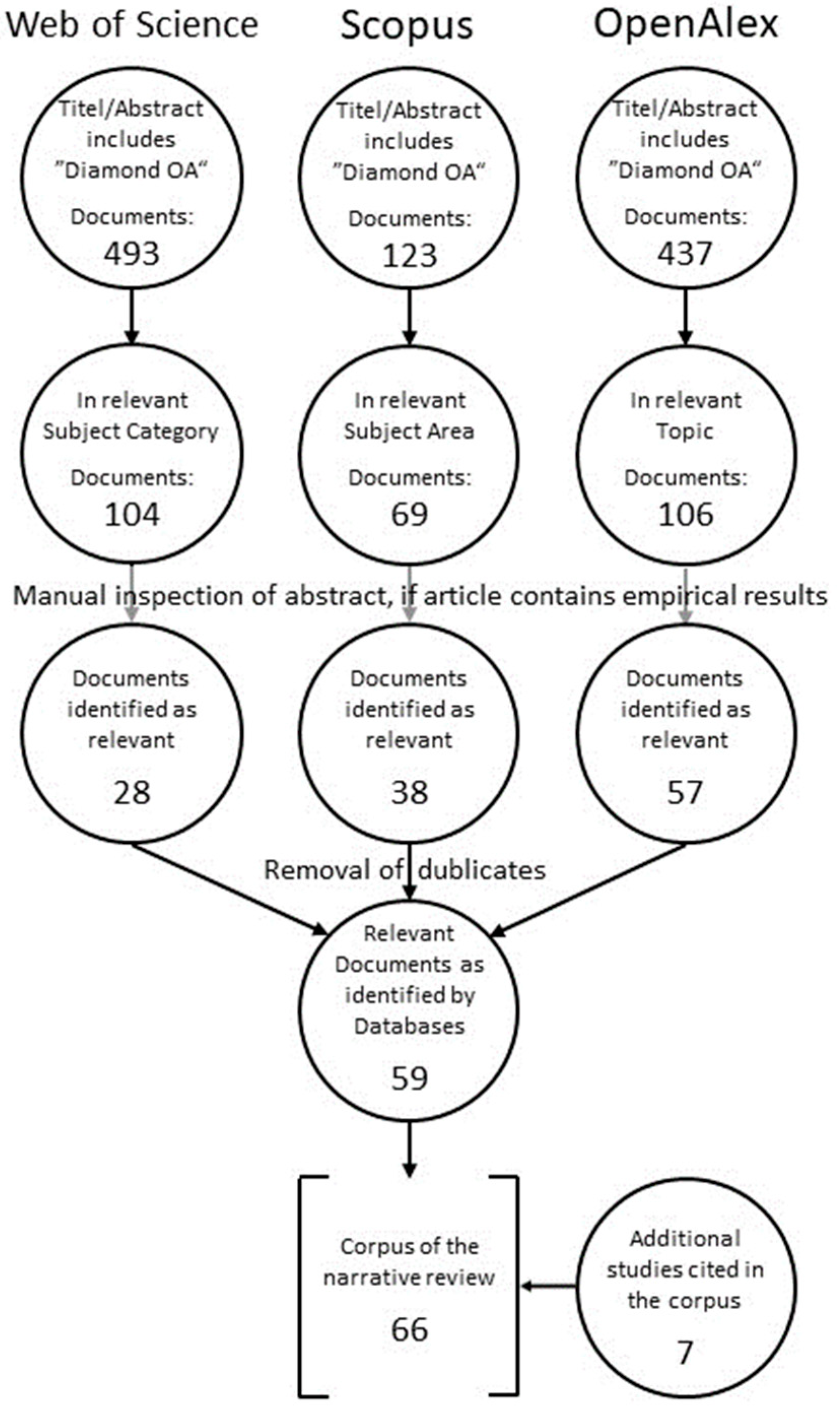
For Scopus, relevant subject areas include Social Sciences, Computer Science, Arts and Humanities, and Business, Management, and Accounting. For WoS, the relevant categories are Information Science & Library Science, Science and Technology Other Topics, Computer Science, Communication, Social Sciences Other Topics, Sociology, and History and Philosophy of Science. In OpenAlex, topics were restricted to Scientometrics and Bibliometrics Research, Research Data Management Practice, Academic Publishing and Open Access, Scientific Computing and Data Management, Cultural, Media and Literary Studies, and Publishing and Scholarly Communication. Figure 1 illustrates the procedure used to identify the relevant literature.
With this search strategy, a considerable number of potentially relevant articles were identified. In order to select the final corpus, all abstracts were screened. Studies addressing mainly technical aspects, descriptions or developments of DOA infrastructures, opinion papers, first-hand experiences, and studies focusing on a single institution or DOA books were excluded. After removing duplicates, 59 articles were identified as relevant. This corpus was complemented by seven additional studies of immediate relevance that were cited within the corpus and published as reports, resulting in a total of 66 publications included in the review. All publications were read in full, and a set of relevant topics was identified during the review process.

3. What Are DOA Journals?

As is often the case in research on Open Access (OA), some confusion exists. The term Diamond Open Access has been used with varying meanings, and there is an ongoing debate about how it should be understood. Moreover, alternative terms like Platinum OA (Haschak, 2007) or sponsored OA (Mellins-Cohen, 2024, p. 7) are sometimes used synonymously. Given that current research tends to favor DOA, this term will be used throughout the present paper.
In the literature, there is at least a minimal consensus that DOA refers to publishing models characterized by the absence of costs for both authors and readers (Dellmann et al., 2022, p. 1). This understanding was popularized by the widely cited OA Diamond Journals Study, which defined its object of investigation as “journals that publish without charging authors and readers, in contrast to subscription journals” (Bosman et al., 2021). A similarly pragmatic definition has been adopted by a number of studies (Hahn et al., 2023, p. 50; Frantsvåg, 2022, p. 1; Taubert et al., 2024, p. 196; Arasteh & Blake, 2024, p. 6; Pilatti et al., 2025, p. 2) and is also used for self-identification by DOA journals (González Tous et al., 2022, p. 2; Gallo & Accogli, 2022, p. I; Biel, 2023, p. 2; Tur-Vines, 2023, p. 10; Fick, 2024, p. 35; Ptakova, 2024, p. 127).
However, there are more complex definitions that propose additional criteria beyond the mere absence of payments (Beigel, 2025, p. 10). One prominent example is the Operational Diamond OA Criteria for Journals, developed within the context of the two Horizon 2020–funded EU projects DIAMAS and CRAFT-OA, which specify six aspects. In addition to the absence of author-facing charges, journals should have a permanent identifier, use an open license, and be open to all authors. These criteria aim to clarify what qualifies as a scholarly journal. Yet one particularly significant criterion that considerably narrows the group of eligible journals is community ownership. This designation is somewhat misleading, since the legal entities that own such journals are in most cases not the scientific communities themselves but rather organizations such as “public or not-for-profit organization[s] (or parts thereof) whose mission includes performing or promoting research and scholarship” (Armengou et al., 2024, p. 2).
This ownership criterion addresses an objection raised by Simard et al. (2024, p. 1024), who argue that journals of commercial publishers that temporarily waive APCs should not be considered DOA. It is worth noting that these additional criteria are not justified by research-oriented arguments but rather by reference to practical concerns—particularly fears that large publishing houses might continue exploitative strategies under the label of DOA (Simard et al., 2024, p. 1025). Such an anti-corporatist stance is not new but has accompanied the term since its inception. When proposing it, Fuchs and Sandoval (2013) defined Diamond OA as a “not-for-profit” model run by “non-commercial organizations, associations, or networks” that publish material online in digital format, free of charge for both readers and authors, and that do not allow commercial or for-profit reuse. It also finds its reflection in a best practices practice paper on DOA journals (Zendejo & Escalona, 2025, p. 5) as well as in self-descriptions of some DOA journals (e.g., Tiwari, 2020, p. 1).
Such definitions may be appropriate in the context of science policy, where the aim is to promote a specific understanding of the OA model. However, with respect to research on OA, definitions should not be guided solely by practical considerations for at least two reasons. First, we have argued elsewhere that it is a general requirement of scientific classifications that they should be complete and mutually exclusive and that such requirements also hold for types of OA (Taubert et al., 2019, p. 7). Otherwise, it becomes necessary to invent additional types of OA for cases that do not meet all the criteria that are specified in a given definition.
Second, and equally important, additional criteria also pose challenges for researchers who aim to consistently identify DOA journals in large data collections. Given the lack of an authoritative and exhaustive database of DOA journals, it is already difficult to verify the absence of payments on both the side of the author and the reader for large journal samples. The inclusion of ownership or other criteria—often missing from databases and not easily ascertainable through web searches—makes the valid identification of DOA journals considerably more difficult.

4. Results

4.1. DOA Journal Landscape

After having discussed the term DOA journals, the following sections present empirical findings from different types of studies. The first strand of research on DOA consists of studies that analyze the DOA journal landscape that seek to map and characterize the field within specific boundaries. These studies vary in scope: some adopt a global perspective, while others focus on a single country or a particular disciplinary context. The entities being mapped may include journals and, less frequently, organizations such as institutional publishers or service providers. Common topics of investigation include the number of DOA journals, their geographic or disciplinary distribution, as well as their publication output.
Before turning to specific findings, one methodological observation deserves attention. A key challenge for studies that analyze the DOA journal landscape is the lack of an authoritative and comprehensive source of information on DOA journals. The most prominent source for Gold Open Access, the Directory of Open Access Journals (DOAJ), includes an “APC” flag that allows researchers to identify journals that do not charge authors. However, this data source is far from exhaustive. In response, many studies adopt a similar strategy: they combine and cross-check multiple data sources.
For example, Bosman et al. (2021, p. 26) use the ISSN Gold OA 4.0 list (Bruns et al., 2020), which integrates data from DOAJ, ROAD, PMC, and OpenAPC. Similar approaches are found at the national level. A Swiss study combines DOAJ, Swisscovery, the SCImago Journal Ranking list, EBSCO Academic Search Ultimate, Web of Science, and ROAD (Hahn et al., 2023, p. 10); an Italian study draws on the Electronic Journals Library (EZB), ROAD, OpenAIRE Graph, AVENUR List of Classified Journals, and SCImago (Angioni et al., 2026, p. 8); a German study again uses DOAJ, ROAD, PMC, and OpenAPC (Taubert et al., 2024, p. 198); a Canadian study combines OpenAlex, the CRKN Open Access Journal Lists, Érudit as well as data from the Public Knowledge Project (van Bellen & Cespedes, 2025, p. 98); and a study of South American and Caribbean countries uses SciELO and Redalyc (Beigel et al., 2024). These examples illustrate that substantial effort is still required to create databases that are suitable for the systematic analysis of DOA journals.

4.1.1. Number of Journals

The number of DOA journals reported in the literature is impressive, regardless of the entities examined. At the global level, Bosman et al. (2021, p. 27) estimate the number of DOA journals to range between a lower bound of 17,000 and an upper bound of 29,000—a magnitude confirmed by estimates from the Korean Council of Science Editors (2022, p. 123). Of the 11,064 journals indexed in DOAJ, approximately 45% are published in Europe, 25% in Latin America, 16% in Asia, and nearly 6% in the United States and Canada (Bosman et al., 2021, p. 32). Based on DOAJ data, a large increase in the number of Diamond OA journals can be observed between 2015 and 2020 (Simard et al., 2022, p. 3).
At the country level, 186 DOA journals have been identified for Switzerland (Hahn et al., 2023, p. 11), 205 for Pakistan (Raza et al., 2024, p. 4), 298 for Germany (Taubert et al., 2024, p. 201), 462 for Italy (Peruginelli & Faro, 2024, p. 70), and 571 for Canada (van Bellen & Cespedes, 2025, p. 104). A study of 1720 journals hosted by the South American and Caribbean publishing platforms SciELO and Redalyc found that the vast majority—1538 journals—are DOA, charging no fees to authors (Beigel et al., 2024, p. 18). The largest numbers of journals on the two platforms are reported for Brazil (506), Colombia (291), Mexico (283), Argentina (167), and Chile (144), reflecting a long and strong tradition of DOA publishing in those countries (Beigel et al., 2024, p. 10). However, these absolute numbers cannot be directly compared, as both the data sources and the criteria used to assign journals to countries differ between studies. Table 1 gives an overview about the number of DOA journals by country as identified by different studies.
Khanna et al. (2022) take a different approach and focus on journals using Open Journal Systems (OJS), an editorial management and hosting platform developed by the Public Knowledge Project (PKP). The platform is frequently used by journals operating independently of major publishers. The number of active journals in 2020 was as high as 25,671 (Khanna et al., 2022, p. 914), distributed across 136 countries. The largest numbers are found in Indonesia (11,535 journals) and Brazil (2653). More than 81% of OJS-based journals are located in middle- or low-income countries (Khanna et al., 2022, p. 920).
Beyond absolute numbers, several studies also examine the share of DOA journals among all Gold OA journals. At the global level, estimates range from 66% (Crawford, 2024, p. 6) to 73% (Bosman et al., 2021, p. 26). Evidence regarding trends over time is less straightforward. A study based on DOAJ data found a steady decrease in the share of DOA journals between 1986 and 2020 (Druelinger & Ma, 2023, p. 352). For the subset of journals indexed in the Web of Science, only 3% of journals with a Journal Impact Factor (JIF) are DOA. This share is, however, growing more rapidly than the overall number of academic journals in that subset (Pearce, 2022, p. 212). These seemingly contradictory trends may reflect the selective inclusion of journals in the Journal Citation Reports or the faster growth of APC-based Gold OA journals. At the national level, shares of DOA also vary: in Canada, the share is 61% (van Bellen & Cespedes, 2025, p. 104), while in Pakistan it stands at 69% (Raza et al., 2024, p. 104), roughly aligning with the global average.
Some studies adopt a disciplinary perspective, examining DOA journals in relation to other types such as APC-based Gold OA, hybrid, or subscription journals. For engineering, 757 active OA journals were identified, of which 504 (67%) charged APCs and 253 (33%) were DOA—representing 8.4% of all engineering journals indexed in Scopus (Pilatti et al., 2025, p. 3). A comparison across quartiles based on CiteScore metrics revealed that DOA journals are less frequent in higher quartiles and overrepresented in lower ones (Pilatti et al., 2025, p. 5). Further analysis of top-quartile journals showed that article output is strongly dominated by APC-based mega-journals published by the scholarly association IEEE (Pilatti et al., 2025, p. 6). However, due to the limited coverage of DOA journals in proprietary databases, their actual share in this disciplinary segment may be underestimated.

4.1.2. Publication Output of Diamond OA Journals

The analysis of the number of journals provides insight into the scale of ongoing efforts to offer fee-free publishing venues; however, it does not indicate the overall relevance of DOA, as publication output can range from only a few articles per year to several tens of thousands in the case of mega-journals. Studies that relate article volume to journal numbers consistently find that although the majority of Gold OA journals do not charge fees, most articles are published in APC-based journals—a phenomenon Crawford (2024, p. 6) describes as the “articles-vs.-journals split.” While 63.8% of Gold OA journals listed in DOAJ do not charge a fee, 70.5% of articles are published in APC-based journals. According to a DOAJ-based study, DOA journals accounted for the majority of article output in Gold OA journals from 1986 onwards. Since 2008, however, this relationship has shifted: APC-based Gold OA journals now publish more than half of all articles in the database, rising to 68.7% in 2020 (Druelinger & Ma, 2023, p. 351). When interpreting these results, it must be considered that DOAJ coverage is not exhaustive and may be biased in favor of APC-based journals.
While DOA journals are numerous, their publication output is comparatively modest as Table 2 shows. For DOA journals indexed in DOAJ, the annual average number of articles was 34 for 2017–2019, compared with 55 for APC-based journals. Large journals with annual outputs exceeding 500 articles are virtually absent (Bosman et al., 2021, p. 36). Similar findings are reported elsewhere: in Switzerland, the median output was 15 articles in 2021, based on a survey of editors (Hahn et al., 2023, p. 20). For Italy, (Angioni et al., 2026) also report small-scale publishing activity, with most journals publishing between 10 and 24 articles per year between 2000 and 2024, albeit with a gradual tendency toward expansion. For German DOA journals, the median output in 2021 was 16 articles per year, compared with 72 for journals indexed in the Web of Science. Large-scale journals with outputs above 500 articles annually are absent from the German DOA landscape, whereas more than 5% of journals indexed in the Web of Science exceed this threshold (Taubert et al., 2024, p. 206). These findings align with a study by Björk et al. (2016), who examined 250 “indie” journals—initiatives launched by scientists without the backing of publishers or learned societies before 2002. The study reports an increase in median article output from 12 in 2003 to 18 in 2014 (Björk et al., 2016, p. 7). Thus, the majority of DOA journals can be considered small- to mid-sized publishing ventures.
Moreover, there is evidence that journal size correlates with the presence or absence of fees, and that this, in turn, correlates with the size of the publishing entity (in terms of the number of journals published). A study focusing on Europe finds that DOA journals are more often published by small and mid-sized publishers, while APC journals are much more frequently published by larger publishing companies (Laakso & Multas, 2023, p. 452). This result is confirmed by a global study, which also highlights strong disciplinary differences. In the arts and humanities, 77% of articles in journals indexed in DOAJ are published in DOA journals of small publishers, whereas the share is as low as 8% for large publishing companies. In the social sciences, the difference is similarly pronounced, with 65% of articles published in DOA journals of small publishers compared to 16% in those of large publishing companies (van Bellen & Cespedes, 2025, p. 11).
Some studies also estimate the share of DOA publications in the overall scholarly output. Compared with the total global journal output—including hybrid and subscription titles—DOA journals account for an estimated 356,000 articles per year for 2017–2019, corresponding to 8–9% of all scholarly articles (Bosman et al., 2021, p. 30). Findings at the country level are in line with this result: in Italy, 9.4% of national research output appears in DOA journals (Angioni et al., 2026, p. 10), while Frantsvåg (2022, p. 4) reports an increase in the share of Diamond OA publications in another national context from 5% in 2017 to 8% in 2020.
Building on the quantitative overview presented in the previous section, this section examines the diversity of DOA journals in more detail, focusing on variations across disciplines, languages, and publishing entities.

4.2. Diversity of DOA Journals

4.2.1. Distribution Among Subject Areas

A first dimension of diversity concerns the subject areas, disciplines, or scientific fields covered by DOA journals. On a global level, notable differences can be observed. The main concentration lies in the social sciences and the arts and humanities, which together account for 61% of DOA journals. Twenty-two percent publish research in the sciences and 17% in medicine (Bosman et al., 2021, p. 34). These findings confirm earlier results by Björk et al. (2016, p. 13). More disaggregated data at the regional and national levels, however, reveal a more nuanced picture. In many European countries, the distribution mirrors the global pattern. For example, in Switzerland, DOA journals are strongly concentrated in the social sciences (44.6%), arts and humanities (21.0%), and life sciences and biomedicine (21.0%) (Hahn et al., 2023). A similar pattern is observed in Germany, where 36.9% of DOA journals publish in the social sciences and 35.6% in the arts and humanities (Taubert et al., 2024, p. 203). Recent studies from Italy (Angioni et al., 2026, p. 9), Canada (van Bellen & Cespedes, 2025, p. 104), and Norway (Frantsvåg, 2022, p. 4) confirm comparable disciplinary profiles, often summarized as a “predominance of SSH disciplines” (van Bellen & Cespedes, 2025, p. 104).
However, three studies provide empirical evidence that this global distribution is largely shaped by European DOA journals, whereas other regions exhibit distinct disciplinary profiles. A study of 25,671 journals using the Open Journal Systems (OJS) platform—of which 84.2% are DOA—found that the social sciences account for 45.9% of journals, while science, technology, engineering, and mathematics (STEM) fields represent a substantial 40.3%. A re-analysis of this dataset by Bosman et al. (2021), cited in Yoon et al. (2025b, p. 56), identified clear regional differences: whereas the social sciences dominate in Europe, science journals are more prevalent in Africa, Asia, and the Middle East, where their share ranges between 23.1% and 30.4%. Beigel et al. (2024, p. 14) examined Latin American and Caribbean journals hosted on the SciELO and Redalyc platforms. The vast majority (89.4%) of the 1720 journals are DOA (see also Segovia et al., 2024, p. 4). Across the region, social sciences account for 33% of journals, medical and health sciences for 19%, humanities for 12%, and natural sciences for 10%. Analyses on the country level further reveal distinct national profiles: social sciences dominate in Uruguay, Ecuador, Puerto Rico, Brazil, Bolivia, Mexico, and Peru, whereas medical and health sciences are particularly well represented in Cuba, Uruguay, Bolivia, Costa Rica, and Peru. In contrast, Argentina, Bolivia, and Brazil show relatively high shares of journals in the natural sciences.

4.2.2. Language

A second dimension of diversity concerns the languages accepted for publication. Empirical evidence consistently indicates that DOA journals display greater linguistic diversity than APC-based journals. A global study comparing journals indexed in DOAJ found that 85.5% of APC-based journals and 62.2% of DOA journals accept only one language. Two languages are accepted by 9.7% of APC-based journals and 23.1% of DOA journals, while three languages are accepted by 3.6% and 9.2%, respectively. English is the most common publication language, used by 70.5% of DOA journals compared to 90.7% of APC-based journals. Among DOA journals, 25.7% accept Spanish, 17.4% Portuguese, 9.1% Indonesian, and 9.1% French. For APC-based journals, only Indonesian stands out, with 9.6% of journals publishing in this language (Bosman et al., 2021, p. 41).
These findings are supported by other studies. A comparative analysis of DOA journals in English-speaking and non-English-speaking countries found that 19.8% publish exclusively in English, 55.9% in English and other languages, and 24.3% in non-English languages (Yoon et al., 2025b, p. 60). Similar patterns appear among small publishers—often responsible for DOA journals—where multilingualism is common (Laakso & Multas, 2023, p. 453). Studies of OJS-hosted journals also confirm this diversity: 60 languages are represented, and nearly half (48%) of the journals allow publication in more than one language (Khanna et al., 2022, p. 920). Supporting evidence for large language diversity in DOA journals is provided by a study of SciELO and Redalyc journals which shows that, among articles published between 1995 and 2018, 43.7% were written in Spanish, 32.1% in Portuguese, and only 23.9% in English (Beigel et al., 2024, p. 26). Multilingualism also characterizes DOA publishing in certain European contexts. In Switzerland, 36.6% of DOA journals publish exclusively in English, while 44.1% accept more than one language (Hahn et al., 2023, p. 14). In Norway, Nordic languages play an important role in most scholarly fields, with the notable exception of the natural sciences and engineering (Frantsvåg, 2022, p. 9). Overall, these findings highlight the integral role of linguistic diversity in shaping the global DOA landscape.

4.2.3. Publishing Entity

A third dimension of diversity concerns the institutions that serve as publishers of DOA journals. The sources of information used to identify these publishing entities are likewise diverse. Some studies draw on existing data collections, such as publishing platforms like SciELO and Redalyc (Beigel et al., 2024), while others rely on open access evidence sources such as the DOAJ (Bosman et al., 2021, p. 35). Still others collect data independently, for instance, through surveys with journal editors or service providers (Stojanovski & Mofardin, 2025), or by gathering information directly from the journal’s websites (Taubert et al., 2024).
According to an analysis based on the DOAJ, 71.4% of DOA journals are published by universities, 13.7% by OA publishers, 10.1% by societies and governmental organizations, and 3.6% by commercial publishers at the global level (Bosman et al., 2024, p. 35). For Switzerland, 47.3% of DOA journals are published by higher education institutions, followed by 19.9% by academic societies, and a notable 11.3% by for-profit publishers (Hahn et al., 2023, p. 13). Parts of these findings align with the situation in Germany, where the majority of DOA journals are published by research institutions (57.7%) and 10.4% by learned societies. However, the share of DOA journals published by commercial publishers is even higher than in Switzerland, at 17.1%, which can partly be attributed to the strong adoption of the Subscribe-to-Open model in Germany. Moreover, it is worth noting that 5.0% of German DOA journals are published by individuals.
In Italy, a major share (57.7%) of DOA journals is published by institutions, with an additional 26.2% also attributed to not-for-profit institutions (Angioni et al., 2026, p. 13). The proportion of journals published by commercial companies is 8.3%. The strong role of public organizations also becomes apparent when the focus shifts from journals to providers of infrastructure. A survey of 77 respondents reports that most institutional publishers in Croatia are public organizations, followed by private, not-for-profit organizations (Stojanovski & Mofardin, 2025, p. 5).
In Latin American and Caribbean countries, the situation is similar: journals hosted on publishing platforms such as SciELO and Redalyc are predominantly published by public organizations. Universities account for 66% of journals on these platforms, independent research centers for 20%, and governmental agencies for 7%. There is also a notable share of 8.5% of journals published by commercial publishers (Beigel et al., 2024, p. 17).

4.3. Indexing

A number of studies have examined the coverage of DOA journals in multidisciplinary bibliographic databases, regional indexes, library discovery services, and OA evidence systems. Although their findings generally indicate low levels of coverage, the degree of clarity and comparability among these studies varies for at least two reasons: the methods applied for data collection and the specific data sources used, particularly when relying on existing large-scale databases.
Regarding data collection, some studies are based on surveys and self-reported inclusion in indexes as reported by editors, while others use direct evidence such as ISSN matching. For instance, based on survey responses from editors of 1359 journals, Bosman et al. (2021) found that more than 1000 DOA journals were indexed in the DOAJ, and over 900 were listed in Google Scholar. Approximately 500 DOA journals were indexed in Scopus and more than 300 in the Web of Science (WoS) (Bosman et al., 2021, p. 45; Korean Council of Science Editors, 2022, p. 132). However, the validity of these results may be questioned. A key limitation of the survey method is that editors are likely to better recall indexing in well-known databases, while inclusion in lesser-known indexes or service systems may be forgotten or entirely unknown to respondents.
A study that makes use of a large database—the DOAJ—calculated that 87% of DOA journals are covered by OpenAlex. In contrast, coverage in proprietary databases is far more selective: only 22% of DOA journals are represented in WoS, and 28% in Scopus (Simard et al., 2023). A subsequent study by the same authors found an improvement in coverage but also highlighted significant disciplinary differences. Specifically, 53.2% of DOA journals in biomedical research, 54.9% in natural sciences and engineering, and 68.2% in the social sciences and humanities are not indexed in either WoS or Scopus. The study also shows that the share of indexed DOA journals decreases with lower national income levels—an effect that can be observed across all scientific domains (Simard et al., 2025, pp. 741, 743).
When interpreting these findings, it is important to note that the databases used to identify DOA journals are themselves selective. Therefore, results may vary when alternative sources are applied. Estimates suggesting that roughly two-thirds of DOA journals worldwide are not indexed in DOAJ (Becerril et al., 2021, p. 11) are supported by evidence from Canada, where only 29% of DOA journals are listed in this directory (van Bellen & Cespedes, 2025, p. 10). When considering journals that use a common publishing infrastructure, the share of non-indexed titles is similarly high. A study focusing on journals using OJS reported that 30.9% were covered by DOAJ and 29.4% by ROAD. Coverage by proprietary databases was even lower, with only 1.1% included in the WoS Citation Reports service and 3.9% in Scopus. Even OpenAlex, known for its extensive coverage, indexed only 13.2% of OJS journals (Khanna et al., 2022, p. 923). A discipline-specific study further supports these patterns. In the field of library and information science—a discipline that is particularly sensitive to issues of indexing—only 3.3% of DOA journals are indexed in WoS, compared to a substantially higher 24.7% of Gold Open Access journals (Yoon et al., 2025a, p. 21). In sum, as Table 3 shows, the indexing coverage of DOA journals remains low, particularly in proprietary databases.

4.4. Awareness and Perception of DOA Journals

Partly related to indexing are studies that explore their awareness and perceptions of DOA journals, as in some disciplines in the natural and medical sciences, indexing in major databases is closely connected to the journal’s reputation. This line of research derives from the broader and long-standing interest in scientists’ attitudes toward OA in general (Schroter & Tite, 2006; Creaser et al., 2010; Serrano-Vicente et al., 2016). One common feature of current studies of the awareness and perception of DOA journals is that they tend to be small. A survey study from Switzerland reports that 64% of 123 respondents perceive the publication process in DOA journals as quite similar or only slightly different compared to non-DOA journals (Hahn et al., 2023, p. 29). The scientific impact of DOA journals is generally regarded as lower than that of Gold, Hybrid, or closed-access journals—with the exception of the Arts (Hahn et al., 2023, p. 31). High awareness of DOA journals is also reported in a small study (n = 109) conducted among scholars in Iran. Seventy-eight percent of respondents indicated awareness of DOA, primarily associating it (correctly) with free accessibility for readers and the absence of APCs (Subaveerapandiyan et al., 2025, p. 8). The main perceived benefits are that DOA “fosters innovation and advancement in research fields” and “encourages collaborations among researchers from different countries, making scholarly communication more equitable globally” (Subaveerapandiyan et al., 2025, p. 9). The most prominent concerns are the rigor of editorial processes and “uncertainty about long-term sustainability” (Subaveerapandiyan et al., 2025, p. 13). Perceptions of gold and DOA journals were also investigated in a survey among researchers who had published in high-impact journals of a major OA publisher. Again, the sample size was relatively small, with 152 completed responses. Attitudes toward Gold OA were generally positive, except in relation to the transparency of APC pricing and the extent of institutional financial support for APCs. Perceptions of DOA journals were even more favorable, as these journals were seen as ensuring equitable access for both authors and readers while removing financial barriers. However, respondents expressed mixed views on the sustainability of DOA journals and the extent of institutional support they receive (Kumari & Subaveerapandiyan, 2025, p. 64).
Empirical studies also adopt a disciplinary perspective. A small study of researchers in urology (n = 82) found that 54% of respondents expressed a “positive” to “strongly positive” attitude toward OA. Among the 74% who had experience publishing in OA journals, most reported being either “satisfied” or “completely satisfied” with Gold (65%), Diamond (86%), and hybrid (83%) OA journals (Guennoun et al., 2024, p. e1273).

4.5. Cost Analysis

One line of research derives from the very definition of DOA. If DOA journals neither involve subscription fees nor APC, where do the resources come from? In the literature, monetary resources and unpaid labor (sometimes also called in-kind contributions) are identified as possible sources. The first type of resources is discussed here; the second type and possible effects in the subsequent section.
Empirical evidence for the assumption that the adaptation of DOA journals results in a decrease in costs for the dissemination of research (e.g., Mrša, 2022, p. 2) can be found in a worldwide survey with 1370 editors of DOA journals. Accordingly, the overall costs for running these journals are low. For over 60% of the 965 journals for which data are available, annual costs are below $/€10,000, including in-kind contributions. (Bosman et al., 2021, p. 110). Twenty-six percent even reported costs lower than $/€ 1000. When relating the costs to the article output, median costs of $/€208 per article were calculated across all journals. Given that costs vary by journal size and decrease for journals with larger article outputs, the median costs range from $/€556 for journals publishing five to nine articles per year to $/€48 for journals publishing more than 100 articles per year (Bosman et al., 2021, p. 112). DOA journals around the globe are also supported by paid staff, but again, the scale is small: 53% of the journals report staff of less than 1 Full Time Equivalent (FTE), 28% from 1 to 2 FTE, 16% 3.5% FTE 2% 6–9 FTE and 1% of the journals 10–20 FTE. (Bosman et al., 2021, p. 114). However, these results point to possible inconsistencies of the data: a share of 60% of the journals with a budget below $/€10,000 might not align to a share of 47% of the DOA journals that report a size of paid staff with more than one or (up to 20) full time equivalents—at least in Western countries with high wages a high per capita income. For Switzerland, costs are reported by a small group of 28 journal editors and the median cost is CHF 15,000 higher than reported for the global study. However, the variation is large and within the small journal group, some of them—in particular in life sciences and Biomedicine and Physical Sciences—report costs of several thousand CHF (Hahn et al., 2023, p. 39).
The DIAMAS IPSP study in Europe follows a different approach, as the focus is not on journals but on institutional publishers and service providers. Such organizations are frequently but not always or exclusively involved in DOA publishing. They often publish in a variety of scholarly outlets and, in most cases, more than one DOA journal. Roughly three-quarters of the 685 respondents were institutional publishers that were responsible for at least one journal, while the remaining quarter identified itself as a service provider. The majority of the IPSPs are small in size, with around 50% having one to five full-time equivalents, and 25% having no paid staff (Arasteh & Blake, 2024, p. 21). When considering regional distribution, it turns out that the share of IPSPs that operate without paid staff is considerably higher in Southern and Eastern Europe than in Western and Northern Europe (Armengou et al., 2023, p. 47).
For IPSP, the DIAMAS survey study was analyzed separately. Again, the scale of resources that are reported by 42 of the 251 Croatian IPSP tends to be small: 9 of them report a budget between 1 and 10 thousand €, 13 between 11 and 50 thousand € and another 7 IPSP between 5 and 100 thousand €. However, one remarkable point is that nearly a quarter of the 42 IPSP did not know the annual budget or did not wish to disclose it even though the results were reported anonymously (Stojanovski & Mofardin, 2025, p. 6).

4.6. ‘Voluntary’ Work, Challenges, and the Stability of DOA Journals

Compared to the relevance attributed to DOA journals, relatively little is known about the specific characteristics of their internal operations. Some studies highlight a strong reliance on unpaid work or volunteer labor (Armengou et al., 2023, p. 46; Hahn et al., 2023, p. 8). In the global survey of 1379 editors of DOA journals cited above, 60% of the respondents indicated the involvement of volunteers in journal operations, whereas 40% reported not involving them. Among the journals that do involve volunteers, a large majority of 86% reported either a high or medium reliance on voluntary labor (Bosman et al., 2021, p. 115). In most cases, voluntary and paid work are combined. The main tasks performed by volunteers include editing, proofreading, copy editing, design, and typesetting (Bosman et al., 2021, p. 117). The study also asked about sources of financial support. Interestingly, the three most important types of organizations identified were organizations performing research, national funding or government agencies, and publishers (Bosman et al., 2021, p. 117).
Regarding the extent of monetization and voluntary work, a study of 260 DOA journals arrives at more nuanced results by distinguishing between 26 ‘publication acts’ and asking whether money is used. While the degree of monetized task completion is low for publication acts contributing to certification, legal aspects of publishing monetization are higher in publication acts related to material production and technical issues (Dufour et al., 2023, p. 41).
However, evidence from other world regions suggests that the global landscape is not homogeneous with respect to the reliance on voluntary work. Journals hosted on SciELO and Redalyc are not predominantly voluntary enterprises: “There is considerable consensus within Latin America about the need for national and institutional policies to sustain the management and regularity of the journals, but also a strong consensus that the solution is not in the APC model” (Beigel et al., 2024, p. 19). This statement suggests that funding structures for DOA journals in this region tend to be more favorable than in other parts of the world, where the maintenance of DOA journals often “relies on a heterogeneous and often unstable combination of resources, including various forms of institutional funding and grants from projects that are typically time-limited” (Caravale, 2025, p. 437).
The stability of DOA journals is questioned in the literature, particularly with respect to the difficulties of obtaining permanent funding, and sometimes based on empirical evidence. One example is a study of 250 journals launched by scientists without the support of publishers or learned societies before 2002 (Björk et al., 2016). Within this group, a high degree of volatility was observed: by 2014, 100 journals had ceased operation and another 23 had disappeared. Of the remaining 127 journals (50.8% of the original sample), a majority of 115 still published articles in open access, although 8% of them had introduced APCs. A small share of 9% had become subscription journals by 2014 (Björk et al., 2016, p. 6).
The follow-up question of whether the share of ceased journals is higher among DOA journals than among scientific journals overall has been addressed by other studies. Yoon et al. (2024) compared formal characteristics of journals with low and high sustainability. Based on a multivariate regression analysis, they identified seven factors that influence sustainability: region and official language of the publication country, discipline, ownership, financial status, allowance of text and data mining of full-text articles, and open sharing of research data (Yoon et al., 2024, p. 4). Journals published in Western and Eastern Europe, as well as in Latin America, were found to be less sustainable than those in Canada. Journals in the humanities and social sciences, on the other hand, were more sustainable than those in the medical sciences. Moreover, government-owned journals were more sustainable than those published by universities or for-profit publishers (Yoon et al., 2024, p. 5). A second recent study compared different segments of the journal landscape, including DOA journals, and identified journal age as the main predictor of journal stability. DOA journals appeared to be the most vulnerable group, as they have been overrepresented among ceased journals since the early 2000s (van Bellen & Cespedes, 2025, p. 103).

5. Discussion

5.1. Limitations

Before discussing the results of this narrative review, three remarks regarding its limitations are warranted. First, as described in the Section 2, the review is based—apart from a few exceptions—on literature indexed in the three databases WoS, Scopus, and OpenAlex. In addition, due to language constraints, only studies published in English were included. Both criteria introduce selectivity and affect the scope of the review, as they tend to exclude research from non-English-speaking and non-Western countries. This limitation may be particularly relevant for regions such as South America and the Caribbean, as well as Indonesia, where OA—and DOA in particular—plays a significant role.
Second, additional limitations arise from the data, definitions, and categories used to study DOA journals. As discussed in Section 3, DOA is a contested concept and is defined heterogeneously in the literature. Combined with the absence of an authoritative data source for DOA journals, as well as inconsistently defined categories (e.g., subject classifications or publishing entities) and varying operationalizations (e.g., of language diversity), this heterogeneity makes it difficult to compare the results of existing studies. For the present review, this diversity also constrains the systematic presentation of findings in tables and figures.
Third, a further limitation results from the primary focus of this review, namely, the role of DOA journals within the scholarly communication system. Other relevant characteristics—such as technical aspects (e.g., publishing infrastructures, formats, or the use of persistent identifiers), as well as funding and resourcing models—fall outside the scope of this paper and would require dedicated review articles or original empirical research.

5.2. Main Findings

The review of existing strands of research shows that significant efforts have been undertaken to study DOA journals. The results are of immediate relevance, as they provide essential orientation for shaping the future (D)OA landscape and can be summarized as follows. Despite methodological challenges in constructing reliable datasets, landscape studies demonstrate that DOA represents a substantial segment of scholarly publishing. While the number of DOA journals is large and continues to grow across regions, their individual publication volumes remain comparatively modest (Armengou et al., 2023, pp. 25, 53), with some countries and regions constituting exceptions. Analyses of disciplinary profiles and thematic foci underscore the importance of country-level analyses. Although DOA journals in many regions primarily focus on the social sciences and humanities, significant regional and national variations exist. Moreover, research addressing aspects of diversity—especially with regard to language—suggests that the global communication system of science is less homogeneous than often assumed in bibliometric studies. Divisions are evident not only between language regions but also within multilingual countries. Latin America and the Caribbean provide a clear example, as scholarly publishing frequently occurs in languages other than English. One may conclude that these countries “have established their own scholarly community centered around their languages” (Yoon et al., 2025b, p. 63). With respect to publishing entities, DOA publishing is primarily driven by universities, research institutions, and other public or non-profit actors. However, national differences—such as the stronger presence of commercial publishers in some contexts—may reflect distinct policy frameworks and funding mechanisms. Together, these patterns highlight that DOA is not a uniform model but a rich and multifaceted segment of scholarly communication shaped by local specificities.
Coverage of DOA journals in indexing services tends to be low compared with Full OA or subscription journals. DOA journals are generally better represented in OA directories and open citation databases, but are weakly included in commercial interdisciplinary databases. This limited representation poses a significant disadvantage—not only by reducing visibility and discoverability, but also by restricting participation in widely used citation metrics. In disciplines where journal selection is strongly influenced by indicators such as the JIF, the absence of DOA journals from major indexing systems constitutes a serious impediment to their development and recognition. Findings from relatively small-scale survey studies on the awareness and perception of DOA journals indicate that they are generally perceived positively and accepted as a legitimate channel for communicating research. Moreover, none of the studies provides empirical evidence suggesting that perceptions of the model constitute a significant obstacle.
Finally, the literature provides evidence that DOA journals often rely on unpaid labor and tend to be less stable. With respect to causes and underlying mechanisms, several indications point to possible explanations. One is provided by Hahn et al., who quote an editor describing their journal as “run by exploitation,” explaining: “I mean, specifically my two colleagues have their PhD dissertations to write. They’re doing the bulk of the work. And I think that’s sometimes difficult to balance” (quoted in Hahn et al., 2023, p. 18). A second indication comes from a study involving eighteen editors of DOA journals in Aotearoa/New Zealand, which highlights signs of underfunding, including a lack of recognition and insufficient financial, copyediting, technical, training, marketing, and overall support (Hayes & Murdoch, 2025, pp. 8–13). Finally, a study of German DOA journals identified possible mechanisms through which reliance on unpaid contributions may hamper long-term stability: the unpaid nature of contributions limits editors’ ability to enforce task completion and to influence how tasks are performed. In cases of resource shortages, workload is often shifted onto already committed team members; as a consequence, such shifts may result in situations in which particular individuals become indispensable (Taubert et al., 2024, pp. 215–219).
After highlighting key empirical findings from the literature, one overarching critical aspect of research on DOA journals warrants attention. As the summary indicates, most existing analyses are descriptive. They provide valuable insights into diverse aspects of DOA journal publishing, but neither offers explanatory accounts nor situates their findings within broader analytical frameworks that would enable a deeper understanding of the observed properties and differences. This applies both to landscape studies and to analyses of specific characteristics of DOA journals, such as size, language, publishing entities, or indexing. For example, the comparatively small size of DOA journals is repeatedly noted in the literature, yet few systematic efforts have been made to empirically investigate the factors that constrain their growth. One possible explanation for the predominantly descriptive character of DOA research lies in its orientation toward shaping scholarly publishing and the demand to produce rapid, policy-relevant results. The time horizon of science policy tends to favor quantitative research designs employing bibliometric, survey, and statistical methods, occasionally supplemented by qualitative components that illuminate selected aspects. As a consequence, features of DOA journals that are more complex and time-intensive to study remain underexplored. With regard to both research design and temporal scope, there is therefore a need to more clearly emancipate research on DOA from the immediate practical imperatives of science policy. The conclusion will therefore outline possible lines of inquiry that may help address this gap.

5.3. Impregnation with Normativity

However, there is also a need for stronger emancipation from science policy in a second sense. In parts of the research on DOA journals, it appears difficult to describe the object of investigation without adopting normative language. The sources of this normativity are evident: in current science policy discourse, DOA journals are associated with strongly positive attributes and presented as the desirable publishing model. To illustrate this point, the 2nd Diamond Open Access Conference attributes seven characteristics to DOA journals: (1) equity, (2) knowledge as a public good, (3) community-driven initiatives, (4) diversity, (5) transition to diamond, (6) research assessment and recognition, and (7) multi-level cooperation (Saenen et al., 2024). Whether these characteristics are assumed to apply to all DOA journals is not entirely clear; however, there is little doubt that they are regarded as positive and explicitly welcomed. In a similar normative vein, the Diamond Open Access Standard (DOAS), developed within the DIAMAS project, characterizes DOA as the “ideal, most equitable, end state of scholarly publishing” (Consortium of the DIAMAS Project, 2024, p. 5). At the same time, it suggests that even journals that have reached this normative telos of scholarly publishing can further improve by adopting elements listed as “desired” features. Examples include the adoption of an open science policy that “shows [the journal] is aware of the value of OS and understands what it entails,” or the explicit acknowledgement that publishing negative or unexpected results contributes to scientific advancement (Consortium of the DIAMAS Project, 2024, pp. 20–21). Similarly, the Council of the European Union (2023) characterizes Diamond OA publishing as “high-quality,” “transparent,” “trustworthy,” and—again—“equitable.”
Such normative attributions spill over into scholarly discourse and are echoed not only in opinion papers (e.g., Andringa et al., 2024, p. 7, characterizing DOA as “truly inclusive”) but also in parts of the research literature. This occurs when certain characteristics are presented as inherent features of DOA journals from the outset, without empirical evidence or further justification. Examples include the characterization of DOA journals as per se “sustainable” (e.g., Peruginelli & Faro, 2024, p. 67), “equitable” (ibid.), or “epistemologically diverse” (e.g., Stojanovski & Mofardin, 2025, p. 1), without substantiating these claims empirically. The effects of unreflected normativity extend beyond the semantic level when they shape research design and introduce normative biases. This may occur, for instance, if commercial actors are excluded from the definition of the object of study from the outset. During data collection, normative bias may lead to a focus on monetary costs while overlooking non-monetary contributions, thereby implicitly suggesting that DOA journals operate at low cost. Normative assumptions may also influence interpretation—for example, when analyses of DOA journals across citation-based quartiles emphasize their share in the highest quartile while neglecting their overrepresentation in lower categories.
A more balanced approach would conceptualize DOA as a highly diverse set of publishing practices (van Bellen & Cespedes, 2025, p. 109), encompassing both strengths and weaknesses that require empirical investigation. Rather than presuming that DOA is inherently scholarly led, non-commercial, and equitable, research should aim to examine these attributes as open empirical questions.

6. Conclusions

This paper has reviewed the literature on DOA journals published after this journal segment became a priority in European research policy around 2020. In conclusion, five directions for future research can be identified.
First, the existing strands of research discussed in this review need to be continued. Such research is of immediate relevance because it provides essential information for shaping the future (D)OA landscape. The current emphasis on large-scale quantitative analyses of the DOA landscape and survey-based studies should be maintained—not only by extending coverage to countries, disciplines, and publication infrastructures that have not yet been examined, but also by revisiting areas already studied, given the rapid evolution of DOA. As infrastructural support for DOA journals increases, data availability—previously perceived as a major limitation (Frantsvåg, 2022, p. 2)—is expected to improve. Important building blocks include advancements in open bibliometric data (particularly OpenAlex), the expansion of CRIS implementations, and the emergence of new DOA evidence systems such as the EZB, the Diamond Discovery Hub (Bargheer et al., 2024), and journal registries developed by national initiatives (e.g., SeDOA).
Second, existing lines of research should be complemented by studies that provide explanatory accounts and a more contextualized perspective. Quantitative analyses have shown that in many Western countries DOA journals are concentrated in specific disciplines, most notably the social sciences and humanities (SSH), whereas the distribution differs in several Latin American countries. The reasons for this disciplinary concentration remain unclear. In Norway (Frantsvåg, 2022) and Canada (van Bellen & Cespedes, 2025, p. 105), funding programs dedicated to SSH journals may partly explain this pattern. However, similar disciplinary distributions are observed in contexts without such programs, suggesting that country-level funding mechanisms (Zlodi et al., 2023, p. 21) are not the sole explanatory factor. Additional explanations may include the multi-paradigmatic epistemic structure of SSH, the relatively small size of research communities (which makes individually initiated journals more viable), the importance of local languages, or the limited commercial interest of large publishers in these fields. Understanding these mechanisms is essential for assessing the conditions under which DOA models can succeed across disciplines.
Third, studies indicate that most DOA journals are small to mid-sized, while large-scale journals are virtually absent (see Section 4.2). A realistic assessment of the potential and limitations of DOA, therefore, requires systematic investigation of the factors influencing journal size and the mechanisms that may constrain growth. Addressing these questions demands comprehensive empirical designs that consider internal operations, cooperation among actors, disciplinary environments, and the funding and support structures from which necessary resources are derived.
Fourth, as discussed in Section 4.6, several studies show that many DOA journals rely on what is described as “voluntary” work and that some lack long-term stability (e.g., Björk et al., 2016; Bosman et al., 2021). Both aspects—including their potential interrelations—require more in-depth investigation of the internal organization of DOA journals and editorial offices. A productive starting point would be to move beyond the notion of “voluntary” work and instead focus on its unpaid character. This shift allows for more precise questions about why scholars contribute labor without financial compensation. Possible explanations include dependency relations within academic fields or institutions (Peacock, 2016), path dependencies created by prior engagement (Taubert et al., 2024), and normative commitments. The work of Mauss (1954) on the ambivalence of gifts provides a fruitful conceptual lens for analyzing the effects of unpaid contributions. Empirical research could examine such ambivalences both at the level of individual contributors and at the level of journal operations, thereby shedding light on questions of stability. These ambivalences may involve challenges in retaining skilled personnel (Stojanovski & Mofardin, 2025, p. 14), concerns about reliance on volunteers (Bosman et al., 2021, p. 124), workload transfers that burden highly committed team members (Taubert et al., 2024, p. 217), and instances of self-exploitation (Hahn et al., 2023, p. 47).
Fifth, scholarly publishing is a resource-intensive activity, and this also applies to DOA journals—even in the absence of commercial publishers and where institutional publishers assume responsibility. Current cost estimations are not entirely convincing, as reported budgets and numbers of paid staff often do not align. Such inconsistencies raise methodological concerns about survey-based approaches that rely on self-reported cost data from editors (Bosman et al., 2021; Hahn et al., 2023). This issue is particularly salient when practical tasks—“such as running an online platform, generating visibility, [or] typesetting”—that are outsourced to paid professionals in commercial publishing must instead be performed by academics themselves, in addition to the unpaid labor they were already providing (van Charldorp & Labrie, 2024, p. 2). Realistic estimations of DOA costs must therefore account for unpaid labor, which generates opportunity costs for both individuals and institutions: time spent working for a journal is time not spent writing articles, developing grant proposals, completing PhD theses, or conducting research. As a result, crucial components of DOA cost structures remain invisible in current data-gathering approaches. More ambitious research designs are required—incorporating editors, editorial staff, support personnel, librarians, IT departments, and service providers—to collect and cross-validate information on budgeted and non-budgeted expenditures, unpaid labor, and in-kind contributions.
Taken together, current research and the directions outlined above demonstrate that DOA journals constitute a diverse and dynamic field of scholarly publishing that remains only partially understood and requires further systematic investigation.

Funding

This research received no external funding.

Data Availability Statement

Data sharing is not applicable.

Conflicts of Interest

The author declares no conflicts of interest.

Abbreviations

The following abbreviations are used in this manuscript:
APCArticle Processing Charges
CRISCurrent Research Information Systems
DOADiamond Open Access
DOAJDirectory of open access journals
DOASDiamond Open Access Standard
ERAEuropean Research Area
EZBElectronische Zeitschriften Bibliothek Regensburg
FTEFull Time Equivalent
IPSPInstitutional Publisher and Service Provider
JIFJournal Impact Factor
OAOpen Access
OJSOpen Journal Systems
PKPPublic Knowledge Project
PMCPubMed Central
ROADDirectory of Open Access Scholarly Resources
WoSWeb of Science

References

  1. Ancion, Z., Borrell-Damián, L., Mounier, P., Rooryck, J., & Saenen, B. (2022). Action plan for diamond open access. Zenodo. [Google Scholar] [CrossRef]
  2. Andringa, S., Mos, M., van Beuningen, C., Gonzalez, P., Hornikx, J., & Steinkrauss, R. (2024). Diamond is a scientist’s best friend: Counteracting systemic inequality in open access publishing. Dutch Journal of Applied Linguistics, 13, 18802. [Google Scholar] [CrossRef]
  3. Angioni, S., Baglioni, M., Bardi, A., Manghi, P., Mannocci, A., & Pavone, G. (2026). Charting the landscape of Italian diamond open access publishing. Quantitative Science Studies, 1–18. [Google Scholar] [CrossRef]
  4. Arasteh, S., & Blake, O. (2024). The European landscape of institutional publishing—A synopsis of results from the DIAMAS survey. Zenodo. [Google Scholar] [CrossRef]
  5. Armengou, C., Aschehoug, A., Ball, J., Bargheer, M., Bosman, J., Brun, V., de Pablo Llorente, V., Franczak, M., Frantsvåg, J. E., Hersperger, O., Klaus, T., Kramer, B., Kuchma, I., Laakso, M., Manista, F., Melinščak Zlodi, I., Mounier, P., Pölönen, J., Pontille, D., … Wnuk, M. (2023). Institutional publishing in the ERA: Results from the DIAMAS survey. Zenodo. [Google Scholar] [CrossRef]
  6. Armengou, C., Bargheer, M., Gingold, A., Holsinger, S., Laakso, M., Mitchell, D., Mounier, P., Pölönen, J., Rooryck, J., Ševkušić, M., Souyioultzoglou, I., & Varachkina, H. (2024). Operational diamond OA criteria for journals. Available online: https://zenodo.org/records/12721408 (accessed on 10 March 2026).
  7. Asai, S. (2021). Author choice of journal type based on income level of country. Journal of Scholarly Publishing, 53(1), 24–34. [Google Scholar] [CrossRef]
  8. Bargheer, M., Varachkina, H., Dreyer, M., & Müller, L. (2024). The diamond discovery hub and its suggested diamond OA criteria for journals. Septentrio Conference Series, (1), 1. [Google Scholar] [CrossRef]
  9. Beall, J. (2012). Predatory publishers are corrupting open access. Nature, 489(7415), 179. [Google Scholar] [CrossRef]
  10. Becerril, A., Bosman, J., Bjørnshauge, L., Frantsvåg, J. E., Kramer, B., Langlais, P.-C., Mounier, P., Proudman, V., Redhead, C., & Torny, D. (2021). OA diamond journals study. Part 2: Recommendations. Zenodo. [Google Scholar] [CrossRef]
  11. Beigel, F. (2025). Untangling the future of diamond access: Discussing quality standards for the re-communalization of scholarly publishing. Zenodo. [Google Scholar] [CrossRef]
  12. Beigel, F., Packer, A. L., Gallardo, O., & Salatino, M. (2024). OLIVA: The scientific output in journals edited in Latin America. Disciplinary diversity, institutional collaboration, and multilingualism in SciELO and Redalyc (1995–2018) *. Dados, 67, e20210174. [Google Scholar] [CrossRef]
  13. Biel, L. (2023). JoSTrans: 20 years of diamond open access publishing in translation and interpreting studies. Journal of Specialised Translation, 40, 1–8. [Google Scholar] [CrossRef]
  14. Björk, B.-C., Shen, C., & Laakso, M. (2016). A longitudinal study of independent scholar-published open access journals. PeerJ, 4, e1990. [Google Scholar] [CrossRef]
  15. Borrego, Á. (2023). Article processing charges for open access journal publishing: A review. Learned Publishing, 36(3), 359–378. [Google Scholar] [CrossRef]
  16. Bosman, J., Frantsvåg, J. E., Kramer, B., Langlais, P.-C., & Proudman, V. (2021). The OA diamond journals study. Part 1: Findings. Zenodo. [Google Scholar] [CrossRef]
  17. Bosman, J., Frantsvåg, J. E., Kramer, B., Manista, F., Mounier, P., Rooryck, J., Stone, G., Armengou, C., Aschehoug, A., Ball, J., Bargheer, M., Brun, V., de Pablo Llorente, V., Franczak, M., Hersperger, O., Klaus, T., Kuchma, I., Laakso, M., Melinščak Zlodi, I., … Wnuk, M. (2024). Institutional publishing in the ERA: Results from the DIAMAS survey. D2.3 Final IPSP landscape report. Zenodo. [Google Scholar] [CrossRef]
  18. Bruns, A., Lenke, C., Schmidt, C., & Taubert, N. C. (2020). ISSN-matching of gold OA journals (ISSN-GOLD-OA) 4.0. Available online: https://pub.uni-bielefeld.de/record/2944717 (accessed on 10 March 2026).
  19. Bruns, A., Taubert, N., Cakir, Y., Kaya, S., & Beidaghi, S. (2022). Diamond open access journals Germany (DOAG). Available online: https://pub.uni-bielefeld.de/record/2963331 (accessed on 10 March 2026).
  20. Butler, L.-A., Matthias, L., Simard, M.-A., Mongeon, P., & Haustein, S. (2023). The oligopoly’s shift to open access: How the big five academic publishers profit from article processing charges. Quantitative Science Studies, 4(4), 778–799. [Google Scholar] [CrossRef]
  21. Caravale, A. (2025). Diamond open access and research infrastructures: The involvement of ⟪archeologia E Calcolatori⟫ in the H2iosc project. Archeologia E Calcolatori, 36(1), 435–442. [Google Scholar] [CrossRef]
  22. Consortium of the DIAMAS Project. (2024). The diamond OA standard (DOAS). Zenodo. [Google Scholar] [CrossRef]
  23. Council of the European Union. (2023). High-quality, transparend, open, trustworthy and equitable scholarly publishing—Concil conclusions (approved on 23 May 2023 (No. 9616/23)). Available online: https://data.consilium.europa.eu/doc/document/ST-9616-2023-INIT/en/pdf (accessed on 10 March 2026).
  24. Crawford, W. (2024). Gold open access 2024: Articles in journals 2019–2023 (GOA9). Cites & Insights Books. Available online: https://www.lulu.com/shop/walt-crawford/gold-open-access-by-country-2015-2020/paperback/product-eqzgjg.html (accessed on 10 March 2026).
  25. Creaser, C., Fry, J., Greenwood, H., Oppenheim, C., Probets, S., Spezi, V., & White, S. (2010). Authors’ awareness and attitudes toward open access repositories. New Review of Academic Librarianship, 16(Suppl. S1), 145–161. [Google Scholar] [CrossRef]
  26. Dacos, M. (2011). OpenEdition freemium. La Lettre du Collège de France, 31, 56–67. [Google Scholar] [CrossRef]
  27. Dellmann, S., van Edig, X., Rücknagel, J., & Schmeja, S. (2022). Facetten eines Missverständnisses: Ein Debattenbeitrag zum Begriff “diamond open access”. o-bib. Das Offene Bibliotheksjournal, 9(3), 1–12. [Google Scholar] [CrossRef]
  28. Druelinger, D., & Ma, L. (2023). Missing a golden opportunity? An analysis of publication trends by income level in the directory of open access journals 1987–2020. Learned Publishing, 36(3), 348–358. [Google Scholar] [CrossRef]
  29. Dufour, Q., Pontille, D., & Torny, D. (2023). Supporting diamond open access journals: Interest and feasibility of direct funding mechanisms. Nordic Journal of Library and Information Studies, 4(2), 35–55. [Google Scholar] [CrossRef]
  30. Fick, L. (2024). On becoming an electronic-only, diamond open access journal, through the lens of a managing editor. South African Journal of Science, 120, 20278. [Google Scholar] [CrossRef]
  31. Frantsvåg, J. E. (2022). Diamond open access in Norway 2017–2020. Publications, 10(1), 13. [Google Scholar] [CrossRef]
  32. Fuchs, C., & Sandoval, M. (2013). The diamond model of open access publishing: Why policy makers, scholars, universities, libraries, labour unions and the publishing world need to take non-commercial, non-profit open access serious. TripleC: Communication, Capitalism & Critique, 11(2), 428–443. [Google Scholar] [CrossRef][Green Version]
  33. Gallo, G., & Accogli, R. (2022). Editorial. SCIRES-IT, a “Class A” diamond open access journal. Scires-It-Scientific Research and Information Technology, 12(2), I–III. [Google Scholar] [CrossRef]
  34. Ginsparg, P. (1994). First steps towards electronic research communication. Computers in Physics, 8(4), 390–396. [Google Scholar] [CrossRef]
  35. González Tous, M., Carlos Salgado-Arroyo, L., & Mattar, S. (2022). Diamond open access: A methodology welcomed by MVZ cordoba journal. Revista Mvz Cordoba, 27(1), e3100. [Google Scholar] [CrossRef]
  36. Guennoun, A., Bensaadi, K., Simard, M.-A., Schwartz, R., Murad, L., Leveridge, M., Siemens, R., Larivière, V., & Bhojani, N. (2024). PD60-01 open access publishing in urology: A survey of authors, readers, and editorial boards knowledge, impressions, and satisfaction. The Journal of Urology, 211, e1273. [Google Scholar] [CrossRef]
  37. Hahn, D., Hehn, J., Hopp, C., & Pruschak, G. (2023). Mapping the Swiss landscape of diamond open access journals. The PLATO study on scholar-led publishing. Report. Zenodo. [Google Scholar] [CrossRef]
  38. Haschak, P. (2007). The “platinum route” to open access: A case study of E-JASL: The electronic journal of academic and special librarianship. E-JASL: Electronic Journal of Academic and Special Librarianship (1999–2009, volumes 1–10). Available online: https://digitalcommons.unl.edu/ejasljournal/131 (accessed on 10 March 2026).
  39. Hayes, L., & Murdoch, C. (2025). The time for action is now: Equity and sustainability for diamond publishing in Aotearoa New Zealand. Journal of Librarianship and Scholarly Communication, 12(2), eP18311. [Google Scholar] [CrossRef]
  40. Jahn, N., & Tullney, M. (2016). A study of institutional spending on open access publication fees in Germany. PeerJ, 4, e2323. [Google Scholar] [CrossRef]
  41. Khanna, S., Ball, J., Alperin, J. P., & Willinsky, J. (2022). Recalibrating the scope of scholarly publishing: A modest step in a vast decolonization process. Quantitative Science Studies, 3(4), 912–930. [Google Scholar] [CrossRef]
  42. Korean Council of Science Editors. (2022). Charting variety, scope, and impact of open access diamond journals in various disciplines and regions: A survey-based observational study. Science Editing, 9(2), 120–135. [Google Scholar] [CrossRef]
  43. Kumari, M., & Subaveerapandiyan, A. (2025). Perceptions of open access publishing: A comparative study of gold and diamond models among global researchers. Alexandria, 35(1–2), 55–73. [Google Scholar] [CrossRef]
  44. Laakso, M., & Multas, A.-M. (2023). European scholarly journals from small- and mid-size publishers: Mapping journals and public funding mechanisms. Science and Public Policy, 50(3), 445–456. [Google Scholar] [CrossRef]
  45. Mauss, M. (1954). The gift: Forms and functions of exchange in archaic societies. Cohen & West. [Google Scholar]
  46. Mellins-Cohen, T. (2024). Classifying open access business models. Insights, 37(1), 15. [Google Scholar] [CrossRef]
  47. Mrša, V. (2022). Decreasing costs of dissemination of research results by publishing in diamond open access journals. Food Technology and Biotechnology, 60(1), 2–3. [Google Scholar] [PubMed]
  48. Packer, A. L. (2009). The SciELO open access: A gold way from the south. Canadian Journal of Higher Education, 39(3), 111–126. [Google Scholar] [CrossRef]
  49. Peacock, V. (2016). Academic precarity as hierarchical dependence in the Max Planck Society. HAU: Journal of Ethnographic Theory, 6(1), 95–119. [Google Scholar] [CrossRef]
  50. Pearce, J. M. (2022). The rise of platinum open access journals with both impact factors and zero article processing charges. Knowledge, 2(2), 209–224. [Google Scholar] [CrossRef]
  51. Peruginelli, G., & Faro, S. (2024). Diamond open access: A viable approach to scholarly communication. Symphonya. Emerging Issues in Management, 2, 66–74. [Google Scholar] [CrossRef]
  52. Pieper, D., & Broschinski, C. (2018). OpenAPC: A contribution to a transparent and reproducible monitoring of fee-based open access publishing across institutions and nations. Insights, 31, 39. [Google Scholar] [CrossRef]
  53. Pilatti, L. E., Pilatti, L. A., de Carvalho, G. D. G., & de Resende, L. M. M. (2025). From fees to free: Comparing APC-based and diamond open access journals in engineering. Publications, 13(2), 16. [Google Scholar] [CrossRef]
  54. Ptakova, M. (2024). Diamond open access as a fair pathway to interdisciplinary archaeological science. Interdisciplinaria Archaeologica-Natural Sciences in Archaeology, 15(2), 127–129. [Google Scholar]
  55. Raza, M. Z., Rafiq, M., & Saroya, S. H. (2024). Status of open access scholarly journal publishing in Pakistan. Journal of Librarianship and Information Science, 56(2), 415–423. [Google Scholar] [CrossRef]
  56. Rodriguez-Munoz, J.-V., Martinez-Mendez, F.-J., Diaz-Ortuno, P.-M., Moya-Martinez, G., & Lopez-Carreno, R. (2025). Tom Wilson and information research: Pioneers of the diamond open access. Information Research-an International Electronic Journal, 30(2), 35–38. [Google Scholar] [CrossRef]
  57. Rother, E. T. (2007). Systematic literature review X narrative review. Acta Paulista de Enfermagem, 20, v–vi. [Google Scholar] [CrossRef]
  58. Saenen, B., Ancion, Z., Borrell-Damián, L., Mounier, P., Oliva Uribe, D., Papp-Le Roy, N., & Rooryck, J. (2024). 2nd diamond access conference report. Zenodo. [Google Scholar] [CrossRef]
  59. Schroter, S., & Tite, L. (2006). Open access publishing and author-pays business models: A survey of authors’ knowledge and perceptions. Journal of the Royal Society of Medicine, 99(3), 141–148. [Google Scholar] [CrossRef] [PubMed][Green Version]
  60. Segovia, M., Galleguillos Madrid, F. M., Portillo, C., Rojas, E. M., Gallegos, S., Castillo, J., Salazar, I., Quezada, G. R., & Toro, N. (2024). The positive impact of the open access scientific publishing in Chile. Publications, 12(4), 41. [Google Scholar] [CrossRef]
  61. Serrano-Vicente, R., Melero, R., & Abadal, E. (2016). Open access awareness and perceptions in an institutional landscape. The Journal of Academic Librarianship, 42(5), 595–603. [Google Scholar] [CrossRef]
  62. Simard, M.-A., Basson, I., Hare, M., Larivière, V., & Mongeon, P. (2023). The value of a diamond: Understanding global coverage of diamond open access journals in Web of Science, Scopus, and OpenAlex to support an open future. Proceedings of the Annual Conference of CAIS/Actes Du Congrès Annuel de l’ACSI. Available online: https://journals.library.ualberta.ca/ojs.cais-acsi.ca/index.php/cais-asci/article/view/1845 (accessed on 10 March 2026). [CrossRef]
  63. Simard, M.-A., Basson, I., Hare, M., Larivière, V., & Mongeon, P. (2025). Examining the geographic and linguistic coverage of gold and diamond open access journals in OpenAlex, Scopus, and Web of Science. Quantitative Science Studies, 6, 732–752. [Google Scholar] [CrossRef]
  64. Simard, M.-A., Basson, I., & Larivière, V. (2022). Geographic differences in the uptake of diamond open access and APCs. Zenodo. [Google Scholar] [CrossRef]
  65. Simard, M.-A., Butler, L.-A., Alperin, J. P., & Haustein, S. (2024). We need to rethink the way we identify diamond open access journals in quantitative science studies. Quantitative Science Studies, 5(4), 1042–1046. [Google Scholar] [CrossRef]
  66. Stojanovski, J., & Mofardin, D. (2025). Diamond open access landscape in Croatia: DIAMAS survey results. Publications, 13(1), 13. [Google Scholar] [CrossRef]
  67. Stojanovski, J., Petrak, J., & Macan, B. (2009). The Croatian national open access journal platform. Learned Publishing, 22(4), 263–273. [Google Scholar] [CrossRef]
  68. Subaveerapandiyan, A., Seifi, L., Shimray, S. R., & Ahmad, N. (2025). Awareness and perception of diamond open access among university professors in Iran. Journal of Librarianship and Information Science, 58(1), 644–664. [Google Scholar] [CrossRef]
  69. Taubert, N., Bruns, A., Lenke, C., & Stone, G. (2021). Waiving article processing charges for least developed countries. A brick stone of a large-scale open access transformation. UKSG Insights, 34(1), 1. [Google Scholar] [CrossRef]
  70. Taubert, N., Hobert, A., Fraser, N., Jahn, N., & Iravani, E. (2019). Open access—Towards a non-normative and systematic understanding. arXiv, arXiv:1910.11568. [Google Scholar] [CrossRef]
  71. Taubert, N., Sterzik, L., & Bruns, A. (2024). Mapping the German diamond open access journal landscape. Minerva, 62(2), 193–227. [Google Scholar] [CrossRef]
  72. Tiwari, A. (2020). Celebrating 10th years of diamond open access publishing in advanced materials. Advanced Materials Letters, 11(3), 1–2. [Google Scholar] [CrossRef]
  73. Tur-Vines, V. (2023). Marine treasures. The diamond route, true open access [Editorial]. Revista Mediterranea Comunicacion-Journal of Communication, 14(2), 9–11. [Google Scholar] [CrossRef]
  74. van Bellen, S., & Cespedes, L. (2025). Diamond open access and open infrastructures have shaped the Canadian scholarly journal landscape since the start of the digital era. Canadian Journal of Information and Library Science-Revue Canadienne des Sciences de l Information et de Bibliotheconomie, 48(1), 96–111. [Google Scholar] [CrossRef]
  75. van Charldorp, T., & Labrie, N. (2024). It only works if we all participate: A response to “Diamond is a scientist’s best friend. Counteracting systemic inequality in open access publishing”. Dutch Journal of Applied Linguistics, 13, 19250. [Google Scholar] [CrossRef]
  76. Yoon, J., Andrews, J. E., & Chung, E. (2025a). Information research at 30: Its role as a diamond open access journal supporting scholarly communication in library and information science. Information Research-an International Electronic Journal, 30(2), 16–22. [Google Scholar] [CrossRef]
  77. Yoon, J., Ku, H., & Chung, E. (2024). The road to sustainability: Examining key drivers in open access diamond journal publishing. Learned Publishing, 37(3), e1611. [Google Scholar] [CrossRef]
  78. Yoon, J., Rorissa, A., Kim, N., & Chung, E. (2025b). Characteristics of OA diamond journal publishing in non-English-speaking countries. Libri, 75(1), 51–66. [Google Scholar] [CrossRef]
  79. Zendejo, D. S., & Escalona, R. S. (2025). Analysis of best practices compliance and transparency for diamond open access journals. Revista de Comunicacion de la Seeci, 58, e903. [Google Scholar] [CrossRef]
  80. Zlodi, I. M., Ševkušić, M., Stojanovski, J., Frantsvåg, J. E., Labastida, I., Llorente, V. D. P., Salopek, Ž., Torny, D., Pontille, D., Brun, V., Linna, A.-K., Zlodi, I. M., Ševkušić, M., Stojanovski, J., Frantsvåg, J. E., Labastida, I., Llorente, V. D. P., Salopek, Ž., Torny, D., … Linna, A.-K. (2023). APCs in a diamond wonderland: The profile of APC journals in countries with predominantly diamond publishing ecosystems. PUBMET. [Google Scholar] [CrossRef]
Figure 1. Identification of relevant literature.
Publications 14 00020 g001
Table 1. No. of DOA journals by country.
CountryNo. DOA JournalsStudy
Argentina167(Beigel et al., 2024)
Brazil506(Beigel et al., 2024)
Canada571(van Bellen & Cespedes, 2025)
Chile144(Beigel et al., 2024)
Colombia291(Beigel et al., 2024)
Germany298(Taubert et al., 2024)
Italy462(Peruginelli & Faro, 2024)
Mexico283(Beigel et al., 2024)
Pakistan205(Raza et al., 2024)
Switzerland186(Hahn et al., 2023)
Table 2. Results regarding the size of the article output in DOA journals.
Group of Journals Results Study
DOA journals worldwide average article output: 34Bosman et al. (2021)
‘Independent’ journals increase in median article output from 12 (2003) to 18 articles (2014)Björk et al. (2016)
DOA Journals Germany median article output: 16Taubert et al. (2024)
DOA Journals Switzerland median article output: 15 Hahn et al. (2023)
DOA Journals Italy The majority of DOA journals’ article output: 10 and 24 articles per year Agioni et al.
(forthcoming)
Table 3. Indexing of DOA journals.
Journal Group DOAJROAD Scopus WoSOpen Alex Studie
DOA journals indexed in DOAJ**28%22%87%(Simard et al., 2023)
DOA journals indexed in DOAJ**33%23%99%(Simard et al., 2025)
Journals using OJS31%29%4%1% **13%(Khanna et al., 2022)
DOA journals in Library and Information Science ***3%*(Yoon et al., 2025a)
DOA journals Germany 45%64%26%19%*(Bruns et al., 2022)
* not investigated. ** Journals included in the WoS Journal Citation Reports.
Disclaimer/Publisher’s Note: The statements, opinions and data contained in all publications are solely those of the individual author(s) and contributor(s) and not of MDPI and/or the editor(s). MDPI and/or the editor(s) disclaim responsibility for any injury to people or property resulting from any ideas, methods, instructions or products referred to in the content.