1. Introduction
The Open Access (OA) movement became consolidated in the early twenty-first century, particularly following the Budapest Open Access Initiative in 2002 and the Bethesda and Berlin Declarations, which defined OA as the free and unrestricted availability of scientific knowledge for reading, downloading, copying, distributing, and legitimate use (
Brown et al., 2003;
Max-Planck-Gesellschaft, 2003). Since then, different publication models have become established, including Gold OA with Article Processing Charges (APCs), hybrid and transformative models, Green OA in institutional repositories, and Diamond OA, which imposes no fees on either authors or readers (
Ancion et al., 2022;
Borrego, 2023;
Rooryck et al., 2024;
Suber, 2012). In parallel, a growing body of literature has examined whether, and to what extent, OA is associated with citation and visibility advantages relative to subscription-based (SB) journals (
Huang et al., 2024;
Laakso & Björk, 2012;
Langham-Putrow et al., 2021).
The expansion of OA has taken place in a context in which large commercial publishers and scholarly societies retain strategic positions in high-prestige journals, frequently either closed-access or associated with high APCs, which tends to reinforce asymmetries between countries and institutions with different funding capacities (
Haug, 2019;
May, 2020;
McCabe & Mueller-Langer, 2024;
Rodrigues et al., 2022). In Engineering, a field closely associated with technological innovation, intellectual property, and large-scale infrastructure projects, this tension becomes evident. Many of the most influential journals are linked to professional societies and commercial publishers that operate SB, hybrid, or high-APC OA models, while a smaller fraction of Diamond OA journals seeks to reconcile free access for authors and readers with high editorial and scientific standards (
Borrego, 2023;
Laakso & Björk, 2012;
Miranda & Garcia-Carpintero, 2019).
In this article, we position our work within this debate from an explicit bibliometric perspective focused on the evaluation of publication models, rather than an analysis of thematic content in Engineering. We focus on how different access models, namely, open-access journals and SB journals, are distributed across prestige strata in the Scopus database, as well as on the patterns of impact, editorial volume, and visibility associated with each group. We treat Engineering as a privileged observational field for investigating the extent to which the expansion of OA has reconfigured consolidated prestige structures, traditionally anchored in SB journals, or whether these structures remain largely intact (
DORA, 2013;
Hicks et al., 2015;
Wilsdon et al., 2015).
Recent studies have mapped the growth of OA and discussed inequalities associated with APC-based models, highlighting that fee-based publication can create additional barriers for researchers in countries and institutions with more limited funding capacity (
Haug, 2019;
May, 2020;
de Oliveira et al., 2023;
Rodrigues et al., 2022). At the same time, analyses of document and citation distributions across quartiles suggest that the concentration of prestige in a relatively small set of high-impact journals remains a robust feature of the scientific system (
Miranda & Garcia-Carpintero, 2019). Despite these advances, systematic comparisons between open-access and SB journals in Engineering remain relatively scarce, particularly those that articulate established bibliometric indicators such as CiteScore, citation counts, article volume, and the percentage of cited articles, stratified by quartile and the top 10 percent CiteScore segment, in Scopus.
In their previous work, “From Fees to Free: Comparing APC-Based and Diamond Open Access Journals in Engineering”,
Pilatti et al. (
2025) analysed OA Engineering journals exclusively, comparing APC-based titles with those operating under the Diamond OA model, using bibliometric data collected between 2020 and 2023. That study showed that APC-based journals tend to dominate the upper strata in terms of absolute citation counts, partly due to the presence of mega-journals. In contrast, Diamond journals are able to maintain competitive proportions of cited articles in specific segments. However, the analysis was restricted to the universe of OA journals and did not include the large majority of Engineering journals that follow SB or hybrid models. Building upon
Pilatti et al. (
2025), we incorporate SB journals in Engineering alongside OA journals, analyse their distribution across prestige strata, namely, Scopus quartiles and the top 10 percent CiteScore segment, and compare performance patterns across different access models. In doing so, we seek to clarify whether the adoption of OA has, in fact, reshaped patterns of impact and productivity in Engineering, or whether the dynamics of concentration in SB journals remain predominant.
Drawing on a set of 3013 active Engineering journals indexed in Scopus, of which 770 are labelled open-access (OA) in Scopus and have an assigned CiteScore quartile, we compare OA and subscription-based (SB) journals in terms of CiteScore, total citation counts, article volume, and the percentage of cited articles in 2020–2023.
We address the following research questions:
RQ1: How are OA and SB journals distributed across CiteScore quartiles and the top 10% CiteScore stratum in Engineering?
RQ2: Within each impact stratum, do OA and SB journals differ in publication volume and citation outcomes (2020–2023) and in the percentage of cited articles?
RQ3: To what extent do differences in citations and published documents between OA and SB journals remain after accounting for impact stratum, years of Scopus coverage, and publisher?
2. Materials and Methods
2.1. Data Source and Sample Selection
We conducted an exploratory, quantitative study based on secondary data retrieved from the Scopus database (2023 view), collected on 2 December 2024. The focus was the “Engineering” subject area (code 22), which comprises 18 sub-areas, including Aerospace Engineering, Architecture, Automotive Engineering, Biomedical Engineering, Building and Construction, Civil and Structural Engineering, Computational Mechanics, Control and Systems Engineering, Electrical and Electronic Engineering, Engineering (miscellaneous), General Engineering, Industrial and Manufacturing Engineering, Mechanical Engineering, Mechanics of Materials, Media Technology, Ocean Engineering and Safety, Risk, Reliability and Quality.
Scopus was selected as the bibliometric source because comparative evaluations report broader journal coverage than Web of Science in many fields and strong coverage of Engineering outlets—where conference-oriented dissemination is particularly relevant—even though our analytical sample is restricted to journals. In addition, Scopus provides a consistent set of journal-level indicators (e.g., CiteScore, percentile ranks, and quartiles) across the entire Engineering set used here, supporting internally comparable analyses within a single database (
Falagas et al., 2008;
Mongeon & Paul-Hus, 2016).
From the Scopus Sources list (December 2024 export), we identified 6084 sources tagged under the Engineering top-level subject area. We retained only active journals with an assigned CiteScore quartile and complete indicators, resulting in 3013 journals, of which 770 are labelled OA in Scopus.
To capture the upper prestige stratum, we identified journals in the top 10% CiteScore percentile within Engineering (percentile ≥ 90). This group comprises 484 journals, of which 125 are OA. SB journals were obtained by subtracting OA titles from the total in each stratum.
2.2. Grouping by Access Model and Impact Strata
Scopus assigns each journal to a CiteScore quartile (Q1–Q4), where Q1 denotes the highest CiteScore quartile and Q4 the lowest.
Journals were grouped into two categories, OA and SB, to enable direct comparisons between access models across different levels of editorial prestige. The final distribution by quartile in Engineering was as follows:
Q1: 1000 journals, of which 266 are OA;
Q2: 859 journals, of which 235 are OA;
Q3: 660 journals, of which 186 are OA;
Q4: 494 journals, of which 83 are OA.
In the top 10% CiteScore stratum (percentile ≥ 90 within Engineering), 125 of 484 journals are OA, and the remainder are classified as SB.
This sampling design allows us to systematically compare the performance of OA and SB journals, both across the full prestige distribution (Q1–Q4) and within the field’s elite core (top 10% in CiteScore).
2.3. Variables and Analysis Period
The analysis focused on four bibliometric indicators chosen to capture complementary dimensions of editorial performance and academic impact in Engineering journals:
CiteScore 2023—used as a measure of journal prestige in Scopus.
Number of citations (2020–2023)—an indicator of cumulative impact or academic attention received by journal outputs in the period.
Number of documents published (2020–2023)—a measure of editorial output volume.
Percentage of cited articles (% Cited, 2020–2023)—a visibility indicator, representing the share of articles that received at least one citation in the period.
We treat 2020–2023 as a recent, cross-sectional reporting window (rather than a long-run time trend), chosen pragmatically to use a complete and internally consistent set of Scopus indicators across all journals in the sample. This interval overlaps the COVID-19 period and its aftermath, during which publication volumes and citation dynamics were atypical in many domains; therefore, journal-level counts in this window should be interpreted with caution and not extrapolated as stable long-term patterns (
da Silva et al., 2021;
Fassin, 2021;
Funada et al., 2023;
Rousseau et al., 2023).
All four indicators were extracted from Scopus metric reports for the 2020–2023 period, ensuring temporal comparability between OA and SB journals across all analysis strata (quartiles and top 10%).
2.4. Statistical Procedures
We conducted descriptive analyses for each combination of impact stratum (Q1–Q4 and the top 10% CiteScore stratum) and access model (OA and SB). For each indicator, we report sample size, median, and interquartile range (IQR) as robust summaries of central tendency and dispersion.
To assess differences between OA and SB journals, we used Mann–Whitney U tests (two-sided) with Cliff’s delta as an effect size. Because multiple metrics and strata are tested, p-values were adjusted using a false discovery rate (Benjamini–Hochberg) procedure.
As a sensitivity analysis for highly skewed variables (citations and documents), we also report Welch two-sample t-tests on log1p-transformed values, together with effect sizes (Hedges’ g).
2.5. Study Limitations
Our methodological design entails several limitations. First, results depend on Scopus coverage, classifications, and Scopus-based indicators; patterns may differ in Web of Science. Moreover, CiteScore and the Journal Impact Factor (JIF) are computed from different source databases and use different operational definitions (e.g., citation windows and document-type rules), so they should not be treated as interchangeable measures of journal impact (
Clarivate, 1994;
Elsevier, 2025;
Trapp, 2020). Second, the OA variable reflects the Scopus open-access label and does not separate OA subtypes (e.g., Diamond, APC-based, or hybrid models). Third, the analysis is at the journal level and uses aggregated indicators for 2020–2023, without distinguishing between document types or article-level characteristics; a longer time horizon (e.g., 10+ years) would require additional data extraction and harmonisation. Fourth, the 2020–2023 window overlaps the COVID-19 era, which may have influenced publication and citation patterns; future work should explicitly test the robustness of these results using extended, pre- and post-pandemic periods (
da Silva et al., 2021;
Fassin, 2021;
Funada et al., 2023;
Rousseau et al., 2023). Finally, citation and publication counts are highly skewed; we therefore emphasise medians, non-parametric tests, and robustness checks. The ‘years of Scopus coverage’ derived from the Coverage field should be understood as a proxy for indexation/coverage rather than the journal’s year of creation.
3. Results
3.1. General Characteristics of the Sample
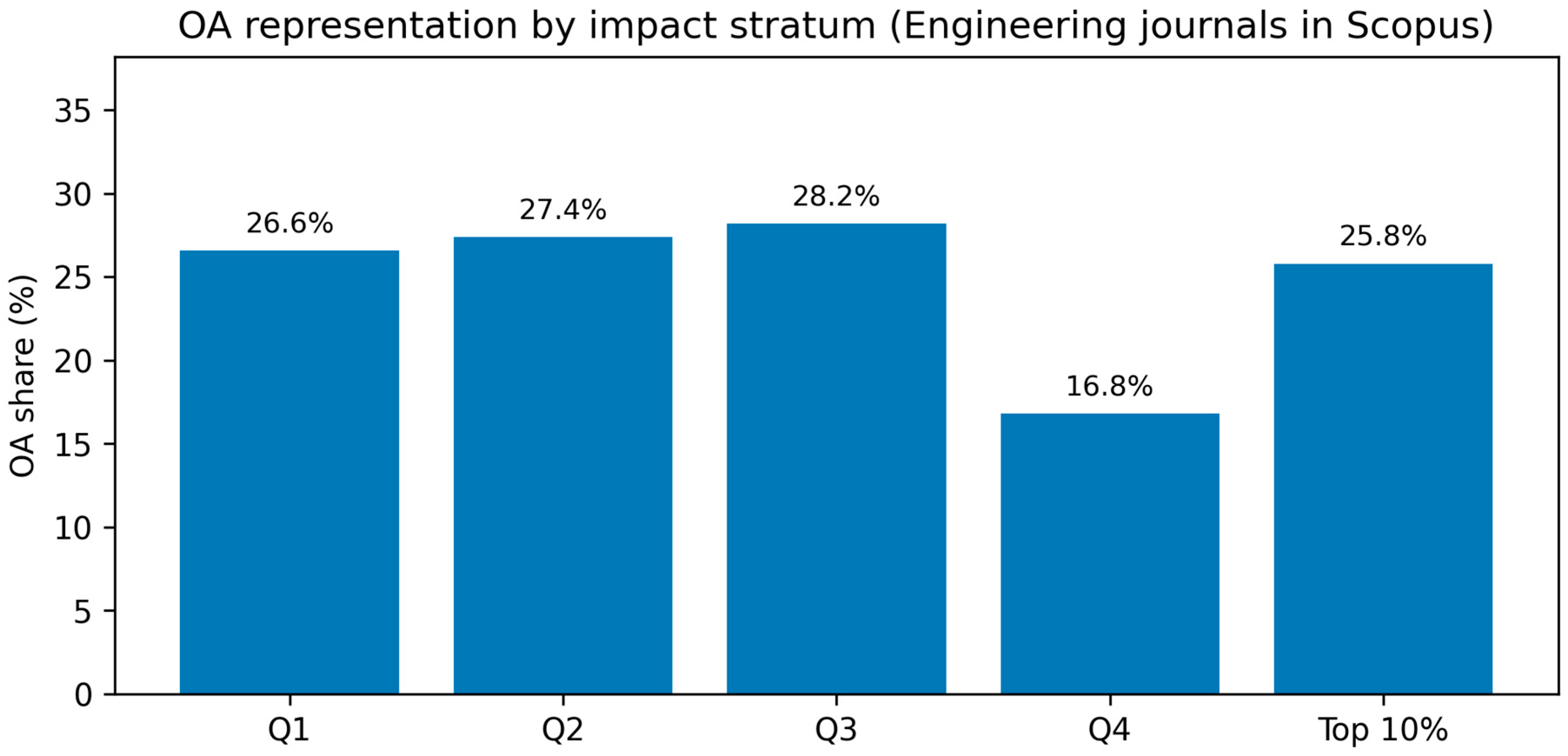
The analysed sample comprises 3013 active Engineering journals indexed in Scopus with an assigned CiteScore quartile (Q1–Q4). Of these, 770 (25.6%) are labelled open-access (OA) in Scopus and 2243 are classified as subscription-based (SB) by complement within each stratum. OA representation decreases toward the very top of the impact distribution: among journals in the top 10% of the CiteScore percentile (n = 484), 125 are OA, and 359 are SB.
Table 1 summarises the distribution of journals by quartile and by the top 10% stratum.
Figure 1 provides a visual summary of OA representation across impact strata in the sample.
3.2. CiteScore Across Quartiles and in the Top 10% Stratum
CiteScore medians are very similar between OA and SB journals in all strata. A small but statistically significant difference is observed in Q3, where the OA median is slightly higher than the SB median; in the top 10% stratum, the difference is not statistically significant. In robustness models controlling for quartile, years of Scopus coverage, and publisher, the OA indicator is not significantly associated with CiteScore, suggesting that typical prestige levels (as captured by CiteScore) are comparable between access models once strata are taken into account.
Table 2 provides the corresponding statistics.
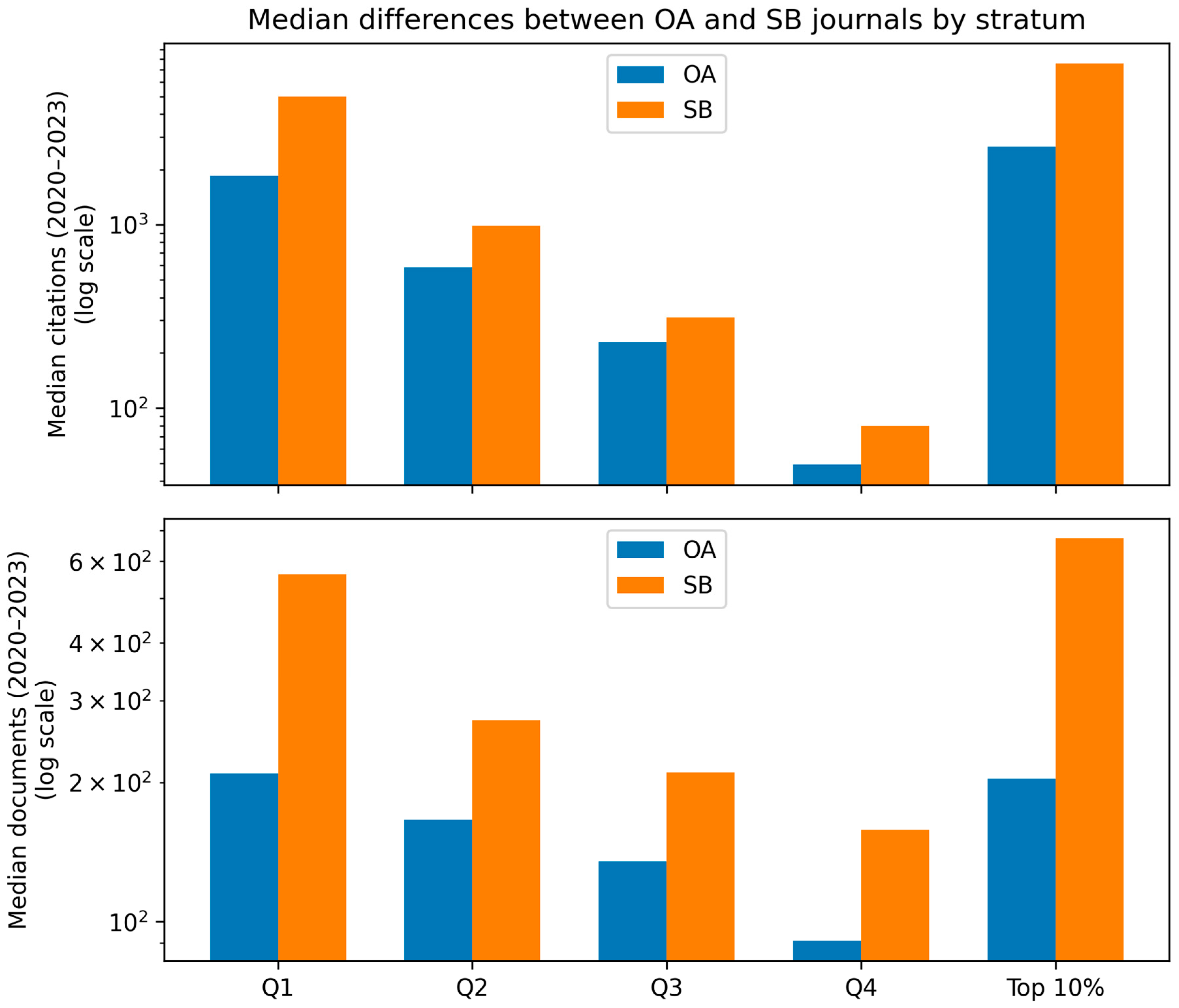
Figure 2 visualises the median differences in citations and publication volume (2020–2023) between OA and SB journals across strata (log scale).
3.3. Total Citations and Publication Volume (2020–2023)
Across all quartiles and in the top 10% stratum, SB journals show substantially higher medians for total citations and for the number of published documents in 2020–2023. These differences are statistically significant after false discovery rate correction and present moderate effect sizes (Cliff’s delta approximately −0.16 to −0.42, negative indicating lower values for OA). In regression models controlling for quartile, years of Scopus coverage, and publisher, OA remains negatively associated with both log1
p(citations) (beta = −0.349;
p = 1.35 × 10
−8) and log1
p(documents) (beta = −0.375;
p = 1.91 × 10
−15).
Table 2 reports the median-based comparisons, effect sizes, and adjusted
p-values.
3.4. Percentage of Cited Articles (% Cited, 2020–2023)
Both access models present high proportions of cited articles in the upper strata. However, SB journals show higher median % Cited in Q1 and Q2 and in the top 10% stratum, with statistically significant differences. In Q3 and Q4, differences in % Cited are minor and not statistically significant after correction.
3.5. Summary of Observed Patterns
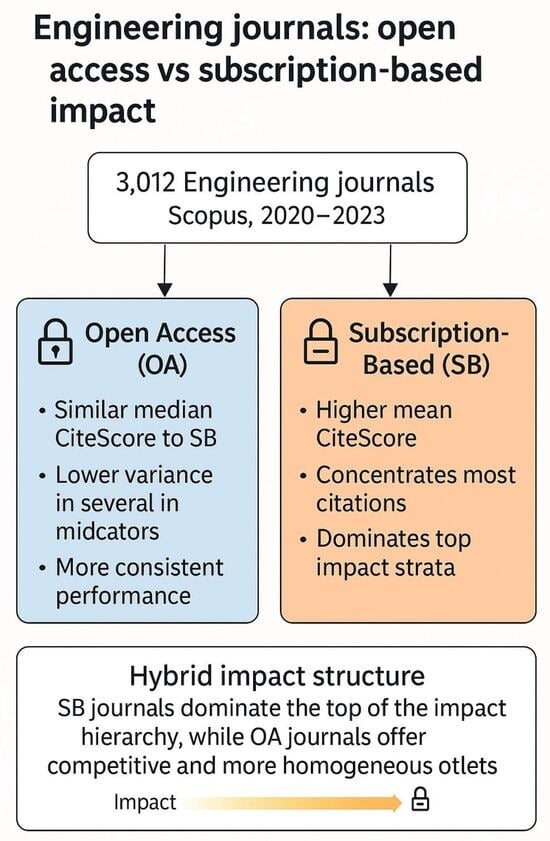
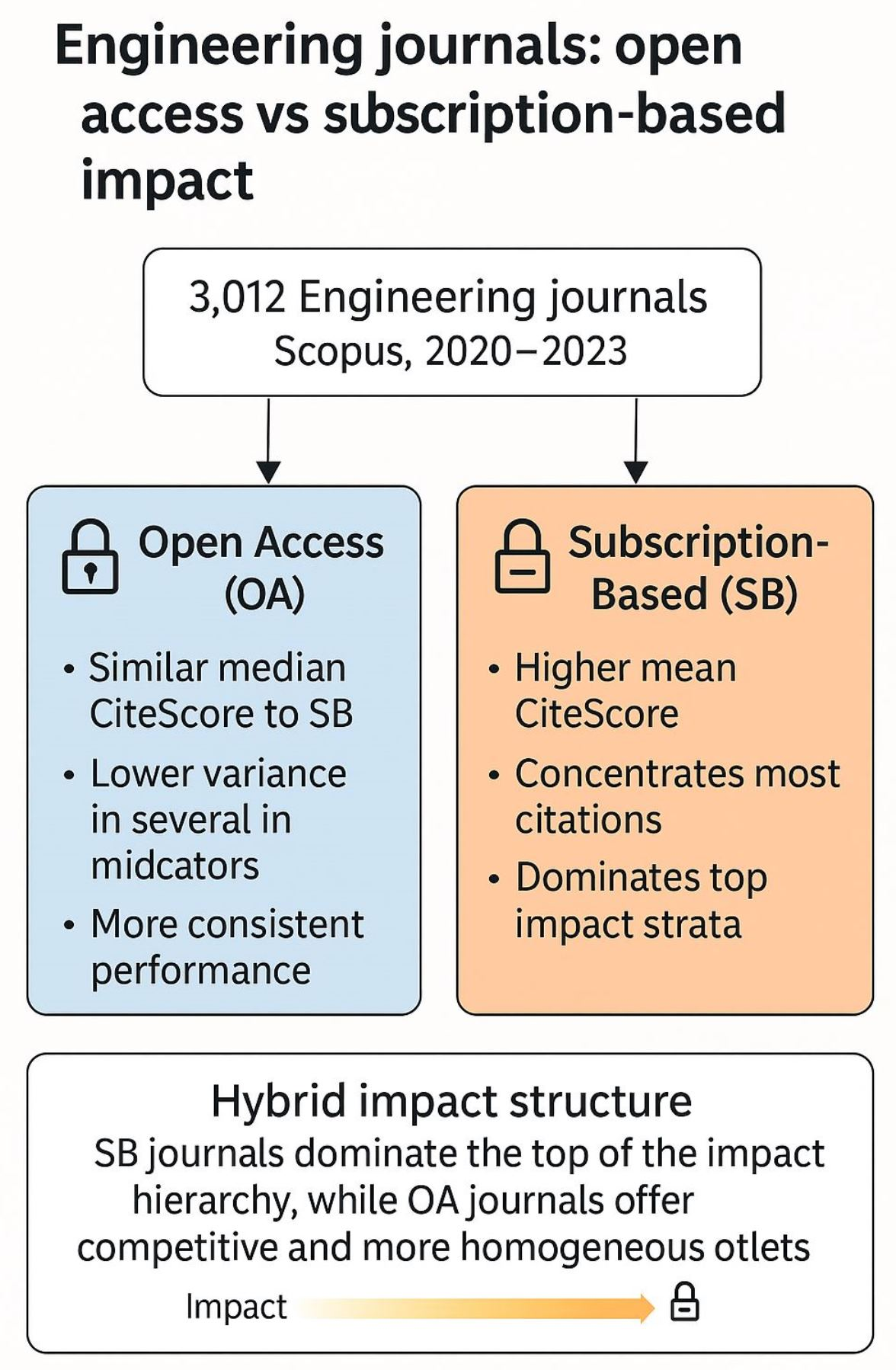
Taken together, the results indicate a dual structure in which SB journals dominate accumulated impact (citations) and editorial scale (documents). In contrast, OA journals achieve very similar typical prestige (CiteScore medians) across the impact hierarchy. OA journals remain less frequent in the most selective segment of Engineering journals (the top 10% CiteScore percentile), even though OA titles in the upper strata show competitive median performance.
4. Discussion
The results indicate that, in Engineering, the expansion of OA has not eliminated the concentration of accumulated impact in subscription-based (SB) journals. Across quartiles and in the top 10% CiteScore stratum, SB journals show substantially higher medians for total citations and publication volume, whereas CiteScore medians are very similar between OA and SB. OA journals account for about one quarter of Engineering journals, rank in the Scopus quartile, but are less frequent in the top 10% segment. Robustness models that control for quartile, years of Scopus coverage, and publisher concentration preserve the negative association between OA and both citations and documents, while showing no significant association with CiteScore. This pattern is consistent with a dual structure: OA offers competitive typical prestige, but SB journals retain dominance in accumulated visibility and editorial scale.
4.1. A Citation Advantage for Open Access?
The literature on the so-called “citation advantage” of OA reports heterogeneous findings. Studies, such as those by
Davis (
2011), suggest that open availability can increase downloads and immediate visibility, but does not necessarily translate into a higher number of citations in the long term. In contrast, large-scale analyses, such as those by
Piwowar et al. (
2018) and
Langham-Putrow et al. (
2021), indicate that OA articles tend, on average, to receive more citations than closed articles, particularly in Green and hybrid OA models.
4.2. Concentration and Publisher Portfolios
Scholarly publishing is widely documented as highly concentrated: a small number of large commercial publishers and major learned societies account for a disproportionate share of journals and citations across disciplines (
Larivière et al., 2015). Importantly, many publisher and society portfolios span subscription-based, fully OA, and hybrid titles; therefore, concentration is better understood as operating through editorial brands, distribution infrastructures, and accumulated reputation rather than mapping neatly onto a single access model.
Our results align with this perspective. In Engineering, SB journals are overrepresented in the most selective stratum (top 10% CiteScore percentile) and show substantially higher medians for citations and publication volume across all strata. These differences persist in robustness models that control for impact stratum, years of Scopus coverage, and publisher, indicating that the observed gap is not solely an artefact of journal maturity or publisher identity. At the same time, the similarity in CiteScore medians between OA and SB within strata suggests that typical prestige is not determined by access model alone. Future work could quantify concentration more directly (e.g., concentration indices at the publisher level) and examine the role of high-volume titles in shaping accumulated citations (
Larivière et al., 2015).
4.3. Implications for Peripheral Countries and Graduate Programmes
In peripheral countries, such as Brazil, characterised by budget constraints, the precarization of higher education, and intense pressure to publish in high-impact journals, the continued centrality of SB titles in the upper stratum has significant implications. For many research groups and graduate programmes, access to these journals depends on library consortia or significant investments in subscription packages, while publishing in OA journals financed by APCs can impose prohibitive costs.
Our results indicate that, as it is currently configured in Engineering, the adoption of OA does not automatically eliminate these asymmetries. In terms of citation probability and median impact, OA journals can offer favourable conditions for visibility. However, the large-scale accumulation of impact and presence in the field’s “elite” remains predominantly associated with SB titles. For graduate programmes in Engineering, this means that publication strategies need to balance, in a realistic way, expectations of impact with funding limitations and with the design of national research assessment policies.
4.4. Metrics, Evaluation, and Open Science Policies
The findings also contribute to the debate on the responsible use of metrics in research assessment, as synthesised in documents such as the Leiden Manifesto, DORA, and the Metric Tide report. The observation that OA and SB journals exhibit similar medians in indicators such as CiteScore and the percentage of cited articles, while SB journals receive the majority of total citations, reinforces the need to avoid decisions based solely on aggregated indicators that can be inflated by a small number of highly cited titles.
From the perspective of open science policies, the results suggest that simply expanding OA, without changing how metrics are used in evaluation processes, is insufficient to alter the prestige structure in Engineering. On the contrary, there is a risk of maintaining or even reinforcing inequalities if metrics such as quartiles and ranking positions are used mechanically. Open-access policies in technical fields, therefore, need to articulate widening access, financial sustainability, and a critical review of assessment criteria, so that openness does not become merely an additional layer on top of an already consolidated hierarchy.
4.5. Advances Relative to the Literature and to Previous Work
Compared to our previous study, “From Fees to Free: Comparing APC-Based and Diamond OA Journals in Engineering,” we make at least three main advances in this article. First, we broaden the scope of publishing models under analysis: instead of comparing only OA journals (APC-based versus Diamond), we also include SB journals, thereby enabling an assessment of OA performance relative to the complete set of relevant channels in Engineering. Second, by working with CiteScore quartiles and the top 10% stratum, we provide a stratified view of the prestige hierarchy, illustrating how OA and SB journals are distributed along the impact pyramid and where the most pronounced differences are concentrated. Third, we emphasise not only central tendency but also patterns of dispersion and consistency, distinguishing between absolute impact (total citations and number of documents) and relative impact (CiteScore and percentage of cited articles).
In relation to the international literature on OA, we contribute by showing that, in Engineering, the advantage of OA does not manifest as a generalised superiority. Instead, our results indicate a capacity for OA journals to compete in typical impact, while SB journals retain the lead in citation accumulation and publication volume. This combination helps qualify the debate on OA in technical and scientific fields, suggesting that open science policies and assessment criteria need to account not only for the open/closed dichotomy but also for the concentration and dispersion patterns reproduced within each access model.
5. Conclusions
We analysed the performance of OA and SB journals in Engineering using journal-level indicators from Scopus for 2020–2023 (CiteScore 2023 view). Based on 3013 active Engineering journals with an assigned CiteScore quartile, 770 were labelled OA in Scopus and 2243 were classified as SB by complement within each stratum. Journals were compared across quartiles (Q1–Q4) and within the top 10% CiteScore percentile (n = 484; 125 OA).
The results show that CiteScore medians are very similar between OA and SB journals across all strata, with only minor differences. Second, SB journals exhibit substantially higher medians for total citations and for the number of published documents across all quartiles and in the top 10% stratum, with statistically significant differences after false discovery rate correction and moderate effect sizes. Third, SB journals show higher median % Cited in Q1 and Q2, and in the top 10% stratum, whereas differences are more minor and less robust in Q3 and Q4.
Overall, the findings point to a dual structure in which OA journals can compete on both typical prestige (CiteScore medians) and high proportions of cited articles. However, SB journals retain dominance in accumulated visibility (citations) and editorial scale (documents), and OA remains underrepresented in the top 10% segment. Robustness models controlling for quartile, years of Scopus coverage, and publisher concentration yield consistent associations and support this interpretation.
From a practical standpoint, the results suggest that publication strategies and OA policies in Engineering should distinguish between typical prestige and accumulated impact. For graduate programmes and research groups facing budgetary constraints, OA journals in the upper strata can offer competitive median performance. At the same time, the concentration of citations and editorial scale in SB titles highlights the persistence of hierarchical structures in the field.
Key limitations include reliance on Scopus coverage and classifications, journal-level aggregation (rather than article-level analysis), and the use of the Scopus OA label without separating OA subtypes. Years of Scopus coverage, derived from the Coverage field, should be interpreted as an indexation/coverage proxy rather than the journal’s year of creation.
Despite these limitations, we contribute to the debate on OA in technical and scientific fields by showing that, in Engineering, OA can compete with median impact and visibility, but still coexists with an intense concentration of prestige and citations in SB journals. Future research may deepen these findings by exploring differences between specific sub-areas, the role of mega-journals, interactions with national assessment and funding policies, and the temporal evolution of these patterns as new open science policies are implemented.
Author Contributions
L.E.P.: Investigation, Formal Analysis, and Writing—Original Draft Preparation; L.A.P.: Conceptualization, Methodology, Validation, and Writing—Review and Editing; G.D.G.d.C.: Supervision and Validation; L.M.M.d.R.: Supervision and Validation. All authors have read and agreed to the published version of the manuscript.
Funding
This research received no specific external funding. L.A.P. acknowledges support from a research productivity fellowship from the Brazilian National Council for Scientific and Technological Development (CNPq).
Data Availability Statement
The data that support our findings were obtained from the Scopus database (Elsevier). These data are subject to restrictions on availability, which were used under licence. Aggregated data derived from the Scopus records may be available from the corresponding author upon reasonable request and with Elsevier’s permission.
Acknowledgments
During the preparation of this manuscript, the authors used ChatGPT (OpenAI, GPT-5.1) to assist with language editing and revision of the English text. The authors have reviewed and edited the output of this tool and take full responsibility for the content of this publication.
Conflicts of Interest
The authors declare no conflicts of interest.
Abbreviations
The following abbreviations are used in this manuscript:
| APC | Article Processing Charge |
| APCs | Article Processing Charges |
| CNPq | Brazilian National Council for Scientific and Technological Development |
| DORA | San Francisco Declaration on Research Assessment |
| OA | Open Access |
| SB | Subscription-Based (journal or publication model) |
| Q1–Q4 | CiteScore quartiles 1 to 4 |
| UTFPR | Federal University of Technology—Paraná |
References
- Ancion, Z., Borrell-Damián, L., Mounier, P., Rooryck, J., & Saenen, B. (2022). Action plan for diamond open access. Zenodo. [Google Scholar] [CrossRef]
- Borrego, A. (2023). Article processing charges for open access journal publishing: A review. Learned Publishing, 36(3), 359–378. [Google Scholar] [CrossRef]
- Brown, P. O., Cabell, D., Chakravarti, A., Cohen, B., Delamothe, T., Eisen, M., Grivell, L., Guédon, J.-C., Hawley, R. S., Johnson, R. K., Kirschner, M. W., Lipman, D., Lutzker, A. P., Marincola, E., Roberts, R. J., Rubin, G. M., Schloegl, R., Siegel, V., So, A. D., … Watson, L. (2003). Bethesda statement on open access publishing. Howard Hughes Medical Institute. Available online: https://dash.harvard.edu/handle/1/4725199 (accessed on 1 December 2025).
- Clarivate. (1994). The Clarivate impact factor. Available online: https://clarivate.com/academia-government/essays/impact-factor/ (accessed on 1 December 2025).
- da Silva, J. A. T., Tsigaris, P., & Erfanmanesh, M. (2021). Publishing volumes in major databases related to COVID-19. Scientometrics, 126(1), 831–842. [Google Scholar] [CrossRef] [PubMed]
- Davis, P. M. (2011). Open access, readership, citations: A randomized controlled trial of scientific journal publishing. The FASEB Journal, 25(7), 2129–2134. [Google Scholar] [CrossRef]
- de Oliveira, A. L., Santos, M. G., Ostermann, A. C., & Bortoluzzi, V. L. (2023). Pagamento de taxas (exorbitantes) em periódicos científicos internacionais de grande visibilidade. Boletim de Conjuntura (BOCA), 14(40), 333–350. [Google Scholar] [CrossRef]
- DORA. (2013). San Francisco declaration on research assessment. Available online: https://sfdora.org/ (accessed on 1 December 2025).
- Elsevier. (2025). Introducing CiteScore 2024: A comprehensive and transparent view of citation impact. Available online: https://blog.scopus.com/introducing-citescore-2024/ (accessed on 1 December 2025).
- Falagas, M. E., Pitsouni, E. I., Malietzis, G. A., & Pappas, G. (2008). Comparison of PubMed, Scopus, Web of Science, and Google Scholar: Strengths and weaknesses. The FASEB Journal, 22(2), 338–342. [Google Scholar] [CrossRef]
- Fassin, Y. (2021). Research on COVID-19: A disruptive phenomenon for bibliometrics. Scientometrics, 126, 5305–5319. [Google Scholar] [CrossRef] [PubMed]
- Funada, S., Yoshioka, T., Luo, Y., Iwama, T., Mori, C., Yamada, N., Yoshida, H., Katanoda, K., & Furukawa, T. A. (2023). Global trends in highly cited studies in COVID-19 research. JAMA Network Open, 6(9), e2332802. [Google Scholar] [CrossRef] [PubMed]
- Haug, C. J. (2019). No free lunch: What price is plan S for scientific publishing? The New England Journal of Medicine, 380(12), 1181–1185. [Google Scholar] [CrossRef]
- Hicks, D., Wouters, P., Waltman, L., de Rijcke, S., & Rafols, I. (2015). Bibliometrics: The Leiden Manifesto for research metrics. Nature, 520(7548), 429–431. [Google Scholar] [CrossRef]
- Huang, C.-K., Neylon, C., Montgomery, L., Hosking, R., Diprose, J. P., Handcock, R. N., & Wilson, K. (2024). Open access research outputs receive more diverse citations. Scientometrics, 129(2), 825–845. [Google Scholar] [CrossRef]
- Laakso, M., & Björk, B. C. (2012). Anatomy of open access publishing: A study of longitudinal development and internal structure. BMC Medicine, 10, 124. [Google Scholar] [CrossRef]
- Langham-Putrow, A., Bakker, C., & Riegelman, A. (2021). Is the open access citation advantage real? A systematic review of the citation of open access and subscription-based articles. PLoS ONE, 16(6), e0253129. [Google Scholar] [CrossRef]
- Larivière, V., Haustein, S., & Mongeon, P. (2015). The oligopoly of academic publishers in the digital era. PLoS ONE, 10(6), e0127502. [Google Scholar] [CrossRef] [PubMed]
- Max-Planck-Gesellschaft. (2003). Berlin declaration on open access to knowledge in the sciences and humanities. Max-Planck-Gesellschaft. Available online: http://openaccess.mpg.de/286432/Berlin-Declaration (accessed on 1 December 2025).
- May, C. (2020). Academic publishing and open access: Costs, benefits, and options for publishing research. Politics, 40(1), 120–135. [Google Scholar] [CrossRef]
- McCabe, M. J., & Mueller-Langer, F. (2024). Open access is shaping scientific communication: Funders and publishers should roll out policies in ways to support their evaluation. Science, 385(6714), 1170–1172. [Google Scholar] [CrossRef]
- Miranda, R., & Garcia-Carpintero, E. (2019). Comparison of the share of documents and citations from different quartile journals in 25 research areas. Scientometrics, 121(1), 479–501. [Google Scholar] [CrossRef]
- Mongeon, P., & Paul-Hus, A. (2016). The journal coverage of web of science and scopus: A comparative analysis. Scientometrics, 106(1), 213–228. [Google Scholar] [CrossRef]
- Pilatti, L. E., Pilatti, L. A., Carvalho, G. D. G. d., & Resende, L. M. M. d. (2025). From fees to free: Comparing APC-based and diamond open access journals in engineering. Publications, 13(2), 16. [Google Scholar] [CrossRef]
- Piwowar, H., Priem, J., Larivière, V., Alperin, J. P., Matthias, L., Norlander, B., Farley, A., West, J., & Haustein, S. (2018). The state of OA: A large-scale analysis of the prevalence and impact of open access articles. PeerJ, 6, e4375. [Google Scholar] [CrossRef]
- Rodrigues, M. L., Savino, W., & Goldenberg, S. (2022). Article-processing charges as a barrier for science in low-to-medium income regions. Memórias do Instituto Oswaldo Cruz, 117, e220064. [Google Scholar] [CrossRef] [PubMed]
- Rooryck, J., Rico Castro, P., & de Pablo Llorente, V. (2024). Quality as a public good: The Diamond Open Access Standard (DOAS) and its role in the Global Diamond Open Access Alliance. Septentrio Conference Series, 1. [Google Scholar] [CrossRef] [PubMed]
- Rousseau, R., García-Zorita, C., & Sanz-Casado, E. (2023). Publications during COVID-19 times: An unexpected overall increase. Journal of Informetrics, 17(4), 101461. [Google Scholar] [CrossRef]
- Suber, P. (2012). Open access. MIT Press. [Google Scholar]
- Trapp, J. V. (2020). The new scopus CiteScore formula and the journal impact factor: A look at top ranking journals and middle ranking journals in the Scopus categories of general physics and astronomy, materials science, general medicine and social sciences. Physical and Engineering Sciences in Medicine, 43, 739–748. [Google Scholar] [CrossRef] [PubMed]
- Wilsdon, J., Allen, L., Belfiore, E., Campbell, P., Curry, S., Hill, S., Jones, R., Kain, R., Kerridge, S., Thelwall, M., Tinkler, J., Viney, I., Wouters, P., Hill, J., & Johnson, B. (2015). The metric tide: Report of the independent review of the role of metrics in research assessment and management. Higher Education Funding Council for England (HEFCE). [Google Scholar] [CrossRef]
| Disclaimer/Publisher’s Note: The statements, opinions and data contained in all publications are solely those of the individual author(s) and contributor(s) and not of MDPI and/or the editor(s). MDPI and/or the editor(s) disclaim responsibility for any injury to people or property resulting from any ideas, methods, instructions or products referred to in the content. |




 ,
,