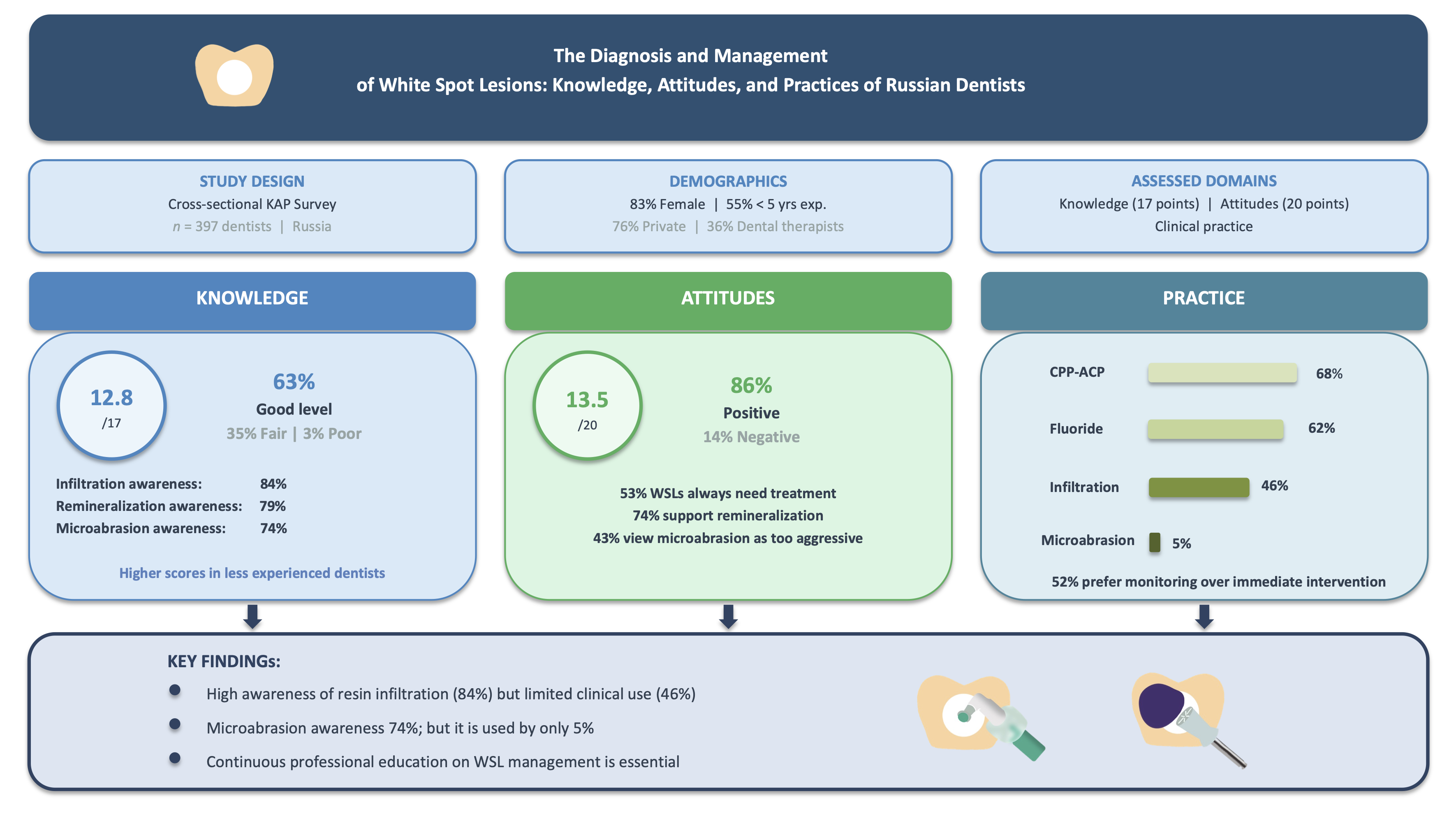

Knowledge, Attitudes, and Practices of Dentists Regarding the Diagnosis and Management of White Spot Lesions

 , , , and
Abstract
1. Introduction
2. Materials and Methods
3. Results
4. Discussion
Author Contributions
Funding
Institutional Review Board Statement
Informed Consent Statement
Data Availability Statement
Conflicts of Interest
References
- Ismail, A.I.; Sohn, W.; Tellez, M.; Amaya, A.; Sen, A.; Hasson, H.; Pitts, N.B. The International Caries Detection and Assessment System (ICDAS): An Integrated System for Measuring Dental Caries. Community Dent. Oral Epidemiol. 2007, 35, 170–178. [Google Scholar] [CrossRef]
- Derks, A.; Katsaros, C.; Frencken, J.E.; Van’t Hof, M.A.; Kuijpers-Jagtman, A.M. Caries-Inhibiting Effect of Preventive Measures during Orthodontic Treatment with Fixed Appliances: A Systematic Review. Caries Res. 2004, 38, 413–420. [Google Scholar] [CrossRef]
- Bergstrand, F.; Twetman, S. A Review on Prevention and Treatment of Post-Orthodontic White Spot Lesions—Evidence-Based Methods and Emerging Technologies. Open Dent. J. 2011, 5, 158–162. [Google Scholar] [CrossRef] [PubMed]
- Tufekci, E.; Dixon, J.S.; Gunsolley, J.C.; Lindauer, S.J. Prevalence of White Spot Lesions during Orthodontic Treatment with Fixed Appliances. Angle Orthod. 2011, 81, 206–210. [Google Scholar] [CrossRef]
- Sharab, L.; Loss, C.; Jensen, D.; Kluemper, G.T.; Alotaibi, M.; Nagaoka, H. Prevalence of White Spot Lesions and Gingival Index during Orthodontic Treatment in an Academic Setting. Am. J. Orthod. Dentofac. Orthop. 2023, 163, 835–842. [Google Scholar] [CrossRef]
- Bowen, W.H. The Stephan Curve Revisited. Odontology 2013, 101, 2–8. [Google Scholar] [CrossRef]
- Sung, Y.-H.; Son, H.-H.; Yi, K.; Chang, J. Elemental Analysis of Caries-Affected Root Dentin and Artificially Demineralized Dentin. Restor. Dent. Endod. 2016, 41, 255–261. [Google Scholar] [CrossRef]
- Shaban, I.M.; Jafer, M.J.; Nema, A.A.; Al Rashidi, A.S.; Mashaan, A. Comparative Study of Microabrasion and Resin Infiltration on Enamel Color Stability and Surface Characteristics: A Systematic Review. J. Int. Soc. Prev. Community Dent. 2025, 15, 485–492. [Google Scholar] [CrossRef] [PubMed]
- Altenburger, M.J.; Schirrmeister, J.F.; Lussi, A.; Klasser, M.; Hellwig, E. In Situ Fluoride Retention and Remineralization of Incipient Carious Lesions after the Application of Different Concentrations of Fluoride. Eur. J. Oral Sci. 2009, 117, 58–63. [Google Scholar] [CrossRef] [PubMed]
- Babu, B.; Padawe, D.; Takate, V. Remineralization Potential of Self-Assembling Peptides Versus Fluoride Agents in White Spot Lesions: A Systematic Review. Cureus 2025, 17, e95416. [Google Scholar] [CrossRef]
- Zhang, Q.; Zou, J.; Yang, R.; Zhou, X. Remineralization Effects of Casein Phosphopeptide-Amorphous Calcium Phosphate Crème on Artificial Early Enamel Lesions of Primary Teeth. Int. J. Paediatr. Dent. 2011, 21, 374–381. [Google Scholar] [CrossRef]
- Zhou, C.; Zhang, D.; Bai, Y.; Li, S. Casein Phosphopeptide-Amorphous Calcium Phosphate Remineralization of Primary Teeth Early Enamel Lesions. J. Dent. 2014, 42, 21–29. [Google Scholar] [CrossRef] [PubMed]
- Soliman, E.M.; Abdelfattah, W.M.; Mohamed, D.R.; Nagui, D.A.; Holiel, A.A. Clinical Evaluation of the Remineralizing Potential of Biomimetic Scaffolds on Enamel White Spot Lesions: A 12-Month Randomized Controlled Trial. J. Dent. 2025, 166, 106303. [Google Scholar] [CrossRef]
- Anbarasu, P.; Bhattacharyya, A.; Dinesh, S.; Kumar, S.S.; Gupta, M.; Eisenhuth, G.; Eisenhuth, S.; Eisenhuth, C.; Bhandi, S. Evaluation of the Preventive Effect of Casein Phosphopeptide-Amorphous Calcium Phosphate (CPP-ACP) on White Spot Lesions during Fixed Orthodontic Treatment Using Scanning Electron Microscopy. J. Contemp. Dent. Pract. 2025, 26, 1087–1091. [Google Scholar] [CrossRef]
- Hamed, S.; Abd El Latief, M.H.; El-Wassefy, N.A.; Montasser, M.A. Fluoride-Amorphous Calcium Phosphate and Biomimetic Nano-Hydroxyapatite for Enamel Remineralization: An in-Vitro Study of Surface Microhardness and Composition. Int. Orthod. 2024, 22, 100865. [Google Scholar] [CrossRef] [PubMed]
- Rajendran, R.; Antony S, D.P.; Ashik P, M.; Bharath, S.; Thomas, A.J.; Heboyan, A. Remineralization Potential of Strontium-Doped Nano-Hydroxyapatite Dentifrice and Casein Phosphopeptide-Amorphous Calcium Phosphate Cream on White Spot Lesions in Enamel Following Orthodontic Debonding—A Randomized Controlled Trial. SAGE Open Med. 2023, 12, 20503121231221630. [Google Scholar] [CrossRef]
- El Mansy, M.M.; Saleh, R.S.; Rashed, M.F.; El-Motayam, A.K. Effect of Nanohydroxyapatite Paste after Different Pretreatment Techniques on Remineralization and Color Change of White Spot Lesions in Children: A Randomized Control Study. BMC Oral Health 2026, 26, 102. [Google Scholar] [CrossRef]
- Khan, N.Z.; Hoque, S.M.; Das, H.; Kumar, A.; Islam, R.; Hossain, M. Remineralization of Demineralized Teeth Enamel with NHAp and NHAp-NaF-PEO Nanocomposite. Biomed. Eng. Adv. 2025, 10, 100192. [Google Scholar] [CrossRef]
- Tschoppe, P.; Zandim, D.L.; Martus, P.; Kielbassa, A.M. Enamel and Dentine Remineralization by Nano-Hydroxyapatite Toothpastes. J. Dent. 2011, 39, 430–437. [Google Scholar] [CrossRef]
- Baptista-Sánchez, H.; Antonio-Zancajo, L.; Albaladejo-Martínez, A.; Colino Gallardo, P.; Garcovich, D.; Alvarado-Lorenzo, M.; Alvarado-Lorenzo, A. Changes in the Color and Brightness of White Spots Associated with Orthodontic Treatment 6 Months after the Application of Infiltrative Resins: Systematic Review and Meta-Analysis. Int. J. Environ. Res. Public Health 2022, 19, 9277. [Google Scholar] [CrossRef]
- Jones, R.S.; Fried, D. Remineralization of Enamel Caries Can Decrease Optical Reflectivity. J. Dent. Res. 2006, 85, 804–808. [Google Scholar] [CrossRef]
- Murphy, T.C.; Willmot, D.R.; Rodd, H.D. Management of Postorthodontic Demineralized White Lesions with Microabrasion: A Quantitative Assessment. Am. J. Orthod. Dentofac. Orthop. 2007, 131, 27–33. [Google Scholar] [CrossRef]
- Neuhaus, K.W.; Ciucchi, P.; Donnet, M.; Lussi, A. Removal of Enamel Caries with an Air Abrasion Powder. Oper. Dent. 2010, 35, 538–546. [Google Scholar] [CrossRef]
- Oglakci Ozkoc, B.; Tunc Dicle, A.; Alkan, E.; Yılmaz Atalı, P.; Eliguzeloglu Dalkilic, E.; Tağtekin, D. The Effectiveness of Novel Remineralising Agents in White Spot Lesion Treatment after Microabrasion. BMC Oral Health 2026, 26, 244. [Google Scholar] [CrossRef] [PubMed]
- Paris, S.; Meyer-Lueckel, H.; Kielbassa, A.M. Resin Infiltration of Natural Caries Lesions. J. Dent. Res. 2007, 86, 662–666. [Google Scholar] [CrossRef] [PubMed]
- Soveral, M.; Machado, V.; Botelho, J.; Mendes, J.J.; Manso, C. Effect of Resin Infiltration on Enamel: A Systematic Review and Meta-Analysis. J. Funct. Biomater. 2021, 12, 48. [Google Scholar] [CrossRef]
- Shuja, M.E.; Jeelani, W.; Ahmed, M.; Khalid, A. Management of Orthodontically Induced White Spot Lesions: A Survey of the Orthodontic Practitioners of Pakistan. J. Pak. Med. Assoc. 2024, 74, 922–929. [Google Scholar] [CrossRef] [PubMed]
- Hamdan, A.M.; Maxfield, B.J.; Tüfekçi, E.; Shroff, B.; Lindauer, S.J. Preventing and Treating White-Spot Lesions Associated with Orthodontic Treatment: A Survey of General Dentists and Orthodontists. J. Am. Dent. Assoc. 2012, 143, 777–783. [Google Scholar] [CrossRef]
- Saito, T.; Park, J.H.; Bay, C. A Survey of Pediatric Dentists on the Treatment Timing and Modalities for White Spot Lesions in the United States. J. Clin. Pediatr. Dent. 2019, 43, 27–33. [Google Scholar] [CrossRef]
- Weyland, M.I.; Jost-Brinkmann, P.G.; Bartzela, T. Management of White Spot Lesions Induced during Orthodontic Treatment with Multibracket Appliance: A National-Based Survey. Clin. Oral Investig. 2022, 26, 4871–4883. [Google Scholar] [CrossRef]
- Mikheikina, A.; Novozhilova, N.; Polyakova, M.; Sokhova, I.; Mun, A.; Zaytsev, A.; Babina, K.; Makeeva, I. Knowledge, Attitude, and Practice towards Chelating Agents in Endodontic Treatment among Dental Practitioners. Dent. J. 2023, 11, 156. [Google Scholar] [CrossRef]
- Lamorgese, M.; Veiga, N.; Correia, M.J.; Gomes, A.T.P.C.; Lopes, S.; Lopes-Rocha, L.; Fidalgo-Pereira, R.; Lopes, P.C. White Spot Lesion Treatment Options: A Systematic Review of Different Techniques for Masking These Lesions. Gels 2025, 11, 371. [Google Scholar] [CrossRef]
- de Moura, R.C.; Santos, P.S.; dos Santos Matias, P.M.; Vitali, F.C.; Hilgert, L.A.; Cardoso, M.; Massignan, C. Knowledge, Attitudes, and Practice of Dentists on Minimal Intervention Dentistry: A Systematic Review and Meta-Analysis. J. Dent. 2023, 132, 104484. [Google Scholar] [CrossRef]
- Parthasarathy, R.; Srinivasan, S.; Vishwanath, S.; Karunakaran, J.; Ilango, S.; Sakthi, N. Knowledge, Attitude, and Practices of White Spot Lesion Management Among Dental Professionals in South India: A Cross-Sectional Study. Cureus 2024, 16, e74877. [Google Scholar] [CrossRef]
- Ahmed, Y.T.; Al Zahrani, A.; Al Ashwal, L.; Al Salem, A.A.; Alsmari, M. Knowledge and Attitude of Dentists and Dental Interns toward the Use of Resin Infiltration for Treatment of White Spot Lesions in Riyadh, Saudi Arabia. Int. J. Med. Dev. Ctries. 2024, 8, 2182–2186. [Google Scholar] [CrossRef]
- Choudhry, N.K.; Fletcher, R.H.; Soumerai, S.B. Systematic Review: The Relationship between Clinical Experience and Quality of Health Care. Ann. Intern. Med. 2005, 142, 260–273. [Google Scholar] [CrossRef]

| Sociodemographic Data | Count, n | Percentage, % |
|---|---|---|
| Gender | ||
| Male | 69 | 17.4 |
| Female | 328 | 82.6 |
| Specialty | ||
| Dental therapist | 141 | 35.5 |
| Pediatric dentist | 49 | 12.3 |
| Orthodontist | 29 | 7.3 |
| General dentist | 128 | 32.2 |
| Dental surgeon | 11 | 2.8 |
| Prosthodontist | 11 | 2.8 |
| Dental hygienist | 28 | 7.1 |
| Years of clinical experience | ||
| <5 | 218 | 54.9 |
| 5–10 | 85 | 21.4 |
| 11–20 | 38 | 9.6 |
| >20 | 56 | 14.1 |
| Clinic | ||
| Private | 301 | 75.8 |
| Government-funded | 96 | 24.2 |
| Sociodemographic Data | Knowledge (Max 17) | |
|---|---|---|
| Mean (sd) | Median (IQR) | |
| Total | 12.8 (2.2) | 13 (11; 14) |
| Gender | ||
| Male | 11.2 (2.2) | 11 (9; 13) |
| Female | 13.1 (2.0) | 14 (12; 14) |
| Kruskal–Wallis chi-squared = 39.743, df = 1, p-value = 2.897 × 10⁻¹⁰ | ||
| Specialty | ||
| Dental therapist | 12.8 (2.2) a | 13 (11; 14) |
| Pediatric dentist | 13.7 (1.9) b | 14 (13; 15) |
| Orthodontist | 13.2 (1.8) a | 14 (13; 14) |
| General dentist | 12.4 (2.5) a | 13 (12; 14) |
| Prosthodontist | 10.8 (0.4) c | 11 (11; 11) |
| Dental surgeon | 13.5 (0.5) a,b | 13 (13; 14) |
| Dental hygienist | 13.1 (2.0) a | 14 (12; 14) |
| Kruskal–Wallis chi-squared = 27.341, df = 6, p-value < 0.001 | ||
| Years of clinical experience | ||
| <5 | 13.1 (2.0) a | 14 (12; 14) |
| 5–10 | 12.8 (2.1) a | 13 (11; 14) |
| 11–20 | 12.9 (1.5) b | 13 (11.25; 14) |
| >20 | 11.5 (3.0) a,b | 12 (10; 13) |
| Kruskal–Wallis chi-squared = 16.302, df = 3, p-value < 0.001 | ||
| Level, n (%) | ||
| Poor | 11 (2.8) | |
| Fair | 138 (34.7) | |
| Good | 248 (62.5) | |
| Item | Variants | Answers, n (%) |
|---|---|---|
| WSCLs are characterized by | Subsurface demineralization | 200 (50.4) |
| Surface demineralization | 194 (48.9) | |
| Disturbances of enamel formation | 3 (0.7) | |
| Enamel necrosis | — | |
| Minimally invasive treatment for WSCLs includes | Infiltration | 333 (83.9) |
| Microabrasion | 220 (55.4) | |
| Remineralization | 314 (79.1) | |
| Whitening | 29 (7.3) | |
| Composite restoration | 24 (6.0) | |
| Diagnostic methods for WSCLs include | Staining | 328 (82.6) |
| Fluorescent diagnosis | 255 (64.2) | |
| Polarization microscopy | 121 (30.5) | |
| Visual examination | 340 (85.6) | |
| Probing | 241 (60.7) | |
| Possible outcomes of WSCLs in the absence of treatment | Stabilization of the process | 295 (74.3) |
| Full remineralization | 148 (37.3) | |
| Formation of a carious cavity | 363 (91.4) | |
| Formation of enamel erosion | 40 (10.1) | |
| Microabrasion includes | Etching the surface of the lesion, then filling the micropores with resin | 28 (7.0) |
| Treatment of the lesion surface with a mixture of abrasive and hydrochloric acid | 294 (74.1) | |
| Filling enamel micropores with minerals | 25 (6.3) | |
| Treatment with hydrogen peroxide or carbamide | 17 (4.3) | |
| I don’t know | 33 (8.3) | |
| Infiltration includes | Etching the surface of the lesion, then filling the micropores with resin | 276 (69.5) |
| Treatment of the lesion surface with a mixture of abrasive and hydrochloric acid | 6 (1.5) | |
| Filling enamel micropores with minerals | 89 (22.4) | |
| Treatment with hydrogen peroxide or carbamide | 3 (0.8) | |
| I don’t know | 23 (5.8) |
| Item | Respondents’ Answers n (%) | ||||
|---|---|---|---|---|---|
| SA | A | N | D | SD | |
| WSCLs always require treatment * | 82 (20.6) | 129 (32.5) | 32 (8.1) | 119 (30.0) | 35 (8.8) |
| Remineralization is ineffective for WSCL treatment ** | 21 (5.3) | 45 (11.4) | 39 (9.8) | 176 (44.3) | 116 (29.2) |
| Microabrasion is too aggressive for WSCL treatment ** | 41 (10.3) | 130 (32.7) | 100 (25.2) | 98 (24.7) | 28 (7.1) |
| Infiltration increases the probability of pigmented plaque formation ** | 11 (2.8) | 46 (11.6) | 125 (31.5) | 153 (38.5) | 62 (15.6) |
| Sociodemographic Data | Attitude | |
|---|---|---|
| Mean (sd) | Median (IQR) | |
| Total | 13.5 (2.6) | 14 (12; 15) |
| Gender | ||
| Male | 13.1 (2.6) | 12 (11; 14) |
| Female | 13.5 (2.6) | 14 (12; 15) |
| Kruskal–Wallis chi-squared = 3.5563, df = 1, p-value = 0.05932 | ||
| Specialty | ||
| Dental therapist | 13.0 (2.7) a | 13 (12; 14) |
| Pediatric dentist | 14.4 (2.6) b | 15 (12; 15) |
| Orthodontist | 13.8 (2.1) b | 14 (12; 15) |
| General dentist | 13.5 (2.4) a,b | 13 (12; 15) |
| Prosthodontist | 11.5 (1.2) a | 11 (10.5; 12.5) |
| Dental surgeon | 14.8 (0.9) b | 15 (14; 15.5) |
| Dental hygienist | 13.8 (3.4) a,b | 13 (11; 17) |
| Kruskal–Wallis chi-squared = 25.301, df = 6, p-value < 0.001 | ||
| Years of clinical experience | ||
| <5 | 13.7 (2.7) a | 14 (12; 15) |
| 5–10 | 14.0 (2.4) a | 14 (12; 16) |
| 11–20 | 12.9 (2.6) b | 14 (12.25; 15) |
| >20 | 12.2 (2.0) a,b | 12 (10; 14) |
| Kruskal–Wallis chi-squared = 19.628, df = 3, p-value < 0.001 | ||
| Negative | 54 (13.6) | |
| Positive | 343 (86.4) | |
| Item | Variants | Answers, n (%) |
|---|---|---|
| How often do you diagnose patients with WSCLs? | Less than 10% of cases | 96 (24.2) |
| 10–20% of cases | 73 (18.4) | |
| 20–30% of cases | 91 (22.9) | |
| 30–40% of cases | 66 (16.6) | |
| More than 40% of cases | 64 (16.1) | |
| Never | 7 (1.8) | |
| What methods of WSCL diagnosis do you use? | Visual examination | 357 (89.9) |
| Staining | 227 (57.2) | |
| Fluorescent diagnosis | 101 (25.4) | |
| Polarization microscopy | 7 (1.8) | |
| Probing | 236 (59.4) | |
| What WSCL treatments do you use? | Infiltration | 183 (46.1) |
| Microabrasion | 20 (5.0) | |
| Remineralization with CPP-ACP | 268 (67.5) | |
| Remineralization with nano-hydroxyapatite | 105 (26.4) | |
| Remineralization with fluoride | 247 (62.2) | |
| Composite restoration | 60 (15.1) | |
| Monitoring | 206 (51.9) | |
| Refer to a relevant specialist | 41 (10.3) | |
| Other | 5 (1.3) | |
| Which WSCL treatment do you prefer in an esthetically significant area? | Infiltration | 139 (35.0) |
| Microabrasion | 21 (5.3) | |
| Remineralization with CPP-ACP | 58 (14.6) | |
| Remineralization with nano-hydroxyapatite | 12 (3.0) | |
| Remineralization with fluoride | 41 (10.3) | |
| Composite restoration | 61 (15.4) | |
| Monitoring | 16 (4.0) | |
| Refer to a relevant specialist | 44 (11.1) | |
| Other | 5 (1.3) |
Disclaimer/Publisher’s Note: The statements, opinions and data contained in all publications are solely those of the individual author(s) and contributor(s) and not of MDPI and/or the editor(s). MDPI and/or the editor(s) disclaim responsibility for any injury to people or property resulting from any ideas, methods, instructions or products referred to in the content. |
© 2026 by the authors. Licensee MDPI, Basel, Switzerland. This article is an open access article distributed under the terms and conditions of the Creative Commons Attribution (CC BY) license.
Share and Cite
Novozhilova, N.; Mun, A.; Polyakova, M.; Makeeva, I.; Mikheikina, A.; Sokhova, I.; Zaytsev, A.; Babina, K. Knowledge, Attitudes, and Practices of Dentists Regarding the Diagnosis and Management of White Spot Lesions. Dent. J. 2026, 14, 365. https://doi.org/10.3390/dj14060365
Novozhilova N, Mun A, Polyakova M, Makeeva I, Mikheikina A, Sokhova I, Zaytsev A, Babina K. Knowledge, Attitudes, and Practices of Dentists Regarding the Diagnosis and Management of White Spot Lesions. Dentistry Journal. 2026; 14(6):365. https://doi.org/10.3390/dj14060365
Chicago/Turabian StyleNovozhilova, Nina, Anastasia Mun, Maria Polyakova, Irina Makeeva, Anna Mikheikina, Inna Sokhova, Alexandr Zaytsev, and Ksenia Babina. 2026. "Knowledge, Attitudes, and Practices of Dentists Regarding the Diagnosis and Management of White Spot Lesions" Dentistry Journal 14, no. 6: 365. https://doi.org/10.3390/dj14060365
APA StyleNovozhilova, N., Mun, A., Polyakova, M., Makeeva, I., Mikheikina, A., Sokhova, I., Zaytsev, A., & Babina, K. (2026). Knowledge, Attitudes, and Practices of Dentists Regarding the Diagnosis and Management of White Spot Lesions. Dentistry Journal, 14(6), 365. https://doi.org/10.3390/dj14060365