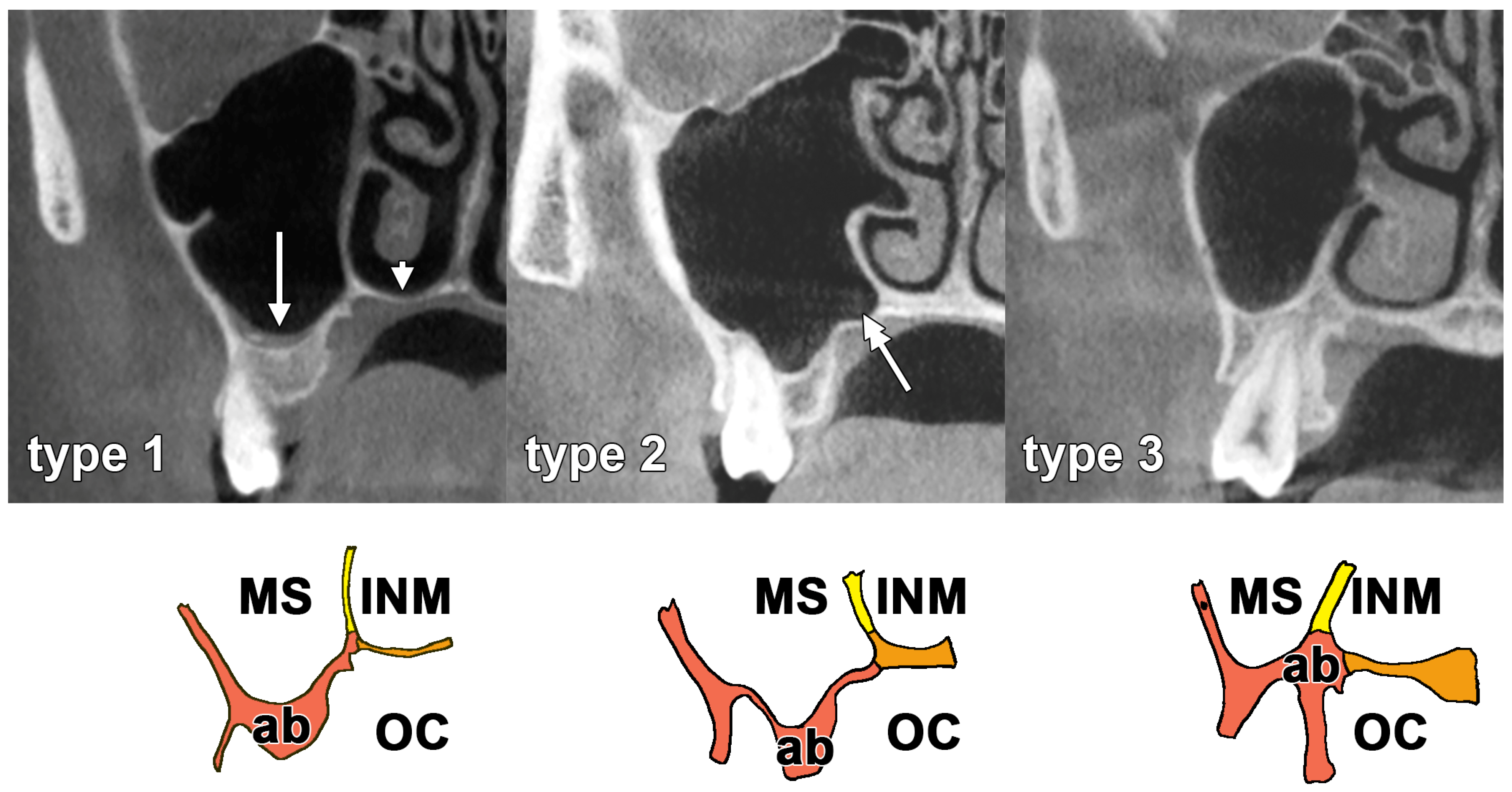


The Big Nose Pattern at the Second Upper Molar—A Retrospective CBCT Study


 , and
, and
Abstract
1. Introduction
2. Materials and Methods
3. Results
3.1. Overall Distribution of Pneumatisation Types
3.2. Distribution by Side
3.3. Bilateral Symmetry
4. Discussion
4.1. Anteroposterior Gradient of Pneumatisation Patterns
4.2. Correlation with Other Classification Systems
4.3. Sinonasal Anatomical Interactions
4.4. Clinical Implications: Imaging and Surgical Considerations
4.5. Bilateral Symmetry and Sex Distribution
4.6. Hypothesis-Generating Considerations
4.7. Limitations
5. Conclusions
Author Contributions
Funding
Institutional Review Board Statement
Informed Consent Statement
Data Availability Statement
Acknowledgments
Conflicts of Interest
Abbreviations
| CBCT | cone-beam computed tomography |
| CF | canine fossa |
| CI | confidence interval |
| CT | computed tomography |
| df | degrees of freedom |
| M2 | maxillary second molar (upper second molar) |
| MAB | maxillary alveolar base |
| MS | maxillary sinus |
| MSF | maxillary sinus floor |
| MSFE | maxillary sinus floor elevation |
| OR | odds ratio |
| PM1 | maxillary first premolar |
| PM2 | maxillary second premolar |
| PSMS | posterior superior maxillary sinus |
References
- Lyu, M.; Xu, D.; Zhang, X.; Yuan, Q. Maxillary sinus floor augmentation: A review of current evidence on anatomical factors and a decision tree. Int. J. Oral Sci. 2023, 15, 41. [Google Scholar] [CrossRef]
- Mureşan, A.N.; Dandoczi, C.A.; Tudose, R.C. Anatomical Possibilities of the Alveolar Bone at the Upper Second Premolar Level. Medicina 2024, 60, 726. [Google Scholar] [CrossRef]
- Gu, Y.; Sun, C.; Wu, D.; Zhu, Q.; Leng, D.; Zhou, Y. Evaluation of the relationship between maxillary posterior teeth and the maxillary sinus floor using cone-beam computed tomography. BMC Oral Health 2018, 18, 164. [Google Scholar] [CrossRef]
- Lim, H.C.; Kim, S.; Kim, D.H.; Herr, Y.; Chung, J.H.; Shin, S.I. Factors affecting maxillary sinus pneumatization following posterior maxillary tooth extraction. J. Periodontal Implant. Sci. 2021, 51, 285–295. [Google Scholar] [CrossRef] [PubMed]
- Sharan, A.; Madjar, D. Maxillary sinus pneumatization following extractions: A radiographic study. Int. J. Oral Maxillofac. Implant. 2008, 23, 48–56. [Google Scholar]
- Park, W.B.; Crasto, G.J.; Park, W.; Han, J.Y.; Kang, P. Successful Implant Placement via Simultaneous Nasal Floor Augmentation in an Inferior Meatus Pneumatization Case. Medicina 2023, 59, 357. [Google Scholar] [CrossRef]
- Boyne, P.J.; James, R.A. Grafting of the maxillary sinus floor with autogenous marrow and bone. J. Oral Surg. 1980, 38, 613–616. [Google Scholar]
- World Medical Association. World Medical Association Declaration of Helsinki: Ethical principles for medical research involving human subjects. JAMA 2013, 310, 2191–2194. [Google Scholar] [CrossRef]
- Serindere, G.; Serindere, M.; Gunduz, K. Evaluation of maxillary palatal process pneumatization by cone-beam computed tomography. J. Stomatol. Oral Maxillofac. Surg. 2023, 124, 101432. [Google Scholar] [CrossRef] [PubMed]
- Niu, L.; Wang, J.; Yu, H.; Qiu, L. New classification of maxillary sinus contours and its relation to sinus floor elevation surgery. Clin. Implant. Dent. Relat. Res. 2018, 20, 493–500. [Google Scholar] [CrossRef]
- Testori, T.; Weinstein, T.; Taschieri, S.; Wallace, S.S. Risk factors in lateral window sinus elevation surgery. Periodontol. 2000 2019, 81, 91–123. [Google Scholar] [CrossRef]
- Dandoczi, C.A.; Rusu, M.C.; Tudose, R.C. The Connection Between Canine Fossa Topography and Facial Morphology. Dent. J. 2025, 13, 229. [Google Scholar] [CrossRef]
- Lorkiewicz-Muszynska, D.; Kociemba, W.; Rewekant, A.; Sroka, A.; Jonczyk-Potoczna, K.; Patelska-Banaszewska, M.; Przystanska, A. Development of the maxillary sinus from birth to age 18. Postnatal growth pattern. Int. J. Pediatr. Otorhinolaryngol. 2015, 79, 1393–1400. [Google Scholar] [CrossRef]
- Whyte, A.; Boeddinghaus, R. The maxillary sinus: Physiology, development and imaging anatomy. Dentomaxillofac. Radiol. 2019, 48, 20190205. [Google Scholar] [CrossRef] [PubMed]
- Lee, S.; Fernandez, J.W.; Mahadevan, M.; Tarr, G.; Mirjalili, A. Using 3D-reconstruction to analyse typical growth trends of the maxillary sinus in children. Int. J. Pediatr. Otorhinolaryngol. 2020, 138, 110334. [Google Scholar] [CrossRef] [PubMed]
- Cavalcanti, M.C.; Guirado, T.E.; Sapata, V.M.; Costa, C.; Pannuti, C.M.; Jung, R.E.; Cesar Neto, J.B. Maxillary sinus floor pneumatization and alveolar ridge resorption after tooth loss: A cross-sectional study. Braz. Oral Res. 2018, 32, e64. [Google Scholar] [CrossRef]
- Wu, X.; Cai, Q.; Huang, D.; Xiong, P.; Shi, L. Cone-beam computed tomography-based analysis of maxillary sinus pneumatization extended into the alveolar process in different age groups. BMC Oral Health 2022, 22, 393. [Google Scholar] [CrossRef]
- Dinc, K.; Icoz, D. Maxillary sinus volume changes in individuals with different craniofacial skeletal patterns: CBCT study. BMC Oral Health 2024, 24, 1516. [Google Scholar] [CrossRef] [PubMed]
- Lee, J.H.; Park, J.T. Three-Dimensional CBCT Based Evaluation of the Maxillary Sinus by Facial Index. Int. J. Environ. Res. Public Health 2022, 19, 5040. [Google Scholar] [CrossRef]
- Haj Yahya, B.; Bar-Hai, D.; Samehov, D.; Chaushu, G.; Hamzani, Y. Sinus Augmentation-Expect the Unexpected: Diagnostic Anatomical Study. J. Clin. Med. 2021, 10, 4293. [Google Scholar] [CrossRef]
- Park, W.B.; Sadilina, S.; Han, J.Y.; Thoma, D.S.; Lim, H.C. Maxillary sinus hypoplasia relevant to dental implant treatment: A narrative review. J. Periodontal Implant. Sci. 2025, 55, 425–435. [Google Scholar] [CrossRef] [PubMed]
- Shetty, S.R.; Arya, S.; Kamath, V.; Al-Bayatti, S.; Marei, H.; Abdelmagyd, H.; El-Kishawi, M.; Al Shehadat, S.; Al Kawas, S.; Shetty, R. Application of a Cone-Beam Computed Tomography-Based Index for Evaluating Surgical Sites Prior to Sinus Lift Procedures-A Pilot Study. BioMed Res. Int. 2021, 2021, 9601968. [Google Scholar] [CrossRef]
- Holton, N.; Yokley, T.; Butaric, L. The morphological interaction between the nasal cavity and maxillary sinuses in living humans. Anat. Rec. 2013, 296, 414–426. [Google Scholar] [CrossRef]
- Jinfeng, L.; Jinsheng, D.; Xiaohui, W.; Yanjun, W.; Ningyu, W. The Pneumatization and Adjacent Structure of the Posterior Superior Maxillary Sinus and Its Effect on Nasal Cavity Morphology. Med. Sci. Monit. 2017, 23, 4166–4174. [Google Scholar] [CrossRef]
- Anbiaee, N.; Khodabakhsh, R.; Bagherpour, A. Relationship between Anatomical Variations of Sinonasal Area and Maxillary Sinus Pneumatization. Iran. J. Otorhinolaryngol. 2019, 31, 229–234. [Google Scholar]
- Goksel, S.; Guler, A.Y. Is There a Relationship Between Maxillary Sinus’s Inferior Pneumatisation and Sinonasal Variations? A Retrospective CBCT Study. J. Oral Maxillofac. Res. 2023, 14, e3. [Google Scholar] [CrossRef]
- Rodriguez Betancourt, A.B.; Martinez Somoza, L.J.; Romero Mesa, C.; Tozum, T.F.; Mourao, C.F.; Shibli, J.A.; Suarez, L.J. Relationship of Maxillary Sinus Volume and Nasal Septum Deviation: A Cone Beam Computed Tomography Study. Diagnostics 2024, 14, 647. [Google Scholar] [CrossRef] [PubMed]
- Guidugli, G.A.; Gibelli, D.; Cellina, M.; Oliva, A.G.; Barni, L.; Sartori, P.; Sforza, C. Volume, asymmetry and reciprocal relationships between paranasal sinuses: A 3D segmentation study on head CT-scans. Stomatol. Edu J. 2020, 7, 20–27. [Google Scholar] [CrossRef]
- Madfa, A.A.; Alshammari, A.F.; Alenezi, Y.E.; Alshammari, B.B.; Al-Haddad, A.; Aledaili, E.A.; Abobaker, S.H.; Alkurdi, K.A. Comprehensive analysis of maxillary sinus anatomical features and associated characteristics: A CBCT-based study in a Saudi subpopulation. BMC Oral Health 2025, 25, 1755. [Google Scholar] [CrossRef] [PubMed]
- Alaqeely, R.; Albaiz, A.; Alenazi, B.; Alem, M.; Alotaibi, Y.; Alrowis, R. Prevalence of Dental Implant Positioning Errors: A Radiographic Analysis. J. Clin. Med. 2025, 14, 3221. [Google Scholar] [CrossRef]
- Park, W.B.; Kim, Y.J.; Kang, K.L.; Lim, H.C.; Han, J.Y. Long-term outcomes of the implants accidentally protruding into nasal cavity extended to posterior maxilla due to inferior meatus pneumatization. Clin. Implant. Dent. Relat. Res. 2020, 22, 105–111. [Google Scholar] [CrossRef]
- Yeom, H.G.; Huh, K.H.; Yi, W.J.; Heo, M.S.; Lee, S.S.; Choi, S.C.; Kim, J.E. Nasal cavity perforation by implant fixtures: Case series with emphasis on panoramic imaging of nasal cavity extending posteriorly. Head Face Med. 2023, 19, 37. [Google Scholar] [CrossRef]
- Anitua, E.; Anitua, B.; Alkhraisat, M.H.; Pinas, L.; Torre, A.; Eguia, A. Dental Implants Survival After Nasal Floor Elevation: A Systematic Review. J. Oral Implant. 2022, 48, 595–603. [Google Scholar] [CrossRef]
- Chen, J.; Lu, Y.; Xu, J.; Hua, Z. Clinical evaluation of maxillary sinus floor elevation with or without bone grafts: A systematic review and meta-analysis of randomised controlled trials with trial sequential analysis. Arch. Med. Sci. 2024, 20, 384–401. [Google Scholar] [CrossRef] [PubMed]
- Hsu, Y.T.; Rosen, P.S.; Choksi, K.; Shih, M.C.; Ninneman, S.; Lee, C.T. Complications of sinus floor elevation procedure and management strategies: A systematic review. Clin. Implant. Dent. Relat. Res. 2022, 24, 740–765. [Google Scholar] [CrossRef]
- Diaz-Olivares, L.A.; Cortes-Breton Brinkmann, J.; Martinez-Rodriguez, N.; Martinez-Gonzalez, J.M.; Lopez-Quiles, J.; Leco-Berrocal, I.; Meniz-Garcia, C. Management of Schneiderian membrane perforations during maxillary sinus floor augmentation with lateral approach in relation to subsequent implant survival rates: A systematic review and meta-analysis. Int. J. Implant. Dent. 2021, 7, 91. [Google Scholar] [CrossRef]
- Rizzo, G.; Prado, M.C.; Rigo, L. Prevalence of dental implant positioning errors: A cross-sectional study. Imaging Sci. Dent. 2022, 52, 343–350. [Google Scholar] [CrossRef] [PubMed]
- Ghavate, V.R.; Pawar, A.M.; Atram, J.; Vinay, V.; Wahjuningrum, D.A.; Luke, A.M.; Rezallah, N.N. Retrospective evaluation of the morphometric properties of intact maxillary sinus using cone-beam computed tomography for sex estimation in an Indian population. PeerJ 2024, 12, e16991. [Google Scholar] [CrossRef] [PubMed]
- Singh, P.K.; Paudel, R.C.; Menezes, R.G.; Khanal, K. Maxillary sinus-A tool for sex determination in the Nepalese population. J. Kathmandu Med. Coll. 2019, 8, 87–91. [Google Scholar] [CrossRef][Green Version]
- Przystańska, A.; Kulczyk, T.; Rewekant, A.; Sroka, A.; Jończyk-Potoczna, K.; Gawriołek, K.; Czajka-Jakubowska, A. The association between maxillary sinus dimensions and midface parameters during human postnatal growth. BioMed Res. Int. 2018, 2018, 6391465. [Google Scholar] [CrossRef]
- Maspero, C.; Farronato, M.; Bellincioni, F.; Annibale, A.; Machetti, J.; Abate, A.; Cavagnetto, D. Three-Dimensional Evaluation of Maxillary Sinus Changes in Growing Subjects: A Retrospective Cross-Sectional Study. Materials 2020, 13, 1007. [Google Scholar] [CrossRef] [PubMed]
- Akotiya, B.R.; Surana, A.; Chauhan, P.; Saha, S.G.; Agarwal, R.S.; Vashisht, A. Morphometric analysis of the relationship between maxillary posterior teeth and maxillary sinus floor in central Indian population: A cone-beam computed tomography study. J. Conserv. Dent. Endod. 2024, 27, 373–377. [Google Scholar] [CrossRef]


| Type | Right Side | Left Side | Combined |
|---|---|---|---|
| Type 1 (pure antral) | 155 (93.9%) | 153 (92.7%) | 308 (93.3%) |
| Type 2 (palatine recess) | 6 (3.6%) | 8 (4.8%) | 14 (4.2%) |
| Type 3 (Big Nose) | 4 (2.4%) | 4 (2.4%) | 8 (2.4%) |
| Pure antral (Types 1 + 2) | 161 (97.6%) | 161 (97.6%) | 322 (97.6%) |
| Left Type 1 | Left Type 2 | Left Type 3 | |
|---|---|---|---|
| Right Type 1 | 153 | 2 | 0 |
| Right Type 2 | 0 | 6 | 0 |
| Right Type 3 | 0 | 0 | 4 |
| Type | Male (n = 67) | Female (n = 98) | p-Value |
|---|---|---|---|
| Type 1 (pure antral) | 61 (91.0%) | 92 (93.9%) | 0.550 |
| Type 2 (palatine recess) | 3 (4.5%) | 5 (5.1%) | 1.000 |
| Type 3 (Big Nose) | 3 (4.5%) | 1 (1.0%) | 0.305 |
| Type | M2 (n = 330) | PM2 (n = 290) | Ratio |
|---|---|---|---|
| Type 1 (pure antral) | 308 (93.3%) | 195 (67.2%) | — |
| Type 2 (palatine recess) | 14 (4.2%) | 39 (13.5%) | ×3.2 at PM2 |
| Type 3 (Big Nose) | 8 (2.4%) | 47 (16.2%) | ×6.8 at PM2 |
| Type 4 (exclusively nasal) | — | 9 (3.1%) | — |
| Pure antral (Types 1 + 2) | 322 (97.6%) | 234 (80.7%) | — |
| Nasal involvement | 8 (2.4%) | 56 (19.3%) | ×8.0 at PM2 |
| Site/Study (n, Sides) | Antral Only | Combined | Nasal Only |
|---|---|---|---|
| CF, PM1 (n = 178) | 68 (38.2%) | 88 (49.4%) | 22 (12.4%) |
| CF, PM2 (n = 178) | 140 (78.7%) | 38 (21.3%) | 0 (0.0%) |
| Alveolar base, PM2 (n = 290) | 234 (80.7%) | 47 (16.2%) | 9 (3.1%) |
| Alveolar base, M2 (n = 330) | 322 (97.6%) | 8 (2.4%) | 0 (0.0%) |
Disclaimer/Publisher’s Note: The statements, opinions and data contained in all publications are solely those of the individual author(s) and contributor(s) and not of MDPI and/or the editor(s). MDPI and/or the editor(s) disclaim responsibility for any injury to people or property resulting from any ideas, methods, instructions or products referred to in the content. |
© 2026 by the authors. Licensee MDPI, Basel, Switzerland. This article is an open access article distributed under the terms and conditions of the Creative Commons Attribution (CC BY) license.
Share and Cite
Dandoczi, C.A.; Rusu, M.C.; Tudose, R.C.; Tudosie, M.S. The Big Nose Pattern at the Second Upper Molar—A Retrospective CBCT Study. Dent. J. 2026, 14, 280. https://doi.org/10.3390/dj14050280
Dandoczi CA, Rusu MC, Tudose RC, Tudosie MS. The Big Nose Pattern at the Second Upper Molar—A Retrospective CBCT Study. Dentistry Journal. 2026; 14(5):280. https://doi.org/10.3390/dj14050280
Chicago/Turabian StyleDandoczi, Carol Antonio, Mugurel Constantin Rusu, Răzvan Costin Tudose, and Mihail Silviu Tudosie. 2026. "The Big Nose Pattern at the Second Upper Molar—A Retrospective CBCT Study" Dentistry Journal 14, no. 5: 280. https://doi.org/10.3390/dj14050280
APA StyleDandoczi, C. A., Rusu, M. C., Tudose, R. C., & Tudosie, M. S. (2026). The Big Nose Pattern at the Second Upper Molar—A Retrospective CBCT Study. Dentistry Journal, 14(5), 280. https://doi.org/10.3390/dj14050280