



Assessing User Experience and Satisfaction with a Mobile Application for Drug Dosage Calculation—A Pilot Study




Abstract
1. Introduction
2. Materials and Methods
2.1. Application Development
2.2. Core Functionalities
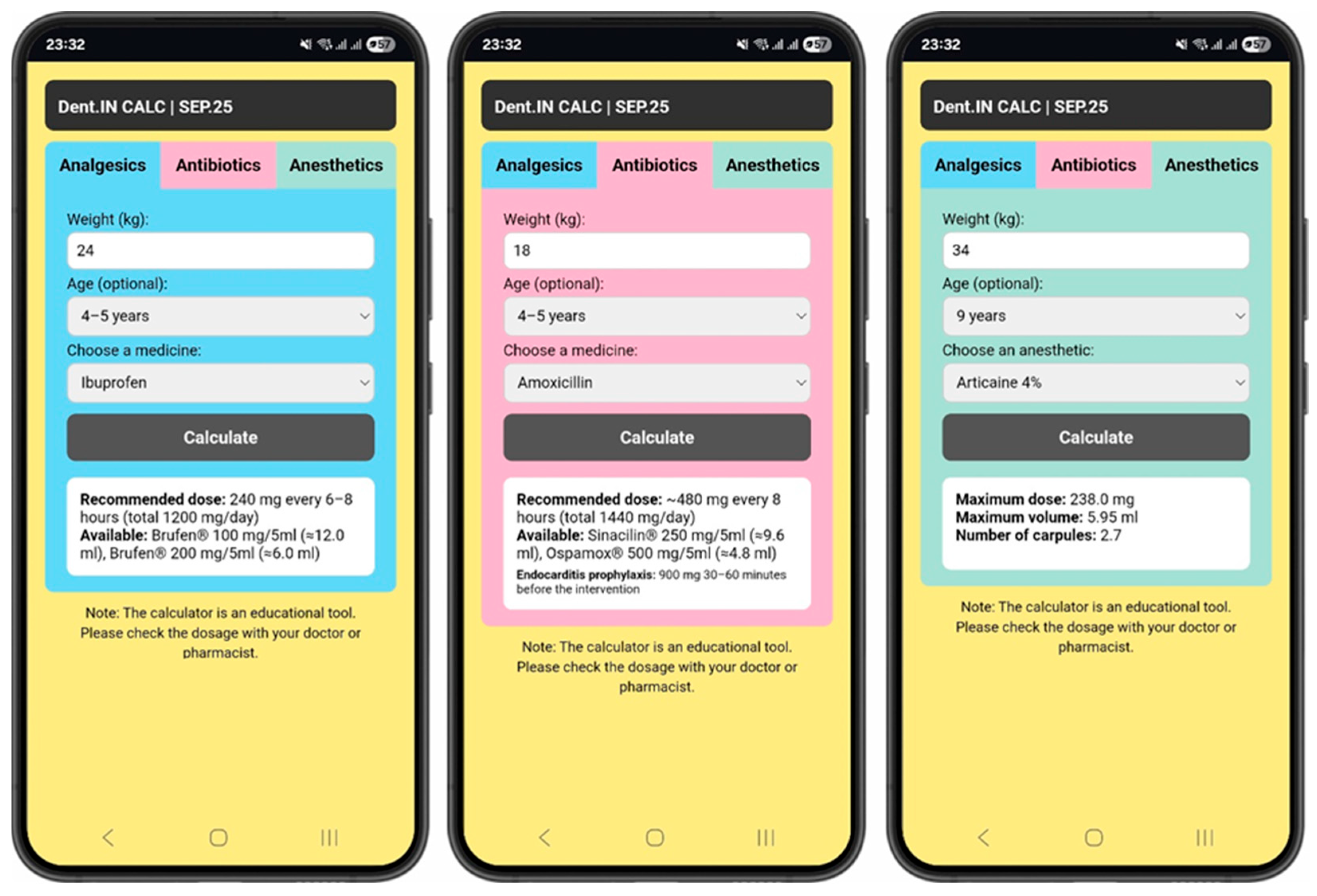
- Patient-specific input: clinicians enter the child’s weight (kg) and age (years).
- Instant calculation: the algorithm provides both recommended and maximum safe doses for key pharmacological groups—antibiotics, analgesics, and local anesthetics.
- Market relevance: the app includes pharmaceutical formulations available in the local market, helping clinicians quickly match calculated doses with available commercial preparations.
- Safety features: where applicable, the app displays alerts when the maximum safe dose is approached or exceeded, reinforcing safe prescribing behavior.
- The visual interface uses large, clearly labeled buttons and dosage fields for rapid use, even during clinical procedures. The app’s offline functionality is particularly beneficial in dental offices or regions with limited internet connectivity, ensuring reliability in all practice settings.
2.3. Study Design and Evaluation Procedure
- Demographic and professional characteristics (specialization, years of experience, workplace setting);
- Self-assessed knowledge of pediatric pharmacology and dosage calculation;
- Satisfaction with the app’s usability, accuracy, and speed; and
- Perceived clinical and educational value.
2.4. Statistical Analysis
3. Results
3.1. Educational Gap
3.2. Information Sources
3.3. User Experience
3.4. Correlation with Experience
3.5. Benefits
3.6. Clinical Significance
- Enhanced patient safety: by minimizing the likelihood of calculation errors and overdosing.
- Improved efficiency: dosage results are available instantly, optimizing workflow and chairside decision-making.
- Educational support: young clinicians gain confidence and understanding of pediatric pharmacology through practical application.
- Standardization: the app promotes consistency in prescription practices across clinicians and institutions.
4. Discussion
5. Conclusions
Author Contributions
Funding
Institutional Review Board Statement
Informed Consent Statement
Data Availability Statement
Acknowledgments
Conflicts of Interest
References
- Goel, D.; Goel, G.K.; Chaudhary, S.; Jain, D. Antibiotic prescriptions in pediatric dentistry: A review. J. Fam. Med. Prim. Care 2020, 9, 473–480. [Google Scholar] [CrossRef] [PubMed]
- Carrasco-Labra, A.; Polk, D.E.; Urquhart, O.; Aghaloo, T.; Claytor, J.W., Jr.; Dhar, V.; Dionne, R.A.; Espinoza, L.; Gordon, S.M.; Hersh, E.V.; et al. Evidence-based clinical practice guideline for the pharmacologic management of acute dental pain in children: A report from the American Dental Association Science and Research Institute, the University of Pittsburgh School of Dental Medicine, and the Center for Integrative Global Oral Health at the University of Pennsylvania. J. Am. Dent. Assoc. 2023, 154, 814–825.e2. [Google Scholar] [PubMed]
- Mladenovic, R. A simple calculation of the maximum dose of the local anesthetic in pediatric dentistry with nomogram. Vojnosanit. Pregl. 2022, 79, 817–819. [Google Scholar] [CrossRef]
- Kaushal, R.; Bates, D.W.; Landrigan, C.; McKenna, K.J.; Clapp, M.D.; Federico, F.; Goldmann, D.A. Medication errors and adverse drug events in pediatric inpatients. JAMA 2001, 285, 2114–2120. [Google Scholar] [CrossRef] [PubMed]
- Chau, R.C.W.; Cheng, A.C.C.; Mao, K.; Thu, K.M.; Ling, Z.; Tew, I.M.; Chang, T.H.; Tan, H.J.; McGrath, C.; Lo, W.L.; et al. External Validation of an AI mHealth Tool for Gingivitis Detection among Older Adults at Daycare Centers: A Pilot Study. Int. Dent. J. 2025, 75, 1970–1978. [Google Scholar] [CrossRef] [PubMed]
- American Academy of Pediatric Dentistry. Use of local anesthesia for pediatric dental patients. In The Reference Manual of Pediatric Dentistry; American Academy of Pediatric Dentistry: Chicago, IL, USA, 2024; pp. 386–393. [Google Scholar]
- American Academy of Pediatric Dentistry. The Reference Manual of Pediatric Dentistry, 2022–2023: Definitions, Oral Health Policies, Recommendations, Endorsements, Resources; American Academy of Pediatric Dentistry: Chicago, IL, USA, 2022. [Google Scholar]
- Mladenovic, R.; Milosavljevic, M.; Stanisic, D.; Vasovic, M. Importance of artificial intelligence in the analysis of children’s CBCT imaging by dental students. J. Dent. Educ. 2023, 87, 914–916. [Google Scholar] [CrossRef] [PubMed]
- Rishoej, R.M.; Almarsdottir, A.B.; Christensen, H.R.; Hallas, J. Medication errors in pediatric inpatients: A systematic review. Eur. J. Pediatr. 2021, 180, 2963–2973. [Google Scholar]
- Ghaleb, M.A.; Barber, N.; Franklin, B.D.; Yeung, V.W.; Khaki, Z.F.; Wong, I.C.K. Systematic review of medication errors in pediatric patients. Ann. Pharmacother. 2006, 40, 1766–1776. [Google Scholar] [CrossRef] [PubMed]
- World Health Organization. Medication Safety in High-Risk Situations; WHO: Geneva, Switzerland, 2022.
- Jia, P.; Zhang, L.; Chen, J.; Zhao, P.; Zhang, M. The Effects of Clinical Decision Support Systems on Medication Safety: An Overview. PLoS One 2016, 11, e0167683. [Google Scholar] [CrossRef] [PubMed]
- Khairat, S.; Marc, D.; Crosby, W.; Al Sanousi, A. Reasons for physicians not adopting clinical decision support systems: Critical analysis. JMIR Med. Inform. 2018, 6, e24. [Google Scholar] [CrossRef] [PubMed]
- Masters, K.; Ellaway, R.H.; Topps, D. Mobile technologies in medical education: AMEE Guide No. 105. Med. Teach. 2020, 42, 507–524. [Google Scholar] [CrossRef] [PubMed]
- Shortliffe, E.H.; Sepúlveda, M.J. Clinical decision support in the era of artificial intelligence. JAMA 2018, 320, 2199–2200. [Google Scholar] [CrossRef] [PubMed]
- Joshi, S.; Sheth, S. Artificial Intelligence (AI) in Pharmaceutical Formulation and Dosage Calculations. Pharmaceutics 2025, 17, 1440. [Google Scholar] [CrossRef] [PubMed]
- El Naqa, I.; Murphy, M.J. Artificial Intelligence in Medicine and Radiation Oncology; CRC Press: Boca Raton, FL, USA, 2021. [Google Scholar]
- Siontis, G.C.M.; Sweda, R.; Noseworthy, P.A.; Friedman, P.A.; Siontis, K.C.; Patel, C.J. Development and validation pathways of artificial intelligence tools evaluated in randomised clinical trials. BMJ Health Care Inform. 2021, 28, e100466. [Google Scholar] [CrossRef] [PubMed]

| Variable | Category | n (%) |
|---|---|---|
| Specialization | General dentists | 38 (63.3) |
| Pediatric dental specialists | 14 (23.3) | |
| Other specialties | 8 (13.3) | |
| Years of experience | <5 years | 14 (23.3) |
| 5–10 years | 19 (31.7) | |
| 10–20 years | 16 (26.7) | |
| >20 years | 11 (18.3) | |
| Practice setting | Private practice | 42 (70) |
| Public sector | 18 (30) |
| Parameter | Response | n (%) |
|---|---|---|
| Undergraduate education on pediatric dosing | Insufficient | 45 (75) |
| Sufficient | 15 (25) | |
| Confidence in manual dosage calculation | Confident | 12 (20) |
| Not confident | 48 (80) | |
| Confidence by experience group | <5 years | (30%) |
| >5 years | (18%) |
| Source of Information | % of Respondents (n = 60) |
|---|---|
| Official dosing manuals | 28 |
| Online resources | 35 |
| Pharmaceutical brochures | 22 |
| Peer advice | 15 |
| Source of Information | Mean ± SD/% | Notes |
|---|---|---|
| Ease of use (“very easy” or “extremely easy”) | 92% | - |
| Clarity of interface | 90% | - |
| Reduced anxiety regarding dosing errors | 88% | - |
| Mean satisfaction score (Likert 1–5) | 4.7 ± 0.4 | 95% CI: 4.6–4.8 |
| Clinical relevance rating | Pediatric specialists: 4.8; General dentists: 4.6 | Mann–Whitney p = 0.03, r = 0.31 |
| Aspect | Response Rate (%) | Description |
|---|---|---|
| Faster workflow and standardized dosing | 100 | Universally noted |
| Increased professional confidence | 92 | Common benefit |
| Expand drug database | 68 | Suggested improvement |
| Add modules for medically compromised | 45 | Suggested improvement |
| Multilingual support | 38 | Suggested improvement |
| Integration with EHR systems | 22 | Suggested improvement |
| Would recommend the app to colleagues | 95 | - |
| Would use the app routinely | 87 | - |
Disclaimer/Publisher’s Note: The statements, opinions and data contained in all publications are solely those of the individual author(s) and contributor(s) and not of MDPI and/or the editor(s). MDPI and/or the editor(s) disclaim responsibility for any injury to people or property resulting from any ideas, methods, instructions or products referred to in the content. |
© 2026 by the authors. Licensee MDPI, Basel, Switzerland. This article is an open access article distributed under the terms and conditions of the Creative Commons Attribution (CC BY) license.
Share and Cite
Mladenovic, R.; Milosavljevic, M.; Mirkovic, Z.; Mladenovic, K. Assessing User Experience and Satisfaction with a Mobile Application for Drug Dosage Calculation—A Pilot Study. Dent. J. 2026, 14, 20. https://doi.org/10.3390/dj14010020
Mladenovic R, Milosavljevic M, Mirkovic Z, Mladenovic K. Assessing User Experience and Satisfaction with a Mobile Application for Drug Dosage Calculation—A Pilot Study. Dentistry Journal. 2026; 14(1):20. https://doi.org/10.3390/dj14010020
Chicago/Turabian StyleMladenovic, Rasa, Marko Milosavljevic, Zlatica Mirkovic, and Kristina Mladenovic. 2026. "Assessing User Experience and Satisfaction with a Mobile Application for Drug Dosage Calculation—A Pilot Study" Dentistry Journal 14, no. 1: 20. https://doi.org/10.3390/dj14010020
APA StyleMladenovic, R., Milosavljevic, M., Mirkovic, Z., & Mladenovic, K. (2026). Assessing User Experience and Satisfaction with a Mobile Application for Drug Dosage Calculation—A Pilot Study. Dentistry Journal, 14(1), 20. https://doi.org/10.3390/dj14010020

