
Article

Mechanochemical Reduction of V2O5: Alkali Metals vs. Alkali Metal Hydrides—Which Are the More Suitable Reducing Agents?


Inorganic Solid-State Chemistry, Saarland University, Campus Building C4.1, 66123 Saarbruecken, Germany
*
Author to whom correspondence should be addressed.
Inorganics 2026, 14(9), 238; https://doi.org/10.3390/inorganics14090238
Submission received: 28 July 2026 / Revised: 31 August 2026 / Accepted: 2 September 2026 / Published: 9 September 2026

Abstract

Vanadium oxides and alkali metal vanadates are promising electrode materials for electrochemical energy storage owing to their ability to access multiple oxidation states. In this study, mechanochemical reduction of V2O5 with alkali metal hydrides is explored as a facile route to obtain reduced vanadium oxide phases. Sodium hydride enables the rapid formation of mixed sodium vanadium oxide phases at room temperature, proceeding in a self-propagating manner after only a short milling period. To assess the generality of this approach, lithium hydride was evaluated as an alternative reducing agent and exhibited comparable reaction behavior and product distributions. Complementary theoretical calculations indicate that the corresponding reductions with elemental sodium and lithium are thermodynamically more favorable, displaying lower reaction enthalpies. This prediction is experimentally corroborated by the instantaneous ignition observed when elemental metals are used. Rietveld refinement reveals that all investigated reducing agents follow similar reaction pathways, yielding comparable mixtures of alkali metal vanadium oxides with consistent main phases. However, the use of highly ductile sodium metal results in significant mixing limitations, which can be mitigated only through cryogenic milling. These findings highlight mechanochemical reduction with alkali metal hydrides as a robust and practical strategy, particularly for systems in which metal ductility limits process efficiency, despite the associated risk of hydrogen evolution.

1. Introduction

Vanadium oxides have long been established as versatile materials in catalysis [1], but more recently they have attracted considerable attention as functional materials for electrochemical energy storage and conversion [2,3,4]. This interest arises primarily from the rich redox chemistry of vanadium, which enables access to multiple oxidation states and thus facilitates reversible electron transfer processes. Prominent applications include redox flow batteries [5] and electrode materials for lithium [6] and sodium-ion batteries [7]. Furthermore, emerging concepts such as photo-rechargeable lithium-ion batteries highlight the potential of vanadium-based compounds in next-generation energy technologies [8].
The vanadium–oxygen system exhibits a remarkable structural and electronic diversity. A wide range of stable and metastable vanadium oxides with vanadium oxidation states spanning from +II to +V have been reported [9,10]. Among these, only a limited number of compounds—namely VO2, V2O3, and V2O5, together with the Magnéli phase V3O5 and the Wadsley phase V3O7—are thermodynamically stable [11].
While the binary oxides VO2, V2O3, and V2O5 contain vanadium in a single oxidation state, the latter two phases exhibit a mixed-valent character. In addition, numerous metastable mixed-valence oxides belonging to the Magnéli and Wadsley series further enrich the system [11,12].
Beyond binary oxides, vanadium forms a large variety of ternary oxide systems with alkali and alkaline earth metals, such as lithium, sodium, potassium, and calcium [13]. These alkali metal vanadates display significant structural diversity, arising from variations in alkali metal content and vanadium oxidation state. For lithium and sodium alone, approximately 20 and 15 distinct stoichiometric compounds, respectively, have been reported, with vanadium oxidation states ranging from +III to +V [13]. Despite the different ionic radii of lithium (76 pm) and sodium (102 pm) [14], many lithium and sodium vanadates adopt closely related or even identical crystal structures when sharing the same composition.
The Na-V-O system has been investigated in considerable detail, largely due to the technological relevance of the Na2O-V2O5 subsystem in the roasting of vanadium slags for metallic vanadium production [15], which is widely used in steel and alloy manufacturing [16]. Early studies, particularly in the mid-20th century, revealed that reactions within this system are often strongly exothermic and tend to yield mixtures of various sodium vanadates and vanadium oxides rather than phase-pure materials [17,18,19]. Comparable observations have been made in the Li-V-O system; for instance, Hagenmuller and Lesaicherre reported the formation of mixed lithium vanadium oxide phases upon reacting V2O5 with LiH at elevated temperatures [20]. The synthesis of phase-pure alkali metal vanadates is therefore intrinsically challenging due to the complex thermodynamic and kinetic landscape governing these systems.
Recently, mechanochemical approaches have emerged as powerful alternatives to conventional high-temperature or solution-based synthesis routes. We have demonstrated that mixtures of sodium vanadium oxides can be readily obtained by the mechanochemical reduction of V2O5 with NaH, proceeding rapidly at room temperature in a self-propagating manner after only a short milling time [21]. Similar highly exothermic and combustion-like reactions have been reported for the mechanochemical reduction of V2O5 using metals such as Mg, Al, or Ti, as well as for co-reduction processes yielding intermetallic compounds [22]. When these types of combustive, self-propagating reactions are performed in the ball mill, they represent so-called mechanically induced self-propagating reactions (MSRs), which are characterized by an adiabatic temperature Tad exceeding 1800 K, as described in detail by Lazlo Takacs [23,24]. MSRs typically consist of three phases. The first phase is an initial activation period. During this first period, which can last from a few minutes [21,25,26,27,28] to several hours [29,30], mechanical activation and mixing lead to a reduced particle size, defect formation and increased surface area of the reactants. In addition to milling parameters [31], other characteristics of the reactants, such as the morphology or their particle size, can also influence the ignition time [32]. Once the reaction reaches a critical activation point, rapid ignition occurs in a combustion-like event. This event is accompanied by a sudden release of reaction energy, sharp increases in temperature and pressure, and the formation of most of the product. During the reaction ignition, the formation of thermites (large chunks of molten product) [22] is often observed, showing the harshness of these reactions and the significant increase in local temperatures [23]. After ignition, further milling results in the obtention of a homogeneous product mixture [23,24].
From a thermodynamic perspective, elemental alkali metals are expected to act as even stronger reducing agents than their corresponding hydrides. This is supported by the lower standard reduction potentials of Na+/Na (−2.71 V) and Li+/Li (−3.04 V) compared to H2/H− (−2.23 V) [33]. Furthermore, under the assumption that the same products are formed with NaH and Na, the reactions with sodium should be energetically more favored due to expected lower (more exothermic) reaction energies issuing from the lower standard enthalpy of formation from NaH (−56.3 kJ mol−1) compared to Na (0 kJ mol−1) [33]. However, it should be noted that mechanochemical reaction pathways and mechanisms are still not well understood since mechanochemically prepared products are usually not in thermodynamic equilibrium.
In the present study, we built upon our previous research by ball milling V2O5 with varying amounts of Na. We then compared the resulting sample compositions to those obtained with NaH to investigate potential differences in reaction behavior and determine whether hydrides or alkali metals are more suitable mechanochemical reducing agents. In addition, both LiH and Li were also applied as reducing agents to evaluate the generality of this concept. In comparison to sodium, an even stronger reaction is anticipated for lithium due to the comparatively lower standard potential of the redox pair Li+/Li (−3.04 eV) [33]. By varying the reagent composition and combining experimental synthesis with density functional theory calculations using the Vienna Ab initio Simulation Package (VASP), we aim to elucidate the generality of mechanochemical reduction pathways in alkali metal–vanadium–oxygen systems and to assess the relative performance of metals versus hydrides as reducing agents.

2. Results and Discussion

2.1. Quantum Mechanical Calculations

Quantum mechanical calculations using the Vienna Ab initio Simulation Package (VASP) were initially conducted to better assess the anticipated differences in exothermicity between alkali metal hydrides (NaH and LiH) and their corresponding elemental forms (Na and Li) as mechanochemical reducing agents for V2O5. It was assumed that the reaction behavior, in terms of the main products formed, would be similar to that observed in the mechanochemical reduction of V2O5 with NaH, which could later be confirmed through ball milling experiments. The formation enthalpies of the reactants and the expected main products were calculated (Supplementary Materials, Table S1), with the lowest formation energy for each polymorph being used to determine the reaction energies. After calculating the partial reaction equations for the reduction of V2O5 to reduced oxides VO2, V3O5 and V2O3, the formation energies of alkali metal vanadates from vanadium oxides with Li2O and Na2O were determined (Table S2). For easy comparison, all reaction energies are normalized to one mol V2O5 or V2O3.
As previously demonstrated, the formation of sodium vanadates—particularly those containing V5+—appears to be the primary driving force behind the pronounced exothermicity observed in reactions involving NaH and Na [21]. While the formation of lithium vanadate Li3VO4, also containing V5+, is likewise highly exothermic, the reduction of V2O5 to reduced vanadium oxides such as V2O3 appears to be even more energetically favorable for lithium-involving reactions compared to sodium ones. This can be attributed to the higher stability of Li2O (−14.75 eV) compared to Na2O (−11.94 eV).
Overall reaction equations were derived by combining the partial reactions listed in Table S2 and subsequently normalized to the atomic mass unit (u) of the reactants to facilitate direct comparison. As summarized in Table S3, the calculated reaction enthalpies range from −5.47 to −47.63 meV u−1, confirming their exothermic nature. A notable exception is the reduction of V2O5 with NaH to elemental vanadium with an endothermic reaction enthalpy of 4.94 meV u−1 (Table S3, Equation (S17)). This deviation is most likely related to the formation of substantial amounts of Na2O, which is less stable and therefore energetically less favored compared to Li2O. For all established reaction equations, those involving elemental alkali metals are more exothermic compared to their respective alkali metal hydrides, which is consistent with the previous considerations. Furthermore, a trend can be observed in which lower standard redox potentials correlate with increased exothermicity. Based on the quantum mechanical calculations, elemental lithium is therefore predicted to achieve the highest degree of reduction while also yielding the most exothermic reactions among the systems investigated.

2.2. Evolution of Pressure During Ball Milling

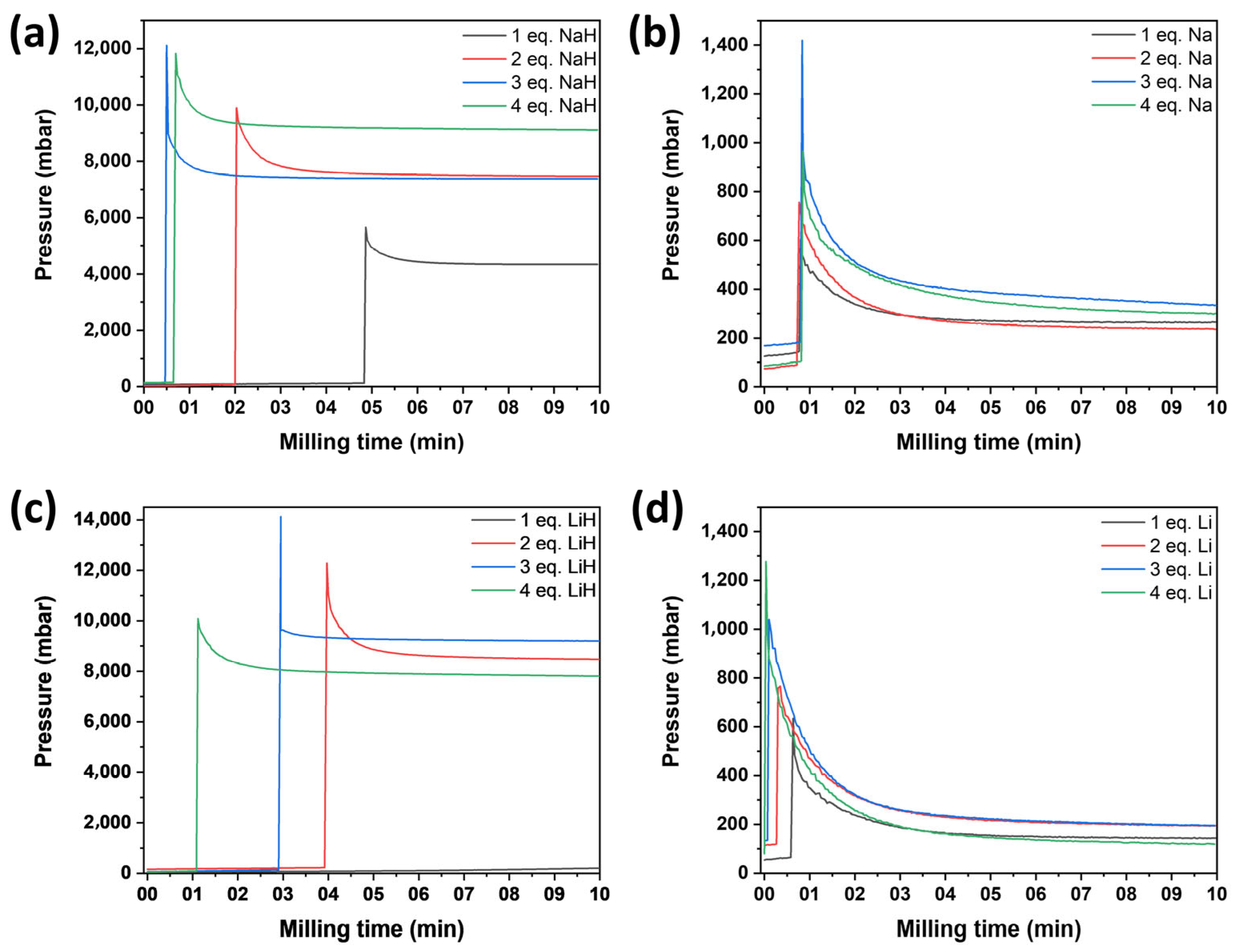
To systematically compare the reaction behavior of the different reducing agents, 1, 2, 3, and 4 eq. of NaH, Na sand, LiH and Li powder were subjected to mechanochemical treatment with V2O5 at 300 rpm for 10 min. The pressure evolution inside the milling jar was studied using the EASY GTM system by Fritsch. Consistent with previous observations for NaH [21], a sharp pressure increase, indicative of a combustion event, was observed for both alkali metals and LiH (Figure 1), suggesting that all reactions are self-propagating and highly exothermic. In our previous investigation, stopping the reaction at maximum pressure confirmed that the reaction occurred during the steep increase in pressure. The same product phases were identified via PXRD measurements as those identified after 10 min of milling [21].
As shown in Figure 1c, only the reaction with 1 eq. LiH did not exhibit a significant pressure increase within the 10 min milling period. This is most likely due to the observed cementation inside the milling jar, which hinders the mechanochemical reaction. Furthermore, using 1 eq. LiH results in the least exothermic reaction (see Supplementary Materials, Table S3). This indicates that the reaction is not as energetically favored under the tested milling conditions as it is with the other tested reducing agents.
After the strong initial pressure spike, the pressure rapidly decreases before attaining constant values between 4 and 9 bar for NaH and LiH (Figure 1a,c). The final elevated pressure is attributed to the evolution of hydrogen. The higher the initial hydride concentration, the higher the pressure increases, and the later the reaction is induced. To avoid exceeding the maximum pressure tolerance of the milling jars of 20 bar, the mass of the reaction mixture was reduced in case of 3 and 4 eq. of hydride. No effect of the formed hydrogen on the final sample composition was observed.
In contrast, during reactions with elemental sodium and lithium, the maximum pressure did not exceed 1.4 bar and quickly returned to its original level (Figure 1b,d). This indicates that no significant amounts of gaseous byproducts such as oxygen were formed, which is consistent with the absence of an increase in oxygen inside the glovebox when the milling jar was opened. Instead, the observed pressure rise is attributed to a sudden release of energy. According to the ideal gas law, the maximum pressure increases from 0.6 to 1.4 bar, which would correspond to brief temperature spikes of approximately 180 to 420 °C. This underlines the strong exothermicity and formation of the observed thermites. Overall, the lack of elevated final pressures significantly reduces safety concerns related to excessive pressure buildup during milling, unlike in the case of the respective hydrides. As observed with alkali metal hydrides, higher maximum pressures are attained with increasing concentrations of alkali hydrides, suggesting that the reactions become more exothermic, which aligns with our calculations.
While the induction period for reactions with NaH and LiH ranged from 30 s to several minutes, all reactions with elemental sodium and lithium as reducing agents started in less than one minute of milling. In particular, the use of lithium powder resulted in instantaneous ignition upon milling. The activation energy is so low that the highly exothermic reaction was even triggered accidentally by lightly mixing both V2O5 and Li powder with a spatula inside the glovebox, which was not observed for the other tested reducing agents. As evidenced by the earlier reaction ignition, reactions with alkali metals seem to have lower activation energies than with the respective hydrides. This is in accordance with the calculated lower (more exothermic) reaction enthalpies under the assumption that similar reactions occur during milling according to the Bell–Evans–Polyani principle, which states that there is a linear relationship between the activation energy and the reaction enthalpy for closely related reactions [34,35]. It should be noted that the Bell–Evans–Polyani principle is an empirical principle and is only used for a qualitative interpretation of the observed results.
A delayed temperature increase of a few degrees was observed in all investigated systems, which is comparable with the results of our previous publication on NaH [21]. However, unlike pressure evolution, the temperature evolution does not provide valuable insight into the occurring reaction since a certain percentage of the heat is absorbed by the milling jar, and the entire atmosphere inside the jar must first warm up before the temperature change is detected.

2.3. Color Change During Ball Milling

After milling, samples with colors ranging from dark green to black were obtained, depending on the type and concentration of the reducing agent, in contrast to the ochre color of the V2O5 starting material (Supporting Information, Figure S2). Milling with 1 eq. NaH, Na, and Li led to a dark-greenish color, while the sample obtained with 1 eq. LiH exhibited a much lighter, ochre/brown color, supporting the hypothesis that no reaction occurred, as seen by the lack of pressure increase. Meanwhile, the use of 2 and 3 eq. Na(H), as well as 2 to 4 eq. Li(H), led to very similar black and anthracite colorations, respectively. Only milling with 4 eq. Na at room temperature resulted in a sticky, grayish, non-homogeneous reaction mixture with milling balls trapped inside. Due to the stickiness, the reaction mixture was difficult to remove from the milling jar, suggesting that large excesses of very ductile reducing agents hinder effective mechanical energy transfer. Similar observations have been made in cases of mechanical alloying with ductile metals. The ductile materials undergo strong plastic deformation and cold welding instead of fracturing, which causes the metals to stick to the milling balls [36,37,38].
To overcome these ductility issues, two different approaches were tested: the addition of NaCl as an inert auxiliary agent and milling under cryogenic conditions. However, the addition of 30 to 50wt% NaCl always led to extensive cementation and inhomogeneity of the reaction mixture instead of finely dispersed Na, which hindered the successful reduction of V2O5 (Supplementary Materials, Figure S2). In contrast, cryogenic milling at 35 Hz produced an easily removable fine, black powder. This phenomenon can be attributed to the increased brittleness of sodium at these temperatures, which facilitates the milling process and represents an effective alternative to address mixing issues with sticky reactants or reaction mixtures.
In alignment with our previous results for NaH, an increase in the temperature of a few degrees is observed after ignition for all tested reactions (see Supplementary Materials, Figure S3 for exemplary data of the reactions with 2 eq. reducing agent). Since a certain percentage of the heat is absorbed by the milling jar and since the entire atmosphere inside the jar must first warm up, detection of the rise in temperature is delayed.

2.4. X-Ray Diffraction Analysis and Rietveld Refinement

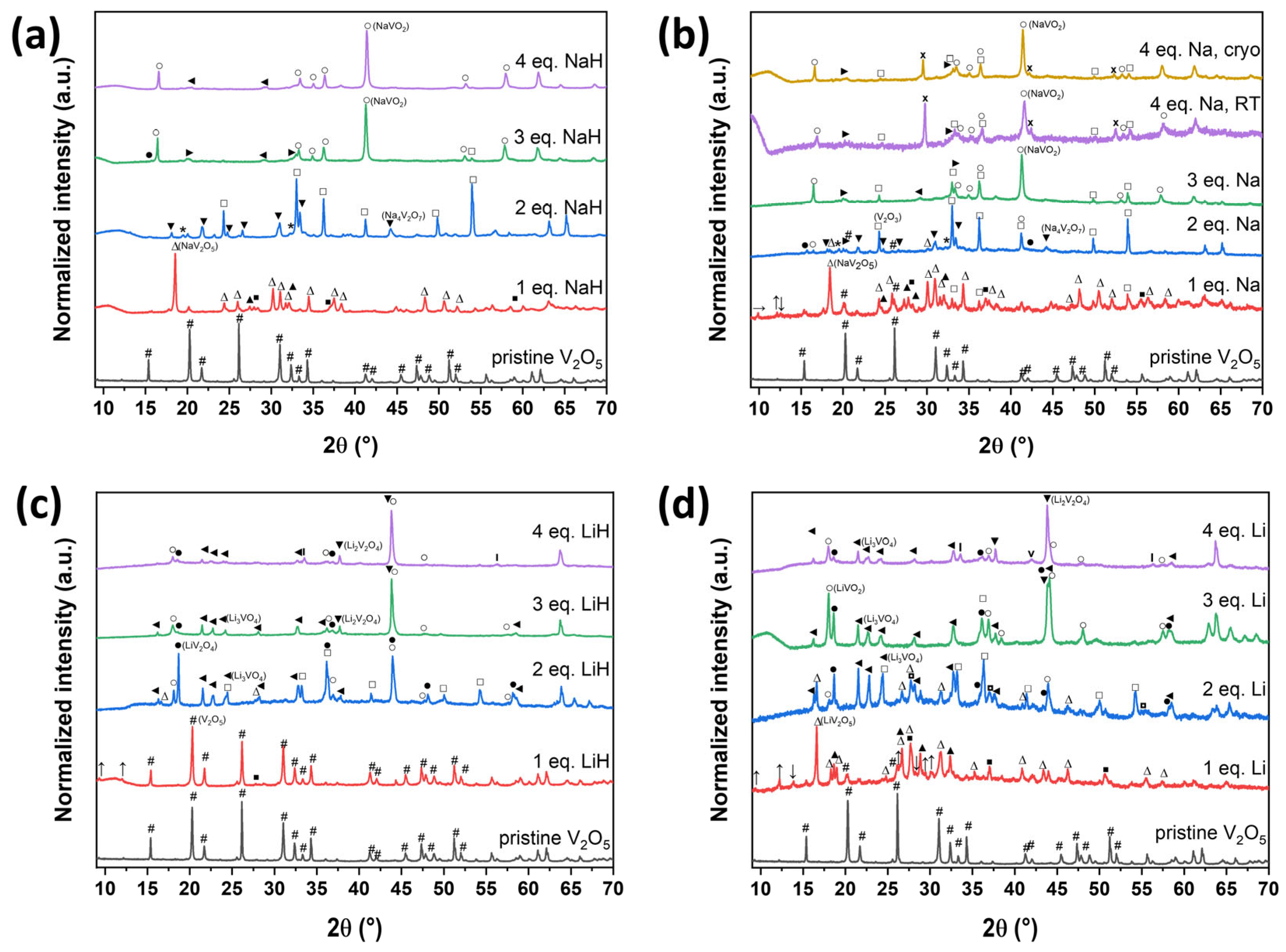
Powder X-ray diffraction (PXRD) measurements and Rietveld refinement were performed to analyze the sample composition. All PXRD patterns differ significantly from the diffraction pattern of pristine V2O5 with space group Pmmn after mechanochemical reaction with the tested reducing agents (Figure 2). While the reducing agent type (NaH vs. Na, LiH vs. Li) had rather minimal influence on the sample composition, the reducing agent concentration strongly influenced the number and positions of reflections and thus the sample composition (Figure 2).
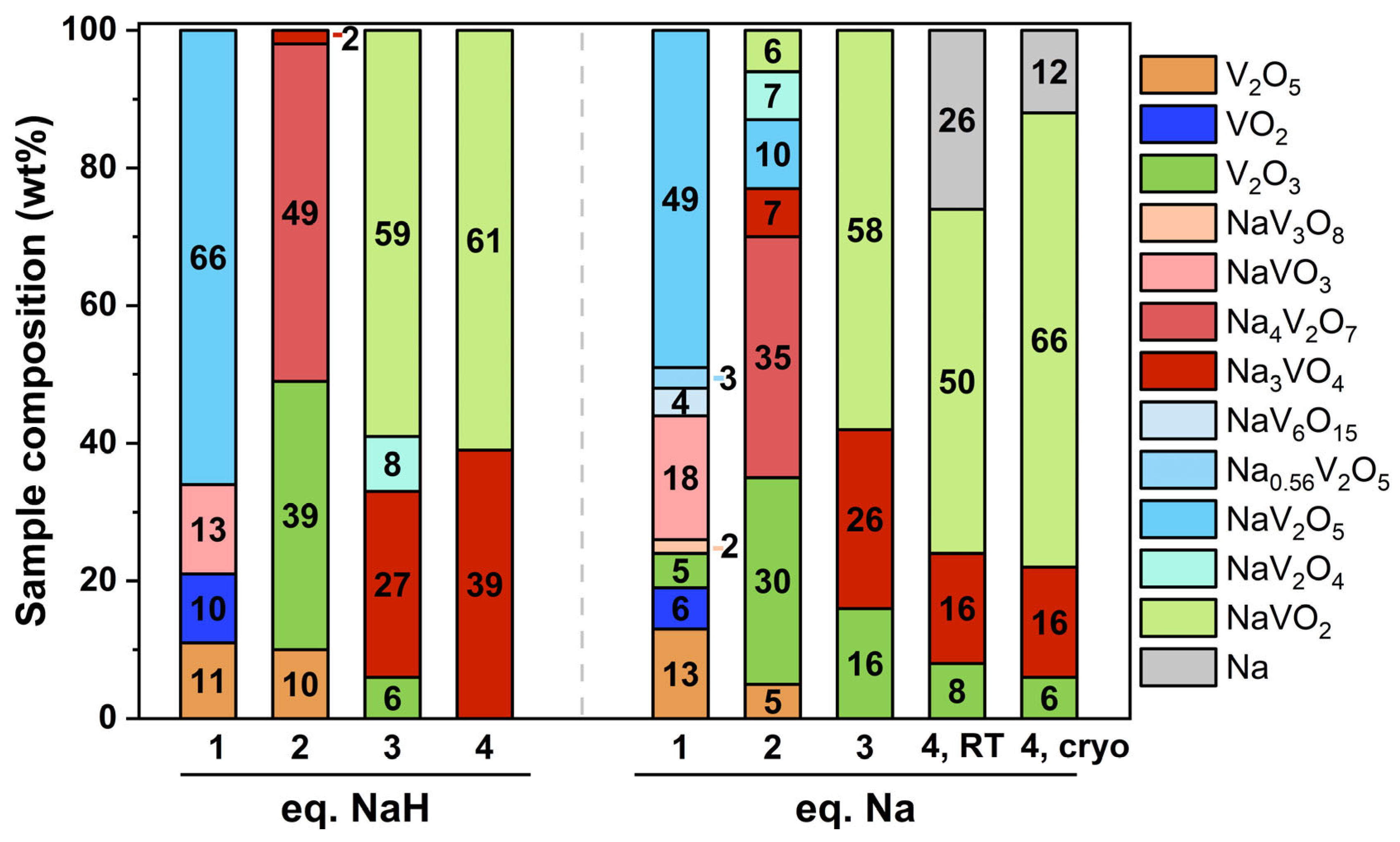
Rietveld refinements confirm the strong influence of the alkali metal concentration on the reaction outcome. The results of the Rietveld refinements of samples reduced with Na, LiH and Li are shown in the Supplementary Materials (Figures S4–S7, Tables S4–S6), while the Rietveld refinements for samples reduced with NaH can be found in the Supplementary Materials of our previous publication [21]. With sodium, the same main phases are overall formed as with NaH (Figure 3), including NaV2O5 (Pmmn) with 1 eq. Na(H), V2O3 (R 3 - c) and Na4V2O7 (C2/c) with 2 eq. Na(H), and NaVO2 (R 3 - m) and Na3VO4 (P213 and Pmn21) with even higher concentrations. As described above, milling with 4 eq. Na resulted in a poorly manageable, sticky reaction mixture at room temperature and a fine black powder under cryogenic conditions. Both milling temperatures resulted in the formation of the same main phases with NaVO2 as the dominant product. In comparison, a higher percentage of unreacted sodium was present after milling at room temperature (26%) compared to cryomilling (12%). Overall, the sample prepared at room temperature shows very poor crystallinity compared to the others, as seen by the high signal-to-noise ratio (Figure 2b), making the refinement process challenging and highlighting cryomilling as a suitable alternative for milling highly ductile compounds.
With 1 eq. Na, some minor additional phases, NaV3O8 (P2/m) [39], NaV6O15 (C2/c) [40], and Na0.56V2O5 (C2/m) [41], were detected which were absent when using sodium hydride. Furthermore, both less and more reduced (sodium) vanadium oxides are observed in the reaction mixtures compared to NaH. For example, NaV2O5 with V4+/V5+ is only formed with 1 eq. NaH, but with both 1 and 2 eq. Na. In contrast, more reduced NaV2O4 and NaVO2 with V+3/V4+ and V3+, respectively, are only observed with ≥3 eq. NaH, but already with 2 eq. Na. The faster formation of more reduced phases with sodium can most likely be attributed to its lower standard potential and the more exothermic reaction enthalpies compared to NaH. However, the high ductility of sodium might reduce the local energy impact from the milling balls, which explains the formation of less reduced products.
Since the same products are mainly formed with NaH, it can be concluded that similar reactions occur simultaneously during ball milling and the general trends deduced for increasing NaH concentrations are also valid for Na reduced samples: higher percentages of sodium vanadates form due to increased sodium availability, lower vanadium oxidation states become accessible, and sodium-rich vanadates are preferentially formed.
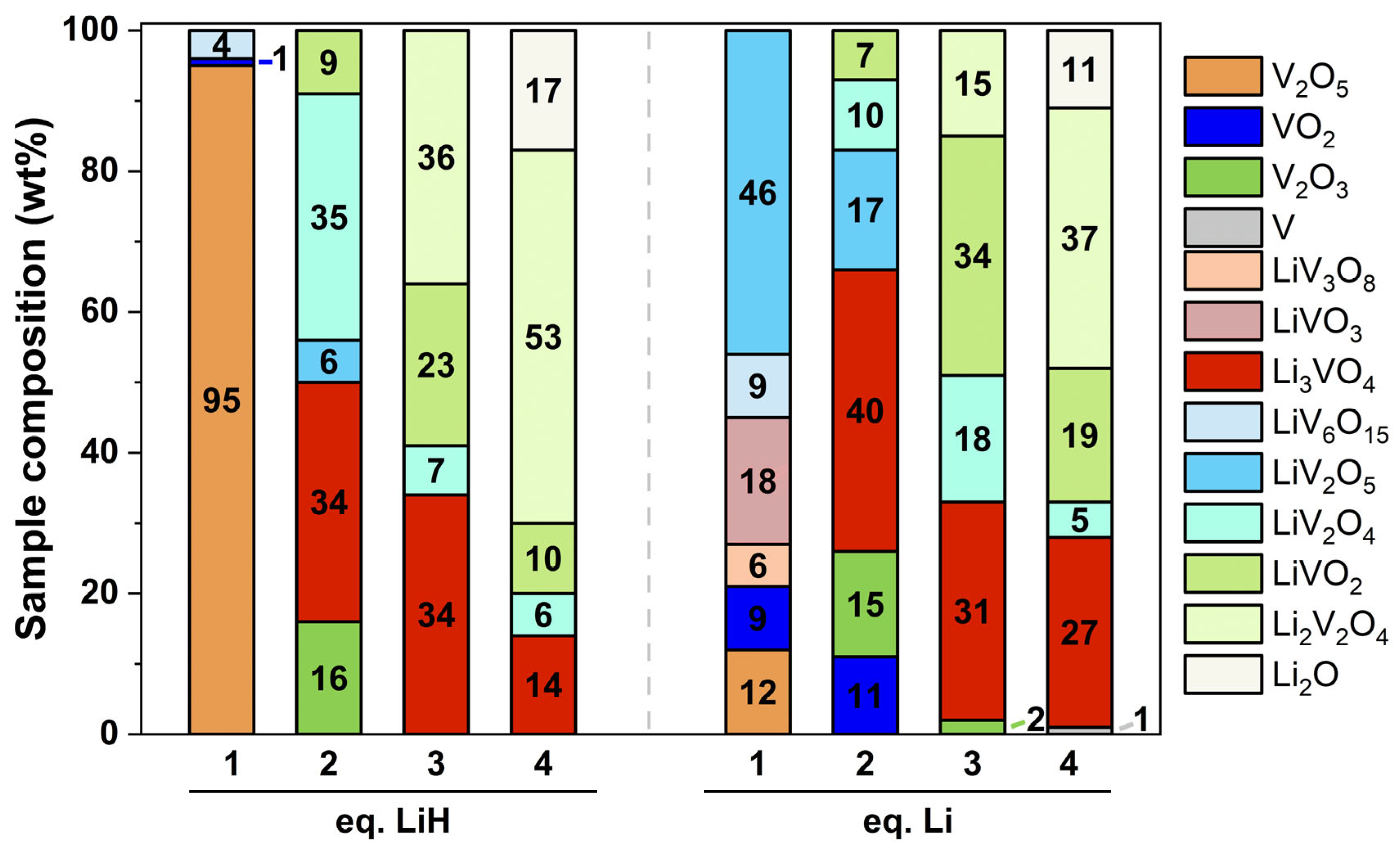
Lithium-based reductions mirror the trends observed for sodium-containing reducing agents and a product mixture of different (lithium) vanadium oxides is always obtained (Figure 4).
As suspected, based on the missing pressure increase and cementation, no reaction occurred with 1 eq. LiH, with the sample consisting mainly of unreacted V2O5 and only minor amounts VO2 (P42/mnm) and LiV6O15 (C2/m). In contrast, milling with lithium resulted in rapid mechanochemical reduction and the formation of VO2 (P21/c), LiV3O8 (P21/m), LiVO3 (C2/c), and LiV6O15 (C2/m) along with some unreacted V2O5. Overall, increasing Li(H) concentrations result in the formation of very similar phases, including V2O3 (R 3 - c), Li3VO4 (Pmn21), LiV2O5 (Pmmn), LiV2O4 (Fd 3 - m), LiVO2 (R 3 - m) and Li2V2O4 (Fd 3 - m). When using elemental lithium, even minor amounts of elemental vanadium can be detected, evidencing the higher reductive power of Li and the highly exothermic calculated reaction enthalpies.
In good agreement with the sodium-based results and the performed quantum chemical calculations, reactions with a low ratio of alkali metal to V2O5 dominate at low Li(H) concentrations such as the formation of LiV2O5 at 1 and 2 eq. Li(H), while lithium-rich phases such as Li3VO4 or reduced lithium vanadates with V3+ such as LiVO2 are only formed with 3 or 4 eq. Li(H). Again, similar findings for the obtained sample compositions suggest similar occurring reactions during ball milling, which further validates the previous assumption regarding lower activation energies in the case of Li according to the Bell–Evans–Polyani principle.

3. Materials and Methods

3.1. Materials

V2O5 (abcr, Karlsruhe, Germany, 99.9%), LiH (Alfa Aesar GmbH, Karlsruhe, Germany, 99.4%), lithium powder and sodium were obtained from commercial standard suppliers and were stored in a glovebox (MBRAUN, Garching, Germany) under argon atmosphere. The purity of all solids was characterized by X-ray diffraction prior to use.

3.2. Synthetic Procedures

3.2.1. Preparation of Sodium Sand

Sodium metal was melted in a Schlenk round-bottom flask under an argon atmosphere in paraffin oil at 105 °C. Upon complete melting, the mixture was vigorously stirred for 15 min to generate finely dispersed sodium droplets (“sodium sand”). Stirring was subsequently halted during cooling to prevent agglomeration. The resulting sodium sand was isolated and washed three times with absolute toluene, followed by three additional washes with absolute n-hexane. After drying, the material was stored under argon in a glovebox. All solvents were pre-dried using a solvent purification system (MBRAUN, Garching, Germany).

3.2.2. Mechanochemical Syntheses

All syntheses were performed under an argon atmosphere using the glovebox technique (MBRAUN, Garching, Germany).
For syntheses in the planetary ball mill Pulverisette 7 premium line (Fritsch, Idar-Oberstein, Germany), ZrO2 grinding jars with a volume of 45 mL were used. The batch size was set to 3 g and V2O5 was milled with n eq. Li, LiH and Na (n = 1, 2, 3 and 4) at 300 rpm for 10 min using 90 ZrO2 milling balls with a diameter of 5 mm. The evolution of pressure and temperature during ball milling was studied using the EASY GTM system by Fritsch (Idar-Oberstein, Germany). To avoid damage of the milling equipment, the total mass of the reaction mixture was set to 2 and 1.5 g for 3 and 4 eq. LiH, respectively. It is advised to estimate the potential pressures inside the milling jars before starting any reactions to avoid damage and safety issues. Since hydrogen is flammable when mixed with air, great care should be taken when opening the milling jar.
Due to ductility issues in the case of 4 eq, Na, the mechanochemical reaction was performed under cryogenic conditions instead of at room temperature. Instead of using the above-mentioned planetary ball mill, the reaction was performed in the mixer mill MM500 nano (Retsch, Haan, Germany). The milling equipment was changed from ZrO2 to steel since ZrO2 milling equipment is not suitable for use in cryogenic conditions. To ensure a good comparability between both milling conditions, the volume of the jar, the number of milling balls and the batch size was kept the same under both cryogenic and room-temperature conditions. For cryogenic milling, the milling jar with the reaction mixture was cooled down in a bath of liquid nitrogen before being milled for 2 min at 35 Hz with 1 min of cooling in between to ensure that the cryogenic conditions were retained.

3.3. Characterization

Powder X-ray diffraction (PXRD) patterns of the pulverized samples were recorded at room temperature on a X’Pert MPD diffractometer (PANalytical, Almelo, The Netherlands) in Bragg–Brentano θ-θ-geometry (goniometer radius 240 mm) with Cu Kα1,2-radiation (λ1 = 154.055, λ2 = 154.441 pm). A 12 µm Ni foil working as a Kβ filter and a variable divergence slit were mounted at the primary beam side. A PIXcel1D detector was used at the secondary beam side. Experiments were carried out in a 2θ range of 7 to 120° with a step size of 0.013° and a total scan time of 2 h. Rietveld refinements of the recorded diffraction patterns were performed using Topas 5.0 (Bruker AXS, Karlsruhe, Germany) software [42]. Crystallographic structure and microstructure were refined, while instrumental line broadening was included in a fundamental parameters approach [43]. The mean crystallite size <L> was calculated as the mean volume-weighted column height derived from the integral breadth. Crystal structure data were obtained from the Pearson’s Crystal database [13].

3.4. Quantum Mechanical Calculations

Calculation of the free energy of the (sodium) vanadium oxides was carried out using the projector-augmented wave (PAW) method by Blöchl [44] implemented in the Vienna Ab initio Simulation Package (VASP) [45,46,47]. Exchange and correlation effects were accommodated using the General Gradient Approximation (GGA) functional by Perdew–Burke–Ernzerhof optimized for bulk solids (PBEsol) [48]. POTPAW_PBE_54 potentials were used for all calculations, more specifically Na_sv, Li_sv, V_sv, O_h, and H_h. The convergence criteria for electronic and ionic relaxation were set to 10−4 and 10−5 eV, respectively, while the cut-off energy was set to 800 eV. The Brillouin zone was sampled by automatically generating a Γ-centered k-point mesh with a resolution of minimum 0.035 Å−1 per cell. All calculations were carried out without spin-polarization.

4. Conclusions

In conclusion, mechanically induced self-propagating reactions of V2O5 can be performed not only with NaH, as previously reported, but also with LiH and their elemental counterparts, sodium and lithium, as reducing agents.
Apart from the system containing 1 eq. of LiH, where no reaction occurred after 10 min of milling due to cementation, ignition was observed either immediately (for Na and Li) or after a few minutes of milling (for NaH and LiH) across all other tested compositions.
Rietveld refinement confirmed that both hydrides and elemental alkali metals follow similar reaction pathways, yielding product mixtures of different (alkali metal) vanadium oxides with the same main phases under comparable reaction conditions. The concentration of the reducing agent strongly influences the reaction outcome. Higher concentrations favor the formation of alkali-rich vanadates, lower vanadium oxidation states, and reduced oxide formation. Both alkali metals yield larger product mixtures with both more and less reduced alkali metal vanadates compared to NaH and LiH. The formation of more reduced phases is likely due to their lower standard potential compared to the hydride and the calculated more exothermic reaction enthalpies. The latter align with the apparent lower activation energy in accordance with the Bell–Evans–Polyani principle, as evidenced by the instantaneous start of the reactions.
Although elemental alkali metals can be seen as the more powerful reducing agents in the investigated system, their higher ductility can hinder effective energy transfer, causing the formation of less reduced products. Particularly large amounts of highly ductile sodium led to unmanageable and sticky reaction mixtures, which can only be overcome by less straightforward cryomilling.
Overall, the differences in reaction outcomes when using alkali metals or hydrides as reducing agents are rather small in the mechanochemical reaction with V2O5 and a large mixture of different phases is always obtained. However, despite the risk of hydrogen gas formation, alkali metal hydrides offer easier handling, better commercial availability and safer mixing in the investigated systems. In contrast, elemental metals provide stronger and faster reduction, but they pose practical limitations due to vigorous reactivity and ductility. For less ductile systems, such as those employing alkaline earth metal-based reducing agents, fine powders of the elemental metal are more preferrable than hydrides since hydrogen gas hazards can be avoided while maintaining similar product formation.

Supplementary Materials

The following supporting information can be downloaded at https://www.mdpi.com/article/10.3390/inorganics14090238/s1: Figure S1: Observed sample coloration after milling V2O5 with different amounts of reducing agent at room temperature and under cryogenic conditions in the case of 4 eq. sodium. Figure S2: Rietveld refinement after milling V2O5 with 4 eq. Na and 50 wt% NaCl at 300 rpm for 10 min. Figure S3: Evolution of pressure and temperature during milling time of V2O5 with 2 eq. of (a) NaH, (b) Na, (c) LiH and (d) Li for 10 min. Note the different scales. Figure S4: Rietveld refinement after milling V2O5 with (a) 1, (b) 2, (c) 3 and (d) 4 eq. Na. Figure S5: Rietveld refinement after milling V2O5 with 4 eq. Na under cryogenic conditions. Figure S6: Rietveld refinement after milling V2O5 with (a) 1, (b) 2, (c) 3 and (d) 4 eq. LiH. Figure S7: Rietveld refinement after milling V2O5 with (a) 1, (b) 2, (c) 3 and (d) 4 eq. Li. Table S1: Overview of the calculated formation enthalpies per formula unit Z of different vanadium oxides, alkali metal vanadates, alkali metal oxides and hydrides as well as their elemental counterparts for the respective sodium and lithium compounds that are relevant for this work. Table S2: Reaction enthalpies per mol V2O5 or V2O3 (ΔHr) of the possible partial reaction equations for the reduction of V2O5 with Na(H) and Li(H) to reduced vanadium oxides and the formation of alkali metal vanadates from vanadium oxides and the respective alkali metal oxide. Table S3: Reaction enthalpies per mol V2O5 (ΔHr) of the overall reaction equations for the reactions between V2O5 and Na(H) and Li(H), normalized to the atomic mass unit of the reactants. Table S4: Overview of the sample composition in weight percent as obtained by Rietveld refinement after milling V2O5 with different amounts of Na for 10 min. Table S5: Overview of the sample composition in weight percent as obtained by Rietveld refinement after milling V2O5 with different amounts of LiH for 10 min. Table S6: Overview of the sample composition in weight percent as obtained by Rietveld refinement after milling V2O5 with different amounts of Li for 10 min.

Author Contributions

Conceptualization, A.M. and G.K.; methodology, A.M.; validation, A.M. and G.K.; formal analysis, A.M.; investigation, A.M.; resources, G.K.; writing—original draft preparation, A.M.; writing—review and editing, G.K.; visualization, A.M.; supervision, G.K.; project administration, G.K.; funding acquisition, G.K. All authors have read and agreed to the published version of the manuscript.

Funding

This research was funded by the Deutsche Forschungsgemeinschaft (DFG, German Research Foundation)—project number INST 256/349-1.

Institutional Review Board Statement

Not applicable.

Informed Consent Statement

Not applicable.

Data Availability Statement

The original contributions presented in this study are included in the article/Supplementary Materials. Further inquiries can be directed to the corresponding author.

Acknowledgments

Instrumentation and technical assistance for this work were provided by the Service Center X-ray Diffraction, with financial support from Saarland University and the Deutsche Forschungsgemeinschaft (DFG, German Research Foundation—project number INST 256/349-1). We thank Lea Bold for performing the milling experiments with NaCl.

Conflicts of Interest

The authors declare no conflicts of interest.

References

  1. Simard, G.L.; Steger, J.F.; Arnott, R.J.; Siegel, L.A. Vanadium Oxides as Oxidation Catalysts. Ind. Eng. Chem. 1955, 47, 1424–1430. [Google Scholar] [CrossRef] [Scilit]
  2. Hassan, N.; Riaz, J.; Qureshi, M.T.; Razaq, A.; Rahim, M.; Toufiq, A.M.; Shakoor, A. Vanadium oxide (V2O3) for energy storage applications through hydrothermal route. J. Mater. Sci. Mater. Electron. 2018, 29, 16021–16026. [Google Scholar] [CrossRef] [Scilit]
  3. Hu, P.; Hu, P.; Vu, T.D.; Li, M.; Wang, S.; Ke, Y.; Zeng, X.; Mai, L.; Long, Y. Vanadium Oxide: Phase Diagrams, Structures, Synthesis, and Applications. Chem. Rev. 2023, 123, 4353–4415. [Google Scholar] [CrossRef] [Scilit] [PubMed]
  4. Liu, M.; Su, B.; Tang, Y.; Jiang, X.; Yu, A. Recent Advances in Nanostructured Vanadium Oxides and Composites for Energy Conversion. Adv. Energy Mater. 2017, 7, 1700885. [Google Scholar] [CrossRef] [Scilit]
  5. Cunha, Á.; Martins, J.; Rodrigues, N.; Brito, F.P. Vanadium redox flow batteries: A technology review. Int. J. Energy Res. 2015, 39, 889–918. [Google Scholar] [CrossRef] [Scilit]
  6. Zhang, X.; Sun, X.; Li, X.; Hu, X.; Cai, S.; Zheng, C. Recent progress in rate and cycling performance modifications of vanadium oxides cathode for lithium-ion batteries. J. Energy Chem. 2021, 59, 343–363. [Google Scholar] [CrossRef] [Scilit]
  7. Zhang, X.; Zhang, Z.; Xu, S.; Xu, C.; Rui, X. Advanced Vanadium Oxides for Sodium-Ion Batteries. Adv. Funct. Mater. 2023, 33, 2306055. [Google Scholar] [CrossRef] [Scilit]
  8. Boruah, B.D.; Wen, B.; De Volder, M. Light Rechargeable Lithium-Ion Batteries Using V2O5 Cathodes. Nano Lett. 2021, 21, 3527–3532. [Google Scholar] [CrossRef] [Scilit] [PubMed]
  9. Kang, Y.-B. Critical evaluation and thermodynamic optimization of the VO–VO2.5 system. J. Eur. Ceram. Soc. 2012, 32, 3187–3198. [Google Scholar] [CrossRef] [Scilit]
  10. Wriedt, H.A. The O-V (Oxygen-Vanadium) system. Bull. Alloy Phase Diagr. 1989, 10, 271–277. [Google Scholar] [CrossRef] [Scilit]
  11. Bahlawane, N.; Lenoble, D. Vanadium Oxide Compounds: Structure, Properties, and Growth from the Gas Phase. Chem. Vap. Depos. 2014, 20, 299–311. [Google Scholar] [CrossRef] [Scilit]
  12. Schwingenschlögl, U.; Eyert, V. The vanadium Magnéli phases VnO2n-1. Ann. Phys. 2004, 516, 475–510. [Google Scholar] [CrossRef] [Scilit]
  13. Villars, P.; Cenzual, K. Pearson’s Crystal Data: Crystal Structure Database for Inorganic Compounds. Release 2022/23; ASM International: Materials Park, OH, USA, 2023. [Google Scholar]
  14. Shannon, R.D. Revised effective ionic radii and systematic studies of interatomic distances in halides and chalcogenides. Acta Crystallogr. A 1976, 32, 751–767. [Google Scholar] [CrossRef] [Scilit]
  15. Pei, G.; Xiang, J.; Yang, L.; Jin, X.; Lv, X. Thermodynamic properties of sodium pyrovanadate (Na4V2O7) at high temperature (298.15–873 K). Calphad 2020, 70, 101802. [Google Scholar] [CrossRef] [Scilit]
  16. Petranikova, M.; Tkaczyk, A.H.; Bartl, A.; Amato, A.; Lapkovskis, V.; Tunsu, C. Vanadium sustainability in the context of innovative recycling and sourcing development. Waste Manag. 2020, 113, 521–544. [Google Scholar] [CrossRef] [Scilit] [PubMed]
  17. Barker, M.G.; Hooper, A.J. Preparation and X-Ray Powder Diffraction Patterns of the Sodium Vanadates NaVO3, Na4V2O7, and Na3VO4. J. Chem. Soc. Dalton Trans. 1973, 2, 1513–1517. [Google Scholar] [CrossRef] [Scilit]
  18. Barker, M.G.; Hooper, A.J. Reactions of Sodium Oxide with the Oxides VO2, V2O3, VO, and Vanadium Metal. J. Chem. Soc. Dalton Trans. 1973, 2, 1517–1519. [Google Scholar] [CrossRef] [Scilit]
  19. Kubaschewski, O.; Hoster, T.; Schlim, R. The Heats of Formation of Some Sodium and Barium Vanadates and Molybdates. Ber. Bunsenges. Phys. Chem. 1981, 85, 367–369. [Google Scholar] [CrossRef] [Scilit]
  20. Hagenmuller, P.; Lesaicherre, A. La réduction de l’anhydride vanadique par l’hydrure de lithium. Compt. Rend. 1963, 256, 170–171. [Google Scholar]
  21. Michaely, A.; Luckas, C.; Haberkorn, R.; Kickelbick, G. Highly Exothermic and Fast Mechanochemical Redox and Intercalation Reactions of V2O5 with Sodium Hydride. Inorg. Chem. 2024, 63, 8099–8108. [Google Scholar] [CrossRef] [Scilit] [PubMed]
  22. Mukherjee, A.; Krishnamurthy, N. Phase evolution during mechanochemical coreduction of V2O5 and TiO2 with Al. Int. J. Self-Propag. High-Temp. Synth. 2010, 19, 237–243. [Google Scholar] [CrossRef] [Scilit]
  23. Takacs, L. Self-sustaining reactions induced by ball milling. Prog. Mater. Sci. 2002, 47, 355–414. [Google Scholar] [CrossRef] [Scilit]
  24. Takacs, L. Self-sustaining reactions as a tool to study mechanochemical activation. Faraday Discuss. 2014, 170, 251–265. [Google Scholar] [CrossRef] [Scilit] [PubMed]
  25. Jalaly, M.; Gotor, F.J.; Sayagués, M.J. Mechanically induced combustion synthesis of niobium carbonitride nanoparticles. J. Solid State Chem. 2018, 267, 106–112. [Google Scholar] [CrossRef] [Scilit]
  26. Jalaly, M.; Gotor, F.J.; Sayagués, M.J. Mechanochemical combustion synthesis of vanadium carbide (VC), niobium carbide (NbC) and tantalum carbide (TaC) nanoparticles. Int. J. Refract. Met. Hard Mater. 2019, 79, 177–184. [Google Scholar] [CrossRef] [Scilit]
  27. Jalaly, M.; Tamizifar, M.; Bafghi, M.S.; Gotor, F.J. Mechanochemical synthesis of ZrB2–SiC–ZrC nanocomposite powder by metallothermic reduction of zircon. J. Alloys Compd. 2013, 581, 782–787. [Google Scholar] [CrossRef] [Scilit]
  28. Yang, H.; McCormick, P.G. Mechanochemical Reduction of V2O5. J. Solid State Chem. 1994, 110, 136–141. [Google Scholar] [CrossRef] [Scilit]
  29. Abdellahi, M.; Zakeri, M.; Bahmanpour, H. Events and reaction mechanisms during the synthesis of an Al2O3-TiB2 nanocomposite via high energy ball milling. Front. Chem. Sci. Eng. 2013, 7, 123–129. [Google Scholar] [CrossRef] [Scilit]
  30. Pallone, E.M.J.A.; Trombini, V.; Botta F, W.J.; Tomasi, R. Synthesis of Al2O3–NbC by reactive milling and production of nanocomposites. J. Mater. Process. Technol. 2003, 143–144, 185–190. [Google Scholar] [CrossRef] [Scilit]
  31. Chicardi, E.; Gotor, F.J.; Alcalá, M.D.; Córdoba, J.M. Influence of milling parameters on the solid-gas synthesis of TiCxN1−x by mechanically induced self-sustaining reaction. Powder Technol. 2017, 319, 12–18. [Google Scholar] [CrossRef] [Scilit]
  32. Baláž, M.; Džunda, R.; Bureš, R.; Sopčák, T.; Csanádi, T. Mechanically induced self-propagating reactions (MSRs) to instantly prepare binary metal chalcogenides: Assessing the influence of particle size, bulk modulus, reagents melting temperature difference and thermodynamic constants on the ignition time. RSC Mechanochem. 2024, 1, 94–105. [Google Scholar] [CrossRef] [Scilit]
  33. Haynes, W.M. CRC Handbook of Chemistry and Physics, 97th ed.; CRC Press: Boca Raton, FL, USA, 2016. [Google Scholar]
  34. Bell, R.P.; Hinshelwood, C.N. The theory of reactions involving proton transfers. Proc. R. Soc. Lond. Ser. A—Math. Phys. Sci. 1936, 154, 414–429. [Google Scholar] [CrossRef] [Scilit]
  35. Evans, M.G.; Polanyi, M. Inertia and driving force of chemical reactions. Trans. Faraday Soc. 1938, 34, 11–24. [Google Scholar] [CrossRef] [Scilit]
  36. Anas, N.S.; Ramakrishna, M.; Dash, R.K.; Rao, T.N.; Vijay, R. Influence of process control agents on microstructure and mechanical properties of Al alloy produced by mechanical alloying. Mater. Sci. Eng. A 2019, 751, 171–182. [Google Scholar] [CrossRef] [Scilit]
  37. Baláž, P.; Achimovičová, M.; Baláž, M.; Billik, P.; Cherkezova-Zheleva, Z.; Criado, J.M.; Delogu, F.; Dutková, E.; Gaffet, E.; Gotor, F.J.; et al. Hallmarks of mechanochemistry: From nanoparticles to technology. Chem. Soc. Rev. 2013, 42, 7571–7637. [Google Scholar] [CrossRef] [Scilit] [PubMed]
  38. Suryanarayana, C. Mechanical alloying and milling. Prog. Mater. Sci. 2001, 46, 1–184. [Google Scholar] [CrossRef] [Scilit]
  39. Jo, J.H.; Aniskevich, Y.; Kim, J.; Choi, J.U.; Kim, H.J.; Jung, Y.H.; Ahn, D.; Jeon, T.-Y.; Lee, K.-S.; Song, S.H.; et al. New Insight on Open-Structured Sodium Vanadium Oxide as High-Capacity and Long Life Cathode for Zn–Ion Storage: Structure, Electrochemistry, and First-Principles Calculation. Adv. Energy Mater. 2020, 10, 2001595. [Google Scholar] [CrossRef] [Scilit]
  40. Grzechnik, A.; Ueda, Y.; Yamauchi, T.; Hanfland, M.; Hering, P.; Potapkin, V.; Friese, K. Pressure-induced non-superconducting phase of β-Na0.33V2O5 and the mechanism of high-pressure phase transitions in β-Na0.33V2O5 and β-Li0.33V2O5 at room temperature. J. Phys. Condens. Matter. 2016, 28, 035401. [Google Scholar] [PubMed]
  41. Kanke, Y.; Kato, K.; Takayama-Muromachi, E.; Isobe, M. Structure of Na0.56V2O5. Acta Cryst. C 1990, 46, 536–538. [Google Scholar] [CrossRef] [Scilit]
  42. Bruker AXS Inc. Topas; Bruker AXS Inc.: Karlsruhe, Germany, 2014. [Google Scholar]
  43. Cheary, R.W.; Coelho, A. A fundamental parameters approach to X-ray line-profile fitting. J. Appl. Crystallogr. 2004, 25, 109–121. [Google Scholar]
  44. Blöchl, P.E. Projector augmented-wave method. Phys. Rev. B 1994, 50, 17953–17979. [Google Scholar] [CrossRef] [Scilit] [PubMed]
  45. Kresse, G.; Furthmüller, J. Efficient iterative schemes for ab initio total-energy calculations using a plane-wave basis set. Phys. Rev. B 1996, 54, 11169–11186. [Google Scholar] [CrossRef] [Scilit] [PubMed]
  46. Kresse, G.; Furthmüller, J. Efficiency of ab-initio total energy calculations for metals and semiconductors using a plane-wave basis set. Comput. Mater. Sci. 1996, 6, 15–50. [Google Scholar] [CrossRef] [Scilit]
  47. Kresse, G.; Joubert, D. From ultrasoft pseudopotentials to the projector augmented-wave method. Phys. Rev. B 1999, 59, 1758–1775. [Google Scholar] [CrossRef] [Scilit]
  48. Perdew, J.P.; Ruzsinszky, A.; Csonka, G.I.; Vydrov, O.A.; Scuseria, G.E.; Constantin, L.A.; Zhou, X.; Burke, K. Restoring the Density-Gradient Expansion for Exchange in Solids and Surfaces. Phys. Rev. Lett. 2008, 100, 136406. [Google Scholar] [CrossRef] [Scilit] [PubMed]
Figure 1. Evolution of the pressure inside the milling jar during milling of V2O5 with 1 to 4 eq. of (a) sodium hydride, (b) sodium, (c) lithium hydride, and (d) lithium. Note the different pressure scales. The pressure sensor inside the milling equipment is referenced to atmospheric pressure and initial pressures before milling therefore often range between 30 and 130 mbar. For easier comparison, our previous results with NaH are shown again in (a), reproduced with permission from the American Chemical Society. Copyright 2024 [21].
Inorganics 14 00238 g001
Figure 2. PXRD patterns of pristine V2O5 (black) and after reaction of V2O5 with 1 to 4 eq. of (a) sodium hydride and (b) sodium, (c) lithium hydride, and (d) lithium. For easier comparison, our previous results with NaH were adapted and are shown again in (a). Adapted with permission from the American Chemical Society. Copyright 2024 [21]. Unidentified reflections are marked with asterisks. Characteristic reflections corresponding to V2O5 (Pmmn) are marked with #, of VO2 (P42/mnm) with ■, of VO2 (P21/c) with ◘, of V2O3 (R 3 - c) with □, of V (Im 3 - m) with v, of AV3O8 (P21/m) with ↓, of AVO3 (C2/c) with ▲, of Na4V2O7 (C2/c) and Li2V2O4 (Fd 3 - m) with ▼, of A3VO4 (P213) with ► and A3VO4 (Pmn21) with ◄, of AV6O15 (C2/m) with ↑, of Na0.56V2O5 (C2/m) with →, of AV2O5 (Pmmn) with ∆, of NaV2O4 (C2/c) and LiV2O4 (Fd 3 - m) with ●, of AVO2 (R 3 - m) with ○, of Li2O (Fd 3 - m) with I, and Na (Im 3 - m) with x. A equals Na and Li. If a phase is present as a main phase in different diffractograms, its main reflections are marked in all corresponding diffractograms. For easier understanding, the chemical formula of each main phase is also written behind the respective symbol. To facilitate comparison, the XRD data have been normalized between zero and one. An increased or amorphous background between ~10 and 15° 2θ originates from different dome sample holders.
Inorganics 14 00238 g002
Figure 3. Sample composition in weight percent obtained by Rietveld refinement for V2O5 milled with 1 to 4 eq. sodium hydride and sodium for 10 min. For easier comparison, our previous results with NaH are reshown (adapted with permission from the American Chemical Society. Copyright 2024) [21].
Inorganics 14 00238 g003
Figure 4. Sample composition in weight percent obtained by Rietveld refinement for V2O5 milled with 1 to 4 eq. lithium hydride and lithium for 10 min.
Inorganics 14 00238 g004
Disclaimer/Publisher’s Note: The statements, opinions and data contained in all publications are solely those of the individual author(s) and contributor(s) and not of MDPI and/or the editor(s). MDPI and/or the editor(s) disclaim responsibility for any injury to people or property resulting from any ideas, methods, instructions or products referred to in the content.