Article

Tilted Magnetic Structure and Enhanced Magnetic Anisotropy of Bilayer CrSBr Induced by Exchange Bias Effect


1
Key Laboratory of Material Physics, Ministry of Education, School of Physics, Zhengzhou University, Zhengzhou 450001, China
2
College of Physics, Donghua University, Shanghai 201620, China
3
State Key Laboratory for Mesoscopic Physics, School of Physics, Peking University, Beijing 100871, China
*
Author to whom correspondence should be addressed.
Inorganics 2026, 14(9), 226; https://doi.org/10.3390/inorganics14090226
Submission received: 23 July 2026 / Revised: 18 August 2026 / Accepted: 21 August 2026 / Published: 24 August 2026
(This article belongs to the Special Issue Inorganics Emerging Investigators Themed Collection)

Abstract

The exchange bias (EB) effect is widely used for stabilizing reference magnetic layers in traditional spintronic devices, yet the EB strength strongly depends on the interfacial quality. Van der Waals antiferromagnets provide an ideal physical platform to study the interfacial magnetic properties for device design in the 2D limit. Herein, we construct CrSBr/Fe3GeTe2 heterostructures and investigate the interfacial coupling via first-principles calculations. The results reveal that robust EB coupling in the heterostructure breaks the intrinsic in-plane magnetic limitation of CrSBr, inducing a stable tilted magnetic structure with magnetic moments tilting toward the out-of-plane direction. Such EB-driven magnetic reconstruction dramatically boosts the perpendicular magnetic anisotropy energy to ~6.5 meV/Cr and increases the AFM-FM energy difference to 1.97 meV/f.u. from 0.32 meV/f.u., achieving simultaneous enhancement of magnetic anisotropy and thermodynamic stability. The transport simulations of the CrSBr/Fe3GeTe2-based magnetic tunnel junction demonstrate that ~65% TMR can be achieved with the use of such an EB-pinned reference layer. This work clarifies the EB modulation mechanism in 2D CrSBr/Fe3GeTe2 heterostructures and provides a reliable theoretical basis for the design of high-performance CrSBr-based reference layers in spintronic devices.

1. Introduction

Antiferromagnetic (AFM) materials with ultra-fast spin dynamics and zero stray field are regarded as promising next-generation spintronic candidates [1,2]. Two-dimensional (2D) AFM-based magnetic tunnel junctions (MTJs) show excellent device performance due to their atomically smooth interfaces, controllable layer-dependent magnetic order, global tunneling, and thus remarkable device performance [3,4]. For example, the tunneling magnetoresistance (TMR) of the MTJs built by AFM tunnel barriers sandwiched between electrodes, such as CrI3, CrSBr, and CrOCl, reaches 1000%~106% [5,6,7,8]. However, the outstanding output TMR cannot be directly translated into practical applications, because the magnetization switching of AFM barriers still strongly relies on the external magnetic field, which not only hinders high-density integration but causes crosstalk between adjacent units. Thus, it can be seen that the advantages of 2D AFM materials have not been fully exploited. Therefore, how to make full use of 2D AFM properties becomes a crucial issue in the development of high-density and high-speed nonvolatile memory.
Exchange bias (EB) effect, originating from the uncompensated interfacial spin exchange coupling between ferromagnetic (FM) and AFM phases, is universally adopted to pin the reference magnetic layer, guaranteeing reliable signal readout and long-term operational stability for high-performance magnetic devices [9,10,11]. As the scaling demands very thin tunnel barriers, the interfacial intermixing and roughness become critical factors to determine severe performance degradation, especially for conventional bulk-film-based EB systems [12,13]. Within this context, excavating 2D EB effects constructed by 2D AFM materials can release the intrinsic metrics of 2D antiferromagnets and eliminate interfacial drawbacks in conventional devices.
Bilayer CrSBr possesses a high Néel temperature (132 K) A-type AFM order and excellent ambient stability, but exhibits extremely weak intrinsic magnetic anisotropy dominated by in-plane y-axis orientation [14,15]. The weak anisotropy originates from the feeble spin–orbit coupling (SOC) of Cr 3d orbitals and nearly quenched orbital angular momentum. Its in-plane magnetic anisotropy energy (MAE) is merely 0.09 meV per Cr atom. Moreover, the tiny energy difference between its AFM and FM states of only 0.32 meV/f.u indicates that its ground AFM state is vulnerable to thermal fluctuations and external perturbations based on our calculations. Herein, bilayer CrSBr and monolayer FM Fe3GeTe2 (FGT) are correspondingly chosen as AFM and FM building blocks to construct the 2D EB heterostructure.
In this work, we systematically construct a CrSBr/FGT heterostructure and investigate the interfacial exchange bias modulation on the magnetic stability and spin configuration of 2D antiferromagnetic CrSBr via first-principles calculations. It is found that the AFM-FM energy difference of bilayer CrSBr is enhanced to 1.97 meV/Cr, indicating a great improvement in AFM robustness against the external magnetic field’s reorientation. The strong EB breaks the intrinsic easy magnetization along the y-axis of CrSBr and triggers layer-dependent magnetic moment tilting toward the out-of-plane z-direction. Specifically, the top CrSBr layer (near FGT) exhibits a larger average tilt angle of 8.5° along the z-axis, while the bottom CrSBr layer presents a relatively smaller tilt of approximately 5.2°, forming an asymmetric yet stable canted magnetic configuration. This magnetic reconstruction drastically boosts the perpendicular magnetic anisotropy to 6.5 meV/Cr atom. Benefiting from such EB-pinned magnetic configuration, our transport simulations of CrSBr/Fe3GeTe2-based MTJs further demonstrate a considerable TMR ratio of approximately 65%, rendering the bilayer heterostructure a promising reference layer for high-stability spintronic devices. Our work clarifies the underlying physical mechanism of layer-resolved spin tilting and magnetic performance enhancement of CrSBr, providing a feasible application strategy for the precise manipulation of 2D antiferromagnetic spintronic units.

2. Results and Discussion

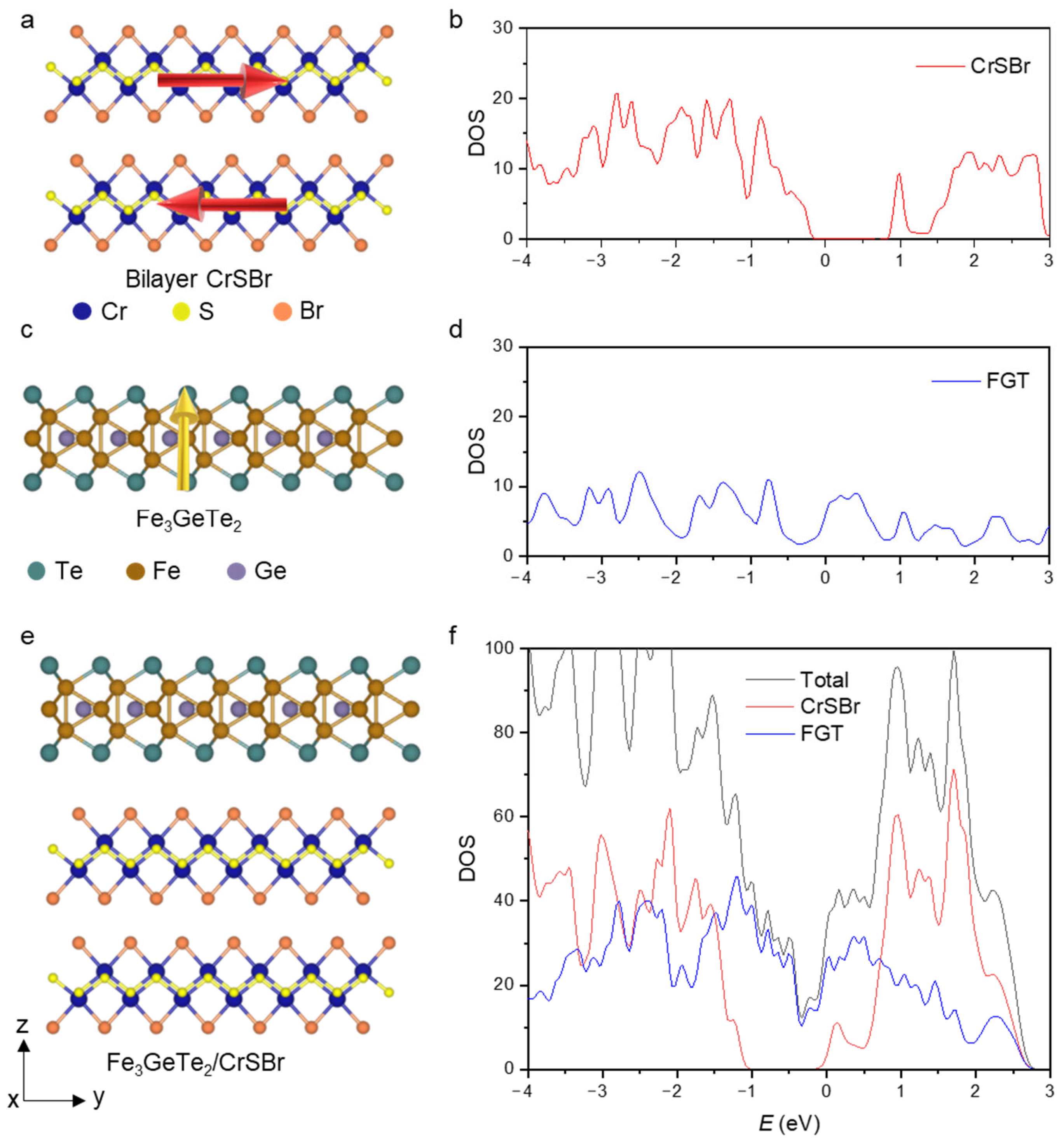
CrSBr is a semiconducting vdW antiferromagnet with intralayer ferromagnetic coupling and interlayer antiferromagnetic coupling. It is confirmed as triaxial magnetic anisotropy with the easy axis along the crystallographic b axis (Figure 1a) [16]. The in-plane MAE is only 0.09 meV per Cr atom, and the out-of-plane MAE is slightly higher at 0.13 meV per Cr atom. This weak anisotropy originates from the weak SOC of Cr 3d orbitals in the pristine state, where the orbital angular momentum is almost completely quenched, resulting in negligible anisotropic energy splitting of spin states. The weak MAE generally indicates that the pristine bilayer CrSBr lacks a stable preferred magnetization direction. An external magnetic field is easy to break the aligned magnetic order [15,17]. Moreover, for the bilayer CrSBr, the energy between the FM and ground AFM states is only 0.08 meV/f.u. Such a small energy barrier means that external thermal excitation or weak electromagnetic disturbance can easily induce an AFM-FM phase transition, leading to magnetic disorder and device performance failure. Therefore, the pure AFM CrSBr cannot act as an ideal reference layer in high-performance spintronic devices.
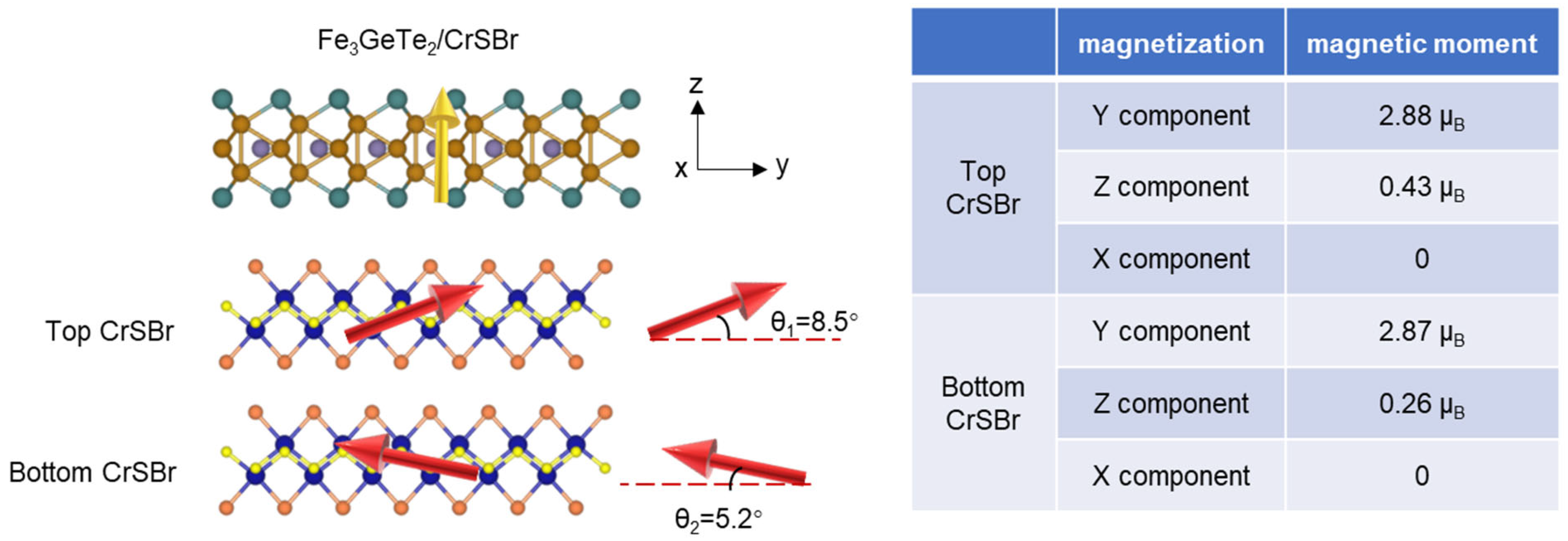
To get sufficient magnetic order stability and obvious anisotropic differences, the monolayer FGT is selected to match an AFM/FM interface with the bilayer CrSBr. Monolayer FGT has robust out-of-plane MAE [18], at 0.78 meV/f.u., one order of magnitude higher than that of the pristine CrSBr. The optimized interlayer distance is 2.90 Ǻ, implying weak interfacial vdW coupling. FGT is insufficient to break the intrinsic in-plane magnetic constraint of CrSBr. In contrast, bilayer CrSBr provides additional interlayer spin coupling degrees of freedom, forming strong and asymmetric interfacial exchange bias interaction with FGT. This robust interfacial spin coupling breaks the original balanced in-plane spin distribution of CrSBr, forcing the intrinsic y-axis easy magnetization axis to deflect toward the out-of-plane direction. Namely, the upper and lower layers of bilayer CrSBr produce uniform out-of-plane spin inclination, forming a stable tilted magnetic structure. To be more specific, we thoroughly check the three component changes in the magnetic moments (m) of Cr atoms. As shown in Figure 2, the m of Cr atoms in the top layer (adjacent to FGT) tilts 8.5° to the +z direction on average, while it rotates ~5° to the +z direction in the bottom CrSBr layer. The mutual antiparallel m in the two layers changes to an angle of ~166° (Figure 2). Their z components are additionally induced by FGT because the y components maintain the same level as the intrinsic lattice. The tilted spin arrangement changes the original planar spin distribution of Cr atoms, activates the quenched orbital angular momentum of Cr 3d orbitals, and significantly enhances the system’s spin–orbit coupling effect. By contrast, m of FGT still points to the z direction in the contact.
Benefiting from the exchange bias-induced tilted magnetic structure and enhanced SOC effect, the perpendicular magnetic anisotropy of bilayer CrSBr is significantly improved. The perpendicular MAE is sharply increased from the intrinsic near-zero level to 6.5 meV per Cr atom (equivalent to 2.88 meV per magnetic atom), which is nearly two orders of magnitude higher than the pristine value (Table 1). The prominent perpendicular magnetic anisotropy completely reverses the intrinsic in-plane magnetic preference of CrSBr, endowing the system with stable inclined out-of-plane magnetization characteristics (the compensated AFM order of the bilayer CrSBr is substituted by net 0.7μB along the out-of-plane direction). Compared with traditional strain-modulated and doping-modulated CrSBr systems, our interface exchange bias strategy achieves a more significant anisotropy enhancement effect and avoids the structural damage and instability problems caused by excessive strain or impurity doping [16,19,20].
In addition, the AFM-FM state energy difference is greatly increased from 0.08 meV/f.u. to 1.97 meV/f.u. (Table 2), which enhances the thermodynamic stability of the AFM ground state by more than dozens of times. The significantly increased energy barrier effectively suppresses the magnetic phase transition induced by thermal fluctuation and external interference, ensuring the long-term stability of the AFM ordered structure of CrSBr. This excellent stability is particularly critical for spintronic reference layers, which need to maintain a fixed magnetic configuration to provide stable reference spin signals for device operation.
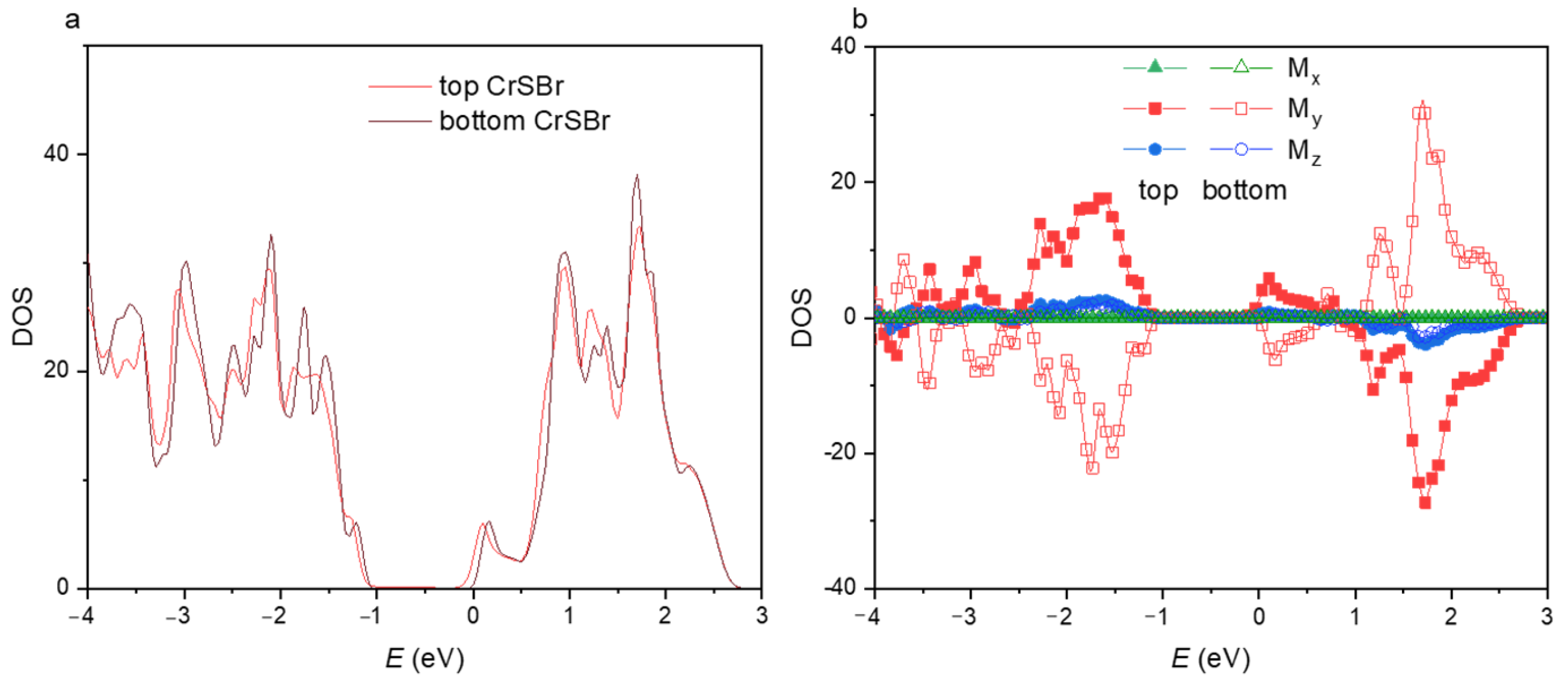
In terms of electronic properties, bilayer CrSBr exhibits an intrinsic band gap of 1.15 eV, as demonstrated by the density of states (DOS) presented in Figure 1b. After contacting FGT, it is found that FGT-CrSBr heterostructure exhibits a metallic phase because several states are crossing the Fermi level (Ef). Furthermore, CrSBr is effectively n-type-doped because Ef shifts upward into the conduction band (Figure 1f vs. Figure 1b). In contrast, the energy level of FGT remains almost unchanged compared with its freestanding state (Figure 1f vs. Figure 1d), indicating that FGT dominates the interfacial charge transfer process without obvious electronic structural distortion. Notably, the n-type doping for the top- and the bottom-layer CrSBr is different. As illustrated in Figure 3a, the top layer accepts more electrons from FGT than the bottom layer. This layer-asymmetric charge doping is evidenced by the more pronounced downward shift in the electronic energy levels for the top CrSBr layer relative to the bottom layer. Such distinct electronic reconstruction between the two layers breaks the in-plane structural symmetry of pristine CrSBr and fundamentally reorganizes its magnetic anisotropy, enabling the transition from weak intrinsic in-plane anisotropy to robust perpendicular magnetic anisotropy. The layer-resolved DOS of CrSBr in the heterostructure can be decomposed by different magnetic moment components (Figure 3b). It is found that my in the conduction bands and the valence bands regions are mutually compensated, and no states are contributing to mx. The out-of-plane m (mz) states provide the net magnetization, which is highly consistent with the three calculated m components in Figure 2.
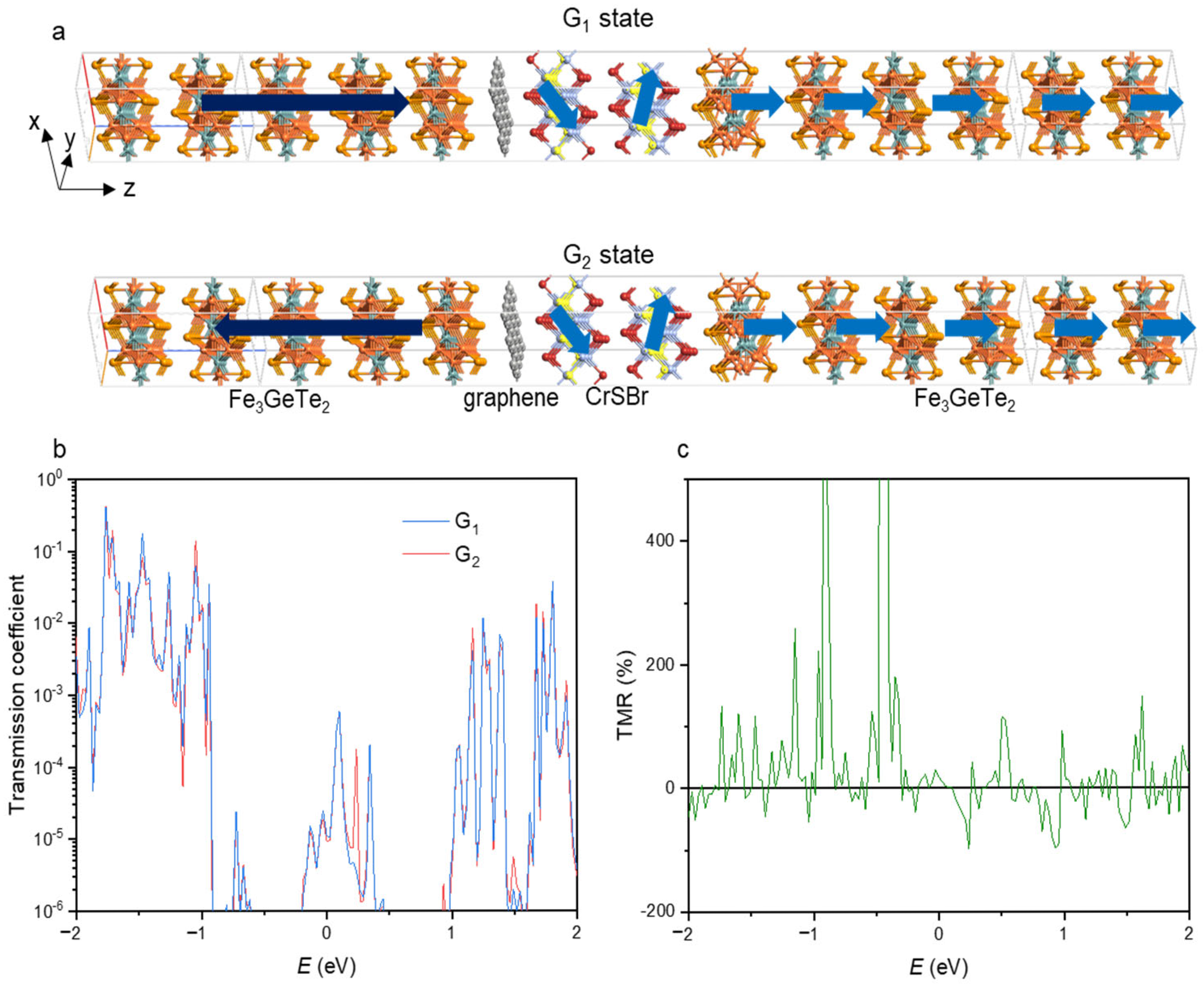
To further validate the practical application potential of the EB-based FGT-CrSBr heterostructure, we construct a simplified van der Waals magnetic tunnel junction (MTJ) and perform systematic quantum transport calculations. In the designed device architecture, the EB-modified FGT-CrSBr heterostructure acts as the stable pinned reference layer, while standalone monolayer FGT serves as the magnetically switchable free layer. To maintain structural simplicity and achieve clean spin-dependent tunneling, monolayer graphene is employed as the ultrathin tunneling barrier. Benefiting from the robust exchange-bias-pinned canted magnetic structure of CrSBr, the reference layer maintains a stable magnetic configuration during device operation, eliminating undesired spin flipping and ensuring reliable spin injection. As the FGT free layer reverses its magnetization, the device enables a switch between two distinct conductance states (denoted as G1 and G2) (Figure 4). Two distinct conductance states have the same atomic device configurations but possess different magnetic orders. The title magnetization of the pinning layer is fixed, while the free layer, made up of pure FGT, can be tuned to orient in the same or the opposite direction of the transport direction, forming G1 and G2 states, respectively. TMR is calculated using TMR   =   G 1   G 2 G 2   ×   100 % . At the Fermi level, the optimized MTJ yields a stable tunneling magnetoresistance (TMR) ratio of 65%, demonstrating reliable spin-switching functionality. Further analysis of energy-dependent TMR based on quantum transmission spectra reveals that the TMR can be raised up to hundreds or thousands of percent (Figure 4).
The EB effect is subject to thickness [21,22,23]. Recently, CrSBr (30 nm)/FGT (9 nm) has been reported to possess tilted in-plane EB on FGT [9], while CrSBr (100 nm)/Fe3GaTe2 (50 nm) shows out-of-plane EB caused by spin-canting [24]. These studies focus on nanoflake systems, while the atomic-resolved CrBr-FGT heterostructure remains unclear. By comparison, our atomic-scale calculations complement such a physical gap. The bilayer CrSBr in this work induces asymmetric spin canting and realizes out-of-plane EB and enhanced perpendicular MAE, which not only confirms the layer-dependent EB orientation and magnetic stability but also highlights the high-quality role that the bilayer CrSBr-FGT interface can serve in high-performance MTJ devices.

3. Methods

Structural configuration calculations were performed based on the density functional theory (DFT) implemented in the Vienna Ab initio Simulation Package (VASP) [25]. The projector augmented wave (PAW) pseudopotential was adopted to describe the electron–ion interaction, and the Perdew–Burke–Ernzerhof (PBE) generalized gradient approximation (GGA) functional was used to treat the exchange-correlation potential [26,27]. To accurately describe the strong electron correlation effect of Cr 3d orbitals, the onsite U with the Liechtenstein version was set to U = 2 eV and J = 1 eV, in good agreement with previous calculations [5]. A vacuum layer of at least 20 Å was added along the out-of-plane z-direction to eliminate the periodic boundary interaction between adjacent layers. The optB86-vdW functional was used to correct the van der Waals force [28]. In total, 2 × 3 CrSBr and 3   ×   7 FGT supercells were matched to form an FGT-CrSBr heterostructure (78 atoms in total) with a lattice mismatch of 1.2%. The k-point mesh of 15 × 11 × 1 was adopted for Brillouin zone sampling. The plane-wave cutoff energy was set to 600 eV. The atomic positions and lattice constants were fully optimized until the residual force on each atom was less than 0.01 eV/Å, and the total energy convergence threshold was set to 10−4 eV. A noncollinear framework and spin–orbit coupling (SOC) were adopted throughout this work. The magnetic anisotropy was calculated via full SCF calculation.
Transport simulations were performed using DFT within non-equilibrium Green’s function formalism (DFT + NEGF) within QuantumATK [29]. The double-zeta polarized basis set of non-relativistic Fritz-Haber-Institute (FHI) pseudopotentials was used for calculations. The real-space cut-off energy was taken as 155 Hartree. A sample of 2 × 2 × 100 was used as a k-point grid. The boundary conditions in the central tunnel region were periodic (x and y-directions) and Dirichlet (z-direction). The transmission coefficient T σ ( E ) was calculated using [30,31]
T σ ( E ) = Tr [   n σ Γ l ,   σ ( E )   G σ ( E )   Γ r ,   σ ( E )   G σ ( E )   ] .
where G and Γ are the Green’s function and self-energy, respectively, σ is the spin index, and nσ is the spin density matrix. All expressions are the function of the reciprocal lattice vector along the surface parallel direction [32].

4. Conclusions

In summary, we systematically investigated the modulation effect and physical mechanism of interfacial exchange bias on the magnetic structure and magnetic properties of bilayer CrSBr by constructing CrSBr-FGT van der Waals heterojunctions. In contrast to conventional single modulation methods, the interfacial exchange bias engineering proposed in this work realizes synchronous enhancement of magnetic anisotropy and magnetic order stability of 2D AFM CrSBr. Driven by the tilted magnetic structure and enhanced interfacial spin coupling, the perpendicular magnetic anisotropy energy of bilayer CrSBr is significantly enhanced to 6.5 meV/Cr atom, and the energy difference between AFM and FM ordered states is increased to 3.95 meV/f.u. The transport simulation proves the distinct conductance difference caused by stable magnetization pinning of such an EB contact. This study provides a universal and feasible interface modulation strategy for optimizing the magnetic properties of low-dimensional antiferromagnetic materials, and offers theoretical guidance for the design and fabrication of novel high-stability, low-power vdW magnetic spintronic devices.

Author Contributions

Conceptualization, J.Y. (Jie Yang) and J.Y. (Jinbo Yang); formal analysis, C.M.; investigation, C.M. and Y.Y.; data curation, C.M.; writing—original draft preparation, J.Y. (Jie Yang); writing—review and editing, J.Y. (Jie Yang), L.Z., C.M., Y.Y.; supervision, J.Y. (Jinbo Yang) and J.Y. (Jie Yang); funding acquisition, J.Y. (Jinbo Yang) and J.Y. (Jie Yang). All authors have read and agreed to the published version of the manuscript.

Funding

This research was funded by the National Natural Science Foundation of China (No. 12404286 and 12241401), and China Postdoctoral Science Foundation (2024M762976).

Data Availability Statement

The data presented in this study are available on request from the corresponding author.

Conflicts of Interest

The authors declare no conflict of interest.

References

  1. Chen, Y.L.; Samanta, K.; Shahed, N.A.; Zhang, H.J.; Fang, C.; Ernst, A.; Tsymbal, E.Y.; Parkin, S.S.P. Twist-assisted all-antiferromagnetic tunnel junction in the atomic limit. Nature 2024, 632, 1045. [Google Scholar] [CrossRef] [Scilit]
  2. Qin, P.; Yan, H.; Wang, X.; Chen, H.; Meng, Z.; Dong, J.; Zhu, M.; Cai, J.; Feng, Z.; Zhou, X.; et al. Room-temperature magnetoresistance in an all-antiferromagnetic tunnel junction. Nature 2023, 613, 485. [Google Scholar] [CrossRef] [Scilit]
  3. Klein, D.R.; MacNeill, D.; Lado, J.L.; Soriano, D.; Navarro-Moratalla, E.; Watanabe, K.; Taniguchi, T.; Manni, S.; Canfield, P.; Fernández-Rossier, J.; et al. Probing magnetism in 2D van der Waals crystalline insulators via electron tunneling. Science 2018, 360, 1218. [Google Scholar] [CrossRef] [Scilit]
  4. Zhao, S.C.; Liu, S.Q.; Feng, C.; Wang, G.J.; Mao, C.; Yang, J.B.; Yang, J. Sliding-engineered multiple conductive states in van der Waals VSe2 devices. Appl. Phys. Lett. 2025, 127, 122102. [Google Scholar] [CrossRef] [Scilit]
  5. Yang, J.; Wu, B.C.; Zhao, S.C.; Liu, S.Q.; Lu, J.; Li, S.F.; Yang, J.B. Multistate magnetic tunnel junction based on a single two-dimensional van der Waals antiferromagnet. Phys. Rev. Appl. 2024, 22, 014017. [Google Scholar] [CrossRef] [Scilit]
  6. Huang, B.; Clark, G.; Klein, D.R.; MacNeill, D.; Navarro-Moratalla, E.; Seyler, K.L.; Wilson, N.; McGuire, M.A.; Cobden, D.H.; Xiao, D.; et al. Electrical control of 2D magnetism in bilayer CrI3. Nat. Nanotechnol. 2018, 13, 544. [Google Scholar] [CrossRef] [Scilit]
  7. Kim, H.H.; Yang, B.; Patel, T.; Sfigakis, F.; Li, C.; Tian, S.; Lei, H.; Tsen, A.W. One million percent tunnel magnetoresistance in a magnetic van der Waals heterostructure. Nano Lett. 2018, 18, 4885. [Google Scholar] [CrossRef] [Scilit]
  8. Lan, G.B.; Xu, H.J.; Zhang, Y.; Cheng, C.; He, B.; Li, J.H.; He, C.L.; Wan, C.H.; Feng, J.F.; Wei, H.X.; et al. Giant Tunneling Magnetoresistance in Spin-Filter Magnetic Tunnel Junctions Based on van der Waals A-Type Antiferromagnet CrSBr. Chin. Phys. Lett. 2023, 40, 058501. [Google Scholar] [CrossRef] [Scilit]
  9. Cham, T.M.J.; Dorrian, R.J.; Zhang, X.S.; Dismukes, A.H.; Chica, D.G.; May, A.F.; Roy, X.; Muller, D.A.; Ralph, D.C.; Luo, Y.K. Exchange Bias Between van der Waals Materials: Tilted Magnetic States and Field-Free Spin-Orbit-Torque Switching. Adv. Mater. 2024, 36, 2305739. [Google Scholar] [CrossRef] [Scilit]
  10. Fu, H.; Liu, C.-X.; Yan, B. Exchange bias and quantum anomalous Hall effect in the MnBi2Te4/CrI3 heterostructure. Sci. Adv. 2020, 6, eaaz0948. [Google Scholar] [CrossRef] [Scilit]
  11. Kumar, A.; Hameed, S.; Denneulin, T.; Balan, A.P.; Vas, J.; Leutner, K.; Gao, L.; Gomonay, O.; Sinova, J.; Dunin-Borkowski, R.E.; et al. Switchable Exchange Bias Resulting From Correlated Domain Structures in Orthogonally Coupled Antiferromagnet/Ferromagnet van der Waals Heterostructures. Small 2025, 21, e06284. [Google Scholar] [CrossRef] [Scilit]
  12. Yang, H.; Valenzuela, S.O.; Chshiev, M.; Couet, S.; Dieny, B.; Dlubak, B.; Fert, A.; Garello, K.; Jamet, M.; Jeong, D.-E.; et al. Two-dimensional materials prospects for non-volatile spintronic memories. Nature 2022, 606, 663. [Google Scholar] [CrossRef] [Scilit]
  13. Leighton, C.; Nogués, J.; Suhl, H.; Schuller, I.K. Competing interfacial exchange and Zeeman energies in exchange biased bilayers. Phys. Rev. B 1999, 60, 12837. [Google Scholar] [CrossRef] [Scilit]
  14. Rizzo, D.J.; McLeod, A.S.; Carnahan, C.; Telford, E.J.; Dismukes, A.H.; Wiscons, R.A.; Dong, Y.; Nuckolls, C.; Dean, C.R.; Pasupathy, A.N.; et al. Visualizing Atomically Layered Magnetism in CrSBr. Adv. Mater. 2022, 34, 2201000. [Google Scholar] [CrossRef] [Scilit]
  15. Telford, E.J.; Dismukes, A.H.; Lee, K.; Cheng, M.; Wieteska, A.; Bartholomew, A.K.; Chen, Y.-S.; Xu, X.; Pasupathy, A.N.; Zhu, X.; et al. Layered antiferromagnetism induces large negative magnetoresistance in the van der Waals semiconductor CrSBr. Adv. Mater. 2020, 32, 2003240. [Google Scholar] [CrossRef] [Scilit]
  16. Yang, K.; Wang, G.Y.; Liu, L.; Lu, D.; Wu, H. Triaxial magnetic anisotropy in the two-dimensional ferromagnetic semiconductor CrSBr. Phys. Rev. B 2021, 104, 144416. [Google Scholar] [CrossRef] [Scilit]
  17. Telford, E.J.; Dismukes, A.H.; Dudley, R.L.; Wiscons, R.A.; Lee, K.; Chica, D.G.; Ziebel, M.E.; Han, M.-G.; Yu, J.; Shabani, S.; et al. Coupling between magnetic order and charge transport in a two-dimensional magnetic semiconductor. Nat. Mater. 2022, 21, 754. [Google Scholar] [CrossRef] [Scilit]
  18. Deng, Y.; Yu, Y.; Song, Y.; Zhang, J.; Wang, N.Z.; Sun, Z.; Yi, Y.; Wu, Y.Z.; Wu, S.; Zhu, J.; et al. Gate-tunable room-temperature ferromagnetism in two-dimensional Fe3GeTe2. Nature 2018, 563, 94. [Google Scholar] [CrossRef] [Scilit]
  19. Cenker, J.; Ovchinnikov, D.; Yang, H.; Chica, D.G.; Zhu, C.; Cai, J.; Diederich, G.; Liu, Z.; Zhu, X.; Roy, X.; et al. Strain-programmable van der Waals magnetic tunnel junctions. Newton 2025, 1, 100130. [Google Scholar] [CrossRef] [Scilit]
  20. Wang, Y.F.; Wang, G.R.; Wu, X.Q.; Li, J.H.; Li, H.B.; Chen, X.A.; Zhang, Z.; Zhao, Y.X.; Zhang, Z. Mechanically Robust 2D Magnetic Semiconductor: Anisotropic Elasticity and Fatigue Resistance in CrSBr. Nano Lett. 2025, 25, 16278. [Google Scholar] [CrossRef] [Scilit]
  21. Mashniwi, M.H.J.; Algethami, N.; Algarni, S.A.; Alshahrani, M.D.; Almutib, E.; Alharbi, N.; Madkhli, A.Y.; Khatab, A.; Shariq, M. Thickness-dependent structural and magnetic properties of Pr2NiMnO6/NdFeO3 bilayer thin films: Implications for exchange bias applications. EPL-Euro. Phys. Lett. 2025, 151, 26006. [Google Scholar] [CrossRef] [Scilit]
  22. Wei, L.J.; Chen, Y.; Chen, L.N.; Liu, P.; Niu, W.; Zhang, L.; Pu, Y. Exchange bias effect in the total two-dimensional van der Waals heterostructures of Fe5-xGeTe2/CrPS4. J. Appl. Phys. 2025, 137, 134305. [Google Scholar] [CrossRef] [Scilit]
  23. Zhu, R.; Zhang, W.; Shen, W.; Wong, P.K.J.; Wang, Q.X.; Liang, Q.J.; Tian, Z.; Zhai, Y.; Qiu, C.W.; Wee, A.T.S. Exchange Bias in van der Waals CrCl3/Fe3GeTe2 Heterostructures. Nano Lett. 2020, 20, 5030. [Google Scholar] [CrossRef] [Scilit]
  24. Ni, K.P.; Zhou, J.Y.; Chen, Y.; Cheng, H.H.; Cao, Z.Y.; Guo, J.M.; Soll, A.; Hou, X.Y.; Shan, L.; Sofer, Z.; et al. Spin Canting Promoted Manipulation of Exchange Bias in a Perpendicular Coupled FeGaTe/CrSBr Magnetic van der Waals Heterostructure. ACS Nano 2025, 19, 2624. [Google Scholar] [CrossRef] [Scilit]
  25. Becke, A.D. Density-functional exchange-energy approximation with correct asymptotic behavior. Phys. Rev. A 1988, 38, 3098. [Google Scholar] [CrossRef] [Scilit]
  26. Ziesche, P.; Kurth, S.; Perdew, J.P. Density functionals from LDA to GGA. Comp. Mater. Sci. 1998, 11, 122. [Google Scholar] [CrossRef] [Scilit]
  27. Perdew, J.P.; Zunger, A. Self-interaction correction to density-functional approximations for many-electron systems. Phys. Rev. B 1981, 23, 5048. [Google Scholar] [CrossRef] [Scilit]
  28. Fang, S.B.; Wu, B.C.; Li, Q.H.; Yang, Z.M.; Du, H.L.; Yang, J.B.; Luo, Z.C.; Lu, J. Light-assisted Néel spin currents in PT-symmetric antiferromagnetic semiconductors. Phys. Rev. B 2024, 109, 085201. [Google Scholar] [CrossRef] [Scilit]
  29. Smidstrup, S.; Markussen, T.; Vancraeyveld, P.; Wellendorff, J.; Schneider, J.; Gunst, T.; Verstichel, B.; Stradi, D.; Khomyakov, P.A.; Vej-Hansen, U.G.; et al. QuantumATK: An integrated platform of electronic and atomic-scale modelling tools. J. Phys. Condens. Matter. 2020, 32, 015901. [Google Scholar] [CrossRef] [Scilit]
  30. Supriyo, D. Electronic Transport in Mesoscopic System; Cambridge University Press: Cambridge, UK, 1995. [Google Scholar]
  31. Mao, C.; Liu, S.Q.; Li, S.F.; Yang, J.B.; Yang, J. Interfacial bond tailored altermagnetic tunnel junctions. Phys. Rev. B 2026, 113, 174409. [Google Scholar] [CrossRef] [Scilit]
  32. Liu, S.Q.; Chen, T.W.; Wu, B.C.; Fan, H.D.; Zhu, Y.M.; Bi, S.; Liu, Y.T.; Shi, Y.N.; Zhang, W.B.; Wang, M.X.; et al. Mn3SnN-based antiferromagnetic tunnel junction with giant tunneling magnetoresistance and multi-states: Design and theoretical validation. Adv. Sci. 2025, 12, e02985. [Google Scholar] [CrossRef] [Scilit]
Figure 1. (a,b) Bilayer CrSBr atomic structure and its total density of states with SOC included. (c,d) Geometry and total density of states for monolayer FGT. Their ground magnetization is oriented by the red and yellow arrows. (e,f) Geometry and density of states of FGT-CrSBr heterostructure. SOC is included. Fermi level is zero.
Inorganics 14 00226 g001
Figure 2. Magnetic order of FGT-CrSBr heterostructure and magnetic moment of Cr atoms in the top and bottom layers of CrSBr. Yellow and red arrows indicate the magnetic moments in FGT and CrSBr, respectively.
Inorganics 14 00226 g002
Figure 3. (a) Layer-resolved density of states of the bilayer CrSBr in the heterostructure. (b) Magnetic moments projected density of states of the bilayer CrSBr in the heterostructure.
Inorganics 14 00226 g003
Figure 4. (a) Device diagram of FGT-CrSBr-based magnetic tunnel junction with G1 and G2 states. G1 and G2 are distinguished by their opposite magnetization. Monolayer graphene is used as the thin tunnel barrier. (b) Transmission spectra of the device with G1 and G2 states. (c) Calculated energy-dependent TMR caused by the difference between G1 and G2. Arrows indicate the magnetic moments.
Inorganics 14 00226 g004
Table 1. Calculated magnetic anisotropy energy (MAE) of freestanding bilayer CrSBr, freestanding monolayer FGT, and their heterostructure FGT-CrSBr. The unit meV/atom is the energy per magnetic atom.
(010) E1 (eV)(100) E1 (eV)(001) E2 (eV)MAE (meV/atom)
Bilayer CrSBr−47.8802−47.8790−41.87990.08 (along y)
Monolayer FGT−24.2144−24.2144−24.21670.78 (along z)
FGT-CrSBr−310.3585−310.3585−310.25472.88 (along y)
6.49 per Cr atom
5.19 per Fe atom
Table 2. Calculated energy difference of FM and AFM order of CrSBr. f.u. means formula unit of CrSBr.
Pristine CrSBrFGT-CrSBr
EFM (eV)−47.7563−310.4435
EAFM (eV)−47.7567−310.4751
ΔE = EAFMEFM (meV/f.u.)0.081.97
Disclaimer/Publisher’s Note: The statements, opinions and data contained in all publications are solely those of the individual author(s) and contributor(s) and not of MDPI and/or the editor(s). MDPI and/or the editor(s) disclaim responsibility for any injury to people or property resulting from any ideas, methods, instructions or products referred to in the content.