Article

Synthesis and Properties of Upconversion Phosphors Based on Double Molybdates of Rare-Earth Elements

by
Victor V. Maltsev
1,*,
Elena A. Volkova
1,
Elizaveta V. Koporulina
1,2,
Konstantin N. Gorbachenya
3,
Anatol S. Yasukevich
3,
Viktor E. Kisel
3,
Anna I. Jiliaeva
1,
Farrukh K. Sherov
4 and
Andrey P. Averin
2
1
Department of Crystallography and Crystal Chemistry, Faculty of Geology, Moscow State University, 119234 Moscow, Russia
2
Melnikov Research Institute of Comprehensive Exploitation of Mineral Resources of the Russian Academy of Sciences, 111020 Moscow, Russia
3
Center for Optical Materials and Technologies, Belarusian National Technical University, Nezalezhnasti Ave., 65, 220013 Minsk, Belarus
4
Department of Chemistry, Physics, and Mechanics of Materials, M.V. Lomonosov Moscow State University, Tajikistan Branch, Dushanbe 734003, Tajikistan
*
Author to whom correspondence should be addressed.
Inorganics 2026, 14(8), 217; https://doi.org/10.3390/inorganics14080217
Submission received: 21 July 2026 / Revised: 6 August 2026 / Accepted: 11 August 2026 / Published: 17 August 2026
(This article belongs to the Section Inorganic Solid-State Chemistry)

Abstract

A series of upconversion phosphors M+(Yb0.99Tm0.005Ho0.005)(MoO4)2 (M+ = Li, Na, K, Rb, Cs) was synthesized by solid-state method. PXRD analysis revealed a clear correlation between the alkali cation radius and the structural type: Li and Na compounds adopt tetragonal scheelite-type structures, while K and Cs crystallize in orthorhombic modifications. For Rb, the predominant phase is Rb-rich Rb5Yb(MoO4)4. DSC revealed distinct thermal behavior: Li and Na molybdates melt congruently, while K, Rb, and Cs compounds show polymorphism preceding melting. Under 980 nm excitation, all samples exhibit characteristic Tm3+ and Ho3+ upconversion emission. The relative emission intensities vary with the structural type, resulting in different CIE color coordinates. This systematic study establishes the structure–property relationship in double molybdate phosphors.

1. Introduction

Double molybdates and tungstates of rare-earth elements with the general chemical formula M+R3+(EO4)2, where M is an alkali metal, R is a rare-earth element or another trivalent cation, and E is Mo or W, are of great practical interest due to their unique properties and straightforward synthesis. These compounds are considered derivatives of the scheelite mineral structure, formed by substituting two calcium atoms with one R3+ and one M+ cation. They are classified according to the deviation of the ionic radii of R3+ and M+ from that of Ca2+. A characteristic feature of these compounds is structural disorder, which arises from the statistical distribution of R3+ and M+ cations [1]. This disorder becomes more pronounced as the ionic radii of R3+ and M+ become closer. As a result of such substitutions, a variety of new structural types, in addition to the scheelite-like structure, can be realized. Scheelite-type structures are typical for a wide range of ABO4 compounds where cations A and B differ in oxidation state and ionic radius. Also, the crystal phases with sheelite-type structure possess the phase transformation under high pressure (see, for example [2]). Examples include KReO4 and AgIO4 (A+ and B7+), CdMoO4 and CaMoO4 (A2+ and B6+), BiVO4 and YNbO4 (A3+ and B5+), as well as ZrGeO4 (A4+ and B4+). Double tungstates and molybdates also exhibit considerable polymorphism. For instance, RbLa(WO4)2 is known to exist in five crystalline modifications [1]. Overall, among the approximately 250 studied compounds of the M+R3+(EO4)2 type, about 30 different structure types have been identified.
The broad compositional and property diversity of this compound family offers significant flexibility in choosing synthesis routes and tuning functional material characteristics. To date, most double tungstates and molybdates of the M+R3+(EO4)2 family have been synthesized. Their structures, polymorphism, melting points, thermal stability, and other key physico-chemical properties have been extensively investigated [1,3,4]. The majority of these compounds have been obtained as polycrystalline powders, enabling comprehensive studies of their structural and functional characteristics, including optical and magnetic behavior.
Molybdates and tungstates doped with rare-earth elements (Ce, Pr, Eu, Tb, Tm) are of practical interest. They represent promising phosphors for light-emitting diodes and find applications in biosensors, biomedical markers, security systems, anti-counterfeiting technologies, and beyond. Specifically, Tm3+-containing compounds serve as yellow phosphors; Tb3+-based compounds as green phosphors; Eu3+-based as red phosphors; and Ce3+-based as blue phosphors for fluorescent lamps and LEDs, as well as for biosensing. Devices based on these materials offer advantages over traditional light sources, including durability, resistance to degradation, superior energy efficiency, cost-effectiveness, and environmental friendliness [5,6,7,8,9,10,11,12,13]. Ref. [14] first reported the upconversion luminescence of K(Yb,Tm,Ho)(MoO4)2-type compounds, revealing their unique properties. Also, using the solid-state method, the highly efficient upconversion luminescence and optical temperature sensing based on the host of KYb(MoO4)2 doped with trivalent lanthanide ions at 980 nm excitation were sintered in [15]. Upon excitation at 980 nm, corresponding to the Yb3+ absorption band, both polycrystalline and single-crystal samples of these molybdates exhibit intense multicolor emission ranging from blue to red. A distinctive feature of these materials is the ability to precisely optimize the luminescence color by varying the Ho3+/Tm3+ ratio in the crystal lattice. The highest emission intensity and optimal white light quality are achieved with the following activator composition: Yb3+ (99 at.%) as a sensitizer, co-doped with Tm3+ (0.5 at.%) and Ho3+ (0.5 at.%).
M+R3+(EO4)2 compounds demonstrate a combination of advantages as laser materials, combining unique optical, thermomechanical, and technological characteristics. Experimentally confirmed laser generation has been achieved in Nd3+-doped single crystals of NaLa(WO4)2, NaLa(MoO4)2, NaPr(MoO4)2, NaTb(MoO4)2, NaGd(MoO4)2, LiGd(MoO4)2, and KY(MoO4)2. The key benefits of such materials include: (1) broadband transparency in the visible and near-infrared regions with minimal optical losses; (2) high thermal conductivity—surpassing that of conventional host matrices—combined with excellent resistance to thermo-optical distortions; (3) technological flexibility, reflected in a broad range of available doping concentrations for active ions and the capability of co-doping with various rare-earth elements; (4) record-high conversion efficiency and long-term operational stability. Owing to this unique property combination, these materials are promising candidates for next-generation compact laser systems, precision measurement instruments, and medical laser devices [16,17,18].
In this work, a comprehensive study is carried out on a series of phosphors based on double alkali metal molybdates with the general formula M+R3+(MoO4)2, where M+ represents a range of alkali cations from Li+ to Cs+, and R3+ corresponds to an optically active center with the composition of Yb0.99Tm0.005Ho0.005. The primary objectives are (i) to develop universal synthesis methods suitable for the entire series of compounds, and (ii) to systematically analyze the effect of the alkali cation radius on the structural parameters, particle morphology, and upconversion luminescence characteristics.

2. Results and Discussion

2.1. Solid-State Synthesis and Morphology

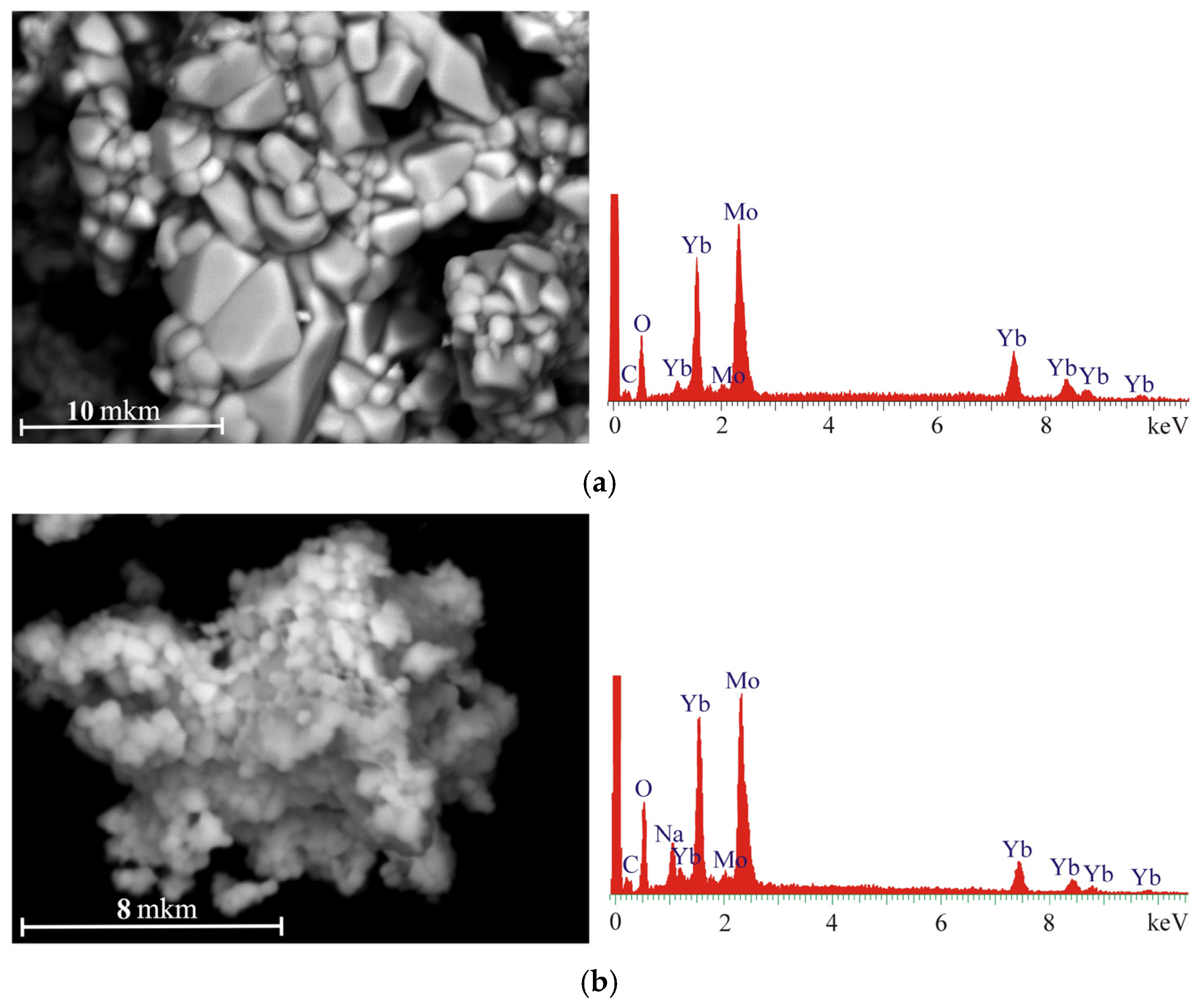
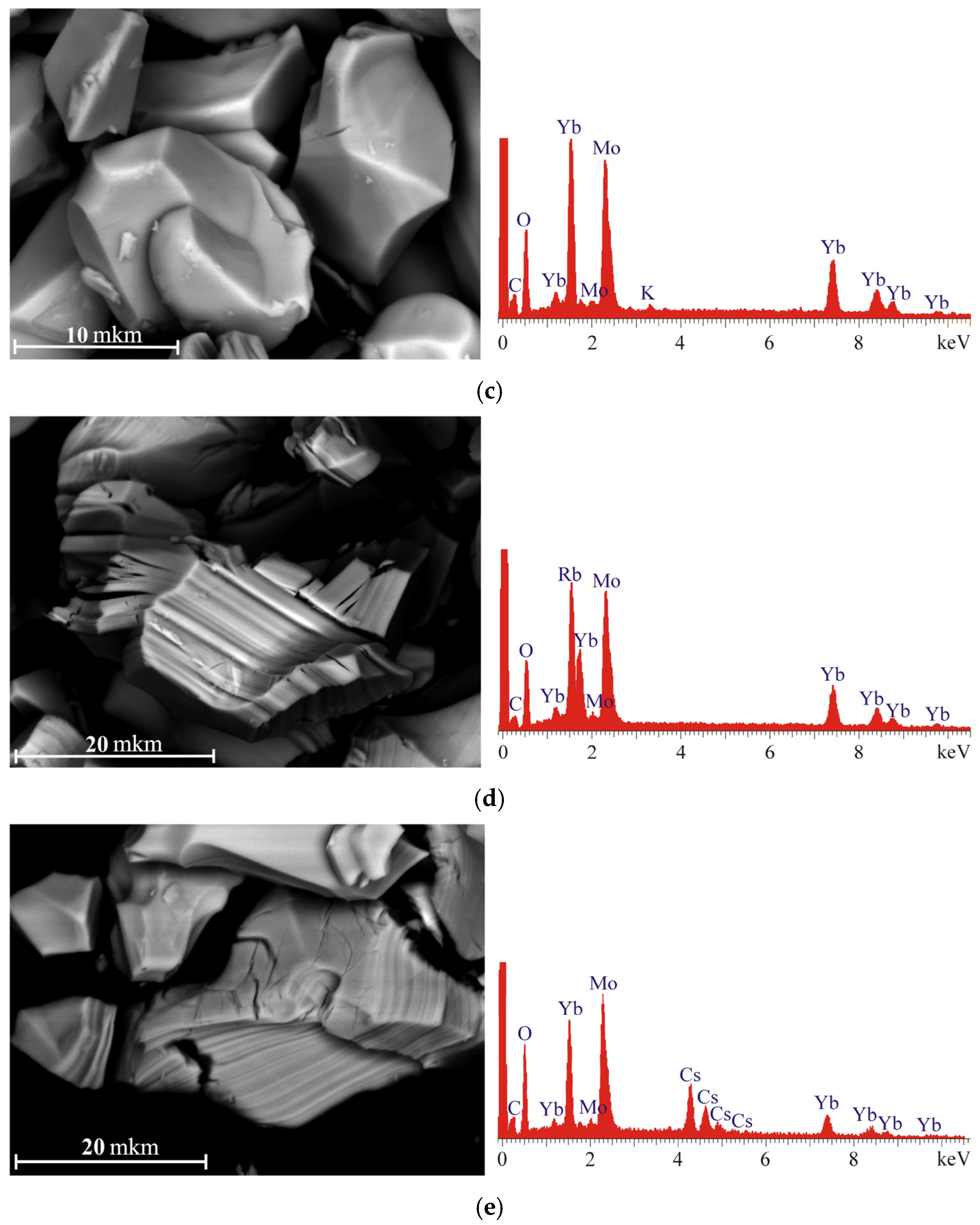
Figure 1a–e show the ASEM results. The polycrystalline samples containing the alkali cations Li+ and Na+, specifically Li(Yb0.99Tm0.005Ho0.005)(MoO4)2 and Na(Yb0.99Tm0.005Ho0.005)(MoO4)2, are characterized by the presence of bulk aggregates consisting of small (up to 5 μm), randomly oriented crystallites with varying degrees of faceting. As the radius of the M+ cation increases, both the size of the synthesized crystals and their degree of separation increase significantly. For example, within the series of K-, Rb-, and Cs-containing compositions, i.e., K(Yb0.99Tm0.005Ho0.005)(MoO4)2, Rb(Yb0.99Tm0.005Ho0.005)(MoO4)2, and Cs(Yb0.99Tm0.005Ho0.005)(MoO4)2, the crystal sizes range from 10 to 30 μm. Simultaneously, the layered morphology of the crystalline individuals becomes more pronounced, consistent with the specific features of their crystal structures. Qualitative analysis of the chemical composition reveals peaks corresponding to the elements present in the sample structure. The absence of holmium and thulium peaks in the spectra is attributed to their initially low concentrations, which are below the detection limit of the X-ray energy-dispersive analyzer.
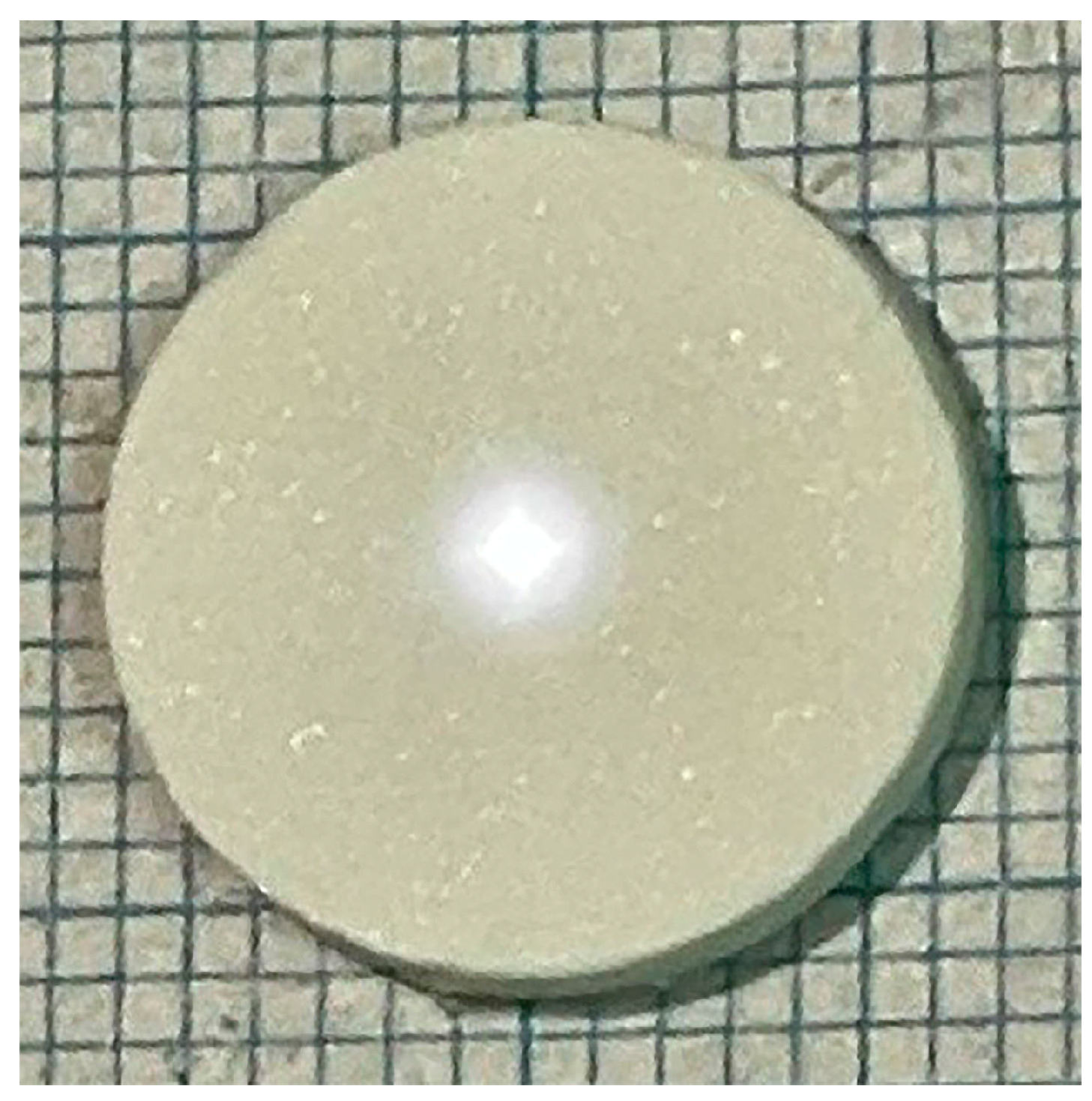
Figure 2 demonstrates visible luminescence from the synthesized polycrystalline samples of composition K(Yb0.99Tm0.005Ho0.005)(MoO4)2 under excitation at 980 nm. This luminescence is characteristics for all synthesized polycrystalline samples.

2.2. Powder XRD Analysis

Powder XRD studies revealed a clear correlation between the crystal structure of the synthesized polycrystalline M+(Yb0.99Tm0.005Ho0.005)(MoO4)2 samples and the nature of the alkali cation.
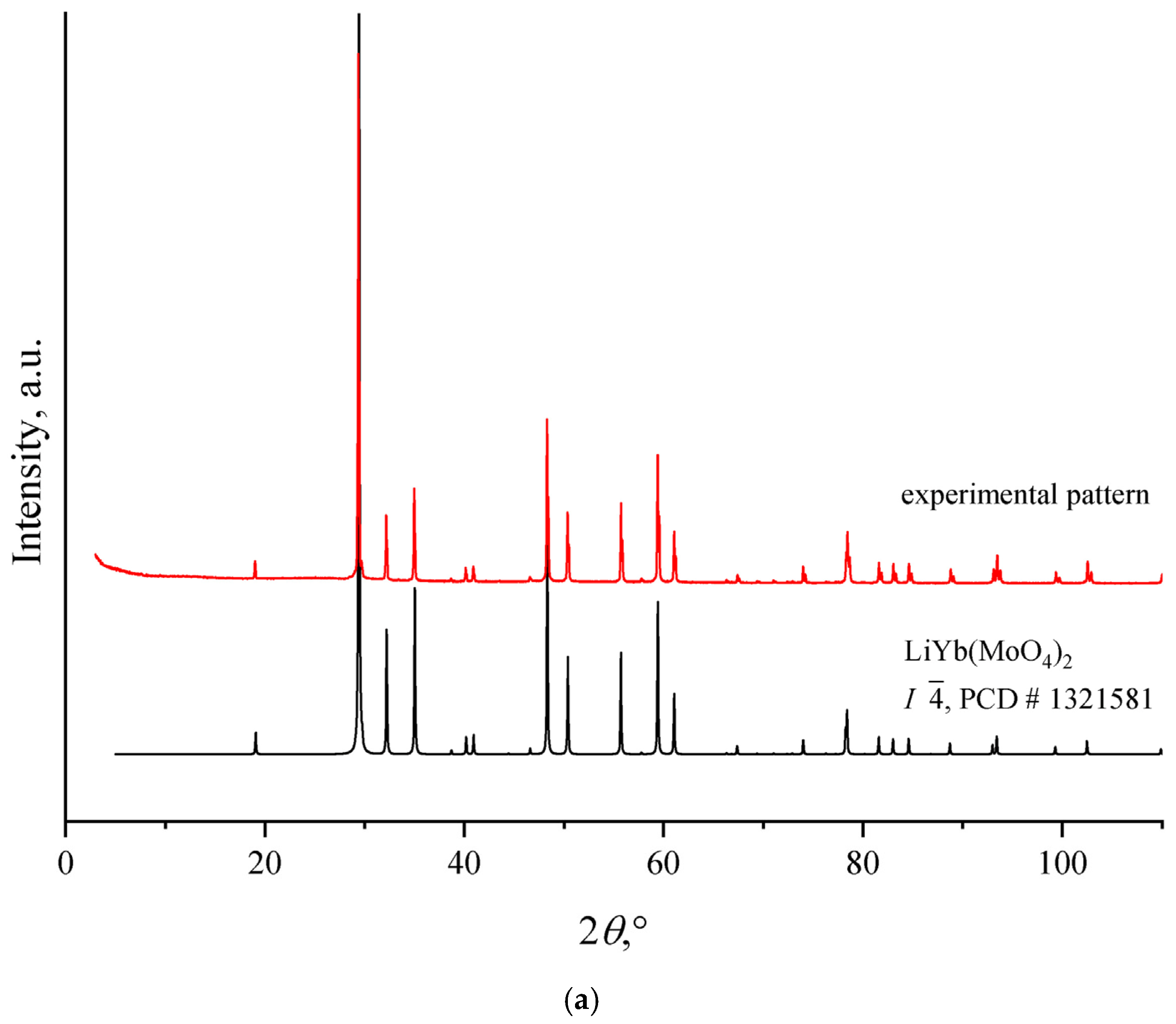
All diffraction peaks observed for the Li(Yb0.99Tm0.005Ho0.005)(MoO4)2 specimen (Figure 3a) correspond to a pure phase crystallizing in the tetragonal space group I 4 (PCD #1321581). Thus, Li(Yb0.99Tm0.005Ho0.005)(MoO4)2 demonstrates tetragonal symmetry characteristic of scheelite-type structures, although with some distortion relative to the scheelite space group I41/a. The experimental PXRD pattern obtained in this study and the observed diffraction peaks match well the calculated pattern for the I 4 structure reported by Volkov et al. [19]. Volkov et al. systematically refined the structure of the archetypal compound LiYb(MoO4)2 using three tetragonal space groups commonly considered for double molybdates and tungstates: I41, I41/a, and I 4. Their analysis demonstrated that only the non-centrosymmetric I 4 space group adequately described the atomic positions, particularly the partial occupancy of Li+ and Yb3+ ions over two distinct crystallographic sites.
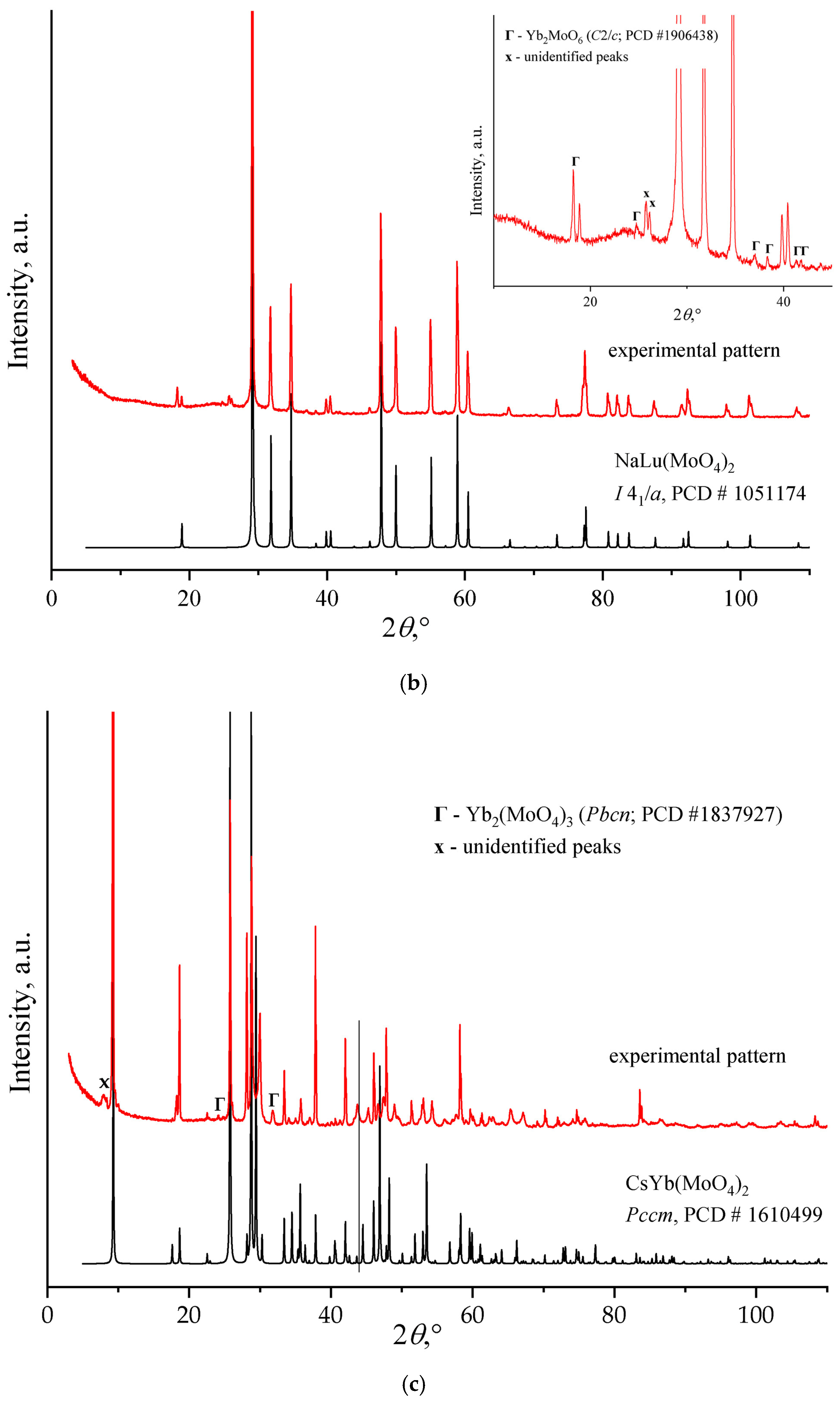
PXRD analysis of the Na(Yb0.99Tm0.005Ho0.005)(MoO4)2 sample confirms that the main phase corresponds to the target double molybdate. The major diffraction maxima are readily indexed to the tetragonal structure of NaLu(MoO4)2 (sp. gr. I41/a, PCD #1051174) (Figure 3b). In addition, several weak reflections indicate the presence of a minor Yb2MoO6 impurity crystalline phase, along with a few unidentified peaks observed at 2θ = 25.83°, and 26.19° (insert on Figure 3b).
The solid-state reaction in the ternary Cs2O–Yb2O3–MoO3 system upon high-temperature annealing leads to the formation of the double molybdate CsYb(MoO4)2 (sp. gr. Pccm, PCD #1610499) (Figure 3c). However, the diffraction pattern of the synthesized product was not single-phase: alongside the main reflections of the target phase, additional diffraction maxima corresponding to the co-crystallizing phase (Yb0.99Tm0.005Ho0.005)2(MoO4)3 were detected, as well as an unidentified reflection at 2θ = 8.2°. The presence of these impurities indicates that the selected synthesis conditions do not fully complete the solid-state interaction, or that the initial Cs2O/Yb2O3 ratio deviates from the stoichiometric one. The low-angle unidentified reflection suggests possible layered or superstructural ordering, which merits further investigation via electron microscopy or synchrotron XRD.
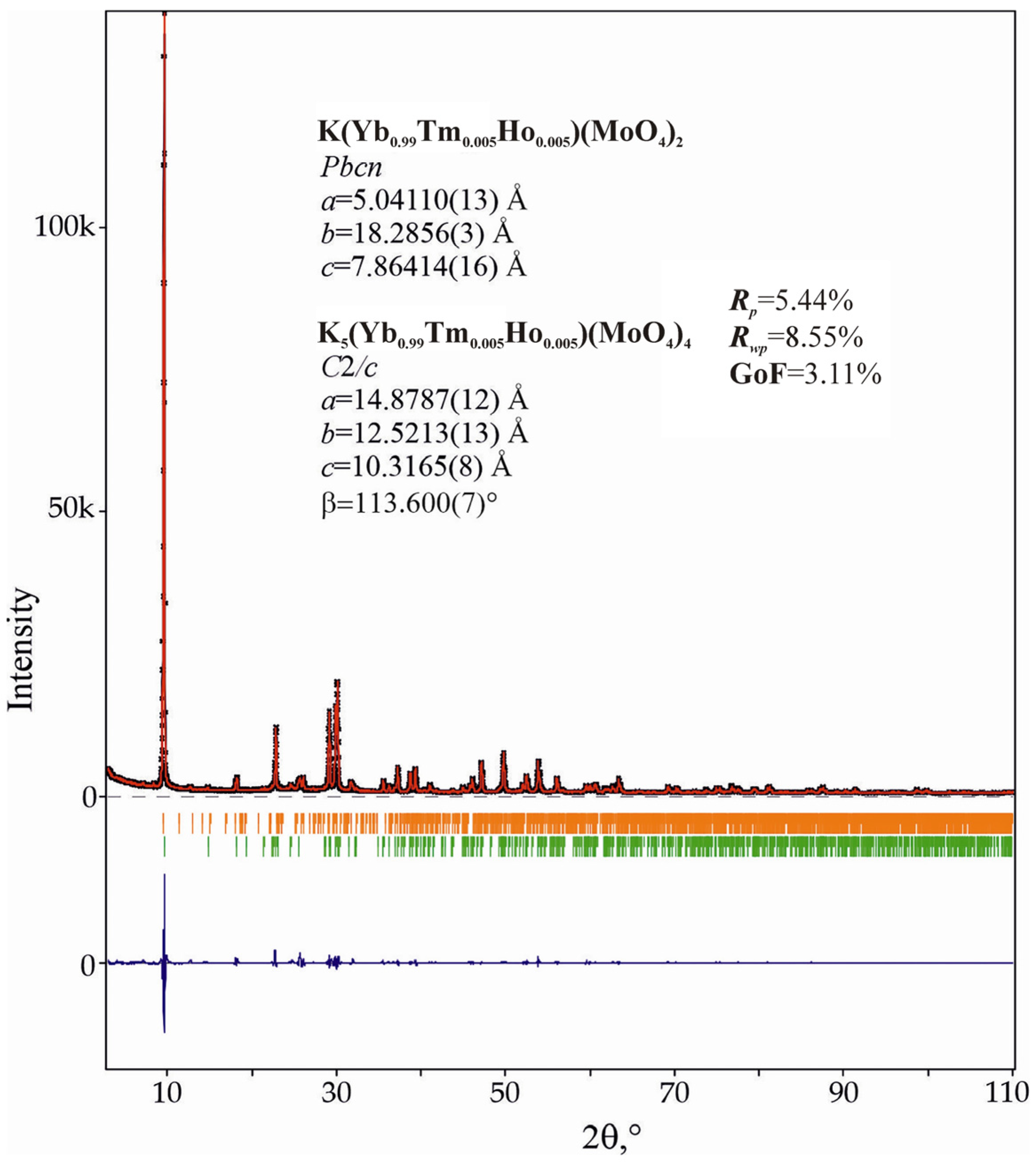
In the K2O–R2O3–MoO3 system, the primary crystalline phase was identified as K(Yb0.99Tm0.005Ho0.005)(MoO4)2, which adopts the orthorhombic space group Pbcn (Figure 4). This structure is characteristic of potassium rare-earth double molybdates containing heavy R3+ cations [3,4,20]. In addition to the main phase, several weak diffraction peaks were observed that could not be attributed to K(Yb0.99Tm0.005Ho0.005)(MoO4)2. Based on their positions and relative intensities, these reflections are assigned to the palmierite-type phase K5Yb(MoO4)4, which is known to exist in three polymorphic modifications: the low-temperature γ-phase (monoclinic, space group C2/c, ordered cation distribution), the intermediate β-phase (incommensurately modulated structure), and the high-temperature α-phase (trigonal, space group R 3m, statistical cation distribution) [21]. The low intensity of the additional reflections indicates that K5(Yb0.99Tm0.005Ho0.005)(MoO4)4 is present only as a minor impurity phase. To interpret these extra reflections and to clarify the origin of the unusual thermal behavior deviating from that of pure KYb(MoO4)2 (see Section 2.3), a Le Bail fitting was performed (Figure 4). The crystal structures of KYb(MoO4)2 (PCD #1342365) and K5Yb(MoO4)4 (PCD #1003278) were used as initial structural models. The refinement converged with the reliability factors shown in Figure 4, confirming good agreement between the observed and calculated profiles. The obtained unit-cell parameters for the main phase are a = 5.04110(13) Å, b = 18.2856(3) Å, and c = 7.86414(16) Å. The presence of a secondary phase identified as K5Yb(MoO4)4 with the lattice parameters a = 14.8787(12) Å, b = 12.5213(12) Å, c = 10.3165(8) Å, and β = 113.600(7)° was also confirmed (green and orange vertical marks in Figure 4 correspond to Bragg reflections of K(Yb0.99Tm0.005Ho0.005)(MoO4)2 and K5(Yb0.99Tm0.005Ho0.005)(MoO4)4, respectively).
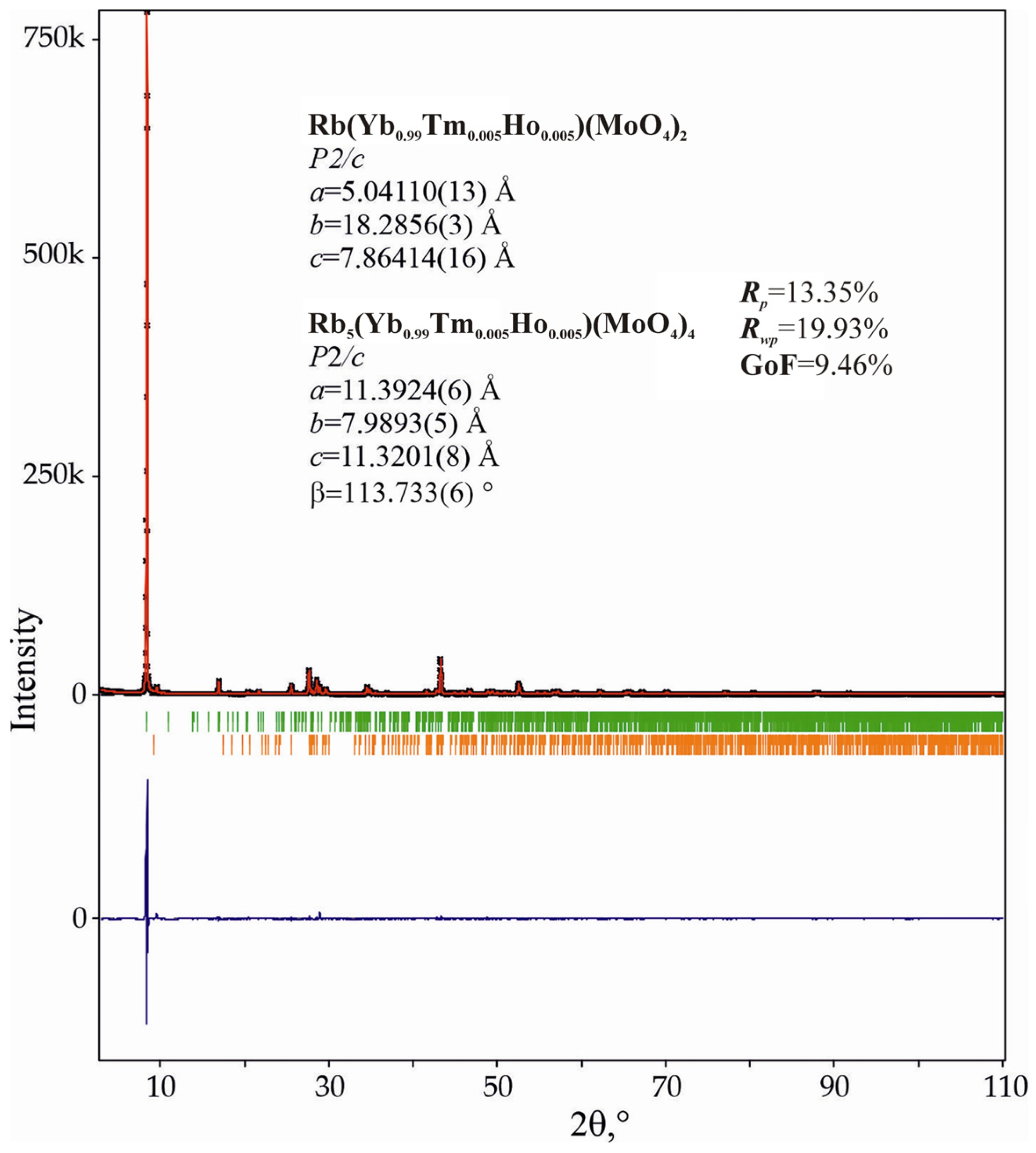
According to PXRD data, the phase composition in the Rb2O–Yb2O3–MoO3 system at the stoichiometry corresponding to Rb(Yb0.99Tm0.005Ho0.005)(MoO4)2 is characterized by the presence of at least two phases. The main phase is a rubidium-rich compound of the Rb5(Yb0.99Tm0.005Ho0.005)(MoO4)4 composition, isostructural to Rb5Er(MoO4)4, crystallizing in the monoclinic system with space group P2/c [22]. The target phase Rb(Yb0.99Tm0.005Ho0.005)(MoO4)2 is present in substantially smaller amount. Preliminary X-ray phase analysis suggests two possible variants for Rb(Yb0.99Tm0.005Ho0.005)(MoO4)2: orthorhombic Pbcn and monoclinic P2/c. In order to clarify probable Rb(Yb0.99Tm0.005Ho0.005)(MoO4)2 phase and to confirm the phase composition, a Le Bail analysis was performed. Two models of phase composition were considered: (i) K5Er(MoO4)4 (PCD #1003278) + KYb(MoO4)2 (PCD #1342365, sp. gr. Pbcn) and (ii) K5Er(MoO4)4 (PCD #1003278) + CsGd(MoO4)2 (PCD #1141740, sp. gr. P2/c).
The obtained results unambiguously confirm the presence of the Rb5(Yb0.99Tm0.005Ho0.005)(MoO4)4 phase in the sample. This structural type is well established for the isostructural potassium analogue K(Yb0.99Tm0.005Ho0.005)(MoO4)2, whose single-crystal structure was determined in the Pbcn space group [20]. Both models demonstrate close agreement factors, indicating that the refinement does not allow definitive assignment between the two possible space groups for the Rb(Yb0.99Tm0.005Ho0.005)(MoO4)4 phase. However, the model with the P2/c space group for Rb(Yb0.99Tm0.005Ho0.005)(MoO4)4 shows slightly better Rp and Rwp values, which may indicate a monoclinic distortion of the second phase structure (Figure 5).
The formation of the Rb5(Yb0.99Tm0.005Ho0.005)(MoO4)4 compound at the stoichiometry corresponding to Rb(Yb0.99Tm0.005Ho0.005)(MoO4)2 can be attributed to several factors. Compounds of the composition M5R3+(MoO4)4 (M+ = K, Rb) are characteristic phases in the M2MoO4R2(MoO4)3 systems, stable in the subsolidus region [23,24]. The high rubidium content in this phase (Rb:Yb ratio = 5:1) explains its predominant formation under the employed synthesis conditions. Additionally, kinetic factors may favor the formation of this phase at the initial stages of solid-state interaction, especially if the synthesis temperature is insufficient for complete reaction or if local stoichiometric fluctuations occur due to MoO3 volatility.

2.3. Thermal Behavior

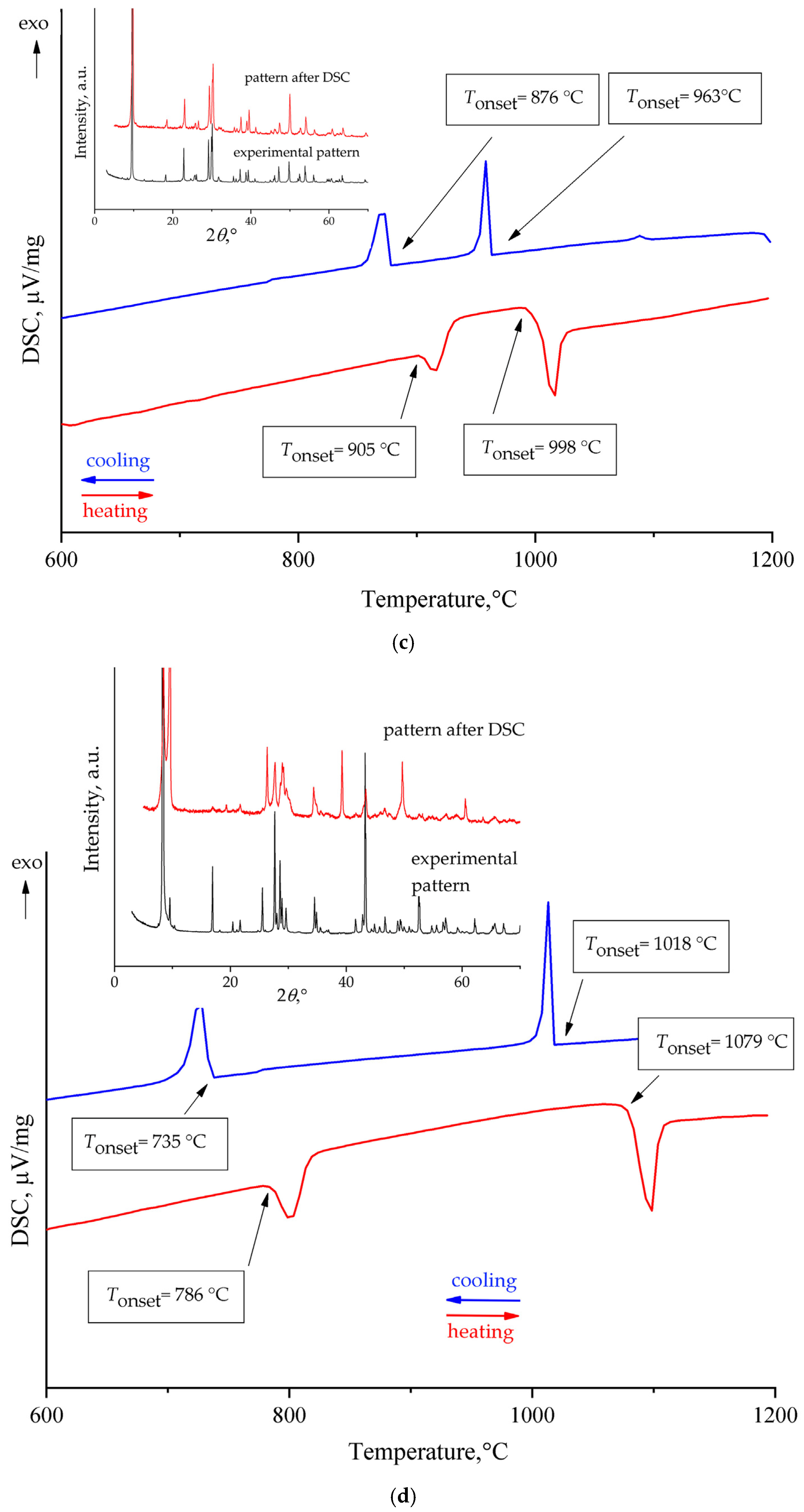
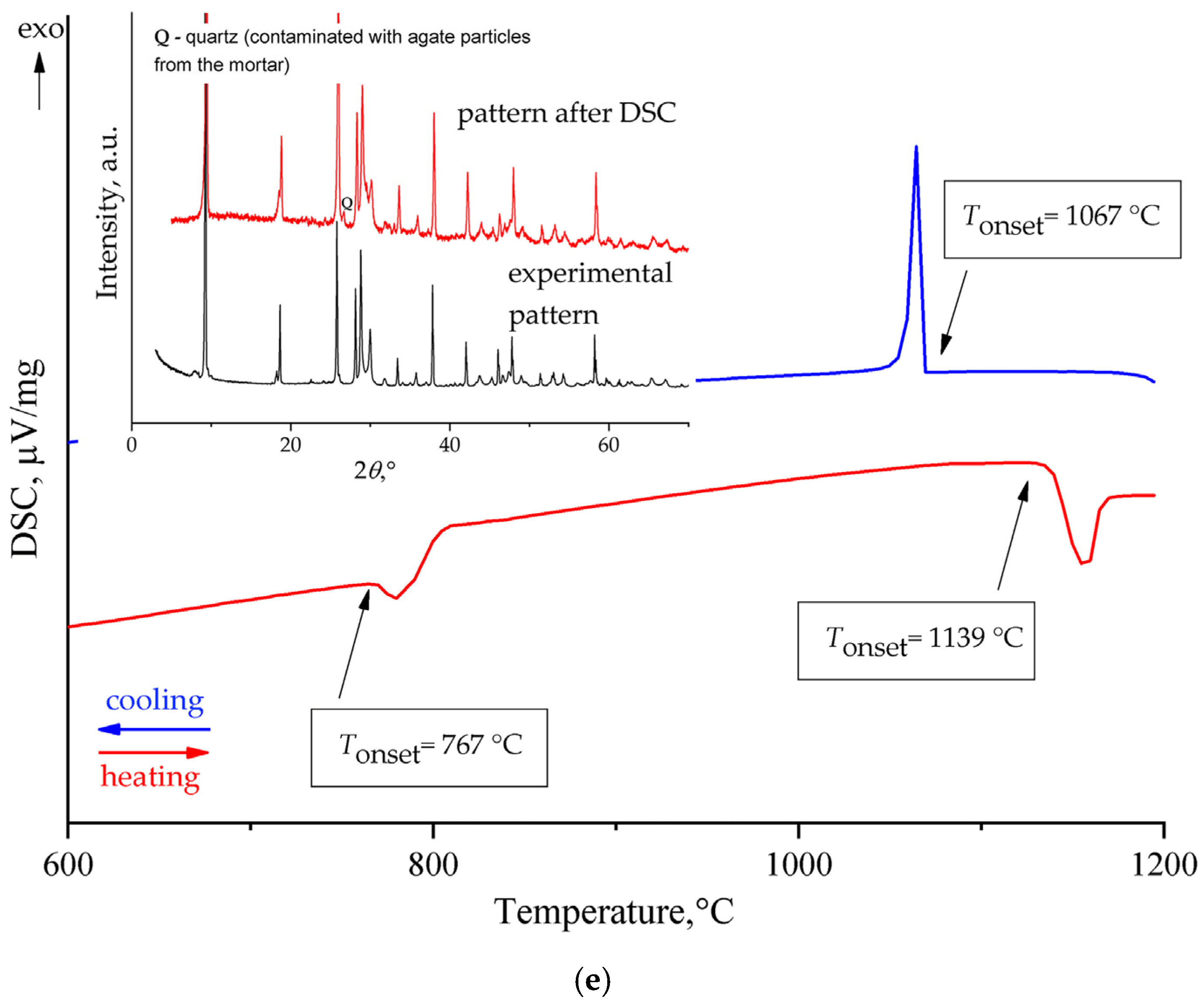
DSC studies of M+(Yb0.99Tm0.005Ho0.005)(MoO4)2 (compounds were conducted in the temperature range of 50–1200 °C (Figure 6a–e). The results revealed distinct patterns in their thermal behavior. To clarify the melting behavior, the M+(Yb0.99Tm0.005Ho0.005)(MoO4)2 samples were re-examined after thermal studies using X-ray diffraction technique.
  • Li(Yb0.99Tm0.005Ho0.005)(MoO4)2
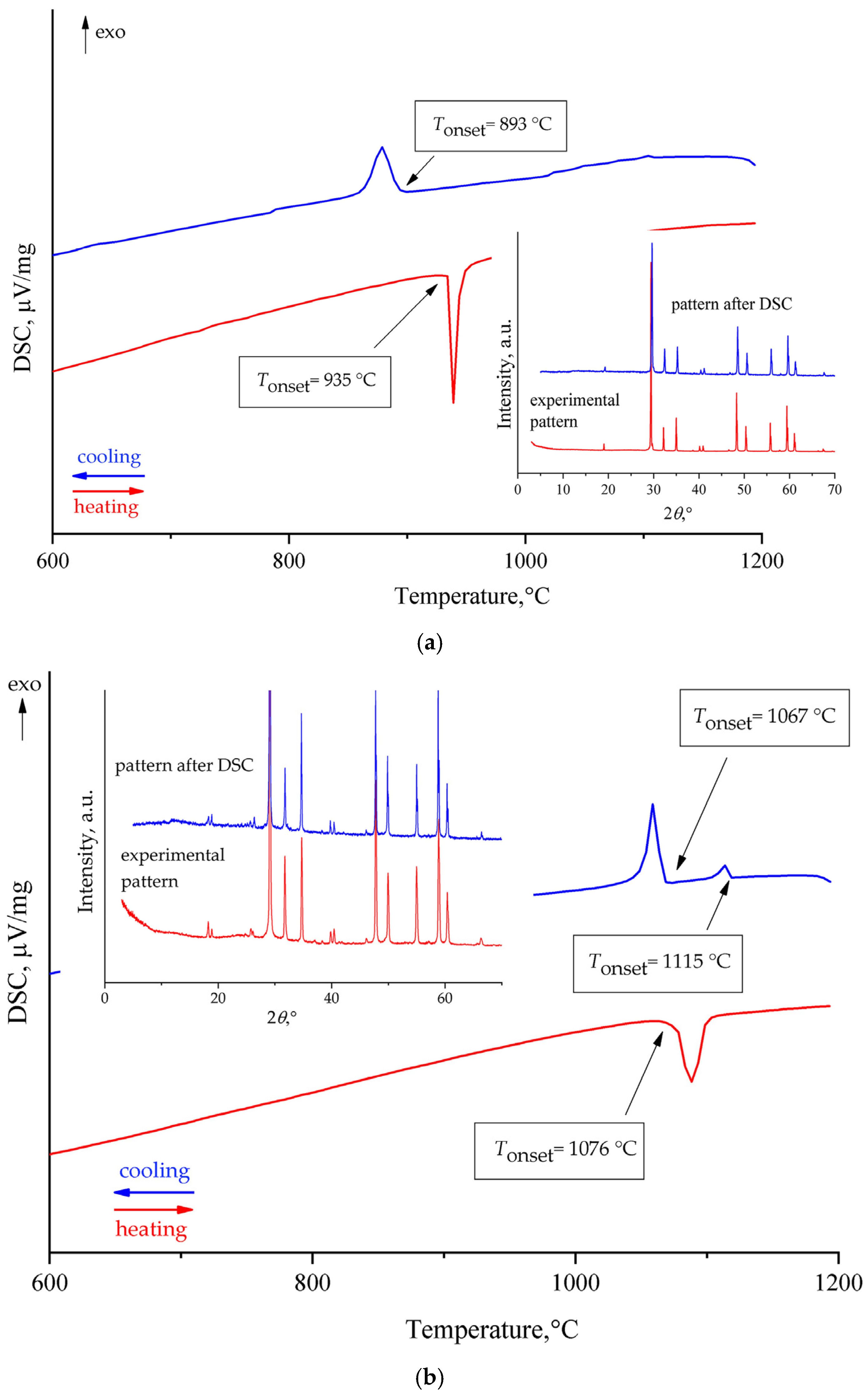
The thermal behavior of Li(Yb0.99Tm0.005Ho0.005)(MoO4)2, as revealed by differential scanning calorimetry technique, shows that the compound melts congruently at approximately 935 °C (onset temperature, Tonset), with subsequent crystallization occurring at 893 °C upon cooling (Figure 6a). The absence of additional peaks on the thermal curves and the full reversibility of the melting/crystallization process, confirmed by the good agreement between the PXRD patterns before and after the DSC run (see insert on Figure 6a), indicate that LiYb(MoO4)2 is stable as a single phase up to its melting point and undergoes no polymorphic transitions or decomposition in the solid state.
Regarding the melting behavior, DSC data, obtained in this study, clearly demonstrate a single, reversible melting event. However, the literature contains inconsistent findings on the melting nature of LiYb(MoO4)2 compounds. Klevtsov and Kozeeva initially reported the melting of LiYb(MoO4)2 at ~900 °C [1], but the nature (congruent vs. incongruent) was not explicitly stated. In contrast, a later study by Volkov et al. [19], concluded that LiYb(MoO4)2 melts incongruently at 912 °C, decomposing to Yb2(MoO4)3 and a liquid phase. Our results, which show complete reversibility and no decomposition products after melting and recrystallization, strongly suggest congruent melting of Li(Yb0.99Tm0.005Ho0.005)(MoO4)2 at ~935 °C. The observed inconsistency may arise from differences in synthesis conditions, heating rates, or the specific starting compositions used in the flux growth experiments by Volkov et al., where higher concentrations of LiYb(MoO4)2 in the melt might have led to decomposition. Our data, obtained from a pure, well-characterized polycrystalline sample, support the conclusion that the compound is stable as a single phase up to its melting point.
  • Na(Yb0.99Tm0.005Ho0.005)(MoO4)2
The thermal behavior of the synthesized Na(Yb0.99Tm0.005Ho0.005)(MoO4)2 sample, as revealed by DSC studies, demonstrates a sequence of melting and recrystallization events that aligns with the established polymorphism of double alkali-rare-earth molybdates (Figure 6b). According to the comprehensive review by Klevtsov and Klevtsova [3], the double molybdates and tungstates M+R3+(EO4)2 represent a system of structural types related by morphotropic and polymorphic phase transformations. Within this class, sodium compounds NaR3+(EO4)2 typically crystallize in the tetragonal scheelite-type structure (sp. gr. I41/a) and are often reported as non-polymorphic, particularly for NaY(MoO4)2 which does not possess solid-phase polymorph transitions [25]. However, recent studies have revealed that polymorphism can be induced under specific conditions; for instance, NaGd(MoO4)2 has been shown to exhibit a fergusonite-type monoclinic polymorph that undergoes an irreversible phase transition to the scheelite structure at approximately 813 K [26].
On the heating curve, a single sharp endothermic peak with Tonset of 1076 °C is observed, assigned to the melting of the Na(Yb0.99Tm0.005Ho0.005)(MoO4)2 phase. Although some literature sources report incongruent melting for certain heavy rare-earth sodium double molybdates, the observation of only one endothermic event on heating suggests that the primary phase melts without prior decomposition. Upon cooling, two distinct exothermic events are recorded: a low-intensity exotherm at 1115 °C and a well-defined, intense exotherm at 1067 °C. The intense peak at Tonset = 1067 °C is attributed to the crystallization of the Na(Yb0.99Tm0.005Ho0.005)(MoO4)2 melt, which is the reverse of the melting process. The smaller exotherm at 1115 °C is assigned to a high-temperature polymorphic phase transition—a subtle cation-ordering phenomenon often observed in scheelite-type structures. As noted by Klevtsov and Klevtsova, phase transformations in these compounds frequently exhibit weak thermal effects and may not be detectable by conventional experimental methods, especially when the high-temperature modification is stabilized or quenched [2].
Crucially, the post-DSC XRD analysis shows that the diffraction pattern of the product after thermal cycling is identical to that of the as-synthesized sample. This finding unambiguously confirms that the primary Na(Yb0.99Tm0.005Ho0.005)(MoO4)2 phase is fully recovered after melting and subsequent cooling, with no evidence of decomposition into secondary phases such as Yb2MoO6 or other reaction products. This observation is consistent with congruent melting behavior for the main phase. The presence of the minor Yb2MoO6 impurity phase, already detected in the as-synthesized material, remains unchanged after the thermal cycle, confirming that it is a persistent secondary phase originating from the synthesis and not a product of melt decomposition.
  • KYb(Yb0.99Tm0.005Ho0.005)(MoO4)2
The heating curve revealed two distinct endothermic peaks with Tonset = 905 °C and 998 °C (Figure 6c). Upon cooling, two exothermic peaks were observed at Tonset = 876 °C and 963 °C. The thermal effects are fully reproducible over several consecutive cycles.
To verify the reversibility of the observed thermal events and to exclude any decomposition or irreversible phase changes, PXRD patterns were recorded both before (as-synthesized) and after the DSC measurements. As shown in the inset to Figure 6c, the diffraction patterns are identical within experimental error. This result unambiguously demonstrates that: (i) no permanent decomposition or volatilization occurs during the thermal cycle; (ii) all thermal events in the investigated temperature range are fully reversible; (iii) no additional phases are formed upon melting and recrystallization.
The comparison of the PXRD patterns confirms that the main phase K(Yb0.99Tm0.005Ho0.005)(MoO4)2 melts congruently and recrystallizes into the same phase, while the minor K5(Yb0.99Tm0.005Ho0.005)(MoO4)4 phase undergoes only reversible structural transitions without decomposition.
The endothermic peak at 998 °C on heating and the corresponding exothermic peak at 963 °C on cooling are assigned to the congruent melting and solidification of the main K(Yb0.99Tm0.005Ho0.005)(MoO4)2 phase. The observed hysteresis of about 35 °C is typical for crystal-melt transitions of complex oxides.
The weaker endothermic peak at 905 °C (heating) and its exothermic counterpart at 876 °C (cooling) are attributed to a structural phase transition in the minor K5(Yb0.99Tm0.005Ho0.005)(MoO4)4 phase. According to [21], this compound undergoes a reversible order–disorder transition from the low-temperature γ-phase (monoclinic, sp. gr. C2/c) to the intermediate β-phase upon heating, which is characterized by an incommensurately modulated structure. In pure K5Yb(MoO4)4, the γβ transition is observed in the range 938–968 °C upon heating [21]. In the present study, the transition temperature Ttr = 905 °C is slightly lower than that reported for the pure compound. This downward shift can be rationalized by: (i) misfit strain imposed by the K(Yb0.99Tm0.005Ho0.005)(MoO4)2 matrix on the embedded minor phase; (ii) minor deviations in stoichiometry of the impurity phase (e.g., slight K/Yb non-stoichiometry), which are known to affect transition temperatures in palmierite-type phases; (iii) different thermal history or heating/cooling rates compared to the literature data.
The reverse transition β → γ occurs at 876 K, giving a thermal hysteresis of ΔT ≈ 29 °C, which is characteristic of first-order or strongly first-order-like transitions involving displacive mechanisms. This hysteresis is consistent with the first-order character of the γ ↔ β transition in the K5Yb(MoO4)4 system, as reported by Morozov et al. [21].
  • Rb(Yb0.99Tm0.005Ho0.005)(MoO4)2
DSC studies of the sample in the Rb2O–R2O3–MoO3 system revealed two endothermic peaks upon heating with onset temperatures Tonset = 786 and 1018 °C (Figure 6d). Upon cooling, two exothermic peaks were observed with Tonset = 1079 and 1018 °C.
The endothermic effect at 786 °C can be associated with a polymorphic transition in the Rb5(Yb0.99Tm0.005Ho0.005)(MoO4)4 phase. It is known that for the isostructural compound K5Yb(MoO4)4, the existence of three polymorphic modifications (γ, β, and α) has been established, related by phase transitions not accompanied by significant rearrangement of the palmierite-type structure [21]. Similar polymorphic behavior can be expected for Rb5(Yb0.99Tm0.005Ho0.005)(MoO4)4, which allows the endothermic effect at 786 °C to be interpreted as a transition between polymorphic modifications of this phase.
The endothermic effect at 1018 °C corresponds to the melting of the sample. This temperature is in good agreement with the general trend of increasing melting temperatures of rubidium double molybdates with heavy lanthanides as the ionic radius of R3+ decreases [3]. The exothermic peak at 1079 °C upon cooling exhibits significant thermal hysteresis (~61 °C) relative to the peak at 786 °C upon heating. Such behavior is characteristic of reconstructive phase transitions in double molybdates and tungstates, where the reverse transition requires significant supercooling and may be kinetically hindered [2]. This is also consistent with data for K5Yb(MoO4)4, where the transition between modifications also exhibits hysteresis [21].
After the DSC study, the phase composition of the sample changed: the Rb(Yb0.99Tm0.005Ho0.005)(MoO4)2 phase became predominant, while the Rb5(Yb0.99Tm0.005Ho0.005)(MoO4)4 content significantly decreased (see inset in Figure 6d). This change unambiguously indicates that high-temperature treatment allows the system to approach thermodynamic equilibrium.
  • Cs(Yb0.99Tm0.005Ho0.005)(MoO4)2
According to XRD data, the as-synthesized Cs(Yb0.99Tm0.005Ho0.005)(MoO4)2 sample crystallizes in the orthorhombic modification (sp. gr. Pccm) at room temperature. The DSC heating curve exhibits two endothermic peaks with onset temperatures 767 °C and 1139 °C (Figure 6e). The first peak is attributed to a polymorphic transition from the α-orthorhombic phase to the high-temperature β-trigonal modification, which is in good agreement with the literature data for this family of compounds [3]. The second peak at 1139 °C corresponds to melting; however, according to the available data [1], the nature of fusion for CsYb(MoO4)2 has not yet been conclusively established. Upon subsequent cooling, only a single exothermic crystallization event is observed with Tonset = 1067 °C, indicating supercooling of the melt. The reverse βα polymorphic transition is not detected as a distinct thermal effect on the cooling curve, which is likely due to kinetic hindrance or a broad temperature range of the transformation. Importantly, the XRD patterns of the sample recorded before and after the thermal cycle are identical (except for the SiO2 impurity originating from the agate mortar during grinding) and correspond to the initial orthorhombic Pccm phase (Figure 6e, inset). This finding demonstrates the full reversibility of the structural transformations within the investigated temperature range and indicates that the final room-temperature state is independent of the thermal history. Furthermore, the identity of the XRD patterns before and after melting–crystallization provides strong evidence that the melting of Cs(Yb0.99Tm0.005Ho0.005)(MoO4)2 occurs congruently.

2.4. Spectroscopic Studies

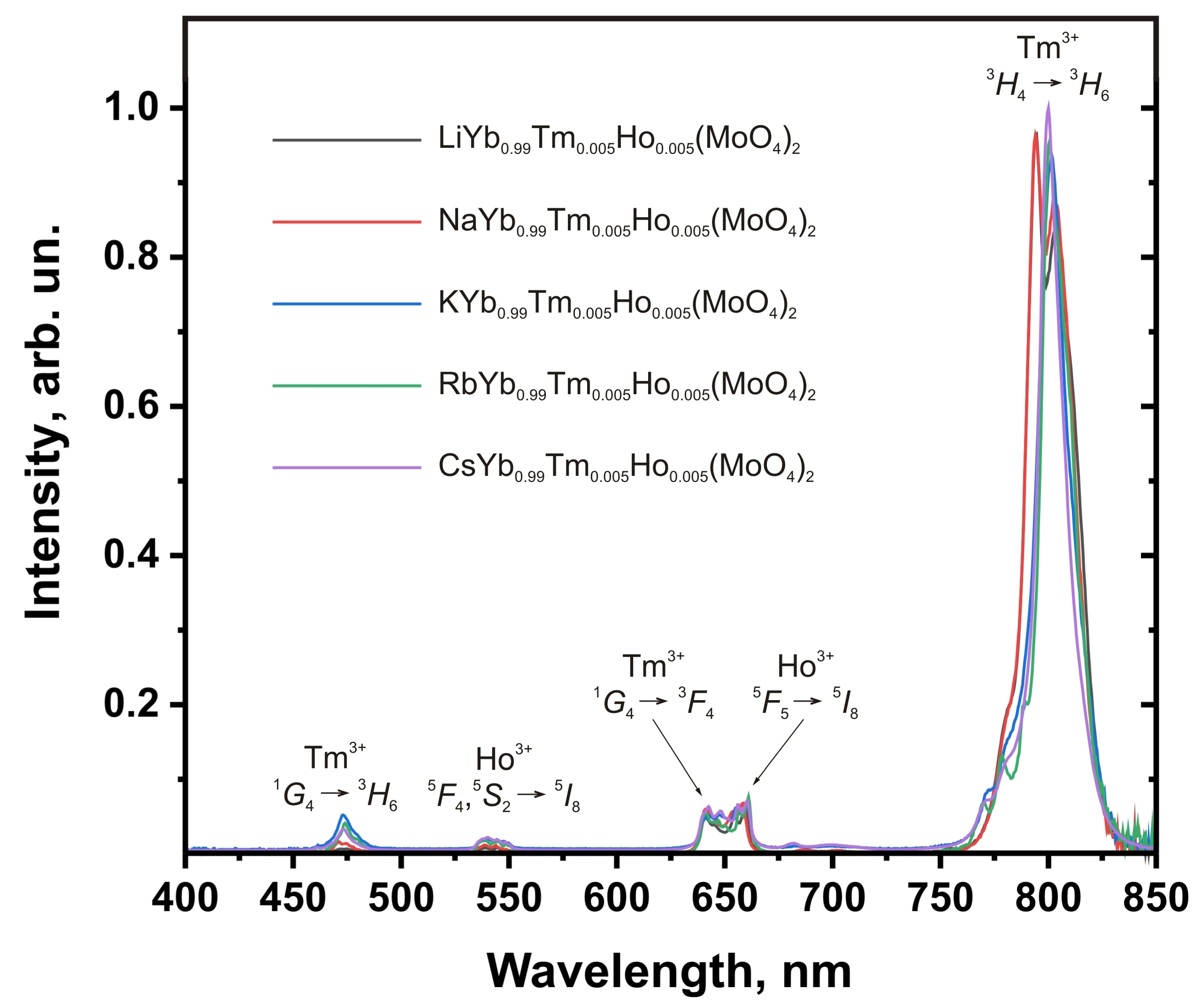
Spectroscopic measurements were performed on polycrystalline samples of M+(Yb0.99Tm0.005Ho0.005)(MoO4)2 (M+ = Li, Na, K, Rb, Cs). The luminescence spectra of the synthesized compounds are presented in Figure 7. The spectra exhibit well-resolved emission lines originating from optical transitions within the 4fn shells of the rare-earth ions. Four distinct emission bands were observed in the visible and near-infrared regions. The blue emission centered at 475 nm corresponds to the 1G43H6 transition of the Tm3+ ion. The green band at 545 nm is attributed to the 5F4, 5S25I8 transition of the Ho3+ ion. The red emission at 655 nm arises from the superposition of the 1G43F4 transition (Tm3+) and the 5F55I8 transition (Ho3+). In addition, an infrared band at 805 nm is observed, which is assigned to the 3H43H6 transition of the Tm3+ ion.
In this system, the Yb3+ ion acts as an efficient sensitizer. Upon excitation at 980 nm, corresponding to the 2F7/22F5/2 absorption transition of Yb3+, energy transfer to the acceptor ions populates the 5F4, 5S2 levels of Ho3+ and the 1G4 level of Tm3+, thereby giving rise to up conversion luminescence in the visible spectral range.
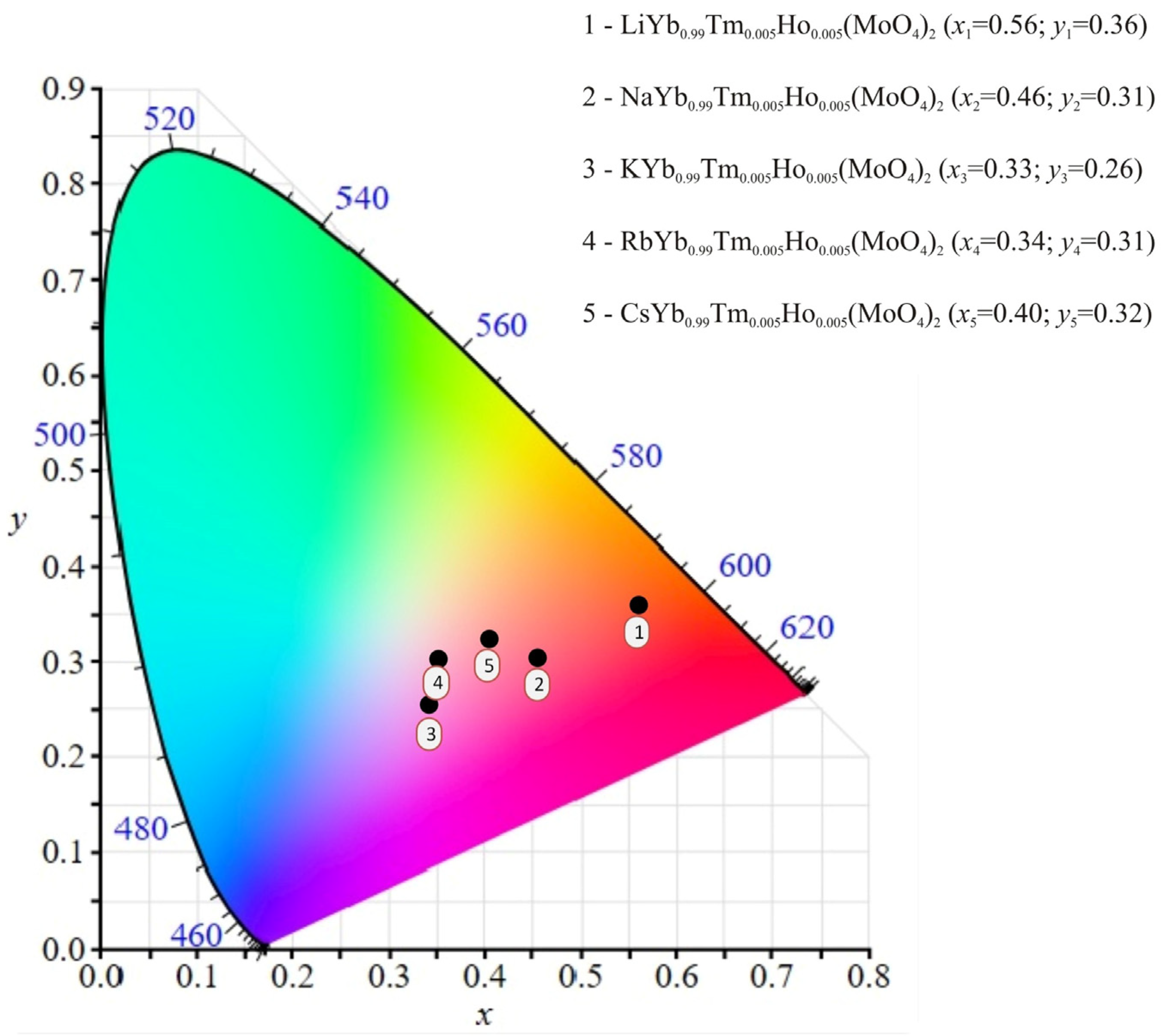
The chromaticity characteristics of the polycrystalline M+(Yb0.99Tm0.005Ho0.005)(MoO4)2 samples, represented in the CIE color-space coordinates, are shown in Figure 8. The observed variation in the color coordinates among the investigated compounds is attributed to the redistribution of the relative emission intensities of the aforementioned radiative transitions, which is governed by the different structural types adopted by the molybdate matrix depending on the alkali-metal cation.

3. Materials and Methods

The starting materials for the solid-state synthesis of M+(Yb0.99Tm0.005Ho0.005)(MoO4)2 were oxides (Yb2O3, Tm2O3, Ho2O3), carbonates (Li2CO3, Na2CO3, K2CO3, Rb2CO3, Cs2CO3), and molybdenum (VI) oxide MoO3 (Alfa-Aesar, Lancashire, UK). All reagents used were of analytical grade or higher.
During synthesis procedure, preliminary pressing of powdered samples into tablets with a diameter of 16 mm was carried out using a hydraulic press (model PGR-10) and a custom die set, with a compaction force of up to 6 tf (metric tons-force). The M+(Yb0.99Tm0.005Ho0.005)(MoO4)2 samples were obtained at a temperature of 700 °C for 3 days in vertical resistance furnaces equipped with fehral (Fe-Cr-Al alloy) heating elements. The obtained specimens were characterized by visual and instrumental luminescence control.
Phase formation was investigated using powder X-ray diffraction (PXRD) technique with a Tongda TDM-20 powder diffractometer and Rigaku MiniFlex-600 powder diffractometer (Rigaku Corp., Tokyo, Japan). PXRD data sets were collected in continuous mode at room temperature (CuKα radiation) in the range of 2θ = 3–110°, and a scan speed of 3° per minute. The PXRD data were analyzed using the model-based Le Bail fitting with Yana2006 software [27]. Phases were identified using the Match! software package, version 3.8.1.143, and the Pearson Crystal Data database [28].
The composition and morphology of the samples synthesized were studied using analytical scanning electron microscopy (ASEM) using a LEO 1420VP microscope (Carl Zeiss NTS GmbH, Jena, Germany) equipped with an INCA 350 energy-dispersive X-ray spectrometer (EDS) (Oxford Instruments, Oxford, UK).
The thermal behavior of the M+(Yb0.99Tm0.005Ho0.005)(MoO4)2 compounds was investigated using thermogravimetric analysis (TGA) and differential scanning calorimetry (DSC) on a Netzsch STA 449 F5 Jupiter (Netzsch, Selb, Germany) thermal analyzer over a temperature range of 50–1200 °C. Measurements were carried out in Pt-Rh crucibles under an argon atmosphere, with heating and cooling rates of 20 °C/min.
Luminescence spectra were recorded at room temperature (300 K) using a synchronous detection technique. Excitation was provided by a laser operating at approximately 980 nm, and the emitted luminescence was dispersed by an MDR-23 monochromator. The signal was detected with a Hamamatsu Photonics G5854 InGaAs photodiode and subsequently processed by a Stanford Research Systems SR830 lock-in amplifier. Spectral sensitivity calibration of the experimental setup was performed using a tungsten incandescent lamp with a known emission spectrum.

4. Conclusions

A series of upconversion phosphors M+(Yb0.99Tm0.005Ho0.005)(MoO4)2 (M+ = Li, Na, K, Rb, Cs) was successfully synthesized by the solid-state method. The systematic investigation revealed a clear correlation between the alkali cation radius and the structural type. Li- and Na-containing compounds crystallize in tetragonal scheelite-type structures, while K and Cs adopt orthorhombic modifications. In the Rb-containing system, the predominant phase is Rb-rich Rb5(Yb0.99Tm0.005Ho0.005)(MoO4)4, which transforms into the target Rb(Yb0.99Tm0.005Ho0.005)(MoO4)2 upon high-temperature treatment. DSC studies demonstrated distinct thermal behavior depending on the alkali cation, with the melting temperature increasing monotonically with cation radius: Li (~935 °C), Na (~1076 °C), K (~998 °C), Rb (~1018 °C), and Cs (~1139 °C). Under 980 nm excitation, all phosphors exhibit characteristic upconversion emission of Tm3+ and Ho3+, with relative intensities depending on the host structure and resulting in varying CIE coordinates.

Author Contributions

Synthesis and conceptualization, V.V.M.; PXRD and data identification, E.A.V.; ASEM and EDX analysis, E.V.K. and A.P.A.; spectroscopy, K.N.G., A.S.Y. and V.E.K.; draft preparation, A.I.J.; synthesis, F.K.S. All authors have read and agreed to the published version of the manuscript.

Funding

This research received no external funding.

Institutional Review Board Statement

Not applicable.

Informed Consent Statement

Not applicable.

Data Availability Statement

The original contributions presented in this study are included in the article. Further inquiries can be directed to the corresponding author.

Acknowledgments

This work was carried out with partial financial support from the state budget research topics: “New minerals and synthetic analogues: crystal growth and crystallochemical features” (project No. AAAA-A16-116033010121-7) and “Fundamental principles of developing processes for the extraction of valuable components during complex and deep processing of mineral raw materials of complex material composition” (project No. FMMS-2024-0006).

Conflicts of Interest

The authors declare no conflicts of interest.

References

  1. Maier, A.A.; Provotorov, M.V.; Balashov, V.A. Double molybdates and tungstates of the rare earth and alkali metals. Russ. Chem. Rev. 1973, 42, 822–833. [Google Scholar] [CrossRef] [Scilit]
  2. Wang, L.; Wang, J.; Fang, C.; Qiao, Y.; Li, Y. The identification of high-pressure phase transition sequence in selected tungstates and molybdates. J. Chem. Phys. 2023, 159, 244307. [Google Scholar] [CrossRef] [Scilit] [PubMed]
  3. Klevtsov, P.V.; Klevtsova, R.F. Polymorphism of the double molybdates and tungstates of mono- and trivalent metals with the composition M+R3+(EO4)2. J. Struct. Chem. 1977, 18, 339–355. [Google Scholar] [CrossRef] [Scilit]
  4. Chong, S.; Perry, S.; Riley, B.J.; Nelson, Z.J. Crystal structures and comparisons of potassium rare-earth molybdates KRE(MoO4)2 (RE = Tb, Dy, Ho, Er, Yb, and Lu). Acta Crystallogr. Sect. E Crystallogr. Commun. 2020, 76, 1871–1875. [Google Scholar] [CrossRef] [Scilit] [PubMed]
  5. Cavalli, E.; Boutinaud, P.; Cucchietti, T.; Bettinelli, M. Spectroscopy and Excited States Dynamics of Tb3+-Doped KLa(MoO4)2 Crystals. Opt. Mater. 2009, 31, 470–473. [Google Scholar] [CrossRef] [Scilit]
  6. Neeraj, S.; Kijima, N.; Cheetham, A.K. Novel Red Phosphors for Solid-State Lighting: The System NaM(WO4)2–x(MoO4)x:Eu3+ (M = Gd, Y, Bi). Chem. Phys. Lett. 2004, 387, 2–6. [Google Scholar] [CrossRef] [Scilit]
  7. Su, Y.; Li, L.; Li, G. Synthesis and Optimum Luminescence of CaWO4-Based Red Phosphors with Codoping of Eu3+ and Na+. Chem. Mater. 2008, 20, 6060–6067. [Google Scholar] [CrossRef] [Scilit]
  8. Xie, A.; Yang, W.; Zhang, M. Red emitting tungsto-molybdate phosphor for near-ultraviolet light-emitting diodes-based solid-state lighting. Sci. China Phys. Mech. Astron. 2012, 55, 1229–1234. [Google Scholar] [CrossRef] [Scilit]
  9. Xie, A.; Yuan, X.; Wang, F.; Shi, Y.; Li, J.; Liu, L.; Mu, Z. Synthesis and Luminescent Properties of Eu3+-Activated Molybdate-Based Novel Red-Emitting Phosphors for White LEDs. J. Alloys Compd. 2010, 501, 124–129. [Google Scholar] [CrossRef] [Scilit]
  10. Xu, L.; Yang, Z.; Guan, L.; Guo, Q.; Huai, S.; Li, P. Synthesis and Properties of Eu3+ Activated Strontium Molybdate Phosphor. J. Rare Earths 2007, 25, 706–709. [Google Scholar] [CrossRef] [Scilit]
  11. Zeng, Q.; He, P.; Liang, H.; Gong, M.; Su, Q. Luminescence of Eu3+-Activated Tetra-Molybdate Red Phosphors and Their Application in Near-UV InGaN-Based LEDs. Mater. Chem. Phys. 2009, 118, 76–80. [Google Scholar] [CrossRef] [Scilit]
  12. Zhu, C.; Liang, X.; Yang, Y.; Chen, G. Luminescence properties of Tb doped and Tm/Tb/Sm co-doped glasses for LED applications. J. Lumin. 2010, 130, 74–77. [Google Scholar] [CrossRef] [Scilit]
  13. Zolotova, E.S.; Trushnikova, L.N.; Ayupov, B.M.; Sokolov, V.V.; Daletskii, V.A. Na2MoO4-CaMoO4-Ce2/3MoO4 Scheelite-Like Solid Solutions. Inorg. Mater. 2009, 45, 432–435. [Google Scholar] [CrossRef] [Scilit]
  14. Maltsev, V.V.; Volkova, E.A.; Koporulina, E.V.; Kuzmin, N.N.; Jiliaeva, A.I.; Kiriukhina, G.V.; Naprasnikov, D.A. Synthesis, Crystal Growth and Phase Formation in the K–(Yb,Tm,Ho)–Mo–O System. CrystEngComm 2025, 27, 1607–1618. [Google Scholar] [CrossRef] [Scilit]
  15. Yan, L.; Xing, M.; Ma, Y.; Kang, L.; Fu, Y.; Pang, Q.; Xin, F.; Wang, H.; Luo, X.; Tian, Y. Promising lanthanide-doped double molybdates KYb(MoO4)2 phosphors for highly efficient upconversion luminescence and temperature sensing. Spectrochim. Acta Part A Mol. Biomol. Spectrosc. 2024, 308, 123751. [Google Scholar] [CrossRef] [Scilit] [PubMed]
  16. Volokitina, A.; Loiko, P.; Pavlyuk, A.; Serres, J.M.; Slimi, S.; Salem, E.B.; Kifle, E.; Griebner, U.; Petrov, V.; Wang, L.; et al. Spectroscopy and Efficient Laser Operation of Cleaving Yb:KY(MoO4)2 Crystal. Opt. Mater. Express 2020, 10, 2356. [Google Scholar] [CrossRef] [Scilit]
  17. Volokitina, A.; Loiko, P.; Serres, J.M.; Mateos, X.; Kuleshov, N.; Trifonov, V.; Pavlyuk, A. Growth and Spectroscopy of Orthorhombic Yb:KY(MoO4)2 Laser Crystal with a Layered Structure. J. Phys. Conf. Ser. 2019, 1410, 012149. [Google Scholar] [CrossRef] [Scilit]
  18. Volokitina, A.; Loiko, P.; Serres, J.M.; Mateos, X.; Kuleshov, N.; Trifonov, V.; Pavlyuk, A. Novel Molybdate Laser Crystal with a Layered Structure: Orthorhombic Er3+:KY(MoO4)2. In Proceedings of the 2020 International Conference Laser Optics (ICLO), St. Petersburg, Russia, 2–6 November 2020; p. 1. [Google Scholar] [CrossRef] [Scilit]
  19. Volkov, V.; Cascales, C.; Kling, A.; Zaldo, C. Growth, Structure, and Evaluation of Laser Properties of LiYb(MoO4)2 Single Crystal. Chem. Mater. 2005, 17, 291–300. [Google Scholar] [CrossRef] [Scilit]
  20. Armand, P.; Reibel, C.; Granier, D.; Tillard, M. Growth, Single-Crystal Structure, and Magnetic Properties of the Double Molybdate KYb(MoO4)2. J. Phys. Chem. Solids 2021, 154, 110023. [Google Scholar] [CrossRef] [Scilit]
  21. Morozov, V.A.; Lazoryak, B.I.; Lebedev, O.I.; Amelinckx, S.; Van Tendeloo, G. Structures of Three Polymorphs of the Complex Oxide K5Yb(MoO4)4. J. Solid State Chem. 2003, 176, 76–87. [Google Scholar] [CrossRef] [Scilit]
  22. Klevtsova, R.F.; Glinskaya, L.A. Crystal structure of double molybdate Rb5Er(MoO4)4. Dokl. Akad. Nauk SSSR 1976, 230, 1337–1340. [Google Scholar]
  23. Evdokimov, A.A.; Eliseev, A.A.; Murashov, V.A.; Khomchenko, G.P. Phase diagrams of the systems M2MoO4–Nd2(MoO4)3 and M5Nd(MoO4)4 crystal growth. Zh. Neorg. Khim. 1981, 26, 3098–3102. (In Russian) [Google Scholar]
  24. Basovich, O.M.; Khaikina, E.G.; Solodovnikov, S.F. Tl2MoO4–Pr2(MoO4)3 system and new molybdates Tl5Ln(MoO4)4. Russ. J. Inorg. Chem. 2000, 45, 1586–1590. [Google Scholar]
  25. Lu, X.; You, Z.; Li, J.; Zhu, Z.; Jia, G.; Wu, B.; Tu, C. Thermal, optical and spectroscopic assessment of Yb3+:NaY(MoO4)2 single crystal as a potential diode pumped laser near 1.04 μm. Solid State Commun. 2008, 146, 287–292. [Google Scholar] [CrossRef] [Scilit]
  26. Dorneles, M.L.A.; Santos, C.C.; Luz-Lima, C.; Ferreira, W.C.; Freire, P.T.C.; de Menezes, A.S.; Moura, J.V.B. A novel polymorphic phase in NaGd(MoO4)2: Synthesis and temperature-induced phase transition. Ceram. Int. 2025, 51, 35582–35591. [Google Scholar] [CrossRef] [Scilit]
  27. Petricek, V.; Dusek, M.; Palatinus, L. Crystallographic computing system JANA2006: General features. Z. Krist. Cryst. Mater. 2014, 229, 345–352. [Google Scholar] [CrossRef] [Scilit]
  28. Villars, P.; Cenzual, K. Pearson’s Crystal Data: Crystal Structure Database for Inorganic Compounds; (on DVD); Release 2023/24; ASM International®: Materials Park, OH, USA, 2023. [Google Scholar]
Figure 1. ASEM images (ae) and corresponding EDS spectra (right panels) of samples with composition M+(Yb0.99Tm0.005Ho0.005)(MoO4)2, where M+ = (a) Li, (b) Na, (c) K, (d) Rb, and (e) Cs.
Inorganics 14 00217 g001aInorganics 14 00217 g001b
Figure 2. Luminescence of the polycrystalline K(Yb0.99Tm0.005Ho0.005)(MoO4)2 sample under 980 nm excitation.
Inorganics 14 00217 g002
Figure 3. PXRD data of as-synthesized samples in the M2O–(Yb0.99Tm0.005Ho0.005)2O3–MoO3 system, where M+ is Li (a), Na (b), Cs (c), compared with the reference database patterns.
Inorganics 14 00217 g003aInorganics 14 00217 g003b
Figure 4. Diffraction profiles illustrating observed (black crosses), calculated (red continuous line) profiles, and the difference curve (blue continuous line) between observed and calculated spectra. Green and orange vertical marks represent Bragg reflections corresponding to the main phase of K(Yb0.99Tm0.005Ho0.005)(MoO4)2 and impurity phase of K5(Yb0.99Tm0.005Ho0.005)(MoO4)4, respectively.
Inorganics 14 00217 g004
Figure 5. Diffraction profiles illustrating observed (black crosses), calculated (red continuous line) profiles, and the difference curve (blue continuous line) between observed and calculated spectra. Green and orange vertical marks represent Bragg reflections corresponding to the Rb5(Yb0.99Tm0.005Ho0.005)(MoO4)4 compound and the target phase of Rb(Yb0.99Tm0.005Ho0.005)(MoO4)2, respectively.
Inorganics 14 00217 g005
Figure 6. Fragments of DSC curves of the as-synthesized solids obtained in the M2O–R2O3–MoO3 system, where M+ is Li (a), Na (b), K (c), Rb (d), Cs (e) across the temperature range of 600–1200 °C.
Inorganics 14 00217 g006aInorganics 14 00217 g006bInorganics 14 00217 g006c
Figure 7. Luminescence spectra of M+(Yb0.99Tm0.005Ho0.005)(MoO4)2 (M+ = Li, Na, K, Rb, Cs) polycrystalline solids under 980 nm excitation.
Inorganics 14 00217 g007
Figure 8. CIE chromaticity diagram of the luminescence of M+(Yb0.99Tm0.005Ho0.005)(MoO4)2 solids, where M+ = Li, Na, K, Rb, Cs.
Inorganics 14 00217 g008
Disclaimer/Publisher’s Note: The statements, opinions and data contained in all publications are solely those of the individual author(s) and contributor(s) and not of MDPI and/or the editor(s). MDPI and/or the editor(s) disclaim responsibility for any injury to people or property resulting from any ideas, methods, instructions or products referred to in the content.