
Article

Single-Ru-Doped PtSe2 Monolayer with Superior Adsorption and Sensing Performance over Au for HCHO, C6H6, and Rn Monitoring: A First-Principles Investigation

1
Library, Archives, and University History Museum, Neijiang Normal University, Dongxing District, Neijiang 641100, China
2
College of Physics and Electronic Information Engineering, Neijiang Normal University, Dongxing District, Neijiang 641100, China
3
Hunan Provincial Key Laboratory of the Traditional Chinese Medicine Agricultural Biogenomics, Changsha Medical University, Changsha 410219, China
4
College of Artificial Intelligence, Southwest University, Chongqing 400715, China
*
Authors to whom correspondence should be addressed.
Inorganics 2026, 14(8), 207; https://doi.org/10.3390/inorganics14080207
Submission received: 12 July 2026 / Revised: 31 July 2026 / Accepted: 1 August 2026 / Published: 4 August 2026
(This article belongs to the Special Issue Feature Papers in Inorganic Solid-State Chemistry 2026)

Abstract

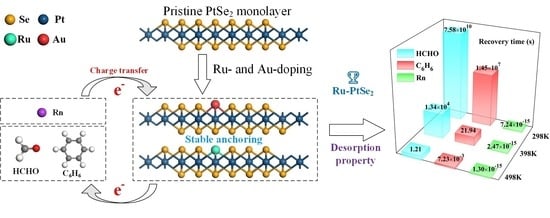
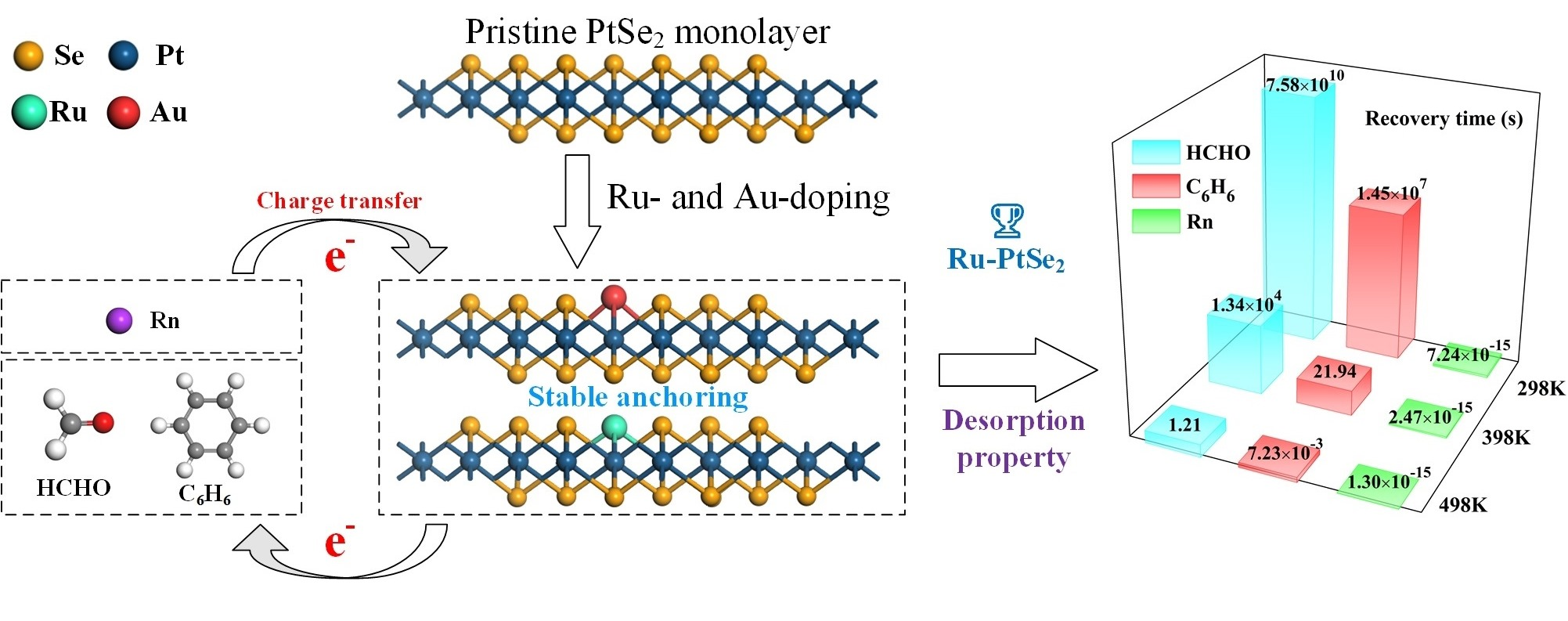
The long-term preservation of historical documents in archival environments is critically challenged by the accumulation of hazardous gases—formaldehyde (HCHO), benzene (C6H6), and radon (Rn)—which originate from collection materials and pose severe health risks to personnel. In this work, we systematically investigate, via first-principles theory, the potential of Au- and Ru-doped PtSe2 monolayers as resistive-type gas sensors for the detection of these pollutants. Atomic-scale substitutional doping at the Se site is modeled to establish the doped PtSe2 configurations, and the structural stability, electronic properties, adsorption behavior, charge transfer characteristics, and recovery kinetics of the doped systems are comprehensively evaluated and compared. Our findings, through comprehensive comparison, reveal that Ru-PtSe2 outperforms its Au-doped counterpart across all key performance metrics, positioning it as a promising candidate for hazardous gas monitoring in archival environments. The key innovation of this work lies in the systematic comparative assessment of noble metal dopants on PtSe2 monolayers, identifying Ru as a superior choice to Au and providing a theoretical foundation for designing high-performance, recyclable 2D material-based gas sensors tailored for cultural heritage preservation applications.

Graphical Abstract

1. Introduction

Archives are specialized facilities intended for the long-term preservation of valuable historical records, manuscripts, and media [1]. To fulfill this purpose, their indoor environments are rigorously regulated, typically characterized by stable low temperatures, moderate to low humidity, limited ventilation—aimed at minimizing energy use and reducing the infiltration of external pollutants—and restricted lighting [2]. Although these conditions are optimal for retarding the degradation of archival materials such as paper, leather, and film, they inadvertently foster a semi-closed micro-ecosystem. The resulting low air exchange rates hinder the dilution and removal of internally generated airborne contaminants, thereby facilitating the accumulation of harmful gases emitted from archival collections, storage furniture, and construction materials [3,4,5]. Among these pollutants, formaldehyde (HCHO), benzene (C6H6), and radon (Rn) pose particular concerns owing to their distinct indoor sources and severe health implications [6,7]. HCHO is recognized as a human carcinogen and respiratory irritant [8], C6H6 exposure may lead to neurological and hepatic disorders [9], and Rn is a leading cause of lung cancer [10]. Consequently, the sensitive detection of these gases is essential for assessing occupational exposure, guiding mitigation strategies, and ensuring safe environments that do not compromise human health.
For gas detection, two-dimensional (2D) material-based sensors have recently emerged as promising alternatives to conventional spectroscopic techniques [11,12,13], offering notable benefits including operational simplicity, cost-effectiveness, miniaturization potential, and fast response [14]. Among the family of 2D materials, transition metal dichalcogenides (TMDs) have drawn considerable research interest. Their strong reactivity and high sensitivity in gas adsorption and sensing applications have been extensively corroborated by both theoretical predictions and experimental validations [15,16,17]. Within the TMD family, PtSe2 stands out due to its unique electronic versatility. Specifically, bulk PtSe2 exhibits metallic-like electrical conductivity, whereas its monolayer form transitions to a semiconducting phase with a moderate bandgap of approximately 1.3 eV [18]. This tunable electronic property, combined with its structural stability, positions the PtSe2 monolayer as a promising candidate for gas sensing applications [19]. Indeed, recent first-principles simulations have demonstrated the superior sensing performance of the PtSe2 monolayer toward various small gas molecules. For instance, theoretical studies have revealed its outstanding capability in detecting toxic SF6 decomposition products [20].
To enhance the chemical reactivity and catalytic behavior of 2D nanosystems, transition metal (TM) surface doping has emerged as an effective strategy. This approach significantly improves the adsorption and sensing performance toward gas molecules [21,22], thereby enabling reliable operation in more challenging environments with maintained sensitivity [23]. For instance, Os-, Ir-, and Pt-doped PtSe2 monolayers have been proposed for gas sensing applications, demonstrating superior performance compared with their pristine counterparts when detecting toxic gases [24]. Similarly, Ni-, Pd-, and Rh-doped PtSe2 monolayers have shown enhanced sensitivity and selectivity toward dissolved gas species in transformers [25,26]. Also, a Pd3-doped PtSe2 monolayer has been proposed for the detection and removal of SF6 decomposed species [27]. Collectively, these findings indicate that TM-doped PtSe2 monolayers possess considerably improved and favorable adsorption characteristics for target gas molecules. Consequently, they hold strong potential for the detection of hazardous gases such as HCHO, C6H6, and Rn in archival environments, an intriguing prospect that warrants further investigation.
As noble transition metals, Au and Ru with favorable catalytic properties are frequently employed as surface dopants in 2D materials to enhance their reactivity toward gas species [28,29]. To the best of our knowledge, however, the doping behavior of Au and Ru atoms on PtSe2 monolayers and the subsequent gas sensing performance of the resulting systems have not yet been explored. In this work, we employ first-principles theory to propose Au- and Ru-doped PtSe2 (Au-PtSe2 and Ru-PtSe2) monolayers as novel gas sensors for detecting toxic gases in archival environments, thereby assessing the safety of such preservation spaces for human health. The doping process is modeled by substituting a Se atom in the PtSe2 lattice with an Au or Ru atom, followed by geometric optimization [30]. Subsequently, the interactions between the three target gas species and the doped PtSe2 monolayers are simulated to reveal the geometric and electronic properties of the proposed materials in the presence of typical gas molecules. By analyzing the adsorption parameters and electronic modification, we systematically compare the sensing mechanisms and performance differences between Au- and Ru-doped PtSe2 surfaces [31]. In parallel, the influence of Au and Ru dopants on the interaction between the PtSe2 monolayer and target gases is also elucidated. This work provides a theoretical basis for the design and development of high-performance gas sensors based on metal-doped PtSe2 monolayers, aiming to offer a new technical approach for monitoring toxic gases in archival environments. The findings highlight the significant role of noble metal surface modification on TMDs in enhancing their adsorption and sensing performance.

2. Results and Discussion

2.1. Au and Ru Doping Properties of the PtSe2 Monolayer

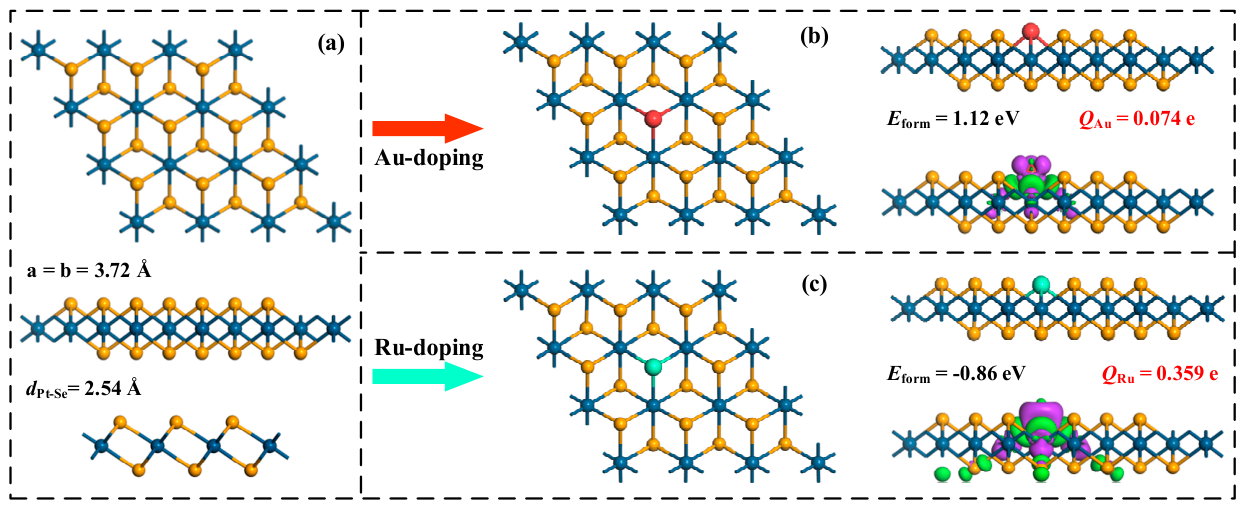
The doping processes of Au and Ru in PtSe2 monolayers are illustrated in Figure 1. To evaluate the structural stability and the energy cost associated with metal incorporation into the nano-surface, the formation energy (Eform) is introduced and calculated as follows [32]:
E form = E M - PtSe 2 E PtSe 2 μ M + μ Se
where E M - PtSe 2 and E PtSe 2 , respectively, represent the energies of the metal-doped (Au or Ru) and pristine PtSe2 monolayers, while μM and μSe, respectively, indicate the chemical potentials of a single metal dopant (Au or Ru) in its bulk phase (fcc for Au and hcp for Ru) and the replaced Se atom in its trigonal structure.
The optimized PtSe2 monolayer yields a lattice constant of 3.72 Å and a Pt-Se bond length of 2.54 Å, which align closely with previously reported values of 3.71 Å and 2.53 Å, respectively [20]. These results confirm the high accuracy of the constructed PtSe2 lattice and the employed computational settings, providing a solid foundation for subsequent doping and adsorption simulations. For the Au- and Ru-doped PtSe2 systems, the calculated Eform values are 1.12 eV and −0.86 eV, respectively. A positive Eform indicates that Au doping is thermodynamically unfavorable and requires external energy input, whereas a negative value reflects the energetic favorability of Ru incorporation [33]. Experimentally, such metal-doped PtSe2 monolayers can be synthesized using solution-phase methods such as wet-chemical reduction, as well as chemical vapor deposition (CVD), which enable controlled incorporation of Au or Ru atoms into the PtSe2 lattice while preserving structural integrity [34]. In the doped configurations, the lengths of the Au-Pt and Ru-Pt bonds are determined to be 2.70 Å and 2.54 Å, respectively. Given the similar atomic radii of Au (1.24 Å) and Ru (1.25 Å) [35], the noticeably longer Au-Pt bond suggests a weaker binding interaction compared with the Ru-Pt bond, indicating stronger orbital coupling and more favorable bonding properties in the Ru-doped system [36]. Besides, vibrational frequency analyses reveal that the Au- and Ru-doped systems exhibit frequency ranges of 75.68–566.67 cm−1 and 80.64–567.52 cm−1, respectively. The absence of imaginary frequencies in both systems confirms their admirable dynamical stability [37].
Hirshfeld population analysis reveals that in the doped PtSe2 systems, the Au and Ru dopants carry net charges of 0.074 e and 0.359 e, respectively. These positive values indicate that both dopants serve as electron donors, transferring electrons to the PtSe2 monolayer. The higher charge on Ru demonstrates its significantly stronger electron-donating capability compared with Au. This enhanced donor behavior of Ru can be attributed to its relatively lower electronegativity and more pronounced metallic character relative to Au, which facilitates greater electron redistribution within the PtSe2 system [38]. Consistent with these findings, charge density difference (CDD) distributions exhibit substantially denser electron depletion around the Ru center than around the Au center, further corroborating the stronger electron-donating property of Ru. In addition, pronounced electron accumulation is observed at both the Au-Pt and Ru-Pt bonds, revealing the favorable binding force in the related doped systems.
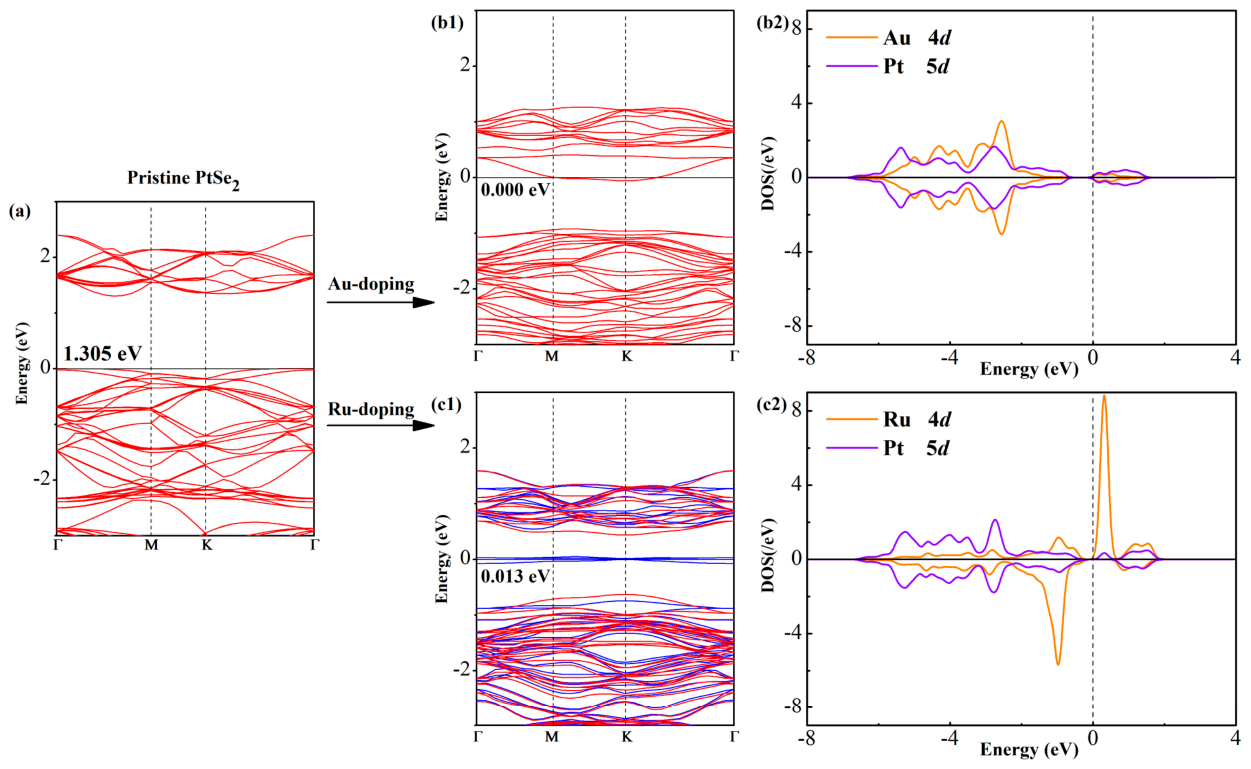
To elucidate the influence of metal doping on the electronic properties of the pristine PtSe2 monolayer, the band structures (BSs) and density of states (DOS) of both pristine and doped systems are presented in Figure 2. The pristine PtSe2 monolayer exhibits a bandgap of 1.305 eV, in close agreement with the previously reported value of 1.31 eV [39]. Upon doping, distinct electronic behaviors emerge between the two systems. The Au-PtSe2 monolayer shows a metallic character with a zero bandgap, as an electronic state at the conduction band minimum (CBM) crosses the Fermi level [40]. Additionally, this system displays symmetric spin-up and spin-down configurations, confirming its non-magnetic nature. In contrast, the Ru-PtSe2 monolayer features asymmetric spin channels, indicative of spontaneous magnetism [41], with a narrow bandgap of 0.013 eV. Magnetic moment analysis of the two doped monolayers, as revealed in Figure 3, further reveals a total magnetic moment of 0 for the Au-PtSe2 system and of 2.02 µB for the Ru-PtSe2 system. Specifically, the magnetic moment within the Ru-doped system is predominantly attributable to the Ru dopant (1.94 µB). These observations suggest that the Ru dopant is the primary cause of magnetism in the PtSe2 monolayer, whereas Au doping leads to metallization without spin polarization. Notably, both doping behaviors substantially modify the pristine electronic structure by introducing impurity states within the original bandgap, thereby significantly reducing the bandgap width. This narrowing is expected to enhance carrier mobility and electrical conductivity, which are favorable for promoting charge transfer during gas adsorption processes [42].
Further insights into bonding characteristics could be gained from the orbital DOS. Strong hybridization between the Au 4d (or Ru 4d) and Pt 5d orbitals is observed near the Fermi level, corroborating the formation of robust Au–Pt and Ru–Pt bonds and supporting the favorable binding interactions inferred from previous structural analyses. In the Ru-doped case, pronounced spin asymmetry in the Ru 4d orbitals near the Fermi level provides additional evidence for the magnetic ground state of this configuration. Collectively, these electronic structure analyses demonstrate that Au and Ru doping effectively modulate both the magnetic and conductive properties of the PtSe2 monolayer. The enhanced carrier mobility and conductivity induced by doping are expected to improve the gas adsorption performance of the modified monolayers toward toxic species in archival environments.

2.2. Gas Adsorption Performances of Au- and Ru-PtSe2 Monolayers

Based on the optimized geometries of the Au- and Ru-PtSe2 monolayers, this section examines their adsorption performance toward three hazardous gases commonly found in archival environments, namely HCHO, C6H6, and Rn. For each adsorption simulation, the target gas molecule is initially positioned at multiple orientations above the dopant site (Au or Ru), with an initial vertical separation of 2.5 Å. This distance lies within the typical range of van der Waals (vdW) interactions, thereby allowing the computational framework to adequately capture both short-range covalent contributions and long-range dispersion forces [43]. For initial configurations of gas adsorption, two molecular orientations are considered—namely, vertical (with the molecular axis perpendicular to the surface) and horizontal (parallel to the surface). To quantitatively evaluate the adsorption strength of each gas–substrate system, the adsorption energy (Ead) is employed and computed using the following expression [44]:
E ad = E surface / gas E surface E gas
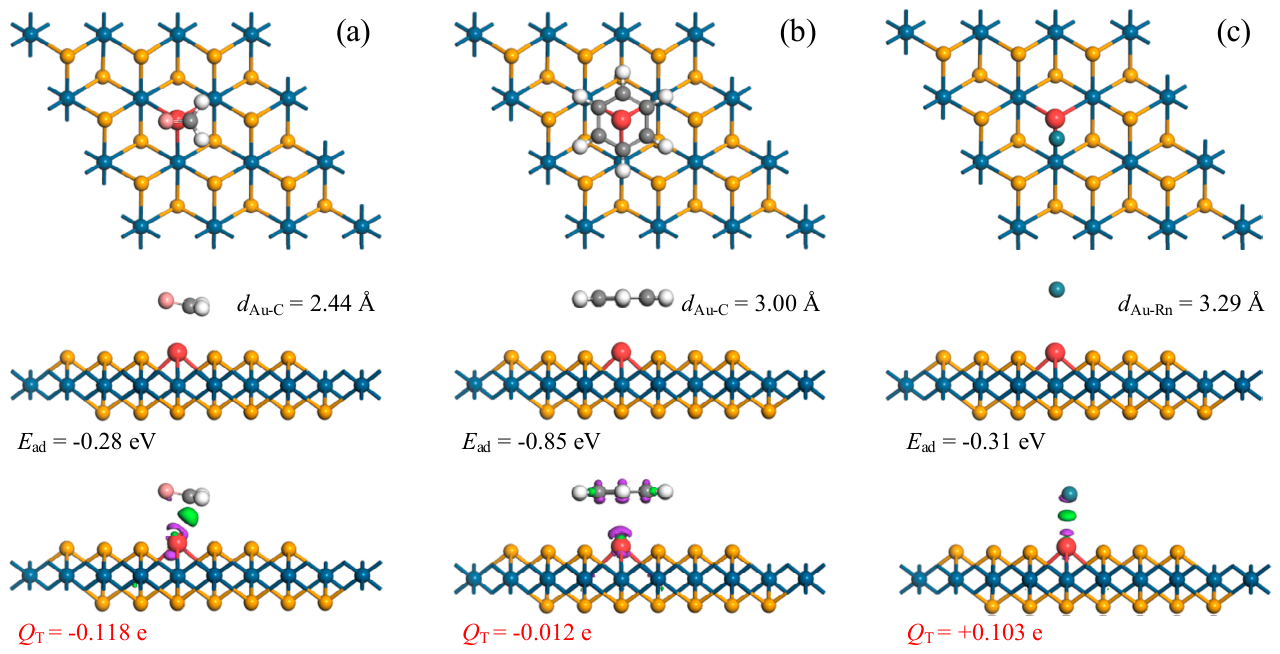
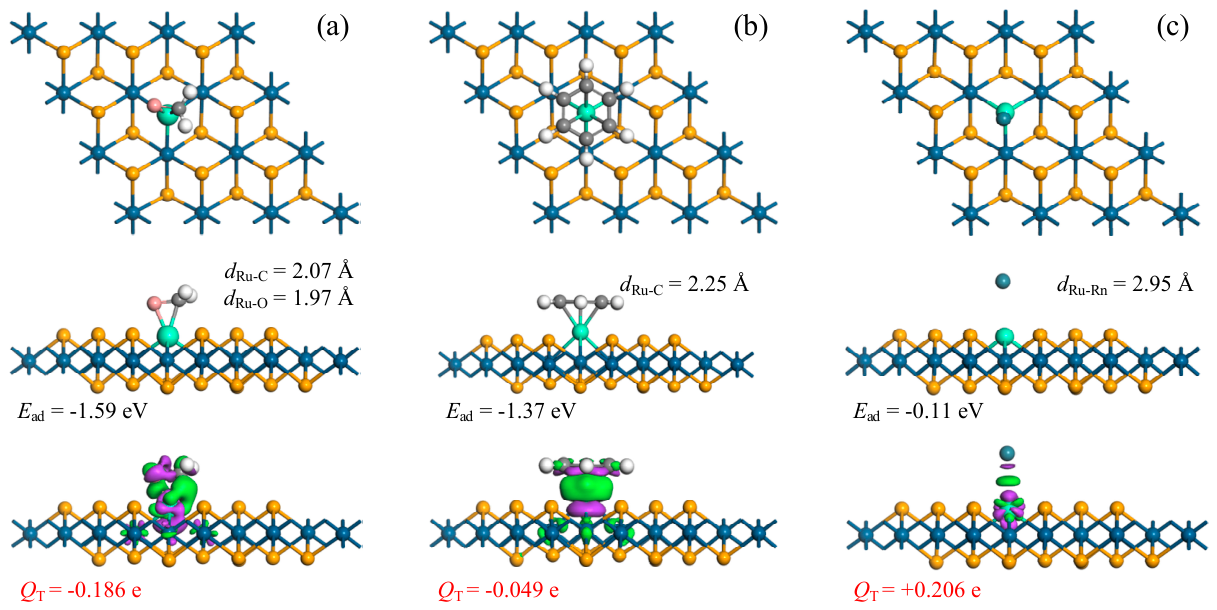
in which E surface / gas represents the total energy of the gas-adsorbed system, E surface / gas denotes the energy of the isolated doped PtSe2 monolayer, while E gas corresponds to the energy of the free gas molecule. By systematically screening multiple initial adsorption configurations, the most stable configuration (MSC) for each gas–substrate combination can be determined based on the most negative Ead value, which signifies the strongest binding affinity. Subsequently, charge density difference (CDD) analyses are performed for the MSC to visualize the electron redistribution induced by gas adsorption. Together, the CDDs and MSCs of the gas-adsorbed Au- and Ru-PtSe2 monolayers are plotted in Figure 4 and Figure 5, respectively, providing visual insight into the interfacial interaction and charge transfer mechanisms in gas adsorption.
For gas adsorption on the Au-PtSe2 monolayer, none of the three target gas molecules forms covalent bonds with the Au dopant. In the MSC, the nearest atomic distances between the adsorbate and the Au site are determined to be 2.44 Å (Au–C in HCHO), 3.00 Å (Au–C in C6H6), and 3.29 Å (Au–Rn in Rn). These relatively large separations suggest that all three interactions are dominated by weak physisorption, primarily governed by van der Waals forces [45]. This physisorptive nature is further corroborated by the calculated Ead values, which follow a clear trend in binding strength. The C6H6 system yields the most negative Ead of −0.85 eV, followed by Rn at −0.31 eV and HCHO at −0.28 eV. Although Rn exhibits a slightly more negative Ead than HCHO, the difference is marginal, implying comparable affinity of the Au-doped surface toward these two molecules [46]. Thus, the overall adsorption affinity of the Au-PtSe2 monolayer toward the three gas species follows the order: C6H6 > Rn ≈ HCHO. The CDD analyses further support the weak interactions in the three systems, revealing negligible electron accumulation in the interfacial region between the gas molecules and the Au dopant. That is, the lack of significant charge redistribution is consistent with the weak physisorptive nature of the interactions [47]. Hirshfeld charge analysis offers quantitative insight into the direction and magnitude of charge transfer during adsorption. Upon interaction with the Au-PtSe2 monolayer, HCHO and C6H6 accept 0.118 e and 0.012 e, respectively, thereby acting as electron acceptors. In contrast, Rn donates approximately 0.110 e to the substrate, functioning as an electron donor. This distinct charge transfer behavior reflects the different electronic affinities of the gas molecules and may influence the sensing response of the Au-doped system toward various hazardous species.
In contrast to the Au-doped system, gas adsorption on the Ru-PtSe2 monolayer exhibits markedly different characteristics. For the HCHO system, the Ru atom simultaneously coordinates with both the C and O atoms of the C=O group, yielding Ru–C and Ru–O bond distances of 2.07 Å and 1.97 Å, respectively. In the case of C6H6 adsorption, the Ru dopant interacts with the aromatic ring through three equivalent Ru–C bonds, with an average bond length of 2.25 Å, indicating a localized π-type orbital overlap between the benzene ring and the Ru site. By contrast, the Rn atom settles at a distance of 2.95 Å from the Ru dopant, with no detectable bond formation, confirming its physisorptive nature governed primarily by van der Waals forces. Consistent with these structural findings, the calculated Ead reveal a pronounced trend in binding strength. The HCHO system yields the most negative Ead of −1.59 eV, followed by C6H6 with −1.37 eV, both characteristic of strong chemisorption [48], while Rn exhibits a modest value of −0.11 eV, indicative of weak physical adsorption. These findings reveal that both HCHO and C6H6 undergo chemisorption through direct orbital hybridization with the Ru dopant, whereas Rn remains physisorbed without forming any chemical bonds. Accordingly, the overall adsorption affinity of the Ru-PtSe2 monolayer toward the three gas species follows the order: HCHO > C6H6 > Rn. CDD analyses corroborate the pronounced electron accumulation along the Ru–C and Ru–O bonds in the HCHO system, as well as along the Ru–C contacts in the C6H6 system, confirming robust gas–substrate electronic coupling. In contrast, the Rn-adsorbed system exhibits negligible charge redistribution at the Ru–Rn interface, consistent with its physisorptive character [47]. Hirshfeld charge analysis quantifies the direction and magnitude of charge transfer upon adsorption. HCHO and C6H6 accept 0.186 e and 0.049 e, respectively, from the Ru-PtSe2 monolayer, functioning as electron acceptors. Conversely, Rn donates 0.206 e to the substrate, behaving as an electron donor.
A comparative evaluation based on Ead and QT reveals that the Ru-PtSe2 monolayer substantially outperforms its Au-doped counterpart in both binding strength and charge redistribution toward the target gases. Specifically, Ru doping enables strong chemisorption of HCHO and C6H6 through robust covalent interactions, whereas the Au-doped system only exhibits weak physisorption of all three species. This pronounced difference can be attributed to the stronger orbital hybridization and greater electron redistribution capability of the Ru dopant [49]. For Rn, both doped systems display physisorptive behavior; however, the Ru-doped surface still induces considerably higher charge transfer, suggesting potentially better electronic signal response. Overall, the Ru-doped system shows superior adsorption performance and sensing potential, while the Au-doped counterpart shows limited reactivity, making it less suitable for the targeted gas detection applications.

2.3. Electronic Properties of Gas-Adsorbed Au- and Ru-PtSe2 Systems

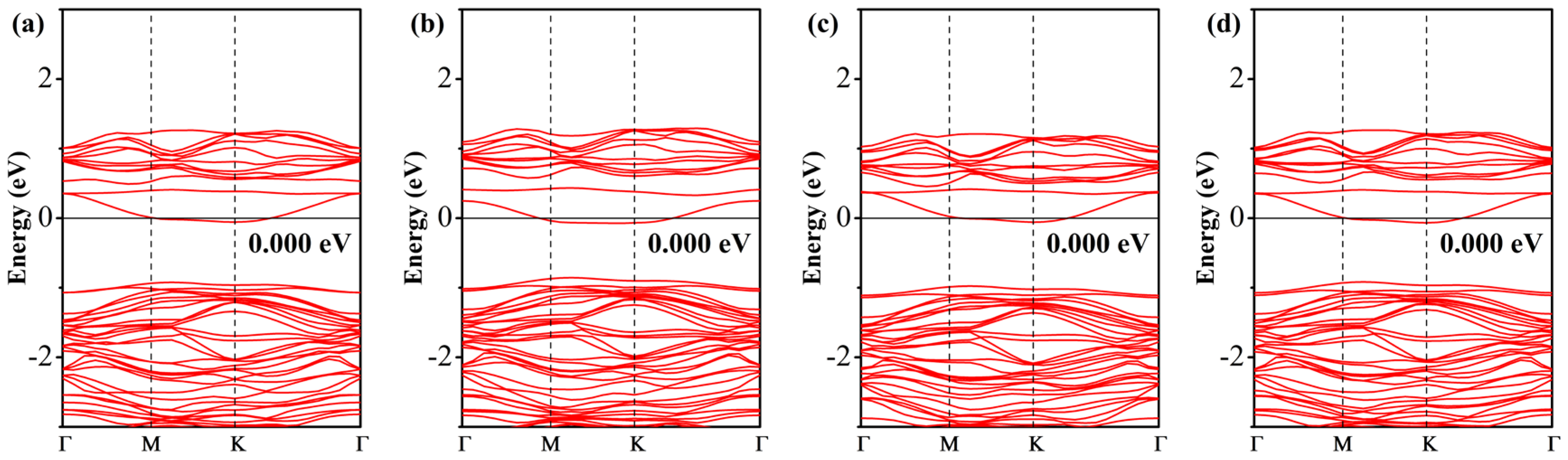
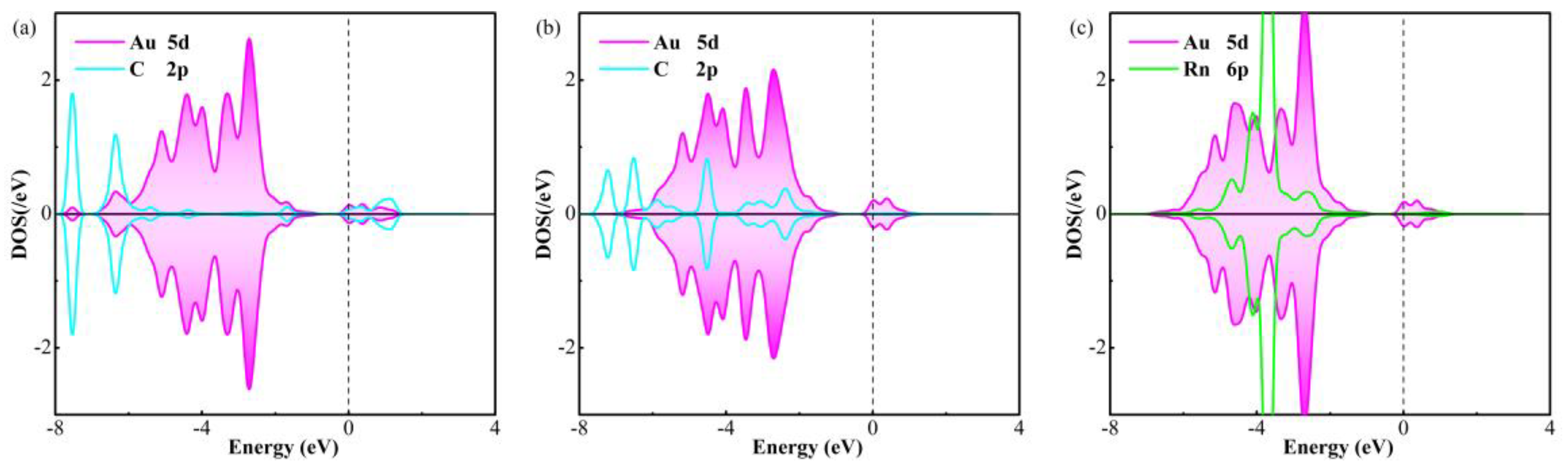
A comprehensive understanding of the electronic property modifications induced by gas adsorption on Au- and Ru-PtSe2 monolayers is essential for evaluating their potential as resistive-type gas sensors. To this end, the BSs of both the isolated and gas-adsorbed systems are examined to reveal bandgap variations upon gas exposure, which directly correlate with changes in electrical conductivity—a key metric for sensor response. Additionally, orbital DOS analyses are performed to elucidate the bonding characteristics between adsorbates and specific atomic sites, thereby providing electronic-level validation of the Ead. Accordingly, the BSs of the isolated and gas-adsorbed Au- and Ru-doped systems are presented in Figure 6 and Figure 8, respectively, while the corresponding orbital DOS plots for the key interacting atomic species are displayed in Figure 7 and Figure 9.
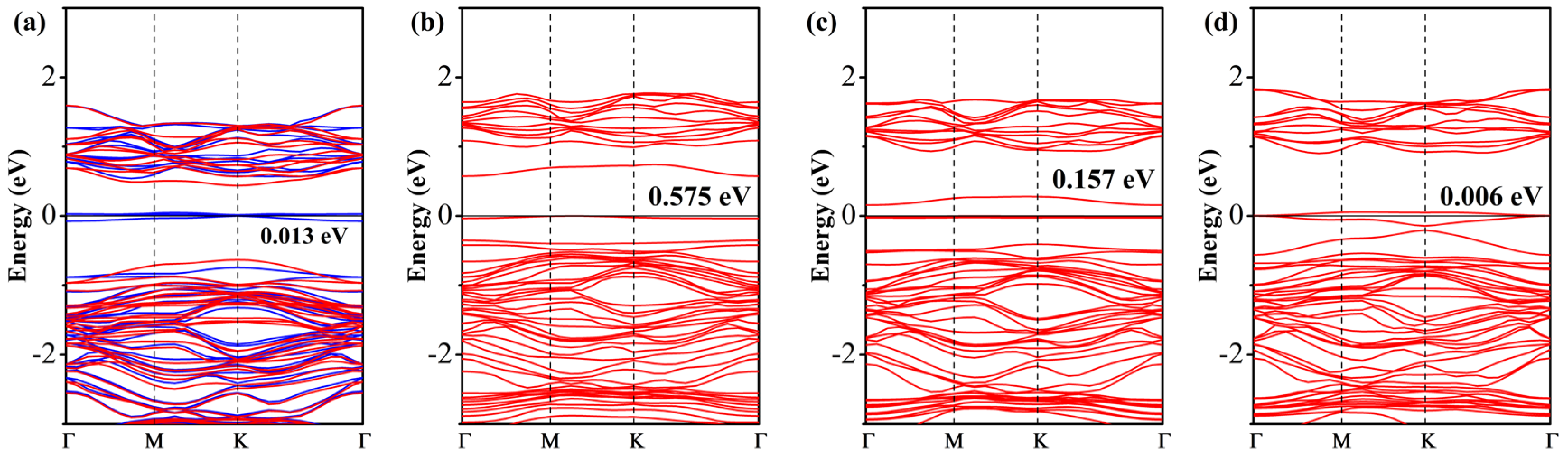
Figure 6. BS distribution of (a) isolated Au-PtSe2 monolayer and (bd) HCHO-, C6H6-, and Rn-adsorbed systems.
Inorganics 14 00207 g006
Figure 7. Orbital DOS of the closest atoms in the gas-adsorbed Au-PtSe2 systems. (a) HCHO system, (b) C6H6 system, and (c) Rn system.
Inorganics 14 00207 g007
Figure 8. BS distribution of (a) isolated Ru-PtSe2 monolayer and (bd) HCHO, C6H6, and Rn adsorbed systems.
Inorganics 14 00207 g008
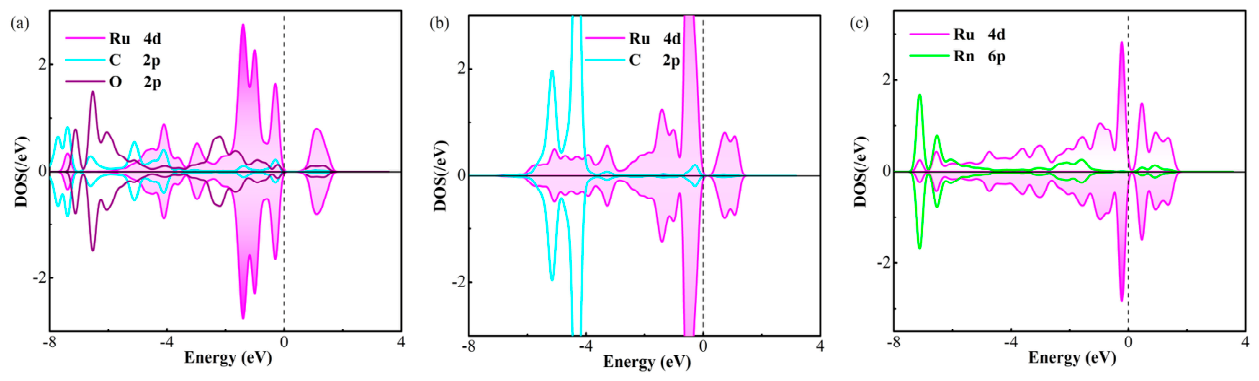
Figure 9. Orbital DOS of bonded or closest atoms in the gas-adsorbed Ru-PtSe2 systems. (a) HCHO system, (b) C6H6 system, and (c) Rn system.
Inorganics 14 00207 g009

2.3.1. Gas-Adsorbed Au-PtSe2 Systems

As shown in Figure 6, the BSs of the isolated and three gas-adsorbed Au-PtSe2 systems exhibit symmetric spin-up and spin-down channels, indicating that gas adsorption has no impact on the non-magnetic nature of the Au-doped system. Furthermore, in each case, an electronic state originating from the CBM crosses the Fermi level, resulting in a zero bandgap. Consequently, all three adsorption systems—HCHO, C6H6, and Rn—retain metallic character, suggesting that Au-PtSe2 may exhibit limited changes in electrical conductivity in terms of bandgap after gas adsorption. That is, the Au-PtSe2 monolayer has limited sensing potential upon three gas species.
Figure 7 presents the orbital DOS for the gas-adsorbed Au-doped systems. It is observed that the Au 5d orbitals exhibit only negligible hybridization with the C 2p orbitals of HCHO and C6H6, as well as with the Rn 6p orbital. This lack of significant orbital overlap corroborates the absence of chemical bond formation, consistent with the minimal negative Ead values and the relatively large equilibrium distances obtained from structural optimization. The nearly featureless DOS profiles near the Fermi level further confirm that charge redistribution between the adsorbates and the Au dopant is extremely limited. Overall, the orbital DOS analysis unequivocally demonstrates that the Au-PtSe2 monolayer interacts with HCHO, C6H6, and Rn solely through weak physisorption, governed predominantly by van der Waals forces, without any appreciable electronic perturbation of the Au-PtSe2. These weak orbital interactions also indicate that gas adsorption only introduces negligible changes to the electronic structure of the Au-doped system, which will lead to limited electrical response in actual gas sensing applications, further verifying that Au-PtSe2 is not an ideal candidate for detecting these three target gases.

2.3.2. Gas-Adsorbed Ru-PtSe2 Systems

From Figure 8, where the BSs of the isolated and gas-adsorbed Ru-PtSe2 systems are shown, a notable observation is that the spin-up and spin-down channels become symmetric in all three gas-adsorbed configurations, in contrast to the asymmetric features of the pristine Ru-doped monolayer. This indicates that the intrinsic magnetic moment of the isolated Ru-PtSe2 system is quenched upon gas adsorption, which can be attributed to charge transfer and orbital hybridization between the Ru dopant and the adsorbate molecules, effectively suppressing the local spin polarization [50]. More significantly, the bandgaps of the HCHO-, C6H6-, and Rn-adsorbed systems are determined to be 0.575 eV, 0.157 eV, and 0.006 eV, respectively. Compared with the bandgap of the isolated Ru-PtSe2 monolayer (0.013 eV), these values correspond to increases of 0.562 eV and 0.144 eV for HCHO and C6H6 adsorption, respectively, while only a marginal increase of 0.007 eV is observed for Rn. This pronounced bandgap widening upon HCHO and C6H6 exposure suggests a suppression of electrical conductivity, as the wider bandgap reduces the number of thermally excited charge carriers. In contrast, the nearly unchanged bandgap upon Rn adsorption implies that the conductivity remains largely unaffected, or even slightly enhanced, due to the retention of near-metallic character [51]. These distinct bandgap responses highlight the potential of the Ru-doped system for selective gas detection, where HCHO and C6H6 can be distinguished from Rn based on the magnitude of conductivity modulation.
Figure 9 displays the orbital-resolved DOS for the gas-adsorbed Ru-PtSe2 systems. For the HCHO system, the Ru 4d orbitals exhibit sharp and localized distributions with pronounced peaks concentrated in the energy range of −5 to 0 eV. The hybridization between Ru 4d and the C 2p/O 2p states is substantially more extensive than in the Au-doped counterpart, as reflected by broader and more intense overlapping regions spanning approximately −6.0 to 0 eV and 0.6 to 1.6 eV. This enhanced orbital overlap directly correlates with the formation of Ru–C and Ru–O bonds and accounts for the significantly larger Ead (−1.59 eV) relative to the Au-doped system (−0.28 eV). Furthermore, the C 2p and O 2p states exhibit more prominent contributions near the Fermi level, implying a larger charge transfer (−0.186 e) compared with the Au-doped case (−0.118 e), as corroborated by Hirshfeld analysis. Collectively, these features confirm that HCHO undergoes strong chemisorption on the Ru-doped surface with substantial electronic perturbation. For the C6H6 system, the hybridization intensity between Ru 4d and C 2p states is moderate, with the overlapping region being narrower and less intense than that observed in the HCHO case. This is consistent with the longer Ru–C bond distance (2.48 Å) and the smaller adsorption energy (−1.37 eV) relative to HCHO. Nevertheless, the orbital mixing around the Fermi level remains clearly discernible, confirming that C6H6 also undergoes chemisorption. In the Rn system, analogous to the Au-doped case, the Ru 4d orbitals show negligible overlap with the Rn 6p states across the entire energy spectrum. The absence of hybridization peaks near the Fermi level corroborates the physisorptive nature of Rn adsorption, which is further supported by the relatively long Ru–Rn distance (2.95 Å) and the modest adsorption energy (−0.11 eV). This indicates that Rn interacts with the Ru-doped surface primarily through van der Waals forces, without inducing significant electronic modifications to the substrate. Overall, the BS and DOS analyses collectively demonstrate that the Ru-PtSe2 monolayer exhibits strong chemisorption toward HCHO and C6H6, with substantial bandgap modulation and pronounced orbital hybridization, whereas its interaction with Rn remains weak and physisorptive.

2.3.3. Comparison Between Au- and Ru-Doped Systems

A comparative analysis of the BS evolution upon gas adsorption reveals that the Ru-PtSe2 monolayer exhibits substantially larger bandgap variations across all three target gases compared with its Au-doped counterpart. Specifically, the bandgap modulation induced by HCHO, C6H6, and Rn adsorption on the Ru-doped system reaches 0.562 eV, 0.144 eV, and 0.007 eV, respectively, whereas the Au-doped system maintains a zero bandgap (metallic character) for all three gas-adsorbed configurations, yielding no detectable bandgap variation. This stark contrast indicates that the Ru-doped system enables significant conductivity modulation upon gas exposure—particularly for HCHO and C6H6—whereas the Au-doped system, due to its persistent metallic state, offers negligible resistive-type sensing response. Consequently, the pronounced bandgap widening in the Ru-doped system translates into substantial suppression of electrical conductivity for HCHO and C6H6 detection, while the near-zero variation for Rn suggests a markedly different electronic response, thereby positioning Ru-PtSe2 as a more sensitive and potentially selective platform for resistive-type gas sensing applications in archival environments.
In parallel, the DOS comparison further corroborates the superior adsorption performance of the Ru-PtSe2 monolayer relative to the Au-doped counterpart. For HCHO and C6H6, the Ru 4d orbitals exhibit extensive hybridization with the C 2p and O 2p states of the adsorbates, characterized by broad overlapping regions and pronounced orbital mixing near the Fermi level. In contrast, the Au 5d orbitals show only negligible overlap with the molecular states, confirming the absence of chemical bond formation and the dominance of weak physisorption in the Au-doped systems [52]. For Rn, both systems display negligible electronic coupling, consistent with physisorption as the dominant interaction mechanism. Collectively, these electronic structure comparisons demonstrate that Ru doping imparts markedly enhanced sensing capability to the PtSe2 monolayer, whereas Au doping results in limited reactivity, making it less suitable for the targeted gas detection applications.

2.4. Recovery Properties of Ru-PtSe2 Monolayers

The preceding sections have systematically demonstrated that the Ru-PtSe2 monolayer serves as a promising resistive-type sensing material for toxic gas detection in archival environments. Beyond sensitivity and selectivity, however, the practical viability of a gas sensor also hinges critically on its reusability, a factor that directly influences operational cost and long-term stability [53]. In this context, evaluating the recovery time of the Ru-PtSe2 monolayer is essential for assessing its potential for repeated use in detecting the target gases [54]. A short recovery period implies rapid desorption of gas molecules and favorable recyclability, whereas an extended recovery duration may limit the material’s applicability in scenarios demanding swift cyclic operation. According to the van’t Hoff–Arrhenius theory, the recovery time (τ) can be estimated by the following expression [55]:
τ = A 1 e ( E ad / k T )
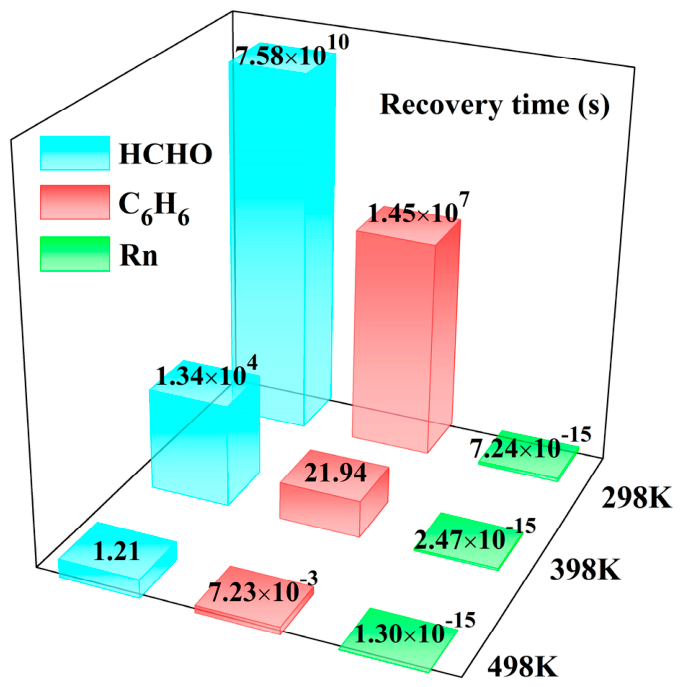
where A denotes the attempt frequency (1016 s−1 for UV light [45]), k is the Boltzmann constant, and T is the absolute temperature. This exponential dependence underscores the critical role of temperature in accelerating desorption: elevated thermal energy facilitates the overcoming of the adsorption energy barrier, thereby substantially reducing the recovery time. Applying this equation, the calculated recovery times for the desorption of HCHO, C6H6, and Rn from the Ru-PtSe2 monolayer are displayed in Figure 10.
As shown in Figure 10, the calculated recovery times at room temperature (298 K) are 7.58 × 10¹⁰ s for HCHO, 1.45 × 10⁷ s for C6H6, and 7.24 × 10⁻¹⁵ s for Rn. These values reveal two extreme scenarios: for HCHO and C6H6, the recovery times are impractically prolonged, rendering real-time cyclic sensing unfeasible under ambient conditions due to the strong chemisorption that traps adsorbates on the surface; conversely, for Rn, the recovery time is extraordinarily short, indicating instantaneous desorption that precludes sufficient gas–surface interaction time for effective detection [56]. These extreme recovery times—either excessively long or impractically short—are both unfavorable for reliable sensing performance. On the one hand, strong chemisorption leads to prolonged desorption and poor recyclability; on the other hand, weak physisorption causes instantaneous desorption, leaving insufficient time for effective gas–surface interaction. Consequently, the Ru-PtSe2 monolayer is not suitable for room-temperature detection of the target gases, as neither extreme ensures a stable and reversible response required for practical sensing applications. Upon elevating the temperature to 398 K, however, the recovery times for HCHO and C6H6 are drastically reduced to 1.34 × 10⁴ s and 21.94 s, respectively. Notably, the recovery time for C6H6 falls below 0.5 min, indicating exceptionally fast desorption and excellent recyclability of the Ru-PtSe2 monolayer at 398 K [57]. This marked improvement demonstrates that moderate thermal stimulation is sufficient to substantially overcome the adsorption energy barrier for C6H6, enabling practical reuse without excessive energy input. Further increasing the temperature to 498 K yields an additional reduction in the recovery time for HCHO to 1.21 s, confirming that thermal activation at elevated temperatures can effectively promote the desorption of even strongly chemisorbed species. This observation suggests that the Ru-PtSe2 monolayer, while requiring higher thermal energy for HCHO regeneration compared with C6H6, still retains the potential for reusability under appropriately elevated operating temperatures.
In short, the comprehensive comparison between Au- and Ru-PtSe2 monolayers establishes the superior sensing performance of the Ru-doped system. From the perspective of doping energetics, the negative Eform of Ru-PtSe2 indicates its thermodynamically favorable incorporation into the PtSe2 lattice, whereas the positive Eform of Au-PtSe2 reflects an energetically costly and less stable doping process. More critically, Ru doping enables strong chemisorption toward HCHO and C6H6 via robust covalent interactions, as evidenced by the substantially larger adsorption energies and pronounced orbital hybridization, while Au doping merely induces weak physisorption for all three target gases. In terms of electronic response, the Ru-doped monolayer exhibits significant bandgap modulation upon gas exposure—particularly for HCHO and C6H6—which translates into measurable conductivity changes suitable for resistive-type sensing, whereas the Au-doped system remains persistently metallic with negligible electronic perturbation. Regarding recoverability, although the strong binding of HCHO and C6H6 on Ru-PtSe2 requires elevated temperatures (398–498 K) to achieve practical desorption, this thermal activation is both feasible and effective, enabling recyclable operation without compromising the material’s structural integrity. Collectively, these findings demonstrate that Ru-PtSe2 outperforms its Au-doped counterpart across all key performance metrics: doping stability, adsorption strength, electronic sensitivity, and recoverability, positioning it as a promising candidate for hazardous gas monitoring in archival environments.
Beyond the Au and Ru dopants systematically investigated in this work, our theoretical screening framework can be readily extended to explore several other promising strategies for further enhancing the sensing performance of PtSe2-based materials. First, other transition metals with highly localized d-orbitals (e.g., Os and Ir) or rare-earth elements (e.g., Y) may induce sharper orbital hybridization near the Fermi level upon gas exposure, potentially creating tailored chemical pathways to overcome the physisorption limits typically observed for inert species such as Rn. Second, deliberate defect engineering, including single Se vacancies (VSe), double Pt-Se vacancies (VPt-Se), and antisite defects (PtSe or SePt), could act as highly reactive charge redistribution centers, significantly reducing activation energy barriers and shifting detection thresholds toward sub-parts-per-billion levels. Third, nanomechanical strain engineering, through the application of uniaxial or biaxial tensile strain (ε = 1% to 5%), offers an additional reversible degree of freedom to continuously modulate the electronic band structure, potentially balancing the trade-off between high adsorption sensitivity and rapid desorption kinetics. In addition, the emerging concept of nanomechanical twist engineering is a promising post-synthetic regulatory strategy for PtSe2-based gas sensors. The application of localized torsional strain and rotational shear gradients could break the spatial inversion symmetry of the PtSe2 lattice, split the degenerate d-orbitals of active catalytic sites, and generate pseudomagnetic fields that enhance interfacial charge redistribution. Such quantum mechanical perturbations could not only amplify adsorption sensitivity and selectivity toward weakly interacting gases but also establish a reversible mechanical switch capable of dynamically destabilizing chemical bonds for ultrafast sensor recovery. Collectively, these alternative doping, defect, and strain strategies may open new avenues for designing next-generation 2D gas sensors, and the computational methodology established in this work provides a reliable basis for future high-throughput screening of novel sensing materials.

3. Computational Method

All first-principles calculations in this work were performed using the DMol3 package with the spin-polarized formalism [58]. The exchange-correlation interactions were described by the Perdew–Burke–Ernzerhof (PBE) functional within the generalized gradient approximation (GGA) [59]. To account for van der Waals interactions and long-range dispersion effects, the Tkatchenko–Scheffler (TS) scheme under the DFT-D3 framework was employed [60]. For Brillouin-zone integration, a Monkhorst–Pack k-point grid of 10 × 10 × 1 was adopted in all geometry relaxation and electronic computations [61], and this grid yielded energy convergence within 1 meV/atom. Geometry optimization was considered converged when the energy change fell below 1 × 10⁻⁵ Ha. A global orbital cutoff radius of 5.0 Å was selected to ensure an accurate description of the electronic states of metal atoms [62]. The Gaussian smearing scheme with a broadening parameter of 0.005 Ha was applied. The electronic structure was expanded using a double numerical plus polarization (DNP) basis set for all atoms. Furthermore, the basis set superposition error (BSSE) was not corrected, as its influence on the total energy of the studied systems was found to be negligible [47].
A 3 × 3 × 1 supercell of the pristine PtSe2 monolayer was constructed as the nano-support, incorporating a vacuum layer of 18 Å to prevent spurious interactions between adjacent periodic units [63]. Within the optimized PtSe2 lattice, the Au- and Ru-PtSe2 monolayers were established by substituting a Se atom with an Au or Ru atom. Such a doping method can ensure good stability of the host structure without inducing significant lattice distortion. To analyze charge transfer within the metal-doped and gas-adsorbed systems, Hirshfeld population analysis was employed [64]. This method allows the determination of net charge populations on the Au and Ru dopants (denoted as QAu and QRu, respectively), as well as on the adsorbed gas molecules (QT). In this framework, a positive value signifies electron-donating behavior of the metal dopant or the gas species, while a negative value indicates electron-accepting characteristics. Together, these computational methodologies offer a comprehensive foundation for interpreting the structural and electronic properties of metal-doped PtSe2 monolayers, along with their interaction behaviors toward toxic gas species.

4. Conclusions

In this work, we systematically investigated the structural stability, gas adsorption performance, electronic sensing response, and recovery characteristics of Au- and Ru-PtSe2 monolayers toward HCHO, C6H6, and Rn using first-principles calculations. The main conclusions are summarized as follows:
(i)
Ru doping is thermodynamically favorable, with an Eform of −0.86 eV, whereas Au doping is energetically costly (+1.12 eV), with both doped systems maintaining good dynamical stability;
(ii)
Ru-PtSe2 enables strong chemisorption of HCHO (−1.59 eV) and C6H6 (−1.37 eV) via robust covalent interactions, whereas Au-PtSe2 exhibits only weak physisorption for all three gases;
(iii)
Ru-PtSe2 exhibits significant bandgap widening upon HCHO (0.562 eV) and C6H6 (0.144 eV) adsorption, while Au-PtSe2 remains metallic (0 eV) with negligible electronic response;
(iv)
Ru-PtSe2 achieves practical reusability under moderate thermal activation (21.94 s for C6H6 at 398 K and 1.21 s for HCHO at 498 K), allowing its reuse in typical gas detection.
In summary, this work establishes a predictive theoretical framework for the rational design of transition-metal-doped 2D sensors, demonstrating that atomic-scale doping engineering can fundamentally dictate the interfacial reactivity, electronic transduction, and operational recyclability of PtSe2-based nanoelectronic devices. The systematic comparative screening of Au and Ru dopants reveals that the selection of substitutional atoms is not merely a compositional variable but a decisive factor governing the transitions from physisorption to chemisorption, and from metallic to semiconducting response, which are key considerations for developing high-performance, low-power gas sensors. The methodology and findings established here pave the way for future experimental validation and inspire further exploration of dopant-engineered 2D materials for broad-spectrum gas sensing and beyond.

Author Contributions

F.L.: Writing—original draft; K.L.: Formal analysis; X.Q.: Investigation; H.C.: Writing—review & editing, Funding acquisition. All authors have read and agreed to the published version of the manuscript.

Funding

This research was funded by Fundamental Research Funds for the Central Universities (No. SWU-KT26007).

Data Availability Statement

The authors confirm that the data supporting the findings of this study are available within the article.

Conflicts of Interest

The authors declare no conflicts of interest.

References

  1. Francke, H.; Gamalielsson, J.; Lundell, B. Institutional repositories as infrastructures for long-term preservation. Inf. Res. 2017, 22, n2. [Google Scholar]
  2. Wang, Y.; Kuckelkorn, J.; Zhao, F.-Y.; Spliethoff, H.; Lang, W. A state of art of review on interactions between energy performance and indoor environment quality in Passive House buildings. Renew. Sustain. Energy Rev. 2017, 72, 1303–1319. [Google Scholar] [CrossRef] [Scilit]
  3. Manisalidis, I.; Stavropoulou, E.; Stavropoulos, A.; Bezirtzoglou, E. Environmental and health impacts of air pollution: A review. Front. Public Health 2020, 8, 14. [Google Scholar] [CrossRef] [Scilit] [PubMed]
  4. Goldstein, A.H.; Nazaroff, W.W.; Weschler, C.J.; Williams, J. How do indoor environments affect air pollution exposure? Environ. Sci. Technol. 2020, 55, 100–108. [Google Scholar] [CrossRef] [Scilit] [PubMed]
  5. Thakur, M.; Pathania, D. Environmental fate of organic pollutants and effect on human health. In Abatement of Environmental Pollutants; Elsevier: Amsterdam, The Netherlands, 2020; pp. 245–262. [Google Scholar]
  6. Lee, S. Indoor air quality and gaseous pollutant. In New Perspectives in Indoor Air Quality; Elsevier: Amsterdam, The Netherlands, 2026; pp. 19–26. [Google Scholar]
  7. Morantes, G.; Jones, B.; Molina, C.; Sherman, M.H. Harm from indoor air contaminants. Environ. Sci. Technol. 2023, 58, 242–257. [Google Scholar] [CrossRef] [Scilit] [PubMed]
  8. Tsai, W.-T. An overview of health hazards of volatile organic compounds regulated as indoor air pollutants. Rev. Environ. Health 2019, 34, 81–89. [Google Scholar] [PubMed]
  9. Wu, H.; Wang, Y.; Zhang, A.; Zhang, Y.; Shen, J.; Du, R.; Tian, X. Research on gas concentration measurement under intrusive damage testing. In Proceedings of the Advanced Fiber Laser Conference (AFL2023), Shenzhen, China, 10–12 November 2024; pp. 1179–1187. [Google Scholar]
  10. Zablotska, L.B.; Richardson, D.B.; Golden, A.; Pasqual, E.; Smith, B.; Rage, E.; Demers, P.A.; Do, M.; Fenske, N.; Deffner, V. The epidemiology of lung cancer following radiation exposure. Int. J. Radiat. Biol. 2023, 99, 569–580. [Google Scholar] [PubMed]
  11. Zhang, S.; Tao, L.; Fang, T.; Dang, J.; Dastan, D.; Li, L.; An, B. Resolving Competitive Adsorption Pathways on Ir-WSe2 Nanosheets via DFT Simulations for Ultra-Selective NO Recognition in Harsh Environments. ACS Appl. Nano Mater. 2026, 9, 4367–4377. [Google Scholar] [CrossRef] [Scilit]
  12. Wu, H.; Zhang, G.; Cui, H.; Deng, X. Atomic-level sensing mechanism of Rh-doped MoS2-WS2 heterojunction towards dissolved H2, C2H2, and C2H4 in transformer oil: A first-principles study. Colloids Surf. A Physicochem. Eng. Asp. 2026, 738, 140006. [Google Scholar] [CrossRef] [Scilit]
  13. He, H.; Bi, M.; Xu, S.; Li, S.; You, Y.; Chen, H.; Zhou, Z.; Jiang, T. Comparison of the Adsorption Characteristics and Sensing Performance of MoS2, MoSe2, and Janus MoSSe toward Lithium-Ion Battery Thermal Runaway Gases. Langmuir 2026, 42, 5283–5312. [Google Scholar] [CrossRef] [Scilit] [PubMed]
  14. Cui, H.; Pu, Y.; Wu, H.; Zhang, Y.; Zhang, X.; Hu, J. Accelerating Discovery of WX2-Based Gas Sensors (X = S, Se, and Te) for C4F7N Decomposed Species via Density Functional Theory and Machine Learning. ACS Sens. 2026, 11, 6295–6308. [Google Scholar] [CrossRef] [Scilit] [PubMed]
  15. Cui, H.; Hu, J.; Jiang, X.; Zhang, X. A first-principles study of SOF2 and SO2F2 adsorption onto PdSe2-based monolayers: Favorable sensitivity and selectivity by doping single Cu or Rh atom. Environ. Res. 2025, 269, 120843. [Google Scholar] [CrossRef] [Scilit] [PubMed]
  16. Shokri, A.; Salami, N. Gas sensor based on MoS2 monolayer. Sens. Actuators B Chem. 2016, 236, 378–385. [Google Scholar] [CrossRef] [Scilit]
  17. Cui, H.; Wu, H.; He, D.; Ma, S. Noble metal (Pd, Pt)-functionalized WSe2 monolayer for adsorbing and sensing thermal runaway gases in LIBs: A first-principles investigation. Environ. Res. 2025, 269, 120847. [Google Scholar] [CrossRef] [Scilit] [PubMed]
  18. Wang, Y.; Li, L.; Yao, W.; Song, S.; Sun, J.T.; Pan, J.; Ren, X.; Li, C.; Okunishi, E.; Wang, Y.-Q.; et al. Monolayer PtSe2, a New Semiconducting Transition-Metal-Dichalcogenide, Epitaxially Grown by Direct Selenization of Pt. Nano Lett. 2015, 15, 4013–4018. [Google Scholar] [CrossRef] [Scilit] [PubMed]
  19. Sajjad, M.; Montes, E.; Singh, N.; Schwingenschlögl, U. Superior Gas Sensing Properties of Monolayer PtSe2. Adv. Mater. Interfaces 2017, 4, 1600911. [Google Scholar]
  20. Chen, D.; Zhang, X.; Tang, J.; Cui, Z.; Cui, H.; Pi, S. Theoretical study of monolayer PtSe2 as outstanding gas sensor to detect SF6 decompositions. IEEE Electron Device Lett. 2018, 39, 1405–1408. [Google Scholar] [CrossRef] [Scilit]
  21. Fan, Y.; Zhang, J.; Qiu, Y.; Zhu, J.; Zhang, Y.; Hu, G. A DFT study of transition metal (Fe, Co, Ni, Cu, Ag, Au, Rh, Pd, Pt and Ir)-embedded monolayer MoS2 for gas adsorption. Comput. Mater. Sci. 2017, 138, 255–266. [Google Scholar] [CrossRef] [Scilit]
  22. Ma, D.; Ju, W.; Li, T.; Zhang, X.; He, C.; Ma, B.; Lu, Z.; Yang, Z. The adsorption of CO and NO on the MoS2 monolayer doped with Au, Pt, Pd, or Ni: A first-principles study. Appl. Surf. Sci. 2016, 383, 98–105. [Google Scholar] [CrossRef] [Scilit]
  23. Baek, D.H.; Kim, J. MoS2 gas sensor functionalized by Pd for the detection of hydrogen. Sens. Actuators B Chem. 2017, 250, 686–691. [Google Scholar] [CrossRef] [Scilit]
  24. Liu, Y.; Xie, K.; Wang, P.; Xu, D.; Lin, L. Noble metals (Os, Ir, Pt) loaded PtSe2 monolayer as high-performance SF6 decomposition gas sensor: A DFT study. Colloids Surf. A Physicochem. Eng. Asp. 2025, 726, 137945. [Google Scholar] [CrossRef] [Scilit]
  25. Jiang, T.; Xu, S.; You, Y.; Chen, H.; Bi, M.; Ma, Z. Enhancing sensitivity and selectivity of transformer oil dissolved gas sensor based on TM (Ni, Pd, Rh)-doped PtSe2 monolayer: A DFT study. Phys. Lett. A 2025, 561, 130987. [Google Scholar] [CrossRef] [Scilit]
  26. Li, M.; Yan, F.; Jiang, Y.; Zhou, M.; Peng, X.; Wu, N. Ni-Doped PtSe2 for Dissolved Gas Detection in Transformer Oil: A First-Principles Study. Int. J. Pattern Recognit. Artif. Intell. 2026, 2650037. [Google Scholar] [CrossRef] [Scilit]
  27. Li, M.; Cen, W.; Tian, Z.; Zheng, Q. First Principles Calculation of Gas Sensitive Properties of Pd3-Modified Monolayer PtSe2 to SF6 Decomposition Products. Phys. Status Solidi (RRL)—Rapid Res. Lett. 2024, 18, 2300367. [Google Scholar] [CrossRef] [Scilit]
  28. Peng, R.; Zeng, W.; Zhou, Q. Adsorption and gas sensing of dissolved gases in transformer oil onto Ru3-modified SnS2: A DFT study. Appl. Surf. Sci. 2023, 615, 156445. [Google Scholar] [CrossRef] [Scilit]
  29. Rawat, S.; Bamola, P.; Rani, C.; Kaushik, V.; Kumar, U.; Dwivedi, C.; Rattan, R.; Sharma, M.; Kumar, R.; Sharma, H. Interdigitated electrodes-based Au-MoS2 hybrid gas sensor for sensing toxic CO and NH3 gases at room temperature. Nanotechnology 2023, 34, 305601. [Google Scholar] [CrossRef] [Scilit] [PubMed]
  30. Wan, Q.; Chen, X.; Gui, Y. First-Principles Insight into a Ru-Doped SnS2 Monolayer as a Promising Biosensor for Exhale Gas Analysis. ACS Omega 2020, 5, 8919–8926. [Google Scholar] [CrossRef] [Scilit] [PubMed]
  31. Cui, H.; Ran, M.; Peng, X.; Zhang, G. First-principles design of noble metal (Rh and Pd) dispersed Janus WSTe monolayer for toxic gas sensing applications. J. Environ. Chem. Eng. 2024, 12, 112047. [Google Scholar] [CrossRef] [Scilit]
  32. Zhang, W.; Yong, Y.; Li, Z.; Li, Z.; Tao, J.; Kuang, Y. First-principles study of highly sensitive and selective gas-sensing properties of the C3N2 monolayers towards SO2 gas. Surf. Interfaces 2022, 33, 102254. [Google Scholar] [CrossRef] [Scilit]
  33. Jiang, M.; Xu, J.; Munroe, P.; Xie, Z.-H. First-principles probing of Au-doped WS2 monolayer as a superb CO sensor with high selectivity and fast diffusion. Mater. Today Commun. 2022, 32, 103922. [Google Scholar] [CrossRef] [Scilit]
  34. Jing, X.; Xing, H.; Ling-Zhi, L.; Meng, W.; Lei, W.; Ben, H.; Dan-Dan, Z.; Jun-Jie, L.; Chang-Zhi, G.; Xiang-Min, M. CVD synthesis of large-area, highly crystalline MoSe2 atomic layers on diverse substrates and application to photodetectors. Nanoscale 2014, 6, 8949–8955. [Google Scholar] [CrossRef] [Scilit] [PubMed]
  35. Pyykkö, P.; Atsumi, M. Molecular single-bond covalent radii for elements 1–118. Chemistry 2009, 15, 186–197. [Google Scholar] [CrossRef] [Scilit] [PubMed]
  36. Lu, M.; Tao, L.; Su, Y.; Sun, Y.; Dastan, D.; Rehman, J.; Zhang, H.; Zhao, H.; Li, L.; An, B. First-Principles Study of Bonding-Driven Selectivity in CO2 Electroreduction on Metal–Nitrogen–Carbon Catalysts. J. Phys. Chem. C 2026, 130, 326–335. [Google Scholar] [CrossRef] [Scilit]
  37. Ruan, S.; Luo, C.; Huang, L.; Liu, Y.; Long, M.; Liu, Q.; Chen, T. Research on excellent adsorption and sensing properties of multiple gases in gas sensors based on Nb2X2C (X = Se, O) TMD-MXene composites. J. Alloys Compd. 2026, 1058, 187006. [Google Scholar] [CrossRef] [Scilit]
  38. Li, K.; Xue, D. Estimation of electronegativity values of elements in different valence states. J. Phys. Chem. A 2006, 110, 11332–11337. [Google Scholar] [CrossRef] [Scilit] [PubMed]
  39. Wang, L.; Chen, J.; Liu, C.; Wei, M.; Xu, X. CuO-Modified PtSe2 Monolayer as a Promising Sensing Candidate toward C2H2 and C2H4 in Oil-Immersed Transformers: A Density Functional Theory Study. ACS Omega 2022, 7, 45590–45597. [Google Scholar] [CrossRef] [Scilit] [PubMed]
  40. Shin, K.Y.; Kim, Y.; Mirzaei, A.; Kim, H.W.; Kim, S.S. Bimetal-decorated resistive gas sensors: A review. J. Mater. Chem. C 2025, 13, 9930–9950. [Google Scholar] [CrossRef] [Scilit]
  41. Chen, F.; Hong, C.; Jiang, J.; Zhang, Z.; Zhou, Q. A comparative DFT study on the adsorption properties of lithium batteries thermal runaway gases CO, CO2, CH4 and C2H4 on pristine and Au doped CdS monolayer. Surf. Interfaces 2024, 46, 104200. [Google Scholar] [CrossRef] [Scilit]
  42. Wu, H.; Fang, J.; Yuan, S.; Liu, Y.; Zeng, J.; Jiang, T. Adsorption and gas sensing properties of Cun and Pdn (n = 1–3) clusters modified MoSe2 for lithium battery thermal runaway gases. Appl. Surf. Sci. 2024, 648, 158963. [Google Scholar] [CrossRef] [Scilit]
  43. Ma, D.; Zeng, Z.; Liu, L.; Jia, Y. Theoretical screening of the transition metal heteronuclear dimer anchored graphdiyne for electrocatalytic nitrogen reduction. J. Energy Chem. 2021, 54, 501–509. [Google Scholar] [CrossRef] [Scilit]
  44. Chu, J.; Wang, Q.; Yang, A.; Pan, J.; Liu, Y.; Yuan, H.; Rong, M.; Wang, X. Method of sieving the optimal NO2 sensitive material. Sens. Actuators B Chem. 2023, 375, 132929. [Google Scholar] [CrossRef] [Scilit]
  45. Vadalkar, S.; Chodvadiya, D.; Som, N.N.; Vyas, K.N.; Jha, P.K.; Chakraborty, B. An Ab-initio Study of the C18 nanocluster for Hazardous Gas Sensor Application. ChemistrySelect 2022, 7, e202103874. [Google Scholar] [CrossRef] [Scilit]
  46. Ding, H.; Qin, Z.; Sun, X.; Wang, B.; Wang, F. Pd-Adsorbing CrS2 monolayer as sensing material for detecting CO, C2H2, and C2H4 in dissolved gases: A first-principles study. Chem. Phys. Lett. 2024, 857, 141700. [Google Scholar] [CrossRef] [Scilit]
  47. Tao, L.; Dastan, D.; Wang, W.; Poldorn, P.; Meng, X.; Wu, M.; Zhao, H.; Zhang, H.; Li, L.; An, B. Metal-decorated InN monolayer senses N2 against CO2. ACS Appl. Mater. Interfaces 2023, 15, 12534–12544. [Google Scholar] [CrossRef] [Scilit] [PubMed]
  48. Reza Khoshnobish, S.; Ahmed, T.; Arefin, T.; Akter Piya, A.; Ud Daula Shamim, S. Assessing the sensing performance of Janus transition metal dichalcogenides (ScSSe, TiSSe and ZrSSe) for oxygen-containing toxic gas molecules such as CO, NO, NO2 and SO2. Appl. Surf. Sci. 2025, 679, 161301. [Google Scholar] [CrossRef] [Scilit]
  49. Faez, F.; Altalbawy, F.M.A.; Kanjariya, P.; Sampangi Rama Reddy, B.R.; Albert, H.M.; Ray, S.; Kalia, R.; Saydaxmetova, S.; Sinha, A. Enhancing the H2S and SO2 sensing capabilities of WS2 nanosheets by transition metal (Mo, Nb, Zr) adsorption: A DFT study. Comput. Theor. Chem. 2025, 1253, 115450. [Google Scholar] [CrossRef] [Scilit]
  50. Kanoun, M.B. Tuning magnetic properties of two-dimensional MoTe2 monolayer by doping 3d transition metals: Insights from first principles calculations. J. Alloys Compd. 2018, 748, 938–942. [Google Scholar] [CrossRef] [Scilit]
  51. Chakraborty, R.; Ahmed, S.; Subrina, S. Functionalization of electronic, spin and optical properties of GeSe monolayer by substitutional doping: A first-principles study. Nanotechnology 2021, 32, 305701. [Google Scholar] [CrossRef] [Scilit] [PubMed]
  52. Yao, W.; Guan, H.; Zhang, K.; Wang, G.; Wu, X.; Jia, Z. Nb-doped PtS2 monolayer for detection of C2H2 and C2H4 in on-load tap-changer of the oil-immersed transformers: A first-principles study. Chem. Phys. Lett. 2022, 802, 139755. [Google Scholar] [CrossRef] [Scilit]
  53. Yang, W.; Chen, T.; Xie, L.; Yu, Y.; Long, M.; Xu, L. A systematic study of switching, optoelectronics, and gas-sensitive properties of PCF-graphene-based nanodevices: Insights from DFT study. Carbon Neutralization 2024, 3, 904–917. [Google Scholar] [CrossRef] [Scilit]
  54. Feng, Z.; Xie, Y.; Chen, J.; Yu, Y.; Zheng, S.; Zhang, R.; Li, Q.; Chen, X.; Sun, C.; Zhang, H. Highly sensitive MoTe2 chemical sensor with fast recovery rate through gate biasing. 2D Mater. 2017, 4, 025018. [Google Scholar] [CrossRef] [Scilit]
  55. Zhang, Y.-H.; Chen, Y.-B.; Zhou, K.-G.; Liu, C.-H.; Zeng, J.; Zhang, H.-L.; Peng, Y. Improving gas sensing properties of graphene by introducing dopants and defects: A first-principles study. Nanotechnology 2009, 20, 185504. [Google Scholar] [CrossRef] [Scilit] [PubMed]
  56. Rajput, K.; Kumar, V.; Roy, D.R. Heterobilayer CaS/CaSe: A promising sensor for environmental toxic NO2 gas with high selectivity and sensitivity. Appl. Surf. Sci. 2020, 528, 146996. [Google Scholar] [CrossRef] [Scilit]
  57. Xu, S.; Zhou, X.; Xu, S.; Zhang, Y.; Shi, Y.; Cong, X.; Xu, Q.; Tian, Y.; Jiang, Y.; Guo, H. Molecularly specific detection towards trace nitrogen dioxide by utilizing Schottky-junction-based Gas Sensor. Nat. Commun. 2024, 15, 5991. [Google Scholar] [CrossRef] [Scilit] [PubMed]
  58. Sun, Y.; Tao, L.; Su, Y.; Dastan, D.; Zhang, H.; Zhao, H.; Li, L.; An, B. Emerging two-dimensional supported atomic and cluster catalysts for CO2 electroreduction. Nanoscale Horiz. 2026, 11, 1239–1279. [Google Scholar] [CrossRef] [Scilit] [PubMed]
  59. Cui, H.; Jia, P.; Peng, X. Adsorption of SO2 and NO2 molecule on intrinsic and Pd-doped HfSe2 monolayer: A first-principles study. Appl. Surf. Sci. 2020, 513, 145863. [Google Scholar] [CrossRef] [Scilit]
  60. Tkatchenko, A.; Di Stasio, R.A., Jr.; Head-Gordon, M.; Scheffler, M. Dispersion-corrected Møller-Plesset second-order perturbation theory. J. Chem. Phys. 2009, 131, 171. [Google Scholar] [CrossRef] [Scilit] [PubMed]
  61. Yang, A.; Pan, J.; Wang, D.; Lan, T.; Liu, Z.; Yuan, H.; Chu, J.; Wang, X.; Rong, M. Tunable SO2-sensing performance of arsenene induced by Stone-Wales defects and external electric field. Appl. Surf. Sci. 2020, 523, 146403. [Google Scholar] [CrossRef] [Scilit]
  62. Cui, H.; Yan, C.; Jia, P.; Cao, W. Adsorption and sensing behaviors of SF6 decomposed species on Ni-doped C3N monolayer: A first-principles study. Appl. Surf. Sci. 2020, 512, 145759. [Google Scholar] [CrossRef] [Scilit]
  63. Wu, P.; Yin, N.; Li, P.; Cheng, W.; Huang, M. The adsorption and diffusion behavior of noble metal adatoms (Pd, Pt, Cu, Ag and Au) on a MoS2 monolayer: A first-principles study. Phys. Chem. Chem. Phys. 2017, 19, 20713–20722. [Google Scholar] [CrossRef] [Scilit] [PubMed]
  64. Chodvadiya, D.; Panchal, J.; Zgłobicka, I.; Kurzydłowski, K.J.; Jha, P.K. A density functional theory study on the prediction of stable Be9O9 nanoring and its application as an atmospheric gas (CO, NO and NH3) sensor. Mater. Sci. Semicond. Process. 2025, 196, 109672. [Google Scholar] [CrossRef] [Scilit]
Figure 1. Au and Ru doping processes within the PtSe2 monolayer. (a) Pristine PtSe2, (b) MSC and CDD of Au-PtSe2, and (c) MSC and CDD of Ru-PtSe2. In CDD, the rosy areas indicate electron depletion and the green areas indicate electron accumulation, with an isosurface value of 0.03 e/A3.
Inorganics 14 00207 g001
Figure 2. Electronic properties of pristine and doped PtSe2 systems. (a) BS of pristine PtSe2; (b1,b2) BS and DOS of the Au-PtSe2 monolayer; and (c1,c2) BS and DOS of the Ru-PtSe2 monolayer. In the BSs, the black values indicate the bandgaps. In DOS, the dashed lines indicate the Fermi level.
Inorganics 14 00207 g002
Figure 3. Magnetic moment of (a) Au-PtSe2 system and (b) Ru-PtSe2 system. The blue area indicates the spin density, with an isosurface value of 0.03 µB3.
Inorganics 14 00207 g003
Figure 4. Typical gas adsorption onto an Au-PtSe2 monolayer. (a) HCHO system, (b) C6H6 system, and (c) Rn system.
Inorganics 14 00207 g004
Figure 5. Typical gas adsorption onto a Ru-PtSe2 monolayer. (a) HCHO system, (b) C6H6 system, and (c) Rn system.
Inorganics 14 00207 g005
Figure 10. Recovery time of Ru-PtSe2/gas systems at different temperatures.
Inorganics 14 00207 g010
Disclaimer/Publisher’s Note: The statements, opinions and data contained in all publications are solely those of the individual author(s) and contributor(s) and not of MDPI and/or the editor(s). MDPI and/or the editor(s) disclaim responsibility for any injury to people or property resulting from any ideas, methods, instructions or products referred to in the content.