Communication

Formation of Artificial Mn4YO4-Cluster Mimicking the Oxygen-Evolving Center in Photosynthesis

1
Laboratory of Photochemistry, Center for Carbon Neutral Chemistry, Institute of Chemistry, Chinese Academy of Sciences, Beijing 100190, China
2
University of Chinese Academy of Sciences, Beijing 100049, China
3
Center for Physicochemical Analysis and Measurement, Institute of Chemistry, Chinese Academy of Sciences, Beijing 100190, China
*
Authors to whom correspondence should be addressed.
These authors contributed equally to this work.
Inorganics 2026, 14(8), 195; https://doi.org/10.3390/inorganics14080195
Submission received: 2 July 2026 / Revised: 20 July 2026 / Accepted: 21 July 2026 / Published: 23 July 2026
(This article belongs to the Special Issue Structure and Properties of Atomically Precise Metal Clusters)

Abstract

The oxygen-evolving center (OEC) in photosynthesis is a unique biological Mn4CaO5-cluster that splits water into electrons, protons, and dioxygen. It is a great challenge for chemists to develop a robust and precise mimic of the OEC in the laboratory. Herein, we report the formation of a rare-earth-element-containing Mn4YO4-cluster that represents an excellent and robust model of the OEC. The key synthetic precursor, the Mn3YO2-cluster, is reported for the first time, which possesses an identical mixed-valence MnIII2MnIV metal core and a hydrogen-bonding network coordination sphere. This precursor is very reactive and can convert into various compounds in solution. Importantly, it has been found that the presence of organic bases significantly influences the distribution of intermediates and promotes the formation of the Mn4YO4-cluster. Meanwhile, two Mn4YO4-clusters are described, which closely mimic the main metal-oxide core and peripheral ligands, as well as the oxidation states of the four Mn ions in the OEC, revealing that both the terminal ligands and a bridging carboxylate are variable. This new Mn4YO4-cluster displays a remarkable stability in the presence of water in acetonitrile solution. These findings shed new light on the synthesis of rare-earth-element-containing clusters and the rational design of robust artificial water-splitting catalysts, and provide chemical insights into the dynamic structural changes of both biological and artificial clusters.

1. Introduction

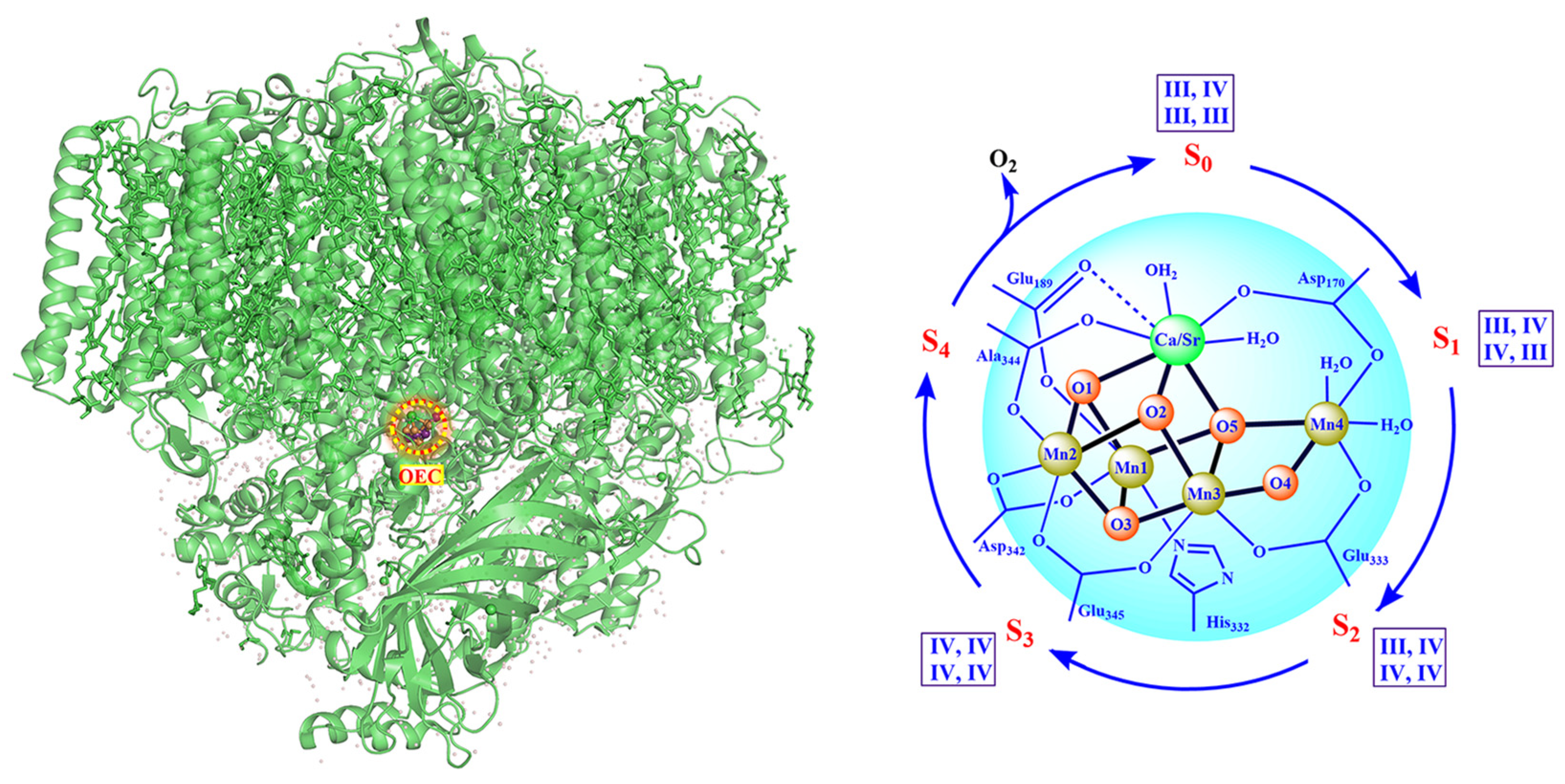
The oxygen-evolving center (OEC) in photosystem II (PSII) of oxygenic photosynthetic organisms is a unique biological Mn4CaO5-cluster that splits water into electrons, protons, and dioxygen, producing nearly all the dioxygen in Earth’s atmosphere and playing a central role in energy and material transformation for sustaining the biosphere [1,2,3,4]. This biological catalyst serves as a blueprint to develop water-splitting catalysts in artificial photosynthesis [5,6,7]. The catalytic cycle of the OEC involves five S-states (Sn, n = 0~4) (Figure 1) [8,9,10,11]. Recently, the detailed structures of the OEC in different S-states have been reported [12,13,14,15,16,17,18], providing a benchmark to investigate the catalytic mechanism for the oxygen-evolving reaction in photosynthesis [19,20,21,22,23,24,25,26,27]. However, the detailed structure changes and the formation of an O-O bond during the catalytic cycle of the OEC remain elusive due to the complexity of protein environments in PSII and the lack of chemical clusters that precisely mimic the OEC [23,28,29,30].
Previously, numerous artificial clusters have been synthesized [31,32,33,34,35,36,37,38,39,40,41,42,43,44,45], in which the artificial Mn4CaO4-cluster and Mn4SrO4-cluster [46,47,48] closely mimic the main metal-oxide core and peripheral ligands of the OEC. However, these alkaline-earth-element-containing clusters are unstable in aqueous solution due to the dissociation of the redox-inactive Ca2+ or Sr2+ ions [49], which precludes in-depth investigation. To improve the stability of OEC mimics, a rare-earth-element-containing Mn4YO4-cluster has been synthesized [50], which exhibits remarkable stability, offering a valuable structural and functional model for the OEC. However, compared to the alkaline-earth-element-containing clusters, the efficient synthesis of this rare-earth-element-containing cluster has been a long-standing challenge for chemists, and its formation mechanism remains fully unknown. It is urgently needed to reveal the synthesis mechanism of the rare-earth-element-containing cluster and to develop new robust and precise mimics of the OEC.
Herein, the formation mechanism of the Mn4YO4-cluster is investigated. The key synthetic precursor, the Mn3YO2-cluster, and its conversion are reported for the first time. Meanwhile, two Mn4YO4-clusters that closely mimic the geometric and electronic structures of the OEC are described, revealing that both the terminal ligands and a bridging carboxylate ligand are flexible. These findings shed new light on the synthesis of robust OEC mimics and provide chemical insights into the dynamic structural changes in both natural and artificial clusters.

2. Results and Discussion

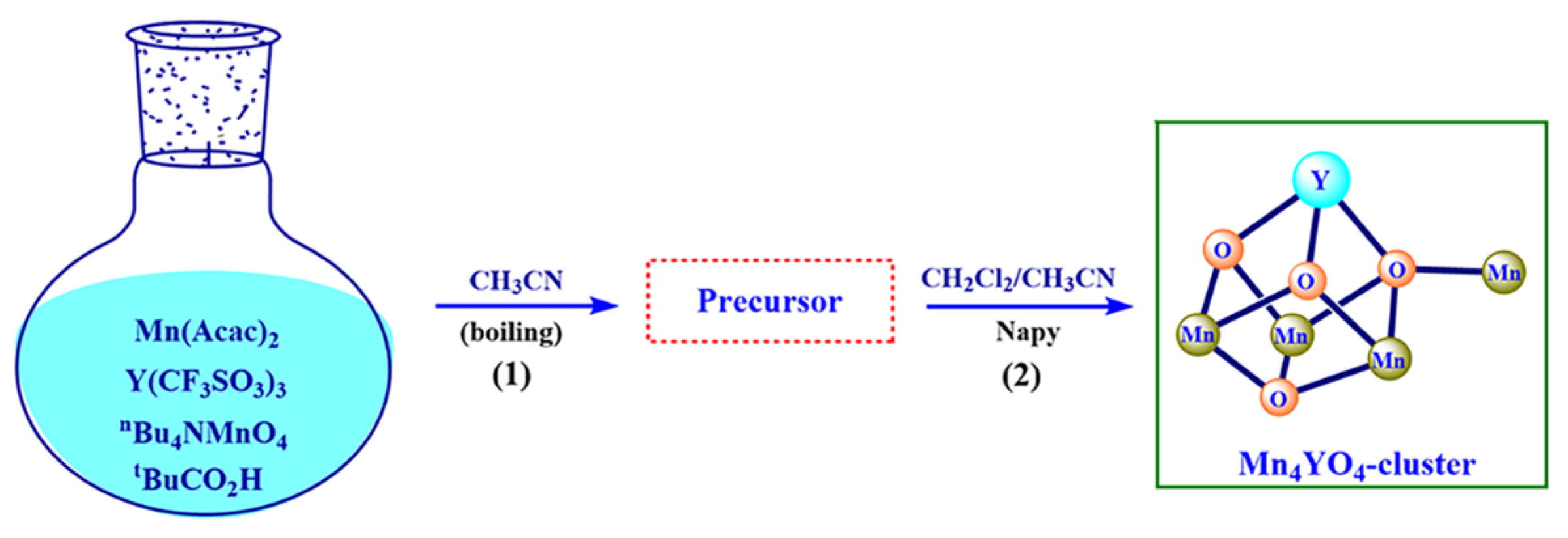
Previously, a Mn4YO4-cluster was synthesized through a two-step protocol as shown in Figure 2. A precursor was generated by a reaction of Y(CF3SO3)3, Mn(Acac)2 (Acac = acetylacetonate), nBu4NMnO4 (nBu = n-butyl), and pivalic acid in boiling acetonitrile in the first step. The precursor was then treated with 1,8-naphthyridine (Napy) in CH2Cl2/CH3CN solution, leading to the formation of the Mn4YO4-cluster in the second step [50]. Extensive efforts were made to purify and characterize the precursor. Eventually, the precursor was successfully crystallized and isolated from the CH3CN reaction solution at low temperature.
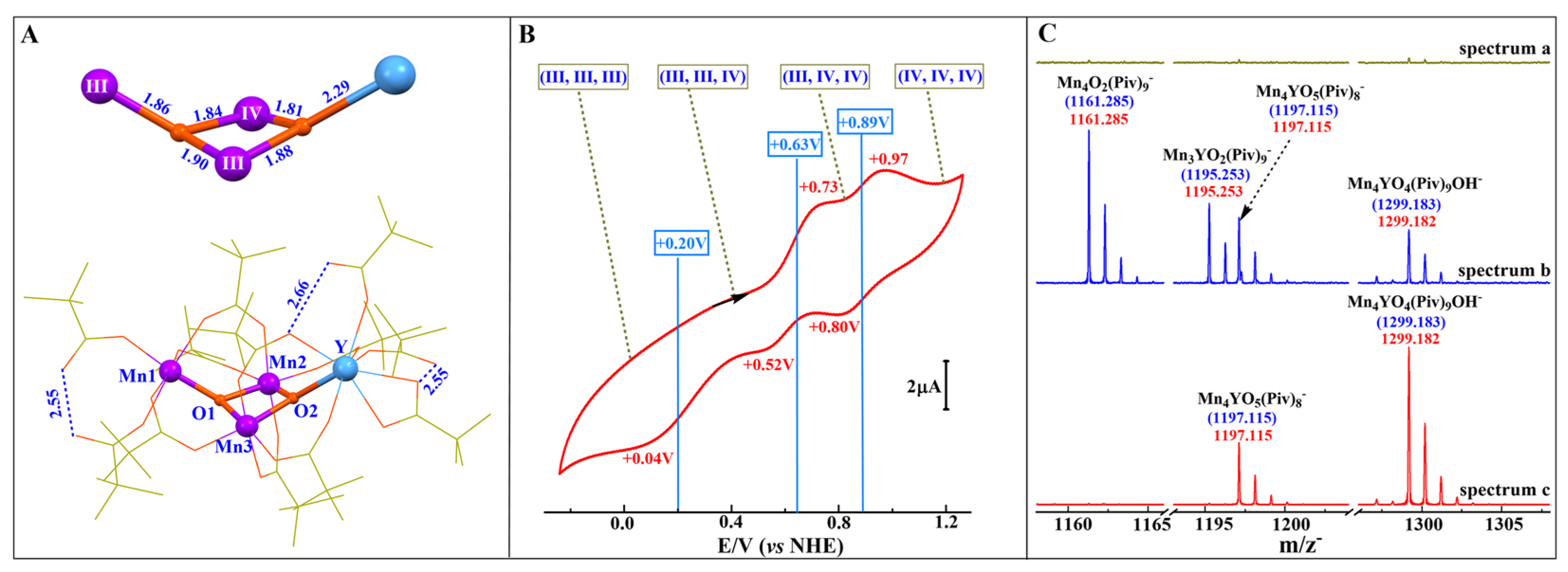
The crystal structure of the precursor, Mn3YO2(tBuCO2)9(tBuCO2H)3 (1), is shown in Figure 3A. It contains a Mn3YO2 core, in which Mn2, Mn3 and two μ3-oxygen (O1, O2) form a Mn2O2 rhombic plane. Both Mn1 and the Y ion are located above this plane, resulting in a cis-conformation for the Mn3YO2 core. All three Mn ions are six-coordinate. The oxidation states of three Mn ions in 1 are III, IV, and III, respectively, as confirmed by bond valence sum (BVS) calculations [51,52,53] (Table S3). The peripheral ligands are provided by nine pivalate (Piv) anions and three pivalic acid molecules. These terminal pivalic acid molecules and pivalate anions form strong intramolecular hydrogen bonds with their nearby ligands, contributing to stabilizing the whole structural framework of the Mn3YO2-cluster in 1. Notably, the structure of this precursor to the Mn4YO4-cluster is in sharp contrast to that of the Mn4CaO4-cluster, where a Mn3CaO4 cubane and one mono-Mn(III) center were found to be two key intermediates in the formation of the Mn4CaO4-cluster [54]. Furthermore, to the best of our knowledge, the Mn3YO2-cluster in 1 with a mixed-valence MnIII2MnIV core and a hydrogen-bonding network coordination sphere represents a highly specific class of heterometallic rare-earth manganese-oxide clusters.
Figure 3B shows the cyclic voltammetry (CV) measurement of 1 in 1,2-dichloroethane. Two redox potentials of +0.63 V and +0.89 V versus normal hydrogen electrode (NHE) are resolved for [MnIII2MnIV]/[MnIIIMnIV2] and [MnIIIMnIV2]/[MnIV3] redox couples, respectively. Interestingly, these values are significantly lower than those for the oxidation of MnIII ions in the Mn4XO4-cluster (X = Ca/Sr/Y) [46,48,50] reported previously. This difference is likely due to the hydrogen-bond network in 1, which contributes to stabilizing the high oxidation state of the Mn ions in the cluster.
To investigate the conversion process of the Mn3YO2-cluster (1) into the Mn4YO4-cluster (2), we performed high-resolution electrospray ionization (HR-ESI) mass spectrometry measurements on the reaction solution in the second step in Figure 2.
Figure 3C shows the mass spectra recorded on the CH2Cl2/CH3CN reaction solution of 1 in the presence of different equivalents of organic base (i.e., Napy). In the absence of organic base (Spectrum a), almost no fragments corresponding to the Mn3YO2-cluster or Mn4YO4-cluster can be distinguished. In the presence of half an equivalent of Napy (Spectrum b), four fragments with m/z values of 1161.285, 1195.253, 1197.115, and 1299.182 are observed, which are assigned to [Mn4O2(tBuCO2)9], [Mn3YO2(tBuCO2)9], [Mn4YO5(tBuCO2)8], and [Mn4YO4(tBuCO2)9(OH)], respectively, with corresponding calculated m/z values of 1161.285, 1195.253, 1197.115, and 1299.183 (Figure S4). In the presence of one equivalent of Napy (Spectrum c), fragments corresponding to [Mn4YO4(tBuCO2)9(OH)] and [Mn4YO5(tBuCO2)8] with m/z values of 1299.182 and 1197.115 become dominant, whereas the [Mn4O2(tBuCO2)9] and [Mn3YO2(tBuCO2)9] fragments disappear. These observations clearly demonstrate that the presence of an organic base significantly influences the distribution of intermediates and promotes the formation of the Mn4YO4-cluster. Notably, the product derived from the [Mn4O2] fragment was successfully isolated and structurally characterized as Mn4O2(tBuCO2)8(Napy)(tBuCO2H) (5), while another additional by-product, Mn2Y2O2(tBuCO2)8(tBuCO2H)2(DMF)2 (4), was also obtained after recrystallization of the precipitate formed in the second step in Figure 2.
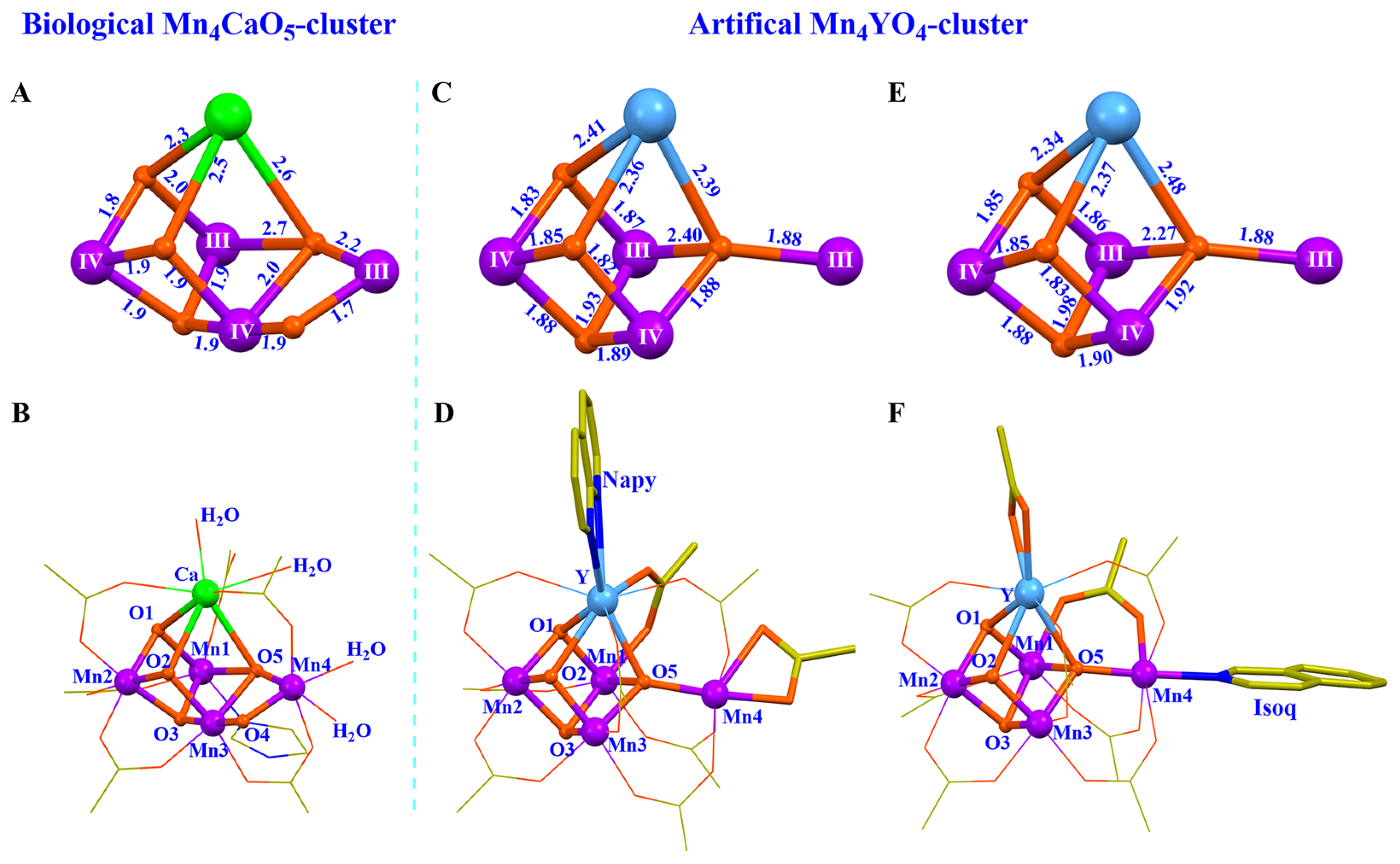
To examine whether other organic bases could support the conversion of the Mn3YO2-cluster to the Mn4YO4-cluster, Napy was replaced by isoquinoline (Isoq), and Mn4YO4(tBuCO2)9(Isoq) (3) was successfully isolated and structurally characterized. As shown in Figure 4E,F, it is composed of a Mn3YO4 cubane attached to one dangling Mn ion via a µ4-oxide bridge, forming an asymmetric Mn4YO4-cluster. The peripheral ligands are provided by nine pivalate anions and a neutral Isoq molecule. All four Mn ions are six-coordinate, and their oxidation states are (III, IV, IV, III) as confirmed by BVS calculations (Table S4).
Compared with the structure of 2 obtained after the treatment of the Mn3YO2-cluster with one equivalent of Napy in CH2Cl2 and CH3CN solution (Figure 4C,D), three differences are observed in 3: (i) One chelating pivalate anion is coordinated to the yttrium instead of to the dangling manganese. (ii) The neutral organic base (i.e., Isoq or Napy) is coordinated to the dangling manganese instead of to the yttrium. (iii) One pivalate anion switches its coordination mode from bridging Mn1 and Y in 2 to bridging Mn1 and Mn4 in 3. Previously, it has been found that the neutral terminal ligands on Ca2+/Sr2+ and the dangling Mn ion are exchangeable, while all bridging ligands are rigid and unchangeable [47,48]. Herein, for the first time, we provide clear evidence that not only the terminal ligands on the dangling manganese and the redox-inactive metal ion (Y3+) but also the coordination mode of a bridging carboxylate ligand is variable in these OEC mimics.
Notably, the overall structures of 2 and 3 hold a striking resemblance to the OEC, particularly in terms of the main metal-oxide core architecture and the carboxylate-rich peripheral coordination sphere. The oxidation states of the four Mn ions in both 2 and 3 are (III, IV, IV, III) (Table S4), which are the same as those in the S1 state of the OEC in PSII [8,9]. Thus, the observed ligand flexibility may mirror the dynamic structural changes of the biological OEC during its catalytic cycle, where carboxylate ligand motions are thought to facilitate substrate water binding and O–O bond formation [14]. It should be noted, however, that these structural variations are observed in the crystalline state and their relevance to solution-phase dynamics remains to be established.
Interestingly, in sharp contrast to the high water-sensitivity of the alkaline-earth-element-containing Mn4CaO4-cluster and Mn4SrO4-cluster, complex 3 displays a remarkable stability in acetonitrile solution in the presence of water. As shown in Figure S6A, upon gradual addition of varying amounts of water (0–1000 equivalents) to the acetonitrile solution of 3, no significant changes were observed in the UV-Vis absorption spectra. Furthermore, time-dependent UV-Vis measurements over 4 h in acetonitrile containing 1000 equivalents of water revealed no notable spectral evolution (Figure S6B). These results confirm that the Mn4YO4-cluster remains stable in the presence of a 1000-fold excess of water in acetonitrile solution. This feature will be crucial for the functional study of this type of artificial cluster in the future.
Therefore, these synthetic Mn4YO4-clusters not only closely mimic the structure of the S1-state OEC, but also offer a robust and tunable platform to investigate the dynamic structural changes during the catalytic cycle of the OEC.

3. Materials and Methods

3.1. General Considerations

All synthesis manipulations were carried out under aerobic conditions. All organic solvents were dried by using an A4 molecular sieve. Acetonitrile was further purified by distillation over CaH2. All other chemicals were used as received without further purification. nBu4NMnO4 was prepared according to the procedure described in the literature [46].

3.2. Preparation of Mn3YO2(tBuCO2)9(tBuCO2H)3 (1)

Mn(Acac)2 (0.253 g, 1 mmol) and Y(CF3SO3)3 (0.536 g, 1 mmol) were dissolved in 25 mL of boiling acetonitrile. After stirring for 5 min, tBuCO2H (4.085 g, 40 mmol) (tBu = t-butyl) and nBu4NMnO4 (1.446 g, 4 mmol) were added, and the mixture was stirred continuously for an additional 25 min. The precipitate was removed while the mixture was still hot. After that, the solution was concentrated and dark crystals of 1 formed after several days at 0 °C. The product was washed repeatedly with acetonitrile and dried under vacuum in a yield of ~55% (based on Y). Elemental analysis (%) calculated for 1 (C60H111O26Mn3Y): C, 47.97; H, 7.45; and found C, 47.91; H, 7.43.

3.3. Preparation of Mn4YO4(tBuCO2)9(Napy) (2)

Mn4YO4(tBuCO2)9(Napy) (2) was synthesized via a reaction between 1 and one equivalent of Napy in a CH2Cl2/CH3CN = 2:1 (vol/vol) solution. After sonication at 50 °C for 5 min, the precipitate was removed, and the solution was kept at 20 °C. Brown crystals of 2 were formed in a few days. The product of 2 was washed with hexane and dried under vacuum in a yield of ~20% (based on Y). Elemental analysis (%) calculated for 2 (C53H87N2O22Mn4Y): C, 45.05; H, 6.21; N, 1.98; and found C, 45.03; H, 6.21; N, 1.77.

3.4. Preparation of Mn4YO4(tBuCO2)9(Isoq) (3)

Mn4YO4(tBuCO2)9(Isoq) (3) was synthesized via a reaction between 1 and one equivalent of Isoq in a CH2Cl2/CH3CN = 2:1 (vol/vol) solution. After sonication at 50 °C for 5 min, the precipitate was removed, and the solution was kept at 20 °C. After several days, reddish-brown single crystals formed. The product of 3 was washed repeatedly with hexane and dried under vacuum in a yield of ~25% (based on Y). Elemental analysis (%) calculated for 3 (C54H88NO22Mn4Y): C, 45.94; H, 6.28; N, 0.99; and found C, 46.19; H, 6.27; N, 1.11.

3.5. Isolation of Mn2Y2O2(tBuCO2)8(tBuCO2H)2(DMF)2 (4)

Mn2Y2O2(tBuCO2)8(tBuCO2H)2(DMF)2 (4) was isolated from a reaction between 1 and one equivalent of isoquinoline (Isoq) in a mixture of CH2Cl2/CH3CN = 2:1 (vol/vol). After sonication at 50 °C for 5 min, the precipitate was collected. The precipitate was then recrystallized in CH2Cl2 in the presence of N, N-dimethyl formamide (DMF). After several days, crystals of 4 formed at 20 °C. The crystal structure of 4 was shown in Figures S1D and S2A.

3.6. Isolation of Mn4O2(tBuCO2)8(Napy)(tBuCO2H) (5)

Mn4O2(tBuCO2)8(Napy)(tBuCO2H) (5) was isolated from a reaction between 1 and one equivalent of 1,8-naphthyridine (Napy) in a CH2Cl2/CH3CN = 2:1 (vol/vol) solution. After sonication at 50 °C for 5 min, the precipitate was removed, and the solution was kept at 20 °C. Black crystals of 5 formed within a few days. The crystal structure of 5 was shown in Figures S1E and S2B.

3.7. Stability of Mn4YO4-Cluster in the Presence of Water

The stability of Mn4YO4(tBuCO2)9(Isoq) (3) in the presence of water was evaluated by UV-Vis absorption spectroscopy upon the gradual addition of various equivalents of water to the acetonitrile solution (Figure S6A). Time-dependent UV-Vis measurements were also carried out in the acetonitrile solution of 3 containing 1000 equivalents of water (Figure S6B). Both results demonstrate that 3 remains stable even in the presence of a 1000-fold excess of water in acetonitrile.

3.8. X-Ray Crystallography Measurements

Suitable crystals of different samples were selected and mounted on a loop, and then placed on the diffractometer under a nitrogen stream. The diffraction data of 15 were collected on a Rigaku XtaLAB AFC10 (RCD3; Tokyo, Japan) diffractometer equipped with a confocal monochromatic Mo-Kα radiation source. The diffraction data were processed by using the Olex2 program [55], and the structure was solved with the ShelXT structure solution program [56] via intrinsic phasing and refined with the ShelXL refinement package using least squares minimization [57].

3.9. Mass Spectroscopic Measurements

High-resolution electrospray ionization mass spectrometry (HR-ESI-MS) measurements were performed using a Bruker Fourier transform ion cyclotron resonance (FT-ICR) mass spectrometer Solarix 9.4T (Billerica, MA, USA). Data were processed using DataAnalysis 4.0 (Bruker Daltonics). Before starting the experiments, the syringe and sampling tube were thoroughly washed with dried acetonitrile.

3.10. CV Measurements

Cyclic voltammogram (CV) measurements were performed by using a three-electrode system connected to an electrochemical workstation PGSTAT302N, (Metrohm, Herisau, Switzerland) The working electrode was a glassy carbon disk (diameter of 3 mm, freshly polished), the counter electrode was a platinum disk (diameter of 3 mm, freshly polished) and the reference electrode was an Ag/AgNO3 electrode (10 mM AgNO3, 100 mM nBu4NPF6 in acetonitrile). The electrolyte solution was 1,2-dichloroethane with 100 mM nBu4NPF6. During the measurement, the solution of 1 (2 mM) was kept under an argon atmosphere. Reported potentials of CVs were referenced to normal hydrogen electrode (NHE) calibrated by the potential of ferrocene/ferrocenium measured under the same conditions.

4. Conclusions

In summary, we have investigated the formation mechanism of the artificial Mn4YO4-cluster. The key synthetic precursor (Mn3YO2-cluster) and its conversion are reported for the first time, demonstrating that the presence of organic bases significantly influences the distribution of intermediates and promotes the formation of the Mn4YO4-cluster. Two Mn4YO4-clusters have been synthesized with different organic bases, and both closely mimic the main metal-oxide core, peripheral coordination sphere, and the oxidation states of the four Mn ions found in the OEC. Structural comparison reveals that not only the terminal ligands but also the binding mode of a bridging carboxylate can be altered. Furthermore, the new Mn4YO4-cluster holds a remarkable stability in the presence of water in acetonitrile solution. These findings shed new light on the synthesis of rare-earth-element-containing artificial clusters and the rational design of robust artificial water-splitting catalysts, and provide chemical insights into the dynamic structural changes of both biological and artificial clusters.

Supplementary Materials

The following supporting information can be downloaded at https://www.mdpi.com/article/10.3390/inorganics14080195/s1, Figure S1: ORTEP view of the structures of 1 (A), 2 (B), 3 (C), 4 (D), and 5 (E) with 50% probability displacement ellipsoids; Figure S2: Crystal structures of 4, Mn2Y2O2(tBuCO2)8(tBuCO2H)2(DMF)2 (A) and 5, Mn4O2(tBuCO2)8(Napy)(tBuCO2H) (B); Figure S3: CV measurement of 1 (red) and the blank (blue) in 1,2-dichloroethane; Figure S4: Experimental (red) and calculated (blue) mass spectra for fragments of [Mn4O2(tBuCO2)9] (A), [Mn3YO2(tBuCO2)9] (B), [Mn4YO5(tBuCO2)8] (C), and [Mn4YO4(tBuCO2)9(OH)] (D); Figure S5: UV-Vis absorption spectra of 1 (red), 2 (yellow), and 3 (blue) in 1,2-dichloroethane; Figure S6: Stability of 3 in acetonitrile solution with different amount of water; Figure S7: FTIR spectra of solid samples of 1 (A), 2 (B), and 3 (C). Table S1: Crystal data and structure refinement for 13; Table S2: Crystal data and structure refinement for 4 and 5; Table S3: Bond-valence sum (BVS) calculations for Mn ions and oxygen bridges in 1; Table S4: Bond-valence sum (BVS) calculations for Mn ions and oxygen bridges in 2 and 3. Table S5: Bond-valence sum (BVS) calculations for Mn ions and oxygen bridges in 4 and 5.

Author Contributions

Conceptualization, C.Z. and C.C.; methodology, C.Z. and C.C.; investigation, Y.W., Z.W., C.C. and J.H.; writing—original draft, Y.W., Z.W. and C.C.; writing—review and editing, C.Z. and C.C.; supervision, C.Z.; funding acquisition, C.Z. and C.C. All authors have read and agreed to the published version of the manuscript.

Funding

This work was supported by the National Natural Science Foundation of China (No. 92461307, 22371286, 91961203), Center for Carbon Neutral Chemistry, ICCAS (CCNC-202503) and the Youth Innovation Promotion Association CAS (No. 2022030).

Data Availability Statement

Crystallographic data for 13 have been deposited with the joint Cambridge Crystallographic Data Centre and can be obtained using the respective CCDC deposition numbers: 2540561 (1), 2098699 (2), 1913760 (3), 2540560 (4), and 2540563 (5). Supplementary Data accompanying this article is available online.

Acknowledgments

We thank Yanxi Li and Yang Chen for their preliminary studies on synthesis.

Conflicts of Interest

The authors declare no conflicts of interest.

References

  1. Shen, J.R. The structure of photosystem II and the mechanism of water oxidation in photosynthesis. Annu. Rev. Plant Biol. 2015, 66, 23–48. [Google Scholar] [CrossRef] [Scilit] [PubMed]
  2. Shevela, D.; Kern, J.F.; Govindjee, G.; Messinger, J. Solar energy conversion by photosystem II: Principles and structures. Photosynth. Res. 2023, 156, 279–307. [Google Scholar] [CrossRef] [Scilit] [PubMed]
  3. Yano, J.; Kern, J.; Yachandra, V.K. Structure function studies of photosystem II using X-ray free electron lasers. Annu. Rev. Biophys. 2024, 53, 343–365. [Google Scholar] [CrossRef] [Scilit] [PubMed]
  4. Britt, R.D.; Marchiori, D.A. Photosystem II, poised for O2 formation. Science 2019, 366, 305–306. [Google Scholar] [CrossRef] [Scilit] [PubMed]
  5. Zhang, B.; Sun, L. Artificial photosynthesis: Opportunities and challenges of molecular catalysts. Chem. Soc. Rev. 2019, 48, 2216–2264. [Google Scholar] [CrossRef] [Scilit] [PubMed]
  6. Chen, Q.F.; Guo, Y.H.; Yu, Y.H.; Zhang, M.T. Bioinspired molecular clusters for water oxidation. Coord. Chem. Rev. 2021, 448, 214164. [Google Scholar] [CrossRef] [Scilit]
  7. Hunter, B.M.; Gray, H.B.; Müller, A.M. Earth-abundant heterogeneous water oxidation catalysts. Chem. Rev. 2016, 116, 14120–14136. [Google Scholar] [CrossRef] [Scilit] [PubMed]
  8. Yano, J.; Yachandra, V. Mn4Ca-cluster in photosynthesis: Where and how water is oxidized to dioxygen. Chem. Rev. 2014, 114, 4175–4205. [Google Scholar] [CrossRef] [Scilit] [PubMed]
  9. Cox, N.; Pantazis, D.A.; Neese, F.; Lubitz, W. Biological water oxidation. Acc. Chem. Res. 2014, 46, 1588–1596. [Google Scholar]
  10. Dau, H.; Haumann, M. The manganese complex of photosystem II in its reaction cycle—Basic framework and possible realization at the atomic level. Coord. Chem. Rev. 2008, 252, 273–295. [Google Scholar] [CrossRef] [Scilit]
  11. Kok, B.; Forbush, B.; McGloin, M. Cooperation of charges in photosynthetic O2 evolution. I. A linear four step mechanism. Photochem. Photobiol. 1970, 11, 457–475. [Google Scholar] [CrossRef] [Scilit] [PubMed]
  12. Umena, Y.; Kawakami, K.; Shen, J.R.; Kamiya, N. Crystal structure of oxygen-evolving photosystem II at a resolution of 1.9Å. Nature 2011, 473, 55–60. [Google Scholar] [CrossRef] [Scilit] [PubMed]
  13. Kern, J.; Chatterjee, R.; Young, I.D.; Fuller, F.D.; Lassalle, L.; Ibrahim, M.; Gul, S.; Fransson, T.; Brewster, A.S.; Alonso-Mori, R.; et al. Structures of the intermediates of Kok’s photosynthetic water oxidation clock. Nature 2018, 563, 421–425. [Google Scholar] [CrossRef] [Scilit] [PubMed]
  14. Li, H.; Nakajima, Y.; Nango, E.; Owada, S.; Yamada, D.; Hashimoto, K.; Luo, F.; Tanaka, R.; Akita, F.; Kato, K.; et al. Oxygen-evolving photosystem II structures during S1–S2–S3 transitions. Nature 2024, 626, 670–677. [Google Scholar] [CrossRef] [Scilit] [PubMed]
  15. Bhowmick, A.; Hussein, R.; Bogacz, I.; Simon, P.S.; Ibrahim, M.; Chatterjee, R.; Doyle, M.D.; Cheah, M.H.; Fransson, T.; Chernev, P.; et al. Structural evidence for intermediates during O2 formation in photosystem II. Nature 2023, 617, 629–636. [Google Scholar] [CrossRef] [Scilit] [PubMed]
  16. Suga, M.; Akita, F.; Hirata, K.; Ueno, G.; Murakami, H.; Nakajima, Y.; Shimizu, T.; Yamashita, K.; Yamamoto, M.; Ago, H.; et al. Native structure of photosystem II at 1.95Å resolution revealed by a femtosecond X-ray laser. Nature 2015, 517, 99–103. [Google Scholar] [PubMed]
  17. Suga, M.; Akita, F.; Yamashita, K.; Nakajima, Y.; Ueno, G.; Li, H.; Yamane, T.; Hirata, K.; Umena, Y.; Yonekura, S.; et al. An oxyl/oxo mechanism for oxygen-oxygen coupling in PSII revealed by an x-ray free-electron laser. Science 2019, 366, 334–338. [Google Scholar] [CrossRef] [Scilit] [PubMed]
  18. Hussein, R.; Graça, A.; Forsman, J.; Aydin, A.O.; Hall, M.; Gaetcke, J.; Chernev, P.; Wendler, P.; Dobbek, H.; Messinger, J.; et al. Cryo-electron microscopy reveals hydrogen positions and water networks in photosystem II. Science 2024, 384, 1349–1355. [Google Scholar] [CrossRef] [Scilit] [PubMed]
  19. Pushkar, Y. New water oxidation mechanism in photosystem II resolves major experimental controversies. Angew. Chem. Int. Ed. 2026, e1930324. [Google Scholar] [CrossRef] [Scilit]
  20. Guo, Y.; He, L.; Ding, Y.; Kloo, L.; Pantazis, D.A.; Messinger, J.; Sun, L. Closing Kok’s cycle of nature’s water oxidation catalysis. Nat. Commun. 2024, 15, 5982. [Google Scholar] [CrossRef] [Scilit] [PubMed]
  21. Yamaguchi, K.; Miyagawa, K.; Shoji, M.; Kawakami, T.; Isobe, H.; Yamanaka, S.; Nakajima, T. Theoretical elucidation of the structure, bonding, and reactivity of the CaMn4Ox clusters in the whole Kok cycle for water oxidation embedded in the oxygen evolving center of photosystem II. New molecular and quantum insights into the mechanism of the O–O bond formation. Photosynth. Res. 2024, 162, 291–330. [Google Scholar] [PubMed]
  22. Lubitz, W.; Pantazis, D.A.; Cox, N. Water oxidation in oxygenic photosynthesis studied by magnetic resonance techniques. FEBS Lett. 2023, 597, 6–29. [Google Scholar] [PubMed]
  23. Kawashima, K.; Takaoka, T.; Kimura, H.; Saito, K.; Ishikita, H. O2 evolution and recovery of the water-oxidizing enzyme. Nat. Commun. 2018, 9, 1247. [Google Scholar] [CrossRef] [Scilit] [PubMed]
  24. Siegbahn, P.E.M. Nucleophilic water attack is not a possible mechanism for O-O bond formation in photosystem II. Proc. Natl. Acad. Sci. USA 2017, 114, 4966–4968. [Google Scholar] [CrossRef] [Scilit] [PubMed]
  25. Capone, M.; Narzi, D.; Guidoni, L. Mechanism of oxygen evolution and Mn4CaO5 cluster restoration in the natural water-oxidizing catalyst. Biochemistry 2021, 60, 2341–2348. [Google Scholar] [CrossRef] [Scilit] [PubMed]
  26. Askerka, M.; Brudvig, G.W.; Batista, V.S. The O2-evolving complex of photosystem II: Recent insights from quantum mechanics/molecular mechanics (QM/MM), extended X-ray absorption fine structure (EXAFS), and femtosecond X-ray crystallography data. Acc. Chem. Res. 2017, 50, 41–48. [Google Scholar] [PubMed]
  27. Barber, J. A mechanism for water splitting and oxygen production in photosynthesis. Nat. Plants 2017, 3, 17041. [Google Scholar] [CrossRef] [Scilit] [PubMed]
  28. Wang, J. Cryo-EM meets crystallography: A model-independent view of the heteronuclear Mn4Ca cluster structure of photosystem II. Proc. Natl. Acad. Sci. USA 2025, 122, e2423012122. [Google Scholar] [CrossRef] [Scilit] [PubMed]
  29. Drosou, M.; Comas-Vila, G.; Neese, F.; Salvador, P.; Pantazis, D.A. Does serial femtosecond crystallography depict state-specific catalytic intermediates of the oxygen-evolving complex? J. Am. Chem. Soc. 2023, 145, 10604–10621. [Google Scholar] [CrossRef] [Scilit] [PubMed]
  30. Wang, Z.; Chen, Y.; Chen, C.; Zhang, C. Comparative analysis of natural vs artificial Mn4Ca-clusters: Structural insights into O−O bond formation in photosystem II. Plant Cell Physiol. 2025, 66, 1710–1719. [Google Scholar] [CrossRef] [Scilit] [PubMed]
  31. Hewitt, I.J.; Tang, J.K.; Madhu, N.T.; Clerac, R.; Buth, G.; Anson, C.E.; Powell, A.K. A series of new structural models for the OEC in photosystem II. Chem. Commun. 2006, 42, 2650–2652. [Google Scholar] [CrossRef] [Scilit]
  32. Mukherjee, S.; Daniels, M.R.; Bagai, R.; Abboud, K.A.; Christou, G.; Lampropoulos, C. Avariety of new tri- and tetranuclear Mn–Ln and Fe–Ln (Ln = lanthanide) complexes. Polyhedron 2010, 29, 54–65. [Google Scholar] [CrossRef] [Scilit]
  33. Koumousi, E.S.; Mukherjee, S.; Beavers, C.M.; Teat, S.J.; Christou, G.; Stamatatos, T.C. Towards models of the oxygen-evolving complex (OEC) of photosystem II: A Mn4Ca cluster of relevance to low oxidation states of the OEC. Chem. Commun. 2011, 47, 11128–11130. [Google Scholar] [CrossRef] [Scilit]
  34. Kanady, J.S.; Tsui, E.Y.; Day, M.W.; Agapie, T. A synthetic model of the Mn3Ca subsite of the oxygen-evolving complex in photosystem II. Science 2011, 333, 733–736. [Google Scholar] [CrossRef] [Scilit] [PubMed]
  35. Mukherjee, S.; Stull, J.A.; Yano, J.; Stamatatos, T.C.; Pringouri, K.; Stich, T.A.; Abboud, K.A.; Britt, R.D.; Yachandra, V.K.; Christou, G. Synthetic model of the asymmetric [Mn3CaO4] cubane core of the oxygen-evolving complex of photosystem II. Proc. Natl. Acad. Sci. USA 2012, 109, 2257–2262. [Google Scholar] [CrossRef] [Scilit] [PubMed]
  36. Tsui, E.Y.; Agapie, T. Reduction potentials of heterometallic manganese–oxido cubane complexes modulated by redox-inactive metals. Proc. Natl. Acad. Sci. USA 2013, 110, 10084–10088. [Google Scholar] [CrossRef] [Scilit] [PubMed]
  37. Kanady, J.S.; Lin, P.H.; Carsch, K.M.; Nielsen, R.J.; Takase, M.K.; Goddard, W.A.; Agapie, T. Toward models for the full oxygen-evolving complex of photosystem II by ligand coordination to lower the symmetry of the Mn3CaO4 cubane: Demonstration that electronic effects facilitate binding of a fifth metal. J. Am. Chem. Soc. 2014, 136, 14373–14376. [Google Scholar] [CrossRef] [Scilit] [PubMed]
  38. Gerey, B.; Goure, E.; Fortage, J.; Pecaut, J.; Collomb, M.N. Manganese-calcium/strontium heterometallic compounds and their relevance for the oxygen-evolving center of photosystem II. Coord. Chem. Rev. 2016, 319, 1–24. [Google Scholar] [CrossRef] [Scilit]
  39. Tsui, E.Y.; Tran, R.; Yano, J.; Agapie, T. Redox-inactive metals modulate the reduction potential in heterometallic manganese-oxido clusters. Nat. Chem. 2013, 5, 293–299. [Google Scholar] [CrossRef] [Scilit] [PubMed]
  40. Lee, H.B.; Agapie, T. Redox tuning via ligand-induced geometric distortions at a YMn3O4 cubane model of the biological oxygen evolving complex. Inorg. Chem. 2019, 58, 14998–15003. [Google Scholar] [CrossRef] [Scilit] [PubMed]
  41. Chen, Y.; Su, Y.; Han, J.; Chen, C.; Fan, H.; Zhang, C. Synthetic Mn3Ce2O5-cluster mimicking the oxygen-evolving center in photosynthesis. ChemSusChem 2024, 17, e2024001031. [Google Scholar] [CrossRef] [Scilit]
  42. Mukhopadhyay, S.; Mandal, S.K.; Bhaduri, S.; Armstrong, W.H. Manganese clusters with relevance to photosystem II. Chem. Rev. 2004, 104, 3981–4026. [Google Scholar] [CrossRef] [Scilit] [PubMed]
  43. Dismukes, G.C.; Brimblecombe, R.; Felton, G.A.N.; Pryadun, R.S.; Sheats, J.E.; Spiccia, L.; Swiegers, G.F. Development of bioinspired Mn4O4-cubane water oxidation catalysts: Lessons from photosynthesis. Acc. Chem. Res. 2009, 42, 1935–1943. [Google Scholar] [CrossRef] [Scilit] [PubMed]
  44. Wang, M.; Ma, C.B.; Yuan, D.Q.; Wang, H.S.; Chen, C.N.; Liu, Q.T. Synthesis and characterization of a family of penta- and tetra-manganese(III) complexes derived from an assembly system containing tert-butylphosphonic acid. Inorg. Chem. 2008, 47, 5580–5590. [Google Scholar] [CrossRef] [Scilit] [PubMed]
  45. Lin, P.H.; Takase, M.K.; Agapie, T. Investigations of the effect of the non-manganese metal in heterometallic-oxido cluster models of the oxygen evolving complex of photosystem II: Lanthanides as substitutes for calcium. Inorg. Chem. 2015, 54, 59–64. [Google Scholar] [CrossRef] [Scilit] [PubMed]
  46. Zhang, C.; Chen, C.; Dong, H.; Shen, J.R.; Dau, H.; Zhao, J. A synthetic Mn4Ca-cluster mimicking the oxygen-evolving center of photosynthesis. Science 2015, 348, 690–693. [Google Scholar] [CrossRef] [Scilit] [PubMed]
  47. Chen, C.; Chen, Y.; Yao, R.; Li, Y.; Zhang, C. Artificial Mn4Ca clusters with exchangeable solvent molecules mimicking the oxygen-evolving center in photosynthesis. Angew. Chem. Int. Ed. 2019, 58, 3939–3942. [Google Scholar] [CrossRef] [Scilit]
  48. Chen, C.; Wang, Z.; Zhang, M.; Jia, K.; Pan, F.; Fan, H.; Xie, S.Y.; Shen, J.R.; Su, J.; Wang, B.W.; et al. Artificial Mn4SrO4-cluster mimicking the structural changes of the photosynthetic oxygen-evolving center. J. Am. Chem. Soc. 2025, 147, 41012–41022. [Google Scholar] [CrossRef] [Scilit] [PubMed]
  49. Chen, C.; Li, Y.; Zhao, G.; Yao, R.; Zhang, C. Natural and artificial Mn4Ca cluster for the water splitting reaction. ChemSusChem 2017, 10, 4403–4408. [Google Scholar] [CrossRef] [Scilit] [PubMed]
  50. Yao, R.; Li, Y.; Chen, Y.; Xu, B.; Chen, C.; Zhang, C. Rare-earth elements can structurally and energetically replace the calcium in a synthetic Mn4CaO4-cluster mimicking the oxygen-evolving center in photosynthesis. J. Am. Chem. Soc. 2021, 143, 17360–17365. [Google Scholar] [CrossRef] [Scilit] [PubMed]
  51. Liu, W.; Thorp, H.H. Bond valence sum analysis of metal-ligand bond lengths in metalloenzymes and model complexes. 2. Refined distances and other enzymes. Inorg. Chem. 1993, 32, 4102–4105. [Google Scholar] [CrossRef] [Scilit]
  52. Pauling, L. The principles determining the structure of complex ionic crystals. J. Am. Chem. Soc. 1929, 51, 1010–1026. [Google Scholar]
  53. Brown, I.D. Recent developments in the methods and applications of the bond valence model. Chem. Rev. 2009, 109, 6858–6919. [Google Scholar]
  54. Chen, C.; Xu, B.; Yao, R.; Chen, Y.; Zhang, C. Synthesizing mechanism of the Mn4Ca-cluster mimicking the oxygen-evolving center in photosynthesis. ChemSusChem 2022, 15, e202102661. [Google Scholar] [CrossRef] [Scilit] [PubMed]
  55. Dolomanov, O.V.; Bourhis, L.J.; Gildea, R.J.; Howard, J.A.K.; Puschmann, H. OLEX2: A complete structure solution, refinement and analysis program. J. Appl. Cryst. 2009, 42, 339–341. [Google Scholar] [CrossRef] [Scilit]
  56. Sheldrick, G.M. SHELXT: Integrated space-group and crystalstructure determination. Acta Cryst. A 2015, 71, 3–8. [Google Scholar] [CrossRef] [Scilit]
  57. Sheldrick, G.M. Crystal structure refinement with SHELXL. Acta Cryst. C 2015, 71, 3–8. [Google Scholar] [CrossRef] [Scilit]
Figure 1. The location of the OEC in PSII [1] (left) and the catalytic cycle of the OEC [9] (right). The oxidation states of the four Mn ions in each state are given in squares.
Inorganics 14 00195 g001
Figure 2. Synthesis procedure for artificial Mn4YO4-cluster.
Inorganics 14 00195 g002
Figure 3. The structure, redox properties, and conversion of 1. (A) The structure for the Mn3YO2 core and peripheral ligands of 1. Mn, Y, O, and C atoms are shown in purple, sky blue, orange, and yellow, respectively. Distances are given in Å. The oxidation states of Mn ions are shown in Roman numerals. Dashed lines indicate the hydrogen-bond interaction. For clarity, all hydrogen atoms are omitted. (B) CV measurement of 1 in 1,2-dichloroethane. All potentials are referenced to NHE. The scan direction is indicated by the arrow. The possible oxidation states of the three Mn ions in different redox states are given in rectangles. (C) HR-ESI mass spectroscopic measurements for the conversion of 1 in the CH2Cl2/CH3CN solution with different equivalents of Napy. Spectrum a, without organic base; Spectrum b, with half an equivalent of Napy; Spectrum c, with one equivalent of Napy. Experimental and calculated m/z values are given in red and blue, respectively.
Inorganics 14 00195 g003
Figure 4. The whole and core structures of the biological Mn4CaO5-cluster [13] and the artificial Mn4YO4-cluster in Mn4YO4(tBuCO2)9(Napy) (2) and Mn4YO4(tBuCO2)9(Isoq) (3). (A) The Mn4CaO5 core of the OEC. (B) The whole structure of the OEC. (C) The Mn4YO4 core of 2. (D) The whole structure of 2. (E) The Mn4YO4 core of 3. (F) The whole structure of 3. Mn, Y, Ca, O, N, and C atoms are shown in purple, sky blue, green, orange, blue, and yellow, respectively. Distances are given in Å. The oxidation states of Mn ions are shown in Roman numerals. For clarity, all hydrogen atoms and methyl groups of tert-butyl are omitted.
Inorganics 14 00195 g004
Disclaimer/Publisher’s Note: The statements, opinions and data contained in all publications are solely those of the individual author(s) and contributor(s) and not of MDPI and/or the editor(s). MDPI and/or the editor(s) disclaim responsibility for any injury to people or property resulting from any ideas, methods, instructions or products referred to in the content.