Article

Synthesis of NiO/CoO@SiO2-10%g-C3N4 and NiO/CoO@SiO2-20%g-C3N4 for Effective Sweepout of Ciprofloxacin from Water


1
Chemistry Department, College of Science, Imam Mohammad Ibn Saud Islamic University (IMSIU), P.O. Box 90950, Riyadh 11623, Saudi Arabia
2
Basic Science Research Center, Deanship of Scientific Research, Imam Mohammad Ibn Saud Islamic University (IMSIU), P.O. Box 90950, Riyadh 11623, Saudi Arabia
3
Institute of Refining and Petrochemicals Technologies, King Abdulaziz City for Science and Technology (KACST), P.O. Box 6086, Riyadh 11442, Saudi Arabia
4
Department of Chemistry, College of Science, Sudan University of Science and Technology (SUST), P.O. Box 407, Khartoum 13311, Sudan
*
Authors to whom correspondence should be addressed.
Inorganics 2026, 14(6), 162; https://doi.org/10.3390/inorganics14060162 (registering DOI)
Submission received: 16 May 2026 / Revised: 11 June 2026 / Accepted: 12 June 2026 / Published: 14 June 2026

Abstract

This study investigated the impact of cobalt/nickel-silicate loadings on graphitic carbon nitride at 10% and 20% doses, designated (CoNiSi-10) and (CoNiSi-20), for the removal of ciprofloxacin (CPF), a hazardous, bioaccumulative antibiotic. The synthesized composites were characterized in detail using SEM, EDX, TEM, N2 adsorption–desorption, XRD, and FTIR techniques. The CoNiSi-10 and CoNiSi-20 exhibited CPF qt values of 64 and 107 mg g−1, respectively, which were consistent with the surface area results. Adsorption kinetics indicated that CPF uptake on CoNiSi-10 and CoNiSi-20 fitted the Lagergren model, with the liquid-film and intraparticle-diffusion mechanisms co-governing CPF sorption. The isotherm investigations indicated CPF adsorption on CoNiSi-10 and CoNiSi-20 aligned with the Langmuir model, suggesting a homogeneous surface, while the Dubinin-Radushkevich results primarily indicated physisorption-based CPF removal. The thermodynamic analyses supported the physisorption outcome and indicated that CPF sorption onto CoNiSi-10 and CoNiSi-20 was endothermic. A five-cycle reusability test yielded average efficiencies of 94% and 96% for CoNiSi-10 and CoNiSi-20, respectively, and an after-sorption analysis indicated their stability and robustness. The ease of synthesis and excellent sorption performance may nominate CoNiSi-10 and CoNiSi-20 as promising adsorbents for treating pharmaceutically contaminated wastewater.

1. Introduction

The features of nanomaterials (NNMs) have garnered significant interest across various fields, including catalysis, nanoelectronics, nano electrochemistry, and adsorption [1]. Although noble-NNMs possess excellent catalytic properties, their high cost, tendency to self-aggregate, and limited abundance have driven demand for alternative catalysts [2]. The progress and feasibility of various technologies, and/or the development of better ones, can be achieved by easing the mass production of NNM and/or by developing innovative nanohybrids [3]. Silicon is among the most abundant solid elements on Earth, and its oxide (SiO2) is a thermally stable, high-surface-area, adjustable-porosity material, making an excellent sorbent/base material [4]. Thanks to their superior physicochemical properties, SiO2-based nanomaterials have attracted researchers’ interest, as evidenced by the extensive synthesis and investigation of SiO2-based nanohybrids [5].
In contrast to traditional carbon allotropes, C3N4 offers significant advantages, including its unique heterostructure sheet features, high surface area, and eco-friendliness, with elevated nitrogen content and excellent chemical stability [6]. Because of these remarkable characteristics, C3N4 garnered considerable attention in the research fields. Compared to pure g-C3N4, the g-C3N4-based nanocomposites exhibit superior sorption capacity [7,8]. The SiO2/C3N4 nanohybrids possess advantageous properties combining the SiO2’s extensive surface area with the functional reactivity of g-C3N4 [9]. Furthermore, the SiO2/g-C3N4 blend adsorbents may improve structural stability, dispersion, and sorption efficacy [8]. Doping with metal-oxides demonstrated significant improvements in porosity, surface characteristics, and electrical properties [10].
The occurrence of pharmaceutical contaminants (PhCNs) in water bodies is a global environmental dilemma. PhCNs dosages normally function at low levels, leaving approximately 70% of the dosage unaltered, making their presence in natural ecosystems a global concern [11,12]. In order to paint a clear picture of the current water contamination situation, it is important to acknowledge that PhCNs, including ciprofloxacin and tetracyclines, have been detected in a wide range of water bodies, including the Red Sea, rivers, and oceans [13,14,15]. PhCN pollution is rising continuously due to the demands of contemporary living for infectious disease treatments and for increased agricultural production and poultry and livestock productivity. The principal PhCNs routes to reach aquatic environments are through industrial waste discharge (accidental and/or illegal), agricultural runoff (antibiotics/pesticides/insecticides), domestic waste (unmetabolized PhCNs), and hospitals, resulting in widespread contamination of freshwater and marine ecosystems [16,17,18]. Due to the failure of conventional treatment to remove PhCNs, numerous studies have detected them in surface water, groundwater, wastewater, and tap water [19]. Microbes, plants, animals, and humans have all been adversely affected by the PhCNs, which were detected in surface water, wastewater, and drinking water worldwide [20,21]. Even at very low concentrations, the presence of PhCNs in water bodies leads to bacterial-antibiotic resistance, which will be genetically transmitted to other/newborn microorganisms that generate new diseases to be responded to by the pharmaceutical industry via developing new drugs that are eventually released into the environment and thereby intensify the same problem, forming an endless cycle of growing contamination that can be stopped only via effective water treatment. The PhCNs/PhCNs-related pollutants persistently negatively impact ecosystems, resulting in prolonged and propagating health risks [22]. Ciprofloxacin (CPF) is a widely used fluoroquinolone member that demonstrated excellent activity against a variety of harmful pathogens that cause infections of the skin, urinary tract, respiratory tract, gastrointestinal tract, and sexually transmitted diseases [23,24]. CPF has helped lower the death rate, but as its use has expanded, soil and water contamination have increased [25]. Moreover, CPF is detected in soil and water sources due to its resistance to degradation. CPF causes oxidative stress, reactive oxygen species production, and resistance in living organisms [26,27,28].
Since standard treatment protocols failed to provide PhCNs-free tap water, other methodologies were introduced for this purpose, including advanced oxidation processes, photodegradation, and adsorption [29,30,31]. Adsorption is a promising water decontamination approach that involves accumulating PhCNs onto a solid surface (the sorbent) through physical and/or chemical interactions. Its preference stems from its efficiency, simplicity, cost-feasibility, and capability to sweep out PhCNs even at low concentrations [32,33,34]. The effectiveness of sorption procedures depends on the sorbent surface area, pore size/volume, and the availability of active sorption sites [35]. Currently, researchers are focusing on co-doping studies, which so far have revealed enhanced active sites, electronic distribution, and thereby improved sorption capabilities, as exemplified by calcium–magnesium impregnated silicate/g-C3N4 (methylene blue removal) and cobalt/molybdenum oxides doped g-C3N4 (rhodamine-B removal) [36]. Co-doping of MgAl2O4 with cobalt and nickel enhances its surface heterogeneity and strengthens interactions with organic compounds via electrostatic attraction, hydrogen bonding, and π–π interactions [37].
Therefore, this study targeted a simple fabrication route of the innovative 10%NiO/10%CoO@10%g-C3N4-70%SiO2 (CoNiSi-10) and 10%NiO/10%CoO@20%g-C3N4-60%SiO2 (CoNiSi-20). The synthesized nanohybrids will be characterized, then assessed for their efficacy in eliminating CPF from aqueous solutions. Additionally, the effects of critical operational parameters, including pH, contact time, temperature, and initial CPF concentration, will be systematically examined. The efficacy of the CoNiSi-10 and CoNiSi-10 will be evaluated using real water samples spiked with CPF to illustrate their potential for practical environmental cleanup.

2. Results

2.1. Characteristics of CoNiSi-10 and CoNiSi-20

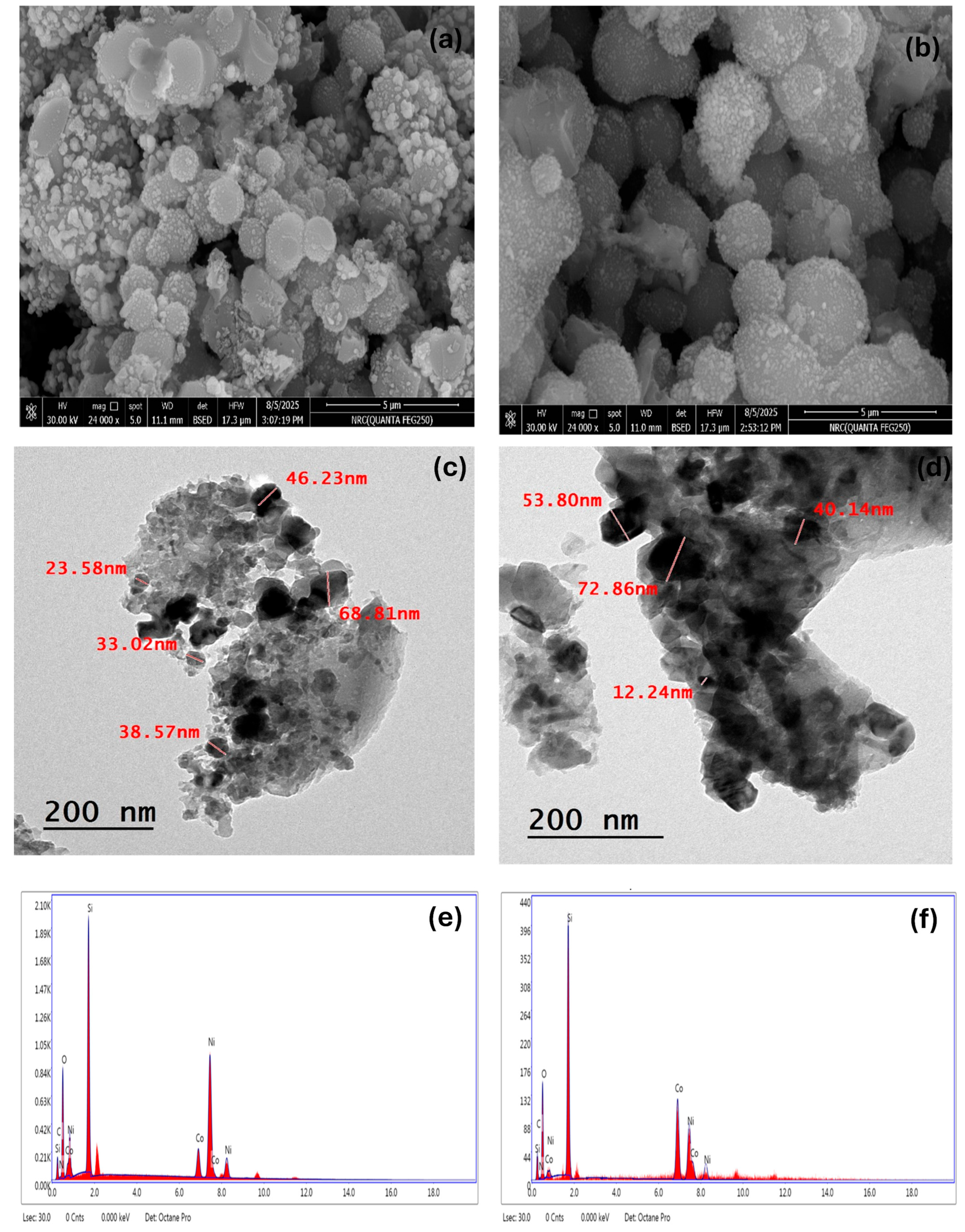
The surface characteristics of CoNiSi-10 and CoNiSi-20 were examined via the SEM technique (Figure 1a,b). For both CoNiSi-10 and CoNiSi-20, SEM images revealed semi-spherical clusters with smaller nanoparticles attached to their surfaces. Moreover, the detailed morphologies of CoNiSi-10 and CoNiSi-20 were examined by TEM (Figure 1c,d). Compared to the CoNiSi-10, the CoNiSi-20 structure appeared fluffier, with large interstitial cavities attributable to the 20% C3N4 dosage, creating a g-C3N4/CoO-NiO-SiO2 amalgam-like construction. The CoNiSi-10 and CoNiSi-20 nanohybrids showed particle size ranges of 24–69 nm and 12–73 nm, respectively, with average sizes of 45 nm and 42 nm, respectively. Compared to CoNiSi-10, the mixed-oxide of CoNiSi-20 appeared less clustered (Figure 1c,d), likely due to the 20% g-C3N4 providing a wider surface area for the mixed-oxide to be formulated with less agglomeration. Furthermore, the elements constituting CoNiSi-10 and CoNiSi-20 were determined via EDX (Figure 1e,f). The EDX results showed that CoNiSi-10 and CoNiSi-20 are composed of C, N, Co, Ni, and Si. demonstrating the successful insertion of these elements into the g-C3N4 layers.
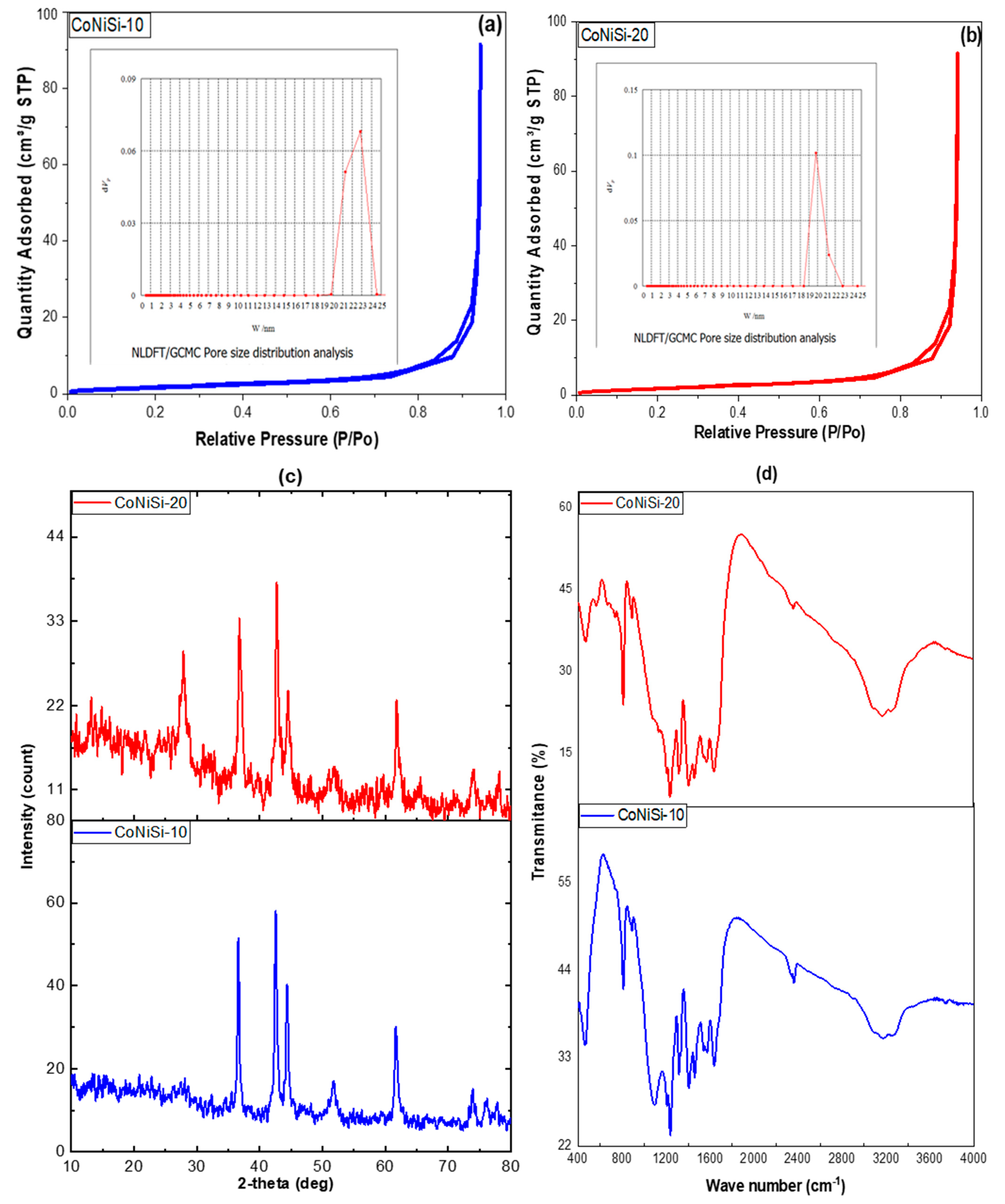
The CoNiSi-10 and CoNiSi-20 surface properties were examined via the N2-addsorption–desorption protocol. The surface area (SrA) was computed via the Brunauer–Emmett–Teller (BET) equation, while the pore size and volume (PRS and PRV) were determined employing the Barrett-Joyner-Halenda (BJH) relation. The CoNiSi-10 and CoNiSi-20 showed isotherms categorized as type IV in Figure 2a,b), and displaying an H3-type hysteresis loop indicative of mesoporous materials with irregularly shaped pores. Compared to CoNiSi-10 (SrA = 67 m2 g−1), the CoNiSi-20 exhibits a higher SrA value (SrA = 99 m2 g−1). CoNiSi-20’s greater surface area could be attributed to its higher PRV (0.126 cm3 g−1), whilst the CoNiSi-10 resulted in comparatively smaller PRV (0.106 cm3 g−1). The CoNiSi-10 and CoNiSi-20 nanohybrids showed PRSs of 20 nm and 23 nm, respectively, indicating an increase in surface area and porosity of the structured nanohybrids with increasing g-C3N4 dosage.
The crystallinity of CoNiSi-10 and CoNiSi-20 and the constructed phases were determined via the XRD technique Figure 2c. Both CoNiSi-10 and CoNiSi-20 patterns showed peaks around 2θ° of 13.1 and 27.9, respectively, allocatable to planes (100) and (002), respectively (g-C3N4, JCPDS 87-1526) [38]. The diffraction peaks at 26.5, 29.5, 32.5, 36.8, 40.2, 42.7, 52.0, and 61.5 2θ° are aligned with the (200), (220), (311), (222), (400), (331), (511), and (620) planes of CoSiO3 (JCPDS #72-1508) [39]. Also, the peaks at 2θ° of 36.8, 42.7, 5, and 61.5° aligned with the (110), (200), (210), and (300) planes of the NiSiO3 crystal (JCPDS 43-0664) [40].
The FTIR technique was employed to examine the functional groups and bonding properties of CoNiSi-10 and CoNiSi-20 (Figure 2d). Both nanohybrids showed a shallow peak at 2360 cm−1, attributed to the C≡N stretching vibration in g-C3N4 [8]. The water O-H stretching and bending vibrations are responsible for the peaks at around 3290 and 1642 cm−1. The two signals at 670 and 464 cm−1 are attributed to Si–O–Si and Si–O–Co bending vibrations, respectively, while the 1095 cm−1 and 1133 cm−1 bands are assigned to symmetric and asymmetric Si–O–Si and/or Si–O–Co stretching vibrations [41,42]. The CoNiSi-20 spectrum showed weak peaks at 578 cm−1 (Co–O) and 665 cm−1 (Ni-O) that were absent in the CoNiSi-10 spectra [43,44].

2.2. Kinetic Investigations of CPF Sorption by CoNiSi-10 and CoNiSi-20

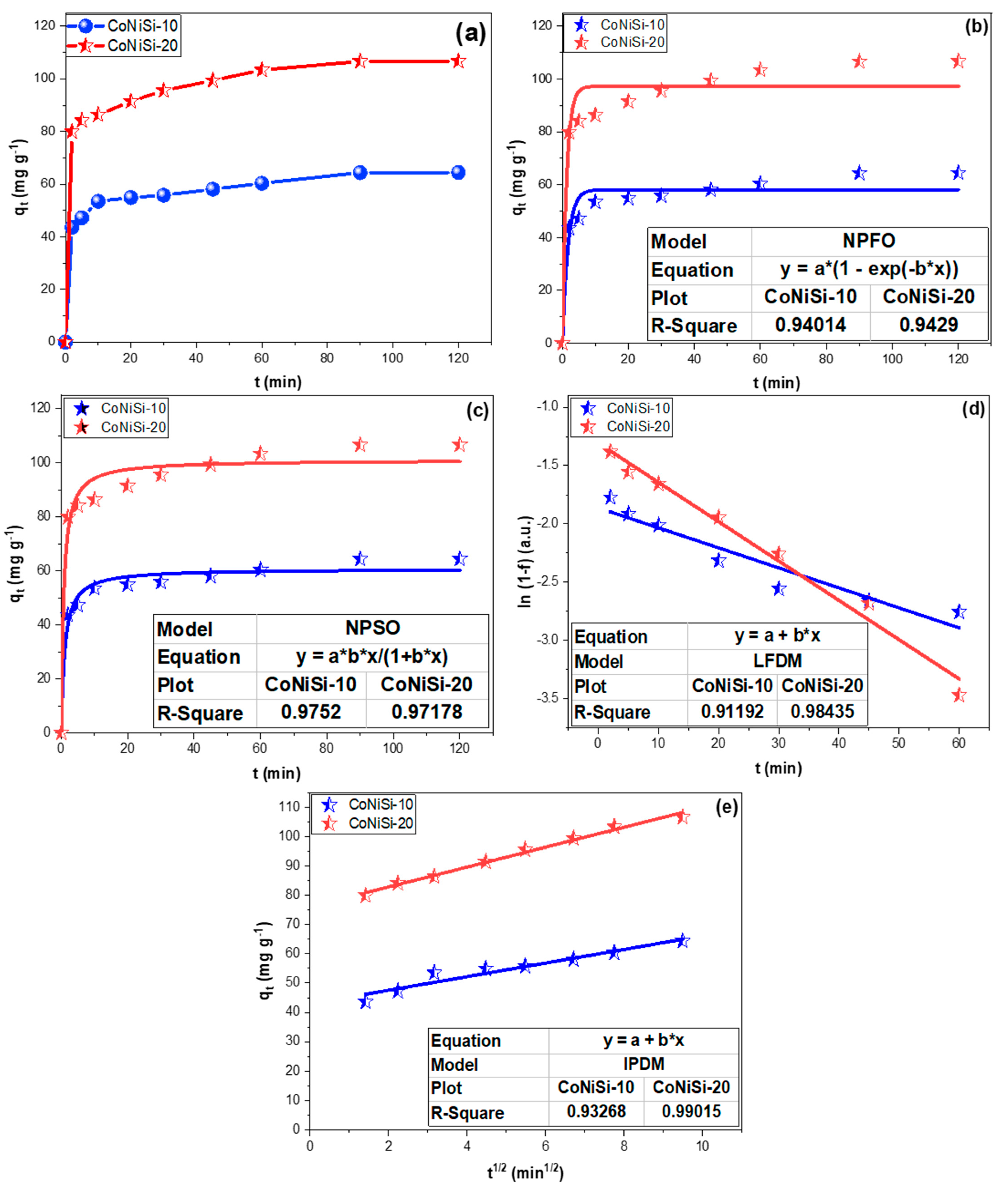
Among the factors determining CPF sorption effectiveness is contact time, which is essential for determining sorption kinetics and the time required to achieve optimal performance of CoNiSi-10 and CoNiSi-20 in treatment facilities without wasted time [45,46]. The CPF adsorption on CoNiSi-10 and CoNiSi-20 progressed up to 90 min, designated as the equilibrium time, since no noticeable further CPF sorption occurred between 90 and 120 min. The CoNiSi-10 and CoNiSi-20 qt values of 64 and 107 mg g−1, respectively, as illustrated in Figure 3a. The CPF sorption can be charted into two phases: the fast one, in which CPF sorption takes place rapidly, attributed to the site availability of CoNiSi-10 and CoNiSi-20, and the highly presented CPF molecules rapidly diffusing toward them [47]. In the second phase, CPF sorption slowed due to the occupation of readily accessible CoNiSi-10 and CoNiSi-20 sites and/or the sharp drop in CPF concentration. Figure 3b,c illustrate the nonlinear pseudo-1st-order (NPFO) and pseudo-2nd-order NPSO investigations about the CPF sorption by CoNiSi-10 and CoNiSi-20, and their resulting values are in Table 1. The CPF adsorption on CoNiSi-10 and CoNiSi-20 follows the NPSO model, yielding R2 values of 0.975 and 0.972, respectively, with lower RSS and X2 values than NPFO. Worth noting that the maximum sorption capacities (qmax) predicted by the NPSO for CoNiSi-10 and CoNiSi-20 were closer to the experimental sorption capacities (qe) (Table 1).
Figure 3d,e depicts the IPDM and LFDM plots of CPF sorption by CoNiSi-10 and CoNiSi-20, and their results are presented in Table 1. Although the R2 values for the intraparticle diffusion model (IPDM) and liquid-film diffusion model (LFDM) were close, CPF sorption by CoNiSi-10 and CoNiSi-20 was more aligned with IPDM. Nevertheless, the IPDM plots for CoNiSi-10 and CoNiSi-20 deviated from the zero-point and showed higher RSS values, indicating that IPDM did not solely limit CPF sorption and suggesting a multi-stage CPF sorption process in which LFDM contribution is not negligible. The combination of high R2 and Ci values of the CPF/CoNiSi-20 system implies a high surface sorption stage (LFDM) before IPDM takes control, a prediction supported by the low Klf values for both sorbents relative to KIP. In conclusion, the textural characteristics of CoNiSi-10 and CoNiSi-20 influence their CPF sorption performance. The relatively larger surface area of CoNiSi-10 and CoNiSi-20 accelerated CPF removal at an earlier stage, when LFDM was the main influencing step. At the same time, the relatively small pores of CoNiSi-10 and CoNiSi-20 delayed the CPF penetration within the CoNiSi-10 and CoNiSi-20 matrices, making the IPDM the controlling step in the second part of CPF sorption, suggesting a stepwise control of LFDM and IPDM combination rather than a single mechanism [48,49,50].

2.3. Sorption Equilibria

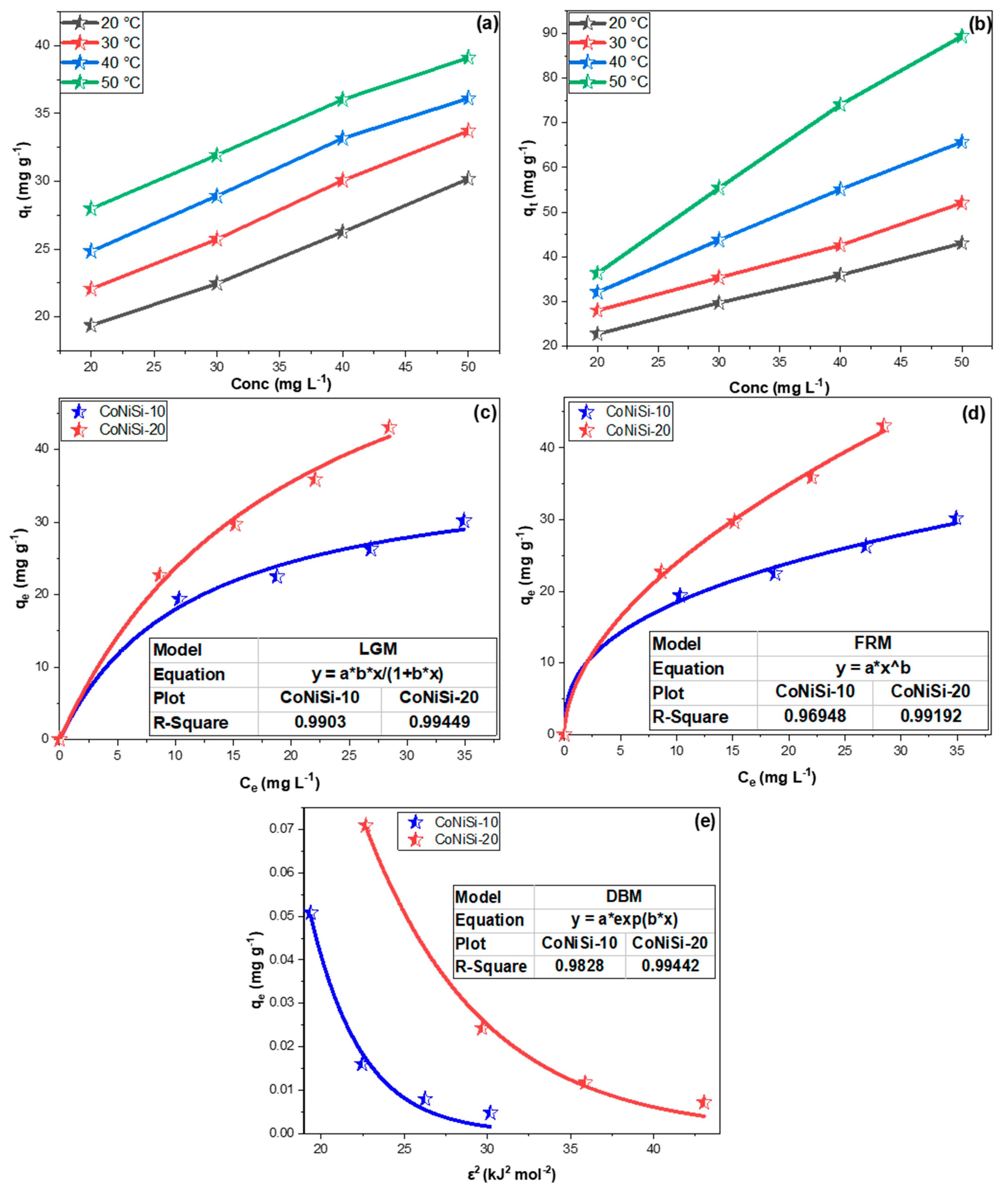
The impact of CPF concentration on its removal by CoNiSi-10 and CoNiSi-20 was examined (Figure 4a,b). The qt of CoNiSi-10 and CoNiSi-20 increased proportionally with concentration (20 to 50 mg L−1), suggesting that increasing the CPF molecules enhanced interaction with the CoNiSi-10 and CoNiSi-20 sites, thereby favoring CPF sorption at equilibrium [8]. The impact of temperature on CPF sorption by CoNiSi-10 and CoNiSi-20 was investigated. The CPF adsorption was endothermic, as qt values for CoNiSi-10 and CoNiSi-20 increased proportionally with temperature. This temperature-dependent enhancement is attributable to the activation of sorbent sites and/or generation of additional ones via sorbent disintegration [51]. The concentration and temperature outputs at 20 °C were utilized to examine the isothermal behavior of CPF sorption onto CoNiSi-10 and CoNiSi-20. The Langmuir (LGM), Freundlich (FRM), and Dubinin-Radushkevich (DBM) models were employed to fit the experimental data (Figure 4c–e), and their computed parameters are summarized in Table 2. The R2 values indicated that LGM adequately described the sorption of CPF onto CoNiSi-10 and CoNiSi-20. Nevertheless, R2 values for FRM are close to those for LGM, suggesting semi-alignment of the FRM, indicating the heterogeneity of CoNiSi-10 and CoNiSi-20 surfaces on which CPF sorption occurs in single and/or multilayers. Considering that the LGM RL values (≥1.0 indicate the model’s unfavorability), and the 1/n values (≤1.0 of FRM indicate the model’s favorability), plus that FRM showed the lowest RSS and X2 values, may support the suggestion that FRM provides a more suitable explanation about CPF sorptions onto CoNiSi-10 and CoNiSi-20 [52,53]. The DBM was employed to elucidate the CPF sorption behavior on CoNiSi-10 and CoNiSi-20, determine the ED, and assess whether CPF removal was a physical or chemical process (Figure 4e). The Dubinin energy (ED) values in Table 2 for CoNiSi-10 and CoNiSi-20 were both below 8 kJ mol−1, concluding that on both sorbents, CPF was removed mainly via physisorption [51,54,55].
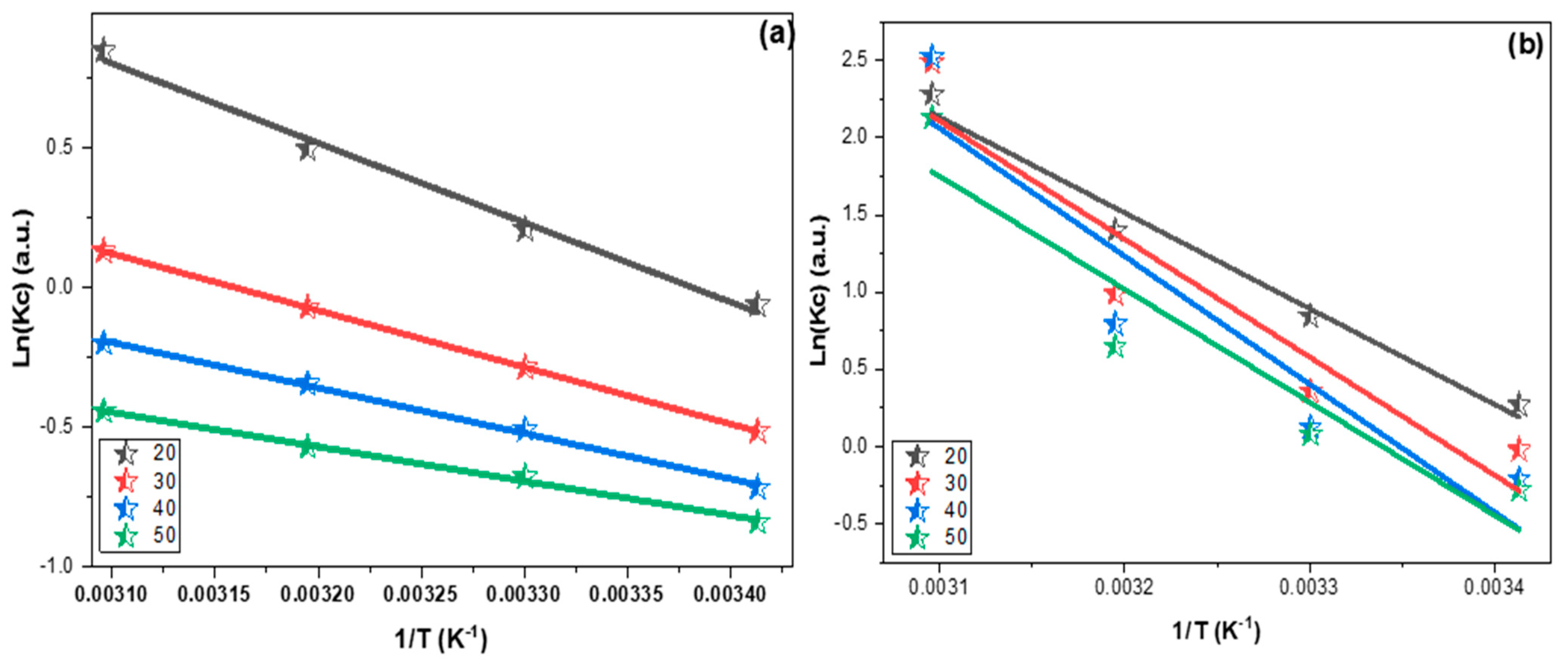
The suitability of CoNiSi-10 and CoNiSi-20 for removing CPF from contaminated water was evaluated, and the spontaneity, feasibility, and endo/exothermic nature of CPF sorption were assessed via studying CPF sorption thermodynamics (Figure 5a,b). The corresponding results in Table 2 show that the ∆G° values become increasingly negative at elevated temperature, indicating spontaneous CPF sorption on CoNiSi-10 and CoNiSi-20. The positive ∆H° values indicate endothermic behavior, consistent with the observed proportional increase in CPF sorption with temperature (Figure 4a,b). The ΔG° values of ≤20 kJ mol−1 for CoNiSi-20 support the physisorption process predicted by DBM and overruled the chemisorption nature suggested by the alignment of CPF sorption with the NPSO. The positive ∆G° values for CPF sorption by CoNiSi-10 indicate that the process is nonspontaneous. Conversely, ∆G° values for CPF sorption by CoNiSi-20 were spontaneous at all examined temperatures except 20 °C, with the process becoming more spontaneous as the temperature increased. The decrease in ∆G° values with increasing temperature indicates that CPF removals by CoNiSi-10 and CoNiSi-20 could be enhanced by elevating the water temperature prior to treatment [56,57]. The positive ∆S° values suggest that interface disorder increases between CoNiSi-10 and CoNiSi-20 and the aqueous phase during CPF sorption, indicating the affinity of CoNiSi-10 and CoNiSi-20 for CPF [58]. These findings indicate that CoNiSi-10 and CoNiSi-20 are excellent, effective adsorbents suitable for removing CPF from contaminated water, with CoNiSi-20 showing clear superiority over CoNiSi-10.

2.4. The pH and PZC Studies, and the Suggested Sorption Mechanism

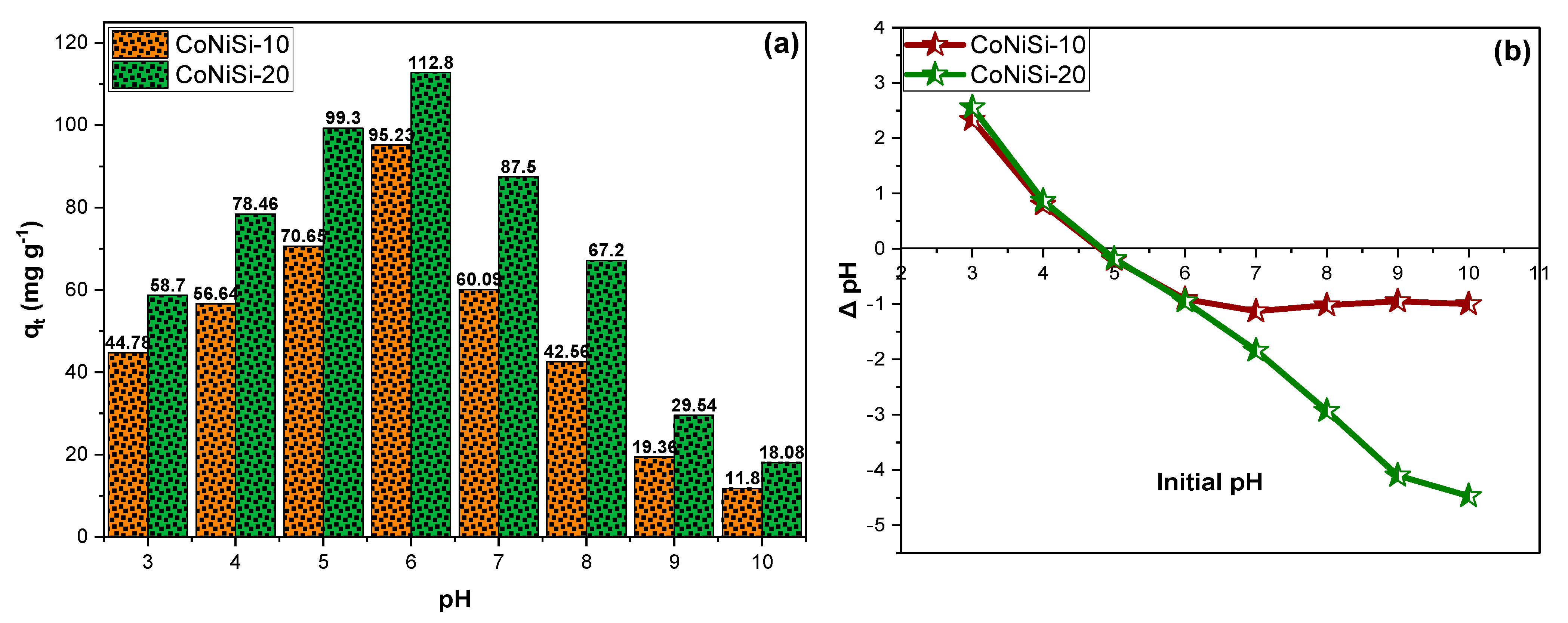
The pH influences the polarity and charge of CoNiSi-10 and CoNiSi-20, as well as the CPF’s speciation. The impact of solution pH on the efficiency of CPF sorption onto CoNiSi-10 and CoNiSi-20 was evaluated (Figure 6a). The qt of CPF propagated as the pH increased from 3 to 6, where CoNiSi-10 and CoNiSi-20 showed qmax values of 95 and 113 mg g−1, respectively, while raising the pH from 6 to 10 reduced the qt values obtained by both CoNiSi-10 and CoNiSi-20 nanohybrids. Both CoNiSi-10 and CoNiSi-20 showed a PZC of 4.9, which may help interpret the resulting CPF sorption trend in light of the PZC outcomes (Figure 6b). Below the PZC (acidic medium), CoNiSi-10 and CoNiSi-20 surfaces became positively charged, as for the CPF molecules, at strong acidic media, CPF may adopt a positive/partially positive charge resulting from the protonation of the nitrogen and the carbonyl sites. The positive charge on CoNiSi-10 and CoNiSi-20 repels the CPF through its preidentified cationic sites, thereby reducing CPF adsorption. At pH 5.9 (≈6.0), CPF molecules adopt a zwitterion formula, while the CoNiSi-10 and CoNiSi-20 gain weak negative charges due to the pH slightly exceeding the PZC, a situation allowing the CPF to approach the CoNiSi-10 and CoNiSi-20. Although CPF molecules remain as zwitterions up to pH 8.9, the sites of CoNiSi-10 and CoNiSi-20 may become highly negative and partially occupied by OH groups, leading to a reduction in the qt values on both nanohybrids. Above pH 8.9, the anionic CPF form induces electrostatic repulsion, thereby diminishing adsorption capacity [8,59,60].

2.5. Regeneration and Reusability

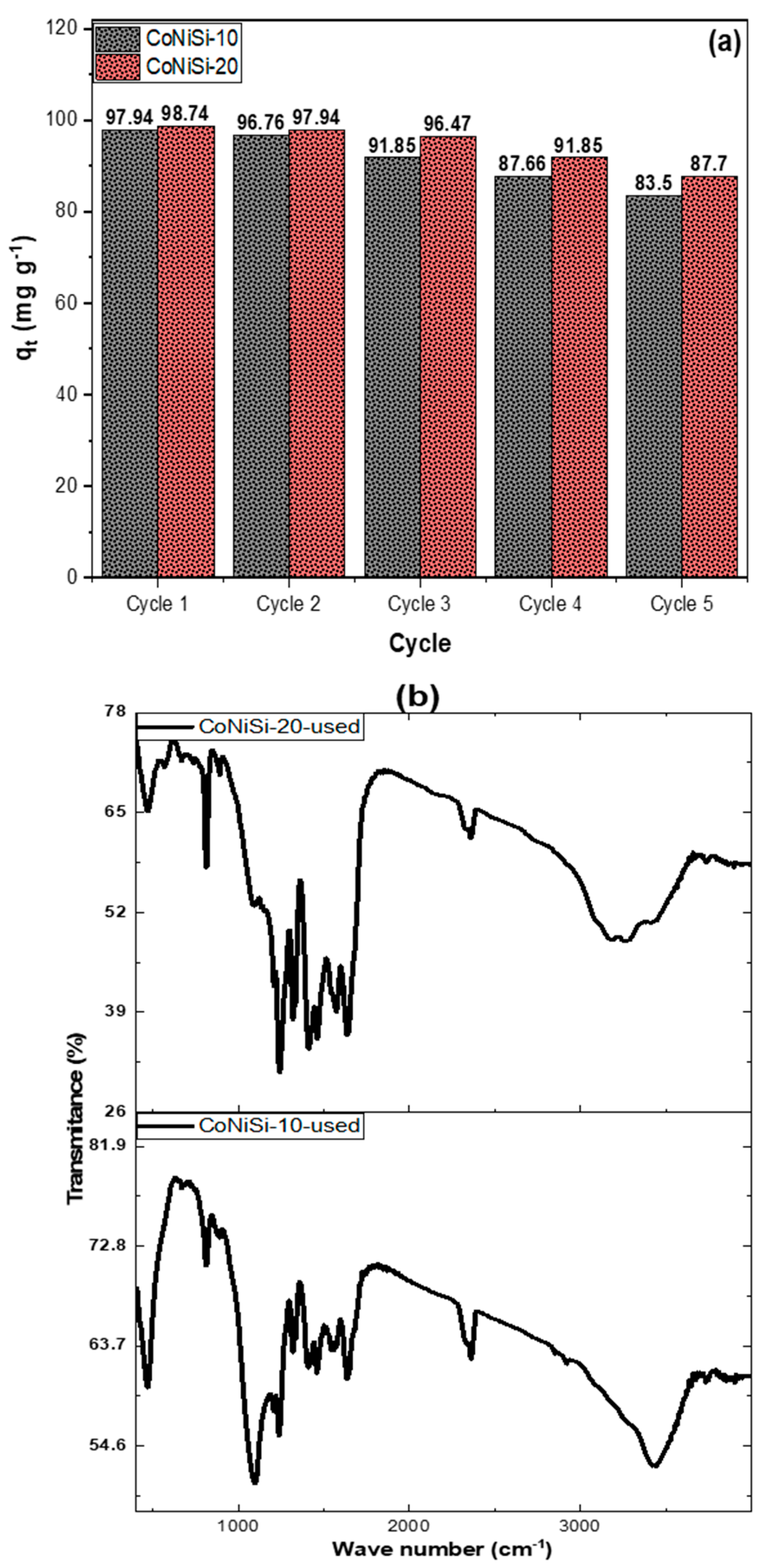
Regeneration enables rapid, multiple reuse of adsorbents with minimal performance variation, thereby lowering overall cost. The reuse investigations of CoNiSi-10 and CoNiSi-20 were conducted over five consecutive regeneration–reuse cycles to assess their viability and feasibility for practical applications (Figure 7a). The CoNiSi-10 and CoNiSi-20 exhibited CPF removal efficiencies of 94% and 96%, respectively, with their lowest CPF removal at the fifth cycle being 84% and 88%, respectively.
Furthermore, the stability of CoNiSi-10 and CoNiSi-20 was examined by conducting FTIR analysis. The spectra of CoNiSi-10 and CoNiSi-20 showed that the peaks of the used and virgin nano-adsorbents matched perfectly without a change except for the intensity of the OH stretching peak, which can be attributed to extensive immersion in aqueous solutions (Figure 7b). Up to the fifth reuse, the CoNiSi-10 and CoNiSi-20 retained about 85% of their initial CPF sorption capacity, demonstrating good reusability. The slight decrease in CoNiSi-10 and CoNiSi-20 removal is attributable to incomplete CPF diffusion from their interior pores and/or a gradual reduction in their pore accessibility caused by multiple reuse-regeneration batches. Despite this slight reduction, the CoNiSi-10 and CoNiSi-20 maintained high removal efficiency, confirming their stability and suitability for multiple reuse cycles.

3. Materials and Methods

3.1. Materials

Butylated hydroxy anisole (BHAN) and cobalt acetate (Co(AC)2) were brought from Win-Lab, England. Hydrophilic fumed silica (HFFS) was obtained from HIFULL Yichang, China. Urea, NaOH, and HCl (37%) were provided by Sharlau (Barcelona, Spain). Nickel acetate tetrahydrate (Ni(AC)2·4H2O) and magnesium acetate tetrahydrate were from Buchs, Fluka, Switzerland. Laboratory-distilled water (DW) was used to prepare nanocomposites and solutions.

3.2. Preparation of CoNiSi-10 and CoNiSi-20

5.0 g of BHAN, 7.0 g of HFFS, 1.073 g of Co(Ac)2, 2.378 g of Ni(AC)2·4H2O, and 20 mL of distilled water (DW) were placed into a 500 mL beaker and heated to 180 °C for 3.0 h. At this point, BHAN may interact with Co2+/Ni2+ and/or srev, forming a boundary that maintains a distance between the ions during carbonization. The product was milled manually in a mortar, then transferred to a 100 mL porcelain dish and calcined for 4.0 h at 650 °C. At this stage, BHAN serves as a fuel and a capping agent to prevent agglomeration of newly formed particles and their further growth. The product was cooled, and the appropriate amount of urea (20.0 g) to produce 1.0 g of g-C3N4 was mixed with the pre-formed NiO/Co2O3/SiO2 product, transferred to a 100 mL porcelain crucible, covered with its lid, wrapped with aluminum foil, heated at 600 °C for 3.0 h, cooled down, and then the 10%NiO/10%CoO@10%g-C3N4-70%SiO2 was collected and labeled (CoNiSi-10). The 10%NiO/10%CoO@20%g-C3N4-60%SiO2 (CoNiSi-20) was prepared using typical steps, except with 6.0 g of HFFS and twice the urea amount.

3.3. Characterization of the Nanocomposites

The morphologies of CoNiSi-10 and CoNiSi-20 nanohybrids were analyzed utilizing scanning electron-energy-dispersive X-ray spectroscopy (FE-SEM-EDX, JSM-IT500HR, JEOL, Pleasanton, Miami, USA), and transmission electron microscopy (JEM-1400, JEOL, Pleasanton, CA, USA). The surface characteristics of CoNiSi-10 and CoNiSi-20 were assessed employing a surface analyzer (ASAP-2020, Micromeritics, Miami, FL, USA). The phase purity/crystallinity of the CoNiSi-10 and CoNiSi-20 nanohybrids was tested via X-ray diffractometer (D8 Advance, Bruker, Billerica, MA, USA).

3.4. Adsorption Studies of CPF

For the contact time investigation, a 100 mL solution (50 mg L−1 CPF) was stirred with 50 mg of CoNiSi-10 and CoNiSi-20 nanohybrid in a 150 mL conical flask. For the effect contact time study, an aliquot (5.0 mL) of the sorbent-CPF mixture was withdrawn (by plastic syringe) at successive time intervals and filtered. The CPF absorbance was determined spectrophotometrically using a UV-1900 spectrophotometer (Shimadzu, Tokyo, Japan). The CPF concentration, sorbent mass (m, g), and the CPF solution volume (v, L) were employed to calculate the adsorption capacity (qt) using Equation (1) [61].
q t = v × ( C o C t ) m
The kinetic investigation of CPF sorption on CoNiSi-10 and CoNiSi-20 was examined utilizing the contact-time outputs. NPFO and NPSO models, as described in Equations (2) and (3), were used to examine the rate order for the CPF sorption on CoNiSi-10 and CoNiSi-20. Moreover, the LFDM (Equation (4) and IPDM (Equation (5) were employed to determine the step regulating the CPF sorption.
q t = q e ( 1 e x p K 1 · t )
q t = k 2 · q e 2 · t 1 + k 2 · q e · t
q t = K I P × t 1 2 + C i
ln ( 1 F ) = K L F × t
KIP (mg g−1 min−1/2) and KLF (min−1) designate LFDM and IPDM constants, respectively; Ci is a boundary-layer-related factor; and k1 (min−1) and k2 (g mg−1 min−1) are the NPFO and NPSO constants, which were determined from the slope and intercept values, respectively [13]. A CPF concentration range of 50 to 200 mg L−1 was employed to examine the impact of CPF feed concentration on its removal by CoNiSi-10 and CoNiSi-20. The impact of temperature was studied by re-conducting the CPF sorption on CoNiSi-10 and CoNiSi-20 at predefined CPF concentrations at 293, 303, 313, and 323 K.
Furthermore, the acquired temperature and concentration-dependent data were used to investigate sorption isotherms and thermodynamics. The LGM (Equation (6)) and the FRM (Equation (7)) were employed to examine CPF sorption probabilities at the monolayer/multilayer interface. The LGM separation factor (RL, arbitrary) was computed utilizing Equation (8). The DRM (Equation (9)) was employed to determine whether the CPF removal was via physisorption or chemisorption; the polani potential (ε, kJ mol−1) was computed via Equation (10) (R = 0.0081345 kJ mol−1), while Equation (11) was used to calculate the ED (kJ mol−1).
q e = K l q m C e 1 + q m C e
q e = K F · C e 1 n
R L = 1 1 + ( K L C 0 )
q e = q m e K D ε 2
ε = R T ln 1 + 1 C e
E D = 2 K D 0.5
KL (L mg−1), KF (L·g−1), and n (arbitrary) indicate LGM constant, FRM constant, and the FRM favorability factor, respectively. KD (mol2 kJ−2), and R (J mol−1 K−1) are the DRM-energy and the ideal-gas constant [53,62]. The enthalpy (ΔH°) and entropy (ΔS°) have been calculated employing the plot’s slope and intercept of Equation (12). Concurrently, the free energy (ΔG°) was liberated by feeding their values in Equation (13) [63].
ln K c = Δ H R T + Δ S R
Δ G = Δ H T Δ S
Furthermore, to investigate the impact of solution pH on CPF sorption by CoNiSi-20, a 50 mg L−1 CPF solution was adjusted to pH 3.0–10.0, with the excess of each adjusted CPF solution serving as a standard for its own sample (to minimize absorbance variation due to pH changes). The CPF ion groups and the CoNiSi-10 and CoNiSi-20 sorption sites can be influenced by pH; therefore, the pH at the zero-charge point (PZC) was evaluated for CoNiSi-10 and CoNiSi-20 within the pre-identified pH range. A 0.01 M NaCl solution was adjusted to a pH of 3–10 (0.1 M HCl/0.1 M NaOH). Subsequently, 0.05 g of adsorbent was stirred with 100 mL of solution at 600 rpm for 24.0 h; the final pH of each solution was recorded, and ΔpH (pHinitial − pHfinal) was computed at each pH point. Furthermore, the regeneration study was conducted on CoNiSi-20, the best sorbent. The used CoNiSi-20 batch was washed with 10 mL ethanol, then with 10 mL DW, and finally dried for 1 h at 115 °C.

4. Conclusions

A straightforward hydrothermal technique was used in this study to create two heteronanocomposites—CoNiSi-10 and CoNiSi-20. With surface areas of 67 m2g−1 and 99 m2g-1 for CoNiSi-10 and CoNiSi-20, respectively, both sorbents demonstrated a mesoporous nature as they both presented a type IV isotherm with an H3 hysteresis loop when investigated by the N2 adsorption–desorption. When examined using SEM and TEM, the sorbents’ morphology revealed irregular nanoscale structures measuring 45 nm and 42 nm, respectively. The ability of the produced nanocomposites to remove ciprofloxacin (CPF), a model pharmaceutical contaminant, was investigated. After optimizing the CPF adsorption parameters on CoNiSi-10 and CoNiSi-20, equilibrium was reached in 90 min, with qt values of 64 and 107 mg g−1 at PH 6.0, respectively. The kinetics demonstrated that IPDM and LFDM both influence CPF removal by the CoNiSi-10 and CoNiSi-20 nanohybrids, and that CPF sorption on CoNiSi-10 and CoNiSi-20 suited the NPSO. The DBM results showed that physisorption was the primary mechanism of CPF removal, whereas isotherm analyses indicated that the Langmuir model best described CPF adsorption on both sorbents. The process is endothermic (positive ∆H°), according to thermodynamic assessments. The adsorption process of CPF on both sorbents is spontaneous, according to the results of entropy (∆S°) and Gibbs free energy (∆G°). A five-consecutive-cycle reusability study examined the robustness of both sorbents’ performance, yielding relatively steady average sorption efficiencies of 93.6% and 96.3% for CoNiSi-20 and CoNiSi-20, respectively. Worth noting that CPF removal by the CoNiSi-10 and CoNiSi-20 was highly impacted by the pH and temperature change, indicating the importance of adjusting the water acidity and temperature. Also, given that CPF sorption by CoNiSi-10 and CoNiSi-20 was IPDM controlled, the occurrence of suspended and/or soluble solids might reduce the effectiveness of CoNiSi-10 and CoNiSi-20.

Author Contributions

Conceptualization, B.Y.A. and M.R.E.; Methodology, M.S.; Software, N.A.; Validation, T.G.I.; Formal Analysis, M.S., S.S.A. and N.A.; Investigation, S.S.A. and N.A.; Data Curation, A.A.A.; Writing—Original Draft, M.R.E. and T.G.I.; Writing—Review and editing, B.Y.A. All authors have read and agreed to the published version of the manuscript.

Funding

This work was supported and funded by the Deanship of Scientific Research at Imam Mohammad Ibn Saud Islamic University (IMSIU) (grant number IMSIU-DDRSP2602).

Institutional Review Board Statement

Not applicable.

Informed Consent Statement

Not applicable.

Data Availability Statement

The original contributions presented in this study are included in the article. Further inquiries can be directed to the corresponding authors.

Conflicts of Interest

The authors declare no conflicts of interest.

References

  1. Gawande, M.B.; Bonifácio, V.D.; Varma, R.S.; Nogueira, I.D.; Bundaleski, N.; Ghumman, C.A.A.; Teodoro, O.M.; Branco, P.S. Magnetically recyclable magnetite–ceria (Nanocat-Fe-Ce) nanocatalyst–applications in multicomponent reactions under benign conditions. Green Chem. 2013, 15, 1226–1231. [Google Scholar] [CrossRef]
  2. Manna, J.; Roy, B.; Sharma, P. Efficient hydrogen generation from sodium borohydride hydrolysis using silica sulfuric acid catalyst. J. Power Sources 2015, 275, 727–733. [Google Scholar] [CrossRef]
  3. Gawande, M.B.; Bonifácio, V.D.; Luque, R.; Branco, P.S.; Varma, R.S. Benign by design: Catalyst-free in-water, on-water green chemical methodologies in organic synthesis. Chem. Soc. Rev. 2013, 42, 5522–5551. [Google Scholar] [CrossRef] [PubMed]
  4. Cashin, V.B.; Eldridge, D.S.; Yu, A.; Zhao, D. Surface functionalization and manipulation of mesoporous silica adsorbents for improved removal of pollutants: A review. Environ. Sci. Water Res. Technol. 2018, 4, 110–128. [Google Scholar] [CrossRef]
  5. Wang, J.; Shah, Z.H.; Zhang, S.; Lu, R. Silica-based nanocomposites via reverse microemulsions: Classifications, preparations, and applications. Nanoscale 2014, 6, 4418–4437. [Google Scholar] [CrossRef]
  6. Zhou, Z.; Zhang, Y.; Shen, Y.; Liu, S.; Zhang, Y. Molecular engineering of polymeric carbon nitride: Advancing applications from photocatalysis to biosensing and more. Chem. Soc. Rev. 2018, 47, 2298–2321. [Google Scholar] [CrossRef] [PubMed]
  7. Sahoo, S.K.; Padhiari, S.; Biswal, S.; Panda, B.; Hota, G. Fe3O4 nanoparticles functionalized GO/g-C3N4 nanocomposite: An efficient magnetic nanoadsorbent for adsorptive removal of organic pollutants. Mater. Chem. Phys. 2020, 244, 122710. [Google Scholar] [CrossRef]
  8. Elamin, M.R.; Ibrahim, T.G.; Salih, M.; Elamin, N.Y.; Albadri, A.; Ramadan, R.; Abdulkhair, B.Y. NovelCoTeO3@β-C3N4 nanohybrids for removing pharmaceutical contaminants from natural water samples. J. Mol. Struct. 2025, 1344, 143020. [Google Scholar] [CrossRef]
  9. Song, Z.; Li, Z.; Lin, L.; Zhang, Y.; Lin, T.; Chen, L.; Cai, Z.; Lin, S.; Guo, L.; Fu, F. Phenyl-doped graphitic carbon nitride: Photoluminescence mechanism and latent fingerprint imaging. Nanoscale 2017, 9, 17737–17742. [Google Scholar] [CrossRef]
  10. Omran, M.K.A.F.; Abdulkhair, B.Y.E.; Qasim, K.F.M. Electrochemical Device Based on CaV2O6/CaSiO3/g-C3N4 Nanocomposite. U.S. Patent No. 12,518,933, 6 January 2026. [Google Scholar]
  11. Ata, R.; Töre, G.Y. Characterization and removal of antibiotic residues by NFC-doped photocatalytic oxidation from domestic and industrial secondary treated wastewaters in Meric-Ergene Basin and reuse assessment for irrigation. J. Environ. Manag. 2019, 233, 673–680. [Google Scholar] [CrossRef] [PubMed]
  12. Almufarij, R.S.; Abdulkhair, B.Y.; Salih, M.; Aldosari, H.; Aldayel, N.W. Optimization, nature, and mechanism investigations for the adsorption of ciprofloxacin and malachite green onto carbon nanoparticles derived from low-cost precursor via a green route. Molecules 2022, 27, 4577. [Google Scholar] [CrossRef]
  13. Elamin, M.; Abdulkhair, B.; Elzupir, A. Removal of ciprofloxacin and indigo carmine from water by carbon nanotubes fabricated from a low-cost precursor: Solution parameters and recyclability. Ain Shams Eng. J. 2022, 14, 101844. [Google Scholar] [CrossRef]
  14. Gu, C.; Karthikeyan, K. Interaction of tetracycline with aluminum and iron hydrous oxides. Environ. Sci. Technol. 2005, 39, 2660–2667. [Google Scholar] [CrossRef]
  15. Díaz-Cruz, M.S.; Barceló, D. Recent advances in LC-MS residue analysis of veterinary medicines in the terrestrial environment. TrAC Trends Anal. Chem. 2007, 26, 637–646. [Google Scholar] [CrossRef]
  16. Salih, M.; Ibrahim, T.G.; Ramadan, R.S.; Alarifi, N.; Abdulkhair, B.Y. Fabrication of Spinel Magnesium Aluminate Doped with Divalent-First-Row Transition-Metal Oxides as Efficient Sorbents for Pharmaceutical Contaminants. Processes 2025, 13, 3095. [Google Scholar] [CrossRef]
  17. Singh, A. Critical risk assessment of adverse effects associated with long term usage of various analgesics on human health. In Pharmaceuticals: Boon or Bane; Agarwal, N., Ed.; Nova Science Publisher, Inc.: New York, NY, USA, 2023. [Google Scholar]
  18. Boxall, A.; Rudd, M.A.; Brooks, B.W.; Caldwell, D.J.; Choi, K.; Hickmann, S.; Innes, E.; Ostapyk, K.; Staveley, J.P.; Verslycke, T. Pharmaceuticals and personal care products in the environment: What are the big questions? Environ. Health Perspect. 2012, 120, 1221. [Google Scholar] [CrossRef]
  19. Kümmerer, K. Antibiotics in the aquatic environment—A review—Part I. Chemosphere 2009, 75, 417–434. [Google Scholar] [CrossRef]
  20. Peng, L.; Li, Z.-w.; Zheng, R.-r.; Yu, H.; Dong, X.-t. Preparation and characterization of mesoporous g-C3N4/SiO2 material with enhanced photocatalytic activity. J. Mater. Res. 2019, 34, 1785–1794. [Google Scholar] [CrossRef]
  21. Al-Howri, B.M.; Ismail, S.; Khajavian, M. comprehensive review of ciprofloxacin pollution in water: Sources, environmental impacts, remediation techniques, and research challenges. Environ. Monit. Assess. 2025, 197, 1095. [Google Scholar] [CrossRef] [PubMed]
  22. Srivastava, S.K. Recent advances in removal of pharmaceutical pollutants in wastewater using metal oxides and carbonaceous materials as photocatalysts: A review. RSC Appl. Interfaces 2024, 1, 340–429. [Google Scholar] [CrossRef]
  23. Gauba, P.; Saxena, A. Ciprofloxacin properties, impacts, and remediation. CABI Rev. 2023, 17, 1–8. [Google Scholar] [CrossRef]
  24. Millanao, A.R.; Mora, A.Y.; Villagra, N.A.; Bucarey, S.A.; Hidalgo, A.A. Biological effects of quinolones: A family of broad-spectrum antimicrobial agents. Molecules 2021, 26, 7153. [Google Scholar] [CrossRef]
  25. Appelbaum, P.; Hunter, P. The fluoroquinolone antibacterials: Past, present and future perspectives. Int. J. Antimicrob. Agents 2000, 16, 5–15. [Google Scholar] [CrossRef] [PubMed]
  26. Girardi, C.; Greve, J.; Lamshöft, M.; Fetzer, I.; Miltner, A.; Schäffer, A.; Kästner, M. Biodegradation of ciprofloxacin in water and soil and its effects on the microbial communities. J. Hazard. Mater. 2011, 198, 22–30. [Google Scholar] [CrossRef] [PubMed]
  27. Parente, C.E.T.; Sierra, J.; Martí, E. Ecotoxicity and biodegradability of oxytetracycline and ciprofloxacin on terrestrial and aquatic media. Orbital. Electron. J. Chem. 2018, 262–271. [Google Scholar] [CrossRef]
  28. Liao, X.; Li, B.; Zou, R.; Dai, Y.; Xie, S.; Yuan, B. Biodegradation of antibiotic ciprofloxacin: Pathways, influential factors, and bacterial community structure. Environ. Sci. Pollut. Res. 2016, 23, 7911–7918. [Google Scholar] [CrossRef]
  29. Klatte, S.; Schaefer, H.-C.; Hempel, M. Pharmaceuticals in the environment–a short review on options to minimize the exposure of humans, animals and ecosystems. Sustain. Chem. Pharm. 2017, 5, 61–66. [Google Scholar] [CrossRef]
  30. Abdurahman, M.H.; Abdullah, A.Z. Mechanism and reaction kinetic of hybrid ozonation-ultrasonication treatment for intensified degradation of emerging organic contaminants in water: A critical review. Chem. Eng. Process. Process Intensif. 2020, 154, 108047. [Google Scholar] [CrossRef]
  31. Shahid, M. An outstanding photocatalytic performance of CNTs based nanocomposite of ternary metal oxides towards cationic and anionic dyes and pharmaceutical drug. Mater. Chem. Phys. 2024, 320, 129392. [Google Scholar] [CrossRef]
  32. de Andrade, J.R.; Oliveira, M.F.; da Silva, M.G.; Vieira, M.G. Adsorption of pharmaceuticals from water and wastewater using nonconventional low-cost materials: A review. Ind. Eng. Chem. Res. 2018, 57, 3103–3127. [Google Scholar] [CrossRef]
  33. Xu, M.; Wang, J.; Wu, J. Recent advances of silicate materials for wastewater treatment: A review. Mater. Res. Express 2024, 11, 032001. [Google Scholar] [CrossRef]
  34. Crini, G.; Lichtfouse, E. Advantages and disadvantages of techniques used for wastewater treatment. Environ. Chem. Lett. 2019, 17, 145–155. [Google Scholar] [CrossRef]
  35. Samonin, V.; Spiridonova, E.; Zotov, A.; Podvyaznikov, M.; Garabadzhiu, A. Chemical structure, porous morphology, and sorption properties of adsorbents produced from organic technogenic substrates (a review). Russ. J. Gen. Chem. 2021, 91, 1546–1565. [Google Scholar] [CrossRef]
  36. Wu, W.; Ruan, Z.; Li, J.; Li, Y.; Jiang, Y.; Xu, X.; Li, D.; Yuan, Y.; Lin, K. In situ preparation and analysis of bimetal Co-doped mesoporous graphitic carbon nitride with enhanced photocatalytic activity. Nano-Micro Lett. 2019, 11, 10. [Google Scholar] [CrossRef]
  37. Almahmoud, S.A.; Alzahrani, S.S.; Abdulkhair, B.Y. Efficacious Removal of Organic Contaminants from Water Using a Novel CoO–NiO@MgAl2O4 Nanocomposite. ACS Omega 2025, 10, 11188–11201. [Google Scholar] [CrossRef] [PubMed]
  38. Wen, J.; Xie, J.; Chen, X.; Li, X. A review on g-C3N4-based photocatalysts. Appl. Surf. Sci. 2017, 391, 72–123. [Google Scholar] [CrossRef]
  39. Ali, G.; Fouad, O.; Makhlouf, S.A. Electrical properties of cobalt oxide/silica nanocomposites obtained by sol-gel technique. Am. J. Eng. Appl. Sci. 2016, 9, 12–16. [Google Scholar] [CrossRef]
  40. Yuan, S.; Zhao, L. Hierarchical core–shell structured Fe3O4@NiSiO3 magnetic microspheres: Preparation, characterization, and adsorption of methylene blue from aqueous solution. RSC Adv. 2016, 6, 49769–49776. [Google Scholar] [CrossRef]
  41. Cui, H.; Zayat, M.; Levy, D. Effect of HCl on the PPO assisted sol-gel synthesis of olivine-type Co2SiO4 ultrafine particles. J. Sol.-Gel Sci. Technol. 2006, 40, 83–87. [Google Scholar] [CrossRef]
  42. Hsiao, M.-C.; Ma, C.-C.M.; Chiang, J.-C.; Ho, K.-K.; Chou, T.-Y.; Xie, X.; Tsai, C.-H.; Chang, L.-H.; Hsieh, C.-K. Thermally conductive and electrically insulating epoxy nanocomposites with thermally reduced graphene oxide–silica hybrid nanosheets. Nanoscale 2013, 5, 5863–5871. [Google Scholar] [CrossRef]
  43. Dominguez, M.; Taboada, E.; Idriss, H.; Molins, E.; Llorca, J. Fast and efficient hydrogen generation catalyzed by cobalt talc nanolayers dispersed in silica aerogel. J. Mater. Chem. 2010, 20, 4875–4883. [Google Scholar] [CrossRef]
  44. Wan, C.; Chen, B. Synthesis and characterization of biomimetic hydroxyapatite/sepiolite nanocomposites. Nanoscale 2011, 3, 693–700. [Google Scholar] [CrossRef]
  45. Li, J.; Dong, X.; Liu, X.; Xu, X.; Duan, W.; Park, J.; Gao, L.; Lu, Y. Comparative study on the adsorption characteristics of heavy metal ions by activated carbon and selected natural adsorbents. Sustainability 2022, 14, 15579. [Google Scholar] [CrossRef]
  46. Vievard, J.; Alem, A.; Pantet, A.; Ahfir, N.; Arellano-Sánchez, M.; Devouge-Boyer, C.; Mignot, M. Bio-based adsorption as ecofriendly method for wastewater decontamination: A review. Toxics 2023, 11, 404. [Google Scholar] [CrossRef]
  47. Amari, A.; Alawameleh, H.S.K.; Isam, M.; Maktoof, M.A.J.; Osman, H.; Panneerselvam, B.; Thomas, M. Thermodynamic Investigation and Study of Kinetics and Mass Transfer Mechanisms of Oily Wastewater Adsorption on UIO-66-MnFe2O4 as a Metal-Organic Framework (MOF). Sustainability 2023, 15, 2488, Correction in Sustainability 2025, 17, 4903. [Google Scholar] [CrossRef]
  48. Yao, C.; Chen, T. A film-diffusion-based adsorption kinetic equation and its application. Chem. Eng. Res. Des. 2017, 119, 87–92. [Google Scholar] [CrossRef]
  49. Wang, J.; Guo, X. Rethinking of the intraparticle diffusion adsorption kinetics model: Interpretation, solving methods and applications. Chemosphere 2022, 309, 136732. [Google Scholar] [CrossRef] [PubMed]
  50. Dharmarathna, S.P.; Priyantha, N. Investigation of boundary layer effect of intra-particle diffusion on methylene blue adsorption on activated carbon. Energy Nexus 2024, 14, 100294. [Google Scholar] [CrossRef]
  51. Stegarescu, A.; Lung, I.; Cârdan, A.; Bocșa, M.; Turza, A.; Lazar, M.D.; Dan, M.; Tripon, S.; Kacso, I.; Pintea, S. Composite Materials Based on Biochar Obtained from Tomato Wastes and Fe3O4/MnO2 Used for Paracetamol Adsorption. Materials 2025, 18, 3914. [Google Scholar] [CrossRef] [PubMed]
  52. Dada, A.; Olalekan, A.; Olatunya, A.; Dada, O. Langmuir, Freundlich, Temkin and Dubinin–Radushkevich isotherms studies of equilibrium sorption of Zn2+ unto phosphoric acid modified rice husk. IOSR J. Appl. Chem. 2012, 3, 38–45. [Google Scholar]
  53. Çiçekçi, A.; Sevim, F.; Sevim, M.; Kavcı, E. Adsorption Capacity, reaction kinetics and thermodynamic studies on Ni (II) removal with GO@Fe3O4@Pluronic-F68 nanocomposite. Polymers 2025, 17, 2141. [Google Scholar] [CrossRef] [PubMed]
  54. Ibrahim, T.G.; Almufarij, R.S.; Abdulkhair, B.Y.; Abd Elaziz, M.E. Eliminating Manifold Pharmaceutical Pollutants with Carbon Nanoparticles Driven via a Short-Duration Ball-Milling Process. Surfaces 2024, 7, 493–507. [Google Scholar] [CrossRef]
  55. Ghoniem, M.G.; Ali, F.A.M.; Abdulkhair, B.Y.; Elamin, M.R.A.; Alqahtani, A.M.; Rahali, S.; Ben Aissa, M.A. Highly selective removal of cationic dyes from wastewater by MgO nanorods. Nanomaterials 2022, 12, 1023. [Google Scholar] [CrossRef] [PubMed]
  56. Gomes, F.P.; Resende, O.; Sousa, E.P.d.; Célia, J.A.; de Oliveira, K.B. Application of mathematical models and thermodynamic properties in the drying of Jambu leaves. Agriculture 2022, 12, 1252. [Google Scholar] [CrossRef]
  57. Kumar, P.; Meyerstein, D.; Mizrahi, A.; Kornweitz, H. Investigation of the Adsorption and Reactions of Methyl Radicals on Transition Metal (M = Co, Ni, Pd, Pt)(111) Surfaces in Aqueous Suspensions. Molecules 2025, 30, 3065. [Google Scholar] [CrossRef]
  58. Khan, A.; Wang, X.; Gul, K.; Khuda, F.; Aly, Z.; Elseman, A. Microwave-assisted spent black tea leaves as cost-effective and powerful green adsorbent for the efficient removal of Eriochrome black T from aqueous solutions. Egypt. J. Basic Appl. Sci. 2018, 5, 171–182. [Google Scholar] [CrossRef]
  59. Heidari, G.; Afruzi, F.H.; Zare, E.N. Molecularly imprinted magnetic nanocomposite based on carboxymethyl dextrin for removal of ciprofloxacin antibiotic from contaminated water. Nanomaterials 2023, 13, 489. [Google Scholar] [CrossRef]
  60. Campos, V.N.; Santos, J.D.; Araújo, R.J.; Lopes, P.H.; Garcia, M.A.; Rojas, A.; Teixeira, M.M.; Bezerra, C.W.; Alcântara, A.C. High Performance of Ciprofloxacin Removal Using Heterostructure Material Based on the Combination of CeO2 and Palygorskite Fibrous Clay. Minerals 2024, 14, 792. [Google Scholar] [CrossRef]
  61. Elamin, M.R.; Abdulkhair, B.Y.; Elamin, N.Y.; Albadri, A.; Ismail, M.; Bakheit, R.; Taha, K.K.; Modwi, A. Ru@Co3O4@g-C3N4 as a novel adsorbent for enhanced copper and cadmium abolition. J. Sci. Adv. Mater. Devices 2024, 9, 100725. [Google Scholar] [CrossRef]
  62. Ercegović, M.; Petrović, J.; Koprivica, M.; Simić, M.; Grubišić, M.; Vuković, N.; Krstić, J. Efficient adsorption of pollutants from aqueous solutions by hydrochar-based hierarchical porous carbons. Water 2024, 16, 2177. [Google Scholar] [CrossRef]
  63. Salih, M.; Abdulkhair, B.Y.; Alotaibi, M. Insight into the Adsorption Behavior of Carbon Nanoparticles Derived from Coffee Skin Waste for Remediating Water Contaminated with Pharmaceutical Ingredients. Chemistry 2023, 5, 1870–1881. [Google Scholar] [CrossRef]
Figure 1. (a,b) SEM images of CoNiSi-10 and CoNiSi-20; (c,d) TEM images of CoNiSi-10 and CoNiSi-20; (e,f) EDX spectra of CoNiSi-10 and CoNiSi-20 nanohybrids, respectively.
Inorganics 14 00162 g001
Figure 2. Nitrogen adsorption–desorption isotherms and pore size distribution of (a) CoNiSi-10, (b) CoNiSi-20, tertiary nanocomposites, (c) XRD diffraction patterns, and (d) FTIR spectrum of CoNiSi-10 and CoNiSi-20 nanohybrids.
Inorganics 14 00162 g002
Figure 3. (a) Contact time results, (b) NPFO, (c) NPSO, (d) LFDM, and (e) IPDM plots of CPF removal by CoNiSi-10 and CoNiSi-20 from a 50 mg L−1 solution at 20 °C.
Inorganics 14 00162 g003
Figure 4. (a,b) Effect of concentration and temperature on CPF sorption onto CoNiSi-10 and CoNiSi-20, respectively; LGM and FRM co-fittings of CPF sorption onto (c) CoNiSi-10 and (d) CoNiSi-20; (e) DBM study of CPF sorption by CoNiSi-10 and CoNiSi-20.
Inorganics 14 00162 g004
Figure 5. The thermodynamic plots of CPF sorption onto (a) CoNiSi-10 and (b) CoNiSi-20, respectively.
Inorganics 14 00162 g005
Figure 6. (a) the effect of pH, (b) the PZC study of CPF removal by CoNiSi-10 and CoNiSi-20.
Inorganics 14 00162 g006
Figure 7. (a) the CoNiSi-10 and CoNiSi-20 reusability study, and (b) FTIR spectra for the regenerated CoNiSi-10 and CoNiSi-20.
Inorganics 14 00162 g007
Table 1. Kinetic results of CPF sorption onto CoNiSi-10 and CoNiSi-20 nanocomposites.
Adsorption rate order
Sorbentqmax exp
(mg·g−1)
NPFONPSO
qe (mg·g−1)K1R2X2RSSqe (mg·g−1)K2R2X2RSS
CoNiSi-10 64.4258.1010.5840.94023.974191.79260.7820.0160.9759.93479.471
CoNiSi-20 88.9081.0140.7890.94344.040352.32184.2270.0160.97221.763174.107
Adsorption rate mechanism
SorbentIPDMLFDM
KIP (mg·g−1 min1/2)Ci (mg·g−1)R2RSSKLF (min−1)R2RSS
CoNiSi-10 63.41442.8940.93321.430.0560.9124.884
CoNiSi-20 2.82363.4140.9906.470.0600.9843.529
Table 2. Isotherm results for CPF sorption by CoNiSi-10 and CoNiSi-20 at 293 K, with concentrations ranging from 20 to 50 mg L−1, and thermodynamic results for CPF concentrations of 20 to 50 mg L−1 at 293, 303, 313, and 323 K.
Adsorption Isotherms
IsothermLGMFRMDBM
SorbentKLRLqmRSSX2R2Kf1/nRSSX2R2qm KDREDRSSX2R2
CoNiSi-100.0883.7538.4665.3211.7740.9907.7530.3762.0101.0050.96925.700.3221.2462.3101.1550.983
CoNiSi-200.0502.9971.3576.0002.0000.9946.8390.5441.8310.9150.9921.7470.1411.8801.4317.1560.994
Thermodynamic resultsCoNiSi-10
Conc. (mg L−1)ΔH°ΔS°ΔG° (293 K)ΔG°—303 KΔG°—313 KΔG°—323 KR2
2023.6220.080−0.180−0.979−1.778−2.5770.992
3016.8710.0530.9870.454−0.079−0.6120.999
4013.4950.0401.5161.1140.7120.3100.997
5010.1940.0281.8841.6051.3261.0470.996
CoNiSi-20
Conc. (mg L−1)ΔH°ΔS°ΔG° (293 K)ΔG°—303 KΔG°—313 KΔG°—323 KR2
2051.5480.178−1.358−3.133−4.908−6.6840.980
3063.5260.214−0.380−2.525−4.669−6.8140.892
4068.8490.2310.142−2.164−4.470−6.7750.866
5060.7870.2030.296−1.734−3.764−5.7940.882
Disclaimer/Publisher’s Note: The statements, opinions and data contained in all publications are solely those of the individual author(s) and contributor(s) and not of MDPI and/or the editor(s). MDPI and/or the editor(s) disclaim responsibility for any injury to people or property resulting from any ideas, methods, instructions or products referred to in the content.