Review

Advances in Air-Stable Silicon-Based Anodes and Their Application in Li–Air Batteries

1
School of Chemistry and Chemical Engineering, Zhejiang Sci-Tech University, 2nd Street 928, Xiasha Higher Education Park, Hangzhou 310018, China
2
School of Biological and Chemical Engineering, NingboTech University, South Qianhu Road 1, Ningbo 315101, China
3
Ningbo Institute of Materials Technology and Engineering, Chinese Academy of Sciences, West Zhongguan Road 1219, Ningbo 315201, China
4
School of Optoelectronic Materials & Technology, Jianghan University, Wuhan 430056, China
5
College of Chemical and Biological Engineering, Zhejiang University, Hangzhou 310058, China
*
Authors to whom correspondence should be addressed.
Inorganics 2026, 14(5), 127; https://doi.org/10.3390/inorganics14050127
Submission received: 16 March 2026 / Revised: 21 April 2026 / Accepted: 28 April 2026 / Published: 30 April 2026

Abstract

In recent years, silicon-based anodes have become a model of commercial success among various high-capacity electrode materials. They also offer a promising substitute for the lithium metal anode (LMA) in lithium–air batteries (LABs), which have the highest specific energy. However, the poor air stability of lithiated silicon-based anodes makes pre-lithiation considerably more difficult and costly in mass production to improve their initial Coulombic efficiency and cyclability, which complicates their material design and electrode manufacturing. To address this issue, intensified efforts have been devoted in recent years, mainly by constructing encapsulation structures, such as core–shell, pomegranate-like or peapod-like architectures. These designs have achieved significantly boosted stability in dry air and, in some cases, even under prolonged exposure to ambient humidity. On the other hand, it was found that silicon-based anodes often provide better cyclic stability than LMAs in LABs and lithium–oxygen batteries (LOBs); however, in most cases, the silicon-based anodes were not optimized for air stability. This review summarizes the relevant works on improving the air stability of silicon-based anodes and LABs/LOBs that used a silicon-based anode, intending to shed light on future development of air-stable silicon-based anodes and bridge the gap between the electrodes’ air-stability and their application in LABs/LOBs.

Graphical Abstract

1. Introduction

The fast development of electric vehicles and portable electronics has stimulated intensive research on next-generation energy storage systems with higher energy density than modern lithium-ion batteries (LIBs). Lithium–air batteries (LABs), with their highest theoretical specific energy (gravimetric energy density) of 11,430 Wh kg−1 (excluding O2 mass), are regarded as the “holy grail” of energy storage systems because they can extract oxygen from ambient air to the cathode without pre-storage and use the lithium metal anode (LMA), which possesses both the lowest redox potential (−3.04 V vs. standard hydrogen electrode) and highest specific capacity (3861 mAh g−1) among all anode materials [1,2,3,4,5,6,7,8]. When operating in pure oxygen, LABs are simplified into lithium–oxygen batteries (LOBs) at the cost of diminished specific energy (3458 Wh kg−1 in theory, including O2 mass), and Li2O2 is precipitated as the discharge product in the porous air cathode during the oxygen reduction reaction (ORR, discharge reaction), whereas in real air, a large portion of ORR intermediates (O2/LiO2) and/or products (Li2O2) will react with other air components (H2O, CO2, N2, SOx, NOx, CO, etc.) to form side products (LiOH, Li2CO3, etc.), complicating the cell chemistry [4,5,6,9,10,11,12].
Despite the appealing ultrahigh energy density, today’s LABs/LOBs still suffer from poor cyclability and rate capability, rendering them inapplicable for commercial use. At the cathode, the solid-state products cause passivation of cathode surface and clogging of gas diffusion channels during discharge and then impede their own decomposition during the following recharge (oxygen evolution reaction, OER), jeopardizing reaction kinetics and reversibility. In addition, the highly reactive oxygen species (ROS, e.g., 1O2, O2, LiO2, Li2O2, etc.) are prone to degrading cell components (cathode substrates, binders, solvents, lithium salts, etc.) [9,10,11,13,14,15,16,17], and these issues drastically obstruct LABs/LOBs’ cyclability and rate capability. To address these issues, most studies in the LAB/LOB field focus on the air cathode side, including insights into the cell chemistry [11,17,18,19,20,21,22,23], stable cell components [24,25,26,27,28,29,30], novel cathode structures [31,32,33,34,35,36,37,38], solid-state catalysts [39,40,41,42,43,44,45,46,47,48], redox mediators (RMs) [49,50,51,52,53,54,55,56,57,58,59], 1O2 quenchers [60,61,62,63], etc.
At the anode, two intrinsic issues of LMA have been plaguing its cyclability and rate capability since its first introduction in lithium metal batteries (LMBs): high chemical reactivity and theoretically infinite volume variation [7,64,65,66,67,68,69,70]. Through modern characterization techniques, particularly in situ methods, the failure mechanisms of LMAs have been visually and quantitatively elucidated. For instance, cryogenic transmission electron microscopy (cryo-TEM) [71] has resolved the atomic-scale crystalline structure of Li dendrites and the nanostructure of the solid-electrolyte interface (SEI), while in situ atomic force microscopy (AFM) coupled with environmental TEM [72] has enabled the direct measurement of the growth stress (up to 130 MPa) and yield strength of individual Li whiskers, revealing the formidable mechanical power behind dendrite penetration. Furthermore, stimulated Raman scattering (SRS) microscopy [73] has been employed to map the spatiotemporal ion concentration gradients that drive dendrite initiation. Together, these observations confirm that the growth of lithium dendrites, the formation of “dead lithium” and the repeated rupture and reconstruction of the SEI are the primary culprits behind LMA failure.
In LABs/LOBs, these issues are further compounded by the involvement of air components (N2, O2, H2O, CO2, etc.) and crossover of soluble species (e.g., RMs, O2 radical, etc.). These factors exacerbate the instability of the SEI, triggering mutual consumption of electrolyte and active lithium as well as impeded mass transfer, leading to rapid cell failure [74,75,76,77]. Though most LAB/LOB studies used bare lithium foils or those with simple surface treatments (e.g., immersion in propylene carbonate) with huge excess lithium (e.g., hundreds of times higher areal capacity than the cathode), neglecting the anode influence, in recent years, it has been found that the parasitic reactions at the anode not only consume available lithium but also play an important role in increasing charge polarization to deteriorate LABs/LOBs’ round-trip efficiency and cyclability [74,75,76,77,78,79]. To pursue higher specific energy and lower the manufacturing cost, excess lithium should be strictly limited in future practical LAB/LOB devices, which would make the anode challenges even more pressing. Therefore, it is crucial to develop air-stable and high-capacity anodes for developing practical LABs/LOBs.
In the development of LMAs, three major strategies have been implemented to improve their cyclic stability, including: (1) constructing robust artificial SEIs to persistently block the electrolyte while maintaining good contact with metallic lithium underneath, (2) designing 3D host (current collector) structures to mitigate dimension variation of the electrode and reduce local current density and (3) using electrolyte additives to regulate lithium deposition behavior. In recent years, many efforts have also been devoted to improving LMA’s air stability, especially by constructing solid-state electrolyte (SSE) membranes as the artificial SEI to block air and water [74,78,79,80]. However, to the authors’ knowledge, there have been only two examples of commercial success to date, namely the lithium aluminum titanium/germanium phosphate (LATP/LAGP) ceramic disks and their derivatives from various manufacturers (represented by Ohara Inc.) and the proprietary protected lithium electrodes (PLEs) from PolyPlus Battery Company.
In the early years of LABs/LOBs (2010s), those with aqueous and hybrid electrolytes had been a popular topic. In these systems, the discharge product (OH or H2O) is soluble as in other aqueous metal–air batteries; thus, the issue of interface instability at the air cathode (as in aprotic LABs) is intrinsically avoided [81,82,83]. To protect the LMA, ceramic SSEs, especially LATP/LAGP and their derivatives (such as Ohara Li1+x+yAlx(Ti,Ge)2SiyP3−yO12) [84,85,86], were commonly used in these systems because of their excellent stability with air/water, high room-temperature ionic conductivity (10−4~10−3 S cm−1) and relatively low cost. However, stand-alone LATP/LAGP SSEs make instable point contact with the LMA at the solid–solid interface, resulting in high interfacial impedance. Furthermore, LATP and LAGP are thermodynamically instable against metallic lithium, and their Ti4+/Ge4+ ions spontaneously reduce to lower valence states, creating an ionic–electronic mixed conductive interface layer to induce the reaction further inwards, causing dendrite growth through the SSE and stress concentration [87,88], leading to cracks and air/water ingress, as often observed after long-term operation of aqueous and hybrid-electrolyte LABs/LOBs.
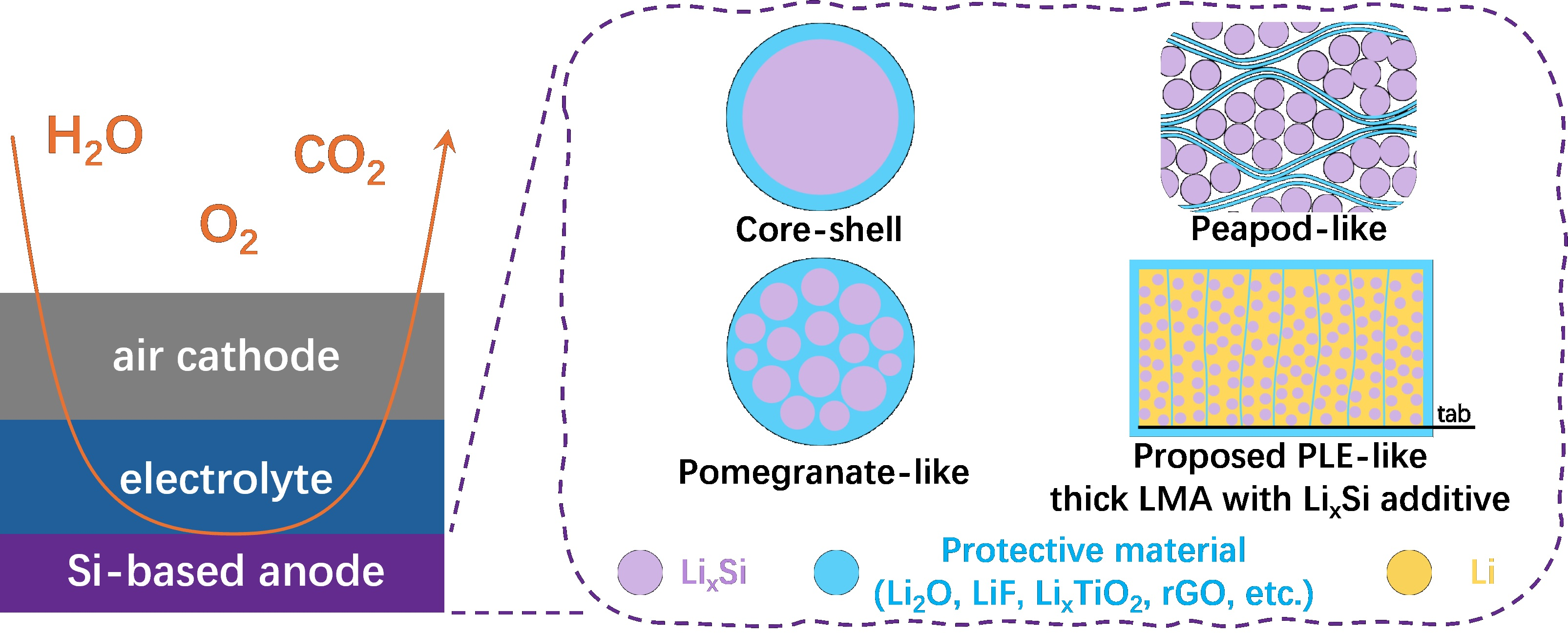
To address this issue, adding an artificial interlayer has been regarded as the most effective solution, using inorganic layers such as metal oxides/nitrides/halides (Al2O3 [89], ZnO [90], SnO2 [91], ZnF2 [92], CuF2 [88], Li3-xPO4−yNy (LiPON) [93], etc.) and organic layers such as poly(ethylene oxide)/lithium salt [94], poly(ethylene glycol) methyl ether acrylate (PEGMEA) [95], polyvinylidene fluoride-hexafluoropropylene (PVDF-HFP)/lithium bis(trifluoromethanesulfonyl)imide (LiTFSI) [96], and polyvinylidene fluoride-trifluoroethylene (PVDF-TrFE) [97], as well as organic–inorganic composites [98,99]. In light of this, PolyPlus Battery Company developed its proprietary PLEs (Figure 1a) [100,101,102,103]. Their basic strategy is to sputter an ultrathin Li-compatible inner layer (such as Li3N, Li3P, LiPON, Li-halides, etc., or their composites with polymers, with a typical thickness of ~0.2 μm) onto the pinhole-free air- and water-stable outer layer (such as LATP, LAGP, etc., with a typical thickness of 20~30 μm) and then laminate the composite membrane with the lithium metal sheet. The inner layer emphasizes ionic conductivity and chemical compatibility with metallic lithium, while the outer layer needs to be highly impervious, ionically conductive and chemically compatible with the inner layer as well as air/water. This strategy led to the development of lithium–seawater primary batteries (essentially LABs utilizing dissolved dioxygen) with their proprietary PLEs [104]. These batteries have demonstrated ultrahigh specific energy of 2000 Wh kg−1 and 69 days of stable underwater operation (down to 400 m) [105]. They also show excellent scalability: a 560 Ah stack was built with gravimetric and volumetric energy densities of 1600 Wh kg−1 and 1050 Wh L−1, respectively [106]. And the pilot production line of PLEs became operational in July 2022. In their design, the thick PLEs for primary batteries have a thickness up to 3.35 mm (650 mAh cm−2). For secondary (rechargeable) batteries, the areal capacity shrank to 3~5 mAh cm−2 (15~25 μm) to reduce volumetric variation. Such areal capacity could match that of the air cathode in some LAB/LOB pouch-cell prototypes, e.g., the one Samsung developed with an areal capacity of 3.55 mAh cm−2 and ultrahigh specific energy of 1214 Wh kg−1 [34].
However, in these thin PLEs, the areal mass of protective layers exceeds that of metallic lithium, diminishing the core value of the LMA: the ultrahigh specific capacity. For example, in primary batteries, the PLE can provide a near-theoretical specific capacity of 3736 mAh g−1 (calculated based on 3350 μm thick Li, 0.2 μm thick LiPON and 20 μm thick LATP layer), whereas in secondary batteries, the specific capacity plummets to 709 mAh g−1 with 25 μm thick Li (assuming the thicknesses of LiPON and LATP are unchanged). Considering the areal mass of other auxiliary components, such as current collectors, packaging materials and oxygen selective membranes (OSMs) [109] (as illustrated in Figure 1b), higher areal loading and capacity are desirable to further improve the energy density once the oxygen mass transfer issue is addressed. For example, recent advanced air cathodes with aligned microchannels and/or hierarchical pores (Figure 1c) have achieved ultrahigh areal capacities of up to 56 mAh cm−2 [32,33]. To meet such high areal capacity, lithiophilic 3D hosts are necessary to reduce local current density and dimension variation. However, to date, there is still a huge gap between laboratory-made lightweight (e.g., carbon-based) 3D hosts and industry-level production.
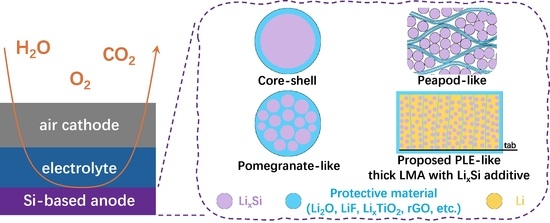
In contrast, silicon-based anode materials, with their specific capacity second only to LMA (3579 mAh g−1Si or 1858 mAh g−1Li15Si4 for Li15Si4), such as Si/C composites and SiOx, have already been successfully commercialized in LIBs [110]. Unlike intercalation/deintercalation in graphite or plating/stripping on the LMA, in Si-based anodes, Li atoms are alloyed with Si atoms to form various stoichiometries (such as Li12Si7, Li7Si3, Li13Si4, Li15Si4, Li21Si5, etc.), as well as amorphous ones [111]. Currently, they are only used as capacity-enhancing additives (with the content of a few percents) in the graphite substrate; however, with the advances in tackling their volume expansion and low initial Coulombic efficiency (ICE) issues (as discussed below), their content is progressively increasing to become the main active material of the anode [112,113,114]. They not only offer an alternative for LMAs in the midway to the “holy grail”—LMBs (especially LABs)—but can also function as the lithiophilic 3D host in high-areal-capacity LMAs. In these thick electrodes, lithium metal in the bulk is bound to the lattice, and its slow self-diffusion restrains the surface delithiation rate, whereas a small amount of silicon-based anode material can act not only as a lithiophilic deposition host but also as ion transport busways in the LMA to enhance lithium ion conductivity to 10−4~10−3 S/cm [111], help homogenize lithium consumption/deposition through the depth of the LMA and significantly extend the Sand’s time while not significantly decreasing the whole electrode’s specific capacity, as illustrated in Figure 1c (the proposed PLE-like thick LMA with LixSi additive).
As widely perceived, the main challenges of silicon-based anodes are their huge volume expansion after lithiation (3.8-fold for Li15Si4) and low ICE (50~80%) [115]. The former issue is mainly tackled by nanosizing, compositing with buffering substrate (e.g., carbon), building internal voids (e.g., yolk–shell silicon–carbon composites [116] and nanoporous silicon structures [117,118,119]), screening stronger adhesives (e.g., poly(acrylic acid) (PAA) [120,121] and alginate salts [122]) and using SEI-forming electrolyte additives (e.g., fluoroethylene carbonate (FEC) and vinylene carbonate (VC) [123]). To improve the ICE, aside from the abovementioned measures, pre-lithiation is also an important strategy [124] and is regarded as the “last piece of the puzzle” for high-content utilization of silicon in LIB anodes. However, the poor air stability of lithiated silicon-based anodes makes their mass production more difficult and costly. In recent years, increasing efforts have been devoted to enhancing the air stability of silicon-based anodes, but to our best knowledge, there has not been a dedicated review on this topic. On the other hand, several previous works have reported that Li-ion–air (or O2) batteries with silicon-based anodes (as illustrated in Figure 1c) provide better cyclic stability than LMAs in LABs/LOBs; however, in most cases, the silicon-based anodes were not optimized for air stability. Under these circumstances, we think it is necessary to summarize the advances in improving the air stability of silicon-based anodes and their application in LABs/LOBs to bridge the gap and shed light on the development of ambient-operable LABs, as well as more convenient production of pre-lithiated silicon-based anodes without the need for dry rooms.

2. Advances in Air-Stable Silicon-Based Anodes

When exposed to ambient environments, the self-limiting oxidation reaction would produce a thin (1~3 nm) and dense native oxide (SiO2) layer on the surface of elemental silicon and SiOx, preventing their further degradation. However, once lithiated, the formed LixSi would readily react with air components, especially water vapor. This high reactivity not only affects the use of silicon-based anodes in LABs/LOBs but, to a broader extent, imposes a big challenge for the production of all pre-lithiated silicon-based anodes, which are desirable to mitigate volume expansion and improve the ICE. In this section, we mainly focus on the long-term air stability of silicon-based anodes, with the prospect to use them in LABs/LOBs; nevertheless, a couple of works focusing on short-term stability were also discussed, which may help eliminate the need of dry rooms for the production of LIBs with pre-lithiated silicon-based anodes.

2.1. Core–Shell Structures

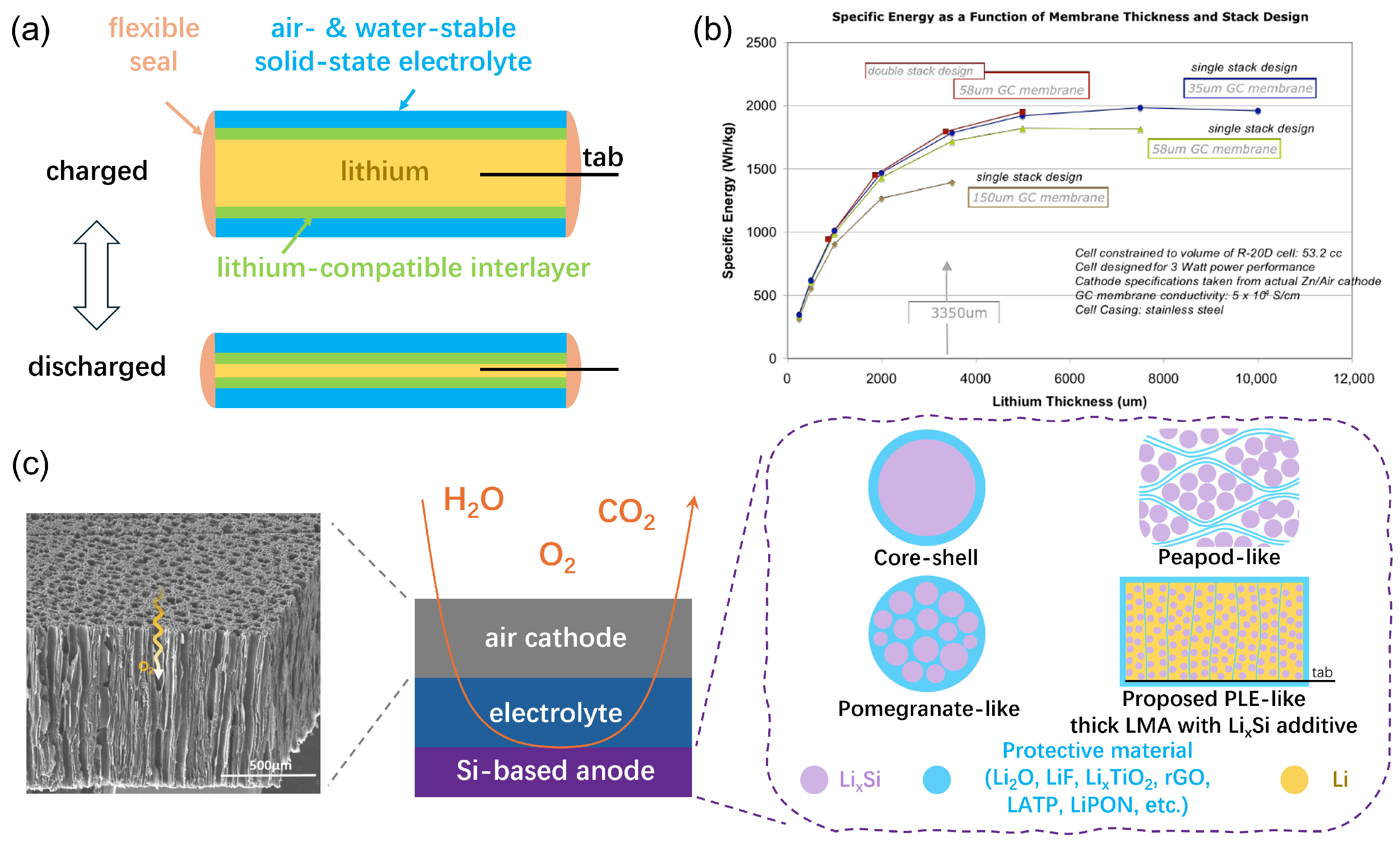
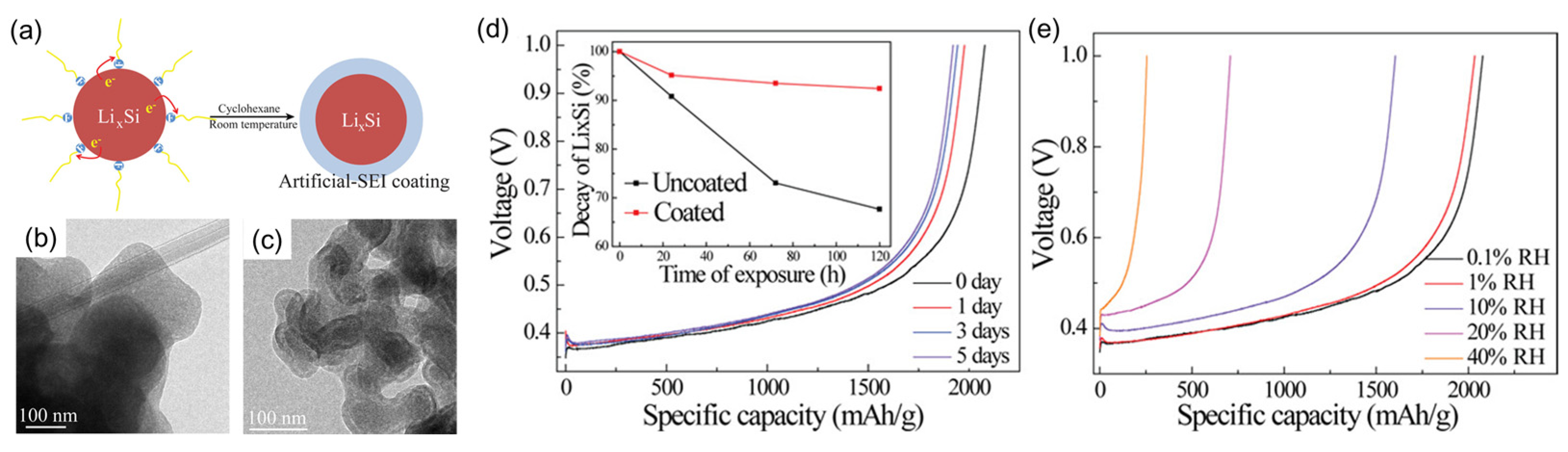
A core–shell is the most straightforward protection structure to design and manufacture. In 2014, Cui’s group [125] reported LixSi-Li2O core–shell nanoparticles (NPs) with improved dry air stability. The LixSi NPs (100~200 nm in diameter) were obtained by mechanical stirring of Si NPs (~50 nm in diameter) and molten Li at 200 °C in argon. Due to the trace oxygen (<3 ppm), a dense Li2O passivation layer (~10 nm thick) was formed on the surface of LixSi NPs, as illustrated in Figure 2a. They found that 1,3-dioxolane (DOL) and toluene have good compatibility with LixSi-Li2O NPs for electrode casting, showing a Li extraction capacity of 1200~1400 mAh g−1Si, while most of the capacity was lost after treatment with the normally used N-methyl-2-pyrrolidinone (NMP) or diethyl carbonate (EC), as shown in Figure 2b. The LixSi-Li2O NPs exhibited almost unchanged capacity (~1600 mAh g−1Si) in a 20-cycle operation; using it as the pre-lithiation reagent for Si NPs, the ICE improved from 76% to 94%, and the cyclability was also slightly improved (Figure 2c). As shown in Figure 2a, after 3 days of exposure to dry air (dew point −50 °C), the Li2O layer was thickened, while the X-ray diffraction (XRD) pattern almost unchanged. Although the capacity retention rate gradually decreased as the exposure was prolonged (Figure 2e), the exposure time is sufficient for battery manufacturing. However, when the dew point increased to above −10 °C, the capacity quickly decayed as LixSi and Li2O converted to LiOH, as shown in Figure 2f. The key metrics are summarized and compared in Table 1.
In 2022, Li’s group [126] used aluminum isopropoxide (dissolved in cyclohexane) to react with LixSi to construct a thin but dense LixAlySiOz/Li2O protective layer on the surface of LixSi NPs. The protected LixSi (denoted by A-LixSi) displayed a Li extraction capacity of 1005 mAh g−1, slightly lower than the bare LixSi (1137 mAh g−1) due to the surface passivation consumption. However, the remaining capacities of A-LixSi after 1, 3 or 5 h exposure to 30 ± 2% RH air were 840, 705 and 454 mAh g−1, respectively, considerably higher than the bare LixSi, which only retained 326 and 189 mAh g−1 after 3 and 5 h exposure, respectively.
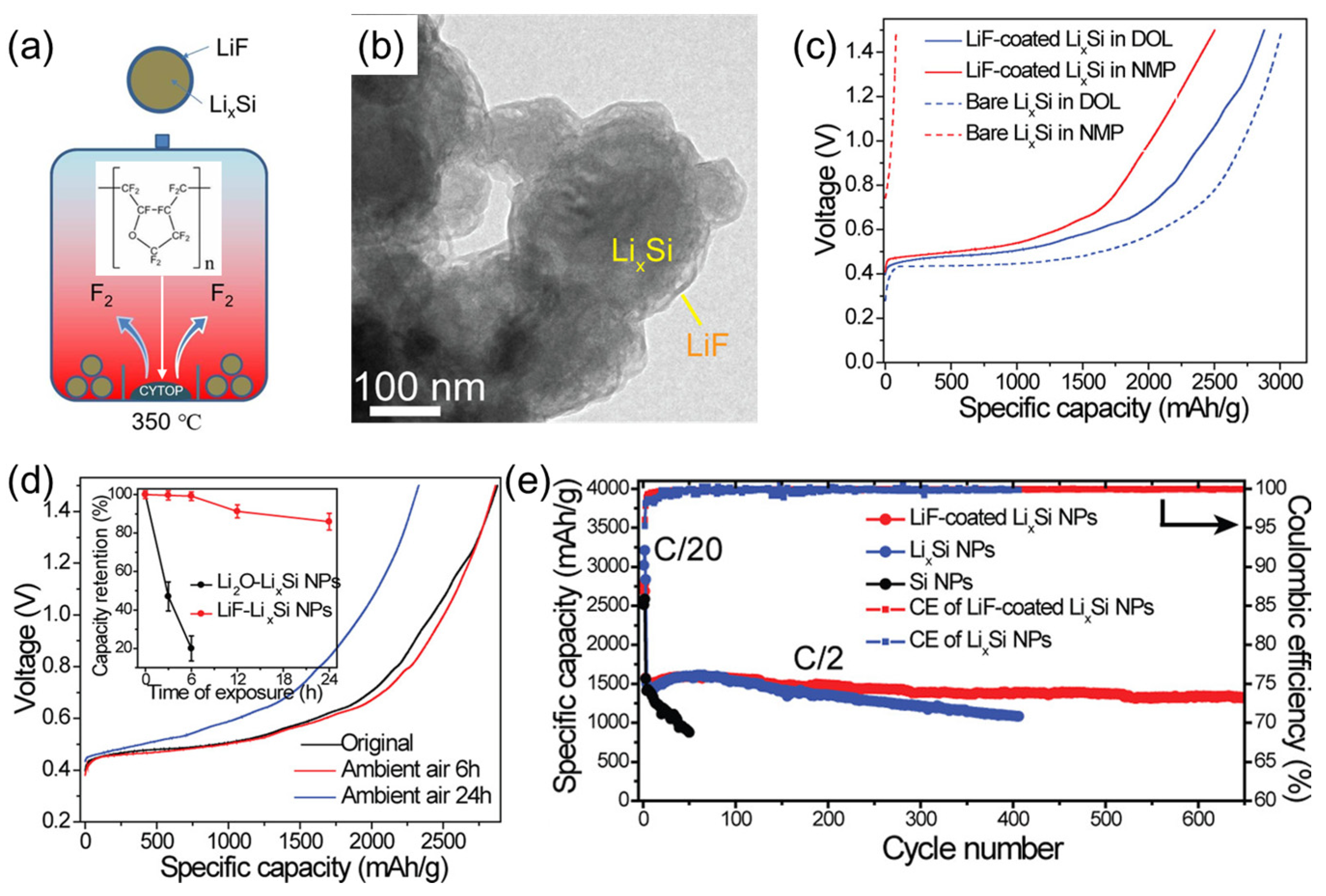
Since Li2O can readily react with H2O, these protection structures are still intrinsically susceptible to humid air. In contrast, LiF is a highly stable SEI component in various environments and can be intentionally utilized to construct air- and water-stable protection structures. In light of that, in 2015, Cui’s group [127] developed artificial-SEI-protected LixSi NPs with 1-fluorodecane as the precursor. The prepared LixSi NPs were added to 1-fluorodecane dissolved in anhydrous cyclohexane and reacted for 2 h, as illustrated in Figure 3a. 1-fluorodecane was chosen for its excellent processability in nonpolar solvents (e.g., cyclohexane) so the capacity loss of LixSi could be eliminated. The dissolved 1-fluorodecane was reduced on the surface of LixSi NPs, generating a conformal, continuous and dense coating (as shown in Figure 3b,c), which consists of LiF and lithium alkyl carbonate with long hydrophobic carbon chains to mitigate susceptibility to air and water. The extraction capacity of coated LixSi was 2078 mAh g−1Si, 10% lower than the bare LixSi, indicating ~10% of active lithium consumed in the coating formation. After 5 days in dry air (dew point −50 °C), the coated LixSi remained 92% of the initial capacity (as shown in Figure 3d), considerably higher than bare LixSi (67%) and their previously reported LixSi-Li2O NPs [125]. However, as the relative humidity (RH) further rose to 10%, 20% and 40%, the extraction capacity decreased to 1604, ~740 and ~250 mAh g−1Si after 6 h exposure, respectively, as shown in Figure 3e.
In 2017, Cui’s group [128] also used a commercial fluorinated thermoplastic polymer CYTOP (developed by AGC Chemicals; its structure is shown in Figure 4a) as the precursor to generate fluorine gas at 350 °C and in situ form a uniform and continuous LiF coating layer on the LixSi surface, as illustrated in Figure 4a. This dense and crystalline LiF coating (shown in Figure 4b) effectively isolates the reactive LixSi from air and slurry dispersants. Unlike the bare LixSi, which suffers from great capacity loss when the slurry dispersant shifts from DOL to NMP, the LiF-coated LixSi retained an extraction capacity of 2504 mAh g−1Si using NMP, close to that with DOL (2879 mAh g−1Si), as shown in Figure 4c. After 1 day of exposure to 40% RH air, the LiF-coated LixSi retained 85.9% of its initial capacity, much higher than the Li2O-LixSi NPs, which only remained at 20% of their initial capacity after 6 h exposure (shown in Figure 4d). The protective LiF coating also improved the average Coulombic efficiency (CE) from 99.79% to 99.92%, with a capacity retention rate of 87% after 650 cycles (Figure 4e).

2.2. Pomegranate-like and Peapod-like Compartmented Protection Structures

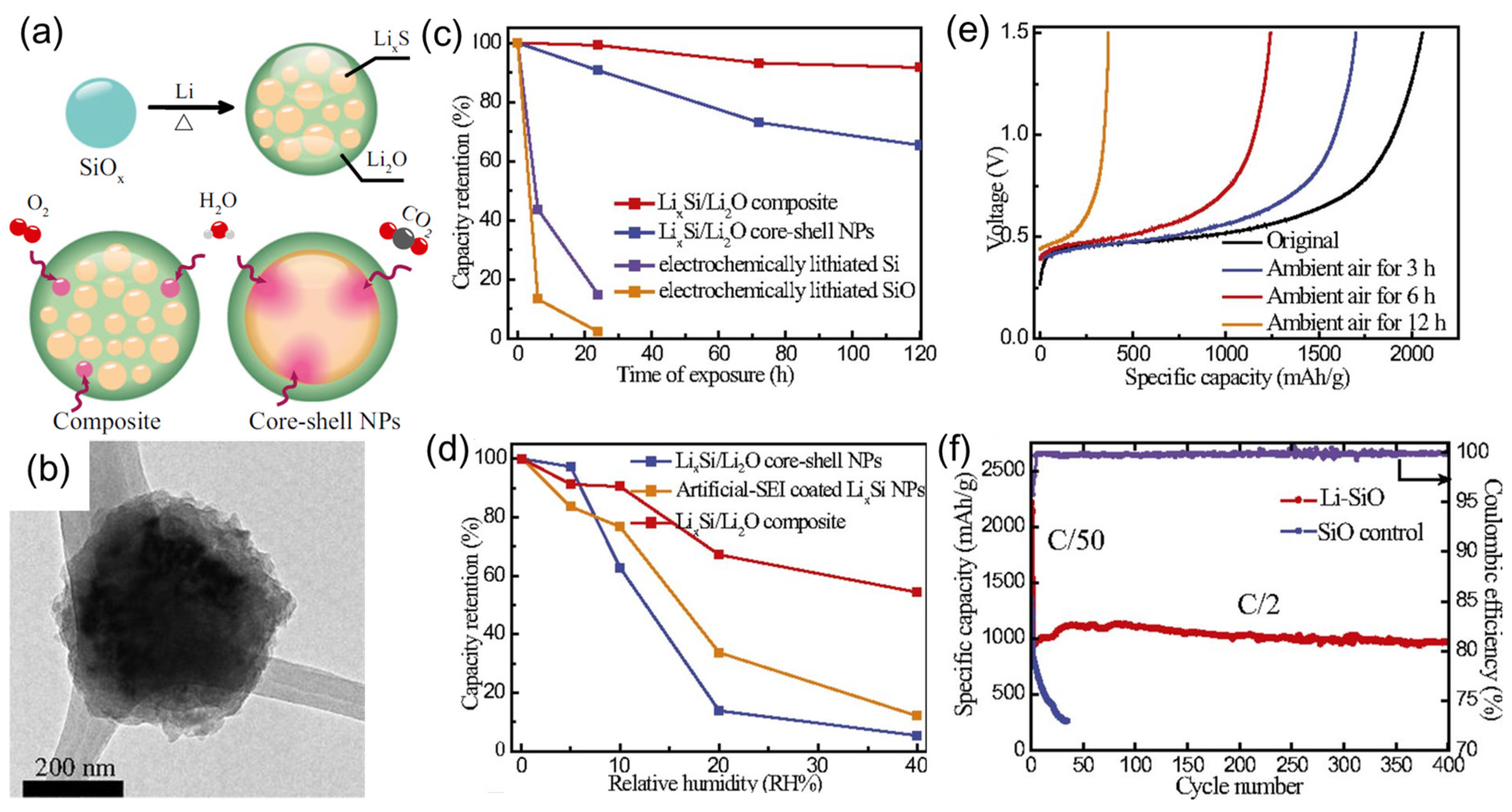
Despite the fruitful progress in core–shell-structured protected Si-based anodes, they are not fail-safe designs in nature; because it is difficult to realize perfect encapsulation, any pinhole will compromise the whole “defense line”, providing a pathway for moisture to react with inner LixSi. In contrast, compartmented designs can theoretically provide better protection; even if some compartments were compromised by pinholes, other independent compartments are still protected. In 2016, Cui’s group [131] developed a LixSi/Li2O composite with excellent ambient air compatibility through a one-pot metallurgical process, using SiO or SiO2 as the starting material to alloy thermally with molten Li metal, as illustrated in Figure 5a. The synthesized LixSi/Li2O composite had a pomegranate-like structure (Figure 5a,b); it exhibited an initial Li extraction capacity of 2059 mAh g−1SiO2 (equivalent to 3236 mAh g−1Si) at C/50 and lost only 9% of initial capacity after 5 days of exposure to dry air (dew point −50 °C), much lower than core–shell-structured LixSi-Li2O NPs (30%), as shown in Figure 5c. Furthermore, the pomegranate-structured LixSi/Li2O composite maintained a specific capacity of 1240 mAh g−1SiO2 after 6 h exposure to humid air with 40% RH (Figure 5d,e). It also exhibited excellent cyclability, achieving an average CE of 99.87% from the 200th to 400th cycle, as shown in Figure 5f. The improved air stability was attributed not only to the highly dense and crystalline protective Li2O matrix formed at high temperature (250 °C) and prolonged reaction time (5 days) but also to the compartmented LixSi nanodomains, such that each LixSi nanodomain has localized Li2O protection.
In 2017, Cui’s group [132] reported a freestanding peapod-like LixM/graphene foil (M = Si, Al, Sn and other materials that can form alloys with Li), which is composed of few-layer (<10 layers) graphene sheets and impregnated LixM NPs. Compared to Li2O in their previous LixSi/Li2O composite [131], the graphene sheets not only have better chemical stability against humidity to protect the impregnated LixM NPs but also provide higher electronic conductivity, achieving excellent air/water and cycling stability. The LixM alloy NPs were prepared by mechanically stirring a stoichiometric mixture of vacuum-dried M NPs and molten Li in argon at a temperature between the melting points of M and Li. The LixM alloy was then mixed with graphene sheets and poly(styrene-butadiene-styrene) (SBS) binder in toluene, and the mixture was cast onto a polyethylene terephthalate (PET) release film and left to dry. Then, thin layers of graphene sheets were coated on the double sides of the foil to protect the LixM NPs on the outer surface, forming the freestanding LixM/graphene foil. Finally, the LixM/graphene foil was pressed under 40 MPa. Since the LixM alloys were already in their fully expanded state, no extra void space was needed to accommodate the volume expansion. This pressing step not only increased the tap density to improve the volumetric capacity to 1800~2000 mAh cm−3 (corresponding to a specific capacity of 1600 mAh g−1LixSi), close to the theoretical value of Li metal (2061 mAh cm−3), but also eliminated the void space that allows air/water/electrolyte ingress. With a foil thickness of 19 μm, the LixSi/graphene exhibited an initial delithiation areal capacity of 3.8 mAh cm−2. Because the LixSi NPs are confined in the graphene matrix, the volume variation is buffered, and dendrite growth is mitigated effectively, enabling stable operation of 400 cycles with 98% capacity retention rate at an areal capacity of ~2.4 mAh cm−2 and current density of 1 mA cm−2 in a half-cell, corresponding to an excellent average CE of 99.92% after the initial two cycles. Furthermore, the LixSi/graphene foil exhibited excellent air/water stability, retaining 94.3% initial capacity after 2 weeks storage in dry air (dew point −50 °C) and ~80% after 3 days in ambient air (with 20~60% RH). Importantly, this preparation method makes the foil thickness highly tunable from 12 to 42 μm (corresponding to initial delithiation capacities of 2.0~8.3 mAh cm−2), as demonstrated in their work.

2.3. Protection Before Lithiation

As mentioned at the beginning of this section, when not lithiated, Si and SiOx are quite stable in ambient conditions. If lithiation could be carried out after building the protection structure rather than before, it would be much more convenient for production. In 2022, Wang et al. [129] reported a hollow porous SiOx@C sphere (Hp-SiOx@C) with excellent cyclability and air stability. The SiOx spheres were coated with resorcinol–formaldehyde (RF) resin, then incubated in hot water to form the hollow structure and finally calcinated to obtain Hp-SiOx@C. It exhibited an initial specific capacity of 1475.6 mAh g−1 at 0.1 A g−1 with 72.2% ICE. After activation at 0.1 A g−1, Hp-SiOx@C displayed a specific capacity of 1126.9 mAh g−1 at 1.0 A g−1 and a high-capacity retention rate of 91.2% after 1000 cycles, much better than the solid SiOx@C (42.4% capacity retention rate after 700 cycles). To improve the ICE and air stability, Hp-SiOx@C was electrochemically pre-lithiated in electrolyte and subsequently heated to 200 °C to evaporate electrolyte and form a robust Li2O-rich passivation layer on the outer surface, resulting in the air-stable pre-lithiated Hp-SiOx@C (ASP-Hp-SiOx@C). Even after 48 h of exposure to 10~20% RH air, it showed an initial specific capacity of 1179 mAh g−1 with a very high ICE of 99.2% and a capacity retention rate of 89.8% after 1000 cycles at 1.0 A g−1.
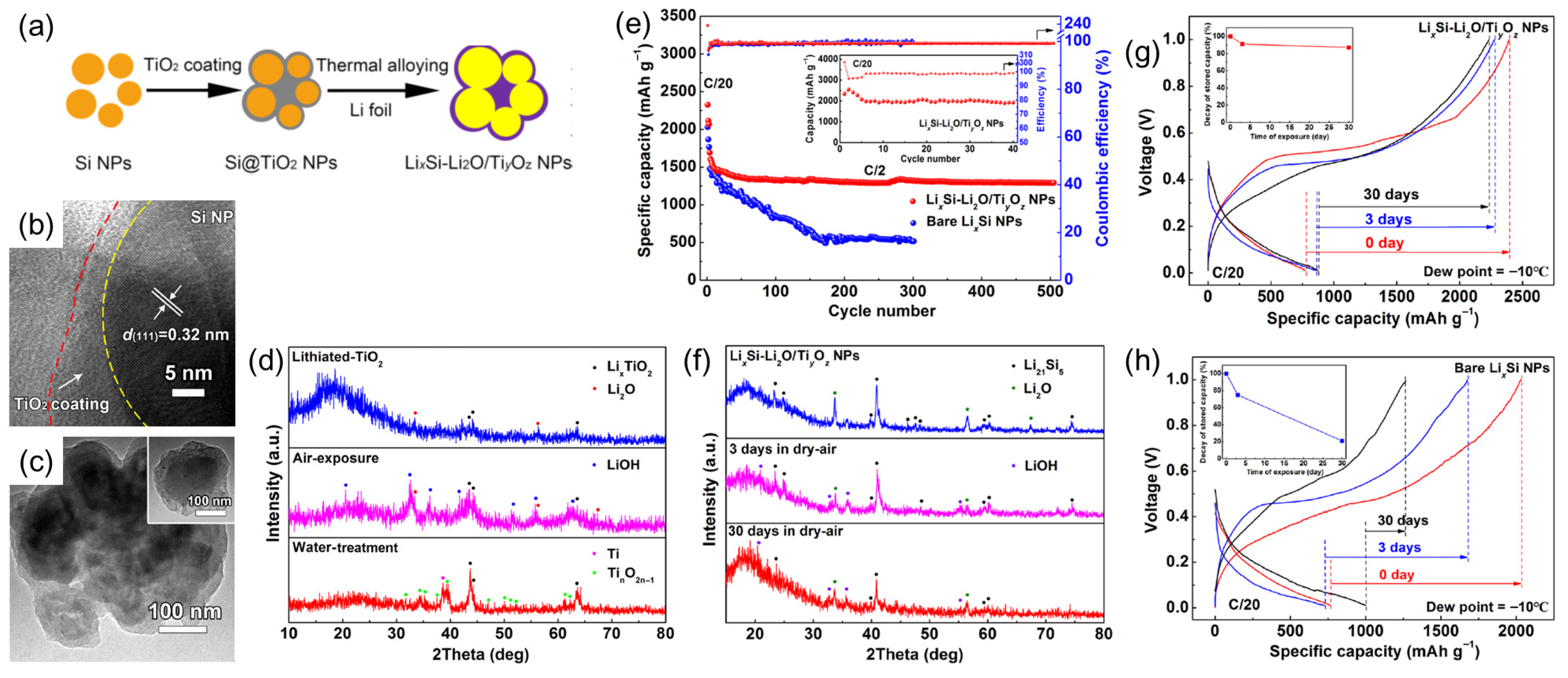
In the above work, pre-lithiation was performed electrochemically by assembling a Si||Li half-cell, as in numerous previous works, which is cumbersome with the need for cell assembling and disassembling, as well as removing residual pre-lithiation electrolytes. In contrast, both metallurgical and chemical lithiation are more desirable for industrial productions. In 2018, Lu’s group [130] developed a thermal lithiated TiO2 as a robust and electron-conducting protection coating for LixSi. As illustrated in Figure 6a, the amorphous TiO2 layer (5~15 nm thick) was first coated on the Si NPs with a facile sol–gel process, and then the Si@TiO2 NPs (with ~75 wt% Si) were alloyed with molten lithium to obtain the LixSi-Li2O/TiyOz product. After lithiation, the surface amorphous TiO2 converted to LixTiO2, which is stable against air and water (as shown in Figure 6d) and has a greatly improved electron conductivity of ~1 × 10⁻⁶ S cm−1. As shown in Figure 6e, the LixSi-Li2O/TiyOz composite exhibited an initial Li extraction capacity of 2326 mAh g−1Si at C/20 (1C = 4.2 A g−1Si) and maintained 2000 mAh g−1Si after 40 cycles. At a higher rate of C/2, the capacity was maintained at 1692 mAh g−1Si at the fourth cycle with a 99.4% CE and ~1300 mAh g−1Si after 500 cycles. As shown in Figure 6g, after 30 days of exposure to 10% RH air, the stored capacity that preloaded in the alloy (determined by subtracting the first lithiation capacity from the delithiation capacity) only decayed by 13% from 1560 mAh g−1Si to 1357 mAh g−1Si. In comparison, the bare LixSi NPs experienced a 79% decay (Figure 6h). In this work, the protective layer (amorphous TiO2) was constructed prior to alloying; thus, it can be carried out in an ambient environment, and after alloying with molten lithium (the only step requiring inert atmosphere in the crucible), the lithiated TiO2 is already in place to protect LixSi underneath from air and water, making the production much more convenient.
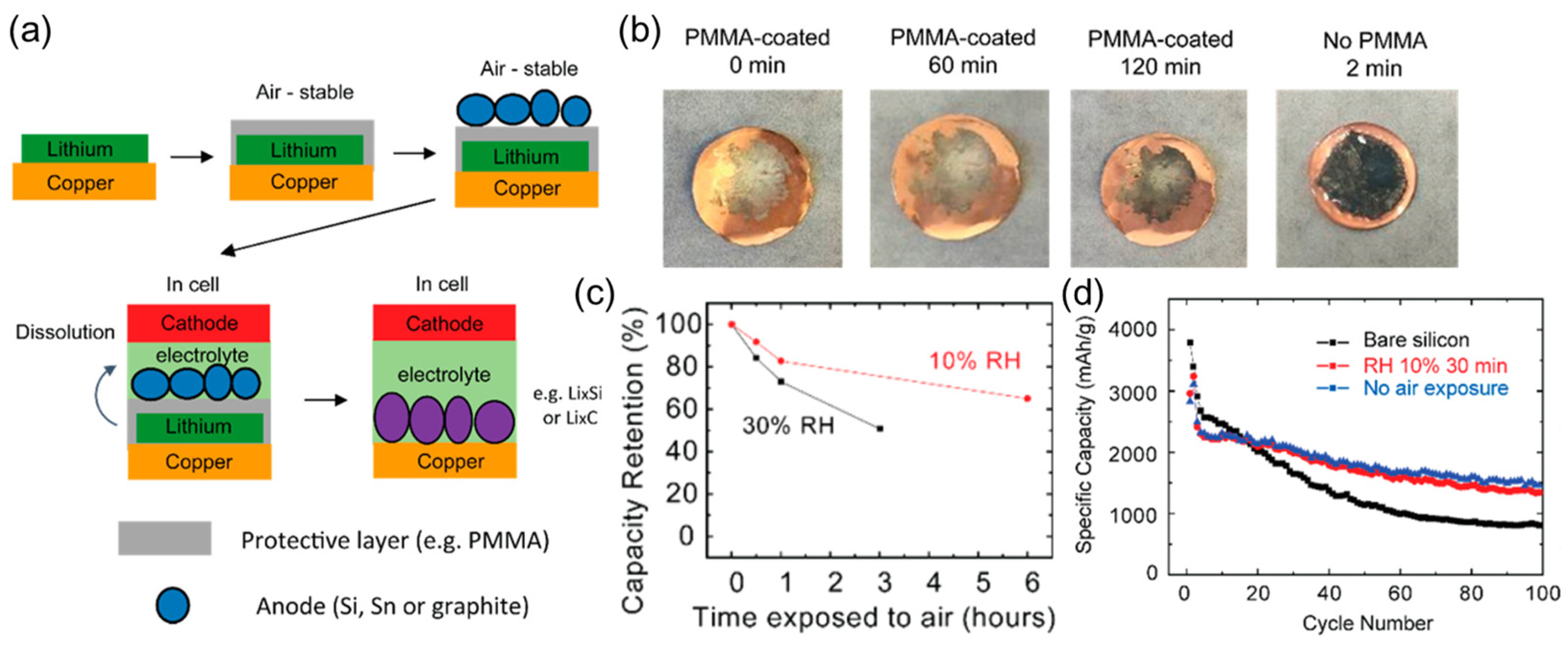
Compared to metallurgical pre-lithiation, which requires high-temperature treatment in an inert atmosphere, chemical pre-lithiation in ambient conditions is more desirable. To date, lithium foil and stabilized lithium metal powder (SLMP) are still the two major anode pre-lithiation reagents. SLMP was developed by FMC Corporation in the 2000s. It is surface passivated by a Li2CO3 coating (<3 wt%), providing significantly improved stability in dry air than regular lithium foil; however, it is still incompatible with aqueous slurry, which is usually used for anode production; furthermore, this proprietary product costs 1~2 times more than regular lithium foil. In 2016, Yang’s group [133] developed an anode pre-lithiation method with lithium foil that was protected by a soluble polymer coating. In their work, metallic lithium was electrochemically deposited onto the copper current collector, and then poly(methyl methacrylate) (PMMA) was dissolved in DOL and drop cast onto the lithium-plated copper foil. After evaporation, the uniform PMMA protective coating was formed. Then, this PMMA-coated lithium–copper film can be used as substrate to prepare artificial graphite (AG) or silicon electrode sheets, as illustrated in Figure 7a. The PMMA-coated lithium–copper film showed good compatibility with humid air (up to 10% RH, as shown in Figure 7b,c) and even aqueous slurry, with the metallic luster unchanged for 5 min (with 20 μm thick PMMA) or over 30 min (with 100 μm thick PMMA) in contact with water. This good protecting effect against air/water provides sufficient time for battery manufacturing. Nevertheless, in their battery tests, ethanol was used as the slurry dispersant for AG/silicon casting to minimize the loss of available lithium in the microcracks. After battery assembly, the PMMA coating was dissolved in electrolyte, and the metallic lithium underneath was exposed to contact AG/silicon to accomplish pre-lithiation even without pressure. With 30 min of exposure to 10% RH air, the PMMA-protected Si electrode retained a capacity of 1340 mAh g−1 (58% retention rate) after 100 cycles, similar to that without air exposure (1456 mAh g−1), considerably higher than the unprotected one (809 mAh g−1), as shown in Figure 7d. However, when the exposure time exceeded 1 h in 10% RH air or when the RH reached 30%, the improvement in electrochemical performance quickly vanished, unlike that with the AG/PMMA/Li electrode, possibly attributed to silicon’s more hydrophilic property and higher surface area than graphite, so the moisture penetrates more easily. Although this work showed good short-term air stability of the PMMA-protected Li/Si composite anode, it cannot be directly transplanted to LABs/LOBs because of the dissolution of PMMA coating.
In 2020, Qu’s group [135] developed an air-stable chemical lithiation compound, Li−9,9-dimethyl-9H-fluorene-tetrahydrofuran (Li-Flr-THF). It was facilely prepared by dissolving 1 M 9,9-dimethyl-9H-fluorene (Flr) in tetrahydrofuran (THF) and then adding excess Li metal in the solution and reacted for 2 h. Although the prepared pre-lithiation reagents are susceptible to the moisture in the air, they can remain in the dried ambient air for several days without degrading. The lithiation was carried out by simply immersing the pristine graphene-coated SiO (SiO/G) electrode (SiO:graphene = 45:55, w/w) for a predetermined duration, followed by washing with THF and drying. Flr exhibited a lower (0.18 V vs. Li/Li+) redox potential compared to other lithium radical anions of polycyclic aromatic hydrocarbons (PAHs), such as biphenylide (Bp, 0.32 V) and naphthalenide (Nap, 0.25 V); this led to the formation of a relatively thin and complete SEI layer with Flr. In contrast, the more positive redox potentials of Nap and Bp not only took longer time (>1 h vs. ~10 min) to form SEI but also resulted in incomplete SEI coverage. Consequently, in half-cells, the SiO/G electrode with Flr treatment exhibited an initial delithiation capacity of 130 mAh g−1, much higher than those with Bp (40 mAh g−1) or Nap (10 mAh g−1). The cell with Flr treatment also presented higher ICE (87.1%) than that with Bp (85.8%) or Nap (82.9%), confirming that Li-Flr-THF was the optimal pre-lithiation reagent. In SiO/G||NCM622 full-cell tests, the Flr-treated sample gave a much higher ICE (87.1%) than the untreated one (61.1%).
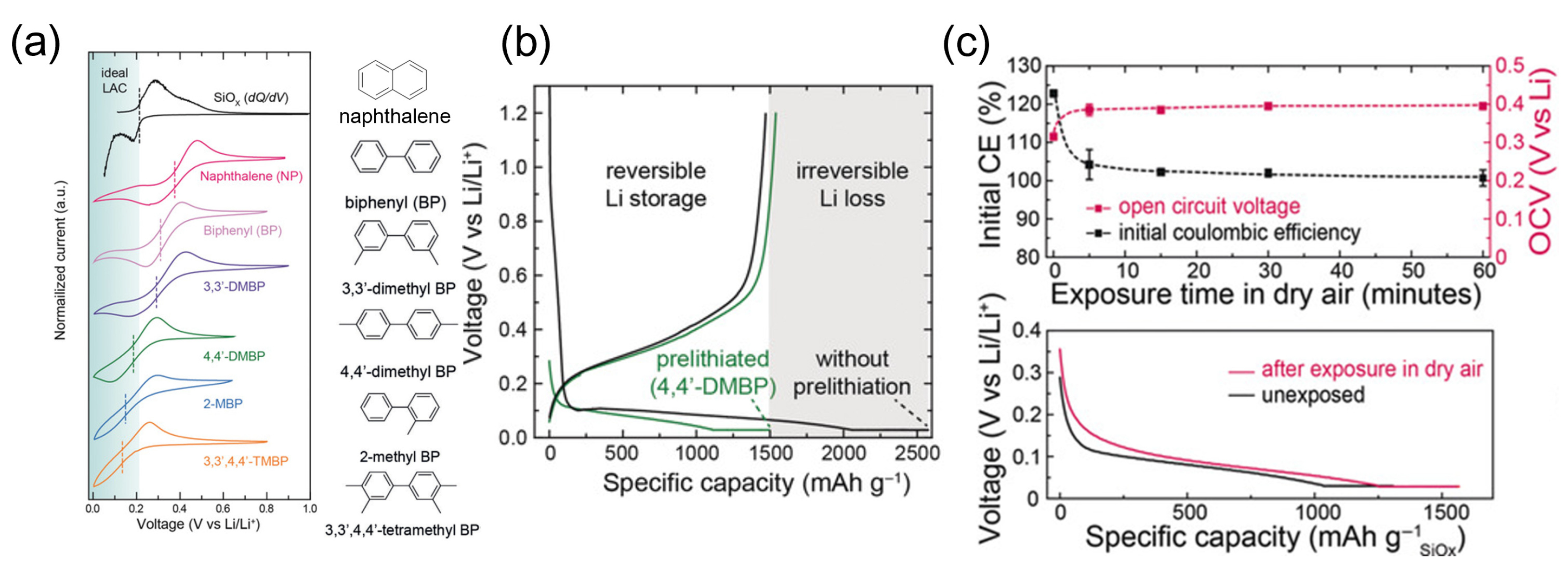
Similarly, in the same year, Lee’s group [136] developed a lithium–arene complex (LAC) as the chemical pre-lithiation reagents for SiOx (x ≈ 0.5). The LAC was facilely prepared by dissolving lithium metal into methyl-substituted biphenyls (e.g., 4,4′-dimethylbiphenyl, abbreviated as 4,4′-DMBP, shown in Figure 8a). When in contact with SiOx, the LAC (e.g., Li-4,4′-DMBP) was immediately oxidized because of its lower redox potential (~0.2 V vs. Li/Li+) than Si (~0.3 V vs. Li/Li+), donating lithium ions to SiOx to complete the pre-lithiation and formation of the SEI. The pre-lithiated SiOx exhibited similar extraction capacity around 1600 mAh g−1 before and after 1 h of exposure to dry air, as shown in Figure 8b, much higher than that with Li-Flr-THF treatment (130 mAh g−1) [135]. However, after exposure to 35~40% RH air, the extraction capacity plummeted to ~300 mAh g−1.

2.4. Silicon–Graphite Hybrid Electrode

In today’s commercial LIBs, Si/C and SiOx are usually composited with other anode materials (graphite, soft/hard carbon, etc.) to buffer Si’s volume variation and improve electronic conductivity. Although they compete in the allocation of Li+ and electric current, they work independently from a particle-level viewpoint. However, in 2024, Zhang’s group [134] reported a lithium-enriched silicon/graphite (LESG) anode with unexpected excellent air and water stability. It was prepared by spray drying a mixture of a lithium-enriched graphite, nano-silicon powders and pitch in THF and subsequent calcination. The prepared LESG (with 12.44 wt% Si) presented a specific capacity of 620 mAh g−1 and excellent stability in air and water. It can be immersed in water without detectable H2 emission using gas chromatography. Furthermore, after 1 week of exposure to humid air (~71% RH), LESG displayed an initial discharge specific capacity of 505 mAh g−1, almost the same as that without air exposure, and the cell with exposed LESG also showed negligible capacity loss after 50 cycles. Through molecular dynamics simulation, they found the formation of a novel O-Li-Si structure, and the dissociation of all Li-adjacent bonds in LESG requires a much higher energy of 4.72 eV than that in LixSi (3.38 eV for equidistant site and 3.03 eV for top site), which may be the reason for LESG’s higher air and water stability.
In summary, there have been several silicon-based anode materials displaying excellent air stability for prolonged exposure (1~30 days) to ambient air (10~60% RH) along with high specific capacity, such as the core–shell-structured LixSi@LiF with CYTOP-derived LiF-based SEI [128] (2879 mAh g−1Si, 85.9% capacity retention rate after 1 day of exposure to 40% RH air), pomegranate- or peapod-structured LixSi/graphene composite foil [132] (1600 mAh g−1LixSi, ~80% capacity retention rate after 3 days of exposure to 20~60% RH air) and core–shell-structured LixSi-Li2O/TiyOz composite [130] (1560 mAh g−1Si, 87% capacity retention rate after 30 days of exposure to 10% RH air). Furthermore, due to the high-quality (artificial) SEI formed with the protective components and structures, in some works, long cyclability could be achieved without fluorine-containing electrolyte additives (such as VC and FEC [127,128,131,133], as listed in Table 1). These are promising anode candidates for Li-ion–air batteries.

3. Lithium-Ion–Air (Or O2) Batteries with Silicon-Based Anodes

In 2012, a joint study by the Scrosati, Sun and Amine groups [137] reported the first effort to replace LMAs with a silicon-based anode in LABs/LOBs. They synthesized a spherical nano-Si-C composite by heating a mixture of nano-Si, graphite and petroleum pitch; then, the obtained Si-C composite (with a Si-C mass ratio of 3:7) was lithiated by direct contact with a lithium foil in an electrolyte solution to form Li2.6Si, which displayed a specific capacity of 650~780 mAh g−1Si-C in the first 20 cycles of a half-cell with tetraethylene glycol dimethyl ether (TEGDME) as the electrolyte solvent. Ex situ XRD patterns of the cathode and anode after discharge and recharge of the Li-ion–O2 full cell revealed the formation and disappearance of Li2O2 at the cathode, as well as the conversion between Si and LixSi. The Li-ion–O2 full cell stably operated 15 cycles under a fixed capacity of 1000 mAh g−1carbon, even with a small N/P ratio (2.34), demonstrating the feasibility of this concept. The corresponding data are listed in Table 2. They also noted a small but progressive drop of both the discharge and charge voltage, which could be attributed to gradual degradation of LixSi due to oxygen attack. Since this foundational work, several other Li-ion–air (or O2) batteries with Si-based anodes have also been reported [84,138,139,140,141,142,143,144], mainly focusing on the electrolyte formulation to improve SEI quality and combination with (quasi-)SSE membranes to suppress the crossover of air and electrolyte components, as discussed below.

3.1. Electrolyte Formulation for Improving SEI Quality

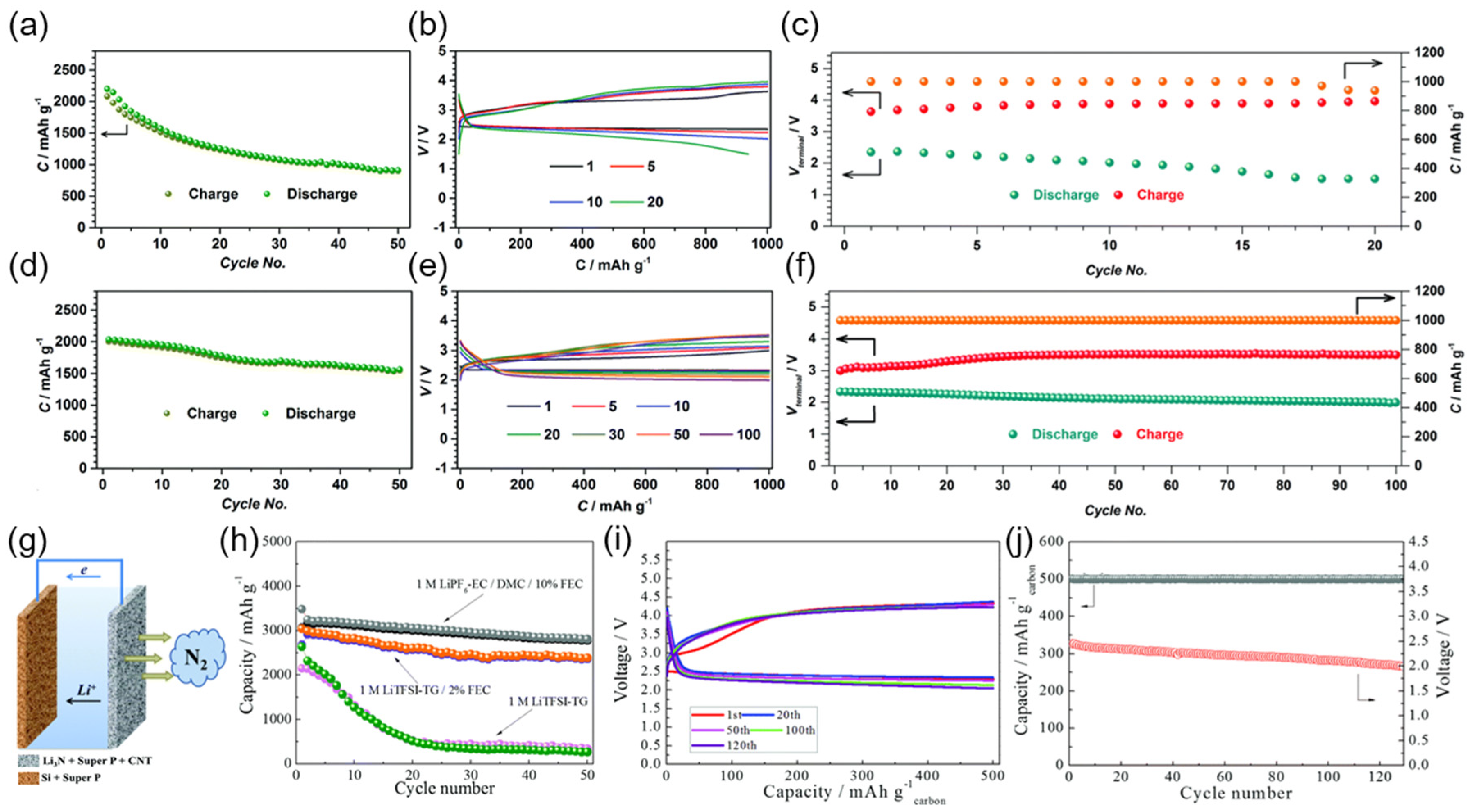
In 2016, Zhou’s group [138] introduced fluoroethylene carbonate (FEC) into the electrolyte to construct a robust SEI on the surface of commercial Si NPs during electrochemical pre-lithiation in a half-cell. The addition of FEC in the TEGDME-based electrolyte did not affect the initial Li extraction capacity (2090 mAh g−1Si without FEC and 2083 mAh g−1Si with FEC) but significantly improved the capacity retention rate from ~45% to ~78% after 50 cycles at 100 mA g−1Si, as shown in Figure 9a,d. Then, they used the pre-lithiated Si anodes in Li-ion–O2 full cells with an N/P ratio of 3.9 to test their cyclability with a fixed-capacity limit of 1000 mAh g−1Ru/KB at 500 mA g−1Ru/KB, where Ru-loaded Ketjenblack (Ru/KB) was used as the cathode substrate. As shown in Figure 9b,c,e,f, the cell with the FEC-treated Si anode sustained 100 cycles without capacity fading, significantly better than that without FEC, which started to show capacity fading within 20 cycles. Even when the N/P ratio was reduced to 2.5, the cell with FEC-treated Si still showed a good lifespan of 60 cycles. Furthermore, ex situ XRD tests revealed that after first recharge in the Li-ion–O2 full cell, the diffraction peaks corresponding to LixSi were similar to the pristine electrode with the FEC-treated Si anode, whereas the signal was much weaker after recharge for the cell with untreated Si. These results confirm the critical role of anode protection for the longevity of Li-ion–O2 batteries with Si-based anodes. They also conducted ex situ X-ray photoelectron spectroscopy (XPS) tests for the pre-lithiated Si anodes, revealing LiF and Li2CO3 as the main components of the SEI for the untreated Si anode; in contrast, the FEC-treated Si anode possibly contains a new polyfluorocarbon component, though some LiF and Li2CO3 were also present. The stabilization effect of FEC treatment was further evidenced by the greatly improved cyclability of Si-Li half-cells in an O2 atmosphere, where the cell with FEC retained ~78% of initial capacity after 50 cycles and that without FEC retained only ~11%. In addition, the cell with FEC-treated Si maintained a stable open-circuit voltage (OCV) around 2.42 V and stable impedance during 64 days of storage in O2; in contrast, the cell with untreated Si experienced a continuous OCV drop (from ~2.36 V to ~2.07 V) and impedance increase. These results demonstrate the significant effect of FEC treatment in improving the SEI robustness to resist oxygen permeation and SEI rupture by the volumetric variation of Si.
In the above work, the electrochemical pre-lithiation requires the assembly of a dedicated Si||Li half-cell with SEI-forming additives, followed by disassembly of the half-cell to retrieve the pre-lithiated Si anode and removal of residual SEI-forming additives to prevent undesirable parasitic reactions on the surface of air cathode. In 2016, Yang, Wang and co-workers [139] developed an in situ lithiation method with Li3N preloaded in the air cathode (Li3N–super P–CNT composite, with a mass ratio of 90:5:5, as illustrated in Figure 9g), eliminating the need for a dedicated pre-lithiation half-cell. They compared the cyclability performance of commercial Si NPs with and without FEC in TEGDME-based electrolyte, as well as that with FEC in carbonate electrolyte, finding that the addition of 2% in TEGDME-based electrolyte is optimal for a Li-ion–O2 full cell. As shown in Figure 9h, on the one hand, it provides similar anode specific capacity (~3000 mAh g−1Si) and cyclability performance (~83% capacity retention rate after 50 cycles in half-cell) to the carbonate electrolyte with 10% FEC (which cannot be used in LABs/LOBs due to carbonate degradation by superoxides); on the other hand, the 2% FEC can be completely consumed in 2 cycles to prevent its further parasitic reactions at the air cathode. Ex situ XRD tests after the first charge (~10.3 mAh with a cutoff voltage of 3.6 V to ensure complete decomposition of Li3N) indicated the disappearance of Li3N and Si, along with the formation of LixSi, demonstrating the feasibility of this in situ pre-lithiation method. In the full-cell cyclability tests with Li3N-preloaded cathode at a fixed capacity limit (500 mAh g−1carbon, equivalent to 0.44 mAh cm−2), the cell with Si anode and preloaded Li3N survived 129 cycles, much longer than that with LMA (65 cycles), as shown in Figure 9i,j, though the active Li reserve in the in situ-formed LixSi was smaller (11 mAh) than the LMA (14 mAh).

3.2. Suppressing Crossover of Air and Electrolyte Components

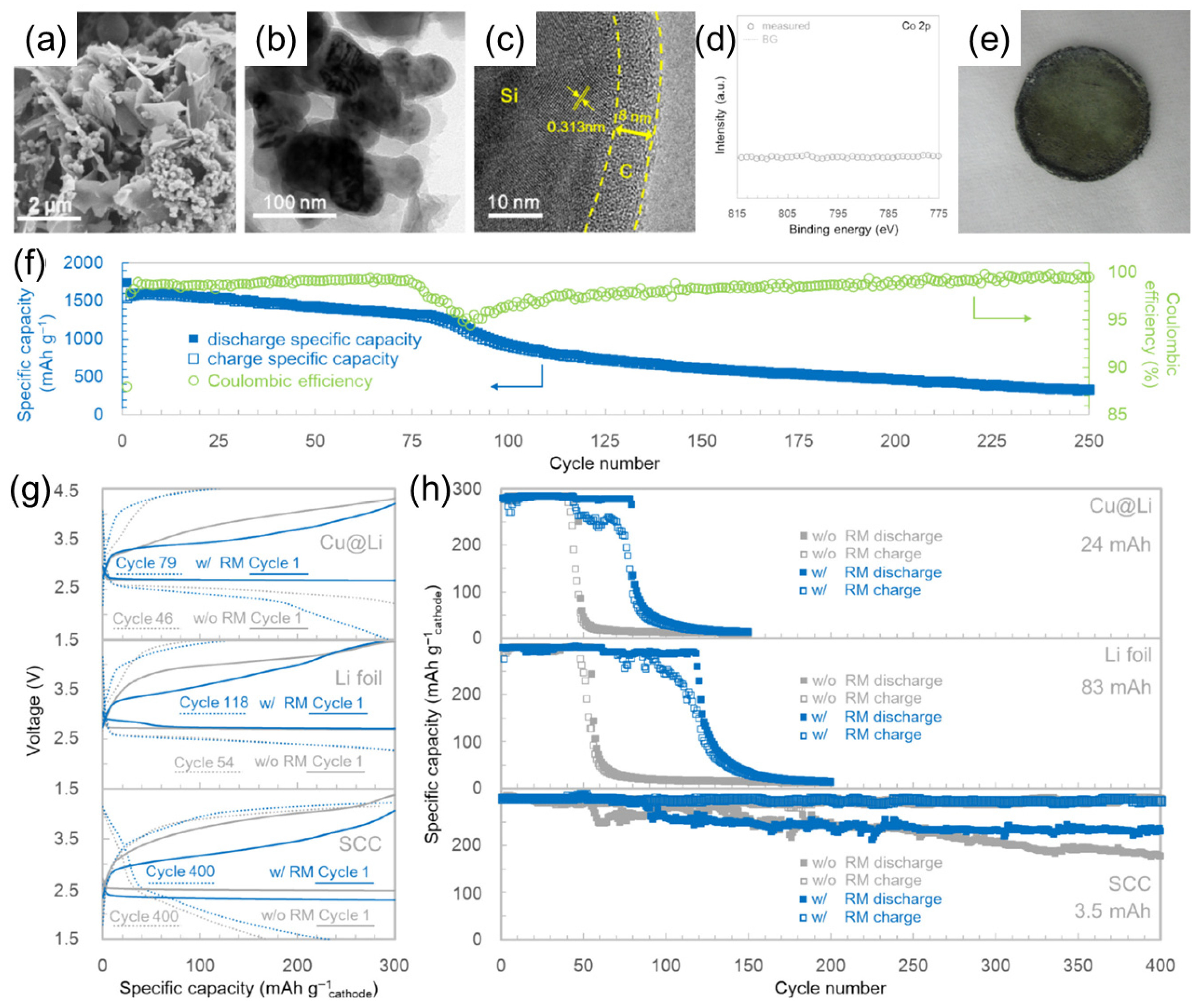
As mentioned at the beginning of this review, in recent years, it has been recognized that the crossover of air components and other soluble species in the electrolyte has critical impacts on the LMA’s polarization and cyclability; however, in 2025, Yan et al. [140] found that silicon-based anodes are much less affected by the crossover of RMs. They synthesized a Si-C composite (SCC) using Si NPs, phenolic resin, sodium alginate and bitumen as the precursors. The synthesized SCC exhibited an initial discharge capacity of 1750 mAh g−1SCC with 88.04% ICE in an SCC||Li half-cell. The capacity retention rate was 54% after 100 cycles at 0.1C, as shown in Figure 10f. Then, the electrochemically pre-lithiated SCC was assembled into Li-ion–air full cells (in N2-O2, 78:22, v/v) for cycling tests with a fixed capacity limit of 0.072 mAh cm−2. As shown in Figure 10g,h, although the cell with SCC has a much lower areal capacity (1.74 mAh cm−2) than the Li foil (41.27 mAh cm−2) and Li-deposited Cu foil (abbreviated as Cu@Li, 11.93 mAh cm−2), it sustained significantly more (86) cycles than that with Li foil (60 cycles) or Cu@Li (43 cycles). Furthermore, ex-situ XPS and energy-dispersive X-ray spectroscopy (EDS) mapping after cycling reveals no deposition of RM (binuclear cobalt phthalocyanine, bi-CoPc) on the SCC (Figure 10d), despite the absence of an SSE membrane to prevent crossover. In contrast, the Li foil after cycling displayed clear Co signal in the EDS mapping, and the whole electrode turn green (Figure 10e, characteristic of bi-CoPc). These results demonstrate the higher compatibility of silicon-based anodes with RMs than LMAs.
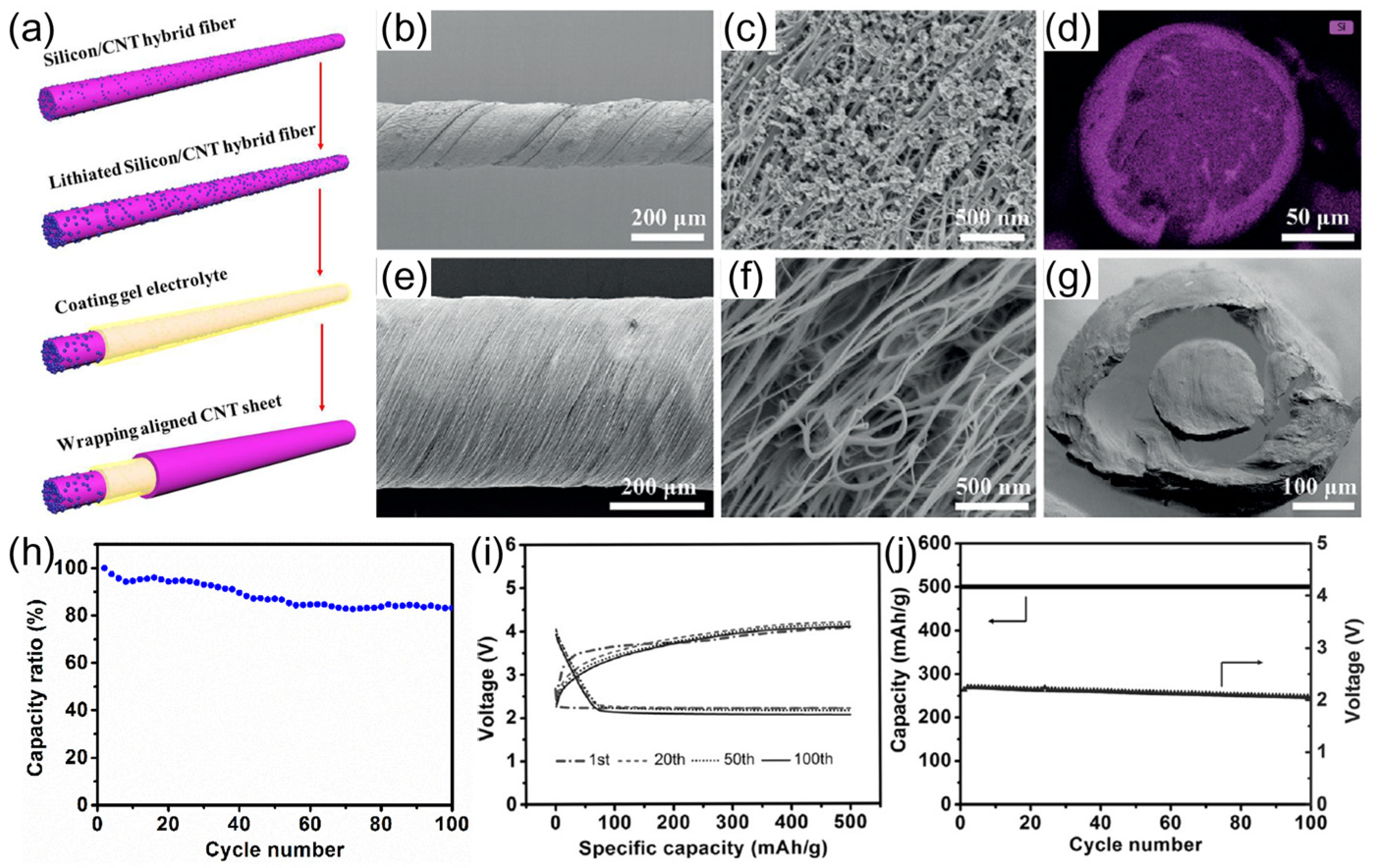
To isolate silicon-based anodes from ambient air components, using (quasi-)SSE membranes has been a straightforward and effective approach. In 2017, Peng’s group [141] reported the first device-level prototype of a Li-ion–air battery with a GPE-protected (where GPE stands for gel polymer electrolyte) Si anode. They designed a coaxial fibrous structure where the electrochemically pre-lithiated silicon/carbon nanotube (CNT) hybrid fiber served as the inner anode, GPE as the interlayer and a bare CNT sheet as the outer cathode. As illustrated in Figure 11a, Si NPs were first coated onto two stacked CNT sheets, which was then twisted into a Si/CNT hybrid fiber (with 83.84 wt% Si, shown in Figure 11b–d). Electrochemical pre-lithiation was performed by galvanostatic cycling of the hybrid fiber with a Li sheet in a coin cell. It exhibited a reversible specific capacity of 1250 mAh g−1Si/CNT with a capacity retention rate over 80% after 100 cycles (Figure 11h), which was attributed to the spiral structure that enabled firm combination of Si NPs on the CNTs’ surfaces, as well as the numerous voids that provided space for volume expansion. The resulting LixSi/CNT fiber anode was then coated with a layer of UV-cured GPE, consisting of LiTFSI, LiNO3, TEGDME, PVDF-HFP, NMP, 2-hydroxy-2-methyl-1-phenyl-1-propanone (HMPP) and trimethylolpropane ethoxylate triacrylate (TMPET). After that, an aligned CNT sheet was wrapped around the hybrid fiber to serve as the air cathode, with an anode–cathode mass ratio of 1.15:1, as shown in Figure 11e–g, and finally, a punched heat shrinkable tube was used to seal the fibrous cell. With a fixed capacity limit of 500 mAh g−1cathode (corresponding to an N/P ratio of 2.88), the full cell stably operated for 100 cycles in 5% RH air, with a specific energy of 512 Wh kg−1 (based on the mass of the cathode and anode, excluding the mass of GPE and packaging), as shown in Figure 11i,j. These results strongly suggest that silicon-based anodes can be effectively protected by GPE against O2 and moisture.
Later in 2019, Yang’s group [142] further improved the Li-ion–O2 battery by optimizing the electrolyte salt. They synthesized a freestanding and flexible Si/C film (with 51 wt% Si) by electrospinning a dispersion containing polyacrylonitrile (PAN) and nano-silicon powder and subsequent calcination. When assembling the LAB/LOB, a Li foil was placed between the Cu-foil current collector and freestanding Si/C film, so the Si/C was chemically pre-lithiated once in contact with the electrolyte. Although the Si/C film exhibited a similar initial Li extraction capacity around 1000~1400 mAh g−1Si/C with different electrolyte formulations, the Si/C||Li half-cell with 1M LiTFSI TEGDME showed rapid capacity decay, which was ascribed to the SEI’s instability. However, by replacing LiTFSI with lithium bis(fluorosulfonyl)imide (LiFSI), a dramatically improved capacity retention rate (from 15% to 72% after 40 cycles) was achieved even without the FEC additive, close to that with carbonate electrolyte and FEC (83%). This improvement was attributed to the formation of a robust SEI, which contains Li4SiO4 and SiO2 but without fluoride on the anode surface. The Li-ion–O2 full cell was then assembled with a GPE based on PVDF-HFP, LiFSI and LiI, and multiwall carbon nanotubes (MWCNTs) were used as the air cathode with a loading of ~0.3 mg cm−2. In addition, a composite Cu@Li foil served as both the anode current collector and pre-lithiation reagent. The cell with Si/C (with an areal capacity of 8~9 mAh cm−2) and GPE stably operated for 140 cycles with a fixed capacity of 1000 mAh g−1MWCNT (equivalent to 0.3 mAh cm−2), significantly higher than that with an LMA (80 cycles). In contrast, the cyclability with liquid electrolyte (1 M LiFSI TEGDME + 50 mM LiI in TEGDME) was much poorer, with only 90 cycles with Si/C and 44 cycles with the LMA. The improved cyclability with Si/C anode and GPE was attributed to the higher stability of LixSi than the LMA and GPE’s suppression effect on the crossover of O2 and other soluble intermediates, respectively. They also tested the cyclability of Li-ion–air cells in humid air (40% RH): the cell with Si/C survived 20 cycles under a fixed capacity of 1000 mAh g−1carbon, while the cell with the LMA survived only 9 cycles.
In general, the use of silicon-based anodes in LABs/LOBs is still in its infancy but has shown good prospects. Electrolyte optimizations and combination with GPE have resulted in significant cycling performance improvements, even with low N/P ratios. However, most reported batteries used commercial Si NPs or homemade Si-C composites that are not optimized for long-term air and water stability. In addition, in most works, the air stability of these silicon-based anodes was not specifically tested in half-cells. These factors should be considered in the future development of Li-ion–air batteries with silicon-based anodes.

4. Conclusions and Prospects

According to the above discussions, pre-lithiated silicon-based anodes can achieve remarkable air stability, even under prolonged exposure (up to 30 days) to ambient humidity (up to 71% RH) through proper designs of protective layers (e.g., LiF, LixTiO2 and graphene). These architectures allow the pre-lithiated anodes to retain most of their initial capacities, reaching up to 1600 mAh g−1LixSi. Furthermore, these protective architectures can serve as artificial SEIs to significantly enhance ICE. While pre-lithiation is essential for improving ICE and cyclability and can potentially alleviate the need for excessive buffering substrates or complex internal void structures (e.g., yolk–shell designs), its industrial application has been historically bottlenecked by the poor air stability of lithiated silicon. Given these advancements in air stabilization, the mass production of pre-lithiated silicon materials and their increased integration into graphite-based anodes are expected in the near future.
With further advancements in ICE and cyclability, silicon-based materials are poised to transition from additives to the dominant active components in anodes, where they would rival LMAs in specific capacity. Although PolyPlus PLEs offer impeccable air and water stability alongside near-theoretical specific capacity, their effective specific capacity in secondary batteries (e.g., 709 mAh g−1 with 25 μm thick Li, as calculated in Section 1) can be surpassed by certain air-stable silicon-based anodes (such as LixSi/graphene composite foils). This performance gap arises because maintaining robust interfacial contact between the lithium metal and the protective layers (e.g., LiPON/LATP) during cycling necessitates the use of thin lithium foils, which inadvertently leads to a disproportionately high mass percentage of these auxiliary components. To pursue extreme specific and areal capacities, ultrathick LMAs (e.g., PLEs with 3350 μm thick Li) remain the ultimate pathway; in this scenario, silicon-based materials can still function as critical structural scaffolds, providing lithiophilic deposition hosts and high-flux lithium transport pathways, as illustrated in Figure 1c. Furthermore, drawing inspiration from the concept of “reserve lithium-ion batteries” [145], air-stable pre-lithiated silicon can act as a robust “lithium reservoir”. This setup not only enables in situ lithiation of the anode to compensate for initial capacity loss but also facilitates the recovery of lost capacity in both electrodes during long-term cycling. By integrating air-stable protective layers, these silicon-based reservoirs can mitigate the risks associated with pure lithium metal while ensuring a continuous lithium supply, thereby significantly extending the lifespan of LABs/LOBs.
As for the Li-ion–air (or O2) batteries, although most utilized silicon-based anodes were not optimized for air stability, they have still shown a significant advantage in cyclability over unprotected LMAs even with a much smaller lithium reserve, indicating that silicon-based hosts can effectively mitigate the catastrophic side reactions between active lithium and permeated oxygen species (e.g., O2 or O2 radical). From the perspective of hard and soft acids and bases (HSAB) theory, while metallic Li0 acts as a highly reactive “soft base” that reacts indiscriminately with “hard” oxygen-containing species, the lithium in LixSi alloys possesses a more localized electron density, shifting its character toward a harder acid. This increased “hardness” promotes a more chemically robust interface and thermodynamic compatibility within the lithium–air (or O2) environment. Consequently, unlike the formation of thick LiOH-rich passivation layers typical of unprotected LMAs in LABs/LOBs, the lithiated silicon framework provides a more stable kinetic landscape for lithium storage. With the integration of air-stable protective layers (e.g., those mentioned in Section 2), pre-lithiated silicon anodes could not only rival LMAs in capacity but also surpass them in practical robustness for long-term LAB operations.
Despite these promising advancements, several critical challenges must be addressed to fully realize the potential of air-stable pre-lithiated silicon anodes in next-generation batteries.
First, there is a prominent “bottleneck” in bridging material-level stabilization with system-level application. While Section 2 highlights significant breakthroughs in air-stable pre-lithiated silicon anodes, the practical LOB/LAB studies summarized in Section 3 still predominantly rely on conventional or unprotected silicon materials, and the superior durability of these newly developed protective architectures (e.g., LixTiO2 and graphene-based scaffolds) has yet to be validated under the aggressive oxidative environments and complex radical chemistries of functioning LABs/LOBs. Future research should prioritize the integration of these air-stable anodes into full-cell configurations. This would not only verify their effectiveness in suppressing parasitic reactions (such as LiOH and/or Li2CO3 accumulation) but also provide a realistic assessment of their energy density advantages over lithium metal-based systems under ambient conditions.
Second, further insights into the reaction mechanisms between the pre-lithiated species and electrolyte/air components are required. Although silicon-based anodes have been extensively investigated for decades, the chemical compatibility of their pre-lithiated states with air components (O2, H2O, CO2, N2, etc.), as well as with specific LAB/LOB electrolyte components (e.g., ethereal solvents, lithium salts, RMs and crossover intermediates), has received far less attention. Establishing such a fundamental understanding is vital for further enhancing the ambient stability of silicon-based anodes and ensuring their successful integration into future practical, long-cyclable LABs/LOBs. Furthermore, such advancements could relax the stringent dry-room requirements for battery assembly and potentially lead to their eventual elimination in silicon-based LIB/LAB production. In the investigations of such reaction mechanisms, modern analytical tools, such as in situ/operando characterization techniques (e.g., cryo-TEM, near-ambient pressure TEM, surface-enhanced Raman spectroscopy (SERS) and isotope tracing), first-principles calculation tools (e.g., Vienna Ab initio Simulation Package (VASP), Gaussian and ORCA) and machine learning/artificial intelligence (ML/AI) tools, will play critical roles.
Third, identifying optimal electrolyte formulations tailored for silicon-based LOBs/LABs is paramount. While glymes (e.g., TEGDME) remain the conventional choice due to their balanced stability at the cathode and anode, they are still vulnerable to nucleophilic attack by superoxide radicals. Emerging candidates such as fully methylated ethers [27,30], amides [28,29] and particularly localized high-concentration electrolytes (LHCEs) [146,147,148] have shown great promise in stability improvements at the air cathode; some of them (notably LHCEs) can also enhance stability against singlet oxygen and LMAs while maintaining/enhancing favorable oxygen solubility/diffusivity. Furthermore, the transition toward gel polymer electrolytes (GPEs) could be a decisive strategy to physically block the crossover of detrimental air components to the Si-based anode. Regarding additives, while SEI-forming additives (e.g., VC and FEC) are essential for Si-based anodes, their dosage must be carefully balanced with cathode-centric additives, such as RMs (e.g., LiBr [149] and bi-CoPc [55]) and singlet oxygen quenchers (e.g., TPA [60]) to simultaneously ensure anode protection and prevent cathode passivation; if high-quality protection structures are successfully formed, the need for these SEI-forming additives could even be eliminated, as demonstrated in Cui’s series of studies [127,128,131]. Integrating these advanced electrolyte systems with air-stable silicon anodes could be a critical frontier for achieving high-performance LOBs/LABs.
Fourth, a comprehensive techno-economical analysis (TEA) is indispensable for evaluating the commercial viability of these high-capacity anodes. While the sophisticated design and manufacturing of protective architectures (e.g., atomic layer deposition or specialized carbon coating) may increase initial material synthesis costs, these expenses can be strategically offset by substantial savings at the system and manufacturing levels. Specifically, the enhanced ambient stability of pre-lithiated silicon significantly relaxes the stringent dew-point requirements for dry rooms, one of the most capital-intensive and energy-consuming components of battery production facilities, thereby drastically reducing both capital expenditure (CAPEX) and long-term operational expenditure (OPEX). In addition, the simplified battery assembly process, which bypasses the need for external lithium-compensation equipment or sacrificial additives, could further streamline production lines. Future TEA should therefore adopt a holistic “cradle-to-gate” approach to balance the incremental costs of advanced material processing against the significant gains in manufacturing efficiency and device-level energy density, ensuring that these anodes remain economically competitive with state-of-the-art graphite and lithium metal technologies.
We envision that the integrated design of air-stable, high-capacity silicon-based anodes coupled with (quasi-)SSE membranes, OSMs and/or pre-lithiation reagents will yield significant improvements in energy density and cyclability. Such holistic strategies, supported by modern analytical tools, are expected to advance the practical application of rechargeable LABs/LOBs, especially those targeting high areal capacities.

Author Contributions

Conceptualization, Z.L. (Zixuan Liu); investigation, Z.L. (Zixuan Liu) and H.Z.; resources, Z.L. (Zixuan Liu), H.H. and Z.C.; writing—original draft preparation, Z.L. (Zixuan Liu) and H.Z.; writing—review and editing, Z.L. (Zixuan Liu), D.W. and Z.L. (Zhoupeng Li); supervision, Z.C.; funding acquisition, Z.L. (Zixuan Liu). All authors have read and agreed to the published version of the manuscript.

Funding

This research was funded by the Technology Innovation Center for Land Spatial Eco-restoration in Metropolitan Area, Ministry of Natural Resources and the Fundamental Research Funds for the Central Universities (No. CXZX2024A01).

Institutional Review Board Statement

Not applicable.

Informed Consent Statement

Not applicable.

Data Availability Statement

No new data were created or analyzed in this study. Data sharing is not applicable to this article.

Conflicts of Interest

The authors declare no conflicts of interest.

References

  1. Kwak, W.-J.; Rosy; Sharon, D.; Xia, C.; Kim, H.; Johnson, L.R.; Bruce, P.G.; Nazar, L.F.; Sun, Y.-K.; Frimer, A.A.; et al. Lithium-Oxygen Batteries and Related Systems: Potential, Status, and Future. Chem. Rev. 2020, 120, 6626–6683. [Google Scholar] [CrossRef]
  2. Girishkumar, G.; McCloskey, B.; Luntz, A.C.; Swanson, S.; Wilcke, W. Lithium−Air Battery: Promise and Challenges. J. Phys. Chem. Lett. 2010, 1, 2193–2203. [Google Scholar] [CrossRef]
  3. Lu, Y.-C.; Gallant, B.M.; Kwabi, D.G.; Harding, J.R.; Mitchell, R.R.; Whittingham, M.S.; Shao-Horn, Y. Lithium–oxygen batteries: Bridging mechanistic understanding and battery performance. Energy Environ. Sci. 2013, 6, 750–768. [Google Scholar] [CrossRef]
  4. Kang, J.-H.; Lee, J.; Jung, J.-W.; Park, J.; Jang, T.; Kim, H.-S.; Nam, J.-S.; Lim, H.; Yoon, K.R.; Ryu, W.-H.; et al. Lithium–Air Batteries: Air-Breathing Challenges and Perspective. ACS Nano 2020, 14, 14549–14578. [Google Scholar] [CrossRef]
  5. Grande, L.; Paillard, E.; Hassoun, J.; Park, J.-B.; Lee, Y.-J.; Sun, Y.-K.; Passerini, S.; Scrosati, B. The Lithium/Air Battery: Still an Emerging System or a Practical Reality? Adv. Mater. 2015, 27, 784–800. [Google Scholar] [CrossRef]
  6. Liang, Z.; Wang, W.; Lu, Y.-C. The path toward practical Li-air batteries. Joule 2022, 6, 2458–2473. [Google Scholar] [CrossRef]
  7. Wu, Z.; Tian, Y.; Chen, H.; Wang, L.; Qian, S.; Wu, T.; Zhang, S.; Lu, J. Evolving aprotic Li-air batteries. Chem. Soc. Rev. 2022, 18, 8045–8101. [Google Scholar] [CrossRef] [PubMed]
  8. Abraham, K.M.; Jiang, Z. A Polymer Electrolyte-Based Rechargeable Lithium/Oxygen Battery. J. Electrochem. Soc. 1996, 143, 1–5. [Google Scholar] [CrossRef]
  9. Zhao, Z.; Huang, J.; Peng, Z. Achilles’ Heel of Lithium–Air Batteries: Lithium Carbonate. Angew. Chem. Int. Ed. 2017, 57, 3874–3886. [Google Scholar] [CrossRef] [PubMed]
  10. Geng, D.; Ding, N.; Andy Hor, T.S.; Chien, S.W.; Liu, Z.; Wuu, D.; Sun, X.; Zong, Y. From Lithium-Oxygen to Lithium-Air Batteries: Challenges and Opportunities. Adv. Energy Mater. 2016, 6, 1502164. [Google Scholar] [CrossRef]
  11. Shu, C.; Wang, J.; Long, J.; Liu, H.-K.; Dou, S.-X. Understanding the Reaction Chemistry during Charging in Aprotic Lithium-Oxygen Batteries: Existing Problems and Solutions. Adv. Mater. 2019, 31, e1804587. [Google Scholar] [CrossRef] [PubMed]
  12. Zhang, T.; Zhou, H. A reversible long-life lithium-air battery in ambient air. Nat. Commun. 2013, 4, 1817. [Google Scholar] [CrossRef]
  13. Freunberger, S.A.; Chen, Y.; Drewett, N.E.; Hardwick, L.J.; Bardé, F.; Bruce, P.G. The Lithium–Oxygen Battery with Ether-Based Electrolytes. Angew. Chem. Int. Ed. 2011, 50, 8609–8613. [Google Scholar] [CrossRef]
  14. Liu, X.; Song, X.; Zhang, Q.; Zhu, X.; Han, Q.; Liu, Z.; Zhang, P.; Zhao, Y. Decomposition pathway and stabilization of ether-based electrolytes in the discharge process of Li-O2 battery. J. Energy Chem. 2022, 69, 516–523. [Google Scholar] [CrossRef]
  15. Mahne, N.; Renfrew, S.E.; McCloskey, B.D.; Freunberger, S.A. Electrochemical Oxidation of Lithium Carbonate Generates Singlet Oxygen. Angew. Chem. Int. Ed. 2018, 57, 5529–5533. [Google Scholar] [CrossRef] [PubMed]
  16. Mahne, N.; Schafzahl, B.; Leypold, C.; Leypold, M.; Grumm, S.; Leitgeb, A.; Strohmeier, G.A.; Wilkening, M.; Fontaine, O.; Kramer, D.; et al. Singlet oxygen generation as a major cause for parasitic reactions during cycling of aprotic lithium–oxygen batteries. Nat. Energy 2017, 2, 17036. [Google Scholar] [CrossRef]
  17. Zor, C.; Jones, K.D.; Rees, G.J.; Yang, S.; Pateman, A.; Gao, X.; Johnson, L.R.; Bruce, P.G. Singlet oxygen is not the main source of electrolyte degradation in lithium–oxygen batteries. Energy Environ. Sci. 2024, 17, 7355–7361. [Google Scholar] [CrossRef]
  18. Gao, Z.; Temprano, I.; Lei, J.; Tang, L.; Li, J.; Grey, C.P.; Liu, T. Recent Progress in Developing a LiOH-Based Reversible Nonaqueous Lithium–Air Battery. Adv. Mater. 2022, 35, 2201384. [Google Scholar] [CrossRef]
  19. Lu, J.; Lee, Y.J.; Luo, X.; Lau, K.C.; Asadi, M.; Wang, H.-H.; Brombosz, S.; Wen, J.; Zhai, D.; Chen, Z.; et al. A lithium-oxygen battery based on lithium superoxide. Nature 2016, 529, 377–382. [Google Scholar] [CrossRef]
  20. Wang, J.; Gao, R.; Liu, X. Reversible Conversion between Lithium Superoxide and Lithium Peroxide: A Closed “Lithium–Oxygen” Battery. Inorganics 2023, 11, 69. [Google Scholar] [CrossRef]
  21. Qiao, Y.; Yi, J.; Guo, S.; Sun, Y.; Wu, S.; Liu, X.; Yang, S.; He, P.; Zhou, H. Li2CO3-free Li–O2/CO2 battery with peroxide discharge product. Energy Environ. Sci. 2018, 11, 1211–1217. [Google Scholar] [CrossRef]
  22. Li, J.; Sanglier, P.; Qu, H.; Miao, Z.; Li, Y.; Su, B.-L. Photo-Assisted Lithium-Oxygen Batteries: Mechanisms, Materials, and Perspectives. Adv. Mater. 2026, 38, e18355. [Google Scholar] [CrossRef] [PubMed]
  23. Song, L.-N.; Zheng, L.-J.; Wang, X.-X.; Kong, D.-C.; Wang, Y.-F.; Wang, Y.; Wu, J.-Y.; Sun, Y.; Xu, J.-J. Aprotic Lithium-Oxygen Batteries Based on Nonsolid Discharge Products. J. Am. Chem. Soc. 2024, 146, 1305–1317. [Google Scholar] [CrossRef]
  24. Xu, J.-J.; Chang, Z.-W.; Yin, Y.-B.; Zhang, X.-B. Nanoengineered Ultralight and Robust All-Metal Cathode for High-Capacity, Stable Lithium-Oxygen Batteries. ACS Cent. Sci. 2017, 3, 598–604. [Google Scholar] [CrossRef]
  25. Asadi, M.; Sayahpour, B.; Abbasi, P.; Ngo, A.T.; Karis, K.; Jokisaari, J.R.; Liu, C.; Narayanan, B.; Gerard, M.; Yasaei, P.; et al. A lithium–oxygen battery with a long cycle life in an air-like atmosphere. Nature 2018, 555, 502–506. [Google Scholar] [CrossRef]
  26. Ottakam Thotiyl, M.M.; Freunberger, S.A.; Peng, Z.; Chen, Y.; Liu, Z.; Bruce, P.G. A stable cathode for the aprotic Li–O2 battery. Nat. Mater. 2013, 12, 1050–1056. [Google Scholar] [CrossRef]
  27. Huang, Z.; Zeng, H.; Xie, M.; Ling, X.; Huang, Z.; Shen, Y.; Huang, Y. A Stable Lithium–Oxygen Battery Electrolyte Based on Fully Methylated Cyclic Ether. Angew. Chem. Int. Ed. 2019, 58, 2345–2349. [Google Scholar] [CrossRef]
  28. Giordani, V.; Bryantsev, V.S.; Uddin, J.; Walker, W.; Chase, G.V.; Addison, D. N-methylacetamide as an Electrolyte Solvent for Rechargeable Li-O2 Batteries: Unexpected Stability at the O2 electrode. ECS Electrochem. Lett. 2013, 3, A11–A14. [Google Scholar] [CrossRef]
  29. Zhou, B.; Guo, L.; Zhang, Y.; Wang, J.; Ma, L.; Zhang, W.-H.; Fu, Z.; Peng, Z. A High-Performance Li–O2 Battery with a Strongly Solvating Hexamethylphosphoramide Electrolyte and a LiPON-Protected Lithium Anode. Adv. Mater. 2017, 29, 1701568. [Google Scholar] [CrossRef] [PubMed]
  30. Adams, B.D.; Black, R.; Williams, Z.; Fernandes, R.; Cuisinier, M.; Berg, E.J.; Novak, P.; Murphy, G.K.; Nazar, L.F. Towards a Stable Organic Electrolyte for the Lithium Oxygen Battery. Adv. Energy Mater. 2015, 5, 1400867. [Google Scholar] [CrossRef]
  31. Lin, Y.; Moitoso, B.; Martinez-Martinez, C.; Walsh, E.D.; Lacey, S.D.; Kim, J.-W.; Dai, L.; Hu, L.; Connell, J.W. Ultrahigh-Capacity Lithium-Oxygen Batteries Enabled by Dry-Pressed Holey Graphene Air Cathodes. Nano Lett. 2017, 17, 3252–3260. [Google Scholar] [CrossRef]
  32. Song, H.; Xu, S.; Li, Y.; Dai, J.; Gong, A.; Zhu, M.; Zhu, C.; Chen, C.; Chen, Y.; Yao, Y.; et al. Hierarchically Porous, Ultrathick, “Breathable” Wood-Derived Cathode for Lithium-Oxygen Batteries. Adv. Energy Mater. 2017, 8, 1701203. [Google Scholar] [CrossRef]
  33. Greenburg, L.C.; Plaza-Rivera, C.O.; Kim, J.-W.; Connell, J.W.; Lin, Y. Architecture Transformations of Ultrahigh Areal Capacity Air Cathodes for Lithium-Oxygen Batteries. Batter. Supercaps 2020, 4, 120–130. [Google Scholar] [CrossRef]
  34. Lee, H.C.; Park, J.O.; Kim, M.; Kwon, H.J.; Kim, J.-H.; Choi, K.H.; Kim, K.; Im, D. High-Energy-Density Li-O2 Battery at Cell Scale with Folded Cell Structure. Joule 2019, 3, 542–556. [Google Scholar] [CrossRef]
  35. Yang, W.; Qian, Z.; Du, C.; Hua, C.; Zuo, P.; Cheng, X.; Ma, Y.; Yin, G. Hierarchical ordered macroporous/ultrathin mesoporous carbon architecture: A promising cathode scaffold with excellent rate performance for rechargeable Li-O2 batteries. Carbon 2017, 118, 139–147. [Google Scholar] [CrossRef]
  36. Chen, Y.; Li, F.; Tang, D.-M.; Jian, Z.; Liu, C.; Golberg, D.; Yamada, A.; Zhou, H. Multi-walled carbon nanotube papers as binder-free cathodes for large capacity and reversible non-aqueous Li–O2 batteries. J. Mater. Chem. A 2013, 1, 13076–13081. [Google Scholar] [CrossRef]
  37. Huang, H.; Zhou, H.; Wu, N.; Yu, H.; Gao, W.; Shi, J.; Song, J.; Zheng, Y.; Chen, Z.; Liu, Z. Multiwall Carbon Nanotubes as Microscopic-Cables to Boost Discharge Performance of Li-O2 Batteries. ChemElectroChem 2025, 12, e202400626. [Google Scholar] [CrossRef]
  38. Lim, H.-D.; Song, H.; Kim, J.; Gwon, H.; Bae, Y.; Park, K.-Y.; Hong, J.; Kim, H.; Kim, T.; Kim, Y.H.; et al. Superior Rechargeability and Efficiency of Lithium–Oxygen Batteries: Hierarchical Air Electrode Architecture Combined with a Soluble Catalyst. Angew. Chem. Int. Ed. 2014, 53, 3926–3931. [Google Scholar] [CrossRef]
  39. Tan, P.; Wei, Z.H.; Shyy, W.; Zhao, T.S.; Zhu, X.B. A nano-structured RuO2/NiO cathode enables the operation of non-aqueous lithium–air batteries in ambient air. Energy Environ. Sci. 2016, 9, 1783–1793. [Google Scholar] [CrossRef]
  40. Zhang, P.-F.; Zhang, J.-Y.; Sheng, T.; Lu, Y.-Q.; Yin, Z.-W.; Li, Y.-Y.; Peng, X.-X.; Zhou, Y.; Li, J.-T.; Wu, Y.-J.; et al. Synergetic Effect of Ru and NiO in the Electrocatalytic Decomposition of Li2CO3 to Enhance the Performance of a Li-CO2/O2 Battery. ACS Catal. 2020, 10, 1640–1651. [Google Scholar] [CrossRef]
  41. Yang, Y.; Liu, W.; Wang, Y.; Wang, X.; Xiao, L.; Lu, J.; Zhuang, L. A PtRu catalyzed rechargeable oxygen electrode for Li–O2 batteries: Performance improvement through Li2O2 morphology control. Phys. Chem. Chem. Phys. 2014, 16, 20618–20623. [Google Scholar] [CrossRef]
  42. Xu, J.-J.; Wang, Z.-L.; Xu, D.; Zhang, L.-L.; Zhang, X.-B. Tailoring deposition and morphology of discharge products towards high-rate and long-life lithium-oxygen batteries. Nat. Commun. 2013, 4, 2438. [Google Scholar] [CrossRef]
  43. Zhou, Y.; Guo, S. Recent advances in cathode catalyst architecture for lithium–oxygen batteries. eScience 2023, 3, 100123. [Google Scholar] [CrossRef]
  44. Wu, Y.; Ding, H.; Yang, T.; Xia, Y.; Zheng, H.; Wei, Q.; Han, J.; Peng, D.-L.; Yue, G. Composite NiCo2O4@CeO2 Microsphere as Cathode Catalyst for High-Performance Lithium–Oxygen Battery. Adv. Sci. 2022, 9, 2200523. [Google Scholar] [CrossRef] [PubMed]
  45. Li, C.; Liu, D.; Xiao, Y.; Liu, Z.; Song, L.; Zhang, Z. Mesoporous Co3O4-Rods-Entangled Carbonized Polyaniline Nanotubes as an Efficient Cathode Material toward Stable Lithium–Air Batteries. ACS Appl. Energy Mater. 2019, 2, 2939–2947. [Google Scholar] [CrossRef]
  46. Luo, Z.; Li, Y.; Liu, Z.; Pan, L.; Guan, W.; Liu, P.; Wang, D. Prolonging the Cycle Life of a Lithium–Air Battery by Alleviating Electrolyte Degradation with a Ceramic–Carbon Composite Cathode. ChemSusChem 2019, 12, 4962–4967. [Google Scholar] [CrossRef] [PubMed]
  47. Li, X.; Liu, Z.; Song, L.; Wang, D.; Zhang, Z. Three-dimensional graphene network supported ultrathin CeO2 nanoflakes for oxygen reduction reaction and rechargeable metal-air batteries. Electrochim. Acta 2018, 263, 561–569. [Google Scholar] [CrossRef]
  48. Bai, T.; Li, D.; Xiao, S.; Ji, F.; Zhang, S.; Wang, C.; Lu, J.; Gao, Q.; Ci, L. Recent progress on single-atom catalysts for lithium–air battery applications. Energy Environ. Sci. 2023, 16, 1431–1465. [Google Scholar] [CrossRef]
  49. Lacey, M.J.; Frith, J.T.; Owen, J.R. A redox shuttle to facilitate oxygen reduction in the lithium air battery. Electrochem. Commun. 2013, 26, 74–76. [Google Scholar] [CrossRef]
  50. Chen, Y.; Freunberger, S.A.; Peng, Z.; Fontaine, O.; Bruce, P.G. Charging a Li–O2 battery using a redox mediator. Nat. Chem. 2013, 5, 489–494. [Google Scholar] [CrossRef]
  51. Kim, D.S.; Park, Y.J. Effect of multi-catalysts on rechargeable Li–air batteries. J. Alloys Compd. 2014, 591, 164–169. [Google Scholar] [CrossRef]
  52. Sun, D.; Shen, Y.; Zhang, W.; Yu, L.; Yi, Z.; Yin, W.; Wang, D.; Huang, Y.; Wang, J.; Wang, D.; et al. A Solution-Phase Bifunctional Catalyst for Lithium–Oxygen Batteries. J. Am. Chem. Soc. 2014, 136, 8941–8946. [Google Scholar] [CrossRef] [PubMed]
  53. Li, F.; Wu, S.; Li, D.; Zhang, T.; He, P.; Yamada, A.; Zhou, H. The water catalysis at oxygen cathodes of lithium-oxygen cells. Nat. Commun. 2015, 6, 7843. [Google Scholar] [CrossRef]
  54. Liu, T.; Leskes, M.; Yu, W.; Moore, A.J.; Zhou, L.; Bayley, P.M.; Kim, G.; Grey, C.P. Cycling Li-O2 batteries via LiOH formation and decomposition. Science 2015, 350, 530–533. [Google Scholar] [CrossRef]
  55. Liu, Z.; Zhang, Y.; Jia, C.; Wan, H.; Peng, Z.; Bi, Y.; Liu, Y.; Peng, Z.; Wang, Q.; Li, H.; et al. Decomposing lithium carbonate with a mobile catalyst. Nano Energy 2017, 36, 390–397. [Google Scholar] [CrossRef]
  56. Huang, S.; Li, Z.; Liu, Z.; Yan, Q.; Ma, B.; Wang, D.; Wei, F.; Chen, Z.; He, H. Surface Enrichment of Redox Mediator for Long-Cyclable Lithium–Air Batteries. Energy Fuels 2023, 37, 11465–11471. [Google Scholar] [CrossRef]
  57. Yan, Q.; Yan, L.; Huang, H.; Chen, Z.; Liu, Z.; Zhou, S.; He, H. Effects of Central Metal Ion on Binuclear Metal Phthalocyanine-Based Redox Mediator for Lithium Carbonate Decomposition. Molecules 2024, 29, 2034. [Google Scholar] [CrossRef] [PubMed]
  58. Liu, Z.; Huang, H.; Chen, Z.; He, H.; Wang, D.; Li, Z. Redox Mediators for Li2CO3 Decomposition. Inorganics 2025, 13, 192. [Google Scholar] [CrossRef]
  59. Ko, Y.; Kim, K.; Yoo, J.; Kwon, G.; Park, H.; Kim, J.; Lee, B.; Song, J.-H.; Kim, J.; Kang, K. Redox mediators for oxygen reduction reactions in lithium–oxygen batteries: Governing kinetics and its implications. Energy Environ. Sci. 2023, 16, 5525–5533. [Google Scholar] [CrossRef]
  60. Jiang, Z.; Huang, Y.; Zhu, Z.; Gao, S.; Lv, Q.; Li, F. Quenching singlet oxygen via intersystem crossing for a stable Li-O2 battery. Proc. Natl. Acad. Sci. USA 2022, 119, e2202835119. [Google Scholar] [CrossRef]
  61. Liang, Z.; Zou, Q.; Xie, J.; Lu, Y.-C. Suppressing singlet oxygen generation in lithium–oxygen batteries with redox mediators. Energy Environ. Sci. 2020, 13, 2870–2877. [Google Scholar] [CrossRef]
  62. Kwak, W.-J.; Freunberger, S.A.; Kim, H.; Park, J.; Nguyen, T.T.; Jung, H.-G.; Byon, H.R.; Sun, Y.-K. Mutual Conservation of Redox Mediator and Singlet Oxygen Quencher in Lithium–Oxygen Batteries. ACS Catal. 2019, 9, 9914–9922. [Google Scholar] [CrossRef]
  63. Petit, Y.K.; Leypold, C.; Mahne, N.; Mourad, E.; Schafzahl, L.; Slugovc, C.; Borisov, S.M.; Freunberger, S.A. DABCOnium: An Efficient and High-Voltage Stable Singlet Oxygen Quencher for Metal–O2 Cells. Angew. Chem. Int. Ed. 2019, 58, 6535–6539. [Google Scholar] [CrossRef]
  64. Zhang, Z.; Peng, Z.; Zheng, J.; Wang, S.; Liu, Z.; Bi, Y.; Chen, Y.; Wu, G.; Li, H.; Cui, P.; et al. The long life-span of a Li-metal anode enabled by a protective layer based on the pyrolyzed N-doped binder network. J. Mater. Chem. A 2017, 5, 9339–9349. [Google Scholar] [CrossRef]
  65. Zhang, Z.; Li, Z.; Lin, H.; Wang, M.; Luo, Z.; Ren, F.; Liu, Z.; Zhou, C.; Peng, Z.; Wang, D. Transplantable Carbonaceous Li+ Filtrating Membrane for Lithium Metal Protection. ACS Appl. Mater. Interfaces 2020, 12, 30494–30502. [Google Scholar] [CrossRef] [PubMed]
  66. Yuan, H.; Ding, X.; Liu, T.; Nai, J.; Wang, Y.; Liu, Y.; Liu, C.; Tao, X. A review of concepts and contributions in lithium metal anode development. Mater. Today 2022, 53, 173–196. [Google Scholar] [CrossRef]
  67. Zhang, X.; Yang, Y.; Zhou, Z. Towards practical lithium-metal anodes. Chem. Soc. Rev. 2020, 49, 3040–3071. [Google Scholar] [CrossRef]
  68. Shi, P.; Zhang, X.-Q.; Shen, X.; Zhang, R.; Liu, H.; Zhang, Q. A Review of Composite Lithium Metal Anode for Practical Applications. Adv. Mater. Technol. 2019, 5, 1900806. [Google Scholar] [CrossRef]
  69. Lin, D.; Liu, Y.; Cui, Y. Reviving the lithium metal anode for high-energy batteries. Nat. Nanotechnol. 2017, 12, 194–206. [Google Scholar] [CrossRef]
  70. Cheng, X.-B.; Zhang, R.; Zhao, C.-Z.; Zhang, Q. Toward Safe Lithium Metal Anode in Rechargeable Batteries: A Review. Chem. Rev. 2017, 117, 10403–10473. [Google Scholar] [CrossRef]
  71. Li, Y.; Li, Y.; Pei, A.; Yan, K.; Sun, Y.; Wu, C.-L.; Joubert, L.-M.; Chin, R.; Koh, A.L.; Yu, Y.; et al. Atomic structure of sensitive battery materials and interfaces revealed by cryo–electron microscopy. Science 2017, 358, 506–510. [Google Scholar] [CrossRef]
  72. Zhang, L.; Yang, T.; Du, C.; Liu, Q.; Tang, Y.; Zhao, J.; Wang, B.; Chen, T.; Sun, Y.; Jia, P.; et al. Lithium whisker growth and stress generation in an in situ atomic force microscope–environmental transmission electron microscope set-up. Nat. Nanotech. 2020, 15, 94–98. [Google Scholar] [CrossRef]
  73. Cheng, Q.; Wei, L.; Liu, Z.; Ni, N.; Sang, Z.; Zhu, B.; Xu, W.; Chen, M.; Miao, Y.; Chen, L.-Q.; et al. Operando and three-dimensional visualization of anion depletion and lithium growth by stimulated Raman scattering microscopy. Nat. Commun. 2018, 9, 2942. [Google Scholar] [CrossRef] [PubMed]
  74. Hong, Y.-S.; Zhao, C.-Z.; Xiao, Y.; Xu, R.; Xu, J.-J.; Huang, J.-Q.; Zhang, Q.; Yu, X.; Li, H. Safe Lithium-Metal Anodes for Li−O2 Batteries: From Fundamental Chemistry to Advanced Characterization and Effective Protection. Batter. Supercaps 2019, 2, 638–658. [Google Scholar] [CrossRef]
  75. Cao, R.; Chen, K.; Liu, J.; Huang, G.; Liu, W.; Zhang, X. Li–air batteries: Air stability of lithium metal anodes. Sci. China Chem. 2023, 67, 122–136. [Google Scholar] [CrossRef]
  76. Li, Z.; Wu, X.; Wang, J.; Zhang, H.; Qin, Y.; Qiao, Y.; Sun, S.-G. An overview of the unstable and irreversible lithium metal anode-related issues in nonaqueous Li–O2/air batteries. J. Mater. Chem. A 2024, 12, 15558–15579. [Google Scholar] [CrossRef]
  77. Bi, X.; Amine, K.; Lu, J. The importance of anode protection towards lithium oxygen batteries. J. Mater. Chem. A 2020, 8, 3563–3573. [Google Scholar] [CrossRef]
  78. Lin, H.; Chen, Z.; Wang, D.; Wang, M.; Peng, Z.; Liu, Z.; He, H.; Wang, M.; Li, H. High-performance Li-air battery after limiting inter-electrode crosstalk. Energy Storage Mater. 2021, 39, 225–231. [Google Scholar] [CrossRef]
  79. Chen, K.; Yang, D.-Y.; Huang, G.; Zhang, X.-B. Lithium–Air Batteries: Air-Electrochemistry and Anode Stabilization. Acc. Chem. Res. 2021, 54, 632–641. [Google Scholar] [CrossRef]
  80. Zhang, H.; Eshetu, G.G.; Judez, X.; Li, C.; Rodriguez-Martinez, L.M.; Armand, M. Electrolyte Additives for Lithium Metal Anodes and Rechargeable Lithium Metal Batteries: Progress and Perspectives. Angew. Chem. Int. Ed. 2018, 57, 15002–15027. [Google Scholar] [CrossRef] [PubMed]
  81. He, P.; Zhang, T.; Jiang, J.; Zhou, H. Lithium–Air Batteries with Hybrid Electrolytes. J. Phys. Chem. Lett. 2016, 7, 1267–1280. [Google Scholar] [CrossRef] [PubMed]
  82. Zhang, T.; Imanishi, N.; Takeda, Y.; Yamamoto, O. Aqueous Lithium/Air Rechargeable Batteries. Chem. Lett. 2011, 40, 668–673. [Google Scholar] [CrossRef]
  83. Manthiram, A.; Li, L. Hybrid and Aqueous Lithium-Air Batteries. Adv. Energy Mater. 2014, 5, 1401302. [Google Scholar] [CrossRef]
  84. Teranishi, R.; Si, Q.; Mizukoshi, F.; Kawakubo, M.; Matsui, M.; Takeda, Y.; Yamamoto, O.; Imanishi, N. Silicon anode for rechargeable aqueous lithium–air batteries. J. Power Sources 2015, 273, 538–543. [Google Scholar] [CrossRef]
  85. Shimonishi, Y.; Zhang, T.; Imanishi, N.; Im, D.; Lee, D.J.; Hirano, A.; Takeda, Y.; Yamamoto, O.; Sammes, N. A study on lithium/air secondary batteries—Stability of the NASICON-type lithium ion conducting solid electrolyte in alkaline aqueous solutions. J. Power Sources 2011, 196, 5128–5132. [Google Scholar] [CrossRef]
  86. Puech, L.; Cantau, C.; Vinatier, P.; Toussaint, G.; Stevens, P. Elaboration and characterization of a free standing LiSICON membrane for aqueous lithium–air battery. J. Power Sources 2012, 214, 330–336. [Google Scholar] [CrossRef]
  87. Jackman, S.D.; Cutler, R.A. Stability of NaSICON-type Li1.3Al0.3Ti1.7P3O12 in aqueous solutions. J. Power Sources 2013, 230, 251–260. [Google Scholar] [CrossRef]
  88. Ding, D.; Ma, H.; Tao, H.; Yang, X.; Fan, L.Z. Stabilizing a Li1.3Al0.3Ti1.7(PO4)3/Li metal anode interface in solid-state batteries with a LiF/Cu-rich multifunctional interlayer. Chem. Sci. 2024, 15, 3730–3740. [Google Scholar] [CrossRef]
  89. Song, G.; Kim, B.; Hwang, I.; Kim, J.; Kim, J.; Yoon, C.-B. Controlling the All-Solid Surface Reaction Between an Li1.3Al0.3Ti1.7(PO4)3 Electrolyte and Anode Through the Insertion of Ag and Al2O3 Nano-Interfacial Layers. Materials 2025, 18, 609. [Google Scholar] [CrossRef]
  90. Bai, H.; Hu, J.; Duan, Y.; Kozawa, T.; Naito, M.; Zhang, J.; Dong, S. Surface modification of Li1.3Al0.3Ti1.7(PO4)3 ceramic electrolyte by Al2O3-doped ZnO coating to enable dendrites-free all-solid-state lithium-metal batteries. Ceram. Int. 2019, 45, 14663–14668. [Google Scholar] [CrossRef]
  91. Wang, L.; Wang, L.; Shi, Q.; Zhong, C.; Gong, D.; Wang, X.; Zhan, C.; Liu, G. In-situ constructed SnO2 gradient buffer layer as a tight and robust interphase toward Li metal anodes in LATP solid state batteries. J. Energy Chem. 2023, 80, 89–98. [Google Scholar] [CrossRef]
  92. Yu, J.; Liu, Q.; Hu, X.; Wang, S.; Wu, J.; Liang, B.; Han, C.; Kang, F.; Li, B. Smart construction of multifunctional Li1.5Al0.5Ge1.5(PO4)3|Li intermediate interfaces for solid-state batteries. Energy Storage Mater. 2022, 46, 68–75. [Google Scholar] [CrossRef]
  93. Wang, C.; Bai, G.; Yang, Y.; Liu, X.; Shao, H. Dendrite-free all-solid-state lithium batteries with lithium phosphorous oxynitride-modified lithium metal anode and composite solid electrolytes. Nano Res. 2018, 12, 217–223. [Google Scholar] [CrossRef]
  94. Yang, Z.; Yuan, H.; Zhou, C.; Wu, Y.; Tang, W.; Sang, S.; Liu, H. Facile interfacial adhesion enabled LATP-based solid-state lithium metal battery. Chem. Eng. J. 2020, 392, 123650. [Google Scholar] [CrossRef]
  95. Yan, Y.; Ju, J.; Dong, S.; Wang, Y.; Huang, L.; Cui, L.; Jiang, F.; Wang, Q.; Zhang, Y.; Cui, G. In Situ Polymerization Permeated Three-Dimensional Li+-Percolated Porous Oxide Ceramic Framework Boosting All Solid-State Lithium Metal Battery. Adv. Sci. 2021, 8, 2003887. [Google Scholar] [CrossRef]
  96. Li, Y.; Wang, H. Composite Solid Electrolytes with NASICON-Type LATP and PVdF–HFP for Solid-State Lithium Batteries. Ind. Eng. Chem. Res. 2021, 60, 1494–1500. [Google Scholar] [CrossRef]
  97. Chen, Z.; Kim, G.-T.; Kim, J.-K.; Zarrabeitia, M.; Kuenzel, M.; Liang, H.-P.; Geiger, D.; Kaiser, U.; Passerini, S. Highly Stable Quasi-Solid-State Lithium Metal Batteries: Reinforced Li1.3Al0.3Ti1.7(PO4)3/Li Interface by a Protection Interlayer. Adv. Energy Mater. 2021, 11, 2101339. [Google Scholar] [CrossRef]
  98. Imanishi, N.; Hasegawa, S.; Zhang, T.; Hirano, A.; Takeda, Y.; Yamamoto, O. Lithium anode for lithium-air secondary batteries. J. Power Sources 2008, 185, 1392–1397. [Google Scholar] [CrossRef]
  99. Kitaura, H.; Zhou, H. Electrochemical Performance of Solid-State Lithium–Air Batteries Using Carbon Nanotube Catalyst in the Air Electrode. Adv. Energy Mater. 2012, 2, 889–894. [Google Scholar] [CrossRef]
  100. Visco, S.J.; Nimon, V.Y.; Petrov, A.; Pridatko, K.; Goncharenko, N.; Nimon, E.; De Jonghe, L.; Volfkovich, Y.M.; Bograchev, D.A. Aqueous and nonaqueous lithium-air batteries enabled by water-stable lithium metal electrodes. J. Solid State Electrochem. 2014, 18, 1443–1456. [Google Scholar] [CrossRef]
  101. Visco, S.J.; Nimon, V.; Petrov, A.; Pridatko, K.; Goncharenko, N.; Nimon, E.; De Jonghe, L.; Hendrickson, M.; Plichta, E. Lithium Air Batteries Based on Protected Lithium Electrodes. In The Lithium Air Battery: Fundamentals; Imanishi, N., Luntz, A.C., Bruce, P., Eds.; Springer: New York, NY, USA, 2014; pp. 179–200. [Google Scholar]
  102. Visco, S.J. Final Technical Report of the project Manufacturing of Protected Lithium Electrodes for Advanced Lithium-Air, Lithium-Water & Lithium-Sulfur Batteries (DE-EE0005757); PolyPlus Battery Company: Berkeley, CA, USA, 2015. Available online: https://www.osti.gov/servlets/purl/1226495 (accessed on 15 March 2026).
  103. Department of Energy, U.S.A. Manufacturing of Protected Lithium Electrodes for Advanced Batteries. Available online: https://www.energy.gov/sites/prod/files/2016/05/f31/Protected%20Lithium%20Electrodes.pdf (accessed on 15 March 2026).
  104. Katoh, T.; Inda, Y.; Nakajima, K.; Ye, R.; Baba, M. Lithium/water battery with lithium ion conducting glass–ceramics electrolyte. J. Power Sources 2011, 196, 6877–6880. [Google Scholar]
  105. Davis, R.E.; Sherman, J.T. Evaluating a Lithium-Seawater Battery on Gliders. J. Atmos. Ocean. Technol. 2017, 34, 1175–1182. [Google Scholar] [CrossRef]
  106. Visco, S.; Nimon, Y. The Use of Protected Lithium Metal Electrodes in the Development of High Energy Density Next Generation Batteries. In ECS Meeting Abstracts; The Electrochemical Society: Pennington, NJ, USA, 2024; Volume MA2024-02, p. 284. [Google Scholar] [CrossRef]
  107. Visco, S.J.; Nimon, E.; De Jonghe, L. High Performance Lithium-Air and Lithium-Water Batteries. In ECS Meeting Abstracts; The Electrochemical Society: Pennington, NJ, USA, 2011; Volume MA2011-01, p. 436. [Google Scholar] [CrossRef]
  108. Visco, S.J. Advanced Lithium Anodes for Li/Air and Li/Water Batteries; Access Number ADA441240; Defense Technical Information Center, Department of Defense, U.S.A.: Fort Belvoir, VA, USA, 2005; p. 43. Available online: https://apps.dtic.mil/sti/citations/ADA441240 (accessed on 15 March 2026).
  109. Ye, J.; Wang, C.; Shao, Z.; Liao, K. From Li–O2 to Li–Air Batteries: Challenges and Progress on Oxygen-Permeable Membranes. Energy Fuels 2024, 38, 15001–15024. [Google Scholar] [CrossRef]
  110. Saidi, N.M.; Abdah, M.A.A.M.; Mustafa, M.N.; Walvekar, R.; Khalid, M.; Khosla, A. Advancements in Silicon Anodes for Enhanced Lithium-Ion Batteries Performance: Innovations Toward Next-Gen Superbatteries. Battery Energy 2025, 4, e20240048. [Google Scholar] [CrossRef]
  111. Kim, D.-H.; Lee, Y.-H.; Yoon, J.-M.; Thondaiman, P.; Kim, B.C.; Choi, I.-C.; Choi, J.-H.; Jeon, K.-J.; Park, C.-M. Li–Si compound anodes enabling high-performance all-solid-state Li-ion batteries. Joule 2025, 9, 102195. [Google Scholar] [CrossRef]
  112. Feyzi, E.; Anil Kumar, M.R.; Li, X.; Deng, S.; Nanda, J.; Zaghib, K. A comprehensive review of silicon anodes for high-energy lithium-ion batteries: Challenges, latest developments, and perspectives. Next Energy 2024, 5, 100176. [Google Scholar] [CrossRef]
  113. Je, M.; Han, D.-Y.; Ryu, J.; Park, S. Constructing Pure Si Anodes for Advanced Lithium Batteries. Acc. Chem. Res. 2023, 56, 2213–2224. [Google Scholar] [CrossRef]
  114. Sun, L.; Liu, Y.; Shao, R.; Wu, J.; Jiang, R.; Jin, Z. Recent progress and future perspective on practical silicon anode-based lithium ion batteries. Energy Storage Mater. 2022, 46, 482–502. [Google Scholar] [CrossRef]
  115. Huo, H.; Jiang, M.; Bai, Y.; Ahmed, S.; Volz, K.; Hartmann, H.; Henss, A.; Singh, C.V.; Raabe, D.; Janek, J. Chemo-mechanical failure mechanisms of the silicon anode in solid-state batteries. Nat. Mater. 2024, 23, 543–551. [Google Scholar] [CrossRef]
  116. Liu, N.; Wu, H.; McDowell, M.T.; Yao, Y.; Wang, C.; Cui, Y. A yolk-shell design for stabilized and scalable li-ion battery alloy anodes. Nano Lett. 2012, 12, 3315–3321. [Google Scholar] [CrossRef]
  117. Tian, H.; Tan, X.; Xin, F.; Wang, C.; Han, W. Micro-sized nano-porous Si/C anodes for lithium ion batteries. Nano Energy 2015, 11, 490–499. [Google Scholar] [CrossRef]
  118. Chae, S.; Xu, Y.; Yi, R.; Lim, H.-S.; Velickovic, D.; Li, X.; Li, Q.; Wang, C.; Zhang, J.-G. A Micrometer-Sized Silicon/Carbon Composite Anode Synthesized by Impregnation of Petroleum Pitch in Nanoporous Silicon. Adv. Mater. 2021, 33, 2103095. [Google Scholar] [CrossRef] [PubMed]
  119. An, Y.; Fei, H.; Zeng, G.; Ci, L.; Xiong, S.; Feng, J.; Qian, Y. Green, Scalable, and Controllable Fabrication of Nanoporous Silicon from Commercial Alloy Precursors for High-Energy Lithium-Ion Batteries. ACS Nano 2018, 12, 4993–5002. [Google Scholar] [CrossRef]
  120. Magasinski, A.; Zdyrko, B.; Kovalenko, I.; Hertzberg, B.; Burtovyy, R.; Huebner, C.F.; Fuller, T.F.; Luzinov, I.; Yushin, G. Toward efficient binders for Li-ion battery Si-based anodes: Polyacrylic acid. ACS Appl. Mater. Interfaces 2010, 2, 3004–3010. [Google Scholar] [CrossRef]
  121. Parikh, P.; Sina, M.; Banerjee, A.; Wang, X.; D’Souza, M.S.; Doux, J.-M.; Wu, E.A.; Trieu, O.Y.; Gong, Y.; Zhou, Q.; et al. Role of Polyacrylic Acid (PAA) Binder on the Solid Electrolyte Interphase in Silicon Anodes. Chem. Mater. 2019, 31, 2535–2544. [Google Scholar] [CrossRef]
  122. Wu, Z.-Y.; Deng, L.; Li, J.-T.; Huang, Q.-S.; Lu, Y.-Q.; Liu, J.; Zhang, T.; Huang, L.; Sun, S.-G. Multiple hydrogel alginate binders for Si anodes of lithium-ion battery. Electrochim. Acta 2017, 245, 371–378. [Google Scholar] [CrossRef]
  123. Jin, Y.; Kneusels, N.H.; Marbella, L.E.; Castillo-Martínez, E.; Magusin, P.C.M.M.; Weatherup, R.S.; Jónsson, E.; Liu, T.; Paul, S.; Grey, C.P. Understanding Fluoroethylene Carbonate and Vinylene Carbonate Based Electrolytes for Si Anodes in Lithium Ion Batteries with NMR Spectroscopy. J. Am. Chem. Soc. 2018, 140, 9854–9867. [Google Scholar] [CrossRef]
  124. Jin, L.; Shen, C.; Wu, Q.; Shellikeri, A.; Zheng, J.; Zhang, C.; Zheng, J.P. Pre-Lithiation Strategies for Next-Generation Practical Lithium-Ion Batteries. Adv. Sci. 2021, 8, 2005031. [Google Scholar] [CrossRef]
  125. Zhao, J.; Lu, Z.; Liu, N.; Lee, H.-W.; McDowell, M.T.; Cui, Y. Dry-air-stable lithium silicide-lithium oxide core-shell nanoparticles as high-capacity prelithiation reagents. Nat. Commun. 2014, 5, 5088. [Google Scholar] [CrossRef] [PubMed]
  126. Yang, Z.; Qin, X.; Lin, K.; Cai, Q.; Fu, Y.; Li, B. Surface passivated LixSi with improved storage stability as a prelithiation reagent in anodes. Electrochem. Commun. 2022, 138, 107272. [Google Scholar] [CrossRef]
  127. Zhao, J.; Lu, Z.; Wang, H.; Liu, W.; Lee, H.-W.; Yan, K.; Zhuo, D.; Lin, D.; Liu, N.; Cui, Y. Artificial Solid Electrolyte Interphase-Protected LixSi Nanoparticles: An Efficient and Stable Prelithiation Reagent for Lithium-Ion Batteries. J. Am. Chem. Soc. 2015, 137, 8372–8375. [Google Scholar] [CrossRef]
  128. Zhao, J.; Liao, L.; Shi, F.; Lei, T.; Chen, G.; Pei, A.; Sun, J.; Yan, K.; Zhou, G.; Xie, J.; et al. Surface Fluorination of Reactive Battery Anode Materials for Enhanced Stability. J. Am. Chem. Soc. 2017, 139, 11550–11558. [Google Scholar] [CrossRef]
  129. Wang, F.; Wang, B.; Yu, Z.; Zhu, C.; Liu, P.; Li, J.; Wang, B.; Zhou, Y.; Wang, D.; Liu, H.K.; et al. Construction of air-stable pre-lithiated SiOx anodes for next-generation high-energy-density lithium-ion batteries. Cell Rep. Phys. Sci. 2022, 3, 100872. [Google Scholar] [CrossRef]
  130. Wang, C.; Han, Y.; Li, S.; Chen, T.; Yu, J.; Lu, Z. Thermal Lithiated-TiO2: A Robust and Electron-Conducting Protection Layer for Li–Si Alloy Anode. ACS Appl. Mater. Interfaces 2018, 10, 12750–12758. [Google Scholar] [CrossRef]
  131. Zhao, J.; Lee, H.-W.; Sun, J.; Yan, K.; Liu, Y.; Liu, W.; Lu, Z.; Lin, D.; Zhou, G.; Cui, Y. Metallurgically lithiated SiOx anode with high capacity and ambient air compatibility. Proc. Natl. Acad. Sci. USA 2016, 113, 7408–7413. [Google Scholar] [CrossRef] [PubMed]
  132. Zhao, J.; Zhou, G.; Yan, K.; Xie, J.; Li, Y.; Liao, L.; Jin, Y.; Liu, K.; Hsu, P.-C.; Wang, J.; et al. Air-stable and freestanding lithium alloy/graphene foil as an alternative to lithium metal anodes. Nat. Nanotechnol. 2017, 12, 993–999. [Google Scholar] [CrossRef] [PubMed]
  133. Cao, Z.; Xu, P.; Zhai, H.; Du, S.; Mandal, J.; Dontigny, M.; Zaghib, K.; Yang, Y. Ambient-Air Stable Lithiated Anode for Rechargeable Li-Ion Batteries with High Energy Density. Nano Lett. 2016, 16, 7235–7240. [Google Scholar] [CrossRef] [PubMed]
  134. Gao, Y.-J.; Cui, C.-H.; Huang, Z.-K.; Pan, G.-Y.; Gu, Y.-F.; Yang, Y.-N.; Bai, F.; Sun, Z.; Zhang, T. Lithium Pre-Storage Enables High Initial Coulombic Efficiency and Stable Lithium-Enriched Silicon/Graphite Anode. Angew. Chem. Int. Ed. 2024, 63, e202404637. [Google Scholar] [CrossRef]
  135. Zhang, X.; Qu, H.; Ji, W.; Zheng, D.; Ding, T.; Qiu, D.; Qu, D. An electrode-level prelithiation of SiO anodes with organolithium compounds for lithium-ion batteries. J. Power Sources 2020, 478, 229067. [Google Scholar] [CrossRef]
  136. Jang, J.; Kang, I.; Choi, J.; Jeong, H.; Yi, K.-W.; Hong, J.; Lee, M. Molecularly Tailored Lithium–Arene Complex Enables Chemical Prelithiation of High-Capacity Lithium-Ion Battery Anodes. Angew. Chem. Int. Ed. 2020, 59, 14473–14480. [Google Scholar] [CrossRef]
  137. Hassoun, J.; Jung, H.-G.; Lee, D.-J.; Park, J.-B.; Amine, K.; Sun, Y.-K.; Scrosati, B. A Metal-Free, Lithium-Ion Oxygen Battery: A Step Forward to Safety in Lithium-Air Batteries. Nano Lett. 2012, 12, 5775–5779. [Google Scholar] [CrossRef]
  138. Wu, S.; Zhu, K.; Tang, J.; Liao, K.; Bai, S.; Yi, J.; Yamauchi, Y.; Ishida, M.; Zhou, H. A long-life lithium ion oxygen battery based on commercial silicon particles as the anode. Energy Environ. Sci. 2016, 9, 3262–3271. [Google Scholar] [CrossRef]
  139. Zhang, T.; Yang, J.; Zhu, J.; Zhou, J.; Xu, Z.; Wang, J.; Qiu, F.; He, P. A lithium-ion oxygen battery with a Si anode lithiated in situ by a Li3N-containing cathode. Chem. Commun. 2018, 54, 1069–1072. [Google Scholar] [CrossRef] [PubMed]
  140. Yan, Q.; Wu, M.; Zhou, H.; Huang, H.; Chen, Z.; He, H.; Liu, Z. Suppressing Adverse Effects of redox mediator shuttling in Li-air batteries by using silicon-based anode. Fuel 2026, 409, 137844. [Google Scholar] [CrossRef]
  141. Zhang, Y.; Jiao, Y.; Lu, L.; Wang, L.; Chen, T.; Peng, H. An Ultraflexible Silicon–Oxygen Battery Fiber with High Energy Density. Angew. Chem. Int. Ed. 2017, 56, 13741–13746. [Google Scholar] [CrossRef]
  142. Zhang, T.; Xu, Z.; Guo, Y.; Liang, C.; Wang, J.; Yang, J. Building high performance silicon–oxygen and silicon–sulfur battery by in-situ lithiation of fibrous Si/C anode. J. Alloys Compd. 2019, 806, 335–342. [Google Scholar] [CrossRef]
  143. Lepoivre, F. Study and Improvement of Non-Aqueous Lithium-Air Batteries via the Development of a Silicon-Based Anode. Ph.D. Thesis, Université Pierre et Marie Curie, Paris, France, 2016. Available online: https://theses.hal.science/tel-01474849v1/file/2016PA066326.pdf (accessed on 15 March 2026).
  144. Lökçü, E.; Anik, M. Synthesis and electrochemical performance of lithium silicide based alloy anodes for Li–ion oxygen batteries. Int. J. Hydrogen Energy 2021, 46, 10624–10631. [Google Scholar] [CrossRef]
  145. Parekh, M.H.; Palanisamy, M.; Pol, V.G. Reserve lithium-ion batteries: Deciphering in situ lithiation of lithium-ion free vanadium pentoxide cathode with graphitic anode. Carbon 2023, 203, 561–570. [Google Scholar] [CrossRef]
  146. Kwak, W.-J.; Lim, H.-S.; Gao, P.; Feng, R.; Chae, S.; Zhong, L.; Read, J.; Engelhard, M.H.; Xu, W.; Zhang, J.-G. Effects of Fluorinated Diluents in Localized High-Concentration Electrolytes for Lithium–Oxygen Batteries. Adv. Funct. Mater. 2020, 31, 2002927. [Google Scholar]
  147. Kwak, W.-J.; Chae, S.; Feng, R.; Gao, P.; Read, J.; Engelhard, M.H.; Zhong, L.; Xu, W.; Zhang, J.-G. Optimized Electrolyte with High Electrochemical Stability and Oxygen Solubility for Lithium–Oxygen and Lithium–Air Batteries. ACS Energy Lett. 2020, 5, 2182–2190. [Google Scholar] [CrossRef]
  148. Wen, Z.; Liu, Y.; Li, K.; Yang, S.; Zhou, H.; He, P. Boosting the Li-O2 pouch cell beyond 860 Wh kg−1 with an O2-enriched localized high-concentration electrolyte. Natl. Sci. Rev. 2025, 12, nwaf059. [Google Scholar] [CrossRef] [PubMed]
  149. Marques Mota, F.; Kang, J.-H.; Jung, Y.; Park, J.; Na, M.; Kim, D.H.; Byon, H.R. Mechanistic Study Revealing the Role of the Br3/Br2 Redox Couple in CO2-Assisted Li–O2 Batteries. Adv. Energy Mater. 2020, 10, 1903486. [Google Scholar] [CrossRef]
Figure 1. (a) The structure of a PLE and its thickness variation during operation. Redrawn based on the model proposed by Visco et al. [107]. (b) Variation trend of LAB’s specific energy as a function of lithium metal electrode thickness in the PolyPlus PLE and cell design. Reproduced with permission from PolyPlus Battery Company [108]. (c) Schematic of a proposed high-areal-capacity LAB/Li-ion–air battery using a wood-derived ultrathick air cathode (with aligned microchannels and hierarchical pores; reproduced with permission from Ref. [32], Copyright © 2017 Wiley-VCH GmbH.) and air-stable silicon-based anode with various reported architectures or a proposed PLE-like thick LMA with LixSi additive.
Inorganics 14 00127 g001
Figure 2. (a) The preparation procedure for LixSi-Li2O core–shell NPs and transmission electron microscopy (TEM) images of LixSi-Li2O core–shell NPs when freshly prepared (left) and after exposure to dry air for 3 days (right, dew point −50 °C), scale bar 0.1 μm. (b) First-cycle delithiation capacity of LixSi-Li2O NPs, using different solvents to form the slurry. (c) Cycling performance of LixSi-Li2O NPs, Si NPs/LixSi-Li2O and the control Si NPs at C/20 (1C = 4.2 A g−1Si), the purple line is the Coulombic efficiency of Si NPs/LixSi–Li2O composite. (d) XRD patterns of LixSi-Li2O core–shell NPs when freshly prepared and after exposure to dry/ambient air for 3 days. (e) The capacity retention of LixSi-Li2O NPs exposed to dry air with varying durations; the inset shows the trend of capacity decay. (f) The capacity retention of LixSi-Li2O NPs exposed to air at different humidity levels. Reproduced from Ref. [125] under the terms of the Creative Commons Attribution 4.0 International License (creativecommons.org), © The Author(s) 2014.
Inorganics 14 00127 g002
Figure 3. (a) Schematic diagram of the artificial-SEI coating formed by reduction of 1-fluorodecane on the surface of LixSi NPs in cyclohexane. (b,c) TEM images of LixSi NPs (b) before and (c) after coating. (d) Li extraction capacities of artificial-SEI-coated NPs exposed to dry air for varying periods of time; the inset shows the change in capacity as a function of exposure time. (e) Li extraction capacities of artificial-SEI-coated NPs exposed to air for 6 h at different humidity levels. Reprinted with permission from Ref. [127]. Copyright © 2017 American Chemical Society.
Inorganics 14 00127 g003
Figure 4. (a) The preparation procedure for LiF-coated LixSi NPs with CYTOP as a precursor to produce fluorine gas. (b) TEM image of LiF-coated LixSi NPs. (c) First-cycle delithiation capacities of LiF-coated LixSi NPs (solid line) and bare LixSi NPs (dashed line) using different solvents to form the slurry. (d) The Li extraction capacities of LiF-coated LixSi NPs exposed to ambient air (∼40% RH) with varying durations; the inset shows the trend of capacity decay of LiF-coated LixSi NPs (red) and Li2O-coated LixSi NPs (black) with varying durations. (e) Cycling performance of LiF-coated LixSi NPs (red), bare LixSi NPs (blue) and Si NPs control cell (black) at C/20 for the first several cycles and C/2 for the following cycles (1C = 4.2 A g−1Si). Reprinted with permission from Ref. [128]. Copyright © 2017 American Chemical Society.
Inorganics 14 00127 g004
Figure 5. (a) The preparation procedure for the pomegranate-structured LixSi/Li2O composite and different behaviors of the pomegranate-structured LixSi/Li2O composite and LixSi/Li2O core–shell NPs under ambient conditions. (b) TEM image of the synthesized pomegranate-structured LixSi/Li2O composite. (c) Capacity retention rates of pomegranate-structured LixSi/Li2O composite (red), LixSi-Li2O core–shell NPs (blue), electrochemically lithiated Si electrode (purple) and electrochemically lithiated SiO electrode (orange) exposed to dry air with varying duration. (d) Capacity retention rates of pomegranate-structured LixSi/Li2O composite (red), LixSi-Li2O core–shell NPs (blue) and artificial-SEI-coated LixSi NPs (orange) after 6 h of storage in the air with different humidity levels. (e) The remaining capacities of pomegranate-structured LixSi/Li2O composite in ambient air (∼40% RH) with different durations. (f) Cycling performance of pomegranate-structured LixSi/Li2O composite and SiO control cell at C/50 for the first two cycles and C/2 for the following cycles (1C = 2.67 A g−1SiO2), the purple line is the CE of lithiated SiO NPs. Reproduced from Ref. [131] under the terms of the PNAS open access license, © The Author(s).
Inorganics 14 00127 g005
Figure 6. (a) Schematic of the fabrication process for LixSi-Li2O/TiyOz core–shell NPs via a coating-then-alloying approach. (b) High-resolution TEM image of the Si@TiO2 NPs. (c) TEM image of the LixSi-Li2O/TiyOz NPs. (d) XRD patterns of lithiated TiO2 samples with different treatments: sealed with Kapton tape, air exposed and water treated. (e) Cycling performances of LixSi-Li2O/TiyOz NPs and bare LixSi NPs under a two-stage process: C/20 for the initial three cycles and C/2 for the subsequent hundreds of cycles in the voltage range of 0.01–1 V; inset: short cycling of LixSi-Li2O/TiyOz NPs at C/20. (f) XRD patterns of LixSi-Li2O/TiyOz NPs exposed to dry air at varying durations. (g,h) Capacity retention of (g) LixSi-Li2O/TiyOz NPs and (h) bare LixSi NPs exposed to dry air with different durations, respectively [130].
Inorganics 14 00127 g006
Figure 7. (a) Schematic of the process to prepare ambient-air-stable PMMA-coated lithiated anode. (b) Camera images of PMMA-coated or bare lithium exposed to air with 30% RH for various durations. (c) Amount of active lithium extracted in the first delithiation versus time exposed to air; the capacity retention is normalized to the delithiated capacity without exposure. (d) Cycling performance of bare Si NP electrode and Si NP/PMMA/Li electrode exposed to 10% RH air for 30 min and Si NP/PMMA/Li electrode not exposed to air; the cycling is performed at C/2, except that the first two cycles are at C/20 [133].
Inorganics 14 00127 g007
Figure 8. (a) Cyclic voltammograms of naphthalene, biphenyl and methyl-substituted biphenyls in 0.5 m LiPF6 in DME solution with comparison of differential capacity curves of the SiOx anode. (b) Voltage profiles of initial discharge–charge cycle of pristine (black) and pre-lithiated (green) SiOx electrodes. (c) ICE (black, top), OCV (pink, top) and voltage profiles (bottom) of the pre-lithiated SiOx anode exposed to dry air for different durations. Reproduced with permission from Ref. [136], Copyright © 2020 Wiley-VCH GmbH.
Inorganics 14 00127 g008
Figure 9. (af) The cycling performance of LixSi (ac) without or (df) with FEC in (a,d) LixSi||Li half-cell and (b,c,e,f) LixSi||O2 full cell. (a,d) The capacity retention of the LixSi||Li half-cells (a) without or (d) with FEC. (b,e) The discharge–charge curves and (c,f) the discharge–charge terminal voltages of LixSi||O2 full cells with a fixed capacity of 1000 mAh g−1Ru/KB. Reproduced from Ref. [138] with permission from the Royal Society of Chemistry. (g) Schematic of the LixSi||O2 full cell with Li3N pre-lithiation reagent in the air cathode. (h) The cycle performance of Li||Si half-cells in different electrolytes at 400 mA g−1Si. (i) The charge–discharge curves and (j) discharge terminal voltages of Li3N-preloaded LixSi||O2 cells with a fixed capacity of 500 mAh g−1carbon. Reproduced from Ref. [139] with permission from the Royal Society of Chemistry.
Inorganics 14 00127 g009
Figure 10. (a) SEM and (b,c) (HR)TEM images of SCC. (d) Co 2p XPS spectrum of the SCC after cycling in SCC||air cell. (e) Camera photograph of LMA after cycling in LAB cell. (f) Capacity retention and Coulombic efficiency variation of SCC at 0.1 A g−1SCC in an SCC||Li half-cell. (g) The discharge/charge curves in the 1st cycle and last cycle with set discharge capacity and (h) capacity retention trends of Li–air or Li-ion–air cells with Li foil, Cu@Li or SCC as the anode. Reproduced from Ref. [140] with permission from Elsevier.
Inorganics 14 00127 g010
Figure 11. (a) Schematic of the fabrication procedure for the Li-ion–air battery with Si/CNT anode. (b,c) SEM images of Si/CNT hybrid fiber. (d) Energy-dispersive X-ray spectroscopy (EDS) mapping image by cross-sectional view of Si/CNT hybrid fiber. Here, silicon is marked with purple. (e,f) Side- and (g) cross-sectional-view SEM images of the fiber Li-ion–air battery. (h) Cycling performance of lithiated Si/CNT hybrid fiber anode at 0.1 mA. (i) Discharge–charge curves and (j) the corresponding discharge voltage and capacity retention of the complete fiber Li-ion–air battery. Reproduced with permission from Ref. [141], Copyright © 2017 Wiley-VCH GmbH.
Inorganics 14 00127 g011
Table 1. Summary of works on improving the air stability of silicon-based anodes.
Protection ArchitecturePreparation Method and Protective ComponentElectrolyte CompositionInitial Li Extraction Capacity and ICECyclabilityAir Exposure Condition and CRR 1 (of 1st Cycle Unless Specified)Year and Reference
Core–shellOxidation by trace O2 during lithiation with molten Li;
Li2O
1M LiPF6 in EC/DEC (1:1, w/w) + 1 v% VC and 10 v% FEC 2~1600 mAh g−1Si (@C/20);
ICE: 94% 3
Almost unchanged ~1600 mAh g−1Si in 20 cycles @C/20Td 4 −50 °C, 1 day; 91%2014
[125]
Td −50 °C, 3 days; 73%
Td −50 °C, 5 days; 67%
Reaction of LixSi with aluminum isopropoxide (in cyclohexane);
LixAlySiOz/
Li2O
1M LiPF6 in EC/DEC (1:1, v/v) + 2% VC1005 mAh g−1A-LixSi;
ICE: N/A
Decays from 430 to 170 mAh g−1 in graphite/A-LixSi composite after 20 cycles30 ± 2% RH, 5 1 h; 84%2022
[126]
30 ± 2% RH, 3 h; 70%
30 ± 2% RH, 5 h; 45%
Reaction of LixSi with 1-fluorodecane (in cyclohexane); LiF and lithium alkyl carbonate1M LiPF6 in EC/DEC (1:1, w/w)2078 mAh g−1Si;
ICE: 96.8% 3
Undiminished ~1500 mAh g−1Si in 70 cycles @C/2 after first 3 cycles @C/20 (~2200 mAh g−1Si)Td −50 °C, 5 days; 92%2015
[127]
10% RH, 6 h; 77%
20% RH, 6 h; 36%
20% RH, 6 h; 12%
Heating CYTOP polymer to generate F2 gas to react with LixSi;
LiF
1M LiPF6 in EC/DEC (1:1)2504 mAh g−1Si in NMP, 2879 mAh g−1Si in DOL (@C/20);
ICE: ~95%
~1300 mAh g−1Si after 650 cycles @C/2 with 87% CRR and 99.92% average Coulombic efficiency (CE)40% RH, 6 h; ≥99%2017
[128]
40% RH, 24 h; 85.9%
Coating with resorcinol–formaldehyde resin-derived carbon, followed by electrochemical pre-lithiation;
carbon and Li2O
1M LiPF6 in EC/DEC (1:1, v/v) + 5 v% FEC for half-cell and 1M LiPF6 in EC/DMC 6/DEC (1:1:1, v/v) for ASP-Hp-SiOx@C-LFP full cell1179 mAh g−1 (@1.0 A g−1);
ICE: 99.2%
1059 mAh g−1 after 1000 cycles @1.0 A g−1 with 89.8% CRR and 550 mAh g−1 after 1000 cycles @10 A g−1 with 66.2% CRR10~20% RH, 48 h; N/A (all battery tests were conducted after air exposure)2022
[129]
Coating with amorphous TiO2, followed by pre-lithiation with molten lithium;
LixTiO2 and Li2O
1M LiPF6 in EC/DEC/VC/FEC (44.5:44.5:1:10, v/v)2326 mAh g−1Si (@C/20);
ICE: 238%
2000 mAh g−1Si after 40 cycles @C/20 with negligible capacity fading and ~1300 mAh g−1Si after 500 cycles @C/2 with 77% CRR10% RH, 30 days; 87%2018
[130]
Pomegranate-likeMixing SiO or SiO2 NPs with molten lithium;
Li2O
1M LiPF6 in EC/DEC (1:1, w/w)2059 mAh g−1SiO2 (equivalent to 3236 mAh g−1Si) @C/50;
ICE: ~95.5%
Undiminished ~961 mAh g−1SiO after 400 cycles @C/2, with 99.87% average CE from 200th to 400th cycleTd −50 °C, 5 days; 91%2016
[131]
10% RH, 6 h; ~91%
40% RH, 6 h; 60%
Peapod-likeMixing LixSi NPs with graphene sheets and SBS 7 binder in toluene, followed by pressing under 40 MPa;
few-layer graphene
1M LiPF6 in EC/DEC/VC/FEC (44.5:44.5:1:10, v/v)1600 mAh g−1LixSi;
ICE: 98.8%
98% CRR after 400 cycles @1 mA cm−2 and ~2.4 mAh cm−2 with 99.92% average CETd −50 °C, 14 days; 94.3%2017
[132]
20~60% RH, 3 days; ~80%
FilmDrop casting PMMA 8 (in DOL) onto the lithium-plated Cu foil;
PMMA
1 M LiPF6 in EC/DEC2961 mAh g−1;
ICE: 116%
1340 mAh g−1 after 100 cycles with 58% CRR after air exposure, similar to the unexposed (1456 mAh g−1 and 63% CRR)10% RH, 0.5 h; 92% (remaining capacity after 100 cycles and air exposure divided by that without exposure)2016
[133]
Silicon–graphite hybridSpray drying a mixture of a lithium-enriched graphite, Si NPs and pitch in tetrahydrofuran followed by calcination;
a novel O-Li-Si bonding composite
Commercial electrolyte for silicon–graphite502 mAh g−1;
ICE: 116%
~520 mAh g−1 after 100 cycles~71% RH, 7 days; almost unaffected initial specific capacity (502 mAh g−1) and ICE (113.6%)2024
[134]
1 CRR: capacity retention rate. 2 EC: ethylene carbonate; DEC: diethyl carbonate; VC: vinylene carbonate; FEC: fluoroethylene carbonate. 3 Si NPs/protected LixSi composite. 4 Dew point. 5 Relative humidity. 6 Dimethyl carbonate. 7 Poly(styrene-butadiene-styrene). 8 Poly(methyl methacrylate).
Table 2. Summary of LABs/LOBs with silicon-based anodes.
Anode Material and LoadingCathode Material and LoadingOther Components, Treatments and ConditionsAnode’s Initial Li Extraction Capacity, ICE and N/P RatioCyclabilityCyclability of ControlYear and Reference
Electrochemically pre-lithiated homemade Si-C composite (Si:C = 3:7, w/w);
binder: CMC-SBR 1
loading: 3 mg cm−2
Super P;
loading: 1.0 ± 0.1 mgcarbon cm−2
Electrolyte: LiCF3SO3-TEGDME (1:4, molar)780 mAh g−1Si-C @100 mA g−1Si-C;
ICE: ~98.3%;
N/P ratio 2: 2.34
Stable ~680 mAh g−1Si-C in 20 cycles in half-cellN/A2012
[137]
15 cycles @200 mA g−1carbon and 1000 mAh g−1carbon in LOBN/A
Electrochemically pre-lithiated commercial Si NPs;
binder: PAA 3;
loading: 0.65 or 1.0 mg cm−2
Ru/KB (1:4, w/w);
loading: 0.5 mg cm−2
Half-cell electrolyte: 1 M LiTFSI-FEC/TEGDME (1:4, v/v)2083 mAh g−1Si @50 mA g−1Si;
ICE: 87%;
N/P ratio 2: 3.9
1550 mAh g−1Si after 50 cycles @100 mA g−1 with 78% CRR in half-cell900 mAh g−1Si after 50 cycles with 45% CRR in FEC-free half-cell2016
[138]
~1850 mAh g−1Si after 50 cycles @100 mA g−1 with ~68% CRR in half-cell in O2 atmosphere~290 mAh g−1Si after 50 cycles @100 mA g−1 with ~11% CRR in FEC-free half-cell in O2 atmosphere
LOB electrolyte: 50 μL 0.2 M LiTFSI + 0.8 M LiNO3 in TEGDME100 cycles @500 mA g−1Ru/KB and 1000 mAh g−1Ru/KB in LOB20 cycles @500 mA g−1Ru/KB and 1000 mAh g−1Ru/KB in LOB without prior FEC treatment
N/P ratio 2: 2.560 cycles @500 mA g−1Ru/KB and 1000 mAh g−1Ru/KB in LOBN/A
Commercial Si NPs;
binder: PAA;
loading: 3 mg cm−2
Li3N–super P–CNT composite (90:5:5, w/w);
loading: 8 mgLi3N cm−2
50 μL 1 M LiTFSI in TEGDME and 2% FEC (v/v)~3000 mAh g−1Si @400 mA g−1Si;
ICE: N/A;
N/P ratio 4: 23.2
~2480 mAh g−1Si after 50 cycles @400 mA g−1Si with ~83% CRR in half-cell~300 mAh g−1Si after 50 cycles @400 mA g−1Si with ~12% CRR in half-cell without FEC2016
[139]
129 cycles @250 mA g−1carbon and 500 mAh g−1carbon in LOB (anode capacity ~11 mAh)65 cycles @250 mA g−1carbon and 500 mAh g−1carbon in LOB with Li foil anode (~14 mAh)
40 cycles @200 mA g−1carbon and 800 mAh g−1carbon in LOBN/A
Electrochemically pre-lithiated homemade Si-C composite;
binder: CMC;
loading: ~1.13 mg cm−2
KB;
loading: 0.156 mg cm−2
140 μL 1 M LiTFSI in TEGDME and 2.5 mM bi-CoPc1541 mAh g−1SCC @100 mA g−1SCC;
ICE: 88.0%;
N/P ratio 2: 48.6
944 mAh g−1SCC after 100 cycles @100 mA g−1SCC with 54% CRR in half-cellN/A2025
[140]
86 cycles @100 mA g−1KB and 300 mAh g−1KB in LAB (anode capacity 3.5 mAh, artificial air N2-O2, 78:22, v/v)60 cycles @100 mA g−1KB and 300 mAh g−1KB in LAB with Li foil anode (capacity 83 mAh)
43 cycles @100 mA g−1KB and 300 mAh g−1KB in LAB with Cu@Li anode (capacity 24 mAh)
Electrochemically pre-lithiated homemade Si–CNT hybrid fiber (83.84 wt% Si);
binder: none;
loading: 0.023 mg cm−1 (longitudinal)
Aligned CNT sheet;
loading: 0.02 mg cm−1 (longitudinal)
UV-cured GPE 5 based on LiTFSI, LiNO3, TEGDME and other components1250 mAh g−1Si/CNT @0.1 mA;
ICE: ~96.7%;
N/P ratio 2: 2.88
~84% CRR after 100 cycles @0.1 mA in half-cellN/A2017
[141]
100 cycles @500 mAh g−1cathode in LAB (5% RH air)N/A
Chemically pre-lithiated, freestanding and flexible Si/C film (51 wt% Si) by electrospinning a dispersion containing PAN 6 and Si NPs and subsequent calcination;
binder: none;
loading: 5.4~6.1 mg cm−2
MWCNTs 7;
loading: ~0.3 mg cm−2
GPE with 1M LiFSI 8 in TEGDME and 50 mM LiI1300 mAh g−1Si-C @100 mA g−1;
N/P ratio: 26.7~30
140 cycles @500 mA g−1MWCNT and 1000 mAh g−1MWCNT in LOB80 cycles @500 mA g−1MWCNT and 1000 mAh g−1MWCNT with GPE and LMA in LOB2019
[142]
90 cycles @500 mA g−1MWCNT and 1000 mAh g−1MWCNT with liquid electrolyte and Si/C film anode in LOB
44 cycles @500 mA g−1MWCNT and 1000 mAh g−1MWCNT with liquid electrolyte and LMA in LOB
1 Carboxymethyl cellulose and styrene butadiene rubber. 2 Based on the given fixed specific capacity of the cathode. 3 Polyacrylic acid. 4 Based on the first charge capacity for the anode and the given fixed specific capacity for the cathode 5 Gel polymer electrolyte. 6 Polyacrylonitrile. 7 Multiwall carbon nanotubes. 8 Lithium bis(fluorosulfonyl)imide.
Disclaimer/Publisher’s Note: The statements, opinions and data contained in all publications are solely those of the individual author(s) and contributor(s) and not of MDPI and/or the editor(s). MDPI and/or the editor(s) disclaim responsibility for any injury to people or property resulting from any ideas, methods, instructions or products referred to in the content.