
Advances in Air-Stable Silicon-Based Anodes and Their Application in Li–Air Batteries




 and
and
Abstract
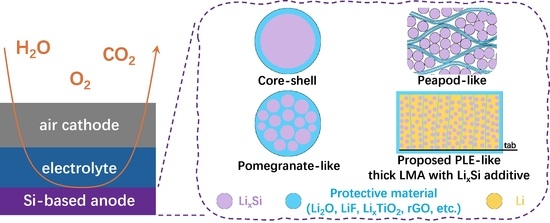
1. Introduction
2. Advances in Air-Stable Silicon-Based Anodes
2.1. Core–Shell Structures
2.2. Pomegranate-like and Peapod-like Compartmented Protection Structures
2.3. Protection Before Lithiation
2.4. Silicon–Graphite Hybrid Electrode
3. Lithium-Ion–Air (Or O2) Batteries with Silicon-Based Anodes
3.1. Electrolyte Formulation for Improving SEI Quality
3.2. Suppressing Crossover of Air and Electrolyte Components
4. Conclusions and Prospects
Author Contributions
Funding
Institutional Review Board Statement
Informed Consent Statement
Data Availability Statement
Conflicts of Interest
References
- Kwak, W.-J.; Rosy; Sharon, D.; Xia, C.; Kim, H.; Johnson, L.R.; Bruce, P.G.; Nazar, L.F.; Sun, Y.-K.; Frimer, A.A.; et al. Lithium-Oxygen Batteries and Related Systems: Potential, Status, and Future. Chem. Rev. 2020, 120, 6626–6683. [Google Scholar] [CrossRef]
- Girishkumar, G.; McCloskey, B.; Luntz, A.C.; Swanson, S.; Wilcke, W. Lithium−Air Battery: Promise and Challenges. J. Phys. Chem. Lett. 2010, 1, 2193–2203. [Google Scholar] [CrossRef]
- Lu, Y.-C.; Gallant, B.M.; Kwabi, D.G.; Harding, J.R.; Mitchell, R.R.; Whittingham, M.S.; Shao-Horn, Y. Lithium–oxygen batteries: Bridging mechanistic understanding and battery performance. Energy Environ. Sci. 2013, 6, 750–768. [Google Scholar] [CrossRef]
- Kang, J.-H.; Lee, J.; Jung, J.-W.; Park, J.; Jang, T.; Kim, H.-S.; Nam, J.-S.; Lim, H.; Yoon, K.R.; Ryu, W.-H.; et al. Lithium–Air Batteries: Air-Breathing Challenges and Perspective. ACS Nano 2020, 14, 14549–14578. [Google Scholar] [CrossRef]
- Grande, L.; Paillard, E.; Hassoun, J.; Park, J.-B.; Lee, Y.-J.; Sun, Y.-K.; Passerini, S.; Scrosati, B. The Lithium/Air Battery: Still an Emerging System or a Practical Reality? Adv. Mater. 2015, 27, 784–800. [Google Scholar] [CrossRef]
- Liang, Z.; Wang, W.; Lu, Y.-C. The path toward practical Li-air batteries. Joule 2022, 6, 2458–2473. [Google Scholar] [CrossRef]
- Wu, Z.; Tian, Y.; Chen, H.; Wang, L.; Qian, S.; Wu, T.; Zhang, S.; Lu, J. Evolving aprotic Li-air batteries. Chem. Soc. Rev. 2022, 18, 8045–8101. [Google Scholar] [CrossRef] [PubMed]
- Abraham, K.M.; Jiang, Z. A Polymer Electrolyte-Based Rechargeable Lithium/Oxygen Battery. J. Electrochem. Soc. 1996, 143, 1–5. [Google Scholar] [CrossRef]
- Zhao, Z.; Huang, J.; Peng, Z. Achilles’ Heel of Lithium–Air Batteries: Lithium Carbonate. Angew. Chem. Int. Ed. 2017, 57, 3874–3886. [Google Scholar] [CrossRef] [PubMed]
- Geng, D.; Ding, N.; Andy Hor, T.S.; Chien, S.W.; Liu, Z.; Wuu, D.; Sun, X.; Zong, Y. From Lithium-Oxygen to Lithium-Air Batteries: Challenges and Opportunities. Adv. Energy Mater. 2016, 6, 1502164. [Google Scholar] [CrossRef]
- Shu, C.; Wang, J.; Long, J.; Liu, H.-K.; Dou, S.-X. Understanding the Reaction Chemistry during Charging in Aprotic Lithium-Oxygen Batteries: Existing Problems and Solutions. Adv. Mater. 2019, 31, e1804587. [Google Scholar] [CrossRef] [PubMed]
- Zhang, T.; Zhou, H. A reversible long-life lithium-air battery in ambient air. Nat. Commun. 2013, 4, 1817. [Google Scholar] [CrossRef]
- Freunberger, S.A.; Chen, Y.; Drewett, N.E.; Hardwick, L.J.; Bardé, F.; Bruce, P.G. The Lithium–Oxygen Battery with Ether-Based Electrolytes. Angew. Chem. Int. Ed. 2011, 50, 8609–8613. [Google Scholar] [CrossRef]
- Liu, X.; Song, X.; Zhang, Q.; Zhu, X.; Han, Q.; Liu, Z.; Zhang, P.; Zhao, Y. Decomposition pathway and stabilization of ether-based electrolytes in the discharge process of Li-O2 battery. J. Energy Chem. 2022, 69, 516–523. [Google Scholar] [CrossRef]
- Mahne, N.; Renfrew, S.E.; McCloskey, B.D.; Freunberger, S.A. Electrochemical Oxidation of Lithium Carbonate Generates Singlet Oxygen. Angew. Chem. Int. Ed. 2018, 57, 5529–5533. [Google Scholar] [CrossRef] [PubMed]
- Mahne, N.; Schafzahl, B.; Leypold, C.; Leypold, M.; Grumm, S.; Leitgeb, A.; Strohmeier, G.A.; Wilkening, M.; Fontaine, O.; Kramer, D.; et al. Singlet oxygen generation as a major cause for parasitic reactions during cycling of aprotic lithium–oxygen batteries. Nat. Energy 2017, 2, 17036. [Google Scholar] [CrossRef]
- Zor, C.; Jones, K.D.; Rees, G.J.; Yang, S.; Pateman, A.; Gao, X.; Johnson, L.R.; Bruce, P.G. Singlet oxygen is not the main source of electrolyte degradation in lithium–oxygen batteries. Energy Environ. Sci. 2024, 17, 7355–7361. [Google Scholar] [CrossRef]
- Gao, Z.; Temprano, I.; Lei, J.; Tang, L.; Li, J.; Grey, C.P.; Liu, T. Recent Progress in Developing a LiOH-Based Reversible Nonaqueous Lithium–Air Battery. Adv. Mater. 2022, 35, 2201384. [Google Scholar] [CrossRef]
- Lu, J.; Lee, Y.J.; Luo, X.; Lau, K.C.; Asadi, M.; Wang, H.-H.; Brombosz, S.; Wen, J.; Zhai, D.; Chen, Z.; et al. A lithium-oxygen battery based on lithium superoxide. Nature 2016, 529, 377–382. [Google Scholar] [CrossRef]
- Wang, J.; Gao, R.; Liu, X. Reversible Conversion between Lithium Superoxide and Lithium Peroxide: A Closed “Lithium–Oxygen” Battery. Inorganics 2023, 11, 69. [Google Scholar] [CrossRef]
- Qiao, Y.; Yi, J.; Guo, S.; Sun, Y.; Wu, S.; Liu, X.; Yang, S.; He, P.; Zhou, H. Li2CO3-free Li–O2/CO2 battery with peroxide discharge product. Energy Environ. Sci. 2018, 11, 1211–1217. [Google Scholar] [CrossRef]
- Li, J.; Sanglier, P.; Qu, H.; Miao, Z.; Li, Y.; Su, B.-L. Photo-Assisted Lithium-Oxygen Batteries: Mechanisms, Materials, and Perspectives. Adv. Mater. 2026, 38, e18355. [Google Scholar] [CrossRef] [PubMed]
- Song, L.-N.; Zheng, L.-J.; Wang, X.-X.; Kong, D.-C.; Wang, Y.-F.; Wang, Y.; Wu, J.-Y.; Sun, Y.; Xu, J.-J. Aprotic Lithium-Oxygen Batteries Based on Nonsolid Discharge Products. J. Am. Chem. Soc. 2024, 146, 1305–1317. [Google Scholar] [CrossRef]
- Xu, J.-J.; Chang, Z.-W.; Yin, Y.-B.; Zhang, X.-B. Nanoengineered Ultralight and Robust All-Metal Cathode for High-Capacity, Stable Lithium-Oxygen Batteries. ACS Cent. Sci. 2017, 3, 598–604. [Google Scholar] [CrossRef]
- Asadi, M.; Sayahpour, B.; Abbasi, P.; Ngo, A.T.; Karis, K.; Jokisaari, J.R.; Liu, C.; Narayanan, B.; Gerard, M.; Yasaei, P.; et al. A lithium–oxygen battery with a long cycle life in an air-like atmosphere. Nature 2018, 555, 502–506. [Google Scholar] [CrossRef]
- Ottakam Thotiyl, M.M.; Freunberger, S.A.; Peng, Z.; Chen, Y.; Liu, Z.; Bruce, P.G. A stable cathode for the aprotic Li–O2 battery. Nat. Mater. 2013, 12, 1050–1056. [Google Scholar] [CrossRef]
- Huang, Z.; Zeng, H.; Xie, M.; Ling, X.; Huang, Z.; Shen, Y.; Huang, Y. A Stable Lithium–Oxygen Battery Electrolyte Based on Fully Methylated Cyclic Ether. Angew. Chem. Int. Ed. 2019, 58, 2345–2349. [Google Scholar] [CrossRef]
- Giordani, V.; Bryantsev, V.S.; Uddin, J.; Walker, W.; Chase, G.V.; Addison, D. N-methylacetamide as an Electrolyte Solvent for Rechargeable Li-O2 Batteries: Unexpected Stability at the O2 electrode. ECS Electrochem. Lett. 2013, 3, A11–A14. [Google Scholar] [CrossRef]
- Zhou, B.; Guo, L.; Zhang, Y.; Wang, J.; Ma, L.; Zhang, W.-H.; Fu, Z.; Peng, Z. A High-Performance Li–O2 Battery with a Strongly Solvating Hexamethylphosphoramide Electrolyte and a LiPON-Protected Lithium Anode. Adv. Mater. 2017, 29, 1701568. [Google Scholar] [CrossRef] [PubMed]
- Adams, B.D.; Black, R.; Williams, Z.; Fernandes, R.; Cuisinier, M.; Berg, E.J.; Novak, P.; Murphy, G.K.; Nazar, L.F. Towards a Stable Organic Electrolyte for the Lithium Oxygen Battery. Adv. Energy Mater. 2015, 5, 1400867. [Google Scholar] [CrossRef]
- Lin, Y.; Moitoso, B.; Martinez-Martinez, C.; Walsh, E.D.; Lacey, S.D.; Kim, J.-W.; Dai, L.; Hu, L.; Connell, J.W. Ultrahigh-Capacity Lithium-Oxygen Batteries Enabled by Dry-Pressed Holey Graphene Air Cathodes. Nano Lett. 2017, 17, 3252–3260. [Google Scholar] [CrossRef]
- Song, H.; Xu, S.; Li, Y.; Dai, J.; Gong, A.; Zhu, M.; Zhu, C.; Chen, C.; Chen, Y.; Yao, Y.; et al. Hierarchically Porous, Ultrathick, “Breathable” Wood-Derived Cathode for Lithium-Oxygen Batteries. Adv. Energy Mater. 2017, 8, 1701203. [Google Scholar] [CrossRef]
- Greenburg, L.C.; Plaza-Rivera, C.O.; Kim, J.-W.; Connell, J.W.; Lin, Y. Architecture Transformations of Ultrahigh Areal Capacity Air Cathodes for Lithium-Oxygen Batteries. Batter. Supercaps 2020, 4, 120–130. [Google Scholar] [CrossRef]
- Lee, H.C.; Park, J.O.; Kim, M.; Kwon, H.J.; Kim, J.-H.; Choi, K.H.; Kim, K.; Im, D. High-Energy-Density Li-O2 Battery at Cell Scale with Folded Cell Structure. Joule 2019, 3, 542–556. [Google Scholar] [CrossRef]
- Yang, W.; Qian, Z.; Du, C.; Hua, C.; Zuo, P.; Cheng, X.; Ma, Y.; Yin, G. Hierarchical ordered macroporous/ultrathin mesoporous carbon architecture: A promising cathode scaffold with excellent rate performance for rechargeable Li-O2 batteries. Carbon 2017, 118, 139–147. [Google Scholar] [CrossRef]
- Chen, Y.; Li, F.; Tang, D.-M.; Jian, Z.; Liu, C.; Golberg, D.; Yamada, A.; Zhou, H. Multi-walled carbon nanotube papers as binder-free cathodes for large capacity and reversible non-aqueous Li–O2 batteries. J. Mater. Chem. A 2013, 1, 13076–13081. [Google Scholar] [CrossRef]
- Huang, H.; Zhou, H.; Wu, N.; Yu, H.; Gao, W.; Shi, J.; Song, J.; Zheng, Y.; Chen, Z.; Liu, Z. Multiwall Carbon Nanotubes as Microscopic-Cables to Boost Discharge Performance of Li-O2 Batteries. ChemElectroChem 2025, 12, e202400626. [Google Scholar] [CrossRef]
- Lim, H.-D.; Song, H.; Kim, J.; Gwon, H.; Bae, Y.; Park, K.-Y.; Hong, J.; Kim, H.; Kim, T.; Kim, Y.H.; et al. Superior Rechargeability and Efficiency of Lithium–Oxygen Batteries: Hierarchical Air Electrode Architecture Combined with a Soluble Catalyst. Angew. Chem. Int. Ed. 2014, 53, 3926–3931. [Google Scholar] [CrossRef]
- Tan, P.; Wei, Z.H.; Shyy, W.; Zhao, T.S.; Zhu, X.B. A nano-structured RuO2/NiO cathode enables the operation of non-aqueous lithium–air batteries in ambient air. Energy Environ. Sci. 2016, 9, 1783–1793. [Google Scholar] [CrossRef]
- Zhang, P.-F.; Zhang, J.-Y.; Sheng, T.; Lu, Y.-Q.; Yin, Z.-W.; Li, Y.-Y.; Peng, X.-X.; Zhou, Y.; Li, J.-T.; Wu, Y.-J.; et al. Synergetic Effect of Ru and NiO in the Electrocatalytic Decomposition of Li2CO3 to Enhance the Performance of a Li-CO2/O2 Battery. ACS Catal. 2020, 10, 1640–1651. [Google Scholar] [CrossRef]
- Yang, Y.; Liu, W.; Wang, Y.; Wang, X.; Xiao, L.; Lu, J.; Zhuang, L. A PtRu catalyzed rechargeable oxygen electrode for Li–O2 batteries: Performance improvement through Li2O2 morphology control. Phys. Chem. Chem. Phys. 2014, 16, 20618–20623. [Google Scholar] [CrossRef]
- Xu, J.-J.; Wang, Z.-L.; Xu, D.; Zhang, L.-L.; Zhang, X.-B. Tailoring deposition and morphology of discharge products towards high-rate and long-life lithium-oxygen batteries. Nat. Commun. 2013, 4, 2438. [Google Scholar] [CrossRef]
- Zhou, Y.; Guo, S. Recent advances in cathode catalyst architecture for lithium–oxygen batteries. eScience 2023, 3, 100123. [Google Scholar] [CrossRef]
- Wu, Y.; Ding, H.; Yang, T.; Xia, Y.; Zheng, H.; Wei, Q.; Han, J.; Peng, D.-L.; Yue, G. Composite NiCo2O4@CeO2 Microsphere as Cathode Catalyst for High-Performance Lithium–Oxygen Battery. Adv. Sci. 2022, 9, 2200523. [Google Scholar] [CrossRef] [PubMed]
- Li, C.; Liu, D.; Xiao, Y.; Liu, Z.; Song, L.; Zhang, Z. Mesoporous Co3O4-Rods-Entangled Carbonized Polyaniline Nanotubes as an Efficient Cathode Material toward Stable Lithium–Air Batteries. ACS Appl. Energy Mater. 2019, 2, 2939–2947. [Google Scholar] [CrossRef]
- Luo, Z.; Li, Y.; Liu, Z.; Pan, L.; Guan, W.; Liu, P.; Wang, D. Prolonging the Cycle Life of a Lithium–Air Battery by Alleviating Electrolyte Degradation with a Ceramic–Carbon Composite Cathode. ChemSusChem 2019, 12, 4962–4967. [Google Scholar] [CrossRef] [PubMed]
- Li, X.; Liu, Z.; Song, L.; Wang, D.; Zhang, Z. Three-dimensional graphene network supported ultrathin CeO2 nanoflakes for oxygen reduction reaction and rechargeable metal-air batteries. Electrochim. Acta 2018, 263, 561–569. [Google Scholar] [CrossRef]
- Bai, T.; Li, D.; Xiao, S.; Ji, F.; Zhang, S.; Wang, C.; Lu, J.; Gao, Q.; Ci, L. Recent progress on single-atom catalysts for lithium–air battery applications. Energy Environ. Sci. 2023, 16, 1431–1465. [Google Scholar] [CrossRef]
- Lacey, M.J.; Frith, J.T.; Owen, J.R. A redox shuttle to facilitate oxygen reduction in the lithium air battery. Electrochem. Commun. 2013, 26, 74–76. [Google Scholar] [CrossRef]
- Chen, Y.; Freunberger, S.A.; Peng, Z.; Fontaine, O.; Bruce, P.G. Charging a Li–O2 battery using a redox mediator. Nat. Chem. 2013, 5, 489–494. [Google Scholar] [CrossRef]
- Kim, D.S.; Park, Y.J. Effect of multi-catalysts on rechargeable Li–air batteries. J. Alloys Compd. 2014, 591, 164–169. [Google Scholar] [CrossRef]
- Sun, D.; Shen, Y.; Zhang, W.; Yu, L.; Yi, Z.; Yin, W.; Wang, D.; Huang, Y.; Wang, J.; Wang, D.; et al. A Solution-Phase Bifunctional Catalyst for Lithium–Oxygen Batteries. J. Am. Chem. Soc. 2014, 136, 8941–8946. [Google Scholar] [CrossRef] [PubMed]
- Li, F.; Wu, S.; Li, D.; Zhang, T.; He, P.; Yamada, A.; Zhou, H. The water catalysis at oxygen cathodes of lithium-oxygen cells. Nat. Commun. 2015, 6, 7843. [Google Scholar] [CrossRef]
- Liu, T.; Leskes, M.; Yu, W.; Moore, A.J.; Zhou, L.; Bayley, P.M.; Kim, G.; Grey, C.P. Cycling Li-O2 batteries via LiOH formation and decomposition. Science 2015, 350, 530–533. [Google Scholar] [CrossRef]
- Liu, Z.; Zhang, Y.; Jia, C.; Wan, H.; Peng, Z.; Bi, Y.; Liu, Y.; Peng, Z.; Wang, Q.; Li, H.; et al. Decomposing lithium carbonate with a mobile catalyst. Nano Energy 2017, 36, 390–397. [Google Scholar] [CrossRef]
- Huang, S.; Li, Z.; Liu, Z.; Yan, Q.; Ma, B.; Wang, D.; Wei, F.; Chen, Z.; He, H. Surface Enrichment of Redox Mediator for Long-Cyclable Lithium–Air Batteries. Energy Fuels 2023, 37, 11465–11471. [Google Scholar] [CrossRef]
- Yan, Q.; Yan, L.; Huang, H.; Chen, Z.; Liu, Z.; Zhou, S.; He, H. Effects of Central Metal Ion on Binuclear Metal Phthalocyanine-Based Redox Mediator for Lithium Carbonate Decomposition. Molecules 2024, 29, 2034. [Google Scholar] [CrossRef] [PubMed]
- Liu, Z.; Huang, H.; Chen, Z.; He, H.; Wang, D.; Li, Z. Redox Mediators for Li2CO3 Decomposition. Inorganics 2025, 13, 192. [Google Scholar] [CrossRef]
- Ko, Y.; Kim, K.; Yoo, J.; Kwon, G.; Park, H.; Kim, J.; Lee, B.; Song, J.-H.; Kim, J.; Kang, K. Redox mediators for oxygen reduction reactions in lithium–oxygen batteries: Governing kinetics and its implications. Energy Environ. Sci. 2023, 16, 5525–5533. [Google Scholar] [CrossRef]
- Jiang, Z.; Huang, Y.; Zhu, Z.; Gao, S.; Lv, Q.; Li, F. Quenching singlet oxygen via intersystem crossing for a stable Li-O2 battery. Proc. Natl. Acad. Sci. USA 2022, 119, e2202835119. [Google Scholar] [CrossRef]
- Liang, Z.; Zou, Q.; Xie, J.; Lu, Y.-C. Suppressing singlet oxygen generation in lithium–oxygen batteries with redox mediators. Energy Environ. Sci. 2020, 13, 2870–2877. [Google Scholar] [CrossRef]
- Kwak, W.-J.; Freunberger, S.A.; Kim, H.; Park, J.; Nguyen, T.T.; Jung, H.-G.; Byon, H.R.; Sun, Y.-K. Mutual Conservation of Redox Mediator and Singlet Oxygen Quencher in Lithium–Oxygen Batteries. ACS Catal. 2019, 9, 9914–9922. [Google Scholar] [CrossRef]
- Petit, Y.K.; Leypold, C.; Mahne, N.; Mourad, E.; Schafzahl, L.; Slugovc, C.; Borisov, S.M.; Freunberger, S.A. DABCOnium: An Efficient and High-Voltage Stable Singlet Oxygen Quencher for Metal–O2 Cells. Angew. Chem. Int. Ed. 2019, 58, 6535–6539. [Google Scholar] [CrossRef]
- Zhang, Z.; Peng, Z.; Zheng, J.; Wang, S.; Liu, Z.; Bi, Y.; Chen, Y.; Wu, G.; Li, H.; Cui, P.; et al. The long life-span of a Li-metal anode enabled by a protective layer based on the pyrolyzed N-doped binder network. J. Mater. Chem. A 2017, 5, 9339–9349. [Google Scholar] [CrossRef]
- Zhang, Z.; Li, Z.; Lin, H.; Wang, M.; Luo, Z.; Ren, F.; Liu, Z.; Zhou, C.; Peng, Z.; Wang, D. Transplantable Carbonaceous Li+ Filtrating Membrane for Lithium Metal Protection. ACS Appl. Mater. Interfaces 2020, 12, 30494–30502. [Google Scholar] [CrossRef] [PubMed]
- Yuan, H.; Ding, X.; Liu, T.; Nai, J.; Wang, Y.; Liu, Y.; Liu, C.; Tao, X. A review of concepts and contributions in lithium metal anode development. Mater. Today 2022, 53, 173–196. [Google Scholar] [CrossRef]
- Zhang, X.; Yang, Y.; Zhou, Z. Towards practical lithium-metal anodes. Chem. Soc. Rev. 2020, 49, 3040–3071. [Google Scholar] [CrossRef]
- Shi, P.; Zhang, X.-Q.; Shen, X.; Zhang, R.; Liu, H.; Zhang, Q. A Review of Composite Lithium Metal Anode for Practical Applications. Adv. Mater. Technol. 2019, 5, 1900806. [Google Scholar] [CrossRef]
- Lin, D.; Liu, Y.; Cui, Y. Reviving the lithium metal anode for high-energy batteries. Nat. Nanotechnol. 2017, 12, 194–206. [Google Scholar] [CrossRef]
- Cheng, X.-B.; Zhang, R.; Zhao, C.-Z.; Zhang, Q. Toward Safe Lithium Metal Anode in Rechargeable Batteries: A Review. Chem. Rev. 2017, 117, 10403–10473. [Google Scholar] [CrossRef]
- Li, Y.; Li, Y.; Pei, A.; Yan, K.; Sun, Y.; Wu, C.-L.; Joubert, L.-M.; Chin, R.; Koh, A.L.; Yu, Y.; et al. Atomic structure of sensitive battery materials and interfaces revealed by cryo–electron microscopy. Science 2017, 358, 506–510. [Google Scholar] [CrossRef]
- Zhang, L.; Yang, T.; Du, C.; Liu, Q.; Tang, Y.; Zhao, J.; Wang, B.; Chen, T.; Sun, Y.; Jia, P.; et al. Lithium whisker growth and stress generation in an in situ atomic force microscope–environmental transmission electron microscope set-up. Nat. Nanotech. 2020, 15, 94–98. [Google Scholar] [CrossRef]
- Cheng, Q.; Wei, L.; Liu, Z.; Ni, N.; Sang, Z.; Zhu, B.; Xu, W.; Chen, M.; Miao, Y.; Chen, L.-Q.; et al. Operando and three-dimensional visualization of anion depletion and lithium growth by stimulated Raman scattering microscopy. Nat. Commun. 2018, 9, 2942. [Google Scholar] [CrossRef] [PubMed]
- Hong, Y.-S.; Zhao, C.-Z.; Xiao, Y.; Xu, R.; Xu, J.-J.; Huang, J.-Q.; Zhang, Q.; Yu, X.; Li, H. Safe Lithium-Metal Anodes for Li−O2 Batteries: From Fundamental Chemistry to Advanced Characterization and Effective Protection. Batter. Supercaps 2019, 2, 638–658. [Google Scholar] [CrossRef]
- Cao, R.; Chen, K.; Liu, J.; Huang, G.; Liu, W.; Zhang, X. Li–air batteries: Air stability of lithium metal anodes. Sci. China Chem. 2023, 67, 122–136. [Google Scholar] [CrossRef]
- Li, Z.; Wu, X.; Wang, J.; Zhang, H.; Qin, Y.; Qiao, Y.; Sun, S.-G. An overview of the unstable and irreversible lithium metal anode-related issues in nonaqueous Li–O2/air batteries. J. Mater. Chem. A 2024, 12, 15558–15579. [Google Scholar] [CrossRef]
- Bi, X.; Amine, K.; Lu, J. The importance of anode protection towards lithium oxygen batteries. J. Mater. Chem. A 2020, 8, 3563–3573. [Google Scholar] [CrossRef]
- Lin, H.; Chen, Z.; Wang, D.; Wang, M.; Peng, Z.; Liu, Z.; He, H.; Wang, M.; Li, H. High-performance Li-air battery after limiting inter-electrode crosstalk. Energy Storage Mater. 2021, 39, 225–231. [Google Scholar] [CrossRef]
- Chen, K.; Yang, D.-Y.; Huang, G.; Zhang, X.-B. Lithium–Air Batteries: Air-Electrochemistry and Anode Stabilization. Acc. Chem. Res. 2021, 54, 632–641. [Google Scholar] [CrossRef]
- Zhang, H.; Eshetu, G.G.; Judez, X.; Li, C.; Rodriguez-Martinez, L.M.; Armand, M. Electrolyte Additives for Lithium Metal Anodes and Rechargeable Lithium Metal Batteries: Progress and Perspectives. Angew. Chem. Int. Ed. 2018, 57, 15002–15027. [Google Scholar] [CrossRef] [PubMed]
- He, P.; Zhang, T.; Jiang, J.; Zhou, H. Lithium–Air Batteries with Hybrid Electrolytes. J. Phys. Chem. Lett. 2016, 7, 1267–1280. [Google Scholar] [CrossRef] [PubMed]
- Zhang, T.; Imanishi, N.; Takeda, Y.; Yamamoto, O. Aqueous Lithium/Air Rechargeable Batteries. Chem. Lett. 2011, 40, 668–673. [Google Scholar] [CrossRef]
- Manthiram, A.; Li, L. Hybrid and Aqueous Lithium-Air Batteries. Adv. Energy Mater. 2014, 5, 1401302. [Google Scholar] [CrossRef]
- Teranishi, R.; Si, Q.; Mizukoshi, F.; Kawakubo, M.; Matsui, M.; Takeda, Y.; Yamamoto, O.; Imanishi, N. Silicon anode for rechargeable aqueous lithium–air batteries. J. Power Sources 2015, 273, 538–543. [Google Scholar] [CrossRef]
- Shimonishi, Y.; Zhang, T.; Imanishi, N.; Im, D.; Lee, D.J.; Hirano, A.; Takeda, Y.; Yamamoto, O.; Sammes, N. A study on lithium/air secondary batteries—Stability of the NASICON-type lithium ion conducting solid electrolyte in alkaline aqueous solutions. J. Power Sources 2011, 196, 5128–5132. [Google Scholar] [CrossRef]
- Puech, L.; Cantau, C.; Vinatier, P.; Toussaint, G.; Stevens, P. Elaboration and characterization of a free standing LiSICON membrane for aqueous lithium–air battery. J. Power Sources 2012, 214, 330–336. [Google Scholar] [CrossRef]
- Jackman, S.D.; Cutler, R.A. Stability of NaSICON-type Li1.3Al0.3Ti1.7P3O12 in aqueous solutions. J. Power Sources 2013, 230, 251–260. [Google Scholar] [CrossRef]
- Ding, D.; Ma, H.; Tao, H.; Yang, X.; Fan, L.Z. Stabilizing a Li1.3Al0.3Ti1.7(PO4)3/Li metal anode interface in solid-state batteries with a LiF/Cu-rich multifunctional interlayer. Chem. Sci. 2024, 15, 3730–3740. [Google Scholar] [CrossRef]
- Song, G.; Kim, B.; Hwang, I.; Kim, J.; Kim, J.; Yoon, C.-B. Controlling the All-Solid Surface Reaction Between an Li1.3Al0.3Ti1.7(PO4)3 Electrolyte and Anode Through the Insertion of Ag and Al2O3 Nano-Interfacial Layers. Materials 2025, 18, 609. [Google Scholar] [CrossRef]
- Bai, H.; Hu, J.; Duan, Y.; Kozawa, T.; Naito, M.; Zhang, J.; Dong, S. Surface modification of Li1.3Al0.3Ti1.7(PO4)3 ceramic electrolyte by Al2O3-doped ZnO coating to enable dendrites-free all-solid-state lithium-metal batteries. Ceram. Int. 2019, 45, 14663–14668. [Google Scholar] [CrossRef]
- Wang, L.; Wang, L.; Shi, Q.; Zhong, C.; Gong, D.; Wang, X.; Zhan, C.; Liu, G. In-situ constructed SnO2 gradient buffer layer as a tight and robust interphase toward Li metal anodes in LATP solid state batteries. J. Energy Chem. 2023, 80, 89–98. [Google Scholar] [CrossRef]
- Yu, J.; Liu, Q.; Hu, X.; Wang, S.; Wu, J.; Liang, B.; Han, C.; Kang, F.; Li, B. Smart construction of multifunctional Li1.5Al0.5Ge1.5(PO4)3|Li intermediate interfaces for solid-state batteries. Energy Storage Mater. 2022, 46, 68–75. [Google Scholar] [CrossRef]
- Wang, C.; Bai, G.; Yang, Y.; Liu, X.; Shao, H. Dendrite-free all-solid-state lithium batteries with lithium phosphorous oxynitride-modified lithium metal anode and composite solid electrolytes. Nano Res. 2018, 12, 217–223. [Google Scholar] [CrossRef]
- Yang, Z.; Yuan, H.; Zhou, C.; Wu, Y.; Tang, W.; Sang, S.; Liu, H. Facile interfacial adhesion enabled LATP-based solid-state lithium metal battery. Chem. Eng. J. 2020, 392, 123650. [Google Scholar] [CrossRef]
- Yan, Y.; Ju, J.; Dong, S.; Wang, Y.; Huang, L.; Cui, L.; Jiang, F.; Wang, Q.; Zhang, Y.; Cui, G. In Situ Polymerization Permeated Three-Dimensional Li+-Percolated Porous Oxide Ceramic Framework Boosting All Solid-State Lithium Metal Battery. Adv. Sci. 2021, 8, 2003887. [Google Scholar] [CrossRef]
- Li, Y.; Wang, H. Composite Solid Electrolytes with NASICON-Type LATP and PVdF–HFP for Solid-State Lithium Batteries. Ind. Eng. Chem. Res. 2021, 60, 1494–1500. [Google Scholar] [CrossRef]
- Chen, Z.; Kim, G.-T.; Kim, J.-K.; Zarrabeitia, M.; Kuenzel, M.; Liang, H.-P.; Geiger, D.; Kaiser, U.; Passerini, S. Highly Stable Quasi-Solid-State Lithium Metal Batteries: Reinforced Li1.3Al0.3Ti1.7(PO4)3/Li Interface by a Protection Interlayer. Adv. Energy Mater. 2021, 11, 2101339. [Google Scholar] [CrossRef]
- Imanishi, N.; Hasegawa, S.; Zhang, T.; Hirano, A.; Takeda, Y.; Yamamoto, O. Lithium anode for lithium-air secondary batteries. J. Power Sources 2008, 185, 1392–1397. [Google Scholar] [CrossRef]
- Kitaura, H.; Zhou, H. Electrochemical Performance of Solid-State Lithium–Air Batteries Using Carbon Nanotube Catalyst in the Air Electrode. Adv. Energy Mater. 2012, 2, 889–894. [Google Scholar] [CrossRef]
- Visco, S.J.; Nimon, V.Y.; Petrov, A.; Pridatko, K.; Goncharenko, N.; Nimon, E.; De Jonghe, L.; Volfkovich, Y.M.; Bograchev, D.A. Aqueous and nonaqueous lithium-air batteries enabled by water-stable lithium metal electrodes. J. Solid State Electrochem. 2014, 18, 1443–1456. [Google Scholar] [CrossRef]
- Visco, S.J.; Nimon, V.; Petrov, A.; Pridatko, K.; Goncharenko, N.; Nimon, E.; De Jonghe, L.; Hendrickson, M.; Plichta, E. Lithium Air Batteries Based on Protected Lithium Electrodes. In The Lithium Air Battery: Fundamentals; Imanishi, N., Luntz, A.C., Bruce, P., Eds.; Springer: New York, NY, USA, 2014; pp. 179–200. [Google Scholar]
- Visco, S.J. Final Technical Report of the project Manufacturing of Protected Lithium Electrodes for Advanced Lithium-Air, Lithium-Water & Lithium-Sulfur Batteries (DE-EE0005757); PolyPlus Battery Company: Berkeley, CA, USA, 2015. Available online: https://www.osti.gov/servlets/purl/1226495 (accessed on 15 March 2026).
- Department of Energy, U.S.A. Manufacturing of Protected Lithium Electrodes for Advanced Batteries. Available online: https://www.energy.gov/sites/prod/files/2016/05/f31/Protected%20Lithium%20Electrodes.pdf (accessed on 15 March 2026).
- Katoh, T.; Inda, Y.; Nakajima, K.; Ye, R.; Baba, M. Lithium/water battery with lithium ion conducting glass–ceramics electrolyte. J. Power Sources 2011, 196, 6877–6880. [Google Scholar]
- Davis, R.E.; Sherman, J.T. Evaluating a Lithium-Seawater Battery on Gliders. J. Atmos. Ocean. Technol. 2017, 34, 1175–1182. [Google Scholar] [CrossRef]
- Visco, S.; Nimon, Y. The Use of Protected Lithium Metal Electrodes in the Development of High Energy Density Next Generation Batteries. In ECS Meeting Abstracts; The Electrochemical Society: Pennington, NJ, USA, 2024; Volume MA2024-02, p. 284. [Google Scholar] [CrossRef]
- Visco, S.J.; Nimon, E.; De Jonghe, L. High Performance Lithium-Air and Lithium-Water Batteries. In ECS Meeting Abstracts; The Electrochemical Society: Pennington, NJ, USA, 2011; Volume MA2011-01, p. 436. [Google Scholar] [CrossRef]
- Visco, S.J. Advanced Lithium Anodes for Li/Air and Li/Water Batteries; Access Number ADA441240; Defense Technical Information Center, Department of Defense, U.S.A.: Fort Belvoir, VA, USA, 2005; p. 43. Available online: https://apps.dtic.mil/sti/citations/ADA441240 (accessed on 15 March 2026).
- Ye, J.; Wang, C.; Shao, Z.; Liao, K. From Li–O2 to Li–Air Batteries: Challenges and Progress on Oxygen-Permeable Membranes. Energy Fuels 2024, 38, 15001–15024. [Google Scholar] [CrossRef]
- Saidi, N.M.; Abdah, M.A.A.M.; Mustafa, M.N.; Walvekar, R.; Khalid, M.; Khosla, A. Advancements in Silicon Anodes for Enhanced Lithium-Ion Batteries Performance: Innovations Toward Next-Gen Superbatteries. Battery Energy 2025, 4, e20240048. [Google Scholar] [CrossRef]
- Kim, D.-H.; Lee, Y.-H.; Yoon, J.-M.; Thondaiman, P.; Kim, B.C.; Choi, I.-C.; Choi, J.-H.; Jeon, K.-J.; Park, C.-M. Li–Si compound anodes enabling high-performance all-solid-state Li-ion batteries. Joule 2025, 9, 102195. [Google Scholar] [CrossRef]
- Feyzi, E.; Anil Kumar, M.R.; Li, X.; Deng, S.; Nanda, J.; Zaghib, K. A comprehensive review of silicon anodes for high-energy lithium-ion batteries: Challenges, latest developments, and perspectives. Next Energy 2024, 5, 100176. [Google Scholar] [CrossRef]
- Je, M.; Han, D.-Y.; Ryu, J.; Park, S. Constructing Pure Si Anodes for Advanced Lithium Batteries. Acc. Chem. Res. 2023, 56, 2213–2224. [Google Scholar] [CrossRef]
- Sun, L.; Liu, Y.; Shao, R.; Wu, J.; Jiang, R.; Jin, Z. Recent progress and future perspective on practical silicon anode-based lithium ion batteries. Energy Storage Mater. 2022, 46, 482–502. [Google Scholar] [CrossRef]
- Huo, H.; Jiang, M.; Bai, Y.; Ahmed, S.; Volz, K.; Hartmann, H.; Henss, A.; Singh, C.V.; Raabe, D.; Janek, J. Chemo-mechanical failure mechanisms of the silicon anode in solid-state batteries. Nat. Mater. 2024, 23, 543–551. [Google Scholar] [CrossRef]
- Liu, N.; Wu, H.; McDowell, M.T.; Yao, Y.; Wang, C.; Cui, Y. A yolk-shell design for stabilized and scalable li-ion battery alloy anodes. Nano Lett. 2012, 12, 3315–3321. [Google Scholar] [CrossRef]
- Tian, H.; Tan, X.; Xin, F.; Wang, C.; Han, W. Micro-sized nano-porous Si/C anodes for lithium ion batteries. Nano Energy 2015, 11, 490–499. [Google Scholar] [CrossRef]
- Chae, S.; Xu, Y.; Yi, R.; Lim, H.-S.; Velickovic, D.; Li, X.; Li, Q.; Wang, C.; Zhang, J.-G. A Micrometer-Sized Silicon/Carbon Composite Anode Synthesized by Impregnation of Petroleum Pitch in Nanoporous Silicon. Adv. Mater. 2021, 33, 2103095. [Google Scholar] [CrossRef] [PubMed]
- An, Y.; Fei, H.; Zeng, G.; Ci, L.; Xiong, S.; Feng, J.; Qian, Y. Green, Scalable, and Controllable Fabrication of Nanoporous Silicon from Commercial Alloy Precursors for High-Energy Lithium-Ion Batteries. ACS Nano 2018, 12, 4993–5002. [Google Scholar] [CrossRef]
- Magasinski, A.; Zdyrko, B.; Kovalenko, I.; Hertzberg, B.; Burtovyy, R.; Huebner, C.F.; Fuller, T.F.; Luzinov, I.; Yushin, G. Toward efficient binders for Li-ion battery Si-based anodes: Polyacrylic acid. ACS Appl. Mater. Interfaces 2010, 2, 3004–3010. [Google Scholar] [CrossRef]
- Parikh, P.; Sina, M.; Banerjee, A.; Wang, X.; D’Souza, M.S.; Doux, J.-M.; Wu, E.A.; Trieu, O.Y.; Gong, Y.; Zhou, Q.; et al. Role of Polyacrylic Acid (PAA) Binder on the Solid Electrolyte Interphase in Silicon Anodes. Chem. Mater. 2019, 31, 2535–2544. [Google Scholar] [CrossRef]
- Wu, Z.-Y.; Deng, L.; Li, J.-T.; Huang, Q.-S.; Lu, Y.-Q.; Liu, J.; Zhang, T.; Huang, L.; Sun, S.-G. Multiple hydrogel alginate binders for Si anodes of lithium-ion battery. Electrochim. Acta 2017, 245, 371–378. [Google Scholar] [CrossRef]
- Jin, Y.; Kneusels, N.H.; Marbella, L.E.; Castillo-Martínez, E.; Magusin, P.C.M.M.; Weatherup, R.S.; Jónsson, E.; Liu, T.; Paul, S.; Grey, C.P. Understanding Fluoroethylene Carbonate and Vinylene Carbonate Based Electrolytes for Si Anodes in Lithium Ion Batteries with NMR Spectroscopy. J. Am. Chem. Soc. 2018, 140, 9854–9867. [Google Scholar] [CrossRef]
- Jin, L.; Shen, C.; Wu, Q.; Shellikeri, A.; Zheng, J.; Zhang, C.; Zheng, J.P. Pre-Lithiation Strategies for Next-Generation Practical Lithium-Ion Batteries. Adv. Sci. 2021, 8, 2005031. [Google Scholar] [CrossRef]
- Zhao, J.; Lu, Z.; Liu, N.; Lee, H.-W.; McDowell, M.T.; Cui, Y. Dry-air-stable lithium silicide-lithium oxide core-shell nanoparticles as high-capacity prelithiation reagents. Nat. Commun. 2014, 5, 5088. [Google Scholar] [CrossRef] [PubMed]
- Yang, Z.; Qin, X.; Lin, K.; Cai, Q.; Fu, Y.; Li, B. Surface passivated LixSi with improved storage stability as a prelithiation reagent in anodes. Electrochem. Commun. 2022, 138, 107272. [Google Scholar] [CrossRef]
- Zhao, J.; Lu, Z.; Wang, H.; Liu, W.; Lee, H.-W.; Yan, K.; Zhuo, D.; Lin, D.; Liu, N.; Cui, Y. Artificial Solid Electrolyte Interphase-Protected LixSi Nanoparticles: An Efficient and Stable Prelithiation Reagent for Lithium-Ion Batteries. J. Am. Chem. Soc. 2015, 137, 8372–8375. [Google Scholar] [CrossRef]
- Zhao, J.; Liao, L.; Shi, F.; Lei, T.; Chen, G.; Pei, A.; Sun, J.; Yan, K.; Zhou, G.; Xie, J.; et al. Surface Fluorination of Reactive Battery Anode Materials for Enhanced Stability. J. Am. Chem. Soc. 2017, 139, 11550–11558. [Google Scholar] [CrossRef]
- Wang, F.; Wang, B.; Yu, Z.; Zhu, C.; Liu, P.; Li, J.; Wang, B.; Zhou, Y.; Wang, D.; Liu, H.K.; et al. Construction of air-stable pre-lithiated SiOx anodes for next-generation high-energy-density lithium-ion batteries. Cell Rep. Phys. Sci. 2022, 3, 100872. [Google Scholar] [CrossRef]
- Wang, C.; Han, Y.; Li, S.; Chen, T.; Yu, J.; Lu, Z. Thermal Lithiated-TiO2: A Robust and Electron-Conducting Protection Layer for Li–Si Alloy Anode. ACS Appl. Mater. Interfaces 2018, 10, 12750–12758. [Google Scholar] [CrossRef]
- Zhao, J.; Lee, H.-W.; Sun, J.; Yan, K.; Liu, Y.; Liu, W.; Lu, Z.; Lin, D.; Zhou, G.; Cui, Y. Metallurgically lithiated SiOx anode with high capacity and ambient air compatibility. Proc. Natl. Acad. Sci. USA 2016, 113, 7408–7413. [Google Scholar] [CrossRef] [PubMed]
- Zhao, J.; Zhou, G.; Yan, K.; Xie, J.; Li, Y.; Liao, L.; Jin, Y.; Liu, K.; Hsu, P.-C.; Wang, J.; et al. Air-stable and freestanding lithium alloy/graphene foil as an alternative to lithium metal anodes. Nat. Nanotechnol. 2017, 12, 993–999. [Google Scholar] [CrossRef] [PubMed]
- Cao, Z.; Xu, P.; Zhai, H.; Du, S.; Mandal, J.; Dontigny, M.; Zaghib, K.; Yang, Y. Ambient-Air Stable Lithiated Anode for Rechargeable Li-Ion Batteries with High Energy Density. Nano Lett. 2016, 16, 7235–7240. [Google Scholar] [CrossRef] [PubMed]
- Gao, Y.-J.; Cui, C.-H.; Huang, Z.-K.; Pan, G.-Y.; Gu, Y.-F.; Yang, Y.-N.; Bai, F.; Sun, Z.; Zhang, T. Lithium Pre-Storage Enables High Initial Coulombic Efficiency and Stable Lithium-Enriched Silicon/Graphite Anode. Angew. Chem. Int. Ed. 2024, 63, e202404637. [Google Scholar] [CrossRef]
- Zhang, X.; Qu, H.; Ji, W.; Zheng, D.; Ding, T.; Qiu, D.; Qu, D. An electrode-level prelithiation of SiO anodes with organolithium compounds for lithium-ion batteries. J. Power Sources 2020, 478, 229067. [Google Scholar] [CrossRef]
- Jang, J.; Kang, I.; Choi, J.; Jeong, H.; Yi, K.-W.; Hong, J.; Lee, M. Molecularly Tailored Lithium–Arene Complex Enables Chemical Prelithiation of High-Capacity Lithium-Ion Battery Anodes. Angew. Chem. Int. Ed. 2020, 59, 14473–14480. [Google Scholar] [CrossRef]
- Hassoun, J.; Jung, H.-G.; Lee, D.-J.; Park, J.-B.; Amine, K.; Sun, Y.-K.; Scrosati, B. A Metal-Free, Lithium-Ion Oxygen Battery: A Step Forward to Safety in Lithium-Air Batteries. Nano Lett. 2012, 12, 5775–5779. [Google Scholar] [CrossRef]
- Wu, S.; Zhu, K.; Tang, J.; Liao, K.; Bai, S.; Yi, J.; Yamauchi, Y.; Ishida, M.; Zhou, H. A long-life lithium ion oxygen battery based on commercial silicon particles as the anode. Energy Environ. Sci. 2016, 9, 3262–3271. [Google Scholar] [CrossRef]
- Zhang, T.; Yang, J.; Zhu, J.; Zhou, J.; Xu, Z.; Wang, J.; Qiu, F.; He, P. A lithium-ion oxygen battery with a Si anode lithiated in situ by a Li3N-containing cathode. Chem. Commun. 2018, 54, 1069–1072. [Google Scholar] [CrossRef] [PubMed]
- Yan, Q.; Wu, M.; Zhou, H.; Huang, H.; Chen, Z.; He, H.; Liu, Z. Suppressing Adverse Effects of redox mediator shuttling in Li-air batteries by using silicon-based anode. Fuel 2026, 409, 137844. [Google Scholar] [CrossRef]
- Zhang, Y.; Jiao, Y.; Lu, L.; Wang, L.; Chen, T.; Peng, H. An Ultraflexible Silicon–Oxygen Battery Fiber with High Energy Density. Angew. Chem. Int. Ed. 2017, 56, 13741–13746. [Google Scholar] [CrossRef]
- Zhang, T.; Xu, Z.; Guo, Y.; Liang, C.; Wang, J.; Yang, J. Building high performance silicon–oxygen and silicon–sulfur battery by in-situ lithiation of fibrous Si/C anode. J. Alloys Compd. 2019, 806, 335–342. [Google Scholar] [CrossRef]
- Lepoivre, F. Study and Improvement of Non-Aqueous Lithium-Air Batteries via the Development of a Silicon-Based Anode. Ph.D. Thesis, Université Pierre et Marie Curie, Paris, France, 2016. Available online: https://theses.hal.science/tel-01474849v1/file/2016PA066326.pdf (accessed on 15 March 2026).
- Lökçü, E.; Anik, M. Synthesis and electrochemical performance of lithium silicide based alloy anodes for Li–ion oxygen batteries. Int. J. Hydrogen Energy 2021, 46, 10624–10631. [Google Scholar] [CrossRef]
- Parekh, M.H.; Palanisamy, M.; Pol, V.G. Reserve lithium-ion batteries: Deciphering in situ lithiation of lithium-ion free vanadium pentoxide cathode with graphitic anode. Carbon 2023, 203, 561–570. [Google Scholar] [CrossRef]
- Kwak, W.-J.; Lim, H.-S.; Gao, P.; Feng, R.; Chae, S.; Zhong, L.; Read, J.; Engelhard, M.H.; Xu, W.; Zhang, J.-G. Effects of Fluorinated Diluents in Localized High-Concentration Electrolytes for Lithium–Oxygen Batteries. Adv. Funct. Mater. 2020, 31, 2002927. [Google Scholar]
- Kwak, W.-J.; Chae, S.; Feng, R.; Gao, P.; Read, J.; Engelhard, M.H.; Zhong, L.; Xu, W.; Zhang, J.-G. Optimized Electrolyte with High Electrochemical Stability and Oxygen Solubility for Lithium–Oxygen and Lithium–Air Batteries. ACS Energy Lett. 2020, 5, 2182–2190. [Google Scholar] [CrossRef]
- Wen, Z.; Liu, Y.; Li, K.; Yang, S.; Zhou, H.; He, P. Boosting the Li-O2 pouch cell beyond 860 Wh kg−1 with an O2-enriched localized high-concentration electrolyte. Natl. Sci. Rev. 2025, 12, nwaf059. [Google Scholar] [CrossRef] [PubMed]
- Marques Mota, F.; Kang, J.-H.; Jung, Y.; Park, J.; Na, M.; Kim, D.H.; Byon, H.R. Mechanistic Study Revealing the Role of the Br3−/Br2 Redox Couple in CO2-Assisted Li–O2 Batteries. Adv. Energy Mater. 2020, 10, 1903486. [Google Scholar] [CrossRef]



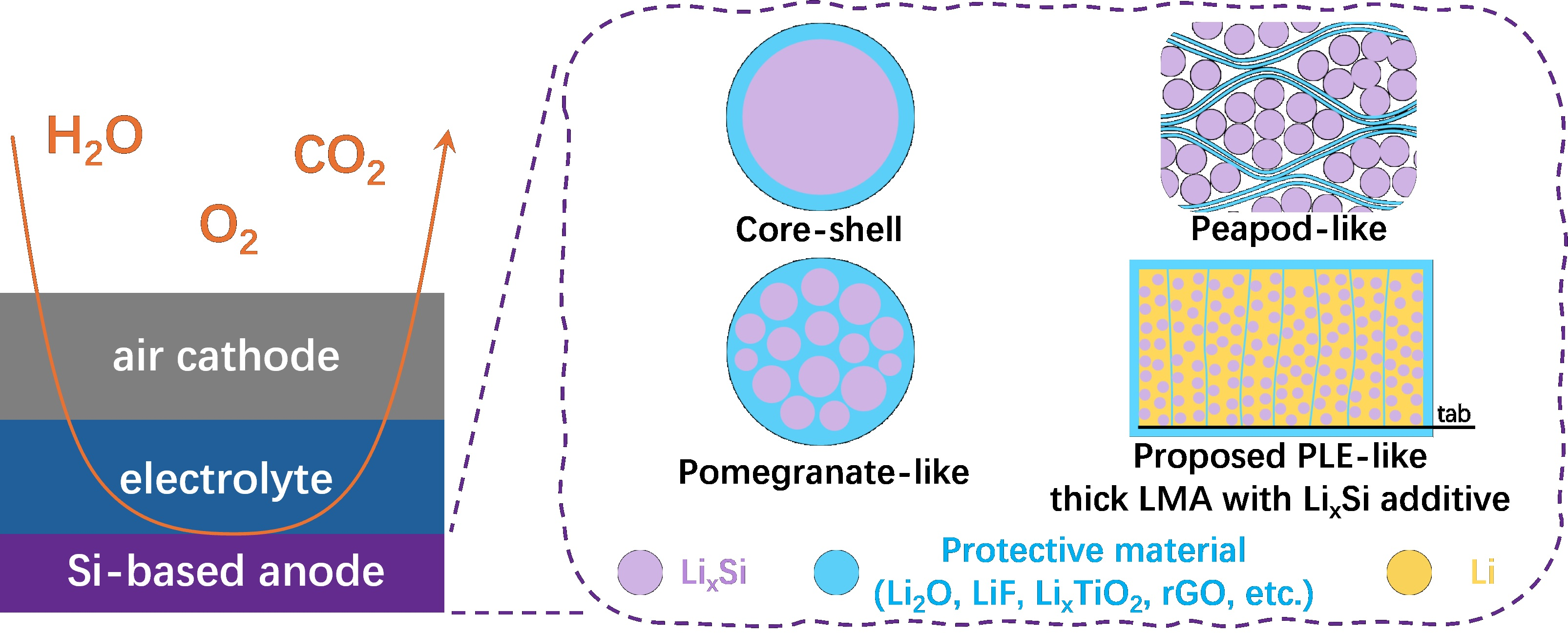
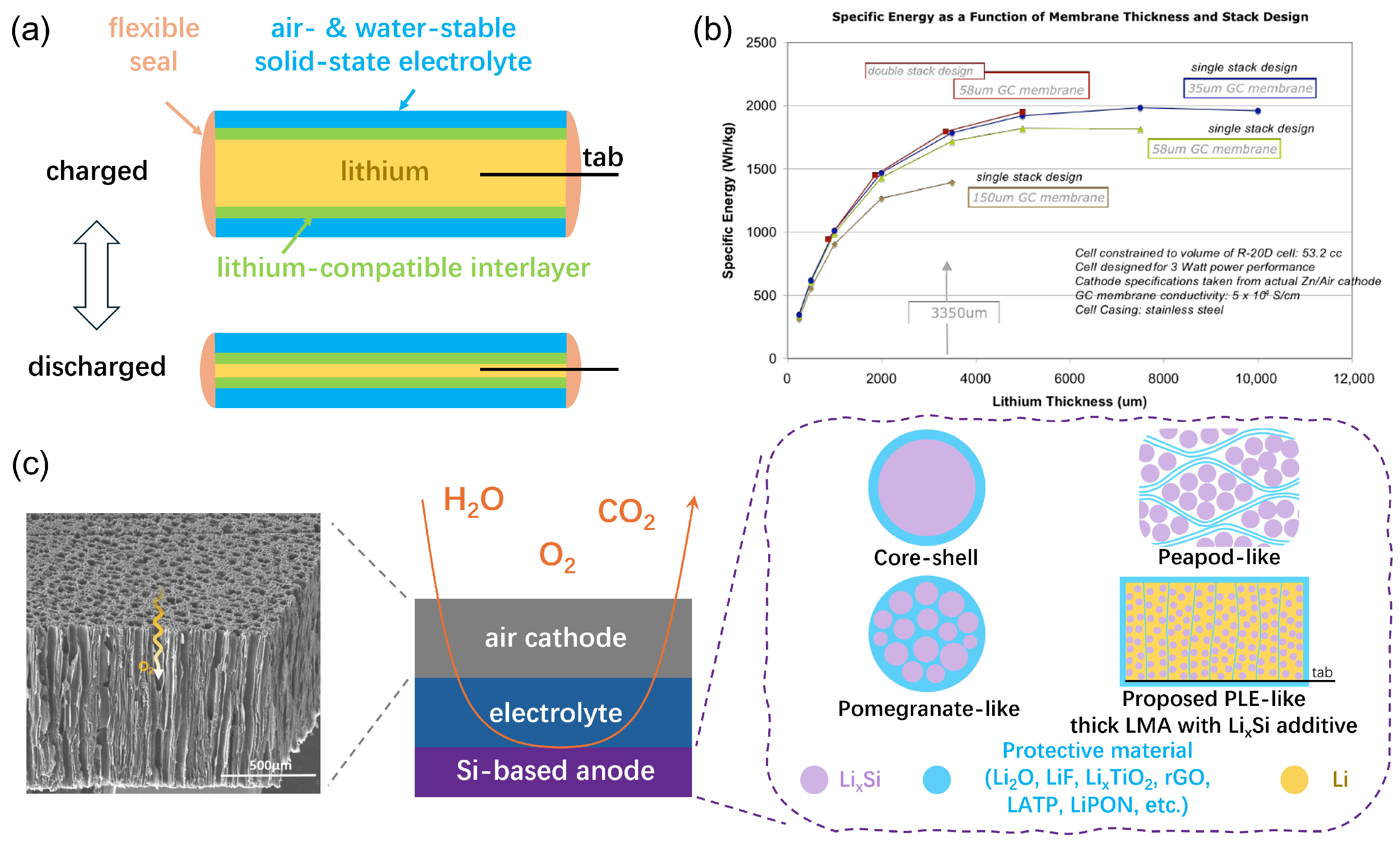
| Protection Architecture | Preparation Method and Protective Component | Electrolyte Composition | Initial Li Extraction Capacity and ICE | Cyclability | Air Exposure Condition and CRR 1 (of 1st Cycle Unless Specified) | Year and Reference |
|---|---|---|---|---|---|---|
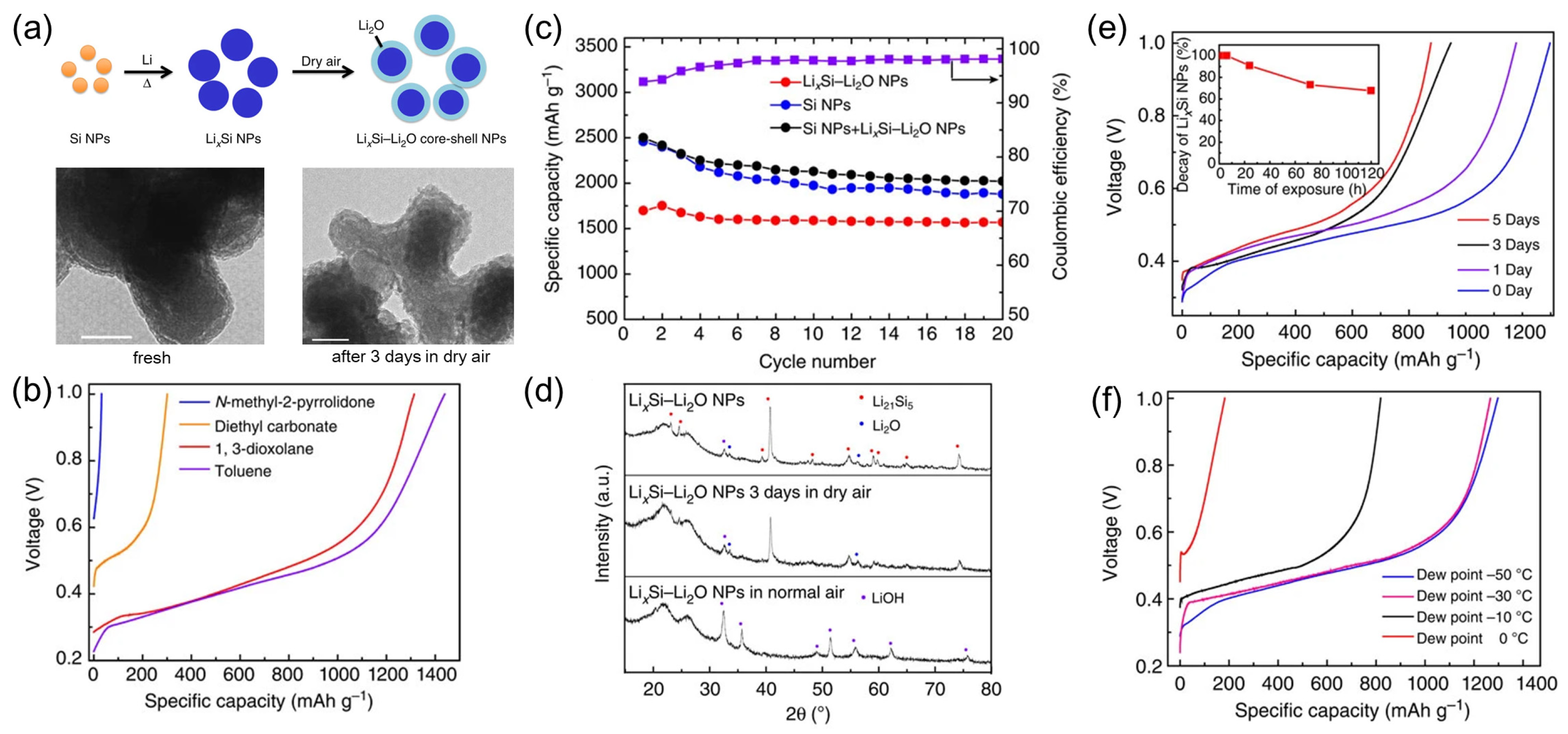
| Core–shell | Oxidation by trace O2 during lithiation with molten Li; Li2O | 1M LiPF6 in EC/DEC (1:1, w/w) + 1 v% VC and 10 v% FEC 2 | ~1600 mAh g−1Si (@C/20); ICE: 94% 3 | Almost unchanged ~1600 mAh g−1Si in 20 cycles @C/20 | Td 4 −50 °C, 1 day; 91% | 2014 [125] |
| Td −50 °C, 3 days; 73% | ||||||
| Td −50 °C, 5 days; 67% | ||||||
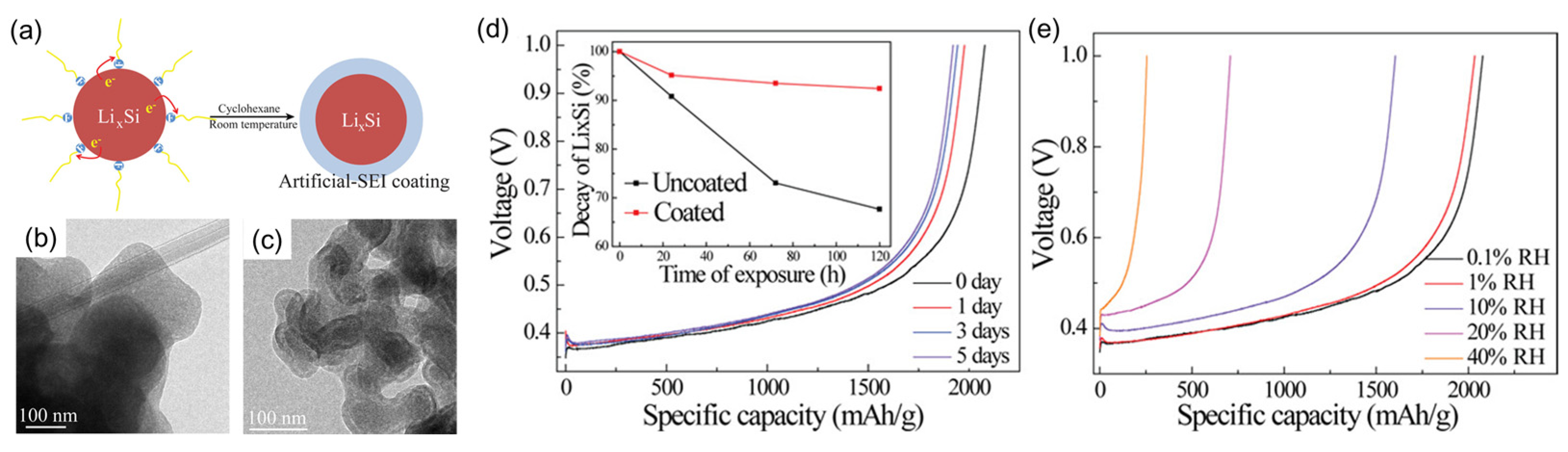
| Reaction of LixSi with aluminum isopropoxide (in cyclohexane); LixAlySiOz/ Li2O | 1M LiPF6 in EC/DEC (1:1, v/v) + 2% VC | 1005 mAh g−1A-LixSi; ICE: N/A | Decays from 430 to 170 mAh g−1 in graphite/A-LixSi composite after 20 cycles | 30 ± 2% RH, 5 1 h; 84% | 2022 [126] | |
| 30 ± 2% RH, 3 h; 70% | ||||||
| 30 ± 2% RH, 5 h; 45% | ||||||
| Reaction of LixSi with 1-fluorodecane (in cyclohexane); LiF and lithium alkyl carbonate | 1M LiPF6 in EC/DEC (1:1, w/w) | 2078 mAh g−1Si; ICE: 96.8% 3 | Undiminished ~1500 mAh g−1Si in 70 cycles @C/2 after first 3 cycles @C/20 (~2200 mAh g−1Si) | Td −50 °C, 5 days; 92% | 2015 [127] | |
| 10% RH, 6 h; 77% | ||||||
| 20% RH, 6 h; 36% | ||||||
| 20% RH, 6 h; 12% | ||||||
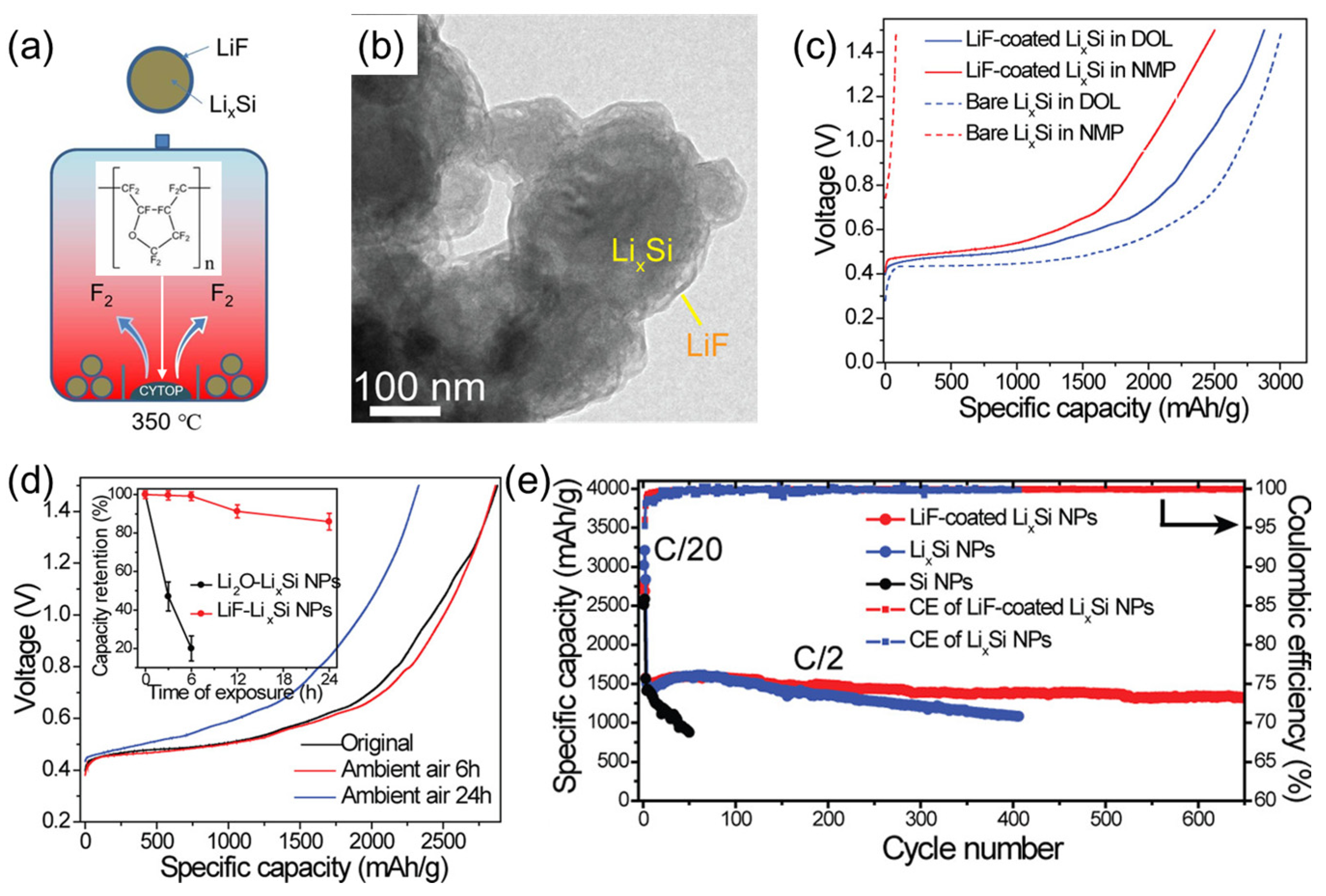
| Heating CYTOP polymer to generate F2 gas to react with LixSi; LiF | 1M LiPF6 in EC/DEC (1:1) | 2504 mAh g−1Si in NMP, 2879 mAh g−1Si in DOL (@C/20); ICE: ~95% | ~1300 mAh g−1Si after 650 cycles @C/2 with 87% CRR and 99.92% average Coulombic efficiency (CE) | 40% RH, 6 h; ≥99% | 2017 [128] | |
| 40% RH, 24 h; 85.9% | ||||||
| Coating with resorcinol–formaldehyde resin-derived carbon, followed by electrochemical pre-lithiation; carbon and Li2O | 1M LiPF6 in EC/DEC (1:1, v/v) + 5 v% FEC for half-cell and 1M LiPF6 in EC/DMC 6/DEC (1:1:1, v/v) for ASP-Hp-SiOx@C-LFP full cell | 1179 mAh g−1 (@1.0 A g−1); ICE: 99.2% | 1059 mAh g−1 after 1000 cycles @1.0 A g−1 with 89.8% CRR and 550 mAh g−1 after 1000 cycles @10 A g−1 with 66.2% CRR | 10~20% RH, 48 h; N/A (all battery tests were conducted after air exposure) | 2022 [129] | |
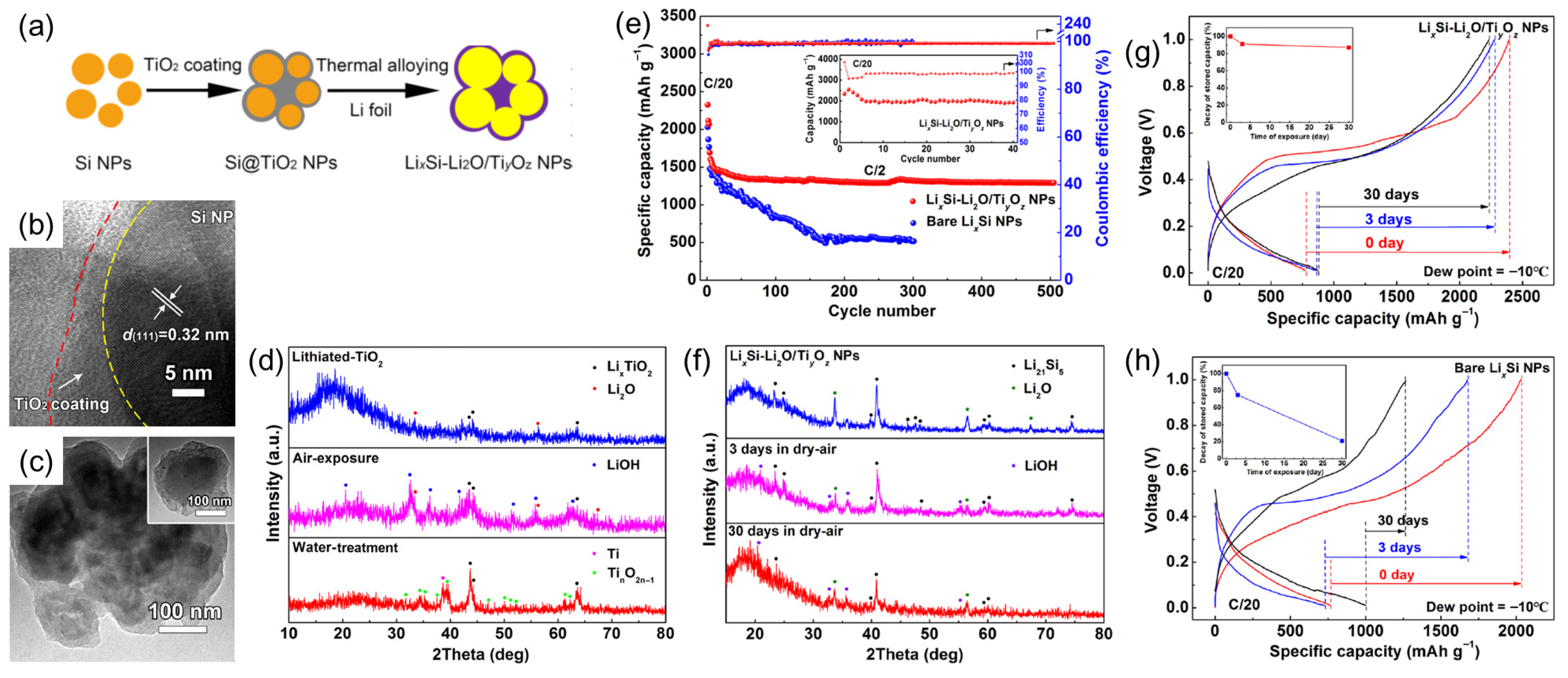
| Coating with amorphous TiO2, followed by pre-lithiation with molten lithium; LixTiO2 and Li2O | 1M LiPF6 in EC/DEC/VC/FEC (44.5:44.5:1:10, v/v) | 2326 mAh g−1Si (@C/20); ICE: 238% | 2000 mAh g−1Si after 40 cycles @C/20 with negligible capacity fading and ~1300 mAh g−1Si after 500 cycles @C/2 with 77% CRR | 10% RH, 30 days; 87% | 2018 [130] | |
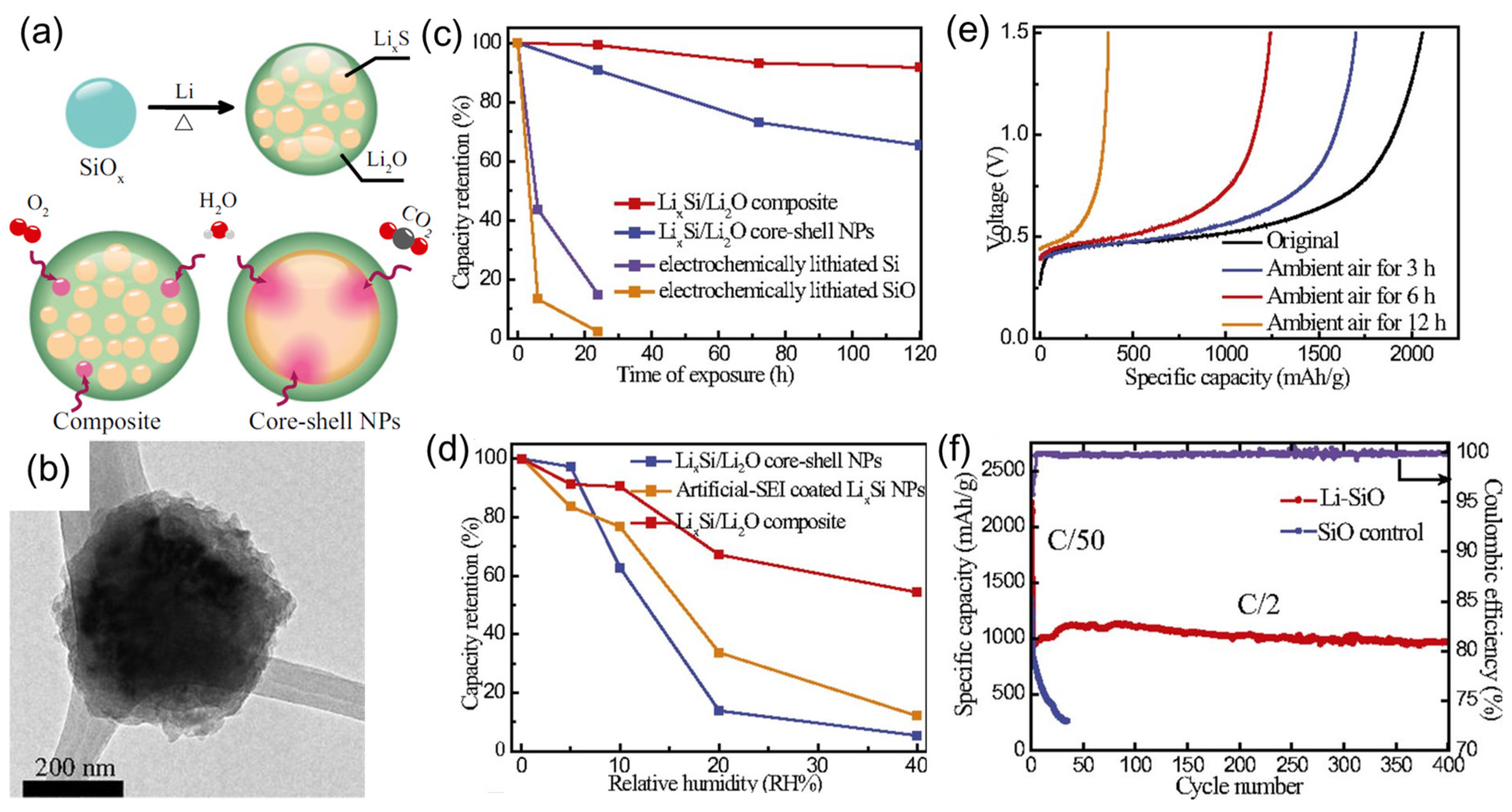
| Pomegranate-like | Mixing SiO or SiO2 NPs with molten lithium; Li2O | 1M LiPF6 in EC/DEC (1:1, w/w) | 2059 mAh g−1SiO2 (equivalent to 3236 mAh g−1Si) @C/50; ICE: ~95.5% | Undiminished ~961 mAh g−1SiO after 400 cycles @C/2, with 99.87% average CE from 200th to 400th cycle | Td −50 °C, 5 days; 91% | 2016 [131] |
| 10% RH, 6 h; ~91% | ||||||
| 40% RH, 6 h; 60% | ||||||
| Peapod-like | Mixing LixSi NPs with graphene sheets and SBS 7 binder in toluene, followed by pressing under 40 MPa; few-layer graphene | 1M LiPF6 in EC/DEC/VC/FEC (44.5:44.5:1:10, v/v) | 1600 mAh g−1LixSi; ICE: 98.8% | 98% CRR after 400 cycles @1 mA cm−2 and ~2.4 mAh cm−2 with 99.92% average CE | Td −50 °C, 14 days; 94.3% | 2017 [132] |
| 20~60% RH, 3 days; ~80% | ||||||
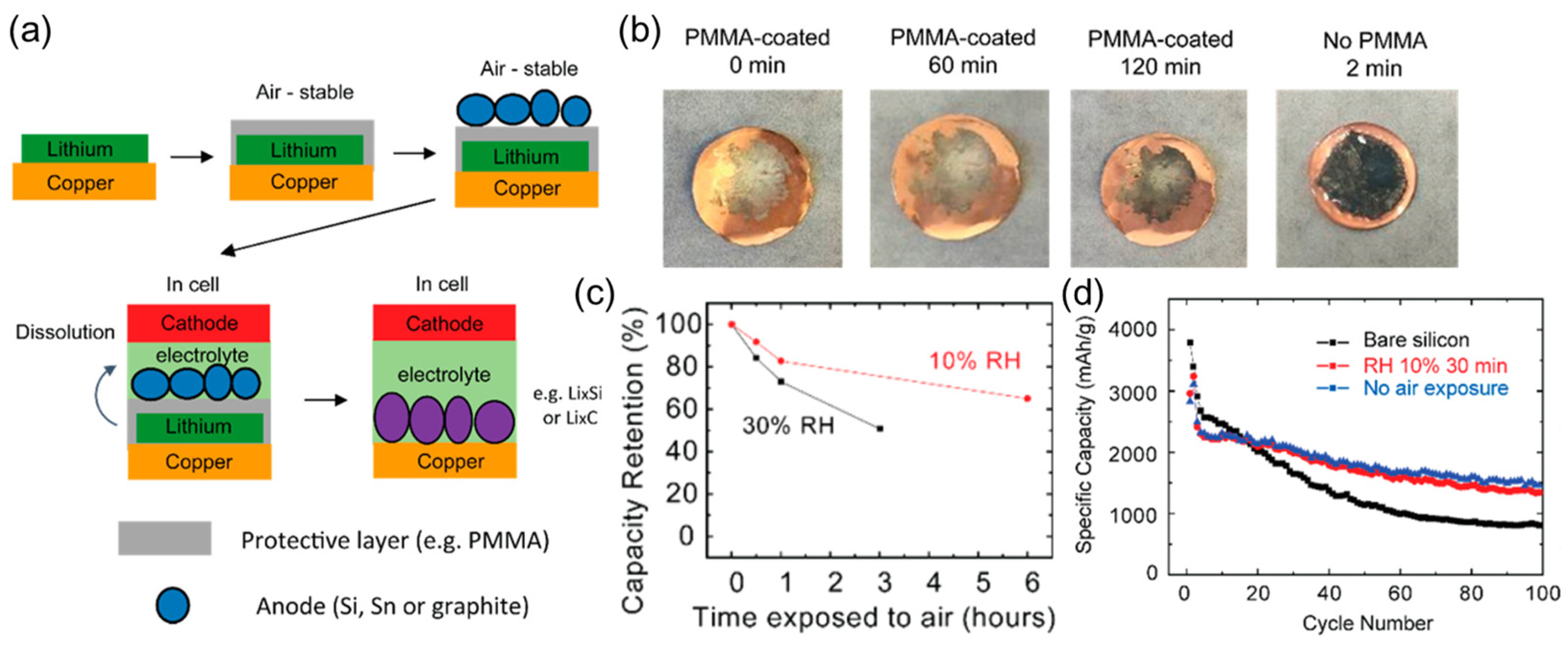
| Film | Drop casting PMMA 8 (in DOL) onto the lithium-plated Cu foil; PMMA | 1 M LiPF6 in EC/DEC | 2961 mAh g−1; ICE: 116% | 1340 mAh g−1 after 100 cycles with 58% CRR after air exposure, similar to the unexposed (1456 mAh g−1 and 63% CRR) | 10% RH, 0.5 h; 92% (remaining capacity after 100 cycles and air exposure divided by that without exposure) | 2016 [133] |
| Silicon–graphite hybrid | Spray drying a mixture of a lithium-enriched graphite, Si NPs and pitch in tetrahydrofuran followed by calcination; a novel O-Li-Si bonding composite | Commercial electrolyte for silicon–graphite | 502 mAh g−1; ICE: 116% | ~520 mAh g−1 after 100 cycles | ~71% RH, 7 days; almost unaffected initial specific capacity (502 mAh g−1) and ICE (113.6%) | 2024 [134] |
| Anode Material and Loading | Cathode Material and Loading | Other Components, Treatments and Conditions | Anode’s Initial Li Extraction Capacity, ICE and N/P Ratio | Cyclability | Cyclability of Control | Year and Reference |
|---|---|---|---|---|---|---|
| Electrochemically pre-lithiated homemade Si-C composite (Si:C = 3:7, w/w); binder: CMC-SBR 1 loading: 3 mg cm−2 | Super P; loading: 1.0 ± 0.1 mgcarbon cm−2 | Electrolyte: LiCF3SO3-TEGDME (1:4, molar) | 780 mAh g−1Si-C @100 mA g−1Si-C; ICE: ~98.3%; N/P ratio 2: 2.34 | Stable ~680 mAh g−1Si-C in 20 cycles in half-cell | N/A | 2012 [137] |
| 15 cycles @200 mA g−1carbon and 1000 mAh g−1carbon in LOB | N/A | |||||
| Electrochemically pre-lithiated commercial Si NPs; binder: PAA 3; loading: 0.65 or 1.0 mg cm−2 | Ru/KB (1:4, w/w); loading: 0.5 mg cm−2 | Half-cell electrolyte: 1 M LiTFSI-FEC/TEGDME (1:4, v/v) | 2083 mAh g−1Si @50 mA g−1Si; ICE: 87%; N/P ratio 2: 3.9 | 1550 mAh g−1Si after 50 cycles @100 mA g−1 with 78% CRR in half-cell | 900 mAh g−1Si after 50 cycles with 45% CRR in FEC-free half-cell | 2016 [138] |
| ~1850 mAh g−1Si after 50 cycles @100 mA g−1 with ~68% CRR in half-cell in O2 atmosphere | ~290 mAh g−1Si after 50 cycles @100 mA g−1 with ~11% CRR in FEC-free half-cell in O2 atmosphere | |||||
| LOB electrolyte: 50 μL 0.2 M LiTFSI + 0.8 M LiNO3 in TEGDME | 100 cycles @500 mA g−1Ru/KB and 1000 mAh g−1Ru/KB in LOB | 20 cycles @500 mA g−1Ru/KB and 1000 mAh g−1Ru/KB in LOB without prior FEC treatment | ||||
| N/P ratio 2: 2.5 | 60 cycles @500 mA g−1Ru/KB and 1000 mAh g−1Ru/KB in LOB | N/A | ||||
| Commercial Si NPs; binder: PAA; loading: 3 mg cm−2 | Li3N–super P–CNT composite (90:5:5, w/w); loading: 8 mgLi3N cm−2 | 50 μL 1 M LiTFSI in TEGDME and 2% FEC (v/v) | ~3000 mAh g−1Si @400 mA g−1Si; ICE: N/A; N/P ratio 4: 23.2 | ~2480 mAh g−1Si after 50 cycles @400 mA g−1Si with ~83% CRR in half-cell | ~300 mAh g−1Si after 50 cycles @400 mA g−1Si with ~12% CRR in half-cell without FEC | 2016 [139] |
| 129 cycles @250 mA g−1carbon and 500 mAh g−1carbon in LOB (anode capacity ~11 mAh) | 65 cycles @250 mA g−1carbon and 500 mAh g−1carbon in LOB with Li foil anode (~14 mAh) | |||||
| 40 cycles @200 mA g−1carbon and 800 mAh g−1carbon in LOB | N/A | |||||
| Electrochemically pre-lithiated homemade Si-C composite; binder: CMC; loading: ~1.13 mg cm−2 | KB; loading: 0.156 mg cm−2 | 140 μL 1 M LiTFSI in TEGDME and 2.5 mM bi-CoPc | 1541 mAh g−1SCC @100 mA g−1SCC; ICE: 88.0%; N/P ratio 2: 48.6 | 944 mAh g−1SCC after 100 cycles @100 mA g−1SCC with 54% CRR in half-cell | N/A | 2025 [140] |
| 86 cycles @100 mA g−1KB and 300 mAh g−1KB in LAB (anode capacity 3.5 mAh, artificial air N2-O2, 78:22, v/v) | 60 cycles @100 mA g−1KB and 300 mAh g−1KB in LAB with Li foil anode (capacity 83 mAh) | |||||
| 43 cycles @100 mA g−1KB and 300 mAh g−1KB in LAB with Cu@Li anode (capacity 24 mAh) | ||||||
| Electrochemically pre-lithiated homemade Si–CNT hybrid fiber (83.84 wt% Si); binder: none; loading: 0.023 mg cm−1 (longitudinal) | Aligned CNT sheet; loading: 0.02 mg cm−1 (longitudinal) | UV-cured GPE 5 based on LiTFSI, LiNO3, TEGDME and other components | 1250 mAh g−1Si/CNT @0.1 mA; ICE: ~96.7%; N/P ratio 2: 2.88 | ~84% CRR after 100 cycles @0.1 mA in half-cell | N/A | 2017 [141] |
| 100 cycles @500 mAh g−1cathode in LAB (5% RH air) | N/A | |||||
| Chemically pre-lithiated, freestanding and flexible Si/C film (51 wt% Si) by electrospinning a dispersion containing PAN 6 and Si NPs and subsequent calcination; binder: none; loading: 5.4~6.1 mg cm−2 | MWCNTs 7; loading: ~0.3 mg cm−2 | GPE with 1M LiFSI 8 in TEGDME and 50 mM LiI | 1300 mAh g−1Si-C @100 mA g−1; N/P ratio: 26.7~30 | 140 cycles @500 mA g−1MWCNT and 1000 mAh g−1MWCNT in LOB | 80 cycles @500 mA g−1MWCNT and 1000 mAh g−1MWCNT with GPE and LMA in LOB | 2019 [142] |
| 90 cycles @500 mA g−1MWCNT and 1000 mAh g−1MWCNT with liquid electrolyte and Si/C film anode in LOB | ||||||
| 44 cycles @500 mA g−1MWCNT and 1000 mAh g−1MWCNT with liquid electrolyte and LMA in LOB |
Disclaimer/Publisher’s Note: The statements, opinions and data contained in all publications are solely those of the individual author(s) and contributor(s) and not of MDPI and/or the editor(s). MDPI and/or the editor(s) disclaim responsibility for any injury to people or property resulting from any ideas, methods, instructions or products referred to in the content. |
© 2026 by the authors. Licensee MDPI, Basel, Switzerland. This article is an open access article distributed under the terms and conditions of the Creative Commons Attribution (CC BY) license.
Share and Cite
Liu, Z.; Zhou, H.; He, H.; Wang, D.; Li, Z.; Chen, Z. Advances in Air-Stable Silicon-Based Anodes and Their Application in Li–Air Batteries. Inorganics 2026, 14, 127. https://doi.org/10.3390/inorganics14050127
Liu Z, Zhou H, He H, Wang D, Li Z, Chen Z. Advances in Air-Stable Silicon-Based Anodes and Their Application in Li–Air Batteries. Inorganics. 2026; 14(5):127. https://doi.org/10.3390/inorganics14050127
Chicago/Turabian StyleLiu, Zixuan, Huafeng Zhou, Haiyong He, Deyu Wang, Zhoupeng Li, and Zhengfei Chen. 2026. "Advances in Air-Stable Silicon-Based Anodes and Their Application in Li–Air Batteries" Inorganics 14, no. 5: 127. https://doi.org/10.3390/inorganics14050127
APA StyleLiu, Z., Zhou, H., He, H., Wang, D., Li, Z., & Chen, Z. (2026). Advances in Air-Stable Silicon-Based Anodes and Their Application in Li–Air Batteries. Inorganics, 14(5), 127. https://doi.org/10.3390/inorganics14050127