Article

Metal Atoms Adsorbed on AlN Monolayer: Potential Application in Photodetectors

1
Yan’an Vocational and Technical College, Yan’an 716000, China
2
School of Electrical Engineering, Xi’an University of Technology, Xi’an 710054, China
*
Author to whom correspondence should be addressed.
Inorganics 2026, 14(4), 99; https://doi.org/10.3390/inorganics14040099
Submission received: 4 March 2026 / Revised: 21 March 2026 / Accepted: 23 March 2026 / Published: 30 March 2026

Abstract

Two-dimensional materials have broad application prospects in the field of optoelectronic devices. As a next-generation power electronic device, AlN materials have obvious advantages in power processing, and their monolayer structure has excellent optoelectronic properties, which is of great significance for the study of 2D AlN monolayers. Properties such as electronic and optical properties of metal-adsorbed AlN (M-AlN) systems have been systematically investigated using density functional theory from first principles. The results of the energy bands of the M-AlN system indicate that the adsorption of Al, Li, Ag, Au, Bi, Cr, Mn, Na, Pb, Sn, Ti, and K metals makes the monolayer AlN magnetic, the incorporation of two metals, Al and Li, is the transition of the monolayer AlN from a semiconductor to a semi-metal, and the introduction of K metal makes the monolayer AlN transition from a semiconductor to a metal. The work function of the M-AlN system shows that the introduction of the metal reduces the work function of the monolayer AlN, especially for K-AlN, which is reduced by 56.12% compared to the monolayer AlN. In addition, the results of the optical absorption spectra of the M-AlN system revealed that the introduction of the metals made the monolayer AlN exhibit high absorption peaks in the visible and near-infrared regions; in particular, the intensity of the absorption peaks of the Ti-AlN system at 557.8 nm reached 7.4 × 104 cm−1 and the intensity of the absorption peaks of the K-AlN system at 1109.3 nm reached 1.01 × 105 cm−1. This indicates that the introduction of Ti and K metal atoms enhances the absorption properties of monolayer AlN in the visible and near-infrared regions. Finally, the time-domain finite difference using spherical metal nanoparticles is used to excite the localized surface plasmon resonance, and the results show a small area of strong electric field around the electric field hotspot of Cr and Li particles, and a good concentration of the electric field strength in the x and y directions. In summary, the system of metal atoms adsorbed on AlN will be favorable for the design of spintronics, field-emitting devices and solar photovoltaic devices.

1. Introduction

In recent years, two-dimensional (2D) materials have been suitable for applications in various technological fields due to their striking variety of properties [1,2]. Representative 2D materials such as graphene [3,4,5], 2D gallium nitride [6,7], black phosphene [8], and transition metal disulfide compounds [9] have been widely used in the fields of optoelectronics, electronics, environment, energy, and aerospace due to their unique structures, which exhibit excellent physical and chemical properties [10,11]. Graphene exhibits high stability and exceptional physical properties due to its unique lattice symmetry [12]; however, there are some limitations of graphene in electronic device applications at the same time, such as zero-bandgap semi-metallic properties, which can lead to low on/off ratios of switching devices, low reproducibility in large-scale production [13], etc., and two-dimensional materials other than graphene may bring a new solution to the identified problems.
III-V compounds are common two-dimensional materials and their applications in optoelectronics, spintronic devices, catalysis, and gas sensing [14,15,16,17,18] have attracted extensive research by scholars. Common III-V nitride compounds contain InN, GaN, and AlN, whose compound bandgaps of the four elements In, Ga, Al, and N can be adjusted between 0.78 eV and 6.2 eV at room temperature, among which GaN and AlN are considered ideal materials for high-efficiency short-wave LEDs and field-effect transistors [19,20,21]. AlN has a wide bandgap, high breakdown field and high thermal conductivity for high-frequency, high-power and high-temperature devices, and these properties make this material an attractive candidate for ceramic substrates in thin-film devices [22].
Constructing vacancies, doping, adsorption, or other modification means are now commonly used to improve the physical properties, electronic structure, and optical properties of two-dimensional materials, and most of the research on this class of materials is based on first principles. Cui et al. systematically investigated the magnetic and electronic properties of metal atoms adsorbed on a monolayer of MoSi2N4 using density functional theory and found that different metal atoms adsorbed on MoSi2N4 had different energy band structure properties, and that the adsorption of metal atoms was able to greatly reduce the work function of MoSi2N4 [23]. Yang et al. investigated the optical properties of WS2 by adsorption of metal atoms and found that the adsorption of metal atoms enhanced the absorption of the original system in the UV region with a significant red shift in the UV region [24]. Shen et al. showed that the adsorption of organic molecules can improve the electronic device performance of ZnO by studying the electronic structure of ZnO adsorbed by organic molecules and expanded the electronic device field emission capability of ZnO [25].
Aluminum nitride is a new type of direct bandgap wide forbidden band chemistries semiconductor material, which was first synthesized in 1877, and has good properties such as wider forbidden bands, low dielectric constants, good thermal conductivity, small coefficients of thermal expansion, and optical transmission properties [26]. However, two-dimensional AlN is a graphene-like material as a class of typical III-V monolayer compounds; its structural stability and electronic properties have also become a “hot” research topic, with most of the main related research based on the first principles of calculations, through the monolayer of AlN constructive vacancies, doping, adsorption, and other modifications of the study of its various physical properties. By studying the electronic structure and optical properties of monolayer AlN after doping with rare earth elements, Zou et al. found that the bandgap value decreased after doping, the energy band profile became denser, and the total density of states shifted downward as a whole, while the static dielectric constant and light absorption properties were improved [27]. Su et al. doped C and Na on monolayer AlN to study the crystal structure, electronic structure and other properties after doping, and it was found that the co-doping of the two elements can greatly reduce the forbidden bandwidth of AlN, resulting in a red shift in the absorption sidebands, which broadens the range of the response of AlN to light, and at the same time, improves its dielectric constant, and it has the strongest absorption ability in the visible region [28]. Jia et al. investigated the mechanical properties, electronic structure and other properties of monolayer AlN after doping by the rare earth metal La and showed that the doping of La element enhances the toughness of AlN, and at the same time it can improve its piezoelectric properties [29]. Han et al. doped monolayer AlN with first and second main group metals and investigated the magnetic and electronic structure of doped AlN, and the results showed that the doped monolayer AlN has semi-metallic properties, which may be applied in the field of spintronics [30]. Wang et al. investigated Cr-doped monolayer AlN and Cu-Cr co-doped monolayer AlN by applying the first nature principle and combining with the generalized gradient, and the bandgaps of the doped monolayers of AlN were narrowed, with all of them showing semi-metallic properties, while the co-doped materials showed excellent ferromagnetism as well as a significant reduction in the energy loss [31].
Unlike the above doping studies on monolayer AlN, this paper is based on the first-principles approach of density functional theory to realize the study of metal-atom-adsorbed monolayer AlN by constructing the structure of metal-atom-adsorbed monolayer AlN (M-AlN), and calculating the properties of the electronic structure, magnetism, work function, and optics of monolayer AlN and M-AlN.

2. Results and Discussion

2.1. Structural Properties

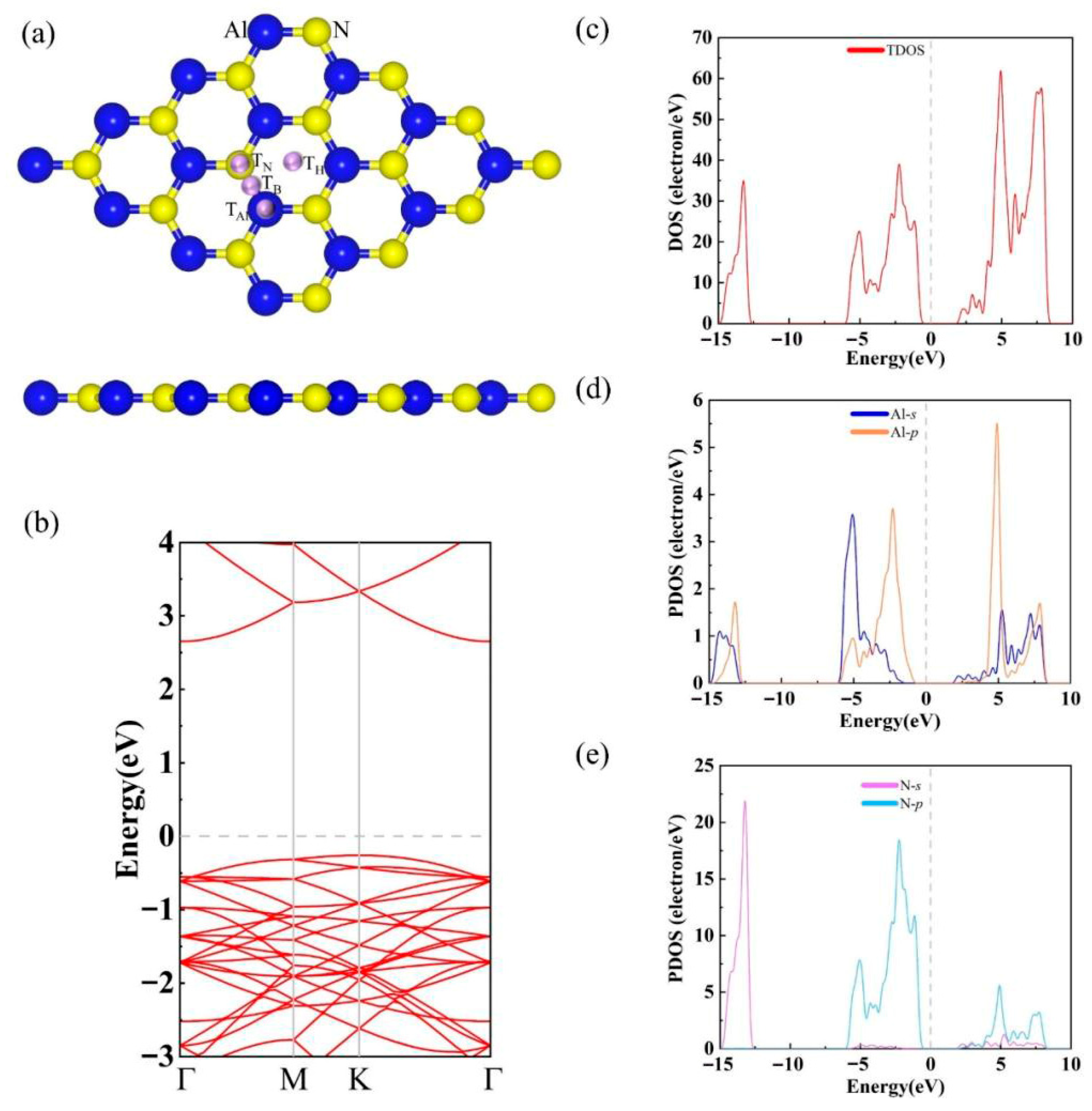
Before exploring the structural properties of metal-atom-adsorbed monolayer AlN (M-AlN) systems, we first evaluated the geometrical and electronic properties of monolayer AlN. Figure 1a depicts the top and side views of the monolayer AlN crystal structure and the adsorption sites of the metal atoms. The optimized monolayer AlN structure contains 32 atoms, where blue spheres indicate Al atoms, yellow spheres indicate N atoms, and purple spheres indicate four adsorption sites for metal atoms. Figure 1b shows the energy band structure of monolayer AlN, and it can be seen that the valence band top and the conduction band bottom of monolayer AlN are located at the K and Γ points in the Brillouin zone, respectively, which suggests that the monolayer AlN is an indirect bandgap semiconductor, with a bandgap of 2.91 eV, which is in accordance with the bandgap of the monolayer AlN calculated by Kecik (2.91 eV) [32,33,34]. Figure 1c–e represent the total and fractional densities of states of monolayer AlN, and the bottom of the conduction band of monolayer AlN is mainly contributed by the Al-s, Al-p, N-s and N-p orbitals, whilst the top of its valence band is mainly contributed by the Al-s, Al-p and N-p orbitals. The next M-AlN systems are all adsorbed based on this monolayer AlN.
After analyzing the basic properties of monolayer AlN for each metal atom, four adsorption positions on the monolayer AlN are considered as in Figure 1a, including TN (adsorbed on N atoms), TAl (adsorbed on Al atoms), TB (adsorbed at the position of the center of the chemical bonding of the N atoms to the Al atoms), and TH (adsorbed at the position of the center of the hexagonal structure). Therefore, four adsorption models were constructed for each metal-atom-adsorbing monolayer AlN. To verify the stability of the M-AlN system, the adsorption energy (Ead) is investigated for all adsorption systems in this part. The M-AlN system is calculated as follows:
Ead = EM+AlN − (EAlN + EM)
where EM+AlN is the total energy of the M-AlN system. EAlN and EM denote the total energy of the monolayer of AlN and metal atoms.
The adsorption energy characterizes the interaction force between atoms, and the magnitude of the adsorption energy can reflect the strength and stability of interatomic interactions. The greater the adsorption energy, the stronger the interactions between the atoms, the more difficult it is to separate them, and the more stable the chemical bonds formed. Table 1 lists the adsorption energy (Ead), charge transfer (C), magnetic moment (Mtotal), bandgap (Eg) and adsorption height (D) for the most stable structures of all M-AlN systems. From the table, all the values of Ead for M-AlN are less than zero, which indicates that all M-AlN systems are well stabilized. However, for the systems with different M-AlN systems, their most stable adsorption sites are different, where the adsorption sites for the most stable configurations of Ag-AlN, Al-AlN, Au-AlN, Bi-AlN, Mn-AlN, Na-AlN, Pb-AlN, Pt-AlN, and Sn-AlN systems are located in the TN, while those of the Cr-AlN, Pd-AlN, and Zn-AlN systems are located in the TB sites. In addition, the adsorption sites of the most stable configurations of the K-AlN and Ti-AlN systems are located at TAl, and interestingly, only the most stable configuration of the Li-AlN system is located at the TH site. Of interest, the Ti-AlN system has a large Ead as high as −7.996 eV, which suggests that the Ti atoms have a strong interaction with the monolayer AlN.
The height of adsorption between atoms characterizes the interactions and distances between atoms. The adsorption heights (D) of the M-AlN system are given in Table 1 as 2.29 Å (Ag), 2.06 Å (Al), 2.11 Å (Au), 2.29 Å (Bi), 2.32 Å (Cr), 2.76 Å (K), 1.32 Å (Li), 2.07 Å (Mn), 2.57 Å (Na), 2.56 Å (Pb), 1.84 Å (Pd), 1.77 Å (Pt), 2.43 Å (Sn), 1.19 Å (Ti) and 2.79 Å (Zn). Among them, K-AlN, Na-AlN, Pb-AlN, and Zn-AlN have larger values of D, indicating that the interaction force between these metal atoms and the monolayer AlN is weak. It is also found that four metal atoms, Li-AlN, Pd-AlN, Pt-AlN and Ti-AlN, have smaller D values, indicating that the interaction force between these metal atoms and the monolayer AlN is stronger. In addition, all the most stable M-AlN systems did not undergo severe deformation compared to monolayer AlN, indicating that the adsorption of metal atoms did not disrupt the structure of monolayer AlN. Based on the results of adsorption energy and adsorption height calculations, the most stable system in each metal adsorption system was selected, and all the next computational studies were carried out based on the selection of the most stable system in M-AlN.
Mastail et al. [35]. investigated the adsorption behavior of Ti, Al, and N atoms on the AlN surface using first-principle calculations and demonstrated that the adsorption configuration is closely related to the coordination environment and local electronic structure of surface atoms, with different adsorption sites exhibiting distinct stabilities. Wang et al. [36] systematically studied the adsorption of gas molecules on monolayer AlN and reported the presence of multiple active adsorption sites, where the adsorption energies vary significantly depending on both the adsorption site and the electronic characteristics of the adsorbates. Strak et al. [37]. explored the adsorption mechanisms on AlN surfaces and found that both structural and electronic factors jointly govern the adsorption process, with specific surface sites playing a key role in determining stability. Kempisty et al. [38] further pointed out that bonding interactions and charge transfer are critical in stabilizing adsorption configurations, suggesting that adsorbed atoms may form stable structures through interactions with multiple surface atoms. Kuang et al. [39]. examined hydrogen adsorption on AlN nanostructures and revealed that different adsorption sites correspond to varying adsorption strengths, which are strongly dependent on local electronic structures and bonding characteristics. Overall, these studies consistently indicate that the adsorption behavior on AlN surfaces is governed by the interplay among the electronic properties of surface atoms, the nature of adsorption sites, and the intrinsic characteristics of the adsorbates. Various adsorption sites, including top, bridge, and hollow positions, can all serve as energetically favorable configurations. These findings are in good agreement with the present results, where different metal atoms preferentially stabilize at TN, TAl, TB, and TH sites.

2.2. Electronic Properties

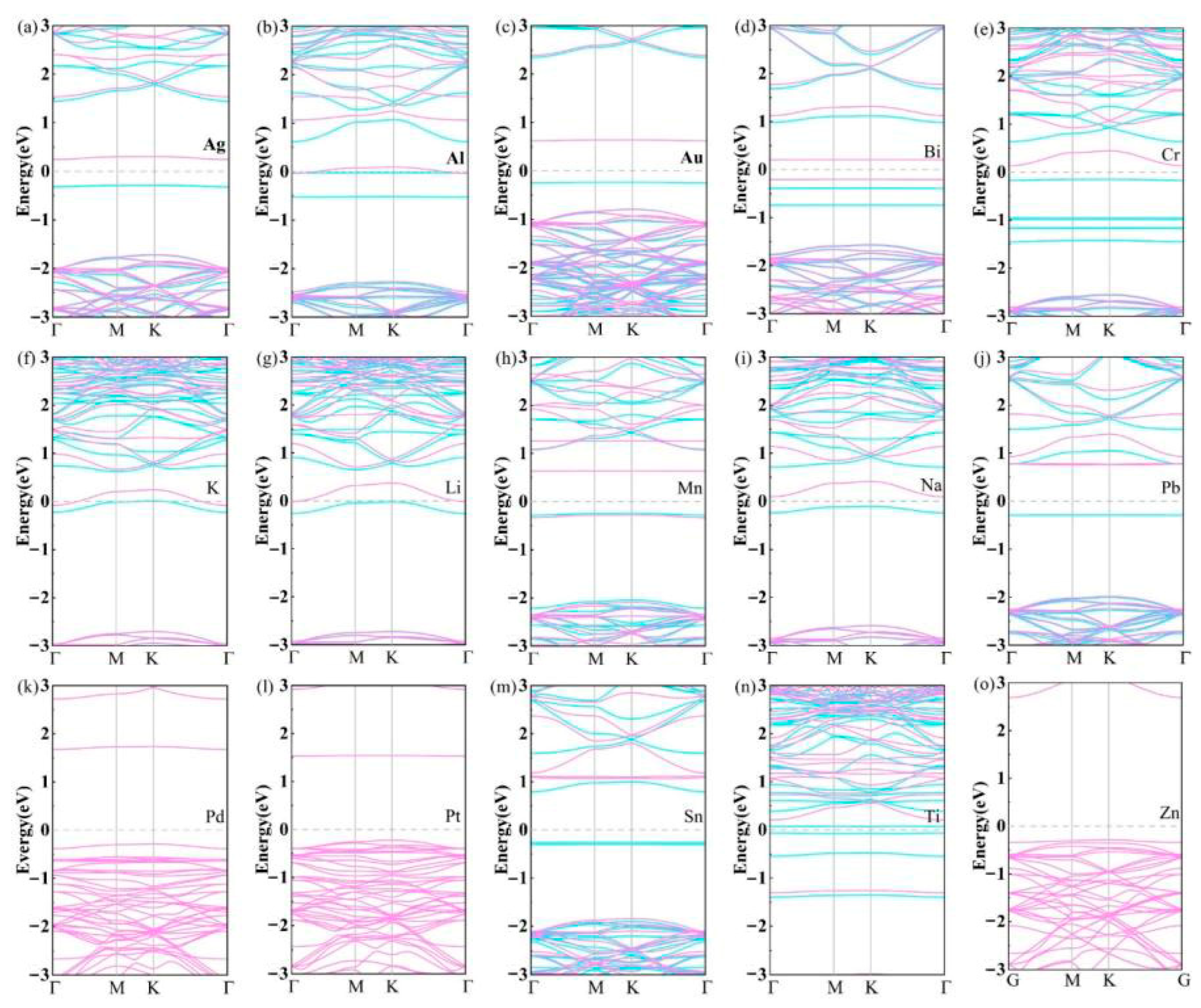
Metal adsorption is an effective method to modulate the electronic properties of two-dimensional materials [40,41] and to analyze the effect of adsorption of metal atoms on the energy band structure of monolayer AlN, the energy band structure of the M-AlN system will be calculated in this section. Figure 2 represents the calculated results of the energy band structure of the M-AlN system, with the gray dashed line indicating the energy zeros as Fermi energy levels. The analytical results show that the Pd-AlN, Pt-AlN and Zn-AlN systems exhibit nonmagnetic semiconductor properties. The Al-AlN and Li-AlN systems exhibit magnetic semi-metallic behavior and the K-AlN system exhibits magnetic metallic behavior due to the adsorption of the metal atoms moving the conduction band upward. However, the Ag-AlN, Au-AlN, Bi-AlN, Cr-AlN, Mn-AlN, Na-AlN, Pb-AlN, Sn-AlN, and Ti-AlN systems exhibit magnetic semiconductor behavior. Their bandgaps are 0.53 eV, 0.86 eV, 0.41 eV, 0.28 eV, 0.88 eV, 0.2 eV, 1.04 eV, 1.06 eV, and 0.13 eV, respectively. Notably, the adsorption of Al, Li, Ag, Au, Bi, Cr, Mn, Na, Pb, Sn, Ti, and K metal atoms makes the monolayer AlN magnetic, the adsorption of two metal atoms, Al and Li, makes the monolayer AlN transition from semiconductor to semi-metal, and most importantly, the introduction of K metal atoms makes the monolayer AlN transition from semiconductor to metal. The analysis of the above results shows that on the one hand, the introduction of metal can greatly reduce the bandgap of monolayer AlN because of the interaction between the metal atoms and nitrogen atoms, and this interaction leads to the metal atoms being able to transfer energy to the monolayer AlN, which leads to the reduction in its bandgap. On the other hand, the introduction of a metal enables the transformation of the monolayer AlN from a semiconductor to a metal, as well as realizing the tuning of the band gap of the monolayer AlN and making it magnetic.
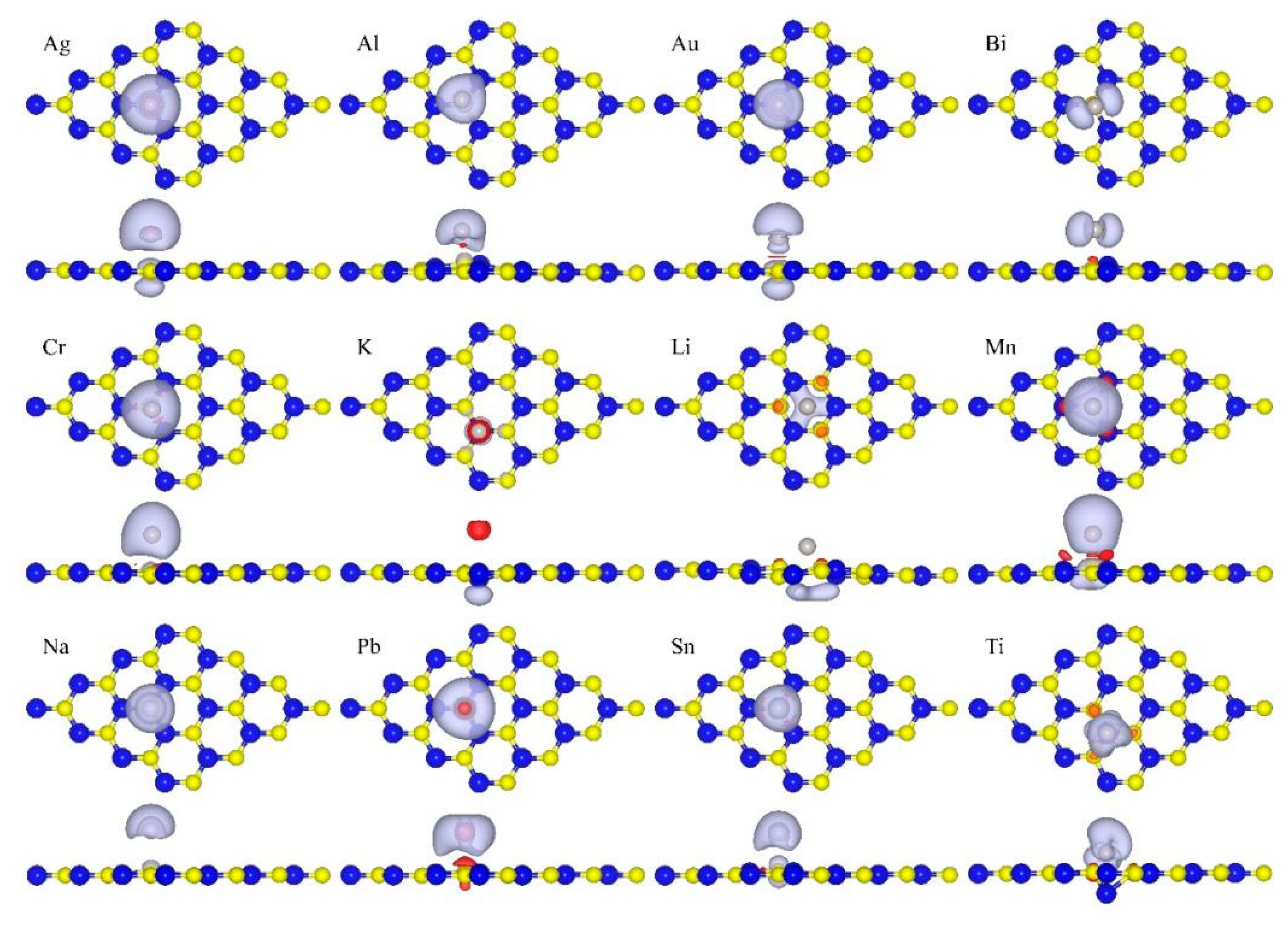
By analyzing the energy band structure, it is found that the adsorption of these metal atoms not only introduces magnetism but also modulates the bandgap of monolayer AlN. In addition, magnetism is one of the most fundamental properties of materials and is determined by exchange interactions between spins [42]. To investigate the origin of the magnetism in the M-AlN system, this section analyzes the spin-polarized charge density of the M-AlN system, and the results are given in Figure 3. The results show that the Al-AlN, Li-AlN, Ag-AlN, Au-AlN, Bi-AlN, Cr-AlN, K-AlN, Mn-AlN, Na-AlN, Pb-AlN, Sn-AlN, and Ti-AlN systems have magnetic properties, which are the same as those demonstrated by the energy band diagrams. In addition, the magnetic moments of each M-AlN system were calculated (as shown in Table 1), and it was found that the Ag-AlN, Au-AlN, Bi-AlN, Cr-AlN, and Na-AlN systems all had magnetic moments of 1.0 μB; however, the magnetic moments of the two systems, K-AlN (0.8 μB) and Li-AlN (0.9 μB), were less than 1.0 μB, the other systems had magnetic properties more significant than 1.0 μB, and their magnetic moment values are 3.0 μB (Al-AlN), 5.0 μB (Mn-AlN), 2.0 μB (Pb-AlN), 4.0 μB (Sn-AlN), and 2.0 μB (Ti-AlN), respectively. The magnetic behavior strongly depends on the valence electronic configurations of the adsorbed metal atoms. Atoms with partially filled d or p orbitals introduce localized states near the Fermi level, leading to pronounced spin splitting. In contrast, alkali metals such as K mainly induce magnetism through charge transfer, resulting in asymmetric electron distribution and localized magnetic moments, whereas systems with nearly filled orbitals exhibit negligible spin polarization. Charge transfer further governs the emergence of spin polarization. Systems such as K, Mn, and Pb exhibit significant electron redistribution, which leads to an imbalance between spin-up and spin-down electrons and thus generates net magnetic moments, while weak charge transfer results in nearly spin-symmetric, nonmagnetic behavior. In addition, adsorption-induced symmetry breaking plays an important role. Different adsorption sites (TN, TB, TAl, and TH) disrupt the intrinsic lattice symmetry, giving rise to an inhomogeneous spatial distribution of electron density. This effect is more pronounced in systems such as K, Mn, and Pb, where localized and asymmetric spin density distributions are clearly observed. The above results indicate that the introduction of metal atoms makes the monolayer AlN magnetic, in which Al-AlN, Li-AlN, Ag-AlN, Au-AlN, Bi-AlN, Cr-AlN, K-AlN, Mn-AlN, Na-AlN, Pb-AlN, Sn-AlN, and Ti-AlN are systems that can be used in spintronic nanodevice preparation.
In addition to the energy band structure and magnetic properties, the charge transfer is also an important parameter for describing the electronic properties of nanomaterials, in which the charge density difference (CDD) is one of the most important means of studying the electronic structure, which can be visualized to obtain the flow of electrons after the interaction of the various parts of the system, or the change in the density of electrons in the process of the formation of molecules from atoms. Therefore, in this part, the CDD of the M-AlN system will be investigated to reveal the effect of metal atom adsorption on the electronic properties of monolayer AlN. The CDD of the M-AlN system is calculated as follows:
Δρ = ρTotalρAlNρM
where ρTotal denotes the total charge of M-AlN, ρAlN denotes the charge of the monolayer AlN, and ρM denotes the charge of the metal atoms.
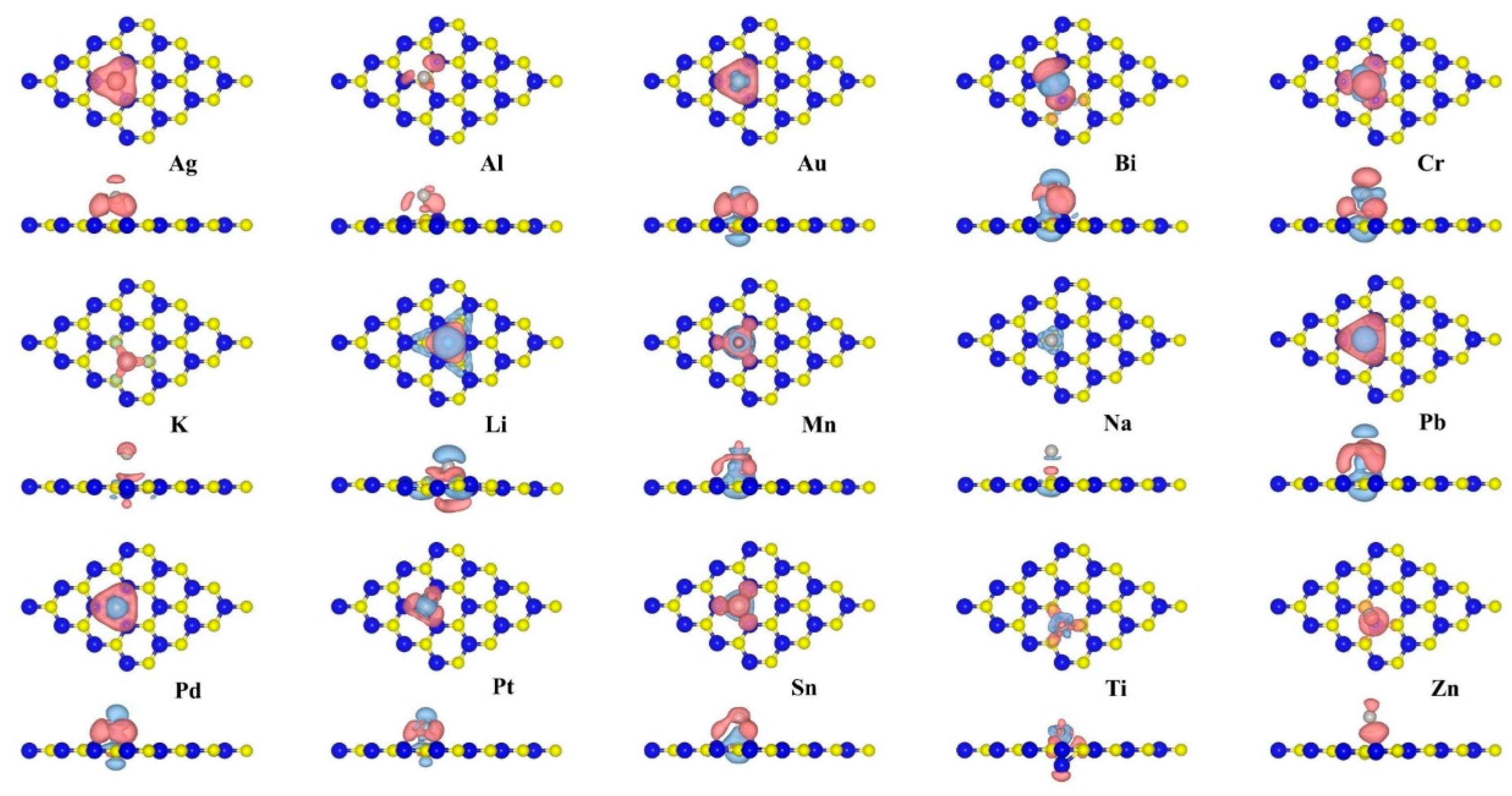
In order to understand the specifics of charge transfer, Bader charges [43] were investigated, and by analyzing the results of CDD for the M-AlN system as in Figure 4, it can be observed that charge transfer occurs mainly between the metal atoms and the monolayer of AlN, resulting in a distribution of charges on the metal atoms and the undercoordinated atoms, and this distribution suggests the existence of covalent bonding between the metal atoms and the undercoordinated atoms. The transfer of electrons between the adsorbed metal atoms and AlN is as follows: On the one hand, in the Ag-AlN, Au-AlN, Bi-AlN, Pd-AlN, Pt-AlN, and Sn-AlN systems, the adsorbed metal atoms act as donors and lose electrons, while the AlN acts as an acceptor and gains electrons. In the case of the corresponding metal atoms, the charge transfers are −0.123 |e|(Ag), −0.441 |e|(Au), −0.143 |e|(Bi), −0.381 |e|(Pd), and −0.628 |e|(Pt), respectively. On the other hand, in other M-AlN systems, the metal atoms act as acceptors and gain electrons and AlN acts as a donor and loses electrons; 0.349 |e|(Al), 0.144 |e|(Cr), 0.604 |e|(K), 0.841 |e|(Li), 0.127 |e|(Mn), 0.397 |e|(Na), 0.012 |e|(Pb), −0.136 |e|(Sn), 1.069 |e|(Ti), and 0.013 |e|(Zn) are transferred from the AlN monolayer to the side of the corresponding metal atom. By comparing the CDD values of the M-AlN system, it is worth emphasizing that the charge transfer between the four metals, K, Li, Ti and Pt, and the monolayer AlN is larger, which indicates the strong interaction between the metal atoms and the monolayer AlN in these four systems.
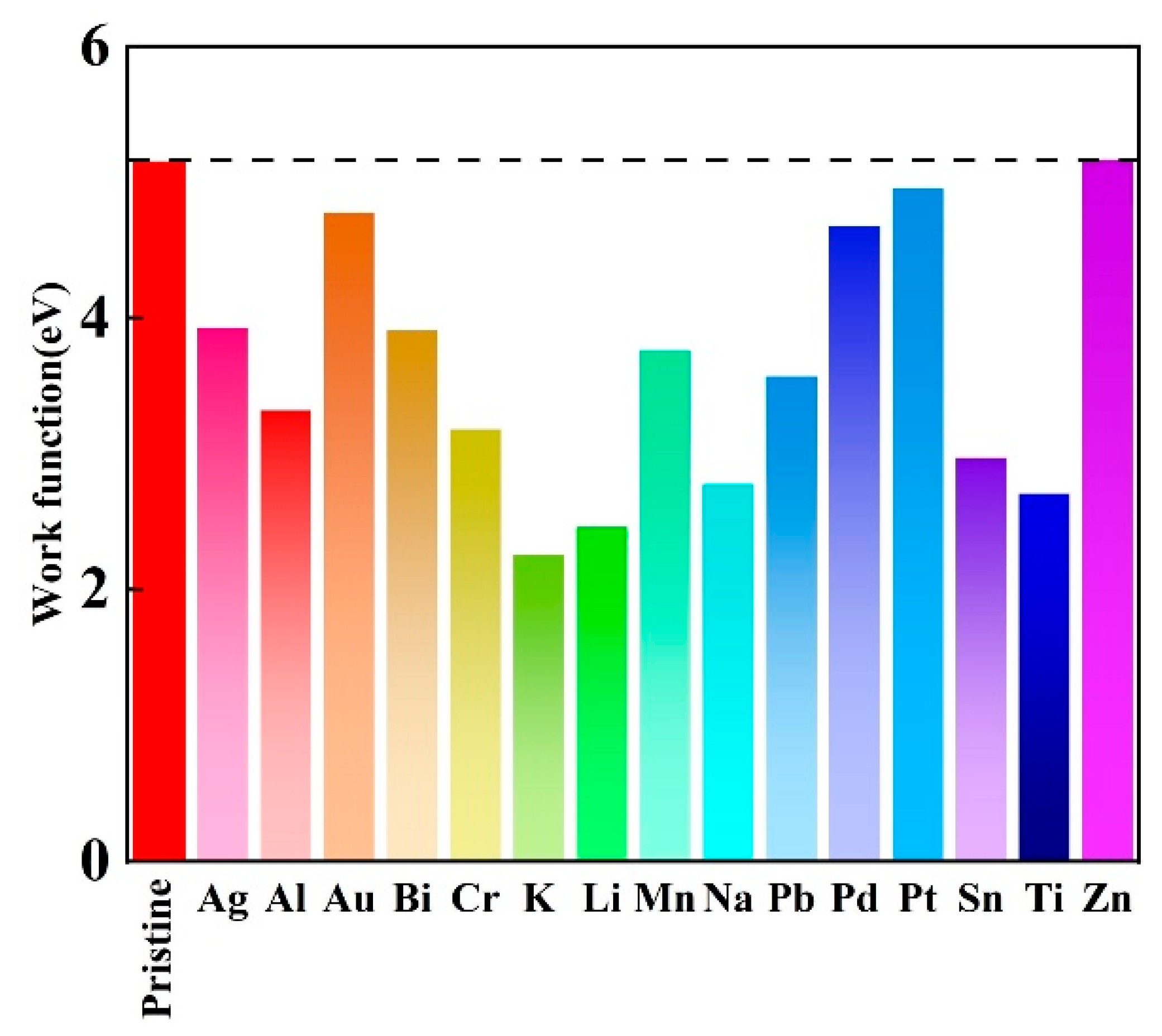
The work function is an important indicator for describing the electron field emission of a two-dimensional material, and a lower work function allows the material to be used as a field-emitting cathode, so calculating the work function for the M-AlN system is essential. Figure 5 shows the values of the work function for the monolayer AlN and the M-AlN system, where the work function for the monolayer AlN is 5.15 eV, which is very close to the calculations of Ou et al. [44], while the figures of merit for the other remaining M-AlN systems are 3.93 eV (Ag), 3.32 eV (Al), 4.78 eV (Au), 3.91 eV (Bi), 3.18 eV (Cr), 2.26 eV (K), 2.46 eV (Li), 3.76 eV (Mn), 2.78 eV (Na), 3.57 eV (Pb), 4.68 eV (Pd), 4.96 eV (Pt), 2.97 eV (Sn), 2.71 eV (Ti) and 5.16 eV (Zn). The results show that the work function of monolayer AlN can be greatly reduced after the adsorption of most metal atoms, among which the adsorption of K, Li, Na, Sn, and Ti make the work function of AlN more obviously reduced. Especially, the work function of K-AlN is reduced by 56.12% compared with the work function of monolayer AlN. However, the work function of Zn-AlN is equal to that of monolayer AlN, indicating that the introduction of Zn atoms does not change the work function of monolayer AlN. Charge transfer occurs between the metal atoms and AlN, leading to a change in the dipole moment [45,46], which is the main reason for the decrease in the work function. The above results indicate that the adsorption of metal atoms on monolayer AlN can modulate the work function of monolayer AlN so that its work function varies from 2.26 eV to 5.15 eV, and in addition, K-AlN, Li-AlN, Na-AlN, Sn-AlN, and Ti-AlN have lower work functions, which can be applied to fabricate two-dimensional electron-emitting nanodevices.
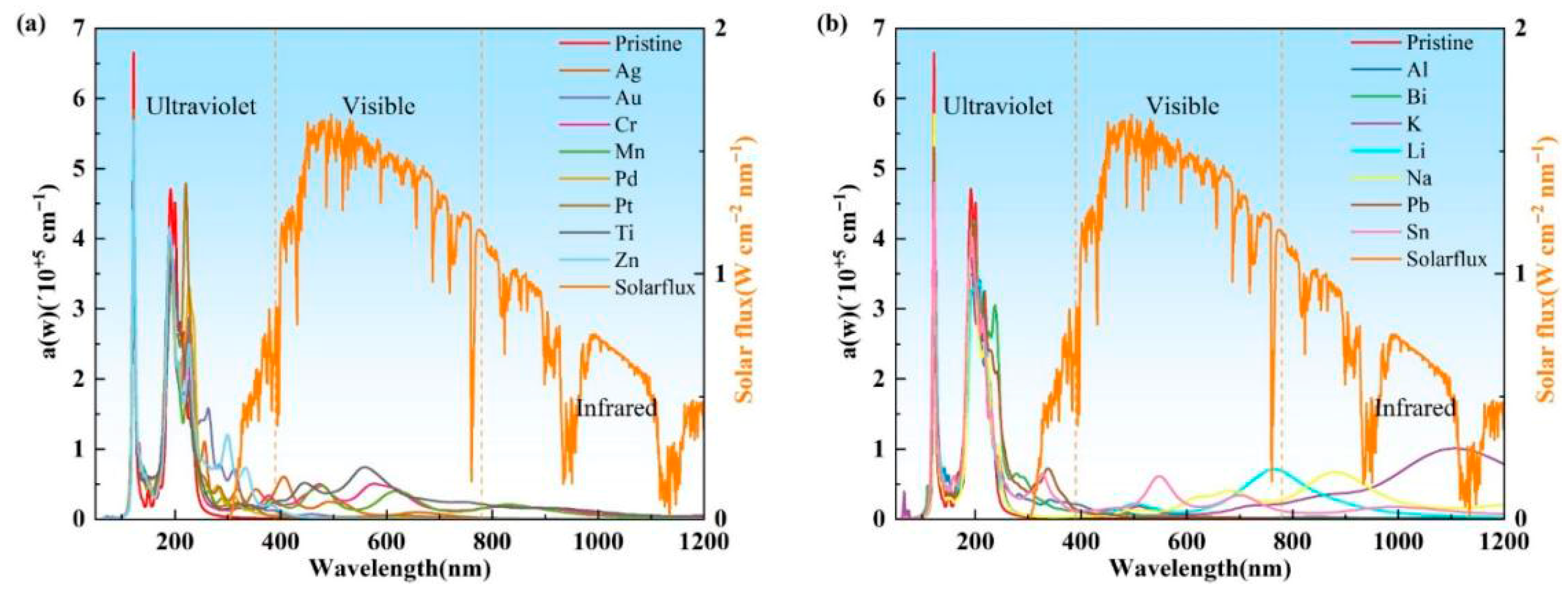
Absorption spectra are important parameters for measuring the optoelectronic properties of two-dimensional materials [47,48,49,50], so the light absorption properties of the M-AlN system are investigated next. Figure 6 shows the absorption spectra of the M-AlN system and the absorption spectra of the monolayer AlN are distributed in the deep UV region. From Figure 6a, it can be seen that there are strong visible light absorption peaks in the absorption spectra of a part of M-AlN systems located at 406.8 nm (Ag-AlN), 471.8 nm (Cr-AlN), 479.4 nm (Mn-AlN), 547.9 nm (Sn-AlN), 557.8 nm (Ti-AlN), and 768.2 nm (Li-AlN); in particular, the absorption peak intensity of the Ti-AlN system at 557.8 nm reaches 7.4 × 104 cm−1. The above results indicate that these materials are promising candidates for the conversion of solar energy into electricity.
In addition, it can be seen from Figure 6b that there are strong infrared light absorption peaks in the absorption spectra of another part of the M-AlN system around 883.3 nm (Na-AlN) and 1109.3 nm (K-AlN), respectively, and in particular, the intensity of the absorption peak of the K-AlN system at 1109.3 nm reaches 1.01 × 105 cm−1, which indicates that the Ti and K metal atoms can be added to enhance the light absorption of monolayer AlN, which provides a basis for its application in the visible and infrared regions.
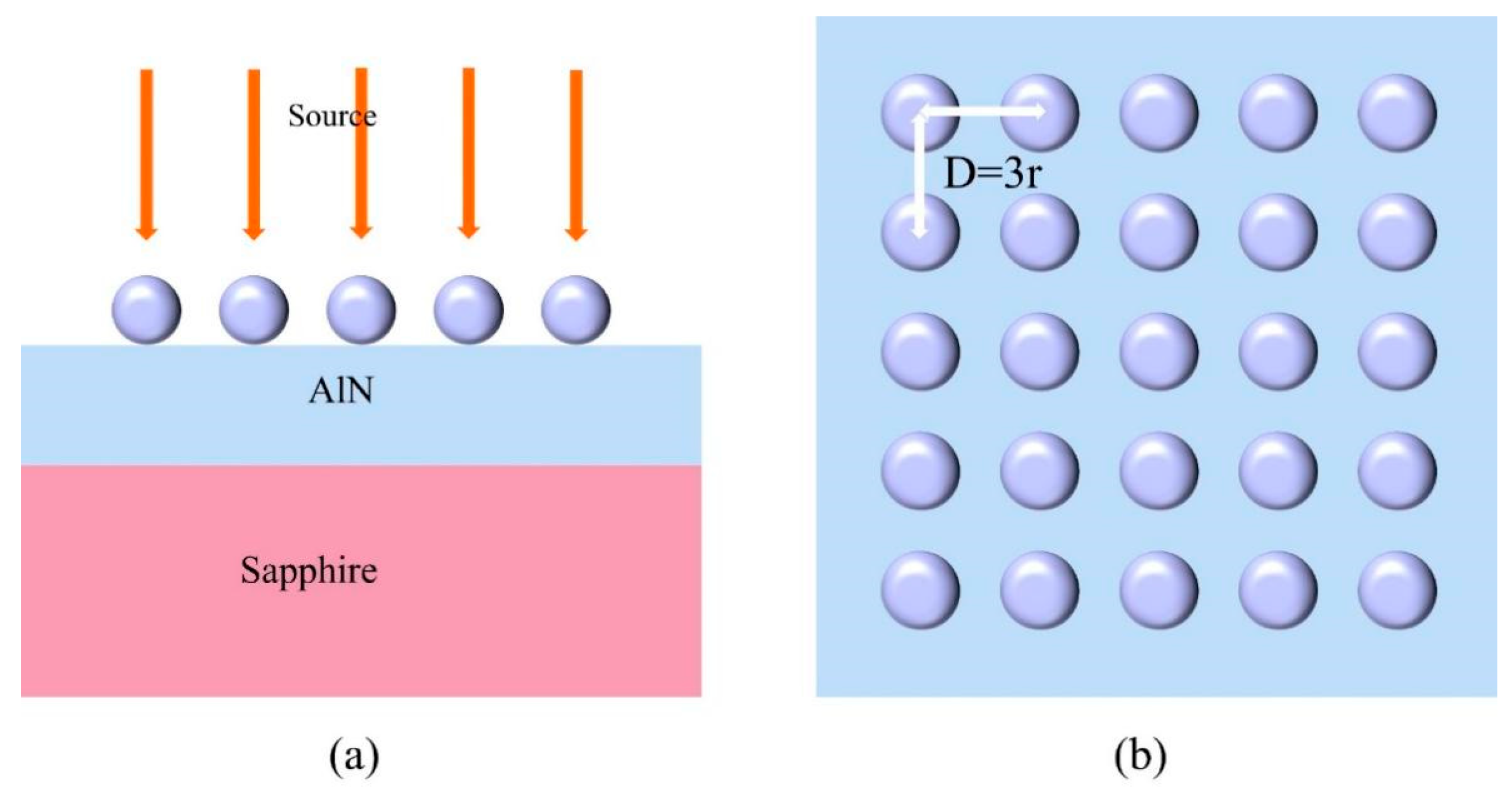
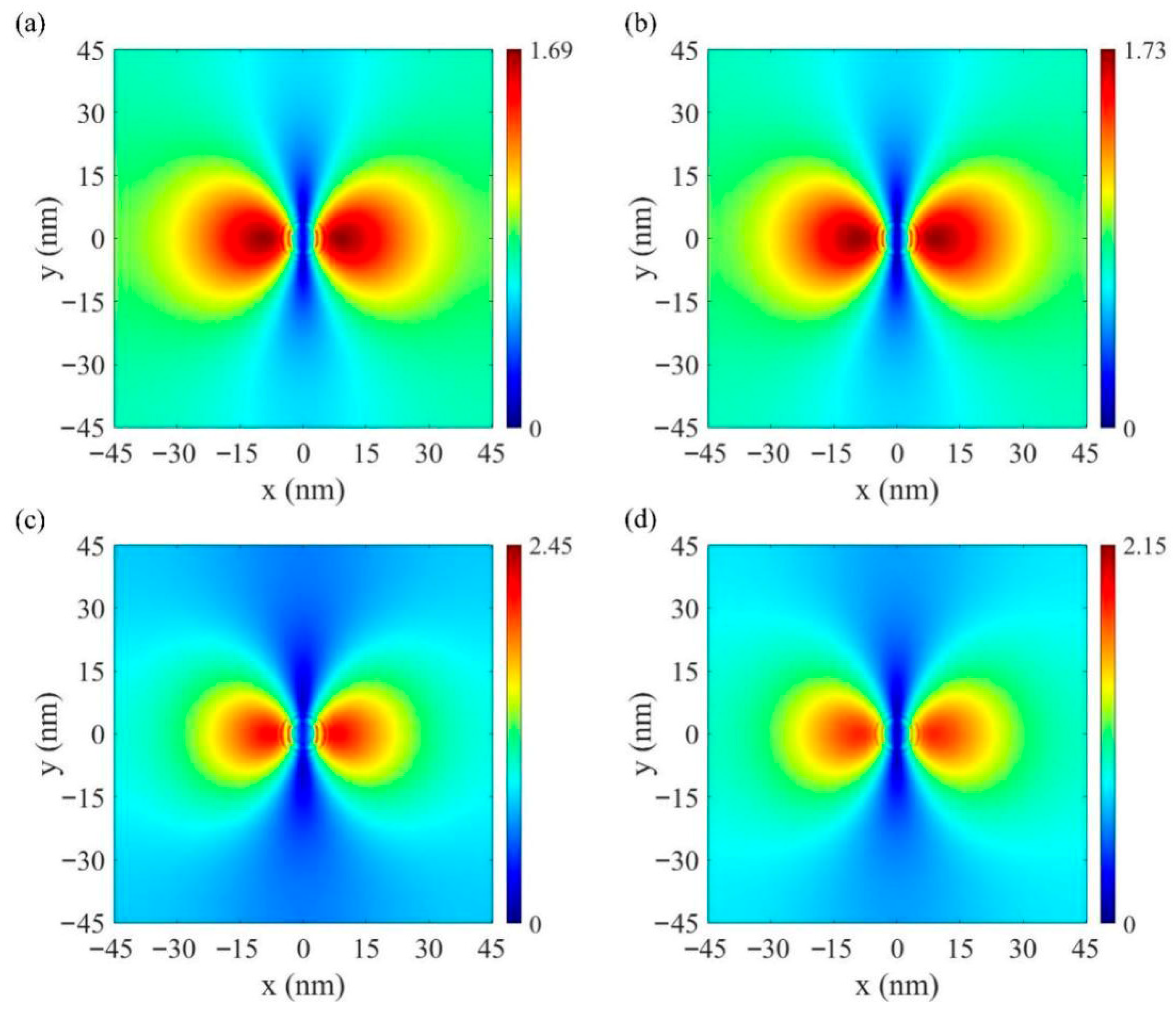
Finally, the electric fields of four metal (Cr, Mn, Ti, and Li) nanoparticles in the M-AlN system were simulated using the time-domain finite-difference method, which suggests that the four-metal-adsorbed monolayer AlN system has a good application in surface plasmon polariton, because these four metals produce significant absorption peaks in the visible region. Figure 7 represents a model of a structure designed by simplifying the simulation process, where the substrate is sapphire and a monolayer of AlN of 142 nm is placed on the sapphire, and nanoparticles of spherical metal atoms are placed on the AlN with a nanoparticle radius of 50 nm. The wavelengths of the incident light source are set as 471.8 nm (Cr), 479.4 nm (Mn), 557.8 nm (Ti), and 768.2 nm (Li), respectively, corresponding to the absorption peaks in the absorption spectrum. Figure 8 shows the simulation results of the excitation of surface plasma excitations, and the analysis shows that when the surface plasma excitations are excited, there are hotspots of electric field inside and at the edges of the spherical nanoparticles, and these hotspots indicate that the metal nanoparticles have a strong absorption capacity of photon energy, which is advantageous for sensing and enhancement of light–matter interactions, among others.
In the four systems, it turns out that the electric field distributions of Cr and Li particles are more similar, with small areas of strong electric fields around the two electric field hotspots, and a better concentration of the electric field strength in the x and y directions, indicating that these two metal nanoparticles have a strong absorption of photon energy, and are able to induce a more pronounced localized surface plasmon resonance, which further suggests that the ability of the metal nanoparticles to absorb strong light makes them candidates for applications in the field of photodetectors.

3. Calculation Method

The metal atom adsorption monolayer AlN model consists of metal atoms stacked at different positions in the vertical direction of the monolayer AlN. The article adopts a first-principles approach to geometry optimization of monolayer AlN and metal-atom-adsorbed monolayer AlN (M-AlN) systems using density functional theory (DFT), and calculates the adsorption energies, energy bands, spin-polarized charge densities, differential charge densities, work function, and photo absorption spectra for the optimized monolayer AlN and M-AlN systems. For monolayer AlN, the Brillouin zone K-space sampling grid used for structure optimization is 4 × 4 × 1. During geometry optimization, the force acting on each atom is less than 10−2 eV·Å−1 until the total energy change is less than 10−5 eV and all atoms are fully relaxed. Also, to avoid interactions between the lattice systems, a vacuum space of 20 Å was applied in the z direction for all systems.
A plane-wave cutoff energy of 400 eV was set using the generalized gradient approximation of the Perdew–Burke–Ernzerhof generalization for exchange–correlation interactions [51]. The Grime DFT-D3 method was used to account for weak dispersion forces [52], as well as Brillouin zone calculations using the Monkhorst–Pack scheme. Finally, calculations of the electronic, magnetic, and optical properties of the M-AlN system were carried out in the Vienna ab initio simulation package (VASP) (version 5.4.4) [53,54]. In addition, data processing was accomplished using the VASPKIT code (version 1.04) [55,56].
Simulations using the time-domain finite-difference method are used to characterize the production of surface-isolated excitations by some metal atoms. To reduce the computational effort, x and y are set as periodic boundaries while z is set as a perfectly matched layer which perfectly absorbs the outgoing waves and matches the impedance to the problem space to prevent reflections, the mesh type is chosen to be of Automatic non-uniform mesh type while the mesh accuracy is set to be five. Finally, the results of the surface-isolated excitations are obtained by using a monitor of the frequency domain field.

4. Conclusions

The energy bands and density of states of monolayer AlN are investigated by constructing a metal-atom-adsorbed monolayer AlN (M-AlN) structure based on the first-principle computational method, as well as further analytical studies on the energy bands, magnetism, differential charge density, work function, photo absorption properties, and electric field distributions of the M-AlN system.
The most stable adsorption sites on monolayer AlN were found to be different for different metals, and all M-AlN systems did not undergo severe deformation, indicating that metal adsorption does not disrupt the structure of monolayer AlN. The energy band diagram results were analyzed and it was observed that the Al-AlN, Li-AlN, Ag-AlN, Au-AlN, Bi-AlN, Cr-AlN, K-AlN, Mn-AlN, Na-AlN, Pb-AlN, Sn-AlN, and Ti-AlN systems are magnetic, and it is worthwhile to note that the adsorption of the two metals, Al and Li, has led to the transition of the monolayers from semiconductors to semi-metals, and the introduction of the K-metal has led to the transition of the monolayers from semiconductors to metals. The work function analysis of the M-AlN system, especially the K-AlN system, shows a reduction of 56.12% compared to the monolayer AlN. Optical characterization of the M-AlN systems revealed that the adsorption of metal atoms enhances the light absorption of monolayer AlN in the visible region and infrared region (e.g., Ti-AlN and K-AlN). Simulation of metal (Cr, Mn, Ti and Li) nanoparticles by the time-domain finite-difference method reveals that the electric field distributions of Cr and Li particles are relatively similar, with a small area of strong electric field around the two hotspots of the electric field, and a good degree of concentration of the electric field strength in the x and y directions, indicating that the metal nanoparticles have a strong absorption of photon energies, and thus suggesting that the placement of spherical metal nanoparticles on a monolayer of AlN nanosheets can stimulate the localized surface plasmon resonance, which can greatly enhance the absorption properties of the structure.
Thus, the above results indicate that the monolayer AlN system with metal atom adsorption will be able to be used in the fabrication of spintronic devices, photodetectors, field-emitting devices, and solar photovoltaic devices.

Author Contributions

Formal analysis, Z.S.; Investigation, Z.S.; Data curation, Z.S.; Writing—original draft, Z.S. and F.C.; Writing—review & editing, F.C.; Supervision, F.C.; Project administration, F.C. All authors have read and agreed to the published version of the manuscript.

Funding

This research received no external funding.

Institutional Review Board Statement

Not applicable.

Informed Consent Statement

Not applicable.

Data Availability Statement

The raw data supporting the conclusions of this article will be made available by the authors, without undue reservation.

Conflicts of Interest

The authors declare no conflict of interest.

References

  1. Sun, M.; Schwingenschlögl, U. Structure Prototype Outperforming MXenes in Stability and Performance in Metal-Ion Batteries: A High Throughput Study. Adv. Energy Mater. 2021, 11, 2003633. [Google Scholar] [CrossRef]
  2. Shu, H. Strain effects on stability, electronic and optical properties of two-dimensional C4X2 (X = F, Cl, Br). J. Mater. Chem. C 2021, 9, 4505–4518. [Google Scholar] [CrossRef]
  3. Cui, Z.; Wang, M.; Lyu, N.; Zhang, S.; Ding, Y.; Bai, K. Electronic, magnetism and optical properties of transition metals adsorbed puckered arsenene. Superlattices Microstruct. 2021, 152, 106852. [Google Scholar] [CrossRef]
  4. Olabi, A.G.; Abdelkareem, M.A.; Wilberforce, T.; Sayed, E.T. Application of graphene in energy storage device—A review. Renew. Sustain. Energy Rev. 2021, 135, 110026. [Google Scholar] [CrossRef]
  5. Palmieri, V.; Papi, M. Can graphene take part in the fight against COVID-19? Nano Today 2020, 33, 100883. [Google Scholar] [CrossRef]
  6. Cui, Z.; Wang, X.; Ding, Y.; Li, E.; Bai, K.; Zheng, J.; Liu, T. Adsorption of CO, NH3, NO, and NO2 on pristine and defective g-GaN: Improved gas sensing and functionalization. Appl. Surf. Sci. 2020, 530, 147275. [Google Scholar] [CrossRef]
  7. Cui, Z.; Bai, K.; Wang, X.; Li, E.; Zheng, J. Electronic, magnetism, and optical properties of transition metals adsorbed g-GaN. Physica E 2020, 118, 13871. [Google Scholar] [CrossRef]
  8. Pang, J.; Bachmatiuk, A.; Yin, Y.; Trzebicka, B.; Zhao, L.; Fu, L.; Mendes, R.G.; Gemming, T.; Liu, Z.; Rummeli, M.H. Applications of Phosphorene and Black Phosphorus in Energy Conversion and Storage Devices. Adv. Energy Mater. 2018, 8, 1702093. [Google Scholar] [CrossRef]
  9. Mak, K.F.; Shan, J. Photonics and optoelectronics of 2D semiconductor transition metal dichalcogenides. Nat. Photonics 2016, 10, 216–226. [Google Scholar] [CrossRef]
  10. Wu, P.; Cui, Z.; Li, Q.; Ding, Y. Gas (CO and NO) adsorption and sensing based on transition metals functionalized Janus MoSSe. Appl. Surf. Sci. 2021, 565, 150509. [Google Scholar] [CrossRef]
  11. Cui, Z.; Wu, H.; Bai, K.; Chen, X.; Li, E.; Shen, Y.; Wang, M. Fabrication of a g-C3N4/MoS2 photocatalyst for enhanced RhB degradation. Physica E 2022, 144, 115361. [Google Scholar] [CrossRef]
  12. Zhang, Y.B.; Tan, Y.W.; Stormer, H.L.; Kim, P. Experimental observation of the quantum Hall effect and Berry’s phase in graphene. Nature 2005, 438, 201–204. [Google Scholar] [CrossRef]
  13. Cresti, A.; Nemec, N.; Biel, B.; Niebler, G.; Triozon, F.; Cuniberti, G.; Roche, S. Charge transport in disordered graphene-based low dimensional materials. Nano Res. 2008, 1, 361–394. [Google Scholar] [CrossRef]
  14. Cui, Z.; Li, E.; Ke, X.; Zhao, T.; Yang, Y.; Ding, Y.; Liu, T.; Qu, Y.; Xu, S. Adsorption of alkali-metal atoms on GaN nanowires photocathode. Appl. Surf. Sci. 2017, 423, 829–835. [Google Scholar] [CrossRef]
  15. Cui, Z.; Wang, X.; Li, E.; Ding, Y.; Sun, C.; Sun, M. Alkali-metal-adsorbed g-GaN monolayer: Ultralow work functions and optical properties. Nanoscale Res. Lett. 2018, 13, 207. [Google Scholar] [CrossRef] [PubMed]
  16. Xia, C.; Peng, Y.; Wei, S.; Jia, Y. The feasibility of tunable p-type Mg doping in a GaN monolayer nanosheet. Acta Mater. 2013, 61, 7720–7725. [Google Scholar] [CrossRef]
  17. Cui, Z.; Lu, Q.; Wang, X. CCEMSS-Unet++: An Enhanced Multi-Scale Context Fusion Network for Pulmonary Nodule Segmentation. Int. J. Imaging Syst. Technol. 2026, 36, e70297. [Google Scholar] [CrossRef]
  18. Cui, Z.; Xu, H.; Wang, X.; Xia, L.; Zhang, S.; Wang, L. A Theoretical Investigation of a Dynamically Tunable Terahertz Chiral Broadband Absorber Based on VO2. Micro Nanostruct. 2026, 212, 208569. [Google Scholar] [CrossRef]
  19. Ma, Y.; Huo, K.; Wu, Q.; Lu, Y.; Hu, Y.; Hu, Z. Self-templated synthesis of polycrystalline hollow aluminium nitride nanospheres. J. Mater. Chem. 2006, 16, 2834–2839. [Google Scholar] [CrossRef]
  20. Xu, H.; Cui, Z. A multifunctional reconfigurable terahertz chiral metasurface based on VO2 and graphene. Dalton Trans. 2026, 55, 2893–2907. [Google Scholar] [CrossRef]
  21. Nakamura, S.; Takashi, M.; Masayuki, S. High-power GaN pn junction blue-light-emitting diodes. Jpn. J. Appl. Phys. 1991, 30, L1998. [Google Scholar] [CrossRef]
  22. Herro, Z.G.; Zhuang, D.; Schlesser, R.; Sitar, Z. Growth of AlN single crystalline boules. J. Cryst. Growth 2010, 312, 2519–2525. [Google Scholar] [CrossRef]
  23. Cui, Z.; Yang, K.; Ren, K.; Zhang, S.; Wang, L. Adsorption of metal atoms on MoSi2N4 monolayer: A first principles study. Mater. Sci. Semicond. Process. 2022, 152, 107072. [Google Scholar] [CrossRef]
  24. Yang, K.; Cui, Z.; Li, E.; Shi, Y.; Zhang, L.; Ma, D.; Yuan, Z.; Dong, Y. Modulation of the magnetic, electronic, and optical behaviors of WS2 after metals adsorption: A first-principles study. Chem. Phys. 2023, 571, 111903. [Google Scholar] [CrossRef]
  25. Shen, Y.; Yuan, Z.; Cui, Z.; Ma, D.; Yuan, P.; Yang, K.; Dong, F.; Wang, F.; Li, E. The electronic properties of g−ZnO modulated by organic molecules adsorption. Crystals 2022, 12, 882. [Google Scholar] [CrossRef]
  26. Zhu, Q.; Cui, Z.; Liu, J. ZnO/Sc2CCl2 van der Waals Heterojunction: From Atomic Scale Properties to Solar-driven Photocatalysis and Photodetection. Ceram. Int. 2026, 52, 8133–8143. [Google Scholar]
  27. Deng, J.; Wu, Z.; Wang, A.; Zhao, R.; Hu, A. First-principles Study of Optical and Electronic Properties of Ag Doped AlN Semiconductors. Chin. J. Comput. Phys. 2014, 31, 617–624. [Google Scholar]
  28. Zou, J.; Li, P.; Xie, Q. First-Principles Study on Electronic Structure and Optical Properties of (La, Y)-Doped AlN. J. Synth. Cryst. 2021, 50, 2036–2043. [Google Scholar]
  29. Jia, X.F.; Liu, Y.H.; Wang, H. First principles study on the effect of rare earth element La doping on the properties of AlN. J. Phys. B At. Mol. Opt. Phys. 2021, 38, 175–183. [Google Scholar]
  30. Han, R.; Chen, X.; Yan, Y. Magnetic properties of AlN monolayer doped with group 1A or 2A nonmagnetic element: First-principles study. Chin. Phys. B 2017, 26, 097503. [Google Scholar] [CrossRef]
  31. Wang, J.; Fa, C.; De, J.Q.; Wu, Z.M.; Li, C.; Fa, F.; Hu, A.Y.; Cu, Y.T. First-principles Calculation of Cu-Cr Co-doped AlN Diluted Magnetic Semiconductors. Chin. J. Comput. Phys. 2016, 33, 99–107. [Google Scholar]
  32. Wang, V.; Xu, N.; Liu, J.; Tang, G.; Geng, W. VASPKIT: A user-friendly interface facilitating high-throughput computing and analysis using VASP code. Comput. Phys. Commun. 2021, 267, 108033. [Google Scholar] [CrossRef]
  33. Cui, Z.; Yan, L.; Ren, Y.; Yao, J.; Liu, C. PtSSe/AlN heterojunctions with favorable photogenerated currents and structural stability. Chin. Phys. B 2026, 35, ae3db7. [Google Scholar] [CrossRef]
  34. Kadioglu, Y.; Ersan, F.; Kecik, D.; Aktürk, O.Ü.; Aktürk, E.; Ciraci, S. Chemical and substitutional doping, and anti-site and vacancy formation in monolayer AlN and GaN. Phys. Chem. Chem. Phys. 2018, 20, 16077–16091. [Google Scholar] [CrossRef] [PubMed]
  35. Mastail, C.; David, M.; Nita, F.; Michel, A.; Abadias, G. Ti, Al and N adatom adsorption and diffusion on rocksalt cubic AlN (001) and (011) surfaces: Ab initio calculations. Appl. Surf. Sci. 2017, 423, 354–364. [Google Scholar] [CrossRef]
  36. Wang, Y.; Song, N.; Song, X.; Zhang, T.; Yang, D.; Li, M. A first-principles study of gas adsorption on monolayer AlN sheet. Vacuum 2018, 147, 18–23. [Google Scholar] [CrossRef]
  37. Strak, P.; Sakowski, K.; Piechota, J.; Ahmad, A.; Grzegory, I.; Kangawa, Y.; Krukowski, S. Adsorption of nitrogen at AlN (000-1) surface–Decisive role of structural and electronic factors. Surface Sci. 2021, 713, 121891. [Google Scholar] [CrossRef]
  38. Kempisty, P.; Strak, P.; Sakowski, K.; Kangawa, Y.; Krukowski, S. Ab initio and thermodynamic picture of Al adsorption of AlN (0001) surface–Role of bond creation and electron transition contributions. Appl. Surf. Sci. 2020, 532, 147419. [Google Scholar] [CrossRef]
  39. Kuang, A.; Wang, G.; Li, Y.; Jiang, Y.; Wu, G.; Wu, B. Ab initio investigation of the adsorption of atomic and molecular hydrogen on AlN nanotubes. Appl. Surf. Sci. 2015, 346, 24–32. [Google Scholar] [CrossRef]
  40. Xu, H.; Cui, Z. VO2 Based Terahertz Absorber with Switchable High-Q Dual Narrowband and Ultra Wideband Modes for Sensing Applications. Phys. Lett. A 2026, 19, 131487. [Google Scholar] [CrossRef]
  41. Sanville, E.; Kenny, S.D.; Smith, R.; Henkelman, G. Improved grid-based algorithm for Bader charge allocation. J. Comput. Chem. 2007, 28, 899–908. [Google Scholar] [CrossRef]
  42. Tang, W.; Sanville, E.; Henkelman, G. A grid-based Bader analysis algorithm without lattice bias. J. Phys. Condens. Matter 2009, 21, 084204. [Google Scholar] [CrossRef]
  43. Ouyang, T.; Qian, Z.; Hao, X.; Ahuja, R.; Liu, X. Effect of defects on adsorption characteristics of AlN monolayer towards SO2 and NO2: Ab initio exposure. Appl. Surf. Sci. 2018, 462, 615–622. [Google Scholar] [CrossRef]
  44. Kim, S.; Lee, M.Y.; Lee, S.; Jhi, S.H. Super low work function of alkali-metal-adsorbed transition metal dichalcogenides. J. Phys. Condens. Matter 2017, 29, 315002. [Google Scholar] [CrossRef]
  45. Ren, K.; Sun, M.; Luo, Y.; Wang, S.; Yu, J.; Tang, W. First-principle study of electronic and optical properties of two-dimensional materials-based heterostructures based on transition metal dichalcogenides and boron phosphide. Surf. Sci. 2019, 476, 70–77. [Google Scholar] [CrossRef]
  46. Sun, M.; Chou, J.P.; Gao, J.; Cheng, Y.; Hu, A.; Tang, W.; Zhang, G. Exceptional optical absorption of buckled arsenene covering a broad spectral range by molecular doping. ACS Omega 2018, 3, 8514–8520. [Google Scholar] [CrossRef]
  47. Cui, Z.; Ren, K.; Zhao, Y.; Wang, X.; Shu, H.; Yu, J.; Tang, W.; Sun, M. Tunable electronic properties and band alignment of GaSe/InS van der Waals heterostructure. Surf. Sci. 2019, 492, 513–520. [Google Scholar] [CrossRef]
  48. Wang, S.; Ren, C.; Tian, H.; Yu, J.; Sun, M. Interfacial charge transfer and band alignment in g-C3N4/WS2 van der Waals heterostructure. Phys. Chem. Chem. Phys. 2018, 20, 13394–13401. [Google Scholar] [CrossRef] [PubMed]
  49. Cui, Z.; Wang, X.; Ding, Y.; Li, M. First-principles study on electronic and optical properties of Janus MoSSe/WSSe van der Waals heterostructures. Micro Nanostruct. 2018, 114, 251–257. [Google Scholar]
  50. Diao, Z.; Cui, Z.; Zhang, S. The GaN/HfZrCO2 heterojunction with excellent photoresponse and superior hydrogen evolution reaction. Phys. Chem. Chem. Phys. 2026, 28, 12345–12352. [Google Scholar] [CrossRef] [PubMed]
  51. Wang, J.; Fan, C.; Deng, J.; Wu, Z.; Liu, C.; Fan, F.; Hu, A.; Cui, Y. A lattice Boltzmann model for simulating multiphase flows with large density ratios. J. Comput. Phys. 2016, 33, 99–108. [Google Scholar]
  52. Perdew, J.P.; Burke, K.; Ernzerhof, M. Generalized gradient approximation made simple. Phys. Rev. Lett. 1996, 77, 3865–3868. [Google Scholar] [CrossRef] [PubMed]
  53. Grimme, S.; Antony, J.; Ehrlich, S.; Krieg, H. A consistent and accurate ab initio parametrization of density functional dispersion correction (DFT-D) for the 94 elements H-Pu. J. Chem. Phys. 2010, 132, 154104. [Google Scholar] [CrossRef] [PubMed]
  54. Monkhorst, H.J.; Pack, J.D. Special points for Brillouin-zone integrations. Phys. Rev. B 1976, 13, 5188–5192. [Google Scholar] [CrossRef]
  55. Kresse, G.; Furthmüller, J. Efficient iterative schemes for ab initio total-energy calculations using a plane-wave basis set. Phys. Rev. B 1996, 54, 11169–11186. [Google Scholar] [CrossRef]
  56. Hafner, J. Ab-initio simulations of materials using VASP: Density-functional theory and beyond. J. Comput. Chem. 2008, 29, 2044–2053. [Google Scholar] [CrossRef] [PubMed]
Figure 1. (a) Crystal structure of monolayer AlN with four different adsorption sites, (b) energy band structure of monolayer AlN, (ce) total and fractional density of states of monolayer AlN.
Inorganics 14 00099 g001
Figure 2. Energy band structure of the M-AlN system. (a) Ag-AlN; (b) Al-AlN; (c) Au-AlN; (d) Bi-AlN; (e) Cr-AlN; (f) K-AlN; (g) Li-AlN; (h) Mn-AlN; (i) Na-AlN; (j) Pb-AlN; (k) Pd-AlN; (l) Pt-AlN; (m) Sn-AlN; (n) Ti-AlN; (o) Zn-AlN (where the magenta line indicates spin-down, the cyan line indicates spin-up, and the Fermi energy level is set to 0 eV).
Inorganics 14 00099 g002
Figure 3. Spin-polarized charge density of the M-AlN system. (Light purple color indicates spin-up, red color indicates spin-down).
Inorganics 14 00099 g003
Figure 4. The charge differential density of the M-AlN system. The isovalue is set to 0.001 e/Å3. (The light blue region and the peach region indicate charge dissipation and aggregation).
Inorganics 14 00099 g004
Figure 5. Work function of single-layer AlN and M-AlN systems.
Inorganics 14 00099 g005
Figure 6. Absorption spectra of M-AlN system. (a) Absorption spectra of transition metal-AlN system. (b) Absorption spectra of main group metal-AlN system.
Inorganics 14 00099 g006
Figure 7. Schematic representation of metal nanoparticles on monolayer AlN surface: (a) side view; (b) top view.
Inorganics 14 00099 g007
Figure 8. Time-domain finite-difference simulation of the local electric field distribution of metal nanoparticles. (a) Ti nanoparticles on AlN surface; (b) Mn nanoparticles on AlN surface; (c) Li nanoparticles on AlN surface; (d) Cr nanoparticles on AlN surface.
Inorganics 14 00099 g008
Table 1. The most stable adsorption position, adsorption energy (Ead), adsorption height (D), charge transfer (C), magnetic moment (Mtotal) and bandgap (Eg) of M-AlN system.
AdsorptionSiteEg (eV)D (Å)C (|e|) M total   ( μ B ) Eg (eV)
AgTN−0.8242.29−0.1231.00.53
AlTN−2.7082.060.3493.00.00
AuTN−2.0792.11−0.4411.00.86
BiTN−1.0372.29−0.1431.00.41
CrTB−0.8282.320.1441.00.28
KTAl−0.8042.760.6040.80.00
LiTH−2.0461.320.8410.90.00
MnTN−1.1462.070.1275.00.88
NaTN−0.5912.570.3971.00.20
PbTN−1.2662.560.0122.01.04
PdTB−2.5481.84−0.3810.00.00
PtTN−3.9831.77−0.6280.00.00
SnTN−2.8692.43−0.1364.01.06
TiTAl−7.9961.191.0692.00.13
ZnTB−0.3882.790.0130.00.00
Disclaimer/Publisher’s Note: The statements, opinions and data contained in all publications are solely those of the individual author(s) and contributor(s) and not of MDPI and/or the editor(s). MDPI and/or the editor(s) disclaim responsibility for any injury to people or property resulting from any ideas, methods, instructions or products referred to in the content.