Review

Review of the Applications of Metal–Organic Frameworks (MOFs) in Multi-Field Detection

1
School of Pharmacy, Jiamusi University, Jiamusi 154002, China
2
School of Information Science and Technology, Beijing University of Chemical Technology, Beijing 100029, China
3
College of Materials Science and Engineering, Jiamusi University, Jiamusi 154007, China
4
China Testing & Certification International Group Co., Ltd., Chaoyang District, Beijing 100024, China
5
State Key Laboratory of Green Building Materials, China State Building Materials Research Institute Co., Ltd., Chaoyang District, Beijing 100000, China
*
Authors to whom correspondence should be addressed.
These authors contributed equally to this work.
Inorganics 2026, 14(4), 93; https://doi.org/10.3390/inorganics14040093
Submission received: 9 February 2026 / Revised: 13 March 2026 / Accepted: 24 March 2026 / Published: 27 March 2026
(This article belongs to the Special Issue MOFs and MCOFs: Design, Synthesis and Application)

Abstract

As a novel organic–inorganic hybrid porous crystalline material, metal–organic frameworks (MOFs) are ideal sensitive materials for detecting gases, antibiotics, and ions, owing to their ultra-high specific surface area, tunable pore structures, abundant active sites, and tailorable architectures. This review systematically summarizes the core structural features, preparation methods, and modification strategies of MOFs, elaborates on the adsorption and signal conversion mechanisms in target detection, and highlights typical applications, performance advantages, and practical scenarios of MOF-based sensors, clarifying their structure–activity relationships and performance differences from traditional semiconductor sensors. It further analyzes key challenges, including insufficient stability, poor conductivity, large-scale preparation difficulties, and real-sample interference, as well as industrialization bottlenecks such as batch-to-batch reproducibility, instrument integration, and high costs. Additionally, it supplements cross-field synergistic innovations and industrialization progress, and prospects future directions: function-oriented precise design, multifunctional composite optimization, portable intelligent devices, green large-scale synthesis, and standardization promotion. This review provides a comprehensive reference for advancing MOF-based detection research and applications in environmental monitoring, industrial safety, food safety, and healthcare.

1. Introduction

With the accelerated industrialization, the ever-increasing frequency of human activities, and the growing prominence of global ecological and public health issues [1,2], precise, efficient and rapid detection technologies have gained escalating significance in such fields as environmental protection, industrial safety, food safety and human health monitoring. Although conventional detection methods (e.g., metal oxide sensors for gas detection, high-performance liquid chromatography for antibiotic detection, and atomic absorption spectrometry for ion detection) demonstrate certain detection capabilities in specific scenarios, they are commonly plagued by inherent limitations including poor selectivity, high detection limits, cumbersome operation, expensive instrumentation, prolonged detection cycles and the inability to achieve on-site rapid detection. These drawbacks render them far from meeting practical detection demands such as those for complex matrices, low-concentration analytes and simultaneous multi-component detection.
Since their first report in 1999 [3], metal–organic frameworks (MOFs) have rapidly emerged as a research hotspot in materials science and detection fields, by virtue of their distinctive advantages including designable crystal structures, ultrahigh specific surface area (typically reaching 1000–4000 m2/g, and even exceeding 7000 m2/g for some materials) [4], precisely tunable pore sizes (ranging from micropores to mesopores, controllable within the range of 0.5–10 nm) [5], abundant functional sites and excellent structural plasticity [6]. The structures and performances of MOFs can be precisely regulated by the rational selection of diverse metal centers (e.g., Zr4+, Cu2+, Eu3+, Mg2+, etc.) and organic ligands (e.g., terephthalic acid, imidazole-based ligands, pyridine-based ligands, etc.) [7,8]. Meanwhile, their detection performances can be readily optimized via various modification strategies such as metal nanoparticle doping [9], carbon material composite formation, ligand functionalization [10] and rare earth element doping [11], which endows MOFs with essential detection properties including fluorescence response, electrochemical activity and specific recognition capability.
In recent years, research on the applications of MOFs and their composite materials in the detection of gases, antibiotics, ions and other analytes has advanced rapidly, leading to the development of diverse detection modes including fluorescence sensing, electrochemical sensing, integrated adsorption–detection, and magnetosolid phase extraction coupled with detection. The detection limits have been reduced from the micromolar level down to the picomolar and even femtomolar level, and some MOF-based materials are also integrated with multiple functions such as adsorption, degradation and separation, thus providing a new avenue to address the limitations of conventional detection technologies. This paper aims to systematically consolidate the research achievements of MOFs in gas, antibiotic and ion detection, conduct an in-depth analysis of their common rules and specific characteristics, and comprehensively elaborate on their preparation and modification strategies, detection mechanisms, application scenarios as well as industrialization progress, thereby offering a comprehensive and in-depth reference for the further development of this field.

2. Core Structural Characteristics, Preparation Methods and Modification Strategies of MOFs

2.1. Core Structural Characteristics

The unique structures of MOFs form the foundation for their superior performance in multi-field detection, with their core structural characteristics exhibiting commonalities across different detection fields while demonstrating customized adaptability to specific detection requirements.

2.1.1. Ultrahigh Specific Surface Area and Porous Structure

The specific surface area of MOFs is typically much higher than that of conventional porous materials (e.g., activated carbon, molecular sieves). The abundant pore structures can provide sufficient active sites, enhance the interactions with target analytes (gas molecules, antibiotic molecules, ions), enable efficient enrichment of analytes, and thus significantly improve detection sensitivity. For instance, Zr-based MOFs (e.g., UiO-66) possess a specific surface area of up to 1500–2000 m2/g [12,13], and their three-dimensional porous structures can effectively enrich antibiotic and gas molecules; the ultrahigh specific surface area of Mg-MOFs-74 endows it with excellent adsorption capacity for gas molecules such as CO2 [14,15].

2.1.2. Structural Tunability

The pore size, surface charge and functional groups of MOFs can be precisely tailored by selecting different metal centers and organic ligands, enabling the specific recognition of various types of target analytes [16]. For example, the selection of fluorescent rare earth metal ions (Eu3+, Tb3+) as metal centers allows the fabrication of fluorescent MOF sensors for antibiotic and ion detection [17,18]; the adoption of organic ligands with functional groups such as amino, carboxyl and pyridine rings can enhance the interactions with acidic gases (e.g., CO2, H2S), antibiotic molecules and metal ions [5,19,20]; the modulation of pore size enables the sieving and selective detection of gas molecules with different sizes (e.g., CH4, CO2) [21].

2.1.3. Multifunctional Integration

MOFs can integrate multiple functions, including adsorption, catalysis, and optical/electrochemical activity simultaneously, which enables the construction of integrated platforms for adsorption–detection and detection–degradation. For instance, the NiCo-LDH@MOF composite not only possesses the high adsorption capacity and fluorescent detection performance of MOFs but also exhibits the catalytic degradation activity of NiCo-LDH, thus achieving the simultaneous detection and removal of antibiotics [22].

2.1.4. Universal Classification of MOFs for Sensors

The design and screening of MOFs for sensors should be carried out by matching the intrinsic material properties with the detection requirements, combining the structure–activity characteristics of metal centers and structural nodes as well as the functional regulation of modifiers, and conducting precise classification according to the differences in sensing mechanisms and core sensing sites. These two classification dimensions are interrelated and jointly support the performance optimization of MOF-based sensors, providing a clear classification framework and material selection basis for the targeted design of MOFs for sensing applications.
Classification by Metal Atoms, Structural Nodes and Modifiers
Metal atoms or cluster nodes serve as the framework core of MOFs, and their type, valence state and coordination environment determine the type of active sites, Lewis acidity and basicity, as well as the intrinsic optical and electrochemical properties. Modifiers act as key external factors to compensate for the performance shortcomings of pristine MOFs and extend their sensing functionalities. These two components together constitute the core classification basis for MOFs employed in sensing applications, which can be specifically divided into two major categories: metal atoms/structural nodes and modifier functions.
From the perspective of metal atoms and structural nodes, MOFs for sensing can be classified into three categories based on the type of metal centers and the coordinated node structures: single-metal ion nodes, rare-earth metal ion nodes, and polymetallic cluster hybrid nodes, where the structural features of different nodes match precisely with corresponding sensing scenarios. MOFs with single-metal ion nodes adopt single-valence metal ions such as Zn2+, Cu2+, Mg2+, Fe3+, and Zr4+ as the core to form stable mononuclear or low-nuclear cluster structures, representing the most widely used basic system in the sensing field. Among them, the Zr6O4(OH)4 clusters formed by Zr4+ exhibit excellent chemical stability and abundant open metal sites, making them preferred materials for the detection of antibiotics and heavy metal ions [23]. Variable-valence metal ion nodes such as Cu2+ and Ni2+ possess inherent electrochemical activity and are suitable for the electrochemical sensing of gases and electroactive antibiotics [24,25]. MOFs constructed from light metal ion nodes including Mg2+ and Zn2+ feature ultra-high specific surface areas and precisely tunable pore sizes, with strong adsorption selectivity toward small gas molecules such as CO2 and NO2, thus serving as classic systems for gas sensing [26,27]. MOFs with rare-earth metal ion nodes are centered on rare-earth ions including La3+, Ce3+, and Dy3+, and display intrinsic fluorescence properties derived from characteristic f–f electron transitions, with large Stokes shifts, narrow emission peaks, and remarkable anti-interference ability [28]. EuTb bimetallic rare-earth node MOFs can further achieve self-calibrated detection through ratiometric fluorescence design, improving the accuracy of antibiotic and metal ion detection [29]. MOFs with polymetallic cluster hybrid nodes are formed either by the co-coordination of two or more metal ions to generate hybrid clusters, or by modifying the original metal nodes via the immobilization of metal nanoparticles, which can integrate the advantages of different metals to achieve synergistic effects. For example, AuCu bimetallic cluster-modified Zr-MOF nodes enable ultrasensitive electrochemical detection of fluoroquinolone antibiotics [30], while MOFs with (Bi-S)n hybrid cluster nodes allow highly selective detection of heavy metal ions such as Pb2+ and Hg2+ based on the specific recognition of Bi metal centers [31].
From the perspective of modifier functions, in view of the common shortcomings of pristine MOFs such as insufficient electrical conductivity, limited water stability, and unsatisfactory selectivity, researchers have achieved targeted optimization of the sensing performance of MOFs by introducing metal-based, carbon-based, organic functional ligands, and inorganic non-metallic modifiers, and the type of modifier directly determines the direction of functional expansion of MOFs. Metal-based modifiers mainly include noble metal nanoparticles such as Au, Ag, and Pt, magnetic nanoparticles such as Fe3O4 and CoFe2O4, and metal oxides such as NiO and CeO2; noble metal nanoparticles can significantly enhance the electrical conductivity and electrocatalytic/fluorescence activity of MOFs [32], magnetic nanoparticles can endow MOFs with rapid magnetic separation ability and high adsorption selectivity [33], and metal oxides can introduce oxygen vacancy sites to improve the gas adsorption selectivity and thermal stability of MOFs [34]; carbon-based modifiers are represented by carbon materials including graphene (GO/rGO), carbon nanotubes (MWCNTs), and MXene, and their high electrical conductivity, large specific surface area, and good dispersibility can improve the electron transport efficiency of MOFs and greatly enhance the response speed and sensitivity of electrochemical sensors [35,36], for example, MOFs/MXene composites can be used to construct gas and ion sensors with rapid response at room temperature [31]; organic functional ligand modifiers are introduced through post-synthetic ligand exchange, ligand modification, and other methods, and ligands containing amino groups, sulfhydryl groups, pyridine rings, fluorescent groups, or specific recognition sites can respectively enhance adsorption, strengthen coordination ability toward specific ions, introduce π–π stacking sites, and provide targeted recognition ability [37,38]; inorganic non-metallic modifiers mainly include SiO2, mesoporous silica, phosphates, etc., which can improve the water stability and structural rigidity of MOFs through surface coating, pore filling, and other means, effectively inhibit the leaching of metal ions, and expand the application of MOFs in scenarios such as food sample detection [39].
Classification by Sensing Mechanism and Sensing Sites
This classification focuses on the signal generation mode and core active sites of MOF-based sensors, which are directly related to the detection principle and key performance indicators including sensitivity, selectivity, and response time. Different sensing mechanisms correspond to specific core sensing sites, and the accessibility of these sites is directly determined by the textural properties of MOFs, thus serving as a fundamental basis for the construction of MOF sensing systems. MOF-based sensors can be mainly classified into four categories: fluorescence sensing, electrochemical sensing, mass-sensitive sensing, and multi-mechanism synergistic sensing.
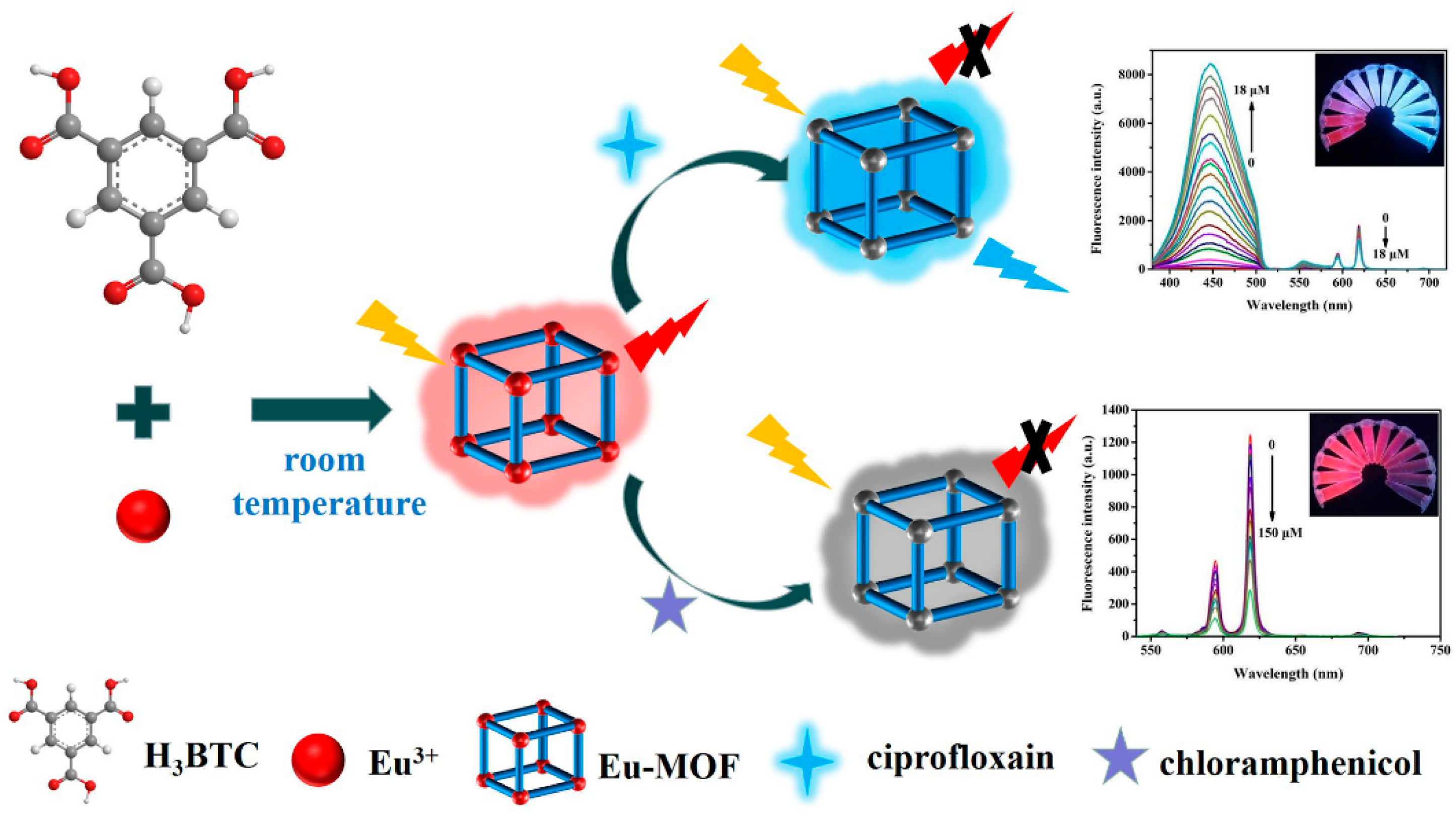
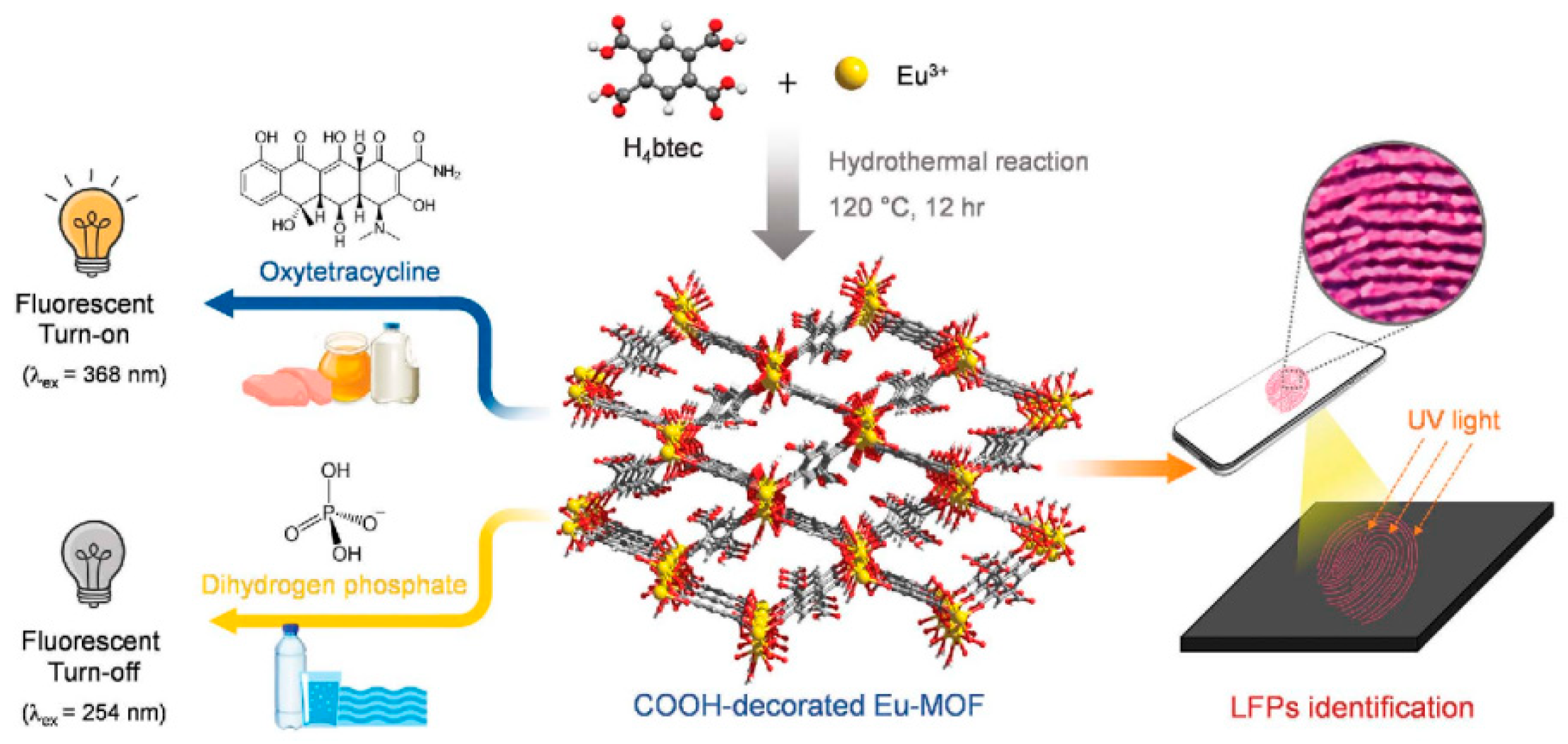
The core sensing mechanisms of fluorescence-based MOFs include fluorescence quenching, fluorescence enhancement, and ratiometric fluorescence shift. Fluorescence quenching mainly involves photoinduced electron transfer, inner filter effect, static quenching, and other pathways, while fluorescence enhancement is achieved based on the antenna effect. The corresponding core sensing sites are the fluorescent active sites of rare-earth metal ions, the conjugated fluorescent sites of organic ligands, and the interaction sites between MOFs and targets such as coordination, π–π stacking, and hydrogen bonding. Their sensing performance mainly depends on the optical activity and accessibility of these sites. For example, the fluorescent active site of Eu-MOf can interact with antibiotic molecules, triggering fluorescence quenching based on the internal filtration effect (IFE) and photoinduced electron transfer (PET) (Figure 1) [40]. Such MOFs are typically represented by lanthanide MOFs and conjugated ligand-based MOFs, which are suitable for the visual and rapid detection of antibiotics, metal ions, and biological small molecules.
The core sensing mechanisms of electrochemical MOFs include redox reactions, interfacial charge transfer, resistance variation, and ion exchange. The core sensing sites cover redox-active sites of metal nodes, electrocatalytic sites on the MOF surface, ion-exchange sites within the pores, and conductive interface sites of composite materials. The sensing performance depends on the electrochemical activity and electron transfer efficiency of these sites. For instance, redox sites of metal nodes such as Cu2+ and Ni2+ can directly participate in electrocatalytic reactions [41], AuCu bimetallic modified sites can accelerate electron transfer to strengthen the current signal for antibiotic detection [42], and oxygen vacancy sites in MOF-derived metal oxides can react with H2S gas to realize gas sensing by changing the material resistance [43]. Typical systems of such MOFs include transition-metal MOFs and MOF composites with carbon materials or metal nanoparticles, which are suitable for the highly sensitive quantitative detection of gases, antibiotics, and heavy metal ions.
The core sensing mechanism of mass-sensitive MOFs is the mass change in MOFs triggered by target adsorption, which requires devices such as quartz crystal microbalance and surface plasmon resonance to convert mass variation into detectable frequency or optical signals; the core sensing sites are the adsorption sites within the MOF pores including open metal sites, hydrogen-bonding sites, and electrostatic interaction sites, whose sensing performance relies on the adsorption selectivity of these sites and the mass response sensitivity of MOFs, thus requiring the materials to possess high specific surface area, precisely tunable pore size, and excellent structural stability. Typical representatives include gas-adsorptive MOFs such as Mg-MOF-74 and CuBTC, which are mainly applied in the quantitative detection of small gas molecules including CO2, CH4, and NH3 [44,45].
Multi-mechanism synergistic MOFs represent a current research hotspot in the sensing field, which mainly integrate two or more sensing mechanisms, such as fluorescence-electrochemical synergy, adsorption–detection synergy, detection–degradation synergy, and so on; the core sensing sites form a synergistic system composed of multiple types of sites, achieving functional expansion through performance complementation. For example, the Ni-MOF/GO/AgNPs composite integrates the electrochemical redox and adsorption synergistic mechanism, which not only enriches targets via adsorption sites but also enhances the detection signal through electrocatalytic sites, and simultaneously possesses photocatalytic degradation activity [46]; Eu-MOFs/NiCo-LDH combines fluorescence sensing and catalytic degradation mechanisms, enabling the visual detection and simultaneous removal of antibiotics [47]. Such MOFs are well-suited to meet the multifunctional detection requirements of complex matrix samples.

2.1.5. Physicochemical Texture Characterization and Environmental Stability

The sensing performance of MOF materials is highly coupled with their structural texture and environmental stability. Particle size, pore size distribution, and pore morphology directly determine the mass transfer efficiency, accessibility of sensing sites, and response time of sensors, while thermal resistance and acid–base stability dictate their suitability for practical application scenarios. The analysis below focuses on the key physicochemical characterization aspects.
Particle Size and Pore Texture Characteristics
The particle size of MOFs is mostly distributed in the nanoscale (50–500 nm) to microscale (1–10 μm) range. Nanoscale MOFs are the preferred morphology in the sensing field due to their larger specific surface area and more exposed surface active sites. Their pore size distribution can be precisely tuned in the micropore (<2 nm) to mesopore (2–10 nm) range, and typical pore morphologies include one-dimensional straight channels, three-dimensional cage-like pores, and layered mesopores [48,49].
Regulation Mechanism of Texture Characteristics on Sensing Performance
The dimensional matching between pore channels and target molecules/ions is crucial for achieving high selectivity and rapid response. For small gas molecules (with kinetic diameters of 0.33 nm for CO2 and 0.36 nm for H2S), microporous MOFs (0.5–1 nm) enable specific adsorption via size sieving, and the short microporous channels shorten the mass transfer pathway, leading to a millisecond-level response time of the sensor [49]. For antibiotic molecules (approximately 1.2 × 0.8 nm for tetracycline and 1.0 × 0.7 nm for fluoroquinolones), mesoporous MOFs (2–5 nm) facilitate fast molecular diffusion and provide sufficient exposed sensing sites, thus improving the efficiency of adsorption and signal conversion with a response time of 1–5 min [50]. For heavy metal ions (hydrated diameters of approximately 0.4–0.6 nm for Pb2+ and Hg2+), microporous MOFs offer higher accessibility to open metal sites and faster coordination between ions and active sites, resulting in a detection response time as short as tens of seconds [51]. In contrast, MOFs with large particles (>5 μm) or oversized pores (>10 nm) tend to suffer from high mass transfer resistance and embedded sensing sites, resulting in prolonged response time (>10 min) and reduced detection sensitivity.
Thermal Stability and Acid–Base Resistance
The thermal stability of MOFs is mainly determined by the strength of metal–ligand coordination bonds. Zr-based and Ce-based MOFs exhibit high coordination bond energies, with thermal decomposition temperatures reaching 400–500 °C. For example, UiO-66 retains its structural integrity at 350 °C, making it suitable for high-temperature industrial gas detection [52]. Mg-based and Zn-based MOFs have thermal decomposition temperatures of approximately 200–300 °C, which are suitable for room-temperature or low-to-medium temperature detection scenarios.
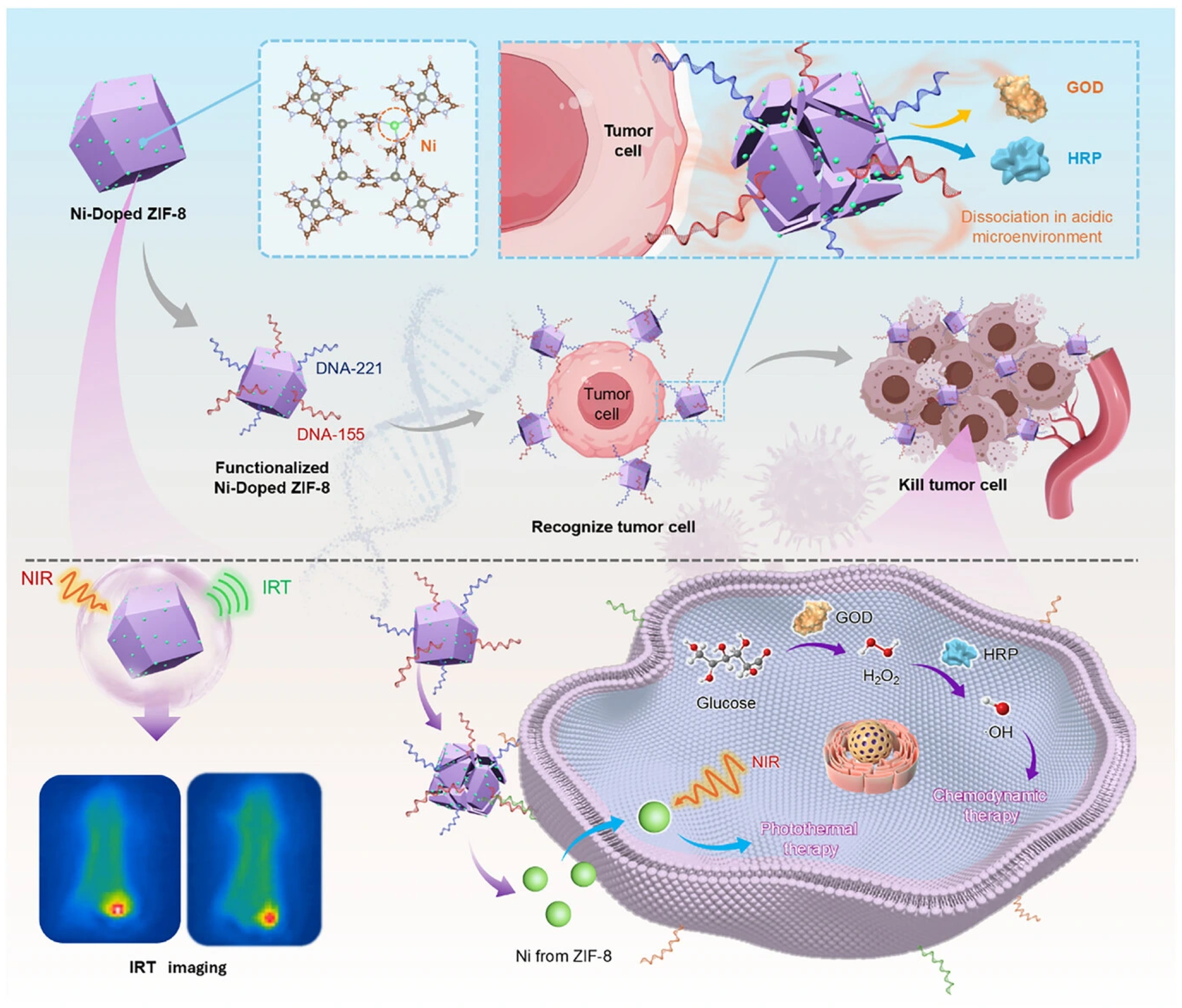
Acid–base resistance is related to the hydrolytic stability of metal centers and the chemical stability of ligands: Zr-based and Fe-based MOFs exhibit stable structures within a pH range of 2–10 without metal ion leaching, enabling their application in complex matrix detection. Cu-based and Ni-based MOFs tend to collapse under strong acidic or alkaline conditions, and their stability can be improved via SiO2 coating or ligand functionalization [7,8]. Rare-earth metal-based MOFs show the most stable fluorescence performance in neutral to weakly acidic environments, making them preferred materials for biomedical detection (e.g., antibiotics or ions in serum and urine, pH ≈ 7.4) by avoiding fluorescence quenching caused by harsh acid–base environments (Figure 2) [53].

2.2. Main Preparation Methods of MOFs

The preparation methods of MOFs directly affect their crystal structures, pore characteristics and detection performance. The commonly used preparation techniques possess universality across different detection fields, with detailed optimizations tailored to specific functional requirements of the materials.
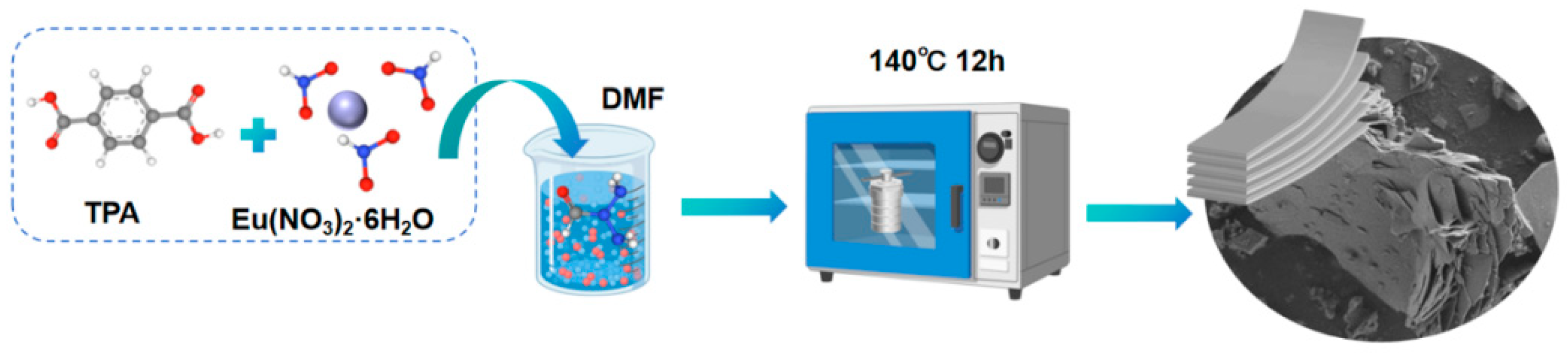
Solvothermal synthesis: As the most classic and widely applied preparation method for MOFs, this approach involves the reaction of metal ions with organic ligands at 80–150 °C for 12–72 h in a sealed autoclave, using organic solvents (e.g., N,N-dimethylformamide (DMF), ethanol) as the reaction medium (Figure 3). The MOFs obtained via this method feature high crystallinity and structural stability, making them suitable for the fabrication of various MOF materials for detection applications, such as Zr-MOFs (UiO-66) [54], Cd-MOFs [55] and BiOBr@ZnFe-MOF [56].
Figure 3. Schematic illustration of solvothermal synthesis of Eu-MOF.
Inorganics 14 00093 g003
Hydrothermal synthesis: Employing water as the solvent and conducting reactions at 100–200 °C, this method features the advantages of environmental friendliness and low cost and is suitable for the reaction of water-soluble ligands with metal salts (e.g., Eu-MOFs [57], Ce-MOFs [58,59], Zn-MOFs [60]). For example, Zn-MOFs can be prepared via the hydrothermal reaction of Zn(NO3)2·6H2O with 2,5-bis(3,5-dicarboxyphenyl)pyridine (L1) and 5-aminotetrazole (5-ATZ) at 120 °C for 24 h, yielding products with excellent crystallinity and stability.
Room-temperature synthesis: Nanosized MOFs can be rapidly prepared at room temperature by introducing deprotonating agents such as triethylamine (TEA) or optimizing the reaction system [61,62]. This method eliminates the need for high-temperature and high-pressure conditions, thus reducing preparation costs, and the resulting products exhibit good dispersibility, making them well-suited for the fabrication of sensor films. For instance, M-MOFs-74 (M = Mg, Ni, Zn, Co) can be synthesized by stirring at room temperature for 2 h [63], and Eu-MOFs are also prepared via the room-temperature stirring method [64,65].
Microwave-assisted synthesis: This method utilizes microwave radiation to rapidly heat the reaction system [66,67], featuring a short reaction time (typically several to tens of minutes), uniformly sized product particles and high crystallinity, thus serving as an efficient and energy-saving preparation approach. For example, the target product of (Bi-S)nMOFs can be obtained via microwave-assisted synthesis with only 10 min of microwave irradiation.
Template method and self-assembly method: MOFs or their composite materials are prepared using specific materials as templates or through molecular self-assembly processes, enabling precise structural regulation and functional synergy [68,69]. For instance, with Ce-MOFs as the template, Ni-doped and calcined treatment yields Ni-CeO2 hollow sphere structures [70]; Bi2CuO4@Al-MOFs@UiO-67 is fabricated by loading Al-MOFs and UiO-67 onto the surface of Bi2CuO4 via the self-assembly method, forming a composite material with a synergistic effect [71].
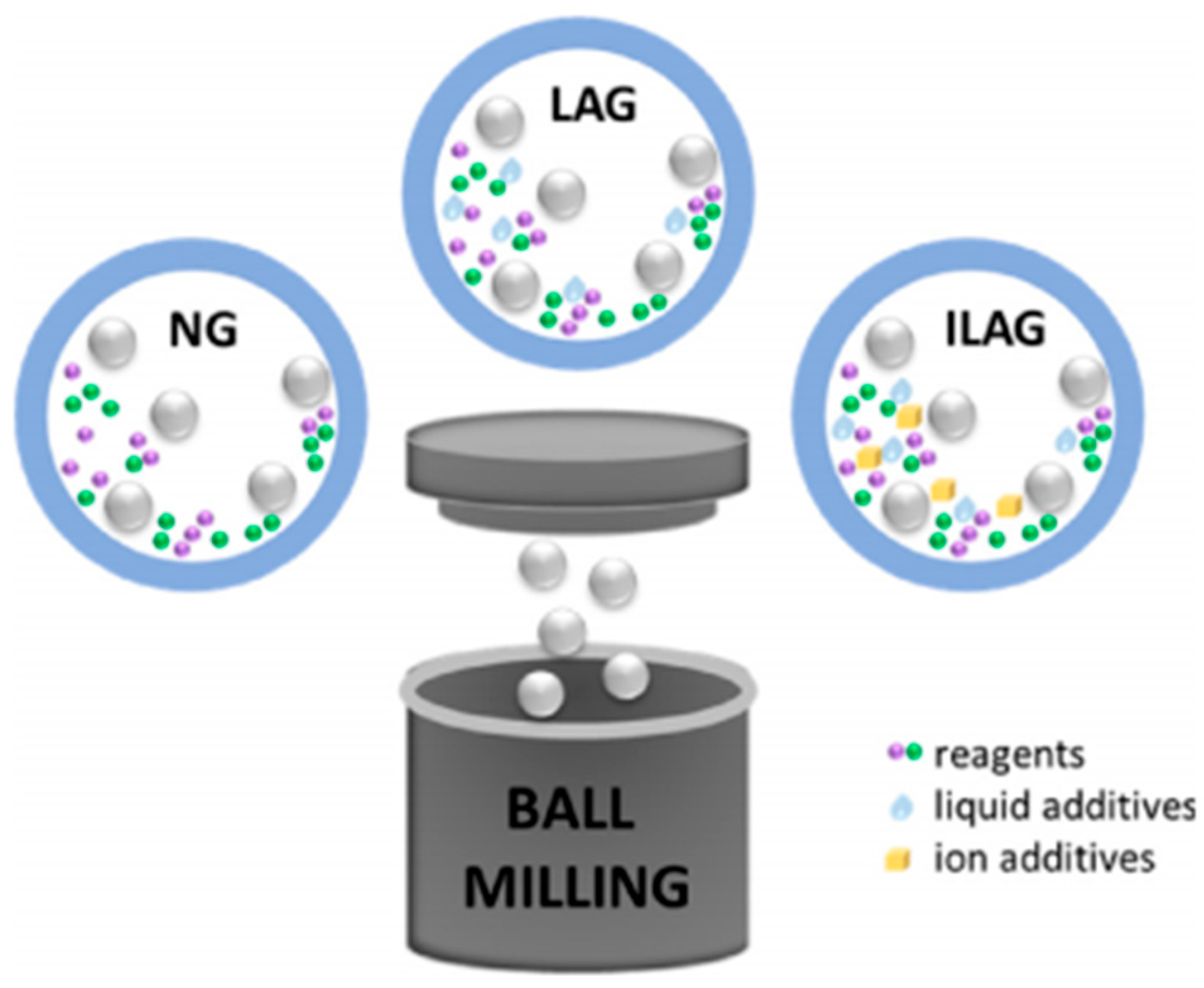
Mechanochemical synthesis: This method promotes the reaction between metal salts and organic ligands through mechanical forces such as grinding and ball milling (Figure 4) [72]. Requiring no or only a small amount of solvent, it is environmentally friendly and suitable for large-scale preparation, thereby providing a feasible route for the industrial production of MOF materials.
Figure 4. Schematic illustration of mechanochemical synthesis preparation [72].
Inorganics 14 00093 g004

2.3. Universal Modification Strategies

To further optimize the detection performance of MOFs and address their inherent drawbacks including insufficient electrical conductivity, limited water stability and poor selectivity, researchers have developed a variety of universal modification strategies applicable for multi-field detection, with customized optimizations additionally tailored to specific detection requirements.
Metal ion regulation and doping: Altering the metal centers of MOFs (e.g., Mg2+, Ni2+, Co2+, Zn2+, Eu3+, Tb3+, etc.) enables the modulation of the materials’ Lewis acid-base properties, ionic characteristics and adsorption affinity toward target analytes [73]. Immobilizing single metal nanoparticles (e.g., Au, Cu, Ag, Pt) or bimetallic nanoparticles (e.g., AuCu, NiCo, FeCo) on the surface or within the pores of MOFs can enhance the electrical conductivity, electrocatalytic activity and fluorescence response performance of the materials [74,75]. For instance, owing to the high ionic characteristics and strong Lewis acidity of Mg2+, Mg-MOFs-74 exhibits a significantly superior CO2 adsorption capacity compared to its derivatives with other metal centers [76]; Zr-MOFs loaded with AuCu bimetallic nanoparticles (AuCu@Zr-MOFs) achieves a remarkable enhancement in the adsorption capacity and detection sensitivity for fluoroquinolone antibiotics via the synergistic effect between metal nanoparticles and MOFs [77].
Ligand functionalization: Organic ligands bearing specific functional groups (e.g., amino, carboxyl, pyridine ring, thiol group, etc.) are selected, or functional moieties including fluorescent groups (e.g., pyrene carboxylic acid, fluorescein) and specific recognition sites (e.g., molecularly imprinted groups, aptamers) are introduced via postsynthetic ligand exchange (PSE), ligand modification and other approaches. This strategy increases the interaction sites between MOFs and target analytes, endowing MOFs with targeted detection capability [78,79]. For example, amino-containing ligands can enhance the adsorption of acidic gases (e.g., CO2, H2S) and sulfonamide antibiotics [80]; thiol-functionalized MOFs exhibit improved binding affinity for soft acid ions such as Hg2+ [81]; 1-pyrene carboxylic acid (PCA) is grafted onto Cu-MOFs via the PSE method, and the as-constructed Cu-TATB-PCA composite enables the highly selective fluorescent detection of tetracycline antibiotics.
Composite material construction: MOFs are hybridized with carbon materials (e.g., graphene, carbon nanotubes, reduced graphene oxide, carbon quantum dots), metal oxides, polymers, MXenes and other materials to synergistically exploit the advantages of each component, thus improving the electron transfer efficiency, structural stability and dispersibility of MOFs. For example, MOF/graphene oxide (GO) composites enhance the response speed and sensitivity of sensors by virtue of the high electrical conductivity of GO and the excellent adsorption capacity of MOFs [36,82]; MOF/MXene composites can be utilized to construct gas and ion sensors with rapid response at room temperature, taking advantage of the high electrical conductivity of MXenes and the excellent adsorption capacity of MOFs [83].
Magnetic particle hybridization: Magnetic nanoparticles such as Fe3O4 and CoFe2O4 are hybridized with MOFs to fabricate magnetic MOF composites, which enables the integration of magnetic solid-phase extraction and detection, simplifies the sample pretreatment process, and is suitable for the detection of trace target analytes in complex matrices. For example, the NH2-MIL-88B(Fe)/TPB-DMTP-COF composite achieves a high degradation rate for sulfamerazine (SMR), which is 32–170 times that of other reported catalysts [84].

3. Core Mechanisms of MOFs in Multi-Field Detection

The core mechanisms of MOF-based detection technologies are all based on the changes in physical or chemical properties induced by the interactions between MOFs and target analytes. Despite the mechanistic differences across various detection fields, there exist prominent common rules, which mainly fall into the following categories.

3.1. Adsorption Mechanism

Efficient adsorption of target analytes by MOF materials is the foundation for achieving high-sensitivity detection. The adsorption mechanisms are universal across various fields and mainly include:

3.1.1. Coordination

The efficient adsorption of target analytes by MOFs forms the foundation for achieving high-sensitivity detection, and their adsorption mechanisms share commonalities across multiple fields, mainly including coordination interaction. The metal ions in MOFs (e.g., Zr4+, Cu2+, Cd2+, Ni2+, Mg2+, etc.) can form coordinate bonds with the functional groups in target analytes (e.g., O atoms in gas molecules, carboxyl/amino/hydroxyl groups in antibiotic molecules, and metal ions), thereby enhancing the adsorption affinity [85]. For example, the strong electrostatic interaction between the open metal sites of Mg2+ in Mg-MOFs and the O atoms in CO2 molecules improves the adsorption and detection capacity of Mg-MOFs for CO2 molecules [86]; Coordination and hydrogen bonding lead to the transfer of energy and electrons from TC to MOF, which promotes the fluorescence enhancement mechanism (Figure 5) [87]; the S atoms in MOFs form stable coordinate bonds with Hg2+ [88].
Figure 5. Multifunctional fluorescent Eu-MOF probes for tetracycline antibiotics [87].
Inorganics 14 00093 g005

3.1.2. Electrostatic Interaction

Electrostatic interaction: Electrostatic attraction is formed between the surface charge of MOFs and the charged state of target analytes at a specific pH. For example, Zr-MOFs carry a weak positive charge at pH = 6, generating electrostatic interactions with fluoroquinolone antibiotics in a zwitterionic state; Cu-TATB-PCA has a negatively charged surface at pH = 7, forming electrostatic attraction with positively charged tetracycline molecules.
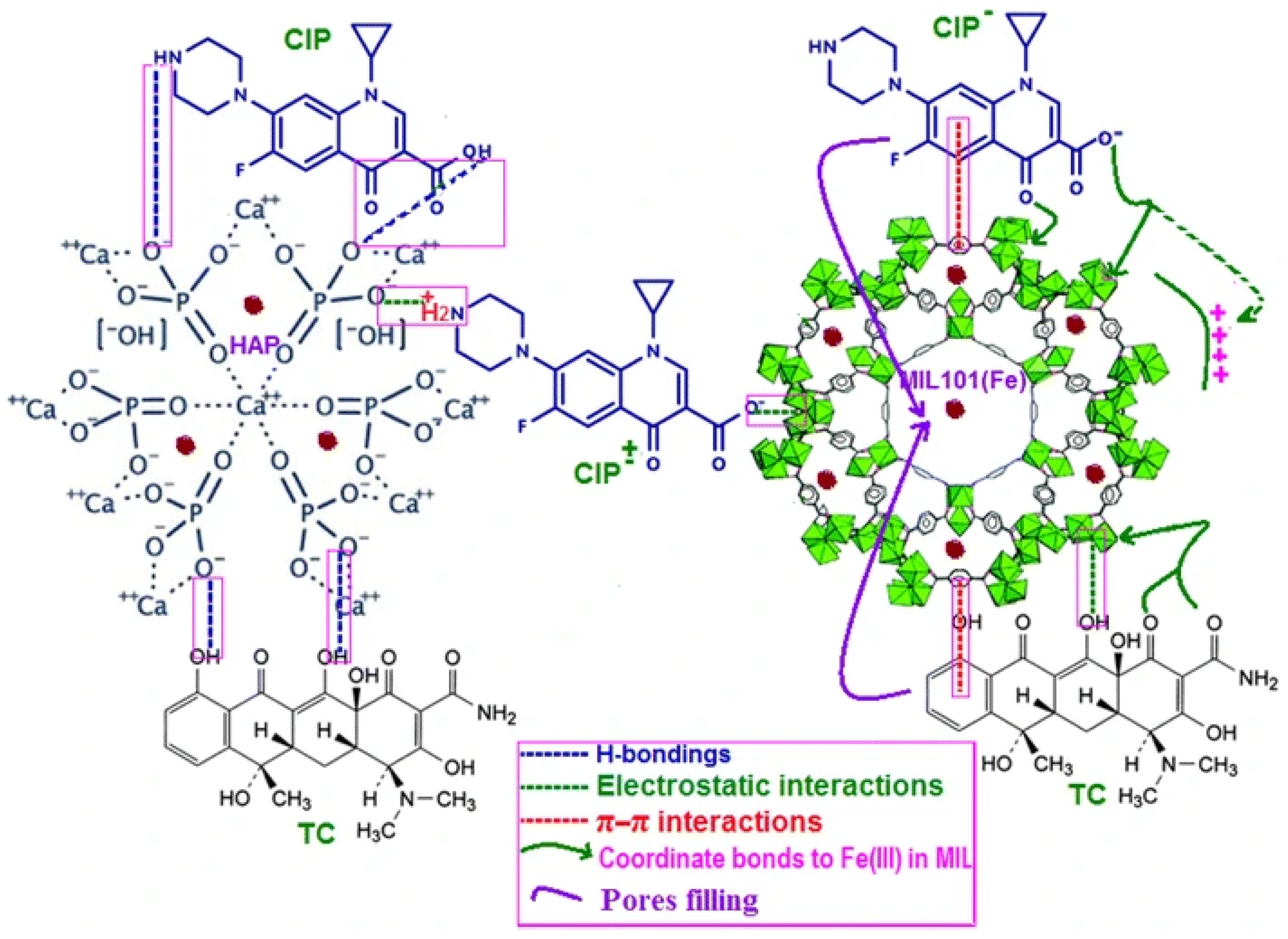
π-π stacking interaction: The aromatic ring structures in MOF ligands (e.g., benzene rings, quinoline rings, imidazole rings) form π-π stacking interactions with benzene rings, quinoline rings and other aromatic moieties in antibiotic molecules. This interaction is significantly enhanced, and even dominates the detection performance of MOFs, especially after ligand functionalization (e.g., introduction of pyrenyl and naphthyl groups) (Figure 6) [89].
Figure 6. Schematic illustration of the adsorption mechanism of antibiotics by magnetic metal–organic framework (MOF) composites [89].
Inorganics 14 00093 g006

3.1.3. Hydrogen Bonding

Hydrogen bonding interaction: Functional groups such as amino, hydroxyl and carboxyl groups in MOFs form hydrogen bonds with oxygen, nitrogen and hydrogen atoms in target analytes, thereby further enhancing the adsorption capacity. For example, the amino groups in UiO-66-NH2 can form hydrogen bonds with hydroxyl groups in target analyte molecules, improving its detection performance for antibiotics such as sulfamethoxazole and levofloxacin [90]; amino-containing MOF ligands can form hydrogen bonds with gas molecules including CO2 and H2S.

3.1.4. Distinction Between Adsorption Thermodynamics and Signal Transduction Efficiency and the Contribution Mechanism of Adsorption to Detection Performance

Adsorption capacity (mg/g), as a key indicator of adsorption thermodynamics, describes the maximum capture ability of MOF materials for target analytes, which is mainly determined by the specific surface area of the material, the number of active sites, and the interaction strength with the targets. In contrast, detection sensitivity depends on signal transduction efficiency—that is, the ability of MOFs to convert the physical process of “target adsorption” into quantifiable detection signals (fluorescence, current, frequency, etc.). The key influencing factors include the optical/electrochemical activity of the material, electron transfer rate, signal amplification effect, and background noise level. The two are not directly positively correlated: high adsorption capacity does not necessarily lead to a low detection limit, and the contribution mechanism of adsorption should be critically analyzed according to the specific sensing system.
Positive Contribution Scenarios of Adsorption
When the adsorption process enables selective enrichment of targets without compromising signal transduction efficiency, high adsorption capacity can significantly lower the detection limit. For example, in gas detection, the high CO2 adsorption capacity of Mg-MOF-74 (4.23 mmol/g) can enrich low-concentration CO2 molecules on the material surface, providing a material basis for the frequency signal response of quartz crystal microbalance (QCM) and reducing the detection limit to the ppm level [91]. In antibiotic detection, the high adsorption capacity of Cu-TATB-PCA toward tetracycline (469.5 mg/g) originates from the π–π stacking interaction introduced by pyrrole functionalization; the enrichment of targets on the material surface enhances the fluorescence quenching effect, indirectly reducing the detection limit to 0.586 μM [90]. In ion detection, the strong coordination adsorption of Hg2+ by Bi2CuO4@Al-MOFs@UiO-67 (removal rate > 99.9%) significantly increases the ion concentration on the electrode surface, promotes signal amplification of the electrochemical redox reaction, and achieves a detection limit as low as 0.041 pM [70,92].
Scenarios of No Direct Contribution or Negative Effects of Adsorption
In some sensing mechanisms, adsorption capacity shows no direct correlation with detection sensitivity, and excessive adsorption may even lead to reduced sensitivity.
In fluorescence sensing based on the inner filter effect (IFE), the detection of Fe3+ by EuTb-MOFs-1 relies on the optical interaction between Fe3+ and the MOF ligands rather than the adsorption amount. Even with a relatively low adsorption capacity, obvious fluorescence quenching can be achieved as long as Fe3+ forms effective optical shielding with the ligands, giving a detection limit of 1.1 μM [93]. In contrast, excessive adsorption that induces MOF aggregation will reduce the stability of the fluorescence signal.
In electrochemical sensing, interfacial mass transfer limitation often occurs. During the detection of nitrofurantoin using Ni-MOF/GO/AgNPs, the electrocatalytic activity of AgNPs dominates signal amplification, while the adsorption role of MOFs only needs to capture targets onto the electrode surface. Over-adsorption will cause the accumulation of targets on the electrode surface, hinder electron transfer, and result in signal saturation or even attenuation [45].
For structurally similar analytes, adsorption may bring selectivity interference. AuCu@Zr-MOFs/MWCNT exhibits similar adsorption capacities toward three fluoroquinolone antibiotics (458.49–480.09 mg/g), whereas the detection limits differ significantly (0.113–0.180 nM) due to variations in electrocatalytic activity. Accurate discrimination ultimately requires the LDA algorithm [41], confirming that adsorption capacity alone cannot determine detection selectivity and sensitivity.
Adsorption is a necessary but insufficient condition for high-sensitivity detection. A low adsorption capacity generally fails to generate an effective response toward low-concentration targets, whereas a high adsorption capacity must cooperate with excellent signal transduction efficiency to truly lower the detection limit. In the rational design of sensing systems, it is essential to balance adsorption thermodynamics (optimizing active sites and pore structures) and signal transduction efficiency (improving conductivity or fluorescence activity via metal nanoparticle doping, carbon material hybridization, etc.), avoiding the evaluation of sensing performance solely based on adsorption capacity.

3.2. Signal Transduction Mechanism

MOF-based detection technologies convert the changes in the physical or chemical properties of materials induced by adsorption into identifiable detection signals, which mainly involve the following core mechanisms.

3.2.1. Fluorescent Sensing Mechanism

Some MOFs (especially lanthanide-based MOFs and MOFs with conjugated ligands) possess intrinsic fluorescent properties. When target analytes interact with MOFs, the fluorescence intensity undergoes quenching, enhancement or wavelength shift, enabling quantitative detection [94]. The fluorescence quenching mechanisms mainly include photoinduced electron transfer (PET), inner filter effect (IFE) and static quenching; the fluorescence enhancement mechanism is that certain target analytes can act as “antennas” to transfer energy to rare earth ions in MOFs, enhancing characteristic fluorescence emission; the ratiometric fluorescent mechanism achieves self-calibrated detection and improves accuracy by virtue of the intensity ratio of two fluorescence emission peaks varying with the concentration of target analytes. For instance, the interaction between EuTb-MOFs and Fe3+ induces fluorescence quenching through the inner filter effect [29]; in Eu-MOF sensors, tetracycline molecules compete with ligands for coordination, leading to the fluorescence quenching of Eu3+ and thus realizing the quantitative detection of tetracyclines [95].

3.2.2. Electrochemical Sensing Mechanism

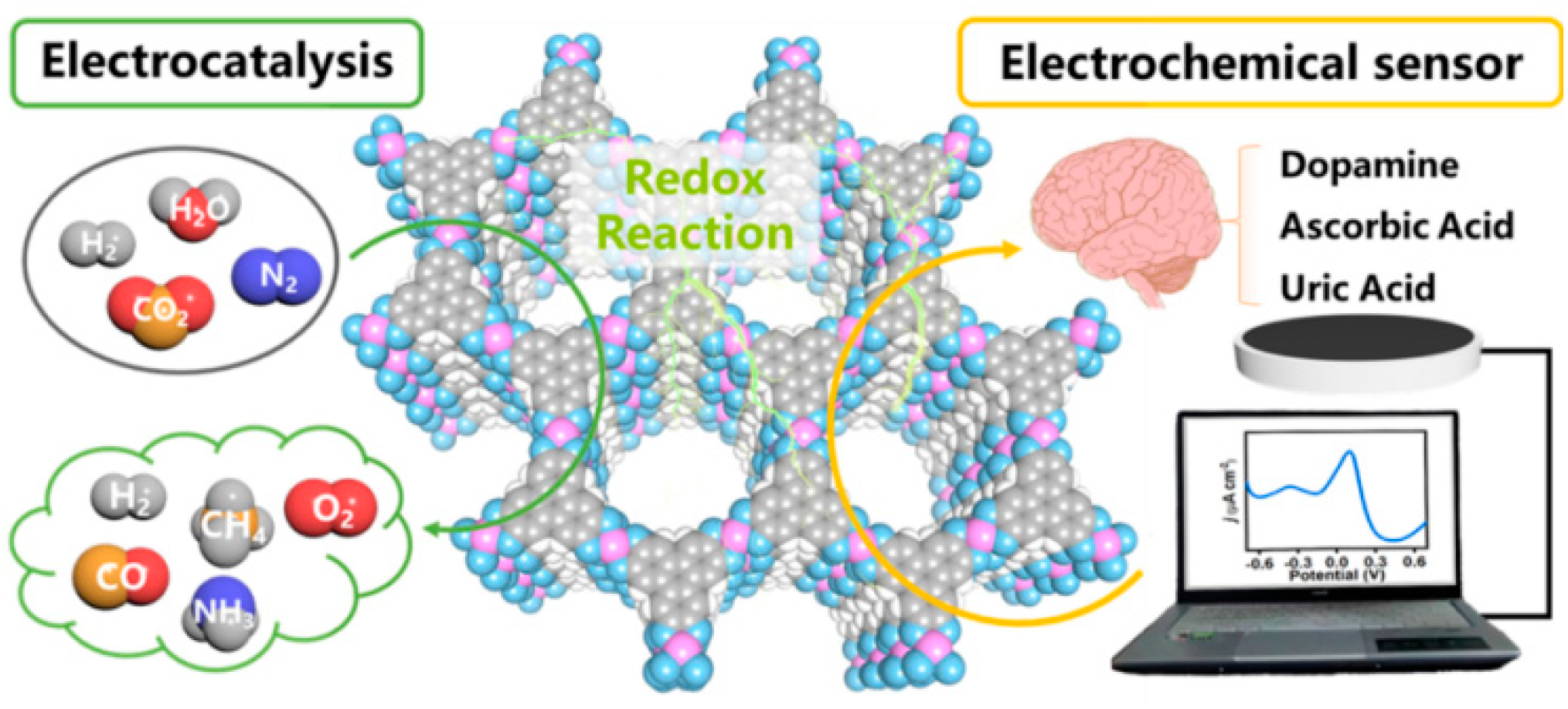
It mainly involves redox reactions and interfacial charge transfer. Electroactive groups in target analytes (e.g., nitro/phenolic hydroxyl/amino groups in antibiotic molecules, reductive groups in gas molecules) undergo redox reactions on the electrode surface to generate current signals; the high electrical conductivity and electrocatalytic activity of MOFs and their composites accelerate electron transfer and enhance signal response (Figure 7). For example, Ni-MOFs-GO-AgNPs promote the reduction in nitro groups in nitrofuran antibiotics via the electrocatalytic effect of AgNPs [45]; in MOF-derived metal oxide sensors, gas molecules (e.g., H2S) react with oxygen vacancies on the material surface, releasing electrons and altering carrier concentration, thereby inducing a resistance change [96]. Mass change mechanism: Taking advantage of the high adsorption capacity of MOFs for target gases, the entry of gas molecules into MOF pores leads to an increase in material mass. The mass change is converted into a frequency signal by mass-sensitive devices such as a quartz crystal microbalance (QCM), enabling gas detection [97]. For instance, the QCM sensor modified with MOFs-74 exhibits a significant shift in crystal resonance frequency after adsorbing CO2, realizing the quantitative detection of CO2 [98].
Figure 7. Schematic diagram of two-dimensional cMOFs in redox reaction mechanisms of electrocatalysis and electrochemical sensing [99].
Inorganics 14 00093 g007
Other mechanisms: These include MOF structural deformation induced by the adsorption of target analytes (piezoelectric sensing mechanism), infrared spectral changes triggered by intermolecular interactions (spectral sensing mechanism), and ion exchange mechanism (some anionic MOFs can undergo ion exchange between the framework ions and target ions), among others.

3.2.3. Auxiliary Recognition Mechanism

For target analytes with similar structures (e.g., different fluoroquinolone antibiotics, sulfonamide antibiotics, mixed gases), a single detection signal is insufficient for discrimination. By combining machine learning algorithms such as linear discriminant analysis (LDA), ResNet-CBAM, and support vector machine (SVM), and analyzing the multi-dimensional features of fluorescence spectra and electrochemical signals, simultaneous identification of multiple components is achieved, which significantly improves the specificity and accuracy of detection. For example, the AuCu@Zr-MOFs/MWCNT sensor combined with the linear discriminant analysis (LDA) algorithm successfully distinguished three structurally similar fluoroquinolone antibiotics, namely norfloxacin, ciprofloxacin, and ofloxacin [41]; Eu-MOFs/NiCo-LDH combined with the ResNet-CBAM neural network model realized the accurate identification of three fluoroquinolone antibiotics via changes in fluorescence color [46].

4. Typical Applications of MOFs in Multi-Field Detection

4.1. Applications in Gas Detection

Gas detection is of great significance in the fields of environmental protection, industrial safety, indoor air quality monitoring and others. MOFs and their composite materials have enabled the highly sensitive and highly selective detection of various gases, with typical applications as follows.

4.1.1. CO2 Detection

As a major greenhouse gas and an indicator of indoor air quality, the accurate detection of CO2 is of crucial importance. Relying on their high adsorption selectivity for CO2, MOF materials have emerged as ideal candidates for CO2 detection. Pure MOF Sensors: The MOFs-74 series exhibits excellent sensing performance for CO2. Among them, the QCM sensor modified with Mg-MOFs-74 achieves a response value of 66.89 Hz for 2000 ppm CO2 at room temperature, with a response/recovery time of 75 s/50 s, as well as favorable linearity (R2 = 0.939) and long-term stability. Its high selectivity stems from the strong electrostatic interaction between the open metal sites of Mg2+ and the O atoms in CO2 molecules.
MOF composite sensors: The GO/CuBTC composite enables the detection of low-concentration CO2 at room temperature by virtue of the high electrical conductivity of GO and the specific adsorption of CO2 by CuBTC [100], with an adsorption capacity of 4.23 mmol/g; the NH2-UiO-66@Br-COFs core–shell composite further enhances CO2 adsorption capacity and detection sensitivity through amino functionalization and the porous synergistic effect [91].

4.1.2. H2S Detection

H2S is a highly toxic and corrosive gas that is widely present in industries such as petrochemical engineering and sewage treatment, making its ppb-level detection crucial. MOF-derived metal oxide sensors: The Ni-CeO2 hollow sphere sensor prepared using Ce-MOFs as the template exhibits a response value of up to 108 (Ra/R9) for 30 ppm H2S at 100 °C, with a limit of detection as low as 8.68 ppb, and also possesses excellent humidity tolerance (a response deviation of only 6% at 15–60% RH). Its outstanding performance stems from a large number of oxygen vacancies introduced by Ni doping, a high specific surface area (68 m2/g), and the facilitation of gas diffusion by the hollow sphere structure [69]. MOF-based heterojunction sensors: The CuO/Ni-MOFs composite enhances the charge separation efficiency by constructing a p-n heterojunction, with a response sensitivity to H2S that is more than three times higher than that of single MOFs. It also shows excellent selectivity and is not affected by interfering gases such as CO and NH3 [42].

4.1.3. Detection of Other Gases

CH4 detection: By regulating the pore size (7.33 Å) and introducing pyridine nitrogen sites, Zn-MOFs achieve the selective adsorption of CH4. The separation ratio of CO2/CH4 mixed gas reaches 17.2 at 298 K, which paves the way for the accurate detection of CH4 [45]. NH3 detection: After Cu-MOFs are compounded with aminated graphene oxide (GO-U), the strong interaction between amino sites and NH3 endows the sensor with a limit of detection as low as 1 ppm for NH3 at room temperature, with a response time of less than 30 ms [101]. Volatile Organic Compound (VOC) detection: The MOFs-74 (Mn, Co, Ni, Zn) series exhibits specific responses to VOCs such as formaldehyde and methanol, and realizes highly selective detection through the coordination between metal centers and VOC molecules as well as the pore sieving effect. To provide a more intuitive comparison of the performance differences, advantages, and applicable scenarios of various MOF-based systems in gas detection, Table 1 summarizes the target gas, detection limit, response/recovery time, and key merits of typical MOF-based gas sensors in recent years, offering a reference for material screening and performance optimization in this field.

4.2. Applications in Antibiotic Detection

Antibiotics have been widely used in clinical practice due to their antibacterial activity. However, the abuse of antibiotics accelerates the metabolic growth of bacteria and enhances their drug resistance, which necessitates the use of more antibiotics to eliminate bacteria, thus leading to a vicious cycle. Most of the ineffective antibiotics are released into the environment. Antibiotic residues in the environment not only destroy the structure of microbial communities, resulting in the decline of soil fertility and eutrophication of water bodies, but also accumulate through the food chain, induce bacteria to produce drug-resistant genes, and further threaten the health of the human immune system. How to reduce environmental antibiotic residues has become an urgent global environmental problem to be solved. MOFs and their composite materials have enabled the efficient detection of various types of antibiotics, with typical applications as follows.

4.2.1. Detection of Fluoroquinolone Antibiotics

Fluoroquinolone antibiotics (e.g., norfloxacin, ciprofloxacin, ofloxacin) are widely used in human medical treatment, animal husbandry and aquaculture, with their environmental residue problem being particularly prominent. A glassy carbon electrode modified with the AuCu@Zr-MOFs/MWCNT composite enables the simultaneous detection of three fluoroquinolone antibiotics, namely norfloxacin, ciprofloxacin and ofloxacin, with the adsorption capacities reaching 458.49, 469.33 and 480.09 mg/g, respectively, and the limits of detection as low as 0.113–0.180 nM. Combined with the LDA machine learning algorithm, it successfully solves the challenge of identifying structurally similar antibiotics, achieving a recovery rate of 96.0–103.7% in the detection of Xiangjiang River water samples [41]. A fluorescent sensing array constructed from the Eu-MOFs/NiCo-LDH nanocomposite exhibits limits of detection for ciprofloxacin, norfloxacin and ofloxacin of 48.5 pM, 180.5 pM and 42.7 pM, respectively. Integrating the ResNet-CBAM neural network model, it realizes visual detection via changes in fluorescence color with a recognition accuracy of nearly 100%. Furthermore, it can achieve the efficient degradation of antibiotics under the condition of peroxymonosulfate (PMS) activation, with the degradation rates reaching 91.2–94.4% [46].

4.2.2. Detection of Nitrofuran Antibiotics

Nitrofuran antibiotics (e.g., nitrofurantoin, furaltadone, furazolidone) possess potential carcinogenic and teratogenic properties, and their use in food production has been prohibited in many countries. The two-dimensional Cd-MOF fluorescent sensor (SLX-8) exhibits a specific fluorescence quenching response to nitrofurantoin, furaltadone and furazolidone in methanol solution, with limits of detection of 0.50 μM, 0.40 μM and 0.28 μM, respectively. Its performance shows no significant attenuation after 5 cyclic uses, and it has a strong anti-interference ability, which enables its application for the rapid detection of such antibiotics in environmental water samples [102]. Ternary Ni-MOF/GO/AgNP composite: It can simultaneously detect chloramphenicol and nitrofurantoin with limits of detection as low as 0.161 nM and 0.057 nM, respectively. This composite integrates both detection and photocatalytic degradation functions, with the degradation rate of nitrofurantoin reaching 96.53%. It can be directly applied to complex samples such as turbid milk, wastewater and biological fluids, achieving a recovery rate of 96.34–99.56% [45].

4.2.3. Detection of Other Types of Antibiotics

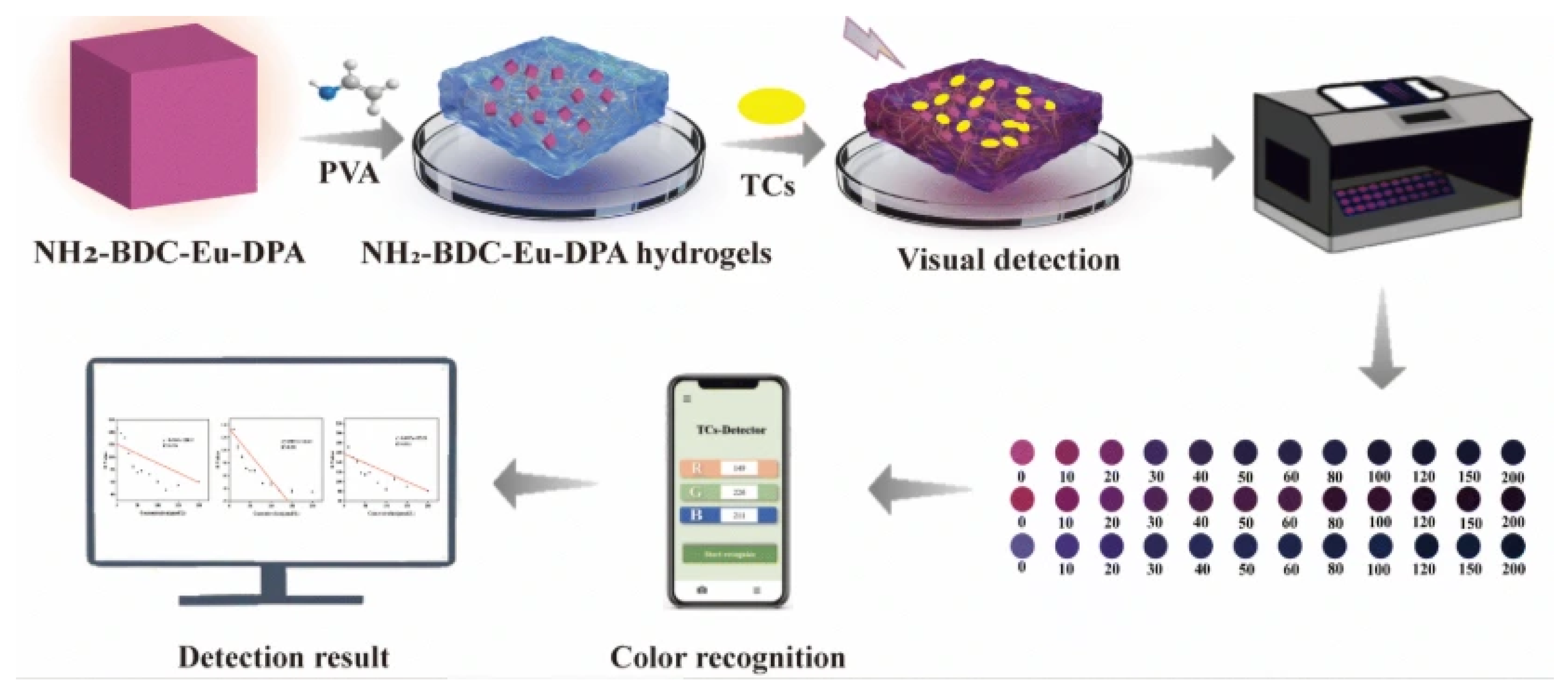
Tetracycline antibiotics: Pyrrole-functionalized Cu-MOFs (Cu-TATB-PCA) exhibit maximum adsorption capacities of 520.8, 473.9 and 469.5 mg/g for oxytetracycline, chlortetracycline and tetracycline, respectively, with limits of detection of 0.586 μM for tetracycline and 0.776 μM for oxytetracycline (Figure 8). The recoveries reach 95.83–103.13% in actual water samples and honey samples [90]. The Eu-MOFs@Tb3+ ratiometric fluorescent probe achieves a limit of detection as low as 0.115 μM for tetracycline, enabling the rapid and visual detection of tetracycline residues in freshwater fish [103].
Figure 8. Schematic illustration of the fluorescent detection of tetracycline [104].
Inorganics 14 00093 g008
β-Lactam antibiotics: Post-synthetically modified Eu@Co-MOFs exhibit highly selective fluorescent detection capability for amoxicillin, with a limit of detection of 0.29 μM. They possess excellent stability in DMF solution and can be applied for the detection of amoxicillin in pharmaceuticals, food products and environmental water samples [105].
Sulfonamide antibiotics: The fluorescent sensor constructed from Zr-MOFs@aptamer composites achieves a limit of detection of 0.03 μM for sulfamethoxazole, with recoveries of 94.2–102.5% in tap water and river water samples, and demonstrates strong anti-interference ability [106].
Macrolide antibiotics: The electrochemical sensor fabricated from Zn-MOFs/CNTs composites has a linear detection range of 0.5–50 μM for erythromycin with a limit of detection of 0.12 μM, and the recoveries in milk samples reach 93.6–101.8%.
Considering the wide variety of MOF materials and the distinct differences in detection performance in the field of antibiotic detection, Table 2 systematically summarizes the key parameters of MOF-based sensors corresponding to different types of antibiotics, clearly demonstrating the performance merits and application potential of each system.

4.3. Applications in Ion Detection

The pollution of heavy metal ions and other harmful ions in matrices such as water and food has become an increasingly prominent problem. MOFs and their composite materials have enabled the highly sensitive and highly selective detection of various ions, with typical applications as follows.

4.3.1. Detection of Heavy Metal Ions

Fe3+ Detection: Two types of In-MOFs (MOF 1 and MOF 2) selectively recognize Fe3+ via fluorescence quenching, with limits of detection of 1.72 × 10⁻⁴ M and 1.46 × 10⁻⁴ M, respectively. EuTb-MOFs-1 achieves a limit of detection of 1.1 μM for Fe3+, and the underlying mechanism is the inner filter effect [93]. Carbon quantum dot-activated MOF composites enhance the selectivity for Fe3+ through a synergistic effect, resulting in a significant improvement in fluorescence quenching efficiency.
Pb2+ Detection: EuTb-MOFs-1 undergoes fluorescence quenching due to the interaction between its Lewis basic sites and Pb2+, with a limit of detection of 1.4 μM. An electrode modified with PAMAM/Ni-MOFs enables the detection of Pb2+ via square wave anodic stripping voltammetry (SWASV), exhibiting a linear range of 1–100 μg/L and a limit of detection as low as 1.21 μg/L, which is below the recommended drinking water threshold set by the World Health Organization [29]. The (Bi-S)n MOFs@MXene sensor achieves a limit of detection of 1.7831 nM for Pb2+ and demonstrates excellent practicability in real samples such as tap water and milk [31].
Detection of Other Heavy Metal Ions: The Bi2CuO4@Al-MOFs@UiO-67 sensor has a limit of detection of 0.02 pM for Cd2+, with a recovery rate of 94.9–108.1% in food samples; the PAMAM/Ni-MOFs sensor shows a limit of detection of 0.77 μg/L for Cu2+ and a linear range of 1–100 μg/L (Figure 9); ZJU-101 MOFs reach an adsorption capacity of 245 mg/g for Cr2O72− with an adsorption time of only 0.41 min [107].
Hg2+ Detection: Zr-DMBD-MOFs achieve a removal efficiency of over 99.9% for Hg2+ and can realize effective detection even at an initial concentration as low as 10 ppm [108]; the Bi2CuO4@Al-MOFs@UiO-67 sensor exhibits a limit of detection of 0.041 pM for Hg2+, enabling simultaneous detection in food samples such as rice and milk (Figure 10) [70].
In view of the characteristics of **multiple systems, ultra-trace concentrations, and strong interference** in heavy metal ion detection, Table 3 integrates the target ions, detection limits, selectivity, and practical application scenarios of typical MOF-based sensors, providing data support for the rapid evaluation of detection performance and targeted material design.
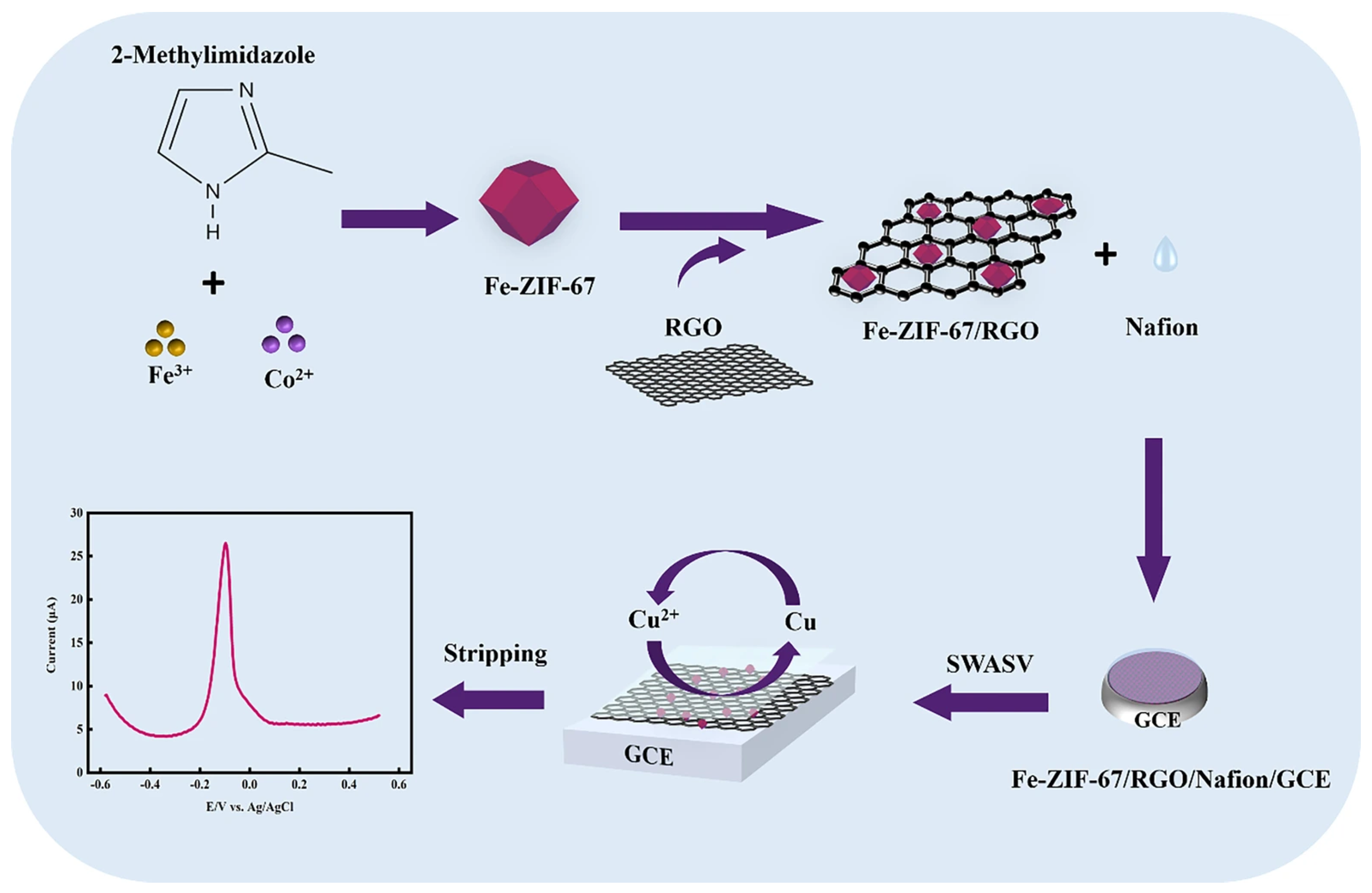
Figure 9. A bimetallic Fe-Co MOF electrochemical sensor for detecting trace copper ions in water [109].
Inorganics 14 00093 g009
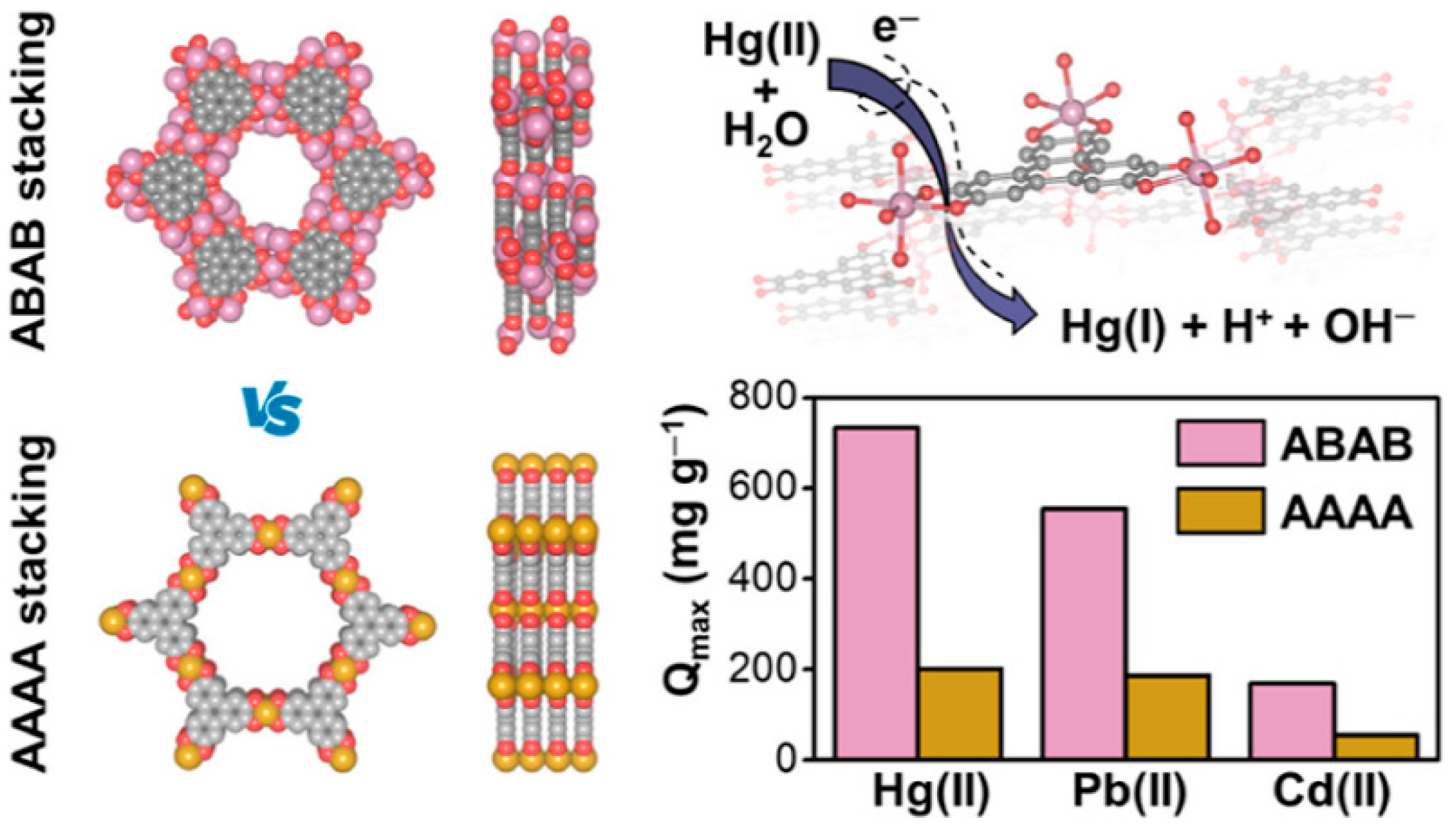
Figure 10. A series of redox-active metal–organic frameworks (MOFs) composed of hexahydroxytriphenyl (HHTP) ligands, liganded in cobalt, nickel, and copper (Co-HHTP, Ni-HHTP, and Cu-HHTP), and for the detection of cadmium (Cd2+), mercury (Hg2+), and lead (Pb2+) [110].
Inorganics 14 00093 g010
Table 3. Summary of MOF heavy metal ion sensor performance.
Target IonMOF Material SystemDetection LimitLinear RangeSelectiveActual SampleCore AdvantagesReferences
Fe3+EuTb-MOFs-11.1 μMResistant to Na+/K+/Ca2+ interferenceInner filter effect, multiple emission fluorescence quenching[93]
Pb2+PAMAM/Ni-MOFs1.21 μg/L1–100 μg/LResistant to Cu2+/Zn2+ interferenceDrinking waterBelow WHO threshold, SWASV highly sensitive[29,107]
Pb2+(Bi-S)n MOF@MXene1.7831 nM1–10 nMResistant to Hg2+/Cd2+ interferenceTap water/MilkMicrowave synthesis, green and efficient[31]
Hg2+Zr-DMBD-MOFsHigh selectivityWastewaterRemoval efficiency > 99.9%[108]
Hg2+Bi2CuO4@Al-MOFs@UiO-670.041 pMResistant to interference from multiple metal ionsRice/MilkUltra-sensitive, multi-MOF collaboration[70]
Cu2+PAMAM/Ni-MOFs0.77 μg/L1–100 μg/LResistant to Pb2+/Fe3+ interferenceDrinking waterElectrochemical signal amplification, good stability[29,107]
Cd2+Bi2CuO4@Al-MOFs@UiO-670.02 pMAnti-common ion interferenceFood sampleRecovery rate 94.9–108.1%[70]

4.3.2. Detection of Other Ions

Ions related to sulfonamide antibiotics: EuTb-MOFs-1 enables highly sensitive detection of sulfamethoxazole (SMZ) and sulfadiazine (SDZ), with limits of detection of 0.037 μM and 0.041 μM, respectively, and achieves signal response via photoinduced electron transfer and inner filter effect [111].
Radioactive ions: MOF materials modified with Prussian blue magnetic nanoparticles exhibit a removal efficiency of over 94% for radioactive cesium ions (137Cs) [112], and can realize rapid separation by an external magnetic field, which provides a new approach for the detection and treatment of radioactive contamination.

4.4. Practical Application Scenarios and Industrialization Progress

4.4.1. Practical Application Scenarios

MOF-based detection platforms have been widely applied in a variety of real samples, covering multiple fields such as the environment, food and biomedicine.
Environmental samples: Tap water, river water, lake water, wastewater, influent and effluent from sewage treatment plants, etc. For instance, the AuCu@Zr-MOFs/MWCNT sensor has been applied to the detection of Xiangjiang River water samples [41], and the Ni-MOFs/GO/AgNPs sensor for the detection of nitrofurantoin in the effluent from sewage treatment plants.
Food samples: Milk, honey, chicken, fish, eggs, pork, rice, etc. For example, the Ni-MOFs-GO-AgNPs sensor enables the direct detection of antibiotics in turbid milk; Fe3O4@NH2-MIL-88(Fe)@TpBD is used for the detection of enrofloxacin in chicken samples; and the (Bi-S)n MOFs@MXene sensor for the detection of Pb2+ in milk [31].
Biological samples: Urine, serum, saliva, etc. For instance, the Zn3V2O8/MOFs composite is applied to the detection of nitrofuran antibiotics in serum, and Ni-MOFs/GO/AgNPs for the detection of nitrofurantoin in urine.

4.4.2. Industrialization Progress

In recent years, the industrialization of MOF-based detection technologies has made certain progress, with some technologies having entered the pilot test or practical application stage.
Portable detection devices: Portable detection devices have been developed by combining MOF-based fluorescent sensors with smartphones. For example, a fluorescent sensor based on Eu-MOFs/NiCo-LDH is integrated with smartphone cameras, and fluorescence images are analyzed via the ResNet-CBAM model to achieve on-site rapid detection of fluoroquinolone antibiotics with a detection time of less than 5 min. This technology has been applied in the on-site monitoring of sewage treatment plants [46].
Test strip detection technology: Visual detection test strips have been developed by loading MOF composites onto test strips. For instance, Cu-TATB-PCA is immobilized on cellulose test strips, which enables the detection of tetracycline antibiotics with a limit of detection as low as 1 μM. Visual semi-quantitative detection is realized through changes in fluorescence intensity, and this test strip has been used for the rapid screening of milk samples.
Online monitoring systems: MOF-based electrochemical sensors are integrated into online monitoring systems to achieve real-time monitoring of target substance residues. The AuCu@Zr-MOFs/MWCNT sensor has been integrated into a water quality online monitoring system for the real-time monitoring of fluoroquinolone antibiotics in surface water and the effluent of sewage treatment plants, with a detection frequency of once per hour. This system has undergone a 6-month trial operation in a sewage treatment plant and has maintained stable performance (Figure 11).
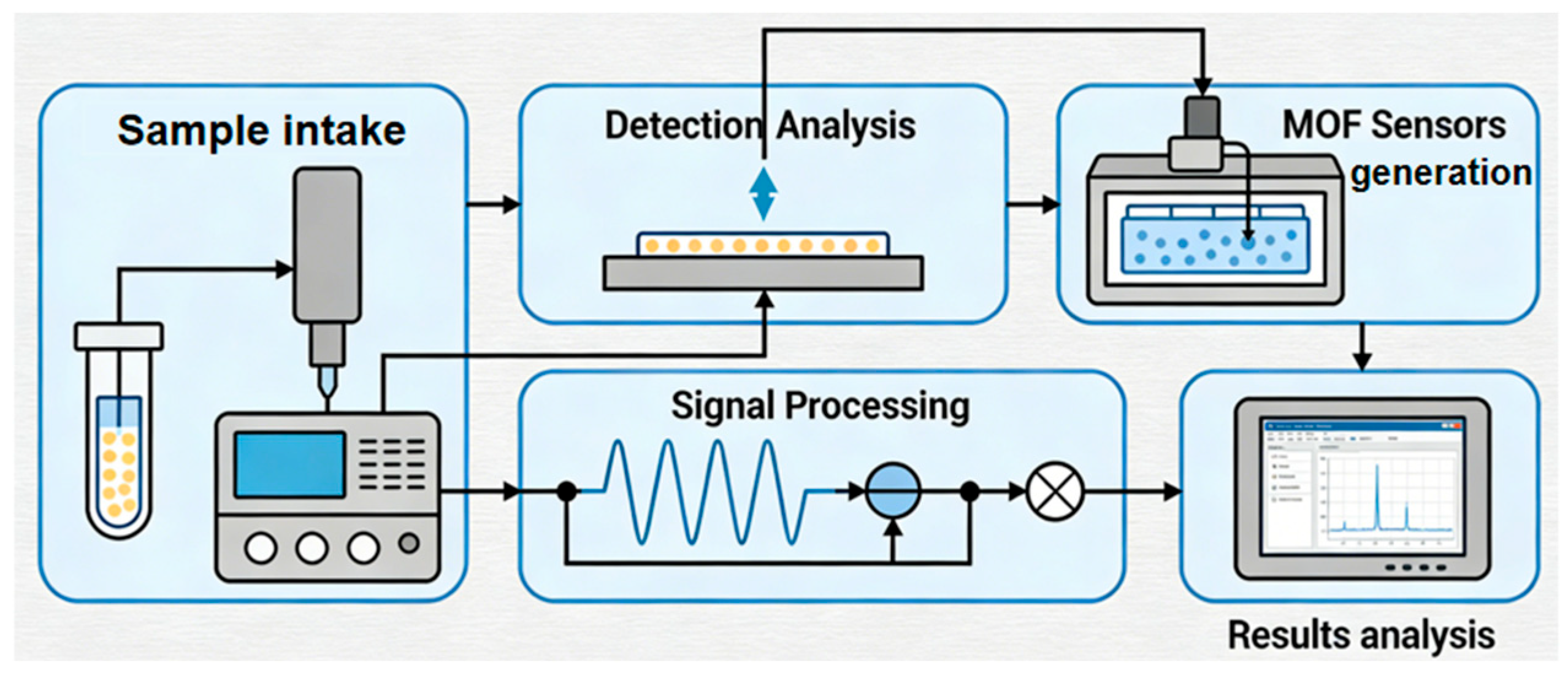
The core of the industrial application of MOF-based sensors lies in the full-process integration of sample processing, detection and analysis, sensor regeneration, and signal analysis. The overall application system can realize the synergistic linkage of each link through modular design, and the typical full-process application of MOF sensors is illustrated in Figure 12. This system can meet the on-site/online detection requirements for various targets such as gases, antibiotics, and ions, providing a standardized design concept for the engineering application of MOF-based detection technologies.
Figure 11. Schematic diagram of the full-process integrated application of MOF sensors.
Inorganics 14 00093 g011
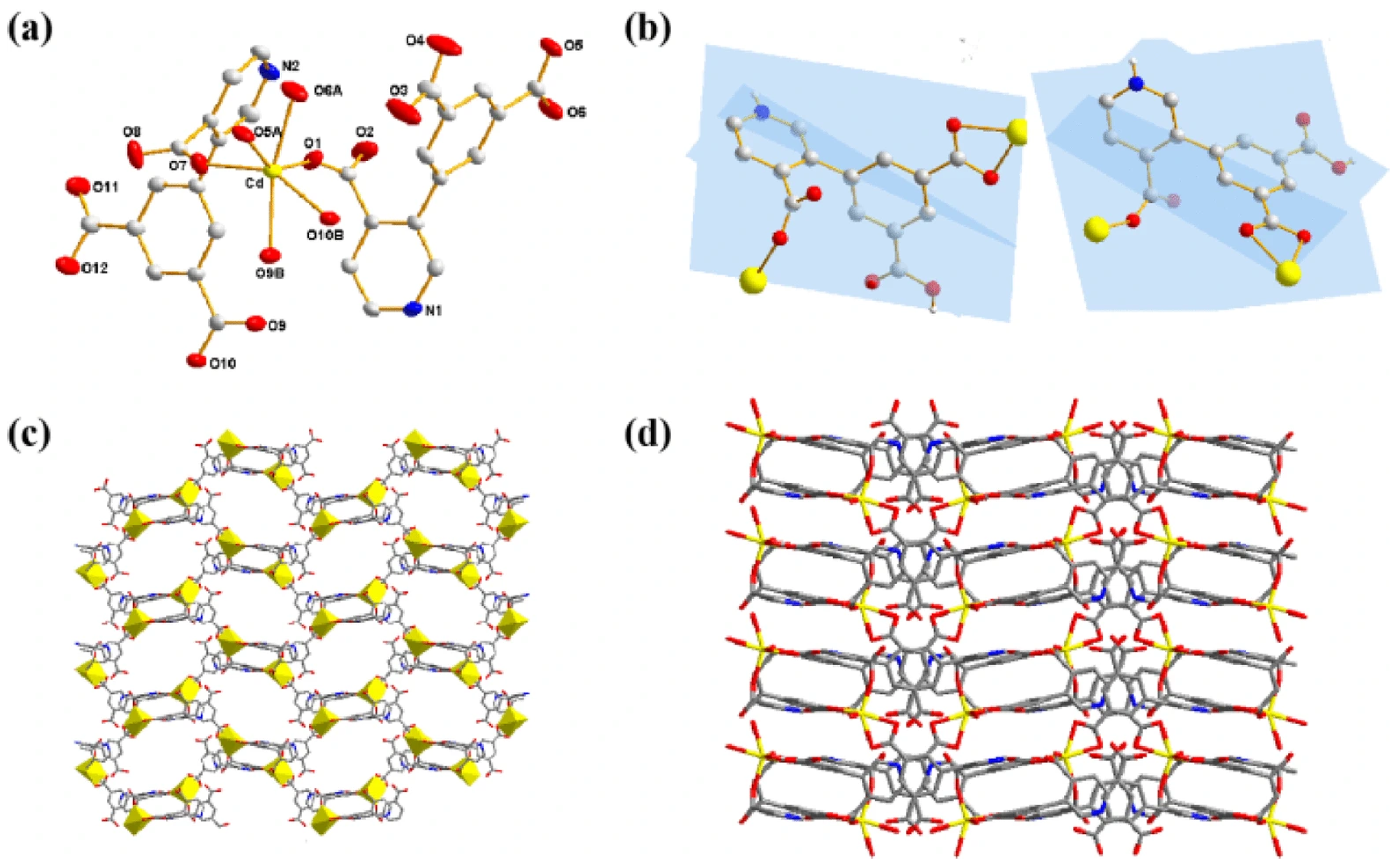
Figure 12. (a) Coordination environment of Cd(II) ions. (b) Coordination mode of H2L—ligand. (c) 2D structure of Cd-MOF. (d) 3D supramolecular structure [113].
Inorganics 14 00093 g012

4.5. Practical Performance Evaluation and Key Issues for Industrialization

The practical implementation of MOF-based detection technologies relies not only on laboratory-level high sensitivity and selectivity but also on meeting industrial requirements such as long-term operational stability, reusability, controllable cost, environmental friendliness, and scalable production. Key information is supplemented below from the perspectives of core practical performance and industrialization bottlenecks.

4.5.1. Long-Term Stability and Regeneration–Recycling Performance

Long-term stability and regeneration capability are essential prerequisites for MOF-based sensors to reduce operating costs and enable repeated application, and their performance directly determines the practical value of the technology.
Long-Term Stability Data
In the field of gas detection, the Ce-MOF-derived Ni-CeO2 hollow sphere sensor operates continuously for 30 days at 15–60% relative humidity and 100 °C, with a response deviation of only 6% toward 30 ppm H2S, and its service life can reach more than 18 months, demonstrating excellent humidity resistance and thermal stability [69]. The Zn-MOF-modified QCM sensor has been used continuously for 6 months in indoor air quality monitoring, with a response attenuation of less than 8% for CO2, which is attributed to the high chemical stability of its zeolite-like structure; its service life in practical applications can be stabilized at about 2 years [45].
In the field of antibiotic detection, after 5 detection cycles for nitrofuran antibiotics, the two-dimensional Cd-MOF (SLX-8) sensor shows no obvious decay in fluorescence response intensity, with the detection limit maintained in the range of 0.28–0.50 μM, and its service life is about 12 months under conventional laboratory conditions [102]. The AuCu@Zr-MOFs/MWCNT electrochemical sensor was tested once a week for 2 months in continuous monitoring of Xiangjiang River water samples, and the recovery rate remained at 96.0–103.7% without significant passivation. With regular regeneration maintenance, its service life in industrial applications can reach 15 months [41].
In the field of ion detection, after being immersed in tap water samples for 15 consecutive days, the Bi2CuO4@Al-MOFs@UiO-67 sensor exhibits a detection limit change of less than 10% for Hg2+ and Cd2+. The synergistic interaction between metal nodes and ligands suppresses ion leaching, and the sensor remains stable after 50 repeated uses in food detection scenarios, with a service life of approximately 20 months [70].
Regeneration Methods and Efficiency
The mainstream regeneration strategies restore the active sites of MOFs through reversible adsorption–desorption mechanisms, and typical examples include:
Solvent washing regeneration: After being used for Hg2+ detection, sulfur-functionalized MOF-808 can rapidly regenerate its adsorption sites by immersion in 0.1 M thiourea solution for 30 min, with a total regeneration time of approximately 40 min (including immersion, washing and drying). The Hg2+ removal efficiency remains above 90% after 5 cycles [80].
Thermal regeneration: During CO2 detection, Mg-MOF-74 desorbs the adsorbed CO2 by purging with nitrogen at 120 °C for 2 h, with a total regeneration time of about 2.5 h (including purging and cooling). The adsorption capacity decreases by only 5% after 10 cycles [91].
UV irradiation regeneration: After detection of fluoroquinolone antibiotics, the Eu-MOFs/NiCo-LDH fluorescence sensor is irradiated with 365 nm UV light for 1 h, and the fluorescence intensity recovery rate reaches 85%, with a total regeneration time of approximately 1.2 h (including irradiation and equilibration). The regeneration mechanism is attributed to UV-induced desorption of antibiotic molecules [46].

4.5.2. Cost Composition and Low-Cost Optimization Strategies

The cost of MOF-based sensors is mainly derived from raw materials and synthesis processes, and the current high cost is a key factor restricting their large-scale promotion. In terms of raw materials, precious metals such as Zr, Ru and Pt, as well as high-priced organic ligands including imidazoles and pyridines, account for 60–70% of the total cost. For instance, the raw material cost of Zr-based MOFs (e.g., UiO-66 series) is approximately 3 to 5 times that of traditional metal oxide sensors [75]. In terms of synthesis processes, solvothermal synthesis consumes a large amount of organic solvents and requires a long reaction cycle of 12–72 h; during large-scale production, the energy consumption per unit product is more than twice that of hydrothermal synthesis, which further drives up the manufacturing cost. To break through the cost bottleneck, researchers have developed various low-cost optimization approaches: the application of green synthesis processes has achieved remarkable results, where room-temperature synthesis (e.g., M-MOF-74 can be prepared by room-temperature stirring for 2 h) can reduce energy consumption by more than 80%, and the replacement of solvothermal synthesis with aqueous-phase synthesis cuts the cost of organic solvents by 90% [62]; the low-cost raw material substitution strategy, which uses cheap metal ions such as Fe3+, Zn2+ and Mg2+ instead of precious metals and general organic ligands such as terephthalic acid instead of customized ligands, can lower the raw material cost by 30–50% [6]; in terms of large-scale preparation technologies, mechanochemical synthesis is a solvent-free method that realizes the batch production of MOFs via ball milling process, with production efficiency increased by 10 times and unit product cost reduced by 40% compared with traditional methods [114], thus providing a feasible route for the low-cost industrial production of MOF-based sensors.

4.5.3. Commercialization Barriers

Although MOF-based detection technologies have achieved remarkable progress at the laboratory scale, their commercialization still faces multiple obstacles. Poor batch-to-batch reproducibility of materials is the primary issue: the crystal structure, pore size distribution and the number of active sites of MOFs are highly susceptible to synthesis conditions (e.g., temperature, pH and ligand purity), leading to a detectable performance deviation of 15–20% among products from different batches. The lack of standardized preparation processes makes it difficult to ensure the performance consistency of sensors [115], which directly impairs their reliability in practical applications.
The great difficulty in instrument integration further hinders commercialization. The signal output of MOF materials needs to be matched with commercial readout equipment (e.g., fluorescence spectrophotometers, electrochemical workstations), yet the signal intensity and response speed of most MOFs are incompatible with the detection range of existing instruments. This necessitates the additional development of dedicated signal amplification modules, which significantly increases the cost of equipment integration [41].
The bottleneck in large-scale production is also prominent. The preparation of high-performance MOF composites involves complex processes that cannot be easily scaled up for continuous production. At present, the laboratory-scale yield of MOF composites is mostly at the milligram level, and the product yield drops by more than 30% during large-scale production [114], which fails to meet the yield requirements for commercialization.
In addition, there are currently no established detection method standards, performance evaluation indicators or quality control systems for MOF-based sensors. This results in a lack of comparability among the research outcomes from different teams and thus impedes the market-oriented popularization of such technologies [106].

4.5.4. Toxicity and Environmental Safety

The metal nodes and organic ligands of MOFs may pose biological toxicity and environmental risks, and their safety assessment is a prerequisite for the application of MOFs in the detection of food and biological samples.
Potential Toxicity Risks
Toxicity of metal nodes: MOFs containing heavy metal ions such as Cd2+, Pb2+ and Cr3+ (e.g., Cd-MOF [102]) may suffer from metal ion leaching in aqueous environments. Prolonged exposure to such leached ions can induce cytotoxicity, which restricts the application of these MOFs in the detection of food and biological samples.
Toxicity of organic ligands: Imidazole- and pyridine-based ligands exhibit a certain degree of biological toxicity. For example, residual unreacted ligands may contaminate test samples and thus compromise the accuracy of subsequent analytical assays.
Green Development Trends
Replacement with low-toxic metal centers: Biocompatible metal ions such as Fe3+, Zn2+, Mg2+ and Zr4+ are the preferred choices. For instance, Fe-MOF-74 and Zr-based UiO-66 series have been proven to exhibit no significant cytotoxicity, enabling their application in food sample detection [6,70].
Design of degradable ligands: Natural organic acids (e.g., citric acid) and biodegradable ligands such as terephthalic acid are adopted for MOF synthesis, which mitigates the environmental impacts of discarded MOFs on soil and aquatic systems.
Surface modification and passivation: The surface of MOFs is encapsulated via approaches including SiO2 coating and biomolecule grafting to inhibit metal ion leaching. A typical example is the Fe3O4@NH2-MIL-88(Fe)@TpBD composite, in which the amount of leached metal ions is reduced to below the detection limit [106].

4.6. Comparison of Sensing Performances of Different MOF Systems from the Perspective of Structure–Activity Relationship

Although the above research cases have fully demonstrated the broad application prospects of MOFs in multi-field detection, MOF materials constructed with different metal centers and organic ligands exhibit distinct performances in specific sensing scenarios. Superior sensing performance is not determined by a single factor, but by the synergistic effect of three key components: the redox activity of metal nodes, the functional group response characteristics of ligands, and the spatial confinement effect of pore structures. A review of recent literature reveals that the superior performance of specific MOF families in dedicated sensing fields essentially arises from the precise matching between the intrinsic material properties and the physicochemical characteristics of the target analytes.
For instance, Zr-based MOFs (e.g., the UiO-66 series) dominate the fluorescence detection of antibiotics and heavy metal ions, owing to their outstanding chemical stability and abundant Zr6O4(OH)4 cluster nodes. Their advantages stem from the readily formed stable coordination bonds between Zr4+ and targets, as well as the significantly enhanced fluorescence quenching efficiency provided by defect sites derived from ligand deficiencies, which are difficult for other MOF series to match. In contrast, Zn-based MOFs (e.g., ZIF-8) [59] are more suitable for the rapid detection of small gas molecules due to their zeolite-like pore structures and favorable biocompatibility, whereas their poor hydrothermal stability limits performance in complex aqueous environments.
In the field of electrochemical sensing, MOFs with variable-valence metal nodes such as Cu-based and Ni-based materials show unique advantages [62]. Such materials can achieve signal amplification through the redox reactions of their own metal ions without additional electroactive modification, resulting in much higher sensitivity in electrocatalytic detection than MOFs with inactive metals. Furthermore, two-dimensional layered MOFs (e.g., Ni-MOF-74) are far superior to traditional three-dimensional cage-type MOFs in response time, due to their open active sites and fast electron transfer pathways [116].
In summary, the selection of the optimal MOF material for practical sensing applications should follow the principle of “targeted matching”: Zr-based or Ti-based MOFs with large pore sizes should be prioritized for the detection of macromolecular antibiotics; Zn-based or Cu-based MOFs with high porosity and specific adsorption sites are more suitable for gas or ion detection; and two-dimensional layered MOFs are more ideal for electrochemical detection requiring fast response. Such critical screening based on the structure–activity relationship provides important theoretical guidance for the targeted design of MOF sensors in the future.

4.7. Performance Comparison and Analysis Between MOF Sensors and Traditional Semiconductor Sensors

Traditional semiconductor sensors (centered on metal oxide semiconductor, MOS, sensors) represent the mainstream commercialized technology in the detection of gases, ions and other targets, and have been widely used in environmental monitoring, industrial safety and other fields for many years [117,118]. As an emerging sensing technology, MOF sensors exhibit remarkable complementarity and differentiated advantages in performance compared with traditional semiconductor sensors [119,120]. In this section, the sensing performances of the two types of sensors are systematically compared in five core dimensions including sensitivity, response time, reusability, service life and cost across various detection fields, so as to clarify the technical advantages and shortcomings of MOF sensors, providing a reference for the selection and optimization of sensing technologies, with the comparison results summarized in Table 4.

4.7.1. Sensitivity

MOF sensors present absolute advantages in sensitivity, relying on ultrahigh specific surface area, abundant specific active sites, and efficient target enrichment capability; their detection limits for gases, antibiotics, and ions can be as low as the pM–fM range with stable responses even at low target concentrations. In contrast, traditional semiconductor sensors are limited by insufficient active sites and a lack of targeted enrichment, with detection limits mostly at the μM–ppm level, and they show weak response signals toward low-concentration targets below the ppb level, making them susceptible to background noise interference [119,120].

4.7.2. Response Time

The response time of the two types of sensors varies with the type of target analytes: for small gas molecules such as CO2, H2S, and NH3, traditional semiconductor sensors can achieve millisecond-level response due to the fast redox reaction between gas molecules and the semiconductor surface; although MOF sensors suffer from certain mass-transfer resistance in the pores, their response time can be reduced to the second–minute range after nanocrystallization, two-dimensional layered structure design, and carbon material hybridization, for instance, the Cu-MOF/GO-U sensor exhibits a response time of <30 ms toward NH3, which is close to that of traditional semiconductor sensors [101]. For macromolecules or ions such as antibiotics and heavy metal ions, traditional semiconductor sensors require additional modification of recognition elements owing to the lack of specific recognition sites, resulting in a prolonged response time of minutes to ten minutes; in contrast, MOF sensors can realize rapid target binding through coordination and electrostatic interactions, with a response time mostly in the range of tens of seconds to minutes, together with higher signal transduction efficiency and stable fast response even in complex matrices.

4.7.3. Reusability

MOF sensors exhibit much better reusability than traditional semiconductor sensors, relying mainly on a reversible adsorption–desorption mechanism that allows regeneration of active sites through mild methods such as solvent washing, thermal treatment, and UV irradiation with high regeneration efficiency and simple operation. For example, sulfur-functionalized MOF-808 can regenerate its Hg2+ adsorption sites after immersion in 0.1 M thiourea solution for 30 min, and the removal efficiency remains above 90% after 5 cycles [80]. In contrast, the deactivation of traditional semiconductor sensors is mostly caused by irreversible surface poisoning or crystal phase transformation. For instance, SnO2-based sensors tend to form metal sulfides on the surface during the detection of sulfur-containing gases, leading to permanent deactivation, while the surface recognition elements of TiO2-based ion sensors easily detach after repeated measurements, resulting in high regeneration difficulty and obvious performance degradation after regeneration, such that the sensing elements usually have to be replaced directly in most cases.

4.7.4. Service Life

Traditional semiconductor sensors possess a longer service life in single and clean detection environments due to their high structural stability, and commercial MOS gas sensors can achieve a service life of 2–3 years under dry and non-corrosive impurity-free conditions; however, in complex matrix environments such as high humidity, high salinity, and multi-component mixed systems, their surfaces are prone to contamination and crystal phase transformation, resulting in a shortened service life of 6–12 months. Although pristine MOF sensors have a relatively short service life of 6–12 months, their structural stability and environmental tolerance can be significantly improved after compositing with carbon materials or metal oxides and SiO2 coating modification, enabling a service life of 12–24 months in complex matrices. For example, the Ce-MOF-derived Ni-CeO2 hollow sphere sensor operates continuously for 30 days at 15–60% relative humidity with only 6% response deviation and a service life of more than 18 months [69], and the Bi2CuO4@Al-MOFs@UiO-67 sensor remains stable after 50 repeated uses in food detection scenarios with a service life of approximately 20 months, which is close to that of traditional semiconductor sensors in complex environments [70].

4.7.5. Cost

In terms of raw material and preparation costs, traditional semiconductor sensors present obvious advantages, as their core materials are low-cost metal oxides such as SnO2, ZnO, and TiO2, with mature preparation processes and scalable continuous production leading to low unit product costs, and the unit price of commercial semiconductor sensors mostly ranges from tens to hundreds of yuan. In contrast, MOF sensors rely on relatively expensive raw materials, in which noble metals (e.g., Zr, Pt) and customized organic ligands (e.g., imidazoles and pyridines) account for 60–70% of the total cost. Moreover, the preparation of most high-performance MOF composites is complex with poor batch stability; at present, laboratory-scale preparation is at the milligram level, the yield decreases by more than 30% in large-scale production, and the unit product cost is 3–5 times that of traditional semiconductor sensors. In terms of usage cost, MOF sensors show remarkably reduced long-term cost owing to excellent reusability and recyclability, while traditional semiconductor sensors suffer from high cumulative usage cost due to poor regeneration and frequent replacement of sensing elements.

5. Challenges Faced by MOF-Based Detection Technologies

Despite the remarkable progress made by MOF materials in the detection of gases, antibiotics, ions and other analytes across various fields, they still encounter a series of common challenges, along with several specific issues.

5.1. Common Challenges

5.1.1. Stability Issues

Most MOF materials are prone to structural collapse, ligand leaching or metal ion release under high humidity, high temperature, complex matrix conditions (e.g., samples with high salt or high organic content) or extreme pH values, which impairs the detection repeatability and service life of the materials [115]. For example, the gas adsorption capacity of Mg-MOFs-74 decreases significantly at humidity above 80%; some Cd-MOFs exhibit metal ion release in high-salt solutions, leading to the attenuation of fluorescent performance.
Insufficient conductivity: Pure MOF materials have low electron transfer efficiency, which results in slow response speed and weak signal intensity of electrochemical sensors. Such materials usually need to be compounded with conductive materials (e.g., MXene, carbon materials, metal nanoparticles) for performance improvement, which increases the complexity of material preparation.
Large-scale preparation and cost issues. The preparation processes of most high-performance MOF composites are complex with poor batch-to-batch reproducibility of the products, making large-scale production difficult to achieve. Additionally, some metal ions (e.g., Ru, Pt, Cd2+) and organic ligands required for MOF synthesis are expensive, which raises the manufacturing cost of sensors and restricts their industrial popularization.
Meanwhile, the regeneration time required by some MOF-based sensors is relatively long, making it difficult to meet the high-frequency application demands of on-site rapid detection, which has become another major pain point in practical application. In addition, the service life of pure MOF sensors is generally shorter than that of composite materials, with most pure MOF sensors having a service life of 6–12 months, while after composite modification with carbon materials and metal oxides, the service life can be extended to 12–24 months, representing a key optimization direction for industrial application.

5.1.2. Interference Issues in Real Samples

Coexisting ions, organic substances, proteins, humic acid and other components in real samples may compete with target analytes for the active sites of MOFs or interfere with detection signals, thus reducing detection accuracy. For example, humic acid in water samples can adsorb on the surface of MOFs, affecting the adsorption and detection of antibiotics and gas molecules; proteins in food samples may interfere with the interaction between ions and MOFs.

5.2. Specific Challenges

5.2.1. Challenges of MOF Materials in Gas Detection

Some MOF-based gas sensors operate at a relatively high temperature with high energy consumption; the detection sensitivity for low-concentration gases (below the ppb level) needs to be further improved; it is quite challenging to achieve the simultaneous and accurate identification of multi-component mixed gases.

5.2.2. Challenges of MOF Materials in Antibiotic Detection

For antibiotics with highly similar structures (e.g., different fluoroquinolones and sulfonamides), the selective recognition ability of a single MOF material is limited, and the detection process has to rely on composite materials or machine learning assistance, which increases the complexity of the detection system. In addition, some MOF materials contain heavy metal ions (e.g., Cd2+, Pb2+) and exhibit poor biocompatibility, which restricts their application in the detection of biological samples [121,122].

5.2.3. Challenges of MOF Materials in Ion Detection

The interference from various coexisting ions in real samples is severe, and some MOFs show insufficient selectivity for target ions; portable ion sensors are lacking in the degree of integration and miniaturization, making it difficult to meet the demand for on-site rapid detection.

6. Future Development Prospects

In response to the challenges faced by MOF-based detection technologies and in combination with the development trends in materials science, sensing technology, artificial intelligence and other fields, future research can focus on the following directions.

6.1. Function-Oriented Precise Design

Combined with computational chemistry methods such as density functional theory (DFT) and molecular dynamics simulation, the interactions between MOFs and target analytes are predicted to enable the precise design of metal centers and organic ligands. MOFs with specific pore sizes and functional sites are constructed to enhance the specific interactions with target analytes and improve detection selectivity and sensitivity [123]. For example, MOFs containing highly active open metal sites are designed for low-concentration toxic gases (e.g., H2S, NO2); ligands with exclusive coordination sites are tailored for specific ions.
The use of heavy metal ions should be reduced, and metal centers with excellent biocompatibility (e.g., Fe3+, Zn2+, Mg2+) should be selected to improve the biocompatibility of materials and expand their applications in the detection of biological samples.

6.2. Synergetic Optimization of Multifunctional Composite Materials

Composite systems of MOFs with functional materials such as quantum dots, enzymes, antibodies and aptamers will be further developed to integrate high sensitivity and high selectivity, thus constructing integrated platforms with multiple functions including detection, adsorption and degradation. Examples include MOF-quantum dot ratiometric fluorescent sensors and MOF-aptamer specific recognition sensors. Through interface bonding enhancement and structural stabilization design of composite materials, the service life of sensors can be further prolonged, and the problems of ligand shedding and metal ion leaching can be alleviated. Meanwhile, optimizing the interfacial interaction of composite materials can shorten the regeneration time required for sensors and improve regeneration efficiency and cycling stability. The integration of the “detection–degradation” dual function will be further advanced to fabricate MOF-based composite materials with the combined functions of target adsorption, detection and degradation, realizing the synergy of environmental remediation and real-time monitoring. The composite ratios and preparation processes of MOFs with conductive materials (e.g., MXene, carbon nanotubes) will be optimized to synergistically improve the sensitivity, response speed and stability of sensors, thus developing multi-field detection sensors with rapid response at room temperature.

6.3. Development of Portable and Intelligent Detection Devices

On-site rapid detection devices will be developed by combining MOF-based sensors with smartphones, microfluidic chips and the Internet of Things (IoT) technology. For example, MOF sensors integrated into microfluidic chips realize the integration of sample pretreatment, separation and detection; smartphone apps combined with AI algorithms achieve real-time analysis and transmission of detection results, meeting the on-site testing demands for environmental monitoring and food safety screening [124,125].
Develop visual detection technologies (e.g., test strips, colorimetric sensors) to reduce the reliance on detection equipment and improve the convenience and popularization of detection.

6.4. Green Synthesis and Large-Scale Production

Develop mild and environmentally friendly MOF synthesis methods (e.g., room-temperature synthesis, aqueous-phase synthesis, mechanochemical synthesis) to reduce preparation costs and energy consumption; optimize synthesis processes, improve product yields and batch-to-batch reproducibility, explore industrial production routes, and promote the practical application of MOF-based detection technologies.
Develop low-cost alternative materials, reduce the use of rare metal ions and expensive organic ligands, and realize the low-cost and large-scale preparation of MOF materials.

6.5. Standardization and Industrial Popularization

Establish standardized preparation processes, detection procedures and quality control systems for MOF-based detection technologies; conduct multicenter clinical trials and field application validations, accumulate practical application data, and improve the reliability and stability of the technologies. Strengthen industry–university research cooperation, promote technological transformation and industrial popularization, and facilitate the widespread application of MOF-based detection products in the fields of environmental monitoring, industrial safety, food safety, medical and health care, etc.

7. Conclusions

Metal–organic frameworks (MOFs), by virtue of their unique porous structures, high specific surface areas, tunable functional sites and excellent structural plasticity, have emerged as ideal sensing materials for detection in various fields including gases, antibiotics and ions. Through modification strategies such as metal ion regulation, ligand functionalization and composite material construction, the detection performance of MOFs has been significantly optimized, enabling the successful achievement of highly sensitive and selective detection of a variety of target analytes with limits of detection down to the pM-fM level. Some materials have also been integrated with multiple functions such as adsorption, degradation and separation.
The core mechanisms of MOF-based detection platforms include adsorption mechanisms such as coordination, electrostatic interaction, π-π stacking and hydrogen bonding, as well as signal conversion and recognition mechanisms such as fluorescence quenching/enhancement, electrochemical redox, mass change and machine-learning-assisted recognition. Their application scenarios have covered various real matrices including environmental water samples, food samples and biological samples, and some technologies have entered the pilot stage of industrialization.
Although MOF-based detection technologies still face common challenges such as poor stability, insufficient conductivity, difficulties in large-scale preparation and interference from real samples, as well as specific issues in various application fields, in-depth research into directions such as function-oriented precise design, synergetic optimization of multifunctional composite materials, development of portable and intelligent devices, green synthesis and large-scale production, and standardization and industrial popularization is expected to further expand their application prospects.
In the future, MOF-based detection technologies will advance toward the directions of high sensitivity, high selectivity, rapid portability, environmental friendliness, functional integration and industrialization, providing strong technical support for the construction of a green, safe and sustainable society.

Author Contributions

Conceptualization, F.L., K.L., W.W. and Y.L.; Writing—original draft, B.Z.; Writing—review and editing, M.Z.; validation, S.H. and X.C.; funding acquisition, Y.L. and W.W. All authors have read and agreed to the published version of the manuscript.

Funding

This work has been supported by the Department of Scientific Research project in Heilong Jiang Province (No. LH2022B022), 2025 Research Startup Fund Project for Doctoral Recipients (No: JMSUBZ2025-09) and “Research and development team of northern unique medicinal resources”, Jiamusi University “East Pole” academic team (team no. DJXSTD202403).

Data Availability Statement

No new data were created or analyzed in this study. Data sharing is not applicable to this article.

Conflicts of Interest

Author Kuilin Lv was employed by the company China Testing & Certification International Group Co., Ltd. and China State Building Materials Research Institute Co., Ltd. The remaining authors declare that the research was conducted in the absence of any commercial or financial relationships that could be construed as a potential conflict of interest.

References

  1. McMichael, A.J. The urban environment and health in a world of increasing globalization: Issues for developing countries. Bull. World Health Organ. 2000, 78, 1117–1126. [Google Scholar] [PubMed]
  2. Myers, S.S.; Patz, J.A. Emerging threats to human health from global environmental change. Annu. Rev. Energy 2009, 34, 223–252. [Google Scholar] [CrossRef]
  3. Furukawa, H.; Cordova, K.E.; O’Keeffe, M.; Yaghi, O.M. The chemistry and applications of metal-organic frameworks. Science 2013, 341, 1230444. [Google Scholar] [CrossRef] [PubMed]
  4. Farha, O.K.; Eryazici, I.; Jeong, N.C.; Hauser, B.G.; Wilmer, C.E.; Sarjeant, A.A.; Snurr, R.Q.; Nguyen, S.T.; Yazaydın, A.Ö.; Hupp, J.T. Metal organic framework materials with ultrahigh surface areas: Is the sky the limit? J. Am. Chem. Soc. 2012, 134, 15016–15021. [Google Scholar] [CrossRef] [PubMed]
  5. Cai, G.; Yan, P.; Zhang, L.; Zhou, H.C.; Jiang, H.L. Metal-Organic Framework-Based Hierarchically Porous Materials: Synthesis and Applications. Chem. Rev. 2021, 121, 12278–12326. [Google Scholar] [CrossRef] [PubMed]
  6. Li, B.; Wen, H.M.; Cui, Y.; Zhou, W.; Qian, G.; Chen, B. Emerging Multifunctional Metal-Organic Framework Materials. Adv. Mater. 2016, 28, 8819–8860. [Google Scholar] [CrossRef] [PubMed]
  7. Lu, W.; Wei, Z.; Gu, Z.Y.; Liu, T.F.; Park, J.; Park, J.; Tian, J.; Zhang, M.; Zhang, Q.; Zhou, H.C. Tuning the structure and function of metal-organic frameworks via linker design. Chem. Soc. Rev. 2014, 43, 5561–5593. [Google Scholar] [CrossRef] [PubMed]
  8. Wei, Y.S.; Zhang, M.; Zou, R.; Xu, Q. Metal-Organic Framework-Based Catalysts with Single Metal Sites. Chem. Rev. 2020, 120, 12089–12174. [Google Scholar] [CrossRef] [PubMed]
  9. Wang, C.; Xie, Z.; deKrafft, K.E.; Lin, W. Doping metal-organic frameworks for water oxidation, carbon dioxide reduction, and organic photocatalysis. J. Am. Chem. Soc. 2011, 133, 13445–13454. [Google Scholar] [CrossRef] [PubMed]
  10. Figueroa-Quintero, L.; Villalgordo-Hernández, D.; Delgado-Marín, J.J.; Narciso, J.; Velisoju, V.K.; Castaño, P.; Gascón, J.; Ramos-Fernández, E.V. Post-Synthetic Surface Modification of Metal-Organic Frameworks and Their Potential Applications. Small Methods 2023, 7, e2201413. [Google Scholar] [CrossRef] [PubMed]
  11. Zheng, B.; Fan, J.; Chen, B.; Qin, X.; Wang, J.; Wang, F.; Deng, R.; Liu, X. Rare-Earth Doping in Nanostructured Inorganic Materials. Chem Rev. 2022, 122, 5519–5603. [Google Scholar] [CrossRef] [PubMed]
  12. Ohtani, B. (Ed.) Catalysis & Photocatalysis Editor’s Pick 2021; Frontiers Media SA: Lausanne, Switzerland, 2021. [Google Scholar]
  13. Song, Y.; Zhu, W.; Wang, C.; Li, Z.; Xin, R.; Wu, D.; Ma, X.; Wang, H.; Sun, Q.; Kim, M. Nanoarchitectonics of Metal-Organic Framework and Nanocellulose Composites for Multifunctional Environmental Remediation. Adv Mater. 2025, 37, e2504364. [Google Scholar] [CrossRef] [PubMed]
  14. Li, X.; Zhou, R.; Wang, Z.; Zhang, M.; He, T. Electrospun metal–organic framework based nanofibers for energy storage and environmental applications: Current approaches and challenges. J. Mater. Chem. A 2021, 10, 1642–1681. [Google Scholar] [CrossRef]
  15. Zhang, M.; Forrest, K.A.; Liu, P.; Dang, R.; Cui, H.; Qin, G.; Pham, T.; Tang, Y.; Wang, S. Significantly Enhanced Carbon Dioxide Selective Adsorption via Gradual Acylamide Truncation in MOFs: Experimental and Theoretical. Inorg. Chem. 2022, 61, 19944–19950. [Google Scholar] [CrossRef] [PubMed]
  16. Zhao, D.; Timmons, D.J.; Yuan, D.; Zhou, H. Tuning the topology and functionality of metal-organic frameworks by ligand design. Acc. Chem. Res. 2010, 44, 123–133. [Google Scholar] [CrossRef] [PubMed]
  17. Yazhini, C.; Mathew, G.; Anpo, M.; Maurin, G.; Choi, W.; Neppolian, B. Decoding the Mechanistic Strategies of Lanthanide-based Luminescent Metal-Organic Frameworks towards Antibiotic Detection. Adv. Opt. Mater. 2024, 12, 2301625. [Google Scholar] [CrossRef]
  18. Chen, X.; Xu, J.; Li, Y.; Huang, Y.; Zhang, L.; Bi, N.; Gou, J.; Zhao, T.; Jia, L. Recent progress in lanthanide-based fluorescent nanomaterials for tetracycline detection and removal. Microchim 2024, 191, 531. [Google Scholar] [CrossRef] [PubMed]
  19. Li, H.Y.; Zhao, S.N.; Zang, S.Q.; Li, J. Functional metal-organic frameworks as effective sensors of gases and volatile compounds. Chem. Soc. Rev. 2020, 49, 6364–6401. [Google Scholar] [CrossRef] [PubMed]
  20. Islamoglu, T.; Chen, Z.; Wasson, M.C.; Buru, C.T.; Kirlikovali, K.O.; Afrin, U.; Mian, M.R.; Farha, O.K. Metal-Organic Frameworks against Toxic Chemicals. Chem. Rev. 2020, 120, 8130–8160. [Google Scholar] [CrossRef] [PubMed]
  21. Li, J.R.; Kuppler, R.J.; Zhou, H.C. Selective gas adsorption and separation in metal-organic frameworks. Chem. Soc. Rev. 2009, 38, 1477. [Google Scholar] [CrossRef] [PubMed]
  22. Han, M.; Zhang, X.; Gao, H.; Chen, S.; Cheng, P.; Wang, P.; Zhao, Z.; Dang, R.; Wang, G. In situ semi-sacrificial template-assisted growth of ultrathin metal–organic framework nanosheets for electrocatalytic oxygen evolution. Chem. Eng. J. 2021, 426, 131348. [Google Scholar] [CrossRef]
  23. Geng, C.C.; Song, W.C.; Wang, X.G. A dual-functional Zr-MOF for blue-light-excitable yellow phosphors and sensitive nitrofuran antibiotic detection. J. Mol. Struct. 2026, 1353, 144720. [Google Scholar] [CrossRef]
  24. Chen, S.; Wang, C.; Zhang, M.; Zhang, W.; Qi, J.; Sun, X.; Wang, L.; Li, J. N-doped Cu-MOFs for efficient electrochemical determination of dopamine and sulfanilamide. J. Hazard. Mater. 2020, 390, 122157. [Google Scholar] [CrossRef] [PubMed]
  25. Otun, K.O.; Zong, S.; Hildebrandt, D.; Liu, L. Self-assembled Zn-functionalized Ni-MOF as an efficient electrode for electrochemical energy storage. J. Phys. Chem. Solids 2022, 167, 110779. [Google Scholar] [CrossRef]
  26. Thomas, S.; Mayr, F.; Gagliardi, A. Adsorption and sensing properties of SF6 decomposed gases on Mg-MOF-74. J. Phys. Chem. Solids 2023, 363, 115120. [Google Scholar] [CrossRef]
  27. Wang, S.; Zhao, Z.; Jia, L.; Guo, X.; Yang, R.; Deng, Q.F.; Sun, R. Constructing 2D Porous ZnO Gas Sensors Based on Polyvinylpyrrolidone-Assisted Zn-MOF Nanosheets for NO2 Detection. ACS Sens. 2024, 9, 5224–5233. [Google Scholar] [CrossRef] [PubMed]
  28. Chai, H.M.; Wei, Y.Y.; Sun, X.H.; Bai, Q.; Ren, Y.; Gao, L. Syntheses, structures of three Ln-MOFs (Ln=La, Ce, Dy), fluorescent sensing Fe3+ and MnO4− of La-MOF film, and magnetic properties of Dy-MOF. J. Mol. Struct. 2023, 1296, 136894. [Google Scholar] [CrossRef]
  29. Gao, Y.; Zhu, Y.; Wang, Y.; Bi, J. Water-Stable Ln-MOF as a multi-emitting luminescent sensor for the detection of metal ions and pharmaceuticals. Spectrochim. Acta Part A Mol. Biomol. Spectrosc. 2024, 323, 124915. [Google Scholar] [CrossRef] [PubMed]
  30. Xie, G.; Bai, X.; Niu, Y. Highly dispersed AuCu nanoparticles confined in Zr-MOFs for efficient methanol synthesis from CO2 hydrogenation. ACS Appl. Mater. Interfaces 2024, 16, 70626–70633. [Google Scholar] [CrossRef]
  31. Javed, S.; Sherin, L.; Riaz, S.; Ashfaq, A. A novel (BiS)nMOF@ MXene hybrid-integrated electrochemical sensor for simultaneous and sensitive detection of multiple trace-level heavy metal ions in drinking water and food samples. Microchem. J. 2025, 219, 116038. [Google Scholar] [CrossRef]
  32. Jiang, G.; Zhang, C.; Liu, X.; Bai, J.; Xu, M.; Xu, Q.; Li, Y.; Long, L.; Zhang, G.; Li, S.; et al. Electrocatalytic hydrogen evolution of highly dispersed Pt/NC nanoparticles derived from porphyrin MOFs under acidic and alkaline medium. Int. J. Hydrogen Energy 2021, 47, 6631–6637. [Google Scholar] [CrossRef]
  33. Rezaei, F.; Masrournia, M.; Pordel, M. Simultaneous determination of four aflatoxins using dispersive micro solid phase extraction with magnetic bimetallic MOFs composite as a sorbent and high-performance liquid chromatography with fluorescence detection. Microchem. J. 2023, 189, 108506. [Google Scholar] [CrossRef]
  34. Zhang, Y.; Wang, R. Metal–Organic Framework (MOF)-Derived Metal Oxides for Selective Catalytic Reduction (SCR) of NOx. Molecules 2025, 30, 2836. [Google Scholar] [CrossRef]
  35. Liu, X.W.; Sun, T.J.; Hu, J.L.; Wang, S. Composites of metal–organic frameworks and carbon-based materials: Preparations, functionalities and applications. J. Mater. Chem. A. 2016, 4, 3584–3616. [Google Scholar] [CrossRef]
  36. Luo, S.; Wang, J. MOF/graphene oxide composite as an efficient adsorbent for the removal of organic dyes from aqueous solution. Environ. Sci. Pollut. Res. 2017, 25, 5521–5528. [Google Scholar] [CrossRef] [PubMed]
  37. Han, S.Y.; Pan, D.L.; Chen, H.; Bu, X.B.; Gao, Y.X.; Gao, H.; Tian, Y.; Li, G.S.; Guo, W.; Cao, D.L.; et al. A Methylthio-Functionalized-MOF Photocatalyst with High Performance for Visible-Light-Driven H2 Evolution. Angew. Chem. Int. Ed. 2018, 57, 9864–9869. [Google Scholar] [CrossRef] [PubMed]
  38. Negro, C.; Martinez Perez-Cejuela, H.; Simó-Alfonso, E.F.; Herrero-Martínez, J.M.; Bruno, R.; Armentano, D.; Ferrando-Soria, D.; Pardo, E. Highly Efficient Removal of Neonicotinoid Insecticides by Thioether-Based (Multivariate) Metal-Organic Frameworks. ACS Appl. Mater. Interfaces 2021, 13, 28424–28432. [Google Scholar] [CrossRef] [PubMed]
  39. Chen, S.; Wan, S.; Lan, Q.; Zheng, Y.; Zhu, X.S. Magnetic graphene oxide-ultrathin nickel-organic framework composite for the extraction and determination of epoxiconazole in food samples. RSC Adv. 2020, 10, 44793–44797. [Google Scholar] [CrossRef] [PubMed]
  40. Yue, X.; Wu, C.; Zhou, Z.; Fu, L.; Bai, Y. Fluorescent Sensing of Ciprofloxacin and Chloramphenicol in Milk Samples via Inner Filter Effect and Photoinduced Electron Transfer Based on Nanosized Rod-Shaped Eu-MOF. Foods 2022, 11, 3138. [Google Scholar] [CrossRef]
  41. Qu, X.; Meng, Z.; Zhang, T.; Dai, H.; Wu, P.D.; Ding, P. Phage@lanthanide metal-organic framework-based fluorescent biosensor for smartphone-assisted simultaneous detection of multiple foodborne pathogens. Microchim. Acta 2025, 192, 255. [Google Scholar] [CrossRef] [PubMed]
  42. He, S.; Zhang, J.; He, J.; Luo, Z.; Chen, W.; Tang, H.; Yu, C.Y. A machine learning-assisted electrochemical nanosensor based on bimetal-codoped MOF composites for simultaneous detection and removal of multiple fluoroquinolone antibiotics. J. Clean. Prod. 2025, 519, 146068. [Google Scholar] [CrossRef]
  43. Montoro, C.; Kim, J.Y.; Mirzaei, A.; Lee, J.H.; Sayegh, S.; Makhoul, E.; Iatsunskyi, I.; Coy, E.; Bechelany, M.; Kim, W.H.; et al. MOF-derived metal oxide (Cu, Ni, Zn) gas sensors with excellent selectivity towards H2S, CO and H2 gases. Compos. Pt. B-Eng. 2024, 283, 111637. [Google Scholar] [CrossRef]
  44. Zhang, Y.; Haning, E.J.; Sun, H.; Su, T.R.; Wang, A.X.; Kim, K.J.; Chang, C.H. Facile Synthesis of Mg-MOF-74 Thin Films for Enhanced CO2 Detection. Nanomaterials 2025, 15, 1541. [Google Scholar] [CrossRef]
  45. Shang, S.; Tao, Z.; Yang, C.; Hanif, A.; Li, L.; Tsang, D.C.W.; Gu, Q.; Shang, J. Facile synthesis of CuBTC and its graphene oxide composites as efficient adsorbents for CO2 capture. Chem. Eng. J. 2020, 393, 124666. [Google Scholar] [CrossRef]
  46. Nandhini, C.; Arul, P.; Huang, C.H.; Huang, S.T. Design and fabrication of integrated ternary hybrid nanocomposites based on Ni-MOF/GO/AgNPs: A bi-functional catalyst for simultaneous sensor detection and photocatalytic degradation of dual nitroaromatic antibiotics. J. Colloid Interface Sci. 2025, 703, 139235. [Google Scholar] [CrossRef]
  47. Liao, X.; Xia, Y.; Wang, X.; Li, B.; Wang, L.; Chen, Y. Sense and Shoot: Nico-Ldh Hollow Nanocages Self-Assembled on Eu-Mof Nanowires for Simultaneous Ai-Driven Visual Detection and Degradation of Fluoroquinolone Antibiotics. Appl. Catal. B Environ. Energy 2025, 379, 125646. [Google Scholar] [CrossRef]
  48. Zeng, M.F.; Li, J.; Fan, S.T.; Song, M.M.; Wang, J.X.; Guo, D.L.; Zhang, S. Internally extended growth of hierarchical MOF-on-MOF nanostructures for adsorption. ACS Appl. Nano Mater. 2025, 8, 11437–11446. [Google Scholar] [CrossRef]
  49. Yao, Z.Y.; Guo, J.H.; Wang, P.; Liu, Y.; Guo, F.; Sun, W.Y. Controlled synthesis of micro/nanoscale Mg-MOF-74 materials and their adsorption property. Mater. Lett. 2018, 223, 174–177. [Google Scholar] [CrossRef]
  50. Chang, Y.; Zhang, S.; Zhou, D.; Wu, X.; Xu, Z.; Sun, S.; Huang, H. Simultaneous creation of hierarchical pores and bimetallic sites in MOFs via one-step metal doping for efficient antibiotic removal. J. Environ. Chem. Eng. 2025, 13, 117369. [Google Scholar] [CrossRef]
  51. Kuzminova, A.; Dmitrenko, M.; Zolotarev, A.; Korniak, A.; Poloneeva, D.; Selyutin, A.; Emeline, A.; Yushkin, A.; Foster, A.; Budd, P.; et al. Novel Mixed Matrix Membranes Based on Polymer of Intrinsic Microporosity PIM-1 Modified with Metal-Organic Frameworks for Removal of Heavy Metal Ions and Food Dyes by Nanofiltration. Membranes 2021, 12, 14. [Google Scholar] [CrossRef] [PubMed]
  52. Li, K.; Li, M.; Su, C.; Long, D.; Zheng, Y.; Shen, H.; Jiao, Y.; Cao, X. Controlled Construction of Hierarchically Porous UiO-66 by Adjusted Partial Linker Thermolysis with Enhanced CO2 Photoreduction Activity. Inorg. Chem. 2025, 64, 6224–6235. [Google Scholar] [CrossRef] [PubMed]
  53. Xu, J.; Chen, H.; Tao, Y.; Wang, H.; Wang, Z.; Xue, Y.; Xue, L. A Dual-Target Recognition System Based on Acid-Degradable Ni-MOF and Aptamer Guidance for Precise Tumor Diagnosis and Combined Therapy. Adv. Sci. 2025, 12, e12838. [Google Scholar] [CrossRef] [PubMed]
  54. Kandiah, M.; Nilsen, M.H.; Usseglio, S.; Jakobsen, S.; Olsbye, U.; Tilset, M.; Larabi, C.; Quadrelli, E.A.; Bonino, F.; Lillerud, K.P. Synthesis and Stability of Tagged UiO-66 Zr-MOFs. Chem. Mater. 2010, 22, 6632–6640. [Google Scholar] [CrossRef]
  55. Rashdan, H.R.M.; Batakoushy, H.A.; Magdy, G.; Morsy, M.; Elzwawy, A. Feasible synthesis and physicochemical features of a luminescent cadmium-metal organic framework (Cd-MOF) composite, and its functionalization as a turn-off sensor towards selective determination of bisphenol a in food, water, and paper products. Microchem. J. 2024, 207, 112125. [Google Scholar] [CrossRef]
  56. Shi, Y.; Wang, L.; Dong, S.; Miao, X.; Zhang, B.; Sun, K.; Zhang, Y.; Cao, Z.; Sun, J. Wool-ball-like BiOBr@ZnFe-MOF composites for degradation organic pollutant under visible-light: Synthesis, performance, characterization and mechanism. Opt. Mater. 2022, 131, 112580. [Google Scholar] [CrossRef]
  57. Zhang, S.; Yang, Y.; Xia, Z.Q.; Liu, X.; Yang, Q.; Wei, Q.; Xie, G.; Chen, S.; Gao, S. Eu-MOFs with 2-(4-carboxyphenyl)imidazo [4,5-f]-1,10-phenanthroline and ditopic carboxylates as coligands: Synthesis, structure, high thermostability, and luminescence properties. Inorg. Chem. 2014, 53, 10952–10963. [Google Scholar] [CrossRef] [PubMed]
  58. Lammert, M.; Glißmann, C.; Reinsch, H.; Stock, N. Synthesis and Characterization of New Ce(IV)-MOFs Exhibiting Various Framework Topologies. Cryst. Growth Des. 2016, 17, 1125–1131. [Google Scholar] [CrossRef]
  59. Jacobsen, J.; Ienco, A.; D’Amato, R.; Costantino, F.; Stock, N. The chemistry of Ce-based metal–organic frameworks. Dalton Trans. 2020, 49, 16551–16586. [Google Scholar] [CrossRef]
  60. Panella, B.; Hirscher, M.; Pütter, H.; Müller, U. Hydrogen adsorption in metal–organic frameworks: Cu-MOFs and Zn-MOFs compared. Adv. Funct. Mater. 2006, 16, 520–524. [Google Scholar] [CrossRef]
  61. Zavyalova, A.G.; Kladko, D.V.; Chernyshov, I.Y.; Vinogradov, V.V. Large MOFs: Synthesis strategies and applications where size matters. J. Mater. Chem. A 2021, 9, 25258–25271. [Google Scholar] [CrossRef]
  62. Xin, C.; Zhan, H.; Huang, X.; Li, H.; Zhao, N.; Xiao, F.; Sun, Y. Effect of various alkaline agents on the size and morphology of nano-sized HKUST-1 for CO2 adsorption. RSC Adv. 2015, 5, 27901–27911. [Google Scholar] [CrossRef]
  63. Capková, D.; Kazda, T.; Király, N.; Volavka, D.; Obšatník, P.; Simek, A.J.; Čudek, P.; Matoga, D.; Bednarčík, J.; Fedorková, A.S.; et al. MOF-74(M) (M = Mg(II), Fe(II), Ni(II)) frameworks to enable accelerated redox kinetics for Li–S batteries. Sci. Rep. 2025, 15, 38396. [Google Scholar] [CrossRef]
  64. Lai, W.; Wu, C.; Han, X. Facile synthesis of hyperbranched Eu-MOF structures for the construction of a CsPbBr 3/Eu-MOF composite and its application as a ratiometric fluorescent probe. J. Mater. Chem. C 2023, 11, 2995–3002. [Google Scholar] [CrossRef]
  65. Shi, W.; Zhang, S.; Wang, Y.; Xue, Y.; Chen, M. Preparation of dual-ligands Eu-MOF nanorods with dual fluorescence emissions for highly sensitive and selective ratiometric/visual fluorescence sensing phosphate. Sens. Actuators B Chem. 2022, 367, 132008. [Google Scholar] [CrossRef]
  66. Vakili, R.; Xu, S.; Al-Janabi, N.; Gorgojo, P.; Holmes, S.M.; Fan, X. Microwave-assisted synthesis of zirconium-based metal organic frameworks (MOFs): Optimization and gas adsorption. Microporous Mesoporous Mater. 2018, 260, 45–53. [Google Scholar] [CrossRef]
  67. Haque, E.; Khan, N.A.; Park, J.H.; Jhung, S.H. Synthesis of a metal–organic framework material, iron terephthalate, by ultrasound, microwave, and conventional electric heating: A kinetic study. Chem. Eur. J. 2010, 16, 1046–1052. [Google Scholar] [CrossRef]
  68. Cook, T.R.; Zheng, Y.; Stang, P.J. Metal–organic frameworks and self-assembled supramolecular coordination complexes: Comparing and contrasting the design, synthesis, and functionality of metal–organic materials. Chem. Rev. 2013, 113, 734–777. [Google Scholar] [CrossRef] [PubMed]
  69. Zhu, Q.L.; Xu, Q. Metal–organic framework composites. Chem. Soc. Rev. 2014, 43, 5468–5512. [Google Scholar] [CrossRef]
  70. Zhao, P.; Feng, Q.; Huang, Z.; Sun, C.; Shen, W.; Xu, H. MOF-derived hollow porous Ni/CeO2 octahedron with high efficiency for N2O decomposition. Chem. Eng. J. 2018, 349, 72–81. [Google Scholar] [CrossRef]
  71. Zelenka, T.; Baláž, M.; Férová, M.; Diko, P.; Bednarčík, J.; Királyová, A.; Zauška, Ľ.; Bureš, R.; Sharda, P.; Király, N.; et al. The influence of HKUST-1 and MOF-76 hand grinding/mechanical activation on stability, particle size, textural properties and carbon dioxide sorption. Sci. Rep. 2024, 14, 15386. [Google Scholar] [CrossRef]
  72. Yuan, S.; Qin, J.; Lollar, C.T.; Zhou, H. Stable metal–organic frameworks with group 4 metals: Current status and trends. ACS Cent. Sci. 2018, 4, 440–450. [Google Scholar] [CrossRef] [PubMed]
  73. Peng, Y.; Sanati, S.; Morsali, A.; García, H. Metal–organic frameworks as electrocatalysts. Angew. Chem. Int. Ed. 2023, 62, e202214707. [Google Scholar] [CrossRef] [PubMed]
  74. Yang, Q.; Xu, Q.; Jiang, H.L. Metal–organic frameworks meet metal nanoparticles: Synergistic effect for enhanced catalysis. Chem. Soc. Rev. 2017, 46, 4774–4808. [Google Scholar] [CrossRef]
  75. Liu, X.; Zhang, Y.; Guo, X.; Pang, H. Electrospun metal–organic framework nanofiber membranes for energy storage and environmental protection. Adv. Fiber Mater. 2022, 4, 1463–1485. [Google Scholar] [CrossRef]
  76. Feng, D.; Zhou, L.; White, T.J.; Cheetham, A.K.; Ma, T.; Wei, F. Nanoengineering metal–organic frameworks and derivatives for electrosynthesis of ammonia. Nano-Micro Lett. 2023, 15, 203. [Google Scholar] [CrossRef]
  77. Cohen, S.M. Postsynthetic methods for the functionalization of metal–organic frameworks. Chem. Rev. 2012, 112, 970–1000. [Google Scholar] [CrossRef]
  78. Segura, J.L.; Royuela, S.; Ramos, M.M. Post-synthetic modification of covalent organic frameworks. Chem. Soc. Rev. 2019, 48, 3903–3945. [Google Scholar] [CrossRef]
  79. Hu, M.; Razavi, S.A.; Piroozzadeh, M.; Morsali, A. Sensing organic analytes by metal–organic frameworks: A new way of considering the topic. Inorg. Chem. Front. 2020, 7, 1598–1632. [Google Scholar] [CrossRef]
  80. Han, L.; Qin, P.; Li, M.; Li, D.; Mu, M.; Gao, Y.M.; Zhu, S.; Lu, M.; Cai, Z. Hierarchically porous zirconium-based metal–organic frameworks for rapid adsorption and enrichment of sulfonamide antibiotics. Chem. Eng. J. 2023, 456, 140969. [Google Scholar] [CrossRef]
  81. Ji, C.; Ren, Y.; Yu, H.; Hua, M.; Lv, L.; Zhang, W. Highly efficient and selective Hg (II) removal from water by thiol-functionalized MOF-808: Kinetic and mechanism study. Chem. Eng. J. 2022, 430, 132960. [Google Scholar] [CrossRef]
  82. Bazargan, M.; Ghaemi, F.; Amiri, A.; Mirzaei, M. Metal–organic framework-based sorbents in analytical sample preparation. Coord. Chem. Rev. 2021, 445, 214107. [Google Scholar] [CrossRef]
  83. Ahmad, K.; Oh, T.H. Recent Progress in MOFs and MOF-Derived Materials for Gas Sensing Applications. Chemosensors 2025, 13, 100. [Google Scholar] [CrossRef]
  84. Hu, X.; Bao, J.Y.; Chen, D.L.; Jalil Shah, S.; Subhan, S.; Gong, W.Z.; Li, W.; Luan, X.; Zhao, Z.; Zhao, Z. Accelerating the Fe(III)/Fe(II) cycle via enhanced electronic effect in NH2-MIL-88B(Fe)/TPB-DMTP-COF composite for boosting photo-Fenton degradation of sulfamerazine. J. Colloid Interface Sci. 2022, 624, 121–136. [Google Scholar] [CrossRef]
  85. Li, J.; Wang, X.; Zhao, G.; Chen, C.; Chai, Z.; Alsaedi, A.; Hayat, T.; Wang, X. Metal–organic framework-based materials: Superior adsorbents for the capture of toxic and radioactive metal ions. Chem. Soc. Rev. 2018, 47, 2322–2356. [Google Scholar] [CrossRef] [PubMed]
  86. Mallick, A.; Saha, S.; Pachfule, P.; Roy, S.; Banerjee, R. Selective CO2 and H2 adsorption in a chiral magnesium-based metal organic framework (Mg-MOF) with open metal sites. J. Mater. Chem. 2010, 20, 9073–9080. [Google Scholar] [CrossRef]
  87. Wiwasuku, T.; Chuaephon, A.; Puangmali, T.; Boonmak, J.; Ittisanronnachai, S.; Promarak, V.; Youngme, S. Multifunctional fluorescent Eu-MOF probe for tetracycline antibiotics and dihydrogen phosphate sensing and visualizing latent fingerprints. RSC Adv. 2023, 13, 10384–10396. [Google Scholar] [CrossRef]
  88. Yao, M.; Wu, H.; Yu, C.; Ding, J.; Zhou, Y.; Liu, L. Fabrication of 2D MOF nanosheets decorated with SO42− for highly efficient and selective Hg2+ capture from wastewater. Sep. Purif. Technol. 2025, 360, 131048. [Google Scholar] [CrossRef]
  89. Beiranvand, M.; Farhadi, S.; Mohammadi-Gholami, A. Adsorptive removal of tetracycline and ciprofloxacin drugs from water by using a magnetic rod-like hydroxyapatite and MIL-101(Fe) metal-organic framework nanocomposite. RSC Adv. 2022, 12, 34438–34453. [Google Scholar] [CrossRef] [PubMed]
  90. Wang, J.; Wang, L.; Wang, Y.; Yang, F.; Li, J.; Guan, X.; Zong, J.; Zhou, F.; Huang, J.; Liu, Y. Covalently connected core–shell NH2-UiO-66@Br-COFs hybrid materials for CO2 capture and I2 vapor adsorption. Chem. Eng. J. 2022, 438, 135555. [Google Scholar] [CrossRef]
  91. Aziz, K.H.H.; Mustafa, F.S.; Hama, S. Pharmaceutical removal from aquatic environments using multifunctional metal-organic frameworks (MOFs) materials for adsorption and degradation processes: A review. Coord. Chem. Rev. 2025, 542, 216875. [Google Scholar] [CrossRef]
  92. Wu, J.; Zhang, Q.; He, Z.; Zhang, Y.; Chen, Y.; Liu, H.; Wang, J. Efficient adsorption and sensitive detection of tetracycline antibiotics based on pyrene-functionalized Cu-MOF. Environ. Chem. Eng. 2025, 13, 119277. [Google Scholar] [CrossRef]
  93. Chen, B.; Fan, D.; Pinto, R.V.; Dovgaliuk, I.; Nandi, S.; Chakraborty, D.; García-Moncada, N.; Vimont, A.; McMonagle, C.J.; Bordonhos, M.; et al. A scalable robust microporous Al-MOF for post-combustion carbon capture. Adv. Sci. 2024, 11, 2401070. [Google Scholar] [CrossRef]
  94. Bai, W.Q.; Wei, Y.Y.; Zhang, Y.Z.; Gao, L.J.; Cui, H.L.; Ren, Y.X.; Chai, H.M. Three Isomorphic Ln-MOFs: Structures, Preparation of Films, and Efficient Fluorescence Sensing. J. Mol. Struct. 2025, 1344, 143006. [Google Scholar] [CrossRef]
  95. Yan, B. Luminescence response mode and chemical sensing mechanism for lanthanide-functionalized metal–organic framework hybrids. Inorg. Chem. Front. 2021, 8, 201–233. [Google Scholar] [CrossRef]
  96. Cao, Q.; Li, S.; Ma, J.; Jia, Q. A novel dual-ligand luminescent Eu-based metal-organic framework for ratiometric fluorescence sensing and visual detection of tetracycline. Microchim. Acta 2025, 192, 634. [Google Scholar] [CrossRef]
  97. Yang, C.; Wang, J.; Fan, H.; Shangguan, J.; Mi, J.; Huo, C. Contributions of tailored oxygen vacancies in ZnO/Al2O3 composites to the enhanced ability for H2S removal at room temperature. Fuel 2018, 215, 695–703. [Google Scholar] [CrossRef]
  98. Huang, X.; Chen, Q.; Pan, W.; Yao, Y. Advances in the mass sensitivity distribution of quartz crystal microbalances: A review. Sensors 2022, 22, 5112. [Google Scholar] [CrossRef] [PubMed]
  99. Liu, K.; Meng, Z.; Fang, Y.; Jiang, H. Conductive MOFs for electrocatalysis and electrochemical sensor. EScience 2023, 3, 100133. [Google Scholar] [CrossRef]
  100. Wang, X.; Xu, X.; Zhou, T.; Zhang, T. Nanoscale MOF-74-based QCM gas sensor for CO2 detection at room temperature. Sens. Actuators B Chem. 2024, 413, 135874. [Google Scholar] [CrossRef]
  101. Mondal, S.; Sahoo, R.; Krishna, R.; Das, M.C. A Highly Chemically Robust 2D Zn-MOF as Promising Adsorbent for One-Step Methane Purification From Multicomponent Gas Mixtures. Chem. Eur. J. 2025, 31, e202500851. [Google Scholar] [CrossRef]
  102. Qu, H.; Huang, L.; Han, Z.; Wang, Y.; Zhang, Z.; Wang, Y.; Chang, Q.; Wei, N.; Kipper, M.J.; Tang, J. A review of graphene-oxide/metal–organic framework composites materials: Characteristics, preparation and applications. J. Porous Mater. 2021, 28, 1837–1865. [Google Scholar] [CrossRef]
  103. Guo, Q.; Xu, K.; Bo, X.; Lu, J.; Shao, L. Highly stable two-dimensional Cd-MOFs for selective detection of nitrofuran antibiotics. J. Mol. Struct. 2025, 1352, 144621. [Google Scholar] [CrossRef]
  104. Guo, R.; He, S.; Zhu, B.; Xi, Z.; Wang, J.; Jie, M. Dual-ligand europium-based metal–organic frameworks and hydrogels for sensitive ratiometric fluorescent detection of tetracyclines in food. RSC Adv. 2026, 16, 1322–1334. [Google Scholar] [CrossRef] [PubMed]
  105. Cui, L.; Zhang, Y.; Chen, W.; Liu, J.; Zhang, H.; Zhu, H.; Zou, J.; Chang, W. A portable smartphone-assisted Tb/Eu-MOF agar slice probes for the visual detection of fluoroquinolones. Food Chem. 2025, 493, 145733. [Google Scholar] [CrossRef] [PubMed]
  106. Wang, J.; Xue, W.; Liu, Y.; Li, T.; Zhang, J.; Hu, D. Post-synthesis modified Eu@Co-MOFs as ratiometric fluorescent sensing materials for the detection of antibiotics. J. Mol. Struct. 2026, 1351, 144194. [Google Scholar] [CrossRef]
  107. Ding, L.; Xubiao, L.; Shao, P.; Yang, J.; Sun, D. Thiol-functionalized Zr-based metal–organic framework for capture of Hg (II) through a proton exchange reaction. ACS Sustain. Chem. Eng. 2018, 6, 8494–8502. [Google Scholar] [CrossRef]
  108. Mohanty, B.; Kumari, S.; Yadav, P.; Kanoo, P.; Chakraborty, A. Metal-organic frameworks (MOFs) and MOF composites based biosensors. Coord. Chem. Rev. 2024, 519, 216102. [Google Scholar] [CrossRef]
  109. Zhu, R.; Ding, L.; Li, Q.; Dong, H.; Shi, M.; Song, Z.; Li, S.; Chen, H.; Zhang, J. Based on bimetallic FeCo MOFs electrochemical sensor with a low detection limit for trace copper ions detection. Results Chem. 2025, 15, 102266. [Google Scholar] [CrossRef]
  110. Damacet, P.; Shehayeb, E.O.; Monti, S.; Barcaro, G.; Mirica, K.A. Redox-Active Metal–Organic Framework Nanocrystals for the Simultaneous Adsorption, Detection, and Detoxification of Heavy Metal Cations. ACS Appl. Mater. Interfaces 2025, 18, 1218–1230. [Google Scholar] [CrossRef]
  111. Wang, M.; Chen, Y.; Noureen, B.; Ma, Y.; Zheng, A.; Zhou, L.; Liu, M.; Zhao, Y.; Du, L.; Zhang, W.; et al. An electrochemical sensor using nickel-based metal-organic framework towards highly-sensitive detection of multiple heavy metal ions. Sens. Actuators B Chem. 2025, 444, 138352. [Google Scholar] [CrossRef]
  112. Zhou, J.; Hu, X.; Liu, C.; Liu, Y.; Tian, N.; Wu, F.; Li, W.; Lei, J.; Dai, Z. Lanthanide-bimetallic organic frameworks: From mechanism and sensors design to ratiometric fluorescent applications. Coord. Chem. Rev. 2025, 534, 216574. [Google Scholar] [CrossRef]
  113. Hou, Y.; Liu, Y.; Chai, J. A Cd-based MOF: Iodine capture and enhanced efficiency of perovskite solar cells. RSC Adv. 2024, 14, 27697–27702. [Google Scholar] [CrossRef]
  114. Zhang, Y.; Xu, Y.; Ma, Y.; Luo, H.; Hou, J.; Hou, C.; Huo, D. Ultra-sensitive electrochemical sensors through self-assembled MOF composites for the simultaneous detection of multiple heavy metal ions in food samples. Anal. Chim. Acta 2024, 1289, 342155. [Google Scholar] [CrossRef] [PubMed]
  115. Rauwel, P.; Rauwel, E. Towards the extraction of radioactive cesium-137 from water via graphene/CNT and nanostructured prussian blue hybrid nanocomposites: A review. Nanomaterials 2019, 9, 682. [Google Scholar] [CrossRef]
  116. Howarth, A.J.; Liu, Y.; Li, P.; Li, Z.; Wang, T.C.; Hupp, J.T.; Farha, O.K. Chemical, thermal and mechanical stabilities of metal–organic frameworks. Nat. Rev. Mater. 2016, 1, 15018. [Google Scholar] [CrossRef]
  117. Linke, J.; Rohrbach, T.; Clark, A.H.; Andrzejewski, M.; Casati, N.P.; Buchauer, F.L.; Kraglund, M.R.; Chatzichristodoulou, C.; Meade, E.; Ranocchiari, M.; et al. From Operando Investigations to Implementation of Ni-MOF-74 Oxygen Evolution Electrocatalysts. Adv. Energy Mater. 2025, 15, 2501401. [Google Scholar] [CrossRef]
  118. Yang, X.; Liu, X.; Zhao, N.; Chang, X.; Zheng, W.; Zhang, J. Beyond conventional sensing paradigms: Multiscale analysis of conductivity-type switching in semiconductor gas sensors. Coord. Chem. Rev. 2026, 549, 217286. [Google Scholar] [CrossRef]
  119. Galstyan, V.; Moumen, A.; Kumarage, G.W.; Comini, E. Progress towards chemical gas sensors: Nanowires and 2D semiconductors. Sens. Actuators B-Chem. 2022, 357, 131466. [Google Scholar] [CrossRef]
  120. Wang, S.; Sun, B.; Su, Z.; Hong, G.; Li, X.; Liu, Y.; Pan, Q.; Sun, J. Lanthanide-MOFs as multifunctional luminescent sensors. Inorg. Chem. Front. 2022, 9, 3259–3266. [Google Scholar] [CrossRef]
  121. Jiang, R.; Pan, L.; Yang, F.; Zhang, S.; Lin, D.; Jiang, C. MOF-on-MOF multi-enzyme cascade sensor for visual monitoring of uric acid in body fluids. Talanta 2025, 299, 129115. [Google Scholar] [CrossRef]
  122. Wu, G.; Zhang, M.; Wang, F.; Zhang, C.; Wang, Q. A dual-function Cd-MOF with high proton conduction and excellent fluorescence detection of pyridine. Dalton Trans. 2022, 51, 6687–6695. [Google Scholar] [CrossRef]
  123. Manivannan, K.; Sanjayan, C.; Vinothkumar, K.; Shwetharani, R.; Geetha Balakrishna, R. In situ synthesis of CsPbBr3 perovskite quantum dots within Pb-MOF framework for sensitive detection of Hg2+ ions in aqueous solutions. Mater. Sci. Semicond. Process. 2025, 200, 109962. [Google Scholar] [CrossRef]
  124. Amaka Chikaodili, N.; Sunday Ume, C.; Chukwudi Nnaji, P.; Bartholomew Iroha, N.; Dagdag, O.; Okechukwu Ezeugo, J.; Thakur, A.; Chikaodili Anadebe, V.; Dominic Onukwuli, O. Physisorption or chemisorption: Insight from AI computing model based on DFT, MC/MD-simulation for prediction of MOF-based inhibitor adsorption on Cu in brine solution. Comput. Theor. Chem. 2024, 1238, 114730. [Google Scholar] [CrossRef]
  125. Shi, S.; Li, X.; Ma, R.; Shang, L.; Zhang, W.; Zhao, H.; Jia, L.; Wang, H. A smartphone-based electrochemical POCT for CEA based on signal amplification of Zr6 MOFs. Lab Chip 2024, 24, 367–374. [Google Scholar] [CrossRef]
Figure 1. Fluorescence sensing of ciprofloxacin and chloramphenicol in milk samples based on the internal filtration effect and photoinduced electron transfer of nanorod-shaped Eu-MOFs [40].
Inorganics 14 00093 g001
Figure 2. Construction of the Ni-doped ZIF-8@GOD&HRP functionalized nanoplatform and its mechanism for tumor cell recognition and therapy [53].
Inorganics 14 00093 g002
Table 1. Summary of MOF-based gas sensor performance.
Target GasMOF Material SystemDetection LimitResponse/Recovery TimeCore AdvantagesApplication ScenarioReferences
CO2GO/CuBTCHigh adsorption capacity, room temperature detectionLow-Concentration CO2 Capture and Detection[78]
H2SNi-CeO2 (Ce-MOF derived)8.68 ppbGood humidity tolerance, hollow structure facilitates diffusionPetrochemical industry, wastewater treatment plants[69]
CH4Zn-MOF (pyridine nitrogen-modified)Precise pore size, CO2/CH4 separation ratio 17.2Natural Gas Purification and Testing[45]
NH3Cu-MOF/GO-U1 ppm<30 msStrong interaction at the amino site, rapid responseIndoor air, industrial exhaust[101]
Table 2. Summary of the performance of MOF-based antibiotic sensors.
Types of AntibioticsTarget ObjectMOF Material SystemDetection LimitAdsorption Capacity (mg/g)Actual Sample Recovery RateCore AdvantagesReferences
FluoroquinolonesNORAuCu@Zr-MOFs/MWCNT0.168 nM458.4996.0–103.7%Bimetallic synergy and LDA algorithm distinguish structurally similar compounds[41]
FluoroquinolonesCIPAuCu@Zr-MOFs/MWCNT0.180 nM469.3396.0–103.7%Adsorption—Integrated detection, high sensitivity[41]
FluoroquinolonesOFLEu-MOFs/NiCo-LDH42.7 pMFluorescence Visualization, ResNet-CBAM Recognition[46]
NitrofuransNitrofurantoinNi-MOF/GO/AgNPs0.057 nM96.34–99.56%Detection—Degradable Dual Function[45]
NitrofuransFurazolidoneCd-MOF (SLX-8)0.40 μMGood cycle stability and strong anti-interference[102]
TetracyclinesTCCu-TATB-PCA0.586 μM469.595.83–103.13%Pyrrole functionalization and π-π stacking enhance recognition[90]
TetracyclinesTCEu-MOFs@Tb3+0.115 μMRatio fluorescence, visual detection of freshwater fish residues[103]
SulfonamidesSulfamethoxazoleZr-MOFs@aptamer0.03 μM94.2–102.5%Aptamers with specific recognition and strong anti-interference ability[106]
Table 4. Core performance comparison between MOF Sensors and traditional semiconductor sensors.
Comparison DimensionMOF SensorTraditional Semiconductor Sensor (MOS Type)Key Difference Reason
SensitivityDetection limits as low as pM~fM levels, with stable response to low-concentration targets at ppb/pM levelsThe detection limit is mostly at the μM to ppm level, and the signal response of low-concentration target substances is weakMOFs have an ultra-high specific surface area and specific active sites, enabling efficient enrichment of target substances; traditional semiconductors lack targeted enrichment capability and have few active sites.
Response TimeGas detection: seconds to minutes (after modification, can reach milliseconds); Antibiotic/ion detection: tens of seconds to minutesGas detection: millisecond-level; Antibiotic/ion detection: minute-level to ten-minute-levelGas detection: MOFs have channel mass transfer resistance, while traditional semiconductors have fast surface reaction rates; Antibiotic/ion detection: MOFs have specific rapid binding sites, whereas traditional semiconductors require additional modification of recognition elements.
RenewabilityExcellent renewability; performance can be restored through gentle methods such as solvent washing, thermal regeneration, or UV irradiation, allowing for multiple cycles of use.Poor regenerability, mostly irreversible deactivation, with significant performance decay after regenerationMOFs rely on a reversible adsorption–desorption mechanism; traditional semiconductors are prone to surface poisoning, crystal phase changes, or detachment of sensing elements.
Service lifePure products: 6–12 months; modified composites: 12–24 months (in complex matrices)Clean environment: 2–3 years; complex matrices: 6–12 monthsMOF has poor structural stability in its pure form, but it is significantly improved after modification; traditional semiconductor basic structures are stable, but they are easily contaminated or undergo crystal phase changes in complex environments.
CostThe raw materials and preparation costs are high, 3 to 5 times that of traditional sensors; the usage cost is low (recyclable).Low raw material and production costs, mature process; high usage cost (requires frequent replacement)MOFs rely on precious metals/high-cost ligands and have complex preparation processes; traditional semiconductors use inexpensive metal oxides and are mature for large-scale production.
Disclaimer/Publisher’s Note: The statements, opinions and data contained in all publications are solely those of the individual author(s) and contributor(s) and not of MDPI and/or the editor(s). MDPI and/or the editor(s) disclaim responsibility for any injury to people or property resulting from any ideas, methods, instructions or products referred to in the content.