Article

Boosting Photo-Fenton Activity of FeWO4 via Mn Doping for Pollutant Degradation: Band Structure Engineering and Enhanced Reactive Oxygen Species Generation


1
State Key Laboratory of Low-Carbon Smart Coal-Fired Power Generation and Ultra-Clean Emission, China Energy Science and Technology Research Institute Co., Ltd., Nanjing 210023, China
2
Carbon Neutrality Institute, China University of Mining and Technology, Xuzhou 221008, China
3
School of Public Administration, Hohai University, Nanjing 211100, China
*
Authors to whom correspondence should be addressed.
Inorganics 2026, 14(4), 103; https://doi.org/10.3390/inorganics14040103
Submission received: 11 March 2026 / Revised: 26 March 2026 / Accepted: 30 March 2026 / Published: 1 April 2026
(This article belongs to the Section Inorganic Materials)

Abstract

Photo-Fenton technology is considered an effective method for removing organic pollutants from water. In this work, a novel Mn-doped FeWO4 (Mn-FeWO4) photocatalyst was synthesized via a one-step hydrothermal method and applied for the photo-Fenton degradation of tetracycline (TC). The optimal Mn-FeWO4-0.05 achieved 100% removal of TC within 60 min under visible light irradiation with a degradation rate constant of 0.0793 min−1, which is 4.5 times higher than that of pristine FeWO4. Systematic characterization revealed that Mn2+ ions were successfully incorporated into the FeWO4 lattice, inducing lattice expansion and narrowing the bandgap from 2.37 eV to 2.25 eV, while also adjusting the conduction and valence band positions. This modulation significantly enhanced visible light absorption and promoted the separation and migration of photogenerated electron–hole pairs. In addition, the Mn2+/Mn3+ and Fe2+/Fe3+ dual redox cycles ensure the continuous generation of reactive oxygen species. Radical trapping experiments and electron paramagnetic resonance (EPR) spectroscopy demonstrated that superoxide radicals (•O2) and photogenerated holes (h+) were the dominant reactive species, while singlet oxygen (1O2) and hydroxyl radicals (•OH) played auxiliary roles. Moreover, Mn-FeWO4-0.05 exhibited excellent stability, strong anti-interference ability against common anions, and high degradation efficiency toward various pollutants.

1. Introduction

In recent decades, the overuse of antibiotics has become a growing environmental concern due to the rapid expansion of the pharmaceutical industry. As broad-spectrum antibacterials, antibiotics are extensively employed in human medicine, animal husbandry, and aquaculture owing to their potent bactericidal and bacteriostatic activity [1,2,3]. However, most antibiotics exhibit high water solubility and recalcitrance to biodegradation, leading to their inefficient removal in conventional wastewater treatment plants [4]. Residual tetracycline (TC) in aquatic environments can adversely affect the development of aquatic organisms and subsequently enter the food chain, posing potential risks to human health [5]. Consequently, the environmental pollution caused by improper discharge and inadequate elimination of antibiotics has garnered increasing attention, and the development of efficient and feasible technologies for TC removal from water is urgently required [6].
Conventional techniques for antibiotic remediation include physical adsorption [7], biological treatment [8], membrane filtration [9] and ion exchange [10]. Nevertheless, these methods suffer from inherent limitations such as limited adsorption capacity, poor regenerability of adsorbents, and membrane fouling [11,12,13]. In this context, advanced oxidation processes (AOPs) have emerged as promising alternatives owing to their high efficiency, cost-effectiveness, and environmental compatibility. AOPs generate reactive oxygen species (ROS) capable of non-selectively oxidizing a wide range of organic contaminants, and have thus been extensively explored for water purification [14].
Among AOPs, the Fenton reaction is one of the most widely studied. However, the conventional homogeneous Fenton process is hindered by sluggish Fe3+/Fe2+ cycling, low utilization efficiency of H2O2, and the generation of substantial iron sludge, which causes secondary pollution [15]. Photo-Fenton technology, which integrates photocatalysis with the Fenton reaction, can significantly accelerate Fe3+/Fe2+ redox cycling under light irradiation while mitigating iron sludge accumulation [16,17,18,19]. Despite these advantages, the practical application of photo-Fenton process remains constrained by the poor visible light response of many semiconductor photocatalysts and the rapid recombination of photogenerated electron–hole pairs (e/h+). Hence, the development of efficient and eco-friendly photo-Fenton catalysts is urgently needed.
Metal tungstates, including ZnWO4 [20], CaWO4 [21], SrWO4 [22], Bi2WO6 [23], CdWO4 [24], and FeWO4 [25], have recently attracted considerable attention as photocatalysts. Among these, FeWO4 stands out due to its low cost, environmental benignity, natural abundance, and p-type semiconducting nature with a narrow bandgap (Eg ≈ 2 eV) [26,27]. Its visible light-driven photocatalytic activity has rendered it a subject of extensive research. Notably, FeWO4 can serve as an effective photo-Fenton catalyst by facilitating Fe3+/Fe2+ redox cycling, thereby promoting •OH generation and enhancing overall reaction efficiency [28]. Nevertheless, its photocatalytic performance is severely limited by rapid charge carrier recombination and low carrier concentration [27]. To address these drawbacks, various strategies have been pursued, including heterojunction construction [26], morphology regulation [29] and elements doping [30].
Doping with metallic or non-metallic elements represents a facile and effective approach to enhance the photocatalytic activity of metal oxides [31]. Specifically, metal ion doping can suppress electron–hole recombination, narrow the bandgap, and improve charge transfer efficiency [24,32]. Manganese (Mn), a low-cost and non-toxic transition metal with multiple valence states, is an attractive dopant for tuning the electronic structure of photocatalysts. However, to date, studies on Mn-doped FeWO4 and its photocatalytic properties remain scarce.
Herein, we report a novel Mn-doped FeWO4 photocatalyst synthesized via a one-step hydrothermal method and evaluate its photo-Fenton performance toward TC degradation. The optimal Mn-FeWO4-0.05 sample achieved 100% TC removal within 60 min, with a degradation rate constant of 0.0793 min−1, substantially higher than that of pristine FeWO4. The enhanced activity of Mn-FeWO4-0.05 is primarily attributed to: (i) Mn doping-induced bandgap narrowing and band edge modulation, which improve visible light harvesting; (ii) suppression of charge carrier recombination and accelerated interfacial charge transfer by Mn2+ ions acting as electron traps; and (iii) expanded specific surface area, leading to increased exposure of active sites.

2. Results and Discussion

2.1. Catalyst Characterization

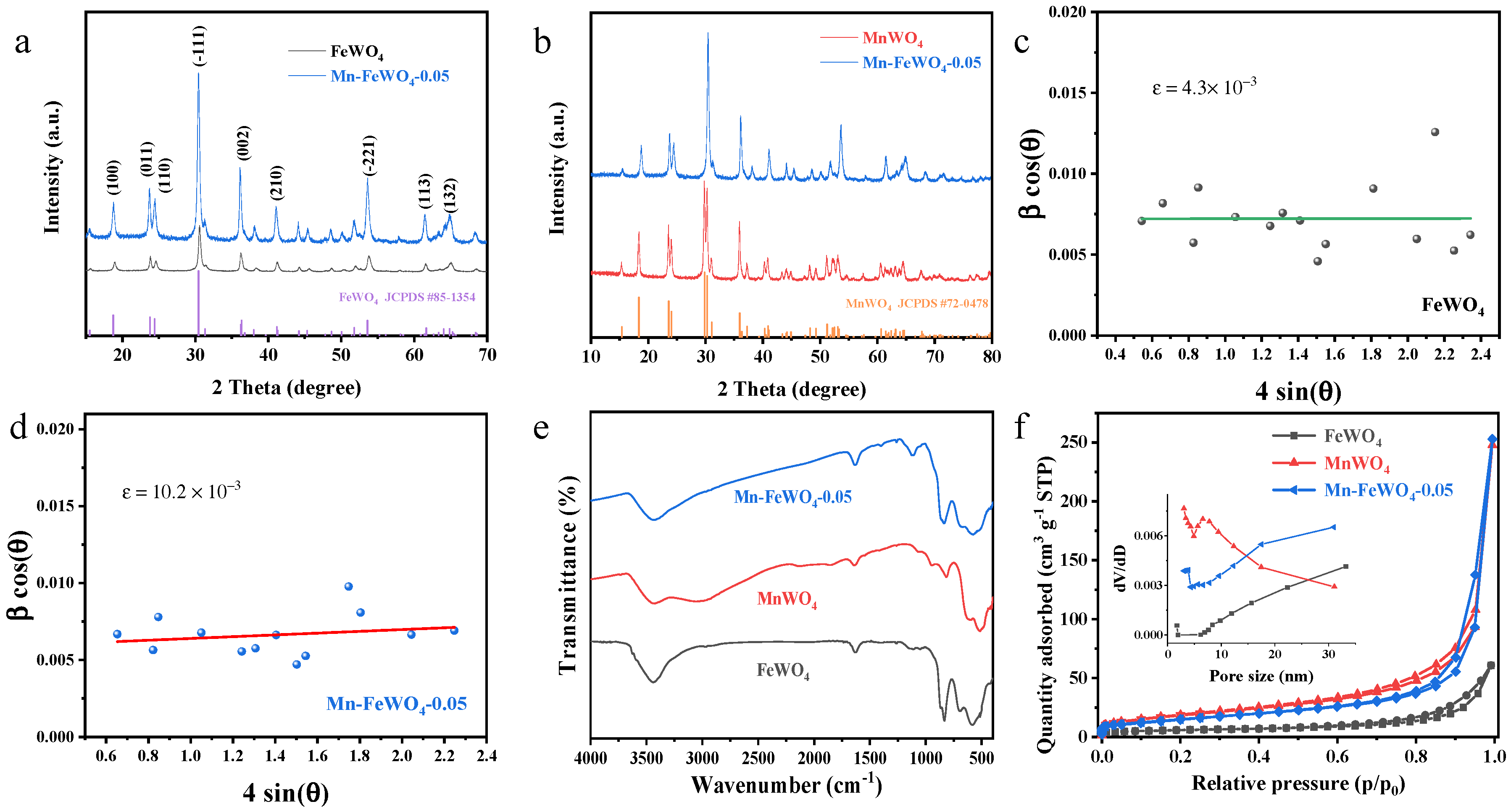
The crystal structure and phase composition of the as-prepared samples were examined by XRD. As shown in Figure 1a, pristine FeWO4 displays diffraction peaks at 18.7°, 23.7°, 24.4°, 30.4°, 36.1°, 41.1°, 53.3°, 61.6°, and 64.8°, which are perfectly indexed to the (100), (011), (110), (111), (002), (210), (−221), (113), and (132) planes of monoclinic FeWO4 (JCPDS No. 85-1354) [33]. For comparison, pure MnWO4 (Figure 1b) exhibits its characteristic reflections at 15.4°, 18.4°, 23.6°, 24.1°, 29.8°, 30.3°, 31.1°, 35.9°, 40.3°, and 40.9°, corresponding to the (010), (100), (011), (110), (111), (111), (020), (002), (102), and (121) planes of MnWO4 (JCPDS No. 72-0478) [34]. Notably, the XRD pattern of Mn-FeWO4-0.05 shows no additional peaks attributable to MnWO4 or other manganese-containing phases. Especially in the range of 2θ between 28°~55°, the diffraction peaks of Mn-FeWO4-0.05 are completely different from those of MnWO4 (see the detail in Figure S1). Instead, the XRD peaks of Mn-FeWO4-0.05 closely resemble that of pristine FeWO4, indicating that Mn2+ ions are substitutionally incorporated into the FeWO4 lattice without forming a discrete secondary phase. A careful comparison reveals that all diffraction peaks of Mn-FeWO4-0.05 are systematically shifted to lower 2θ angles relative to those of undoped FeWO4 (Figure S1). This shift arises from lattice expansion [35,36] caused by the replacement of smaller Fe2+ ions (0.76 Å) [37] with larger Mn2+ ions (0.80 Å) [31,38]. The effect of Mn doping on the lattice of FeWO4 was quantitatively evaluated using Williamson–Hall analysis [39], as shown in Figure 1c,d. The grain size increased from 19.2 nm for FeWO4 to 23.8 nm for Mn-FeWO4-0.05, and the microstrain (ε) increased from 4.3 × 10⁻³ to 10.2 × 10⁻³, indicating that Mn doping generated lattice defects and internal strain, which may influence the band structure, promote defect-assisted charge separation, and enhance the photo-Fenton activity of Mn-FeWO4-0.05 [38,40].
FT-IR spectroscopy was employed to probe the chemical bonding and structural evolution of FeWO4 upon Mn doping (Figure 1e). For pristine FeWO4, absorption bands at 835, 655, and 507 cm−1 are assigned to the symmetric stretching of WO6 octahedra (involving Fe–O–W and W–O vibrations) and the asymmetric deformation of Fe–O bonds, respectively [41]. The broad bands at 1632 and 3436 cm−1 correspond to the bending and stretching vibrations of surface-adsorbed water molecules and hydroxyl groups [17]. Pristine MnWO4 displays characteristic Mn–O vibrations at 515 cm−1 together with a band at 1084 cm−1 related to tungstate groups [42]. For Mn-FeWO4-0.05, the FT-IR spectrum retains the main absorption features of FeWO4, but with slight shifts in the W–O and Fe–O bands and the emergence of a weak shoulder near 520 cm−1. These spectral changes are attributed to local structural distortion and the formation of Mn–O bonds within the FeWO4 host lattice, further corroborating the successful incorporation of Mn2+ at Fe sites. The persistence of hydroxyl-related bands also suggests that Mn doping does not compromise the surface hydrophilicity of the catalyst.
The pore properties of the samples were evaluated by N2 physisorption measurements (Figure 1f and Table S1) [43]. All isotherms are of type-IV with H3-type hysteresis loops between relative pressures of 0.65 and 1.0, characteristic of mesoporous materials [44,45]. Pristine MnWO4 exhibits the highest BET specific surface area (SBET = 54.78 m2 g−1), whereas FeWO4 shows a much lower value (20.94 m2 g−1). The Mn-doped composite, Mn-FeWO4-0.05, possesses an intermediate SBET (47.56 m2 g−1) but displays the largest average pore size (30.98 nm) and pore volume (0.208 cm3 g−1) among the three samples. The enhanced porosity is not due to the presence of a discrete MnWO4 phase, but rather arises from Mn-induced modification of FeWO4 crystal growth, which generates finer nanocrystallites and creates additional interparticle voids. Although the SBET of Mn-FeWO4-0.05 is lower than that of MnWO4, its photocatalytic activity is markedly superior (vide infra). This clearly demonstrates that the improved photo-Fenton performance originates predominantly from the intrinsic electronic modulation conferred by Mn doping, such as bandgap narrowing and suppressed charge recombination, rather than from a mere increase in specific surface area.
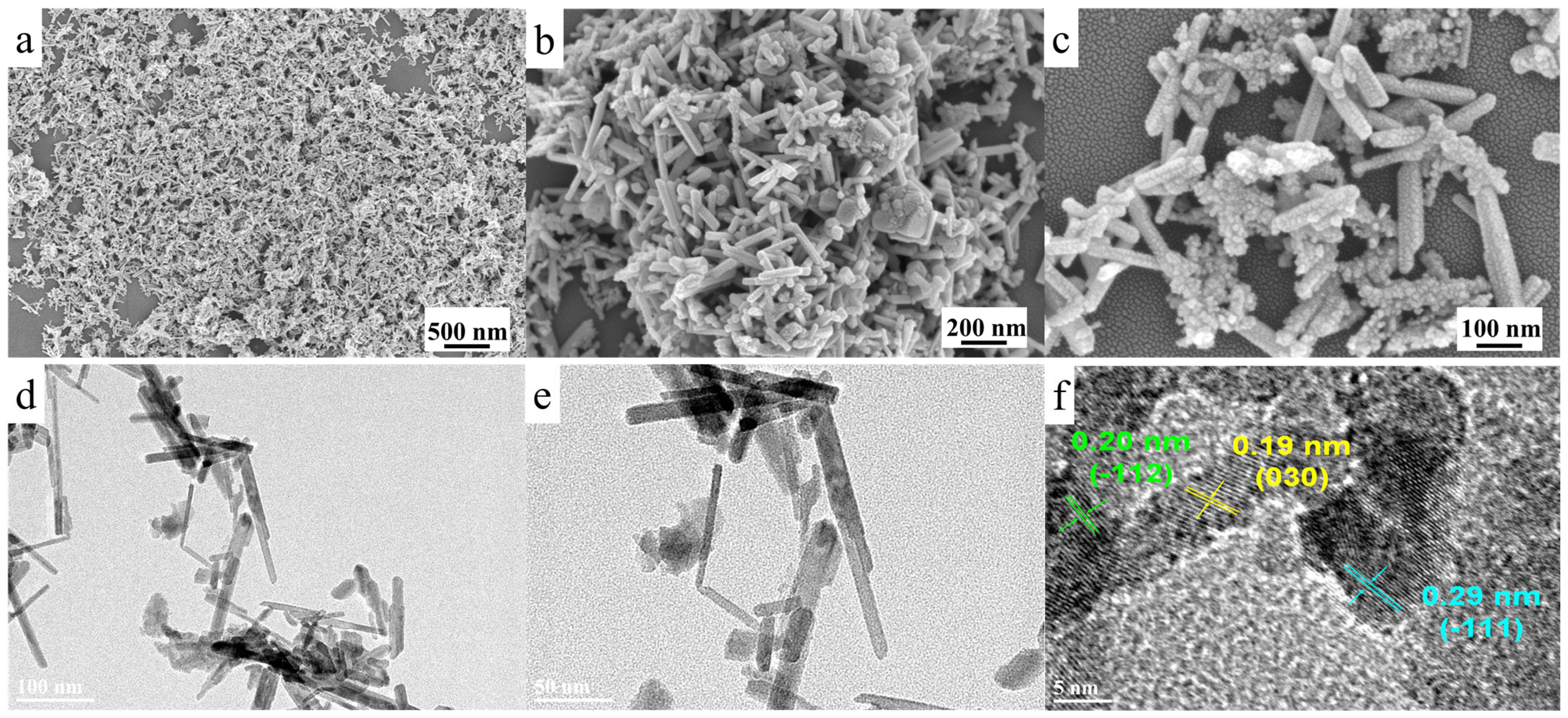
The morphology and microstructure of the as-prepared samples were examined by SEM. Pristine FeWO4 exhibits a compact morphology consisting of aggregated nanorods with lengths of 150–200 nm and diameters of ~10 nm (Figure S2). In contrast, MnWO4 prepared under identical conditions appears to be composed of finer, more loosely arranged short nanorod-like particles with sizes ranging from 10 to 40 nm (Figure S3). The distinctly different morphological features of FeWO4 and MnWO4 suggest that the crystal growth habit is closely related to the transition metal cations involved. Upon introduction of a trace amount of Mn2+ during the hydrothermal synthesis of FeWO4, the morphology of the resulting Mn-FeWO4-0.05 composite undergoes a significant transformation. Mn doping induces the growth of fine secondary nanoparticles on the surface of the nanorods, as illustrated in Figure 2a–c. These nanoparticles are tightly attached to the rod-like cores, forming a hierarchical structure with increased surface roughness and abundant interparticle voids. Such architecture is expected to enhance the specific surface area, expose more active sites, and facilitate interfacial charge transfer. This co-assembly behavior is attributable to the structural compatibility between FeWO4 and MnWO4. Both crystallize in the monoclinic wolframite-type structure (space group P2/c) with similar lattice parameters, which favors epitaxial or coalescent growth [26,34,46].
The fine microstructure and crystallographic features of Mn-FeWO4-0.05 were further elucidated by high-resolution TEM. As depicted in Figure 2d,e, Mn-FeWO4-0.05 exhibits a nanorod-like morphology, with numerous nanoparticles distributed on and around the rod surfaces. This observation is consistent with the SEM results, confirming that Mn doping modifies the crystal growth habit of FeWO4. Figure 2f reveals clear lattice fringes with interplanar spacings of 0.29 nm, 0.20 nm and 0.19 nm, corresponding to the (−111), (−112), and (030) planes of monoclinic FeWO4, respectively [47]. Energy-dispersive X-ray spectroscopy (EDS) elemental mapping (Figure S4) demonstrates the homogeneous distribution of Fe, W, O, and Mn throughout the composite, further verifying the successful doping of Mn into the FeWO4 matrix. In addition, EDS analysis reveals (Figure S5) that Mn constitutes roughly 4.3% of the total Mn/Fe atomic content. This value aligns well with the molar ratio of the Mn precursor used in the synthesis of Mn-FeWO4.
XPS was employed to investigate the elemental composition and surface chemical states of FeWO4, MnWO4, and Mn-FeWO4-0.05. All binding energies were calibrated against the adventitious C 1s peak at 284.8 eV. The survey spectra (Figure S6) reveal only the presence of Fe, W, O, and Mn in the composite, with no detectable impurities.
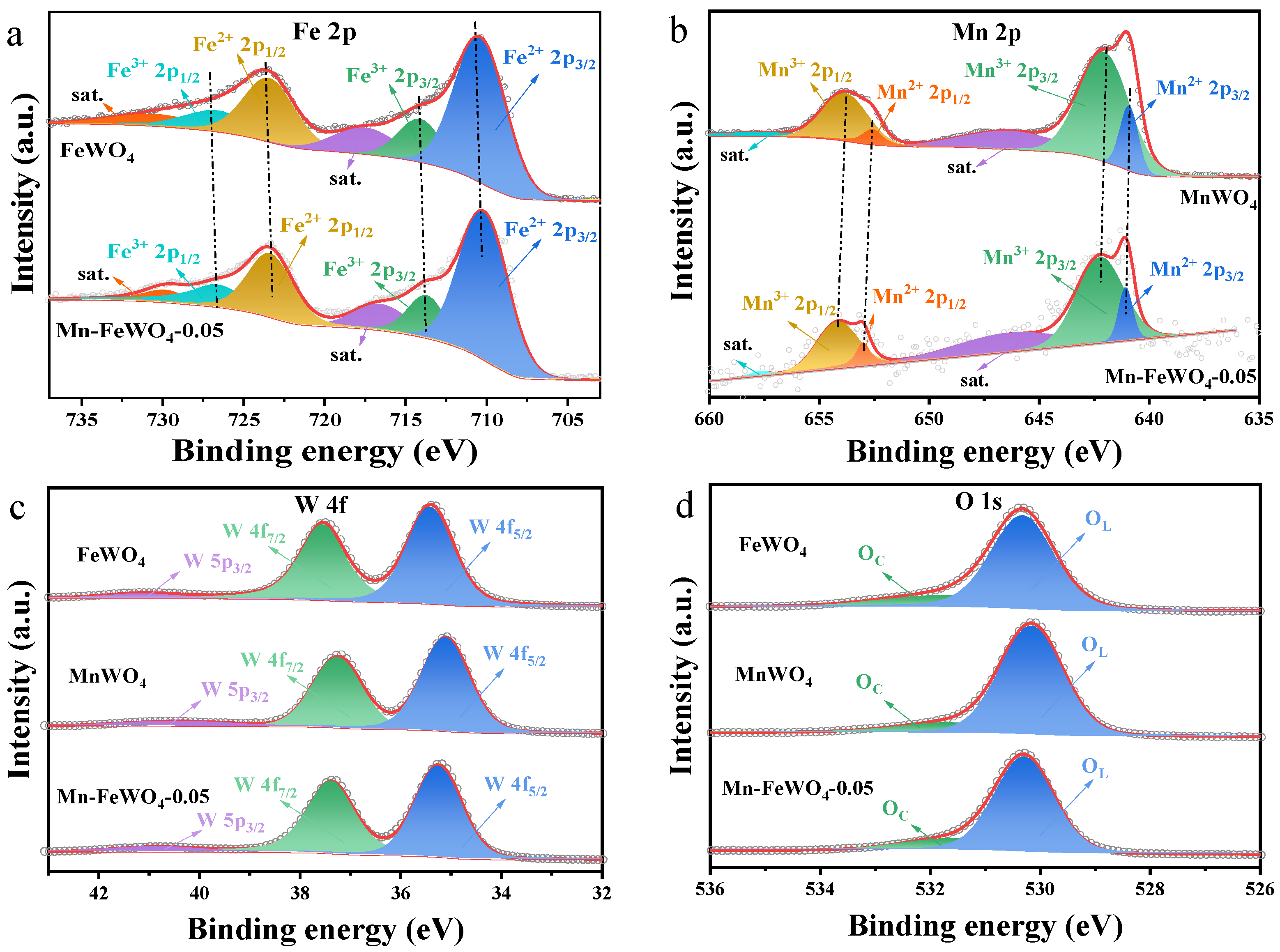
The high-resolution Fe 2p spectra (Figure 3a) exhibits two primary spin–orbit doublets. The peaks at 710.4 and 723.4 eV are assigned to Fe2+ 2p3/2 and Fe2+ 2p1/2, while those at 713.9 and 726.6 eV correspond to Fe3+ 2p3/2 and Fe3+ 2p1/2, respectively [48]. Figure 3b presents the Mn 2p spectrum. The peaks at binding energies of 640.2 and 651.9 eV are attributed to Mn2+, whereas the peak sitting at 641.3 and 653.1 eV are ascribed to Mn3+ [49]. Compared with pure FeWO4 and MnWO4, Mn-FeWO4-0.05 exhibits a negative shift in the binding energy of Fe 2p and a positive shift in the binding energy of Mn 2p, attributing to the lower electronegativity of Mn (1.55) compared to Fe (1.83). Such variations in local charge density can modulate the adsorption and activation of reactant molecules (e.g., H2O2 or organic pollutants) on the catalyst surface, potentially enhancing reaction kinetics. Moreover, these electronic perturbations may introduce shallow trap states within the band structure, facilitating the separation of photogenerated charge carriers and thereby improving photocatalytic efficiency [50]. Notably, the coexistence of Fe2+/Fe3+ and Mn2+/Mn3+ redox couples in Mn-FeWO4-0.05 confirms the mixed-valence states of both Fe and Mn. The simultaneous presence of these dual redox pairs is expected to promote sustained generation of reactive oxygen species (ROS) in photo-Fenton reactions by facilitating continuous redox cycling and interfacial electron transfer.
The high-resolution W 4f spectrum (Figure 3c) of Mn-FeWO4-0.05 displays two prominent peaks at 35.4 and 37.5 eV, corresponding to W 4f7/2 and W 4f5/2, respectively, together with a satellite feature at 40.8 eV attributable to W 5p3/2. These binding energies are characteristic of W6+ in the tungstate lattice [51], and their positions remain essentially unchanged upon Mn doping, suggesting that the WO6 octahedral framework is preserved. The O 1s spectra (Figure 3d) are deconvoluted into two components: lattice oxygen (OL) at 530.3 eV and chemisorbed oxygen species (OC, surface hydroxyl groups) at 531.6 eV [52].
Collectively, the XPS results provide compelling evidence that Mn was successfully doped into the FeWO4 crystal lattice, occupying Fe2+ sites and forming a substitutional solid solution. The observed shifts in binding energies and the mixed-valence state of Fe/Mn all point to a synergistic electronic modification induced by Mn doping. Such modification not only tailors the band structure but also optimizes the surface reactivity and redox properties, thereby laying the foundation for a significant improvement in photo-Fenton performance.

2.2. Optical Properties and Band Structure Engineering

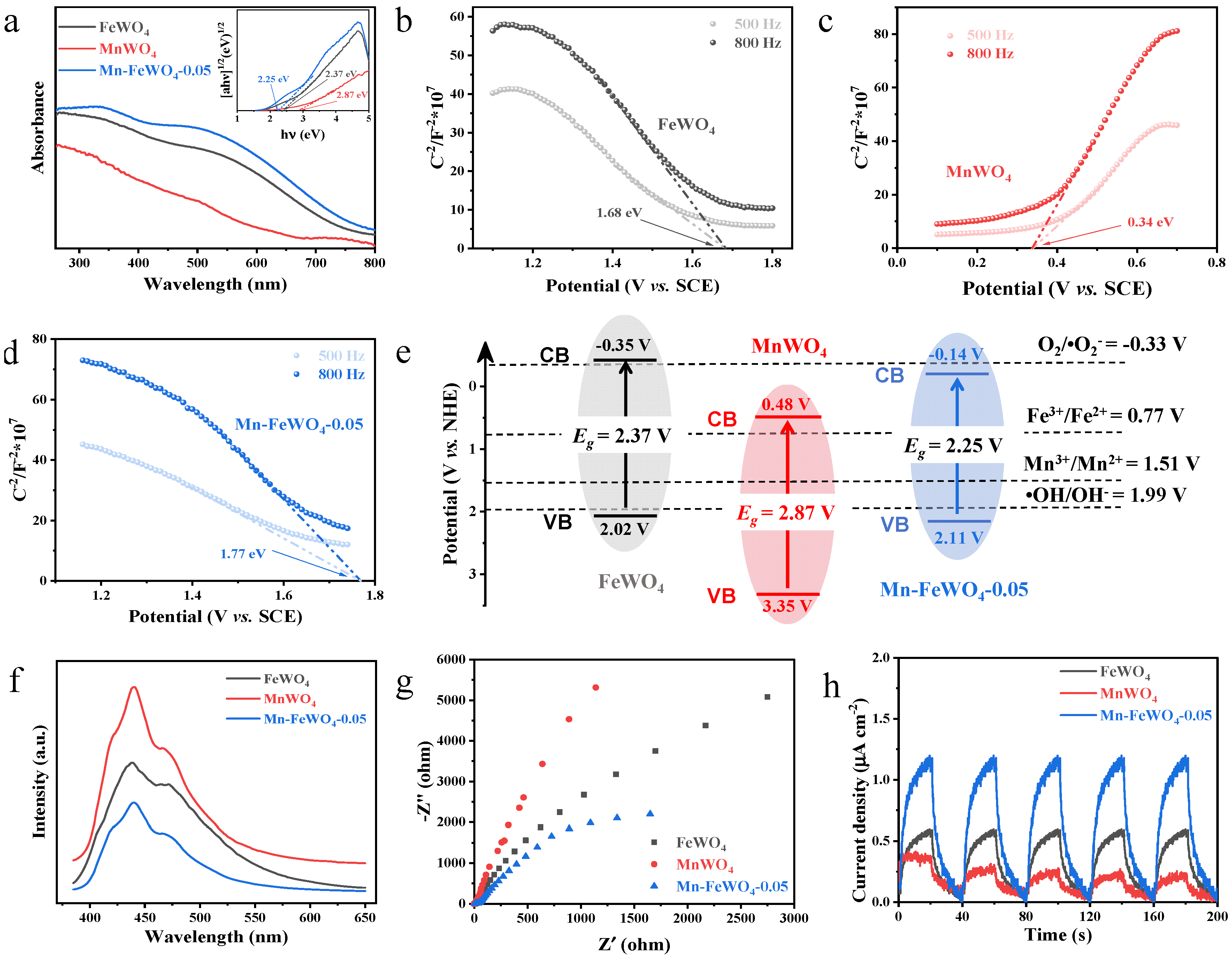
The light-harvesting capability of a photocatalyst is a primary determinant of its catalytic activity. UV-vis diffuse reflectance spectroscopy (DRS) was employed to evaluate the optical response of the as-prepared samples. As shown in Figure 4a, all materials exhibit strong absorption in the ultraviolet region. Pristine FeWO4 displays pronounced visible light absorption, outperforming MnWO4 across the entire visible range. Upon Mn doping, the resulting Mn-FeWO4-0.05 composite retains an absorption profile similar to that of FeWO4, yet its absorption edge undergoes a discernible red shift relative to MnWO4 and FeWO4. This red shift is attributed to the substitutional incorporation of Mn2+ into the FeWO4 lattice, which introduces additional electronic states within the bandgap and facilitates 3d–6p3 orbital interactions between Mn2+ and the surrounding W–O framework [53]. Such modulation enhances the visible light harvesting efficiency of the doped catalyst, a direct consequence of Mn-induced band structure tailoring.
The bandgap energy (Eg) of FeWO4, MnWO4, and Mn-FeWO4-0.05 were calculated from the DRS spectra using the Kubelka–Munk function (Equation (1)):
( α h v ) n = A ( h v E g )
where α represents the absorption coefficient, h denotes the Planck constant, ν represents the frequency of light (s−1), A is the absorption constant, and Eg represents the bandgap of the semiconductor. The exponent n depends on the semiconductor transition type [45]; both FeWO4 and MnWO4 are well-documented indirect bandgap semiconductors, thus n = 1/2 [17,54]. Although Mn is incorporated, XRD and XPS confirm that no discrete MnWO4 phase is formed; Mn2+ ions occupy Fe2+ sites within the FeWO4 host, preserving the original crystal symmetry and transition characteristics. Accordingly, an n value of 2 was also adopted for Mn-FeWO4-0.05 [55]. As presented in Figure 4b, the calculated Eg values are 2.37 eV for FeWO4, 2.87 eV for MnWO4, and 2.25 eV for Mn-FeWO4-0.05. The substantial bandgap narrowing upon Mn doping unequivocally demonstrates the effectiveness of substitutional Mn2+ in modulating the electronic structure of FeWO4.
To further elucidate the semiconductor type and energy band alignment, Mott–Schottky (M–S) measurements were performed. As illustrated in Figure 4c,d, the negative slopes of the linear M–S plots confirm that both FeWO4 and Mn-FeWO4-0.05 are p-type semiconductors, while MnWO4 is n-type semiconductor. The flat-band potentials (EFB) determined from the intercepts are +1.68 V, 0.34 V, and +1.77 V (vs. SCE) for FeWO4, MnWO4, and Mn-FeWO4-0.05, respectively, corresponding to +1.92 V, 0.58 V, and +2.01 V vs. NHE [56]. It is generally believed that the conduction band potential of n-type semiconductors is 0.1~0.2 V more negative than EFB, while the valence band potential of p-type semiconductors is 0.1~0.2 V more positive than EFB [57,58]. The calculated CB potential (ECB) of MnWO4 is 0.48 V (vs. NHE), while the VB potentials (EVB) of FeWO4 and Mn-FeWO4-0.05 are 2.02 V and 2.11 V (vs. NHE), respectively. Combining these with the bandgap energies via E C B + E g = E V B , the conduction band potentials (ECB) of FeWO4 and Mn-FeWO4-0.05 are calculated to be –0.35 V and –0.14 V (vs. NHE), respectively [59]. The VB potential of MnWO4 is 3.35 V (vs. NHE). The derived energy band diagrams of FeWO4, MnWO4, and Mn-FeWO4-0.05 are schematically depicted in Figure 4e.
Clearly, Mn-FeWO4-0.05 exhibits a downshifted conduction band and an upshifted valence band relative to pristine FeWO4, resulting in a narrower bandgap and a more negative valence band edge. This shift endows Mn-FeWO4-0.05 with stronger oxidation capability, as the photogenerated holes (h+) possess higher oxidative potential [60]. Moreover, the introduction of Mn2+ states within the bandgap may serve as shallow trap sites, prolonging the lifetime of charge carriers and further boosting photocatalytic efficiency. Collectively, these results establish that Mn doping effectively engineers the band structure of FeWO4, narrowing the bandgap, enhancing visible light absorption, and strengthening the oxidizing power of photogenerated holes, thereby laying a solid electronic foundation for the superior photo-Fenton activity demonstrated below.
To elucidate the influence of Mn doping on charge carrier separation and migration, steady-state PL spectroscopy, EIS, and transient photocurrent measurements were systematically conducted [61]. Figure 4f presents the PL spectra of FeWO4, MnWO4, and Mn-FeWO4-0.05 recorded at an excitation wavelength of 438 nm. All samples exhibit broad emission peaks originating from radiative recombination of photogenerated electron–hole pairs. Notably, Mn-FeWO4-0.05 displays a markedly lower PL intensity compared to both pristine FeWO4 and MnWO4, indicating significant suppression of charge carrier recombination. This quenching effect is attributed to the substitutional incorporation of Mn2+ ions into the FeWO4 lattice, where they function as shallow trap sites that temporarily immobilize photogenerated electrons, thereby delaying recombination and prolonging carrier lifetime [35]. Importantly, since no discrete MnWO4 phase is detected by XRD or HRTEM, the observed PL attenuation arises solely from electronic modulation within the FeWO4 host, rather than from heterojunction formation with a secondary tungstate phase.
Charge transfer kinetics were further probed by EIS under visible light illumination. As shown in Figure 4g, the Nyquist plot of Mn-FeWO4-0.05 exhibits a substantially smaller arc radius than those of FeWO4 and MnWO4, reflecting a lower charge transfer resistance (Rct) at the electrode–electrolyte interface [62,63]. This reduced resistance facilitates more efficient interfacial migration of photogenerated carriers, a direct consequence of Mn2+-induced modification of the local electronic environment and surface states.
The transient photocurrent responses of the three electrodes were measured over five on–off irradiation cycles (Figure 4h). All samples display stable and reproducible photocurrent signals. Consistent with the PL and EIS results, Mn-FeWO4-0.05 achieves the highest photocurrent density, approximately 3.2 and 5.1 times greater than those of FeWO4 and MnWO4, respectively. This enhancement confirms that Mn doping not only suppresses carrier recombination but also accelerates charge separation and transport. The elevated photocurrent correlates directly with the increased population of long-lived carriers available for surface redox reactions, reinforcing the pivotal role of Mn doping in optimizing the photo-Fenton performance of FeWO4.
Collectively, the photoelectrochemical evidence demonstrates that Mn2+ substitution at Fe sites intrinsically upgrades the charge dynamics of FeWO4 by introducing temporary electron traps and reducing interfacial transfer barriers. These improvements are achieved without the formation of secondary phases, underscoring the efficiency of Mn doping as a phase-pure, solid-solution approach to boost the photocatalytic functionality of FeWO4.

2.3. Photo-Fenton Performance Evaluation

The photo-Fenton degradation performance of the as-prepared catalysts was assessed using TC as a model antibiotic pollutant. Comparative experiments were conducted under simulated solar irradiation in the presence of H2O2 to decouple the contributions of adsorption, photocatalysis, and Fenton oxidation.
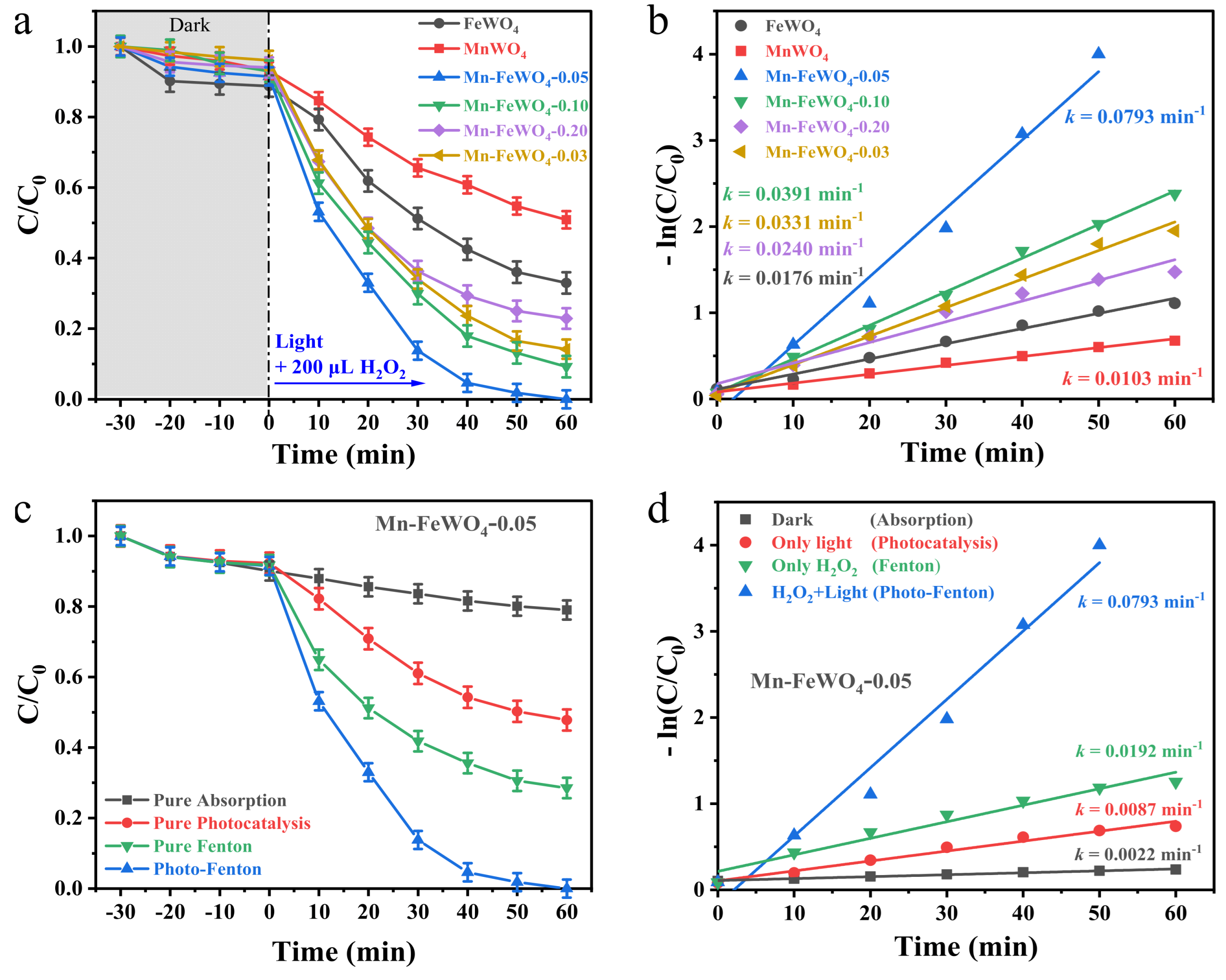
Figure 5a illustrates the TC removal efficiencies over different catalysts. In the dark, all samples exhibited a rapid initial decrease in TC concentration within 30 min, indicating the establishment of adsorption–desorption equilibrium. Upon light irradiation and H2O2 addition, pristine FeWO4 and MnWO4 showed moderate photo-Fenton activity, achieving only 70.3% and 49.2% TC removal within 60 min, respectively. In marked contrast, all Mn-doped FeWO4 (Mn-FeWO4-X) composites displayed substantially enhanced degradation performance, with removal efficiencies exceeding 70.3% regardless of the Mn content. Strikingly, Mn-FeWO4-0.05 delivered 100% TC degradation within 60 min, a 29.7% and 50.8% improvement over pristine FeWO4 and MnWO4, respectively. The degradation efficiency of Mn-FeWO4-X gradually declined as the Mn/(Mn + Fe) molar ratio increased beyond 0.05. This trend indicates that an optimal Mn doping level is critical.
The degradation kinetics of TC by different catalysts were fitted using the first-order kinetic equation ( l n ( C t / C 0 ) = k t ) (Figure 5b), where Ct/C0 is the ratio of the residual TC concentration to the initial concentration, k (min−1) is the rate constant, and t is the reaction time [64,65]. The apparent rate constant (k) of Mn-FeWO4-0.05 was 0.0793 min−1, which is 4.5 times and 7.7 times higher than those of pristine FeWO4 (0.0176 min−1) and MnWO4 (0.0103 min−1), respectively. This substantial kinetic improvement is a direct consequence of Mn2+-induced bandgap narrowing, enhanced visible light harvesting, and suppressed charge carrier recombination.
To deconvolute the individual contributions of photocatalysis and Fenton oxidation, the performance of Mn-FeWO4-0.05 was evaluated under four different conditions (Figure 5c). Dark adsorption alone removed only 21% of TC within 60 min. Under visible light without H2O2 (photocatalysis), the removal efficiency was 52.2% (net photodegradation: 31.2%). In the dark with H2O2 (Fenton oxidation), 71.5% TC removal was achieved (net Fenton contribution: 50.5%). Strikingly, the photo-Fenton system (light + H2O2 + catalyst) exhibited a removal efficiency (100%) that significantly exceeded the sum of the individual photocatalysis and Fenton processes, unequivocally demonstrating a strong synergistic effect among light, H2O2, and the Mn-doped catalyst. This synergy is further reflected in the corresponding rate constants (Figure 5d), where the k value (0.0793 min−1) of photo-Fenton reation is markedly higher than the sum of photocatalytic (0.0087 min−1) and Fenton (0.0192 min−1). Control experiments comparing pristine FeWO4 and MnWO4 under identical conditions (Figure S7) confirmed that Mn-FeWO4-0.05 consistently outperforms FeWO4 and MnWO4 in photocatalysis and Fenton oxidation, while its adsorption capacity remains intermediate, consistent with its BET surface area lying between those of FeWO4 and MnWO4. Thus, the superior photo-Fenton activity is not governed by surface area but by the electronic and structural benefits conferred by Mn doping.
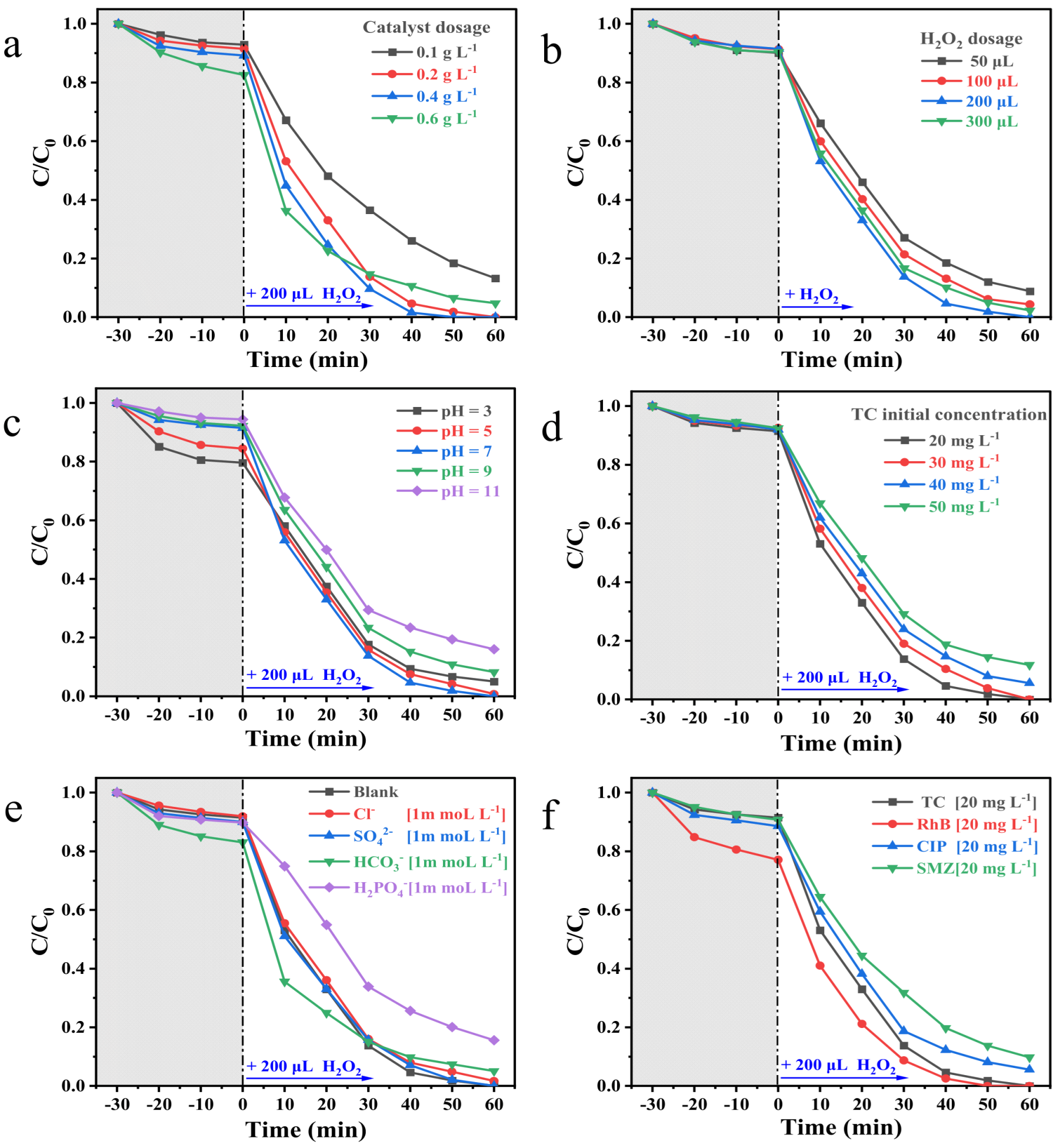
The influence of key operational parameters on the photo-Fenton performance of Mn-FeWO4-0.05 was systematically investigated (Figure 6). As shown in Figure 6a, increasing the catalyst dosage from 0.1 to 0.4 g L−1 progressively accelerated TC degradation, attributable to a higher density of active sites and more efficient H2O2 activation. However, further increasing the dosage to 0.6 g L−1 did not yield additional improvement, likely due to increased turbidity that screens light penetration and reduces photon utilization efficiency [66].
Figure 6b depicts the effect of H2O2 concentration. The degradation efficiency initially increased with H2O2 dosage, reaching an optimum at 2.0 mM. Excess H2O2 (>2.0 mM) prolonged the time required for complete TC removal, as excessive H2O2 acts as a •OH scavenger via the reactions H 2 O 2 + · O H · H O 2 + H 2 O and · H O 2 + · O H H 2 O + O 2 , thereby depleting the primary oxidant [67,68].
The solution pH exerts a pronounced effect on TC degradation (Figure 6c). Mn-FeWO4-0.05 maintained high removal efficiency (>95%) over a broad pH range of 3.0–7.0, demonstrating its robustness and superiority over conventional Fenton systems that are typically limited to acidic conditions. However, at pH > 9.0, degradation efficiency declined sharply, which is ascribed to the rapid decomposition of H2O2 into O2 and H2O, reducing the availability of H2O2 for •OH generation [69].
Figure 6d shows that even at an elevated TC concentration of 50 mg L−1, Mn-FeWO4-0.05 still achieved 88.3% removal within 60 min, underscoring its excellent catalytic potency. The influence of coexisting inorganic anions was evaluated using Cl, SO42−, HCO3, and H2PO4 (Figure 6e). Cl and SO42− caused negligible inhibition (98.4% and 100% removal, respectively), while HCO3 slightly reduced the efficiency to 95%, likely due to an increase in solution pH and •OH scavenging [67]. H2PO4 exhibited the most pronounced suppression (84.4%), attributable to its rapid reaction with •OH to form the less reactive H2PO4 radical H 2 P O 4 + · O H O H + H 2 P O 4 · [70].
Finally, the broad applicability of Mn-FeWO4-0.05 was demonstrated by its high degradation efficiencies toward other organic micropollutants, including ciprofloxacin (CIP), norfloxacin (NOR), sulfamethoxazole (SMZ), and rhodamine B (RhB) (Figure 6f). Notably, after 60 min of illumination, Mn-FeWO4-0.05 achieved a removal efficiency of over 90% for these four pollutants. These results collectively confirm that Mn-doped FeWO4 is a highly efficient, durable, and broadly applicable photo-Fenton catalyst, with the optimal Mn-FeWO4-0.05 composition offering the best trade-off between electronic modulation and preservation of Fenton-active Fe sites.

2.4. Mechanistic Investigation of Reactive Species and Degradation Pathway

To identify the predominant reactive oxygen species (ROSs) responsible for TC degradation in the Mn-FeWO4-0.05/H2O2/light system, a series of radical scavenging experiments were conducted. Typically, p-BQ, IPA, L-his, and EDTA-2Na were used as quenchers for •O2, •OH, 1O2, and photogenerated holes (h+), respectively [50,71]. As shown in Figure S8a, the addition of p-BQ at 0.5 mM markedly suppressed TC removal, with inhibition becoming more pronounced at higher concentrations. At 5 mM p-BQ, the degradation efficiency dropped sharply to 51.3%, demonstrating that •O2 is a primary reactive species in this system. Similarly, the introduction of EDTA-2Na progressively reduced TC degradation from 81.5% (0.1 mM) to 64.6% (2.5 mM), confirming that photogenerated holes (h+) also play a pivotal role (Figure S8b). In contrast, the addition of L-his or IPA caused only marginal inhibition even at the maximum tested dosages (5 mM and 50 mM, respectively), with TC removal efficiencies remaining at 81.1% and 89.7% (Figure S8c,d). These results indicate that while 1O2 and •OH contribute to TC degradation, their roles are secondary compared to •O2 and h+.
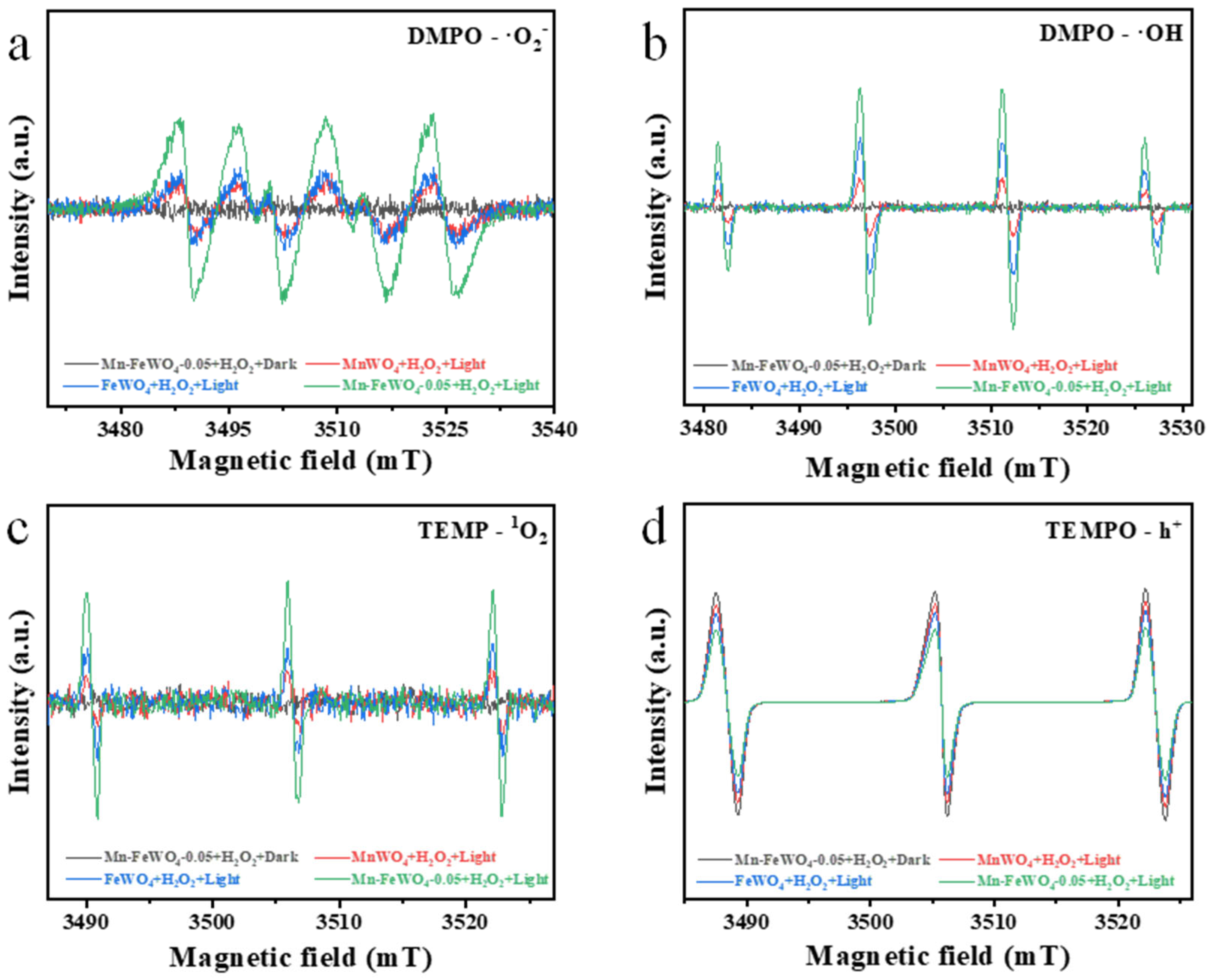
The generation of ROSs was further corroborated by electron paramagnetic resonance (EPR) spectroscopy using DMPO and TEMP as spin-trapping agents [72]. As illustrated in Figure 7, no discernible signals were detected under dark conditions for any of the targeted radicals. However, upon visible light irradiation, Mn-FeWO4-0.05 exhibited substantially stronger characteristic signals for DMPO-•O2, DMPO-•OH, and TEMPO-1O2 compared to pristine FeWO4 and MnWO4 (Figure 7a–c). This unequivocally demonstrates that Mn doping significantly enhances the generation of multiple ROSs [73].
Figure 7d displays the three-line EPR spectra of TEMPO-h+ feature with an intensity ratio of 1:1:1. Under illumination, the signal intensity of TEMPO-h+ decreased markedly, which is attributed to the reduction of TEMPO by photogenerated electrons, thereby indirectly reflecting the accumulation of h+ [74]. Notably, the attenuation of the TEMPO-h+ signal was most pronounced for Mn-FeWO4-0.05. This trend confirms that Mn-FeWO4-0.05 generates a significantly higher flux of photogenerated holes than pure FeWO4 and MnWO4, consistent with its more negative valence band position and enhanced charge separation efficiency. Crucially, this enhanced h+ generation originates solely from the substitutional incorporation of Mn2+ into the FeWO4 lattice, which tailors the electronic structure and promotes carrier separation.
Collectively, the radical trapping and EPR results establish that •O2 and h+ are the dominant reactive species governing TC degradation in the Mn-FeWO4-0.05/H2O2/light system, with 1O2 and •OH serving as auxiliary oxidants. The markedly higher ROS production over Mn-FeWO4-0.05 compared to pure FeWO4 and MnWO4 is a direct manifestation of Mn-induced modulation of band structure, charge dynamics, and surface reactivity. This integrated mechanistic insight underscores the efficacy of Mn doping as a strategy to concurrently optimize light harvesting, carrier separation, and radical generation in FeWO4-based photo-Fenton catalysis.

2.5. Proposed Photocatalytic Mechanism

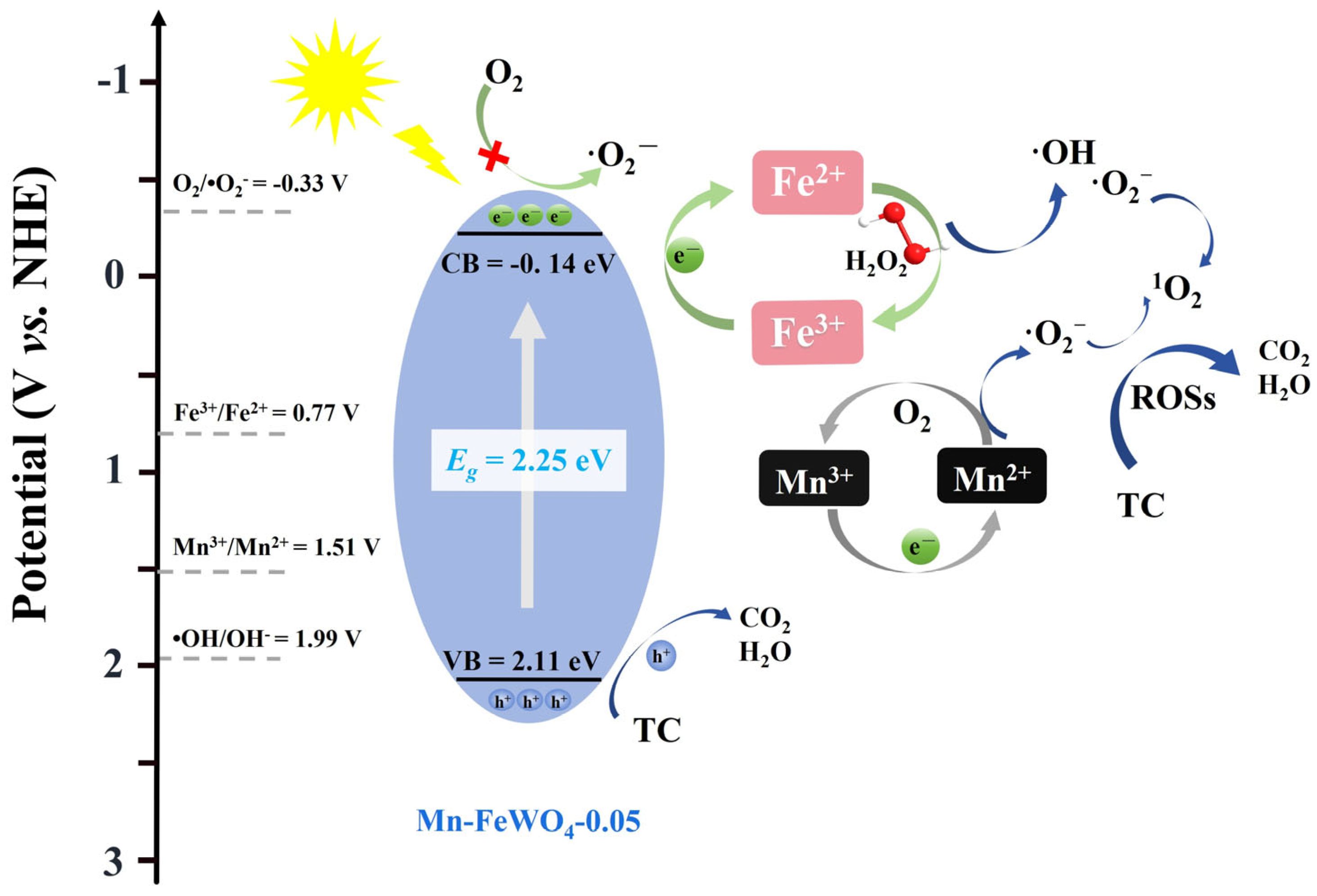
Based on the comprehensive analysis of the band structure, photoelectrochemical properties, and reactive species identification, a plausible mechanism for the photo-Fenton degradation of TC over Mn-FeWO4-0.05 under visible light irradiation is proposed, as illustrated in Figure 8.
Upon visible light illumination, Mn-FeWO4-0.05 semiconductor absorbs photons with energy equal to or greater than its bandgap (2.25 eV), prompting the excitation of electrons from the valence band (VB) to the conduction band (CB) and generating photogenerated electron–hole pairs (Equation (2)) [26]. The photogenerated holes accumulated in the VB can directly oxidize TC molecules adsorbed on the catalyst surface. Since the CB potential of Mn-FeWO4-0.05 is higher than the standard redox potential φθ(H2O2/•OH, +0.37 V vs. NHE), and its VB potential is more positive than the potential of •OH/OH (+1.99 V vs. NHE), electrons in the CB react with H2O2 to generate •OH radicals (Equation (3)), and holes accumulated in the valence band can oxidize OH and H2O2 to generate •OH (Equation (4)) and•O2 (Equation (5)).
In parallel, the intrinsic Fenton cycle is activated by the abundant Fe2+ sites in the catalyst. Fe2+ participated in the activation of H2O2 to produce •OH and converted to Fe3+ (Equation (6)) [75]. The generated Fe3+ can be reduced back to Fe2+ via two pathways: (i) reaction with H2O2 (Equation (7)) [17], and (ii) direct capture of photogenerated electrons (Equation (8)) [76]. Moreover, Mn doping generates defect states that serve as shallow electron traps, which prolonged lifetime and improved mobility of charge carriers, resulting in an enhanced photoelectron-assisted Fe3+/Fe2+ cycling. In Mn-FeWO4-0.05, Mn can act as an “electron pump,” driven by the difference in standard reduction potentials between Mn (E0(Mn3+/Mn2+) = 1.51 V) and Fe (E0(Fe3+/Fe2+) = 0.77 V) [77]. As Mn2+ was oxidized to Mn3+, it donated electrons to reduce Fe3+ to the active Fe2+ species. Meanwhile, the Mn2+/Mn3+ and Fe2+/Fe3+ dual redox cycles can directly activate H2O2 that promoted the generation of ROSs [32]. In addition, 1O2 may be generated by the reaction of •O2 with •OH or H2O (Equation (11)).
Collectively, the proposed mechanism highlights that Mn doping concurrently optimizes three critical functions in FeWO4: (i) band structure engineering for enhanced visible light harvesting, (ii) suppression of charge carrier recombination via shallow trap states, and (iii) Mn3+/Mn2+ auxiliary redox pair functions as an internal electron mediator boosted the production of ROSs. The synergistic interaction between photocatalysis, Fenton oxidation, and Mn-mediated electron transfer generated a sustained flux of ROS, which collectively oxidized TC and ultimately mineralized it to CO2 and H2O (Equation (12)). This tripartite enhancement, achieved within a phase-pure FeWO4 host, constitutes the fundamental origin of the superior photo-Fenton performance observed for Mn-FeWO4-0.05.
Mn-FeWO 4 - 0.05 + h v h + + e
  e + H 2 O 2   · O H + O H
h + + O H   · O H
h + + H 2 O 2 ·   O 2 + 2 H +
F e 2 + / M n 2 + + H 2 O 2 F e 3 + / M n 3 + + ·   O H + O H
F e 3 + / M n 3 + + H 2 O 2   F e 2 + / M n 2 + + ·   O 2 + 2 H +
F e 3 + / M n 3 + + e   F e 2 + / M n 2 +
M n 2 + + F e 3 +   M n 3 + + F e 2 +
·   O 2 + ·   O H O H + O 2 1
2 O 2 + 2 H 2 O 2 H 2 O 2 + O 2 1
O 2 / h + / O 2 1 / · O H + T C C O 2 + H 2 O

2.6. Degradation Pathways of TC

To elucidate the transformation intermediates and propose plausible degradation pathways of TC in the Mn-FeWO4-0.05/H2O2/light system, high-performance liquid chromatography–tandem mass spectrometry (HPLC-MS) was employed. The mass spectra of the reaction aliquots collected at different irradiation intervals are presented in Figure S9. Based on the identified intermediates and their relative abundances, three distinct degradation pathways are proposed and schematically illustrated in Figure S10.
Pathway I initiates with the demethylation of the parent TC molecule (m/z = 455), yielding intermediate P1 (m/z = 431) [78]. Subsequent deoxygenation, deamidation, and dealkylation reactions convert P1 into P2 (m/z = 371.0) and P3 (m/z = 235.0). Further oxidative ring-opening processes lead to the formation of smaller fragments, ultimately producing P4 (m/z = 155.0).
Pathway II proceeds via methylation of TC to generate P5 (m/z = 396.0), followed by cleavage of C–C/C=N bonds and hydroxylation to afford P6 (m/z = 345.0). The C=C bond of P6 is subsequently broken, accompanied by quinonization and additional hydroxylation, giving rise to P7 (m/z = 307.0). Dehydration and cleavage of the C=O bond then convert P7 into P8 (m/z = 279.0) [79].
Pathway III begins with the detachment of hydroxyl groups from TC, forming P9 (m/z = 428.0). Demethylation of P9 produces P10 (m/z = 403.3), while dissociation of the C–N bond yields P11 (m/z = 384.1). Further attack by reactive species induces deprotonation of hydroxyl groups and subsequent decarboxylation, leading to the formation of P12 (m/z = 325.4) and P13 (m/z = 301.0) [50].
Collectively, these three pathways operate concurrently under the sustained oxidative assault of •O2, h+, 1O2, and •OH, reactive oxygen species whose generation is markedly amplified by Mn doping. The substitutional incorporation of Mn2+ into the FeWO4 lattice enhances visible light absorption, suppresses charge recombination, and introduces an auxiliary Mn2+/Mn3+ redox cycle, all of which contribute to a higher steady-state concentration of ROS. This Mn-induced augmentation of ROS production accelerates each step of TC degradation, from initial bond cleavage to deep ring-opening and mineralization. As a result, the TC molecule undergoes a cascade of demethylation, dehydroxylation, deamidation, decarboxylation, and multiple hydroxylation events, progressively breaking down into low-molecular-weight intermediates and ultimately being mineralized into CO2 and H2O.

2.7. Reusability and Stability

The long-term durability and structural robustness of a heterogeneous catalyst are critical criteria for its practical applicability. To assess the reusability of Mn-FeWO4-0.05, five consecutive photo-Fenton degradation cycles were carried out under identical conditions. After each run, the spent catalyst was collected by centrifugation, thoroughly washed with deionized water and ethanol, and vacuum-dried before reuse. As shown in Figure S11, the TC removal efficiency remained remarkably stable, with only a 3.4% decline after the fifth cycle, indicating excellent reusability.
The structural integrity of the recycled catalyst was examined by XRD. As presented in Figure S12, the diffraction pattern of the used Mn-FeWO4-0.05 is virtually superimposable onto that of the fresh sample, with no observable peak shift, attenuation, or emergence of additional reflections, which clearly demonstrates the excellent structural stability of Mn-FeWO4-0.05. The chemical state and surface composition stability were further interrogated by XPS. The Fe 2p (Figure S13a) and Mn 2p (Figure S13b) spectrum of fresh and used Mn-FeWO4-0.05showed no significant change in binding energy, except for slight changes in the Fe3+/Fe2+ and Mn3+/Mn2+ ratios, which are due to valence cycling during the photo-Fenton reaction. The Mn3+/Mn2+ auxiliary cycle helps to maintain a steady supply of electrons for Fe3+ reduction, thereby mitigating the accumulation of inactive Fe3+ species. The W 4f doublet remains centered at 35.2 and 37.4 eV (Figure S13c), and the O 1s spectra (Figure S13d) shows almost no change. These results confirm the chemical and structural stability of Mn-FeWO4-0.05.
Finally, the photo-Fenton performance of Mn-FeWO4-0.05 was benchmarked against recently reported iron- and manganese-based photocatalysts (Table S2). Despite employing a low catalyst dosage (0.2 g L−1) and a reduced H2O2 concentration (2.0 mM), Mn-FeWO4-0.05 achieved complete TC removal within 60 min, a performance that compares favorably with or even surpasses many state-of-the-art systems. This competitive efficiency, combined with the outstanding stability demonstrated above, positions Mn-FeWO4-0.05 as a highly promising candidate for sustainable, real-world water remediation.

3. Experimental

3.1. Materials

Ammonium iron(II) sulfate hexahydrate (Fe(NH4)2(SO4)2·6H2O), sodium tungstate dihydrate (Na2WO4·2H2O), sodium hydroxide (NaOH), manganese(II) chloride tetrahydrate (MnCl2·4H2O), hydrogen peroxide (H2O2, 30 wt%), rhodamine B (RhB), norfloxacin (NOR), sulfamethoxazole (SMZ), tetracycline hydrochloride (TC), p-benzoquinone (p-BQ), L-histidine (L-his), isopropanol (IPA), methanol (MeOH), ethylenediaminetetraacetic acid disodium salt (EDTA-2Na), hydrochloric acid (HCl), and sodium sulfite (Na2SO4) were purchased from Shanghai Macklin Biochemical Technology Co., Ltd. (Shanghai, China). All reagents were of analytical grade and used as received without further purification. Deionized (DI) water (18.2 MΩ·cm) was used throughout the experiments.

3.2. Preparation of Mn-FeWO4 Catalyst

A series of Mn-doped FeWO4 photocatalysts (denoted as Mn-FeWO4-X, where X represents the molar ratio of Mn/(Mn+Fe)) were synthesized via a one-step hydrothermal method. In a typical procedure, predetermined amounts of Na2WO4·2H2O (3 mmol), Fe(NH4)2(SO4)2·6H2O (a mmol), and MnCl2·4H2O (b mmol) with a fixed total metal amount of 3 mmol (a + b = 3) and varying Mn/Fe molar ratios (a:b = 4:1, 9:1, 19:1, 29:1) were dissolved in 30 mL of DI water under magnetic stirring. The solution pH was adjusted to 8.0 ± 0.1 by dropwise addition of 1 M NaOH. After stirring for 30 min, the homogeneous mixture was transferred into a 100 mL Teflon-lined stainless-steel autoclave, sealed, and heated at 180 °C for 12 h. The autoclave was then allowed to cool naturally to room temperature. The resulting precipitate was collected by centrifugation (8000 rpm, 5 min), washed alternately with DI water and absolute ethanol three times, and dried under vacuum at 60 °C for 12 h. The final dark-brown product was ground into a fine powder using an agate mortar. The obtained samples were labeled according to the Mn content: Mn-FeWO4-0.20, -0.10, -0.05, and -0.03, corresponding to Mn/(Mn + Fe) ratios of 0.2, 0.1, 0.05, and 0.03, respectively. For comparison, pristine FeWO4 and MnWO4 were prepared under identical conditions without the addition of MnCl2·4H2O or Fe(NH4)2(SO4)2·6H2O, respectively.

3.3. Characterization of Materials

Crystal structures of the as-prepared samples were determined by X-ray diffraction (XRD, Bruker D8-Advance (Billerica, MA, USA)) using Cu Kα radiation (λ = 1.5406 Å) at 40 kV and 40 mA. X-ray photoelectron spectroscopy (XPS) measurements were performed on a Thermo ESCALAB 250Xi (Waltham, MA, USA) spectrometer with monochromated Al Kα radiation, and binding energies were calibrated against the C 1s peak at 284.8 eV. Morphological observations were conducted using field-emission scanning electron microscopy (SEM, Hitachi S4800 (Tokyo, Japan)) and transmission electron microscopy (TEM, FEI Tecnai20 (Hillsboro, OR, USA)) equipped with an energy-dispersive X-ray spectroscopy (EDS) detector. Nitrogen adsorption–desorption isotherms were recorded at 77 K on a Micromeritics ASAP 2460 (Norcross, GA, USA) analyzer. Specific surface areas were calculated by the Brunauer–Emmett–Teller (BET) method, and pore size distributions were derived from the desorption branch using the Barrett–Joyner–Halenda (BJH) model. UV-vis diffuse reflectance spectra (UV-vis DRS) were recorded on a PerkinElmer Lambda 950 spectrophotometer (Shelton, CT, USA) in the range of 250–800 nm, with BaSO4 as the reflectance standard. Photoluminescence (PL) spectra were acquired on a Hitachi F-4500 fluorescence spectrophotometer (Tokyo, Japan) at an excitation wavelength of 250 nm. Electron paramagnetic resonance (EPR) measurements were carried out at room temperature using a JEOL JES FA200 (Tokyo, Japan) spectrometer. 5,5-Dimethyl-1-pyrroline-N-oxide (DMPO) and 2,2,6,6-tetramethylpiperidine (TEMP) were employed as spin-trapping agents for •OH/•O2 and 1O2/h+, respectively. The degradation intermediates of TC were identified by high-performance liquid chromatography–tandem mass spectrometry (HPLC-MS/MS) using an Agilent (Santa Clara, CA, USA) 1290II-6460 Triple Quad LC/MS system.

3.4. Evaluation of Photo-Fenton Activity

The photo-Fenton degradation performance of the synthesized catalysts was evaluated by monitoring the removal of tetracycline hydrochloride (TC) under simulated solar irradiation. Typically, 20 mg of catalyst was dispersed in 100 mL of TC aqueous solution (20 mg L−1, pH ≈ 6.8). The suspension was stirred in the dark for 30 min to establish adsorption–desorption equilibrium. Subsequently, 200 μL of H2O2 (30 wt%) was added, and the mixture was irradiated using a 300 W xenon lamp (CEL-HXF300, CEALight (Anhui, China)) equipped with an AM 1.5 filter. At predetermined time intervals, 3 mL aliquots were withdrawn and immediately filtered through a 0.22 μm membrane filter to remove catalyst particles. The residual TC concentration was determined by measuring the absorbance at 357 nm using a UV-vis spectrophotometer. All experiments were performed in triplicate, and the average values with standard deviations are reported.

3.5. Photoelectrochemical Characterization

Photoelectrochemical (PEC) measurements were conducted on a CHI-660D electrochemical workstation using a conventional three-electrode configuration. A 0.1 M Na2SO4 aqueous solution was used as the electrolyte. A saturated calomel electrode (SCE) and a platinum sheet served as the reference and counter electrodes, respectively. The working electrode was prepared by dispersing 2 mg of the catalyst in a mixture of 200 μL ethanol and 200 μL Nafion (5 wt%) under sonication to form a homogeneous slurry. The slurry was then drop-cast onto a 1 cm2 (1 cm × 1 cm) area of indium-tin oxide (ITO) conductive glass and dried at room temperature. All potentials reported herein are referenced to the standard normal hydrogen electrode (NHE) using the conversion: E (vs. NHE) = E (vs. SCE) + 0.242 V. Electrochemical impedance spectroscopy (EIS) was performed at a bias potential of 0.2 V vs. SCE under illumination over a frequency range of 100 mHz to 10 kHz with an AC amplitude of 5 mV. Transient photocurrent responses (i–t) were recorded at a constant potential of 0.4 V vs. SCE under intermittent illumination (20 s light on/off cycles). Mott–Schottky (M–S) plots were obtained at frequencies of 500 Hz and 800 Hz in the dark.

3.6. Radical Scavenging Experiments

To identify the predominant reactive species involved in the photo-Fenton degradation process, radical scavenging experiments were performed under identical conditions as described in Section 2.4. Isopropanol (IPA, 50 mM), p-benzoquinone (p-BQ, 5 mM), disodium ethylenediaminetetraacetate (EDTA-2Na, 2.5 mM), and L-histidine (L-his, 5 mM) were added as scavengers for hydroxyl radicals (•OH), superoxide radicals (•O2), photogenerated holes (h+), and singlet oxygen (1O2), respectively. The quenching effect was evaluated by comparing the TC degradation efficiency with and without the addition of each scavenger.

4. Conclusions

In summary, a novel Mn-doped FeWO4 photocatalyst was successfully synthesized via a one-step hydrothermal method and employed as an efficient photo-Fenton catalyst for the degradation of TC. The optimal Mn-FeWO4-0.05 composite exhibited 100% TC removal within 60 min under visible light, with an apparent rate constant 4.5 times higher than that of pristine FeWO4. This remarkable enhancement originates solely from the substitutional incorporation of Mn2+ into the FeWO4 lattice. Systematic characterization revealed that Mn doping induces lattice expansion, narrows the bandgap from 2.37 eV to 2.25 eV, and downshifts the conduction band edge, thereby extending visible light harvesting and strengthening the oxidation potential of photogenerated holes. Photoelectrochemical measurements demonstrated that Mn2+ ions act as effective electron traps, significantly suppressing charge carrier recombination and accelerating interfacial charge transfer, a direct consequence of atomic-level doping rather than heterojunction formation. Furthermore, Mn doping establishes an auxiliary Mn2+/Mn3+ redox cycle, providing an additional pathway for •O2 generation while preserving the Fe2+/Fe3+ Fenton centers. Radical trapping and EPR spectroscopy identified •O2 and h+ as the dominant reactive species, with 1O2 and •OH playing subsidiary roles. Three distinct TC degradation pathways were proposed based on HPLC-MS analysis, involving sequential demethylation, hydroxylation, ring-opening, and mineralization. Notably, Mn-FeWO4-0.05 displayed excellent recyclability (96.6% activity retained after five cycles) and outstanding structural/chemical stability. Benchmarking against recently reported photocatalysts confirmed its competitive performance under mild operating conditions (low catalyst and H2O2 dosages, neutral pH). This work demonstrates that Mn doping is a simple strategy to simultaneously engineer the band structure, charge dynamics, and surface reactivity of FeWO4, yielding a high-performance photo-Fenton catalyst for antibiotic remediation.

Supplementary Materials

The following supporting information can be downloaded at: https://www.mdpi.com/article/10.3390/inorganics14040103/s1, Figure S1. XRD patterns of as-prepared samples; Figure S2. SEM images of FeWO4; Figure S3. SEM images of MnWO4; Figure S4. EDS element mapping of Mn-FeWO4-0.05; Figure S5. EDS spectra of Mn-FeWO4-0.05; Figure S6. The XPS survey spectra of as-prepared samples; Figure S7. Comparison charts of photocatalytic performance (a), Fenton performance (b) and adsorption performance (c) of different catalysts. ([catalyst] = 200 mg L−1, [H2O2] = 2.0 mmoL, [pH] = 7.0, [TC] = 20 mg L−1); Figure S8. Effects of p-BQ (a), EDTA-2Na (b), L-his (c) and IPA (d) on TC degradation in the Mn-FeWO4-0.05/H2O2/light system; Figure S9. HPLC-MS spectra of TC solutions with different reaction time; Figure S10. Proposed degradation pathways of TC in the Mn-FeWO4-0.05/H2O2/light system; Figure S11. Recycle performance of Mn-FeWO4-0.05; Figure S12. XRD patterns of fresh and used Mn-FeWO4-0.05; Figure S13. High-resolution Fe 2p (a), Mn 2p (b), W 4f (c) and O 1s (d) XPS spectra of fresh and used Mn-FeWO4-0.05; Table S1. The pore structure parameters of FeWO4, MnWO4, and Mn-FeWO4-0.05; Table S2. The performance of different photocatalytic Fenton catalysts in the degradation process of pollutants.

Author Contributions

S.W.: Writing—review and editing, validation, methodology, conceptualization. H.L. (Han Li): Methodology, investigation, validation, formal analysis. H.L. (Huagen Liang): Writing—review and editing, validation. F.C.: Supervision, funding acquisition. All authors have read and agreed to the published version of the manuscript.

Funding

This research was funded by the Open Project Program of the State Key Laboratory of Low-carbon Smart Coal-fired Power Generation and Ultra-clean Emission, grant number D2023FK081.

Data Availability Statement

The raw data supporting the conclusions of this article will be made available by the authors upon request.

Conflicts of Interest

Sheng Wang and Fu Chen were employed by Energy Science and Technology Research Institute Co., Ltd. The remaining authors declare that the research was conducted in the absence of any commercial or financial relationships that could be construed as a potential conflict of interest.

References

  1. Wang, W.; Chen, M.; Wang, D.; Yan, M.; Liu, Z. Different activation methods in sulfate radical-based oxidation for organic pollutants degradation: Catalytic mechanism and toxicity assessment of degradation intermediates. Sci. Total Environ. 2021, 772, 145522. [Google Scholar] [CrossRef]
  2. Zampaloni, C.; Mattei, P.; Bleicher, K.; Winther, L.; Thäte, C.; Bucher, C.; Adam, J.-M.; Alanine, A.; Amrein, K.E.; Baidin, V.; et al. A novel antibiotic class targeting the lipopolysaccharide transporter. Nature 2024, 625, 566–571. [Google Scholar] [CrossRef] [PubMed]
  3. Daghrir, R.; Drogui, P. Tetracycline antibiotics in the environment: A review. Environ. Chem. Lett. 2013, 11, 209–227. [Google Scholar] [CrossRef]
  4. Su, Z.; Wang, K.; Yang, F.; Zhuang, T. Antibiotic pollution of the Yellow River in China and its relationship with dissolved organic matter: Distribution and Source identification. Water Res. 2023, 235, 119867. [Google Scholar] [CrossRef] [PubMed]
  5. Xu, L.; Zhang, H.; Xiong, P.; Zhu, Q.; Liao, C.; Jiang, G. Occurrence, fate, and risk assessment of typical tetracycline antibiotics in the aquatic environment: A review. Sci. Total Environ. 2021, 753, 141975. [Google Scholar] [CrossRef]
  6. Yang, Y.; Ji, W.; Li, X.; Lin, H.; Chen, H.; Bi, F.; Zheng, Z.; Xu, J.; Zhang, X. Insights into the mechanism of enhanced peroxymonosulfate degraded tetracycline using metal organic framework derived carbonyl modified carbon-coated Fe0. J. Hazard. Mater. 2022, 424, 127640. [Google Scholar] [CrossRef]
  7. Wang, D.; Jia, F.; Wang, H.; Chen, F.; Fang, Y.; Dong, W.; Zeng, G.; Li, X.; Yang, Q.; Yuan, X. Simultaneously efficient adsorption and photocatalytic degradation of tetracycline by Fe-based MOFs. J. Colloid Interface Sci. 2018, 519, 273–284. [Google Scholar] [CrossRef]
  8. Yang, J.; Lin, Y.; Yang, X.; Ng, T.B.; Ye, X.; Lin, J. Degradation of tetracycline by immobilized laccase and the proposed transformation pathway. J. Hazard. Mater. 2017, 322, 525–531. [Google Scholar] [CrossRef]
  9. Liu, Z.; Zhu, M.; Zhao, L.; Deng, C.; Ma, J.; Wang, Z.; Liu, H.; Wang, H. Aqueous tetracycline degradation by coal-based carbon electrocatalytic filtration membrane: Effect of nano antimony-doped tin dioxide coating. Chem. Eng. J. 2017, 314, 59–68. [Google Scholar] [CrossRef]
  10. Gao, P.; Cui, J.; Deng, Y. Direct regeneration of ion exchange resins with sulfate radical-based advanced oxidation for enabling a cyclic adsorption—Regeneration treatment approach to aqueous perfluorooctanoic acid (PFOA). Chem. Eng. J. 2021, 405, 126698. [Google Scholar] [CrossRef]
  11. Huang, Y.; Wang, Y.; Huang, Y.; Zhang, L.; Ye, F.; Wang, J.; Shang, J.; Liao, Q. Impact of sediment characteristics on adsorption behavior of typical antibiotics in Lake Taihu, China. Sci. Total Environ. 2020, 718, 137329. [Google Scholar] [CrossRef]
  12. Liao, Q.; Rong, H.; Zhao, M.; Luo, H.; Chu, Z.; Wang, R. Interaction between tetracycline and microorganisms during wastewater treatment: A review. Sci. Total Environ. 2021, 757, 143981. [Google Scholar] [CrossRef] [PubMed]
  13. Niu, J.; Xie, Y.; Luo, H.; Wang, Q.; Zhang, Y.; Wang, Y. Cobalt oxide loaded graphitic carbon nitride as adsorptive photocatalyst for tetracycline removal from aqueous solution. Chemosphere 2019, 218, 169–178. [Google Scholar] [CrossRef] [PubMed]
  14. Miklos, D.B.; Remy, C.; Jekel, M.; Linden, K.G.; Drewes, J.E.; Hübner, U. Evaluation of advanced oxidation processes for water and wastewater treatment—A critical review. Water Res. 2018, 139, 118–131. [Google Scholar] [CrossRef] [PubMed]
  15. Zhang, Q.; Zheng, D.; Bai, B.; Ma, Z.; Zong, S. Insight into antibiotic removal by advanced oxidation processes (AOPs): Performance, mechanism, degradation pathways, and ecotoxicity assessment. Chem. Eng. J. 2024, 500, 157134. [Google Scholar] [CrossRef]
  16. Xiao, Q.; Lou, X.; Chen, L.; Li, M.; Qiu, X. Multi-electron collaborative photo-Fenton-like system for indoor air purification: A case study of Cu(II) grafted BaTiO3 with oxygen vacancies. J. Environ. Chem. Eng. 2024, 12, 111781. [Google Scholar] [CrossRef]
  17. Shi, X.; Wang, L.; Zuh, A.A.; Jia, Y.; Ding, F.; Cheng, H.; Wang, Q. Photo-Fenton reaction for the degradation of tetracycline hydrochloride using a FeWO4/BiOCl nanocomposite. J. Alloys Compd. 2022, 903, 163889. [Google Scholar] [CrossRef]
  18. Huang, X.; Xiao, J.; Yi, Q.; Li, D.; Liu, C.; Liu, Y. Construction of core-shell Fe3O4@GO-CoPc photo-Fenton catalyst for superior removal of tetracycline: The role of GO in promotion of H2O2 to •OH conversion. J. Environ. Manag. 2022, 308, 114613. [Google Scholar] [CrossRef]
  19. Yang, J.; Liang, Y.; Yang, G.; Wang, K.; Zeng, Z.; Xiong, Z.; Han, Y. Constructing electrostatic self-assembled ultrathin porous red 2D g-C3N4/Fe2N Schottky catalyst for high-efficiency tetracycline removal in photo-Fenton-like processes. J. Colloid Interface Sci. 2022, 607, 1527–1539. [Google Scholar] [CrossRef]
  20. Fu, H.; Lin, J.; Zhang, L.; Zhu, Y. Photocatalytic activities of a novel ZnWO4 catalyst prepared by a hydrothermal process. Appl. Catal. A Gen. 2006, 306, 58–67. [Google Scholar] [CrossRef]
  21. Shan, Z.; Wang, Y.; Ding, H.; Huang, F. Structure-dependent photocatalytic activities of MWO4 (M=Ca, Sr, Ba). J. Mol. Catal. A Chem. 2009, 302, 54–58. [Google Scholar] [CrossRef]
  22. Cavalcante, L.S.; Sczancoski, J.C.; Batista, N.C.; Longo, E.; Varela, J.A.; Orlandi, M.O. Growth mechanism and photocatalytic properties of SrWO4 microcrystals synthesized by injection of ions into a hot aqueous solution. Adv. Powder Technol. 2013, 24, 344–353. [Google Scholar] [CrossRef]
  23. Kumar, S.G.; Rao, K.K. Tungsten-based nanomaterials (WO3 & Bi2WO6): Modifications related to charge carrier transfer mechanisms and photocatalytic applications. Appl. Surf. Sci. 2015, 355, 939–958. [Google Scholar] [CrossRef]
  24. Wang, X.; Su, W.; Hu, X.; Liu, H.; Sheng, M.; Zhou, Q. Synthesis and characterization of Fe-doped CdWO4 nanoparticles with enhanced photocatalytic activity. Mater. Res. Express 2019, 6, 035507. [Google Scholar] [CrossRef]
  25. Chen, Z.; Ma, H.; Xia, J.; Zeng, J.; Di, J.; Yin, S.; Xu, L.; Li, H. Ionic liquid-induced strategy for FeWO4 microspheres with advanced visible light photocatalysis. Ceram. Int. 2016, 42, 8997–9003. [Google Scholar] [CrossRef]
  26. Wang, J.; Wang, M.; Kang, J.; Tang, Y.; Liu, J.; Li, S.; Xu, Z.; Tang, P. The promoted tetracycline visible-light-driven photocatalytic degradation efficiency of g-C3N4/FeWO4 Z-scheme heterojunction with peroxymonosulfate assisting and mechanism. Sep. Purif. Technol. 2022, 296, 121440. [Google Scholar] [CrossRef]
  27. Liu, C.; Lü, H.; Yu, C.; Ding, B.; Ye, R.; Ji, Y.; Dai, B.; Liu, W. Novel FeWO4/WO3 nanoplate with p–n heterostructure and its enhanced mechanism for organic pollutants removal under visible-light illumination. J. Environ. Chem. Eng. 2020, 8, 104044. [Google Scholar] [CrossRef]
  28. Kumar, G.; Dutta, R.K. Sunlight mediated photo-Fenton degradation of tetracycline antibiotic and methylene blue dye in aqueous medium using FeWO4/Bi2MoO6 nanocomposite. Process Saf. Environ. 2022, 159, 862–873. [Google Scholar] [CrossRef]
  29. Xu, L.; Wang, X.-F.; Liu, B.; Sun, T.; Wang, X. Fabrication of ferrous tungstate with enhanced sonocatalytic performance for meloxicam removal. Colloids Surf. A Physicochem. Eng. Asp. 2021, 627, 127222. [Google Scholar] [CrossRef]
  30. Xie, D.-H.; Li, W.-Q.; Xu, N.; Yuan, L.; Zhang, W.-H.; Huang, T.-Y.; Sheng, G.-P. Sulfur doping-induced morphological and electronic structure modification of polyoxometalate FeWO4 for enhanced removal of organic pollutants from water. Water Res. 2024, 257, 121695. [Google Scholar] [CrossRef]
  31. Kumar, K.S.; Vaishnavi, K.; Venkataswamy, P.; Ravi, G.; Ramaswamy, K.; Vithal, M. Photocatalytic degradation of methylene blue over N-doped MnWO4 under visible light irradiation. Indian Chem. Soc. 2021, 98, 100140. [Google Scholar] [CrossRef]
  32. He, Z.; Fareed, H.; Yang, H.; Xia, Y.; Su, J.; Wang, L.; Kang, L.; Wu, M.; Huang, Z. Mechanistic insight into the charge carrier separation and molecular oxygen activation of manganese doping BiOBr hollow microspheres. J. Colloid Interface Sci. 2023, 629, 355–367. [Google Scholar] [CrossRef] [PubMed]
  33. Gao, J.; Gao, Y.; Sui, Z.; Dong, Z.; Wang, S.; Zou, D. Hydrothermal synthesis of BiOBr/FeWO4 composite photocatalysts and their photocatalytic degradation of doxycycline. J. Alloys Compd. 2018, 732, 43–51. [Google Scholar] [CrossRef]
  34. Verma, Y.; Naushad, M.; García-Peñas, A.; Kumar, A.; Dhiman, P.; Sharma, G. Exploring the potential of MnWO4/MXene/carbon xerogel photocatalyst for photo efficient degradation of crystal violet. Chem. Eng. Res. Des. 2025, 219, 235–248. [Google Scholar] [CrossRef]
  35. Wang, L.; Wang, P.; Huang, B.; Ma, X.; Wang, G.; Dai, Y.; Zhang, X.; Qin, X. Synthesis of Mn-doped ZnS microspheres with enhanced visible light photocatalytic activity. Appl. Surf. Sci. 2017, 391, 557–564. [Google Scholar] [CrossRef]
  36. Wu, J.-C.; Shen, X.-C.; Wang, H.; Deng, D.-J.; Wu, S.-Q.; Gong, Y.; Zhu, L.-H.; Xu, L.; Li, H.-N. Electronic structure modification of FeWO4 through F doping for enhanced oxygen reduction performance in zinc–air batteries. Mater. Today Phys. 2023, 38, 101274. [Google Scholar] [CrossRef]
  37. Bailon-Ruiz, S.J.; Cedeño-Mattei, Y.; Alamo-Nole, L. Fe-Doped ZnS Quantum Dot Photocatalysts for the Degradation of Cefalexin in Water. Micro 2025, 5, 31. [Google Scholar] [CrossRef]
  38. El-Aassar, M.R.; Hassan, H.M.A.; Alhumaimess, M.S.; Alsohaimi, I.H.; Alzaid, M.; Alanazi, A.K.; Shakir, I.; Iram, S.; Aadil, M. Hydrothermally engineered In3+-doped, defect-rich FeWO4 photocatalysts with synergistic optical–electrical modifications for enhanced visible-light dye degradation. Ceram. Int. 2025, 51, 63734–63745. [Google Scholar] [CrossRef]
  39. Desai, K.R.; Alone, S.T.; Wadgane, S.R.; Shirsath, S.E.; Batoo, K.M.; Imran, A.; Raslan, E.H.; Hadi, M.; Ijaz, M.F.; Kadam, R.H. X-ray diffraction based Williamson–Hall analysis and rietveld refinement for strain mechanism in Mg–Mn co-substituted CdFe2O4 nanoparticles. Phys. B Condens. Matter 2021, 614, 413054. [Google Scholar] [CrossRef]
  40. Gunavathy, K.V.; Vinoth, S.; Isaac, R.S.R.; Prakash, B.; Valanarasu, S.; Trabelsi, A.B.G.; Shkir, M.; AlFaify, S. Highly improved photo-sensing ability of In2S3 thin films through cerium doping. Opt. Mater. 2023, 137, 113612. [Google Scholar] [CrossRef]
  41. Karthikeyan, C.; Rani, G.J.; Ng, F.-L.; Periasamy, V.; Pappathi, M.; Rajan, M.J.; Al-Sehemi, A.G.; Pannipara, M.; Phang, S.-M.; Aziz, M.A.; et al. 3D Flower-Like FeWO4/CeO2 Hierarchical Architectures on rGO for Durable and High-Performance Microalgae Biophotovoltaic Fuel Cells. Appl. Biochem. Biotechnol. 2020, 192, 751–769. [Google Scholar] [CrossRef]
  42. Ramasamy Raja, V.; Karthika, A.; Suganthi, A.; Rajarajan, M. Facile synthesis of MnWO4/BiOI nanocomposites and their efficient photocatalytic and photoelectrochemical activities under the visible-light irradiation. J. Sci-A. Mater. Dev. 2018, 3, 331–341. [Google Scholar] [CrossRef]
  43. Ren, H.; Qi, F.; Labidi, A.; Zhao, J.; Wang, H.; Xin, Y.; Luo, J.; Wang, C. Chemically bonded carbon quantum dots/Bi2WO6 S-scheme heterojunction for boosted photocatalytic antibiotic degradation: Interfacial engineering and mechanism insight. Appl. Catal. B 2023, 330, 122587. [Google Scholar] [CrossRef]
  44. Ge, T.; Jiang, Z.; Shen, L.; Li, J.; Lu, Z.; Zhang, Y.; Wang, F. Synthesis and application of Fe3O4/FeWO4 composite as an efficient and magnetically recoverable visible light-driven photocatalyst for the reduction of Cr(VI). Sep. Purif. Technol. 2021, 263, 118401. [Google Scholar] [CrossRef]
  45. Ji, Y.; Cui, M.; Wei, J.; Shi, Y.; Bao, L.; Tian, Z.; Hu, X.; Zhang, X.; Li, C. Interfacial oxygen vacancy engineering and built-in electric field mediated Z-scheme In2O3/Ag3PO4 heterojunction for boosted photocatalytic doxycycline degradation. Chem. Eng. J. 2024, 489, 151216. [Google Scholar] [CrossRef]
  46. Wei, J.; Ma, J.; Wang, W.; Li, T.; Wu, N.; Zhang, D. Study of the Effect of F-Doping on Lithium Electrochemical Behavior in MnWO4 Anode Nanomaterials. J. Inorg. Organomet. Polym. Mater. 2021, 31, 3175–3182. [Google Scholar] [CrossRef]
  47. He, G.-L.; Chen, M.-J.; Liu, Y.-Q.; Li, X.; Liu, Y.-J.; Xu, Y.-H. Hydrothermal synthesis of FeWO4-graphene composites and their photocatalytic activities under visible light. Appl. Surf. Sci. 2015, 351, 474–479. [Google Scholar] [CrossRef]
  48. Tan, Q.; Yu, Z.; Chen, Y.; He, N. Mixed-valent FeWO4-coated 2D Ti3C2 MXene photocatalysts for photo-fenton removal of many common pollutants in water. Ceram. Int. 2024, 50, 16382–16397. [Google Scholar] [CrossRef]
  49. Basak, H.K.; Kamboj, B.; Patra, J.; Ghosh, D.; Chakraborty, B. Enhancing valence-band charge localization via zinc doping into MnWO4 to promote selective ammonia electrooxidation. J. Mater. Chem. A 2026, 14, 9492–9509. [Google Scholar] [CrossRef]
  50. Jing, S.; Wang, H.; Wang, A.; Cheng, R.; Liang, H.; Chen, F.; Brouzgou, A.; Tsiakaras, P. Surface plasmon resonance Bismuth-modified NH2-UiO-66 with enhanced photocatalytic tetracycline degradation performance. J. Colloid Interface Sci. 2024, 655, 120–132. [Google Scholar] [CrossRef]
  51. Song, J.; Yang, Y.; Cui, N.; Sadiq, S.; Khan, I.; Liu, S.-Y.; Qi, K. Preparation and application of ZnWO4/FeWO4 based photocatalyst: Organic pollutant degradation and microbicide. J. Water Process. Eng. 2024, 68, 106516. [Google Scholar] [CrossRef]
  52. Ma, H.; Xiaohui, L.; Luo, X.; Sun, D.; Wang, G.; Fu, Y. Constructing core-shell structured Co3O4-MnWO4 composite photoelectrode with superior PEC water purification performance. Chemosphere 2024, 354, 141648. [Google Scholar] [CrossRef] [PubMed]
  53. Li, A.; Pang, H.; Li, P.; Zhang, N.; Chen, G.; Meng, X.; Liu, M.; Liu, X.; Ma, R.; Ye, J. Insights into the critical dual-effect of acid treatment on ZnxCd1-xS for enhanced photocatalytic production of syngas under visible light. Appl. Catal. B 2021, 288, 119976. [Google Scholar] [CrossRef]
  54. Diaz-Anichtchenko, D.; Aviles-Coronado, J.E.; López-Moreno, S.; Turnbull, R.; Manjón, F.J.; Popescu, C.; Errandonea, D. Electronic, Vibrational, and Structural Properties of the Natural Mineral Ferberite (FeWO4): A High-Pressure Study. Inorg. Chem. 2024, 63, 6898–6908. [Google Scholar] [CrossRef]
  55. Saravanakumar, K.; Mamba, G.; Muthuraj, V. 1D/2D MnWO4 nanorods anchored on g-C3N4 nanosheets for enhanced photocatalytic degradation ofloxacin under visible light irradiation. Colloids Surf. A Physicochem. Eng. Asp. 2019, 581, 123845. [Google Scholar] [CrossRef]
  56. Amiri, M.; Fallahi, M.; Bezaatpour, A.; Jijie, R.; Nozari-asbmarz, M.; Rouhi, M.; Boukherroub, R.; Szunerits, S. Solution Processable Cu(II)macrocycle for the Formation of Cu2O Thin Film on Indium Tin Oxide and Its Application for Water Oxidation. J. Phys. Chem. C 2018, 122, 16510–16518. [Google Scholar] [CrossRef]
  57. Kar, A.; Majumdar, S.; Chowdhury, P.K.; Ganguli, A.K. Unravelling Charge Carrier Dynamics in Bi2MoO6/CaFe2O4 Heterostructure for Efficient Photoelectrochemical Applications. J. Phys. Chem. C 2025, 129, 14440–14449. [Google Scholar] [CrossRef]
  58. Wang, J.; Jiang, W.; Liu, D.; Wei, Z.; Zhu, Y. Photocatalytic performance enhanced via surface bismuth vacancy of Bi6S2O15 core/shell nanowires. Appl. Catal. B 2015, 176–177, 306–314. [Google Scholar] [CrossRef]
  59. Yin, X.-L.; Li, L.-L.; Gao, G.-M.; Lu, Y.; Shang, Q.-Q.; Zhao, H.-T.; Li, D.-C.; Dou, J.-M. Direct Z-Scheme NiWO4/CdS nanosheets-on-nanorods nanoheterostructure for efficient visible-light-driven H2 generation. Int. J. Hydrogen Energy 2022, 47, 9895–9904. [Google Scholar] [CrossRef]
  60. Carp, O.; Huisman, C.L.; Reller, A. Photoinduced reactivity of titanium dioxide. Prog. Solid State Chem. 2004, 32, 33–177. [Google Scholar] [CrossRef]
  61. Zhang, L.; Liu, Q.; Chai, Y.; Yang, F.; Cao, M.; Dai, W.-L. In Situ Growth of g-C3N4 on Hexangular Flowerlike FeWO4 Microcrystals: Highly Efficient Catalyst and the Crucial Roles of Fe3+/Fe2+ Couple in the Photoassisted Oxidation and Reduction Reactions. J. Phys. Chem. C 2018, 122, 12900–12912. [Google Scholar] [CrossRef]
  62. Chai, Y.; Dai, H.; Duan, X.; Sun, Z.; Hu, F.; Qian, J.; Peng, X. Elucidation of the mechanistic origin of spin-state-dependent P-doped Fe single-atom catalysts for the oxidation of organic pollutants through peroxymonosulfate activation. Appl. Catal. B 2024, 341, 123289. [Google Scholar] [CrossRef]
  63. Wang, L.; Yang, T.; Peng, L.; Zhang, Q.; She, X.; Tang, H.; Liu, Q. Dual transfer channels of photo-carriers in 2D/2D/2D sandwich-like ZnIn2S4/g-C3N4/Ti3C2 MXene S-scheme/Schottky heterojunction for boosting photocatalytic H2 evolution. Chin. J. Catal. 2022, 43, 2720–2731. [Google Scholar] [CrossRef]
  64. Grassi, P.; Drumm, F.C.; Georgin, J.; Franco, D.S.P.; Foletto, E.L.; Dotto, G.L.; Jahn, S.L. Water treatment plant sludge as iron source to catalyze a heterogeneous photo-Fenton reaction. Environ. Technol. Innov. 2020, 17, 100544. [Google Scholar] [CrossRef]
  65. da Silveira Salla, J.; Dotto, G.L.; Hotza, D.; Landers, R.; da Boit Martinello, K.; Foletto, E.L. Enhanced catalytic performance of CuFeS2 chalcogenide prepared by microwave-assisted route for photo-Fenton oxidation of emerging pollutant in water. J. Environ. Chem. Eng. 2020, 8, 104077. [Google Scholar] [CrossRef]
  66. Jin, C.; Kang, J.; Li, Z.; Wang, M.; Wu, Z.; Xie, Y. Enhanced visible light photocatalytic degradation of tetracycline by MoS2/Ag/g-C3N4 Z-scheme composites with peroxymonosulfate. Appl. Surf. Sci. 2020, 514, 146076. [Google Scholar] [CrossRef]
  67. Ren, G.; Zhang, J.; Li, S.; Zhang, L.; Shao, C.; Wang, X.; Bai, H. Z-scheme heterojunction composed of Fe-doped g-C3N4 and Bi2MoO6 for photo-fenton degradation of antibiotics over a wide pH range: Activity and toxicity assessment. Environ. Res. 2024, 252, 118886. [Google Scholar] [CrossRef]
  68. Hu, C.; He, J.; Liang, J.; Lin, T.; Liu, Q. Heterogeneous photo-Fenton catalyst α-Fe2O3@g-C3N4@NH2-MIL-101(Fe) with dual Z-Scheme heterojunction for degradation of tetracycline. Environ. Res. 2023, 231, 116313. [Google Scholar] [CrossRef]
  69. Yang, Y.; Zhen, W.; Zhao, T.; Wu, M.; Ma, S.; Zhao, L.; Wu, J.; Liu, L.; Zhang, J.; Yao, T. Engineering low-valence Moδ+ (0<δ<4) sites on MoS2 surface: Accelerating Fe3+/Fe2+ cycle, maximizing H2O2 activation efficiency, and extending applicable pH range in photo-Fenton reaction. J. Clean. Prod. 2023, 404, 136918. [Google Scholar] [CrossRef]
  70. Wu, M.; Tao, Y.; Liu, Y.; Hou, S.; Xiao, T.; Fu, Q.; Peng, G.; Shi, L. Fe-N-coordinated graphene-like honeycomb porous carbon as an extremely effective catalyst for catalytic oxidation. Sep. Purif. Technol. 2025, 354, 129225. [Google Scholar] [CrossRef]
  71. Kang, J.; Tang, Y.; Wang, M.; Jin, C.; Liu, J.; Li, S.; Li, Z.; Zhu, J. The enhanced peroxymonosulfate-assisted photocatalytic degradation of tetracycline under visible light by g-C3N4/Na-BiVO4 heterojunction catalyst and its mechanism. J. Environ. Chem. Eng. 2021, 9, 105524. [Google Scholar] [CrossRef]
  72. Fang, Y.; Liang, Q.; Li, Y.; Luo, H. Surface oxygen vacancies and carbon dopant co-decorated magnetic ZnFe2O4 as photo-Fenton catalyst towards efficient degradation of tetracycline hydrochloride. Chemosphere 2022, 302, 134832. [Google Scholar] [CrossRef] [PubMed]
  73. Wang, Z.; Meng, S.; Li, J.; Guo, D.; Fu, S.; Zhang, D.; Yang, X.; Sui, G. Oxygen Vacancy Engineering and Constructing Built-In Electric Field in Fe-g-C3N4/Bi2MoO6 Z-Scheme Heterojunction for Boosting Photo-Fenton Catalytic Degradation Performance of Tetracycline. Small 2024, 20, 2406125. [Google Scholar] [CrossRef] [PubMed]
  74. Jing, S.; Li, H.; Liang, H.; Cheng, R.; Brouzgou, A.; Tsiakaras, P. Boosting photocatalytic degradation of antibiotics: The role of alcohol solvent on the morphology and bandgap structure of FeWO4 used for peroxymonosulfate activation. Chem. Eng. J. 2025, 516, 163118. [Google Scholar] [CrossRef]
  75. Zhu, C.; Wang, Y.; Qiu, L.; Yang, W.; Yu, Y.; Li, J.; Liu, Y. Z-scheme NiFe LDH/Bi4O5I2 heterojunction for photo-Fenton oxidation of tetracycline. J. Alloys Compd. 2023, 944, 169124. [Google Scholar] [CrossRef]
  76. Li, X.; Zeng, Z.; Zeng, G.; Wang, D.; Xiao, R.; Wang, Y.; Zhou, C.; Yi, H.; Ye, S.; Yang, Y.; et al. A “bottle-around-ship” like method synthesized yolk-shell Ag3PO4@MIL-53(Fe) Z-scheme photocatalysts for enhanced tetracycline removal. J. Colloid Interface Sci. 2020, 561, 501–511. [Google Scholar] [CrossRef]
  77. Wang, S.; Tian, L.; Zhai, Z.; Zhang, J.; Pan, F.; Wang, M.; Zong, M. Enhanced Toluene Degradation Using Fe–Mn Bimetallic Catalyst in a Gaseous H2O2 Fenton-Like System. Water Air Soil Pollut. 2026, 237, 596. [Google Scholar] [CrossRef]
  78. Jiang, J.; Wang, X.; Liu, Y.; Ma, Y.; Li, T.; Lin, Y.; Xie, T.; Dong, S. Photo-Fenton degradation of emerging pollutants over Fe-POM nanoparticle/porous and ultrathin g-C3N4 nanosheet with rich nitrogen defect: Degradation mechanism, pathways, and products toxicity assessment. Appl. Catal. B 2020, 278, 119349. [Google Scholar] [CrossRef]
  79. Jing, S.; Ren, J.; Wang, A.; Cheng, R.; Liang, H.; Liu, H.; Chen, F.; Tsiakaras, P. An efficient photo-Fenton In2O3@FeIn2S4 composite catalyst for tetracycline degradation. Chem. Eng. J. 2024, 491, 151549. [Google Scholar] [CrossRef]
Figure 1. (a,b) XRD patterns; (c,d) Williamson–Hall plots; (e) FT-IR spectra; (f) N2 adsorption–desorption isotherms of as-prepared catalysts.
Inorganics 14 00103 g001
Figure 2. (ac) SEM images and (df) TEM images of Mn-FeWO4-0.05.
Inorganics 14 00103 g002
Figure 3. High-resolution Fe 2p (a), Mn 2p (b), W 4f (c), and O 1s (d) XPS spectra of as-prepared catalysts.
Inorganics 14 00103 g003
Figure 4. (a) UV-Vis diffuse reflectance spectra and corresponding Tauc plots (insert); (bd) M-S plots; (e) schematic energy band diagrams; (f) PL spectra, (g) EIS Nyquist plots, (h) transient photocurrent response of FeWO4, MnWO4, and Mn-FeWO4-0.05.
Inorganics 14 00103 g004
Figure 5. (a) Photo-Fenton degradation of TC over different catalysts; (b) corresponding pseudo-first-order kinetic plots; (c) effect of reaction conditions on TC removal by Mn-FeWO4-0.05; (d) apparent rate constants under different experimental conditions. ([catalyst] = 200 mg L−1, [H2O2] = 2.0 mM, [TC] = 20 mg L−1, [pH] = 7.0).
Inorganics 14 00103 g005
Figure 6. (a) Effects of catalyst dose; (b) H2O2 dosages; (c) initial pH values; (d) initial TC concentration; (e) different inorganic anions; (f) different pollutants on the photo-Fenton performance of Mn-FeWO4-0.05. (Common conditions: [catalyst] = 0.2 g L−1, [H2O2] = 2.0 mM, [TC] = 20 mg L−1, pH = 7.0, unless specific experimental parameters change).
Inorganics 14 00103 g006
Figure 7. EPR spectra of (a) DMPO-•O2, (b) DMPO-•OH, (c) TEMPO-1O2, and (d) TEMPO-h+ in the photocatalyst/H2O2 system.
Inorganics 14 00103 g007
Figure 8. Schematic illustration of the proposed photo-Fenton degradation mechanism of TC over Mn-FeWO4-0.05 under visible light irradiation.
Inorganics 14 00103 g008
Disclaimer/Publisher’s Note: The statements, opinions and data contained in all publications are solely those of the individual author(s) and contributor(s) and not of MDPI and/or the editor(s). MDPI and/or the editor(s) disclaim responsibility for any injury to people or property resulting from any ideas, methods, instructions or products referred to in the content.