
Article

Mn2+ Pre-Embedded V2CTx MXene as a Negative Electrode for Lithium-Ion Batteries

1
The Joint Laboratory of MXene Materials, Jilin Normal University, Changchun 130103, China
2
School of Optoelectronic Science and Engineering, Changchun College of Electronic Technology, Changchun 130114, China
*
Authors to whom correspondence should be addressed.
Inorganics 2026, 14(2), 65; https://doi.org/10.3390/inorganics14020065

Submission received: 21 January 2026 / Revised: 12 February 2026 / Accepted: 20 February 2026 / Published: 22 February 2026

Abstract

V2CTx MXene is a promising anode material for lithium-ion batteries due to its high electrical conductivity and abundant active sites. However, the spatial environment within its layers restricts the function of its energy storage electrode. Herein, V2CTx MXene was synthesized via an NH4F–HCl-assisted hydrothermal etching method, followed by electrochemical pre-intercalation of Mn2+ using a three-electrode system. Structural characterizations confirm that Mn2+ pre-intercalation effectively modulates the interlayer environment, reduces surface F terminations, and maintains a stable layered structure. Electrochemical measurements demonstrate that the Mn2+-intercalated V2CTx MXene delivers an enhanced reversible capacity of 313.6 mAh·g−1 after 200 cycles, outperforming pristine V2CTx MXene. The improved rate capability and reduced charge transfer resistance indicate accelerated ion/electron transport kinetics. This study provides an effective interlayer engineering strategy for improving MXene-based lithium-ion storage performance.

1. Introduction

With the rapid development of new energy technologies and energy storage devices, lithium-ion batteries are widely used in portable electronic devices, electric vehicles, and large-scale energy storage systems due to their high energy density, long cycle life, and environmental friendliness [1,2,3]. As the core component of lithium-ion batteries, the structural characteristics and electrochemical performance of electrode materials directly determine the specific capacity, rate performance, and cycling stability of the battery [4,5,6]. Therefore, the development of advanced electrode materials that combine high specific capacity, excellent electron/ion transport capability, and structural stability is currently a key direction in lithium-ion battery research.
MXene is a type of two-dimensional transition metal carbon/nitride material obtained by selective etching of element A from MAX phase [7,8]. Since its first report in 2011, it has shown great potential in the field of electrochemical energy storage due to its metallic conductivity characteristics, controllable interlayer structure, and abundant surface functional groups (-F, -O, -OH). Among them, the most mature Ti3C2Tx MXene exhibits a reversible capacity of about 320 mAh·g−1 in lithium-ion batteries, but its thick layered structure and limited active sites still limit its further performance improvement [9,10].
Compared to Ti-based MXene, V2CTx MXene, has a smaller single-layer thickness and larger specific surface area due to its composition of only two layers of V atoms and one layer of C atoms, which can expose more electrochemical active sites [11,12,13]. Theoretical calculations show that the theoretical storage capacity of V2CTx MXene for Li+ can be significantly higher than that of M3X2 and M4X3 MXene, and both its surface and interlayer provide sufficient reaction sites for Li+ insertion/extraction. In addition, the accordion-shaped structure formed by the stacking of a large number of V-C-V monolayers constructs ordered nanochannels between layers, which is conducive to rapid electron transfer and ion diffusion, making it a significant advantage in high-power output electrode materials [14,15,16].
However, the intralayer spatial environment of V2CTx MXene is closely related to its electrochemical reaction mechanism. The key lies in the manner of optimizing its intralayer spatial environment for enhancing its ion storage performance [17,18,19]. Previous studies have shown that V2CTx MXene electrodes without interlayer structure regulation only maintain a specific capacity of about 270 mAh·g−1 after hundreds of cycles in lithium-ion batteries. The ion transport resistance at the electrode/electrolyte interface is high, which limits their rate performance and cycling stability. Therefore, improving the ion transport kinetics and structural stability of V2CTx MXene through rational structural design and interlayer engineering regulation is a keyway to enhance its electrochemical performance.
In recent years, ion pre-embedding has received widespread attention as an effective interlayer regulation strategy for MXene. By introducing metal ions between MXene layers, the disordered stacking of nanosheets can be effectively suppressed, the layered structure can be stabilized, and the transport behavior of electrons and ions can be improved [20,21]. Transition metal ions, specifically, do not only have high conductivity but can also interact with functional groups on the surface of MXene, thereby regulating interlayer distance and surface chemical environment. Ion pre-embedding achieved by electrochemical methods has the advantages of controllable process, mild conditions, and uniform embedding, and it has been proven to be an efficient interlayer engineering method.
Based on the above research background, this work uses NH4F-HCl mixed solution as the etching system and successfully prepares high-purity V2CTx MXene through hydrothermal assisted etching method. On this basis, using a three-electrode system, Mn2+ was pre-embedded into the interlayer of V2CTx MXene through cyclic voltammetry. The structural characterization results indicate that the material still maintains a typical layered structure after Mn2+ pre-embedding, and its (002) interplanar spacing is adjusted from 0.9605 nm to 0.9501 nm, indicating a stable interaction between Mn2+ and MXene layers. The electrochemical test results showed that the V2CTx MXene electrode pre-embedded with Mn2+ increased its specific capacity to 313.6 mAh·g−1 after 200 cycles in lithium-ion batteries, significantly higher than 271.9 mAh·g−1 of the non-pre-embedded sample, while exhibiting lower charge transfer resistance and better rate performance. This work studies the effective regulation of the interlayer structure and surface chemistry of V2CTx MXene through electrochemical ion pre embedding, providing new ideas and experimental basis for improving the lithium-ion storage performance of MXene-based negative electrode materials. It has important reference value for the design of high-performance lithium-ion battery electrode materials.

2. Results and Discussion

2.1. Microstructure and Morphology

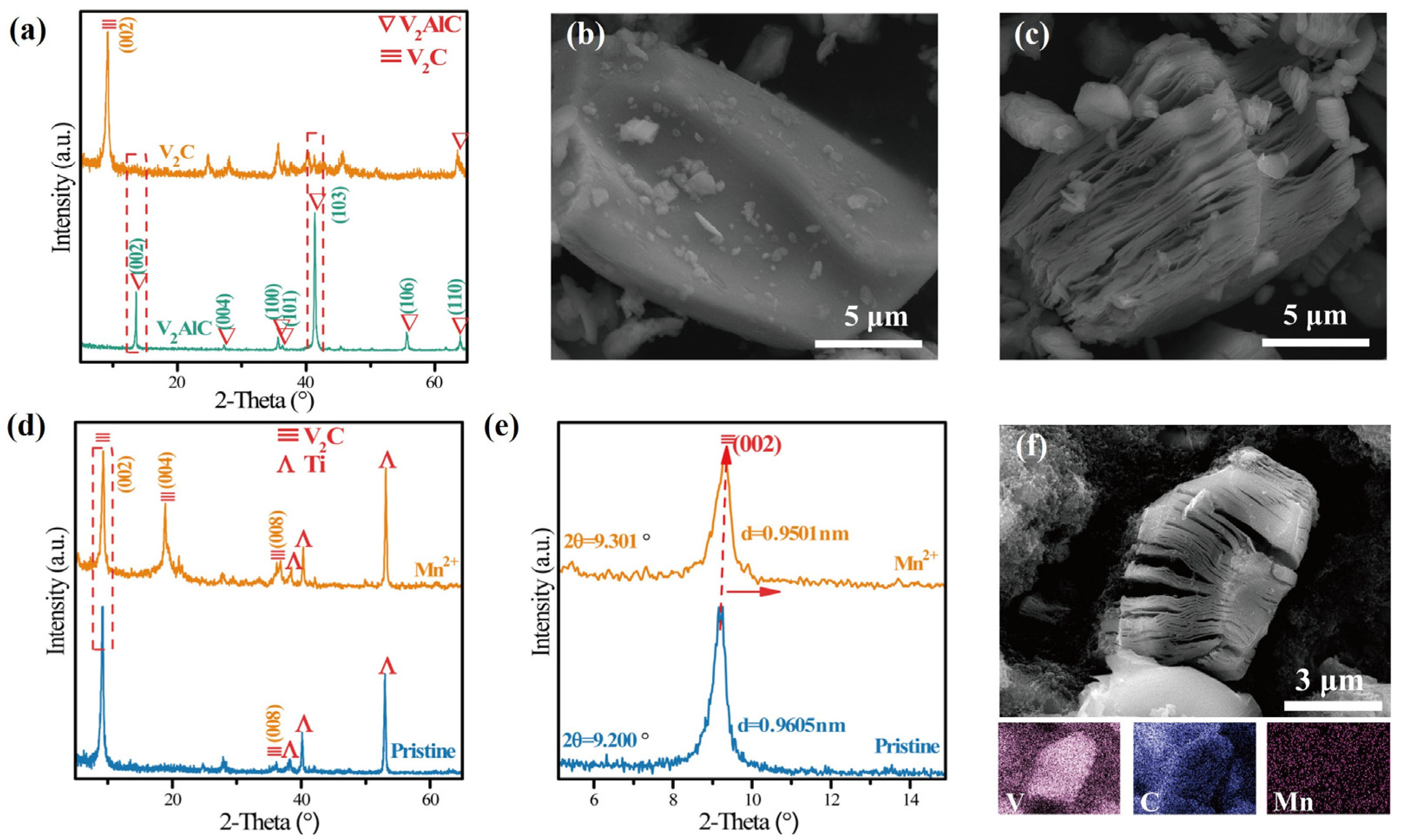
Figure 1a shows the XRD pattern of V2CTx MXene obtained after etching with NH4F and HCl. From the figure, the (103) diffraction peak of V2AlC phase significantly weakens after etching, and the (002) diffraction peak shifts towards a smaller angle, which is caused by the increase in interlayer spacing of MXene after etching. XRD successfully demonstrated the acquisition of V2CTx MXene phase. After etching, there are still small amounts of vanadium, aluminum oxides, and other impurities present. Figure 1b,c and Figure S1 show the scanning electron microscopy images of V2AlC before etching and V2CTx MXene obtained after etching. In Figure 1b, the V2AlC before etching exhibits a block-like structure with a certain texture on the side of the material and a relatively smooth surface. In Figure 1c, the V2CTx MXene obtained after etching exhibits a typical layered structure, further proving that the Al atomic layer of V2AlC is etched away after etching.
A three-electrode system was prepared in a 0.2 M Mn(NO3)2 aqueous electrolyte using titanium foil as the counter electrode, Ag/AgCl (3 M KCl) electrode as the reference electrode, and ML MXene electrode as the working electrode. Using an electrochemical workstation, 10 cycles of cyclic voltammetry (CV) testing were performed to achieve Mn2+ insertion. Negative potential between −0.3 and −1 V at a scanning rate of 1 mV/s was applied to drive Mn2+ insertion/extraction into V2CTx MXene. Figure 1d,e shows the XRD patterns of the prepared ML V2CTx MXene and Mn2+ pre-embedded V2CTx MXene electrodes. The (002) diffraction peaks of the V2CTx MXene electrode before and after Mn2+ pre-embedding appeared at 9.200° and 9.301°, respectively, indicating that the layered structure was still maintained after Mn2+ pre-embedding in ML V2CTx MXene. Compared with the (002) diffraction peak of ML V2CTx MXene, the (002) diffraction peak of Mn2+ pre-embedding in ML V2CTx MXene shifted towards higher angles, indicating that the interlayer spacing decreased after Mn2+ embedding. The interlayer spacing calculation results of the samples are shown in Table 1. The interlayer spacing of ML V2CTx MXene is 0.9605 nm, and the interlayer spacing of Mn2+ pre-embedded V2CTx MXene is 0.9501 nm. The reduction in interlayer spacing may be due to the interaction between the pre-embedded Mn2+ and V2CTx MXene layers, which leads to the contraction of interlayer spacing. In addition, FWHM of the (002) diffraction peak decreases after Mn2+ pre-embedding into ML V2CTx MXene, indicating that ion pre-embedding can cause rearrangement of ML V2CTx MXene nanosheets and increase long-range orientation. Figure 1f shows the SEM and elemental mapping images of Mn2+ pre-embedded V2CTx MXene. From the figure, it can be seen that after Mn2+ pre-embedding, V2CTx MXene still maintains its typical accordion-like structure. In addition to the mapping of C and V elements contained in V2CTx MXene shown in Figure 1f, it can also be seen that the Mn element is uniformly distributed in the sample.
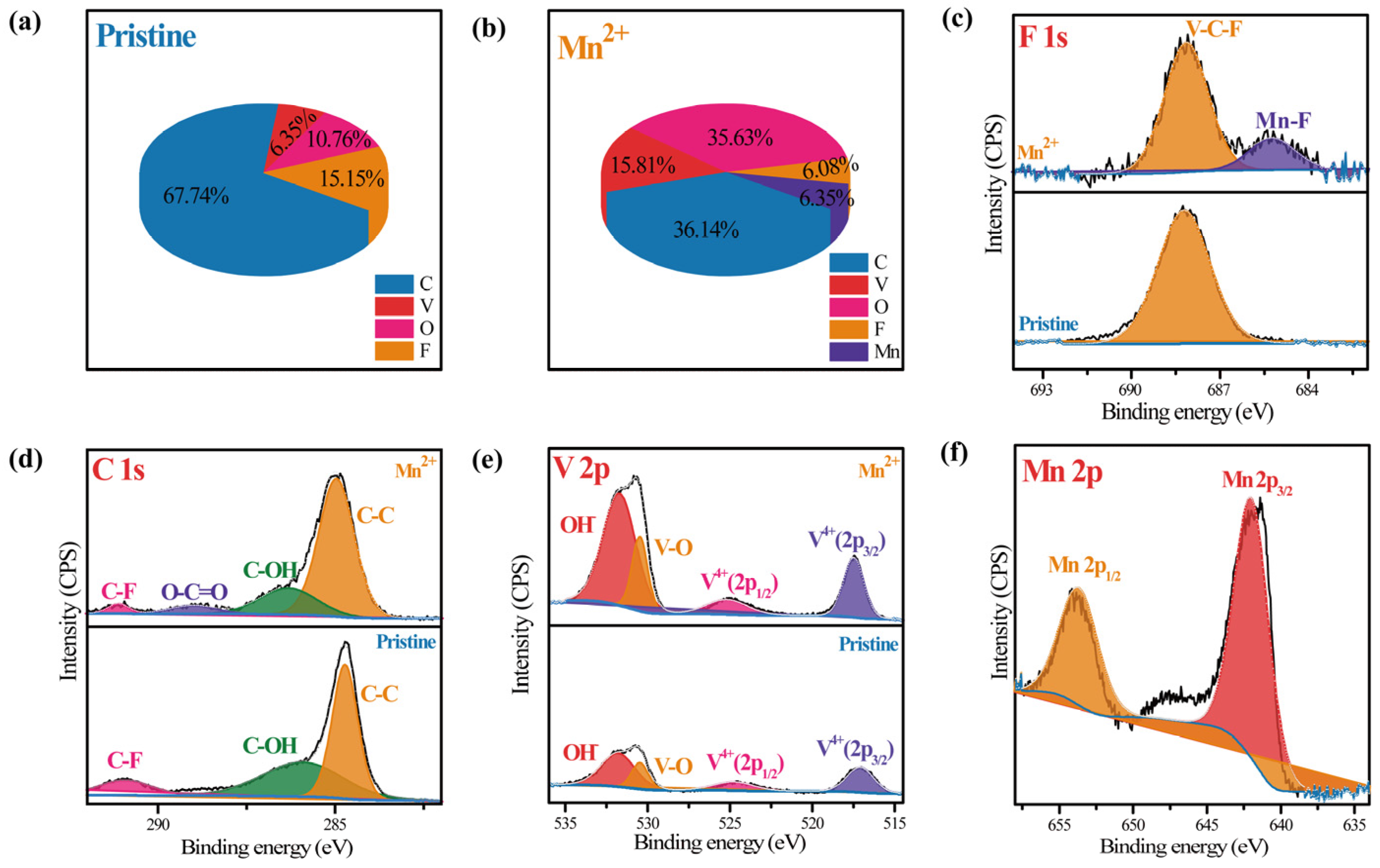
XPS was used to characterize the content and chemical state of surface elements in the sample. From Figure 2 and Figure S2, it can be seen that the V, C, O, and F elements are present in V2CTx MXene before and after Mn2+ pre-embedding. The Mn element in V2CTx MXene is present after Mn2+ pre-embedding. From the percentage content of the F element, it was found that the F content in the sample before pre-embedding was 15.15%, and after embedding Mn2+, the F content decreased to 6.08% (Figure 2a,b). The embedded Mn2+ provides a strong thermodynamic driving force (manifested as a significant difference in formation energy), promoting the transformation of the electrochemically inert -F terminal on the MXene surface to the active -O terminal, thereby indirectly reducing the F content. In Figure 2c, it can be seen that, compared with V2CTx MXene, a new peak at 685.22 eV appears in the XPS spectrum of F 1s after Mn2+ pre-embedding into V2CTx MXene, which can be attributed to the Mn-F bond. From the XPS spectrum of C 1s in Figure 2d, it can be seen that after embedding Mn2+, the O-C=O bond is enhanced, indicating that a large amount of Mn2+ embedding breaks the previous V-C-F bond, and some -OH is reduced to hydrogen gas and forms O-C=O bond. Figure 2e shows the V 2p XPS spectra of V2CTx and Mn2+- V2CTx, where the peaks at 525.0 eV and 517.5 eV belong to V4+ 2p1/2 and V4+ 2p3/2, respectively, and the peaks at 531.8 eV and 530.4 eV belong to oxygen-containing functional groups, the mixture of oxides, and H2O, respectively. In the XPS spectrum of Mn 2p in Figure 2f, peaks observed at 653.8 eV and 642.3 eV belong to Mn 2p1/2 and Mn 2p3/2, respectively, indicating the successful embedding of Mn2+ in V2CTx MXene.
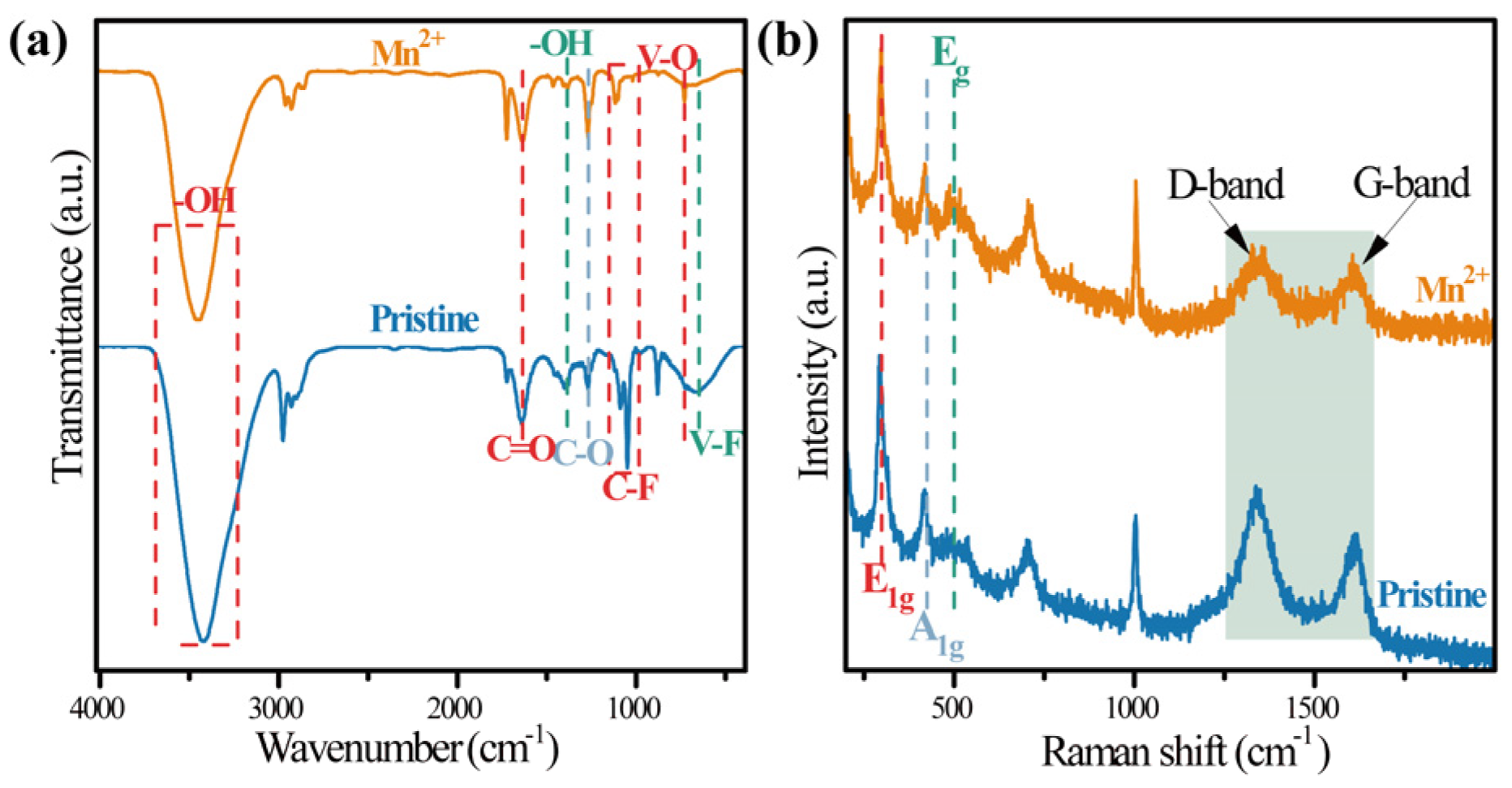
Figure 3a shows the FT-IR spectra of pre-embedded Mn2+ and original V2CTx MXene. The peak at 3450 cm−1 in Figure 3a is caused by the stretching of water molecules, O-H, adsorbed on the surface of MXene. The peaks at 1630 cm−1 and 1384 cm−1 are attributed to the stretching vibrations of the C=O bond and O-H bond, respectively. The peaks at 1060 cm−1 and 650 cm−1 belong to the C-F bond and V-F bond. The strength of the C-F bond and V-F bond is weakened after Mn2+ pre-embedding, which further proves that the previous V-C-F bond is destroyed after Mn2+ pre-embedding in V2CTx MXene. In order to determine the molecular structure of the material surface, Raman testing was conducted, and Figure 3b shows the Raman spectra of V2CTx MXene before and after Mn2+ pre-embedding. The vibration at 298 cm−1 (E1g) corresponds to the in-plane vibration of the V atom, the vibration at 417 cm−1 (A1g) corresponds to the out-of-plane vibration of the V atom, and the Raman vibration at 496 cm−1 is attributed to the Eg mode in V2C(OH)2, corresponding to the in-plane vibration of the V atom, indicating the presence of both out-of-plane tensile and in-plane biaxial compressive stresses. The other two peaks located at 1344 cm−1 and 1603 cm−1 correspond to the D peak of sp3 vibration of disordered structured carbon and the G peak of sp2 vibration of fully graphitized structured carbon in V2CTx MXene electrodes, respectively. Comparing the Raman peaks of MXene before and after Mn2+ embedding, it was found that with the pre-embedding of Mn2+, the ID/IG values significantly decreased, indicating an increase in the orderliness of MXene electrodes during the pre-embedding of Mn2+. This may be attributed to the conductive carbon black introduced during the electrode preparation process, along with the embedded Mn2+, which also intercalates into the carbon material.

2.2. Electrochemical Properties

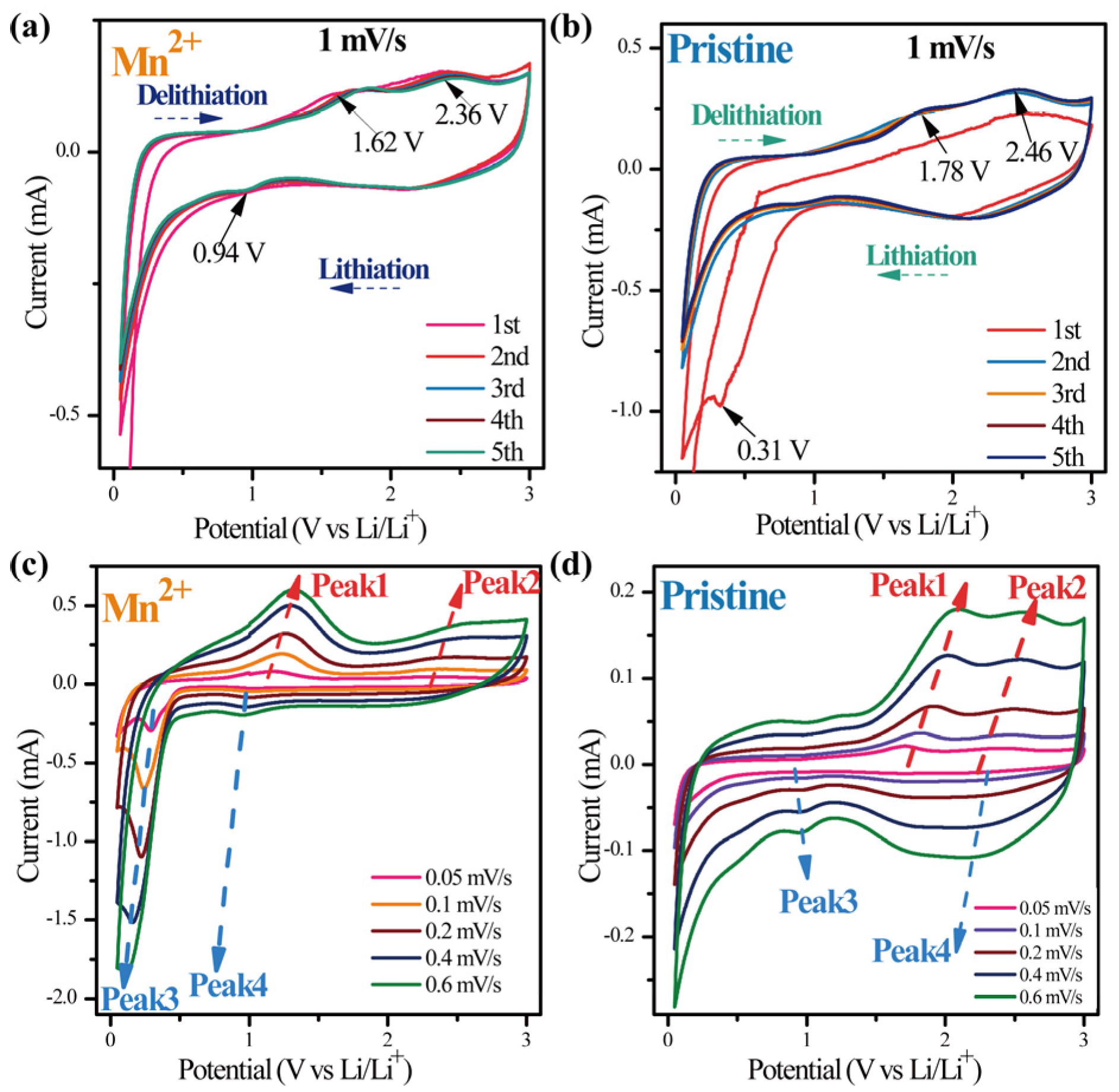
Using a half-cell approach based on two electrodes, electrochemical performance tests were conducted on the electrodes before and after pre-embedding. In order to elucidate the redox reaction behavior and the reversibility of lithium-ion insertion and extraction, the CV curves of V2CTx MXene before and after Mn2+ pre-insertion were tested at different scan rates and cycles, as shown in Figure 4. It is worth noting that during the first lithiation process of V2CTx MXene, there is an irreversible reduction peak located at 0.31 V (see Figure 4b), which subsequently disappears during the insertion of lithium ions. The irreversible peak and corresponding capacity loss exhibited can be attributed to the irreversible electrochemical reduction reaction caused by the SEI film generated on the electrode and the functional groups on the surface of the electrode material. Starting from the second cycle, the shape of the CV curve of V2CTx MXene electrode before and after Mn2+ pre-embedding remained basically unchanged, and the curves almost overlapped, indicating that Li ions are reversible during the insertion and extraction process of the material, demonstrating good reversibility. From the CV curves of V2CTx MXene electrodes before and after Mn2+ pre-embedding at different scanning rates, it can be observed that the capacity gradually increases with the increase in scanning speed during the cycling process, possibly due to the polarization phenomenon caused by the continuous insertion and extraction of Li+ during the cycling reaction.
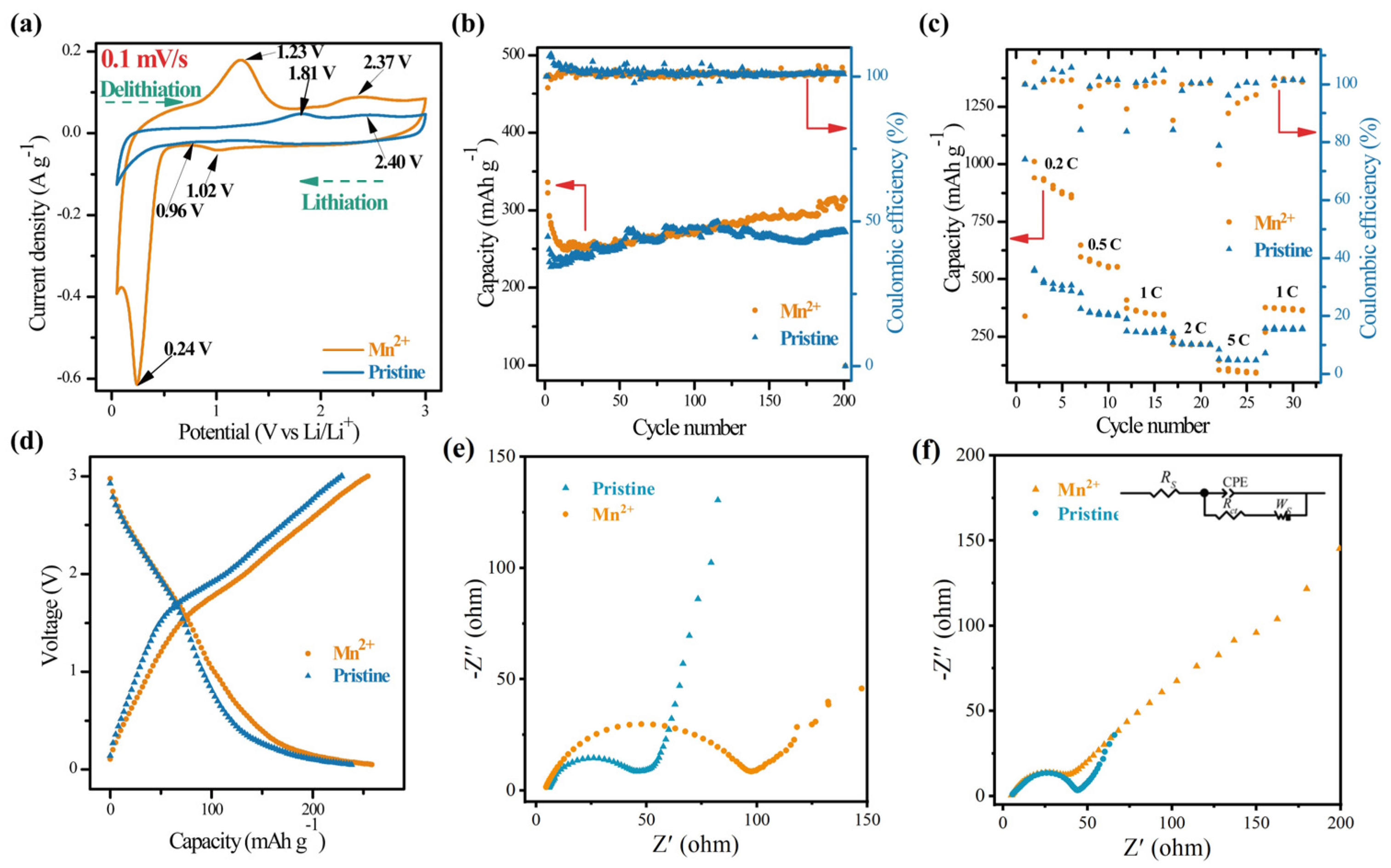
At 0.1 mV/s, the CV curves of V2CTx MXene before and after Mn2+ pre-embedding were compared, with a voltage range of 0.05–3.0 V, as shown in Figure 5a. In Figure 5a, it can be seen that the CV curve area of V2CTx MXene after Mn2+ embedding is larger than that of V2CTx, indicating that V2CTx MXene has higher capacity. To further demonstrate the superiority of Mn2+ pre-embedded V2CTx MXene, its cycling performance in lithium-ion batteries was tested, as shown in Figure 5b. The fluctuations shown in the figure may be caused by the instability of the battery during the testing process. The capacity of the original V2CTx MXene electrode after 200 cycles is 271.9 mAh/g. The specific capacity of Mn2+ pre-embedded V2CTx MXene first decreases and then gradually increases with the number of cycles, which is common in two-dimensional materials. After 200 cycles, the capacity of Mn2+ pre-embedded V2CTx MXene electrode reached 313.6 mAh/g. This may be because Mn2+ pre-embedded MXene layers serve as support points between layers, providing more stable and multiple reaction channels. During repeated Li+ insertion/extraction, electrolyte penetration continuously increases, resulting in high capacity during the cycling process. Figure 5c shows the performance rate of V2CTx MXene and Mn2+ pre-embedded V2CTx MXene. After pre-embedding Mn2+ into V2CTx MXene, its charge and discharge capacities were higher than the original V2CTx MXene at current densities of 0.2, 0.5, and 1 C. When the current density is restored to 1 C, the capacity of Mn2+ pre-embedded V2CTx MXene is basically restored, indicating its good reversible performance. Figure 5d shows the GCD curve at 1 C (10th cycle). The V2CTx MXene electrode pre-embedded with Mn2+ has higher capacity, with capacities of 254.5 and 258.6 mAh/g, respectively. The capacity of the original V2CTx MXene is 228.7 and 238.3 mAh/g, respectively.
In order to further investigate the electrochemical behavior of Mn2+ pre-embedded V2CTx MXene, the EIS spectra of V2CTx MXene and Mn2+ pre-embedded V2CTx MXene before and after cycling were measured, as shown in Figure 5e,f. It consists of two overlapping semicircles in the high-frequency and mid-frequency regions and a linear part in the low-frequency region. In the mid-high frequency region, the diameter of the semicircle of the sample after Mn2+ pre-embedding is smaller than that of the original V2CTx MXene, indicating that Mn2+ pre-embedding can reduce charge transfer resistance, which is beneficial for charge transfer and further confirms that Mn2+ can induce rapid charge transfer. This proves the reason why Mn2+ pre-embedded V2CTx MXene electrodes have more stable charge discharge cycling performance and higher specific capacity. Comparing the EIS spectra after 200 cycles, it can be seen that in the mid- to high-frequency region, the semi-circular diameter of the sample pre-embedded with Mn2+ is smaller than that of the original V2CTx MXene, indicating that the Rct value of the sample pre-embedded with Mn2+ after cycling is lower than that before the original V2CTx MXene. This is because Mn2+ pre-embedding can induce larger interlayer distance, faster ion migration speed, and higher conductivity during the Li+ insertion/extraction cycle.
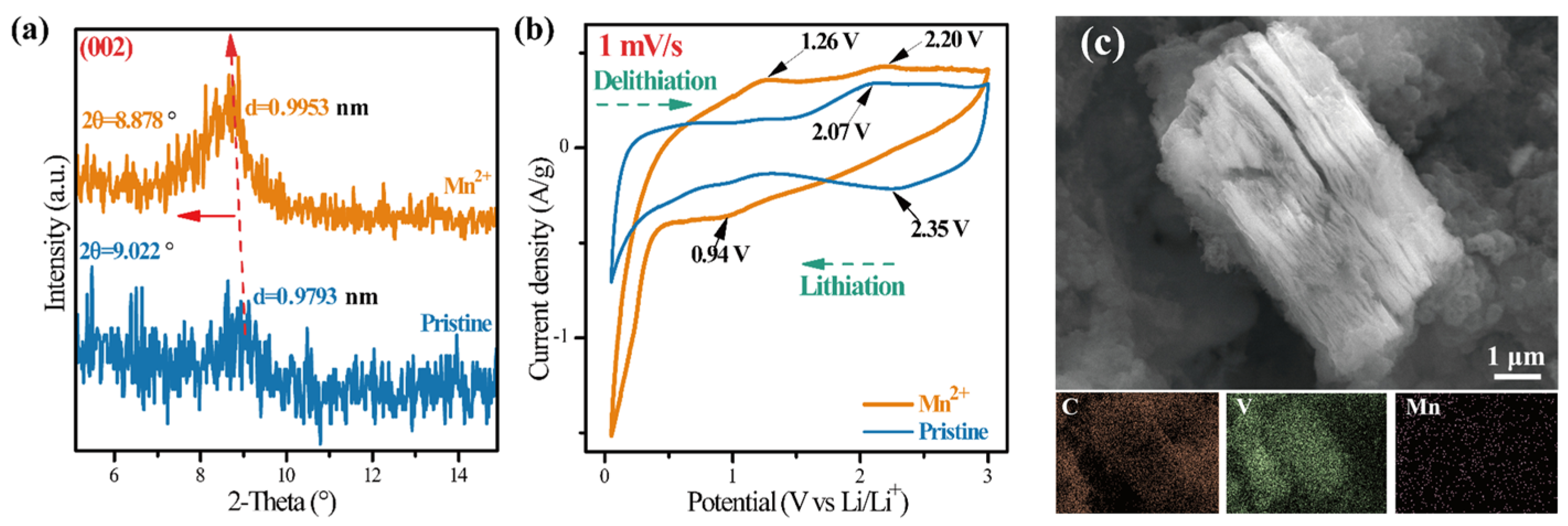
In order to further investigate the embedding behavior of Mn2+, structural characterization, morphology characterization, CV, and EIS testing were performed on the electrode after 200 cycles. Figure 6a shows the XRD patterns of ML V2CTx MXene electrode before and after Mn2+ insertion after 200 cycles. By calculation, it can be concluded that after 200 cycles, the (002) peak of both electrodes shifts towards a small angle compared to the XRD pattern of the sample before cycling (Figure 1e), confirming that the interlayer distance between the two electrodes further increases during Li+ insertion and extraction cycling, thus explaining the capacity increase phenomenon of the ML V2CTx MXene electrode before and after Mn2+ insertion during cycling. For MXene, the significant decrease in the intensity of the (002) peak directly reflects an essential change in its layered structure, which may be due to the damage to the electrode structure caused by periodic charging and discharging. During the electrochemical cycling process, the in situ oxidation of Mn2+ to Mn4+ between layers and the formation of manganese oxide species may indeed lead to physical expansion between multiple MXene layers. After 200 cycles, the CV curve of the electrode (second cycle) is shown in Figure 6b. It can be observed that after Mn2+ pre-embedding, the oxidation peak of V2CTx MXene at 2.07 V shifts towards higher potential, indicating that Mn2+ pre-embedding expands the distribution range of Li+ participating in electrode active sites. Meanwhile, compared with the original V2CTx MXene, Mn2+ embedding resulted in a larger integration area, explaining the phenomenon that the capacity of the ML V2CTx MXene electrode is higher than that of the ML V2CTx MXene electrode after Mn2+ embedding during the cycling process. Figure 6c shows the SEM and elemental mapping images after 200 cycles of charge and discharge. It can be seen that after Mn2+ pre-embedding, V2CTx MXene still maintains its original accordion-shaped morphology, with Mn element still uniformly distributed.

3. Experimental Section

3.1. Reagents and Materials

The materials and reagents required for the synthesis of samples are hydrochloric acid (HCl) with a concentration of 40%, V2AlC MAX ceramic powder with a particle size of 400 mesh, 0.2 M manganese nitrate solution (Mn(NO3)2), ammonium fluoride (NH4F), polyvinylidene fluoride (PVDF), carbon black, N-methyl pyrrolidone (NMP), 1 m lithium hexafluorophosphate solution (LiPF6), 10 × 20 mm titanium sheet, glass fiber membrane (Whatman GF/D), Li sheet, ethylene carbonate (EC), diethyl carbonate (DEC), and methyl ethyl carbonate (EMC). V2AlC MAX powders were purchased from Jilin 11 Technology Co., Ltd. (Jilin, China), and the rest were purchased from Sinopharm Chemical Reagent Co., Ltd. (Shanghai, China). All the above chemicals used in this experiment are of analytical purity, and all the reagents were not further purified.

3.2. Preparation of V2CTx MXene Electrode

A total of 2 g of ammonium fluoride (NH4F) was added to 20 mL of hydrochloric acid (HCl) (40%) solution and stirred for 30 min; then 2 g of V2AlC MAX ceramic powder was added. The reaction mixture was sealed in a stainless steel autoclave, stored at 120 °C for 24 h, and cooled naturally to room temperature. The black sediment was collected through centrifugation and washed with deionized water and ethanol three times. Finally, the precipitate was dried in a vacuum oven at 70 °C for 12 h. The V2CTx MXene powder, carbon black, and PVDF were mixed uniformly according to the mass ratio of 8:1:1 with the addition of NMP. The obtained slurry was coated onto the titanium films (10 mm 20 mm, the covered area is 10 mm 10 mm) with a small brush. The mass density of the coated electrode was approximately 1 mg/cm2. The prepared electrodes were dried under 120 °C in a vacuum drying chamber.

3.3. Preparation of V2CTx MXene Pre-Intercalated with Mn2+

Mn2+ pre-embedded V2CTx MXene electrode was prepared. Firstly, a three-electrode system was constructed with 0.2 M Mn(NO3)2 aqueous solution as an electrolyte, titanium foil as a counter electrode, Ag/AgCl (3 M KCl) electrode as a reference electrode, and MXene electrode as a working electrode. With the help of electrochemical workstation, the CV techniques were employed to drive the Mn2+ to intercalate into MXene via a negative potential of −0.9~−0.4 V at 1 mV/s. The pre-embedded electrode needs flowing deionized water to clean the electrode surface. Using the above process, V2CTx MXene electrodes pre-intercalated with Mn2+ were prepared.

3.4. Microstructural Characterization

X-ray diffraction (XRD) patterns of V2CTx MXene powders were obtained using a D/Max-2500 diffractometer (Rigaku, Tokyo, Japan). The test uses a CuKα (λ = 0.15406 nm) radiation source with a working voltage of 40 kV and a working current of 200 mA. The morphologies of V2CTx MXene powders were observed through scanning electron microscopy (SEM, JSM-7800F, JEOL, Tokyo, Japan). Nicolet iS50 Fourier transform infrared spectrometer (Thermo Fisher Scientific, MA, USA) was used to conduct FTIR tests on V2CTx MXene powders; the spectra in the range of 4000–500 cm−1 were collected with a wavenumber accuracy of 0.01 cm−1. The chemical composition and elemental valence of the samples were characterized by X-ray photoelectron spectroscopy (XPS, Thermo Scientific escalab 250xi, MA, USA). Fourier transform infrared spectrometer (FT-IR, therom scientific Nicolet is50, MA, USA) was used to collect infrared spectra. The Raman spectra of the samples were collected using confocal Raman microscope (Renishaw invia, London, UK), and the excitation wavelength was 514 nm.

3.5. Electrochemical Measurements

Using V2CTx MXene pre-intercalated Mn2+ as anode (which contributes the charge storage between 0.05 and 3 V), lithium sheet as a counter electrode/reference electrode (to match the electrochemical reaction mechanism of lithium-ion intercalation/deintercalation, construct a stable lithium-ion transport cycle, and reduce interfacial side reactions), and commercial lithium-ion battery electrolyte (1 M LiPF6 in ethylene carbonate/diethyl carbonate/ethyl methyl carbonate (EC/DEC/EMC), 1:1:1 in volume) as an electrolyte, the battery system was assembled with a CR2032 button electrode shell to explore the performance and mechanism of V2CTx MXene pre-intercalated Mn2+ electrode for lithium-ion storage at high temperatures. The cyclic voltammetry (CV) curves and electrode performance were collected using the electrochemical workstation (Metrohm, Autolab PGSTAT302N, Herisau, Switzerland) and the battery test system (NEWARE, CT-4008T, Shenzhen, China). During the testing process, the voltage window was set to 0.05–3 V, and the cyclic voltammetry curve of the lithium-ion battery was tested at a scanning speed of 1 mV/s. In addition, CV curves at different scan speeds (0.5, 1, 2, 5, and 10 mV/s) were tested and compared to further investigate the electrochemical performance of V2CTx MXene electrodes. The battery testing system was used to test the constant current charge discharge curve and cycling characteristics of the V2CTx MXene as the anode of lithium-ion batteries in the potential range of 0.05–3 V. At the same time, the rate characteristics of the V2CTx MXene as the anode of lithium-ion batteries were tested with current densities of 0.2, 0.5, 1, 2, and 5 C, and the changes in its cycling and rate performance were analyzed.

4. Conclusions

In this study, high-purity V2CTx MXene was successfully prepared through etching with NH4F-HCl mixed solution and combined with hydrothermal-assisted method. Based on this, controllable pre-embedding of Mn2+ between V2CTx MXene layers was achieved through a three-electrode electrochemical system. The structural characterization results indicate that after Mn2+ pre-embedding, the material still maintains a typical layered accordion structure, with the (002) interplanar spacing adjusted from 0.9605 nm to 0.9501 nm. At the same time, the surface F functional group content is significantly reduced, and the material’s orderliness and conductivity are improved. The electrochemical performance test results showed that Mn2+ pre-embedding effectively improved the lithium-ion storage performance of V2CTx MXene. Compared with the original V2CTx MXene, the specific capacity of the pre-embedded electrode increased from 271.9 mAh g−1 to 313.6 mAh g−1 after 200 cycles and exhibited better rate performance and lower charge transfer resistance. The above results indicate that electrochemical ion pre-embedding is an effective interlayer engineering control strategy for MXene, which can significantly improve its electrochemical reaction kinetics and structural stability, providing important references for the design of high-performance MXene-based lithium-ion battery electrode materials.

Supplementary Materials

The following supporting information can be downloaded at: https://www.mdpi.com/article/10.3390/inorganics14020065/s1, Figure S1. SEM image of V2AlC and V2CTx MXene. Figure S2. XPS spectra of Mn2+ before and after pre-embedding V2CTx MXene, (a) full spectra; (b) O 1s; (d) V 2p.

Author Contributions

Conceptualization, H.Y.; methodology, J.L. and Z.Y.; writing—original draft preparation, H.Y.; formal analysis, S.X.; writing—review and editing, M.L. and M.X.; supervision, H.L. All authors have read and agreed to the published version of the manuscript.

Funding

The authors gratefully acknowledge the financial support provided by the Natural Science Foundation of Jilin Province (YDZJ202401316ZYTS), and Jilin Province Science and Technology Department Program (YDZJ202201ZYTS323).

Data Availability Statement

The raw data supporting the conclusions of this article will be made available by the authors on request.

Acknowledgments

The authors gratefully acknowledge the Innovation Laboratory Development Program of Education Department of Jilin Province and Industry and Information Technology Department of Jilin Province, China (The Joint Laboratory of MXene Materials).

Conflicts of Interest

The authors declare no conflicts of interest.

References

  1. Kabir, M.M.; Demirocak, D.E. Degradation mechanisms in Li-ion batteries: A state-of-the-art review. Int. J. Energy Res. 2017, 41, 1963–1986. [Google Scholar] [CrossRef]
  2. Miao, Y.; Hynan, P.; von Jouanne, A.; Yokochi, A. Current Li-ion battery technologies in electric vehicles and opportunities for advancements. Energies 2019, 12, 1074. [Google Scholar] [CrossRef]
  3. Rojaee, R.; Shahbazian-Yassar, R. Two-dimensional materials to address the lithium battery challenges. ACS Nano 2020, 14, 2628–2658. [Google Scholar] [CrossRef] [PubMed]
  4. Lu, J.; Chen, Z.W.; Pan, F.; Cui, Y.; Amine, K. High-performance anode materials for rechargeable lithium-ion batteries. Electrochem. Energy Rev. 2018, 1, 35–53. [Google Scholar] [CrossRef]
  5. Zheng, G.Y.; Yang, Y.; Cha, J.J.; Hong, S.S.; Cui, Y. Hollow carbon nanofiber-encapsulated sulfur cathodes for high specific capacity rechargeable lithium batteries. Nano Lett. 2011, 11, 4462–4467. [Google Scholar] [CrossRef]
  6. Zhang, X.; Wang, L.; Liu, W.; Li, C.; Wang, K.; Ma, Y.W. Recent advances in MXenes for lithium-ion capacitors. ACS Omega 2020, 5, 75–82. [Google Scholar] [CrossRef]
  7. Zhang, X.; Zhang, Z.; Zhou, Z. MXene-based materials for electrochemical energy storage. J. Energy Chem. 2018, 27, 73–85. [Google Scholar] [CrossRef]
  8. Gogotsi, Y.; Huang, Q. MXenes: Two-Dimensional building blocks for future materials and devices. ACS Nano 2021, 15, 5775–5780. [Google Scholar] [CrossRef]
  9. Zhang, C.F.; Ma, Y.L.; Zhang, X.T.; Abdolhosseinzadeh, S.; Sheng, H.W.; Lan, W.; Pakdel, A.; Heier, J.; Nüesch, F. Two-Dimensional transition metal carbides and nitrides (MXenes): Synthesis, properties, and electrochemical energy storage applications. Energy Environ. Mater. 2020, 3, 29–55. [Google Scholar] [CrossRef]
  10. Qing, Y.C.; Zhou, W.C.; Luo, F.; Zhu, D.M. Titanium carbide (MXene) nanosheets as promising microwave absorbers. Ceram. Int. 2016, 42, 16412–16416. [Google Scholar] [CrossRef]
  11. Liu, F.F.; Liu, Y.C.; Zhao, X.D.; Liu, K.Y.; Yin, H.Q.; Fan, L.Z. Prelithiated V2C MXene: A high-performance electrode for hybrid Magnesium/Lithium-ion batteries by ion cointercalation. Small 2020, 16, 1906076. [Google Scholar] [CrossRef] [PubMed]
  12. Liu, P.J.; Hou, Z.R.; Hu, M.J.; Hu, L.W.; Tang, R.; Wu, H.F.; Hu, M.L. Electro-Synthesis of ultrafine V2AlC MAX-phase and its conversion process towards two-dimensional V2CTx. J. Electrochem. Soc. 2020, 167, 122501. [Google Scholar] [CrossRef]
  13. Tan, Z.L.; Wei, J.X.; Liu, Y.; uz Zaman, F.; Rehman, W.; Hou, L.R.; Yuan, C.Z. V2CTx MXene and its derivatives: Synthesis and recent progress in electrochemical energy storage applications. Rare Met. 2022, 41, 775–797. [Google Scholar] [CrossRef]
  14. Zhu, X.D.; Cao, Z.Y.; Wang, W.J.; Li, H.J.; Dong, J.C.; Gao, S.P.; Xu, D.X.; Li, L.; Shen, J.F.; Ye, M.X. Superior-performance aqueous zinc-ion batteries based on the in situ growth of MnO2 nanosheets on V2CTx MXene. ACS Nano 2021, 15, 2971–2983. [Google Scholar] [CrossRef]
  15. Ming, F.W.; Liang, H.F.; Zhang, W.L.; Ming, J.; Lei, Y.J.; Abdul-Hamid, E.; Alshareef, H.N. Porous MXenes enable high performance potassium ion capacitors. Nano Energy 2019, 62, 853–860. [Google Scholar] [CrossRef]
  16. Lu, M.; Han, W.J.; Li, H.J.; Shi, W.; Wang, J.H.; Zhang, B.S.; Zhou, Y.; Li, H.B.; Zhang, W.; Zheng, W.T. Tent-pitching-inspired high-valence period 3-cation pre-intercalation excels for anode of 2D titanium carbide (MXene) with high Li storage capacity. Energy Storage Mater. 2019, 16, 163–168. [Google Scholar] [CrossRef]
  17. Lv, W.R.; Wu, G.H.; Li, X.X.; Li, J.L.; Li, Z.Y. Two-dimensional V2C@Se (MXene) composite cathode material for high-performance rechargeable aluminum batteries. Energy Storage Mater. 2022, 46, 138–146. [Google Scholar] [CrossRef]
  18. Lu, M.; Zhang, Y.P.; Chen, J.N.; Han, W.J.; Zhang, W.; Li, H.B.; Zhang, X.; Zhang, B.S. K+ alkalization promoted Ca2+ intercalation in V2CTx MXene for enhanced Li storage. J. Energy Chem. 2020, 49, 358–364. [Google Scholar] [CrossRef]
  19. Huang, P.F.; Zhang, S.L.; Ying, H.J.; Yang, W.T.; Wang, J.L.; Guo, R.N.; Ha, W.Q. Fabrication of Fe nanocomplex pillared few-layered Ti3C2Tx MXene with enhanced rate performance for lithium-ion batteries. Nano Res. 2021, 14, 1218–1227. [Google Scholar] [CrossRef]
  20. Han, W.J.; Lu, M.; Chen, J.N.; Li, H.J.; Li, H.B.; Zhang, B.S.; Zhang, W.; Zheng, W.T. Activating an MXene as a host for EMIm+ by electrochemistry-driven Fe ion pre-intercalation. J. Mater. Chem. A 2020, 8, 16265–16270. [Google Scholar] [CrossRef]
  21. Hu, Y.X.; Zhang, D.T.; Liu, M.C. Self-assembly of Ba2+ pillared Ti3C2 with enlarged interlayer spacing towards improved supercapacitive performance. Nano 2021, 16, 2150081. [Google Scholar] [CrossRef]
Disclaimer/Publisher’s Note: The statements, opinions, and data contained in all publications are solely those of the individual author(s) and contributor(s) and not of MDPI and/or the editor(s). MDPI and/or the editor(s) disclaim responsibility for any injury to people or property resulting from any ideas, methods, instructions, or products referred to in the content.
Figure 1. (a) XRD patterns of V2AlC and V2CTx MXene; (b,c) SEM image of V2AlC and V2CTx MXene; (d) XRD patterns of Mn2+ before and after pre-embedding in V2CTx MXene; (e) the enlarged XRD spectra of the (002) peak of Mn2+ before and after pre-embedding in V2CTx MXene; (f) SEM and EDS image of Mn2+ after pre-embedding V2CTx MXene.
Inorganics 14 00065 g001
Figure 2. XPS spectra of Mn2+ before and after pre-embedding V2CTx MXene; (a,b) the presence of element; (c) F 1s; (d) C 1s; (e) V 2p; (f) Mn 2p.
Inorganics 14 00065 g002
Figure 3. (a) FT-IR spectra and (b) Raman spectra of Mn2+ pre-embedded V2CTx MXene.
Inorganics 14 00065 g003
Figure 4. (a,b) CV curves of V2CTx MXene after and before Mn2+ pre-embedding; (c,d) CV curves at different scanning rates.
Inorganics 14 00065 g004
Figure 5. (a) CV curves; (b) cycle performance; (c) rate performance; (d) GCD curve; (e,f) the EIS spectra pre-cycle and (f) after 200 cycles of Mn2+ pre-embedded V2CTx MXene and the original V2CTx MXene.
Inorganics 14 00065 g005
Figure 6. The XRD pattern of peak (a) (002) after 200 cycles; (b) CV curve (Period 2); (c) SEM and EDS images of Mn2+ embedded in V2CTx MXene after 200 cycles.
Inorganics 14 00065 g006
Table 1. The (002) peak position, interplanar spacing, and FWHM before and after Mn2+ pre-embedding in V2CTx MXene.
2θ [°]d-Spacing [nm]FWHM [°]
V2CTx9.2000.96050.415
V2CTx-Mn2+9.3010.95010.423
Disclaimer/Publisher’s Note: The statements, opinions and data contained in all publications are solely those of the individual author(s) and contributor(s) and not of MDPI and/or the editor(s). MDPI and/or the editor(s) disclaim responsibility for any injury to people or property resulting from any ideas, methods, instructions or products referred to in the content.