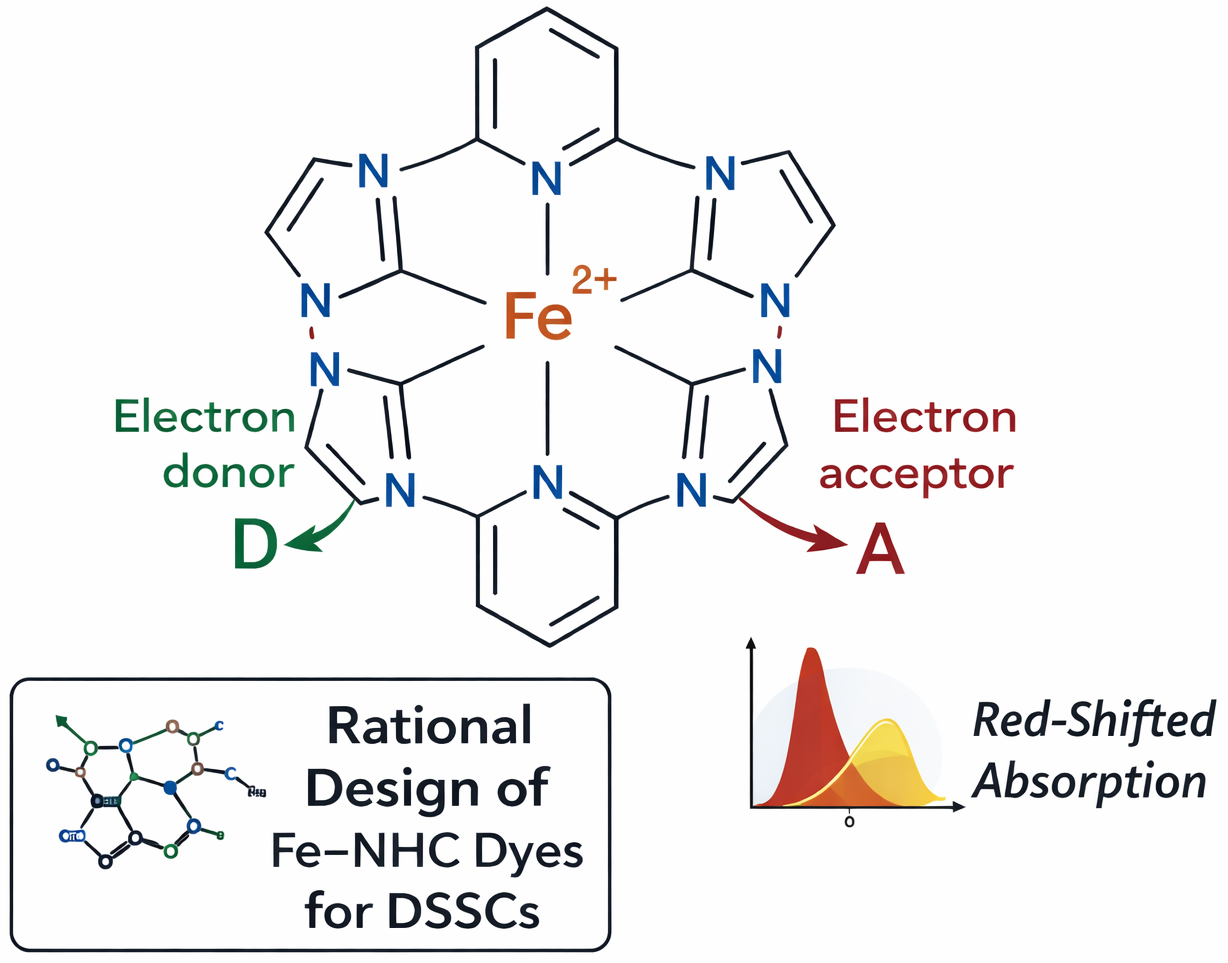

Enhancing the Photophysical Properties of NHC-Based Iron Sensitizers for Dye-Sensitized Solar Cells: A Computational Study
 , , , ,
Abstract
1. Introduction
2. Results and Discussion
2.1. Construction of the Model Fe(II)–NHC Dye Series
2.2. Optimized Geometries
2.3. Electronic Structure
2.4. Electronic Transitions & Spectra
2.5. Solar Cell Efficiency Variables
3. Materials and Methods
4. Conclusions
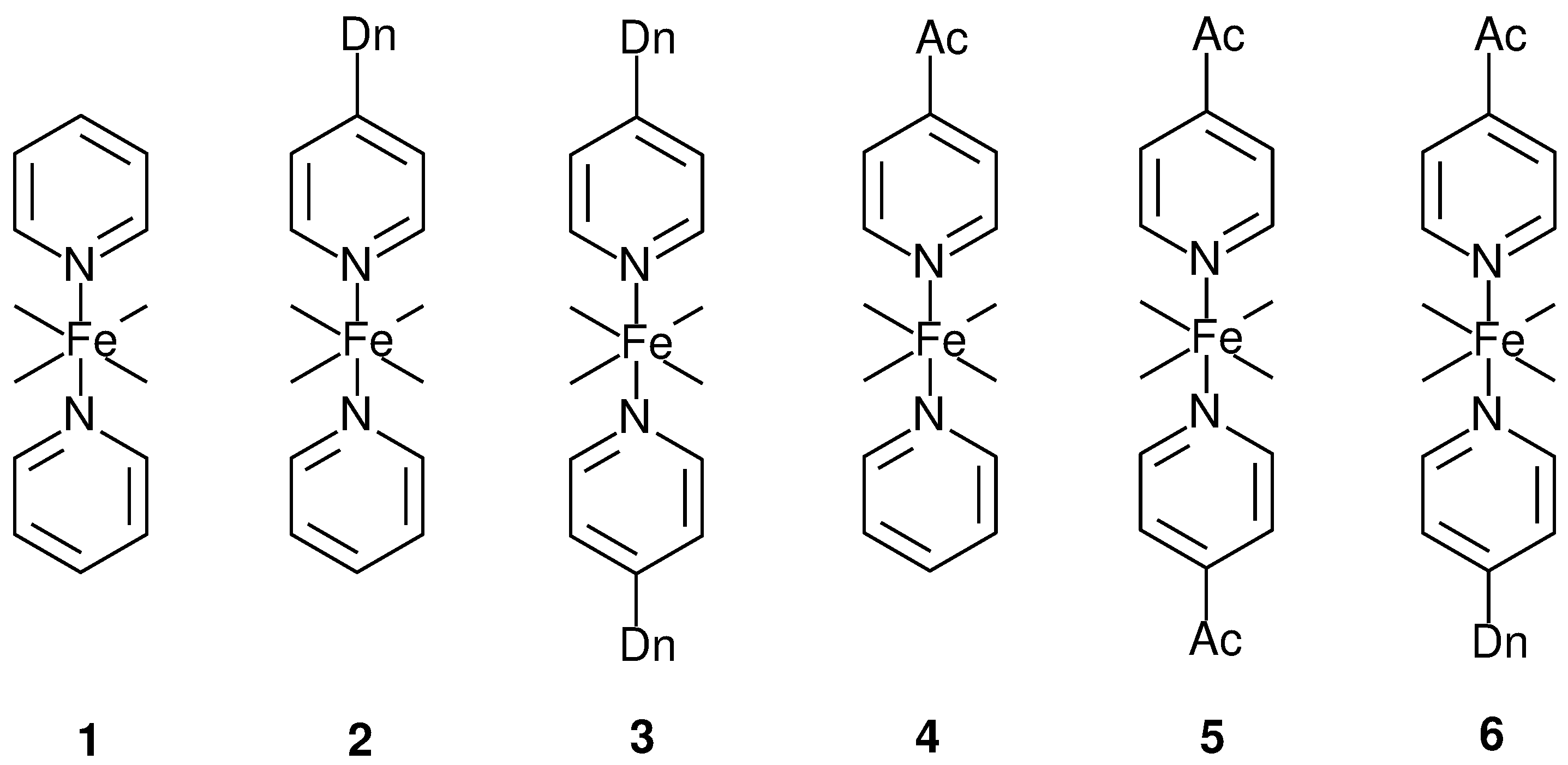
- First, donor substitution primarily destabilizes the HOMO and enhances oscillator strength, leading to more intense absorption but only modest redshifts in MLCT transition energies. In contrast, acceptor substitution significantly stabilizes the LUMO and produces the largest redshifts, effectively extending absorption toward lower energies.
- Second, the combined donor–acceptor (push–pull) configuration provides the most balanced photophysical profile, simultaneously achieving reduced MLCT excitation energies, preserved oscillator strengths, favorable electron-injection and dye-regeneration driving forces, and relatively long radiative excited-state lifetimes.
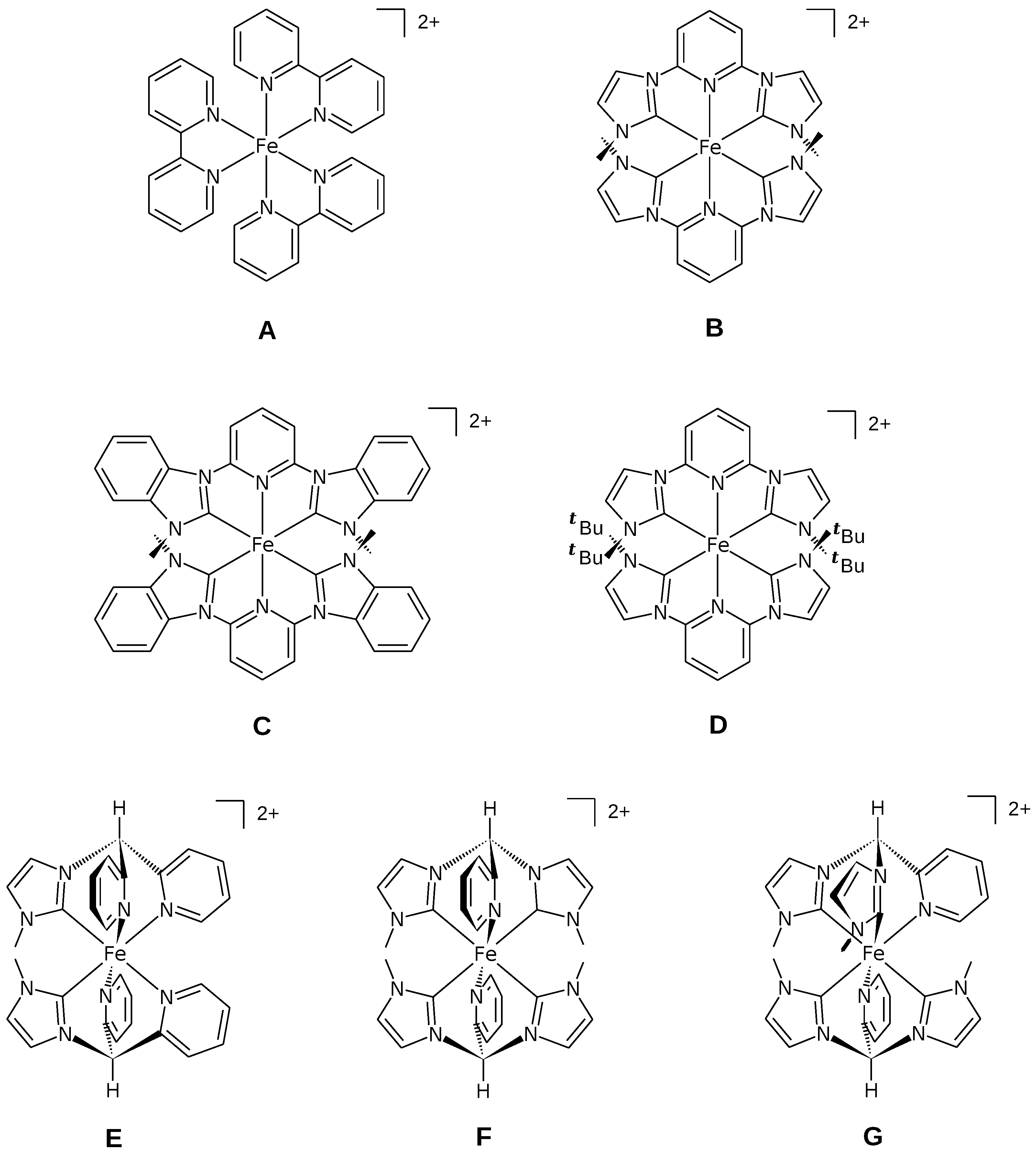
- Among the investigated systems, double-acceptor dyes (configuration 5) in frameworks B–D and push–pull dyes (configuration 6) in the tripodal frameworks E–G emerge as the most promising candidates. In particular, complexes such as B5, C5, D5, E6, F6, and G6 combine substantial absorption redshifts with favorable charge-transfer energetics, making them attractive targets for further experimental exploration.
Supplementary Materials
Author Contributions
Funding
Institutional Review Board Statement
Informed Consent Statement
Data Availability Statement
Conflicts of Interest
References
- Saygili, Y.; Stojanovic, M.; Flores-Díaz, N.; Zakeeruddin, S.M.; Vlachopoulos, N.; Grätzel, M.; Hagfeldt, A. Metal Coordination Complexes as Redox Mediators in Regenerative Dye-Sensitized Solar Cells. Inorganics 2019, 7, 30. [Google Scholar] [CrossRef]
- Korir, B.K.; Kibet, J.K.; Ngari, S.M. A review on the current status of dye-sensitized solar cells: Toward sustainable energy. Energy Sci. Eng. 2024, 12, 3188–3226. [Google Scholar] [CrossRef]
- Saud, P.S.; Bist, A.; Kim, A.A.; Yousef, A.; Abutaleb, A.; Park, M.; Park, S.J.; Pant, B. Dye-sensitized solar cells: Fundamentals, recent progress, and Optoelectrical properties improvement strategies. Opt. Mater. 2024, 150, 115242. [Google Scholar] [CrossRef]
- Michaels, H.; Rinderle, M.; Benesperi, I.; Freitag, R.; Gagliardi, A.; Freitag, M. Emerging indoor photovoltaics for self-powered and self-aware IoT towards sustainable energy management. Chem. Sci. 2023, 14, 5350–5360. [Google Scholar] [CrossRef] [PubMed]
- Onah, E.H.; Lethole, N.L.; Mukumba, P. Luminescent Materials for Dye-Sensitized Solar Cells: Advances and Directions. Appl. Sci. 2024, 14, 9202. [Google Scholar] [CrossRef]
- Suchikova, Y.; Nazarovets, S.; Konuhova, M.; Popov, A.I. Binary Oxide Ceramics (TiO2, ZnO, Al2O3, SiO2, CeO2, Fe2O3, and WO3) for Solar Cell Applications: A Comparative and Bibliometric Analysis. Ceramics 2025, 8, 119. [Google Scholar] [CrossRef]
- Liu, Q.; Gao, N.; Liu, D.; Liu, J.; Li, Y. Structure and Photoelectrical Properties of Natural Photoactive Dyes for Solar Cells. Appl. Sci. 2018, 8, 1697. [Google Scholar] [CrossRef]
- Chmovzh, T.N.; Knyazeva, E.A.; Tanaka, E.; Popov, V.V.; Mikhalchenko, L.V.; Robertson, N.; Rakitin, O.A. [1,2,5]Thiadiazolo[3,4-d]Pyridazine as an Internal Acceptor in the D-A-π-A Organic Sensitizers for Dye-Sensitized Solar Cells. Molecules 2019, 24, 1588. [Google Scholar] [CrossRef]
- Sun, Z.D.; Zhao, J.S.; Ju, X.H.; Xia, Q.Y. Effect of Nitrogen Cation as “Electron Trap” at π-Linker on Properties for p-Type Photosensitizers: DFT Study. Molecules 2019, 24, 3134. [Google Scholar] [CrossRef]
- Buene, A.F.; Christensen, M.; Hoff, B.H. Effect of Auxiliary Donors on 3,8-Phenothiazine Dyes for Dye-Sensitized Solar Cells. Molecules 2019, 24, 4485. [Google Scholar] [CrossRef]
- Delgado-Montiel, T.; Soto-Rojo, R.; Baldenebro-López, J.; Glossman-Mitnik, D. Theoretical Study of the Effect of Different π Bridges Including an Azomethine Group in Triphenylamine-Based Dye for Dye-Sensitized Solar Cells. Molecules 2019, 24, 3897. [Google Scholar] [CrossRef]
- Wanwong, S.; Sangkhun, W.; Kumnorkaew, P.; Wootthikanokkhan, J. Improved Performance of Ternary Solar Cells by Using BODIPY Triads. Materials 2020, 13, 2723. [Google Scholar] [CrossRef]
- Zdyb, A.; Krawczak, E. Organic Dyes in Dye-Sensitized Solar Cells Featuring Back Reflector. Energies 2021, 14, 5529. [Google Scholar] [CrossRef]
- Holliman, P.J.; Mohsen, M.; Connell, A.; Kershaw, C.P.; Meza-Rojas, D.; Jones, E.W.; Geatches, D.; Sen, K.; Hsiao, Y.W. Double Linker Triphenylamine Dyes for Dye-Sensitized Solar Cells. Energies 2020, 13, 4637. [Google Scholar] [CrossRef]
- Slodek, A.; Zych, D.; Szafraniec-Gorol, G.; Gnida, P.; Vasylieva, M.; Schab-Balcerzak, E. Investigations of New Phenothiazine-Based Compounds for Dye-Sensitized Solar Cells with Theoretical Insight. Materials 2020, 13, 2292. [Google Scholar] [CrossRef]
- Elegbeleye, I.F.; Maluta, N.E.; Maphanga, R.R. Density Functional Theory Study of Optical and Electronic Properties of (TiO2)n=5,8,68 Clusters for Application in Solar Cells. Molecules 2021, 26, 955. [Google Scholar] [CrossRef]
- Delgado-Montiel, T.; Baldenebro-López, J.; Soto-Rojo, R.; Glossman-Mitnik, D. Theoretical Study of the Effect of π-Bridge on Optical and Electronic Properties of Carbazole-Based Sensitizers for DSSCs. Molecules 2020, 25, 3670. [Google Scholar] [CrossRef] [PubMed]
- Yemene, A.E.; Venkatraman, V.; Moe Almenningen, D.; Hoff, B.H.; Gautun, O.R. Synthesis of Novel 3,6-Dithienyl Diketopyrrolopyrrole Dyes by Direct C-H Arylation. Molecules 2020, 25, 2349. [Google Scholar] [CrossRef] [PubMed]
- Al-Faouri, T.; Buguis, F.L.; Azizi Soldouz, S.; Sarycheva, O.V.; Hussein, B.A.; Mahmood, R.; Koivisto, B.D. Exploring Structure-Property Relationships in a Bio-Inspired Family of Bipodal and Electronically-Coupled Bistriphenylamine Dyes for Dye-Sensitized Solar Cell Applications. Molecules 2020, 25, 2260. [Google Scholar] [CrossRef]
- Ndiaye, A.; Dioum, A.; Oprea, C.I.; Dumbrava, A.; Lungu, J.; Georgescu, A.; Moscalu, F.; Gîrţu, M.A.; Beye, A.C.; Youm, I. A Combined Experimental and Computational Study of Chrysanthemin as a Pigment for Dye-Sensitized Solar Cells. Molecules 2021, 26, 225. [Google Scholar] [CrossRef] [PubMed]
- Păușescu, I.; Todea, A.; Dreavă, D.M.; Boboescu, T.; Pațcan, B.; Pațcan, L.; Albulescu, D.; Badea, V.; Peter, F.; Tőtős, R.; et al. Experimental and Computational Studies on Bio-Inspired Flavylium Salts as Sensitizers for Dye-Sensitized Solar Cells. Materials 2022, 15, 6985. [Google Scholar] [CrossRef] [PubMed]
- Gierszewski, M.; Glinka, A.; Ziółek, M. Co-Sensitization Effects of Indoline and Carbazole Dyes in Solar Cells and Their Neutral–Anion Equilibrium in Solution. Materials 2022, 15, 7725. [Google Scholar] [CrossRef]
- Coetzee, L.C.C.; Adeyinka, A.S.; Magwa, N. A Theoretical Evaluation of the Efficiencies of Metal-Free 1,3,4-Oxadiazole Dye-Sensitized Solar Cells: Insights from Electron–Hole Separation Distance Analysis. Energies 2022, 15, 4913. [Google Scholar] [CrossRef]
- Shukor, N.I.A.; Chan, K.Y.; Thien, G.S.H.; Yeoh, M.E.; Low, P.L.; Devaraj, N.K.; Ng, Z.N.; Yap, B.K. A Green Approach to Natural Dyes in Dye-Sensitized Solar Cells. Sensors 2023, 23, 8412. [Google Scholar] [CrossRef]
- Inácio, D.; Pinto, A.L.; Paninho, A.B.; Branco, L.C.; Freitas, S.K.S.; Cruz, H. Application of Covalent Organic Frameworks (COFs) as Dyes and Additives for Dye-Sensitized Solar Cells (DSSCs). Nanomaterials 2023, 13, 1204. [Google Scholar] [CrossRef]
- Pradhan, S.; Kurokawa, Y.; Shaban, S.; Pandey, S.S. Squaric Acid Core Substituted Unsymmetrical Squaraine Dyes for Dye-Sensitized Solar Cells: Effect of Electron Acceptors on Their Photovoltaic Performance. Colorants 2023, 2, 654–673. [Google Scholar] [CrossRef]
- Hara, M.; Ejima, R. Fabrication and Characterization of Co-Sensitized Dye Solar Cells Using Energy Transfer from Spiropyran Derivatives to SQ2 Dye. Molecules 2024, 29, 4896. [Google Scholar] [CrossRef]
- Almansour, A.I.; Kumar, R.S.; Al-Shemaimari, K.I.; Arumugam, N. Highly Efficient DSSCs Sensitized Using NIR Responsive Bacteriopheophytine-a and Its Derivatives Extracted from Rhodobacter Sphaeroides Photobacteria. Molecules 2024, 29, 931. [Google Scholar] [CrossRef] [PubMed]
- Mori, K.; Kurokawa, Y.; Pandey, S.S. Synthesis and Characterization of Multifunctional Symmetrical Squaraine Dyes for Molecular Photovoltaics by Terminal Alkyl Chain Modifications. Colorants 2024, 3, 198–213. [Google Scholar] [CrossRef]
- Amin, M.F.; Gnida, P.; Małecki, J.G.; Kotowicz, S.; Schab-Balcerzak, E. DSSCs Sensitized with Phenothiazine Derivatives Containing 1H-Tetrazole-5-acrylic Acid as an Anchoring Unit. Materials 2024, 17, 6116. [Google Scholar] [CrossRef] [PubMed]
- Zhou, H.; Ji, J.M.; Kim, M.S.; Kim, H.K. Significant Influence of a Single Atom Change in Auxiliary Acceptor on Photovoltaic Properties of Porphyrin-Based Dye-Sensitized Solar Cells. Nanomaterials 2018, 8, 1030. [Google Scholar] [CrossRef] [PubMed]
- Ghazal, B.; Azizi, K.; Ewies, E.F.; Youssef, A.S.A.; Mwalukuku, V.M.; Demadrille, R.; Torres, T.; Makhseed, S. Push–Pull Zinc Phthalocyanine Bearing Hexa-Tertiary Substituted Carbazolyl Donor Groups for Dye-Sensitized Solar Cells. Molecules 2020, 25, 1692. [Google Scholar] [CrossRef]
- Chevrier, M.; Fattori, A.; Lasser, L.; Kotras, C.; Rose, C.; Cangiotti, M.; Beljonne, D.; Mehdi, A.; Surin, M.; Lazzaroni, R.; et al. In Depth Analysis of Photovoltaic Performance of Chlorophyll Derivative-Based “All Solid-State” Dye-Sensitized Solar Cells. Molecules 2020, 25, 198. [Google Scholar] [CrossRef]
- Xu, F.; Testoff, T.T.; Wang, L.; Zhou, X. Cause, Regulation and Utilization of Dye Aggregation in Dye-Sensitized Solar Cells. Molecules 2020, 25, 4478. [Google Scholar] [CrossRef]
- Ikeuchi, T.; Kudo, R.; Kitazawa, Y.; Mori, S.; Kimura, M. 3D Structural Optimization of Zinc Phthalocyanine-Based Sensitizers for Enhancement of Open-Circuit Voltage of Dye-Sensitized Solar Cells. Energies 2020, 13, 2288. [Google Scholar] [CrossRef]
- Xu, Z.; Lu, X.; Li, Y.; Wei, S. Theoretical Analysis on Heteroleptic Cu(I)-Based Complexes for Dye-Sensitized Solar Cells: Effect of Anchors on Electronic Structure, Spectrum, Excitation, and Intramolecular and Interfacial Electron Transfer. Molecules 2020, 25, 3681. [Google Scholar] [CrossRef] [PubMed]
- Risi, G.; Becker, M.; Housecroft, C.E.; Constable, E.C. Are Alkynyl Spacers in Ancillary Ligands in Heteroleptic Bis(diimine)copper(I) Dyes Beneficial for Dye Performance in Dye-Sensitized Solar Cells? Molecules 2020, 25, 1528. [Google Scholar] [CrossRef]
- Colombo, A.; Dragonetti, C.; Roberto, D.; Fagnani, F. Copper Complexes as Alternative Redox Mediators in Dye-Sensitized Solar Cells. Molecules 2021, 26, 194. [Google Scholar] [CrossRef]
- Taher, D.; Wilson, J.R.; Ritch, G.; Zeller, M.; Szymczak, N.K. Late-stage ligand functionalization via the Staudinger reaction using phosphine-appended 2,2′-bipyridine. Chem. Commun. 2021, 57, 5718–5721. [Google Scholar] [CrossRef]
- Syed, T.H.; Wei, W. Technoeconomic Analysis of Dye Sensitized Solar Cells (DSSCs) with WS2/Carbon Composite as Counter Electrode Material. Inorganics 2022, 10, 191. [Google Scholar] [CrossRef]
- Sangiorgi, N.; Sangiorgi, A.; Sanson, A.; Licchelli, M.; Orbelli Biroli, A. An Investigation on Gel-State Electrolytes for Solar Cells Sensitized with β-Substituted Porphyrinic Dyes. Processes 2023, 11, 463. [Google Scholar] [CrossRef]
- Gnida, P.; Schab-Balcerzak, E. Effect of Structural and Material Modifications of Dye-Sensitized Solar Cells on Photovoltaic Performance. Coatings 2024, 14, 837. [Google Scholar] [CrossRef]
- Yaltseva, P.; Maisuradze, T.; Prescimone, A.; Kupfer, S.; Wenger, O.S. Structural Control of Metal-Centered Excited States in Cobalt(III) Complexes via Bite Angle and pi–pi Interactions. J. Am. Chem. Soc. 2025, 147, 29444–29456. [Google Scholar] [CrossRef]
- Bowers, B.E.; Pfund, B.; Beissel, H.F.; Ghosh, A.; McCusker, J.K. Spin-State and Reorganization Energy Considerations for Metal-Centered Photoredox Catalysis. J. Am. Chem. Soc. 2025, 147, 39898–39911. [Google Scholar] [CrossRef]
- Yang, J.; Zhang, P.; Liu, Z.; Penny, M.; Mosca, S.; Zhou, J.; Tiwari, V.; Davis, B.G.; Zheng, F.; Duan, H.G.; et al. Mapping Vibronic Dynamics of Ultrafast Intersystem Crossing in an Earth-Abundant Ligand-Field Excited Complex. J. Am. Chem. Soc. 2026, 148, 1977–1988. [Google Scholar] [CrossRef]
- Latini, A.; Panetta, R. Test of Different Sensitizing Dyes in Dye-Sensitized Solar Cells Based on Nb2O5 Photoanodes. Energies 2018, 11, 975. [Google Scholar] [CrossRef]
- Bittner, F.; Oekermann, T.; Wark, M. Scale-Up of the Electrodeposition of ZnO/Eosin Y Hybrid Thin Films for the Fabrication of Flexible Dye-Sensitized Solar Cell Modules. Materials 2018, 11, 232. [Google Scholar] [CrossRef]
- Saadmim, F.; Forhad, T.; Sikder, A.; Ghann, W.; M. Ali, M.; Sitther, V.; Ahammad, A.J.S.; Subhan, M.A.; Uddin, J. Enhancing the Performance of Dye Sensitized Solar Cells Using Silver Nanoparticles Modified Photoanode. Molecules 2020, 25, 4021. [Google Scholar] [CrossRef]
- Maldon, B.; Thamwattana, N. A Fractional Diffusion Model for Dye-Sensitized Solar Cells. Molecules 2020, 25, 2966. [Google Scholar] [CrossRef]
- Sung, H.K.; Lee, Y.; Kim, W.H.; Lee, S.J.; Sung, S.J.; Kim, D.H.; Han, Y.S. Enhanced Power Conversion Efficiency of Dye-Sensitized Solar Cells by Band Edge Shift of TiO2 Photoanode. Molecules 2020, 25, 1502. [Google Scholar] [CrossRef]
- Alshahrie, A.; Alghamdi, A.A.; Hasan, P.M.Z.; Ahmed, F.; Albalawi, H.M.E.; Umar, A.; Alsulami, A. Enhancement in the Performance of Dye Sensitized Solar Cells (DSSCs) by Incorporation of Reduced Graphene Oxide (RGO) and Carbon Nanotubes (CNTs) in ZnO Nanostructures. Inorganics 2022, 10, 204. [Google Scholar] [CrossRef]
- Zaine, S.N.A.; Mohamed, N.M.; Khatani, M.; Shahid, M.U. Nanoparticle/Core-Shell Composite Structures with Superior Optical and Electrochemical Properties in a Dye-Sensitized Solar Cell. Nanomaterials 2022, 12, 3128. [Google Scholar] [CrossRef]
- Magiswaran, K.; Norizan, M.N.; Mahmed, N.; Mohamad, I.S.; Idris, S.N.; Sabri, M.F.M.; Amin, N.; Sandu, A.V.; Vizureanu, P.; Nabiałek, M.; et al. Controlling the Layer Thickness of Zinc Oxide Photoanode and the Dye-Soaking Time for an Optimal-Efficiency Dye-Sensitized Solar Cell. Coatings 2023, 13, 20. [Google Scholar] [CrossRef]
- Bužančić Milosavljević, M.; Perić Bakulić, M.; Sanader Marsic, Z.; Mravak, A.; Bonačić-Koutecký, V. Enhancing Efficiency of Dye Sensitized Solar Cells by Coinage Metal Doping of Cyanidin-Silver Trimer Hybrids at TiO2 Support Based on Theoretical Study. Nanomaterials 2024, 14, 1034. [Google Scholar] [CrossRef]
- Wang, Y.; Wu, W.; Ren, P. Classification, Functions, Development and Outlook of Photoanode Block Layer for Dye-Sensitized Solar Cells. Inorganics 2025, 13, 103. [Google Scholar] [CrossRef]
- Sauvage, J.P.; Collin, J.P.; Chambron, J.C.; Guillerez, S.; Coudret, C.; Balzani, V.; Barigelletti, F.; De Cola, L.; Flamigni, L. Ruthenium(II) and Osmium(II) Bis(terpyridine) Complexes in Covalently-Linked Multicomponent Systems: Synthesis, Electrochemical Behavior, Absorption Spectra, and Photochemical and Photophysical Properties. Chem. Rev. 1994, 94, 993–1019. [Google Scholar] [CrossRef]
- Dixon, I.M.; Lebon, E.; Sutra, P.; Igau, A. Luminescent ruthenium–polypyridine complexes & phosphorus ligands: Anything but a simple story. Chem. Soc. Rev. 2009, 38, 1621–1634. [Google Scholar] [CrossRef]
- Beley, M.; Gros, P.C. Ruthenium Polypyridine Complexes Bearing Pyrroles and π-Extended Analogues. Synthesis, Spectroelectronic, Electrochemical, and Photovoltaic Properties. Organometallics 2014, 33, 4590–4606. [Google Scholar] [CrossRef]
- Al-Noaimi, M.; Awwadi, F.F.; Atallah, B.; Taher, D.; Hammoudeh, A.; Lang, H.; Rüffer, T. Ruthenium(II) bipyridine complexes incorporating (NN’S) azoimine ancillary ligands. Synthesis, spectroscopy, solid state structure and DFT calculations. Polyhedron 2017, 123, 47–55. [Google Scholar] [CrossRef]
- Aghazada, S.; Nazeeruddin, M.K. Ruthenium Complexes as Sensitizers in Dye-Sensitized Solar Cells. Inorganics 2018, 6, 52. [Google Scholar] [CrossRef]
- Kerraj, S.; Salah, M.; Chtita, S.; El Idrissi, M.; Belaaouad, S.; Mohammed, M.; Acharjee, N.; Komiha, N. Theoretical study of photovoltaic performances of Ru, Rh and Ir half sandwich complexes containing N,N chelating ligands in Dye-Sensitized Solar Cells (DSSCs). DFT and TD-DFT investigation. Comput. Theor. Chem. 2022, 1209, 113630. [Google Scholar] [CrossRef]
- Colombo, A.; Dragonetti, C.; Fagnani, F.; Roberto, D. Recent Developments of Ruthenium Complexes for Dye-Sensitized Solar Cells. Electronics 2025, 14, 1639. [Google Scholar] [CrossRef]
- Duchanois, T.; Liu, L.; Pastore, M.; Monari, A.; Cebrián, C.; Trolez, Y.; Darari, M.; Magra, K.; Francés-Monerris, A.; Domenichini, E.; et al. NHC-Based Iron Sensitizers for DSSCs. Inorganics 2018, 6, 63. [Google Scholar] [CrossRef]
- Francés-Monerris, A.; Gros, P.C.; Assfeld, X.; Monari, A.; Pastore, M. Toward Luminescent Iron Complexes: Unravelling the Photophysics by Computing Potential Energy Surfaces. ChemPhotoChem 2019, 3, 666–683. [Google Scholar] [CrossRef]
- Wenger, O.S. Is Iron the New Ruthenium? Chem. Eur. J. 2019, 25, 6043–6052. [Google Scholar] [CrossRef]
- Förster, C.; Heinze, K. Photophysics and photochemistry with Earth-abundant metals—Fundamentals and concepts. Chem. Soc. Rev. 2020, 49, 1057–1070. [Google Scholar] [CrossRef]
- Mauri, L.; Colombo, A.; Dragonetti, C.; Fagnani, F. A Fascinating Trip into Iron and Copper Dyes for DSSCs. Inorganics 2022, 10, 137. [Google Scholar] [CrossRef]
- Sinha, N.; Wenger, O.S. Photoactive Metal-to-Ligand Charge Transfer Excited States in 3d6 Complexes with Cr0, MnI, FeII, and CoIII. J. Am. Chem. Soc. 2023, 145, 4903–4920. [Google Scholar] [CrossRef]
- de Groot, L.H.M.; Ilic, A.; Schwarz, J.; Wärnmark, K. Iron Photoredox Catalysis–Past, Present, and Future. J. Am. Chem. Soc. 2023, 145, 9369–9388. [Google Scholar] [CrossRef]
- Pastore, M.; Caramori, S.; Gros, P.C. Iron-Sensitized Solar Cells (FeSSCs). Acc. Chem. Res. 2024, 57, 439–449. [Google Scholar] [CrossRef]
- Wellauer, J.; Pattuwage, M.L.; Doeven, E.H.; Connell, T.U.; Wenger, O.S.; Francis, P.S. Rethinking the Excited-State Redox Properties of Iron(III) Complexes for LMCT Photoredox Catalysis. J. Am. Chem. Soc. 2025, 147, 29304–29314. [Google Scholar] [CrossRef]
- Doettinger, F.; Sagaya, J.; Morselli, G.; Wenger, O.S. Homomolecular Photon Upconversion in a Perylene-Decorated Iron(III) Complex. J. Am. Chem. Soc. 2025, 147, 43013–43028. [Google Scholar] [CrossRef]
- Carey, M.C.; Adelman, S.; McCusker, J.K. Insights into the excited state dynamics of Fe(ii) polypyridyl complexes from variable-temperature ultrafast spectroscopy. Chem. Sci. 2019, 10, 134–144. [Google Scholar] [CrossRef]
- Liu, Y.; Harlang, T.; Canton, S.E.; Chábera, P.; Suárez-Alcántara, K.; Fleckhaus, A.; Vithanage, D.A.; Göransson, E.; Corani, A.; Lomoth, R.; et al. Towards longer-lived metal-to-ligand charge transfer states of iron(ii) complexes: An N-heterocyclic carbene approach. Chem. Commun. 2013, 49, 6412–6414. [Google Scholar] [CrossRef]
- Duchanois, T.; Etienne, T.; Cebrián, C.; Liu, L.; Monari, A.; Beley, M.; Assfeld, X.; Haacke, S.; Gros, P.C. An Iron-Based Photosensitizer with Extended Excited-State Lifetime: Photophysical and Photovoltaic Properties. Eur. J. Inorg. Chem. 2015, 2015, 2469–2477. [Google Scholar] [CrossRef]
- Reddy Marri, A.; Marchini, E.; Cabanes, V.D.; Argazzi, R.; Pastore, M.; Caramori, S.; Gros, P.C. Record power conversion efficiencies for iron(ii)-NHC-sensitized DSSCs from rational molecular engineering and electrolyte optimization. J. Mater. Chem. A 2021, 9, 3540–3554. [Google Scholar] [CrossRef]
- Marri, A.R.; Marchini, E.; Cabanes, V.D.; Argazzi, R.; Pastore, M.; Caramori, S.; Bignozzi, C.A.; Gros, P.C. A Series of Iron(II)-NHC Sensitizers with Remarkable Power Conversion Efficiency in Photoelectrochemical Cells. Chem. Eur. J. 2021, 27, 16260–16269. [Google Scholar] [CrossRef]
- Reddy-Marri, A.; Marchini, E.; Cabanes, V.D.; Argazzi, R.; Pastore, M.; Caramori, S.; Gros, P.C. Panchromatic light harvesting and record power conversion efficiency for carboxylic/cyanoacrylic Fe(ii) NHC co-sensitized FeSSCs. Chem. Sci. 2023, 14, 4288–4301. [Google Scholar] [CrossRef]
- Lindh, L.; Gordivska, O.; Persson, S.; Michaels, H.; Fan, H.; Chábera, P.; Rosemann, N.W.; Gupta, A.K.; Benesperi, I.; Uhlig, J.; et al. Dye-sensitized solar cells based on Fe N-heterocyclic carbene photosensitizers with improved rod-like push-pull functionality. Chem. Sci. 2021, 12, 16035–16053. [Google Scholar] [CrossRef]
- Wakabayashi, T.; Ogawa, T.; Honda, T.; Segawa, K.; Mochimaru, T.; Yoshida, T.; Miyata, K.; Onda, K. Air-Stable Fe(II) Hexa-N-Heterocyclic Carbene Complex and Its Photoexcited State Dynamics. Inorg. Chem. 2026, 65, 767–775. [Google Scholar] [CrossRef]
- Morselli, G.; Reber, C.; Wenger, O.S. Molecular Design Principles for Photoactive Transition Metal Complexes: A Guide for “Photo-Motivated” Chemists. J. Am. Chem. Soc. 2025, 147, 11608–11624. [Google Scholar] [CrossRef]
- Ortiz, R.J.; Mondal, R.; McCusker, J.K.; Herbert, D.E. Leveraging Intramolecular π-Stacking to Access an Exceptionally Long-Lived 3MC Excited State in an Fe(II) Carbene Complex. J. Am. Chem. Soc. 2025, 147, 1694–1708. [Google Scholar] [CrossRef]
- Schmidt, H.; Oglou, R.C.; Tunçer, H.O.; Ghobadi, T.G.U.; Tekir, S.; Sertcelik, K.N.O.; Ibrahim, A.; Döhler, L.; Özçubukçu, S.; Kupfer, S.; et al. A Heterodox Approach for Designing Iron Photosensitizers: Pentacyanoferrate(II) Complexes with Monodentate Bipyridinium/Pyrazinium-Based Acceptor Ligands. Inorg. Chem. 2025, 64, 7079–7087. [Google Scholar] [CrossRef]
- Magra, K.; Francés-Monerris, A.; Cebrián, C.; Monari, A.; Haacke, S.; Gros, P.C. Bidentate Pyridyl-NHC Ligands: Synthesis, Ground and Excited State Properties of Their Iron(II) Complexes and the Role of the fac/mer Isomerism. Eur. J. Inorg. Chem. 2022, 2022, e202100818. [Google Scholar] [CrossRef]
- Marri, A.R.; Marekha, B.; Penfold, T.; Haacke, S.; Gros, P.C. Towards panchromatic Fe(II) NHC sensitizers via HOMO inversion. Inorg. Chem. Front. 2023, 10, 118–126. [Google Scholar] [CrossRef]
- Persson, S.; Koninti, R.K.; Barakat, M.; Mishra, A.; Lindgren, F.; Ericsson, T.; Häggström, L.; Lidin, S.; Gonzalez, A.; Jakubikova, E.; et al. Iron N-Heterocyclic Carbene Photoactive Complexes with Rigid Phenylethynyl Substituents as Ligand π-System Extensions. Inorg. Chem. 2025, 64, 12120–12131. [Google Scholar] [CrossRef]
- Shalhoub, N.; Marchini, E.; Coppola, F.; Argazzi, R.; Caramori, S.; Pastore, M.; Pierrat, P.; Gros, P.C. Tuning the electronic properties of Fe(II)–NHC sensitizers with thienyl π-extended ligands. Dalton Trans. 2025, 17662–17673. [Google Scholar] [CrossRef]
- Carrillo, U.; Francés-Monerris, A.; Marri, A.R.; Cebrián, C.; Gros, P.C. Substituent-Induced Control of fac/mer Isomerism in Azine-NHC Fe(II) Complexes. ACS Org. Inorg. Au 2022, 2, 525–536. [Google Scholar] [CrossRef]
- Carrillo, U.; Viel, R.; Jamil, S.S.; Molton, F.; Duboc, C.; Perez-Lustres, J.L.; Heyne, K.; Haacke, S.; Cebrian, C.; Gros, P.C. Fe(II) bidentate complexes with long-lived triplet states. Inorg. Chem. Front. 2025, 12, 6946–6957. [Google Scholar] [CrossRef]
- Reuter, T.; Kruse, A.; Schoch, R.; Lochbrunner, S.; Bauer, M.; Heinze, K. Higher MLCT lifetime of carbene iron(ii) complexes by chelate ring expansion. Chem. Commun. 2021, 57, 7541–7544. [Google Scholar] [CrossRef]
- Reuter, T.; Zorn, D.; Naumann, R.; Klett, J.; Förster, C.; Heinze, K. A Tetracarbene Iron(II) Complex with a Long-lived Triplet Metal-to-Ligand Charge Transfer State due to a Triplet-Triplet Barrier. Angew. Chem. Int. Ed. 2024, 63, e202406438. [Google Scholar] [CrossRef]
- Hagfeldt, A.; Boschloo, G.; Sun, L.; Kloo, L.; Pettersson, H. Dye-Sensitized Solar Cells. Chem. Rev. 2010, 110, 6595–6663. [Google Scholar] [CrossRef]
- Wu, Y.; Zhu, W.H.; Zakeeruddin, S.M.; Grätzel, M. Insight into D–A–π–A Structured Sensitizers: A Promising Route to Highly Efficient and Stable Dye-Sensitized Solar Cells. ACS Appl. Mater. Interfaces 2015, 7, 9307–9318. [Google Scholar] [CrossRef]
- Taher, D.; Klaib, S.; Awwadi, F.F.; Helal, W.; Gharaibeh, M.; Rheinwald, G.; Rüffer, T.; Lang, H. Ti(η5-1-SiMe3-C9H6)(Cl)2(OR): Structure and bonding. Inorg. Chim. Acta 2018, 477, 270–276. [Google Scholar] [CrossRef]
- Amarne, H.; Helal, W.; Wang, S. Synthesis, structure and density functional theory calculations of a novel photoluminescent trisarylborane-bismuth(III) complex. Luminescence 2019, 34, 731–738. [Google Scholar] [CrossRef]
- Al Khalyfeh, K.; Taher, D.; Helal, W.; Korb, M.; Amarne, H.; Lang, H. Crystal Structure and Hirshfeld Surface Analysis of Bis(3-thienoyl) Disulfide. J. Chem. Crystallogr. 2022, 52, 113–121. [Google Scholar] [CrossRef]
- Amarne, H.; Helal, W.; Taher, D.; Korb, M.; Al-Hunaiti, A. Crystal structure, Hirshfeld surface analysis and contact enrichment ratios of 5,5-dimethyl-2-(2,4,6-tris(trifluoromethyl)phenyl)-1,3,2-dioxaborinane. Mol. Cryst. Liq. Cryst. 2022, 743, 77–88. [Google Scholar] [CrossRef]
- Ishtaiwi, Z.; Taher, D.; Korb, M.; Helal, W.; Al-Hunaiti, A.; Juwhari, H.K.; Amarne, H.; Amer, M.W.; YouSef, Y.A.; Klaib, S.; et al. Syntheses, crystal structures, DFT calculation and solid-state spectroscopic properties of new zincate(II) complexes with N-(4-substituted phenyl)-N′-(4-nitrophenyl)-oxamate. Arab. J. Chem. 2022, 15, 104349. [Google Scholar] [CrossRef]
- Abu-Yamin, A.A.; Taher, D.; Korb, M.; Al Khalyfeh, K.; Ishtaiwi, Z.; Juwhari, H.K.; Helal, W.; Amarne, H.; Mahmood, S.; Loloee, R.; et al. Synthesis, chemical and physical properties of lanthanide(III) (Nd, Gd, Tb) complexes derived from (E)-ethyl 4-(2-hydroxybenzylideneamino)benzoate. Polyhedron 2022, 222, 115906. [Google Scholar] [CrossRef]
- Ishtaiwi, Z.; Taher, D.; Korb, M.; Helal, W.; Juwhari, H.K.; Al-Hunaiti, A.; Amarne, H.; Assaf, K.; Alrawashdeh, L.; Amer, M.W.; et al. Luminescent materials based on N-(3-nitrophenyl)-N′-(4-R-C6H4)oxamato zincate(II) complexes. J. Mol. Struct. 2023, 1288, 135747. [Google Scholar] [CrossRef]
- Taher, D.; Saleh, S.; Habashneh, A.Y.; Hourani, W.; Mustafa, M.; Helal, W.; Al-Noaimi, M.; Obeidat, S.M.; Kloda, M.; Alhindi, T.; et al. Synthesis and anticancer activity of bis(β-ketoiminato) palladium(II) complexes of 3-[(chloro-substituted phenyl)amino]-1-phenyl-2-buten-1-one. J. Mol. Struct. 2025, 1340, 142542. [Google Scholar] [CrossRef]
- Afaneh, A.T.; Alshhadat, M.; Marashdeh, A.; Almatarneh, M.H.; Helal, W. DFT Insights into FEBID Stability: Condensed Study of Gold(I) Complexes with Phosphine Ligands. ChemistrySelect 2024, 9, e202303726. [Google Scholar] [CrossRef]
- Marashdeh, A.; Saraireh, S.A.; Assaf, N.W.; Alghamdi, S.K.; Afaneh, A.T.; Helal, W.; Altarawneh, M. Interaction of Br with Cu(100) surface: Adsorption and thermodynamics stability study. RSC Adv. 2025, 15, 28384–28394. [Google Scholar] [CrossRef]
- Al Khalyfeh, K.; Taher, D.; Helal, W.; Korb, M.; Hamadneh, I.; Al-Dujaili, A.; Imraish, A.; Hammad, H.M.; Al-As’ad, R.M.; Abu-Orabi, S.T.; et al. Synthesis and characterization of 1,4-chalcogenesters bearing 5-membered heterocycles. J. Chem. Sci. 2020, 132, 117. [Google Scholar] [CrossRef]
- Al-Qaraleh, M.E.; Al-Zereini, W.A.; Al-Mustafa, A.; Helal, W.; Habashneh, A.Y.; Mizyed, S.A.; Ashram, M. Design and synthesis of acyclic bis-triazole ligands: Complexation with metal ions, DFT calculations, and biological activity. J. Mol. Struct. 2024, 1301, 137342. [Google Scholar] [CrossRef]
- Pastore, M.; Helal, W.; Angeli, C.; Evangelisti, S.; Leininger, T.; Cimiraglia, R. Application of a “charge-averaged” second order multireference perturbation theory strategy to the study of a model Mixed-Valence compound. J. Mol. Struct. Theochem. 2009, 896, 12–17. [Google Scholar] [CrossRef]
- Ghazzy, A.; Taher, D.; Helal, W.; Korb, M.; Khalyfeh, K.; Awwadi, F.F.; Al-Shewiki, R.K.; Weheabby, S.; Al-Said, N.; Abu-Orabi, S.T.; et al. Aryl ferrocenylmethylesters: Synthesis, solid-state structure and electrochemical investigations. Arab. J. Chem. 2020, 13, 3546–3557. [Google Scholar] [CrossRef]
- Ghazzy, A.; Taher, D.; Korb, M.; Al Khalyfeh, K.; Helal, W.; Amarne, H.; Rüffer, T.; Ishtaiwi, Z.; Lang, H. Rearrangement of Diferrocenyl 3,4-Thiophene Dicarboxylate. Inorganics 2022, 10, 96. [Google Scholar] [CrossRef]
- Taher, D.; Ghazzy, A.; Awwadi, F.F.; Helal, W.; Al Khalyfeh, K.; Korb, M.; Hildebrandt, A.; Kovalski, E.; Lang, H. Ferrocenylmethyl-functionalized 5-membered heterocycles: Synthesis, solid-state structure and electrochemical investigations. Polyhedron 2018, 152, 188–194. [Google Scholar] [CrossRef]
- Alkhatib, Q.; Helal, W.; Marashdeh, A. Accurate predictions of the electronic excited states of BODIPY based dye sensitizers using spin-component-scaled double-hybrid functionals: A TD-DFT benchmark study. RSC Adv. 2022, 12, 1704–1717. [Google Scholar] [CrossRef]
- Alkhatib, Q.; Helal, W.; Afaneh, A.T. Assessment of Time-Dependent Density Functionals for the Electronic Excitation Energies of Organic Dyes Used in DSSCs. New J. Chem. 2022, 46, 7682–7694. [Google Scholar] [CrossRef]
- Helal, W.; Marashdeh, A.; Alkhatib, Q.; Qashmar, H.; Gharaibeh, M.; Afaneh, A.T. Tuning the photophysical properties of BODIPY dyes used in DSSCs as predicted by double-hybrid TD-DFT: The role of the methyl substituents. Int. J. Quantum Chem. 2022, 122, e27000. [Google Scholar] [CrossRef]
- Pastore, M.; Fantacci, S.; De Angelis, F. Modeling Excited States and Alignment of Energy Levels in Dye-Sensitized Solar Cells: Successes, Failures, and Challenges. J. Phys. Chem. C 2013, 117, 3685–3700. [Google Scholar] [CrossRef]
- Le Bahers, T.; Pauporte, T.; Laine, P.P.; Labat, F.; Adamo, C.; Ciofini, I. Modeling Dye-Sensitized Solar Cells: From Theory to Experiment. J. Phys. Chem. Lett. 2013, 4, 1044–1050. [Google Scholar] [CrossRef]
- Pastore, M.; Etienne, T.; De Angelis, F. Structural and electronic properties of dye-sensitized TiO2 for solar cell applications: From single molecules to self-assembled monolayers. J. Mater. Chem. C 2016, 4, 4346–4373. [Google Scholar] [CrossRef]
- Pastore, M. First Principle Modelling of Materials and Processes in Dye-Sensitized Photoanodes for Solar Energy and Solar Fuels. Computation 2017, 5, 5. [Google Scholar] [CrossRef]
- Abdullah, M.I.; Janjua, M.R.S.A.; Nazar, M.F.; Mahmood, A. Quantum Chemical Designing of Efficient TC4-Based Sensitizers by Modification of Auxiliary Donor and π-Spacer. Bull. Chem. Soc. Jpn. 2013, 86, 1272–1281. [Google Scholar] [CrossRef]
- Liao, J.M.; Chen, Y.H.; Lee, H.W.; Guo, B.C.; Su, P.C.; Wang, L.H.; Reddy, N.M.; Yella, A.; Zhang, Z.J.; Chang, C.Y.; et al. Advanced High-Throughput Rational Design of Porphyrin-Sensitized Solar Cells Using Interpretable Machine Learning. Adv. Sci. 2024, 11, 2407235. [Google Scholar] [CrossRef]
- Mustafa, F.M.; Abdel Khalek, A.A.; Mahboob, A.A.; Abdel-Latif, M.K. Designing Efficient Metal-Free Dye-Sensitized Solar Cells: A Detailed Computational Study. Molecules 2023, 28, 6177. [Google Scholar] [CrossRef]
- Varga, Z.; Bobcek, M.; Conka, Z.; Racz, E. Machine Learning-Based Prediction of Dye-Sensitized Solar Cell Efficiency for Manufacturing Process Optimization. Energies 2025, 18, 5011. [Google Scholar] [CrossRef]
- Westermayr, J.; Marquetand, P. Machine Learning for Electronically Excited States of Molecules. Chem. Rev. 2021, 121, 9873–9926. [Google Scholar] [CrossRef]
- Dral, P.O.; Barbatti, M. Molecular Excited States Through a Machine Learning Lens. Nat. Rev. Chem. 2021, 5, 388–405. [Google Scholar] [CrossRef]
- Zhao, D.; He, X.; Ayers, P.W.; Liu, S. Excited-State Polarizabilities: A Combined Density Functional Theory and Information-Theoretic Approach Study. Molecules 2023, 28, 2576. [Google Scholar] [CrossRef]
- Perrella, F.; Coppola, F.; Rega, N.; Petrone, A. An Expedited Route to Optical and Electronic Properties at Finite Temperature via Unsupervised Learning. Molecules 2023, 28, 3411. [Google Scholar] [CrossRef]
- Chen, W.K.; Wang, S.R.; Liu, X.Y.; Fang, W.H.; Cui, G. Nonadiabatic Derivative Couplings Calculated Using Information of Potential Energy Surfaces without Wavefunctions: Ab Initio and Machine Learning Implementations. Molecules 2023, 28, 4222. [Google Scholar] [CrossRef]
- Bian, Q.; Wang, X. Machine Learning-Driven Design of Fluorescent Materials: Principles, Methodologies, and Future Directions. Nanomaterials 2025, 15, 1495. [Google Scholar] [CrossRef]
- El Haloui, K.; Thome, N.; Sisourat, N. Combining Physics and Machine Learning: Hybrid Models for Predicting Interatomic Potentials. Atoms 2025, 13, 89. [Google Scholar] [CrossRef]
- Monat, J.E.; McCusker, J.K. Femtosecond Excited-State Dynamics of an Iron(II) Polypyridyl Solar Cell Sensitizer Model. J. Am. Chem. Soc. 2000, 122, 4092–4097. [Google Scholar] [CrossRef]
- Liu, L.; Duchanois, T.; Etienne, T.; Monari, A.; Beley, M.; Assfeld, X.; Haacke, S.; Gros, P.C. A new record excited state 3MLCT lifetime for metalorganic iron(ii) complexes. Phys. Chem. Chem. Phys. 2016, 18, 12550–12556. [Google Scholar] [CrossRef]
- Helal, W.; Alkhatib, Q.; Gharaibeh, M. Can time-dependent double hybrid density functionals accurately predict electronic excitation energies of BODIPY compounds? Comput. Theor. Chem. 2022, 1207, 113531. [Google Scholar] [CrossRef]
- Helal, W. Double Hybrid Density Functionals for the Electronic Excitation Energies of Linear Cyanines. J. Phys. Chem. A 2023, 127, 131–141. [Google Scholar] [CrossRef]
- Helal, W. Effect of thermal fluctuations on the electronic excitation energies of linear polyenes: A combined molecular dynamics and TD-DFT study. Int. J. Quantum Chem. 2024, 124, e27270. [Google Scholar] [CrossRef]
- Neese, F. The ORCA program system. Wiley Interdiscip. Rev. Comput. Mol. Sci. 2012, 2, 73–78. [Google Scholar] [CrossRef]
- Neese, F. Software update: The ORCA program system, version 4.0. Wiley Interdiscip. Rev. Comput. Mol. Sci. 2018, 8, e1327. [Google Scholar] [CrossRef]
- Allouche, A.R. Gabedit—A graphical user interface for computational chemistry softwares. J. Comput. Chem. 2011, 32, 174–182. [Google Scholar] [CrossRef] [PubMed]
- Weigend, F.; Ahlrichs, R. Balanced basis sets of split valence, triple zeta valence and quadruple zeta valence quality for H to Rn: Design and assessment of accuracy. Phys. Chem. Chem. Phys. 2005, 7, 3297–3305. [Google Scholar] [CrossRef] [PubMed]
- Hirata, S.; Head-Gordon, M. Time-dependent density functional theory within the Tamm–Dancoff approximation. Chem. Phys. Lett. 1999, 314, 291–299. [Google Scholar] [CrossRef]
- Barone, V.; Cossi, M. Quantum Calculation of Molecular Energies and Energy Gradients in Solution by a Conductor Solvent Model. J. Phys. Chem. A 1998, 102, 1995–2001. [Google Scholar] [CrossRef]
- Izsák, R.; Neese, F. An overlap fitted chain of spheres exchange method. J. Chem. Phys. 2011, 135, 144105. [Google Scholar] [CrossRef]
- Neese, F.; Wennmohs, F.; Hansen, A.; Becker, U. Efficient, approximate and parallel Hartree–Fock and hybrid DFT calculations. A ‘chain-of-spheres’ algorithm for the Hartree–Fock exchange. Chem. Phys. 2009, 356, 98–109. [Google Scholar] [CrossRef]
- Weigend, F. Accurate Coulomb-fitting basis sets for H to Rn. Phys. Chem. Chem. Phys. 2006, 8, 1057–1065. [Google Scholar] [CrossRef]
- Ramos, V.M.; Severino, B.C.; Brugnari, F.M.; Conceição, L.; Rocha, A.S.; Batista, A.P. Assessing and applying DFT approaches for geometries and UV-Vis absorption spectra of tetragonal iron(II) complexes. Theor. Chem. Acc. 2024, 143, 72. [Google Scholar] [CrossRef]
- Dreuw, A.; Head-Gordon, M. Single-Reference ab Initio Methods for the Calculation of Excited States of Large Molecules. Chem. Rev. 2005, 105, 4009–4037. [Google Scholar] [CrossRef]
- Neese, F. Prediction of molecular properties and molecular spectroscopy with density functional theory: From fundamental theory to exchange-coupling. Coord. Chem. Rev. 2009, 253, 526–563. [Google Scholar] [CrossRef]
- Jacquemin, D.; Wathelet, V.; Perpète, E.A.; Adamo, C. Extensive TD-DFT Benchmark: Singlet-Excited States of Organic Molecules. J. Chem. Theory Comput. 2009, 5, 2420–2435. [Google Scholar] [CrossRef]
- Katoh, R.; Furube, A.; Yoshihara, T.; Hara, K.; Fujihashi, G.; Takano, S.; Murata, S.; Arakawa, H.; Tachiya, M. Efficiencies of Electron Injection from Excited N3 Dye into Nanocrystalline Semiconductor (ZrO2, TiO2, ZnO, Nb2O5, SnO2, In2O3) Films. J. Phys. Chem. B 2004, 108, 4818–4822. [Google Scholar] [CrossRef]
- Asbury, J.B.; Wang, Y.Q.; Hao, E.; Ghosh, H.N.; Lian, T. Evidences of hot excited state electron injection from sensitizer molecules to TiO2 nanocrystalline thin films. Res. Chem. Intermed. 2001, 27, 393–406. [Google Scholar] [CrossRef]
- Cahen, D.; Hodes, G.; Grätzel, M.; Guillemoles, J.F.; Riess, I. Nature of Photovoltaic Action in Dye-Sensitized Solar Cells. J. Phys. Chem. B 2000, 104, 2053–2059. [Google Scholar] [CrossRef]
- Nazeeruddin, M.K.; Kay, A.; Rodicio, I.; Humphry-Baker, R.; Mueller, E.; Liska, P.; Vlachopoulos, N.; Graetzel, M. Conversion of light to electricity by cis-X2bis(2,2′-bipyridyl-4,4′-dicarboxylate)ruthenium(II) charge-transfer sensitizers (X = Cl-, Br-, I-, CN-, and SCN-) on nanocrystalline titanium dioxide electrodes. J. Am. Chem. Soc. 1993, 115, 6382–6390. [Google Scholar] [CrossRef]
- Nelsen, S.F.; Blackstock, S.C.; Kim, Y. Estimation of inner shell Marcus terms for amino nitrogen compounds by molecular orbital calculations. J. Am. Chem. Soc. 1987, 109, 677–682. [Google Scholar] [CrossRef]
- Rohatgi-Mukherjee, K.K. Fundamentals of Photochemistry; John Wiley & Sons (Asia) Pte Ltd.: New Delhi, India, 1978. [Google Scholar]



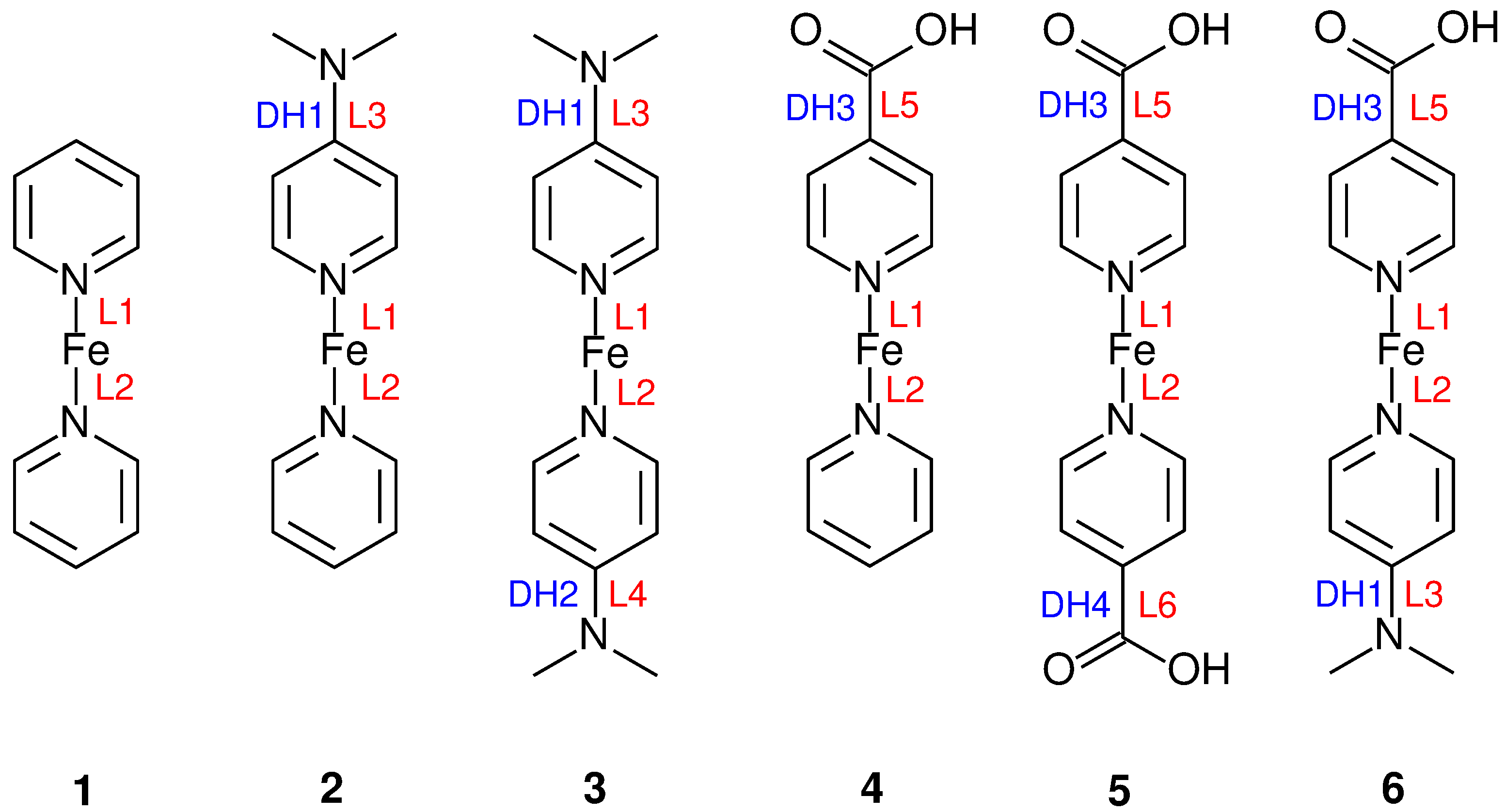
| L1 | L2 | L3 | L4 | L5 | L6 | DH1 | DH2 | DH3 | DH4 | |
|---|---|---|---|---|---|---|---|---|---|---|
| (Dn) | (Ac) | (Dn) | (Dn) | (Ac) | (Ac) | (Dn) | (Dn) | (Ac) | (Ac) | |
| A1 | 2.019 | 2.020 | ||||||||
| A2 | 2.019 | 2.020 | 1.372 | 14.3 | ||||||
| A3 | 2.019 | 2.019 | 1.372 | 1.373 | 13.9 | 15.0 | ||||
| A4 | 2.019 | 2.014 | 1.497 | 0.465 | ||||||
| A5 | 2.014 | 2.014 | 1.497 | 1.496 | 0.684 | 0.684 | ||||
| A6 | 2.019 | 2.011 | 1.371 | 1.496 | 15.1 | 0.980 | ||||
| B1 | 1.955 | 1.955 | ||||||||
| B2 | 1.958 | 1.950 | 1.374 | 15.0 | ||||||
| B3 | 1.955 | 1.955 | 1.379 | 1.378 | 21.7 | 17.8 | ||||
| B4 | 1.959 | 1.941 | 1.495 | 0.679 | ||||||
| B5 | 1.945 | 1.944 | 1.496 | 1.496 | 1.36 | 0.099 | ||||
| B6 | 1.998 | 1.972 | 1.369 | 1.493 | 11.1 | 4.50 | ||||
| C1 | 1.925 | 1.926 | ||||||||
| C2 | 1.954 | 1.949 | 1.370 | 11.1 | ||||||
| C3 | 1.954 | 1.954 | 1.372 | 1.374 | 14.2 | 16.1 | ||||
| C4 | 1.954 | 1.939 | 1.497 | 1.794 | ||||||
| C5 | 1.942 | 1.943 | 1.497 | 1.497 | 1.785 | 0.848 | ||||
| C6 | 1.957 | 1.936 | 1.370 | 1.496 | 11.6 | 0.237 | ||||
| D1 | 1.959 | 1.959 | ||||||||
| D2 | 1.963 | 1.958 | 1.373 | 17.2 | ||||||
| D3 | 1.962 | 1.963 | 1.373 | 1.375 | 15.8 | 18.0 | ||||
| D4 | 1.961 | 1.946 | 1.496 | 0.515 | ||||||
| D5 | 1.949 | 1.949 | 1.496 | 1.496 | 0.404 | 0.122 | ||||
| D6 | 1.965 | 1.944 | 1.370 | 1.495 | 12.5 | 1.941 | ||||
| E1 | 2.051 | 2.051 | ||||||||
| E2 | 2.053 | 2.050 | 1.373 | 14.5 | ||||||
| E3 | 2.052 | 2.055 | 1.373 | 1.374 | 14.0 | 15. | 1 | |||
| E4 | 2.051 | 2.037 | 1.494 | 2.538 | ||||||
| E5 | 2.037 | 2.041 | 1.495 | 1.495 | 2.316 | 3.127 | ||||
| E6 | 2.053 | 2.033 | 1.372 | 1.494 | 13.3 | 2.351 | ||||
| F1 | 2.070 | 2.070 | ||||||||
| F2 | 2.079 | 2.069 | 1.375 | 17.8 | ||||||
| F3 | 2.078 | 2.076 | 1.375 | 1.375 | 15.3 | 15. | 5 | |||
| F4 | 2.075 | 2.049 | 1.493 | 0.156 | ||||||
| F5 | 2.055 | 2.055 | 1.493 | 1.494 | 1.709 | 1.6 | ||||
| F6 | 2.083 | 2.044 | 1.373 | 1.492 | 17.4 | 0.406 | ||||
| G1 | 2.106 | 2.107 | ||||||||
| G2 | 2.114 | 2.105 | 1.374 | 14.3 | ||||||
| G3 | 2.105 | 2.109 | 1.375 | 1.375 | 13.6 | 13.7 | ||||
| G4 | 2.106 | 2.088 | 1.493 | 3.498 | ||||||
| G5 | 2.090 | 2.088 | 1.494 | 1.494 | 0.642 | 0.605 | ||||
| G6 | 2.109 | 2.079 | 1.374 | 1.493 | 14.4 | 0.203 |
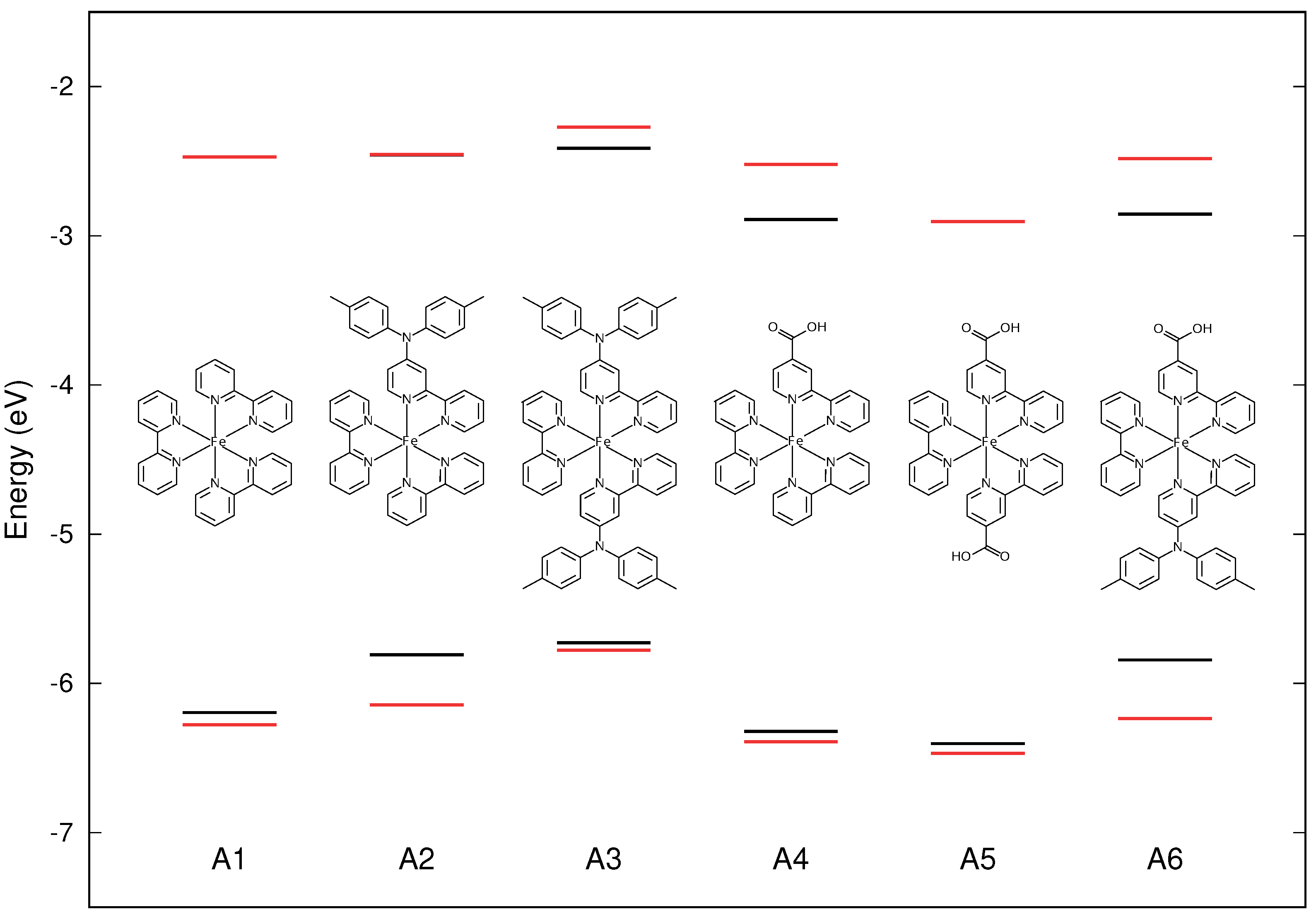
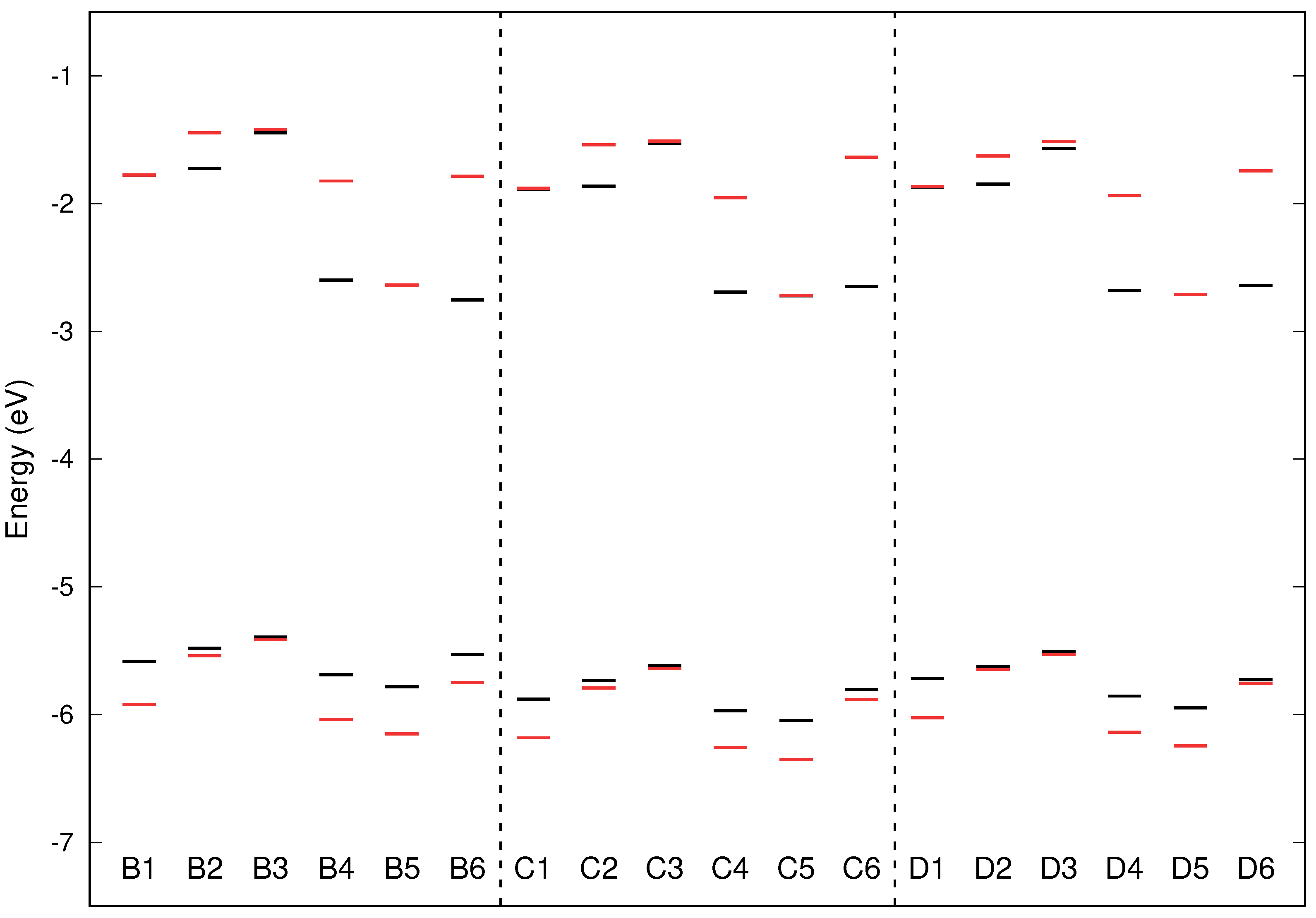
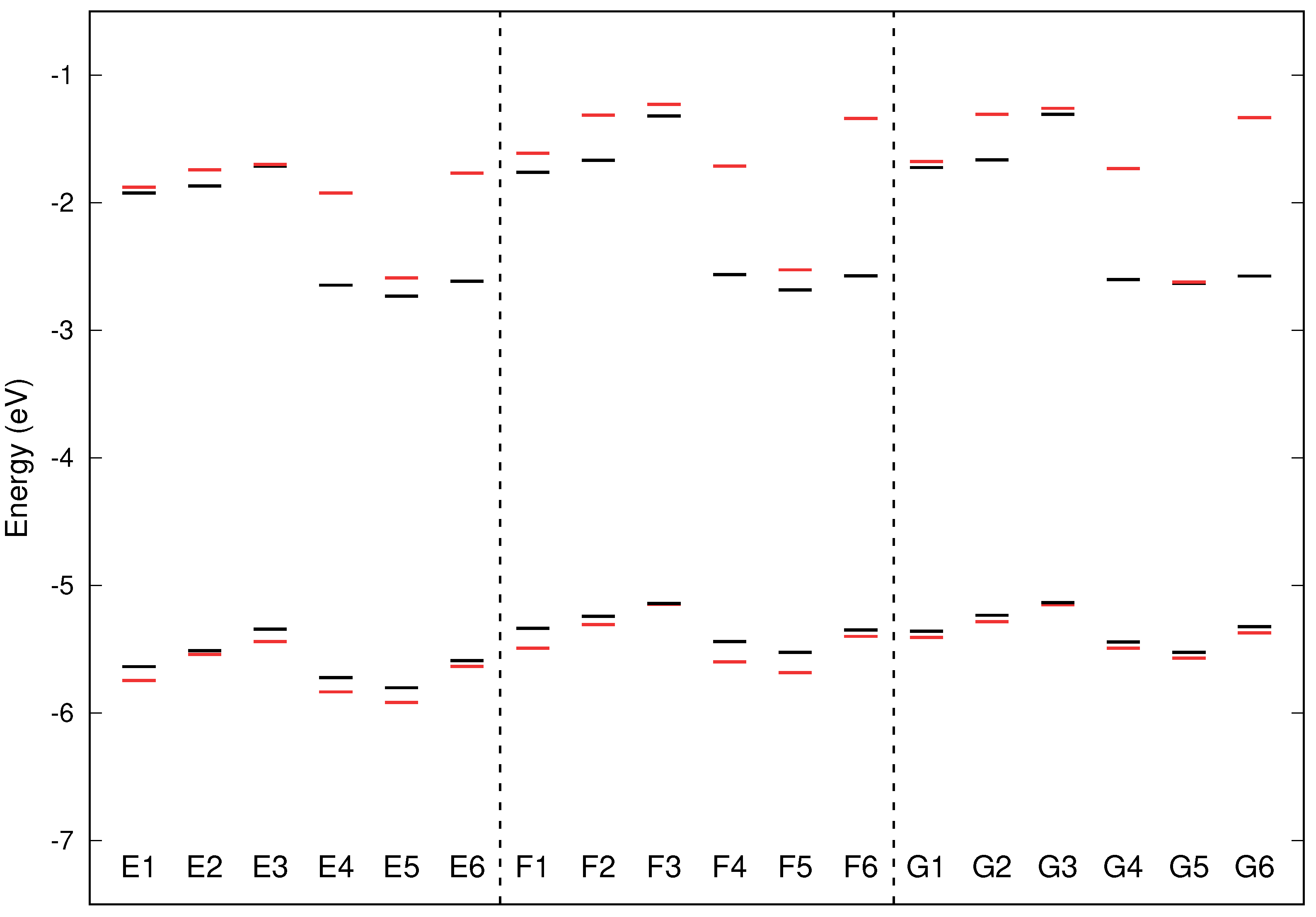
| Dye | HOMO − 2 | HOMO − 1 | HOMO | LUMO | LUMO + 1 | LUMO + 2 | H-L Gap |
|---|---|---|---|---|---|---|---|
| (eV) | (eV) | (eV) | (eV) | (eV) | (eV) | (eV) | |
| A1 | −6.279 | −6.277 | −6.195 | −2.472 | −2.470 | −2.469 | 3.724 |
| A2 | −6.192 | −6.144 | −5.808 | −2.459 | −2.454 | −2.294 | 3.349 |
| A3 | −6.058 | −5.776 | −5.728 | −2.413 | −2.271 | −2.259 | 3.315 |
| A4 | −6.399 | −6.392 | −6.321 | −2.890 | −2.521 | −2.511 | 3.431 |
| A5 | −6.482 | −6.469 | −6.403 | −2.904 | −2.904 | −2.542 | 3.498 |
| A6 | −6.281 | −6.234 | −5.842 | −2.853 | −2.483 | −2.316 | 2.989 |
| B1 | −5.925 | −5.923 | −5.584 | −1.778 | −1.775 | −1.500 | 3.806 |
| B2 | −5.787 | −5.539 | −5.482 | −1.723 | −1.445 | −1.421 | 3.759 |
| B3 | −5.441 | −5.414 | −5.391 | −1.446 | −1.420 | −1.413 | 3.945 |
| B4 | −6.047 | −6.038 | −5.688 | −2.600 | −1.823 | −1.613 | 3.088 |
| B5 | −6.152 | −6.150 | −5.781 | −2.637 | −2.637 | −1.675 | 3.144 |
| B6 | −6.178 | −5.750 | −5.531 | −2.753 | −1.785 | −1.674 | 2.778 |
| C1 | −6.185 | −6.181 | −5.880 | −1.886 | −1.880 | −1.567 | 3.994 |
| C2 | −6.034 | −5.793 | −5.735 | −1.862 | −1.539 | −1.535 | 3.873 |
| C3 | −5.705 | −5.639 | −5.617 | −1.532 | −1.509 | −1.488 | 4.085 |
| C4 | −6.266 | −6.259 | −5.969 | −2.691 | −1.954 | −1.691 | 3.278 |
| C5 | −6.354 | −6.350 | −6.045 | −2.723 | −2.719 | −1.752 | 3.322 |
| C6 | −6.136 | −5.883 | −5.804 | −2.649 | −1.638 | −1.573 | 3.155 |
| D1 | −6.026 | −6.025 | −5.717 | −1.868 | −1.866 | −1.674 | 3.850 |
| D2 | −5.885 | −5.646 | −5.622 | −1.846 | −1.626 | −1.532 | 3.776 |
| D3 | −5.541 | −5.526 | −5.507 | −1.567 | −1.512 | −1.481 | 3.941 |
| D4 | −6.141 | −6.137 | −5.854 | −2.678 | −1.936 | −1.794 | 3.176 |
| D5 | −6.248 | −6.246 | −5.946 | −2.712 | −2.710 | −1.861 | 3.234 |
| D6 | −6.004 | −5.755 | −5.727 | −2.639 | −1.744 | −1.550 | 3.088 |
| E1 | −6.155 | −5.744 | −5.635 | −1.924 | −1.879 | −1.593 | 3.711 |
| E2 | −6.036 | −5.539 | −5.512 | −1.867 | −1.742 | −1.511 | 3.645 |
| E3 | −5.909 | −5.441 | −5.342 | −1.712 | −1.700 | −1.325 | 3.630 |
| E4 | −6.255 | −5.834 | −5.723 | −2.645 | −1.923 | −1.748 | 3.078 |
| E5 | −6.346 | −5.917 | −5.801 | −2.731 | −2.587 | −1.782 | 3.069 |
| E6 | −6.086 | −5.634 | −5.589 | −2.615 | −1.768 | −1.713 | 2.975 |
| F1 | −5.882 | −5.490 | −5.335 | −1.762 | −1.612 | −1.114 | 3.574 |
| F2 | −5.773 | −5.306 | −5.242 | −1.666 | −1.312 | −1.100 | 3.576 |
| F3 | −5.657 | −5.149 | −5.140 | −1.318 | −1.228 | −1.085 | 3.822 |
| F4 | −6.003 | −5.598 | −5.440 | −2.564 | −1.714 | −1.368 | 2.876 |
| F5 | −6.100 | −5.683 | −5.523 | −2.683 | −2.526 | −1.405 | 2.840 |
| F6 | −5.895 | −5.399 | −5.349 | −2.573 | −1.337 | −1.240 | 2.776 |
| G1 | −5.842 | −5.406 | −5.357 | −1.724 | −1.677 | −1.185 | 3.632 |
| G2 | −5.736 | −5.284 | −5.233 | −1.663 | −1.307 | −1.159 | 3.570 |
| G3 | −5.636 | −5.152 | −5.136 | −1.306 | −1.259 | −1.148 | 3.829 |
| G4 | −5.942 | −5.491 | −5.443 | −2.602 | −1.731 | −1.319 | 2.842 |
| G5 | −6.034 | −5.570 | −5.524 | −2.631 | −2.620 | −1.402 | 2.893 |
| G6 | −5.845 | −5.373 | −5.322 | −2.574 | −1.333 | −1.277 | 2.748 |
| Dye | Electronic | Oscillator | MO Designation | ||
|---|---|---|---|---|---|
| Transition | (nm) | (eV) | Strength (f) | Character (Coef) | |
| A1 | 415.0 | 2.988 | 0.074 | H-1 → L (0.8598) | |
| A2 | 433.6 | 2.860 | 0.080 | H-2 → L (0.4751) | |
| A3 | 446.0 | 2.780 | 0.112 | H → L+1 (0.6283) | |
| A4 | 407.3 | 3.044 | 0.079 | H-2 → L+2 (0.7128) | |
| A5 | 450.6 | 2.751 | 0.173 | H-1 → L+1 (0.3923) | |
| A6 | 463.3 | 2.676 | 0.085 | H-1 → L+1 (0.4363) | |
| B1 | 356.6 | 3.477 | 0.276 | H → L+3 (0.7884) | |
| B2 | 361.9 | 3.426 | 0.438 | H → L+3 (0.6993) | |
| B3 | 383.3 | 3.235 | 0.592 | H-1 → L (0.2415) | |
| B4 | 436.3 | 2.841 | 0.195 | H → L+3 (0.6860) | |
| B5 | 440.2 | 2.817 | 0.398 | H-2 → L (0.2933) | |
| B6 | 392.6 | 3.158 | 0.110 | H-1 → L+1 (0.5088) | |
| C1 | 361.0 | 3.434 | 0.169 | H-1 → L (0.4603) | |
| C2 | 362.2 | 3.423 | 0.296 | H → L+2 (0.4673) | |
| C3 | 369.6 | 3.355 | 0.675 | H-1 → L+1 (0.4863) | |
| C4 | 365.5 | 3.392 | 0.114 | H-1 → L+2 (0.7269) | |
| C5 | 424.8 | 2.919 | 0.346 | H-1 → L (0.4572) | |
| C6 | 359.4 | 3.450 | 0.258 | H → L+2 (0.5401) | |
| D1 | 360.5 | 3.439 | 0.180 | H → L+3 (0.8355) | |
| D2 | 376.7 | 3.291 | 0.306 | H → L+3 (0.5077) | |
| D3 | 382.1 | 3.245 | 0.586 | H-1 → L+2 (0.3721) | |
| D4 | 434.7 | 2.852 | 0.183 | H-1 → L (0.7188) | |
| D5 | 441.1 | 2.811 | 0.343 | H-2 → L+1 (0.3884) | |
| D6 | 375.3 | 3.304 | 0.278 | H-1 → L+2 (0.5503) | |
| E1 | 374.6 | 3.310 | 0.092 | H-1 → L+2 (0.8233) | |
| E2 | 376.7 | 3.291 | 0.116 | H → L+2 (0.3394) | |
| E3 | 374.2 | 3.314 | 0.296 | H → L+2 (0.8794) | |
| E4 | 476.1 | 2.604 | 0.140 | H-1 → L (0.8201) | |
| E5 | 481.8 | 2.573 | 0.243 | H-1 → L (0.8790) | |
| E6 | 499.7 | 2.481 | 0.150 | H → L (0.7074) | |
| F1 | 414.9 | 2.989 | 0.190 | H-1 → L (0.9901) | |
| F2 | 425.1 | 2.917 | 0.131 | H-1 → L (0.7450) | |
| F3 | 393.4 | 3.151 | 0.507 | H-1 → L (0.7977) | |
| F4 | 498.9 | 2.485 | 0.145 | H-1 → L (0.7179) | |
| F5 | 519.4 | 2.387 | 0.287 | H-1 → L (0.9789) | |
| F6 | 531.5 | 2.333 | 0.210 | H-1 → L (0.8677) | |
| G1 | 413.4 | 2.999 | 0.075 | H-1 → L+1 (0.4235) | |
| G2 | 381.1 | 3.254 | 0.153 | H-1 → L+1 (0.4841) | |
| G3 | 387.7 | 3.198 | 0.216 | H → L+1 (0.8211) | |
| G4 | 528.5 | 2.346 | 0.155 | H-1 → L (0.7123) | |
| G5 | 539.3 | 2.299 | 0.149 | H-1 → L+1 (0.8709) | |
| G6 | 540.9 | 2.292 | 0.164 | H-1 → L (0.8705) |
| Dye | HOMO | GSOP | ESOP | LHE | ||||
|---|---|---|---|---|---|---|---|---|
| (eV) | (eV) | (eV) | (eV) | (eV) | (eV) | (%) | (ns) | |
| A1 | −6.195 | 2.988 | 6.195 | 3.207 | −0.793 | −1.395 | 15.7 | 33.6 |
| A2 | −5.808 | 2.860 | 5.808 | 2.948 | −1.052 | −1.008 | 16.8 | 34.1 |
| A3 | −5.728 | 2.780 | 5.728 | 2.948 | −1.052 | −0.928 | 22.8 | 25.7 |
| A4 | −6.321 | 3.044 | 6.321 | 3.277 | −0.723 | −1.521 | 16.7 | 30.4 |
| A5 | −6.403 | 2.751 | 6.403 | 3.652 | −0.348 | −1.603 | 32.8 | 17.0 |
| A6 | −5.842 | 2.676 | 5.842 | 3.166 | −0.834 | −1.042 | 17.8 | 36.6 |
| B1 | −5.584 | 3.477 | 5.584 | 2.107 | −1.893 | −0.784 | 47.1 | 6.7 |
| B2 | −5.482 | 3.426 | 5.482 | 2.056 | −1.944 | −0.682 | 63.5 | 4.3 |
| B3 | −5.391 | 3.235 | 5.391 | 2.156 | −1.844 | −0.591 | 74.4 | 3.6 |
| B4 | −5.688 | 2.841 | 5.688 | 2.847 | −1.153 | −0.888 | 36.2 | 14.2 |
| B5 | −5.781 | 2.817 | 5.781 | 2.964 | −1.036 | −0.981 | 60.0 | 7.1 |
| B6 | −5.531 | 3.158 | 5.531 | 2.373 | −1.627 | −0.731 | 22.4 | 20.3 |
| C1 | −5.880 | 3.434 | 5.880 | 2.446 | −1.554 | −1.080 | 32.2 | 11.2 |
| C2 | −5.735 | 3.423 | 5.735 | 2.312 | −1.688 | −0.935 | 49.4 | 6.4 |
| C3 | −5.617 | 3.355 | 5.617 | 2.262 | −1.738 | −0.817 | 78.9 | 2.9 |
| C4 | −5.969 | 3.727 | 5.969 | 2.577 | −1.423 | −1.169 | 23.1 | 14.1 |
| C5 | −6.045 | 2.919 | 6.045 | 3.126 | −0.874 | −1.245 | 54.9 | 7.6 |
| C6 | −5.804 | 3.450 | 5.804 | 2.354 | −1.646 | −1.004 | 44.7 | 7.3 |
| D1 | −5.717 | 3.439 | 5.717 | 2.278 | −1.722 | −0.917 | 33.9 | 10.5 |
| D2 | −5.622 | 3.291 | 5.622 | 2.331 | −1.669 | −0.822 | 50.6 | 6.7 |
| D3 | −5.507 | 3.245 | 5.507 | 2.262 | −1.738 | −0.707 | 74.1 | 3.6 |
| D4 | −5.854 | 2.852 | 5.854 | 3.002 | −0.998 | −1.054 | 34.4 | 14.9 |
| D5 | −5.946 | 2.811 | 5.946 | 3.135 | −0.865 | −1.146 | 54.6 | 8.2 |
| D6 | −5.727 | 3.304 | 5.727 | 2.423 | −1.577 | −0.927 | 47.3 | 7.3 |
| E1 | −5.635 | 3.310 | 5.635 | 2.325 | −1.675 | −0.835 | 19.1 | 22.1 |
| E2 | −5.512 | 3.291 | 5.512 | 2.221 | −1.779 | −0.712 | 23.4 | 17.8 |
| E3 | −5.342 | 3.314 | 5.342 | 2.028 | −1.972 | −0.542 | 49.4 | 6.9 |
| E4 | −5.723 | 2.604 | 5.723 | 3.119 | −0.881 | −0.923 | 27.6 | 23.4 |
| E5 | −5.801 | 2.573 | 5.801 | 3.228 | −0.772 | −1.001 | 42.9 | 13.8 |
| E6 | −5.589 | 2.481 | 5.589 | 3.108 | −0.892 | −0.789 | 29.2 | 24.1 |
| F1 | −5.335 | 2.989 | 5.335 | 2.346 | −1.654 | −0.535 | 35.5 | 13.1 |
| F2 | −5.242 | 2.917 | 5.242 | 2.325 | −1.675 | −0.442 | 26.0 | 20.0 |
| F3 | −5.140 | 3.151 | 5.140 | 1.989 | −2.011 | −0.340 | 68.9 | 4.4 |
| F4 | −5.440 | 2.485 | 5.440 | 2.955 | −1.045 | −0.640 | 28.4 | 24.9 |
| F5 | −5.523 | 2.387 | 5.523 | 3.136 | −0.864 | −0.723 | 48.4 | 13.6 |
| F6 | −5.349 | 2.333 | 5.349 | 3.016 | −0.984 | −0.549 | 38.3 | 19.5 |
| G1 | −5.357 | 2.999 | 5.357 | 2.358 | −1.642 | −0.557 | 15.8 | 33.2 |
| G2 | −5.233 | 3.254 | 5.233 | 1.979 | −2.021 | −0.433 | 29.7 | 13.8 |
| G3 | −5.136 | 3.198 | 5.136 | 1.938 | −2.062 | −0.336 | 39.2 | 10.1 |
| G4 | −5.443 | 2.346 | 5.443 | 3.097 | −0.903 | −0.643 | 30.0 | 26.1 |
| G5 | −5.524 | 2.299 | 5.524 | 3.225 | −0.775 | −0.724 | 29.0 | 28.3 |
| G6 | −5.322 | 2.292 | 5.322 | 3.030 | −0.970 | −0.522 | 31.5 | 25.8 |
| Complex | |||||||
|---|---|---|---|---|---|---|---|
| (eV) | (eV) | (eV) | (eV) | (eV) | (eV) | (eV) | |
| A1 | −74,813.107 | −74,807.804 | −74,812.678 | −74,807.856 | 0.428 | 0.052 | 0.481 |
| A2 | −91,029.039 | −91,023.871 | −91,028.977 | −91,023.939 | 0.062 | 0.067 | 0.130 |
| A3 | −107,244.960 | −107,239.927 | −107,244.891 | −107,240.001 | 0.070 | 0.074 | 0.143 |
| A4 | −79,944.520 | −79,939.143 | −79,944.472 | −79,939.195 | 0.048 | 0.052 | 0.100 |
| A5 | −85,075.939 | −85,070.490 | −85,075.891 | −85,070.541 | 0.048 | 0.051 | 0.099 |
| A6 | −96,160.461 | −96,155.219 | −96,160.396 | −96,155.289 | 0.065 | 0.069 | 0.134 |
| B1 | −76,654.866 | −76,650.072 | −76,654.831 | −76,650.147 | 0.036 | 0.075 | 0.110 |
| B2 | −92,870.742 | −92,866.058 | −92,870.655 | −92,866.155 | 0.086 | 0.097 | 0.184 |
| B3 | −109,086.602 | −109,082.013 | −109,086.507 | −109,082.116 | 0.095 | 0.103 | 0.198 |
| B4 | −81,786.295 | −81,781.413 | −81,786.249 | −81,781.476 | 0.045 | 0.063 | 0.108 |
| B5 | −86,917.716 | −86,912.753 | −86,917.666 | −86,912.805 | 0.050 | 0.052 | 0.102 |
| B6 | −97,999.456 | −97,994.953 | −97,999.385 | −97,995.029 | 0.071 | 0.076 | 0.147 |
| C1 | −93,374.231 | −93,368.976 | −93,374.144 | −93,369.171 | 0.087 | 0.195 | 0.282 |
| C2 | −109,590.117 | −109,585.120 | −109,589.994 | −109,585.242 | 0.124 | 0.121 | 0.245 |
| C3 | −125,805.995 | −125,801.138 | −125,805.890 | −125,801.252 | 0.105 | 0.113 | 0.218 |
| C4 | −98,505.642 | −98,500.437 | −98,505.558 | −98,500.505 | 0.084 | 0.068 | 0.152 |
| C5 | −103,637.047 | −103,631.774 | −103,636.973 | −103,631.836 | 0.074 | 0.062 | 0.136 |
| C6 | −114,721.538 | −114,716.453 | −114,721.406 | −114,716.577 | 0.131 | 0.124 | 0.255 |
| D1 | −89,485.959 | −89,481.081 | −89,485.909 | −89,481.133 | 0.051 | 0.052 | 0.103 |
| D2 | −105,701.858 | −105,697.090 | −105,701.780 | −105,697.167 | 0.078 | 0.077 | 0.154 |
| D3 | −121,917.741 | −121,913.098 | −121,917.650 | −121,913.178 | 0.091 | 0.079 | 0.170 |
| D4 | −94,617.376 | −94,612.414 | −94,617.324 | −94,612.467 | 0.052 | 0.052 | 0.104 |
| D5 | −99,748.785 | −99,743.744 | −99,748.734 | −99,743.796 | 0.051 | 0.052 | 0.102 |
| D6 | −110,833.283 | −110,828.432 | −110,833.208 | −110,828.502 | 0.075 | 0.071 | 0.146 |
| E1 | −77,855.785 | −77,850.962 | −77,855.739 | −77,851.008 | 0.046 | 0.046 | 0.092 |
| E2 | −94,071.710 | −94,067.009 | −94,071.647 | −94,067.073 | 0.062 | 0.064 | 0.126 |
| E3 | −110,287.626 | −110,283.076 | −110,287.551 | −110,283.156 | 0.074 | 0.081 | 0.155 |
| E4 | −82,987.221 | −82,982.328 | −82,987.174 | −82,982.374 | 0.047 | 0.046 | 0.093 |
| E5 | −88,118.651 | −88,113.692 | −88,118.604 | −88,113.737 | 0.047 | 0.045 | 0.092 |
| E6 | −99,203.149 | −99,198.363 | −99,203.084 | −99,198.429 | 0.065 | 0.066 | 0.131 |
| F1 | −78,792.618 | −78,788.096 | −78,792.569 | −78,788.148 | 0.049 | 0.052 | 0.100 |
| F2 | −95,008.534 | −95,004.108 | −95,008.464 | −95,004.186 | 0.070 | 0.079 | 0.149 |
| F3 | −111,224.439 | −111,220.159 | −111,224.354 | −111,220.247 | 0.085 | 0.088 | 0.174 |
| F4 | −83,924.069 | −83,919.477 | −83,924.019 | −83,919.528 | 0.050 | 0.051 | 0.101 |
| F5 | −89,055.512 | −89,050.853 | −89,055.464 | −89,050.902 | 0.050 | 0.048 | 0.098 |
| F6 | −100,139.988 | −100,135.480 | −100,139.932 | −100,135.548 | 0.055 | 0.068 | 0.123 |
| G1 | −78,792.717 | −78,788.202 | −78,792.663 | −78,788.257 | 0.054 | 0.055 | 0.109 |
| G2 | −95,008.635 | −95,004.240 | −95,008.561 | −95,004.313 | 0.075 | 0.073 | 0.147 |
| G3 | −111,224.547 | −111,220.250 | −111,224.463 | −111,220.335 | 0.084 | 0.086 | 0.170 |
| G4 | −83,924.161 | −83,919.580 | −83,924.108 | −83,919.634 | 0.053 | 0.055 | 0.108 |
| G5 | −89,055.602 | −89,050.951 | −89,055.549 | −89,051.004 | 0.053 | 0.053 | 0.106 |
| G6 | −100,140.081 | −100,134.146 | −100,140.007 | −100,135.690 | 0.074 | 1.544 | 1.619 |
Disclaimer/Publisher’s Note: The statements, opinions and data contained in all publications are solely those of the individual author(s) and contributor(s) and not of MDPI and/or the editor(s). MDPI and/or the editor(s) disclaim responsibility for any injury to people or property resulting from any ideas, methods, instructions or products referred to in the content. |
© 2026 by the authors. Licensee MDPI, Basel, Switzerland. This article is an open access article distributed under the terms and conditions of the Creative Commons Attribution (CC BY) license.
Share and Cite
Helal, W.; Siedat, A.M.; Alrub, A.M.; Atiewi, S.; Barham, A.S.; Alkhatab, M.I.; Elzein, B. Enhancing the Photophysical Properties of NHC-Based Iron Sensitizers for Dye-Sensitized Solar Cells: A Computational Study. Inorganics 2026, 14, 64. https://doi.org/10.3390/inorganics14020064
Helal W, Siedat AM, Alrub AM, Atiewi S, Barham AS, Alkhatab MI, Elzein B. Enhancing the Photophysical Properties of NHC-Based Iron Sensitizers for Dye-Sensitized Solar Cells: A Computational Study. Inorganics. 2026; 14(2):64. https://doi.org/10.3390/inorganics14020064
Chicago/Turabian StyleHelal, Wissam, Ayat M. Siedat, Ahmad Musleh Alrub, Saleh Atiewi, Ahmad S. Barham, Mohammad I. Alkhatab, and Basma Elzein. 2026. "Enhancing the Photophysical Properties of NHC-Based Iron Sensitizers for Dye-Sensitized Solar Cells: A Computational Study" Inorganics 14, no. 2: 64. https://doi.org/10.3390/inorganics14020064
APA StyleHelal, W., Siedat, A. M., Alrub, A. M., Atiewi, S., Barham, A. S., Alkhatab, M. I., & Elzein, B. (2026). Enhancing the Photophysical Properties of NHC-Based Iron Sensitizers for Dye-Sensitized Solar Cells: A Computational Study. Inorganics, 14(2), 64. https://doi.org/10.3390/inorganics14020064