Article

Spectral Fluorescence Foundations for a Promising UV LED-Based Milk Analyzer


by
Alexey V. Shkirin
1,2,*,
Egor I. Nagaev
3,
Dmitry N. Ignatenko
3,
Leonid L. Chaikov
1,
Andrey N. Lobanov
1,
Pavel P. Sverbil
1,
Svetlana E. Dimitrieva
1,
Maria A. Shermeneva
3,
Sergey N. Chirikov
2 and
Nikolai V. Suyazov
3
1
P.N. Lebedev Physical Institute of the Russian Academy of Sciences, Leninskiy Prospekt 53, Moscow 119991, Russia
2
Laser Physics Department, National Research Nuclear University MEPhI, Kashirskoe sh. 31, Moscow 115409, Russia
3
Prokhorov General Physics Institute of the Russian Academy of Sciences, Vavilova st. 38, Moscow 119991, Russia
*
Author to whom correspondence should be addressed.
Photonics 2026, 13(6), 577; https://doi.org/10.3390/photonics13060577 (registering DOI)
Submission received: 9 April 2026 / Revised: 30 May 2026 / Accepted: 11 June 2026 / Published: 13 June 2026
(This article belongs to the Special Issue Optical Sensors and Devices)

Abstract

Fluorescence emission-excitation matrices for cow milk samples with different fat contents in the range of 0.05–10% and a constant protein content of 3%, as well as for butter and extracted milk components such as casein and lactose, have been measured using a spectrofluorometer. The influence of the increased fat content on the shape of the fluorescence spectra of milk has been studied. In addition, fluorescence spectra measured for serial dilutions of high-fat milk with water and skim milk, along with aqueous dilutions of skim milk, have shown that the fluorescence diagnostics of fat and protein content in milk can be implemented using excitation at only two wavelengths: 280 and 320 nm. The optimal spectral ranges proposed for detecting the content of milk components via fluorescence measurements can be useful when designing UV LED-based fluorescence analyzers of milk composition.

1. Introduction

The growing consumer demand for quality food products has led to an increased need for inexpensive, accurate, and fast quality control instruments in the dairy industry. Modern industrial automation tends to eliminate the human factor in assessing technological parameters and decision-making at all stages of production. Classical diagnostic methods are often very cumbersome and time-consuming; therefore, to ensure the best quality and safety control in production, more technologically advanced analytical tools associated with optical non-destructive methods are required [1]. These methods relate primarily to various types of spectroscopy. In the last decade, fluorescence spectrometry has emerged as a reliable tool for monitoring the properties of a variety of food products [2,3]. This method is so sensitive that it allows for determining not only the properties of the product under study, but also their changes under various conditions of production, transportation and storage. More details about these features of fluorescence diagnostics can be found in [4].
Milk quality control is aimed at identifying milk of inadequate quality and determining the content of hazardous impurities. It is also necessary to assess the quality of milk processing before direct shipment to the consumer. Classical microbiological and chemical analyses of milk and its derivatives give objective, accurate and reproducible results. Among the classical methods, the butyrometric method, the Folch method, the dry-column method and chromatographic methods should be noted as the most common [5]. However, on one hand, these methods require highly qualified specialists and expensive consumables. On the other hand, such analyses are destructive and time-consuming. The use of optical devices is an alternative that can implement the principles of non-destructive testing [6]. For example, Raman spectroscopy can determine milk fat content, as well as lactose and adulterant impurities [7], but it requires a high-resolution Raman spectrometer, which is prohibitively expensive, as well as qualified personnel to operate it and process the results. Methods based on infrared absorption spectroscopy [5], including Fourier transform infrared spectroscopy (FTIR), have similar disadvantages, preventing them from being used as the basis for compact, inexpensive, and high-throughput analyzers.
In recent years, the use of fluorescence detection for food analysis has grown rapidly [6]. Fluorescence spectroscopy is an accurate and fast non-invasive method capable of providing information about the presence of fluorescent molecules and their environment [3,4]. Each fluorophore has its own unique excitation and emission spectrum, which can be used to determine the presence of compositional or structural changes in a particular molecule. For effective excitation of fluorescence of various milk components, pump radiation in the spectral range of 260–400 nm is used [2,3,4,8]. Note that the spectral properties of fluorophores can change depending on the conditions. Fluorescence in dairy products is caused by chemical compounds naturally present in the sample matrix. These include riboflavin, carotenoids, vitamin A, aromatic amino acids, Maillard reaction products, NADH, porphyrins, chlorophylls, and lipid oxidation products [2].
Typically, fluorescence diagnostics is applied to transparent solutions with known fluorophores. In this case, fluorescence emission measurements are taken from the side of the sample at an angle of 90° relative to the excitation beam. When the concentration is below a certain level, the measured intensity is proportional to the concentration and obeys the Lambert–Beer law. Scattering, quenching, and internal filter effects break this relationship when the concentration is high. For dense samples, front-face fluorescence spectroscopy (FFFS) can be used instead of the classical right-angle technique. It measures the fluorescence emitted only from the surface of the sample, which reduces the impact of light absorption and scattering. When measuring front-face fluorescence, an oblique angle is commonly set between the sample surface and the light beam. In production, the fluorescent analysis of dairy products is mostly carried out using FFFS [2,9,10,11,12].
Among the dairy components, the content and condition of fat in dairy products are of paramount importance. Often this is a key quality-forming component. Milk fat is approximately 96% triglycerides (1 molecule of glycerol and three fatty acids), 2–3% diglycerides, 1% phospholipids, essential polyunsaturated fatty acids such as linoleic acid (LA) and linolenic acid, as well as fat-soluble vitamins (A, B, D, E, and K), cholesterol, and carotenoids. The assessment of milk fat content in dairy products is the basis of quality control in the dairy industry and testing for adulteration. Fluorescence spectroscopy combined with statistical methods of analysis can be useful in such analyses because it is fast, non-destructive, and cheaper than conventional analytical methods [13]. Fat affects both flavor and texture and serves as a major solvent for many flavor compounds, while a marked reduction in fat content alters aroma and taste. It has been suggested that the fat globules have a “ball bearing” effect, whereby they rotate relative to each other under shear conditions in the mouth, and this creates mass fluidity that weakens the forces acting on the palate [14].
Several fluorometric studies conducted on various samples of dairy products have shown that fluorescence measurements at an excitation maximum of about 325 nm and an emission maximum of about 410 nm correspond to fat-soluble vitamin A [4,14,15]. Vitamin A is a fluorescent carotenoid with excitation and emission maxima in a pure solution of about 325 and 470 nm, respectively [16]. Carotenoids and vitamin A are associated with the fat phase of milk and are absent in milk plasma. Approximately 95% of these substances are located in the core of fat globules, and 5% in the membranes. Carotenoids together with vitamin A make up 0.002% of the total mass of fat [17,18]. Using vitamin A as an internal fluorescent marker, fluorescence spectra can also provide information about the physical state of triglycerides and protein-lipid interactions [15]. Moreover, we presume that measuring vitamin A may allow us to indirectly judge dairy cattle nutrition and the biological value of milk. It was shown that the excitation spectra of semi-hard cheeses in the range from 260 to 350 nm (measured at the emission wavelength of 410 nm), showed a maximum at 322 nm and two shoulders at 295 and 305 nm [19]. The peak at 322 nm increased with maturation time, while the shoulder at 295 nm decreased. These spectra were assigned to vitamin A, and variations were attributed to changes in the molecular environment of vitamin A, solvent viscosity, and the physical state of triglycerides in fat globules during maturation, and emission spectra were examined in the range from 400 to 640 nm (excitation at 380 nm) during the maturation of raclette cheese. Several components have been proposed to influence the emission spectra, such as riboflavin, lumiflavin, vitamin A, oxidation products, and β-carotene. Emission spectra of tryptophan residues (305–400 nm) were recorded at an excitation wavelength of 290 nm, and vitamin A excitation spectra (260–350 nm) were recorded at an emission wavelength of 410 nm [20]. Differences observed for vitamin A fluorescence spectra are consistent with changes in lipid structure, but their interpretation at the molecular level is more difficult. In addition, changes in the shape of vitamin A excitation spectra recorded during milk clotting correlate with changes in fat-globule/protein interactions.
Using the FFFS method, it is possible to determine impurities in milk. Synchronous front-face fluorescence spectroscopy, together with partial least squares regression (PLSR), was used to quantitatively predict cow and buffalo milk adulteration [21]. Samples of fresh (unprocessed) cow and buffalo milk were collected from local dairy farms. Fluorescence emission from milk samples of different origins mixed at different concentrations showed intensity changes at wavelengths of 370–380 nm, 410 nm, 442 nm and 520–560 nm. This helps to determine the impurities of one type of milk in the milk in another, as well as to detect external agents (adulterants) added to milk and other dairy products. The emission at 442 nm is due to the fat-soluble vitamin A (abundant in buffalo milk), while the emission at the 525–560 nm band corresponds to beta-carotene (a precursor of vitamin A available in cow’s milk). In cow and buffalo milk, differences were found in the fluorescence emission at the 382 nm, 440 nm, 505 nm and 525 nm bands, acquired in both classical right-angle and front-face geometries [22]. In the front-face fluorescence geometry, the synchronous fluorescence emission shows clear differences at 410 and 440 nm between the milk samples of both species. These fluorescence bands correspond to fats, vitamin A and β-carotene.
The fluorescence method can be used for assessing dairy products in real time [23]. So, the fluorescence of tryptophan, Maillard reaction products and NADH, measured by time-resolved fluorescence, was used to distinguish milk powder with different fat contents and heat treatments. Fat globule fluorescence at 315 nm excitation and 468 nm emission provided good classification.
It is also worth considering that the fluorescence of fat can affect the fluorescence detection of other milk components. The fat content also affects light scattering in milk [8]. To eliminate the effects of light scattering on the fluorescence spectra of milk, it is preferable to use the front-face geometry.
For some tasks related to the determination of fat, it is proposed to combine fluorescence with other spectroscopy methods. So, for the classification of 23 commercial samples of milk according to fat content and animal origin, three methods of optical spectroscopy (UV absorption, fluorescence and FTIR reflectance) were applied in combination with multivariate statistical analysis (OPLS-DA) [13]. Success rates for grouping samples by fat content or by animal origin range from 70% to 96%, suggesting that the combined spectroscopy and statistical analysis approach works well even for small (<25) groupings of milk samples. Using rheological measurements and front-face fluorescence spectroscopy in combination with a multidimensional statistical method, the influence of the surface composition of fat globules in reconstituted milk on the properties of rennet clots was explored to reveal the structural evolution at the molecular level during milk coagulation [24]. It was shown that the fluorescent properties of protein tryptophan and, consequently, the structure of protein networks differed for the various studied fat-protein systems.
In this work, based on the measured fluorescence emission-excitation matrices (FEEMs) for cow milk samples, we draw practical conclusions about what optimal spectral bands of excitation and emission radiation are needed for the fluorescence determination of the percentage of the main components in milk (casein and fat) in order to develop devices for monitoring the composition of milk.
Portable fluorescent sensors based on light-emitting diodes (LEDs) that are highly sensitive to organic substances have been actively developed and implemented recently [25,26]. Note that a fiber-optic fluorescent sensor was previously proposed for measuring the fat content of milk in containers using fluorescence excitation at a wavelength of 530 nm [27]. Fiber optic systems for fluorescent sensors intended for chemical and biological measurements were reviewed in [28]. The most variable parameter during milking is the fat content, while the contents of protein and lactose in raw cow milk do not deviate significantly from the average values. Due to this fact, we studied the spectral fluorescence of milk with different fat contents.

2. Materials and Methods

We measured fluorescence maps using the FP-8300 spectrofluorimeter (Jasco UK, Ltd., Heckmondwike, UK), which has the following performance characteristics:
-
A wavelength range, 200 to 750 nm (to 900 nm, option);
-
A spectral resolution, 1.0 nm.
The standard automatic cut-off filter for higher-order diffraction allows for obtaining spectra without artificial peaks from second order light. Right-angle fluorescence measurements were performed using a quartz rectangular 1 × 1 cm2 cuvette; the fluorescent radiation was collected from the side face of the cuvette. Front-face fluorescence measurements were performed using a quartz rectangular 1 × 2 cm2 cuvette; the fluorescent radiation was collected from the front face of the cuvette at an angle of 90° to the axis of the exciting beam incident at an angle of 45° to the cuvette.
We studied spectral fluorescence of the individual components of cow milk as well as butter. Casein from bovine milk in powder form was purchased from Sigma Aldrich (Saint Louis, MO, USA). The content of protein was 87–94%. Granulated lactose Super Tab 30 GR was purchased from DFE pharma (Goch, Germany). Farmer butter with 82.5% fat was purchased from the “Farmer Corner” open company (Volokolamsk district, Moscow region, Russia). We conducted fluorescence experiments with cow milk samples commercially produced using the technology of UHT pasteurization and homogenization with different fat percentages: 0.05%, 0.5%, 1.5%, 3.2%, 6% and 10% (cream).

3. Results

We experimentally studied the fluorescence of cow milk with different fat contents, as well as butter and refined components extracted from cow milk.

3.1. Fluorescence Emission-Excitation Matrices (FEEM)

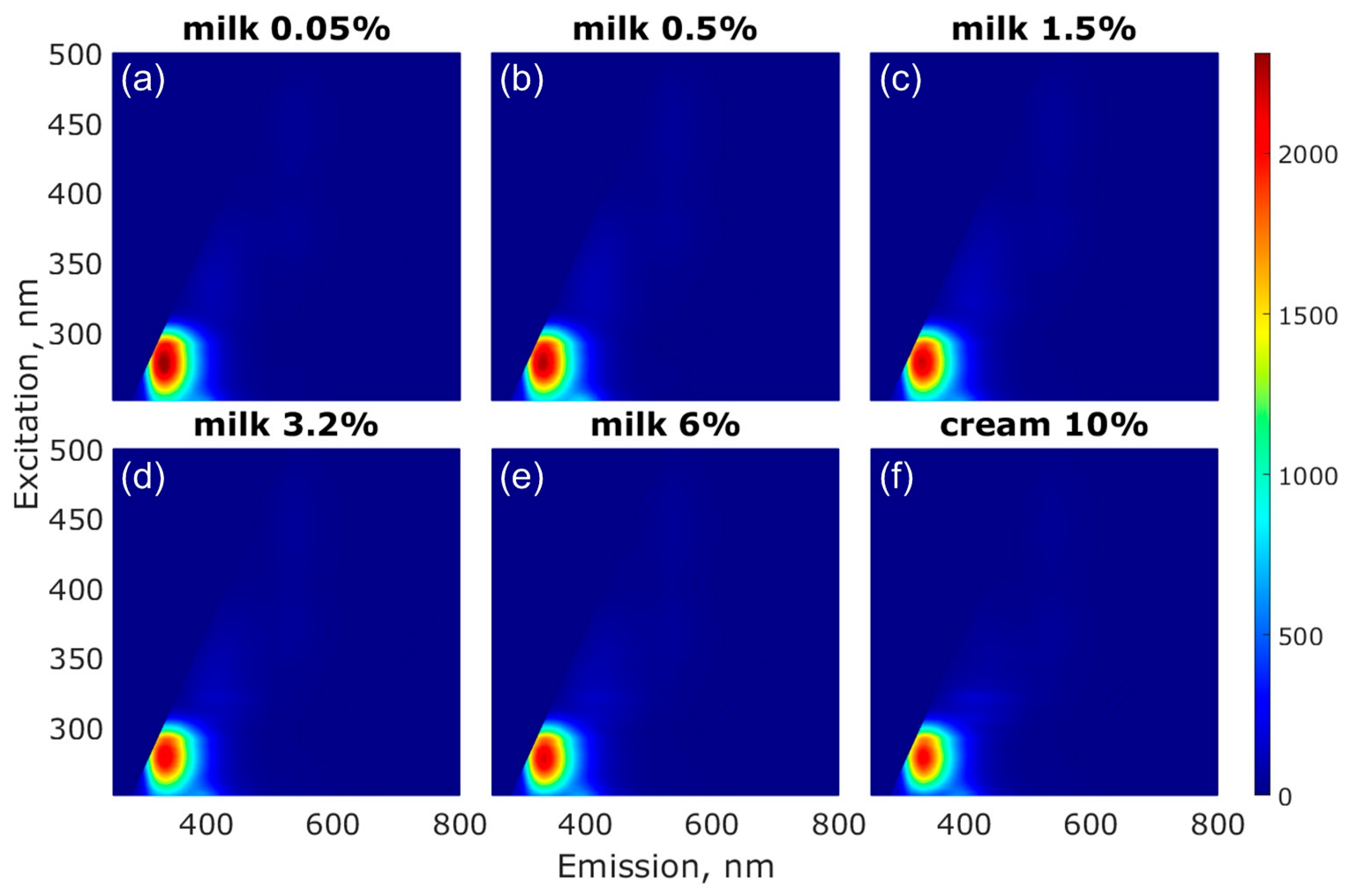
The FEEMs measured using the front-face geometry for cow milk samples with different nominal fat percentages are presented in Figure 1.
In the fluorescence map of cow milk (Figure 1), the strongest peak corresponding to casein is clearly seen at 280 nm excitation with 360 nm emission. It appears that the spectra of milk samples with different fat contents are almost identical. The only feature that changes with increasing fat content is that the contrast of the spectra decreases until the sharp peak disappears in the case of cream. It is possible that this is an artifact associated with the contribution of luminescence-scattering on emulsion fat particles in milk. With increasing fat content, the role of scattering increases, which leads to a visible broadening of the spectral curve.
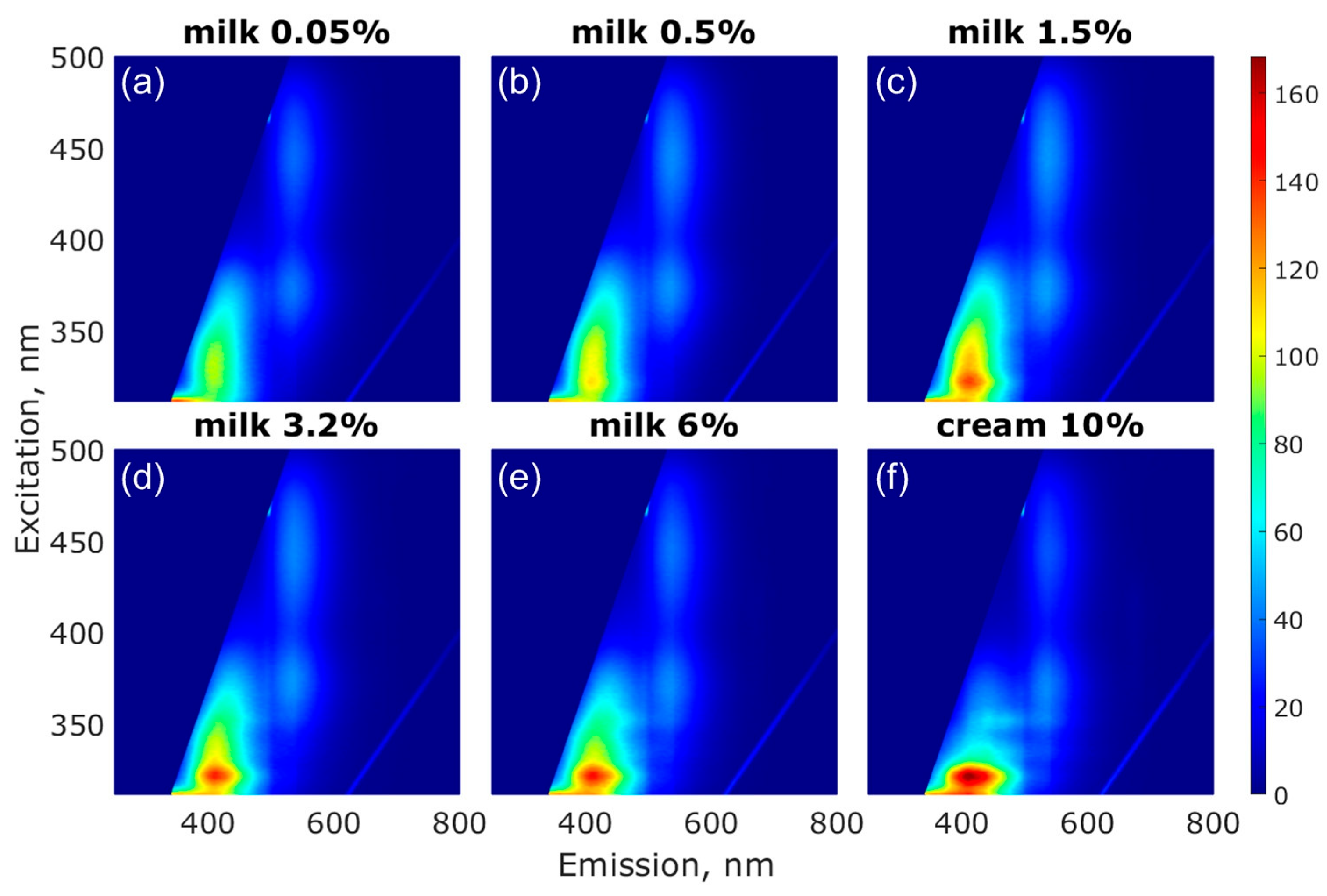
A faint peak at 320 nm excitation with 410 nm emission can also be traced. In order to visualize the peak at 320 nm excitation with more contrast, we cut off the excitation spectral region at wavelengths shorter than 300 nm. The resulting map is shown in Figure 2.
As can be seen form Figure 2, the only peak that strongly depends on fat content is at 320 nm excitation with 410 nm emission. The intensity of this peak depends monotonically on the fat content.
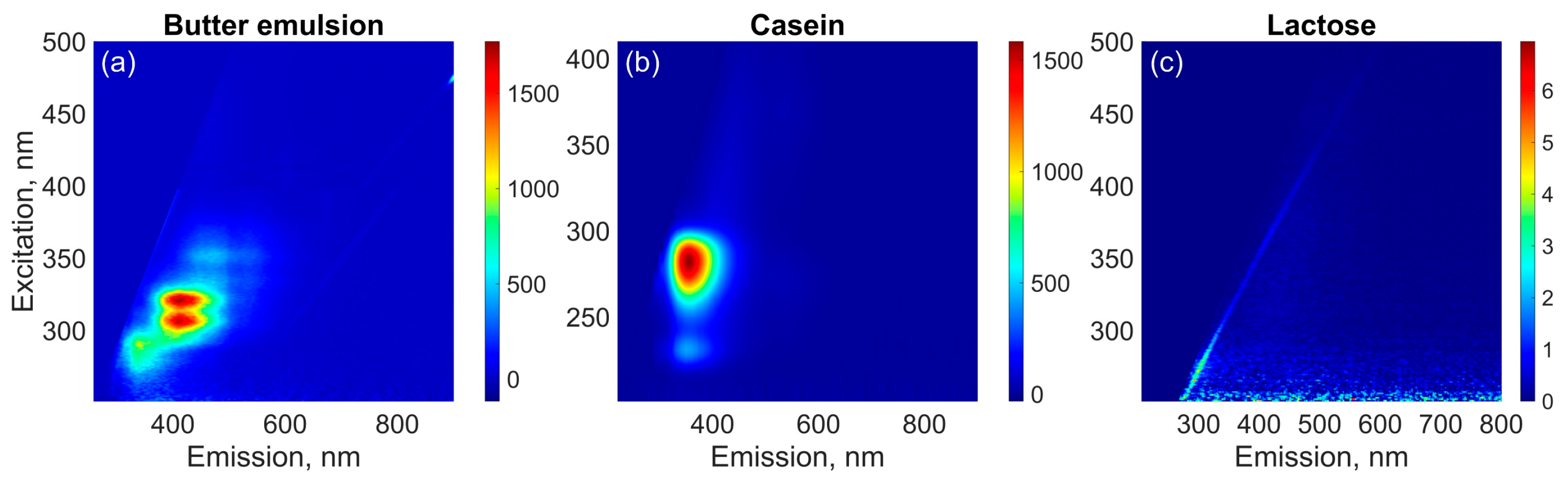
In order to determine the positions of the characteristic fluorescence peaks for the main constituents, we measured right-angle FEEMs for an aqueous emulsion of cow milk butter, a colloid solution of casein and a lactose solution in water (Figure 3).
The fluorescence pattern of casein in Figure 3 is typical for tryptophan, which in this case can be considered the main fluorescent marker. Its excitation at about 290 nm produces emission in the range from 300 to 400 nm [29]. Fat in milk can be characterized by the fluorescence of fat-soluble substances such as vitamin A (retinol) and carotenoids. In the fluorescence pattern of butter, the fluorescence contribution of retinol can be recognized in the excitation range from 250 to 350 nm with emission maximum at a wavelength of 410 nm [20,30], while the characteristic emission of carotenoids in the range from 390 to 550 nm [11,21,22] can hardly be distinguished due to the presence of other peaks with significantly greater brightness. However, fluorescence in this spectral region is clearly visible on the truncated FEEMs (Figure 2). At the same time, it should be noted that milk also contains water-soluble vitamins such as riboflavin, which has a broad emission peak at about 520 nm [30]. Thus, the fluorescence of carotenoids can overlap with that of riboflavin. Therefore, retinol producing most intense fluorescence appears to be a more reliable fluorescent marker of fat than carotenoids. It should be noted that a good correlation between the positions of the peak maximum (excitation at 320 nm and emission at 410 nm) in the FEEMs of butter and milk samples (Figure 2) is observed; consequently, this peak of milk fluorescence can be definitely attributed to the fat component. As Figure 3 shows, lactose does not have characteristic fluorescence peaks in the studied range of excitation wavelengths.

3.2. Sensitivity of Fluorescence Spectra to Milk Composition

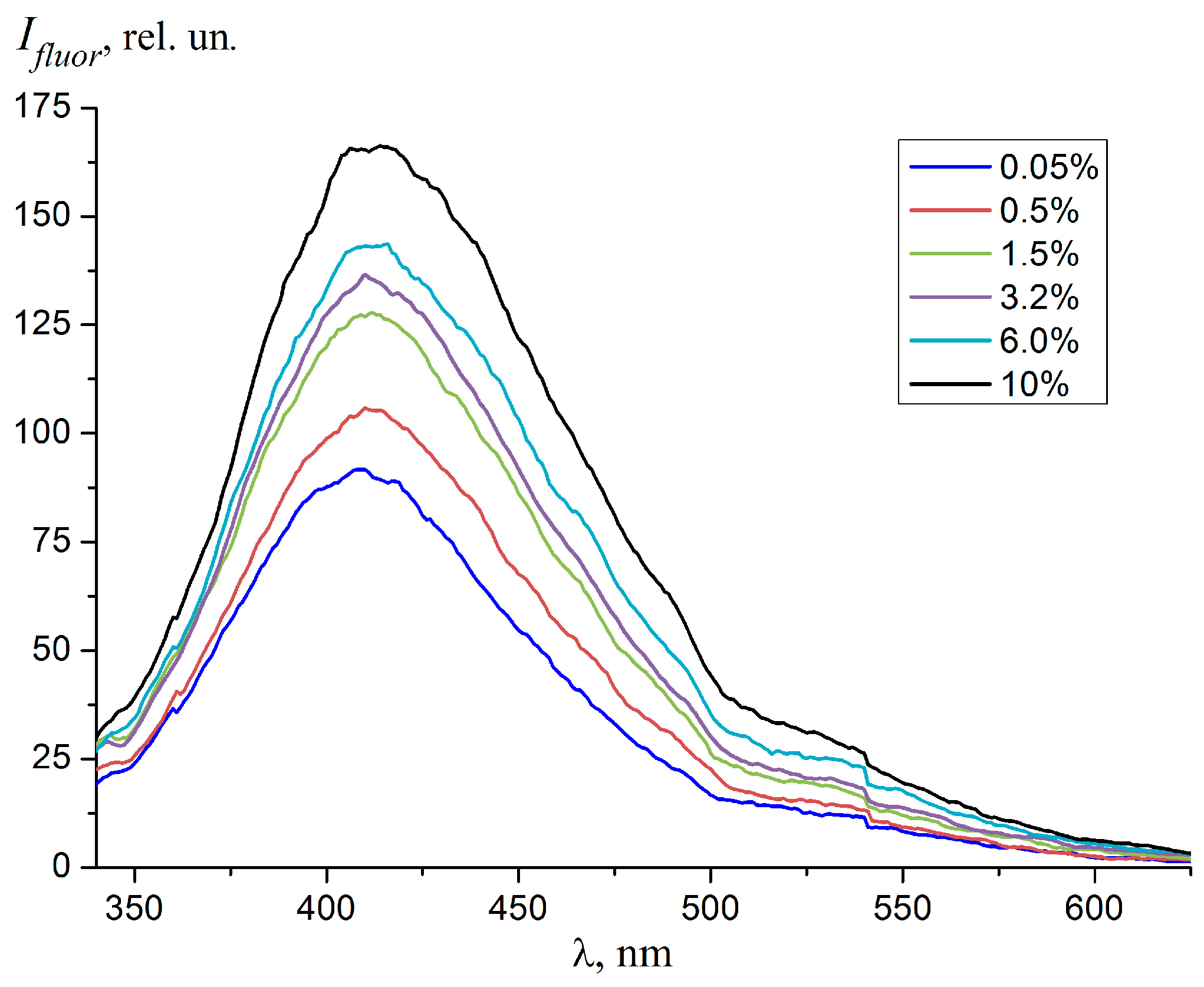
From the measured FEEMs of commercial milk samples, characteristic fluorescence spectra sensitive to the content of milk fat can be obtained for a pump wavelength of 320 nm (Figure 4).
In the fluorescence spectra depicted in Figure 4, one can observe a monotonic dependence of the fluorescence intensity peak at a wavelength of 410 nm.
Ultimately, based on the positions of the fluorescence peak maxima in the FEEMs shown in Figure 1, Figure 2 and Figure 3, we chose two characteristic excitation wavelengths for analyzing the milk composition: 280 nm for the protein component and 320 nm for the fat component.
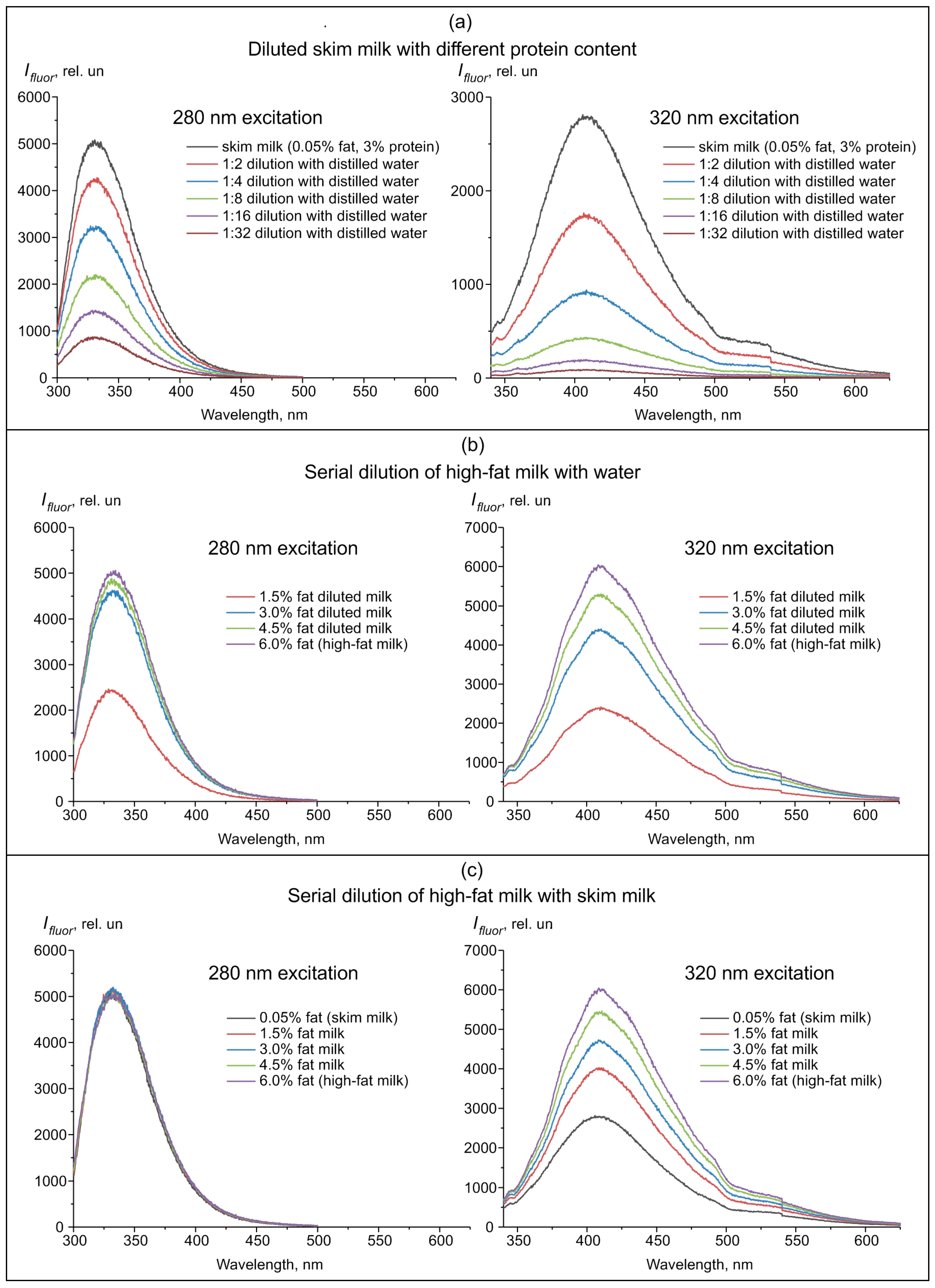
To obtain the dependences of fluorescence intensity on fat and protein contents, we performed measurements on two sets of milk samples with strictly proportional protein and fat contents. These samples were prepared by sequentially diluting the original samples of skim milk (0.05% fat) and high-fat milk (6% fat), both containing 3% protein, with distilled water, as shown in Figure 5a,b. To calibrate the proposed milk analyzer, it is important to have a series of milk samples, in which the fat content varies independently of the protein content. For this purpose, we also measured the fluorescence intensity for various dilutions of high-fat milk with skim milk, in which the same protein content (3%) was thus maintained (Figure 5c). These dilutions correspond to protein-to-fat ratios greater than 0.5.
When excited at a wavelength of 280 nm, an emission peak with a maximum at ~340 nm is observed. The intensity of this peak has a monotonic dependence when varying the protein content in milk (Figure 5a,b), whereas in milk samples with a fixed protein content (3%) and varying fat content, it is practically constant in the fat percentage range of 0–6% (Figure 5c). Accordingly, when excited at a wavelength of 320 nm, the intensity of the emission peak at 410 nm in milk samples with different fat contents monotonically depends on the fat content (Figure 5b,c). It can be concluded that the intensity maxima of the fluorescence peaks have a monotonic but nonlinear dependence on the fat and protein contents in milk. At low fat percentages, milk samples diluted with skim milk produce greater fluorescence intensity values than those diluted with water.

3.3. Mathematical Model for a Fluorescence Analyzer of Fat and Protein Content in Milk

To simultaneously determine the fat and protein content in milk, we assume the possibility of separating the contributions to the fluorescence spectra of the protein and fat phases of milk based on an additive model. In this case, using the fluorescence intensity values measured at wavelengths of 340 and 410 nm (corresponding to the emission peak maxima) upon excitation at wavelengths of 280 and 320 nm, respectively, I 280 ( 340 ) and I 320 ( 410 ) , the percentages of fat (FP) and protein (PP) in dairy products can be found from the system of equations:
P P · A 1 ( P P ) + F P · A 2 ( F P ) = I 280 ( 340 ) ,
F P · A 3 ( F P ) + P P · A 4 ( P P ) = I 320 ( 410 ) ,
with known functions A 1 ( P P ) , A 2 ( F P ) , A 3 ( F P ) , A 4 ( P P ) . To define these functions, an approximation of the experimental data at protein concentrations of 0.75, 1.5, 2.25, 3%, and fat concentrations of 1.5, 3.0, 4.5, 6% (Figure 5b,c) were used.
Since the calculation results show that the F P · A 2 ( F P ) values do not exceed 4% of the I 280 ( 340 ) values, the protein content can be found with an error of no worse than 7% from the equation:
P P = a 1 ( P P ) · I 280 ( 340 ) ,
where a 1 ( P P ) = 1 / A 1 ( P P ) . Approximating a 1 ( x ) by a third-degree polynomial, we obtain:
a 1 ( x ) = ( 5.259 4.347 · x + 2.715 · x 2 0.386 · x 3 ) · 10 4 ,
where x is the percentage value. Note that the alternative approximation of a 1 ( x ) by a second-degree polynomial, a three-parameter power or exponential function leads not only to large values of the standard deviation, but also to a non-monotonic dependence of a 1 ( x ) and an ambiguous solution of Equation (3) on the PP interval 0–6%. The PP value can be obtained as the root of the polynomial Equation (3).
Having found the protein concentration, the fat concentration can be found by solving the equation obtained from (2):
F P = a 3 ( F P ) · ( I 320 ( 410 ) a 4 ( P P ) ) ,
where a 3 ( F P ) = 1 / A 3 ( F P ) and a 4 ( P P ) = P P · A 4 ( P P ) . When approximating a 3 ( F P ) ,   a 4 ( P P ) by a third-degree polynomial, we obtain:
a 3 ( x ) = ( 5.859 + 5.917 · x 1.161 · x 2 + 0.08842 · x 3 ) · 10 4 ,
a 4 ( x ) = ( 2.281 + 6.532 · x 2.886 · x 2 + 0.4236 · x 3 ) · 10 3 .
Here, x is the percentage value. The approximation of a 3 ( x ) , a 4 ( x ) by a second-degree polynomial, or other three-parameter functions leads to large values of the standard deviation. After substituting the calculated PP value, the FP value can be obtained as the root of the polynomial in Equation (5).
The error in solving Equation (5) and thus determining the fat concentration was estimated by comparing the calculated and experimental concentration values for the experimentally measured I 320 ( 410 ) . With a 7% error in determining the protein concentration, the error in determining the fat concentration in the 3–6% range does not exceed 10%, and in the 0.5–3% range, it does not exceed 20%. It is important to note that the obtained polynomial approximations a 1 ( x ) , a 3 ( x ) , a 4 ( x ) allow us to unambiguously solve the system of Equations (1) and (2).
Fluorescence excitation at wavelengths of 280 and 320 nm can be practically implemented using commercially available UV-C and UV-B LEDs, respectively.

4. Discussion

Based on the analysis of the FEEMs measured for milk of different fat contents in the front-face geometry, as well as for butter and extracted lactose and casein, we showed that the percentages of the two main components of milk (fat and protein) in milk can be determined by successively measuring the intensity of two fluorescence emission peaks at wavelengths of 340 nm and 410 nm upon excitation at 280 and 320 nm, respectively. Additionally, we showed that the fluorescence spectra of serial dilutions of high-fat milk with water and skim milk, together with serial dilutions of skim milk, along with water when excited at 280 nm and 320 nm can provide data for establishing the functional dependence of the fat and protein percentage in milk on the fluorescence intensities measured at 340 nm and 410 nm. It should be noted that the fat phase of milk produces fluorescence mainly due to the vitamin A dissolved in it, which can serve as a fluorescent marker of fat. However, there is no universal stoichiometric relationship between the amount of fat and vitamin A (as it depends on the origin of the milk and may exhibit seasonal fluctuations), so accurate measurement of fat content mediated by such marker fluorescence requires calibration adjustment. In routine analysis at production facilities, where milk is delivered daily and cows are fed a standard ration, the content of vitamin A could be quite easily correlated to the milk fat content. Theoretically, carotenoids could be used as an additional fluorescent marker for milk fat content. However, as mentioned in Section 3.1, a shortcoming of fluorescent carotenoid detection is the spectral overlap with riboflavin fluorescence.

5. Conclusions

The methods of fluorescence spectroscopy are highly accurate, which makes them promising for application in industries where diagnostics of the component composition of organic media are necessary, in particular, in milk production. The inverse problem for the fluorescence diagnostics of fat and protein content in milk can be solved when using excitation at only two wavelengths of 280 and 320 nm with a fluorescence response at wavelengths of 340 nm and 410 nm. The proposed method of determining the percentage of milk components can serve as the working principle of a fluorescence milk composition sensor, which employs inexpensive UV LEDs (280 nm and 320 nm) as pump radiation sources. To design a compact sensor, photodiodes in combination with optical filters can be used to detect the fluorescence emission at the appropriate wavelengths.

Author Contributions

Conceptualization, A.V.S., E.I.N. and S.E.D.; methodology, A.V.S., E.I.N., A.N.L. and L.L.C.; software, E.I.N., S.N.C. and M.A.S.; validation, P.P.S., A.N.L. and S.E.D.; formal analysis, A.N.L., P.P.S., S.N.C. and N.V.S.; investigation, E.I.N., D.N.I., L.L.C., A.N.L., P.P.S., M.A.S. and A.V.S.; resources, D.N.I. and S.E.D.; data curation, A.N.L., P.P.S. and S.E.D.; writing—original draft preparation, A.V.S., E.I.N. and D.N.I.; writing—review and editing, L.L.C., A.N.L., P.P.S., S.E.D. and S.N.C.; visualization, E.I.N. and D.N.I.; supervision, A.V.S. and L.L.C.; project administration, A.V.S. All authors have read and agreed to the published version of the manuscript.

Funding

This research received no external funding.

Institutional Review Board Statement

Not applicable.

Informed Consent Statement

Not applicable.

Data Availability Statement

The original contributions presented in this study are included in the article. Further inquiries can be directed to the corresponding author.

Conflicts of Interest

The authors declare no conflicts of interest.

Abbreviations

The following abbreviations are used in this manuscript:
LEDLight-emitting diode
UVUltraviolet
FFFSFront-face fluorescence spectroscopy
FEEMFluorescence emission-excitation matrix

References

  1. van den Berg, F.; Lyndgaard, C.B.; Sørensen, K.M.; Engelsen, S.B. Process analytical technology in the food industry. Trends Food Sci. Technol. 2013, 31, 27–35. [Google Scholar] [CrossRef]
  2. Andersen, C.M.; Mortensen, G. Fluorescence spectroscopy: A rapid tool for analyzing dairy products. J. Agric. Food Chem. 2008, 56, 720–729. [Google Scholar] [CrossRef] [PubMed]
  3. Karoui, R.; Blecker, C. Fluorescence spectroscopy measurement for quality assessment of food systems—A review. Food Bioprocess Technol. 2011, 4, 364–386. [Google Scholar] [CrossRef]
  4. Shaikh, S.; O’Donnell, C. Applications of fluorescence spectroscopy in dairy processing: A review. Curr. Opin. Food Sci. 2017, 17, 16–24. [Google Scholar] [CrossRef]
  5. Kala, R.; Samková, E.; Pecová, L.; Hanuš, O.; Sekmokas, K.; Riaukienė, D. An Overview of Determination of Milk Fat: Development, Quality Control Measures, and Application. Acta Univ. Agric. Silvic. Mendel. Brun. 2018, 66, 1055–1064. [Google Scholar] [CrossRef]
  6. Wang, Y.; Yang, Y.; Liu, H.A. Review of High-Throughput Optical Sensors for Food Detection Based on Machine Learning. Foods 2026, 15, 133. [Google Scholar] [CrossRef]
  7. Silva, M.G.; de Paula, I.L.; Stephani, R.; Edwards, H.G.; de Oliveira, L.F.C. Raman spectroscopy in the quality analysis of dairy products: A literature review. J. Raman Spectrosc. 2021, 52, 2444–2478. [Google Scholar] [CrossRef]
  8. Dimitrova, T.; Eftimov, T.; Kabadzhov, V.; Panayotov, P.; Boyanova, P. Scattering and fluorescence spectra of cow milk. Bulg. Chem. Commun. 2014, 46, 39–43. [Google Scholar]
  9. Kulmyrzaev, A.A.; Levieux, D.; Dufour, E. Front-Face Fluorescence Spectroscopy Allows the Characterization of Mild Heat Treatments Applied to Milk. Relations with the Denaturation of Milk Proteins. J. Agric. Food Chem. 2005, 53, 502−507. [Google Scholar] [CrossRef]
  10. Ma, Y.B.; Amamcharla, J.K. A rapid method to quantify casein in fluid milk by front-face fluorescence spectroscopy combined with chemometrics. J. Dairy Sci. 2021, 104, 243–252. [Google Scholar] [CrossRef] [PubMed]
  11. Freire, P.; Zamora, A.; Castillo, M. Synchronous Front-Face Fluorescence Spectra: A Review of Milk Fluorophores. Foods 2024, 13, 812. [Google Scholar] [CrossRef] [PubMed]
  12. González-Gallardo, C.; Ayala, N.; Ali, F.; Zamora, A.; Saldo, J.; Castillo, M. Using front face fluorescence for rapid estimation of furosine concentration in heat treated milk: A kinetic study. Int. Dairy J. 2026, 173, 106490. [Google Scholar] [CrossRef]
  13. Fragkoulis, N.; Samartzis, P.C.; Velegrakis, M. Commercial milk discrimination by fat content and animal origin using optical absorption and fluorescence spectroscopy. Int. Dairy J. 2021, 123, 105181. [Google Scholar] [CrossRef]
  14. Andersen, C.M.; Frøst, M.B.; Viereck, N. Spectroscopic characterization of low-and non-fat cream cheeses. Int. Dairy J. 2010, 20, 32–39. [Google Scholar] [CrossRef]
  15. Karoui, R.; Dufour, E.; De Baerdemaeker, J. Monitoring the molecular changes by front face fluorescence spectroscopy throughout ripening of a semi-hard cheese. Food Chem. 2007, 104, 409–420. [Google Scholar] [CrossRef]
  16. Duggan, D.E.; Bowman, R.L.; Brodie, B.B.; Udenfriend, S. A spectrophotofluorometric study of compounds of biological interest. Arch. Biochem. Biophys. 1957, 68, 1–14. [Google Scholar] [CrossRef]
  17. Hui, Y.H. (Ed.) Dairy Science and Technology Handbook. In Principles and Properties; VCH Publishers: New York, NY, USA, 1993; Volume 1. [Google Scholar]
  18. Walstra, P.; Jenness, R. Dairy Chemistry and Physics; John Wiley & Sons: New York, NY, USA, 1984. [Google Scholar]
  19. Karoui, R.; Dufour, É.; De Baerdemaeker, J. Common components and specific weights analysis: A tool for monitoring the molecular structure of semi-hard cheese throughout ripening. Anal. Chim. Acta 2006, 572, 125–133. [Google Scholar] [CrossRef]
  20. Herbert, S.; Riou, N.M.; Devaux, M.F.; Riaublanc, A.; Bouchet, B.; Gallant, D.J.; Dufour, É. Monitoring the identity and the structure of soft cheeses by fluorescence spectroscopy. Le Lait 2000, 80, 621–634. [Google Scholar] [CrossRef]
  21. Ullah, R.; Khan, S.; Ali, H.; Bilal, M. Potentiality of using front face fluorescence spectroscopy for quantitative analysis of cow milk adulteration in buffalo milk. Spectrochim. Acta Part A Mol. Biomol. Spectrosc. 2020, 225, 117518. [Google Scholar] [CrossRef]
  22. Ullah, R.; Khan, S.; Ali, H.; Bilal, M.; Saleem, M. Identification of cow and buffalo milk based on Beta carotene and vitamin-A concentration using fluorescence spectroscopy. PLoS ONE 2017, 12, e0178055. [Google Scholar] [CrossRef] [PubMed]
  23. Brandao, M.P.; dos Anjos, V.d.C.; Bell, M.J.V. Time resolved fluorescence of milk powders—A pilot study. Int. Dairy J. 2017, 64, 31–36. [Google Scholar] [CrossRef]
  24. Lopez, C.; Dufour, E. The composition of the milk fat globule surface alters the structural characteristics of the coagulum. J. Colloid Interface Sci. 2001, 233, 241–249. [Google Scholar] [CrossRef]
  25. Shin, Y.-H.; Gutierrez-Wing, M.T.; Choi, J.-W. Recent progress in portable fluorescence sensors. J. Electrochem. Soc. 2021, 168, 017502. [Google Scholar] [CrossRef]
  26. Chen, X.; Du, J.; Kanwal, S.; Yang, Z.-J.; Zheng, L.-L.; Wang, J.; Wen, J.; Zhang, D.-W. A low-cost and portable fluorometer based on an optical pick-up unit for chlorophyll-a detection. Talanta 2024, 269, 125447. [Google Scholar] [CrossRef]
  27. Wang, X.; Jiaojiao, B.; Juanjuan, P.; Animesh, S.; Divyanshud; Chang, Y.-T. Milk quality control: Instant and quantitative milk fat determination with a BODIPY sensor-based fluorescence detector. Chem. Commun. 2014, 50, 10398. [Google Scholar] [CrossRef] [PubMed]
  28. Pérez, M.A.; González, O.; Arias, J.R. Optical Fiber Sensors for Chemical and Biological Measurements. In Current Developments in Optical Fiber Technology; Harun, S.W., Arof, H., Eds.; Intech Open: Rijeka, Croatia, 2013. [Google Scholar] [CrossRef]
  29. Aït-Kaddour, A.; Abdelbaky, H.; Hamdy, S.; Boubellouta, T.; Abou-El-Karam, S.; Abdelmentolb, H.S. Discrimination of thermally treated milk using fluorescence spectroscopy combined with PCA and artificial neural networks. J. Food Compos. Anal. 2025, 146, 107952. [Google Scholar] [CrossRef]
  30. Karoui, R.; Martin, B.; Dufour, É. Potentiality of Front-Face Fluorescence Spectroscopy to Determine the Geographic Origin of Milks from the Haute-Loire Department (France). Le Lait 2005, 85, 223–236. [Google Scholar] [CrossRef]
Figure 1. Front-face fluorescence EEM of cow milk samples with the nominal fat percentages: 0.05% (a), 0.5% (b), 1.5% (c), 3.2% (d), 6% (e), 10% (f). Temperature 20 °C.
Photonics 13 00577 g001
Figure 2. Truncated front-face fluorescence EEM (excitation wavelength > 300 nm) of cow milk samples with the nominal fat percentages: 0.05% (a), 0.5% (b), 1.5% (c), 3.2% (d), 6% (e), 10% (f). Temperature 20 °C.
Photonics 13 00577 g002
Figure 3. Right-angle fluorescence EEM of cow milk butter emulsion (a) and extracted milk constituents: casein (b), lactose (c). Temperature 20 °C.
Photonics 13 00577 g003
Figure 4. Front-face fluorescence spectra of milk samples with nominal fat content ranging from 0.05% to 10%. The pump radiation wavelength is 320 nm. Temperature 20 °C.
Photonics 13 00577 g004
Figure 5. Front-face fluorescence spectra of proportionally diluted samples of high-fat and skim milk under excitation at wavelengths of 280 nm and 320 nm: (a) serial dilution of skim milk (0.05% fat and 3% protein) with water; (b) serial dilution of high-fat milk (6% fat and 3% protein) with water, 320 nm excitation; (c) serial dilution of high-fat milk (6% fat and 3% protein) with skim milk (0.05% fat and 3% protein). Temperature 20 °C.
Photonics 13 00577 g005
Disclaimer/Publisher’s Note: The statements, opinions and data contained in all publications are solely those of the individual author(s) and contributor(s) and not of MDPI and/or the editor(s). MDPI and/or the editor(s) disclaim responsibility for any injury to people or property resulting from any ideas, methods, instructions or products referred to in the content.