


Abstract
The topological properties of vector optical fields are traditionally considered strictly conserved during continuous deformations and linear propagation. However, while structured light has been extended into nonlinear regimes, previous studies have predominantly focused on the intensity modulation of specific orbital angular momentum (OAM) components and the pure frequency conversion of structured light. The critical question of whether macroscopic topological invariants remain robust or experience fundamental breakdown during nonlinear light–matter interactions remains largely unexplored. To address this specific gap, we propose and generate multiple fractional vector optical fields (MF-VOFs), establishing their dynamic topological evolution and inherent conservation laws in free space. It should be noted that our experimental results are limited to free-space propagation. Strikingly, we report a significant departure from this paradigm during light–matter interactions: topological nonconservation anomalies manifest when these optical fields interact with nonlinear materials via second- and third-harmonic generation. Through a comprehensive quantitative analysis of the OAM spectrum, we confirm that the asymmetrical reconstruction and spatial transition of the total OAM along the propagation direction serve as the physical origins driving this topological symmetry breaking. These findings provide a fundamentally novel perspective on topological manipulation in nonlinear optical processes, offering advanced strategies for complex structured light generation and high-dimensional optical information processing.
1. Introduction
Originating as a mathematical concept addressing conserved properties under continuous deformation, topology has emerged as an essential degree of freedom for characterizing the quantized global behaviors of classical and quantum wave functions [1,2,3,4,5]. In singular optics, topological defects act as cornerstones of structured light [6,7,8,9,10]. Specifically, scalar optical vortices (often termed phase vortices) feature topological zero-intensity spots carrying well-defined orbital angular momentum (OAM) [11,12,13,14,15]. Extending this concept into the vectorial domain, polarization vortices—commonly known as polarization singularities—manifest within vector optical fields (VOFs). Sharing comparable topological robustness with their scalar counterparts, these polarization singularities are mathematically governed by a topological index, enabling the generation of complex spatial polarization distributions [16,17,18,19,20,21,22].
Recently, the introduction of fractional vortices and their superposition in orthogonal bases [23,24] has revealed intriguing topological behaviors. In the linear regime, breakthroughs such as precision topological charge measurements via angular grating diffraction OAM spectra [25] and deep-learning-assisted recognition of fractional C-point indices [26] have advanced the accurate characterization of these complex singular fields. Simultaneously, the interaction between complex structured light and nonlinear materials has opened unprecedented avenues for high-dimensional optical manipulation [27,28,29,30,31,32,33]. Furthermore, nonlinear frequency conversion processes have been strategically employed to advance the manipulation of structured light, enabling both the asymmetric generation of optical OAM via cooperative phase-matching mechanisms [34] and the nearly nondestructive, mode-selective detection of OAM states through sum-frequency generation [35]. It is essential to clarify that these prior works primarily focus on the selection, generation, and intensity modulation of specific OAM spectral components. Furthermore, while spatial and rotational dynamics during nonlinear frequency conversion are well-documented [36,37,38,39,40,41], the corresponding topological modulation effects—specifically, the robustness and potential breakdown of topological invariants during nonlinear light–matter interactions—remain largely unexplored. Specifically, the robustness and potential breakdown of these invariants—manifesting as a non-doubling relationship of topological indices rather than simple OAM spectral changes or macroscopic spatial rotations—have yet to be systematically investigated. Addressing this fundamental gap is essential for advancing nonlinear topological photonics.
To bridge this gap, this study investigates the topological dynamics of multiple fractional VOFs (MF-VOFs) in both linear and nonlinear regimes. We first establish a baseline by mapping the precise topological jump rules and conservation properties of MF-VOFs in free space. Subsequently, we extend our investigation to second-harmonic generation (SHG) and third-harmonic generation (THG), uncovering striking topological nonconservation anomalies within specific topological charge ranges. By calculating the OAM spectrum, we elucidate the intrinsic physical mechanism driving this topological modulation. This work not only enriches the landscape of singular optics but also provides a quantifiable mapping relationship between VOF parameters and topological invariants in nonlinear interactions.
2. Theoretical Design of MF-VOFs
To investigate the dynamic evolution of the topological features of VOFs, we propose MF-VOFs characterized by multiple customizable polarization structures. This unique framework can generate an array of polarization vortices at arbitrarily designated positions across the wavefront, facilitating the precise manipulation of singular lines. In polar coordinates , a conventional fractional VOF is constructed by superimposing right- and left-handed circularly polarized bases carrying opposite topological charges:
where r denotes the radial coordinate, is the azimuthal coordinate, and represents the fractional topological charge. The vectors and correspond to the right- and left-handed circularly polarized bases, respectively.
To achieve a more intricate, multi-phase structure, we define the transmission equation as , treating each segment of independently varying phase as a distinct “slope”. Here, m denotes the total number of slopes (a positive integer), and k is the slope index . The critical parameter dictates the phase range for each slope. Physically, it acts to compress or stretch the local topological charge density (i.e., the azimuthal polarization gradient) within that specific slope, providing an extra degree of freedom for manipulating the singularity distribution. Consequently, the azimuthal width of each slope is , while its effective phase range is . By leveraging the arbitrary nature of , the phase gradient—or equivalent topological charge—of each slope can be independently manipulated. The resulting MF-VOF is mathematically expressed as:
This independent control enables the generation of multiple singular lines with diverse spatial distributions. When , Equation (2) describes a uniform MF-VOF, signifying the execution of m-fold rotational symmetry operations on the wavefront. In this scenario, the structure of each slope is identical, producing multiple symmetric singular lines. In the extreme limit where and , the structure seamlessly reverts to the traditional vortex phase used for conventional fractional VOFs.
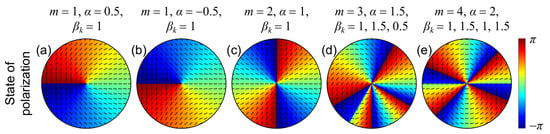
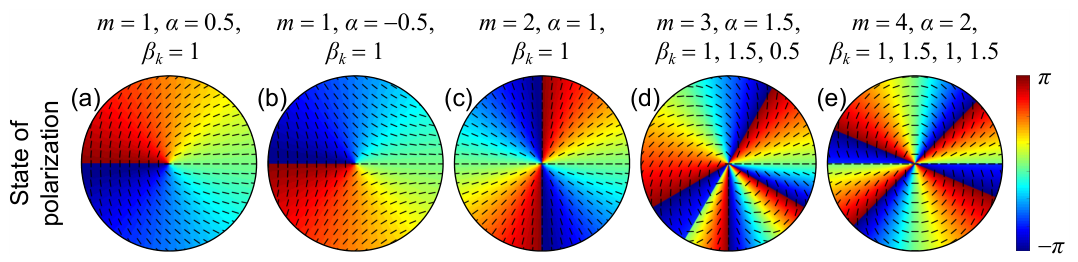
Figure 1 illustrates the polarization distributions of the MF-VOFs. Because these VOFs are locally linearly polarized, their initial polarization ellipticity is zero. Generally, the polarization ellipticity is mathematically calculated using the standard Stokes parameters, defined as , where represents the total intensity and denotes the intensity difference between the right- and left-handed circular polarization components. Figure 1a,b depict classic Lemon- and Star-type singularities, distinguished by their oppositely directed polarization orientation changes [21]. In singular optics, such configurations center around a V-point, which represents a vector singularity surrounded by a purely linearly polarized field; at the exact center of the V-point, the local intensity is zero, rendering the polarization orientation completely undefined. Upon propagation, these states can transform into C-points, which are typical polarization singularities where the optical field becomes purely circularly polarized (polarization ellipticity is ), meaning that the orientation of the polarization major axis becomes completely undefined. Figure 1c displays a uniform MF-VOF exhibiting 2-fold rotational symmetry. Conversely, Figure 1d,e showcase non-uniform distributions manipulated via . For example, as illustrated by the polarization distribution in Figure 1d with , there are three azimuthally equal-divided slopes. However, due to (i.e., , , ), the polarization orientation ranges across the three slopes are distinct, being , , and , respectively.
Figure 1.
Polarization distributions of MF-VOFs. (a,b) Lemon- and Star-type singularities showing conventional fractional VOFs. (c) The uniform MF-VOF () with 2-fold rotational symmetry. (d,e) Non-uniform MF-VOF designed with distinct phase ranges: (d) , , ; (e) , , , . The black lines represent the local polarization states, and the background color indicates the polarization orientation ranging from to , while this visualization visually resembles a scalar vortex phase distribution, it physically represents the spatially variant rotation of the local polarization orientation.
3. Evolution of Optical Fields in Free Space
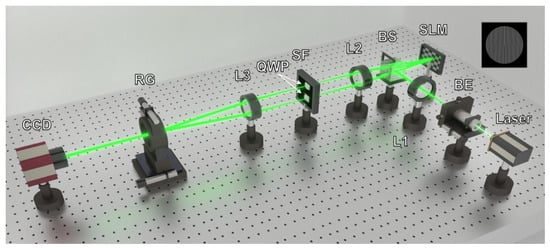
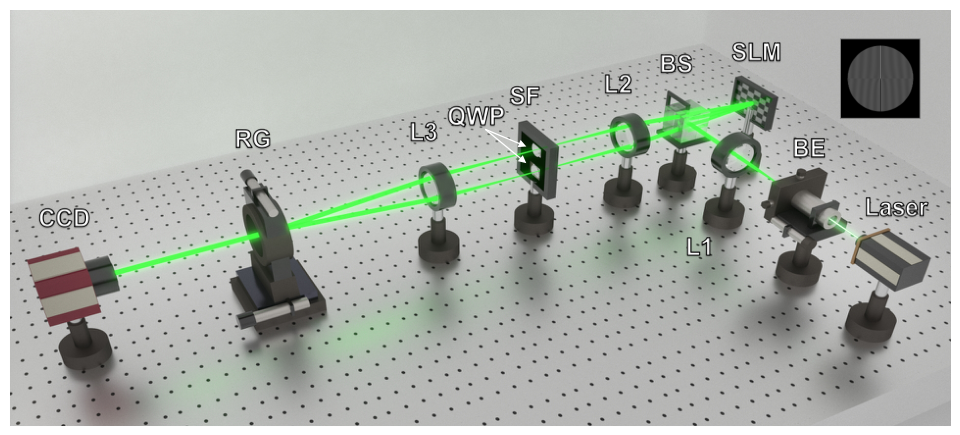
To experimentally generate the designated MF-VOFs and observe their free-space propagation, we constructed an optical setup utilizing a spatial light modulator (SLM) embedded within a system, as depicted in Figure 2. The SLM (HOLOEYE, PLUTO-NIR-II, featuring a resolution of pixels and a pixel pitch of ) is positioned at the input plane of the system and loaded with a custom holographic grating. The transmission function of this grating is mathematically defined as , where denotes the spatial frequency. By encoding the desired phase structure as , the incident field is diffracted into orders. Crucially, these two diffraction orders acquire opposite spatial phase distributions of . After passing through a spatial filter (SF) to isolate the desired orders, they are independently transformed into two orthogonal circularly polarized beams using a pair of quarter-wave plates (QWPs). Finally, these two orthogonal components are coaxially recombined by a Ronchi phase grating (RG) located at the output plane of the system, which defines the initial plane of the generated VOF. The subsequent dynamic propagation states are then recorded by translating a charge-coupled device (CCD) camera along the propagation axis.
Figure 2.
Schematic of the experimental setup for generating and observing MF-VOFs, where the inset displays a typical example of the hologram loaded onto the SLM. BE: beam expander; L: lens; SLM: spatial light modulator; BS: beam splitter; SF: spatial filter; QWP: quarter-wave plate; RG: Ronchi phase grating; CCD: charge-coupled device (camera).
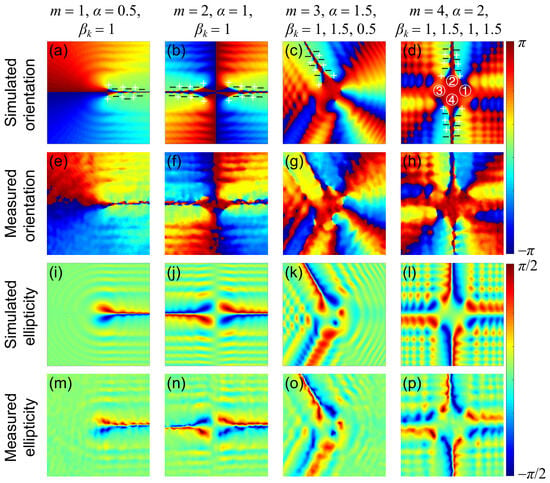
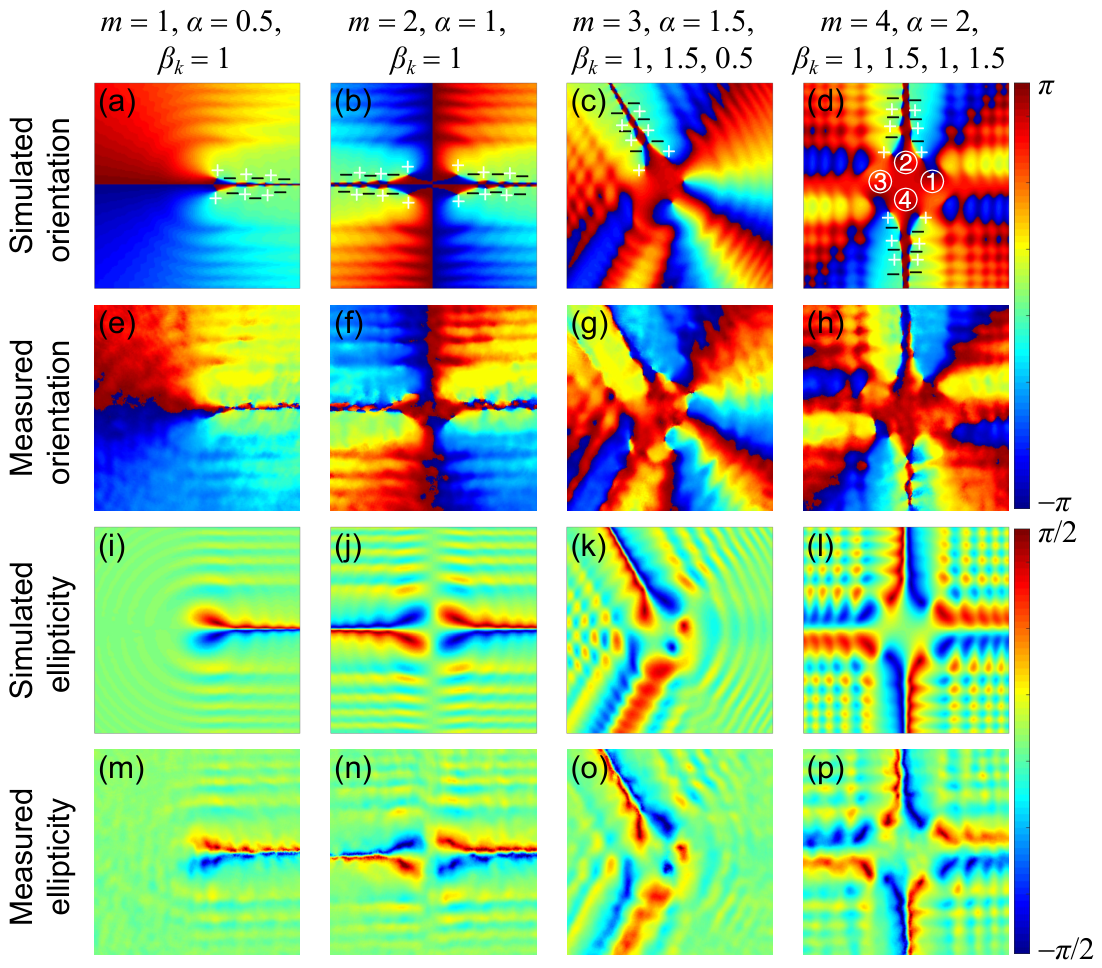
For comparative analysis, the Beam Propagation Method [42] was utilized to numerically simulate this evolution. Given the paraxial nature of our beams and the macroscopic free-space propagation, this was rigorously implemented by independently propagating the two orthogonal circularly polarized base components and subsequently performing a coherent vectorial superposition at the observation plane. Figure 3 illustrates the simulated [Figure 3a–d] and experimentally measured [Figure 3e–h] distributions of polarization orientation, alongside their corresponding simulated [Figure 3i–l] and measured [Figure 3m–p] polarization ellipticities, after propagating a distance of m. Specifically, Figure 3a displays the evolution of a conventional fractional VOF (), serving as a baseline reference where a single singular line forms. As depicted in Figure 3b, the distribution of polarization singularities in the uniform structures exhibits m-fold rotational symmetry. During propagation, each original singular line of polarization robustly transforms into two symmetric singular chains (C-point chains) composed of alternating Lemon–Star singularity pairs. By systematically tuning parameters m, , and , we can deterministically design these chains. For instance, Figure 3c demonstrates that in an MF-VOF with three slopes, only one complete singular line evolves into two C-point chains, while the other slopes exhibit no polarization singularities. The continuous phase matching between the third and first slopes demonstrates that while the wavefront is inherently divided into m equal slopes, strategic parameter tuning can effectively eliminate the phase discontinuity, causing the corresponding singular line to vanish. Consequently, by scaling up the value of m, this framework theoretically enables the deterministic generation of arbitrary singularity chains at any precise spatial position across the entire wavefront. Similarly, in Figure 3d where , singular chains ➁ and ➃ appear exclusively in the vertical direction, with horizontal singular chains ➀ and ➂ conspicuously absent. Furthermore, Figure 3i–p reveal that the polarization ellipticity is no longer uniformly zero but fluctuates between , indicating the generation of spin angular momentum during propagation and the emergence of C-points, where those flanking any given singular line inherently exhibit opposite ellipticities. Unlike the static, inherent spin angular momentum generated via transverse spatial asymmetry in non-diffracting frameworks such as Vector Tricomi beams [43], this localized ellipticity emerges dynamically during free-space propagation, driven by azimuthal phase discontinuities.
Figure 3.
Spatial distributions of singular lines after a propagation distance of 0.5 m. The parameters , and are indicated above each column. (a–d) and (e–h) show the simulated and measured polarization orientations, whereas (i–l) and (m–p) present the corresponding polarization ellipticities. The “+” and “−” signs indicate the singularities of Lemon type and Star type, respectively, while the black and white signs identify pairs of singularities undergoing simultaneous generation or annihilation. The circled numbers highlight the pairs of complete polarization singular chains.
Physically, this spatial evolution stems from the differential phase accumulation between the superimposed left- and right-handed circularly polarized components. Initially at , the MF-VOF consists entirely of local linear polarizations (situated strictly on the equator of the Poincaré sphere), centered around a V-point. As transmission progresses, the two equally superimposed orthogonal components symmetrically diverge from the equator toward the northern and southern hemispheres, causing the polarization ellipticity to fluctuate between . This spatial dynamic is deeply rooted in the accumulation of geometric phases and spin–orbit interactions within the VOF [44]. This process completely covers the Poincaré sphere, birthing the observed C-points and defining the singular lines’ topological boundaries. Notably, through strategic manipulation of uniform or non-uniform phase structures, we establish a highly predictable and conserved framework for generating a customized number of C-point chains at any desired wavefront location.
4. Topological Jump Characteristics of Optical Fields in Free Space
To rigorously characterize the topological evolution of VOFs, the polarization topological index t is defined as the closed-loop integral of the polarization orientation gradient around the singularity [45]: . This integral directly correlates with the rotational symmetry of the optical field. For our proposed MF-VOFs, the total polarization topological index t is mathematically governed by the fractional topological charge , the number of slopes m, and the fractional phase control coefficient :
where denotes the floor function, defined as . Physically, because the polarization state must return to an equivalent physical state after a complete circuit around the singularity, the loop integral of the polarization orientation gradient is strictly quantized. Thus, the topological index manifests as an integer even for fractional input charges. The total number of polarization singularities T within the VOF maintains a fixed, doubled relationship with the topological index, explicitly expressed as . Consequently, any alteration in T directly corresponds to a discrete jump in t. As increases, these polarization singularities undergo discrete jumps starting from . The periodicity of these jumps spans , with the critical value of for the j-th jump, satisfying:
where represents the sequential number of the jump. By strategically selecting m and , we can precisely dictate the extent and position of these topological jumps at any given topological charge .
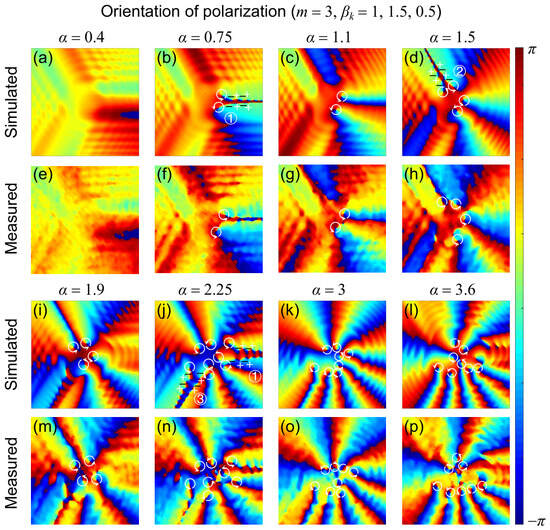
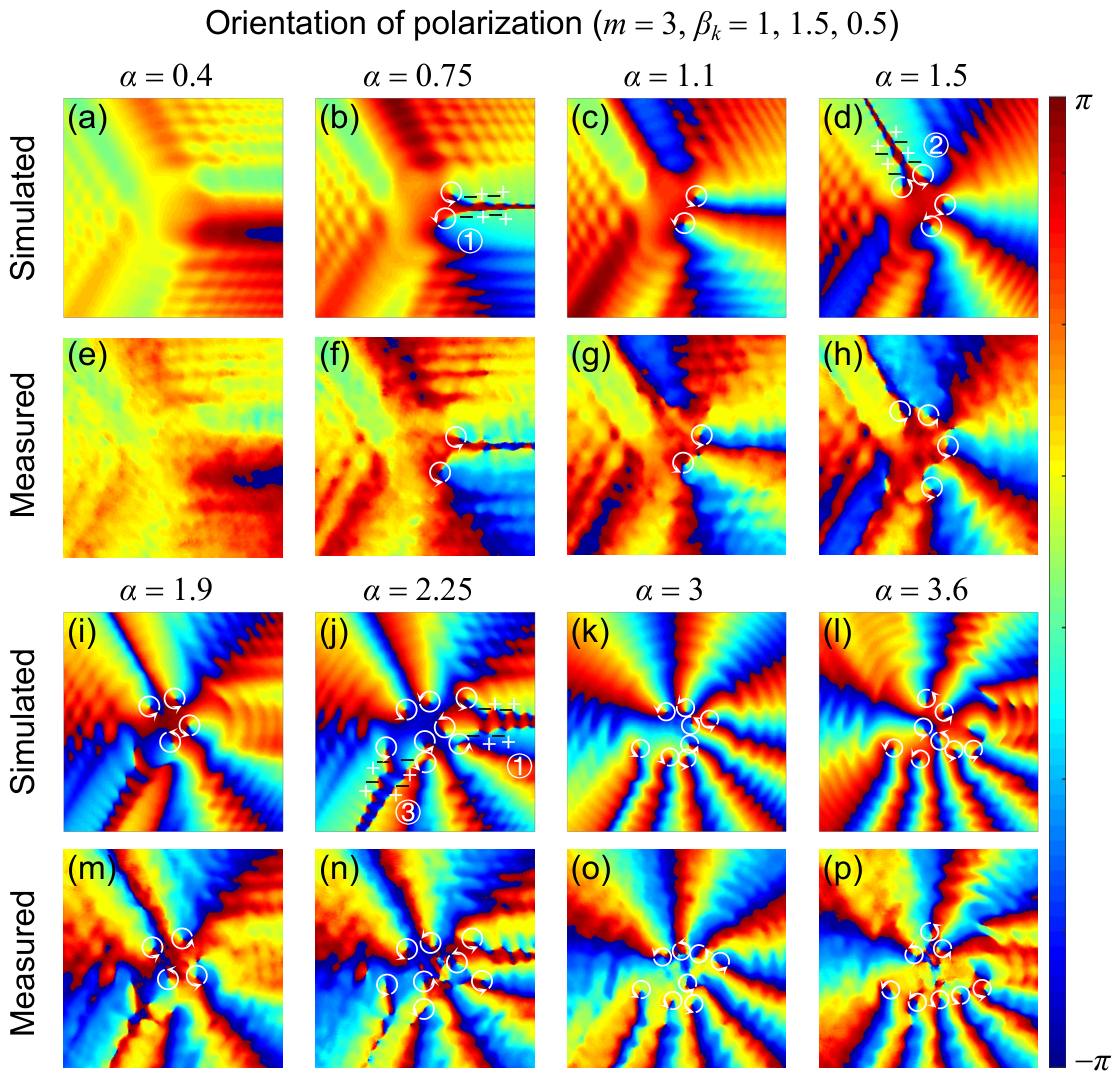
Figure 4 illustrates this dynamic orientation distribution as it varies with , with parameters fixed at and . The numerical simulations are sequentially presented in the first [Figure 4a–d] and third [Figure 4i–l] rows, while the excellent agreement with our experimental observations is demonstrated in the corresponding second [Figure 4e–h] and fourth [Figure 4m–p] rows. This specific value of is chosen as the representative case because it provides an optimal demonstration of non-trivial rotational symmetry and distinct multi-slope interactions, avoiding the visual crowding that higher m values might introduce. The underlying mathematical intricacy here is akin to handling countably infinite sets in “Hilbert’s Hotel” [46,47,48]. When a pair of complete singularity chains manifests on the wavefront, it signals that the VOF has reached a critical point where the number of singularities is about to jump. Because the Lemon and Star singularities appear in pairs along these chains, their net contribution to the topological index remains zero upon integration; thus, only isolated singularities near the VOF center dictate the index.
Figure 4.
Distributions of polarization orientation as a function of the fractional topological charge (with fixed parameters , ). The first and third rows show numerical simulations, while the second and fourth rows display the corresponding experimental results. The white circles mark the locations of polarization singularities to clearly show the jump process, without distinguishing their specific types (Lemon or Star).
To illustrate this deterministic evolution, we observe the field at specific critical thresholds. For , the critical jump condition is not met, resulting in a total absence of singularities, as depicted in Figure 4a. However, at the first critical threshold (), a pair of singular chains emerges on the first slope, denoted as mark ➀ in Figure 4b. Subsequently, pairs of singularities on the chains annihilate, leaving two isolated singularities near the center—a definitive jump from 0 to 2 singularities, illustrated in Figure 4c. Similarly, at , the singular chain of the third slope emerges for the first time, concurrently with the reappearance of the initial singular chain on the first slope. Beyond this specific critical point, pair annihilation results in a 4-unit increase in the total number of singularities T, as shown in Figure 4k.
This pattern repeats cyclically as increases. Each emergence of a polarized singular chain corresponds to a mathematically predictable topological jump, resulting in an increase in the total number of singularities within the VOF. This dynamic evolution perfectly aligns with the analytical laws governed by Equations (3) and (4). Crucially, by tailoring the structural parameters, we can deterministically design topological jumps at any arbitrary spatial position and topological charge, while precisely controlling the exact number of singularities generated per jump. Our findings highlight the remarkable flexibility of MF-VOFs in regulating topological charges, enabling the precise prediction and planning of new polarization vortices while maintaining strict conservation rules.
5. Topological Nonconservation in the Process of Interaction Between Optical Field and Nonlinear Materials
While the polarization topological index remains strictly conserved under arbitrary continuous deformations in free space, we discovered a profound departure from this paradigm during nonlinear light–matter interactions. Under the slowly varying envelope approximation, the nonlinear coupled-wave equations satisfied by the second harmonic (SH) and third harmonic (TH) are concisely expressed as [49]
where , , and denote the complex amplitude envelopes of the fundamental wave (FW), SH, and TH, respectively. Additionally, represents the angular frequency of the FW, z signifies the propagation direction, denotes the effective nonlinear susceptibility tensor, c is the speed of light in vacuum, and k stands for the wavenumber. The term serves as the phase mismatch factor, with indicating perfect phase matching. We adopt this ideal condition to explicitly isolate the intrinsic topological modulation driven by the fundamental structures, as phase mismatch would introduce additional phase distortions that complicate the theoretical analysis and obscure the fundamental physical mechanisms. Given that VOFs are composed of two orthogonal components possessing opposite topological charges, these components must be selectively converted. Crucially, our theoretical formulation inherently assumes a decoupled interaction framework where cross-coupling between orthogonal polarization components is eliminated. Practically, this decoupling can be realized using advanced experimental configurations, such as polarization Sagnac interferometers [36,37] or orthogonal axis crystal configurations (e.g., dual-BIBO crystals) [50], wherein the effective nonlinear susceptibility tensor is diagonalized, allowing each orthogonal base component to evolve independently according to the decoupled wave equations without cross-coupling. Building upon this physically realizable framework, our numerical simulations phenomenologically utilize normalized susceptibility parameters. This approach allows us to uncover universal topological evolution rules and singularity dynamics, rather than calculating absolute conversion efficiencies for a specific material. These generalized theoretical results are fundamentally consistent with the nonlinear optical response of realistic media (e.g., PPKTP, or BIBO) operating under the previously mentioned decoupled configurations. Applying the small-signal approximation, where the FW amplitude remains relatively constant, the generated harmonic components correspond proportionally to the FW orthogonal states ( and ):
To establish a rigorous analytical framework, we focus our discussion on uniform MF-VOFs, as non-uniform structures introduce irregular phase distributions that obscure unified scaling laws. By integrating Equation (3) with Equation (6), the polarization topological indices for the FW (), SH (), and TH () are analytically derived as
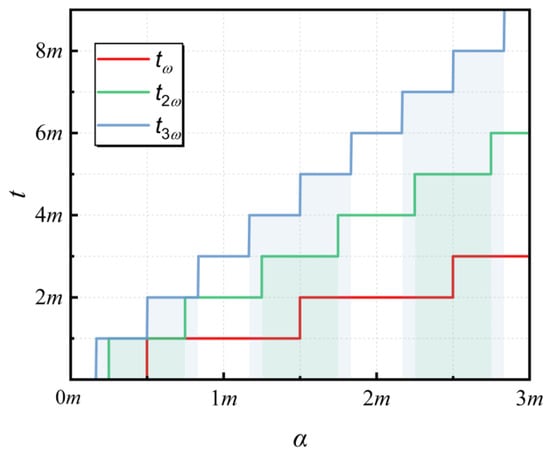
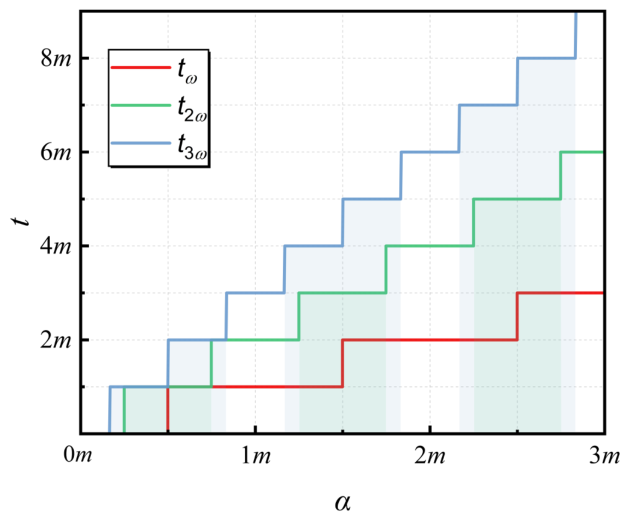
Figure 5 plots these theoretical index variations during SHG and THG. Notably, not all values adhere to the expected topological multiplier relationship (e.g., or ). This topological nonconservation is distinctly visualized within the shaded regions of Figure 5. This multiplier breakdown represents a distinct topological anomaly compared to traditional integer-order frameworks. Specifically, pioneering theoretical work by Freund established that the topological charge strictly obeys a linear doubling rule during second-harmonic generation for integer singularities [51]. In contrast, our fractional design fundamentally violates this linear multiplier scaling relationship.
Figure 5.
Variation curves of the polarization topological index t during SHG and THG. The red, green, and blue curves correspond to the FW, SH, and TH, respectively. The shaded regions explicitly highlight the specific topological charge ranges where topological nonconservation occurs.
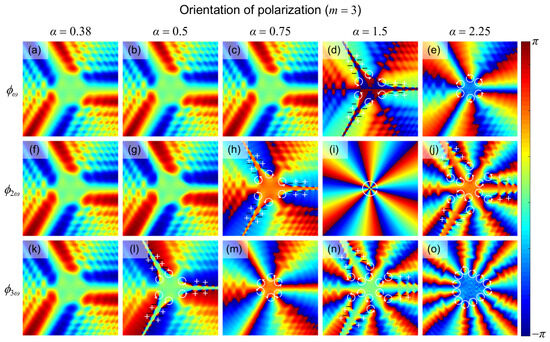
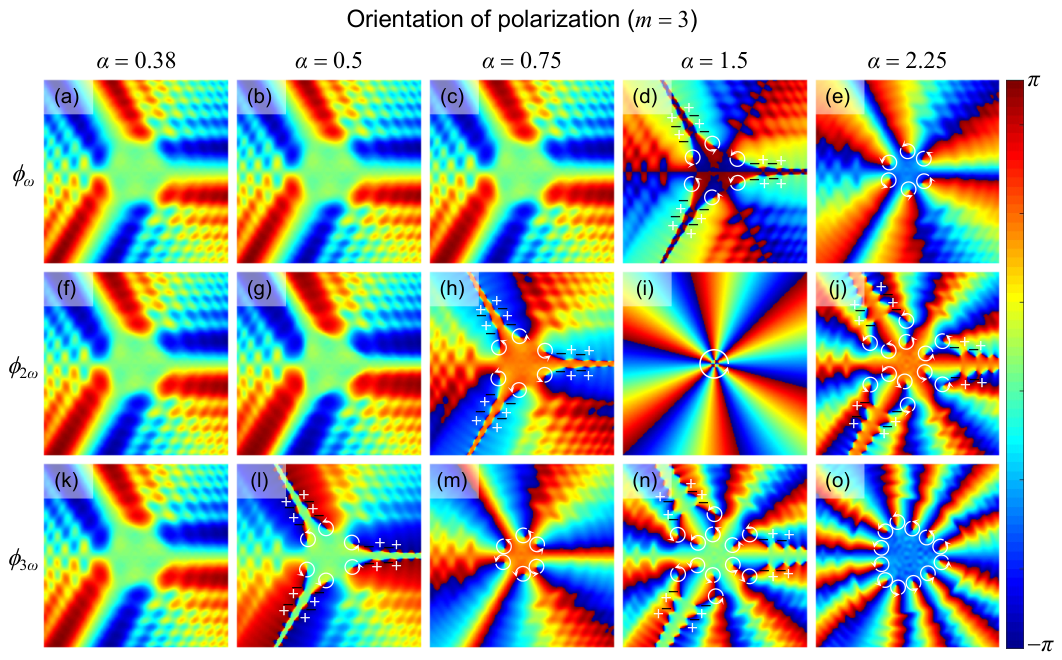
To validate this theoretical anomaly, Figure 6 illustrates the polarization singularity evolution of the MF-VOF at various topological charges. The first row [Figure 6a–e] displays the FW, the second row [Figure 6f–j] shows the SH, and the third row [Figure 6k–o] corresponds to the TH. The critical values corresponding to the first topological jump points of the FW, SH, and TH occur at 1.5, 0.75, and 0.5, respectively. For instance, when (Figure 6a,f,k), the topological indices for all frequencies remain zero, exhibiting a complete absence of polarization singularities. However, as surpasses the first jump threshold (Figure 6d,h,l), three pairs of polarization singularity chains emerge symmetrically, leaving 6 stable polarization singularities on the wavefronts and elevating their respective topological indices to 3. Subsequently, the SH and TH reach their second topological jump points at and 1.5. Crossing this second threshold spawns three additional pairs of singular chains (Figure 6j,n), injecting 6 more singularities into the SH and TH wavefronts and pushing their topological indices to 6. This dynamic evolution meticulously aligns with the nonconservation curves depicted in Figure 5.
Figure 6.
Evolution of polarization orientation as a function of the fractional topological charge during SHG and THG (). The first, second, and third rows correspond to the FW, SH, and TH, respectively. The white circles mark the locations of polarization singularities to clearly show the jump process, without distinguishing their specific types (Lemon or Star). The background color indicates the polarization orientation. Specifically, the color bar ranging from to represents the angle between the local polarization direction and the horizontal axis.
While our preceding analysis has predominantly characterized topological jumps in nonlinear processes from a mathematical perspective, we now aim to elucidate the fundamental physical nature of this effect. Recognizing the intrinsic correlation between OAM and the vortex phases inherent in VOFs [52], we propose that OAM theory provides a robust physical mechanism for the topological nonconservation observed in fractional VOFs during both SHG and THG. Unlike integer-order vortices, the inherent phase discontinuity in fractional VOFs induces a broad spectrum of OAM components. During nonlinear frequency conversion, the multi-wave mixing processes dictate that these constituent OAM modes interact comprehensively, rather than undergoing simple scalar multiplication. To demonstrate this, the MF-VOFs can be expanded as a superposition of integer-order VOFs:
where the Fourier coefficients are non-zero only for indices l that are multiples of m. Note that both orthogonal components are projected onto the identical standard OAM basis (), while their opposite topological charges ( and ) are physically encoded in the distinct spectral distributions of and , respectively. The normalized OAM spectrum is defined as , satisfying the absolute normalization condition . During nonlinear interactions, the spatial distortion of the additional phase structure triggers an exchange of energy and momentum, fundamentally reconstructing the OAM spectrum. The average OAM carried by the VOF can be derived from the OAM spectrum, denoted as . It is well established that this average OAM can be interpreted as the outcome of lateral movement along the axis of rotation of the total OAM in the direction of propagation [53]:
where represents the total transverse linear momentum, and denotes the lateral shift of the prime rotation axis. Because is an extrinsic quantity highly susceptible to continuous perturbations, it does not function as a physically conserved topological invariant [54,55]. In contrast, the total OAM is intrinsic and only alters during topological transitions.
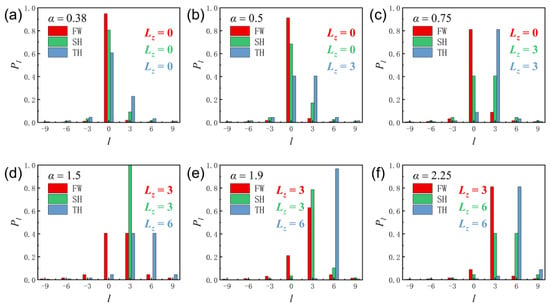
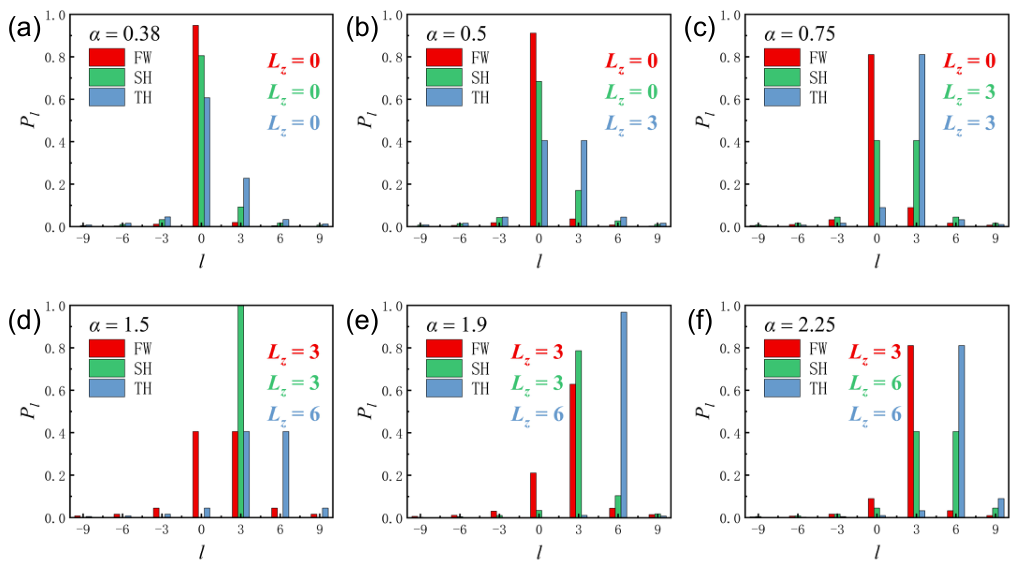
Figure 7 computes the reconstructed OAM spectra of the +1 diffraction order during SHG and THG. The ±1 orders result in a symmetrically distributed OAM spectrum with respect to point 0, and their superposition yields the polarization topological index t in the VOF, as depicted in Figure 5. At the specific critical jump points (, and 1.5), two distinct spectral components with different topological charges but identical intensities emerge. A similar spectral splitting occurs at the second transitions for SH and TH ( and 1.5). At (Figure 7e), the OAM in the FW and TH clearly fails to satisfy the threefold relationship, confirming . Conversely, at this identical state, the FW and SH satisfy the twofold relationship (). Ultimately, the asymmetrical reconstruction of the OAM spectrum induces an OAM jump in the two orthogonal basis vectors during frequency conversion. The superposition of these fundamentally altered basis vectors directly manifests as the macroscopic polarization topological nonconservation observed within the VOF.
Figure 7.
The OAM spectra of the +1 diffraction order for the MF-VOFs during SHG and THG (). The red, green, and blue bars represent the normalized spectral intensities of the OAM components for the FW, SH, and TH, respectively, revealing the physical origin of topological nonconservation.
6. Conclusions
In summary, we have theoretically designed and experimentally validated a highly flexible class of MF-VOFs, uncovering their distinct topological evolution pathways. In free space, we demonstrated that the polarized singular lines within MF-VOFs deterministically split into C-point chains, allowing for highly tunable, arbitrary position topological jumps while maintaining overall topological conservation. It should be noted that our experimental results are limited to free-space propagation. Most crucially, we discovered anomalous topological nonconservation during nonlinear frequency conversion processes (SHG and THG). Through a detailed analysis of the OAM spectrum, we verified that this topological symmetry breaking originates physically from the transition and reconstruction of the total OAM along the propagation direction. This intrinsic correlation between OAM spectral reconstruction and topological symmetry breaking introduces a powerful new paradigm for decoding complex light–matter interactions. Our framework overcomes the constraints of traditional periodic topological jump laws and holds significant potential for advancing multidimensional optical information processing and nonlinear topological photonics. By bridging the gap between singular optics and nonlinear frequency conversion, this work paves the way for advanced topological control in ultrafast light–matter interactions and the design of next-generation topological photonic devices.
Author Contributions
Conceptualization, C.T.; Methodology, J.Z., X.H. and Y.L. (Yue Li); Formal analysis, J.Z., X.H., Y.L. (Yue Li) and X.Z.; Investigation, J.Z., X.H. and X.Z.; Resources, C.T.; Data curation, Y.L. (Yue Li); Writing—original draft, J.Z. and C.T.; Writing—review & editing, Y.L. (Yongnan Li) and C.T.; Supervision, C.T.; Project administration, C.T.; Funding acquisition, Y.L. (Yongnan Li) and C.T. All authors have read and agreed to the published version of the manuscript.
Funding
This research was funded by the National Key R&D Program of China (Grant No. 2022YFA1404800) and National Natural Science Foundation of China (Grant Nos. 12374308, and 12474328).
Data Availability Statement
Data underlying the results presented in this paper are not publicly available at this time but may be obtained from the authors upon reasonable request.
Conflicts of Interest
The authors declare no conflicts of interest.
References
- Leykam, D.; Xue, H.; Zhang, B.; Chong, Y.D. Limitations and possibilities of topological photonics. Nat. Rev. Phys. 2026, 8, 55–64. [Google Scholar] [CrossRef] [Scilit]
- Kang, M.; Liu, T.; Chan, C.T.; Xiao, M. Applications of bound states in the continuum in photonics. Nat. Rev. Phys. 2023, 5, 659–678. [Google Scholar] [CrossRef] [Scilit]
- Zhang, X.; Zangeneh-Nejad, F.; Chen, Z.-G.; Lu, M.-H.; Christensen, J. A second wave of topological phenomena in photonics and acoustics. Nature 2023, 618, 687–697. [Google Scholar] [CrossRef] [Scilit]
- Tang, G.-J.; He, X.-T.; Shi, F.-L.; Liu, J.-W.; Chen, X.-D.; Dong, J.-W. Topological photonic crystals: Physics, designs, and applications. Laser Photonics Rev. 2022, 16, 2100300. [Google Scholar] [CrossRef] [Scilit]
- Ozawa, T.; Price, H.M.; Amo, A.; Goldman, N.; Hafezi, M.; Lu, L.; Rechtsman, M.C.; Schuster, D.; Simon, J.; Zilberberg, O.; et al. Topological photonics. Rev. Mod. Phys. 2019, 91, 015006. [Google Scholar] [CrossRef] [Scilit]
- Gao, W.; Zhou, Y.; Li, X.; Zhang, Y.; Zhang, Q.; Li, M.; Yu, X.; Yan, S.; Xu, X.; Yao, B. Topological light field: From singular to skyrmionic optics and beyond. J. Opt. 2025, 27, 083001. [Google Scholar] [CrossRef] [Scilit]
- Bliokh, K.Y.; Karimi, E.; Padgett, M.J.; Alonso, M.A.; Dennis, M.R.; Dudley, A.; Forbes, A.; Zahedpour, S.; Hancock, S.W.; Milchberg, H.M.; et al. Roadmap on structured waves. J. Opt. 2023, 25, 103001. [Google Scholar] [CrossRef] [Scilit]
- He, C.; Shen, Y.; Forbes, A. Towards higher-dimensional structured light. Light Sci. Appl. 2022, 11, 205. [Google Scholar] [CrossRef] [Scilit] [PubMed]
- Ma, X.; Zhang, H.; Wei, W.; Tai, Y.; Qian, Y.; Li, X.; Shen, Y. Observation of superoscillation moir’e superlattices. Adv. Photonics 2026, 8, 026008. [Google Scholar] [CrossRef] [Scilit]
- Wang, R.; Zhang, H.; Liu, K.; Li, X.; Tai, Y. Arbitrary vector beam generation by mapping an object. Appl. Phys. Lett. 2025, 127, 061101. [Google Scholar] [CrossRef] [Scilit]
- Cheng, M.; Jiang, W.; Guo, L.; Li, J.; Forbes, A. Metrology with a twist: Probing and sensing with vortex light. Light Sci. Appl. 2025, 14, 4. [Google Scholar] [CrossRef] [Scilit] [PubMed]
- Wan, C.; Chong, A.; Zhan, Q. Optical spatiotemporal vortices. eLight 2023, 3, 11. [Google Scholar] [CrossRef] [Scilit]
- Porfirev, A.; Khonina, S.; Kuchmizhak, A. Light–matter interaction empowered by orbital angular momentum: Control of matter at the micro-and nanoscale. Prog. Quantum Electron. 2023, 88, 100459. [Google Scholar] [CrossRef] [Scilit]
- Yang, X.; Fan, M.; Zhang, H.; Liu, K.; Hu, J.; Tai, Y.; Shen, Y.; Li, X. Fractional orbital angular momentum sorting using wind spiral transformation. Nanophotonics 2026, 15, e70086. [Google Scholar] [CrossRef] [Scilit]
- Li, C.; Qin, X.; Liu, K.; Zhang, H.; Zhou, Y.; Tai, Y.; Li, X. Optical vortex in a quasicrystal structure. Opt. Lett. 2025, 50, 3373–3376. [Google Scholar] [CrossRef] [Scilit]
- Zhen, W.; Ren, Z.-C.; Wang, X.-L.; Ding, J.; Wang, H.-T. Polarization structure transition of C-point singularities upon reflection. Sci. China Phys. Mech. Astron. 2025, 68, 244211. [Google Scholar] [CrossRef] [Scilit]
- Li, J.; Jana, A.; Yuan, Y.; Zhang, K.; Burokur, S.N.; Genevet, P. Exploiting hidden singularity on the surface of the Poincaré sphere. Nat. Commun. 2025, 16, 5953. [Google Scholar] [CrossRef] [Scilit] [PubMed]
- Wang, S.; Zhou, Z.; Zheng, Z.; Sun, J.; Cao, H.; Song, S.; Deng, Z.-L.; Qin, F.; Cao, Y.; Li, X. Topological structures of energy flow: Poynting vector skyrmions. Phys. Rev. Lett. 2024, 133, 073802. [Google Scholar] [CrossRef] [Scilit]
- Ahmed, H.; Ansari, M.A.; Li, Y.; Zentgraf, T.; Mehmood, M.Q.; Chen, X. Dynamic control of hybrid grafted perfect vector vortex beams. Nat. Commun. 2023, 14, 3915. [Google Scholar] [CrossRef] [Scilit]
- Liu, W.; Liu, W.; Shi, L.; Kivshar, Y. Topological polarization singularities in metaphotonics. Nanophotonics 2021, 10, 2173–2191. [Google Scholar] [CrossRef] [Scilit]
- Wang, Q.; Tu, C.-H.; Li, Y.-N.; Wang, H.-T. Polarization singularities: Progress, fundamental physics, and prospects. Apl Photonics 2021, 6, 040901. [Google Scholar] [CrossRef] [Scilit]
- Zhang, G.-L.; Tu, C.; Li, Y.; Wang, H.-T. Observation of polarization topological singular lines. Photonics Res. 2019, 7, 705–710. [Google Scholar] [CrossRef] [Scilit]
- Lu, X.; Wang, Z.; Zhu, J.; Hang, Y.; Lu, X.; Cai, X.; Xie, T.; Cai, Y.; Zhao, C. Fractional vortex beam: Fundamentals and beyond. Light Manip. Appl. 2026, 1, 202502. [Google Scholar] [CrossRef] [Scilit]
- Zhang, H.; Zeng, J.; Lu, X.; Wang, Z.; Zhao, C.; Cai, Y. Review on fractional vortex beam. Nanophotonics 2022, 11, 241–273. [Google Scholar] [CrossRef] [Scilit] [PubMed]
- Zheng, Y.; Li, Y.; Wang, F.; Liu, R.; Deng, D.; Cai, Y.; Zhao, Y. Precision measurement of the topological charge of a fractional vortex beam based on angular-grating-diffraction OAM spectrum. Opt. Express 2025, 33, 553–561. [Google Scholar] [CrossRef] [Scilit]
- Cai, Y.; Fang, S.; Guo, H.; Xu, D.; Yang, G.; Zhang, W.; Chen, L. Deep-learning-based recognition of fractional C-point indices in polarization singularities. Phys. Rev. A 2022, 105, 053509. [Google Scholar] [CrossRef] [Scilit]
- Tu, C.; Wang, Q.; Ren, Z.-C.; Wang, X.-L.; Li, Y.; Wang, H.-T. Advances in nonlinear manipulation of structured light fields: From fundamentals to applications. Light Manip. Appl. 2026, 1, 202506. [Google Scholar] [CrossRef] [Scilit]
- Zhang, Z.; Li, G.; Liu, Y.; Wang, H.; Hoenders, B.J.; Liang, C.; Cai, Y.; Zeng, J. Robust measurement of orbital angular momentum of a partially coherent vortex beam under amplitude and phase perturbations. Opto-Electron. Sci. 2024, 3, 240001. [Google Scholar] [CrossRef] [Scilit]
- Buono, W.T.; Forbes, A. Nonlinear optics with structured light. Opto-Electron. Adv. 2022, 5, 210174. [Google Scholar] [CrossRef] [Scilit]
- Liu, Z.-F.; Ren, Z.-C.; Lou, Y.-C.; Cheng, Z.-M.; Yang, Y.-X.; Li, Y.; Ding, J.; Wang, X.-L.; Wang, H.-T. Control of harmonic orbital angular momentum in second-harmonic generation of perfect vortices. Phys. Rev. A 2022, 105, 063518. [Google Scholar] [CrossRef] [Scilit]
- Liu, T.; Gu, B.; Rui, G.; Lv, C.; He, J.; Cui, Y. Conservation of the spin angular momentum in second-harmonic generation with elliptically polarized vortex beams. Appl. Phys. Lett. 2019, 114, 101101. [Google Scholar] [CrossRef] [Scilit]
- Wang, D.; Liu, G.-G.; Lü, J.-Q.; Li, P.-P.; Cai, M.-Q.; Zhang, G.-L.; Li, Y.; Tu, C.; Wang, H.-T. Femtosecond polarization-structured optical field meets an anisotropic nonlinear medium. Opt. Express 2018, 26, 27726–27747. [Google Scholar] [CrossRef] [Scilit] [PubMed]
- Bouchard, F.; Larocque, H.; Yao, A.M.; Travis, C.; De Leon, I.; Rubano, A.; Karimi, E.; Oppo, G.-L.; Boyd, R.W. Polarization shaping for control of nonlinear propagation. Phys. Rev. Lett. 2016, 117, 233903. [Google Scholar] [CrossRef] [Scilit]
- Liu, X.; Chang, C.; Mo, Y.; Liu, D.; Wei, D.; Li, J.; Wei, D.; Wang, X. Asymmetrically Nonlinear Generation of Optical Orbital Angular Momentum via Cooperation of Bragg Diffraction and Birefringent Phase Matching. Laser Photonics Rev. 2026, 20, e01656. [Google Scholar] [CrossRef] [Scilit]
- Kim, J.-Y.; Cho, M. Optical Orbital Angular Momentum Detection Using Second-Order Nonlinear Optical Processes. ACS Photonics 2026, 13, 1020–1029. [Google Scholar] [CrossRef] [Scilit]
- Lou, Y.-C.; Cheng, Z.-M.; Liu, Z.-H.; Yang, Y.-X.; Ren, Z.-C.; Ding, J.; Wang, X.-L.; Wang, H.-T. Third-harmonic generation of spatially structured light in a quasi-periodically poled crystal. Optica 2022, 9, 183–186. [Google Scholar] [CrossRef] [Scilit]
- Wu, H.-J.; Yu, B.-S.; Zhu, Z.-H.; Gao, W.; Ding, D.-S.; Zhou, Z.-Y.; Hu, X.-P.; Rosales-Guzmán, C.; Shen, Y.; Shi, B.-S. Conformal frequency conversion for arbitrary vectorial structured light. Optica 2022, 9, 187–196. [Google Scholar] [CrossRef] [Scilit]
- Yang, Y.-X.; Dong, B.-W.; Ren, Z.-C.; Li, H.; Lou, Y.-C.; Cheng, Z.-M.; Liu, Z.-F.; Ding, J.; Wang, X.-L.; Wang, H.-T. Nonlinear manipulation of orbital angular momentum spectra with second- and third-harmonic generation in a quasi-periodically poled crystal. Appl. Phys. Lett. 2022, 121, 032202. [Google Scholar] [CrossRef] [Scilit]
- Wen, B.; Rui, G.; He, J.; Cui, Y.; Gu, B. Polarization rotation and singularity evolution of fundamental Poincaré beams through anisotropic Kerr nonlinearities. J. Opt. 2020, 22, 085501. [Google Scholar] [CrossRef] [Scilit]
- Gibson, C.J.; Bevington, P.; Oppo, G.-L.; Yao, A.M. Control of polarization rotation in nonlinear propagation of fully structured light. Phys. Rev. A 2018, 97, 033832. [Google Scholar] [CrossRef] [Scilit]
- Liu, C.; Guan, Y.; Wu, Y.; Hu, X.; Chew, K.-H.; Chen, R.-P. Second harmonic generation of twisted vector vortex beams using a β-BaB2O4 crystal. Photonics 2024, 11, 606. [Google Scholar] [CrossRef] [Scilit]
- Fleck, J.A., Jr.; Morris, J.R.; Feit, M.D. Time-dependent propagation of high energy laser beams through the atmosphere. Appl. Phys. 1976, 10, 129–160. [Google Scholar] [CrossRef] [Scilit]
- Singh, S.K.; Kinashi, K.; Tsutsumi, N.; Awatsuji, Y.; Jackin, B.J. Non-diffracting Vector Tricomi beams. Opt. Commun. 2026, 608, 133004. [Google Scholar] [CrossRef] [Scilit]
- Bliokh, K.Y.; Alonso, M.A.; Dennis, M.R. Geometric phases in 2D and 3D polarized fields: Geometrical, dynamical, and topological aspects. Rep. Prog. Phys. 2019, 82, 122401. [Google Scholar] [CrossRef] [Scilit]
- Zhang, W.; Tang, J.; Ming, Y.; Zhang, C.; Lu, Y. Optical-field topological phase transition in nonlinear frequency conversion. Opt. Express 2020, 28, 2818–2827. [Google Scholar] [CrossRef] [Scilit]
- Wang, Y.; Gbur, G. Hilbert’s Hotel in polarization singularities. Opt. Lett. 2017, 42, 5154–5157. [Google Scholar] [CrossRef] [Scilit] [PubMed]
- Gbur, G. Fractional vortex Hilbert’s hotel. Optica 2016, 3, 222–225. [Google Scholar] [CrossRef] [Scilit]
- Jones, P.H.; Rashid, M.; Makita, M.; Maragò, O.M. Sagnac interferometer method for synthesis of fractional polarization vortices. Opt. Lett. 2009, 34, 2560–2562. [Google Scholar] [CrossRef] [Scilit] [PubMed]
- Boyd, R.W. Nonlinear Optics, 4th ed.; Academic Press: Cambridge, MA, USA, 2020. [Google Scholar]
- Kumar, S.; Saripalli, R.K.; Ghosh, A.; Buono, W.T.; Forbes, A.; Samanta, G.K. Controlling the coverage of full Poincaré beams through second-harmonic generation. Phys. Rev. Appl. 2023, 19, 034082. [Google Scholar] [CrossRef] [Scilit]
- Freund, I. Second-harmonic generation of polarization singularities. Opt. Lett. 2002, 27, 1640–1642. [Google Scholar] [CrossRef] [Scilit] [PubMed]
- Shen, Y.; Wang, X.; Xie, Z.; Min, C.; Fu, X.; Liu, Q.; Gong, M.; Yuan, X. Optical vortices 30 years on: OAM manipulation from topological charge to multiple singularities. Light Sci. Appl. 2019, 8, 90. [Google Scholar] [CrossRef] [Scilit]
- Zambrini, R.; Barnett, S.M. Quasi-intrinsic angular momentum and the measurement of its spectrum. Phys. Rev. Lett. 2006, 96, 113901. [Google Scholar] [CrossRef] [Scilit]
- Alperin, S.N.; Siemens, M.E. Angular momentum of topologically structured darkness. Phys. Rev. Lett. 2017, 119, 203902. [Google Scholar] [CrossRef] [Scilit]
- O’Neil, A.T.; MacVicar, I.; Allen, L.; Padgett, M.J. Intrinsic and extrinsic nature of the orbital angular momentum of a light beam. Phys. Rev. Lett. 2002, 88, 053601. [Google Scholar] [CrossRef] [Scilit]
Disclaimer/Publisher’s Note: The statements, opinions and data contained in all publications are solely those of the individual author(s) and contributor(s) and not of MDPI and/or the editor(s). MDPI and/or the editor(s) disclaim responsibility for any injury to people or property resulting from any ideas, methods, instructions or products referred to in the content. |
© 2026 by the authors. Licensee MDPI, Basel, Switzerland. This article is an open access article distributed under the terms and conditions of the Creative Commons Attribution (CC BY) license.