Article

Alignment of Off-Axis Two-Mirror Freeform Optical Systems Based on Geometric Constraints of a Multi-Zone CGH

1
National Key Laboratory of Infrared Detection Technologies, Shanghai Institute of Technical Physics, Chinese Academy of Sciences, Shanghai 200083, China
2
University of Chinese Academy of Sciences, Beijing 100049, China
*
Author to whom correspondence should be addressed.
Photonics 2026, 13(5), 473; https://doi.org/10.3390/photonics13050473
Submission received: 16 April 2026 / Revised: 2 May 2026 / Accepted: 6 May 2026 / Published: 9 May 2026

Abstract

Due to the lack of rotational symmetry, off-axis two-mirror freeform optical systems usually exhibit coupled alignment degrees of freedom and poor sensitivity-matrix conditioning, which increase the difficulty of alignment. To address this issue, a geometrically constrained alignment method based on a multi-zone computer-generated hologram (CGH) is proposed. A multi-zone CGH integrating null compensation and mark projection on a single substrate was designed to provide both wavefront and spatial references. In combination with a staged alignment procedure, the projected optical marks were used to assist in establishing the relative positional relationship between the interferometer–CGH subsystem and the PM-SM system, while also providing geometric references for secondary-mirror pose adjustment during wavefront-guided iterative alignment. Results from multiple alignment experiments show that the mean wavefront RMS was 0.0577 λ at 632.8 nm, with a standard deviation of 0.004 λ . These results suggest that, under the present experimental conditions, the proposed method exhibits good repeatability and convergence stability and can provide a reference for the alignment of freeform optical payloads.

1. Introduction

With the development of Earth observation and deep-space exploration missions, optical payloads are facing increasingly stringent requirements in terms of compactness, image quality, and field of view. Off-axis reflective optical systems, owing to their unobscured apertures and relatively flexible structural layouts, have become an important solution for space optical payloads [1,2]. The use of freeform optical elements further increases the design freedom of such systems, providing additional flexibility for aberration correction and for achieving wide-field, high-image-quality imaging within compact configurations [3,4]. At the same time, the increased design freedom of these systems also imposes higher requirements on manufacturing, assembly, alignment, and testing. For space optical payloads in particular, the final imaging performance depends not only on the optical design itself, but also on the accuracy with which the relative poses of the optical components are controlled during alignment. However, off-axis freeform optical systems generally lack rotational symmetry, and the relationship between system aberrations and component pose errors is correspondingly more complicated [5]. In this context, high-precision alignment remains a key issue for the engineering implementation of such systems.
In practical alignment, one of the main difficulties is that different pose-error degrees of freedom are often coupled, and their corresponding aberration responses may be similar, which increases the complexity of misalignment identification and correction [6,7]. For off-axis freeform reflective systems, decenter and tilt errors of reflective elements often give rise to similar low-order aberration signatures, and certain degrees of freedom may also exhibit mutual compensation [8,9]. Because wavefront measurements reflect the combined response of system errors, misalignment inversion during system alignment is often subject to a certain degree of uncertainty, and a reduction in the residual wavefront error does not necessarily indicate that the component poses are approaching their nominal states. Therefore, additional references or constraint information are usually required during alignment to improve the reliability of misalignment identification.
In practical applications, existing alignment methods usually introduce mechanical metrology instruments, such as laser trackers or theodolites, to establish geometric references for component position and orientation [10,11,12], thereby providing geometric constraints for initial positioning and subsequent alignment. Although such methods can support system assembly and pre-alignment, they also increase the dependence of the alignment procedure on external metrology chains and coordinate-transfer processes. Moreover, these measurements primarily reflect the positional relationship of mechanical surfaces or mounting references rather than the direct response of system wavefront error, and coordinate transformation errors and alignment residuals may still exist between the mechanical and optical references [13]. On the other hand, if alignment relies only on interferometric test results, it is difficult to sufficiently constrain the inversion ambiguity caused by coupled degrees of freedom [14]. Therefore, how to effectively combine wavefront sensing and spatial positioning information during alignment, and how to establish a stable and accurate correspondence between them, remains an issue that needs to be further addressed in the alignment of off-axis freeform optical systems.
To address this problem, this paper proposes a spatially geometrically constrained alignment method based on a multi-zone CGH. The multi-zone CGH integrates wavefront phase compensation and optical mark projection on a single substrate [15,16]. In this way, while enabling null-compensation testing of the system, the auxiliary functional zones can project geometric marks to provide spatial references for establishing the relative positional relationship between the test system and the system under test, for geometric pre-alignment, and for supplying additional geometric constraints during component pose adjustment. On this basis, a staged alignment procedure for an off-axis two-mirror freeform optical system is established, and the effectiveness of the proposed method is experimentally verified.

2. Theory and Method

2.1. Analysis of Misalignment Characteristics Based on Nodal Aberration Theory

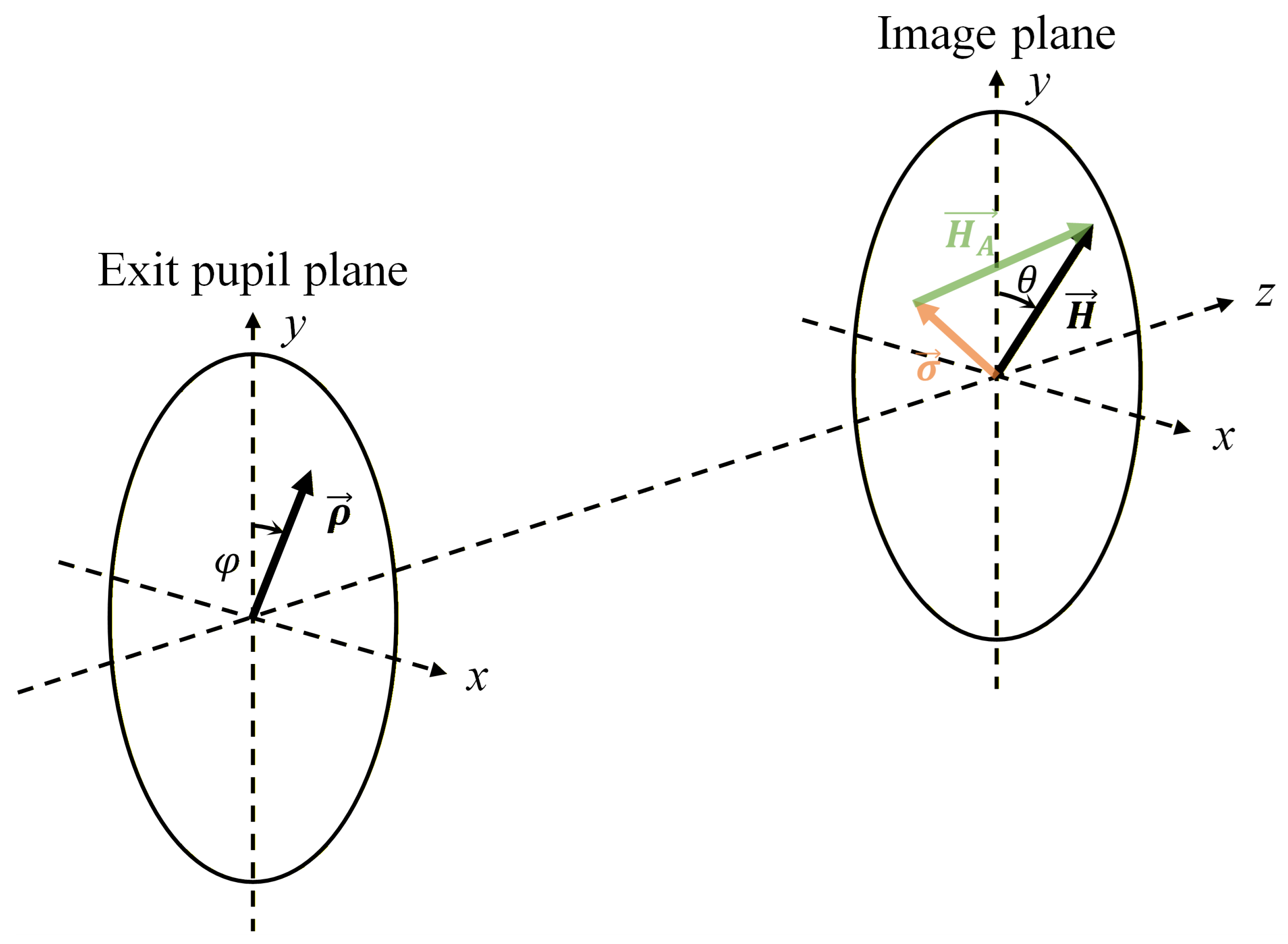
Classical Seidel aberration theory is predicated on the assumption of rotational symmetry in optical systems, a premise that is no longer applicable to off-axis and freeform systems. As shown in Figure 1, to further characterize the dependence of the wave aberration function on the field and pupil coordinates, Shack recast the scalar form of the wave aberration function into the following vector form [17]:
W = j p = 0 n = 0 m = 0 ( W k l m ) j ( H · H ) p ( H · ρ ) m ( ρ · ρ ) n , k = 2 p + m , l = 2 n + m ,
where W denotes the wave aberration function; H and ρ represent the field vector and pupil vector, respectively; ( W k l m ) j denotes the contribution coefficient of the j-th optical surface to the total wave aberration; and p, n, and m are non-negative integers. To describe the shift of the aberration field center of each surface with respect to the nominal field center, Buchroeder introduced the aberration field-center shift vector σ j [18], which represents the position displacement of the aberration field center associated with the j-th optical surface on the image plane. Accordingly, the effective aberration field height of the j-th surface, denoted by H A j , is defined as
H A j = H σ j .
Based on this definition, Thompson incorporated H A j into the vector form of the wave aberration function and established the general expression of Nodal Aberration Theory (NAT) [6]:
W = j p = 0 n = 0 m = 0 ( W k l m ) j ( H A j · H A j ) p ( ρ · ρ ) n ( H A j · ρ ) m = j p = 0 n = 0 m = 0 ( W k l m ) j ( H σ j ) · ( H σ j ) p ( ρ · ρ ) n ( H σ j ) · ρ m .
This expression shows that the introduction of H A j does not change the basic form of the aberration terms, but modifies their field dependence through the field-center shift vector σ j . As a result, the overall aberration field exhibits a distribution different from that of a rotational symmetry system. In other words, the effect of misalignment on aberration distribution is mainly reflected in changes in the locations of the aberration field centers and their field dependence.
For the third-order coma term, its expression in NAT can be written as
W coma = j ( W 131 ) j ( H σ j ) · ρ ( ρ · ρ ) = W 131 ( H σ 131 eff ) · ρ ( ρ · ρ ) , ( W 131 0 )
where
W 131 = j ( W 131 ) j , A 131 = j ( W 131 ) j σ j , σ 131 eff = A 131 W 131 = j ( W 131 ) j σ j j ( W 131 ) j .
These equations show that the third-order coma term still has a first-order dependence on the field coordinate in NAT. The overall coma field can be interpreted as a linear field distribution about an effective coma field center, σ 131 eff , which is determined by the weighted superposition of the aberration field-center shifts of all optical surfaces. Therefore, the effects of the off-axis configuration and misalignments such as decenter and tilt are mainly manifested as changes in the effective coma field center and, consequently, in the field distribution of the total coma. Note that σ 131 eff is not necessarily nonzero, because contributions from different surfaces may partially cancel each other.
For the third-order astigmatism term, its expression in NAT can be written as
W astig = 1 2 j ( W 222 ) j ( H σ j ) 2 · ρ 2 = 1 2 W 222 H 2 2 A 222 H + B 222 · ρ 2 = 1 2 W 222 ( H a 222 ) 2 + b 222 · ρ 2 , ( W 222 0 )
where
W 222 = j ( W 222 ) j , A 222 = j ( W 222 ) j σ j , B 222 = j ( W 222 ) j σ j 2 , a 222 = A 222 W 222 , b 222 = B 222 W 222 a 222 2 .
Here, a 222 describes the central position of the astigmatic nodal structure, whereas b 222 characterizes the bi-nodal separation. Therefore, decenter or tilt misalignment changes the corresponding σ j values of the relevant optical surfaces, causing both a drift of the astigmatic nodal structure through a 222 and a change in the separation and orientation of the bi-nodal pattern through b 222 . As a result, the influence of misalignment on the third-order astigmatism field is reflected not only in the nodal positions, but also in the node separation and field distribution. Therefore, unlike third-order coma, which is mainly manifested as an effective field-center shift, third-order astigmatism generally exhibits a more complex response to the off-axis configuration, decenter and tilt misalignment, and is more likely to show degree-of-freedom coupling.
The above NAT-based analysis is mainly introduced to provide a physical interpretation of misalignment-induced aberration responses in the off-axis two-mirror freeform optical system. It shows that misalignments mainly affect the aberration distribution through shifts of the aberration field centers associated with different optical surfaces, thereby changing the nodal locations and field dependence of the aberration fields. As a result, some misalignment degrees of freedom may produce similar or coupled low-order aberration responses.

2.2. Model Construction for Misalignment Analysis Based on the Sensitivity Matrix

Although NAT describes how misalignments affect the aberration distribution, quantitative misalignment correction requires a mathematical mapping between the SM pose errors and the system wavefront aberration coefficients. In the alignment process, the primary mirror is taken as the spatial reference, and the system aberrations are compensated by adjusting the pose of the SM. The actual pose state of the SM is defined as
x = [ D x , D y , D z , T x , T y , T z ] T ,
where D x , D y and D z are the translational displacements along the three coordinate axes, and T x , T y and T z are the rotation angles about these axes. Let x 0 denote the nominal pose state. Then, the misalignment vector relative to the nominal state is
Δ x = x x 0 = [ Δ D x , Δ D y , Δ D z , Δ T x , Δ T y , Δ T z ] T ,
where Δ D x , Δ D y and Δ D z denote the translational misalignments, and Δ T x , Δ T y and Δ T z denote the angular misalignments. The system response is represented by the wavefront aberration coefficient vector
y = [ C 1 , C 2 , , C M ] T ,
where y R M × 1 is the wavefront aberration coefficient vector.
When the system is within a small misalignment range around the nominal state, the wavefront aberration coefficient vector y ( x 0 + Δ x ) can be expanded at x 0 by a first-order Taylor series:
y ( x 0 + Δ x ) = y ( x 0 ) + J Δ x + O ( Δ x ) 2 ,
where y ( x 0 ) is the wavefront aberration coefficient vector in the nominal state, J is the Jacobian matrix at x 0 , and O ( Δ x ) 2 denotes the higher-order terms. Neglecting the higher-order nonlinear terms, the local linear model can be written as
Δ y = y ( x 0 + Δ x ) y ( x 0 ) S Δ x ,
where Δ y is the variation vector of the wavefront aberration coefficients, and S R M × 6 is the sensitivity matrix. It characterizes the first-order response of each wavefront aberration coefficient to each pose degree of freedom:
S = C 1 D x C 1 D y C 1 T z C 2 D x C 2 D y C 2 T z C M D x C M D y C M T z x = x 0 .
These partial derivatives are evaluated at x 0 . In practice, the sensitivity matrix is usually computed by finite differences. For the j-th degree of freedom, the corresponding matrix element is approximated by
s i , j C i ( x 0 + δ x j ) C i ( x 0 ) δ x j ,
where δ x j is a small perturbation of the j-th degree of freedom.
Once the sensitivity matrix is obtained, the misalignment correction vector Δ x can be estimated from the measured wavefront aberration coefficient variation Δ y . Under the linear model, the solution is written as
Δ x = S + Δ y ,
where S + is the pseudo inverse of the sensitivity matrix. However, strong linear correlations among the columns of S may result in poor conditioning, making the inversion sensitive to measurement noise and causing unstable parameter solutions. Therefore, singular value decomposition (SVD) is introduced to evaluate the conditioning of the sensitivity matrix and identify potentially degenerate degrees of freedom.

2.3. Analysis of Coupling Characteristics of Alignment Degrees of Freedom Based on SVD

Applying SVD to the sensitivity matrix S yields
S = U Σ V T ,
where U R M × M and V R 6 × 6 are orthogonal matrices, and Σ R M × 6 contains the singular values η i . These singular values describe the response magnitude of the system along different orthogonal directions. The columns of V represent orthogonal combinations in the six-degree-of-freedom space of the secondary mirror, whereas the columns of U represent orthogonal response modes in the observation space. Therefore, the singular-value spectrum and the associated singular vectors can be used to analyze the observability and coupling characteristics of the alignment model. To quantify the ill-conditioning of S , the condition number is defined as
κ ( S ) = η max η min ,
where η max and η min are the largest and smallest nonzero singular values, respectively. A larger κ indicates stronger response imbalance among different directions, higher sensitivity to measurement noise, and a greater likelihood of coupling or near-degeneracy among certain degrees of freedom.
The SVD results of the sensitivity matrix for the off-axis two-mirror system are listed in Table 1, with singular values of 89.596 , 66.432 , 26.056 , 0.959 , 0.851 and 0.002 , giving a condition number of approximately 44,798 . This indicates that the inversion problem is strongly ill-conditioned under the current observation model. The first three singular values are much larger than the last three, showing a significant difference in response magnitude among different singular directions. The dominant modes are mainly associated with SM rotations about the X - and Y -axis and axial translation, whereas the weak-response modes are mainly combinations of lateral translations and tilts. The right singular vectors further show evident coupling between Y -direction translation and X -axis rotation, as well as between X -direction translation and Y -axis rotation. This suggests that the wavefront responses of the lateral translation and tilt degrees of freedom are similar under the current model. Therefore, although the inversion can reduce the wavefront residual, the corresponding geometric pose parameters may not be uniquely determined. The above analysis is based on the six-degree-of-freedom SM correction model of the present off-axis two-mirror system.

2.4. Misalignment Estimation Model with Geometric Constraints

In the previous subsection, a misalignment inversion model was established based on the sensitivity matrix. In the unconstrained case, the correction can be obtained in the least-squares form:
Δ x = S T S 1 S T Δ y .
This indicates that, when only the wavefront residual is considered, the misalignment can be estimated from the linear relationship between the sensitivity matrix and the measured wave aberration coefficient variation. However, for an ill-conditioned system, this unconstrained solution may be sensitive to measurement perturbations. Therefore, a geometric constraint term is introduced, and the problem is formulated as
J ( Δ x ) = S Δ x Δ y 2 2 + μ G Δ x 2 2 ,
where G is the geometric constraint weighting matrix determined by the degrees of freedom that can be constrained by the geometric references. For each constrained degree of freedom, the corresponding weight was set according to its allowable geometric tolerance, so that the constrained correction terms were normalized to a comparable scale. The parameter μ was selected empirically to balance the wavefront residual term and the geometric constraint term. Accordingly, the regularized solution can be expressed as
Δ x = S T S + μ G T G 1 S T Δ y .
In this form, the geometric constraint helps suppress solution drift in ill-conditioned directions and reduces inversion ambiguity caused by degree-of-freedom coupling.

3. Alignment Method Based on Geometric Constraints

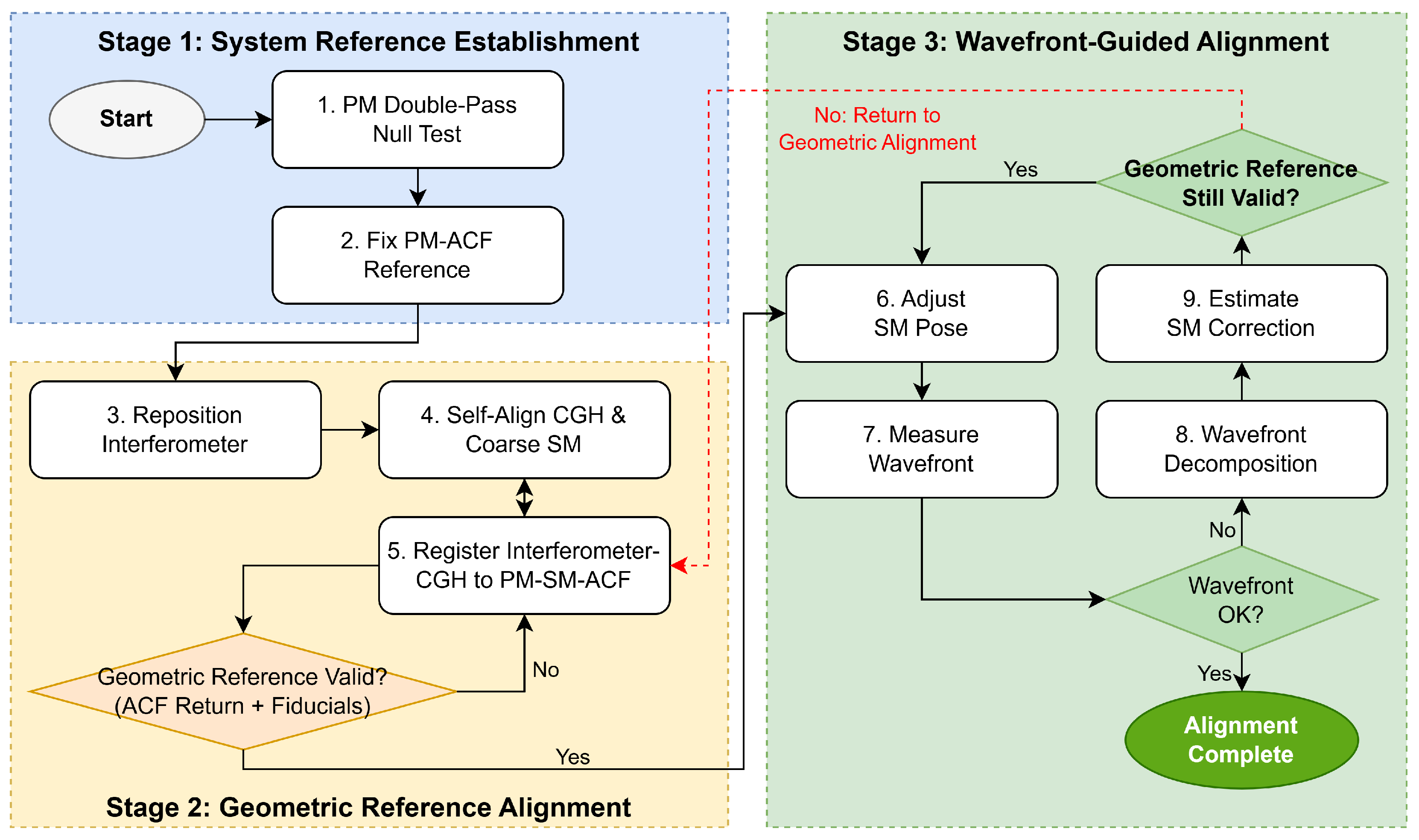
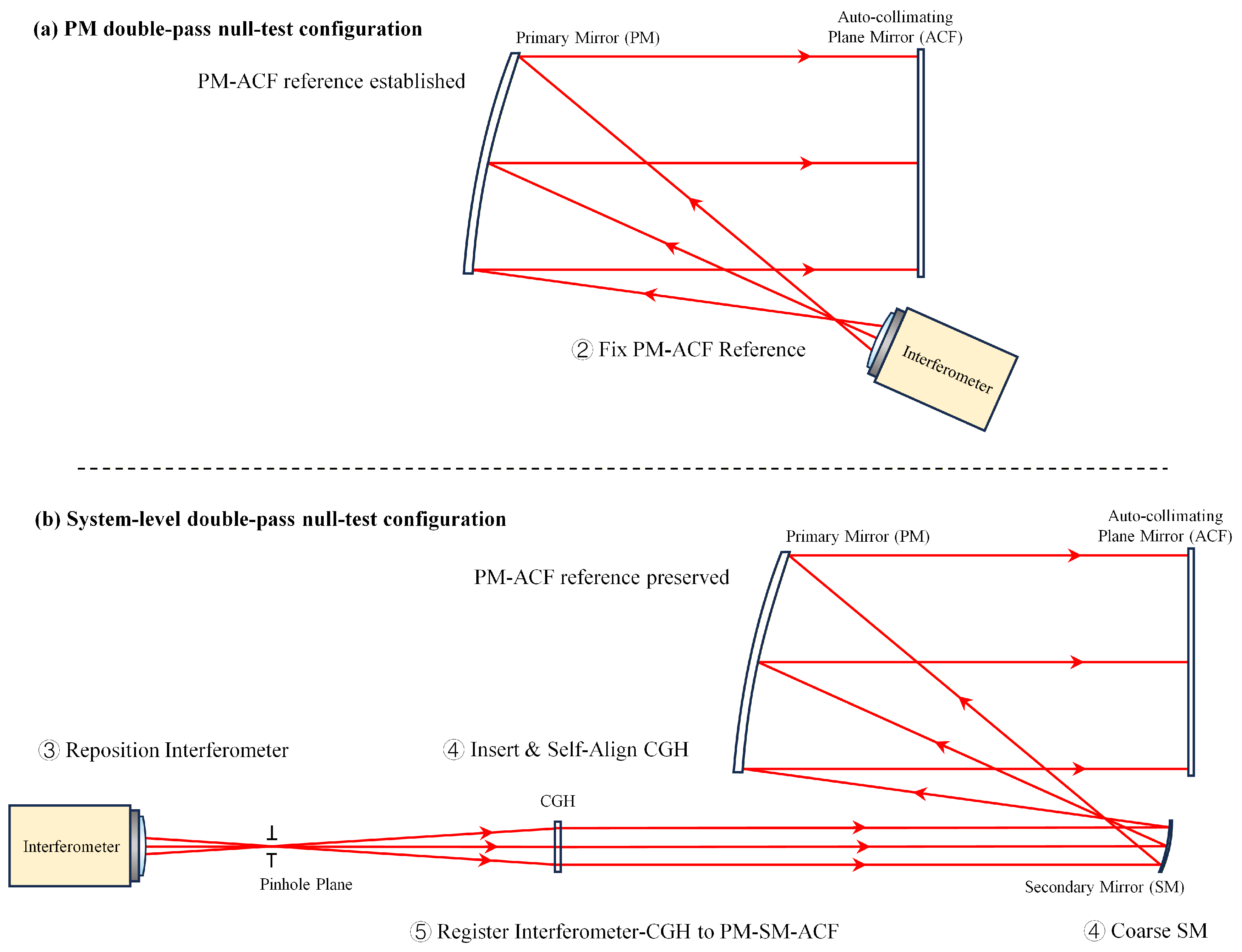
The geometric constraints in the misalignment inversion model can be implemented using a multi-zone CGH. A multi-zone CGH can integrate wavefront compensation and geometric fiducial projection on the same substrate, thereby providing soft geometric constraints on the spatial position of the SM. To combine the wavefront and geometric information in practical alignment, the alignment procedure is divided into three stages—system reference establishment, geometric reference alignment, and wavefront-guided adjustment—as shown in Figure 2. The corresponding optical configurations for the PM double-pass null test and the system-level double-pass null test are further illustrated in Figure 3.
First, in the system reference establishment stage, the interferometer is placed in the PM null-test configuration, and a double-pass null-test path consisting of the interferometer, the PM, and the ACF is constructed for the selected field used in the subsequent system-level wavefront measurement. By adjusting the relative alignment among the interferometer, the PM, and the ACF, the PM double-pass null-test condition is established. In this condition, the beam reflected by the ACF retraces the incident path, and the measured PM null-test result is consistent with the single-mirror acceptance result. Acceptance of the PM null test therefore indicates that the PM-ACF auto-collimation reference required for the selected system test field has been established. After this step, the PM and the ACF are mechanically fixed and serve as the stationary reference for the subsequent system-level double-pass null test, as shown in Figure 3a.
Second, in the geometric reference alignment stage, the test configuration is switched from the PM double-pass null-test configuration to the system-level double-pass null-test configuration used for wavefront measurement, as illustrated in Figure 3b. The PM and the ACF remain mechanically fixed, while the interferometer is repositioned to the system-test position to accommodate the insertion of the multi-zone CGH and the SM. This repositioning does not redefine the PM-ACF reference established in the previous stage. The CGH is first aligned with the interferometer through the self-alignment zone. The SM is then introduced and coarsely positioned near its designed state according to the optical design and laser tracker measurements. The interferometer–CGH assembly is subsequently registered to the PM-SM-ACF configuration. The projected fiducial marks generated by the CGH and the ACF-reflected return beam are used to verify whether the current spatial geometry satisfies the requirements for the system-level double-pass null test. Once the geometric references and the beam-retrace condition of the ACF-reflected return beam are confirmed, the interferometer–CGH measurement configuration is regarded as valid for the subsequent wavefront-guided adjustment.
Finally, in the wavefront-guided adjustment stage, the SM pose is further adjusted according to the system-level double-pass interferometric result, and the wavefront of the current field is measured. If the wavefront does not meet the prescribed requirement, the measured wavefront is decomposed and the corresponding correction of the SM pose is estimated using the sensitivity model. At the same time, the geometric references and the ACF-reflected return beam are checked to ensure that the established measurement geometry remains within the allowable range. If the geometric references are violated or the ACF-reflected return beam becomes unstable, the procedure returns to the geometric reference alignment stage, where the interferometer–CGH registration and the system under test are rechecked. Otherwise, the SM pose adjustment continues under the joint monitoring of the ACF-reflected return beam and the wavefront result. Through this iterative process, geometric reference verification, SM pose adjustment, and wavefront measurement are integrated. When the wavefront requirement is satisfied and the geometric references remain valid, the alignment of the current field is considered complete.

4. Design of a Multi-Zone CGH with Integrated Geometric References

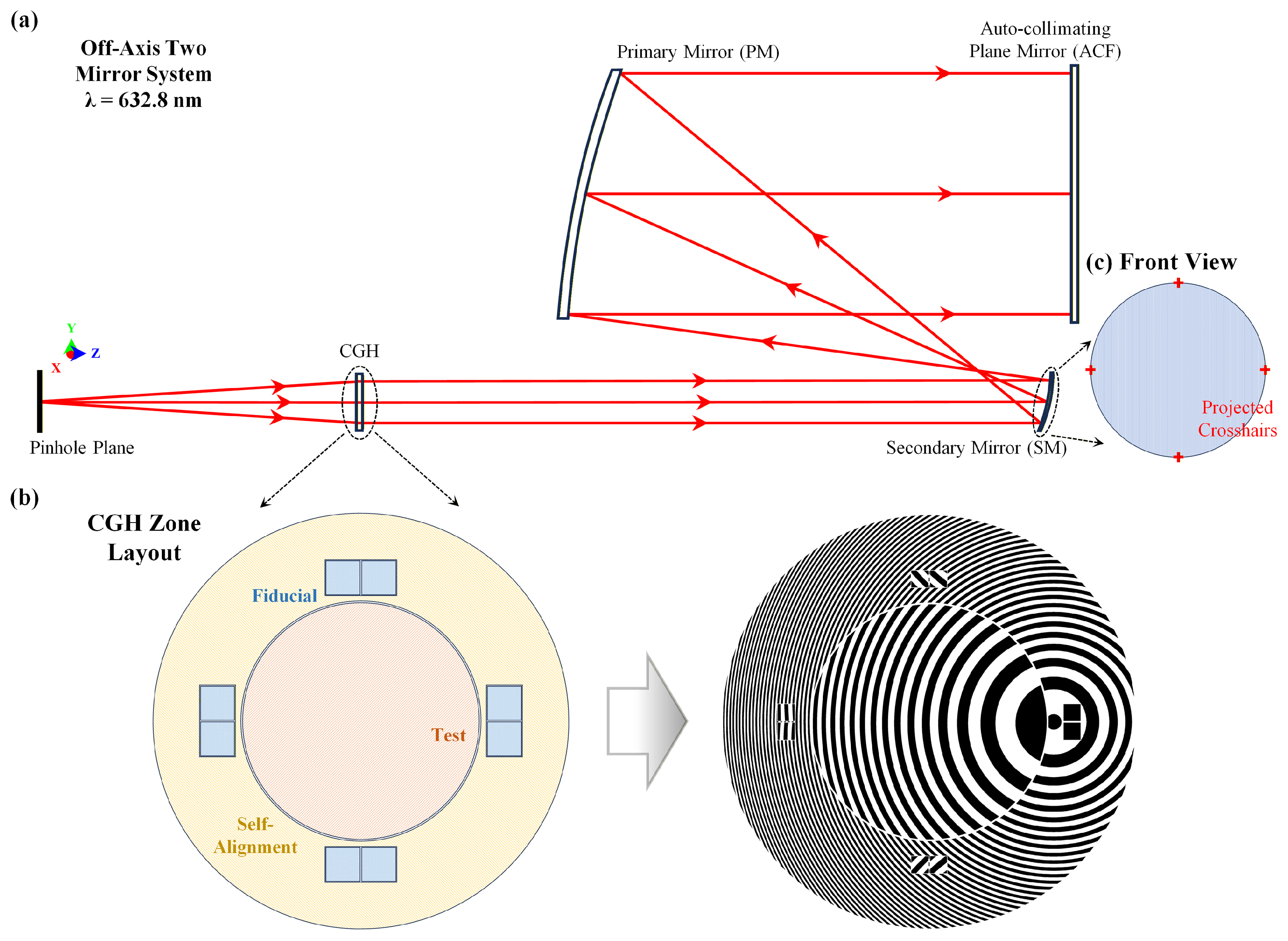
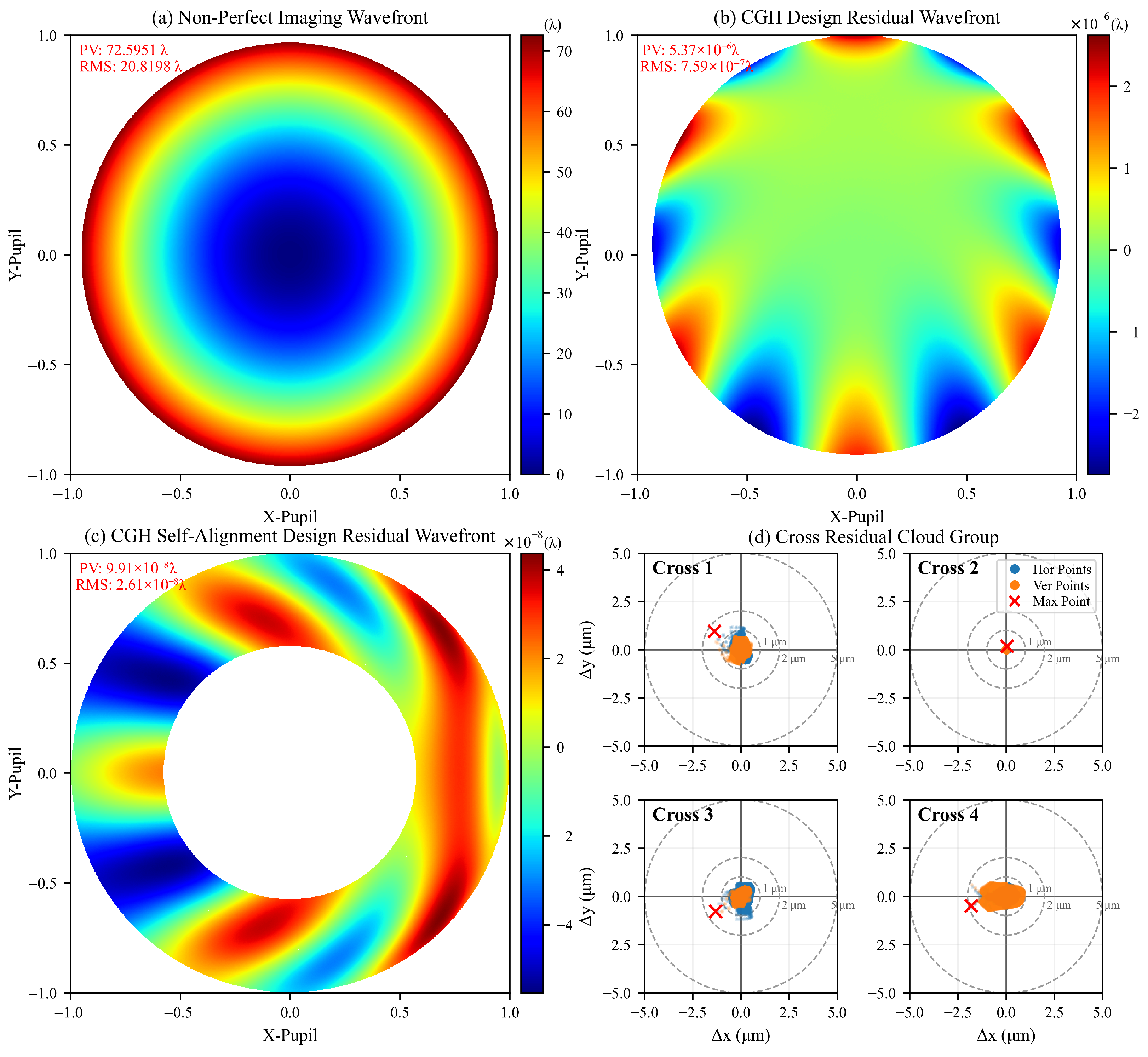
To address the alignment of an off-axis two-mirror freeform optical system with intrinsic design residual aberration, a null-test interferometric scheme based on a multi-zone CGH was adopted. The test configuration is shown in Figure 4a. A Fizeau interferometer with a wavelength of 632.8 nm was used. The spherical wave emitted by the interferometer was modulated by the CGH into an aspheric wavefront matching the theoretical wavefront of the system under test. After reflection by the SM and PM, the beam formed a collimated output and was reflected by a ACF back along the same path. The returned beam then passed through the PM, SM, and CGH again and interfered with the reference beam. The retrieved phase represented the overall wavefront deviation of the test path, including contributions from the current alignment state and related manufacturing errors. Because the theoretical output wavefront of the studied system is not an ideal plane wave but contains an inherent aberration distribution, as shown in Figure 5a, CGH-based compensation is required to realize null interferometric testing. In addition, to provide geometric references during alignment, the null-compensation and geometric-reference functions were integrated onto the same CGH substrate using a multi-zone layout.
As shown in Figure 4b, the CGH aperture was divided into three independent functional zones. The central circular zone was the main hologram zone for compensating the intrinsic design residual aberration. The surrounding annular zone was the self-alignment zone, which returned the test beam along the original path to monitor and calibrate the six-degree-of-freedom pose of the CGH relative to the interferometer. The outermost eight rectangular zones formed the auxiliary geometric reference zone, which generated crosshair patterns projected onto the mechanical boundary of the SM, as shown in Figure 4c. These projected patterns provided additional geometric references for relevant spatial degrees of freedom during alignment. Therefore, the proposed multi-zone layout enabled null compensation, self-alignment, and geometric referencing within a single test path.
A binary amplitude CGH with a 50% duty cycle was used. The main design parameters and performance metrics of each zone are summarized in Table 2. The main hologram zone occupied the central aperture of 0∼33 mm and operated at the + 1 diffraction order. The self-alignment zone covered 33∼58 mm and operated at the + 3 diffraction order. The auxiliary geometric reference zone consisted of eight 5 mm × 5 mm regions operating at the + 1 diffraction order. The theoretical diffraction efficiencies of the three zones were 10.13 % , 1.13 % , and 10.13 % , respectively. Figure 5b shows that the RMS of the residual wavefront after compensation by the main hologram zone was well below 0.0001 λ , meeting the null-test requirement. Figure 5c shows that the RMS of the returned wavefront in the self-alignment zone was also well below 0.0001 λ , indicating sufficient performance for pose monitoring and calibration. For the auxiliary geometric reference zone, ray-tracing results in Figure 5d show that the maximum positioning error of the projected crosshair near the SM mechanical boundary was below 2.0 μ m at the working distance, with a theoretical line width of about 10 μ m . These results indicate that the proposed multi-zone CGH can satisfy the null-compensation requirement while simultaneously providing additional geometric reference information for subsequent alignment. In practical implementation, fabrication residuals of the auxiliary zones may introduce offsets in the projected reticle positions. A slight CGH tilt is first detected and minimized through the self-alignment zone before the auxiliary geometric references and the main test zone are used for wavefront-guided adjustment.

5. Alignment Experiment and Analysis

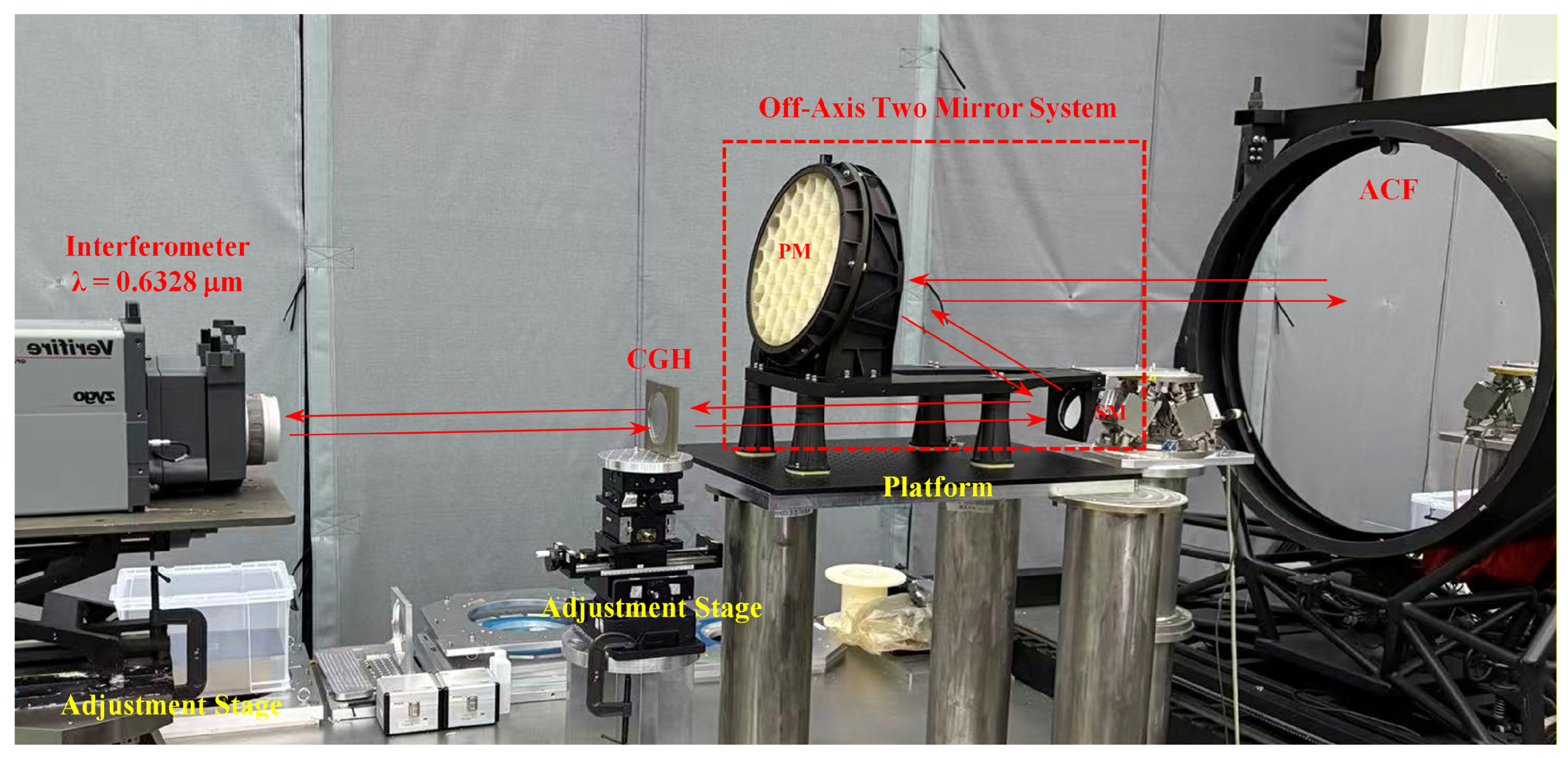
To verify the effectiveness of the multi-zone CGH with integrated geometric references and the proposed staged alignment strategy, an alignment experiment was conducted on an off-axis two-mirror freeform optical system with intrinsic design residuals. As shown in Figure 6, the experimental platform mainly consists of a Fizeau interferometer, a CGH, the off-axis two-mirror system, and an ACF. The interferometer and the CGH were mounted on independent adjustable stages at the front end of the test path for separate position and attitude adjustment. The PM and SM were fixed on a central support platform to maintain structural stability, while the ACF was placed at the exit side of the system. During the experiment, the beam emitted by the interferometer was modulated by the CGH, passed through the PM-SM system, was reflected by the ACF, and then returned to the interferometer along the same optical path, thereby forming the basic auto-collimation interferometric configuration for subsequent wavefront measurement and alignment.
Based on the above experimental platform, the system alignment was performed sequentially in the three stages described above. In the experiment, the interferometric test path corresponding to the no-aberration point of the PM was first established according to the PM single-mirror acceptance result, together with the reference state of the ACF and the outgoing direction of the interferometer. The CGH was then inserted, and the SM was preliminarily adjusted based on laser tracker measurements. Using the geometric reference markers provided by the CGH, the relative relationship among the interferometer, the CGH, and the PM-SM system was verified and adjusted to establish the auto-collimated return condition. After the geometric reference and auto-collimated return conditions were satisfied, the SM was further iteratively adjusted according to the interferometric measured result until the target wavefront requirement was achieved while the geometric references remained within the allowable range. The measurement results of this alignment process are presented and analyzed below.
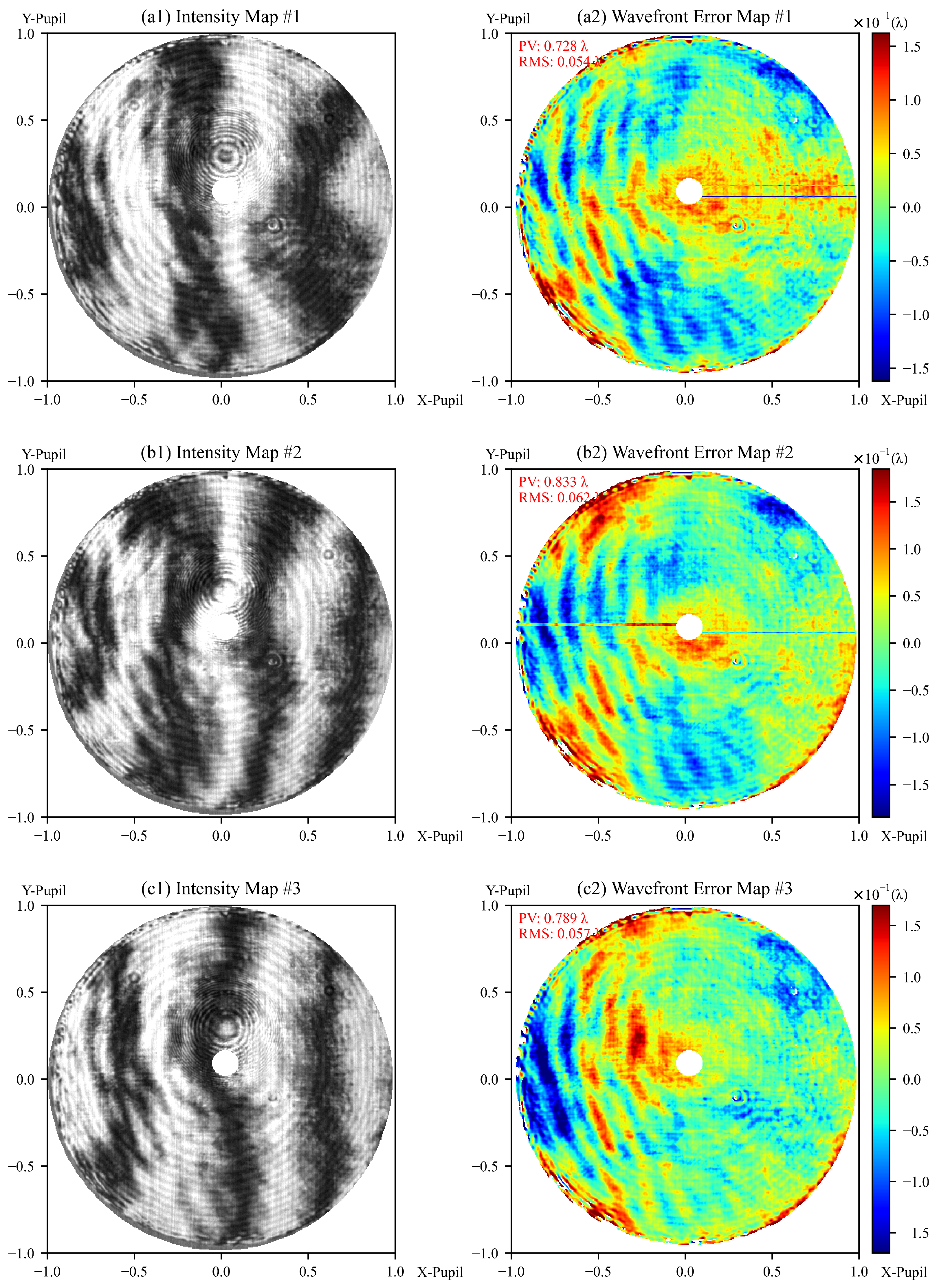
To assess the operational stability of the multi-zone CGH-based alignment process, three repeated alignment measurements were performed. After fine adjustment converged in each measurement, the results are shown in Figure 7. Figure 7(a1–c1) show the interferometric fringe intensity maps, and Figure 7(a2–c2) show the corresponding wavefront phase maps. The central blank region in the phase maps is caused by parasitic diffraction interference in the CGH-based null test and was masked during data processing. Although noise and parasitic diffraction fringes are visible due to the multiple reflective and diffractive elements in the test path, the main fringes remain sufficiently continuous for phase unwrapping. The measured wavefront RMS values range from 0.054 λ to 0.062 λ , and the PV values range from 0.728 λ to 0.833 λ ( λ = 632.8 nm ). The phase maps still exhibit some localized band-like residual structures, but no dominant low-order aberration morphology is observed. These residual wavefronts represent the combined effect of alignment error, fabrication error, and measurement disturbances.
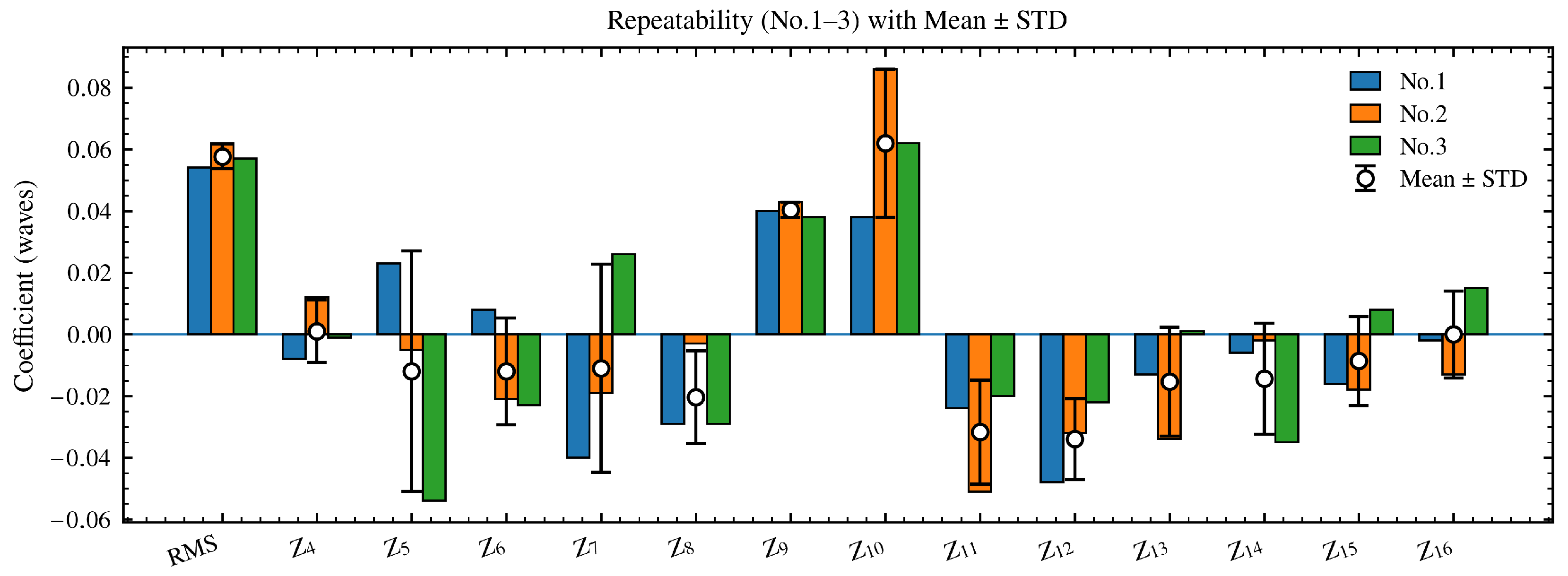
Figure 8 further presents the statistical results of the residual wavefront RMS and the major Zernike coefficients from the three measurements. The mean residual RMS is 0.0577 λ , with a standard deviation of 0.004 λ , indicating good repeatability in terms of the overall residual wavefront level. Compared with the RMS, the Zernike coefficients show different levels of variation. In particular, Z 4 and Z 9 remain relatively concentrated, whereas the astigmatism terms ( Z 5 , Z 6 ), coma terms ( Z 7 , Z 8 ), and especially Z 10 exhibit more obvious fluctuations. This suggests that, although the final RMS values are close, the compositions of the residual aberrations are not fully identical among the three measurements. Such differences may be associated with remaining geometric ambiguity in the alignment process, since slightly different residual pose states can yield similar RMS values but different distributions among low-order aberration terms. Run-to-run environmental and measurement variations in the long-path interferometric test may also contribute to the observed coefficient fluctuations.
Overall, although the residual values of individual Zernike coefficients differ to some extent, the residual wavefront RMS in all three measurements converges to around 0.060 λ without an obvious divergence trend. These results indicate that the multi-zone CGH with integrated geometric references and the corresponding staged alignment procedure can support the alignment of the off-axis two-mirror freeform optical system at the current field of view, while also showing reasonable repeatability in practical implementation.

6. Conclusions

This study proposed a geometrically constrained alignment method based on a multi-zone CGH for off-axis two-mirror freeform optical systems with inherent design residuals. A multi-zone CGH integrating null-wavefront compensation and geometric projection positioning was designed for the alignment of such systems, where the alignment process is complicated by the poor conditioning of the sensitivity matrix and the coupling among the degrees of freedom. During alignment, the CGH was used to assist in establishing the relative positional relationship between the interferometer–CGH system and the PM–SM system, while also providing geometric soft constraints for SM adjustment in combination with wavefront-guided iteration.
Experimental results showed that the alignment process could converge stably under the combined use of wavefront information and geometric references. Over multiple experiments, the mean wavefront RMS reached 0.0577 λ , with a standard deviation of 0.0040 λ . These results suggest that the introduced multi-zone CGH is beneficial for repeatability and convergence stability under the present experimental conditions. The proposed method is mainly intended for ground-based alignment, integration, and testing of space optical systems under controlled laboratory metrology conditions, and provides a practical reference for the alignment of off-axis freeform optical systems.

Author Contributions

Conceptualization, Z.W. and Q.Y.; methodology, Z.W. and Q.Y.; software, Z.W.; validation, Z.W.; formal analysis, Z.W.; investigation, Z.W.; resources, Q.Y.; data curation, Z.W.; writing—original draft preparation, Z.W.; writing—review and editing, Z.W. and Q.Y.; visualization, Z.W.; supervision, Q.Y.; project administration, Q.Y.; funding acquisition, Q.Y. All authors have read and agreed to the published version of the manuscript.

Funding

This research was funded by Shanghai Oriental Talent Program.

Institutional Review Board Statement

Not applicable.

Informed Consent Statement

Not applicable.

Data Availability Statement

Data underlying the results presented in this paper are not publicly available at this time but may be obtained from the authors upon reasonable request.

Conflicts of Interest

The authors declare no conflicts of interest.

References

  1. Gloesener, P.; Quertemont, E.; Flebus, C. Development of a three-mirror anastigmat telescope for the GERB experiment. In International Conference on Space Optics—ICSO 2000; Otrio, G., Ed.; International Society for Optics and Photonics, SPIE: Bellingham, WA, USA, 2017; Volume 10569, p. 105691W. [Google Scholar] [CrossRef][Green Version]
  2. Korsch, D. Anastigmatic three-mirror telescope. Appl. Opt. 1977, 16, 2074–2077. [Google Scholar] [CrossRef] [PubMed]
  3. Rolland, J.P.; Davies, M.A.; Suleski, T.J.; Evans, C.; Bauer, A.; Lambropoulos, J.C.; Falaggis, K. Freeform optics for imaging. Optica 2021, 8, 161–176. [Google Scholar] [CrossRef]
  4. Reimers, J.; Bauer, A.; Thompson, K.P.; Rolland, J.P. Freeform spectrometer enabling increased compactness. Light. Sci. Appl. 2017, 6, e17026. [Google Scholar] [CrossRef] [PubMed]
  5. Fuerschbach, K.; Rolland, J.P.; Thompson, K.P. Nodal aberration theory applied to freeform surfaces. In International Optical Design Conference 2014; Figueiro, M., Lerner, S., Muschaweck, J., Rogers, J., Eds.; International Society for Optics and Photonics, SPIE: Bellingham, WA, USA, 2014; Volume 9293, p. 92931V. [Google Scholar] [CrossRef]
  6. Thompson, K. Description of the third-order optical aberrations of near-circular pupil optical systems without symmetry. J. Opt. Soc. Am. A 2005, 22, 1389–1401. [Google Scholar] [CrossRef] [PubMed]
  7. Gu, Z.; Yan, C.; Wang, Y. Alignment of a three-mirror anastigmatic telescope using nodal aberration theory. Opt. Express 2015, 23, 25182–25201. [Google Scholar] [CrossRef] [PubMed]
  8. Thompson, K.P.; Fuerschbach, K.; Schmid, T.; Rolland, J.P. Using nodal aberration theory to understand the aberrations of multiple unobscured three mirror anastigmatic (TMA) telescopes. In Optical System Alignment, Tolerancing, and Verification III; Sasián, J., Youngworth, R.N., Eds.; International Society for Optics and Photonics, SPIE: Bellingham, WA, USA, 2009; Volume 7433, p. 74330B. [Google Scholar] [CrossRef]
  9. Schmid, T.; Thompson, K.P.; Rolland, J.P. Misalignment-induced nodal aberration fields in two-mirror astronomical telescopes. Appl. Opt. 2010, 49, D131–D144. [Google Scholar] [CrossRef] [PubMed]
  10. Burge, J.H.; Su, P.; Zhao, C.; Zobrist, T. Use of a commercial laser tracker for optical alignment. In Optical System Alignment and Tolerancing; Sasian, J.M., Ruda, M.C., Eds.; International Society for Optics and Photonics, SPIE: Bellingham, WA, USA, 2007; Volume 6676, p. 66760E. [Google Scholar] [CrossRef]
  11. Hagopian, J.G.; Ohl, R.; Bos, B.; Davila, P.; Eichhorn, W.; Hylan, J.; Hill, M.; Nowak, M.; Pasquale, B.; Sampler, H.; et al. Optical Alignment and Test of the James Webb Space Telescope Integrated Science Instrument Module. In Proceedings of the 2007 IEEE Aerospace Conference, Big Sky, MT, USA, 3–10 March 2007; pp. 1–13. [Google Scholar] [CrossRef]
  12. Rakich, A. Alignment of LBT optics using a laser tracker. In Ground-Based and Airborne Telescopes III; Stepp, L.M., Gilmozzi, R., Hall, H.J., Eds.; International Society for Optics and Photonics, SPIE: Bellingham, WA, USA, 2010; Volume 7733, p. 77335K. [Google Scholar] [CrossRef]
  13. Coulter, P.; Ohl, R.G.; Blake, P.N.; Bos, B.J.; Chambers, V.J.; Eichhorn, W.L.; Gum, J.S.; Hadjimichael, T.J.; Hagopian, J.G.; Hayden, J.E.; et al. A toolbox of metrology-based techniques for optical system alignment. In Optical System Alignment, Tolerancing, and Verification X; Sasián, J., Youngworth, R.N., Eds.; International Society for Optics and Photonics, SPIE: Bellingham, WA, USA, 2016; Volume 9951, p. 995108. [Google Scholar] [CrossRef]
  14. He, X.; Luo, J.; Wang, J.; Zhang, X.; Liu, Y. Improvement of a computer-aided alignment algorithm for the nonsymmetric off-axis reflective telescope. Appl. Opt. 2021, 60, 2127–2140. [Google Scholar] [CrossRef] [PubMed]
  15. Burge, J.H.; Zehnder, R.; Zhao, C. Optical alignment with computer-generated holograms. In Optical System Alignment and Tolerancing; Sasian, J.M., Ruda, M.C., Eds.; International Society for Optics and Photonics, SPIE: Bellingham, WA, USA, 2007; Volume 6676, p. 66760C. [Google Scholar] [CrossRef]
  16. Zehnder, R.; Burge, J.H.; Zhao, C. Use of computer generated holograms for alignment of complex null correctors. In Optomechanical Technologies for Astronomy; Atad-Ettedgui, E., Antebi, J., Lemke, D., Eds.; International Society for Optics and Photonics, SPIE: Bellingham, WA, USA, 2006; Volume 6273, p. 62732S. [Google Scholar] [CrossRef]
  17. Shack, R.V.; Thompson, K. Influence of Alignment Errors of a Telescope System on Its Aberration Field. In Optical Alignment I; Shagam, R.N., Sweatt, W.C., Eds.; International Society for Optics and Photonics, SPIE: Bellingham, WA, USA, 1980; Volume 0251, pp. 146–153. [Google Scholar] [CrossRef]
  18. Buchroeder, R.A. Tilted Component Optical Systems. Ph.D. Thesis, University of Arizona, Tucson, AZ, USA, 1976. [Google Scholar]
Figure 1. Conventions for aperture vector, field vector and effective field vector.
Photonics 13 00473 g001
Figure 2. Flowchart of the alignment process for the off-axis two-mirror system based on the geometric constraints of a multi-zone CGH.
Photonics 13 00473 g002
Figure 3. Schematic illustration of the reference establishment and configuration transfer from the PM double-pass null test to the system-level double-pass null test. (a) PM double-pass null-test configuration, in which the PM-ACF reference is established and fixed. (b) System-level double-pass null-test configuration after repositioning the interferometer and inserting the CGH and SM, followed by the registration of the interferometer-CGH assembly to the PM-SM-ACF configuration. The numbered annotations correspond to the main operations in Figure 2.
Photonics 13 00473 g003
Figure 4. Interferometric testing setup and CGH layout for the off-axis two-mirror freeform optical system based on a multi-zone CGH. (a) Schematic of the system interferometric testing setup. (b) Layout design of the multi-zone CGH, comprising the main test zone, self-alignment zone, and auxiliary geometric fiducial zones. (c) Schematic of the auxiliary geometric alignment principle.
Photonics 13 00473 g004
Figure 5. Wavefront of the off-axis two-mirror freeform optical system and its multi-region CGH compensation and alignment design results. (a) Initial theoretical exit wavefront of the system. (b) Residual design wavefront after compensation by the main holographic zone. (c) CGH self-alignment zone design residual wavefront. (d) Residual cloud group of 4 crosshairs under ray tracing.
Photonics 13 00473 g005
Figure 6. Experimental setup and test optical path for the alignment of the off-axis two-mirror optical system.
Photonics 13 00473 g006
Figure 7. Final measurement results of the current field of view for the off-axis two-mirror optical system from the three alignments. (a1c1) Corresponding interferogram intensity maps. (a2c2) Corresponding wavefront phase maps.
Photonics 13 00473 g007
Figure 8. Distribution of the final residual wavefront RMS and Zernike coefficients for three alignment.
Photonics 13 00473 g008
Table 1. SVD results of the sensitivity matrix and dominant modal features for the system.
Mode IndexSingular ValueDominant Components of Right Singular Vector
189.596 Δ D y ( 0.427 ) , Δ D z ( 0.225 ) , Δ T x ( 0.857 ) , Δ T y ( 0.162 )
266.432 Δ D x ( 0.437 ) , Δ D y ( 0.110 ) , Δ T x ( 0.153 ) , Δ T y ( 0.879 )
326.056 Δ D x ( 0.121 ) , Δ D z ( 0.968 ) , Δ T x ( 0.201 )
40.959 Δ D x ( 0.660 ) , Δ D y ( 0.594 ) , Δ T x ( 0.279 ) , Δ T y ( 0.354 )
50.851 Δ D x ( 0.594 ) , Δ D y ( 0.667 ) , Δ T x ( 0.352 ) , Δ T y ( 0.273 )
60.002 Δ T z ( 0.9998 )
Note: Only the dominant components with larger absolute values in each right singular vector are listed. Values in parentheses represent the approximate coefficients of the corresponding components.
Table 2. Key design parameters of each functional zone in the multi-zone CGH.
Functional
Zone
Size/mmDiffraction
Order
Theoretical
Diffraction Efficiency/%
Performance
and Accuracy
Main hologram zone0∼33 + 1 10.13Residual wavefront
RMS < 0.0001 λ
Self-alignment zone33∼58 + 3 1.13Residual wavefront
RMS < 0.0001 λ
Auxiliary geometric zoneEight peripheral
5 × 5 feature regions
+ 1 10.13Positioning error
MAX < 2.0 μ m
Disclaimer/Publisher’s Note: The statements, opinions and data contained in all publications are solely those of the individual author(s) and contributor(s) and not of MDPI and/or the editor(s). MDPI and/or the editor(s) disclaim responsibility for any injury to people or property resulting from any ideas, methods, instructions or products referred to in the content.