Article

154-W, Single-Frequency, Two-Stage Innoslab Amplifier at 1319 nm

1
Graduate School, China Academy of Engineering Physics, Mianyang 621900, China
2
Institute of Applied Electronics, China Academy of Engineering Physics, Mianyang 621900, China
3
National Key Laboratory on Advanced Laser and High Power Microwave, Mianyang 621900, China
*
Authors to whom correspondence should be addressed.
Photonics 2026, 13(5), 449; https://doi.org/10.3390/photonics13050449
Submission received: 26 March 2026 / Revised: 21 April 2026 / Accepted: 24 April 2026 / Published: 1 May 2026
(This article belongs to the Special Issue Advances in Solid-State Laser Technology and Applications)

Abstract

A 1319 nm, single-frequency, two-stage partially end-pumped slab (Innoslab) amplifier with high output power and excellent beam quality was reported. A 3 W, quasi-continuous wave pulsed, single-frequency all-fiber seed laser was amplified to a maximum average power of 154.0 W with a magnification of ~51.3 and overall optical-to-optical efficiency up to 12.0%. The output pulse width was 132.6 μs at a repetition rate of 500 Hz. The beam quality factors of M2 were 1.4 and 1.3 in the horizontal and vertical directions, respectively. The power stability at the maximum output power was 0.43% (RMS) in 10 min. Higher output power and optical-to-optical efficiency could be achieved through optimizing mode matching between the pump beam and the seed laser beam.

1. Introduction

For atmospheric adaptive optics applications in astronomy, quasi-continuous wave (QCW) pulsed sodium-guide-star lasers at 589 nm with high average power and narrow line-width have been typically employed to enhance photons returned from the sodium layer in ~90 km mesosphere while avoiding temporal overlap with backward Rayleigh scattering light in the lower atmosphere [1,2]. Up to now, the highest average output power (exceeding 100 W) of QCW pulsed sodium-guide-star lasers has been demonstrated through sum-frequency generation (SFG) of 1064 nm and 1319 nm radiation from solid-state Nd:YAG laser systems [3,4,5]. This configuration demands high-power outputs at both fundamental wavelengths (1064 nm and 1319 nm) with good beam quality for realizing high-power and high-efficiency SFG. However, the stimulated emission cross-section at 1319 nm is merely one-third of that at 1064 nm while the 1319 nm and 1064 nm transitions within the Nd:YAG medium share the same upper energy level [6]. This fundamental disparity leads to a lower gain and extraction efficiency while more serious thermal problems in laser resonators or amplifiers of 1319 nm. Also, fatal amplified spontaneous emission (ASE) or even parasitic oscillation of 1064 nm will cause further degradation of laser performance at 1319 nm [7,8,9,10,11]. These challenges make it quite difficult to achieve both high-power and high-beam-quality 1319 nm laser output of QCW pulse.
The master oscillator power amplifier (MOPA) configuration represents the standard architecture for generating high-power, narrow-linewidth laser sources of 1319 nm. Utilizing a high-quality seed source emitting at 1319 nm with high beam quality and narrow line-width, this approach enables power scaling to the hundred-watt level through multistage amplification processes [4,5]. Multiple architectures have been implemented in high-power, 1319 nm MOPA systems with QCW pulse and narrow line-width, composed of rod, zig-zag, and Innoslab [3,4,5,12,13,14,15]. In 2019, Yanhua Lu et al. reported a MOPA system that comprised a 0.3-GHz line-width, 1319 nm oscillator as the seed source and six Nd:YAG rod modules for laser amplification [4]. The system demonstrated an average output power of 115 W with a pulse duration of 120 μs at a repetition rate of 250 Hz. The optical-to-optical efficiency was about 9.8%, and the beam quality factors of M2 were 3.0 in both horizontal and vertical directions. In 2017, Chuan Guo et al. implemented a QCW pulse Nd:YAG master oscillator and a multi-pass zigzag Nd:YAG slab amplifier [12]. A QCW μs-pulse, narrow line-width, 1319 nm oscillator was utilized as the seed source with an average output power of 20.5 W. An average output power of 51.5 W was achieved with a pulse width of 105 μs and a repetition rate of 500 Hz. The beam quality factors of M2 were measured to be 1.61 and 1.81 in the orthogonal directions. Innoslab (partially end-pumped slab) laser systems employ a hybrid stable-unstable resonator configuration, effectively mitigating thermal effects to achieve both high output power and beam quality [16,17]. Because of the folded beam path, the overall gain of the amplifier and the overlap between the seed laser and pumped volume can be very high. And the good thermal management is to the benefit of the beam quality. Those innovative arrangements of the Innoslab amplifiers decrease the possibility of parasitic oscillation, guarantee the high power, high beam quality laser output with compact and reliable stability [18,19,20,21,22,23]. By employing a 10 W, narrow-linewidth, 1319 nm seed laser, a five-pass Innoslab amplifier achieved 42.3 W output with 6.5% optical conversion efficiency [13]. The beam quality factors of M2 were 1.13 (horizontal) and 2.16 (vertical), and the pulse width was 75 μs at a repetition rate of 1 kHz. In 2023, Xuguang Zhang et al. [15] reported a seven-pass 1319 nm Nd:YAG Innoslab amplifier for a single-frequency seed laser. A maximum average output power of 80.1 W was reached first with the pulse width of 131 µs and the repetition of 500 Hz. The beam quality factors of M2 were 1.3 in both the vertical and horizontal directions.
In this paper, a two-stage Nd:YAG Innoslab amplifier at 1319 nm with high power and high beam quality was reported for the first time. The 3 W single-frequency, QCW pulsed, all-fiber seed laser was amplified to a maximum average output power of 154.0 W, and the overall optical-to-optical efficiency was 12.0%. The average output power was nearly two times that reported before [15]. The optical-to-optical efficiency was 16.1% and 11.9% for the first- and second-stage, respectively. The output pulse width was 132.6 μs at a repetition of 500 Hz, while the beam quality factors of M2 were 1.4 and 1.3 in the orthogonal directions, respectively.

2. Experimental Setup

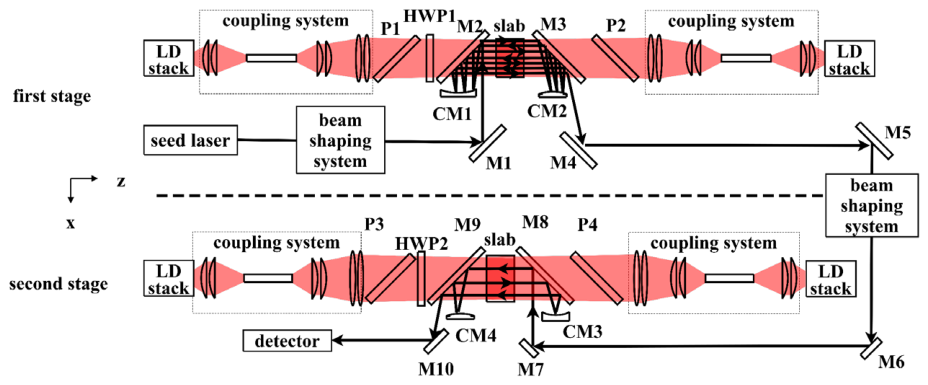
The two-stage single-frequency Nd:YAG Innoslab amplifier at 1319 nm is shown schematically in Figure 1. To avoid repetitive descriptions, a clearer schematic explanation of the amplification stages and optical components can be found in reference [15]. The design parameters of the two-stage QCW pulsed amplifier are summarized in Table 1.
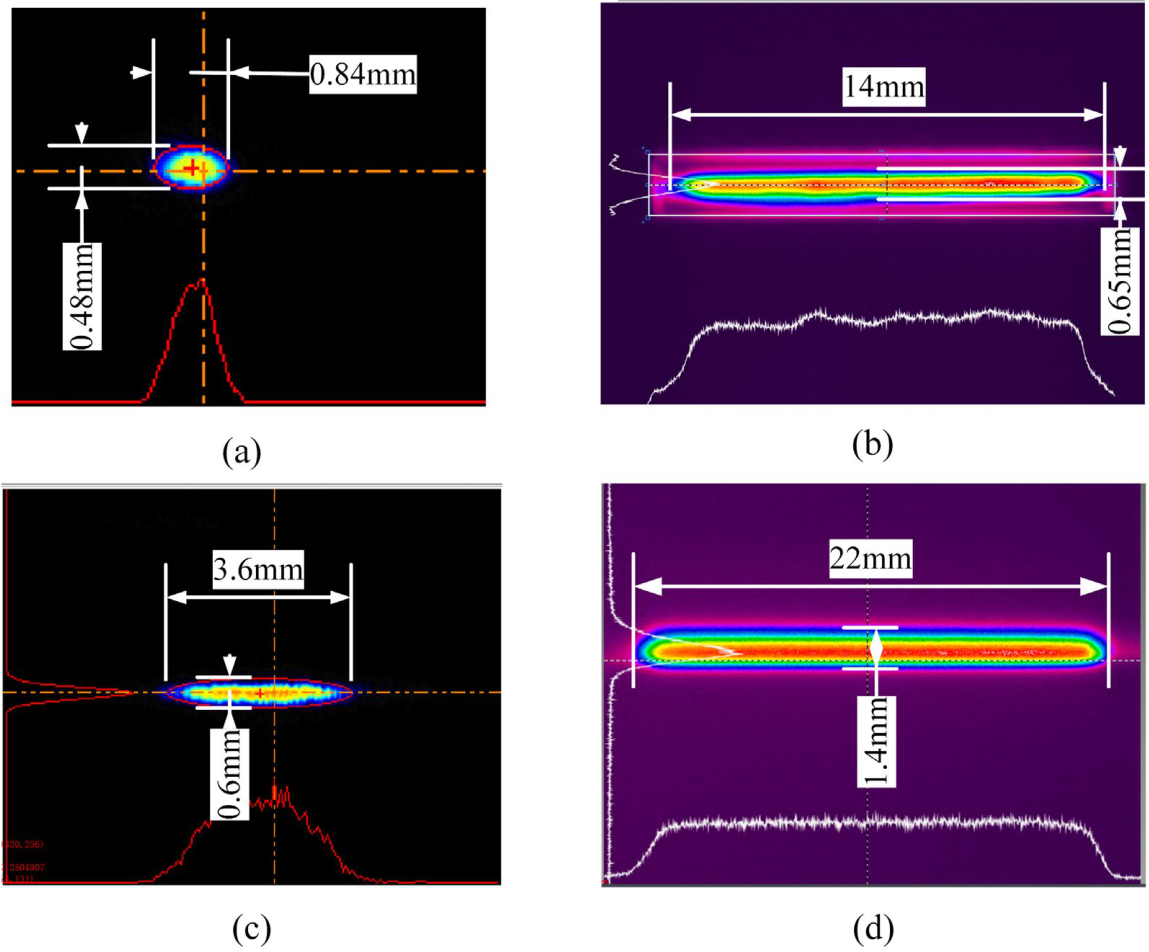
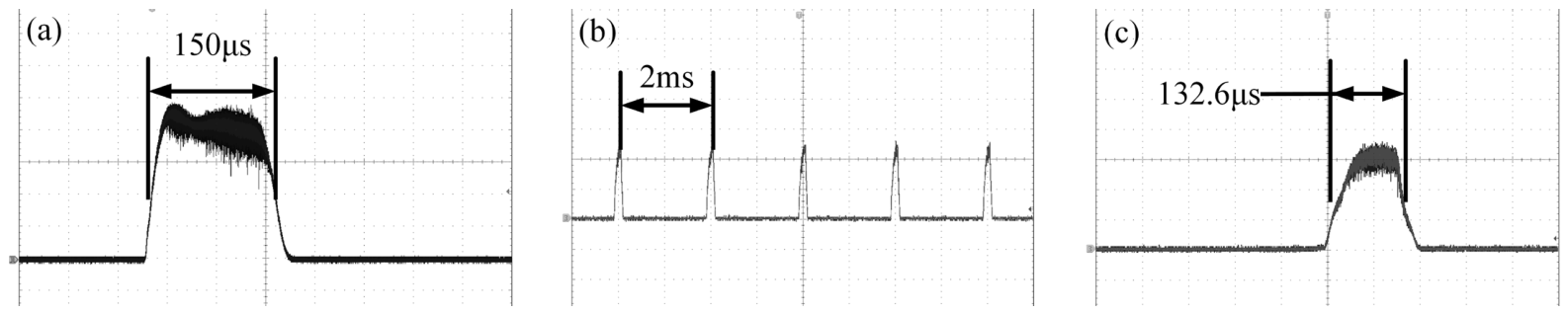
The first amplifier stage is composed of three parts: (1) an all-fiber single-frequency seed laser of 1319 nm, (2) two pump coupling systems of 808 nm laser-diode (LD) stack, and (3) a seven-pass hybrid cavity which comprises a Nd:YAG slab and two cylindrical mirrors. The seed laser source contained a single-frequency 15 mW CW oscillator and a QCW pulsed Raman fiber amplifier [15]. In the experiment, the central wavelength of the seed source was set at ~1319.36 nm, and the pulse width of the QCW pulsed seed was ~150 μs at a repetition of 500 Hz. The seed laser delivered 3 W maximum average power with a peak power of ~40 W. The beam quality factors of M2 were both 1.1 in the orthogonal directions. An optical isolator was inserted between the seed laser and the Innoslab amplifier. The seed laser was shaped into an elliptical beam for better mode matching with the pump volume. The beam size after shaping was 0.84 mm and 0.48 mm along the horizontal and vertical directions, respectively, as shown in Figure 2a. The input laser peak intensity was ~1.8 times the saturation intensity of the 1319 nm laser in Nd:YAG, which pledged high extraction efficiency in the seven-pass amplification stage [15]. The seed laser was launched into the Nd:YAG slab by the 45° mirrors M1 and M2, and steered out of the cavity by the 45° mirror M3. Both M2 and M3 were high-reflective at 1319 nm and anti-reflective at 808 nm.
The dimensions of the first-stage Nd:YAG slab were 15 mm in width, 10 mm in length, and 1.5 mm in height, which was 1.1 at.% doped and welded between two copper heat sinks (15 mm × 10 mm) for high-efficiency heat dissipation. The heat sinks were cooled by circulating water at a temperature of 25 °C. The Nd:YAG slab was mounted in the middle of the hybrid cavity, and its two optical end-facets (15 mm × 1.5 mm) were anti-reflective coated for the wavelengths of 1064 nm, 1319 nm and 808 nm. The Nd:YAG slab was dual-end-pumped by two commercial QCW pulsed LD stacks at 808 nm. Each LD stack was vertically encapsulated by ten diode bars which were collimated by a microlens in the fast-axis (i.e., y-axis) direction. By regulating the cooling water temperature, the pump center wavelength was stabilized near 808 nm. The pump radiation emitted by each stack was focused into a planar waveguide for spatial homogenization in the slow axis direction. Subsequently, it was directed out of the waveguide and imaged into the Nd:YAG slab. In the fast axis, the collimating pump beam was focused directly into the slab. The pump beam from each stack was shaped to a 14 mm×0.65 mm line-shape inside the Nd:YAG slab, as shown in Figure 2b. The intensity distribution was quasi-uniform in the horizontal direction and Gaussian in the vertical direction of the Nd:YAG slab. Two polarizers (P1 and P2) and a half-wave plate (HWP1) were inserted to protect the LDs against the resident unabsorbed pump light from the other side. The QCW LD stacks provided a maximum average pump power of 590 W (corresponding peak power of ~7.4 kW). The pulse width was ~160 μs at a repetition of 500 Hz. The overall transmittance of the pump coupling system was ~90%, and the absorption efficiency of the Nd:YAG crystal was ~90%. The maximum absorbed average pump power by the Nd:YAG crystal was approximately 478 W. The temperature of the first-stage crystal rose to 75.4 °C under the maximum pump power.
In the first-stage amplifier, a concave cylindrical mirror CM1 (600 mm radius of curvature) and a convex cylindrical mirror CM2 (−400 mm radius of curvature) were used as the cavity mirrors. Both cavity mirrors were coated with high-reflective (HR@1319 nm) and anti-reflective (AR@1064 nm) optical coatings. The cavity mirrors were curved along the x-axis but remained planar along the y-axis. Consequently, this configuration achieved high power-extraction efficiency while maintaining the laser intensity well below the damage threshold of the optical components. Notably, the cavity exhibits stability along the y-axis direction, and the laser mode can be consistently reproduced with each passage through the gain medium, while the thermal focal length fth and the cavity length L are satisfied as L = 2fth. In the experiment, the thermal focal length of the crystal was measured as fth = 60 mm at the maximum pump power. The cavity length between CM1 and CM2 was configured at ~100 mm. The mode overlapping efficiency between the pump volume and the multi-pass seed laser beam was ~74%.
The output laser was redirected from the first-stage amplifier by M4 and launched into the second-stage amplifier by three 45° mirrors, M5, M6 and M7, all of which were high-reflective coated at 1319 nm. The laser was then shaped to 3.6 mm × 0.6 mm, as shown in Figure 2c.
The second-stage amplifier adopted a three-pass configuration. The output beam from the first stage was coupled into the Nd:YAG slab via a 45° mirror (M8), then redirected outward through mirrors M9 and M10. M8 and M9 were high-reflective coated at 1319 nm and anti-reflective coated at 808 nm. A concave cylindrical mirror, CM3 (600 mm radius of curvature), and a convex cylindrical mirror, CM4 (−300 mm radius of curvature), were used as the cavity mirrors. Both of the mirrors were coated with high-reflective films at 1319 nm and anti-reflective films at 1064 nm. The size of the second-stage Nd:YAG slab was 22 mm × 10 mm × 2.5 mm. The Nd:YAG slab was 1.1 at.% doped. Similarly, the pump beam from each LD stack was shaped into a line shape of 22 mm × 1.4 mm within the Nd:YAG slab, as shown in Figure 2d. The two LD stacks provided a maximum average pump power of 1050 W (corresponding peak power of 13 kW). The pulse width was ~160 μs at a repetition of 500 Hz. The absorption efficiency of the Nd:YAG crystal was ~85%, and the maximum absorbed average pump power by the Nd:YAG crystal was approximately 803 W. At the maximum pump power, the thermal focal length of the crystal was 75 mm, and the cavity length between CM3 and CM4 was configured at ~150 mm. The temperature of the second-stage crystal increased to 84.4 °C under the maximum pump power.

3. Results and Discussion

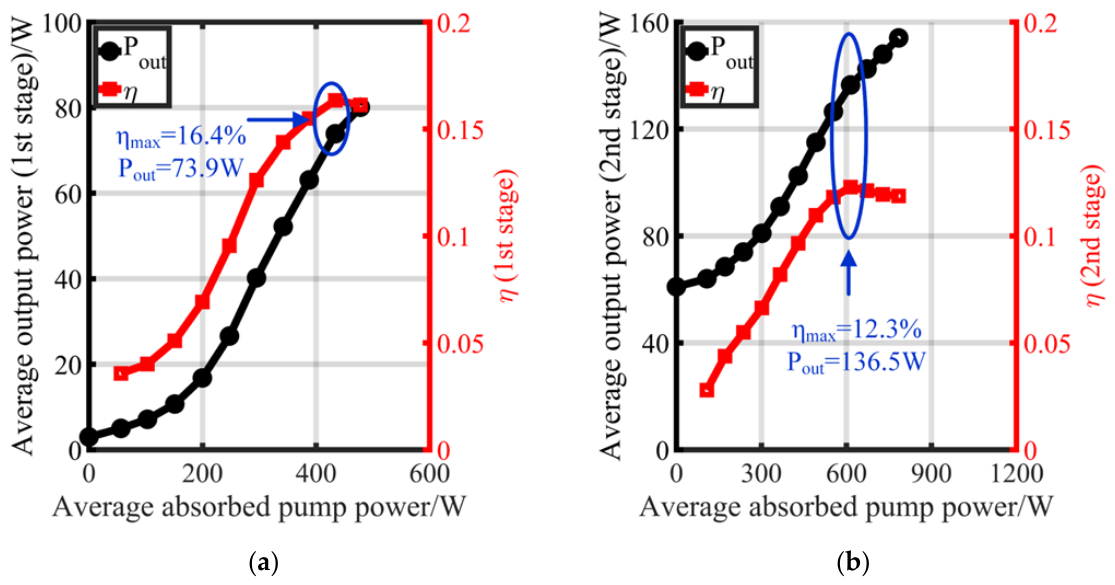
The QCW LD pump pulse widths of the first- and second-stage amplifiers were the same, 160 μs, and the repetitions were both 500 Hz. After temporally synchronizing the seed laser and the QCW pump sources, two-stage amplification was carried out. The average output power and optical-to-optical efficiency of the first- and second-stage versus absorbed average pump power are shown in Figure 3. In the experiments, the maximum average output power of the first-stage amplifier was 80.1 W with an optical-to-optical efficiency of 16.1%, while the second-stage amplifier achieved 154.0 W with an optical-to-optical efficiency of 11.9%. The overall optical-to-optical efficiency of the two-stage amplifier was 12.0%. The high peak pump intensity generated significant gain for the 1319 nm laser, directly enhancing the amplification efficiency. Additionally, the input peak intensity (~1.8 times the saturation intensity) further guaranteed high-efficiency amplification. The maximum optical-to-optical efficiency of the first- and second-stage was 16.4% and 12.3% with the average output power of 73.9 W and 136.5 W, respectively. To the best of our knowledge, this is the first report of such high average output power and optical-to-optical efficiency for 1319 nm high-power amplifier systems [12,13,14,15]. As pump power increased, the thermal focal length along the height dimension decreased below half the cavity length, which thereby brought about decreased overlap efficiency between the seed laser beam and the pump volume. Concurrently, ASE at the main emission line of 1064 nm intensified with higher pumping. These combined effects degraded the optical-to-optical conversion efficiency at 1319 nm [14,15].
The input laser beam exhibited vertical dimensions of 0.48 mm (first stage) and 0.6 mm (second stage), while the pump beams measured 0.65 mm and 1.4 mm vertically in their respective stages. Such a mismatch in beam sizes between seed and pump radiation was more significant in the second stage [14,15]. Therefore, the overlapping efficiency of the second stage was only 51% which was lower than that of the first stage (approximately 74%). In the simulation, the average output power and optical-to-optical efficiency can be improved to over 210 W and 20.9% with an overlapping efficiency of 75%.
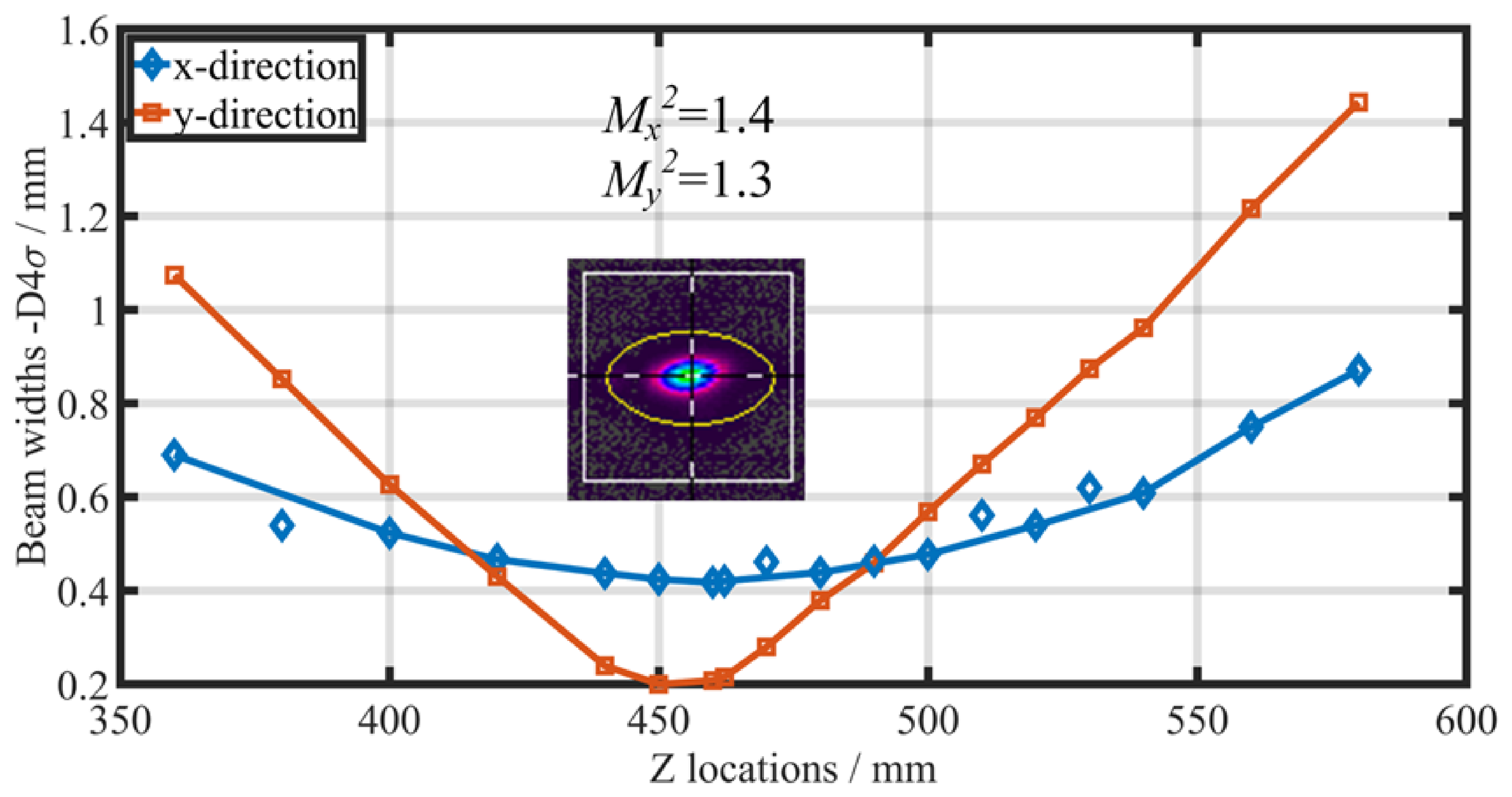
The elliptical output beam from the two-stage amplifier was transformed into a nearly circular beam by a cylindrical telescope. At the average output power of 154.0 W, the beam quality factors of M2 in the horizontal and vertical directions were 1.4 and 1.3, respectively (see Figure 4). As depicted in Figure 5, the output pulse width was 132.6 μs at a repetition of 500 Hz. The peak power was above 2.3 kW. No self-excitation was observed under these high peak pump power conditions.
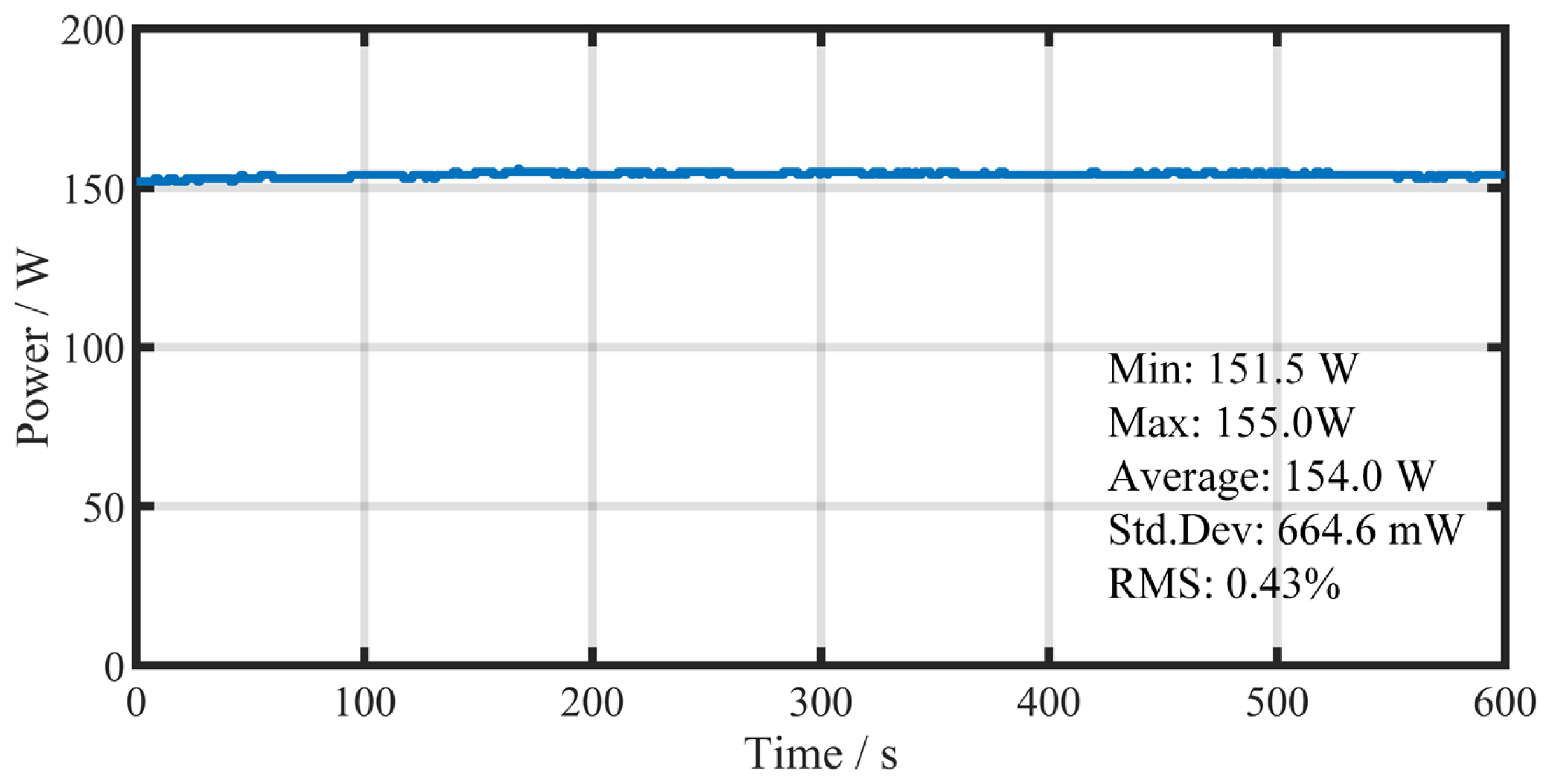
Furthermore, we found that the central wavelength and the line-width of the output laser were nearly the same as those of the seed laser. The central wavelength of the output laser was measured to be 1319.367 nm with a line-width of ~0.6 MHz. The power stability in 10 min was measured to be 0.43% (RMS), as shown in Figure 6. The degree of linear polarization was measured to be 15 dB after amplification while the linear polarization degree of the seed laser was 20 dB.

4. Conclusions

In summary, a high-power, single-frequency, QCW pulsed laser at 1319 nm was realized by a two-stage Nd:YAG Innoslab amplifier. The maximum average output power was 154.0 W with a magnification of ~51.3, and the output pulse width was 132.6 μs at a repetition of 500 Hz. At the maximum output power, the beam quality factors of M2 were 1.4 and 1.3 in the horizontal and vertical directions, respectively. Thanks to the high peak pump intensity provided by the QCW pump source, the overall optical-to-optical efficiency of the two-stage amplifier was 12.0%. To the best of our knowledge, this is the first report of such high average output power and optical-to-optical efficiency for 1319 nm high-power amplifier systems [12,13,14,15]. With higher overlapping efficiency between the seed laser and the pump volume, the output power and optical-to-optical efficiency can be further improved. The output characteristics of the 1319 nm are conformable to achieve high power 589 nm sodium-guide-star laser by sum-frequency with the QCW single-frequency 1064 nm laser reported in related literature [22,23]. Nearly an average output power of higher than 200 W at 589 nm has been achieved for the QCW pulsed sodium-guide-star applications.

Author Contributions

Conceptualization, X.Z. (Xiaochuan Zheng), Y.L. and X.Z. (Xuguang Zhang); Methodology, X.Z. (Xiaochuan Zheng), Y.L., X.Z. (Xuguang Zhang) and X.L.; Software, X.Z. (Xiaochuan Zheng); Validation, X.Z. (Xiaochuan Zheng), X.L., J.Y., P.H., H.S., T.X. and L.Z.; Formal analysis, X.Z. (Xiaochuan Zheng); Investigation, X.Z. (Xiaochuan Zheng) and X.L.; Resources, X.Z. (Xuguang Zhang); Data curation, X.Z. (Xiaochuan Zheng); Writing—original draft, X.Z. (Xiaochuan Zheng); Writing—review & editing, Y.L. and X.Z. (Xuguang Zhang); Visualization, X.Z. (Xiaochuan Zheng); Supervision, Y.L., X.Z. (Xuguang Zhang), J.S., Q.G. and W.W.; Project administration, Y.L., X.Z. (Xuguang Zhang), J.S., Q.G. and W.W.; Funding acquisition, Y.L. and X.Z. (Xuguang Zhang). All authors have read and agreed to the published version of the manuscript.

Funding

This research was funded by the Presidential Foundation of China Academy of Engineering Physics (Grant No. YZJJLX2019015 and 2022-ZLJJ-03).

Data Availability Statement

Data underlying the results presented in this paper are not publicly available at this time but may be obtained from the authors upon reasonable request.

Conflicts of Interest

The authors declare no conflicts of interest.

References

  1. Bradley, L.C. Pulse-train excitation of sodium for use as a synthetic beacon. J. Opt. Soc. Am. B-Opt. Phys. 1992, 9, 1931–1944. [Google Scholar] [CrossRef]
  2. Telle, J.M.; Milonni, P.W.; Hillman, P.D. Comparison of pump-laser characteristics for producing a mesospheric sodium guidestar for adaptive optical systems on large-aperture telescopes. Proc. SPIE Int. Soc. Opt. Eng. 1998, 3264, 37–42. [Google Scholar] [CrossRef]
  3. Lu, Y.H.; Xie, G.; Zhang, L.; Fan, G.B.; Pang, Y.; Li, N.; Wei, B.; Gao, S.X.; Zhang, W.; Tang, C. High-energy all-solid-state sodium beacon laser with line width of 0.6 GHz. Appl. Phys. B. 2015, 118, 253–259. [Google Scholar] [CrossRef]
  4. Lu, Y.; Zhang, L.; Xu, X.; Ren, H.; Chen, X.; Wei, X.; Wei, B.; Liao, Y.; Gu, J.; Liu, F.; et al. 208 W all-solid-state sodium guide star laser operated at modulated-longitudinal mode. Opt. Express 2019, 27, 20282–20289. [Google Scholar] [CrossRef]
  5. Bian, Q.; Bo, Y.; Zuo, J.W.; Feng, L.; Gao, H.W.; Yuan, L.; Cui, D.F.; Peng, Q.J.; Chen, H.B.; Xu, Z.Y. High-repetition-rate 100 W level sodium beacon laser for a multi-conjugate adaptive optics system. Opt. Lett. 2020, 45, 1818–1821. [Google Scholar] [CrossRef] [PubMed]
  6. Koechner, W. Solid-State Laser Engineering, Sixth Revised and Updated Edition; Springer: Berlin/Heidelberg, Germany, 2006. [Google Scholar]
  7. Li, M.L.; Zhao, W.F.; Zhang, S.B.; Guo, L.; Hou, W.; Li, J.M.; Lin, X.C. 1.86 W cw single-frequency 1319 nm ring laser pumped at 885 nm. Appl. Opt. 2013, 51, 1241–1244. [Google Scholar] [CrossRef]
  8. Lin, W.; Zhang, L.; Wang, J.; Chen, Y.; Xu, L.; Wang, D.; Zhou, T.; Tong, L.; Lu, Y.; Gao, Q. Amplification Properties of 1319 nm Nd:YAG Planar Waveguide. Laser Optoelectron. Prog. 2019, 56, 011404. [Google Scholar] [CrossRef]
  9. Li, L.P.; Li, Y.J.; Song, Y.J.; Tu, W.; Zong, N.; Zhang, S.J.; Wang, Z.M.; Bo, Y.; Peng, Q.J.; Xu, Z.Y. 10.3 W diode-pumped passively mode-locked Nd:YAG laser at 1319 nm with a semiconductor saturable absorber mirror. Laser Phys. 2019, 29, 095001. [Google Scholar] [CrossRef]
  10. Li, N.; Yu, P.; Lu, Y.; Zhang, L.; Xie, G.; Wang, W.; Xu, X. 800 mJ High Beam Quality All-Solid-State 1319 nm Pulsed Laser. Chin. J. Lasers 2013, 40, 0802007. [Google Scholar] [CrossRef]
  11. Xu, X.; Lu, Y.; Zhang, L.; Ren, H.; Chen, X. Relaxation oscillation suppressed, narrow linewidth, high beam quality, 1319 nm long-pulsed duration laser. Appl. Opt. 2018, 57, 4692–4695. [Google Scholar] [CrossRef]
  12. Guo, C.; Zuo, J.; Bian, Q.; Xu, C.; Zong, Q.; Bo, Y.; Shen, Y.; Zong, N.; Gao, H.; Lin, Y.; et al. Compact, high-power, high-beam-quality quasi-CW microsecond five-pass zigzag slab 1319 nm amplifier. Appl. Opt. 2017, 56, 3445. [Google Scholar] [CrossRef] [PubMed]
  13. Zheng, J.K.; Bo, Y.; Xie, S.Y.; Zuo, J.W.; Wang, P.Y.; Guo, Y.D.; Liu, B.L.; Peng, Q.J.; Cui, D.F.; Lei, W.Q.; et al. High power quasi-continuous-wave diode-end-pumped Nd:YAG slab amplifier at 1319 nm. Chin. Phys. Lett. 2013, 30, 74202. [Google Scholar] [CrossRef]
  14. Zhang, X.; He, T.; Luo, X.; Chen, X.; Zhang, L.; Xu, X.; Ren, H.; Xu, L.; Lu, Y.; Sun, J.; et al. Study of long-pulse quasicontinuous wave INNOSLAB amplifier at 1319 nm. Opt. Eng. 2020, 59, 056112. [Google Scholar] [CrossRef]
  15. Zhang, X.; Ye, J.; Chen, X.; Luo, X.; Zhang, L.; Lu, Y.; Shang, J.; Gao, Q.; Wang, W. 80-W single-frequency Innoslab μs-amplifier at 1319 nm with high efficiency. Opt. Express 2023, 31, 26757–26763. [Google Scholar] [CrossRef]
  16. Du, K.; Wu, N.; Xu, J.; Giesekus, J.; Loosen, P.; Poprawe, R. Partially end-pumped Nd:YAG slab laser with a hybrid resonator. Opt. Lett. 1998, 23, 370–372. [Google Scholar] [CrossRef]
  17. Du, K. Unique performances and favourable applications of INNOSLAB lasers. Proc. SPIE Int. Soc. Opt. Eng. 2009, 7193, 71932B–71932B–71910. [Google Scholar] [CrossRef]
  18. Russbueldt, P.; Hoffmann, D.; Höfer, M.; Löhring, J.; Luttmann, J.; Meissner, A.; Weitenberg, J.; Traub, M.; Sartorius, T.; Esser, D.; et al. Innoslab amplifiers. IEEE J. Sel. Top. Quantum Electron. 2014, 21, 447–463. [Google Scholar] [CrossRef]
  19. Russbueldt, P.; Mans, T.; Rotarius, G.; Weitenberg, J.; Hoffmann, H.D.; Poprawe, A.R. 400W Yb:YAG Innoslab fs-Amplifier. Opt. Express 2009, 17, 12230–12245. [Google Scholar] [CrossRef]
  20. Strotkamp, M.; Elsen, F.; Löhring, J.; Traub, M.; Hoffmann, D. Two stage Innoslab amplifier for energy scaling from 100 to >500mJ for future lidar applications. Appl. Opt. 2017, 56, 2886. [Google Scholar] [CrossRef]
  21. Javed, F.; Zhang, H.; Gao, Q.; Li, X.; Imran, A.; Jiang, Y. A high Average Power, Compact 100 kHz, 11.6-ns Nd:YAG Innoslab Amplifier. Results Phys. 2020, 16, 102926. [Google Scholar] [CrossRef]
  22. Zhang, X.; Ye, J.; Luo, X.; Chen, X.; Zhang, L.; Xu, X.; Ren, H.; Lu, Y.; Ma, Y.; Gao, Q.; et al. 148-W single-frequency Nd:YAG Innoslab μs-amplifier at 1064 nm with high efficiency. Opt. Express 2021, 29, 5687–5693. [Google Scholar] [CrossRef] [PubMed]
  23. Zhang, X.; Ye, J.; Luo, X.; Chen, X.; Zhang, L.; Xu, X.; Ren, H.; Lu, Y.; Ma, Y.; Gao, Q.; et al. 300 W two-stage Nd:YAG Innoslab microsecond amplifier. Appl. Opt. 2021, 60, 971–975. [Google Scholar] [CrossRef] [PubMed]
Figure 1. Experimental setup of two-stage QCW Innoslab amplifier at 1319 nm.
Photonics 13 00449 g001
Figure 2. Beam profiles of the (a) first-stage input laser, (b) first-stage pump beam, (c) second-stage input laser and (d) second-stage pump beam.
Photonics 13 00449 g002
Figure 3. Average output power (Pout) and optical-optical efficiency (η) of the (a) first- and (b) second-stage versus absorbed average pump power.
Photonics 13 00449 g003
Figure 4. Beam quality measurement at the output power of 154.0 W.
Photonics 13 00449 g004
Figure 5. Pulse waveform of the seed laser (a), pulse train (b) and pulse waveform (c) of the 154.0 W output laser.
Photonics 13 00449 g005
Figure 6. Power stability in 10 min at the maximum output power.
Photonics 13 00449 g006
Table 1. Design parameters of the two-stage amplifier.
ParametersSeed Laser1st Stage2nd Stage
Laser crystal--Nd:YAGNd:YAG
Nd3+ doping level--1.1 at.%1.1 at.%
Crystal size--15 × 10 × 1.5 mm322 × 10 × 2.5 mm3
Pump beam size--14 × 0.65 mm222 × 1.4 mm2
Maximum average pump/seed power @500 Hz3 W@150 μs (seed)590 W@160 μs (pump)~1050 W@160 μs (pump)
Number of passes in the crystal--73
Length of cavity--100 mm150 mm
Beam quality (M2)1.11.31.4 (x)/1.3 (y)
Disclaimer/Publisher’s Note: The statements, opinions and data contained in all publications are solely those of the individual author(s) and contributor(s) and not of MDPI and/or the editor(s). MDPI and/or the editor(s) disclaim responsibility for any injury to people or property resulting from any ideas, methods, instructions or products referred to in the content.