Recent Progress in Multimode Fibers


Corning Incorporated, 1 Riverfront Plaza, Corning, NY 14831, USA
Photonics 2026, 13(5), 408; https://doi.org/10.3390/photonics13050408
Submission received: 20 March 2026
/
Revised: 8 April 2026
/
Accepted: 15 April 2026
/
Published: 22 April 2026
(This article belongs to the Special Issue Advances in Multimode Optical Fibers and Related Technologies)
Abstract
Multimode fibers (MMFs) have been a key component in short-reach transmission systems for over 50 years and remain the predominant transmission medium for Vertical Cavity Surface-Emitting Laser (VCSEL)-based short links in data centers. To meet the growing demand for higher data rates, MMFs have continuously evolved to enhance bandwidth performance. This paper provides an overview of the fundamental properties of MMFs, with an emphasis on fiber parameters that influence bandwidth capabilities. We discuss trends in increasing data rates for MMF transmission systems in data centers and review recent progress in MMF technology aimed at boosting bandwidth. In particular, we highlight innovative fiber designs, including high-bandwidth 50 μm MMFs, large-core MMFs, long-wavelength MMFs, universal fibers, MMF bundles, and multicore fibers.
1. Introduction
Multimode fibers (MMFs) feature a large core and a high numerical aperture compared to single-mode fibers, enabling efficient, low-cost coupling with light sources and cost-effective splicing and connectorization between fibers. These advantages make MMFs the preferred choice for short-distance data network applications [1].
Standard MMFs are available in two core sizes: 50 μm core and 62.5 μm core [2]. The 50 μm MMF, with a relative refractive index change of 1% and a numerical aperture (NA) of 0.2, was initially developed in the 1970s for both short- and long-haul applications using light-emitting diodes (LEDs) [3]. However, advancements in semiconductor lasers [4,5] and single-mode fibers [6,7] in the early 1980s led to single-mode fibers becoming the preferred choice for long-haul applications, while 50 μm MMFs remained for short-reach applications. Due to the low coupling of power from the large beam spot of LEDs, the transmission distance through 50 μm MMF was constrained to 1.2 km for 10 Mb/s Ethernet. To expand transmission distances for emerging applications, the 62.5 μm MMF was introduced for short-distance transmission. With a refractive index of 2% and an NA of 0.28, the 62.5 μm MMF allowed more light coupled to the fiber from an LED source, supporting 2 km transmission for 10 Mb/s Ethernet and even later 100 Mb/s “Fast Ethernet” standard of the early 1990s.
The development of Vertical Cavity Surface-Emitting Lasers (VCSELs) at 850 nm in the mid-1990s [8,9] marked a significant milestone for MMFs. VCSELs, with their smaller spot size and lower NA, resolved the coupling challenges associated with 50 μm MMF. Additionally, the lower material dispersion and higher bandwidth of 50 μm MMF, resulting from its lower refractive index difference between the core and the cladding, enabled the developments of 1 Gb/s and 10 Gb/s optical Ethernet standards.
Over the past three decades, MMFs coupled with 850 nm VCSELs have become dominant technologies for short-reach, high-data-rate networks [1]. Their rapid growth has been fueled by the increasing demand for higher data rates to support computer connections, data storage, local communication, and internet traffic. Emerging technologies such as server virtualization, cloud computing, and artificial intelligence are now driving networks toward 400 Gb/s and beyond in data centers. To address these demands for higher data rates and longer transmission distances, MMFs have continued to evolve, improving their bandwidth capabilities and overall performance.
In this paper, we review recent advancements in MMF technology and explore emerging trends in high-data-rate MMF applications. The paper is organized as follows: Section 2 provides an overview of the fundamental properties of MMFs, focusing on fiber parameters that impact bandwidth capabilities. Section 3 examines trends in increasing data rates for MMF transmission systems in data centers and reviews innovative fiber designs that leverage multimode properties to enhance bandwidth and transmission performance. These designs include high-bandwidth 50 μm MMFs, large-core MMFs, long-wavelength MMFs, universal fibers, MMF bundles, and multicore fibers. Finally, Section 4 summarizes the key findings and presents the conclusions.
2. Properties of MMF
The refractive index of an MMF can be represented by an alpha profile, which is defined as
where n0 is the refractive index in the center of the core, a is the core radius, α is the profile shape parameter, and is the maximum relative refractive index difference in the core, where n1 is the refractive index of the cladding. Since the relative index difference between the core and clad of MMF is small (<2%), mode properties can be obtained by solving the scalar wave equation. Using the WKB approximation [10], we can get analytical solutions for the electric field distribution and the propagating constant β, which are intuitive for understanding properties of MMF. The time delay of each mode can be expressed approximately as [11]
where , .
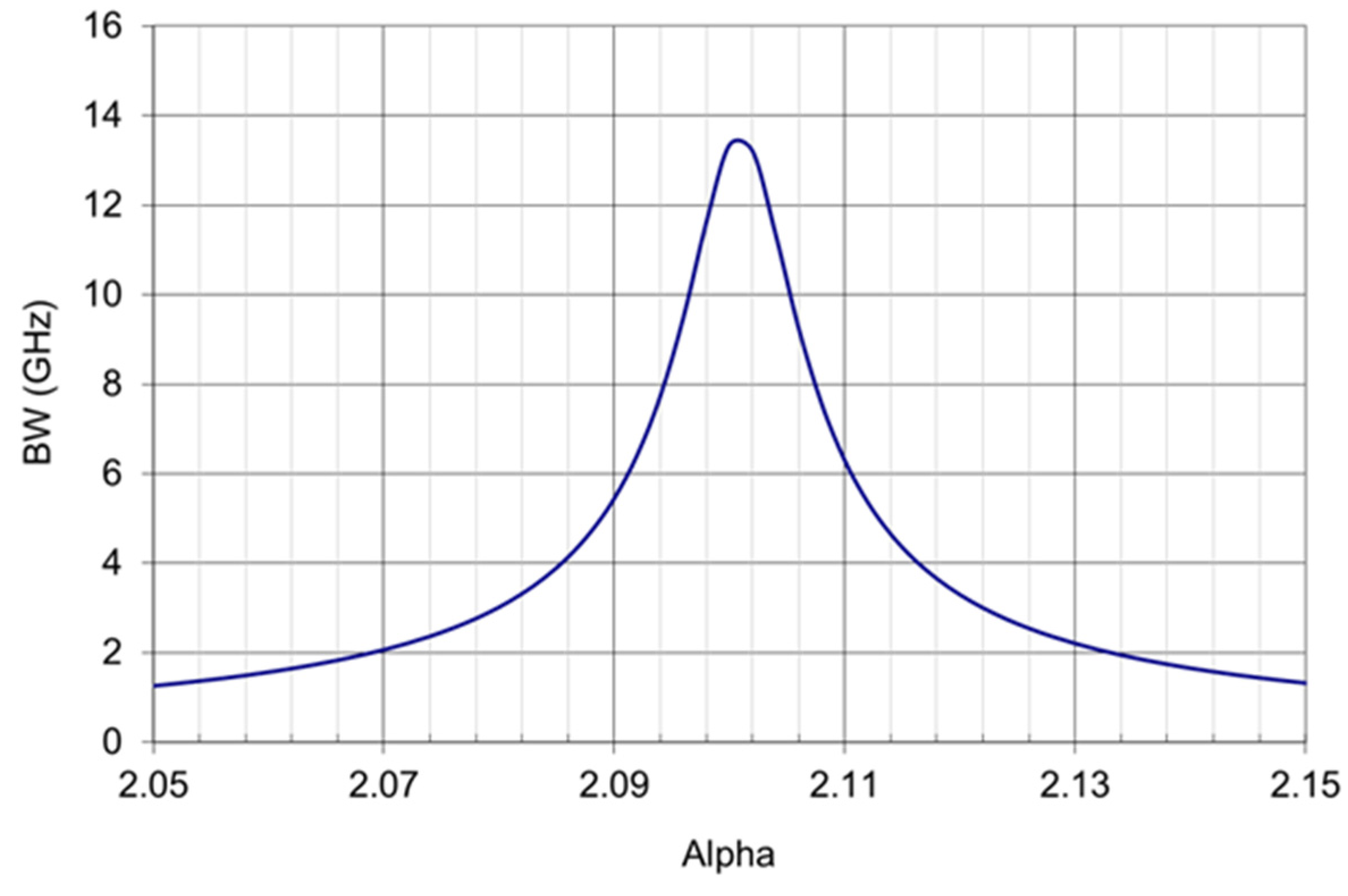
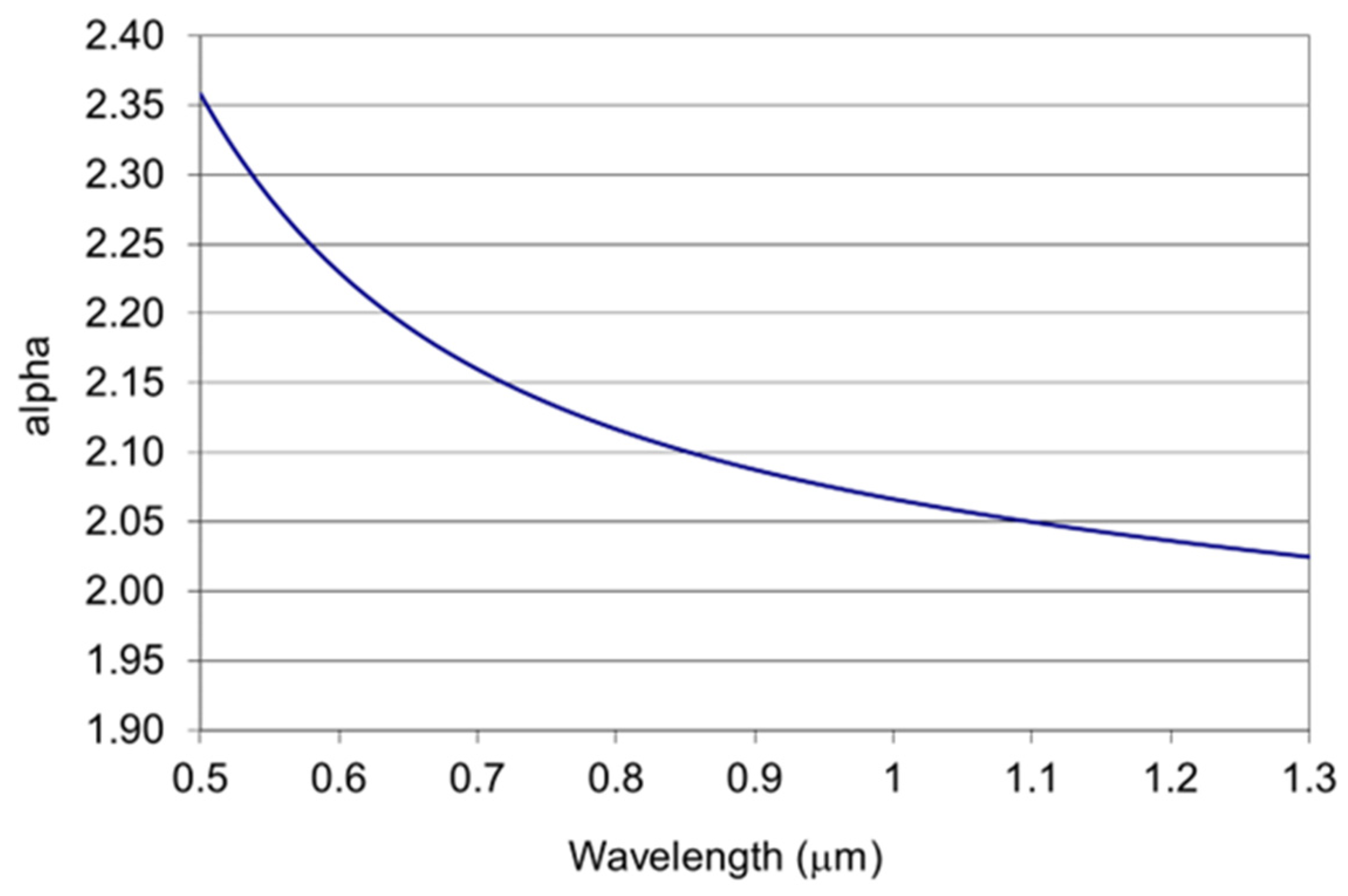
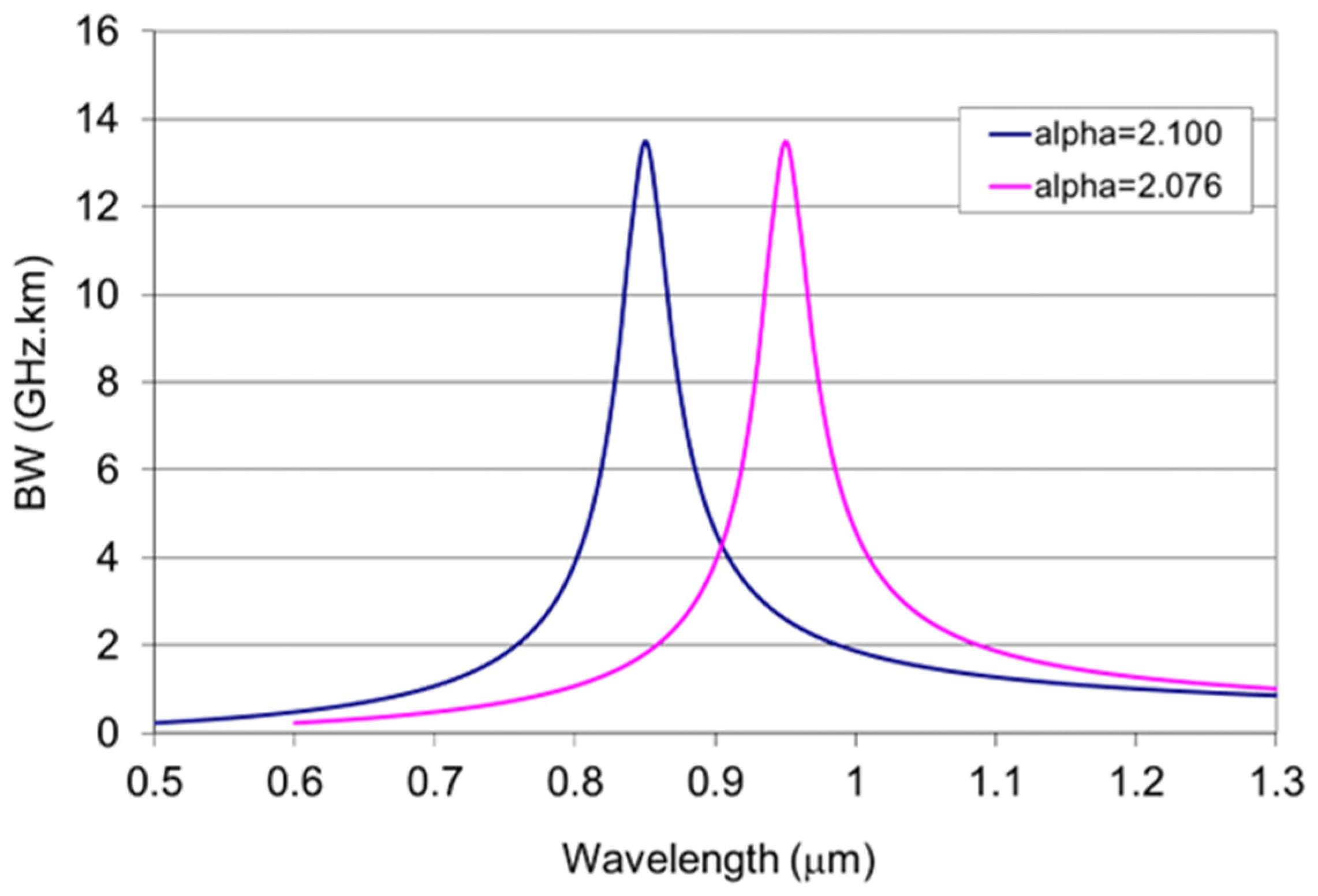
Using Equation (2), the root-mean-square (RMS) pulse width can be calculated, which is inversely proportional to fiber modal bandwidth. From Equation (2), to minimize the delay difference between different modes, we can make the second term zero, which implies that the optimal profile shape parameter . This result indicates that, for optimizing the modal bandwidth, the most important profile parameter is the α value. Figure 1 shows a calculated modal bandwidth of a germanium-doped MMF with an ideal profile of 1% delta at 850 nm. The fiber has very high modal bandwidth over 13 GHz·km when the α-value is at the optimal value of 2.10. The bandwidth drops quickly when the α moves away from this optimal value. The optimal α value depends on the wavelength and material dispersion parameter p, as shown in Equation (2). Figure 2 shows how the α-value changes with wavelength. Without material dispersion, the optimal α is 2, which corresponds to a perfect parabolic profile and is independent of wavelength. With material dispersion, the optimal α is slightly different from 2 and is wavelength-dependent. For a given wavelength, achieving an optimal modal bandwidth requires highly precise profile control. As an example, Figure 3 shows two bandwidth curves for MMFs with α values of 2.100 and 2.076, respectively. The corresponding refractive index profiles appear nearly identical when plotted together, but the peak bandwidth occurs at two very different wavelengths, 850 nm for α = 2.100 and 950 nm for α = 2.076.
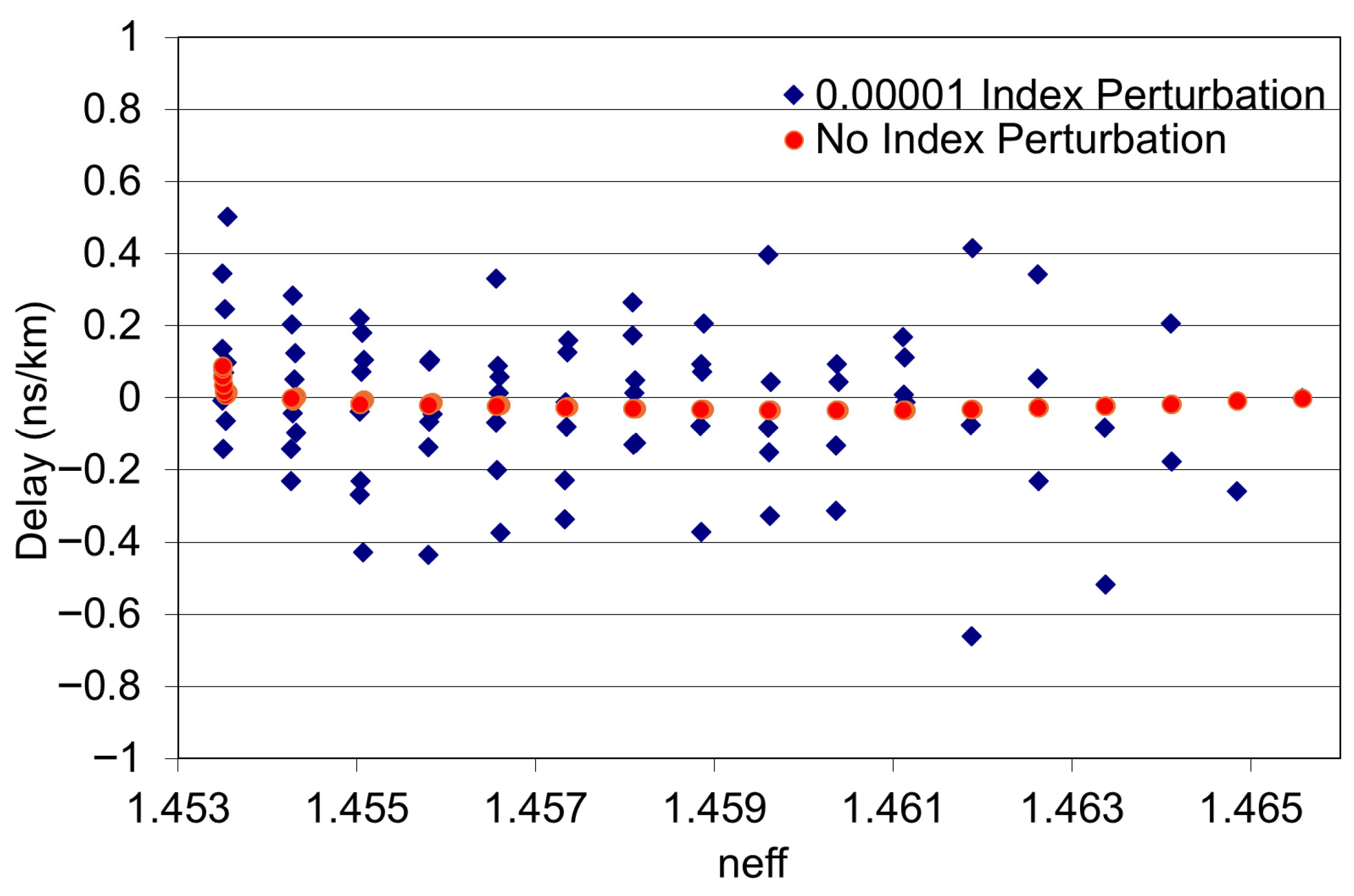
In addition to the α-error in the refractive index profile, various imperfections such as non-α-errors in the manufactured core profile can also limit the actual bandwidth. To illustrate that, Figure 4 shows the modeled differential mode delays at 850 nm of two MMFs, both with 1% delta and 50 μm core diameter. One fiber has a perfect α-profile in the core, and the other one has a random index perturbation of 1 × 10⁻⁵ around the ideal α-profile. For the one with the ideal α-profile, the delay spread is nearly zero except the last mode group due to profile truncation at the core and cladding interface. The bandwidth for this fiber is 8.1 GHz·km. On the other hand, for the fiber with random index perturbation, the delay spreads within several tens of ns/km, which reduces the bandwidth to 0.85 GHz·km. For practical MMFs to have a high bandwidth, the index perturbation should be less than 10−6.
Besides the profile shape, the core Δ also affects the maximum modal bandwidth that can be achieved. From Equation (2), when the second term becomes zero for the optimum α, the time delay is proportional to . As a result, the maximum modal bandwidth scales with , as shown in Figure 5. A lower Δ0 enables higher modal bandwidth, but the light capture efficiency decreases because the numerical aperture () is lower. Therefore, there is a tradeoff between bandwidth and NA depending on the application.
The modal bandwidth of an MMF also depends on the launch condition. When an overfilled launch condition is used, such as employing an LED source to excite all the modes in the core, the modal bandwidth can be at its worst. If a restricted launch is used, such as with a multimode VCSEL, the modal bandwidth can be improved since fewer modes are excited. With a single-mode launch, such as a single-mode VCSEL, the modal bandwidth becomes significantly higher. For a launch spot size that matches the mode field diameter of the fundamental mode of the MMF, the fiber behaves like a single-mode fiber with very high bandwidth. For MMF systems using multimode VCSELs, an effective modal bandwidth (EMB) is defined by standards [12,13,14]. TIA standards specify 10 different VCSEL sources to represent a range of allowed output power characteristics. To determine the EMB of an MMF, the weighting functions that represent the radial launch power distributions of the 10 VCSELs interact with the measured fiber differential mode delay (DMD) distribution to generate 10 EMB values. The lowest value from the 10 calculated EMB values, referred to as minEMBc, is multiplied by a factor of 1.13 to determine the fiber’s final EMB value.
Fiber bending can also affect the modal bandwidth. When an MMF is under bending, the bending losses are higher for higher-order modes than for lower-order modes. As higher-order modes have more modal delay spreads, the fiber modal bandwidth can increase due to higher-mode stripping effects. For bend-insensitive MMFs, a low index trench is added to reduce fiber bending loss, and the mode stripping effect is also reduced. Using the low index trench, the bending loss can be reduced to below 0.1 dB/turn with a bend diameter of 15 mm. It has been found that by properly placing the trench in the optimal location next to the core, the higher-order mode delays can be minimized, resulting higher bandwidth [15,16]. The optimal trench location is about 1.4 μm away from the core, which can result in bandwidth of about 12 GHz·km, close to the infinite ideal alpha profile.
When two MMFs are spliced together or joined by connectors, the bandwidth can be affected by differential mode insertion losses and mode coupling effects, which may either degrade or improve overall link bandwidth. However, with current splicing and connector technologies, the insertion loss is less than 0.5 dB. This low insertion loss does not affect the bandwidth much but can affect the link budget with multiple connections.
For an MMF transmission system, the data transmission performance depends on not only the EMB but also the chromatic dispersion bandwidth (CDB). An effective bandwidth (EB) can be calculated using the following equation [17]:
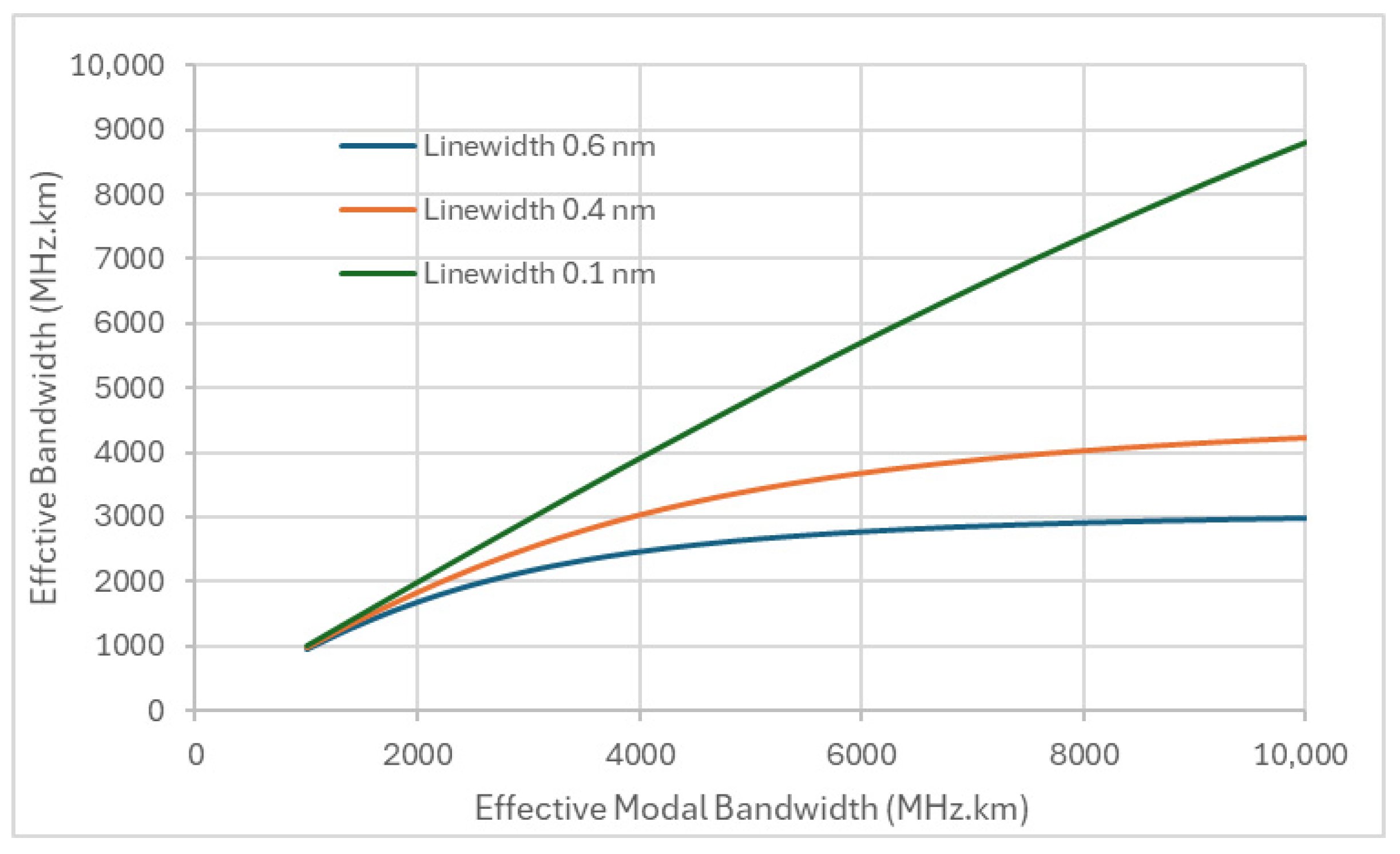
where , where D is the chromatic dispersion, and Δλ is the RMS spectral linewidth of VCSEL. To illustrate the chromatic dispersion effect on EB of MMF, Figure 6 plots the EB as a function of EMB for different RMS spectral linewidths of VCSELs at 850 nm wavelength. It can be seen that the chromatic dispersion has a significant impact on EB. For current multimode VCSELs with a typical RMS spectral linewidth of 0.6 nm [18,19], increasing the EMB beyond the OM4 level does not significantly increase the EB due to chromatic dispersion. If the VCSEL moves to few-mode operation with an RMS spectral linewidth reduced to 0.4 nm, the EB can increase by approximately 30% for OM4 MMF. If the VCSEL is single-mode with an RMS spectral linewidth of 0.1 nm, the effect of chromatic dispersion becomes minimum, and the EB is only slightly lower than the EMB.
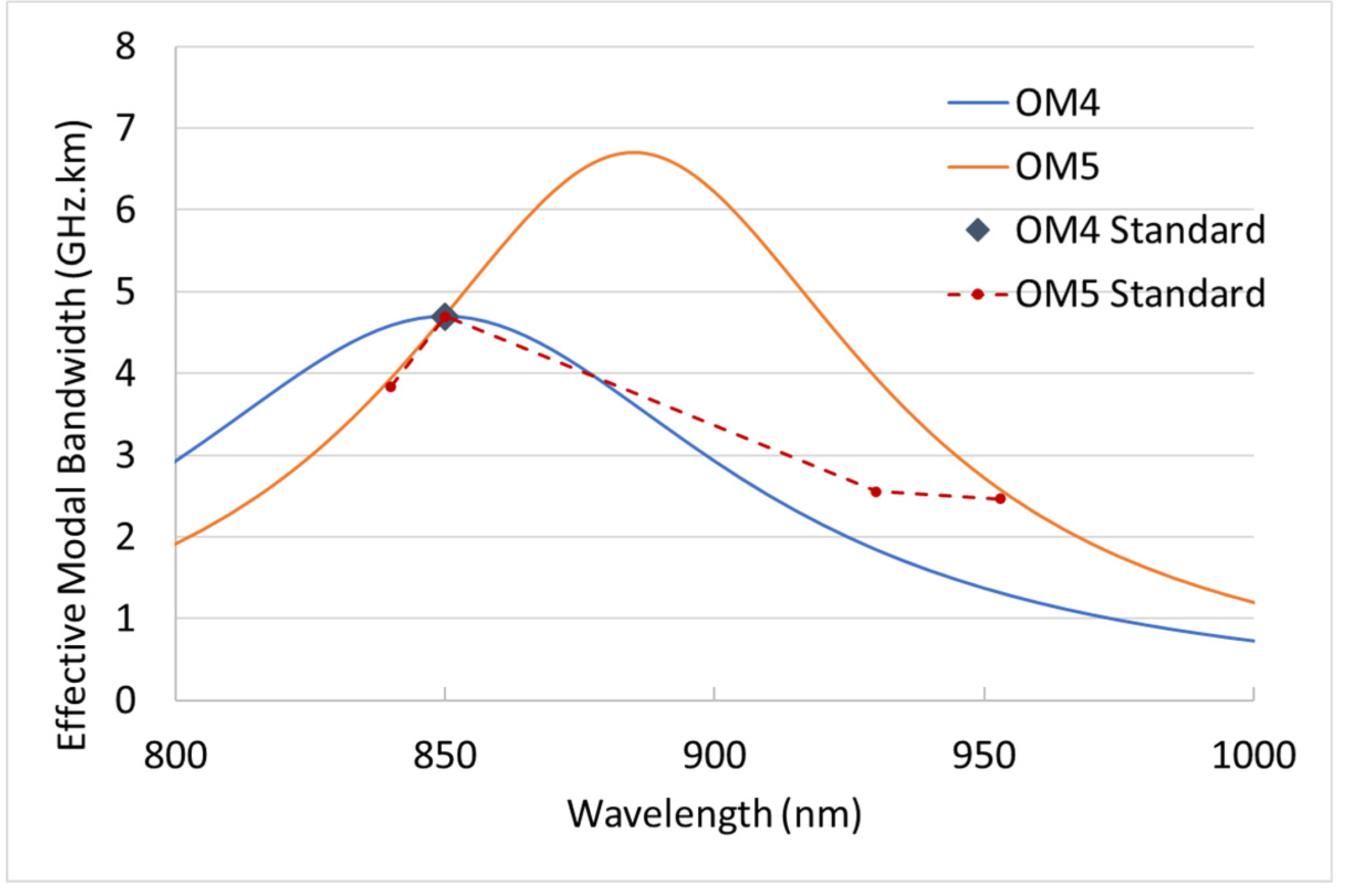
As fiber manufacturing processes and designs have improved, the MMF bandwidth has improved significantly to meet new bandwidth demands. Table 1 presents different types of standard MMFs [20] for their core characteristics, bandwidths, and link distances using the NRZ modulation format. The OM1 MMF has a high core Δ of 2% and a large core diameter of 62.5 μm, which is suitable for applications using LED sources or applications requiring low-cost coupling using VCSELs. However, the transmission data rate is limited to 1 G to 10 G. The OM2 to OM4 MMFs have a core Δ of 1% and a core diameter of 50 μm. OM2 MMF has an OFL BW of 500 MHz·km, enabling transmission of 1 G to 10 G over longer distances than OM1. OM3 and OM4 are laser-optimized for 850 nm VCSEL transmission with EMBs of 2000 and 4700 MHz·km, respectively. They are suitable for higher-data-rate applications ranging from 10 G to 100 G. For 100 G transmission using the common 100GBASE-SR4 standard [21], the total capacity is achieved with four parallel channels (fibers), each operating at a channel rate of 25 Gbps. OM5 is designed for short-wavelength division multiplexing (SWDM) transmission using four wavelengths (850, 880, 910, and 940 nm) through one fiber. To accommodate transmission of the four wavelengths, OM5 requires an EMB of 4700 MHz·km at 850 nm and 2470 MHz·km at 953 nm. Figure 7 shows example minimum EMB curves for OM4 and OM5 MMFs using germanium single dopant. The minimum peak EMB of OM5 fiber is around 6.7 GHz·km at 890 nm, which is much higher than the minimum EMB required for the OM4 fiber at 850 nm. Therefore, manufacturing the OM5 fiber is more challenging than the OM4 fiber due to its high peak bandwidth requirement.
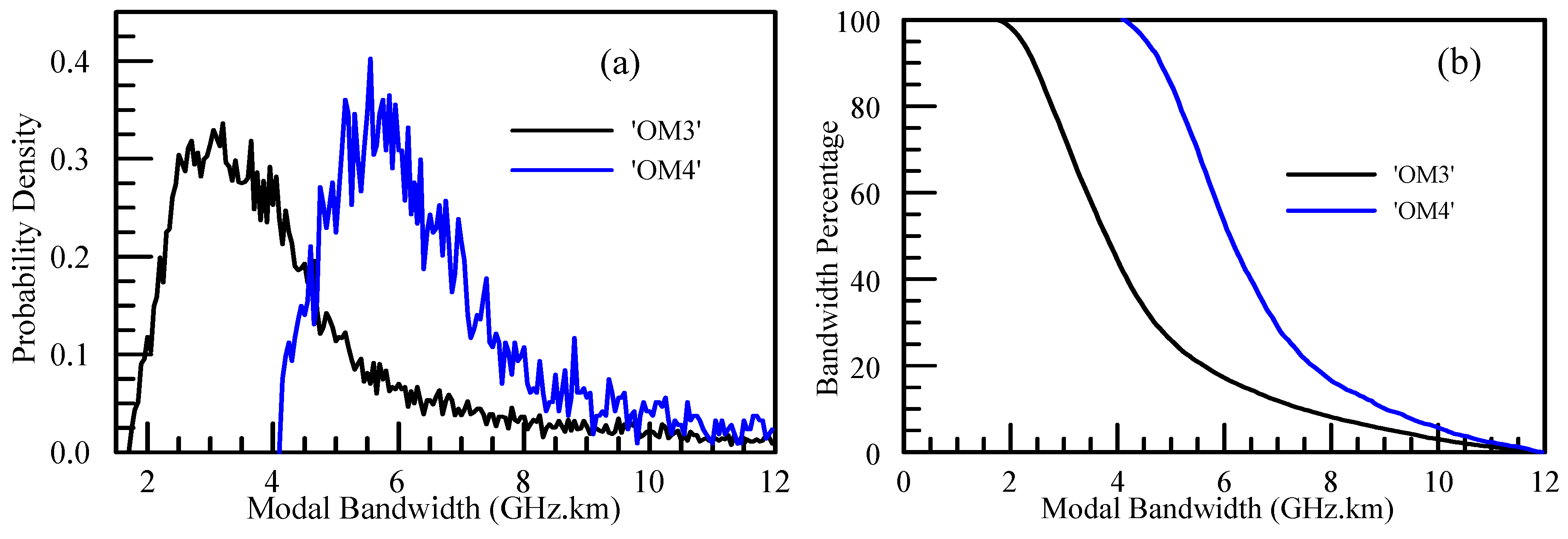
It is worth pointing out that the bandwidth values for the standard MMFs in Table 1 are the minimum bandwidths required for each type of MMF. Due to the profile sensitivities to α-errors and non-α-errors discussed above, the bandwidth of each type of MMF follows a statistical distribution. As examples, Figure 8 shows bandwidth distributions of OM3 and OM4 MMFs used for IEEE 10GbE model development [22]. Most of the modal bandwidth values are significantly higher than minimally allowed values. Nevertheless, using the standard specified bandwidth values guarantees the worst-case performance for MMF links, which is current practice for system engineering.
With the developments of new applications, the data rate has moved to 400 G and above, which imposes new challenges for MMF to meet the bandwidth and distance requirements. In the following section, we will discuss approaches for improving MMF performance to overcome these challenges.
3. Fiber Designs to Improve MMF Performance
In this section, we discuss innovative fiber designs aimed at enhancing multimode fiber (MMF) performance.
3.1. Increase Bandwidth of 50 μm Core MMF
As the transmission rates increase from 25 Gb/s to 50, 100, 200 and 400 Gb/s, the required EB for an MMF fiber link increases. We can use the link bandwidth, which is the normalized EB by dividing the fiber link length to quantify the total bandwidth required for a fiber link. Table 2 shows the link bandwidths for different transmission data rates [23]. The link bandwidth for 25 Gb/s using the NRZ modulation format is 16.3 GHz. For 50 Gb/s using the PAM4 modulation format, the link bandwidth is the same. For 100 Gb/s using the PAM4 modulation format, the link bandwidth is increased to 18 GHz. The link bandwidth is nearly tripled for 200 Gb/s PAM4 transmission. Note that the link bandwidth for the 200 G system is based on our current estimate as no standard has been established yet. This table clearly shows the need for a higher link bandwidth as the data rate increases.
Another factor to consider is the effect of chromatic dispersion on link bandwidth. The benefit of further increasing the MMF modal bandwidth strongly depends on the VCSEL RMS spectral line width, as discussed in the previous section. For current multimode VCSELs, the link distances for the OM4 fiber are shown in Table 3, assuming the worst VCSEL RMS spectral linewidth of 0.65 nm [19], which represents the upper limit for multimode VCSELs. At 25 and 50 Gb/s transmission rates, the achievable link distance is 151 m. For 100 Gb/s, the link distance is reduced slightly to 136 m. However, at 50 Gb/s transmission, the link distance is reduced to less than 50 m. To achieve a transmission distance of 50 m, the EMB of the fiber must be increased. Table 3 also includes a hypothetical MMF, referred to as OMx, with a higher bandwidth than the OM4 fiber with an EMB of 6.1 GHz·km. This fiber is used to illustrate how the link distance changes with higher bandwidth. It is not a new product or a new standard proposal. For this fiber, the EB is increased to 2.602 GHz·km, which can guarantee a transmission distance of 50 m. As mentioned in the previous section, the 50 μm core MMF can have a high modal bandwidth of about 13 GHz·km. However, reaching this bandwidth value in practice is very challenging due to various imperfections in the manufactured refractive index profile. For this new OMx fiber with higher EMB, it is expected that fiber yields will decrease, leading to higher manufacturing costs.
Another way to increase MMF EB is to reduce the spectral linewidth of the light source by using few-mode VCSELs. Table 4 shows the link distances for the OM4 fiber and OMx fiber when assuming the VCSEL RMS spectral linewidth of 0.4 nm. With few-mode VCSELs, the transmission distance for every data rate is increased. For 200 Gb/s transmission, the link distance is increased to 66 m for OM4 and 74 m for OMx, respectively. For lower data rates, one can use lower-cost OM3 fiber to achieve desired distances.
3.2. Large Core MMF
As mentioned in the previous section, it is theoretically possible to achieve a bandwidth as high as approximately 13 GHz·km. However, reaching this bandwidth value in practice is extremely challenging due to various imperfections in the manufactured refractive index profile. This is why OM4 and OM5 are specified for EMB at 4700 MHz·km. The modal bandwidth of MMFs is highly sensitive to small perturbations to the refractive index profile. Further increasing the bandwidth of MMFs requires more accurate profile controls, which poses significant challenges in manufacturing processes and increases the fiber manufacturing costs. One approach to increasing fiber bandwidth with current manufacturing technologies is to enlarge the core diameter, a concept proposed as a large core MMF (LCMMF) [24,25].
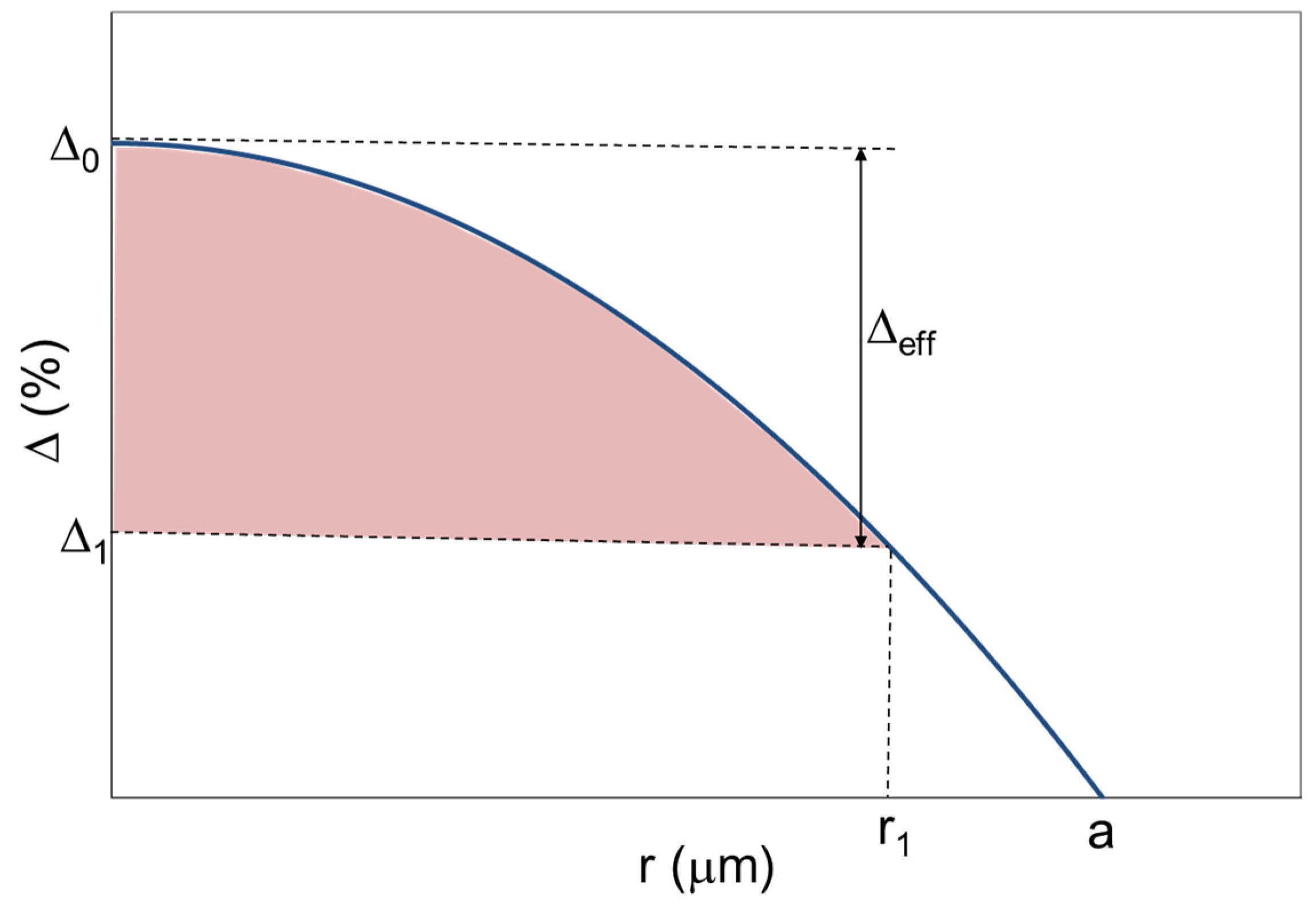
The principle behind an LCMMF is that the bandwidth depends on the core Δ, as described in Section 2. The relative refractive index profile, or delta profile, of the LCMMF takes the alpha graded-index profile, Δ(r) = Δ0 [1 − (r/a)α], as illustrated in Figure 9. The fiber has a peak core delta Δ0 of 1%, the same as the standard MMF, but a core radius greater than the standard MMF of 25 μm, and a parabolic shape with α about 2.1 at 850 nm.
Even though the LCMMF has a larger core, the light from VCSEL transceivers designed for the 50 µm core MMF is launched into a fiber core portion smaller than the core diameter using the law of etendue conservation [26], as shown in the filled area of Figure 9. The excited core portion of the LCMMF has a radius of r1 and an effective delta of Δeff. When using the bandwidth of the 50 µm core MMF with 1% core delta as a reference, the bandwidth of LCMMF BWLC is
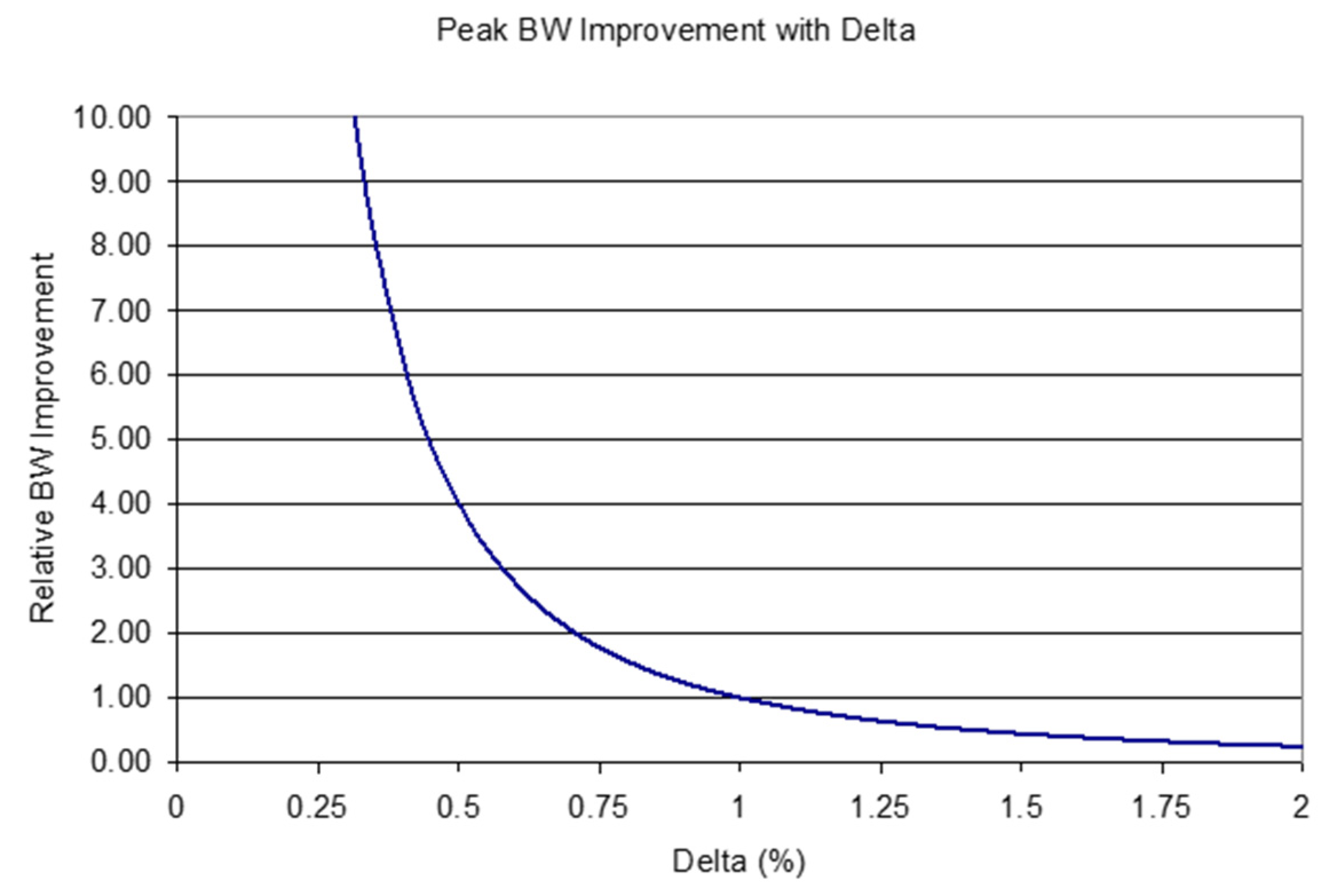
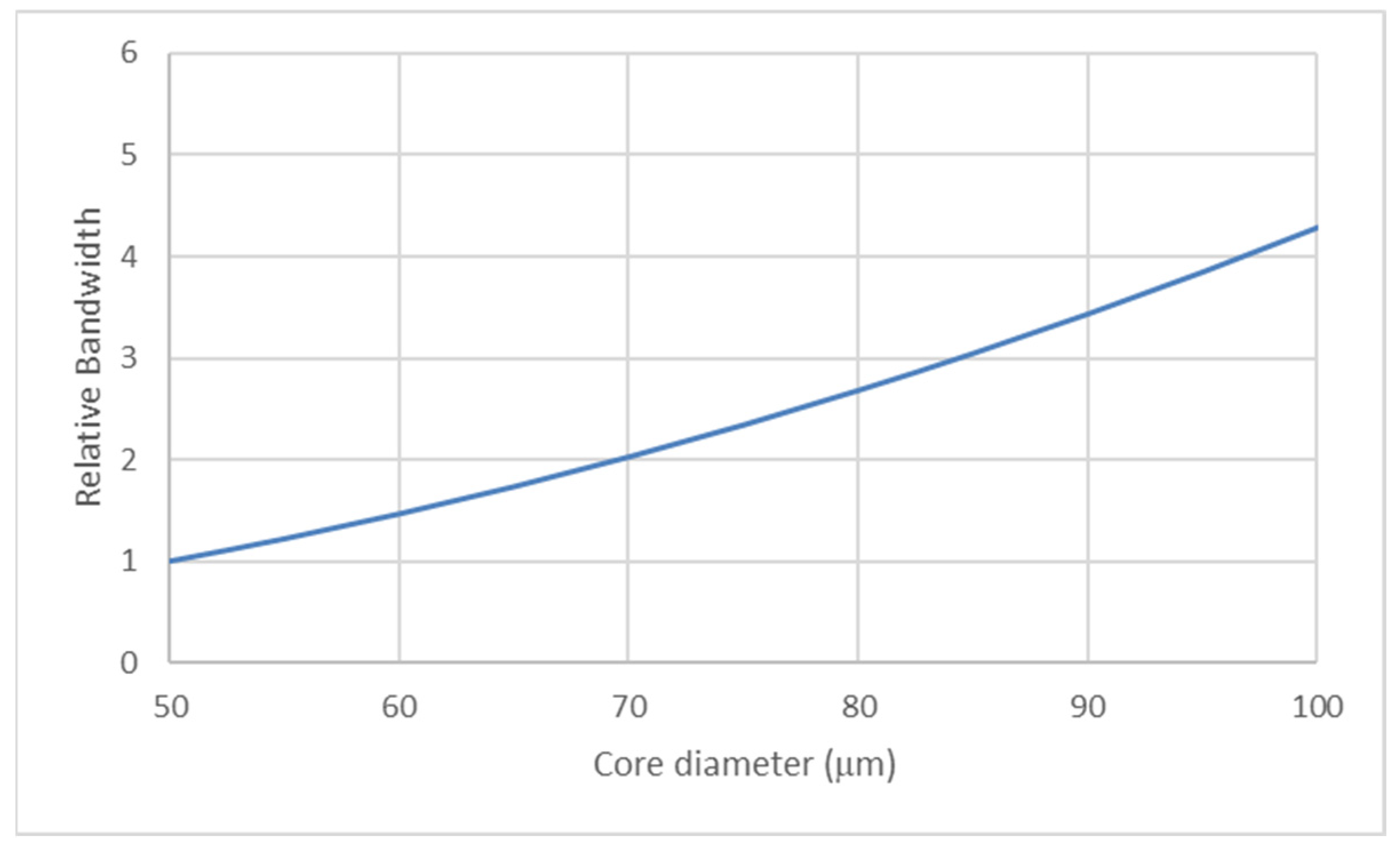
Figure 10 illustrates the relative bandwidth improvement BWLC/BW50 of LCMMF over the 50 μm core MMF. For a 70 μm core diameter, the bandwidth is doubled, and for a 100 μm core diameter, the bandwidth increases by more than four times. However, increasing the core diameter increases the germanium consumption in the core region, which increases the material cost. We can choose a diameter that is slightly larger—for example, around 60 μm—which corresponds to a bandwidth improvement by a factor of 1.47. This core diameter will enable a modal bandwidth of about 6900 MHz·km as compared to the 50 μm core diameter standard of the OM4 fiber.
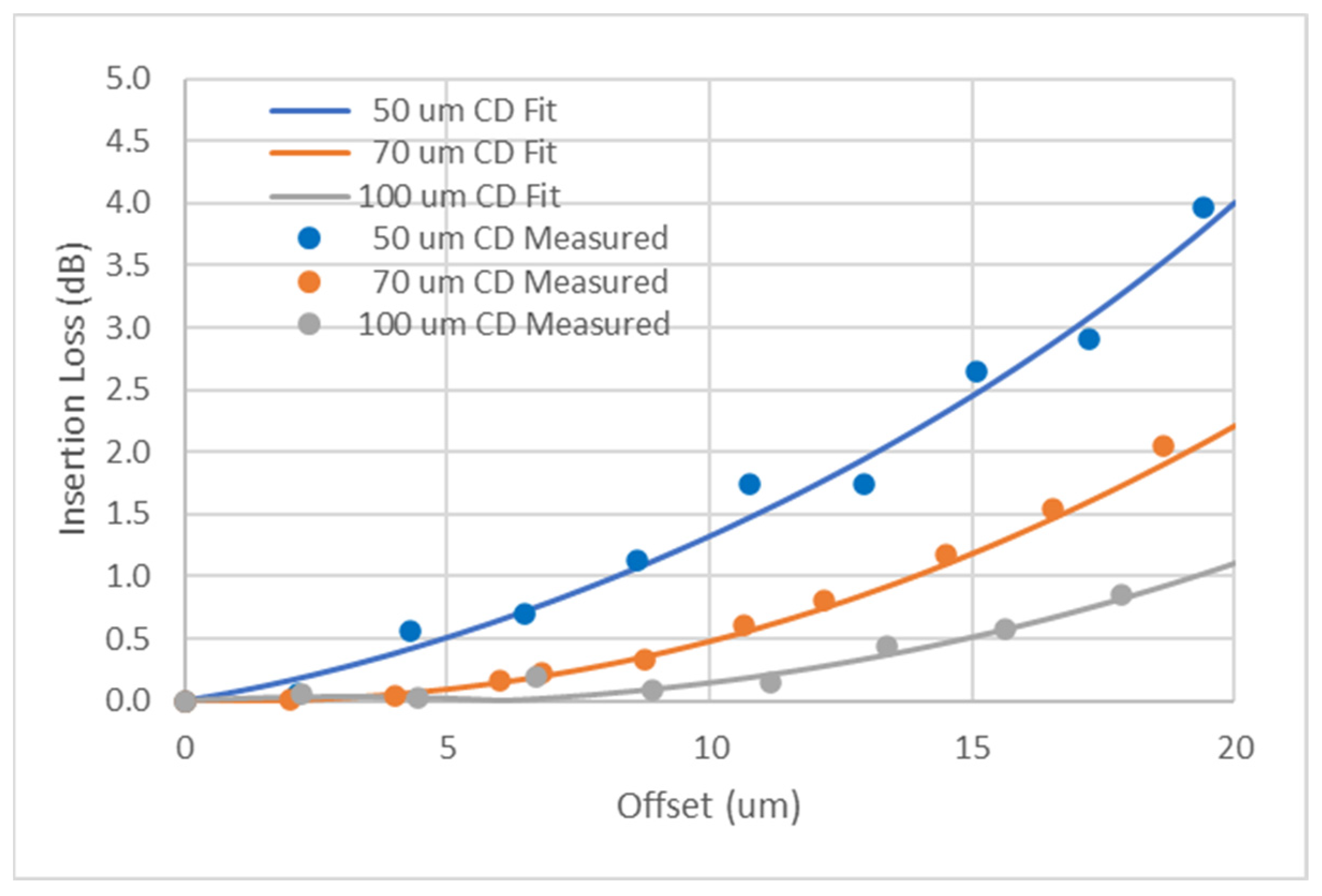
We fabricated several LCMMFs to demonstrate the design concept. The actual fibers have a core delta of 1% and core diameter of 100 and 70 μm. The α value is around 2.1. The fiber was characterized for modal bandwidth using the standard encircled flux launch condition over a range of wavelengths. The measured modal bandwidths are shown in Figure 11. As can be seen, the 100 μm core diameter fiber has a peak modal bandwidth of about 24 GHz·km around 870 nm, and the 70 μm core diameter fiber has a peak modal bandwidth of about 16 GHz·km around 850 nm, which are much higher than that of a typical 50 µm MMF. The modal bandwidth results validate the LCMMF design concept with a higher bandwidth. Such a high bandwidth feature makes the LCMMF suitable for high-data-rate VCSEL transmission systems. In addition, the LCMMF has more tolerance to alignment offset. Figure 12 plots measured insertion loss as a function of lateral offset for 50, 70 and 100 μm core diameter fibers. For a 0.5 dB insertion loss, the 50 μm core diameter fiber can tolerate 5 μm offset. For the same insertion loss, the offsets for the LCMMFs with 70 μm and 100 μm core diameters are increased to 10 μm and 15 μm, respectively. The large tolerance to offset makes the LCMMF attractive for low-insertion-loss fiber connectors and splices.
3.3. Long-Wavelength MMF
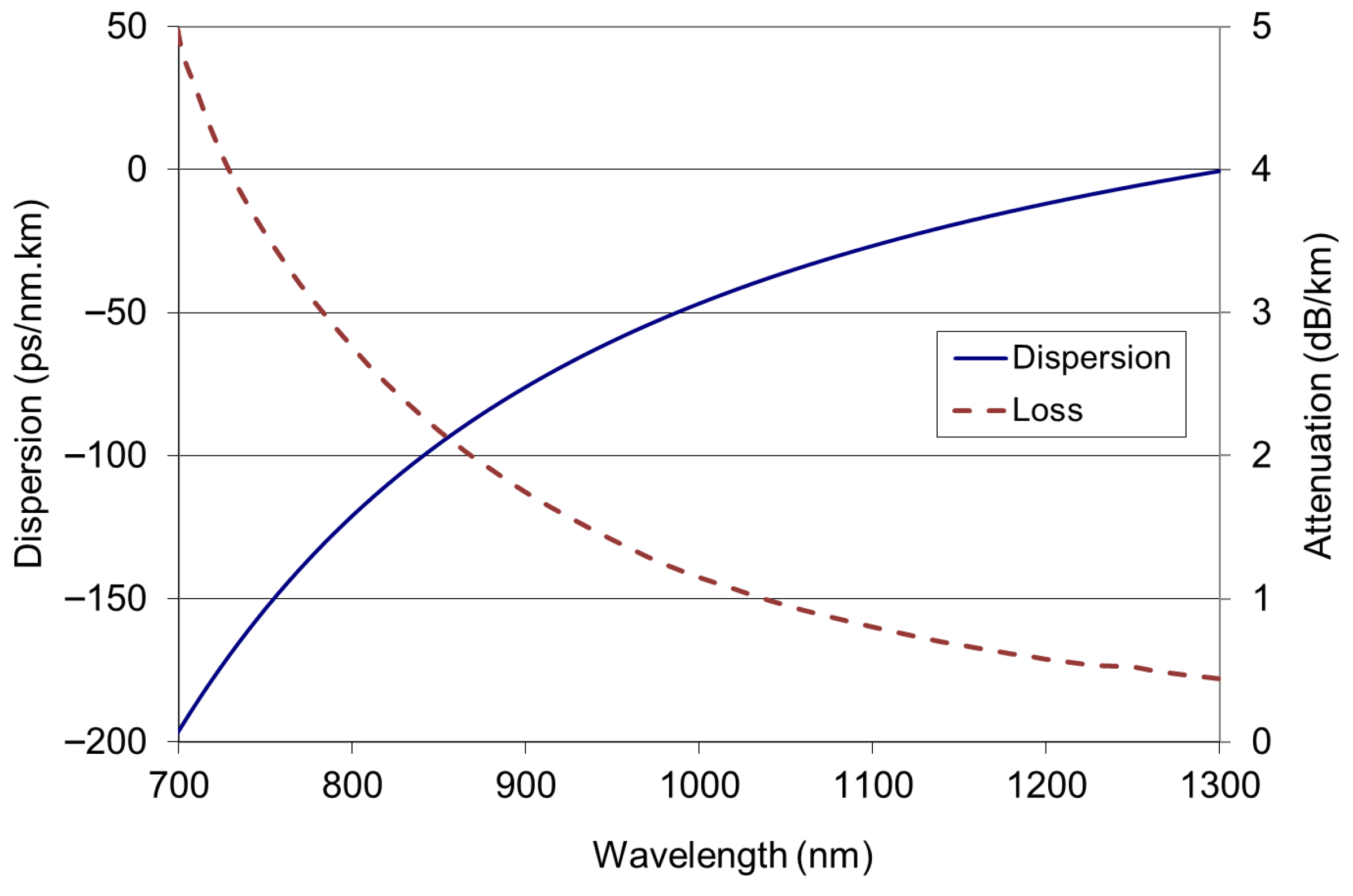
As discussed in Section 2, the fiber chromatic dispersion significantly impacts the EB of MMF if a multimode VCSEL is used. For silica-based MMFs, the chromatic dispersion depends on the operating wavelength. Figure 13 illustrates the chromatic dispersion and attenuation changes with wavelength for MMF with a germanium-doped core of 1% delta. For 850 nm, the chromatic dispersion is approximately −96 ps/(nm·km). As the wavelength increases towards 1300 nm, the absolute value of chromatic dispersion decreases. Simultaneously, the fiber attenuation is also reduced. Table 5 compares the chromatic dispersion, attenuation and EB of OM4 MMF at 850 nm, 980 nm, and 1060 nm. At 980 nm, the chromatic dispersion is reduced to −52 ps/(nm·km), roughly half of the value at 850 nm. For 1060 nm, the chromatic dispersion is further reduced to −34 ps/(nm·km), which is about one-third of the value at 850 nm. Due to lower chromatic dispersion, the EB of OM4 MMF increases from 2671 MHz·km at 850 nm to 3698 MHz·km at 980 nm, and 4182 MHz·km at 1060 nm. For 850 nm, the attenuation is 2.3 dB/km. The attenuation is reduced to 1.2 and 0.9 dB/km for the wavelengths of 980 and 1060 nm, respectively, which is another benefit for moving to longer wavelengths.
For long-wavelength MMFs, the refractive index profile needs to be optimized by adjusting the α-value. As mentioned earlier in Section 2, for 850 nm, the optimal α-value is 2.100. For 980 nm and 1060 nm, the optimal α-value is decreased to 2.069 and 2.055, respectively, due to the lower chromatic dispersion.
MMFs optimized at 1060 nm have been reported [27]. Two MMFs reported in that paper were of a quality between OM3 and OM4. However, 25 Gb/s transmissions have been successfully demonstrated through 300 m of MMF with a 1060 nm VCSEL transceiver, which clearly show the advantages of long-wavelength MMF transmissions. Recently, a 980 nm optimized MMF was reported with a high bandwidth of 14.2 GHz·km [28]. Transmission of 56 G PAM4 signals over 500 m was successfully demonstrated over 500 m fiber. With the VCSEL technology developments for long wavelengths, it is expected that long-wavelength MMFs could increase the data rate and extend the reach for VCSEL-based MMF systems.
3.4. Universal Fiber for Both Single-Mode and Multimode Transmission
MMFs and single-mode fibers are both used for different data center applications. MMFs with VCSELs offers cost-effective solutions for system reach up to about 100 m. For longer-reach applications beyond MMF transmission distances, single-mode fibers must be used. However, the overall cost of single-mode systems is significantly higher than MMF systems due to the higher expense of single-mode transceivers, which arises from increased manufacturing and packaging costs associated with single-mode lasers. In addition, single-mode systems consume more power, which is a critical factor to consider in data center operations. While it is feasible to adopt both multimode and single-mode fibers in data centers, a uniform type of optical fiber that can accommodate both types of transmissions is preferred to simplify fiber cable management and transceiver/connectivity logistics and provide flexibility for future transceiver upgrades. To accommodate both single-mode and multimode transmissions, a universal fiber (UF) was proposed and demonstrated [29,30,31,32,33,34].
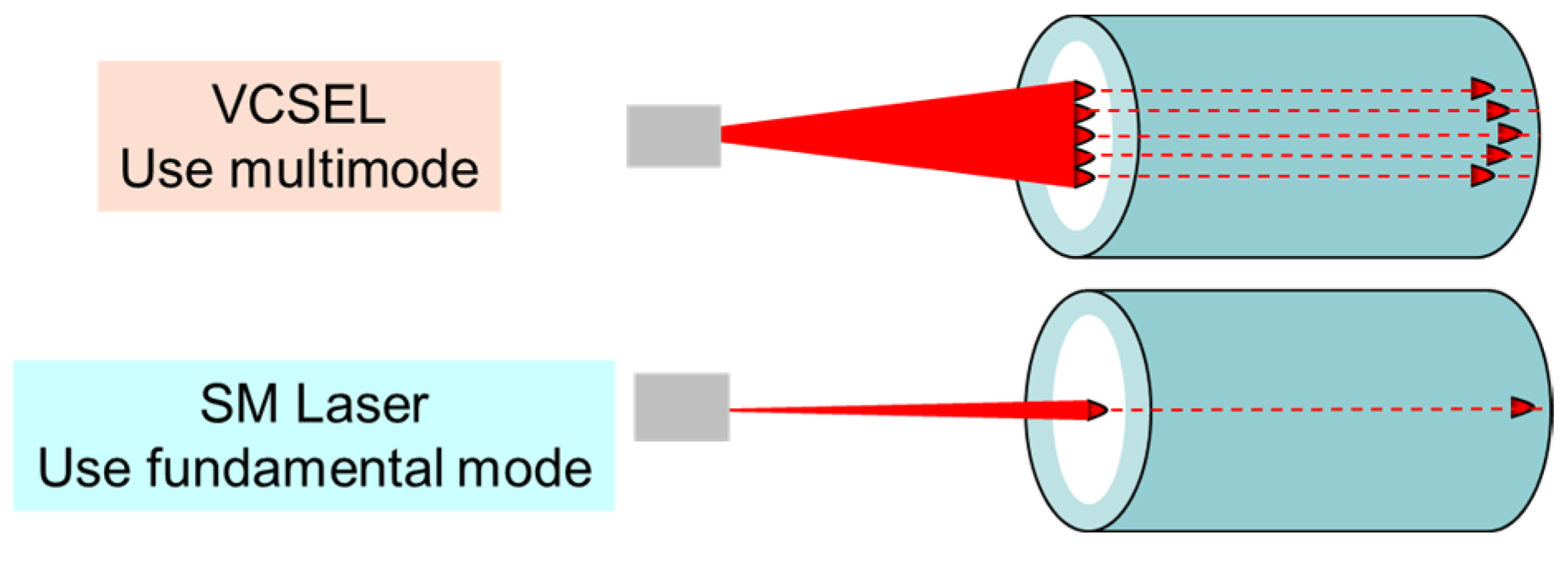
The UF has a multimode core that is designed to have a mode field diameter (MFD) for the fundamental LP01 mode approximately matched to that of standard single-mode fiber. As depicted in Figure 14, the multimode core design allows the use of VCSELs for low-cost transmission for short distances, similarly to conventional MMFs. At the same time, the design that matches the MFD to that of standard single-mode fiber makes it compatible with single-mode transceivers, so that single-mode transceivers can be plugged in for transmission using only the fundamental mode for longer link distances.
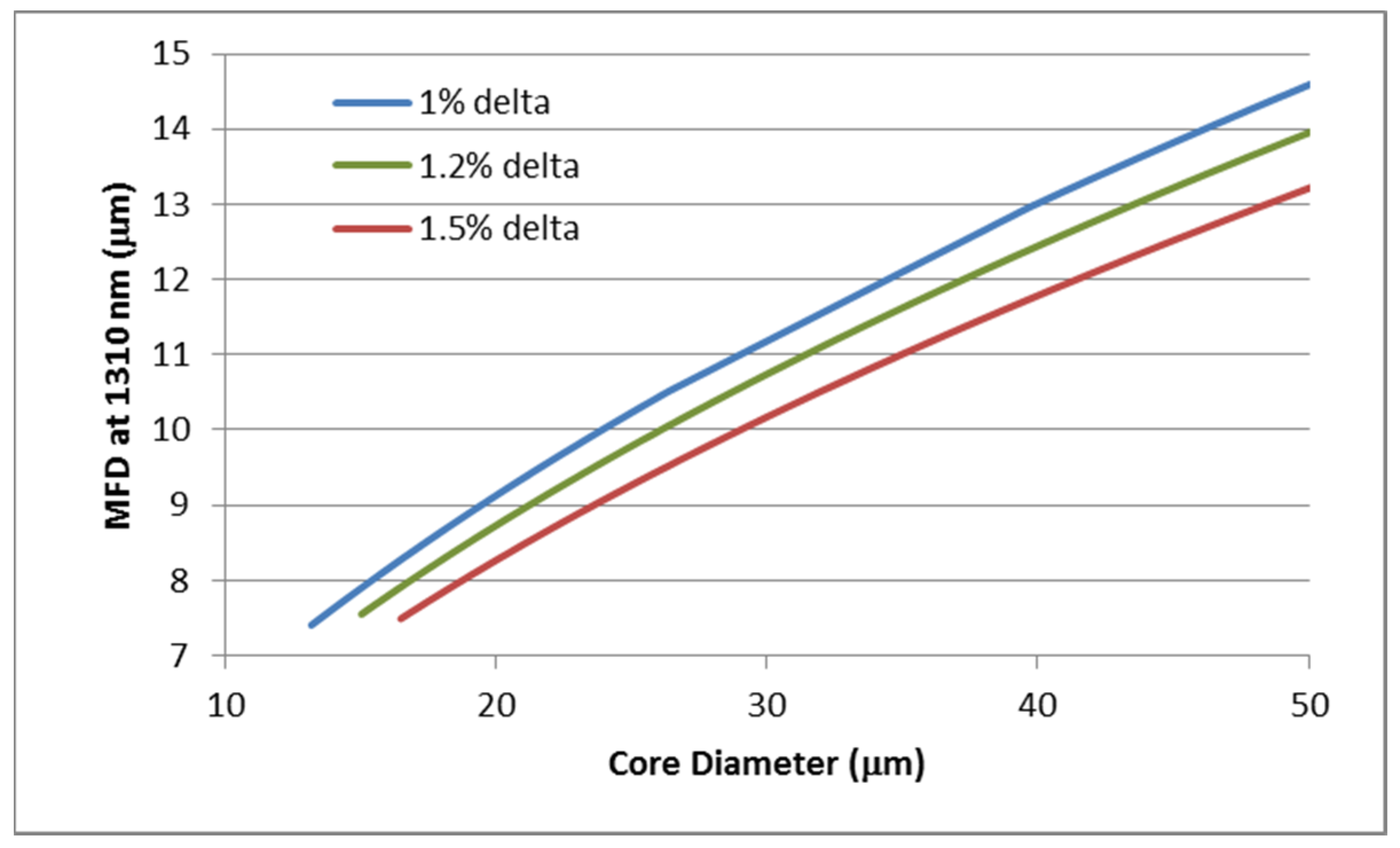
For a standard MMF with 1% core delta and 50 μm core diameter, the MFD at 1310 nm is 14.6 μm. This MFD is much larger than the 9.2 μm value of standard single-mode fiber, which can cause a coupling loss of almost 1 dB for the fundamental mode. This high coupling loss results in not only power penalty to the system, but also system degradation due to multipath interference (MPI).
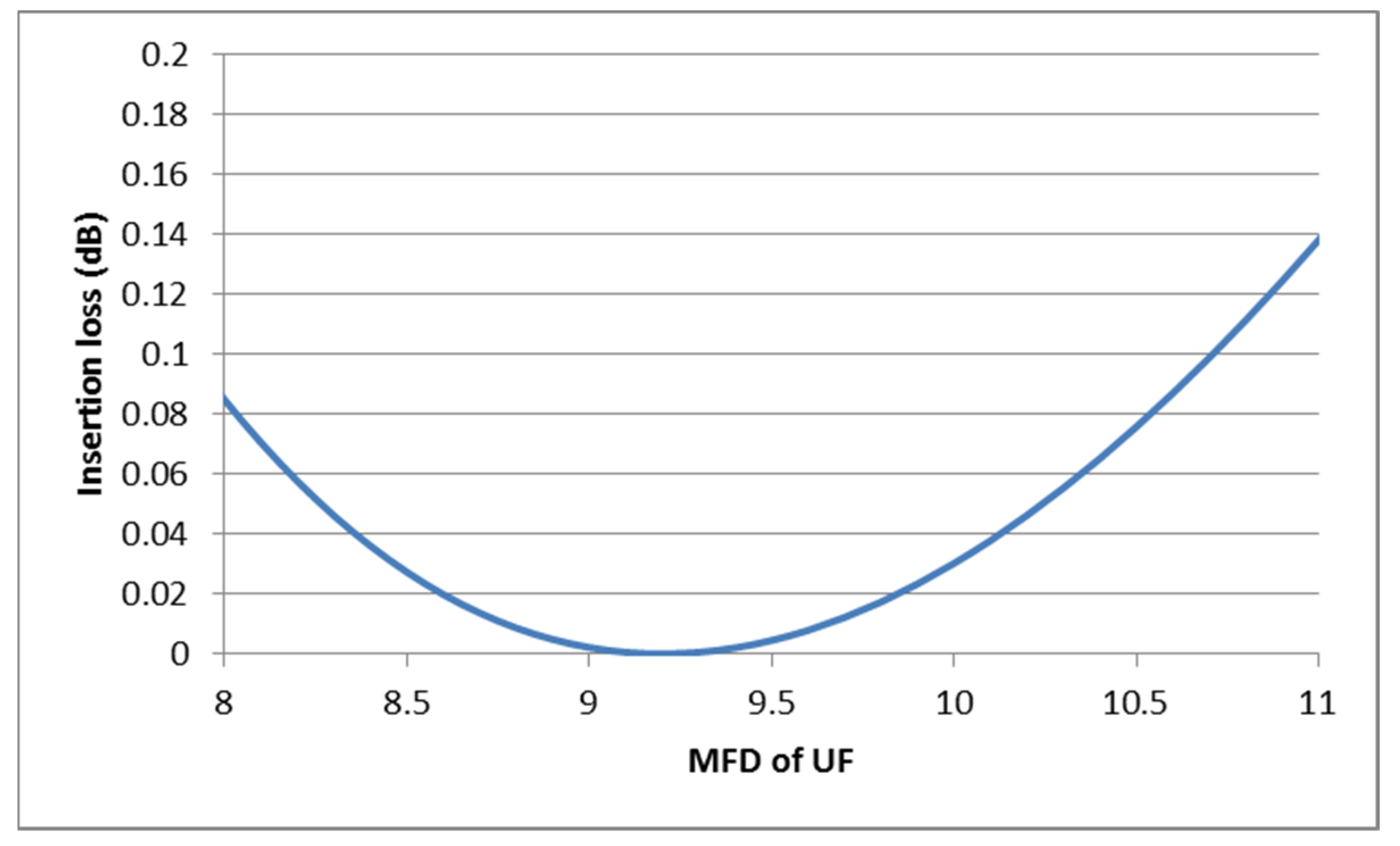
To match the MFD of fundamental mode of MMF to that of standard single-mode fiber, the core delta and core diameter of MMF need to be designed carefully. Figure 15 shows MFD as a function of core diameter for MMFs with different core deltas. Figure 16 plots the insertion loss between a single-mode fiber with an MFD of 9.2 μm and UFs with different MFDs. If we choose the 0.1 dB insertion loss level, the MFD of UF can be as large as 10.7 μm. For 1% delta, this corresponds to a core diameter of about 26 μm. For 1.2% delta, the corresponding core diameter is about 30 μm. The larger core diameter and higher delta help to reduce insertion loss for VCSEL transceivers. Further increasing the delta to 1.5% can enlarge the core diameter to about 35 μm. However, the larger modal dispersion associated with this high delta degrades the modal bandwidth performance. Therefore, the UF with 1.2% delta and 30 μm core diameter seems to be an optimal choice [30].
An experimental UF with core delta 1.2% and core diameter about 31 μm based on the optimized design discussed above was fabricated. The fiber attenuations were 2.2 dB/km and 0.42 dB/km at wavelengths of 850 nm and 1310 nm, respectively. The measured overfill modal bandwidth of the UF at 850 nm was 1.1 GHz·km with the peak bandwidth 4.13 GHz·km at 935 nm. Although the wavelength of the peak bandwidth was not at the target of 850 nm, it was feasible to use this fiber to study the multimode and single-mode transmission capabilities of the UF concept.
To demonstrate both single-mode and multimode transmission capabilities, the UF was tested for system performance using multimode and single-mode transceivers. Table 6 summarizes the system testing results for the three types of multimode and single-mode transceivers using the UF. The reaches for multimode transmission achieved can meet most of link lengths in data centers. The single-mode transmission length exceeded the 2 km link length specified for the 100 G CWDM4 transceiver. These results clearly demonstrate the dual transmission capabilities of UF, supporting both multimode and single-mode operations.
The multimode core of UF can be designed for long wavelengths as well, such as 980 nm and 1060 nm, to take advantages of lower chromatic dispersion, as discussed in Section 3.3. With the better bandwidth for the multimode core and single-mode transmission capability, it is expected that UF can find new applications for 800 G and beyond.
3.5. Few-Mode Transmission at Short Wavelengths Using Standard Single-Mode Fiber
A standard single-mode fiber that meets the ITU-T G.652 standard [35] has a cable cutoff wavelength below 1260 nm. The fiber is single-mode above this cable cutoff wavelength in the 1310 nm and 1550 nm transmission windows. At wavelengths shorter than 1260 nm, such as 850 to 1060 nm, the fiber becomes a few-mode fiber (FMF), which can be used for few-mode transmission with few-mode or single-mode VCSELs [36,37,38,39,40]. To achieve high bandwidth for few-mode operation, a standard single-mode fiber with a step-index profile with an α-value greater than 5 is not suitable, as explained in Section 2. Instead, a single-mode fiber with a graded-index profile can be designed to have high bandwidth for few-mode operation and meet the ITU-T G.652 standard for single-mode operation, which provides another option for universal fiber operation.
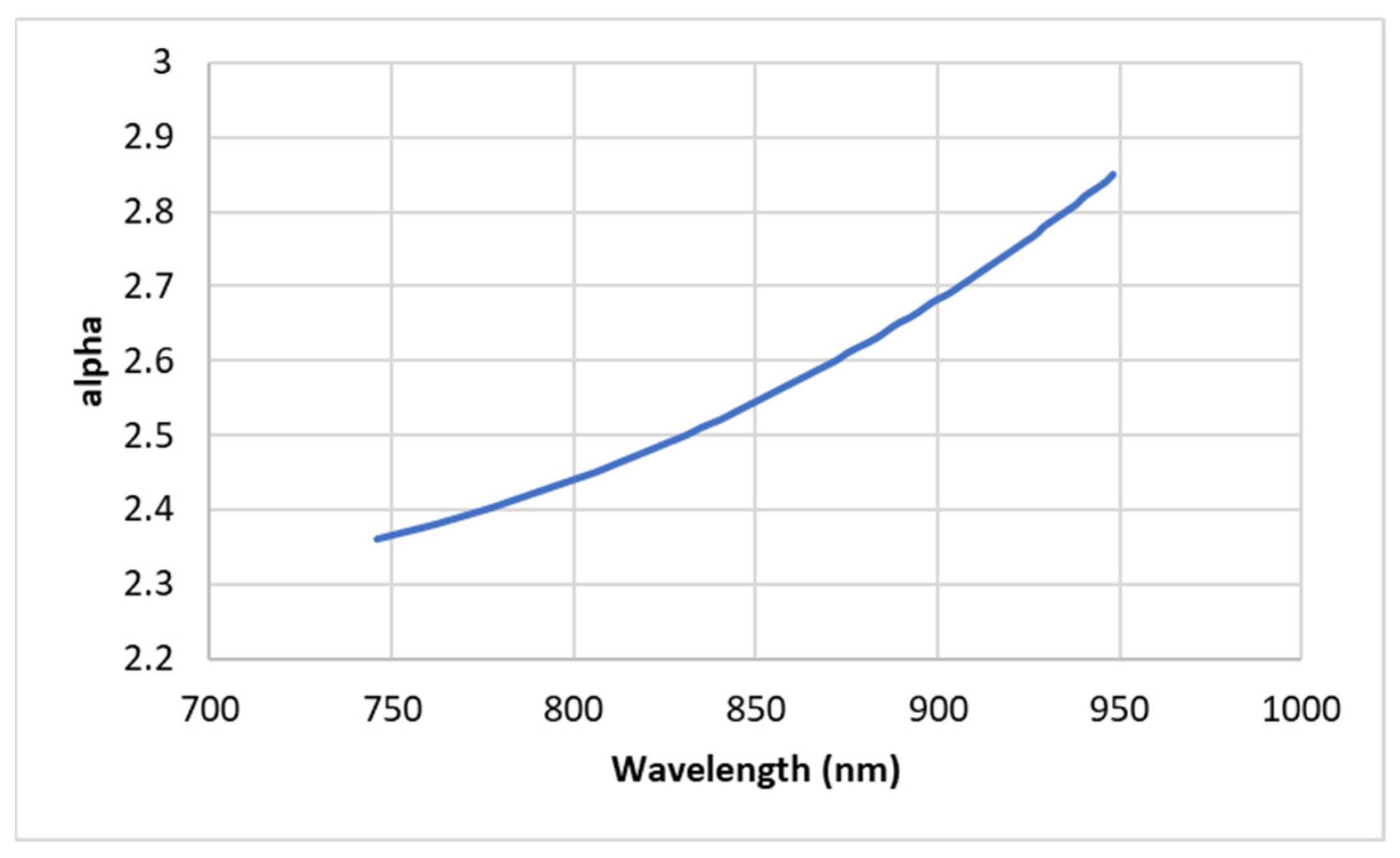
As an example, a graded index single-mode fiber was designed with a core delta of 0.41%, and a core radius of 5.95 μm to meet the nominal requirements for single-mode fiber. These requirements include an MFD at 1310 nm of approximately 9.2 μm, zero-dispersion wavelength around 1312 nm and cable cutoff wavelength around 1200 nm. For the bandwidth of an FMF, the α-value is the most important parameter similar to its role in MMF. A standard single-mode fiber supports two mode groups at 850 nm, LP01 and LP11. By selecting an appropriate α-value, the DMD between the two modes can be minimized and the bandwidth can be maximized. Figure 17 shows the optimum α-value as a function of the wavelength for the graded-index single-mode fiber. It can be observed that the optimal α-value for this fiber is larger than that required for MMF, as shown in Figure 2, to achieve the optimal modal bandwidth. Additionally, the slope of the curve has the opposite sign compared to MMF, indicating that as the α-value increases, the peak wavelength shifts toward longer wavelengths. Furthermore, the sensitivity to the α-value for the graded-index single-mode fiber is much lower, which is beneficial to the fiber manufacturing process. Based on Figure 17, an α-value of 2.52 was chosen to achieve a DMD between the LP01 and LP11 modes around zero at 850 nm, enabling the fiber to achieve very high bandwidth.
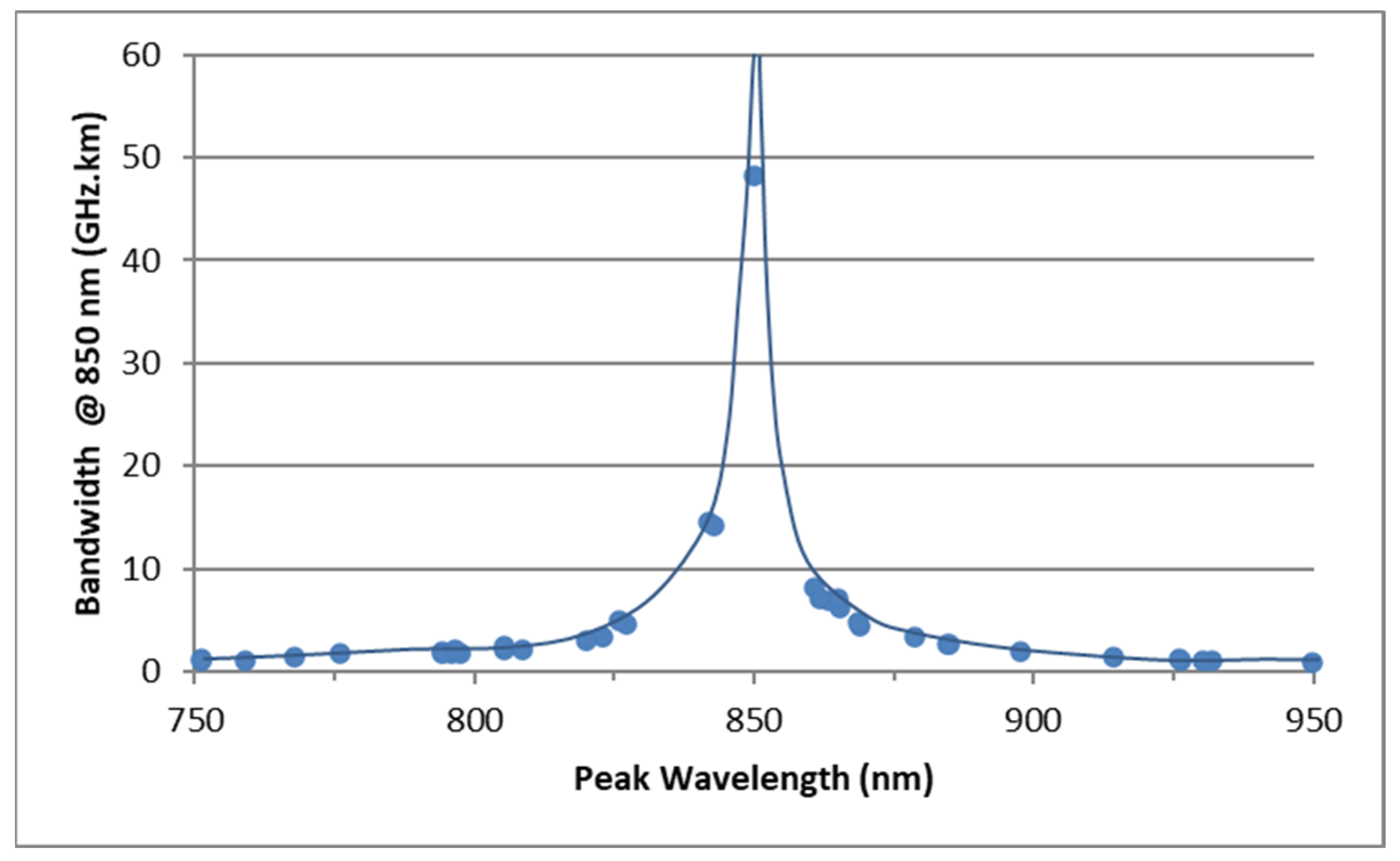
We have fabricated graded index single-mode fibers based on the design discussed above. The single-mode properties are fully compatible with nominal requirements for single-mode transmission. The fibers were tested for bandwidth at 850 nm using a bi-modal fiber measurement method that we developed [41]. Figure 18 shows the measured bandwidth at 850 nm as a function of the peak wavelength. A bandwidth as high as 48.3 GHz·km is demonstrated. From this figure, it is evident that precise control of the profile α-value is critical to aligning the peak wavelength with the operating wavelength to achieve high bandwidth. For the peak wavelength between 825 and 875 nm, the bandwidth exceeds 3 GHz·km at 850 nm, which is sufficient for high-speed transmission using single-mode VCSELs. Moreover, 25 Gb/s transmission through graded index single-mode fibers has been demonstrated. Transmission distances from 100 m up to 1.5 km have been achieved using fibers with bandwidth from 2.5 GHz·km to 48.3 GHz·km [39].
3.6. Fiber Bundle and Multicore MMF
In the era of artificial intelligence (AI), data center architectures are evolving to meet the exponential demand for greater power, density, and speed. In addition to the traditional network that interconnects servers, now referred to as the front-end network, a new backend scale-out network has emerged for high-performance computing nodes. This backend network requires significantly higher bandwidth density compared to the front-end network. The rapid scaling of AI models is driving for optical interconnects to scale up for replacing copper architectures for rack-scale deployments. These emerging optical interconnect applications demand at least an order-of-magnitude increase in bandwidth and bandwidth density with competitive cost and energy efficiency compared to copper alternatives [42].
There are two approaches to increasing the total bandwidth of a transmission link [43]. The first approach is to increase the transmission speed of each fiber channel by raising the modulation speed and enhancing the fiber bandwidth. However, increasing the modulation speed can lead to a higher transceiver cost and greater power consumption, which is undesirable for AI data centers that prioritize low cost and energy efficiency. The second approach involves using lower transmission speeds for each fiber channel while employing a large number of fiber channels to achieve the total transmission capacity. The approach is referred to as ‘slow-and wide’ approach. It typically requires a micro-LED array or a VCSEL array, combined with a fiber bundle or multicore fiber, to realize the total capacity [44,45]. The advantage is that the system can be optimized for low cost and low power consumption.
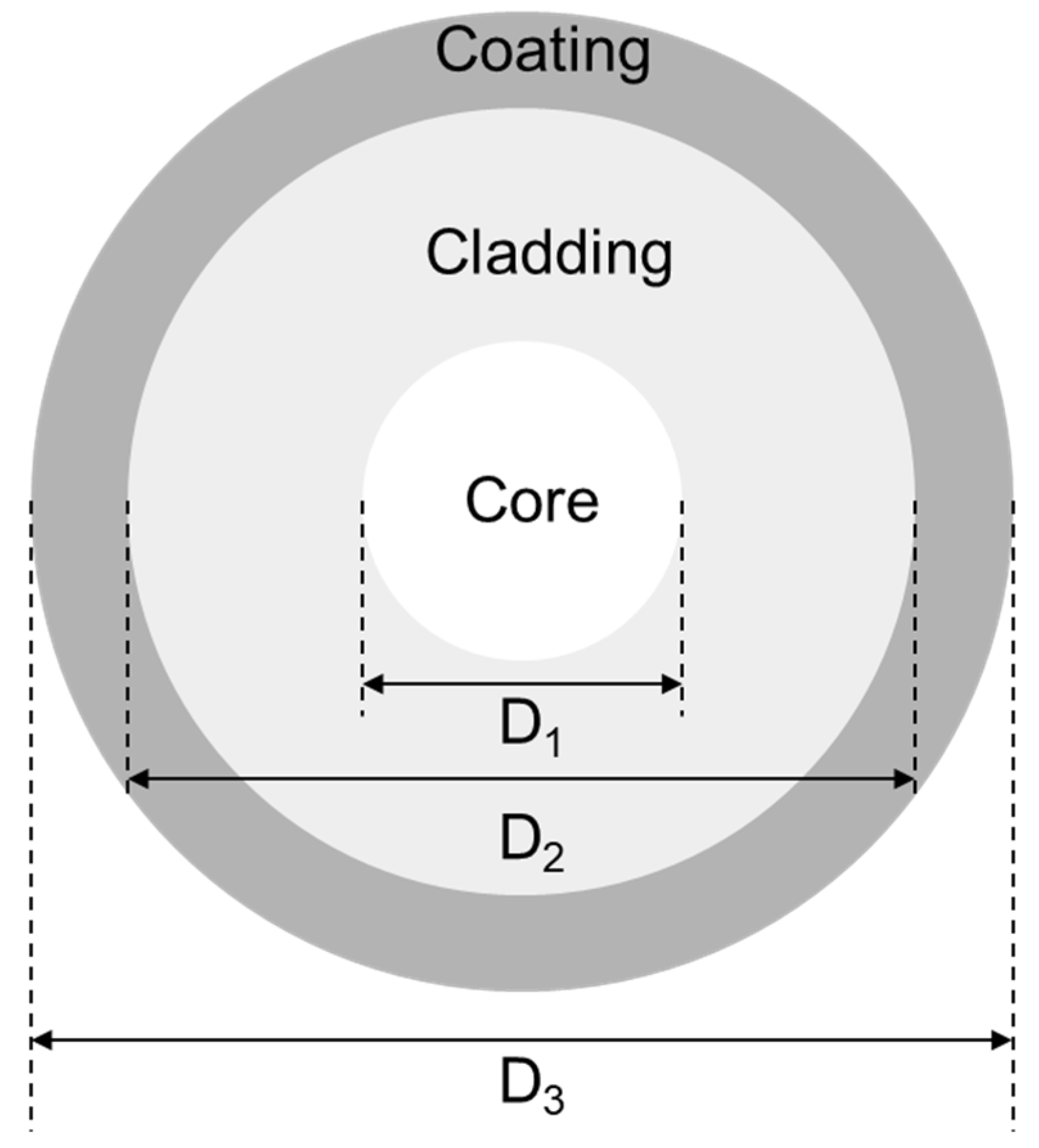
For making fiber bundles, thin coated MMFs have been proposed [46]. Figure 19 illustrates a thin coated MMF. It consists of a core, a cladding, and a coating. The fiber can have a core diameter D1 from 30 to 50 μm, a cladding diameter D2 ranging from 40 to 115 μm, and a coating diameter D3 ranging from 50 to 125 μm. The coating is a single layer with thickness of around 5–10 μm. A hard coating material is used to improve coating geometry accuracy and provide sufficient mechanical protection, as micro-bend attenuation is negligible for transmission distances under 100 m. The reduced diameter fiber with thin coating offers several advantages over conventional MMF with a 250 μm coating diameter. The fiber density is improved by a factor from 4 to 25. The thin coating layer does not need to be removed for fiber bundling and connecterization [47], simplifying these processes. Fibers with precision coatings can be stacked directly using a fixture to form a close-packed array. Furthermore, the precision and abrasion-resistant coating enables an efficient process for shaping fiber bundles into various geometries such as hexagonal and square.
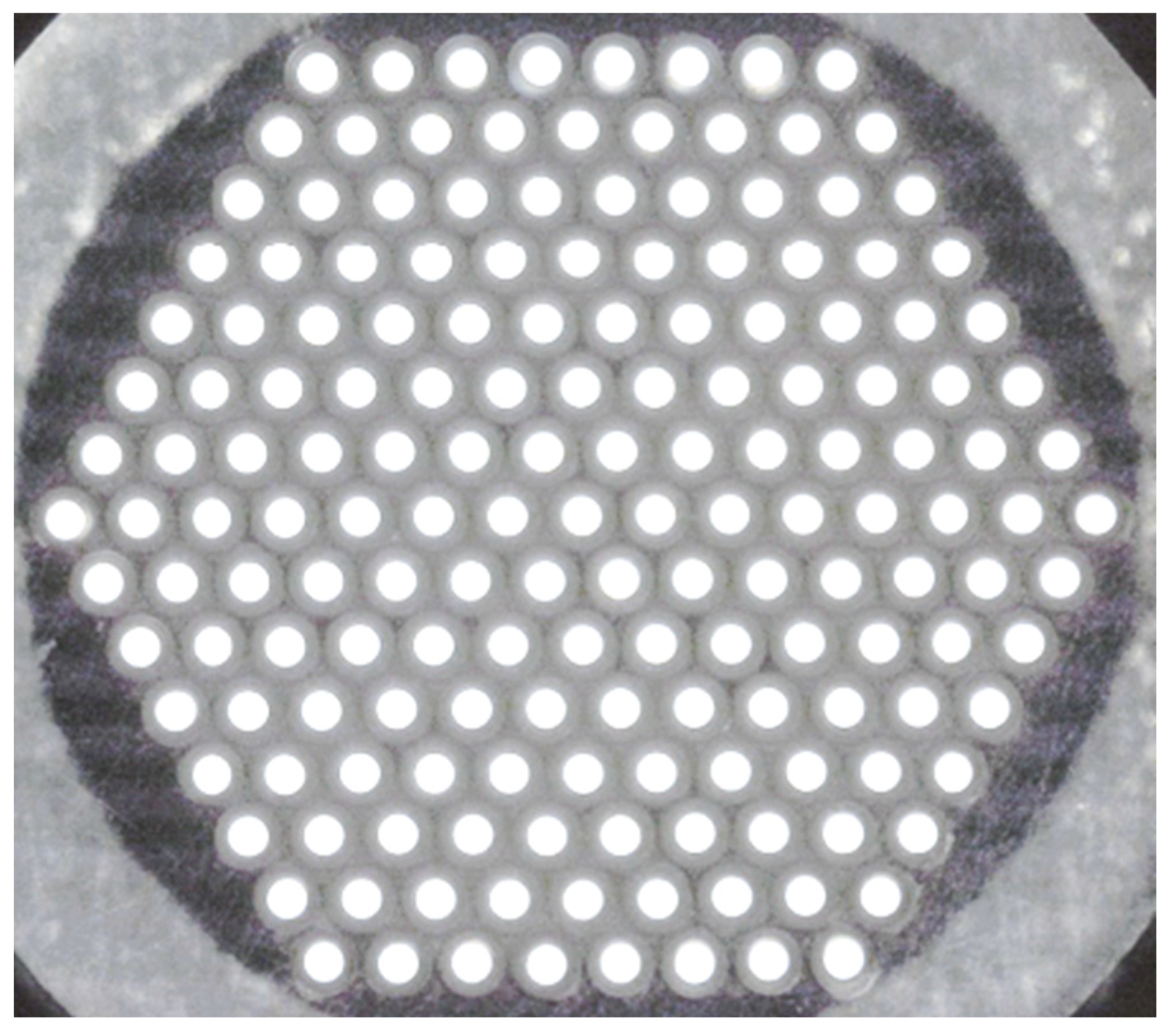
As an example, a 169-fiber hexagonal bundle was fabricated using thin coated fibers. In this example, the fiber has a 50 µm core with OM3 quality and a cladding diameter of 110 μm and coating diameter of 125 μm. The fibers were directly stacked using a fixture to form a close-packed 169 fiber bundle. The ends of the fiber bundle were inserted into a housing of 2.5 mm and polished. Figure 20 shows a picture of one end of the fiber bundle. The positions have errors of less than 5 μm relative to the ideal hexagonal grid, which are sufficiently good for coupling using micro-LED sources.
The fiber bundle process described above for 169 fibers can be scaled up to an even large number of fibers. If we use a fiber bundle diameter of 2.5 mm, the number of 125 μm diameter fibers that can be combined into a bundle is 271 for hexagonal packing. If the fiber diameter is reduced to 50 μm, the number of fibers can be increased to 1801.
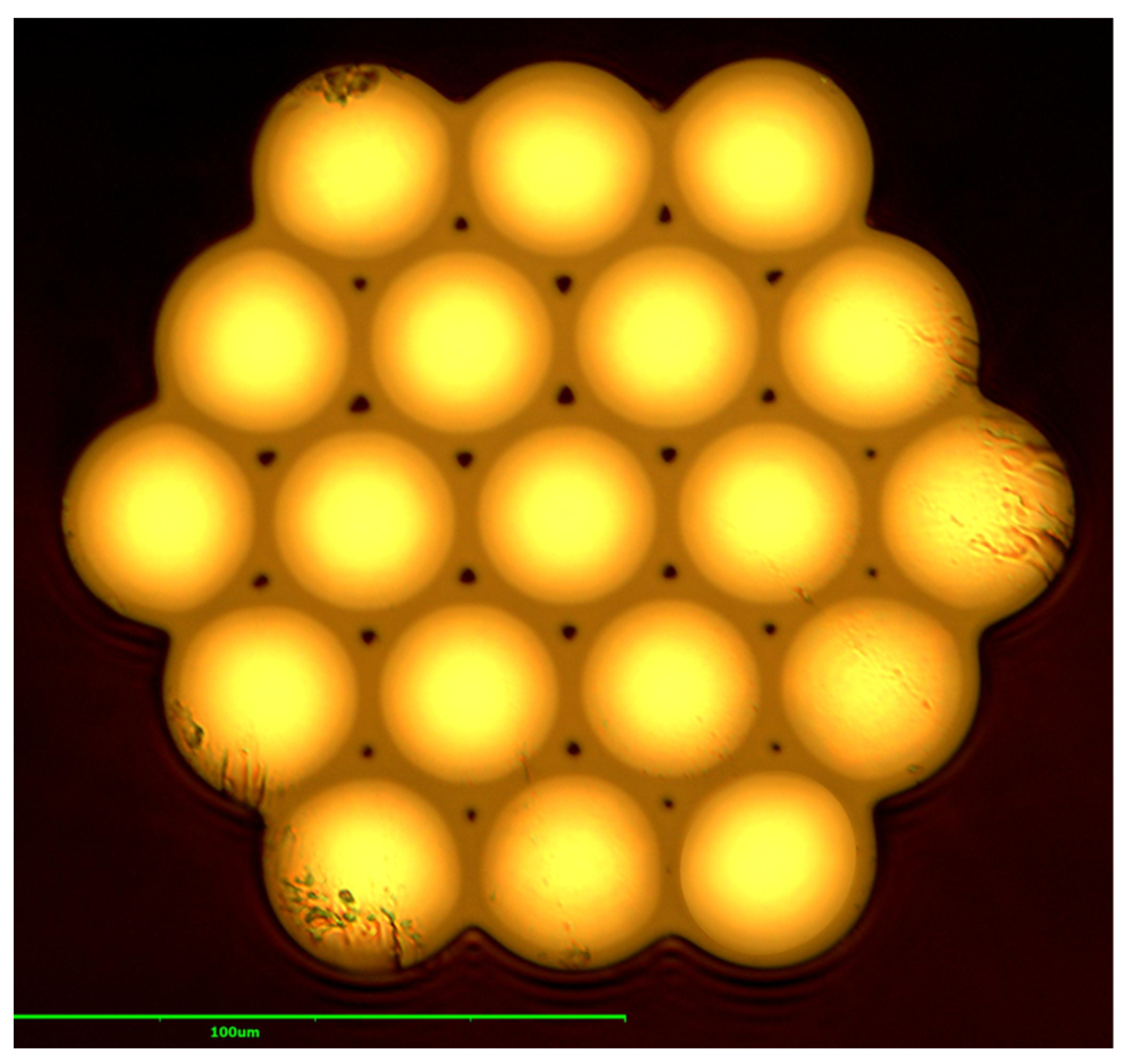
For core pitches less than 50 μm, multicore fibers are a viable alternative, as manufacturing single-core fibers with diameters below 50 μm is challenging. Multimode multicore fibers with seven cores have been reported with core pitches of 39 μm [48] and 42 μm [49]. However, to increase the core density, a higher core count of MM-MCFs is desirable. For multicore fibers, the number of cores depends on the core pitch and fiber diameter. To maintain mechanical flexibility and bending reliability, the fiber diameter is typically limited to approximately 250 μm. Assuming hexagonal packing and a core pitch of 10 μm as the lower limit, the maximum number of cores that can be accommodated within a single fiber is 469. For other fiber diameters and core pitches, the number of cores ranges between 7 and 469. Additionally, multicore fibers can be bundled together to form multicore fiber bundles, enabling the incorporation of several thousand to tens of thousands of cores.
4. Future Prospects of MMFs for AI Data Center Applications
We have discussed a few recent designs of MMFs to improve their performance. From a forward-looking perspective, the design of MMFs is expected to be increasingly driven by the requirements of next-generation data centers, particularly AI computing clusters characterized by high-bandwidth, low-latency, and energy-efficient short-reach interconnects. In such environments, MMFs with optimized designs can effectively support parallel optical links, making them well suited for high-radix switch fabrics and dense optical I/O.
In parallel, the operational wavelength window of MMF systems is undergoing continuous evolution. While 850 nm remains the dominant window, increasing attention is being paid to extending to long wavelengths (e.g., 950–1060 nm) with an improved VCSEL performance, and to short wavelengths (e.g., 400–600 nm) with low-power micro-LED sources. From a fiber design perspective, this trend motivates the development of MMFs with a high bandwidth and low attenuation over broader wavelength ranges, as well as potential exploration of short-wavelength operation to enhance bandwidth density with lower power consumption and compatibility with emerging light sources.
Equally important is the development of low-cost and scalable manufacturing technologies for MMFs. Future design trends emphasize fibers that are tolerant to fabrication imperfections, support high-volume production, and maintain backward compatibility with existing OM-class standards. Advances in preform fabrication, refractive-index profile control, lower germanium consumption and integration with low-cost cable, connectors and optical engines will be critical to reducing the overall cost and power consumption per transmitted bit. Together, these design-driven advances indicate that MMFs will continue to evolve as a cost-effective and high-performance solution for short-reach optical interconnects in future AI data center networks.
5. Conclusions
We have reviewed recent advancements in MMF technology aimed at increasing bandwidth and improving transmission performance. MMF designs continue to evolve to address the growing demand for higher data rates in short-reach links within data centers. For 850 nm multimode VCSELs with a linewidth of 0.65 nm, further improving the EMB of MMFs beyond OM4 levels provides only marginal performance gains due to high chromatic dispersion. However, the benefits become more substantial if 850 nm VCSELs transition to few-mode operation with a reduced linewidth of 0.4 nm or less. To further enhance bandwidth, large-core multimode fibers (LCMMFs) offer a compelling option beyond OM4 performance along with advantages such as greater tolerance for splicing and connectorization.
Universal fibers, which support multimode transmission in the 850–1060 nm wavelength range using VCSELs and single-mode transmission at 1310 nm using single-mode lasers, present a unified fiber solution for both short- and long-distance links. Additionally, graded-index single-mode fibers could also serve as universal fibers, enabling few-mode transmission at shorter wavelengths if single-mode VCSELs become available. For emerging scale-up and scale-out optical interconnects, MMF bundles and multimode MCFs are promising solutions to increase bandwidth density while maintaining low power consumption.
With ongoing innovations in MMF technology, MMFs are expected to remain a key enabler of high-bandwidth-density, cost-effective, and energy-efficient solutions for data centers in the era of artificial intelligence and beyond.
Funding
This research received no external funding.
Institutional Review Board Statement
Not applicable.
Informed Consent Statement
Not applicable.
Data Availability Statement
Data are contained within the article as shown in the figures and associated descriptions.
Conflicts of Interest
Author Ming-Jun Li was employed by the company Corning Incorporated. The author declares that the research was conducted in the absence of any commercial or financial relationships that could be construed as a potential conflict of interest.
References
- Abbott, J.; Bickham, S.; Dainese, P.; Li, M.-J. Chapter 7: Fibers for Short-Distance Applications. Optical Fiber Telecommunications VIA; Academic Press: New York, NY, USA, 2013. [Google Scholar]
- Li, M.-J.; Nolan, D.A. Optical Transmission Fiber Design Evolution. J. Light. Technol. 2008, 26, 1079–1092. [Google Scholar] [CrossRef]
- Barnoski, M.K. Data Distribution Using Fiber Optics. Appl. Opt. 1975, 14, 2571–2577. [Google Scholar] [CrossRef] [PubMed]
- Joyce, W.B.; Dixon, R.W.; Hartman, R.L. Statistical Characterization of the Lifetimes of Continuously Operated (Al, Ga)As Double-Heterostructure Lasers. Appl. Phys. Lett. 1976, 28, 684–686. [Google Scholar] [CrossRef]
- Joyce, W.B.; Dixon, R.W.; Hartman, R.L. Continuously Operated (Al, Ga)As Double-Heterostructure Lasers with 70 °C Lifetimes as Long as Two Years. Appl. Phys. Lett. 1977, 31, 756–759. [Google Scholar]
- Horiguchi, M.; Osanai, H. Spectral Losses of Low-OH-Content Optical Fibres. Electron. Lett. 1976, 12, 310–312. [Google Scholar] [CrossRef]
- Miya, T.; Terunuma, Y.; Hosaka, T.; Moyashita, T. Ultimate Low-Loss Single-Mode Fibers at 1.55 μm. Electron. Lett. 1979, 15, 106–108. [Google Scholar] [CrossRef]
- Koyama, F.; Kinoshita, S.; Iga, K. Room Temperature CW Operation of GaAs Vertical Cavity Surface Emitting Laser. IEICE Trans. 1988, E71, 1089–1090. [Google Scholar]
- Tatum, J.A. Evolution of VCSELs. Proc. SPIE 2014, 9001, 10C-1–10C-9. [Google Scholar]
- Gloge, D.; Marcatelli, A.J. Multimode Theory of Graded-Core Fibers. Bell Syst. Tech. J. 1973, 52, 1563–1579. [Google Scholar] [CrossRef]
- Olshansky, R.; Keck, D.B. Pulse Broadening in Graded-Index Optical Fibers. Appl. Opt. 1976, 15, 483–491. [Google Scholar] [CrossRef] [PubMed]
- ANSI/TIA-455-220-A; FOTP-220 Differential Mode Delay Measurement of Multimode Fiber in the Time Domain. Telecommunications Industry Association: Arlington, VA, USA, 2003.
- TIA/EIA-492AAAC-B; Detail Specification for 850-nm Laser-Optimized 50-μm Core Diameter/125-μm Cladding Diameter Class Ia Graded-Index Multimode Optical Fibers. Telecommunications Industry Association: Arlington, VA, USA, 2009.
- TIA-492AAAD; Detail Specification for 850-nm Laser-Optimized 50-μm Core Diameter/125-μm Cladding Diameter Class Ia Graded-Index Multimode Optical Fibers Suitable for Manufacturing OM4 Cabled Optical Fiber. Telecommunications Industry Association: Arlington, VA, USA, 2009.
- Molin, D.; Bigot-Astruc, M.; de Jongh, K.; Sillard, P. Trench-assisted bend-resistant OM4 multi-mode fibers. In Proceedings of the 36th European Conference and Exhibition on Optical Communication, Turin, Italy, 19–23 September 2010; pp. 1–3. [Google Scholar] [CrossRef]
- Li, M.; Tandon, P.; Bookbinder, D.C.; Bickham, S.R.; Wilbert, K.A.; Abbott, J.S.; Nolan, D.A. Designs of Bend-Insensitive Multimode fibers. In Optical Fiber Communication Conference/National Fiber Optic Engineers Conference 2011; OSA Technical Digest (CD); Optica Publishing Group: Washington, DC, USA, 2011; Paper JThA3. [Google Scholar]
- 10Gb/s Link Budget Spreadsheet (Version 3.1.16a) Excel® Spreadsheet. Available online: http://www.ieee802.org/3/ae/public/index.html (accessed on 10 March 2026).
- Haglund, E.; Haglund, Å.; Gustavsson, J.S.; Kögel, B.; Westbergh, P.; Larsson, A. Reducing the Spectral Width of High-Speed Oxide Confined VCSELs Using an Integrated Mode Filter. In Vertical-Cavity Surface-Emitting Lasers XVI; SPIE: Bellingham, WA, USA, 2012; Volume 8276, p. 82760L. [Google Scholar]
- Murty, R. RMS Spectral Width. IEEE 802.3 cm 400 Gb/s over Multi-Mode Fiber Task Force, 12 November 2018. Available online: https://www.ieee802.org/3/cm/public/November18/murty_3cm_01_1118.pdf (accessed on 19 March 2026).
- ANSI/TIA-492AAAF; Detail Specification for Class Ia Graded-Index Multimode Optical Fibers. Telecommunications Industry Association: Arlington, VA, USA, 2020.
- IEEE 802.3bm-2015; IEEE Standard for Ethernet—Amendment 3: Physical Layer Specifications and Management Parameters for 40 Gb/s and 100 Gb/s Operation over Fiber Optic Cables. IEEE Standards Association: Piscataway, NJ, USA, 27 March 2015.
- King, J. Channel Wavelength Ranges for 400GBASE-4.2 OM3 and OM4 Effective Bandwidth, Modal and Chromatic Dispersion Included. IEEE 802.3 cm ad hoc, 28 June 2018. Available online: https://www.ieee802.org/3/cm/public/adhoc/king_3cm_adhoc_01_062818.pdf (accessed on 10 March 2026).
- Chen, X.; Dong, H.; Chen, H.; Hurley, J.E.; Bullock, Z.D.; Li, M.-J. Wavelength Dependence of Modal Bandwidth of Multimode Fibers for High Data Rate Transmission and Its Implications. Photonics 2024, 11, 667. [Google Scholar] [CrossRef]
- Li, K.; Chen, X.; Zakharian, A.R.; Hurley, J.E.; Stone, J.S.; Li, M.-J. High Bandwidth Large Core Multimode Fibre with High Connector Tolerance for Short Distance Communications. In European Conference on Optical Communications (ECOC); IEEE: Piscataway, NJ, USA, 2020; pp. 1–4. [Google Scholar]
- Li, K.; Chen, X.; Zakharian, A.R.; Hurley, J.E.; Stone, J.S.; Li, M.-J. Large Core Multimode Fiber with High Bandwidth and High Connector Tolerance for Broadband Short-Distance Communications. APL Photonics 2021, 6, 070802. [Google Scholar] [CrossRef]
- Etendue. Available online: https://en.wikipedia.org/wiki/Etendue (accessed on 19 March 2026).
- Kise, T.; Suzuki, T.; Funabashi, M.; Nagashima, K.; Lingle, R.; Vaidya, D.S.; Shubochkin, R.; Kamino, J.T.; Chen, X.; Bickham, S.R.; et al. Development of 1060 nm 25-Gb/s VCSEL and Demonstration of 300 m and 500 m System Reach Using MMFs and Link Optimized for 1060 nm. In Optical Fiber Communication Conference; Optica Publishing Group: Washington, DC, USA, 2014; Paper Th4G.3. [Google Scholar]
- Hellmig, J.; Chen, X.; Safaisini, R.; Juarez, A.; Dragt, J.; Hurley, J.E.; Moser, P.; Sassiya, B.; King, R.; Larisch, G.; et al. 56G VCSEL Transmission at 980 nm across 500 m Multimode Fiber. In Optical Fiber Communication Conference (OFC); Technical Digest Series; Optica Publishing Group: Washington, DC, USA, 2024; Paper Th1B.3. [Google Scholar]
- Chen, X.; Hurley, J.E.; Stone, J.; Downie, J.D.; Roudas, I.; Coleman, D.; Li, M.-J. Universal Fiber for Both Short-Reach VCSEL Transmission at 850 nm and Single-Mode Transmission at 1310 nm. In Optical Fiber Communication Conference; OFC Technical Digest 2016; Optica Publishing Group: Washington, DC, USA, 2016; Paper Th4E.4. [Google Scholar]
- Chen, X.; Hurley, J.E.; Stone, J.; Zakharian, A.R.; Coleman, D.; Li, M.-J. Design of Universal Fiber with Demonstration of Full System Reaches over 100G SR4, 40G sWDM, and 100G CWDM4 Transceivers. Opt. Express 2016, 24, 18492. [Google Scholar] [CrossRef] [PubMed]
- Chen, X.; Hurley, J.E.; Stone, J.; Coleman, D.; Li, M.-J. Demonstration of Full System Reaches of 100G SR4, 40G sWDM, and 100G CWDM4 Transmissions over Universal Fiber. In Proceedings of the IEEE Photonics Conference 2016, Waikoloa, HI, USA, 2–6 October 2016. Paper WF2.2. [Google Scholar]
- Chen, X.; Hurley, J.E.; Stone, J.; Zakharian, A.R.; Chow, B.; Coleman, D.; Li, M.-J. Universal Fibers for Both Single-Mode and Multimode Transmissions in Data Centers. In Optical Fiber Communication Conference; OSA Technical Digest (Online); Optica Publishing Group: Washington, DC, USA, 2018; Paper W3C.2. [Google Scholar]
- Li, M.-J.; Chen, X.; Hurley, J.E.; Stone, J.S.; Zakharian, A.R.; Coleman, D. Universal Fibers for Data Center Applications. In Next-Generation Optical Networks for Data Centers and Short-Reach Links IV; SPIE: Bellingham, WA, USA, 2017; Volume 10131, p. 1013106. [Google Scholar] [CrossRef]
- Chen, X.; Himmelreich, J.E.; Hurley, J.E.; Zhou, C.; Jiang, Q.; Qin, Y.; Li, J.; Wu, C.; Chen, H.; Coleman, D.; et al. Universal Fiber for Short-Distance Optical Communications. J. Light. Technol. 2019, 37, 389–395. [Google Scholar] [CrossRef]
- ITU-T G.652; Characteristics of a Single-Mode Optical Fibre and Cable. The International Telecommunication Union: Geneva, Switzerland, 2024.
- Li, M.-J.; Li, K.; Chen, X.; Mishra, S.K.; Juarez, A.A.; Hurley, J.E.; Stone, J.S.; Wang, C.-H.; Cheng, H.-T.; Wu, C.-H.; et al. Single-Mode VCSEL Transmission for Short Reach Communications. J. Light. Technol. 2021, 39, 868–880. [Google Scholar] [CrossRef]
- Juarez, A.A.; Chen, X.; Hurley, J.E.; Thiermann, M.; Stone, J.; Li, M.-J. Graded-Index Standard Single-Mode Fiber for VCSEL Transmission around 850 nm. In Optical Fiber Communication Conference; OSA Technical Digest (Online); Optical Society of America: Washington, DC, USA, 2019; Paper M3C.2. [Google Scholar]
- Chen, X.; Li, K.; Hurley, J.E.; Stone, J.; Li, M.-J. 25 Gb/s Few-Mode Transmission at ~850 nm over 1.5 km Graded-Index Single-Mode Fiber Using SM VCSEL. In Proceedings of the 2019 24th OptoElectronics and Communications Conference (OECC) and 2019 International Conference on Photonics in Switching and Computing (PSC), Fukuoka, Japan, 7–11 July 2019; pp. 1–3. [Google Scholar]
- Li, K.; Chen, X.; Hurley, J.E.; Stone, J.S.; Li, M.-J. High Data Rate Few-Mode Transmission over Graded-Index Single-Mode Fiber Using 850 nm Single-Mode VCSEL. Opt. Express 2019, 27, 21395–21404. [Google Scholar] [CrossRef] [PubMed]
- Li, M.-J.; Li, K.; Chen, X.; Mishra, S.K.; Juarez, A.A.; Hurley, J.E.; Stone, J.S. Single-Mode VCSEL Transmission over Graded-Index Single-Mode Fiber around 850 nm. In Optical Fiber Communication Conference (OFC); OSA Technical Digest (Online); Optical Society of America: Washington, DC, USA, 2020; Paper W4D.4. [Google Scholar]
- Li, K.; Chen, X.; Hurley, J.E.; Stone, J.S.; Li, M.-J. Modal Delay and Modal Bandwidth Measurements of Bi-Modal Optical Fibers through a Frequency Domain Method. Opt. Fiber Technol. 2020, 55, 102145. [Google Scholar] [CrossRef]
- Benyahya, K.; Diaz, A.G.; Liu, J.; Lyutsarev, V.; Pantouvaki, M.; Shi, K.; Siew, S.Y.; Ballani, H.; Burridge, T.; Cletheroe, D.; et al. Mosaic: Breaking the Optics versus Copper Trade-off with a Wide-and-Slow Architecture and MicroLEDs. In Proceedings of the ACM SIGCOMM 2025 Conference, Coimbra, Portugal, 8–11 September 2025. [Google Scholar]
- Zhou, X.; Liu, H.; Urata, R.; Zebian, S. Scaling Large Data Center Interconnects: Challenges and Solutions. Opt. Fiber Technol. 2018, 44, 61–68. [Google Scholar] [CrossRef]
- Pezeshki, B.; Tselikov, A.; Kalman, R.; Danesh, C. Wide and Parallel, LED-Based Optical Links Using Multi-Core Fiber for Chip-to-Chip Communications. In Optical Fiber Communication Conference (OFC) 2021; Optica Publishing Group: Washington, DC, USA, 2021; Paper F3A.1. [Google Scholar]
- Pezeshki, B.; Rangarajan, S.; Tselikov, A.; Afifi, E.; Huang, I.; Pepper, J.; Zou, S.; Rourke, H.; Pocock, R.; Fikouras, A.; et al. 304-Channel MicroLED-Based CMOS Transceiver IC with Aggregate 1 Tbps and Sub-pJ per Bit Capability. In Optical Fiber Communication Conference (OFC); Technical Digest Series; Optica Publishing Group: Washington, DC, USA, 2024; Paper M3A.1. [Google Scholar]
- Li, M.-J.; Abedijaberi, A.; Niu, W.; Leonhardt, E.E.; Clark, D.A.; Scannell, G.W.; Drake, M.R.; Stone, J.S.; McCarthy, J.E.; Wallace, A.L.; et al. Reduced Coating Diameter Fibers for High Density Cables. In Optical Fiber Communication Conference; Optica Publishing Group: Washington, DC, USA, 2022; pp. 1–3. [Google Scholar]
- Liu, J.; McClure, R.L.; Wu, Q.; Niu, W.; Drake, M.R.; McCarthy, J.E.; Stone, J.S.; Gu, Y.; Li, M.-J. Stripping-Free Direct Fiber Insertion Connectors Using Thin-Coated Optical Fibers. In Optical Fiber Communication Conference; Optica Publishing Group: Washington, DC, USA, 2022; Paper M4E.6. [Google Scholar]
- Zhu, B.; Taunay, T.F.; Yan, M.F.; Fishteyn, M.; Oulundsen, G.; Vaidya, D. 70-Gb/s multicore multimode fiber transmissions for optical data links. IEEE Photon. Technol. Lett. 2010, 22, 1647. [Google Scholar] [CrossRef]
- Liu, Y.; Ma, L.; Yang, C.; Tong, W.; He, Z. Multimode and single-mode fiber compatible graded-index multicore fiber for high density optical interconnect application. Opt. Express 2018, 26, 11639–11648. [Google Scholar] [CrossRef] [PubMed]
- Li, M.-J.; Griffin, S.; Knowlton, B.; McCarthy, J.; Gu, Y.; Pedro, H.; Zakharian, A. A Novel Multicore Fiber by Drawing and Attaching Multiple Fibers Together. In Proceedings of the 2025 Asia Communications and Photonics Conference (ACP), Suzhou, China, 5–8 November 2025; pp. 1–3. [Google Scholar]
Figure 1.
Bandwidth as a function of α-parameter for MMF with 1% core delta at 850 nm.

Figure 2.
Optimal α change with wavelength for MMF with 1% core delta.

Figure 3.
Bandwidth curves for two MMFs with slightly different α parameters.

Figure 4.
Differential mode group delay of an MMF with an α-profile without index perturbation in the core and an MMF with a random index perturbation of 1 × 10⁻⁵.
Figure 4.
Differential mode group delay of an MMF with an α-profile without index perturbation in the core and an MMF with a random index perturbation of 1 × 10⁻⁵.

Figure 5.
Bandwidth scales with core Δ0 for MMF.

Figure 6.
Effective bandwidth as a function of effective modal bandwidth for different RMS spectral linewidths of VCSEL.
Figure 6.
Effective bandwidth as a function of effective modal bandwidth for different RMS spectral linewidths of VCSEL.

Figure 7.
Minimum effective modal bandwidth curves for OM4 and OM5 fibers.

Figure 8.
(a) The probability density function of ‘OM3’ and ‘OM4’ fibers. (b) Percentage of ‘OM3’ and ‘OM4’ fibers exceeding a given bandwidth value.
Figure 8.
(a) The probability density function of ‘OM3’ and ‘OM4’ fibers. (b) Percentage of ‘OM3’ and ‘OM4’ fibers exceeding a given bandwidth value.

Figure 9.
Schematics illustrating delta profile of the LCMMF and effective delta for the excited core portion.
Figure 9.
Schematics illustrating delta profile of the LCMMF and effective delta for the excited core portion.

Figure 10.
Relative bandwidth improvement over 50 μm core MMF by increasing the core diameter.

Figure 11.
Measured modal bandwidths of a 100 μm and a 70 μm core diameter LCMMF.
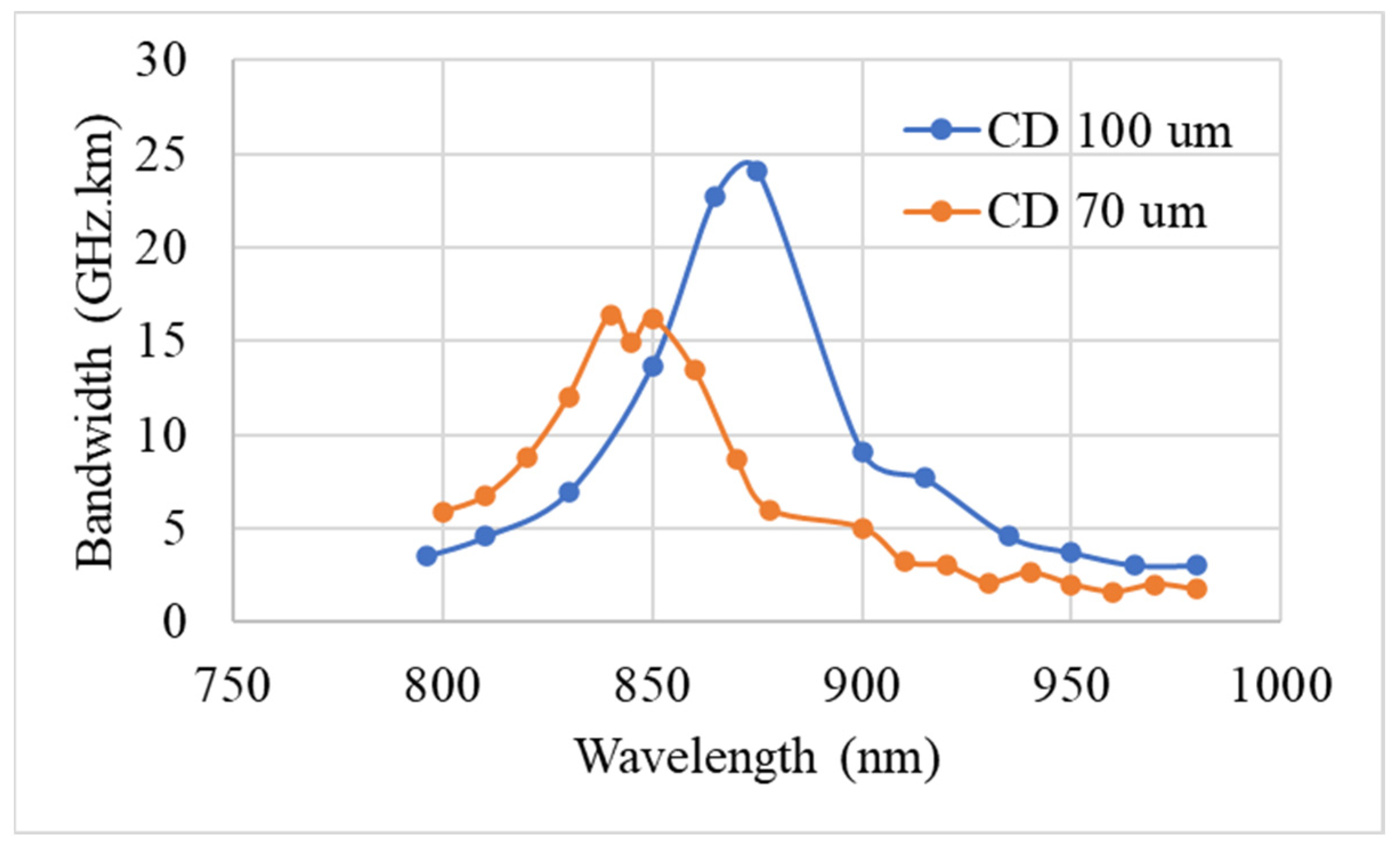
Figure 12.
Measured insertion loss as a function of offset for 50, 70 and 100 μm core diameter MMFs.
Figure 12.
Measured insertion loss as a function of offset for 50, 70 and 100 μm core diameter MMFs.

Figure 13.
Chromatic dispersion and attenuation changes with wavelength of MMF.

Figure 14.
Schematic of universal fiber operations.

Figure 15.
MFD at 1310 nm as a function of core diameter for different core deltas.

Figure 16.
Insertion loss between UF and single-mode fiber with 9.2 μm MFD.

Figure 17.
Optimal α change with wavelength for a standard single-mode fiber with graded index profile.
Figure 17.
Optimal α change with wavelength for a standard single-mode fiber with graded index profile.

Figure 18.
Measured bandwidth at 850 nm for fibers with different peak wavelengths.

Figure 19.
Schematic of a thin coated MMF.

Figure 20.
Cross-section picture of a 169-fiber bundle.

Figure 21.
Cross-section picture of a 19-core fiber.


Table 1.
Bandwidth and link distance of different types of MMF.
| Fiber | Core Δ (%) | NA | Core D (μm) | OFL BW (MHz·km) | EMB (MHz·km) | Link Distance Using NRZ Modulation Format (m) | |||||||
|---|---|---|---|---|---|---|---|---|---|---|---|---|---|
| 850 nm | 1310 nm | 850 nm | 953 nm | 1 G | 10 G | 40 G | 100 G | 40 G SWDM | 100 G SWDM | ||||
| OM1 | 2 | 0.28 | 62.5 | 200 | 500 | N/A | N/A | 275 | 33 | N/A | N/A | N/A | N/A |
| OM2 | 1 | 0.2 | 50 | 500 | 500 | N/A | N/A | 550 | 82 | N/A | N/A | N/A | N/A |
| OM3 | 1 | 0.2 | 50 | 1500 | 500 | 2000 | N/A | N/A | 300 | 100 | 100 | 240 | 75 |
| OM4 | 1 | 0.2 | 50 | 3500 | 500 | 4700 | N/A | N/A | 550 | 150 | 150 | 350 | 100 |
| OM5 | 1 | 0.2 | 50 | 3500 | 500 | 4700 | 2470 | N/A | 550 | 150 | 150 | 440 | 150 |
Table 2.
Link bandwidth required for different transmission rates for MMF systems.
| Data Rate (Gbit/s) | Modulation Format | Link Bandwidth (GHz) |
|---|---|---|
| 25 | NRZ | 16.3 |
| 50 | PAM4 | 16.3 |
| 100 | PAM4 | 18 |
| 200 | PAM4 | 50 |
Table 3.
Link distances for different transmission rates for MMF systems using OM4 MMF and a hypothetical OMx MMF with higher EMB using multimode VCSELs. The RMS spectral linewidth for the multimode VCSEL is assumed to be 0.65 nm.
Table 3.
Link distances for different transmission rates for MMF systems using OM4 MMF and a hypothetical OMx MMF with higher EMB using multimode VCSELs. The RMS spectral linewidth for the multimode VCSEL is assumed to be 0.65 nm.
| OM4 MMF | OMx MMF | OM4 MMF | OMx MMF | OM4 MMF | OMx MMF | |
|---|---|---|---|---|---|---|
| Data Rate (Gbit/s) | EMB (GHz·km) | EB (GHz·km) | Link Distance (m) | |||
| 25 | 4.700 | 6.100 | 2.454 | 2.602 | 151 | 160 |
| 50 | 151 | 160 | ||||
| 100 | 136 | 144 | ||||
| 200 | 49 | 52 | ||||
Table 4.
Link distances for different transmission rates for MMF systems using OM4 MMF and a hypothetical OMx MMF with higher EMB using few mode VCSELs. The RMS spectral linewidth for the few mode VCSELs is assumed to be 0.4 nm.
Table 4.
Link distances for different transmission rates for MMF systems using OM4 MMF and a hypothetical OMx MMF with higher EMB using few mode VCSELs. The RMS spectral linewidth for the few mode VCSELs is assumed to be 0.4 nm.
| OM4 MMF | OMx MMF | OM4 MMF | OMx MMF | OM4 MMF | OMx MMF | |
|---|---|---|---|---|---|---|
| Data Rate (Gbit/s) | EMB (GHz·km) | EB (GHz·km) | Link Distance (m) | |||
| 25 | 4.700 | 6.100 | 3.315 | 3.711 | 203 | 228 |
| 50 | 203 | 228 | ||||
| 100 | 184 | 206 | ||||
| 200 | 66 | 74 | ||||
Table 5.
Comparison of chromatic dispersion, attenuation and EB for OM4 MMF at the wavelengths of 850, 980 and 1060 nm. The VCSEL linewidth is assumed to be 0.6 nm.
Table 5.
Comparison of chromatic dispersion, attenuation and EB for OM4 MMF at the wavelengths of 850, 980 and 1060 nm. The VCSEL linewidth is assumed to be 0.6 nm.
| Wavelength (nm) | 850 | 980 | 1060 |
|---|---|---|---|
| Chromatic dispersion (ps/nm·km) | −96 | −52 | −34 |
| Attenuation (dB/km) | 2.2 | 1.2 | 0.9 |
| EB for OM4 MMF (MHz·km) | 2671 | 3698 | 4182 |
Table 6.
Demonstrated system reach lengths for multimode and single-mode transceivers using the UF.
| Type of Transmission | Transceiver | Wavelength (nm) | Reach Length (m) |
|---|---|---|---|
| Multimode | 100 G SR4 | 850 | 150 |
| Multimode | 100 G sWDM | 850, 880, 910, 940 | 150 |
| Multimode | 100 G BiDi | 850, 910 | 200 |
| Single mode | 100 G CWDM4 | 1270, 1290, 1310, 1330 | 2700 |
| Single mode | 100 G PSM4 | 1310 | 2000 |
Disclaimer/Publisher’s Note: The statements, opinions and data contained in all publications are solely those of the individual author(s) and contributor(s) and not of MDPI and/or the editor(s). MDPI and/or the editor(s) disclaim responsibility for any injury to people or property resulting from any ideas, methods, instructions or products referred to in the content. |
© 2026 by the author. Licensee MDPI, Basel, Switzerland. This article is an open access article distributed under the terms and conditions of the Creative Commons Attribution (CC BY) license.
Share and Cite
MDPI and ACS Style
Li, M.-J. Recent Progress in Multimode Fibers. Photonics 2026, 13, 408. https://doi.org/10.3390/photonics13050408
AMA Style
Li M-J. Recent Progress in Multimode Fibers. Photonics. 2026; 13(5):408. https://doi.org/10.3390/photonics13050408
Chicago/Turabian StyleLi, Ming-Jun. 2026. "Recent Progress in Multimode Fibers" Photonics 13, no. 5: 408. https://doi.org/10.3390/photonics13050408
APA StyleLi, M.-J. (2026). Recent Progress in Multimode Fibers. Photonics, 13(5), 408. https://doi.org/10.3390/photonics13050408
Note that from the first issue of 2016, this journal uses article numbers instead of page numbers. See further details here.