Article

Phase Noise Suppression in Fiber Interferometers over the Hz–kHz Range Using Solid-Core and Hollow-Core Photonic Crystal Fibers

1
School of Physics and Optoelectronic Engineering, Guangdong University of Technology, Guangzhou 510006, China
2
Guangdong Provincial Key Laboratory of Sensing Physics and System Integration Applications, Guangdong University of Technology, Guangzhou 510006, China
*
Author to whom correspondence should be addressed.
Photonics 2026, 13(4), 361; https://doi.org/10.3390/photonics13040361

Submission received: 7 March 2026 / Revised: 20 March 2026 / Accepted: 8 April 2026 / Published: 9 April 2026
(This article belongs to the Section Lasers, Light Sources and Sensors)

Abstract

Fiber interferometers are widely used in precision measurement fields such as seismic observation, gravitational-wave detection, and aerospace guidance. However, phase noise in the Hz–kHz range has become an important factor limiting further improvement in measurement accuracy. In this work, a solid-core photonic crystal fiber (PCF) and a hollow-core photonic bandgap fiber (HC-PBGF) were introduced into the sensing arms of a fiber interferometer to reduce phase noise in this frequency range. Theoretical analysis showed that, compared with a conventional solid-core fiber, the PCF and the 19-cell HC-PBGF used in this study could reduce the phase noise by approximately 3 dB and 7 dB, respectively. The experimental results agreed well with the theoretical predictions, confirming that both fibers can effectively suppress high-frequency phase noise, with HC-PBGF showing superior noise reduction performance. This work provides a feasible approach for improving the performance of fiber interferometers in precision measurement.

1. Introduction

Owing to the advantages of low-loss transmission and strong immunity to electromagnetic interference, interferometric fiber optic sensors based on fiber interferometers have demonstrated significant application value in complex engineering environments and high-precision measurement fields. Their conventional applications mainly include the measurement of displacement [1,2], strain [3,4], and liquid concentration [5,6]. In recent years, with the continuous development of high-performance fiber optic sensing technologies, fiber interferometric techniques have been further extended to systems such as fiber optic seismometers [7,8], fiber optic hydrophone systems [9,10,11,12], and fiber optic gyroscopes [13,14].
However, the measurement accuracy of such systems still needs to be further improved because it is limited by the system noise floor. In the Hz–kHz range, the dominant noise source in a fiber interferometer depends on the specific system configuration. Under conditions of low source intensity noise, good interferometer balancing, and sufficiently long sensing fiber, intrinsic fiber thermal noise can become an important phase noise mechanism, which has become a major bottleneck for further reducing the system noise floor [15,16,17,18]. This issue is particularly pronounced in conventional solid-core fiber interferometric systems. Previous studies have shown that the thermal noise of conventional solid-core fibers has become one of the key factors limiting further performance improvements in fiber optic gyroscopes [19,20], fiber links [21,22], optoelectronic oscillators [23], and laser frequency stabilization systems [24]. Therefore, the use of fibers with low thermal noise is of great significance for suppressing noise in the Hz–kHz range and improving the phase resolution of high-precision interferometric fiber optic sensors.
To further suppress fiber thermal noise, PCF and HC-PBGF offer promising approaches for fiber interferometers. Previous studies have shown that PCF exhibits lower temperature sensitivity [25], while hollow-core fibers have demonstrated good noise reduction performance at frequencies above 30 kHz [26,27]. This improvement is mainly attributed to the hollow-core guidance mechanism: since most of the optical field propagates in air rather than silica, the overlap with the glass material is significantly reduced, leading to a suppression of thermos-optic effects and a reduction in thermal expansion-related and thermally induced phase noise contributions [27,28]. However, systematic studies on the noise reduction performance of PCF and HC-PBGF in the Hz–kHz range remain limited.
Based on the above analysis, fiber interferometers employing a solid-core photonic crystal fiber (PCF) and a hollow-core photonic bandgap fiber (HC-PBGF) were constructed in this work and compared with a conventional solid-core polarization-maintaining fiber interferometer under identical conditions. Systematic theoretical and experimental investigations were carried out in the Hz–kHz range. The results show that both PCF and HC-PBGF can effectively suppress phase noise in this frequency range, with HC-PBGF exhibiting a more pronounced noise reduction effect. This work provides a feasible approach for achieving low-noise, high-precision interferometric fiber optic measurements.

2. Theory

2.1. Fiber Samples and Key Parameters

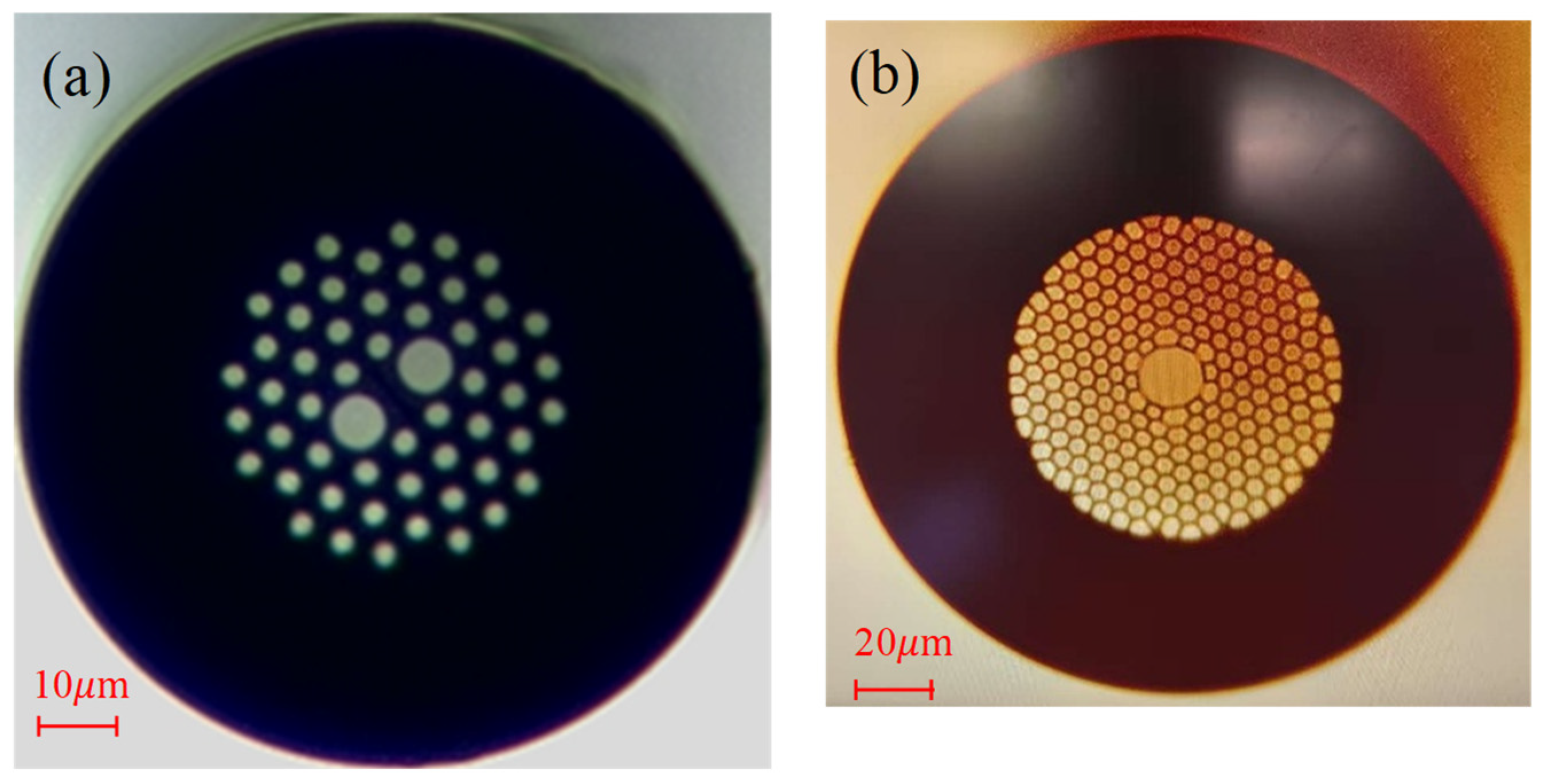
In this work, fiber interferometers based on a PCF and an HC-PBGF were constructed for phase noise suppression. The cross-sectional micrographs of the two fibers are shown in Figure 1, where Figure 1a corresponds to the PCF, and Figure 1b corresponds to the HC-PBGF. Both fibers guide light by introducing defects into the photonic crystal structure. The PCF was fabricated by stacking capillaries and solid silica rods into a preform with the designed microstructure, followed by drawing on a high-temperature fiber-drawing tower. The HC-PBGF was fabricated by removing 19 capillaries in the core region during the drawing process. A solid-core polarization-maintaining fiber, PM 80/165, was used as the reference fiber. The key parameters of the three fibers are summarized in Table 1. The PCF and HC-PBGF exhibit distinct guidance characteristics and larger mode field diameters, which are favorable for phase noise reduction. According to the thermal phase noise model [29], a larger mode field diameter effectively averages temperature fluctuations over a larger cross-sectional area, thereby reducing the thermal conduction noise contribution. In addition, different guidance mechanisms modify the effective thermo-optic coefficient, thermal expansion coefficient, and thermal conductivity, which further weakens the coupling between temperature fluctuations and optical phase.

2.2. Phase Noise Theoretical Model in the Hz–kHz Band

In the Hz–kHz range, a balanced Mach–Zehnder (MZ) interferometer was employed in this work to acquire the phase signal, and the phase noise power spectral density (phase noise PSD) was used to characterize the noise level of the interferometer. In this frequency range, the noise of the fiber interferometer is mainly limited by the intrinsic thermal noise of the fiber, which consists of thermal conduction noise and thermo-mechanical noise [30].
Thermo-mechanical noise originates from the spontaneous mechanical fluctuations of the fiber under thermal equilibrium. It essentially reflects random fluctuations in the fiber length and does not directly depend on the temperature coefficient of the material. As indicated by its expression, thermo-mechanical noise is related to the absolute temperature rather than directly to temperature variation. In addition, this noise is closely related to the propagation length of the optical signal in the fiber. Therefore, in a fiber interferometer, the thermal phase noise power spectral density caused by spontaneous fluctuations in the fiber length (unit: rad2/Hz) can be expressed as follows [15]:
S M ( f ) = 2 π λ n 2 2 k B T L φ 0 3 π E 0 A 1 f
where kB is the Boltzmann constant, L is the sensing fiber length, λ is the wavelength, n is the refractive index of the fiber, T is the temperature, E0 is Young’s modulus, A is the fiber cross-sectional area, and φ0 is the loss angle. Because the PMF, PCF, and HC-PBGF differ in cross-sectional structure, material distribution, and effective refractive index, their thermo-mechanical noise characteristics are also different.
Unlike thermo-mechanical noise, fiber thermal conduction noise is mainly induced by fluctuations in the temperature field and is coupled to the optical phase through the thermal expansion effect and the thermo-optic effect. Its expression can be expressed as follows [29]:
S T ω = 2 π k B T 2 L λ 2 κ d n d T + n α 2 ln k max 4 + ω 0 D 2 k min 4 + ω 0 D 2
where dn/dT is the thermo-optic coefficient, α is the thermal expansion coefficient, and κ is the thermal conductivity. For an insulated boundary condition, kmin = 2.405/aL, where 2aL is the cladding diameter, and kmax = 2/ω0, where ω0 is the mode field radius.
Compared with a conventional solid-core fiber, the PCF has a larger mode field radius and a thicker coating layer. For the HC-PBGF, light is mainly guided in the air core, resulting in a lower effective refractive index. In addition, because the contribution of the thermal expansion of air to phase perturbation is very small, α ≈ 0 can be assumed. Considering that the gas in the hollow-core region is mainly air and that nitrogen is its major component, the optical and thermal parameters of nitrogen were used in this work to approximately represent those of air. Previous studies have shown that nitrogen has a thermal conductivity of κ = 0.025 W/(m·K) and a thermo-optic coefficient of dn/dT = 910 ppb/K [31].
By taking both thermo-mechanical noise and thermal conduction noise into account, the total thermal noise spectral density, ST(ω), in the fiber interferometer can be expressed as follows [30,32,33]:
S T ω = 2 π k B T L λ 2 T κ d n d T + n α 2 ln k max 4 + ω 0 D 2 k min 4 + ω 0 D 2 + 2 n 2 φ 0 3 E 0 A 1 f
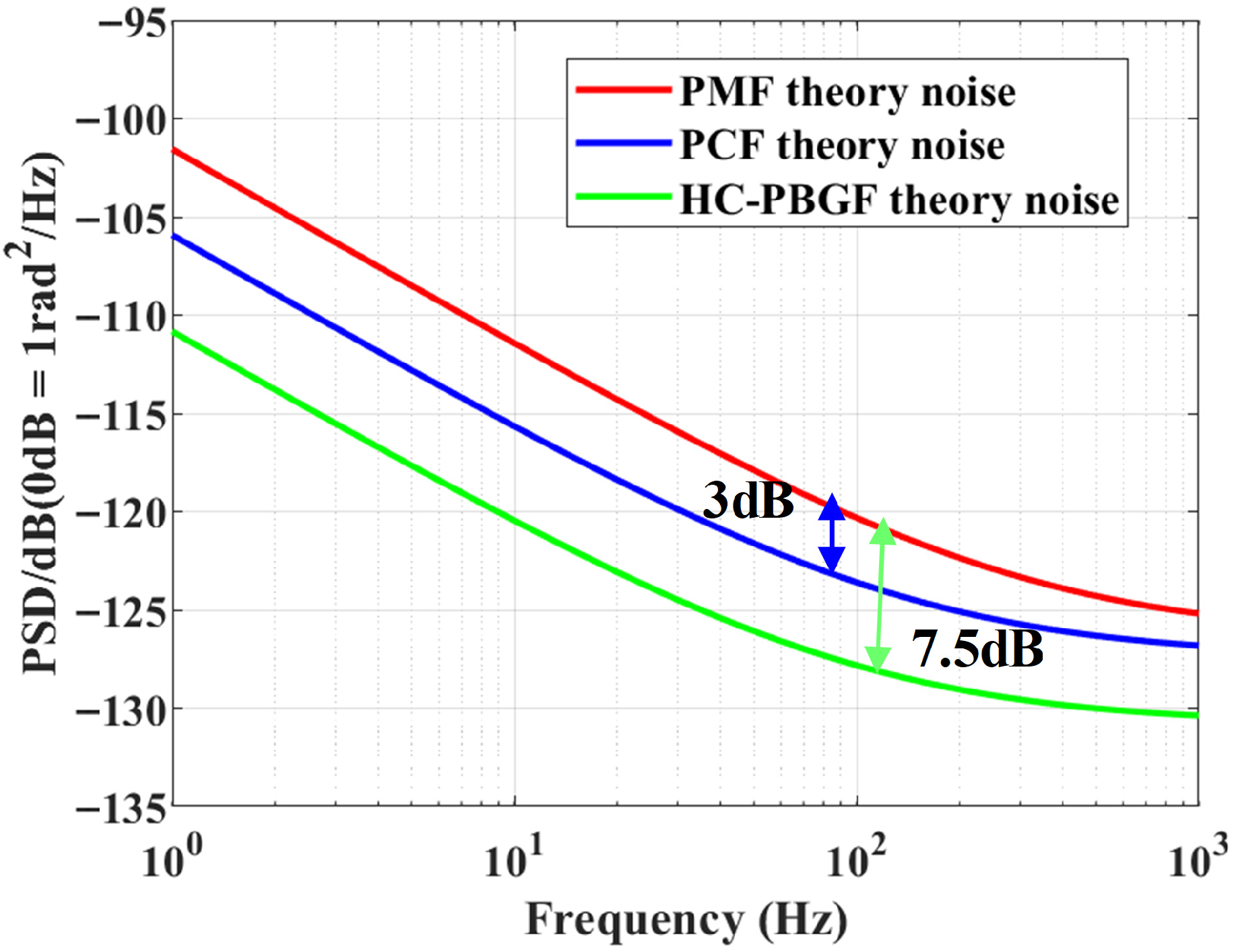
Based on the above simplified effective model, Figure 2 shows the theoretical phase noise power spectral density (PSD) curves of the PMF, PCF, and HC-PBGF in the Hz–kHz range. It can be seen that, over the entire analyzed frequency range, the theoretical noise floors of both the PCF and HC-PBGF are lower than that of the conventional solid-core fiber, with the HC-PBGF exhibiting the lowest noise level. Taking the region around 100 Hz as an example, the theoretical phase noise of the PCF is approximately 3 dB lower than that of the PMF, while the HC-PBGF provides a further reduction of approximately 7.5 dB relative to the PMF. These results indicate that special photonic crystal fibers, especially HC-PBGF, have greater potential for noise suppression in the Hz–kHz range.
To ensure reproducibility of the theoretical results in Figure 2, all parameters used in the calculation are listed as follows. The Boltzmann constant was taken as kB = 1.38 × 10⁻²³ J/K, and the temperature was set to T = 300 K. The operating wavelength was λ = 1550 nm. The sensing fiber length was L = 85 m. For the solid-core fibers (PMF and PCF), the refractive index, thermo-optic coefficient, thermal expansion coefficient, and thermal conductivity were taken as typical silica values, with n = 1.456, dn/dT = 9.2 × 10⁻⁶/K, κ = 1.37 W/(m·K), and α = 5.5 × 10⁻⁷/K. For the HC-PBGF, since light mainly propagates in the air core, the corresponding parameters were approximated using those of air (nitrogen), with n = 1, dn/dT = 9.1 × 10⁻⁹/K, κ = 0.025 W/(m·K), and α ≈ 0/K. The mode field radius, ω0, and cladding diameter for each fiber were obtained from Table 1 and used to determine kmax and kmin. The Young’s modulus and loss angle were taken as E0 = 2.5 × 10¹⁰ Pa and ϕ0 = 0.01.

3. Experimental Setup

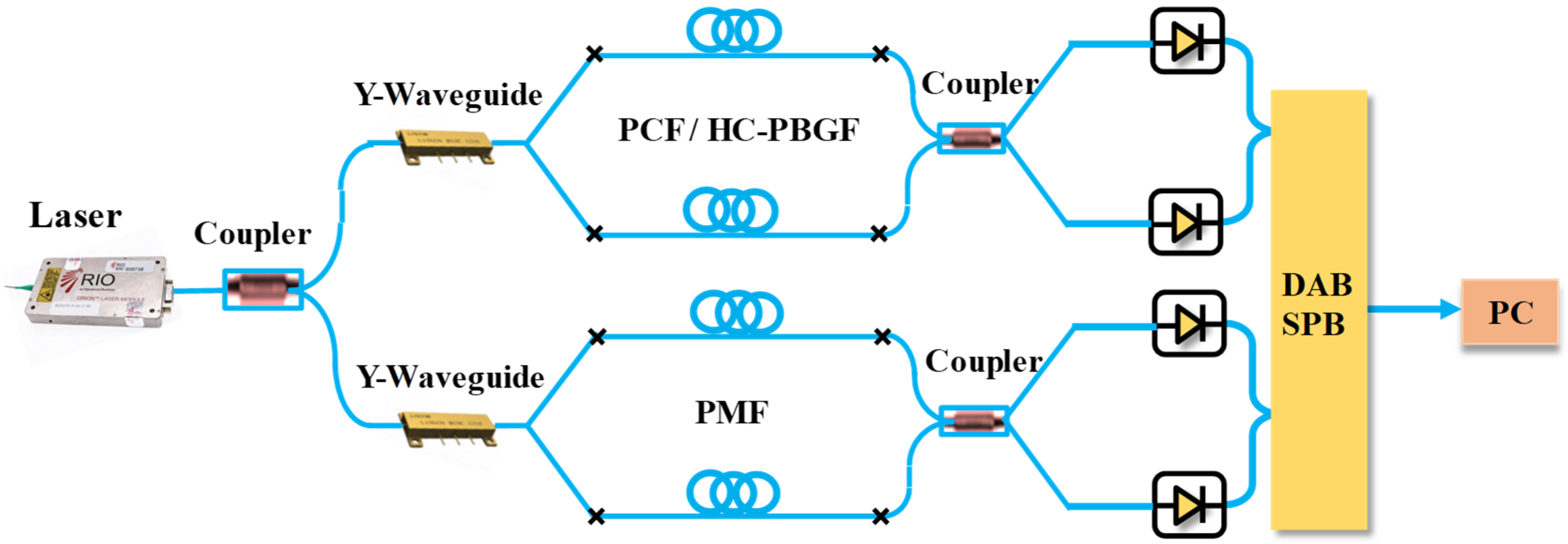
Based on the principle of the Mach–Zehnder (M–Z) interferometer, the experimental setup shown in Figure 3 was constructed, comprising a fiber interferometer module, a signal-processing module, and a data-analysis module. Light emitted by a narrow-linewidth semiconductor laser enters the interferometer, and the resulting interference signal passes through the coupler into the signal-processing module. There, it is converted into an electrical signal by the photodetector (SPB), while a modulation signal is applied to the Y-waveguide for subsequent demodulation. Finally, the signal is processed on a computer (PC) using self-developed demodulation software, and a balanced differential detector (DAB) is employed at the output to suppress the influence of laser relative intensity noise (RIN).
The experiments were conducted in two groups: PCF versus PMF and HC-PBGF versus PMF. In each group, the test fiber and the solid-core fiber were both wound to the same length of 85 m and with the same coil diameter of 10 cm to form the two arms of a balanced Mach–Zehnder interferometer. The arm length difference was precisely controlled to within 1 cm using OFDR-based distributed length measurement, thereby minimizing the coupling of laser frequency noise into phase noise. Under this coil diameter, the bending losses of the PMF and PCF are negligible, while the measured bending loss of the HC-PBGF is only about 0.001 dB per turn. In addition, mode content characterization indicates that both the PCF and HC-PBGF operate with high mode purity under the experimental conditions. Both interferometers shared the same narrow-linewidth laser source, and a 50:50 splitter was used after the source to provide illumination to both systems simultaneously, ensuring that the comparative measurements were performed under identical source conditions. The two optical paths were fixed on the same acrylic plate, with all fiber sections tightly arranged in parallel except for the sensing arm coils, in order to minimize the differences in environmental disturbances. The entire setup was placed in a vacuum chamber and mounted on a floating vibration isolation platform. During testing, the four fiber loops in each group were suspended and secured with rubber bands to reduce external vibration coupling and ensure fairness and repeatability in the synchronized comparative measurements.

4. Results and Discussion

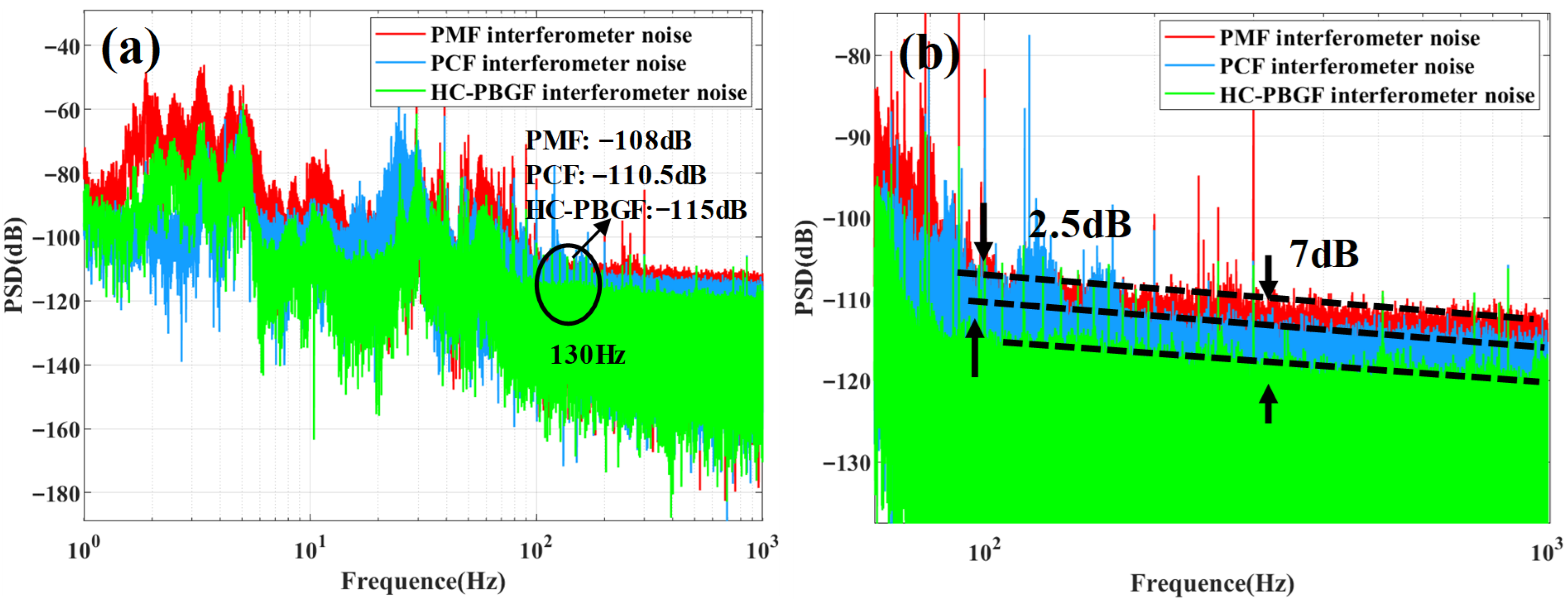
The phase data acquired from the two fiber interferometers were analyzed in terms of phase noise power spectral density (PSD), and the results are shown in Figure 4. The red, blue, and green curves correspond to the PMF, PCF, and HC-PBGF interferometers, respectively. As shown in Figure 4a, at 130 Hz, the phase noise of the PMF interferometer is approximately −108 dB, while the phase noise values of the PCF and HC-PBGF interferometers at the same frequency are approximately −110.5 dB and −115 dB, respectively. Therefore, compared with the PMF interferometer, the PCF and HC-PBGF interferometers achieve noise reductions of approximately 2.5 dB and 7 dB, respectively, with the HC-PBGF interferometer exhibiting a further reduction of about 4.5 dB relative to the PCF interferometer. These results are basically consistent with the theoretical predictions in Section 2.2.
It should be noted that the above conclusion is not drawn from a single frequency point alone. In the 130–1000 Hz range, the phase noise reductions in the PCF and HC-PBGF interferometers relative to the PMF interferometer remain at approximately 2.5 dB and 7 dB, respectively, indicating that both fibers provide stable noise suppression in this frequency range, with HC-PBGF exhibiting a more pronounced effect.
In addition, several narrow-band parasitic peaks can be observed in the 1–100 Hz range, which are likely caused by the modal response of the suspension structure and residual environmental vibration coupling. Despite the presence of these parasitic peaks, the overall noise spectrum of the HC-PBGF interferometer remains lower than that of the PMF interferometer under the same suspension condition and environmental disturbance, further confirming its noise suppression advantage in this frequency range.
It should be noted that the results shown here were obtained from two comparative experiments and that the PMF interferometer noise exhibited good repeatability between the two measurements, ensuring the reliability of the combined comparison.
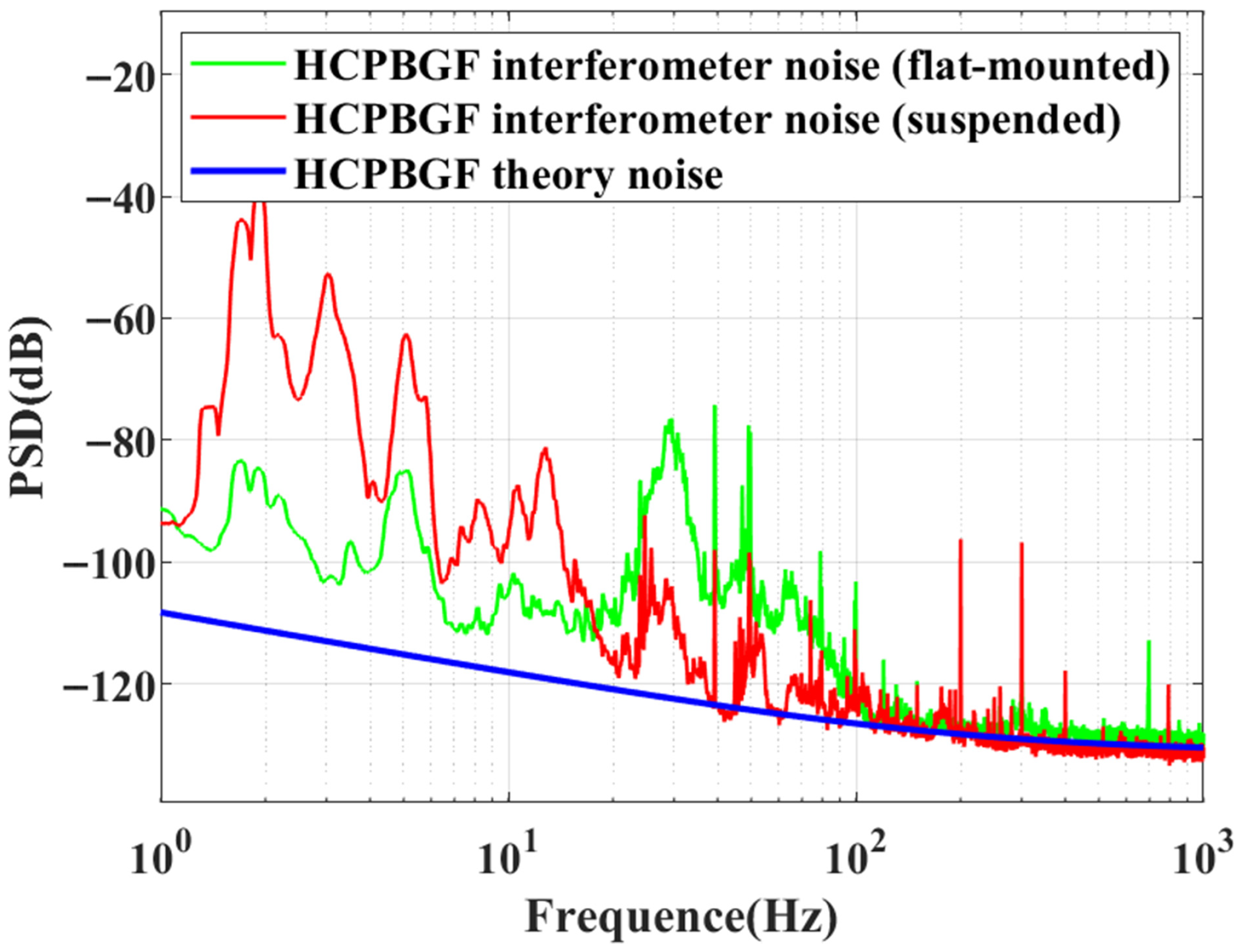
In addition, the theoretical phase noise PSD shown in Figure 2 represents the intrinsic thermal noise limit of the fiber, including thermal conduction noise and thermo-mechanical noise, under idealized conditions. However, in the actual experiment, the measured spectra are also affected by external perturbation channels that are not included in the theoretical model, especially in the low-frequency range below 100 Hz. In particular, when the fiber is measured in the suspended state, the suspension structure introduces additional mechanical resonance modes and enhances the coupling of ambient vibration and acoustic disturbances into the interferometer phase. As a result, several distinct peaks appear in the measured spectra below 100 Hz, leading to a deviation from the theoretical curves. To verify this interpretation, an additional comparison was performed between the suspended and flat-mounted conditions.
As shown in Figure 5, the results show that the low-frequency peaks are significantly stronger in the suspended state, while they are suppressed in the flat-mounted case, indicating that these features mainly originate from suspension-related mechanical coupling rather than from intrinsic fiber thermal noise. Moreover, the spectra were reprocessed using a Hann window to reduce spectral leakage, and the low-frequency peaks remained observable after windowing, confirming that they are physical features instead of numerical artifacts. Therefore, the discrepancy between theory and experiment below 100 Hz is mainly caused by the fact that the theoretical model does not include the mechanical transfer function and environmental coupling introduced by the practical suspension configuration.
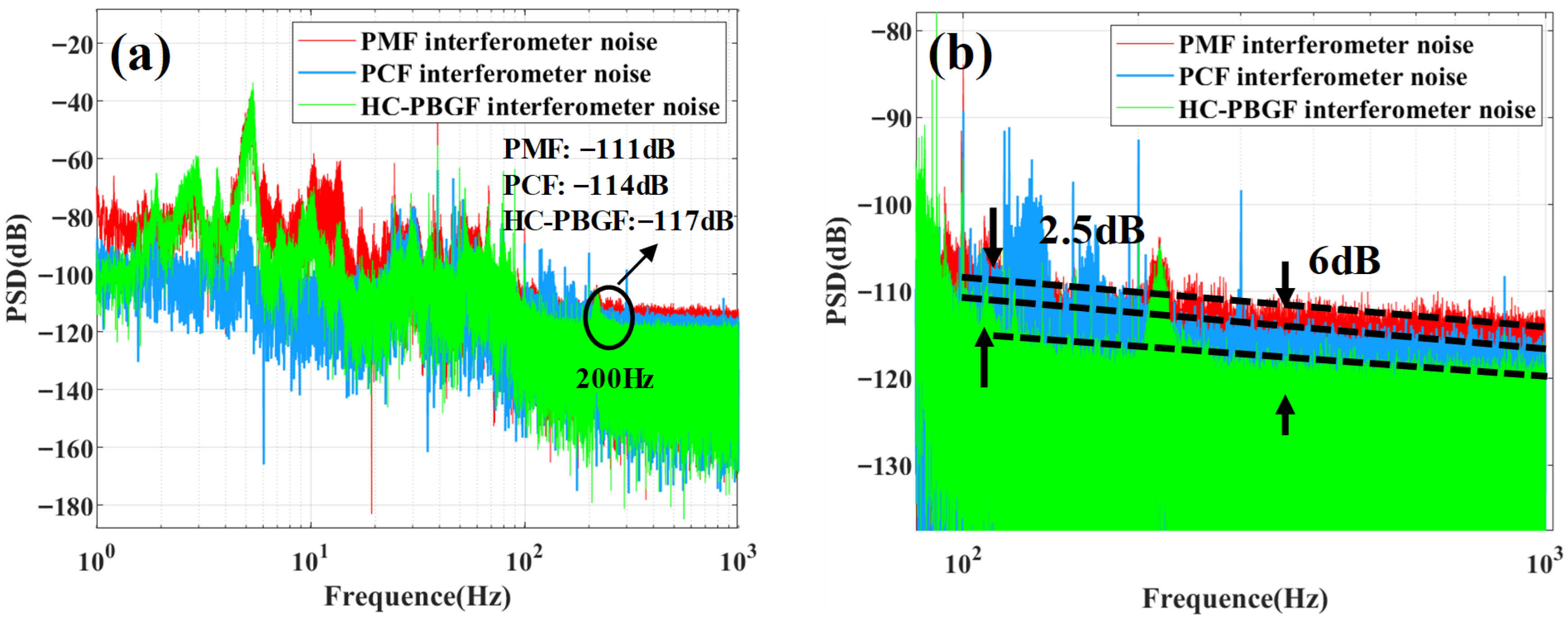
To verify the repeatability of the experimental results, a second repeated measurement was carried out after the fibers were re-suspended, and the corresponding results are shown in Figure 6. Specifically, Figure 6a presents the measured phase noise PSD curves of the PMF, PCF, and HC-PBGF interferometers over the full frequency range, while Figure 6b shows an enlarged comparison in the 200–1000 Hz range. It can be seen that, under the re-suspended condition, the overall noise spectra of the PCF and HC-PBGF interferometers remain lower than that of the PMF interferometer. As shown in Figure 6b, in the 200–1000 Hz range, the phase noise differences in the PCF and HC-PBGF interferometers relative to the PMF interferometer remain at approximately 2.5 dB and 6 dB, respectively.
As shown in Figure 6, a localized spectral peak appears near 200 Hz in the HC-PBGF interferometer spectrum. As further evidenced by Figure 5, the suspended and flat-mounted configurations exhibit different spectral characteristics, with the peak near 200 Hz being more evident in the suspended case. This suggests that the peak mainly originates from suspension-related mechanical coupling, which may enhance the response to environmental vibration or acoustic disturbances rather than from the intrinsic thermal noise of the fiber itself.
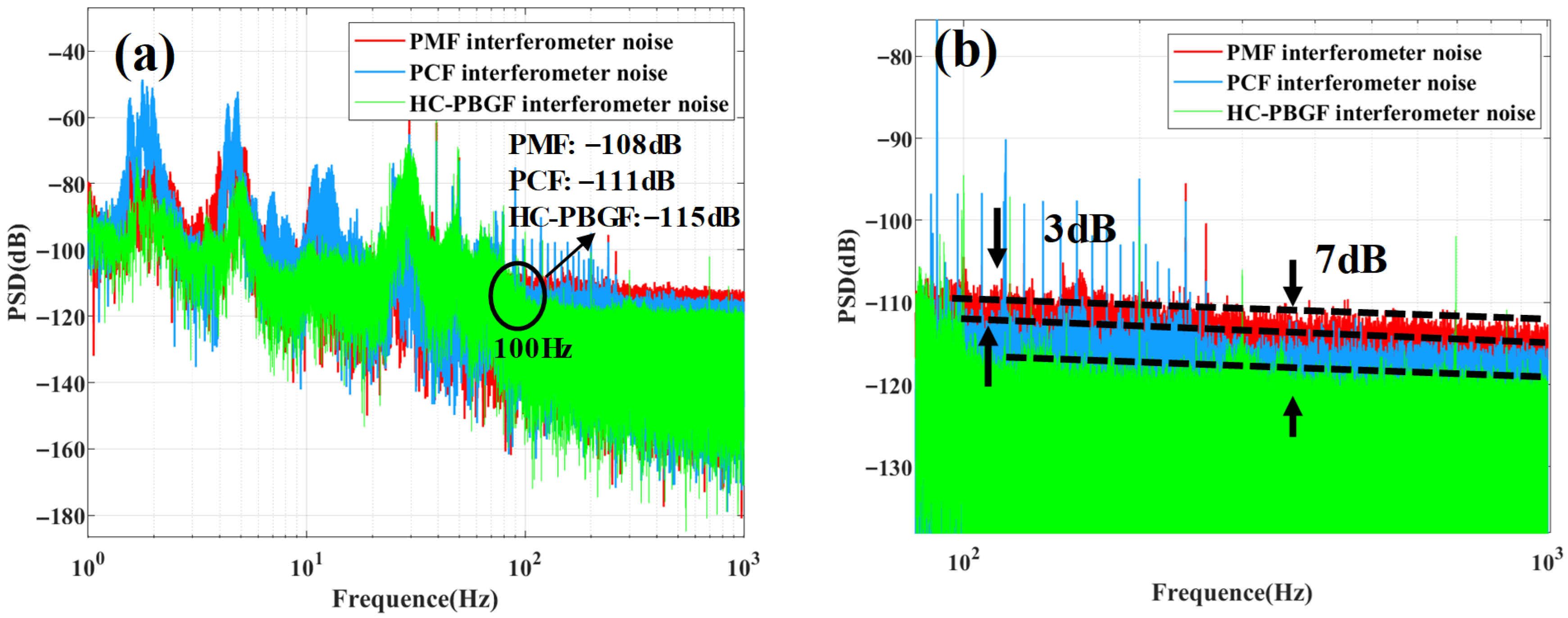
The results of the third repeated experiment are shown in Figure 7. In particular, Figure 7a presents the measured phase noise PSD curves over the full frequency range. The overall trend is consistent with those observed in the previous two experiments. In the 100–1000 Hz range, the phase noise differences in the PCF and HC-PBGF interferometers relative to the PMF interferometer remain at approximately 3 dB and 7 dB, respectively. These results indicate that, although the fiber suspension state and environmental disturbances may affect the noise PSD at certain frequencies, the photonic crystal fibers, especially the HC-PBGF, still exhibit stable and repeatable noise suppression performance in the Hz–kHz range compared with the conventional PMF.

5. Conclusions

To address the limitations imposed by fiber thermal noise on fiber interferometers in the Hz–kHz range, a noise reduction scheme based on a solid-core photonic crystal fiber (PCF) and a hollow-core photonic bandgap fiber (HC-PBGF) was proposed and experimentally verified in this work. Comparative experiments among the PCF, HC-PBGF, and PMF interferometers were carried out under the same environmental conditions and synchronized measurement conditions. The results show that the differences in mode field size, refractive index distribution, and related parameters induced by the fiber microstructures can effectively reduce fiber thermal noise.
Quantitatively, the theoretical model predicts that, around 100 Hz, the phase noise PSD of the PCF and HC-PBGF interferometers should be lower than that of the PMF interferometer by about 3 dB and 7.5 dB, respectively. Experimentally, in the 100–1000 Hz range, the measured phase noise reduction was about 2.5–3 dB for the PCF and about 6–7 dB for the HC-PBGF relative to the PMF, which is reasonably consistent with the theoretical prediction in terms of both trend and magnitude. In particular, the HC-PBGF interferometer exhibited an average phase noise reduction of about 7 dB relative to the PMF interferometer in this frequency range.
It should also be noted that the agreement between theory and experiment is frequency-dependent. In the low-frequency region below 100 Hz, additional mechanical and environmental coupling in the suspended configuration can lead to deviations from the intrinsic thermal noise model. Therefore, the present theoretical model should be understood as describing the intrinsic thermal noise limit of the fiber, while the experimental results reflect both intrinsic noise and practical environmental perturbations.
Overall, these results indicate that HC-PBGF has clear potential for suppressing interferometer phase noise in the Hz–kHz range and that it provides a feasible approach for improving high-stability, low-noise interferometric fiber optic measurements.

Author Contributions

Conceptualization, Y.L. and K.W.; methodology, K.W.; software, K.W.; validation, Y.L., K.L. and K.W.; formal analysis, Y.L.; investigation, K.L.; resources, K.W.; data curation, Y.L. and K.L.; writing—original draft preparation, Y.L.; writing—review and editing, Y.L. and K.W.; visualization, K.L.; supervision, K.W.; project administration, K.W.; funding acquisition, K.W. All authors have read and agreed to the published version of the manuscript.

Funding

This work was supported by the National Natural Science Foundation of China (Grant Nos. 62127815, 62575078); the Natural Science Foundation of Guangdong Province, China (Grant No. 2026A1515011677); Special Talent Support Program of Guangdong Province, China (Grant No. 2024TQ08X315); the Guangzhou Science and Technology Plan Project, China (Grant No. 2025A04J5486).

Institutional Review Board Statement

Not applicable.

Informed Consent Statement

Not applicable.

Data Availability Statement

The data underlying the results presented in this paper are not publicly available at this time but may be obtained from the authors upon reasonable request.

Acknowledgments

We would like to thank Fei Yu from the Shanghai Institute of Optics and Fine Mechanics, Chinese Academy of Sciences, for providing the hollow-core photonic bandgap fibers used in the experiments.

Conflicts of Interest

The authors declare no conflicts of interest.

References

  1. Wei, Y.; Yang, J.; Liu, C.; Zhang, X.; Zhang, Y.; Li, S.; Yang, Q.; Liu, Z. Large detection range and high sensitivity fiber optic interferometric micro-displacement sensor based on an N-type structure. Opt. Express 2025, 33, 35852–35864. [Google Scholar] [CrossRef] [PubMed]
  2. Shi, Y.; Xu, Z.; Wu, J.; Chen, L.; Liang, Y.; Sun, Q.; Zhou, Z. Ultra-low frequency high-precision displacement measurement based on dual-polarization differential fiber heterodyne interferometer. J. Light. Technol. 2023, 41, 5773–5779. [Google Scholar] [CrossRef]
  3. Liu, C.; Chen, H.; Chen, Q.; Gao, Z.; Wu, B.; Fan, X.; Ma, M. Sagnac interferometer-based optical fiber strain sensor with exceeding free spectral measurement range and high sensitivity. Opt. Laser Technol. 2023, 159, 108935. [Google Scholar] [CrossRef]
  4. Li, H.; Lou, M.; Huang, W.; Zhang, W. Fiber optic strain sensor with femto-strain resolution based on differentiating interferometer. J. Light. Technol. 2024, 42, 6360–6366. [Google Scholar] [CrossRef]
  5. Li, G.; Liu, Z.; Feng, J.; Zhou, G.; Huang, X. Pb2+ fiber optic sensor based on smart hydrogel coated Mach-Zehnder interferometer. Opt. Laser Technol. 2022, 145, 107453. [Google Scholar] [CrossRef]
  6. Yi, D.; Zhang, B.; Geng, Y.; Li, X. Titanium Nitride Modified Fiber Optic Interferometer for Refractive Index Sensitivity Enhancement. Sensors 2023, 23, 5280. [Google Scholar] [CrossRef]
  7. Li, H.; Qi, G.; Lou, M.; Huang, W.; Zhang, W. Fiber-Optic Broadband Seismometer Based on Inverted Pendulum and Hybrid Interferometer. IEEE Trans. Instrum. Meas. 2025, 74, 9514914. [Google Scholar] [CrossRef]
  8. Li, H.; Huang, W.; Zhang, W.; Li, L. Fiber optic interferometric velocity seismometer. Measurement 2025, 253, 117667. [Google Scholar] [CrossRef]
  9. Hu, Q.H.; Zhu, X.Q.; Ma, L.N.; Qi, Y.; Shang, F.; Bian, Y.J. Advances in Passive-Interferometric Type Fiber Bragg Grating-Based Hydrophones. Laser Optoelectron. Prog. 2023, 60, 11. [Google Scholar] [CrossRef]
  10. Yang, Y.; Luo, Z.; Wang, Z.; Zhang, Y.; Chang, T.; Yu, M.; Cheng, L.; Wu, C.; Cui, H. High-performance fiber optic interferometric hydrophone based on push–pull structure. IEEE Trans. Instrum. Meas. 2021, 70, 9511313. [Google Scholar] [CrossRef]
  11. Chen, J.; Chang, T.; Fu, Q.; Lang, J.; Gao, W.; Wang, Z.; Yu, M.; Zhang, Y.; Cui, H.-L. A Fiber-Optic Interferometric Tri-Component Geophone for Ocean Floor Seismic Monitoring. Sensors 2017, 17, 47. [Google Scholar] [CrossRef]
  12. Yang, Y.; Chang, T.; Yu, M.; Wu, C.; Cheng, L.; Cui, H. Physics-Based Performance Optimization of Fiber-Optic Interferometric Hydrophone with Push–Pull Mandrel Structure. IEEE Sens. J. 2022, 22, 19346–19356. [Google Scholar] [CrossRef]
  13. Wang, Z.; Wang, G.; Kumar, S.; Marques, C.; Min, R.; Li, X. Recent Advancements in Resonant Fiber Optic Gyro—A Review. IEEE Sens. J. 2022, 22, 18240–18252. [Google Scholar] [CrossRef]
  14. Song, N.; Xu, X.; Zhang, Z.; Gao, F.; Wang, X. Advanced interferometric fiber optic gyroscope for inertial sensing: A review. J. Light. Technol. 2023, 41, 4023–4034. [Google Scholar] [CrossRef]
  15. Duan, L. Intrinsic thermal noise of optical fibres due to mechanical dissipation. Electron. Lett. 2010, 46, 1515–1516. [Google Scholar] [CrossRef]
  16. Song, N.; Ma, K.; Jin, J.; Teng, F.; Cai, W. Modeling of Thermal Phase Noise in a Solid Core Photonic Crystal Fiber-Optic Gyroscope. Sensors 2017, 17, 2456. [Google Scholar] [CrossRef]
  17. Bartolo, R.; Tveten, A.; Dandridge, A. Thermal Phase Noise Measurements in Optical Fiber Interferometers. IEEE J. Quantum Electron. 2012, 48, 720–727. [Google Scholar] [CrossRef]
  18. Dong, J.; Huang, J.; Li, T.; Liu, L. Observation of Fundamental Thermal Noise in Optical Fibers down to Infrasonic Frequencies. Appl. Phys. Lett. 2016, 108, 021108. [Google Scholar] [CrossRef]
  19. Knudsen, S.; Tveten, A.; Dandridge, A. Measurements of Fundamental Thermally Induced Phase Fluctuations in the Fiber of a Sagnac Interferometer. IEEE Photon. Technol. Lett. 1995, 7, 90–92. [Google Scholar] [CrossRef]
  20. Li, Y.; Cao, Y.; He, D.; Wu, Y.; Chen, F.; Peng, C.; Li, Z. Thermal Phase Noise in Giant Interferometric Fiber Optic Gyroscopes. Opt. Express 2019, 27, 14121–14132. [Google Scholar] [CrossRef]
  21. Williams, P.; Swann, W.; Newbury, N. High-Stability Transfer of an Optical Frequency over Long Fiber-Optic Links. J. Opt. Soc. Am. B 2008, 25, 1284–1293. [Google Scholar] [CrossRef]
  22. Stefani, F.; Lopez, O.; Bercy, A.; Lee, W.; Chardonnet, C.; Santarelli, G.; Pottie, P.-E.; Amy-Klein, A. Tackling the Limits of Optical Fiber Links. J. Opt. Soc. Am. B 2015, 32, 787–797. [Google Scholar] [CrossRef]
  23. Cahill, J.; Zhou, W.; Menyuk, C. Additive Phase Noise of Fiber-Optic Links Used in Photonic Microwave-Generation Systems. Appl. Opt. 2017, 56, B18–B25. [Google Scholar] [CrossRef] [PubMed]
  24. Dong, J.; Hu, Y.; Huang, J.; Ye, M.; Qu, Q.; Li, T.; Liu, L. Subhertz Linewidth Laser by Locking to a Fiber Delay Line. Appl. Opt. 2015, 54, 1152–1156. [Google Scholar] [CrossRef]
  25. Dong, B.; Hao, J.; Liaw, C.; Lin, B.; Tjin, S. Simultaneous Strain and Temperature Measurement Using a Compact Photonic Crystal Fiber Inter-Modal Interferometer and a Fiber Bragg Grating. Appl. Opt. 2010, 49, 6232–6235. [Google Scholar] [CrossRef]
  26. Cranch, G.; Miller, G. Coherent Light Transmission Properties of Commercial Photonic Crystal Hollow Core Optical Fiber. Appl. Opt. 2015, 54, F8–F16. [Google Scholar] [CrossRef]
  27. Michaud-Belleau, V.; Fokoua, E.; Horak, P.; Wheeler, N.; Rikimi, S.; Bradley, T.; Richardson, D.; Poletti, F.; Genest, J.; Slavík, R. Fundamental Thermal Noise in Antiresonant Hollow-Core Fibers. Phys. Rev. A 2022, 106, 023501. [Google Scholar] [CrossRef]
  28. Meiselman, A.; Cranch, G.A. Optical phase response to temperature in a hollow-core photonic crystal fiber. Opt. Express 2017, 25, 27581–27594. [Google Scholar] [CrossRef]
  29. Wanser, K.H. Fundamental phase noise limit in optical fibers due to temperature fluctuations. Electron. Lett. 1992, 28, 53–54. [Google Scholar] [CrossRef]
  30. Tian, S.; Yang, J.; Yuan, Y.; Zhang, Y.; Zhu, H.; An, R.; Yu, Z.; Wang, Y.; Qin, Y. Research on the Influence of Ultralow Frequency Band 1/f Noise in Ultralong Fiber Interferometers. Acta Opt. Sin. 2021, 41, 1306007. (In Chinese) [Google Scholar]
  31. Edlén, B. The Refractive Index of Air. Metrologia 1966, 2, 71. [Google Scholar] [CrossRef]
  32. Foster, S.; Tikhomirov, A.; Milnes, M. Fundamental thermal noise in distributed feedback fiber lasers. IEEE J. Quantum Electron. 2007, 43, 378–384. [Google Scholar] [CrossRef]
  33. Hilweg, C.; Shadman, D.; Walther, P.; Mavalvala, N.; Sudhir, V. Limits and prospects for long-baseline optical fiber interferometry. Optica 2022, 9, 1238–1252. [Google Scholar] [CrossRef]
Figure 1. Fiber end-face images: (a) PCF, (b) HC-PBGF.
Photonics 13 00361 g001
Figure 2. Theoretical phase noise PSD of the PMF, PCF, and HC-PBGF.
Photonics 13 00361 g002
Figure 3. Schematic diagram of the synchronized measurement system for the balanced MZ interferometers based on the PMF, PCF, and HC-PBGF (DAB: balanced differential detector; SPB: photodetection board; PC: host computer).
Photonics 13 00361 g003
Figure 4. Measured phase noise PSD curves of the PMF, PCF, and HC-PBGF: (a) overall trend, (b) detail in the 100–1000 Hz band.
Photonics 13 00361 g004
Figure 5. Comparison of the measured phase noise PSDs of the HC-19 interferometer under two different mechanical mounting conditions (suspended and flat-mounted), together with the theoretical thermal noise PSD.
Photonics 13 00361 g005
Figure 6. Measured phase noise PSD curves of the PMF, PCF, and HC-PBGF in the second test: (a) overall trend, (b) detail in the 100–1000 Hz band.
Photonics 13 00361 g006
Figure 7. Measured phase noise PSD curves of the PMF, PCF, and HC-PBGF in the third test: (a) overall trend, (b) detail in the 100–1000 Hz band.
Photonics 13 00361 g007
Table 1. Key parameters of the PMF, PCF, and HC-PBGF.
ParametersPMF 80/165PCFHC-PBGF
PC cladding diameter (µm)80100161.5
Mode field diameter (µm)5.717.522
Coating diameter (µm)165200350
Disclaimer/Publisher’s Note: The statements, opinions and data contained in all publications are solely those of the individual author(s) and contributor(s) and not of MDPI and/or the editor(s). MDPI and/or the editor(s) disclaim responsibility for any injury to people or property resulting from any ideas, methods, instructions or products referred to in the content.