
Article

Chaotic Fiber Laser-Based Distributed Fiber Sensing for Weak Vibration Detection Using Machine Learning


1
Shenzhen Key Laboratory of Ultraintense Laser and Advanced Material Technology, Center for Intense Laser Application Technology, and College of Engineering Physics, Shenzhen Technology University, Shenzhen 518118, China
2
College of New Materials and New Energies, Shenzhen Technology University, Shenzhen 518118, China
*
Authors to whom correspondence should be addressed.
Photonics 2026, 13(3), 243; https://doi.org/10.3390/photonics13030243
Submission received: 19 January 2026 / Revised: 10 February 2026 / Accepted: 22 February 2026 / Published: 2 March 2026
(This article belongs to the Special Issue Fiber Optics and Fiber Lasers)

Abstract

To address the challenge of weak vibration signal detection, we propose a chaotic fiber laser-based distributed sensing system integrated with machine learning-assisted signal extraction. The system combines a chaotic fiber laser with a linear non-balanced Sagnac interferometer, enabling high sensitivity to external perturbations while effectively suppressing reciprocal effects of traditional ring interferometer systems. A convolutional neural network (CNN) is employed to directly learn and extract discriminative vibration features from the chaotic sensing signals, facilitated by phase space reconstruction (PSR), which preserves the system’s intrinsic dynamics under extreme noise. By jointly exploiting the broadband, noise-like characteristics of chaotic laser sensing, and the nonlinear feature extraction capability of CNNs, the proposed system enables reliable detection of weak vibration signals under ultra-low signal-to-noise ratio (SNR) conditions, down to −22 dB. Experimental results demonstrate a weak frequency detection ranging from 0.1 Hz to 10 kHz, with significantly enhanced sensitivity and bandwidth compared with conventional signal processing-based methods.

1. Introduction

Over the years, there has been growing interest in the detection of low-amplitude signals, especially those that must be identified amidst strong background noise. Specifically, the detection of weak vibration signals has long been a critical challenge in optical fiber sensing, particularly in environments dominated by broadband noise and complex background disturbances. Conventional fiber-optic vibration and acoustic sensing systems typically employ coherent or quasi-coherent laser sources in combination with linear demodulation and spectral analysis techniques to detect weak signals [1,2], while optical fiber structures are widely investigated as intrinsic sensing elements of temperature, strain, or mechanical deformation directly by monitoring power loss [3]. However, their performance deteriorates rapidly when target signals are deeply submerged in broadband strong noise or spectral overlap with environmental interference. Increasing optical power or applying narrowband filtering can partially enhance sensitivity, yet such approaches inevitably introduce trade-offs in system sensitivity and detection bandwidth, and they often fail under ultra-low signal-to-noise ratio (SNR) conditions. To reconcile the inherent conflict between sensitivity and bandwidth, chaotic lasers have attracted considerable attention owing to their broadband spectra, noise-like temporal behavior, and high sensitivity to external perturbations, and they have been widely explored in various sensing and metrological applications [4,5,6].
Chaotic fiber laser sources generate complex optical waveforms through intrinsic nonlinear dynamics [7,8], enabling robust information encoding while simultaneously offering enhanced sensitivity [8] and allowing long-range detection and high resolution [9]. Despite their attractiveness for sensing applications, chaotic lasers are also associated with fundamental challenges. When the target signal induces only weak perturbations on a broadband chaotic carrier, its dynamical signature is often deeply buried within the complex chaotic background. Under such conditions, conventional signal processing techniques such as frequency spectrum, correlation-based methods [6,8], and linear filtering [10] exhibit inherently limited discrimination capability especially under ultra-low SNR. Theoretical analysis suggests that the signal will be hardly recovered when the SNR is lower than −25 dB for a sensor based on a chaotic fiber ring resonator [11]. Consequently, although chaotic fiber laser sources offer favorable properties in terms of security and robustness, achieving reliable weak signal detection with accuracy under ultra-low SNR conditions remains a significant challenge [12,13].
To overcome this limitation, recent progress in machine learning has demonstrated that data-driven models can effectively extract nonlinear and high-dimensional features from complex time series without explicit assumptions about the underlying physical model [14,15,16]. In particular, convolutional neural networks (CNNs) have shown strong performance in chaotic time-series prediction and nonlinear system identification by learning hierarchical structures directly from data [17]. These capabilities suggest a potential pathway to overcome the information extraction bottleneck in chaotic laser sensing. However, most existing studies treat machine learning as an external post-processing tool, without explicitly linking the learned features to the physical dynamics of the chaotic sensing system. Meanwhile, previous studies on chaotic laser-based fiber sensing have primarily focused on enhancing spatial resolution, extending sensing distance, or improving correlation-based demodulation efficiency. However, relatively limited attention has been paid to the systematic extraction of weak perturbation information from chaotic backgrounds under ultra-low SNR conditions, especially from a perspective of emphasizing the change in chaotic dynamical systems. This gap highlights the need for approaches that jointly consider the physical encoding mechanism of chaotic light and data-driven nonlinear feature extraction.
In this work, we propose a weak vibration detection framework that integrates a chaotic fiber laser source, a linear non-balanced Sagnac interferometer, and a CNN-based nonlinear feature extraction model. Unlike conventional chaotic laser sensing or interferometric vibration sensing systems that rely on explicit phase demodulation or identifiable spectral features, the proposed approach treats weak vibrations as perturbations to chaotic dynamics. Weak signal detection is therefore achieved through dynamical mismatch analysis enabled by phase space reconstruction (PSR) and CNN-based nonlinear prediction rather than by direct phase demodulation or spectral analysis. By jointly leveraging a low-coherence and broadband chaotic fiber laser and a non-balanced Sagnac interferometer to enhance sensitivity, the proposed approach enables reliable weak signal detection under ultra-low SNR conditions down to −22 dB, with weak signal frequency spanning from 0.1 Hz to 10 kHz. This work demonstrates that coupling chaotic photonic sensing with data-driven nonlinear analysis provides a viable route toward intelligent fiber sensing in complex environments.

2. Principle and Methods

In fiber laser systems, chaotic behavior arises from the combined effects of Kerr nonlinearity, gain saturation, and nonlinear polarization evolution. Compared with conventional narrow-linewidth lasers, chaotic lasers exhibit noise-like temporal behavior, low coherence, and a flattened broadband spectrum, rendering them highly sensitive to weak external perturbations while maintaining strong resistance to coherent interference. These properties make chaotic lasers particularly suitable as carriers for weak signal encoding in distributed fiber sensing systems operating under ultra-low SNR conditions.
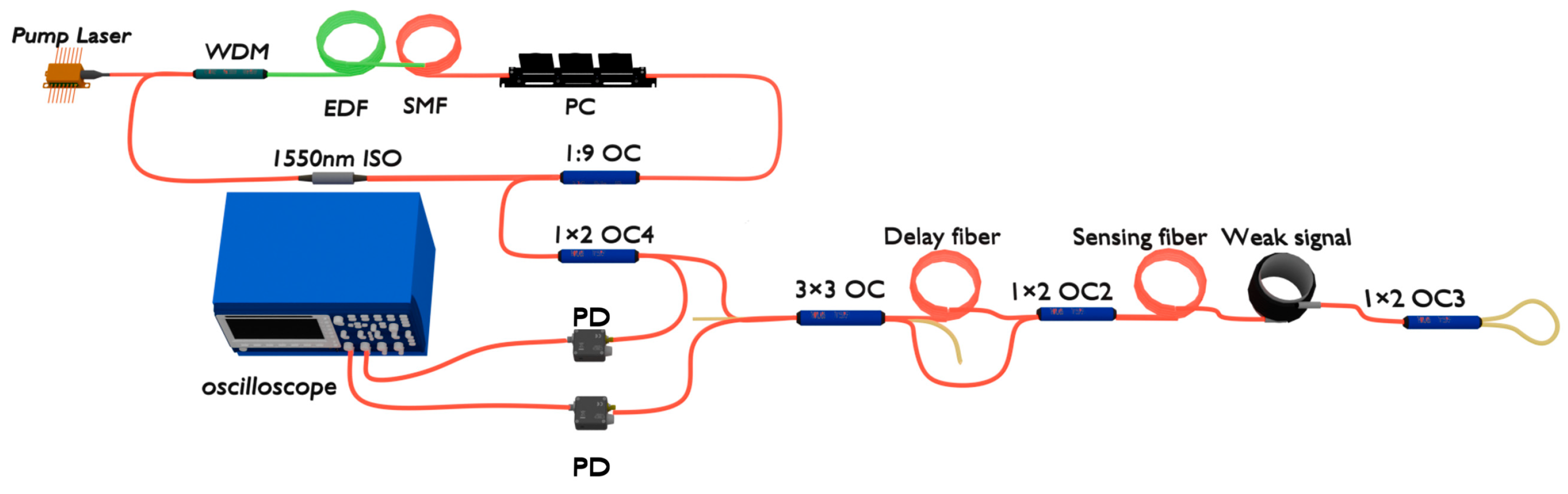
In this study, the chaotic laser source is implemented using a unidirectional erbium-doped fiber (EDF) ring cavity integrated with polarization control. Figure 1 illustrates the schematic of the proposed chaotic fiber laser–based sensing system. The cavity consists of 8 m EDF serving as the gain medium, 11 m single-mode fiber (SMF) to ensure enough nonlinearity, a wavelength-division multiplexer (WDM) to couple the 976 nm LD pump into the EDF for population inversion, an optical isolator (ISO) to enforce unidirectional operation, and a polarization controller (PC) to regulate the intracavity polarization state. A fraction of the chaotic output is extracted through an optical coupler (OC), with one branch (90%) back into the fiber ring and the other (10%) injected into a linear Sagnac interferometer for weak signal sensing. The non-balanced Sagnac interferometer incorporates a 4 km delay fiber and a 12 km sensing fiber At the end of the sensing fiber, a 13 m armored fiber is uniformly wound around the outer periphery of a titanium alloy steel pipe, with an outer diameter of 110 mm, a wall thickness of 3 mm, and a height of 120 mm. The titanium alloy steel pipe can effectively capture weak vibrations and load the vibration signals into the armored fiber. The detailed multi-layer winding and detection system will be uncovered in Appendix A. The output of the fiber laser and interferometric signal is monitored by a 4 GHz Oscilloscope (Tektronix, MSO64B) together with a 5 GHz photodetector (PD) and an optical spectrum analyzer (OSA) (Yokogawa, AQ6370D)
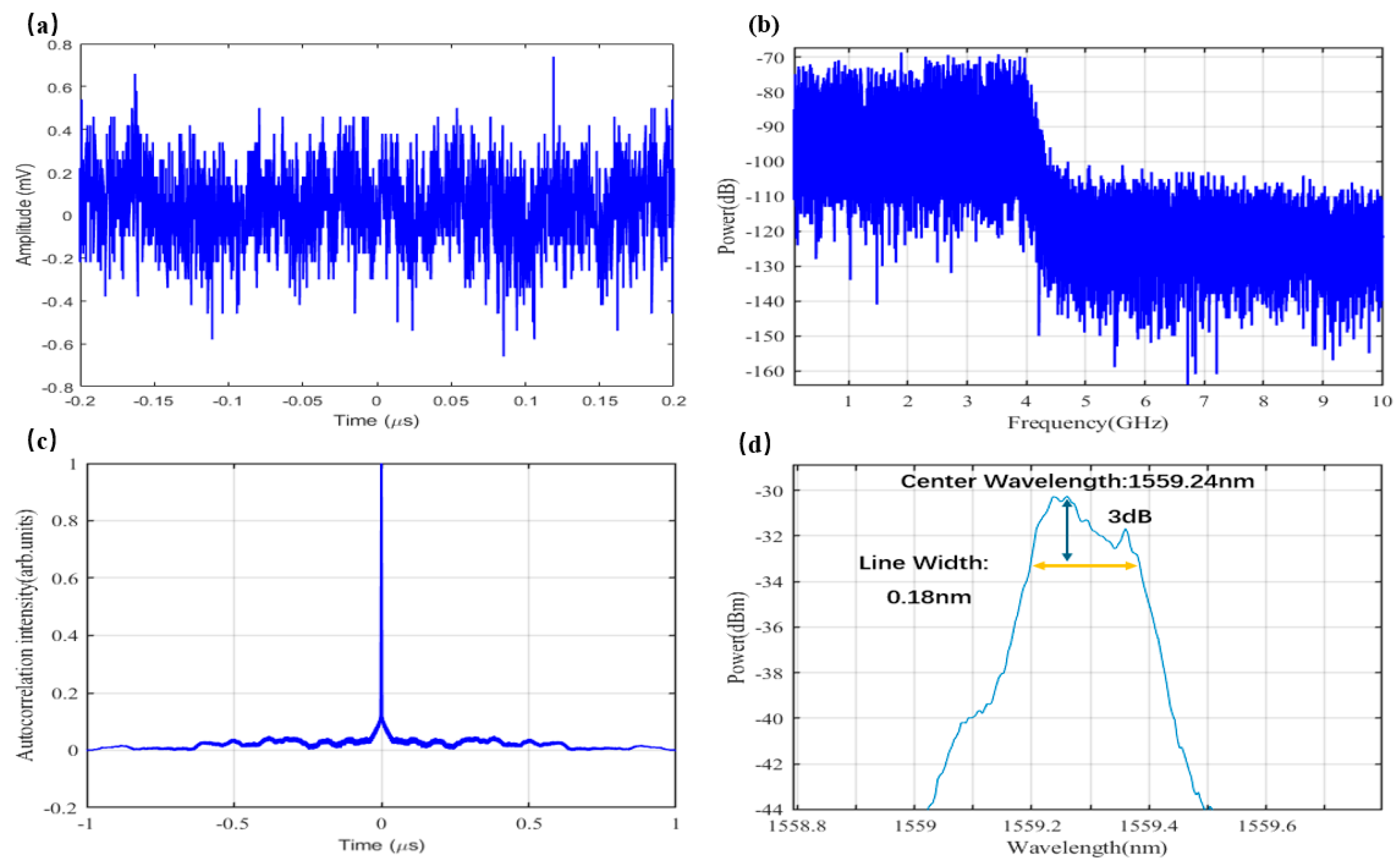
When the laser is operated beyond the instability threshold, the system transitions from stable emission to chaotic dynamics through a period-doubling route. At a pump power of 100 mW, the PC is carefully adjusted to an optimal operating point to sustain a stable, broadband, low-coherence chaotic regime while maximizing the interferometric sensitivity. In the non-balanced Sagnac configuration, a delay fiber facilitates the transduction of weak vibration-induced phase perturbations into chaotic intensity fluctuations and suppressing reciprocal effects, enabling robust embedding of weak signals into the chaotic carrier for data-driven analysis. It should be emphasized that, although vibration information was initially introduced as a phase perturbation, no explicit phase demodulation was performed in this work. Instead, the vibration was regarded as a dynamical perturbation to the chaotic system and detected through deviations in the reconstructed chaotic dynamics. The output characteristics of the chaotic fiber laser are presented in Figure 2. Figure 2a shows the time-domain waveform, which exhibits strongly irregular intensity fluctuations without any discernible periodicity, indicating noise-like temporal behavior. The corresponding radio-frequency spectrum in Figure 2b displays a broadband and continuous distribution extending up to several GHz, with no observable discrete spectral lines. Specifically, the trailing snap in the frequency traces in Figure 2b is caused by the bandwidth limitation of the real-time digital oscilloscope with 4 GHz bandwidth. Furthermore, repeated experiments using a oscilloscope with 50 GHz bandwidth are provided in Appendix A.2. for comparison and validation. As shown in Figure 2c, the autocorrelation trace features a pronounced peak with a thumbtack-like shape, confirming low-autocorrelation noise. Figure 2d presents the optical spectrum of the chaotic laser, with a central wavelength of 1559.24 nm and a measured 3 dB line-width of approximately 0.18 nm.
The chaotic time series generated by the fiber laser originates from deterministic nonlinear dynamics rather than stochastic noise. Although the temporal waveform exhibits apparent randomness, it is governed by an underlying low-dimensional dynamical system characterized by strong sensitivity to initial conditions and aperiodic evolution. Such dynamics evolve on a strange attractor of the chaotic resonator, which encapsulates the intrinsic structure and regularity of the system in phase space. The combination of the chaotic fiber laser source and the linear Sagnac interferometer enable high-sensitivity embedding of weak vibration signals into the chaotic carrier.
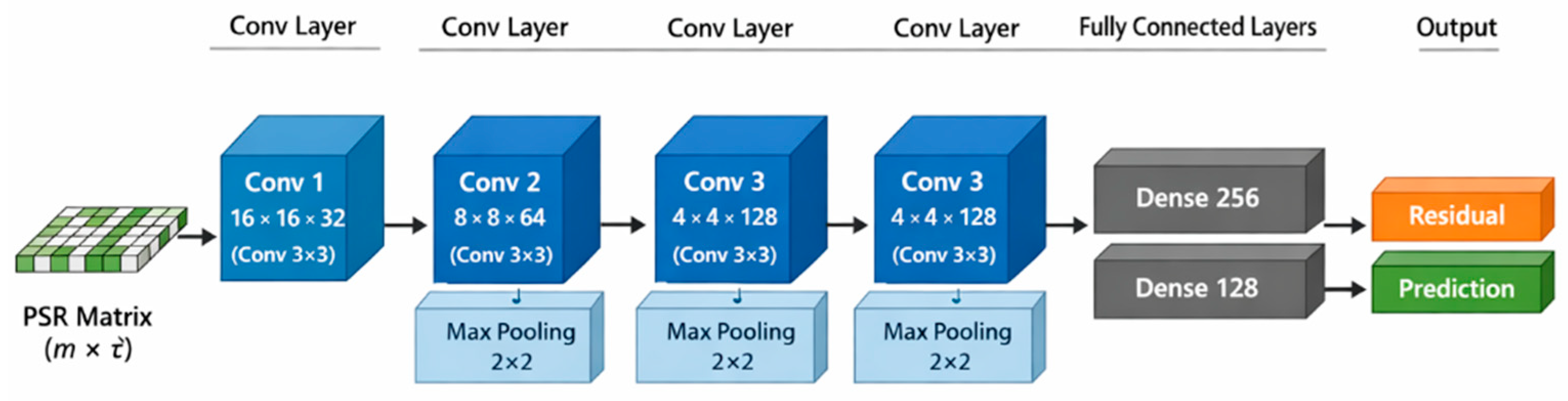
To prepare the data for CNN training, we employed PSR based on Takens’ embedding theorem, transforming the one-dimensional chaotic time series into a high-dimensional feature space that preserves the intrinsic dynamics of the system. Details of Takens’ embedding theorem are provided in Appendix B.1. This facilitated robust learning of nonlinear features by the CNN model. The architecture of CNN is shown in Figure 3, with its depth determined via validation-based ablation. Stacked 3 × 3 convolutions were used to gradually enlarge the receptive field on the PSR maps and capture multi-scale attractor patterns. We observed that 4 convolutional layers provided the best accuracy–complexity trade-off, enabling precise identification of weak signals even under ultra-low SNR conditions. The network takes the PSR matrix as input and employs 4 convolutional layers with 3 × 3 kernels and max pooling to extract hierarchical features. The extracted features are processed by fully connected layers to generate the final prediction and the corresponding residual. The CNN architecture and training hyperparameters are summarized in Appendix B.2.
In this study, the chaotic output of the fiber laser is divided into two paths using a 1 × 2 optical coupler. One path is directly detected by a photodetector and serves as a reference chaotic signal, denoted as c r t . The other path propagates through a Sagnac interferometric loop to carry the weak vibration information, and the resulting signal is denoted as c m t . After photoelectric conversion, the measured signal is acquired and processed for further analysis. Depending on whether an external weak signal is applied, the detected signal can be expressed as Equation (1) when only chaotic noise is present, or Equation (2) when a weak vibration signal is s t superimposed.
x t = c r t + n t
y t = c m t + n t + s t
Here, n t represents additive white noise. To identify weak signals embedded in chaotic backgrounds, a data-driven detection framework based on nonlinear dynamic modeling is constructed. The framework consists of a nonlinear feature construction model,
T = f x t , α
and a detection model,
D = g y t , β
where α and β denote the system parameters of the reference chaotic system and the measured system, respectively. Their relationship can be expressed as follows:
β = α + Δ
where Δ characterizes the deviation in the system dynamics caused by external perturbations. When Δ = 0 , the chaotic dynamics of the measured arm are consistent with those of the reference. In contrast, a nonzero Δ indicates the presence of external disturbances, enabling weak signal detection through dynamic mismatch analysis.

3. Results

In this experiment, an armored optical fiber was uniformly wound around the surface of a titanium alloy steel pipe to serve as an acoustic loading device. A loudspeaker was placed at the center of the pipe and adjusted to emit audio signals at a specific frequency and sound pressure level, monitored using a sound level meter. The vibration of the titanium alloy pipe altered the refractive index of the armored fiber, thereby encoding the acoustic information onto the optical signal. The SNR was controlled by adjusting the volume of the audio signal. The device is shown in Appendix A.3.

3.1. Weak Vibration Detection via Frequency Spectrum Analysis

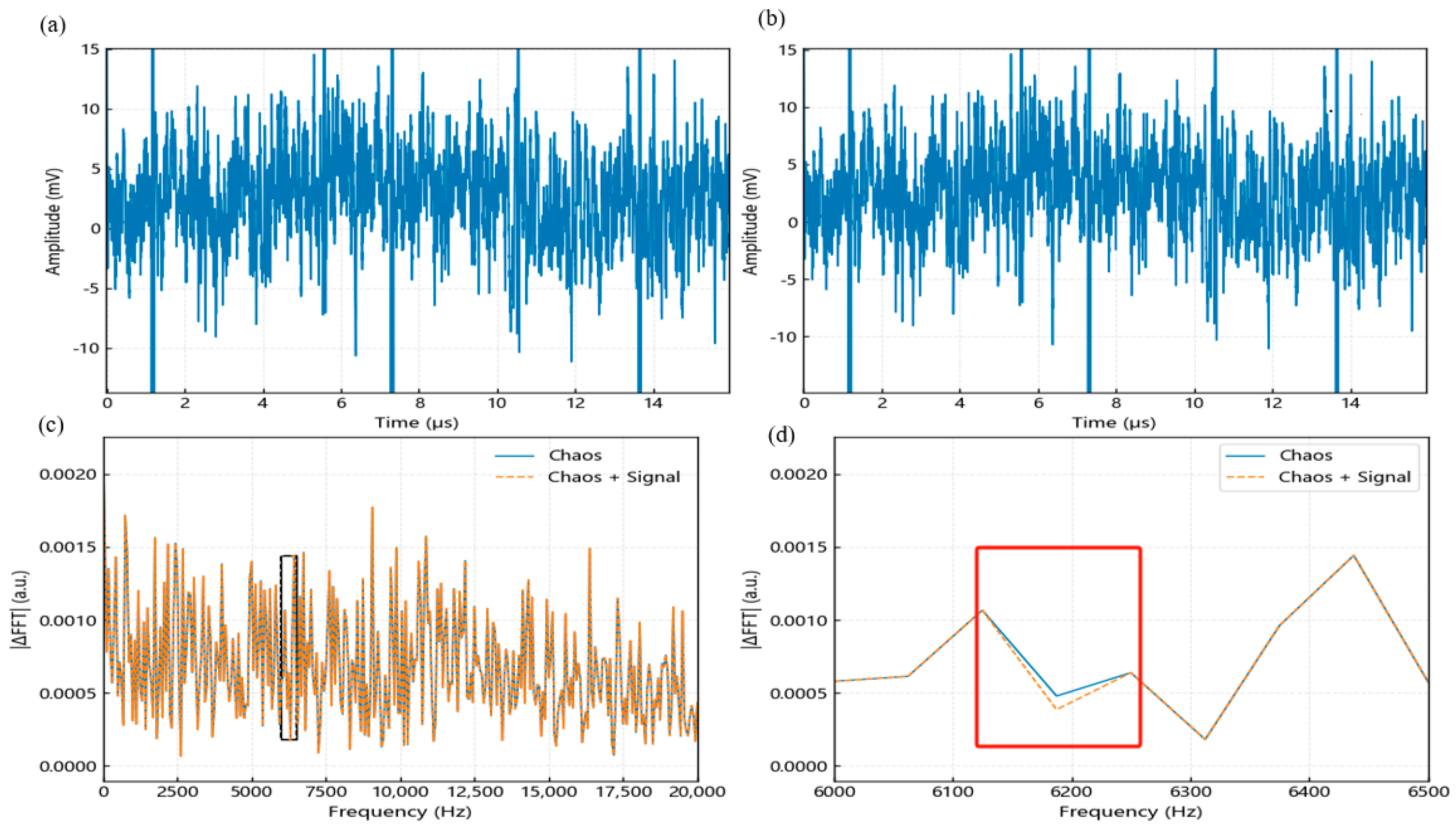
A sinusoidal signal of fixed frequency was generated using MATLAB (R2024a) and output through a loudspeaker with the sound function. In this experiment, a 6000 Hz sinusoidal signal at 66 dBA was used to test model prediction accuracy. Figure 4a,b show the time-domain waveforms before and after signal injection, respectively. Both traces exhibit irregular, noise-like fluctuations dominated by the chaotic background. From the waveform alone, it is nearly impossible to determine whether a weak signal has been embedded, confirming that the weak signal is completely embedded in the chaotic noise. To illustrate this, we compare the frequency spectra of them in Figure 4c, where the blue line and dotted orange line present the pure chaotic signal and the chaotic signal with weak signal injection, respectively. The spectrum is fitted to suppress random fluctuations and emphasize their overall spectral characteristics. As can be observed, the two fitted spectra largely overlap over the full bandwidth, and no isolated spectral peak corresponding to the weak signal can be directly resolved, confirming the extremely low SNR. To further examine subtle spectral differences, Figure 4d shows a locally magnified view around the target frequency band, and a slight deviation between the two spectra can be observed. However, the spectral difference remains weak and is difficult to distinguish reliably using conventional frequency-domain analysis.

3.2. Prediction Experiment Based on CNN

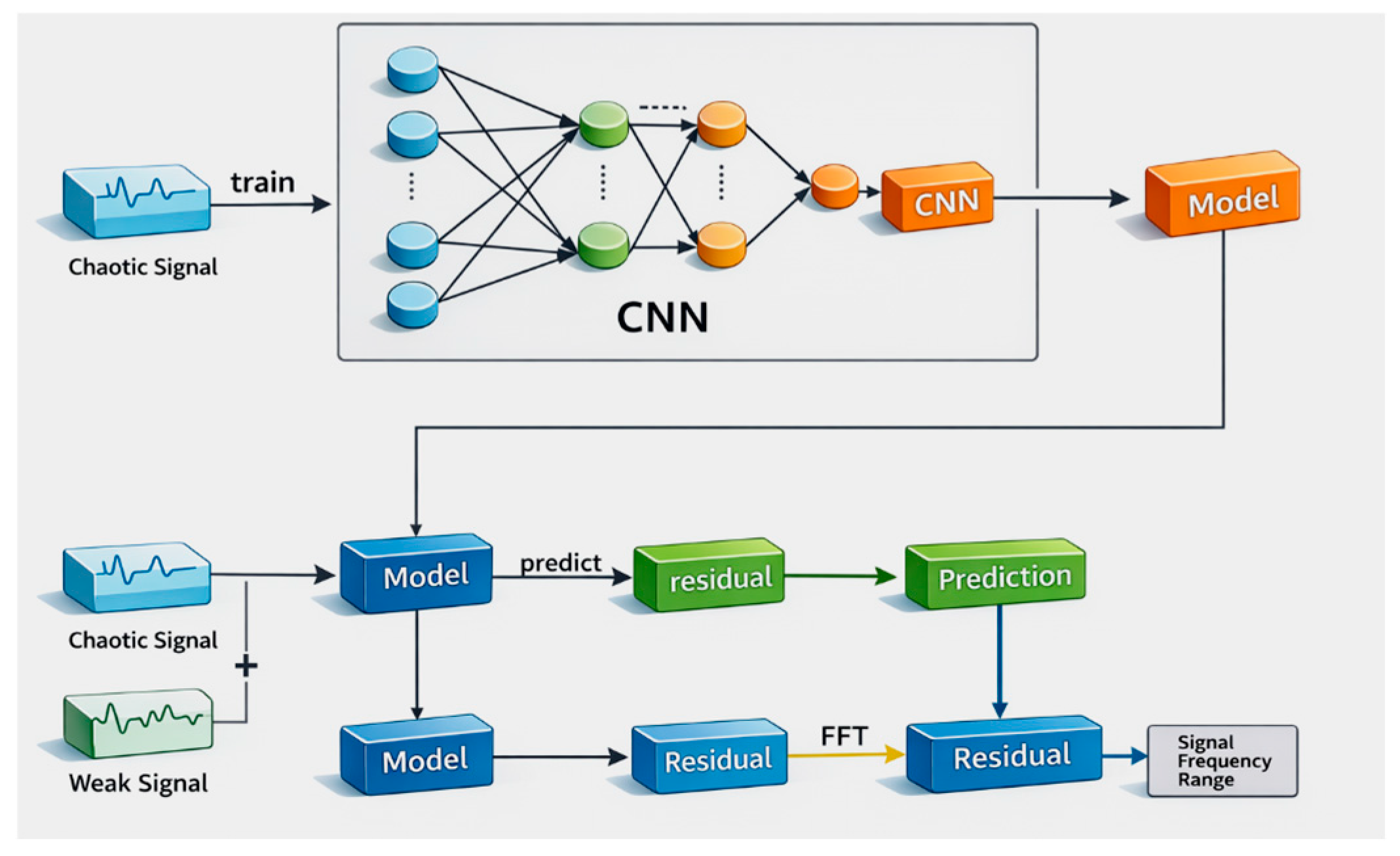
As proven in Appendix B.3., when the two signals differ only in phase, the CNN model can be used to predict both, and residuals can be analyzed. PSR was applied to the chaotic signal using an embedding dimension m = 13 and delay τ = 1. The reconstructed data was used to train the CNN model. The trained model was then used to predict both the original and weak signal embedded chaotic signals. Since the null-frequency component of the embedded signal produced significant residuals compared to the pure chaotic signal, analyzing the residual spectrum revealed the frequency range of the weak signal. Averaging across multiple predictions allowed for estimating the weak signal frequency. The model structure is shown in Figure 5.
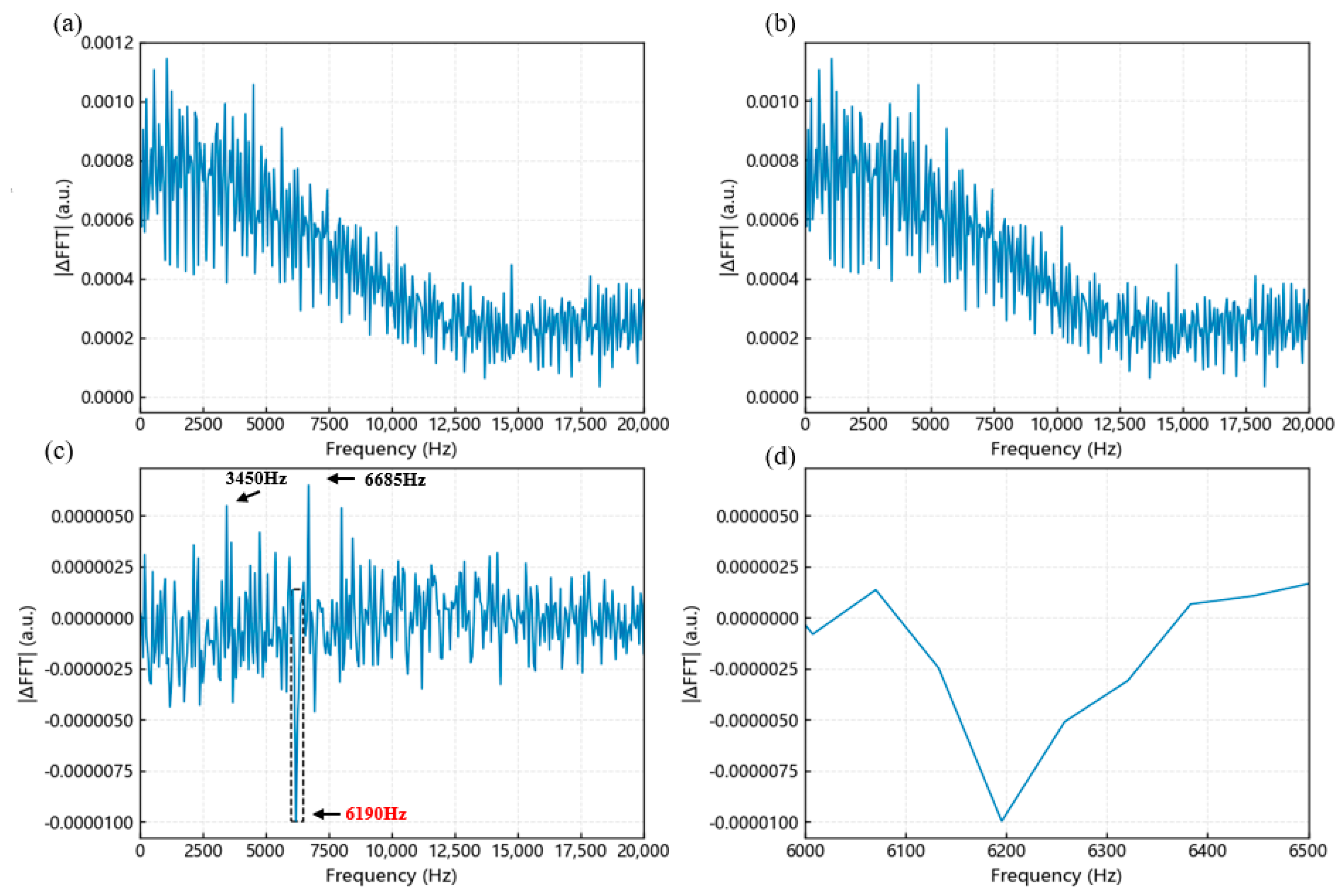
The prediction error was quantified using the mean squared error (MSE) averaged over the test set. For the original chaotic signal, the CNN model yielded a prediction error of 0.000137879. For the embedded signal (66 dBA, 6000 Hz), the error increased slightly to 0.000140454, indicating the null-frequency notch introduces a detectable deviation. Figure 6a,b show the residual frequency responses of the original and embedded signals, respectively. In the kHz range, residuals fluctuate significantly, reflecting the inherent unpredictability of chaotic signals in this band. By subtracting residual spectra in Figure 6a,b, Figure 6c highlights three major deviations at 3450 Hz, 6190 Hz, and 6685 Hz. The largest deviation is observed near 6190 Hz, indicating the presence of an embedded signal within this frequency range. Averaging across multiple trials further refines the frequency estimate (the five measurements are 6192 Hz, 6217 Hz, 6178 Hz, 6197 Hz, and 6211 Hz, respectively), ultimately converging at 6199 Hz, which is consistent with the result obtained from direct spectral analysis (6200 Hz). The residual-based method yielded a prediction error of less than 3.31% relative to the true 6000 Hz signal, demonstrating that the proposed approach is both feasible and accurate, while also being more convenient than direct spectral analysis.

3.3. Model Stability Experiment

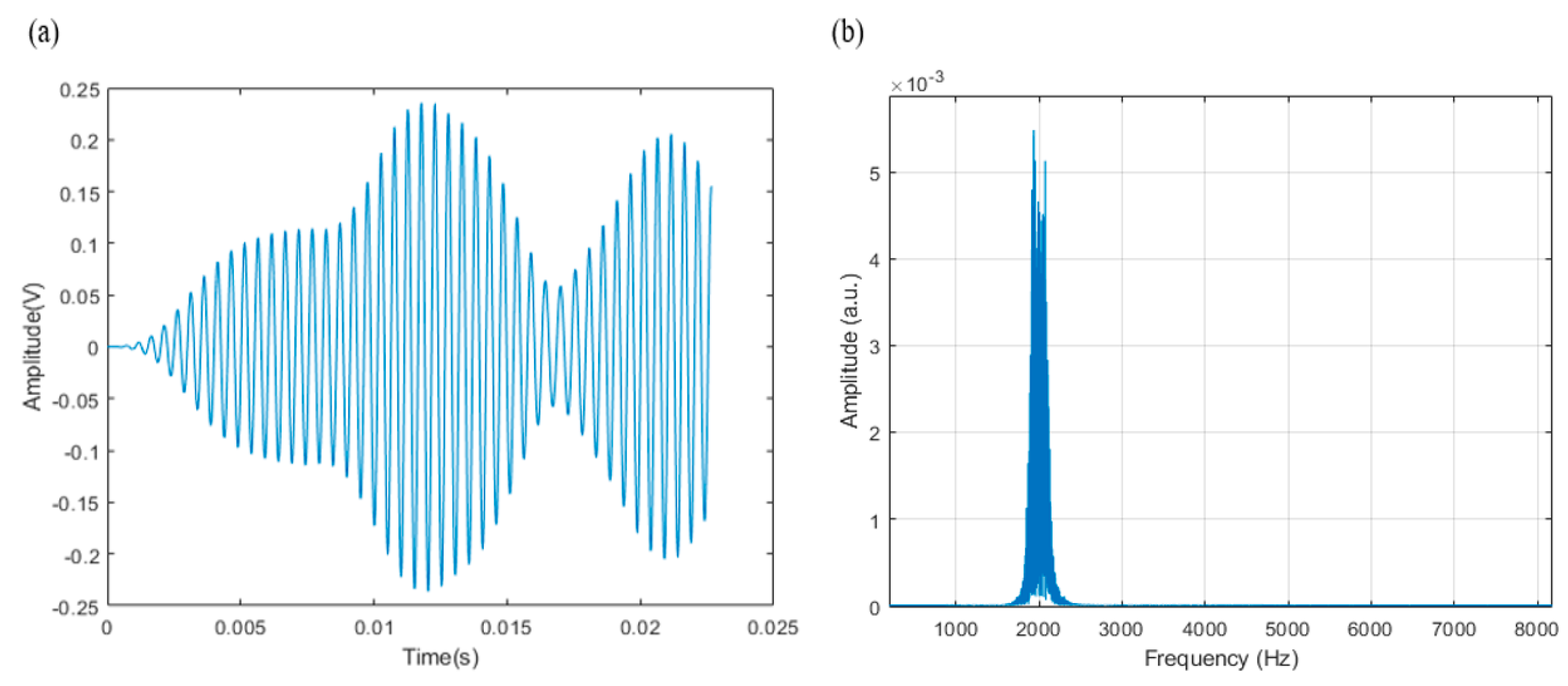
To test the robustness of the prediction model, the sine wave signal was replaced with band-limited noise. Unlike the sine wave, band-limited noise exhibits an irregularly oscillating time-domain waveform with slowly varying amplitude but presents a concentrated narrowband frequency spectrum, as shown in Figure 7a and Figure 7b, respectively. When embedded in chaotic noise, the weak signal becomes even less discernible in the time and frequency domains.
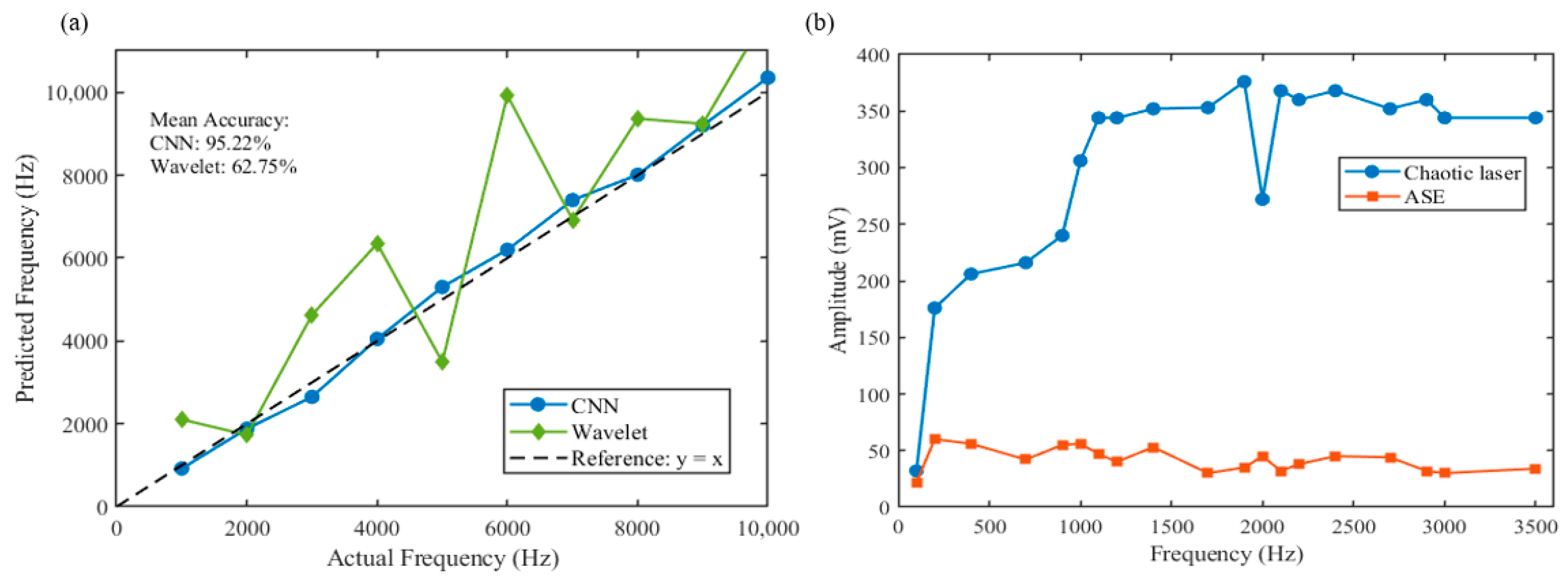
Using MATLAB, band-limited noise was generated to serve as the excitation signal. Specifically, band-limited noise refers to a stochastic signal whose spectral energy is confined within a finite frequency interval, while being strongly suppressed outside this range. In this work, the noise spectrum was centered at a predefined center frequency f c and limited to a bandwidth B , such that its frequency components were distributed within f c B / 2 ,   f c + B / 2 . The spectral amplitude within the passband was approximately flat, whereas frequency components outside the specified band were effectively attenuated. This controlled spectral confinement enables precise emulation of narrowband or quasi-narrowband vibration disturbances with tunable frequency location and bandwidth. The signal was played through a loudspeaker at 66 dBA. We systematically investigated the center frequencies from 1 kHz to 10 kHz, with 1 kHz spacing. The embedded frequency was estimated using the proposed CNN-based residual prediction framework, while conventional wavelet-based analysis was employed as a baseline for quantitative comparison. Predictions were averaged over repeated measurements and benchmarked against the ideal relation Y = X in Figure 8a. The CNN outputs closely follow the ground truth across the entire frequency range, highlighting its strong robustness in the presence of chaotic, noise-like backgrounds and its capability to generalize across multiple weak signal scenarios.
Meanwhile, we further compared the response of the chaotic laser to the applied signal with that obtained using an amplified spontaneous emission (ASE) source, as illustrated in Figure 8b that compares the model response obtained using a chaotic laser source and an ASE source over the frequency range from 100 Hz to 3.5 kHz. When the chaotic laser was employed, the measured signal amplitude was markedly higher than that obtained with the ASE source across the entire frequency band, which implies that the sensitivity of the chaotic system can be more than 5 times higher than that of the ASE source. The larger response amplitude obtained with the chaotic laser leads to an improved lower SNR condition, providing a favorable basis for accurate model prediction. These results suggest that the use of a chaotic laser is beneficial for improving the reliability and accuracy of the proposed model, especially under conditions where weak perturbations need to be extracted from a noisy background.
The SNR is defined based on the RMS amplitude of the time-domain signals. Specifically, the chaotic carrier background (including measurement noise) c ( t ) + n ( t ) was first extracted from the filtered test data, and its mean value was removed to avoid fixed bias. The noise strength was then quantified by the sample standard deviation σ c + n . Similarly, the signal strength σ s was estimated as the sample standard deviation of the injected signal sequence s ( t ) . The SNR was finally calculated as
S N R = 20 log 10 σ s σ c + n
At the detection limit of the system, the standard deviation of the injected signal is significantly smaller than that of the chaotic background. Substituting the measured values of σ s and σ c + n , the corresponding signal-to-noise ratio is calculated to be approximately −22 dB, which is taken as the effective detection limit of our proposed scheme. It should be noted that the −22 dB value refers to the equivalent input SNR defined from the acquired time-domain sequences, rather than the acoustic sound pressure level measured in air.

4. Discussion

By integrating CNN with machine learning techniques, this study proposes a distributed chaotic fiber laser-based sensing system integrated with a non-balanced linear Sagnac interferometer for weak signal detection. More importantly, the proposed system represents a shift in the detection paradigm: weak vibrations are characterized as differences in chaotic dynamics between the reference and measurement branches, and further quantified through the prediction error of a machine-learning model rather than through explicit phase recovery or spectral feature extraction. The local receptive fields and shared weights of CNNs impose an inductive bias that naturally matches the spatially structured perturbations induced by weak vibrations, enabling robust detection even when the signal is buried under chaotic background noise. In terms of system performance, the sensor covers a detection bandwidth, ranging from 0.1 Hz to 10 kHz, and operates effectively even under ultra-low signal-to-noise ratio conditions down to −22 dB.
The system successfully detects both fixed-frequency sinusoidal signals and complex broadband noise signals. In the experiment with a 6000 Hz sinusoidal signal, the predicted frequency deviated from the actual value by only 3.31%. Additionally, when tested with band-limited noise signals of various center frequencies, the CNN prediction model produced fitted curves that closely matched the true values, demonstrating strong robustness and adaptability for different types of weak signal detection. The proposed system offers a novel and practical solution for detecting weak vibration signals and solving the vibration recognition problem, which shows promising potential for application in a wide range of sensing scenarios.
While the present system demonstrates reliable vibration detection up to 10 kHz for detecting human-audible frequencies, low-altitude small UAVs, etc., the upper frequency bound is likely associated with the opto-mechanical response of the armed fiber–pipe assembly. The sensing fiber and its coupling to the surrounding environment can be modified through optimized coating [18] or bonded configuration. Extending this limit remains an important direction for future work. Standard single-mode fiber or microstructured fibers, along with a Piezoelectric Tube (PZT) can be used to replace the assembly of armed fiber and titanium alloy steel pipe to extend the high-frequency limitation. In addition, long-term operation may introduce slow environmental drifts, such as temperature variations [19], which can gradually shift the laser dynamics and affect the consistency of data-driven models. Future efforts will therefore focus on improving structural robustness and maintaining stable operating conditions to support broader bandwidth and reliable long-term measurements in practical sensing scenarios.

Author Contributions

W.Z. and Y.C. contributed equally to this work. Conceptualization, C.Z. and J.L.; methodology, C.Z. and J.L.; software, W.Z. and Y.C.; validation, W.Z., Y.C., H.P., J.X. and X.M.; formal analysis, H.P. and W.Z.; investigation, H.P. and C.Z.; resources, C.Z.; data curation, W.Z. and J.X.; writing—original draft preparation, W.Z. and Y.C.; writing—review and editing, C.Z.; visualization, Y.C.; supervision, C.Z.; project administration, C.Z.; funding acquisition, C.Z. All authors have read and agreed to the published version of the manuscript.

Funding

This work was supported by the National Natural Science Foundation of China (No.12304478). This work was supported by the Guangdong Province Key Construction Discipline Scientific Research Capacity Improvement Project (Grant No.2021ZDJS107).

Institutional Review Board Statement

Not applicable.

Informed Consent Statement

Not applicable.

Data Availability Statement

The data related to the paper are available from the corresponding authors upon reasonable request.

Conflicts of Interest

The authors declare no conflicts of interest.

Appendix A

Appendix A.1. Composition of Detection Devices

At the laser output, a 50:50 optical coupler (OC) was used to divide the optical signal into two branches, corresponding to the directly extracted chaotic laser and the branch designated for subsequent modulation. The latter was injected into a Sagnac interferometric loop using a 3 × 3 optical coupler. Within the loop, the optical field propagated bidirectionally and experienced a relative time delay introduced by a 4 km delay fiber. The delayed signal was then coupled into the 12 km sensing fiber through a 1 × 2 optical coupler. The interfering waves propagating in separate paths in the non-balanced Sagnac structure enabled the transduction of weak acoustic perturbations acting on the sensing fiber into intensity modulation of the optical signal, thereby producing the chaotic dynamics deviations.

Appendix A.2. Characterization of the Chaotic Signal Using a High-Bandwidth Oscilloscope

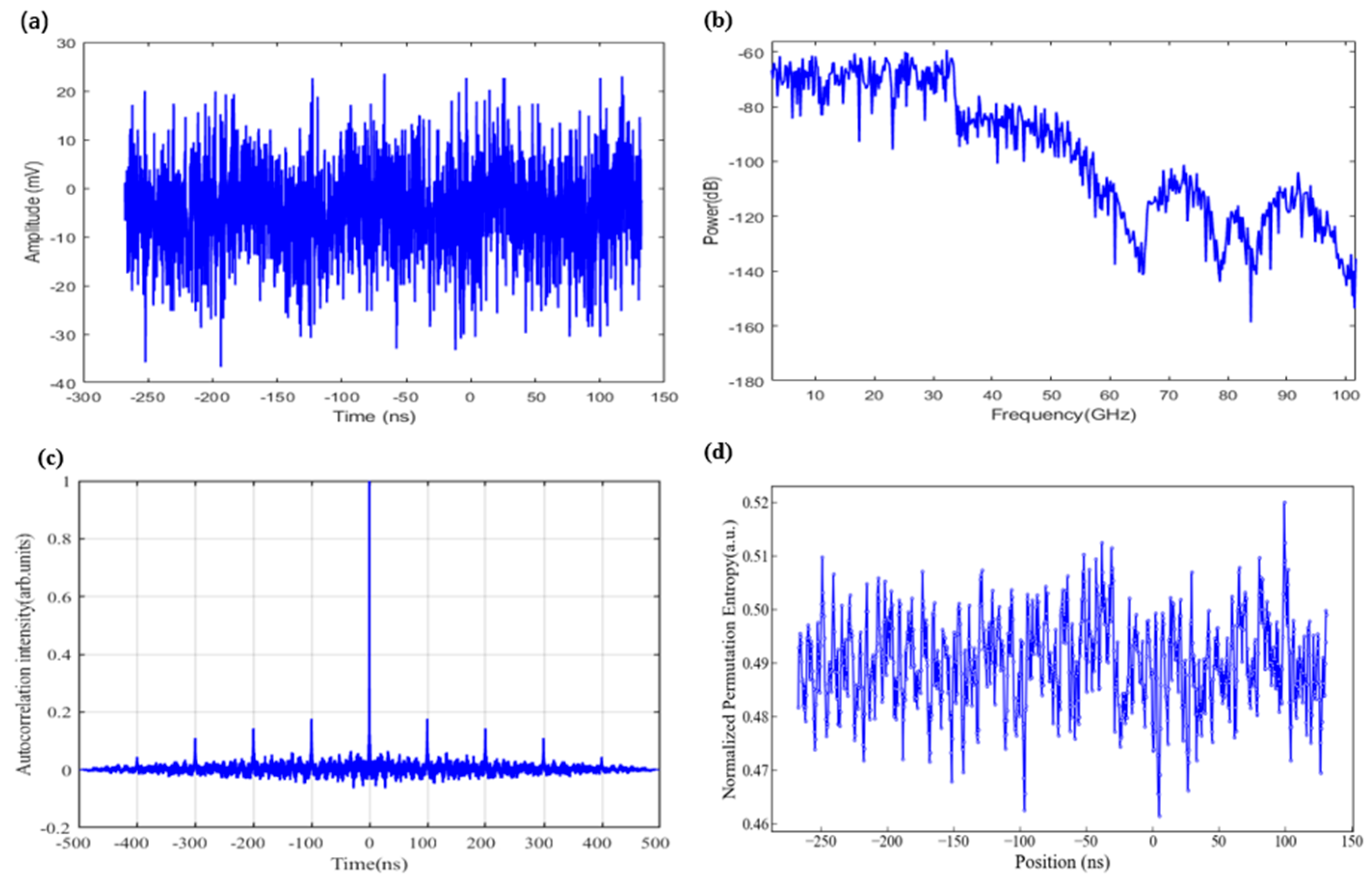
By employing high-bandwidth detection equipment, the time-domain waveform, power spectrum, and autocorrelation function of the chaotic laser were re-measured. In addition, the chaotic state of the system was further verified by calculating the sliding permutation entropy. Figure A1 presents the output characteristics of the chaotic laser measured using a photodetector with 50 GHz bandwidth and an oscilloscope with 33 GHz bandwidth. As shown in Figure A1a, the time-domain waveform exhibits strongly irregular and noise-like intensity fluctuations without any discernible periodicity, which is a typical signature of chaotic dynamics. Correspondingly, the radio-frequency spectrum in Figure A1b shows a broadband and continuous distribution over a wide frequency range up to 30 GHz, further confirming the absence of dominant oscillation frequencies. The autocorrelation trace in Figure A1c features a pronounced peak at zero delay and rapidly decays to near-zero at nonzero delays, indicating weak temporal correlation in the laser output. To quantitatively characterize the complexity of the chaotic signal, sliding permutation entropy was calculated, as shown in Figure A1d. The entropy values remained above 0.46 throughout the measured range, demonstrating a high level of dynamical complexity and temporal unpredictability of the laser output [20]. A particular point to note is that, in Figure A1c, sidelobes appear in the autocorrelation trace at the cavity periodic positions. Similar autocorrelation sidelobes correlated with the cavity round-trip time were also reported by Yang et al., who attributed this effect to repetitive intracavity interference accompanied by nonlinear phase accumulation [21].
Figure A1. The characteristics of chaotic laser output using a high−bandwidth oscilloscope. (a) Time−domain waveform. (b) Frequency spectrum. (c) Autocorrelation. (d) Sliding permutation entropy.
Photonics 13 00243 g0a1

Appendix A.3. Vibration Transmission Equipment

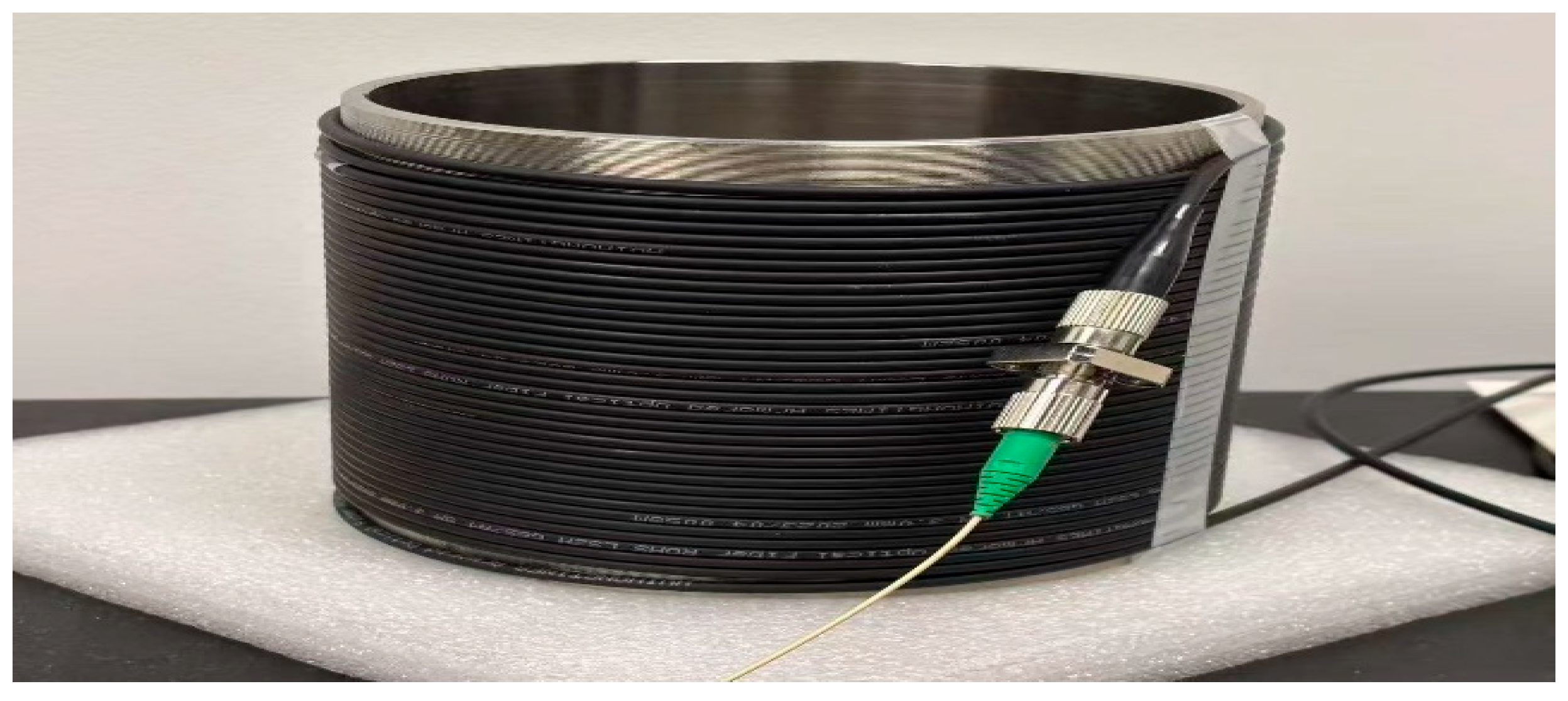
To introduce weak vibration signals in a controlled manner, a dedicated loading device was designed and fabricated, as shown in Figure A2. The device consisted of a rigid titanium alloy ring serving as the mechanical support, around which an armored optical fiber was uniformly wound. External vibrations applied to the ring were effectively transferred to the wrapped fiber through mechanical coupling, enabling stable and repeatable loading of weak perturbations into the sensing fiber.
Figure A2. Device for loading weak signals. The structure consists of a titanium alloy steel ring in the middle, wrapped with black armored optical fiber on the outside.
Photonics 13 00243 g0a2

Appendix B

Appendix B.1. Phase Space Reconstruction

In practical experiments, only a scalar time series of the chaotic laser intensity can be directly measured, while the full-state variables of the underlying dynamical system remain inaccessible. This limitation inevitably leads to the loss of phase and dimensional information, making direct analysis of the system’s intrinsic dynamics infeasible. PSR provides an effective approach to overcome this constraint by embedding the measured one-dimensional time series into a higher-dimensional space that is topologically equivalent to the original phase space.
According to Takens’ embedding theorem [22,23], an equivalent reconstruction of the original dynamical system can be achieved by appropriately selecting the delay time τ and embedding dimension m, such that the reconstructed attractor preserves the topological properties of the true system [24]. Owing to its ability to recover intrinsic nonlinear dynamics from scalar observations, PSR has been widely employed in chaotic time-series analysis [25,26], nonlinear feature extraction, and weak signal detection. In Takens’ theorem, as long as m > 2d (where d is the dimension of the attractor) and certain regularity conditions are satisfied,
X t = x t , x t + τ , x t + 2 τ , , x t + m 1 τ
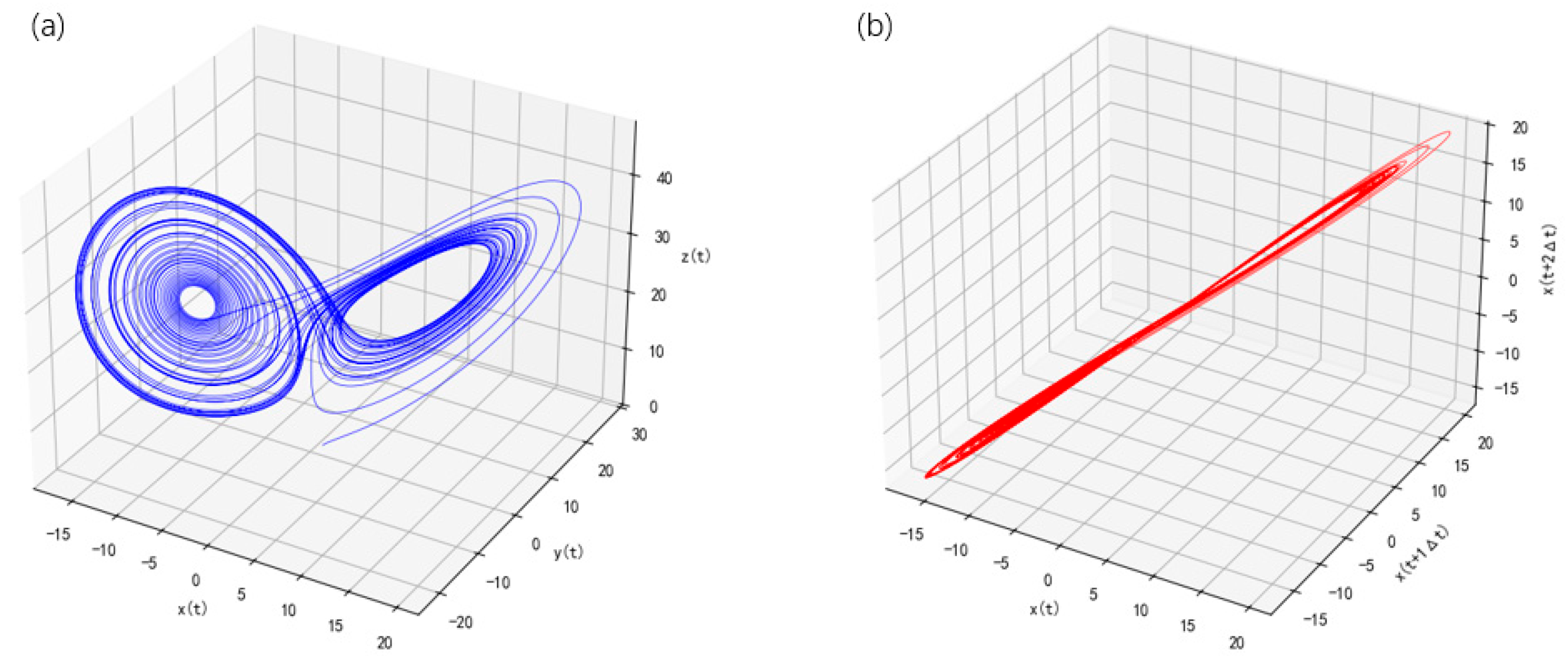
Based on this theory, the classical Lorenz system was used for PSR in this study. Given the embedding dimension m = 13 and delay time τ = 1, the reconstructed vectors are shown in Figure A3. Since m = 13 is too high to display in full, only the first three dimensions are plotted.
Figure A3. (a) The classic Lorenz attractor. (b) PSR of a classical Lorenz system using Takens’ method.
Photonics 13 00243 g0a3

Appendix B.2. CNN Details

A convolution kernel scans through local regions of the input to compute feature maps that machines can recognize. For 2D convolution, this operation can be described as follows:
y i , j = f x i , j = m n f m , n x i m , j n
After convolution, a nonlinear activation function is typically applied. A commonly used activation function is the Rectified Linear Unit (ReLU) [27,28]:
R e L U x = m a x 0 , x
Pooling layers, unique to CNNs, downsample feature maps to reduce spatial dimensions, lower computational complexity, and prevent overfitting. Typical pooling methods include max pooling and average pooling. For a 2 × 2 window, max pooling can be expressed as follows:
y i , j = max x i , j , x i + 1 , j , x i , j + 1 , x i + 1 , j + 1  
After multiple convolution and pooling layers extract features, the output is flattened and passed into fully connected layers for final classification or regression [29]. The loss function measures the difference between the predicted and true values. For regression, the MSE is commonly used:
L = 1 N i = 1 N y true i y pred i 2      
By adjusting kernel sizes, CNNs can handle long-term dependencies in data, avoiding vanishing gradient issues common in RNNs. For a time series input [30],
x t = x t , x t + 1 , , x t + N
CNNs apply convolution and pooling to extract local features and predict future values:
x t + k = f CNN x t , x t + 1 , , x t + N
To consider multi-scale dependencies, multiple convolution kernels can be applied:
x t + k = f CNN { x t , x t + 1 x t + N } , { x t + 1 , x t + 2 x t + N + 1 } ,
Each kernel size can capture different time-scale relationships:
x t + k = f CNN i = 1 M Conv i x t , x t + 1 , , x t + N
where C o n v i denotes the CNN with the i -th kernel.
This allows the model to extract hierarchical temporal dependencies from the time series [31]. Assume a one-dimensional finite time series V ( n ) from an unknown dynamic system. To predict its future behavior, V ( n + 1 ) , Takens’ embedding theorem provides a mapping f :   R m R 1
V ( n + 1 ) = f ( V ( n τ ) , V ( ( n 1 ) τ ) , , V ( ( n m 1 ) τ ) )  
where m is the embedding dimension, τ is the delay length, and m and τ are determined by Takens’ embedding theorem. After processing with the PSR method, the training pairs can be expressed as follows:
ξ = { c i ( i + ( j 1 ) τ ) , c i ( i + m τ ) } , i = 1 ,   2 , , N j = 1 ,   2 , , m                                                            
Once the training pairs are established, they can be input into the neural network for conventional training. Then, MSE is used to optimize the network weights W i and biases   b i   . Stochastic gradient descent is employed to optimize W i and b i , where η is the learning rate.
M S E = 1 n ( y t u r e y r e a l ) 2  
W i = W i 1 η M S E W i 1
b i = b i 1 η M S E b i 1
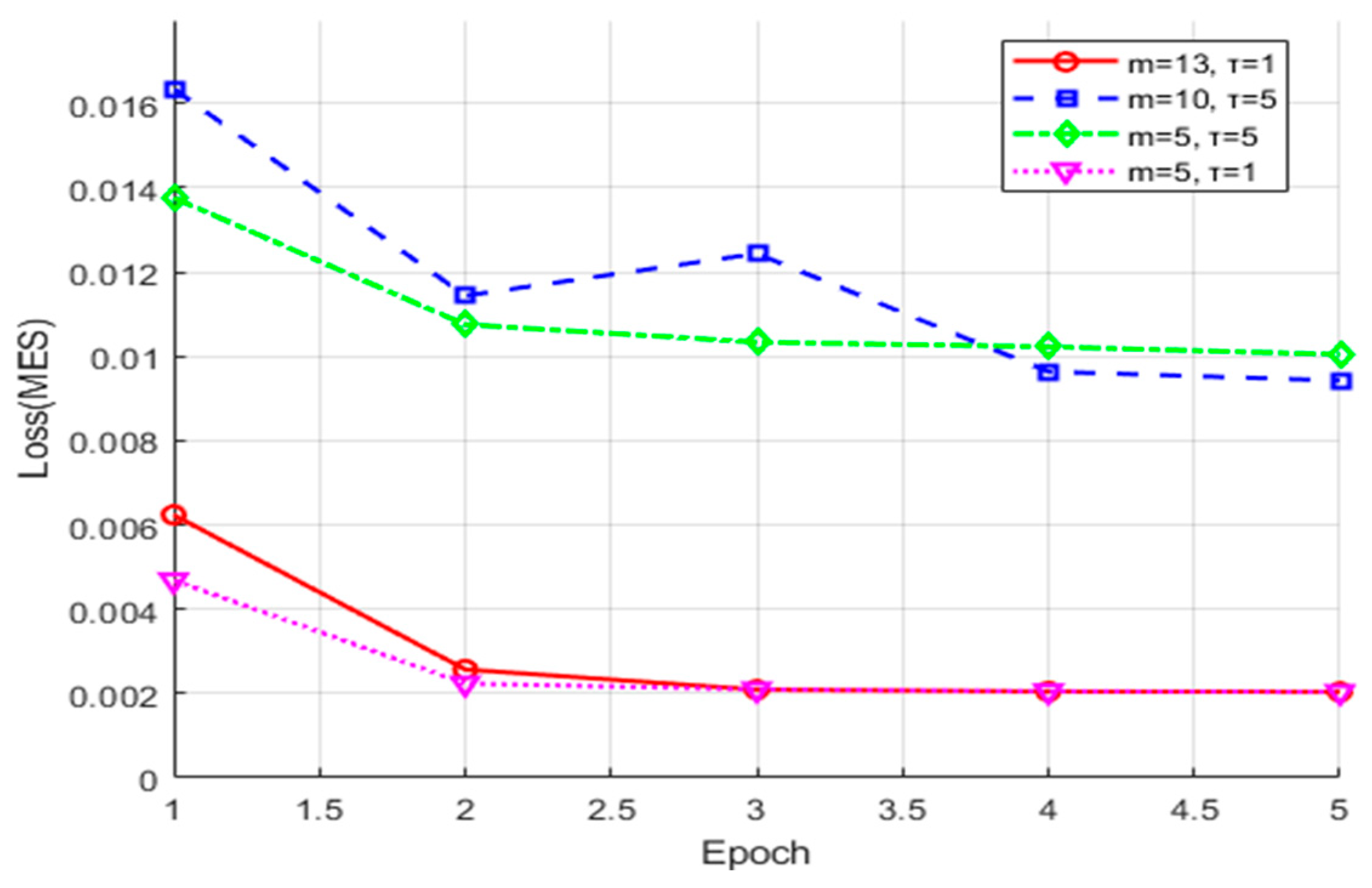
Experiments revealed that the CNN model’s loss function varied with different values of the embedding dimension m and delay time τ , indicating that the model’s accuracy changes with these parameters. The impact of m and τ on model accuracy is illustrated in Figure A4. Notably, sub-optimal parameter choices lead to a moderate increase in prediction error but did not cause qualitative degradation or failure of weak signal detection.
Figure A4. The influence of the values of m and τ on model accuracy, divided into four cases: (1) m = 13 and τ = 1, (2) m = 10 and τ = 5, (3) m = 5 and τ = 5, (4) m = 5 and τ = 1.
Photonics 13 00243 g0a4

Appendix B.3. Phase Derivation

The chaotic laser intensity can be expressed as follows:
I = I 0    
After embedding the weak signal via vibration-induced phase changes, the expression becomes
I = 1 9 I 0 { 1 + cos Δ φ + Δ ψ }
where:
I 0 is the original chaotic light intensity;
Δ φ is the phase difference caused by the weak signal;
Δ ψ is the phase shift introduced by the coupler.

References

  1. He, Z.; Liu, Q. Optical fiber distributed acoustic sensors: A Review. J. Light. Technol. 2021, 39, 3671–3686. [Google Scholar] [CrossRef]
  2. Rao, Y.; Wang, Z.; Wu, H.; Ran, Z.; Han, B. Recent advances in phase-sensitive optical time-domain reflectometry (Φ-OTDR). Photonic Sens. 2021, 11, 1–30. [Google Scholar] [CrossRef]
  3. Savović, S.; Djordjevich, A.; Savović, I. Theoretical investigation of bending loss in step-index plastic optical fibers. Opt. Commun. 2020, 475, 126200. [Google Scholar] [CrossRef]
  4. Zhang, M.; Wang, Y. Review on chaotic lasers and measurement applications. J. Light. Technol. 2021, 39, 3711–3723. [Google Scholar] [CrossRef]
  5. Chen, W.; Mao, X.; Wang, J.; Zhang, R.; Wang, L.; Jia, Z.; Li, P.; Wang, A.; Wang, Y. Optical Chaos Generation and Applications. Adv. Photon. Res. 2025, 6, 2500055. [Google Scholar] [CrossRef]
  6. Wang, Y.; Liu, X.; Jin, B.; Song, X.; Wang, D.; Bai, Q.; Wang, Y.; Wang, A. Optical fiber vibration sensor using chaotic laser. IEEE Photonics Technol. Lett. 2017, 29, 1336–1339. [Google Scholar] [CrossRef]
  7. Abarbanel, H.D.I.; Kennel, M.B.; Buhl, M.; Lewis, C.T. Chaotic dynamics in erbium-doped fiber ring lasers. Phys. Rev. A 1999, 60, 2360–2366. [Google Scholar] [CrossRef]
  8. Fang, N.; Qin, H.; Wang, L.; Huang, Z. Experimental investigation of sensitivity improvement of chaotic fiber ring laser sensing system with embedded Sagnac interferometer. In Proceedings of the International Symposium on Photonics and Optoelectronics, Suzhou, China, 21 August 2014; SPIE: Bellingham, WA, USA, 2014; Volume 9233, pp. 123–128. [Google Scholar]
  9. Sun, Y.; Luo, Y.; Liu, H.; Liu, Y.; Wang, J.; Tang, X.; Shum, P.P.; Sun, Q. Ultrafast chaotic bunched solitons empower high-resolution and long-range optical fiber sensing. Laser Photonics Rev. 2025, 20, e01618. [Google Scholar] [CrossRef]
  10. Butusov, D.; Karimov, T.; Voznesenskiy, A.; Kaplun, D.; Andreev, V.; Ostrovskii, V. Filtering techniques for chaotic signal processing. Electronics 2018, 7, 450. [Google Scholar] [CrossRef]
  11. Chen, D.; Shi, S.; Gu, X.; Shim, B. Weak signal frequency detection using chaos theory: A comprehensive analysis. IEEE Trans. Veh. Technol. 2021, 70, 8950–8963. [Google Scholar] [CrossRef]
  12. Cao, S.; Li, H.; Zhang, K.; Yang, C.; Sun, F.; Wang, Z. An improved chaotic recognition method for weak signal frequency and its application to fault diagnosis of planetary gearboxes. Meas. Sci. Technol. 2022, 33, 105113. [Google Scholar] [CrossRef]
  13. Jauregui, C.; Quintela, A.; Lomer, M.; Zubia, J.; Lopez-Higuera, J.M. Optical fiber sensor based on a chaotic fiber ring resonator. In Proceedings of the IEEE/LEOS Workshop on Fibers and Optical Passive Components, Palermo, Italy, 22–24 June 2005; pp. 329–334. [Google Scholar]
  14. Fan, H.F.; Jiang, J.; Zhang, C.; Wang, X.; Lai, Y.-C. Long-term prediction of chaotic systems with machine learning. Phys. Rev. Res. 2020, 2, 012080. [Google Scholar] [CrossRef]
  15. Ramadevi, B.; Bingi, K. Chaotic time series forecasting approaches using machine learning techniques: A Review. Symmetry 2022, 14, 955. [Google Scholar] [CrossRef]
  16. Li, K.; Zhen, Y.; Li, P.; Hu, X.; Yang, L. Optical fiber vibration signal recognition based on the EMD algorithm and CNN-LSTM. Sensors 2025, 25, 2016. [Google Scholar] [CrossRef] [PubMed]
  17. Churchill, R.M.; DIII-D Team. Deep convolutional neural networks for multi-scale time-series classification and application to tokamak disruption prediction using raw, high temporal resolution diagnostic data. Phys. Plasmas 2020, 27, 062510. [Google Scholar] [CrossRef]
  18. Li, C.; Yang, W.; Wang, M.; Yu, X.; Fan, J.; Xiong, Y.; Yang, Y.; Li, L. A review of coating materials used to improve the performance of optical fiber sensors. Sensors 2020, 20, 4215. [Google Scholar] [CrossRef]
  19. Zhu, W.; Numkam Fokoua, E.R.; Chen, Y.; Bradley, T.; Petrovich, M.N.; Poletti, F.; Zhao, M.; Richardson, D.J.; Slavík, R. Temperature insensitive fiber interferometry. Opt. Lett. 2019, 44, 2768. [Google Scholar] [CrossRef]
  20. Zanin, M.; Zunino, L.; Rosso, O.A.; Papo, D. Permutation entropy and its main biomedical and econophysics applications: A review. Entropy 2012, 14, 1553–1577. [Google Scholar] [CrossRef]
  21. Yang, L.; Zhang, L.; Yang, R.; Yang, L.; Yue, B.; Yang, P. Chaotic dynamics of erbium-doped fiber laser with nonlinear optical loop mirror. Opt. Commun. 2012, 285, 143–148. [Google Scholar] [CrossRef]
  22. Takens, F. Detecting Strange Attractors in Turbulence. In Dynamical Systems and Turbulence, Warwick 1980; Rand, D., Young, L.S., Eds.; Lecture Notes in Mathematics; Springer: Berlin/Heidelberg, Germany, 1981; Volume 898, pp. 366–381. [Google Scholar]
  23. Abarbanel, H.D.I. Analysis of Observed Chaotic Data; Springer: New York, NY, USA, 1996. [Google Scholar]
  24. Kantz, H.; Schreiber, T. Nonlinear Time Series Analysis; Cambridge University Press: Cambridge, UK, 2004. [Google Scholar]
  25. Leung, H.; Haykin, S. Is there a radar clutter attractor? Appl. Phys. Lett. 1990, 56, 593–595. [Google Scholar] [CrossRef]
  26. Leung, H.; Lo, T. Chaotic radar signal processing over the sea. IEEE J. Oceanic Eng. 1993, 18, 287–295. [Google Scholar] [CrossRef]
  27. Haykin, S.; Li, X.B. Detection of signals in chaos. Proc. IEEE 1995, 83, 95–122. [Google Scholar] [CrossRef]
  28. Su, L.; Deng, L.; Zhu, W.; Zhao, S. Statistical detection of weak pulse signal under chaotic noise based on Elman neural network. Wirel. Commun. Mob. Comput. 2020, 2020, 1–12. [Google Scholar] [CrossRef]
  29. Längkvist, M.; Karlsson, L.; Loutfi, A. A review of unsupervised feature learning and deep learning for time-series modeling. Pattern Recognit. Lett. 2014, 42, 11–24. [Google Scholar] [CrossRef]
  30. Pan, C.; Su, L.; Li, Q.; Li, F. MSK-TCN: Multi-scale stacked kernel temporal convolutional network for multivariate chaotic time series prediction. Phys. Scr. 2025, 100, add215. [Google Scholar] [CrossRef]
  31. Borovykh, A.; Bohte, S.; Oosterlee, C.W. Dilated convolutional neural networks for time series forecasting. J. Comput. Financ. 2019, 22, 73–101. [Google Scholar] [CrossRef]
Figure 1. Chaotic fiber ring laser sensing with Sagnac interferometer. WDM: wavelength-division multiplexing; EDF: Erbium-doped fiber; PC: polarization controller; OC: optical coupler; ISO: isolator; PD: photodetector; SMF: Single-Mode Fiber.
Photonics 13 00243 g001
Figure 2. Characteristics of chaotic laser output. (a) Time−domain waveform. (b) Frequency spectrum. (c) Autocorrelation. (d) Optical spectrum.
Photonics 13 00243 g002
Figure 3. Convolutional neural network architecture.
Photonics 13 00243 g003
Figure 4. Weak signal detection in frequency spectrum. (a) Time series of chaotic signal. (b) Time series of chaotic signal integrating with weak signal. (c) Fitting frequency of chaotic signal with or without weak signal injection. (d) Local enlarged view of the dotted black rectangle in (c), with red square highlighted the difference.
Photonics 13 00243 g004
Figure 5. Flowchart illustrating the CNN training, weak signal embedding, and detection procedures.
Photonics 13 00243 g005
Figure 6. Prediction results of the CNN model. (a) Residual response of the CNN model to different frequencies of the chaotic signal. (b) Residual response of the CNN model to different frequencies of chaotic signal with a weak signal. (c) The relative residual by subtracting (b) from (a), with the largest deviation near 6190 Hz in red indicating an embedded signal. (d) Local enlarged view of the dotted black rectangle in (c).
Photonics 13 00243 g006
Figure 7. Characteristics of band-limited noise signals. (a) Time−domain waveform. (b) Frequency spectrum.
Photonics 13 00243 g007
Figure 8. (a) CNN−predicted frequency versus the central frequency of the broadband noise. (b) Comparison between the chaotic laser and the ASE source.
Photonics 13 00243 g008
Disclaimer/Publisher’s Note: The statements, opinions and data contained in all publications are solely those of the individual author(s) and contributor(s) and not of MDPI and/or the editor(s). MDPI and/or the editor(s) disclaim responsibility for any injury to people or property resulting from any ideas, methods, instructions or products referred to in the content.