Review

Integrated Fiber Sensing and Communication for Optical Networks: Principles, Solutions, and Challenges

Key Laboratory of All Optical Network & Advanced Telecommunication Network, Ministry of Education, Institute of Lightwave Technology, Beijing Jiaotong University, Beijing 100044, China
*
Author to whom correspondence should be addressed.
Photonics 2026, 13(3), 216; https://doi.org/10.3390/photonics13030216
Submission received: 4 December 2025 / Revised: 4 February 2026 / Accepted: 11 February 2026 / Published: 24 February 2026
(This article belongs to the Special Issue Optical Fiber Communication: Challenges and Opportunities)

Abstract

The integration of optical-network sensing and communication (optical-network ISAC) can effectively utilize resources and meet the demands of intelligent scenarios, becoming a future development trend. This article reviews the fundamental technical principles involved in the optical-network ISAC, including three types of backward-sensing based on Rayleigh scattering, Raman scattering, and Brillouin scattering, respectively. The forward-sensing methods based on power profile estimation (PPE) and the state of polarization (SOP), as well as bidirectional sensing, are compared and analyzed. The technical difficulties and recent solutions to realize the optical-network ISAC are introduced, including the existing solutions implemented at the transmitter side or the receiver side. Finally, we discuss the new opportunities and major challenges of the optical-network ISAC technique for practical applications.

1. Introduction

Nowadays, many emerging technologies such as big data, cloud computing, the Internet of Things, and digital twins are underpinning the future society, driving an ecosystem of universal connectivity and intelligence manifested in smart scenarios [1,2]. These scenarios demand higher bandwidth, faster connection speeds, and richer user business experiences. However, a separate design of sensing and communication is hardly sufficient to meet the needs of complex scenarios [3]. Therefore, the deep integrated sensing and communication (ISAC) has become a new trend in technological development [4]. ISAC enables shared hardware and signal processing modules and uses a commonly transmitted signal for both communication and sensing [5]. This can reduce costs and enhance the resource efficiency of energy, spectrum, and hardware [6,7].
Since optical fiber transmission systems have the advantages of broad bandwidth, low transmission loss, and immunity to electromagnetic interference [8], it is becoming very necessary to realize the integration of sensing and communication for optical networks (optical-network ISAC). The optical-network ISAC system represents a converged framework that delivers both optical communication and sensing capabilities. This unified architecture optimally utilizes the same spectrum, hardware, and transmission resources. In the physical layer, dual functionality is achieved through key processes such as signal generation and multiplexing, transmission and interaction, and demultiplexing and detection. The optical-network ISAC system can provide measurement of multiple physical parameters, such as temperature, strain, vibration, etc., while high-speed data transmission [9]. This exploitation of the deployed fiber can allow a large-scale environmental monitoring system serving many applications, such as smart cities and smart communities [10]. More importantly, there are millions of kilometers of installed submarine fibers that are not being used, so-called “dark fiber”. If these dark fibers can be used to provide early warning for earthquakes and tsunamis, they can replace other costly monitoring systems [11].
Using the existing optical fiber lines to realize the sensing and monitoring function, generally speaking, is to collect and process the scattered lights of different optical fibers [12]. The traditional distributed optical fiber sensing systems have mature and widespread applications, and can still achieve the monitoring of underwater earthquakes, observation of ocean and solid earth phenomena, even in complex underwater environments with existing telecommunication optical fiber cables [13,14,15]. However, water flow and marine organisms directly interfere with the sensing link, and it is necessary to eliminate the interference of environmental noise, such as waves and ocean currents, on the monitoring. Therefore, both sensing distance and sensing accuracy must be taken into account to adapt to the optical-network ISAC system in harsh underwater environments. In addition, the research that distributed sensing can be effectively compatible with quantum communication has been confirmed. The combination of sensing technology and the security of quantum communication not only ensures the security of communication but also increases the distance of communication and sensing. The sensing function provides real-time security monitoring for quantum communication, and the sensing data is fed back to the communication protocol, realizing a dynamic balance between security and efficiency. However, the challenge lies in the difficulty of distinguishing whether systematic attenuation is due to a communication module or a sensing module failure. Simultaneously, environmental influences can cause both phase drift in quantum signals and interfere with the accuracy of sensing signals [16,17].
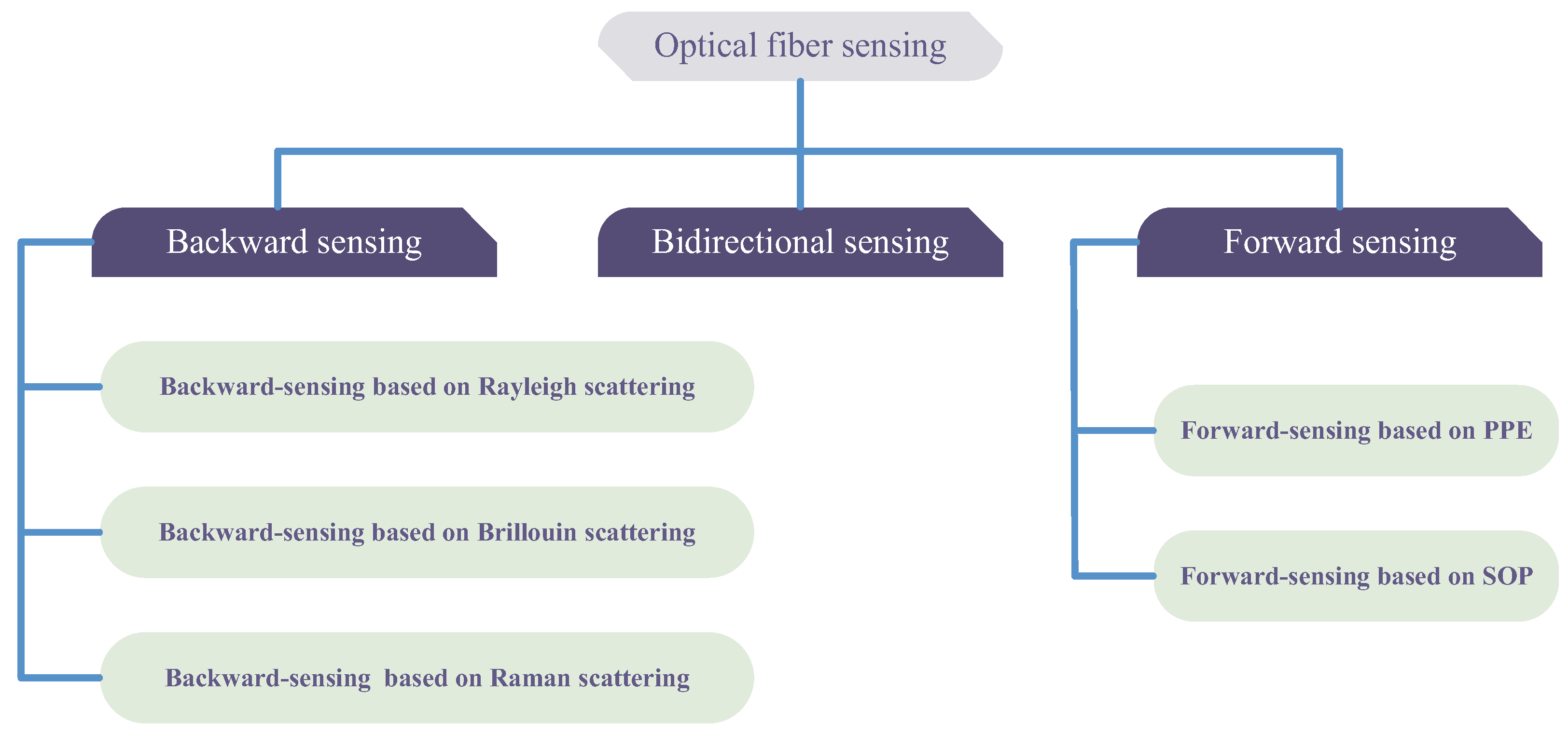
Although optical-network ISAC systems provide new possibilities for the application of intelligent optical networks, they trigger many technical problems and challenges. Further in-depth research is still needed in aspects such as signal compatibility, interference control, and data processing efficiency, etc. For processing communication and sensing signals in current optical-network ISAC systems, there are two main approaches. One approach is that communication signals and sensing signals exist independently and are transmitted through multiplexing techniques, such as the architecture based on backward-sensing and bidirectional sensing, which is called multiplexing of communication signals and sensing signals. The other approach is that sensing signals do not exist independently. Instead, sensing information is extracted directly from communication signals, which can be defined as the integration of communication and sensing signals, such as in forward-sensing architectures based on SOP and PPE. In the context of communication and sensing signals multiplexing, utilizing weakly coupled multi-core fiber effectively solves signal crosstalk; however, they incur significant underutilization of fiber core resources. Conversely, wavelength division multiplexing (WDM) schemes remain susceptible to inter-signal interference. Although fully integrated approaches successfully address crosstalk challenges, they introduce substantial computational overhead due to the considerable increase in data processing requirements, such as the PPE method, which usually needs complex digital signal processing (DSP) at the receiver end [18].
This article focuses on the challenging issues and current solutions for realizing integrated optical fiber sensing and communication technology for optical networks. We compared and analyzed the advantages and disadvantages of three different types of sensing, as well as their applicable scenarios, introducing their potential application capabilities in the optical-network ISAC systems. Through describing the efforts of dealing with the co-existence of sensing signals and communication signals, this paper briefly introduces the methods used and the functions achieved. The aim is to present the core key technologies that need to be broken through, providing an important reference for the future development and application of the optical-network ISAC systems.
The rest of the paper is organized as follows. Section 2 discusses the fundamental technical principles of optical-network ISAC, including backward-sensing, forward-sensing, and bidirectional sensing. Section 3 reviews the technical difficulties and the solutions of the key technology in optical-network ISAC. The solutions both at the transmitter and receiver sides can be found, involving the integration and multiplexing of communication signals and sensing signals, parametric detection, and channel reconstruction. Section 4 presents new opportunities and major challenges. Finally, Section 5 concludes this paper.

2. The Fundamental Technical Principles of Optical-Network ISAC

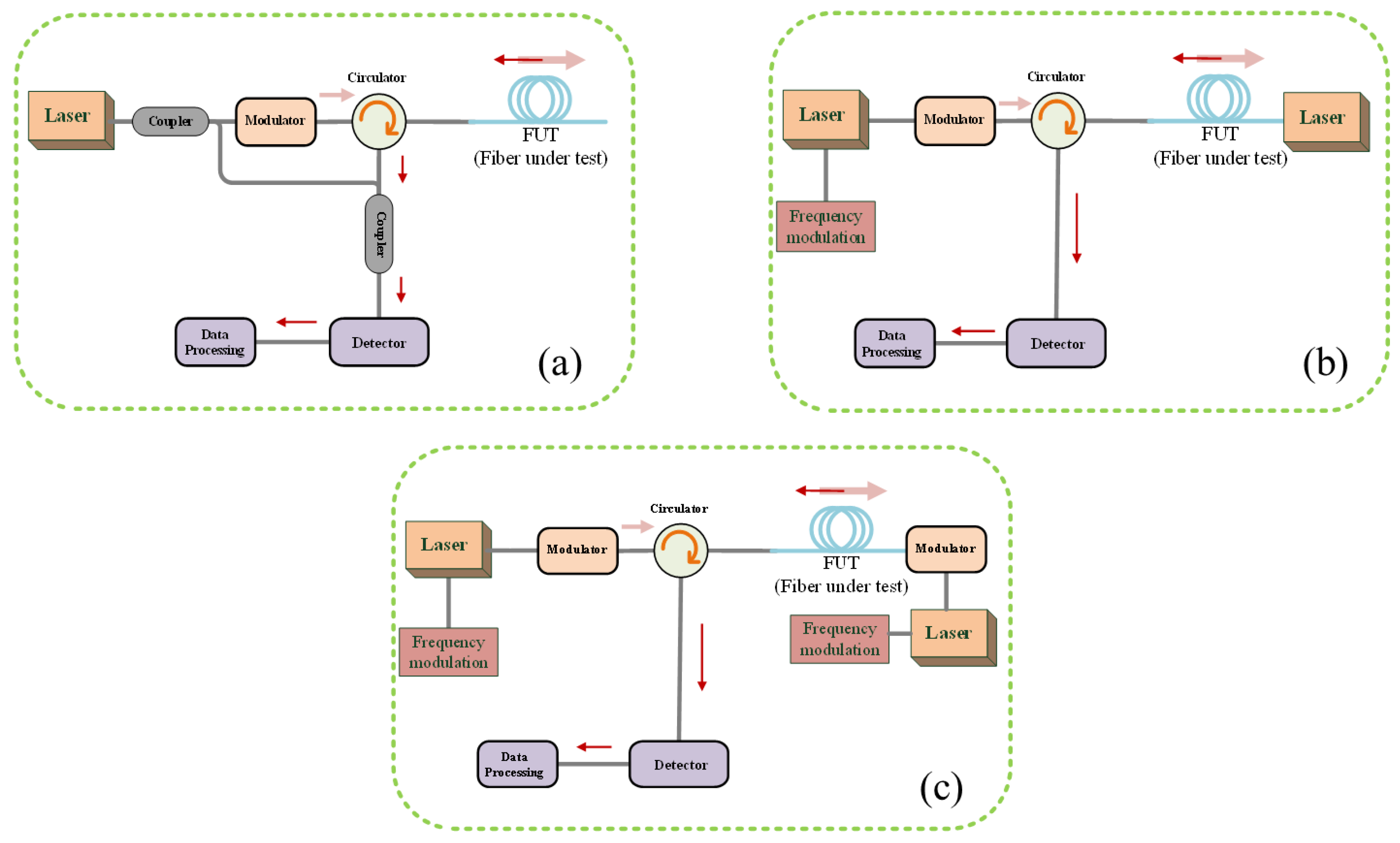
The optical-network ISAC technique can be classified into three types based on the relative position of the transmitter and receiver of its sensing part, as shown in Figure 1.
(1) When both the transmitter and the receiver are located on the same side and share the same optical fiber, it is categorized as the backward-sensing technology. (2) If the transmitter and the receiver are situated on opposite sides of the same optical fiber, it is classified as forward-sensing technology. (3) When the transmitter and the receiver are positioned on the same side but use two independent optical fibers, this configuration is termed bidirectional sensing technology.

2.1. Backward-Sensing

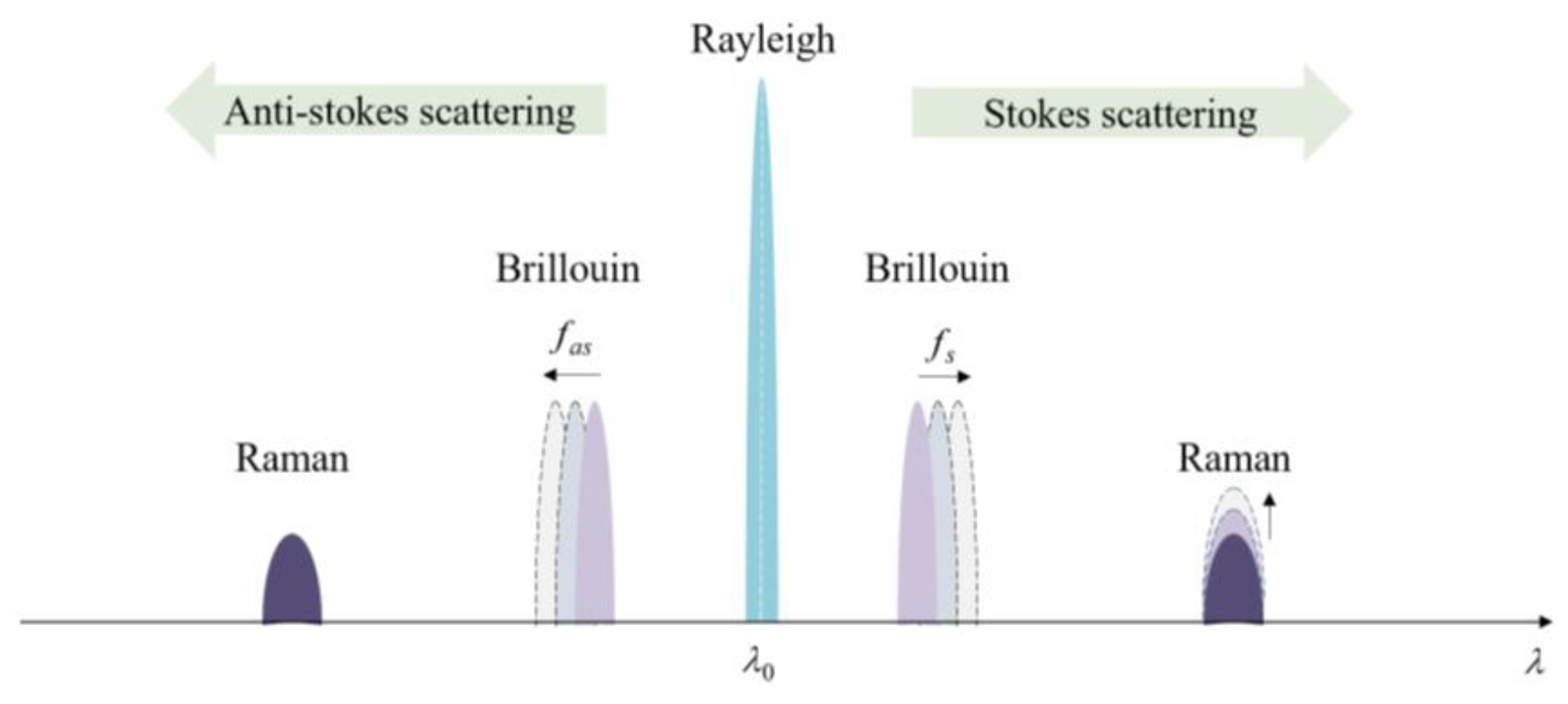
As early as the 1970s, researchers began investigating the backscattering effect in optical fibers [19]. As illustrated in Figure 2, when light waves propagate through the fiber, three types of backscattered light are excited, including Rayleigh scattering, Raman scattering, and Brillouin scattering. By monitoring the amplitude or frequency shifts in the backscattered light, various physical parameters can be obtained.

2.1.1. Backward-Sensing Based on Rayleigh Scattering

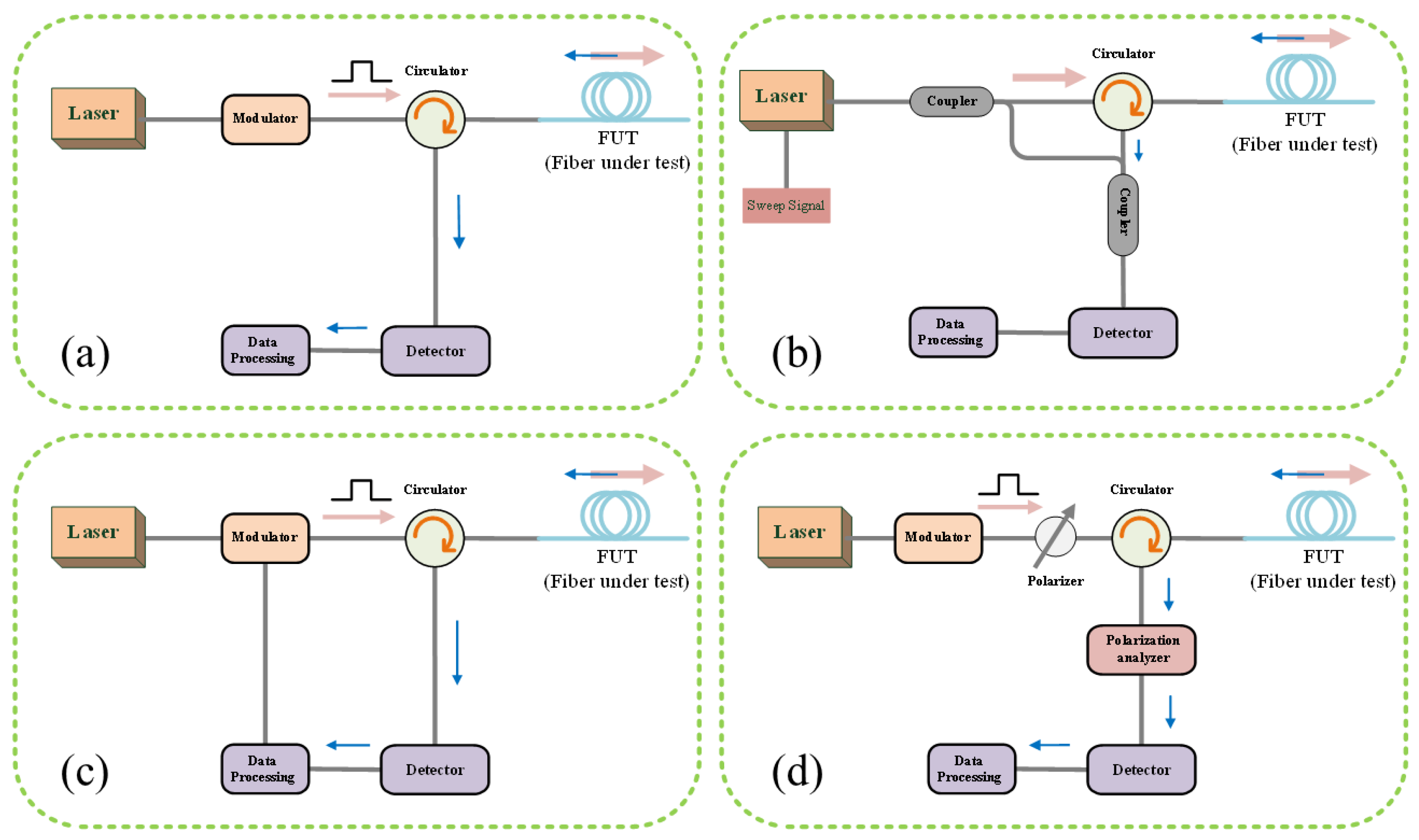
Rayleigh scattering is an elastic scattering process that causes intensity fluctuations without inducing frequency shifts [20]. When a short light pulse is launched into the optical fiber, it scatters light along almost all directions based on the Rayleigh scattering effect, but only the Rayleigh backscattering power can propagate in the fiber and be captured [21]. The Rayleigh scattering power is determined by the signal power, and the loss in the optical fiber link can be assessed through the Rayleigh scattering power loss. Based on the above characteristics of Rayleigh scattering, optical time domain reflectometry (OTDR), as shown in Figure 3a, and optical frequency domain reflectometry (OFDR), as shown in Figure 3b, have been developed to locate loss points in both the time and frequency domains along the optical fiber link.
In an OTDR system, a probe light pulse is sent into the optical fiber under test (FUT) [22]. At the input end, the Rayleigh backscattering (RBS) is received, and the amplitude of RBS follows a decaying curve. By mapping the decaying curve of time, the location information about the event points can be obtained. If t is the delay between the launch of the pulse and the time at which RBS is received, the distance D can be calculated by [23,24]
D = c n × t 2
where c is the speed of light in vacuum, and n is the refractive index of the fiber.
The OTDR system features a simple structure and mature technology. However, its spatial resolution decreases as the measurement distance increases [25]. To improve its performance metrics, such as sensor sensitivity, researchers have utilized the phase and polarization information of scattered light to monitor the fiber link state, leading to the development of phase-sensitive OTDR (Φ-OTDR), as shown in Figure 3c, and polarization-sensitive OTDR (P-OTDR), as shown in Figure 3d.
In a Φ-OTDR system, a coherent optical pulse is sent into the FUT. By analyzing the phase variations in multiple scattered signals and the resulting changes in interference intensity, the vibration location can be quantified [26]. The Φ-OTDR system exhibits three advantages: high sensitivity, high spatial resolution, and long detection range [27]. However, in practical applications, the use of the Φ-OTDR system is limited by the tradeoff between the sensing range, the spatial resolution, and the frequency response bandwidth [28]. Compared with the Φ-OTDR system, the P-OTDR system has advantages in the increase in measurement length and moderate sensitivity, owing to the structure of one polarizer and one polarization analyzer. By utilizing the polarization changes induced by optical fiber birefringence, the P-OTDR system can extract information on external temperature, vibration, and strain, which provides higher measurement accuracy and spatial resolution [29]. Due to using continuous wave light instead of a light pulse as the source, the OFDR system enables a higher signal-to-noise ratio (SNR) than the OTDR system. Meanwhile, the OFDR system can easily realize a spatial resolution as low as several tens of micrometers [30]. However, OFDR is very sensitive to laser phase noise, leading to shorter sensing distances with low response bandwidth [23]. Therefore, the performance of OFDR is constrained by the linewidth of the laser and the nonlinearity of the frequency sweep [20], limiting its applications in long-distance optical-network ISAC.

2.1.2. Backward-Sensing Based on Brillouin Scattering

Brillouin scattering differs from Rayleigh scattering in that it is an inelastic scattering process, which is the result of the interaction between the incident photon and an acoustic phonon. When this process occurs in an optical fiber, the backscattered light undergoes a frequency shift known as the Brillouin frequency shift (BFS) f B , which changes linearly with strain and temperature [31]. The event of a temperature change T , and/or strain of ϵ at a specific location along the fiber can be expressed by [32,33]
f B = C T T + C ϵ ϵ
where C T and C ϵ are the temperature and strain coefficients, respectively.
One of the typical structures utilizing Brillouin scattering is Brillouin optical time domain reflectometry (BOTDR), as shown in Figure 4a. When a probe pulse is launched into the FUT, its spectrum is analyzed to obtain the BFS, and then the strain and temperature distribution can be mapped along the length of the optical fiber [34]. BOTDR has many exclusive advantages, including simple architecture, single-end access, easy implementation, and widespread field applications [35]. However, due to the low efficiency of self-releasing Brillouin scattering in optical fibers, coherent detection technology is usually used to improve spatial resolution and accuracy. A continuous wave probe light is introduced oppositely to the pumped pulse light, and interacts with the pump pulses in the optical fiber, which is the technique known as Brillouin optical time domain analysis (BOTDA), as shown in Figure 4b [36]. Using short pulses can enhance spatial resolution, while the Brillouin interaction spectrum is broadened, reducing the strain and temperature measurement accuracy [37]. Moreover, the BOTDA system is relatively complex, so there are few commercial applications at present.
In addition to BOTDR and BOTDA, Brillouin scattering with optical correlation is used in Brillouin optical correlation domain analysis (BOCDA), as shown in Figure 4c. Compared with BOTDR and BOTDA, the BOCDA system based on the coherence method can provide advantages of a higher spatial resolution and a higher sampling rate, and can achieve random access of the sensing position [38]. However, the excellent spatial resolution capabilities provided by BOCDA are at the expense of the maximum number of sensing points [39].

2.1.3. Backward-Sensing Based on Raman Scattering

Another form of inelastic scattering is Raman scattering [40], where the interaction between pulsed light and molecular vibrations changes the frequency of the incident light as it propagates through the optical fiber [41]. This frequency shift occurs due to the absorption or emission of optical phonons from the fiber, resulting in higher-frequency anti-Stokes light or lower-frequency Stokes light, respectively [42]. The intensity of the anti-Stokes light exhibits high sensitivity to temperature changes, whereas the intensity of the Stokes light remains relatively insensitive [43].
The occupation probabilities of Stokes and anti-Stokes photons are given by the following equation [44].
P s z = 1 1 e x p ( E k T ( z ) )
P a s z = 1 1 e x p ( E k T ( z ) )
where E is the Raman energy shift, k is the Boltzmann constant, and T ( z ) represents the temperature at position z along the optical fibers. Based on Equations (3) and (4), the temperature can be determined by the logarithm of the power ratio between the Stokes and anti-Stokes frequencies measured at the receiver [45].
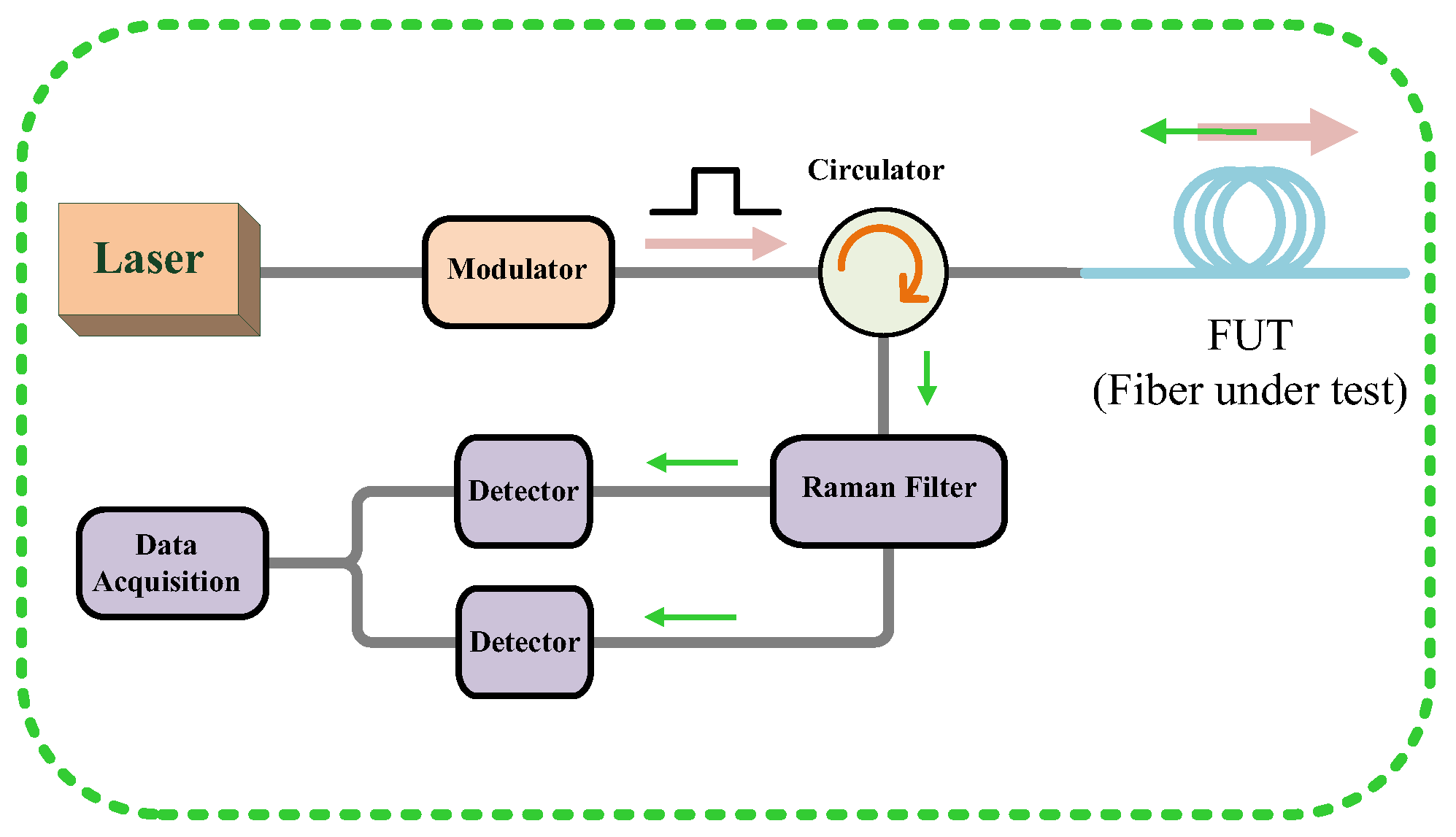
Distributed optical fiber sensing based on Raman scattering, known as Raman Optical Time Domain Reflectometry (ROTDR), as shown in Figure 5, utilizes a structure similar to BOTDR, where a short and strong laser pulse is launched into the FUT, and the backscattered Raman light is detected with information on loss and temperature along the optical fiber [46]. Since ROTDR allows temperature measurements without any cross-sensitivity with other parameters, such as strain, it provides advantages of high sensitivity, fast measurement speed, and simple structure [47]. However, due to the low Raman scattering coefficient of optical fibers, which makes temperature information susceptible to other noise, a trade-off has to be made between the SNR and the transmission distance. To address these challenges, one of the methods is the use of optical pulse coding [48], enabling more accurate measurements at long distances with meter-scale spatial resolution. Moreover, it should be noticed that, in multi-band optical fiber communication systems, the Raman scattering spectrum and the communication signal exhibit spectral overlap, which complicates the detection of their offset, limiting the integration of sensing and communication.
As can be seen from the backward-sensing technology derived from the above three scattering principles, as shown in Table 1, backward-sensing based on Rayleigh scattering is the simplest and most cost-effective, making it particularly suitable for engineering applications. This method has been widely adopted in various engineering fields. The advantage of backward-sensing lies in its excellent spatial resolution; however, due to the weak backscattered power, the SNR of the detected signal is typically very low, which limits the overall performance of the sensing system. Additionally, for long-distance transmission, the use of online amplifiers and similar devices can interfere with backscattered signal reception. As a result, the communication link must be redesigned to address this issue, so the backward-sensing technology faces numerous challenges that need to be addressed for the optical-network ISAC.

2.2. Forward-Sensing

2.2.1. Forward-Sensing Based on PPE

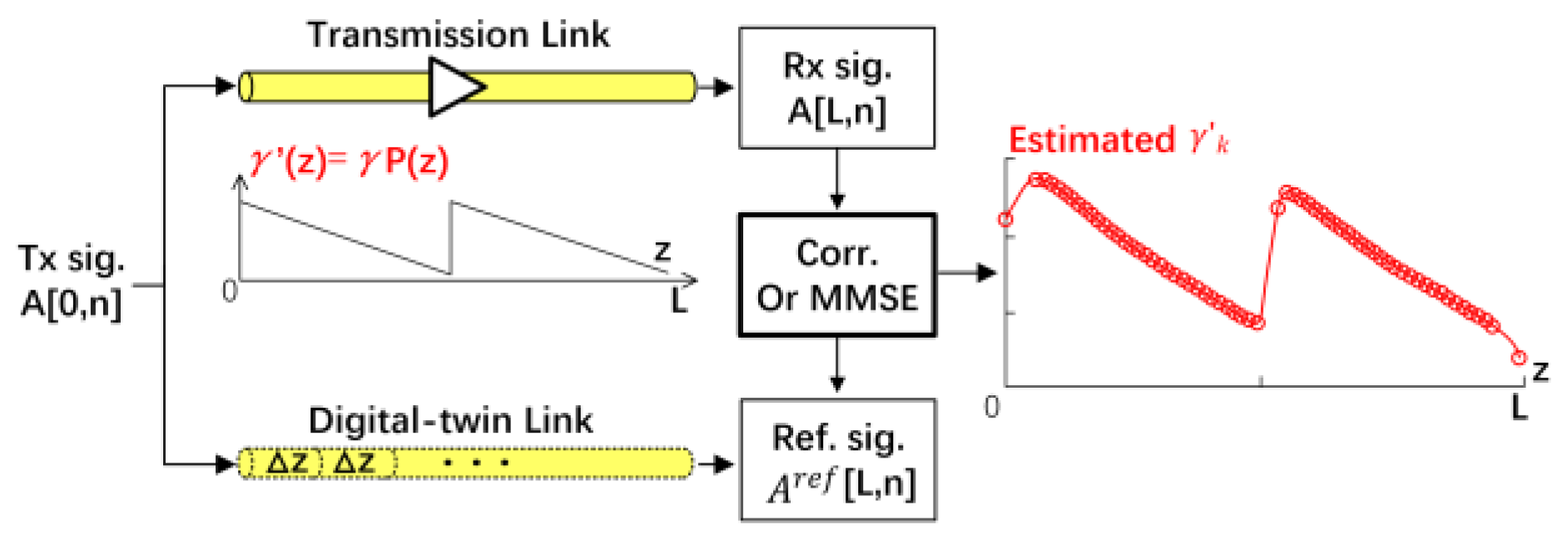
The power profile estimation (PPE) is a typical distributed optical performance monitoring (OPM) approach based on digital signal processing (DSP) at the receiver end [18], making it an economically viable tool for monitoring the performance of modern optical networks. In existing PPE methods, both least squares-based (LS) and correlation-based (CM) methods estimate the longitudinal power profile by comparing the received signal with a digitally emulated reference signal [49]. Figure 6 illustrates a typical configuration of PPE methods [50,51].
PPE can be formulated as solving the problem of the nonlinear Schrödinger equation (NLSE) given in Equations (5) and (6) [51], where the nonlinear coefficients are reconstructed from the boundary conditions.
A z = j β 2 z 2 2 t 2 + β 3 z 2 3 t 3 A j γ ( z ) A 2 A
γ z γ z P 0 exp 0 z α z d z = γ z P ( z )
where A A ( z , t ) , γ z is the nonlinear coefficient, α(z) is the fiber loss, β 2 z , β 3 z represent the second/third dispersion, respectively, and P ( z ) is the optical signal power at z . Note that, in this formulation, the power of A ( z , t ) is normalized to 1 regardless of the position z [52]. Thus, the estimation target is γ ( z ) , and P ( z ) can be inferred by estimating γ ( z ) , assuming that γ ( z ) is constant.
PPE has several advantages over the OTDR: (i) there is no probing light or additional optical configuration required; (ii) it has more applications, such as multi-path interference, polarization-dependent loss, etc.; (iii) it can be used to simultaneously and digitally characterize multiple components across various links at a single coherent receiver [51,53]. Therefore, the PPE method has the potential to replace existing hardware-based approaches, by the physical parameter distributions of various link components [51]. Additionally, PPE can reduce both capital expenditures and operational expenditures for optical networks.

2.2.2. Forward-Sensing Based on SOP

The principle of optical fiber sensing based on the state of polarization (SOP) is that dynamic environmental changes lead to a change in the birefringence of the optical fiber [54]. By continuously analyzing the SOP data obtained from the output, various external disruptions can be identified [55]. The output SOP at the receiver typically differs from the input SOP due to changes in the Polarization Mode Dispersion (PMD) along the optical fiber length and time [54]. Additionally, the SOP changes in response to the environmental fluctuations can be modeled as a stochastic random walk on the Poincaré sphere [54,56,57]. It is demonstrated that the following formula can describe the strain induced by vibrations [58,59].
s 2 = π 4 2 π c λ 2 0 z k 2 ϵ 2 ( t ) d z
where τ 2 z = ( 3 π / 8 ) k 2 , k 2 = τ 2 / z , τ is the PMD vector. It can be seen from Equation (7) that the signal power is proportional to the integral of the square of the strain change [60].
Monitoring the SOP within optical fibers provides a powerful tool for detecting line vibration, strain changes, and external damage from mechanical vibrations to natural disasters like earthquakes [55]. Typically, DSP techniques are employed at the receiver to analyze SOP changes after coherent signal transmission, and then the environmental parameters along the fiber link are calculated and analyzed to identify anomalies and trends. Moreover, it does not require additional sensing equipment, and its monitoring distance is not limited. It can flexibly monitor the environmental parameters of the optical fiber link without affecting the networking scheme, with the advantages of low cost, flexible application, and suitability for large-scale deployment.
The sensing system based on forward transmission is easy to integrate with optical communication systems, because of its same transmission direction as optical communication systems. Moreover, since the forward transmission signal has much higher power than the backscattered signal, and it can be further boosted by the online optical amplifiers, such as erbium-doped fiber amplifiers (EDFAs), the forward-sensing technology has greater potential for achieving ultra-long sensing distance and high location accuracy [61].

2.3. Bidirectional Sensing

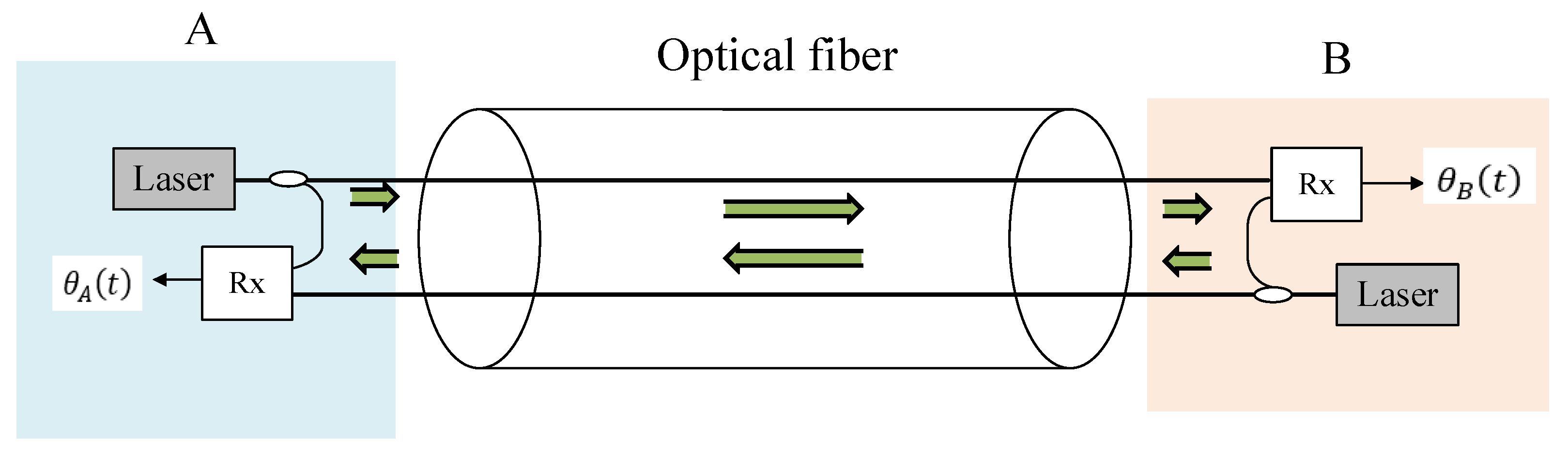
The bidirectional sensing scheme is composed of two optical fiber links [13,59,62]. As shown in Figure 7, from the West(A) transponder to the East(B) transponder, an unmodulated continuous wave laser is transmitted over the upper fiber link, and at the receiver, a narrow-line-width laser as a local oscillator (LO) is used to coherently detect the signal. Similarly, from the East transponder to the West transponder, the signal is transmitted over the lower fiber link. Then, the external disturbance location can be realized by detecting the phase change in the interference signals by obtaining optical-to-electrical downconversion at each receiver.
Let the signals transmitted by the West(A) and East(B) transponders be x B ( t ) = P B e j ( 2 π f B t + φ B t ) and x A ( t ) = P A e j ( 2 π f A t + φ A t ) , respectively, then the phase of the interferometric signal obtained at the two sides can be written as [59,62]:
θ B t = 2 π f A f B t + φ A t τ φ B t + φ v i b t τ B + φ n , B t
θ A t = 2 π f B f A t + φ B t τ φ A t + φ v i b t τ A + φ n , A t
where f and φ t are the optical frequencies and phase noises, respectively, P represents the launched power, τ = L / ( c / n e f f ) is the phase delay of the link with length L , and n e f f is the phase velocity index. z A and z B denote the distances from the vibration source to each receiver, while τ A = z A / ( c / n e f f ) and τ B = z B / ( c / n e f f ) are the corresponding delays. φ v i b t represents the vibration-induced phase of interest, and φ n t denotes the equivalent phase noise produced by each receiver due to all the additive white Gaussian noise (AWGN) sources in the link, including amplified spontaneous emission (ASE) of online amplifiers and receiver noise. A vibration event can be detected when it occurs and its amplitude exceeds the sensitivity threshold, and the position of vibration can be estimated by taking the correlation between θ B t ~ φ v i b t τ B and θ A t ~ φ v i b t τ A [62].
Bidirectional sensing technology requires two transponders at the ends of the optical fibers, which not only significantly increases the complexity of the system design but also may bring more technical challenges, such as the accurate synchronization of time between devices at two ends, thereby hindering the realization of integration and collaboration with the existing communication network.
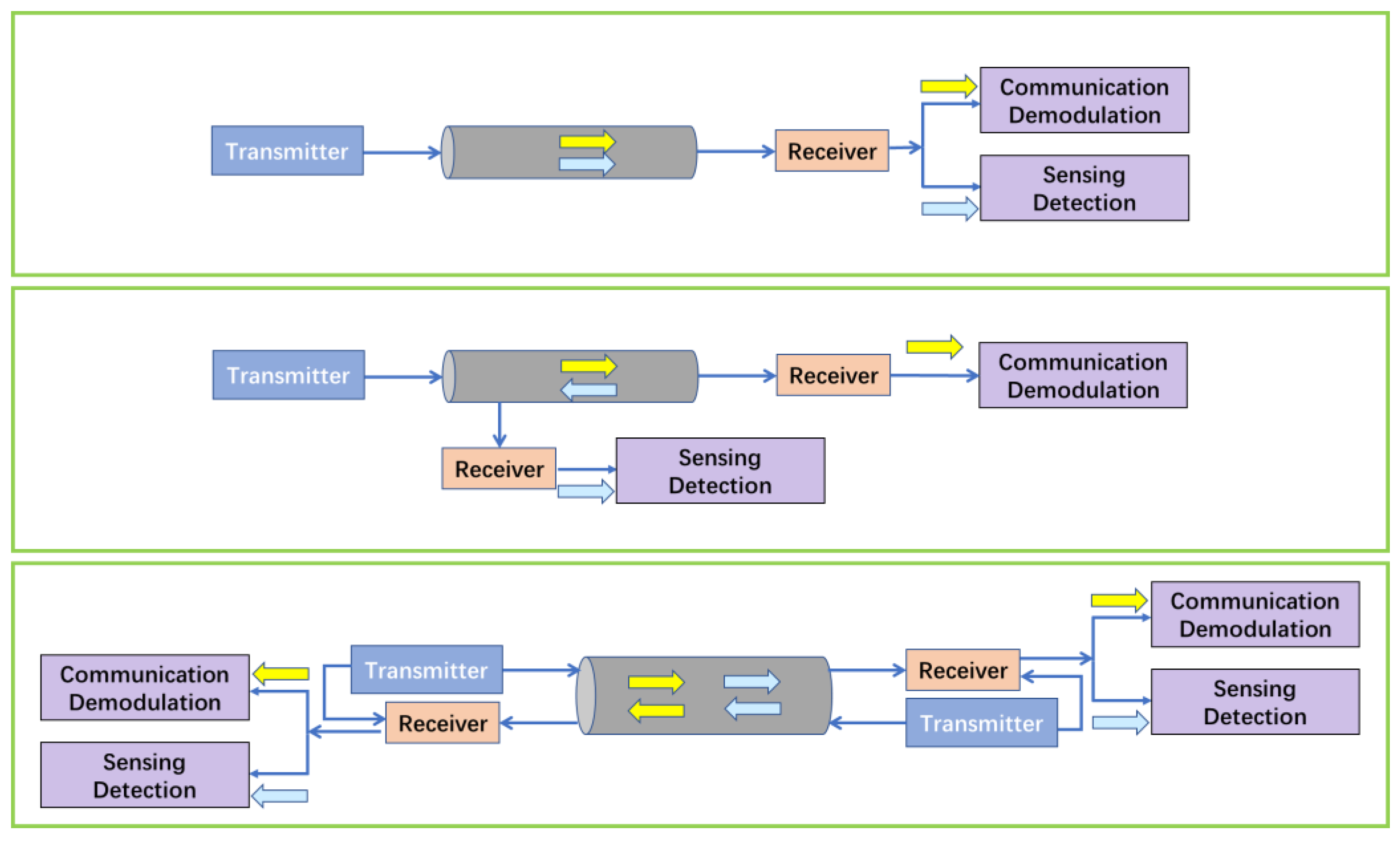
The architecture of the optical-network ISAC system varies depending on the different types of optical fiber sensing, as shown in Figure 8. The basis for this classification of optical fiber sensing mainly depends on how the sensing signal is acquired in the optical-network ISAC system.
Based on the three types of sensing technologies mentioned above, it is only necessary to add simple receiving equipment or perform corresponding data processing based on existing optical fiber links, amplifiers, and other equipment to realize the optical-network ISAC system. Without affecting the communication performance, the sensing can be realized in the existing pure optical fiber communication system. Although in some backward or bidirectional sensing configurations, the injection of sensing signals may bring additional noise, crosstalk, or link loss, which may adversely affect communication performance, this trade-off does not negate the inherent advantages of integration. At the same time, optical fiber, as a communication medium, has unique advantages in sensing functions, such as the ability to achieve high sensitivity and distributed or point measurement, and support long-distance, continuous spatial resolution monitoring. The optical fiber itself has excellent communication characteristics such as extremely low transmission loss, high bandwidth, and anti-electromagnetic interference, which enable it to stably transmit sensing signals in complex environments.

3. Key Technology of the Optical-Network ISAC

Although optical fiber communication and optical fiber sensing systems have the inherent advantage of integration, the co-propagation of communication signals and sensing signals in the same channel inevitably introduces a series of challenges.
First, communication signals and sensing signals have different optimization objectives. Communication signals must be transmitted stably, even in the presence of external interference, while sensing signals require sensitivity to the external environment. Therefore, the channel is required to have both good robustness and extreme sensitivity to environmental changes, which is a technical contradiction. If the communication signal and the sensing signal are combined into an integrated signal for transmission, different optimization objectives of the communication signal and the sensing signal need to be taken into account. During the transmission of the integrated signal, to ensure the accurate detection of the sensing signal, a high-power optical signal must be maintained. However, excessive optical power will trigger nonlinear effects, causing channel damage to the integrated signal and waveform distortion. This leads to an increase in the bit error rate and is not conducive to communication transmission.
Second, while ensuring the perception ability of the integrated signal to the outside world, some additional environmental noise is introduced, inevitably reducing the SNR of the integrated signal and the quality of communication. Although some methods, such as WDM, can be utilized to integrate the communication signal and the sensing signal, the sensing signal has to occupy a separate wavelength channel in such a scheme, thereby reducing the overall spectral efficiency as well as the network capacity. Therefore, achieving a balance between communication and sensing performance and minimizing crosstalk between the two signals is crucial for realizing the deep integration of the two subsystems.
In addition, simultaneously detecting the sensing signal and the communication signal at the receiver is also challenging. Facing various environmental interferences and dynamic changes, it is necessary to constantly adjust the algorithm parameters in combination with technologies such as AI algorithms to meet the actual needs. Therefore, achieving high-quality restoration of communication signals while maintaining high spatial resolution in sensor signal detection remains difficult and a hotspot in the research.
Recently, a series of studies and explorations have been carried out in response to the above issues. Some focused on the transmitter, some sought solutions from the receiver, and others combined the transmitter and receiver to jointly address the problems. In the following section, we analyze and compare the advantages and disadvantages of these solutions.

3.1. Solution at the Transmitter

The current solutions to the cross-talk problem of communication signals and sensing signals can be classified into two categories. One is the multiplexed transmission of communication signals and sensing signals, including mode-division multiplexing (MDM), WDM, and SDM, etc. The other is the integration solution, i.e., the communication signals and sensing signals co-propagating in the optical fiber as an integrated signal.

3.1.1. Multiplexing of Communication Signals and Sensing Signals

In recent years, leveraging methodologies such as MDM, SDM, and WDM has been reported to enable both data transmission and distributed vibration detection to coexist in the same fiber link. Among these techniques, the WDM scheme is more attractive, without the waste of fiber resources compared with MDM and SDM, where the communication signals and the sensing signals are loaded at different wavelengths.
In 2022, Marin et al. [63] designed and tested the co-existence of DAS and optical communication over a two-mode fiber (TMF). In this design, LP01 was for communication, and the degenerate LP11a mode was for DAS. In particular, both the DAS and communication signals co-propagated at the same wavelength, avoiding the waste of wavelength. A proof-of-concept experiment reported that orthogonal frequency-division multiplexing (OFDM) transmission could achieve a data rate of up to 4.2 Gb/s with a bit error rate (BER) of 3.2 × 10⁻³ that co-existed with DAS. In 2023, Marin et al. [64] further proposed the co-propagation of Kramers–Kronig (KK) communication and DAS scheme over a TMF. The improvement compared to before was that the KK was introduced, whose phase could be uniquely recovered from the amplitude, so just one photo-diode (PD) was needed to transmit a complex signal. As a proof-of-concept demonstration, the experiment showed that DAS with an SNR larger than 2 dB and a gross data rate of 2.04 Gb/s could be achieved over 1 km of fiber.
Although the method of MDM can achieve effective co-propagation of sensing signals and communication signals, the sensing range is limited due to the influence of intermodal crosstalk. Moreover, single-mode fibers are commonly used in current commercial optical fiber systems, so other methods are studied. In 2023, Chen et al. [65] deployed a seven-core optical fiber cable for optical-network ISAC, where one core was for sensing while the other six cores were for communication. Field trials of transmission with a net capacity of 187.49 Tb/s using C-band 93 WDM channels had been successfully demonstrated, with a spatial resolution of 5 m. This system had been successfully applied to monitor the real-time operation of the urban metro in Guangzhou, accurately identifying the direction and speed of trains. In 2023, Zhang et al. [66] used the SDM method to achieve a 50-Gbaud DP-16QAM transmission system integrated with a sensing system based on BOTDA. The proposed system provided a sensing range of 16 km with a spatial resolution of 3 m and a temperature accuracy of 1 °C. For the multicore fiber link, the inner core was for sensing, while one of the outer cores was used to transmit the data signal. This was specially chosen to prevent the mechanical effect of random bending and twisting of the fiber coiling, which could cause the random variation in BFS. In 2023, Li et al. [67] achieved simultaneous vibration sensing and high-speed communications by a weakly coupled seven-core fiber. The sensing signal and the communication signal propagated in different cores over a 41.4 km fiber link. At the transmitter, the sensing signal was injected into the center core of the fiber, whereas the communication signal traveled in the outer six cores. Due to DSP-assisted interference fading mitigation, the 100 Hz sinusoidal disturbance was detected while transmitting 120-Gbaud 16QAM signals. In 2023, Tang et al. [68] presented an optical transmission system in which the detection of fiber vibration direction and location of the vibration source could be obtained simultaneously based on a weakly coupled multi-core fiber (MCF). In the proposed scheme, 6 branches of telecommunication signals forward propagated in core 1 to core 6, respectively, while a counter-propagating continuous-wave carrier 2 (CW2) was injected into core 1. Detection was realized by exploiting continuous-wave carrier 1 (CW1) in core 7. By leveraging the differential phase information retrieved from two-counter-propagating CW carriers, multidimensional vibration sensing was achieved, while transmitting in the meantime a single-carrier 16QAM signal reaching a net data rate of 5.36 Tb/s over 41.4 km. The special feature of this scheme was that it directly measured the forward signals, rather than the backscattered light, compared with the above schemes. In 2024, Tang et al. [69] achieved distributed vibration sensing and simultaneous transmission using seven-core fiber once again. This time, CW1 and CW2 propagated in the central core, which was used for sensing, and the six outer cores were for transmitting. Using the cross-correlation between the phases of CW1 and CW2, vibration detection and accurate localization were achieved, with the transmission of a single-carrier net 5.36 Tb/s signal over 41.4 km of fiber.
The crosstalk can be effectively solved by SDM, but it brings the issue of fiber core resource waste, so a series of studies is deployed for traveling through the same fiber core. In 2019, Wellbrock et al. [70] proved the coexisting system of 36.8 Tb/s data transmission and distributed optical fiber sensing through operation of a commercial telecom network, with a resolution as low as 1 m over 80 km of fiber. The communication channels and the fiber sensing signal traveled through the same fiber, but propagated in opposite directions. To reduce the fiber nonlinearity crosstalk, two wavelength-selected switches (WSS) were used to multiplex the communication signals and the sensing signals. An accuracy of 94.5% for moving vehicle density measurement and 98.5% for speed measurement was achieved by detecting and tracing vibration through fiber deployed. In 2020, Aono et al. [71] proposed a bidirectional WDM scheme where data transmission and sensing systems coexist in the low-loss C-band, the data channels and sensing pulses propagated in opposite directions in each fiber to reduce their mutual nonlinearities. Using this architecture, DVS of vehicular traffic over a deployed cable carrying live data traffic was demonstrated. Machine learning (ML) on the raw data captured with DVS allows the determination of vehicle flow conditions, average vehicle speed, and even pavement deterioration. In 2020, Luch et al. [72] presented a counter-propagating coherent vibration sensing approach to detect and localize mechanical stress applied to the network cable. All the wavelengths in the dense wavelength division multiplexing (DWDM) were used for normal data traffic transmission, unless one of them was dedicated to sensing. With the coherent approach adopted in a counter-propagating interferometer, the proposed sensing solution had been experimented with in a metro ring of 32 km standard single-mode fiber (SMF) deployed in the city of Turin, Italy, devoted to telecom applications.
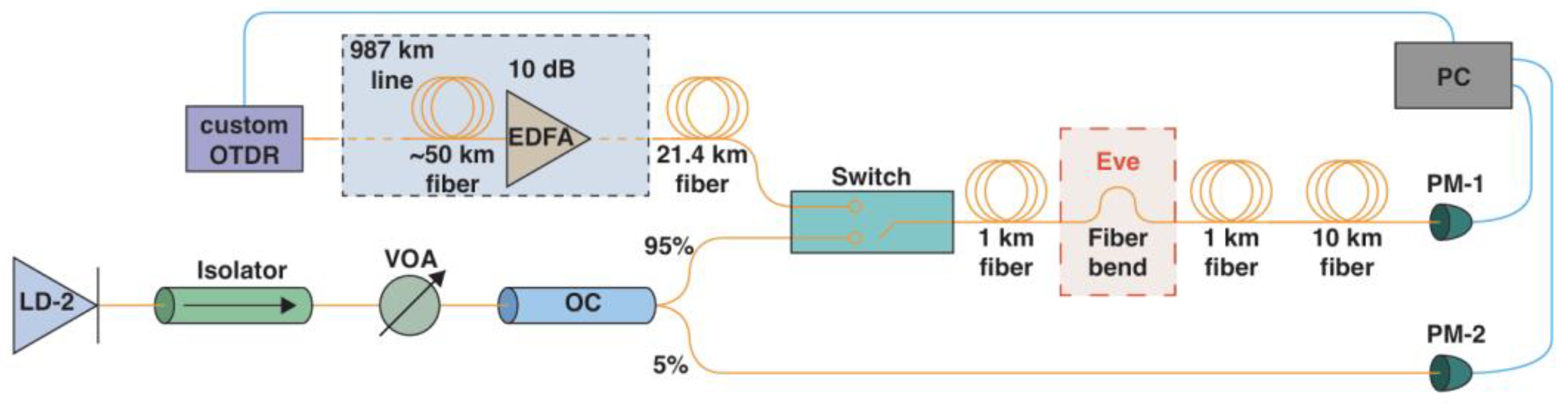
Besides the above counter-propagating method, the co-propagation scheme has also attracted the attention of scholars. In 2020, Huang et al. [73] reported the first coexisting system of 36.8 Tb/s data transmission and distributed optical fiber sensing through a commercial telecom network. In that architecture, among the 15 channels, the three central channels were reserved for the sensing signals. Optimal performance was achieved by using the most central channel for sensing, while the two adjacent channels were deliberately left unoccupied to minimize potential interactions between data signals and sensing signals, which allowed the co-existence between data transmission and sensing on the same fiber. In 2022, Chen et al. [74] reported the co-propagation of a L-band chirped pulse DAS system with the data traffic in the C-band. Due to the use of low peak power chirped pulse, the non-linear effects of XPM and Raman effects on the data channels were reduced. The experimental results verified that the DAS system can accurately locate the vibration, at a spatial resolution of 10 m, with 100 Gb/s DP-QPSK transmission over 50 km fiber. In 2024, Brenne et al. [75] described the DAS operating in the L-band for non-intrusive coexistence with live C-band WDM channels, carrying a 400 Gb/s net channel data rate with DP-16QAM modulation format. The sensing signals were allowed both co- and counter-propagating coexistence with live WDM channels, by utilizing the frequency swept interrogation (FSI) technique to reduce the pulse peak power of the DAS probe pulses. A field experiment reported that surface vessels, seabed fishing gear, and earthquakes could be localized on the full 83 km shore end span of the 2Africa Marseille branch. In 2023, Li et al. [76] designed a real-time DAS system based on field-programmable gate array (FPGA) with a spatial resolution of 10 m and sensing external vibrations at 75 km, and explored the performance of coexistence with high-speed communication signals. Depending on the bands of sensing and communication, the discussion was divided into two ways: in-band and out-of-band. When in-band co-propagation with 200 G/400 G 16QAM data transmission, DAS with S-band could provide a sensing distance of 22 km at an optical signal-to-noise ratio (OSNR) penalty of 0.5 dB. In the case of out-of-band coexistence, DAS with C-band could achieve sensing distances of ~35 km and ~60 km under co-propagation and counter-propagation. In 2025, Yarovikov et al. [16] used the dual-mode optical switch to toggle between the transmission coefficient measurement mode and the OTDR mode, as shown in Figure 9, achieving detection of a 0.01 dB leakage over a distance of 1009 km with a spatial resolution of 80 m. This approach was compatible with both classical systems and control-based quantum key distribution (QCKD) protocol, with bidirectional amplifiers. The proposed quantum communication protocol not only provided physically secure key transmission, but also overcomes long-distance transmission limitations by combining with OTDR monitoring technology.
The optical-network ISAC based on WDM generally requires the use of independent communication and sensing devices, which significantly increases the deployment cost. Furthermore, this scheme reserves a separate wavelength channel for the sensing signal, which results in a waste of spectrum resources. A comparison of the current studies on multiplexing methods is presented in Table 2.

3.1.2. Integration of Communication Signals and Sensing Signals

Reducing the peak power of sensing pulses can significantly solve the cross-talk problem between sensing signals and data transmission signals, thereby enabling their co-existence. However, this reduction inevitably decreases the sensitivity of the sensing signals and shortens the sensing range. Thus, a series of studies and discussions have been carried out on the sensing technology based on linear frequency modulated (LFM). Chirped pulses feature linear frequency modulation, and after matched filtering at the receiver, they produce a highly narrow sync function in intensity distribution. This mechanism ensures that spatial resolution depends only on the frequency scanning range, effectively decoupling pulse width from spatial resolution. The use of chirped pulses can ensure the energy of the sensing pulse while reducing the peak power of the pulse, which can ensure high-performance coexistence with the communication signals.
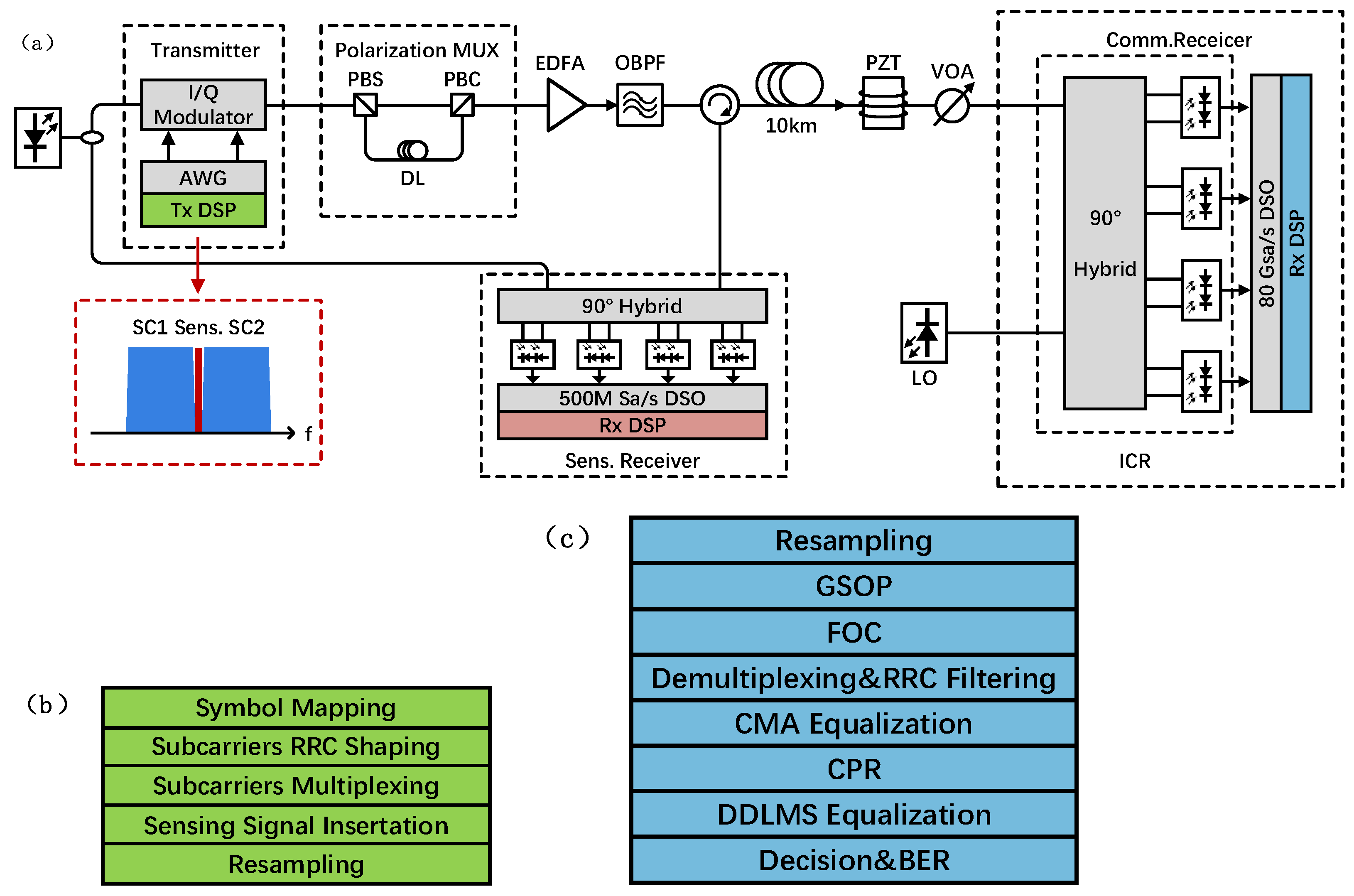
In 2023, He et al. [77] proposed a pulse amplitude-modulation (PAM4) signal with chirp, which was generated using LFM light, functioning as a sensing probe to detect vibrations along the fiber, which enabled simultaneous data transmission and vibration monitoring using the same channel (including the same optical fiber and the same spectrum resources). It was shown that 56 Gb/s 4-level PAM4 signal transmissions and distributed vibration measurements were simultaneously implemented over 24.5 km of fiber. In 2022, Ip et al. [78] tried to use frequency-diversity chirped-pulse DAS with correlation detection and diversity combining, achieving the coexistence of the sensing signal with 10 Tb/s data transmission over a 1000 km experiment demonstration. An all-Raman amplification scheme allowed Rayleigh backscatter to be propagated and amplified back to the sensing transponder. Amplitude shaping reduced cross-phase modulation (XPM) on data channels, thereby improving signal quality. In 2022, Ip et al. [79] showed that 200 Gb/s DP-16QAM transmission and DAS sensitivity with 13.3 m resolution at a sensitivity < 20 p ϵ / H z could be achieved simultaneously. The sensing signal and its Rayleigh back-reflection were generated and detected using the same coherent receiver. A pilot tone was inserted to assist in the removal of laser phase noise from the DAS measurement. In this experiment, the power of the signal and LO at launch were both set to +10 dBm; the sensing performance was adjusted by changing the power ratio between the data and sensing signals. In 2023, Hu et al. [80] realized a cost-effective integration of sensing and communication signals using the same transmitter, by using the continuous LFM, which was derived from p-order fractional Fourier transform (FrFT) of a direct current signal, as a probe signal was inserted into the central spectrum of the digital subcarrier multiplexing (DSCM) communication signal, as shown in Figure 10. This cost-effective scheme had been demonstrated to achieve simultaneous vibration sensing and communication in DSCM system over 10 km of fiber at 100 Gb/s dual-polarization (DP) QPSK and 200 Gb/s DP-16QAM transmission, the DAS sensitivities are 69 p ϵ / H z and 88 p ϵ / H z , respectively, at a spatial resolution of 4 m. Above this foundation, in 2024, Hu et al. [81] introduced redesigning the FrFT-based synchronization pilots, addressing the timing/frequency offset problems, leading to the vibration response bandwidth being increased threefold. At the transmitter, the pilots, also serving as multi-tone sensing probes, were inserted in the communication DSCM signal. This scheme was demonstrated by 100 Gb/s 16QAM DSCM-based point-to-multipoint (P2MP) transmission with the vibration frequency up to 12 kHz over 10 km fiber.
In 2024, Wang et al. [82] presented another integrated solution by inserting LFM sensing probes into the training symbols of communication data frames. In this scheme, multiple LFM probes with different center frequencies were generated as sensing probes, which were within the round-trip time of the FUT. The experiment demonstrated that simultaneous 60 G-Baud 16 QAM data transmission and vibration sensing with a spatial resolution of 0.5 m were achieved over 10 km of fiber. A summary of the different integration methods is presented in Table 3.

3.2. Solution at the Receiver

At the receiver, through precise processing of the signals, the simultaneous extraction of communication signals and sensing signals can be achieved. One of the effective methods is parameter detection, the most typical of which is achieved through SOP. This method can effectively identify and extract various signal features to ensure the accurate transmission of information. Another implementation approach is channel reconstruction, which simulates the state of the optical fiber link through digital means, thereby achieving real-time monitoring and evaluation of the link environment.

3.2.1. Parametric Detection

In 2017, Charlton et al. [83] reported that SOP transient was correlated with lightning strikes by monitoring SOP of polarized light in an optical ground wire (OPGW) link located in North America. The SOP angular velocity of up to 5.1 Mrad/s was measured, and these events were 95% correlated in both time and location to lightning strikes documented by the United States Precision Lightning Network (USPLN). This test provided an excellent foundation for using the SOP to realize the optical-network ISAC. In 2022, Zeng et al. [56] proposed an integrated polarization sensing scheme using the adaptive polarization controller (APC) in an SHC communication system, and studied the influence of polarization tracking results on sensing accuracy. By reconstructing the SOP rotation trajectory, the SHC system successfully demonstrated in-service detections of up to 400 Hz vibration and 2.4 nε micro-strain with 400 Gb/s DP-16QAM transmission, without additional components or burdening DSP. In 2023, Zeng et al. [84] reported a novel architecture called the Direct-Computation Sensing Architecture (DCSA) to obtain the distinct fiber vibration. By directly calculating the polarization state changes caused by optical fiber vibrations with training data, a laboratory experiment showed that the vibration frequency of 0.98–8 kHz could be obtained with 10 Gb/s transmission over 55.1 km fiber. In 2024, Tang et al. [85] proposed a fiber sensing scheme compatible with a C + L unidirectional optical transmission system. In this scheme, detection was realized by the extraction of SOP changes, while the disturbance localization was based on the group velocity difference in two telecom signals traveling at different wavelengths in the C- and L-band. The experimental setup showed that a high localization accuracy with a standard deviation below 25 m was achieved in the operated system with 15 Gb/s DP-QPSK transmission over 50.5 km of fiber.
Apart from detecting the variation in SOP in communication signals, vibration sensing can be achieved from the pilot signals. In 2024, Tang et al. [86] proposed a SOP-based vibration sensing in DSCM to realize 100 kHz-level vibration sensing. The change in SOP was obtained by the Jones matrix derived from the frequency-domain pilot tones (FPTs). At the receiver, the Stokes parameters were calculated through the Jones matrix, and the rate of change in the Stokes parameters was analyzed, thereby achieving vibration detection and frequency identification.
For vibration detection, the optical phase is better than SOP because of its high sensitivity. In 2023, Yan et al. [87] tried to extract the phases of a co-propagating pilot and a counter-propagating tone to get the vibration localization by setting a small portion split from the LO at the receiver side. Through retrieving and correlating the phases of the pilot tone and counter-propagating CW, vibration sensing was realized for 60 G-Baud 16QAM transmission over a single 100 km deployed fiber link. In 2025, Yang et al. [88] introduced FPTs into the subcarrier intervals of the DSCM systems to achieve dynamic frequency offset estimation (FOE), carrier phase estimation (CPE), and polarization demultiplexing simultaneously. At the receiver, a band-pass filter (BPF) was used to separate the laser phase noise and the vibration-induced phase. In the experiment, the detectable vibration frequency was effectively improved to as low as 10 kHz with a 10 dB SSNR gain in the DSCM communication system using commercial 100 kHz ECLs. In 2025, Yang et al. [89] used a Wiener filter (WF) combined with FPTs to realize vibration sensing with existing commercial coherent communication systems. Experimental results demonstrated an 8 dB SSNR improvement over the traditional BPF method for 10 kHz sinusoidal vibration detection.
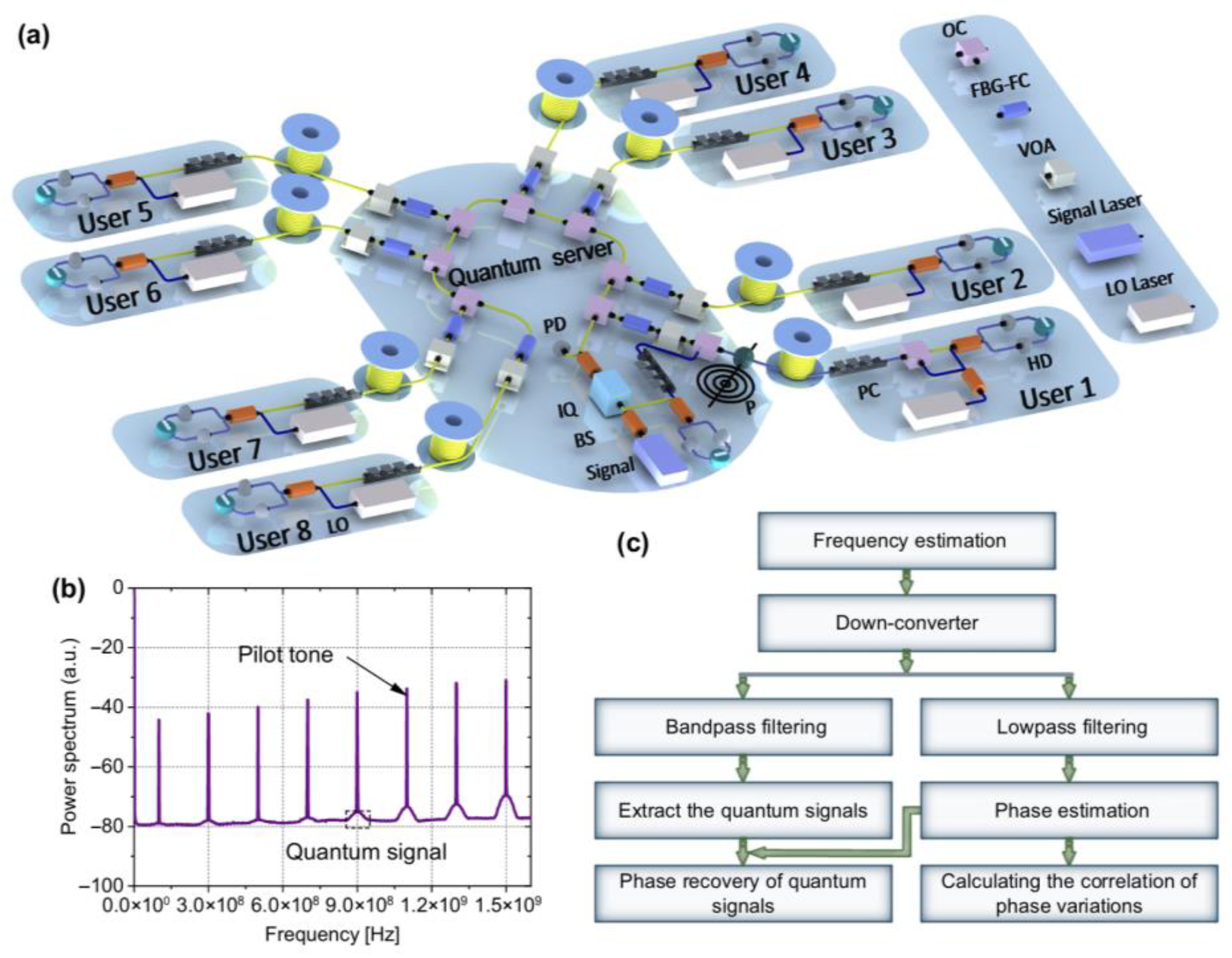
In 2023, Zhou et al. [90] proposed a linear fitting-based residual frequency offset compensation (LF-RFOC) algorithm to provide a simultaneous transmission and sensing scheme. Without modifying the existing coherent transponder hardware, vibration sensing was achieved by adding a compensation process after carrier phase recovery (CPR) through algorithm optimization at the DSP. The LF-RFOC algorithm included three stages: FO de-compensation (FODC), FO fitting (FOF), and FO re-compensation (FORC). For simulation, the vibration at 30 kHz was detected clearly with QPSK-format data transmission at a symbol rate of 20 G-Baud over 100 km of fiber. In 2024, Chen et al. [91] achieved the low-frequency vibration detection from 1 to 500 Hz by applying fiber interferometry over two cores of a seven-core fiber. This was accomplished by utilizing the residual carrier in the communication signals, enabling sensing to proceed synchronously with active data communication. An optical phase locking loop (OPLL) was used to compensate for the relative phase fluctuations between the two cores, and the vibration signals were extracted from the error signal of OPLL after a low-bandwidth balanced photodetector. The scheme was applied to a deployed seven-core fiber link over 16.5 km, successfully capturing a vibration signal at a fundamental frequency of 5.8 Hz. In 2024, Liu et al. [17] proposed and demonstrated a network architecture that integrates a downstream quantum access network (DQAN) and vibration sensing in optical fibers. An average key rate of 1.94 × 104 bits per second over an 80 km single-mode fiber was achieved. Meanwhile, vibration locations with spatial resolutions of 131, 25, and 4 m at vibration frequencies of 100 Hz, 1 kHz, and 10 kHz, respectively, were implemented. In this infrastructure, pilot signals and quantum signals were transmitted in the same frequency band. The pilot signals were used to compensate for the phase drift of the quantum signals, and the phase change data of the pilot signals were multiplexed as the original signal source for vibration sensing, as shown in Figure 11c. In particular, the role of quantum key distribution was to meet the needs of multi-user, long-distance secure communication.
The method based on SOP and phase information extraction can share the hardware and software resources of the transmitter and receiver with the existing communication systems, thus having great potential for application in the optical-network ISAC. However, there are still some problems, such as the localization of multiple disturbance events, the positioning accuracy, and the information of the entire link, which require further research and discussion. A comparison of SOP and phase extraction methods is shown in Table 4.

3.2.2. Channel Reconstruction

Channel reconstruction method can digitally simulate information such as dispersion and fiber nonlinearity in an optical fiber link, thereby accurately replicating the real-world conditions of an optical fiber transmission system. This enables the identification and localization of various anomalies, including abnormal losses, unexpected dispersion, insufficient amplification, and polarization mode dispersion (PMD). Recently, this method has been introduced into the integration of sensing and communication, without additional hardware devices or the introduction of signals.
In 2020, Tanimura et al. [92] developed a fiber-longitudinal monitor to simultaneously visualize and localize multiple power attenuation anomalies over fiber transmission links. The concept of the link-longitudinal monitor, called the in situ power profile estimator (in situ PPE). By leveraging the non-commutative characteristics of dispersion and nonlinear self-phase modulation (SPM), the longitudinal power distribution of the link was reverse-derived through digital signal processing, achieving the detection of the abnormal behavior. Experimental results showed that multi-point unexpected excess losses could be successfully detected with 506 Gbit/s DP-16QAM transmission over a 5-span, 260 km fiber. In 2020, Sasai et al. [93] described a signal monitoring technique of using a neural-network-based digital backpropagation (NN-based DBP), allowing the monitoring of loss profile along multiple spans of optical transmission links. The information on power and dispersion distribution was obtained through reverse derivation of link characteristics, thanks to the key parameters of DBP being optimized by using NN. The experiment showed that lossy points within the range of 50–230 km with 2 dB and 5 dB were successfully detected in an SSMF-only line with 423.04 Gb/s 64QAM transmission over 70 km × 4-spans fibers. The channel reconstruction method has the advantage of non-intrusive and low-cost anomaly monitoring for multi-span long-haul transmission systems, providing a potential solution for the classification of sensing signal events in optical-network ISAC.
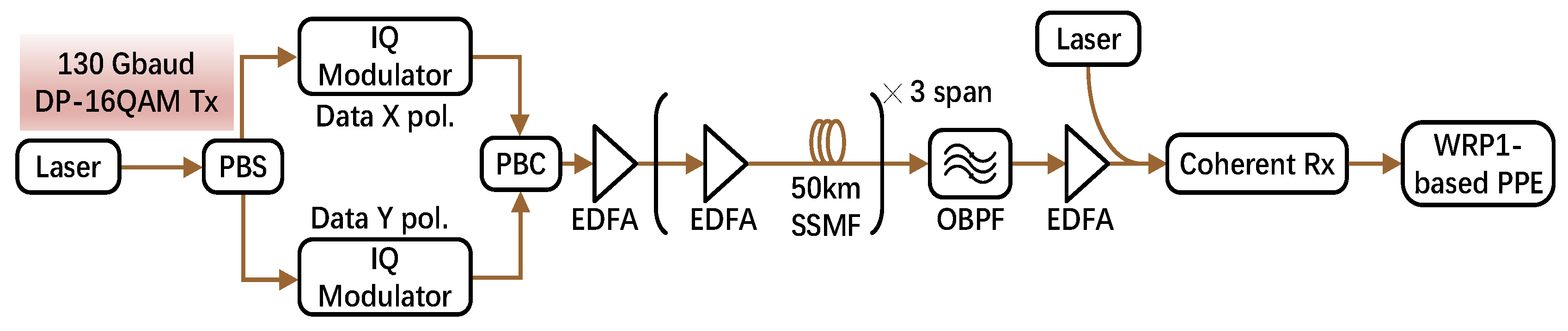
In 2024, Jiang et al. [94] proposed another PPE method operating at the symbol rate, based on the weighted first-order regular perturbation model (WRP1), to achieve the location of the loss. The method was demonstrated in a 130 G Baud DP-16QAM 3 span × 50 km transmission system, as shown in Figure 12. The WRP1-based PPE reduced computational complexity by over 52% compared to waveform-level PPE, while the mean absolute error is 0.56 dB across all positions. The reconstruction performance of different channel reconstruction methods is shown in Table 5 and a summary of the key technology of the optical-network ISAC is presented in Table 6.

4. New Opportunities and Challenges

4.1. New Opportunities

4.1.1. New Application of Existing Optical Fiber Links

The effective integration of optical fiber sensing systems and optical communications can not only effectively activate the “dark fiber” resources, but also realize many innovative perception applications. At present, monitoring and functions on active communication have been realized, which has been reflected in the existing reports [65,83]. The non-intrusive integration of sensing functions is regarded as a kind of perceptual neural network using optical fibers. For instance, beyond the research above, fiber-to-the-home (FTTH) networks can serve as sensory networks within buildings, enabling building energy management, fire alarming, and structural health monitoring [95], and can easily enable early warning. Moreover, [11] suggested that networks of fiber-optic telecommunication lines worldwide could be used as seismometers, opening a new window for earth hazard assessment and exploration. If the optical fiber lines of the operator function as a sensor network, this network can become the nervous system of the earth, providing excellent support for the realization of smart communities, smart cities, and smart transportation.

4.1.2. Comprehensive Improvement by the New Optical Fibers

The development and application of new optical fibers have also brought new vitality to the optical-network ISAC. Reference [96] reported that the Enhanced Scattering Fiber (ESF) in DAS links could significantly reduce the background noise. The simultaneous sensing and 400 Gb/s data transmission over 195 km fiber using ESF had been successfully demonstrated, without inline amplifications. In addition, ref. [97] analyzed the performance of hollow core fiber (HCF), which exhibited comprehensive advantages in terms of attenuation, bandwidth, and manufacturing difficulty. Then, a 15 km continuous length of HCF with minimal loss of 0.58 dB/km and a 10 km continuous length of HCF with minimal loss of 0.25 dB/km were obtained, transmitting at 1 um and C + L bands. These new optical fibers enhance the capabilities of optical communication, which provides a brand-new technical path for the optical-network ISAC.

4.1.3. Enhancement Combined with Artificial Intelligence (AI)

With the continuous advancements in Artificial Intelligence (AI) and machine learning methodologies, such as deep neural networks (DNNs) and convolutional neural networks (CNNs), the accuracy of detection, classification, and localization of sensing time can be more guaranteed [59]. Ref. [98] introduced a one-dimensional convolutional neural network (1-D CNN), combined with the support vector machine (SVM), to obtain efficient and accurate classification of multiple vibration signal types in pipeline monitoring. Once the AI is trained, it enables accurate classification of events, reducing the likelihood of false alarms, and facilitates low-cost environmental monitoring across a wide geographic area, in contrast to the extensive deployment of security cameras [71]. Ref. [99] used the NN with the stacked gated recurrent unit (SGRU) algorithm to solve the overlap spectra problem, improving the accuracy of wavelength detection techniques. The improvement of accuracy for event monitoring combined with AI can enable the optical-network ISAC to open the door to more scenarios.

4.2. Challenges

4.2.1. Precision of Event Classification

The optical-network ISAC can effectively save network core resources and reduce operation costs, but with the in-depth application in various scenarios, challenges are posed to the simultaneous, accurate, and efficient detection of multiple parameters. There is a big problem to be solved in a more detailed classification and determination for different parameters, so it is necessary to accurately identify the type and nature of the parameters. Only by accurately identifying the type and nature of each parameter can alarms be issued in a timely and effective manner. This not only helps to avoid unnecessary waste of resources, but more importantly, it prevents catastrophic accidents from occurring.

4.2.2. Processing of Massive Data

For optical fiber sensing, enhancing spatial resolution means higher data sampling rates, as well as a large amount of data to be processed, leading to the challenges of acquisition, transmission, and processing of this massive data. Meanwhile, for the method at the receiver, precisely extracting the information of the sensing signal from the communication signal means an extremely large amount of data. Moreover, the accurate classification of different disturbance events also requires data support in the optical-network ISAC, which meets the needs of different scenarios.

4.2.3. Protection of Information Security

The information security of the transmission, calculation, and sharing of massive data among networks is of extremely crucial significance for the stability and normal operation of the system. In the data collection, storage, and utilization, there is always a potential risk of various malicious attacks. Therefore, it is imperative to develop a set of security mechanisms that are truly effective across the diverse scenarios of the integrated system. Guaranteeing the absolute security of perception and communication data remains a critical technical challenge that demands continuous, long-term exploration and resolution.

5. Conclusions

In this paper, we provide a comprehensive review of the advancements in integrated communication and sensing technologies within the existing optical fiber links. With the rapid evolution of information technology, modern optical fiber networks are increasingly incorporating sensing capabilities to enhance the efficiency and reliability of data transmission. This paper focuses on the principles underpinning this new technology, examines the challenges associated with integrated communication and sensing signals, and analyzes current solutions to these challenges from both the transmitter and receiver perspectives. Additionally, we highlight the new opportunities that arise from the optical-network ISAC. Overall, the deep integration of these two domains not only opens up new possibilities in optical fiber communications but also establishes a robust foundation for more intelligent and efficient network architectures. We believe that future research should continue to advance this critical field and contribute to the digital transformation across various industries.

Author Contributions

Conceptualization, L.P. and W.W.; methodology, J.W.; validation, L.P., W.W. and J.W.; writing—original draft preparation, W.W.; writing—review and editing, L.P., J.W. and T.N.; visualization, W.W.; supervision, T.N.; project administration, J.W.; funding acquisition, L.P. All authors have read and agreed to the published version of the manuscript.

Funding

This research was funded by the National Key R&D Program of China (2024YFF0726401), the National Natural Science Foundation of China under Grant (62305020).

Data Availability Statement

The data that support the findings of this study are available from the author upon reasonable request.

Conflicts of Interest

The authors declare no conflicts of interest.

References

  1. Nguyen, D.C.; Ding, M.; Pathirana, P.N.; Seneviratne, A.; Li, J.; Niyato, D.; Dobre, O.; Poor, H.V. 6G Internet of Things: A Comprehensive Survey. IEEE Internet Things J. 2022, 9, 359–383. [Google Scholar] [CrossRef]
  2. Singh, S.; Samal, U. Integrated Sensing and Communication in Next-Generation Wireless Networks: Insights and Trends. Int. J. Commun. Syst. 2025, 38, e70014. [Google Scholar] [CrossRef]
  3. Wei, Z.; Qu, H.; Wang, Y.; Yuan, X.; Wu, H.; Du, Y.; Han, K.; Zhang, N.; Feng, Z. Integrated Sensing and Communication Signals Toward 5G-A and 6G: A Survey. IEEE Internet Things J. 2023, 10, 11068–11092. [Google Scholar] [CrossRef]
  4. Wu, N.; Jiang, R.; Wang, X.; Yang, L.; Zhang, K.; Yi, W.; Nallanathan, A. AI-Enhanced Integrated Sensing and Communications: Advancements, Challenges, and Prospects. IEEE Commun. Mag. 2024, 62, 144–150. [Google Scholar] [CrossRef]
  5. Zhang, J.; Wang, J.; Zhang, Y.; Liu, Y.; Chai, Z.; Liu, G.; Jiang, T. Integrated Sensing and Communication Channel: Measurements, Characteristics, and Modeling. IEEE Commun. Mag. 2024, 62, 98–104. [Google Scholar] [CrossRef]
  6. Mu, X.; Wang, Z.; Liu, Y. NOMA for Integrating Sensing and Communications Toward 6G: A Multiple Access Perspective. IEEE Wirel. Commun. 2024, 31, 316–323. [Google Scholar] [CrossRef]
  7. Liu, Y.; Huang, T.; Liu, F.; Ma, D.; Huangfu, W.; Eldar, Y.C. Next-Generation Multiple Access for Integrated Sensing and Communications. Proc. IEEE 2024, 112, 1467–1496. [Google Scholar] [CrossRef]
  8. Dong, B.; Jia, J.; Tao, L.; Li, G.; Li, Z.; Huang, C.; Shi, J.; Wang, H.; Tang, Z.; Zhang, J.; et al. Photonic-Based W-Band Integrated Sensing and Communication System with Flexible Time- Frequency Division Multiplexed Waveforms for Fiber-Wireless Network. J. Light. Technol. 2024, 42, 1281–1295. [Google Scholar] [CrossRef]
  9. Laarossi, I.; Ruiz-Lombera, R.; Quintela, M.A.; Mirapeix, J.; Lima, D.; Solana, D.; Lopez-Higuera, J.M. Ultrahigh Temperature Raman-Based Distributed Optical Fiber Sensor with Gold-Coated Fiber. IEEE J. Sel. Top. Quantum Electron. 2017, 23, 296–301. [Google Scholar] [CrossRef]
  10. Tucker, R.; Ruffini, M.; Valcarenghi, L.; Campelo, D.R.; Simeonidou, D.; Du, L.; Marinescu, M.C.; Middleton, C.; Yin, S.; Forde, T.; et al. Connected OFCity: Technology innovations for a smart city project [Invited]. J. Opt. Commun. Netw. 2017, 9, A245–A255. [Google Scholar] [CrossRef]
  11. Jousset, P.; Reinsch, T.; Ryberg, T.; Blanck, H.; Clarke, A.; Aghayev, R.; Hersir, G.P.; Henninges, J.; Weber, M.; Krawczyk, C.M. Dynamic strain determination using fibre-optic cables allows imaging of seismological and structural features. Nat. Commun. 2018, 9, 2509. [Google Scholar] [CrossRef]
  12. Zhang, C.; Tang, X.; Wang, G.; Shen, S.; Zhang, H.; Chang, Y.; Cao, J. Field Test of Communication Cable for Environmental Monitoring. In Proceedings of the 2024 Optical Fiber Communications Conference and Exhibition (OFC), San Diego, CA, USA, 24–28 March 2024. [Google Scholar]
  13. Marra, G.; Clivati, C.; Luckett, R.; Tampellini, A.; Kronjäger, J.; Wright, L.; Mura, A.; Levi, F.; Robinson, S.; Xuereb, A.; et al. Ultrastable laser interferometry for earthquake detection with terrestrial and submarine cables. Science 2018, 361, 486–490. [Google Scholar] [CrossRef]
  14. Williams, E.F.; Fernández-Ruiz, M.R.; Magalhaes, R.; Vanthillo, R.; Zhan, Z.; González-Herráez, M.; Martins, H.F. Distributed sensing of microseisms and teleseisms with submarine dark fibers. Nat. Commun. 2019, 10, 5778. [Google Scholar] [CrossRef]
  15. Lindsey, N.J.; Dawe, T.C.; Ajo-Franklin, J.B. Illuminating seafloor faults and ocean dynamics with dark fiber distributed acoustic sensing. Science 2019, 366, 1103–1107. [Google Scholar] [CrossRef]
  16. Yarovikov, M.; Smirnov, A.; Aliev, A.; Strizhak, D. Highly Sensitive Optical Time-Domain Reflectometry: Detecting 0.01 dB Leakage over 1000 km for Classical and Quantum Communication. Sensors 2025, 25, 1407. [Google Scholar] [CrossRef]
  17. Liu, S.; Tian, Y.; Zhang, Y.; Lu, Z.; Wang, X.; Li, Y. Integrated quantum communication network and vibration sensing in optical fibers. Optica 2024, 11, 1762–1772. [Google Scholar] [CrossRef]
  18. Tang, D.; Jiang, Y.; Luo, J.; Chen, Y.; Yang, J.; Zheng, B.; Qiao, Y. Noise and Performance Analysis of Fiber-Longitudinal Power Profile Estimation. J. Light. Technol. 2024, 42, 5846–5855. [Google Scholar] [CrossRef]
  19. Kapron, F.P.; Maurer, R.D.; Teter, M.P. Theory of Backscattering Effects in Waveguides. Appl. Opt. 1972, 11, 1352–1356. [Google Scholar] [CrossRef] [PubMed]
  20. Palmieri, L.; Schenato, L.; Santagiustina, M.; Galtarossa, A. Rayleigh-Based Distributed Optical Fiber Sensing. Sensors 2022, 22, 6811. [Google Scholar] [CrossRef]
  21. Wu, Y.; Gan, J.; Li, Q.; Zhang, Z.; Heng, X.; Yang, Z. Distributed Fiber Voice Sensor Based on Phase-Sensitive Optical Time-Domain Reflectometry. IEEE Photonics J. 2015, 7, 6803810. [Google Scholar] [CrossRef]
  22. Fermann, M.E.; Poole, S.B.; Payne, D.N.; Martinez, F. Comparative measurement of Rayleigh scattering in single-mode optical fibers based on an OTDR technique. J. Light. Technol. 1988, 6, 545–551. [Google Scholar] [CrossRef]
  23. He, Z.; Liu, Q. Optical Fiber Distributed Acoustic Sensors: A Review. J. Light. Technol. 2021, 39, 3671–3686. [Google Scholar] [CrossRef]
  24. Alan, R. Distributed optical-fibre sensing. Meas. Sci. Technol. 1999, 10, R75. [Google Scholar] [CrossRef]
  25. Tosi, D.; Molardi, C.; Sypabekova, M.; Blanc, W. Enhanced Backscattering Optical Fiber Distributed Sensors: Tutorial and Review. IEEE Sens. J. 2021, 21, 12667–12678. [Google Scholar] [CrossRef]
  26. Lalam, N.; Westbrook, P.S.; Li, J.; Lu, P.; Buric, M.P. Phase-Sensitive Optical Time Domain Reflectometry with Rayleigh Enhanced Optical Fiber. IEEE Access 2021, 9, 114428–114434. [Google Scholar] [CrossRef]
  27. Rao, Y.; Wang, Z.; Wu, H.; Ran, Z.; Han, B. Recent Advances in Phase-Sensitive Optical Time Domain Reflectometry (Φ-OTDR). Photonic Sens. 2021, 11, 1–30. [Google Scholar] [CrossRef]
  28. Zinsou, R.; Liu, X.; Wang, Y.; Zhang, J.; Wang, Y.; Jin, B. Recent Progress in the Performance Enhancement of Phase-Sensitive OTDR Vibration Sensing Systems. Sensors 2019, 19, 1709. [Google Scholar] [CrossRef] [PubMed]
  29. Huang, Z.; Wu, C.; Wang, Z.; Wang, J.; Liu, L. Distributed measurement of axes misaligned splicing and multi-stress in polarization-maintaining fiber based on polarization-OTDR. Opt. Commun. 2018, 423, 96–99. [Google Scholar] [CrossRef]
  30. Ding, Z.; Guo, H.; Liu, K.; Hua, P.; Zhang, T.; Li, S.; Liu, J.; Jiang, J.; Liu, T. Advances in Distributed Optical Fiber Sensors Based on Optical Frequency-Domain Reflectometry: A Review. IEEE Sens. J. 2023, 23, 26925–26941. [Google Scholar] [CrossRef]
  31. Bernini, R.; Minardo, A.; Zeni, L. Self-Demodulated Heterodyne Frequency Domain Distributed Brillouin Fiber Sensor. IEEE Photonics Technol. Lett. 2007, 19, 447–449. [Google Scholar] [CrossRef]
  32. Bouyahi, M.; Zrelli, A.; Rezig, H.; Ezzedine, T. Modeling the Brillouin spectrum by measurement of the distributed strain and temperature. Opt. Quantum Electron. 2016, 48, 103. [Google Scholar] [CrossRef]
  33. Ip, E.; Fang, J.; Li, Y.; Wang, Q.; Huang, M.F.; Salemi, M.; Huang, Y.K. Distributed fiber sensor network using telecom cables as sensing media: Technology advancements and applications [Invited]. J. Opt. Commun. Netw. 2022, 14, A61–A68. [Google Scholar] [CrossRef]
  34. Horiguchi, T.; Masui, Y.; Zan, M.S.D. Analysis of Phase-Shift Pulse Brillouin Optical Time-Domain Reflectometry. Sensors 2019, 19, 1497. [Google Scholar] [CrossRef] [PubMed]
  35. Bai, Q.; Wang, Q.; Wang, D.; Wang, Y.; Gao, Y.; Zhang, H.; Zhang, M.; Jin, B. Recent Advances in Brillouin Optical Time Domain Reflectometry. Sensors 2019, 19, 1862. [Google Scholar] [CrossRef] [PubMed]
  36. Wu, H.; Wan, Y.; Tang, M.; Chen, Y.; Zhao, C.; Liao, R.; Chang, Y.; Fu, S.; Shum, P.P.; Liu, D. Real-Time Denoising of Brillouin Optical Time Domain Analyzer with High Data Fidelity Using Convolutional Neural Networks. J. Light. Technol. 2019, 37, 2648–2653. [Google Scholar] [CrossRef]
  37. Brown, A.W.; Colpitts, B.G.; Brown, K. Distributed sensor based on dark-pulse Brillouin scattering. IEEE Photonics Technol. Lett. 2005, 17, 1501–1503. [Google Scholar] [CrossRef]
  38. Jeong, J.H.; Chung, K.H.; Lee, S.B.; Song, K.Y.; Jeong, J.-M.; Lee, K. Linearly configured BOCDA system using a differential measurement scheme. Opt. Express 2014, 22, 1467–1473. [Google Scholar] [CrossRef]
  39. Coscetta, A.; Minardo, A.; Zeni, L. Distributed Dynamic Strain Sensing Based on Brillouin Scattering in Optical Fibers. Sensors 2020, 20, 5629. [Google Scholar] [CrossRef]
  40. Muanenda, Y.; Oton, C.J.; Di Pasquale, F. Application of Raman and Brillouin Scattering Phenomena in Distributed Optical Fiber Sensing. Front. Phys. 2019, 7, 155. [Google Scholar] [CrossRef]
  41. Li, J.; Zhang, M. Physics and applications of Raman distributed optical fiber sensing. Light Sci. Appl. 2022, 11, 128. [Google Scholar] [CrossRef]
  42. Bahrampour, A.R.; Moosavi, A.; Bahrampour, M.J.; Safaei, L. Spatial resolution enhancement in fiber Raman distributed temperature sensor by employing ForWaRD deconvolution algorithm. Opt. Fiber Technol. 2011, 17, 128–134. [Google Scholar] [CrossRef]
  43. Liu, Z.; Wu, H.; Du, H.; Luo, Z.; Tang, M. Distributed Temperature and Curvature Sensing Based on Raman Scattering in Few-Mode Fiber. IEEE Sens. J. 2022, 22, 22620–22626. [Google Scholar] [CrossRef]
  44. Amira, Z.; Bouyahi, M.; Ezzedine, T. Measurement of Temperature through Raman Scattering. Procedia Comput. Sci. 2015, 73, 350–357. [Google Scholar] [CrossRef]
  45. Van de Giesen, N.; Steele-Dunne, S.C.; Jansen, J.; Hoes, O.; Hausner, M.B.; Tyler, S.; Selker, J. Double-Ended Calibration of Fiber-Optic Raman Spectra Distributed Temperature Sensing Data. Sensors 2012, 12, 5471–5485. [Google Scholar] [CrossRef]
  46. Farahani, M.A.; Gogolla, T. Spontaneous Raman scattering in optical fibers with modulated probe light for distributed temperature Raman remote sensing. J. Light. Technol. 1999, 17, 1379–1391. [Google Scholar] [CrossRef]
  47. Li, J.; Zhou, X.; Xu, Y.; Qiao, L.; Zhang, J.; Zhang, M. Slope-assisted Raman distributed optical fiber sensing. Photon. Res. 2022, 10, 205–213. [Google Scholar] [CrossRef]
  48. Sun, X.; Yang, Z.; Hong, X.; Zaslawski, S.; Wang, S.; Soto, M.A.; Gao, X.; Wu, J.; Thévenaz, L. Genetic-optimised aperiodic code for distributed optical fibre sensors. Nat. Commun. 2020, 11, 5774. [Google Scholar] [CrossRef] [PubMed]
  49. Jiang, Y.; Tang, D.; Wang, Z.; Luo, J.; Zheng, B.; Qiao, Y. Symbol-level fiber-longitudinal power profile estimation. Opt. Lett. 2024, 49, 2305–2308. [Google Scholar] [CrossRef] [PubMed]
  50. Sasai, T.; Takahashi, M.; Nakamura, M.; Yamazaki, E.; Kisaka, Y. Linear Least Squares Estimation of Fiber-Longitudinal Optical Power Profile. J. Light. Technol. 2024, 42, 1955–1965. [Google Scholar] [CrossRef]
  51. Sasai, T.; Yamazaki, E.; Kisaka, Y. Performance Limit of Fiber-Longitudinal Power Profile Estimation Methods. J. Light. Technol. 2023, 41, 3278–3289. [Google Scholar] [CrossRef]
  52. Sasai, T.; Nakamura, M.; Yamazaki, E.; Yamamoto, S.; Nishizawa, H.; Kisaka, Y. Digital Longitudinal Monitoring of Optical Fiber Communication Link. J. Light. Technol. 2022, 40, 2390–2408. [Google Scholar] [CrossRef]
  53. Sasai, T.; Sone, Y.; Yamazaki, E.; Nakamura, M.; Kisaka, Y. A generalized method for fiber-longitudinal power profile estimation. In Proceedings of the 49th European Conference on Optical Communications (ECOC 2023), Glasgow, Scotland, 1–5 October 2023. [Google Scholar]
  54. Ireeta, W.T.; Musara, V.; Wu, L.; Leitch, A.W.R. SOP and PMD monitoring on deployed aerial optical fibres. Optik 2012, 123, 2098–2103. [Google Scholar] [CrossRef]
  55. Abdelli, K.; Lonardi, M.; Gripp, J.; Olsson, S.; Boitier, F.; Layec, P. Computer Vision for Anomaly Detection in Optical Networks with State of Polarization Image Data: Opportunities and Challenges. In Proceedings of the 2024 24th International Conference on Transparent Optical Networks (ICTON), Bari, Italy, 14–18 July 2024. [Google Scholar]
  56. Zeng, Y.; Wang, X.; Li, W.; Wang, L.; Tang, M. Integrated communication and polarization sensing in self-homodyne coherent systems. Opt. Lett. 2022, 47, 4684–4687. [Google Scholar] [CrossRef]
  57. Zhan, Z.; Cantono, M.; Kamalov, V.; Mecozzi, A.; Müller, R.; Yin, S.; Castellanos, J.C. Optical polarization-based seismic and water wave sensing on transoceanic cables. Science 2021, 371, 931–936. [Google Scholar] [CrossRef]
  58. Liokumovich, L.B.; Ushakov, N.A.; Kotov, O.I.; Bisyarin, M.A.; Hartog, A.H. Fundamentals of Optical Fiber Sensing Schemes Based on Coherent Optical Time Domain Reflectometry: Signal Model Under Static Fiber Conditions. J. Light. Technol. 2015, 33, 3660–3671. [Google Scholar] [CrossRef]
  59. Ip, E.; Ravet, F.; Martins, H.; Huang, M.F.; Okamoto, T.; Han, S.; Narisetty, C.; Fang, J.; Huang, Y.K.; Salemi, M.; et al. Using Global Existing Fiber Networks for Environmental Sensing. Proc. IEEE 2022, 110, 1853–1888. [Google Scholar] [CrossRef]
  60. Mecozzi, A.; Cantono, M.; Castellanos, J.C.; Kamalov, V.; Muller, R.; Zhan, Z. Polarization sensing using submarine optical cables. Optica 2021, 8, 788–795. [Google Scholar] [CrossRef]
  61. Yan, Y.; Zheng, H.; Zhao, Z.; Guo, C.; Wu, X.; Hu, J.; Lau, A.P.T.; Lu, C. Distributed Optical Fiber Sensing Assisted by Optical Communication Techniques. J. Light. Technol. 2021, 39, 3654–3670. [Google Scholar] [CrossRef]
  62. Ip, E.; Huang, Y.K.; Wellbrock, G.; Xia, T.; Huang, M.F.; Wang, T.; Aono, Y. Vibration Detection and Localization Using Modified Digital Coherent Telecom Transponders. J. Light. Technol. 2022, 40, 1472–1482. [Google Scholar] [CrossRef]
  63. Marin, J.M.; Ashry, I.; Alkhazragi, O.; Trichili, A.; Khee Ng, T.; Ooi, B.S. Simultaneous distributed acoustic sensing and communication over a two-mode fiber. Opt. Lett. 2022, 47, 6321–6324. [Google Scholar] [CrossRef] [PubMed]
  64. Marin, J.M.; Briantcev, D.; Kang, C.H.; Alkhazragi, O.; Ng, T.K.; Ashry, I.; Trichili, A.; Ooi, B.S. Hybrid distributed acoustic sensing and Kramers–Kronig communication system over a two-mode fiber. In Proceedings of the 2023 Optical Fiber Communications Conference and Exhibition (OFC), San Diego, CA, USA, 5–9 March 2023. [Google Scholar]
  65. Chen, Y.; Xiao, Y.; Chen, S.; Xie, F.; Liu, Z.; Wang, D.; Yi, X.; Lu, C.; Li, Z. Field Trials of Communication and Sensing System in Space Division Multiplexing Optical Fiber Cable. IEEE Commun. Mag. 2023, 61, 182–188. [Google Scholar] [CrossRef]
  66. Zhang, M.; Wei, W.; Li, W.; He, H.; Chen, Y.; Wu, H.; Zhao, C.; Zhao, Z.; Tang, M. Endogenous BOTDA in the self-homodyne coherent detection transmission system for communication-integrated datacenter temperature monitoring. Opt. Lett. 2023, 48, 4749–4752. [Google Scholar] [CrossRef]
  67. Li, X.; Xiang, Q.; Hao, Y.; Tang, J.; Cheng, C.; Wu, Q.; Jin, Y.; Liang, J.; Yang, Y.; Hu, W. Simultaneous Vibration Sensing and Transmission of a Single-Carrier 5.38 Tb/s Signal over 41.4 km Weakly Coupled 7-Core Fiber. In Proceedings of the 2023 Asia Communications and Photonics Conference/2023 International Photonics and Optoelectronics Meetings (ACP/POEM), Wuhan, China, 4–7 November 2023. [Google Scholar]
  68. Tang, J.; Li, X.; Yang, B.; Cheng, C.; Hao, Y.; Xu, Y.; Li, J.; He, Z.; Yang, Y.; Hu, W. Multi-dimensional vibration sensing and simultaneous self-homodyne optical transmission of single wavelength net 5.36 Tb/s signal using telecom 7-core fiber. arXiv 2023, arXiv:2311.06019. [Google Scholar]
  69. Tang, J.; Li, X.; Cheng, C.; Fan, L.; Hao, Y.; Yue, B.; Li, J.; He, Z.; Yang, Y.; Hu, W. Distributed vibration sensing and simultaneous self-homodyne transmission of single-carrier net 5.36 Tb/s signal using 7-core fiber. In Proceedings of the Optical Fiber Communication Conference (OFC) 2024, San Diego, CA, USA, 24–28 March 2024; Optica Publishing Group: San Diego, CA, USA, 2024. [Google Scholar]
  70. Wellbrock, G.A.; Xia, T.J.; Huang, M.F.; Chen, Y.; Salemi, M.; Huang, Y.K.; Ji, P.; Ip, E.; Wang, T. First Field Trial of Sensing Vehicle Speed, Density, and Road Conditions by using Fiber Carrying High Speed Data. In Proceedings of the 2019 Optical Fiber Communications Conference and Exhibition (OFC), San Diego, CA, USA, 3–7 March 2019. [Google Scholar]
  71. Aono, Y.; Ip, E.; Ji, P. More Than Communications: Environment Monitoring using Existing Optical Fiber Network Infrastructure. In Proceedings of the 2020 Optical Fiber Communications Conference and Exhibition (OFC), San Diego, CA, USA, 8–12 March 2020. [Google Scholar]
  72. Luch, I.D.; Ferrarlo, M.; Rizzelli, G.; Gaudino, R.; Boffi, P. Vibration Sensing for Deployed Metropolitan Fiber Infrastructures. In Proceedings of the 2020 Optical Fiber Communications Conference and Exhibition (OFC), San Diego, CA, USA, 8–12 March 2020. [Google Scholar]
  73. Huang, M.F.; Salemi, M.; Chen, Y.; Zhao, J.; Xia, T.J.; Wellbrock, G.A.; Huang, Y.K.; Milione, G.; Ip, E.; Ji, P.; et al. First Field Trial of Distributed Fiber Optical Sensing and High-Speed Communication over an Operational Telecom Network. J. Light. Technol. 2020, 38, 75–81. [Google Scholar] [CrossRef]
  74. Shen, L.; Yu, W.; Xu, R.; Wang, Y.; Du, B. Co-propagation of Distributed Acoustic Sensing in the L-band and 100-Gb/s WDM Coherent Communication Systems. In Proceedings of the 2022 Asia Communications and Photonics Conference (ACP), Shenzhen, China, 5–8 November 2022. [Google Scholar]
  75. Brenne, J.K.; Sladen, A.; Pecci, P.; Morten, J.P.; Pelaez, J.; Jacobsen, J.; Calsat, A.; Plantady, P.; Ampuero, J.-P.; Rivet, D.; et al. Non-Intrusive DAS Coexisting in Telecom Networks. In Proceedings of the Optical Fiber Communication Conference (OFC) 2024, San Diego, CA, USA, 24–28 March 2024; Optica Publishing Group: San Diego, CA, USA, 2024. [Google Scholar]
  76. Li, Y.; Shi, H.; Zhao, Y.; Zhang, Z.; Zhu, M.; Wang, Z. Investigation on the Coexistence of Real-Time DAS System and High-Speed Coherent Optical Signal. In Proceedings of the 2023 Asia Communications and Photonics Conference/2023 International Photonics and Optoelectronics Meetings (ACP/POEM), Wuhan, China, 4–7 November 2023. [Google Scholar]
  77. He, H.; Jiang, L.; Pan, Y.; Yi, A.; Zou, X.; Pan, W.; Willner, A.E.; Fan, X.; He, Z.; Yan, L. Integrated sensing and communication in an optical fibre. Light Sci. Appl. 2023, 12, 25. [Google Scholar] [CrossRef]
  78. Ip, E.; Huang, Y.K.; Huang, M.F.; Yaman, F.; Wellbrock, G.; Xia, T.; Wang, T.; Asahi, K.; Aono, Y. DAS over 1,007-km Hybrid Link with 10-Tb/s DP-16QAM Co-propagation using Frequency-Diverse Chirped Pulses. In Proceedings of the 2022 Optical Fiber Communications Conference and Exhibition (OFC), San Diego, CA, USA, 6–10 March 2022. [Google Scholar]
  79. Ip, E.; Huang, Y.K.; Wang, T.; Aono, Y.; Asahi, K. Distributed Acoustic Sensing for Datacenter Optical Interconnects using Self-Homodyne Coherent Detection. In Proceedings of the 2022 Optical Fiber Communications Conference and Exhibition (OFC), San Diego, CA, USA, 6–10 March 2022. [Google Scholar]
  80. Hu, Z.; Chen, Y.; Jiang, H.; Zhang, M.; Chen, J.; Li, W.; Zhao, L.; Zhao, C.; Tang, M. Enabling cost-effective high-performance vibration sensing in digital subcarrier multiplexing systems. Opt. Express 2023, 31, 32114–32125. [Google Scholar] [CrossRef] [PubMed]
  81. Hu, Z.; Zhao, C.; Chen, Y.; Zhang, M.; Chen, J.; Li, W.; Zhao, L.; Tang, M. Enabling Endogenous DAS in P2MP Digital Subcarrier Coherent Transmission System with Enhanced Frequency Response. In Proceedings of the Optical Fiber Communication Conference (OFC) 2024, San Diego, CA, USA, 24–28 March 2024; Optica Publishing Group: San Diego, CA, USA, 2024. [Google Scholar]
  82. Wang, J.; Lu, L.; Wang, L.; Yan, Y.; Lau, A.P.T.; Lu, C. High-efficiency ISAC to enable sub-meter level vibration sensing for coherent fiber networks. In Proceedings of the Optical Fiber Communication Conference (OFC) 2024, San Diego, CA, USA, 24–28 March 2024; Optica Publishing Group: San Diego, CA, USA, 2024. [Google Scholar]
  83. Charlton, D.; Clarke, S.; Doucet, D.; O’Sullivan, M.; Peterson, D.L.; Wilson, D.; Wellbrock, G.; Bélanger, M. Field measurements of SOP transients in OPGW, with time and location correlation to lightning strikes. Opt. Express 2017, 25, 9689–9696. [Google Scholar] [CrossRef]
  84. Zeng, T.; Li, W.; Hu, S.; Pan, Y.; Zhang, B.; He, Q.; Luo, M.; Xiao, X. Monitoring acoustic vibrations in optical fibers by estimating polarization matrix variation with the integration of coherent optical communication and sensing. Opt. Express 2023, 31, 37630–37644. [Google Scholar] [CrossRef] [PubMed]
  85. Tang, J.; Li, X.; Cheng, C.; Hao, Y.; Yang, B.; Li, J.; He, Z.; Yang, Y.; Hu, W. Forward-transmission based distributed fiber sensing compatible with C+L unidirectional communication systems. In Proceedings of the Optical Fiber Communication Conference (OFC) 2024, San Diego, CA, USA, 24–28 March 2024; Optica Publishing Group: San Diego, CA, USA, 2024. [Google Scholar]
  86. Yang, B.; Tang, J.; Zhuo, Q.; Hao, Y.; Fan, L.; Wang, S.; Gao, S.; Liang, J.; Hu, W.; Yao, Y.; et al. Robust SOP-Based Vibration Sensing Integrated in DSCM System Based on Frequency-Domain Pilot Tones. In Proceedings of the Frontiers in Optics + Laser Science 2024 (FiO, LS), Denver, CO, USA, 23–26 September 2024; Optica Publishing Group: Denver, CO, USA, 2024. [Google Scholar]
  87. Yan, Y.; Lu, L.; Wu, X.; Wang, J.; He, Y.; Chen, D.; Lu, C.; Lau, A.P.T. Simultaneous communications and vibration sensing over a single 100-km deployed fiber link by fiber interferometry. In Proceedings of the 2023 Optical Fiber Communications Conference and Exhibition (OFC), San Diego, CA, USA, 5–9 March 2023. [Google Scholar]
  88. Yang, B.; Tang, J.; Cheng, C.; Fan, L.; Yang, P.; Wang, S.; Zhao, T.; Liang, J.; Gao, S.; Wei, J.; et al. Integrated Communication and Enhanced Forward Phase-Based Sensing Based on Frequency-Domain Pilot Tones in DSCM Systems Using 100 kHz ECLs. J. Light. Technol. 2025, 43, 2664–2671. [Google Scholar] [CrossRef]
  89. Yang, B.; Tang, J.; Cheng, C.; Fan, L.; Gao, S.; Yao, Y.; Liang, J.; Wei, J.; Yang, Y. High-fidelity and adaptive forward-phase-based vibration sensing using a Wiener filter in DSCM systems under commercial ECLs. Opt. Lett. 2025, 50, 554–557. [Google Scholar] [CrossRef]
  90. Zhou, H.; Zuo, W.; Qiao, Y.; Zhao, Y.; Ye, B. Linear Fitting-Based Residual Frequency Offset Compensation in Simultaneous Transmitting and Sensing System Using Coherent Transponders. In Proceedings of the 2023 Asia Communications and Photonics Conference/2023 International Photonics and Optoelectronics Meetings (ACP/POEM), Wuhan, China, 4–7 November 2023. [Google Scholar]
  91. Chen, Y.; Wang, D.; Cai, X.; Lu, C.; Li, Z. Simultaneous Communication and Low-Frequency Vibration Sensing over Deployed Seven-Core Fiber. In Proceedings of the 2024 Asia Communications and Photonics Conference (ACP) and International Conference on Information Photonics and Optical Communications (IPOC), Beijing, China, 2–5 November 2024. [Google Scholar]
  92. Tanimura, T.; Yoshida, S.; Tajima, K.; Oda, S.; Hoshida, T. Fiber-Longitudinal Anomaly Position Identification over Multi-Span Transmission Link Out of Receiver-end Signals. J. Light. Technol. 2020, 38, 2726–2733. [Google Scholar] [CrossRef]
  93. Sasai, T.; Nakamura, M.; Okamoto, S.; Hamaoka, F.; Yamamoto, S.; Yamazaki, E.; Nishizawa, A.M.H.; Kisaka, Y. Simultaneous Detection of Anomaly Points and Fiber Types in Multi-Span Transmission Links Only by Receiver-Side Digital Signal Processing. In Proceedings of the 2020 Optical Fiber Communications Conference and Exhibition (OFC), San Diego, CA, USA, 8–12 March 2020. [Google Scholar]
  94. Jiang, Y.; Tang, D.; Luo, J.; Chen, Y.; Zheng, B.; Qiao, Y. Low-complexity weighted regular perturbation model-based symbol rate power profile estimation. Opt. Express 2024, 32, 35256–35267. [Google Scholar] [CrossRef] [PubMed]
  95. Liu, B.; Peng, M.; Wang, W.; Liu, B. Fiber in the Home: Broadband Networks and Optic Distributed Sensing. In Proceedings of the 2008 International Seminar on Future BioMedical Information Engineering, Wuhan, China, 18 December 2008. [Google Scholar]
  96. Zhu, B.; Li, Y.; Huang, Y.K.; Westbrook, P.; Feder, K.S.; Shi, Z.; Hu, J.; Wang, T.; DiGiovanni, D.J. Long reach fibre optic distributed acoustic sensing using enhanced scattering fibre. In Proceedings of the 49th European Conference on Optical Communications (ECOC 2023), Glasgow, Scotland, 1–5 October 2023. [Google Scholar]
  97. Li, P.; Chen, G.; Chu, J.; Zhang, L.; Zhang, L.; Luo, J.; Li, Z.; Gao, R.; Xin, X. 15 km Continuous Length and Low Loss Hollow Core Fiber in 1um, C and L Bands. In Proceedings of the ECOC 2024; 50th European Conference on Optical Communication, Frankfurt, Germany, 22–26 September 2024. [Google Scholar]
  98. Wu, H.; Chen, J.; Liu, X.; Xiao, Y.; Wang, M.; Zheng, Y.; Rao, Y. One-Dimensional CNN-Based Intelligent Recognition of Vibrations in Pipeline Monitoring with DAS. J. Light. Technol. 2019, 37, 4359–4366. [Google Scholar] [CrossRef]
  99. Hayle, S.T.; Manie, Y.C.; Yao, C.K.; Yeh, T.Y.; Yu, C.H.; Peng, P.C. Hybrid of Free Space Optics Communication and Sensor System Using IWDM Technique. J. Light. Technol. 2022, 40, 5862–5869. [Google Scholar] [CrossRef]
Figure 1. Three types of sensing in the optical-network ISAC technique.
Photonics 13 00216 g001
Figure 2. Three types of backscattered light in optical fibers.
Photonics 13 00216 g002
Figure 3. Backward-sensing based on Rayleigh scattering: (a) OTDR; (b) OFDR; (c) Φ-OTDR; (d) P-OTDR.
Photonics 13 00216 g003
Figure 4. Backward-sensing based on Brillouin scattering: (a) BOTDR; (b) BOTDA; (c) BOCDA.
Photonics 13 00216 g004
Figure 5. Backward-sensing based on Raman scattering: ROTDR.
Photonics 13 00216 g005
Figure 6. The typical configuration of PPE methods [48,49].
Photonics 13 00216 g006
Figure 7. The bidirectional sensing scheme.
Photonics 13 00216 g007
Figure 8. The block diagram of the optical-network ISAC based on different types of optical fiber sensing.
Photonics 13 00216 g008
Figure 9. Scheme of the experimental setup with dual mode optical switch. EDFA—erbium-doped fiber amplifier; LD-2—laser diode; VOA—variable optical attenuator; OC—optical coupler; PM-1,2—optical power meters; PC—personal computer [16].
Photonics 13 00216 g009
Figure 10. (a) Experimental setup; (b) block diagram of Tx Integrated DSP; (c) block diagram of Rx Communication DSP [80].
Photonics 13 00216 g010
Figure 11. Digital signal procedures for extracting the quantum signals and vibration location. (a) Experimental diagram of the integrated DQAN and fiber vibration sensing; (b) Power spectrum of eight quantum signals and pilot tones; (c) Digital signal procedures for extracting the quantum signals and vibration location [17].
Photonics 13 00216 g011
Figure 12. System setup. PBS: polarization beam splitter, PBC: polarization beam combiner, EDFA: Erbium-doped fiber amplifiers, SSMF: standard single-mode fiber, OBPF: optical band-pass filter [94].
Photonics 13 00216 g012
Table 1. Typical optical scattering and backward-sensing techniques in optical fibers.
Sensing TypeOptical ParametersTypical SystemSensing ParametersTechnical Features
Rayleigh scatteringIntensityOTDRFiber length, average loss, etc.Simple structure, mature technology,
PhaseΦ-OTDRVibration, sound waves, etc.Higher sensitivity
PolarizationPOTDRVibration, polarization mode dispersion, etc.Sensitive to temperature, vibration, strain, bending, and torsion
FrequencyOFDRHigh precision, high resolution insertion lossHigh spatial resolution, centimeter level or even millimeter level
Brillouin scatteringFrequency ShiftBOTDRTemperature, strain, etc.Temperature or strain measurement
Frequency ShiftBOTDATemperature, strain, etc.The sensing distance becomes longer, and the system is complex.
Correlated PeaksBOCDATemperature, strain, etc.The measurement is limited in range and takes a long time
Raman scatteringIntensityROTDRTemperature, etc.Low responsiveness and long measurement time
Table 2. Multiplexing of communication signals and sensing signals.
Multiplexing
Method
Fiber
Type
Sensing
System
Sensing
Parameters
Sensing Performance
(Distance, SNR, etc.)
Communication Performance
MDMTMF [63]Φ-OTDRVibration1 km SNR 8.04 dB/600 Hz
1 km SNR 7.17 dB/900 Hz
4.2 Gb/s
TMF [64]Φ-OTDRVibration1 km OOK: SNR 6.71 dB/500 Hz
SNR 7.54 dB/800 Hz
1 km OFDM: SNR 10.38 dB/500 Hz
SNR10.72 dB/800 Hz
2.04 Gb/s
SDMMCF [65]Φ-OTDRVibration16.5 km 60–120 Hz
Peak value 4500 nm/m/s
187.49 Tb/s
MCF [66]BOTDATemperature16 km accuracy of 1 °C
Spatial resolution: 3 m
50-Gbaud
MCF [67]Φ-OTDRVibration41.4 km 100 Hz
SNR 15 dB
120-Gbaud
MCF [68]Bidirectional sensingVibration41.4 km 215 Hz/340 Hz
position error 0.25 km
5.36 Tb/s
MCF [69]Bidirectional sensingVibration41.4 km 100 Hz
position error 0.35 km
5.36 Tb/s
WDMSSMF [70]Φ-OTDRVibration55 km Spatial resolution: 1 m
accuracy of 94.5% and 98.5%
36.8 Tb/s
SMF [71]Bidirectional sensingVibration, Strain,
Temperature
55 km accurate classification
environmental monitoring
Non
SMF [72]Bidirectional sensingVibration32 km Spatial resolution: 10 m
accuracy of ±15 m
Non
SSMF [73]Φ-OTDRVibration55 km Spatial resolution: 1 m
accuracy of 98.5% and 94.5%
36.8 Tb/s
SSMF [74]OTDRVibration50 km 50 Hz
Spatial resolution: 10 m
100 Gb/s
SMF [75]OTDRVibration83 km 13 Hz
Spatial resolution: 1.25 m
400 Gb/s
SMF [76]Φ-OTDRVibration75 km Spatial resolution: 10 m
OSNR penalty of 0.5 dB
200 G/400 G
SMF [16]OTDRloss1009 km Spatial resolution: 80 m
0.01 dB leakage
Non
Table 3. Integration of communication signals and sensing signals.
Sensing SignalSensing ParametersKey TechnologiesSensing Performance
(Distance, SNR, etc.)
Communication
Performance
Rayleigh [77] VibrationLFM24.5 km 21 kHz
Spatial resolution: 4 m
56 Gb/s
Rayleigh [78]VibrationFrequency-diversity
chirped-pulses
1007 km Spatial resolution: 20 m
sensitivity   of   100   p ϵ / H z
10 Tb/s
Rayleigh [79]Vibrationchirped-pulses5.1 km Spatial resolution: 13.3 m
sensitivity   <   20   p ϵ / H z
200 Gb/s
Rayleigh [80]VibrationFrFT-based LFM10 km 0.5–2 kHz
Spatial resolution: 4 m
200 Gb/s
Rayleigh [81]VibrationFrFT-based LFM10 km 12 kHz
Spatial resolution: 5 m
100 Gb/s
Rayleigh [82]Vibrationfrequency-diverse
LFM
10 km 800 Hz
Spatial resolution: 0.5 m
60 G-Baud
Table 4. Comparison of the parametric detection methods.
Parametric DetectionKey TechnologiesSensing Performance
(Distance, SNR, etc.)
Sensing Signal
Existence Mode
SOPStokes space
Analysis [83]
505 km 21 kHz
Spatial resolution: 4 m
Coexistence
Direct-Computation
Sensing Architecture [56]
55.1 km 0.98 Hz–8 kHz
Variance of 1∼2 km
Training data
Stokes Parameters Derivation [84]50.5 km deviation < 25 mCoexistence
Stokes Parameters
Analysis [85]
100 kHz-levelFrequency Domain
Pilot Tones
PhaseFiber
Interferometry [86]
98.9 km
Localization error < 30 m
Pilot
FOE/CPE/polarization demultiplexing [87]10–40 kHz
SSNR improved 10 dB
Frequency Domain
Pilot Tones
Wiener filter [88]10–40 kHz
SSNR improved 8 dB
Frequency Domain
Pilot Tones
LF-RFOC [89]100 km 10 kHz
Phase noise reduced by 34.5 dB
Coexistence
Fiber Interferometry
OPLL [90]
16.5 km 1–500 HzCoexistence
Downstream quantum
access network [17]
80 km
Spatial resolution: 131 m, 25 m, 4 m
Pilot
Table 5. Comparison of the channel reconstruction methods.
Sensing ParametersKey TechnologiesSensing Performance
(Distance, SNR, etc.)
Features
Loss in-situPPE [92]260 km × 5 1.8/3.3/5.0 dB
Spatial resolution: 5 m
Long-distance multi-span
LossNN-based DBP [93]220 km × 4 2/5 dB
distance resolution: 2 km
Compatible with different fiber types
LossWRP1-based PPE [94]55 km × 3 3/5 dB
mean absolute error: 0.56 dB
Low computational complexity
Table 6. Summary of the key technology of the optical-network ISAC.
WhereHowPossible SolutionFeatures
TransmitterMultiplexingMDMIntermodal crosstalk
SDMLow crosstalk; Core resource waste
WDMWavelength waste
IntegratingLFMHigh spectral efficiency; Collaborative optimization between sensing and communication
ReceiverParametric DetectionSOPNo crosstalk; No resource waste; Strictly synchronized in time
PhaseNo crosstalk; No resource waste; High sensitivity; Low positioning accuracy
Channel ReconstructionPPENo crosstalk; No resource waste; DSP and NN are required
Disclaimer/Publisher’s Note: The statements, opinions and data contained in all publications are solely those of the individual author(s) and contributor(s) and not of MDPI and/or the editor(s). MDPI and/or the editor(s) disclaim responsibility for any injury to people or property resulting from any ideas, methods, instructions or products referred to in the content.