Article

Improved Sensitivity of Brain Cancer Detection Using 2D Photonic Crystal Sensor


1
IET Institute, University of Mohamed Elbachir Elibrahimi, Al Anasser, Bordj Bou Arreridj 34030, Algeria
2
MMN Team of ETA Laboratory, University of Mohamed Elbachir Elibrahimi, Bordj Bou Arreridj 34030, Algeria
3
Faculty of Electrical Engineering and Computer Science, University of Mouloud MAMMERI, Tizi Ouzou 15000, Algeria
4
ETA Laboratory, University of Mohamed Elbachir Elibrahimi, Al Anasser, Bordj Bou Arreridj 34030, Algeria
5
Laboratoire des Technologies Avancées en Génie Electrique (LATAGE), University of Mouloud MAMMERI, Tizi Ouzou 15000, Algeria
6
Advanced High Voltage Engineering Centre, School of Engineering, Cardiff University, Queen’s Buildings, The Parade, Cardiff CF24 3AA, UK
*
Author to whom correspondence should be addressed.
Photonics 2026, 13(2), 207; https://doi.org/10.3390/photonics13020207

Submission received: 21 December 2025 / Revised: 22 January 2026 / Accepted: 10 February 2026 / Published: 22 February 2026
(This article belongs to the Section Biophotonics and Biomedical Optics)

Abstract

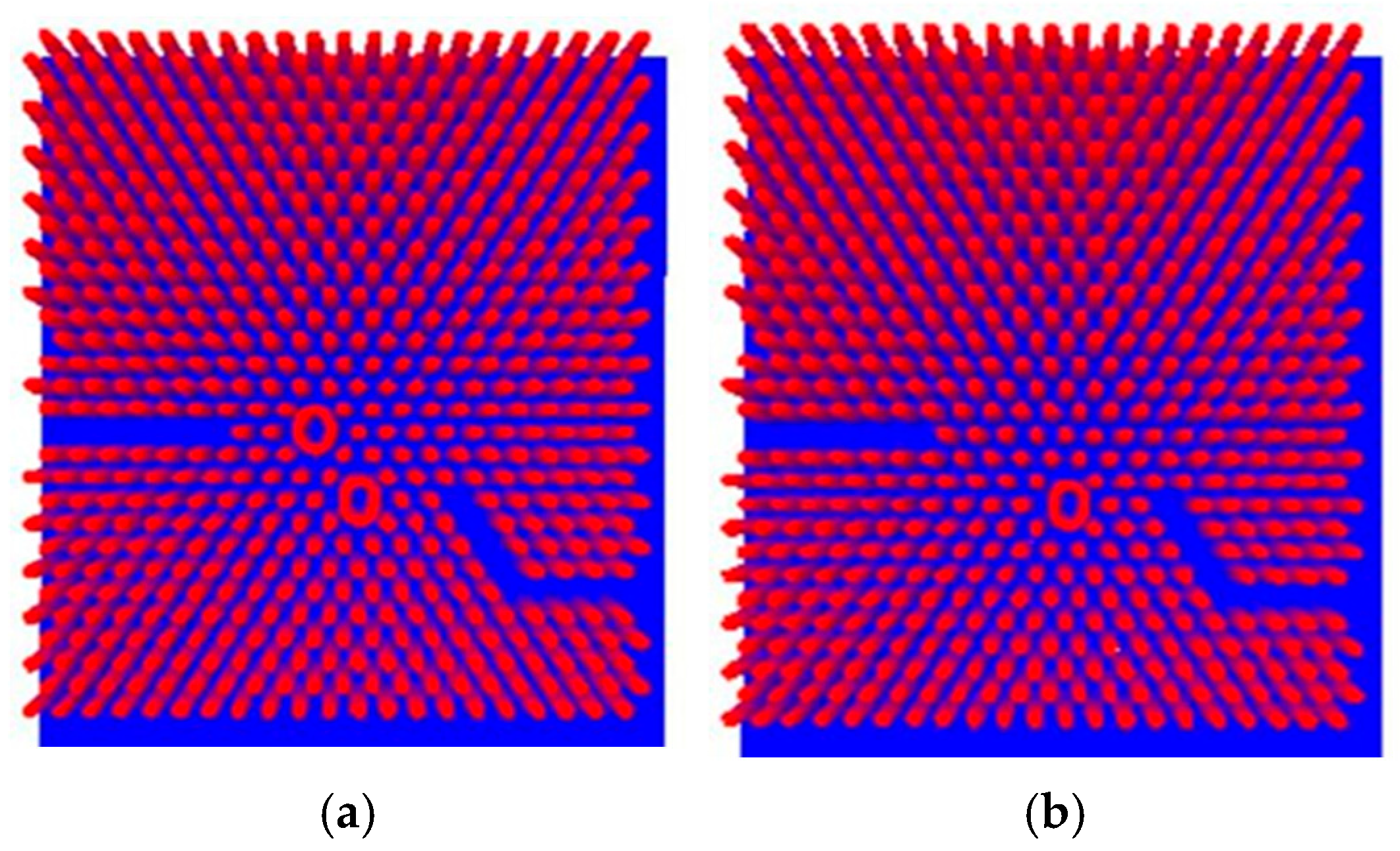
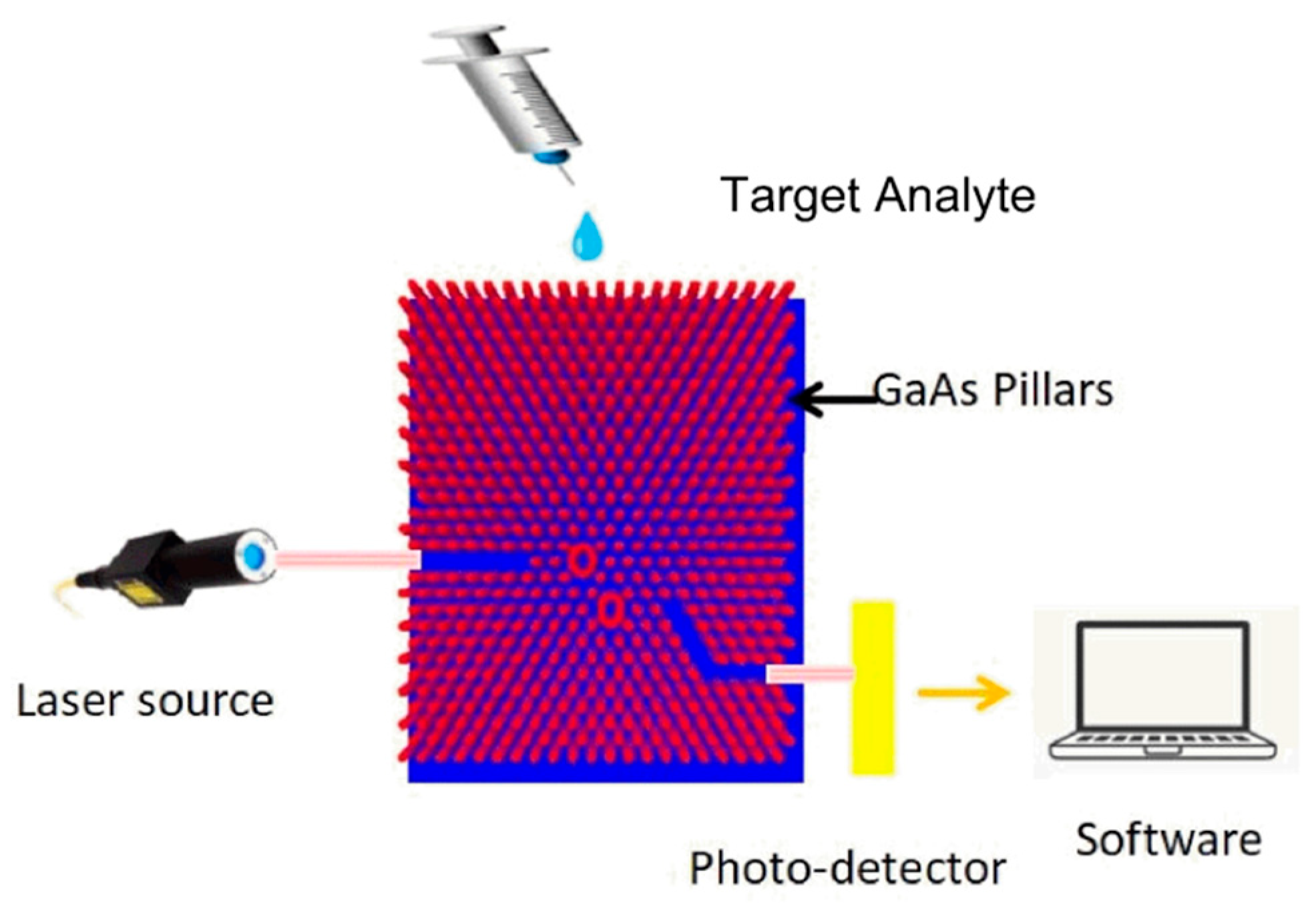
This study investigates the influence of cavity configuration on the performance of two-dimensional (2D) photonic crystal (PhC) sensors, with particular emphasis on the effect of doubling the number of cavities. A comparative analysis between single-cavity and dual-cavity configurations is conducted to evaluate their impact on key sensing parameters. In the dual-cavity configuration, two resonant cavities are introduced between coupled waveguides, enabling strong optical mode coupling and enhanced electromagnetic field confinement within the sensing region. This coupling leads to sharper resonance peaks, reduced linewidths, and increased interaction between the optical field and the infiltrated analyte. As a result, the dual-cavity sensor exhibits significantly improved sensing performance, achieving a high sensitivity of 9261.54 nm/RIU, a quality factor of 15,352.38, a figure of merit exceeding 4.5 × 10⁷, and a detection limit below 1.7 × 10⁻⁷ RIU. These results demonstrate that doubling the cavity number effectively amplifies light–matter interaction and resonance stability, making the proposed dual-cavity 2D PhC sensor a highly promising platform for precise refractive index sensing in biomedical applications.
Keywords: photonic crystal; brain cancer; cavity; doubling cavity; optiFDTD photonic crystal; brain cancer; cavity; doubling cavity; optiFDTD