Article

A Low-Cost, High-Power, Fast-Tunable Narrow-Linewidth Laser with Terminal Feedback for Rubidium Optical Pumping


1
Institute of Nuclear Physics and Chemistry, China Academy of Engineering Physics, Mianyang 621900, China
2
National Key Laboratory of Neutron Science and Technology, Institute of Nuclear Physics and Chemistry, China Academy of Engineering Physics, Mianyang 621900, China
3
Key Laboratory of Nuclear Physics and Ion-Beam Application (MOE), Fudan University, Shanghai 200433, China
4
Institute of Fundamental Physics and Quantum Technology, and School of Physical Science and Technology, Ningbo University, Ningbo 315211, China
*
Author to whom correspondence should be addressed.
Photonics 2026, 13(2), 182; https://doi.org/10.3390/photonics13020182
Submission received: 8 January 2026 / Revised: 7 February 2026 / Accepted: 10 February 2026 / Published: 12 February 2026
(This article belongs to the Section Lasers, Light Sources and Sensors)

Abstract

We report the development of a high-power, cost-effective, and rapidly tunable laser system optimized for rubidium optical pumping in spin-exchange optical pumping (SEOP) applications. The system combines a spectrally narrowed diode laser bar with a low-cost yet high-stability thermal-management architecture based on consumer-grade CPU liquid-cooling components. Wavelength narrowing and fast tuning are achieved by linearly translating a chirped volume Bragg grating (CVBG), providing mode-hop-free, continuous wavelength control without relying on slow thermal tuning mechanisms. Long-term wavelength stability is ensured through a terminal proportional–integral–derivative (PID) feedback loop that locks the laser directly to the rubidium absorption spectrum in the pumping cell, rather than to an internal reference. Operating near 795 nm, the laser delivers up to 40 W of optical power with a measured linewidth of approximately 0.15 nm. The system supports rapid wavelength agility over a continuous tuning range of 794.73 ± 0.24 nm and exhibits stable spectral performance during extended operation. Owing to its compact design, fast response, and substantially lower cost than conventional volume-grating-based systems, this laser architecture provides a practical and scalable solution for SEOP and other precision atomic and spectroscopic applications that require high power, a narrow linewidth, and robust wavelength stability.

1. Introduction

Laser sources with high spectral purity and long-term phase stability are indispensable tools in modern precision science and engineering. In applications such as nuclear and atomic physics [1,2], laser-driven plasma physics [3,4], quantum optomechanics [5], and optical pumping, the laser linewidth and frequency stability directly determine the achievable signal contrast, polarization efficiency, and measurement sensitivity. Even small spectral broadening or wavelength drift can significantly degrade system performance by increasing off-resonant excitation, introducing excess phase noise, or reducing the effective interaction strength with narrow atomic transitions [6,7,8,9,10,11]. Consequently, the development of high-power laser systems that simultaneously offer narrow linewidth, fast wavelength control, and robust long-term stability remains an essential and ongoing challenge.
A particularly important application of narrow-linewidth, high-power lasers in atomic physics is the optical polarization of alkali metals, which plays a pivotal role in both the research and development of alkali lasers [12,13,14,15,16,17], atomic magnetometers [18,19,20,21] and magnetic field descriptions [22,23], nuclear magnetic resonance gyroscopes [24,25,26], and polarizing noble gases using spin-exchange optical pumping (SEOP) [27,28,29,30,31,32] and metastability-exchange optical pumping (MEOP) [33,34,35]. In this work, we focus on SEOP of helium-3 (3He). The SEOP process requires a laser source that simultaneously provides high optical power, a sufficiently narrow linewidth, and a center wavelength precisely matched to the D 1 absorption line of alkali-metal atoms (typically rubidium at ∼794.7 nm). Under optical pumping, polarized alkali-metal valence electrons transfer angular momentum to the 3He nucleus via spin-exchange collisions, enabling nuclear spin polarizations exceeding 80% under optimized conditions [36].
SEOP-based nuclear polarization is a multidisciplinary technique that integrates atomic, laser, and nuclear physics [30,37]. In a typical implementation, 3He gas, a small quantity of alkali metal (Rb or K), and a buffer gas such as N 2 are sealed within a glass cell placed in a uniform magnetic field. Circularly polarized laser light resonant with the alkali-metal D 1 transition optically pumps the atoms into the state | 5 S 1 / 2 , m S = 1 / 2 through repeated excitation and collisional quenching. The polarized alkali-metal atoms subsequently transfer angular momentum to the 3He nuclei via the Fermi contact interaction [27,28,38]:
H I I · S , Rb + He 3 Rb + He 3 ,
where I and S denote the nuclear spin of 3He and the valence-electron spin of the alkali atom, respectively. This process constitutes an angular-momentum-conserving transfer from photons to nuclei mediated by resonant optical excitation and hyperfine interactions.
Polarized 3He plays an important role in polarized neutron scattering experiments, as it can serve as a neutron polarizer offering advantages such as a broad operational neutron energy range, large acceptance angles, and uniform analyzing efficiency [30,39,40,41,42,43]. Given the inherently low neutron flux and high operational costs of neutron facilities, improving neutron polarization efficiency is essential to maximize experimental sensitivity and effective use of beamtime. Beyond neutron scattering, SEOP-polarized noble gases are widely employed in fundamental physics [44], precision magnetometry, medical imaging, inertial navigation, and inertial sensing. Representative examples include hyperpolarized 3He and 129Xe for lung MRI [45,46], spin-exchange relaxation-free (SERF) alkali-metal magnetometers surpassing SQUID sensitivity [18,47,48], and quantum gyroscopes based on polarized 129Xe–131Xe ensembles [49].
These diverse applications impose stringent requirements on the pumping laser system, including high output power, narrow linewidth, fast wavelength tunability or response, and long-term wavelength stability, all while maintaining reasonable system cost and operational robustness. Semiconductor laser arrays are attractive high-power sources owing to their high electro-optical efficiency and scalability; however, their intrinsically broad emission spectra necessitate effective spectral-narrowing techniques. External volume-grating feedback is widely employed to achieve narrow-linewidth operation by providing wavelength-selective optical feedback [14,15,50].
Despite their effectiveness, existing commercial volume-grating-based laser systems remain expensive and often rely on thermal wavelength tuning, which inherently limits tuning speed. Moreover, most commercial systems lack fine-grained feedback tuning and instead rely on built-in wavelength correlations to meet user wavelength requirements, rather than basing feedback on the terminal load, such as the alkali-metal vapor absorption spectrum. As a result, long-term wavelength drift under real operating conditions is difficult to suppress, posing a significant challenge in neutron-scattering facilities and other environments where manual intervention is limited.
To address these challenges, we present a laser architecture that simultaneously improves cost efficiency, tuning speed, and operational stability. The system integrates (i) a low-cost yet high-stability thermal-management module constructed from commercial off-the-shelf computer components, (ii) rapid wavelength tuning enabled by linear translation of a chirped volume Bragg grating (CVBG) [51], and (iii) closed-loop wavelength stabilization using terminal feedback derived directly from the optical pumping cell. This architecture provides a compact, agile, and cost-effective laser solution tailored for SEOP and other precision atomic-physics applications.

2. Laser System Configuration

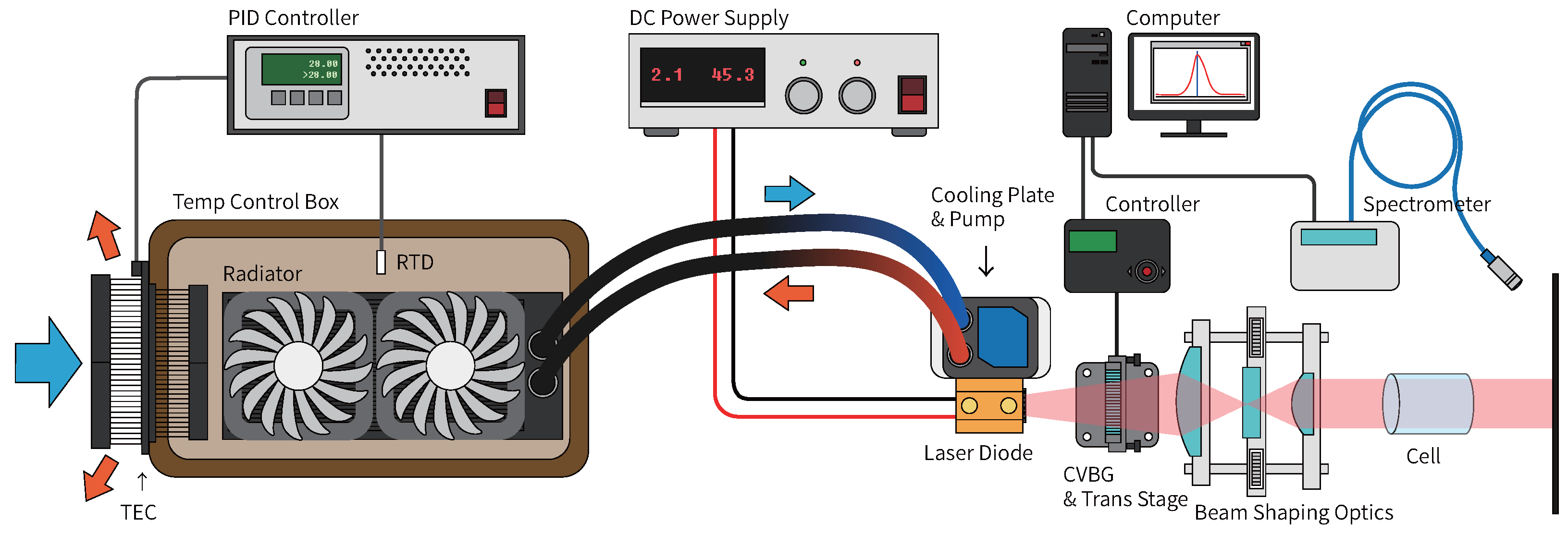
The laser system we developed comprises several key subsystems: a diode laser bar, a thermal-management unit, a wavelength-narrowing and tuning module, and a terminal feedback control system. A schematic overview of the system is shown in Figure 1. The diode laser bar serves as the light source, emitting a laser beam that is directed onto a CVBG. The CVBG is mounted on a motorized linear translation stage controlled by a PC, enabling precise adjustment of the feedback wavelength. The diode laser bar is water-cooled by a temperature-stabilized thermal-management system to ensure highly stable operation. A spectrometer continuously monitors the laser spectral peak, and the measured data are fed back to the PC, which in turn regulates the CVBG position to achieve closed-loop wavelength control. Detailed descriptions of each subsystem are provided below.

2.1. Diode Laser Bar

Commercial 795 nm diode laser bars provide a cost-effective, high-power light source well-suited to rubidium optical pumping applications. Accordingly, a 795 nm diode laser bar was selected as the gain medium in the present system to minimize overall cost while delivering sufficient optical power. However, such diode laser bars typically have a relatively broad emission spectrum, with a full width at half maximum (FWHM) of several nanometers, making additional spectral narrowing essential for precision applications. A fast-axis collimating microlens array is incorporated at the output facet to collimate the emitted radiation. Under typical operating conditions, the diode laser bar delivers up to 40 W of optical power with an intrinsic spectral bandwidth of approximately 3 nm (FWHM). Standardized mechanical mounting features and optimized thermal contact interfaces facilitate straightforward integration into experimental setups while ensuring efficient heat dissipation and stable operation.

2.2. Thermal-Management Unit

Precise temperature control of the laser bar is essential for stable operation, as temperature fluctuations induce wavelength drift and linewidth broadening [52,53]. Thermoelectric coolers (TECs), combined with proportional–integral–derivative (PID) feedback, are widely used for compact and efficient thermal management [54,55]. By reversing the voltage polarity, TECs provide bidirectional cooling and heating, while PID control ensures stable temperature regulation. Conventional laser thermal-stabilization solutions often rely on custom components, increasing system complexity and cost. The approach presented here provides a low-cost alternative while maintaining high thermal stability and robust laser performance.
High-power semiconductor lasers are typically liquid-cooled using micro-channel coolers (MCCs), which provide efficient heat dissipation [56,57]. However, MCC-based systems require continuous water circulation, introducing reliability and usability challenges. Micro-channel clogging, electrochemical corrosion caused by incompatible materials, and leakage risks can degrade thermal performance and threaten long-term operation. In addition, MCC systems serve a limited user base, limiting the benefits of large-scale manufacturing and rapid technology iteration. As a result, 400 W-class commercial water-cooling units typically cost several thousand U.S. dollars, motivating the development of alternative cooling strategies with improved reliability and lower cost.
Consumer-grade CPU liquid coolers provide a compact, closed-loop cooling solution that integrates a pump, radiator, and cold plate [58,59]. Commercial all-in-one (AIO) coolers priced below $300 employ micro-channel cold plates with heat-dissipation efficiencies exceeding 70 W / cm 2 , which is sufficient for high-power diode laser bars. Their large user base enables extensive reliability testing and rapid iteration, and their costs are at least an order of magnitude lower than those of specialized MCC systems.
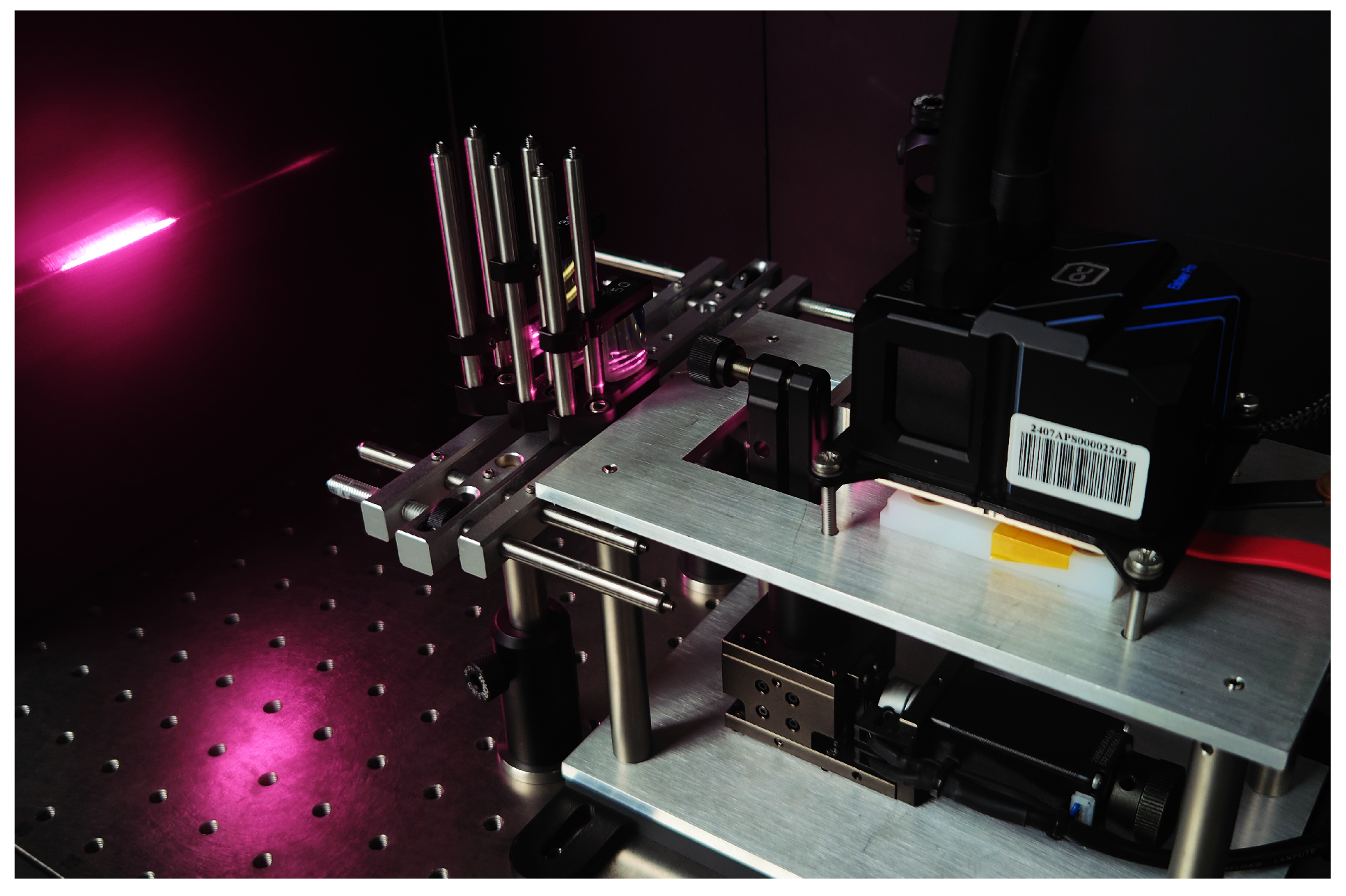
In the current design, the radiator is placed inside a temperature-controlled enclosure, providing efficient heat dissipation while maintaining a well-defined thermal environment. Previous studies have demonstrated that low-cost temperature-control systems can achieve stability better than ±0.1 °C [60]. This two-stage cooling strategy removes most of the thermal load through the CPU liquid cooler, while the enclosure suppresses residual temperature fluctuations that affect the laser bar. As shown in Figure 2, the diode laser bar is mounted in direct thermal contact with the CPU cooler’s copper cold plate, with thermal grease minimizing interfacial thermal resistance. The cold plate is connected to the radiator through sealed thermoplastic vulcanizate (TPV) tubing, coupling the cooling loop to a thermally stable buffer environment. A commercial water-based coolant with defoamers and preservatives suppresses bubble formation and microbial growth while maintaining favorable thermal properties.
To enhance stability, temperature-control electronics and active cooling components are positioned away from the laser diode, reducing unwanted thermal coupling and electromagnetic interference. A copper cold plate/radiator configuration is adopted to exploit high thermal conductivity and to avoid galvanic corrosion in mixed-metal systems [61]. The temperature-controlled enclosure is equipped with a 400 W TEC and a matched PID controller for adjustable constant-temperature operation [60]. Experimental measurements show that the enclosure temperature stabilizes within ±0.1 °C at thermal equilibrium. The combination of efficient heat removal and precise temperature regulation ensures stable laser operation and reliable long-term performance.

2.3. Wavelength-Narrowing and Tuning Module

Two complementary strategies are commonly used to control the emission wavelength of commercial laser diodes. One strategy relies on wavelength-selective optical feedback to modify the effective cavity oscillation conditions, whereby external feedback at a target wavelength “pulls” the laser emission toward that wavelength. External-cavity diode lasers (ECDLs), for example, employ diffraction gratings to provide such feedback and enable tuning by several nanometers around the free-running wavelength [62]. The second strategy exploits the intrinsic dependence of the diode emission wavelength on operating temperature, which originates from thermal variations in the semiconductor gain spectrum and cavity length, with typical tuning coefficients of 0.15–0.25 nm/°C [52]. These two mechanisms underlie many wavelength-tunable diode laser systems used in atomic physics and spectroscopy.
In the current system, the collimated output beam from the diode laser bar is directed onto a CVBG, with a diffraction efficiency of approximately 30%. At the selected wavelength, about 30% of the incident optical power is retroreflected by the CVBG and coupled back into the diode laser bar, thereby providing wavelength-selective optical feedback. Efficient retro-injection requires careful angular and positional alignment of the grating to ensure proper coupling into the diode emitter. Meanwhile, the remaining ∼70% of the optical power is transmitted through the CVBG and serves as the usable output beam.
A CVBG is a reflective volume Bragg structure characterized by a spatially varying grating period along one transverse direction [63,64]. Owing to this chirped structure, the Bragg-resonance wavelength depends on the transverse position at which the laser beam impinges on the grating, establishing a direct correspondence between beam position and feedback wavelength. To exploit this property for wavelength tuning, a 14   ( W ) × 14   ( H ) × 1.5   ( T ) mm CVBG is mounted on a three-axis adjustable optical mount then connected to a high-precision motorized linear translation stage. Translating the grating along its chirped axis continuously shifts the beam position on the CVBG, thereby enabling rapid and continuous wavelength tuning over a broad range [65]. This tuning scheme inherently suppresses mode hopping, a common limitation in both ECDL-based feedback systems and temperature-based tuning [66], while the performance of the translation stage determines the achievable tuning speed and resolution.
In addition to wavelength tuning, the CVBG provides effective linewidth narrowing. Within its operating bandwidth, a CVBG typically exhibits high reflectivity, together with an ultranarrow spectral acceptance of the order of picometers [67,68]. This strong spectral selectivity imposes a narrowband constraint on the laser cavity, forcing oscillation on a single longitudinal mode and significantly compressing the intrinsically broad gain spectrum of the diode laser. Compared with temperature tuning, which merely shifts the emission wavelength without reducing the linewidth, and conventional ECDLs, which often require additional spectral-filtering elements, the CVBG-based approach offers a compact and robust solution for simultaneous wavelength tuning and linewidth narrowing.
Wavelength tuning can also be achieved by adjusting the grating temperature, which alters the effective grating period through thermal expansion. However, this method is inherently slow, as the grating typically requires several minutes to reach thermal equilibrium before the laser wavelength stabilizes; in practice, stabilization times of approximately 10 min are common. In addition, in certain experimental scenarios where tuning must be performed in radiation environments, temperature-based adjustments further complicate operations and increase tuning latency. In contrast, wavelength tuning in the present system is achieved by translating the CVBG mounted on a motorized linear stage, enabling an essentially instantaneous response of the laser wavelength without thermal stabilization.

2.4. Terminal Feedback Control System

One of the key advantages of the laser system developed in this work is the implementation of terminal feedback control, which locks the laser wavelength directly to the alkali-metal vapor cell under optical pumping. The output laser beam is reshaped and directed into a heated rubidium cell, where it interacts with the vapor. A black screen blocks the transmitted light and diffusely scatters it into a spectrometer, allowing the absorption spectrum of the rubidium vapor to be recorded. The resulting spectral dip corresponds to the atomic absorption resonance and serves as an absolute frequency reference. This signal is used in a PID feedback loop to control the CVBG position, thereby stabilizing the laser wavelength.
Although this type of absorption-based feedback is conceptually well-established and straightforward to implement, we emphasize that, in the present system, it is applied at the terminal stage of the pumping process, a feature typically absent in commercial laser systems. Commercial solutions generally rely on built-in spectral correlations to lock the wavelength (typically via PID control of the grating temperature) without reference to the downstream application. Such internal feedback schemes are inherently slow and, more importantly, do not reflect the spectral conditions experienced at the end-user interface. In contrast, our system derives the feedback signal directly from the pumping cell itself, ensuring that the stabilized wavelength precisely matches the atomic absorption resonance relevant to the application. This terminal-feedback approach not only provides a faster response but also achieves optimal spectral alignment under real operating conditions.

3. Experimental Characterization and Performance Evaluation

A series of experiments was conducted to evaluate the performance of the fabricated laser system. All measurements were carried out in a controlled laboratory environment to ensure reproducibility and stable operating conditions.
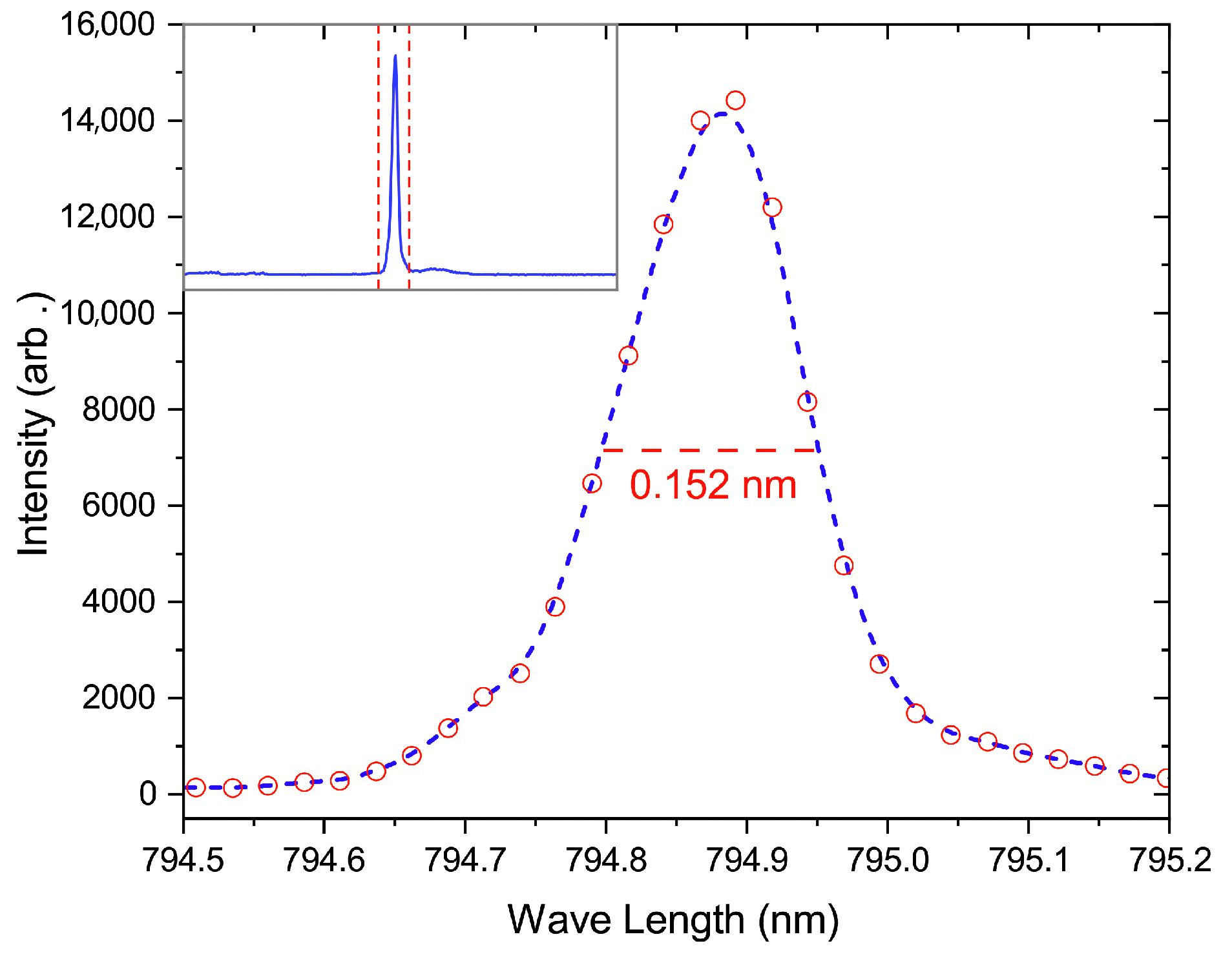
To verify the CVBG-integrated laser design, the spectral linewidth and long-term stability were characterized using a high-resolution compact fiber-optic spectrometer with a wavelength resolution of 0.025 nm near 795 nm. During linewidth measurement, the laser was operated at a drive current of 42.0 A and a voltage of 2.2 V, with the external temperature-controlled enclosure maintained at 27.5 °C. Under these conditions, a FWHM linewidth of 0.152 nm was measured, together with a spectral purity of 86% and a side-mode suppression ratio of ∼15 dB, confirming the effective linewidth compression enabled by the CVBG, as shown in Figure 3.
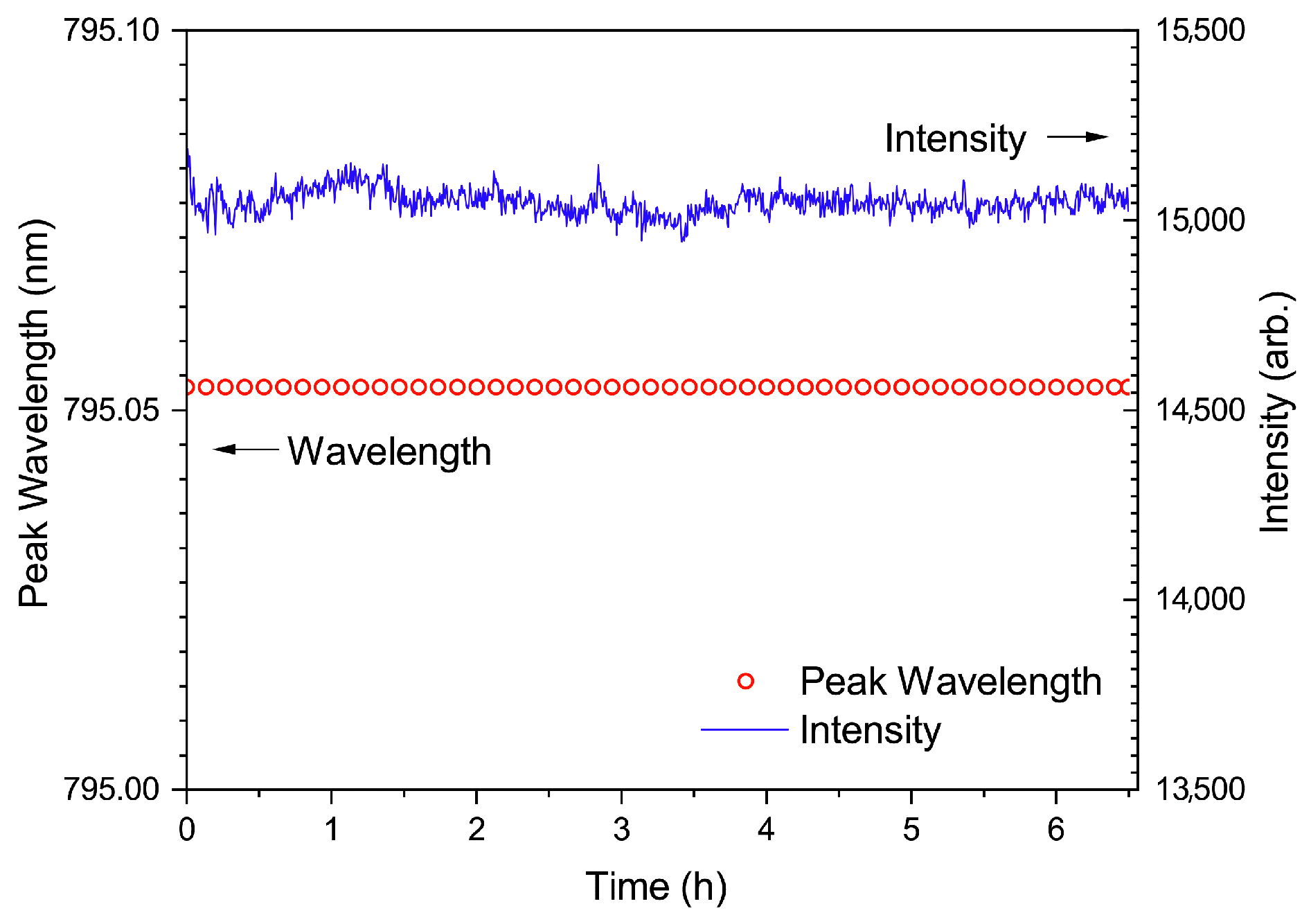
Long-term spectral stability was monitored using the same spectrometer for 6.5 h. The measured peak-wavelength drift was below 0.0084 nm, while the peak optical power fluctuation remained within 2%, as shown in Figure 4. Owing to the finite wavelength resolution of the spectrometer, no systematic wavelength drift was resolvable over the measurement period. These results validate the effectiveness of the two-stage thermal-management scheme in suppressing wavelength fluctuations.
The system’s wavelength-tuning performance was characterized by sweeping the motorized linear translation stage over its full travel range while simultaneously monitoring the laser output wavelength with the same spectrometer. The measured peak wavelength was correlated with the stage position to determine both the tuning range and tuning speed.
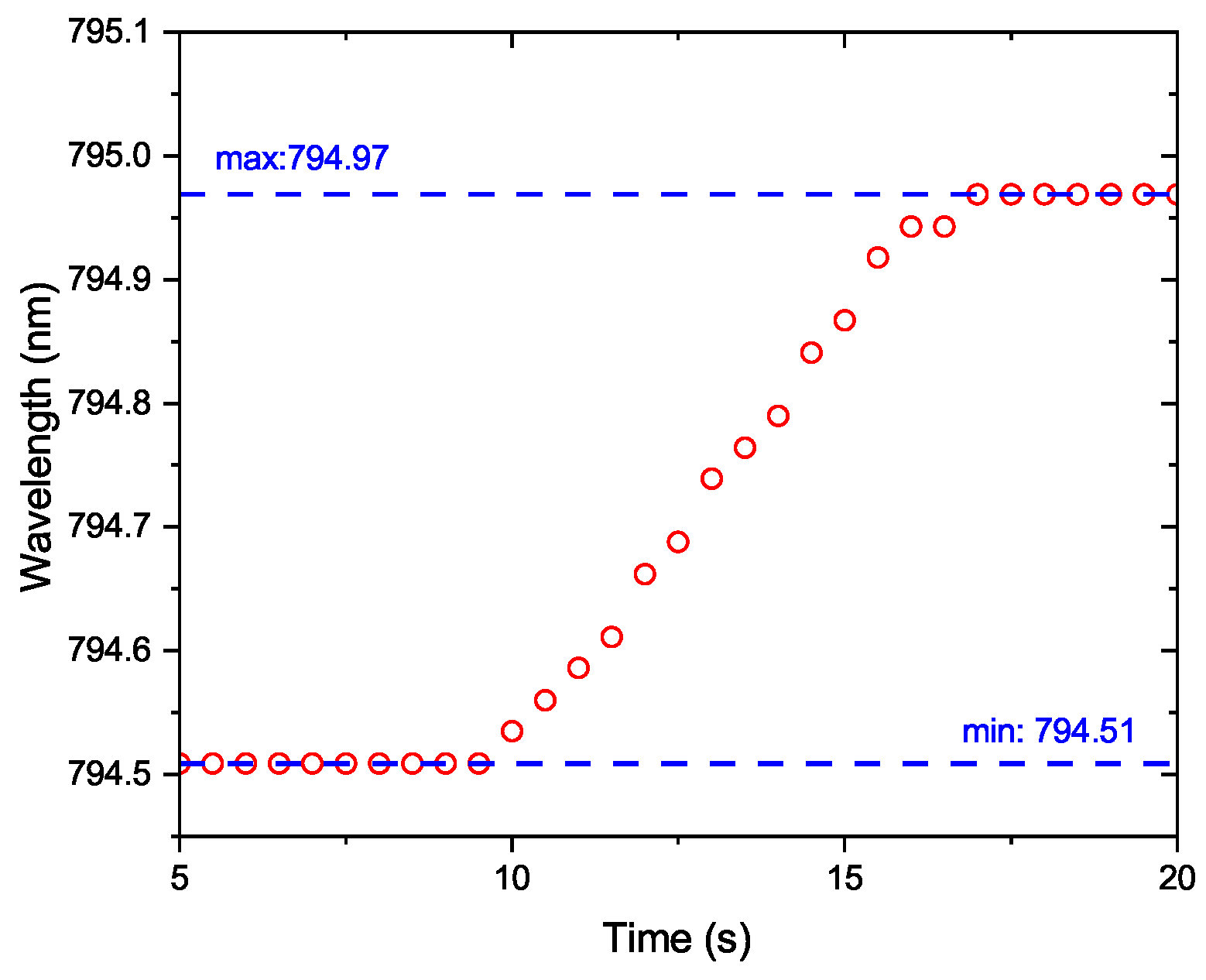
To change the wavelength from 794.51 to 794.97 nm, as shown in Figure 5, the CVBG was translated by approximately 6 mm. The translation stage is driven by a stepping motor with a full-step resolution of 0.005 mm and a positioning accuracy of ≤50 μ m . A maximum tuning speed of 0.06 nm/s was achieved, attributable to the motorized translation stage’s high-speed performance and the simplicity of the CVBG-based tuning mechanism.

4. Conclusions and Discussion

In this work, we have designed, implemented, and experimentally characterized a low-cost, high-power, fast-tunable narrow-linewidth laser system operating near 795 nm, specifically optimized for rubidium optical pumping in SEOP applications. The laser architecture combines a CVBG mounted on a motorized linear translation stage with terminal wavelength feedback derived directly from the alkali-metal absorption spectrum in the pumping cell. This terminal feedback scheme locks the laser wavelength to the actual atomic resonance encountered during optical pumping, enabling rapid, mode-hop-free wavelength tuning and long-term spectral stability under realistic SEOP operating conditions.
A central outcome of this study is the demonstration that laser systems that meet the stringent requirements of neutron-related SEOP applications—high optical power, narrow linewidth, rapid wavelength response, and long-term stability—can be realized without reliance on expensive, custom-engineered subsystems. By leveraging a consumer-grade CPU liquid-cooling solution in conjunction with an external temperature-controlled enclosure, the system achieves effective thermal stabilization while significantly reducing cost and integration complexity. This two-stage thermal-management strategy provides sufficient temperature stability to suppress wavelength drift during extended operation, a critical requirement for uninterrupted neutron beamtime at large-scale facilities.
The CVBG-based wavelength-control scheme, combined with terminal feedback, represents a key advantage for SEOP users. Linear translation of the CVBG provides a mechanically simple, robust, and inherently mode-hop-free tuning mechanism, with response times that far exceed those achievable with conventional temperature-based tuning. More importantly, the terminal feedback loop continuously corrects wavelength deviations using the absorption signal from the pumping cell itself, rather than relying on an internal spectrometer or cavity reference. This distinction is particularly important in neutron facilities, where alkali-metal vapor density, buffer-gas pressure, and cell temperature can vary over time, shifting the effective absorption profile seen by the laser. By locking directly to the terminal load, the laser remains optimally tuned to the atomic transition throughout operation without manual intervention.
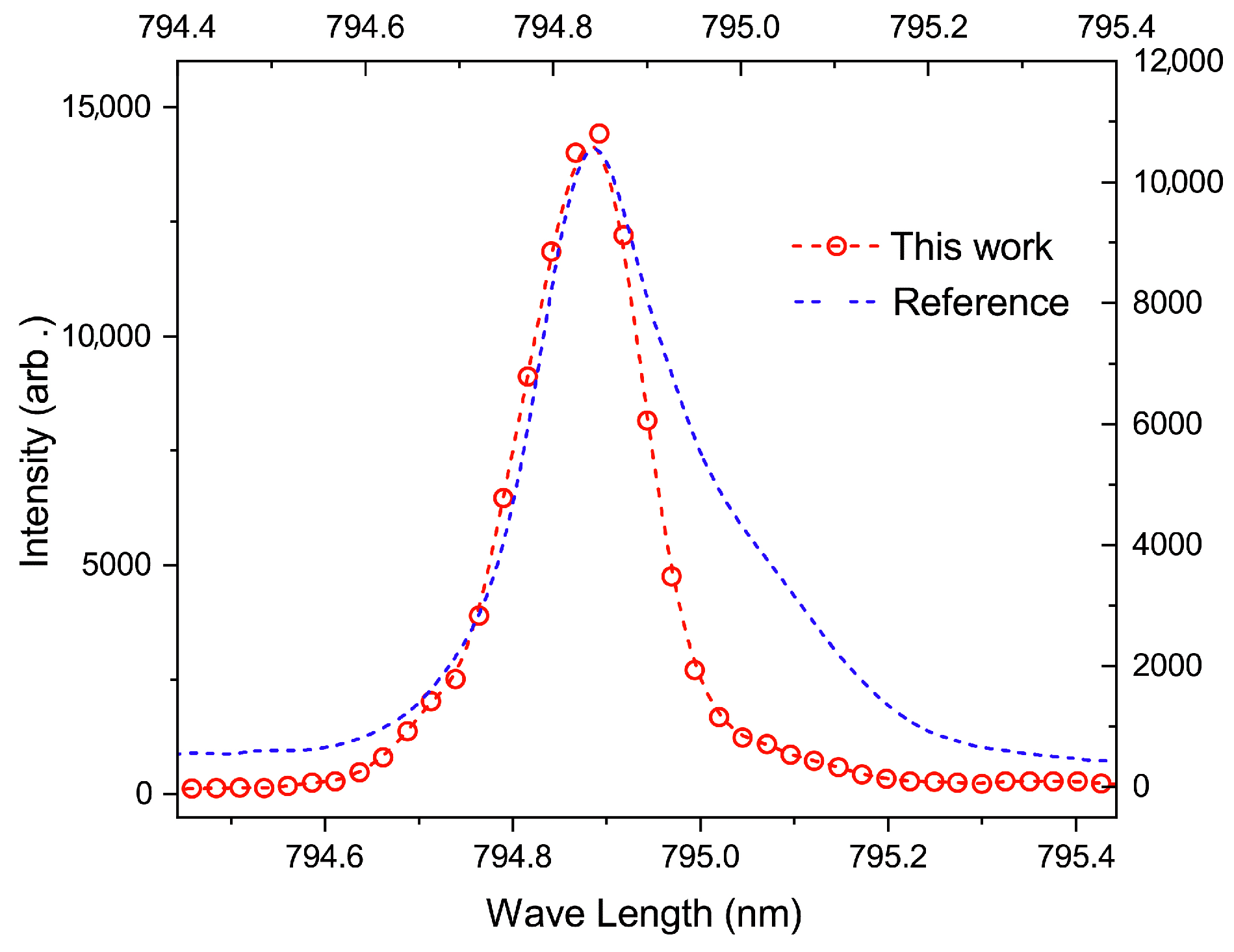
To place the system performance in context, we compared its spectral characteristics with those of representative commercial high-power narrow-linewidth laser systems commonly used for SEOP. As shown in Figure 6, the laser developed in this work exhibits a significantly narrower emission spectrum under comparable operating conditions. Since laser linewidth and wavelength stability directly affect optical pumping efficiency and neutron polarization performance, the demonstrated combination of spectral purity, fast tunability, and terminal feedback control is expected to yield improved 3He polarization levels and more efficient utilization of neutron beamtime. In addition, the ability to rapidly scan and re-lock the wavelength enables efficient compensation for pressure broadening, temperature drifts, and cell-to-cell variations commonly encountered in SEOP systems.
Beyond neutron scattering, integrating fast CVBG tuning with terminal feedback control also benefits other SEOP-based platforms, including precision magnetometry, comagnetometry, and inertial sensing, as well as high-resolution atomic and molecular spectroscopy. The substantially reduced system cost further lowers the barrier to entry for laboratories seeking to deploy SEOP capabilities without dependence on specialized commercial laser sources.
While the current prototype validates the core design principles, further development is needed to improve its suitability for routine deployment at neutron facilities. In particular, improvements in mechanical compactness, fiber coupling, and output-power scaling will be essential for integration with existing SEOP beamline infrastructure and transportable polarization systems. Future work will also explore adapting the architecture to other alkali-metal transitions and wavelengths relevant to neutron and nuclear physics experiments.
By combining fast CVBG-based tuning with terminal feedback control and low-cost thermal management, this laser architecture points toward more autonomous, robust, and facility-friendly SEOP systems that can support long-duration, high-efficiency neutron polarization at next-generation neutron sources.

Author Contributions

Conceptualization, H.Y.; validation, Y.X.; build and testing, Y.X., K.W. and S.C.; data curation, Y.X.; writing—original draft preparation, Y.X.; writing—review and editing, H.Y., L.W. and Y.X. All authors have read and agreed to the published version of the manuscript.

Funding

This research was funded by the National Natural Science Foundation of China grants Nos. U2230207, 12305114, and 12305125.

Data Availability Statement

The data presented in this study are available on request from the corresponding author.

Conflicts of Interest

The authors declare no conflicts of interest.

Abbreviations

The following abbreviations are used in this manuscript:
AIOAll-in-one
CVBGChirped volume Bragg grating
ECDLExternal-cavity diode laser
MCCMicro-channel cooler
MEOPMetastability-exchange optical pumping
PIDProportional–integral–derivative
SEOPSpin-exchange optical pumping
SERFSpin-exchange relaxation-free
TECThermoelectric cooler
TPVThermoplastic vulcanizate

References

  1. Otten, E.W. Laser techniques in nuclear physics. Nucl. Phys. A 1981, 354, 471–496. [Google Scholar] [CrossRef]
  2. Hannachi, F.; Aléonard, M.M.; Gerbaux, M.; Gobet, F.; Malka, G.; Plaisir, C.; Scheurer, J.N.; Tarisien, M.; Audebert, P.; Brambrink, E.; et al. Prospects for nuclear physics with lasers. Plasma Phys. Control. Fusion 2007, 49, B79. [Google Scholar] [CrossRef]
  3. Hora, H. Physics of Laser Driven Plasmas; Wiley-Interscience: New York, NY, USA, 1981. [Google Scholar]
  4. Hooker, S.M. Developments in laser-driven plasma accelerators. Nat. Photonics 2013, 7, 775–782. [Google Scholar] [CrossRef]
  5. Bowen, W.P.; Milburn, G.J. Quantum Optomechanics; CRC Press: London, UK, 2020. [Google Scholar]
  6. Paschotta, R. Phase Noise. RP Photonics Encyclopedia. 2007. Available online: https://www.rp-photonics.com/phase_noise.html (accessed on 8 January 2026).
  7. Hager, G.; Mciver, J.; Hostutler, D.; Pitz, G.; Perram, G. A quasi-two level analytic model for end pumped alkali metal vapor laser. In High-Power Laser Ablation VII; SPIE: Bellingham, WA, USA, 2008; Volume 7005, pp. 667–675. [Google Scholar]
  8. Pitz, G.A.; Wertepny, D.E.; Perram, G.P. Pressure broadening and shift of the cesium D1 transition by the noble gases and N2, H2, HD, D2, CH4, C2H6, CF4, and 3He. Phys. Rev. A 2009, 80, 062718. [Google Scholar]
  9. Pitz, G.A.; Fox, C.D.; Perram, G.P. Pressure broadening and shift of the cesium D2 transition by the noble gases and N2, H2, HD, D2, CH4, C2H6, CF4, and 3He with comparison to the D1 transition. Phys. Rev. A 2010, 82, 042502. [Google Scholar] [CrossRef]
  10. Hager, G.D.; Perram, G.P. A three-level analytic model for alkali metal vapor lasers: Part I. Narrowband optical pumping. Appl. Phys. B 2010, 101, 45–56. [Google Scholar] [CrossRef]
  11. Yang, Z.; Wang, H.; Lu, Q.; Li, Y.; Hua, W.; Xu, X.; Chen, J. Modeling, numerical approach, and power scaling of alkali vapor lasers in side-pumped configuration with flowing medium. J. Opt. Soc. Am. B 2011, 28, 1353–1364. [Google Scholar] [CrossRef]
  12. Zhdanov, B.V.; Knize, R.J. Review of alkali laser research and development. Opt. Eng. 2012, 52, 021010. [Google Scholar] [CrossRef]
  13. Zhdanov, B.V.; Stooke, A.; Boyadjian, G.; Voci, A.; Knize, R.J. Laser diode array pumped continuous wave rubidium vapor laser. Opt. Express 2008, 16, 748–751. [Google Scholar] [CrossRef]
  14. Gourevitch, A.; Venus, G.; Smirnov, V.; Glebov, L. Efficient pumping of Rb vapor by high-power volume Bragg diode laser. Opt. Lett. 2007, 32, 2611–2613. [Google Scholar] [CrossRef]
  15. Podvyaznyy, A.; Venus, G.; Smirnov, V.; Mokhun, O.; Koulechov, V.; Hostutler, D.; Glebov, L. 250W diode laser for low pressure rb vapor pumping. High-Power Diode Laser Technol. Appl. VIII 2010, 7583, 352–357. [Google Scholar]
  16. Ehrenreich, T.; Zhdanov, B.; Takekoshi, T.; Phipps, S.P.; Knize, R.J. Diode pumped caesium laser. Electron. Lett. 2005, 41, 415–416. [Google Scholar] [CrossRef]
  17. Ehrenreich, T. Diode pumped cesium laser. In APS Division of Atomic, Molecular and Optical Physics Meeting Abstracts; American Physical Society: College Park, MD, USA, 2005; Volume 36, pp. D6–D100. [Google Scholar]
  18. Kominis, I.K.; Kornack, T.W.; Allred, J.C.; Romalis, M.V. A subfemtotesla multichannel atomic magnetometer. Nature 2003, 422, 596–599. [Google Scholar] [CrossRef] [PubMed]
  19. Yang, H.; Zhang, K.; Wang, Y.; Zhao, N. High bandwidth three-axis magnetometer based on optically polarized 85Rb under unshielded environment. J. Phys. D Appl. Phys. 2019, 53, 065002. [Google Scholar] [CrossRef]
  20. Zhang, X.; Hu, J.; Zhao, N. Stable atomic magnetometer in parity-time symmetry broken phase. Phys. Rev. Lett. 2023, 130, 023201. [Google Scholar] [CrossRef]
  21. Huang, H.; Dong, H.; Chen, L.; Gao, Y. Single-beam three-axis atomic magnetometer. Appl. Phys. Lett. 2016, 109, 062404. [Google Scholar] [CrossRef]
  22. Dong, H.; Ye, H.; Hu, M.; Ma, Z. Recent developments in fabrication methods and measurement schemes for optically pumped magnetic gradiometers: A comprehensive review. Micromachines 2024, 15, 59. [Google Scholar] [CrossRef]
  23. Liu, C.; Dong, H.; Sang, J. Submillimeter-resolution magnetic field imaging with digital micromirror device and atomic vapor cell. Appl. Phys. Lett. 2021, 119, 114002. [Google Scholar] [CrossRef]
  24. Gao, G.; Hu, J.; Tang, F.; Liu, W.; Zhang, X.; Wang, B.; Deng, D.; Zhu, M.; Zhao, N. Stability improvement of nuclear magnetic resonance gyroscope with self-calibrating parametric magnetometer. Phys. Rev. Appl. 2024, 21, 014042. [Google Scholar] [CrossRef]
  25. Zhang, K.; Zhao, N.; Wang, Y.-H. Closed-loop nuclear magnetic resonance gyroscope based on Rb-Xe. Sci. Rep. 2020, 10, 2258. [Google Scholar] [CrossRef]
  26. Dong, H.; Fang, J.; Qin, J.; Chen, Y. Analysis of the electrons-nuclei coupled atomic gyroscope. Opt. Commun. 2011, 284, 2886–2889. [Google Scholar] [CrossRef]
  27. Bouchiat, M.A.; Carver, T.R.; Varnum, C.M. Nuclear polarization in 3He gas induced by optical pumping and dipolar exchange. Phys. Rev. Lett. 1960, 5, 373–375. [Google Scholar] [CrossRef]
  28. Appelt, S.; Baranga, A.B.-A.; Erickson, C.J.; Romalis, M.V.; Young, A.R.; Happer, W. Theory of spin-exchange optical pumping of 3He and 129Xe. Phys. Rev. A 1998, 58, 1412–1439. [Google Scholar] [CrossRef]
  29. Walker, T.G.; Happer, W. Spin-exchange optical pumping of noble-gas nuclei. Rev. Mod. Phys. 1997, 69, 629–642. [Google Scholar] [CrossRef]
  30. Gentile, T.R.; Nacher, P.J.; Saam, B.; Walker, T.G. Optically polarized 3He. Rev. Mod. Phys. 2017, 89, 045004. [Google Scholar] [CrossRef]
  31. Babcock, E.; Mattauch, S.; Ioffe, A. High level of 3He polarization maintained in an on-beam 3He spin filter using SEOP. Nucl. Instruments Methods Phys. Res. Sect. A Accel. Spectrometers Detect. Assoc. Equip. 2011, 625, 43–46. [Google Scholar] [CrossRef]
  32. Jiang, C. Optimization of Polarized Helium-3 Neutron Spin Filters for Neutron Scattering. Ph.D. Thesis, Indiana University, Bloomington, IN, USA, 2010. [Google Scholar]
  33. Colegrove, F.D.; Schearer, L.D.; Walters, G.K. Polarization of 3He gas by optical pumping. Phys. Rev. 1963, 132, 2561–2572. [Google Scholar] [CrossRef]
  34. Eckert, G.; Heil, W.; Meyerhoff, M.; Otten, E.W.; Surkau, R.; Werner, M.; Leduc, M.; Nacher, P.J.; Schearer, L.D. A dense polarized 3He target based on compression of optically pumped gas. Nucl. Instruments Methods Phys. Res. Sect. A Accel. Spectrometers Detect. Assoc. Equip. 1992, 320, 53–65. [Google Scholar] [CrossRef]
  35. Stoltz, E.; Meyerhoff, M.; Bigelow, N.; Leduc, M.; Nacher, P.-J.; Tastevin, G. High nuclear polarization in 3He and 4He gas mixtures by optical pumping with a laser diode. Appl. Phys. B 1996, 63, 629–633. [Google Scholar]
  36. Chen, W.C.; Gentile, T.R.; Ye, Q.; Walker, T.G.; Babcock, E. On the limits of spin-exchange optical pumping of 3He. J. Appl. Phys. 2014, 116, 014903. [Google Scholar] [CrossRef]
  37. Happer, W. Optical pumping. Rev. Mod. Phys. 1972, 44, 169–249. [Google Scholar] [CrossRef]
  38. Grover, B.C. Noble-Gas NMR Detection through Noble-Gas-Rubidium Hyperfine Contact Interaction. Phys. Rev. Lett. 1978, 40, 391–392. [Google Scholar] [CrossRef]
  39. Jiang, C. An overview of polarized neutron instruments and techniques in asia pacific. AAPPS Bull. 2023, 33, 21. [Google Scholar] [CrossRef]
  40. Jiang, C.; McDonald, L.; Cao, H.; Balafas, M.; Crow, L.; Kroll, E. Micro in situ 3He polarizer for dimensional extreme magnetic neutron diffractometer at the high flux isotope reactor. J. Phys. Conf. Ser. 2023, 2481, 012010. [Google Scholar] [CrossRef]
  41. Chen, W.C.; Gentile, T.R.; Fu, C.B.; Watson, S.; Jones, G.L.; McIver, J.W.; Rich, D.R. Polarized 3He cell development and application at NIST. J. Phys. Conf. Ser. 2011, 294, 012003. [Google Scholar] [CrossRef]
  42. Fu, C.B.; Gentile, T.R.; Jones, G.L.; Chen, W.C.; Erwin, R.; Watson, S.; Broholm, C.; Rodriguez-Rivera, J.A.; Scherschligt, J. A wide angle neutron spin filter system using polarized 3He. Phys. B Condens. Matter 2011, 406, 2419–2423. [Google Scholar] [CrossRef]
  43. Fu, C.B.; Gentile, T.R.; Snow, W.M. Limits on possible new nucleon monopole-dipole interactions from the spin relaxation rate of polarized 3He gas. Phys. Rev. D 2011, 83, 031504. [Google Scholar] [CrossRef]
  44. Yan, H.; Sun, G.A.; Peng, S.M.; Zhang, Y.; Fu, C.; Guo, H.; Liu, B.Q. Searching for New Spin- and Velocity-Dependent Interactions by Spin Relaxation of Polarized 3He Gas. Phys. Rev. Lett. 2015, 115, 182001. [Google Scholar] [CrossRef]
  45. Stewart, N.J.; Chan, H.-F.; Hughes, P.J.C.; Horn, F.C.; Norquay, G.; Rao, M.; Yates, D.P.; Ireland, R.H.; Hatton, M.Q.; Tahir, B.A.; et al. Comparison of 3He and 129Xe mri for evaluation of lung microstructure and ventilation at 1.5T: 3He and 129Xe lung mri at 1.5T. J. Magn. Reson. Imaging 2018, 48, 632–642. [Google Scholar] [CrossRef]
  46. Acosta, R.H.; Blümler, P.; Münnemann, K.; Spiess, H.-W. Mixture and dissolution of laser polarized noble gases: Spectroscopic and imaging applications. Prog. Nucl. Magn. Reson. Spectrosc. 2012, 66, 40–69. [Google Scholar] [CrossRef]
  47. Song, X.; Dong, H.; Fang, J. Chip scale atomic magnetometer based on SERF. In 2009 4th IEEE International Conference on Nano/Micro Engineered and Molecular Systems; IEEE: Piscataway, NJ, USA, 2009; pp. 231–234. [Google Scholar]
  48. Wei, K.; Ji, W.; Fu, C.; Wickenbrock, A.; Flambaum, V.V.; Fang, J.; Budker, D. Constraints on exotic spin-velocity-dependent interactions. Nat. Commun. 2022, 13, 7387. [Google Scholar] [CrossRef] [PubMed]
  49. Bulatowicz, M.; Griffith, R.; Larsen, M.; Mirijanian, J.; Walker, T.G.; Fu, C.B.; Smith, E.; Snow, W.M.; Yan, H. A Laboratory Search for a Long-Range T-Odd, P-Odd Interaction from Axion-Like Particles Using Dual Species Nuclear Magnetic Resonance with Polarized Xe-129 and Xe-131 Gas. Phys. Rev. Lett. 2013, 111, 102001. [Google Scholar] [CrossRef] [PubMed]
  50. Zhdanov, B.V.; Ehrenreich, T.; Knize, R.J. Narrowband external cavity laser diode array. Electron. Lett. 2007, 43, 221–222. [Google Scholar] [CrossRef]
  51. Li, X.; Shi, J.; Wei, L.; Ding, K.; Ma, Y.; Sun, K.; Li, Z.; Qu, Y.; Li, L.; Qiao, Z.; et al. Research progress of wide tunable bragg grating external cavity semiconductor lasers. Materials 2022, 15, 8256. [Google Scholar] [CrossRef] [PubMed]
  52. Wieman, C.E.; Hollberg, L. Using diode lasers for atomic physics. Rev. Sci. Instruments 1991, 62, 1–20. [Google Scholar] [CrossRef]
  53. Osinski, M.; Buus, J. Linewidth broadening factor in semiconductor lasers—An overview. IEEE J. Quantum Electron. 1987, 23, 9–29. [Google Scholar] [CrossRef]
  54. Tritt, T.M. Thermoelectric materials: Principles, structure, properties, and applications. In Encyclopedia of Materials: Science and Technology; Buschow, K.H.J., Cahn, R.W., Flemings, M.C., Ilschner, B., Kramer, E.J., Mahajan, S., Veyssière, P., Eds.; Elsevier: Oxford, UK, 2002; pp. 1–11. [Google Scholar]
  55. Ebert, T.; Treusch, H.-G.; Loosen, P.; Poprawe, R. Optimization of microchannel heatsinks for high-power diode lasers in copper technology. In Fabrication, Testing, Reliability, and Applications of Semiconductor Lasers III; SPIE: Bellingham, WA, USA, 1998; Volume 3285, pp. 25–29. [Google Scholar]
  56. Unger, K.; Mueller, D.; Lorenzen, D.; Daiminger, F.X. Controlling diode laser bar temperature by micro channel liquid cooling. In Microsystems Metrology and Inspection; Gorecki, C., Ed.; International Society for Optics and Photonics, SPIE: Bellingham, WA, USA, 1999; Volume 3825, pp. 80–91. [Google Scholar]
  57. Leers, M.; Boucke, K.; Scholz, C.; Westphalen, T. Next generation of cooling approaches for diode laser bars. In High-Power Diode Laser Technology and Applications V; Zediker, M.S., Ed.; International Society for Optics and Photonics, SPIE: Bellingham, WA, USA, 2007; Volume 6456, p. 64561A. [Google Scholar]
  58. Naduvilakath-Mohammed, F.M.; Jenkins, R.; Byrne, G.; Robinson, A.J. Closed loop liquid cooling of high-powered cpus: A case study on cooling performance and energy optimization. Case Stud. Therm. Eng. 2023, 50, 103472. [Google Scholar] [CrossRef]
  59. Chang, J.-Y.; Park, H.S.; Jo, J.; Julia, S. A system design of liquid cooling computer based on the micro cooling technology. In Thermal and Thermomechanical Proceedings 10th Intersociety Conference on Phenomena in Electronics Systems, 2006. ITHERM 2006; IEEE: Piscataway, NJ, USA, 2006; pp. 157–160. [Google Scholar]
  60. Yan, H.; Pang, B.; Chen, S.; Wang, Z.; Wu, K.; Peng, M. Device Used to Control the Ambient Temperature of Precision Instruments and Prevent Moisture. Patent CN202011555890.4, 7 June 2022. [Google Scholar]
  61. Mak, A. Corrosion of Steel, Aluminum and Copper in Electrical Applications. 2013. Available online: https://www.yumpu.com/en/document/view/11748858/corrosion-of-steel-aluminum-and-copper-in-electrical-alcan (accessed on 8 January 2026).
  62. Li, D.; Pan, S.; Wu, Y.; Chen, S.; Lin, Q.; Xiao, Y.; Chen, J. External cavity diode lasers for atom gravimetry: A review of structures, performance, and miniaturization strategies. Laser Photonics Rev. 2025, e02256. [Google Scholar] [CrossRef]
  63. Paschotta, R. Wavelength Tuning. RP Photonics Encyclopedia. 2006. Available online: https://www.rp-photonics.com/wavelength_tuning.html (accessed on 8 January 2026).
  64. Glebov, L.B.; Smirnov, V.; Rotari, E.; Cohanoschi, I.; Glebova, L.; Smolski, O.V.; Lumeau, J.; Lantigua, C.; Glebov, A. Volume-chirped Bragg gratings: Monolithic components for stretching and compression of ultrashort laser pulses. Opt. Eng. 2014, 53, 051514. [Google Scholar] [CrossRef]
  65. Seger, K.; Jacobsson, B.; Pasiskevicius, V.; Laurell, F. Tunable Yb:KYW laser using a transversely chirped volume Bragg grating. Opt. Express 2009, 17, 2341–2347. [Google Scholar] [CrossRef]
  66. Paschotta, R. Mode Hopping. RP Photonics Encyclopedia. 2007. Available online: https://www.rp-photonics.com/mode_hopping.html (accessed on 8 January 2026).
  67. Wang, S.; Wan, J.; Lei, H.; Zhao, L.; Luo, H.; Li, J. High reflectivity, ultraflat-spectrum chirped fiber Bragg grating written using low energy UV femtosecond pulses. Opt. Laser Technol. 2024, 176, 111035. [Google Scholar] [CrossRef]
  68. Stepankova, D.; Novak, O.; Sikocinski, P.; Roskot, L.; Smrz, M. Characterization of chirped volume bragg gratings–compact laser pulse compressors. MM Sci. J. 2019, 12, 3611–3614. [Google Scholar] [CrossRef]
Figure 1. Schematic of the laser system. A 50 W (max) laser diode bar is cooled by a CPU liquid cooler, with the radiator housed in a temperature-controlled enclosure stabilized by a TEC. The red and blue arrows indicate the air or coolant flow. A spectrometer monitors the laser spectrum and provides feedback to a control computer, which actuates a translation stage to adjust the CVBG, thereby regulating the grating feedback and stabilizing the laser wavelength.
Photonics 13 00182 g001
Figure 2. Photograph of the experimental laser system corresponding to the schematic shown in Figure 1.
Photonics 13 00182 g002
Figure 3. Spectrum after CVBG-based linewidth narrowing. The red circles represent the discrete data measured by the spectrometer, and the blue dashed line is a simple smoothing applied to them, and the red dashed line indicates the FWHM of the laser emission. The inset in the upper-left corner shows the spectrum over a broader wavelength range (790–800 nm), with the peak region magnified for clarity.
Photonics 13 00182 g003
Figure 4. Long-term stability measurement over 6.5 h. The lower trace shows the temporal evolution of the peak wavelength, while the upper trace shows the corresponding variation in peak intensity. Within the resolution of the spectrometer, no measurable wavelength drift is observed over the measurement period.
Photonics 13 00182 g004
Figure 5. Temporal evolution of the laser peak wavelength while the linear translation stage operates at its maximum speed, demonstrating rapid and continuous wavelength tuning.
Photonics 13 00182 g005
Figure 6. Comparison of emission spectra under polarized 3He operating conditions. The spectrum obtained in this work is plotted using the left and bottom axes, while the reference commercial laser spectrum is plotted using the right and top axes. The intensity axis is normalized for both datasets, and the wavelength axis is kept consistent. The spectrum from this work exhibits a noticeably narrower linewidth than the commercial reference.
Photonics 13 00182 g006
Disclaimer/Publisher’s Note: The statements, opinions and data contained in all publications are solely those of the individual author(s) and contributor(s) and not of MDPI and/or the editor(s). MDPI and/or the editor(s) disclaim responsibility for any injury to people or property resulting from any ideas, methods, instructions or products referred to in the content.