Review

Perspectives on Terahertz Radiation and Clathrate Hydrates: An Overview of the State-of-the-Art


1
Department of Basic and Applied Sciences for Engineering (SBAI), Sapienza University of Rome, Via A. Scarpa 16, 00161 Rome, Italy
2
Department of Physics, Sapienza University of Rome, P.le A. Moro 2, 00185 Rome, Italy
*
Authors to whom correspondence should be addressed.
Photonics 2026, 13(2), 122; https://doi.org/10.3390/photonics13020122
Submission received: 13 October 2025 / Revised: 19 January 2026 / Accepted: 23 January 2026 / Published: 28 January 2026
(This article belongs to the Special Issue Terahertz Photonics: Recent Advances and Future Perspectives)

Abstract

Clathrates have gained considerable attention due to their potential impact on various industries, including oil and gas production, and more recently in the fields ranging from energy storage and transportation to environmental protection and gas separation processes, opening up new technological possibilities. Overall, the attention is focused on their spontaneous and uncontrolled formation/nucleation in offshore oil and gas pipelines, which can lead to numerous and serious operational problems. Accordingly, significant research efforts have focused on understanding the mechanisms of clathrate formation and inhibition or dissociation. Different approaches are being explored; some are ambitious and innovative, whereas others seek further validation. Among these, particular interest has emerged in the coupling of Terahertz (THz) radiation with the collective low-energy and/or vibrational modes of water, and/or other molecules, as well as their clusters. In this review, we summarize recent advances and findings in this promising research field, highlighting the potential applications of THz radiation and spectroscopy, future applications in the field of clathrates, and the technological progress toward the implementation of THz-based solutions in transportation and industrial processes.

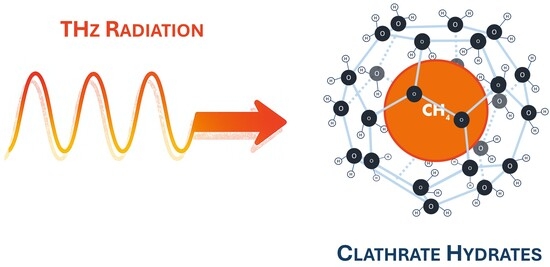
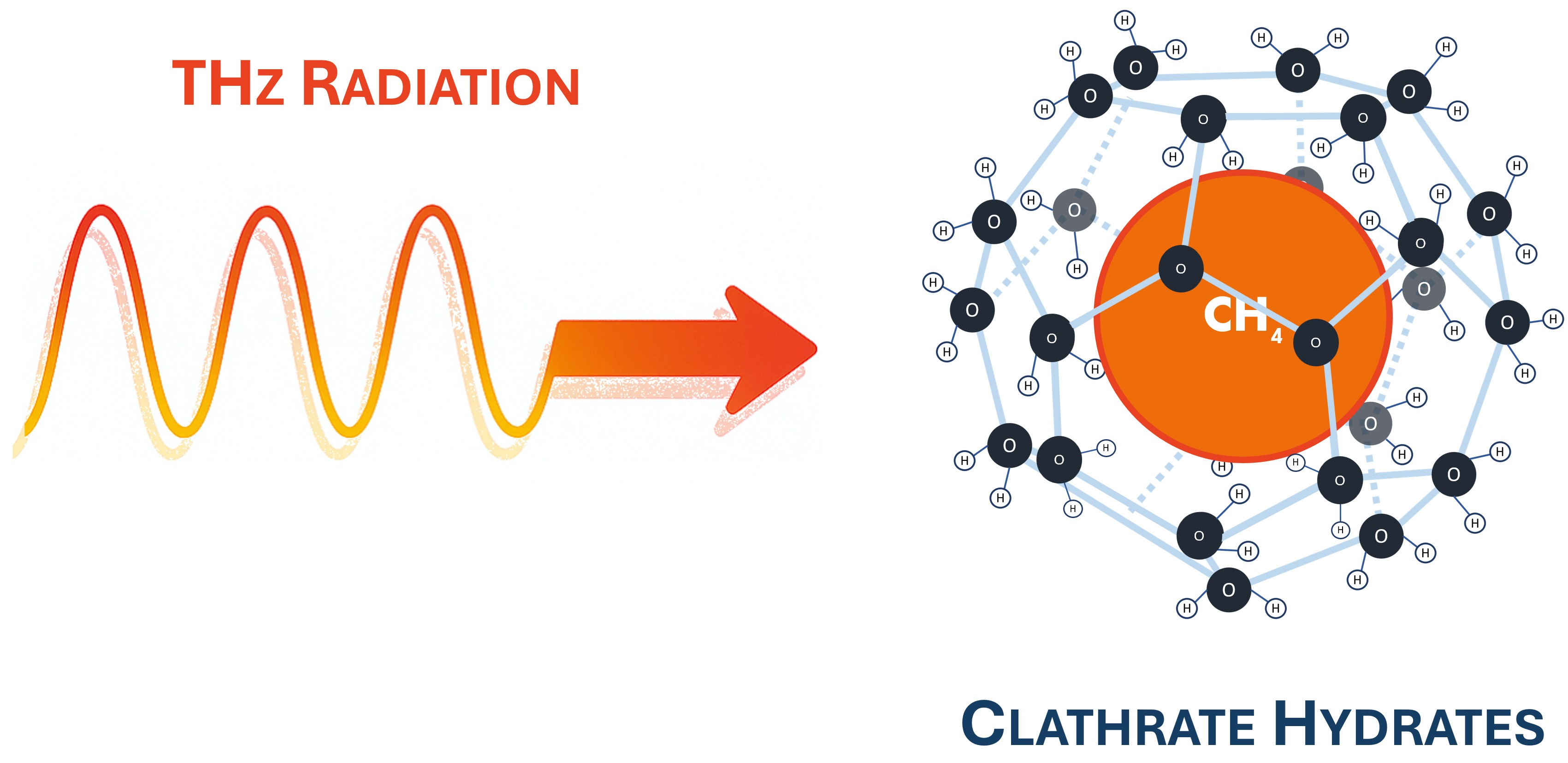
Graphical Abstract

1. Introduction

The goal of keeping global average temperatures within 2 °C above preindustrial levels will likely require halving emissions from global energy infrastructure by 2050, with full decarbonization by 2100. The Oil and Gas decarbonization Charter addresses strategies and actions to achieve drastic emission reduction [1,2]. In this context, natural gases (NGs) are the cleanest burning fossil fuels and are identified as strong candidates for future energy systems compared to oil and coal. Indeed, since natural gas emits the least amount of CO2 per unit of energy among fossil fuels, replacing coal with natural gas as the primary energy source could emerge a viable strategy for mitigating CO2 emissions in the future. Therefore, natural gas is likely to continue accounting for approximately 50% of current global production, mainly for power generation, industrial applications, and hydrogen production.
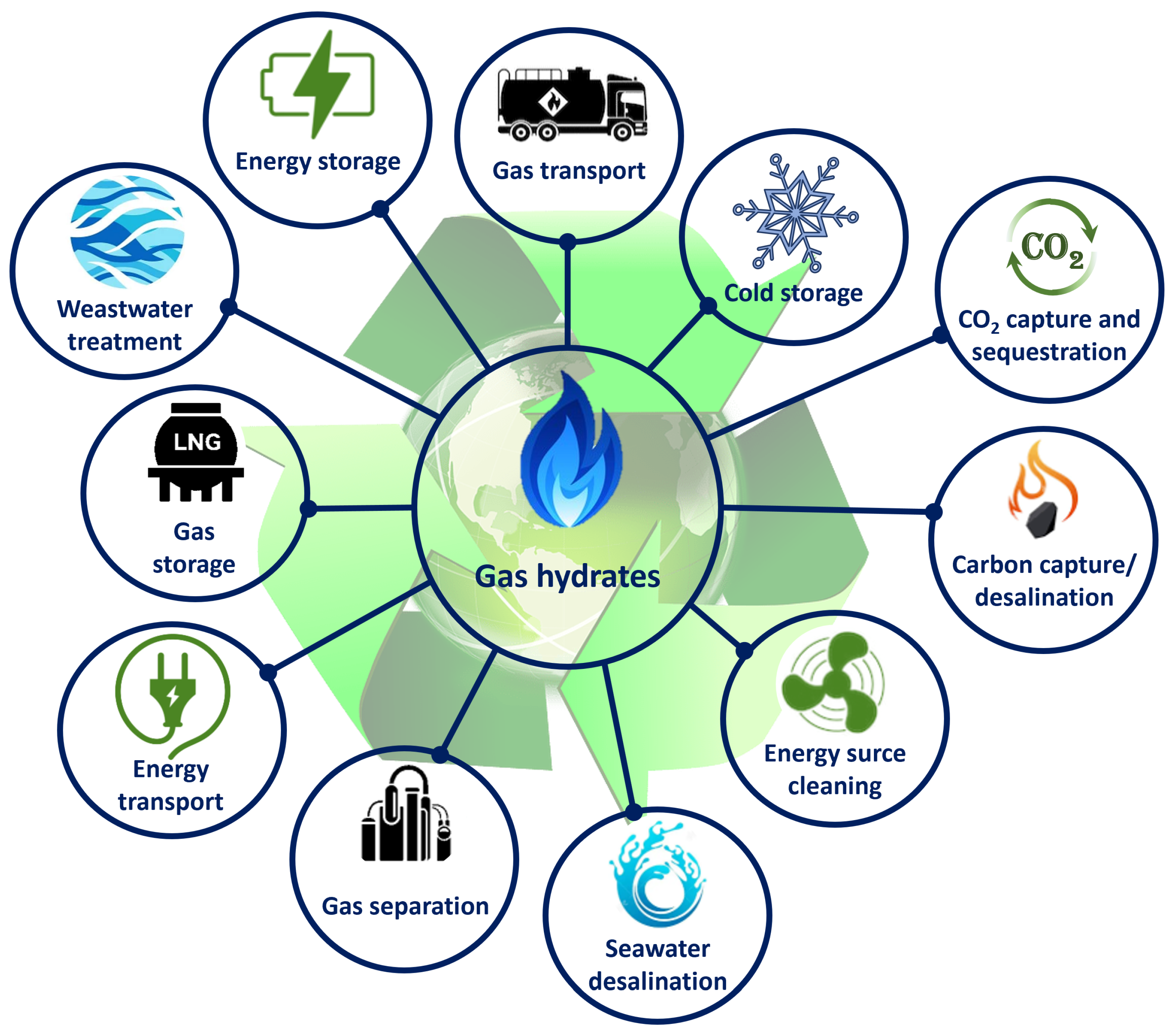
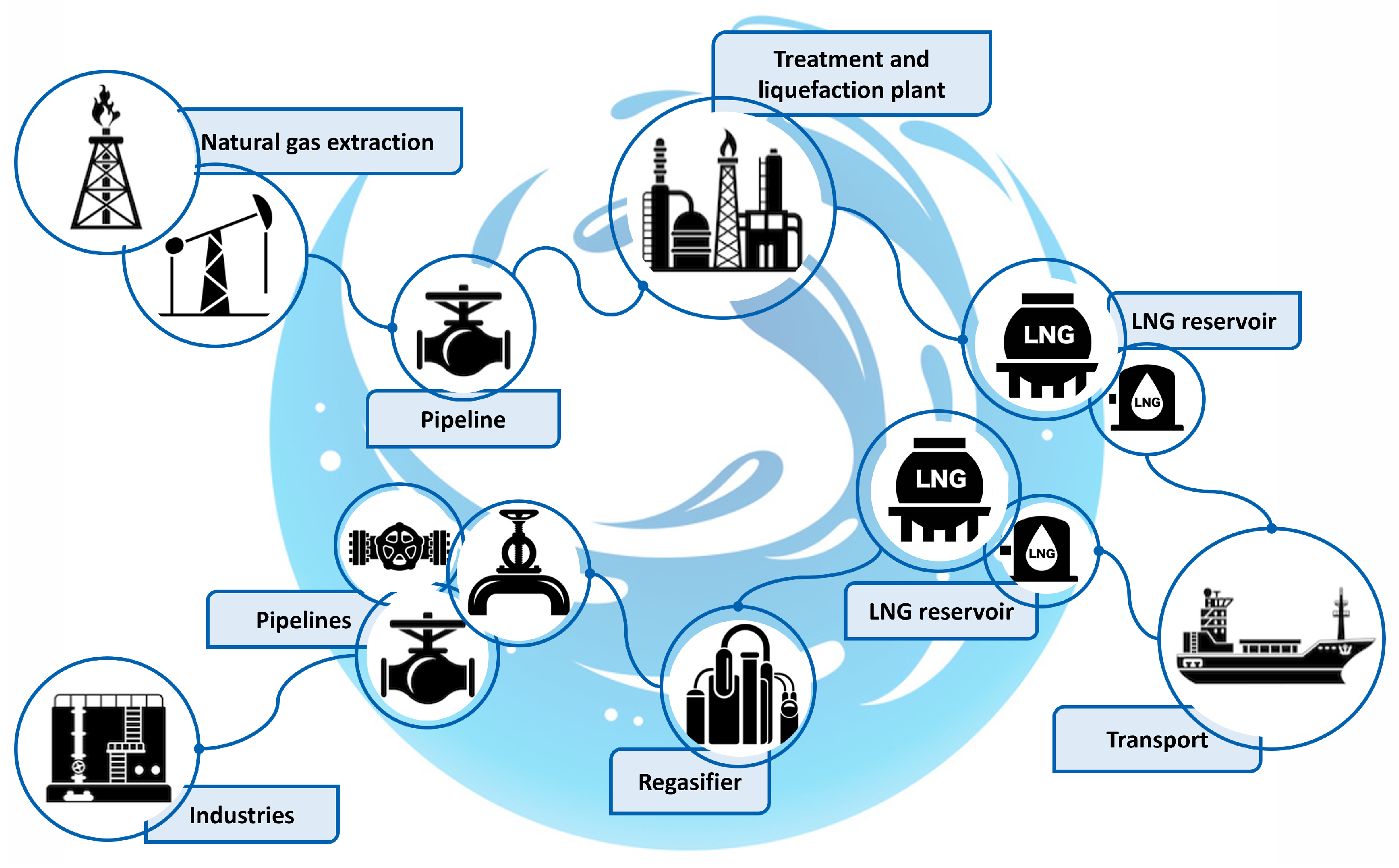
The early era of NG-related research was mainly dominated by transport processes, with attention devoted to flow assurance and minimization of hydrocarbon and gas pipeline blockages caused by the formation of crystalline structures, known as clathrates or gas hydrates (GHs). Clathrate are crystalline inclusion compounds in which small guest molecules of NG are encapsulated within cages formed by a network of water molecules. In recent decades, GHs have shown significant potential in a wide range of industrial applications, ranging from energy storage and transportation to environmental protection and gas separation processes (as schematically summarized in Figure 1) [3,4,5,6,7,8,9,10,11,12,13,14,15,16,17,18,19,20]. These applications include clean energy sources [4], CO2 capture and sequestration [5,6], cold storage and industrial refrigeration [7,8,9], gas separation, natural gas/hydrogen storage [11,12], gas transport [13,14], seawater desalination [15,16], integrated carbon capture and desalination [17], and wastewater treatment [18].
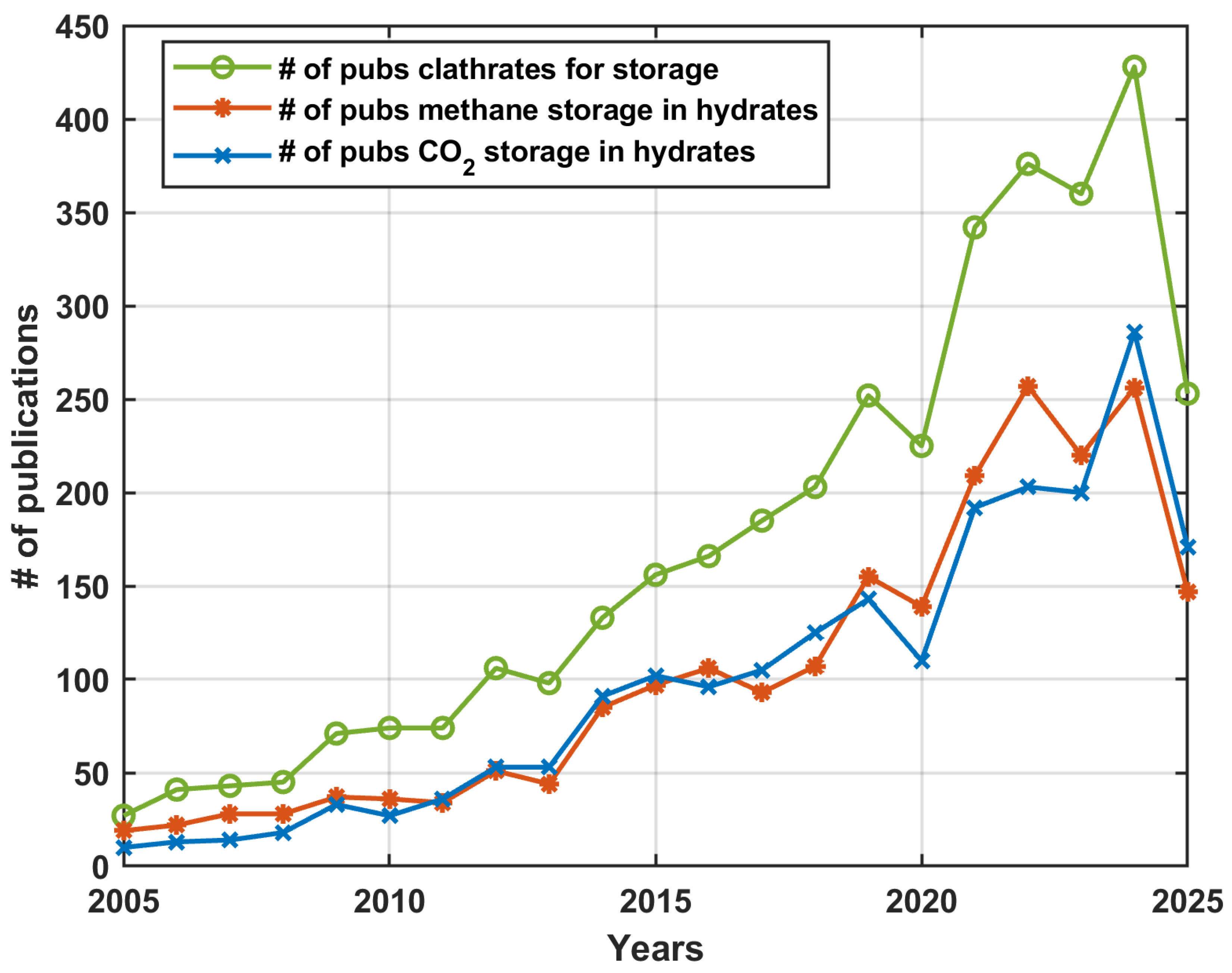
Takeya et al. [21] were among the first to hypothesize and propose the use of GHs as alternative natural fuel sources, including as substitutes for traditional oils. Their study focused on the detailed analysis of the structural characteristics of natural GH crystals extracted from the Okhotsk Sea, collected from four locations containing type I GH, which mainly contains methane (96–98%) and a small amount of carbon dioxide [21]. Understanding the structure and thermal expansion properties of both mixed and natural GHs is important for improving the understanding of their formation, dissociation, and inhibition. The analysis revealed that half of the examined samples consisted of hydrates formed under varying pressure conditions and that the lattice constant did not change with variations in gas content, remaining approximately equal to that of pure methane hydrate. These results, together with density and thermal property measurements, suggest that impurities in seawater, such as minerals, have a negligible impact on the hydrate lattice constant and are of practical importance for improving the interpretation of well-logging data [22]. This work paves the way for the synthesis and use of non-natural clathrates for storage applications, as demonstrated by the increasing publication rate from 2005 to the present, see Figure 2.
Despite the great potential of clathrates in several industrial applications, their formation poses a significant challenge for industries specialized in oil and NGs transport [23,24]. Indeed, clathrate crystals, mainly found as sediments in permafrost regions, are stable under high pressure and low temperature conditions, which creates difficulties in the transportation of NGs through subsea pipelines operating at low temperatures and high pressures (1–4 °C and 6–8 MPa) [25]. From a physical/molecular perspective, when gas and water come into contact at high pressures and low temperatures, water molecules organize into cage-like hydrogen-bonds (H-bonds) structures capable of encapsulating gas molecules through van der Waals interactions [26,27]. Their presence beneath the seabed has attracted considerable attention due to their potential impact on sectors such as oil and gas production and extraction [28]. The spontaneous and uncontrolled formation of clathrates can cause several problems [29], particularly in offshore oil and gas pipelines. The main issue is due to the pipeline blockage: clathrate hydrates can accumulate inside pipelines, causing partial or complete obstructions. These lead to interruptions of gas flow, resulting in costly downtime and increased maintenance requirements. Furthermore, pipeline blockages increase the risk of leaks and/or breaks, posing safety hazards to both personnel and the environment [25,27]. Currently, the solutions adopted to manage hydrate formation are based on physical and chemical approaches. Chemical inhibitors can be classified into thermodynamic hydrate inhibitors (THIs) and kinetic hydrate inhibitors (KHIs). These are commonly used to suppress hydrate formation by altering the thermodynamic or kinetic properties of the system, modifying the fluid composition, and shifting the stability curve of clathrate formation [30,31]. In addition, the role of nanoparticles as an unconventional method for inhibiting clathrate formation is of particular interest [32,33,34,35]. Nanoparticles with diameters ranging from 1 to 100 nm have been considered for applications in the oil and gas industry [35]. Hydrophobic nanoparticles; for example, can facilitate the formation and growth of GHs in aqueous systems under certain conditions [18,36,37]. In contrast, it has been established that hydrophilic nanoparticles can inhibit their formation. Wang et al. [34] extensively studied hydrophilic SiO2 nanoparticles of different sizes and concentrations, and reported that these nanoparticles act as dispersants and emulsion stabilizers, thereby preventing aggregation. For example, Ni-Fe nanoparticles suspended in air exhibit enhances thermal properties due to their self-heating effect. By acting as thermal inhibitors, they can stabilize the temperature at 42 °C, outside the equilibrium region of clathrate formation [38]. On the other hand, the physical inhibitory approach involves varying the physical parameters of clathrate formation and/or degradation, such as increasing the temperature and/or reducing the pressure in the pipeline [25,31], as well as applying specific electromagnetic radiation to alter the ability of water molecules to reorganize into hydrate structures. Unfortunately, all of these techniques have inherent limitations and do not guarantee successful gas and/or oil extraction. Therefore, one of the main industrial and technological challenges is to identify economical, intelligent, and eco-friendly solutions that ensure the inhibition and/or dissociation of clathrate hydrates. Various approaches are currently being explored, some of which are already proposed at an ambitious stage, while others still require further validation. Among these is the coupling of light with the low-energy collective and/or vibrational modes of water and its clusters, studied directly using various techniques and, more recently, indirectly with density functional theory (DFT) approaches [39,40,41]. Vibrational spectroscopy, including THz, Infrared (IR) and Raman spectroscopies, as well as nuclear magnetic resonance (NMR), is among the conventional in situ methodologies used to study materials [42,43,44,45,46,47,48,49,50], especially the structures of hydrated clathrates and their occupancy within cages [51,52,53,54,55,56,57,58,59,60,61,62]. Raman spectroscopy facilitates the chemical identification of specific gas hydrates by showing distinct peaks corresponding to each molecule. NMR determines the composition of the guest molecules within the hydrated phase, excluding the water molecules. These are useful tools for determining the hydrate formation and dissociation behavior, thermodynamic properties, structural evolution over time, and cage occupancy of multiple molecules. For example, Subramanian et al. [63] and Susilo et al. [64] adopted a multi-technique approach. The limited number of theoretical and experimental works available in the literature highlight the presence of spectral features in the THz/IR region associated with the water cage, revealing significant potential to improving flow assurance through enabling technologies. These theoretical findings support the coupling of THz radiation with the collective low-energy modes of water and its clusters, suggesting potential inhibitor actions [65,66,67]. Therefore, exploring the interactions between water molecules and simple hydrocarbons as a model for clathrate hydrate host–guest interactions, considering their collective (THz region) and localized vibrational modes (mid-IR region), is necessary. This should be performed using different spectroscopic techniques covering different regions of the electromagnetic spectrum [68,69,70,71,72].
The aim of this review is to revise and compare, based on the literature, the results achieved in clathrate investigations through coupling with THz radiation. We used the Scopus, Google Scholar, and Web of Science databases to review papers published up to June 2025. This search identified very few studies on the experimental applications of THz radiation to hydrates. As a result, we meticulously and thoroughly reevaluated these available data. The review is organized as follows: (i) in the first section, we outline the main features of clathrate hydrates, including their structural and chemical properties, hypotheses about their formation, and relevant theoretical studies supporting these hypotheses; (ii) we then briefly summarize their key roles in the energy transition scenario, focusing on the drawbacks associated with gas hydrate transport; (iii) next, we introduce THz radiation and spectroscopy as validated candidates for clathrate hydrate structural characterization and as potential inhibitors, and we review and compare the findings reported to date; (iv) finally, we discuss the potential of THz radiation and spectroscopy, future applications in the clathrate field, and technological advances toward the application of THz radiation in transport and industrial processes.

2. Clathrate Hydrates

2.1. Clathrate Structures

The first evidence of GHs was discovered in 1811 by H. Davy. He noted that pure chlorine gas does not solidify at temperatures below 0 °C, but in aqueous solution it is capable of inducing water to freeze even at temperatures above 0 °C. In the following years, researchers focused on the search for molecules capable of inducing the formation of clathrates, estimating the ratio of guest molecules to water in an attempt to define stoichiometric ratios; the most famous is Villard’s rule (1897), according to which the hydration number is 6. A clearer understanding was achieved in the 1950s, when M. von Stackelberg and his colleagues concluded that GHs are clathrate compounds and identified the two main crystalline structures.
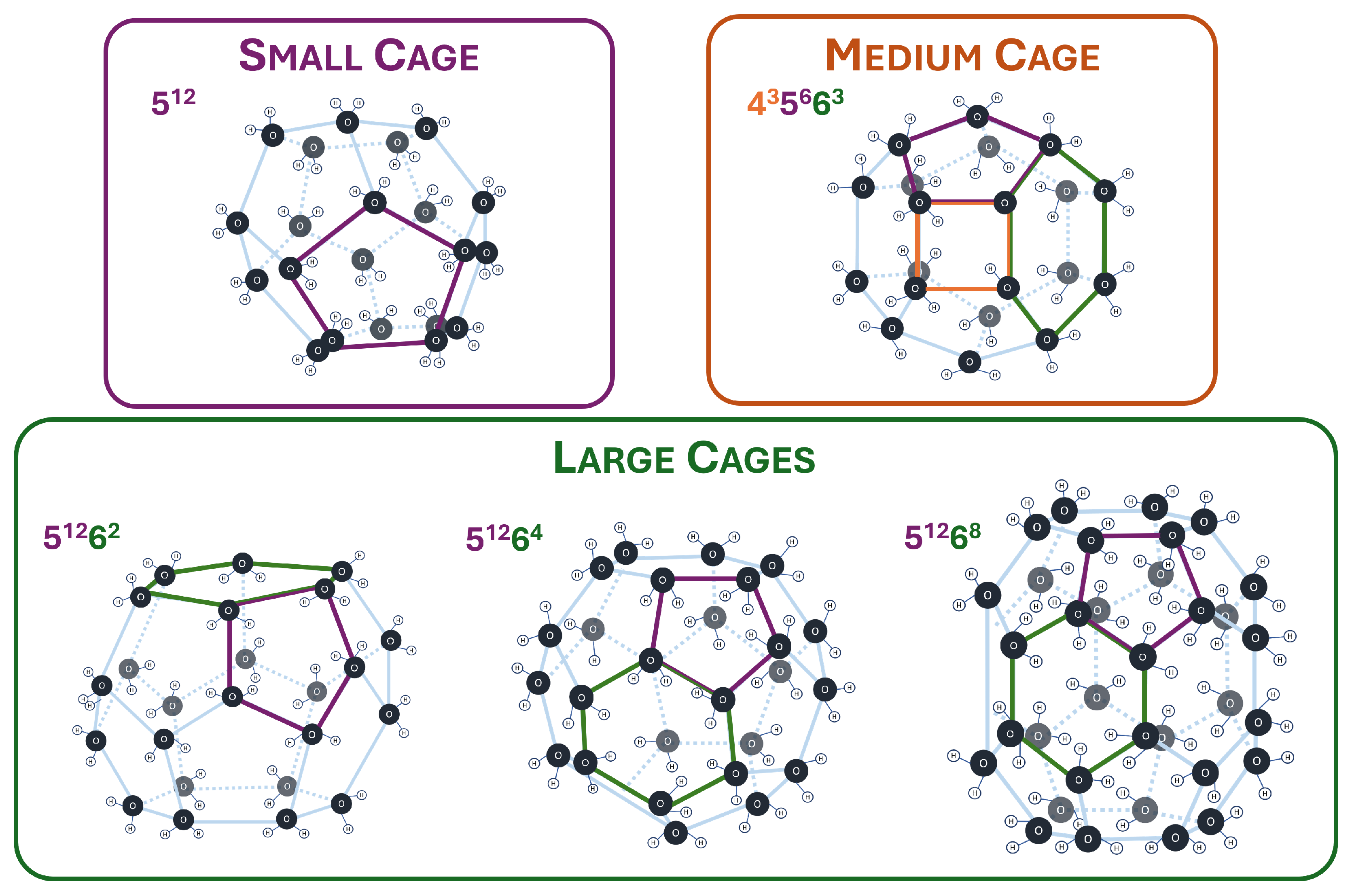
Clathrate hydrates can present several structures that differ in shape and size and are formed by large, small, and medium cages. The cages are divided into: (i) small, which are composed of  5 12  cavities, meaning 12 pentagonal faces; (ii) medium, which are  4 3 5 6 6 3  cavities, which have 3 square, 6 pentagonal and 3 hexagonal faces; and (iii) large, i.e.,  5 12 6 2 5 12 6 4 , and  5 12 6 8  cavities, which present 12 pentagonal and 2, 4, and 8 hexagonal faces, respectively. A schematic representation of these cages is shown in Figure 3.
The differences between various structures, referred to as sI, sII and sH, arise from the way in which the large and small cavities are interconnected. The sI hydrates are characterized by a lattice with cubic symmetry, with a unit cell edge length of 1.20 nm. The cavities are of two types: small cages ( 5 12 ) with a radius of 0.395 nm and six large tetracaidecahedral cages ( 5 12 6 2 ) with a radius of 0.433 nm. The composition of the unit cell includes 2 small cavities and 6 large cavities, connected through vertex-sharing between blocks: a total of 46 water molecules with a hydration number of 5.75. The sII hydrates are characterized by a symmetric face-centered cubic lattice, with a unit cell of 1.70 nm. The cavities generated by the lattice of water molecules are, also in this case of two types: small cavities ( 5 12 ) with an average radius of 0.391 nm and large cavities ( 5 12 6 4 ) with an average radius equal to or greater than 0.473 nm. The composition of the unit cell includes 16 small cavities and 8 large cavities, form ed by sharing faces: a total of 136 water molecules with a hydration number of 5.67. Finally, sH hydrates exhibit hexagonal symmetry, similar to that of common ice, with a unit cell having a = 1.21 nm and c = 1.01 nm. The generated cavities are of 3 types: small cavities ( 5 12 ), the same as sI and sII hydrates, irregular dodecahedron medium cavities ( 4 3 5 6 6 3 ) with an average radius of 0.404 nm, and large icosahedron cavity ( 5 12 6 8 ) with an average radius equal to 0.579 nm, that is isostructural with the hexagonal clathrasil dodecasill H. The composition of the unit cell includes 2 small cages, 3 medium cages, and a large cage: a total of 34 water molecules with a hydration number of 5.67 [27,73]. All these properties are summarized in Table 1.
The water molecular networks forming the crystalline structures of sI and sII clathrates correspond to those of ice XVI and ice XVII, respectively. The main differences between clathrates and ice lie in theirtemperature stability and interaction with light. Clathrates can maintain a crystallyne structure at temperatures significantly above 0 °C and, unlike the common hexagonal ice form ( I h ), do not affect light polarization. In clathrate networks, water molecules interact through hydrogen bonding to form cages that encapsulate guest molecules via van der Waals interactions during the clathrate formation process. Additional hydrogen bonds and interactions may form between the water network and the guest molecules as a consequence of the nature of the guest molecules, influencing the structural and dynamic properties of the clathrate itself. Another key factor is the size of the guest molecules, which plays a crucial role in determining the type of cages and thus the overall structure. Smaller atoms or molecules, such as noble gases or simple diatomic compounds, preferentially occupy smaller cages and therefore tend to form sII hydrates, which contain a large proportion of small  5 12  cages [74]. Moreover, the size of the guest molecule, together with cage occupancy and distribution, influences the stability of hydrates by changing the temperature and pressure stability conditions. Kainai et al. [75] recently demonstrated that hydrate stability decreases with a reduction in cage occupancy.

2.2. Clathrate Formation and Hypothesis: Molecular Simulations

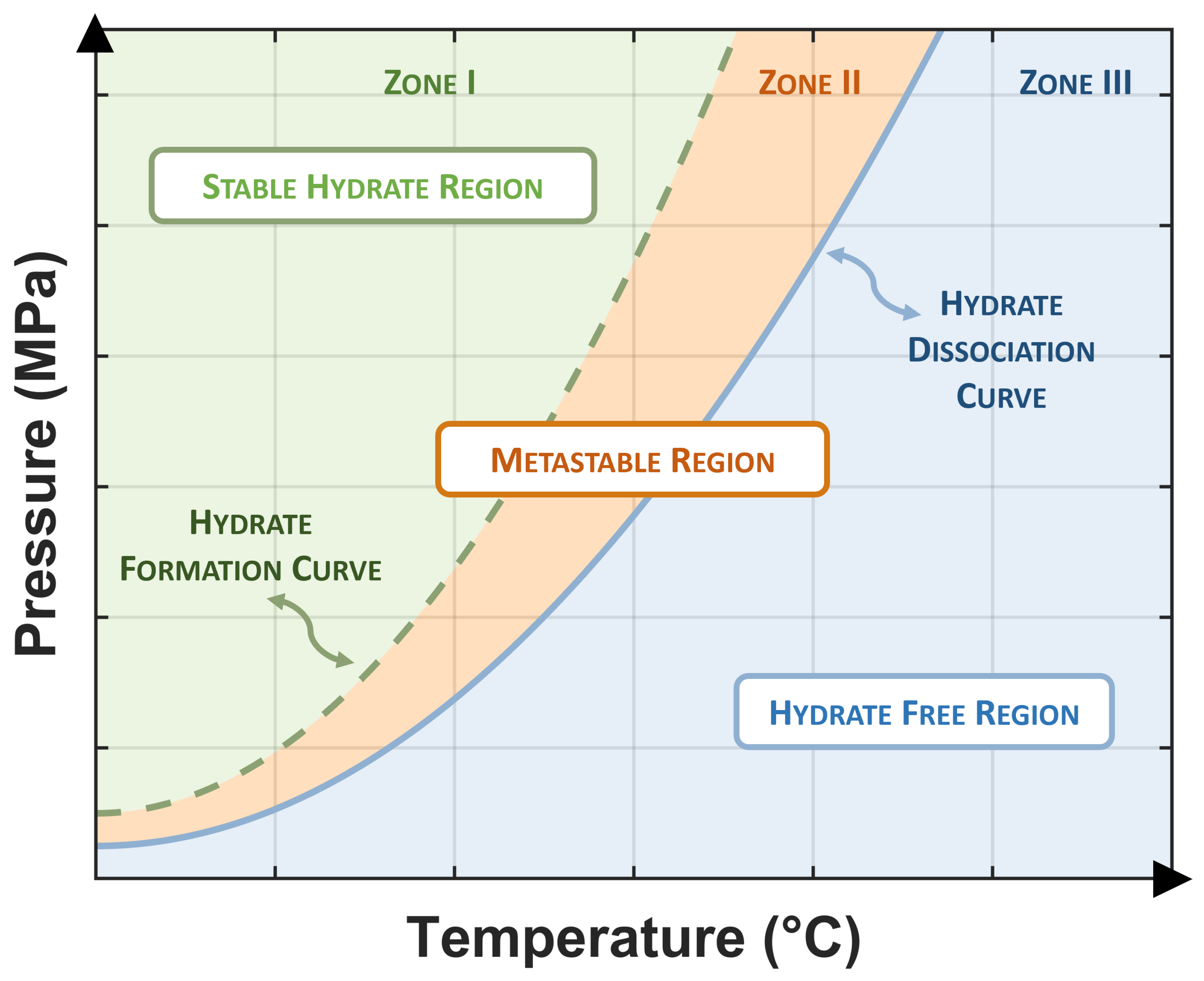
Clathrate hydrate formation can be categorized into three stages: nucleation, growth, and crystallization. Nucleation represents the initial step of hydrate formation from water–gas mixtures. The growth stage follows, during which the number of hydrate nuclei increases with the incorporation of additional new water molecules. In the final crystallization phase, the clathrate adopts a stable and well-defined structure. Nucleation is a stochastic process governed by free energy and influenced by pressure and temperature. As illustrated in Figure 4 hydrate nuclei must reach a critical size and favorable conditions for the transition into the growth phase.
The nucleation mechanism for gas hydrates has received increasing attention in recent studies [76,77,78,79,80,81,82,83]. Despite this simplified division of the clathrate formation process, several formation hypotheses have been proposed. Among the earliest is the Labile Cluster Hypothesis (LCH), introduced by Sloan and co-authors [83]. LCH suggests that water cages initially form around the guest molecules, which subsequently combine to produce a non-stoichiometric crystal. Later, Radhakrishnan and Trout [59] proposed the Local Structural Hypothesis (LSH), which suggests that fluctuations in the concentration of guest molecules lead to their arrangement in a configuration similar to that of the crystal. Water molecules then reorganize around the host-guest clusters to form the gas hydrate structures. Two predictive studies, by Rodger and co-authors and Walsh and co-workers [80,84] support the LSH framework. They predicted spontaneous methane hydrate nucleation using unconstrained atomistic molecular dynamics (MD) simulations of binary systems (water-methane) under high driving force conditions, characterized by a large number of guest molecules surrounding the forming water cages, as suggested by LSH theory.
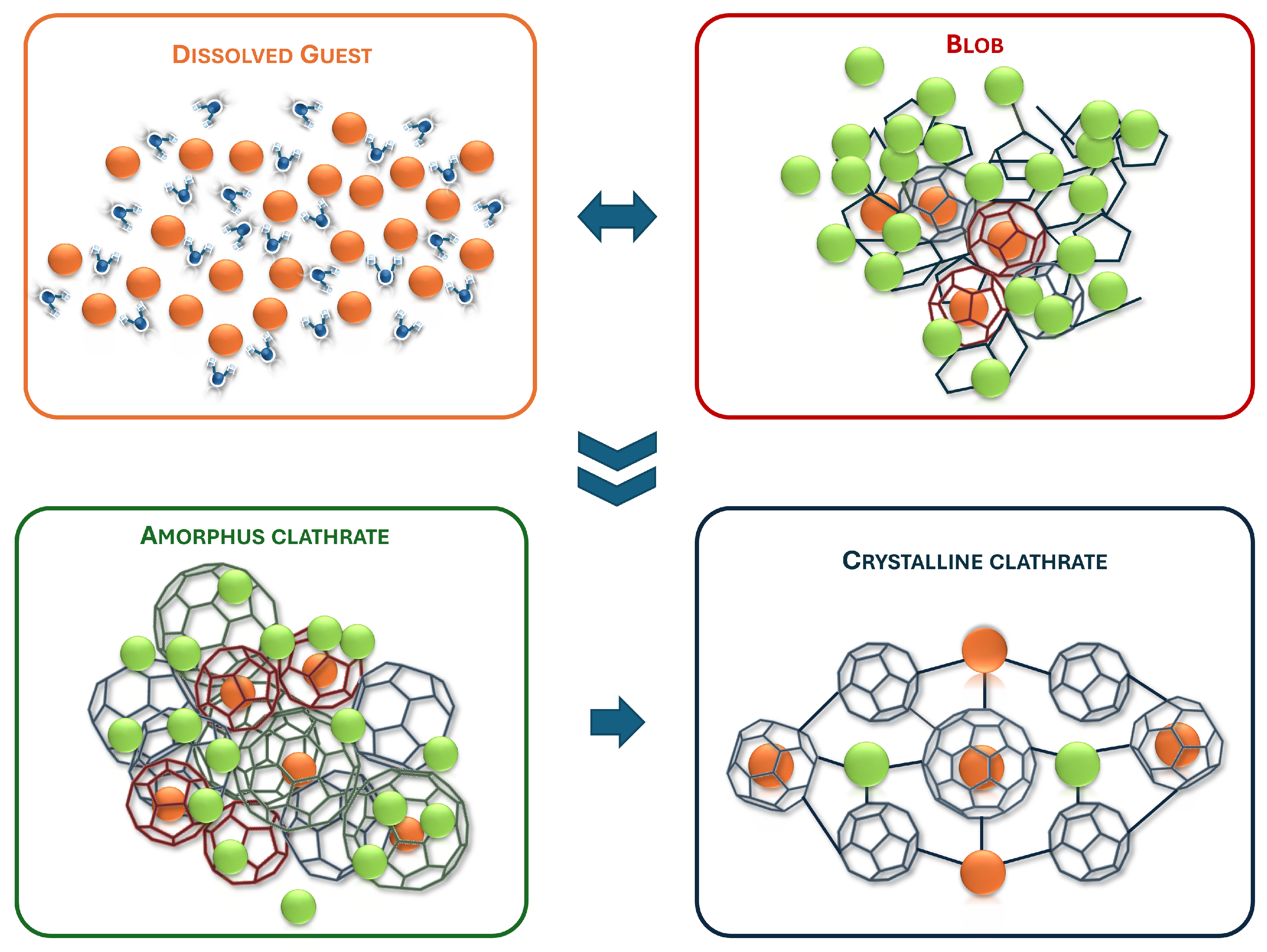
However, simulations have revealed that the subsequent growth and crystallization of the nascent nucleus do not follow LSH theory. In particular, the nucleus structure appears as an amorphous cluster of  5 12  and  5 12 6 X  cages (X = 2, 3, 4) in the growth phase, which deviates from the ordered structure predicted by LSH. This observation suggests that crystallization occurs through an intermediate amorphous phase, analogous to protein crystallization mechanisms. The crystallization process can be modeled in two steps. In the first step, guest molecules aggregate into blobs, amorphous clusters involving multiple guest molecules in water-mediated configurations. These blobs exist in dynamic equilibrium with the surrounding dilute solution and are embedded within clathrate cages, eventually forming an amorphous clathrate nucleus. In the second step, the amorphous clathrate nucleus undergoes a structural rearrangement to form a crystalline clathrate. A schematic representation of the nucleation and crystallization mechanism is shown in Figure 5.
This mechanism is well described by Jacobson et al. in their MD studies. In their work [79], the authors focused on the initial stage of clathrate formation, monitoring crystallization through the time evolution of the polyhedral cages that make up the clathrate lattices. They conducted molecular simulations to study the nucleation mechanism of sI and sII classes of gas hydrates, aiming to explain the structure of the clathrate nuclei and to determine whether microscopic amorphous precursors or metastable phases are involved in the crystallization pathway of clathrate hydrates from aqueous solutions. However, both hypotheses fail to capture a crucial aspect of clathrate formation: hydrate nucleation is a cooperative process in which individual hydrate cages are thermodynamically unstable, and their existence is stabilized by guest molecules located inside, outside and surrounding the cages [81].
Various in-depth molecular simulation studies [85] have attempted to shed light on the hydrate formation process, which does not follow classical nucleation theory, but instead appears to occur through a multistep mechanism involving amorphous precursors. Most of these works use the Monoatomic Water (MW) model [86] to represent water molecules, in which each molecule is modeled as a single particle interacting via anisotropic short-ranged potentials that promote hydrogen-bonded configurations. These findings initially revealed a lack of well-defined crystalline order, suggesting that, under conditions of high supercooling, amorphous solid clathrates may act as intermediates in the crystallization pathway leading to crystalline clathrate hydrates. In particular, guest and water molecules reorganize into clusters and the stability of these clusters increases as the number of guest molecules rises. The presence of multiple guest molecules promotes solvent-separated configurations, leading to the formation of persistent clusters in which guest molecules are separated by water. At the simulation level, the timescales for the entire nucleation process range from a few hundred nanoseconds to a few microseconds [87,88]. In MD simulations of methane-water systems at high concentrations (∼6.5 mol% and ∼9.45 mol% CH4), distinct stages of the nucleation process can be identified. During the initial phase (up to ∼1 ns), no stable cavities are formed. This is followed by an intermediate regime, between ∼1 and ∼4.5 ns, characterized by the formation and dissolution of fluctuating cavities with short lifetimes (on the order of picoseconds), associated with the reorganization of the hydrogen-bonded water network. After approximately 6 ns, the system evolves toward the formation of blobs and more persistent cavities. When the simulation times are extended to ∼100 ns, the growth of an amorphous aggregate of “hydrate-like structures” is observed, which can be considered as a post-blob stage [89]. Ultimately, blob formation can occur on the order of nanoseconds (1–10 ns); however, under conditions of low supersaturation, in real mixtures, in the presence of impurities, this scale can be much longer. These multiguest clusters, together with their associated water molecules, exhibit behavior similar to that of droplets of viscous liquids, i.e., blobs. These blobs are in dynamic equilibrium with the surrounding solution, although they exchange water and guest molecules at a slow rate, resulting in fluctuations in blob size and structure. For this reason, large blobs tend to persist longer than smaller ones and may remain stable even near the melting point. Furthermore, blobs located at interfaces are more likely to lead to the formation of critical nuclei. Therefore, the study concludes that liquid-like blobs give rise to the clathrate cages, which aggregate into an amorphous solid clathrate nucleus and subsequently transform into a crystalline clathrate. This process, termed the blob mechanism of clathrate crystallization, follows the sequence: dilute solution, blob, amorphous clathrate and finally crystalline clathrate. This mechanism involves the formation of a blob from the dilute solution, consisting of a cluster of solvent-separated guest molecules with interstitial water that continually rearranges to form transient clathrate cages. If the blob reaches a sufficiently large and persists over a long enough timescale, the surrounding water molecules form stable polyhedral cages, leading to an amorphous clathrate intermediate capable of nucleating the growth of the crystalline clathrate phase. These results were supported by both experimental and theoretical studies [90,91,92,93], including works by Jacobson et al. and Molinero [86,88,94]. These studies focused on the stability and growth of early-stage amorphous and crystalline nuclei. The authors investigated the role of the initial structure and size of the nucleus inits subsequent growth, finding that both amorphous and sI crystalline nuclei can produce crystalline clathrates. Moreover, they examined the entropic and enthalpic properties of amorphous and crystalline clathrates originating from various initial structural configurations. In their simulations, water was modeled using the MW theory, while the guest molecule exhibited properties intermediate between those of methane and carbon dioxide. As a first result, they observed that the melting temperature of the amorphous clathrate was approximately 90% of that of the crystal. In addition, the amorphous clathrate exhibited higher entropy compared to the crystalline configuration, thereby favoring its formation from the liquid. At all temperatures considered, the critical nucleus sizes required for crystallization were smaller for crystalline nuclei than for amorphous ones. However, entropic considerations suggested that their formation might be kinetically favored due to lower free energy barriers. As in previous work, a main conclusion was that crystalline clathrates can grow from amorphous nuclei. Specifically, the growth of clathrate cages around the nucleus occurred more rapidly than the reorganization of the initial amorphous core into a crystalline structure. As a result, the amorphous core remained encased within a crystalline (or polycrystalline) shell. Another important finding was the observation of cross-nucleation of the sII crystal from the sI core, facilitated by the formation of  5 12 6 4  cages. The study showed that, despite the amorphous nature of the initial nuclei, all systems ultimately developed predominantly the sII structure, rather than the more stable sI crystal form. Although the sI crystal is thermodynamically more stable, the occurrence cross-nucleation of sII from sI highlights the important role of kinetic factors, not only during nucleation but also for the subsequent growth of the clathrates. A more focused theoretical investigation of clathrate hydrates was conducted by Inerbaev et al. [51], who examined the electronic, structural, dynamic, and thermodynamic properties of sII, sH, and tetragonal Ar clathrate hydrates. In particular, they explored the dynamical properties of the system as a function of the number of guest molecules within the clathrate cages. Initially, they simulated the phonon density for an empty host lattice, finding that the low-frequency region (0–9 THz) corresponded to translational modes of water molecules, while the high-frequency region (15.6–30 THz) was dominated by the libration modes of the host water framework. They noted that Ar atoms only slightly influence the vibrational modes of the water frameworks. Guest vibrational modes were found near the peaks of the phonon density of states in the 0–1.2 THz region. The authors hypothesized that the guest atoms are not confined to potential energy minima but can move freely within large cages. They further speculated that multiple guest occupancies are possible in large cages and cavities, and optimized the calculations using first-principles methods. It was found that multiple occupancies of the large cages are indeed possible in Ar hydrates.

3. Oil and Gas Pipelines

As discussed above (see Figure 4), hydrate nucleation and growth phenomena can occur under high pressure and low temperature conditions, typically found beneath the sea floor. In the context of the oil and gas industries, this represents a significant issue to address because the presence of hydrates could cause occluded pipes and flow arrest, due to inadvertent shutdowns, poor performance of chemical injection pumps, and an incremental increase in the aqueous phase of the flow. GHs related flow assurance challenges can occur not only in hydrocarbon pipeline systems, but also in CO2 and hydrogen transport pipelines, where there may be traces of water impurities in the stream. A graphical representation of the oil and gas pipeline flow is shown in Figure 6.
Significant research has been devoted to identifying methods to prevent the formation of natural gas hydrates. Currently, the state-of-the-art consists of four different methods: two physical and two chemical methods. Physical methods inhibit clathrate formation or promote dissociation by increasing pipeline temperature or reducing pipeline pressure, based on the understanding that clathrate formation strongly depends on the surrounding pressure and temperature [25,31]. Chemical methods involve the addition of antifreeze agents or the dehydration process, both of which alter the fluid composition and modify the stability curve [30,95]. Physical processes require careful precautions. Increasing the temperature or lowering the pressure of the pipeline can cause the detachment of clathrate pieces from the inner surface, which could damage the pipeline and disrupt the flow. Chemical processes, on the other hand, involve adding antifreeze to the fluid to alter its purity and composition, or performing a dehydration process to remove water molecules. However, the presence of residual vapor molecules can also lead to the further clathrate formation on longer timescales. Antifreeze added to the fluid can be classified into low-dose thermodynamic hydrate inhibitors. Thermodynamic inhibitors reduce water movement by shifting the hydrate phase to lower temperatures and higher pressures, thus preventing effective hydrate formation. For example, by injecting methanol, glycols, or electrolytes, the phase behavior of the gas-water system can be changed. In this regard, Shin et al. conducted a study on the performance of methanol as an inhibitor [95]. Their results show that if pipelines pass through conditions where moisture can freeze on the walls, the presence of methanol in the gas stream can effectively catalyze the formation of solid clathrate hydrate phases. They found that methanol can be incorporated into hydrates formed from solid ice and hydrocarbon guests and must largely exist as an aqueous surface film, but this does not necessarily inhibit the formation of hydrates from ice. This phenomenon can occur in gas pipelines in polar climates and during the extraction of methane gas from clathrate hydrate deposits in the permafrost layers, highlighting the need to develop new, cost-effective, smart, and eco-friendly techniques. In recent years, the use of THz radiation has emerged as a promising innovative method. Its versatile and effective properties, already exploited in various research fields, suggest potential applications for the prevention or control of clathrate formation.

4. Terahertz Technology

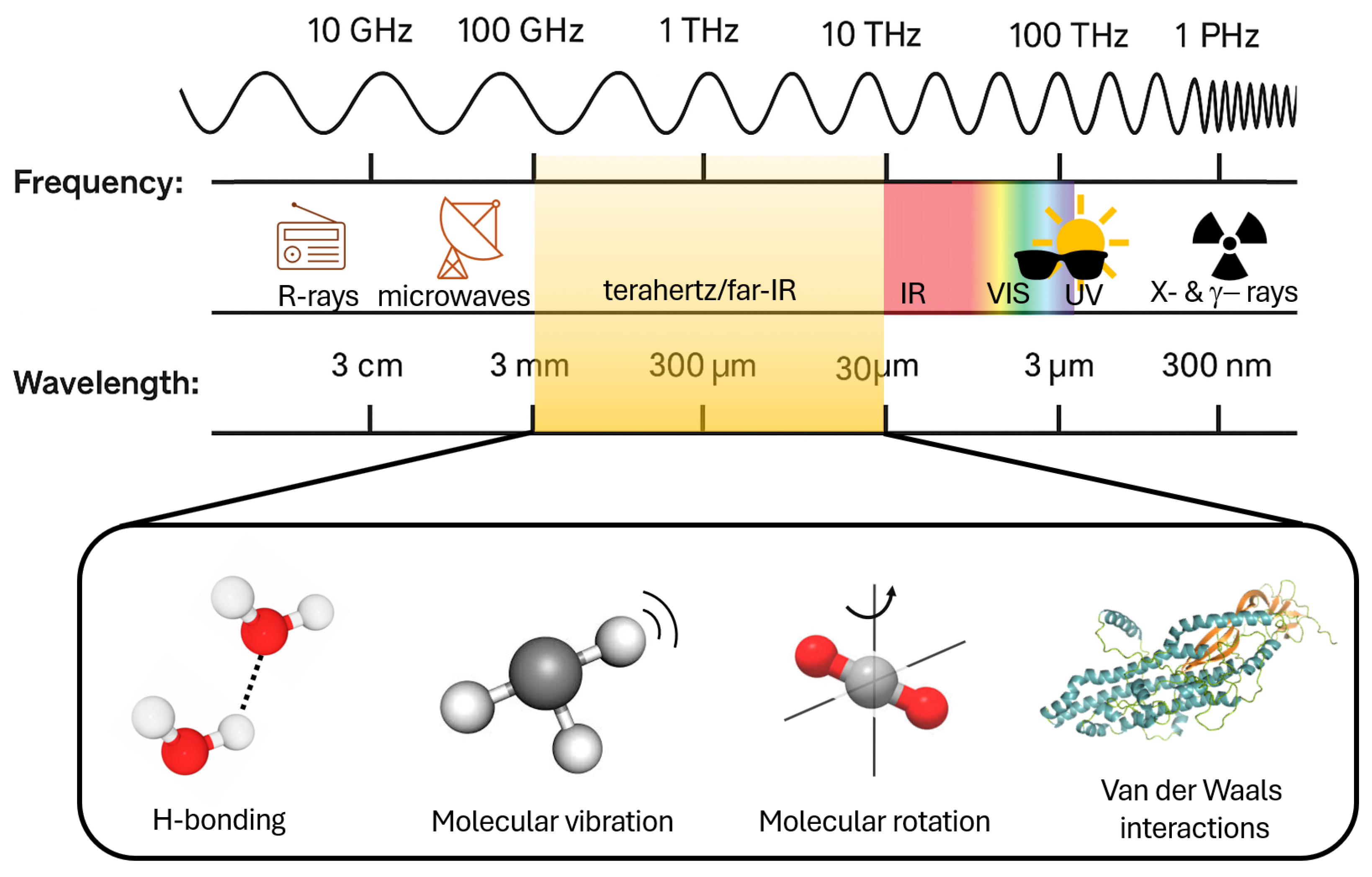
Numerous advancements in THz technology have significantly improved the performance of THz sources and detectors [96,97,98,99,100,101,102,103,104,105,106,107,108,109,110,111,112,113,114,115,116,117,118,119], while improving flexibility, portability, and the usability of THz devices. These developments have stimulated the widespread adoption of THz radiation, as well as systems for spectroscopic and imaging applications in various scientific fields. THz technology is applied in biology and medicine [120,121,122,123], imaging [124,125], gas sensing [126,127,128,129,130], chemical analysis [131,132], characterization of new materials in the low-frequency range [133,134,135], and non-destructive evaluation of composite materials and constructions [136,137,138], astronomy [139,140,141], microelectronics [142], communications and security [143,144], agrifood quality [145,146,147], cultural heritage [148,149], and more. THz radiation, also known as T-rays or sub-millimeter radiation, occupies the spectral window of the electromagnetic spectrum between microwaves and infrared light (see Figure 7).
It offers many advantages, making this spectral region a very promising tool for spectroscopic applications. Firstly, (i) the low photon energy of THz radiation (i.e., 4 meV at 1 THz) matches the energy levels corresponding to low-frequency motions, such as the vibration, rotation, and translation modes of molecules in their condensed phases, as well as intermolecular vibrations such as hydrogen bonds. These low-frequency motions allow the identification of molecules, characterizing their THz spectral features and providing information on their chemical compositions, including hydrogen bond networks. For instance, external lattice vibrations typically dominate the low-frequency region, and these modes are influenced by the crystalline arrangement of the molecules. This occurs for different polymorphs, where the unique THz spectral features can be used as identifying fingerprints, especially in the identification of pharmaceutical substances and the detection of explosives. THz waves are highly sensitive to crystal conformation and structure, and they can provide useful information in combination with quantum-mechanical theory. (ii) In addition, the low photon energy is not sufficient to cause combustion, making THz radiation suitable for applications on flammable materials. This is particularly relevant in the investigations on clathrate compounds and on their inhibition in oil pipelines, where direct interventions may be necessary. (iii) Furthermore, unlike X-rays or gamma rays, the non-ionizing nature of THz radiation means that it does not carry enough energy to ionize atoms or molecules [132], making the technique safer forbiological tissues and materials [121]. Moreover, many materials exhibit their spectral sigatures in this frequency range. THz radiation is highly sensitive to polar molecules such as water (220 cm−1 for pure water at 1 THz and room temperature), while remaining relatively transparent to non-polar molecules like plastics, ceramics, paper, cloth, fats, etc. These distinctions in optical response are often the basis for both material characterizations and spectroscopic imaging [125]. With particular attention to THz spectroscopy, the time-resolved version has several advantages over traditional Fourier transform infrared spectroscopy (FTIR), which is commonly used in many fields and has several benefits [49]. THz radiation is insensitive to the thermal background, shows a higher signal-to-noise ratio (SNR), and does not require the use of cooling detectors. More importantly, THz time-domain spectroscopy (THz-TDS) compared to conventional FTIR spectroscopy is based on synchronous and coherent detection, in which both the amplitude and phase of a THz pulse are measured. For this reason, the technique is capable of evaluating optical properties, such as the refractive index, as well as the absorption coefficient, without using the Kramers-Kronig relations [124]. This allows the direct extraction of information on the dielectric response, molecular dynamics, and carrier relaxation processes in clathrate systems, insights that cannot be obtained from simple absorption measurements alone. The propagation of THz through flammable liquids without causing combustion, while maintaining sensitivity to polar molecules, makes this technique useful in the analysis of clathrate compounds, particularly those formed in oil pipelines. In fact, there are several simulation studies [65,150,151,152,153] that highlight how THz radiation can be used to characterize and decompose clathrate cages, allowing the release of gas through the two intense vibrational peaks of water in the THz range. In this context, numerous studies have been conducted on the crystalline structures of clathrate and water. Here, our aim is to summarize the main results obtained in this field and highlight the open questions that could open up new avenues for research.

5. Clathrate and Terahertz

5.1. The Most Common Clathrate: Methane Hydrate

Methane hydrate, which comprises 99% of gas molecules in GHs, is methane [154] and is the most common sI-type hydrate in nature. It has been extensively studied both experimentally, including the spectral region under discussion, and via MD simulations. Due to their presence in drilling operations, where they can hinder the safe extraction of natural gas hydrates, the authors focused on understanding and controlling hydrate dissociation in the presence of kinetic inhibitors, a process that remains unclear to date. Hydrate dissociation, mainly regulated by variations in temperature and pressure, can also be influenced by other factors, such as mechanical stress, the size of guest molecules, cage occupancy, chemical inhibitors, and electric fields [27,73,74,75]. Several theoretical studies have explored the influence of THz electric fields on the formation, inhibition and dissociation of methane hydrates using MD simulations. For example, Waldron et al. [150] investigated the effect of externally applied static electric fields (ranging from 0.0 to 2.0 V/nm) on the dissociation of bulk methane hydrate. They found that strong electric fields can amorphize the water-lattice cage network, with a threshold field of approximately 1.2 V/nm. The field strength can influence this process, with weaker fields causing a more gradual release of guest molecules, while stronger fields can lead to rapid and complete dissociation. From this, Qu et al. [151] employed oscillating electric fields to enhance in hydrate dissociation electric resonance, induced hydrate dissociation acceleration uses an oscillating electric field to break the hydrogen-bonded network in methane hydrates, causing them to dissociate and release methane gas much faster than traditional methods. Similarly, the effects of static and oscillating electric fields on the formation and dissociation of methane hydrates were studied, finding that static fields above 1.5 V/nm facilitate dissociation by reorienting water molecules along the field direction [65]. Chen et al. [152] conducted a recent study that constitutes a fundamental basis for its characterization and understanding. Chen and co-authors proposed a strategy for applying THz electric fields to manipulate the dissociation process, based on the inhibition mechanisms of two common kinetic inhibitors: lecithin and polyvinylpyrrolidone (PVP).
MD simulations were employed to investigate the effects of 30 THz and lower-intensity electric fields on methane hydrate systems in both pure water (PW) and seawater (SW), with the addition of Lecithin and PVP. The results indicate that the application of lower-intensity electric fields inhibits the dissociation of methane hydrate, whereas stronger electric fields accelerate the dissociation process. They hypothesized that, as the strength of the THz electric field increases, the system exhibits a nonlinear and complex dissociation behavior, particularly in the PW system.
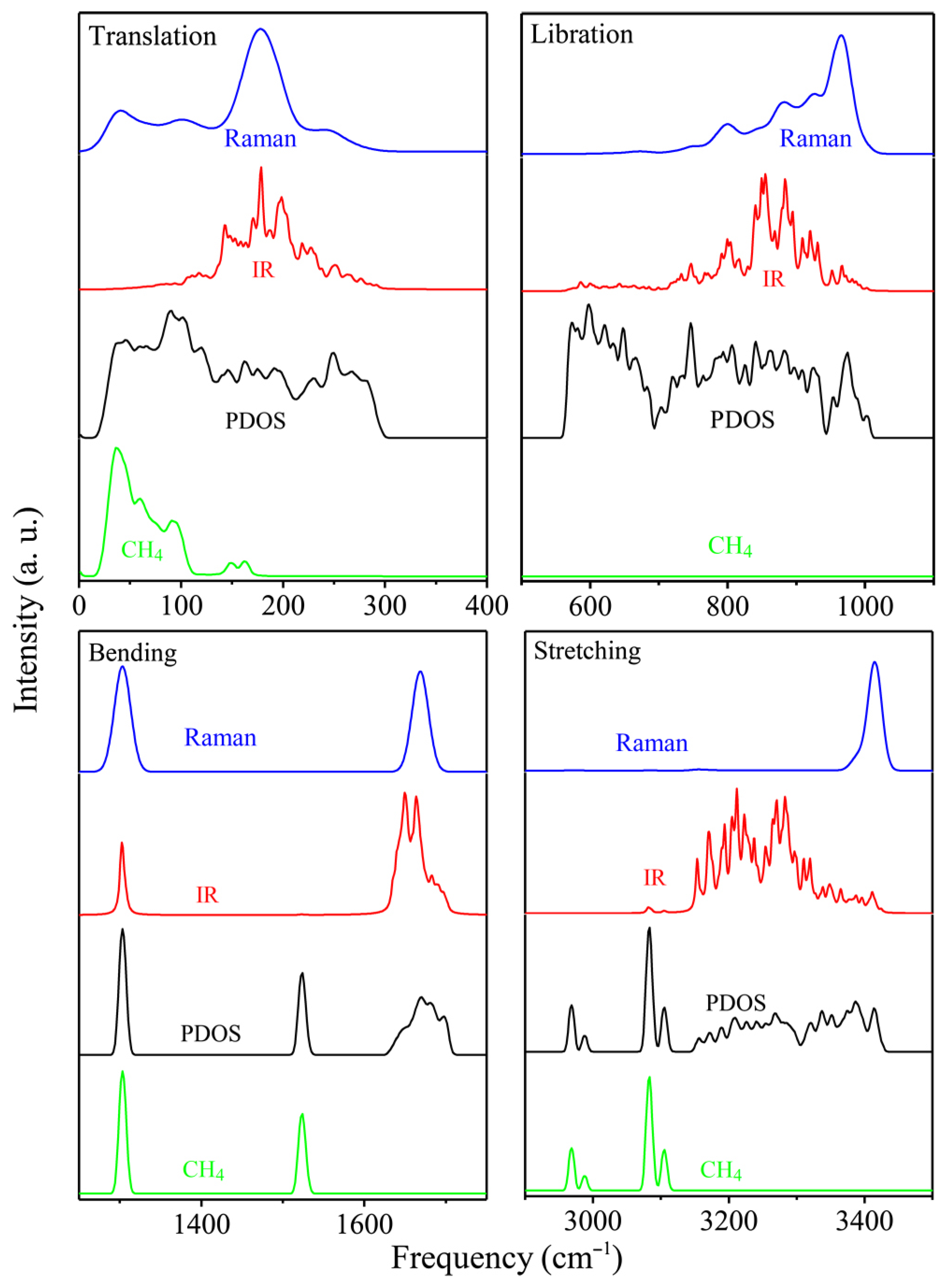
In a related study, Liang et al. [153] examined the influence of various THz electric fields, especially those with amplitudes from 0.12 to 0.16 V/Å at 1.8 THz, on the potential rapid decomposition of methane hydrate in a methane clathrate system using MD simulations. The decomposition behavior was assessed by monitoring the time evolution of the system’s potential energy (PE), which was observed to increase with hydrate dissociation under controlled temperature and pressure conditions. Specifically, they observed that the THz electric field alters the orientation of water molecules, leading to the rapid breakdown of hydrogen bonds, the collapse of the water cages, and the subsequent decomposition of the gas hydrate. The computational study demonstrated that the dynamic response of water molecules to the applied electric field disrupts the hydrogen-bonding network within the methane hydrate crystal structure, effectively shortening the duration of the quasi-stable state. For instance, the authors reported that when the frequency is kept constant and the amplitude is increased to 0.16 V/Å, the reaction time is significantly reduced to 29 ps, resulting in an acceleration of nearly 29-fold. Similarly, when the amplitude is kept constant at 0.12 V/Å and the frequency is increased to 7.0 THz, the reaction time shortens to 64 ps, leading to an acceleration of about 13-fold [153]. The study further revealed that strong external static electric fields (up to 0.15 V/Å) can prevent methane molecules, once released from the water cages, from re-entering them, even after the electric field is switched off. A higher electric field applied in the simulation induced a ‘plateau’ state in the methane system, indicating significant amorphization of the hydrate structure. Upon removal of the field, this amorphous phase separates into two distinct phases. Furthermore, it was found that sI methane hydrates absorb more energy and undergo more effective dissociation over short timescales under a periodic electric field compared to a non-periodic one. In a separate work, Wang et al. [40] investigated the vibrational modes of hydrogen bonds in sI methane hydrates using density functional theory (DFT) prediction. They simulated and analyzed the vibrational spectra and normal modes of methane hydrates, providing calculated IR and Raman spectra, as well as the phonon density of states (PDOS). Figure 8 shows the results, highlighting that in the translation region the strong group of H-bond vibrations disappears in the IR and Raman spectra, while phonon modes can still be observed in the PDOS curve.
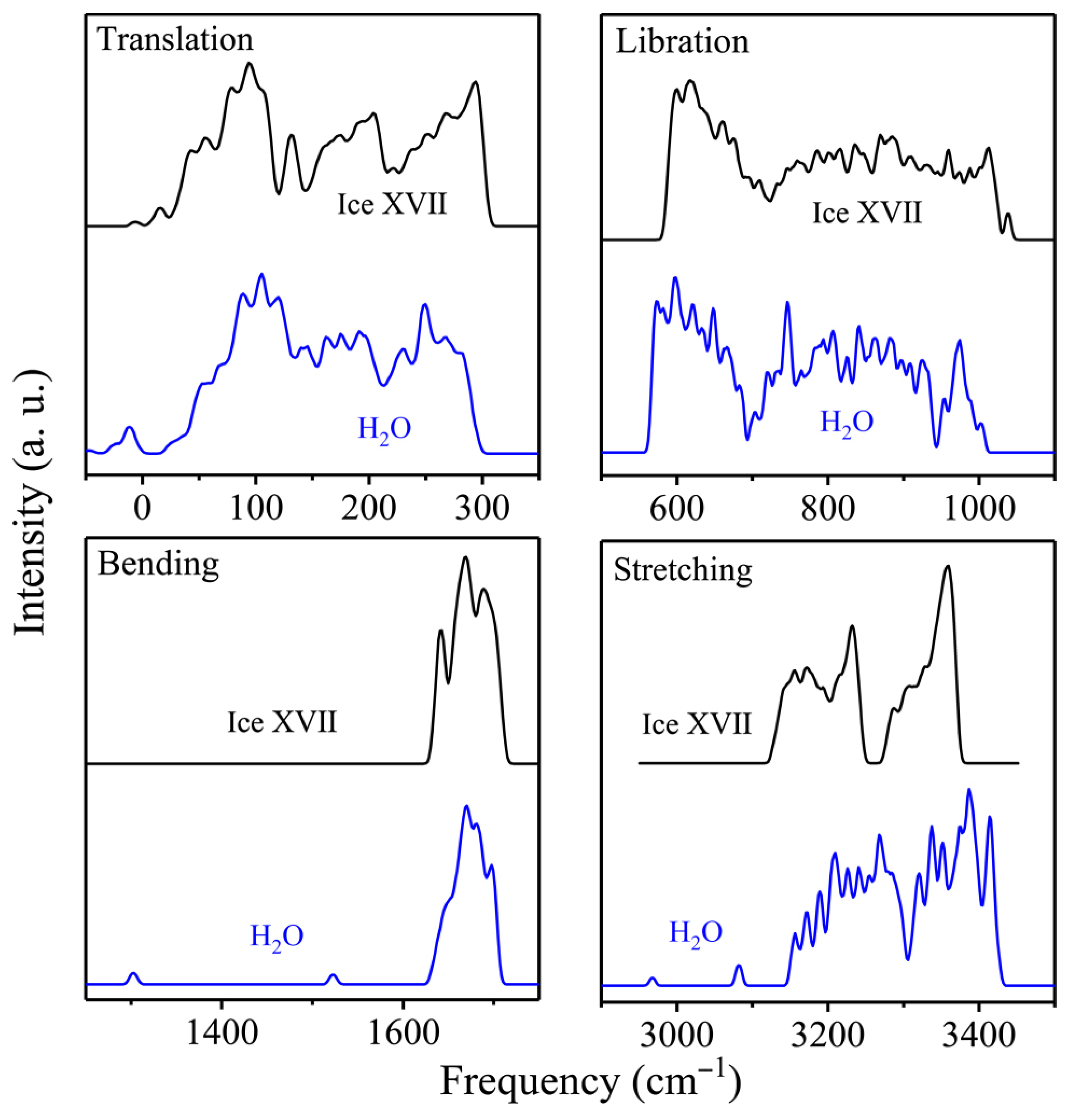
Comparisons were made between ice XVII and sI-type clathrate hydrates without guest molecules. The encapsulation of methane was found to have minimal impact on the hydrogen bonding network. Specifically, they identified two distinct groups of H-bond peaks in the sI clathrate structure, located around 291 and 210 cm−1, (corresponding to approximately 9.1 and 6.8 THz, respectively) within the translational bands, see Figure 9. These peaks are associated with two types of intermolecular H-bond vibrational modes, commonly observed in the tetrahedral structure of ice, corresponding to the two-bond mode and the four-bond mode. In all ice phases, water molecules are arranged so that a central molecule forms H-bonds with four neighboring molecules in a tetrahedral geometry. When the central molecule vibrates along its angle bisector, all four hydrogen bonds oscillate, resulting in the four-bond mode. In contrast, when the vibration involves only two of these bonds, it corresponds to the two-bond mode. This analysis supports the hypothesis that the application of THz radiation in aqueous environments may serve as an effective approach means to promote the decomposition of gas hydrates.

5.2. Water Network and Terahertz Energy

Starting from this consideration, it is useful to analyze the work of Zhu et al. regarding the vibrational spectrum of ice. In their initial study from 2019 [155], the authors investigated the relationship between vibrational normal modes and the spectrum of ice XVII, which corresponds to the empty framework of the sI clathrate structure. Despite its significantly lower density compared to ice  I h , its PDOS exhibits features remarkably similar to those of ice  I h . In particular, two sharp peaks, approximately located at 204 and 294 cm−1, are found in the translation region. These peaks are associated with the two-bond and the four-bond modes, respectively, and were previously identified in ice  I c  as well. Therefore, the existence of two basic H-bond vibrational modes is a general feature of the ice family, due to the local tetrahedral structure in ice phases. This conclusion was further confirmed by Zhu et al. [156], who compared the absorption bands of water, ice XI and Ic with experimental data obtained for ice  I h . Their analysis showed that two peaks between 200 and 300 cm−1 (∼5.99 and 8.99 THz, respectively) can consistently be attributed to the two- and four-bond modes present in the vibrational spectra of ice phases. This behavior has also been observed in ice phases XIV, XVI, XVII, VIII, VII, II, and XV, where ice XVI and XVII correspond to the sII and sI clathrate structures, respectively. The authors therefore concluded that the presence of these two peaks is a robust signature of the H-bond network in ice, including clathrate forms. Based on this observation, they hypothesized that the application of two specific THz radiation energies (∼6.8 and 9.1 THz) to gas hydrates could induce resonant absorption, thereby facilitating the decomposition of clathrate structures and the release of guest molecules with minimal energy loss.
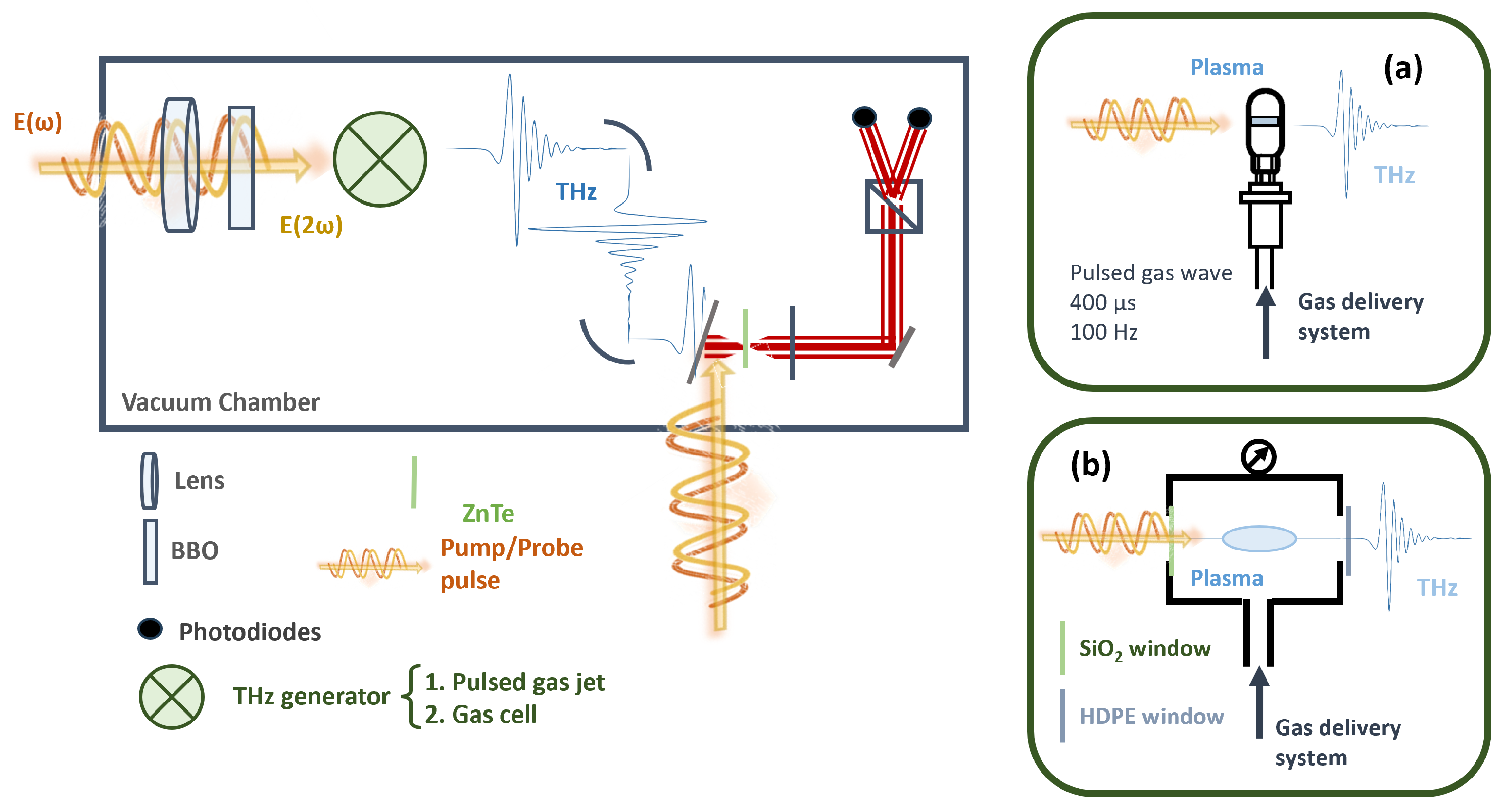
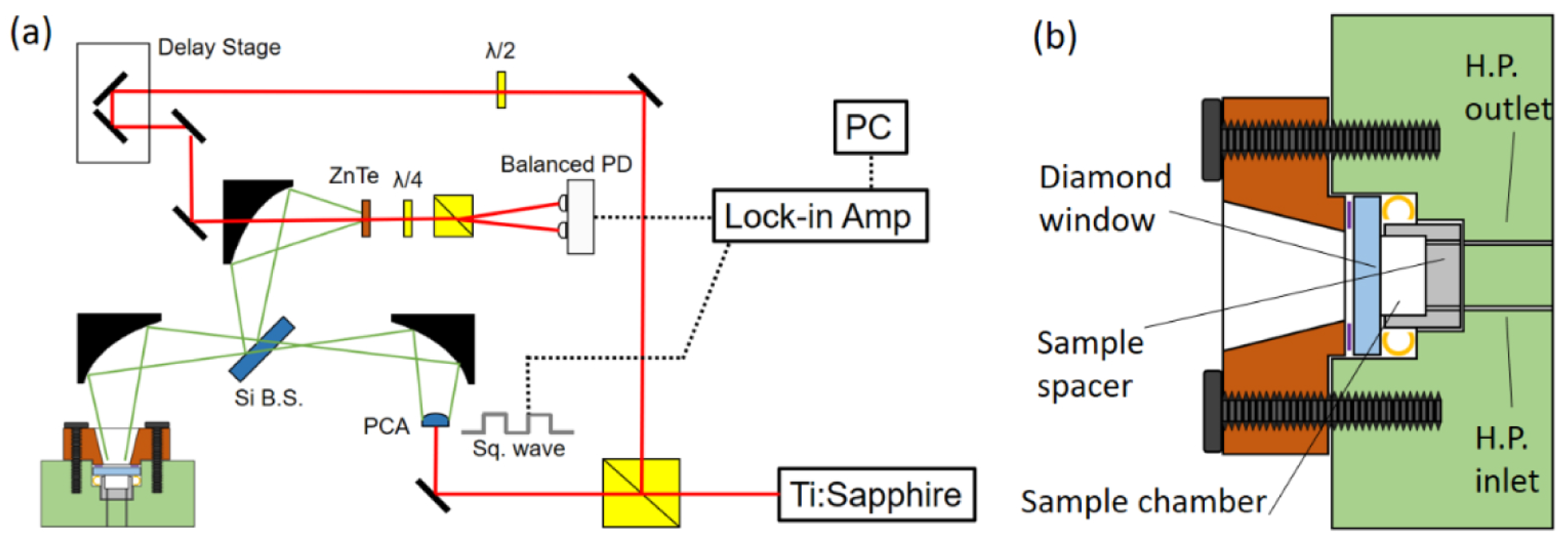
A similar hypothesis is also proposed by Johnson in several of his works. In his 2009 study [157], Johnson investigated so-called “water buckyball”, i.e., pentagonal dodecahedral water clusters (H2O)20 or (H2O)21H+, which correspond to  5 12  clathrate cages [158]. According to Johnson, these water buckyballs and their arrays possess the unique property of vibrational modes extending into the THz region of the electromagnetic spectrum. He noted that the THz spectra of H2O and CO2 monomers are associated with pure rotational or roto-vibrational modes. Given that the radiated power of an oscillating dipole scales with the square of the dipole moment, an optically excited water cluster ion such as (H2O)nH+ can act as strong source of THz radiations. Johnson’s theory further suggests that the lowest unoccupied molecular orbital (LUMO) energy levels, which correspond to the huge “Rydberg” “S”-, “P”-, “D”- and “F”-like cluster “surface” orbital wavefunctions, give rise to vibrational modes in 1–6 THz range. These modes are attributed to O-O-O “squashing” (or “bending”) and “twisting” motions between adjacent H-bonds, commonly observed in such water clusters. In this framework, near-ultraviolet (UV) excitation of an electron from the HOMO to the LUMO populates the “S”-like cluster molecular orbital, forming a metastable, bound state even in the presence of an extra electron (hydrated electron). IR absorption can further excite the cluster LUMO “S”-like electron to higher LUMOs such as the “P”-like cluster orbital, followed by vibrational relaxation in accordance with the Franck-Condon principle. From this theoretical basis, Johnson asserts that the lowest vibrational frequency modes induced by optical pumping in water clusters correspond to the 1–6 THz “surface” modes [157,159,160]. Johnson and collaborators [160] reported the first experimental demonstration, along with theoretical implications, of intense broadband THz emission from water vapor using femtosecond laser pulses. THz generation was investigated at various pressures using two complementary setups, schematically shown in Figure 10: water vapor in a cell (at low pressure, ambient temperatures and high pressures, Figure 10b) and a nozzle jet in a vacuum chamber (at intermediate and semi-high pressures, Figure 10a). By focusing an intense laser pulse on confined water vapor, they observed an extraordinarily strong THz field emission. To explain this behavior, they proposed that the efficiency of THz generation depends critically on the molecular structure of water. In particular, they reported the following key observations: (i) water vapor produces stronger THz emission than nitrogen at the same pressure and power, ascribable to a four-wave mixing process; (ii) the threshold of pump energy for THz generation from water vapor is around 100 μJ at 200 mTorr; (iii) THz wave generation from H2O vapor is significantly stronger than that from D2O vapor. H2O and D2O have virtually identical ionization energies [161], so in the simplest free-electron plasma scenario, they should not produce THz emission with any significant isotope effect arising solely from photoionization. However, isotope effects are observed in THz absorption spectra of water vapor due to rotational–vibrational excitations and have been attributed to the dissociative recombination of hydronium-ion water clusters [162]. Water clusters, particularly protonated [163] or deuterated [162] hydronium-ion clusters, (HO)nH+ and (D2O)nD+, which are naturally present in water vapor [163,164], may contribute to isotope-dependent THz emission due to their remarkable thermal stability and unique THz vibrational modes. Based on these observations and data, they proposed a simple model incorporating molecular orbital theory and vibrational normal modes to explain isotope-dependent THz emission from optically pumped water cluster ions.

5.3. Terahertz Application

All these observations lead to the conclusion that THz radiation can be used for various applications in the context of clathrates. As discussed, one of the main advantages of THz lies in its selectivity, which allows for a rapid and comprehensive characterization of gas hydrates. Furthermore, the non-destructive inspection enabled by THz technologies allows for the measurement and determination of the absorption coefficients, refractive indices and dielectric constants of hydrate structures. These properties are crucial for investigating hydrate nucleation and dissociation processes at temperatures below the freezing point, as demonstrated in the pioneering studies by Takeya et al. [165,166]. In particular, Takeya et al. [165] investigated gas hydrates at 243 K and atmospheric pressure, aiming to measure the absorption coefficient and refractive index of sII hydrates from tetrahydrofuran (THF) and propane in THz frequency range. The primary objective was to explore the potential of this technology for the non-destructive inspection of gas hydrates. The results obtained for gas hydrates and ice revealed that, although the H-bond networks in both materials are nearly identical, subtle differences in their refractive indices n( ω ) could be detected using THz-TDS spectroscopy. Based on these findings, the authors proposed that THz-TDS could serve as a effective tool for distinguishing gas hydrates from ice by analyzing time-domain THz signals and frequency-dependent and refractive index variations. The real parts of the refractive indices for THF, propane, and  S F 6  hydrates [165,166] show a slight increase with frequency and are approximately 1.725, 1.775, and 1.775 at 1 THz, respectively. In comparison, the refractive index of ice  I h  is approximately 1.79 at 1 THz. The refractive index and dielectric constant of ice-like compounds can be theoretically explained by the contribution of defect-induced molecular reorientation. Notably, THF hydrate exhibits a distinct absorption peak around 0.5 THz, which is likely attributed to the dynamic behavior of the encapsulated THF molecules. This feature appears to be typical of gas hydrates containing guest molecules with a permanent dipole moment. Therefore, THz-TDS studies of gas hydrates provide valuable insights into the dynamics of polar guest molecules within hydrate cages. In related works, Zhang et al. studied hydroquinone (HQ) clathrates [167,168], which serve as an example of prototypical organic clathrates, using the schematic layout reported in Figure 11. HQ, a phenolic compound with the formula p-C6H4(OH)2, assembles into hydrogen-bonded ring structures during clathrate formation. At least four polymorphs of HQ are known; of these, the  α - and  β -forms are the most commonly observed, both of which form clathrate structures. The  α -polymorph is the most stable structure under ambient conditions and crystallizes in a hexagonal unit cell containing 54 HQ molecules, with one pore for every 18 HQ molecules. The  β -form, which also crystallizes in the same way, represents a more accessible clathrate structure, with one pore for every three HQ molecules.
In their initial study, Zhang et al. [168] assigned THz vibrational modes to HQ structures. They first measured the temperature-dependent THz spectra of both  α -HQ (the non-clathrate form) and  β -HQ (clathrate form), using Ar and CO2 as guest species. Subsequently, they performed DFT simulations on these materials in order to assign the spectral features, finding excellent agreement between the experimental data and DFT-calculated spectra. Finally, these findings were further exploited in their subsequent study [167], where they demonstrated that the gas-capture process is mediated by a single THz vibrational mode, which they then used to track the uptake of gas. Specifically, they employed a commercial THz time-domain spectrometer to measure THz spectra inside a pressure cell and monitor the spectral changes in the sample throughout the reaction, demonstrating that THz spectroscopy is a powerful technique for understanding the low-frequency dynamics, phenomena of thermal expansion, elasticity, and stability related to gas capture in HQ. Due to the structural differences between the two crystal forms and their corresponding differences in the THz-TDS spectra, the phase transition induced by applied pressure could be monitored using THz-TDS alone. By tracking changes in THz spectra, the authors followed the kinetics of the reaction from  α -HQ to  β -HQ-CO2. Notably, the relative amount of HQ was quantified by monitoring the absorption coefficient at 1.18 THz, corresponding to the first phonon mode of  α -HQ. Since this peak is absent in the  β -form, it served as a reliable spectral marker for the conversion to the clathrate phase. Overall, the study provided a coherent description of the transition from empty HQ and HQ clathrate in the presence of high-pressure CO2 gas and supported the idea, previously proposed [40,153,157,159,160] that THz radiation can induce the dissociation of clathrate cages. A recent study by Di Profio et al. [25] provided new insights into the potential influence of THz radiation on clathrate formation. In this work, the authors experimentally demonstrated that the formation of methane hydrates can be inhibited by irradiating the water/methane system with THz radiation in the frequency region ranging from 1 to 5 THz. To the best of our knowledge, this represents the first study reporting an application of THz radiation to actively suppress hydrate formation. The aim of the study lies in the coupling of THz radiation with low-energy collective vibrational modes of water and its molecular clusters. THz spectroscopy was employed to investigate the interactions between water molecules and simple hydrocarbons, serving as a model for clathrate hydrate host-guest dynamics. Their results showed that the vibrational frequencies observed in the Raman spectra of water in the 2600–3000 cm−1 region shift depending on the type of guest molecule and the cage structure formed. This suggests that THz radiation may destabilize the hydrogen-bonding network of hydrate cages. Consistent with the interpretation proposed by Johnson [160] these findings highlight that THz irradiation could lead to the weakening of clathrate H-bonds by closing the energy gap between the highest occupied molecular orbitals (HOMOs) and the lowest unoccupied molecular orbitals (LUMOs) of water clusters, resembling dodecahedral hydrate structures, thereby resulting in the disruption of hydrate cages. They noted that continuous exposure of water and methane to THz radiation in the 1–5 THz range for 48 h, completely inhibited methane hydrate formation, with this inhibition persisting for several days after the radiation source was switched off. Recently, Bancroft et al. [170] proposed a comprehensive experimental and computational study on the low-frequency vibrational dynamics of HQ clathrate during in situ gas loading. In particular, their aim is to track the gas loading in HQ clathrate within situ gas injecting, monitoring the replacement of carbon dioxide with methane in its atomic-level pores. Taking advantage of THz-TDS spectroscopy highly sensitive to the identity and structure of enclathrated guest molecules, they monitored the reaction in situ through the corresponding changes in the vibrational mode spectrum in the 0.5–2.5 THz range (corresponding to 15–84 cm−1). Through comparisons with both DFT calculations and ab initio molecular dynamics (AIMD) simulations, they confirmed the experimental results showing that methane molecules occupy approximately one-third of available adsorption sites, contrary to previously published experiments and simulations, which found that the CO2 clathrate is fully ordered (both the framework and guest CO2 molecules) [167]. There is little information available to explain this disorder, but it is most likely attributable to the weak van der Waals interactions between the methane molecules and the cage framework, which allow multiple orientations of the guest molecules to coexist. This presents a challenge because the THz spectra of disordered materials differ from those of ordered crystals; however, the ability to distinguish between different types of disorder using THz spectroscopy could represent an opportunity.

6. Conclusions

The massive presence of natural GHs in permafrost regions, along with their numerous potential industrial applications and relevance to oil and gas extraction issues, makes them a promising research topic in multiple fields. A comprehensive understanding of their chemical composition, as well as association and dissociation processes, is fundamental for their effective knowledge and use. An innovative approach for the chemical and structural characterization and inhibition of clathrate formation is based on THz radiation. In this Review, we have collected, critically reviewed, and compared the state-of-the-art of investigations and analyses on clathrates using time-resolved THz spectroscopy, as well as studies addressing the effects induced by THz electric fields on clathrates. This work is intended both as a point of reflection and a starting point for future research. Several studies were carried out using MD simulations of clathrate cages, water cages and their interaction with electromagnetic THz fields. These studies have demonstrated that THz radiation is a valuable tool for the characterization and analysis of GHs, owing to its specificity and sensitivity. A novel application of THz technology was also investigated for inhibiting hydrate formation process, showing promising effectiveness in reducing the general influence of the hydrate growth of THz electric fields achievable with common benchtop femtosecond laser systems based on THz generation [25], and effects in disrupting nucleation mechanisms under highly intense THz electric fields [150,152,153]. For the latter case, the mentioned field strengths are on the order of ≈MV/cm, well beyond what is currently achievable with common benchtop femtosecond laser systems. Such strengths are typically accessible only with large, specialized systems or under highly optimized laboratory conditions using advanced THz sources. These field values represent an interesting range in which the physical limits of THz-induced processes can be explored and constitute necessary benchmarks for further technological developments in high-intensity THz field generation, both in terms of efficiency and scalability, before such strengths can be applied to complex or large-scale systems, e.g., industrial or in situ applications such as pipelines. However, scientific and technological research, as demonstrated by the extensive scientific production of the last few decades summarized in Section 4, has reached a sufficient level of maturity to propose solutions that, while still far from in situ industrial applications, are moving in that direction. In the generation of intense THz radiation on optical benchtops, organic crystals and topological materials, such as Co2MnGa [100,171,172,173], are emerging. Another limiting aspect is the absorption of THz radiation by water and aqueous media. THz radiation is strongly attenuated by polar liquids due to their intense absorption, resulting in a significant reduction in penetration depth (typically a few tens of micrometers in liquid water). This explains why most of the experimental studies reported in this review focus on dry, thin, or cryogenic samples, and why experimental investigations in aqueous environments are still limited. This can be overcome by alternative detection geometries (e.g., in reflection mode or evanescent wave THz spectroscopy) or under specific experimental conditions such as confinement. Finally, we believe that, despite all these challenges, THz technology in the study of clathrates can offer significant impacts and emerging aspects for their structural and dynamic characterization. It can improve the understanding of nucleation and growth mechanisms, detect variations in cage rigidity that provide insight into the dissociation process, and in the presence of strong THz fields, act as a molecular actuator.

Author Contributions

Conceptualization, R.M. and A.D.; methodology, R.M., A.D., S.M., T.M., M.C.P., L.M., S.L.; resources, S.L.; visualization, R.M., A.D.; writing—original draft preparation, R.M., A.D., and S.L.; writing—review and editing, R.M., T.M., S.M., M.C.P., L.M., A.D., S.L.; supervision, S.L. and A.D.; funding acquisition, S.L. All authors have read and agreed to the published version of the manuscript.

Funding

This research was funded by Rome Technopole-CUP: B83C22002820006, funded by Decreto MUR 23/06/2022 prot. n. 105 (codice ECS 00000024), Avviso pubblico n. 3277 of MUR in the framework of Piano Nazionale di Ripresa e Resilienza PNRR-Missione 4 Istruzione e Ricerca-Componente 2-Investimento 1.5, funded by EU-Next Generation EU. Missione 4 Componente 2.

Data Availability Statement

No new data were created or analyzed in this study. Data sharing is not applicable to this article.

Acknowledgments

This work was funded by Rome Technopole Spoke 6—Joint Lab “Environmental Sensor Lab”.

Conflicts of Interest

The authors declare no conflicts of interest.

References

  1. Bataille, C.; Åhman, M.; Neuhoff, K.; Nilsson, L.J.; Fischedick, M.; Lechtenböhmer, S.; Solano-Rodriquez, B.; Denis-Ryan, A.; Stiebert, S.; Waisman, H.; et al. A Review of Technology and Policy Deep Decarbonization Pathway Options for Making Energy-Intensive Industry Production Consistent with the Paris Agreement. J. Clean. Prod. 2018, 187, 960–973. [Google Scholar] [CrossRef]
  2. IRENA. World Energy Transitions Outlook: 1.5 °C Pathway; International Renewable Energy Agency: Abu Dhabi, United Arab Emirates, 2021; ISBN 978-92-9260-334-2. Available online: https://www.irena.org/publications/2021/Jun/World-Energy-Transitions-Outlook (accessed on 13 October 2025).
  3. Englezos, P. Clathrate Hydrates. Ind. Eng. Chem. Res. 1993, 32, 1251–1274. [Google Scholar] [CrossRef]
  4. Englezos, P.; Lee, J.D. Gas Hydrates: A Cleaner Source of Energy and Opportunity for Innovative Technologies. Korean J. Chem. Eng. 2005, 22, 671–681. [Google Scholar] [CrossRef]
  5. Kumar, A.; Bhattacharjee, G.; Kulkarni, B.D.; Kumar, R. Role of Surfactants in Promoting Gas Hydrate Formation. Ind. Eng. Chem. Res. 2015, 54, 12217–12232. [Google Scholar] [CrossRef]
  6. Bhattacharjee, G.; Kumar, A.; Sakpal, T.; Kumar, R. Carbon Dioxide Sequestration: Influence of Porous Media on Hydrate Formation Kinetics. ACS Sustain. Chem. Eng. 2015, 3, 1205–1214. [Google Scholar] [CrossRef]
  7. Zhou, X.; Sun, C.; Li, X.; Yang, X.; Li, S.; Liang, D. Gas Storage via Clathrate Hydrates: Advances, Challenges, and Prospects. J. Gas Sci. Eng. 2024, 139, 205388. [Google Scholar] [CrossRef]
  8. Xie, Y.; Li, G.; Liu, D.; Liu, N.; Qi, Y.; Liang, D.; Guo, K.; Fan, S. Experimental Study on a Small Scale of Gas Hydrate Cold Storage Apparatus. Appl Energy 2010, 87, 3340–3346. [Google Scholar] [CrossRef]
  9. Bi, Y.; Guo, T.; Zhu, T.; Zhang, L.; Chen, L. Influences of Additives on the Gas Hydrate Cool Storage Process in a New Gas Hydrate Cool Storage System. Energy Convers. Manag. 2006, 47, 2974–2982. [Google Scholar] [CrossRef]
  10. Kumar, A.; Palodkar, A.V.; Gautam, R.; Choudhary, N.; Veluswamy, H.P.; Kumar, S. Role of Salinity in Clathrate Hydrate Based Processes. J. Nat. Gas Sci. Eng. 2022, 108, 104811. [Google Scholar] [CrossRef]
  11. Lee, H.; Lee, J.; Kim, D.Y.; Park, J.; Seo, Y.-T.; Zeng, H.; Moudrakovski, I.L.; Ratcliffe, C.I.; Ripmeester, J.A. Tuning Clathrate Hydrates for Hydrogen Storage. Nature 2005, 434, 743–746. [Google Scholar] [CrossRef]
  12. Gudmundsson, J.S.; Parlaktuna, M.; Khokhar, A.A. Storage of Natural Gas as Frozen Hydrate. SPE Prod. Facil. 1994, 9, 69–73. [Google Scholar] [CrossRef]
  13. Veluswamy, H.P.; Kumar, A.; Seo, Y.; Lee, J.D.; Linga, P. A Review of Solidified Natural Gas (SNG) Technology for Gas Storage via Clathrate Hydrates. Appl. Energy 2018, 216, 262–285. [Google Scholar] [CrossRef]
  14. Kumar, A.; Veluswamy, H.P.; Kumar, R.; Linga, P. Direct Use of Seawater for Rapid Methane Storage via Clathrate (SII) Hydrates. Appl. Energy 2019, 235, 21–30. [Google Scholar] [CrossRef]
  15. Babu, P.; Nambiar, A.; He, T.; Karimi, I.A.; Lee, J.D.; Englezos, P.; Linga, P. A Review of Clathrate Hydrate Based Desalination To Strengthen Energy–Water Nexus. ACS Sustain. Chem. Eng. 2018, 6, 8093–8107. [Google Scholar] [CrossRef]
  16. Javanmardi, J.; Moshfeghian, M. Energy Consumption and Economic Evaluation of Water Desalination by Hydrate Phenomenon. Appl. Therm. Eng. 2003, 23, 845–857. [Google Scholar] [CrossRef]
  17. Gautam, R.; Kumar, S.; Sahai, M.; Kumar, A. Solid CO2 Hydrates for Sustainable Environment: Application in Carbon Capture and Desalination. Mater. Today Proc. 2022, 67, 609–615. [Google Scholar] [CrossRef]
  18. Dong, H.; Wang, J.; Xie, Z.; Wang, B.; Zhang, L.; Shi, Q. Potential Applications Based on the Formation and Dissociation of Gas Hydrates. Renew. Sustain. Energy Rev. 2021, 143, 110928. [Google Scholar] [CrossRef]
  19. Chong, Z.R.; Yang, S.H.B.; Babu, P.; Linga, P.; Li, X.-S. Review of Natural Gas Hydrates as an Energy Resource: Prospects and Challenges. Appl. Energy 2016, 162, 1633–1652. [Google Scholar] [CrossRef]
  20. Englezos, P.; Bishnoi, P.R. Prediction of Gas Hydrate Formation Conditions in Aqueous Electrolyte Solutions. AIChE J. 1988, 34, 1718–1721. [Google Scholar] [CrossRef]
  21. Takeya, S.; Kida, M.; Minami, H.; Sakagami, H.; Hachikubo, A.; Takahashi, N.; Shoji, H.; Soloviev, V.; Wallmann, K.; Biebow, N.; et al. Structure and Thermal Expansion of Natural Gas Clathrate Hydrates. Chem. Eng. Sci. 2006, 61, 2670–2674. [Google Scholar] [CrossRef]
  22. Collett, T.; Lee, M.W. Reservoir characterization of marine and permafrost associated gas hydrate accumulations with downhole well logs. Ann. N. Y. Acad. Sci. 2000, 912, 51–64. [Google Scholar] [CrossRef]
  23. Sloan, E.D. Gas Hydrates: Review of Physical/Chemical Properties. J. Chem. Thermodyn. 1998, 12, 191–196. [Google Scholar] [CrossRef]
  24. Sloan, E.D. Fundamental Principles and Applications of Natural Gas Hydrates. Nature 2003, 426, 353–359. [Google Scholar] [CrossRef]
  25. Di Profio, P.; Canale, V.; Ciulla, M.; Fontana, A.; Madia, L.; Zampato, M.; Carminati, S. Terahertz Irradiation of Liquid Water Inhibits Methane Hydrate Formation. ACS Sustain. Chem. Eng. 2022, 10, 4780–4787. [Google Scholar] [CrossRef]
  26. Sloan, E.D.; Koh, C.A.; Koh, C.A. Clathrate Hydrates of Natural Gases; CRC Press: Boca Raton, FL, USA, 2007; ISBN 9780429129148. [Google Scholar]
  27. Ripmeester, J.A.; Tse, J.S.; Ratcliffe, C.I.; Powell, B.M. A New Clathrate Hydrate Structure. Nature 1987, 325, 135–136. [Google Scholar] [CrossRef]
  28. Song, Y.; Yang, L.; Yang, M. Natural Gas Hydrate, Far Beyond a Vast Resource of Natural Gas. Xinnengyuan Energy 2024, 3, 100074. [Google Scholar] [CrossRef]
  29. Hammerschmidt, E.G. Formation of Gas Hydrates in Natural Gas Transmission Lines. Ind. Eng. Chem. 1934, 26, 851–855. [Google Scholar] [CrossRef]
  30. Majid, A.A.A.; Worley, J.; Koh, C.A. Thermodynamic and Kinetic Promoters for Gas Hydrate Technological Applications. Energy Fuels 2021, 35, 19288–19301. [Google Scholar] [CrossRef]
  31. Di Profio, P.; Ciulla, M.; Di Giacomo, S.; Barbacane, N.; Wolicki, R.D.; Fontana, A.; Moffa, S.; Pilato, S.; Siani, G. Emerging Green Strategies for Biogas Upgrading through CO2 Capture: From Unconventional Organic Solvents to Clathrate and Semi-Clathrate Hydrates. J. Mol. Liq. 2023, 391, 123196. [Google Scholar] [CrossRef]
  32. Mao, H.; Qiu, Z.; Shen, Z.; Huang, W. Hydrophobic associated polymer based silica nanoparticles composite with core-shell structure as a filtrate reducer for drilling fluid at utra-high temperature. J. Pet. Sci. Eng. 2015, 129, 1–14. [Google Scholar] [CrossRef]
  33. Amanullah, M.; Al-Tahani, A.M. Nano-technology-its significance in smart fluid development for oil and gas field application. SPE Saudi Arab. Sect. Tech. Symp. 2009, 61, 54–59. [Google Scholar]
  34. Wang, R.; Liu, T.; Ning, F.; Ou, W.; Zhang, L.; Wang, Z.; Peng, L.; Sun, J.; Liu, Z.; Li, T.; et al. Effect of hydrophilic silica nanoparticles on hydrate formation: Insight from the experimental study. J. Energy Chem. 2019, 30, 90–100. [Google Scholar] [CrossRef]
  35. Laurent, S.; Forge, D.; Port, M.; Roch, A.; Robic, C.; Elst, L.V.; Muller, R.N. Magnetic iron oxide nanoparticles: Synthesis, stabilization, vectorization, physicochemical characterizations and biological applications. Chem. Rev. 2008, 108, 2064–2110. [Google Scholar] [CrossRef]
  36. Arjang, S.; Manteghian, M.; Mohammadi, A. Effect of synthesized silver nanoparticles in promoting methane hydrate formation at 4.7 MPa and 5.7 MPa. Chem. Eng. Res. Des. 2013, 91, 1050–1054. [Google Scholar] [CrossRef]
  37. Zhou, S.; Jiang, K.; Zhao, Y.; Chi, Y.; Wang, S.; Zhang, G. Experimental investigation of CO2 hydrate formation in the water containing graphite nanoparticles and tetra-n-butyl ammonium bromide. J. Chem. Eng. Data 2018, 63, 389–394. [Google Scholar] [CrossRef]
  38. Bhatia, K.; Chacko, L. Ni-Fe nanoparticle: An innovative approach for recovery of hydrates. In Proceedings of the SPE EUROPEC/EAGE Annual Conference and Exhibition, Vienna, Austria, 23–26 May 2011; SPE: Dallas, TX, USA; Volume 2011, pp. 387–393. [Google Scholar]
  39. Ramya, K.R.; Venkatnathan, A. Stability and Reactivity of Methane Clathrate Hydrates: Insights from Density Functional Theory. J. Phys. Chem. A 2012, 116, 7742–7745. [Google Scholar] [CrossRef]
  40. Wang, H.-C.; Zhu, X.-L.; Cao, J.-W.; Qin, X.-L.; Yang, Y.-C.; Niu, T.-X.; Lu, Y.-B.; Zhang, P. Density Functional Theory Studies of Hydrogen Bonding Vibrations in SI Gas Hydrates. New J. Phys. 2020, 22, 093066. [Google Scholar] [CrossRef]
  41. Ramya, K.R.; Pavan Kumar, G.V.; Venkatnathan, A. Raman Spectra of Vibrational and Librational Modes in Methane Clathrate Hydrates Using Density Functional Theory. J. Chem. Phys. 2012, 136, 174305. [Google Scholar] [CrossRef] [PubMed]
  42. Dhungana, D.S.; Bonaventura, E.; Martella, C.; Grazianetti, C.; Molle, A. Solid Phase Crystallization of Amorphous Silicon at the Two-Dimensional Limit. Nanoscale Adv. 2023, 5, 668–674. [Google Scholar] [CrossRef]
  43. Bonaventura, E.; Martella, C.; Macis, S.; Dhungana, D.S.; Krotkus, S.; Heuken, M.; Lupi, S.; Molle, A.; Grazianetti, C. Optical Properties of Two-Dimensional Tin Nanosheets Epitaxially Grown on Graphene. Nanotechnology 2024, 35, 23LT01. [Google Scholar] [CrossRef]
  44. Dartois, E. CO clathrate hydrate: Near to mid-IR spectroscopic signatures. Icarus 2011, 212, 950–956. [Google Scholar] [CrossRef]
  45. Gowd, E.B.; Nair, S.S.; Ramesh, C.; Tashiro, K. Studies on the Clathrate (δ) Form of Syndiotactic Polystyrene Crystallized by Different Solvents Using Fourier Transform Infrared Spectroscopy. Macroolecules 2003, 36, 7388–7397. [Google Scholar] [CrossRef]
  46. Piccirilli, F.; Tardani, F.; D’Arco, A.; Birarda, G.; Vaccari, L.; Sennato, S.; Casciardi, S.; Lupi, S. Infrared Nanospectroscopy reveals DNA structural modifications upon immobilization onto clay nanotubes. Nanomaterials 2021, 11, 1103. [Google Scholar] [CrossRef] [PubMed]
  47. Noguchi, N.; Shiraishi, Y.; Kageyama, M.; Yokoi, Y.; Kurohama, S.; Okada, N.; Okamura, H. Direct observation of pressure-induced amorphization of methane/ethane hydrates using Raman and infrared spectroscopy. Phys. Chem. Chem. Phys. 2023, 25, 22161–22170. [Google Scholar] [CrossRef] [PubMed]
  48. Strobel, T.A.; Sloan, E.D.; Koh, C.A. Raman spectroscopic studies of hydrogen clathrate hydrates. J. Chem. Phys. 2009, 130, 014506. [Google Scholar] [CrossRef]
  49. Bach-Vergés, M.; Kitchin, S.J.; Harris, K.D.M.; Zugic, M.; Koh, C.A. Dynamic Properties of the Tetrahydrofuran Clathrate Hydrate, Investigated by Solid State 2H NMR Spectroscopy. J. Phys. Chem. B 2001, 105, 2699–2706. [Google Scholar] [CrossRef]
  50. Yang, M.; Chong, Z.R.; Zheng, J.; Song, Y.; Linga, P. Advances in nuclear magnetic resonance (NMR) techniques for the investigation of clathrate hydrates. Renew. Sustain. Energy Rev. 2017, 74, 1346–1360. [Google Scholar] [CrossRef]
  51. Inerbaev, T.M.; Belosludov, V.R.; Belosludov, R.V.; Sluiter, M.; Kawazoe, Y.; Kudoh, J.I. Theoretical Study of Clathrate Hydrates with Multiple Occupation. J. Incl. Phenom. 2004, 48, 55–60. [Google Scholar] [CrossRef]
  52. Sum, A.K.; Burruss, R.C.; Sloan, D. Measurement of Clathrate Hydrates via Raman Spectroscopy. J. Phys. Chem. B 1997, 101, 7371–7377. [Google Scholar] [CrossRef]
  53. Giannasi, A.; Celli, M.; Ulivi, L.; Zoppi, M. Low temperature Raman spectra of hydrogen in simple and binary clathrate hydrates. J. Chem. Phys. 2008, 129, 084705. [Google Scholar] [CrossRef] [PubMed]
  54. del Rosso, L.; Celli, M.; Ulivi, L. Raman Measurements of Pure Hydrogen Clathrate Formation from a Supercooled Hydrogen-Water Solution. J. Phys. Chem. Lett. 2015, 6, 4309–4313. [Google Scholar] [CrossRef]
  55. Nam, B.U.; Kim, B.S.; Lee, H.H.; Yoon, J.H. Structural transformation and guest dynamics of methanol-loaded hydroquinone clathrate observed by temperature-dependent Raman spectroscopy. J. Phys. Chem. A 2012, 116, 435–438. [Google Scholar] [CrossRef]
  56. Dolenko, T.A.; Burikov, S.A.; Dolenko, S.A.; Efitorov, A.O.; Plastinin, I.V.; Yuzhakov, V.I.; Patsaeva, S.V. Raman Spectroscopy of Water-Ethanol Solutions: The Estimation of Hydrogen Bonding Energy and the Appearance of Clathrate-like Structures in Solutions. J. Phys. Chem. A 2015, 119, 10806–10815. [Google Scholar] [CrossRef]
  57. Malla, B.K.; Yang, D.S.; Pradeep, T. Growth of Clathrate Hydrates in Nanoscale Ice Films Observed Using Electron Diffraction and Infrared Spectroscopy. J. Phys. Chem. Lett. 2025, 16, 365–371. [Google Scholar] [CrossRef]
  58. Douberly, G.E.; Ricks, A.M.; Duncan, M.A. Infrared spectroscopy of perdeuterated protonated water clusters in the vicinity of the clathrate cage. J. Phys. Chem. A 2009, 113, 8449–8453. [Google Scholar] [CrossRef]
  59. Houlleberghs, M.; Radhakrishnan, S.; Chandran, C.V.; Morais, A.F.; Martens, J.A.; Breynaert, E. Harnessing Nuclear Magnetic Resonance Spectroscopy to Decipher Structure and Dynamics of Clathrate Hydrates in Confinement: A Perspective. Molecules 2024, 29, 3369. [Google Scholar] [CrossRef] [PubMed]
  60. Udachin, K.A.; Ratcliffe, C.I.; Ripmeester, J.A. Structure, dynamics and ordering in structure i ether clathrate hydrates from single-crystal X-ray diffraction and 2H NMR spectroscopy. J. Phys. Chem. B 2007, 111, 11366–11372. [Google Scholar] [CrossRef]
  61. Delgado-Mellado, N.; García, J.; Rodríguez, F.; Rogers, R.D. Insights into Ionic Liquid/Aromatic Systems from NMR Spectroscopy: How Water Affects Solubility and Intermolecular Interactions. Chempluschem 2019, 84, 872–881. [Google Scholar] [CrossRef]
  62. Adkins, Z.; Yang, Y.; Hartman, R.L.; Koh, C.A. Interactions of clathrate hydrate promoters sodium dodecyl sulfate and tetrahydrofuran investigated using 1H diffusion nuclear magnetic resonance at hydrate-forming conditions. J. Chem. Phys. 2024, 161, 094502. [Google Scholar] [CrossRef] [PubMed]
  63. Subramanian, S.; Ballard, A.L.; Kini, R.A.; Dec, S.F.; Sloan, E.D. Structural Transitions in Methane+ethane Gas Hydrates—Part I: Upper Transition Point and Applications. Chem. Eng. Sci. 2000, 55, 5763–5771. [Google Scholar] [CrossRef]
  64. Susilo, R.; Ripmeester, J.A.; Englezos, P. Characterization of Gas Hydrates with PXRD, DSC, NMR, and Raman Spectroscopy. Chem. Eng. Sci. 2007, 62, 3930–3939. [Google Scholar] [CrossRef]
  65. Xu, T.; Lang, X.; Fan, S.; Wang, Y.; Chen, J. The Effect of Electric Fields in Methane Hydrate Growth and Dissociation: A MD Simulation. Comput. Theor. Chem. 2019, 1149, 57–68. [Google Scholar] [CrossRef]
  66. Chen, B.; Li, K.; Sun, H.; Jiang, L.; Yang, M.; Song, Y. Promoting Effect of Common Marine Cations on Hydrate Dissociation and Structural Evolution under a Static Electric Field. J. Phys. Chem. B 2022, 126, 7892–7900. [Google Scholar] [CrossRef]
  67. Li, K.; Chen, B.; Li, M.; Jiang, L.; Song, Y.; Yang, M. Facilitation of Hydrate Dissociation and Structural Evolution by Major Marine Anions under Static Electric Fields. J. Phys. Chem. B 2023, 127, 10776–10784. [Google Scholar] [CrossRef]
  68. Kerenskaya, G.; Goldschleger, I.U.; Apkarian, V.A.; Janda, K.C. Spectroscopic Signatures of Halogens in Clathrate Hydrate Cages. 1. Bromine. J. Phys. Chem. A 2006, 110, 13792–13798. [Google Scholar] [CrossRef] [PubMed]
  69. Ratcliffe, C.I. The Development of Clathrate Hydrate Science. Energy Fuels 2022, 36, 10412–10429. [Google Scholar] [CrossRef]
  70. Bauer, R.P.C.; Rodriguez, D.; Pathak, S.; Tse, J.S. Capturing Hydrate Formation Processes in Tetrahydrofuran/Water Mixtures with Temperature Resolved In Situ Synchrotron X-ray Diffraction and Infrared Spectroscopy. J. Phys. Chem. Lett. 2025, 16, 5160–5167. [Google Scholar] [CrossRef]
  71. Melgar, D.; Ghaani, M.R.; Lauricella, M.; O’Brien, G.S.; English, N.J. Acoustic-propagation properties of methane clathrate hydrates from non-equilibrium molecular dynamics. J. Chem. Phys. 2019, 151, 144505. [Google Scholar] [CrossRef]
  72. Pandey, J.S.; Tariq, M.; Krishna, S.; Heydari, A.; Bu, Y.-H.; Chen, G.-J.; Sun, C.-Y. Advances in Spectroscopic Methods for Gas Hydrate: A Review and Perspectives for Low-Carbon Energy Solutions and Applications. Energy Fuels 2025, 39, 19998–20055. [Google Scholar] [CrossRef]
  73. Hassanpouryouzband, A.; Joonaki, E.; Vasheghani Farahani, M.; Takeya, S.; Ruppel, C.; Yang, J.; English, N.J.; Schicks, J.M.; Edlmann, K.; Mehrabian, H.; et al. Gas Hydrates in Sustainable Chemistry. Chem. Soc. Rev. 2020, 49, 5225–5309. [Google Scholar] [CrossRef]
  74. Fanetti, S.; Scelta, D.; Bini, R. Growth Dynamics of Crystalline Ar Hydrate. J. Phys. Chem. C 2020, 124, 10159–10166. [Google Scholar] [CrossRef]
  75. Kainai, D.; Bai, D. Effect of Cage Occupancy on Stability and Decomposition of Methane Hydrate. J. Phys. Chem. B 2022, 126, 492. [Google Scholar] [CrossRef] [PubMed]
  76. Bi, Y.; Porras, A.; Li, T. Free Energy Landscape and Molecular Pathways of Gas Hydrate Nucleation. J. Chem. Phys. 2016, 145, 211909. [Google Scholar] [CrossRef]
  77. Guo, G.-J.; Zhang, Y.-G.; Liu, C.-J.; Li, K.-H. Using the Face-Saturated Incomplete Cage Analysis to Quantify the Cage Compositions and Cage Linking Structures of Amorphous Phase Hydrates. Phys. Chem. Chem. Phys. 2011, 13, 12048. [Google Scholar] [CrossRef]
  78. Vatamanu, J.; Kusalik, P.G. Observation of Two-Step Nucleation in Methane Hydrates. Phys. Chem. Chem. Phys. 2010, 12, 15065. [Google Scholar] [CrossRef]
  79. Jacobson, L.C.; Hujo, W.; Molinero, V. Amorphous Precursors in the Nucleation of Clathrate Hydrates. J. Am. Chem. Soc. 2010, 132, 11806–11811. [Google Scholar] [CrossRef]
  80. Walsh, M.R.; Koh, C.A.; Sloan, E.D.; Sum, A.K.; Wu, D.T. Microsecond Simulations of Spontaneous Methane Hydrate Nucleation and Growth. Science 2009, 326, 1095–1098. [Google Scholar] [CrossRef] [PubMed]
  81. Guo, G.-J.; Li, M.; Zhang, Y.-G.; Wu, C.-H. Why Can Water Cages Adsorb Aqueous Methane? A Potential of Mean Force Calculation on Hydrate Nucleation Mechanisms. Phys. Chem. Chem. Phys. 2009, 11, 10427. [Google Scholar] [CrossRef]
  82. Guo, G.-J.; Zhang, Y.-G.; Liu, H. Effect of Methane Adsorption on the Lifetime of a Dodecahedral Water Cluster Immersed in Liquid Water: A Molecular Dynamics Study on the Hydrate Nucleation Mechanisms. J. Phys. Chem. C 2007, 111, 2595–2606. [Google Scholar] [CrossRef]
  83. Zhang, Z.; Kusalik, P.G.; Guo, G.-J. Bridging Solution Properties to Gas Hydrate Nucleation through Guest Dynamics. Phys. Chem. Chem. Phys. 2018, 20, 24535–24538. [Google Scholar] [CrossRef]
  84. Rodger, P.M. Lattice Relaxation in Type I Gas Hydrates. AIChE J. 1991, 37, 1511–1516. [Google Scholar] [CrossRef]
  85. Zheng, Z.-C.; Wu, N.-Y.; Liu, C.-L.; Hao, X.-L.; Zhang, Y.-C.; Gao, K.; Peng, B.; Zheng, C.; Tang, W.; Guo, G.-J. Molecular Simulation Studies on Natural Gas Hydrates Nucleation and Growth: A Review. Clean Gas Technol. 2022, 6, 94–113. [Google Scholar] [CrossRef]
  86. Molinero, V.; Moore, E.B. Water Modeled As an Intermediate Element between Carbon and Silicon. J. Phys. Chem. B 2009, 113, 4008–4016. [Google Scholar] [CrossRef]
  87. Warrier, P.; Khan, M.N.; Srivastava, V.; Maupin, C.M.; Koh, C.A. Overview: Nucleation of clathrate hydrates. J. Chem. Phys. 2016, 145, 211705. [Google Scholar] [CrossRef] [PubMed]
  88. Jacobson, L.C.; Hujo, W.; Molinero, V. Nucleation Pathways of Clathrate Hydrates: Effect of Guest Size and Solubility. J. Am. Chem. Soc. 2010, 114, 13796–13807. [Google Scholar] [CrossRef]
  89. Belosludov, R.V.; Gets, K.V.; Zhdanov, R.K.; Bozhko, Y.Y.; Belosludov, V.R.; Chen, L.-J.; Kawazoe, Y. Molecular Dynamics Study of Clathrate-like Ordering of Water in Supersaturated Methane Solution at Low Pressure. Molecules 2023, 28, 2960. [Google Scholar] [CrossRef] [PubMed]
  90. Jensen, L.; Thomsen, K.; von Solms, N. Propane hydrate nucleation: Experimental investigation and correlation. Chem. Eng. Sci. 2008, 63, 3069–3080. [Google Scholar] [CrossRef]
  91. Bishnoi, P.R.; Natarajan, V. Formation and decomposition of gas hydrates. Fluid Phase Equilib. 1996, 117, 168–177. [Google Scholar] [CrossRef]
  92. Wilson, P.; Heneghan, A.; Haymet, A. Ice nucleation in nature: Supercooling point (SCP) measurements and the role of heterogeneous nucleation. Cryobiology 2003, 46, 88–98. [Google Scholar] [CrossRef]
  93. Khurana, M.; Yin, Z.; Linga, P. A Review of Clathrate Hydrate Nucleation. ACS Sustain. Chem. Eng. 2017, 5, 11176–11203. [Google Scholar] [CrossRef]
  94. Jacobson, L.C.; Molinero, V. Can Amorphous Nuclei Grow Crystalline Clathrates? The Size and Crystallinity of Critical Clathrate Nuclei. J. Am. Chem. Soc. 2011, 133, 6458–6463. [Google Scholar] [CrossRef]
  95. Shin, K.; Udachin, K.A.; Moudrakovski, I.L.; Leek, D.M.; Alavi, S.; Ratcliffe, C.I.; Ripmeester, J.A. Methanol Incorporation in Clathrate Hydrates and the Implications for Oil and Gas Pipeline Flow Assurance and Icy Planetary Bodies. Proc. Natl. Acad. Sci. USA 2013, 110, 8437–8442. [Google Scholar] [CrossRef]
  96. Melnikov, A.A.; Anikeeva, V.E.; Semenova, O.I.; Chekalin, S.V. Terahertz Kerr effect in a methylammonium lead bromide perovskite crystal. Phys. Rev. B 2022, 105, 174304. [Google Scholar] [CrossRef]
  97. Sun, Q.; Liu, X.; Cao, J.; Stantchev, R.I.; Zhou, Y.; Chen, X.; Parrott, E.P.J.; Lloyd-Hughes, J.; Zhao, N.; Pickwell-MacPherson, E. Highly Sensitive Terahertz Thin-Film Total Internal Reflection Spectroscopy Reveals in Situ Photoinduced Structural Changes in Methylammonium Lead Halide Perovskites. J. Phys. Chem. C 2018, 122, 17552–17558. [Google Scholar] [CrossRef]
  98. Mou, S.; D’Arco, A.; Tomarchio, L.; Macis, S.; Curcio, A.; Lupi, S.; Petrarca, M. Generation of terahertz vector beam bearing tailored topological charge. APL Photonics 2023, 8, 036103. [Google Scholar] [CrossRef]
  99. Mou, S.; Tomarchio, L.; D’Arco, A.; Di Fabrizio, M.; Macis, S.; Curcio, A.; Palumbo, L.; Lupi, S.; Petrarca, M. Impact of Laser Chirp on the Polarization of Terahertz from Two-Color Plasma. Photonics Res. 2023, 11, 978. [Google Scholar] [CrossRef]
  100. Tomarchio, L.; Mou, S.; Mosesso, L.; Markou, A.; Lesne, E.; Felser, C.; Lupi, S. THz Generation from the Topological Nodal Line Semimetal Co 2 MnGa. ACS Appl. Electron Mater. 2023, 5, 1437–1443. [Google Scholar] [CrossRef]
  101. Mosesso, L.; Macis, S.; D’Arco, A.; Marcelli, A.; Notargiacomo, A.; Pea, M.; Spataro, B.; Stagno, V.; Lupi, S. Characterization of CuAg Alloys with Low Ag Concentrations. Materials 2024, 17, 1823. [Google Scholar] [CrossRef] [PubMed]
  102. Naftaly, M.; Vieweg, N.; Deninger, A. Industrial Applications of Terahertz Sensing: State of Play. Sensors 2019, 19, 4203. [Google Scholar] [CrossRef]
  103. Xu, Z.; Mou, S.; Tomarchio, L.; D’Arco, A.; Guo, K.; Petrarca, M.; Lupi, S. Phase-Matching Effect on the Second Harmonic and Terahertz Generations in β-Barium Borate. Opt. Laser Technol. 2023, 167, 109764. [Google Scholar] [CrossRef]
  104. Mou, S.; D’Arco, A.; Tomarchio, L.; Di Fabrizio, M.; Curcio, A.; Lupi, S.; Petrarca, M. Simultaneous Elliptically and Radially Polarized THz from One-Color Laser-Induced Plasma Filament. New J. Phys. 2021, 23, 063048. [Google Scholar] [CrossRef]
  105. Chen, S.; Fan, F.; Chang, S.; Miao, Y.; Chen, M.; Li, J.; Wang, X.; Lin, L. Tunable optical and magneto-optical properties of ferrofluid in the terahertz regime. Opt. Express 2014, 22, 6313–6321. [Google Scholar] [CrossRef] [PubMed]
  106. Davies, A.G.; Linfield, E.H.; Johnston, M.B. The development of terahertz sources and their applications. Phys. Med. Biol. 2002, 47, 3679. [Google Scholar] [CrossRef]
  107. Bereznaya, S.A.; Korotchenko, Z.V.; Redkin, R.A.; Sarkisov, S.Y.; Brudnyi, V.N.; Kosobutsky, A.V.; Atuchin, V.V. Terahertz generation from electron- and neutron-irradiated semiconductor crystal surfaces. Infrared Phys. Technol. 2016, 77, 100–103. [Google Scholar] [CrossRef]
  108. D’Arco, A.; Mussi, V.; Petrov, S.; Tofani, S.; Petrarca, M.; Beccherelli, R.; Dimitrov, D.; Marinova, V.; Lupi, S.; Zografopoulos, D.C. Fabrication and Spectroscopic Characterization of Graphene Transparent Electrodes on Flexible Cyclo-Olefin Substrates for Terahertz Electro-Optic Applications. Nanotechnology 2020, 31, 364006. [Google Scholar] [CrossRef]
  109. D’Arco, A.; Tomarchio, L.; Dolci, V.; Di Pietro, P.; Perucchi, A.; Mou, S.; Petrarca, M.; Lupi, S. Broadband Anisotropic Optical Properties of the Terahertz Generator HMQ-TMS Organic Crystal. Condens. Matter 2020, 5, 47. [Google Scholar] [CrossRef]
  110. Wallace, V.P.; Taday, P.F.; Fitzgerald, A.J.; Woodward, R.M.; Cluff, J.; Pye, R.J.; Arnone, D.D. Terahertz Pulsed Imaging and Spectroscopy for Biomedical and Pharmaceutical Applications. Faraday Discuss. 2004, 126, 255. [Google Scholar] [CrossRef]
  111. Zhang, X.-C. Terahertz Wave Imaging: Horizons and Hurdles. Phys. Med. Biol. 2002, 47, 3667–3677. [Google Scholar] [CrossRef]
  112. Siegel, P.H. Terahertz Technology in Biology and Medicine. IEEE Trans. Microw. Theory Tech. 2004, 52, 2438–2447. [Google Scholar] [CrossRef]
  113. Mittleman, D.M.; Gupta, M.; Neelamani, R.; Baraniuk, R.G.; Rudd, J.V.; Koch, M. Recent Advances in Terahertz Imaging. Appl. Phys. B 1999, 68, 1085–1094. [Google Scholar] [CrossRef]
  114. Zhang, Y.; Shur, M. THz detection and amplification using plasmonic field effect transistors driven by DC drain currents. J. Appl. Phys. 2022, 132, 193102. [Google Scholar] [CrossRef]
  115. Ryzhii, V.; Ryzhii, M.; Tang, C.; Otsuji, T.; Shur, M.S. Resonant plasmonic terahertz photomixing using interdigital graphene micro-nanoribbon arrays. Appl. Phys. Lett. 2024, 124, 163504. [Google Scholar] [CrossRef]
  116. Hosotani, T.; Satou, A.; Otsuji, T. Terahertz emission in an InGaAs-based dual-grating-gate high-electron-mobility transistor plasmonic photomixer. Appl. Phys. Express 2021, 14, 051001. [Google Scholar] [CrossRef]
  117. Takida, Y.; Nawata, K.; Notake, T.; Otsuji, T.; Minamide, H. Optical up-conversion-based cross-correlation for characterization of sub-nanosecond terahertz-wave pulses. Opt. Exp. 2022, 30, 11217–11227. [Google Scholar] [CrossRef]
  118. Valusis, G.; Lisauskas, A.; Yuan, H.; Knap, W.; Roskos, H.G. Roadmap of terahertz imaging 2021. Sensors 2021, 21, 4092. [Google Scholar] [CrossRef]
  119. Thomson, M.D.; Ludwig, F.; Holstein, J.; Al-Mudhafar, R.; Al-Daffaie, S.; Roskos, H.G. Coherent Terahertz Detection via Ultrafast Dynamics of Hot Dirac Fermions in Graphene. ACS Nano 2024, 18, 4765–4774. [Google Scholar] [CrossRef] [PubMed]
  120. Fardelli, E.; D’Arco, A.; Lupi, S.; Billi, D.; Moeller, R.; Guidi, M.C. Spectroscopic Evidence of the Radioresistance of Chroococcidiopsis Biosignatures: A Combined Raman, FT-IR and THz-TDs Spectroscopy Study. Spectrochim. Acta A Mol. Biomol. Spectrosc. 2023, 288, 122148. [Google Scholar] [CrossRef] [PubMed]
  121. Sun, L.; Zhao, L.; Peng, R.-Y. Research progress in the effects of terahertz waves on biomacromolecules. Mil. Med Res. 2021, 8, 28. [Google Scholar] [CrossRef] [PubMed]
  122. Mancini, T.; Mosetti, R.; Marcelli, A.; Petrarca, M.; Lupi, S.; D’Arco, A. Terahertz Spectroscopic Analysis in Protein Dynamics: Current Status. Radiation 2022, 2, 100–123. [Google Scholar] [CrossRef]
  123. Di Fabrizio, M.; Lupi, S.; D’Arco, A. Virus recognition with terahertz radiation: Drawbacks and potentialities. J. Phys. Photonics 2021, 3, 032001. [Google Scholar] [CrossRef]
  124. Sun, Y.; Sy, M.Y.; Wang, Y.-X.J.; Ahuja, A.T.; Zhang, Y.-T.; Pickwell-MacPherson, E. A promising diagnostic method: Terahertz pulsed imaging and spectroscopy. World J. Radiol. 2011, 3, 55–65. [Google Scholar] [CrossRef] [PubMed]
  125. Di Fabrizio, M.; D’Arco, A.; Mou, S.; Palumbo, L.; Petrarca, M.; Lupi, S. Performance Evaluation of a THz Pulsed Imaging System: Point Spread Function, Broadband THz Beam Visualization and Image Reconstruction. Appl. Sci. 2021, 11, 562. [Google Scholar] [CrossRef]
  126. Rothbart, N.; Holz, O.; Koczulla, R.; Schmalz, K.; Hübers, H.-W. Analysis of Human Breath by Millimeter-Wave/Terahertz Spectroscopy. Sensors 2019, 19, 2719. [Google Scholar] [CrossRef]
  127. Decker, J.; Hindle, F.; Fertein, E.; Cazier, F.; Ngo, M.-N.; Mouret, G.; Dumont, J.; Quenot, C.; Cuisse, A. Real-time gas phase monitoring of regulated emissions from a waste recovery center by terahertz rotational spectroscopy. J. Phys. D Appl. Phys. 2025, 58, 435101. [Google Scholar] [CrossRef]
  128. Abina, A.; Puc, U.; Jazbinšek, M.; Zidanšek, A. Analytical Gas Sensing in the Terahertz Spectral Range. Micromachines 2023, 14, 1987. [Google Scholar] [CrossRef]
  129. Tyree, D.J.; Huntington, P.; Holt, J.; Ross, A.L.; Schueler, R.; Petkie, D.T.; Kim, S.S.; Grigsby, C.C.; Neese, C.; Medvedev, I.R. Terahertz Spectroscopic Molecular Sensor for Rapid and Highly Specific Quantitative Analytical Gas Sensing. ACS Sens. 2022, 7, 3730–3740. [Google Scholar] [CrossRef]
  130. D’Arco, A.; Rocco, D.; Magboo, F.P.; Moffa, C.; Della Ventura, G.; Palumbo, L.; Mattiello, L.; Lupi, S.; Petrarca, M. Terahertz continuous wave spectroscopy: A portable advanced method for atmospheric gas sensing. Opt. Exp. 2022, 30, 19005–19016. [Google Scholar] [CrossRef] [PubMed]
  131. Dong, R.; Nassar, M.; Friend, B.; Teckoe, J.; Zeitler, J.A. Studying the dissolution of immediate release film coating using terahertz pulsed imaging. Int. J. Pharm. 2023, 630, 122456. [Google Scholar] [CrossRef]
  132. D’Arco, A.; Di Fabrizio, M.; Dolci, V.; Marcelli, A.; Petrarca, M.; Della Ventura, G.; Lupi, S. Characterization of Volatile Organic Compounds (VOCs) in Their Liquid-Phase by Terahertz Time-Domain Spectroscopy. Biomed. Opt. Express 2020, 11, 1–7. [Google Scholar] [CrossRef] [PubMed]
  133. Bera, A.; Bera, S.; Kalimuddin, S.; Gayen, S.; Kundu, M.; Das, B.; Mondal, M. Review of recent progress on THz spectroscopy of quantum materials: Superconductors, magnetic and topological materials. Eur. Phys. J. Spec. Top. 2021, 230, 4113–4139. [Google Scholar] [CrossRef]
  134. Macis, S.; Paolozzi, M.C.; D’Arco, A.; Piccirilli, F.; Stopponi, V.; Rossi, M.; Moia, F.; Toma, A.; Lupi, S. Extraordinary Optical Transmittance Generation on Si3N4 Membranes. Nanoscale 2023, 15, 16002–16009. [Google Scholar] [CrossRef]
  135. Tomarchio, L.; Macis, S.; D’Arco, A.; Mou, S.; Grilli, A.; Romani, M.; Guidi, M.C.; Hu, K.; Kukunuri, S.; Jeong, S.; et al. Disordered Photonics Behavior from Terahertz to Ultraviolet of a Three-Dimensional Graphene Network. NPG Asia Mater. 2021, 13, 73. [Google Scholar] [CrossRef]
  136. Macis, S.; D’Arco, A.; Mosesso, L.; Paolozzi, M.C.; Tofani, S.; Tomarchio, L.; Tummala, P.P.; Ghomi, S.; Stopponi, V.; Bonaventura, E.; et al. Terahertz and Infrared Plasmon Polaritons in PtTe 2 Type-II Dirac Topological Semimetal. Adv. Mater. 2024, 36, 2400554. [Google Scholar] [CrossRef]
  137. D’Apuzzo, F.; Piacenti, A.R.; Giorgianni, F.; Autore, M.; Guidi, M.C.; Marcelli, A.; Schade, U.; Ito, Y.; Chen, M.; Lupi, S. Terahertz and Mid-Infrared Plasmons in Three-Dimensional Nanoporous Graphene. Nat. Commun. 2017, 8, 14885. [Google Scholar] [CrossRef] [PubMed]
  138. Lupi, S.; Molle, A. Emerging Dirac Materials for THz Plasmonics. Appl. Mater. Today 2020, 20, 100732. [Google Scholar] [CrossRef]
  139. Giuliano, B.M.; Gavdush, A.A.; Müller, B.; Zaytsev, K.I.; Grassi, T.; Ivlev, A.V.; Palumbo, M.E.; Baratta, G.A.; Scirè, C.; Komandin, G.A.; et al. Broadband Spectroscopy of Astrophysical Ice Analogues. Astron. Astrophys. 2019, 629, A112. [Google Scholar] [CrossRef]
  140. Li, J.; Deng, X.; Li, Y.; Hu, J.; Miao, W.; Lin, C.; Jiang, J.; Shi, S. Terahertz Science and Technology in Astronomy, Telecommunications, and Biophysics. Research 2025, 8, 0586. [Google Scholar] [CrossRef]
  141. Gurvits, L.I.; Paragi, Z.; Casasola, V.; Conway, J.; Davelaar, J.; Falcke, H.; Fender, R.; Frey, S.; Fromm, C.M.; Miró, C.G.; et al. THEZA: TeraHertz Exploration and Zooming-in for Astrophysics. Exp. Astron. 2021, 51, 559–594. [Google Scholar] [CrossRef]
  142. Macis, S.; Paolozzi, M.C.; D’Arco, A.; Tomarchio, L.; Di Gaspare, A.; Lupi, S. Terahertz Resonators Based on YBa2Cu3O7 High-Tc Superconductor. Appl. Sci. 2022, 12, 10242. [Google Scholar] [CrossRef]
  143. Wang, W.; Tan, Y.J.; Tan, T.C.; Kumar, A.; Pitchappa, P.; Szriftgiser, P.; Ducournau, G.; Singh, R. On-chip topological beamformer for multi-link terahertz 6G to XG wireless. Nature 2024, 632, 522–527. [Google Scholar] [CrossRef]
  144. Aman, W.; Rahman, M.M.U.; Abbas, H.T.; Khalid, M.A.; Imran, M.A.; Alomainy, A.; Abbasi, Q.H. Securing the Insecure: A First-Line-of-Defense for Body-Centric Nanoscale Communication Systems Operating in THz Band. Sensors 2021, 21, 3534. [Google Scholar] [CrossRef] [PubMed]
  145. Yang, J.; Bai, X.; Wei, M.; Jiang, H.; Xu, L. Terahertz Spectroscopy for Food Quality Assessment: A Comprehensive Review. Foods 2025, 14, 2199. [Google Scholar] [CrossRef]
  146. Qin, J.; Ying, Y.; Xie, L. The Detection of Agricultural Products and Food Using Terahertz Spectroscopy: A Review. Appl. Spectrosc. Rev. 2013, 48, 439–457. [Google Scholar] [CrossRef]
  147. Zhang, L.; Wang, S.; Yang, W.; Liu, X.; Wei, Z.; Abdalla, A.; Zhang, J.; Kong, X.; Qu, F. A Comprehensive Review of Terahertz Time-Domain Spectroscopy for Agri-Food Safety Detection: Enhanced Sensing Performance Through Multidisciplinary Technology Integration. Crit. Rev. Anal. Chem. 2025, 1–22. [Google Scholar] [CrossRef]
  148. Cosentino, A. Terahertz and Cultural Heritage Science: Examination of Art and Archaeology. Technologies 2016, 4, 6. [Google Scholar] [CrossRef]
  149. Moffa, C.; Urso, V.; Migliorati, M.; Palumbo, L.; Felici, A.C.; Zollo, G.; Petrarca, M. Terahertz time-domain investigation of atacamite: Spectral analysis and theoretical insights for cultural heritage applications. Appl. Phys. Lett. 2024, 125, 204102. [Google Scholar] [CrossRef]
  150. Waldron, C.J.; English, N.J. System-density fluctuations and electro-dissociation of methane clathrate hydrates in externally-applied static electric fields. J. Chem. Thermodyn. 2018, 117, 68–80. [Google Scholar] [CrossRef]
  151. Qu, Y.; Meng, Q.; Liu, W.; Pan, Z.; Fang, W.; Wang, Y.; Liu, B. Electric resonance-induced hydrate dissociation acceleration to extract methane gas. Fuel 2022, 321, 124014. [Google Scholar] [CrossRef]
  152. Chen, D.; Miao, T.; Chang, C.; Guo, X.; An, M.; Guan, M.; Ji, Z. Molecular Insights into Inhibition and Manipulation of Methane Hydrate Dissociation by Lecithin and Poly(N-vinylpyrrolidone). Fuel 2024, 362, 133580. [Google Scholar] [CrossRef]
  153. Liang, Y.; Bi, X.; Zhao, Y.; Tian, R.; Zhao, P.; Fang, W.; Liu, B. Rapid Decomposition of Methane Hydrates Induced by Terahertz Bidirectional Pulse Electric Fields. Energy 2024, 286, 129633. [Google Scholar] [CrossRef]
  154. Ye, J.; Qin, X.; Xie, W.; Lu, H.; Ma, B.; Qiu, H.; Li, Q.; Yang, S.; Wu, N.; Liu, C.; et al. The Second Natural Gas Hydrate Production Test in the South China Sea. China Geol. 2020, 3, 197–209. [Google Scholar] [CrossRef]
  155. Zhu, X.-L.; Yuan, Z.-Y.; Jiang, L.; Zhang, K.; Wang, Z.-R.; Luo, H.-W.; Gu, Y.; Cao, J.-W.; Qin, X.-L.; Zhang, P. Computational Analysis of Vibrational Spectrum and Hydrogen Bonds of Ice XVII. New J. Phys. 2019, 21, 043054. [Google Scholar] [CrossRef]
  156. Zhu, X.-L.; Cao, J.-W.; Qin, X.-L.; Jiang, L.; Gu, Y.; Wang, H.-C.; Liu, Y.; Kolesnikov, A.I.; Zhang, P. Origin of Two Distinct Peaks of Ice in the THz Region and Its Application for Natural Gas Hydrate Dissociation. J. Phys. Chem. C 2020, 124, 1165–1170. [Google Scholar] [CrossRef]
  157. Johnson, K. Water Buckyball Terahertz Vibrations in Physics, Chemistry, Biology, and Cosmology; Massachusetts Institute of Technology: Cambridge, MA, USA; HydroElectron Ventures Inc.: Westmount, QC, Canada, 2009. [Google Scholar]
  158. Belosludov, V.R.; Belosludov, R.V.; Kawazoe, Y. Atlas of Optimal Proton Configurations of Water Clusters in the Form of Gas Hydrate Cavities. J. Struct. Chem. 2002, 43, 319–343. [Google Scholar] [CrossRef]
  159. Johnson, K. Terahertz Vibrational Properties of Water Nanoclusters Relevant to Biology. J. Biol. Phys. 2012, 38, 85–95. [Google Scholar] [CrossRef]
  160. Johnson, K.; Price-Gallagher, M.; Mamer, O.; Lesimple, A.; Fletcher, C.; Chen, Y.; Lu, X.; Yamaguchi, M.; Zhang, X.-C. Water Vapor: An Extraordinary Terahertz Wave Source under Optical Excitation. Phys. Lett. A 2008, 372, 6037–6040. [Google Scholar] [CrossRef][Green Version]
  161. Page, R.H.; Larkin, R.J.; Shen, Y.R.; Lee, Y.T. High-resolution photoionization spectrum of water molecules in a supersonic beam. J. Chem. Phys. 1988, 88, 2249. [Google Scholar] [CrossRef]
  162. Micheal, E.A.; Keoshian, C.J.; Anderson, S.K.; Saykally, R.J. Rotational transitions in excited vibrational states of D2O. J. Molec. Spect. 2001, 208, 219. [Google Scholar] [CrossRef][Green Version]
  163. Aplin, K.L.; McPheat, R.A. Absorption of infra-red radiation by atmospheric molecular cluster-ions. J. Atmos. Sol. Terrest. Phys. 2005, 67, 775. [Google Scholar] [CrossRef]
  164. Tsuchiya, M.; Tashiro, T.; Shigihara, A.J. Water Clusters in Gas Phases Studied by Liquid Ionization Mass Spectrometry. Mass Spectrom. Soc. Jpn. 2004, 52, 1. [Google Scholar] [CrossRef]
  165. Takeya, K.; Zhang, C.; Kawayama, I.; Murakami, H.; Jepsen, P.U.; Chen, J.; Wu, P.; Ohgaki, K.; Tonouchi, M. Terahertz Time Domain Spectroscopy for Structure-II Gas Hydrates. Appl. Phys. Express 2009, 2, 122303. [Google Scholar] [CrossRef]
  166. Takeya, K.; Kawayama, I.; Murakami, H.; Ohgaki, K.; Tonouchi, M. Terahertz spectroscopy of gas hydrates. In Proceedings of the 35th International Conference on Infrared, Millimeter, and Terahertz Waves (IRMMW-THZ 2010), Rome, Italy, 5–10 September 2010. [Google Scholar]
  167. Zhang, W.; Song, Z.; Ruggiero, M.T.; Mittleman, D.M. Terahertz Vibrational Motions Mediate Gas Uptake in Organic Clathrates. Cryst. Growth Des. 2020, 20, 5638–5643. [Google Scholar] [CrossRef]
  168. Zhang, W.; Song, Z.; Ruggiero, M.T.; Mittleman, D.M. Assignment of Terahertz Modes in Hydroquinone Clathrates. J. Infrared Millim. Terahertz Waves 2020, 41, 1355–1365. [Google Scholar] [CrossRef]
  169. Zhang, W.; Nickel, D.; Mittleman, D. High-pressure cell for terahertz time-domain spectroscopy. Opt. Express 2017, 25, 2983–2993. [Google Scholar] [CrossRef] [PubMed]
  170. Bancroft, K.D.; Ajibade, S.A.; Kölbel, J.; Ruggiero, M.T.; Mittleman, D.M. Terahertz Signatures of the Methane Replacement Reaction in Hydroquinone Clathrates. J. Phys. Chem. Lett. 2024, 15, 6092–6098. [Google Scholar] [CrossRef] [PubMed]
  171. Yan, B.; Felser, C. Topological Materials: Weyl Semimetals. Annu. Rev. Condens. Matter Phys. 2017, 8, 337–354. [Google Scholar] [CrossRef]
  172. Yang, S.; Cheng, L.; Qi, J. Terahertz Emission in Quantum Materials. Ultrafast Sci. 2023, 3, 0047. [Google Scholar] [CrossRef]
  173. Pettine, J.; Padmanabhan, P.; Sirica, N.; Prasankumar, R.P.; Taylor, A.J.; Chen, H. Ultrafast terahertz emission from emerging symmetry-broken materials. Light Sci. Appl. 2023, 12, 133. [Google Scholar] [CrossRef]
Figure 1. Schematic representation of NG applications across key sectors.
Photonics 13 00122 g001
Figure 2. In blue, the number of publications (including articles, books, book chapters, proceeding papers and reviews) on the use of clathates and GHs over the last twenty years. In red, the number of the publications concerning the methane and CO2 storage in hydrates. Source: Web of Science.
Photonics 13 00122 g002
Figure 3. The structure of the five cages in clathrate hydrate. Each color defines a specific structure: purple is referred to the pentagonal face, green to hexagonal face and finally orange to square face.
Photonics 13 00122 g003
Figure 4. Typical hydrate transition-phase diagram. In Zone I, hydrates are stable under prevailing pressure-temperature (P-T) conditions that exceed the equilibrium curve (hydrate formation curve) associated with the particular hydrate type. For P-T conditions below the equilibrium curve, dissociation occurs. In Zone II, a transient situation coexists with a metastable state. In Zone III, below the dissociation curve, no hydrate formation occurs.
Photonics 13 00122 g004
Figure 5. Nucleation, growth and crystallization process: the dissolved guest molecules in water start to form blobs which growth as amorphous clathrate and then organize themselves into a crystalline structure. Green and orange spheres are guests molecules linked and/or dissolved in water. Red and blue lines and cages represent amorphous and crystalline structures.
Photonics 13 00122 g005
Figure 6. Schematic representation of oil and gas pipelines and their transportation flow.
Photonics 13 00122 g006
Figure 7. Schematic representation electromagnetic wave and THz and Far-IR regions.
Photonics 13 00122 g007
Figure 8. Simulated vibrational spectra of sI gas hydrates. From top to bottom, Raman, IR, PDOS, and partial PDOS of CH4 [40].
Photonics 13 00122 g008
Figure 9. Comparison between sI water clathrates and ice XVII. Ice XVII is a kind of sI clathrate ice without guest molecules and methane molecules encapsulated in the sI structure [40].
Photonics 13 00122 g009
Figure 10. Experimental setup. In the green box were placed vapor glass cell or a pulsed jet nozzle (adapted from [160]). A Ti-sapphire regenerative amplifier generates laser pulses with 100 fs duration and 800 nm central wavelength, with a repetition rate of 1 KHz and 1 mJ of pulse energy. Intense fundamental laser pulses ( ω ) and their second-harmonic pulses ( 2 ω ) are focused into a gas with a 100 mm focal length lens. The second-harmonic pulses are generated by a 100 μm thick type-I beta barium borate (BBO) crystal. The right panels show the schematic representations of the two THz sources: (a) a vapor glass cell, (b) a pulsed jet nozzle.
Photonics 13 00122 g010
Figure 11. Diagrams of the experimental setup. (a) The overall layout of the setup. THz pulses are generated by the PCA, and then sent into the pressure cell. The reflected wave is detected by the EO sampling method. (b) A closer view of the pressure cell. A diamond window and a sample spacer form a sample chamber that allows solid or liquid sample to be placed inside. The high pressure is introduced from the high pressure inlet and released from the high pressure outlet [169]. (Reprinted with permission from Zhang et al. [169] © Optica Publishing Group).
Photonics 13 00122 g011
Table 1. Summary of the physical properties of the three common types of clathrate structures: sI, sII, and sH. The numbers and superscripts represent the types and quantities of polygonal faces in each cage unit cell. Hydration number is defined as the number of water molecules associated with each gas molecule in hydrate phase. Average cage radius is defined as the average size of the polyhedral cavities within a clathrate crystal structure.
StructuresCagesn° of Cages/Unit CellAverage Cage Radius (10−10m)n° Water/Unit CellHydration Number
sI 5 12 , 5 12 6 2 (2), (6)3.95, 4.33465.75
sII 5 12 , 5 12 6 4 (16), (8)3.91, 4.731365.67
sH 5 12 , 4 3 5 6 6 3 , 5 12 6 8 (3), (2), (1)3.94, 4.04, 5.79345.67
Disclaimer/Publisher’s Note: The statements, opinions and data contained in all publications are solely those of the individual author(s) and contributor(s) and not of MDPI and/or the editor(s). MDPI and/or the editor(s) disclaim responsibility for any injury to people or property resulting from any ideas, methods, instructions or products referred to in the content.