Article

Quantitative Analysis of Fission-Product Surrogates in Molten Salt Chloride Aerosols


1
Fuel Cycle Science and Technology Division, Idaho National Laboratory, Idaho Falls, ID 83415, USA
2
Nuclear Nonproliferation Division, Idaho National Laboratory, Idaho Falls, ID 83415, USA
*
Author to whom correspondence should be addressed.
Photonics 2026, 13(1), 93; https://doi.org/10.3390/photonics13010093
Submission received: 1 December 2025 / Revised: 9 January 2026 / Accepted: 17 January 2026 / Published: 20 January 2026

Abstract

This work demonstrates laser-induced breakdown spectroscopy (LIBS) applied to a stream of aerosolized salt from molten eutectic LiCl-KCl. We demonstrate analytical capabilities to track fission-product surrogates of Cs, Sr, Pr, and Nd simultaneously, with application to monitor salts in pyroprocessing schemes and molten salt reactors. This work demonstrates limits of detection using LIBS on the order of 100 μ g/g, which proves potentially applicable to monitoring fission-product concentrations in pyroprocessing applications. Additionally, this work explores fundamental aspects of plasma temperature and plasma electron density of the aerosolized species during LIBS with a specific focus on potential non-uniform plasma conditions in the aerosol.

1. Introduction

Molten salts are attractive fluid media in nuclear applications. There has been significant focus on fluoride and chloride-based molten salts for use in molten salt reactors (MSRs) and nuclear fuel reprocessing. MSRs represent attractive reactor designs due to high-temperature, low-pressure operation that also potentially allows for unique breeding and burn-up reactions. Reprocessing discharged nuclear fuel using pyroprocessing methods with a molten salt electrolyte has potential to decrease high-level radioactive waste in the nuclear fuel cycle and return usable fissile material (e.g., uranium, U) to the fuel cycle [1]. However, both general use cases of molten salts for nuclear applications have challenging needs of monitoring processes in real-time.
On the pyroprocessing side of development, a significant amount of work has been performed on the Mark-IV electrorefiner (ER) at INL, which has reprocessed spent driver fuel from the Experimental Breeder Reactor-II (EBR-II) since 1995 [2]. This process makes use of electrochemical extraction to refine metallic U from a pool of molten LiCl-KCl eutectic (0.592:0.408 mol/mol LiCl:KCl) at 500 °C. Monitoring the molten salt composition is vital from perspectives of both process control and safeguards for material accountancy because fissile-material (e.g., U), corrosion-product (e.g., Ni, Cr, Fe), and fission-product (e.g., Sr, Cs, lighter lanthanides) inventories change in the ER during fuel reprocessing [3].
In MSRs, molten salts are used as fuel salts and coolants, allowing the reactors to operate at higher temperatures and lower pressures, increasing efficiency and safety. An important MSR demonstration was the Molten Salt Reactor Experiment (MSRE), which was operated at the Oak Ridge National Laboratory from 1965 to 1968. The reactor used a molten fluoride salt (LiF-BeF2-ZrF4-UF4, 65.0-29.1-5.0-0.9 mole %) with UF4, enriched to 33%235U as the fuel salt [4]. One of the challenges of the reactor operation was salt sampling. The MSRE used a salt sampling approach that in theory could pull salt samples for offline analysis. However, this approach proved difficult and unreliable.
Monitoring radioactive salt samples is far from trivial and requires time-consuming, expensive methods of physically extracting samples for offline analysis [5]. This presents several major concerns arising from both the potential for hazardous radiological exposures and the latency of monitoring information, which slows process-control decisions and presents a serious concern for material-safeguard applications. These concerns must be addressed before any kind of commercial-scale molten salt-based reactor or reprocessing scheme with bulk fissile materials can be achieved.
Several methods have been conceived for real-time, online material accountancy in molten salts, including electrochemical methods [6,7,8], spectroscopic probes [9], and physical-property measurements [10,11]. This current work explores the use of laser-induced breakdown spectroscopy (LIBS) for material-accountancy applications in molten salts, specifically those relevant to the ER. LIBS makes use of a high-power, pulsed laser focused on a sample of interest that generates plasma plumes due to local heating from the laser. In these plasma plumes, atoms from the sample are ablated and ionized at temperatures exceeding 10,000 K. This, in turn, generates a relatively dense collection of free electrons that excite atoms and ionized species to electronically excited states that transition back to electronic ground states with corresponding photon-emission lines that are unique to a given element. LIBS is attractive for elemental-composition analysis because LIBS can resolve the entire periodic table, may be performed on a wide range of phases, including solids, liquids, and gases, and can be performed with laser sources and emission detectors remote from a sample of interest, an attractive feature for radioactive materials.
Performing LIBS on the surface of a molten salt is feasible, but this can create issues when material splashes from the plasma formation and leads to problematic effects for optical windows or lenses. To circumvent this issue, previous work has shown that aerosolized species from molten salts can be used to monitor bulk salt composition. This provides a means to sample a small amount of material as an aerosol from a molten salt system and to transport the aerosol to an external cell for optical characterization [12,13]. Indeed, Williams et al. demonstrated that LIBS of aerosolized molten salt containing U and cerium (Ce) could be used to monitor bulk molten LiCl-KCl eutectic composition, with limits-of-detection (LOD) of 650 and 148 μ g/g for U and Ce, respectively [12,14,15]. Andrews et al. have demonstrated that lighter-element isotopic measurements are possible in work on monitoring hydrogen/deuterium (H/D) in aerosols from molten NaNO3-KNO3 salts [16]. Kitzhaber et al. showed that strontium (Sr) and sodium (Na) could also be monitored in molten NaNO3-KNO3 salt [17]. Previous works from our group and Andrews et al. have both demonstrated that lighter lanthanide species (Pr, Nd, Sm, Gd) along with Cs and Rb could be monitored well in aerosols generated from aqueous solutions [18,19,20]. Additionally, work of LIBS on solid and/or molten bulk salts showed that monitoring lanthanides in LiCl-KCl with LODs below 1000 μ g/g is possible [21,22].
We focus this study on the monitoring of fission products shown to exist in ER salts at INL. Specifically, we target Cs, Sr, and two lanthanides, Pr and Nd. These elements were chosen because they sample fission products from multiple elemental groups, including both alkali and alkaline earth metals and lanthanide fission products, and also represent significant fission-product concentrations in salt samples taken from the Mark-IV ER at INL [3]. Additionally, Cs and Sr specifically represent serious environmental and safeguard concerns due to long half-lives (e.g., 137Cs has a half-life of 30.17 years and 90Sr has a half-life of 28.8 years) and potential for air or water dispersion and bio-uptake [23]. Some of these fission-product surrogates have been explored in molten salt aerosols in varying combinations before. Weisberg et al. explored Eu and Pr in molten LiCl-KCl eutectic, demonstrating monitoring capabilities at relatively low analyte loadings (<3 wt.% ) [24]. Lee et al. have demonstrated the ability to monitor Sr in bulk molten LiCl-KCl eutectic [25,26]. We build off of this previous work with more complex mixtures of fission-product surrogates by exploring Cs, Sr, Pr, and Nd in LiCl-KCl eutectic salt simultaneously.
We explore LiCl-KCl salt with relatively low surrogate fission-product concentrations (<1 wt.%) in this work. The necessity of targeting species in these concentration ranges stems from experimental composition analysis on Mark-IV ER salts performed by Karlsson et al., which showed Nd and Cs concentrations of ≈1 wt.% and Pr and Sr concentrations of <0.3 wt.% [3]. Any ability to analytically track these species in real time will ideally have LODs approximately an order of magnitude lower than the lowest concentrations expected; thus, we need to target LODs on the order of 0.01–0.1 wt.% for all species. We demonstrate that the sampling scheme and analysis of this work meets these LOD requirements. Furthermore, we explore fundamental aspects of plasma conditions in the aerosol stream, allowing us to perform a critical analysis of non-uniform plasma conditions in the laser-induced plasmas of aerosolized materials.

2. Materials and Methods

2.1. Aerosol Generation and Sampling

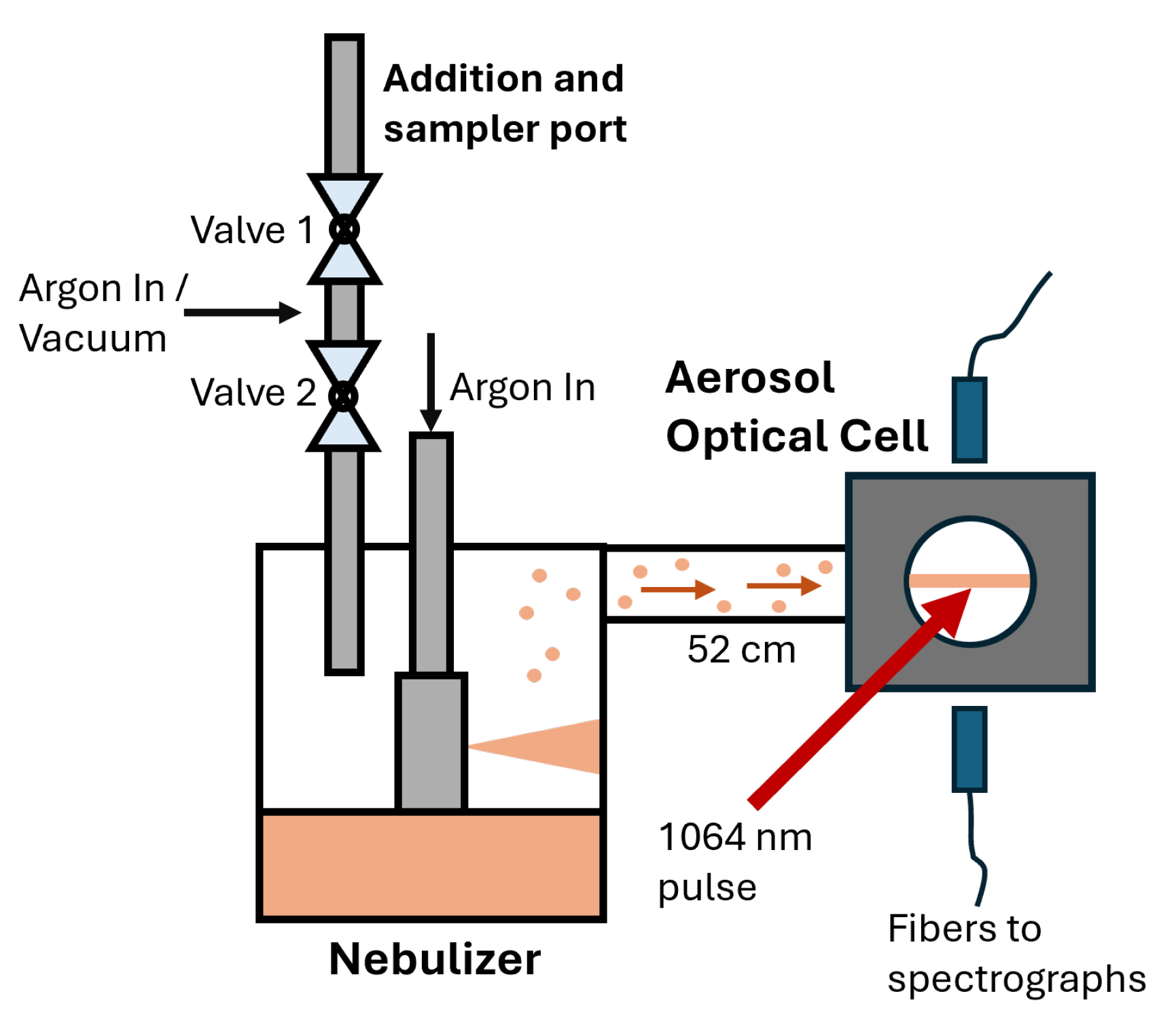
Aerosol was generated via a high-temperature, single-jet Collison nebulizer, with all components constructed from 316 stainless steel, shown schematically in Figure 1. All testing was performed with the nebulizer at 500 °C in this work. The nebulizer operated with argon as the pressure supply gas. Additionally, an argon cover gas stream was supplied into the nebulizer (around the jet supply line) to prevent salt aerosol and vapor from freezing around the nebulizer supply line, allowing for online height adjustments within the salt as needed and to help ensure an inert environment. Aerosol from the nebulizer flowed 52 cm to an optical cell for LIBS characterization before being collected with a filtering element. The length of the transfer tubing between the optical cell and nebulizer was not heated or insulated to allow the salt droplets to freeze, so the aerosol stream was transported with solid particulates. The aerosol/gas stream in the optical cell had an approximate temperature of 60 °C for the conditions explored in this study.
Material was added to the nebulizer through a custom-built addition port shown in Figure 1. This port comprised a set of two valves with a tee between the two valves that allows for either pulling vacuum or backfilling with argon. The upper valve (Valve 1) connects to a 3/8 inch, capped stainless steel tube that can be loaded with salt inside an inert environment glovebox, sealed with the valve, and then attached to the nebulizer port above Valve 2 (the “sampler/addition vessel” in this work). The tubing below Valve 1 can then be purged and evacuated to generate an inert environment. After at least seven cycles of refilling/evacuating the region between Valve 1 and Valve 2, both valves can be opened and the material in the sampler/addition vessel dropped into the nebulizer. Details on the analytes and preparation of additions are given in Section 2.2. Salt from the nebulizer was sampled through the same addition port shown in Figure 1 by running a room-temperature (23 °C) 316 stainless steel rod into the salt and then rapidly withdrawing the rod. The rod was sealed into the system using a through-Swagelok fitting with PTFE ferrules, allowing the rod to slide through the salt addition/sampling port without compromising the salt environment. When the cold rod tip encountered the salt, a small amount (<0.5 g) of salt froze on the rod that was then rapidly withdrawn back into the sampler/addition vessel. Valve 1 was then closed off and the entire assembly of Valve 1 and the sampler/addition vessel could then be transferred to an inert environment before preparing the material for offline inductively coupled mass spectrometry (ICP-MS) analysis.

2.2. Materials

Material handling prior to addition to the nebulizer vessel was performed inside an argon-filled glovebox with O2 and H2O impurities less than 0.01 ppm. Eutectic LiCl-KCl (Sigma Aldrich, St. Louis, MO, USA, 99.99% trace-metals purity), NdCl3 (Sigma Aldrich 99.99% trace-metals purity), PrCl3 (Sigma Aldrich 99.99% trace-metals purity), CsCl (Sigma Aldrich, 99.999% trace-metals purity), and SrCl2 (Thermo Fisher, Waltham, MA, USA 99.5% trace-metals purity) were procured in argon-filled glass ampoules. All materials were used as-is, without further purification. Before salt additions to the sampler/addition port shown in Figure 1, analytes of interest were first pressed into compact pellets using a Pike Pellet Press, Fitchburg, WI, USA (Model 161-1100). This allowed either single species or blends of CsCl, SrCl2, PrCl3, or NdCl3 to be pressed into pellets with 7 mm diameters and ≈1–1.5 mm thicknesses (see Supplemental Figure S6 for an example of a pressed pellet). This procedure helped eliminate potential sticking of powdered species on the addition port. After adding analyte species of interest, the salt was allowed to homogenize for at least 45 min before salt samples were taken using the sampler port as shown in Figure 1. The sampled salt was then moved into an inert atmosphere glovebox for packaging for offline ICP-MS analysis. The resulting matrix of samples used in this work are shown in Table 1, where analyte concentration values are based on offline ICP-MS analysis.

2.3. Laser-Induced Breakdown Spectroscopy (LIBS)

LIBS was performed using the output of a pulsed Nd:YAG laser (Quantel USA, Bozeman, MT, USA, Q-Smart 450) operating at an output wavelength of 1064 nm. The laser output was focused into an aerosol optical cell using an f = 75.3 mm focal-length plano-convex lens. Emission was collected using fiber optics, terminated with collimating lenses (≈0.05 steradian solid angle of collection from the plasma). The laser was operated at an output of 74 mJ and a fire rate of 4 Hz. For each sample condition, 10 spectra of 200 shots per spectra were collected. Emission lines were measured using two echelle spectrographs. Both spectrographs were Catalina Scientific, EMU 120/65 models: one was equipped with an iXon3-885 electron-multiplying charge coupled device (EMCCD) Andor Technology detector, Concord, MA, USA (“Andor” in this work); the other spectrograph had a Raptor Photonics Falcon 285 iStar EMCCD, Glastonbury, CT, USA (“Falcon” in this work). The Andor-equipped spectrograph had a Catalina Scientific UVU3:UV/VIS/NIR grating, with a spectral wavelength ( λ ) range from λ = 200 to 1000 nm and a resolving power of ≈15,000 at λ = 435 nm. The Falcon-equipped spectrograph had a Catalina Scientific IX2:VIS/NIR grating with a spectral range from λ = 350 to 900 nm and a resolving power of ≈51,000 at λ = 435 nm. For both spectrometers, the gate width was set to 80 μ s. LIBS optimization studies were performed with the Falcon-equipped spectrograph, but the remaining data in the text, unless otherwise noted, are shown from the Andor-equipped spectrograph. The lower resolving power but higher light throughput of the Andor-equipped spectrograph provided better results for the calibration analysis.
Spectrographs were calibrated for wavelengths using an Oriel Hg-Ar pen-lamp and were evaluated for instrumental line broadening using the same lamps [27]. See Supplemental Figure S1 and Table S3 for spectrometer wavelength deviations and instrumental broadening. The spectral response of the fiber-spectrometer system was estimated using the fiber-coupled output of an Ocean-Optics DH-2000BAL tungsten-halogen source with a known relative-intensity output. Light from the DH-2000BAL was directed with a fiber of known relative transmission (Ocean Optics QP400-UV-Vis) through a Thorlabs UVFS window onto the terminal collimating lens of the fiber leading to each spectrometer used in this work. Variable gate delays for LIBS emission collection were generated with a Quantum Composer 9200.

2.4. Partial Least-Squares Regression

Partial least-squares (PLS) regression is performed using open-source packages in the Python 3.12.4 Sci-Kit learn family of packages [28]. All PLS input data were normalized using Min-Max normalization such that all input values were between 0 and 1 arbitrary units, and cross-validation was evaluated using a leave-one-out cross-validation (LOOCV) approach. Four latent variables (LVs) were used in this work, with one LV corresponding to one analyte species present. Details on this selection are given in Supplemental Figure S5 that shows the mean-squared error (MSE) of PLS fits to all four analyte species simultaneously as a function of LV number. Four LVs appeared to be physically justifiable as there were four changing analyte species in this work.

3. Results and Discussion

3.1. LIBS Optimization Study

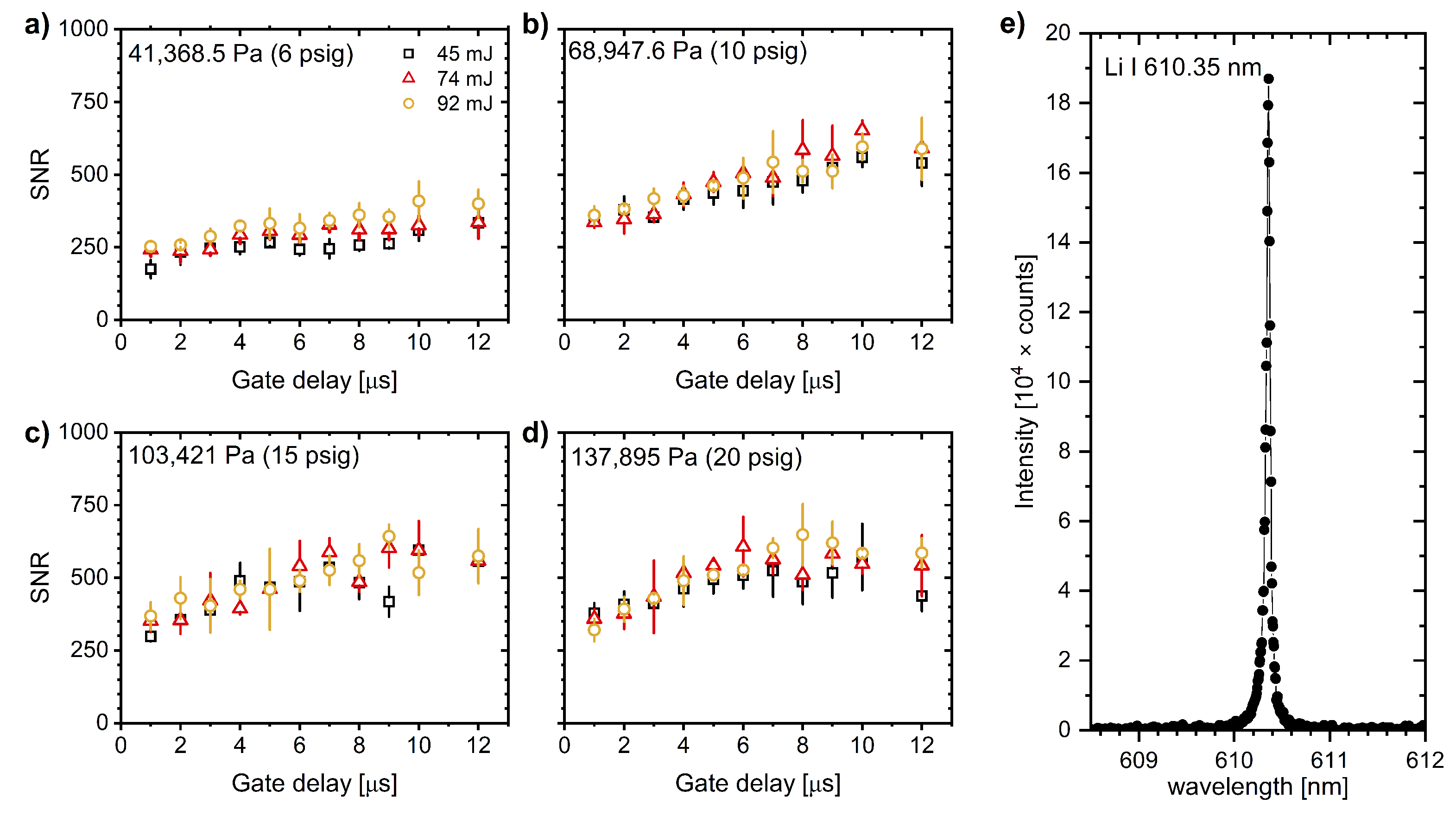
Spectrometer gate delay, laser energy, and pressure (in Pascals, Pa) on the Collision nebulizer element were optimized using signal from the 610.35 nm Li I emission line. The resulting signal-to-noise ratio (SNR) of this line was found by fitting a Voigt peak-shape function to the line and using the peak intensity (peak height) as the signal compared to the standard deviation in signal of a wavelength region close to the 610.35 nm line, but not overlapping with the intense wings of the Li I emission line for the noise. For this work, the region between 612 and 614 nm was used to estimate the noise. Resulting SNR values for various laser pulse energies, EMCCD gate delays, and nebulizer pressure are shown in Figure 2. There are no clear trends in SNR, but three notes can be made: (1) increasing nebulizer pressure generally leads to increased SNR although the improvement at pressures above 68,940 Pa (10 pounds per square inch gage, psig) are marginal, (2) laser energy has a marginal impact on SNR although higher pulse energies tend to increase SNR, and (3) the trend in SNR with gate delay is weak. There is no obvious optimum condition based on the results shown in Figure 2, but Figure 2 does show that gate delays between 8 and 10 μ s tended to produce the best SNR values for all nebulizer pressures. For the data in this work, we chose 9 μ s for the gate delay, 68,947.6 Pa (10 psig) as the nebulizer pressure (≈350 mL min−1 of argon flow through nebulizer), and 74 mJ for the laser energy pulse. The nebulizer pressure was chosen to have increased SNR without consuming more salt through aerosol flow, and the laser energy was chosen as the middle value tested in this work as laser energy appeared to weakly impact SNR. There is some caution in using the optimization of the base salt (i.e., LiCl-KCl) emission peak from Li to analyze trace analytes as different species may have mildly different optimal conditions. However, given the relatively weak trends in signals shown in Figure 2 as laser, detection, and nebulizer conditions are changed, we do not expect this to dramatically alter our analysis.

3.2. Emission Peaks

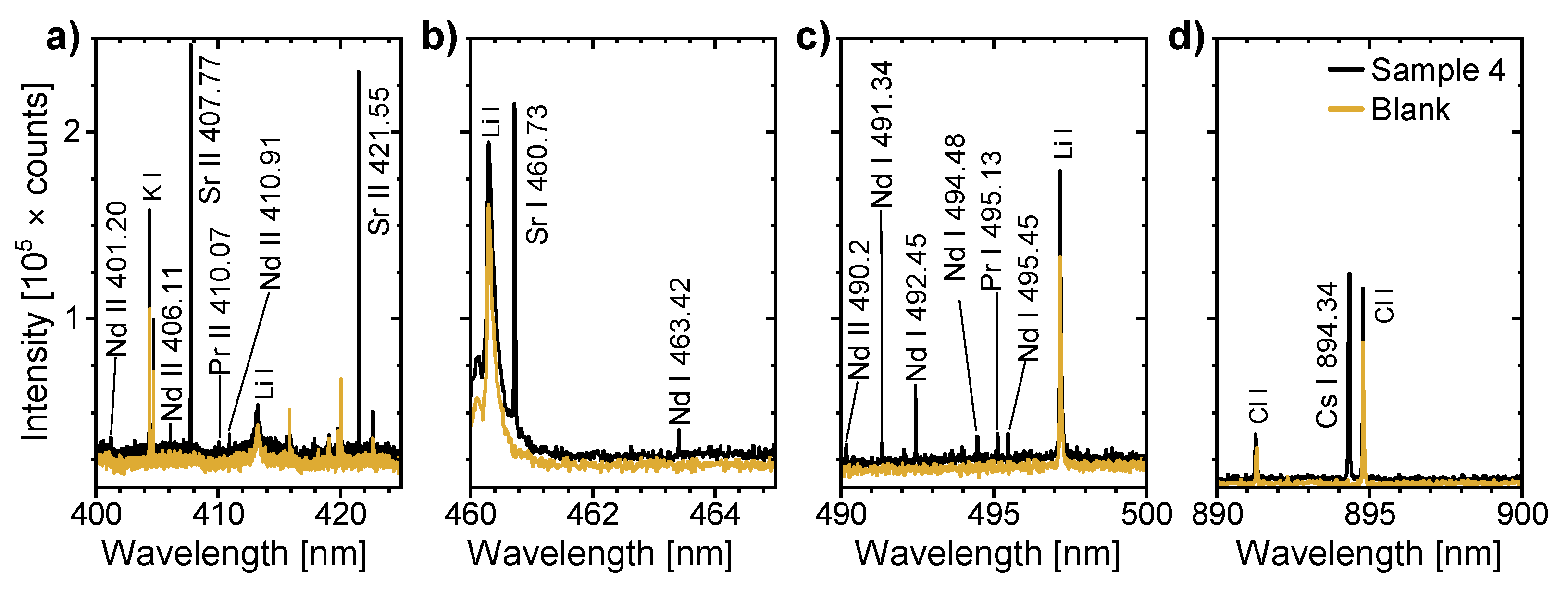
More than 100 emission peaks assignable to analyte species (i.e., Cs, Sr, Pr, or Nd) or species belonging to either the base LiCl-KCl eutectic base salt or argon sheathing gas were observed in LIBS spectra. No evidence of moisture or oxygen impurities was observed (see Supplemental Figure S3). Select peaks are shown alongside assignments and transition levels in Supplemental Table S1. All peaks were assigned either from the National Institute of Standards and Technology (NIST) atomic-spectra database (ASD) [29] or the Kurucz ASD [30]. Figure 3 shows examples of some emission peaks of a sample containing analytes compared to a blank sample (“Blank” in Table 1) with no detectable analytes. Emission lines from singly ionized Sr II were observed at 407.77 and 421.55, and lines from neutral Sr I were observed at 460.73 nm and 650.40 nm. The three lines at 407.77, 421.55, and 460.73 nm were particularly strong compared to other target analytes. This appears reasonable, because all these emissions correspond to electronic resonances for Sr. That is, these are transitions where the final state is the electronic ground state of species. See Supplemental Table S2 for assignments of resonance transitions based on data from the NIST ASD. A single strong emission line from neutral Cs I was observed at 894.34 nm, which also corresponds to a resonance transition (Supplemental Table S2). There was evidence of the resonance Cs I at 852.10 nm, but this line overlapped closely with an Ar I emission line at 852.14 nm, and the two lines could not be reliably deconvoluted. Nd and Pr both displayed a number of both neutral emission lines (Pr I and Nd I), alongside emission lines from the singly ionized states (Nd II and Pr II). Resonance transitions at 495.14, 502.69, and 513.34 nm for Pr I and 463.42, 492.45, and 495.48 nm for Nd I are observed (Supplemental Table S2).

3.3. Calibration Curves

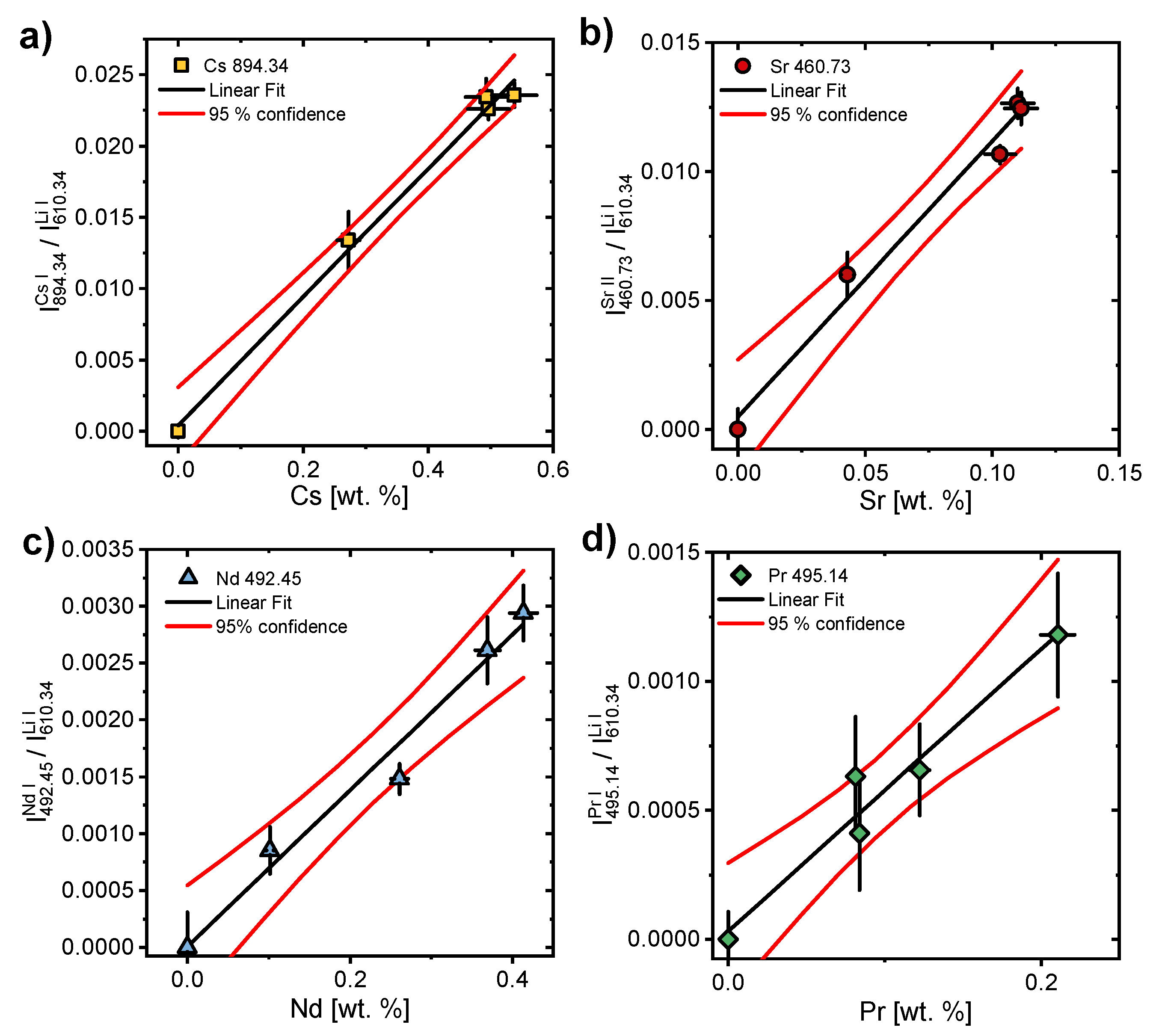
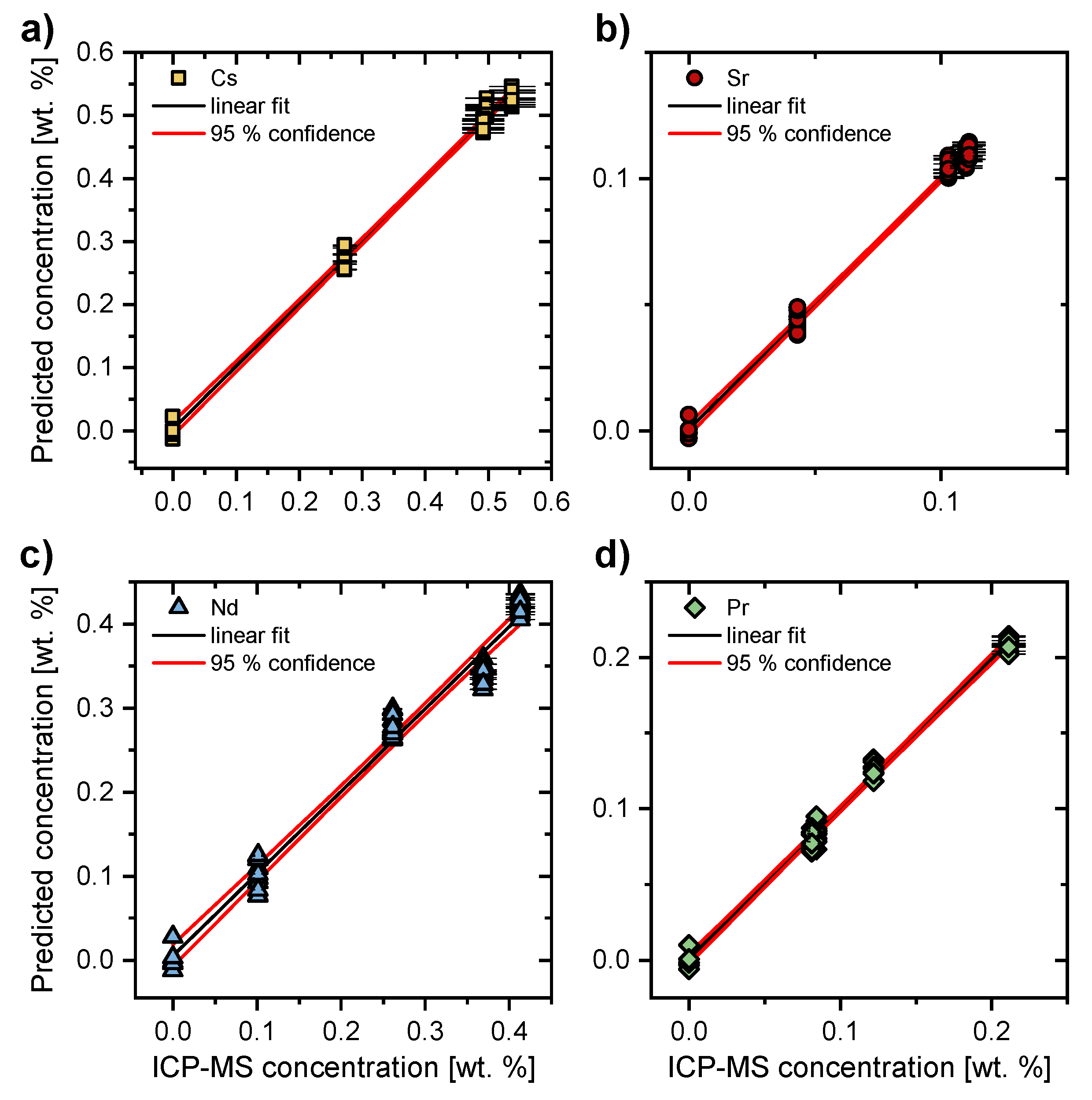
Emission-peak intensity was quantified by fitting Voigt peak-shape functions with linear backgrounds and taking the area of the peak as the intensity. Peak center wavelengths ( λ c ), peak area, and peak full-width at half-maximum (FWHM, Δ λ ) were all extracted from the Voigt peak fits. Based on emission-peak area from select lines, calibration curves for all four analytes were constructed. Figure 4 shows calibration curve built from the best-performing emission lines in terms of highest R2 and lowest LODs. A summary of regression statistics is shown in Table 2. LODs were calculated according to Equation (1):
LOD = 3 σ m
where σ represents the standard deviation of the blank sample replicates (number of replicates, n = 10 replicates), and m represents the slope of the calibration line. σ was calculated by fitting linear backgrounds over small wavelength regions around a given emission line λ c where the wavelength region was defined by λ c ± 3 × Δ λ . This fit was performed on the blank sample replicates, and standard deviation of the area under this linear fit was then used as σ . Figure 4 also shows root-mean squared error of calibration (RMSEC) as defined by Equation (2):
RMSEC = i c pred , i c ICPMS , i 2 p 1 2
where c pred , i and c ICPMS , i are the concentration of the univariate prediction and the actual concentration measured by offline ICP-MS for the i th sample, respectively, and p is the number of samples considered (p = 5 in this case). For constructing the calibration curves, peaks were normalized by the Li I 610.35 nm emission line to account for potential signal-intensity variation across samples although this peak intensity varied less than ≈5% across all samples measured, with no discernible trend (see Supplemental Figure S2). This low variation gave confidence that the windows of the aerosol optical cell were not degrading with time.
Calibration curves of Sr and Cs display particularly good linearity (R2 > 0.97) and LODs of 0.023 wt.% and 0.029 wt.% for Sr and Cs, respectively (Table 2). Experimental results from pyroprocessing operations at INL have shown that Cs and Sr exist in concentrations ranging from 1 to 3 wt.% for Cs and 0.2 to 0.6 wt.% for Sr [3]. The LODs presented in this work sit at about one order of magnitude lower than the lowest concentrations seen in these experimental pyroprocessing results, indicating that the analysis of this work is potentially viable for detecting Sr and Cs in engineering-scale pyroprocessing operations. Of note in Figure 4 is that the best-performing univariate calibrations for all species occurred for resonance emission lines (see Supplemental Table S2). This is not surprising because these resonance emission lines are typically the strongest lines in LIBS spectra.
While emission intensities were generally lower for Nd and Pr relative to Cs and Sr, emissions from Nd and Pr were nonetheless able to generate reasonable calibration curves (Figure 4c,d). LODs for both species were less than 0.1 wt.%, with an LOD of 0.048 wt.% for Nd and 0.059 wt.% for Pr (Table 2). Again, using results from select pyroprocessing operations at INL, Nd was found in concentrations from 1–3.5 wt.%, and Pr in concentrations of 0.3–0.9 wt.%. This suggests that the LOD of Nd found in this work would be sufficient for reasonable analysis of engineering-scale pyroprocessing operations [3]. Real-time tracking of Pr could prove more difficult given the current results, but the LOD presented here still sits ≈5× lower than the lowest concentrations found in real conditions, which may be sufficient for real-time tracking. Additionally, the errors in calibration (i.e., in RMSEC) are improved by employing multivariate PLS regression analysis (see Figure 5 and Table 2). PLS fits were cross-validated using a leave-one-out cross-validation approach (LOOCV), where in each sample used for training, the PLS regression was sequentially left out of the training set, and then tested against the resulting regression from the remaining samples. This yields a root-mean squared error of cross-validation (RMSECV) defined identically as RMSEC in Equation (2) except that c pred , i now represents the model prediction of the left-out testing sample.

3.4. Plasma Characterization

Though the calibration curves shown in Figure 4 have LODs useful for quantification of species in engineering scale pyroprocessing applications, additional parameters of the plasma can be checked to understand plasma temperatures and non-uniformity. This analysis also allows us to determine whether emission self-absorption effects may be a significant concern for the analytes used in this work. There is a caveat in this work that the long gate-width of our spectrometers (80 μ s) allows us to only determine “apparent” conditions of the plasma, as the spectra collected are not time-resolved on the order of changing plasma conditions (order of μ s) [31]. As such, any use of the “temperature” in this work refers to an apparent plasma temperature. We base this analysis on results from Grifoni et al. that showed that the estimation of plasma temperatures from either time-resolved spectra or time-integrated spectra (as in this work) are with a factor of ≈10% from each other [32].

3.4.1. Electron Density

The free electron density of the laser-generated plasmas ( N e ) was calculated using the Lorentzian-shaped Stark broadening of spectral lines. The Sr II 407.77 nm emission line was used for estimates of N e [cm−3] according to Equation (3) [33,34,35].
N e = Δ λ 1 / 2 2 W × 10 16
where Δ λ 1 / 2 is the instrument-corrected full-width at half-maximum (FWHM) of the peak of interest and W is the electron-impact parameter set to W = 0.032 nm and obtained from tabulated values in Ref. [36]. Three additional line-broadening factors were considered: Doppler broadening, natural linewidth broadening, and instrumental broadening. The measured linewidth ( Δ λ meas . ) of ≈0.025 nm was at least an order of magnitude larger than either Doppler or natural linewidth broadening (see Supplemental Section S3), and was considered negligible in this work. However, the instrumental broadening ( Δ λ inst . ) estimated at 407.77 nm of Δ λ inst . = 0.0157 nm was not negligible (see Supplemental Section S2 for information on this). We employ the method suggested by Ivković and Konjević to remove the instrumental effects from Δ λ meas . [37]. In this method, the measured peak shapes of emission lines are taken to be Voigt peak-shape functions (as used in this work), and the Gaussian component of the Voigt peak-shape ( Δ λ G ) is assumed to be entirely from the instrumental broadening effects. The Gaussian peak-width from instrumental broadening ( Δ λ inst . ) was found as described in Supplemental Section S2 and was constrained in the Voigt-peak shape fitting to be within 1% of this value (i.e., Δ λ G = Δ λ inst . ± 0.01 × Δ λ inst . ). The resulting Lorentzian peak-width ( Δ λ L ) found from the Voigt peak-fit was then taken to be the Stark-broadened peak-width such that Δ λ L = Δ λ 1 / 2 in Equation (3). Based on this analysis, we find N e = 1.90 ± 0.2 × 10 15 [cm−3], where the value represents the average across Samples 1–4 and the error represents the standard deviation.

3.4.2. Plasma Apparent Temperature and Assessment of Optically Thin Plasma Conditions

With an estimation of free electron density in the plasma, we can now turn towards an assessment of whether analytes species in the plasma exist in optically thin conditions. Plasma apparent temperature (T) was calculated through two different means, both of which should give comparable results if the plasma is optically thin.
The first method of estimating temperature made use of the Saha–Eggert ionization equation, which relates spectrally integrated intensities from ions at different ionization stages to the plasma temperature. This estimate was only performed for Sr, Pr, and Nd species as these were the only species with emissions from multiple ionization stages (e.g., Nd II and Nd I). The Saha–Eggert equation is given in Equation (4) and makes use of the experimentally determined free electron density [34,38].
ϵ II ϵ I = 2 2 π m e k b T 3 / 2 h 3 N e g j II A II ν II g j I A I ν I exp E ip E II + E I k B T
where k B is Boltzmann’s constant (eV K−1), ϵ II ( ϵ I ) represent the integrated unitless intensity of the transition from the ionized (neutral) species, g j II A II ( g j I A I ) represent the degeneracy-weighted transition rate in s−1 of the j upper-level transition for the ionized (neutral) species, ν II ( ν I ) is the is the transition frequency in s−1 from the j level of the ionized (neutral) species, E II ( E I ) is the upper level energy in eV of the upper level j for the ionized (neutral) species, and E ip represents the first ionization potential. Equation (4) was solved numerically for T in this work by making use of the relative intensities of the Pr II 532.25 nm and Pr I 502.70 nm transitions for Pr, the Nd II 410.91 nm and Nd I 462.40 nm transitions for Nd, and the Sr II 407.77 nm and Sr I 460.73 nm transitions for Sr.
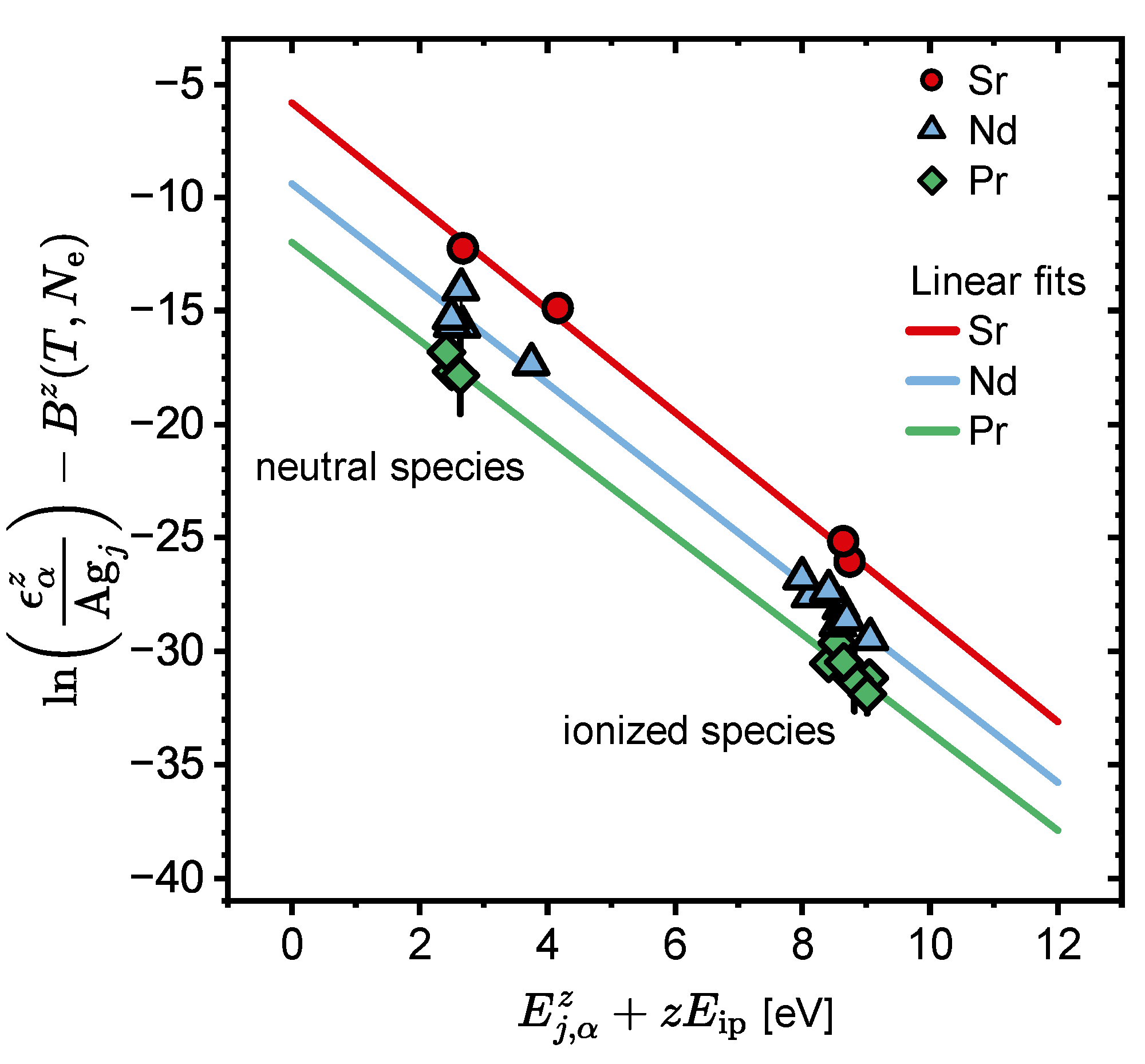
The second method of plasma temperature made use of modified Saha–Boltzmann plots according to procedures outlined by Aguilera and Aragón [39]. In this version of plasma-temperature calculation, a plot can be made that essentially combines the Saha–Eggert equation, which relates various ionization stage populations to temperature, with Boltzmann population statistics of individual ionization stages. In this form of analysis, spectral line intensity is related to temperature by Equations (5) and (6) [39].
ln ϵ α z Ag j B z T , N e = E j , α z + z E ip 1 k B T + ln N 0 4 π Q 0 T
where
B z T , N e = z ln 2 m e k B 2 π 2 3 / 2 T 3 / 2 N e
where ϵ α z represents the integrated unitless intensity of the α species in ionization stage z (z = 0 for neutral atoms and z = 1 for the first ionization stage), N 0 is the number density of neutral atoms (m−3), Q 0 T is the corresponding neutral atom partition function, and is the reduced Planck’s constant (J-s). In Equations (5) and (6), k B is in units of J K−1. Equation (5) allows for a graphical solution to temperature where the slope of a linear fit has a value of 1 / ( k B T ) . Plots of the modified Saha–Boltzmann expression of Equation (5) are shown in Figure 6. Figure 6 shows the graphical delineation between the neutral-species emission lines and the first ionization-stage species.
Using these two methods, apparent plasma temperatures for analyte species can be calculated, and results are shown in Table 3. Note Cs did not have multiple emission lines to perform these calculations. Errors in estimated temperatures are overall less than 4% of the values found. The combination of T estimated from Saha–Boltzmann plots (Figure 6) in conjunction with the Saha–Eggert equation (Equation (4)) allows a check of optically thin conditions in the plasma [37]. By inserting T from the Saha–Boltzmann plots and using the experimental line intensities used in the Saha–Eggert calculations, Equation (4) can be solved for Ne. This back calculation of Ne should match with the Ne value obtained from Stark-width measurements under optically thin conditions, as self-absorption of lines will artificially increase peak-width and thus increase Ne found from Stark-width measurements. Values of Ne obtained from this back calculation are shown in Table 3. Values generally line up within error of the Stark-width estimate from the Sr II 407.77 nm line of N e = 1.90 ± 0.2 × 10 15 [cm−3]. This suggests that these analyte species (Sr, Nd, and Pr) exist in optically thin conditions in the plasma.

3.4.3. Plasma Non-Uniformity

The temperatures and electron densities calculated in this work exist on the lower end of typical LIBS plasmas generated from solid LiCl-KCl [21,40]. The apparent plasma temperatures as calculated from particulate species in this work are only mildly lower than those found in previous work on metallic particulates in argon aerosol streams, where plasma temperatures based on the particulates were found to be in the range of 7000–8000 K [41,42]. The lower plasma temperatures of solid particulates in aerosol compared to the plasmas on bulk solids of the same materials were thought to result from fluctuations in the plasma local to the solid aerosol particulate. In these fluctuations, the initial vaporization, dissociation, and ionization of the particle effectively pulls thermal energy from a small volume surrounding the aerosol particle, resulting in locally cooler temperatures than can persist for more than 10 μ s [41,43]. Additionally, particle dissociation and analyte diffusion from aerosol particles occur over time scales comparable to emission lifetimes. This means that plasmas in aerosols can be highly non-uniform, and additional details on analyte diffusion lengths over relevant emission lifetimes are needed to understand where analyte emission occurs in the plasma.
The first task to understand plasma non-uniformity is to estimate diffusion coefficients of analyte species. We follow methods outlined by Diwakar et al. in Ref. [44] to estimate binary diffusion coefficients of analyte species (e.g., Cs, Sr, Pr, and Nd) diffusing into bulk argon gas. This method is outlined in detail in Ref. [44], but briefly, species are considered to be hard-spheres that interact through an effective Lennard-Jones potential. The binary diffusion coefficient ( D AB ) in units of [m2 s−1] of an analyte species (“A”) and a bulk gas species (“B”) is given by Equation (7).
D AB = 3 16 4 π k B T M AB 1 / 2 P R T π σ AB 2 Ω D , AB
where M AB is the harmonic mean of the molecular weights of species “A” and “B”, P is the system pressure in [Pa] and taken to be 101,325 [Pa] in this work, k B is Boltzmann’s constant in [J K−1], R is the universal gas constant in [J mol−1 K−1], σ AB 2 is the arithmetic mean of the hard-sphere collision diameters of species “A” and “B” (additional details in Supplemental Section S5, including estimation of σ A for individual species from Ref. [45]), and Ω D , AB is the dimensionless, diffusion-type collision integral for species “A” and “B” given by Equation (8).
Ω D , AB = A ( T * ) B + C exp ( D T * ) + E exp ( F T * ) + G exp ( H T * )
where the constants are taken from Ref. [46] for the diffusion-type collision integral values ( Ω D ( 1 , 1 ) in literature tables) where A = 1.06036, B = 0.15610, C = 0.19300, D = 0.47635, E = 1.03587, F = 1.52996, G = 1.76474, and H = 3.89411, and T * is the dimensionless reduced temperature given by Equation (9).
T * = k B T ( ϵ A ϵ b ) 1 / 2
where ϵ i is the Lennard-Jones potential prefactor of the i th species. Additional details on ϵ i are given in the Supplemental Section S5, including details on the extraction of ϵ i from Refs. [47,48,49,50,51,52,53,54,55]. Based on Equation (7), diffusion coefficients for Sr, Nd, Pr, and Cs are D Sr Ar = 0.00134 m2 s−1, D Nd Ar = 0.00127 m2 s−1, D Pr Ar = 0.00120 m2 s−1, and D Pr Ar = 0.00085 m2 s−1, respectively. T was set to the temperatures estimated from the Saha–Boltzmann plots (Table 3), except for Cs, which was set to a representative temperature of 5200 K.
Next, the characteristic time scale of emission events for analyte species can be calculated. Emission lifetimes (i.e., relaxation times, τ relax ) in units of [s] are calculated according to Equation (10) [56].
τ relax = k N e 1
where N e is the plasma electron density in [cm−3] as found from Sr II analyte Stark-widths, and k in units of [cm3 s−1] is the excitation rate constant given by Equation (11). [57]
k = 4 π e 4 g ¯ f lu Δ E lu 2 π 3 m e k B T 1 / 2 exp Δ E lu k B T
where e is the electron fundamental charge in stat-coulomb, g ¯ is the effective Gaunt factor taken from Ref. [58], f lu is the oscillator strength of a given transition from and upper (u) to lower (l) energy level, and Δ E lu is the energy of a given transition in units of [erg]. Note, all constants of Equation (11) are in centimeter–gram–second (cgs) units.
The diffusion coefficients for analyte species can now be combined with emission lifetimes to estimate characteristic diffusion lengths ( λ Diff ) over which emission occurs, as shown in Equation (12).
λ Diff = D AB τ relax 1 2
Emission lifetimes and characteristic diffusion lengths for various emission lines are shown in Table 4.

3.5. Discussion of Non-Uniform Plasma Characteristics

The results of Section 3.4.3 agree with the previous results that have shown that analyte emission in plasmas of aerosolized particles is a highly local process [41,42,43,44]. The characteristic diffusion lengths shown in Table 4 are largely between 5 and 10 μ m. The similarity in characteristic lengths of emission lines across species suggests that we are measuring emission from similar spatial regions in the plasma surrounding the aerosol particles. Estimated particle sizes in aerosols produced from similar molten salts are on the order of 1–10 μ m in diameter, depending on exact system conditions [15,17]. This means that the analyte species emission measured in this work is essentially arising from regions on the same length scales as the aerosol particles. This is important to understand, as this means that LIBS analysis of aerosolized species is highly dependent on the local environment of particles, such that matrix effects in the LIBS analysis are important to understand.
It is interesting to compare these characteristic diffusion lengths shown in Table 4 to estimate the relevant length of electrostatic screening in the plasma. This screening is represented by the Debye length ( λ Debye ) according to Equation (13) [59].
λ Debye = ε 0 k B T N e e 2 1 / 2
where ε 0 is permittivity of free-space. Using an approximate plasma temperature of 5200 K, and an electron density of N e = 1.90 × 10 15 cm−3, the Debye length is estimated to be λ Debye = 0.11 μ m. This value is at least an order of magnitude smaller than any of the analyte diffusion lengths shown in Table 4. This implies that plasma electrostatic neutrality is a safe assumption in this system and means that concerns of long-range coulomb forces impacting species diffusion estimates can be safely ignored.

4. Conclusions

This work performs an analysis of non-uniform plasma characteristics in plasmas of aerosolized solids. We find that the plasmas generated are relatively cool (≈5200 K) for laser-induced plasmas, but we find this temperature to be in line with previous work [41,42] The evaluation of plasma temperatures and electron density allowed us to conclude that plasma self-absorption effects were minimal for the analyte species of interest, such that emission signal from an element is proportional approximately to the amount of that material in the plasma. Importantly, this work agrees with previous work that shows that analyte emission in aerosolized species occurs from regions local to the aerosolized particles, meaning that bulk plasma properties are not necessarily relevant for plasmas in aerosols and that matrix effects on LIBS analysis of aerosolized particles are especially important [41,42,43,44].
The most-applicable piece of this work is that LIBS emission of the aerosolized salts provides reasonable analytical capabilities particularly targeted towards analysis of pyroprocessing ER salts, though results could also be applicable to fission-product analysis in MSR salts. This work focused on emission signals from relatively low loadings of analytes, with all species having maximum loadings of less than 1.0 wt.%. The salts of this work were non-radioactive, surrogate examples of potential ER salts, but the limits of detection found in this work could allow for material quantification in ER salts based on historic data [3]. Indeed, for elements with small concentrations in ER salts, such as Sr and Pr with loadings as low as 0.2 wt.%, we find LODs in this work at least a factor of 5× lower (Figure 4). The data in Figure 4 also highlight that the four fission-product surrogates of this work can be measured simultaneously. This is an important requirement for analytical monitoring of ER salts, where a dozen or more fission products may be present [3]. This work still operates on a relatively simple salt matrix compared to real, radioactive ER salts, but marks an important step in advancing LIBS analysis of ER salts species.

Supplementary Materials

The following supporting information can be downloaded at: https://www.mdpi.com/article/10.3390/photonics13010093/s1, Table S1: Observed elemental emission lines and assignments of transition levels and probabilities. Table S2: Observed resonance transitions and transition states. Table S3: Spectrometer calibration lines. Table S4: Species-specific parameters used for binary diffusion coefficient calculations. Figure S1: Full-width half-maximums (FWHM) for Hg-Ar pen lamp emission imaged into the two spectrographs used in this work. Figure S2: Integrated intensity of the Li I 610.354 nm emission peak across multiple experimental runs as found from Voigt fits to this peak. The five runs shown correspond to the five experimental samples shown in Table 1 of the main text and represent ≈15 h of system operation. Error bars represent the standard deviation of n = 10 experimental spectra. Figure S3: Typical LIBS spectrum in the ranges of (a) 775–779 nm and (b) 652–660 nm. Spectra taken from Sample 4 of Table 1 of the main text. Vertical lines highlight where the (a) O I emission triplet at 777.194 nm, 777.417 nm, and 777.539 nm would appear and (b) where the H emission at 656.285 nm would appear. While this does not allow us to specify a quantitative upper limit of O2 or moisture presence in the aerosol, the lack of any measurable signal for H or O gives a good indication that the aerosol was transporting in an inert environment. Figure S4: Parity plots showing predicted analyte compositions based on the univariate calibration curves shown in Figure 4 of the main text for (a) Cs with the 894.34 nm line, (b) Sr with the 460.73 nm line, (c) Nd with the 492.45 nm line, and (d) Pr with the 495.13 nm line. Figure S5: Optimization of LV number for PLS regression fits. Four LVs were used in this work. Figure S6: Pressed 0.2028 g pellet comprising 0.0777 g NdCl3, 0.0510 g PrCl3, 0.0249 g SrCl2, and 0.0492 g CsCl. The pellet has an outer diameter of 7 mm and a height of ≈1.5 mm. The pellet was created by adding salts to a Pike Pellet Handpress in an inert environment (see Methods section of main text). The pellet could then be added alongside varying amounts of LiCl-KCl base salt to the nebulizer via the sample-addition port shown in Figure 1 of the main text.

Author Contributions

Conceptualization, G.L., R.G. and A.W.; methodology, G.L., R.A. and A.W.; software, G.L., R.A. and A.W.; formal analysis, G.L. and A.W.; investigation, G.L., R.A. and A.W.; resources, R.G. and A.W.; data curation, G.L. and R.A.; writing—original draft preparation, G.L. and A.W.; writing—review and editing, G.L., R.A., R.G. and A.W.; visualization, G.L.; supervision, R.G. and A.W.; project administration, A.W.; funding acquisition, R.G. and A.W. All authors have read and agreed to the published version of the manuscript.

Funding

Funding for this work was through the Idaho National Laboratory Directed Research & Development (LDRD) Program under DOE Idaho Operations Office Contract DE-AC07-05ID14517.

Data Availability Statement

All data are available from corresponding authors on a reasonable request.

Acknowledgments

The authors gratefully acknowledge the support of Austin Parmer, Jacob Siler, James Halstead, and Adam Butikofer from Idaho National Laboratory for helpful machining work and design work on the high-temperature aerosol nebulizer.

Conflicts of Interest

The authors declare no conflicts of interest.

Abbreviations

The following abbreviations are used in this manuscript:
ASDAtomic-spectra Database
EBR-IIExperimental Breeder Reactor-II
EMCCDElectron-multiplying charge coupled device
ERElectrorefiner
FWHMFull-width at half-maximum
ICPMSInductively coupled mass spectrometry
INLIdaho National Laboratory
LIBSLaser-induced breakdown spectroscopy
LODLimit of detection
LOOCVleave-one-out cross-validation
LVLatent variable
MSEMean squared error
MSRMolten Salt Reactor
MSREMolten Salt Reactor Experiment
NISTNational Institute of Standards and Technology
PLSPartial least squares
RMSECRoot-mean squared error of calibration
RMSECVRoot-mean squared error of cross-validation
SNRSignal-to-noise ratio

References

  1. International Atomic Energy Agency. Status and Trends in Pyroprocessing of Spent Nuclear Fuels; International Atomic Energy Agency: Vienna, Austria, 2021. [Google Scholar]
  2. Benedict, R.W.; Henslee, S.P. EBR-II spent fuel treatment demonstration project. In Proceedings of the American Nuclear Society 1997 Winter Meeting, Albuquerque, NM, USA, 16–20 November 1997. [Google Scholar]
  3. Karlsson, T.Y.; Fredrickson, G.L.; Yoo, T.-S.; Vaden, D.; Patterson, M.N.; Utgikar, V. Thermal analysis of projected molten salt compositions during FFTF and EBR-II used nuclear fuel processing. J. Nucl. Mater. 2019, 520, 87–95. [Google Scholar] [CrossRef]
  4. Haubenreich, P.N.; Engel, J.R. Experience with the Molten-Salt Reactor Experiment. Nucl. Appl. Technol. 1970, 8, 118–136. [Google Scholar] [CrossRef]
  5. Tse, P.; Bryan, S.A.; Bessen, N.P.; Lines, A.M.; Shafer, J.C. Review of on-line and near real-time spectroscopic monitoring of processes relevant to nuclear material management. Anal. Chim. Acta 2020, 1107, 1–13. [Google Scholar] [CrossRef] [PubMed]
  6. Cao, G.; Herrmann, S.; Fredrickson, G.L.; Hoover, R. Study of Potentiometry for Monitoring Activity of GdCl3 in Molten LiCl-KCl Salt. ECS Adv. 2022, 1, 042503. [Google Scholar] [CrossRef]
  7. Jung, Y.E.; Ahn, S.K.; Yim, M.S. Investigation of neural network-based cathode potential monitoring to support nuclear safeguards of electrorefining in pyroprocessing. Nucl. Eng. Technol. 2022, 54, 644–652. [Google Scholar] [CrossRef]
  8. Andrews, H.; Phongikaroon, S. Electrochemical and Laser-Induced Breakdown Spectroscopy Signal Fusion for Detection of UCl3-GdCl3-MgCl2 in LiCl-KCl Molten Salt. Nucl. Technol. 2021, 207, 617–626. [Google Scholar] [CrossRef]
  9. Lines, A.M.; Bryan, S.A.; Felmy, H.M.; Branch, S.D. On-Line Monitoring for Molten Salt Reactor MC&A: Optical Spectroscopy-Based Approaches; Pacific Northwest National Laboratory: Richland, WA, USA, 2022. [Google Scholar]
  10. Kim, J.Y.; Bae, S.E.; Park, T.H.; Paek, S.; Kim, T.J.; Lee, S.J. Wireless simultaneous measurement system for liquid level and density using dynamic bubbler technique: Application to KNO3 molten salts. J. Ind. Eng. Chem. 2020, 82, 57–62. [Google Scholar] [CrossRef]
  11. Williams, A.N.; Galbreth, G.G.; Sanders, J. Accurate determination of density, surface tension, and vessel depth using a triple bubbler system. J. Ind. Eng. Chem. 2018, 63, 149–156. [Google Scholar] [CrossRef]
  12. Williams, A.; Phongikaroon, S. Laser-Induced Breakdown Spectroscopy (LIBS) in a Novel Molten Salt Aerosol System. Appl. Spectrosc. 2017, 71, 744–749. [Google Scholar] [CrossRef]
  13. Diaz, D.; Hahn, D.W. Detection of Off-Gassed Products From Molten Salts Using Laser-Induced Breakdown Spectroscopy. Appl. Spectrosc. 2023, 77, 1033–1043. [Google Scholar] [CrossRef]
  14. Williams, A.; Phongikaroon, S. Laser-Induced Breakdown Spectroscopy (LIBS) Measurement of Uranium in Molten Salt. Appl. Spectrosc. 2018, 72, 1029–1039. [Google Scholar] [CrossRef] [PubMed]
  15. Williams, A. Measurement of Rare Earth and Uranium Elements Using Laser-Induced Breakdown Spectroscopy (LIBS) in an Aerosol System for Nuclear Safeguards Applications. Ph.D. Thesis, Virginia Commonwealth University, Richmond, VA, USA, 2016. [Google Scholar]
  16. Andrews, H.B.; Kitzhaber, Z.B.; Orea, D.; McFarlane, J. Real-Time Elemental and Isotopic Measurements of Molten Salt Systems through Laser-Induced Breakdown Spectroscopy. J. Am. Chem. Soc. 2025, 147, 910–917. [Google Scholar] [CrossRef] [PubMed]
  17. Kitzhaber, Z.B.; Orea, D.; McFarlane, J.; Manard, B.T.; Andrews, H.B. Sparge Sampling of Molten Salts for Online Monitoring via Laser-Induced Breakdown Spectroscopy. ACS Omega 2025, 10, 37889–37897. [Google Scholar] [CrossRef] [PubMed]
  18. Andrews, H.B.; Myhre, K.G. Quantification of Lanthanides in a Molten Salt Reactor Surrogate Off-Gas Stream Using Laser-Induced Breakdown Spectroscopy. Appl. Spectrosc. 2022, 76, 877–886. [Google Scholar] [CrossRef]
  19. LeCroy, G.; Yang, Q.; Raab, M.; Gakhar, R.; Williams, A. Online monitoring of lanthanide species with combined spectroscopy. RSC Adv. 2025, 15, 35036–35046. [Google Scholar] [CrossRef]
  20. Andrews, H.B.; McFarlane, J.; Myhre, K.G. Monitoring Noble Gases (Xe and Kr) and Aerosols (Cs and Rb) in a Molten Salt Reactor Surrogate Off-Gas Stream Using Laser-Induced Breakdown Spectroscopy (LIBS). Appl. Spectrosc. 2022, 76, 988–997. [Google Scholar] [CrossRef]
  21. Lee, Y.; Yoon, S.; Kim, N.; Kang, D.; Kim, H.; Yang, W.; Burger, M.; Jovanovic, I.; Choi, S. In-situ measurement of Ce concentration in high-temperature molten salts using acoustic-assisted laser-induced breakdown spectroscopy with gas protective layer. Nucl. Eng. Technol. 2022, 54, 4431–4440. [Google Scholar] [CrossRef]
  22. Hull, G.; Lambert, H.; Haroon, K.; Coffey, P.; Kerry, T.; McNaghten, E.D.; Sharrad, C.A.; Martin, P. Quantitative prediction of rare earth concentrations in salt matrices using laser-induced breakdown spectroscopy for application to molten salt reactors and pyroprocessing. J. Anal. At. Spectrom. 2021, 36, 92–102. [Google Scholar] [CrossRef]
  23. Cao, Y.; Zhao, Z.; Wang, P.; Yu, S.; Lai, Z.; Zhang, M.; Gao, X.; Zhao, Y.; Xuan, Z.; Ren, H.; et al. Long-term variation of 90Sr and 137Cs in environmental and food samples around Qinshan nuclear power plant, China. Sci. Rep. 2021, 11, 20903. [Google Scholar] [CrossRef]
  24. Weisberg, A.; Lakis, R.E.; Simpson, M.F.; Horowitz, L.; Craparo, J. Measuring Lanthanide Concentrations in Molten Salt Using Laser-Induced Breakdown Spectroscopy (LIBS). Appl. Spectrosc. 2014, 68, 937–947. [Google Scholar] [CrossRef]
  25. Lee, Y.; Foster, R.I.; Kim, H.; Choi, S. Acoustic-filtered laser-induced breakdown spectroscopy for monitoring fission products in molten LiCl–KCl eutectic during salt fluctuations. Talanta 2026, 298, 129013. [Google Scholar] [CrossRef]
  26. Lee, Y.; Foster, R.I.; Kim, H.; Choi, S. Machine learning-assisted laser-induced breakdown spectroscopy for monitoring molten salt compositions of small modular reactor fuel under varying laser focus positions. Anal. Chim. Acta 2023, 1241, 340804. [Google Scholar] [CrossRef]
  27. Sansonetti, C.J.; Salit, M.L.; Reader, J. Wavelengths of spectral lines in mercury pencil lamps. Appl. Opt. 1996, 35, 74–77. [Google Scholar]
  28. Pedregosa, F.; Varoquaux, G.; Gramfort, A.; Michel, V.; Thirion, B.; Grisel, O.; Blondel, M.; Prettenhofer, P.; Weiss, R.; Dubourg, V.; et al. Scikit-learn: Machine Learning in Python. J. Mach. Learn. Res. 2011, 12, 2825–2830. [Google Scholar]
  29. Kramida, A.; Ralchenko, Y.; Reader, J.; Team, N.A. NIST Atomic Spectra Database, 5.12th ed.; National Institute of Standards and Technology: Gaithersburg, MD, USA, 2025. [Google Scholar]
  30. Kurucz, R.L. gfall08oct17.dat; Center for Astrophysics|Harvard and Smithsonian: 10/17/2008. Available online: http://kurucz.harvard.edu/linelists/gfnew/gfall08oct17.dat (accessed on 5 October 2025).
  31. Bousquet, B.; Gardette, V.; Ros, V.M.; Gaudiuso, R.; Dell’Aglio, M.; De Giacomo, A. Plasma excitation temperature obtained with Boltzmann plot method: Significance, precision, trueness and accuracy. Spectrochim. Acta Part B At. Spectrosc. 2023, 204, 106686. [Google Scholar] [CrossRef]
  32. Grifoni, E.; Legnaioli, S.; Lezzerini, M.; Lorenzetti, G.; Pagnotta, S.; Palleschi, V. Extracting Time-Resolved Information from Time-Integrated Laser-Induced Breakdown Spectra. J. Spectrosc. 2014, 2014, 849310. [Google Scholar] [CrossRef]
  33. Rao, A.P.; Gragston, M.; Patnaik, A.K.; Hsu, P.S.; Shattan, M.B. Measurement of electron density and temperature from laser-induced nitrogen plasma at elevated pressure (1–6 bar). Opt. Express 2019, 27, 33779–33788. [Google Scholar] [CrossRef]
  34. Cremers, D.A.; Radziemski, L.J. Handbook of Laser-Induced Breakdown Spectroscopy; John Wiley & Sons Ltd.: Hoboken, NJ, USA, 2013. [Google Scholar]
  35. Hou, X.; Pan, L.; Sun, Y.; Li, Y.; He, Y.; Qi, H. Study of the plasma produced from laser ablation of a LBO crystal. Appl. Surf. Sci. 2004, 227, 325–330. [Google Scholar] [CrossRef]
  36. Fleurier, C.; Sahal-Brechot, S.; Chapelle, J. Stark profiles of some ion lines of alkaline earth elements. J. Quant. Spectrosc. Radiat. Transf. 1977, 17, 595–604. [Google Scholar] [CrossRef]
  37. Ivković, M.; Konjević, N. Stark width and shift for electron number density diagnostics of low temperature plasma: Application to silicon Laser Induced Breakdown Spectroscopy. Spectrochim. Acta Part B At. Spectrosc. 2017, 131, 79–92. [Google Scholar] [CrossRef]
  38. Cristoforetti, G.; De Giacomo, A.; Dell’Aglio, M.; Legnaioli, S.; Tognoni, E.; Palleschi, V.; Omenetto, N. Local Thermodynamic Equilibrium in Laser-Induced Breakdown Spectroscopy: Beyond the McWhirter criterion. Spectrochim. Acta Part B At. Spectrosc. 2010, 65, 86–95. [Google Scholar] [CrossRef]
  39. Aguilera, J.A.; Aragón, C. Multi-element Saha–Boltzmann and Boltzmann plots in laser-induced plasmas. Spectrochim. Acta Part B At. Spectrosc. 2007, 62, 378–385. [Google Scholar] [CrossRef]
  40. Hanson, C.; Phongikaroon, S.; Scott, J.R. Temperature effect on laser-induced breakdown spectroscopy spectra of molten and solid salts. Spectrochim. Acta Part B At. Spectrosc. 2014, 97, 79–85. [Google Scholar] [CrossRef]
  41. Diwakar, P.K.; Jackson, P.B.; Hahn, D.W. The effect of multi-component aerosol particles on quantitative laser-induced breakdown spectroscopy: Consideration of localized matrix effects. Spectrochim. Acta Part B At. Spectrosc. 2007, 62, 1466–1474. [Google Scholar] [CrossRef]
  42. Asgill, M.E.; Groh, S.; Niemax, K.; Hahn, D.W. The use of multi-element aerosol particles for determining temporal variations in temperature and electron density in laser-induced plasmas in support of quantitative laser-induced breakdown spectroscopy. Spectrochim. Acta Part B At. Spectrosc. 2015, 109, 1–7. [Google Scholar] [CrossRef]
  43. Hohreiter, V.; Hahn, D.W. Plasma–Particle Interactions in a Laser-Induced Plasma: Implications for Laser-Induced Breakdown Spectroscopy. Anal. Chem. 2006, 78, 1509–1514. [Google Scholar] [CrossRef]
  44. Diwakar, P.K.; Groh, S.; Niemax, K.; Hahn, D.W. Study of analyte dissociation and diffusion in laser-induced plasmas: Implications for laser-induced breakdown spectroscopy. J. Anal. At. Spectrom. 2010, 25, 1921–1930. [Google Scholar] [CrossRef]
  45. Zvára, I. The Inorganic Radiochemistry of Heavy Elements: Methods for Studying Gaseous Compounds; Springer Science + Business Media B.V: Berlin/Heidelberg, Germany, 2010. [Google Scholar]
  46. Neufeld, P.D.; Janzen, A.R.; Aziz, R.A. Empirical Equations to Calculate 16 of the Transport Collision Integrals Ω(l,s)* for the Lennard-Jones (12–6) Potential. J. Chem. Phys. 1972, 57, 1100–1102. [Google Scholar] [CrossRef]
  47. Pousse, J.; Chervy, B.; Bilodeau, J.-F.; Gleizes, A. Thermodynamic and transport properties of argon/carbon and helium/carbon mixtures in fullerene synthesis. Plasma Chem. Plasma Process. 1996, 16, 605–634. [Google Scholar] [CrossRef]
  48. Hirschfelder, J.O.; Curtiss, C.F.; Bird, R.B. The Molecular Theory of Gases and Liquids; John Wiley Sons, Inc.: New York, NY, USA, 1964. [Google Scholar]
  49. Jones, J.E. On the Determination of Molecular Fields. I. From the Variation of the Viscosity of a Gas with Temperature. Proc. R. Soc. Lond. A: Math. Phys. Eng. Sci. 1924, 106, 441–462. [Google Scholar] [CrossRef]
  50. Jones, J.E. On the Determination of Molecular Fields. II. From the Equation of State of a Gas. Proc. R. Soc. Lond. A Math. Phys. Eng. Sci. 1924, 106, 463–477. [Google Scholar] [CrossRef]
  51. Lennard-Jones, J.E. On the Forces between Atoms and Ions. Proc. R. Soc. Lond. A Math. Phys. Eng. Sci. 1925, 109, 584–597. [Google Scholar] [CrossRef]
  52. Elliott, R.S.; Tadmor, E.B. Knowledgebase of Interatomic Models (KIM) Application Programming Interface (API). Available online: https://openkim.org/kim-api (accessed on 18 December 2025).
  53. Tadmor, E.B.; Elliott, R.S.; Sethna, J.P.; Miller, R.E.; Becker, C.A. The potential of atomistic simulations and the Knowledgebase of Interatomic Models. JOM 2011, 63, 17. [Google Scholar] [CrossRef]
  54. Elliott, R.S.; Lennard-Jones, J. Efficient Multi-Species Lennard-Jones Model with Truncated or Shifted Cutoff v003, OpenKIM. Available online: https://openkim.org/id/MD_414112407348_003 (accessed on 18 December 2025). [CrossRef]
  55. Lennard-Jones, J. Efficient ‘Universal’ Shifted Lennard-Jones Model for all KIM API Supported Species Developed by Elliott and Akerson (2015) v003, OpenKIM. Available online: https://openkim.org/id/MO_959249795837_003 (accessed on 18 December 2025). [CrossRef]
  56. Sobel’man, I.I.; Vainshtein, L.A.; Yukov, E.A. Excitation of Atoms and Broadening of Spectral Lines; Springer: Berlin/Heidelberg, Germany, 1995. [Google Scholar]
  57. Hey, J.D. Criteria for local thermal equilibrium in non-hydrogenic plasmas. J. Quant. Spectrosc. Radiat. Transf. 1976, 16, 69–75. [Google Scholar] [CrossRef]
  58. van Regemorter, H. Rate of Collisional Excitation in Stellar Atmospheres. Astrophys. J. 1962, 136, 906. [Google Scholar] [CrossRef]
  59. Stenson, E.V.; Horn-Stanja, J.; Stoneking, M.R.; Pedersen, T.S. Debye length and plasma skin depth: Two length scales of interest in the creation and diagnosis of laboratory pair plasmas. J. Plasma Phys. 2017, 83, 595830106. [Google Scholar] [CrossRef]
Figure 1. Schematic of nebulizer and material addition/sampling port. Aerosol is generated via a Collison nebulizer through an argon-gas feed. Aerosol is then transported to an optical cell for LIBS characterization. In the optical cell, aerosol is focused into a thin (≈1 cm-diameter) stream and surrounded by an argon sheath gas to protect optical windows, as described in previous work [19]. Materials can be added to the nebulizer vessel through a port on the top of the nebulizer. The nebulizer was operated at a constant 500 °C in this work.
Photonics 13 00093 g001
Figure 2. SNR of the Li I 610.35 nm emission line as a function of gate delay and laser energy for nebulizer feed pressures of (a) 41,368.5 Pa (6 psig), (b) 68,947.6 Pa (10 psig), (c) 103,421 Pa (15 psig), and (d) 137,895 Pa (20 psig). Color scales remain the same across panels (ad). (e) A representative Li I emission at 610.35 nm is shown.
Photonics 13 00093 g002
Figure 3. Select emission peaks from Sample 4 (Table 1, 0.358 wt.% Cs, 0.128 wt.% Sr, 0.538 wt.% Nd, and 0.232 wt.% Pr). The blank sample of LiCl-KCl eutectic salt is shown for comparison. The color labels remain the same across all panels. Panels (ad) show wavelength regions of emissions along with select peaks from the four analytes highlighted. Select peaks of the base LiCl-KCl are shown as Cl I, Li I, or K I. Some weaker Li and Ar emission peaks are seen in panel (a) as well.
Photonics 13 00093 g003
Figure 4. Univariate calibration curves for Cs, Sr, Nd, and Pr. Only a single normalized emission line is shown for a given element. Lines shown are the emission peak at (a) 894.34 nm for Cs, (b) 460.73 nm for Sr, (c) 492.45 nm for Nd, and (d) 495.13 nm for Pr. Fit statistics are shown in Table 2. All peak intensities were normalized by the Li I 610.34 nm emission line. Horizontal error bars represent propagated uncertainty from ICP-MS measurements, and vertical error bars represent standard deviation of peak intensities across n = 10 replicates. Errors in reported LOD represent propagated standard deviation as based on standard deviation errors found in the regression slopes. Confidence intervals are calculated based on uncertainty of both LIBS signal and element concentration.
Photonics 13 00093 g004
Figure 5. Parity plots showing predicted analyte compositions based on PLS analysis of the LIBS emission spectra for (a) Cs, (b) Sr, (c) Nd, and (d) Pr. Horizontal error bars represent propagated standard deviation in from ICP-MS measurements, and each concentration has n = 10 replicates shown as individual data points. Regression statistics are shown in Table 2.
Photonics 13 00093 g005
Figure 6. Saha–Boltzmann plots for Pr, Nd, and Sr analyte species in Sample 4. Axes are described by Equations (5) and (6). Lines of best fit are shown as solid traces for all species.
Photonics 13 00093 g006
Table 1. Sample matrix.
Sample NumberCs [wt.%]Sr [wt.%]Nd [wt.%]Pr [wt.%]
Blank<0.0003<0.0001<0.0001<0.0001
10.2720.0430.1010.084
20.5380.1030.2610.081
30.4970.1110.3690.122
40.7730.0970.4130.211
Table 2. Regression statistics for univariate and PLS analysis of calibration curves 1.
AnalyteUnivariatePLS
Line [nm]R2LOD [wt.%]RMSEC
[wt.%]
Slope
Parity
R2
Parity
RMSEC
[wt.%]
RMSECV
[wt.%]
Cs894.340.9920.029 ± 0.0010.0160.99 ± 0.010.9940.0140.015
Sr460.730.9770.023 ± 0.0020.00580.99 ± 0.010.9940.00320.0040
Nd492.450.9690.048 ± 0.0040.0240.98 ± 0.020.9780.0210.015
Pr495.130.9530.059 ± 0.0080.0150.99 ± 0.010.9920.00570.0089
1 Errors represent either propagated standard deviations in linear fits for LOD or fit standard deviation for parity line slope.
Table 3. Comparison of plasma temperatures for different calculation methods.
SpeciesSaha–Boltzmann 1 TSaha–Eggert 1,2 TNe Back Calculation 3
[K]K][1015 cm−3]
Sr5100 ± 1305170 ± 901.96 ± 0.8
Pr5380 ± 1905180 ± 1302.3 ± 1.2
Nd5280 ± 140517 ± 1402.4 ± 0.9
1 Errors represent either propagated standard deviations from linear fits to Saha–Boltzmann plots or propagated standard deviations in emission intensities used to numerically solve the Saha–Eggert equation. 2 Lines used in the Saha–Eggert calculations were the Pr II 532.25 nm, Pr I 502.70 nm, Nd II 410.91 nm, Nd I 462.40 nm, Sr II 407.77 nm, and the Sr I 460.73 nm transitions. 3 Errors in N e represent propagated standard deviation based on errors from the found T using the Saha–Boltzmann method and the propagated standard deviations in emission intensities used to perform the calculation.
Table 4. Emission lifetimes and characteristic diffusion lengths.
SpeciesLine [nm] τ relax [ μ s]DAB [m2 s−1] λ Diff [ μ m]
Sr II407.770.01280.001344.1
Sr II421.550.02055.2
Sr I460.730.01905.0
Sr I650.390.02495.7
Nd II406.110.04180.001277.4
Nd II410.910.12312.6
Nd II417.730.094911.1
Nd II445.160.04807.9
Nd II490.200.081910.3
Nd II531.980.02395.6
Nd I463.420.083510.4
Nd I494.480.05198.2
Nd I495.480.11512.2
Pr II410.070.02390.001205.4
Pr II417.940.03636.6
Pr II422.540.02925.9
Pr II425.440.24117.0
Pr II433.400.02525.5
Cs I894.700.001980.0008531.3
Disclaimer/Publisher’s Note: The statements, opinions and data contained in all publications are solely those of the individual author(s) and contributor(s) and not of MDPI and/or the editor(s). MDPI and/or the editor(s) disclaim responsibility for any injury to people or property resulting from any ideas, methods, instructions or products referred to in the content.