Communication

Multiband Infrared Photodetection Based on Colloidal Quantum Dot

1
School of Optics and Photonics, Beijing Institute of Technology, Beijing 100081, China
2
National Institute of Metrology, Beijing 100029, China
3
State Key Laboratory of Laser Interaction with Matter, Xi’an 710024, China
4
National Key Laboratory of Infrared Detection Technologies, Shanghai 200083, China
*
Authors to whom correspondence should be addressed.
Photonics 2026, 13(1), 89; https://doi.org/10.3390/photonics13010089
Submission received: 19 December 2025 / Revised: 4 January 2026 / Accepted: 13 January 2026 / Published: 20 January 2026
(This article belongs to the Special Issue New Perspectives in Micro-Nano Optical Design and Manufacturing)

Abstract

Multispectral infrared detection plays a crucial role in advanced applications spanning environmental monitoring, military surveillance, and biomedical diagnostics, offering superior target identification accuracy compared to single-band imaging techniques. In this work, we synthesized four distinct bands of colloidal quantum dots (CQDs)—specifically, a cut-off of 1.3 µm with PbS CQDs and 1.8 µm, 2.6 µm, and 3.5 µm with HgTe CQDs—and employed them to construct planar multiband infrared photodetectors. The device exhibited a clear photoresponse at room temperature from 0.8 µm to 3.5 µm, with responsivity of 5.39 A/W and specific detectivity of 2.01 × 10¹¹ Jones at 1.8 µm. This materials–device co-design strategy integrates wavelength-selective CQD synthesis with planar pixel-level patterning, providing a versatile pathway for developing low-cost, solution-processed, multiband infrared photodetectors.

1. Introduction

Infrared detection [1] identifies and analyzes targets by capturing their emitted infrared radiation. Compared to single-band detection, multi-spectral infrared detection [2] overcomes the limitations of limited information dimensions. This approach enables the acquisition of spectral data within specific wavelength ranges, providing a more complete set of radiation and reflection characteristics. Consequently, it provides deeper insights into material composition, physical states, and surface properties, with broad applications in environmental monitoring [3], military reconnaissance [4,5] and Biomedical contexts [6]. Currently, traditional multispectral detection is typically based on epitaxial materials like mercury cadmium telluride (HgCdTe) [7] and indium gallium arsenide (InGaAs) [8], which offer high sensitivity and low noise. However, their complex material growth, limited bandgap tunability, and poor compatibility with silicon readout circuits pose significant challenges for device integration and optimization.
Colloidal quantum dots (CQDs) [9,10] are promising materials for developing high-performance optoelectronic devices with a wide spectral range due to their unique properties, such as strong light absorption, multi-exciton generation, and size-tunable bandgaps. Among these colloidal nanomaterials, metal chalcogenide quantum dots, such as PbS CQDs and HgTe CQDs, have been shown to exhibit excellent photoelectric responses and broad spectral ranges. By precisely controlling the size of the CQDs, their optical response range can be flexibly tuned, providing diversified options for multi-spectral infrared detection. However, the intrinsic bandgap and quantum confinement modulation ranges of PbS and HgTe CQDs differ significantly. PbS CQDs are narrow-bandgap semiconductors that facilitate bandgap alteration from the near-infrared (NIR) to the visible spectrum edge by quantum confinement effects [11,12,13]. In contrast, HgTe CQDs are characterized by an intrinsic zero bandgap with an inverted band structure and offer tunable bandgaps and optical responses across shortwave infrared (SWIR, 1.5–2.5 μm) [14,15,16], midwave infrared (MWIR, 3–5 μm) [17,18,19], and longwave infrared (LWIR, 8–12 μm) [20,21,22]. Researchers often use device design methodologies, such as vertically stacked structures and planar coupled/patterned devices, to broaden the spectrum range or attain multi-band detection. Vertical stacking improves pixel fill factor and optical coherence. Pejović et al. [23] presented a photodetector based on PbS CQDs and on OPD-PbS CQDs that enables multispectral sensing in a broadband region spanning from visible to SWIR. Zhao et al. [24] demonstrated a visible/shortwave infrared multiband photodetector based on HgTe/CdTe metal-sulfide CQDs with bias-switchable operation. On the other hand, planar patterning offers flexibility for arbitrary band combinations. Tang et al. [25] fabricated a planar three-pixel HgTe CQD multispectral detector using lithography, with each pixel coated with different sized HgTe CQDs covering SWIR, MWIR, and LWIR. Kim et al. [26] developed a monolithic full-color light detector based on PbS and CdSe CQDs. By depositing CQDs with different bandgaps in distinct regions and integrating them with oxide semiconductors, they achieved two-dimensional pixelated multicolor detection across the wavelength range from 365 nm to 1310 nm. In this work, we synthesized PbS CQDs and HgTe CQDs with absorption edges of 1.3 µm, 1.8 µm, 2.6 µm, and 3.5 µm, respectively. Then, the CQDs were used to build planar multiband infrared detectors, which show a distinct photoresponse across the NIR to MWIR. At room temperature, the responsivities are 0.87, 5.39, 2.43, and 0.22 A/W with specific detectivities of 8.87 × 10¹⁰, 2.01 × 10¹¹, 3.36 × 10¹⁰ and 3.54 × 10⁹ Jones at 1.3 µm, 1.8 µm, 2.6 µm, and 3.5 µm, respectively. Compared with prior studies that use PbS and HgTe CQDs for photodetection [27], the key advantage of our work is the on-chip four-pixel integration using a uniform planar device layout and the same processing flow, enabling spectral coverage from the NIR to the MWIR, as well as co-registered, independently addressable room-temperature multiband detection.

2. Results and Discussions

2.1. Materials Synthesis

In a nitrogen glovebox, four bands of CQDs covering complementary spectral ranges in the infrared were synthesized in this work. These included PbS CQD and three types of HgTe CQDs.
Synthesis (1) Experimental materials: lead (II) oxide (PbO, 99.5%, Sigma-Aldrich, St. Louis, MO, USA), oleic acid (OA, 90%, Sigma-Aldrich), 1-octadecene (ODE, 90%, Sigma-Aldrich), tetramethylsilane (TMS, 99%, Sigma-Aldrich, St. Louis, MO, USA), mercury (II) chloride (HgCl2, >99.5%, Sigma-Aldrich, St. Louis, MO, USA), oleylamine (OAM, 80–90%, Aladdin, Riverside, CA, USA), tellurium powder (Te, 99.999%, Sigma-Aldrich), tri-n-octylphosphine (TOP, 97%, Sigma-Aldrich), 1-dodecanethiol (DDT, >98%, Sigma-Aldrich), and 1,1,2-trichloroethane (TCE, 98%, Aladdin), Didodecyldimethylammonium bromide (DDAB, 98%, Sigma-Aldrich), octane (>99%, Sigma-Aldrich), chlorobenzene (CBZ, 99.5%, Aladdin), methanol (MeOH, 99.8%, Adamas-beta, Shanghai, China), anhydrous ethanol (EtOH, 99.7%, Innochem, Shanghai, China), isopropanol (IPA, Single Metal < 10 ppb, Adamas, Maasdijk, The Netherlands), acetone (>98%).
(2) Synthesis of PbS CQD: A lead precursor solution was prepared by reacting 0.45 g (2 mmol) of PbO with 20 mL of oleic acid at 150 °C for 1 h. Then, the system was then cooled to 120 °C and equilibrated for 30 min. Subsequently, a sulfur precursor solution (210 μL TMS in 10 mL ODE) was quickly injected, and the reaction lasted for 2 min. The crude product was refined by precipitation with a methanol/acetone mixture, then recovered by centrifugation and redispersed in 1 mL of octane for further use.
(3) Synthesis of HgTe CQDs: The emission wavelength of HgTe CQDs was tuned across different spectral bands by controlling the reaction temperature and time during a hot-injection synthesis between mercury precursors. The HgTe CQDs synthesis was as follows:
Precursor Preparation: The mercury precursor solution ((HgCl2/OAM)) was prepared by dissolving 108.8 mg (0.4 mmol) of HgCl2 in 16 mL of OAM at 100 °C for 1 h. The tellurium precursor solution (TOPTe) was obtained by dissolving 12.76 mg (0.1 mmol) of Te in 0.1 mL of TOP under stirring at 80 °C for 12 h.
Nucleation and Growth: Nucleation was initiated by the rapid injection of 0.4 mL of the TOPTe solution into the thermally equilibrated mercury precursor. This was followed by a growth period at the specified temperature to attain the target bandgap.
Reaction Termination and Purification: The reaction was terminated by the immediate addition of a pre-cooled quenching solution (1.2 mL TOP, 16 mL TCE, 3 mL DDT), followed by rapid cooling in a water bath. Subsequently, the crude CQDs were purified by precipitation with the DDAB/IPA mixture, collected via centrifugation, and finally redispersed in 1 mL of CBZ. A schematic of the synthesis processes for both PbS and HgTe CQDs is presented in Figure 1a.
Absorption Characterization: The optical absorption of the synthesized CQDs was characterized using Fourier transform infrared spectroscopy (FTIR). The cutoff wavelength, defined at 50 percent attenuation on the absorption spectra edge, was determined to be 1.3 μm (7690 cm−1) for PbS CQD, as shown in Figure 1b.
Following the LaMer nucleation-growth model, both reaction temperature and growth time were tuned because they control different stages of CQD formation: temperature governs monomer generation/supersaturation and thus nucleation density and growth kinetics, while time determines the extent of post-nucleation growth before quenching. Spectral tuning was achieved by precisely controlling the reaction parameters during the hot-injection synthesis of HgTe CQDs. The cutoff absorption was tuned from 1.8 μm (5347 cm−1) to 2.6 μm (3850 cm−1) and 3.5 μm (2850 cm−1) by increasing the reaction temperature from 60 °C to 80 °C and 90 °C with growth times of 5 min, 4 min and 6 min, respectively, as shown in Figure 1c–e. Higher synthesis temperatures and adjusted growth times were employed to obtain CQDs with progressively longer cutoff wavelengths. Synthesis parameters of all CQDs are summarized in Table 1.

2.2. Photodetector Structure and Fabrication

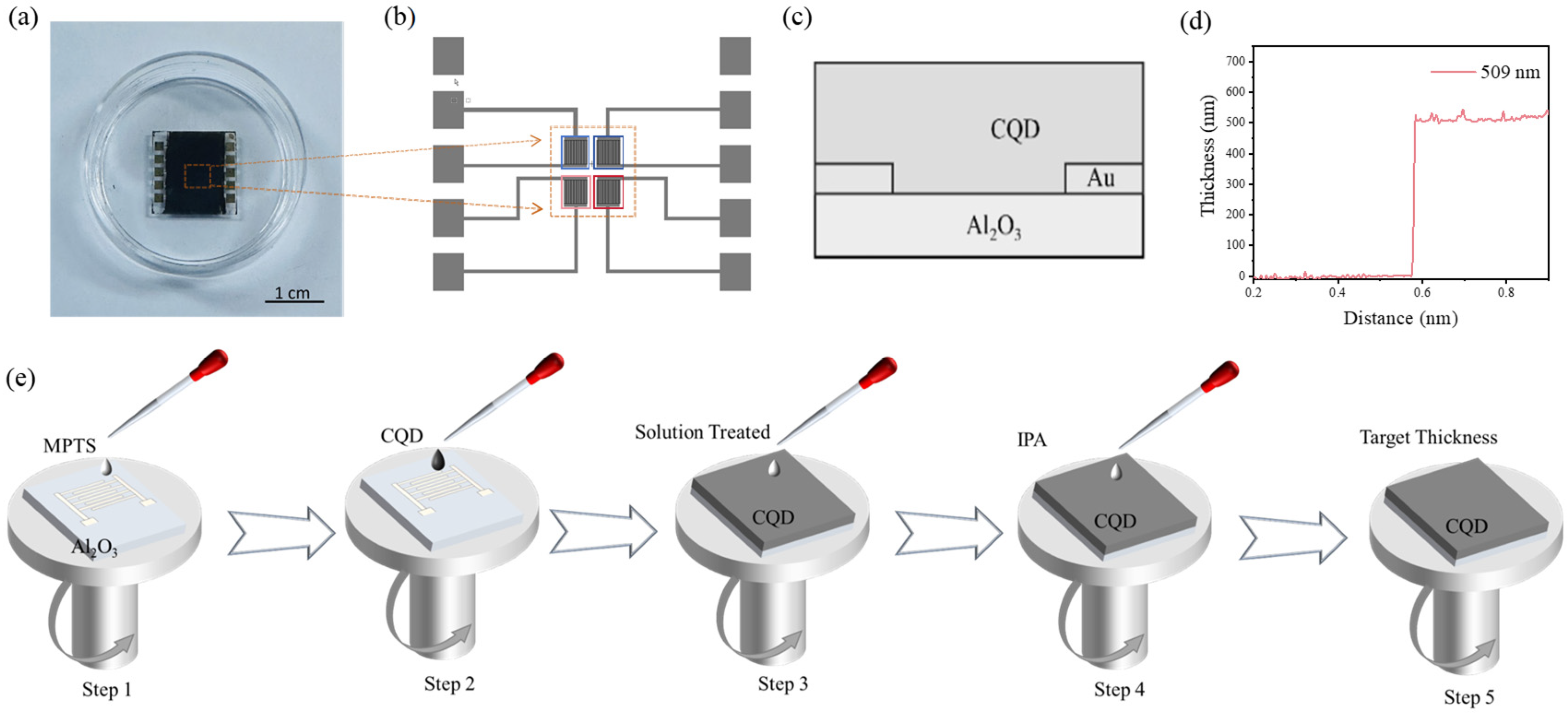
Four pixels with photoactive materials (1.3 μm PbS CQD, 1.8 μm HgTe CQD, 2.6 μm HgTe CQD, and 3.5 μm HgTe CQD) are connected onto a single-plane substrate. Figure 2a,b illustrate the physical configurations and pixel layouts of the four-band photoconductors. Every pixel shares an identical architecture: Au interdigitated electrodes are precisely patterned onto an infrared-transparent Al2O3 substrate, which functions as the device’s foundational platform. Subsequently, a continuous layer of CQDs is deposited over this substrate, ensuring complete coverage and electrical connection between the Au contacts. This CQD film serves as the active medium for infrared detection, while the Au electrodes efficiently collect the photogenerated charge carriers, as depicted in the cross-sectional schematic of a single pixel shown in Figure 2c. The preparation processes for the PbS and HgTe pixels are detailed below.
(1)
Substrate Pretreatment:
The Al2O3 substrate was first treated with (3-mercaptopropyl) trimethoxysilane (MPTS) for 1 min to increase film adhesion, then rinsed with isopropanol (IPA) and spin-dried at 3000 rpm for 15 s.
(2)
Film Deposition and Processing
For the pixel with PbS CQDs, the PbS CQDs ink was spin-coated at 2000 rpm for 20 s. Ligand exchange was carried out by immersing the film in a methanolic solution of tetrabutylammonium iodide (TBAI, 10 mg/mL) for 30 s.
For the three pixels with HgTe CQDs, the CQDs’ ink was spin-coated at 1500 rpm for 15 s. Ligand exchange was accomplished by immersing the film in a solution of EDT, HCl, and IPA (volume ratio 1:1:50) for 10 s.
(3)
Layer Completion and Thickness Control
Following ligand exchange, the film was rinsed with IPA to remove excess ligands and spin-dried at 2000 rpm for 10 s. Steps 2–4 (spin-coating, solution treatment, and rinsing/drying) were repeated cyclically until the target film thickness of approximately 500 nm was achieved, the thickness characterization for the CQD films using a step meter, as shown in Figure 2d. The schematic diagram of the device fabrication process as shown in Figure 2e.
This integrated structure and fabrication approach facilitates the monolithic production of four-band devices, thereby enabling simultaneous multi-spectral detection. It lays a fundamental device platform for subsequent spectral recognition and extraction of multidimensional information.

2.3. Photodetector Characterization

(1)
Responsivity (R) and Detectivity (D*)
The responsivity (R) and specific detectivity (D*) were used to evaluate device performance. R is a parameter that describes detector photoelectric conversion capability by defining the relationship between the input power and the output signal of the detector.
R = I p h P
where I p h is the photocurrent of the detector, P is the input power.
The D* is the key parameter for characterizing the sensitivity of a photodetector. It enables a direct comparison of the detection capabilities among devices with different specifications, as its normalization process eliminates the effects of detector size and noise bandwidth on performance evaluation. A higher D* value indicates a stronger capability of the detector to detect weak light signals.
D * = A d f i n R
where R is responsivity, i n is noise current density, A d is the effective illuminated area, and f is the measurement bandwidth.
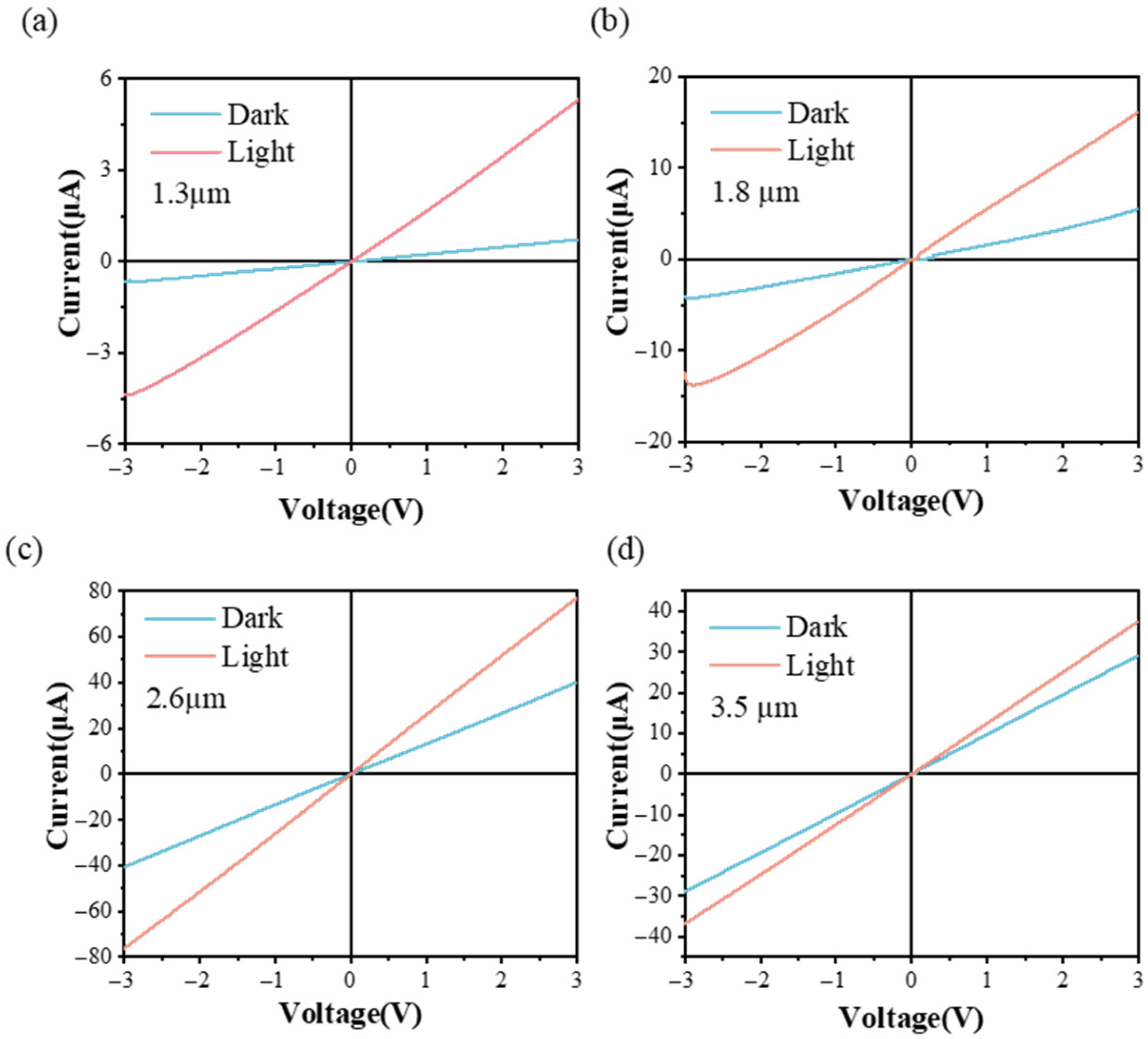
The devices were measured at room temperature, and their I-V curves were systematically monitored using a Keithley 2602B (Keithley Instruments, Solon, OH, USA)source meter for bias application and current collection, as shown in Figure 3a–d. The 1.3 μm PbS CQD pixel was characterized using a tungsten–halogen lamp (Silan, Hangzhou, China) as the near-infrared light source, whereas the 1.8 μm, 2.6 μm, and 3.5 μm HgTe CQD pixels were examined using a blackbody of 600 °C as the light source.
The multiband device operates in the photoconductive mode. For incident photons with energies exceeding the bandgap of the CQDs in a given pixel, the active layer efficiently absorbs the light and generates electron–hole pairs. Under an applied bias, these photogenerated carriers are separated and transported through the percolated CQDs, leading to an increase in conductivity compared to the dark state. The resulting photocurrent depends on the incident photon flux and the carrier transport properties in the film, so that each pixel selectively responds within its designed spectral band. By integrating CQDs with different bandgaps in spatially separated pixels, the device achieves multiband photoconductive detection from the NIR to the MWIR on a single planar platform. Table 2 summarizes the performance metrics of every pixel measured under the 3 V bias. A photocurrent of 4.61 μA is produced for the 1.3 μm PbS CQD pixel with an incident optical power of 5.30 μW. This results in a responsivity of 0.87 A/W and a specific detectivity of 8.87 × 10¹⁰ Jones. The 1.8 μm HgTe CQD pixel exhibits the best performance with a photocurrent of 10.67 μA at 1.98 μW, a high responsivity of 5.39 A/W, and a detectivity of 2.01 × 10¹¹ Jones. The photocurrents at longer wavelengths are 36.91 μA (15.14 μW) and 8.41 μA (38.51 μW) for the 2.6 μm and 3.5 μm pixels, the corresponding responsivities are 2.43 and 0.22 A/W, while the detectivities are 3.36 × 10¹⁰ and 3.54 × 10⁹ Jones, respectively. This trend is mainly attributed to the reduced bandgap at longer cutoff wavelengths, which increases thermally activated carriers and dark current at room temperature, thereby lowering the signal-to-noise ratio and detectivity.
(2)
Photoresponse
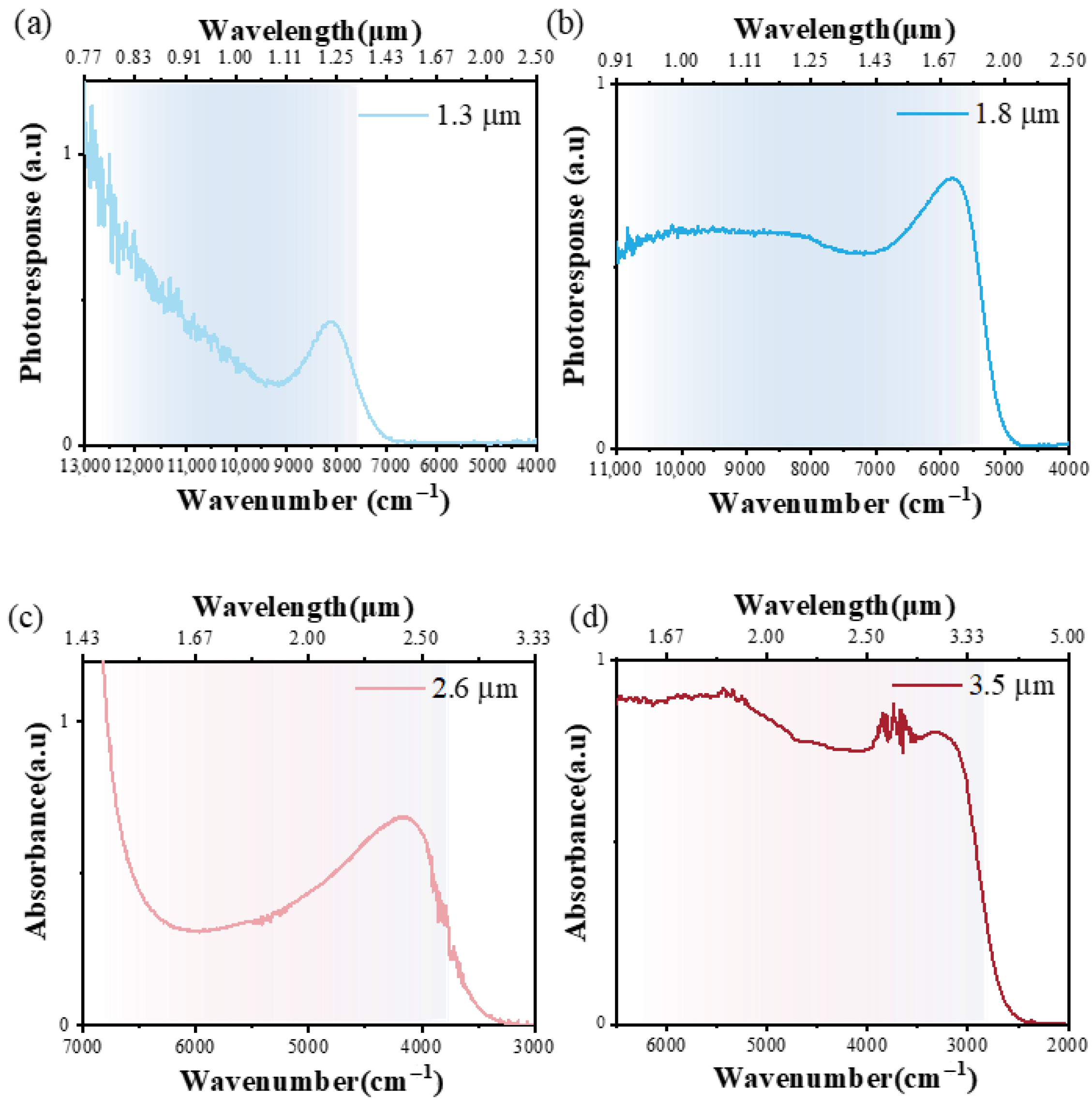
The device being tested was utilized as an external detector for FTIR. The incident optical signals were converted into corresponding photocurrents by the detector. Subsequently, the output was then fed into a Femto DLPCA-200 current amplifier(Femto, Berlin Germany), and then into a Femto DLPVA-100-B voltage amplifier(Femto, Berlin Germany) for external signal conditioning, before being routed to the internal detector port of the FTIR. System control was managed through dedicated electronic modules and software, facilitating fully automated operation and the acquisition of response spectra for four devices, as illustrated in Figure 4a–d. The cut-off wavelength is defined as the wavelength at which the spectral responsivity falls to half of its peak value. According to the photoresponse spectra, the PbS CQD pixel and the three HgTe CQDs pixels have cut-off wavelengths of 7532 cm−1 (1.3 μm), 5344 cm−1 (1.8 μm), 3808 cm−1 (2.6 μm), and 2847 cm−1 (3.5 μm), respectively. These results are consistent with the absorption spectrum characteristics of the relevant materials, suggesting that the spectral response range of the devices is primarily determined by the inherent absorption capabilities of the CQD. Minor differences between the absorption and photoresponse spectra are expected due to device-related effects (e.g., film thickness, electrodes/substrate reflection and interference) and the DTGS-normalized FTIR measurement.
For comparison with the CQD-based multispectral photodetectors, representative literature results are summarized in Table 3, highlighting the distinct integration strategies and performance trade-offs across different multiband platforms.

3. Conclusions

In this work, we fabricated a multiband planar integrated photodetector which consists of four pixels. Each pixel is based on different photoactive materials corresponding to four specific bands: 1.3 μm PbS CQD, 1.8 μm HgTe CQD, 2.6 μm HgTe CQD, and 3.5 μm HgTe CQD. This design allows for comprehensive spectral coverage spanning from the NIR to the MWIR range. All pixels demonstrated good photoresponse characteristics, with the 1.8 μm HgTe CQD pixel exhibiting the highest performance at room temperature, with the responsivity of 5.39 A/W and the specific detectivity of 2.01 × 10¹¹ Jones at 3 V bias voltage. The integration of multiple detection bands onto a single compact chip offers an efficient platform for simultaneous multispectral imaging, enabling advanced functionalities such as precise spectral fingerprinting and detailed multidimensional scene analysis.

Author Contributions

Y.X., X.X. and M.C. designed the experiments; Y.X. and X.X. conceived and designed the idea; Y.X. and X.X. collected and analyzed the data. Y.X. and X.X. wrote the manuscript. M.C. revised the manuscript. Y.X., X.X., L.W., Z.G., Q.H. and M.C. reviewed this work. All authors have read and agreed to the published version of the manuscript.

Funding

This work is financially supported by National Natural Science Foundation of China (No.62475012), State Key Laboratory of Laser Interaction with Matter (SKLLIM-G-2501), National Key Laboratory of Infrared Detection Technologies (IRDT-ZGKXY-25-04), Natural Science Foundation of Zhejiang Province (LD25F040001).

Data Availability Statement

The original contributions presented in this study are included in the article. Further inquiries can be directed to the corresponding authors.

Conflicts of Interest

The authors declare no conflict of interest.

References

  1. Rogalski, A.; Antoszewski, J.; Faraone, L. Third-generation infrared photodetector arrays. J. Appl. Phys. 2009, 105, 091101. [Google Scholar] [CrossRef]
  2. Shen, Y.; Li, J.; Lin, W.; Chen, L.; Huang, F.; Wang, S. Camouflaged Target Detection Based on Snapshot Multispectral Imaging. Remote Sens. 2021, 13, 3949. [Google Scholar] [CrossRef]
  3. Cumis, M.S.; Viciani, S.; Borri, S.; Patimisco, P.; Sampaolo, A.; Scamarcio, G.; De Natale, P.; D’Amato, F.; Spagnolo, V. Widely-tunable mid-infrared fiber-coupled quartz-enhanced photoacoustic sensor for environmental monitoring. Opt. Express 2014, 22, 28222–28231. [Google Scholar] [CrossRef] [PubMed]
  4. Thompson, N.A. Common Aperture Multi-Spectral Optics for Military Applications. Proc. SPIE 2012, 8353, 83531X. [Google Scholar]
  5. Thompson, N.A. Optical Design of Common Aperture, Common Focal Plane, Multispectral Optics for Military Applications. Opt. Eng. 2013, 52, 061308. [Google Scholar] [CrossRef]
  6. Wang, F.; Zhong, Y.; Bruns, O.; Liang, Y.; Dai, H. In vivo NIR-II Fluorescence Imaging for Biology and Medicine. Nat. Photonics 2024, 18, 535–547. [Google Scholar] [CrossRef]
  7. Kopytko, M.; Gawron, W.; Kębłowski, A.; Stępień, D.; Martyniuk, P.; Jóźwikowski, K. Numerical analysis of HgCdTe dual-band infrared detector. Opt. Quantum Electron. 2019, 51, 62. [Google Scholar] [CrossRef]
  8. Kaniewski, J.; Muszalski, J.; Piotrowski, J. Recent advances in InGaAs detector technology. Phys. Status Solidi (A) 2004, 201, 2281–2287. [Google Scholar] [CrossRef]
  9. Ekimov, A.; Efros, A.L.; Onushchenko, A.A. Quantum size effect in semiconductor microcrystals. Solid State Commun. 1993, 88, 947–950. [Google Scholar] [CrossRef]
  10. Garcia de Arquer, F.P.; Talapin, D.V.; Klimov, V.I.; Arakawa, Y.; Bayer, M.; Sargent, E.H. Semiconductor quantum dots: Technological progress and future challenges. Science 2021, 373, eaaz8541. [Google Scholar] [CrossRef]
  11. Balazs, D.M.; Nugraha, M.I.; Bisri, S.Z.; Sytnyk, M.; Heiss, W.; Loi, M.A. Reducing charge trapping in PbS colloidal quantum dot solids. Appl. Phys. Lett. 2014, 104, 112104. [Google Scholar] [CrossRef]
  12. Wang, C.; Wang, Y.; Jia, Y.; Wang, H.; Li, X.; Liu, S.; Liu, X.; Zhu, H.; Wang, H.; Liu, Y.; et al. Precursor Chemistry Enables the Surface Ligand Control of PbS Quantum Dots for Efficient Photovoltaics. Adv. Sci. 2022, 10, 2204655. [Google Scholar] [CrossRef] [PubMed]
  13. Lee, J.W.; Kim, D.Y.; Baek, S.; Yu, H.; So, F. Inorganic UV-Visible-SWIR Broadband Photodetector Based on Monodisperse PbS Nanocrystals. Small 2016, 12, 1328–1333. [Google Scholar] [CrossRef] [PubMed]
  14. Yang, J.; Hu, H.; Lv, Y.; Yuan, M.; Wang, B.; He, Z.; Chen, S.; Wang, Y.; Hu, Z.; Yu, M.; et al. Ligand-Engineered HgTe Colloidal Quantum Dot Solids for Infrared Photodetectors. Nano Lett. 2022, 22, 3465–3472. [Google Scholar] [CrossRef]
  15. Xue, X.; Luo, Y.; Hao, Q.; Cao, J.; Tang, X.; Liu, Y.; Chen, M. Low Dark-Current Quantum-Dot Infrared Imager. ACS Photonics 2023, 10, 4290–4298. [Google Scholar] [CrossRef]
  16. Sergeeva, K.A.; Hu, S.; Sokolova, A.V.; Portniagin, A.S.; Chen, D.; Kershaw, S.V.; Rogach, A.L. Obviating Ligand Exchange Preserves the Intact Surface of HgTe Colloidal Quantum Dots and Enhances Performance of Short Wavelength Infrared Photodetectors. Adv. Mater. 2024, 36, e2306518. [Google Scholar] [CrossRef]
  17. Chen, M.; Lan, X.; Tang, X.; Wang, Y.; Hudson, M.H.; Talapin, D.V.; Guyot-Sionnest, P. High Carrier Mobility in HgTe Quantum Dot Solids Improves Mid-IR Photodetectors. ACS Photonics 2019, 6, 2358–2365. [Google Scholar] [CrossRef]
  18. Xue, X.; Chen, M.; Luo, Y.; Qin, T.; Tang, X.; Hao, Q. High-operating-temperature mid-infrared photodetectors via quantum dot gradient homojunction. Light Sci. Appl. 2023, 12, 2. [Google Scholar] [CrossRef]
  19. Caillas, A.; Guyot-Sionnest, P. Uncooled high detectivity mid-infrared photoconductor using HgTe quantum dots and nanoantennas. ACS Nano 2024, 18, 8952–8960. [Google Scholar] [CrossRef]
  20. Keuleyan, S.E.; Guyot-Sionnest, P.; Delerue, C.; Allan, G. Mercury telluride colloidal quantum dots: Electronic structure, size-dependent spectra, and photocurrent detection up to 12 μm. ACS Nano 2014, 8, 8676–8682. [Google Scholar] [CrossRef]
  21. Zhang, H.; Peterson, J.C.; Guyot-Sionnest, P. Intraband Transition of HgTe Nanocrystals for Long-Wave Infrared Detection at 12 μm. ACS Nano 2023, 17, 7530–7538. [Google Scholar] [CrossRef] [PubMed]
  22. Xue, X.; Hao, Q.; Chen, M. Very long wave infrared quantum dot photodetector up to 18 μm. Light Sci. Appl. 2024, 13, 89. [Google Scholar] [CrossRef] [PubMed]
  23. Pejović, V.; Georgitzikis, E.; Lieberman, I.; Malinowski, P.E.; Heremans, P.; Cheyns, D. Photodetectors Based on Lead Sulfide Quantum Dot and Organic Absorbers for Multispectral Sensing in the Visible to Short-Wave Infrared Range. Adv. Funct. Mater. 2022, 32, 2201424. [Google Scholar] [CrossRef]
  24. Zhao, P.; Qin, T.; Mu, G.; Zhang, S.; Luo, Y.; Chen, M.; Tang, X. Band-engineered dual-band visible and short-wave infrared photodetector with metal chalcogenide colloidal quantum dots. J. Mater. Chem. C 2023, 11, 2842–2850. [Google Scholar] [CrossRef]
  25. Tang, X.; Lai, K.W.C. Scalable Fabrication of Infrared Detectors with Multispectral Photoresponse Based on Patterned Colloidal Quantum Dot Films. ACS Photonics 2016, 3, 2396–2404. [Google Scholar] [CrossRef]
  26. Kim, J.; Kwon, S.M.; Kang, Y.K.; Kim, Y.; Lee, M.J.; Han, K.; Facchetti, A.; Kim, M.; Park, S.K. A skin-like two-dimensionally pixelized full-color quantum dot photodetector. Sci. Adv. 2019, 5, eaax8801. [Google Scholar] [CrossRef]
  27. Hu, C.; Gassenq, A.; Justo, Y.; Yakunin, S.; Heiss, W.; Hens, Z.; Roelkens, G. Short-wave infrared colloidal quantum dot photodetectors on silicon. Proc. SPIE 2013, 8631, 863127. [Google Scholar]
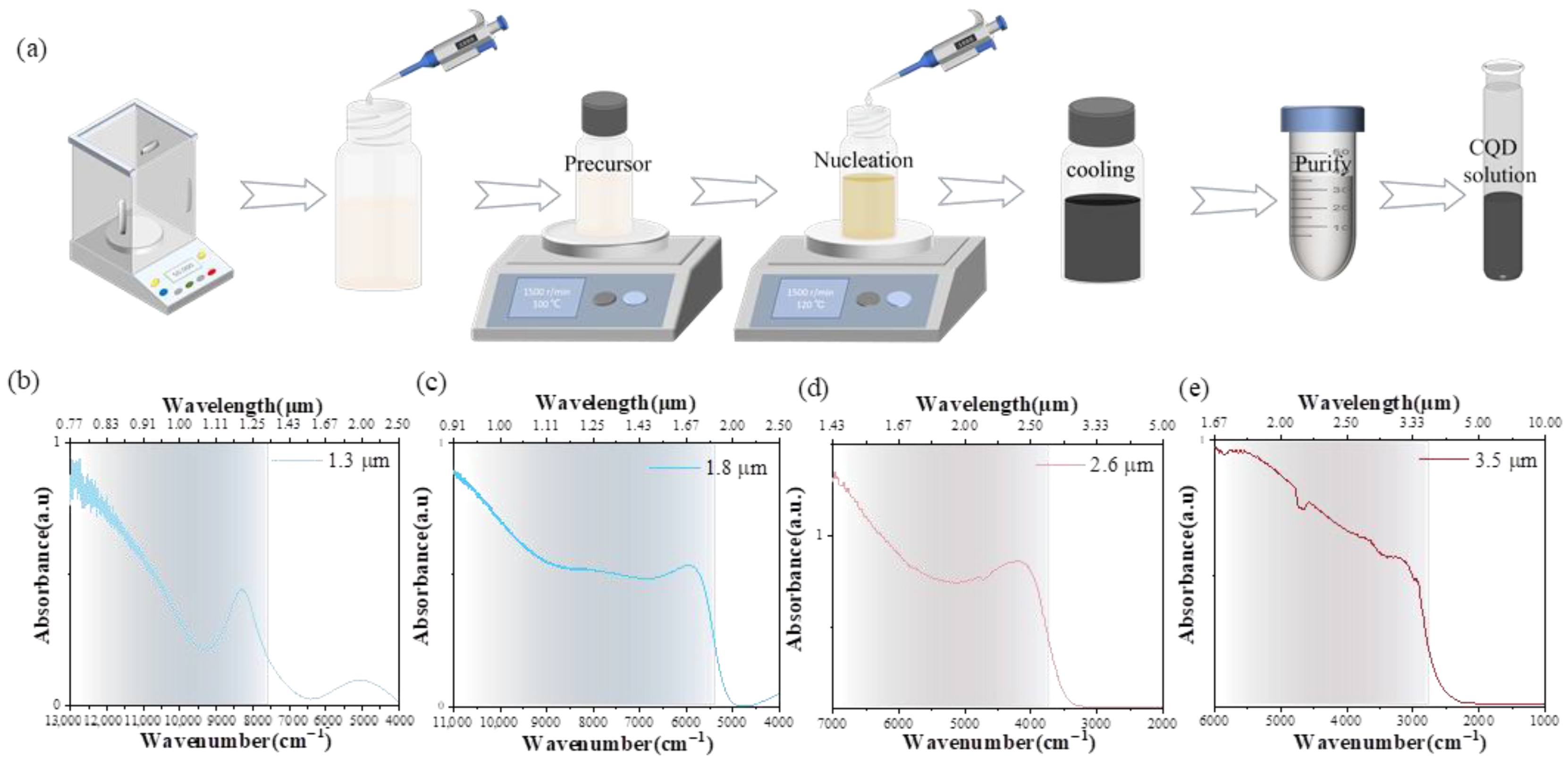
Figure 1. Synthesis and characterization of PbS and HgTe CQDs. (a) Schematic illustration of the hot-injection synthesis method. (be) Absorption spectra of the synthesized CQDs: (b) 1.3 μm PbS CQD, (c) 1.8 μm HgTe CQD, (d) 2.6 μm HgTe CQD, and (e) 3.5 μm HgTe CQD.
Photonics 13 00089 g001
Figure 2. Structure and fabrication of the multiband device. (a) Photograph of the fabricated device. (b) Pixel arrangement of the four-band photoconductors. (c) Schematic cross-section of a single pixel. (d) The thickness characterization for the CQD films. (e) Fabrication process of multiband device.
Photonics 13 00089 g002
Figure 3. Current–Voltage (I-V) characteristics of the four pixels measured under dark and illuminated conditions: (a) 1.3 μm PbS CQD pixel, (b) 1.8 μm HgTe CQD pixel, (c) 2.6 μm HgTe CQD pixel, and (d) 3.5 μm HgTe CQD pixel.
Photonics 13 00089 g003
Figure 4. Room-temperature spectral response of the four pixels, normalized to the DTGS: (a) 1.3 μm PbS CQD pixel, (b) 1.8 μm HgTe CQD pixel, (c) 2.6 μm HgTe CQD pixel, and (d) 3.5 μm HgTe CQD pixel.
Photonics 13 00089 g004
Table 1. Synthesis parameters for all CQDs targeting different infrared bands.
Wavelength (μm)Reaction Temperature (℃)Growth Time (min)
1.31202
1.8605
2.6804
3.5906
Table 2. The performance parameters of all pixels.
PixelP (μW)Iph (μA)R (A/W)D* (Jones)
1.3 μm PbS CQD5.304.610.878.87 × 1010
1.8 μm HgTe CQD1.9810.675.392.01 × 1011
2.6 μm HgTe CQD15.1436.912.433.36 × 1010
3.5 μm HgTe CQD38.518.410.223.54 × 109
Table 3. Performance comparison of representative CQD-based multiband photodetectors.
MaterialsDevice
Structure
Operating
Temperature
Bias
(V)
Wavelength
(μm)
Detectivity
(Jones)
Responsivity
(A/W)
Ref
PbS CQDs/OPD-PbS CQDsVertical
stacking
/10.4–1.0/EQE = 70%
@ 500nm
[23]
0.8–1.2/EQE = 30%
@ 1150nm
HgTe/CdTe CQDsVertical
stacking
Room
tempreture
+30.71.1 × 10110.5[24]
−22.14.5 × 10111.1
HgTe
CQD
Planar
patterning
room
tempreture
<104.82 × 10⁷@2μm0.1@2μm[25]
6.01.25 × 107@4μm0.07@4μm
9.51.0 × 107@7μm0.05@7μm
PbS/CdSe/CdS CQDPlanar
patterning
room
tempreture
VD = 15
VG = −3
4064.2 × 10178.3 × 103[26]
530
630
1310
PbS/HgTe CQDPlanar
patterning
room
tempreture
31.38.87 × 10100.87This
work
1.82.01 × 10115.39
2.63.36 × 10102.43
3.53.54 × 1090.22
Disclaimer/Publisher’s Note: The statements, opinions and data contained in all publications are solely those of the individual author(s) and contributor(s) and not of MDPI and/or the editor(s). MDPI and/or the editor(s) disclaim responsibility for any injury to people or property resulting from any ideas, methods, instructions or products referred to in the content.