Article

Genetic-Algorithm-Based Research on Key Technologies for Motion System Calibration and Error Control for the Precision Marking System


by
Jiang Li
1,†,
Shuangxiong Yin
2,†,
Zexiao Li
1,
Yongxu Xiang
2,* and
Xiaodong Zhang
1,*
1
State Key Laboratory of Precision Measurement Technology and Instruments, Laboratory of Micronano Manufacturing Technology (MNMT), Tianjin University, Tianjin 300072, China
2
Standard Optics Technology Tianjin Co., Ltd., Tianjin 300350, China
*
Authors to whom correspondence should be addressed.
These authors contributed equally to this work.
Photonics 2026, 13(1), 4; https://doi.org/10.3390/photonics13010004
Submission received: 25 October 2025 / Revised: 24 November 2025 / Accepted: 15 December 2025 / Published: 22 December 2025
(This article belongs to the Special Issue Emerging Topics in Freeform Optics)

Abstract

To counteract accuracy degradation in micrometer-scale precision marking—where the precision marking (PM) system denotes the precision marking platform and the Optical Microscope (OM) system denotes the camera-based visual guidance module—a genetic-algorithm-based framework for motion-system calibration and error control is introduced. A kinematic error model is established to capture multi-source coupled errors in the PM system, and the propagation mechanisms of axis misalignment, pose misregistration, and flatness-induced errors are analyzed. Building on this model, a GA-driven multi-objective calibration scheme and a coordinated optimization model jointly address axis-orthogonality correction, PM-OM extrinsic-pose calibration, and workpiece flatness compensation. Furthermore, a dynamic error-compensation framework leveraging real-time monitoring and adaptive adjustment sustains long-term high-precision marking. In post-calibration tests-after correcting axis orthogonality, aligning the PM-OM extrinsic pose, and compensating workpiece flatness, the PM system achieves dimensional accuracies of ±0.05, ±0.08, and ±0.10 μm for nominal 1, 2, and 3 μm marks, respectively, with positional accuracy better than ±0.2 μm. Marking consistency improves markedly, and the indentation force closely matches the target mark size, validating the approach. These techniques provide both theoretical and practical support for the engineering deployment of PM systems and are significant for improving the quality and productivity of micrometer-scale precision marking.

1. Introduction

With the technological upgrading of display panels and optical components, micrometer-scale marking on multilayer glass substrates has become a key link for product traceability and quality inspection, where high precision, low damage, and strong consistency are required [1,2,3,4]. Conventional mechanical marking equipment suffers from large motion errors and limited positioning accuracy, and thus cannot reliably meet the processing demands for 1000–3000 nm markers [5,6]. As a dedicated solution, the precision marking (PM) system performs indentation-based marking under the guidance of an Optical Microscope (OM) camera, with Z-axis compound motion driving the indenter. A classic framework for extracting hardness and elastic modulus from load–displacement sensing indentation experiments was established by Oliver and Pharr [7], and similar indentation principles are adopted in our PM system to generate micrometer-scale marks on glass substrates. However, axis-orthogonality deviations in the motion system, pose mismatches between PM and OM, and workpiece flatness errors can cause marker size out-of-tolerance and positional offsets, severely compromising product quality [8,9,10]. Hence, motion-system calibration and error control for PM are of substantial engineering significance.
Regarding factors that affect the accuracy of point-marking systems and their modeling performance, Soares et al. proposed an interaction-based method to evaluate point-marking accuracy and showed its direct impact on spatial modeling accuracy and user experience [11]. For event-marking systems with limited timing accuracy, Williams et al. introduced a precision evaluation method for event-related potentials using Emotive-based event marking and demonstrated improvements in temporal precision for neuroscience studies [12]. In biomedical 3D surface imaging, Eder et al. established a comprehensive evaluation approach for accuracy and precision across multiple systems and reported considerable variations among applications [13]. For aerial navigation and state estimation with millimeter-level precision, Lanegger et al. developed ceiling-marker-based navigation and precise flight positioning, validating millimeter-scale flight marking capability [14].
In precision dispensing, Raja et al. integrated machine vision into real-time control of a high-precision microsprayer and achieved accurate pesticide delivery [15]. For 3D ultraviolet-laser high-precision marking, Xiao et al. experimentally demonstrated a process route with improved marking accuracy [16]. In minimally invasive thoracic surgery, Suzuki et al. and Ueda et al. reported radio-frequency identification (RFID)-assisted precise localization and resection techniques that enhanced surgical accuracy and safety [17,18]. For aerial end-effector placement and precision marking, Lanegger et al. proposed compliant-actuator-based layout and control methods enabling accurate aerial calibration [19]. In wafer bonding alignment, Wang et al. developed a sub-pixel template-matching-based calibration and localization algorithm with ultrahigh precision [20]. For VTOL pad marking detection, Heo et al. presented a vision-based system that delivers more accurate landing-mark localization and recognition [21]. Taken together, these representative studies demonstrate that precise marking, localization, and error control are critical across applications, but their calibration and compensation schemes are typically tailored to specific error sources or hardware configurations and do not establish a unified kinematic error model with explicit multi-source error coupling and integrated dynamic drift compensation as developed in this work.
Despite these advances, existing precision marking methods still face several limitations when directly applied to micrometer-scale marking on glass substrates. Most calibration schemes treat geometric stage errors, sensor pose misalignment, and workpiece flatness separately, so the coupling and propagation of these errors to the final mark size and position are not explicitly modeled [22,23,24,25,26]. Conventional least-squares geometric fitting and polynomial error-mapping usually compensate one error term at a time under linearized assumptions, which makes it difficult to maintain high accuracy when the stage operates with non-ideal error characteristics. Metaheuristic algorithms such as particle swarm optimization (PSO) and differential evolution (DE) have been introduced into motion-system calibration, but they mainly focus on static error identification and rarely consider long-term thermal or mechanical drift under production conditions [27,28,29].
In photonics manufacturing, this level of micrometer-scale positioning accuracy and sub-micrometer drift control is particularly relevant for wafer-level micro-optical integration and fiducial fabrication. For example, silicon-based micro-optical systems assembled by low-temperature wafer bonding rely on passive alignment marks and groove structures with lateral tolerances on the order of ±0.3 μm to maintain optical coupling losses within 1 dB [30]. At the same time, lithography alignment systems using diffraction-grating or Moiré-fringe alignment marks routinely target overlay errors of only a few nanometers, and their performance critically depends on the stability and optical contrast of the micro-structured marks written on the wafer surface [31]. A precision marking system that can generate repeatable micrometer-scale indents with controlled morphology on glass or silicon substrates is therefore attractive as a generic platform for alignment and fiducial marks in wafer-level optics, freeform optics metrology, and micro-structured glass components.
To address these issues, this paper proposes a GA-based multi-source error-coupling calibration and drift-compensation framework for the PM system, in which axis scale, straightness, and non-orthogonality errors of the PM motion stages, PM-OM extrinsic pose misalignment, workpiece plane deviation, and long-term thermal/mechanical drift are modeled within a single kinematic chain and compensated in a unified manner. A GA-based multi-objective calibration procedure is then used to jointly optimize axis orthogonality, extrinsic pose, and plane parameters under realistic constraints. Finally, a dynamic drift-compensation strategy is integrated based on long-term drift measurements, achieving about 75–78% reduction in X/Y/Z drift in 4 h tests while keeping the calibration workflow suitable for periodic use in production.

2. Fundamental Principles and Architecture of the PM System

2.1. Operating Principle

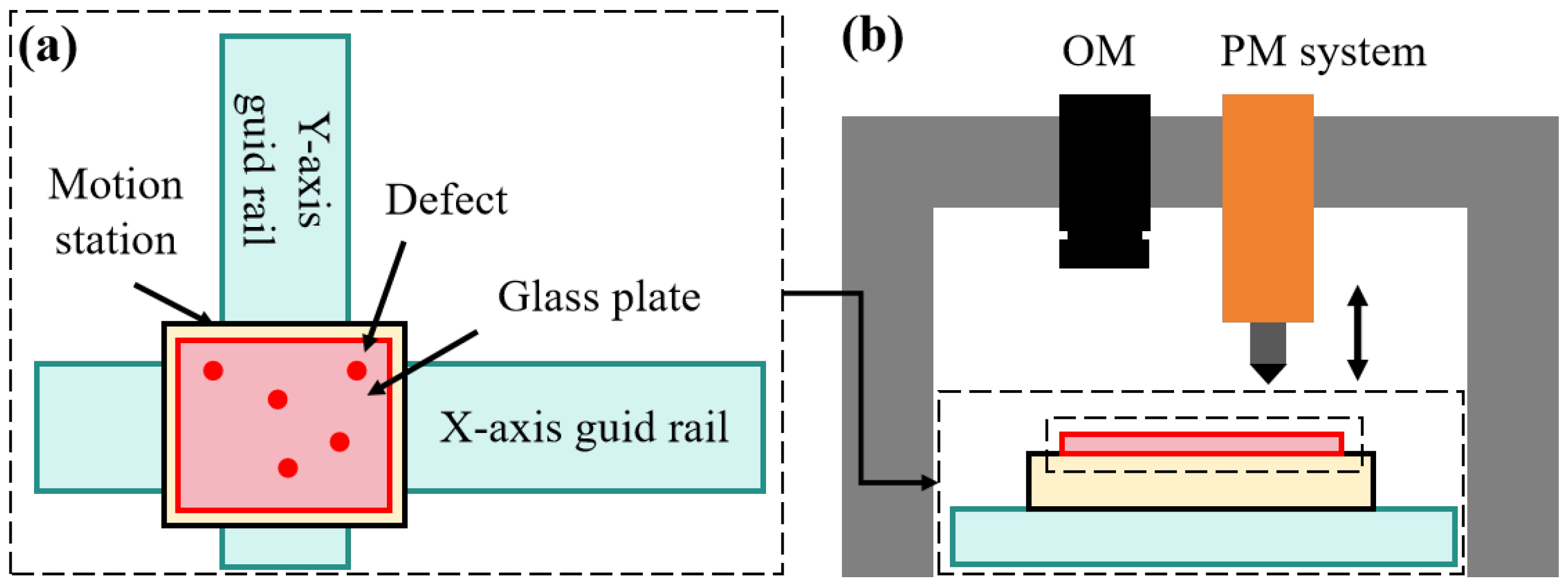
The PM system produces V-shaped micro-marks on glass substrates via a vision-guided, servo-actuated indentation workflow (system overview in Figure 1b). The workflow comprises three coordinated stages—vision localization, planar positioning, and force-controlled indentation. First, the OM camera acquires the substrate image; sub-pixel localization extracts the target site, and the pixel coordinates are mapped—through calibrated camera intrinsics/extrinsics—into the stage (world) frame and dispatched to the motion controller (Figure 1a illustrates the orthogonal X/Y motion station and target sites on the mounted glass plate). Next, the X/Y macro-positioning stage places the indenter above the target. Along Z, a macro stage rapidly descends to a pre-contact height (~1 mm), after which a PZT micro-actuator advances with nanometer resolution to ensure a safe approach. During indentation, a tip-mounted force sensor monitors contact in real time; upon reaching the prescribed force, the PZT holds its displacement to form a V-shaped indentation with controlled morphology. The composite Z-axis retracts, returning the system to its initial state and completing one high-precision marking cycle.

2.2. PM Subsystems and Analysis of Key Error Sources

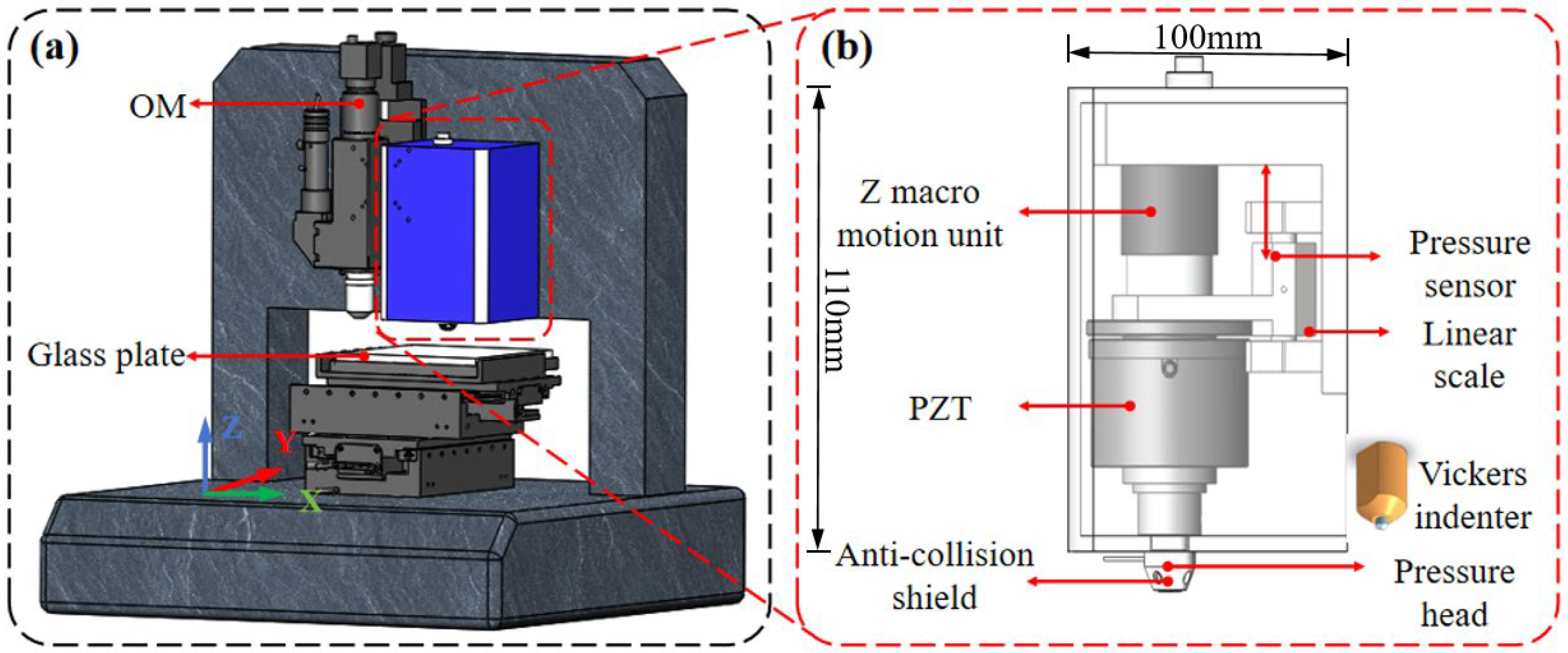
Although the PM system adopts high-precision motion stages and precision sensors, the achieved marking accuracy in practice is jointly affected by multiple error sources. To sustain micrometer-scale accuracy, these sources must be systematically identified, analyzed, and quantified so that appropriate error-control strategies can be formulated. An overview of the motion station and OM placement is shown in Figure 2a, while the composite Z-axis motion and indentation unit is illustrated in Figure 2b.
As indicated in Figure 2b, the Z-axis macro-motion unit (ball-screw drive) provides fast coarse positioning over a long travel (110 mm). The Z-axis micro-motion unit, implemented as a piezoelectric ceramic (PZT) micro-actuator, supplies nanometer-level displacement compensation; cascaded with the macro unit, it realizes coarse-fine Z-axis control to ensure depth accuracy during indentation. A tip-mounted force sensor monitors the contact force in real time and closes the force loop, maintaining the prescribed force (e.g., ≤200 mN) to avoid cracking multilayer glass. A linear encoder on the Z-axis provides real-time position feedback and, together with the macro and micro stages, forms a closed loop that guarantees positioning accuracy and repeatability. A crash guard protects the indenter and moving components from collision. The indenter is a Vickers tip (included angle 136°), chosen to form a regular V-shaped micro-mark with controllable morphology. Coordinated operation of these modules-referenced to the stage/world frame defined in Figure 2a—implements the vision-guided, force-controlled indentation described in Section 2.1 and directly determines the resulting mark quality.
From the standpoint of error formation, the dominant contributors in the PM system can be grouped into several categories: (i) intrinsic geometric errors of the X/Y/Z stages, including axis scale errors, straightness deviations, and non-orthogonality between axes; (ii) extrinsic pose mismatch between the PM coordinate frame and the OM camera frame, which couples stage motion into the apparent mark position in the image plane; (iii) indentation-depth uncertainty and nonlinearity arising from the composite Z-axis stack and the PZT micro-actuator; and (iv) workpiece flatness/tilt that changes the local surface normal and couples Z-height error into lateral mark size and morphology. In the proposed framework, these error sources are not treated in isolation; instead, they are incorporated into a single kinematic chain so that their interactions-such as axis non-orthogonality combined with PM-OM pose misalignment and workpiece plane deviation-are modeled explicitly when predicting the final marker position and size.

3. Genetic-Algorithm-Based Motion-System Calibration Techniques

3.1. Axis-Orthogonality Calibration Algorithm

The geometric accuracy of the motion system is a primary determinant of high-precision micro/nano marking. In practice, machining and assembly tolerances, as well as thermal deformation, introduce axis non-orthogonality and pose deviations. When multiple axes operate in coordination, these errors couple and may be amplified, ultimately degrading both mark size and positional accuracy. Traditional linearized compensation is ill-suited to such strongly coupled, multi-parameter optimization. Therefore, a genetic-algorithm (GA)-based global optimizer is employed to tackle axis-orthogonality correction together with PM-OM pose calibration under a multi-objective framework. This subsection focuses on the axis-orthogonality subproblem.
Let x, y, z denote the (unit) direction vectors of the X/Y/Z axes. Ideal orthogonality entails two families of constraints:
Normalization (unit-length) constraints for each axis (Equation (1)):
x 1 2 + x 2 2 + x 3 2 = 1 y 1 2 + y 2 2 + y 3 2 = 1 z 1 2 + z 2 2 + z 3 2 = 1
Mutual orthogonality between any two axes (Equation (2)):
x 1 y 1 + x 2 y 2 + x 3 y 3 = 1 x 1 z 1 + x 2 z 2 + x 3 z 3 = 1 y 1 z 1 + y 2 z 2 + y 3 z 3 = 1
Real systems exhibit deviations from ideality; hence, an axis-orthogonality error function is minimized to reduce these departures. Sampling the axis directions at N representative configurations yields the objective (Equation (3)):
E = i = 1 N [ ( X i Y i ) 2 + ( X i Z i ) 2 + ( Y i Z i ) 2 ]
where (Xi, Yi, Zi) are the unit direction vectors of the three axes at the i-th sample, estimated from the measured calibration trajectories of the stage, and E reflects the overall deviation from orthogonality over all N samples. This axis-orthogonality error is later normalized and used as the orthogonality term Eortho in the GA-based calibration framework. E reflects the overall deviation from orthogonality.
Given the objective in Equation (3) under the normalization and mutual-orthogonality constraints, a GA-based global optimizer is adopted to search for the optimal axis triad and calibration matrix; the computational flow is summarized in Figure 3. In the implementation, a real-coded GA is employed with a population size of 60 individuals and a maximum generation number Gmax = 100. Each individual encodes the three-stage axes x, y, and z by their direction cosines, i.e., the components of the three axis vectors are stacked into a nine-dimensional real-valued chromosome. After crossover and mutation, a projection step is applied before fitness evaluation: the three-axis vectors are first normalized to unit length and then orthogonalized to form a right-handed orthonormal triad, with the third axis constructed as the cross product of the first two. This procedure ensures that the normalization and mutual-orthogonality constraints in Equations (1) and (2) are satisfied at every GA generation while the GA effectively searches over the space of feasible rotation matrices. The crossover and mutation probabilities are set to Pc = 0.9 and Pm = 0.05, respectively, and tournament selection with elitism is used. These settings lie in the typical range reported for GA-based calibration problems and provide reliable convergence within a reasonable off-line computation time for the PM system. In this work, the GA is executed with a fixed random seed in all calibration runs to ensure that the procedure is fully reproducible for the specified GA configuration. Within the overall error-control framework, these GA-based runs are used only for off-line identification of the static baseline calibration parameters (axis orthogonality, PM–OM pose, and workpiece plane).

3.2. PM-OM Extrinsic-Pose Calibration

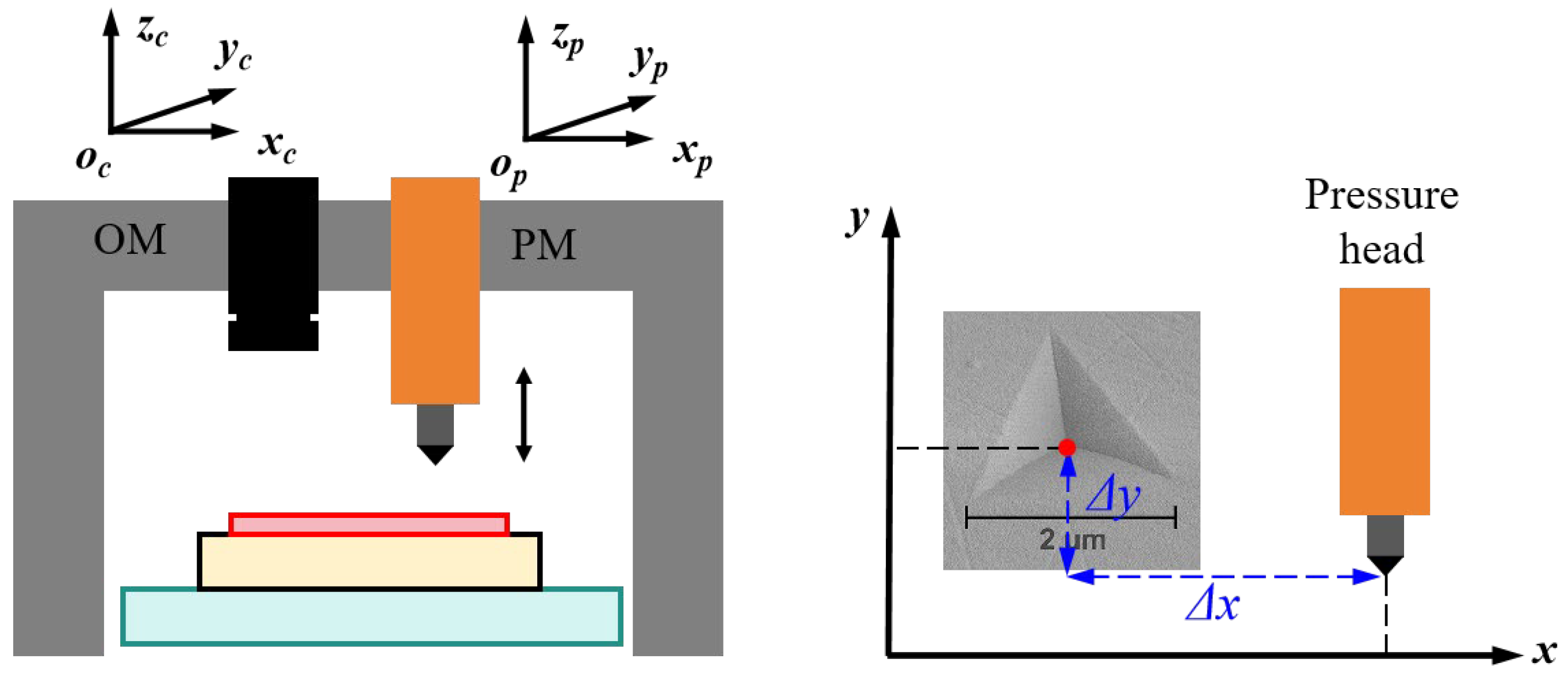
To eliminate the bias between the camera-guided target location and the actual indentation point of the PM indenter, an extrinsic-pose calibration is performed between the PM system and the OM camera. In micrometer-level marking, the PM and OM subsystems each define their own coordinate frames; mechanical assembly tolerances and thermal effects introduce an inherent relative pose error, which chiefly manifests as in-plane (X/Y) offsets at the mark site. In the typical workflow, the PM subsystem executes Z-axis indentation on the glass substrate, whereas the OM module provides visual localization for in-plane guidance. A calibration model is therefore established to recover the rigid transformation between the two frames and remove the systematic bias.
The calibration uses a standard rigid transformation of the form:
X O M = R X P M + T
where XOM denotes the target position vector in the camera (OM) frame, XPM denotes the execution position vector in the PM frame; RR3×3 is the rotation matrix describing the orientation between the two frames; and TR3 is the translation vector that includes the systematic offsets to be calibrated (e.g., ΔX and ΔY). By estimating R and T via least-squares fitting or an equivalent optimization routine, an accurate inter-frame transformation is obtained. This calibration co-registers the observation (OM) and actuation (PM) subsystems, ensuring micrometer-level placement accuracy for marking. The PM-OM relative (extrinsic) pose calibration is illustrated in Figure 4.

3.3. PM System Marking Workflow and Error-Control Framework

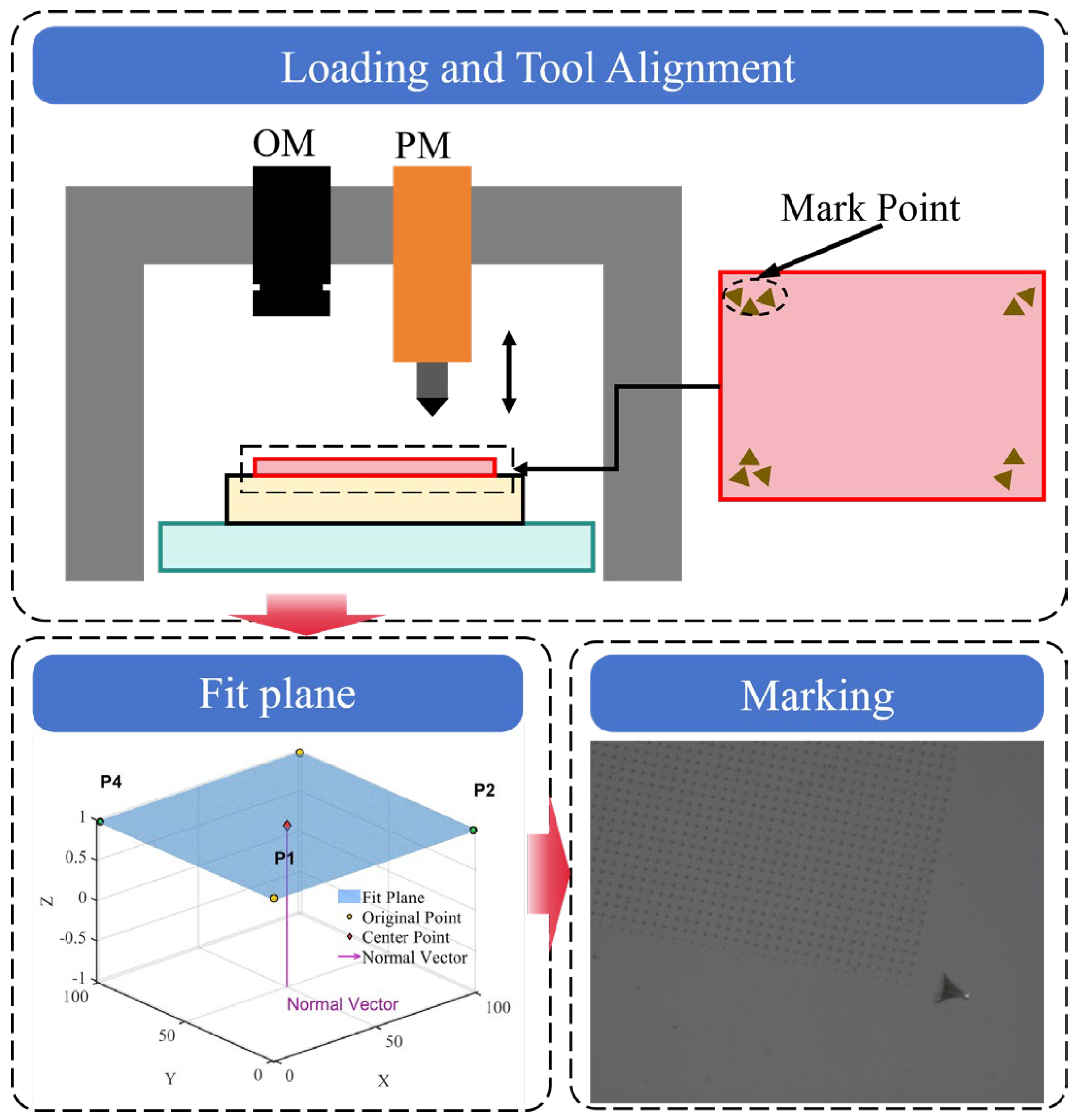
Building on the axis-orthogonality calibration and PM-OM extrinsic-pose calibration, the error-control strategy must integrate all compensation results and also account for process-level disturbances—such as workpiece flatness deviations, environmental temperature drift, and mechanical vibration—so as to meet laboratory-grade micrometer marking accuracy. Accordingly, an error-propagation analysis motivates a three-stage workflow consisting of loading and tool-setting, plane fitting, and designated-position marking, as shown in Figure 5. In practical operation, the static calibration of the PM system is carried out in three steps: first, axis-orthogonality calibration of the X/Y/Z stages; second, PM-OM extrinsic-pose calibration using the rigid-transformation model of Equation (4); and third, workpiece plane fitting via the 5 × 5 surface-probing grid in the X/Y workspace.
To achieve high-precision marking accuracy, a process route is adopted that combines automatic clamping and tool-setting, plane fitting, and precision marking. The route follows a stepwise error-cancelation principle: installation and initial datum setting remove large biases; plane fitting compensates the workpiece’s non-ideal flatness; residual errors are then handled by multi-objective optimization and dynamic compensation. The glass workpiece (fused silica) is rigidly clamped, and the OM camera measures three non-collinear fiducials to establish the workpiece coordinate frame, which serves as the reference for subsequent operations. During force-feedback tool-setting along Z, the indenter advances at low speed while the force sensor monitors the compressive load; when the load reaches a preset threshold (5 mN), the current position is taken as the Z-axis origin, preventing hard contact and providing a precise indenter datum.
To compensate for workpiece flatness/tilt, plane fitting is performed over a 5 × 5 sampling grid within the X/Y workspace. The Z-axis probing system records the surface heights Zi at 25 sampling points (i = 1, …, 25). A least-squares plane model is then estimated:
Z = a X + b Y + c
where a, b are the plane tilt coefficients and c is the intercept. The fitting minimizes the quadratic objective:
E p l a n e = i = 1 25 ( Z i ( a X i + b Y i + c ) 2 )
yielding the optimal plane parameters and the corresponding surface normal
n = ( a ,   b ,   1 )
At the designated-position marking stage, the system uses the established coordinate frame and the fitted plane to compute the commanded trajectory at the target (xtarget, ytarget). Combining axis-orthogonality corrections (ΔXcal, ΔYcal) with the plane-based height compensation, the command is
X c m d Y c m d Z c m d = x t arg e t + Δ X c a l y t arg e t + Δ Y c a l a x t arg e t + b y t arg e t + c d n
where d is the prescribed indentation depth along the surface normal, and n is the unit normal vector of the fitted workpiece plane given in Equation (7). Z-axis control is implemented in two scales: the macro stage provides coarse motion, and a PZT micro-actuator executes 1 nm incremental steps. A closed-loop force controller regulates the indentation load to a constant 50–200 mN, ensuring mark quality.
The error-control system therefore addresses four principal contributors—axis non-orthogonality, PM-OM pose error, plane fitting (flatness and tilt) error, and dynamic drift-through a weighted multi-objective fitness:
F = ω 1 E o r t h o + ω 2 E p o s e + ω 3 E f l a t + ω 4 E d y n
where F is the GA fitness; ω1ω4 are weighting factors; Eortho quantifies the residual axis non-orthogonality after calibration and is obtained from the normalized version of the axis-orthogonality error E defined in Equation (3); Epose measures misalignment between the calibrated PM and OM frames; Eflat represents the plane-fitting error that reflects workpiece flatness or tilt; and Edyn quantifies long-term drift. Specifically, Edyn is computed from time-series reference-mark measurements as the mean dynamic error over ten consecutive marking cycles at each sampled time instant, where the dynamic error combines the displacement of the mark center in X and Y and the deviation of indentation depth in Z relative to the initial calibrated state. During GA-based calibration, Edyn(θ) is evaluated by applying the candidate calibration parameters θ to map the measured drift trajectories into the calibrated frame and recomputing the same normalized mean dynamic-error metric, so that long-term drift is incorporated as the fourth term in the multi-objective fitness. To avoid domination of any single term due to its physical units or scale, each component is first normalized by its corresponding tolerance bound, so that Eortho, Epose, Eflat, and Edyn become dimensionless quantities of comparable magnitude. Based on the error-budget analysis for the PM system, axis-orthogonality and PM–OM pose errors have the most direct impact on systematic geometric accuracy, whereas plane-fitting error and long-term dynamic drift mainly affect the stability of marking height and morphology. Accordingly, the weights are set to ω1 = ω2 = 0.30 and ω3 = ω4 = 0.20, assigning slightly higher priority to Eortho and Epose while still penalizing Eflat and Edyn.
On top of the static corrections delivered by GA, a dynamic-compensation update is applied online:
Δ C ( t ) = Δ C G A + α Δ E d y n ( t ) + ( 1 α ) Δ C ( t 1 )
where ΔC(t) is the real-time compensation at time t (µm); ΔCGA is the baseline static correction from GA; ΔEdyn(t) is the incremental dynamic error at time t, obtained from the same combined dynamic-error metric used in Edyn by periodically writing and measuring a small reference array-that is, at each sampling instant tk the PM system writes a 3 × 3 array of 2 µm marks at a fixed location near the center of the workspace, and compares the currently measured X/Y mark-center displacement (from the OM image) and Z indentation-depth deviation (from the Z-axis encoder and force sensor) with their values at the previous sampling instant; and α is a forgetting factor (0 < α < 1). In this work, α is set to 0.80. This value was selected empirically in preliminary drift-compensation experiments as a compromise between rapid convergence and robustness to measurement noise: smaller values caused the compensation to overreact to short-term fluctuations, whereas larger values made the update noticeably slower. Mathematically, Equation (10) corresponds to a first-order exponential smoothing filter applied to the dynamic-error signal, where α controls the effective memory of the compensation—a larger α retains a longer history of past drift, while a smaller α makes the update more strongly focused on recent measurements. During long production runs, Equation (10) is evaluated at discrete sampling instants tk when a reference-mark measurement is taken; the resulting compensation ΔC(tk) is then applied to all subsequent marking cycles until the next sampling instant tk+1.
To quantify the improvement due to dynamic compensation, the dynamic-error reduction rate is defined as
η = | E ¯ d y n , p r e | | E ¯ d y n , p o s t | | E ¯ d y n , p r e | × 100 %
where E ¯ d y n , p r e is the average dynamic error over ten marking cycles before compensation, and E ¯ d y n , p o s t is the corresponding average after compensation.
These steps integrate geometric calibration, plane-based height correction, and real-time drift suppression, enabling consistent high-precision performance in the PM marking workflow.

4. Experimental Verification and Results

To demonstrate the applicability of the GA-based key techniques for the PM system in high-precision (micrometer-scale) marking, system-level experiments were conducted to verify feasibility. Experiments were performed on fused-silica substrates rigidly clamped in a dedicated fixture to prevent in-process drift. The environment was controlled at 20 ± 1 °C with relative humidity 45–55%, effectively isolating environmental influences on micrometer-scale marking. All calibration and marking experiments were performed on an industrial PC that controls both the PM and OM subsystems (Intel Core i7-9700K CPU @ 3.60 GHz, 16 GB RAM). In practical use, the PM system is always operated after applying the proposed GA-based static calibration; accordingly, all experiments reported in this section are carried out on this statically calibrated configuration and use it as the baseline. The additional contribution of the online dynamic compensation is evaluated by comparing, in the 4 h stability test, the long-term drift of the same GA-calibrated system before and after enabling the dynamic update.
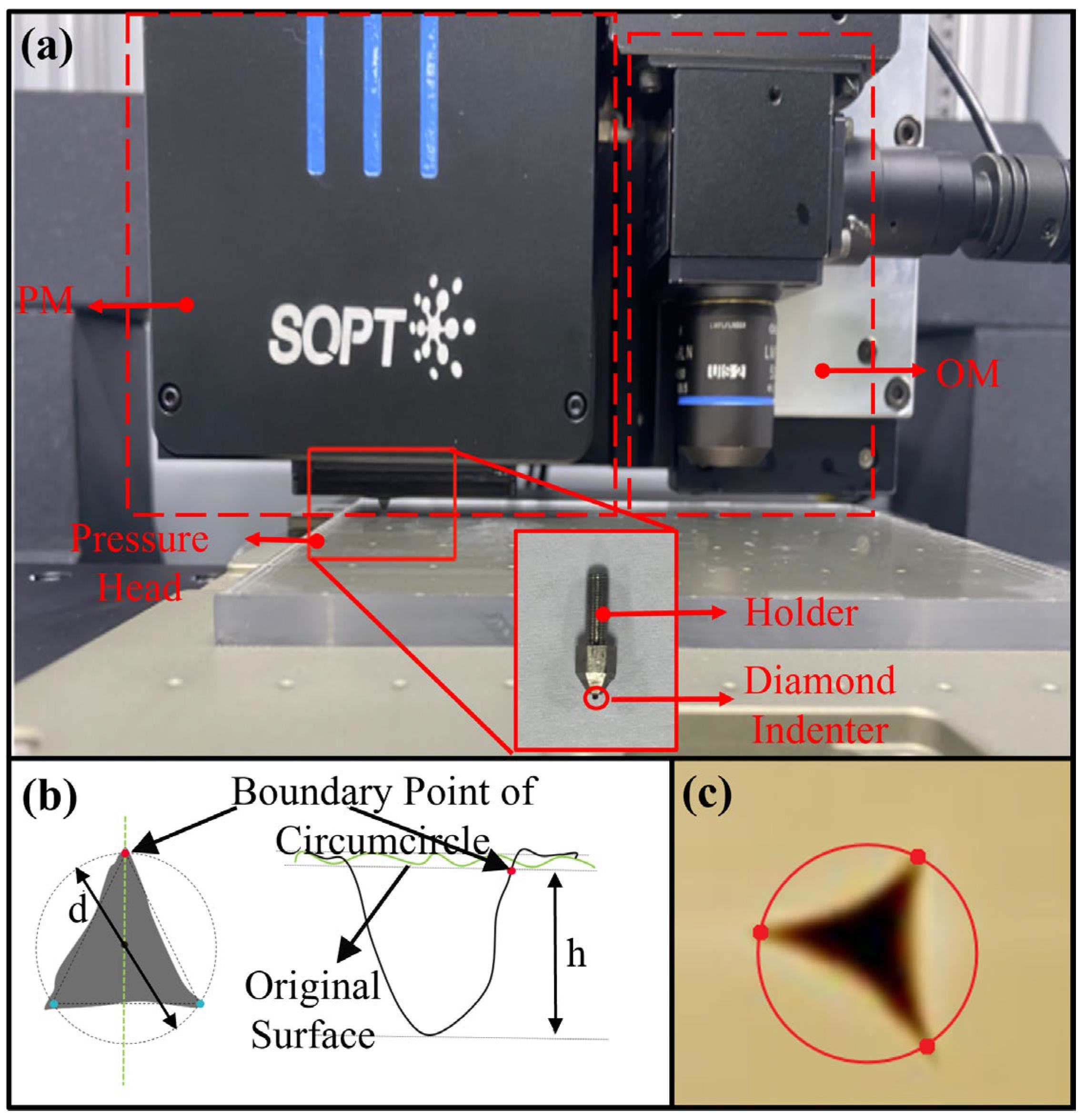
Under a nominal single-marker size specification of 1000–3000 nm, the marker size error was maintained within ±150 nm. Planar positioning errors (marker x and y) were controlled within ±100 nm, enabling accurate localization and operation. The indentation force was limited to ≤200 mN to avoid malfunction caused by excessive load. These measures ensured stable and reliable PM operation and satisfied the accuracy requirements of both production and application scenarios. Representative indentation morphology and the experimental setup schematic are shown in Figure 6. Figure 6a shows the experimental carrier: a fused-silica glass plate used as the marked workpiece. The rigid clamping fixture provides mechanical stability during processing, ensuring positional accuracy and forming the hardware basis for high-precision indentation experiments of the PM system. Figure 6b illustrates the indentation geometry for quantitative analysis; the depth h is defined from the original surface to the pit floor, and an outer-ring set of sampling points is specified to support metrics such as marker depth, surface morphology, and width-to-depth ratio. Figure 6c presents a micrograph of a Vickers indentation, displaying the characteristic morphology of high-precision marking.
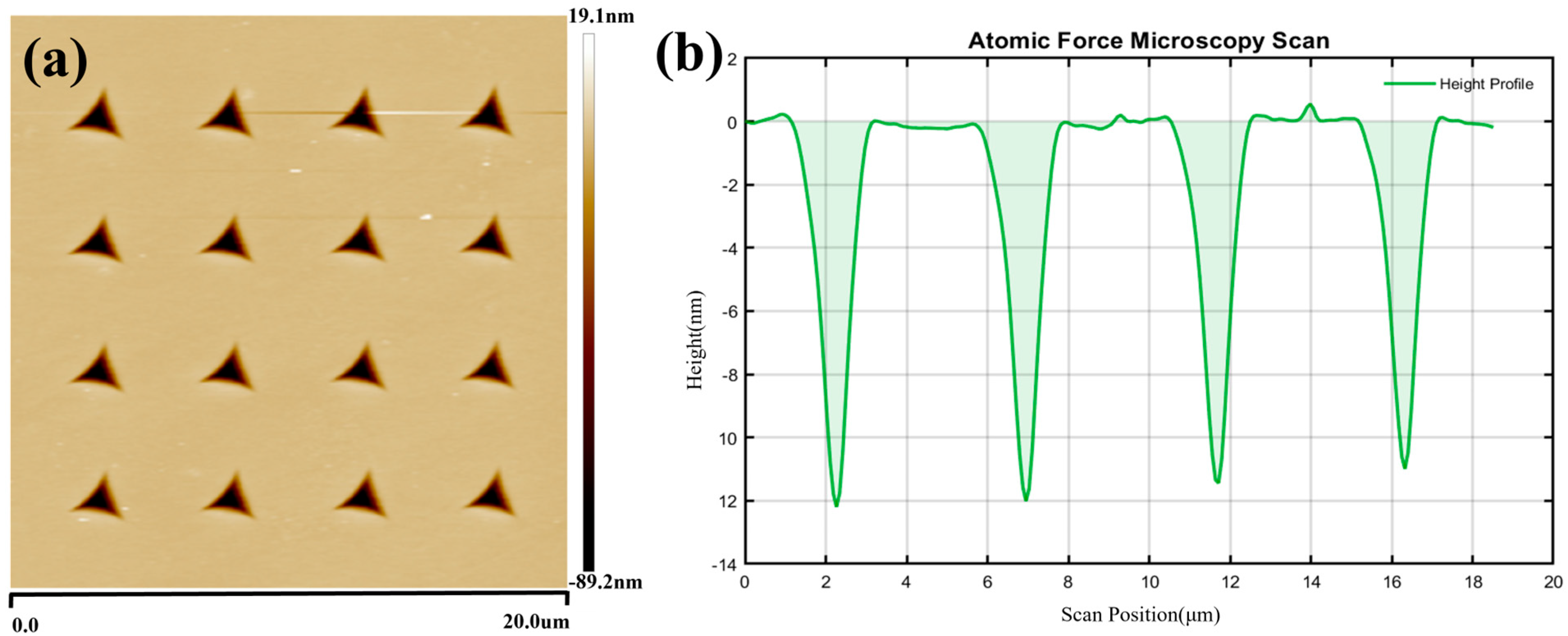
Building on the above characterization, an atomic force microscope (AFM) is further employed to acquire high-resolution images of the micro/nano indentation arrays produced by the PM system. The AFM operates in tapping mode, with a 50 µm × 50 µm scan area and 512 × 512 sampling resolution, ensuring accurate capture of the three-dimensional morphology of a single indentation.
Figure 7 presents AFM images of micrometer-scale indentation arrays fabricated by the PM system. In terms of positional accuracy, the indentations show uniform spacing in both the horizontal and vertical directions with very small center offsets, indicating excellent positioning accuracy and repeatability of the X/Y motion stage. In morphology and size consistency, individual pyramidal (Vickers) indentations exhibit highly consistent profiles and heights without discernible shape distortion, demonstrating precise coordination between Z-axis displacement control and force regulation. These controls ensure a marker size error ≤ 150 nm and a depth-to-width ratio ≥ 0.04. Taken together, the results verify the effectiveness of the PM system and the GA-based key techniques in delivering micrometer-scale marking accuracy and batch-to-batch consistency.
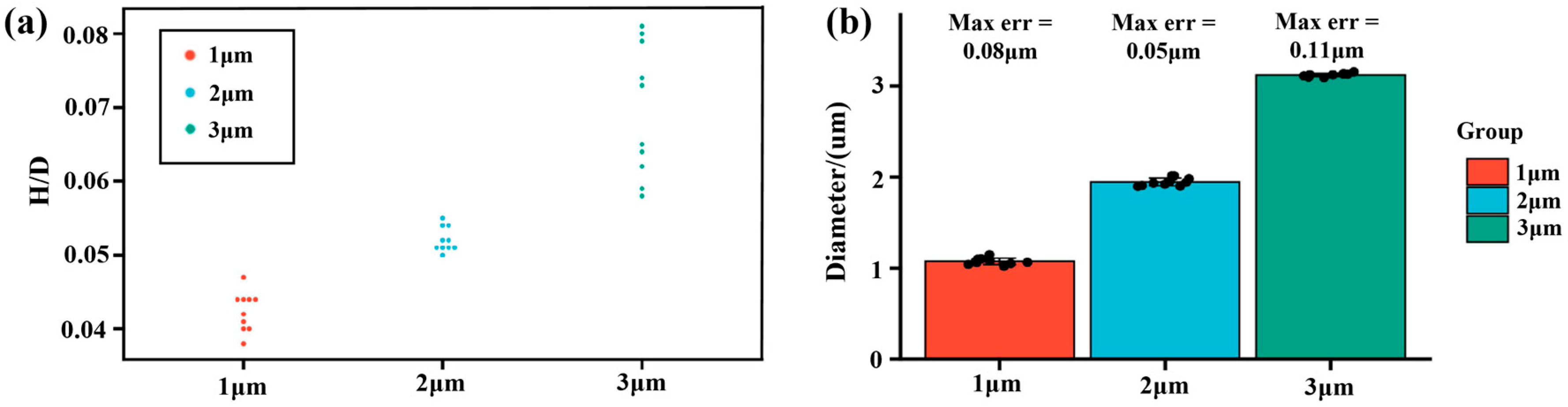
Morphology and size: From an optical-inspection viewpoint, the micrometer-scale indentations generated by the PM system appear in OM images as compact dot-like pits with clear boundaries and well-controlled lateral size (Figure 5), and the AFM profiles (Figure 7) show smooth V-shaped sidewalls and reproducible depths for the different nominal sizes. The depth-to-diameter ratio (H/D) increases monotonically with the nominal size (1, 2, and 3 µm), indicating that the energy input of the PM system can be scaled in a controlled manner. Diameter measurements show means close to nominal for all three groups, and the maximum absolute diameter errors are well within the specified ±150 nm tolerance (Figure 8a,b), confirming that the mark size and morphology are both stable and repeatable. The corresponding numerical statistics for each nominal size and indentation-force level, computed from N = 54 AFM-measured indentations per group, are summarized in Table 1.
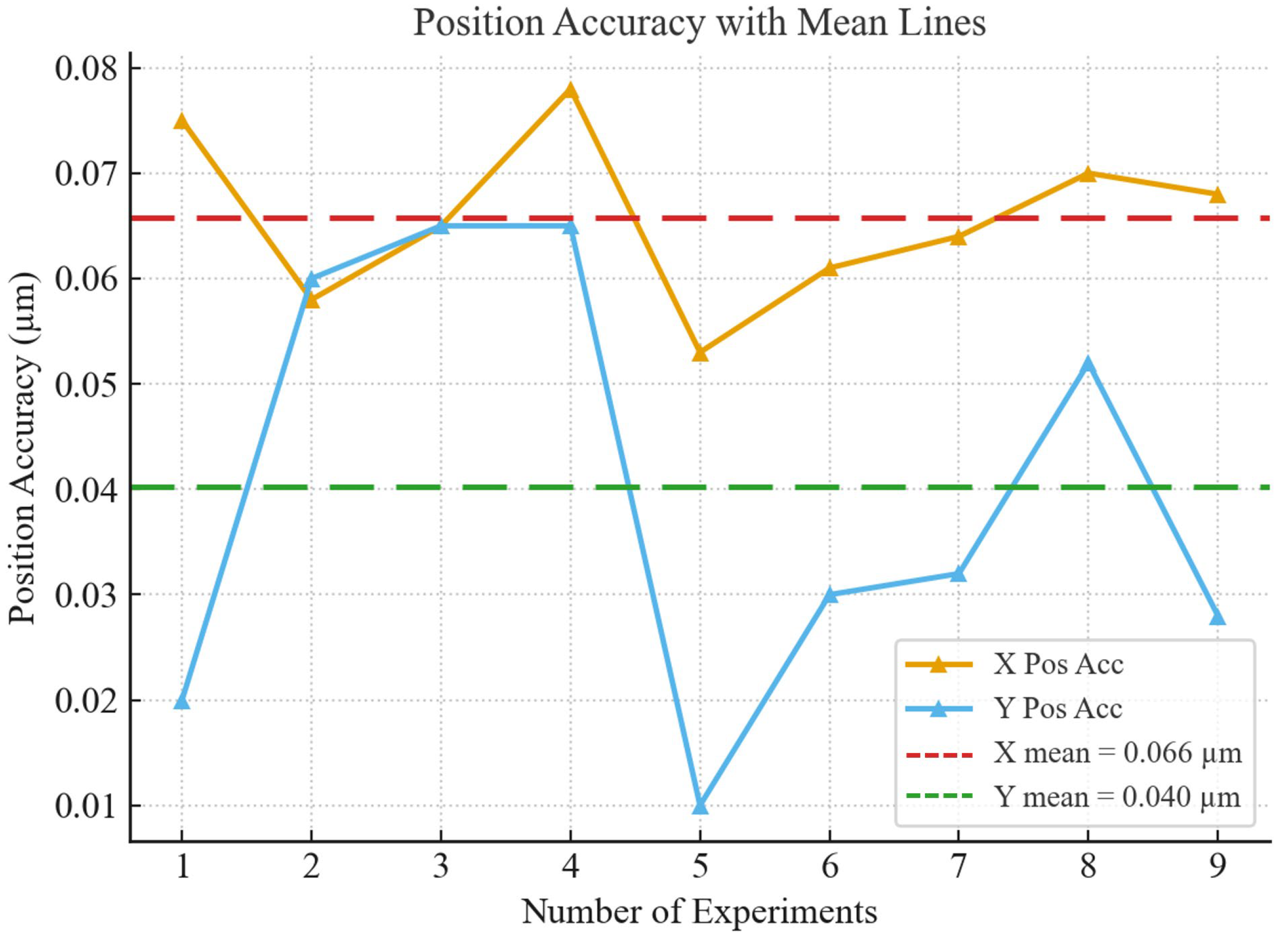
As shown in Figure 9, both X- and Y-direction errors stayed within 0–0.08 µm (0–80 nm). Across nine trials, the mean and RMS errors were as follows: X: 0.0658 µm/66.21 nm (mean 0.0658 µm; RMS 0.0662 µm); Y: 0.0402 µm/40.22 nm (mean 0.0402 µm; RMS 0.0447 µm). The X direction shows slightly larger fluctuations (mostly 0.05–0.07 µm), whereas the Y direction remains lower (about 0.01–0.05 µm). All trials meet the planar positioning-error requirement of ≤±100 nm, confirming stable and reliable repeatability after axis-orthogonality calibration and PM-OM extrinsic-pose calibration.
In a 4 h continuous marking stability test, dynamic drift was sampled every 10 min and the reduction rate η (as defined in Equation (11)) was computed, and the dynamic compensation ΔC(t) was updated at the same 10 min interval; the results are summarized in Table 2. At each sampling instant, the PM system wrote a 3 × 3 array of nominal 2 µm reference marks at a fixed location near the center of the workspace. The X/Y drift was obtained from the displacement of the array centroid in the OM image relative to its initial position, and the Z drift was computed from the change in the average indentation depth of the nine marks relative to their initial depth. Before compensation, the cumulative drift reached 0.21 μm in X/Y and 0.18 μm in Z. After enabling the online dynamic update in Equation (10), which incrementally adjusts the drift-compensation terms based on the sampled drift without re-running the GA, the drift decreased to 0.05 μm in X/Y and 0.04 μm in Z, yielding reduction rates of 76% and 78%, respectively; moreover, the standard deviation of the mark position over 100 consecutive operations decreased from 0.15 μm to 0.03 μm. These findings indicate that the combination of GA-based static baseline compensation and real-time incremental compensation effectively suppresses thermal deformation and mechanical creep during long-duration processing, achieving sub-micrometer stability. In addition to the aggregate values in Table 2, the 10 min sampled drift curves show a slow and monotonic evolution of the dynamic error over the 4 h run. Before compensation, the X/Y/Z drift increases gradually with time without oscillatory transients, whereas after enabling the dynamic update, the residual drift at each sampling instant remains within ±0.05 μm and remains in a narrow band of ±0.05 μm to a nearly steady level, with no noticeable overshoot or instability.
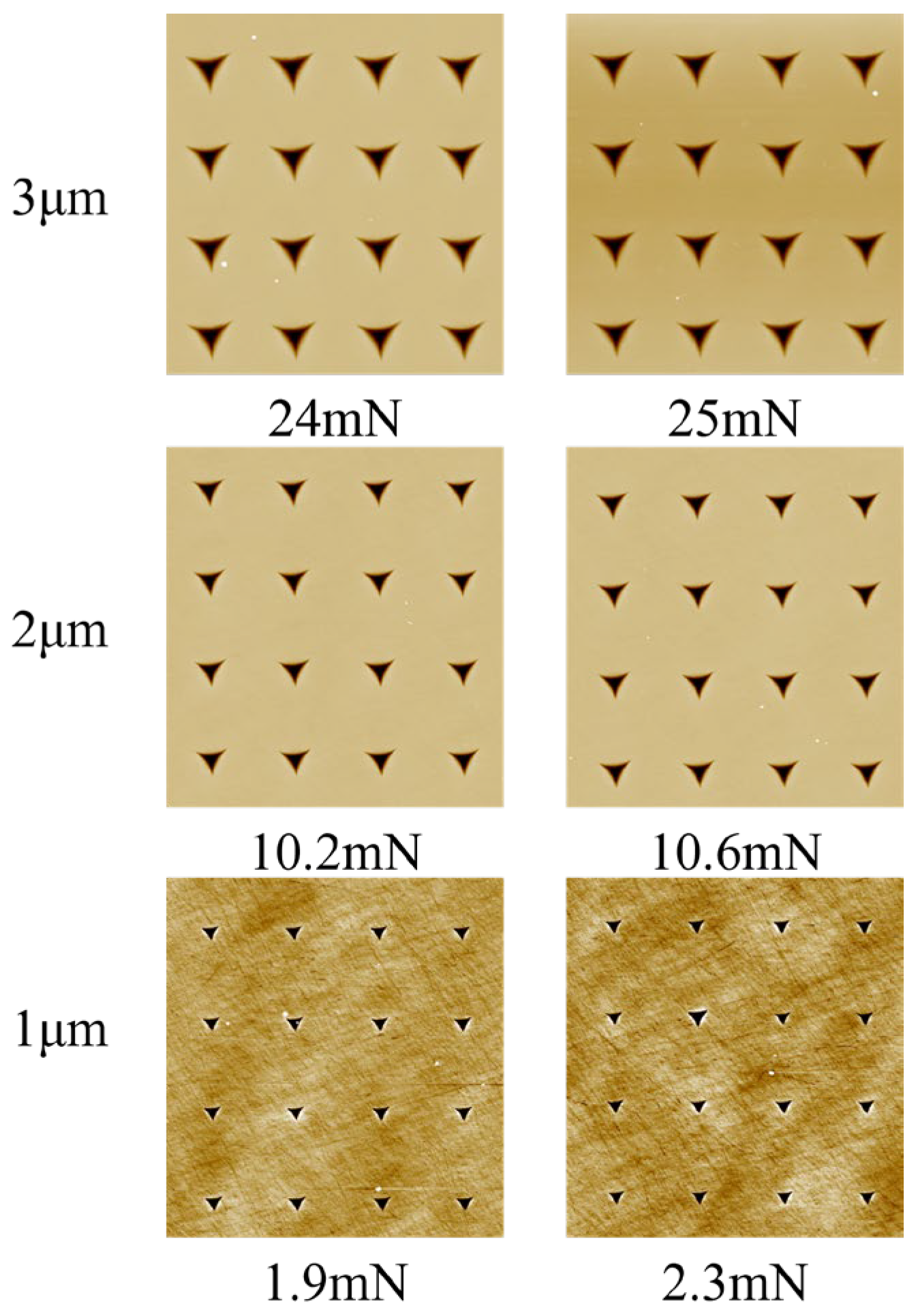
To further verify stability and consistency across different marker sizes, a multi-size array morphology comparison was performed. A one-factor-at-a-time design was used: for nominal sizes of 1 µm, 2 µm, and 3 µm, the corresponding optimal indentation forces were applied, 5 × 5 arrays were fabricated under identical processing conditions, and array morphology was documented using combined optical microscopy (OM) and scanning electron microscopy (SEM) (Figure 10). The results show that, within the force windows matched to each nominal size, the arrays remain well-formed with uniform spacing and sharp boundaries: the 3 µm group exhibits consistent morphology at 24–25 mN; the 2 µm group is clear and orderly at 10.2–10.6 mN; and the 1 µm group is stable without noticeable distortion at 1.9–2.3 mN. Overall, the indentation force is well matched to marker size, enabling reliable, high-precision, and consistent array fabrication.
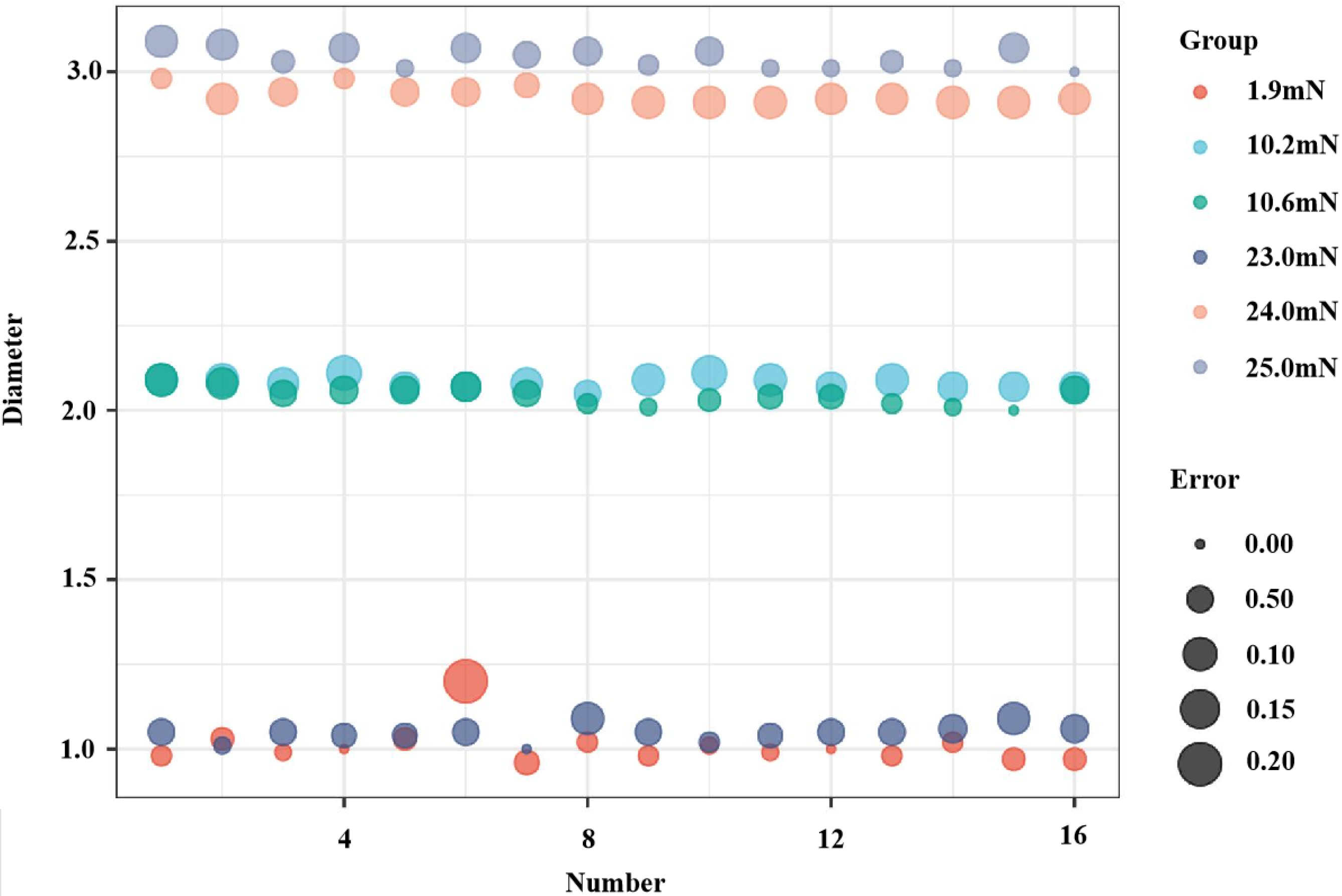
Figure 11 shows the diameter and error distributions of micrometer-scale markers under different indentation forces. At 1.9 mN, diameters cluster around 1.0 µm with absolute errors mostly below 0.05 µm. At 10.2 and 10.6 mN, the diameters are approximately 2.0 µm, the scatter is compact, and errors are generally small. At 24 and 25 mN, the diameters approach 3.0 µm with similarly good uniformity, and most absolute errors are below 0.10 µm. Overall, the force–size pairing is well matched: the measured diameters closely track the targets (1/2/3 µm), and size errors are well controlled across all force levels, indicating excellent size accuracy and consistency of the PM system for micrometer-scale markers of different specifications.
From a calibration-strategy perspective, the experimental results also clarify the respective roles of the GA-based static calibration and the online dynamic compensation. Before applying the GA-based calibration, the as-built PM system exhibits larger systematic geometric errors due to axis non-orthogonality, PM-OM pose misalignment, and plane-fitting errors; the static GA-based calibration primarily reduces these systematic components and establishes a stable baseline for micrometer-scale marking accuracy. The online dynamic compensation does not change this nominal geometric calibration, but suppresses slow thermal and mechanical drift during long-duration operation, as reflected by the reduced long-term drift in the 4 h stability test. We have not yet performed a full three-way ablation on identical marking tasks comparing an uncalibrated configuration, a static-only GA calibration, and the combined static-plus-dynamic compensation. However, based on the error-budget analysis and the observed improvements in accuracy and stability, we can qualitatively expect that omitting the GA-based calibration would lead to larger systematic marking errors, whereas omitting the dynamic compensation would mainly degrade long-term stability under thermal and creep effects. A more exhaustive experimental comparison of alternative calibration and compensation strategies will be pursued in future work to further optimize the engineering performance of the PM system.
The multi-size marking experiments also define a practical process window for transferring the method to production. As detailed in the experimental section, the tests were conducted on fused-silica substrates with the ambient temperature controlled at 20 ± 1 °C and the relative humidity maintained at 45–55%. Under these conditions, nominal mark sizes of 1, 2, and 3 µm were stably obtained with indentation-force ranges of 1.9–2.3 mN, 10.2–10.6 mN, and 24–25 mN, respectively. Within this window, the marker arrays exhibit well-formed shapes with sharp boundaries, regular spacing, and stable morphology, and the measured maximum absolute diameter error remains below 0.15 µm while planar positioning errors stay within ±100 nm, as reported in the preceding analysis. These operating conditions therefore provide a compact summary of the validated process window and a useful reference for assessing whether a given factory environment and equipment configuration are compatible with the proposed PM system.

5. Conclusions

A multi-source error-coupling model was formulated for the PM system, explicitly linking axis scale, straightness, and non-orthogonality errors with PM-OM extrinsic pose, workpiece plane deviation, and long-term drift, and providing a unified basis for GA-based calibration of axis orthogonality, pose parameters, and plane-based height correction. Building on this model, a genetic-algorithm (GA)-based multi-objective calibration and a real-time compensation framework were developed to jointly optimize axis orthogonality, PM-OM extrinsic pose, and plane-based height correction.
In the validated operating window, the calibrated PM system meets the engineering targets for micrometer-scale marking: for nominal 1, 2, and 3 µm marks on fused-silica substrates, the marker-size error is maintained within ±150 nm and planar positioning within ±100 nm. Under a controlled environment of 20 ± 1 °C and 45–55% relative humidity, indentation-force ranges of 1.9–2.3 mN, 10.2–10.6 mN, and 24–25 mN are recommended for nominal 1, 2, and 3 µm marks, respectively, yielding well-formed arrays with uniform spacing, sharp boundaries, and stable morphology. In practical use, GA-based static calibration is performed off-line at appropriate intervals to update axis-orthogonality, PM-OM pose, and workpiece plane parameters, and the same configuration is then used as the baseline during production. During long-duration runs, the dynamic drift-compensation routine is activated, with reference arrays written and measured periodically (e.g., every 10 min) to update the compensation terms and keep long-term drift below the sub-micrometer level. These conditions and procedures indicate how the proposed framework can be integrated into a routine calibration-and-operation workflow when deploying precision marking systems in industrial environments.
Overall, GA-driven collaborative calibration and compensation effectively suppress coupled geometric and process errors, delivering high-precision and durable marking performance. Future work will focus on improving algorithmic efficiency and enhancing the adaptability of the dynamic/thermal compensation model to varying process conditions, as well as exploring hybrid learning-and-GA optimization for predictive error suppression. A more exhaustive ablation study that directly compares, on identical marking tasks, the uncalibrated system, the GA-calibrated static baseline, and the combined static-plus-dynamic compensation will be considered in future work.

Author Contributions

Conceptualization, Y.X. and X.Z.; methodology, J.L., S.Y. and X.Z.; software, J.L., S.Y. and Z.L.; validation, Z.L., X.Z. and Y.X.; formal analysis, J.L. and S.Y.; investigation, Z.L., X.Z. and S.Y.; resources, S.Y. and X.Z.; data curation, J.L. and S.Y.; writing—original draft preparation, J.L. and S.Y.; writing—review and editing, J.L., S.Y., Z.L., Y.X. and X.Z.; visualization, J.L., S.Y. and Z.L.; supervision, Z.L. and X.Z.; project administration, Y.X. and X.Z.; funding acquisition, X.Z., Z.L. and Y.X. All authors have read and agreed to the published version of the manuscript.

Funding

This research was funded by the National Program of China (J0017-2326-QT); National Natural Science Foundation of China (62373274 and 52405508).

Institutional Review Board Statement

Not applicable.

Informed Consent Statement

Not applicable.

Data Availability Statement

The original contributions presented in this study are included in the article.

Conflicts of Interest

Authors Shuangxiong Yin and Yongxu Xiang are employees of Standard Optics Technology Tianjin Co. The company’s involvement was limited to providing resources and project administration, as detailed in the author contributions statement. All authors affirm that this employment does not constitute a conflict of interest and unanimously agree on the objectivity of this work.

References

  1. Wang, L.; Wang, Z.; Yuan, M.; Huang, W.; Bu, Q.; Shen, X.; Lin, Y.; Cao, J.; Wu, J.; Yao, X.; et al. Design and Application of Integrated Marking System. In Proceedings of the 2021 4th International Conference on Advanced Electronic Materials, Computers and Software Engineering (AEMCSE), Changsha, China, 26–28 March 2021; IEEE: New York City, NY, USA, 2021; pp. 1005–1008. [Google Scholar]
  2. Sun, L.; Li, Y.; Du, G.; Wang, W.; Zhang, Y. Modification design of high-precision above ground marking system. In Proceedings of the 2010 Chinese Control and Decision Conference, Xuzhou, China, 26–28 May 2010; IEEE: New York City, NY, USA, 2010; pp. 531–535. [Google Scholar]
  3. Zukiwsky, N.M.; Girard, T.E.; Zuidhof, M.J. Effect of an automated marking system on aggressive behavior of precision-fed broiler breeder chicks. J. Appl. Poult. Res. 2020, 29, 786–797. [Google Scholar] [CrossRef]
  4. Sun, L. Verification experiments for high-precision Above Ground Marking system. In Proceedings of the IEEE ICCA 2010, Xiamen, China, 9–11 June 2010; IEEE: New York City, NY, USA, 2010; pp. 1737–1741. [Google Scholar]
  5. Sato, T.; Yutaka, Y.; Nakamura, T.; Date, H. First clinical application of radiofrequency identification (RFID) marking system—Precise localization of a small lung nodule. JTCVS Tech. 2020, 4, 301–304. [Google Scholar] [CrossRef] [PubMed]
  6. Williams, L. Precision Marking System. U.S. Patent 9937616 B2, 10 April 2018. [Google Scholar]
  7. Oliver, W.C.; Pharr, G.M. An improved technique for determining hardness and elastic modulus using load and displacement sensing indentation experiments. J. Mater. Res. 1992, 7, 1564–1583. [Google Scholar] [CrossRef]
  8. Wongkietkachorn, A.; Surakunprapha, P.; Winaikosol, K.; Wongkietkachorn, N.; Wongkietkachorn, S. Precise marking for burn excision by using indocyanine green angiography. Plast. Reconstr. Surg. 2020, 145, 229e–230e. [Google Scholar] [CrossRef] [PubMed]
  9. Parsa, V.; Jamieson, D.G. A comparison of high precision Fo extraction algorithms for sustained vowels. J. Speech Lang. Hear. Res. 1999, 42, 112–126. [Google Scholar] [CrossRef] [PubMed]
  10. Fischer, T.; Fischer, W. Manufacturing of high precision levelling rods. In The Importance of Heights; FIG: Gävle, Sweden, 1999; pp. 223–228. [Google Scholar]
  11. Soares, L.P.; Bowman, D.A.; Pinho, M.S. Evaluating the impact of point marking precision on situated modeling performance. In Proceedings of the Symposium on Spatial User Interaction, New Orleans, LA, USA, 19–20 October 2019; pp. 1–5. [Google Scholar]
  12. Williams, N.S.; McArthur, G.M.; Badcock, N.A. It’s all about time: Precision and accuracy of Emotiv event-marking for ERP research. PeerJ 2021, 9, e10700. [Google Scholar] [PubMed]
  13. Eder, M.; Brockmann, G.; Zimmermann, A.; Papadopoulos, M.A.; Schwenzer-Zimmerer, K.; Zeilhofer, H.F.; Sader, R.; Papadopulos, N.A.; Kovacs, L. Evaluation of precision and accuracy assessment of different 3-D surface imaging systems for biomedical purposes. J. Digit. Imaging 2013, 26, 163–172. [Google Scholar] [PubMed]
  14. Lanegger, C.; Pantic, M.; Bähnemann, R.; Siegwart, R.; Ott, L. Chasing millimeters: Design, navigation and state estimation for precise in-flight marking on ceilings. Auton. Robot. 2023, 47, 1405–1418. [Google Scholar] [CrossRef]
  15. Raja, R.; Slaughter, D.C.; Fennimore, S.A.; Siemens, M.C. Real-time control of high-resolution micro-jet sprayer integrated with machine vision for precision weed control. Biosyst. Eng. 2023, 228, 31–48. [Google Scholar] [CrossRef]
  16. Xiao, H.B.; Zhou, Y.Q.; Liu, M.J. Experimental Research on 3D Ultraviolet Laser Precision Marking Processing Technology. In Proceedings of the 2nd International Conference on Computer, Mechatronics and Electronic Engineering, Xiamen, China, 24–25 December 2017; pp. 24–25. [Google Scholar]
  17. Suzuki, J.; Shiono, S.; Watanabe, H.; Takamori, S. Thoracoscopic precision excision technique for small non-palpable lesions using radiofrequency identification lung marking system. J. Vis. Surg. 2024, 10, 27. [Google Scholar] [CrossRef]
  18. Ueda, Y.; Mitsumata, S.; Matsunaga, H.; Kaneda, S.; Midorikawa, K.; Miyahara, S.; Tokuishi, K.; Nakajima, H.; Waseda, R.; Shiraishi, T.; et al. Use of a radiofrequency identification system for precise sublobar resection of small lung cancers. Surg. Endosc. 2023, 37, 2388–2394. [Google Scholar] [PubMed]
  19. Lanegger, C.; Ruggia, M.; Tognon, M.; Ott, L.; Siegwart, R. Aerial layouting: Design and control of a compliant and actuated end-effector for precise in-flight marking on ceilings. In Proceedings of the Robotics: Science and System XVIII, New York City, NY, USA, 27 June–1 July 2022; p. 073. [Google Scholar]
  20. Wang, R.; Yang, K.; Zhu, Y. A high-precision Mark positioning algorithm based on sub-pixel shape template matching in wafer bonding alignment. Precis. Eng. 2023, 80, 104–114. [Google Scholar] [CrossRef]
  21. Heo, H.; Lee, K. Vision-based Vertiport Marking Detection System for Precision Landing on a Vertiport. J. Inst. Control. Robot. Syst. 2024, 30, 93–98. [Google Scholar] [CrossRef]
  22. Liu, J.; Yu, T.; Wu, C.; Zhou, C.; Lu, D.; Zeng, Q. A low-cost and high-precision underwater integrated navigation system. J. Mar. Sci. Eng. 2024, 12, 200. [Google Scholar] [CrossRef]
  23. Su, Z.; Huang, S.; Zhao, W.; Wang, S.; Feng, H.; Chen, J. Development of a portable high-precision above ground marker system for an MFL pipeline inspector. In Proceedings of the 18th World Conference on Nondestructive Testing, Durban, South Africa, 16–20 April 2012; pp. 16–20. [Google Scholar]
  24. Cai, B.; Liu, X.D.; Tong, B.; Tan, X.X.; Chen, Y.L. Study on laser flying marking systems based on DSP and CPLD. Laser Technol. 2007, 31, 387–390. [Google Scholar]
  25. Markov, V.V.; Lebedeva, L.I. Study of defects causes in precision laser marking of the articles with surface thin coating. In Proceedings of the 2014 International Conference on Mechanical Engineering, Automation and Control Systems (MEACS), Tomsk, Russia, 16–8 October 2014; IEEE: New York City, NY, USA, 2014; pp. 1–5. [Google Scholar]
  26. Kupriyanov, O.; Lamnauer, N. Improvement of the assembling technology for precision joints using the dimensional information. In Proceedings of the Grabchenko’s International Conference on Advanced Manufacturing Processes, Odessa, Ukraine, 8–11 September 2020; Springer International Publishing: Cham, Switzerland, 2020; pp. 52–60. [Google Scholar]
  27. Chen, H.; Shannon, G. Precision cutting & drilling metals with a fiber laser marker. In Proceedings of the International Congress on Applications of Lasers & Electro-Optics, Baltimore, MD, USA, 31 May–5 June 2009; Laser Institute of America: Orlando, FL, USA, 2009; Volume 2009, pp. 741–744. [Google Scholar]
  28. Wongkietkachorn, A.; Surakunprapha, P.; Jenwitheesuk, K.; Eua-Angkanakul, K.; Winaikosol, K.; Punyavong, P.; Salyapongse, A.N. Indocyanine green angiography precise marking for indeterminate burn excision: A prospective, multi-centered, double-blinded study. Plast. Reconstr. Surg.–Glob. Open 2021, 9, e3538. [Google Scholar] [CrossRef] [PubMed]
  29. Andersson, A.; Shahin, A. MAX IV high precision self-positioning robot. In Proceedings of the International Workshops on Accelerator Alignment (IWAA), Geneva, Switzerland, 31 October–4 November 2022; CERN: Genève, Switzerland, 2022. [Google Scholar]
  30. Qin, Y.; Howlader, M.M.; Deen, M.J. Low-temperature bonding for silicon-based micro-optical systems. Photonics 2015, 2, 1164–1201. [Google Scholar] [CrossRef]
  31. Jiang, W.; Wang, H.; Xie, W.; Qu, Z. Lithography alignment techniques based on moiré fringe. Photonics 2023, 10, 351. [Google Scholar] [CrossRef]
Figure 1. PM system operating principle and mark morphology. (a) Orthogonal X/Y motion station with guide rails. (b) Integrated schematic of the OM-guided PM system: the OM module performs vision localization, the X/Y stage aligns the target position, and the composite Z-axis (macro stage + piezoelectric ceramic (PZT) micro-actuator) drives the indenter for force-controlled marking.
Photonics 13 00004 g001
Figure 2. PM subsystems. (a) Motion station overview. (b) Composite Z-axis motion and indentation unit with representative dimensions.
Photonics 13 00004 g002
Figure 3. Optimization flowchart based on a genetic algorithm.
Photonics 13 00004 g003
Figure 4. PM-OM relative pose calibration.
Photonics 13 00004 g004
Figure 5. PM system marking workflow.
Photonics 13 00004 g005
Figure 6. Indentation morphology and schematic of the experimental setup for the PM system in high-precision marking. (a) photograph of the PM-OM integrated setup, indicating the marking (PM) head, the OM module, and the rigidly clamped fused-silica workpiece with the diamond (Vickers) indenter; (b) definition of the indentation geometry for quantitative characterization, including the equivalent diameter d determined from the circumscribed circle (boundary points) and the indentation depth h measured from the original surface to the pit floor; (c) AFM topography of a representative Vickers indentation, with the circumscribed circle and boundary points used for morphology and size evaluation.
Photonics 13 00004 g006
Figure 7. AFM imaging and positional consistency of micrometer-scale indentation arrays fabricated by the PM system. (a) AFM topography of a representative indentation array, showing uniformly distributed Vickers indentations with consistent orientation and spacing in the X–Y plane; (b) AFM height profile extracted along the indicated scan direction, revealing repeatable indentation depths and highly consistent profiles among adjacent marks.
Photonics 13 00004 g007
Figure 8. Multidimensional experimental validation of high-precision marking performance in the genetic-algorithm-based PM system. (a) distribution of the depth-to-diameter ratio (H/D) for nominal indentation sizes of 1, 2, and 3 μm; (b) statistical comparison of the measured indentation diameters for the three nominal sizes.
Photonics 13 00004 g008
Figure 9. Positional accuracy error.
Photonics 13 00004 g009
Figure 10. Array morphology of markers of different sizes under the corresponding indentation forces.
Photonics 13 00004 g010
Figure 11. Diameter and error distributions of micrometer-scale markers under different indentation forces.
Photonics 13 00004 g011
Table 1. Summary of AFM-measured marker dimensions for different nominal sizes and indentation forces.
Nominal Size
(µm)
Mean Indentation Force (mN)σ_Force
(mN)
Mean Diameter
(µm)
σ_Diameter
(µm)
Mean H/Dσ_H/D
12.70.61.058 0.1720.0560.008
211.40.7 1.901 0.0660.0610.008
326.31.22.7960.1070.0620.008
Table 2. Repeatability measurement table.
AxisMean Drift Before Compensation/μmMean Drift After Compensation/μmReduction Rate
η
x0.210.05 76%
y0.20 0.05 75%
z0.180.0478%
Disclaimer/Publisher’s Note: The statements, opinions and data contained in all publications are solely those of the individual author(s) and contributor(s) and not of MDPI and/or the editor(s). MDPI and/or the editor(s) disclaim responsibility for any injury to people or property resulting from any ideas, methods, instructions or products referred to in the content.