Article

Analytical Investigation of DNA Hybridization Sensing Using Integrated Photonic Micro-Ring Resonators


by
Shalini Vardhan
and
Ritu Raj Singh
*
Department of Electronics and Communication Engineering, Netaji Subhas University of Technology, New Delhi 110078, India
*
Author to whom correspondence should be addressed.
Photonics 2025, 12(3), 216; https://doi.org/10.3390/photonics12030216

Submission received: 9 January 2025 / Revised: 25 February 2025 / Accepted: 26 February 2025 / Published: 28 February 2025
(This article belongs to the Special Issue Optical Fiber Sensors: Shedding More Light with Machine Learning)

Abstract

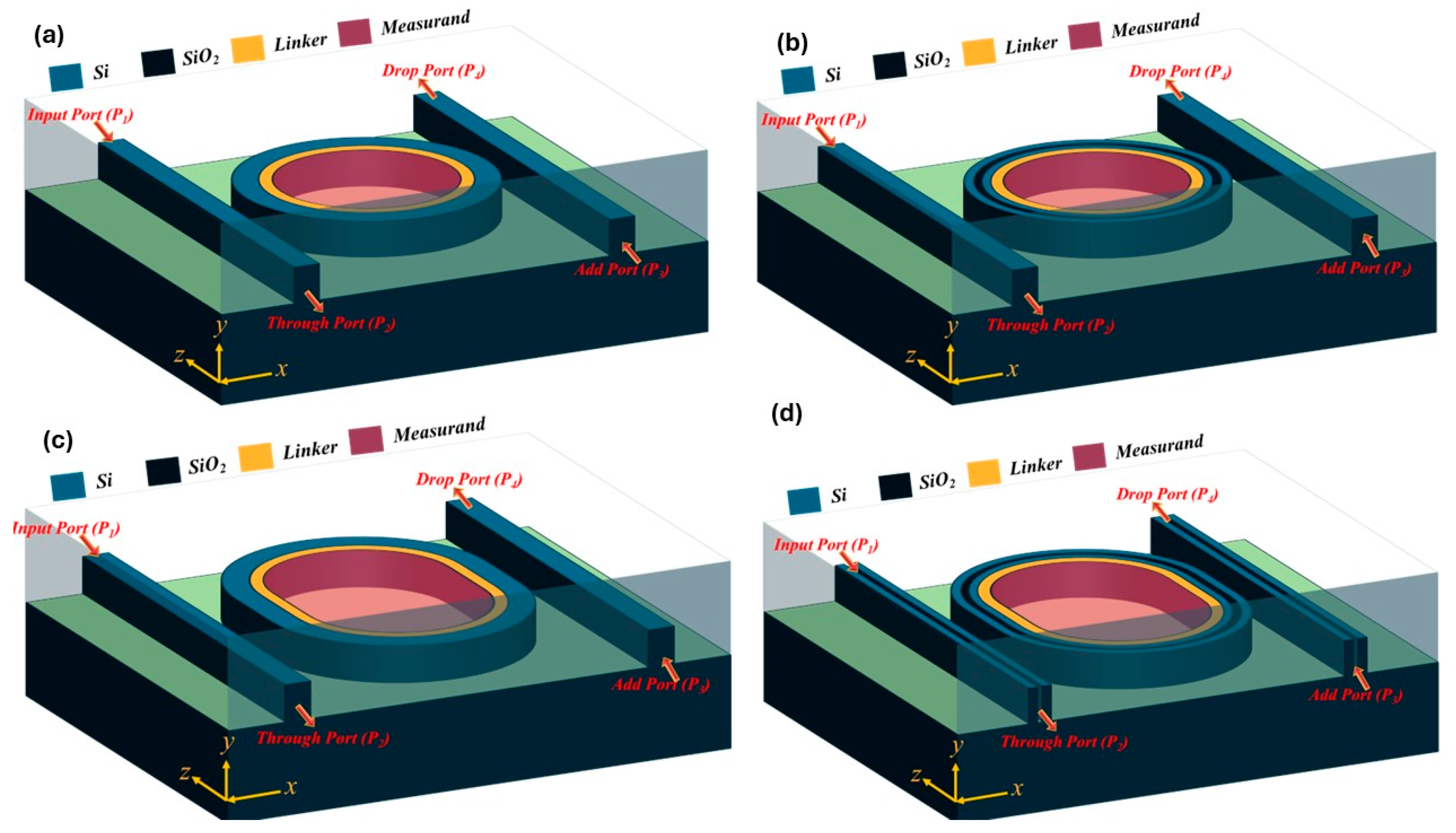
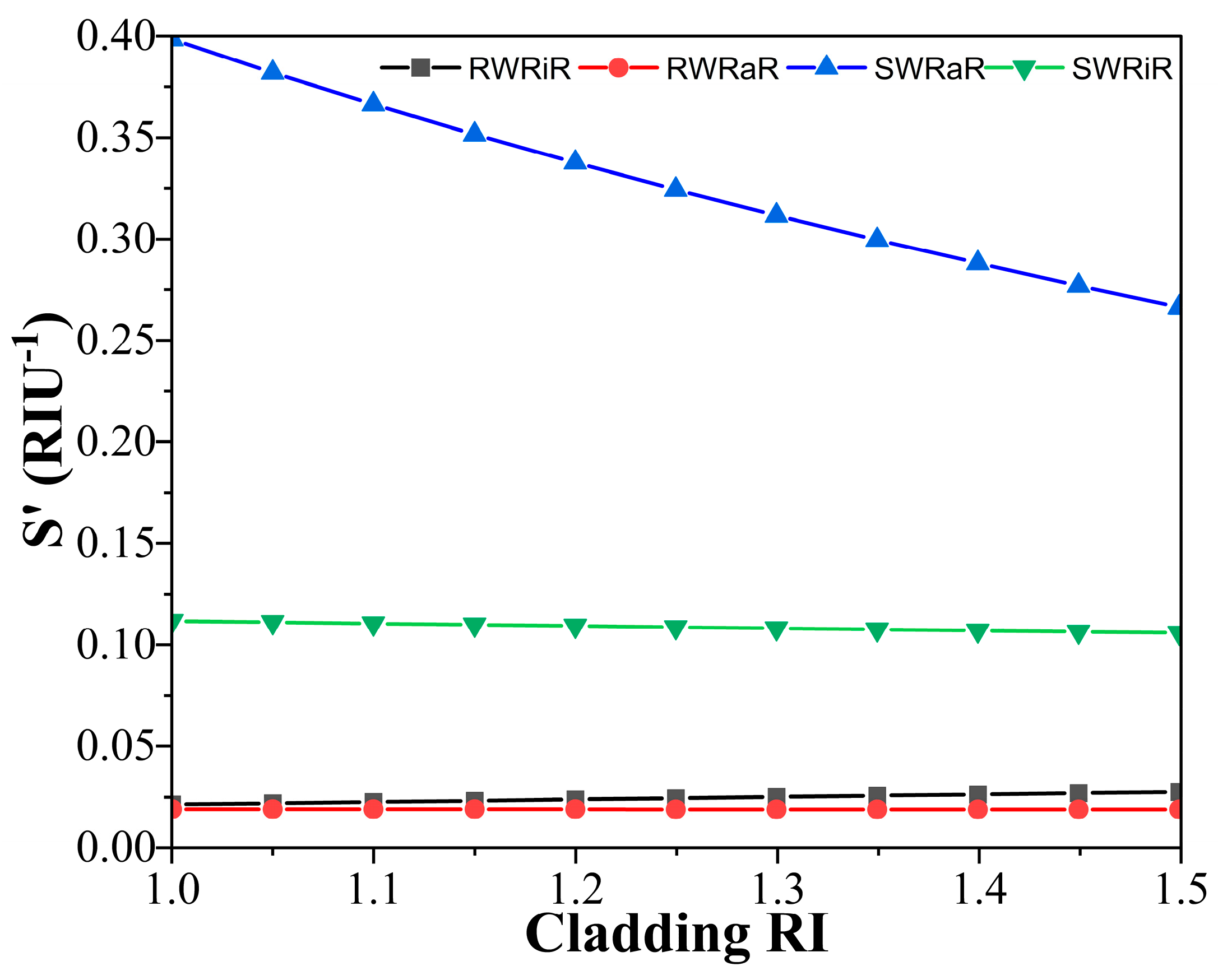
The study of infected biological cells is crucial in modern biomedical research. This work presents a passive sensing approach using optical resonators, designed to detect malignant diseases within a refractive index (RI) range of 1 to 1.5. A comprehensive theoretical analysis is conducted, yielding an expected limit of detection (LoD) ranging from 0.03 nm/RIU to 0.92 nm/RIU. Furthermore, an in-depth investigation of DNA hybridization is performed, incorporating a 1.8 nm linker layer at the analyte boundary. The refractive indices of single-stranded DNA (ssDNA) and double-stranded DNA (dsDNA) are 1.456 and 1.529, respectively. The novelty of this work lies in the renaturation process of ssDNA to dsDNA, demonstrated through a labeled sensing modality with a measurable shift in the resonance wavelength spectrum. The proposed surface-functionalized resonators, designed using Silicon-on-Insulator (SOI) technology, include (a) a Rectangular Waveguide-based Ring Resonator (RWRiR), (b) a Rectangular Waveguide-based Racetrack Resonator (RWRaR), (c) a Slot Waveguide-based Ring Resonator (SWRiR), and (d) a Slot Waveguide-based Racetrack Resonator (SWRaR). Among these, the SWRiR exhibits the best performance for DNA sensing, achieving a quality factor (Q-factor) of 2216.714, a sensitivity (S) of 54.282 nm/RIU, and a normalized sensitivity (S’) of 0.0349.
Keywords: integrated photonic; silicon photonics; optical waveguides; SOI technology; DNA hybridization; ring resonators; racetrack resonators integrated photonic; silicon photonics; optical waveguides; SOI technology; DNA hybridization; ring resonators; racetrack resonators