Review

Application of Terahertz Detection Technology in Non-Destructive Thickness Measurement


1
School of Opto-Electronic and Communication Engineering, Xiamen University of Technology, Xiamen 361024, China
2
Fujian Zhengtai Judicial Expertise Center, Xiamen 361006, China
*
Author to whom correspondence should be addressed.
Photonics 2025, 12(12), 1191; https://doi.org/10.3390/photonics12121191
Submission received: 26 October 2025 / Revised: 25 November 2025 / Accepted: 29 November 2025 / Published: 3 December 2025
(This article belongs to the Special Issue Terahertz (THz) Science in Photonics)

Abstract

Terahertz (THz) waves, situated between the infrared and microwave regions, possess distinctive properties such as non-contact, high penetration, and high resolution. These properties render them highly advantageous for non-destructive thickness measurement of multilayer structural materials. In comparison with conventional ultrasound or X-ray techniques, THz thickness measurement has the capacity to acquire thickness data for multilayer structures without compromising the integrity of the specimen and is characterized by its environmental sustainability. The extant THz thickness measurement techniques principally encompass time-domain spectroscopy, frequency-domain spectroscopy, and model-based inversion and deep learning methods. A variety of methodologies have been demonstrated to possess complementary advantages in addressing subwavelength-scale thin layers, overlapping multilayer interfaces, and complex environmental interferences. These methodologies render them suitable for a range of measurement scenarios and precision requirements. A wide range of technologies related to this field have been applied in various disciplines, including aerospace thermal barrier coating inspection, semiconductor process monitoring, automotive coating quality assessment, and oil film thickness monitoring. The ongoing enhancement in system integration and continuous algorithm optimization has led to significant advancements in THz thickness measurement, propelling it towards high resolution, real-time performance, and intelligence. This development offers a wide range of engineering applications with considerable potential for future growth and innovation.

1. Introduction

In various domains, including industrial production, quality control, and material research, the measurement of thickness has consistently been recognized as a vital inspection task [1]. Accurate determination of the thickness of coatings, films, composite materials, insulating layers, dielectrics, and multilayer structures is essential for evaluating product performance, ensuring safety, and achieving process control [2,3,4]. Traditional thickness measurement methods, such as eddy current, ultrasonic, infrared thermal imaging, and X-ray, can all be used to detect coating thickness. However, with the increasing diversity of materials, especially the growing application demands in semiconductors, polymers, biological tissues, and multilayer non-metallic materials [5,6], these methods have exhibited notable limitations regarding spatial resolution, material selectivity, penetration depth, and non-contact operation. To address these issues, researchers have begun to focus on new electromagnetic detection methods that are non-contact and high-resolution and have material penetration capabilities. Among them, THz non-destructive testing technology can effectively overcome the above problems and obtain the thickness information of multiple coatings in real time in a non-contact form.
THz waves are typically defined as electromagnetic waves with frequencies ranging from 0.1 to 10 THz, corresponding to wavelengths of 0.03 to 30 mm and photon energies of 0.414 to 41.4 meV. This frequency range is situated at the intersection of photonics and electronics [7,8,9].
As electromagnetic radiation, THz waves interact with dielectric materials through the same fundamental mechanisms of refraction, reflection, and interference that govern classical optics [10]. These interactions, combined with their relatively long wavelength and low photon energy, endow THz waves with a unique penetration capability through many optically opaque materials while remaining non-ionizing and inherently suitable for non-contact measurements. These characteristics have opened up an extremely broad range of applications across numerous fields. For example, advanced dispersion metasurface THz imaging has enabled three-dimensional, high-resolution reconstruction of complex multilayer structures and micro–nano scales [11], providing a novel approach for analyzing samples that are difficult to process with traditional optical and X-ray methods. Additionally, in agricultural remote sensing, THz waves facilitate non-contact, real-time monitoring of crop leaf moisture content, offering an efficient tool for precision irrigation and plant health assessment [12]. These diverse applications underscore the broad potential of THz technology across interdisciplinary fields such as industrial non-destructive testing, biomedical imaging, and agricultural remote sensing, delivering innovative solutions that surpass conventional methods.
The unique characteristics of THz technology make it particularly prominent in the critical industrial task of thickness measurement. With the rapid development of THz technology, thickness measurement methods based on THz spectroscopy have made significant progress in three main directions: time-domain methods, frequency-domain methods, and model-based inversion and deep learning methods. Specifically, time-domain methods estimate interlayer thickness by measuring the time delay between reflected echoes generated by the THz pulse at different interfaces of the sample [13]. In contrast, frequency-domain methods extract optical path difference (OPD) information by analyzing the interference features of the transmission or reflection spectra at different frequencies, thereby enabling thickness estimation [14,15]. For complex scenarios such as multilayer structures, inhomogeneous media, or severe signal overlap, model-based inversion techniques fit the measured signals with THz propagation models to solve for thickness [16]. In addition, model-based inversion and deep learning methods, such as those based on deep learning, establish the mapping between signals and thickness through model training.
In summary, THz technology possesses strong material penetration, high temporal and spectral resolution, and non-contact, non-destructive testing capabilities, which make it particularly suitable for thickness characterization of multilayer dielectrics, coatings, and complex interfaces [17]. This paper systematically reviews recent advances and potential applications of THz-based thickness measurement, focusing on three mainstream approaches: time-domain spectroscopy (TDS) based on pulse-echo delays, frequency-domain spectroscopy (FDS) utilizing spectral interference, and model-based inversion and deep learning methods. Time-domain and frequency-domain techniques enable rapid thickness assessment of single-layer and multilayer structures [18], whereas model-based inversion and deep learning methods demonstrate superior robustness and adaptability under complex or non-ideal conditions.

2. Terahertz Time-Domain Spectroscopy

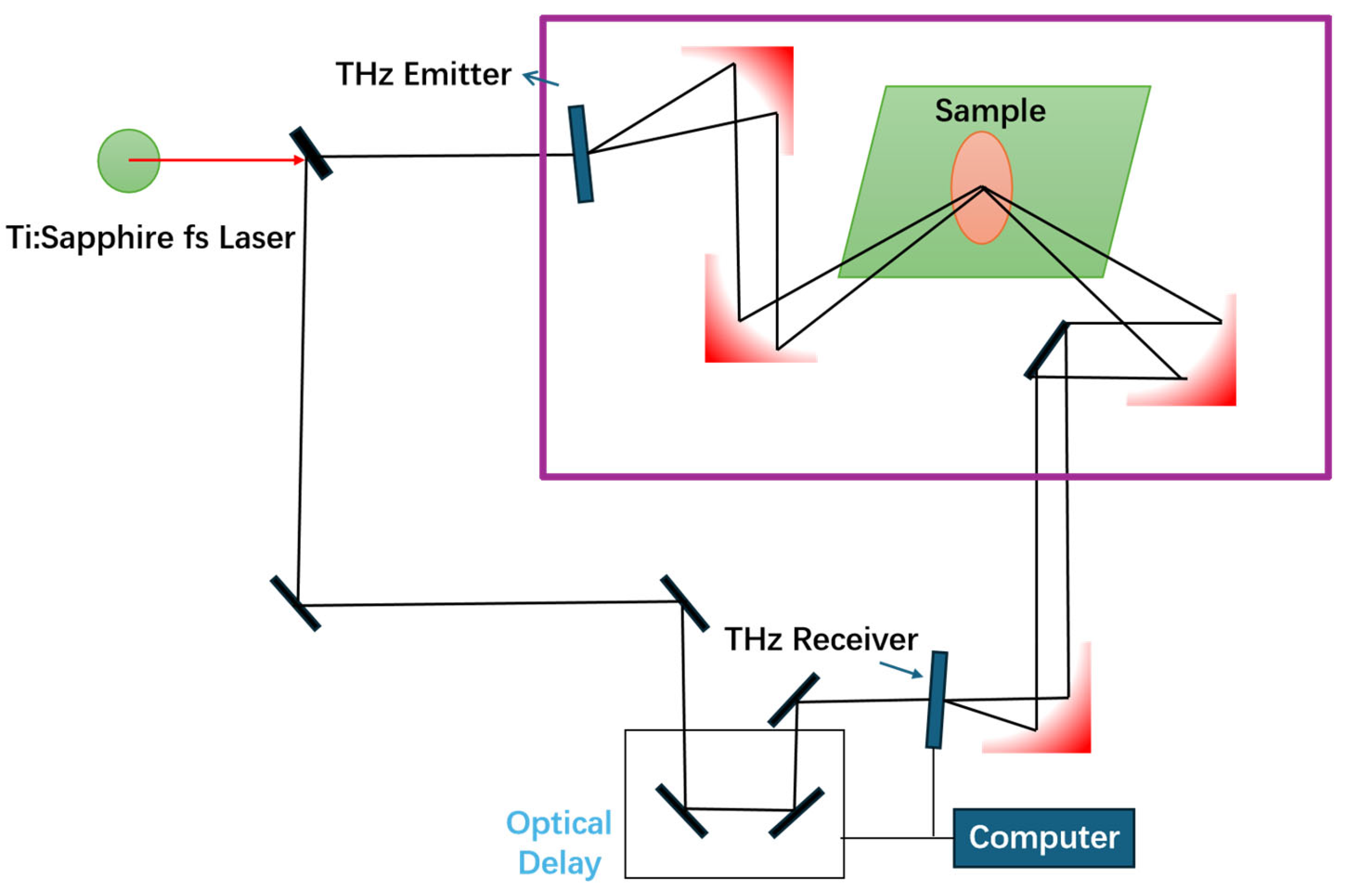
Terahertz time-domain spectroscopy (THz-TDS) generates broadband THz pulses using femtosecond lasers and coherently detects them, directly recording the full-time-domain waveform of the electric field reflected or transmitted by the sample. This allows for the simultaneous acquisition of both amplitude and phase information. The sample thickness is determined from the time delay between the main pulse and the echo pulse in the time-domain signal, combined with the OPD. This method relies on a femtosecond laser as the excitation source. The laser pulse is divided by a beam splitter into a pump pulse and a probe pulse. The pump pulse passes through a time-delay system and is then directed onto a THz emitter, thereby generating a THz pulse. The probe pulse subsequently converges with the THz pulse and propagates collinearly through a THz detector, enabling measurement of the THz electric field. By adjusting the time-delay system to vary the relative timing between the pump and probe pulses, the complete time-domain waveform of the THz pulse is obtained. Applying a Fourier transform to this waveform yields the frequency-domain spectrum of the sample, from which optical parameters, such as absorption coefficient, refractive index, and transmittance, are subsequently extracted.
Compared with traditional optical or contact-based thickness measurement methods, TDS provides a wide bandwidth and high temporal resolution, which makes it particularly suitable for rapid measurements of coatings, films, and multilayer structures. TDS has been widely applied in industrial and scientific research [19,20], primarily through approaches such as the time-domain single-point method and the echo separation method. In the time-domain single-point method, the time delay between the reflection pulse and the echo pulses at a fixed spatial position on the material surface is analyzed, and the OPD is incorporated to determine the thickness. This method is relatively simple and enables rapid measurements, rendering it suitable for single-layer or uniform films. The echo separation method resolves the problem of overlapping THz echo signals in multilayer structures by employing algorithms to separate the signals, thereby improving measurement accuracy.

2.1. Time-Domain Single-Point Method

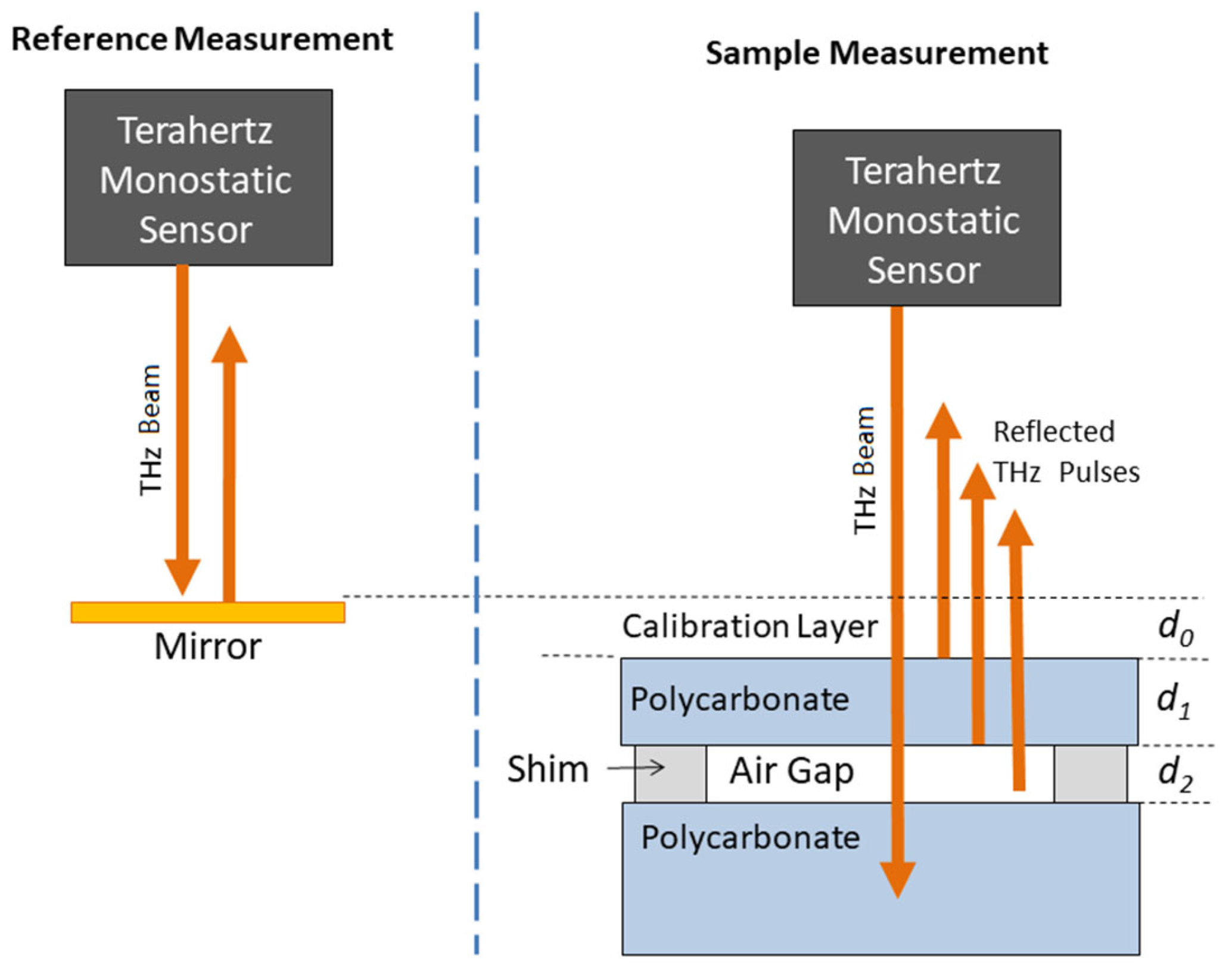
The time-domain single-point method, a core thickness measurement technique in THz-TDS, is primarily implemented in reflection mode. In this method, femtosecond laser-driven THz pulses are irradiated onto the material surface. The echo signal generated by interface reflections is acquired at a single spatial position. Owing to refractive index differences between material layers, THz pulses undergo multiple internal reflections, producing echo signals. This process produces the time delay between the main pulse and the echo pulses. When combined with the refractive index of the medium, this information enables the determination of sample thickness. This method relies on the direct mapping relationship between time delay and thickness, avoiding the complexity of frequency-domain transformations to effectively simplify data processing. Furthermore, the broadband characteristics of THz pulses enable direct signal analysis in the time domain, making it suitable for real-time detection and characterization of complex samples [21].The typical experimental setup is depicted in Figure 1. This approach utilizes a photoconductive antenna (PCA) powered by a high-repetition-rate, fiber-based femtosecond laser to generate and detect THz pulses. It provides several advantages, including a compact structure, low cost, and ease of integration.
In 1999, Duvillaret et al. introduced a foundational method for simultaneously and accurately determining both optical constants and sample thickness using THz-TDS. This approach relies on only two time-domain measurements—the reference pulse and the pulse transmitted through the sample—eliminating the need for additional mechanical thickness measurements and achieving a thickness accuracy of better than 1% [23]. Building upon this core capability of material characterization, THz-TDS quickly found specialized applications in industrial process monitoring. For example, in 2005, Yasui et al. applied reflective THz-TDS for the non-contact thickness measurement of industrial paint films. By utilizing the first-echo time-of-flight (TOF) technique, they achieved measurements across thickness ranges from tens to hundreds of micrometers while simultaneously monitoring the wet-to-dry transition during the paint film drying process [24]. Furthermore, leveraging the high-resolution nature of THz reflectometry, the technique has been advanced for complex non-destructive evaluation (NDE) tasks. Illustrating this, in 2013, Im et al. employed a THz reflectometer system to scan and image sawtooth-shaped delamination defects artificially introduced in GFRP composites used in wind turbine blades. Using the single-point TOF method, they successfully measured multilayer structures with thicknesses ranging from 120 to 500 µm, achieving sub-micrometer accuracy [25]. In 2017, Dong et al. reported the measurement of polymer coating thickness (50 µm) using single-point reflection THz-TDS [26]. In 2020, Unnikrishnakurup et al. employed the single-point reflection THz-TDS method to measure the thickness of thermal barrier coatings (38 µm) on aircraft engines. By directly measuring the time difference to cancel deconvolution and introducing a 30° incident angle correction, they quantified measurement errors ranging from 5.24% to 10.28% [27].
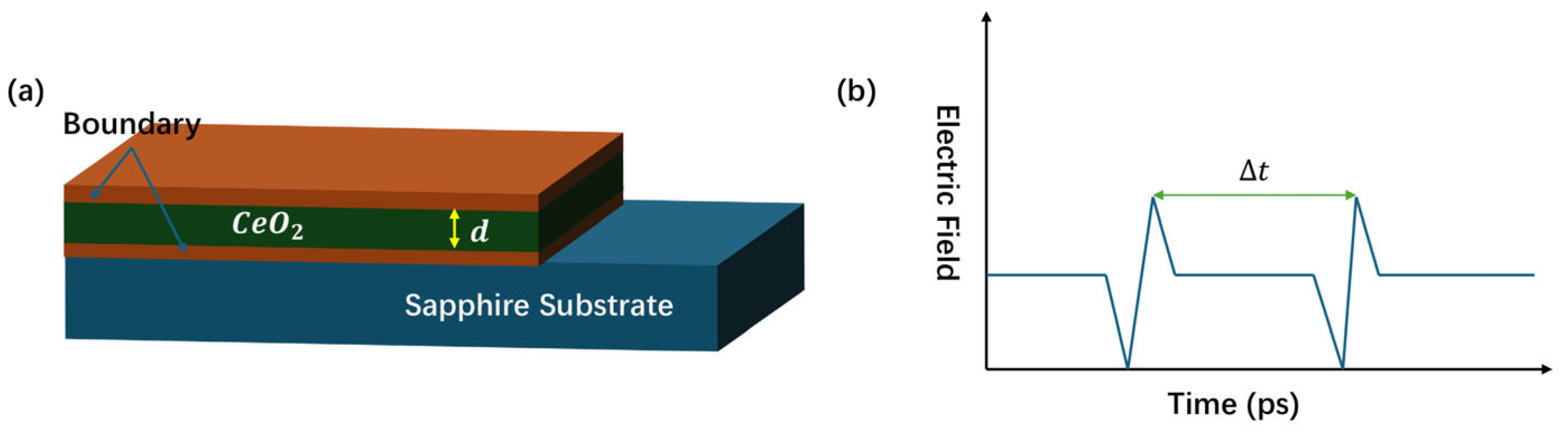
Although THz-TDS systems with high repetition rates (typically around 80 MHz) are favored for real-time monitoring applications due to their rapid data acquisition capabilities, femtosecond laser-pumped THz systems with lower repetition rates (ranging from 1 kHz to several hundred kHz) offer unique advantages in scenarios requiring extremely high sensitivity and pulse energy. In 2020, Nimanpure et al. successfully measured a 35.83 µm CeO2 film on a sapphire substrate using this high-end configuration, achieving precise thickness measurement through echo time delay in reflection mode [28]. The study focuses on a single spatial position, namely a single-layer thin film or coating deposited on a substrate. When a THz pulse impinges on the film surface, discontinuities in refractive index result in reflections at both the air–film and film–substrate interfaces, thereby generating a series of echo pulses. The core challenge in employing femtosecond pulses for film-thickness and refractive index measurements lies in accurately capturing the pulse time delay induced by sample insertion. When a sample is inserted perpendicularly into the propagation path of a THz beam, the pulse experiences a measurable delay as it traverses the sample owing to the reduced propagation velocity. The OPD corresponding to this time delay satisfies the following relationship with the sample thickness and refractive index:
Δ t = 2 ( n g n 0 ) d c
Here c denotes the speed of light in vacuum, and n 0 is the refractive index of air (approximately 1). This equation is valid only for single-layer thin films and when the sample is perpendicular to the incident light. Therefore, under the assumption that the sample’s refractive index ( n g ) in the THz region remains constant, the geometric thickness of the film can be measured from the echo pulse as shown in Figure 2.
To measure the time delay of the reflected signal, the THz-TDS system uses a pump–probe mechanism for temporal sampling. At the detector, the incident THz pulse is synchronously sampled with a femtosecond probe laser pulse passing through an adjustable optical path, thereby capturing the time-delay signal caused by the THz pulse reflecting at the interface. This pump–probe approach requires a time-delay stage to resolve the time difference between the main and echo pulses, thereby allowing for the calculation of the sample thickness.
The schematic of the reflective THz-TDS system employed for thickness measurement in this study. At the heart of the system is a low-repetition-rate (1 kHz) femtosecond laser amplifier. The high-energy pulses it produces drive the generation of broadband terahertz pulses via the optical rectification effect in a lithium niobate crystal. When the sample is inserted perpendicularly into one optical path of the interferometer, the laser pulse traverses the sample during propagation, resulting in a single-pass time delay. For the THz pulse operating in reflection mode, which propagates through the sample once in both forward and backward directions, the total propagation delay is equivalent to twice the single-pass delay. The corresponding OPD can thus be expressed as a function of the sample thickness and its refractive index, an equation that is valid only for single-layer thin films and when the sample is perpendicular to the incident light, as shown in the following equation:
Δ P n = 2 ( n n 0 ) d
where Δ P n represents the total OPD, n denotes the refractive index of the adhesive, and d is the physical thickness of the layer. This formula demonstrates that when light passes through a material with a higher refractive index than air, its propagation speed decreases, thereby introducing an additional effective optical path. By precisely measuring this delay, the geometric thickness or refractive index of the sample can be determined.
After passing through the thin film, the typical time-domain response of the THz signal is observed to exhibit an echo following the main pulse—a reflection that occurs after a specific time delay. By measuring the time interval between the main and echo signals, the film thickness can be determined. In the experiment, the first peak of the generated time-domain waveform is attributed to the first interface (air/film), whereas the second peak corresponds to the second interface (film/substrate). The first peak is observed at approximately 5.22 ps, whereas the second and third peaks are detected at around 5.80 and 10.93 ps, respectively. The time delay between the first two peaks is measured to be approximately 0.57 ps, which corresponds to a film thickness of about 35.83 µm. The delay between the second and third peaks is utilized to estimate the substrate thickness, which is approximately 434.74 µm. Consequently, the total thickness of the sapphire sample is determined to be approximately 470.57 µm.
Moreover, in 2022, Xu and Jiang implemented single-point reflection-mode THz-TDS for non-destructive evaluation and imaging of corrosion layers on steel plates, achieving precise measurements for corrosion depths exceeding 40 µm and enabling three-dimensional visualization. Following extraction of the time-delay differences from the reflected THz signals, three-dimensional maps depicting the spatial distribution of corrosion thickness across the scanned area were reconstructed. These results provide a comprehensive and intuitive representation of the corrosion profile, demonstrating the capability of THz-TDS for quantitative structural assessment [29].
In 2022, Hansen et al. developed a single-shot THz-TDS system employing the single-point reflection method to measure paper thicknesses from 68 to 443 µm [30].
In summary, the time-domain single-point method measures thickness by analyzing the time delay between the main and echo pulses, combined with the OPD, eliminating the need for complex frequency-domain processing. It is ideal for measuring single-layer coatings with clear interfaces and easily distinguishable echoes. Recent optimizations of the system architecture—such as incident angle correction and pump–probe measurements—have improved the accuracy of non-destructive thickness measurement in multilayer structures. This technique will increasingly play a significant role in structural characterization of diverse material systems and in industrial online inspection.

2.2. The Echo Separation Method

The echo separation method is a THz time-domain technique for multilayer thickness measurement utilizing multiple echo pulses formed by reflections at each layer interface. However, the small distance between adjacent interfaces in multilayer materials causes overlap of reflection signals along the time axis [31,32]. To resolve the issue of time-domain signal overlap in multilayer structure measurements, the echo separation method seeks to isolate echo information from each interface by applying mathematical algorithms to overlapping measurement signals. When reflected waves from closely spaced interfaces combine in the time domain, resulting in a single complex waveform, this method utilizes specific algorithms—such as deconvolution—to process the composite signal. The key calculation involves “reversing” the signal mixing effects, thereby enhancing the time-domain resolution and allowing for the separation of contributions from each interface. This process reconstructs distinct, isolated echo pulses corresponding to each internal boundary.
In recent years, researchers have expanded the application of echo separation-based THz-TDS for thickness measurement in various complex structures. In 2021, Burger et al. refined the Fukuchi signal processing technique to enhance the THz-TDS thickness measurement method, accounting for the influence of surface roughness. This enhancement enabled precise measurement of thermal barrier coating thickness under non-vertical incidence [33]. In 2022, Liu et al. achieved spatial distribution measurements of thermal barrier coating thickness on turbine blades by integrating time-domain peak separation with two-dimensional scanning using the echo separation method [34].
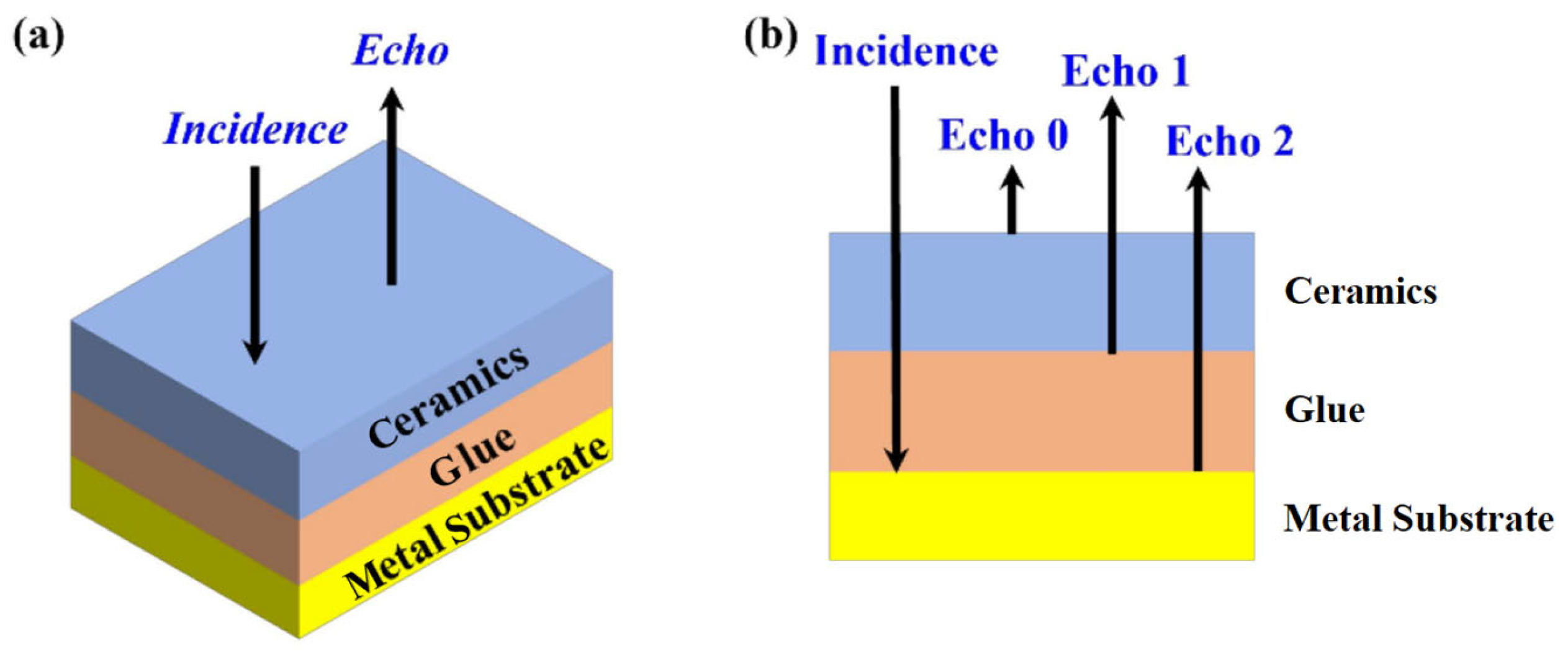
In 2022, Yang et al. addressed the limitations of traditional non-destructive testing methods for measuring ceramic–metal composite structure thickness—specifically, insufficient penetration and safety concerns—by proposing an accurate adhesive layer thickness measurement technique. This method combines THz-TDS with sparse deconvolution, effectively resolving issues such as overlapping reflection signals at the upper and lower adhesive layer interfaces and difficulties in peak identification due to a low signal-to-noise ratio [35].
As shown in Figure 3, the sample consists of a three-layer structure: ceramic, adhesive layer, and metal. The incident THz pulse reflects at each interface, recording the propagation path of the THz wave. Reflection signals from the THz pulse are generated at the ceramic surface, ceramic–adhesive interface, and adhesive–metal interface. The time delay of these signals is influenced by both the thickness of the adhesive layer and the complex permittivity (refractive index) of the material. The thickness is calculated using the TOF formula:
d = c 2 n ( T down T up )
where T d o w n and T u p represent the flight times of the reflections from the lower and upper surfaces, respectively.
To achieve echo separation, Yang et al. implemented a sparse deconvolution algorithm that models the THz reflection signal as the convolution of the system’s impulse response and the sample’s reflectivity sequence. By incorporating a regularization term to enforce sparsity, the method enhances model accuracy and enables high-resolution reconstruction of individual interface reflections. The specific optimization objective is
min f 1 2 H f y 2 2 + λ f 1
Here, H represents the convolution matrix, f the sparse sequence, y the received THz signal, and λ the regularization parameter.
The solution is obtained using an iterative thresholding algorithm, with each iteration step defined as follows:
f i + 1 = S λ τ f i τ H T ( H f i y )
Here, S denotes the soft thresholding operation controlling the recovery of sparse structures, and τ represents the step size. This approach achieves temporal separation of overlapping echoes, enhancing the thickness measurement accuracy of thin-layer bonded structures.
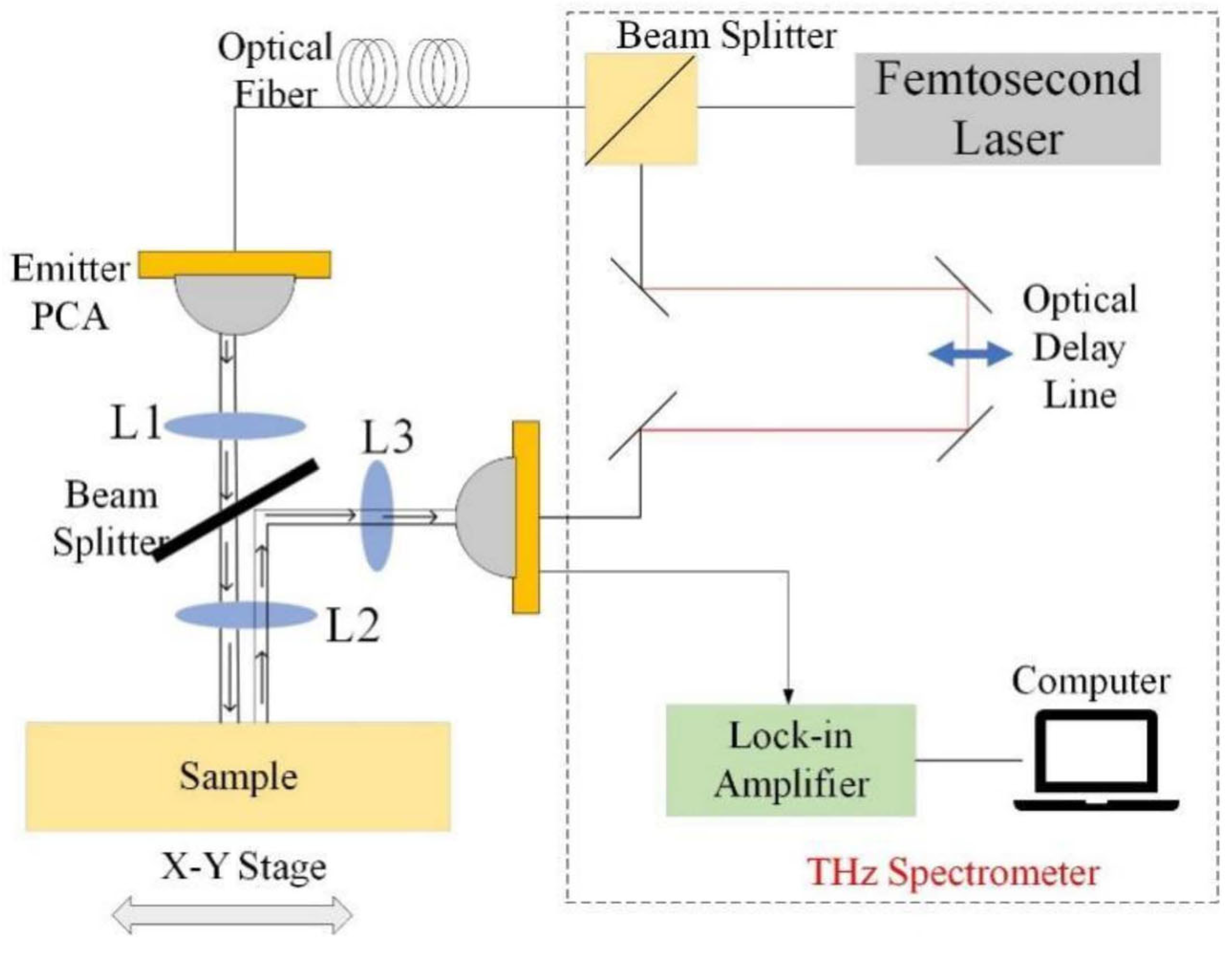
To address overlapping reflection peaks caused by the attenuation and dispersion effects of ceramic materials on THz signals, a reflective tera TDS system was employed. As shown in Figure 4, the system uses femtosecond laser-generated ultrashort pulses to excite THz pulses. After multiple reflections within the sample, a delay-scanning mechanism enables high-time-resolution acquisition of reflected signals. The system precisely captures faint echo signals generated at the interfaces above and below the adhesive layer, providing raw time-domain data for subsequent echo separation algorithms.
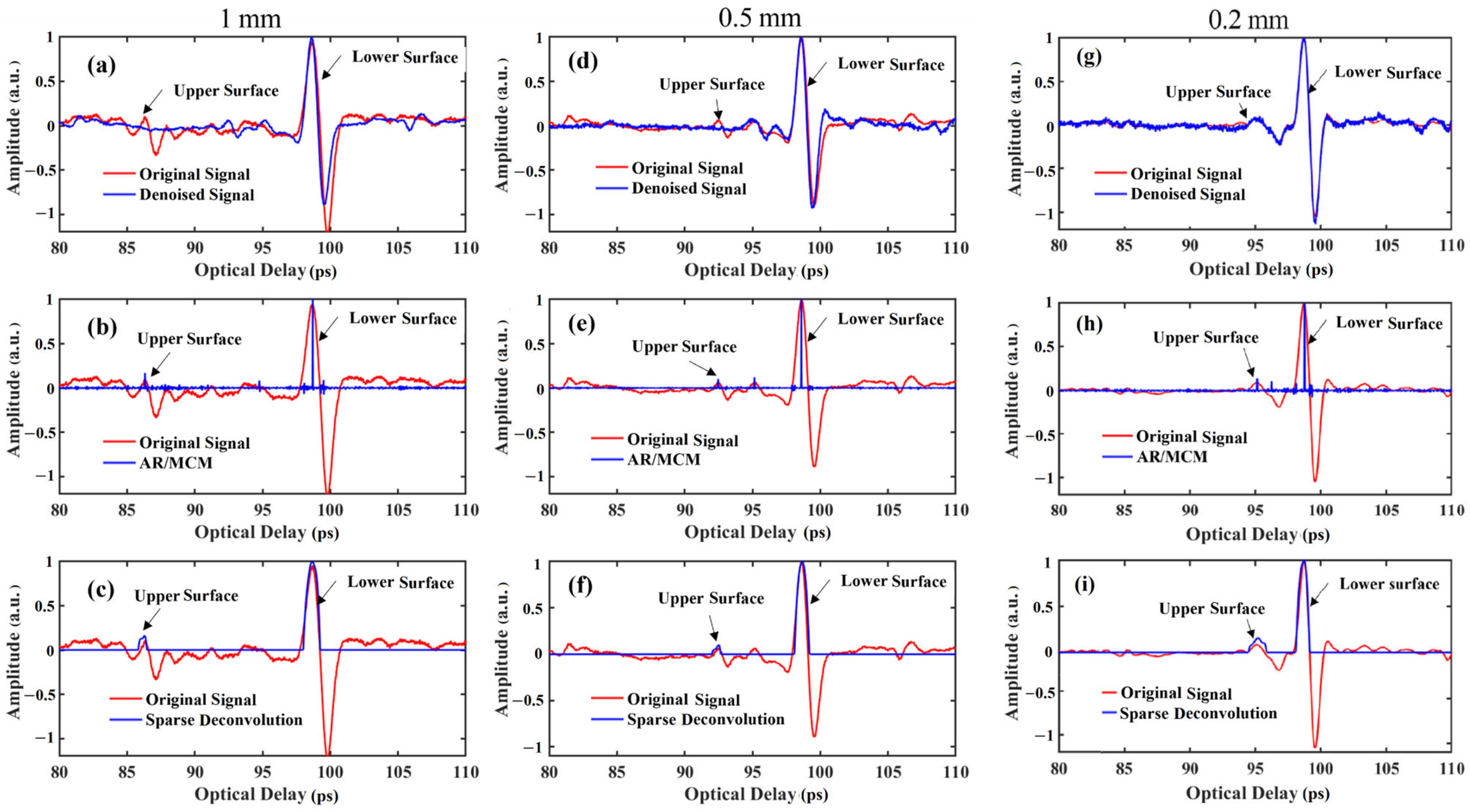
Yang et al. employed a sparse deconvolution method with echo separation technology to compare wavelet denoising and autoregressive/minimum covariance method (AR/MCM) analysis results on bonded layer samples with thicknesses of 1, 0.2, and 0.5 mm. Figure 5a–c shows the 1 mm thickness, Figure 5d–f the 0.5 mm thickness, and Figure 5g–i the 0.2 mm thickness.
The results demonstrate that for a 1 mm thickness, all three methods successfully resolve the echo peaks, with sparse deconvolution achieving the smallest measurement error (0.02 mm). At a thickness of 0.5 mm, the wavelet denoising method generates a double peak within the upper surface envelope, complicating signal interpretation, whereas sparse deconvolution maintains the lowest error (0.01 mm). For the 0.2 mm thin layer, wavelet denoising fails to clearly resolve the upper surface peak, and the AR/MCM method is affected by multi-peak interference. In contrast, sparse deconvolution accurately separates the echoes, producing a distinct peak with an error of only 0.02 mm. These findings indicate that as layer thickness decreases, signal aliasing in multilayer structures becomes more pronounced, thereby limiting the performance of both wavelet denoising and AR/MCM methods. Conversely, sparse deconvolution effectively suppresses signal aliasing and minimizes thickness resolution errors, yielding measurements that closely approximate the true values.
In 2023, Jang et al. further integrated time-domain peak separation with spatial scanning techniques, enabling simultaneous multilayer thickness measurement and debonding defect detection in ceramic–metal bonded structures. This approach was subsequently applied to assess the effects of thermal shock on structural integrity [36]. In the same year, Park et al. proposed an echo separation strategy that combines transfer function analysis with the Fabry–Perot effect, achieving precise measurement of both the total thickness of silicon wafers and their surface thin films. Additionally, they optimized the quartz window design to improve the adaptability of THz-TDS systems for in situ semiconductor inspection applications [37].
In summary, the echo separation method resolves echo overlap and signal aliasing in multilayer structures, improving thin-layer thickness analysis precision. Whether in ceramic–metal bonded structures or semiconductor thin-film inspection, the echo separation method has become a key driver propelling THz thickness measurement from experimental research to engineering applications [38].

3. Frequency-Domain Spectroscopy

FDS obtains OPD information through phase delay, interference, or the frequency response of THz waves. In the system, a continuous or modulated THz light source illuminates the sample, with detectors recording amplitude and phase variations across all frequency components. Frequency-domain signal analysis enables extraction of the sample’s optical constants and thickness information. Compared with TDS, FDS eliminates the need for femtosecond lasers, offering advantages such as simpler architecture, ease of integration, and lower power consumption. It is particularly suited for industrial online monitoring and multilayer material thickness measurement.
FDS primarily includes discrete-mode continuous-wave interferometry and frequency-sweep methods. Discrete-mode continuous-wave interferometry method derives thickness measurements by analyzing the phase or amplitude of continuous-wave signals at discrete frequency points. Frequency-sweep methods acquire beat frequency differences from reflected signals through continuous frequency scanning, enabling time-delay analysis in the frequency domain. Frequency-modulated continuous wave (FMCW) systems are a typical application of this approach [39,40].

3.1. Discrete-Mode Continuous-Wave Interferometry Method

Discrete-mode continuous-wave THz technology primarily uses frequency-domain point-sampling techniques for THz thickness measurement. By selecting one or more THz frequency points, it measures the phase and amplitude responses of transmitted or reflected signals. When a THz wave passes through or reflects off a multilayer material structure, phase differences arise due to varying propagation paths in each layer. Phase responses at different frequencies are recorded and analyzed to calculate the actual thickness using interference effects, phase shifts (e.g., Gouy phase shifts), or signal intensity variations [41].
In 2014, Kiwon Moon et al. used 0.35–0.7 THz (1 GHz step) to measure the conductivity and thickness of 1.868 mm thick glass substrates and ITO coatings with in-phase detection. The measurement time was reduced to 1 s, achieving accuracy comparable to THz-TDS, making it suitable for plasma display panel monitoring [42]. In 2016, Devi et al. used 0.3–0.7 THz (0.1 GHz steps) to analyze the multilayer coating (approximately 440 µm) of sugar-coated tablets via inverse Fourier transform, validating the resolution for multilayer structures. These studies relied on frequency-domain signal processing (e.g., IFFT) to extract phase and amplitude information, forming the technical foundation for subsequent interferometric methods and optimization algorithms [43]. Early frequency-domain analysis of multi-frequency continuous wave (CW) techniques inspired the use of phase interference technology, while single-frequency CW improved thickness measurement efficiency by simplifying frequency operations. In 2019, Choi et al. proposed a single-frequency CW method based on Gouy phase-shift interference. At 625 GHz, destructive interference was generated using the phase difference (π) between a focused wave and a collimated wave to measure the thickness of 100 µm adhesive tape (69, 103, 138 µm) with an error of ±2 µm, eliminating the need for frequency sweeping. This method outperformed the 700 GHz scanning requirement of THz optical coherence tomography (OCT) [44].
In the same year, Choi et al. applied this method to automotive paint film inspection, achieving 5% accuracy and demonstrating the industrial potential of single-frequency CW for rapid thin-film measurement [45]. These studies used interferometry to replace multi-frequency scanning, building on early phase analysis principles to achieve system miniaturization and faster measurements.
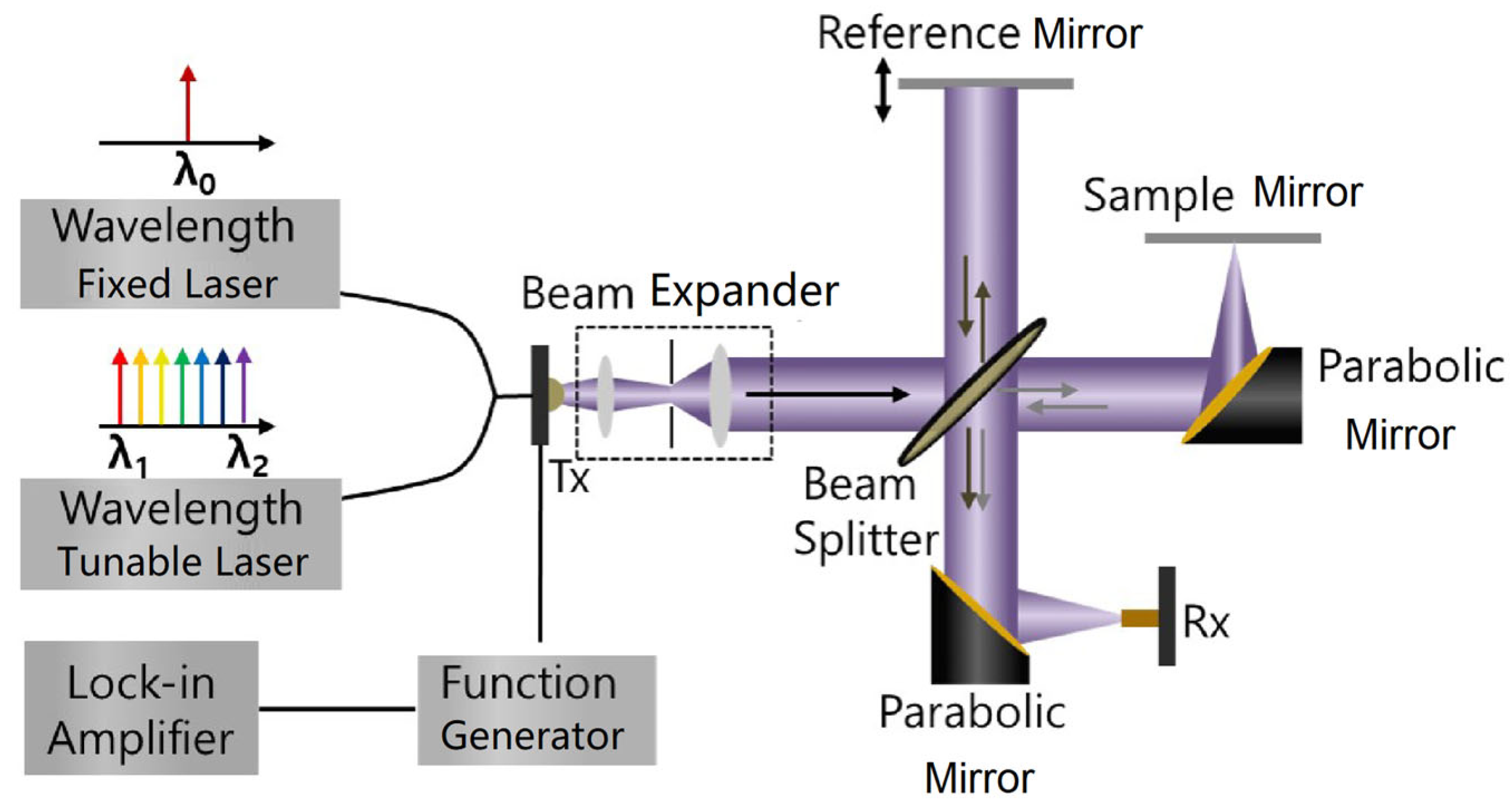
This method uses a Michelson interferometer configuration, as shown in Figure 6. One arm of the interferometer uses collimated THz waves as the reference beam, while the other focuses THz waves onto the sample via an off-axis parabolic mirror, forming the detection beam. After reflection from the sample and reference mirror, the two THz beams converge at the Schottky barrier diode (SBD) detector for interference. The interference signal is detected by a lock-in amplifier.
The Gouy phase shift is an additional phase transition occurring when a focused beam passes through the focal point, expressed as
Δ ψ ( v ) = π 2   tan 1 2 v c π v
v c = f l c w 0 2
where w 0 is the waist radius, f l is the focal length of the lens, and v c is the characteristic frequency.
E ref ( ω ) = E 1 cos ( k ω × ( z 1 Δ z ) ω t )
The electric field at the sample arm, after focusing, is
E sam = E 2 cos ( k ω z 1 ω t + Δ ψ )
where Z 1 represents the optical path of the sample arm, ψ denotes the Gouy phase shift introduced by focusing (theoretically approaching π near the focal point), E r e f and E s a m correspond to the electric fields in the reference arm, k is the wave number, ω is the angular frequency, and Δ z is the OPD between the two arms. The total interference intensity is provided by
I c a l c u l a t e d ( ω , Δ z ) = E r e f + E s a m 2
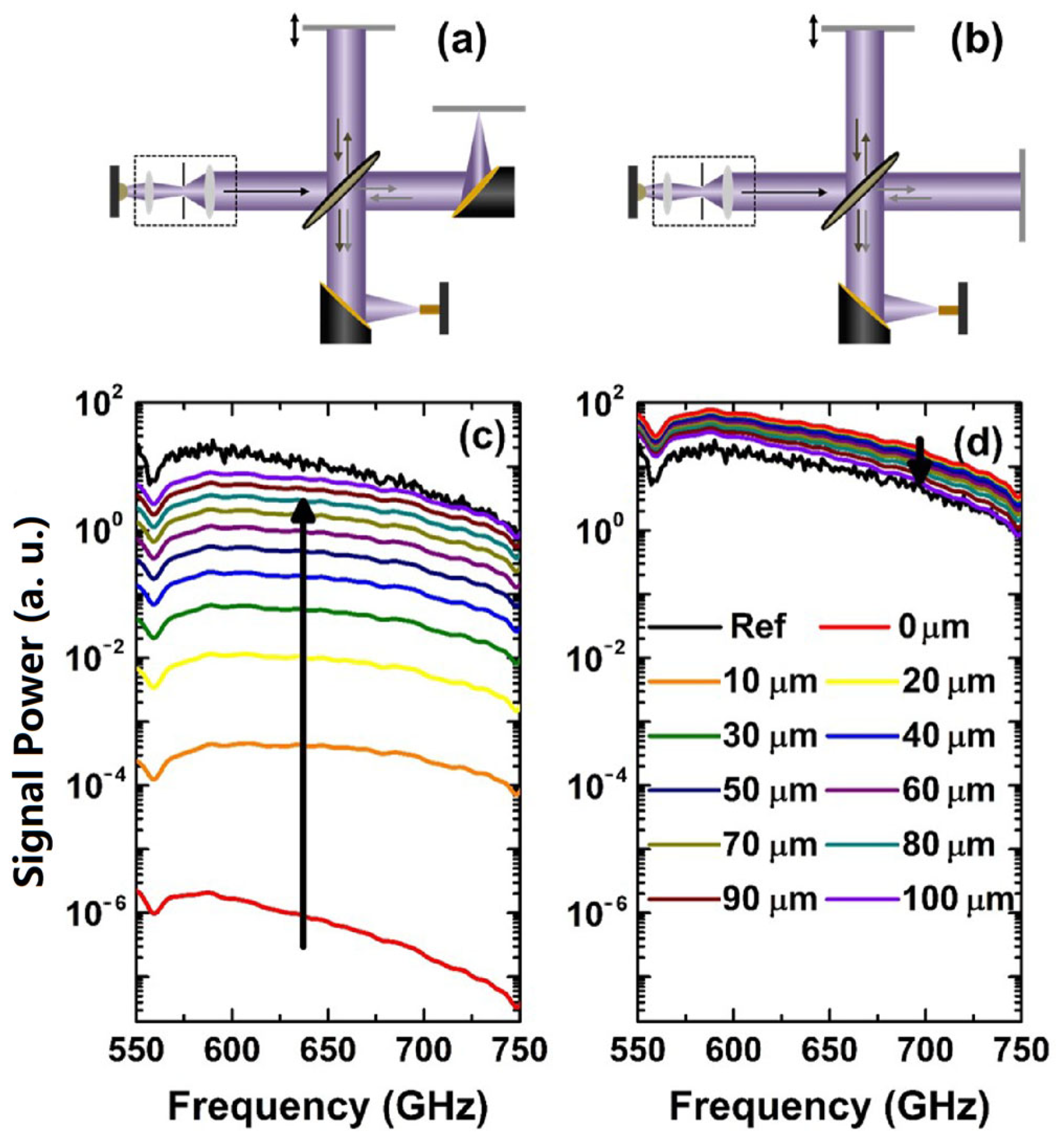
Using the Gouy phase shift, destructive interference occurs when the OPD between the two arms is zero. Minor variations in the OPD disrupt this interference, leading to measurable changes in signal intensity. By comparing the measured signals with the theoretically calculated ones, the system achieves high-precision thickness determination of the sample. Unlike conventional THz OCT, this system operates at a fixed frequency (625 GHz in the experiment), eliminating the need for frequency scanning and thus significantly reducing measurement time. Figure 7 illustrates the relationship between the interference signal and OPD variation for both the Gouy structure and the conventional collimator–collimator configuration. The interference signal intensity of the former exhibits a four-order-of-magnitude change over an OPD range of 10–100 µm, far exceeding the 2.5-fold change observed in the conventional configuration. This demonstrates that the system exhibits measurement sensitivity far exceeding the precision of the wavelength.
Additionally, the interference signal within this system exhibits extreme sensitivity to variations in sample thickness. When the reference mirror undergoes minute displacement (e.g., 90 μm) or OPD perturbations arise due to changes in sample thickness, the destructive interference state established by Gouy phase shifts is disrupted. This disruption causes a significant amplification of the interference signal intensity across the entire frequency range. As shown in Figure 7a, the measured spectrum shows a pronounced enhancement before and after OPD fine-tuning. The theoretical simulation spectrum in Figure 7b closely matches the experimental results, demonstrating the system’s excellent predictability and consistency in frequency-domain response modeling. Further analysis shows that compared with conventional THz OCT systems, this method achieves sub-micrometer thickness resolution at a fixed frequency (625 GHz). Conventional OCT systems require scanning bandwidths greater than 700 GHz to achieve similar resolution performance. In contrast, this method significantly improves the system’s sensitivity to minute thickness variations by constructing “phase-sensitive interference points.”
During thickness extraction, this method estimates thickness by constructing an error function between the interferometric signal and the theoretical simulation and then identifying its minimum. The error function is formulated as a squared error, specifically expressed as follows:
E r r o r ( Δ z ) = ω = ω 0 Δ ω / 2 ω 0 + Δ ω / 2 I m e a s u r e d I c a l c u l a t e d ω , Δ z 2
Here, ω 0 represents the starting frequency for error calculation, Δ ω denotes the width of the frequency range, I m e a s u r e d corresponds to the signal strength measured experimentally, and I c a l c u l a t e d refers to the theoretical signal strength.
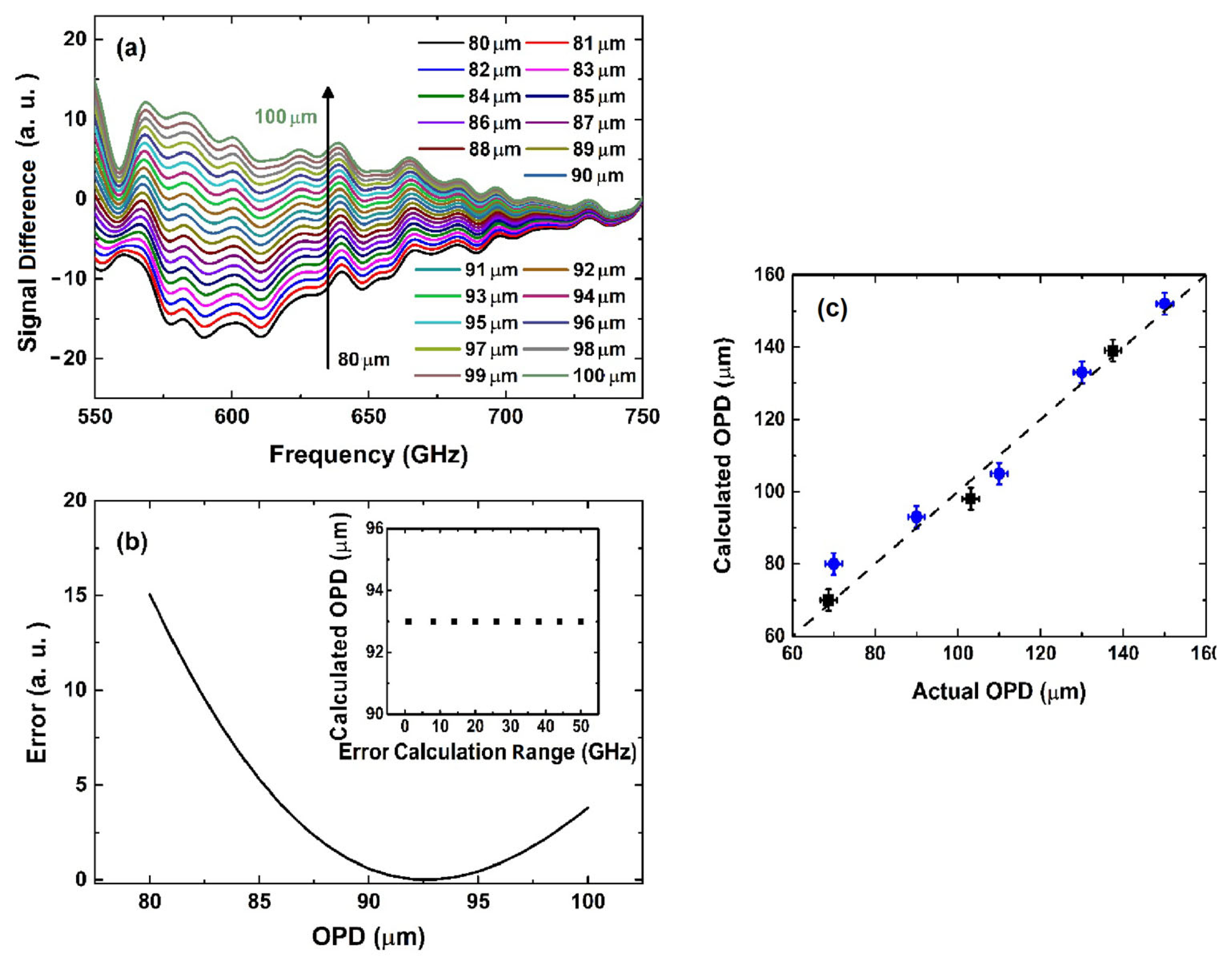
As shown in Figure 8a, the error function curve exhibits a distinct single minimum at a specific OPD position, which is adopted as the final thickness estimate. To validate the robustness of this approach, Figure 8b presents the variation in the error curve across different frequency bandwidths. The results show that the position of the error minimum remains nearly unchanged, demonstrating that the method is insensitive to frequency bandwidth and thus suitable for high-precision measurement in non-swept continuous-wave terahertz (CW-THz) systems.
To further verify the system’s measurement capability, adhesive tape was applied to the mirror surface in varying numbers of layers to artificially introduce thickness changes. The system successfully estimated the resulting OPD. As shown in Figure 8c, the theoretical thicknesses of one, two, and three tape layers are 69, 103, and 138 µm, respectively, while the corresponding measured results are 70, 98, and 139 µm. The maximum deviation does not exceed 5 µm, demonstrating the method’s high thickness measurement accuracy and stability and confirming its suitability for resolving fine structures in real samples.
Additionally, in 2023, Zhang et al. employed a 200–1200 GHz frequency range with 0.05 GHz steps to measure PTFE thickness via phase delay, achieving an error of 0.45%. They optimized the 800–900 GHz band for a high signal-to-noise ratio, validated the method under 17% humidity conditions, and demonstrated its suitability for plastics industry applications [46]. The single-frequency CW interferometry approach also provides valuable insights for optimizing multi-frequency CW algorithms. By reducing the number of frequency points and integrating efficient processing strategies, the capability for multilayer thickness measurement can be further enhanced.
In summary, the discrete-mode continuous-wave method determines thickness by analyzing phase and amplitude responses at selected frequency points, integrating interference effects with frequency-domain signal processing. This approach combines system simplicity, flexible frequency control, and ease of integration, showing significant potential across diverse fields—from glass panels and pharmaceutical coatings to automotive paint and PTFE materials.

3.2. Frequency-Sweeping Method

The frequency-sweeping method is a technique for thickness measurement utilizing THz frequency-domain information. It primarily calculates sample thickness by extracting OPD data through the beat frequency signal generated in the reflection path, which correlates with material thickness, based on the frequency of a continuous THz wave [47,48]. Specifically, it involves emitting a continuously varying frequency THz wave. When this wave strikes the sample surface, it reflects at the interfaces of multilayer structures. Echoes returning from different interfaces exhibit time delays due to varying propagation distances, manifesting as specific beat frequencies. By performing spectral analysis on the mixed signal, the delay times at each reflective interface can be extracted from the beat signals, enabling the calculation of the sample thickness. Consequently, it does not require femtosecond lasers or mechanical delay lines. This approach offers advantages such as compact system structure, stable operation, and suitability for non-contact and online detection [49].
As an application of the frequency-sweeping method, a linearly frequency-modulated CW signal is transmitted by the FMCW system. The beat frequency signal is obtained through a mixing analysis of the echo and the transmitted wave. The relationship between the beat frequency and the reflection delay time can be expressed as follows:
f b = B T τ = 2 B n d c 0
Here, B denotes the modulation bandwidth, and T represents the sweep period. Therefore, if the individual beat frequency components within the echo can be resolved, the corresponding thickness information can be determined.
Between 2020 and 2021, Schreiner et al. utilized FMCW sensors to innovatively measure the thickness of multilayer dielectric structures in the millimeter-wave and THz bands [50]. In 2020, they further advanced the frequency-sweeping methodology by adopting FMCW scanning techniques, achieving high-resolution thickness measurements of multilayer pipe walls. They compared the performance of the correlation, improved covariance, and MUSIC algorithms [51]. To further advance FMCW technology, they again employed FMCW sweeping in 2021, optimizing algorithms (steepest descent, Nelder–Mead, genetic algorithm) to achieve high-precision thickness measurements of acrylic samples (773 µm–4.9 mm) [52].
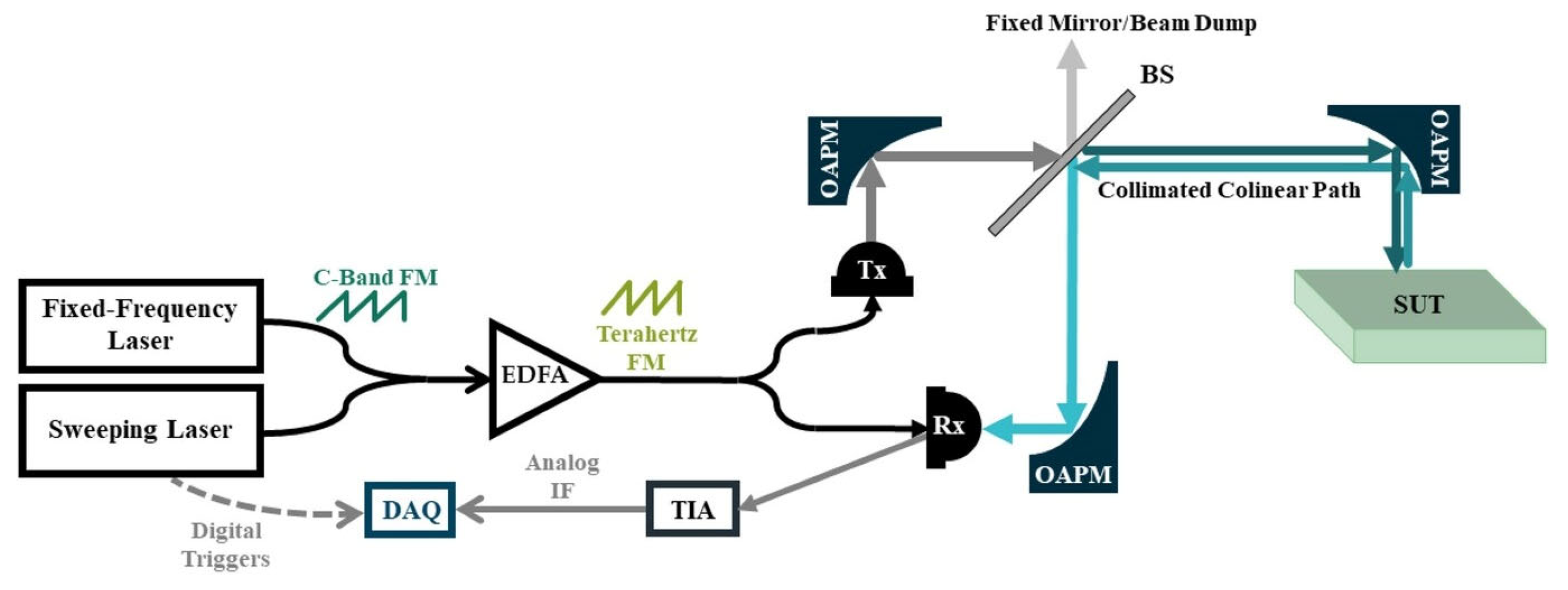
In 2023, Shiva Mohammadzadeh et al. developed an optoelectronic FMCW THz radar that employs frequency-sweeping techniques and optimizes linear frequency modulation for the precise measurement of plastic film thickness, PTFE sheet thickness, and battery electrode coating thickness [53]. The system is based on dual-laser electro-optic mixing (Figure 9) and achieves dual-mode operation at 600 GHz (0.6 THz, 560 Hz) and 1.65 THz (200 Hz) by optimizing nonlinear frequency modulation (e.g., cavity mode hopping) of the swept laser. The 1.65 THz bandwidth provides a free-space resolution of 90.6 µm, with an approximate resolution of 50.3 µm for plastic film thickness.
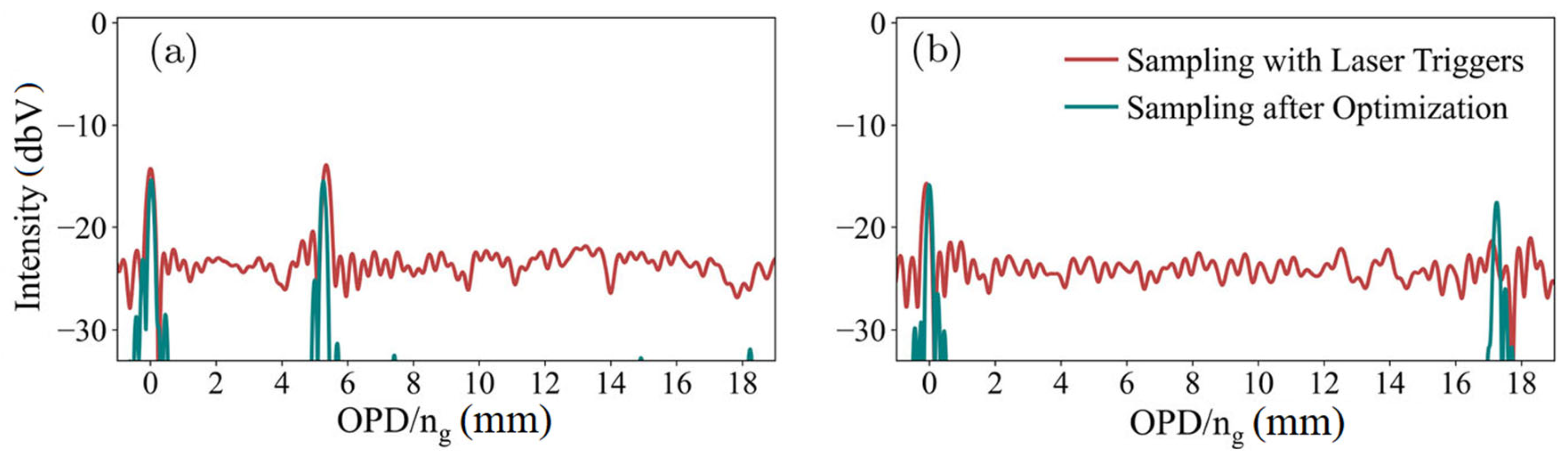
To achieve high-precision thickness measurement, this system utilizes a Michelson interferometer to characterize the laser’s frequency modulation characteristics, effectively resolving the nonlinearity issues of swept-frequency lasers. Figure 10 demonstrates the optimization results. In Figure 10b, the spectral range of the 5.25 mm PTFE plate exhibits energy dispersion prior to optimization, making peak detection challenging. After optimization, by stitching the 54–92 GHz gapless segment and applying linear regression, peak separation becomes distinct, with significantly improved signal-to-noise ratio. The key formula for beat frequency signals is:
s m ( t ) cos 2 π 2 R α ν n t
Here, R denotes the distance, α = B / T represents the modulation rate, and v n signifies the group velocity.
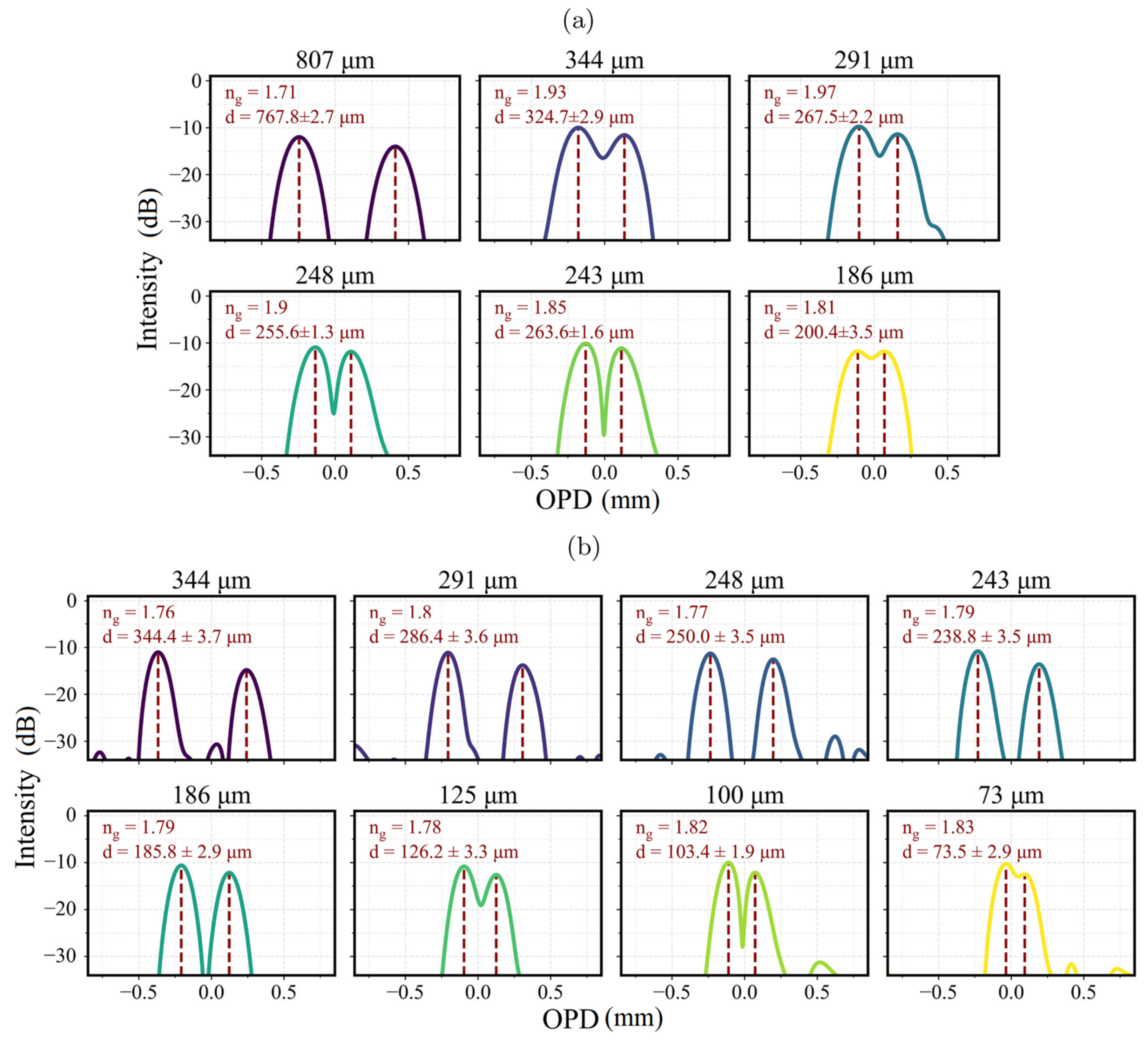
Based on an optimized frequency-sweeping method, measurements were performed on plastic films and PTFE plates. Figure 11a shows the 600 GHz (0.6 THz) mode, where the bandwidth provides a free-space resolution of 249.4 µm (plastic film thickness resolution of approximately 138 µm). A 186 µm film was successfully resolved, with measured values close to the nominal value, though side lobe interference introduced a slight deviation. Figure 11b demonstrates the 1.65 THz mode, where resolution improves to 90.6 µm (thickness of ~50.3 µm). A 73.5 µm film exhibits minimal deviation with superior peak separation, achieving high-resolution thickness measurement.
In summary, as a typical frequency-domain multi-frequency detection technique, the frequency-sweeping method demonstrates significant potential in THz and millimeter-wave thickness measurement due to its advantages, including the elimination of mechanical delay lines, a compact system structure, and the ability to enable high-speed continuous scanning. In particular, systems based on optoelectronic FMCW structures achieve sub-hundred-micrometer thickness resolution across the 600 GHz to 1.65 THz frequency band through dual-laser beat frequency and linear frequency modulation optimization, successfully measuring thin-film structures as thin as 50–70 µm. These systems not only offer non-contact, highly stable, and high-resolution measurement capabilities but are also inherently suited for multilayer interface identification and industrial online inspection through the analysis of multi-frequency interference information in swept-frequency data. They represent the cutting-edge direction of development in frequency-domain thickness measurement technology.

4. Model-Based Inversion and Deep Learning Methods

With the rapid advancement of conventional frequency-domain and time-domain measurement methods, researchers have begun to explore more versatile and intelligent strategies for thickness measurement. Among these, model-based inversion and deep learning methods stand out. These approaches process data to provide alternative and efficient solutions for thickness measurement in complex structures, ultra-thin layers, and non-ideal conditions. Model-based inversion fits measurement signals by constructing models (e.g., matrix models) to derive material thickness. Deep learning methods, on the other hand, employ algorithms to extract features from THz signals and establish mapping relationships for thickness estimation. Model-based inversion and deep learning methods are widely applied in fields such as aerospace, semiconductors, and thermal barrier coatings [54,55].

4.1. Model-Based Inversion Method

The model-based inversion method relies on the physical laws governing the propagation of THz waves through multilayer materials. Mathematical models are constructed to describe the reflection, transmission, and interference of THz waves within samples. By applying these physical principles and fitting models to frequency- or time-domain signals, the material thickness parameters can be derived. When film thickness falls below the THz pulse resolution limit (typically tens of micrometers), overlapping reflected pulses make traditional TOF methods ineffective. This issue is effectively resolved by model-based inversion, which fits physical models to measurement data and is suitable for industrial coatings, thermal barrier coatings, and similar applications.
In 2016 and 2017, Krimi et al. proposed an advanced THz-TDS thickness measurement method that combined a self-calibrating model, the generalized Rouard method, and differential evolution (DE) optimization. This approach enables high-precision online measurements of multilayer automotive coatings (4–60 µm) with exceptional adaptability. It supports metal, carbon fiber-reinforced polymer (CFRP), and dielectric substrates; accommodates both point measurements and surface imaging; and meets real-time quality control requirements in the automotive industry [56,57].
In 2018, Schecklman et al. employed model-based inversion to estimate environmental parameters by comparing measured and simulated signals. Layer thickness estimation techniques were applied within THz-TDS systems to overcome the resolution limitations of conventional TOF tomography when measuring thin layers (thinner than the THz pulse duration) [58].
To address this issue, it is assumed that many materials can be approximated as stacks of planar, parallel layers. If these materials lie within the focal depth of the emitter and receiver lenses in a THz-TDS system, the propagation of THz waves in the layered structure can be modeled as plane wave propagation through a multilayer medium. With a matrix model, the total reflection or transmission coefficient of a parallel stack containing Q layers can be efficiently calculated. The transfer function of the sample, H s f , can be formulated as follows:
H s ( f ) = Ƴ 0 m 11 + Ƴ 0 Ƴ s m 12 m 21 Ƴ s m 22 Ƴ 0 m 11 + Ƴ 0 Ƴ s m 12 + m 21 + Ƴ s m 22
Here, Ƴ 0 and Ƴ s denote the admittances of the background and substrate media, respectively, while m 11 , m 12 , m 21 , and m 22 correspond to the four elements of the 2 × 2 matrix.
M 1 × M 2 × × M q × × M Q = m 11 m 12 m 21 m 22
Among these, the matrices M 1 and M 1 M q M Q correspond to the electric and magnetic fields at the boundaries of layers 1 and 2 … q Q , respectively. The matrix of an arbitrary layer can be expressed as follows:
M q = cos ( k 0 n ˜ q h q ) j sin k 0 n ˜ q h q Ƴ q j Ƴ q sin ( k 0 n ˜ q h q ) cos ( k 0 n ˜ q h q )
Here, Ƴ q is the admittance of the medium in layer q , k 0 = 2 π f c denotes the wave number in free space, and n ˜ q represents the complex refractive index of layer q , which can be expressed as follows:
n ˜ q ( f ) = n q ( f ) + j K q ( f )
The real part of the refractive index, n q f , is associated with dispersion, whereas the extinction coefficient, K q f , corresponds to attenuation within the layer. The transmission distance within layer q , denoted as h q , can be expressed as follows:
h q = d q cos ( ϕ i q )
The propagation angle within the layer is denoted as ϕ i q , and the thickness of layer q is represented as d q . For normal incidence, Snell’s law reduces to h q = d q . Subsequently, the reflection coefficient R f is obtained from the total transmission matrix. By combining it with the incident spectrum, the theoretical reflected signal can be expressed as follows:
H ( f , α T ) = R ref ( f ) + N ( f )
Here, R r e f f represents the reference signal (specular reflection measurement), H f , α T denotes the sample’s transfer function, and N f indicates the measurement noise.
As shown in Figure 12, the sample is placed at the terahertz focal point to capture multiple reflection echoes from the interfaces between layers. Next, the actual reflected signals are acquired, and statistical features are extracted while suppressing noise interference. First, a Fourier transform is applied to the time-domain signal to obtain its frequency-domain representation. The effective frequency band (0.1–1.3 THz) is retained, while regions with low signal-to-noise ratio are discarded. Subsequently, multi-band segmentation and covariance calculation are performed by dividing the frequency band into K sub-bands and extracting signals from each sub-band. Finally, the covariance matrix is constructed as follows:
K ^ ( α T ) 1 Z Z = 1 Z R Z ( α T ) × R Z H ( α T )
Z denotes the number of rapid measurements, i.e., the number of repeated measurements, which is set to 300 in this study. R Z represents the spectral vector of a single measurement, comprising complex spectral values across K sub-bands. R Z H denotes the conjugate transpose of R Z which is used to calculate correlations between frequency bands. The covariance matrix reflects the statistical characteristics of the signal in the frequency domain while suppressing random noise.
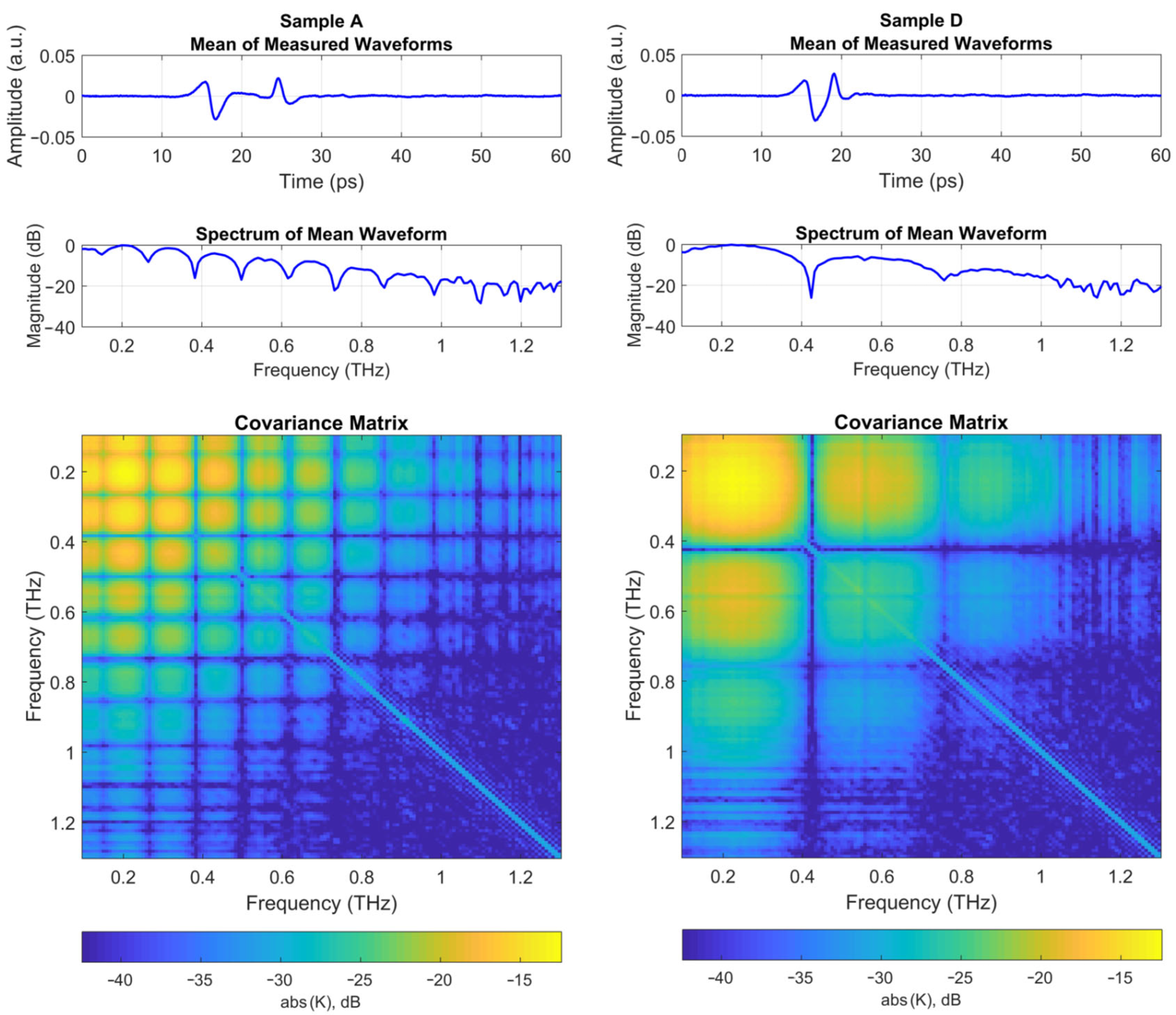
To demonstrate the limitations of conventional THz TOF tomography in thin-film thickness estimation and the effectiveness of the matched-field processing (MFP) method, as shown in Figure 13, the upper panel presents the time-domain signals of various samples. These represent the raw time-domain reflection signals directly acquired from the THz sensor, specifically the pulse sequences reflected from the sample surface and internal interfaces. Sample 1 (thick layer) exhibits partially separated pulses, although not fully resolved, while Sample 2 (thin layer) shows fully overlapping pulses. This demonstrates the failure of conventional TOF methods in thin-layer scenarios. The middle panel shows the frequency-domain power spectrum. The time-domain signal is converted into the frequency-domain power spectrum via fast Fourier transform (FFT), with the energy distribution displayed in decibels (dB). The interference oscillation patterns implicitly carry information about layer thickness, serving as the key basis for parameter inversion. The lower panel displays the covariance matrix, which captures the statistical distribution of signal and noise—the core input for the MFP method. Through multiple fast-snapshot averaging, the off-diagonal elements of random noise approach zero (dark background regions), while signal-related coherence is preserved (bright regions). The thin-layer covariance matrix contains more frequency-band correlation information, facilitating super-resolution inversion of layer thickness.
Therefore, the algorithm needs to be optimized to align the theoretical model with the measured data and determine the optimal layer thickness parameters. To focus the construction of the covariance matrix on frequency structures, thereby enhancing the robustness and accuracy of parameter inversion under noisy measurement conditions, normalization is initially applied. The normalized weight vector ω a is presented as follows:
ω ( a ) = R τ ( a ) R τ ( a )
R τ a represents the theoretical field generated by the propagation model, indicating the simulated spectrum under parameter a (such as layer thickness, refractive index, etc.); R τ a denotes the Euclidean norm (magnitude) of R τ a , i.e., the vector amplitude. Subsequently, processors convert the preceding information into parameter matching scores, ultimately achieving thickness inversion via optimization. Two primary processors are used here: the Bartlett processor and the minimum variance (MV) processor. Both processors fundamentally quantify matching scores through mathematical operations involving theoretical weights ω a and measured covariance K ^ α T :
Bartlett processor:
P B ( a ) = ω H ( a ) K ^ ( α T ) ω ( a )
P B a represents the output value of the objective function, indicating the goodness-of-fit of parameter a.
MV processor:
P M V ( a ^ ) = 1 ω H ( a ^ ) K ^ 1 ( α T ) ω ( a ^ )
P M V a ^ reflects the significance of parameter a in a noisy environment.
The objective function values of all candidate parameters are arranged in sequential order to form a fuzzy surface curve, revealing the distribution of matching degrees for different candidate values within the parameter space. The peak of its main lobe corresponds to the optimal estimate of the parameter.
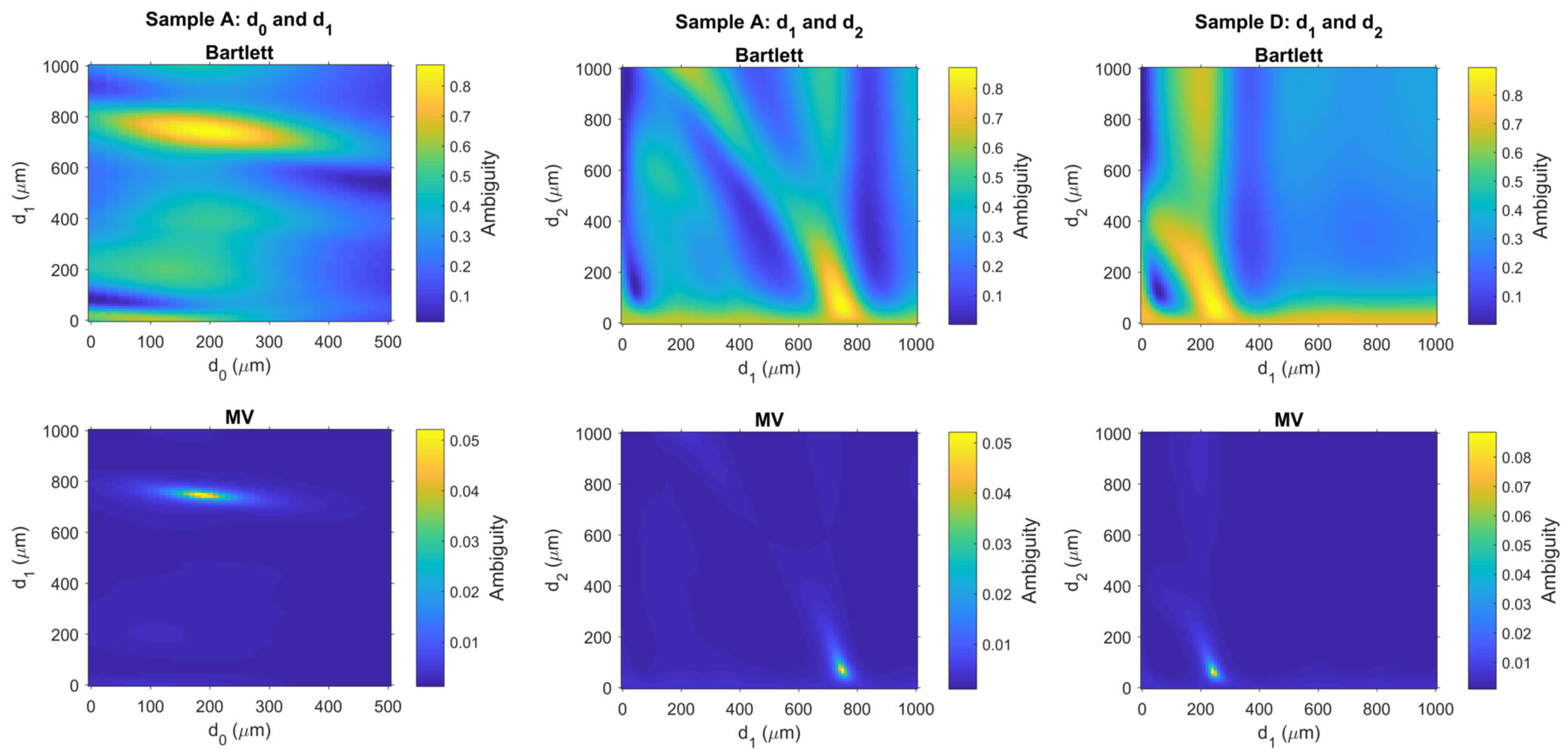
Both the Bartlett and MV processors can accurately estimate the thickness of multilayer structures using THz time-domain spectroscopy data, even when the layer thicknesses are below the resolution limits of traditional time-difference methods. As shown in Figure 14, the MV processor produces sharper main peaks in the two-dimensional search of multilayer parameters for each sample, demonstrating significantly superior sidelobe suppression compared with the Bartlett processor. It also achieves higher thickness estimation accuracy (specific values are indicated by peak values in each subfigure), providing a high-precision solution for thin-layer defect detection. The measurement errors for each layer across all samples are compared in Table 1.
The results in Table 1 were further validated through error analysis, with all estimated values differing from caliper measurements by no more than the experimental error range (≤20 µm). By establishing a propagation model for multilayer structures and integrating optimization algorithms with a covariance processor, high-precision inversion of multilayer dielectric structures with layer thicknesses below the THz pulse width limit (<100 µm) has been successfully achieved. Both the Bartlett and MV processors demonstrated robust performance in handling pulse overlap and strong noise backgrounds, with estimation errors generally controlled to within 20 µm. This satisfies the micrometer-level precision requirements for NDT.
Model-based inversion methods provide high resolution, whereas microwave radar lacks sufficient resolution for detecting oil films on ocean surfaces. Researchers combined THz waves with model-based inversion techniques to achieve precise measurements of oil film thickness, which is sensitive to non-polar organic compounds. In 2020, Yanmin Zhang et al. investigated THz wave scattering from oil-covered sea surfaces. Using an equivalent monolayer medium model and the first-order small-slope approximation (SSA-1), they analyzed the variation in the normalized radar cross-section (NRCS) with oil film thickness. Their findings demonstrated that THz waves are sensitive to oil film thicknesses ranging from several to hundreds of micrometers, thus expanding the application of THz technology in marine remote sensing [59]. In 2022, Hongzhen Zhang et al. combined multiple reflection pulses with a differential evolution (DE) algorithm to improve measurement accuracy. They employed empirical mode decomposition (EMD) to eliminate noise and correct non-flat baselines, reducing the minimum measurable thickness from 80 µm to approximately 40 µm. This enabled real-time monitoring of micrometer-level coating thickness and drying processes [60]. In 2024, Sun et al. proposed THzMINet, an inversion method that combines physical models with deep learning to measure the top layer thickness (236–468 µm) of thermal barrier coatings (TBCs). Time-stream extraction is used to determine the TOF, while frequency-stream estimation calculates the refractive index (range 3.57–5.63). Thickness is computed using a divided layer model. Adaptive weight optimization enhances experimental data accuracy, reduces sample requirements, achieves a mean absolute error (MAE) of 1.73 µm, and completes testing in 0.17 s—making it suitable for industrial online applications [61].
In summary, by constructing theoretical models of THz wave propagation in multilayer media and combining them with frequency- or time-domain measurements and optimization algorithms, the resolution limitations of traditional TOF methods in ultra-thin-film measurements have been overcome, achieving excellent thickness extraction accuracy. With further advances in optimization algorithms and multi-physics integrated modeling, non-contact thickness measurement at the micrometer or even nanometer scale is expected in the near future.

4.2. Deep Learning Method

Deep learning methods are data-driven modeling approaches that utilize large datasets to perform supervised learning, mapping THz signals to material thickness. These models then predict material thickness [62]. Essentially, this involves feature extraction from THz signals in the time or frequency domain. The extracted features serve as inputs for supervised learning algorithms. This process yields a mapping model between THz signal features and material thickness. Finally, the trained model is applied to predict the thickness of new samples.
In 2020, Luo et al. utilized the stationary wavelet transform (SWT) and backpropagation (BP) neural networks to measure the thickness (1–29 µm) of thin thermal growth oxide (TGO) layers in thermal barrier coatings (TBCs). Simulation data generated using COMSOL Multiphysics were used to train the SWT-BP model, achieving a regression coefficient of 0.92, suitable for thin-layer non-destructive testing [63]. In 2022, Sun et al. employed a long short-term memory network combined with a local extremum method to measure the thickness of TBC top coatings [64]. Verified using the TeraMetrix T-Ray 5000 system, the integration of simulation and experimental data reduced measurement time from 140 to 0.3 s, with accuracy comparable to manual methods. Furthermore, in 2022, Li et al. performed non-destructive TBC thickness evaluation by integrating THz time-domain spectroscopy with a hybrid deep learning model (PCA–WOA–Elman), achieving high precision and validating the hybrid model [65]. Subsequently, in 2023, Gong et al. proposed a TBC thickness measurement method based on THz time-domain spectroscopy and PCA–WOA–Elman hybrid deep learning. This approach leverages the high penetration and reflection of THz waves in non-conductive ceramic layers, with signals generated via simulation modeling. It enhances measurement efficiency and accuracy by applying SVD-PCA for dimensionality reduction and WOA to optimize the Elman neural network. Experiments demonstrated that this method reduced computation time to 0.11 s while maintaining an error rate of 1.09% [66]. In 2024, Jiang et al. characterized steel plate coating thickness using THz time-domain reflectometry (TDR) with a BP neural network, achieving over 96% accuracy. The method also enabled visualization of thickness distribution and defect identification, demonstrating multifunctionality [67].
In 2025, Sun et al. proposed a hybrid deep learning method for measuring TBC thickness using THz technology. Its core innovation lies in using only the first three echo peaks as sparse input features instead of the full THz time-domain waveform [68]. Since THz dispersion from top-layer pores broadens the echo signal, focusing on the first three peaks mitigates noise and dispersion effects. Conventional deep learning methods for TBC thickness measurement require acquiring many real samples through destructive means, with scanning electron microscopy measurements as labels—resulting in high cost, inefficiency, and sample waste. To reduce costs, an analytical model incorporating roughness effects was developed to simulate THz signals, thereby generating a dataset covering a wide range of refractive indices. This effectively compensates for refractive index uncertainties arising from microstructural and temperature variations. The improved analytical model formula accounting for roughness variations is:
x ( t ) = IFFT r 01 exp 8 π σ 1 λ 2 + t 01 r 12 exp 8 π σ 2 λ 2 t 10 exp i β 1 1 + r 12 exp 8 π σ 2 λ 2 r 01 exp 8 π σ 1 λ exp i β 1 E 0 ( ω )
Here, σ 1 and σ 2 denote the surface roughness, β 1 denotes the phase factor, and E 0 ω denotes the reference signal.
Building upon this foundation, a physically constrained weighting layer is introduced. The first peak, which is minimally affected by dispersion, maintains an approximately linear relationship with the refractive index, whereas the second and third peaks ( w 1 > w 2 > w 3 ), influenced by both dispersion and phase factors, follow nonlinear relationships. To address this, the weighting layer assigns greater importance to the first peak relative to the latter two, thereby establishing a one-to-one mapping between peaks and refractive index. This reduces discrepancies between the simulation training set and the experimental test set, ultimately improving thickness estimation accuracy.
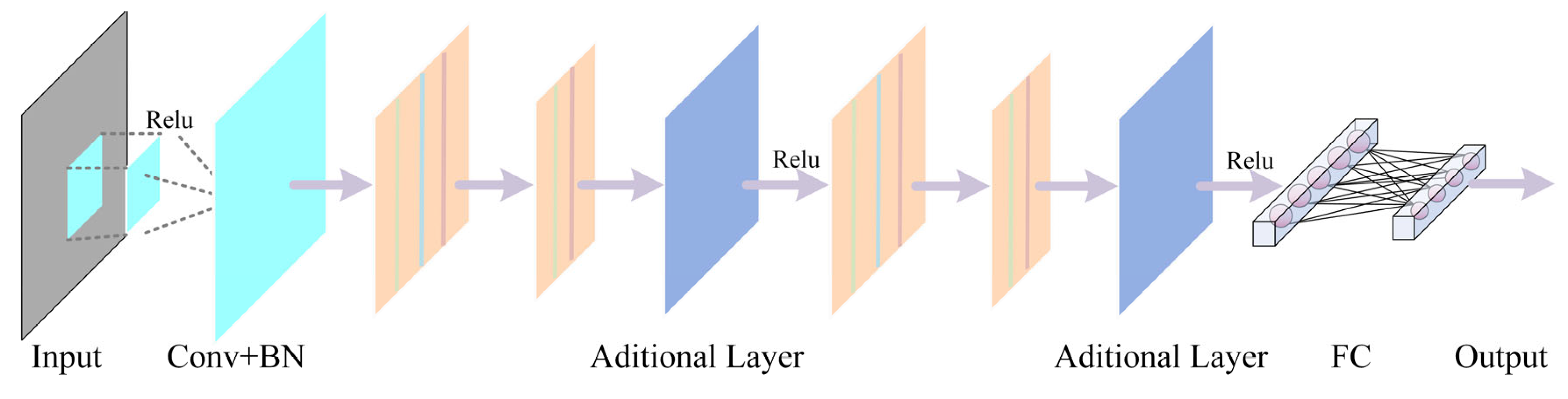
Next, a framework employing a one-dimensional residual network (1D ResNet) architecture is adopted for feature learning. The physics-constrained ResNet adopted here still incorporates essential physical priors while greatly simplifying the modeling effort. As shown in Figure 15, the input is first passed through a weight-constrained layer, which provides weighted triple-peak amplitude data to subsequent layers to enhance consistency between simulated and experimental data. The data are then sequentially processed through five convolutional, normalization, and ReLU layers to progressively extract features. This physics-driven 1D ResNet architecture effectively integrates THz signals with deep learning, enabling sparse features to be accurately mapped onto thickness metrics.1
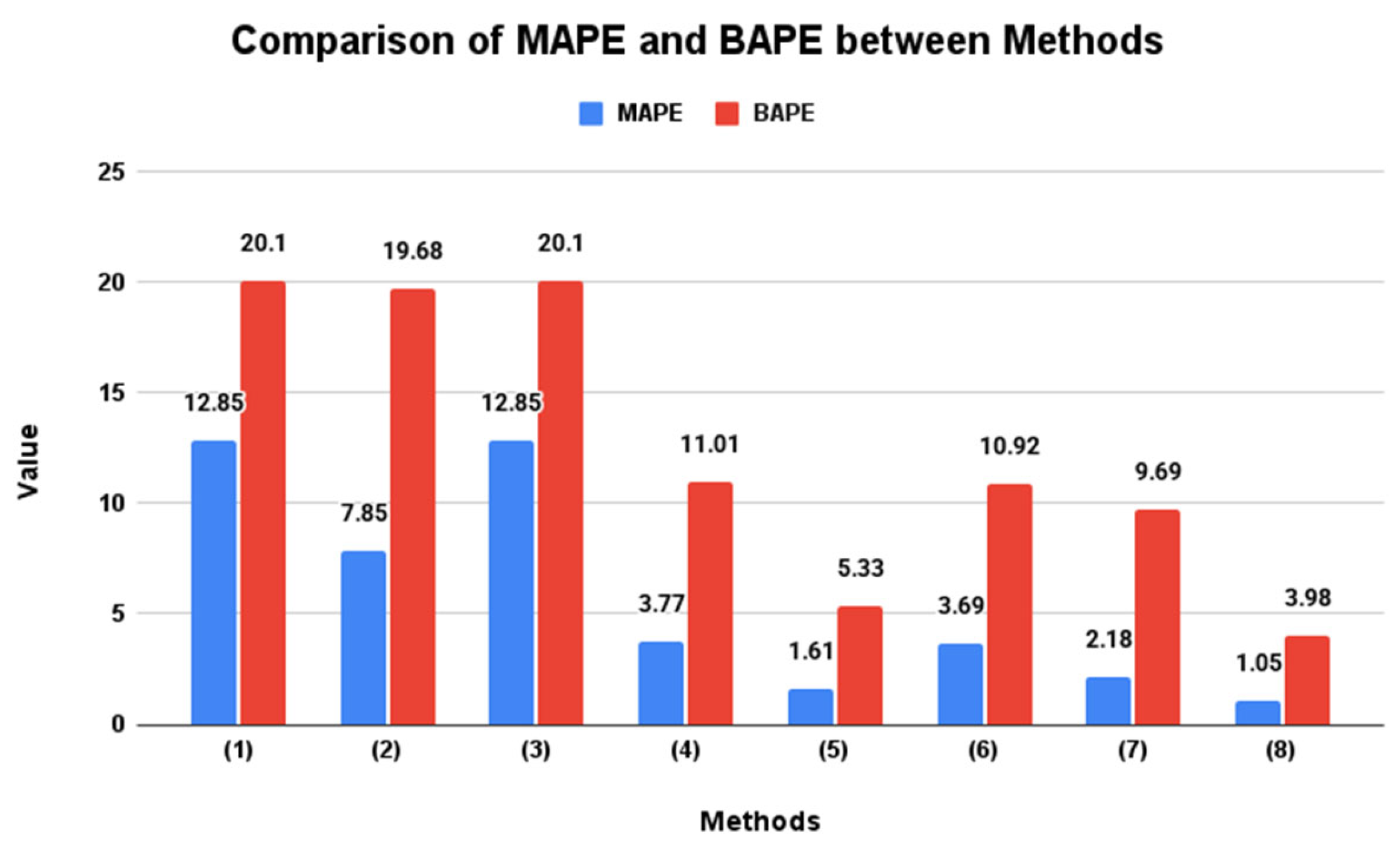
A comparison was conducted between several representative thickness measurement methods, including TOF-based, Fukuchi-based, machine learning, and deep learning approaches. The results are shown in Figure 16.
As shown in Figure 16, the proposed method achieves an average absolute percentage error of approximately 1.05% and an absolute error margin of about 3.98%, which are substantially lower than those obtained with TOF + Fukuchi, wavelet + Fukuchi, and conventional deep learning approaches (≈0.72%). Additionally, the proposed network outputs thickness estimates in a single forward pass without iterative optimization, completing the processing of 51 test points within 0.22 s—significantly faster than traditional optimization-based methods. Overall, the proposed method not only demonstrates superior error statistics but also provides model-driven physical interpretability and high computational efficiency, highlighting its advantages for non-destructive TBC thickness measurement.
In summary, deep learning methods provide a robust alternative to traditional model-driven approaches, minimizing the need for complex and detailed physical modeling. Training on large datasets with thickness labels establishes a mapping between signal features and thickness, thereby demonstrating strong nonlinear modeling capabilities and adaptability. With the continued advancement of deep learning and related technologies, deep learning-based approaches are expected to become increasingly suitable for applications such as industrial online inspection, large-scale sample processing, and the evaluation of complex multilayer structures.

5. Conclusions

This paper focuses on the main methods of THz technology for thickness measurement, broadly categorized into three classes: time domain, frequency domain, and model-based inversion and deep learning methods.
A comparative overview of the six representative techniques is provided in Table 2.
Time-domain methods, based on THz-TDS, avoid the need for complex frequency-domain transformations and can be further divided into single-point measurement and echo separation methods. Both estimate thickness by analyzing the time delay between the main pulse and reflected echoes. The single-point method acquires interface-reflection signals at a single spatial location, offering simplicity of operation and intuitive data processing. It is well-suited for single-layer structures or cases with clearly distinguishable echoes. By contrast, the echo separation method decouples and isolates overlapping multilayer echoes (e.g., via sparse deconvolution). Compared with the single-point method, it is more effective for resolving complex structural interfaces, such as those in ceramic–metal composites or thermal barrier coatings.
Frequency-domain methods are categorized into discrete-mode continuous-wave interferometry and frequency-sweeping methods. Compared with time-domain methods, frequency-domain methods avoid the use of complex devices such as femtosecond lasers and mechanical delay lines, thereby making them more suitable for online monitoring and industrial integration applications. The discrete-mode continuous-wave interferometry method is based on amplitude–phase sampling at one or multiple THz frequency points. This method is particularly suitable for scenarios characterized by fixed target thickness and low system sensitivity to structural perturbations. In contrast, the frequency-sweeping method derives beat frequency signals through frequency modulation, thereby enabling the separation of multi-interface structures. This method is applicable to multilayer structures or to materials requiring high depth resolution.
The methods used are generally classified into model-based inversion and deep learning methods. Model-based inversion relies on the physical laws governing terahertz-wave propagation in multilayer structures. By constructing models and integrating algorithms such as differential evolution, least squares, and matched-field processing, full-waveform fitting is performed on time-domain or frequency-domain signals. This method is well suited for measurements in which interlayer interfaces are indistinct, structures are complex, or traditional TOF methods fail to resolve details. Machine learning, however, employs supervised learning with large datasets to extract signal-related features, thereby establishing nonlinear relationships between signals and thickness for accurate thickness prediction. This approach is suitable for high-throughput analysis and for complex feature-extraction tasks under big data conditions, and it can be integrated with automated systems to facilitate online learning and prediction.

Author Contributions

Conceptualization, H.L. (Hongkai Li), Z.Z., H.N., Z.C., S.J., F.D., D.S. and H.L. (Hongyi Lin); methodology, H.L. (Hongkai Li), Z.Z., D.S. and H.L. (Hongyi Lin); validation, H.L. (Hongkai Li), Z.Z., Z.C. and H.L. (Hongyi Lin); formal analysis, H.L. (Hongkai Li), Z.Z., F.D. and H.L. (Hongyi Lin); investigation, H.L. (Hongkai Li), Z.Z., H.N., Z.C. and F.D.; resources, H.L. (Hongkai Li), Z.Z., H.N., S.J. and H.L. (Hongyi Lin); data curation, H.L. (Hongkai Li), Z.Z. and S.J.; writing—original draft preparation, H.L. (Hongkai Li), Z.Z., F.D., D.S. and H.L. (Hongyi Lin); writing—review and editing, H.N., D.S. and H.L. (Hongyi Lin); visualization, H.L. (Hongkai Li), Z.Z., D.S. and H.L. (Hongyi Lin); supervision, H.N., D.S. and H.L. (Hongyi Lin); project administration, D.S. and H.L. (Hongyi Lin). All authors have read and agreed to the published version of the manuscript.

Funding

This research received no external funding.

Data Availability Statement

The data used to support the findings of this study are available from the corresponding author upon request.

Conflicts of Interest

The authors declare no conflict of interest.

References

  1. Hashimshony, D.; Geltner, I.; Cohen, G.; Avitzour, Y.; Zigler, A.; Smith, C. Characterization of the electrical properties and thickness of thin epitaxial semiconductor layers by THz reflection spectroscopy. J. Appl. Phys. 2001, 90, 5778–5781. [Google Scholar] [CrossRef]
  2. Nsengiyumva, W.; Zhong, S.; Zheng, L.; Liang, W.; Wang, B.; Huang, Y.; Chen, X.; Shen, Y. Sensing and nondestructive testing applications of terahertz spectroscopy and imaging systems: State-of-the-art and state-of-the-practice. IEEE Trans. Instrum. Meas. 2023, 72, 1–83. [Google Scholar] [CrossRef]
  3. Palka, N.; Krimi, S.; Ospald, F.; Miedzinska, D.; Gieleta, R.; Malek, M.; Beigang, R. Precise determination of thicknesses of multilayer polyethylene composite materials by terahertz time-domain spectroscopy. J. Infrared Millim. Terahertz Waves 2015, 36, 578–596. [Google Scholar] [CrossRef]
  4. Zhang, X.; Guo, Q.; Chang, T.; Cui, H.-L. Broadband stepped-frequency modulated continuous terahertz wave tomography for non-destructive inspection of polymer materials. Polym. Test. 2019, 76, 455–463. [Google Scholar] [CrossRef]
  5. Dai, J.; Zhang, J.; Zhang, W.; Grischkowsky, D. Terahertz time-domain spectroscopy characterization of the far-infrared absorption and index of refraction of high-resistivity, float-zone silicon. J. Opt. Soc. Am. B 2004, 21, 1379–1386. [Google Scholar] [CrossRef]
  6. Zeitler, J.A.; Taday, P.F.; Newnham, D.A.; Pepper, M.; Gordon, K.C.; Rades, T. Terahertz pulsed spectroscopy and imaging in the pharmaceutical setting-a review. J. Pharm. Pharmacol. 2007, 59, 209–223. [Google Scholar] [CrossRef]
  7. Xu, H. Study on the Fabrication and Response Mechanism of Terahertz Photodetectors Based on Type-II Dirac Semimetals. Ph.D. Thesis, University of Chinese Academy of Sciences (Shanghai Institute of Technical Physics, Chinese Academy of Sciences), Shanghai, China, 2021. [Google Scholar] [CrossRef]
  8. Lin, H.; Zhang, Z.; Gao, F.; Ruan, J.; Sun, D.; Hou, S.; Zhang, B.; Song, Q. Non-contact, highly sensitive sugar concentration detection based on a Co3Sn2S2 Weyl semimetal thin film sensor by terahertz wave. Biomed. Opt. Express 2024, 15, 965–972. [Google Scholar] [CrossRef]
  9. Fukunaga, K.; Picollo, M. Terahertz spectroscopy applied to the analysis of artists’ materials. Appl. Phys. A 2010, 100, 591–597. [Google Scholar] [CrossRef]
  10. Born, M.; Wolf, E. Principles of Optics: Electromagnetic Theory of Propagation, Interference and Diffraction of Light; Elsevier: Amsterdam, The Netherlands, 2013. [Google Scholar]
  11. You, X.; Ako, R.T.; Sriram, S.; Withayachumnankul, W. Experimental Realization of Terahertz 3D Imaging with Chromatic Metasurface. In Proceedings of the 2024 IEEE Asia-Pacific Microwave Conference (APMC), Bali, Indonesia, 17–20 November 2024; IEEE: New York, NY, USA, 2024; pp. 339–341. [Google Scholar]
  12. You, X.; Pagay, V.; Withayachumnankul, W. Non-Contact Monitoring of Plant Leaf Water Status Using Terahertz Waves. J. Infrared Millim. Terahertz Waves 2025, 46, 53. [Google Scholar] [CrossRef]
  13. Van Mechelen, J.L.M.; Kuzmenko, A.B.; Merbold, H. Stratified dispersive model for material characterization using terahertz time-domain spectroscopy. Opt. Lett. 2014, 39, 3853–3856. [Google Scholar] [CrossRef]
  14. Schulz, N.; Brenner, C.; Kreuzer, L.; Surkamp, N.; Hofmann, M. CW-THz system for high scan rate inline thickness measurements. In Proceedings of the 48th International Conference on Infrared, Millimeter, and Terahertz Waves (IRMMW-THz), Montreal, QC, Canada, 27 August–1 September 2023; IEEE: New York, NY, USA, 2023; pp. 1–2. [Google Scholar]
  15. Jen, C.Y.; Richter, C. Sample thickness measurement with THz-TDS: Resolution and implications. J. Infrared Millim. Terahertz Waves 2014, 35, 840–859. [Google Scholar] [CrossRef]
  16. Withayachumnankul, W.; Fischer, B.M.; Mickan, S.P.; Abbott, D. Thickness determination for homogeneous dielectric materials through THz-TDS. In Proceedings of the Joint 31st International Conference on Infrared and Millimeter Waves and 14th International Conference on Terahertz Electronics, Shanghai, China, 18–22 September 2006; IEEE: New York, NY, USA, 2006; p. 448. [Google Scholar]
  17. Liu, X.; Teng, Y.; Li, W.; Zhang, C.; Huang, W. Terahertz thickness measurement based on atomic superheterodyne detection. Acta Phys. Sin. 2025, 74, 020701. [Google Scholar] [CrossRef]
  18. Ospald, F.; Zouaghi, W.; Beigang, R.; Matheis, C.; Jonuscheit, J.; Recur, B.; Guillet, J.-P.; Mounaix, P.; Vleugels, W.; Venegas Bosom, P.; et al. Aeronautics composite material inspection with a terahertz frequency-modulated continuous-wave imaging radar. Opt. Eng. 2014, 53, 031208. [Google Scholar] [CrossRef]
  19. Brown, E.R.; McIntosh, K.A.; Nichols, K.B.; Dennis, C.L. Photomixing up to 3.8 THz in low-temperature-grown GaAs. Appl. Phys. Lett. 1995, 66, 285–287. [Google Scholar] [CrossRef]
  20. Scheller, M.; Jansen, C.; Koch, M. Analyzing sub-100-μm samples with transmission terahertz time domain spectroscopy. Opt. Commun. 2009, 282, 1304–1306. [Google Scholar] [CrossRef]
  21. Pawar, A.Y.; Sonawane, D.D.; Erande, K.B.; Derle, D.V. Terahertz technology and its applications. Drug Invention Today 2013, 5, 157–163. [Google Scholar] [CrossRef]
  22. Im, K.H.; Kim, S.K.; Cho, Y.T.; Woo, Y.D.; Chiou, C.P. THz-TDS techniques of thickness measurements in thin shim stock films and composite materials. Appl. Sci. 2021, 11, 8889. [Google Scholar] [CrossRef]
  23. Duvillaret, L.; Garet, F.; Coutaz, J.L. Highly precise determination of optical constants and sample thickness in terahertz time-domain spectroscopy. Appl. Opt. 1999, 38, 409–415. [Google Scholar] [CrossRef]
  24. Yasui, T.; Yasuda, T.; Sawanaka, K.; Araki, T. Terahertz paintmeter for noncontact monitoring of thickness and drying progress in paint film. Appl. Opt. 2005, 44, 6849–6856. [Google Scholar] [CrossRef]
  25. Im, K.-H.; Hsu, D.K.; Chiou, C.-P.; Barnard, D.J.; Kim, S.-J.; Cho, Y.-T.; Jung, J.-A. Advanced T-ray nondestructive evaluation of defects in FRP solid composites. Int. J. Precis. Eng. Manuf. 2013, 14, 1093–1098. [Google Scholar] [CrossRef]
  26. Dong, J.; Locquet, A.; Citrin, D.S. Terahertz quantitative nondestructive evaluation of failure modes in polymer-coated steel. IEEE J. Sel. Top. Quantum Electron. 2016, 23, 8400207. [Google Scholar] [CrossRef]
  27. Unnikrishnakurup, S.; Dash, J.; Ray, S.; Pesala, B.; Balasubramaniam, K. Nondestructive evaluation of thermal barrier coating thickness degradation using pulsed IR thermography and THz-TDS measurements: A comparative study. NDT E Int. 2020, 116, 102367. [Google Scholar] [CrossRef]
  28. Nimanpure, S.; Singh, G.; Yadav, S.; Singh, P.; Moona, G.; Jewariya, M.; Sharma, R. Investigation of cerium oxide thin film thickness using THz spectroscopy for non-destructive measurement. J. Opt. 2020, 50, 90–94. [Google Scholar] [CrossRef]
  29. Xu, Y.; Jiang, X. Nondestructive testing and imaging of corrosion thickness of steel plates using THz-TDS. Infrared Phys. Technol. 2022, 127, 104467. [Google Scholar] [CrossRef]
  30. Hansen, R.E.; Bæk, T.; Lange, S.L.; Israelsen, N.M.; Mäntylä, M.; Bang, O.; Petersen, C.R. Non-contact paper thickness and quality monitoring based on mid-infrared optical coherence tomography and THz time domain spectroscopy. Sensors 2022, 22, 1549. [Google Scholar] [CrossRef]
  31. Park, D.-W.; Oh, G.-H.; Kim, D.-J.; Kim, H.-S. In-situ thickness measurement of epoxy molding compound in semiconductor package products using a terahertz-time of flight system. NDT E Int. 2019, 105, 11–18. [Google Scholar] [CrossRef]
  32. Amenabar, I.F.; Lopez, A. Mendikute. In introductory review to THz non-destructive testing of composite mater. J. Infrared Millim. Terahertz Waves 2013, 34, 152–169. [Google Scholar] [CrossRef]
  33. Burger, R.; Frisch, J.; Hübner, M.; Goldammer, M.; Peters, O.; Rönneberg, E.; Wu, D. THz-TDS reflection measurement of coating thicknesses at non-perpendicular incidence: Experiment and simulation. Sensors 2021, 21, 3473. [Google Scholar] [CrossRef]
  34. Liu, L.; Yu, H.; Zheng, C.; Ye, D.; He, W.; Wang, S.; Li, J.; Wu, L.; Zhang, Y.; Xie, J.; et al. Nondestructive thickness measurement of thermal barrier coatings for turbine blades by terahertz time domain spectroscopy. Photonics 2023, 10, 105. [Google Scholar] [CrossRef]
  35. Yang, X.; Zhang, D.; Wu, B.; Zhang, K.; Yang, B.; Wang, Z.; Wu, X. Accurate characterization of the adhesive layer thickness of ceramic bonding structures using terahertz time-domain spectroscopy. Materials 2022, 15, 6972. [Google Scholar] [CrossRef]
  36. Jang, H.L.; Lee, S.H.; Kang, L.H. Non-destructive testing for thickness measurement of the adhesive layer and defect detection in ceramic-metal bonded structures using THz waves. Struct. Health Monit. 2025, 24, 3657–3673. [Google Scholar] [CrossRef]
  37. Park, D.W.; Oh, G.H.; Kim, H.S.; Choi, J.; Righetti, F.; Kang, J.S.; Kim, H.S. In situ thickness measurements of a silicon wafer with a deposited thin layer using multi-reflected terahertz electromagnetic waves through quartz chamber window. J. Infrared Millim. Terahertz Waves 2023, 44, 458–472. [Google Scholar] [CrossRef]
  38. Gu, J.; Zhang, J.Y.; Lei, T.; Zhang, D.D.; Ren, J.J.; Xue, J.W.; Chen, Q.; Yang, W.T. Research on High Precision Detection Technology of Coating Thickness Based on Standard Tool. Adv. Aeronaut. Eng. 2024. Available online: https://link.cnki.net/urlid/61.1479.V.20240812.0859.002 (accessed on 26 October 2025).
  39. Li, B.; Li, X.; Li, Y.; Wu, X.; Zhang, Z.; Zhao, X.; Zhang, T. A novel algorithm for refractive index determination using photomixing terahertz continuous-wave spectroscopy. In Proceedings of the 47th International Conference on Infrared, Millimeter and Terahertz Waves (IRMMW-THz), Delft, The Netherlands, 28 August–2 September 2022; IEEE: New York, NY, USA, 2022; pp. 1–2. [Google Scholar]
  40. Stanze, D.; Globisch, B.; Dietz, R.J.B.; Roehle, H.; Gobel, T.; Schell, M. Multilayer thickness determination using continuous wave THz spectroscopy. IEEE Trans. Terahertz Sci. Technol. 2014, 4, 696–701. [Google Scholar] [CrossRef]
  41. Roggenbuck, A.; Schmitz, H.; Deninger, A.; Mayorga, I.C.; Hemberger, J.; Güsten, R.; Grüninger, M. Coherent broadband continuous-wave terahertz spectroscopy on solid-state samples. New J. Phys. 2010, 12, 043017. [Google Scholar] [CrossRef]
  42. Moon, K.; Kim, N.; Shin, J.-H.; Yoon, Y.-J.; Han, S.-P.; Park, K.H. Continuous-wave terahertz system based on a dual-mode laser for real-time non-contact measurement of thickness and conductivity. Opt. Express 2014, 22, 2259–2266. [Google Scholar] [CrossRef] [PubMed]
  43. Devi, N.; Dash, J.; Ray, S.; Pesala, B. Thickness measurement of tablet coating using continuous-wave terahertz reflection spectroscopy. In Terahertz, RF, Millimeter, and Submillimeter-Wave Technology and Applications IX, Proceedings of the SPIE, San Francisco, CA, USA, 15–18 February 2016; SPIE: Bellingham, WA, USA, 2016; Volume 9747, pp. 21–28. [Google Scholar]
  44. Choi, D.-H.; Lee, I.-M.; Moon, K.; Park, D.W.; Lee, E.S.; Park, K.H. Terahertz continuous wave system for measuring sub-100-μm-thick samples using Gouy phase shift interferometry. In Proceedings of the 44th International Conference on Infrared, Millimeter, and Terahertz Waves (IRMMW-THz), Paris, France, 1–6 September 2019; IEEE: New York, NY, USA, 2019; pp. 1–2. [Google Scholar]
  45. Choi, D.-H.; Lee, I.-M.; Moon, K.; Park, D.W.; Lee, E.S.; Park, K.H. Terahertz continuous wave system using phase shift interferometry for measuring the thickness of sub-100-μm-thick samples without frequency sweep. Opt. Express 2019, 27, 14695–14704. [Google Scholar] [CrossRef]
  46. Zhang, T.; Li, B.; Ye, Z.; Yan, J.; Zhao, X.; Zhang, Z. Prediction of thickness for plastic products based on terahertz frequency-domain spectroscopy. J. Adv. Comput. Intell. Intell. Inform. 2023, 27, 726–731. [Google Scholar] [CrossRef]
  47. Wilk, R.; Breitfeld, F.; Mikulics, M.; Koch, M. Continuous wave terahertz spectrometer as a noncontact thickness measuring device. Appl. Opt. 2008, 47, 3023–3026. [Google Scholar] [CrossRef]
  48. Surkamp, N.; Gerling, A.; O’Gorman, J.; Honsberg, M.; Schmidtmann, S.; Nandi, U.; Preu, S.; Sacher, J.; Brenner, C.; Hofmann, M.R. Slotted Y-branch laser for cw-THz thickness measurements at 1 THz. In Novel In-Plane Semiconductor Lasers XXI, Proceedings of the SPIE, San Francisco, CA, USA, 20–24 February 2022; SPIE: Bellingham, WA, USA, 2022; Volume 12021, pp. 14–20. [Google Scholar]
  49. Ryu, H.-C.; Kim, N.; Han, S.-P.; Ko, H.; Park, J.-W.; Moon, K.; Park, K.H. Simple and cost-effective thickness measurement terahertz system based on a compact 1.55 µm λ/4 phase-shifted dual-mode laser. Opt. Express 2012, 20, 25990–25999. [Google Scholar] [CrossRef]
  50. Schreiner, N.S.; Sauer-Greff, W.; Urbansky, R.; von Freymann, G.; Friederich, F. Multilayer thickness measurements below the Rayleigh limit using FMCW millimeter and terahertz waves. Sensors 2019, 19, 3910. [Google Scholar] [CrossRef]
  51. Schreiner, N.; Keil, A.; Sauer-Greff, W.; Urbansky, R.; Friederich, F. Comparison of signal processing algorithms for high-resolution FMCW terahertz thickness measurements. J. Phys. Conf. Ser. 2020, 1537, 012018. [Google Scholar] [CrossRef]
  52. Schreiner, N.S.; Bortz, M.; Sauer-Greff, W.; Urbansky, R.; Friederich, F. Optimization algorithms for accurate FMCW millimeter wave and terahertz thickness measurements. In Proceedings of the 50th European Microwave Conference (EuMC), Utrecht, The Netherlands, 12–14 January 2021; IEEE: New York, NY, USA, 2021; pp. 623–626. [Google Scholar]
  53. Mohammadzadeh, S.; Keil, A.; Kocybik, M.; Schwenson, L.M.; Liebermeister, L.; Kohlhaas, R.; Globisch, B.; Von Freymann, G.; Seewig, J.; Friederich, F. Extreme ultra-wideband optoelectronic frequency-modulated continuous-wave terahertz radar. Laser Photonics Rev. 2023, 17, 2300396. [Google Scholar] [CrossRef]
  54. Fukuchi, T.; Fuse, N.; Okada, M.; Fujii, T.; Mizuno, M.; Fukunaga, K. Measurement of refractive index and thickness of topcoat of thermal barrier coating by reflection measurement of terahertz waves. Electron. Commun. Jpn. 2013, 96, 37–45. [Google Scholar] [CrossRef]
  55. Cao, B.; Wang, M.; Li, X.; Fan, M.; Tian, G. Noncontact thickness measurement of multilayer coatings on metallic substrate using pulsed terahertz technology. IEEE Sens. J. 2019, 20, 3162–3171. [Google Scholar] [CrossRef]
  56. Krimi, S.; Klier, J.; Jonuscheit, J.; von Freymann, G.; Urbansky, R.; Beigang, R. Highly accurate thickness measurement of multi-layered automotive paints using terahertz technology. Appl. Phys. Lett. 2016, 109, 021101. [Google Scholar] [CrossRef]
  57. Krimi, S.; Torosyan, G.; Beigang, R. Advanced GPU-based terahertz approach for in-line multilayer thickness measurements. IEEE J. Sel. Top. Quantum Electron. 2016, 23, 8501112. [Google Scholar] [CrossRef]
  58. Schecklman, S.; Zurk, L.M. Terahertz imaging of thin film layers with matched field processing. Sensors 2018, 18, 3547. [Google Scholar] [CrossRef]
  59. Zhang, Y.; Zheng, H.; Wang, Y.; Wang, R.; Guo, L. Investigation on THz EM wave scattering from oil-covered sea surface: Exploration for an approach to probe the thickness of oil film. IEEE Trans. Geosci. Remote Sens. 2020, 59, 1827–1835. [Google Scholar] [CrossRef]
  60. Zhang, H.; Shi, L.; He, M. Extension of terahertz time-domain spectroscopy: A micron-level thickness gauging technology. Opt. Commun. 2022, 506, 127597. [Google Scholar] [CrossRef]
  61. Sun, F.; Cao, B.; Fan, M.; Ye, B.; Liu, L. THzMINet: A terahertz model-data-driven interpretable neural network for thickness measurement of thermal barrier coatings. IEEE Trans. Ind. Inform. 2023, 20, 4722–4734. [Google Scholar] [CrossRef]
  62. Ye, D.; Wang, W.; Yin, C.; Xu, Z.; Zhou, H.; Fang, H.; Li, Y.; Huang, J. Pulsed terahertz spectroscopy combined with hybrid deep learning approaches for structural health monitoring of multilayer thermal barrier coatings. Opt. Express 2020, 28, 34875–34893. [Google Scholar] [CrossRef]
  63. Luo, M.; Zhong, S.; Yao, L.; Tu, W.; Nsengiyumva, W.; Chen, W. Thin thermally grown oxide thickness detection in thermal barrier coatings based on SWT-BP neural network algorithm and terahertz technology. Appl. Opt. 2020, 59, 4097–4104. [Google Scholar] [CrossRef]
  64. Xu, Z.; Ye, D.; Chen, J.; Zhou, H. Novel terahertz nondestructive method for measuring the thickness of thin oxide scale using different hybrid deep learning models. Coatings 2020, 10, 805. [Google Scholar] [CrossRef]
  65. Li, R.; Ye, D.; Xu, Z.; Yin, C.; Xu, H.; Zhou, H.; Yi, J.; Chen, Y.; Pan, J. Nondestructive evaluation of thermal barrier coatings thickness using terahertz time-domain spectroscopy combined with hybrid deep learning approaches. Coatings 2022, 12, 1875. [Google Scholar] [CrossRef]
  66. Gong, Y.; Cao, B.; Zhang, H.; Sun, F.; Fan, M. Terahertz based thickness measurement of thermal barrier coatings using hybrid deep learning. Nondestr. Test. Eval. 2023, 38, 1–17. [Google Scholar] [CrossRef]
  67. Jiang, X.; Xu, Y.; Hu, H. Thickness characterization of steel plate coating materials with terahertz time-domain reflection spectroscopy based on BP neural network. Sensors 2024, 24, 4992. [Google Scholar] [CrossRef]
  68. Sun, F.; Cao, B.; Fan, M.; Liu, L. Physics-based deep learning framework for terahertz thickness measurement of thermal barrier coatings with variable refractive index. Mech. Syst. Signal Process. 2025, 228, 112430. [Google Scholar] [CrossRef]
Figure 1. Typical THz-TDS setup using photoconductive antennas [22].
Photonics 12 01191 g001
Figure 2. (a) The schematic representation of THz incident and detection; (b) the time-delay function [28].
Photonics 12 01191 g002
Figure 3. The model of the three-layered structure in this work: (a) 3D view; (b) the cross-sectional schematic diagram [35].
Photonics 12 01191 g003
Figure 4. Instrument schematic diagram [35].
Photonics 12 01191 g004
Figure 5. Comparison of three echo separation methods for adhesive layers of different thicknesses: (ac) 1.0 mm; (df) 0.5 mm; (gi) 0.2 mm. (a,d,g) Wavelet denoising; (b,e,h) AR/MCM; (c,f,i) sparse deconvolution proposed in this work. Blue curves represent the raw THz time-domain reflection signals, and red curves represent the processed signals [35].
Photonics 12 01191 g005
Figure 6. Schematic of the experiment setup. A beating signal generated from a tunable laser system is injected into the transmitter (Tx) for THz generation. The THz waves are divided by a beam splitter. The beams reflected from the two mirrors are focused on the receiver (Rx) [45].
Photonics 12 01191 g006
Figure 7. Schematic of (a) an interferometer with a focused beam and a collimated beam and of (b) an interferometer with collimated beams for both arms. (c,d) Signal change as a function of OPD in the experimental conditions of (a) and (b), respectively [45].
Photonics 12 01191 g007
Figure 8. (a) Difference between the measured spectrum when the stage is changed by 90 µm from the reference position and the calculated spectra with different OPDs. (b) OPD dependent error. (c) Calculated OPD change by changing the linear stage position (blue circles) or by attaching adhesive tapes on the sample mirror (black squares) against actual OPD change [45].
Photonics 12 01191 g008
Figure 9. Optoelectronic FMCW radar concept consisting of a sweeping laser and a fixed-frequency laser. The two laser output signals are superimposed using a fiber coupler which is attached to an erbium-doped fiber amplifier (EDFA). A fiber splitter is used to guide the amplified laser beat signal by the EDFA to the transmitter (Tx) and receiver (Rx) in a terahertz measurement setup. A data acquisition unit (DAQ) records trigger signals of the laser tuning events while synchronously acquiring the received terahertz signals, which are amplified by a transimpedance amplifier (TIA). The THz radiation is collimated or focused using off-axis parabolic mirrors (OAPM), and the transmitted and reflected signals are guided with a beam splitter made of float-zone silicon (FZ-Si) wafer [53].
Photonics 12 01191 g009
Figure 10. Comparison between sampling with triggers and new optimized resampling of a single FMCW chirp signal for (a) range spectrum of a dielectric slab of 5.25 mm and (b) range spectrum of a dielectric slab of 17.25 mm. The data is calibrated to a reference measurement [53].
Photonics 12 01191 g010
Figure 11. Range spectra of standard calibration dielectric foils, measured with the (a) 600 GHz mode and (b) 1.65 THz mode. The values in black are the nominal thicknesses of the samples, and the numbers in red are the measured thicknesses of each sample with 10 k measurements. The group refractive indices are calculated using the Fresnel’s reflection coefficient for each sample [53].
Photonics 12 01191 g011
Figure 12. Schematic diagram of the THz NDE experimental configuration. Measurement configuration of the THz benchmark (left). Measurement configuration of the layered sample under test (right) [58].
Photonics 12 01191 g012
Figure 13. Time-domain signal (top), spectrum (middle), and covariance matrix (bottom) of different samples [58].
Photonics 12 01191 g013
Figure 14. Estimated values of the thickness of the calibration layer d 0 and the polycarbonate layer d 1 for sample A (left). Global maximum d 0 = 190 and d 1 = 750 for the Bartlett processor (upper left). Global maximum d 0 = 180 and d 1 = 750 for the MV processor (lower left). Estimated values of the thickness d 1 of the polycarbonate layer and the air gap d 2 for sample A (middle). Global maximum d 1 = 750 and d 2 = 70 for the Bartlett processor (upper middle). Global maximum d 1 = 750 and d 2 = 70 for the MV processor (lower middle). Estimated values of the thickness d 1 of the polycarbonate layer and the air gap d 2 for sample D (right column). Global maximum d 1 = 250 and d 2 = 60 for the Bartlett processor (upper right). Global maximum d 1 = 240 and d 2 = 60 for the MV processor (lower right) [58].
Photonics 12 01191 g014
Figure 15. Physics-based deep learning framework [68].
Photonics 12 01191 g015
Figure 16. Comparison of MAPE and BAPE values obtained by eight different methods, including (1) sparse deconvolution + TOF method, (2) sparse deconvolution + Fukuchi method, (3) wavelet transform + TOF method, (4) wavelet transform + Fukuchi method, (5) deep learning method, (6) machine learning method, (7) method without weight constraint layer, and (8) proposed method [68].
Photonics 12 01191 g016
Table 1. Comparison of measurement error [58].
Sample
ID
Layer
ID
Vernier Cal
(µm)
THz MFP Bartlett
(µm)
THz MFP: MV
(µm)
A d 1 740750750
A d 2 607070
B d 1 520510510
B d 2 607070
C d 1 390380370
C d 2 606070
D d 1 260250240
D d 2 606060
Table 2. Comparison of THz thickness measurement methods.
MethodPrecisionSpeedCostSample RequirementsMain LimitationsEase of Use
Time-domain single-pointMedium–highFastHighSingle-layer;
simple structures
Echo overlap in multilayers;
noise-sensitive
High
Echo separationHighMediumHighMultilayer interfacesHighly sensitive to noise;
strongly depends on
the choice of algorithm
Medium–low
CW discrete-mode interferometryMedium–highVery fastLow–mediumSmooth surface,
known refractive index
Unsuitable for multilayers;
limited resolution
High
Frequency sweeping (FMCW)Medium–highHighMediumMultilayer,
strong reflection
Resolution limited by bandwidth;
sensitive to surface roughness
Medium
Model-based inversionHighMedium–slowHighKnown material parameters;
modellable structure
Strong model dependence;
computationally heavy
Low
Deep learningHigh–very highVery fastMediumLarge labeled;
simulated dataset
Poor generalization;
data-dependent
Medium–low
Disclaimer/Publisher’s Note: The statements, opinions and data contained in all publications are solely those of the individual author(s) and contributor(s) and not of MDPI and/or the editor(s). MDPI and/or the editor(s) disclaim responsibility for any injury to people or property resulting from any ideas, methods, instructions or products referred to in the content.