1. Introduction
In recent years, quantum technology has emerged as a frontier domain in the global technological revolution and industrial transformation. Current research focuses on three principal areas: quantum computing, quantum communication, and quantum precision measurement. Among these, quantum communication demonstrates the highest technological maturity, having achieved significant breakthroughs in technical feasibility verification, practical device development, and industrial ecosystem cultivation [
1]. Worldwide, nations are actively engaged in the research and deployment of both terrestrial and satellite-based QKD networks. To date, China has established the world’s most extensive quantum-secure communication network. The landmark satellite-based QKD experiment has extended QKD capabilities from thousands to tens of thousands of kilometers, enabling secure Quantum Key Distribution to achieve broader geographic coverage [
2,
3].
Traditional terrestrial mobile communication systems face limitations imposed by base station placement and optical fiber deployment constraints. The advancement of mobile satellite communication technology addresses these challenges by providing coverage to remote areas and enabling emergency communications where conventional 5G networks prove inadequate [
4]. Ensuring space–terrestrial link security is vital for maritime missions and connectivity-deprived regions.
With the advancement of satellite technology, High Throughput Satellite (HTS) communication systems have emerged as a critical complement to terrestrial mobile communication networks. Characterized by extensive coverage, high-bandwidth capacity, and cost-effectiveness, HTS systems now represent a predominant developmental trajectory in satellite communications. Standardization bodies, including the International Telecommunication Union (ITU) and Third Generation Partnership Project (3GPP), have initiated the standardization process for 5G-enabled satellite communications, thereby facilitating the establishment of an integrated space–terrestrial communication architecture [
5,
6]. Concurrently, global initiatives are actively deploying emergency communication infrastructure in remote regions to strengthen the resilience of regional communication networks. The global satellite communication market size was estimated at USD 90,299.1 million in 2024 and is projected to reach USD 159,599.2 million by 2030, growing at a Compound Annual Growth Rate (CAGR) of 10.2% from 2025 to 2030 [
7].
Recent years have witnessed a surge in sophisticated cyberattacks targeting Critical Information Infrastructure (CII), with evolving attack vectors demonstrating increased technical complexity. Statistical data reveal exponential growth in cyber threats against CII, constituting significant risks to national security and societal stability globally. The operational integrity of CII now confronts unprecedented security challenges, as exemplified by
The New York Times’ documented breach of SpaceX’s Starlink network by Russian actors [
8], which has precipitated legitimate concerns regarding the system’s security assurances among stakeholders.
This work aims to integrate satellite-based QKD into next-generation NTN, thereby enabling users in regions beyond the coverage of terrestrial networks to securely distribute quantum keys and to achieve satellite communications based on quantum encryption, so as to safeguard user privacy and data security. We developed a 5G-enabled satellite communication testbed incorporating satellite-based QKD and validated the feasibility of the integrated architecture through testing user experience metrics such as RTT and jitter.
To the best of our knowledge, this study advances the exploration of a quantum-encrypted NTN integration architecture through investigating the implementation of satellite-based QKD in the NTN framework—an approach that remains unprecedented to date. We propose a testbed implemented using a suite of devices, encompassing the “Jinan-1” quantum satellite, “Chinasat-26” communication satellite, 5G network, ground stations, and IP Sec VPNs, with the employed satellite networks being commercial off-the-shelf systems, thereby constructing an experimental environment for quantum-encrypted NTN. From this testbed, we collected both the time metrics of conventional 5G NTN and those of quantum-encrypted 5G NTN to evaluate the overall system performance, and the obtained results offer valuable implications for the development of potential next-generation NTN systems based on satellite-based QKD. However, it is important to note that while the integration of external commercial services into the testbed enables the acquisition of more realistic data metrics, its intrinsic black-box characteristics inevitably incur numerous assumptions and technical constraints.
In this experiment, we adopted GEO-based NTN links to verify the feasibility of the proposed scheme. Geostationary Earth Orbit (GEO) satellites feature lower deployment costs and network complexity, with only three satellites required to achieve global coverage. Notably, Low Earth Orbit (LEO) satellite constellations are developing rapidly, and we plan to conduct follow-up experiments based on LEO constellations to meet the demands of low-latency communication scenarios (e.g., Sixth-Generation Mobile Communication Technology, 6G). Based on this, we anticipate that GEO-based NTN and LEO-based NTN will coexist for a prolonged period. Furthermore, this experiment utilized a single standalone LEO quantum satellite (rather than a satellite constellation). For a specific ground station, the quantum satellite only passes overhead once per night— the daytime pass is unavailable due to intense solar background light, which interferes with the ground station’s reception of optical signals transmitted by the quantum satellite. Consequently, we could conduct at most one experiment per day. Additionally, LEO satellites fly at extremely high speeds, resulting in a time window of only approximately 10 min when passing a single ground station. The ground station must maintain high stability during satellite tracking to ensure continuity of communication. Since only one quantum satellite was used in this experiment, it can dock with only one ground station in the same region within a single orbit. To address the aforementioned two limitations, viable solutions include establishing a quantum satellite constellation or deploying Medium Earth Orbit (MEO)/GEO quantum satellites.
2. Analysis of the Application Scheme of Satellite-Based QKD in 5G-Enabled NTN
In this section, we first analyze the situation and architecture of satellite-based QKD and 5G-enabled NTN. Secondly, we propose a satellite-based QKD encryption solution for 5G-enabled NTN. Finally, we theoretically analyze the impact on the 5G-enabled NTN after adding quantum encryption.
2.1. State of the Art in Satellite-Based QKD Communications: Architecture and Developments
2.1.1. Developments of Satellite-Based QKD
The global development of satellite-based quantum communication has achieved significant milestones since 2016. In August 2016, China successfully deployed the world’s first quantum science satellite, “Micius”, establishing a pioneering satellite-to-ground quantum secure communication system that accomplished the first intercontinental QKD demonstration [
2,
3,
9,
10]. This was followed by the September 2016 launch of the “Tiangong-2” space laboratory carrying quantum communication payloads, which advanced satellite-ground QKD experiments [
11]. A subsequent breakthrough occurred in July 2022 with the “Jinan-1” microsatellite, achieving real-time QKD operations and marking a crucial step toward practical implementation [
12]. According to the report, Canada has outlined the Quantum EncrYption and Science Satellite (QEYSSat) mission expected to be launched in 2026 and its anticipated outcomes [
13]. QEYSSat is a technology demonstration platform aimed at studying the ground-to-space quantum uplink channel using satellite-based quantum receivers, including photon polarization analyzers and single-photon detectors [
14]. Germany has launched “QUBE” and “QUICK 3” quantum satellites in 2024 [
15,
16]. It is planned to launch the “QUBE-II” quantum satellite in 2025, equipped with dual-wavelength Discrete Variable (DV) QKD transmission modules at 850 nm and 1550 nm, Quantum Random Number Generators (QRNG), and high-precision laser communication terminals [
17]. The EU plans to launch the “Eagle-1” quantum satellite between the end of 2025 and 2026, integrating QKD payloads to verify and demonstrate the European cross-border quantum secure communication network [
18]. At the same time, the EU plans to launch the “IRIS2” quantum satellite in 2027, which will adopt a multi-orbit QKD architecture combining LEO and MEO, integrating 5G standards and government-level encryption technology [
19]. In addition, the EU also plans to launch the “SAGA 1G” quantum satellite, using the Prepare-and-Measure (PM) Discrete Variable QKD protocol, through the C-band quantum signal downlink [
20].
2.1.2. Architecture of Satellite-Based QKD
A QKD system typically consists of a quantum transmitter and a quantum receiver, which are connected through a quantum channel and a classical channel. QKD systems typically use the BB84 protocol to implement QKD. The system generates random numbers and randomly selects either the “+” basis (horizontal and vertical polarization) or the “×” basis (45° and −45° polarization) based on the bits. The quantum signal modulation module modulates the quantum signal into the corresponding quantum state, which is transmitted to the QKD receiver through a quantum channel. The QKD receiver’s quantum signal demodulation module randomly selects either the “+” basis or the “×” basis for each quantum bit, demodulates and measures the quantum signal, and after obtaining the measurement result, both parties compare the basis vectors through a classical channel to negotiate and form the final quantum key [
2,
21,
22].
Currently, there are two common implementations of QKD: The first is QKD transmitted through fiber-optic networks, which can provide a relatively high secret key generation rate and strong system reliability. The second is QKD based on Free-Space Optical (FSO) has advantages in flexible infrastructure deployment [
23,
24]. Moreover, satellite-based QKD systems that rely on FSO can distribute secret keys to much farther locations.
Due to the signal attenuation problem of optical quantum transmission in optical fibers, in formally applied QKD networks, the transmission distance between two QKD nodes is usually controlled within 100 km. In order to achieve long-distance transmission of quantum keys, multiple trusted relay nodes need to be set up on the transmission path between the starting node and the target node [
21]. A QKD sending device and a QKD receiving device need to be deployed at each node along the entire transmission path. A point-to-point QKD link is established between each group of adjacent nodes to generate a relay quantum key. Based on this key, a “one-time password” method is used to relay the key to the next node [
21].
One important role of quantum satellites is to serve as relay nodes to expand the scope of QKD, distributing quantum keys to two nodes that do not have ground-based QKD connection capabilities. A free-space quantum channel is constructed between quantum satellites and ground stations through laser communication technology for satellite-ground QKD [
2,
22,
25].
Deployment of Quantum Ground Stations (QGS) at communication sites lacking ground-based QKD networks is used to dock with quantum satellites and receive optical quantum signals. The BB84 protocol is used between the quantum satellites and ground stations to distribute quantum keys to the quantum encryption and decryption devices of both communication parties [
2,
11,
12,
21].
FSO-based satellite-ground communication can operate independently of terrestrial networks, thereby enhancing the flexibility of network deployment. Satellite relay-based QKD networks enable the long-distance transmission of quantum keys, allowing quantum keys to be delivered to any remote areas.
2.2. Analysis of 5G-Enabled NTN Architecture
As a core implementation of 5G-enabled NTN, 5G satellite communications primarily operate through three fundamental architectural paradigms: (1) satellite-based relaying, (2) transparent payload forwarding, and (3) regenerative on-board processing.
2.2.1. Architecture of Satellite-Based Relaying Network
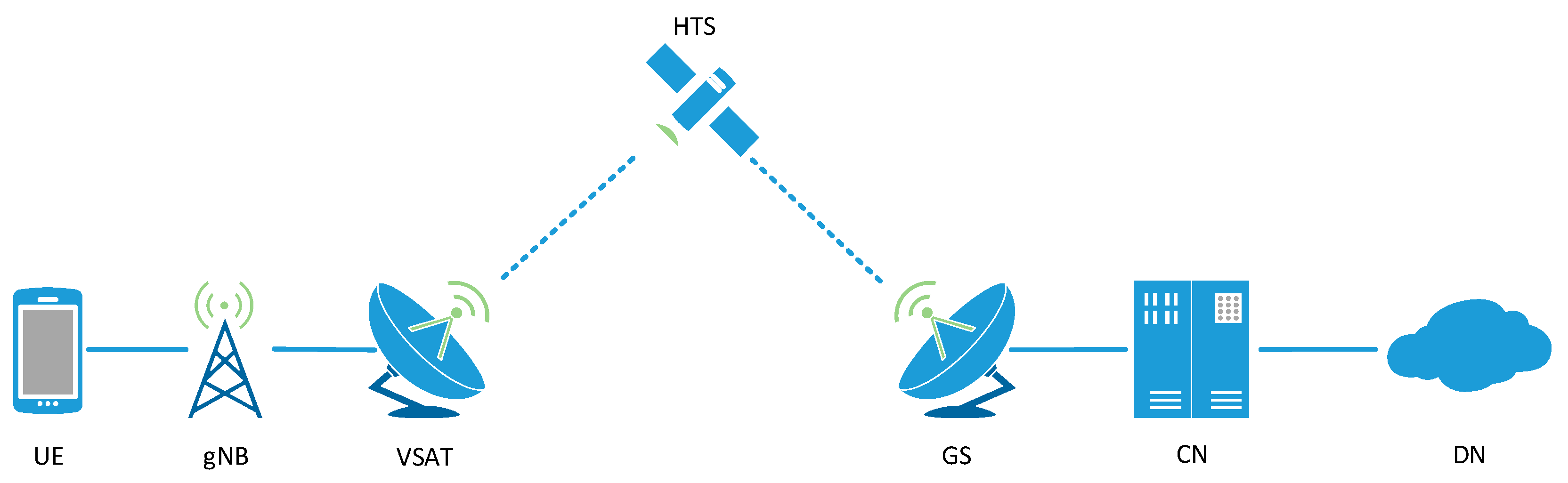
The satellite-based relaying architecture represents a conventional implementation in 5G-enabled NTN systems, where satellites function as transparent backhaul carriers between the next-generation NodeB (gNB) and the core network (CN) of 5G or 6G. This topology maintains minimal on-board signal processing, limiting satellites to basic frequency conversion and signal amplification functions.
As illustrated in
Figure 1, the satellite-based relaying architecture demonstrates protocol-transparent coupling with 5G terrestrial networks and enables flexible topology reconfiguration by utilizing established satellite communication infrastructure. However, this implementation mandates the co-located deployment of gNBs and satellite ground stations (e.g., VSAT terminals) at user-side premises.
The architecture of a satellite-based relaying network applies to areas with no terrestrial networks at all and where users are relatively concentrated in clusters [
26].
2.2.2. Architecture of Satellite-Based Transparent Forwarding Network
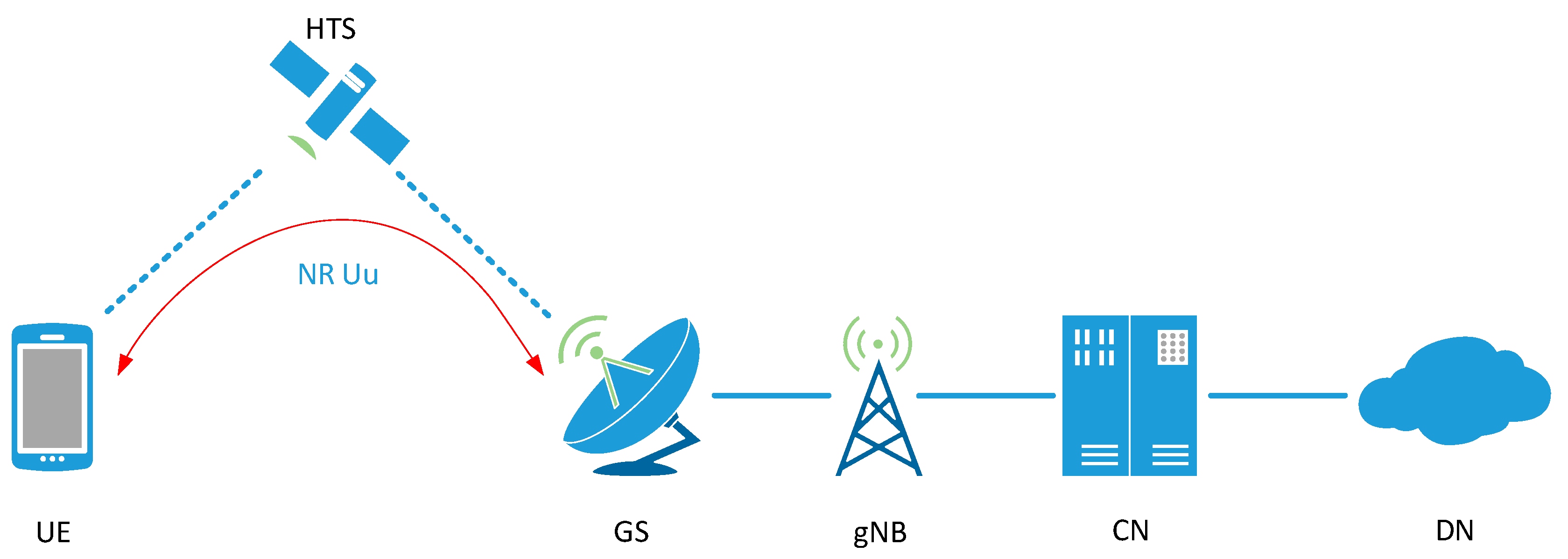
Transparent forwarding mode, as standardized in 3GPP Release 17, constitutes a foundational 5G-enabled NTN architecture where satellites and gateway stations operate as Radio Frequency (RF) repeaters. This implementation enables signal propagation to remote regions (e.g., maritime and arid zones) through regenerative RF chain processing. UE achieves direct satellite access via transparent payloads while maintaining terrestrial-grade QoS (Quality of Service) through gateway-anchored gNBs [
5,
27].
As shown in
Figure 2, in the satellite-based transparent forwarding network, the satellite and GS function as signal extensions of the gNB, necessitating support for the NR-Uu (The NR-Uu interface connects the UE to the gNB) radio interface and employing transparent signal relaying techniques that maintain protocol stack integrity without onboard baseband processing. Concurrently, the satellite payload must additionally support RF signal transmission to accommodate NTN requirements [
5,
26,
27].
The architecture of a satellite-based transparent forwarding network is suitable for mobile terminals without fixed operating locations, enabling terminals supporting satellite communication to access the satellite without the need to deploy dedicated devices such as VSAT.
2.2.3. Architecture of Regenerative Satellite-Based Network
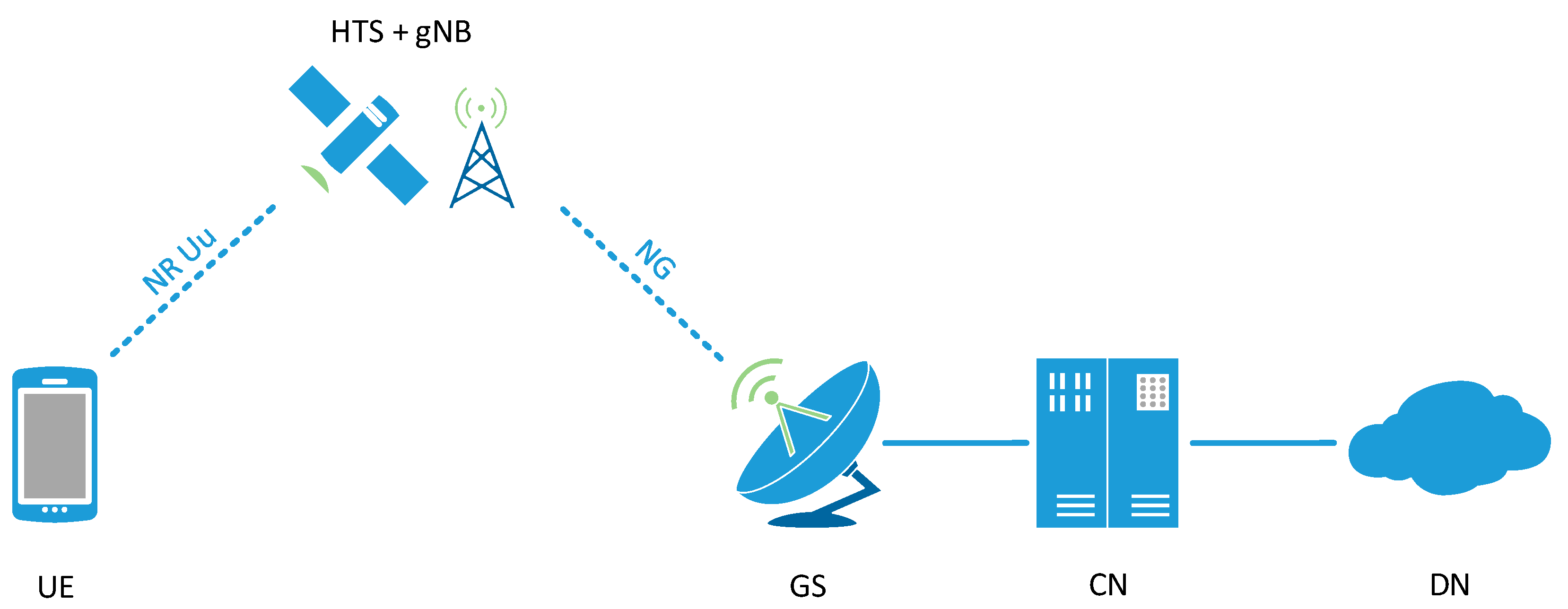
A regenerative satellite-based network is an NTN networking mode proposed by 3GPP in R18, shown in
Figure 3. In this mode, the main feature of the gNB will be transferred to the satellite, also known as the base station in satellite mode. The satellite still provides the NR-Uu radio interface to ground terminals, and user terminals can directly access the satellite. Unlike the transparent forwarding mode, the on-board regeneration mode layers the base station protocol with the underlying link between the satellite and the GS using Satellite Radio Interface (SRI), and the upper layer protocol is directly transmitted transparently by the GS [
5,
27].
In the regenerative satellite-based network, the satellite is deeply integrated with the gNB, and most of the functions of the gNB need to be integrated into the satellite for direct processing, reducing space–ground interaction, lowering time delay, and improving system reliability.
The application scenarios of the regenerative satellite network architecture are similar to those of the satellite-based transparent forwarding network architecture, and it is also applicable to mobile terminals without fixed operating locations. The biggest difference between the two lies in the different deployment locations of base stations. For the regenerative satellite network architecture, because the distance between base stations and users is shorter, the system processing efficiency is higher.
3. Analysis of Security Frameworks for Converged Applications
Satellite communication has gradually matured, especially with the rapid development of high-throughput satellites. High-throughput satellites provide greater throughput than conventional communication satellites, and satellite Internet demonstrates strong application potential. User terminals can communicate with satellites through ground stations, while some satellite phones support direct satellite connectivity.
For scenarios involving densely concentrated user populations in specific areas, we propose deploying gNBs on the user-side. This approach enables signal coverage via user-side gNB deployment, allowing standard UE to access the network without satellite communication capabilities. The solution effectively addresses diverse connectivity demands while maintaining terminal cost-effectiveness.
Quantum satellites enable secure Quantum Key Distribution between communication parties. The QGS integrates multiple subsystems, including optical receivers, precision turntables, quantum optical processors, and key generation modules. Through the efforts of the industry, the weight of QGS has been successfully reduced from 13 tons to less than 100 kg through miniaturization [
12]. Following quantum satellite docking, the QGS stores generated keys in a tamper-resistant local Key Management System (KMS), with on-demand retrieval by application systems. To ensure key security, we propose collocating QGSs with application systems within a shared secure domain, utilizing wired network connections for encapsulated key transmission.
Considering the usage characteristics of the terminal and the networking architecture of the mobile network, the quantum key equipment is recommended to be deployed at the exit of the gNB and the entrance of the CN. Therefore, in the satellite communication network, we suggest applying QKD technology to the satellite communication system in satellite relay mode.
3.1. Converged Architecture
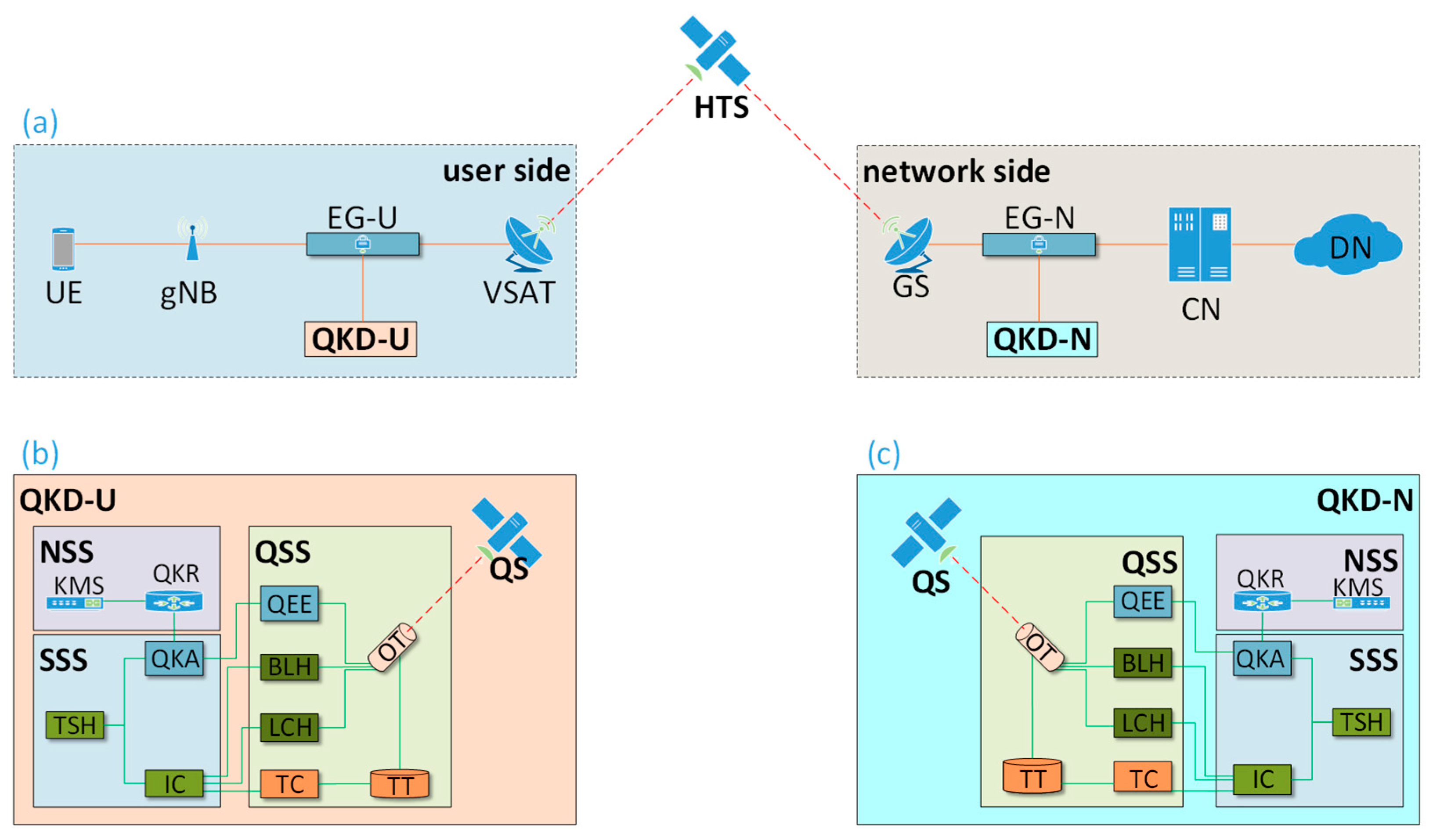
The quantum-encrypted satellite communication scheme involves deploying additional QGS and Encryption Gateways on both the user side and the net side of the satellite-based relaying network to establish a secure, encrypted communication network.
As shown in
Figure 4a, the user side consists of UE, gNB, VSAT, QGS, and Encryption Gateway, while the network-side comprises CN, QGS, and Encryption Gateway, which interfaces with the high-throughput satellite GS. The CN further connects to the DN.
The high-throughput satellite network, composed of high-throughput satellites, ground stations (GSs, and the core network, provides satellite-based broadband communication capabilities to users. It serves as a backhaul network to enable data transmission between gNBs and the CN in satellite communication systems, delivering the signal coverage to terrestrial network-inaccessible areas and meeting conventional users’ communication requirements.
The ground station interfaces with the high-throughput satellite, responsible for transmitting uplink data from gNBs to the high-throughput satellite and simultaneously receiving downlink data from the high-throughput satellite for forwarding to gNBs. The GS connects to the high-throughput satellite, receives gNB data relayed by the high-throughput satellite, and transmits the data to CN via a dedicated network line.
The satellite-based QKD network, composed of quantum satellites, QGS, and Quantum Satellite Operation and Control Centers (QSOCC), enables intercontinental QKD through FSO-QKD technology. This network provides quantum keys for Encryption Gateways on both the gNB and CN sides, ensuring the security of gNB backhaul links.
As shown in
Figure 4b,c, the QKD-U and QKD-N systems implement identical QKD protocols and function as ground-based quantum signal receivers for single-photon signals transmitted from quantum satellites. The fundamental distinction resides in their network deployment: QKD-U is typically co-located with end-user devices, whereas QKD-N functions as an intermediate node within the network infrastructure.
The QGS interfaces with the quantum satellite to implement QKD. Generated quantum keys are securely stored in the QGS’s KMS and are then delivered to the Encryption Gateways on the gNB and CN sides via standardized interfaces. These Encryption Gateways utilize these keys to encrypt transmission links between gNBs and the CN.
During system operation, the satellite-based QKD and satellite communication systems operate asynchronously. The Encryption Gateway consumes quantum keys when encrypting satellite communication links. To maintain sufficient available quantum keys between ground stations, the quantum satellite and QGS trigger QKD sessions periodically or on demand based on real-time key consumption rates.
The QKD process is dynamically scheduled to ensure continuous key replenishment between QGSs, thereby guaranteeing sustained encryption capability for the Encryption Gateway-secured backhaul links between gNBs and the CN.
The proposed integrated architecture obtains quantum keys by deploying Quantum Ground Stations on both the user-side and the core-network-side of the NTN. Meanwhile, it deploys quantum encryption and decryption gateways to perform quantum encryption for NTN links, thus constructing an NTN security architecture based on quantum encryption.
3.2. Principle of Satellite-Based QKD
A satellite-based QKD system requires at least one QS and two QGSs. The QS enables QKD and relay between the two QGS units, which are deployed on the information transmission and reception sides, respectively, to provide quantum keys for the information systems.
During scheduled overflight windows, the QS passes over the QGS units, which then acquire and maintain continuous tracking of the satellite. Within a single orbital period, the QS continuously transmits single-photon signals to the ground stations. The QKD process between the QS and each QGS is implemented using the BB84 protocol, establishing a shared key K at both ends.
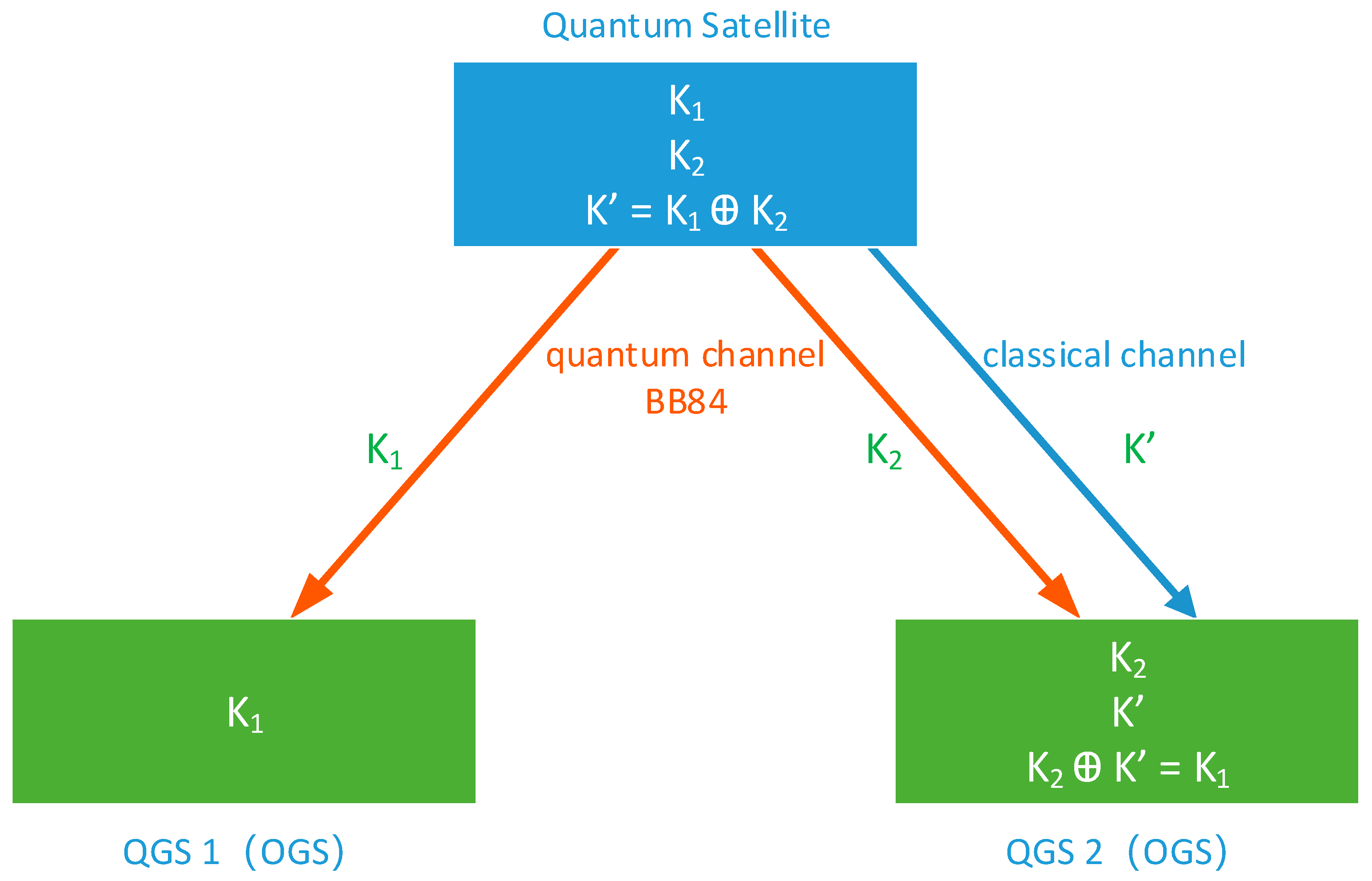
As illustrated in
Figure 5, when long-distance Quantum Key Distribution is required between QGS 1 and QGS 2, satellite-ground docking missions are initiated through the quantum satellite operation and control center. The missions are dispatched to the quantum satellite, QGS 1, and QGS 2, respectively. During the docking with QGS 1, the quantum satellite establishes a QKD link based on the BB84 protocol, generating a shared key K
1 stored in both entities. Similarly, during the docking with QGS 2, another shared key K
2 is produced through the BB84 protocol and stored in the quantum satellite and QGS 2.
Upon completing the QKD process with QGS 2, the quantum satellite encrypts K1 with K2 to obtain K′, which is transmitted to QGS 2. QGS 2 then decrypts K′ using K2 to recover K1, enabling secure key sharing between the two ground stations. This process ensures that K1 is securely distributed without direct transmission between QGS 1 and QGS 2.
The shared key K
1 can now be utilized by both ground stations for end-to-end encryption of transmitted data. QGS 1 and QGS 2 provide K
1 to their local application systems, respectively, enabling secure communication between the two locations. This method leverages the quantum satellite as a trusted intermediary for key distribution [
3,
21].
The use of the BB84 protocol ensures the security of the key generation process, as any attempt to intercept the quantum signals would introduce detectable disturbances. The encryption of K1 with K2 further enhances security during the key sharing phase, ensuring that K1 remains confidential until it reaches QGS 2.
The core function of satellite-based QKD lies in key relay. A quantum satellite establishes shared quantum keys with each ground station via separate quantum secure channels. When a specific ground station requests to share keys with another ground station, the quantum satellite encrypts the key of the target ground station using the shared quantum key between itself and the requesting ground station, and then distributes the encrypted key. The OTP encryption method, which offers the highest security, is adopted in this process.
3.3. Quantum-Encrypted NTN Workflow
The quantum-encrypted NTN comprises a foundational infrastructure of high-throughput satellites, ground stations, and GSs.
In an encrypted transmission channel, the user-side Encryption Gateway and network-side Encryption Gateway establish an end-to-end encrypted tunnel over the satellite network. This tunnel serves as the underlying secure transport layer, connecting gNBs to the CN to form the encrypted NTN system.
Figure 4 details the communication workflow. In uplink data transmission, the UE sends data to the gNB. The gNB forwards the data to the EG-U, which encrypts it using quantum keys. The encrypted data is then transmitted via the satellite network to the EG-N. The EG-N decrypts the data using quantum keys and forwards it to the CN, which delivers it to the data network. In downlink data transmission, the reverse path is followed for downlink data (DN → CN → EG-N → HTS → EG-U → gNB → UE). The EG-N encrypts downlink data, while the EG-U decrypts it [
28].
3.4. Performance Evaluation
In satellite communication networks, communication delay stands as the most significant factor affecting overall system availability. The variation in satellite altitude directly impacts communication delay, with higher altitudes resulting in greater delays. Based on orbital altitude, satellites are typically categorized into three classifications: GEO, MEO, and LEO. Specifically, GEO satellites operate at an altitude of 36,000 km, MEO satellites function within the altitude range of 5000–20,000 km, while LEO satellites maintain orbital heights between 500 and 1200 km.
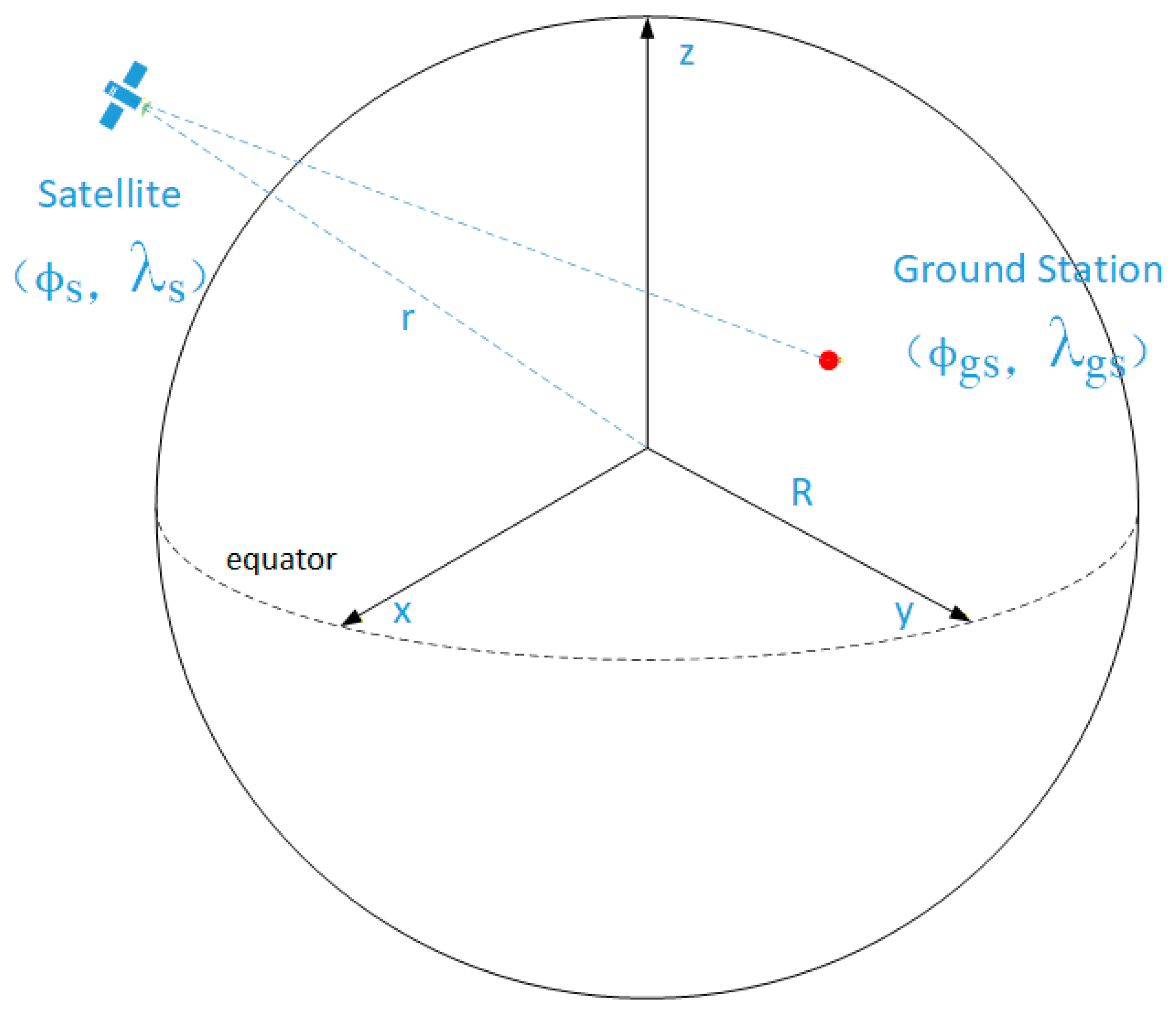
As shown in
Figure 6, the propagation delay Δ
t for signals transmitted from a satellite to a ground station can be calculated based on the signal propagation distance and the speed of light. Mathematically, it is expressed as [
29,
30]:
where
R denotes the Earth’s equatorial radius (the distance from the Earth’s surface at the equator to its center),
r represents the satellite’s orbital radius (the distance from the satellite to the Earth’s center),
ϕs and
λs indicate the satellite’s latitude and longitude in the geocentric coordinate system, respectively, while
ϕgs and
λgs correspond to the latitude and longitude of the ground station.
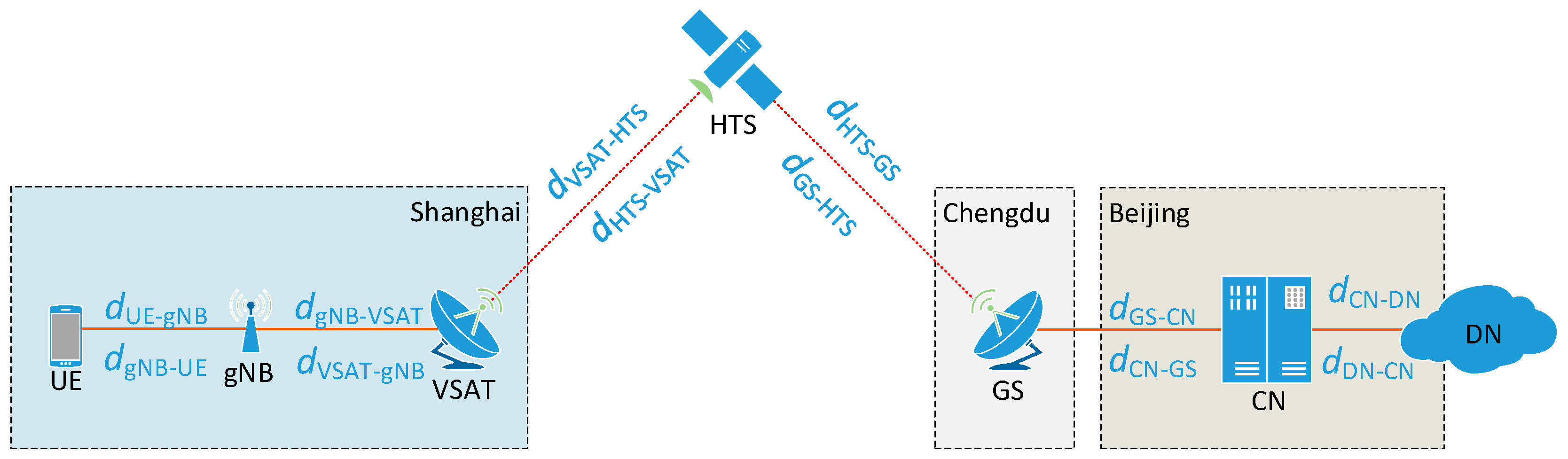
As depicted in
Figure 7, the RTT (
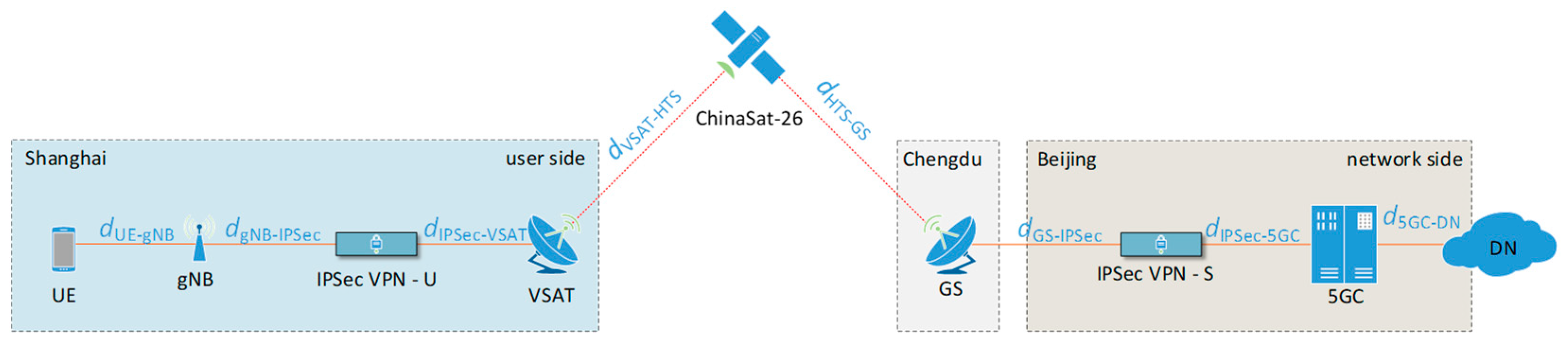
T) of satellite communication services comprises not only the propagation delay between the Shanghai VSAT and the Chengdu GS, but also the access latency from the UE to the VSAT, and the core network transmission delay from the GS to the DN [
29,
30].
Satellite communication networks exhibit multiple intermediate nodes and are susceptible to weather-induced impairments in space-to-ground links. To ensure statistical validity of the time delay, we conducted
n times (
n = 100) delay measurement trials and calculated the mean delay using the following equation:
where
Ti denotes the RTT of the i-th communication and
μ denotes the mean time delay.
In assessing network availability between nodes, in addition to average RTT, network jitter serves as a critical stability metric. This parameter σ quantifies temporal delay variation and is calculated as follows:
where
Ti represents the i-th time delay measurement.
To quantify network stability with higher precision, we propose analyzing the temporal dynamics of network jitter through standardized measurement intervals using the following equation:
4. Experimental Setup and Results
To validate the feasibility of integrating satellite-based QKD into 5G satellite communication systems, we constructed a satellite-relayed encrypted 5G network using the following components:
QS: “Jinan-1”;
HTS: “Chinasat-26”;
QGS: CASQN SIWS-1000;
VSAT: KeyCSat PB60A-S4;
GS: CSC Chengdu GS;
5GC: GENEW 5GC;
IPSec VPN: CASQN CSL-VPN-1000;
gNB: CTIBS5421 5G small cell;
UE: HUAWEI Mate 30 Pro 5G.
Subsequently, we conducted satellite-based QKD experiments to provide quantum keys for IPSec VPNs located in Beijing and Shanghai. Based on these keys, we further implemented a quantum-encrypted 5G satellite communication test.
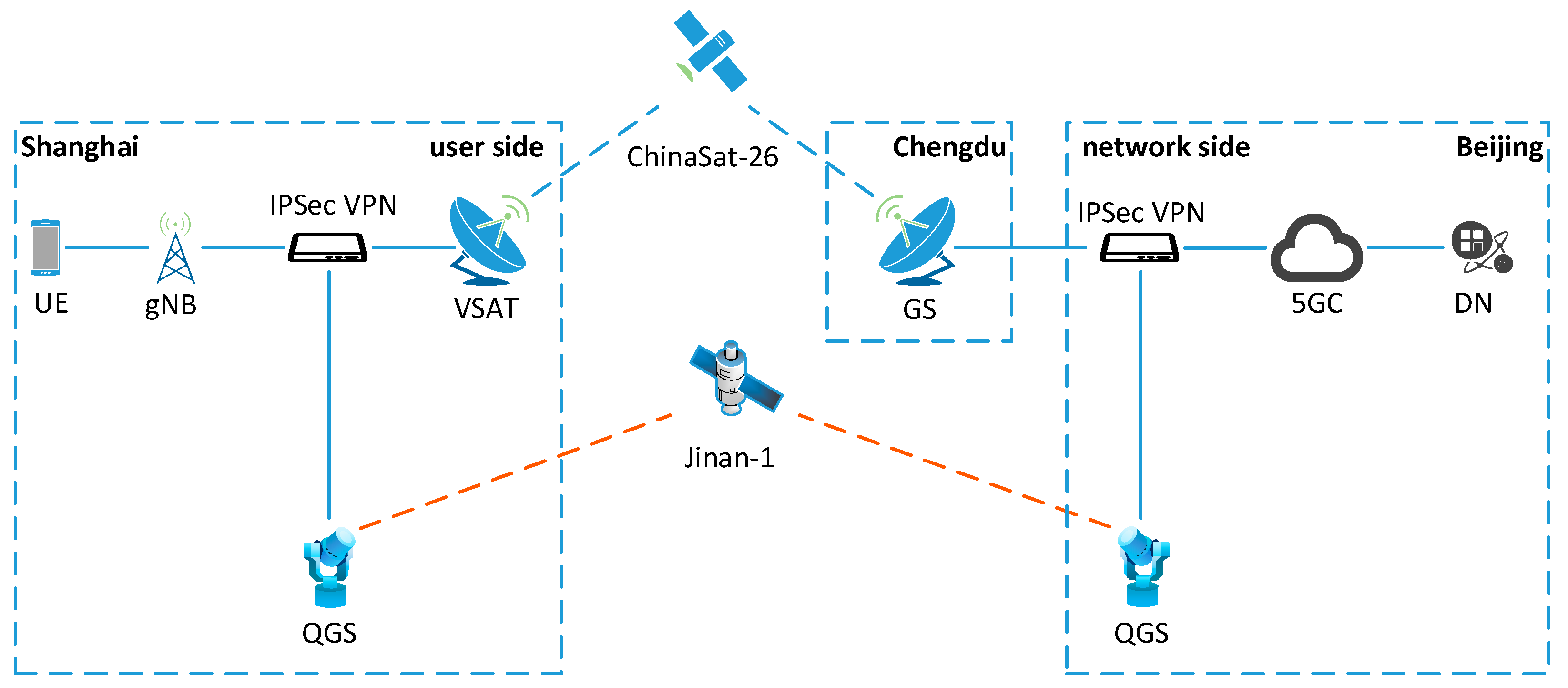
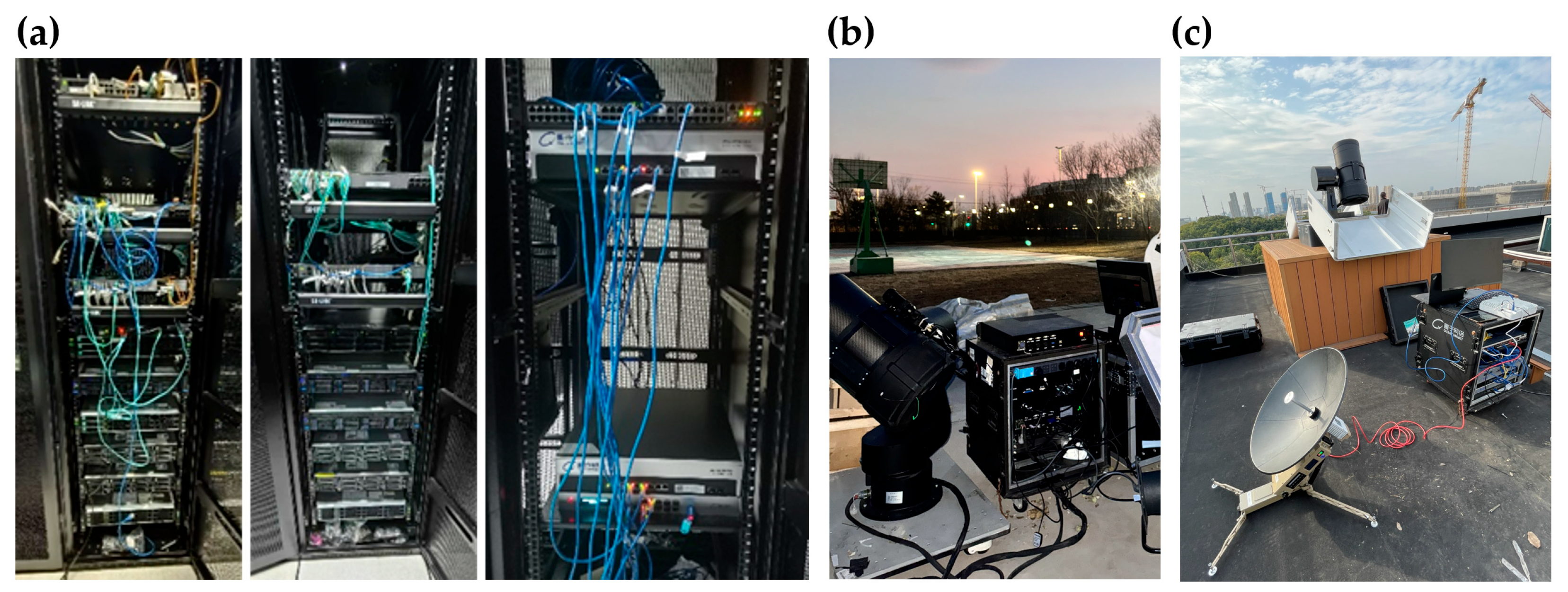
In Shanghai and Beijing, shown in
Figure 8, QGS were deployed and connected to the quantum satellite to establish a satellite-to-ground QKD network. In Shanghai, a VSAT and 5G small cell were installed to provide 5G signal coverage for scenarios lacking terrestrial network infrastructure (e.g., maritime vessels, deserts, and remote areas). In Beijing, a 5GC was implemented and interfaced via dedicated fiber-optic lines with the GS in Chengdu, which connects to the HTS.
Figure 9 presents a satellite-based QKD-encrypted 5G-enabled NTN between Shanghai and Beijing nodes.
As depicted in
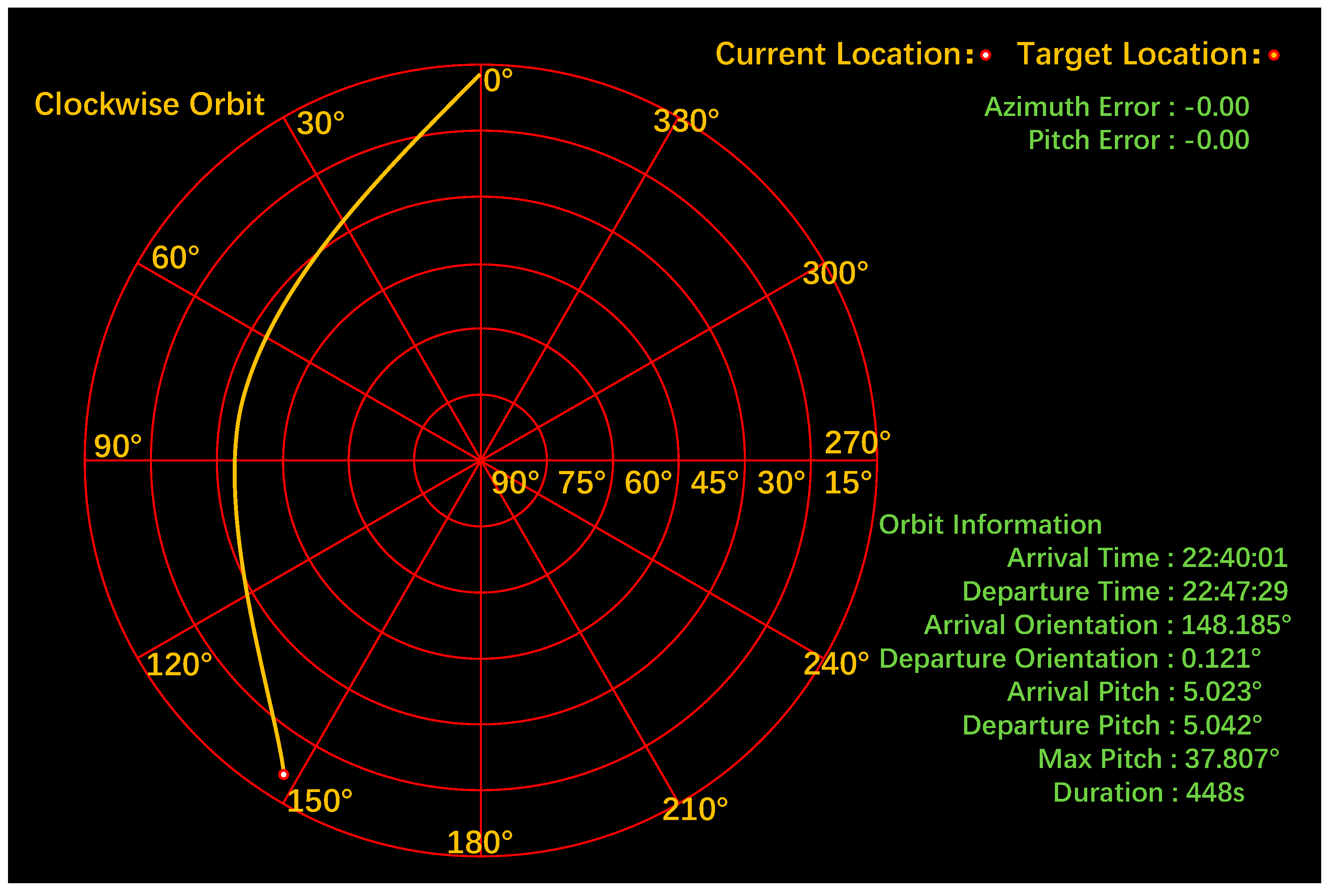
Figure 10, the experimental campaign achieved critical milestones in satellite-based QKD: On 22 November 2024 (22:40:01–22:47:29 UTC+08:00), the QGS in Beijing successfully established a quantum optical link with the “Jinan-1” and performed QKD, generating quantum-secured keys. On 29 November 2024, these keys were relayed to the QGS in Shanghai via the “Jinan-1”. These keys, managed by the integrated KMS of the QGS’s QKD system, are utilized to secure satellite communications. When encrypted 5G satellite communication is required, the VPN gateways can request and obtain these QKD-derived keys from the QGS’s KMS to negotiate strong session keys for protecting the IPSec VPN tunnels.
When encrypted data transmission is required in 5G satellite networks, the IPSec VPN dynamically acquires fresh quantum keys from the local KMS, implementing end-to-end quantum-secured communication via 128-bit SM4 or AES encryption algorithms.
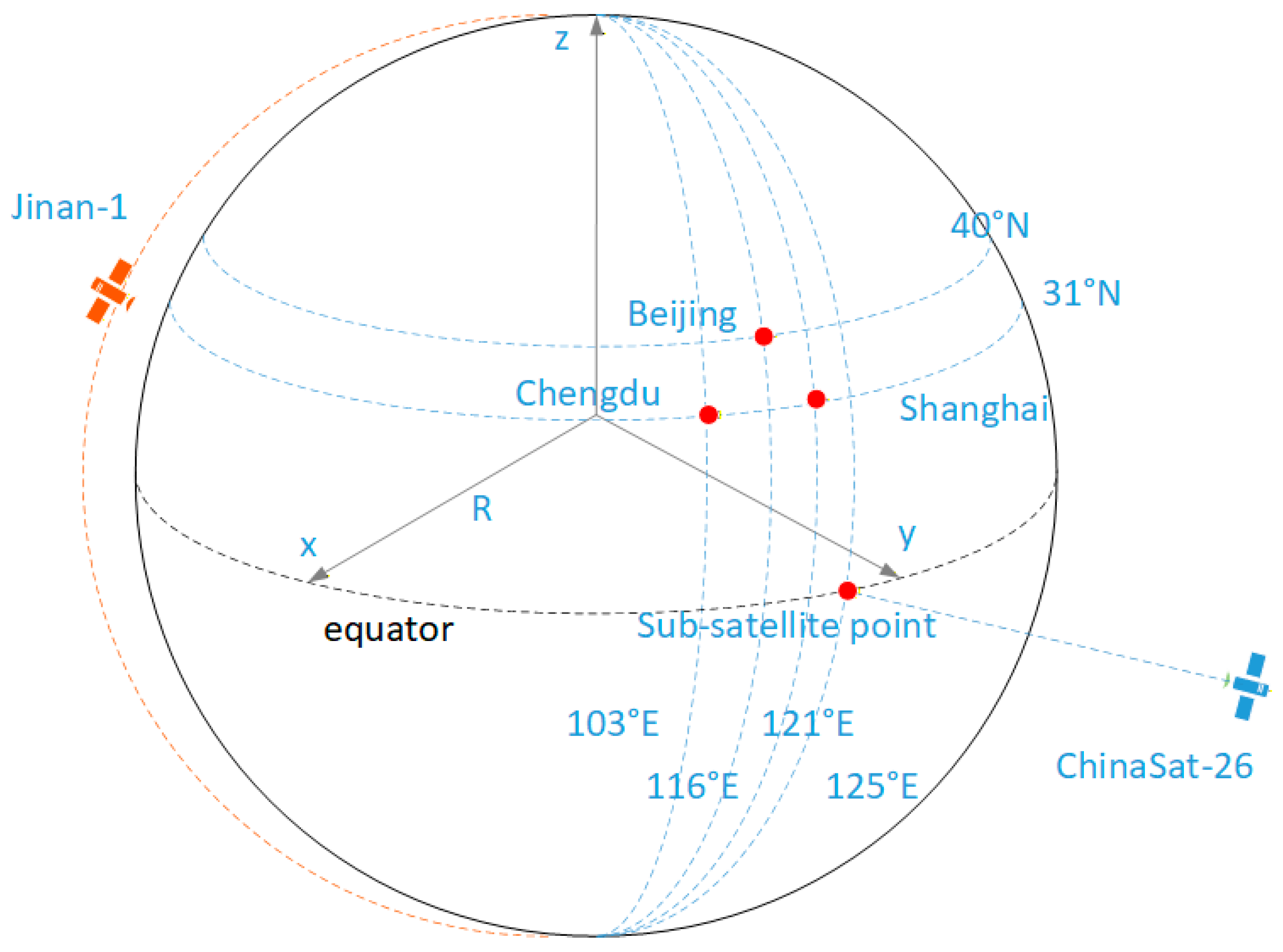
In this experiment, shown in
Figure 11, the “ChinaSat-26” satellite is positioned directly above the equator (i.e.,
ϕs = 0°), which simplifies the trigonometric terms to sin
ϕs = sin 0° = 0 and cos
ϕs = cos 0° = 1. Consequently, the propagation delay Equation (1) reduces to
The parameters are substituted as follows:
Speed of light c = 299,792.458 km/s;
Earth’s equatorial radius R = 6378 km;
Satellite orbital radius r = 42,164 km;
Longitude difference = λs − λgs = 125° − 121°30′ = 3°30′.
The theoretical propagation delay from the satellite to the Shanghai ground station is calculated as Δts = 123 ms, and to the Chengdu GS as Δtc = 124 ms. Therefore, the total theoretical propagation delay between the Shanghai ground station and the Chengdu GS approximates 247 ms.
The leased line transmission delay from the Chengdu GS to the Beijing 5GC is approximately 20 ms. The total delay from the Shanghai VSAT to the Beijing DN is 267 ms, yielding a RTT of 534 ms.
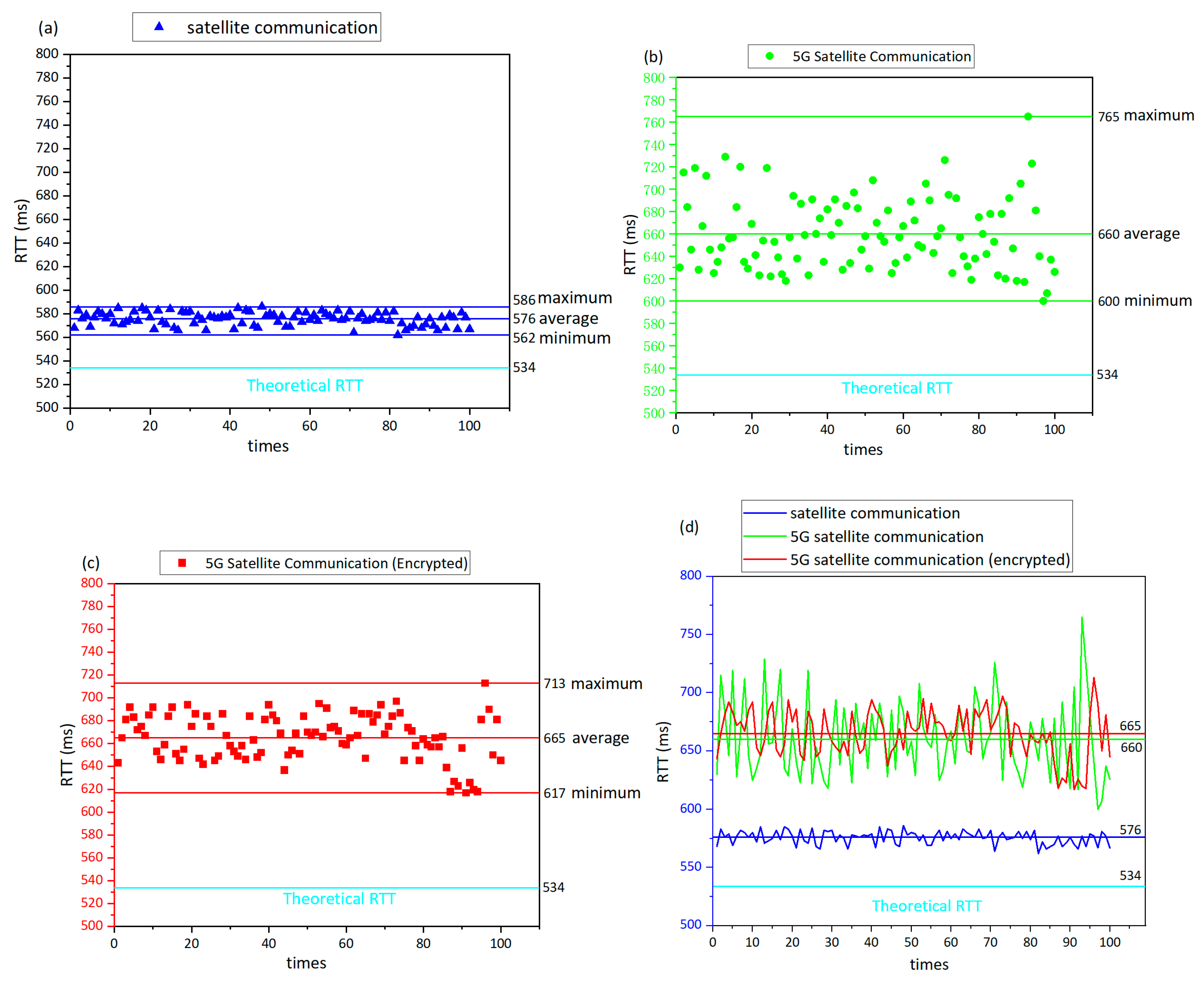
We first conducted RTT tests on the high-throughput satellite link between the Shanghai VSAT and the Beijing 5GC entry point. As shown in
Figure 12a, the measured RTT consistently remained below 600 ms, with a minimum RTT of 562 ms, a maximum RTT of 586 ms, and an average RTT of 576 ms. Compared to the theoretical RTT of 534 ms, the measured results exhibited an average increase of approximately 42 ms, indicating limited overall RTT variation.
To evaluate the impact of quantum encryption implementation on 5G satellite communication services, we conducted RTT tests using a real UE in a non-IPSec VPN environment. As depicted in
Figure 12b, the measured RTT ranged from 600 ms to 765 ms with an average value of 660 ms.
Subsequently, we deployed IPSec VPN within the experimental environment. As illustrated in
Figure 13, the network architecture was augmented with a pair of IPSec VPN tunnels, and bidirectional delay measurements were systematically conducted.
As shown in
Figure 12c, in quantum-encrypted 5G satellite communication scenarios, the RTT between UE and DN remains predominantly below 700 ms, with a minimum RTT of 617 ms, a maximum RTT of 713 ms, and an average RTT of 665 ms. The comparative analysis of RTT can refer to
Figure 12d.
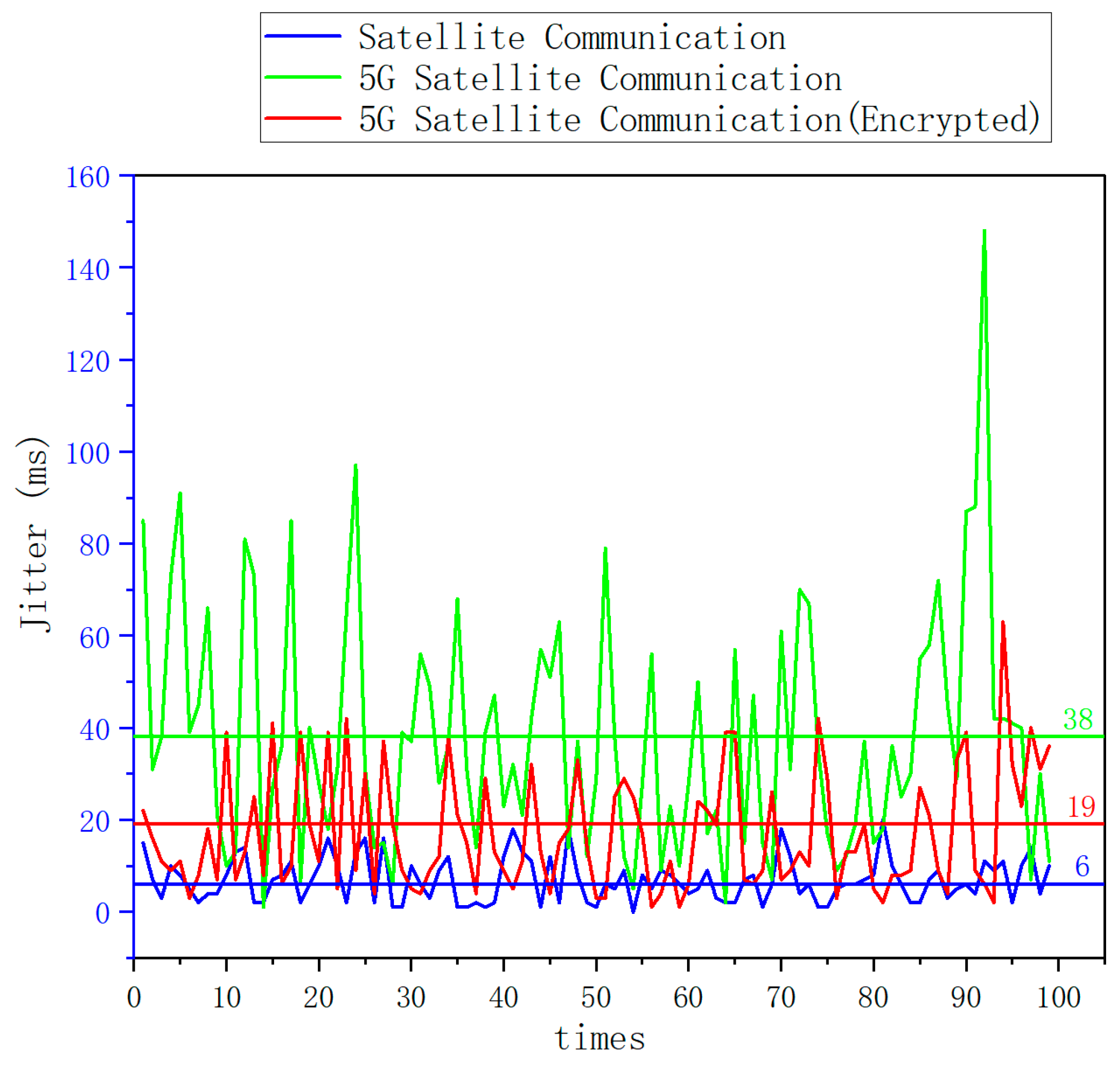
Detailed jitter dynamics are illustrated in
Figure 14. Experimental results demonstrate that the high-throughput satellite link exhibits minimal network jitter, with an average value of 6 ms. In contrast, the non-encrypted 5G satellite communication network shows significantly higher jitter, averaging 38 ms. Following the implementation of quantum IPSec VPN, the 5G satellite communication network achieves a substantial 50% reduction in jitter, lowering the average to 19 ms. This provides evidence that quantum IPSec VPN markedly enhances network stability.
Furthermore, we conducted comprehensive testing of quantum-encrypted 5G services, including Voice over New Radio (VoNR), messaging, and data communications. All services operated seamlessly, with VoNR—the most delay-sensitive application—delivering excellent audio quality. Under the Mean Opinion Score (MOS) evaluation framework, all testers rated the voice quality above 4.0 (categorized as “good” to “excellent”).
5. Discussion
This paper systematically examines the feasibility of 5G-enabled NTN and satellite-based QKD technology, proposing an integrated application framework for spaceborne QKD in 5G satellite systems. In terms of results, this study not only experimentally validates the technical feasibility of integrating of 5G-enabled NTN with satellite-based QKD in 5G networks, but also achieves enhanced communication, as well as providing RTT and jitter metrics to assess end-user experience performance. These findings may inspire the research community to further explore security while expanding solutions for next-generation NTN based on satellite-based QKD encryption, as well as their potential applications.
The security framework presented in this work exhibits both strengths and limitations. First, 5G-enabled NTNs operating in satellite relay mode deliver reliable 5G signal coverage to remote areas, eliminating the need for wired connections between gNB and 5GC. Second, satellite-based QKD provides a quantum satellite application scenario communication infrastructure for remote regions, enabling Quantum Key Distribution via satellites and obviating concerns about the high construction costs of terrestrial QKD networks. Third, backhaul link encryption based on quantum cryptography offers users high-security transmission guarantees and mitigates the risk of information leakage. However, the framework involves a large number of devices, leading to considerable overall costs. Beyond 5GC, QGS, and IPSec VPN on the network side, it requires the deployment of multiple independent devices (including VSAT, QGS, IPSec VPN, and gNB) on the user side. Future work could explore device integration efforts to reduce the system construction costs.
In this experiment, a 5G-enabled NTN was established using GEO satellites for communication. Due to the significantly large orbital altitude radius of GEO satellites, the system’s signal propagation characteristics were degraded by environmental factors, resulting in elevated measured latency compared to theoretical predictions. Furthermore, the experimental configuration involved geographically separating the satellite gateways and the 5G core network by a distance of gateway and 5GC between two cities 2000 km across two distinct metropolitan areas. This intentional geographical dispersion introduced a substantial additional communication delay. Currently, low-latency satellite communication technology based on LEO is maturing; future research could be conducted on LEO communication satellite constellations to reduce RTT metrics and improve end-user experience.
In addition, only one quantum satellite was used in this experiment. The QGS in Beijing and Shanghai both needed to interface with “Jinan-1”. Since these two cities are geographically close in longitude, “Jinan-1” could only interface with one of the QGS during a single satellite pass, while the other had to wait for the next satellite pass to establish the connection. Future efforts could focus on developing quantum satellite constellations to enhance satellite-ground QKD interfacing capability, thereby meeting the demands arising from the growth in user numbers.
6. Conclusions
This paper explores the integration architectures of 5G-enabled NTNs (in different modes) with satellite-based QKD and proposes a quantum-enhanced security framework for next-generation space–terrestrial networks. To this end, we developed a testbed and conducted experiments using real-world devices. These validations confirm the feasibility of the security framework, enhance the security of 5G-enabled NTN communications, and expand the application scenarios of quantum satellites.
To reduce latency in future commercial deployments, transitioning to LEO satellites represents a feasible strategy. Co-locating satellite gateways with 5G core network elements will further reduce the latency contribution caused by terrestrial network transmission. Establishing a dedicated quantum satellite constellation provides a viable approach to significantly enhancing the key delivery capabilities of satellite-based QKD. Subsequently, we intend to extend this architecture to quantum satellite constellations. Key issues that we need to focus on addressing in the next step include key management, such as inter-satellite key routing and transmission, task scheduling for simultaneous QKD sessions between multiple ground stations and the satellite constellation, as well as cooperation among multiple satellites.



 ,
,