Article

Design of a Wide-Field Deflection System Using a Self-Achromatic Grism


1
Key Laboratory of Photoelectronic Imaging Technology and System of Ministry of Education of China, School of Optics and Photonics, Beijing Institute of Technology, Beijing 100081, China
2
National Key Laboratory of Electromagnetic Space Security, Tianjin 300308, China
*
Author to whom correspondence should be addressed.
Photonics 2025, 12(12), 1178; https://doi.org/10.3390/photonics12121178
Submission received: 31 October 2025 / Revised: 17 November 2025 / Accepted: 28 November 2025 / Published: 29 November 2025
(This article belongs to the Special Issue Optical Systems and Design)

Abstract

Field-deflecting optical elements play a crucial role in various high-resolution and field-expandable optical systems. However, for widely used prism-based field-deflecting optical elements, the issue of chromatic aberration correction under wide-field conditions remains unresolved. To solve this problem, we first propose a self-achromatic double-faced grism (DFG) configuration based on a single prism and establish a parametric design model for the DFG under wide-field self-achromatic conditions. Based on this model, an optical imaging system with a field deflection range of −3.6° to +0.8° operating in the 3–5 μm wavelength band was designed. The absolute residual chromatic aberration of the DFG element is less than 0.07 across all field points, and the MTF of the imaging system exceeds 0.2@33 lp/mm for all fields. The design results demonstrate that the proposed element can effectively achieve achromatic field deflection in wide-field optical systems.

1. Introduction

With the continuous emergence and application of new technologies, imaging systems increasingly demand higher performance, including a wider field of view (FOV) and higher resolution. One persistent challenge in imaging system design has been achieving a broad FOV, where optical elements for field deflection play a vital role.
Currently, there are two primary approaches to FOV expansion. The first is the scanning-based imaging system, which reduces volume, weight, and power consumption by employing electrically driven optical elements to deflect instantaneous FOV. This system sequentially captures images of different sub-fields and stitches them into a panoramic image [1,2,3]. The second is the array-based imaging system, which consists of multiple lenses arranged in an array. To minimize volume and weight while avoiding mechanical interference between lenses, boresight deflection optics are employed to direct each lens toward a different sub-FOV. The resulting images are then fused algorithmically [4,5,6].
A commonly used method for achieving continuous wide-angle beam deflection involves Risley prisms [5,6,7,8,9,10,11,12,13]. However, the inherent chromatic aberration of the prisms, which manifests as lateral chromatic aberration, is difficult to compensate for using the rear rotationally symmetric imaging optics. Consequently, the difficulty of achieving self-achromatism restricts their application in broadband imaging, restricting their use largely to monochromatic systems. To enable broadband operation, researchers from the University of Dayton and Kent State University combined prisms made of different materials to correct chromatic aberration in the mid-infrared band (2–5 μm) and optimized the two-prism achromatic system using a first-order approximation method [14,15,16]. Recently, innovations in diffractive optics have substantially improved performance in classical optical designs across visible and infrared wavelengths. For instance, Chen proposed combining achromatic and apochromatic prisms with diffraction gratings [17,18]. Weber et al. fabricated etched diffraction gratings on ZnSe prism surfaces, creating a two-prism scanning system with diffractive correction [19]. Hybrid prism-grating elements have gained popularity due to their low dispersion and compact form factor [20,21,22,23]. Nie Xin et al. further developed a mathematical model for rotating double grisms [24].
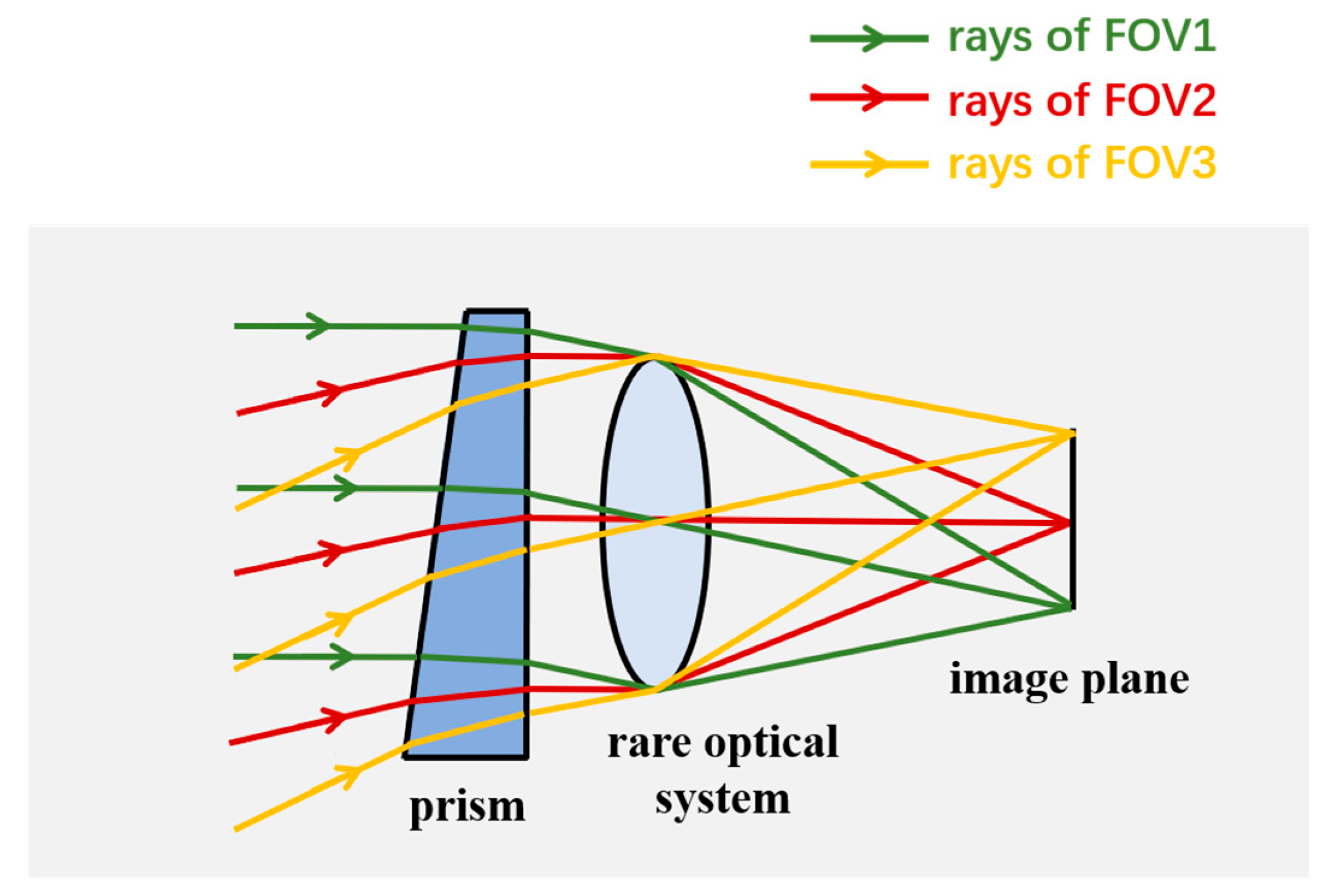
At present, large-format detectors are advancing rapidly. To improve scanning efficiency, engineers now prefer to use them with a wide instantaneous field of view (IFOV), as shown in Figure 1. However, a wider IFOV demands that the prism must correct chromatic aberration across this wide field. If not, the image quality at the edge of the field will drop sharply. This severely affects the stitching of the final large-field image. Previous papers mainly solved chromatic aberration correction for narrow fields. For wide-field conditions, this problem remains unsolved. This limitation also hinders the use of such prisms in wide-field beam-steering imaging systems.
To solve the problem of chromatic aberration under wide-field deflection conditions, in this paper, we propose a double-faced grism (DFG) structure based on a single prism capable of self-correcting chromatic aberration. We establish a parametric model for the DFG under wide-field achromatic conditions and define associated chromatic control criteria for integration with rear imaging optics. In Section 2, we introduce the theoretical model of field deflection based on the self-achromatic DFG. In Section 3, we present the design of a 3–5 μm imaging system with a field deflection range of −3.6° to +0.8°, including DFG optimization and full system implementation. In Section 4, we provide a discussion.

2. Theory of Boresight Deflection with a Self-Achromatic Double-Faced Diffractive Grism

2.1. Ray Transmission Model of the Double-Faced Grism Structure

The propagation of diffracted light for an incident angle α (equal to the field angle α ) is described by the grating equation [25], where n i is the refractive index of the incident medium, n o is the refractive index of the outgoing medium, λ is the design wavelength, d is the grating constant, m is the diffraction order, and θ is the diffraction angle.
n o sin θ = n i sin α + m λ d
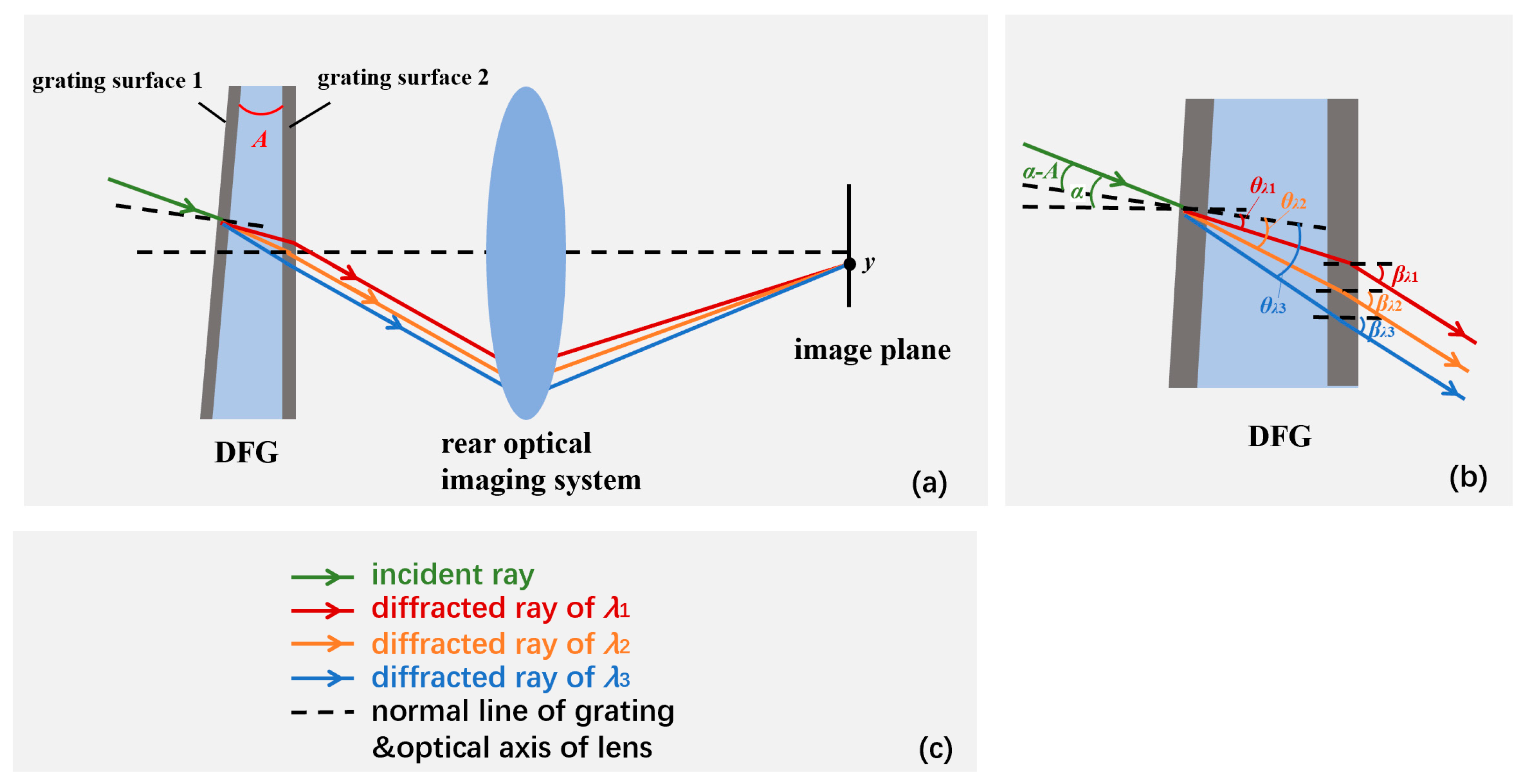
The double-faced grism (DFG) structure is depicted in Figure 2a. It consists of a prismatic wedge with gratings etched on both its front and rear surfaces. This configuration achieves self-achromatism through two successive diffraction events and enables field deflection by leveraging the wedge angle to adjust the incident angle on the gratings. The ray propagation path illustrating the field deflection angle achieved by the DFG is shown in Figure 2b. According to the grating diffraction equation, for a field angle of α , the ray propagation is governed by the following formula:
n 2 ( λ ) sin θ = n 1 sin ( α A ) + m 1 λ d 1 n 3 sin β = n 2 ( λ ) sin ( θ + A ) + m 2 λ d 2
where n 1 is the refractive index of the incident medium, n 2 is the refractive index of the DFG material, n 3 is the refractive index of the outgoing medium, λ is the design wavelength, d 1 is the grating constant of Grating 1, m 1 is the diffraction order of Grating 1, d 2 is the grating constant of Grating 2, m 2 is the diffraction order of Grating 2, θ is the diffraction angle from Grating 1, and β is the diffraction angle from Grating 2 (i.e., the exit angle). Here, n 1 = n 2 = 1 . The simultaneous solution of Equation (2) is the ray transmission equation of the double-faced grism structure:
sin β = sin ( α A ) + m 1 λ d 1 cos A + sin A n 2 2 sin ( α A ) + m 1 λ d 1 2 + m 2 λ d 2

2.2. Self-Achromatic Field Deflection Model of the Double-Faced Grism

For a DFG designed at three wavelengths (Figure 2b) with a central wavelength λ 2 and an operating band Δ λ = λ 3 λ 1 , the derivative of Equation (4) gives the variation in the dispersion angle Δ β ( Δ β = β λ 3 β λ 1 ) with Δ λ as:
Δ β = Δ λ cos β 2 m 1 d 1 cos A 2 n 2 Δ n 2 Δ λ sin ( α A ) + m 1 λ 2 d 1 m 1 d 1 n 2 2 sin ( α A ) + m 1 λ 2 d 1 2 sin A + m 2 d 2
Since the media on the two sides of the DFG grating surfaces are opposite, the grating constants d1 and d2 of the two surfaces exhibit opposite signs. As the dispersion in DFG originates from grating diffraction, by setting M = m 1 / d 1 = m 2 / d 2 , the beam experiences equal amounts of forward and reverse dispersion within the DFG, thereby enabling the achievement of self-achromatism. Let R = Δ n 2 / Δ λ be the change in the refractive index of the component material. Equation (4) then becomes:
Δ β = Δ λ cos β 2 M ( 1 - cos A ) + 2 n 2 R sin ( α A ) + M λ 2 M n 2 2 sin ( α A ) + M λ 2 2 sin A
Rearranging Equation (5) into a polynomial form yield:
a 0 + a 1 M + a 2 M 2 + a 3 M 3 + a 4 M 4 = 0
with the coefficients given as follows:
a 0 = 4 n 2 2 R 2 sin 2 A Δ β 2 cos 2 β 2 ( n 2 2 sin 2 ( α A ) ) a 1 = 4 n 2 R sin ( α A ) sin 2 A + 2 λ 2 sin ( α A ) Δ β 2 cos 2 β 2 2 Δ β cos β 2 ( cos A 1 ) Δ λ ( n 2 2 sin 2 ( α A ) ) a 2 = sin 2 ( α A ) sin 2 A 4 n 2 R sin 2 A + λ 2 2 Δ λ 2 ( cos A 1 ) 2 a 3 = 2 λ 2 sin ( α A ) sin 2 A a 4 = λ 2 2 sin 2 A
The parameters of the DFG can be determined by solving for M in Equation (6) and optimizing the value of A and n 2 , Δ β is guided by the rear aberration requirements of the subsequent optical system.
Since multiple field points are sampled during optical system design, let N be the number of field samples. Equation (6) can thus be extended to a multi-field form:
a 10 a 11 a 12 a 13 a 14 a 20 a 21 a 22 a 23 a 24 a N 0 a N 1 a N 2 a N 3 a N 4 1 M M 2 M 3 M 4 = 0 0 0
where for the i-th field, the polynomial coefficients are given by:
a i 0 = 4 n 2 2 R 2 sin 2 A Δ β 2 cos 2 β 2 ( n 2 2 sin 2 ( α i A ) ) a i 1 = 4 n 2 R sin ( α i A ) sin 2 A + 2 λ 2 sin ( α i A ) Δ β 2 cos 2 β 2 2 Δ β cos β 2 ( cos A 1 ) Δ λ ( n 2 2 sin 2 ( α i A ) ) a i 2 = sin 2 ( α i A ) sin 2 A 4 n 2 R sin 2 A + λ 2 2 Δ λ 2 ( cos A 1 ) 2 a i 3 = 2 λ 2 sin ( α i A ) sin 2 A a i 4 = λ 2 2 sin 2 A
The parameters of the DFG can then be obtained by solving for M in Equation (7) and optimizing A , n 2 . The chromatic value of the DFG component Δ y can be calculated by Δ y = Δ β f , where f is the focal length of the rear optical imaging system. The chromatic aberration control condition, which is matched to the rear optical imaging system (i.e., the self-achromatism condition), is set as follows: Δ y takes a value equal to 10 times of the chromatic aberration of the rear optical imaging system. This establishes the target value for the optimization of Δ β .
The lateral chromatic aberration value of the rear optical imaging system is determined by the lateral chromatic aberration formula given in Equation (8) [26], where n k is the image-space refractive index, u k is the image-space numerical aperture angle, h is the stop height, and h z is the marginal ray height of every lens.
Δ y = 1 n k u k 1 k C II ,   1 N C II = 1 N h h z ϕ υ

3. Design Example

3.1. Design Specifications

Following the theory in Section 2, we design an optical system with DFG-based field deflection, with the key design requirements provided in Table 1.

3.2. Design of the Initial System

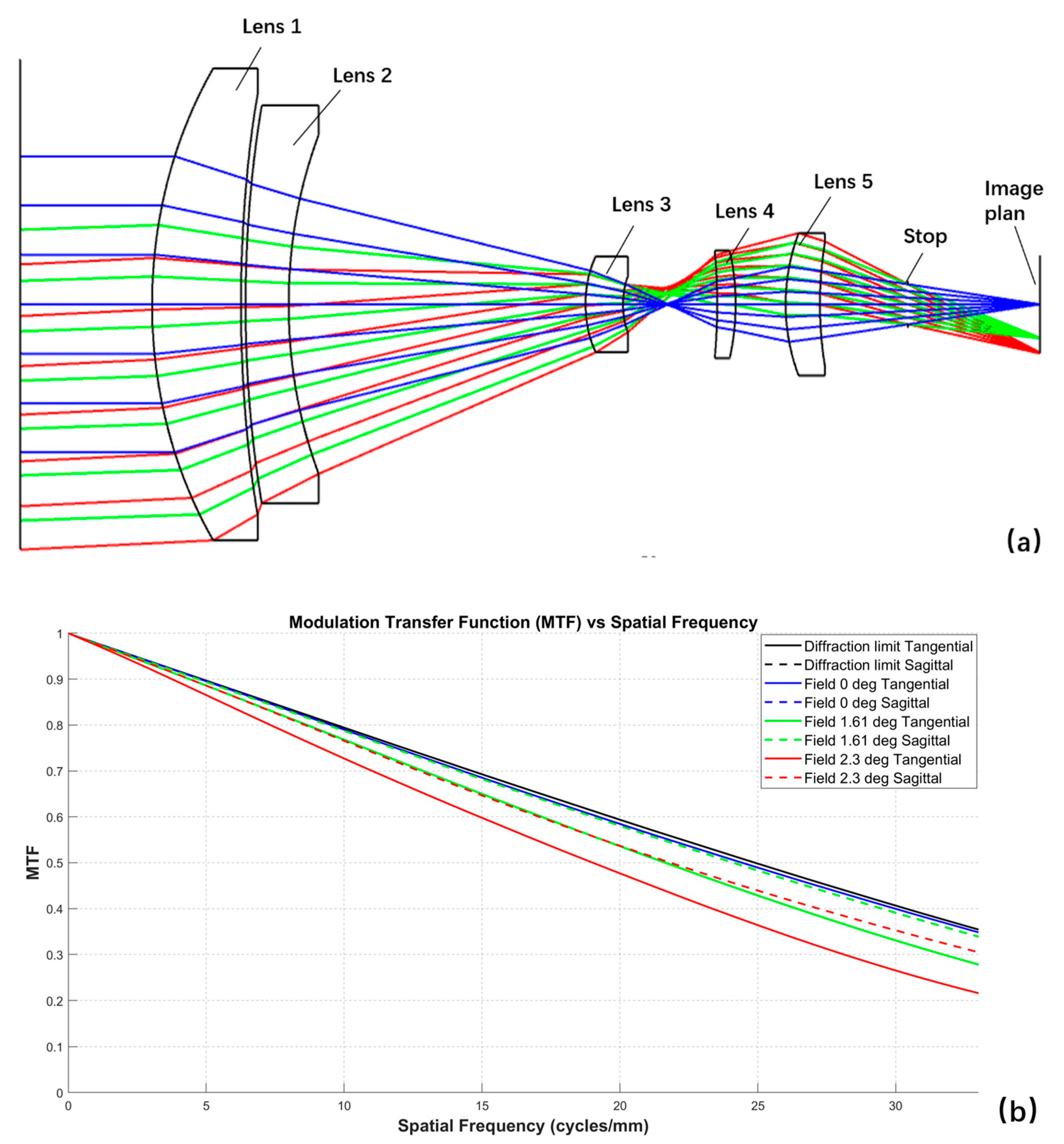
The chosen rear optical system structure, depicted in Figure 3a, has an XY-field of −2.2° to +2.2°. It is a secondary imaging system composed of five lenses made of SILICON, SILICON, GE, GE, and SILICON. Key specifications include a 37.5 mm entrance pupil diameter, a 60 mm maximum aperture, and a 12.34 mm image height, with the layout shown in Figure 3a. The MTF is greater than 0.2 at 33 lp/mm across all fields.
We can calculate the lateral chromatic aberration values Δ y of the rear optical imaging system using the data provided in Table 2 and Table 3. And based on the results summarized in Table 3, we can determine the achromatization target value for the DFG element at each field is Δ y 0.09 mm.
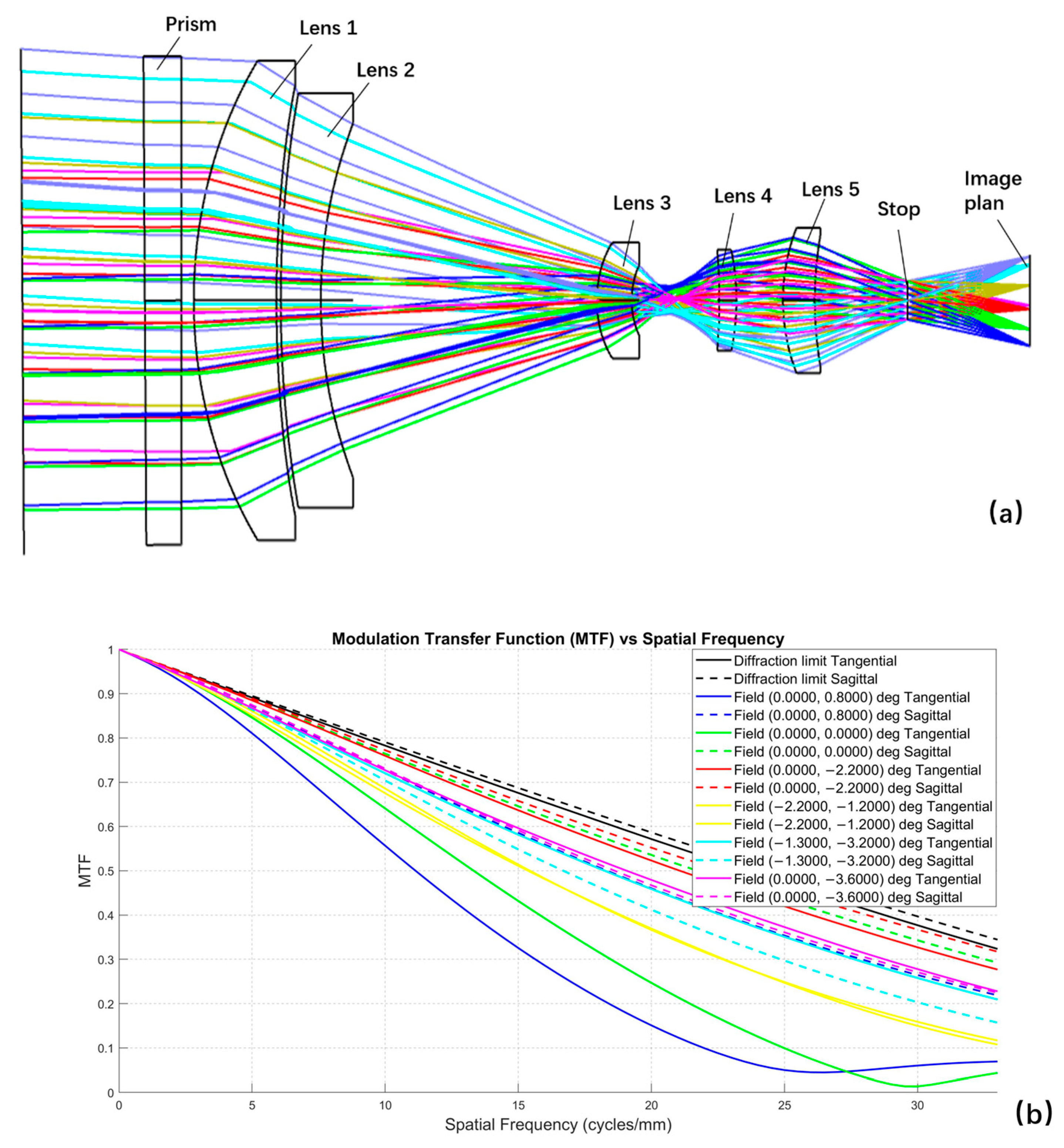
The FOV in the Y-direction after field deflection ranges from −3.6° to +0.8° in Figure 4a, with a nominal deflection field of −1.4°. We selected silicon as the material for the DFG based on considerations of its large element size and manufacturability. Based on the prismatic field deflection formula, an initial apex angle of A = −0.42° was defined for the DFG. The following field points were selected as sampling fields for analysis: (0°, 0.8°), (1.5°, 0.6°), (0°, 0°), (0°, −1.2°), (2.2°, −1.2°), (1.5°, −3°), and (0°, −3.6°). And it can be clearly observed in Figure 4b that the MTF decreased sharply in these fields.

3.3. Optimization and Result

Based on Equation (7) derived in Section 2, we set the central wavelength λ 2 = 4   μ m , λ 1 = 3   μ m , λ 3 = 5   μ m . Then we solve the value of M and optimize the value of A to satisfy the target chromatic aberration Δ y 0.09 mm.
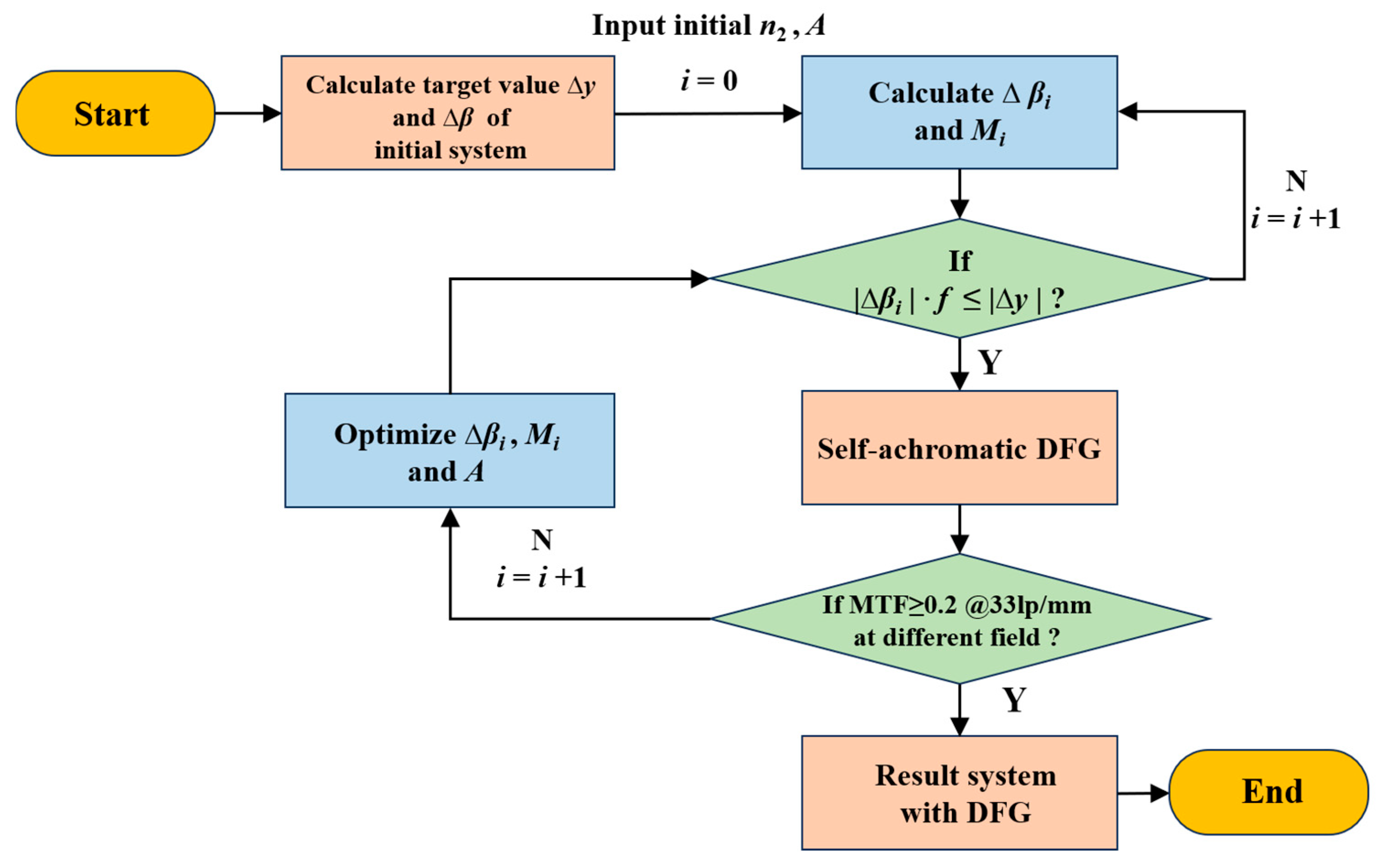
In Figure 5, we show the procedure for solving the DFG parameters and designing the field deflection system. The process commences with the calculation of the target values for chromatic aberration, Δ y and Δ β , derived from the initial optical system parameters. These initial prism parameters, n 2 and A, are subsequently substituted into the DFG computational model expressed in Equation (7) to calculate the initial solutions for M0 and Δ β 0 .
The workflow then proceeds to evaluate the achromatic condition. The determination Δ β i f Δ y is made as to whether the calculated value Δ β 0 satisfies the prerequisite for achromatism. If the condition is not Δ β 0 satisfied, the parameters M0 and Δ β 0 are iteratively recalculated (yielding M1, Δ β 1 , etc.) until the achromatic condition is met. Upon satisfaction of this condition, the process advances to the image quality assessment phase.
During the image quality assessment, the DFG parameter model is integrated into the initial optical system to analyze whether the MTF conforms to the design specifications. Should the MTF prove inadequate, the DFG parameters are optimized utilizing Equation (7). This optimization triggers a reiteration of both the achromatic condition check and the image quality evaluation. The iterative cycle continues until the system’s MTF meets the required performance standards, at which point the design of the field deflection system is finalized.
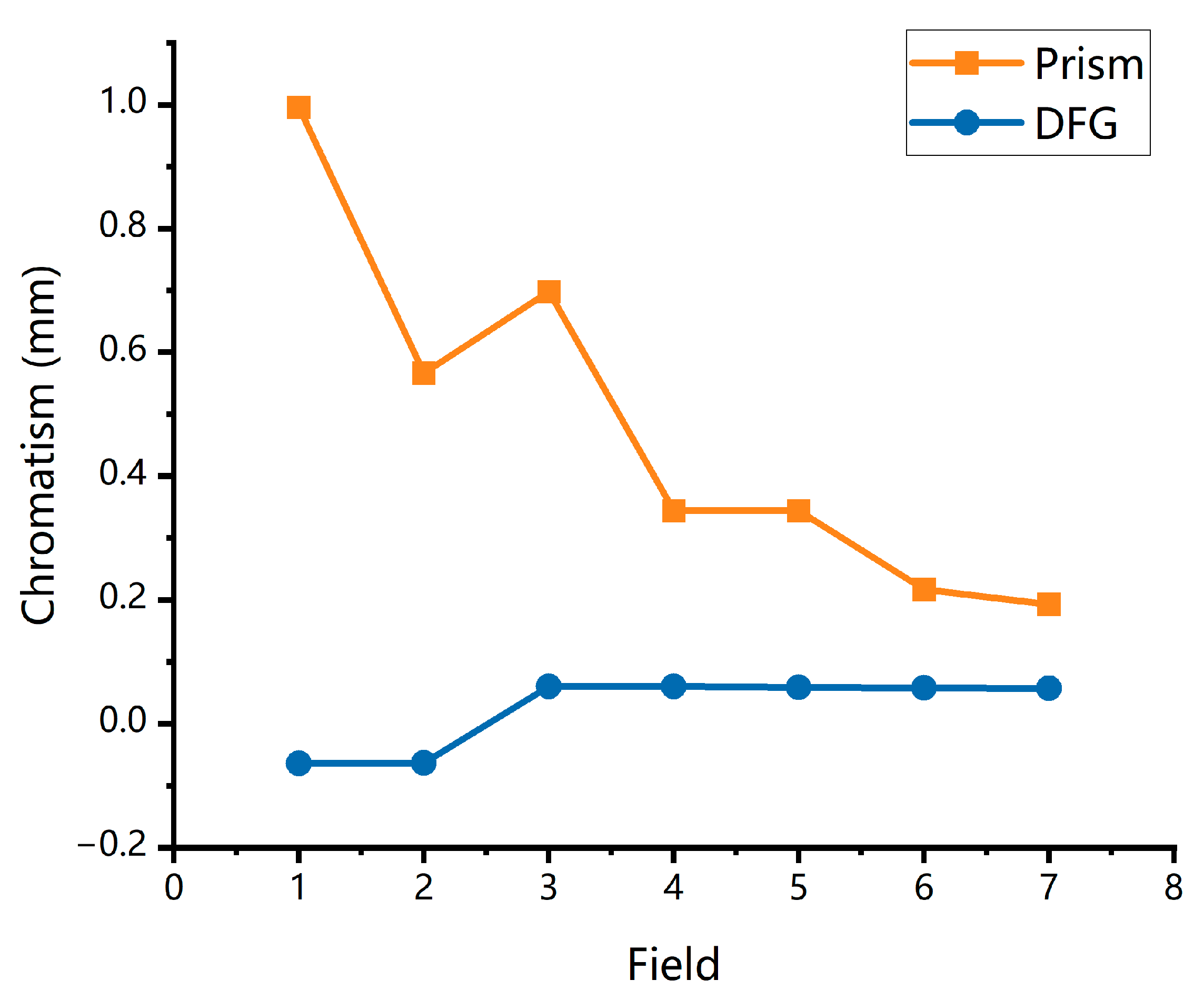
The initial Δ β of the element at various field points, calculated using the prism dispersion formula, are 0.006634224, 0.00377661, 0.004653543, 0.002294525, 0.002294525, 0.001444937 and 0.0012864. So the aberration values Δ y are 0.9951 mm, 0.5665 mm, 0.698 mm, 0.3442 mm, 0.3442 mm, 0.2167 mm, and 0.193 mm.
Following computation and optimization, the final parameters of the DFG are A = −0.4° and M = 7.63. The residual chromatic aberrations values are −0.06403 mm, −0.06312 mm, 0.06046 mm, 0.06046 mm, 0.05873 mm, 0.05787 mm, and 0.05759 mm, which meet the achromatic condition Δ y 0.09 mm. A comparison of the residual chromatic aberration between the prism and the DFG at different sampling field positions is shown in Figure 6. It can be observed that the residual chromatic aberration of the DFG is significantly smaller than that of the prism. And the residual Δ β are −0.000427, −0.000421, 0.000403, 0.000403, 0.000391, 0.000386, and 0.000384.
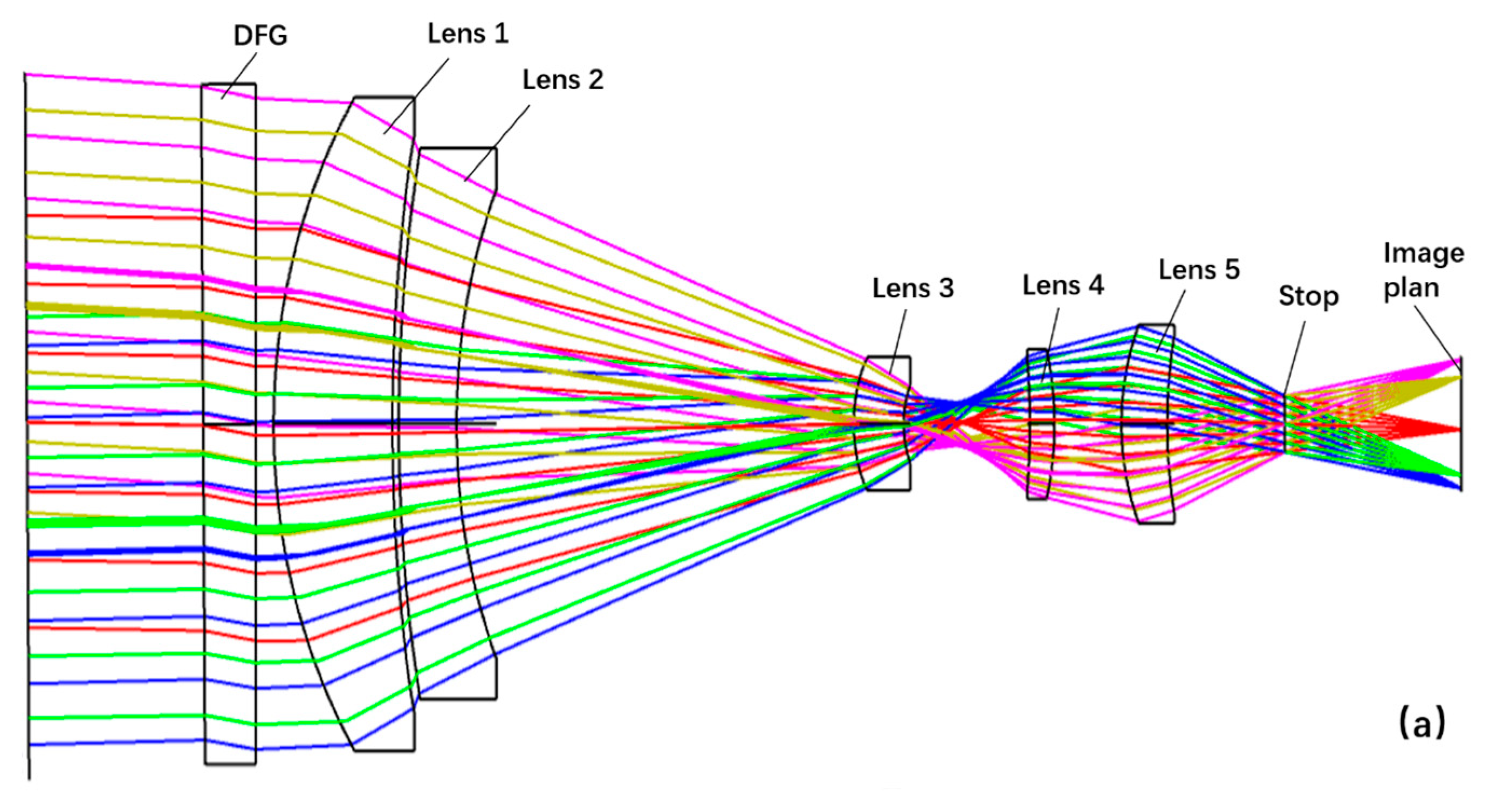
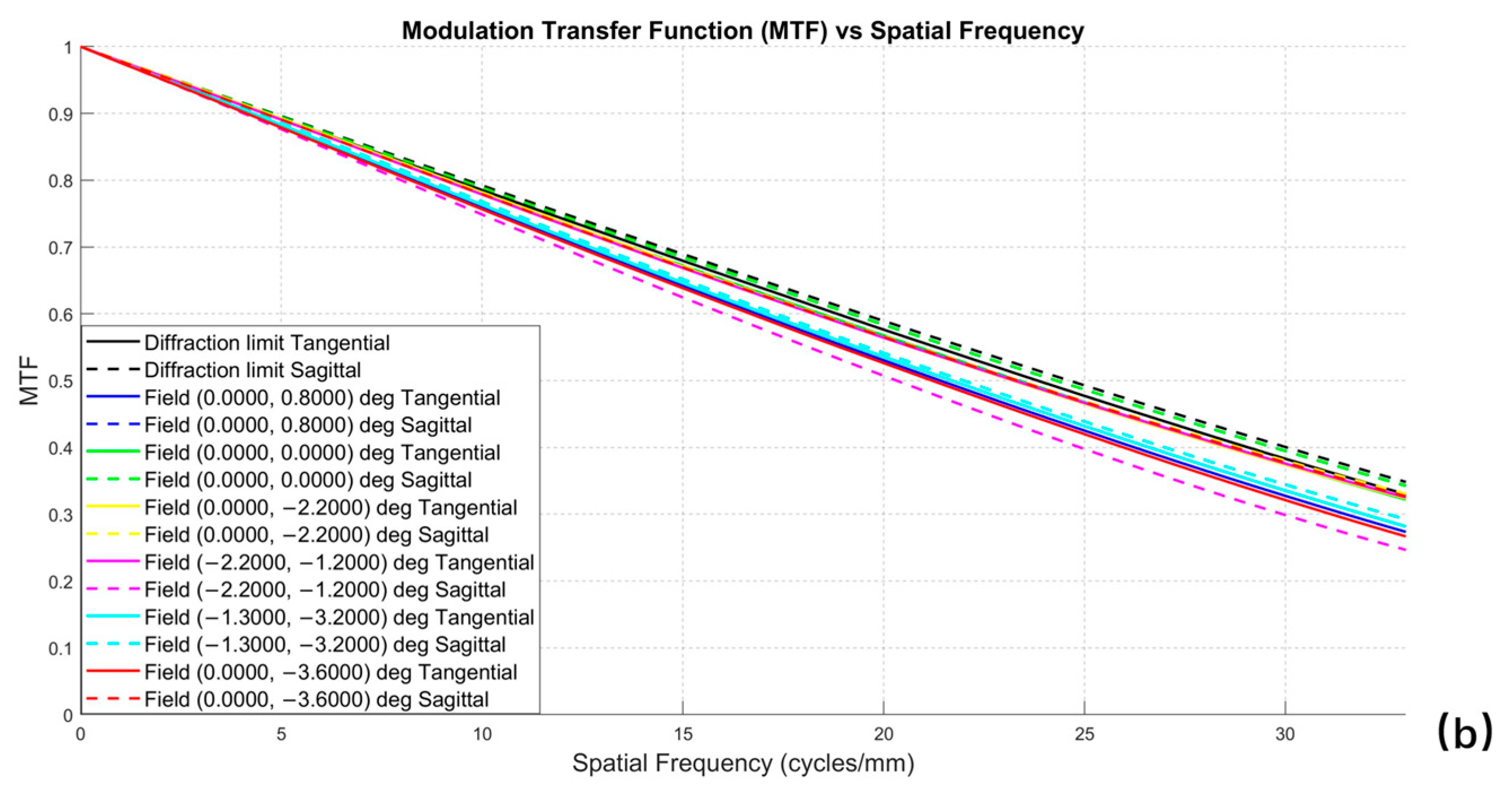
With the diffraction order set to 1, the corresponding grating parameters are calculated as d1 = −d2 = 0.131 mm and m1 = m2 = 1. After incorporating these DFG parameters into the system, the resulting optical system layout is as shown in Figure 7a. The MTF result is also presented in Figure 7b. At a spatial frequency of 33 lp/mm, the MTF values for all fields exceed 0.22, meeting the design requirements.

4. Discussion

In this paper, we proposed a self-achromatic DFG optical configuration based on a single prism. And we established a theoretical model for calculating DFG parameters under wide-field self-achromatic conditions, along with chromatic aberration control criteria for matching with rear optical imaging systems. Based on this model, we designed a field-deflecting optical imaging system operating in the 3–5 μm wavelength range with a Y-field of −3.6° to +0.8° and completed the self-achromatic optimization of the DFG and the overall imaging system design. The absolute residual chromatic aberration angle of the DFG across all fields is less than 0.07 mm, and the MTF of the imaging system exceeds 0.2 at 33 lp/mm for all fields. The design results demonstrate that the proposed DFG effectively achieves achromatic field deflection for wide-field imaging systems.
The design method proposed in this paper enables a single-material field deflection optical element to achieve self-achromatism under wide-field conditions. This effectively addresses the challenge of chromatic aberration correction in wide-field deflection systems and expands their application scope. However, due to the incorporation of a double-sided diffractive surface structure, the transmittance of the DFG experiences some degradation. Further design and optimization of the diffractive microstructures are necessary to enhance the element’s transmittance. According to the result from the design example, the grating constant d = 0.131 mm falls within the normal range for such gratings, confirming its feasibility for fabrication and alignment. Future work will focus on exploring methods to extend the capabilities of this element in terms of operational bandwidth and field of view.

Author Contributions

Conceptualization, N.X., J.C. and Y.L.; methodology, N.X.; formal analysis, N.X., B.X. and N.M.; investigation, N.X., Y.L., B.X. and N.M.; resources, N.X., B.X. and N.M.; data curation, Y.L.; writing—original draft preparation, N.X.; writing—review and editing, J.C., B.X. and N.M.; visualization, N.X.; supervision, Y.L.; project administration, J.C. and Y.L.; funding acquisition, J.C. All authors have read and agreed to the published version of the manuscript.

Funding

This research was funded by Opening Funding of National Key Laboratory of Electromagnetic Space Security grant number JCKY2024240C006.

Data Availability Statement

Data are contained within the article.

Acknowledgments

We would like to express our gratitude to the National Key Laboratory of Electromagnetic Space Security for providing technical assistance.

Conflicts of Interest

The authors declare no conflicts of interest.

References

  1. Rosell, F.A. Prism scanner. J. Opt. Soc. Am. 1960, 50, 521–526. [Google Scholar] [CrossRef]
  2. Huang, F.; Ren, H.; Wu, X.Y.; Wang, P.F.I. Flexible foveated imaging using a single Risley-prism imaging system. Opt. Express 2021, 29, 40072–40090. [Google Scholar] [CrossRef]
  3. Wang, Y.Q.; Diao, Z.; Bi, Z.K.; Chen, A. Design of out-of-plane scanning linearization drive for waveguide beam scanner based on dual-frequency liquid crystal. Opt. Express 2025, 33, 41448–41460. [Google Scholar] [CrossRef]
  4. Carles, G.; Chen, S.; Bustin, N.; Downing, J.; McCall, D.; Wood, A.; Harvey, A.R. Multi-aperture foveated imaging. Opt. Lett. 2016, 41, 1869–1872. [Google Scholar] [CrossRef]
  5. Li, A.; Liu, X.; Gong, W.; Sun, W.; Sun, J. Prelocation image stitching method based on flexible and precise boresight adjustment using Risley prisms. J. Opt. Soc. Am. 2019, 36, 305. [Google Scholar] [CrossRef] [PubMed]
  6. Lu, S.Y.; Cao, Z.Y.; Ling, J.Z.; Yuan, Y. Recent Progress in Liquid Microlenses and Their Arrays for Adaptive and Applied Optical Systems. Micromachines. 2025, 16, 1158. [Google Scholar] [CrossRef] [PubMed]
  7. Li, A.; Sun, W.; Liu, X.; Gong, W. Laser coarse-fine coupling tracking by cascaded rotation Risley-prism pairs. Appl. Opt. 2018, 57, 3873–3880. [Google Scholar] [CrossRef]
  8. Lai, S.; Lee, C. Double-wedge prism scanner for application in thermal imaging systems. Appl. Opt. 2018, 57, 6290–6299. [Google Scholar] [CrossRef]
  9. Dixon, J.; Engel, J.R.; Vaillancourt, R.; Schwarze, C.; Potter, K. Risley prism universal pointing system (RPUPS). Proc. SPIE 2015, 9579, 95790B. [Google Scholar]
  10. Zhao, P.; Che, G.H.; He, X.D.; Huang, F. Full-area three-element Risley prism system based on high precision real-time continuous scanning strategy. Opt. Express 2025, 30, 37364–37378. [Google Scholar] [CrossRef]
  11. Xia, H.F.; Xia, H.Y.; Yuan, L.Z. Cascaded strapdown line-of-sight stabilization for Risley prisms on motion platforms. Appl. Opt. 2025, 64, 5546–5557. [Google Scholar] [CrossRef]
  12. Xia, H.Y.; Xia, Y.X.; Yuan, L.Z.; Wen, P. Fast and high-precision tracking technology for image-based closed-loop cascaded control system with a Risley prism and fast steering mirror. Opt. Express 2024, 32, 85555–85571. [Google Scholar] [CrossRef]
  13. Haoyu, Z.; Jie, C.; Zhou, D.; Cui, H. Three-dimensional computational ghost imaging using a dynamic virtual projection unit generated by Risley prisms. Opt. Express 2022, 30, 39152–39161. [Google Scholar] [CrossRef] [PubMed]
  14. Bos, P.J.; Garcia, H.; Sergan, V. Wide-angle achromatic prism beam steering for infrared countermeasures and imaging applications: Solving the singularity problem in the two-prism design. Opt. Eng. 2007, 46, 11301. [Google Scholar]
  15. Gibson, J.L.; Duncan, B.D.; Bos, P. Wide angle beam steering for infrared countermeasures applications. Proc. SPIE 2002, 4723, 100–111. [Google Scholar]
  16. Duncan, B.D.; Bos, P.J.; Sergan, V. Wide-angle achromatic prism beam steering for infrared countermeasure application. Opt. Eng. 2003, 42, 1038–1047. [Google Scholar] [CrossRef]
  17. Chen, C.W. Grism (Grating-Prism Combination). U.S. Patent 5,652,681, 29 July 1997. [Google Scholar]
  18. Chen, C.W. Achromatic and Apochromatic Prism Element Employing Prisms and Grating. U.S. Patent 5,625,499, 29 April 1997. [Google Scholar]
  19. Weber, D.C.; Trolinger, J.D.; Nochols, R.G.; Lal, A.K. Diffractively corrected Risley prism for infrared imaging. Proc. SPIE 2000, 4025, 79–86. [Google Scholar]
  20. Missig, M.D.; Morris, G.M. Diffractive optics applied to eyepiece design. Appl. Opt. 1995, 34, 2452–2461. [Google Scholar] [CrossRef]
  21. Chen, C.W.; Anderson, J.S. The use of diffractive optical element in 3-5 micrometer optical system. Proc. SPIE 1993, 2075, 207502. [Google Scholar]
  22. Jannson, T.; Aye, T.M.; Savant, G. Dispersion and aberration compensation techniques in diffractive optics and holography. Proc. SPIE 1994, 2152, 44–70. [Google Scholar]
  23. Chen, C.B. Beam steering and pointing with counter-rotating grisms. Proc. SPIE 2007, 6714, 671409. [Google Scholar]
  24. Nie, X.; Yang, H.F.; Xue, C.X. Diffractively corrected counter-rotating Risley prisms. Appl. Opt. 2015, 54, 10473–10478. [Google Scholar] [CrossRef]
  25. Loewen, E.G.; Popov, E. Diffraction Grating and Its Application, 1st ed.; Marcele Dekker: Boca Raton, FL, USA, 1997; pp. 50–82. [Google Scholar]
  26. Yu, D.Y.; Tan, H.Y. Engineering Optics, 3rd ed.; China Machine Press: Beijing, China, 2011; pp. 105–129. [Google Scholar]
Figure 1. Optical path diagram of the field deflection optical system.
Photonics 12 01178 g001
Figure 2. (a) The structure of a DFG and the process of ray deflection and focusing via a DFG. (b) Diffraction process upon passing through a DFG. The system operates over a waveband λ 1 ~ λ 3 . centered at λ 2 . The angles are defined as follows: field angle α ; incident angle on Grating 1 ( α A ) ; diffraction angles from Grating 1: θ λ 1 , θ λ 2 , θ λ 3 ; and corresponding diffraction angles from Grating 2: β λ 1 , β λ 2 , β λ 3 ; Δ β = β λ 3 β λ 1 . (c) Legend.
Photonics 12 01178 g002
Figure 3. (a) Rear optical imaging system layout (b) MTF curve.
Photonics 12 01178 g003
Figure 4. (a) Initial System Layout with Field Deflection (b) MTF curve with Field Deflection.
Photonics 12 01178 g004
Figure 5. DFG Parameters Solution and Optimization Flowchart.
Photonics 12 01178 g005
Figure 6. Comparison of the residual chromatic aberration between the prism and the DFG.
Photonics 12 01178 g006
Figure 7. (a) Resulting System Layout with Field Deflection (b) MTF diagram with Field Deflection.
Photonics 12 01178 g007aPhotonics 12 01178 g007b
Table 1. Design Requirements.
ParametersValues
Wavelength (μm)3~5
Focal length (mm)150
FOV (°)X: (−2.2~+2.2); Y: (−3.6~+0.8)
F-number4
MTF>0.2@33 lp/mm
Table 2. Parameters of lens.
Lens Number (i)12345
Refractive power ( ϕ i )3.25 × 10⁻²−3.03 × 10−21.69 × 10−25.73 × 10−26.38 × 10−2
Abbe number ( υ i )145.03106.43106.43145.03145.03
Table 3. Chromatic aberration calculation data.
Field (x°, y°) h 1 z (mm) h 2 z (mm) h 3 z (mm) h 4 z (mm) h 5 z (mm) Δ y
(0, 0)−1.51−1.21−0.070.500.530.00098
(0, 1.61)−8.40−7.09−0.403.183.020.00600
(0, 2.3)−12.30−9.71−0.114.194.630.00856
Disclaimer/Publisher’s Note: The statements, opinions and data contained in all publications are solely those of the individual author(s) and contributor(s) and not of MDPI and/or the editor(s). MDPI and/or the editor(s) disclaim responsibility for any injury to people or property resulting from any ideas, methods, instructions or products referred to in the content.