Article

Design and Experimental Research of Vortex Beam Mixer


1
School of Information Engineering, Xi’an University, Xi’an 710065, China
2
School of Automation and Information Engineering, Xi’an University of Technology, Xi’an 710048, China
3
Xianyang Key Laboratory of Intelligent Manufacturing Equipment Technology, Xi’an 712000, China
4
Yangtze Optical Fibre and Cable Joint Stock Limited Company, Wuhan 430073, China
*
Author to whom correspondence should be addressed.
Photonics 2025, 12(12), 1164; https://doi.org/10.3390/photonics12121164
Submission received: 26 October 2025 / Revised: 15 November 2025 / Accepted: 24 November 2025 / Published: 26 November 2025
(This article belongs to the Section Optical Communication and Network)

Abstract

Based on the birefringence phenomenon of vortex beam in uniaxial crystals for optical path design, yttrium vanadate crystals and waveplates are used to realize coherent mixing of vortex beam. A crystal-type spatial light mixer applied to a vortex beam communication system is designed. The effects of beam polarization, waveplate optical axis, crystal transmittance, and other factors on the performance of the mixer are explored. Simulations show that the mixer output phase error is extremely small, the insertion loss is about 1.9 dB , and the overall loss is close to 36.6%. Finally, it is applied in the vortex optical coherent communication system, and the effectiveness of the optical mixer is experimentally verified with a phase deviation of 3°, a splitting ratio close to 1, and a mixing efficiency of 78.5%. Vortex beam mixer extracts information such as phase, amplitude, and polarization of the signal light by combining optical beams with orbital angular momentum modes. It enables mode multiplexing, topologically protected transmission, and high-order modulation. This technology is widely applied in space optical communication, high-speed fiber-optic systems, and quantum communication.

1. Introduction

By virtue of its unique helical phase and orthogonality of orbital angular momentum, vortex beam opens up a whole new dimension for optical communications, showing great potential for dramatically expanding communication capacity, enhancing anti-jamming capability, and improving information security [1]. Beyond scalar vortex beams, vector vortex beams with spatially varying polarization, such as the C-point beam, have also attracted attention [2].
Optical mixers, as key devices for optical field interaction and frequency conversion, play an important role in the field of optical communication and optical processing [3]. To fully utilize the role of vortex beam in the optical field, the key lies in the design of a spatial optical mixer that can precisely control and process vortex beam. Compared with other types of optical mixers, crystal-type spatial optical mixers respond to the urgent needs of today’s technological development due to their simple structure, low insertion loss, and easy installation. In recent years, a number of scholars [4] have investigated the beam splitting characteristics [5], phase delay characteristics [6], and mixing efficiency [7,8] of the mixers and also, based on beam splitters [9], calcite crystals [10], lithium niobate crystals [11], yttrium vanadate crystals [12], birefringent crystal plates [13], indium phosphide crystals [14], silicon nitride [15], terahertz wavebands [16], and the polarization diversity principle [17], designed the mixer and studied its evaluation index. Compared with the design and study of other types of optical mixers, there are fewer studies on crystal-based spatial optical mixers nowadays. Coupled with the special characteristics of vortex beam, there are even fewer studies on mixers specifically for vortex beam. In this context, yttrium vanadate crystals, as a kind of nonlinear optical device with high transmittance, a wide transparent wavelength band, and good stability [18], can be accurately applied in the field of optical frequency conversion. Cleverly applying yttrium vanadate crystals in crystalline spatial light mixers is expected to achieve efficient and accurate mixing of vortex beam and use optical fibers to reduce signal attenuation and increase transmission distance and stability [19].
Therefore, this paper designs a crystalline spatial optical mixer that can transmit vortex beam. The optical mixer uses yttrium vanadate and waveplates as the main optical devices and combines with fiber coupling technology to achieve efficient mixing of vortex beam. In this paper, the optical phenomenon of yttrium vanadate crystals on vortex beam, the design structure and theoretical formula of crystal-type spatial light mixers, and the influence of each parameter on the mixing performance are discussed in depth.

2. Effect of Crystal on Vortex Beam

Vortex beam, as a special light field with a helical distribution of phases along the propagation direction and a phase singularity, carries not only spin angular momentum but also orbital angular momentum independent of each other, providing a whole new degree of freedom in fields such as optical communication and quantum information.
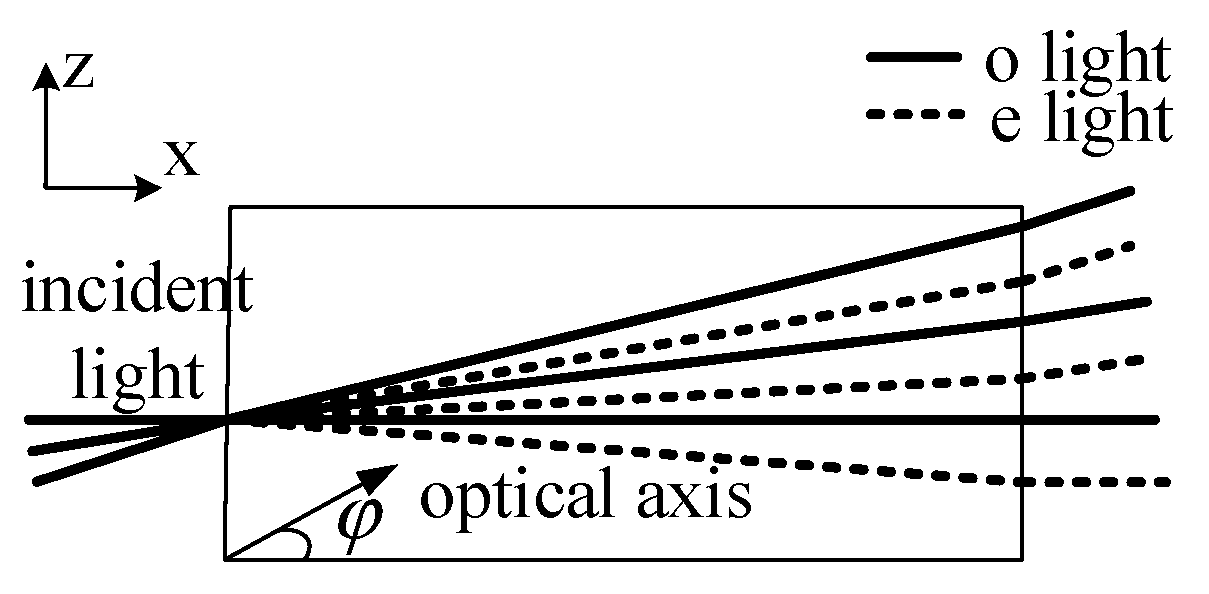
The main optical element of the crystal-type spatial light mixer is the crystal, because the crystal anisotropy leads to the refractive index difference in different directions, which will produce the phenomena of birefringence, phase delay, and polarization change when the light beam is incident, so it is necessary to study this effect. When the light beam is incident perpendicular to the crystal and the beam propagation direction is at different angles to the crystal optical axis in the same plane, birefringence will occur inside the crystal, and the ordinary beam (o light) and extraordinary beam (e light) will be ejected perpendicularly out of the crystal, as shown in Figure 1 [20].
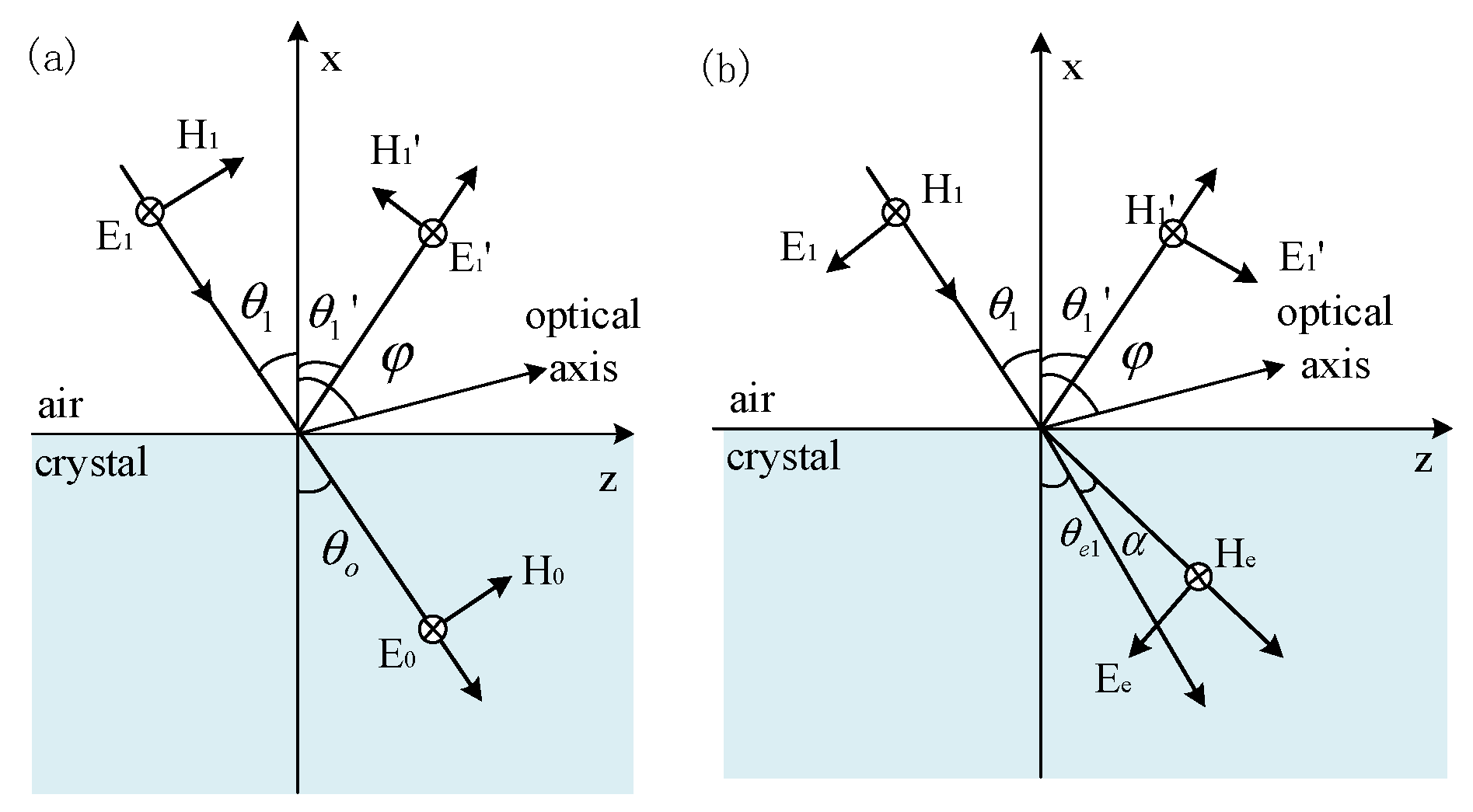
According to the basic method of vectorial decomposition in the principles of optics, the Fast Fourier transform, the vibration of any beam can be decomposed into two mutually perpendicular directions. In order to facilitate the analysis of the values of parameters such as transmission coefficient, phase, etc., the incident light is decomposed into horizontal and vertical directions for calculation [21]. Firstly, an x z coordinate system is established based on Maxwell’s system of equations, where x > 0 denotes air and x < 0 denotes a crystal, and the optical axis of the crystal is at an angle φ with the x -axis. For a horizontal beam component incident on the crystal, as shown in Figure 2a, the equation is
t o = E o E 1 = 2 n o n 1 cos θ o + cos θ 1 ,
r o = E 1 E 1 = t o 1 ,
sin θ o = n 1 sin θ 1 n o ,
ϕ o = 2 π λ n o L ,
In Equations (1)–(4), φ denotes the angle between the crystal’s optical axes, E 1 , H 1 and θ 1 denote the electric field, magnetic field strength, and angle of the incident light, E 0 , H 0 and θ 0 denote the electric field, magnetic field strength, and angle of the refracted light, E 1 , H 1 and θ 1 denote the electric field, magnetic field strength, and angle of the reflected light, n o denotes the refractive index of the crystal to o light, n 1 denotes the refractive index of the air, L denotes the distance of propagation, and t o and r o reflect the change in amplitude of the refracted and reflected light relative to the incident. For a vertical beam component incident on the crystal, as shown in Figure 2b, the equation is
t e = E e E 1 = 2 cos θ 1 n e n 1 cos θ 1 cos α + cos ( θ e 1 + α ) ,
r e = E 1 E 1 = n e n 1 t e cos α 1 ,
n e = n o n e n o 2 sin 2 ( π θ e 1 φ ) + n e 2 cos 2 ( π θ e 1 φ ) ,
α = arctan n o 2 n e 2 1 cot ( π 2 φ θ e 1 ) 1 + n o 2 n e 2 cot 2 ( π 2 φ θ e 1 ) ,
θ e 1 = arccot n e 2 n o 2 sin 2 ( π 2 φ ) + 2 n e n o n o 2 cos 2 ( π 2 φ ) + n e 2 sin 2 ( π 2 φ ) n 1 2 sin 2 θ 1 1 2 ( n o 2 sin 2 ( π 2 φ ) + n e 2 cos 2 ( π 2 φ ) ) ,
ϕ e = 2 π λ n e L ,
In Equations (5)–(10), E e denotes the electric field of the refracted light, n e denotes the refractive index of the crystal to e light, n e denotes the refractive index affected by the optical axis of the crystal, θ e 1 + α denotes the angle of the refracted light, and t e and r e reflect the change in amplitude of the refracted and reflected light relative to the incident.
The Jones matrix is used as a mathematical tool to accurately describe the effect of arbitrary optical components on the polarization state [22], so the Jones matrix is used to analyze the polarization state of the beam before and after it passes through the crystal. Let the expression for a linearly polarized beam incident along the x -axis be given by
E = E x E y = E 0 ( z ) e i φ 0 cos θ 0 sin θ 0 ,
In Equation (11), θ 0 , E 0 ( z ) , and φ 0 denote the polarization direction, amplitude function, and initial phase of the incident light. The Jones matrix of the crystal is expressed as [6].
Λ o = e i ϕ o 0 0 0 ,
Λ e = 0 0 0 e i ϕ e ,
ϕ o and ϕ e can be solved by Equations (4) and (10). Then the output expression is
E o = Λ o · E = e i ϕ o E x 0 ,
E e = Λ o · E = 0 e i ϕ e E y .
From Equations (14) and (15), the output o light is horizontally polarized and e light is vertically polarized when the input is linearly polarized light at any angle. Combined, the expression for a linearly polarized beam passing through a crystal is [23].
E o = E 0 ( z ) e i φ 0 t o e i ϕ o cos θ 0 0 ,
E e = E 0 ( z ) e i φ 0 0 t e e i ϕ e sin θ 0 ,
θ o = arcsin n 1 sin θ 1 n o ,
θ e = θ e 1 + α .
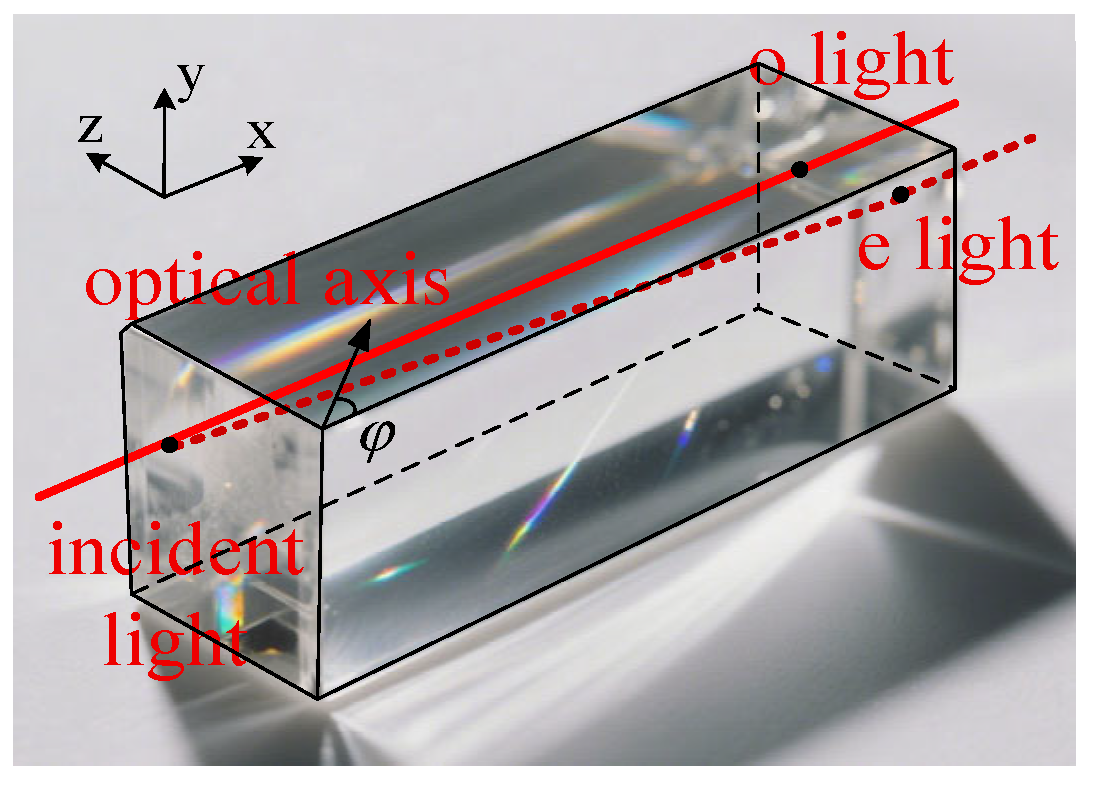
As shown in Figure 3, the size of the yttrium vanadate crystal is 4 × 4 × 20 mm, the optical axis is in the x o z -plane and at 47.8° to the x-axis, and the beam is incident along the x-axis. According to Equations (1)–(10), setting the parameters solves for t o = 0.8104, t e = 0.8055, ϕ o = 1.5758 × 10⁵, ϕ e = 1.6604 × 10⁵, θ o = 0°, θ e 1 = 0°, and α = 5.71°. The vortex beam expression is
E p l ( x , y , z ) = 2 p ! π ( l + p ) ! 1 w ( z ) 2 r w ( z ) l L p l 2 r 2 w ( z ) 2 exp r 2 w ( z ) 2 exp ( i k r 2 z 2 ( z 2 + z R 2 ) ) exp ( i ( 2 p + l + 1 ) arctan ( z z R ) ) exp ( i l θ ) ,
w ( z ) = w 0 1 + z z R 2 ,
L p l = m = 0 p ( 1 ) m ( l + p ) ! ( p m ) ! ( l + m ) ! m ! x m ,
In Equation (20), p , l , r , θ and w 0 denote the radial index, topological charge, radial component, azimuthal angle, and beam waist radius of the vortex beam, where r = x 2 + y 2 and θ = arctan ( x / y ) . w ( z ) denotes the beam radius from the center to the beam waist. L p | l | denotes the Laguerre polynomials. z R = k w / λ denotes the Rayleigh distance. k = 2 π / λ . The Jones matrix for linearly polarized vortex beam can be simplified as
E = E 0 exp ( i ( l θ + ω t + φ 0 ) ) cos θ 0 sin θ 0 ,
In Equation (23), w and E 0 denote the angular frequency and amplitude of the vortex beam. According to Equations (16) and (17), vortex beam: 1550 nm band, 45° line polarization, 0 initial phase, topological charge of 1, and output after yttrium vanadate crystal is [23].
E o = E 0 exp ( i ( θ + ω t ) ) 0.8104 e i 1.5 × 10 5 2 2 0 ,
E e = E 0 exp ( i ( θ + ω t ) ) 0 0.8055 e i 1.6 × 10 5 2 2 .
From Equations (24) and (25), the vortex beam undergoes the birefringence phenomenon, the o light is separated from the e light by 5.71°, the output produces a certain phase delay, and the polarization is decomposed into horizontal and vertical polarization. Under an ideal state such as homogeneous optical axis, absence of spin–orbit transformations, weak astigmatism, and without modal selection by the fiber, the whole process can be approximated as linear, so the topological charge number remains constant [24].

3. Design of Crystal Spatial Light Mixer

According to the design principle of the mixer, combined with the birefringence phenomenon of the crystal for vortex beam and the phase delay property of the waveplate, a set of optical path diagrams of the signal light and the local oscillator are designed, and a crystal-type spatial light mixer that can transmit vortex beam is proposed.

3.1. Theoretical Analysis

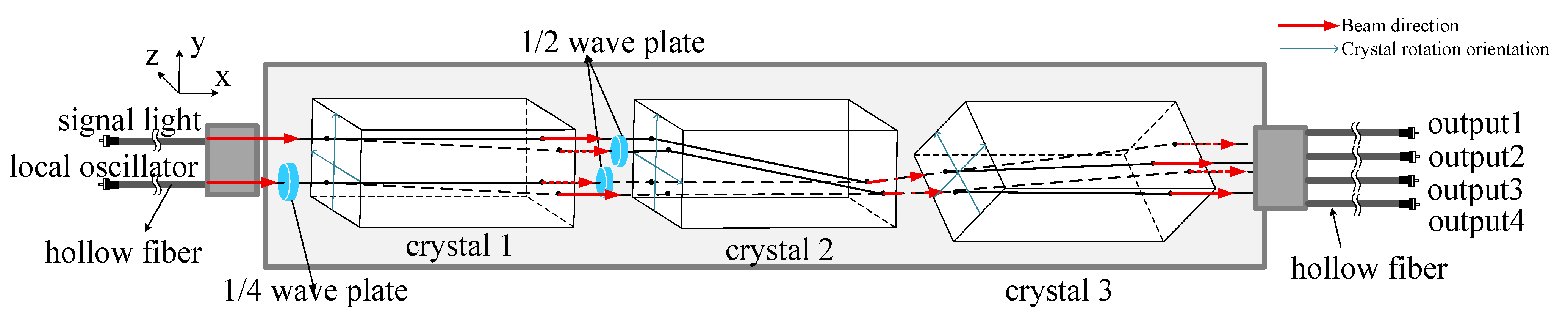
The crystal-type spatial light mixer consists of one 1/4 waveplate, three yttrium vanadate crystals, and two 1/2 waveplates, as shown in Figure 4. The three crystals have the same structure as in Section 2, with the main cross-sections of crystals 1 and 2 perpendicular to each other and the main cross-sections of crystals 1 and 3 at 45°. The optical axis of crystal 1 lies in the x o z plane, with an angle of 47.8° to the x -axis. The optical axis of crystal 2 lies in the x o y plane, with an angle of 47.8° to the x -axis. The optical axis of crystal 3 lies in space, with an angle of 47.8° to the x -axis and 45 degrees to the y -axis and z -axis. The waveplates are all parallel to the y o z plane, the fast axis of the 1/4 waveplates is parallel to the z -axis, and the fast axis of the 1/2 waveplates lies in the y o z plane and forms 45° to the z -axis. The signal light and the local oscillator will undergo the birefringence phenomenon inside crystal 1 and decompose into o light and e light with an angular difference of 5.7°. They converge into a beam of light in crystal 2, and crystal 3 outputs four paths of light with phases of 0°, 180°, 90°, and 270°. Next, the principle of the optical mixer is formulaically described in the ideal state of no spin–orbit transformations, homogeneous optical axis, small angles, thin elements, and so on.
Firstly, according to Equation (23), the signal and local oscillator field of the incident linear polarization vortex beam along the x -axis are
E l = E l 0 exp ( i ( l l θ + ω l t + φ l 0 ) ) cos θ l sin θ l ,
E s = E s 0 exp ( i ( l s θ + ω s t + φ s 0 ) ) cos θ s sin θ s ,
In Equations (26) and (27), E s 0 , l s , w l , φ l 0 , and θ 1 denote the amplitude, topological charge, angular frequency, initial phase, and polarization angle of the signal light. E l 0 , l l , w s , φ s 0 , and θ s denote the amplitude, topological charge, angular frequency, initial phase, and polarization angle of the local oscillator. The Jones matrix of the 1/4 waveplate parallel to the z-axis is
Λ 1 / 4 = 1 0 0 i = 2 2 1 i 0 0 1 + i ,
E l 1 = Λ 1 / 4 E l = E l 0 exp ( i ( l s θ + ω l t + φ l 0 ) ) cos θ l exp ( i π 2 ) sin θ l .
Local oscillator passes through this 1/4 waveplate, the vertical component produces a phase of 90°, which affects the change in polarization state, i.e., the linear polarization is transformed into circular polarization, with no change in amplitude and topological charge. The Jones matrix for crystal 1 is
Λ 1 o = e i ϕ 1 o 0 0 0 ,
Λ 1 e = 0 0 0 e i ϕ 1 e ,
E l o = Λ 1 o E l 1 = E l 0 exp ( i ( l l θ + ω l t + φ l 0 ) ) exp ( i ϕ 1 o ) cos θ l 0 ,
E l e = Λ 1 e E l 1 = E l 0 exp ( i ( l l θ + ω l t + φ l 0 ) ) 0 exp ( i ( ϕ 1 e + π 2 ) ) sin θ l ,
E s o = Λ 1 o E s = E s 0 exp ( i ( l s θ + ω s t + φ s 0 ) ) exp ( i ϕ 1 o ) cos θ s 0 ,
E s e = Λ 1 e E s = E s 0 exp ( i ( l s θ + ω s t + φ s 0 ) ) 0 exp ( i ϕ 1 e ) sin θ s ,
The beam undergoes birefringence in crystal 1 and outputs horizontally polarized E l o , E s o and vertically polarized E l e , E s e , with phase delays of ϕ l o and ϕ l e , with unchanged amplitudes and topological charges. The Jones matrix of the 1/2 waveplate at 45° to the z-axis is
Λ 1 / 2 = 0 1 1 0 ,
E l o e = Λ 1 / 2 E l 1 = E l 0 exp ( i ( l l θ + ω l t + φ l 0 ) ) 0 exp ( i ϕ 1 o ) cos θ l ,
E s e o = Λ 1 / 2 E s 1 = E s 0 exp ( i ( l s θ + ω s t + φ s 0 ) ) exp ( i ϕ 1 e ) sin θ s 0 .
Local oscillator passes through this 1/2 waveplate, producing a phase of 180°, which affects the polarization exchange, i.e., horizontal polarization is converted to vertical polarization, and vertical polarization is converted to horizontal polarization, with no change in amplitude or topological charge. The Jones matrix of crystal 2 is
Λ 2 o = cos 90 sin 90 sin 90 cos 90 e i ϕ 2 o 0 0 0 cos 90 sin 90 sin 90 cos 90 = 0 0 0 e i ϕ 2 o ,
Λ 2 e = cos 90 sin 90 sin 90 cos 90 0 0 0 e i ϕ 2 e cos 90 sin 90 sin 90 cos 90 = e i ϕ 2 e 0 0 0 ,
E l o e o = Λ 2 o E l o e = E l 0 exp ( i ( l l θ + ω l t + φ l 0 ) ) 0 exp ( i ( ϕ 1 o + ϕ 2 o ) ) cos θ l ,
E l e o = Λ 2 o E l e = E l 0 exp ( i ( l l θ + ω l t + φ l 0 ) ) 0 exp ( i ( ϕ 1 e + ϕ 2 o + π 2 ) ) sin θ l ,
E s o e = Λ 2 e E s o = E s 0 exp ( i ( l s θ + ω s t + φ s 0 ) ) exp ( i ϕ 1 o + ϕ 2 e ) cos θ s 0 ,
E s e o e = Λ 2 e E s e o = E s 0 exp ( i ( l s θ + ω s t + φ s 0 ) ) exp ( i ( ϕ 1 e + ϕ 2 e ) ) sin θ s 0 .
The beam undergoes birefringence in crystal 2 and outputs horizontally polarized E s o e , E s e o e and vertically polarized E l o e o , E l e o , with phase delays of ϕ 2 o and ϕ 2 e , with unchanged amplitudes and topological charges. And E l o e o and E s o e converge to E 2 and E l e o and E s e o e converge to E 3 ; the formula is expressed as the Jones matrix summation.
E 2 = E s 0 exp ( i ( l s θ + ω s t + φ s 0 ) ) exp ( i ( ϕ 1 o + ϕ 2 e ) ) cos θ s E l 0 exp ( i ( l l θ + ω l t + φ l 0 ) ) exp ( i ( ϕ 1 o + ϕ 2 o ) ) cos θ l ,
E 3 = E s 0 exp ( i ( l s θ + ω s t + φ s 0 ) ) exp ( i ( ϕ 1 e + ϕ 2 e ) ) sin θ s E l 0 exp ( i ( l l θ + ω l t + φ l 0 ) ) exp ( i ( ϕ 1 e + ϕ 2 o + π 2 ) ) sin θ l .
The Jones matrix of crystal 3 and the four outputs of the optical mixer are
Λ 3 o = cos 45 sin 45 sin 45 cos 45 e i ϕ 3 o 0 0 0 cos 45 sin 45 sin 45 cos 45 = 1 2 e i ϕ 3 o e i ϕ 3 o e i ϕ 3 o e i ϕ 3 o ,
Λ 3 e = cos 45 sin 45 sin 45 cos 45 0 0 0 e i ϕ 3 e cos 45 sin 45 sin 45 cos 45 = 1 2 e i ϕ 3 e e i ϕ 3 e e i ϕ 3 e e i ϕ 3 e ,
E 2 o = Λ 3 o E 2 = 1 2 ( E s 0 exp ( i ( l s θ + ω s t + φ s 0 ) ) exp ( i ( ϕ 1 o + ϕ 2 e + ϕ 3 o ) ) cos θ s + E l 0 exp ( i ( l l θ + ω l t + φ l 0 ) ) exp ( i ( ϕ 1 o + ϕ 2 o + ϕ 3 o ) ) cos θ l ) 1 1 ,
E 2 e = Λ 3 e E 2 = 1 2 ( E s 0 exp ( i ( l s θ + ω s t + φ s 0 ) ) exp ( i ( ϕ 1 o + ϕ 2 e + ϕ 3 e ) ) cos θ s E l 0 exp ( i ( l l θ + ω l t + φ l 0 ) ) exp ( i ( ϕ 1 o + ϕ 2 o + ϕ 3 e ) ) cos θ l ) 1 1 ,
E 3 o = Λ 3 o E 3 = 1 2 ( E s 0 exp ( i ( l s θ + ω s t + φ s 0 ) ) exp ( i ( ϕ 1 e + ϕ 2 e + ϕ 3 o ) ) sin θ s + E l 0 exp ( i ( l l θ + ω l t + φ l 0 ) ) exp ( i ( ϕ 1 e + ϕ 2 o + ϕ 3 o + π 2 ) ) sin θ l ) 1 1 ,
E 3 e = Λ 3 e E 3 = 1 2 ( E s 0 exp ( i ( l s θ + ω s t + φ s 0 ) ) exp ( i ( ϕ 1 e + ϕ 2 e + ϕ 3 e ) ) sin θ s E l 0 exp ( i ( l l θ + ω l t + φ l 0 ) ) exp ( i ( ϕ 1 e + ϕ 2 o + ϕ 3 e + π 2 ) ) sin θ l ) 1 1 .
The beam undergoes birefringence in crystal 3 and outputs 45° line-polarized light E 2 o , E 3 o and −45° line-polarized light E 2 e , E 3 e , with phase delays of ϕ 3 o and ϕ 3 e , with unchanged amplitudes and topological charges. The signal light intensity equation is
I = E x 2 + E y 2 = E x × E x + E y × E y ,
In Equation (53), E x and E y denote the expressions for the horizontal and vertical directions of the signals; * denotes the conjugate operation. Combining Euler’s formula, the light intensity of the four output signals is
I 2 o = 1 2 E s 0 2 cos 2 θ s + E l 0 2 cos 2 θ l + 2 E s 0 E l 0 cos θ s cos θ l cos ( l s l l ) θ + ( ω s ω l ) t + ( φ s 0 φ l 0 ) + ( ϕ 2 e ϕ 2 o ) ,
I 2 e = 1 2 E s 0 2 cos 2 θ s + E l 0 2 cos 2 θ l + 2 E s 0 E l 0 cos θ s cos θ l cos ( l s l l ) θ + ( ω s ω l ) t + ( φ s 0 φ l 0 ) + ( ϕ 2 e ϕ 2 o ) + π ,
I 3 o = 1 2 E s 0 2 sin 2 θ s + E l 0 2 sin 2 θ l + 2 E s 0 E l 0 sin θ s sin θ l cos ( l s l l ) θ + ( ω s ω l ) t + ( φ s 0 φ l 0 ) + ( ϕ 2 e ϕ 2 o ) + π 2 ,
I 3 e = 1 2 E s 0 2 sin 2 θ s + E l 0 2 sin 2 θ l + 2 E s 0 E l 0 sin θ s sin θ l cos ( l s l l ) θ + ( ω s ω l ) t + ( φ s 0 φ l 0 ) + ( ϕ 2 e ϕ 2 o ) + 3 π 2 .
From Equations (54)–(57), the phases of the four outputs of the mixer are 0°, 180°, 90°, and 270°. Afterward, the signal with a phase difference of 180° is input into the balanced detector two by two for coherent detection of photoelectric conversion, and the output electrical signal is
I I = I 0 I 180 = 2 E s 0 E l 0 cos θ s cos θ l cos ( l s l l ) θ + ( ω s ω l ) t + ( φ s 0 φ l 0 ) + ( ϕ 2 e ϕ 2 o ) ,
I Q = I 90 I 270 = 2 E s 0 E l 0 sin θ s sin θ l cos ( l s l l ) θ + ( ω s ω l ) t + ( φ s 0 φ l 0 ) + ( ϕ 2 e ϕ 2 o ) + π 2 .
I I is the in-phase branch for extracting the information of the modulating signal, and I Q is the quadrature branch for controlling the feedback loop. The two-phase differences are 90°. The phase information of Equations (54)–(59) realizes a crystal-type spatial light mixer.

3.2. Input/Output Fiber

Optical mixers use optical fiber instead of spatial transmission. Optical fibers rely on total internal reflection closed light transmission, can shield interference, and avoid spatial optical coupling. Due to the special characteristics of vortex beam, the traditional optical fiber will lead to its light intensity attenuation. The use of hollow fiber instead of traditional optical fiber and its special structure can reduce the absorption and dispersion to maintain the topological charge number. Therefore, the hollow fiber guarantees the performance and reliability of the vortex optical mixer.
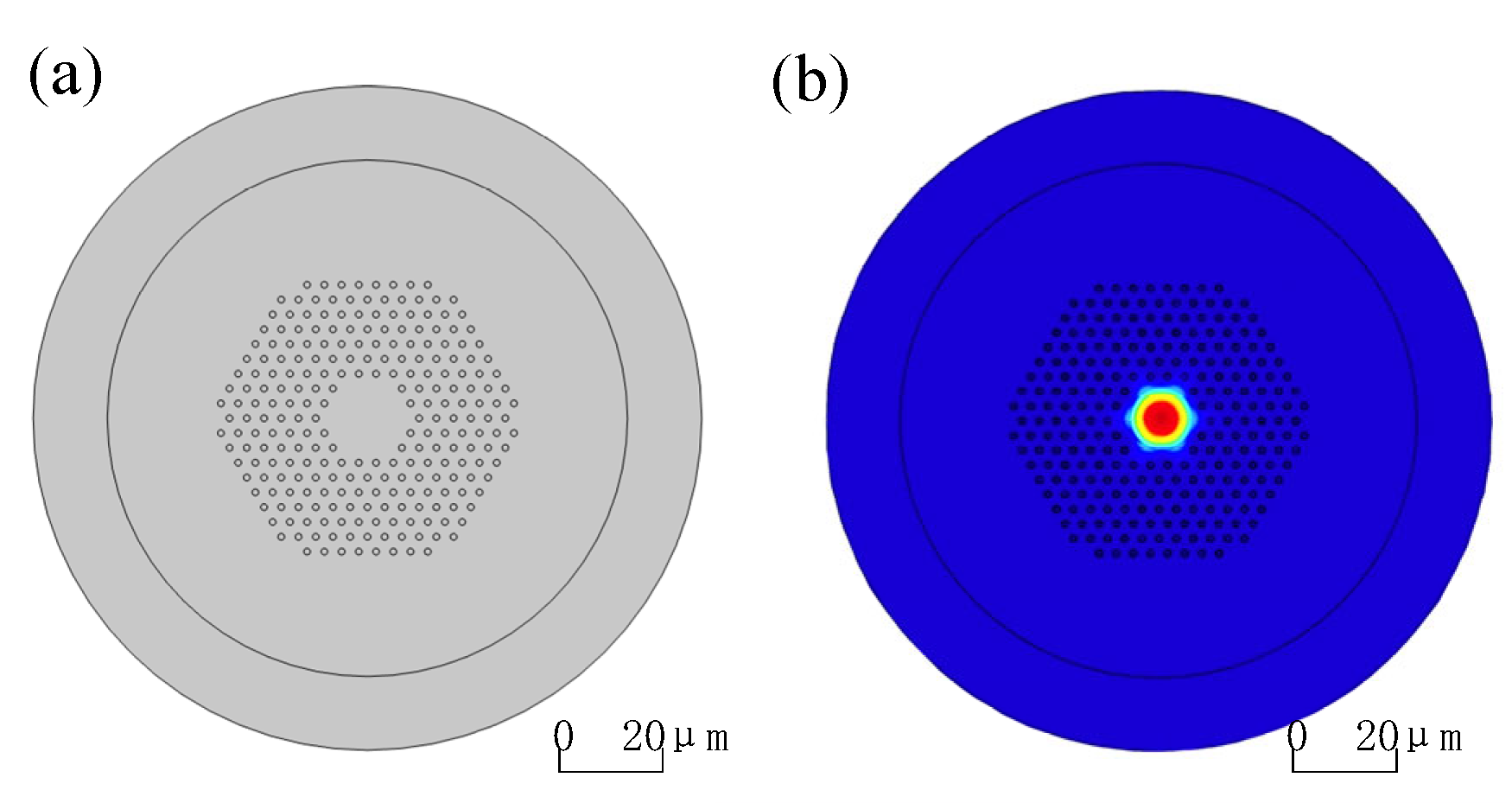
Helical refractive index guided photonic crystal fiber is a special hollow fiber with a fiber cross-section profile matched to vortex beam, good effective refractive index separation between vortex beam modes [25], and low mode loss. As shown in Figure 5a, which consists of a solid fiber core and six layers of regularly distributed hexagonal air holes arranged. As shown in Figure 5b, the beam is overwhelmingly confined in the ring fiber core during transmission. Using COMSOL software (version 6.1, COMSOL AB, Stockholm, Sweden) analysis, in the range of 1.52–1.56 μm, stable transmission of orbital angular momentum from 1st to 3rd order is supported [26], the effective refractive index difference between modes is greater than 10−4, and the insertion loss is less than 10−4 dB/cm, so this hollow fiber is applied to the input and output of the optical mixer and the optical transmission process of coherent detection.

3.3. Influence of Various Factors on the Mixing Performance

Ideally, when the polarization angle of the signal light and the local oscillator light is 45° and the topological charge is the same, the four output energies of the designed crystal-type spatial optical mixer are equal, the splitting ratio is 1, and the mixing efficiency is 1 [27]. However, in practical applications, various factors can cause changes in the evaluation index of the optical mixer, thus affecting the performance of the communication system. The influencing factors include beam parameters, crystal transmittance, the angle of optical elements, and the optical axis.
The transmittance of the transmissive film on the surface of the waveplate to the beam is ( 1 R ) 2 , where R = 0.5%. The fiber coupling, about I L 0 = 1.75 dB, and the transmittance of the yttrium vanadate crystal to the o and e light are known. The insertion loss is calculated by substituting into Equations (60)–(67) for the power values of P s and P l for the incident light.
I L ( l ) 270 = 10 log ( 1 P l ( 1 R ) 2 T e T o T e ) + I L 0 ,
I L ( l ) 90 = 10 log ( 1 P l ( 1 R ) 2 T e T o T o ) + I L 0 ,
I L ( l ) 180 = 10 log ( 1 P l ( 1 R ) 2 T o ( 1 R ) 2 T o T e ) + I L 0 ,
I L ( l ) 0 = 10 log ( 1 P l ( 1 R ) 2 T o ( 1 R ) 2 T o T o ) + I L 0 ,
I L ( s ) 270 = 10 log ( 1 P s T e ( 1 R ) 2 T e T e ) + I L 0 ,
I L ( s ) 90 = 10 log ( 1 P s T e ( 1 R ) 2 T e T o ) + I L 0 ,
I L ( s ) 180 = 10 log ( 1 P s T o T e T e ) + I L 0 ,
I L ( s ) 0 = 10 log ( 1 P s T o T e T o ) + I L 0 .
Table 1 shows that the optical mixer has low loss and less attenuation of light intensity. The output energy of the optical mixer is analyzed by Equations (60)–(67). Beam energy and transmission distance have a monotonically decreasing relationship. After a wave plate energy loss of 0.9%, after a crystal loss of 12%, and after the overall loss of 36.6% of the optical mixer, it can be seen that the wave plate on the energy of the beam of impact is much smaller than the crystal.
The equation for the mixing efficiency is [28]
η = 0 2 π 0 r 0 E l E s exp ( i Δ φ ) r d r d φ 2 0 2 π 0 r 0 E l E l r d r d φ 0 2 π 0 r 0 E s E s r d r d φ ,
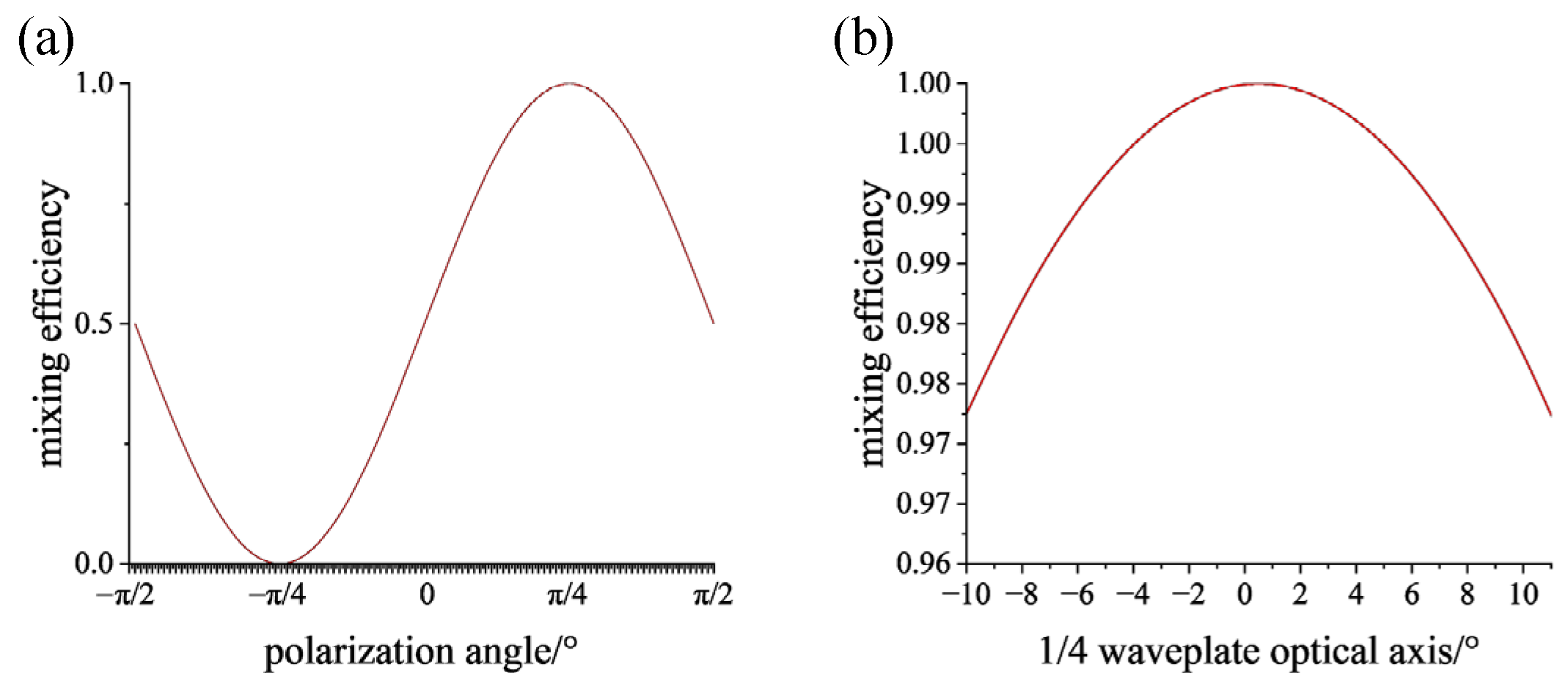
In Equation (68), Δ φ denotes the phase difference, and r 0 denotes the radius of the detector’s photosensitive surface. The output mixing efficiency of the optical mixer for different beam polarizations is analyzed by Equation (68). In the case where the signal light is polarized with the same polarization as the local oscillator light [29], the mixing efficiency is a sinusoidal function of the polarization angle, as shown in Figure 6a. The mixing efficiency reaches peaks of 1 and troughs of 0 at polarization angles of 45° and −45°. Next, the output mixing efficiency of the optical mixer for different 1/4 waveplate optical axes is analyzed. The mixing efficiency is an inverted parabolic function of the 1/4 waveplate optical axis angles, as shown in Figure 6b. The mixing efficiency reaches peaks of 1 at 1/4 waveplate optical axis angles of 0.
Based on the equations in Section 3.1, adding uniaxial crystals, waveplates, and errors such as crystals, the output phase difference is
Δ θ 0 180 = Δ θ 90 270 = 2 π Δ f c ( L cos α L ) + π ,
Δ θ 0 90 = Δ θ 180 270 = 2 π Δ f c ( L cos α L ) + π 2 ,
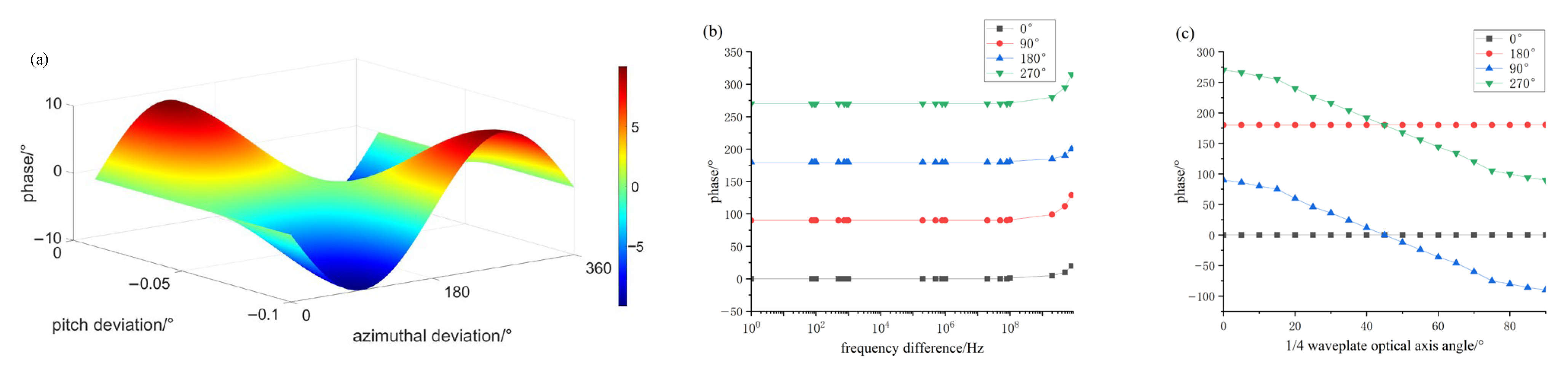
In Equations (69)–(71), Δ f denotes the frequency difference, and c denotes the propagation speed of light in a vacuum. When the frequency difference is less than 1 GHz, it is calculated that Δ θ 0 180 = Δ θ 90 270 = 180.009° and Δ θ 0 90 = Δ θ 180 270 = 90.01°, so the phase error is very small and negligible. The output phase of the optical mixer for different beam incidence angles is analyzed by Equations (69)–(71). For the incident crystal, a small angle change produces a phase deviation of 10°, as shown in Figure 7a. For the incident 1/4 and 1/2 waveplates, producing phase deviations within 0.01° and 0.03°, the 1/2 waveplates have a slightly larger effect than the 1/4 waveplates, which are both negligible. Next, the output phase of the optical mixer for different frequency differences is analyzed. When the frequency difference is less than 400 mHz, the phase of the four outputs is basically unchanged. When the frequency difference is larger than 1 GHz, the output phase shift increases by about 2°, and the larger the frequency difference is, the larger the shift is, as shown in Figure 7b, so it must be as small as possible. Finally, the output phase of the optical mixer for different 1/4 waveplate optical axes is analyzed. The 1/4 waveplate optical axis angle has no effect on the phase of the 0° and 180° branches, and has a greater effect on the 90° and 270° branches, with a monotonically decreasing relationship, as shown in Figure 7c, so the optical axis must be within 0.5°
The equation for the splitting ratio is [30].
ξ = I 0 I 180 max I 90 I 270 max ,
I 0 I 180 = E s 0 T o T e k 2 cos ε 1 2 T o sin ( 45 + ε 2 ) 2 T e cos ( 45 + ε 2 ) 2 + E l 0 A T o T o B sin ε 1 cos θ 2 2 + B sin ε 1 sin θ 2 cos ε 1 sin δ 1 / 2 2 sin 2 θ 1 / 2 2 2 ( T o cos ( 45 + ε 2 ) ) 2 T e sin ( 45 + ε 2 ) 2 ,
I 90 I 270 = E l 0 T e T o C cos ε 1 2 T o cos ( 45 + ε 2 ) 2 T e sin ( 45 + ε 2 ) 2 + E s 0 T e T e k 1 B sin ε 1 cos θ 2 2 + B sin ε 1 sin θ 2 + cos ε 1 sin δ 1 / 2 2 sin 2 θ 1 / 2 2 2 T o sin ( 45 + ε 2 ) 2 T e cos ( 45 + ε 2 ) 2 ,
θ 2 = arctan ( tan δ 1 / 2 2 cos 2 θ 1 / 2 ) ,
A = ( k 4 cos δ 1 / 4 2 ) 2 + ( k 4 sin δ 1 / 4 2 cos 2 θ 1 / 4 k 3 sin δ 1 / 4 2 sin 2 θ 1 / 4 ) 2 ,
B = cos δ 1 / 2 2 2 + sin δ 1 / 2 2 cos 2 θ 1 / 2 2 ,
C = ( k 3 cos δ 1 / 4 2 ) 2 + ( k 3 sin δ 1 / 4 2 cos 2 θ 1 / 4 + k 4 sin δ 1 / 4 2 sin 2 θ 1 / 4 ) 2 ,
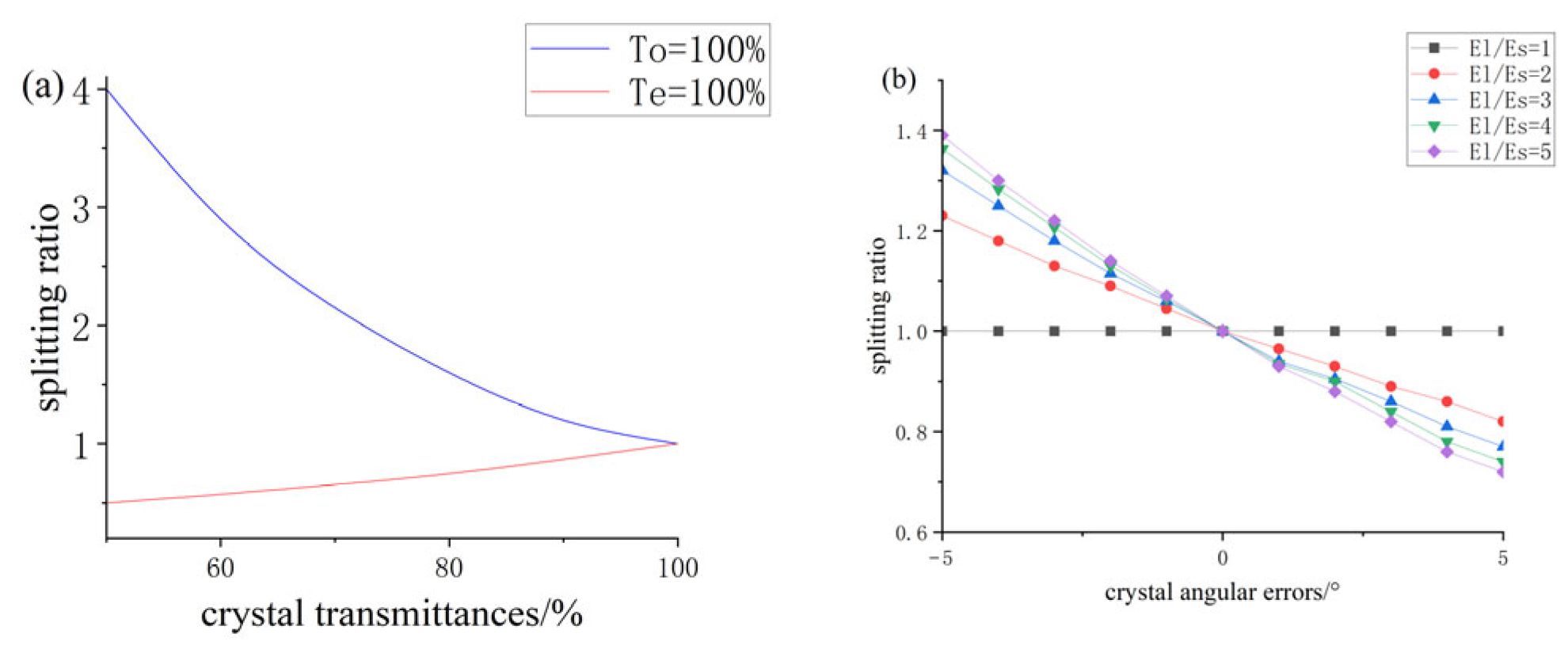
In Equations (71)–(77), k 1 = cos θ s , k 2 = sin θ s , k 3 = cos θ l , and k 4 = sin θ l denote the horizontal and vertical components of the signal light and local oscillator, ε 1 and ε 2 denote the main cross-section angular errors of crystals 1 and 2 and crystals 2 and 3. δ 1 / 2 , θ 1 / 2 , δ 1 / 4 , and θ 1 / 4 denote the additional phase difference and the optical axis angle of the 1/2 and 1/4 waveplates. The splitting ratio of the optical mixer for different crystal transmittances is analyzed by Equations (71)–(77). The splitting ratio is a monotonically decreasing relationship of the transmittance of the crystal to e light and a monotonically increasing relationship of the transmittance of the crystal to o light, as shown in Figure 8a. When the transmittances are both 100%, the splitting ratio is 1. Next, the splitting ratio of the optical mixer for different angular errors is analyzed. When the amplitudes of the signal light and local oscillator are equal, crystal angular error has no effect on the spectral ratio, and the larger the amplitude ratio, the more obvious the effect is, as shown in Figure 8b. Waveplate angle error has the same impact, but less than the crystal impact, so the crystal angle must be within 0.5.

4. Experiments and Result Analysis

4.1. Crystal Simulation

To verify the analysis in Section 2, simulations are performed using the physical optics simulation software VirtualLab Fusion (version 2024.1, LightTrans GmbH). The incident light module is added sequentially, the medium module simulates the crystal, and the detection module observes the light intensity and phase of the beam. Beam and optics parameters are the same as above, the beam radius is 0.4 mm, and the refractive index of the yttrium vanadate crystal is shown in Equation (78).
The input vortex beam has a hollow light intensity, helical phase, 45° line polarization, and topological charge number 1, as shown in Figure 9a. The beam undergoes birefringence inside the crystal [31], and outputs a horizontally polarized and a vertically polarized vortex beam, as shown in Figure 9c, the line in the diagram represents the state of polarization. With the increase in propagation distance, the lateral spacing of the two beams gradually increases, and the spot sizes gradually become closer to each other. Comparison of Figure 9b,d shows that this yttrium vanadate crystal is able to maintain the special light intensity and topological charge of the vortex beam, only changing the polarization state and phase, which is in accordance with the results deduced from the previous equations.
n o 2 = 3.7783 + 0.0697 λ 2 0.1105 0.0108 λ 2 n e 2 = 4.5991 + 0.1105 λ 2 0.0481 0.0123 λ 2 .

4.2. Optical Mixer Simulation

To verify the analysis in Section 3, set as the ideal case, the performance of the optical mixer is simulated from the perspective of Eqs. Beam and optics parameters are the same as above. The vortex beam code is written according to Equations (20)–(22), and the code of the optical elements within the optical mixer is written according to Equations (26)–(52). Plot the light intensity and phase at the input and output of the optical mixer.
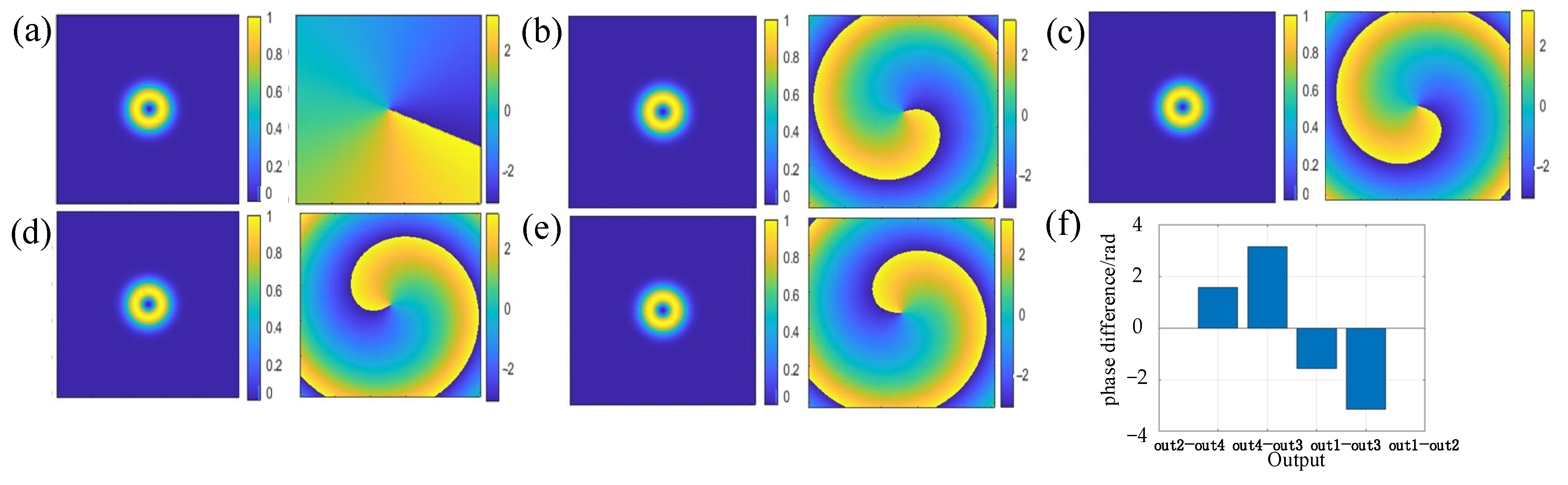
Four output topological charges are unchanged, and the splitting ratios of the in-phase and quadrature branches are 1, which only affects the phase, as shown in Figure 10a–e, which is the same as the result of the previous analysis. The phase difference in the four outputs, as shown in Figure 10f, is E o u t 2 E o u t 1 = E o u t 4 E o u t 3 = 2 ( E o u t 3 E o u t 1 ) = 2 ( E o u t 4 E o u t 2 ) = 3.14 rad . The functionality of a crystal-based spatial light mixer is verified.
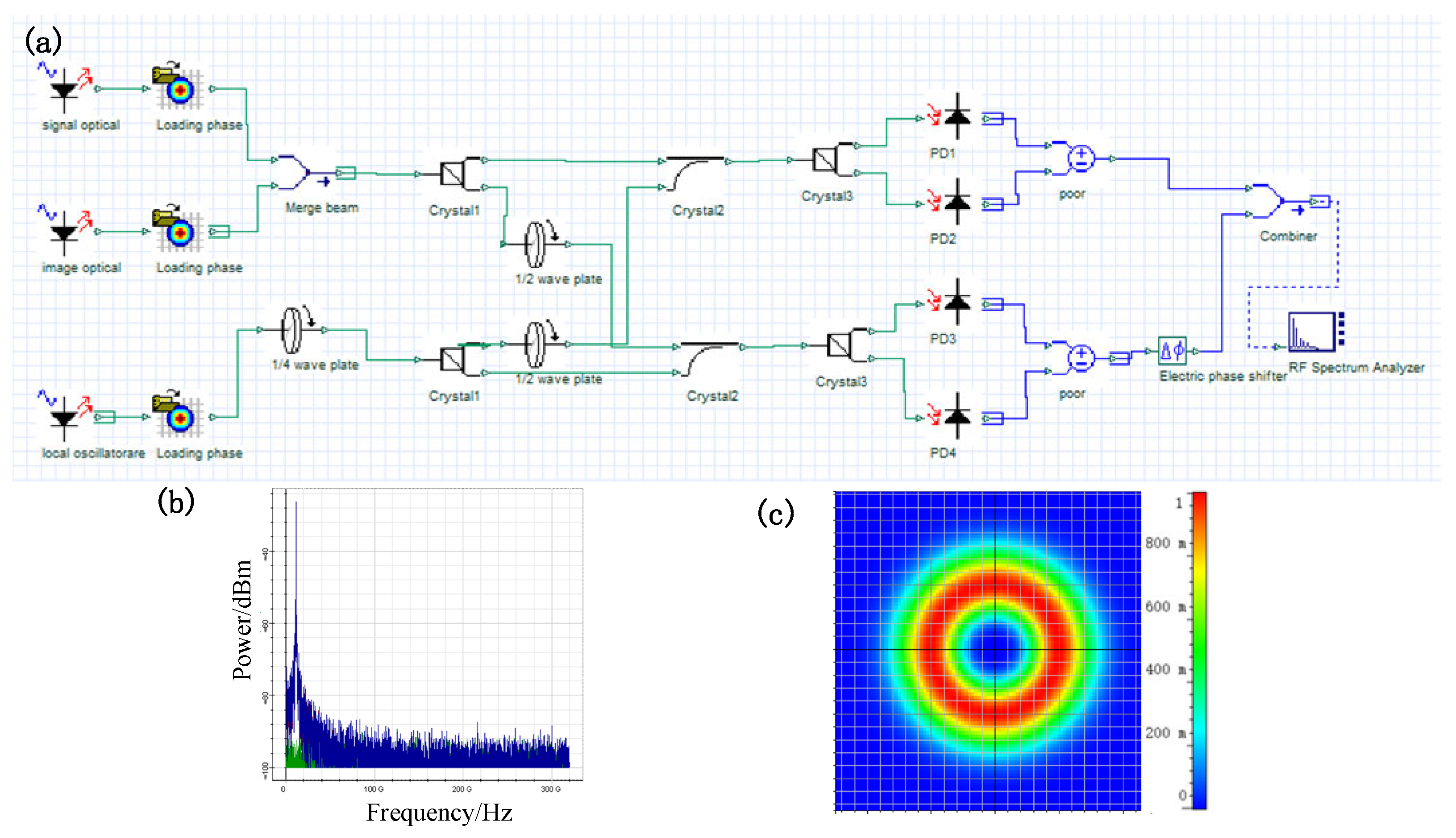
Next, the performance of the optical mixer is simulated from the perspective of the device, using optical communication design software. In the simulation software, modules from the module library are used: Measured transverse Mode Generator modules generate vortex beam and Polarization Waveplate and Polarization Spitter modules simulate optical elements in the optical mixer. Beam and optics parameters are the same as above, and the beam power is 5.5 mW. The balanced detection system comprises PD (Photodiode) and optical subtractor module. The balanced detection system and mirror frequency rejection system are built to verify the correctness of the optical mixer, and the detection module observes the power and polarization state of the output beam, as shown in Figure 11a.
The four output powers of the optical mixer are equal and are 3.1 mW. Mirror frequency rejection is a single peak, as shown in Figure 11b. It is shown that the designed optical mixer can effectively suppress the mirror frequency and other spurious components, and the ideal coherent mixing between the signal light and the local oscillator light occurs. The functionality of a crystal-based spatial light mixer is verified, which is the same as the result of the previous analysis. Coherent mixing of vortex beam cannot be realized when the signal light and local oscillator have different topological charges and different polarization states [30], the frequency difference is greater than 1 GHz, and the crystal angle and waveplate optical axis angle are greater than 0.5°.
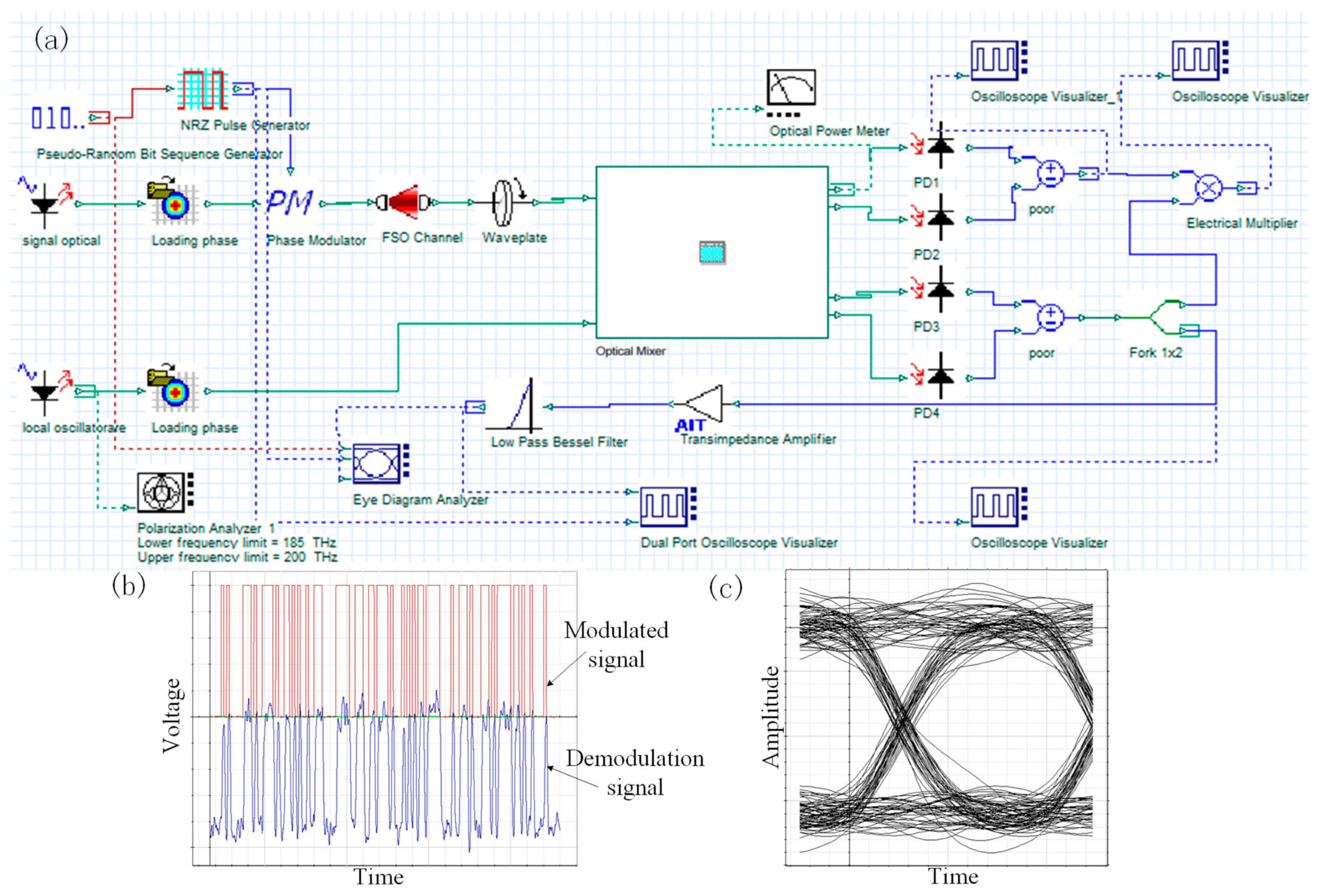
Finally, the designed optical mixer is applied in a coherent optical communication system. Using a random bit sequence as the data source and a digital coding method of non-zeroing codes, the laser generates a vortex optical carrier and modulates it using a binary phase-shift keyed phase. It is input to the system shown in Figure 12, and the baseband signal is extracted by phase multiplication, amplification, and filtering to realize the demodulation function.
The four output powers of the optical mixer are equal, 2.9 mW, the balanced detector responsivity is 1 A/W, and the system communication rate is 10 Gb/s. When the loop completes the phase locking, the frequency difference between the signal light and local oscillator is 0, and the output phase difference is constant. The eye diagram opens to a larger extent with clear lines, indicating that the signal quality is better and the stability is higher, as shown in Figure 12c, and BER is 1.86 × 10⁻¹⁵. With the demodulation, the fluctuation amplitude and noise decrease gradually, the signal is clearer, and the demodulated signal is shown in Figure 12b. The functionality of the coherent optical communication system is verified, which is the same as the result of the previous analysis.

4.3. Optical Mixer Experiment

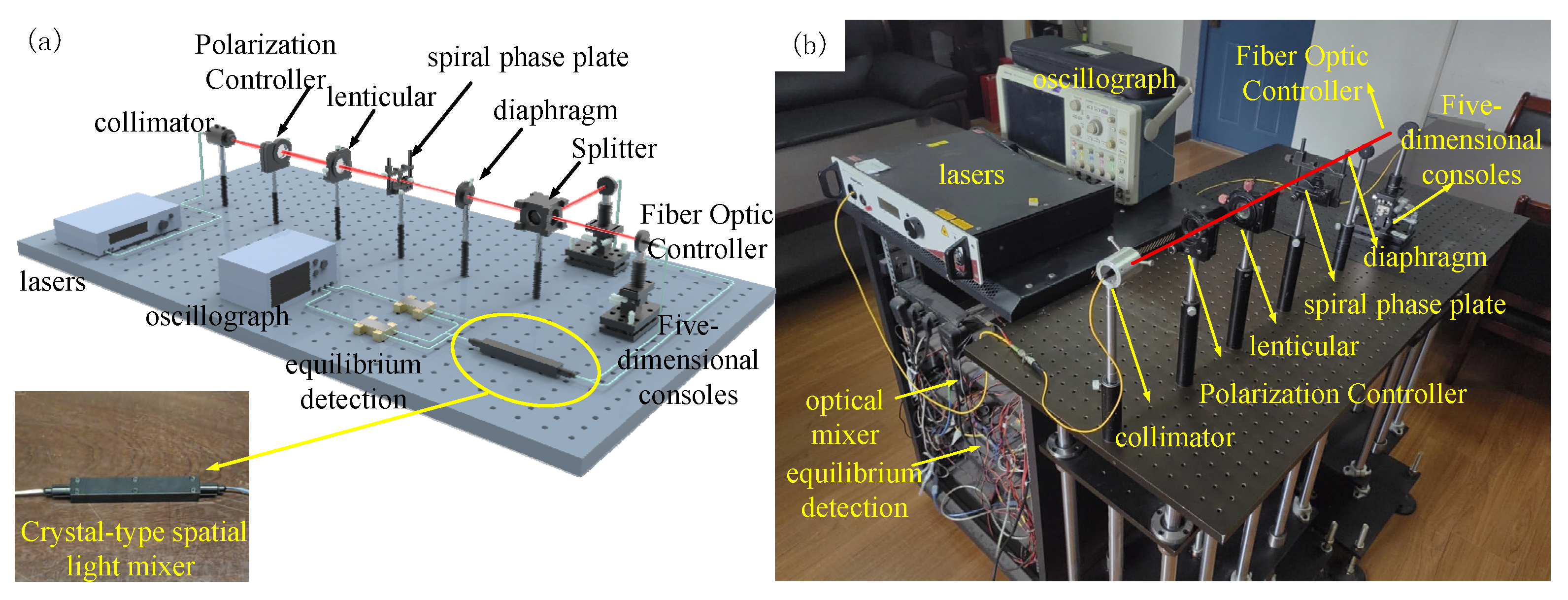
An experiment is built to verify the designed optical mixer, as shown in Figure 13a,b. A narrow linewidth fiber laser was used to generate the signal light and local oscillator, and the output was connected to a collimator to introduce the beam into free space. Adjust the output power of the signal light and the local oscillator light, and ensure that the frequency difference between the two beams of light is as low as possible. Beam parameters are the same as above. A first-order helical phase screen was added to the output of the laser to generate vortex beam, and a diaphragm was used to filter out other modes generated in the process. The spiral phase plate method for generating vortex beams offers the advantages of simple implementation, low cost, and low loss under high-power operation, making it well-suited for high-power laser systems and experimental research. In contrast, metasurfaces and integrated photonic platforms feature programmable structures, compact size, and easy integration, with more versatile functionalities but more complex fabrication processes, making them more suitable for miniature optical devices and quantum photonic chips. Therefore, the experiment in this work employs a spiral phase plate to generate the vortex beam. Rotating the polarizer generated 45° line polarization, and an infrared camera collected spot information.
During the fiber coupling process, since the 1550 nm laser is invisible to the human eye, a 650 nm red laser was first used for system pre-alignment. The observation screen was moved step by step along the beam propagation direction to monitor the beam spot variation. When the beam diameter remained nearly constant within a sufficiently wide range, coarse alignment was completed. Then, a five-dimensional precision adjustment stage was used to finely tune the fiber position. The coupling efficiency was monitored using a spectrometer to ensure that as much of the laser beam as possible was coupled into the fiber. After the optical mixer, as shown in Figure 13c, the four output signals are transmitted to the balanced detector for photoelectric conversion, and the IF signals are observed and collected in real time by an oscilloscope.
Before testing, the output voltages of the four channels of the mixer were recorded with no input, representing the detector’s baseline noise. Since the initial frequency difference between the two lasers was uncertain and the intermediate frequency (IF) signal was relatively high, one output channel of the mixer was first connected to a spectrometer. The parameters of the local oscillator laser were kept fixed, while the wavelength of the signal laser was adjusted sequentially to minimize the frequency difference between the two lasers and obtain the maximum IF signal.
Experimental equipment: A narrow-linewidth laser (E15, NKT Photonics, Birkerød, Denmark) was used as the light source, with adjustable frequency and output power. The collimator (LXFC-12, Thorlabs Inc., Newton, NJ, USA) was employed to collimate the beam. A spiral phase plate (LETO, UPO Labs, Vilnius, Lithuania) was used to generate the vortex phase. A polarization controller (PT-SD51-360°, Thorlabs Inc., Newton, NJ, USA) was inserted for polarization state modulation. The beam intensity distribution was recorded using an infrared camera (Bobcat 640 Gige, Xenics, Leuven, Belgium). A balanced photodetector (BPDV2120R, u2t Photonics, Berlin, Germany) and an oscilloscope (TDS2024C, Tektronix, Beaverton, OR, USA) were used for detection and analysis, with a bandwidth of 200 MHz.
Due to the high precision required for crystal fabrication and the complexity of the hollow fiber manufacturing process, specialized companies were commissioned to perform the crystal machining and coating. The optical setup was assembled and aligned according to the designed optical path, and the optical fibers were fabricated and cut accordingly.
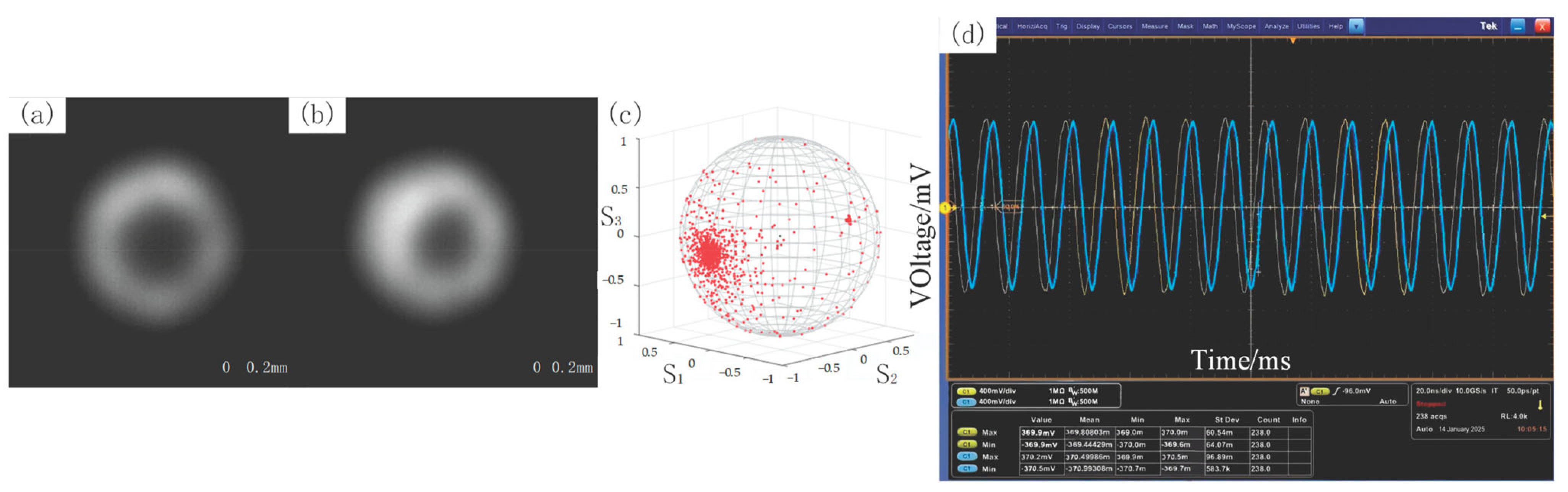
To evaluate the long-term stability of the device, we monitored its output power and signal consistency over an extended period. The results showed good operational stability under repeated use. The frequency difference between the signal light and local oscillator is 506 mHz, reaching the minimum, and the insertion loss of the fabricated optical mixer is 2.8 dB, and the input power of the optical mixer is measured by the optical power meter to be 1.4 μ W and the output power to be 0.58 μ W . The infrared camera measured the input beam radius of the optical mixer to be 0.42 mm, as shown in Figure 14a, and the output beam maintains a high degree of integrity of the vortex beam, as shown in Figure 14b. The spectrometer measures the polarization state, and the data points are close to the equator, indicating a line polarization state, as shown in Figure 14c, and S 1 , S 2 , S 3 denotes Stokes parameters. During the gradual stabilization, the phase of the IF signal changes rapidly, the amplitude remains essentially constant, and the IF signal voltage varies in the range of 350 mV to 390 mV. After stabilization, the amplitudes are 369.9 mV and 370.1 mV, which are close to 1:1, and the mixing efficiency at this time is the highest, 78.5%. The wave of the two IF signals is displayed on the oscilloscope, as shown in Figure 14d. Multiple repeated measurements were performed, and the measured phase difference between the two waveforms is 93°, which satisfies the requirement of an error within 5°, 95% confidence intervals, demonstrating the reproducibility and stability of the measurement process. The functionality of a crystal-based spatial light mixer is verified, and efficient mixing of vortex beam is achieved. It further verified that the designed crystal-type spatial optical mixer can achieve the function of optical frequency mixing.
The measured insertion loss of the mixer is 2.8 dB, which is relatively high for certain applications. This loss mainly originates from coupling inefficiencies and propagation loss within the crystal. Optimization can be achieved by improving the anti-reflection coating and optimizing the mode-matching conditions. For comparison, fiber-based [32,33] and integrated photonic mixers [34,35] typically exhibit insertion losses in the range of 1–3 dB, indicating that the result is within a comparable range.
In particular, the liquid crystal spatial light modulator (SLM) regulates the electrode voltage by loading the phase grayscale image, thereby driving the rotation of liquid crystal molecules and altering the effective refractive index. In conjunction with an optimization algorithm [36], the SLM can modulate the phase, polarization, and intensity distribution of the output light. The SLM has the advantages of high precision and a large number of pixel units. However, insufficient driving voltage can result in a phase modulation depth of less than 2 π , which in turn can lead to a significant deterioration in the vortex light quality, with insertion loss reaching 4.5 dB [37]. The SLM is suitable for dynamic light field control and the flexible generation of complex mode systems. However, for the optical systems in this article that pursue high stable light refraction, fast response, and low-cost fixed optical components, uniaxial crystals are a more suitable choice.
Although a full quantitative characterization of the output polarization (e.g., via the Mueller matrix or Stokes parameter measurements) would provide a more comprehensive evaluation, such measurements were not implemented in the present work due to equipment constraints. This limitation may lead to incomplete information regarding subtle polarization variations. Furthermore, the present method may introduce systematic uncertainties originating from the alignment tolerance and the selectivity of the detection scheme. As a result, the polarization analysis presented here is limited to intensity- and phase-based indicators. Nevertheless, these measurements are sufficient to verify the key physical phenomena investigated in this study. More complete polarization characterization will be carried out in future work.

5. Conclusions

This paper focuses on a newly designed crystal-type spatial optical mixer that can transmit vortex beam and analyzes the influence of each parameter on the output performance of the optical mixer. Formula derivation, simulation modeling, and experiment results show the following:
  • The birefringence phenomenon in yttrium vanadate crystals produces phase delays and polarization changes for vortex beam but preserves the hollow light intensity and helical phase without changing the topological charge.
  • The insertion loss of the optical mixer is about 1.9 dB, and the whole optical mixer is 36.6%. The phase error of the four output signals is small, and the crystal angle has a larger effect on the output phase, and the 1/2 and 1/4 wave plate angles have a negligible effect, about 0.03°.
  • To obtain the optimal output splitting ratio and mixing efficiency, it is necessary to ensure that the frequency difference between the signal light and local oscillator is small, the topological charges are the same, the polarization states are 45° linear polarization, the accuracy of the optical axis is controlled within 0.5°, and the crystal angle is controlled within 0.3°.
  • The designed crystal-type spatial optical mixer is applied in the vortex optical coherent optical communication system. The output phase error is less than 3°, the splitting ratio is about 1:1, the mixing efficiency is 78.5%, and the mirror frequency suppression is a single peak. It is shown that the designed mixer effectively realizes the coherent mixing of vortex beam.

Author Contributions

Conceptualization, X.K.; software, X.Z.; validation, P.L. and X.Z.; formal analysis, X.Z. and X.K.; writing—original draft preparation, X.Z.; writing—review and editing, C.K. and X.K.; supervision, X.K.; project administration, C.K. and P.L.; funding acquisition, C.K. All authors have read and agreed to the published version of the manuscript.

Funding

Natural Science Basic Research Program of Shaanxi (Program No. 2024JC-YBMS-557, 2024JC-YBMS-562), Key Industrial Innovation Projects in Shaanxi Province (No. 2017ZDCXL-GY-06-01), The National Natural Science Foundation of China (No. 61377080), Shaanxi Fundamental Science Research Project for Mathematics and Physics (Grant No. 23JSQ024).

Data Availability Statement

Data are contained within the article.

Acknowledgments

Thanks to Yangtze Optical Fibre and Cable Joint Stock Limited Company for providing hollow fiber.

Conflicts of Interest

Author Peng Li was employed by Yangtze Optical Fibre and Cable Joint Stock Limited Company. The remaining authors declare that the research was conducted in the absence of any commercial or financial relationships that could be construed as a potential conflict of interest.

References

  1. Fang, L.; Wang, J. Optical angular momentum derivation and evolution from vector field superposition. Opt. Express 2017, 25, 23364. [Google Scholar] [CrossRef]
  2. Zhen, W.M.; Ren, Z.C.; Wang, X.-L.; Ding, J.; Wang, H.-T. Polarization structure transition of C-point singularities upon reflection. Sci. China Phys. 2025, 68, 211–244. [Google Scholar] [CrossRef]
  3. Pan, P.; An, J.-M.; Wang, H.; Wang, Y.; Zhang, J.; Wang, L.; Han, Q.; Hu, X. The design and error analysis of 90° hybrid based on InP 4 × 4 MMI. Opt. Commun. 2015, 351, 63–69. [Google Scholar] [CrossRef]
  4. Liang, J.; Zhang, Q.; Wu, J.; Ke, X. Advances in Mixer Research. Electron. Meas. Technol. 2023, 46, 130–150. [Google Scholar]
  5. Nan, H.; Zhang, P.; Tong, S.-F.; Liu, Y.; Hao, S.-C.; Chang, S.; Fan, X.-B. Analysis and optimization of splitting performance for space optical hybrid. Opt. Precis. Eng. 2017, 25, 1748–1756. [Google Scholar]
  6. Zheng, Y.; Jiang, H.; Hu, Y.; Tong, S.; Li, Z. Opto-mechanical structure design of the space optical hybrid. In Proceedings of the International Conference on Optoelectronics and Microelectronics 2012, Changchun, China, 23–25 August 2012. [Google Scholar]
  7. Gong, X.; Zhang, P.; Wu, X.; Nan, H.; Guo, D.; Wang, C.; Tong, S. A study of the effects of aberration and turbulence on the performance of 90° spatial optical mixers. Acta Photonics Sin. 2021, 50, 74–88. [Google Scholar]
  8. Nan, H.; Zhang, P.; Tong, S.; Ma, T. Analysis of the effects of spot size deviation and optical axis deflection on the mixing efficiency of spatial light mixers. Infrared Laser Eng. 2017, 46, 205–212. [Google Scholar]
  9. Kleinman, D.A. Infrared Detection by Optical Mixing. J. Appl. Phys. 1969, 40, 546. [Google Scholar] [CrossRef]
  10. Song, Z.; Yu, W.; Song, J.; Wang, Y.; Tian, X.; Zhao, Q.; Wang, A. 2 × 4 Integrated Structure 90° Spatial Optical Bridge. Laser Optoelectron. Prog. 2018, 55, 438–443. [Google Scholar]
  11. Li, J.; Billah, M.R.; Schindler, P.C.; Lauermann, M.; Schuele, S.; Hengsbach, S.; Hollenbach, U.; Mohr, J.; Koos, C.; Freude, W.; et al. Four-in-one interferometer for coherent and self-coherent detection. Opt. Express 2013, 21, 13293–13304. [Google Scholar] [CrossRef][Green Version]
  12. Hoffman, D.; Heidrich, H.; Wenke, G.; Langenhorst, R.; Dietrich, E. Integrated optics eight-port 90° hybrid on LiNbO3. Light. Technol. J. 1989, 7, 794–798. [Google Scholar] [CrossRef]
  13. Zhi, Y.N.; Zhou, Y.; Liu, L.R. Optical 90-deg hybrid of birefringent crystals for freely propagating laser beams. Opt. Eng. 2010, 49, 125. [Google Scholar] [CrossRef]
  14. Chen, W.; Cui, D.J.; Huang, X.F.; Zhou, L.; Xiao, R.; Wu, W.; Liu, K.; Zuo, X.; Wang, L.; Yan, Y. Design and fabrication of 90° optical mixer based on multimode interferometric waveguide structure. Semicond. Optoelectron. 2023, 44, 515–518. [Google Scholar]
  15. Wang, J.Y.; Yue, W.C.; Liu, Y.F.; Li, X.; Tu, Z.; Yu, M. Advances in silicon-based optical mixers. Optoelectron. Technol. 2021, 41, 79–86. [Google Scholar]
  16. Xu, M.M.; Guo, D.M.; Guo, A.Y.; Gao, W.J.; Han, Y.Z. Design and realization of terahertz quasi-optical mixers. J. Terahertz Sci. Electron. Inf. Technol. 2016, 14, 673–676. [Google Scholar]
  17. Lin, T.; Zhao, S.H.; Zhu, Z.H.; Li, X.; Zheng, Q.; Qu, K.; Hu, D. Microwave photonics reconfigurable mixer based on polarization modulator. Opt. Quantum Electron. 2017, 21, 13293. [Google Scholar] [CrossRef]
  18. Wang, Y.W.; Cheng, H.B.; Liu, J.H. YVO4 birefringent crystal growth and integrity analysis. J. Synth. Cryst. 2013, 32, 41–43. [Google Scholar]
  19. Wang, A.; Zhu, L.; Wang, L.; Ai, J.; Chen, S.; Wang, J. Directly using 8.8-km conventional multi-mode fiber for 6-mode orbital angular momentum multiplexing transmission. Opt. Express 2018, 26, 10038–10047. [Google Scholar] [CrossRef]
  20. Avendaño-Alejo, M. Analysis of the refraction of the extraordinary ray in a plane-parallel uniaxial plate with an arbitrary orientation of the optical axis. Opt. Express 2005, 13, 2549–2555. [Google Scholar] [CrossRef]
  21. Ren, H.X.; Liu, L.R.; Song, Z.; Ruan, Z. Continuous birefringence and bireflection in crystals with arbitrary optical axis directions. Acta Opt. Sin. 2004, 33, 1397–1400. [Google Scholar]
  22. Jones, R.C. A new calculus for the treatment of optical systems. J. Opt. Soc. Am. 1941, 31, 500–503. [Google Scholar] [CrossRef]
  23. Wu, J.L. Study of Key Technologies to Improve the Performance of Wireless Optical Coherent Detection Systems. Ph.D. Thesis, Xi’an University of Technology, Xi’an, China, 2025. [Google Scholar] [CrossRef]
  24. Lin, T.; Meng, X.Z.; Zheng, Z.R.; Ding, Y.; Song, L.; Liu, Y.; Tian, Y. Evolution of mid-infrared vortex laser in organic crystal DSTMS. Acta Opt. Sin. 2024, 44, 315–321. [Google Scholar]
  25. Brunet, C.; Vaity, P.; Messaddeq, Y.; LaRochelle, S.; Rusch, L.A. Design, fabrication and validation of an OAM fiber supporting 36 states. Opt. Express 2014, 22, 26117–26127. [Google Scholar] [CrossRef] [PubMed]
  26. Zhang, X.Y.; Guan, C.Y.; Wang, K.D.; Cheng, L.; Yang, J.; Shi, J.; Liu, H.; Liu, Z.; Yuan, L. Multi focus optical fiber lens based on all-dielectric metasurface. Chin. Opt. Lett. 2021, 19, 10–15. [Google Scholar] [CrossRef]
  27. Yang, S.J.; Li, M.R.; Ke, C.H.; Ding, D.; Ke, X. Coherent demultiplexing study of vortex optical multiplexing transmission. Acta Opt. Sin. 2023, 43, 64–74. [Google Scholar]
  28. David, F. Coherent Detection Signal-to-Noise. Appl. Opt. 1975, 14, 689–690. [Google Scholar] [CrossRef]
  29. Mu, Y. Experimental study of partially coherent optical coherence detection. Master’s Thesis, Xi’an University of Technology, Xi’an, China, 2024. [Google Scholar] [CrossRef]
  30. Zhou, L.Y. 90-Degree Optical Mixers for Coherent Optical Communications; Chengdu University of China: Chengdu, China, 2011; pp. 26–28. [Google Scholar]
  31. Gabriella, C. Laguerre–Gauss and Bessel–Gauss beams in uniaxial crystals. J. Opt. Soc. Am. A 2002, 19, 1680–1683. [Google Scholar]
  32. Dai, Z.S.; Jiang, L.; Song, Z.H.; Dai, T.; Yu, X.; Wang, C.; Song, Y.; Tonh, S. Coherent detection mixing system with shaping elements. Adv. Lasers Optoelectron. 2021, 58, 132–138. [Google Scholar]
  33. Zheng, Y.; Jiang, H.L.; Tong, S.F.; Zheng, J.; He, W.J. Establishment of a mathematical model of spatial optical mixer based on coherent laser communication. Acta Opt. Sin. 2013, 33, 149–154. [Google Scholar]
  34. Wu, X.J.; Zhang, P. Research on Dynamic Characteristics of 90° Spatial Light Mixer. Master’s Thesis, Changchun University of Science and Technology, Changchun, China, 2021. [Google Scholar] [CrossRef]
  35. Lian, G. Research on Phase Delay Characteristics of Spatial Optical Mixer. Master’s Thesis, Changchun University of Science and Technology, Changchun, China, 2024. [Google Scholar] [CrossRef]
  36. Ma, G.C. Research on the Optimization Method of Two-Dimensional Beam Deflection Accuracy for Liquid Crystal Spatial Light Modulators. Master’s Thesis, Xi’an University of Technology, Xi’an, China, 2025. [Google Scholar] [CrossRef]
  37. Zhao, R.H. Phase Response Equalization and Application of Spatial Light Modulator Based on Superpixel Technology. Master’s Thesis, Guangdong University of Technology, Guangzhou, China, 2024. [Google Scholar] [CrossRef]
Figure 1. Schematic diagram of beam birefringence in a uniaxial crystal.
Photonics 12 01164 g001
Figure 2. Light vector relationship for incidence, reflection, and refraction. (a) Horizontal. (b) Vertical [21].
Photonics 12 01164 g002
Figure 3. Schematic diagram of yttrium vanadate crystals.
Photonics 12 01164 g003
Figure 4. Structure of a crystal-type spatial light mixer.
Photonics 12 01164 g004
Figure 5. Schematic diagram of hollow fiber. (a) Cross-section. (b) Optical field intensity distribution.
Photonics 12 01164 g005
Figure 6. Effect of different factors on the mixing efficiency. (a) Polarization angle. (b) 1/4-waveplate optical axis.
Photonics 12 01164 g006
Figure 7. Effect of different factors on the output phase. (a) Beam angle. (b) Frequency differences. (c) 1/4 waveplate optical axis.
Photonics 12 01164 g007
Figure 8. Effect of different factors on the splitting ratio. (a) Crystal transmittances. (b) Crystal angular errors.
Photonics 12 01164 g008
Figure 9. Input/output beam diagram of uniaxial crystal. (a) Input light intensity. (b) Input phase. (c) Output beam. (d) Output phase.
Photonics 12 01164 g009
Figure 10. Input and output beam diagram of optical mixer. (a) Input light. (b) Output 1. (c) Output 2. (d) Output 3. (e) Output 4. (f) Phase difference.
Photonics 12 01164 g010
Figure 11. Spatial light mixer model. (a) Simulation model. (b) Mirror frequency rejection ratio. (c) Input light intensity.
Photonics 12 01164 g011
Figure 12. Coherent optical communication system. (a) Simulation model. (b) Modulated demodulated signal. (c) Eye diagram.
Photonics 12 01164 g012
Figure 13. Schematic of the experiment. (a) Theoretical model. (b) Practical experiment. (c) Crystal-type spatial light mixer.
Photonics 12 01164 g013
Figure 14. Plot of measurement results. (a) Input light. (b) Output light. (c) Poincaré sphere. (d) Oscilloscope.
Photonics 12 01164 g014
Table 1. Insertion loss table for crystalline spatial light mixers.
Output 0°Output 180°Output 90°Output 270°
Single signal light1.91 dB1.94 dB1.95 dB1.96 dB
Single local oscillator1.95 dB1.96 dB1.94 dB1.92 dB
Disclaimer/Publisher’s Note: The statements, opinions and data contained in all publications are solely those of the individual author(s) and contributor(s) and not of MDPI and/or the editor(s). MDPI and/or the editor(s) disclaim responsibility for any injury to people or property resulting from any ideas, methods, instructions or products referred to in the content.