Article

Optical Path Testing for Fiber Optic Current Transformers Using Optical Frequency Domain Reflectometry

School of Optical and Electronic Information, Huazhong University of Science and Technology, Wuhan 430074, China
*
Author to whom correspondence should be addressed.
Photonics 2025, 12(12), 1159; https://doi.org/10.3390/photonics12121159
Submission received: 28 September 2025 / Revised: 20 November 2025 / Accepted: 23 November 2025 / Published: 25 November 2025

Abstract

The long-term operational stability of a fiber optic current transformer (FOCT) is critically dependent on the integrity of its internal fiber optic loop. Conventional testing methods often fall short in providing high-precision, spatially resolved diagnosis of FOCT internal fiber links. To overcome this limitation, this paper proposes a distributed sensing and testing scheme based on Optical Frequency Domain Reflectometry (OFDR). The implemented OFDR system offers a measurement range of up to several hundred meters, with a spatial resolution of 10 μm and a localization accuracy of 1 mm. Capitalizing on these capabilities, the proposed approach enables a comprehensive inspection of the FOCT sensing coil and lead fibers. At the same time, the OFDR response of various devices in the FOCT system is analyzed, while providing precise measurements of both optical loss and reflectance. In addition, the temperature stress variation of the sensing coil is measured by using the sensing characteristics of OFDR. This work provides a powerful and indispensable tool for FOCT factory testing, field fault diagnosis, and condition monitoring, contributing significantly to the safety and stability of smart grid systems.

1. Introduction

Fiber Optic Current Transformers (FOCTs) have gradually replaced traditional electromagnetic transformers and become the core equipment for current measurement in smart grids, thanks to their advantages such as strong anti-electromagnetic interference capability, wide dynamic measurement range, small size, and oil-free operation [1,2,3]. However, the long-term stable operation of FOCTs is highly dependent on the structural integrity of their internal optical fiber loops. During the manufacturing, installation, and long-term service processes, the internal optical fiber links may develop defects such as increased loss at fusion splices, loose connectors, fiber microbending, and even fiber breakage due to factors including process deviations, temperature fluctuations, and mechanical vibrations. Meanwhile, the FOCT optical path design faces key issues such as polarization crosstalk of polarization-maintaining (PM) fiber connectors, signal instability caused by temperature-induced stress, and phase shifts resulting from connector insertion and extraction, which seriously affect measurement accuracy [1,4,5].
Optical fiber sensors, with advantages such as electromagnetic interference resistance, small size and light weight, and distributed monitoring, have been widely applied in the condition monitoring of key equipment in power systems (e.g., power transformers and transmission lines), covering the real-time sensing of various core parameters including temperature, partial discharge, current/voltage, dissolved gas, winding deformation, and vibration [6,7,8]. Currently, there exists a significant contradiction between the diagnostic needs for FOCT optical path faults and the limitations of traditional testing technologies. Among traditional testing methods, optical power meters can only measure the total optical loss of the fiber link but fail to locate specific defect positions. Although Optical Time-Domain Reflectometers (OTDRs) can realize distributed measurement, their spatial resolution is usually at the meter-level [9,10], making it difficult to identify critical issues such as millimeter-level tiny fusion splice defects inside FOCTs. This current situation—”only being able to determine the existence of faults but unable to achieve accurate localization and quantitative analysis”—results in difficulties in identifying potential hidden dangers during FOCT factory inspections and prolonged time consumption for operational fault diagnosis. These problems severely restrict the reliable application of FOCTs in smart grids. In addition, existing detection methods for polarizers, polarization-maintaining fibers, and sensing fibers in FOCT all perform measurements separately, failing to effectively reflect the overall optical path condition of the FOCT system [4,11]. Optical Frequency Domain Reflectometry (OFDR), with its high sensitivity and distributed sensing characteristics, has been initially applied in power systems [12]. Therefore, utilizing the OFDR system for FOCT link detection can address the limitations of existing detection technologies. Meanwhile, leveraging the sensing capability of the OFDR system to measure the stress distribution inside the FOCT sensing coil under different temperatures can provide a basis for the error analysis of the FOCT system as well as the strain and temperature compensation of the sensing coil [10,13,14,15,16,17].
OFDR is the core technique for high-precision detection of FOCT optical paths. Its development traces back to 1997, when vonderWeid et al. explored its application in characterizing fiber network devices [16]; 2005 saw Soller’s team develop a high-resolution system, advancing its practicalization [18]. Current systems achieve 600 m range, 10 μm spatial resolution, and 1 mm positioning accuracy, covering most FOCT optical paths and detecting micro-defects. Its significance in current research is notable: it expands detection dimensions (calculating PM fiber birefringence, monitoring polarization states [19]); and supports FOCT stability by measuring sensing coil stress at varying temperatures, providing a basis for temperature-strain compensation and ensuring reliable operation of smart grid devices.
This paper aims to address the aforementioned research gaps and technical bottlenecks, and proposes a distributed optical path testing and diagnostic scheme for FOCTs based on OFDR technology. The core research objectives include: first, leveraging the millimeter-level spatial resolution and high sensitivity of OFDR to realize full-link defect localization of the internal sensing rings and pigtail fibers of FOCTs, as well as accurate measurement of loss and reflection parameters [18,20], besides this, it was also observed that the end of the polarization-maintaining fiber induces the conversion of the polarization state of the reflected light [21]; second, expanding the sensing capability of OFDR to achieve real-time monitoring of temperature-induced stress changes in the FOCT sensing coil; third, verifying the effectiveness of the proposed scheme through experiments to provide technical support for FOCT factory inspection, fault diagnosis, and long-term condition monitoring. It not only fills the accuracy gap in existing FOCT optical path diagnostic technologies but also provides a new technical approach for the full-lifecycle management of key equipment in smart grids.

2. Experimental Setup

2.1. Measurement Principle of OFDR Technology

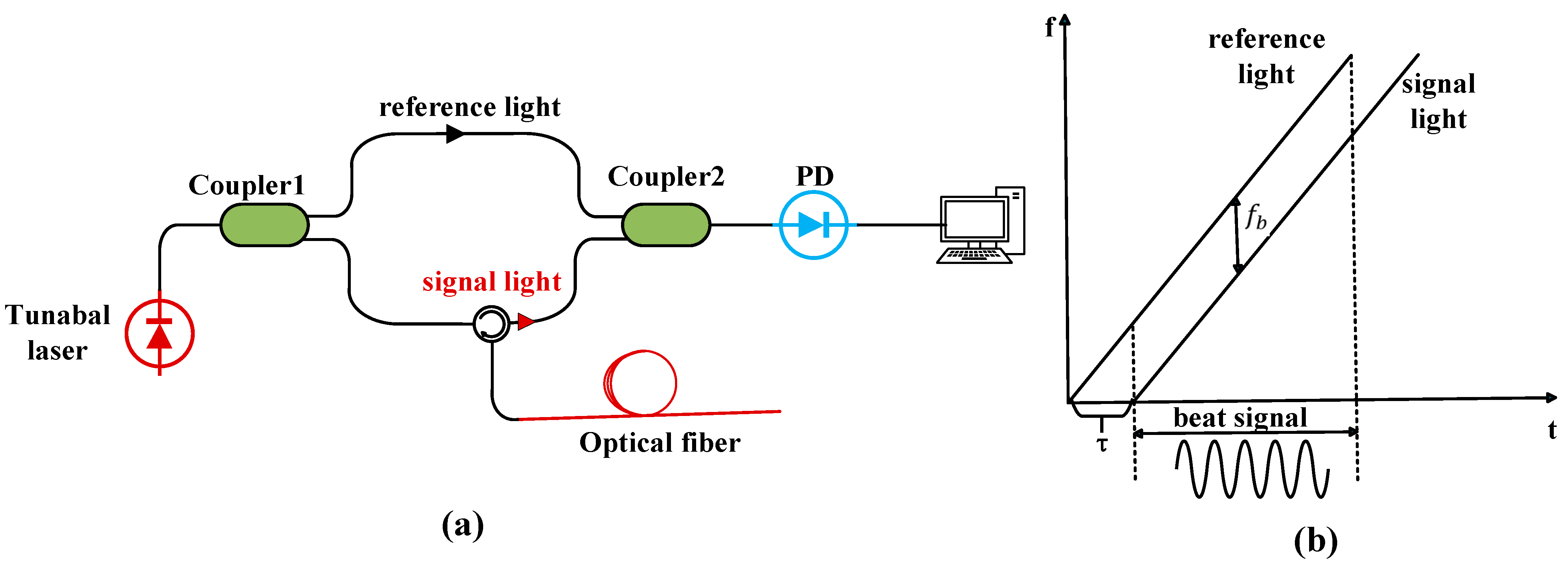
OFDR is essentially a detection system that uses optical heterodyne detection technology to detect backscattered light in optical fibers. As shown in Figure 1a, frequency-swept light enters Coupler 1 and is split into two paths, entering the two arms of a Mach-Zehnder interferometer. One arm has a circulator and the fiber under test (FUT), which generates backward Rayleigh scattered light as the signal light. The other path through Coupler 1 enters the other arm as the reference light. The signal light and reference light undergo beat frequency interference at Coupler 2, and the resulting optical signal is converted into an electrical signal by a photodetector.
Let the linear frequency modulation rate of the tunable laser be γ; the instantaneous frequency of the frequency-swept light output by the laser is:
v ( t ) = v 0 + γ t , 0 < t < T
where T denotes the frequency-sweeping time. Thus, the optical signal can be expressed as:
E r ( t ) = E 0 e x p j 2 π f 0 t + π γ t 2
Suppose reflection occurs at a distance x from the start of the FUT. The frequency-time curves of the generated signal light and reference light are shown in Figure 1b. At this point, the resulting time delay is τ = 2 n x / c , so the frequency of the beat frequency interference signal is f b = 2 γ n x / c . Here, c is the speed of light in vacuum, and n is the refractive index of the detected fiber. The resulting signal optical signal is:
E s ( t ) = R ( τ ) E r ( t τ )
where R ( τ ) is the reflection coefficient at the corresponding reflection position.
The signal light and reference light undergo beat frequency interference at Coupler 2, and the light intensity is:
I ( t ) = E r ( t ) + E s ( t ) 2   = E 0 2 1 + R ( τ ) + 2 R ( τ ) cos 2 π f 0 τ + f b t γ τ 2 2
It can be seen that the light intensity is related to f b t By measuring the beat frequency interference signal, the time delay τ at this position and the reflection distance x can be derived. Using Fourier transform to analyze the collected beat frequency interference signals, the reflection intensity curves at different positions can be obtained.
The spatial resolution Δ x of OFDR is determined by the formula Δ x = c / ( 2 n Δ F ) , where c is the speed of light in vacuum, n is the refractive index of the fiber, and Δ F is the frequency sweep range of the tunable laser [18]. Since the frequency sweep range of the tunable laser in the OFDR system is F = γ T , let the central wavelength of the tunable laser be λ . The relationship between the frequency sweep range F and the wavelength sweep range λ is:
Δ F = c λ 2 Δ λ
Then the spatial resolution Δ x can be rewritten as:
Δ x = c 2 n Δ F = λ 2 2 n Δ λ
The spatial resolution of the OFDR system is related to the central wavelength and wavelength sweep range of the tunable laser.
DR technology is similar to that of FBGs sensing. When an optical fiber is subjected to external stress and temperature changes, its internal refractive index distribution changes, leading to a drift in the Rayleigh scattering spectrum. By detecting the drift amount of the Rayleigh scattering spectrum, the magnitude of strain and temperature can be measured.
Δ λ λ = K T Δ T + K ε ε
where Δ λ denotes the frequency shift of Rayleigh scattered light, λ represents the central frequency of Rayleigh scattered light, K ε is the strain sensitivity coefficient, ε stands for the strain experienced by the optical fiber, K T denotes the temperature sensitivity coefficient, and Δ T represents the temperature change.

2.2. Experimental Setup for FOCT Optical Path Detection

For a complete all-fiber current transformer (FOCT) system, its internal components include a circuit part, a modulation module part, and an optical path part. When performing OFDR-based detection on the optical path system of the FOCT, further processing of the transformer system is required. Since the OFDR system itself is equipped with a tunable laser, the SLD broadband light source in the FOCT system is no longer needed. In this experiment, the OFDR system adopts an integrated device produced by Sense Maga (Wuhan, China), with the relevant parameters provided in Table 1.
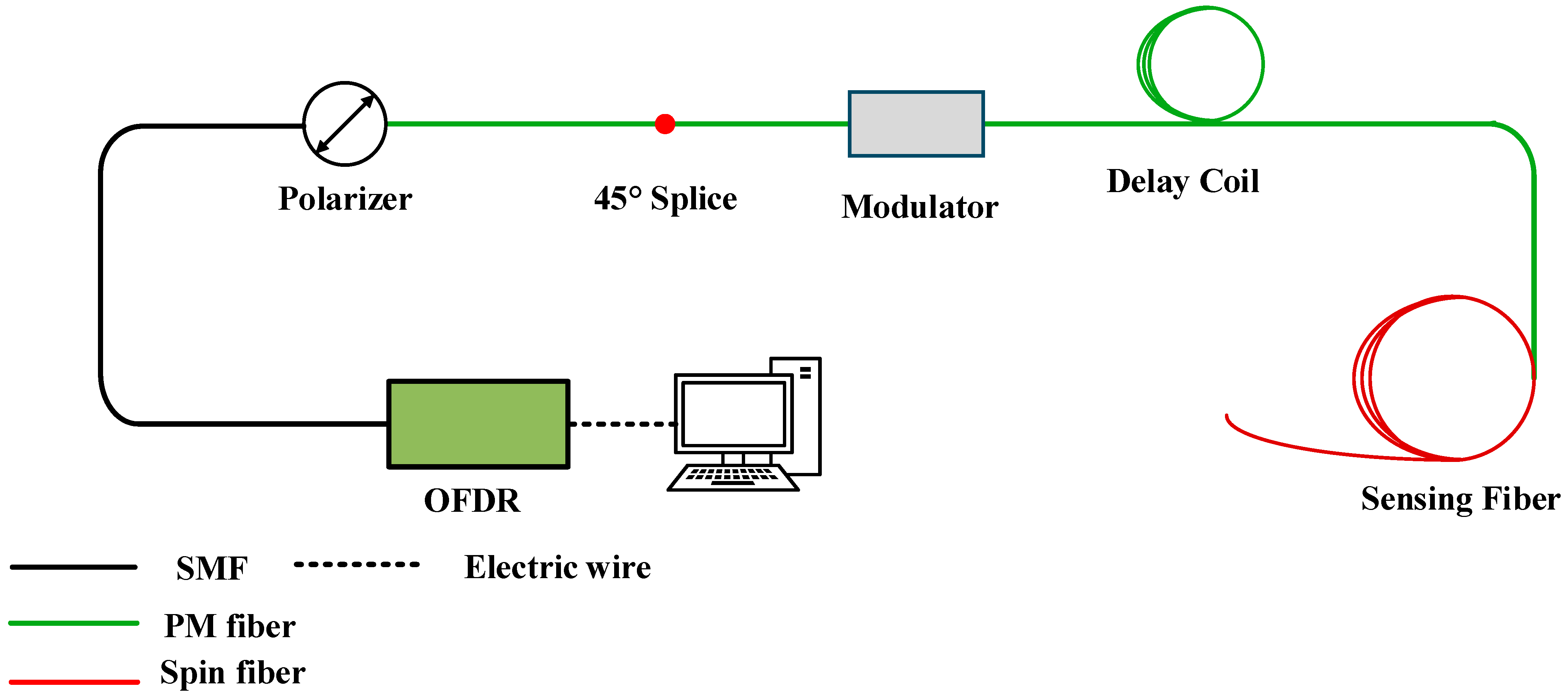
The FOCT used in this experiment adopts a hardware phase-locking scheme; thus, the phase-locking part can be removed. For the phase modulator part, no additional modulation needs to be introduced, with detection focused solely on the optical path of the system. In addition, partial modifications to the optical path are required: since the OFDR detects Rayleigh scattering signals in the optical fiber, excessive reflection at the fiber end will seriously interfere with signal detection. Therefore, it is necessary to remove the mirror at the end of the rotating fiber. The schematic diagram of the experimental setup is shown in Figure 2. In the experimental system, ordinary single-mode fiber is used before the polarizer, while polarization-maintaining (PM) fiber is adopted from the polarizer to the sensing coil system. The sensing coil part consists of spin fiber, and the types of optical fibers used have been marked in Figure 2. Table 1 presents the parameters of each device in the experiment.

2.3. Experiment on Temperature-Induced Stress Variation of FOCT Sensing Coil

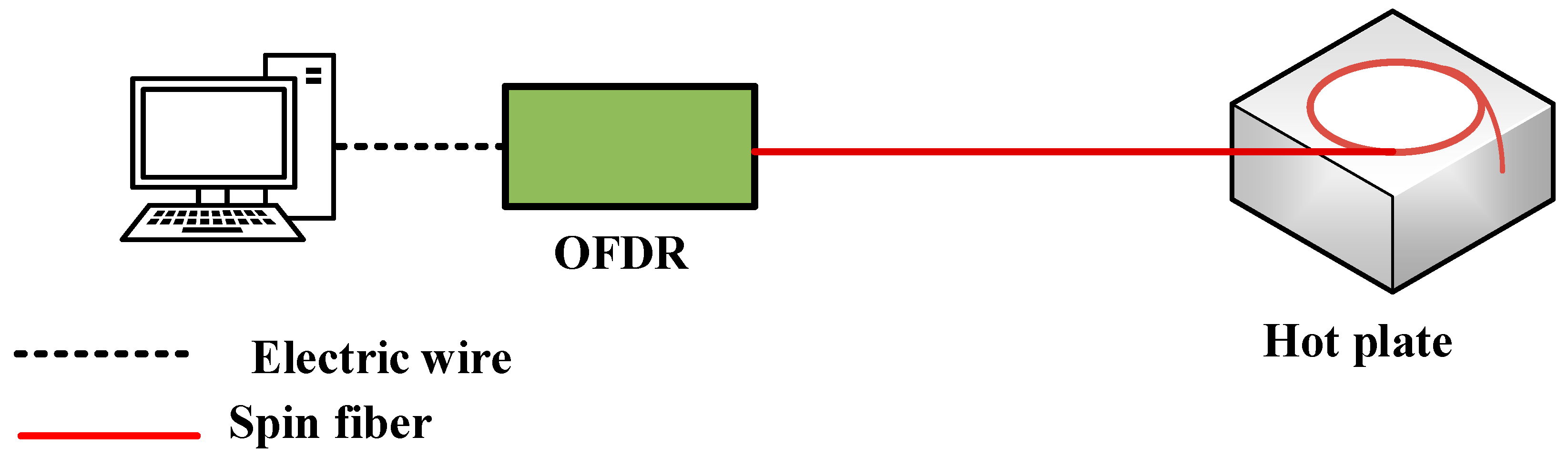
In the FOCT system, the sensing coil is affected by temperature, resulting in the presence of strain distribution inside it. By leveraging the sensing capability of OFDR, the stress distribution of the FOCT sensing coil under different temperatures can be measured, which thereby provides a basis for the temperature-induced strain compensation of the FOCT sensing coil. The sensing coil was removed and connected independently to the OFDR system. Subsequently, the sensing coil was fixed on a heating stage, and the internal stress variation of the sensing coil was measured by adjusting the temperature. The model of the constant-temperature heating stage is BY2020 (Bangyuan Hardware Co., Ltd., Shenzhen, China), with a heating aluminum plate size of 20 mm × 20 mm and a heating accuracy of 1 °C. Its initial state is room temperature (25 °C). The initial temperature of the experiment was set to 40 °C, with the target temperature of 90 °C. Every time the temperature was increased by 10 °C, data was recorded once after the heating stage stabilized for 1 min. The fixing method of the sensing coil involved using four pieces of tape to uniformly attach the sensing coil to the heating stage. The experimental setup is shown in Figure 3.

3. Results

3.1. Analysis of the Entire FOCT Optical Path Using a High-Range OFDR System

One end of the coupler in the system’s optical path was connected to the OFDR system, and the host computer was used to control the OFDR system for optical path scanning. The laser emitted by the tunable laser in the OFDR passes through the polarizer, 45° fusion splice, and phase modulator in sequence, then enters the polarization-maintaining fiber (PM fiber), and is coupled into the rotating fiber via the quarter-wave plate.
The backward Rayleigh scattering and backward reflection generated by these passive components and specialty fibers are collected by the OFDR system, which then generates the corresponding OFDR response curves. Since the optical path system of the all-fiber current transformer has a relatively long overall length and involves multiple components and fibers, to conduct OFDR response curve analysis on the transformer system, it is necessary to identify the OFDR response curves corresponding to each component and fiber in the current transformer’s optical path system one by one, and establish the corresponding relationships within the overall response curve.
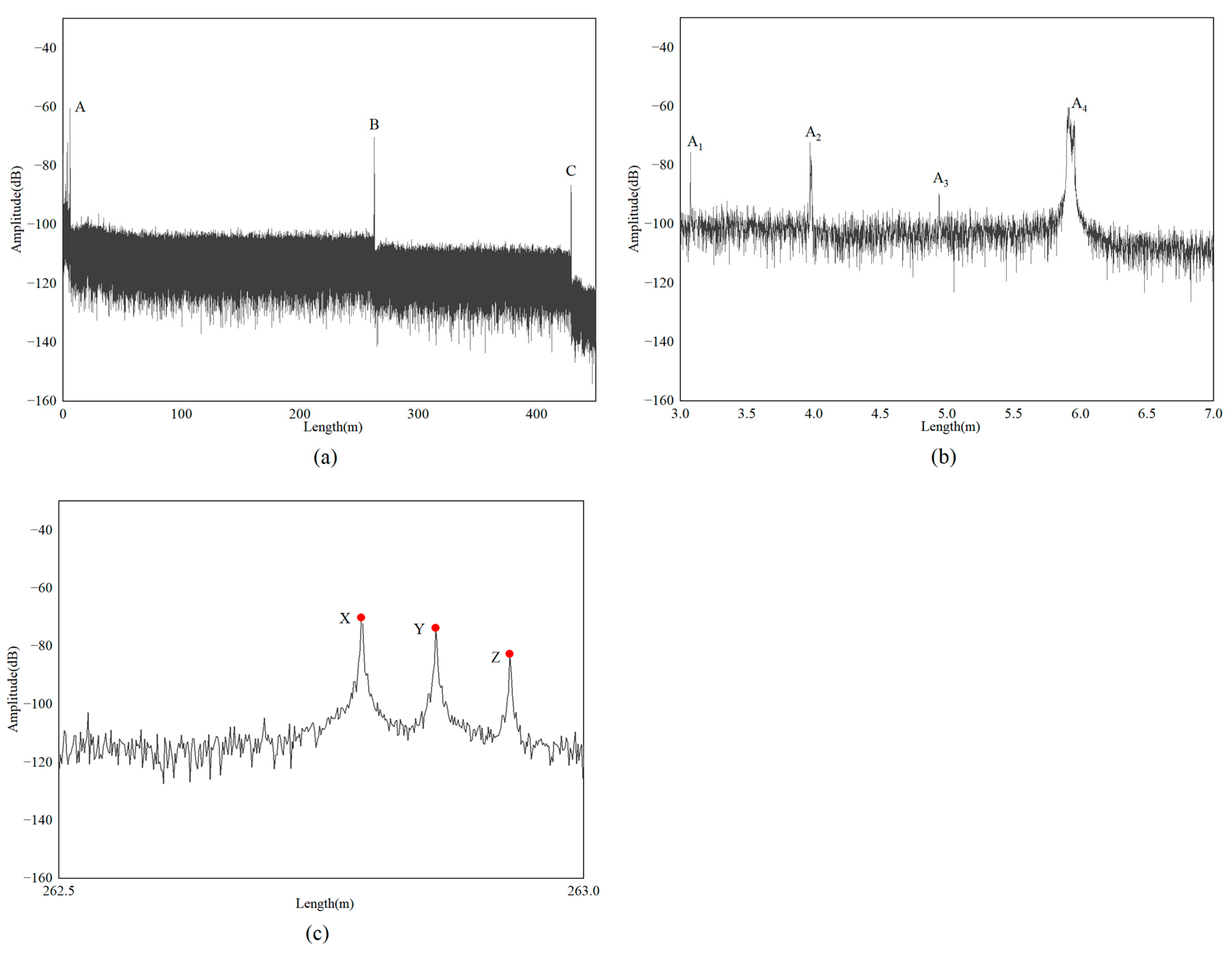
The OFDR response curves obtained from the experiment are shown in Figure 4. Figure 4a exhibits three peak points, denoted as A, B, and C. Specifically, Point A corresponds to the interface between the FOCT optical path and the single-mode fiber pigtail; Point B corresponds to the end of the polarization-maintaining (PM) fiber delay loop; and Point C corresponds to the integrated glass slide and rotating fiber in the FOCT optical path. The lengths corresponding to these points are as follows: L A = 3.07566   m , L B = 262.78803   m and L C = 428.96846   m .
The total length of the entire FOCT system was calculated as:
L = L C L A = 425.89280   m ,
the length of the integrated glass slide and sensing coil in the FOCT system (denoted as LS) was
L S = L C L B = 166.18043   m ,
The OFDR system exhibits extremely high spatial resolution and a measurement range of 600 m, which can cover the total length of most current FOCT optical paths.
By virtue of the high resolution and high sensitivity of the OFDR system, various front-end components of the FOCT system can also be identified one by one. As shown in Figure 4b, a segment of the response curve ranging from 3 m to 7 m was selected, which contains four event points (A1, A2, A3, and A4) that correspond one-to-one with the components in the FOCT optical path. The peak at event point A1 is attributed to the cross-sectional reflection formed at the interface between the light inlet of the FOCT system and the single-mode fiber pigtail. The peak at event point A2 is caused by the internal reflection of the polarizer in the system. Event point A3 is associated with the 45° fusion splice, where both the front and rear ends of A3 are connected to PM fibers. During the fusion splicing at A3, to distribute the linearly polarized light (after the polarizer) onto both the fast axis and slow axis of the subsequent PM fiber, the slow axes of the two PM fibers (front and rear) were offset by 45° relative to each other during splicing. This resulted in relatively high loss, thereby causing a prominent peak at A3. Event point A4 corresponds to the phase modulator; the phase modulator has relatively high internal loss, which manifests as a large peak in the curve.
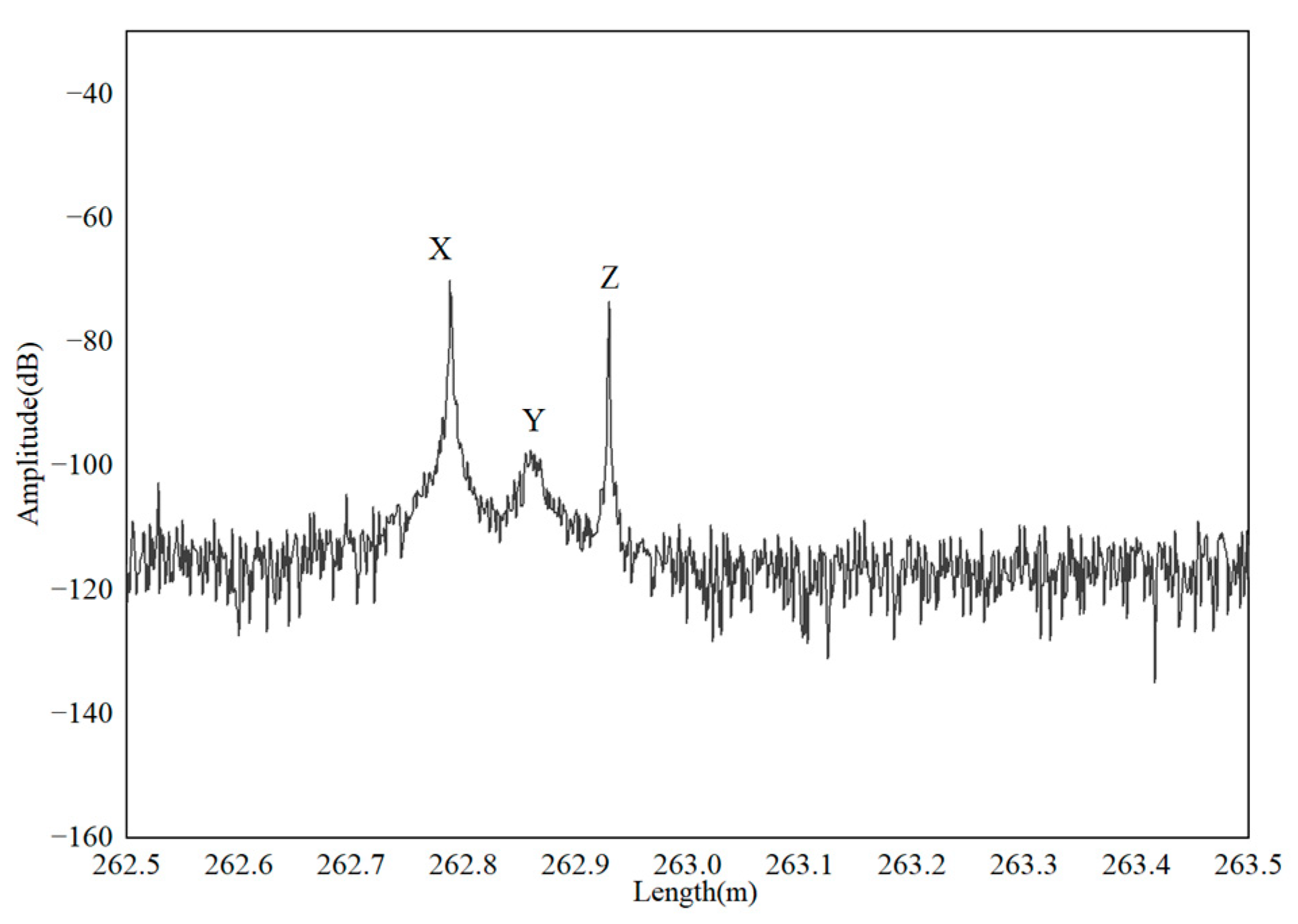
Figure 4c shows the reflection peak diagram obtained by amplifying the peak at Point B, where three peaks can be observed. These three peaks can be analyzed by examining the operating principle of the FOCT system.
After passing through the 45° fusion splice, the linearly polarized light in the FOCT system is split into two components in the subsequent polarization-maintaining (PM) fiber delay loop: fast-axis light (propagating along the fast axis with a refractive index of n 1 ) and slow-axis light (propagating along the slow axis with a refractive index of n 2 ). Due to their different propagation speeds in the delay loop, a time delay difference τ arises when the two light components reach the end of the delay loop. Consequently, a time delay difference of 2τ is introduced when their reflected light signals arrive at the OFDR system. This results in two sequential peaks in the OFDR response curve, which correspond to Points X and Z in the diagram.
Point Y in the diagram is caused by crosstalk between the fast-axis light and slow-axis light at the end of the delay loop. Table 2 presents the signal light characteristics and reflection peak conditions corresponding to different transmission paths.
Based on this, the birefringence of the polarization-maintaining (PM) fiber delay loop can be calculated:
L i = c τ i 2 n
where   L i is the position of the peak of the two reflection segments, τ i is the different time delay corresponding to the peak of the two reflection segments,   c is the speed of light in vacuum, and   n is the refractive index of the optical fiber.
Δ n = τ c L
here,   L   represents the actual fiber length, and Δn denotes the birefringence of the PM fiber. With   L X = 262.78803   m , L Y = 262.85879   m and L Z = 262.92954   m , n is calculated to be   5.385 × 10 4 . Given that the operating wavelength of the FOCT system is 1310 nm, the beat length   L p is obtained as 2.428   m m . The delay loop model is PM1016-C, which meets its parameter specification of beat length less than 3 mm.
It is speculated that the Y peak is caused by the uneven end face of the optical fiber—the uneven end face of the PM fiber delay loop leads to significant crosstalk between the fast-axis light and the slow-axis light. The end of the delay loop was removed, and a fiber cleaver was used to process the end of the delay loop to make its end face flat. As shown in the following Figure 5, from the OFDR response curve measured after the end treatment, it can be clearly seen that the crosstalk peak at Y decreases significantly, while the peaks at X and Z increase.

3.2. The Influence of Light in Different Polarization States on System Response

In general, the FOCT system is a polarization-based system. The incident light in the single-mode fiber passes through the polarizer to become linearly polarized light, which then propagates in the PM fiber. Notably, the backward Rayleigh scattered light of this linearly polarized light also contains polarization information.
Among them, the backward scattered light is collected by the OFDR system as the signal light. The signal light undergoes heterodyne interference with the reference light inside the OFDR system, thereby generating the OFDR response curve of the system.
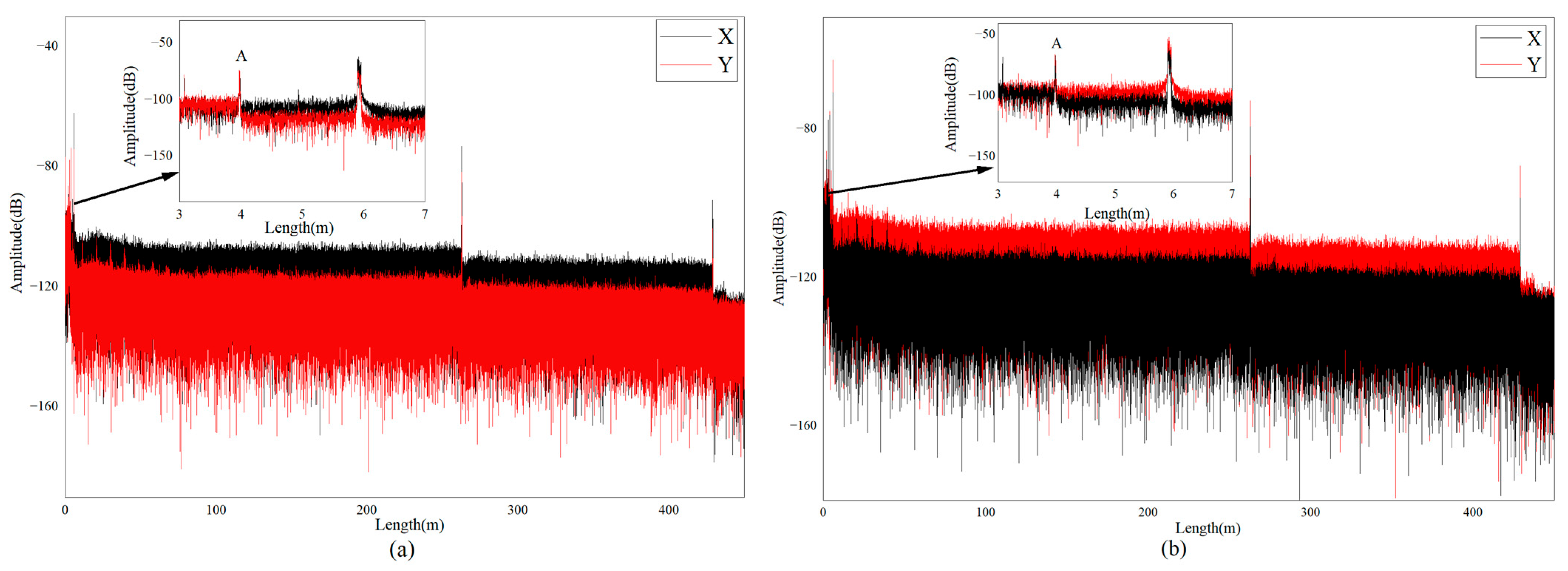
The reference light inside the OFDR system is split into two mutually orthogonal polarization states (X-polarization state and Y-polarization state). The signal light then undergoes heterodyne interference with these two reference lights separately, resulting in two sets of response curves, as shown in Figure 6 below.
The analysis of Figure 6a reveals that after the backward scattered light of the system interferes with the reference lights in the two polarization states, the two resulting curves exhibit significant differences in intensity. By magnifying the front end of the curves, it is found that the two sets of curves show obvious intensity differences only after event point A (the polarizer), which confirms that the light in the FOCT system becomes linearly polarized light after passing through the polarizer. The interference intensity between the reference light in the X-polarization state and the signal light is significantly higher than that between the reference light in the Y-polarization state and the signal light, indicating that the polarization state of the linearly polarized light in the system is closer to the X-polarization state.
To verify this result, the polarizer and the single-mode fiber were rotated by 90° (i.e., the polarization state of the linearly polarized light in the system was rotated by 90°), and the resulting curve is shown in Figure 6b. At this point, the interference intensity between the reference light in the Y-polarization state and the signal light is higher, which indicates that the polarization state of the linearly polarized light in the system is closer to the Y-polarization state. This thus verifies that the OFDR system can effectively monitor changes in the polarization state within the FOCT system.

3.3. Temperature-Strain Response of the Sensing Coil

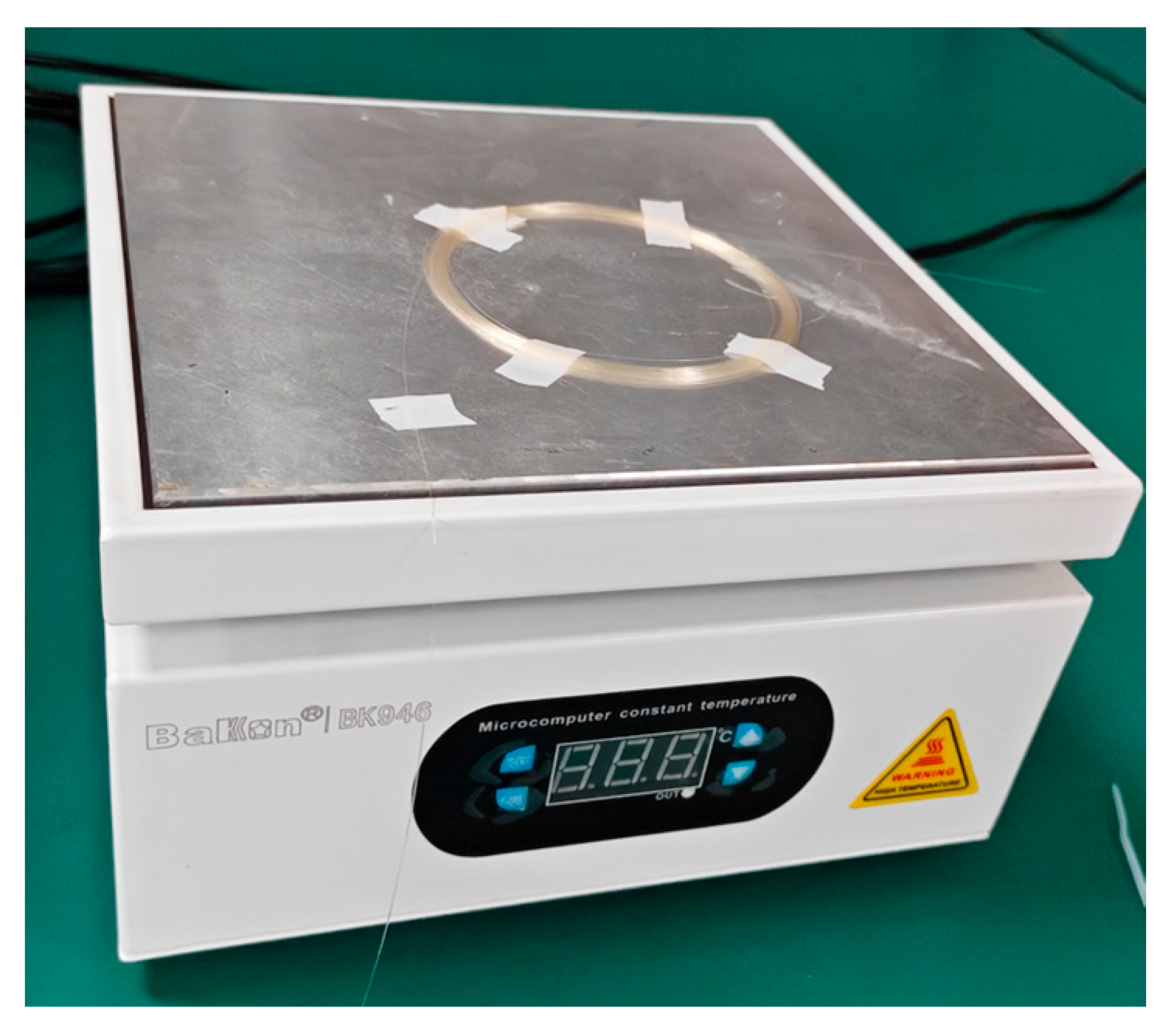
The rotating fiber in the FOCT system was removed and wound into a coil (with a coil circumference of 0.282 m), which was then fixed on a constant-temperature heating stage using tape. The coil was connected to the OFDR system via a fiber pigtail. The coil has 90 turns and a radius of 45 mm, and is uniformly attached to the metal plate of the heating stage using four pieces of tape. To ensure stable and uniform temperature of the coil during heating, data is recorded after the temperature stabilizes for 1 min. Experimental setup diagram is shown in Figure 7.
The sensing measurement of the OFDR system is achieved by measuring the shift of the reflection spectrum. With room temperature (25 °C) as the reference, the coil was subjected to heating (temperature increase), and the internal stress variation of the coil was measured simultaneously.
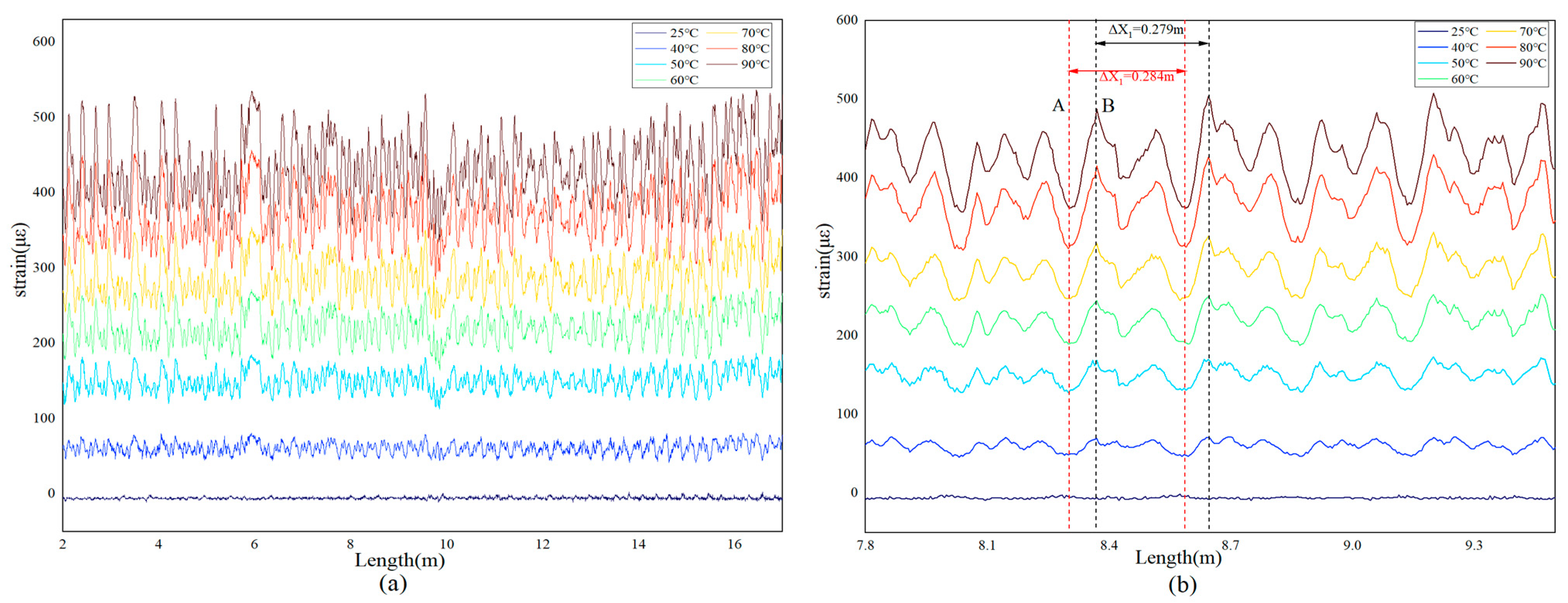
Analysis of Figure 8a shows that as the temperature of the heating stage increases, the internal strain of the sensing coil increases overall. Since the sensing coil was manually wound and fixed on the heating stage with tape, this results in an uneven internal stress distribution within the coil.
By selecting the strain distribution curve in the 7.8–9.5 m segment (as shown in Figure 8b), it can be observed that the curve exhibits a certain regularity. The fiber coil is formed by multi-layer winding along a helical path, and the spatial position of each fiber loop repeats periodically. This geometric periodicity provides a structural basis for the periodic distribution of strain: the existence of “wave crests” is due to the difficulty in releasing strain at the coil’s fixed positions, which thus accumulates into relatively large strain; at “wave troughs”, the constraints on thermal expansion are significantly reduced, and strain can be released through micro-deformations, resulting in smaller strain.
It can be seen from Figure 8 that the higher the temperature, the greater the amplitude of the wave crests; however, the “periodic pattern” of the wave crests and troughs remains consistent. This is determined by the inherent periodicity of the coil’s winding structure—as long as the structure remains unchanged, the pattern of periodic constraints will not change.
The internal strain distribution of the sensing coil can be expressed as:
S = s 0 + δ s
where S Internal strain of the sensing coil; s 0 : strain contribution caused by temperature; δ s : strain contribution caused by the winding structure.
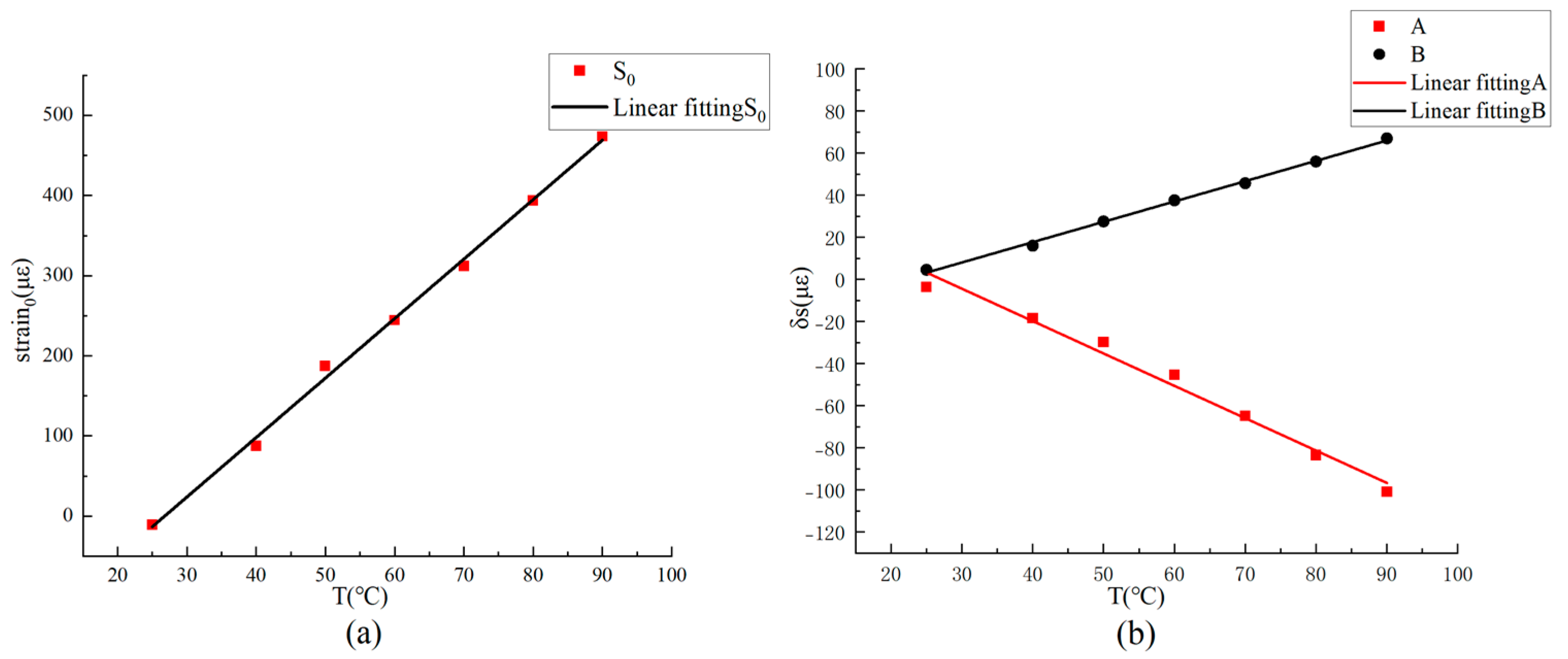
An overall analysis was conducted on the curve in Figure 8a, revealing that   s 0   exhibits a linear relationship with temperature. For the curve in Figure 8b, analysis was focused on two points (Point A and Point B), and δ s was calculated accordingly—results showed that δ s also has a linear relationship with temperature.
This indicates that the stress inside the sensing coil is positively correlated with temperature. Furthermore, the distribution of stress along the optical fiber is related to the inherent periodicity of the coil’s winding structure, and the strain amplitude is also positively correlated with temperature. The fitting curve of stress versus temperature is shown in Figure 9.
The fitting curves show that the thermal strain of the fiber coil has two components: uniform and non-uniform. The uniform component   s 0 is linearly and positively correlated with temperature, dominated by overall thermal expansion and structural constraints. The non-uniform component δ s exhibits different linear variation trends due to structural anisotropy or material interface effects. The high goodness-of-fit verifies the linear correlation between thermal strain and temperature, providing an experimental basis for modeling the thermal effects of the coil and temperature compensation. Analyzing the temperature strain distribution of the sensing ring is of great significance for performing temperature strain compensation in the FOCT system [22].

4. Discussion

Equation (6) gives the relationship between the spatial resolution of the OFDR system and the central wavelength as well as the wavelength sweep range of the tunable laser. The theoretical spatial resolution for a 75   n m sweep range is calculated to be   0.01   m m , i.e., the distance between two data points is   0.01   m m . This indicates that the OFDR system used in this experiment has extremely high resolution, laying a foundation for FOCT optical path detection. Through the analysis of experimental results in Section 3, it can be found that the OFDR system can not only perform link analysis on the entire FOCT optical path but also distinguish individual components in the optical path and accurately locate their positions. This is of great significance for the optical path diagnosis of FOCT.
OFDR is the preferred method for FOCT optical path measurement due to its comprehensive advantages: it delivers high spatial resolution for precise defect localization, enables holistic analysis of both the entire optical link and internal devices (surpassing methods limited to partial detection or requiring system disassembly), and maintains low system complexity with strong practicality. Additionally, it possesses the unique capability to measure the temperature and stress distribution of FOCT sensing coils, providing critical data support for system temperature-strain compensation. Despite its higher cost, these integrated strengths make it indispensable for safeguarding FOCT operational reliability. The detection methods for the FOCT system are shown in Table 3.

5. Conclusions

In summary, OFDR plays a vital role in FOCT optical path detection, leveraging its high resolution, sensitivity, and 600 m range. It identifies FOCT components (polarizers, 45° fusion splices) and fibers via response curves, calculates optical path/sensing coil lengths, and pinpoints anomalies (e.g., uneven fiber ends causing crosstalk, fixed by end processing). OFDR monitors FOCT polarization by splitting reference light into X/Y states for interference with signal light, verifying post-polarizer linear polarization and tracking its changes. It also measures sensing coil strain via reflection spectrum shifts, revealing strain-temperature linearity and structure-induced periodic strain, supporting FOCT temperature-strain compensation. Overall, OFDR is indispensable for FOCT fault diagnosis, polarization tracking, and performance optimization.

Author Contributions

Conceptualization, Y.W. and G.M.; methodology, Y.W. and P.X.; software, Y.W.; validation, G.M. and Y.W.; investigation, G.M.; data curation, G.M.; writing—original draft preparation, G.M.; writing—review and editing, Y.W. and L.X.; All authors have read and agreed to the published version of the manuscript.

Funding

This work was supported by the Open Fund Project of the Tibet Yangbajing High-Altitude Electrical Safety and Electromagnetic Environment National Field Observation and Research Station (Project Name: Reliability and Failure Mechanism Analysis of Electro-Optic Modulators for All Fiber Optical Current Transformer Applications in High Altitude Environments, WG80-25-003).

Data Availability Statement

The original contributions presented in this study are included in the article. Further inquiries can be directed to the corresponding author.

Conflicts of Interest

The authors declare no conflicts of interest.

References

  1. Pang, F.; Huang, Q.; Liu, Y.; Li, P.; Kong, X.; Song, L. Fault Mechanism of Fiber Optical Current Transformer Based on Signal Method. Math. Probl. Eng. 2020, 2020, 1282014. [Google Scholar] [CrossRef]
  2. Xuming, L.; Ping, Z.; Yong, C. Recent Advances in High-Voltage Direct-Current Power Transmission and Its Developing Potential. Power Syst. Technol. 2012, 36, 1–9. [Google Scholar]
  3. Shillaber, L.; Jiang, Y.L.; Ran, L.; Long, T. Ultrafast Current Shunt (UFCS): A Gigahertz Bandwidth Ultra-Low-Inductance Current Sensor. IEEE Trans. Power Electron. 2022, 37, 15493–15504. [Google Scholar] [CrossRef]
  4. Wang, L.H.; Chen, G.; Ji, J.F.; Sun, J.; Qian, J.B.; Liu, X.X. Methods of Fault Diagnosis in Fiber Optic Current Transducer Based on Allan Variance. Math. Probl. Eng. 2014, 2014, 831075. [Google Scholar] [CrossRef]
  5. Bohnert, K.; Hsu, C.P.; Yang, L.; Frank, A.; Müller, G.M.; Gabus, P. Fiber-Optic Current Sensor Tolerant to Imperfections of Polarization-Maintaining Fiber Connectors. J. Light. Technol. 2018, 36, 2161–2165. [Google Scholar] [CrossRef]
  6. N’cho, J.S.; Fofana, I. Review of Fiber Optic Diagnostic Techniques for Power Transformers. Energies 2020, 13, 1789. [Google Scholar] [CrossRef]
  7. Beheshti Asl, M.; Fofana, I.; Meghnefi, F. Review of Various Sensor Technologies in Monitoring the Condition of Power Transformers. Energies 2024, 17, 3533. [Google Scholar] [CrossRef]
  8. Lobo Ribeiro, A.B.; Eira, N.F.; Sousa, J.M.; Guerreiro, P.T.; Salcedo, J.R. Multipoint Fiber-Optic Hot-Spot Sensing Network Integrated into High Power Transformer for Continuous Monitoring. IEEE Sens. J. 2008, 8, 1264–1267. [Google Scholar] [CrossRef]
  9. Liu, H.; Zhao, T.; Zhang, M.J. OTDR Development Based on Single-Mode Fiber Fault Detection. Sensors 2025, 25, 4284. [Google Scholar] [CrossRef] [PubMed]
  10. Qu, S.; Xu, Y.P.; Huang, S.; Sun, M.C.; Wang, C.; Shang, Y. Recent Advancements in Optical Frequency-Domain Reflectometry: A Review. IEEE Sens. J. 2023, 23, 1707–1723. [Google Scholar] [CrossRef]
  11. Li, Z.; Cui, J.; Chen, H.; Lu, H.; Zhou, F.; Rocha, P.R.F.; Yang, C. Research Progress of All-Fiber Optic Current Transformers in Novel Power Systems: A Review. Microw. Opt. Technol. Lett. 2025, 67, e70061. [Google Scholar] [CrossRef]
  12. Lu, P.; Buric, M.P.; Byerly, K.; Moon, S.R.; Nazmunnahar, M.; Simizu, S.; Leary, A.M.; Beddingfield, R.B.; Sun, C.; Zandhuis, P.; et al. Real-Time Monitoring of Temperature Rises of Energized Transformer Cores with Distributed Optical Fiber Sensors. IEEE Trans. Power Deliv. 2019, 34, 1588–1598. [Google Scholar] [CrossRef]
  13. Lou, G.; Xia, L. Study on Temperature-Dependent Performance of Polarization Maintaining Fiber Used in All-Fiber Current Transformer. In Proceedings of the ICOCN 2022—20th International Conference on Optical Communications and Networks, Shenzhen, China, 12–15 August 2022; Institute of Electrical and Electronics Engineers Inc.: New York, NY, USA, 2022. [Google Scholar]
  14. Sasaki, K.; Takahashi, M.; Hirata, Y. Temperature-Insensitive Sagnac-Type Optical Current Transformer. J. Light. Technol. 2015, 33, 2463–2467. [Google Scholar] [CrossRef]
  15. Li, Y.; Yang, X.; Xu, J.; Wang, Y. Temperature Compensation in Full Optical Fiber Current Transformer Using Signal Processing. In Proceedings of the 2013 Sixth International Symposium on Computational Intelligence and Design, Hangzhou, China, 28–29 October 2013; Volume 2, pp. 227–230. [Google Scholar]
  16. von der Weid, J.P.; Passy, R.; Mussi, G.; Gisin, N. On the Characterization of Optical Fiber Network Components with Optical Frequency Domain Reflectometry. J. Light. Technol. 1997, 15, 1131–1141. [Google Scholar] [CrossRef]
  17. Glombitza, U.; Brinkmeyer, E. Coherent Frequency-Domain Reflectometry for Characterization of Single-Mode Integrated-Optical Waveguides. J. Light. Technol. 1993, 11, 1377–1384. [Google Scholar] [CrossRef]
  18. Soller, B.J.; Gifford, D.K.; Wolfe, M.S.; Froggatt, M.E. High Resolution Optical Frequency Domain Reflectometry for Characterization of Components and Assemblies. Opt. Express 2005, 13, 666–674. [Google Scholar] [CrossRef] [PubMed]
  19. Zhou, D.-P.; Qin, Z.; Li, W.; Chen, L.; Bao, X. Distributed Group Birefringence Measurement in a Polarization-Maintaining Fiber Using Optical Frequency-Domain Reflectometry. Opt. Commun. 2015, 345, 62–66. [Google Scholar] [CrossRef]
  20. He, Z.Y.; Liu, Q.W. Optical Fiber Distributed Acoustic Sensors: A Review. J. Light. Technol. 2021, 39, 3671–3686. [Google Scholar] [CrossRef]
  21. Zhen, W.; Ren, Z.-C.; Wang, X.-L.; Ding, J.; Wang, H.-T. Polarization Structure Transition of C-Point Singularities upon Reflection. Sci. China Phys. Mech. Astron. 2025, 68, 244211. [Google Scholar] [CrossRef]
  22. Chen, L.; Ding, W.; Chenggang, L.; Kuo, S.; Dexin, L.; Yu, D.; Liqing, W.; Lei, S.; Junjie, J. Fiber Optic Current Sensor Temperature Compensation through RBF Neural. In Proceedings of the AOPC 2020: Optical Information and Network, Beijing, China, 30 November–2 December 2020; Zhang, J., Fu, S., Zhang, H., Eds.; Proceedings of SPIE: Bellingham, WA, USA, 2020; Volume 11569. [Google Scholar]
  23. Wen, G.; Zhang, H.; Li, T.; Qu, J.; Jia, D.; Liu, T. A 10-Km Polarization Maintaining Fiber Distributed Polarization Coupling Measurement Method with Dispersion Compensation Function Based on White Light Interferometer. IEEE Sens. J. 2023, 23, 21293–21300. [Google Scholar] [CrossRef]
Figure 1. Basic working principle of OFDR system. (a) Schematic diagram of OFDR system structure. (b) Schematic diagram of beat frequency interference principle.
Photonics 12 01159 g001
Figure 2. Schematic diagram of the FOCT optical path detection experiment.
Photonics 12 01159 g002
Figure 3. Heating the FOCT sensing coil using a heating stage.
Photonics 12 01159 g003
Figure 4. OFDR response curves of the FOCT optical path system. (a) OFDR response curve of the entire FOCT optical path, three peak points are denoted as A, B, and C. (b) OFDR response curve of FOCT front-end components at the 3–7 m position, the figure contains four event points (A1, A2, A3, and A4). (c) Reflection peak diagram obtained by amplifying the peak at Point B. X, Y, and Z are the three reflection peaks in the figure.
Photonics 12 01159 g004
Figure 5. OFDR response curve measured after end treatment of the delay loop, X, Y, and Z are the three reflection peaks in the figure.
Photonics 12 01159 g005
Figure 6. OFDR response curves of the OFDR system under X-Polarization and Y-Polarization reference Lights. Event point A in the figure is a polarizer. (a) Deflection angle between polarizer and single-mode fiber: 0°; (b) Deflection angle between polarizer and single-mode fiber: 90°.
Photonics 12 01159 g006
Figure 7. Experiment of sensing coil heated by heating stage.
Photonics 12 01159 g007
Figure 8. (a) Internal strain distribution curves of the sensing coil at different temperatures; (b) Internal Strain Distribution Curves of the Sensing Coil (7.8–9.5 m Segment) at Different Temperatures. In the figure, A denotes the “wave troughs” position, B denotes the “wave crests” position, and the dashed line segment represents the occurrence period of the same peaks and valleys.
Photonics 12 01159 g008
Figure 9. (a). Fitting curve of   s 0 as a function of temperature (R2 = 0.99742, Ks = 7.42105 × 10⁻⁶/°C); (b). Fitting curves of   δ s   as a function of temperature (RA2 = 0.99756, KA= 0.96556 × 10⁻⁶/°C; RB2 = 0.98266, KB = −1.53739 × 10⁻⁶/°C).
Photonics 12 01159 g009
Table 1. Performance Parameters of Optical Fibers, Devices and OFDR System.
Module/EquipmentModelParametersValue
PolarizerMCILP-1310-L-S2-P13-10-B-FAOperating Wavelength1310 nm
IL0.3 dB
ER30 dB
PM fiberPM1016-COperating Wavelength1310 nm
Loss≤0.5 dB/km
Beat Length≤4.0 dB
ModulatorKG-AM-13Operating Wavelength1310 nm
IL4 dB
Bandwidth2.5 GHz
Spin fiberSH1016-COperating Wavelength1310 nm
Loss≤2.0 dB/km
Linear Beat Length4~8 mm
OFDROCI-VMeasurement Length600 m
Minimum spatial resolution10 μm
Sensing Length200 m
Sensing Spatial Resolution1 mm
Accuracy±1 με
Wavelength Scan Range1265~1340 nm
Table 2. Characteristics of signal light and reflection peak conditions corresponding to different transmission paths.
Transmission PathSignal Light TypeTime Delay Difference Compared to Fast-Axis LightReflection Peak Position
Fast axis + Fast axisFast-axis light0 L X
Fast axis + Slow axisCrosstalk lightτ L Y
Slow axis + Fast axisCrosstalk lightτ L Y
Slow axis + Slow axisSlow-axis light2τ L Z
Table 3. Comparison of Different Methods for FOCT Optical Path Fault Detection.
MethodSystem ComplexitySpatial Resolution/mMeasurement ContentPracticalityCost
OTDR [7]Low10−1Overall optical path; Device measurement limited by dead zone and sensitivityCan roughly measure FOCT optical path; Unable to accurately locate and detect device status, with high practicalityRelatively Low
WLI [23]High10−2PM fiber Distributed Polarization CouplingCan only measure parameters related to PM fibers High
OFDRLow10−5Overall optical path and internal devicesAccurately measure the entire link and various devices, with high practicalityHigh
FBGs [6]Low\External components of FOCT optical patCannot measure the FOCT optical path, but can monitor temperature and stress of external componentsHigh
Allan-Variance [4]High\Independent devicesCan only analyze the noise level of independent devices to judge faults, with low practicalityRelatively Low
Independent Device Detection [11]High\Independent devicesRequires disassembling the system for independent device detection, complex and with low practicalityHigh
Disclaimer/Publisher’s Note: The statements, opinions and data contained in all publications are solely those of the individual author(s) and contributor(s) and not of MDPI and/or the editor(s). MDPI and/or the editor(s) disclaim responsibility for any injury to people or property resulting from any ideas, methods, instructions or products referred to in the content.