1. Introduction
Wide-field adaptive optics (AO) techniques [
1,
2], particularly ground-layer adaptive optics (GLAO), have proven effective for high-resolution solar imaging [
3,
4]. A single deformable mirror (DM) is employed in GLAO to mitigate ground-layer turbulence, significantly simplifying the system architecture. This configuration enables uniform wavefront correction across wide fields of view (FoVs). As a result, GLAO has been regarded as a promising technique for wide-field solar observations.
Wavefront sensing is fundamental to the performance of GLAO systems. Unlike nighttime observations that utilize point sources, solar observations rely on extended features—such as sunspots and granulation—as guide regions. In solar GLAO systems, the correlated Shack–Hartmann wavefront sensor (SH-WFS) [
5] is commonly employed to compute wavefront slopes by correlating these features. Two main wavefront sensing approaches have been adopted [
6]: multi-direction averaging (MD-A) and wide-field correlation (WF-C). In MD-A, wavefronts are sensed along multiple spatially separated lines of sight and averaged to estimate ground-layer turbulence. In contrast, WF-C derives turbulence information from a single large guide region using wide-field correlation processing.
Because the demand for wide-field GLAO systems was relatively low in the past and the WF-C wavefront sensing method was easier to implement, studies on WF-C were initiated earlier. In 2010, Rimmele et al. conducted the first solar GLAO experiment using an SH-WFS on the 76 cm Dunn Solar Telescope (DST), performing wavefront sensing over a 42″ × 42″ FoV with a single guide region [
7]. The results confirmed both uniform correction of ground-layer turbulence and, for the first time, the technical feasibility of the WF-C method for solar GLAO. This work laid the foundation for subsequent developments. Ren et al. carried out on-site observations using the 1.6 m McMP telescope at Kitt Peak [
8] in 2012. Wavefront sensing was conducted over a 30″ × 30″ FoV using sunspots, with real-time correction enabled by a portable AO system. These results demonstrated the stability and practicality of the WF-C method under narrow-to-moderate FoVs and challenging observational conditions. Three years later, Ren et al. [
6] investigated the performance of solar GLAO for FoVs on the order of several tens of arcseconds using the WF-C wavefront sensing method. The results indicated that the WF-C method provided high performance for FoVs of 40″ and 60″.
The practical value of the MD-A method has been demonstrated through continued optimization and experimental validation. Owing to its broad spatial coverage, it is increasingly recognized as a promising approach for wide-field wavefront sensing. In 2017, Schmidt et al. [
9] conducted a solar GLAO experiment using the Clear system on the Goode Solar Telescope (GST), achieving uniform correction of ground-layer turbulence across a 53″ FoV with a
guide region layout. In 2018, a GLAO prototype based on the New Vacuum Solar Telescope (NVST) was developed by Rao et al. [
10]. Wavefront sensing was performed with five guide regions (12″ × 10″ each), improving image uniformity within a 1′ FoV. In 2020, Rao et al. [
11] implemented a GLAO system using a
multi-directional SH-WFS on the 1.8 m Chinese Large Solar Telescope (CLST). In 2023, Zhang et al. [
12] further optimized the GLAO system of the NVST by implementing the MD-A method for wavefront sensing using multiple guide regions arranged in a
grid. Each guide region covered an FoV of 14.4″ × 14.4″. Wavefront slopes obtained from different lines of sight were averaged, effectively suppressing uncorrelated aberrations caused by high-altitude turbulence. This approach enhanced the stability of ground-layer turbulence sensing and improved the uniformity of wide-field imaging.
Although significant progress has been made in applying GLAO technology to solar observations, and wavefront sensing methods continue to be refined for uniform correction across wider FoVs, most studies still focus on overall system performance. The accuracy and applicability of different wavefront sensing methods under varying FoV conditions have yet to be systematically analyzed. Comparative studies between the two representative methods—MD-A and WF-C—are limited in medium-to-wide FoV applications, posing challenges for their selection in the design of next-generation GLAO systems.
This study presents a systematic comparison of the MD-A and WF-C methods, combining both simulations and experimental validation for the first time. The accuracy of two wavefront sensing methods was evaluated in simulation using the ground-truth phase data, and their wavefront correction performance was analyzed. The simulation results were further validated through experiments conducted on an indoor GLAO platform. The presented results are expected to provide theoretical guidance and practical support for the optimization of GLAO systems and wavefront sensing strategies in 1-meter-class wide-field solar telescopes.
2. Methods
In this model, the Kolmogorov atmospheric turbulence model was used to generate the phase screen, simulating wavefront distortions induced by atmospheric turbulence. Although these wavefronts exhibit strong randomness, they can be effectively decomposed and modeled using Zernike polynomials. The coefficients of these polynomials are modeled as zero-mean Gaussian random variables.
The wavefront phase is typically expressed as a function of spatial coordinates
, neglecting the directional dependence of wavefront distortion across the FoV
. However, in practical observations, the angular direction of each point relative to the central optical axis determines its effective position within the field. To address this, the wavefront phase is extended to a four-dimensional function
. This is achieved by treating the directional coordinates
as parameters and computing the Zernike polynomial expansion coefficients
separately for each direction, allowing the wavefront phase function to be rewritten as follows:
In the extended wavefront phase model [
13], the coefficients
explicitly characterize direction-dependent variations of wavefront distortions, thus providing a theoretical foundation for multi-directional wavefront reconstruction and compensation.
The MD-A wavefront sensing model is defined as follows, where
denotes the wavefront slope in the
x-direction:
denotes the two-dimensional wavefront phase induced by the turbulence layer at height
l, sampled at spatial coordinates
along the line of sight
. Here,
represents the subaperture area over which the gradient is averaged. When wavefront sensing is performed over
different lines of sight, there are
small guide regions. Each guide region is associated with a direction
, and the averaged slope across all directions is given by:
The WF-C wavefront sensing model is defined as follows, where
denotes the wavefront slope in the
x-direction:
In the case of WF-C wavefront sensing, the computation also involves averaging the gradient over the guiding field , where denotes the angular extent of the large guide region.
3. Simulations
In the simulation, the Monte Carlo method was employed to model the physical procedures of solar GLAO wavefront sensing and correction in a rigorous manner, encompassing solar granulation image degradation, subaperture image acquisition and correlation, slope extraction, Zernike mode reconstruction, wavefront correction, and system imaging. In the Monte Carlo simulations, the phase screens were extracted from a large rotating phase screen, which inherently introduces noticeable periodicity. This approach aimed to enable an accurate comparison of the wavefront sensing accuracy of the two methods and the GLAO correction performance achieved by each method.
3.1. Simulation Design
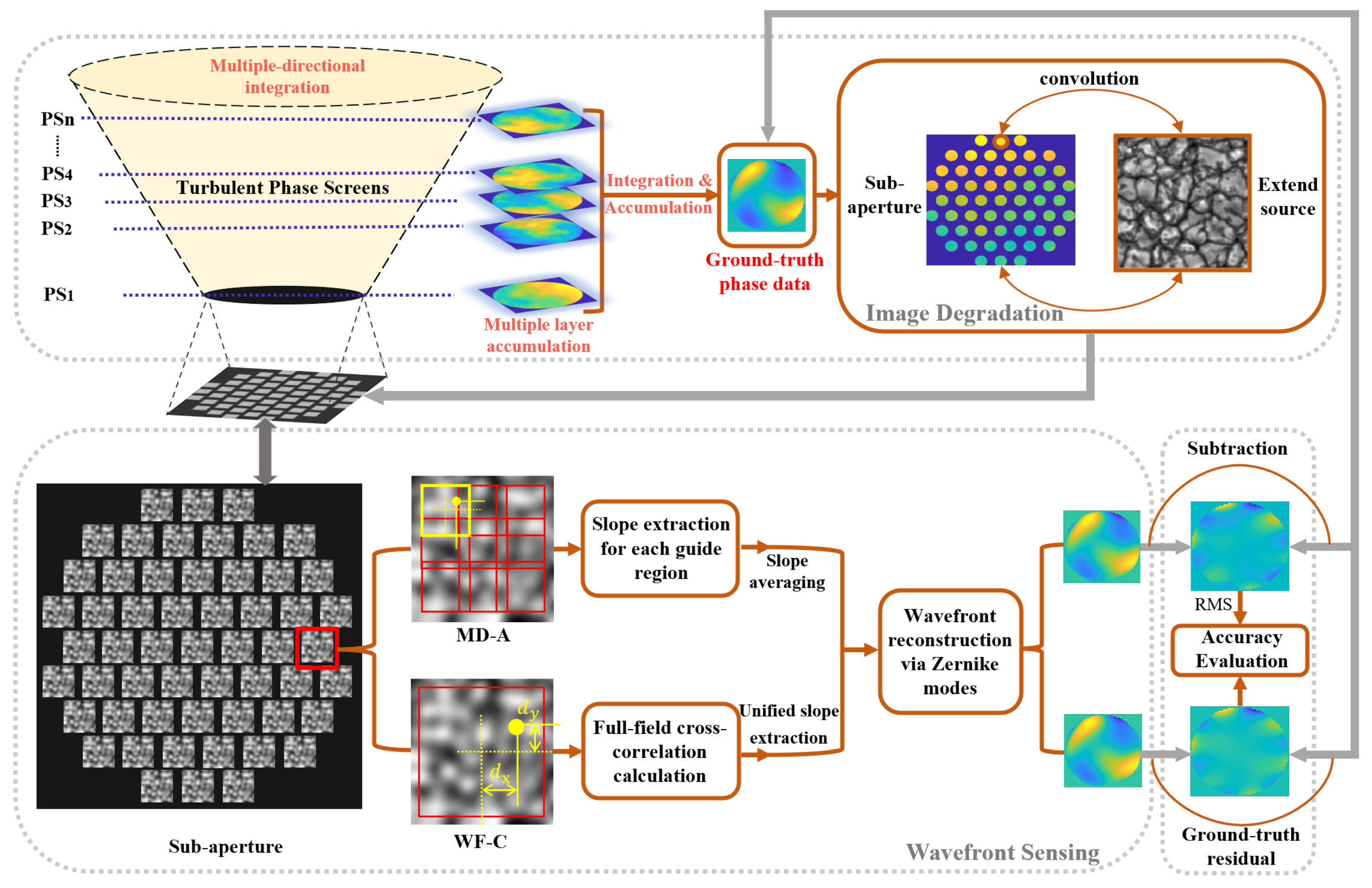
The simulation framework for comparing wavefront sensing accuracy is illustrated in
Figure 1. Existing studies on GLAO wavefront sensing generally lack a ground-truth phase reference, thereby allowing only an indirect assessment of sensing methods through GLAO performance and precluding detailed analysis of wavefront sensing accuracy. In this work, ground-truth phase data were generated via Monte Carlo simulation, enabling a quantitative evaluation of the deviations between the results obtained by each sensing method and the corresponding ground truth. The upper-left portion of
Figure 1 illustrates the generation of ground-truth phase data. This data is computed within the detection FoV by integrating wavefronts across multiple lines of sight and accumulating phase contributions from multiple turbulence layers. The extended target image was convolved with a point spread function (PSF) derived from the ground-truth phase data to produce a degraded image. A similar degradation was applied to the extended target image within each sub-aperture in the SH-WFS.
The system parameters used in the simulation were derived from the GLAO system of NVST, as listed in
Table 1 and
Table 2 [
14]. These parameters are intended to serve as a reference for selecting wavefront sensing methods for the NVST GLAO system. Moreover, since most current solar GLAO systems are implemented on 1-meter-class telescopes, the findings of this study are broadly applicable to similar systems.
Figure 1.
Workflow diagram of the simulation process. High-resolution solar granulation image from the European solar telescope (EST) [
15] was used as extended source.
Figure 1.
Workflow diagram of the simulation process. High-resolution solar granulation image from the European solar telescope (EST) [
15] was used as extended source.
Additionally, in MD-A, the guide region configuration with the broad applicability and optimal performance—identified in previous studies—was adopted [
16], consisting of one central region and eight surrounding regions arranged in an annular pattern for averaged wavefront sensing, as illustrated in
Figure 1. The ratio of pixel counts between the large region in WF-C and the small region in MD-A was set to 5:3. To ensure a fair performance comparison between the two methods, the influence of guide star arrangement and discrete spatial undersampling was minimized as much as possible.
3.2. Simulation Results
In the wavefront sensing comparison, reconstructed phase results from the SH-WFS were computed over 1000 frames, corresponding to one complete cycle of the phase screen.
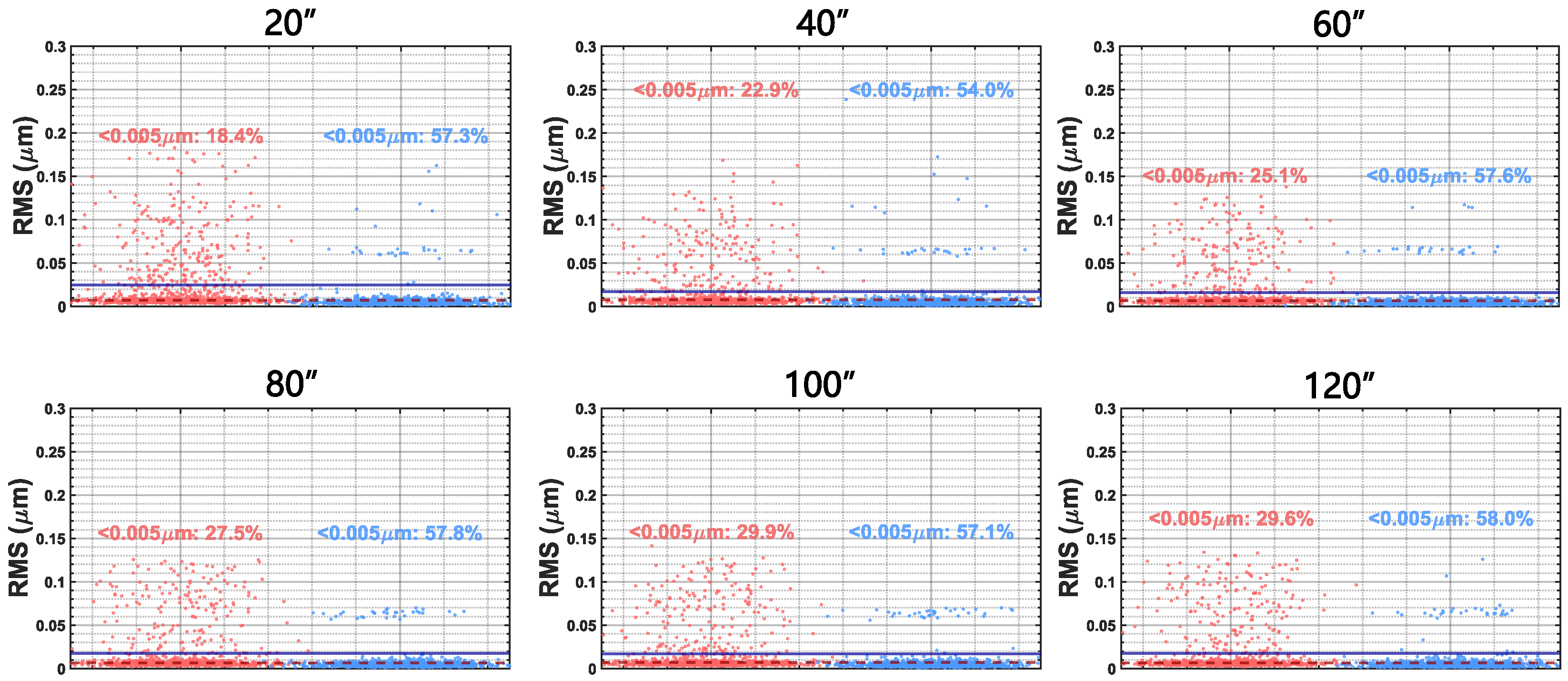
Figure 2 presents the scatter distribution statistics of the ground-truth residuals from multiple frames for MD-A and WF-C under various FoV conditions. In solar GLAO systems, a residual of
is generally considered negligible. Accordingly, the proportion of frames with ground-truth residuals below
is calculated to indicate the fraction of high-precision frames.
It is evident that, under all FoV conditions, most scatter points are concentrated below , indicating that the residuals of the vast majority of frames for both methods remain at a low level and that both are capable of effectively capturing variations in the ground-truth phase. The results further show that the residual RMS of WF-C consistently remains low, with approximately 54– of frames across all FoVs exhibiting residuals smaller than , demonstrating insensitivity to FoV variation and strong robustness. In contrast, the proportion of high-accuracy frames for MD-A is lower in narrow FoVs (18.4% at 20″) but increases progressively with FoV size, reaching nearly 30% at 100″, accompanied by a simultaneous reduction in the mean ground-truth deviation. This indicates a marked improvement in accuracy under large FoV conditions. Overall, these findings demonstrate that WF-C consistently outperforms MD-A, with performance exhibiting minimal dependence on FoV size, while MD-A reduces its performance gap with WF-C under large FoV scenarios.
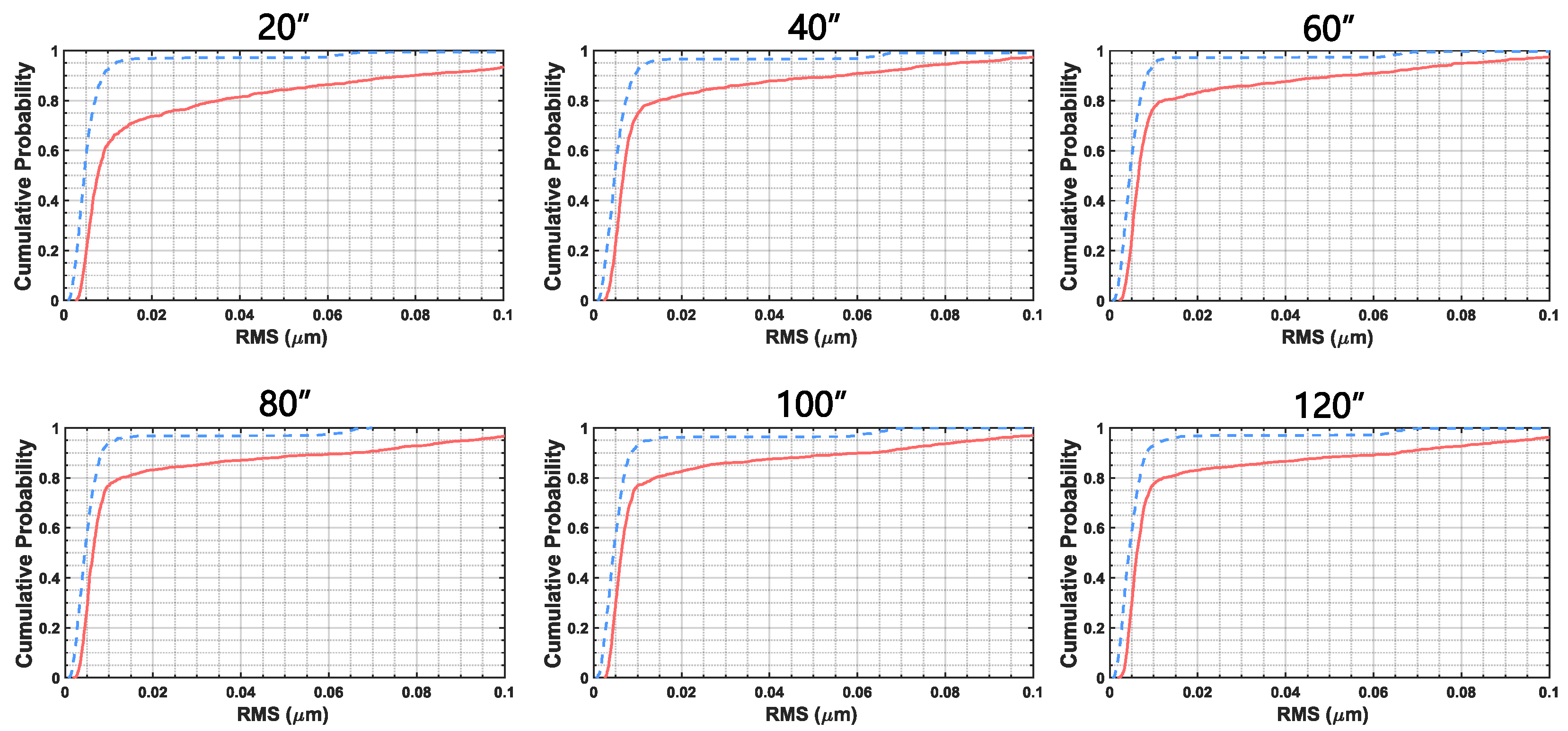
The cumulative distribution function (CDF) in
Figure 3 provides a statistical quantification of this difference. At an accuracy threshold of
, WF-C remains stable in the range of 0.88–0.92, with fluctuations within ±0.02, whereas the probability for MD-A increases to 0.65–0.78. At
accuracy, WF-C consistently exceeds 0.95, while MD-A ranges from 0.74 to 0.85. When the threshold is further relaxed to
, WF-C still remains above 0.95, whereas MD-A stabilizes at approximately 0.85. These results indicate that increasing the FoV can enhance the high-accuracy detection capability of MD-A; however, simply enlarging the FoV cannot fully overcome its inherent limitations in detection accuracy. This limitation arises because MD-A mitigates the influence of aberrations induced by high-altitude turbulence through multi-direction averaging, which inherently restricts its ability to capture variations in high-order aberrations [
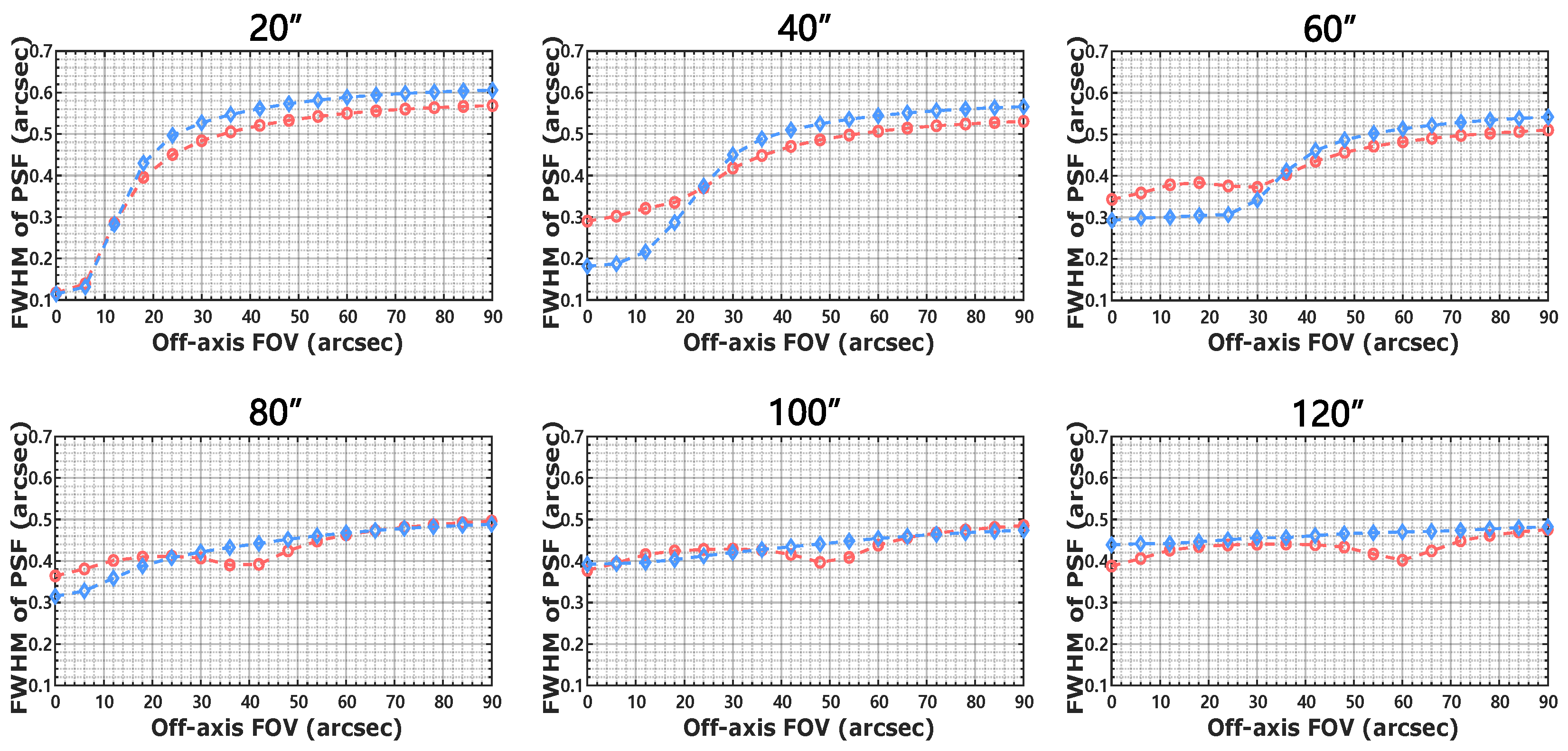
17]. Interestingly, this smoothing effect can, in turn, improve the ground-layer correction capability of GLAO, as illustrated in
Figure 4.
Figure 4 presents the distribution of the PSF full width at half maximum (FWHM) within the half-FoV for the WF-C and MD-A modes, across total FoVs ranging from 20″ to 120″. In general, a smaller FWHM corresponds to higher spatial imaging resolution. Under the narrow FoV of 20″, the two methods exhibit comparable imaging resolution. For narrow FoVs of 40″–60″, a significant advantage is observed for WF-C in the central region (0–10″), with FWHM values smaller by 0.08″–0.12″ compared with MD-A, corresponding to an improvement in resolution of approximately 25–35%. Beyond an off-axis angle of 60″, the difference between the two methods decreases to within 0.02″, indicating comparable imaging performance at the FoV edge. For large FoVs of 80″–120″, the two curves converge across the entire FoV; however, in the central region, MD-A exhibits slightly higher FWHM values than WF-C by 0.02″–0.05″, suggesting that MD-A can offer better correction capability for GLAO systems under wider FoV conditions. Overall, these results indicate that WF-C is preferable for small-FoV applications requiring high central resolution, whereas MD-A provides more uniform correction quality across wide FoVs, making it more suitable for large-area imaging tasks.
4. Experiments
To further validate the comparative results of the two wavefront sensing methods, an indoor GLAO experimental platform was constructed. In the absence of a ground-truth reference, the analysis focused on the differences in detection accuracy between the two methods and their impact on overall system performance.
4.1. Experimental Design
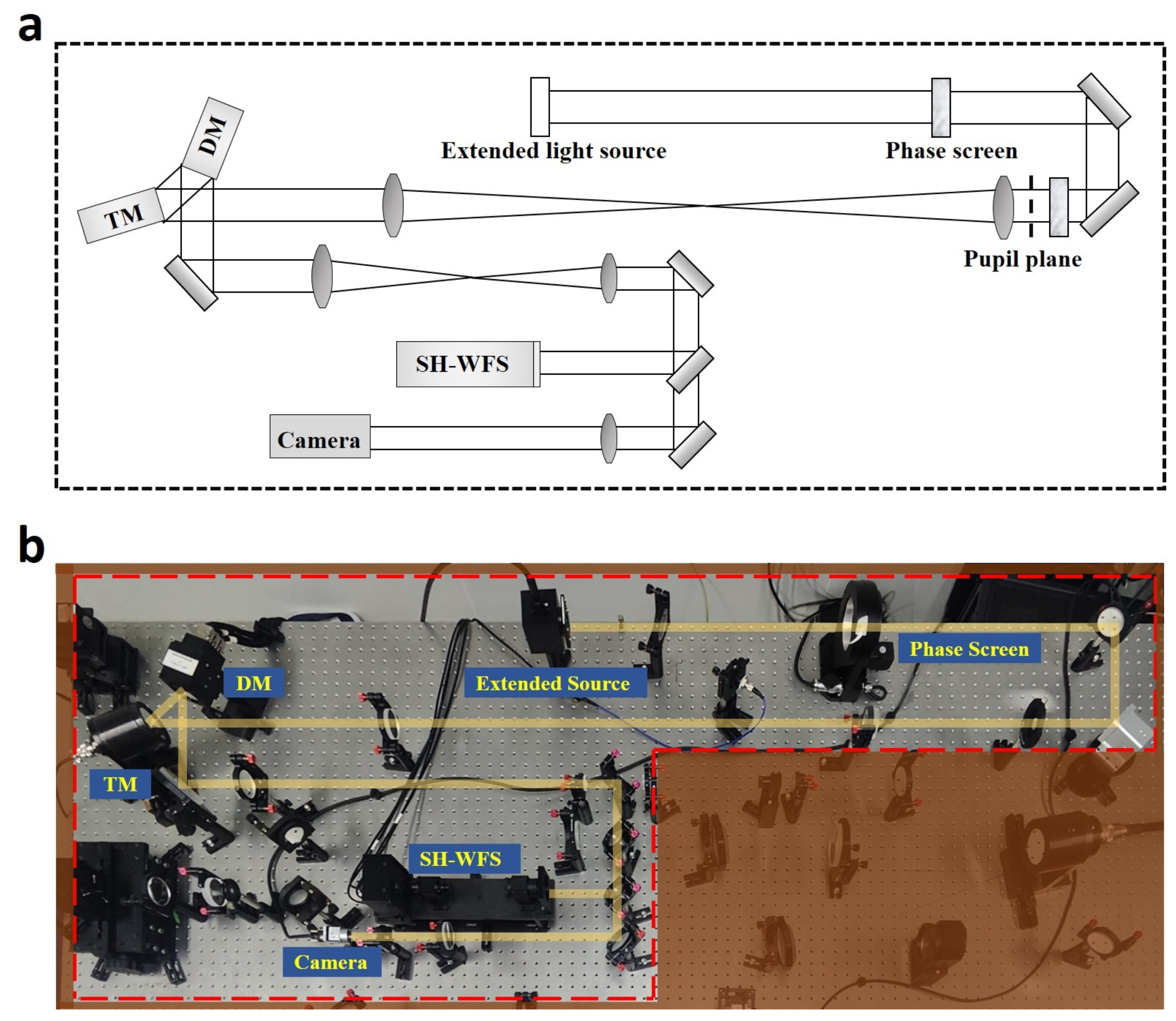
The platform comprises several reconfigurable modules, as showed in
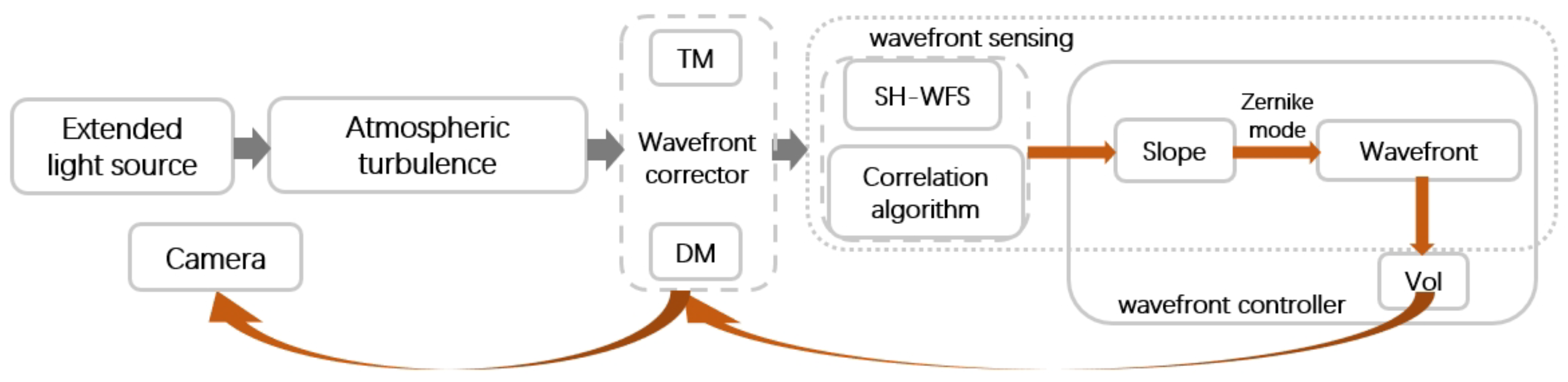
Figure 5: an extended target light source, a turbulence simulation unit, wavefront sensing and reconstruction components, a correction module, and an imaging system. An overview of the system workflow is provided in
Figure 6. The extended target light source is homogenized by an integrating sphere to generate uniform parallel illumination, which is then projected onto a solar granulation target film, simulating extended target imaging under telescope observation conditions. Atmospheric turbulence is modeled using Kolmogorov phase screens. Custom atmospheric profiles are configured by exchanging phase plates or adjusting their axial positions to vary
and layer altitudes. An SH-WFS enables both MD-A and WF-C operations. Switching between the two modes is controlled via the detection region and correlation algorithm. In each mode, real-time subaperture images are acquired and converted into wavefront slopes. Wavefronts are reconstructed via Zernike polynomial fitting and corrected using a ground-conjugate deformable mirror. A scientific CMOS camera records images before and after correction to compute the Strehl ratio, quantifying image quality improvements. The system parameters used in the experiment are summarized in
Table 3.
To address experimental limitations, additional procedures were implemented. Due to the platform’s FoV constraint of approximately 40″, direct wavefront sensing over larger guide regions was infeasible. Instead, an optimized equivalent strategy [
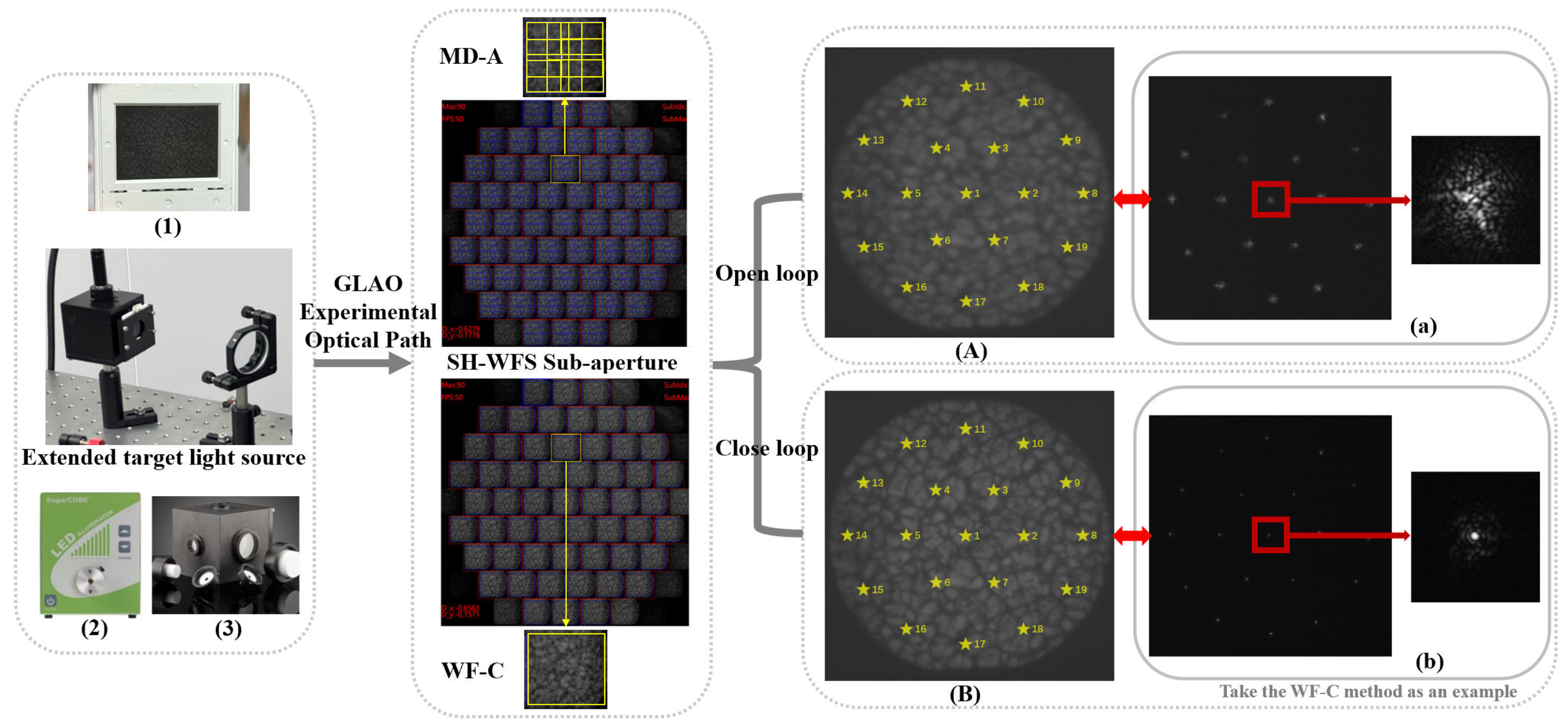
17] was employed: wavefront sensing under varying FoV conditions was emulated by adjusting the phase screen height from 0 km to 10 km while maintaining a fixed imaging FoV. Moreover, direct assessment of far-field imaging performance was not feasible. To enable quantitative comparison of MD-A and WF-C in the far field, 19 sampling points were uniformly distributed across the extended target image (
Figure 7). This configuration allowed objective evaluation of image quality using standard performance metrics.
4.2. Experimental Results
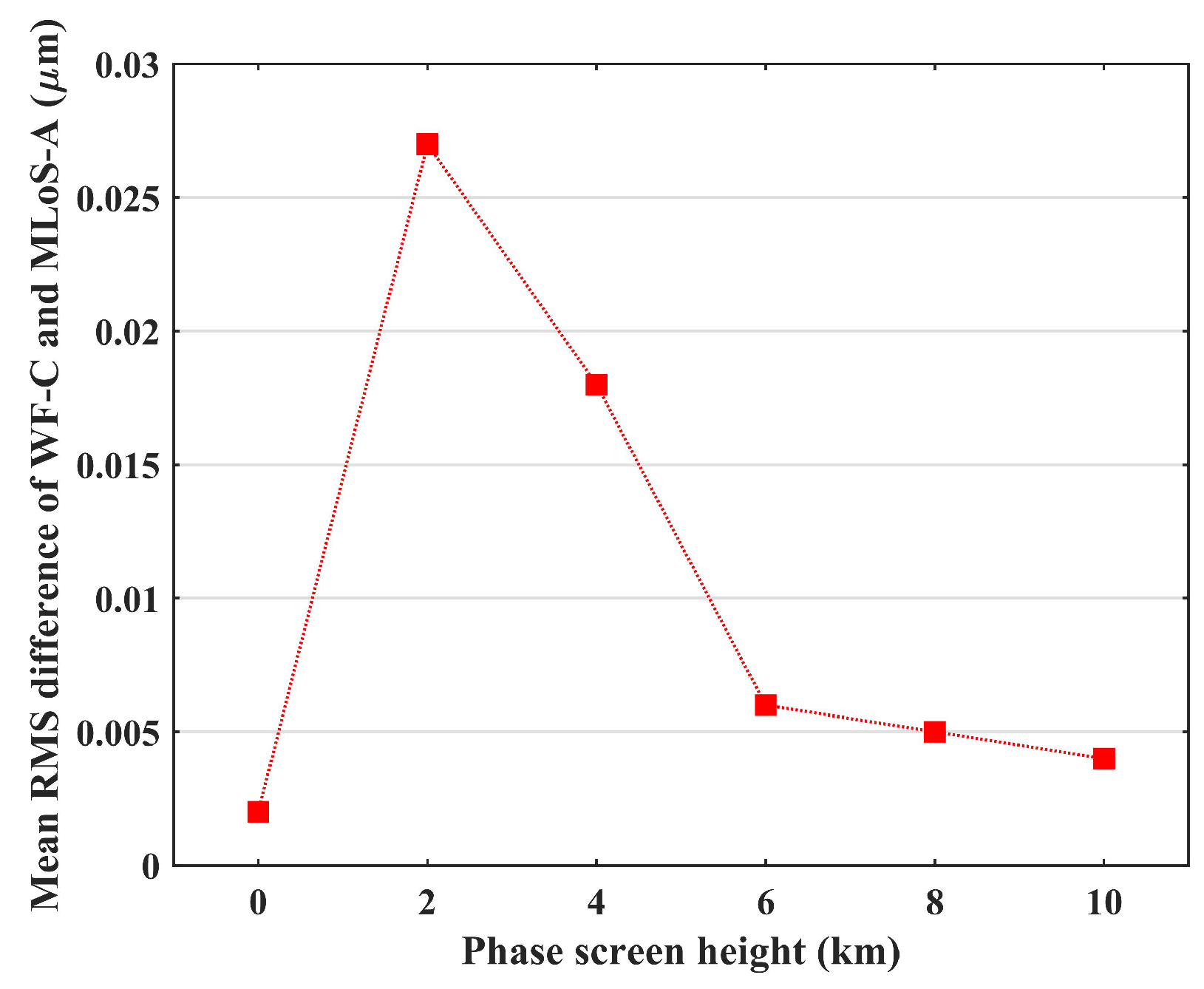
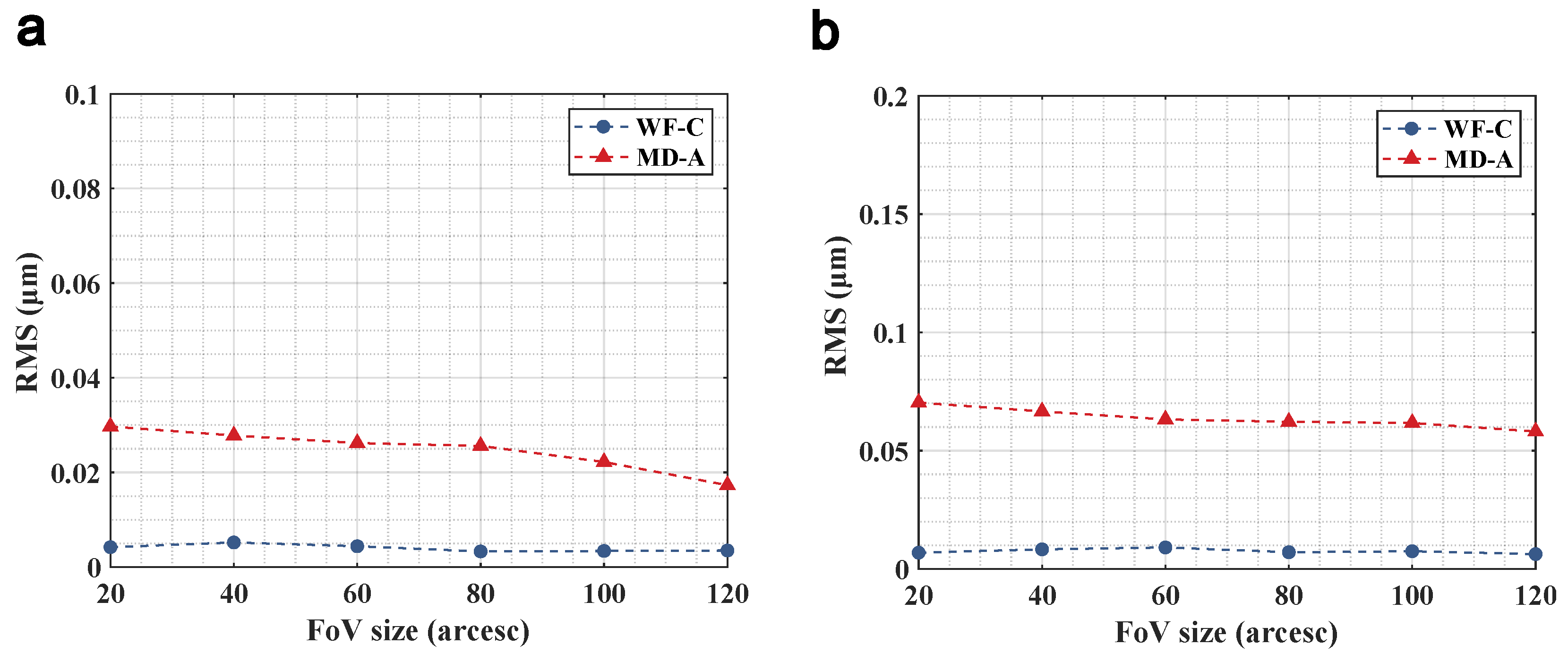
In the open-loop state of the GLAO system, the mean RMS differences of multiple phase frames between WF-C and MD-A were measured with the phase screen placed at different altitudes, as shown in
Figure 8. As noted previously, the experimental platform does not allow arbitrary changes to the FoV; instead, variations in the effective FoV were emulated by adjusting the phase screen altitude, with greater heights corresponding to larger FoVs. The results indicate that WF-C consistently captured more complex high-order aberrations, which were not effectively resolved by MD-A. As the phase screen altitude increased, the difference between the two methods gradually diminished. At altitudes of 6–10 km, the difference fell below
, indicating nearly identical accuracy. Notably, when the phase screen was positioned at the pupil plane, WF-C still exhibited superior detection accuracy compared with MD-A. Overall, these findings demonstrate that WF-C generally achieves higher detection accuracy than MD-A, although the latter progressively compensates for this disadvantage as the FoV increases. The experimental results are, therefore, consistent with the conclusions drawn from the preceding simulations.
Based on
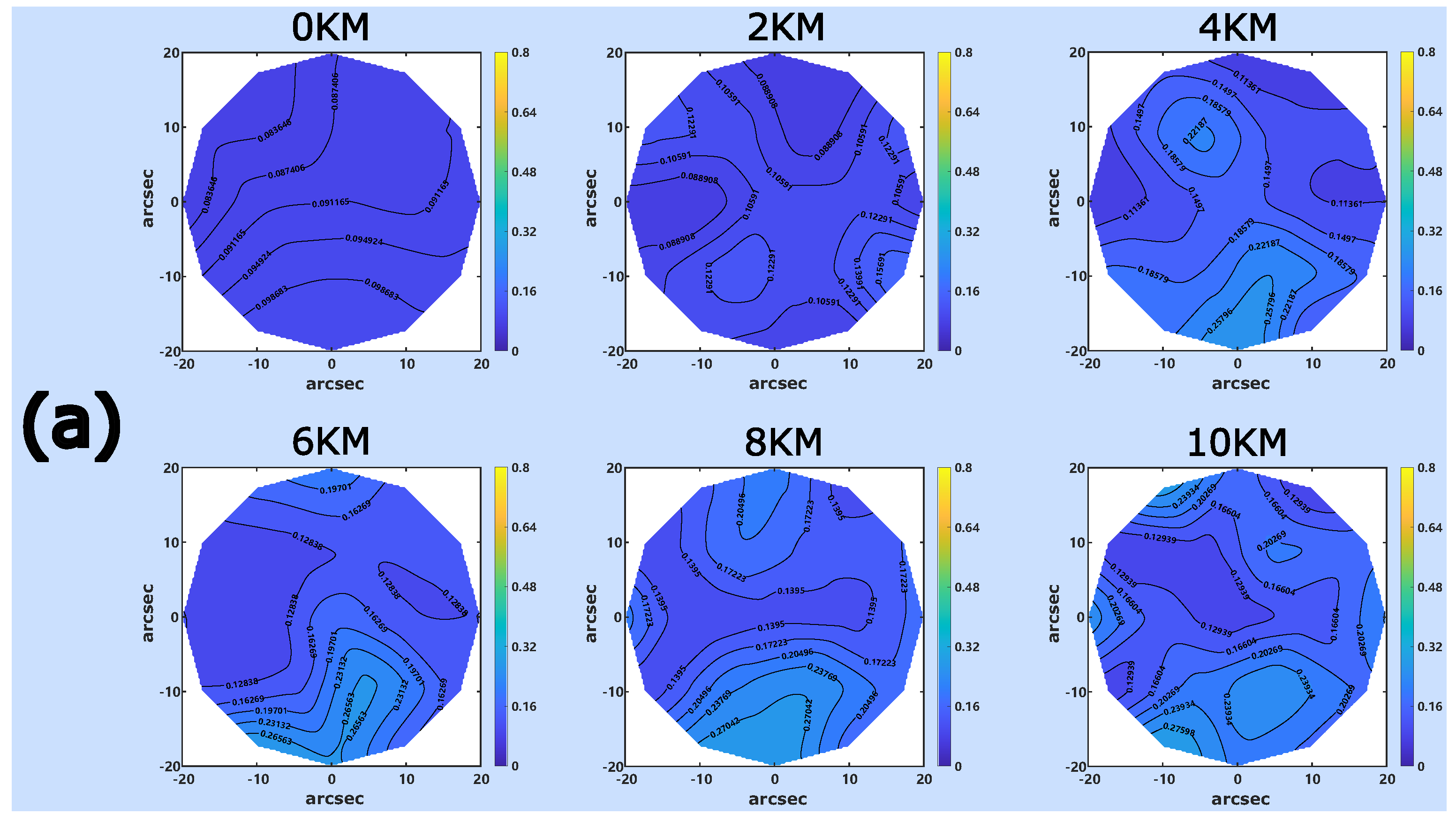
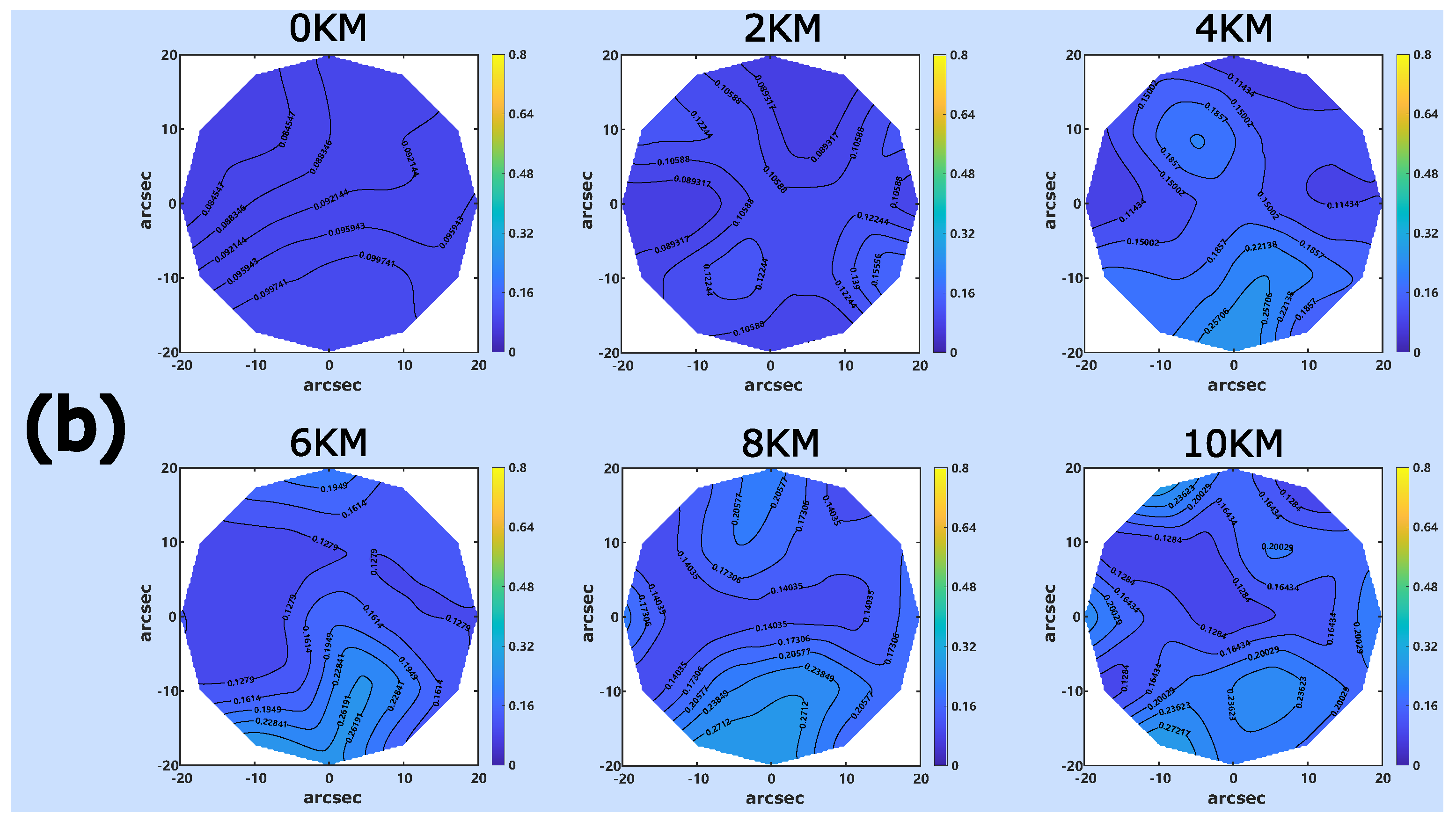
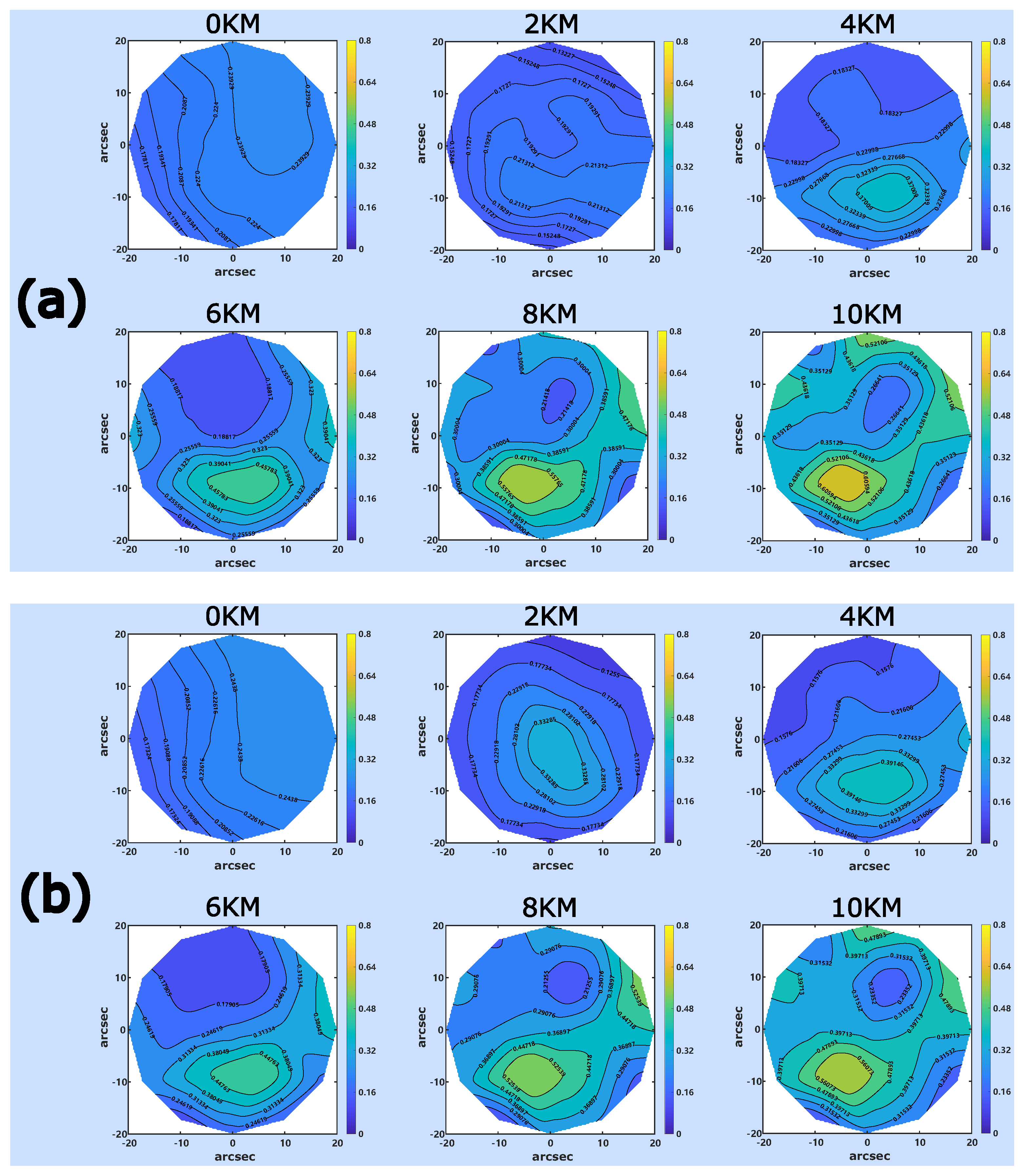
Figure 7, the far-field performance of the two methods was evaluated. Panels (A) and (B) illustrate the open- and closed-loop conditions, respectively, with 19 points uniformly distributed across the solar granulation image. This configuration enables precise calculation of the Strehl Ratio (SR) at each point, allowing for a detailed assessment of the imaging performance of the wavefront sensing methods.
Figure 9 and
Figure 10 present the spatial distributions of SR under open- and closed-loop conditions, respectively. A significant improvement in SR is observed in
Figure 9 compared to
Figure 10, confirming the effectiveness of the indoor GLAO laboratory platform in wavefront correction and its ability to reliably close the control loop. Within the low-altitude turbulence range (0–4 km), WF-C achieves higher SR values—approximately
greater on average than those of MD-A at the center of the field—indirectly suggesting its superior performance in narrow FoVs. As the turbulence altitude increases (≥
), MD-A exhibits approximately
higher average SR in the central field than WF-C, demonstrating its advantage under wide-field conditions. The experimental results align well with simulation trends, indicating that both methods are effective in enhancing imaging quality. Their optimal application depends on FoV size: WF-C is better suited for narrow and moderate fields, whereas MD-A is more appropriate for wider fields.
A supplementary analysis was conducted to identify and mitigate error sources in the experiment. The experimental errors mainly originate from the optical platform, wavefront sensing, correction, and control processes. For the wavefront sensing accuracy analysis shown in
Figure 8, the phases reconstructed by WF-C and MD-A over 20,000 frames were statistically averaged and subtracted, which effectively minimized system-related errors and isolated the accuracy differences between the two methods. The SR of the far-field imaging was also evaluated using 20,000 long-exposure frames, ensuring that both methods experienced nearly identical error conditions. In addition, the closed-loop operation inherently compensates for optical platform errors. These treatments collectively minimize the impact of experimental errors on the comparison between the two methods.
5. Disscussion
Unlike previous studies that primarily focused on evaluating overall GLAO system performance [
6,
7,
12,
13], this paper begins with numerical simulations and concentrates on assessing the sensing precision of the MD-A and WF-C methods, with ground-truth comparisons introduced to enhance reliability. An indoor experimental platform was also constructed, through which the sensing accuracy and closed-loop imaging performance of both methods were further validated. The findings provide valuable practical guidance for optimizing solar GLAO system design.
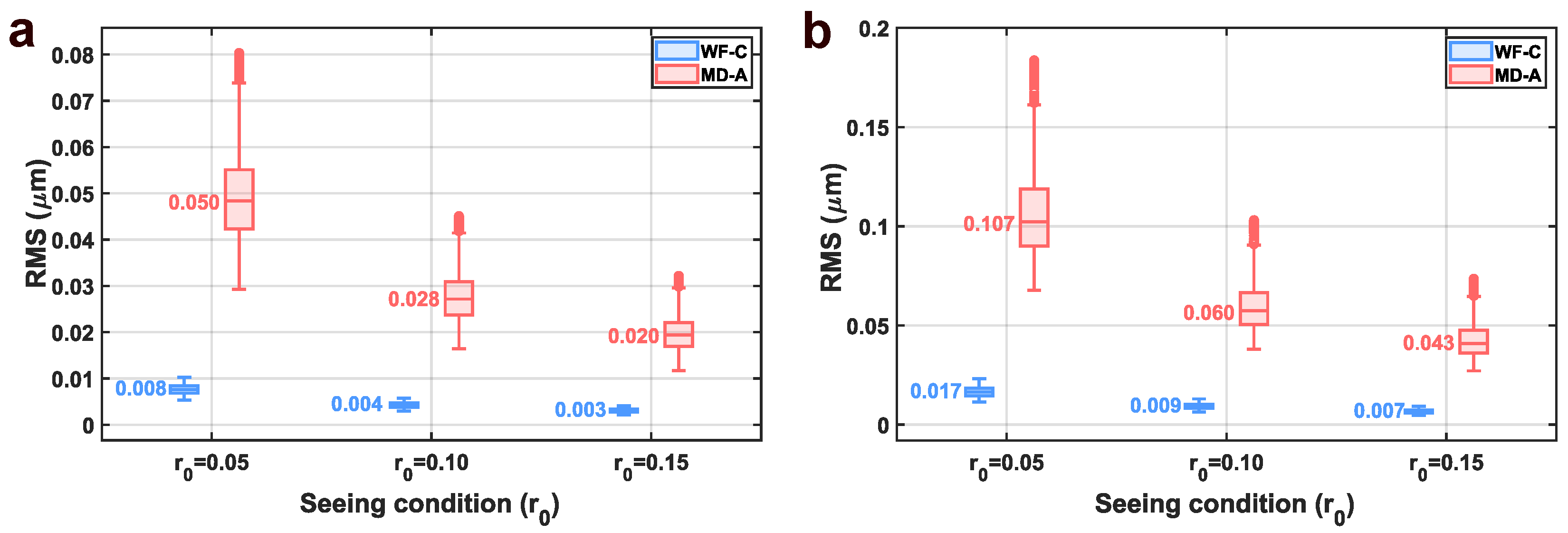
We also analyzed the effects of varying ground-layer turbulence fractions and different atmospheric seeing conditions on the performance of the two wavefront sensing methods, as shown in
Figure 11 and
Figure 12. The results indicate that reducing the ground-layer turbulence fraction leads to a decrease in the sensing accuracy of both MD-A and WF-C, while their stability remains almost unaffected. Variations in seeing conditions have a significant impact on MD-A but only a minor effect on WF-C, suggesting that WF-C exhibits better stability under strong turbulence conditions. It is noteworthy that the ratio of the mean sensing accuracy between the two methods remains nearly constant under all conditions, indicating that both methods are affected by external turbulence to a similar extent. In contrast, because MD-A relies on discrete sampling, it cannot adequately capture the aberration variations induced by high-altitude turbulence. As a result, its sensing accuracy is more susceptible to the distribution of atmospheric turbulence.
In addition to sensing accuracy and correction performance, the algorithmic complexity of the MD-A and WF-C methods is also a critical consideration for practical systems, as shown in Equation (
5).
M and
m represent the pixel side lengths of the guide regions for WF-C and MD-A, respectively.
is the number of parallel threads in MD-A, and
is the number of guide regions. For example, when
,
,
, and
, the computational complexity of WF-C is approximately three times that of MD-A. However, because MD-A can exploit nine parallel threads, its effective computational load is substantially reduced, resulting in an overall complexity lower than that of WF-C. This demonstrates the distinct advantage of MD-A in real-time applications over large FoV. From a practical standpoint, WF-C requires large-format detectors to maintain full-FoV correlation, increasing system complexity and cost. In contrast, MD-A can scale with multiple compact SH-WFS units, offering cost-effective FoV expansion and flexible deployment, especially in large-aperture solar telescope systems such as WeHoST [
18]. Based on the above analysis, a decision table for method selection has been summarized, as presented in
Table 4. The decision table is expected to offer theoretical guidance for optimizing the GLAO system and the associated wavefront-sensing strategy of a 1-meter-class wide-field solar telescope. However, the specific choice is further constrained by additional factors, including the atmospheric turbulence distribution, the telescope aperture, the available number of guide stars, among others.
6. Conclusions
This study systematically compared the performance of MD-A and WF-C under varying FoV conditions through simulation and experimental validation. For 1 m GLAO, the results indicate that WF-C provides higher sensing precision and superior correction in narrow FoVs (20″–60″), particularly at the field center. Its global correlation mechanism also enhances sensitivity to ground-layer turbulence, making it well suited for ground-conjugate adaptive optics applications. Conversely, MD-A exhibits better scalability, faster real-time performance, and more stable correction across wide FoVs (80″–120″), benefiting from its multi-directional slope averaging approach. The experimental outcomes closely follow the simulation trends, confirming each method’s strengths and limitations. Overall, WF-C is recommended for high-resolution sensing within narrow fields, while MD-A is better suited for wide-field applications with real-time constraints. Method selection should be based on system design goals, detector architecture, and computational resources.
Author Contributions
Funding acquisition, L.Z., Z.L. (Zhen Li) and C.R.; methodology, Y.L. and X.R.; software, Y.L. and Z.L. (Ziming Li); validation, Y.L., Q.Z. and N.Y.; writing—review and editing, Y.L., A.T. and L.Z. All authors have read and agreed to the published version of the manuscript.
Funding
This research was funded by National Natural Science Foundation of China (Grant Nos. 12127901 and 12103057).
Data Availability Statement
The original contributions presented in this study are included in the article. Further inquiries can be directed to the corresponding authors.
Conflicts of Interest
The authors declare no conflicts of interest.
References
- Collados, M.; Bettonvil, F.; Cavaller, L.; Ermolli, I.; Gelly, B.; Pérez, A.; Socas-Navarro, H.; Soltau, D.; Volkmer, R. European solar telescope: Progress status. Astron. Nachr. 2010, 331, 615–619. [Google Scholar] [CrossRef]
- Zhang, L.; Rao, X.; Bao, H.; Guo, Y.; Yang, J.; Yan, N.; Ran, X.; Tong, D.; Fan, X.; Feng, Z.; et al. Solar adaptive optics systems for the new vacuum solar telescope at the Fuxian Lake Solar Observatory. Astron. Tech. Instruments 2024, 1, 95–104. [Google Scholar] [CrossRef]
- Rigaut, F. Ground conjugate wide field adaptive optics for the ELTs. In Beyond Conventional Adaptive Optics; Vernet, E., Ragazzoni, R., Esposito, S., Hubin, N., Eds.; ESO Conference and Workshop Proceedings; ESO: Garching, Germany, 2002; Volume 58, p. 11. [Google Scholar]
- Stoesz, J.A. Constraining the GLAO parameter space with turbulence profile models. In Advances in Adaptive Optics II; SPIE: Bellingham, WA, USA, 2006; Volume 6272, pp. 1467–1476. [Google Scholar]
- Michau, V.; Conan, J.M.; Fusco, T.; Nicolle, M.; Robert, C.; Velluet, M.T.; Piganeau, E. Shack-Hartmann wavefront sensing with extended sources. In Atmospheric Optical Modeling, Measurement, and Simulation II; SPIE: Bellingham, WA, USA, 2006; Volume 6303, pp. 103–113. [Google Scholar]
- Ren, D.Q.; Jolissaint, L.; Zhang, X.; Dou, J.; Chen, R.; Zhao, G.; Zhu, Y. Solar ground-layer adaptive optics. Publ. Astron. Soc. Pac. 2015, 127, 469. [Google Scholar] [CrossRef]
- Rimmele, T.; Hegwer, S.; Marino, J.; Richards, K.; Schmidt, D.; Waldmann, T.; Woeger, F. Solar multi-conjugate adaptive optics at the Dunn Solar Telescope. In 1st AO4ELT Conference; EDP Sciences: Les Ulis, France, 2010; p. 08002. [Google Scholar][Green Version]
- Ren, D.Q.; Zhu, Y.T. A Solar Adaptive Optics System. In Adaptive Optics Progress; IntechOpen: London, UK, 2012. [Google Scholar]
- Schmidt, D.; Gorceix, N.; Goode, P.R.; Marino, J.; Rimmele, T.; Berkefeld, T.; Wöger, F.; Zhang, X.; Rigaut, F.; von der Lühe, O. Clear widens the field for observations of the Sun with multi-conjugate adaptive optics. Astron. Astrophys. 2017, 597, L8. [Google Scholar] [CrossRef]
- Rao, C.H.; Zhang, L.Q.; Kong, L.; Guo, Y.M.; Rao, X.J.; Bao, H.; Zhu, L.; Zhong, L. First light of solar multi-conjugate adaptive optics at the 1-m new vacuum solar telescope. Sci. China Phys. Mech. Astron. 2018, 61, 089621. [Google Scholar] [CrossRef]
- Rao, C.H.; Gu, N.T.; Rao, X.J.; Li, C.; Zhang, L.Q.; Huang, J.L.; Kong, L.; Zhang, M.; Cheng, Y.; Pu, Y.; et al. First light of the 1.8-m solar telescope—CLST. Sci. China Phys. Mech. Astron. 2020, 63, 109631. [Google Scholar] [CrossRef]
- Zhang, L.Q.; Bao, H.; Rao, X.J.; Guo, Y.M.; Zhong, L.B.; Ran, X.; Yan, N.; Yang, J.; Wang, C.; Zhou, J.; et al. Ground-layer adaptive optics for the New Vacuum Solar Telescope: Instrument description and first results. Sci. China Phys. Mech. Astron. 2023, 66, 269611. [Google Scholar] [CrossRef]
- Béchet, C.; Tallon, M.; Montilla, I.; Langlois, M. Wide-field wavefront sensing in solar adaptive optics: Modeling and effects on reconstruction. In Adaptive Optics for ELTs III; ESO: Garching, Germany, 2013. [Google Scholar]
- Wang, Z.; Zhang, L.; Kong, L.; Bao, H.; Guo, Y.; Rao, X.; Zhong, L.; Zhu, L.; Rao, C. A modified S-DIMM+: Applying additional height grids for characterizing daytime seeing profiles. Mon. Not. R. Astron. Soc. 2018, 478, 1459–1467. [Google Scholar] [CrossRef]
- Matthews, S.A.; Collados, M.; Mathioudakis, M.; Erdelyi, R. The European Solar Telescope (EST). Ground-Based Airborne Instrum. Astron. VI 2016, 9908, 47–55. [Google Scholar]
- Yang, Y.; Zhang, L.Q.; Rao, C.H. Comparative analysis of performance evaluation methods for wide-field ground-layer adaptive optics systems. Infrared Laser Eng. 2022, 51, 20210744. [Google Scholar]
- Liu, Y.; Ran, X.; Li, Z.; Yan, N.; Zhou, Q.; Tang, A.; Ran, X.; Zhang, L.; Rao, C. Wavefront sensing based on large guide region in solar ground layer adaptive optics. Opt. Express 2024, 32, 44591–44604. [Google Scholar] [CrossRef]
- Yang, Y.; Zhang, L.-Q.; Yan, N.-F.; Yang, J.-S.; Li, Z.; Song, T.-F.; Rao, X.-J.; Rao, C.-H. Ground-layer Adaptive Optics for the 2.5 m Wide-field and High-resolution Solar Telescope. Res. Astron. Astrophys. 2024, 24, 035018. [Google Scholar] [CrossRef]
| Disclaimer/Publisher’s Note: The statements, opinions and data contained in all publications are solely those of the individual author(s) and contributor(s) and not of MDPI and/or the editor(s). MDPI and/or the editor(s) disclaim responsibility for any injury to people or property resulting from any ideas, methods, instructions or products referred to in the content. |
© 2025 by the authors. Licensee MDPI, Basel, Switzerland. This article is an open access article distributed under the terms and conditions of the Creative Commons Attribution (CC BY) license (https://creativecommons.org/licenses/by/4.0/).



 and
and