Article

Angle-Scanning and Size-Scaling Pixelated Quasi-BIC Metasurface Array for Broadband Terahertz Fingerprint Biosensing


1
School of Integrated Circuits, Shandong University, Jinan 250101, China
2
School of Electronics and Integrated Circuits, Aerospace Information Technology University, Jinan 250200, China
3
Shandong Key Laboratory of Ubiquitous Intelligent Computing, School of Information Science and Engineering, University of Jinan, Jinan 250022, China
4
Shandong Key Laboratory of Metamaterial and Electromagnetic Manipulation Technology, Jinan 250022, China
*
Authors to whom correspondence should be addressed.
Photonics 2025, 12(11), 1127; https://doi.org/10.3390/photonics12111127
Submission received: 24 October 2025 / Revised: 7 November 2025 / Accepted: 12 November 2025 / Published: 14 November 2025
(This article belongs to the Special Issue Technologies and Applications of Terahertz Metamaterials)

Abstract

Metasurface biosensing confronts a significant challenge in simultaneously achieving broadband response, high quality-factor (Q-factor), and ultrahigh sensitivity for specific trace-analyte detection at terahertz (THz) frequencies. Recently, quasi-bound states in the continuum (QBICs) metasurfaces provided enhanced light–matter interactions and ultrahigh sensitivity in narrow resonant bands. In this work, an angle-scanning QBIC metasurface array pixelated with just 5 × 5 scaling units is proposed to achieve an ultra-broad spectrum from 1 to 2.8 THz for fingerprint bio-detection. The symmetry-protected QBIC is excited by breaking the symmetry of copper block dimer resonator structures, achieving a Q-factor of 20 and a sensitivity of 500 GHz/RIU. A spectral step of approximately 10 GHz is demonstrated in this approach, and glutamic acid and glutamine are specifically detected, with detection limits reaching 15.4 μg/cm2 and 14.7 μg/cm2. This design provides a novel approach for achieving ultra-wideband, specific, and highly sensitive detection. This capability offers an efficient strategy for monitoring tumor metabolic biomarkers and paves the way for applications in early diagnosis and advanced broadband THz detection.

1. Introduction

The terahertz (THz) science and technology field has great potential in imaging [1], nondestructive testing [2], communications [3], etc. Preserving the essential non-ionizing characteristics of optical techniques and simultaneously inheriting the superior penetration capability of radio waves, terahertz technology consequently demonstrates outstanding application value in biomedical sensing [4,5]. Studies confirm that the unique vibrational modes of biomacromolecules, such as proteins and nucleic acids, including intramolecular vibrations, hydrogen bond network dynamics, and low-frequency lattice vibrations, exhibit characteristic “fingerprint” absorption spectra in the THz band [6]. These characteristic spectra are highly specific and have laid a solid physical foundation for the development of novel biomolecular identification techniques. Nevertheless, the size mismatch between THz wavelengths and biomedical analytes leads to weak light-matter interactions, consequently resulting in limited sensitivity [7,8,9]. This often necessitates a substantial volume of analytes to achieve noticeable absorption [10]. To this end, THz metamaterials featuring subwavelength dimensions and localized field enhancement have attracted considerable worldwide attention. Previous studies have employed metallic metasurfaces with strong localized field enhancement to significantly enhance the interaction between waves and matter in THz sensing [11,12,13]. However, these structures exhibit relatively low detection sensitivity when dealing with trace analytes, as their response is fundamentally limited by resonant mechanisms with low Q factors. To ensure high Q-factors, bound states in the continuum (BICs) have been introduced into metasurfaces to address this limitation. The research frontier of BICs has expanded from conventional symmetry protection to the exploration of more complex light matter interactions. Firstly, the generalized Kerker effect demonstrates how quasi BICs can manipulate multipolar interference to achieve flexible scattering control [14]. Secondly, the fusion of BICs at exceptional points has given rise to a new class of modes known as exceptional BICs, which simultaneously inherit the non-radiative nature of BICs and the enhanced sensitivity of exceptional points [15]. These advances highlight the vast design space of BIC metasurfaces. BICs are exceptional electromagnetic resonance modes possessing theoretically infinite Q-factors and infinitesimal resonance linewidths [16,17]. Nevertheless, strictly speaking, BICs cannot be directly applied to sensing applications [18,19], since their completely radiationless nature prevents coupling with external electromagnetic fields. Introducing structural symmetry breaking, for example by using an asymmetry parameter α, BICs are transformed into quasi-bound states in the continuum (QBICs) [20,21,22], which enables controllable radiative losses while maintaining high Q-factors. Thereby, it significantly enhances THz wave–matter interactions [23,24,25]. In 2010, Vyacheslav V. et al. first proposed the concept of symmetry-protected BICs transitioning to leaky resonances using split-ring resonators [26]. Building on this theory, QBIC-based THz refractive index sensing metasurfaces have been developed, leveraging high-Q resonances to detect minute frequency shifts induced by trace analytes [27,28]. Despite significant progress in THz technology based on refractive index sensing, it still faces key challenges in the detection of complex biological samples. Firstly, the refractive index differences among biomolecules are usually small, especially in multi-component environments such as blood and cells. Background interference can significantly reduce the detection specificity and lead to an increase in the false detection rate [29]. Secondly, there is a serious mismatch between the narrowband response of high-Q resonant modes and the broadband fingerprint features of biomolecules. Coupled with the resonance frequency shift caused by environmental dielectric interference, the accuracy of spectral overlap is further undermined. Although the THz fingerprint spectrum has the potential for molecular specific recognition, relying solely on the detection of a single characteristic peak is prone to producing “false positive” results [30]. To avoid them, there is an urgent need to develop broadband sensing technologies that can capture multiple fingerprint peaks simultaneously. To address the conflict between narrowband response and broadband detection in THz sensing, current research primarily explores two approaches, angle multiplexing strategies and pixelated metasurface technology. Angle multiplexing strategies excite resonances at different frequencies by varying the incident angle. As demonstrated in 2020, Zhang et al. successfully achieved multi-band detection of tyrosine and santonin [31]. Nonetheless, this method suffers from inherent limitations like operational complexity and prolonged measurement times due to large-angle scanning [32,33]. In contrast, pixelated metasurface technology offers superior broadband response characteristics. A representative example is the 2D pixelated metasurface based on S-factor periodic scaling developed by Altug et al. in 2018 [34], which achieved parallel multi-component detection through spatial-spectral mapping. Consequently, this study proposes an innovative hybrid sensing method that integrates pixelated metasurfaces with optimized angle scanning while leveraging the high Q-factor and strong field localization advantages of QBIC sensors. This design preserves the multi-band coverage capability of pixelated structures while compensating for frequency coverage limitations through intelligent angle tuning, providing a novel technical pathway for high-sensitivity, high-specificity detection of complex biological samples, that is blood, tissue.
Tumor metabolic markers are key molecules that reflect the characteristics of metabolic reprogramming in tumor cells. Their concentration changes are of great significance to the early diagnosis, prognostic evaluation, and treatment monitoring of tumors [35,36]. As core amino acids in tumor metabolism, glutamic acid (Glu) and glutamine (Gln) directly regulate the survival, proliferation, and apoptosis of cancer cells. Under nutrient-sufficient conditions, Glu promotes tumor proliferation; nonetheless, when its concentration falls below the threshold of 13.41 nmol/mg protein, it triggers the polymerization of glutaminase 1 (GLS1), thereby activating the apoptotic pathway. This mechanism is particularly prominent under Gln-deficient conditions. When intracellular Gln is below 50 μM, apoptosis is induced; conversely, when it is above 300 μM, cancer cells preferentially utilize Gln to support tumor growth [37]. In the brain tumor microenvironment, the ratio of Glu to 2-hydroxyglutarate (2HG) in normal brain tissue approaches zero. Tumors with isocitrate dehydrogenase (IDH) mutations exhibit abnormal IDH activity, leading to the massive accumulation of 2HG and a significant reduction in Glu levels. This causes a marked increase in the 2HG/Glu ratio, making Glu a specific biomarker for IDH mutations [38].
In the field of medical detection, most samples to be tested are trace substances, so improving detection sensitivity has become one of the core requirements. For THz metasurface-based biosensors, the key approach to enhance detection sensitivity lies in increasing the Q factor of the metasurface, which imposes specific requirements on the performance of the substrate. Typically, the substrate is required to have a low loss tangent and a low dielectric constant. Liquid crystal polymer (LCP) substrates precisely possess these advantages, with a dielectric constant of approximately 3 and a loss tangent as low as 0.002 in relevant experiments, thus exhibiting the characteristics of a low dielectric constant and low loss tangent. Additionally, LCP substrates have good flexibility and can be fabricated to be extremely thin, with a minimum thickness of 25 μm. Owing to these excellent properties, LCP substrates are an ideal substrate material for THz biosensors [39]. Furthermore, to further enhance the detection effect, metal metasurfaces with local field enhancement characteristics are employed. These metasurfaces can enhance the interaction between THz waves and samples, thereby providing stronger support for the high-sensitivity detection of trace samples [40].
We present a pixelated QBIC metasurface biosensor that combines angle-scanning and size-scaling. The sensor adopts a “LCP substrate + metallic metasurface” configuration. The symmetry-protected QBIC is excited by breaking the symmetry of the copper-block dimer resonator structure, achieving a Q-factor of 20 and a sensitivity of 500 GHz/RIU. In this configuration, by tuning the structural parameters and the incident angle, the resonant frequency shifts, ultimately producing a broad envelope curve. This envelope curve covers the absorption resonances of analytes, enabling the highly sensitive and specific dual-absorption detection of the tumor metabolic markers Glu and Gln. Compared with previous studies, this design can cover a wide frequency band from 1 THz to 2.8 THz with a smaller pixel array size of 5 × 5. Meanwhile, auxiliary tuning under small incident angles no greater than 30 degrees yields a spectral step of approximately 10 GHz. High-precision detection is realized at the characteristic absorption peaks of Glu (1.21 THz and 2.03 THz) and Gln (1.72 THz and 2.31 THz), with detection limits reaching 15.4 μg/cm2 and 14.7 μg/cm2, respectively. This design provides a novel approach for achieving ultra-wideband, specific, and highly sensitive detection. It offers an efficient strategy for monitoring tumor biomarkers and paves the way for early diagnosis and advanced broadband THz sensing in complex biological environments.

2. Structure and Design

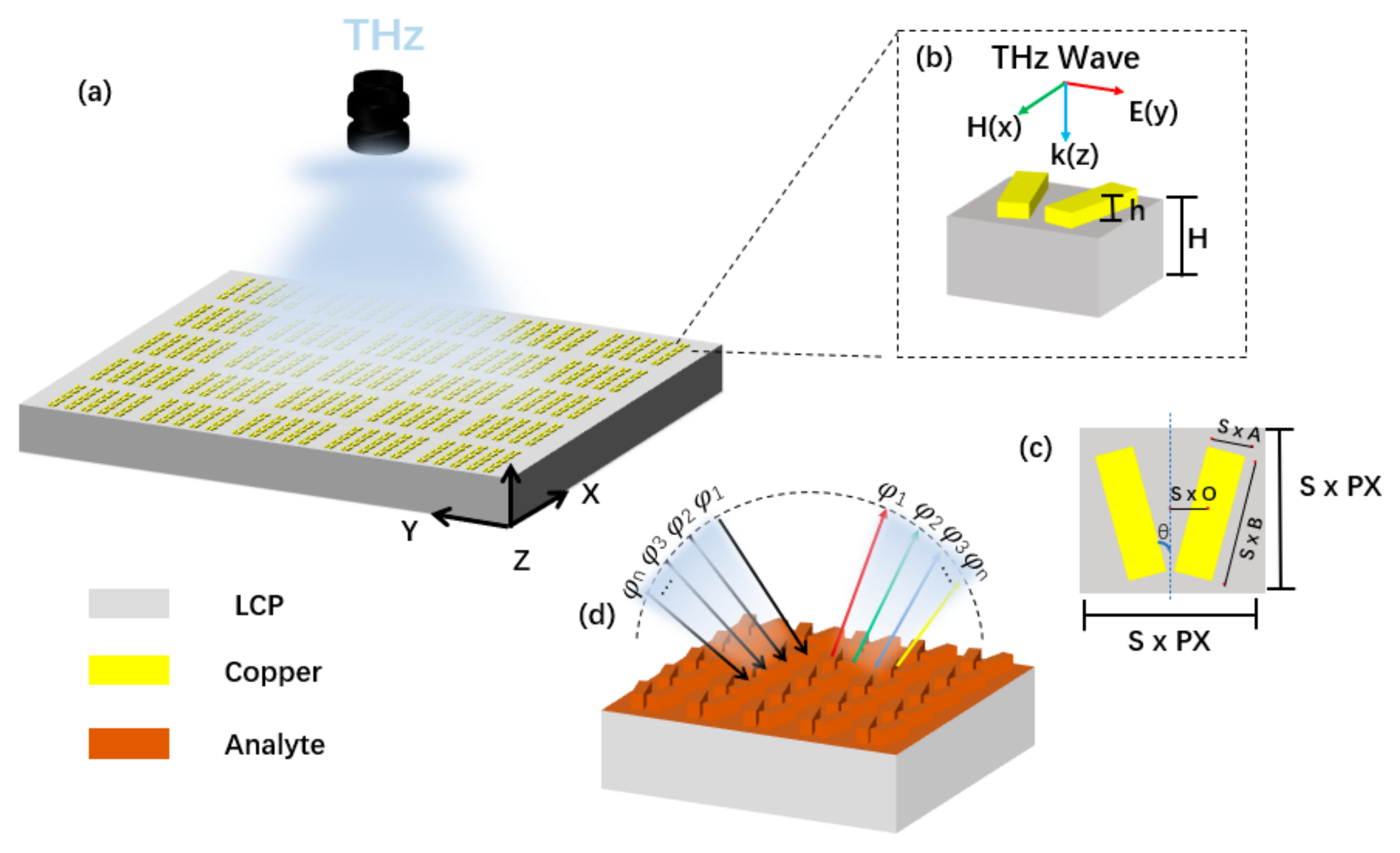
This study has designed a tunable metasurface structure based on a LCP substrate. This structure achieves broadband THz sensing functionality through its unique pixelated design supplemented by angle scanning technology. As shown in Figure 1a, the metasurface adopts a 5 × 5 pixel array configuration. Each pixel unit is designed with proportional scaling based on the characteristic dimension parameter S. The scaling factor S is defined as the ratio by which the key geometric dimensions of the resonator and the unit cell period are scaled relative to the base unit cell (where S = 1). Specifically, the length (A), width (B), the center-to-center distance (2O) of the copper cuboid resonators, and the lattice period (PX) are scaled proportionally by S, while the rotation angle (θ) and the thickness of the metal (h) and substrate (H) remain constant. This array configuration provides a structural foundation for the subsequent multi-pixel collaborative tuning. In this design, angle scanning serves as an auxiliary tuning means, optimizing the sensing performance by dynamically adjusting the incident angle. When the scaling factor S = 1, the unit cell structure is shown in Figure 1b,c. An LCP material with a thickness of 100 μm, a relative permittivity of 3.27 and a loss tangent of only 0.002 is adopted as the substrate [41]. For modeling the frequency-dependent optical response of the metallic sections, the Drude model has been employed:
ε ω = 1 ω 2 p ω 2 + γ 2 + j γ ω 2 p ω ( ω 2 + γ 2 )  
The two important metal-specific properties in the Drude model are plasma frequency (ωp) and damping constant (γ). The surface pattern consists of an 8 μm-thick copper layer, ω p   = 13.4 × 10¹⁵ s−1, γ = 0.14 × 10¹⁵ s−1 [42]. The lattice constants are PX = 35.33 μm. Each resonant unit comprises two cuboid structures with length A = 31.80 μm, width B = 2.09 μm, and height h = 8.00 μm. The center-to-center distance between the cuboids is 2O = 27 μm. Crucially, the angle θ between the cuboids and the central axis is designed to be 15°, resulting in symmetric distribution within the x-y plane. This asymmetric design is key to exciting QBIC modes. Angle scanning technology serves as an auxiliary regulation and control means, as is illustrated in Figure 1d. After uniformly coating the metasurface pixel array with an analyte, the electric field of the TE wave is always parallel to the analyte for all the incident angles, which is more advantageous in enhancing wave–matter interaction than the transverse magnetic wave [43]. excitation by TE-polarized THz waves combined with angle scanning enables precise matching between the resulting transmission spectral resonance dip and the analyte’s absorption features.
For simulations and optimization, Ansys High Frequency Structure Simulator (HFSS) software was employed, specifically the finite element method solver within the ANSYS Electronics Desktop 2019 R2 software environment. Specific simulation settings included periodic boundary conditions in the X and Y directions to accurately model the electromagnetic response of an infinite periodic array. Floquet ports were applied in the Z direction to simulate plane wave incidence and transmission. The Z-direction was defined as the THz wave propagation direction. Adaptive meshing ensured a balance between computational accuracy and efficiency [44].

3. Results and Discussion

3.1. QBIC in the Structure

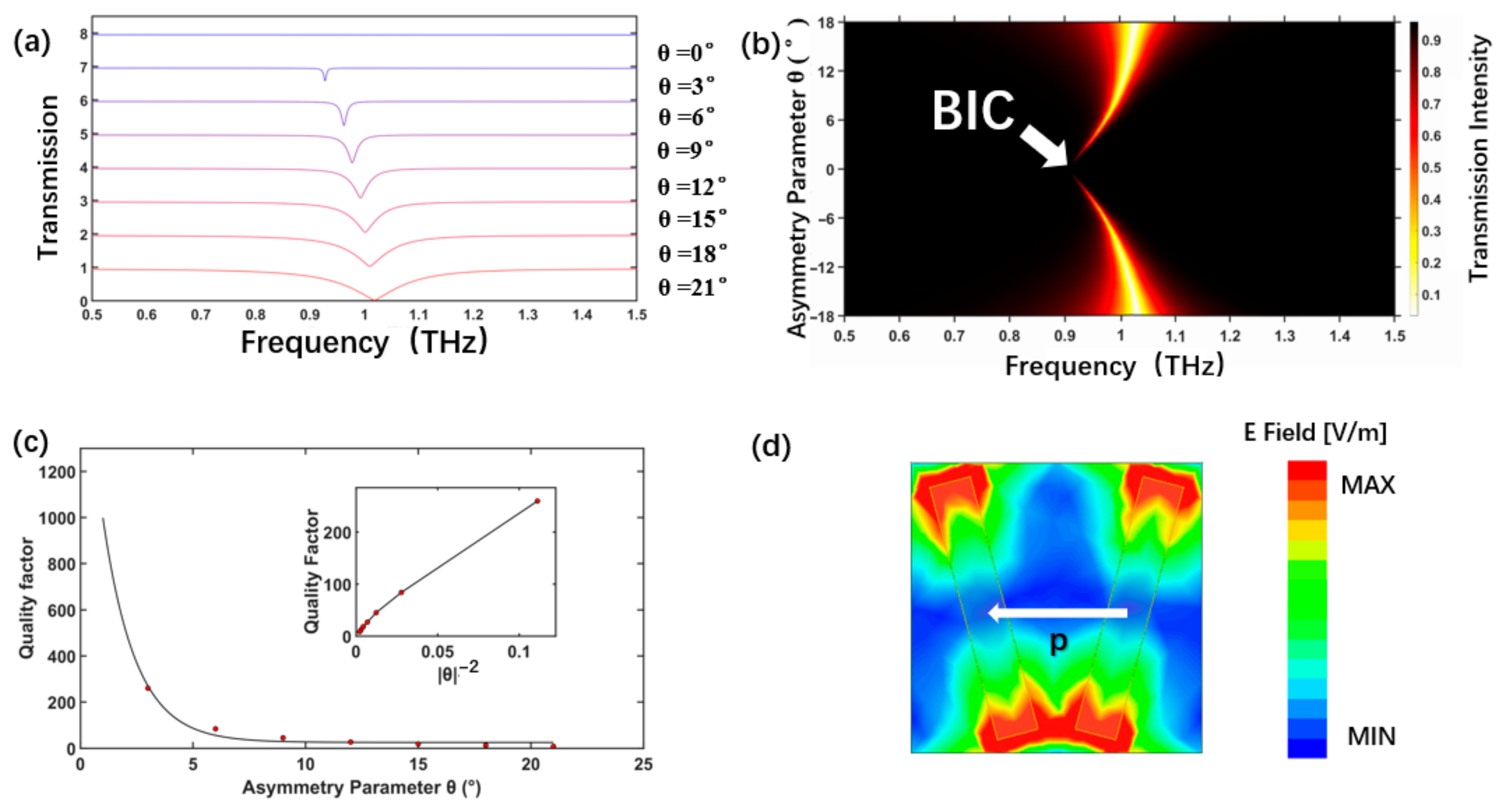
To address the inability of BICs to be directly used in sensing, this study introduces an asymmetry parameter θ to break the symmetry of the copper block dimer resonator structure, successfully converting the BIC into a QBIC and enabling controlled excitation of the QBIC mode. Numerical simulations revealed the optical response of the designed metasurface. Figure 2a clearly shows that as the asymmetry parameter θ increases, the resonance peak in the transmission spectrum exhibits a distinct redshift, accompanied by progressive broadening of the resonance linewidth. This indicates a direct correlation between the degree of symmetry breaking and both the resonant frequency and radiative losses. Figure 2b further demonstrates that as θ varies from ±18° to 0°, the linewidth of the quasi-bound state monotonically decreases. Notably, under perfect symmetry (θ = 0°), the mode completely degenerates into an ideal BIC state, where electromagnetic energy is confined within the structure and cannot radiate into free space. This phenomenon robustly validates the symmetry-protected mechanism of BICs. Figure 2c presents the simulated dependence of the Q-factor on the asymmetry parameter θ. As θ increases from 0°, structural symmetry breaking transforms the ideal bound state in the continuum into a QBIC, reducing the Q-factor from theoretical infinity to a finite value. This evolution is consistent with the behavior of a symmetry-protected BIC mechanism. Furthermore, the Q-factor follows the expected inverse square dependence on the asymmetry parameter α, obeying the relation Q ∝ α−2. The fitted curve in Figure 2c shows excellent agreement with the simulated data, thus confirming the QBIC nature of the observed resonance. QBICs are typically quantitatively characterized by their Q-factor, defined as follows:
Q = f F W H M
where f is the central resonant frequency and FWHM is the full width at half maximum of the resonance peak. This definition intuitively reflects the energy storage and loss characteristics of the resonant mode: a higher Q-value indicates a stronger ability of the resonator to store electromagnetic energy and slower energy decay. For the structure operating at its resonant frequency with θ = 15°, Figure 2d shows that the electric field distribution of the QBIC mode exhibits significant bipolar localization, with strong field enhancement occurring at both ends of the copper bars, consistent with an electric dipole resonance mode. Simultaneously, part of the field energy leaks into free space, enabling effective coupling with the external electromagnetic field. This synergy between localized field enhancement and controlled energy leakage provides a dual mechanism for enhancing THz wave-matter interactions. On one hand, enhanced localized electric field intensity at the resonator ends significantly boosts the coupling efficiency between target molecules and THz waves. On the other hand, energy leakage allows the QBIC mode to transmit molecular vibrational information to the far field via changes in the transmission spectrum. This electric-dipole-dominated field distribution not only ensures efficient matching with molecular vibrational modes but also effectively strengthens the interaction intensity between incident THz waves and matter through the synergistic action of these mechanisms.

3.2. Spectral Broadening via Synergistic Pixelated Metasurface and Angle Scanning

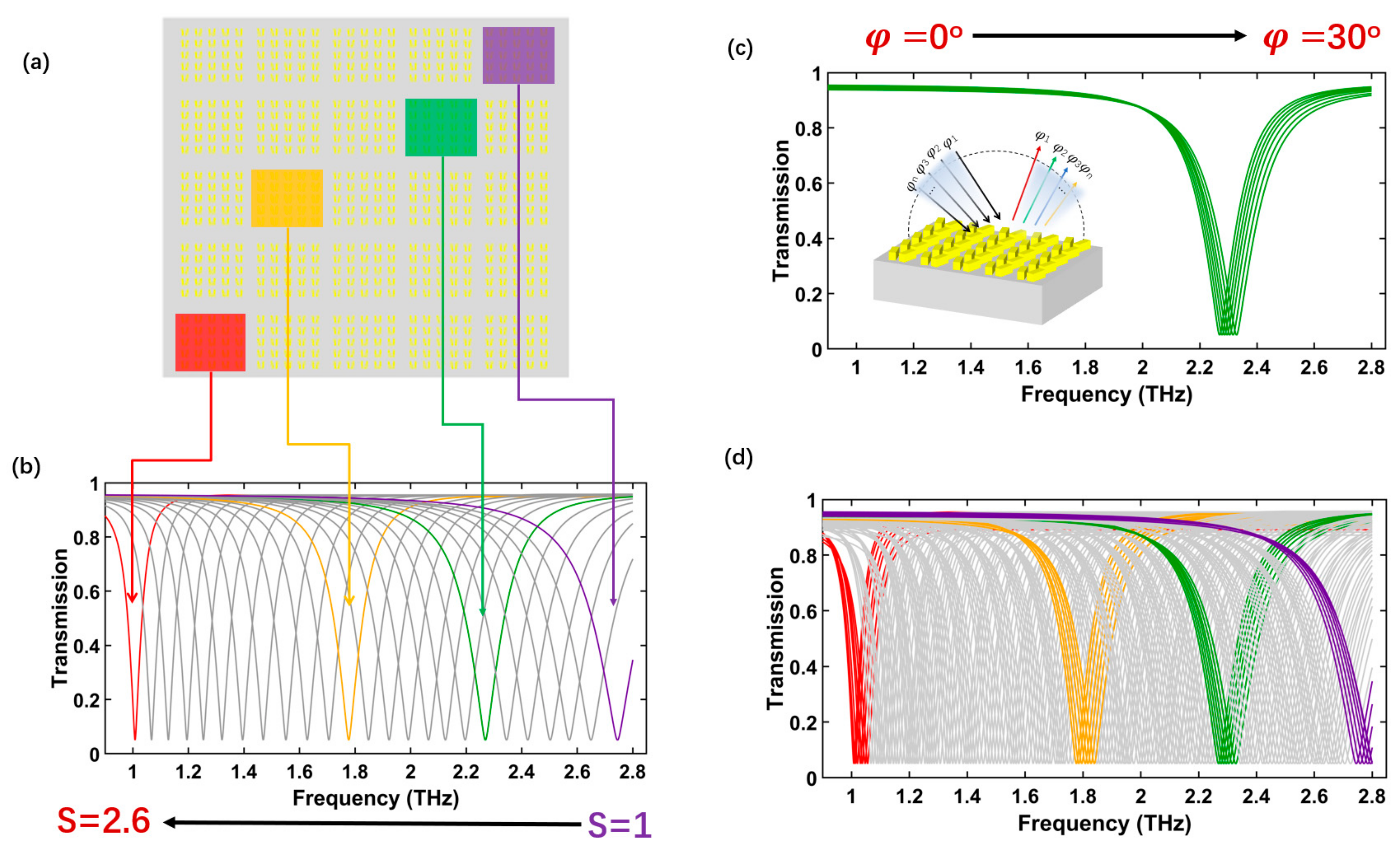
A two-dimensional pixelated metasurface tunable via a scaling factor S is designed. Its innovative advantage lies in achieving broader spectral coverage with a smaller array size while enabling higher spectral resolution at key fingerprint peaks through angle tuning. As shown in Figure 3a, the 5 × 5 pixel array structure covers a broad band from 1 THz to 2.8 THz with a smaller footprint compared to conventional pixelated metasurfaces. Precise scaling of S from 1.0 to 2.6 establishes a one-to-one correspondence between “single pixel unit” and “independent resonance peak”. As shown in Figure 3b, sharp resonance peaks in the transmission spectrum exhibit a systematic redshift with increasing S, covering a range significantly exceeding that of similar structures. Transmission intensities reach minima as low as 0.05, and these minima lie on a straight line. Furthermore, the metasurface exhibits angular sensitivity. As shown in Figure 3c, a minor adjustment of the incident angle φ induces a resonance blueshift. The observed blueshift in the transmission spectra with increasing incident angle originates from the change in the in-plane momentum of the incident THz wave, which modifies the phase-matching condition between the external excitation and the QBIC supported by the metasurface [45,46]. In this work, angle scanning serves as an auxiliary tuning mechanism that enables fine spectral adjustment on top of the broadband response provided by size scaling. The simulations were performed with an angular step of 5°, corresponding to an average resonance shift of approximately 10 GHz per step within the 0–30° range. From a practical perspective, this angle control can be readily realized by employing a miniature rotation stage or a MEMS-based beam-steering component. Therefore, the angle-scanning function in this design primarily serves as a feasible and effective auxiliary strategy to achieve high-resolution spectral refinement, rather than acting as a complex modulation process. As shown in Figure 3d, Broadband coverage from 1 to 2.8 THz was achieved, enabled by a combination of geometric parameter scaling and angular scanning. Consequently, even for a fixed scaling factor S, higher-precision spectral localization can be achieved through minor angular adjustments, providing an additional dimension for precise analysis in specific spectral bands. This approach provides a synergistic “broad coverage + high precision” solution for THz sensing by employing the scaling factor for coarse tuning during broadband scanning, complemented by fine-tuning with the angle parameters in critical spectral bands.

3.3. Molecular Fingerprint Detection and Sensing Performance

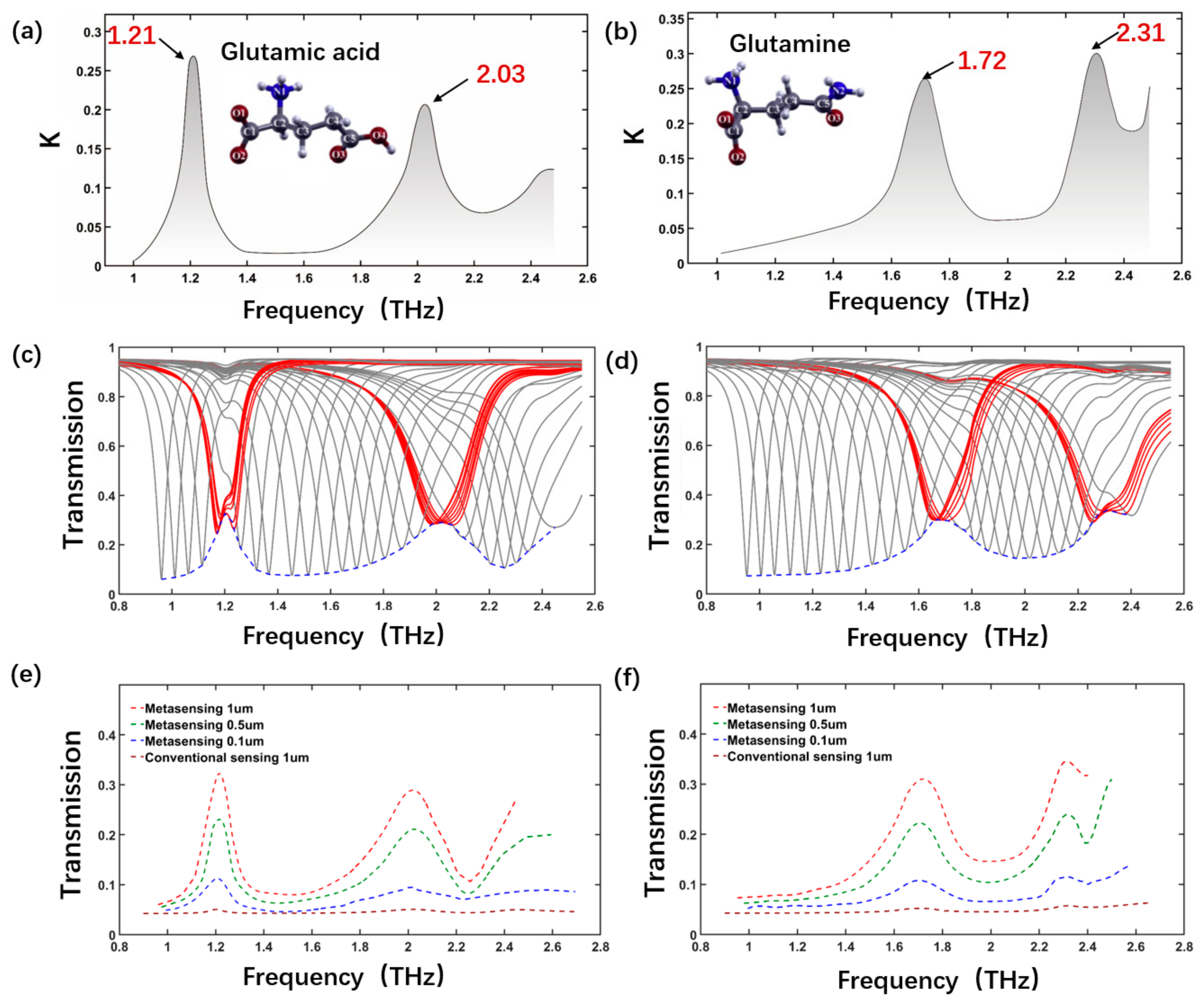
Glu and Gln are key molecules in tumor metabolic regulation, whose concentration changes are closely linked to the tumor microenvironment. This study successfully detected the characteristic absorption peaks of these molecules using THz spectroscopy. As shown in Figure 4a,b, Glu exhibits significant characteristic absorption peaks at 1.21 THz and 2.03 THz, while Gln peaks are located at 1.72 THz and 2.31 THz [47]. These peaks originate from intramolecular vibrations and low-frequency modes of hydrogen-bond networks, offering high specificity for molecular identification. To validate the metasurface’s detection capability, the surface was uniformly coated with 1 μm thick layers of Glu and Gln. Figure 4c,d display the transmission spectra and their envelope curves after analyte coating. Results show distinct resonance dips at the characteristic peaks of Glu and Gln, with the envelope curves closely matching the molecules’ extinction coefficient spectra. This indicates the metasurface’s ability to convert weak molecular vibrational signals into measurable optical responses for high-sensitivity detection. Further analysis reveals that the pixelated metasurface, composed of multiple subwavelength resonators, locally enhances the near-field electric field. When molecular vibrations couple with this enhanced near-field surrounding the resonators, absorption of near-field energy by the vibrations and their inherent damping effect lead to reduced resonance peak intensity and increased linewidth. This interaction mechanism causes the overall transmission spectrum profile to closely match the THz absorption features of the molecules, enabling precise molecular fingerprint identification. To quantitatively assess detection performance, the effect of analyte thickness on the transmission spectrum was investigated. Figure 4e,f show the envelope curve variations for different coating thicknesses. Transmission intensity at the resonance minima gradually decreases with increasing analyte thickness. The four curves represent the reference absorption spectra of unpatterned substrates, along with the envelope curves for Glu and Gln samples with deposited thicknesses of 0.1 µm, 0.5 μm, and 1 µm. As the thickness increases, the transmittance intensity of the resonance peaks progressively decreases. For Glu, the transmittance values at 1.21 THz are 5.05%, 11.25%, 23.25%, and 32.65%, while at 2.02 THz they are 5.06%, 9.41%, 21.12%, and 29.04%, corresponding to the increasing thicknesses. When coated with 1 µm of Glu, the signal intensities at 1.21 THz and 2.02 THz exhibit enhancements of 6.47-fold and 5.74-fold, respectively, compared to the unpatterned substrate. Similarly, for Gln, the transmittance values at 1.72 THz are 5.22%, 10.79%, 22.31%, and 31.37%, while at 2.31 THz they are 5.73%, 11.66%, 23.91%, and 34.59%. With a 1 µm Gln coating, the signal intensities at 1.72 THz and 2.31 THz show improvements of 6.01-fold and 6.03-fold, respectively, relative to the unpatterned substrate. The detection limit (σ) is calculated by σ = ρ × h , where the volume densities of Glu and Gln are ρ = 1.538 g cm−3 and ρ = 1.47 g cm−3, respectively. The minimum detectable analyte thickness is 0.1 μm, yielding detection limits of 15.4 μg cm−2 for Glu and 14.7 μg cm−2 for Gln, significantly surpassing conventional THz time-domain spectroscopy techniques. The sensitivity is given by S f = f / n , where Δf is the resonance frequency shift in hertz and Δn is the change in the refractive index. A maximum sensitivity of 500 GHz/RIU is attained in this work.
To comprehensively illustrate the novelty and significance of the proposed metasurface, Table 1 provides a detailed comparison with state-of-the-art fingerprint metasensors. While some works have demonstrated higher enhancement factors for specific analytes, such as the 7.3× enhancement achieved by Lyu et al. [48] and the 10.4× enhancement reported by Han’s group [49], the primary innovation of our work lies in its integrated approach that combines broadband response with multi-peak detection capability within a compact 5 × 5 pixel array. The proposed structure exhibits the widest tuning bandwidth (1.8 THz) among all listed works while simultaneously achieving the lowest detection limits (14.7–15.4 μg/cm2). More importantly, unlike designs optimized for maximum enhancement at specific frequencies, our platform enables the simultaneous detection of multiple fingerprint peaks across a wide spectral range in a single measurement. The demonstrated detection of both Glu (1.21 THz and 2.03 THz) and Gln (1.72 THz and 2.31 THz) fingerprints within the same sensing platform showcases this unique advantage. This balanced performance profile is further enhanced by our hybrid multiplexing scheme that combines geometric scaling with angle scanning. The incorporation of angle scanning as a fine-tuning mechanism provides additional spectral resolution where needed, offering optimal balance between broadband coverage and precise spectral identification. This capability is particularly valuable for practical application scenarios such as analyzing complex biological samples where multiple biomarkers need to be identified concurrently. This design therefore innovatively provides a broadband biosensing methodology that transcends the limitations of conventional parameter optimization approaches, opening new avenues for real-time monitoring and early diagnosis of tumor biomarkers.
Finally, although this work primarily focuses on the numerical demonstration of the proposed pixelated QBIC metasensor, we have carefully considered its fabrication feasibility based on established micro-fabrication techniques for flexible THz devices. The key challenge of patterning high-precision copper structures on thin LCP substrates could be addressed by employing photolithography with a rigid carrier wafer support to prevent substrate deformation. For robust copper-LCP adhesion, an oxygen plasma treatment followed by the deposition of a thin chromium adhesion layer (e.g., 10 nm) prior to copper deposition is recommended, a method successfully demonstrated in similar flexible metamaterial fabrication [54]. To quantitatively evaluate the manufacturability of the proposed design, we performed a comprehensive tolerance analysis through parametric simulations. The results indicate that even when considering structural deviations typically encountered in practical fabrication processes, including rounded edges of copper blocks forming elliptical cross-sections and rotational angle variations within ±1°, the QBIC resonance maintains its fundamental mode characteristics and key sensing performance. Specifically, such dimensional deviations result in resonance frequency shifts of less than 5%, demonstrating the robustness of our design against typical fabrication tolerances.

4. Conclusions

In conclusion, this paper presents a QBIC metasurface array that combines angle-scanning with size-scaled pixelation, aiming to enhance THz wave–matter interactions and achieve ultrasensitive detection of tumor metabolic biomarkers. The sensor adopts a “LCP substrate + copper block dimer resonant structure”. The LCP substrate lays a foundation for high-Q resonance. By introducing an asymmetry parameter θ to break the structural symmetry, the non-radiative BICs are converted into QBIC modes with high-Q and controllable radiation, achieving a Q-factor of 20 and a sensitivity of 500 GHz/RIU. With a 5 × 5 pixel array scaled by a proportional factor S ranging from 1.0 to 2.6, this sensor covers a broad frequency band from 1 THz to 2.8 THz. Meanwhile, by employing small-angle scanning within 30°, a spectral step of approximately 10 GHz is achieved, realizing the function of “broadband coarse tuning + fine tuning at key peaks”. In the detection of Glu and Gln, the signal intensities of 1 μm thick samples are enhanced by 5.74 to 6.47 times, with detection limits as low as 14.7 to 15.4 μg/cm2, outperforming conventional THz detection technologies. This design addresses the limitations of traditional sensing technologies, such as severe background interference and mismatch between narrowband response and broadband molecular fingerprints. It provides an innovative platform for the trace monitoring of tumor metabolic biomarkers and promotes the application of THz sensing in biomedical diagnostics.

Author Contributions

Conceptualization, M.P., Y.Z. and Y.S.; methodology, M.P., Y.Z. and Y.S.; software, M.P. and H.L.; validation, M.P.; formal analysis, M.P.; investigation, M.P.; resources, Y.Z., Y.S., X.Z., H.L. and D.X.; data curation, M.P., Y.Z. and Y.S.; writing—original draft preparation, M.P.; writing—review and editing, M.P., Y.Z. and Y.S.; visualization, M.P.; supervision, Y.Z. and Y.S.; project administration, Y.Z. and Y.S.; funding acquisition, Y.Z., Y.S., X.Z., H.L. and D.X. All authors have read and agreed to the published version of the manuscript.

Funding

This work was supported by the National Key Research and Development Program of China (2022YFA1405200), the National Natural Science Foundation of China (62371272), the Shandong Provincial Natural Science Foundation (ZR2023ZD08, ZR2024LLZ006), the Key Technology Program of Qingdao City (23-1-2-qljh-5-gx), the Taishan Industrial Experts Program (tscy20241154).

Institutional Review Board Statement

Not applicable.

Informed Consent Statement

Not applicable.

Data Availability Statement

Since no public dataset was created for this study, please contact me at 202432401@mail.sdu.edu.cn if you require the data presented in this paper.

Acknowledgments

The authors would like to thank the Shandong Key Laboratory of Metamaterial and Electromagnetic Manipulation Technology, Multidisciplinary Team Program of Shandong University, Qilu Scholar Program of Shandong University and Young Scholars Future Program of Shandong University for supporting this work.

Conflicts of Interest

The authors declare no conflicts of interest.

Abbreviations

The following abbreviations are used in this manuscript:
THzTerahertz
EITElectromagnetically induced transparency
BICsBound states in the continuum
QBICsQuasi-bound states in the continuum
Q-factorQuality-factor
GluGlutamic acid
GlnGlutamine
GLS1Glutaminase 1
2HG2-hydroxyglutarate
IDHIsocitrate dehydrogenase
LCPLiquid crystal polymer
LSPRLocalized Surface Plasmon Resonance

References

  1. Dai, Y.; Chen, C.; Gao, P.; Lu, X.; Zhao, J.; Wan, Y.; Wang, X.; Zhao, S.; Liu, H. 3-bit reconfigurable THz metasurface based on structured light illumination for vortex beams and holographic imaging. Opt. Laser Technol. 2024, 169, 109951. [Google Scholar] [CrossRef]
  2. Yang, X.; Zhao, X.; Yang, K.; Liu, Y.; Liu, Y.; Fu, W.; Luo, Y. Biomedical Applications of Terahertz Spectroscopy and Imaging. Trends Biotechnol. 2016, 34, 810–824. [Google Scholar] [CrossRef] [PubMed]
  3. Zhang, Y.; Qiao, S.; Liang, S.; Wu, Z.; Yang, Z.; Feng, Z.; Sun, H.; Zhou, Y.; Sun, L.; Chen, Z.; et al. Gbps Terahertz External Modulator Based on a Composite Metamaterial with a Double-Channel Heterostructure. Nano Lett. 2015, 15, 3501–3506. [Google Scholar] [CrossRef] [PubMed]
  4. Ahmadivand, A.; Gerislioglu, B.; Ahuja, R.; Mishra, Y.K. Terahertz plasmonics: The rise of toroidal metadevices towards immunobiosensings. Mater. Today 2020, 32, 108–130. [Google Scholar] [CrossRef]
  5. Beruete, M.; Jáuregui-López, I. Terahertz Sensing Based on Metasurfaces. Adv. Opt. Mater. 2020, 8, 1900721. [Google Scholar] [CrossRef]
  6. Geng, Z.; Zhang, X.; Fan, Z.; Lv, X.; Chen, H. A Route to Terahertz Metamaterial Biosensor Integrated with Microfluidics for Liver Cancer Biomarker Testing in Early Stage. Sci. Rep. 2017, 7, 16378. [Google Scholar] [CrossRef]
  7. Chen, L.; Ren, G.; Liu, L.; Guo, P.; Wang, E.; Zhou, L.; Zhu, Z.; Zhang, J.; Yang, B.; Zhang, W.; et al. Terahertz Signatures of Hydrate Formation in Alkali Halide Solutions. J. Phys. Chem. Lett. 2020, 11, 7146–7152. [Google Scholar] [CrossRef]
  8. Ho, L.; Pepper, M.; Taday, P. Terahertz Spectroscopy: Signatures and Fingerprints. Nat. Photon. 2008, 2, 541–543. [Google Scholar] [CrossRef]
  9. Yan, X.; Yang, M.S.; Zhang, Z.; Liang, L.; Wei, D.; Wang, M.; Zhang, M.; Wang, T.; Liu, L.; Xie, J.; et al. The terahertz electromagnetically induced transparency-like metamaterials for sensitive biosensors in the detection of cancer cells. Biosens. Bioelectron. 2019, 126, 485–492. [Google Scholar] [CrossRef]
  10. Federici, J.F.; Schulkin, B.; Huang, F.; Gary, D.; Barat, R.; Oliveira, F.; Zimdars, D. THz imaging and sensing for security applications—Explosives, weapons and drugs. Semicond. Sci. Technol. 2005, 20, S266. [Google Scholar] [CrossRef]
  11. Lee, D.K.; Kang, J.H.; Lee, J.S.; Kim, H.-S.; Kim, C.; Kim, J.H.; Lee, T.; Son, J.-H.; Park, Q.-H.; Seo, M. Highly sensitive and selective sugar detection by terahertz nano-antennas. Sci. Rep. 2015, 5, 15459. [Google Scholar] [CrossRef]
  12. Wang, D.X.; Xu, K.D.; Luo, S.Y.; Cui, Y.; Zhang, L.; Cui, J. A high Q-factor dual-band terahertz metamaterial absorber and its sensing characteristics. Nanoscale 2023, 15, 3398–3407. [Google Scholar] [CrossRef]
  13. Zhao, R.; Niu, Q.; Zou, Y.; Cui, B.; Yang, Y. A terahertz metasurface biosensor based on electromagnetically induced transparency for fingerprint trace detection. J. Mater. Chem. C 2024, 12, 6106–6113. [Google Scholar] [CrossRef]
  14. Jing, Z.; Li, S.; Ouyang, S.; Lu, J.; Wang, Y.; Huang, L.; Li, L.; Sang, T. Observation of the Generalized Kerker Effect Mediated by Quasi-Bound States in the Continuum. Nano Lett. 2024, 25, 522–528. [Google Scholar] [CrossRef] [PubMed]
  15. Canós Valero, A.; Sztranyovszky, Z.; Muljarov, E.A.; Bogdanov, A.; Weiss, T. Exceptional Bound States in the Continuum. Phys. Rev. Lett. 2025, 134, 103802. [Google Scholar] [CrossRef] [PubMed]
  16. Koshelev, K.; Favraud, G.; Bogdanov, A.; Kivshar, Y.; Fratalocchi, A. Nonradiating photonics with resonant dielectric nanostructures. Nanophotonics 2019, 8, 725–745. [Google Scholar] [CrossRef]
  17. Li, S.; Zhou, C.; Liu, T.; Xiao, S. Symmetry-protected bound states in the continuum supported by all-dielectric metasurfaces. Phys. Rev. A 2019, 100, 063803. [Google Scholar] [CrossRef]
  18. Koshelev, K.; Lepeshov, S.; Liu, M.K.; Bogdanov, A.; Kivshar, Y. Asymmetric Metasurfaces with High-Q Resonances Governed by Bound States in the Continuum. Phys. Rev. Lett. 2018, 123, 193903. [Google Scholar] [CrossRef]
  19. Cong, L.; Singh, R. Symmetry-Protected Dual Bound States in the Continuum in Metamaterials. Adv. Opt. Mater. 2019, 7, 1900383. [Google Scholar] [CrossRef]
  20. Fang, C.Z.; Yang, Q.Y.; Yuan, Q.C.; Gan, X.; Zhao, J.; Shao, Y.; Liu, Y.; Han, G.; Hao, Y. High-Q resonances governed by the quasi-bound states in the continuum in all-dielectric metasurfaces. Opto-Electron. Adv. 2021, 4, 200030. [Google Scholar] [CrossRef]
  21. Sun, K.; Sun, M.; Cai, Y.J.; Levy, U.; Han, Z. Strong coupling between quasi-bound states in the continuum and molecular vibrations in the mid-infrared. Nanophotonics 2022, 11, 4221–4229. [Google Scholar] [CrossRef]
  22. Zhou, C.; Pu, T.; Huang, J.; Fan, M.; Huang, L. Manipulating optical scattering of quasi-BIC in dielectric metasurface with off-center hole. Nanomaterials 2021, 12, 54. [Google Scholar] [CrossRef]
  23. Hsu, C.W.; Zhen, B.; Lee, J.; Chua, S.-L.; Johnson, S.G.; Joannopoulos, J.D.; Soljačić, M. Observation of Trapped Light Within the Radiation Continuum. Nature 2013, 499, 188–191. [Google Scholar] [CrossRef]
  24. Srivastava, Y.K.; Ako, R.T.; Gupta, M.; Bhaskaran, M.; Sriram, S.; Singh, R. Terahertz Sensing of 7 nm Dielectric Film with Bound States in the Continuum Metasurfaces. Appl. Phys. Lett. 2019, 115, 151105. [Google Scholar] [CrossRef]
  25. Tan, T.C.W.; Plum, E.; Singh, R. Lattice-Enhanced Fano Resonances from Bound States in the Continuum Metasurfaces. Adv. Opt. Mater. 2020, 8, 1901572. [Google Scholar] [CrossRef]
  26. Khardikov, V.V.; Iarko, E.O.; Prosvirnin, S.L. Trapping of light by metal arrays. J. Opt. 2010, 12, 045102. [Google Scholar] [CrossRef]
  27. Wang, R.; Xu, L.; Wang, J.; Sun, L.; Jiao, Y.; Meng, Y.; Chen, S.; Chang, C.; Fan, C. Electric Fano resonance-based terahertz metasensors. Nanoscale 2021, 13, 18467–18472. [Google Scholar] [CrossRef]
  28. Liu, B.; Peng, Y.; Jin, Z.; Wu, X.; Gu, H.; Wei, D.; Zhu, Y.; Zhuang, S. Terahertz ultrasensitive biosensor based on wide-area and intense light-matter interaction supported by QBIC. Chem. Eng. J. 2023, 462, 142347. [Google Scholar] [CrossRef]
  29. Gezimati, M.; Singh, G. Terahertz Imaging and Sensing for Healthcare: Current Status and Future Perspectives. IEEE Access 2023, 11, 18590–18619. [Google Scholar] [CrossRef]
  30. Shen, S.Y.; Chen, L. Rapid Recognition of Glucose Molecular Fingerprint Using Transmissive Microfluidic Multiplexing Metasensor. IEEE Sens. J. 2024, 24, 16070–16076. [Google Scholar] [CrossRef]
  31. Zhong, Y.; Du, L.; Liu, Q.; Zhu, L.; Meng, K.; Zou, Y.; Zhang, B. Ultrasensitive specific sensor based on all-dielectric metasurfaces in the terahertz range. RSC Adv. 2020, 10, 33018–33025. [Google Scholar] [CrossRef] [PubMed]
  32. Xue, Y.; Zhang, S.; Lin, J.; Wang, W.; Chai, Z.; Sun, M.; Shi, Y.; Zhang, Y. Metasurface-based sensor with terahertz molecular fingerprint enhancement in trace additives identification. J. Phys. D Appl. Phys. 2024, 57, 235104. [Google Scholar] [CrossRef]
  33. Lin, J.; Xue, Y.; Wang, W.; Sun, M.; Shi, S.; Zhang, S.; Shi, Y. Enhancing Multi-Spectral Fingerprint Sensing for Trace Explosive Molecules with All-Silicon Metasurfaces. Nanomaterials 2024, 14, 738. [Google Scholar] [CrossRef] [PubMed]
  34. Andreas, T.; Aleksandrs, L.; Liu, M.; Yesilkoy, F.; Choi, D.Y.; Neshev, D.N.; Kivshar, Y.S.; Altug, H. Imaging-based molecular barcoding with pixelated dielectric metasurfaces. Science 2018, 360, 1105–1109. [Google Scholar] [CrossRef]
  35. Cao, Y.; Zhao, R.; Guo, K.; Ren, S.; Zhang, Y.; Lu, Z.; Tian, L.; Li, T.; Chen, X.; Wang, Z. Potential Metabolite Biomarkers for Early Detection of Stage-I Pancreatic Ductal Adenocarcinoma. Front. Oncol. 2022, 11, 744667. [Google Scholar] [CrossRef]
  36. Lin, Y.; Yang, Z.; Li, J.; Sun, Y.; Zhang, X.; Qu, Z.; Luo, Y.; Zhang, L. Effects of glutamate and aspartate on prostate cancer and breast cancer: A Mendelian randomization study. BMC Genom. 2022, 23, 213. [Google Scholar] [CrossRef]
  37. Jiang, B.; Zhang, J.; Zhao, G.; Liu, M.; Hu, J.; Lin, F.; Wang, J.; Zhao, W.; Ma, H.; Zhang, C.; et al. Filamentous GLS1 promotes ROS-induced apoptosis upon glutamine deprivation via insufficient asparagine synthesis. Mol. Cell. 2022, 82, 1821–1835. [Google Scholar] [CrossRef]
  38. Hua, W.; Zhang, W.; Brown, H.; Wu, J.; Fang, X.; Shahi, M.; Chen, R.; Zhang, H.; Jiao, B.; Wang, N.; et al. Rapid detection of IDH mutations in gliomas by intraoperative mass spectrometry. Proc. Natl. Acad. Sci. USA 2024, 121, e2318843121. [Google Scholar] [CrossRef]
  39. Ling, H.; Li, Z.; Li, K.; Zhao, R.; Ma, P.; Zhou, Y.; Li, J.; Xu, X.; Yashchyshyn, Y.; Zou, X.; et al. Terahertz Electromagnetically Induced Transparency with Electric-Field-Coupled Inductor-Capacitor Resonators on LCP Substrate. Crystals 2023, 13, 283. [Google Scholar] [CrossRef]
  40. Wang, Q.; Chen, Y.; Mao, J.; Yang, F.; Wang, N. Metasurface-Assisted Terahertz Sensing. Sensors 2023, 23, 5902. [Google Scholar] [CrossRef]
  41. Wang, X.; Li, Z.; Song, J.; Ling, H.; Shi, Y.; Zhang, X.; Zhang, B.; Song, A.; Zhang, Y. Graphene-Manipulated Terahertz Zigzag Electromagnetically Induced Transparency Metasurface on Liquid Crystal Polymer Film. Adv. Opt. Mater. 2025, 10, e00523. [Google Scholar] [CrossRef]
  42. Asim, A.; Cada, M.; Ma, Y.; Fine, A. Dual-Resonance Split Ring Resonator Metasurface for Terahertz Biosensing. IEEE Sens. J. 2024, 24, 14189–14196. [Google Scholar] [CrossRef]
  43. Zhu, J.; Jiang, S.; Xie, Y.; Li, F.; Du, L.-H.; Meng, K.; Zhu, L.-G.; Zhou, J. Enhancing terahertz molecular fingerprint detection by a dielectric metagrating. Opt. Lett. 2020, 45, 2335–2338. [Google Scholar] [CrossRef]
  44. Ling, H.T. Research on Dynamic Modulation Methods of Metamaterials and Artificial Surface Plasmons Based on Thin-Film Materials. Master’s Thesis, Shandong University, Jinan, China, 2021. [Google Scholar]
  45. Hu, D.; Pan, M.; Shi, Y.; Zhang, Y. Multi-Mode Coupling Enabled Broadband Coverage for Terahertz Biosensing Applications. Biosensors 2025, 15, 368. [Google Scholar] [CrossRef] [PubMed]
  46. Xie, Y.; Liu, X.; Zhou, J.; Zhang, H.; Lin, J.-Y.; Chen, W.; Zhu, L.-G.; Meng, K.; Liu, Q.H.; Zhu, J. Enhancing Trace Terahertz Fingerprint Sensing by the Lossy Silicon Metagrating with a Gold Mirror. IEEE Trans. Microw. Theory Tech. 2024, 72, 2368–2377. [Google Scholar] [CrossRef]
  47. Li, Y.; Xu, L.; Li, H.; Xiong, G.; Liu, Q.; Yang, W.; Yang, S.; Deng, X. Impact of hydrogen bonding network configuration on intramolecular distortion in solid state: Studies on low-frequency vibrations of L-glutamic acid and L-glutamine. J. Mol. Struct. 2019, 1180, 636–641. [Google Scholar] [CrossRef]
  48. Lyu, J.; Shen, S.; Chen, L.; Zhu, Y.; Zhuang, S. Frequency Selective Fingerprint Sensor: The Terahertz Unity Platform for Broadband Chiral Enantiomers Multiplexed Signals and Narrowband Molecular AIT Enhancement. PhotoniX 2023, 4, 28. [Google Scholar] [CrossRef]
  49. Han, W.; Wang, P.; Zhang, C.; Xu, Y.; Wu, Z.; Wang, Q. Pixelated Toroidal Metasurface Sensor with Broadband Terahertz Fingerprint Enhancement for Biochemical Trace Detection. ACS Appl. Mater. Interfaces 2024, 16, 70795–70803. [Google Scholar] [CrossRef]
  50. Nie, W.; Pan, M.; Shi, Y.; Shu, W.; Li, H.; Yu, W.; Liu, S.; Zhang, Y. A Sensitive THz Fingerprint Sensor Based on Silicon Cylindrical Trimers for the Detection of Kresoxim-methyl. Photonics 2024, 11, 1128. [Google Scholar] [CrossRef]
  51. Li, H.; Yu, W.; Pan, M.; Liu, S.; Nie, W.; Zhang, Y.; Shi, Y. Multi-Degree-of-Freedom Stretchable Metasurface Terahertz Sensor for Trace Cinnamoylglycine Detection. Biosensors 2024, 14, 602. [Google Scholar] [CrossRef]
  52. Sun, L.; Xu, L.; Wang, J.; Jiao, Y.; Ma, Z.; Ma, Z.; Chang, C.; Yang, X.; Wang, R. A Pixelated Frequency-Agile Metasurface for Broadband Terahertz Molecular Fingerprint Sensing. Nanoscale 2022, 14, 9681–9685. [Google Scholar] [CrossRef]
  53. Liu, B.; Peng, Y.; Hao, Y.; Zhu, Y.; Chang, S.; Zhuang, S. Ultra-wideband terahertz fingerprint enhancement sensing and inversion model supported by single-pixel reconfigurable graphene metasurface. PhotoniX 2024, 5, 10. [Google Scholar] [CrossRef]
  54. Zhou, Z.; Li, W.; Qian, J.; Liu, W.; Wang, Y.; Zhang, X.; Guo, Q.; Yashchyshyn, Y.; Wang, Q.; Shi, Y.; et al. Flexible Liquid Crystal Polymer Technologies from Microwave to Terahertz Frequencies. Molecules 2022, 27, 1336. [Google Scholar] [CrossRef]
Figure 1. (a) Structure of the 5 × 5 pixel array. (b,c) Schematic of the unit cell structure and parameters. Symbols H, h, PX, A, B, O, and θ denote the substrate height, cuboid height, unit cell period, cuboid width, cuboid length, distance from cuboid center to central axis, and angle between cuboid and central axis, respectively. (d) Schematic of a single pixel array coated with analyte.
Photonics 12 01127 g001
Figure 2. (a) Transmission spectra corresponding to different asymmetry parameters. (b) Simulated angular dependence on the transmission spectra (c) Q-factors corresponding to different asymmetry parameters. (d) Electric field distribution at the resonance frequency for an asymmetry parameter of 15 degrees.
Photonics 12 01127 g002
Figure 3. (a) An S-parameter tuned pixel array, where arrows of different colors represent the corresponding resonance curves of each structural unit in the transmission spectrum. (b) The corresponding transmission spectrum at the resonance frequency. (c) Transmission spectra with blue-shifted resonance frequencies generated by angle-assisted tuning. (d) Broadband coverage from 1 to 2.8 THz was achieved, enabled by a combination of geometric parameter scaling and angular scanning.
Photonics 12 01127 g003
Figure 4. (a,b) Extinction coefficient spectra of Glu and Gln. (c,d) Transmission spectra and their envelopes for samples coated with 1 μm Glu and 1 μm Gln, respectively. The gray curves correspond to the individual pixel units; each set of red curves is generated through angular scanning; and the blue curve represents the envelope of all unit responses. (e,f) Envelope spectra for different analyte thicknesses.
Photonics 12 01127 g004
Table 1. THz molecular fingerprint sensing performance of recently reported metasurfaces.
Refs.Material of
Structured
Layer
ResonancetypeTuning
Bandwidth
Multiplexed
Scheme
AnalyteDetection
Limits
Enhancement Factor
[50]siliconGMR0.3 THzAngleKresoxim-methyl37.74 μg/cm2
[51]PDMSMagnetic
dipole
0.1 THzAngleCinamoy-
lglycine
24.6 μg/cm2
[52]AU +
Graphene
Dipole1.5 THzGraphenevoltage + geometryglucose5
[53]GrapheneEIT1.5 THzGrapheneCarnitine64 μg/cm2
[48]AU + quartzLSPR1.05 THzGeometryD-carnitine
L-carnitine
7.3
[49]AUToroidal
Dipole
0.8 THzGeometryglucose10.4
This workCopper + LCPBIC1.8 THzGeometry +
Angle
Glu
Gln
14.7 μg/cm2
15.4 μg/cm2
5.74
6.47
Disclaimer/Publisher’s Note: The statements, opinions and data contained in all publications are solely those of the individual author(s) and contributor(s) and not of MDPI and/or the editor(s). MDPI and/or the editor(s) disclaim responsibility for any injury to people or property resulting from any ideas, methods, instructions or products referred to in the content.