1. Introduction
Diffuse Raman spectroscopy (DIRS) [
1,
2,
3,
4,
5,
6,
7,
8] merges and incorporates the high chemical specificity of Raman spectroscopy [
9,
10] with in-depth or bulk analysis of Diffuse Optics to probe highly diffusive media [
11,
12]. Among different DIRS approaches, time-domain diffuse Raman spectroscopy (TD-DIRS) explores diffusive media exploiting the photon time of flight, which encodes the mean visited depth [
13,
14,
15,
16,
17]. TD-DIRS extends the use of time gates, initially sought for fluorescence suppression [
18,
19,
20] to encompass depth discrimination. The interpretation of time-domain diffuse Raman spectroscopy relies on the availability of a model capable of describing the migration of photons in the media of interest. Therefore, accurate modeling of light propagation is essential for this technique for the correct recovery of Raman spectra from the investigated medium [
17,
21]. Spontaneous Raman scattering in the TD in highly diffusive media can be computationally evaluated by three main approaches: stochastic forward solvers based on Monte Carlo (MC) simulations [
11,
21], analytical heuristic solutions of the Raman interactions [
11,
17,
21], and rigorous analytical solutions of the diffusion equation (DE) [
11,
17,
21]. Monte Carlo simulations can be performed for any geometry and have been exploited in the forward modeling of continuous-wave (CW) diffuse Raman propagation [
22], yet they are computationally expensive, and their use for the inverse problem is more challenging, particularly for the TD. In contrast, exact analytical forward solvers are significantly faster; however, their availability is limited to homogeneous geometries [
11,
21]. We address photon migration in a two-layer medium using MC simulations and a heuristic analytical model that offers significant advantages compared to the existing one [
17]. The layered geometry is of great interest in the field of tissue optics. Indeed, it represents the architecture of many tissues, such as the fat layer overlying muscle tissue, the extra-cerebral tissue over the brain, or the thorax over the lungs. The MC results serve as a reference for verifying the analytical model.
2. Theory
The usual approach used to obtain solutions for the Raman signal in diffusive media across any geometry involves two coupled diffusion equations [
11,
17,
21], one at the excitation wavelength (
) for the fluence rate
, describing the energy distribution of the excitation light, and one at the emission wavelength (
) for the Raman fluence rate
, describing the energy distribution of the Raman emitted light [
11,
17,
21]. In this scheme, the product of the Raman scattering coefficient
(probability per unit path length to have Raman scattering [
11,
21]), where
is the source term of the second DE generating the sought-for Raman solution
. Computing the TD Raman fluence signal,
, according to the mentioned scheme, implies the evaluation of the following integral of Green’s function (for the details of the procedure, see Refs. [
11,
17,
21]):
where
and
are Green’s functions for the two-layer medium at
and
[
11], respectively, and
denotes the volume of the medium. The solution of Equation (
1) is obtained, assuming that only single-scattering Raman events contribute to the signal. The evaluation of this integral can be computationally expensive in terms of computing time, with the risk of obtaining a model whose computation speed is not sufficiently high for applying the model in the inverse reconstructions of Raman spectra. For this reason, we opted for a heuristic approach.
From now on, the quantities without a suffix are related to
, and the quantities with suffix “e” refer to
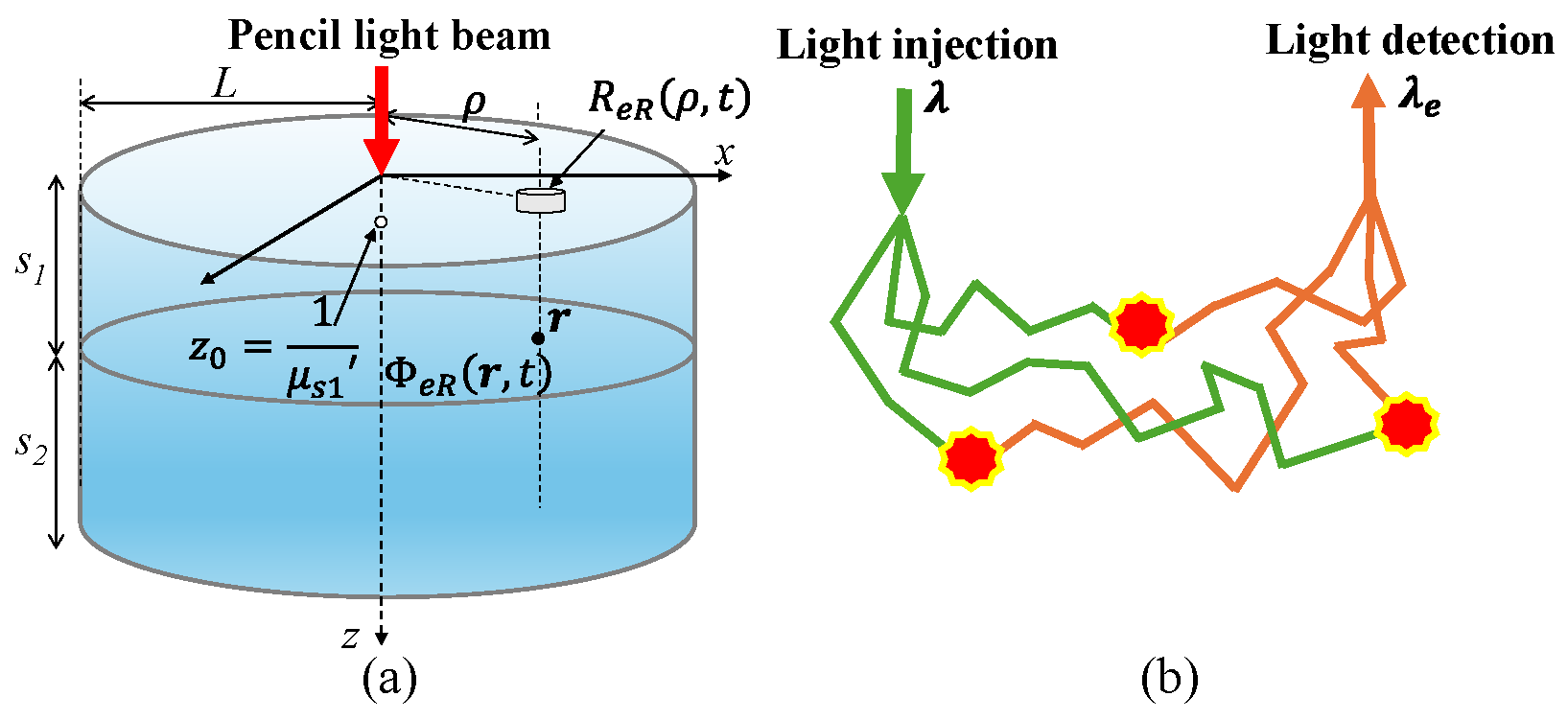
. A two-layer cylinder (see
Figure 1a) of radius
L and thicknesses
and
is considered for the first and second layer, respectively. At
, we identify the absorption coefficients
and
; the reduced scattering coefficients
and
; the Raman scattering coefficients
and
; and the refractive indices
and
in the first and second layer, respectively. Similarly, the symbols
,
,
,
,
, and
indicate the optical properties at
.
We started from a previous heuristic approach proposed by Šušnjar et al. [
17] that, by exploiting the typical low values of
and
, usually lower than
mm
−1, expands the emitted fluence in a Taylor series up to its first-order approximation. According to this method, the TD Raman fluence signal at
,
, in a two-layer cylinder can be written, under the hypothesis that the optical properties of the medium are the same at
and
, as follows: [
17]
with
as the fluence rate in the two-layer medium at
[
11],
and
as the average times spent by detected light at
t in the first and second layer, respectively, and
and
as the speed of light in the layers. About
and
, according to known properties of the Radiative Transfer Equation (RTE) arising from the microscopic Beer–Lambert–Bouguer law, they can be expressed as [
11,
23]
with
. The second term of Equation (
2) is the probability,
, to have Raman-generated photons from the two layers, subsequently detected at time
t, i.e.,
Equation (
2) does not account for the dependence of the optical properties on
that actually influence the Raman signal emerging from the medium. We denote this model as “Model 0”.
In the more general case,
depends on both the optical properties at
and
, since the propagation of photons received at
consists of two different parts, i.e., two phases of propagation: An initial photon propagation at
and a second propagation at
(see
Figure 1b). In principle, we know how to describe these two separated kinds of propagation; however, the challenging point is to establish how to combine them to obtain
. In this work, we heuristically assume that the detected Raman signal is determined on average through a combination of photon propagation at
and
, i.e., one half at
and one half at
. This hypothesis is well verified when the diffusion conditions of light propagation hold and when the variation in optical properties between
and
is sufficiently low to have a similar propagation at
and
and thus a similar probability of having photons at these two wavelengths. Under these conditions, we have that the propagation of light is well randomized also in wavelength, so we have the same probability of finding photons at both wavelengths. Consequently, according to the above assumption, we can heuristically express the Raman fluence at
,
, as
where
and
are, respectively, the photon fluence rate at
and
. We denote this improved model as “Model 1”. Unlike “Model 0”, which ignores
dependence, “Model 1” heuristically integrates both
and
propagation, as validated against MC simulations in the next section. The time-domain Raman signal received in reflectance configuration,
, from the two-layer medium (
Figure 1) illuminated by a pulse source can thus be obtained as [
11,
17,
21]
with
A being a coefficient related to the Fresnel reflection coefficient [
11,
23]. Alternatively,
can also be calculated by Fick’s law [
11,
23]. Actually, there are only slight differences between the two ways of calculating the photon flux [
11,
21], which are of little interest in this context; therefore, in this work, we used Equation (
6). The superiority of “Model 1” over “Model 0” is shown through a comparison with the results of the MC simulations in the next section.
The results presented in this work concern a unitary Dirac
pulse pencil beam source incident perpendicularly on the medium, as shown in
Figure 1. This kind of source can be accurately modeled as an isotropic point source of unitary strength,
, placed at one transport mean free path from the injection point, i.e., at
[
11,
23], and this is used to obtain the solutions of “Model 0” and “Model 1”. For details on this point, see [
11].
3. Results: Comparison Models vs. Monte Carlo Simulations
The MC results were obtained by extending a previously developed code for simulating Raman propagation through a homogeneous medium to the case of a two-layer geometry [
21,
24]. The values of the optical properties selected for the comparison models vs. MC simulations were among those typical of various biological tissues. However, it is worth emphasizing that the particular values chosen do not affect the conclusions of this work. The considered geometric dimensions of the medium were large enough to have negligible boundary effects from the finite lateral dimension (
) and longitudinal dimension (
) as in most in vivo experiments on biological tissues. For this purpose, in all the comparisons in the figures, we had
mm,
mm,
mm, and a maximum
equal to 20 mm. Further, the refractive index of the layers was the same at both wavelengths,
, and the refractive index of the external medium was 1. The Raman scattering coefficients in the two layers were different in all comparisons made and were equal to
mm
−1 and
mm
−1, small enough to ensure the usability of the models and a realistic scenario. The optical and geometrical properties considered in the comparisons are summarized in
Table 1.
These comparisons intend to show the performances of the models to account for the variation in the optical properties of the two-layer medium between
and
and of the different Raman scattering coefficients in the two layers at
. In
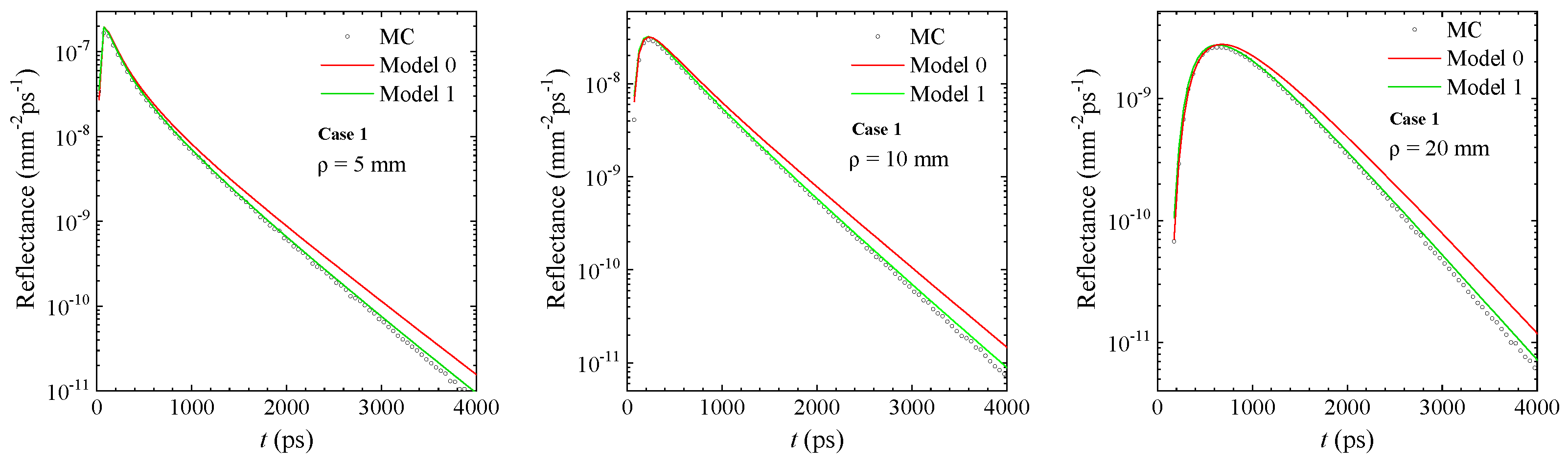
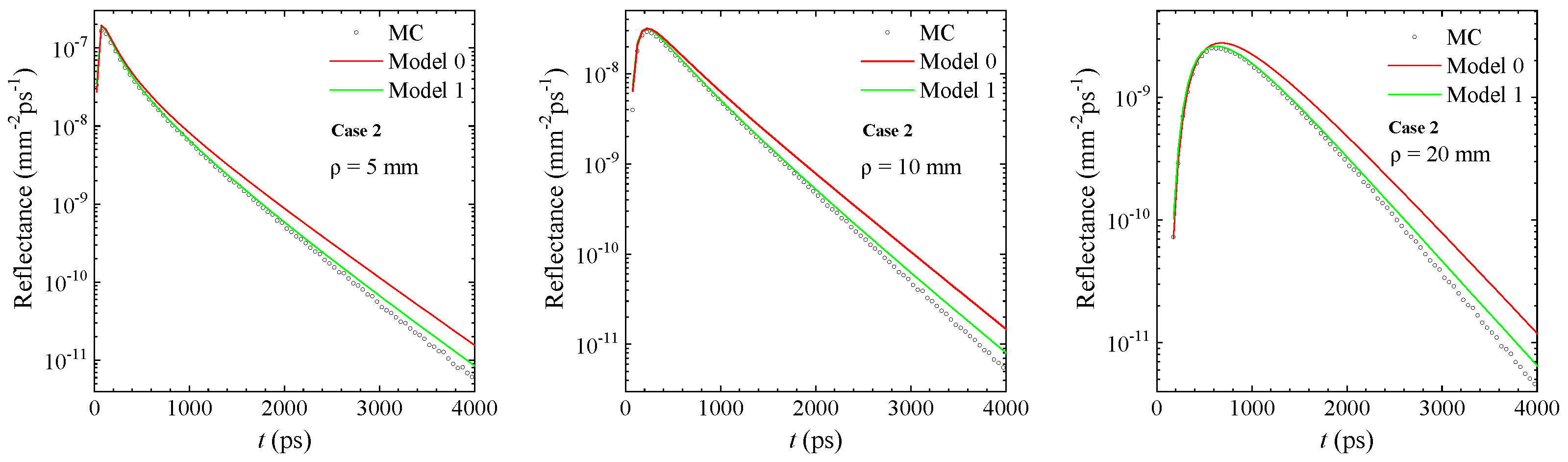
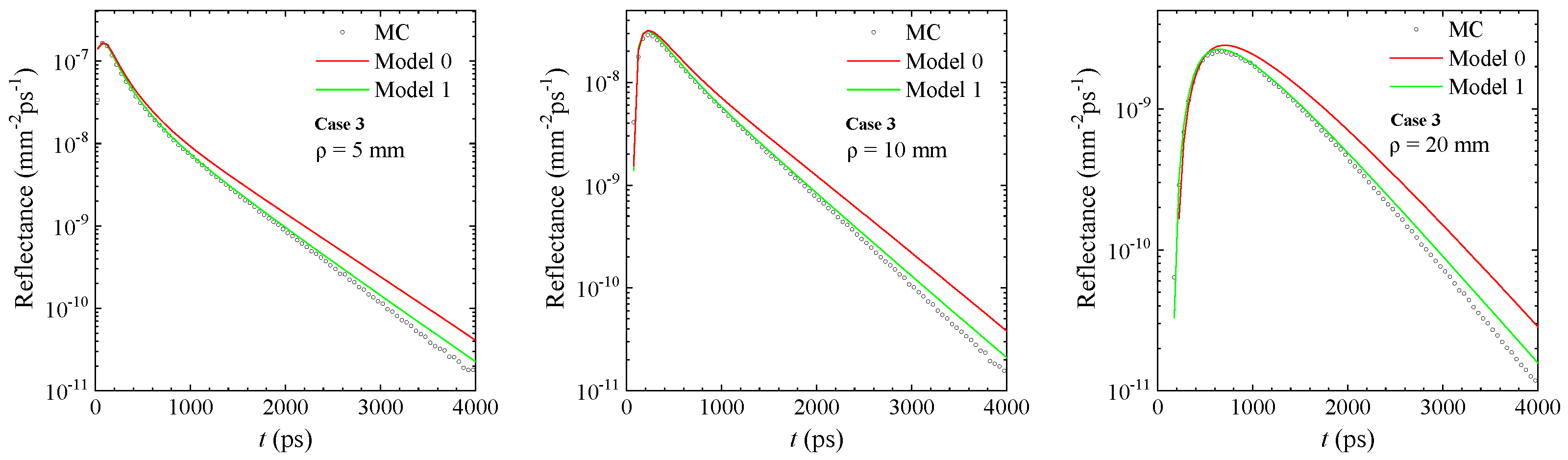
Figure 2 and
Figure 3, the considered optical properties at
were typical of muscle with a subcutaneous fat layer and the first layer thickness used (15 mm) can be a typical value for the fat layer. At
, a reduction in scattering of 10% was assumed in the layers, as well as increases in absorption of 30% (
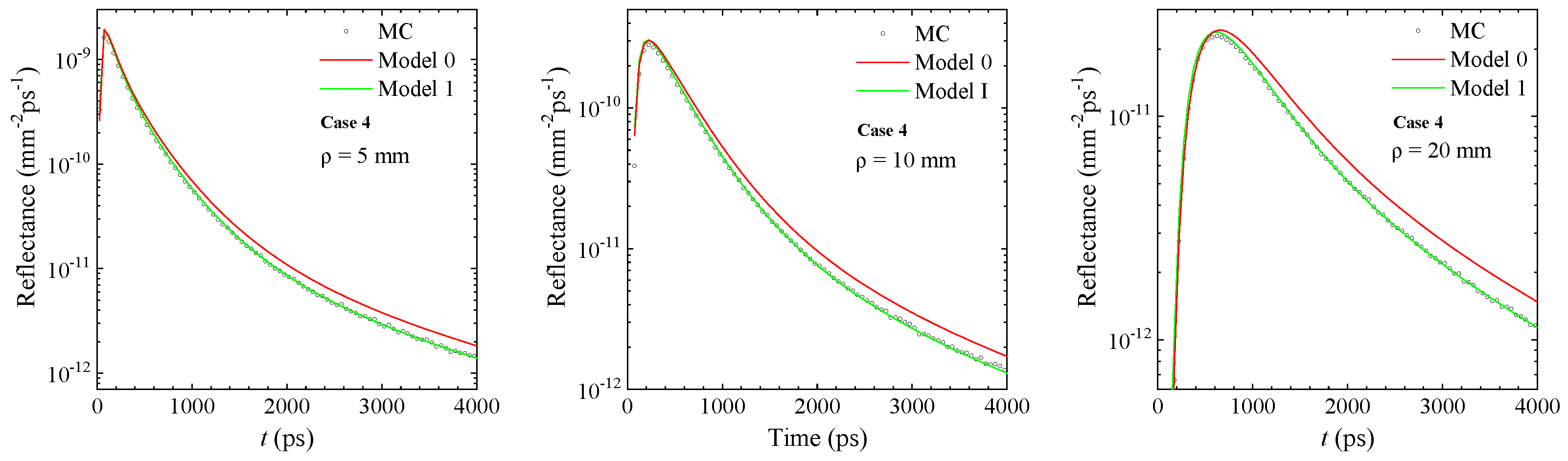
Figure 2) and 50% (
Figure 3). The difference in accuracy between the two models is evident at both short and long distances, particularly at late times. In these two figures, the improvement of “Model 1” over “Model 0” is largely evident. However, given its heuristic nature, “Model 1” is also notably lacking at late times.
Figure 4 shows results similar to those of
Figure 3; however, they refer to a higher scattering in the second layer
mm
−1, which can be linked to in vivo measurements of the chest, above the lungs [
25]. The different combination of scattering does not alter the quality of the comparison between models and MC results, which are shown to be very close to that observed above. This confirms that the two-layer solution of “Model 1” can correctly account for the dependence of the Raman signal from the optical properties at
and
, which is missing in “Model 0”.
In
Figure 5, we finally have a case with absorption in the first layer being higher than in the second layer, for which the “Model 1” almost matches the MC results. Similar results were obtained for other values of
, such as 15 mm, and of
, such as 5 and 10 mm.
The proposed “Model 1” performs robustly but exhibits reduced accuracy at late times. It can be seen that the reduced accuracy at late times increases with the increase in the difference of optical properties at
and
, as can be visually seen by comparing the results of Case 1 and Case 2. We can argue that the difference in the optical properties at
and
influences the validity of the hypothesis employed to obtain “Model 1”, i.e., Equation (
5). To understand and explain this fact, we must go back to the hypothesis on which it is based, i.e., on the heuristic assumption of Equation (
5). The validity of this hypothesis is strictly subordinate to having an average generation time for each Raman signal detected at time
t,
, equal to
. Under this condition, half of the light propagation of the detected Raman signal is determined with the optical properties at
and the other half with the optical properties at
, and this is what Equation (
5) synthetically expresses. In reality, this is only an approximation, whose validity depends on the optical properties of the two layers at
and
. It is also important to point out that “Model 1” can only be used for sufficiently low values of
and
, which is naturally satisfied since the spontaneous Raman scattering coefficient is usually lower than
mm
−1. The MC results have shown that for
mm
−1, the condition for representing the Raman fluence rate as a first-order approximation is well verified.
4. Discussion
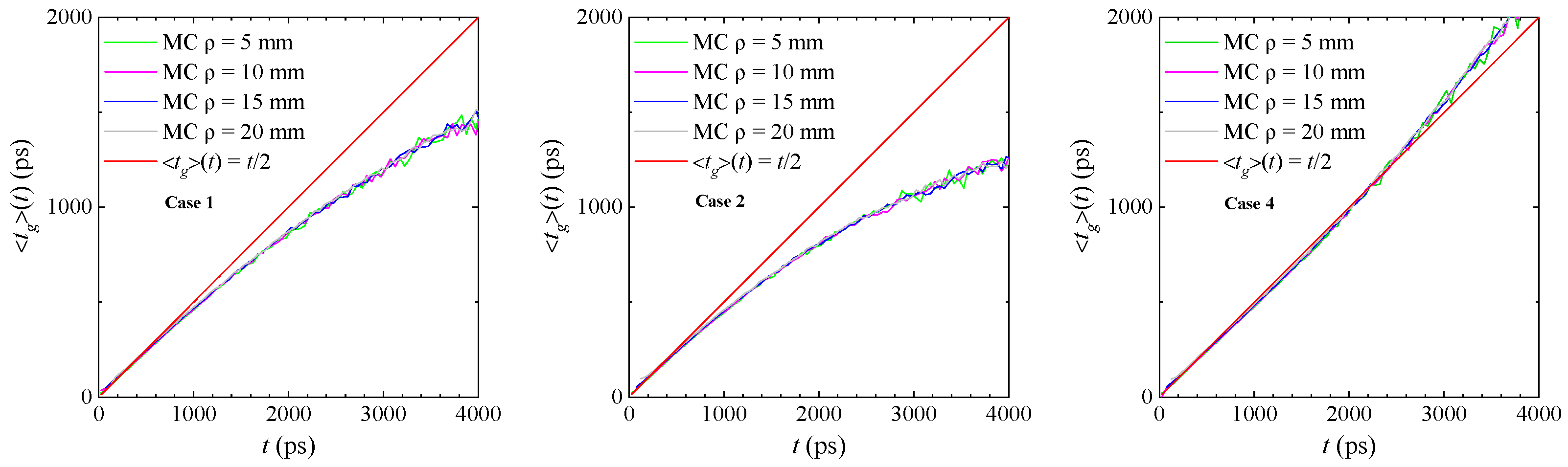
To better understand the validity of the heuristic approximation underlying “Model 1”, in
Figure 6, by means of MC simulations, the average generation time of the emitted Raman photons
is plotted as a function of time, along with the behavior hypothesized by the model for Cases 1, 2 and 4. The figure highlights that the heuristic hypothesis of “Model 1” holds exactly at early times, while at later times, a clear deviation emerges between the expected behavior
and the actual behavior from the MC simulations.
Furthermore, a direct correlation exists between the model’s accuracy and the deviation, at each detection time
t, in the model assumption
from the actual
obtained from MC simulations. For instance, in Case 2, where larger discrepancies arise between “Model 1” and MC simulations at late times (
Figure 3), we also observe greater deviations between MC-derived
and
. On the contrary, in Case 4 (
Figure 5), where “Model 1” closely matches MC simulations even at late times, the differences between the MC-derived
and
remain small. More importantly, the results of the figure confirm the previous observation that the validity of the hypothesis
depends on the difference in the optical properties between
and
. In fact, Case 2, which has a larger absorption difference (between
and
), shows a larger deviation from the hypothesis made compared to Cases 1 and 4, which have a lower absorption difference.
These observations clarify the underlying effect and suggest a viable approach for model improvement: implementing a late-time correction to “Model 1” proportional to the deviation in the actual
from
. It is also very important to note that this behavior is independent of the source–detector distance
considered, as we see in
Figure 6. This result is in agreement with the features of the proposed model and with what we can reasonably expect from the migration of photons through a layered medium. In fact,
depends on the two probability terms of having Raman-generated photons in the two layers, i.e.,
and
. Previous studies have shown that in the diffusive regime and in a two-layer medium,
and
weakly depend on
[
26]; thus, the results of
Figure 6 fall completely within this frame.
Finally, we utilized the MC simulation values of
to refine and implement the final version of our proposed model.
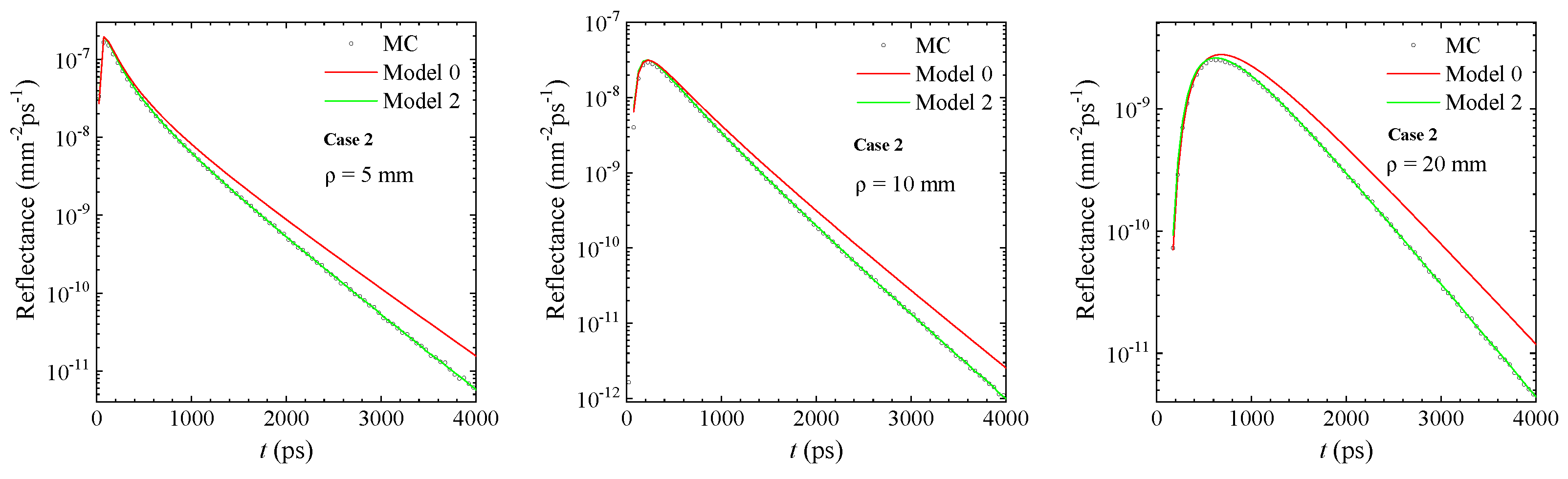
Figure 7 presents the recalculated comparison of Case 2, where “Model 1” now incorporates the exact generation time
obtained from MC simulations instead of using the
approximation, denoted as “Model 2”. This approach effectively calculates the Raman fluence rate at
,
, using the fractions of time
t spent by the detected photons at
in their previous propagation, respectively, at
and
, as
The results in
Figure 7 obtained using Equation (
7) demonstrate that the late-time discrepancy between the model and MC simulations is completely resolved with this correction. It is also important to emphasize how the agreement between the model and MC results remains surprisingly good for the distance of
mm as well, for which one could expect a lower performance from the DE. This is because in the time-domain, what really matters in the validity of the diffusion approximation is only the observation time rather than the distance from the source. The same approach used here to generate the data of Figure
7 works exceptionally well for all other studied cases, confirming that Equation (
7) provides a complete and optimal description of Raman light propagation through a layered diffusive medium. In the future, we aim to derive an analytical expression for
as the final step in refining “Model 2”. However, it is worth noting that evaluating
via MC simulations is both fast and straightforward, as it can be obtained using an arbitrarily large detector, since
is independent of the source–detector distance
.
The proposed solver “Model 1” for the Raman TD signal (
5) is, in terms of computational cost, approximately equivalent to computing the DE solution twice for a two-layer medium used to obtain the solution of Equation (
5) [
11,
27] and thus about twice “Model 0”, which was already used in the inverse reconstruction of Raman spectra [
17], thus demonstrating its suitability for this purpose. For a better overview of the performance of the different models shown in the previous figures, in
Table 2, we report the main characteristics of each model for approximation and calculation times. The computation time of “Model 1”, since it includes the calculation of the two-layer DE solution at both
and
, is roughly twice the computation time of “Model 0”, and for a whole temporal profile, it is about 1 s with a CPU Intel i7-12650h. The computation time to reproduce the same temporal profiles with MC simulations is about 280 times larger using an NVIDIA GEFORCE RTX3080 Ti 12Gb. “Model 2”, compared to “Model 1”, requires further evaluation of the prior information on
, which is achieved through a single MC simulation. By exploiting the fact that in the diffusive regime,
is independent of the source–detector distance
, we can run the MC simulation with a very large detector and a few thousands of trajectories are enough for a reasonable estimate of
. So, calculating this information is very fast. For this reason, the computation time of “Model 2” is of the order of a few seconds compared to “Model 1”.
The modeling proposed here for the TD Raman signal also has some implications for applications involving fluorescence, both for steady state and TD sources, given the high similarities between the two phenomena. It is also straightforward to implement this kind of model for fluorescence calculations in the TD by replacing the Raman scattering coefficients with the fluorescence absorption coefficients and introducing the related decay time of the fluorophores. Thus, given the order of magnitude of the absorption term in fluorescence, which is usually much higher than the usual values of the Raman scattering coefficient, the same approximations for Raman may not be valid for fluorescence emission. Thus, we may expect that the Taylor expansion to the first order is not enough to obtain a correct representation of the signal. In the case of fluorescence, it may therefore be necessary to introduce higher-order terms to represent the probability
in Equation (
5). The complete expression of
is as follows [
17]:
with
as the probability density function of the photons spending a time duration of
in the first layer. For the fluorescence calculation, coefficients
and
must be replaced with the correspondent absorption coefficients of the fluorophores in the layers and the quantum efficiency of the fluorophores should also be included [
11,
21]. The present “Model 1” and “Model 2” are obtained by expanding the exponential obtained for
(Equation (
8)) to the first order. For fluorescence calculations, one might consequently suggest deriving a second-order expression, which can be obtained by expanding the exponential term in the integral of Equation (
8) up to the second order. The implementation of this part of the modeling is beyond the scope of this work. As for the use of the presented “Model 1” for fluorescence calculations, this is possible as long as the value of the absorption coefficient of the fluorophore is lower than
mm
−1.
The described models pertain to a pencil light beam impinging over the considered medium. In most cases, this is enough to describe real laser sources. The working hypothesis for a real beam would be that it is spatially incoherent and that scattering from one pencil beam will not coherently interfere with that from another pencil beam. This assumption is well justified in a regime of multiple scatterings due to the effects of scattering events (for some insights into a real beam source, see Equation 5.57 in Section 5.3.1 of [
11]).



 ,
,