Review

Recent Advanced Photodetectors Coupling Optical Structure

School of Optics and Photonics, Beijing Institute of Technology, Beijing 100081, China
*
Author to whom correspondence should be addressed.
Photonics 2025, 12(11), 1096; https://doi.org/10.3390/photonics12111096
Submission received: 29 September 2025 / Revised: 27 October 2025 / Accepted: 3 November 2025 / Published: 7 November 2025
(This article belongs to the Special Issue Organic Photodetectors, Displays, and Upconverters)

Abstract

Photodetectors are critical components in a wide range of applications, including military, communications, medical, and aerospace fields. With ongoing advancements in optoelectronics, the strategy of integrating multiple optical structures with photodetectors has led to substantial improvements in detection performance. This review summarizes recent research progress in optically coupled photodetectors, providing a systematic analysis of the operational mechanisms and performance characteristics of five key coupling configurations: optical waveguides, surface plasmon resonance structures, microcavities, gratings, and integrated metasurfaces. Furthermore, the main limitations of current coupling technologies and challenges facing the development of future coupled devices are discussed. Recent studies indicate that heterogeneous integration, multi-physical field coupling, and automated fabrication processes are paving the way for high-performance photodetectors with enhanced bandwidth, sensitivity, functional integration, and spectral control capabilities.

1. Introduction

As a fundamental element in optoelectronics, photodetectors are extensively utilized across diverse fields such as communications [1], military systems [2], autonomous road detection and recognition [3,4], intelligent healthcare [5,6], and night vision systems [7]. They remain a central focus of ongoing research. In essence, photodetectors function by capturing incident light signals that induce electronic state transitions within specific materials, thereby converting radiation energy into electrical signals for applications including detection, control, and imaging. With the continuous advancement of societal productivity, there has been an increasing demand for enhanced photodetector performance—particularly regarding sensitivity, detection speed, cost-effectiveness, flexibility, and integrability [8]. Recent developments involving coupling structures have introduced multidimensional approaches to improve the performance of photodetectors.
With the exponential growth of optical information data in both industrial production and daily life, traditional photodetectors are increasingly unable to satisfy the growing demands for high-speed acquisition and processing of complex optical information. A key factor underlying this limitation is the difficulty in efficiently delivering incident optical signals to the detector’s active region; transmission losses arising in this process restrict the optical coupling efficiency. To address this constraint, researchers have proposed integrating optical waveguide structures with detectors. By focusing and guiding optical signals through such waveguide structures, the signals become more concentrated when reaching the detector’s photosensitive region, thereby enhancing detection sensitivity. Furthermore, waveguide structures enable efficient focusing of optical signals, facilitating the development of more compact and easily integrable detectors—a critical requirement for the design of high-density photonic integrated circuits [9,10].
In essence, a photodetector is a device that detects incident optical radiation and converts optical signals into electrical signals. While waveguide coupling enhances the device’s light absorption by focusing and guiding optical signals, traditional planar photodetectors exhibit poor capability in capturing light, which restricts their practical applications. Surface plasmon resonance (SPR) relies on electromagnetic oscillations at the metal–dielectric interface, enabling rapid enhancement of electric field strength at the nanoscale, generation of more electron-hole pairs, and excellent performance in capturing light. In device structure design, adjusting parameters such as the thickness, material, and dielectric environment of the metal layer allows tuning of the SPR wavelength, thereby regulating the absorption band [11,12].
With the advancement of application fields such as spectral analysis, sensor technologies, and communication systems, there is a growing demand for narrowband photodetectors capable of accurately measuring light at specific wavelengths. In recent years, researchers have proposed diverse strategies, including the utilization of narrowband absorbing materials, plasmonic resonance effects, and optical microcavities, among others. Currently, most of these strategies are confined to realizing narrowband detection at specific wavelengths. For instance, narrowband absorption is contingent upon the intrinsic absorption properties of semiconductors, while plasmonic resonance effects are constrained by nanoparticles. In contrast, photodetectors integrated with coupled microcavity structures exhibit superior spectral selectivity. Tuning the thickness of the spacer layer and mirror layer in the optical microcavity enables precise control over its transmission spectrum, thereby achieving adjustable detection of central wavelengths. Meanwhile, coupling optical microcavities with specific spectral selectivity to photodetectors can effectively regulate the spectral response range of the latter, endowing them with enhanced sensitivity and efficiency within a targeted wavelength range. This advantage renders microcavity-coupled photodetectors with broader application prospects in fields requiring precise spectral responses, such as ultraviolet detection [13,14].
The high Q-factor (quality factor, a key parameter characterizing the degree of energy loss in a resonant system, indicates that the higher the Q value, the smaller the energy loss and the narrower the resonant peak) of microcavities confers enhancement effects within an extremely narrow spectral range, enabling detectors to achieve high-precision measurements and high-resolution detection at specific wavelengths. An effective strategy for selective detection of light across a broad spectral range involves the incorporation of grating structures. Grating-coupled photodetectors leverage the diffraction properties of grating structures for optical signal selection and modulation. Tuning grating parameters allows selective detection of optical signals at different wavelengths, enabling grating structures to efficiently process broadband optical signals and enhance the detector’s spectral response capability [15]. Such structures find extensive application in domains including spectrometers, optical communication systems, and environmental monitoring. In practical scenarios, coupling strategies involving different optical structures are frequently combined based on specific application requirements to substantially enhance detection performance.
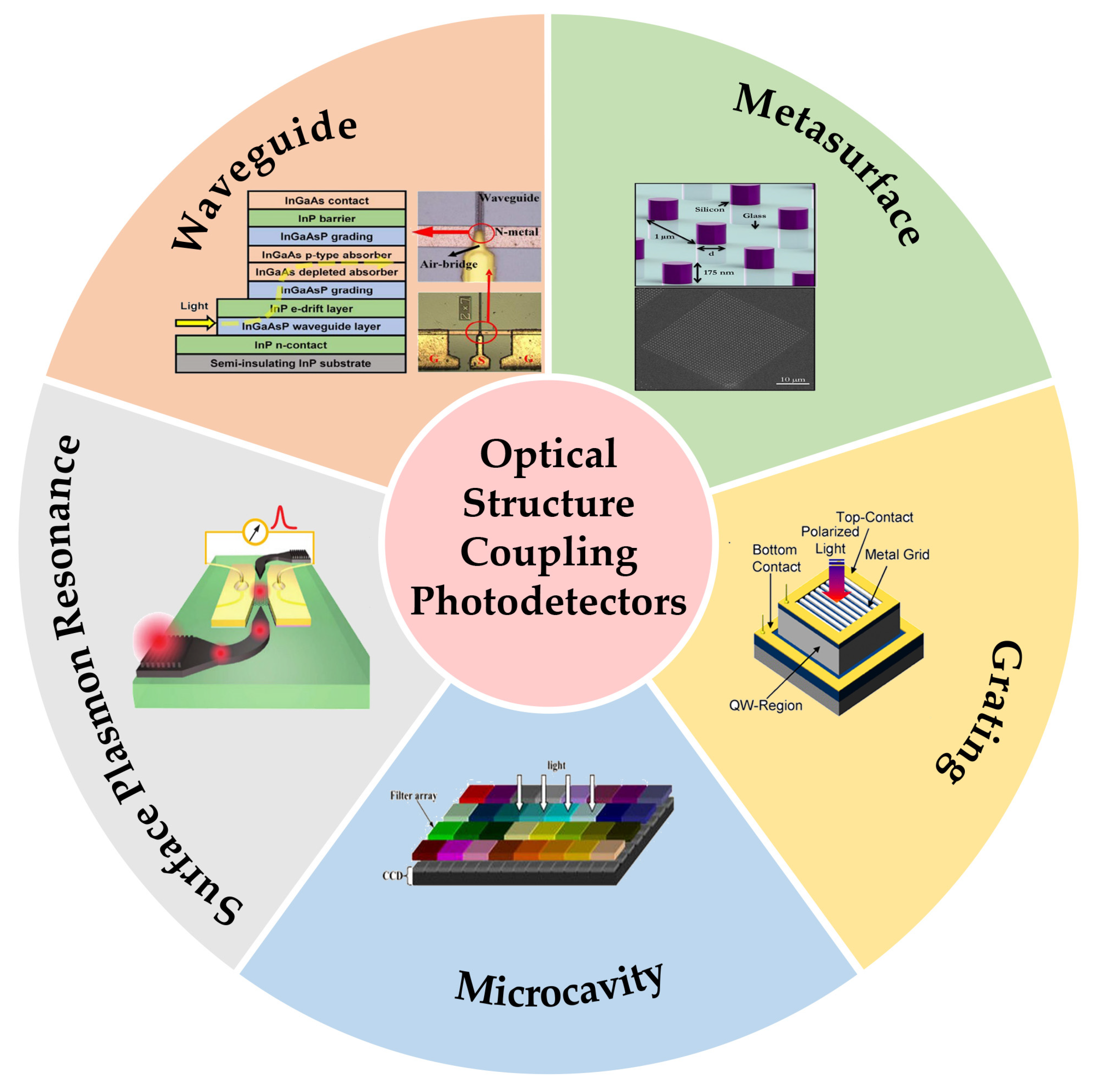
This review summarizes recent advances in optical structure-coupled photodetectors, with a focus on coupling schemes that have substantially enhanced device performance. The fundamental structures and operating mechanisms of each strategy are elucidated, alongside detailed discussions of research progress in various coupling platforms. Emerging trends—including heterogeneous integration, multi-physics coupling, and automated fabrication processes—are highlighted. Finally, future development directions for coupled photodetector technologies are outlined. An overview of the progress in optical structure-coupled photodetectors is presented in Figure 1.

2. The Key Parameters of Photodetector Performance

The core objective of the above-mentioned various optical structure coupling strategies is to optimize the inherent trade-offs among key performance indicators such as response rate, bandwidth, and spectral selectivity of photodetectors. To accurately assess the effectiveness of these strategies, it is first necessary to clearly define the core parameters and evaluation criteria for measuring device performance. The following is a brief introduction to the main performance indicators of photodetectors.
The spectral response of a photodetector refers to the detector’s response capability under the irradiation of light of different wavelengths, which is usually expressed by spectral responsivity.
The responsivity of a photodetector, also known as its sensitivity, is a parameter for determining the detector’s photoelectric conversion capability, defined as the ratio of the detector’s photocurrent (or photovoltage) to the incident light power.
The unit of responsiveness is V/W or A/W, and it is expressed as [16]:
R i = d I S d P = I S P ;   R V = d V S d P = V S P
where ℜi and ℜV are the current and voltage responsivity, IS and vs. are the measured detector photocurrent and photovoltage, and P is the incident optical power.
External Quantum Efficiency (EQE) describes the sensitivity characteristics of a photodetector from a microscopic perspective, representing the ratio of the number of photons absorbed by the detector to the number of excited electrons, which is expressed as:
η = h c e λ R
where c represents the speed of light in the material, and λ is the detection wavelength.
Noise equivalent power (NEP) is the incident power when the light signal generated by the photodetector is equal to the noise, and it can also be expressed as the incident light power when the signal-to-noise ratio (SNR) is 1. Calculate through the following formula:
N E P = V n P V = I n P I
The smaller the NEP, the stronger the detector’s ability to detect weak signals.
The reciprocal of NEP is defined as the detectivity (D*), and the higher the D*, the stronger the detection capability. Since the NEP of the detector is proportional to the measurement bandwidth Δf, the noise current is proportional to (Δf)1/2, and the detector signal is proportional to the detector area Ad. Therefore, the detection sensitivity is A function of the measurement bandwidth and the detector area, and D is proportional to (AΔf)−1/2. The detection capability of the detector is expressed by the D*, which is defined as [17]:
D * = D A Δ f = A Δ f I n R = A Δ f I n I S P
where D* is defined as the output signal-to-noise ratio generated by the unit incident power per unit area of the detector when the unit noise equivalent bandwidth is reached, with the unit being Jones (cm Hz1/2W−1).

3. Types of Optical Structure Coupling Photodetectors

Based on the evaluation framework of the above performance parameters, the following text will systematically disassemble the design logic of different optical coupling structures and analyze how each strategy breaks through specific performance trade-off bottlenecks (such as the constraints of response rate and bandwidth, the contradiction between narrowband response and tunability, etc.) through structural innovation.

3.1. Optical Waveguide-Coupled Photodetector

Key performance metrics for evaluating photodetectors in practical applications include responsivity, dark current, and 3 dB bandwidth, among which the 3 dB bandwidth determines the device’s maximum response speed. To enhance the 3 dB bandwidth of photodetectors, the primary approach is to mitigate limitations imposed by the carrier transit time-limited bandwidth (fT)) and the resistance-capacitance (RC)-limited bandwidth (fRC) [18]. This is typically achieved through device design optimizations such as reducing the width of the intrinsic region, shrinking device dimensions, and minimizing junction capacitance. However, such strategies often lead to insufficient light absorption, thereby decreasing responsivity. Thus, resolving the trade-off between responsivity and bandwidth remains a critical research focus. In traditional normal-incidence detectors, the incident light direction is parallel to the photocarrier transport direction, exacerbating the responsivity-bandwidth trade-off. In contrast, waveguide-coupled detectors separate the photon absorption path from the photocarrier transport path (perpendicular to each other), effectively alleviating this trade-off while facilitating on-chip integration [19,20].
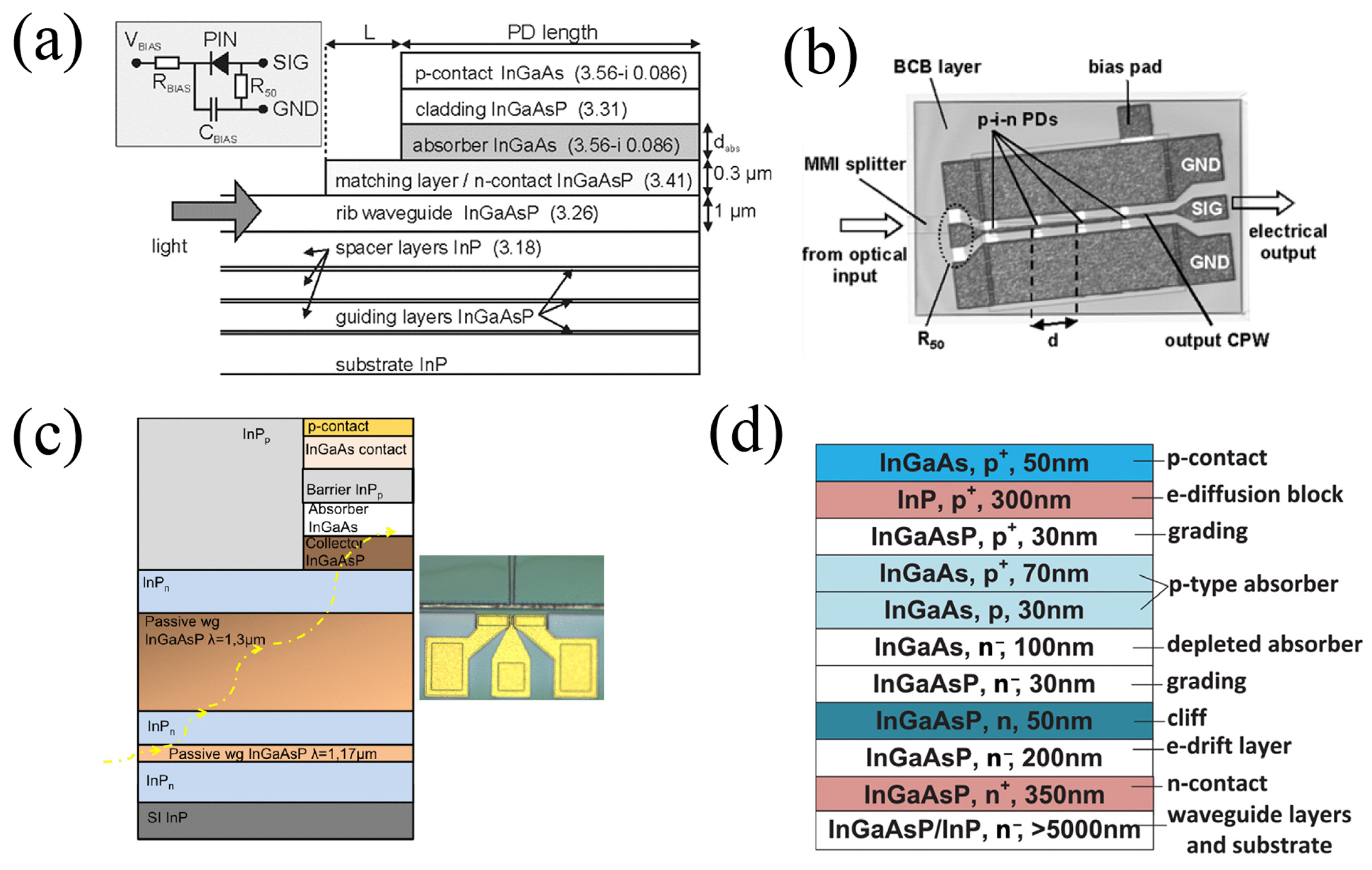
In 2005, Beling et al. [21] developed a miniaturized waveguide-integrated p-i-n photodetector with a 120 GHz bandwidth and high responsivity. The design included a 5 × 7 μm2 active region and an extended optical matching layer fed by a single-mode waveguide (Figure 2a). Optimizing the optical matching layer significantly improved external responsivity to 0.51 A/W, while reducing p-n capacitance yielded a 3 dB bandwidth of 120 GHz (46 GHz under a 25-μm effective load). In 2007, the same group [22] proposed a periodic parallel-fed traveling-wave photodetector (TWPD) based on a p-i-n structure, achieving impedance matching to a 50 Ω environment via monolithic integration of a power divider (Figure 2b). The photodetector (PD) featured an optimized optical matching layer and a 4 μm × 7 μm active area, delivering a 145 GHz bandwidth. However, a TWPD with an integrated 5 μm × 20 μm active area exhibited a reduced 85 GHz bandwidth. This work demonstrated that TWPDs could output +10.3 dBm at 10 GHz and outperform discrete PDs at 110 GHz.
In waveguide-coupled photodetectors, the uni-traveling carrier (UTC) waveguide photodiodes are adopted to address the bandwidth limitation and performance degradation of traditional small-sized InP-based p-i-n photodetectors caused by slow hole transit time and potential electric field shielding from hole accumulation, as the structure proposed by Davis et al. [23] decouples electron and hole transport, making electron transit time the sole determinant of carrier transport bandwidth to boost device performance. In 2014, Anagnosti et al. [24] reported a high-speed Uni-Traveling-Carrier photodiode (UTCPD) suitable for 100 Gbit/s operation, with −4 dBm output power at 100 GHz (Figure 2c). Researchers have optimized and improved the UTC structure, proposing a modified uni-traveling carrier (MUTC) structure. In 2017, Zhou et al. [25] fabricated a waveguide-coupled high-speed detector on a 3-inch semi-insulating InP substrate using metal–organic vapor phase epitaxy (MOVPE). As shown in Figure 2d, the device employed gradient-doped InGaAs in the absorption region, where the built-in electric field converts photoelectron diffusion into drift motion, accelerating transport in the non-depleted absorber and reducing transit time.
Figure 2. (a) Schematic cross-sectional diagram of PD and a circuit integrated on a chip [21]. (b) Schematic diagram of the structure of a periodic parallel fed traveling wave photodetector (TWPD) [22]. (c) Epitaxial structure and UTC top view [24]. (d) Schematic diagram of MUTC structure [25].
Photonics 12 01096 g002
Since detectors are inherently capacitive, bandwidth can be enhanced by inductive compensation at specific frequencies. Based on the MUTC structure, Wang et al. [26] proposed an inverted evanescently coupled waveguide modified uni-traveling-carrier photodiode (IECWG MUTC-PD) in 2021, achieving a 71.9 GHz 3 dB bandwidth and 0.59 A/W responsivity. In 2023, Li et al. [27] introduced inductive waveguide coupling via optimized high-impedance coplanar waveguides (CPWs), realizing a 130 GHz 3 dB bandwidth with 0.12 A/W responsivity. In 2024, the same group [28] reduced parasitic capacitance by introducing benzocyclobutene (BCB) under the PD electrode, enabling 2 × 7 μm2 and 2 × 10 μm2 devices to achieve above 220 GHz 3 dB bandwidth.
In recent years, waveguide-coupled photodetectors have made remarkable progress in pursuing higher bandwidth and responsivity. In 2025, Chen Bailuo’s group from ShanghaiTech University reported a 230 GHz bandwidth improved MUTC-PD based on a thin-film lithium niobate (TFLN) waveguide platform at OFC2025 [29]. This work achieved the first heterogeneous integration of MUTC-PD on the TFLN waveguide platform. By adopting an ultra-thin BCB adhesive bonding process and a dual-matching layer structure, the optical mode mismatch between lithium niobate and InGaAs absorption layers has been effectively alleviated, achieving rapid absorption within a 7 μm device length. The device’s internal responsiveness reaches 0.51 A/W, and the 3 dB bandwidth is as high as 230 GHz. It represents the best performance of photodetectors under the current TFLN platform. This research provides key support for the on-chip THz source system integrating modulation, detection, and emission.
Another work reported by the same research group demonstrated a waveguide MUTC-PD suitable for the dual bands of 1310 nm and 1550 nm [30], targeting the application requirements of high-speed interconnection systems exceeding 200 GHz. This device achieves a responsivity of 0.52 A/W in the 1550 nm band and maintains a responsivity of 0.35 A/W in the 1310 nm band. Under the conditions of −1 V bias and 3 mA photocurrent, the 3 dB bandwidth exceeds 170 GHz, and it realizes an output power of 0.77 dBm at the 160 GHz frequency point. It has excellent linearity and saturation performance. Table 1 summarizes the main performance parameters of the optical waveguide-coupled photodetector.

3.2. Surface Plasmon Resonance (SPR)-Coupled Photodetector

Optical waveguide coupling effectively alleviates the trade-off between response rate and bandwidth through path separation, but there is still room for improvement in enhancing weak light capture capability and linear light absorption efficiency. The SPR coupling strategy specifically addresses this performance shortcoming through the local field enhancement effect at the nanoscale.
SPR refers to resonant electromagnetic oscillations arising from interactions between free electrons and optical fields at metal–dielectric interfaces [31,32]. It enhances light absorption [33] through local SPR at the metal–dielectric interface, thereby improving the signal quality of the detector. Precious metal materials such as gold, silver, copper, and platinum can excite SPR effects [34,35,36]. A core advantage of SPR coupling is that through the local field enhancement of the nanoscale metal structure, light energy is concentrated in the active region of the detector and thereby transcends the traditional limitations imposed by material thickness and enhancing absorption.
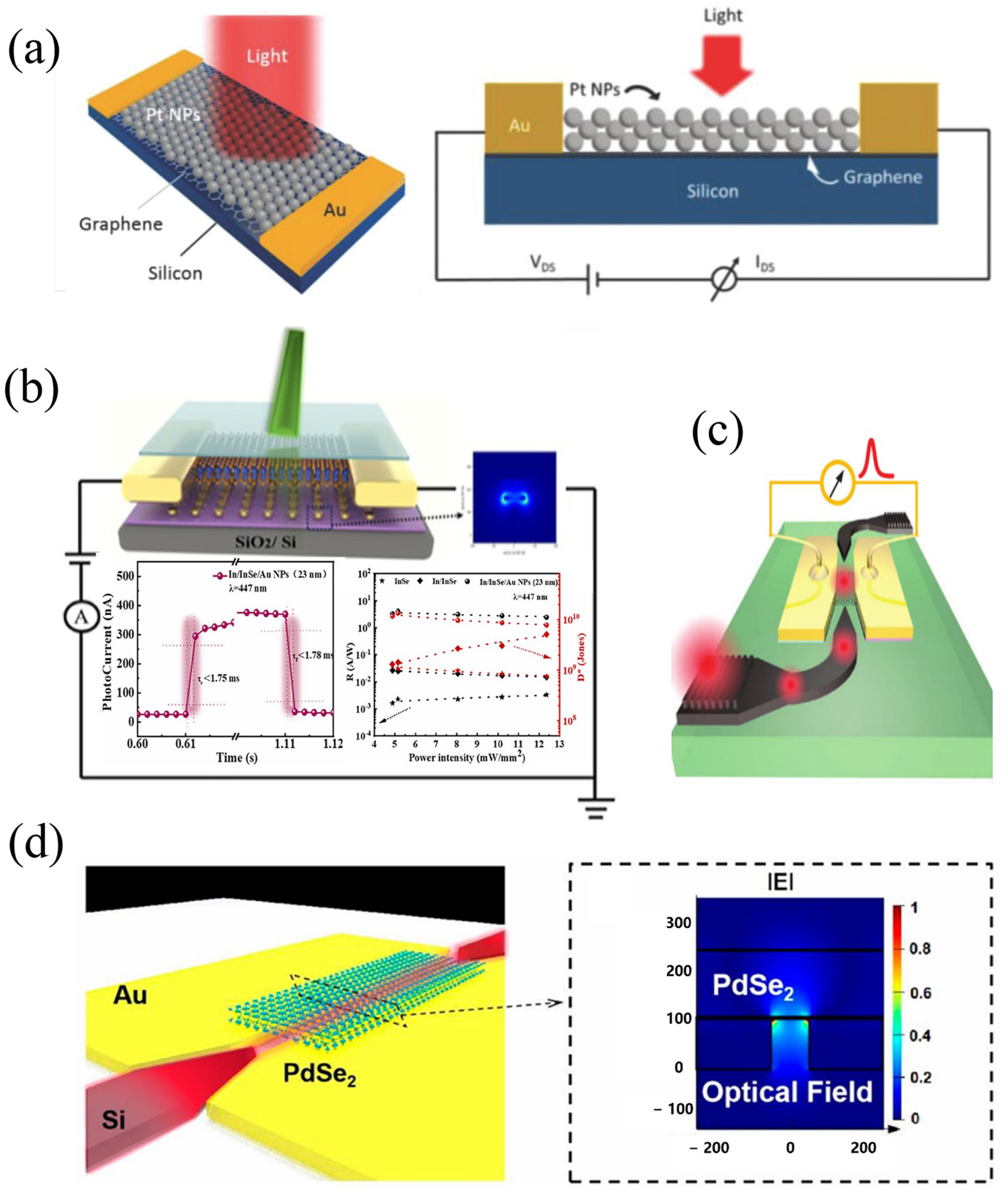
In 2018, Hu et al. [34] introduced platinum nanoparticles (Pt NPs) into graphene/silicon (Gr/Si) photodetectors to induce plasmon resonance (Figure 3a), enhancing light absorption, broadening the absorption spectrum, and leveraging the Gr/Si heterojunction’s built-in electric field to promote electron-hole pair generation and separation, improving response speed. Responsivity reached 1.68 × 10⁷ A/W, with a 180 ns response time due to low interface trap density. In 2019, Li et al. [35] used Cu nanostructures to confine incident light within a ZnO photosensitive layer, enhancing plasmon resonance and charge carrier transport. Under 0.62 mW/cm2 ultraviolet irradiation and 10 V bias, photocurrent and responsivity increased to 2.26 mA and 234 A/W, respectively. In 2024, Li et al. [36] enhanced InSe photodetector performance via SPR in gold nanoparticle (Au NP) arrays. Combined with surface engineering (20 nm In layer deposition on InSe), local photon-electron resonance at metal nanoparticles significantly boosted light absorption (Figure 3b). The In/InSe/Au NP based photodetector has a responsivity of 15.2 A/W, which is an improvement of 3 and 4 orders of magnitude compared to In/InSe photodetectors and InSe photodetectors, respectively. The response speed reaches 1.75 ms, which is three orders of magnitude faster than InSe photodetectors.
In addition, the SPR effect is often combined with optical waveguide-coupled detectors to improve the responsiveness and sensitivity of the device. In 2019, Ding et al. [37] reported a waveguide-coupled graphene plasmonic photodetector. The schematic diagram of the device structure is shown in Figure 3c. The device has a bandwidth of over 110 GHz and a responsivity of 360 mA/W. Two asymmetric Au (90 nm)/Pd (5 nm) and Au (90 nm)/Ti (5 nm) metal electrodes are in contact to form a plasma gap waveguide. The narrow gap of 120 nm between the electrodes shortens the drift path of charge carriers, allowing them to quickly transition. At the same time, the built-in electric field covered in the 120 nm narrow gap effectively separates photogenerated charge carriers, improving the device response speed. In 2023, Jian et al. [38] reported a PbSe2 plasmonic waveguide-integrated photodetector with 17.5 GHz bandwidth and 560.1 mA/W responsivity. A 100 nm slot waveguide provided narrow carrier drift paths, enhancing sensitivity (Figure 3d).
Traditional surface plasmon resonance (SPR) enhancement strategies mostly rely on dipole resonance, making it difficult to match the energy demands of the ultraviolet band. However, high-order plasma modes are expected to solve this problem. In 2017, Wang et al. [39] reported a ZnO photodetector decorated with silver nanoparticles (NPs) for ultraviolet sensing, which selectively optimized the ultraviolet detection performance by using high-order plasma resonance. After Ag NPs modification, the dark current density of the device at a 5 V bias voltage decreased from 60 mA/cm2 to 38 mA/cm2, which was due to the depletion of surface carriers by the local Schottky junction formed by ZnO and Ag. The peak responsivity near 380 nm increased from 2.16 A/W to 2.86 A/W, while the responsivity at other wavelengths decreased significantly. The response full width at half-maximum was only about 10 nm, demonstrating excellent wavelength selectivity. The ultraviolet-visible suppression ratio (the ratio of peak responsivity to responsivity at 500 nm) is as high as 103. Table 2 summarizes the main performance parameters of the SPR-coupled photodetector.

3.3. Microcavity Photodetector

Although SPR coupling significantly enhances the light absorption efficiency, it has limitations in achieving narrowband spectral response and tunability of the central wavelength. The microcavity coupling strategy, with its interference enhancement mechanism, provides an effective solution to address the performance trade-off between band detection and wavelength tunability.
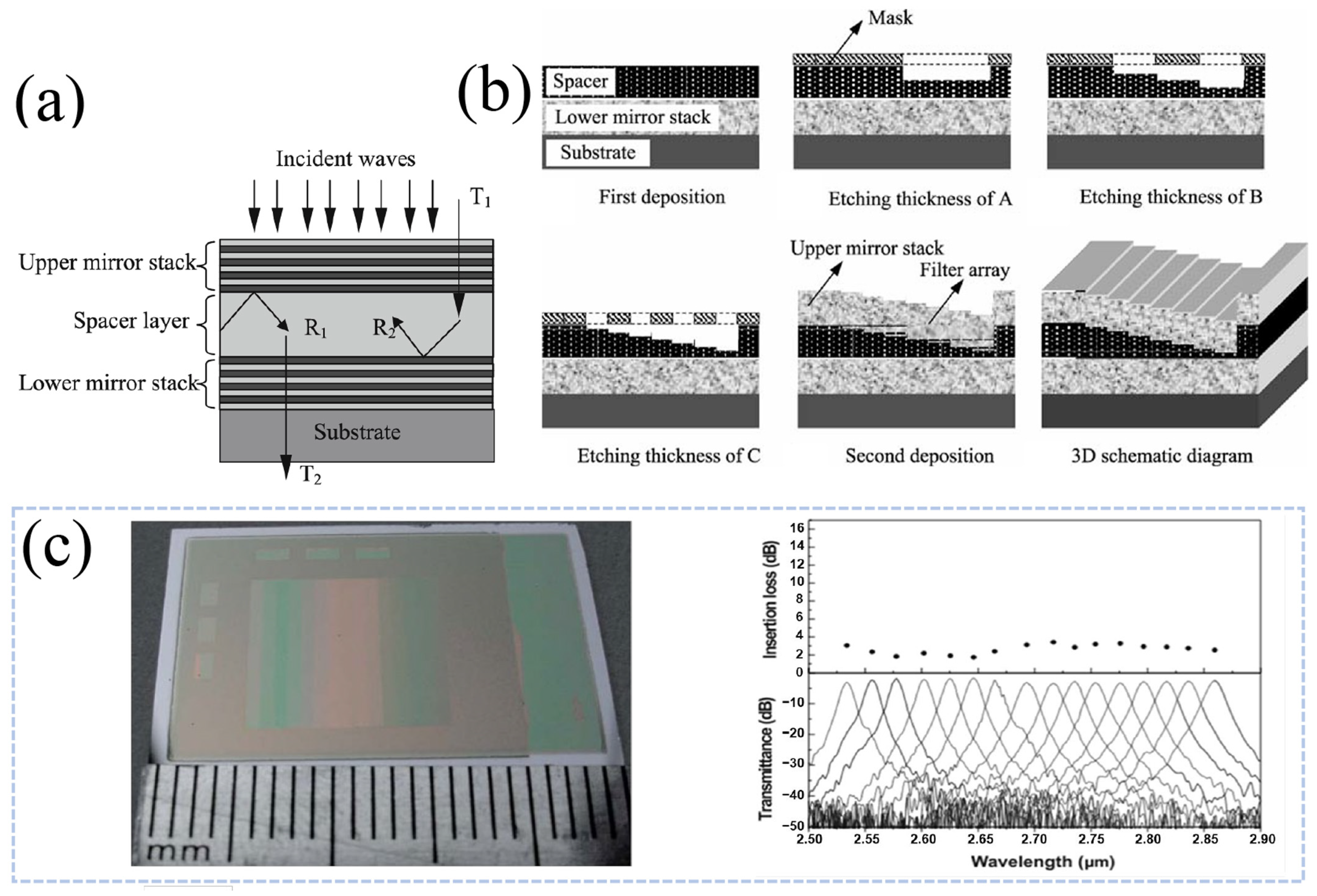
The Fabry–Pérot (F-P) microcavity is composed of two parallel mirrors and an intermediate dielectric layer. It achieves enhancement or suppression of specific wavelengths through multi-beam interference, featuring spectral selectivity and light field enhancement capabilities. It can be used for highly sensitive detection and luminescence control. This structure is mainly divided into all-dielectric type and metal-dielectric-metal (MDM) type [40]. In 1974, Wang [41] proposed the distributed Bragg reflectors (DBRs), which achieve high reflection through multi-layer dielectric films and further enhance the performance of microcavities. The F-P microcavity using DBR as the mirror is called the all-dielectric type (Figure 4a), and its low loss characteristic helps to achieve a high Q factor. Based on its spectral selection capability, multi-channel F-P microcavities have been developed for multispectral/hyperspectral detection and are widely used in spectrometers [42,43] and imaging systems [44,45].
In 2006, Wang et al. [46,47] proposed the application of a combinatorial etching technique for the fabrication of all-dielectric integrated filters in the mid-infrared and near-infrared regions. The process flow of this combinatorial etching technique is illustrated in Figure 4b, enabling the creation of a filter array with 2 N channels through N iterations of combinatorial etching. The mid-infrared all-dielectric integrated filter features 16 channels, with a passband range from 2.534 to 2.859 μm, a bandwidth of 0.013 μm, and a relative bandwidth of 0.48%. The configuration and transmittance characteristics of the 16-channel infrared integrated F-P filter are depicted in Figure 4c. In 2007, this research team [48] reported on utilizing a combinatorial etching technique to fabricate an all-dielectric integrated filter array comprising 128 channels in the near-infrared spectrum. This near-infrared all-dielectric integrated filter can be achieved through seven combined etching processes resulting in an array with 128 channels; its passband ranges from 722.0 to 880.0 nm, featuring a bandwidth of approximately 1.2 nm and a relative bandwidth of about 0.2%. In recent years, researchers have continuously refined experimental methodologies and introduced advanced techniques such as nanoimprinting [49], grayscale electron beam lithography [50,51,52], and laser direct writing [43], significantly enhancing the preparation efficiency for integrated F-P microcavities.
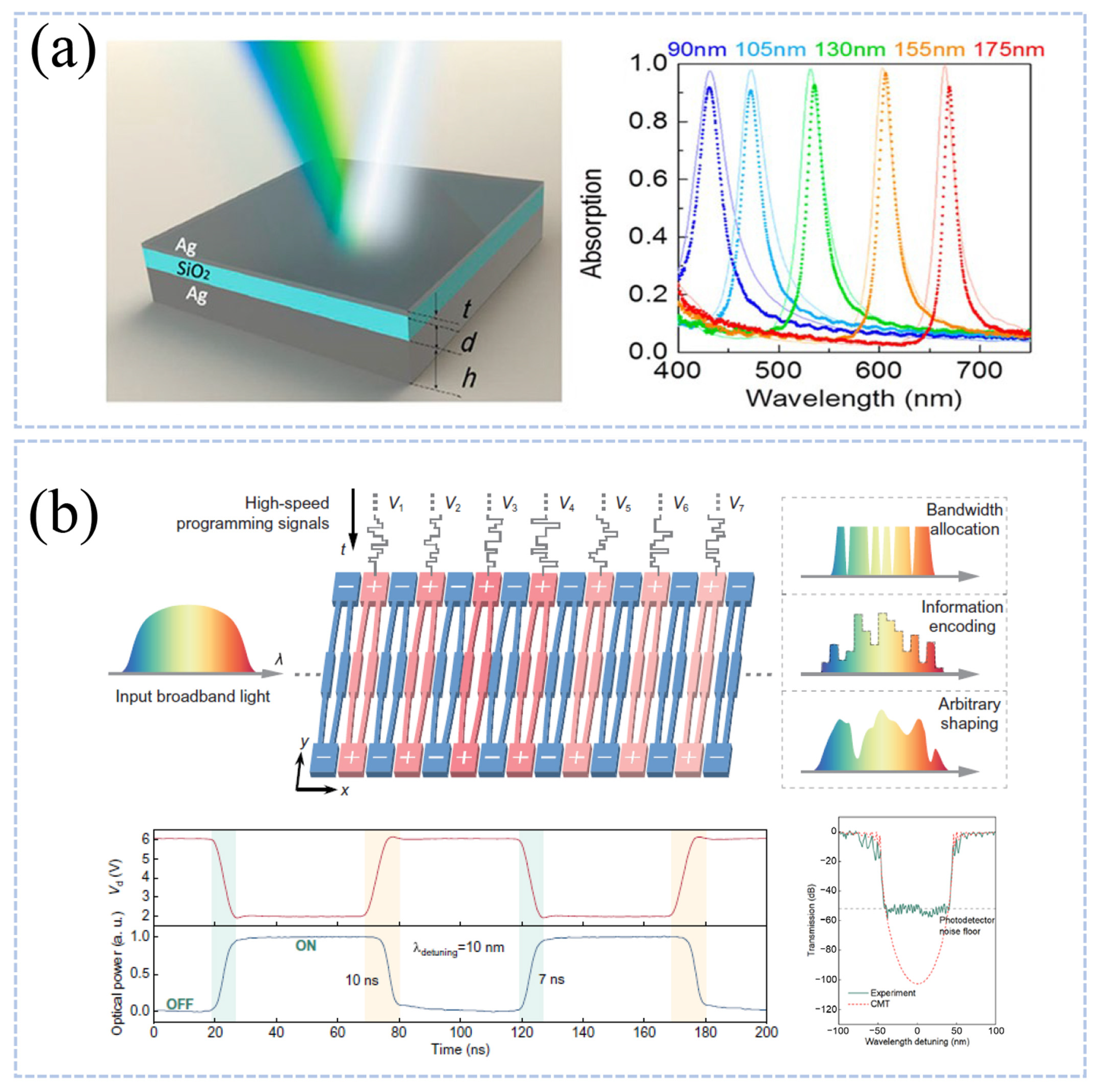
The all-dielectric F-P cavity can attain narrower transmission spectrum peak bandwidths by employing high-reflectivity distributed Bragg reflector (DBR) structures; however, due to their limited cutoff bandwidth—particularly within the visible light region—the operational capacity across wide bandwidth ranges remains constrained [52]. In 2015, Li et al. [53] reported on an F-P microcavity absorber based on a metal-insulator-metal three-layer thin film stack architecture; details regarding this device structure are shown in Figure 5a. The device is fundamentally designed as an asymmetric F-P microcavity, comprising a top metal layer (Ag), an insulating medium with minimal light transmission loss (SiO2), and a high-reflectivity metal layer whose thickness is optimized to achieve the desired optical characteristics (Ag). This internal configuration of the cavity facilitates resonance, significantly amplifying the electric field within the cavity. Consequently, this enhancement allows the top metal film to absorb a substantial portion of the optical power, thereby improving its capacity to capture optical signals. In 2022, Zhang et al. [54] reported on a narrowband ultraviolet (UV) organic photodetector based on F-P microcavities. The selected microcavity structure was Ag/LiF/Ag, with a photomultiplier structure (ITO/PEDOT: PSS/P3HT: PC71BM/Al). This configuration achieved an extensive response range from ultraviolet to visible light, with an EQE of 9300% and a narrowband response with a half width of 33 nm. In 2023, Li et al. [55] reported a perovskite photodetector with a metal-dielectric-metal F-P cavity to enable broadband operation by adjusting the different thicknesses of the metal and intermediate dielectric layers. The F-P microcavity adopted an Ag/MgF2/Ag material stack, with the metal films fixed at a thickness of 40 nm. Transmission spectra for 90–220 nm dielectric thicknesses (10 nm steps) revealed a near-linear relationship between center wavelength and thickness, enabling tunable filtering.
In addition to the F-P cavity, other microcavity structures (such as photonic crystal microcavities and echo wall mode microcavities) also provide new approaches for light field manipulation. In 2018, a research team from Sun Yat-sen University, through the rational design of the structural parameters of photonic crystal microcavities and plasmonic nano-optical cavities [56], not only enhanced the dipole radiation by thousands of times (5060 times), but also increased the far-field radiation efficiency to 97% and the dipole radiation collection efficiency to 67%. The problems of high metal radiant heat loss and low collection efficiency have been solved in the communication band, and it is expected to realize the application of on-chip high-energy-density single-photon sources and plasma nanolasers.
Figure 5. (a) Schematic diagram of the internal structure of F-P microcavity t = 30 nm, h = 100 nm and absorption spectra obtained from microcavity measurements (points) and simulations (solid lines) with SiO2 thicknesses of d = 90, 105, 130, 155, and 175 nm, respectively [53]. (b) The ultra-compact on-chip spectral shaper based on pixelated NOEM gratings [57].
Photonics 12 01096 g005
In 2025, a research team from the National University of Singapore proposed an ultra-compact on-chip spectral shaper based on pixelated nano-opto- electro- mechanical (NOEM) gratings [57], which overcomes this rigidity by achieving sub-micron scale electromechanical tunability, thereby generating an on-chip programmable spectral shaper (Figure 5b). The pixel-level precise control of grating coupling strength has been achieved through the symmetry-breaking mechanism induced by electromechanical means. In addition, by utilizing the collective nanoscale electrostatic perturbation of low-quality nanobeams to generate coherent accumulation, the NOEM grating achieves wavelength-selective and bandwidth-adjustable switching, featuring an ultra-fast operating speed (<10 ns), high switching contrast (>100 dB), and low reconstruction energy (~1 pJ). It provides a brand-new solution for on-chip spectral control. Table 3 summarizes the main performance parameters of the microcavity photodetector.

3.4. Grating-Coupled Photodetector

The high Q-factor of the microcavity structure endows it with excellent narrowband detection capability, but it has shortcomings in wideband optical signal processing and polarization information extraction. The grating coupling strategy, by taking advantage of the diffraction characteristics, achieves the synergistic optimization of polarization sensitivity and wideband response while considering spectral selectivity.
The polarization of light describes the orientation of the oscillation of the electric field vector in a light wave. Due to the distinct reflection and scattering behaviors of different material surfaces, polarization characteristics can convey additional information about the state of light, thereby offering higher resolution and richer data for various applications. For instance, by analyzing differences in polarized light scattered from target surfaces versus the background, it is possible to enhance the contrast and clarity of infrared detector imaging. This capability is particularly valuable for target recognition and detection in complex obscured environments—such as cloudy, hazy, or forested areas [2].
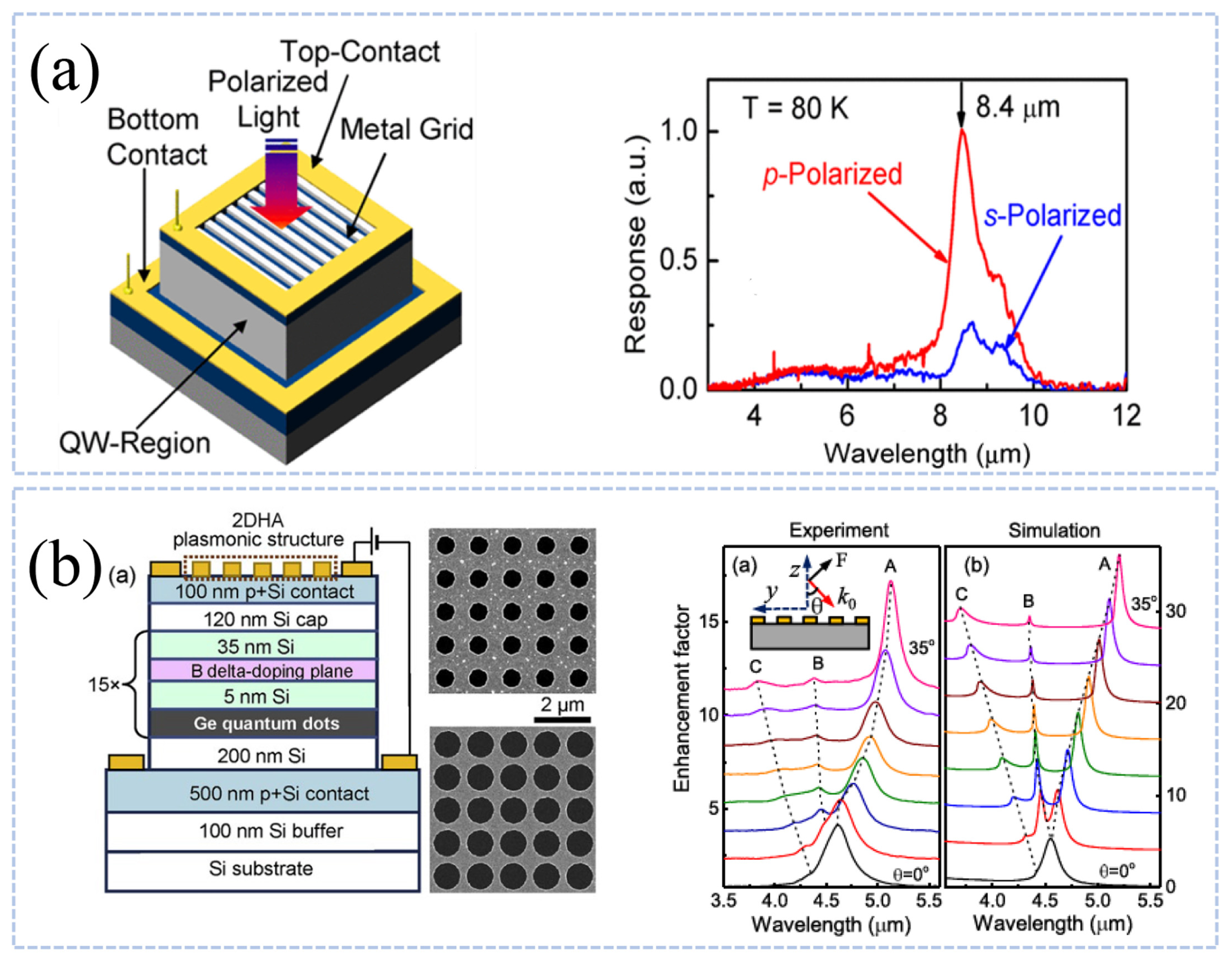
To capture such polarization information, a common approach involves integrating grating structures onto photodetectors. As discussed in Section 3.2 of this article, when light is incident on a metal–dielectric interface at a specific angle and frequency, it can excite surface plasmon waves. These waves generate enhanced localized electromagnetic fields on the metal surface, strengthening the light–matter interaction. In recent years, numerous studies have investigated the impact of metallic plasmonic gratings on the performance of photodetectors [58,59,60]. In 2010, Apalkov et al. [61] investigated a method to enhance the polarization sensitivity of quantum well infrared photodetectors (QWIPs) using diffraction grating coupling. As illustrated in Figure 6a, both the diffraction grating and the photodetector collectively influence the polarization extinction ratio of the integrated system through their coupled structure. By varying the geometric parameters of the grating, the polarization characteristics of the quantum well coupled with the diffraction grating were systematically examined both experimentally and numerically. The results demonstrated that increasing the grating height and adjusting the grating period effectively improved the polarization extinction ratio. Furthermore, the system exhibited the highest polarization sensitivity under front-side illumination compared to back-side incidence. In 2014, Li et al. [62] reported a grating-based plasmonic microcavity quantum well infrared photodetector. The device features a top layer of periodically arranged Au gratings with a thickness of 100 nm and a bottom Au layer of the same thickness, encapsulating the quantum well material. The metallic grating layer, coupled with the bottom metal reflector, forms a plasmonic microcavity that confines incident light within the cavity, thereby prolonging the interaction time with the quantum well region. Under TM-polarized illumination, both localized surface plasmon (LSP) modes and surface plasmon polariton (SPP) modes were excited, significantly enhancing the detector’s sensitivity. Experimental results indicated that the device achieved an extinction ratio of 65:1 at a long-wave infrared wavelength of 14.6 μm.
Based on the resonant coupling between localized surface plasmons (LSP) and SPP, Wang et al. [15] proposed a quasi-one-dimensional gold grating structure in 2015. Their results demonstrated that the optimized configuration achieved higher charge density, with the electric field component Ez perpendicular to the multi-quantum-well direction being 2 times and 1.3 times stronger than that of one-dimensional and two-dimensional gold gratings, respectively. The optical coupling efficiency within the quantum well region reached 85%. In 2020, Yakimov et al. [63] investigated the optical resonance effects in Ge/Si quantum dot photodetectors in the mid-infrared region using metal gratings with varying aperture diameters. They enhanced the photocurrent response through near-field coupling with subwavelength hole arrays embedded in adjacent metal thin films. The device, a Ge/Si quantum dot infrared photodetector (QDIP), was fabricated via molecular beam epitaxy (MBE), with the structure depicted in Figure 6b. To precisely control the position, size, and shape of the grating holes, electron beam lithography was employed instead of conventional photolithography, which helped visualize photocurrent resonances associated with diffraction anomalies. Simulation of the near-field distribution corroborated the experimental observations. Both experimental and computational results revealed that the photocurrent and near-field spectra exhibited multiple peaks at different incident angles θ, attributable to excitations of surface plasmon waves, localized surface plasmon modes, or Rayleigh diffraction anomalies. When the aperture size was small, surface plasmon polariton waves contributed most significantly to the photocurrent enhancement across all incident angles. As the aperture diameter increased and approached the array period, the improvement in the normal incidence response was primarily governed by Rayleigh anomalies. At larger incident angles, the photocurrent enhancement was attributed to the coupling between localized shape resonances and propagating plasmon modes. Additionally, the study noted that discrepancies between the actual hole shapes and simulated sizes, as well as variations in hole dimensions, resulted in a photocurrent enhancement spectrum that was approximately twice as broad as the corresponding near-field intensity data. Table 4 summarizes the main performance parameters of the grating-coupled photodetector.

3.5. Integrated Metasurface-Coupled Photodetector

The limitations of traditional grating coupling in the synchronous processing of multi-dimensional optical information (phase, amplitude, polarization) have promoted the development of metasurface integrated coupling strategies. Metasurfaces extend gratings from periodic structures to arbitrarily designed subwavelength structures. Through the precise design of subwavelength structures, they break through the bottleneck of single performance optimization and achieve a performance balance between compactness and multi-functionality.
In recent years, metasurfaces—two-dimensional planar devices consisting of subwavelength nanostructures—have garnered significant attention within the scientific community. By employing artificially designed nanostructures, metasurfaces enable precise manipulation of the phase, amplitude, and polarization of light, overcoming limitations inherent in conventional optical elements. Originally developed as passive components, metasurfaces are now increasingly integrated with various optoelectronic devices to form revolutionary “metamaterial devices” (metadevices), opening new avenues for advancing photodetector technology. The incorporation of metasurfaces into photodetectors not only markedly improves device performance—such as enhancing light absorption efficiency and responsivity—but also imparts unprecedented multifunctionality, including polarization sensitivity, spectral discrimination, and dynamic tunability. This integrated approach effectively alleviates issues associated with traditional multi-dimensional optical sensing systems, which often rely on bulky, complex assemblies of discrete optical components. Consequently, metasurface-integrated photodetectors offer a promising pathway toward compact, chip-scale systems for full light-field information extraction.
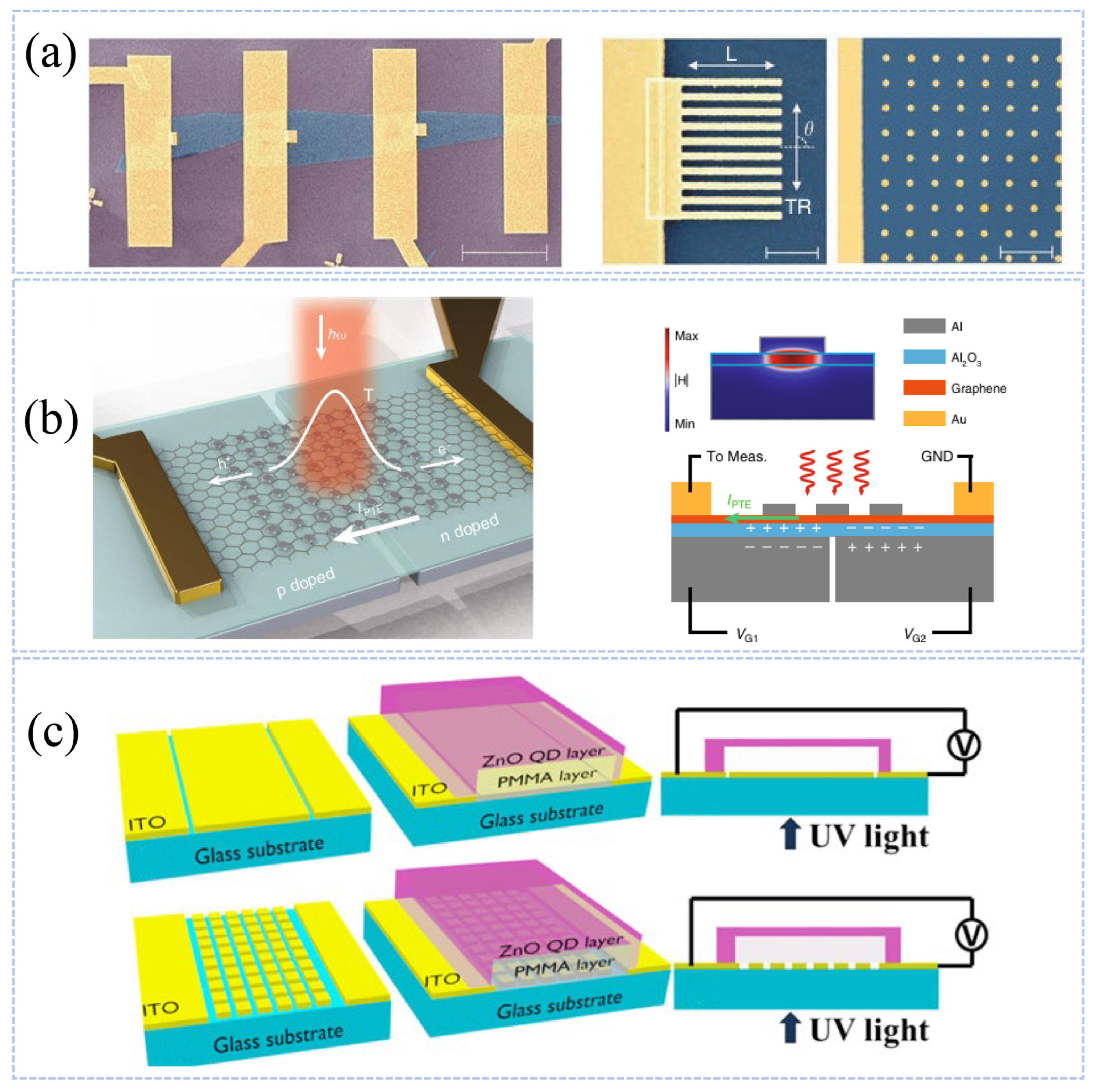
The integration of metasurfaces in photodetectors enhances light-matter interactions primarily through the following mechanisms: local field enhancement effect, guided-mode resonance effect, and band engineering with carrier manipulation. Metasurfaces can support SPR, which significantly enhances local light field intensity within a specific wavelength range. Plasmonic metasurfaces improve the responsiveness of photodetectors mainly by increasing light absorption, elevating local temperature, and injecting hot carriers (Electrons or holes that gain sufficient energy during the plasma relaxation process can participate in the photoelectric conversion process). Specifically, SPP can confine the light field to the subwavelength scale, leading to significant near-field enhancement and improved optical absorption. In 2011, Echtermeyer et al. [64] reported a graphene photodetector combined with plasmonic nanostructures. By introducing plasma nanostructures, the absorbed incident light is converted into plasma oscillations in the p-n junction region formed by graphene, resulting in a sharp increase in local electric field. This localized strong light field can significantly enhance the absorption rate of light in photodetector materials, thereby improving the sensitivity of the detector. Experimental results have shown that the efficiency of this photodetector, which combines graphene with plasmonic nanostructures, can be increased by up to 20-fold. The scanning electron microscope (SEM) image of the device is shown in Figure 7a. However, the intrinsically low absorption of graphene limits its responsivity. To overcome this, Wang et al. [65] enhanced the photothermal–electric effect—the dominant photoconversion mechanism in graphene—by co-optimizing the “light-to-heat” and “heat-to-electricity” processes (as shown in Figure 7b). They employed a gap plasmon structure for efficient light absorption and local heating, combined with a split-gate-defined p–n junction in graphene to tune the Fermi level and Seebeck coefficient via gate voltage. This optoelectronic co-design yielded a 25-fold enhancement in zero-bias photocurrent, achieving a responsivity of 52 μA/W.
Dielectric metasurfaces can couple specific wavelengths into waveguide modes, efficiently concentrating light within subwavelength volumes via guided-mode resonances, thereby strengthening the optical field in the detector’s active region and improving absorption and responsivity. For instance, Palwe et al. [66] developed an ITO metasurface (ITOM) exhibiting guided-mode resonance around 410 nm, focusing UV–visible light (350–550 nm) into a quasi-near-field region about 1.5 μm from the surface. Through diffracted-light phase interference, electric field hotspots form, significantly enhancing the local intensity and boosting the photocurrent density of a ZnO quantum dot UV photodetector by approximately 183% (Figure 7c). Metasurfaces combined with emerging semiconductor materials can also optimize carrier generation, separation, and collection via band engineering. Two-dimensional/three-dimensional van der Waals heterostructures (2D/3D vdWHs) merge the benefits of 2D layered materials (2DLMs)—such as dangling-bond-free surfaces, thickness-tunable bandgaps, high absorption coefficients, and large specific surface areas—with mature 3D semiconductor technology. While pure 2DLM photodetectors face challenges in scalable growth and transfer, and 3D devices are limited by heterointegration issues, 2D/3D vdWHs combine the advantages of both materials to provide a versatile platform for high-performance photodetection [67].
Polarization is a key characteristic of light, carrying critical information about the interaction between light sources/objects and light. It provides rich data related to material properties, morphology, and stress, and enhances contrast between targets and backgrounds. Traditional photodetectors can only detect light intensity, whereas metasurface-integrated photodetectors enable direct analysis of light polarization states and on-chip polarization imaging. This capability overcomes the bulk and complexity of conventional polarization imaging systems, offering compact solutions for applications such as unmanned aerial vehicles, autonomous driving, and portable medical diagnostics.
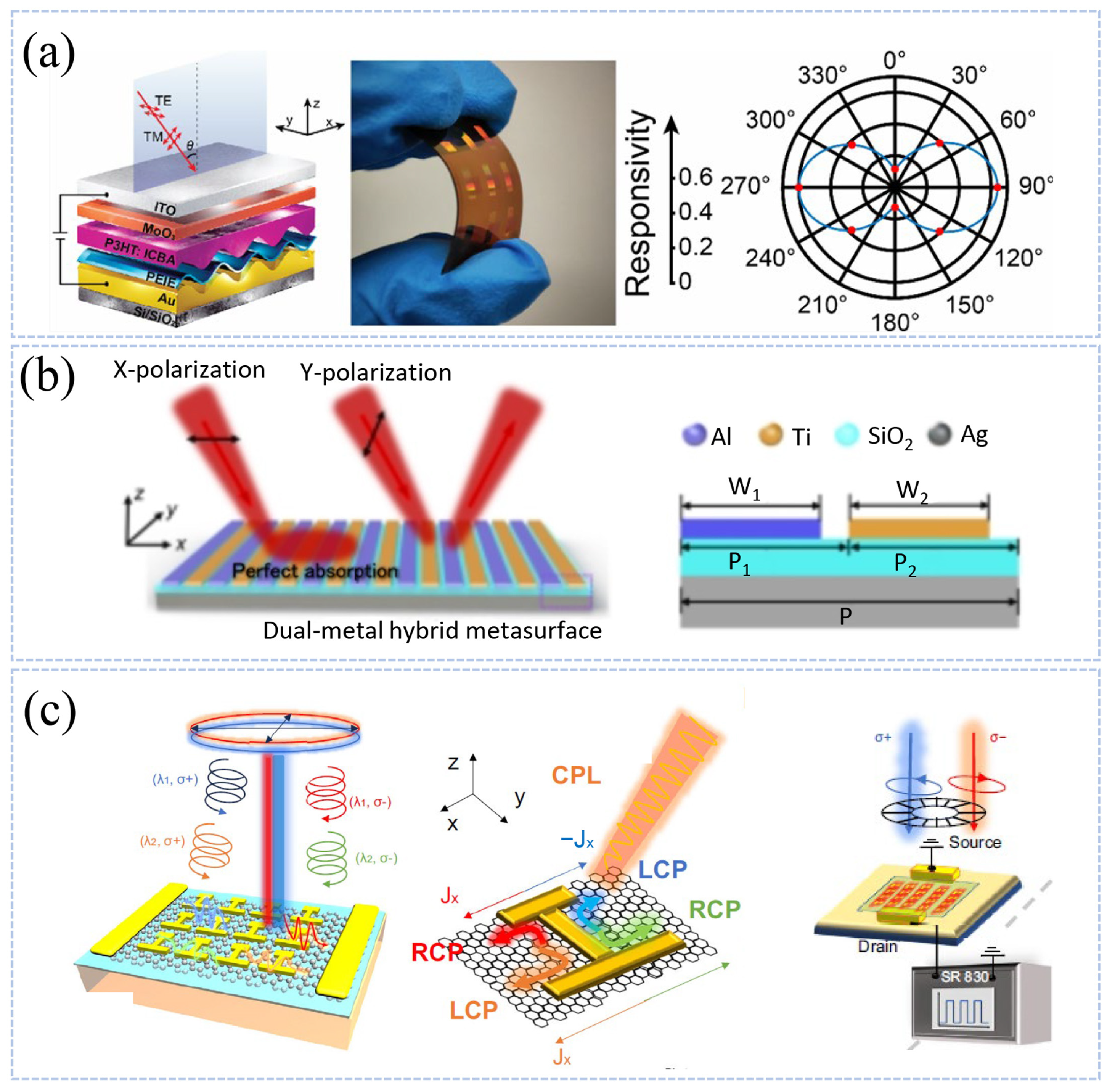
Wang et al. [68] used a one-dimensional metal grating as an SPP excitation platform and directly integrated it as an electrode into an organic heterojunction photodiode (As shown in Figure 8a). Through “metasurface-organic interface co-design,” they achieved matching between SPP resonance and organic heterojunctions in the near-infrared (NIR) band. High-precision polarization resolution was realized by leveraging the polarization dependence of SPPs—electromagnetic modes formed by the coupling of light waves and collective oscillations of free electrons on metal surfaces. Leveraging the polarization selectivity of SPP (excited efficiently only by TM-polarized light), the device achieved a polarization ratio of 0.8, with TM response ~13 higher than TE response. Dai et al. [69] proposed a bimetallic hybrid metasurface with alternating Al and Ti nanoribbons that perfectly absorbs X-polarized infrared light while reflecting Y-polarized light (As shown in Figure 8b). By adjusting the period of the metasurface unit structure, the peak absorption wavelength can be continuously manipulated, with the wavelength modulation range covering 1200 nm to 1850 nm and an average absorption rate greater than 99%. Immersion-based active tuning further shifted the peak over 750 nm while maintaining >99.5% absorption. Li et al. [70] reported an electrically tunable polarized photodetector composed of MoTe2 and gold metasurface for on-chip polarization-sensitive near-infrared (900–1200 nm) detection. Contact engineering enabled a widely adjustable Schottky barrier via bias and gate voltages, yielding continuously tunable degree of linear polarization (DOLP from 0.2 to 1.0). Unlike stacked nanostructure devices requiring precise alignment, this design uses in-plane propagating SPPs as the carrier for transmitting polarization signals, offering flexible structure design, multi-band operation, and compatibility with optoelectronic chips, with a fast response up to 2.1 kHz. Jiang et al. [71] reported a metasurface-based graphene photodetector capable of resolving multiple polarization states and wavelengths across a broad band (1–8 μm) with 0.5 μm wavelength accuracy (Figure 8c). By exploiting photocurrent polarity and amplitude variations under different polarizations, and combining multi-port metasurfaces with machine learning, the system decouples polarization and spectral information in a single measurement, balancing high spatial and temporal resolution. This research provides new ideas for the development of compact and high-dimensional spectral detection systems, overcoming the limitations of existing technologies in terms of detection dimension, band range and spatial resolution.
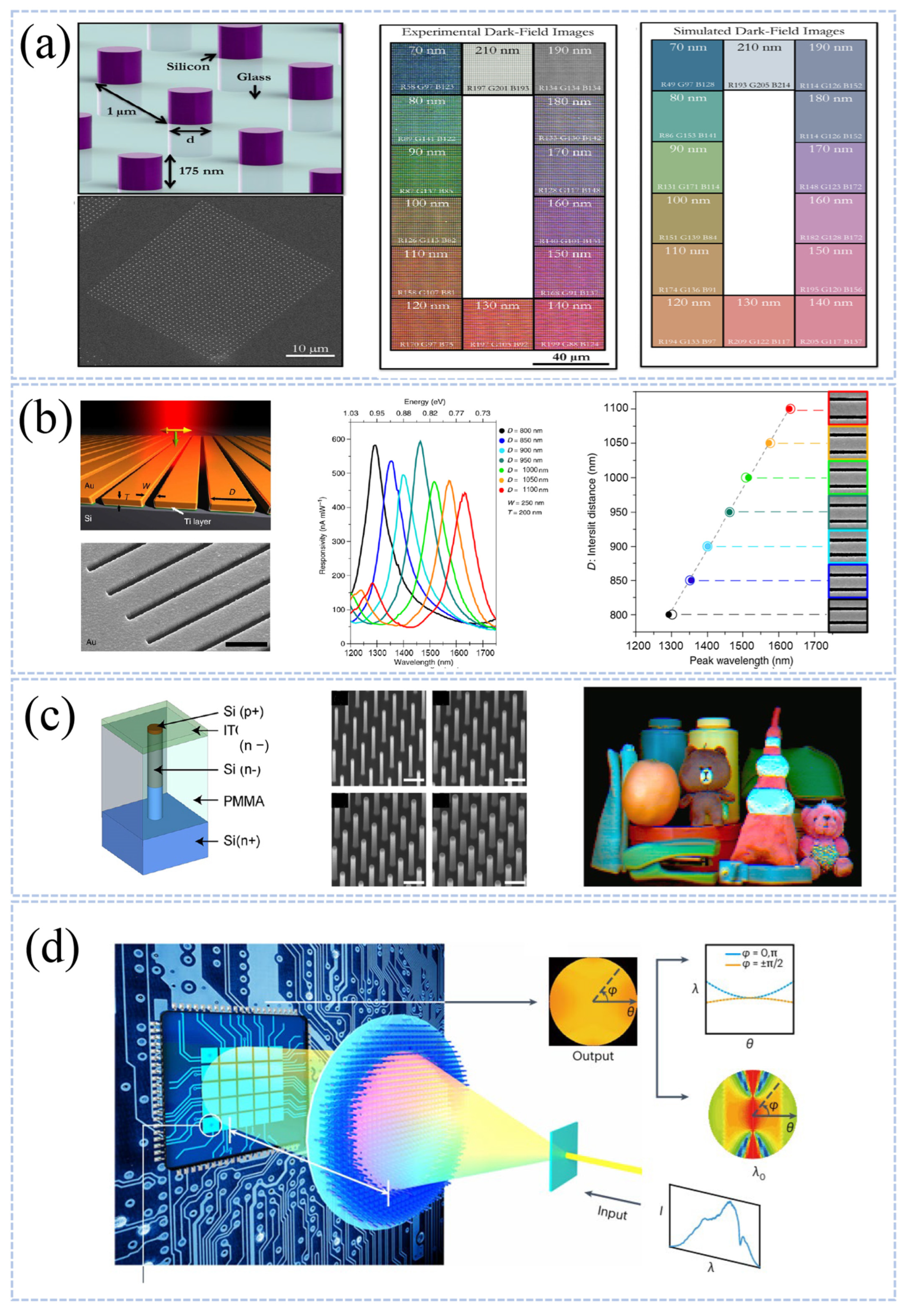
The resonance peaks of plasmonic or Mie resonances can be tuned by adjusting the dimensions of metasurface unit structures, thereby enabling flexible control over the operating wavelength of photodetectors. This tunability allows metasurfaces to function as adaptive elements for polychromatic light detection. For instance, Proust et al. [72] demonstrated a metasurface color-printing technique based on silicon nanocolumn arrays that exploit low-order electric and magnetic Mie resonances (Figure 9a). By varying the nanocolumn radius, the resonant wavelength can be continuously shifted, facilitating color (wavelength) discrimination. The interplay between electric and magnetic resonances produces a diverse color gamut. This all-dielectric fabrication strategy benefits from the use of cost-effective, stable, and sustainable materials, while achieving vivid colors across the entire visible spectrum.
Hot carriers generated during plasmonic relaxation enable the absorption of sub-bandgap photons. Whenever the photon energy exceeds the Schottky barrier height, a photocurrent can be generated, effectively extending the operational bandwidth of the photodetector. Moreover, metallic nanostructures simultaneously provide plasmonic resonance and carrier injection functions, making hot-carrier devices particularly attractive for wavelength-tunable and multicolor detection applications. Sobhani et al. [73] developed a plasmonic-Schottky photodetector incorporating a grating structure that strongly couples incident light to surface plasmons in a metal film, resulting in narrowband, high-efficiency infrared absorption below the semiconductor bandgap (Figure 9b). The absorbed light generates hot electrons that contribute to the photocurrent, with the detection wavelength determined by the grating period rather than being constrained by the Schottky barrier or semiconductor bandgap. This grating-based detector exhibited significantly enhanced performance: a responsivity of 0.6 mA/W, a 20-fold increase in internal quantum efficiency (IQE) up to 0.2%, and a spectral linewidth (FWHM of 54 meV) narrowed by more than three times. Furthermore, by varying the grating period, the response peak could be linearly tuned across the near-infrared range from 1295 nm to 1635 nm.
Another wavelength-resolved photodetection method involves fabricating photoelectric materials into metasurfaces that support specific resonant wavelengths. Park et al. [74] introduced a filter-free color imaging method using vertical silicon nanowire p–i–n photodetectors (Figure 9c). By controlling the nanowire radius, which dictates the supported waveguide mode, the spectral response is directly engineered without additional filters. This design allows selective absorption at specific wavelengths and direct photocurrent generation. Only a single lithography step is required to define both optical and electrical properties of each pixel, greatly simplifying fabrication and offering high photon utilization efficiency.
Cai et al. [75] realized a miniaturized angle-resolved spectrometer by integrating a tunable metasurface spectrometer array with a metalens, shrinking a single spectrometer footprint to just 4 × 4 μm2. The device achieved a wavelength accuracy of 0.17 nm, a spectral resolution of 0.4 nm, a linear dynamic range of 149 dB, a detection limit of 1.2 fJ, and an angular resolution of 4.88 × 10⁻³ rad. With low power consumption, minimal computational overhead, and compatibility with modern portable electronics, this spectrometer can be readily expanded into large-format spectral imaging arrays.
Figure 9. (a) Metasurface color-printing technique based on silicon nanocolumn arrays that exploit low-order electric and magnetic Mie resonances [72]. (b) A plasma thermoionization photodetector utilizing gold nanoslits. The operational frequency band of the device can be fine-tuned by varying the period of the nanoslits [73]. (c) Employing color-resolved light detection with silicon nanocolor technology. Multi-color imaging was accomplished through the use of p-i-n photodetectors integrated with silicon nanocolumn arrays of differing radii [74]. (d) Photodetectors that combine metasurface and deep learning can continuously characterize parameters such as intensity, polarization and frequency in three-dimensional space [76].
Photonics 12 01096 g009
In addition to polarization detection and spectral control, metasurface-integrated photodetectors exhibit significant potential in several emerging fields, such as high-dimensional optical information processing. By integrating artificial metasurfaces with deep learning techniques, Zhang et al. [76] constructed a photodetector capable of fully characterizing the three-dimensional continuous parameter space encompassing intensity, polarization, and frequency (Figure 9d). This device employs a decoupling design of the Pancharatnam–Berry (PB) phase and transmission phase to encode spectral information into orbital angular momentum (OAM) topological charge numbers while mapping polarization information onto OAM mode purity. Ultimately, it achieves ultra-high-precision decoding through residual neural networks, thereby establishing a new paradigm for high-dimensional optical information processing and secure communication. Table 5 summarizes the main performance parameters of the integrated metasurface-coupled photodetector.
To better compare several optical structure coupling methods, Table 6 summarizes the key characteristics of five coupling methods (enhancement mechanisms, typical performance gains, advantages/disadvantages, etc.)

4. Challenges and Perspectives

The above-mentioned various coupling strategies have made significant progress in optimizing specific performance trade-offs. However, in practical applications, issues such as the stability of coupling efficiency, packaging alignment accuracy, and large-scale manufacturing of these structures still pose constraints on the continuous improvement of performance. The following text will focus on current technical challenges and look forward to future development directions.

4.1. Technical Challenges

Coupling Efficiency, Alignment Accuracy, and Automation: Coupling efficiency is highly sensitive to alignment precision and packaging techniques. Even minor misalignments—often induced by thermal cycling or mechanical stress—can lead to spot displacement and severely degrade responsivity. Although automated coupling technologies are under development, achieving high-throughput nanoscale alignment and packaging remains a critical engineering challenge.
Material Compatibility and Optical Loss: Heterogeneous integration is a promising approach to overcome the limitations of single-material systems. However, issues such as lattice mismatch, differences in thermal expansion coefficients, and optical mode mismatch between materials can introduce additional loss and stress. Innovative bonding techniques and mode conversion structures are required to mitigate these effects.
Structural Complexity and Cost-Effectiveness: Highly complex coupling structures often entail complicated fabrication processes and elevated costs. While techniques such as electron-beam lithography and nanoimprinting offer high precision, they suffer from low throughput and high expense. The development of nanofabrication methods that combine high performance, high yield, and low cost is essential for commercial adoption.
Preparation process consistency: New coupling strategies such as integrated metasurfaces require nanoscale processing accuracy. Any minor deviation or roughness in the shape or size of the structure may significantly affect its optical performance, posing extremely high demands on the consistency of the manufacturing process.

4.2. Future Development Direction

New function integration and multi-field regulation: In the future, photodetectors will not only pursue high performance but also tend towards intelligence and multi-functionality. By coupling the photoelectric field with the polarization field to regulate the physical properties of materials, intelligent photodetectors with enhanced performance and rich functions can be prepared, providing a direction for the development of next-generation intelligent detection systems that adapt to complex environments.
System-level integration and collaborative optimization: Integrating high-performance photodetectors with subsequent amplification circuits, processing algorithms, etc., on a single chip or heterogeneous chip to build a compact system-on-chip (SoC) is another important trend. It is necessary to optimize the performance of light, electricity, heat, mechanics, etc., in a coordinated manner from the system level.
Dynamic reconfigurable devices: By integrating metasurfaces with phase change materials, transparent conductive oxides, liquid crystals or MEMS structures, dynamic tunable metasurface photodetectors can be achieved, endowing the detectors with reconfigurable spectral selection capabilities or polarization sensitivity.
Multi-dimensional information acquisition: By integrating the multi-dimensional light field control capabilities of metasurfaces and computational imaging algorithms, develop intelligent optical sensors capable of directly obtaining multi-dimensional information of objects without the need for additional moving parts or complex external spectral splitting systems.

5. Conclusions

This review has systematically summarized recent advances in photodetectors coupled with advanced optical structures, including optical waveguides, SPR, optical microcavities, gratings, and integrated metasurfaces. Each strategy offers distinct operational principles and performance benefits, addressing diverse application needs.
Optical waveguide coupling effectively mitigates the trade-off between responsivity and bandwidth, showing great potential for high-speed optical communication. SPR enhances light–matter interaction beyond the limits of conventional materials via localized field enhancement. Optical microcavities provide superior spectral selectivity and light confinement. Grating structures enable robust polarization selection and spectral shaping. As an emerging approach, integrated metasurfaces exhibit unique advantages in multi-dimensional light-field control and multifunctional integration.
Looking forward, continued progress in heterogeneous integration, multi-physical field coupling, and automated fabrication will drive photodetectors toward higher performance, greater functionality, and reduced cost. Emerging applications in intelligent sensing, on-chip photonic computing, and quantum information processing will further stimulate development. Addressing challenges in fabrication uniformity, system integration complexity, and cost-effectiveness will be crucial to enabling large-scale commercial adoption.
In summary, optical structure-coupled photodetectors represent a frontier in optoelectronic technology, providing critical hardware support for innovation in information technology, biomedical imaging, environmental monitoring, and beyond. They hold substantial scientific value and offer wide-ranging application prospects.

Author Contributions

Writing original draft preparation: Y.L.; Writing review and editing: S.Z. All authors have read and agreed to the published version of the manuscript.

Funding

National Key R&D Program of China (2021YFA0717600), National Natural Science Foundation of China (NSFC No. 62035004, NSFC No. 62305022, NSFC No. U22A2081), and Young Elite Scientists Sponsorship Program by CAST (No. YESS20200163).

Institutional Review Board Statement

Not applicable.

Informed Consent Statement

Not applicable.

Data Availability Statement

Not applicable.

Conflicts of Interest

The authors declare no conflicts of interest.

Abbreviations

AcronymsDefinition
SPRSurface plasmon resonance
Q-factorquality factor
EQEExternal Quantum Efficiency
NEPNoise equivalent power
SNRsignal-to-noise ratio
RCresistance-capacitance
TWPDTraveling-wave photodetector
PDphotodetector
UTCuni-traveling carrier
UTCPDUni-Traveling-Carrier photodiode
MOVPEmetal–organic vapor phase epitaxy
IECWG MUTC-PDinverted evanescently coupled waveguide modified uni-traveling-carrier photodiode
MUTCmodified uni-traveling carrier
CPWscoplanar waveguides
BCBbenzocyclobutene
TFLNthin-film lithium niobate
Pt NPsplatinum nanoparticles
F-PFabry–Pérot
MDMmetal-dielectric-metal
DBRsdistributed Bragg reflectors
NOEMnano-opto- electro- mechanical
QWIPsquantum well infrared photodetectors
LSPlocalized surface plasmon
SPPsurface plasmon polariton
QDIPquantum dot infrared photodetector
MBEmolecular beam epitaxy
SEMscanning electron microscope
ITOMITO metasurface
2D/3D vdWHsTwo-dimensional/three-dimensional van der Waals heterostructures
2DLMs2D layered materials
NIRnear-infrared
DOLPdegree of linear polarization
IQEinternal quantum efficiency
PBPancharatnam-Berry
OAMorbital angular momentum
SoCsystem-on-chip

References

  1. Minotto, A.; Haigh, P.A.; Łukasiewicz, Ł.G.; Lunedei, E.; Gryko, D.T.; Darwazeh, I.; Cacialli, F. Visible Light Communication with Efficient Far-Red/near-Infrared Polymer Light-Emitting Diodes. Light Sci. Appl. 2020, 9, 70. [Google Scholar] [CrossRef]
  2. Tyo, J.S.; Goldstein, D.L.; Chenault, D.B.; Shaw, J.A. Review of Passive Imaging Polarimetry for Remote Sensing Applications. Appl. Opt. 2006, 45, 5453. [Google Scholar] [CrossRef]
  3. Li, N.; Zhao, Y.; Pan, Q.; Kong, S.G.; Chan, J.C.-W. Illumination-Invariant Road Detection and Tracking Using LWIR Polarization Characteristics. ISPRS J. Photogramm. Remote Sens. 2021, 180, 357–369. [Google Scholar] [CrossRef]
  4. Li, N.; Zhao, Y.; Wu, R.; Pan, Q. Polarization-Guided Road Detection Network for LWIR Division-of-Focal-Plane Camera. Opt. Lett. 2021, 46, 5679. [Google Scholar] [CrossRef]
  5. Patel, R.; Khan, A.; Quinlan, R.; Yaroslavsky, A.N. Polarization-Sensitive Multimodal Imaging for Detecting Breast Cancer. Cancer Res. 2014, 74, 4685–4693. [Google Scholar] [CrossRef]
  6. Shi, Z.; Gao, X.; Cai, X.; Zhao, H.; Wang, X.; Zhao, L.; Yin, L.; Ding, H.; Sheng, X. Fully Implantable and Retrievable Upconversion Waveguides for Photodynamic Therapy in Deep Tissue. Adv. Opt. Mater. 2023, 11, 2300689. [Google Scholar] [CrossRef]
  7. Schreiner, K. Night Vision: Infrared Takes to the Road. IEEE Comput. Graph. Appl. 2002, 19, 6–10. [Google Scholar] [CrossRef]
  8. Ferrari, A.C.; Bonaccorso, F.; Fal’ko, V.; Novoselov, K.S.; Roche, S.; Bøggild, P.; Borini, S.; Koppens, F.H.L.; Palermo, V.; Pugno, N.; et al. Science and Technology Roadmap for Graphene, Related Two-Dimensional Crystals, and Hybrid Systems. Nanoscale 2015, 7, 4598–4810. [Google Scholar] [CrossRef]
  9. Suemori, D.; Ishii, M.; Kohmu, N.; Ishigure, T. 90-Degree Bent Core Polymer Optical Waveguide Coupler for Low Loss Lens-Less Light Coupling Between Laser/Photodetector and Fiber. In Proceedings of the Electronic Components and Technology Conference 2022, San Diego, CA, USA, 31 May–3 June 2022; pp. 436–440. [Google Scholar] [CrossRef]
  10. Ma, P.; Flöry, N.; Salamin, Y.; Baeuerle, B.; Emboras, A.; Josten, A.; Taniguchi, T.; Watanabe, K.; Novotny, L.; Leuthold, J. Fast MoTe 2 Waveguide Photodetector with High Sensitivity at Telecommunication Wavelengths. ACS Photonics 2018, 5, 1846–1852. [Google Scholar] [CrossRef]
  11. Chen, K.; Deng, C.; Zou, C.; Zhao, Z.; Liu, Q.; Wang, X.; He, L.; Gao, F.; Zhao, W.; Li, S. Plasmonic Hot-Hole Injection Combined with Patterned Substrate for Performance Improvement in Trapezoidal PIN GaN Microwire Self-Powered Ultraviolet Photodetector. Nano Energy 2022, 104 Pt A, 107926. [Google Scholar] [CrossRef]
  12. Kunwar, S.; Pandit, S.; Jeong, J.H.; Lee, J. Improved Photoresponse of UV Photodetectors by the Incorporation of Plasmonic Nanoparticles on GaN Through the Resonant Coupling of Localized Surface Plasmon Resonance. Nano-Micro Lett. 2020, 12, 91. [Google Scholar] [CrossRef]
  13. Matei, D.G.; Legero, T.; Häfner, S.; Grebing, C.; Weyrich, R.; Zhang, W.; Sonderhouse, L.; Robinson, J.M.; Ye, J.; Riehle, F.; et al. 1.5 μm Lasers with Sub-10 MHz Linewidth. Phys. Rev. Lett. 2017, 118, 263202. [Google Scholar] [CrossRef]
  14. Guo, X.; Ren, Y.; Zhang, G.; Yu, A.; Chen, X.; Zhu, Y. Theoretical Investigation on Microcavity Coupler for Terahertz Quantum-Well Infrared Photodetectors. IEEE Access 2020, 8, 176149–176157. [Google Scholar] [CrossRef]
  15. Wang, S.; Tian, W.; Wu, F.; Zhang, J.; Dai, J.N.; Wu, Z.H.; Fang, Y.Y.; Tian, Y.; Chen, C.Q. Efficient Optical Coupling in AlGaN/GaN Quantum Well Infrared Photodetector via Quasi-One-Dimensional Gold Grating. Opt. Express 2015, 23, 8740. [Google Scholar] [CrossRef]
  16. Xiao, B.; Liu, B.; He, X.; Li, C.; Liang, Z.; Sun, Y.; Cheng, Q. Plasma surface treatment of amorphous Ga2O3 thin films for solar-blind ultraviolet photodetectors. Appl. Surf. Sci. 2024, 678, 161146. [Google Scholar] [CrossRef]
  17. Han, D.; Liu, J.; Zhu, S.; Liu, C.; Liu, K.; Zhang, X.; Liu, N.; Ye, J.; Zhang, W. Gate-Tunable Current Polarity Switching in p-NiO/n-ZnGa2O4 Heterojunction Field-Effect Phototransistors for Secure Optical Communication. ACS Photonics 2025, 12, 1628–1637. [Google Scholar] [CrossRef]
  18. Jutzi, M.; Berroth, M.; Wöhl, G.; Oehme, M.; Kasper, E. Ge-on-Si Vertical Incidence Photodiodes with 39-GHz Bandwidth. IEEE Photonics Technol. Lett. 2005, 17, 1510–1512. [Google Scholar] [CrossRef]
  19. Hongda, C.; Zan, Z.; Beiju, H.; Luhong, M.; Zanyun, Z. Progress in Complementary Metaloxidesemiconductor Silicon Photonics and Optoelectronic Integrated Circuits. J. Semicond. 2015, 36, 121001. [Google Scholar] [CrossRef]
  20. Haurylau, M.; Chen, G.; Chen, H.; Zhang, J.; Nelson, N.A.; Albonesi, D.H.; Friedman, E.G.; Fauchet, P.M. On-Chip Optical Interconnect Roadmap: Challenges and Critical Directions. IEEE J. Sel. Top. Quantum Electron. 2006, 12, 1699–1704. [Google Scholar] [CrossRef]
  21. Beling, A.; Bach, H.G.; Mekonnen, G.G.; Kunkel, R.; Schmidt, D.; Abstract, A. Miniaturized Waveguide-Integrated p-i-n Photodetector With 120-GHz Bandwidth. IEEE Photonics Technol. Lett. 2005, 17, 2152–2154. [Google Scholar] [CrossRef]
  22. Beling, A.; Bach, H.G.; Mekonnen, G.G.; Kunkel, R.; Schmidt, D. High-Speed Miniaturized Photodiode and Parallel-Fed Traveling-Wave Photodetectors Based on InP. IEEE J. Sel. Top. Quantum Electron. 2007, 13, 15–21. [Google Scholar] [CrossRef]
  23. Davis, G.A.; Weiss, R.E.; Larue, R.A.; Williams, K.J.; Esman, R.D. A 920-1 650-nm High-Current Photodetector. IEEE Photonics Technol. Lett. 1996, 8, 1373–1375. [Google Scholar] [CrossRef]
  24. Anagnosti, M.; Caillaud, C.; Blache, F.; Jorge, F.; Angelini, P.; Paret, J.F.; Achouche, M. Optimized High Speed UTC Photodiode for 100 Gbit/s Applications. IEEE J. Sel. Top. Quantum Electron. 2014, 20, 29–35. [Google Scholar] [CrossRef]
  25. Zhou, G.; Runge, P.; Keyvaninia, S.; Seifert, S.; Ebert, W.; Mutschall, S.; Seeger, A.; Li, Q.; Beling, A. High-Power InP-Based Waveguide Integrated Modified Uni-Traveling-Carrier Photodiodes. J. Light. Technol. 2017, 35, 717–721. [Google Scholar] [CrossRef]
  26. Wang, F.; Zhang, B.; Wang, L. High-Performance Inverted Evanescently Coupled Waveguide Integrated MUTC-PD with High Response Speed. Appl. Opt. 2021, 60, 10696. [Google Scholar] [CrossRef]
  27. Li, L.; Wang, L.; Chen, B. High-Speed Waveguide Modified Uni-Traveling Carrier Photodiodes with 130 GHz Bandwidth. In Proceedings of the 2023 Opto-Electronics and Communications Conference (OECC), Shanghai, China, 2–6 July 2023; pp. 1–3. [Google Scholar] [CrossRef]
  28. Li, L.; Wang, L.; Long, T.; Zhang, Z.; Lu, J.; Chen, B. Ultra-Fast Waveguide MUTC Photodiodes Over 220GHz. J. Light. Technol. 2024, 42, 7451–7457. [Google Scholar] [CrossRef]
  29. Wang, L.; Feng, H.; Zhang, Z.; Li, L.; Long, T.; Shang, C.; Wang, C.; Chen, B. 230 GHz MUTC Photodiodes Integrated on Thin-film Lithium Niobate. In Proceedings of the Optical Fiber Communication Conference (OFC) 2025, San Francisco, CA, USA, 30 March–3 April 2025; Technical Digest Series. Optica Publishing Group: Washington, DC, USA, 2025. paper M2K.7. [Google Scholar] [CrossRef]
  30. Li, L.; Long, T.; Zhang, Z.; Wang, L.; Chen, B. Ultrafast Waveguide MUTC Photodiode Targeting Over 200 GBaud Applications at 1310 nm and 1550 nm. In Proceedings of the Optical Fiber Communication Conference (OFC) 2025, San Francisco, CA, USA, 30 March–3 April 2025; Technical Digest Series. Optica Publishing Group: Washington, DC, USA, 2025. paper W2A.17. [Google Scholar] [CrossRef]
  31. Ding, F.; Yang, Y.; Deshpande, R.A.; Bozhevolnyi, S.I. A Review of Gap-Surface Plasmon Metasurfaces: Fundamentals and Applications. Nanophotonics 2018, 7, 1129–1156. [Google Scholar] [CrossRef]
  32. Halas, N.J.; Lal, S.; Chang, W.S.; Link, S.; Nordlander, P. Plasmons in Strongly Coupled Metallic Nanostructures. Chem. Rev. 2011, 111, 3913–3961. [Google Scholar] [CrossRef]
  33. Chen, H.; Deng, S.; Jiang, Y.; Wang, H.; Wen, S. Resonance Coupling in an Individual Gold Nanorod-Monolayer WS2 Heterostructure: Photoluminescence Enhancement with Spectral Broadening. ACS Nano 2020, 14, 13841–13851. [Google Scholar] [CrossRef]
  34. Hu, M.; Yan, Y.; Huang, K.; Khan, A.; Qiu, X.; Xu, D.; Zhang, H.; Yu, X.; Yang, D. Performance Improvement of Graphene/Silicon Photodetectors Using High Work Function Metal Nanoparticles with Plasma Effect. Adv. Opt. Mater. 2018, 6, 1701243. [Google Scholar] [CrossRef]
  35. Li, M.Y.; Yu, M.; Su, D.; Zhang, J.; Jiang, S.; Wu, J.; Wang, Q.; Liu, S. Ultrahigh Responsivity UV Photodetector Based on Cu Nanostructure/ZnO QD Hybrid Architectures. Small 2019, 15, 1901606. [Google Scholar] [CrossRef]
  36. Li, L.; Wu, Q.; Wang, C.; Cai, Z.; Lin, L.; Gu, X.; Ostrikov, K.K.; Nan, H.; Xiao, S. High-Performance InSe Photodetector Induced by Synergetic Surface Plasmon Resonance and Surface Engineering. ACS Photonics 2024, 11, 2615–2623. [Google Scholar] [CrossRef]
  37. Ding, Y.; Cheng, Z.; Zhu, X.; Yvind, K.; Dong, J.; Galili, M.; Hu, H.; Mortensen, N.A.; Xiao, S.; Oxenløwe, L.K. Ultra-Compact Integrated Graphene Plasmonic Photodetector with Bandwidth above 110 GHz. Nanophotonics 2020, 9, 317–325. [Google Scholar] [CrossRef]
  38. Jian, J.; Wu, J.; Zhong, C.; Ma, H.; Sun, B.; Ye, Y.; Luo, Y.; Wei, M.; Lei, K.; Liu, R.; et al. High-Speed Compact Plasmonic-PdSe2 Waveguide-Integrated Photodetector. ACS Photonics 2023, 10, 3494–3501. [Google Scholar] [CrossRef]
  39. Wang, X.; Liu, K.; Chen, X.; Li, B.; Jiang, M.; Zhang, Z.; Zhao, H.; Shen, D. Highly Wavelength-Selective Enhancement of Responsivity in Ag Nanoparticle-Modified ZnO UV Photodetector. ACS Appl. Mater. Interfaces 2017, 9, 5574–5579. [Google Scholar] [CrossRef]
  40. Li, Q.; Li, Z.; Xiang, X.; Wang, T.; Yang, H.; Wang, X.; Gong, Y.; Gao, J. Tunable Perfect Narrow-Band Absorber Based on a Metal-Dielectric-Metal Structure. Coatings 2019, 9, 393. [Google Scholar] [CrossRef]
  41. Wang, S. Principles of Distributed Feedback and Distributed Bragg-Reflector Lasers. IEEE J. Quantum Electron. 1974, 10, 413–427. [Google Scholar] [CrossRef]
  42. Huang, E.; Ma, Q.; Liu, Z. Etalon Array Reconstructive Spectrometry. Sci. Rep. 2017, 7, 40693. [Google Scholar] [CrossRef] [PubMed]
  43. Xuan, Z.; Wang, Z.; Liu, Q.; Huang, S.; Yang, B.; Yang, L.; Yin, Z.; Xie, M.; Li, C.; Yu, J.; et al. Short-Wave Infrared Chip-Spectrometer by Using Laser Direct-Writing Grayscale Lithography. Adv. Opt. Mater. 2022, 10, 2200284. [Google Scholar] [CrossRef]
  44. McClung, A.; Samudrala, S.; Torfeh, M.; Mansouree, M.; Arbabi, A. Snapshot Spectral Imaging with Parallel Metasystems. Sci. Adv. 2020, 6, eabc7646. [Google Scholar] [CrossRef]
  45. Fan, X.; Liu, C.; Liu, S.; Xie, Y.; Zheng, L.; Wang, T.; Feng, Q. The Instrument Design of Lightweight and Large Field of View High-Resolution Hyperspectral Camera. Sensors 2021, 21, 2276. [Google Scholar] [CrossRef]
  46. Wang, S.W.; Liu, D.; Lin, B.; Chen, X.; Lu, W. 16 × 1 Integrated Filter Array in the MIR Region Prepared by Using a Combinatorial Etching Technique. Appl. Phys. B Lasers Opt. 2006, 82, 637–641. [Google Scholar] [CrossRef]
  47. Wang, S.-W.; Chen, X.; Lu, W.; Wang, L.; Wu, Y.; Wang, Z. Integrated Optical Filter Arrays Fabricated by Using the Combinatorial Etching Technique. Opt. Lett. 2006, 31, 332. [Google Scholar] [CrossRef]
  48. Wang, S.-W.; Xia, C.; Chen, X.; Lu, W.; Li, M.; Wang, H.; Zheng, W.; Zhang, T. Concept of a High-Resolution Miniature Spectrometer Using an Integrated Filter Array. Opt. Lett. 2007, 32, 632. [Google Scholar] [CrossRef] [PubMed]
  49. Wang, X.; Albrecht, A.; Mai, H.H.; Woidt, C.; Meinl, T.; Hornung, M.; Bartels, M.; Hillmer, H. High Resolution 3D NanoImprint Technology: Template Fabrication, Application in Fabry–Pérot-Filter-Array-Based Optical Nanospectrometers. Microelectron. Eng. 2013, 110, 44–51. [Google Scholar] [CrossRef]
  50. Yang, Z.; Chen, Y.; Zhou, Y.; Wang, Y.; Dai, P.; Zhu, X.; Duan, H. Microscopic Interference Full-Color Printing Using Grayscale-Patterned Fabry–Perot Resonance Cavities. Adv. Opt. Mater. 2017, 5, 1700029. [Google Scholar] [CrossRef]
  51. Williams, C.; Gordon, G.S.D.; Wilkinson, T.D.; Bohndiek, S.E. Grayscale-to-Color: Scalable Fabrication of Custom Multispectral Filter Arrays. ACS Photonics 2019, 6, 3132–3141. [Google Scholar] [CrossRef]
  52. Zhu, J.; Zhou, S.; Ning, Y.; Dun, X.; Dong, S.; Wang, Z.; Cheng, X. Grayscale-Patterned Integrated Multilayer-Metal-Dielectric Microcavities for on-Chip Multi/Hyperspectral Imaging in the Extended Visible Bandwidth. Opt. Express 2023, 31, 14027. [Google Scholar] [CrossRef]
  53. Li, Z.; Butun, S.; Aydin, K. Large-Area, Lithography-Free Super Absorbers and Color Filters at Visible Frequencies Using Ultrathin Metallic Films. ACS Photonics 2015, 2, 183–188. [Google Scholar] [CrossRef]
  54. Zhao, Z.; Xu, C.; Ma, Y.; Yang, K.; Liu, M.; Zhu, X.; Zhou, Z.; Shen, L.; Yuan, G.; Zhang, F. Ultraviolet Narrowband Photomultiplication Type Organic Photodetectors with Fabry−Pérot Resonator Architecture. Adv. Funct. Mater. 2022, 32, 2203606. [Google Scholar] [CrossRef]
  55. Li, J.; Lu, Q.; Dai, H.; Chen, Z.; Fu, Y.; Chen, X. Tricolor Narrowband Planar Perovskite Photodetectors Based on FP Microcavity Structure. Opt. Express 2023, 31, 30578. [Google Scholar] [CrossRef]
  56. Zhu, G.; Liao, Q. Highly efficient collection for photon emission enhanced by the hybrid photonic-plasmonic cavity. Opt. Express 2018, 26, 31391–31401. [Google Scholar] [CrossRef] [PubMed]
  57. Liu, W.; Xu, S.; Lee, C. Ultracompact on-chip spectral shaping using pixelated nano-opto-electro-mechanical gratings. Science 2025, 389, 806–810. [Google Scholar] [CrossRef]
  58. Stanley, R. Plasmonics in the Mid-Infrared. Nat. Photonics 2012, 6, 409–411. [Google Scholar] [CrossRef]
  59. Law, S.; Podolskiy, V.; Wasserman, D. Towards Nano-Scale Photonics with Micro-Scale Photons: The Opportunities and Challenges of Mid-Infrared Plasmonics. Nanophotonics 2013, 2, 103–130. [Google Scholar] [CrossRef]
  60. Tong, J.; Suo, F.; Ma, J.; Tobing, L.Y.M.; Qian, L.; Hua Zhang, D. Surface Plasmon Enhanced Infrared Photodetection. Opto-Electron. Adv. 2019, 2, 18002601–18002610. [Google Scholar] [CrossRef]
  61. Apalkov, V.; Ariyawansa, G.; Perera, A.G.U.; Buchanan, M.; Wasilewski, Z.R.; Liu, H.C. Polarization Sensitivity of Quantum Well Infrared Photodetector Coupled to a Metallic Diffraction Grid. IEEE J. Quantum Electron. 2010, 46, 877–883. [Google Scholar] [CrossRef]
  62. Li, Q.; Li, Z.F.; Li, N.; Chen, X.S.; Chen, P.P.; Shen, X.C.; Lu, W. High-Polarization-Discriminating Infrared Detection Using a Single Quantum Well Sandwiched in Plasmonic Micro-Cavity. Sci. Rep. 2014, 4, 5–10. [Google Scholar] [CrossRef]
  63. Yakimov, A.I.; Kirienko, V.V.; Bloshkin, A.A.; Dvurechenskii, A.V.; Utkin, D.E. Mid-Infrared Optical Resonances in Quantum Dot Photodetectors Coupled with Metallic Gratings with Different Aperture Diameters. Curr. Appl. Phys. 2020, 20, 877–882. [Google Scholar] [CrossRef]
  64. Echtermeyer, T.J.; Britnell, L.; Jasnos, P.K.; Lombardo, A.; Gorbachev, R.V.; Grigorenko, A.N.; Geim, A.K.; Ferrari, A.C.; Novoselov, K.S. Strong Plasmonic Enhancement of Photovoltage in Graphene. Nat. Commun. 2011, 2, 458. [Google Scholar] [CrossRef] [PubMed]
  65. Wang, D.; Allcca, A.E.L.; Chung, T.-F.; Kildishev, A.V.; Chen, Y.P.; Boltasseva, A.; Shalaev, V.M. Enhancing the graphene photocurrent using surface plasmons and a p-n junction. Light Sci. Appl. 2020, 9, 126. [Google Scholar] [CrossRef] [PubMed]
  66. Palwe, A.; Kumar, C.; Shukla, S.; Saxena, S. ITO metasurface assisted quasi near-field focusing for enhanced photoresponse in ZnO photodetectors. Appl. Surf. Sci. 2025, 707, 163583. [Google Scholar] [CrossRef]
  67. Liu, W.; Yu, Y.; Peng, M.; Zheng, Z.; Jian, P.; Wang, Y.; Zou, Y.; Zhao, Y.; Wang, F.; Wu, F.; et al. Integrating 2D layered materials with 3D bulk materials as van der Waals heterostructures for photodetections: Current status and perspectives. InfoMat 2023, 5, e12470. [Google Scholar] [CrossRef]
  68. Wang, W.; Sun, S.; Chen, W.; Zhang, L.; Muhammad, I.; Xu, F.; Zhang, W.; Jiao, Y.; Kang, L.; Werner, D.H.; et al. Polarization-Sensitive Photodetectors Enabled by Plasmonic Metasurface Integrated Organic Photodiodes. ACS Photonics 2025, 12, 2727–2735. [Google Scholar] [CrossRef]
  69. Dai, C.; Zhou, Q.; Liu, T.; Chen, S.; Cheng, S.; Xu, D.; Shui, T.; Yang, W.X. Dual-metal hybrid metasurface for liquid-tunable infrared polarization-selective perfect absorption. Appl. Phys. Lett. 2025, 126, 071703. [Google Scholar] [CrossRef]
  70. Li, R.; Zhang, X.; Zhong, F.; Yu, Y.; Yan, P.; Lei, D.; Lu, J.; Ni, Z. On-Chip Metasurface-Mediated MoTe2 Photodetector with Electrically Tunable Polarization-Sensitivity. Adv. Opt. Mater. 2025, 13, 2402668. [Google Scholar] [CrossRef]
  71. Jiang, H.; Chen, Y.; Guo, W.; Zhang, Y.; Zhou, R.; Gu, M.; Zhong, F.; Ni, Z.; Lu, J.; Qiu, C.-W.; et al. Metasurface-enabled broadband multidimensional photodetectors. Nat. Commun. 2024, 15, 8347. [Google Scholar] [CrossRef]
  72. Proust, J.; Bedu, F.; Gallas, B.; Ozerov, I.; Bonod, N. All-Dielectric Colored Metasurfaces with Silicon Mie Resonators. ACS Nano 2016, 10, 7761–7767. [Google Scholar] [CrossRef]
  73. Sobhani, A.; Knight, M.; Wang, Y.; Zheng, B.; King, N.S.; Brown, L.V.; Fang, Z.; Nordlander, P.; Halas, N.J. Narrowband photodetection in the near-infrared with a plasmon-induced hot electron device. Nat. Commun. 2013, 4, 1643. [Google Scholar] [CrossRef] [PubMed]
  74. Park, H.; Dan, Y.; Seo, K.; Yu, Y.J.; Duane, P.K.; Wober, M.; Crozier, K.B. Filter-Free Image Sensor Pixels Comprising Silicon Nanowires with Selective Color Absorption. Nano Lett. 2014, 14, 1804–1809. [Google Scholar] [CrossRef]
  75. Cai, G.; Li, Y.; Zhang, Y.; Jiang, X.; Chen, Y.; Qu, G.; Zhang, X.; Xiao, S.; Han, J.; Yu, S.; et al. Compact angle-resolved metasurface spectrometer. Nat. Mater. 2024, 23, 71–78. [Google Scholar] [CrossRef] [PubMed]
  76. Zhang, Z.-K.; Zhang, T.; Zhang, Z.-P.; Chong, M.-Z.; Xiao, M.; Peng, P.; Feng, P.; Sun, H.; Zheng, Z.; Zang, X.; et al. Deep learning-enabled ultra-broadband terahertz high-dimensional photodetector. Nat. Commun. 2025, 16, 8133. [Google Scholar] [CrossRef] [PubMed]
Figure 1. Progress in Optical Structure-Coupled Photodetectors.
Photonics 12 01096 g001
Figure 3. (a) Schematic diagram of graphene/silicon photodetector device structure with platinum nanoparticles added [34]. (b) Schematic diagram of InSe photodetector device structure induced by SPR and surface engineering synergy [36]. (c) Schematic of the proposed graphene-plasmonic hybrid photodetector [37]. (d) Schematic diagram and optical field distribution of PdSe2 plasma slot waveguide photodetector device structure [38].
Photonics 12 01096 g003
Figure 4. (a) The schematic diagram of the all-dielectric F-P microcavity [41]. (b) Diagram of the procedure for fabricating a filter array using the combinatorial etching technique [46]. (c) the 16-channel infrared integrated F-P filter and the insertion loss and transmittance of the 16-channel infrared integrated F-P filter [46].
Photonics 12 01096 g004
Figure 6. (a) Schematic diagram of grating-coupled quantum well infrared detector structure and polarization response test spectrum [61]. (b) Schematic diagram of heterostructure studied by the device [63].
Photonics 12 01096 g006
Figure 7. (a) SEM image of the integrating graphene with plasmonic metal metasurface structures [64]. (b) Schematic of the graphene photodetector that integrates both optical heating enhancement and electrical junction enhancement [65]. (c) ITO metasurface (ITOM) exhibiting guided-mode resonance [66].
Photonics 12 01096 g007
Figure 8. (a) Schematic diagram of an organic polarized photodetector with a composite Au grating structure; Photographic image of the flex-OPP; Normalized angle-resolved photocurrents in the polar coordinates [68]. (b) Bimetallic hybrid metasurface with alternating Al and Ti nanoribbons t the period of the metasurface unit structure [69]. (c) Sensor design with high-dimensional detection capability and optical encoding for high-dimensional information identification [71].
Photonics 12 01096 g008
Table 1. Summary of the main results obtained relating to the optical waveguide-coupled photodiode.
Research Year/TeamStructure3 dB BandwidthResponsivityWavelengthKey Performance Features
In 2005, Beling et al. [21]Miniaturized Waveguide-Integrated p-i-n Photodetector120 GHz0.51 A/W1.55 μmOptimized optical matching layer to improve responsivity and reduce p-n capacitance for high bandwidth
In 2007, Beling et al. [22]Periodic Parallel-Fed Traveling-Wave PD (TWPD)145 GHz0.3 A/W1.55 μmMonolithically integrated power splitter to achieve 50Ω impedance matching, output +10.3 dBm at 10 GHz
In 2014, Anagnosti et al. [24]High-Speed Uni-Traveling-Carrier PD (UTC-PD)100 GHz0.55 A/W1.54–1.57 μm.Uni-traveling-carrier structure solves the problem of slow hole transport, adapting to high-speed communication needs
In 2021, Wang et al. [26]IECWG MUTC-PD71.9 GHz0.59 A/W1.55 μmInverse evanescent-coupled waveguide modification and inductive compensation of capacitive effects to improve bandwidth
In 2023, Li et al. [27]Inductive Waveguide-Coupled PD130 GHz0.12 A/W1.55 μmHigh-impedance coplanar waveguide design to reduce parasitic effects and achieve high bandwidth
In 2023, Li et al. [28]Low Parasitic Capacitance PD>220 GHz0.237 A/W1.55 μmIntroduced BCB under electrodes to reduce parasitic capacitance and significantly improve bandwidth
In 2025, Chen Bailuo’s group [29]TFLN Waveguide Heterogeneously Integrated MUTC-PD230 GHz0.51 A/W1.55 μmDual matching layer alleviates mode mismatch, enabling fast absorption within 7 μm device length
In 2025, Chen Bailuo’s group [30]Dual-Band Waveguide MUTC-PD>170 GHz0.52 A/W;
0.35 A/W
1.55 μm;
1.31 μm
Adaptable to dual-band high-speed interconnection with excellent linearity and saturation performance
Table 2. Main results obtained using Surface Plasmon Resonance (SPR)-Coupled Photodetector.
Research Year/TeamStructureResponsivityResponse TimeWavelengthKey Performance Features
In 2018, Hu et al. [34]Pt NPs/Gr/Si Heterojunction PD1.68 × 107 A/W180 ns1150 nmSPR enhances light absorption and expands spectrum; built-in electric field promotes carrier separation; low interface trap density improves response speed
In 2019, Li et al. [35]Cu Nanostructure/ZnO PD234 A/W7.4 s365 nmPlasmon resonance confines incident light in the photosensitive layer and enhances carrier transport
In 2024, Li et al. [36]In/InSe/Au NP PD15.2 A/W1.75 ms637 nmSPR of Au NP array enhances light absorption; In-layer surface engineering optimizes carrier characteristics
In 2019, Ding et al. [37]Waveguide-Coupled Graphene Plasmonic PD360 mA/W-1540 nmAsymmetric metal electrodes form plasmonic slot waveguide to shorten carrier drift path
In 2023, Jian et al. [38]PbSe2 Plasmonic Waveguide-Integrated PD560.1 mA/W-1550 nm100 nm slot waveguide optimizes carrier drift path and improves sensitivity
In 2017, Wang et al. [39]Ag NPs-Decorated ZnO PD2.86 A/W15 s380 nmAdopted high-order plasmon resonance to optimize UV detection performance; local Schottky junction formed by ZnO and Ag depletes surface carriers, reducing dark current
Table 3. Main results obtained using the microcavity photodetector.
Research Year/TeamStructureCore Performance IndicatorsWavelengthKey Performance Features
In 2006, Wang et al. [46]All-Dielectric Fabry–Pérot (F-P) Microcavity Integrated Filter16 channels, bandwidth 0.013 μm, relative bandwidth 0.48%2.534–2.859 μmFabricated by combined etching technology, suitable for mid-infrared multi-spectral detection
In 2007, Wang et al. [48]All-Dielectric F-P Microcavity Integrated Filter128 channels, bandwidth ~1.2 nm, relative bandwidth ~0.2%722.0–880.0 nmCombinatorial etching technique process to increase channel number and spectral precision
In 2015, Li et al. [53]MDM F-P Microcavity AbsorberSignificantly amplifies electric field in the cavity and enhances light absorption capacity of the top metal film400–800 nmAsymmetric Ag/SiO2/Ag structure; optimized thickness to achieve target optical characteristics
In 2022, Zhang et al. [54]Ag/LiF/Ag F-P Microcavity Organic PDEQE 9300%, narrowband response FWHM 33 nm, response range covering UV to visible light350 nmIntegrated with photomultiplier structure to balance high quantum efficiency and narrowband response
In 2023, Li et al. [55]Perovskite-Based MDM F-P Microcavity PDLinear tunability of central wavelength with dielectric thickness of 90~220 nm, excellent average absorptivity430 nm–680 nmAg/MgF2/Ag stacked structure; metal film thickness fixed at 40 nm; spectrum regulated by dielectric layer
In 2018, Sun Yat-sen University Team [56]Photonic Crystal-Plasmonic Nano-Optical CavityDipole radiation enhanced by 5060 times, far-field radiation efficiency 97%, collection efficiency 67%1180 nmOptimized structural parameters to reduce metal radiative heat loss and improve energy collection efficiency
In 2025, National University of Singapore Team [57]Pixelated Nano-Opto-Electro-Mechanical (NOEM) Grating SpectrometerSwitching speed < 10 ns, contrast > 100 dB, reconstruction energy ~1 pJ, wavelength selectivity and bandwidth tunable3.9–4 μmSub-micron electromechanical tunability enables programmable spectral control; coherent accumulation enhances performance
Table 4. Main results obtained using the grating-coupled photodetector.
Research Year/TeamStructureCore Performance IndicatorsWavelengthKey Performance Features
In 2010, Apalkov et al. [61]Diffraction Grating-Coupled Quantum Well Infrared Photodetectors (QWIPs)Higher polarization sensitivity under front-side illumination than back-side; polarization extinction ratio can be improved by optimizing grating parameters8.4 μmGrating coupled with quantum well to regulate polarization characteristics; geometric parameters (height, period) significantly affect performance
In 2014, Li et al. [62]Grating Plasmonic Microcavity QWIPsPolarization extinction ratio 65:1; significantly improved sensitivity under TM-polarized light14.6 μmAu grating and bottom metal layer form plasmonic microcavity to extend interaction time between light and quantum well, exciting LSP/SPP modes
In 2015, Wang et al. [15]Quasi-1D Au Grating Structure PDLight coupling efficiency 85% in quantum well region; Ez electric field component 2 times and 1.3 times stronger than that of 1D/2D Au gratings, respectively4.65 μmUtilizes resonant coupling between LSP and SPP to optimize charge density and enhance light-matter interaction
In 2020, Yakimov et al. [63]Metal Grating Ge/Si Quantum Dot Infrared Photodetector (QDIP)Photocurrent spectrum shows multi-peak characteristics; SPP contributes most to enhancement when aperture is small; dominated by Rayleigh anomaly when aperture increases4.4–4.7 μmNear-field coupling of sub-wavelength hole array enhances photocurrent; electron beam lithography precisely controls grating parameters
Table 5. Main results about the integrated metasurface-coupled photodetector.
Research Year/TeamStructureCore Performance IndicatorsWavelengthKey Performance Features
In 2011, Echtermeyer et al. [64]Graphene-Plasmonic Nanostructure PDEfficiency increased by 20 times; local electric field significantly enhanced457–785 nmConverts incident light into plasmonic oscillations to improve light absorption in graphene p-n junction region
In 2020, Wang et al. [65]Gap Plasmon-Graphene Split-Gate PDZero-bias photocurrent increased by 25 times; responsivity 52 μA/W400–900 nmSynergistically optimizes “light-to-heat” and “heat-to-electricity” processes; gate voltage regulates Fermi level and Seebeck coefficient
In 2025, Palwe et al. [66]ITO Metasurface-ZnO Quantum Dot UV PDPhotocurrent density increased by 183%; guided-mode resonance focused around 410 nm350–550 nmDiffracted light phase interference forms electric field hotspots to enhance light intensity in the quasi-near-field region
In 2025, Wang et al. [68]1D Metal Grating-Organic Heterojunction PDPolarization ratio 0.8; TM response ~13 times higher than TE532/808 nmSynergistic design of metasurface-organic interface; SPP resonance matches heterojunction; utilizes SPP polarization dependence for high-resolution polarization identification
In 2025, Dai et al. [69]Dual-Metal Hybrid Metasurface PDPeak absorption wavelength tuning range 1200~1850 nm; average absorptivity >99%; immersion tuning over 750 nm1200~1850 nmAlternating Al/Ti nanoribbon structure; selectively absorbs x-polarized light and reflects y-polarized light
In 2025, Li et al. [70]MoTe2-Au Metasurface Tunable PDResponse speed 2.1 kHz; Degree of Linear Polarization (DOLP) tunable range 0.2~1.0900–1200 nmContact engineering regulates Schottky barrier; in-plane SPP transmits polarization signals, compatible with optoelectronic chips
In 2024, Jiang et al. [71]Metasurface-Graphene PDwavelength accuracy 0.5 μm; capable of distinguishing multiple polarization states1~8 μmMulti-port metasurface combined with machine learning to decouple polarization and spectral information, balancing spatiotemporal resolution
In 2013, Sobhani et al. [73]Grating Plasmonic-Schottky PDResponsivity 0.6 mA/W; Internal Quantum Efficiency (IQE) increased by 20 times to 0.2%; FWHM 54 meV1295~1635 nmHot carriers enable sub-bandgap photon absorption; detection wavelength determined by grating period, independent of bandgap
In 2014, Park et al. [74]Vertical Silicon Nanowire p-i-n Metasurface PDFilter-free color imaging; spectral response designable by nanowire radius400–700 nmSingle lithography step defines pixel optical and electrical properties; high photon utilization efficiency
In 2024, Cai et al. [75]Tunable Metasurface Spectrometer Array-Metalens Integrated Angle-Resolved SpectrometerSingle spectrometer footprint of 4 × 4 μm2; wavelength accuracy of 0.17 nm; spectral resolution of 0.4 nm; linear dynamic range of 149 dB; detection limit of 1.2 fJ; angular resolution of 4.88 × 10⁻³ rad525–535 nmMiniaturized design with low power consumption, minimal computational overhead, and compatibility with modern portable electronics
In 2025, Zhang et al. [76]Artificial Metasurface-Deep Learning Integrated PhotodetectorAchieves ultra-high-precision decoding of the three-dimensional continuous parameter space encompassing intensity, polarization, and frequency0.3–1.1 THzEmploys a decoupling design of the Pancharatnam–Berry (PB) phase and transmission phase to encode spectral information into Orbital Angular Momentum (OAM) topological charge numbers, while mapping polarization information onto OAM mode purity; realizes decoding via residual neural networks
Table 6. Comparison of Key Characteristics of Five Optical Structure Coupling methods.
Coupling MethodEnhancement MechanismTypical Performance GainsAdvantagesDisadvantagesTypical Application Scenarios
Waveguide CouplingSeparate absorption/transport paths; focus light to active area3 dB bandwidth up to 230 GHz; responsivity 0.52 A/WHigh integration; alleviates responsivity-bandwidth trade-offSensitive to alignment/packaging; potential insufficient absorptionOn-chip photonic circuits; high-speed interconnection
SPR CouplingMetal-dielectric interface local field enhancementResponsivity up 4 orders of magnitude; 180 ns responseExcellent weak light capture; nanoscale light confinementMetal loss; limited spectral bandwidth/tunabilityWeak light detection; UV detectors
Microcavity CouplingCavity interference for specific wavelength enhancementFWHM down to 1.2 nm; EQE up to 9300%High spectral selectivity; wavelength tunabilityPoor broadband response; high manufacturing precisionMiniature spectrometers; narrowband UV detection
Grating CouplingDiffraction; plasmon excitation; polarization regulationPolarization extinction ratio 65:1; 85% coupling efficiencyStrong polarization identification; broadband adaptationWeak multi-dimensional info processingInfrared imaging; quantum well detectors
Integrated Metasurface CouplingSub-wavelength structure manipulates light phase/amplitude/polarizationPhotocurrent up 25 times; 1200–1850 nm tuningMulti-functional integration; compact sizeComplex manufacturing; unstable coupling efficiencyPolarization imaging; autonomous driving sensing
Disclaimer/Publisher’s Note: The statements, opinions and data contained in all publications are solely those of the individual author(s) and contributor(s) and not of MDPI and/or the editor(s). MDPI and/or the editor(s) disclaim responsibility for any injury to people or property resulting from any ideas, methods, instructions or products referred to in the content.