Communication

Gaussian-Shaped Free-Space Optical Beam Intensity Estimation in Detector Arrays


by
Muhammad Ali Umair
1,2,
Hira Khalid
2,
Sheikh Muhammad Sajid
2 and
Hector E. Nistazakis
3,*
1
European Laboratory for NonLinear Spectroscopy (LENS), University of Florence, 50121 Sesto Fiorentino, Italy
2
Department of Electrical Engineering, National University of Computer and Emerging Sciences, Lahore 54000, Pakistan
3
Section of Electronic Physics and Systems, Department of Physics, National and Kapodistrian University of Athens, 15784 Athens, Greece
*
Author to whom correspondence should be addressed.
Photonics 2023, 10(8), 930; https://doi.org/10.3390/photonics10080930

Submission received: 29 June 2023 / Revised: 2 August 2023 / Accepted: 11 August 2023 / Published: 14 August 2023
(This article belongs to the Special Issue New Advances in Optical Wireless Communication)

Abstract

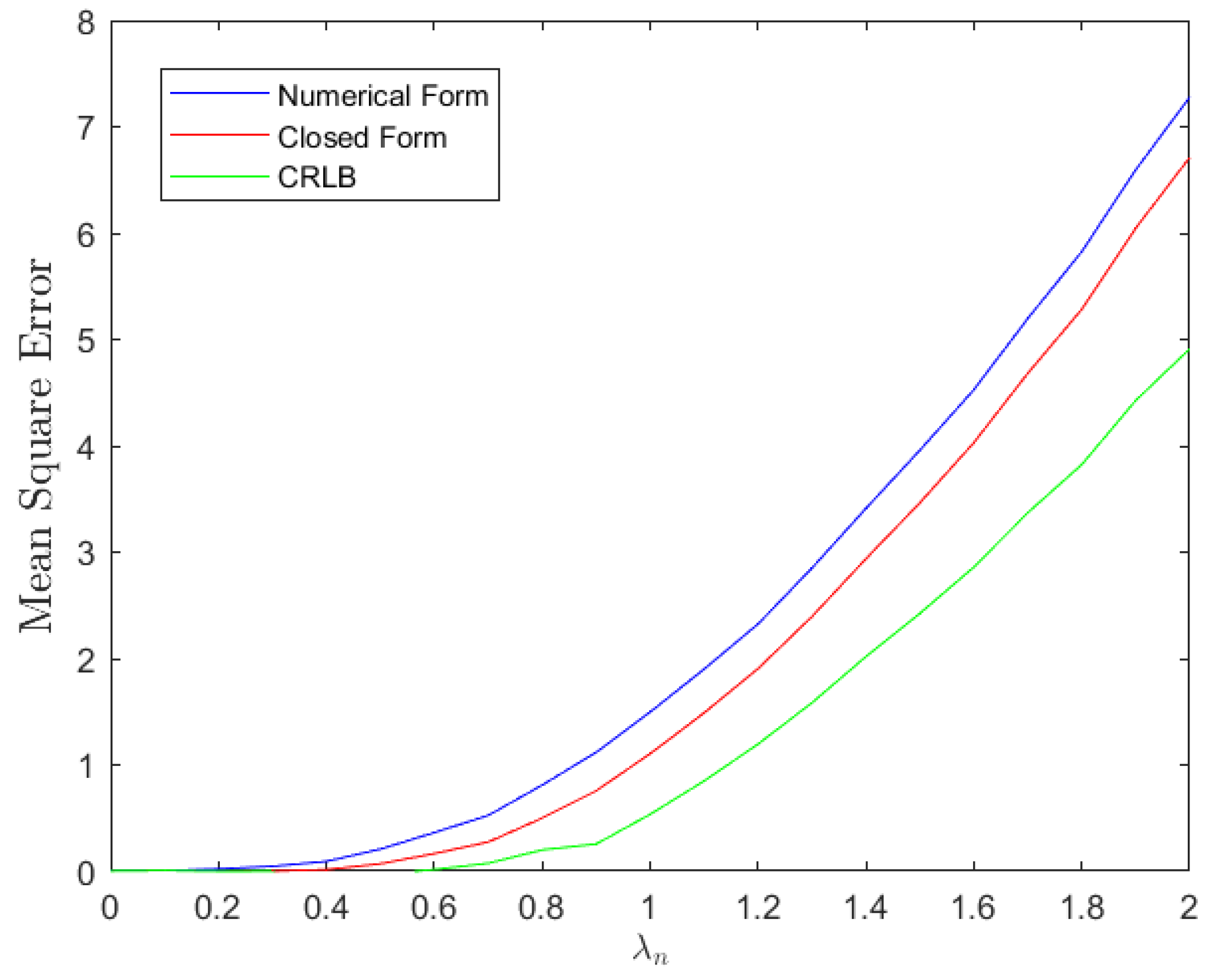
Photon counting detector arrays are commonly used for deep space optical communication receivers operating on the principle of intensity modulation/direct detection (IM/DD). In scenarios where beam parameters can vary at the receiver due to scattering, it is important to estimate beam parameters in order to minimize the probability of error. The use of array of detectors increases the sensitivity of the receiver as compared to single photo-detector of the same size. In this paper, we present the derivation of a maximum likelihood estimator (ML) for peak optical intensity, providing both numerical and closed form expressions for the estimator. Performance of both forms of ML estimator are compared using the mean squared error (MSE) criterion and Cramer–Rao Lower Bound (CRLB) is also derived to assess the proposed estimator’s efficiency. This research contributed to the advancement of estimation techniques and has practical implications for optimizing deep space optical communication systems.
Keywords: photon counting detector array; scattering channel; Gaussian beam; maximum likelihood estimator; mean square error photon counting detector array; scattering channel; Gaussian beam; maximum likelihood estimator; mean square error