
Ecological Functioning and Environmental Applications of Schoenoplectus californicus in Freshwater Wetlands: A Review

 , and
, and
Abstract
1. Introduction
1.1. Taxonomic Identity, Distribution, and Nomenclatural Scope
1.2. Ecological Functions and Ecosystem Services of Totora Wetlands
1.3. Environmental Applications: Water Treatment, Purification, and Phytoremediation
1.4. Knowledge Gap and Purpose of the Systematized Review
2. Materials and Methods
2.1. Review Design
2.2. Search Strategy
2.3. Eligibility Criteria
2.4. Screening and Selection
2.5. Data Extraction and Synthesis
3. Results and Discussion
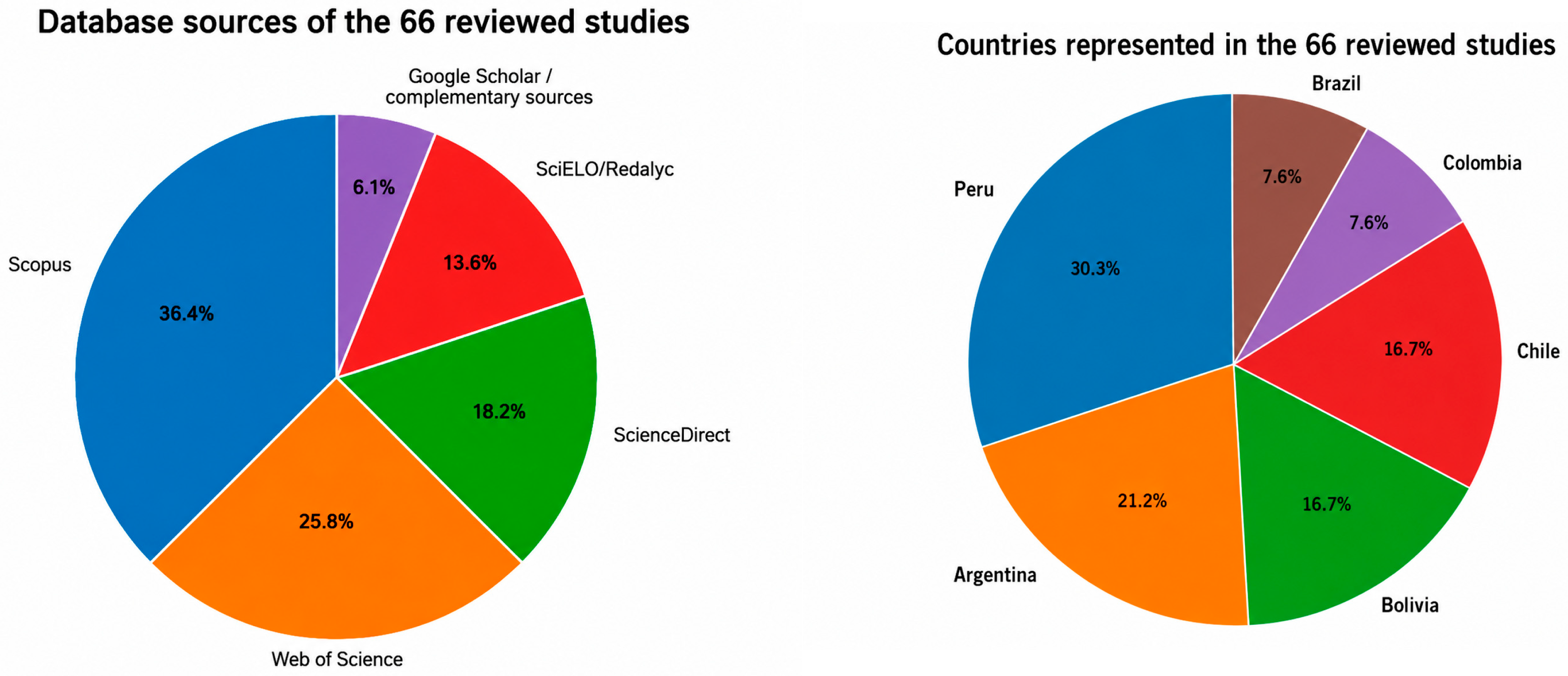
3.1. Bibliometric and Thematic Structure of the Reviewed Literature
3.2. Water Treatment, Phytoremediation, and Engineered Systems
3.3. Wetland Ecology, Biomass, Biodiversity, and Ecosystem Services
3.4. Functional Ecology, Nutrient Dynamics, and Ecological Plasticity
3.5. Morphology, Anatomy, and Functional Adaptation
3.6. Biomaterials, Sustainable Construction, and Technological Applications
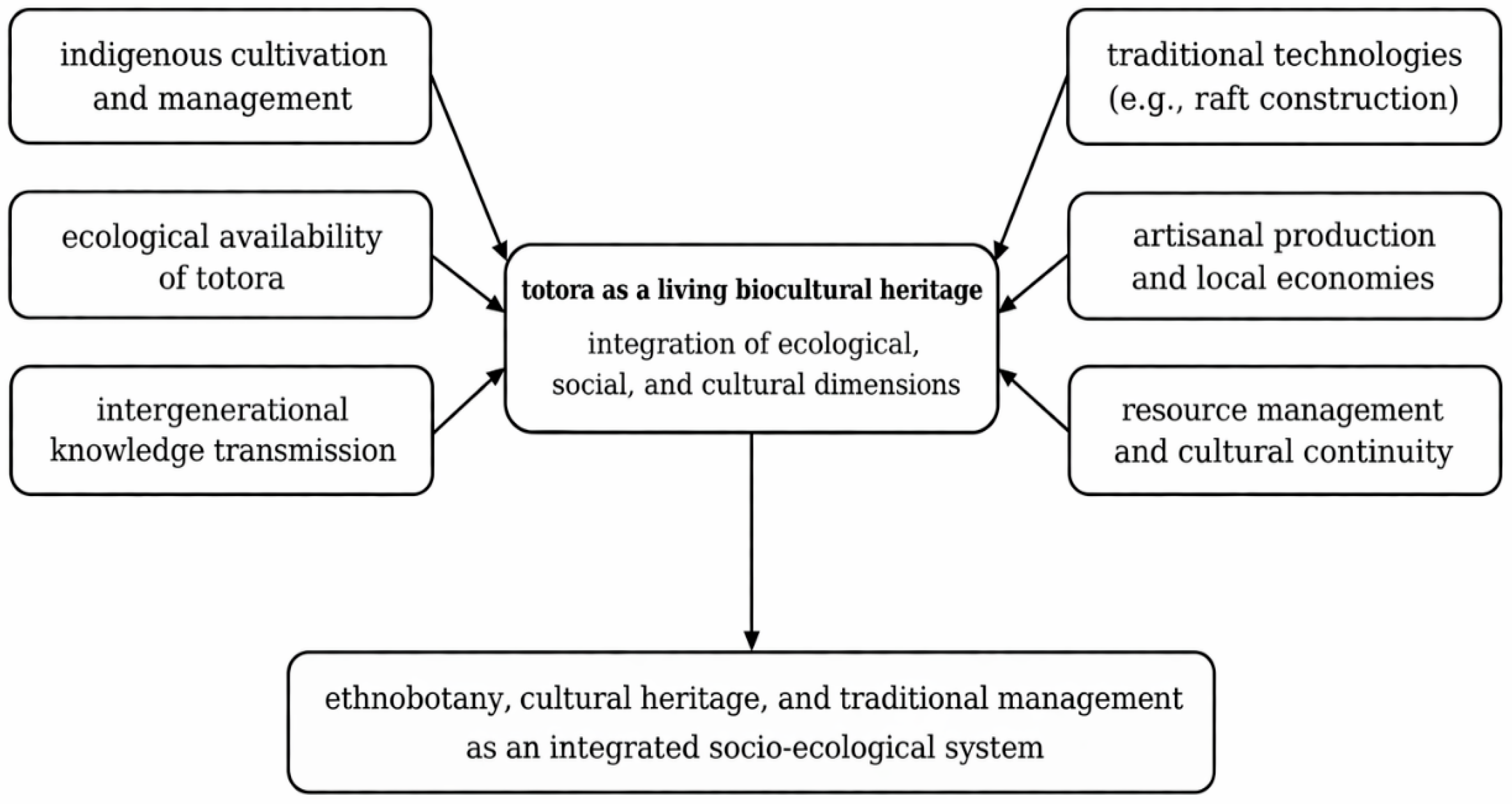
3.7. Nutritional, Ethnobotanical, and Biocultural Dimensions
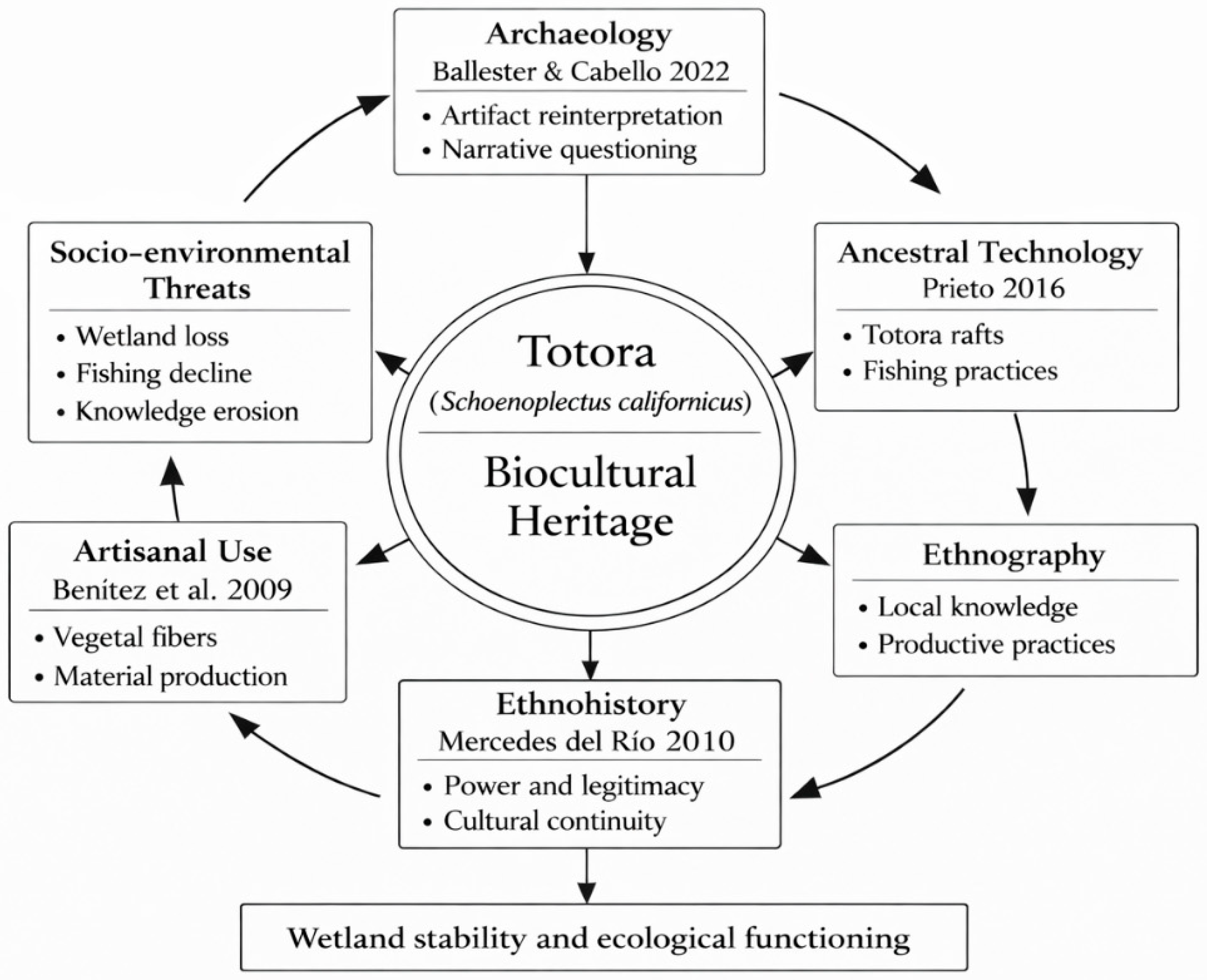
3.8. Integrative Synthesis and Research Gaps
4. Conclusions
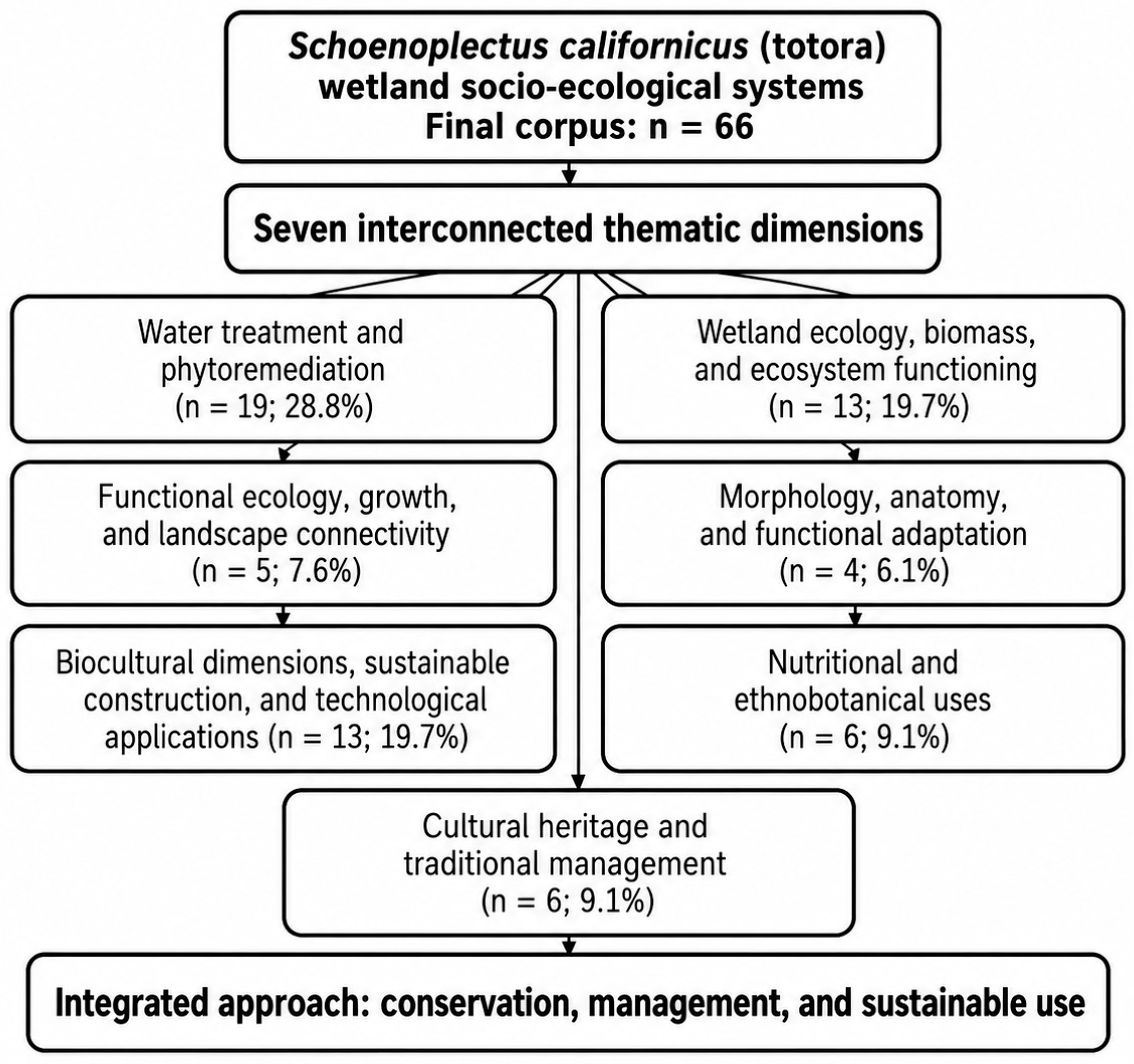
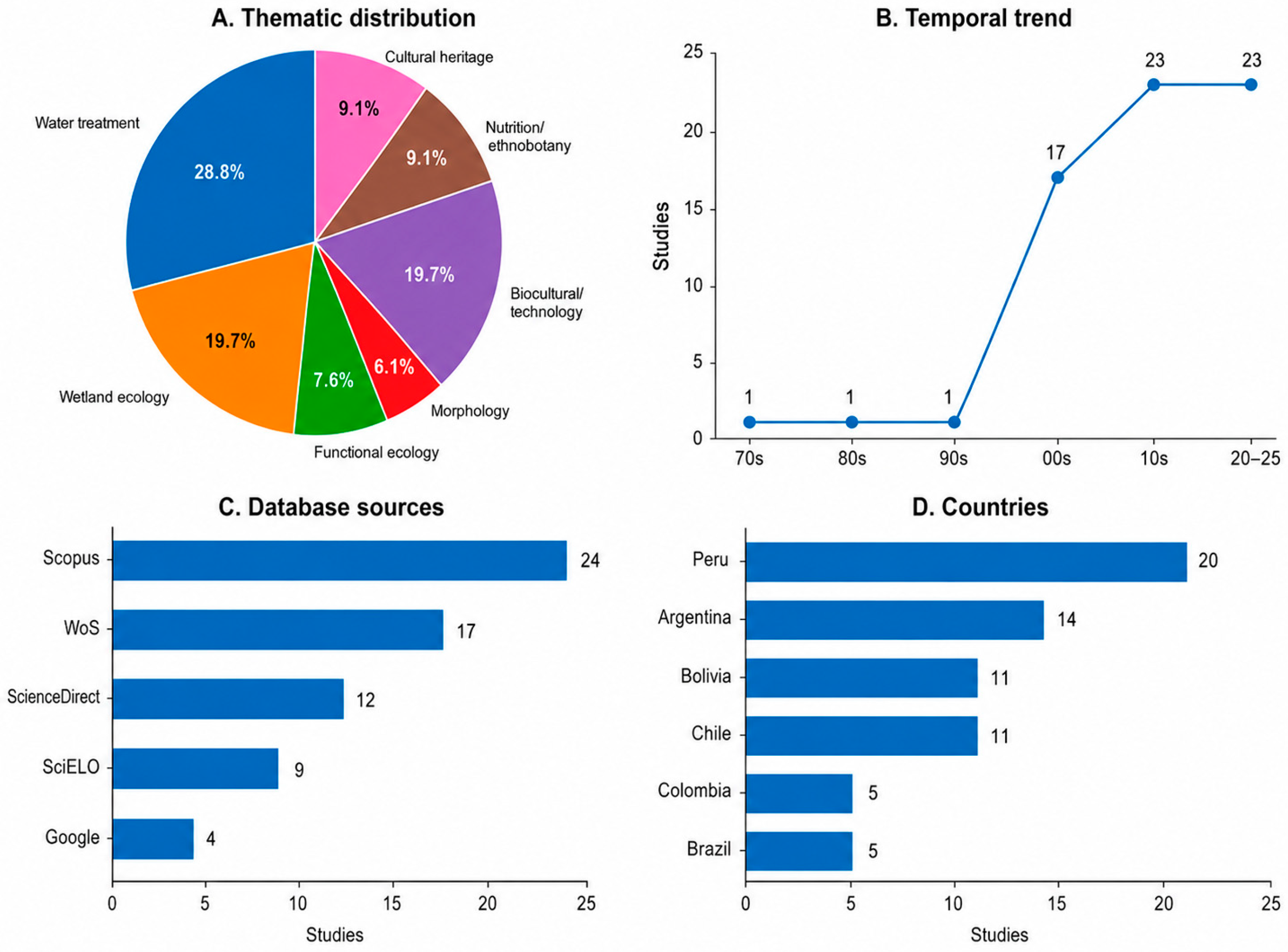
- The best documented applications of Schoenoplectus californicus are water treatment and phytoremediation, which represent the largest evidence base, with 19 studies (28.8%) focused on wastewater treatment, nutrient removal, metal retention, bioaccumulation, and phytostabilization. Moderately supported evidence corresponds to wetland ecology, biomass, ecosystem functioning, and sustainable technological applications, each represented by 13 studies (19.7%). Promising but still limited research lines include functional ecology, morphology, nutritional uses, ethnobotany, and traditional management, which together show the novel value of the species beyond remediation, but still require stronger experimental and socio-ecological evidence.
- Despite this broader evidence base, the literature remains thematically unbalanced. Functional ecology, growth, and landscape connectivity account for 5 studies (7.6%), whereas morphology, anatomy, and functional adaptation represent only 4 studies (6.1%). Nutritional and ethnobotanical uses and cultural heritage and traditional management each include 6 studies (9.1%). This imbalance indicates that the mechanistic, anatomical, functional, nutritional, and cultural dimensions of S. californicus remain less explored than its role in phytoremediation and wetland functioning.
- The main contribution of this multidisciplinary systematized review is to show that the value of S. californicus does not lie in a single ecological or technological use, but in the convergence of ecological functioning, contaminant retention, biomass production, structural adaptation, biomaterial potential, traditional knowledge, and biocultural continuity. Future research should therefore prioritize integrative frameworks capable of linking wetland functioning, phytoremediation performance, plant traits, biomaterial applications, nutritional uses, and traditional management within a common analytical perspective.
Author Contributions
Funding
Data Availability Statement
Acknowledgments
Conflicts of Interest
Appendix A

| ID | Reference | Year | Database/Source | Title/Abstract Screening | Full-Text Eligibility | Final Inclusion | Final Thematic Category | DOI Verified | Notes |
|---|---|---|---|---|---|---|---|---|---|
| 1 | Aguilar et al. [45] | 2024 | Google Scholar | Included | Eligible | Included | Water treatment and phytoremediation | Yes | Activated carbon from totora |
| 2 | Castañeda & Flores [14] | 2014 | Redalyc/Google Scholar | Included | Eligible | Included | Water treatment and phytoremediation | No DOI shown in manuscript | Domestic wastewater treatment |
| 3 | Chuchón & Aybar [18] | 2008 | SciELO/Google Scholar | Included | Eligible | Included | Water treatment and phytoremediation | No DOI shown in manuscript | Treatment plant/macrophyte system |
| 4 | Blanco [17] | 2019 | Scopus/MDPI | Included | Eligible | Included | Water treatment and phytoremediation | Yes | Heavy-metal suitability |
| 5 | Rodríguez et al. [19] | 2019 | Google Scholar | Included | Eligible | Included | Water treatment and phytoremediation | Yes | Bioconcentration factors |
| 6 | Noriega-Rico et al. [33] | 2026 | Scopus | Included | Eligible | Included | Functional ecology, growth, and landscape connectivity | Yes | Population genetics, wetland fragmentation, and functional connectivity |
| 7 | Rojas et al. [16] | 2013 | Scopus/Google Scholar | Included | Eligible | Included | Water treatment and phytoremediation | No DOI shown in manuscript | Nutrient removal in constructed wetlands |
| 8 | Palacios et al. [15] | 2020 | Google Scholar | Included | Eligible | Included | Water treatment and phytoremediation | No DOI shown in manuscript | Artificial wetland performance |
| 9 | Moyano Arévalo et al. [46] | 2018 | Google Scholar | Included | Eligible | Included | Water treatment and phytoremediation | No DOI shown in manuscript | Natural fiber filtration and pollutant reduction |
| 10 | de Cabo et al. [39] | 2019 | DOAJ/Google Scholar | Included | Eligible | Included | Water treatment and phytoremediation | Yes | Riparian rehabilitation |
| 11 | Harguinteguy et al. [41] | 2023 | Scopus | Included | Eligible | Included | Water treatment and phytoremediation | Yes | Cu, Pb, and Zn removal/tolerance |
| 12 | Romero et al. [24] | 2023 | Wiley Online Library/Scopus | Included | Eligible | Included | Water treatment and phytoremediation | Yes | Mine effluent laboratory assessment |
| 13 | Choque et al. [6] | 2025 | Google Scholar | Included | Eligible | Included | Wetland ecology, biomass, and ecosystem functioning | Yes | Distribution and biomass |
| 14 | Pratolongo & Kandus [8] | 2005 | Google Scholar | Included | Eligible | Included | Wetland ecology, biomass, and ecosystem functioning | No DOI shown in manuscript | Aboveground biomass dynamics |
| 15 | Hernández-R. & Rangel [7] | 2009 | SciELO | Included | Eligible | Included | Wetland ecology, biomass, and ecosystem functioning | No DOI shown in manuscript | Wetland vegetation |
| 16 | Ramírez et al. [4] | 2014 | SciELO | Included | Eligible | Included | Wetland ecology, biomass, and ecosystem functioning | Yes | Floristic diversity |
| 17 | Sánchez & Amat-García [10] | 2005 | Google Scholar | Included | Eligible | Included | Wetland ecology, biomass, and ecosystem functioning | No DOI shown in manuscript | Arthropod diversity and trophic support |
| 18 | Palomino & Cabrera Carranza [11] | 2007 | Google Scholar | Included | Eligible | Included | Wetland ecology, biomass, and ecosystem functioning | No DOI shown in manuscript | CO2 capture ecosystem service |
| 19 | Pérez et al. [12] | 2015 | Google Scholar | Included | Eligible | Included | Wetland ecology, biomass, and ecosystem functioning | No DOI shown in manuscript | Quantification of CO2 capture |
| 20 | Claps [9] | 1987 | Manual reference check/Google Scholar | Included | Eligible | Included | Wetland ecology, biomass, and ecosystem functioning | No DOI shown in manuscript | Periphyton pigments and productivity |
| 21 | Fontúrbel et al. [13] | 2006 | Google Scholar | Included | Eligible | Included | Wetland ecology, biomass, and ecosystem functioning | No DOI shown in manuscript | Ecological condition and flora |
| 22 | de Lange et al. [2] | 2010 | Wiley Online Library/Google Scholar | Included | Eligible | Included | Wetland ecology, biomass, and ecosystem functioning | Yes | Ecological occurrence and distribution |
| 23 | Arce & Achá [32] | 2025 | ScienceDirect/Scopus | Included | Eligible | Included | Functional ecology, growth, and landscape connectivity | Yes | Allometry and nutrient uptake |
| 24 | Neubauer et al. [48] | 2012 | Google Scholar/Scopus | Included | Eligible | Included | Functional ecology, growth, and landscape connectivity | Yes | Biomass allocation and plant performance |
| 25 | Pabón et al. [5] | 2025 | Google Scholar | Included | Eligible | Included | Functional ecology, growth, and landscape connectivity | Yes | Growth response and ecological plasticity |
| 26 | Apóstolo [49] | 2005 | Google Scholar | Included | Eligible | Included | Morphology, anatomy, and functional adaptation | No DOI shown in manuscript | Anatomical characters |
| 27 | Benítez et al. [50] | 2009 | Google Scholar | Included | Eligible | Included | Morphology, anatomy, and functional adaptation | Yes | Fiber-related native plants |
| 28 | Corsino et al. [51] | 2013 | Google Scholar | Included | Eligible | Included | Morphology, anatomy, and functional adaptation | No DOI shown in manuscript | Scape architecture |
| 29 | Galindo & Córdoba Sánchez [20] | 2025 | Taylor & Francis Online/Scopus | Included | Eligible | Included | Water treatment and phytoremediation | Yes | Bioindication and phytostabilization of potentially toxic elements in a Ramsar urban wetland |
| 30 | Aza et al. [52] | 2023 | ScienceDirect/Scopus | Included | Eligible | Included | Biocultural dimensions, sustainable construction, and technological applications | Yes | Thermal, mechanical, and fire behavior of totora panels |
| 31 | Hýsková et al. [56] | 2020 | ScienceDirect/Scopus | Included | Eligible | Included | Biocultural dimensions, sustainable construction, and technological applications | Yes | Composite materials |
| 32 | Hidalgo-Cordero & García-Navarro [55] | 2018 | ScienceDirect/Scopus | Included | Eligible | Included | Biocultural dimensions, sustainable construction, and technological applications | Yes | Construction material potential |
| 33 | Hidalgo et al. [54] | 2019 | Google Scholar | Included | Eligible | Included | Biocultural dimensions, sustainable construction, and technological applications | Yes | Bound fiber rolls |
| 34 | Jiménez et al. [53] | 2024 | Scopus/Google Scholar | Included | Eligible | Included | Biocultural dimensions, sustainable construction, and technological applications | Yes | Modular insulating systems |
| 35 | Gavilanez & Zurita-Polo [66] | 2021 | DOAJ | Included | Eligible | Included | Nutritional and ethnobotanical uses | Yes | Totora flour |
| 36 | Loza et al. [65] | 2025 | Google Scholar | Included | Eligible | Included | Nutritional and ethnobotanical uses | Yes | Edible organs and nutritional content |
| 37 | Loza-Del Carpio & Roque-Huanca [64] | 2022 | Google Scholar | Included | Eligible | Included | Nutritional and ethnobotanical uses | Yes | Prescribed burning and forage value |
| 38 | Rondón et al. [3] | 2003 | SpringerLink/Google Scholar | Included | Eligible | Included | Nutritional and ethnobotanical uses | Yes | Ethnobotanical investigation |
| 39 | Macía & Balslev [22] | 2000 | SpringerLink/Google Scholar | Included | Eligible | Included | Nutritional and ethnobotanical uses | Yes | Use and management of totora treated here as ethnobotany |
| 40 | Banack et al. [21] | 2004 | SpringerLink/Google Scholar | Included | Eligible | Included | Cultural heritage and traditional management | Yes | Indigenous cultivation and conservation |
| 41 | Prieto [23] | 2016 | Google Scholar | Included | Eligible | Included | Cultural heritage and traditional management | No DOI shown in manuscript | Ethnographic and archaeological approach |
| 42 | Ballester & Cabello [62] | 2022 | DOAJ/Google Scholar | Included | Eligible | Included | Cultural heritage and traditional management | Yes | Biocultural and historical continuity |
| 43 | del Rio [63] | 2010 | SciELO/Google Scholar | Included | Eligible | Included | Cultural heritage and traditional management | Yes | Historical continuity and traditional systems |
| 44 | Heiser [1] | 1978 | SpringerLink | Included | Eligible | Included | Cultural heritage and traditional management | Yes | Broad totora context retained as historical-cultural background |
| 45 | Boleji et al. [25] | 2021 | Google Scholar/journal platform | Included | Eligible | Included | Water treatment and phytoremediation | Yes | Bioconcentration and bioaccumulation of toxic metals in Scirpus californicus from natural wetlands |
| 46 | Campos-Florián et al. [37] | 2026 | MDPI/Scopus | Included | Eligible | Included | Nutritional and ethnobotanical uses | Yes | Chemical profile, antioxidant capacity, psychopharmacological exploration, and analgesic activity of S. californicus |
| 47 | Cañarejo Antamba & Delgado Yánez [59] | 2026 | Google Scholar/journal platform | Included | Eligible | Included | Biocultural dimensions, sustainable construction, and technological applications | Yes | Totora as a thermal biomaterial for construction in Ecuador |
| 48 | De Rito et al. [26] | 2024 | Taylor & Francis/Scopus | Included | Eligible | Included | Wetland ecology, biomass, and ecosystem functioning | Yes | Amorphous silica contribution of S. californicus to the silicon cycle in shallow lakes |
| 49 | Flores et al. [42] | 2023 | Google Scholar/journal platform | Included | Eligible | Included | Water treatment and phytoremediation | Yes | Heavy-metal removal using Phragmites australis and S. californicus |
| 50 | Hidalgo-Cordero & Aza-Medina [29] | 2023 | ScienceDirect/Scopus | Included | Eligible | Included | Biocultural dimensions, sustainable construction, and technological applications | Yes | Thermal performance of elements made with totora using different production processes |
| 51 | Hidalgo-Cordero et al. [57] | 2021 | Taylor & Francis Online/Scopus | Included | Eligible | Included | Biocultural dimensions, sustainable construction, and technological applications | Yes | Durability of totora binderless boards against wood-decaying organisms |
| 52 | Hidalgo-Cordero et al. [34] | 2023 | Taylor & Francis Online/Scopus | Included | Eligible | Included | Morphology, anatomy, and functional adaptation | Yes | Macromolecular stem composition and relationship with mechanical properties |
| 53 | Huaquisto-Cáceres et al. [30] | 2023 | Scopus/journal platform | Included | Eligible | Included | Biocultural dimensions, sustainable construction, and technological applications | Yes | Eco-efficient thermoacoustic panels made of totora and gypsum |
| 54 | Izzati et al. [35] | 2021 | Google Scholar/journal platform | Included | Eligible | Included | Functional ecology, growth, and landscape connectivity | Yes | Bulrush as a soil conditioner for improving sandy and clay soil fertility |
| 55 | Jara Vinueza et al. [58] | 2024 | MDPI/Scopus | Included | Eligible | Included | Biocultural dimensions, sustainable construction, and technological applications | Yes | Sustainable construction with cattail fibers: physical and mechanical properties |
| 56 | Jara-Vinueza et al. [31] | 2025 | MDPI/Scopus | Included | Eligible | Included | Biocultural dimensions, sustainable construction, and technological applications | Yes | Mechanical behavior and application potential of totora and recycled LDPE-Al hybrid panels |
| 57 | Masias-Flores et al. [43] | 2025 | Google Scholar/journal platform | Included | Eligible | Included | Water treatment and phytoremediation | Yes | Rhizobacteria from Scirpus californicus and Typha dominguensis reduced COD in wastewater |
| 58 | Morales et al. [60] | 2026 | Wiley/Scopus | Included | Eligible | Included | Biocultural dimensions, sustainable construction, and technological applications | Yes | S. californicus evaluated as an antifouling candidate with anti-attachment and toxicological effects |
| 59 | Neyrot et al. [44] | 2024 | ScienceDirect/Scopus | Included | Eligible | Included | Water treatment and phytoremediation | Yes | Fate of sulfamethoxazole in S. californicus microcosms and effects on microbial communities |
| 60 | Rigotti et al. [36] | 2021 | SpringerLink/Scopus | Included | Eligible | Included | Water treatment and phytoremediation | Yes | Root growth and nutrient removal during plant establishment in constructed floating wetlands |
| 61 | Villar et al. [38] | 2024 | SpringerLink/Scopus | Included | Eligible | Included | Cultural heritage and traditional management | Yes | Declining use of totora in Lake Titicaca and implications for traditional management |
| 62 | Wille et al. [61] | 2023 | SpringerLink/Scopus | Included | Eligible | Included | Biocultural dimensions, sustainable construction, and technological applications | Yes | Totora fibers evaluated as a new source for papermaking |
| 63 | Labra & Jaramillo [27] | 2025 | MDPI/Scopus | Included | Eligible | Included | Wetland ecology, biomass, and ecosystem functioning | Yes | Climate and hydrology shape the distribution of dominant native and alien macrophytes in a Ramsar wetland |
| 64 | Malecki-Brown et al. [47] | 2010 | ScienceDirect/Scopus | Included | Eligible | Included | Water treatment and phytoremediation | Yes | Alum application improved water quality in a municipal wastewater treatment wetland and affected macrophyte growth and nutrient uptake |
| 65 | Rivera-Cáceda et al. [28] | 2026 | MDPI/Scopus | Included | Eligible | Included | Wetland ecology, biomass, and ecosystem functioning | Yes | Spatiotemporal analysis of aquatic macrophytes and limnological variability in an impacted urban wetland |
| 66 | Zhang et al. [40] | 2008 | ScienceDirect/Scopus | Included | Eligible | Included | Water treatment and phytoremediation | Yes | Schoenoplectus validus microcosms/comparative evidence |
References
- Heiser, C.B. The totora (Scirpus californicus) in Ecuador and Peru. Econ. Bot. 1978, 32, 222–236. [Google Scholar] [CrossRef] [Scilit]
- de Lange, P.J.; Gardner, R.O.; Champion, P.D.; Tanner, C.C. Schoenoplectus californicus in New Zealand. N. Z. J. Bot. 2010, 36, 319–327. [Google Scholar] [CrossRef] [Scilit]
- Rondón, X.J.; Banack, S.A.; Diaz-Huamanchumo, W. Ethnobotanical investigation of caballitos (Schoenoplectus californicus: Cyperaceae) in Huanchaco, Peru. Econ. Bot. 2004, 57, 35–47. [Google Scholar] [CrossRef] [Scilit]
- Ramírez, C.; Fariña, J.M.; Contreras, D.; Camaño, A.; San Martín, C.; Molina, M.; Moraga, P.; Vidal, O.; Pérez, Y. La diversidad florística del humedal “Ciénagas del Name” (Región del Maule) comparada con otros humedales costeros de Chile Central. Gayana Botán. 2014, 71, 108–119. [Google Scholar] [CrossRef] [Scilit]
- Pabón, G.; Vásquez-Hernández, L.; Yaguana-Jiménez, G.; Aguirre-Mejía, P. Vegetative growth analysis of Schoenoplectus californicus (totora): Dynamics and physiological mechanisms in high-altitude Andean lakes. Ecologies 2025, 6, 71. [Google Scholar] [CrossRef] [Scilit]
- Choque, W.; Gutiérrez Choque, Z.; Paco Pérez, V. Distribución y biomasa de la totora (Schoenoplectus californicus) en el Sitio Ramsar Uru Uru y Poopó, Bolivia. Rev. Investig. Altoandin. 2025, 27, e27673. [Google Scholar] [CrossRef] [Scilit]
- Hernández, R.J.; Rangel, C.J.O. La vegetación del humedal de Jaboque (Bogotá, D.C.). Caldasia 2009, 31, 355–379. [Google Scholar]
- Pratolongo, P.; Kandus, P. Dinámica de biomasa aérea en pajonales de Scirpus Giganteus y juncales de Schoenoplectus Californicus en la zona frontal del bajo delta de río Paraná (Argentina). Ecotrópicos 2005, 18, 30–37. Available online: http://erevistas.saber.ula.ve/index.php/ecotropicos/article/view/10223 (accessed on 10 April 2026).
- Claps, M.C. Valores de pigmentos hallados en el perifiton de Schoenoplectus californicus. Limnobios 1987, 2, 653–656. [Google Scholar]
- Sánchez, D.; Amat-García, G.D. Diversidad de la fauna de artrópodos terrestres en el humedal Jaboque, Bogotá-Colombia. Caldasia 2005, 27, 311–329. [Google Scholar]
- Palomino, D.; Cabrera Carranza, C. Estimación del servicio ambiental de captura del CO2 en la flora de los humedales de Puerto Viejo. Rev. Inst. Investig. FIGMMG 2007, 10, 49–59. Available online: https://revistasinvestigacion.unmsm.edu.pe/index.php/iigeo/article/view/494 (accessed on 10 April 2026).
- Pérez, H.; Luccini, E.; Herrera, L.A.; Parodi, M.; Matar, M.; Barrea, L.; Mechni, M.; Masramón, E. Cuantificación de la captura de CO2 por la flora nativa de totora en un humedal costero de Perú. Energeia 2015, 13, 73–80. Available online: https://bicyt.conicet.gov.ar/fichas/produccion/11979640 (accessed on 10 April 2026).
- Fontúrbel, F.; Richard, E.; García Crispieri, G. Diversidad de flora fanerógama y aspectos ecobiológicos de la unidad vegetal de Aygachi–Cumana–Bahía Cohana, lago Titikaka (La Paz, Bolivia). Cienc. Abierta Int. 2006, 30. [Google Scholar]
- Castañeda Villanueva, A.A.; Flores López, H.E. Tratamiento de aguas residuales domésticas mediante plantas macrófitas típicas en Los Altos de Jalisco, México. Paakat Rev. Tecnol. Soc. 2014, 4, 1–13. Available online: https://www.redalyc.org/articulo.oa?id=499051554003 (accessed on 10 April 2026).
- Palacios Carvajal, M.J.; Gualli Bonilla, D.A.; Manzano Cepeda, M.R. Planta de totora en humedal artificial de flujo subsuperficial. Rev. Caribeña Cienc. Soc. 2020, 9. Available online: https://www.eumed.net/rev/caribe/2020/09/planta-totora.html (accessed on 10 April 2026).
- Rojas, K.; Vera, I.; Vidal, G. Influencia de la estación y de las especies Phragmites australis y Schoenoplectus californicus en la eliminación de materia orgánica y nutrientes contenidos en aguas servidas durante la operación de puesta en marcha de humedales construidos de flujo horizontal subsuperficial. Rev. Fac. Ing. Univ. Antioq. 2013, 69, 289–299. Available online: https://www.redalyc.org/pdf/430/43029812022.pdf (accessed on 10 April 2026).
- Blanco, J.A. Suitability of totora (Schoenoplectus californicus) for its use in constructed wetlands in areas polluted with heavy metals. Sustainability 2019, 11, 19. [Google Scholar] [CrossRef] [Scilit]
- Chuchón, S.A.; Aybar Escobar, C.A. Evaluación de la capacidad de remoción en planta de tratamiento “La Totora”. Ecol. Apl. 2008, 7, 165–171. [Google Scholar] [CrossRef] [Scilit]
- Rodríguez, A.; Flores, R.; Rodríguez, M.; Roldan, D. Cuantificación de los factores de bioconcentración en Schoenoplectus californicus ubicada en el Lago San Pablo, Imbabura-Ecuador (año, 2017). Ciencia 2019, 20, 160–176. [Google Scholar] [CrossRef] [Scilit]
- Galindo, L.A.; Córdoba Sánchez, M.P. Bioindication and phytostabilization of potentially toxic elements by Schoenoplectus californicus in a Ramsar urban wetland, Colombia. Int. J. Phytoremediation 2025, 27, 1765–1773. [Google Scholar] [CrossRef] [Scilit] [PubMed]
- Banack, S.A.; Rondón, X.J.; Diaz-Huamanchumo, W. Indigenous cultivation and conservation of totora (Schoenoplectus californicus, Cyperaceae) in Peru. Econ. Bot. 2004, 58, 11–20. [Google Scholar] [CrossRef] [Scilit]
- Macía, M.J.; Balslev, H. Use and management of Totora (Schoenoplectus californicus, Cyperaceae) in Ecuador. Econ. Bot. 2000, 54, 82–89. [Google Scholar] [CrossRef] [Scilit]
- Prieto, G. Balsas de totora en la costa norte del Perú: Una aproximación etnográfica y arqueológica. Quingnam 2016, 2, 141–188. Available online: https://journal.upao.edu.pe/Quingnam/article/view/574 (accessed on 10 April 2026).
- Romero, M.; Flores, M.; Bravo-Thais, S.; Guzman, M. Schoenoplectus californicus as potential remover of metal elements from mine effluents: A laboratory assessment. Clean Soil Air Water 2023, 51, 2200029. [Google Scholar] [CrossRef] [Scilit]
- Boleji, L.A.; Custodio-Villanueva, M.; Chanamé Zapata, F.C.; Cuadrado Campó, W.J.; Peñaloza Fernández, R.P. Bioconcentration and bioaccumulation of toxic metals in Scirpus californicus from natural wetlands in the Central Andes of Peru. Rev. Ambiente Água–Interdiscip. J. Appl. Sci. 2021, 16, e2728. [Google Scholar] [CrossRef] [Scilit]
- De Rito, M.V.; Borrelli, N.; Natal, M.; Fernández Honaine, M. Schoenoplectus californicus (Cyperaceae) amorphous silica contribution to the silicon cycle in Pampean shallow lakes: An analysis of spatio-temporal variation and silicon-lignin relations. Aust. J. Bot. 2024, 72, BT23084. [Google Scholar] [CrossRef] [Scilit]
- Labra, F.A.; Jaramillo, E. Biodiversity dynamics in a Ramsar wetland: Assessing how climate and hydrology shape the distribution of dominant native and alien macrophytes. Plants 2025, 14, 1116. [Google Scholar] [CrossRef] [Scilit] [PubMed]
- Rivera-Cáceda, F.V.; Arenas-Ibarra, J.A.; Urrutia-Ramírez, S.I. Do ecological patterns persist in highly impacted urban wetlands? A spatiotemporal analysis of aquatic macrophytes and limnological variability in a Peruvian coastal wetland. Diversity 2026, 18, 214. [Google Scholar] [CrossRef] [Scilit]
- Hidalgo-Cordero, J.F.; Aza-Medina, L.C. Analysis of the thermal performance of elements made with totora using different production processes. J. Build. Eng. 2023, 65, 105777. [Google Scholar] [CrossRef] [Scilit]
- Huaquisto-Cáceres, S.; Pari-Quispe, D.K.; Cruz-Maron, R.A. Eco-efficient thermoacoustic panels made of totora and gypsum for sustainable rural housing ceilings. Mater. Constr. 2023, 73, e331. [Google Scholar] [CrossRef] [Scilit]
- Jara-Vinueza, O.; Pavon, W.; Remache, A.; Arroyo, F.; Gutiérrez, M.; Mora Figueroa, E. Evaluation of mechanical behavior and application potential of totora (Schoenoplectus californicus) and recycled low-density polyethylene-aluminum (LDPE-Al) hybrid panels. Buildings 2025, 15, 2212. [Google Scholar] [CrossRef] [Scilit]
- Arce, W.A.; Achá, D. Allometric determinations in the early development of Schoenoplectus californicus to monitor nutrient uptake in constructed wetlands. Ecohydrol. Hydrobiol. 2025, 25, 34–41. [Google Scholar] [CrossRef] [Scilit]
- Noriega-Rico, E.; Lobato-de Magalhães, T.; Rico, Y. Forested landscape promotes functional connectivity of California bulrush (Schoenoplectus californicus) in threatened freshwater wetlands. Aquat. Bot. 2023, 204, 103980. [Google Scholar] [CrossRef] [Scilit]
- Hidalgo-Cordero, J.F.; Němec, M.; Hidalgo Castro, P.; Hájková, K.; Ordóñez Castro, A.; Hýsek, Š. Macromolecular composition of totora (Schoenoplectus californicus C.A. Mey. Soják) stem and its correlation with stem mechanical properties. J. Nat. Fibers 2023, 20, 2282049. [Google Scholar] [CrossRef] [Scilit]
- Izzati, M.; Haryanti, S.; Hastuti, R.B. Effectivity of bulrush (Scirpus californicus) as a soil conditioner in increasing sandy and clay soil fertility. Biodiversitas J. Biol. Divers. 2021, 22, 3423–3429. [Google Scholar] [CrossRef] [Scilit]
- Rigotti, J.A.; Paqualini, J.P.; Rodrigues, L.R. Root growth and nutrient removal of Typha domingensis and Schoenoplectus californicus over the period of plant establishment in a constructed floating wetland. Environ. Sci. Pollut. Res. 2021, 28, 8927–8935. [Google Scholar] [CrossRef] [Scilit] [PubMed]
- Campos-Florián, J.; Galliani-Huamanchumo, G.; Campos-Bazán, A.V.; Chunga-Flores, B.; Castro-Dionicio, I.; Villarreal-La Torre, V.E.; Flores-Atoche, L.F.; Gonzales-Mendez, L.; Ramos-Farfán, G.; Condor-Goytizolo, J.; et al. Schoenoplectus californicus (C.A. Mey.) Soják: Chemical profile, antioxidant capacity, psychopharmacological exploration and analgesic activity. Mar. Drugs 2026, 24, 160. [Google Scholar] [CrossRef] [Scilit] [PubMed]
- Villar, D.A.; Thomsen, B.; Gutiérrez Tito, E.R.; Paca Condori, A.C.; Velásquez-Noriega, P.; Mamani, E.; Arivilca, M.; Moreno Terrazas, E.G.; Marino, J.; Gosler, A.G. Declining use of totora (Schoenoplectus californicus subsp. tatora) in Lake Titicaca. Hum. Ecol. 2024, 52, 1–14. [Google Scholar] [CrossRef] [Scilit]
- de Cabo, L.I.; Faggi, A.; Miguel, S.; Basílico, G. Rehabilitación de riberas en cuenca Matanza-Riachuelo. Biol. Acuát. 2019, 33, e005. [Google Scholar] [CrossRef] [Scilit]
- Zhang, Z.; Rengel, Z.; Meney, K. Interactive effects of nitrogen and phosphorus loadings on nutrient removal from simulated wastewater using Schoenoplectus validus in wetland microcosms. Chemosphere 2008, 72, 1823–1828. [Google Scholar] [CrossRef] [Scilit] [PubMed]
- Harguinteguy, C.A.; Arán, D.S.; Gudiño, G.L.; Peñaflor, M. Capacity of Schoenoplectus californicus to remove and tolerate copper, lead, and zinc in constructed wetland systems using simulated wastewater. J. Environ. Eng. 2023, 149, 04023069. [Google Scholar] [CrossRef] [Scilit]
- Flores, M.; Bravo-Thais, S.; Romero, M.; Guzman, M. Evaluation of heavy metal removal using Phragmites australis (Cav.) and Schoenoplectus californicus (C.A. Mey.): A comparison of the dry ashing and wet digestion method. Anal. Bioanal. Chem. Res. 2023, 10, 97–109. [Google Scholar] [CrossRef]
- Masias-Flores, S.M.; Granada-Cruz, G.O.; Vera-Marmanillo, V.I. Eficiencia de rizobacterias de Scirpus californicus y Typha dominguensis en la reducción de DQO de aguas residuales bajo condiciones de laboratorio. Rev. Int. Contam. Ambient. 2025, 41, 199–209. [Google Scholar] [CrossRef] [Scilit]
- Neyrot, S.; Acha, D.; Morales-Belpaire, I. The fate of sulfamethoxazole in microcosms of the macrophyte Schoenoplectus californicus and its impact on microbial communities. Environ. Pollut. 2024, 362, 124947. [Google Scholar] [CrossRef] [Scilit] [PubMed]
- Aguilar, D.A.; Aguilar Laquis, L.F.; Vargas Maron, J.A.; Guerra Bueno, E.S.; Arazola Mamani, G. Elevar el índice de la calidad del agua del lago Titicaca con carbón activado de totora (Schoenoplectus californicus). Rev. Investig. 2024, 13, e5969. [Google Scholar] [CrossRef] [Scilit]
- Moyano Arévalo, J.R.; Naranjo Vargas, E.M.; Santillán Mariño, C.J. Filtros naturales para purificación de agua. Rev. Obs. Econ. Latinoam. 2018. Available online: https://www.eumed.net/rev/oel/2018/11/filtro-purificacion-aguas.html (accessed on 10 April 2026). [CrossRef] [Scilit]
- Malecki-Brown, L.M.; White, J.R.; Brix, H. Alum application to improve water quality in a municipal wastewater treatment wetland: Effects on macrophyte growth and nutrient uptake. Chemosphere 2010, 79, 186–192. [Google Scholar] [CrossRef] [Scilit] [PubMed]
- Neubauer, M.E.; Plaza de los Reyes, C.; Pozo, G.; Villamar, C.A.; Vidal, G. Growth and nutrient uptake by Schoenoplectus californicus (C.A. Méyer) Sójak in a constructed wetland fed with swine slurry. J. Soil Sci. Plant Nutr. 2012, 12, 421–430. [Google Scholar] [CrossRef] [Scilit]
- Apóstolo, N.M. Caracteres anatómicos de la vegetación costera del Rio Salado (Noroeste de la provincia de Buenos Aires, Argentina). Bol. Soc. Argent. Botán. 2005, 40, 215–227. [Google Scholar]
- Benítez, F.B.; Pereira, S.C.; González, F.; Bertoni, S. Plantas nativas e introducidas utilizadas por sus fibras en Paraguay. Steviana 2009, 1, 5–23. [Google Scholar] [CrossRef] [Scilit] [PubMed]
- Corsino, B.; Boeger, M.R.T.; Maranho, L.T. Arquitetura do escapo de Schoenoplectus californicus. Iheringia Sér. Botânica 2013, 68, 27–35. [Google Scholar]
- Jiménez, G.C.; Montoya Robles, d.P.T.; Loayza León, S. De la “Quesana” tradicional a un sistema modular de paneles aislantes de totora. Rev. Arquit. 2024, 26, 125–146. [Google Scholar] [CrossRef] [Scilit]
- Aza, L.C.; Palumbo, M.; Lacasta, A.M.; González-Lezcano, R.A. Characterization of the thermal behavior, mechanical resistance, and reaction to fire of totora (Schoenoplectus californicus) panels and their potential use as a sustainable construction material. J. Build. Eng. 2023, 65, 105984. [Google Scholar] [CrossRef] [Scilit]
- Hidalgo, P.; Hidalgo-Cordero, J.F.; García-Navarro, J. Estudio del comportamiento físico-mecánico de rollos de totora amarrados: Influencia de la tensión de amarre, diámetro y longitud. DAYA Diseño Arte. Arquit. 2019, 6, 53–84. [Google Scholar] [CrossRef] [Scilit]
- Hidalgo, J.F.; García-Navarro, J. Totora (Schoenoplectus californicus (C.A. Mey.) Soják) and its potential as a construction material. Ind. Crops Prod. 2018, 112, 467–480. [Google Scholar] [CrossRef] [Scilit]
- Hýsková, P.; Gaff, M.; Hidalgo-Cordero, J.F.; Hýsek, Š. Composite materials from totora (Schoenoplectus californicus): Is it worth it? Compos. Struct. 2020, 232, 111572. [Google Scholar] [CrossRef] [Scilit]
- Hidalgo-Cordero, J.F.; De Troya, M.T.; García-Navarro, J. Influence of the hot-pressing process on the durability of totora (Schoenoplectus californicus C.A. Mey. Soják) binderless boards against wood-decaying organisms. J. Nat. Fibers 2021, 18, 1882–1892. [Google Scholar] [CrossRef] [Scilit]
- Jara Vinueza, O.; Pavon, W.; Remache, A. Sustainable construction with cattail fibers in Imbabura, Ecuador: Physical and mechanical properties, research and applications. Buildings 2024, 14, 1703. [Google Scholar] [CrossRef] [Scilit]
- Cañarejo Antamba, J.; Delgado Yánez, M. La totora (Schoenoplectus californicus) como biomaterial térmico para la construcción en Ecuador: Parámetros físicos y ambientales. Estud. Perspect. Rev. Científica. Académica 2026, 6, 7711–7728. [Google Scholar] [CrossRef] [Scilit]
- Morales, M.L.P.; Neves, L.O.; das Shaik, A.; Chenia, H.; Maronna, M.M.; Soroldoni, S.; Nagata, R.M.; They, N.H.; Agostini, V.O.; Pinho, G.L.L. Cabomba caroliniana and Schoenoplectus californicus as antifouling candidates: Anti-attachment and toxicological effects in Aurelia coerulea (Cnidaria, Scyphozoa). Environ. Toxicol. 2026, 41, 356–372. [Google Scholar] [CrossRef] [Scilit] [PubMed]
- Wille, V.K.D.; Gentil, M.; Nunes, G.R.S.; Da Rosa, R.C.; Jardim, J.M.; Berger, C.; Dalla Costa, H.W.; Gatto, D.A.; Pedrazzi, C. Totora fibers as a new source for papermaking. Biomass Convers. Biorefinery 2023, 13, 5235–5241. [Google Scholar] [CrossRef] [Scilit]
- Ballester, B.; Cabello, G. Mitologías navieras de Atacama: El caballito de totora de Jean-Christian Spahni. Estud. Atacameños 2022, 68, e4690. [Google Scholar] [CrossRef] [Scilit]
- del Rio, M. Los tesoros de los mallku de Pocona y Totora en el siglo XVI. Chungará 2010, 42, 199–220. [Google Scholar] [CrossRef] [Scilit]
- Loza-Del Carpio, A.; Roque-Huanca, B. Efecto de la quema prescrita en el valor nutricional de tallos aéreos de Schoenoplectus tatora (Kunth) Palla, lago Titicaca, Perú. Bioagro 2022, 34, 253–264. [Google Scholar] [CrossRef] [Scilit]
- Loza, A.; Vallenas Gaona, M.; Mamani Sairitupac, D. Contenido nutricional e importancia etnobotánica de órganos comestibles de la totora Schoenoplectus californicus (C.A.Mey.) Soják. Bioagro 2025, 37, 91–100. [Google Scholar] [CrossRef] [Scilit]
- Gavilanez, I.M.; Zurita-Polo, S.M. Divulgación de la obtención y uso de harina de totora Schoenoplectus californicus, producto no maderable por sus características físico-químicas. Dominio Cienc. 2021, 7, 1798–1811. [Google Scholar]



| Name as Cited in the Literature | Family | Rank | Verified Author Citation | IPNI/Taxonomic Record | Current Taxonomic Status | Harmonized Name Adopted in This Review | Decision Applied in the Manuscript |
|---|---|---|---|---|---|---|---|
| Schoenoplectus californicus | Cyperaceae | Species | Schoenoplectus californicus (C.A.Mey.) Soják | IPNI LSID: urn:lsid.org:names:229810-2 | Accepted species | Schoenoplectus californicus (C.A.Mey.) Soják | Principal accepted name used throughout the manuscript. |
| Scirpus californicus | Cyperaceae | Species | Scirpus californicus (C.A.Mey.) Steud. | IPNI/POWO/WFO consulted | Synonym/unaccepted name under current taxonomic treatment | Schoenoplectus californicus (C.A.Mey.) Soják | Retained only when cited in the original source; harmonized to S. californicus for synthesis. |
| Schoenoplectus tatora | Cyperaceae | Species | Schoenoplectus tatora (Kunth) Palla | IPNI/POWO consulted | Synonym of Schoenoplectus californicus | Schoenoplectus californicus (C.A.Mey.) Soják | Treated as a synonym used in older or regional literature. |
| Scirpus californicus subsp. tatora | Cyperaceae | Subspecies | Scirpus californicus subsp. tatora (Kunth) T.Koyama | IPNI LSID: urn:lsid.org:names:230246-2 | Infraspecific synonym/unaccepted under current harmonized treatment | Schoenoplectus californicus (C.A.Mey.) Soják | Mentioned only when the original reference uses this infraspecific name; interpreted at species level. |
| Schoenoplectus californicus subsp. tatora | Cyperaceae | Subspecies | Schoenoplectus californicus subsp. tatora (Kunth) T.Koyama | IPNI/herbarium and taxonomic records consulted | Infraspecific name used in Andean and Lake Titicaca literature | Schoenoplectus californicus (C.A.Mey.) Soják | Used with taxonomic caution; not counted as a separate taxon in the synthesis. |
| Schoenoplectus californicus var. spoliatus | Cyperaceae | Variety | Schoenoplectus californicus var. spoliatus (Barros) Vegetti | IPNI LSID: urn:lsid.org:names:2987168-1 | Infraspecific name/synonymized in current taxonomic backbones | Schoenoplectus californicus (C.A.Mey.) Soják | Not treated as an independent taxonomic unit unless specifically cited by an original source. |
| Scirpus californicus var. spoliatus | Cyperaceae | Variety | Scirpus californicus var. spoliatus Barros | IPNI/POWO consulted | Synonym of Schoenoplectus californicus | Schoenoplectus californicus (C.A.Mey.) Soják | Considered a synonym; not separated analytically. |
| “Totora” | Cyperaceae | Vernacular name | Not applicable | Not applicable | Vernacular name | Schoenoplectus californicus (C.A.Mey.) Soják | Used only as a common name after first defining the scientific name. |
| “Tatora” | Cyperaceae | Vernacular/regional name | Not applicable | Not applicable | Vernacular or regional designation | Schoenoplectus californicus (C.A.Mey.) Soják | Used only when discussing regional, ethnobotanical, or cultural literature. |
| Theme | n | % |
|---|---|---|
| Water treatment and phytoremediation | 19 | 28.8 |
| Wetland ecology, biomass, and ecosystem functioning | 13 | 19.7 |
| Functional ecology, growth, and landscape connectivity | 5 | 7.6 |
| Morphology, anatomy, and functional adaptation | 4 | 6.1 |
| Biocultural dimensions, sustainable construction, and technological applications | 13 | 19.7 |
| Nutritional and ethnobotanical uses | 6 | 9.1 |
| Cultural heritage and traditional management | 6 | 9.1 |
| Total | 66 | 100% |
| Authors/Year | System or Configuration | Contaminant or Water-Quality Indicator | Removal Efficiency or Main Reported Result | Duration | Scale | Main Limitation for Interpretation |
|---|---|---|---|---|---|---|
| Aguilar et al. [45] (2024) | Water remediation using activated carbon derived from totora | General water-quality index and physicochemical parameters | Improved water-quality indicators after treatment with totora-derived activated carbon | Not specified in the current synthesis | Material-based/experimental application | The evidence supports adsorbent potential, but performance depends on material preparation, dosage, contact time, regeneration capacity, and long-term safety. |
| Castañeda and Flores [14] (2014) | Domestic wastewater treatment using wetland macrophytes | Domestic wastewater indicators | Demonstrated a sustainable and low-cost treatment alternative | Not specified in the current synthesis | Applied/treatment system | The result supports ecological treatment, but system design and operational conditions limit direct comparison with other studies. |
| Chuchón and Aybar [18] (2008) | Wastewater treatment plant with macrophyte-based system | Coliforms and BOD5 | Reported high removal of coliforms and BOD5 | Not specified in the current synthesis | Applied/wastewater treatment plant | Treatment performance may depend on hydraulic loading, maintenance, plant density, and local operating conditions. |
| Blanco [17] (2019) | Phytoremediation in contaminated wetland environments | Potentially toxic metals | Demonstrated tolerance of S. californicus to metal contamination | Not specified in the current synthesis | Field or contaminated wetland context | Tolerance does not necessarily indicate complete removal; metal partitioning among roots, stems, sediments, and water must be interpreted carefully. |
| Rodríguez et al. [19] (2019) | Bioconcentration and bioaccumulation assessment | Metals accumulated in plant tissues | Reported metal accumulation in tissues of S. californicus | Not specified in the current synthesis | Natural wetland/field evidence | Bioaccumulation indicates retention potential, but extraction, disposal, and trophic-transfer risks require further evaluation. |
| Rojas et al. [16] (2013) | Constructed wetlands comparing Phragmites australis and S. californicus | Wastewater treatment indicators | Reported similar treatment efficiency between macrophyte species | Not specified in the current synthesis | Constructed wetland/comparative system | Seasonal variation and differences in hydraulic or substrate conditions may influence treatment performance. |
| Moyano Arévalo, Naranjo Vargas, and Santillán Mariño [46] (2018) | Natural fiber filtration using totora fibers | Pollutants retained through natural filtration | Reported pollutant reduction through natural fiber filtration | Not specified in the current synthesis | Material-based filtration system | The result is promising, but efficiency depends on fiber preparation, filter design, flow rate, and replacement frequency. |
| Neyrot et al. [44] (2024) | Microcosm with plant, sediment, algae, and microbial communities | Sulfamethoxazole | Removal depended on the combined action of plant, sediment, algae, and microbial communities | Not specified in the current synthesis | Microcosm | The evidence supports system-level transformation, but microcosm behavior may differ from constructed or natural wetlands under variable environmental conditions. |
| Authors | Year | System/Approach | Species/Material | Main Finding | Contribution |
|---|---|---|---|---|---|
| Aguilar et al. [45] | 2024 | Water remediation using plant-derived material | Activated carbon from totora (S. californicus) | Improved water quality index and physicochemical parameters | Supports the use of totora as an adsorbent material for water remediation |
| Castañeda & Flores [14] | 2014 | Domestic wastewater treatment | Wetland macrophytes | Demonstrated a sustainable and low-cost treatment alternative | Supports macrophyte-based systems as ecological technology |
| Chuchón & Aybar [18] | 2008 | Wastewater treatment plant | Macrophyte system | Reported high removal of coliforms and BOD5 | Shows that treatment performance depends on system design and operation |
| Blanco [17] | 2019 | Phytoremediation | S. californicus | Demonstrated tolerance to metals | Supports the application of S. californicus in contaminated wetland environments |
| Rodríguez et al. [19] | 2019 | Bioconcentration | S. californicus | Reported metal accumulation in plant tissues | Indicates potential use in metal retention, bioaccumulation, and extraction processes |
| Rojas et al. [16] | 2013 | Constructed wetlands | P. australis and S. californicus | Reported similar treatment efficiency between macrophyte species | Highlights the influence of seasonal variation on treatment performance |
| Palacios et al. [15] | 2020 | Artificial wetland | Totora | Reported good operational performance | Supports the practical value of totora in engineered wetland systems |
| Moyano Arévalo, Naranjo Vargas & Santillán Mariño [46] | 2018 | Natural fiber filtration | Totora fibers/natural fibers | Reduced pollutants through natural filtration | Supports the use of totora fibers as a low-cost filtration material |
| de Cabo et al. [39] | 2019 | Riparian rehabilitation | Macrophytes | Supported the restoration of riparian vegetation | Provides ecological support for wetland and riparian recovery |
Disclaimer/Publisher’s Note: The statements, opinions and data contained in all publications are solely those of the individual author(s) and contributor(s) and not of MDPI and/or the editor(s). MDPI and/or the editor(s) disclaim responsibility for any injury to people or property resulting from any ideas, methods, instructions or products referred to in the content. |
© 2026 by the authors. Licensee MDPI, Basel, Switzerland. This article is an open access article distributed under the terms and conditions of the Creative Commons Attribution (CC BY) license.
Share and Cite
Canales-Gutiérrez, A.; Canales-Manchuria, G.; Miranda-Mamani, J.; Calatayud-Mendoza, A.; Mullisaca-Torres, F. Ecological Functioning and Environmental Applications of Schoenoplectus californicus in Freshwater Wetlands: A Review. Limnol. Rev. 2026, 26, 38. https://doi.org/10.3390/limnolrev26030038
Canales-Gutiérrez A, Canales-Manchuria G, Miranda-Mamani J, Calatayud-Mendoza A, Mullisaca-Torres F. Ecological Functioning and Environmental Applications of Schoenoplectus californicus in Freshwater Wetlands: A Review. Limnological Review. 2026; 26(3):38. https://doi.org/10.3390/limnolrev26030038
Chicago/Turabian StyleCanales-Gutiérrez, Angel, Gelvi Canales-Manchuria, Jesús Miranda-Mamani, Alfredo Calatayud-Mendoza, and Francely Mullisaca-Torres. 2026. "Ecological Functioning and Environmental Applications of Schoenoplectus californicus in Freshwater Wetlands: A Review" Limnological Review 26, no. 3: 38. https://doi.org/10.3390/limnolrev26030038
APA StyleCanales-Gutiérrez, A., Canales-Manchuria, G., Miranda-Mamani, J., Calatayud-Mendoza, A., & Mullisaca-Torres, F. (2026). Ecological Functioning and Environmental Applications of Schoenoplectus californicus in Freshwater Wetlands: A Review. Limnological Review, 26(3), 38. https://doi.org/10.3390/limnolrev26030038