
A Dataset Trichoptera (Insecta) in Selected Regions of European Russia

 ,
,  , ,
, ,
Abstract
1. Introduction
2. Data Description
2.1. Dataset Description
2.2. Species Diversity
3. Methods
3.1. Study Area
3.2. Data Collection
3.3. Taxonomic Analysis
4. Conclusions
Author Contributions
Funding
Institutional Review Board Statement
Data Availability Statement
Acknowledgments
Conflicts of Interest
Appendix A
| Species | VlR | VgR | VrR | LR | RM | MR | NNR | PR | RR | SmR | SrR | TR | RT | UR | RCh | Total of Specimens | |
| Rhyacophilidae | |||||||||||||||||
| 1. | Rhyacophila fasciata Hagen, 1859 | 1 | 13 | 14 | |||||||||||||
| 2. | Rhyacophila nubila Zetterstedt, 1840 | 2 | 1 | 3 | |||||||||||||
| 3. | Rhyacophila obliterata McLachlan, 1863 | 1 | 1 | ||||||||||||||
| Glossosomatidae | |||||||||||||||||
| 4. | Agapetus ochripes Curtis, 1834 | 5 | 5 | ||||||||||||||
| Hydroptilidae | |||||||||||||||||
| 5. | Agraylea multipunctata Curtis, 1834 | 7 | 2 | 3 | 1 | 7 | 20 | ||||||||||
| 6. | Agraylea sexmaculata Curtis, 1834 | 1 | 24 | 1 | 2 | 1 | 9 | 38 | |||||||||
| 7. | Hydroptila angulata Mosely, 1922 * | 2 | 2 | ||||||||||||||
| 8. | Hydroptila dampfi Ulmer, 1929 | 4 | 4 | ||||||||||||||
| 9. | Hydroptila sparsa Curtis, 1834 | 1 | 1 | ||||||||||||||
| 10. | Hydroptila tineoides Dalman, 1819 | 3 | 2 | 1 | 6 | ||||||||||||
| 11. | Ithytrichia lamellaris Eaton, 1873 | 109 | 1 | 2 | 2 | 114 | |||||||||||
| 12. | Orthotrichia costalis (Curtis, 1834) | 1 | 1 | ||||||||||||||
| 13. | Orthotrichia tragetti Mosely, 1930 | 27 | 9 | 36 | |||||||||||||
| 14. | Oxyethira flavicornis (Pictet, 1834) | 3 | 1 | 1 | 5 | ||||||||||||
| 15. | Oxyethira tristella Klapalek, 1895 | ||||||||||||||||
| 16. | Tricholeiochiton fagesii (Guinard, 1879) | 1 | 1 | ||||||||||||||
| Philopotamidae | |||||||||||||||||
| 17. | Philopotamus montanus (Donovan, 1813) | 1 | 1 | ||||||||||||||
| Psychomyiidae | |||||||||||||||||
| 18. | Lype phaeopa (Stephens, 1836) | 3 | 1 | 3 | 7 | ||||||||||||
| 19. | Paduniella uralensis Martynov, 1914 | 1 | 1 | ||||||||||||||
| 20. | Psychomyia pusilla (Fabricius, 1781) | 1 | 2 | 1 | 1 | 179 | 184 | ||||||||||
| 21. | Tinodes waeneri (Linnaeus, 1758) | 4 | 66 | 3 | 73 | ||||||||||||
| Ecnomidae | |||||||||||||||||
| 22. | Ecnomus tenellus (Rambur, 1842) | 1 | 20 | 10 | 1 | 21 | 53 | ||||||||||
| Polycentropodidae | |||||||||||||||||
| 23. | Cyrnus crenaticornis (Kolenati, 1859) | 2 | 2 | ||||||||||||||
| 24. | Cyrnus flavidus McLachlan, 1864 | 7 | 1 | 1 | 1 | 5 | 15 | ||||||||||
| 25. | Cyrnus trimaculatus (Curtis, 1834) | 1 | 4 | 5 | |||||||||||||
| 26. | Holocentropus dubius (Rambur, 1842) | 75 | 1 | 76 | |||||||||||||
| 27. | Holocentropus insignis Martynov, 1924 | 3 | 1 | 4 | |||||||||||||
| 28. | Holocentropus picicornis (Stephens, 1836) | 1 | 1 | 2 | |||||||||||||
| 29. | Neureclipsis bimaculata (Linnaeus, 1758) | 1 | 7 | 4 | 9 | 21 | |||||||||||
| 30. | Plectrocnemia conspersa (Curtis, 1834) | 1 | 1 | 9 | 1 | 17 | 29 | ||||||||||
| 31. | Polycentropus flavomaculatus (Pictet, 1834) | 30 | 3 | 2 | 1 | 3 | 39 | ||||||||||
| 32. | Polycentropus irroratus Curtis, 1835 | 1 | 1 | ||||||||||||||
| Hydropsychidae | |||||||||||||||||
| 33. | Cheumatopsyche lepida (Pictet, 1834) | 2 | 4 | 1 | 1 | 8 | |||||||||||
| 34. | Hydropsyche angustipennis (Curtis, 1834) | 82 | 2 | 113 | 3 | 1 | 32 | 233 | |||||||||
| 35. | Hydropsyche bulgaromanorum Malicky, 1977 | 1 | 7 | 6 | 14 | ||||||||||||
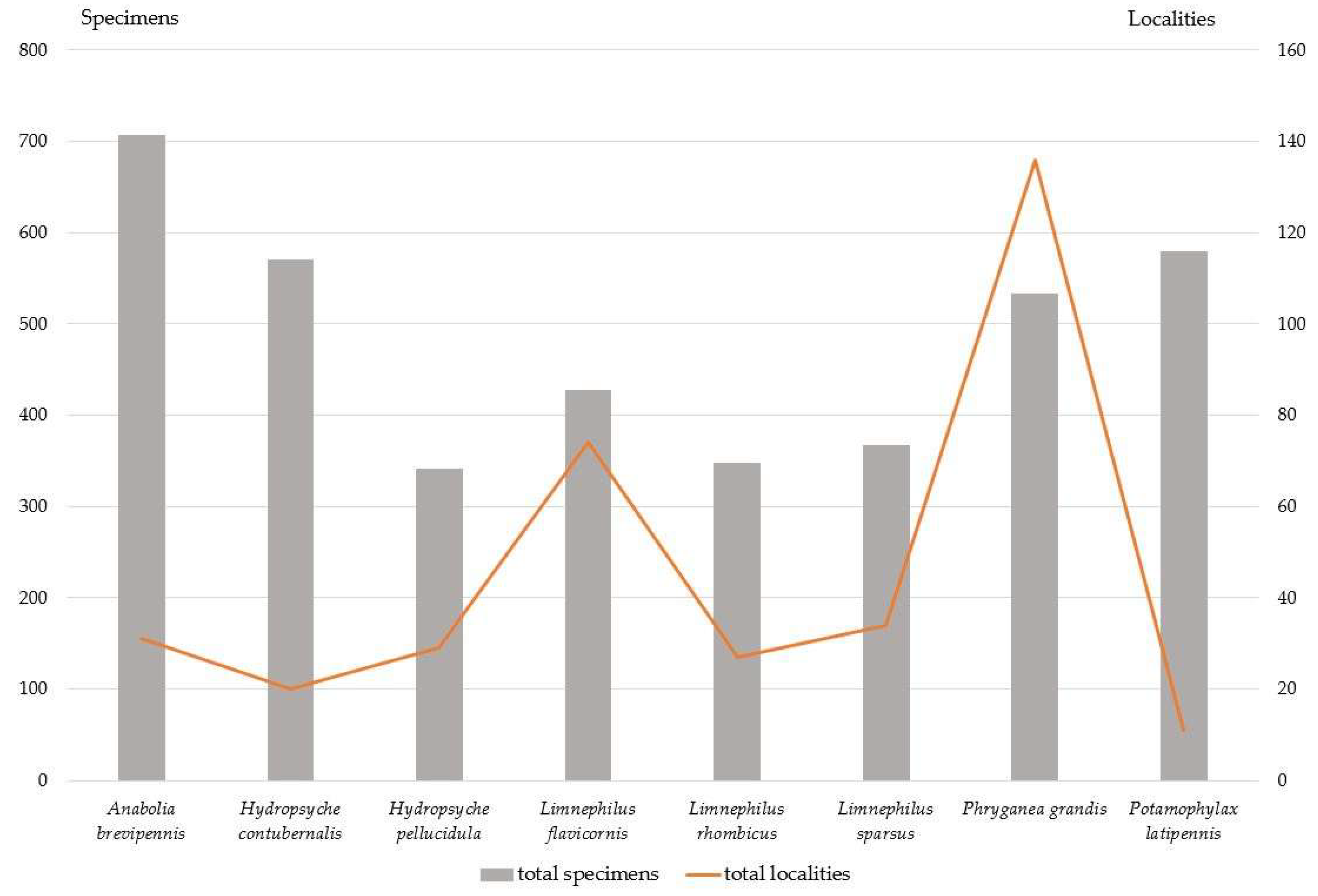
| 36. | Hydropsyche contubernalis Mclachlan, 1865 | 163 | 167 | 56 | 129 | 4 | 1 | 51 | 571 | ||||||||
| 37. | Hydropsyche ornatula McLachlan, 1878 | + | 1 | 2 | 1 | 4 | |||||||||||
| 38. | Hydropsyche pellucidula (Curtis, 1834) | 103 | 2 | 1 | 2 | 234 | 342 | ||||||||||
| 39. | Hydropsyche siltalai Doehler, 1963 | 7 | 7 | ||||||||||||||
| Phryganeidae | |||||||||||||||||
| 40. | Agrypnia crassicornis (McLachlan, 1876) | 4 | 1 | 5 | |||||||||||||
| 41. | Agrypnia obsoleta (Hagen, 1864) | 12 | 1 | 9 | 22 | ||||||||||||
| 42. | Agrypnia pagetana Curtis, 1835 | 1 | 5 | 3 | 150 | 159 | |||||||||||
| 43. | Agrypnia picta Kolenati, 1848 | 1 | 1 | ||||||||||||||
| 44. | Agrypnia varia (Fabricius, 1793) | 1 | 1 | 28 | 1 | 3 | 5 | 4 | 2 | 8 | 4 | 4 | 5 | 37 | 103 | ||
| 45. | Hagenella clathrata (Kolenati, 1848) | 65 | 9 | 5 | 79 | ||||||||||||
| 46. | Oligostomis reticulata (Linnaeus, 1761) | 6 | 4 | 1 | 7 | 18 | |||||||||||
| 47. | Oligotricha striata (Linnaeus, 1758) | 12 | 1 | 1 | 14 | ||||||||||||
| 48. | Phryganea bipunctata Retzius, 1783 | 2 | 35 | 1 | 5 | 1 | 1 | 5 | 50 | ||||||||
| 49. | Phryganea grandis Linnaeus, 1758 | 19 | 2 | 3 | 16 | 155 | 2 | 23 | 42 | 23 | 21 | 28 | 33 | 29 | 11 | 126 | 533 |
| 50. | Semblis phalaenoides (Linnaeus, 1758) | 6 | 2 | 8 | |||||||||||||
| 51. | Trichostegia minor (Curtis, 1834) | 108 | 35 | 11 | 3 | 1 | 7 | 5 | 1 | 1 | 172 | ||||||
| Brachycentridae | |||||||||||||||||
| 52. | Brachycentrus subnubilus Curtis, 1834 | 7 | 2 | 1 | 10 | ||||||||||||
| Odontoceridae | |||||||||||||||||
| 53. | Odontocerum albicorne (Scopoli, 1763) | 4 | 4 | ||||||||||||||
| Lepidostomatidae | |||||||||||||||||
| 54. | Lepidostoma hirtum (Fabricius, 1775) | 1 | 1 | 2 | |||||||||||||
| Apataniidae | |||||||||||||||||
| 55. | Apatania zonella (Zetterstedt, 1840) | 6 | 6 | ||||||||||||||
| Limnephilidae | |||||||||||||||||
| 56. | Anabolia brevipennis (Curtis, 1834) | 32 | 566 | 4 | 23 | 15 | 1 | 66 | 707 | ||||||||
| 57. | Anabolia concentrica (Zetterstedt, 1840) | 7 | 1 | 5 | 10 | 23 | |||||||||||
| 58. | Anabolia furcata Brauer, 1857 | 3 | 1 | 4 | 1 | 1 | 1 | 15 | 13 | 39 | |||||||
| 59. | Anabolia laevis (Zetterstedt, 1840) | 35 | 10 | 45 | |||||||||||||
| 60. | Chaetopteryx villosa (Fabricius, 1798) | 2 | 4 | 6 | |||||||||||||
| 61. | Colpotaulius incisus (Curtis, 1834) | 1 | 5 | 2 | 8 | ||||||||||||
| 62. | Colpotaulius major Martynov, 1909 | 2 | 2 | ||||||||||||||
| 63. | Glyphotaelius pellucidus (Retzius, 1783) | 9 | 1 | 52 | 9 | 4 | 3 | 2 | 1 | 19 | 100 | ||||||
| 64. | Grammotaulius nigropunctatus (Retzius, 1783) | 2 | 1 | 3 | |||||||||||||
| 65. | Grammotaulius nitidus (Müller, 1764) | 1 | 2 | 1 | 7 | 1 | 7 | 19 | |||||||||
| 66. | Halesus digitatus (Schrank, 1781) | 31 | 6 | 8 | 45 | ||||||||||||
| 67. | Halesus radiatus (Curtis, 1834) | 63 | 1 | 64 | |||||||||||||
| 68. | Halesus tesselatus (Rambur, 1842) | 1 | 63 | 42 | 106 | ||||||||||||
| 69. | Ironoquia dubia (Stephens,1837) | 3 | 1 | 7 | 11 | ||||||||||||
| 70. | Lenarchus bicornis (McLachlan, 1880) | + | |||||||||||||||
| 71. | Limnephilus affinis Curtis, 1834 | 2 | 1 | 3 | |||||||||||||
| 72. | Limnephilus auricula Curtis, 1834 | 1 | 4 | 7 | 12 | ||||||||||||
| 73. | Limnephilus bipunctatus Curtis, 1834 | 3 | 2 | 2 | 12 | 19 | |||||||||||
| 74. | Limnephilus borealis (Zetterstedt, 1840) | 1 | + | 1 | 1 | 3 | |||||||||||
| 75. | Limnephilus centralis Brauer, 1857 | 1 | 1 | ||||||||||||||
| 76. | Limnephilus decipiens (Kolenati, 1848) | 4 | 1 | 11 | 3 | 20 | 39 | ||||||||||
| 77. | Limnephilus dispar McLachlan, 1875 | 1 | 1 | 2 | 4 | ||||||||||||
| 78. | Limnephilus elegans Curtis, 1834 | 1 | 1 | 3 | 5 | ||||||||||||
| 79. | Limnephilus externus Hagen, 1861 | 6 | 6 | ||||||||||||||
| 80. | Limnephilus extricatus McLachlan, 1865 | 9 | 2 | 1 | 1 | 6 | 19 | ||||||||||
| 81. | Limnephilus femoratus (Zetterstedt, 1840) | 4 | 4 | ||||||||||||||
| 82. | Limnephilus flavicornis (Fabricius, 1787) | 42 | 1 | 9 | 1 | 75 | 1 | 5 | 66 | 23 | 6 | 7 | 5 | 4 | 183 | 428 | |
| 83. | Limnephilus fuscicornis (Rambur, 1842) | 30 | 52 | 2 | 8 | 16 | 4 | 112 | |||||||||
| 84. | Limnephilus fuscinervis (Zetterstedt, 1840) | 1 | 5 | 6 | |||||||||||||
| 85. | Limnephilus griseus (Linnaeus, 1758) | 1 | 45 | 4 | 45 | 67 | 162 | ||||||||||
| 86. | Limnephilus ignavus Mclachlan, 1865 | 2 | 8 | 11 | 1 | 2 | 1 | 6 | 31 | ||||||||
| 87. | Limnephilus lunatus Curtis, 1834 | 1 | 3 | 5 | 2 | 4 | 15 | ||||||||||
| 88. | Limnephilus nigriceps (Zetterstedt, 1840) | 5 | 3 | 15 | 23 | ||||||||||||
| 89. | Limnephilus politus McLachlan, 1865 | 26 | 6 | 77 | 109 | ||||||||||||
| 90. | Limnephilus rhombicus (Linnaeus, 1758) | 199 | 30 | 6 | 2 | 2 | 1 | 108 | 348 | ||||||||
| 91. | Limnephilus sericeus (Say, 1824) | 125 | 10 | 22 | 13 | 170 | |||||||||||
| 92. | Limnephilus sparsus Curtis, 1834 | 46 | 111 | 164 | 6 | 9 | 3 | 3 | 25 | 367 | |||||||
| 93. | Limnephilus stigma Curtis, 1834 | 6 | 28 | 1 | 63 | 98 | |||||||||||
| 94. | Limnephilus vittatus (Fabricius, 1798) | 8 | 5 | 5 | 30 | 48 | |||||||||||
| 95. | Limnephilus xanthodes McLachlan, 1873 | 3 | 1 | 1 | 5 | ||||||||||||
| 96. | Nemotaulius punctatolineatus (Retzius, 1783) | 2 | 5 | 1 | 1 | 1 | 10 | ||||||||||
| 97. | Philarctus bergrothi McLachlan, 1880 | 1 | 1 | ||||||||||||||
| 98. | Potamophylax latipennis (Curtis, 1834) | 551 | 12 | 2 | 1 | 14 | 580 | ||||||||||
| 99. | Potamophylax nigricornis (Pictet, 1834) | 5 | 2 | 1 | 2 | 10 | |||||||||||
| 100. | Potamophylax rotundipennis (Brauer, 1857) | 9 | 51 | 60 | |||||||||||||
| 101. | Rhadicoleptus alpestris (Kolenati, 1848) | 1 | 1 | ||||||||||||||
| 102. | Stenophylax lateralis (Stephens, 1837) | 1 | 1 | 9 | 5 | 1 | 3 | 1 | 8 | 29 | |||||||
| 103. | Stenophylax sequax (Mclachlan, 1875) | 2 | 1 | 5 | 8 | ||||||||||||
| Goeridae | |||||||||||||||||
| 104. | Goera pilosa (Fabricius, 1775) | 2 | 2 | ||||||||||||||
| 105. | Silo pallipes (Fabricius, 1781) | 1 | 1 | ||||||||||||||
| Sericostomatidae | |||||||||||||||||
| 106. | Sericostoma personatum (Kirby & Spence, 1826) | 1 | 3 | 1 | 5 | ||||||||||||
| Molannidae | |||||||||||||||||
| 107. | Molanna albicans (Zetterstedt, 1840) | 21 | 9 | 14 | 44 | ||||||||||||
| 108. | Molanna angustata Curtis, 1834 | 2 | 1 | 1 | 1 | 5 | |||||||||||
| 109. | Molannodes tinctus (Zetterstedt, 1840) | 2 | 2 | ||||||||||||||
| Leptoceridae | |||||||||||||||||
| 110. | Athripsodes aterrimus (Stephens, 1836) | 1 | 7 | 38 | 46 | ||||||||||||
| 111. | Athripsodes cinereus (Curtis, 1834) | 4 | 1 | 5 | |||||||||||||
| 112. | Ceraclea albimacula (Rambur, 1842) | 2 | 2 | 4 | |||||||||||||
| 113. | Ceraclea annulicornis (Stephens, 1836) | 3 | 28 | 31 | |||||||||||||
| 114. | Ceraclea dissimilis (Stephens, 1836) | 19 | 1 | 1 | 29 | 50 | |||||||||||
| 115. | Ceraclea excisa (Morton 1904) | 3 | 25 | 28 | |||||||||||||
| 116. | Ceraclea fulva (Rambur, 1842) | 3 | 3 | ||||||||||||||
| 117. | Ceraclea nigronervosa (Retzius, 1783) | 1 | 8 | 9 | |||||||||||||
| 118. | Ceraclea senilis (Burmeister, 1839) | 5 | 5 | ||||||||||||||
| 119. | Leptocerus interruptus (Fabricius, 1775) | 1 | 1 | ||||||||||||||
| 120. | Leptocerus tineiformis Curtis, 1834 | 60 | 31 | 6 | 1 | 30 | 128 | ||||||||||
| 121. | Mystacides azureus (Linnaeus, 1761) | 8 | 1 | 1 | 2 | 12 | |||||||||||
| 122. | Mystacides longicornis (Linnaeus, 1758) | 2 | 5 | 2 | 1 | 1 | 214 | 225 | |||||||||
| 123. | Mystacides niger (Linnaeus, 1758) | 1 | 2 | 1 | 6 | 10 | |||||||||||
| 124. | Oecetis furva (Rambur, 1842) | 1 | 9 | 7 | 17 | ||||||||||||
| 125. | Oecetis intima McLachlan, 1877 | 7 | 7 | ||||||||||||||
| 126. | Oecetis lacustris (P. J. Pictet, 1834) | 1 | 1 | 1 | 12 | 15 | |||||||||||
| 127. | Oecetis nigropunctata Ulmer, 1908 | 1 | 1 | ||||||||||||||
| 128. | Oecetis ochracea (Curtis, 1825) | 1 | 3 | 5 | 9 | 1 | 3 | 3 | 25 | ||||||||
| 129. | Parasetodes respersellus (Rambur, 1842) | 1 | 1 | ||||||||||||||
| 130. | Setodes punctatus (Fabricius, 1793) | 1 | 1 | ||||||||||||||
| 131. | Setodes viridis (Fourcroy, 1785) | 2 | 1 | 1 | 4 | ||||||||||||
| 132. | Triaenodes bicolor (Curtis, 1834) | 5 | 1 | 18 | 24 | ||||||||||||
| 133. | Triaenodes unanimis McLachlan, 1877 | 2 | 2 | ||||||||||||||
| 134. | Triaenodes conspersus (Rambur, 1842) | 3 | 3 | ||||||||||||||
| Total specimens in dataset | 297 | 17 | 192 | 18 | 3368 | 17 | 297 | 275 | 550 | 24 | 200 | 51 | 95 | 79 | 2279 | 7759 | |
| Total species | 17 | 14 | 12 | 3 | 98 | 5 | 23 | 21 | 35 | 3 | 55 | 7 | 28 | 49 | 86 | 134 |
References
- Nimma, D.; Devi, O.R.; Laishram, B.; Ramesh, J.V.N.; Boddupalli, S.; Ayyasamy, R.; Arabi, A. Implications of climate change on freshwater ecosystems and their biodiversity. Desalin. Water Treat. 2025, 321, 100889. [Google Scholar]
- Justino, W.S.; Negreiros, D.; Ramos, L.; Figueiredo, J.C.G.; Paiva, D.C.; Oki, Y.; Santos, R.M.; Ashworth, L.; Nunes, Y.R.F.; Fernandes, G.W. Floristic and edaphic inventory of Atlantic riparian forests: References for restoration projects. Nat. Conserv. Res. 2025, 10, 76–88. [Google Scholar] [CrossRef]
- Popoola, B.M.; Adeyemi, O.A.; Samson, O.J. Antibiotic-resistant bacteria in tropical freshwater ecosystems: A review of occurrence, distribution and environmental implications. Microbe 2025, 8, 100457. [Google Scholar] [CrossRef]
- Surazakov, A.B.; Aizen, V.B. Estimating volume change of mountain glaciers using SRTM and map-based topographic data. IEEE Trans. Geosci. Remote Sens. 2006, 44, 2991–2995. [Google Scholar] [CrossRef]
- Han, Y.; Wang, Y.; Ma, X.; Shang, Y. Glacier and Snow Cover Dynamics and Their Affecting Factors on the Pamir Plateau Section of the China–Pakistan Economic Corridor. Land 2025, 14, 880. [Google Scholar] [CrossRef]
- Verma, M.; Sati, M. Forest Fires and Climate Change Impacts on Water Resources. In Forest Fire and Climate Change: Insights into Science; Springer Nature: Cham, Switzerland, 2025; pp. 169–190. [Google Scholar]
- Vdovina, O.N.; Tropina, E.F.; Makarycheva, A.Y.; Yerunova, M.G. Patterns of macroinvertebrate distribution in watercourses of the Krasnoyarsk Stolby National Park (East Siberia). Nat. Conserv. Res. 2025, 10, 50–65. [Google Scholar] [CrossRef]
- Liu, H.; Zhou, X. Wildfire and Its Impact on the Ecosystem in Guizhou Province. Fire Mater. 2025, 49, 550–558. [Google Scholar]
- Aleinikov, A.A.; Aleksutin, V.E.; Vozmitel, F.K.; Gunya, A.N. Long-term dynamics of forests with Pinus sibirica in the upper reaches of the River Kolva (Northern Pre-Urals, Russia) from 1938 to 2023. Nat. Conserv. Res. 2024, 9, 72–91. [Google Scholar] [CrossRef]
- Senkevich, V.A.; Stojko, T.G.; Bashinskiy, I.V. Zooplankton communities of small floodplain water bodies in longtime limnophase (Khoper River valley, European Russia). Nat. Conserv. Res. 2024, 9, 92–105. [Google Scholar] [CrossRef]
- Iyiola, A.O.; Asiedu, B.; Oyewole, E.O.; Akinrinade, A.J. Impacts of climate change on aquatic biodiversity in Africa. In Biodiversity in Africa: Potentials, Threats and Conservation; Springer Nature: Singapore, 2022; pp. 369–394. [Google Scholar]
- Afonina, E.Y.; Tashlykova, N.A. Diversity of aquatic organisms in the lowland watercourses: A case study in transboundary rivers, Transbaikalia, Russia. Nat. Conserv. Res. 2025, 10, 1–19. [Google Scholar] [CrossRef]
- Ali, G.; Abbas, S.; Nagai, S.; Mohd Arshad, N.; Bhassu, S. Threats of Climate Change to Freshwater Ecosystems in Pakistan: eDNA Monitoring Will Be the Next-Generation Tool Used in Biodiversity, Conservation, and Management. Biology 2025, 14, 1191. [Google Scholar] [CrossRef] [PubMed]
- Hambaryan, L.; Stepanyan, L.; Khachikyan, T.; Mamyan, A.; Azizyan, L.; Shahnazaryan, G.; Barinova, S. Phytoplankton as an indicator of long-term changes in the aquatic ecosystem of Sevan National Park, Armenia, 2015–2019. Nat. Conserv. Res. 2025, 10, 13–30. [Google Scholar] [CrossRef]
- Semenchenko, A.; Tiunova, T.M. DNA barcoding of mayflies (Ephemeroptera) in Kamchatka peninsula, Russia. Far East. Entomol. 2025, 533, 7–19. [Google Scholar] [CrossRef]
- Morse, J.C.; Frandsen, P.B.; Graf, W.; Thomas, J.A. Diversity and ecosystem services of Trichoptera. Insects 2019, 10, 125. [Google Scholar] [CrossRef] [PubMed]
- Erdoğan, Ö.; Karakaş, B.; Yünlü, M.Z. The Trichoptera fauna of the Karpuz Stream and its relationships with water quality. Biologia 2025, 80, 641–653. [Google Scholar] [CrossRef]
- Simeone, D.; Fernandes, M.E. Linking Riparian Forest to the Functional Diversity of Ephemeroptera, Plecoptera, and Trichoptera in First-Order Tropical Streams. Diversity 2025, 17, 438. [Google Scholar] [CrossRef]
- Ivanov, V.D. Caddisflies of Russia: Fauna and biodiversity. Zoosymposia 2011, 5, 171–209. [Google Scholar] [CrossRef]
- Svenningsen, C.S.; Schigel, D. Sharing insect data through GBIF: Novel monitoring methods, opportunities and standards. Philos. Trans. R. Soc. B Biol. Sci. 2024, 379, 20230104. [Google Scholar] [CrossRef]
- Štípková, Z.; Tsiftsis, S.; Kindlmann, P. Is the GBIF appropriate for use as input in models of predicting species distributions? Study from the Czech Republic. Nat. Conserv. Res. 2024, 9, 84–95. [Google Scholar] [CrossRef]
- Jackowiak, B.; Lawenda, M. How Does Sharing Data from Research Institutions on Global Biodiversity Information Facility Enhance Its Scientific Value? Diversity 2025, 17, 221. [Google Scholar] [CrossRef]
- Borisova, N.; Ruchin, A.; Egorov, L.; Esin, M.; Lobachev, E.; Lukiyanov, S.; Semishin, G.; Esina, I.; Nikolaeva, A.; Sidorov, D. Biodiversity of Trichoptera (Insecta) in Some Regions of European Russia: Research Results and Literature Data; Joint Directorate of the Mordovia State Nature Reserve and National Park “Smolny”: Saransk, Russia, 2026. [Google Scholar] [CrossRef]
- Wiggers, R.; van den Hoek, T.H.; van Maanen, B.; Higler, L.W.G.; van Kleef, H. Some rare and new caddis flies recorded for the Netherlands (Trichoptera). Ned. Faun. Meded. 2006, 25, 53–68. [Google Scholar]
- Graf, W.; Murphy, J.; Dahl, J.; Zamora-Muñoz, C.; López-Rodríguez, M.J. Distribution and Ecological Preferences of European Freshwater Species. Volume 1: Trichoptera; Schmidt-Kloiber, A., Hering, D., Eds.; Pensoft: Sofia, Bulgaria; Moscow, Russia, 2008. [Google Scholar]
- Barnard, P.; Ross, E. The Adult Trichoptera (Caddisflies) of Britain and Ireland; RES Handbook; Royal Entomological Society: St Albans, UK, 2012; Volume 1. [Google Scholar]
- Arnscheidt, J.; Balzer, I.; Mädler, K. Hydroptila angulata Mosely 1922 (Trichoptera), a caddisfly species new for the Saxonian fauna. Lauterbornia 1996, 25, 143–145. [Google Scholar]
- Borisova, N.V.; Ruchin, A.B.; Esin, M.N.; Lobachev, E.A.; Semishin, G.B. Caddisfly fauna (Insecta: Trichoptera) in the Republic of Mordovia (Russia). Nat. Conserv. Res. 2026, 11, 82–93. [Google Scholar] [CrossRef]
- Ćukušić, A.; Ćuk, R.; Vučković, I.; Previšić, A.; Cerjanec, D.; Mihoci, I.; Kučinić, M. Trichoptera research within project “EU Natura 2000 Integration Project–NIP. In Proceedings of the 15th International Symposium on Trichoptera, New Brunswick, NJ, USA, 4–8 June 2015. [Google Scholar]
- Carew, M.E.; Coleman, R.A.; Robinson, K.L.; Hoffmann, A.A. Using unsorted sweep-net samples to rapidly assess macroinvertebrate biodiversity. Freshw. Sci. 2021, 40, 551–565. [Google Scholar] [CrossRef]
- Larsson, M.; Göthberg, A.; Milberg, P. Night, light and flight: Light attraction in Trichoptera. Insect Conserv. Divers. 2020, 13, 296–302. [Google Scholar]
- Waringer, J.A. Phenology and the influence of meteorological parameters on the catching success of light-trapping for Trichoptera. Freshw. Biol. 1991, 25, 307–319. [Google Scholar] [CrossRef]
- Malicky, H. A quantitative field comparison of different types of emergence traps in a stream: General, Trichoptera, Diptera (Limoniidae and Empididae). Ann. Limnol.-Int. J. Limnol. 2002, 38, 133–149. [Google Scholar] [CrossRef]
- Kjærandsen, J. Species assemblages and community structure of adult caddisflies along a headwater stream in southeastern Ghana (Insecta: Trichoptera). Biodivers. Conserv. 2005, 14, 1–43. [Google Scholar] [CrossRef]
- Frings, H.; Frings, M. The loci of contact chemoreceptors sensitive to sucrose solutions in adult Trichoptera. Biol. Bull. 1956, 111, 92–100. [Google Scholar] [CrossRef]
- Novikova, E.S.; Soboleva, E.B. Nutrition of adult barnacles (Insecta, Trichoptera) and its effect on behavior and life expectancy. In Problems of Aquatic Entomology in Russia: Proceedings of the X(2) Trichopterological Symposium; Severnaya Ossetia Univ. Publishing House: Vladikavkaz, Russia, 2013; pp. 34–40. [Google Scholar]
- Barabanova, A.A.; Zhukovskaya, M.I.; Ivanov, V.D.; Melnitsky, S.I. The effect of octopamine on antenna responses in Phryganea grandis L. (Trichoptera, Phryganeidae). In Problems of Aquatic Entomology in Russia and Neighboring Countries; K.L. Khetagurov North-Ossetian State University: Voronezh, Russia, 2007; pp. 30–36. [Google Scholar]
- Borisova, N.V.; Ruchin, A.B.; Lukyanova, Y.A.; Suleimanova, G.F. Accounting of the caddisflies (Insecta, Trichoptera) in fermental crown traps. Nat. Sci. Res. Chuvashia 2022, 8, 85–102. [Google Scholar] [CrossRef]
- Sidorchuk, A.; Borisova, O.; Panin, A. Fluvial response to the Late Valdai/Holocene environmental change on the East European Plain. Glob. Planet. Change 2001, 28, 303–318. [Google Scholar] [CrossRef]
- Frolova, N.L.; Agafonova, S.A.; Kireeva, M.B.; Povalishnikova, E.S.; Pakhomova, O.M. Recent changes of annual flow distribution of the Volga Basin Rivers. Geogr. Environ. Sustain. 2017, 10, 28–39. [Google Scholar] [CrossRef]
- Dzhamalov, R.G.; Frolova, N.L.; Kireeva, M.B. Current changes in river water regime in the Don River Basin. Water Resour. 2013, 40, 573–584. [Google Scholar] [CrossRef]
- Lepneva, S.G. Caddisflies. Larvae and Pupae of the Suborder Annulipalpia. In Fauna of the USSR. Vol. II, Issue 1; Nauka: Moscow, Russia, 1964; 560p. [Google Scholar]
- Lepneva, S.G. Caddisflies. Larvae and Pupae of the Suborder Integripalpia. In Fauna of the USSR. Vol. II, Issue 2; Nauka: Moscow, Russia, 1966; 560p. [Google Scholar]
- Egorov, L.V.; Dedyukhin, S.V.; Alekseev, S.K.; Trushitsyna, O.S.; Ruchin, A.B.; Sazhnev, A.S.; Nikolaeva, A.M.; Esin, M.N.; Khapugin, A.A. Regional Coleoptera Fauna: Applying different methods to study species diversity in a single region. Insects 2024, 15, 917. [Google Scholar] [CrossRef] [PubMed]
- Golub, V.B.; Tsurikov, M.N.; Prokin, A.A. Insect Collections: Collection, Processing and Storage of Material; KMK Scientific Press Ltd.: Moscow, Russia, 2012; 339p. [Google Scholar]
- Ivanov, V.D.; Grigorenko, V.N.; Arefina, T.I. Order Trichoptera (Caddisflies). Key to Freshwater Invertebrates of Russia and Adjacent Territories. In Higher Insects; Tsalolikhin, S.Y., Ed.; Zoological Institute of the Russian Academy of Sciences: St. Petersburg, Russia, 2001; Volume 5, pp. 7–72. (In Russian) [Google Scholar]
- Macan, T.T. A Key to the Adults of British Trichoptera; Freshwater Biological Association: Cumbria, UK, 1973; Volume 28, pp. 1–151. [Google Scholar]
- Malicky, H. Atlas of European Trichoptera, 2nd ed.; Springer: Dordrecht, The Netherlands, 2004; 359p. [Google Scholar]
- Salokannel, J.; Mattila, K. Suomen Vesiperhoset Trichoptera of Finland; Tibiale Oy: Helsinki, Finland, 2018. [Google Scholar]



| Column Label | Column Description |
|---|---|
| occurrenceID | An identifier for the occurrence (as opposed to a particular digital record of the occurrence) |
| basisOfRecord | The specific nature of the data record: HumanObservation |
| eventDate | The date when material from the trap was collected or the range of dates during which the trap collected material |
| scientificNam | The full scientific name including the genus name and the lowest level of taxonomic rank with the authority |
| kingdom | The full scientific name of the kingdom in which the taxon is classified |
| decimalLatitude | The geographic latitude of location in decimal degrees |
| decimalLongitude | The geographic longitude (in decimal degrees, using the spatial reference system given in dwc:geodeticDatum) |
| country | The name of the country in which the location occurs |
| countryCode | The standard code for the country in which the location occurs. |
| individualCount | The number of individuals represented present at the time of the occurrence |
| year | The integer year in which the event occurred |
| month | The ordinal month in which the event occurred |
| day | The integer day of the month on which the event occurred |
| associatedReferences | A list (concatenated and separated) of identifiers (publication, bibliographic reference, global unique identifier, URI) of literature associated with the dwc:Occurrence. |
| recordedBy | A person, group, or organization responsible for recording the original occurrence |
| identifiedBy | A list of names of people who assigned the taxon to the subject |
| locality_original | The specific description of the place. This term may contain information modified from the original to correct perceived errors or standardize the description |
| samplingProtocol | The names of the methods or protocols used during an event |
| georeferenceSources | A list of maps, gazetteers, or other resources used to georeference the Location |
| coordinateUncertaintyInMeters | The maximum uncertainty distance in metres |
| geodeticDatum | The ellipsoid, geodetic datum, or spatial reference system (SRS) upon which the geographic coordinates given in decimalLatitude and decimalLongitude is based |
| stateProvince | The name of the next smaller administrative region than country (state, province, canton, department, region, etc.) in which the dcterms:Location occurs. |
| habitat | A category or description of the habitat in which the Event occurred |
Disclaimer/Publisher’s Note: The statements, opinions and data contained in all publications are solely those of the individual author(s) and contributor(s) and not of MDPI and/or the editor(s). MDPI and/or the editor(s) disclaim responsibility for any injury to people or property resulting from any ideas, methods, instructions or products referred to in the content. |
© 2026 by the authors. Licensee MDPI, Basel, Switzerland. This article is an open access article distributed under the terms and conditions of the Creative Commons Attribution (CC BY) license.
Share and Cite
Ruchin, A.B.; Borisova, N.V.; Egorov, L.V.; Esin, M.N.; Lobachev, E.A.; Lukiyanov, S.V.; Semishin, G.B.; Esina, I.G.; Nikolaeva, A.M. A Dataset Trichoptera (Insecta) in Selected Regions of European Russia. Limnol. Rev. 2026, 26, 31. https://doi.org/10.3390/limnolrev26030031
Ruchin AB, Borisova NV, Egorov LV, Esin MN, Lobachev EA, Lukiyanov SV, Semishin GB, Esina IG, Nikolaeva AM. A Dataset Trichoptera (Insecta) in Selected Regions of European Russia. Limnological Review. 2026; 26(3):31. https://doi.org/10.3390/limnolrev26030031
Chicago/Turabian StyleRuchin, Alexander B., Natalia V. Borisova, Leonid V. Egorov, Mikhail N. Esin, Evgeniy A. Lobachev, Sergei V. Lukiyanov, Gennadiy B. Semishin, Irina G. Esina, and Anna M. Nikolaeva. 2026. "A Dataset Trichoptera (Insecta) in Selected Regions of European Russia" Limnological Review 26, no. 3: 31. https://doi.org/10.3390/limnolrev26030031
APA StyleRuchin, A. B., Borisova, N. V., Egorov, L. V., Esin, M. N., Lobachev, E. A., Lukiyanov, S. V., Semishin, G. B., Esina, I. G., & Nikolaeva, A. M. (2026). A Dataset Trichoptera (Insecta) in Selected Regions of European Russia. Limnological Review, 26(3), 31. https://doi.org/10.3390/limnolrev26030031