Article

Paleolimnological Analysis of Lakes in Central Mexico: Regional Comparisons, Human Forcing, and Teleconnections During the Late Quaternary


by
Rubén Hernández-Morales
1,2,3,
Isabel Israde Alcantara
3,*,
Nicolás Waldmann
4 and
Gabriela Ana Zanor
1,*
1
Department of Environmental Sciences, Life Sciences Division, Guanajuato University, Irapuato 36500, Guanajuato, Mexico
2
Faculty of Biology, Michoacan University of Saint Nicholas of Hidalgo, Morelia 58040, Michoacan, Mexico
3
Institute of Earth Sciences Research, Michoacan University of Saint Nicholas of Hidalgo, Morelia 58040, Michoacan, Mexico
4
Department Marine Geosciences, University of Haifa, Mount Carmel, Haifa 3103301, Israel
*
Authors to whom correspondence should be addressed.
Limnol. Rev. 2026, 26(2), 20; https://doi.org/10.3390/limnolrev26020020
Submission received: 2 April 2026 / Revised: 12 May 2026 / Accepted: 14 May 2026 / Published: 16 May 2026

Abstract

This article analyzes the information provided by the sedimentary sequences of 29 lakes in central Mexico, 10 of which are currently paleolakes. During the Late Quaternary, the lakes of central Mexico experienced environmental changes driven by global and local climatic and geological processes, showing regional trends of wet and dry periods. Paleoenvironmental reconstructions are based on the use of 20 indicators, including diatoms, pollen, geochemistry, mineralogy, granulometry, magnetic susceptibility, and isotopes. Seven major episodes are recognized in the historical evolution of the lakes of central Mexico: i. Late Miocene–Pliocene: A period that includes the formation of large lakes in central Mexico by volcano tectonic activity under a regime of continuous humidity. ii. Pleistocene–Drought and climatic variability of the interglacial period. iii. Drying and successive lacustrine transgression during the Last Glacial Maximum. iv. Spatial climate variability in the Heinrich 1 period. v. Lake regression and expansion of terrestrial vegetation in the Bølling–Allerød period. vi. Transgression of lakes of central Mexico during the Younger Dryas and mid-Holocene periods. vii. Late Holocene: A period that includes lake desiccation influenced by the impact of human activities. The analysis of the data allows us to propose six challenges for the scientific community in future research of central Mexico.

1. Introduction

The Late Pleistocene in Mexico represents a key interval for understanding the evolution of lacustrine ecosystems and biodiversity under changing climatic and geological conditions. Spanning from approximately 126 to 11.7 ka BP, this period was characterized by significant climatic fluctuations and extinction events [1,2], which are extensively recorded in geological records, particularly within lake sediments.
The basins of central Mexico, like other basins around the world, accumulate autogenic and allogenic lake deposits. Autogenic components include organisms or remains (diatoms, spicules, cysts, pollen, ostracods, testate amoebae, and phytoliths), isotopes, chemical forms derived from carbonates, silicates, phosphates, nitrates, carbon, and photosynthetic organic pigments [3,4], while allogenic material from fluvial and aeolian transport is formed of clastic sediments from the erosion of the catchment basin, constituting elements of the sediment stratigraphy, which contains pollen, phytoliths, dissolved salts and terrigenous, which indicate various fluctuations in the ecosystem and allow us to understand the changes in lacustrine and terrestrial processes. The sedimentary record constitutes an indicator to help us understand the impact of environmental changes in different geographical contexts [5], with emphasis on the change in land use within the lacustrine basins.
The Late Quaternary paleoenvironmental record integrates geological and environmental changes in the dynamics in lake ecosystems, as well as the role of anthropogenic processes in the basins of central Mexico [6], as human populations depend on water bodies for their subsistence, creating significant interactions between humans and lake ecosystems [6,7].
Another factor considered as a determinant of ecological, climatic, and environmental variation in lakes is Quaternary volcanism [8,9], which has a significant impact on the evolution of lakes in Mexico. Tectonic activity also produced changes in basin and lake configuration along the Trans-Mexican Volcanic Belt (TMVB) [10,11,12]. These effects are manifested through changes in the morphology of lake basins, variations in water levels, and variations in sedimentation rates. Volcanic activity during this period caused uplift and deformation in the lake basins, as well as the displacement of water masses due to faulting, which affected sedimentation patterns [13,14].
In the Late Quaternary, several glaciation and deglaciation events were recorded, with interglacial periods [15]. These global climate fluctuations directly influenced lake levels in central Mexico [16]. In glacial periods, the prevailing climate was cold and dry, resulting in decreased precipitation and, consequently, lower lake water levels [17].
One of the best-documented cases of lacustrine regression and transgression in Mexico is that of the Basin of Mexico, which included the lakes of Texcoco, Xochimilco, Zumpango, Tecocomulco, Xaltocan, and Chalco (where Texcoco, Xochimilco, Tecocomulco, Xaltocan, and Chalco are extinct lakes). Lake sediments show evidence of significant variations in water levels and extent, related to variations in precipitation, wind patterns, and volcanic activity [12]. These lakes developed, and some of them disappeared, in response to changes in local climatic, hydrological, and urban development conditions. During periods of prolonged drought, such as in the Late Pleistocene, the lakes shrank to small water bodies [18], while during humid periods, they expanded to cover what is now known as the Valley of Mexico [19].
The patterns of lake regression and transgression in central Mexico are not limited to the Basin of Mexico. Other basins of the Trans-Mexican Volcanic Belt (TMVB) provide information on climatic variations with regional impact. This includes the Upper and Middle Balsas Basin, the Santiago River Basin, the Lower, Middle, and Upper Lerma Basin, the Amacuzac River Basin, the Tecolutla River Basin, and the Eastern Basin, among others.
This paper examines the most significant contributions to the paleolimnology of lake basins in central Mexico, aiming to understand the changes that occurred during the Late Quaternary period, focusing on the causes of ecological change and the nature of their impacts. It also highlights the variations that humans induced since the last glacial period once they established the reservoirs for recent lakes.

2. Methods

The current study develops a regional analysis of the paleolimnology of lakes in central Mexico, including human impact and teleconnections during the Late Quaternary, a systematic mapping process was implemented to identify, select, and synthesize articles using replicable methods and the Reporting Standards for Systematic Evidence Syntheses of the Haddaway method (https://doi.org/10.1186/s13750-018-0121-7). Trends were mapped to clarify the types of approaches used in research on Late Quaternary paleolimnology.
The review process was approached in five steps:
Step 1: Scope Definition: General criteria were established to include articles that addressed the following terms: paleolimnology, Late Quaternary, central Mexico, Trans-Mexican Volcanic Belt, Holocene, geochronology, climate change, lakes, sediments, and paleoindicators.
Step 2. Downloading information from databases: The PubMed, Web of Science, Scopus, Science Direct, and Bio One databases were accessed, as well as the network of databases of the National Consortium of Scientific and Technological Information Resources in Mexico (Conricyt) and Google Scholar. A total of 1865 articles were obtained, of which 157 were review articles and 1708 were research articles published between 1971 and 2025.
Step 3. Documenting selection criteria: Articles that focused their information on lakes in central Mexico, as well as on paleolimnological research of the Late Quaternary, were selected. Articles addressing paleoclimatology, paleoecology, or paleoenvironmental reconstructions were considered relevant. Publications in English and Spanish were included, resulting in a total of 73 documents. Subsequently, articles reporting paleolimnology results from around the world were selected to review Late Quaternary teleconnections, as well as to explain climatic processes on the planet in the Late Quaternary, filtering a total of 57 documents. It should be noted that, in the selection process, only one of the documents that presented one or more duplicates was considered.
Step 4: Coding: A classification system was applied to identify each document, both generally and specifically. General coding considered hemisphere, latitude, longitude, country, state or province, basin, period, age, date, extinct lake, ancient lake with a recent water column, and tectonic or volcanic origin. Specific coding considered paleoindicator, trophic state, dry period, wet period, and variable period.
Step 5: Analysis: A bibliometric analysis was performed using information gathered from Web of Science and ScienceDirect, databases with the largest number of published articles (1396 documents), to highlight the importance of the research topic in the field of study from 1982 to 2024. Subsequently, a global network map was created using the VOSviewer (version 1.6.20) program version 1.6.20, considering 1865 documents published from 1971 to 2025. This map highlighted 277 keywords, forming 13 groups, with the group containing the largest number of publications comprising 26 keywords. The data processing focused on environmental changes on a chronological scale, allowing for the identification of periods of lake transgression and regression, periods of drought and severe drought, glacial and interglacial periods, and warm and cold periods. It also allowed for the correlation of human impacts on the lake basins of central Mexico during the Late Quaternary.
Subsequently, relationships with global processes such as isotopic stages, the Heinrich 1 period, the Bølling–Allerød period, the Younger Dryas, changes in the Intertropical Convergence Zone, and the associated North American Monsoon, as well as the South Pacific Oscillation, were explored, culminating in teleconnections with other lakes and lake basins worldwide.

3. Results

3.1. Bibliometric Analysis

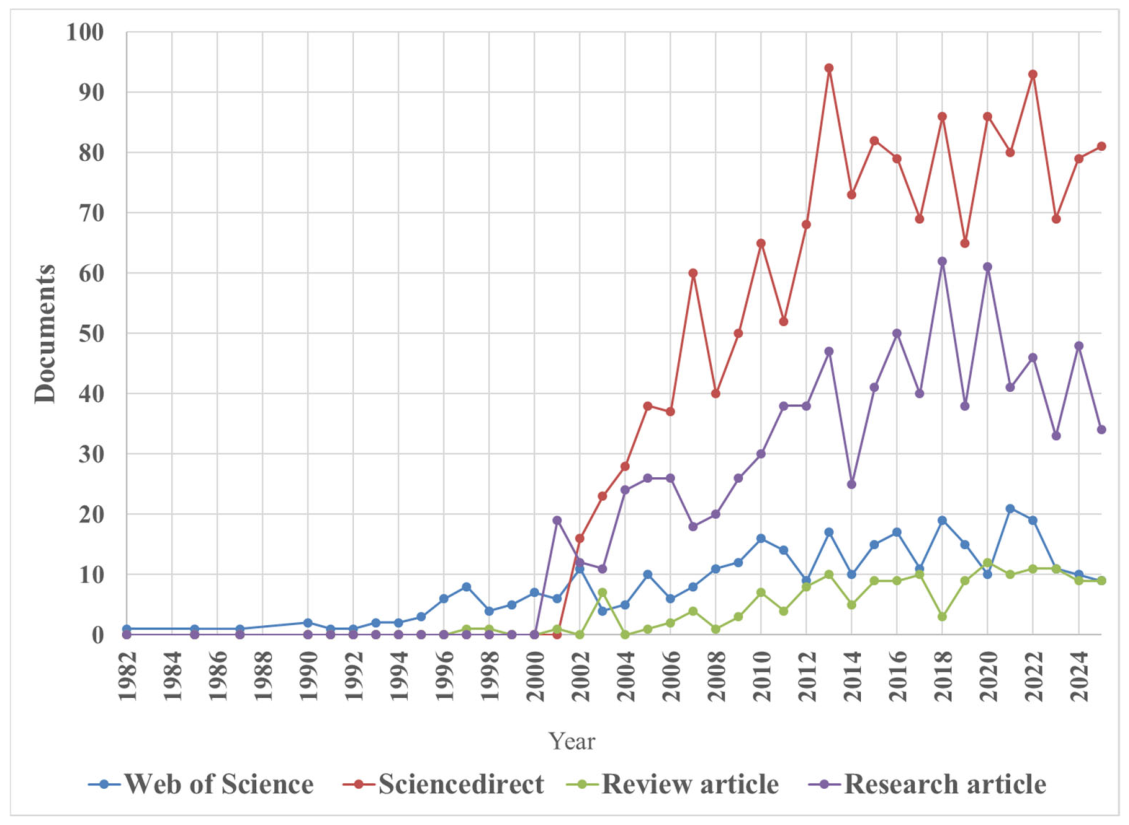
A precise search for studies focused on climate variability and paleolimnology in lakes in central Mexico during the Quaternary allows us to examine research progress in two databases: Web of Science® and ScienceDirect®. This analysis shows an increase in publications from 2002 to 2024, with an upward trend in research and review articles (Figure 1).
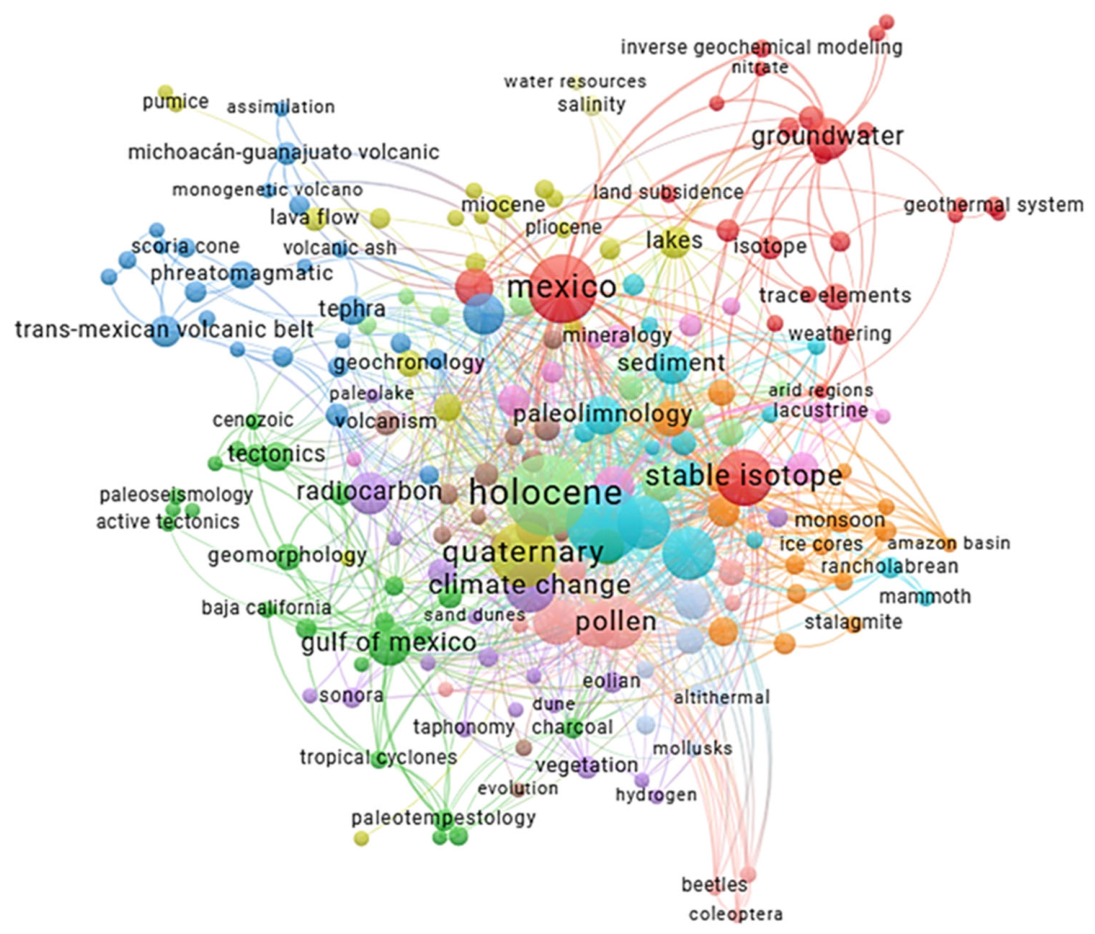
The keywords from research related to the paleolimnological study of the Quaternary in Mexico led to the construction of a bibliometric map, with the frequency of occurrence of words extracted from the titles and abstracts of articles in the ScienceDirect® database. Figure 2 shows that studies of the sedimentary record of Mexican lakes during the Quaternary present 13 clusters. The main keywords associated with the research topic are “Holocene,” “paleoclimate,” “Quaternary,” “climate change,” “pollen,” “stable isotope,” “North America,” “geochemistry,” “groundwater,” “Gulf of Mexico,” “Late Pleistocene,” “sediment,” and “paleolimnology”.
The mapping of the global network and the bibliometric map indicate that the most frequently occurring words are “Holocene,” “paleoclimate,” and “Mexico.” The bibliometric analysis shows that the term Holocene is related to the following words: paleoclimate, Mexico, Quaternary, North America, pollen, radiocarbon, Gulf of Mexico, stable isotopes, pollen, geochemistry, radiocarbon, Last Glacial Maximum, Young Dryas period, glaciation, monsoon, and Anthropocene (Figure 2).
Regarding the term “paleoclimate”, Figure 2 illustrates that the most frequently used indicators to obtain information are stable isotopes, pollen, geochemistry, radiocarbon, diatoms, and tephra, which are used to determine their influence on climate change and the reconstruction of paleoenvironments in North America and central Mexico (Figure 2).

3.2. Late Quaternary

The Quaternary is the last period after the Paleogene and Neogene periods in the Cenozoic Era, approximately 2.58 Ma [20]. This period of the Earth’s history includes two transcendent epochs for understanding the current environmental configuration of our planet. The Pleistocene recorded mass extinctions of large mammals due to the Last Glacial Maximum, while the Holocene marked the end of the Last Ice Age, with warm and cold periods during which modern human civilization flourished [21].
During the Pleistocene, the Riss-Würm interglacial, recorded in Europe and North America, marks the beginning of the last age of the period, known as the beginning of the Late Quaternary, with the development of warmer and wetter conditions than those recorded in the Holocene. This event was preceded by the Riss glaciation (200 ka BP) and predates the Last Glacial Period (Würm) in 110 ka BP [22].
During the Tarantian age (Last Glacial Maximum; 26–19 ka BP), the Earth’s ice sheet volume is estimated to have reached its maximum, but it decreased due to a deglaciation event in the Northern Hemisphere in 20 ka BP [23,24]. This process caused huge masses of ice to be detached from glaciers and transported to the oceans, a process known as the Heinrich 1 event, which occurred from approximately 16 to 14 ka BP [25,26]. After this event, there was an increase in temperature in the northern hemisphere, which was called Bølling–Allerød, dated from approximately 14.5 to 13 ka BP, where significant changes in deep ocean circulation occurred [27,28], preceding the Younger Dryas, which marks the end of the Pleistocene period. Afterwards, the Holocene began, with a decrease in the temperature due to changes in the thermohaline current by the presence of fresh water in the ocean, with an approximate chronology of 13–11 ka BP [29].

3.3. Lake Basins

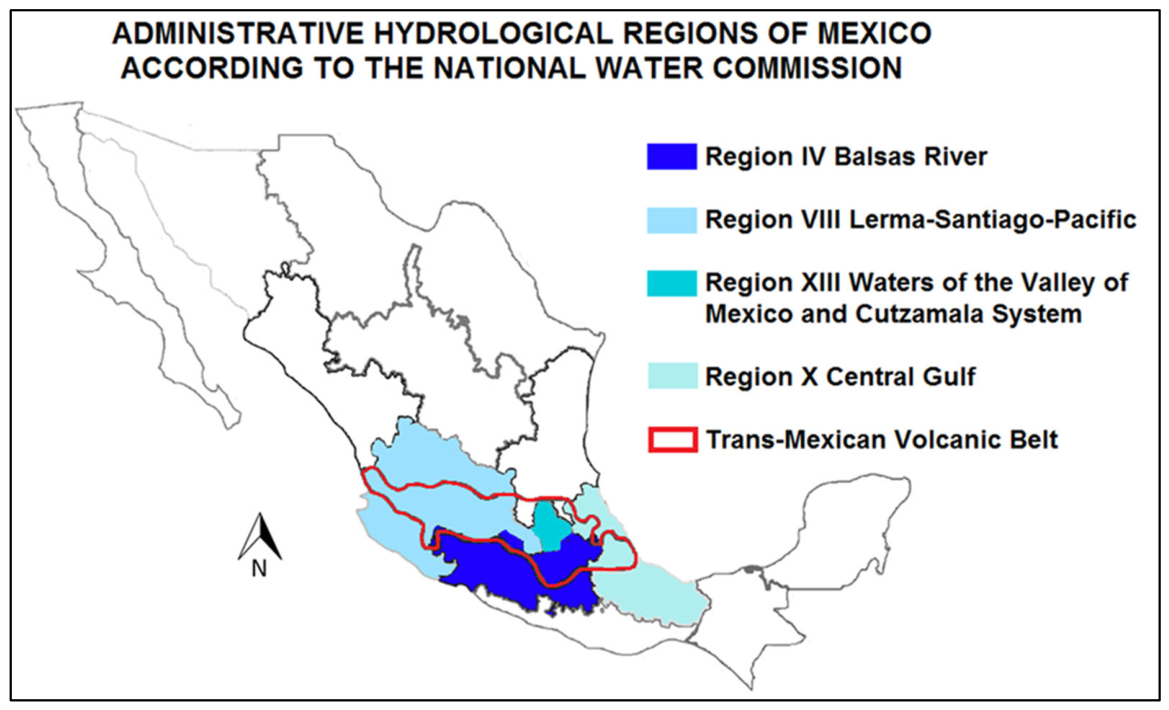
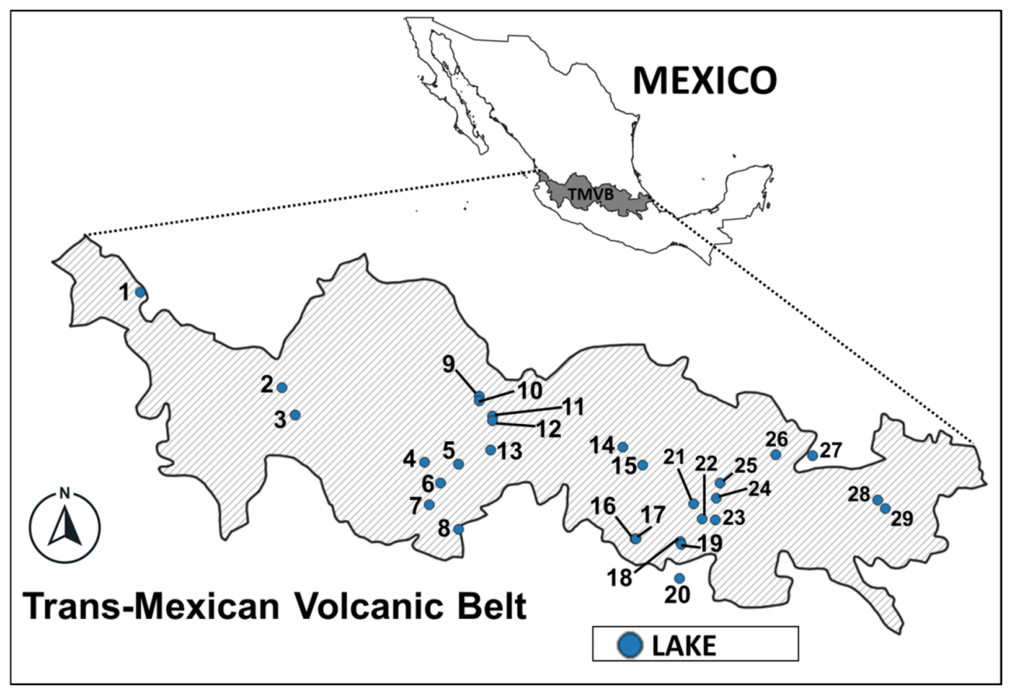
Central Mexico lies within a physiographic region known as TMVB, a partially molten continental arc where four hydrological regions (Lerma-Chapala-Santiago, Balsas River, the Valley of Mexico, and the Central Gulf) converge, with a length of approximately 1000 km (Figure 3). It comprises two large geological units, the first being of Precambrian to Paleozoic origin with a thickness of 50–55 km, and the second spanning the Jurassic to the Cenozoic with a thickness of 35–40 km [30].
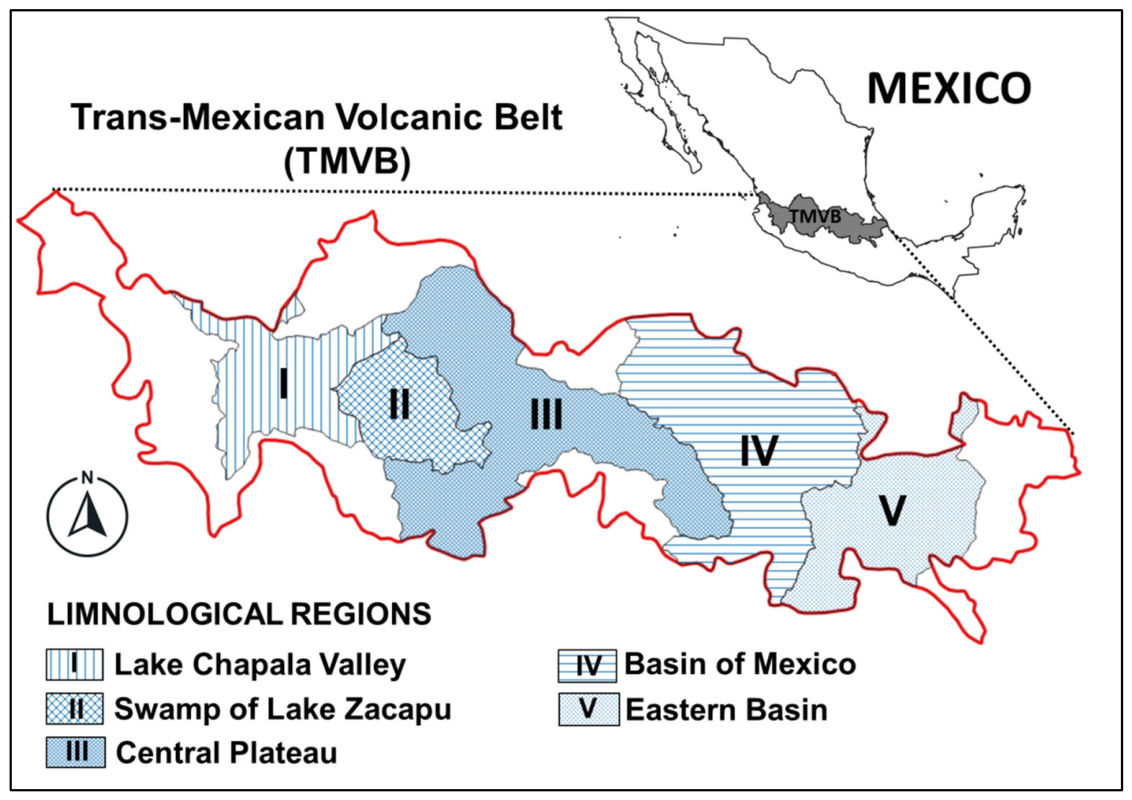
The TMVB contains numerous lake basins, distributed in five regions (Figure 4): 1. The Basin of Mexico, which hosted extensive lakes that are now extinct or are represented by remnants of them, such as Texcoco, Chalco, Xochimilco, Zumpango, and Xaltocan [31]. 2. The Eastern Basin, which contains various lake systems, including the crater lakes of the state of Puebla [32]. 3. The lakes of the central plateau, among which Cuitzeo, Patzcuaro, Zirahuen, and Yuriria stand out, as well as the crater systems of Tacambaro and Teremendo [33], all of them belonging to the hydrological regions RH12 (Lerma-Chapala) and RH18 (Balsas river). 4. The marsh of Zacapu Lake [34], which contained a large lake, currently restricted to Zacapu Lake, and where a crater lake is located, the Los Espinos Crater Lake. 5. The lake valley region of Chapala Lake, one of the largest in central Mexico [35], which occupies the Lerma-Chapala-Santiago system, with its origin in the state of Mexico and its mouth in the Pacific Ocean.
Of the current lake systems, the one with the greatest environmental variability is Cuitzeo Lake, a volcanic tectonic system with volcano–sedimentary successions originating in the Late Miocene, 11.5 Ma. It preserves the record of the glacial and interglacial periods, cold and warm climates, and periods of humidity and drought [11,36,37,38]. However, it is not the only source of information on past environmental conditions in central Mexico, since there is a sedimentary record of ten extinct lakes (San Nicolas Parangueo, Rincon de Parangueo, Saint Bartolo Acambay, Acambay Lake, Chalco, Texcoco, Xochimilco, Tepexpan, Chapultepec, and Quila), as well as nineteen lakes systems that include a stratigraphic record and are perennial (Figure 5 and Table 1).

3.4. Paleolimnological Indicators

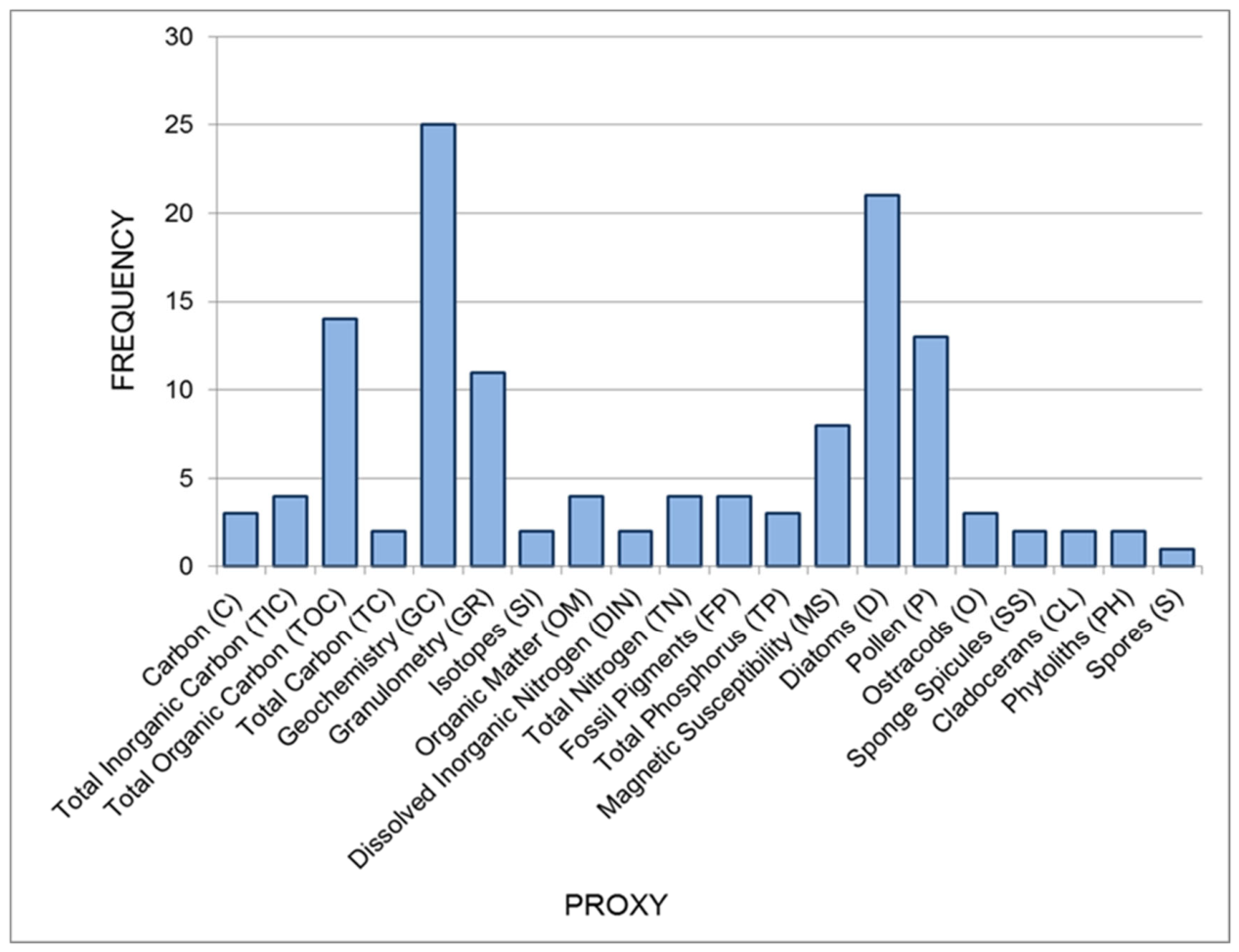
Indicators used for paleoenvironmental reconstructions in central Mexico are diverse. Common indicators in central Mexico include geochemistry, diatoms, pollen, organic carbon, granulometry, and magnetic susceptibility (Figure 6 and Table 2). The use of geochemistry allows for an approximation of environmental changes at a study site [72], while the use of biological indicators such as diatoms and pollen allows for interpretations of biotic responses to environmental modifications and climate change [73]. In central Mexico, the least frequently used indicators are as follows: fern spores, phytoliths, cladocerans, sponge spicules, isotopes, inorganic nitrogen, and total carbon (Figure 3 and Table 2). One of the reasons for the low frequency of an indicator is the lack of access to technologies that can determine it. Another cause is a low percentage in the fossil record or a taxonomic deficiency in recognizing them in the sedimentary sequence [72]. Phytoliths, fern spores, and isotopes are important indicators that enable the reconstruction of the vegetation of a basin or region [74]. These, together with independent “predictive” indicators, explain in greater detail the changes observed in paleolimnological indicators (diatoms, cladocerans, ostracods, and sponge spicules, among others).

3.5. Environmental Evolution of Lakes of Central Mexico

The sedimentary records in the TMVB indicate that the region of central Mexico hosted large lakes during the Late Quaternary [10], which are generally classified as large shallow environments, as well as deep environments that occupied small lake basins. Most of these ecosystems presented diatom species that formed in distinct physicochemical conditions and were highly susceptible to changes in distribution and diversity, representing a good indicator of lacustrine level changes. During the Late Pleistocene, different paleoclimatic scenarios are recognized and are associated with changes in the insolation orbital and millennial-scale climatic oscillations recorded in the interglacial and glacial periods. In central Mexico, there have been attempts to fit paleoclimatic records with global climatic oscillations in order to understand the climatic variability. These shifts in air temperature oscillations has been well documented in the marine isotopically stages, showing a minimal summer insolation in the North hemisphere (Stadials MIS) 5d (~105 ka BP), 5b (~90–95 ka BP), 4 (~70–60 ka BP), and MIS 2 (the Last Glacial Maximum; ~26, 5–19 ka BP). In contrast, interstadials MIS 5c (~100 ka BP), 5a (85–80 ka BP), and y 3 (50–35 ka BP) are associated with warmer conditions and glacial melting [76].
During the Late Pleistocene, the following stand out: the final stage of the Last Glacial Maximum (LGM 26–19 ka BP) at a global level observed a warmer Heinrich stadial (~18.2–14.6 ka BP); the warmer Bølling–Allerød oscillations from 14.6 to 12.9 ka BP; and the pronounced cooler Younger Dryas, 12.9–11.7 ka BP, with transcendental changes in the evolution of lakes [77,78,79].

3.5.1. Tarantian or Late Pleistocene, Riss-Würm Interglacial (130–84 ka BP): Warm Period

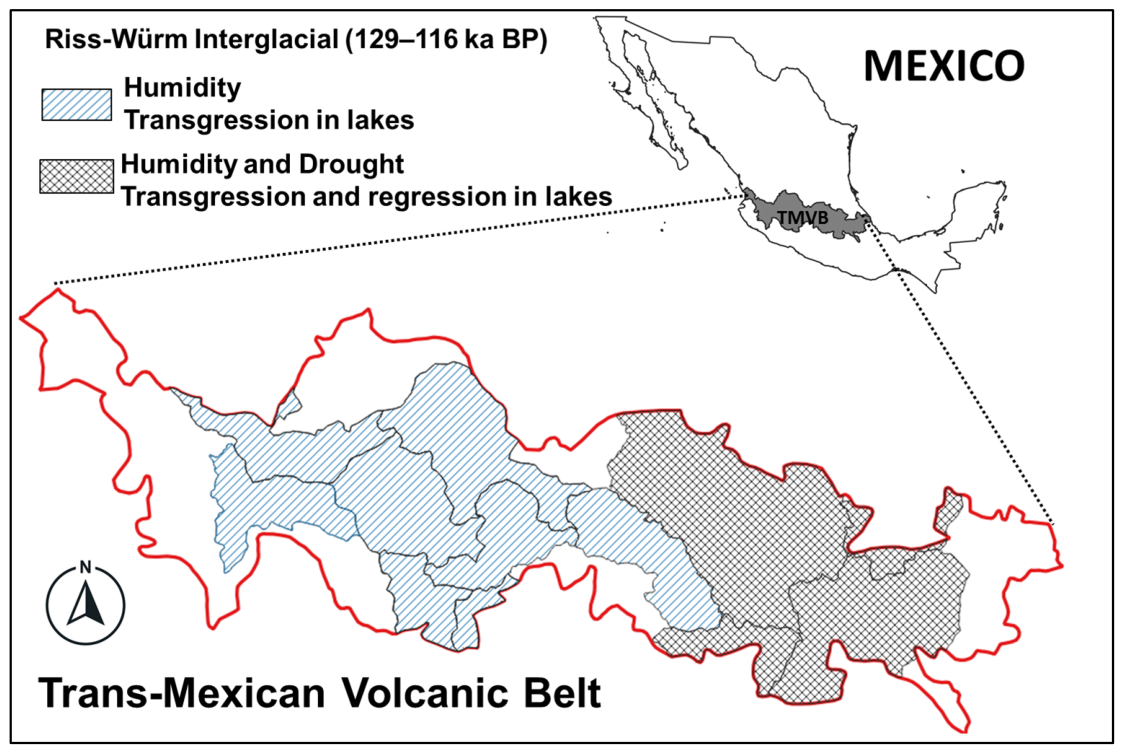
This period belongs to the Last Interglacial (LIG): global temperatures were warm, 2–5 °C above current temperatures [22]. In MIS 5e and MIS 6 in central Mexico, this interglacial period hosted extensive lakes of considerable depth, such as Cuitzeo Lake [10,37], which, based on pollen and diatom records, indicated a stable water column and a warm, humid climate (120 ka BP). Similarly, in the Acambay lake region, the diatom record indicated the presence of a large, deep lake with a turbid water column [56]. Meanwhile, the Basin of Mexico was occupied by the Texcoco Lake at its highest lacustrine levels [67], where the diatom record shows the presence of a large, deep lake in a cool climate (100 ka BP; Figure 7).
Due to the increase in temperature during the interglacial period (Figure 7), the large lakes of central Mexico began a process of evaporation (MIS 5e), in which the large lake basins were reduced to swampy areas, as shown by the diatom record of Texcoco Lake, which presented a reduction in its water column, going from a deep lake to a shallow system in a continuous process of drying, with numerous flooding zones sustained by springs in a warm climate of low humidity [67]. High evaporation of saline associated with drying processes was recorded in Chalco Lake [15].
In Chalco Lake, a change in the vegetation structure was reported with relatively cool temperatures with high salt concentrations and low lake levels (from 130 to 123 ka BP). The record of titanomagnetites, ostracods, and Chara exposes a gradual process of desiccation (from 130 to 84 ka BP) in MIS 5a, 5b, and 5c in a warm, low-humidity climate that led to an intense drought with high evaporation rates [64,80].
Another long core belongs to Cuitzeo: even if there is no chronological control at the base of the 27 m core, an extrapolation suggests a sedimentary record of 110 ka BP, reaching the Last Interglacial period (LIG). In this sedimentary record, diatoms and pollen showed warmer and more humid conditions [10].

3.5.2. The Last Glacial (MIS4, MIS3, MIS2; 71–57 ka BP): Period of Intense Drought

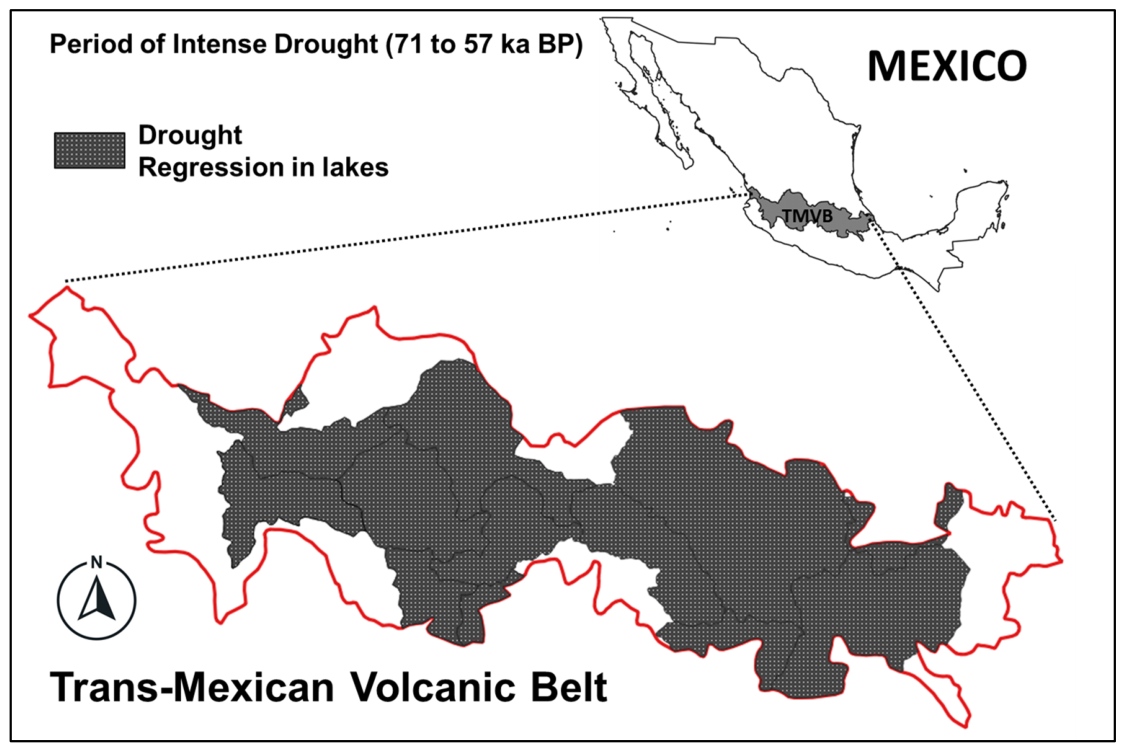
The warm, humid climate of the interglacial period transitioned to a warm, dry climate and then to a cold, dry climate, marking the beginning of the last glacial cycle (Figure 8). This led to an intense drought event affecting the lakes in central Mexico, particularly those in the Basin of Mexico. In Texcoco Lake, the surface area of the lake decreased, favoring a brackish water system [67]. Meanwhile, in Chalco Lake, a change of terrestrial vegetation was reported, indicating extreme drought in a cold climate [67]. During this period, a low precipitation rate was reported due to the southward shift of the Intertropical Convergence Zone, which generated high-pressure zones and intense drought [81,82].
In the case of the Acambay area (Figure 8), a decrease in the water column in the lake systems was reported [55,56] due to an intense drought (70 ka BP), a condition that was also reported for Cuitzeo Lake, which presented a decrease in the lake level [10,37].

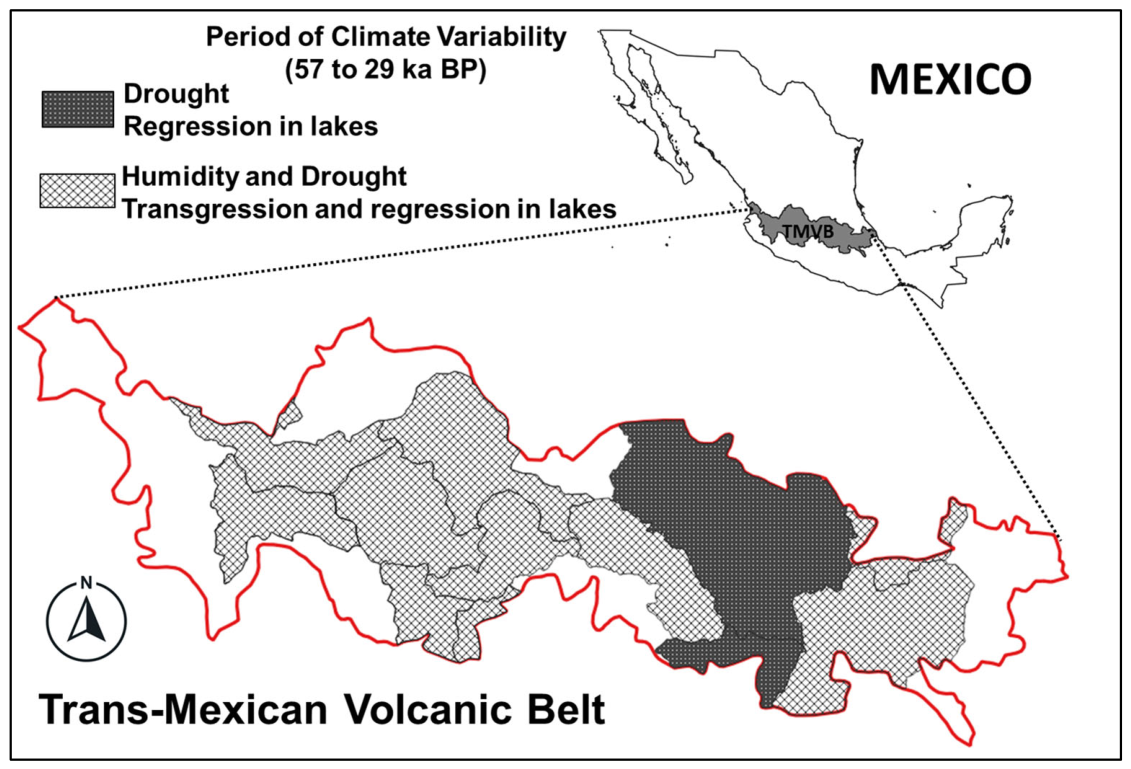
3.5.3. Period of Climate Variability (57–29 ka BP)

Following the intense drought, the climate experienced increased humidity, which favored the recovery of lake levels in the aquatic ecosystems in western central Mexico. This climate signal was different in east-central Mexico (Chalco and Texcoco lakes), suggesting relatively small evaporation and temperature changes until the marked cooling recorded at the beginning of MIS 2 (27 ka BP), when freshwater environments returned.
The process of lacustrine transgression in central Mexico allowed for Cuitzeo Lake to increase in depth [11,37]. Likewise, the maximum depth was recorded for Patzcuaro Lake in this period (48 ka BP), where the lake remained climatically stable until 44 ka BP. This lake experienced its deep maximum during a cool, humid period, with a water column with high concentrations of carbon and nitrogen and low levels of phosphate and iron, reflecting an oligotrophic environment with a tendency toward mesotrophy [46]. A change in humidity was subsequently reported, which marked the beginning of a period of variability in Patzcuaro Lake [83], decreasing its depth (37 ka BP) with fluctuating levels of the water column (27 ka BP; Figure 9).
A change in climatic conditions was reported in the Patzcuaro Lake basin (28 ka BP), impacting Zacapu Lake, which was a deep and extensive environment (Figure 9). This was recorded in 27 ka BP, where a reduction in the depth of the water column of several lakes on the central plateau was documented [43,45]. The Yuriria and Rincon de Parangueo crater lakes recorded climatic variability during this period, with a predominance of cold and humid conditions, preceded by a cold and dry period. This climatic variability allowed for the crater lakes to develop a shallow, eutrophic, saline, alkaline water column at ca. 30 cal ka BP [53,84].
Toward central-east Mexico, frequent climate changes were reported in Tecocomulco Lake, with a transition from a cold and humid to a warm and dry climate. This fluctuation led to a reduction in vegetation, as well as a reduction in the lake level (41 ka BP). This process continued until 31 ka BP (Figure 9), with changes in the water column, with freshwater species that indicated a deep-to-shallow water column [68].
In the Basin of Mexico, the Texcoco and Chalco lakes cooled at the onset of MIS2 (27 ka BP), when freshwater environments returned to periods of no significant changes in lake levels [81]. Drought events subsequently occurred, as Texcoco Lake reduced its depth with a column of brackish water [67]. Regarding Chalco Lake, there are records for this period of a deep and saline lake [17,63,85], which reduced its depth, generating bioturbation in the sediment layer, in the context of a turbid and alkaline-saline lake [86]. Environmental stressors subsequently caused Chalco Lake to transition to a shallow environment (34 ka BP; Figure 9), attributed to an intense drought in central Mexico that led to numerous fires between 45 and 39 ka BP [86,87].

3.5.4. Tarantian or Late Pleistocene, Last Glacial Maximum (26–19 ka BP)

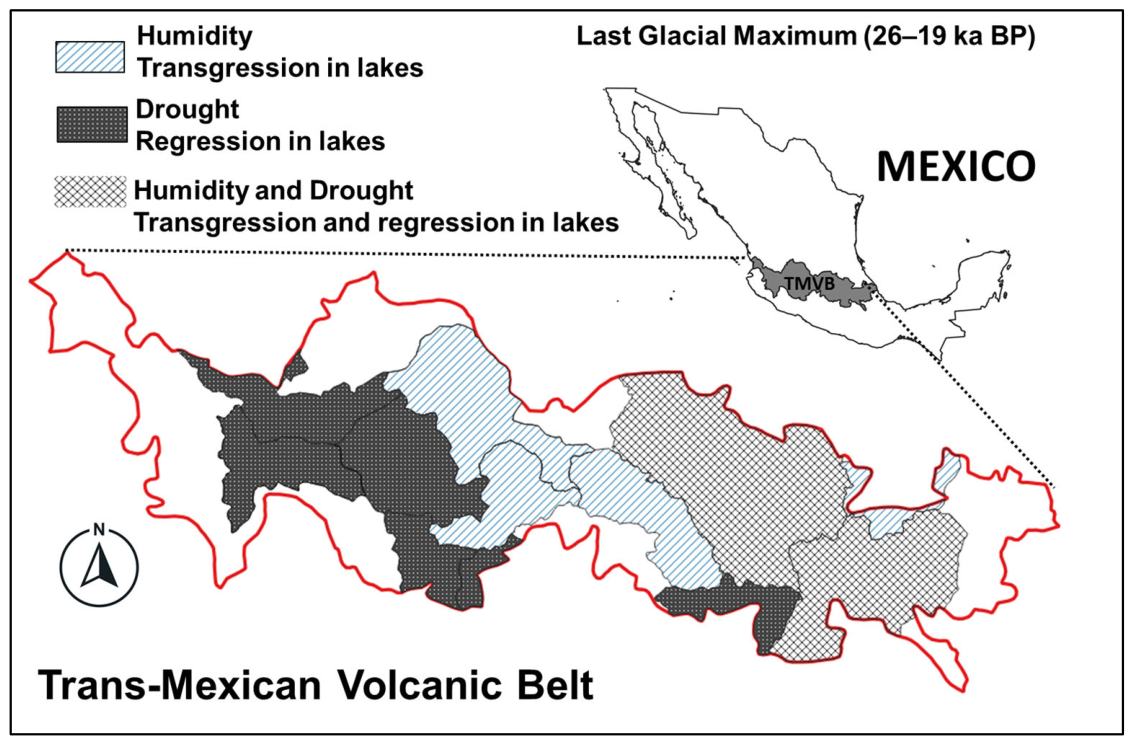
The coldest part of the MIS 2 stadial includes the Last Glacial Maximum. In this event in central Mexico, relatively cold temperatures were recorded (the temperature decreased by 4 or 5 °C). At Chalco Lake, the diatom record indicates the presence of Stephanoodiscus niagarae, suggesting cold temperatures [80] with a predominantly cold climate, notably at the onset of MIS2 (27 ka BP). In Patzcuaro Lake basin (26 ka BP), colder temperatures and mesophilic vegetation were recorded [88]. This signal is consistent with the observed climatic trend in Acambay Lake [56], Rincon de Parangueo Lake [50], and Patzcuaro Lake [46]. A humid period characterized by the development of terrestrial vegetation (Figure 10), associated with cloud forests, was documented 26 ka BP [50,89].
The relatively cold temperatures were followed by accelerated drought and regression process, as observed in Zacapu Lake on the central plateau [43]. This process marked the beginning of a cold and dry climate from 25 to 22 ka BP and affected the lake levels of the lakes of Jalisco, Guanajuato, Michoacán, the State of Mexico, and Mexico City. Such was the case of the Yuriria Crater Lake, which recorded desiccation events with the development of a saline and alkaline lake with dry climate conditions between 25 and 14 ka BP [53]. Likewise, Texcoco Lake reduced its water column, indicating brackish conditions [67], and Chalco Lake recorded a reduction in the lake level with an increase in turbidity, with scarce aquatic vegetation in the period from 31 to 23 ka BP (Figure 10), with a saline and alkaline lake [63,90] in a cold and dry climate [90,91].
After the drying period in Chalco Lake, climate change was recorded in the sedimentary record in 22 ka BP, with the end of the drought in a cold and humid climate [64]. A change in the lake was observed, a process that favored lacustrine transgression and a decrease in the concentration of dissolved salts [63,92]. The establishment of a freshwater column allowed for the development and expansion of aquatic and underwater vegetation, marking the beginning of a warm, humid climate from 22 to 18 ka BP (Figure 10), with a lacustrine transgression from 14 to 10 ka BP [86].
At the end of the Last Glacial Maximum, several lakes registered transgressive events, as documented in the Eastern Mexico Basin, and in the region of the lakes of the central plateau, attributed to a warm and humid climate, according to the paleolimnological record of the Chignahuapan [69], Tecocomulco [68], Chalco [63,86]. Chapala [35,41], and Cuitzeo lakes [11,37], respectively (Figure 10).

3.5.5. Heinrich Stadial 1 Period (17–15 ka BP)

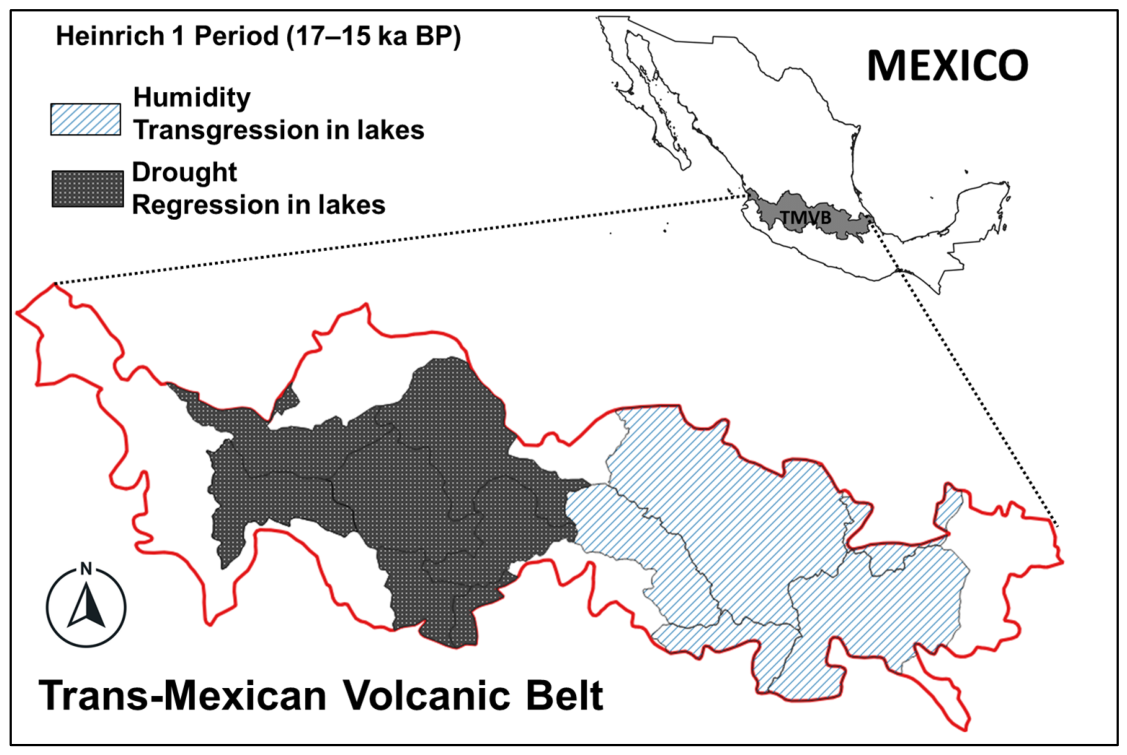
During the Heinrich 1 period, a cold climate developed, with spatial variations in moisture content. In the Basin of Mexico, the sedimentary record of the Xochimilco and Chalco lakes indicated the establishment of a cold and humid climate [61,63,91]. In the central plateau lake region (Figure 11), the stratigraphy recorded a cold and dry climate [48,53]. In the same context, Xochimilco Lake presented sparse terrestrial vegetation, with an increase in erosion from 17 to 15 ka BP. The development of low vegetation continued until 11 ka BP, with a moderate supply of detritus in a cold and humid climate [61]. In the case of Chalco Lake (Figure 11), a marsh stage with a neutral to slightly acidic water column consolidated in a cold and humid climate from 18 to 14 ka BP [86,93].
In the central west lakes in the Volcanic Transmexican Belt from 22 to 14 ka BP, the Patzcuaro and Rincon de Parangueo lakes recorded cold and humid environmental conditions. These conditions favored the development of an open cloud forest, as indicated by the pollen of Liquidambar (Altingiaceae) and Corylus (Betulaceae), which are no longer found in the area [46,50,88]. At Zirahuén Lake, a cold and dry climate was recorded for the interval from 17 to 14 ka BP [16], with precipitation increasing after 13.5 ka BP [16,48]. Climatic conditions similar to those recorded at Zirahuén Lake were observed at Cuitzeo Lake [11].
On the central plateau, the sedimentary record indicated the development of a cold, low-humidity climate, which favored a regional drought that accelerated the desiccation of the Yuriria Crater Lake, which lost its water column from 14 to 11 ka BP [53]. The cold climate with low humidity caused havoc in Zirahuen Lake (Figure 11), which lowered its lake level to the point where it presented characteristics of a shallow environment at 17 ka BP [9,48]. At Zirahuen Lake, a cold and dry climate was recorded for the interval from 17 to 14 ka BP [16]. Climatic conditions similar to those recorded at Zirahuen Lake were observed at Cuitzeo Lake [11].

3.5.6. Bølling–Allerød Period (15–13 ka BP)

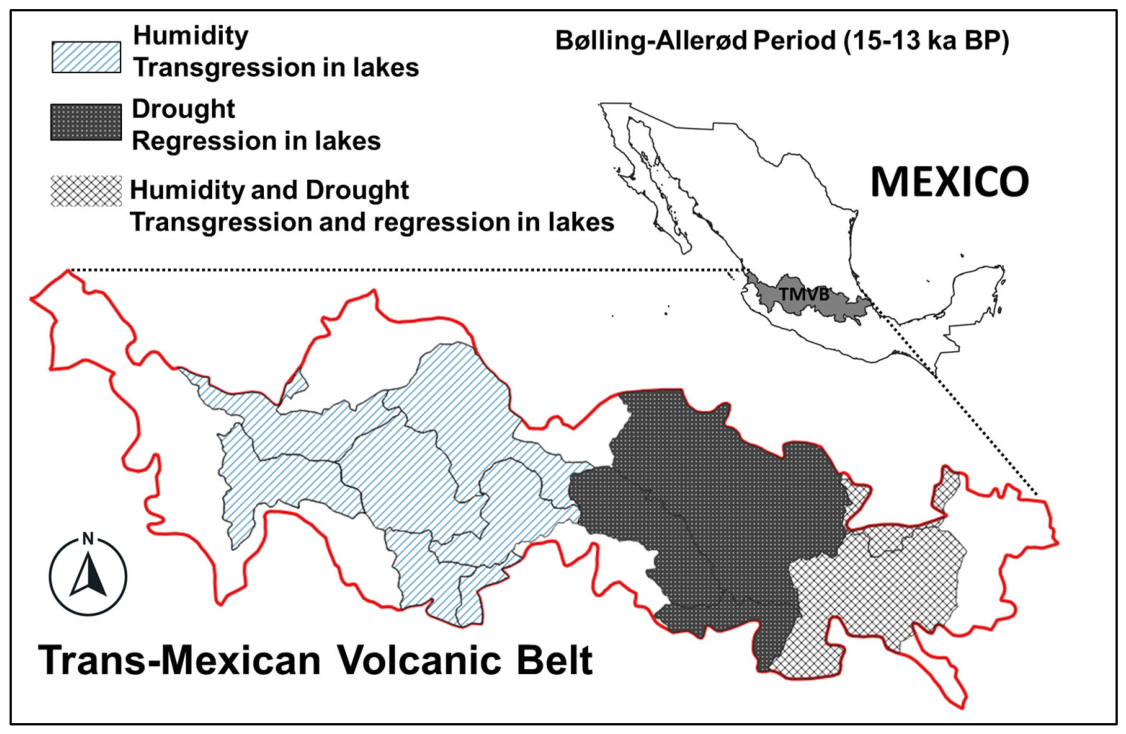
During the Bølling–Allerød Period, the sedimentary record reported a climate change due to a slight increase in temperatures. This favored the development and expansion of vegetation in Xochimilco Lake and the formation of soils in its basin from 15 to 13 ka BP [61]. As a result of the slight increase in temperature 14 ka BP (Figure 12), the lakes in the Central Mexico Basin (Texcoco, Chalco, Xochimilco, Tepexpan, and Chapultepec) recorded a shallow, saline water column [31].
Different humidity conditions are observed in the central west lakes sector, suggesting an increase in precipitation around 13.5 ka BP in Zirahuen Lake [48]. The paleolimnological record of the largest active lake in Mexico, Chapala Lake, the pollen, diatom, and TOC record reveals deeper and colder conditions between 14.7 and 14.1 ka BP [35].

3.5.7. Younger Dryas (11.7–8.2 ka BP)

Once the Bølling–Allerød period concluded, the sedimentary record of Xochimilco Lake indicated a climate change, with a decrease in temperature, which generated a cold and dry climate. Due to the development of this climatic condition, the Xochimilco Lake basin experienced a reduction in vegetation cover from 13 to 11 ka BP. The resulting drought lowered the lake level of Xochimilco Lake (Figure 13), increasing water salinity from 11 to 0.8 ka BP [61].
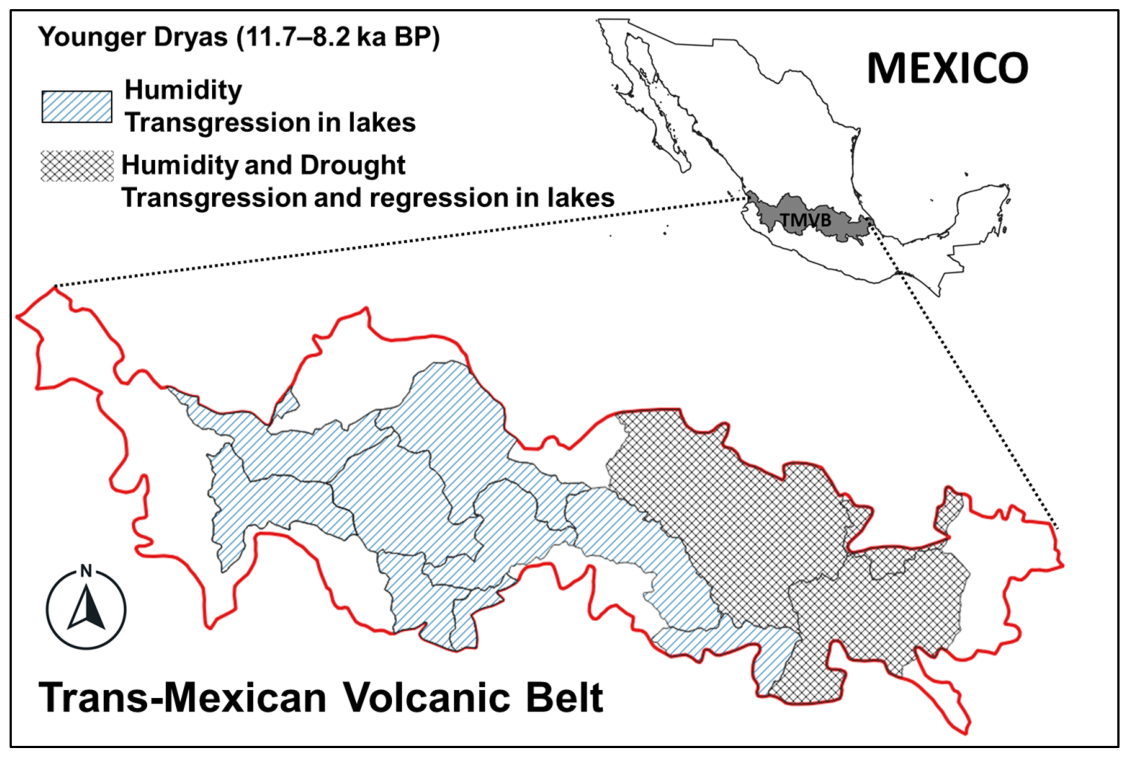
The prevalence of a cold climate and the northward shift of the Intertropical Convergence Zone brought about an increase in humidity from 11 to 8 ka BP, indicated by the sedimentary records of the lakes of central Mexico [48,53,55,59,82,91,94]. This process allowed for a lacustrine transgression of the lakes in central Mexico (Figure 13).
In the Basin of Mexico, Chalco Lake observed an increase in the depth of the water column [86,92] in a cold and humid climate from 10 to 5 ka BP [91]. This pattern was reported in the Coatetelco, Zempoala, and Quila lakes, as well as in the Acambay Lake region, where the establishment of terrestrial vegetation, represented by coniferous forests and cloud forest (Figure 13), was recorded during the period from 11 to 10 ka BP [55,59,60].
In the lakes of the central plateau, as in other systems in central Mexico, recovery of the lake level was reported, as indicated by the sedimentary record of Zirahuen Lake, which presented a deep-water column in a climate of greater humidity at 11 ka BP [48]. Similarly, the water column of the Yuriria Crater Lake recovered [53], as well as the water column of Rincon de Parangueo Lake, accompanied by an increase in plant diversity in their area of influence, with open and less dense vegetation [50]. In the case of Patzcuaro Lake, the recovery of the lake level is not evident, since shallow and alkaline conditions predominate, with a water column of greater algal productivity. The Patzcuaro Lake basin recorded environmental changes, attributed to initial human activity (Figure 13), which favored an increase in the erosion rate with the beginning of agricultural activity [13,46].
The effect of a cosmic impact was recorded in Cuitzeo Lake. This event produced the lake’s high stand in a short interval and a sharp change in the sedimentary and biogenic record, producing high percentages of planktonic taxa, charcoal, nanodiamonds, and microspherules associated with the impact [38]. These high stands are observed in several lakes in central Mexico, and could have been triggered by an increase in humidity due to the effect of the melting of the Laurentidae ice sheet during the cosmic impact [4].

3.5.8. Northgrippian (Middle Holocene; 8–5 ka BP)

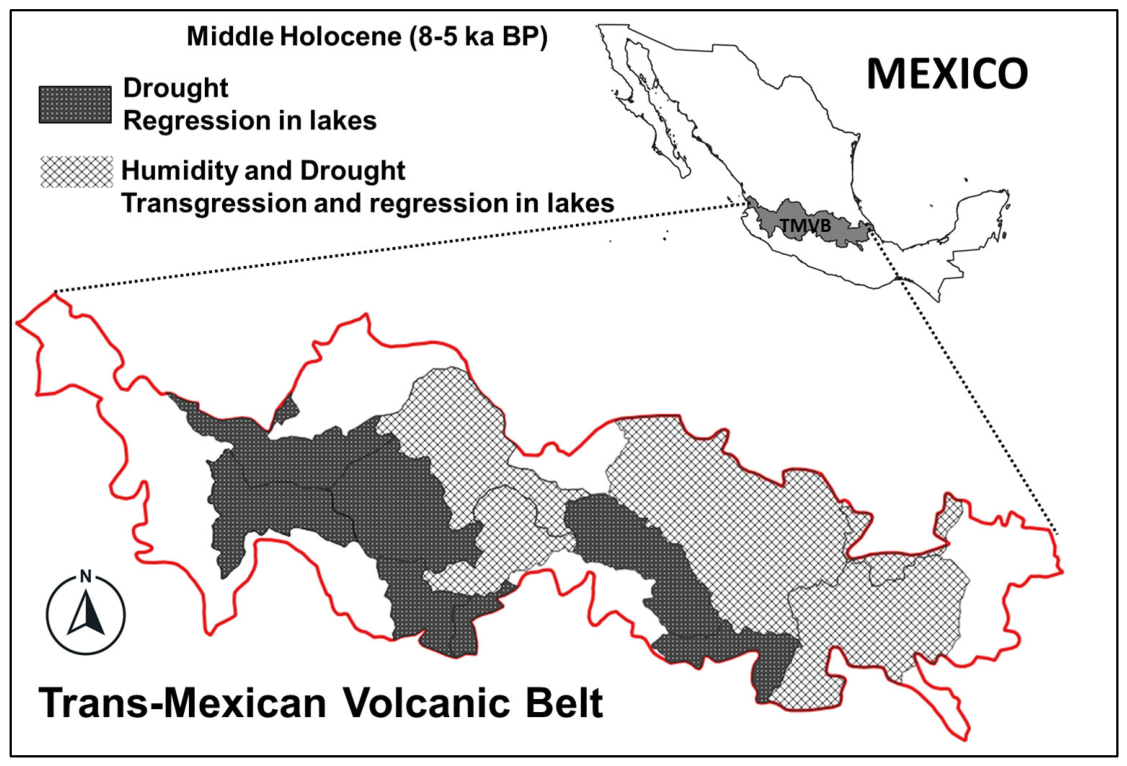
At the end of the Younger Dryas period, the lakes of the Basin of Mexico maintained a sedimentary record that indicated an increase in regional vegetation cover. In Xochimilco Lake, lower-salinity conditions and higher precipitation rates prevailed in a cold and humid climate from 8 to 6 ka BP [61]. Similarly, in Chalco Lake (Figure 14), recovery of the water column was reported in a more humid climate from 10 to 5 ka BP [86,91,92].
After the period of wetness and lake stability, central Mexico experienced a widespread drought, accentuated by the impact of human activities on the basins. The sedimentary record of the Zempoala and Quila lakes indicates the prevalence of a drought period during which agriculture developed and forest fires occurred [59]. Likewise, the stratigraphic record of the lakes in Texcoco, Chalco, Xochimilco, Tepexpan, Coatetelco, and Chapultepec corroborates the drought period from 6 to 1.4 ka BP (Figure 14), with a shallow and saline water column in addition to the development of terrestrial vegetation in the grass group and various monocotyledons [31,60].
In the lakes of the central plateau, a period of widespread drought was also recorded in the sedimentary records. This is the case of Patzcuaro Lake, which has been undergoing a continuous process of desiccation between 3 and 2 ka BP [94], with a eutrophic and shallower water column in a warm, low-humidity climate. The Patzcuaro Lake basin experienced significant changes that affected the rate of erosion (Figure 14), indicating the expansion of agricultural activity due to an increase in the frequency of maize pollen 5 ka BP [46].
The sedimentary record of the Tacambaro Crater Lake corroborated the presence of a warm, low-humidity climate, giving way to a period of drought from 8 to 6 ka BP [49]. This period of drought was reported in the sedimentary record of the Yuriria Crater Lake (Figure 14), which presented a shallow, saline, and alkaline water column from 8 to 4 ka BP [53,95,96].
The Zacapu Lake basin experienced a dry period lasting from 6 to 4 ka BP, which led to an accelerated decline in the lake level. This dry period was interrupted by a period of wet conditions, during which the lake recovered its water column (from 3 to 2 ka BP), after an intense drought was registered with a significant reduction in the water level (1 ka BP; Figure 14).

3.5.9. Meghalayan (Late Holocene, ~4 ka BP)

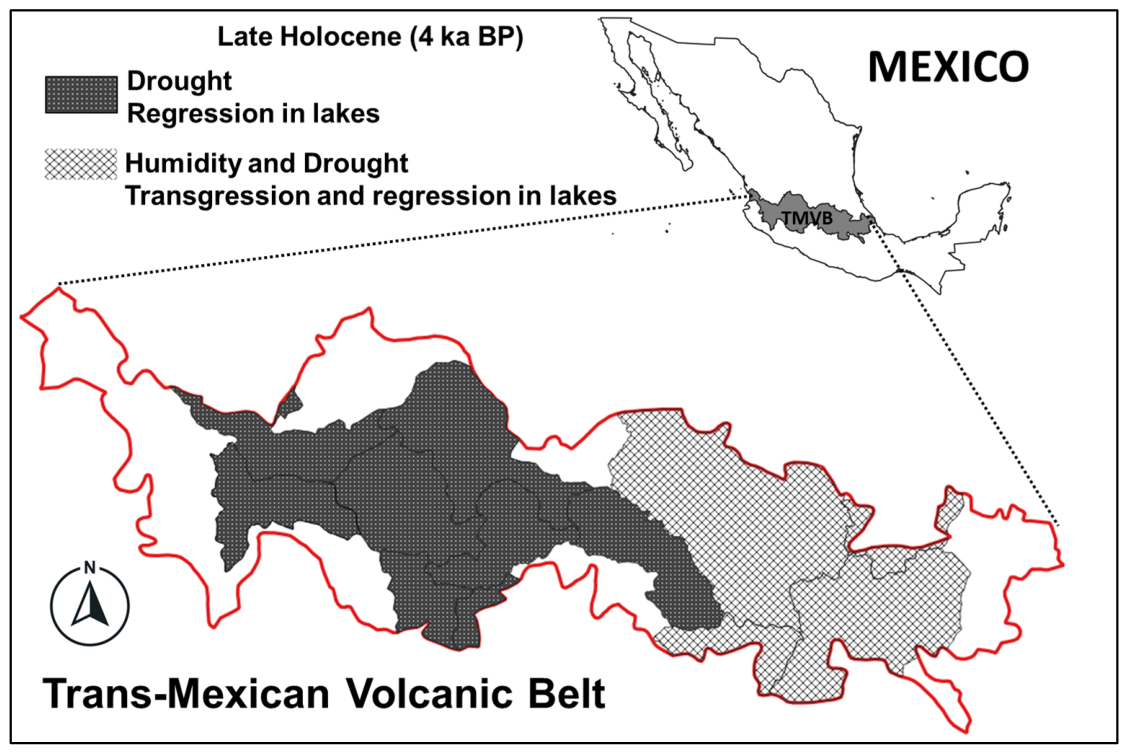
The Northgrippian drought extended into the Meghalayan. The sedimentary record of Rincon de Parangueo documented a change in vegetation composition, indicating a significant climate shift, characterized by the appearance of species that are suggestive of dry environments. This suggests that central Mexico transitioned to arid conditions [50]. This is corroborated by the record obtained from the Yuriria and Rincon de Parangueo crater lakes (Figure 15), which underwent a continuous process of desiccation from 3 to 1 ka BP [53,84,95,96].
In Patzcuaro Lake, the sedimentary record showed changes in lake levels, with a greater tendency toward desiccation, increased nutrient transport, and an intensification of erosion rates due to agricultural activities and deforestation. An alkaline water column and a continuous process of eutrophication were recorded starting 3 ka BP [46,47]. Similarly, in the Zirahuen Lake basin, the eutrophication process was similar, attributed to increased human settlements (Figure 15), increased erosion rates, deforestation, and the intensification of agricultural activity, factors that fostered nutritional enrichment in the lake, particularly beginning around 1550 AD [40].
The records of Alchichica and Atexcac lakes indicate hydroclimatic variability during the Late Holocene, with alternating dry periods (higher evaporation reflected in high δ18O values) and wetter phases associated with humidity regional input [7]. In the Santa Maria del Oro and Teremendo lakes, a recent increase in carbon production was observed, linked to anthropogenic impact and warm conditions during the last few centuries [39]. Mineralogical studies in the lakes of the Eastern Basin suggest changes in weathering and terrigenous inputs related to variations in humidity [71]. In the Tacambaro Crater Lake, records show transitions from the cold and dry climates of the Late Glacial to the warmer and wetter conditions of the Holocene [49], while global multiproxy analyses in Patzcuaro Lake show that lakes respond quickly to climate changes (Figure 15), integrating a regional drought in the central plateau [47].
In the Basin of Mexico, the drought period continues from 4 to 3 ka BP, as was revealed by the sedimentary record of El Sol and La Luna lakes in the Nevado de Toluca [58]. It should be noted that, at 3 ka BP in central Mexico, the warm, dry climate transitioned to a cold, dry climate, subsequently giving way to a Little Ice Age from 1350 to 1910 AD, attributed to a decrease in solar activity (Maunder Minimum). After this period (from 1910 to 2020 AD; Figure 15), the climate again changed to warmer, wetter conditions [57].

3.6. Geological Events That Modified the Paleolimnological Record

Volcanic and seismic activities are factors that have modified the paleolimnological record around the lakes of west-central Mexico. Some examples are Patzcuaro Lake, which produced uplift and altered the sedimentary regime. The last eruption of La Tasa volcano, ca. 8.5 cal ka BP (South margin of Patzcuaro Lake), precipitated volcanic material into the lake. Landslides within the lake also altered the sedimentary record [13]. Another case is Zirahuen Lake, located southwest of Patzcuaro Lake, where La Magueyera volcano produced a lake damming and a change to high lacustrine levels [9,48]. Cuitzeo Lake also evidenced migration of the lake basin during the Neogene and in historical times; lacustrine sediments with a diatom record outcrops 30 m above the current lake. In the Mexican basin, Chalco Lake presented an effect of “mixed layers” of pumice emitted of the Popocatepetl volcano, which produced landslides due to glacial melt, causing the death of mammoths in the ancient lake margin [14].

3.7. Connections of the Sedimentary Record of Central Mexican Lakes with Other Lacustrine Systems

The sedimentary record of the world’s ancient lakes demonstrates a high sensitivity to long-term climate change due to the preservation of multiple glacial and interglacial cycles in sedimentary records [97]. The Baikal, Tanganyika, Ohrid, Owens, Titicaca, and central Mexico basins demonstrate global-scale forcing, which expose trends in temperature, precipitation, and water column productivity. This is in response to hydroclimatic variability and global processes such as Milankovitch cycles [98,99,100], such as eccentricity (100 ka BP), precession (41 ka BP), and obliquity (21 ka BP).
The paleolimnological records of Owens Lake in California constitute one of the most continuous and climate-sensitive continental archives in western North America [101]. Data obtained from various cores document lake responses that were highly sensitive to long-term climatic variations, with resolutions ranging from millennial to orbital scales. This record, spanning up to ca. 800 cal ka BP, reveals pronounced fluctuations in salinity, lake levels, and sedimentary composition, reflecting changes in hydrological balance controlled by temperature and precipitation [102]. For example, the abundance of rock fluoride recorded in sediments correlates with the intensity of glaciations in the Sierra Nevada, showing dominant cycles of ca. 20 cal ka BP associated with orbital forcing (insolation), as well as suborbital variability (ca. 3–5 cal ka BP), possibly linked to Heinrich events and the North Atlantic thermohaline circulation [103]. These results demonstrate a direct connection between global climate forcing and the records in the lakes of central Mexico and regional hydroclimatic responses. Climate oscillations between 10 and 155 ka BP reflect the combined influence of orbital forcing (Milankovitch), hemispheric teleconnections, and internal variability of the climate system [104].
The lakes of central Mexico demonstrate both abrupt and gradual environmental changes at a global level. However, they are highly sensitive to hydrological changes not observed in high-latitude lakes (temperate lakes). This process has been described as asynchronous behavior with the North Atlantic thermal fluctuation [105,106], attributed to the presence of ENSO (the El Niño-Southern Oscillation) and the ITCZ (Intertropical Convergence Zone), associated with low pressure and high cloudiness near the equator, causing intense rainfall [82]. A clear example of the asynchrony in the hydrological behavior of lakes in central Mexico is recorded in LGM, where a cold climate with a tendency toward humidity was present, a process reported in other tropical lakes such as Tanganyika and Titicaca, where the water column increased due to the weakening of the monsoon circulation [107]. This record differed from that obtained in the temperate lakes of Greenland, Baikal, and Ohrid, where cold and arid conditions were reported for this period, in accordance with the thermal fluctuation in the North Atlantic [108].
The variations between the glacial and interglacial periods in the sedimentary record of lakes in central Mexico during the Late Quaternary indicate the shift of the ITCZ, which is closer to the equator during glacial periods and moves toward the northern hemisphere during interglacial periods [46,109]. This process generates a more humid climate and dilution of the water column in tropical lakes during the interglacial period. These modulations in precipitation also affect the trophic state and productivity of the water column, favoring shifts from eutrophic to mesotrophic conditions during periods of high humidity. This oscillation was caused by ENSO, the shift of the ITCZ, and the North American Monsoon (NAM). Similar patterns were reported in South American lakes, showing the teleconnection of tropical lakes with lakes in central Mexico [109,110].
The Titicaca Lake basin indicated a relationship in the decadal variability of ENSO with the lakes of central Mexico, attributed to a climatic coupling at the hemispheric scale due to the Hadley circulation, which transports heat from Ecuador to the northern hemisphere [111]. Likewise, the lakes of central Mexico are an indicator of ocean–atmosphere dynamics with teleconnection with other tropical systems, as indicated by the records of the Caribbean and the Gulf of Mexico, demonstrating analogies in the synchronous intervals of drought during Holocene aridity [112].

3.8. Human Influence on Changes in the Sedimentary Record of Lakes of Central Mexico: Early Landscape Modification

The sedimentary record, using paleoecological indicators, demonstrates the influence of human occupation around the lakes of central Mexico due to increased charcoal deposition, the presence of pollen from domesticated plant species, and increased sedimentation rates due to erosion of lake basins. This early landscape modification is associated with agriculture, deforestation, and hydraulic changes in the basin’s tributaries and effluents, activities that promote an increase in trophic level, an accelerated drying process, and the silting of lake systems [109]. This record is not exclusive to central Mexico, since there are reports of terrace cultivation in the Andes and fishing activities in African lakes [113,114] in a period known as the early Anthropocene, which is evidence that human occupation around ancient lakes predates the Holocene.
Epiclassic and Postclassic droughts identified long-term dry periods, AD 700–950 and AD 1200–1300, that contributed to the decline of major prehispanic settlements of central-east Mexico such as Xochicalco and Tula. This is also observed in the Coatetelco and Alchichica lakes [7] in southwest-central Mexico [60]. At Patzcuaro Lake, the sedimentary record indicates deterioration, attributed to anthropogenic rather than climatic factors. The initial degradation originated with the establishment of human settlements (ca. 2 cal ka BP), generating localized erosion on the mountain slopes. Erosion and sedimentation intensified between 665 and 775 AD due to the construction of ceremonial centers. From 900 to 1520 AD, Patzcuaro Lake maintained relative stability due to intensive landscape management, coinciding with the predominance of the Tarascan Empire. However, after the European Conquest, the demographic collapse caused by disease led to the abandonment of human-modified systems, triggering widespread erosion, increased runoff, and greater sediment input into the lake. This deterioration was exacerbated by heavy rainfall and changes in land use. In the 19th and 20th centuries, deforestation and socio-economic instability deepened the degradation of the basin and the lake system [47].
The Anthropocene is a controversial chronostratigraphic boundary, as indicated by the sedimentary record [114]. In this period, human occupation is recognized as a force that alters biogeochemical cycles, not only from a philosophical perspective, but also from tangible markers (ashes, plastics, isotopes, and radionuclides) that indicate a stratigraphic transition [115]. For example, in the human occupation of the Patzcuaro and Zirahuen Lake basins, a sedimentary layer of lead and copper, respectively, has been found [40,42,48,94,116], which coincides with the human occupation and the beginning of industrial activities in the Issyk-Kul, Caspian, and Tanganyika lakes with deposits of lead, mercury, and uranium [117,118].
The lakes of central Mexico indicate a direct relationship between urban growth and eutrophication. In the Santa Maria del Oro and Teremendo lakes, a marked increase in algal production and organic carbon sedimentation has been documented, associated with urban growth, leading to a progressive eutrophication process since the beginning of the 20th century. This increase in organic material in the sediments has intensified in recent decades, with sedimentation rates 3–7 times higher, reflecting a greater nutrient load linked to local disturbances. This process has been linked to urban growth and land use in the watersheds, increasing primary productivity and accelerating sediment accumulation. Therefore, the anthropogenic signal has overcome natural climate controls in the recent dynamics of lakes in central Mexico, leading to a transition toward higher trophic levels [39]. This process has been documented in the Valencia Lake basin, Venezuela [119], due to the increase in wastewater discharge, which has resulted in harmful algal blooms. This nutrient enrichment, combined with rising temperatures, causes changes in species presence, favoring cosmopolitan species and reducing ecosystem diversity, reducing the presence of organisms sensitive to pollution and endemic species, as documented in the Baikal (Russia) and Tanganyika lakes in East Africa [120,121].
Changes in the hydraulic dynamics of basins are another aspect with a significant impact on the variation in the sedimentary record as a result of human influence on aquatic systems. An example is the modification of the hydrological connections between the lakes in the Basin of Mexico and the modification of the hydrological connections between the waterbodies in Zacapu Lake Basin, with a chinampa system, which accentuated the regional drought during the Little Ice Age in Mexico [34,43,45,113].
These modifications led to a change in the regional microclimate, as reported in the Aral Sea, where a hydrological collapse occurred due to irrigation diversion, with the loss of nearly 90% of its volume, transforming the region’s climate [122].
The increasing number of reports on microplastic contamination and emerging contaminants [123,124] demonstrates bioaccumulation and altered microscopic community dynamics [125], indicating the influence of industrialization in lake basins. They reveal the remote transport of these contaminants, documented in several lake basins like Victoria Lake (Kenya, Tanzania, and Uganda), Khovsgol Lake (Mongolia), and Lake Superior in the United States and Canada [97].

4. Perspectives and Challenges in Lake Basin Changes in Central Mexico

The lakes of central Mexico provide an exceptional record in which natural factors, tectonic and volcanic activity, climate variability driven by glacial and interglacial cycles, and fluctuations in precipitation and regional climate seasonality converge in the medium and long term, as well as showing the influence of anthropogenic factors. It is a critical region modulated by the ITCZ, ENSO variability, and the North American monsoon.
Future studies of the sedimentary record in central Mexico should address aspects that allow us to understand the effects of climate stability and disturbance on biological diversity, the loss of endemism, and its relationship to global warming, with an emphasis on the socioecological importance of lake ecosystems in relation to ecosystem services, carbon sequestration [39], and the development of productive activities such as hydrological balance, water supply, fishing, and tourism [97,126].
Early landscape modification, referred to as the Early Anthropocene, has been documented in the sedimentary record of central Mexico [109]. However, it is necessary to delimit anthropogenic stress factors, since they are addressed in conjunction with environmental factors, and it is complicated to delimit the influence of natural factors in this period, particularly when addressing natural and anthropogenic eutrophication processes, including modern landscape transformations (Jalisco, Chapala–Maltaraña, Acambay Lake, and Cuitzeo–La Cinta drainage for agriculture expansion during the Spanish arrival). In other lake basins around the world, this allows us to identify the forcing of changes in food webs, the proliferation of harmful algal blooms, the presence of cosmopolitan organisms over endemic ones, and the collapse of the water balance [119,120,121]; the latter acts as a factor that modifies regional microclimates [122]. In Mexico, this process is represented by land use change, urbanization, and the presence of massive plant crops with high evapotranspiration rates in the TMVB, such as the case of avocado in central and southern Mexico.
The sediments of lakes in central Mexico hold information such is the case of emerging contaminants derived from pharmaceuticals, organic pollutants such as pesticides and hormones, heavy metals, trace metals, and microplastics, to name a few, which have ecological implications in bioaccumulation, endocrine disruption, and changes in the structure of biological communities, particularly in a field not addressed in depth such as microbial dynamics, aspects that are broken down in lake basins around the world [117,118,123,124,125]. This information will allow us to track the transformation of lake basins to chronostratigraphically delineate the controversial Anthropocene as a geological force that alters biogeochemical cycles and promotes new evolutionary trajectories. This information, reinforced by high-resolution indicators such as stable isotopes and emerging methods such as sedimentary DNA, as well as X-ray fluorescence scanning [98,127], reconstructs a paleo and neolimnological scale, integrating paleoecology, archeology, and modern limnological monitoring.
Several challenges are projected for the scientific community in central Mexico. These include the following: (1) Separating natural climate variability from processes that entail anthropogenic disturbance. (2) Understanding the effect of changes in sedimentary and biogenic record and the effect of tecto-volcanic activity. (3) Developing a conceptual model for the coupling of climate, lake basins, and human activities. (4) Understanding the biotic resilience of lakes to develop ecological restoration strategies that address nutrient management at the watershed level, reforestation, containment of leachate and untreated effluents, emerging pollutants, environmental stressors such as eutrophication, invasive species, global warming, hydrological management, and socioeconomic planning. (5) Using high-resolution indicators to delineate rapid environmental transitions. (6) Conducting cross-continental meta-analyses to establish universal and regional drivers of ecological change as a source of a predictive framework for climate scenarios. (7) Calibrating paleolimnological information methods and analyses with contemporary monitoring so that modern limnological data can calibrate paleorecords and thereby refine ecosystem response models. (8) Recognizing lakes as cultural and biophysical entities within a governance framework that integrates sustainability, equity, and intergenerational responsibility.

5. Conclusions

Analysis of information from the sedimentary records of different lake basins in central Mexico provides insight into the processes that occurred during the Late Quaternary, a period marked by global climatic fluctuations that directly influenced the presence and persistence of the lakes in the Trans-Mexican Volcanic Belt.
Seven major moments in the historical evolution of the lakes of central Mexico are recognized:
  • Large Lakes in Central Mexico and the Beginning of Their Desiccation: The beginning of the Late Quaternary, marked by the Riss-Würm interglacial period in central Mexico, allowed for the lacustrine basins to host extensive shallow and deep lakes in a warm and humid climate with abundant terrestrial vegetation. These lakes then began a process of desiccation, with temperatures during the Tarantian age being 2–5 °C higher than those reported today.
  • Intense Drought and Climatic Variability of the Interglacial Period: The deglaciation process and the southward shift of the Intertropical Convergence Zone favored the development of a high-pressure system, which generated a drought in central Mexico, reducing the lake levels of all aquatic systems. Subsequent intermittent climate change generated variable humidity conditions, which contributed to the filling and drying of the lakes in central Mexico for a period of ca. 28,000 years.
  • Drying and Filling of Lakes during the Last Glacial Maximum: The onset of the Last Glacial Maximum caused a 4–5 °C drop in temperatures in central Mexico, allowing for the establishment of a cold, dry climate that generated a continuous process of drying in the lakes of central Mexico for a period of 4000 years. This continued until global climatic conditions allowed for the development of a warm, humid climate, which allowed for the lake basins to fill and the water column of the lakes of central Mexico to recover.
  • Spatial Climate Variability in the Heinrich 1 Period: The Heinrich 1 period developed a cold climate in central Mexico, characterized by spatial variation in humidity. The Mexico Basin and the Eastern Basin presented a wet environment with climatic stability, while the lakes of the central plateau and the western section presented a dry environment that favored desiccation processes in that part of the country.
  • Vegetation Expansion in the Bølling–Allerød Period: Central Mexico experienced a slight increase in temperature during the Bølling–Allerød Period, which favored the increase in vegetation in the lakes of central Mexico, characterized by their shallowness and water columns enriched by dissolved salts.
  • Recovery of the Lakes of Central Mexico During the Younger Dryas Period: The Younger Dryas Period in central Mexico brought a cold climate that gradually allowed for the development of humid conditions over 700 years. This was due to a sudden increase in humidity recorded in several lakes of central Mexico, attributed to a cosmic impact, with a successive northward shift of the ITCZ melting. This process favored a low-pressure system and generated precipitation in the TMVB. This process allowed for the recovery of the water column of lakes that had experienced extreme drought and the rise in lake levels in shallow systems.
  • Impact of Human Activities on Lake Drying: The Holocene marks a continuous process of lake drying in central Mexico. However, lake basins affected by human activities show a marked decrease in water column levels due to land use changes in their basins, increasing erosion rates as a result of deforestation and the intensification of agricultural activity, processes that affect the long-term recovery of lake systems.
Based on the analysis of information generated in the lakes of central Mexico and in relation to research around the world, six challenges are projected for the scientific community, including the following: (1) Recognizing the Anthropocene in chronostratigraphy, separating it from natural climatic variation. (2) Establishing environmental restoration actions based on the resilience of lakes. (3) Delimiting short environmental transitions with high-resolution indicators. (4) Establishing teleconnections of lake basins to predict climate scenarios. (5) Calibrating paleolimnological interpretation with modern limnological information. (6) Building cultural and biophysical governance of lakes and their lake basins, with intergenerational responsibility.

Author Contributions

R.H.-M.: Conceptualization; data curation; formal analysis; investigation; methodology; visualization; writing; original draft; writing review, and editing. I.I.A.: Formal analysis; investigation; methodology; visualization; writing original draft; review, and editing. N.W.: Review and editing. G.A.Z.: Investigation, review, and editing. All authors have read and agreed to the published version of the manuscript.

Funding

This research was supported by the Secretary of Science, Humanities, Technology, and Innovation of the Government of Mexico. Grant number 66d22102cdea600538501e16.

Data Availability Statement

No new data were created or analyzed in this study. Data sharing does not apply to this article.

Conflicts of Interest

The authors declare that they have no conflicts of interest. All authors have read, understood, and complied where applicable with the statement on the “Ethical responsibilities of Authors” as found in the Instructions for Authors. All ethical practices have been followed in relation to the development, writing, and submission of the manuscript.

Abbreviations

The following abbreviations are used in this manuscript:
TMVBTrans-Mexican Volcanic Belt
RH12Hydrological regions number 12
LIGLast Interglacial
MIS 2Marine Isotope Stage 2
MIS 4Marine Isotope Stage 4
MIS 5aMarine Isotope Stage 5a
MIS 5bMarine Isotope Stage 5b
MIS 5cMarine Isotope Stage 5c
MIS 5dMarine Isotope Stage 5d
MIS 5eMarine Isotope Stage 5e
MIS 6Marine Isotope Stage 6
LGMLast Glacial Maximum
ITCZIntertropical Convergence Zone
ENSOEl Niño-Southern Oscillation
NAMNorth American Monsoon

References

  1. Lemoine, R.T.; Buitenwerf, R.; Svenning, J.C. Megafauna extinctions in the Late-Quaternary are linked to human range expansion, not climate change. Anthropocene 2023, 44, 100403. [Google Scholar] [CrossRef]
  2. Graipel, M.E.; Lima-Ribeiro, M.S.; Cherem, J.J.; Miller, P.R.M.; Diniz-Filho, J.A.; Cáceres, N.C. Seasonality and desertification drove the global extinction of megafauna in the Late Quaternary. Quat. Sci. Rev. 2024, 344, 108979. [Google Scholar] [CrossRef]
  3. Pérez, L.; Massaferro, J.; Correa-Metrio, A.; Sandoval, K.Z.R. Paleobioindicadores Lacustres Neotropicales; Universidad Nacional Autónoma de México: Mexico City, Mexico, 2017. [Google Scholar]
  4. Wolbach, W.S.; Ballard, J.P.; Mayewski, P.A.; Parnell, A.C.; Cahill, N.; Adedeji, V.; Bunch, T.E.; Domínguez-Vázquez, G.; Erlandson, J.M.; Firestone, R.B.; et al. Extraordinary biomass-burning episode and impact winter triggered by the Younger Dryas cosmic impact∼ 12,800 years ago. 2. Lake, marine, and terrestrial sediments. J. Geol. 2018, 126, 185–205. [Google Scholar] [CrossRef] [PubMed]
  5. Ghafarpour, A.; Khormali, F.; Tazikeh, H.; Kehl, M.; Frechen, M.; Zolitschka, B. Loess origin and Late Pleistocene environmental reconstruction for northeastern Iran: Multiproxy evidences from the Chenarli loess-paleosol sequence. Quat. Sci. Rev. 2024, 328, 108545. [Google Scholar] [CrossRef]
  6. Vegas-Vilarrúbia, T.; Rull, V.; Montoya, E.; Safont, E. Quaternary palaeoecology and nature conservation: A general review with examples from the neotropics. Quat. Sci. Rev. 2011, 30, 2361–2388. [Google Scholar] [CrossRef]
  7. Safaierad, R.; Israde-Alcántara, I.; Rantala, M.; Domínguez-Vázquez, G.; Mohtadi, M.; Schefuß, E.; Tylmann, W.; Francus, P.; Mattielli, N.; Metcalfe, S.; et al. Late Holocene hydroclimate variability and human–environment interactions in the Cuenca Oriental, Mexico: Multiproxy evidence from Lake Alchichica. Quat. Sci. Rev. 2025, 369, 109618. [Google Scholar] [CrossRef]
  8. Torres-Orozco, R.; Arce, J.L.; Layer, P.W.; Benowitz, J.A. The Quaternary history of effusive volcanism of the Nevado de Toluca area, Central Mexico. J. S. Am. Earth Sci. 2017, 79, 12–39. [Google Scholar] [CrossRef]
  9. Israde-Alcántara, I.; Vazquez, C.G.; Davies, S.; Astom, B.; Miranda, M. A 12,000 year diatom based paleoenvironmental record from Lago de Zirahuen, Mexico. In Limnogeology Progress. Challenges and Opporunities; Syntheses in Limnogeology; Rosen, M.R., Finkelstein, D.B., Park, B.L., Pla Pueyo, S., Eds.; Springer: Cham, Switzerland, 2021; pp. 367–391. ISBN 978-3-030-66575-3. [Google Scholar] [CrossRef]
  10. Israde, A.I.; Velázquez-Durán, R.; Lozano García, M.S.; Bischoff, J.; Domínguez Vázquez, G.; Garduño Monroy, V.H. Paleolimnologic evolution of the Cuitzeo lake, Michoacán, during the Pleistocene-Holocene. Boletín Soc. Geol. Mex. 2010, 62, 345–357. Available online: http://www.scielo.org.mx/scielo.php?script=sci_arttext&pid=S1405-33222010000300004&lng=es&nrm=iso (accessed on 5 February 2025). [CrossRef]
  11. Israde- Alcántara, I.; Miller, W.E.; Garduño- Monroy, V.H.; Barron, J.; Rodriguez-Pascua, M.A. Palaeoenvironmental significance of Diatom and Vertebrate fossils from Late Cenozoic Tectonic Basins in west-central México: A review. Quat. Int. 2010, 219, 79–94. [Google Scholar] [CrossRef]
  12. Gonzalez, S.; Huddart, D.; Israde-Alcántara, I.; Domínguez-Vázquez, G.; Bischoff, J.; Felstead, N. Paleoindian sites from the Basin of Mexico: Evidence from stratigraphy, tephrochronology and dating. Quat. Int. 2015, 363, 4–19. [Google Scholar] [CrossRef]
  13. Israde-Alcántara, I.; Garduño-Monroy, V.H.; Fisher, C.T.; Pollard, H.P.; Rodríguez-Pascua, M.A. Lake level change, climate, and the impact of natural events: The role of seismic and volcanic events in the formation of the Lake Patzcuaro Basin, Michacan, Mexico. Quat. Int. 2005, 135, 35–46. [Google Scholar] [CrossRef]
  14. Gonzalez, S.; Huddart, D.; Israde-Alcántara, I.; Dominguez-Vazquez, G.; Bischoff, J. Tocuila mammoths, Basin of Mexico: Late Pleistocene–Early Holocene stratigraphy and the geological context of the bone accumulation. Quat. Sci. Rev. 2014, 96, 222–239. [Google Scholar] [CrossRef]
  15. Avendaño, D.; Caballero, M.; Ortega-Guerrero, B.; Lozano-García, S. Response of diatom assemblages to orbital and millennial scale climatic variability since the penultimate glacial maximum in the northern limit of the Neotropics. J. Quat. Sci. 2023, 38, 750–766. [Google Scholar] [CrossRef]
  16. Torres-Rodríguez, E.; Lozano-García, S.; Roy, P.; Ortega, B.; Beramendi-Orosco, L.; Correa-Metrio, A.; Caballero, M. Last Glacial droughts and fire regimes in the central Mexican highlands. J. Quat. Sci. 2015, 30, 88–99. [Google Scholar] [CrossRef]
  17. Ortega-Guerrero, B.; Lozano-García, S.; Herrera-Hernández, D.; Caballero, M.; Beramendi-Orosco, L.; Bernal, J.P.; Torres-Rodríguez, E.; Avendaño-Villeda, D. Lithostratigraphy and physical properties of lacustrine sediments of the last ca. 150 ky from Chalco basin, central México. J. S. Am. Earth Sci. 2017, 79, 507–524. [Google Scholar] [CrossRef]
  18. Sosa-Nájera, S.; Lozano-García, S.; Roy, P.D.; Caballero, M. Registro de sequías históricas en el occidente de México con base en el análisis elemental de sedimentos lacustres: El caso del lago de Santa María del Oro. Boletín Soc. Geol. Mex. 2010, 62, 437–451. Available online: http://www.scielo.org.mx/scielo.php?script=sci_arttext&pid=S1405-33222010000300009&lng=es&nrm=iso (accessed on 5 February 2025). [CrossRef]
  19. Metcalfe, S.; Say, A.; Black, S.; McCulloch, R.; O’Hara, S. Wet conditions during the last glaciation in the Chihuahuan Desert, Alta Babicora Basin, Mexico. Quat. Res. 2002, 57, 91–101. [Google Scholar] [CrossRef]
  20. Bautista, J.L.L. On the Quaternary. Ann. Anthropol. 1993, 30, 73–81. [Google Scholar] [CrossRef]
  21. Gibbard, P.L.; Head, M.J. The definition of the Quaternary system/era and the Pleistocene series/epoch. Quaternaire 2009, 20, 125–133. [Google Scholar] [CrossRef]
  22. Dahl-Jensen, D.; Balslev-Clausen, D.; Blunier, T.; Buchardt, S.L.; Buizert, C.; Clausen, H.B.; Cvijanovic, I.; Ditlevsen, P.; Gkinis, V.; Grinsted, A.; et al. Eemian interglacial reconstructed from a Greenland folded ice core. Nature 2013, 493, 489–494. [Google Scholar] [CrossRef]
  23. Clark, P.U.; Dyke, A.S.; Shakun, J.D.; Carlson, A.E.; Clark, J.; Wohlfarth, B.; Mitrovica, J.X.; Hostetler, S.W.; McCabe, A.M. The last glacial maximum. Science 2009, 325, 710–714. [Google Scholar] [CrossRef]
  24. Annan, J.D.; Hargreaves, J.C.; Mauritsen, T. A new global surface temperature reconstruction for the Last Glacial Maximum. Clim. Past 2022, 18, 1883–1896. [Google Scholar] [CrossRef]
  25. Bond, G.; Broecker, W.; Johnsen, S.; McManus, J.; Labeyrie, L.; Jouzel, J.; Bonani, G. Correlations between climate records from North Atlantic sediments and Greenland ice. Nature 1993, 365, 143–147. [Google Scholar] [CrossRef]
  26. Stanford, J.D.; Rohling, E.J.; Bacon, S.; Roberts, A.P.; Grousset, F.E.; Bolshaw, M. A new concept for the paleoceanographic evolution of Heinrich event 1 in the North Atlantic. Quat. Sci. Rev. 2011, 30, 1047–1066. [Google Scholar] [CrossRef]
  27. Obase, T.; Abe-Ouchi, A. Abrupt Bølling-Allerød warming simulated under gradual forcing of the last deglaciation. Geophys. Res. Lett. 2019, 46, 11397–11405. [Google Scholar] [CrossRef]
  28. Naughton, F.; Sánchez-Goñi, M.F.; Landais, A.; Rodrigues, T.; Riveiros, N.V.; Toucanne, S. The Bølling–Allerød Interstadial. Eur. Glacial Landsc. 2023, 45–50. [Google Scholar] [CrossRef]
  29. Cheng, H.; Zhang, H.; Spötl, C.; Baker, J.; Sinha, A.; Li, H.; Bartolomé, M.; Moreno, A.; Kathayat, G.; Zhao, J.; et al. Timing and structure of the Younger Dryas event and its underlying climate dynamics. Proc. Natl. Acad. Sci. USA 2020, 117, 23408–23417. [Google Scholar] [CrossRef]
  30. Ferrari, L.; Orozco-Esquivel, T.; Manea, V.; Manea, M. The dynamic history of the Trans-Mexican Volcanic Belt and the Mexico subduction zone. Tectonophysics 2012, 522–523, 122–149. [Google Scholar] [CrossRef]
  31. Bradbury, J.P. Late Quaternary lacustrine paleoenvironments in the cuenca de Mexico. Quat. Sci. Rev. 1989, 8, 75–100. [Google Scholar] [CrossRef]
  32. Caballero, M.; Lozano-García, S.; Romero, M.V.; Sosa, S. Droughts during the last 2000 years in a tropical sub-humid environment in central Mexico. J. Quat. Sci. 2023, 38, 767–775. [Google Scholar] [CrossRef]
  33. Contreras-McBeath, T.; Brito-Rodríguez, M.; Sorani, V.; Goldspink Cy McGregor-Reid, G. Richness and endemism of the freshwater fishes of Mexico. J. Threat. Taxa 2014, 6, 5421–5433. [Google Scholar] [CrossRef]
  34. Metcalfe, S.E. Holocene environmental change in the Zacapu Basin Mexico. a diatom-based record. Holocene 1995, 5, 196–208. [Google Scholar] [CrossRef]
  35. Espinoza-Encinas, I.R.; Israde-Alcántara, I.; Domínguez-Vázquez, G.; Zárate-del Valle, P.F.; Huerta-Magaña, C.G. A 15,000-yr paleo-environmental record from Lake Chapala, west-central Mexico. J. Paleolimnol. 2022, 68, 377–393. [Google Scholar] [CrossRef]
  36. Israde, A.I. Neogene diatoms of Cuitzeo Lake, central sector of the Trans-Mexican Volcanic Belt and their relationship with the volcano-tectonic evolution. Quat. Int. 1997, 43, 137–143. [Google Scholar] [CrossRef]
  37. Israde, A.I.; Garduño-Monroy, V.H.; Ortega Murillo, R. Paleoambiente lacustre del Cuaternario tardío en el centro del lago de Cuitzeo. Hidrobiológica 2002, 12, 61–78. Available online: http://www.scielo.org.mx/scielo.php?script=sci_arttext&pid=S0188-88972002000100008&lng=es&nrm=iso (accessed on 5 February 2025).
  38. Israde-Alcántara, I.; Bischoff, J.; Domínguez-Vázquez, G.; Li, H.; McGeehin, J.; DeCarli, P.; Bunch, T.; Wittke, J.; Weaver, J.; Xie, S.; et al. Evidence from Central Mexico supporting the Younger Dryas Impact Hypothesis. Proc. Nat. Acad. Sci. USA 2012, 109, E738–E747. [Google Scholar] [CrossRef]
  39. Rantala, M.; Israde-Alcántara, I.; Safaierad, R.; Tylmann, W.; Lepoint, G.; Francus, P.; Smol, J.P.; Meyer-Jacob, C.; Grooms, C.; Mattielli, N.; et al. Anthropogenic increase in organic carbon production and burial in two tropical Mexican crater lakes. Sci. Total Environ. 2025, 971, 179041. [Google Scholar] [CrossRef] [PubMed]
  40. Davies, S.J.; Metcalfe, S.E.; Bernal-Brooks, F.; Chacón-Torres, A.; Farmer, J.G.; MacKenzie, A.B.; Newton, A.J. Lake sediments record sensitivity of two hydrologically closed upland lakes in Mexico to human impact. AMBIO J. Hum. Environ. 2005, 34, 470–475. [Google Scholar] [CrossRef]
  41. Fernex, F.; Zárate-del Valle, P.; Ramírez-Sánchez, H.; Michaud, F.; Parron, C.; Dalmasso, J.; Barci-Funel, G.; Guzman-Arroyo, M. Sedimentation rates in Lake Chapala (western Mexico): Possible active tectonic control. Chem. Geol. 2001, 177, 213–228. [Google Scholar] [CrossRef]
  42. Metcalfe, S.E.; Street-Perrott, F.A.; Brown, R.B.; Hales, P.E.; Perrott, R.A.; Steininger, F.M. Late Holocene human impact on lake basins in central Mexico. Geoarchaeology 1989, 4, 119–141. [Google Scholar] [CrossRef]
  43. Metcalfe, S.E. Changing Environments of the Zacapu Basin, Central Mexico: A Diatom Based History Spanning the Last 30,000 Years; School of Geography: Oxford, UK, 1992; Research Paper No. 48. [Google Scholar]
  44. Xelhuantzi-López, M.S. Determinación palinológica del paleoambiente Holocénico en la parte norte del Estado de Michoacán. Bot. Sci. 1994, 54, 251–265. [Google Scholar] [CrossRef][Green Version]
  45. Ortega, B.; Caballero, C.; Lozano, S.; Israde, I.; Vilaclara, G. 52 000 years of environmental history in Zacapu basin, Michoacán, Mexico: The magnetic record. Earth Planet. Sci. Lett. 2002, 202, 663–675. [Google Scholar] [CrossRef]
  46. Bradbury, J.P. Limnologic history of Lago de Pátzcuaro, Michoacán, Mexico for the past 48000 years: Impacts of climate and man. Palaeogeogr. Palaeoclimatol. Palaeoecol. 2000, 163, 69–95. [Google Scholar] [CrossRef]
  47. Fisher, C.T.; Pollard, H.P.; Israde-Alcántara, I.; Garduño-Monroy, V.H.; Banerjee, S.K. A reexamination of human-induced environmental change within the Lake Patzcuaro Basin, Michoacan, Mexico. Proc. Natl. Acad. Sci. USA 2003, 100, 4957–4962. [Google Scholar] [CrossRef]
  48. Ortega, B.; Vázquez, G.; Caballero, M.; Israde, I.; Lozano-García, S.; Schaaf, P.; Torres, E. Late Pleistocene: Holocene record of environmental changes in lake Zirahuen, Central Mexico. J. Paleolimnol. 2010, 44, 745–760. [Google Scholar] [CrossRef]
  49. Ortega-Guerrero, B.; Caballero, M.; Israde-Alcántara, I. The Holocene record of Alberca de Tacámbaro, a tropical lake in western Mexico: Evidence of orbital and millennial-scale climatic variability. J. Quat. Sci. 2021, 36, 649–663. [Google Scholar] [CrossRef]
  50. Domínguez-Vázquez, G.; Osuna-Vallejo, V.; Castro-López, V.; Israde-Alcántara, I.; Bischoff, J.A. Changes in vegetation structure during the Pleistocene–Holocene transition in Guanajuato, central Mexico. Veg. Hist. Archaeobotany 2019, 28, 81–91. [Google Scholar] [CrossRef]
  51. Wogau, K.H.; Keenan, B.; Arz, H.W.; Böhnel, H.N. Paleoenvironmental study of the Late Preclassic period in the Northern Mesoamerican Frontier. Holocene 2023, 33, 1291–1303. [Google Scholar] [CrossRef]
  52. Steininger, F.M. Environmental Changes in the Hoya de San Nicolás de Parangueo Basin, Guanajuato, Mexico. A Palaeolimnological Study. Master’s Thesis, University of Oxford, Oxford, UK, 1988. [Google Scholar]
  53. Holmes, J.A.; Metcalfe, S.E.; Jones, H.L.; Marshall, J.D. Climatic variability over the last 30 000 years recorded in La Piscina de Yuriria, a Central Mexican crater lake. J. Quat. Sci. 2016, 31, 310–324. [Google Scholar] [CrossRef]
  54. Manjarrez-Rangel, C.S.; Halac, S.R.; Piovano, E.L.; Del Rincón, C.M.C.; Miranda, A.R.; Zanor, G. Análisis de indicadores ambientales en registros sedimentarios recientes de reservorios en México centralBol. Soc. Geol. Mex. 2024, 76, A181223. [Google Scholar] [CrossRef]
  55. Israde, A.I.; Aguilar, R.B.O.; Gogichiasvili, A.; Garduño-Monroy, V.H.; Carranza, R.A.G.; Morales, J. Paleoenvironmental Evolution from the Late Pleistocene to the Holocene of the Ancient Lake Los Espejos (Acambay, Mexico). Latinmag Lett. 2013, 3, 1–4. Available online: https://www.geofisica.unam.mx/LatinmagLetters/LL13-03-SP/B/PB12.pdf (accessed on 5 February 2025).
  56. Andrade, S.A.G.; Israde, A.I. Pleistocene variations in the lacustrine phase of the locality of San Bartolo Lanzados (Atlacomulco, Mexico), evaluated by diatom stratigraphy. Cienc. Ergo Sum. 2008, 16, 273–277. [Google Scholar]
  57. Cuna, E.; Caballero, M.; Zawisza, E.; Ruiz, C. Environmental history of an alpine lake in central Mexico (1230–2010). TIP. J. Spec. Chem.-Biol. Sci. 2015, 18, 97–106. [Google Scholar] [CrossRef]
  58. Caballero, M.; Zawisza, E.; Hernández, M.; Lozano-García, S.; Ruiz-Córdova, J.P.; Waters, M.N.; Ortega Guerrero, B. The Holocene history of a tropical high-altitude lake in central Mexico. Holocene 2020, 30, 865–877. [Google Scholar] [CrossRef]
  59. Almeida-Lenero, L.; Hooghiemstra, H.; Cleef, A.M.; Van Geel, B. Holocene climatic and environmental change from pollen records of lakes Zempoala and Quila, central Mexican highlands. Rev. Palaeobot. Palynol. 2005, 136, 63–92. [Google Scholar] [CrossRef]
  60. García-Arriola, O.A.; Roy, P.D.; Vargas-Martínez, I.G.; Giron-García, M.P.; Curtis, J.H.; Israde-Alcantara, I.; Quiroz-Jimenez, J.D. Environmental and Hydrological Changes of Lake Coatetelco in Central Mesoamerica (Southwest Mexico) Over the Holocene and Comparison with Climatic Forcing. Front. Ecol. Evol. 2022, 10, 809949. [Google Scholar] [CrossRef]
  61. Albarran, S.M.A. Paleoenvironmental History of the Xochimilco Sub-Basin Between ca. 18 and 5 ky cal BP: Environmental Magnetism and Geochemistry Applied to Paleolimnology. Bachelor’s Thesis, National Autonomous University of Mexico, Mexico City, Mexico, 2018; p. 86. [Google Scholar]
  62. Ortega-Guerrero, B.; García, S.; Cruz, G.; Salinas, C.; Caballero, M.; Reyes, I.; Cabalelro, L. Estratigrafía del Holoceno y Pleistoceno Superior del Lago de Xochimilco, centro de México. Rev. Mex. Cienc. Geol. 2022, 39, 167–178. [Google Scholar] [CrossRef]
  63. Caballero-Miranda, M. Paleolimnological reconstruction of Lake Chalco, Mexico during the Last Glacial Maximum—The diatom record between 34,000 and 15,000 years BP. Mex. J. Geol. Sci. 1997, 14, 91–100. [Google Scholar]
  64. Herrera, H.D. Stratigraphy and Facies Analysis of the Late Quaternary Lacustrine Sediments of the Chalco Basin, Mexico. Ph.D. Thesis, Institute of Geophysics, National Autonomous University of Mexico, Mexico City, Mexico, 2011; p. 88. [Google Scholar]
  65. Avendaño, V.D.A. Paleolimnological Reconstruction of the Chalco Lake Record During the Transition from Marine Isotope Stage 6 to 5 (MIS 6 to MIS 5). Bachelor’s Thesis, National Autonomous University of Mexico, Mexico City, Mexico, 2017; p. 87. [Google Scholar]
  66. Avendaño-Villeda, D.A.; Caballero, M.; Ortega-Guerrero, B.; Lozano-García, S.; Brown, E. Environmental conditions at the end of Isotopic Stage 6 (IE 6: > 130,000 years) in central Mexico: Characterization of a laminated sediment section from Lake Chalco. Mex. J. Geol. Sci. 2018, 35, 168–178. [Google Scholar] [CrossRef]
  67. Bradbury, J.P. Paleolimnology of lake texcoco, Mexico. Evidence from diatoms. Limnol. Oceanogr. 1971, 16, 180–200. [Google Scholar] [CrossRef]
  68. Caballero, M.; Lozano, S.; Ortega, B.; Urrutia, J.; Macias, J.L. Environmental characteristics of Lake Tecocomulco, northern basin of Mexico, for the last 50000 years. J. Paleolimnol. 1999, 22, 399–411. [Google Scholar] [CrossRef]
  69. Caballero, M.; Ortega, B.; Valadez, F.; Metfalce, S.; Macías, J.L.; Sugiura, Y. Sta Cruz Atizapán: A 22-ky lake level record and climatic implications for the Late Holocene human occupation in the Upper Lerma Basin, Central Mexico. Palaeogeogr. Palaeoclimatol. Palaeoecol. 2002, 186, 217–235. [Google Scholar] [CrossRef]
  70. Caballero, M.; Vilaclara, G.; Rodríguez, A.; Juárez, D. Short-term climatic change in lake sediments from lake Alchichica, Oriental, Mexico. Geofísica Int. 2003, 42, 529–537. [Google Scholar] [CrossRef]
  71. Fagel, N.; Israde-Alcántara, I.; Safaierad, R.; Rantala, M.; Schmidt, S.; Lepoint, G.; Pellenard, P.; Mattielli, N.; Metcalfe, S. Environmental significance of kaolinite variability over the last centuries in crater lake sediments from Central Mexico. Appl. Clay Sci. 2024, 247, 107211. [Google Scholar] [CrossRef]
  72. Birks, H.H.; Birks, H.J.B. Multi-proxy studies in palaeolimnology. Veg. Hist. Archaeobot. 2006, 15, 235–251. [Google Scholar] [CrossRef]
  73. Birks, H.B.; Heiri, O.; Seppä, H.; Bjune, A.E. Strengths and weaknesses of quantitative climate reconstructions based on Late-Quaternary biological proxies. Open Ecol. J. 2010, 3, 68–110. [Google Scholar] [CrossRef]
  74. Lotter, A.F.; Birks, H.J.B. Holocene sediments of Sägistalsee, a small lake at the present-day tree-line in the Swiss Alps. J. Paleolimnol. 2003, 30, 253–260. [Google Scholar] [CrossRef]
  75. Soria-Caballero, D.C.; Garduño-Monroy, V.H.; Israde-Alcántara, I.; Figueroa-Soto, Á.G.; Gómez-Vasconcelos, M.G.; Fagel, N. Sedimentary Record of the Zacapu Basin, Michoacán, México, and Implications for P’urhépecha Culture During the Preclassic and Postclassic Periods. In Limnogeology: Progress, Challenges and Opportunities: A Tribute to Elizabeth Gierlowski-Kordesch; Springer: Berlin/Heidelberg, Germany, 2021; pp. 393–414. [Google Scholar] [CrossRef]
  76. Creveling, J.R.; Mitrovica, J.X.; Clark, P.U.; Waelbroeck, C.; Pico, T. Predicted bounds on peak global mean sea level during Marine Isotope Stages 5a and 5c. Quat. Sci. Rev. 2017, 163, 193–208. [Google Scholar] [CrossRef]
  77. Toucanne, S.; Soulet, G.; Freslon, N.; Silva, J.R.; Dennielou, B.; Zaragosi, S.; Eynaud, F.; Bourillet, J.F.; Bayon, G. Millennial-scale fluctuations of the European ice sheet at the end of the last glacial, and their potential impact on global climate. Quat. Sci. Rev. 2015, 123, 113–133. [Google Scholar] [CrossRef]
  78. Capron, E.; Rasmussen, S.O.; Popp, T.J.; Erhardt, T.; Fischer, H.; Landais, A.; Pedro, J.B.; Vettoretti, G.; Grinsted, A.; Gkinis, V.; et al. The anatomy of past abrupt warmings recorded in Greenland ice. Nat. Commun. 2021, 12, 2106. [Google Scholar] [CrossRef] [PubMed]
  79. Rasmussen, S.O.; Bigler, M.; Blockley, S.P.; Blunier, T.; Buchardt, S.L.; Clausen, H.B.; Cvijanovic, I.; Dahl-Jensen, D.; Johnsen, S.J.; Fischer, H.; et al. A stratigraphic framework for abrupt climatic changes during the Last Glacial period based on three synchronized Greenland ice-core records: Refining and extending the INTIMATE event stratigraphy. Quat. Sci. Rev. 2014, 106, 14–28. [Google Scholar] [CrossRef]
  80. Avendaño, D.; Caballero, M.; Vazquez, G. Diversity and distribution of lacustrine diatoms along the Trans-Mexican Volcanic Belt. Freshw. Biol. 2023, 68, 391–405. [Google Scholar] [CrossRef]
  81. Metcalfe, S.E.; O’Hara, S.L.; Caballero, M.; Davies, S.J. Records of Late Pleistocene–Holocene climatic change in Mexico—A review. Quat. Sci. Rev. 2000, 19, 699–721. [Google Scholar] [CrossRef]
  82. Schneider, T.; Bisschoff, T.; Haug, G.H. Migrations and dynamics of the intertropical convergence zone. Nature 2014, 513, 45–53. [Google Scholar] [CrossRef]
  83. Bradbury, J.P. Sources of glacial moisture in Mesoamerica. Quat. Int. 1997, 43–44, 97–110. [Google Scholar] [CrossRef]
  84. Wogau, K.H.; Arz, H.W.; Böhnel, H.N.; Nowaczyk, N.R.; Park, J. High resolution paleoclimate and paleoenvironmental reconstruction in the Northern Mesoamerican Frontier for Prehistory to Historical times. Quat. Sci. Rev. 2019, 226, 106001. [Google Scholar] [CrossRef]
  85. Lozano-García, M.S.; Ortega-Guererro, B.; Caballero Miranda, M.; Urrutia-Fucugauchi, J. Late Pleistocene and Holocene paleoenvironments of Chalco Lake, central Mexico. Quat. Res. 1993, 40, 332–342. [Google Scholar] [CrossRef]
  86. Caballero-Miranda, M.E. The last glacial maximum in the Basin of Mexico: The diatom record between 34,000 and 15,000 years BP from Lake Chalco. Quat. Int. 1997, 43–44, 125–136. [Google Scholar] [CrossRef]
  87. Caballero-Miranda, M.; Ortega-Guerrero, B. Lake levels since about 40,000 years ago at Lake Chalco, near Mexico City. Quat. Res. 1998, 50, 69–79. [Google Scholar] [CrossRef]
  88. Robles-Camacho, J.; Corona-Chávez, P.; Morales-Gámez, M.; Guzmán, A.F.; Polaco, O.J.; Domínguez-Vázquez, G.; Israde-Alcántara, I.; Oliveros-Morales, A. Estratigrafía y paleoambiente asociados a un Gomphoteriidae (Cuvieronius hyodon) en Tzintzuntzan, Michoacán, México. Rev. Mex. Cienc. Geol. 2010, 27, 530–544. [Google Scholar]
  89. Ortega, G.B.; Miranda, M.C.; García, S.L.; De la OVillanueva, M. Palaeoenvironmental record of the last 70 000 yr in San Felipe Basin, Sonora desert, Mexico: Preliminary results. Geofísica Int. 1999, 38, 153–163. [Google Scholar] [CrossRef]
  90. Caballero, M.; Lozano-García, S.; Ortega-Guerrero, B.; Correa-Metrio, A. Quantitative estimates of orbital and millennial scale climatic variability in central Mexico during the last ∼40,000 years. Quat. Sci. Rev. 2019, 205, 62–75. [Google Scholar] [CrossRef]
  91. Lozano García, M.S.; Ortega Guerrero, B. Palynological and magnetic susceptibility records of Lake Chalco, central Mexico. Palaeogeogr. Palaeoclimatol. Palaeoecol. 1994, 109, 177–191. [Google Scholar] [CrossRef]
  92. Caballero-Miranda, M.E. Late Quaternary Palaeolimnology of Lake Chalco, the Basin of Mexico: New Evidence for Palaeoenvironmental and Palaeoclimatic Change in Central Mexico During the Last 45,000 Years. Ph.D. Thesis, University of Hull, Hull, UK, 1995. [Google Scholar]
  93. O’Hara, S.L. Late Holocene Environmental Change in the Basin of Patzcuaro, Michoacan, Mexico. Ph.D. Thesis, University of Oxford, Oxford, UK, 1991. [Google Scholar]
  94. Metcalfe, S.E.; Street-Perrott, F.A.; Perrott, R.A.; Harkness, D.D. Palaeolimnology of the Upper Lerma Basin, Central Mexico: A record of climatic change and anthropogenic disturbance since 11,600 yr BP. J. Paleolimnol. 1991, 5, 197–218. [Google Scholar] [CrossRef]
  95. Metcalfe, S.E.; Hales, P.E. Holocene diatoms from a Mexican crater lake—La Piscina de Yuriria. In Proceedings of the 11th International Diatom Symposium, 12–17 August; Academy of Sciences: San Francisco, CA, USA, 1990; Volume 17, pp. 505–515. [Google Scholar]
  96. Metcalfe, S.E.; Street-Perrott, F.A.; O’Hara, S.L.; Hales, P.E.; Perrott, R.A. The palaeolimnological record of environmental change: Examples from the arid frontier of Mesoamerica. In Environmental Change in Drylands: Biogeographical and Geomorphological Perspectives; Millington, A.C., Pye, K., Eds.; Wiley: New York, NY, USA, 1994; pp. 131–145. [Google Scholar]
  97. Hampton, S.E.; McGowan, S.; Ozersky, T.; Virdis, S.G.; Vu, T.T.; Spanbauer, T.L.; Kraemer, B.M.; Swann, G.; Mackay, A.W.; Power, S.M.; et al. Recent ecological change in ancient lakes. Limnol. Oceanogr. 2018, 63, 2277–2304. [Google Scholar] [CrossRef]
  98. Fritz, S.C.; Baker, P.A.; Ekdahl, E.; Seltzer, G.O.; Stevens, L.R. Millennial-scale climate variability during the Last Glacial period in the tropical Andes. Quat. Sci. Rev. 2010, 29, 1017–1024. [Google Scholar] [CrossRef]
  99. Lyons, R.P.; Scholz, C.A.; Cohen, A.S.; King, J.W.; Brown, E.T.; Ivory, S.J.; Johnson, T.C.; Deino, A.L.; Reinthal, P.N.; McGlue, M.M.; et al. Continuous 1.3-million-year record of East African hydroclimate, and implications for patterns of evolution and biodiversity. Proc. Natl. Acad. Sci. USA 2015, 112, 15568–15573. [Google Scholar] [CrossRef]
  100. Cohen, A.S.; Gergurich, E.L.; Kraemer, B.M.; McGlue, M.M.; McIntyre, P.B.; Russell, J.M.; Simmons, J.D.; Swarzenski, P.W. Climate warming reduces fish production and benthic habitat in Lake Tanganyika, one of the most biodiverse freshwater ecosystems. Proc. Natl. Acad. Sci. USA 2016, 113, 9563–9568. [Google Scholar] [CrossRef] [PubMed]
  101. Li, H.-C.; Bischoff, J.L.; Ku, T.-L.; Lund, S.P.; Stott, L.D. Climate variability in east-central California during the past 1000 years reflected by high-resolution geochemical and isotopic records from Owens Lake sediments. Quat. Res. 2000, 54, 189–197. [Google Scholar] [CrossRef]
  102. Smith, G.I.; Bischoff, J.L. (Eds.) An 800,000-Year Paleoclimatic Record from Core OL-92, Owens Lake, Southeast CALIFORNIA (Vol. 317); Geological Society of America: Boulder, CO, USA, 1997; Available online: https://books.google.com.mx/books?hl=es&lr=&id=PC_pAgAAQBAJ&oi=fnd&pg=PP1&dq=An+800,000-year+paleoclimatic+record+from+core+OL-92,+Owens+Lake,+Southeast+California&ots=uEASfquiQO&sig=qsAnbyGS6qOAbgKjqny0Xp5rTdQ&redir_esc=y#v=onepage&q=An%20800%2C000-year%20paleoclimatic%20record%20from%20core%20OL-92%2C%20Owens%20Lake%2C%20Southeast%20California&f=false (accessed on 5 February 2025).
  103. Bischoff, J.L.; Cummins, K. Wisconsin glaciation of the Sierra Nevada (79,000–15,000 yr BP) as recorded by rock flour in sediments of Owens Lake, California. Quat. Res. 2001, 55, 14–24. [Google Scholar] [CrossRef]
  104. Bischoff, J.L.; Menking, K.M.; Fitts, J.P.; Fitzpatrick, J.A. Climatic oscillations 10,000–155,000 yr BP at Owens Lake, California reflected in glacial rock flour abundance and lake salinity in core OL-92. Quat. Res. 1997, 48, 313–325. [Google Scholar] [CrossRef]
  105. Tierney, J.E.; Mayes, M.T.; Meyer, N.; Johnson, C.; Swarzenski, P.W.; Cohen, A.S.; Russell, J.M. Late-twentieth-century warming in Lake Tanganyika unprecedented sinceAD500. Nat. Geosci. 2010, 3, 422–425. [Google Scholar] [CrossRef]
  106. Stager, J.C.; Ryves, D.B.; Chase, B.M.; Pausata, F.S.R. Catastrophic drought in the Afro-Asian monsoon region during Heinrich Event 1. Science 2011, 331, 1299–1302. [Google Scholar] [CrossRef] [PubMed]
  107. Cohen, A.S.; Stone, J.R.; Beuning, K.R.; Park, L.E.; Reinthal, P.N.; Dettman, D.; Scholz, C.A.; Johnson, T.C.; King, J.W.; Talbot, M.R.; et al. Ecological consequences of early Late Pleistocene megadroughts in tropical Africa. Proc. Natl. Acad. Sci. USA 2007, 104, 16422–16427. [Google Scholar] [CrossRef]
  108. Hemming, S.R. Heinrich events: Massive Late Pleistocene detritus layers of the North Atlantic and their global climate imprint. Rev. Geophys. 2004, 42, RG1005. [Google Scholar] [CrossRef]
  109. Metcalfe, S.E.; Barron, J.A.; Davies, S.J. The Holocene history of the North American Monsoon: ‘known knowns’ and ‘known unknowns’ in understanding its spatial and temporal complexity. Quat. Sci. Rev. 2015, 120, 1–27. [Google Scholar] [CrossRef]
  110. Baker, P.A.; Seltzer, G.O.; Fritz, S.C.; Dunbar, R.B.; Grove, M.J.; Tapia, P.M.; Cross, S.L.; Rowe, H.D.; Broda, J.P. The history of South American tropical precipitation for the past 25,000 years. Science 2001, 291, 640–643. [Google Scholar] [CrossRef]
  111. Vuille, M.; Burns, S.J.; Taylor, B.L.; Cruz, F.W.; Bird, B.W.; Abbott, M.B.; Kanner, L.C.; Cheng, H.; Novello, V.F. A review of the South American monsoon history as recorded in stable isotopic proxies over the past two millennia. Clim. Past 2012, 8, 1309–1321. [Google Scholar] [CrossRef]
  112. Haug, G.H.; Hughen, K.A.; Sigman, D.M.; Peterson, L.C.; Roehl, U. Southward migration of the Intertropical Convergence Zone through the Holocene. Science 2001, 293, 304–1308. [Google Scholar] [CrossRef]
  113. Capriles, J.M.; Moore, K.M.; Domic, A.I.; Hastorf, C.A. Fishing and environmental change during the emergence of social complexity in the Lake Titicaca Basin. J. Anthropol. Archaeol. 2014, 34, 66–77. [Google Scholar] [CrossRef]
  114. Zalasiewicz, J.; Waters, C.N.; Ellis, E.C.; Head, M.J.; Vidas, D.; Steffen, W.; Thomas, J.A.; Horn, E.; Summerhayes, C.P.; Leinfelder, R.; et al. The anthropocene: Comparing its meaning in geology (chronostratigraphy) with conceptual approaches arising in other disciplines. Earth’s Future 2021, 9, 3. [Google Scholar] [CrossRef]
  115. Waters, C.N.; Zalasiewicz, J.; Summerhayes, C.; Barnosky, A.D.; Poirier, C.; Gałuszka, A.; Cearreta, A.; Edgeworth, M.; Ellis, E.C.; Ellis, M.; et al. The Anthropocene is functionally and stratigraphically distinct from the Holocene. Science 2016, 351, 137. [Google Scholar] [CrossRef]
  116. Vázquez, G.; Ortega, B.; Davies, S.J.; Aston, B.J. Sedimentary record of the last ca. 17000 years of Lake Zirahuén, Michoacán, Mexico. Bull. Mex. Geol. Soc. 2010, 62, 325–343. Available online: http://www.scielo.org.mx/scielo.php?script=sci_arttext&pid=S1405-33222010000300003&lng=es&nrm=iso (accessed on 5 February 2025). [CrossRef]
  117. Fallah, A.A.; Zeynali, F.; Saei-Dehkordi, S.S.; Rahnama, M.; Jafari, T. Seasonal bioaccumulation of toxic trace elements in economically important fish species from the Caspian Sea using GFAAS. J. Verbrauch. Schutz. Leb. 2011, 6, 367–374. [Google Scholar] [CrossRef]
  118. Oughton, D.H.; Strømman, G.; Salbu, B. Ecological risk assessment of Central Asian mining sites: Application of the ERICA assessment tool. J. Environ. Radioact. 2013, 123, 90–98. [Google Scholar] [CrossRef]
  119. Jaffe, R.; Benitez, F.; Bohus, S. Assessment of eutrophication chronology via sediment core analyses: Case of Lake Valencia, Venezuela. Fresenius Environ. Bull. 1993, 2, 602–607. Available online: https://www.webofscience.com/wos/woscc/full-record/WOS:000208652100008 (accessed on 5 February 2025).
  120. Hampton, S.E.; Izmest’eva, L.R.; Moore, M.V.; Katz, S.L.; Dennis, B.; Silow, E.A. Sixty years of environmental change in the world’s largest freshwater lake—Lake Baikal, Siberia. Glob. Change Biol. 2008, 14, 1947–1958. [Google Scholar] [CrossRef]
  121. Izmest’eva, L.R.; Moore, M.V.; Hampton, S.E.; Ferwerda, C.J.; Gray, D.K.; Woo, K.H.; Pislegina, H.V.; Krashchuk, L.S.; Shimaraeva, S.V.; Silow, E.A. Lake-wide physical and biological trends associated with warming in Lake Baikal. J. Gt. Lakes Res. 2016, 42, 6–17. [Google Scholar] [CrossRef]
  122. Micklin, P. The Aral Sea disaster. Annu. Rev. Earth Planet. Sci. 2007, 35, 47–72. [Google Scholar] [CrossRef]
  123. Matsui, S.; Lee, B.C.; Kawami, F.; Shimizu, Y.; Matsuda, T. High-performance liquid chromatography-bioassay profiles of endocrine disrupters discharged from point and non-point pollution sources in Lake Biwa basin. Lakes Reserv. Res. Manag. 2002, 7, 289–293. [Google Scholar] [CrossRef]
  124. Free, C.M.; Jensen, O.P.; Mason, S.A.; Eriksen, M.; Williamson, N.J.; Boldgiv, B. High-levels of microplastic pollution in a large, remote, mountain lake. Mar. Pollut. Bull. 2014, 85, 156–163. [Google Scholar] [CrossRef]
  125. Rosi-Marshall, E.J.; Royer, T.V. Pharmaceutical compounds and ecosystem function: An emerging research challenge for aquatic ecologists. Ecosystems 2012, 15, 867–880. [Google Scholar] [CrossRef]
  126. O’Reilly, C.M.; Sharma, S.; Gray, D.K.; Hampton, S.E.; Read, J.S.; Rowley, R.J.; Schneider, P.; Lenters, J.D.; McIntyre, P.B.; Kraemer, B.M. Rapid and highly variable warming of lake surface waters around the globe. Geophys. Res. Lett. 2015, 42, 10773–10781. [Google Scholar] [CrossRef]
  127. Dhami, N.K.; Greenwood, P.F.; Poropat, S.F.; Tripp, M.; Elson, A.; Vijay, H.; Brosnan, L.; Holman, A.I.; Campbell, M.; Hopper, P.; et al. Microbially mediated fossil concretions and their characterization by the latest methodologies: A review. Front. Microbiol. 2023, 14, 1225411. [Google Scholar] [CrossRef]
Figure 1. Scientific publications on the climatic variability of lakes of central Mexico in the Quaternary period by year, from 1982 to 2025, based on Web of Science® and ScienceDirect®.
Limnolrev 26 00020 g001
Figure 2. VOSviewer bibliometric analysis and global network map of the occurrence of author keywords in paleolimnological studies of the Quaternary in Mexico, considering at least five keyword concurrences in documents published from 1971 to 2025, utilizing the scientific platform ScienceDirect®, with 277 keywords in 13 groups; the largest group is made up of 26 words (https://tinyurl.com/27lwexys, accessed on 5 February 2026).
Limnolrev 26 00020 g002
Figure 3. Geographic location of the Trans-Mexican Volcanic Belt and its hydrological regions, according to the National Water Commission in Mexico.
Limnolrev 26 00020 g003
Figure 4. The TMVB limnological regions.
Limnolrev 26 00020 g004
Figure 5. Geographical location of 29 lakes in the Mexican Trans Volcanic Belt: 1. Santa Maria del Oro Crater Lake, 2. Juanacatlan ex Lake, 3. Chapala Lake, 4. Zacapu Lake, 5. Teremendo Crater Lake, 6. Patzcuaro Lake, 7. Zirahuen Lake, 8. Tacambaro Lake, 9. Rincon of Parangueo Crater Lake, 10. San Nicolas Parangueo Crater Lake, 11. Yuriria Crater Lake, 12. Yuriria Lake, 13. Cuitzeo Lake, 14. Ex Lake Acambay, 15. San Bartolo Lake in Acambay, 16. The Moon Crater Lake, 17. The Sun Crater Lake, 18. Quila Lake, 19. Zempoala Lake, 20. Coatetelco Lake, 21. Chapultepec Lake, 22. Xochimilco Lake, 23. Chalco Lake, 24. Texcoco Lake, 25. Tepexpan Lake, 26. Tecocomulco Lake, 27. Chignahuapan Lake, 28. Alchichica Crater Lake, 29. Atexcac Crater Lake.
Limnolrev 26 00020 g005
Figure 6. Paleoenvironmental indicators used in sedimentary sequence studies in central Mexico.
Limnolrev 26 00020 g006
Figure 7. Dominant patterns of drought, humidity and climatic transition in the Riss-Würm Interglacial.
Limnolrev 26 00020 g007
Figure 8. Dominant patterns of drought, humidity and climatic transition in the intense drought period.
Limnolrev 26 00020 g008
Figure 9. Dominant patterns of drought, humidity and climatic transition in the climate variability period.
Limnolrev 26 00020 g009
Figure 10. Dominant patterns of drought, humidity and climatic transition in the Last Glacial Maximum.
Limnolrev 26 00020 g010
Figure 11. Dominant patterns of drought, humidity and climatic transition in the Heinrich 1.
Limnolrev 26 00020 g011
Figure 12. Dominant patterns of drought, humidity and climatic transition in the Bølling–Allerød.
Limnolrev 26 00020 g012
Figure 13. Dominant patterns of drought, humidity and climatic transition in the Younger Dryas.
Limnolrev 26 00020 g013
Figure 14. Dominant patterns of drought, humidity and climatic transition in the Middle Holocene.
Limnolrev 26 00020 g014
Figure 15. Dominant patterns of drought, humidity and climatic transition in the Late Holocene.
Limnolrev 26 00020 g015
Table 1. Geographic location of lake systems, with information from the Late Quaternary and its most notable references. * stands for paleolakes.
IDLakeCoordinatesRegionBasinStateReferences
1Santa Maria del Oro21°22′11.62″ N
104°34′10.73″ W
Santiago River BasinSantiago AguamilpaNayarit [39]
2Juanacatlan20°30′30.1″ N
103°10′28.2″ W
Santiago River BasinSantiago RiverJalisco[40]
3Chapala 20°15′16.91″ N
103°2′32.51″ W
Lower Lerma RiverChapala Lake Jalisco[35,41]
4Zacapu19°49′28.63″ N
101°47′13.9″ W
Half Lerma
River
Lerma-Chapala River Michoacan[34,42,43,44,45]
5Patzcuaro 19°38′8.4″ N
101°37′45.7″ W
Half Lerma
River
Patzcuaro, Cuitzeo and Yuriria Lakes Michoacan[13,46,47]
6Teremendo Crater 19°48′26.30″ N
101°27′15.78″ W
Half Lerma
River
Patzcuaro, Cuitzeo and Yuriria Lakes Michoacan[39]
7Zirahuen19°26′20.9″ N
101°44′22.7″ W
Half Balsas
River
Tepalcatepec Infiernillo RiverMichoacan[9,40,48]
8Tacambaro19°12′39.63″ N
101°27′30.5″ W
Half Balsas
River
Tacambaro River Michoacan[49]
9* Rincon of Parangueo Crater 20°25′52.54″ N
101°14′56.7″ W
Half Lerma
River
Lerma Salamanca RiverGuanajuato[50,51]
10* San Nicolas Parangueo Crater 20°23′17.55″ N
101°15′10.5″ W
Half Lerma
River
Lerma Salamanca RiverGuanajuato[52]
11Yuriria Crater 20°12′19.7″ N
101°7′45.03″ W
Half Lerma
River
Patzcuaro, Cuitzeo and Yuriria LakesGuanajuato[53]
12Yuriria 20°15′12.8″ N
101°07′17.1″ W
Half Lerma
River
Patzcuaro, Cuitzeo and Yuriria LakesGuanajuato[54]
13Cuitzeo 19°56′24.2″ N
101°08′50.37″ W
Half Lerma RiverPatzcuaro, Cuitzeo y Yuriria LakesMichoacan[10,36,37,38,55]
14* Acambay 19°57′11.94″ N
99°51′35.15″ W
Upper Lerma
River
Lerma Toluca River Mexico State[55]
15
* San Bartolo, Acambay19°47′2.19″ N
99°40′16.93″ W
Upper Lerma
River
Lerma Toluca RiverMexico State[56]
16The Moon Crater, Toluca19°6′37.63″ N
99°45′37.63″ W
Upper Lerma
River
Lerma Toluca and Amacuzac RiversMexico State[57,58]
17The Sun Crater, Toluca19°6′25.56″ N
99°45′9.15″ W
Upper Lerma
River
Lerma Toluca and Amacuzac RiversMexico State[57,58]
18*Quila 19°4′43.16″ N
99°19′6.56″ W
Amacuzac River BasinAmacuzac RiverMexico State[59]
19Zempoala 19°3′3.11″ N
99°18′52.51″ W
Amacuzac River BasinAmacuzac RiverMorelos[59]
20Coatetelco 18°44′30.22″ N 99°20′15.29″ WUpper Balsas
River
Amacuzac RiverMorelos[32,60]
21
* Chapultepec 19°25′23.01″ N
99°11′8.60″ W
Basin of MéxicoMoctezuma River Mexico
City
[31]
22* Xochimilco 19°16′57.40″ N
99°6′16.17″ W
Basin of MéxicoMoctezuma RiverMexico State[31,61,62]
23* Chalco 19°15′59.62″ N
98°58′45.44″ W
Basin of MéxicoMoctezuma RiverMexico State[15,31,63,64,65,66]
24* Texcoco 19°27′59.85″ N
98°58′18.10″ W
Basin of MéxicoMoctezuma RiverMexico State[31,67]
25* Tepexpan 19°36′35.15″ N
98°55′52.01″ W
Basin of MéxicoMoctezuma RiverMexico State[31]
26Tecocomulco 19°51′20.27″ N
98°22′57.06″ W
Basin of MéxicoMoctezuma RiverHidalgo[68]
27Chignahuapan 19°50′27.21″ N
98°1′27.21″ W
Tecolutla
River Basin
Tecolutla
River
Puebla[69]
28Atexcac Crater 19°20′4.21″ N
97°27′1.59″ W
Eastern BasinAtoyac River Puebla[39]
29Alchichica Crater 19°24′54.96″ N 97°24′14.8″ WEastern BasinAtoyac River Puebla[7,39,70,71]
Table 2. Paleolimnological indicators used in lake systems in central Mexico. * stands for paleolakes.
LakeIndicator14 C AgeReferences
Santa Maria del Oro Diatoms, elementary and isotopic geochemistry, magnetic susceptibility, and organic carbon~1650–2022 AD[39]
Juanacatlan Magnetic susceptibility, metals, and diatoms1520 AD[40]
Chapala Diatoms, pollen, TOC, and TIC15 ka BP[35]
Zacapu Diatoms, pollen, and geochemistry27 ka BP[34,42,43,44,75]
Patzcuaro Pollen, diatoms, TC, TN, and geochemistry48 ka BP[13,46]
Teremendo Crater Diatoms, elementary and isotopic geochemistry, magnetic susceptibility, and organic carbon~1650–2022 AD[39]
Zirahuen Magnetic susceptibility, metals, diatoms, total organic carbon (TOC), total inorganic carbon (TIC), and geochemistry17 ka BP
1520 AD
[40,48]
Tacambaro Diatoms, geochemistry, and organic matter9 ka BP[49]
* Rincon de Parangueo Crater Pollen, macro carbon, and organic matter26 ka BP[50,51]
* San Nicolas Parangueo Crater Pollen and geochemistry15 ka BP[52]
Yuriria TOC, TIC, total phosphate (TP), fossil pigments, total concentration of As, Pb, Zn, Cu, and Cr---[54]
Yuriria Crater Sedimentology, sedimentary geochemistry, ostracods, diatoms, and stable isotopes30 ka BP[53]
Cuitzeo Granulometry, mineral composition, organic matter, diatoms, and pollen11720 ka BP
120 ka BP
[11,36,38]
* Acambay Magnetic susceptibility, organic and inorganic carbon, geochemistry, and diatoms70 ka BP[55]
* San Bartolo, AcambayDiatoms and granulometry130 ka BP[56]
The Moon Crater, TolucaDiatoms, cladocerans, photosynthetic pigments, pollen, TOC, TN, tephra geochemistry, magnetic susceptibility,
silica oxide (SiO4), orthophosphate (PO4), and dissolved inorganic nitrogen (DIN)
6 ka BP
1 ka BP
[57,58]
The Sun Crater, TolucaDiatoms, cladocerans, photosynthetic pigments, pollen, TOC, TN, tephra geochemistry, magnetic susceptibility, silica oxide (SiO4), orthophosphate (PO4), and dissolved inorganic nitrogen (DIN). 6 ka BP
1 ka BP
[57,58]
* Quila Pollen and granulometry9 ka BP[59]
Zempoala Pollen and granulometry9 ka BP[59]
Coatetelco Pollen, diatoms, spores, geochemistry, granulometry, oxides, trace metals, total carbon (TC), and total nitrogen (TN)0.05 ka BP
11 ka BP
[60,70]
* Chapultepec Diatoms, TOC, geochemistry, and granulometry14 ka BP[31]
* Xochimilco Diatoms, ostracods, calcite phytoliths, spicules, roots, TOC, geochemistry, and granulometry17 ka BP
14 ka BP
[31,61]
* Chalco Diatoms, sponge spicules, ostracods valves, pollen, TOC, geochemistry, particle size distribution, isotopes, magnetic susceptibility, and apparent density225 ka BP
34 ka BP
14 ka BP
[15,31,63,64,65,66]
* Texcoco Diatoms, TOC, geochemistry, and granulometry100 ka BP
14 ka BP
[31,67]
* Tepexpan Diatoms, TOC, geochemistry, and granulometry14 ka BP[31]
Tecocomulco Pollen, diatoms, granulometry, magnetic properties, and organic matter50 ka BP[68]
Chignahuapan Diatoms, magnetic properties22 ka BP[69]
Alchichica Crater TOC, fossil pigments, diatoms
Isotopes (δ18O, δ13C), pollen, and geochemistry (XRF, XRD)
0.6 ka BP[7,70,71]
Atexcac Crater Organic carbon, Sedimentology, and organic geochemistry4 ka BP[39]
Disclaimer/Publisher’s Note: The statements, opinions and data contained in all publications are solely those of the individual author(s) and contributor(s) and not of MDPI and/or the editor(s). MDPI and/or the editor(s) disclaim responsibility for any injury to people or property resulting from any ideas, methods, instructions or products referred to in the content.