Article

Numerical Approximation of a Smoking Dynamics Model Using a Hybrid Deep Neural Network Architecture


1
Department of Mathematics, COMSATS University Islamabad, Islamabad Campus, Islamabad 45550, Pakistan
2
Department of Mathematics, Air University, Islamabad 44000, Pakistan
3
Department of Mathematics and Computer Science, Lebanese American University, Beirut 03797751, Lebanon
*
Authors to whom correspondence should be addressed.
Math. Comput. Appl. 2026, 31(4), 152; https://doi.org/10.3390/mca31040152
Submission received: 21 May 2026 / Revised: 20 July 2026 / Accepted: 30 July 2026 / Published: 2 August 2026
(This article belongs to the Section Natural Sciences)

Abstract

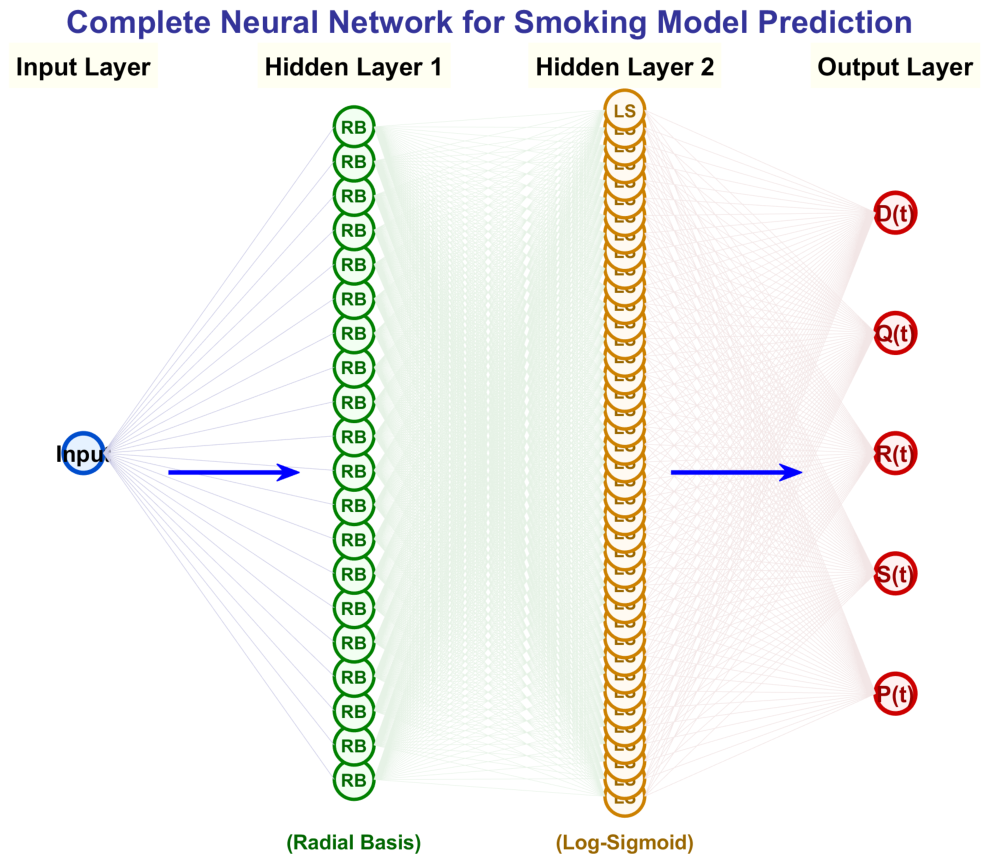
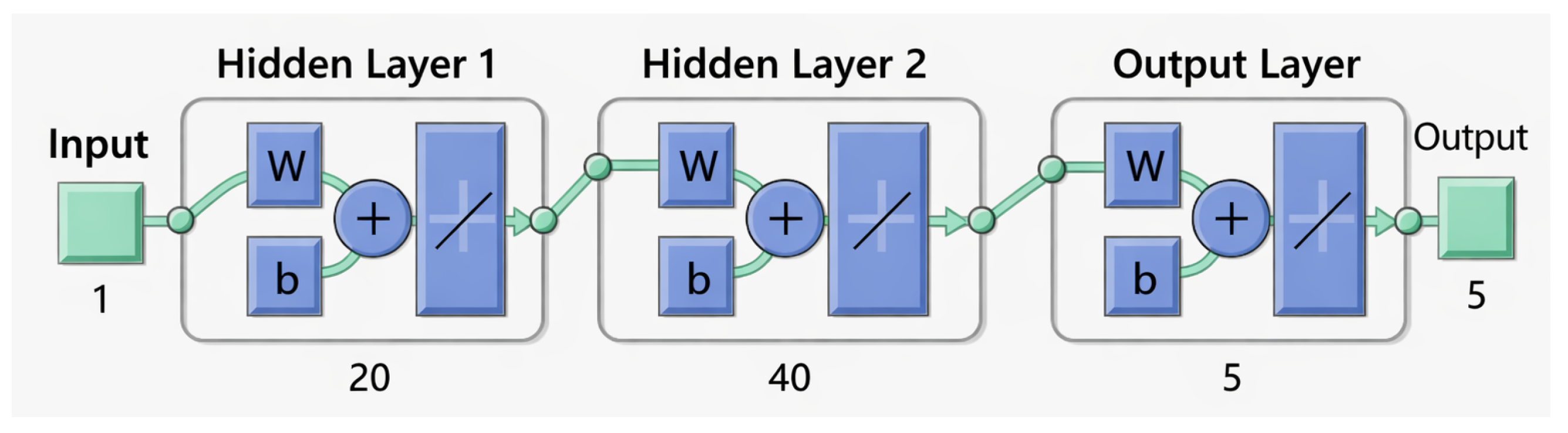
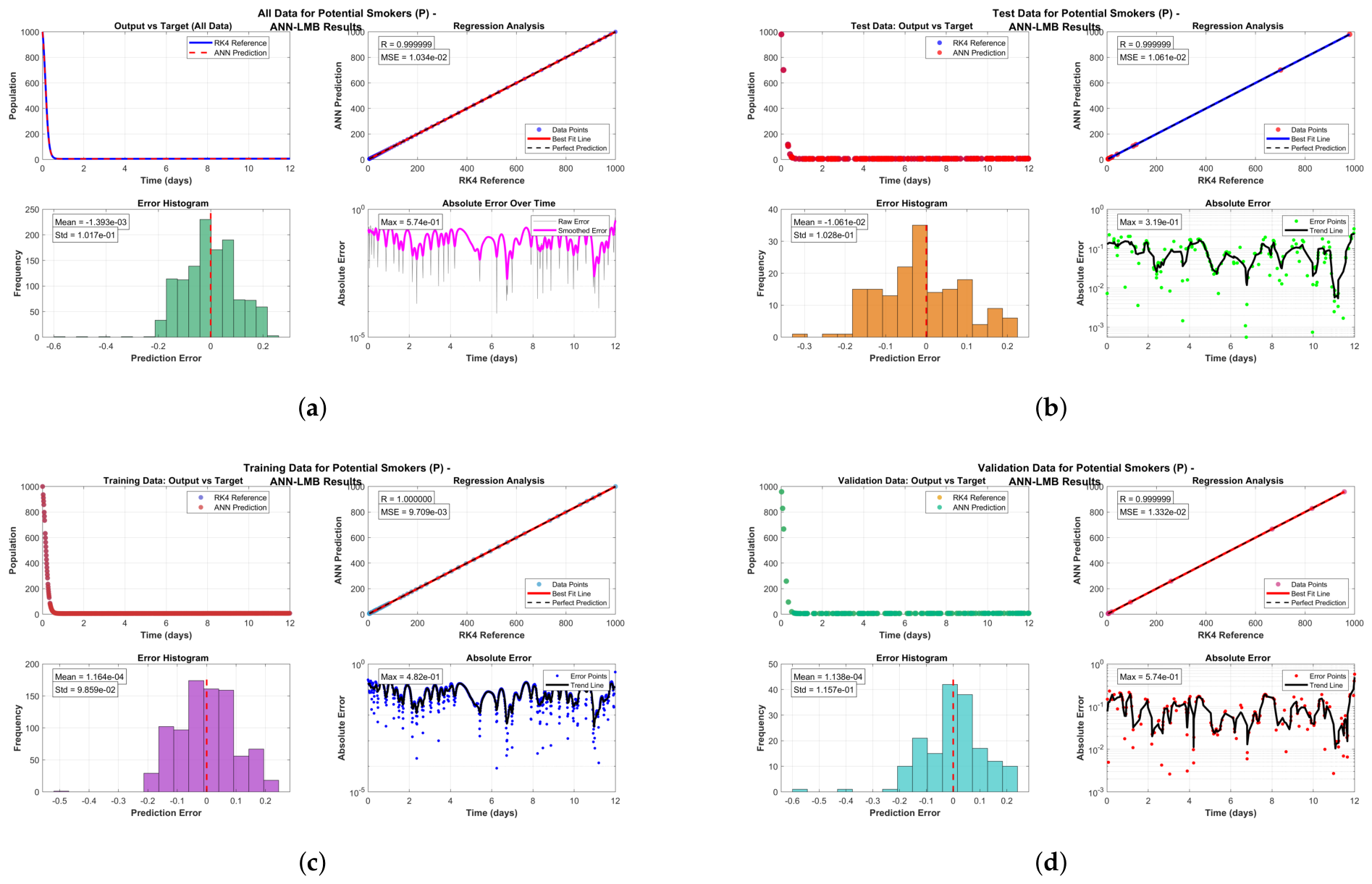
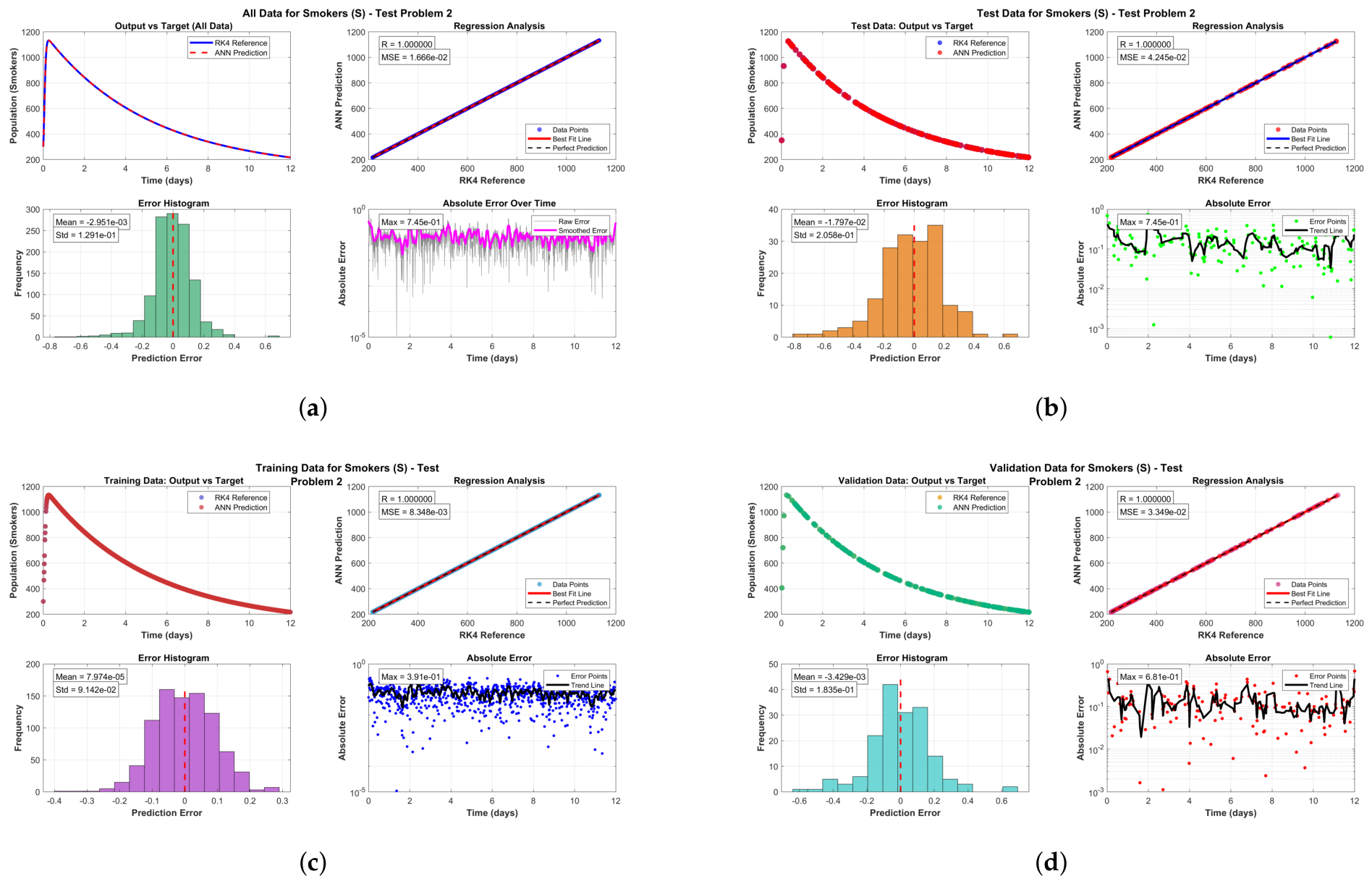
Despite the fact that smoking is still a significant global public health concern, current mathematical models of smoking dynamics primarily depend on conventional numerical solvers. A particular five-compartment smoking dynamics model has not yet been solved using deep neural network (DNN) techniques. In order to fill this research gap, this work creates a unique DNN framework that can simulate nonlinear smoking dynamics in a computationally efficient manner. The Levenberg–Marquardt backpropagation technique is used to improve a dual-hidden-layer network consisting of 20 radial basis activation function (RBAF) neurons and 40 log-sigmoid activation function (LSAF) neurons. With a minimum mean squared error (MSE) of 1.865×10⁶ and a coefficient of determination R2 equal to or near unity across all model variables, the trained DNN offers instantaneous predictions while maintaining superior accuracy, in contrast to traditional numerical methods that necessitate the explicit re-solving of differential equations for each parameter change. Crucially, our DNN-based framework is appropriate for automated public health decision-support systems since it functions independently and does not require human intervention during the prediction phase. Key smoking behaviors, such as initiation, quitting efforts, relapse dynamics, and long-term recovery patterns, are successfully replicated by the framework, while relapse dynamics are captured through the recovered-to-potential smoker pathway, consistent with the original model formulation. These findings show that the proposed DNN approach not only closes the methodological gap in the application of deep learning to smoking dynamics but also offers a dependable and computationally effective tool for quick evaluation of intervention scenarios, supporting evidence-based public health decision making without compromising accuracy.
Keywords: smoking dynamics; DNN; radial basis activation function (RBAF); log-sigmoid activation function (LSAF); epidemiological modeling; artificial neural network (ANN) smoking dynamics; DNN; radial basis activation function (RBAF); log-sigmoid activation function (LSAF); epidemiological modeling; artificial neural network (ANN)