1. Introduction
The poroelastic theory considers the system formed by an elastic material with pores that can be penetrated by a fluid and/or dissolved solutes. A typical biological example is the glucose solute penetrating a tissue layer. The basic theory of poroelasticity was developed by Biot [
1], and its state-of-the-art can be found in the well-known books [
2,
3,
4] (see also recent studies, e.g., [
5,
6,
7,
8,
9]). A poroelastic material is considered as the superposition of two continuous media: the matrix (skeleton), occupying the fractional volume
, and the system of pores saturated by a fluid, occupying the fractional volume
). The deformation of the system under the fluid pressure is described by a deformation vector, and the dynamics of the deformation under the forces needs in general to be described by second order tensors. The relationship between stress and strain is usually assumed to be linear. The flux of fluid depends on the hydrostatic pressure and solute gradient (called osmotic pressure). The diffusive and convective transport mechanisms should be taken into account as well. The general three-dimensional theory describing transport in poroelastic materials (PEMs) is very complex because relevant mathematical models involve 3D nonlinear partial differential equations (PDEs). As a result, in order to obtain analytical results, one-dimensional versions are usually discussed [
10,
11,
12]. Here, we study a one-dimensional model for fluid and solute transport in poroelastic materials (PEMs) that was derived in [
11] and generalised in [
12]. The governing equations of the model read as
where
and
are positive constants, and the lower subscripts
t and
x denote differentiation with respect to these variables. The physical/biological meanings of the notations used above are presented in
Table 1.
The nonlinear system of PDEs (
1)–(
5) was integrated in the stationary case. As a result, all steady-state solutions were identified, and examples of their application for the glucose fluid transport in a biological tissue were provided [
11]. In the nonstationary case, system (
1)–(
5) is not integrable; therefore, the classical Lie method [
13,
14,
15,
16,
17] was adopted for search exact solutions. Nowadays, this method is widely used for construction of exact solutions of nonlinear PDEs arising in real-world applications and the most remarkable works are cited in the above cited books. However, it can be easily noted that there are not many studies devoted to
multicomponent systems of PDEs because essential technical difficulties occur if one intends to find exact solutions for such systems by applying Lie symmetries. Taking into account the above observation, we refer the reader to recent works [
18,
19,
20,
21,
22,
23], devoted to applications of the classical Lie method to the nonlinear three-component systems of PDEs.
Although several nontrivial Lie symmetries were identified and successfully applied for finding exact solutions in [
11] (see also generalisations in [
12]), some limiting cases have been not analysed therein. In particular, the special cases
and/or
were not examined in [
11,
12]. It is proved here that the special cases listed above lead to a rich Lie symmetry involving symmetry operators that do not occur for system (
1)–(
5) with
. It should be stressed that the governing equations with
and/or
can still be used as a real-world model in some cases. For example, it is known that the diffusion term in Equation (
5) is negligible (i.e.,
) if molecules of large size (because of high atomic weight) are dissolved. A typical example is albumin, for which the diffusivity is circa 50 times smaller than the glucose diffusivity [
24].
This paper is organised as follows. In
Section 2, all possible extensions of the Lie algebra of invariance of the nonlinear system of PDEs (
1)–(
5) are derived. It is proven that there are four inequivalent cases when the system admits additional Lie symmetries depending on the values of the parameters
D and
S.
Section 3 is devoted to the constructions of exact solutions of system (
1)–(
5) with
. Because the system admits an additional Lie symmetry, new reductions to systems of ODEs and, as a result, new exact solutions of the nonlinear model in question are derived. In
Section 4, an exact solution is analysed in order to show its applicability for modelling solute transport in PEM. The analysis is supported by 3D plots of the solution. In
Section 5, new exact solutions of the nonlinear system (
1)–(
5) with arbitrary
D and
S are constructed. The solutions obtained were not identified in the previous study [
11]. In
Section 6, we present conclusions highlighting the main results obtained.
3. Ansätze, Reductions and Exact Solutions in the Case
As it was noted above, the most interesting cases from the symmetry point of view are the second and the fourth cases (see
Table 2) because they involve the Lie symmetry
that cannot be predicted by any physical/biological consideration. The fourth case is rather artificial from an applicability point of view. Indeed, the restrictions
means that both diffusive and convective transports are neglected, which is a very strong assumption (however, one cannot claim that such a special case is absolutely unrealistic). Thus, we study the second case,
, in what follows.
The general technique for constructing an exact solution using Lie symmetries is well-known from the theoretical point of view. There are two different approaches described, e.g., in Section 1.3 [
17]. One of them is based on the construction of optimal systems of inequivalent (nonconjugated) subalgebras of the given Lie algebra of symmetries. Although this technique is very popular, one successfully works only in the case of Lie algebras of low dimensionality (up to 4). In fact, all optimal systems for such algebras were described in a seminal work [
25]. However, a pure algebraic problem occurs if one deals with a Lie algebra of the dimensionality 5 and higher. To the best of our knowledge, there is no generalisations of the results presented in [
25] on higher-dimensional Lie algebras. Notably, the Lie algebra of symmetries of system (
7) is infinity-dimensional (see the operator
in Theorem 1).
The second technique for constructing exact solution via Lie symmetries is based on the most general linear combination of basic operators of the Lie algebra in question. Of course, many technical difficulties arise in the case of higher-dimensional Lie algebras; however, these difficulties can be overcome by a careful analysis of the relevant invariant surface condition. Here, this is demonstrated in the case of Lie algebra with the basic operators
Let us consider the most general linear combination of Lie symmetries listed above
where
and
are arbitrary constants,
(if
, then there is no reduction to an ODE system).
Depending on the value of the constants
and
, operator (
19) produces three inequivalent ansätze for the reduction of system (
7) to ODE systems. Thus, one needs to consider such cases:
- I.
;
- II.
;
- III.
.
From the very beginning, it can be noted that the function
does not play a role in the first two cases, and we may set
without losing a generality. In fact, ansätze obtained contain the added term
in expressions for the function
, and this term vanishes after substituting into system (
7). So, one always can generalise an arbitrary solution by inserting into the pressure component the additional term
that simply follows from the Lie group generated by the operator
:
In the third case, the function
does play a role.
In case
I, operator (
19) leads to the ansatz
where
are new smooth functions.
Substituting ansatz (
20) into PDE system (
7), one arrives at the ODE system
where new notations
and
are used.
We are looking for exact solutions of the ODE system (
21) in the two essentially different subcases
(i) and
(ii) .
Subcase (i). System (
21) after the relevant calculations leads to the result
where
are arbitrary constants and constant
.
If , then the general solution of Equation (
22) has the form
. Thus, taking into account ansatz (
20) and the above formulae, the exact solution of the PDE system (
7) with
(here,
is an arbitrary smooth function) is obtained.
If , then the general solution of Equation (
22) can be found in an explicit form only for some fixed function
. Let us solve Equation (
22) assuming
(here,
and
n are arbitrary constants). So, one needs to construct exact solutions of Equation
Equation (
26) has essentially different general solutions depending on the value of the constants
and
n. In the simplest case, when
, the general solution of Equation (
26) has the form
The obtained functions
and
from (
27) lead to the components
of the exact solution of the PDE system (
7) with
and
, while other components of the corresponding solution are presented in Formulae (
23)–(25).
Now, let us return to Equation (
26). In the case
this equation is reduced to the Bessel equation
if
, and to the modified Bessel equation
if
, by the substitution
Thus, the general solution of Equation (
26) with
can be expressed in the following forms
if
, and
if
. Here,
J and
Y are the Bessel functions, while
I and
K are the modified Bessel functions.
Note that solution (
27) can be derived from (28)–(29) by setting
in the last ones.
In the case
the general solution of Equation (
26) has the form
Note that in the case
and
Equation (
26) has only complex solutions, not real ones.
The functions
(from (28)–(30)) and
produce the components
and
of the solutions of the PDE system (
7) with
. The remaining components of the corresponding solutions are still given by Formulae (
23)–(25).
Subcase (ii). In this case, the functions
and
can be expressed via the function
F, namely,
where the function
F is a solution of the equation
while the function
must be founded from the equation
ODE (32) is a nonlinear Abel-type equation and its full integration is questionable; moreover, even particular solutions are unknown. However, assuming that the function
F is linear, one can find the exact solution
provided that the following restrictions are satisfied
Another possibility to integrate ODE (32) arises if one sets
In this case, ODE (32) takes the form
The latter is integrable via the Lambert function,
where
The exact solution (36) can also be presented in the implicit form
It can be easily seen that a special case occurs when
In this case, one again arrives at the linear function
Each of the exact solutions (34)–(37) can be used for finding the function
by solving the linear ODE (33). Because the formulae obtained are very cumbersome (in particular, the Heun functions are obtained if one applies (37)), here, we present only the details concerning solution (34). In this case, ODE (33) can be rewritten in the form
Although this equation is very awkward, one may find the substitution
transforming ODE (38) into the well-known Whittaker Equation (see, e.g., [
26])
where
The general solution of Equation (40) has the form
where
M and
W are the Whittaker functions. In the case
(that leads to the conditions
or
), the function
M takes the form
Thus, the general solution of the Whittaker equation in this special case has the form
Taking into account (39) and (42), we arrive at the solution of ODE (38) under restrictions
and
, namely,
Using the obtained functions
and the above formulae, one can construct exact solutions of the PDE system (
7). In particular, setting
in (43) for simplicity, an exact solution of the system in question can be written down in the form
where
Similarly, setting
in (44), another solution of the PDE system (
7) with
can be derived in the form
while other components have the same form as in (45).
In case II, operator (
19) leads to the ansatz
where
are new smooth functions, while
The special case is
which means that the operator
is not taken into account; hence, one may apply ansatz (46) to system (
7) with an arbitrary parameter
S (see
Section 5).
Here, we substitute ansatz (
20) with
into PDE system (
7) with
to obtain a reduced ODE system. As a result, one arrives at the system
The first four equations of the ODE system (47) can be easily integrated, producing the functions
while the last equation on the function
takes the form
It is difficult to construct exact solutions of Equation (49) without additional restrictions. Note that Equation (49) in the case is the Heun equation, and its general solution can be constructed using software such as Maple 2017.3. Since this case leads to very cumbersome formulae, we omit those here.
Let us set
, then Equation (49) takes the form
The latter is integrable in the terms of modified Bessel functions. Thus, we arrive at the exact solution of the PDE system (
7) with
:
Let us set
, then Equation (49) takes the form
Applying the substitution
to Equation (50), we again arrive at the Whittaker Equation (40) with the parameters
Note that we consider only the special case
that leads to the condition
Now making the same calculations as in
subcase (ii), we obtain the general solution of Equation (50) as
Setting for simplicity
and using Formulae (46), (48) and (51), we arrive at the exact solution of the PDE system (
7)
In case III, operator (
19) produces the ansatz (we remind the reader that the operator
should be taken into account in this case):
where
are new smooth functions. Substituting ansatz (52) into the PDE system (
7) with
, we arrive at the condition
. In this case, the corresponding ODE system has the form
Solving system (53), we obtain the exact solution of the PDE system (
7) with
as follows
where
and
are arbitrary smooth functions.
Remark 1. In order to find exact solutions, the condition was used in several case. It means that the operator is not taken into account, hence one may apply the relevant ansätze to system (7) with a nonzero parameter S. This is carried out in Section 5. 4. An Example of the Exact Solution Describing Solute Transport
in PEM
In order to show that a given exact solution describes solute transport in PEM, one should check some properties from the very beginning. In particular, the components and must be nonnegative; moreover, . The displacement function should be either nonnegative (this means that PEM is expanding), or nonpositive (PEM is shrinking). There is also a natural initial condition for the displacement, , i.e., no deformation of PEM in the initial time moment . Obviously, only some exact solutions satisfy the above requirements on a given space interval and for .
Here, we look in detail at the exact solution (45). By using the space translation
and setting
and
, the solution takes the form
Obviously, the initial condition
is satisfied. It can easily be shown that all components of the solution (54) are bounded and nonnegative in the domain
and
if the following restrictions hold:
Using the function
from (54) and Formula (
6), one can derive the hydrostatic pressure of the poroelastic materials by the formula
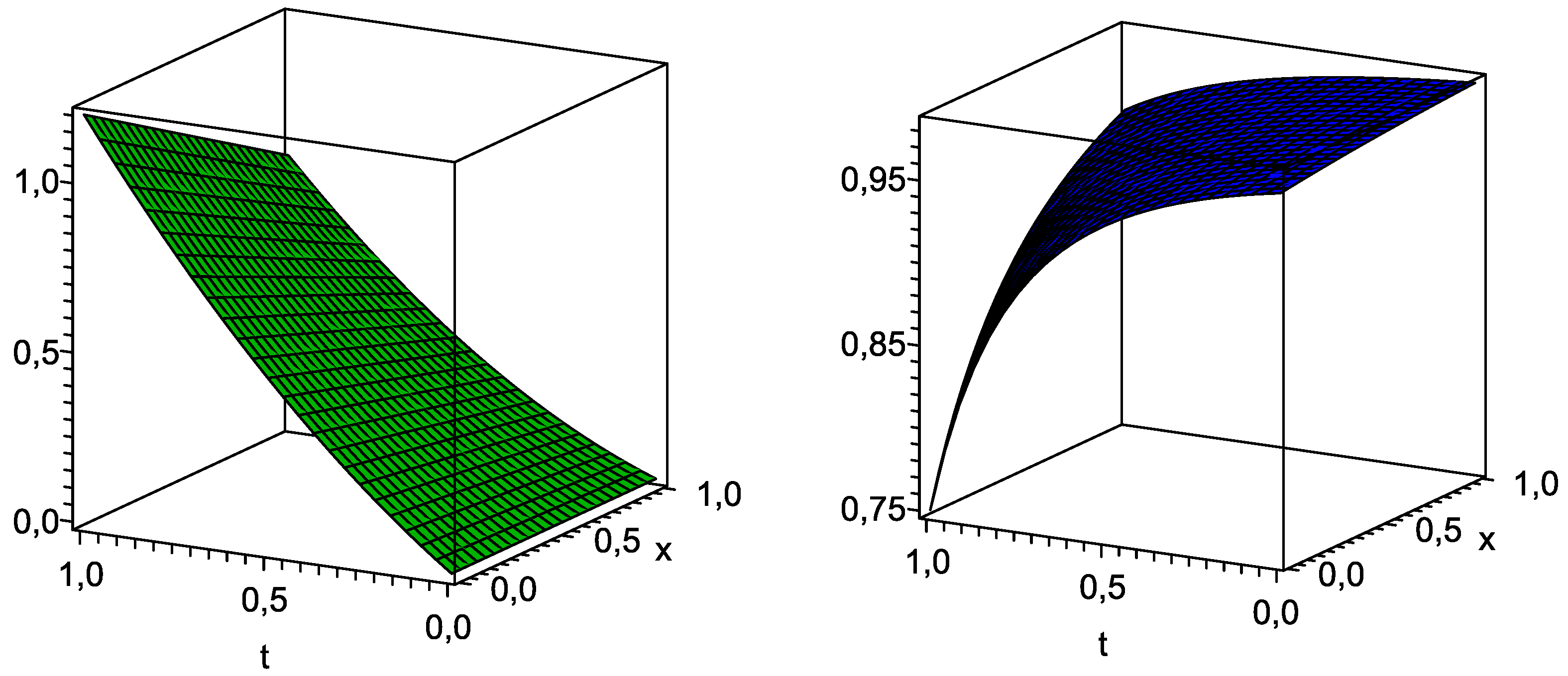
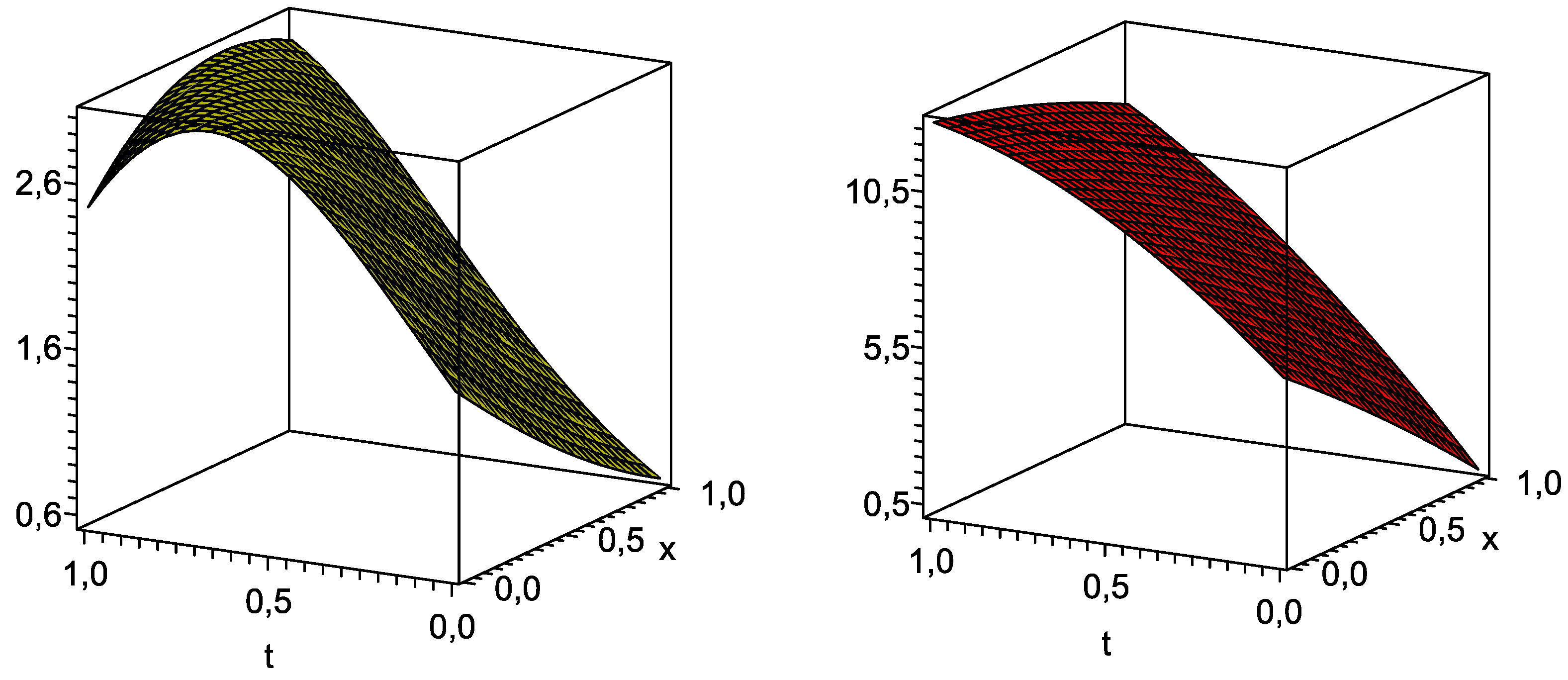
Plots of the functions
and
p defined in the domain
with the parameter restrictions (55) are presented in
Figure 1 and
Figure 2. The above restrictions (55) guarantee positive values of displacement, i.e., a given layer of PEM is expanding.
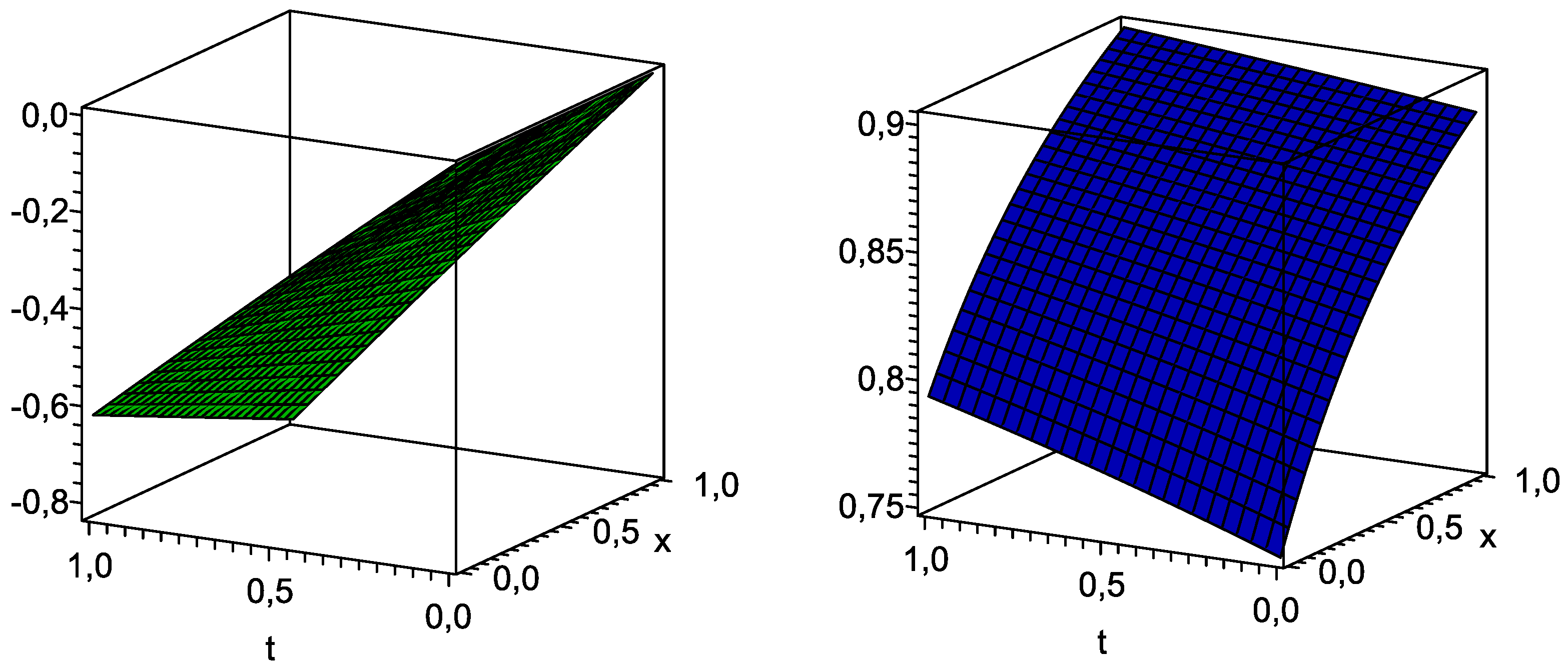
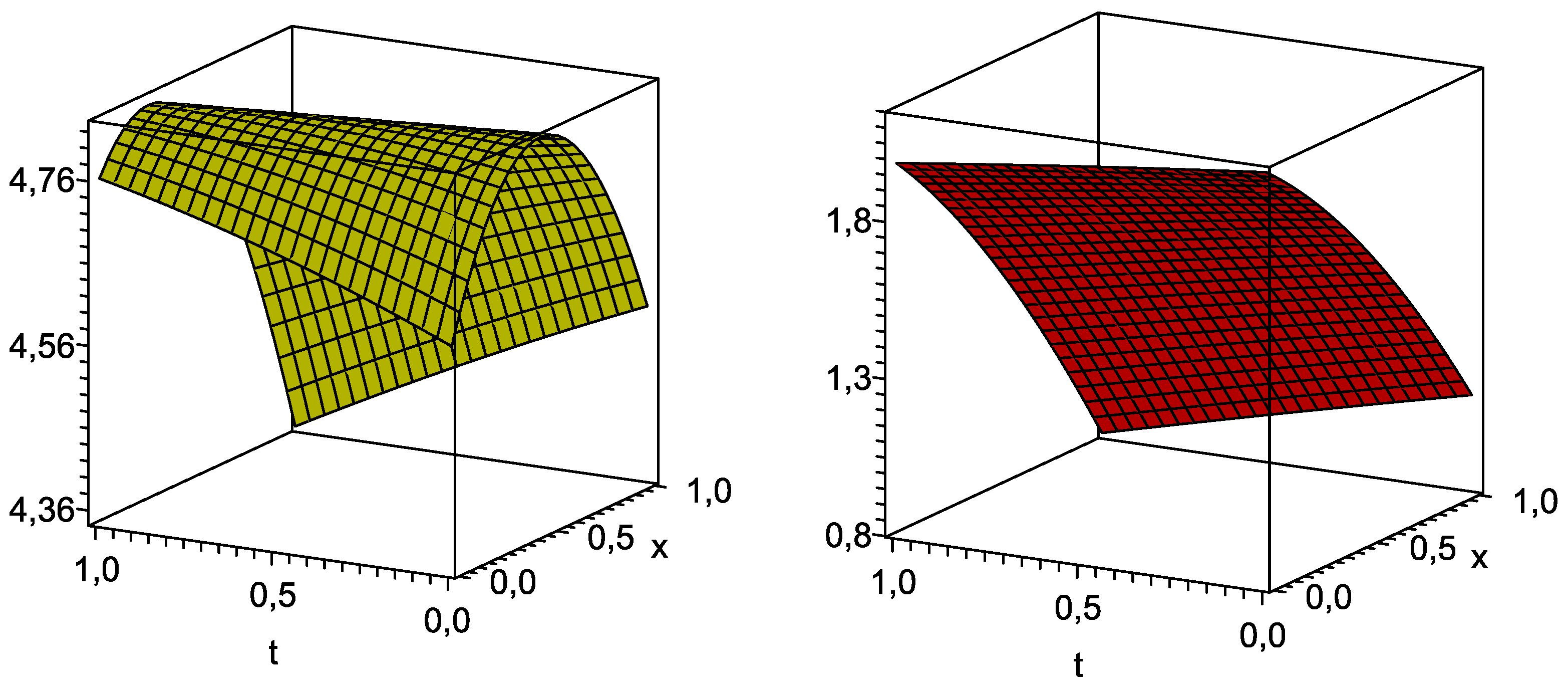
In order to obtain negative values of displacement, i.e., a given layer of PEM is shrinking, one needs the restrictions that are listed below. An example is presented in
Figure 3 and
Figure 4.
Thus, we have demonstrated that the exact solution (45) with correctly specified coefficients can describe (at least qualitatively) the solute transport in PEM.
5. New Exact Solutions of System (7) with
In [
11], some of the simplest exact solutions of system (
7) with an arbitrary parameter
S are constructed. Here, we show how new solutions can be derived. As noted above in Remark 1, the condition
in the ansätze constructed in
Section 3 means that those are applicable for (
7) with nonzero
S as well.
The simplest case occurs in the case of ansatz (46). Substituting the latter into system (
7) with an arbitrary parameter
S, we arrive at the ODE system
Thus, solving the ODE system (57) and taking into account (46) with
we obtain the solution of system (
7)
where
and
are arbitrary smooth functions, while
is an arbitrary solution of the linear ODE
If
, then the solutions of the above ODE can be written down in an explicit form provided the function
is correctly specified (typical examples are
and
).
If
, then
(here,
and
are arbitrary constants).
Let us construct solutions using restrictions (35). In this case, the function
F from (37) can be used to specify the functions
in (31). Setting
for simplicity and using the restriction
, we arrive at the formulae
while the equation for finding the function
takes the form
In (58), coefficients
and
are defined by the formulae
The general solution of Equation (58) can be constructed via the Heun functions. To avoid cumbersome formulae, we consider only some cases in which Equation (58) can be reduced to known equations, in particular, the Whittaker equation and the Bessel equation.
In the case of the additional restrictions
Equation (58) is transformed into the Whittaker Equation (40) with the parameters
by the substitution
Taking into account (59), restrictions (60) lead to the condition
Thus, using Formula (41) and the above substitution, one obtains the function
in an explicit form. Finally, applying ansatz (
20) with the above specified beta-s and renaming
, the following solution of the nonlinear system (
7) was constructed:
where
and
are arbitrary constants
To construct exact solutions of Equation (58) in terms of elementary functions, we consider the special case
, which leads to the conditions
Thus, the general solution of Equation (58) with
has the forms
in the case
, and
in the case
Thus, the component
of the solution (61) of the PDE system (
7), corresponding to solution (62) with
, has the form
Setting
in (63), another solution of the PDE system (
7) can be derived in the form
while other components have the same form as in (61).
In the case when the additional restrictions
take place, i.e., (see (59))
Equation (58) is transformed into the Bessel equation
if
, and to the modified Bessel equation
if
, by the substitution
Thus, the general solution of Equation (58) under restrictions (64) takes the form
if
, and
if
. Here,
,
and
are the Bessel functions, and
and
are the modified Bessel functions.
Taking into account the above formulae and renaming
, the exact solution of the PDE system (
7) with
takes the form
where
and
are arbitrary constants, while
Finally, using ansatz (52) and making similar calculations to those in the end of
Section 3, one obtains the following exact solution of the PDE system (
7):