Review

Gallium Extraction Using Surface-Functionalized Carbon-Based Materials: A Mini-Review

1
College of Resources and Environment, University of Chinese Academy of Sciences, 19 A Yuquan Road, Beijing 100049, China
2
Binzhou Institute of Technology, Weiqiao-UCAS Science and Technology Park, Binzhou 256606, China
*
Authors to whom correspondence should be addressed.
Separations 2026, 13(9), 250; https://doi.org/10.3390/separations13090250
Submission received: 28 May 2026 / Revised: 26 August 2026 / Accepted: 28 August 2026 / Published: 1 September 2026

Abstract

Gallium is a critical metal for high-tech industries, with its global demand surging in recent years. Currently, approximately 90% of primary gallium is extracted from Bayer liquor. Chelating resins such as amidoxime sorbents are widely adopted commercial materials for this purpose. However, gallium recovery from such highly caustic media remains a formidable challenge, as gallium is present at low concentrations while aluminate ions are hundreds of times more abundant, and the medium is rich in competing vanadate ions and humic substances. These interfering components impede both adsorption and desorption cycles, leading to a progressive decline in resin performance and a subsequent increase in operational costs. In recent years, functionalized carbon-based materials have gained significant traction. This growing interest is motivated by the carbon-based materials’ exceptional chemical resilience across both acidic and alkaline environments, tunable surface chemistry, and facile re-functionalization. This mini-review synthesizes recent progress in functionalized carbon-based materials for gallium recovery, with a particular emphasis on their adsorption performance and mechanistic insights. At the end of the paper, major challenges and research gaps are identified, and future research directions are proposed.

1. Introduction

Gallium is a critical raw material for high-tech industries in the manufacture of semiconductors, solar panels, and light-emitting diodes (LEDs). Driven by the rapid advancement of green energy, high-speed electronics, and biomedical technologies, its demand has escalated significantly [1,2]. Global consumption surged by 330% from 101 tons in 2000 to 432 tons in 2021, with projections suggesting a further rise to 3000 tons by 2050 [3,4]. Although global production reached approximately 760 tons in 2024, it remains insufficient to meet the anticipated long-term demand [5,6,7].
Unlike conventional metals, gallium does not occur in economically viable discrete deposits. Instead, it is primarily recovered as a byproduct from industrial streams from the processing of bauxite ores, coal fly ash, and zinc residues [8]. Among these, Bayer liquor, a byproduct of alumina refining from bauxite, constitutes the principal feedstock for gallium extraction, accounting for approximately 90% of global primary gallium production [9,10]. In the Bayer process, bauxite is digested in concentrated NaOH solution at elevated temperatures, solubilizing aluminum minerals as sodium aluminate while partitioning insoluble impurities into red mud [11]. Subsequent to the precipitation of aluminum hydroxide, the continuous recirculation of the caustic liquor facilitates the progressive accumulation of gallium. This cyclical enrichment elevates gallium concentrations from 20–80 ppm in raw bauxite to approximately 100–300 ppm in the Bayer liquor, establishing it as the primary industrial source for gallium recovery [12,13].
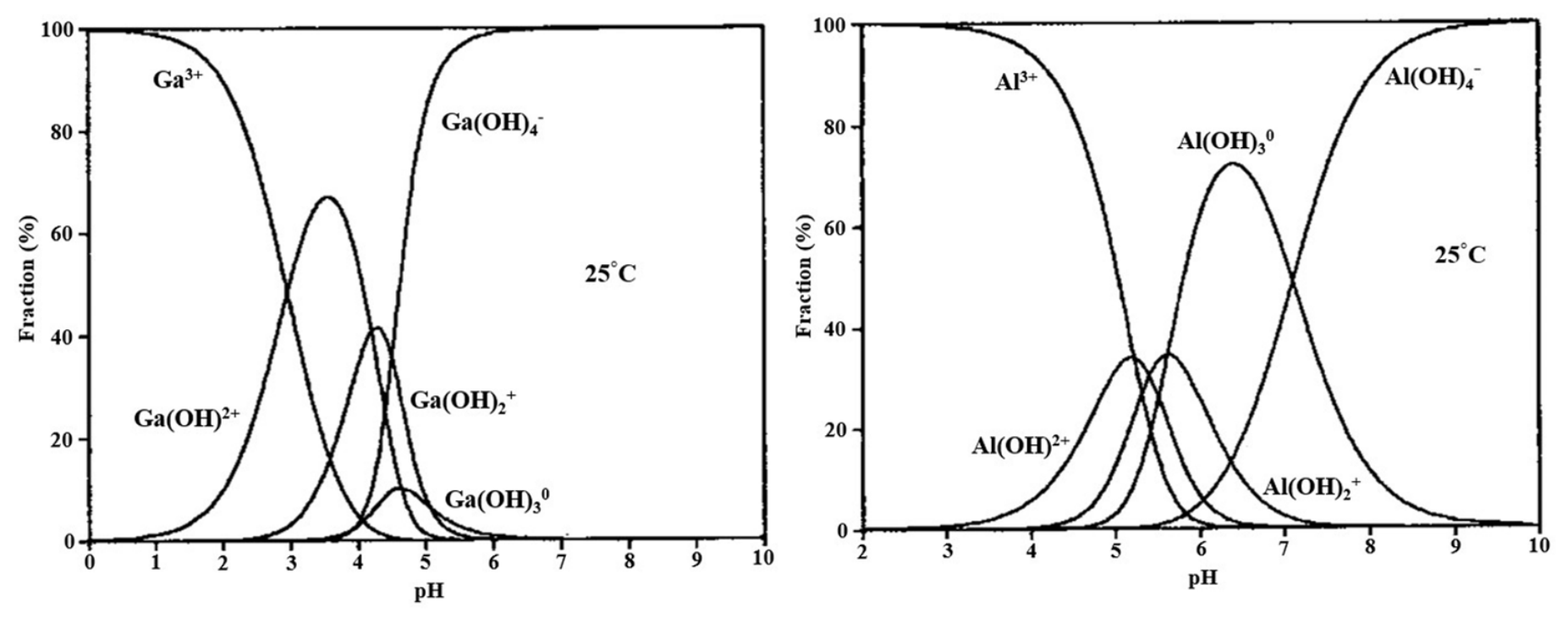
The extraction of gallium from Bayer liquor is significantly challenged by its low concentration and the presence of aluminum at concentrations several hundred times higher [14]. A further complication arises from the analogous speciation patterns of these two metals across the pH spectrum. As illustrated in Figure 1 [15], the speciation of Ga(III) and Al(III) in aqueous solution is highly pH-dependent. In strongly acidic media, gallium exists predominantly as the free Ga3+ aquo-ion. With increasing pH, Ga(III) undergoes sequential hydrolysis to form [Ga(OH)]2+, [Ga(OH)2]+, Ga(OH)3, and ultimately [Ga(OH)4] under strongly alkaline conditions. In the highly alkaline environment of Bayer liquor, gallium and aluminum coexist almost exclusively as [Ga(OH)4] and [Al(OH)4], respectively [15,16]. Given their striking chemical similarities and vast concentration disparity, achieving successful gallium recovery necessitates exceptionally high Ga(III)/Al(III) selectivity [17,18,19].
The extraction of gallium from Bayer liquors has undergone significant technological evolution over the past several decades. Early strategies for isolating gallium from these alkaline solutions pioneered the use of fractional precipitation via CO2 and lime. However, this approach was eventually phased out due to its operational complexity and the generation of substantial solid waste [20]. Subsequently, the mid-1950s saw the introduction of the electrochemical process utilizing mercury cathodes to reduce gallate ions to elemental gallium. Despite its initial industrial adoption, this technique was ultimately abandoned due to the limited solubility of gallium in mercury and stringent environmental regulations regarding mercury toxicity [21,22]. While liquid–liquid extraction (solvent extraction) was adapted for Bayer liquor in the mid-1970s [23,24], its application remained hampered by sluggish extraction kinetics and adverse environmental impacts [25]. A paradigm shift occurred in 1984 with the patenting of chelating resin-based extraction. By functionalizing resins with amidoxime groups (=NOH) alongside auxiliary ligands (e.g., –OH, –COOH, –NH2, or =NH), highly selective recovery of gallium from aluminate-rich liquor became feasible. Following continuous optimization, chelating resin-based extraction has established itself since the late 1990s as the predominant commercial standard for gallium recovery in alumina refineries [26,27,28].
Despite their widespread application, commercial chelating resins encounter substantial challenges in recovering gallium from Bayer liquor, primarily owing to the liquor’s highly alkaline nature and elevated concentrations of vanadate and humic substances [28,29,30,31]. During the adsorption phase, vanadate ions compete with gallate and bind tenaciously to the resin framework, resisting elution and leading to a progressive decline in performance [32]. Meanwhile, humic substances induce organic fouling and pore blockage, which may cause permanent structural damage and irreversible loss of activity [28,33]. While strong acidic conditions are effective for gallium desorption, excessive acidity can degrade the amidoxime functional groups, undermining the resin’s long-term stability. Compounded by the high material costs of chelating resins, these challenges substantially increase the operational expenditure. To address these limitations, researchers have explored various advanced adsorbents, including metal–organic frameworks (MOFs), covalent–organic frameworks (COFs), and other sorbent systems. Among these, functionalized carbon-based materials have emerged as particularly promising candidates [34,35,36].
Functionalized carbon materials have gained significant traction for gallium extraction in recent years [37,38,39,40,41,42,43,44,45,46,47,48,49,50,51,52,53]. This mini-review synthesizes recent progress in functionalized carbon-based materials for gallium recovery, with a particular emphasis on their adsorption performance and mechanistic insights. At the end of the review, challenges, research gaps, and prospective research directions are outlined. We anticipate that this mini-review can offer useful references for researchers exploring advanced carbon-based sorbents with improved sorption capacity and selectivity.

2. Surface Functionalized Carbon-Based Materials for Gallium Extraction

Surface functionalization plays a vital role in determining the gallium extraction performance of various adsorbents [54,55,56,57,58], a principle that applies equally to carbon-based sorbents. Pristine carbon materials, such as unmodified mesoporous carbon, exhibit limited gallium sorption capacity (e.g., 6.5 mg/g) due to a lack of active sites and low surface affinity [40]. However, the introduction of functional groups, such as hydroxyl, carboxyl, N-containing, and P-containing moieties, can significantly enhance the performance of carbon materials through electrostatic interactions, ion exchange, and chelation [43,52,59]. Given their robust physicochemical stability in aggressive media, carbon materials serve as superior scaffolds for diverse functionalities tailored for gallium sequestration. This section reviews recent progress in this field, with a specific focus on carbonaceous materials, including activated carbon, biochar, carbon nanotubes, and graphene oxide. Notably, biomass materials treated solely by dehydration without formal carbonization are excluded from this scope. This review is organized according to the dominant functional group anchored on the carbon surfaces. Although some modified materials possess multiple types of functional groups, they are categorized and discussed based on their primary reactive moieties. We focus on summarizing the synthesis and capture performance of these functionalized carbon materials, as well as the specific interaction mechanisms between gallium species and the associated functional group. A comprehensive summary of the adsorbents’ performance is provided in Table 1.

2.1. Hydroxyl-Functionalized Carbon Sorbents

Hydroxyl groups have been widely grafted onto diverse carbonaceous sorbents to enhance their gallium extraction performance [41,42,43,44]. A prominent example is gallotannin (GT), a natural polyphenol rich in ortho-phenolic hydroxyl moieties capable of forming stable multidentate chelates with Ga3+. For instance, Xiong et al. [41] fabricated a gallotannin-modified carbon nanotube adsorbent (CNT-GT) via a two-step procedure. CNTs were first acid-oxidized to introduce surface carboxyl groups (CNT-COOH), followed by the grafting of gallotannin using dicyclohexylcarbodiimide (DCC) as a coupling agent under microwave hydrothermal conditions. The resulting CNT-GT exhibited impressive Ga adsorption capacities of 170.8 mg/g at pH 3 and 156.8 mg/g at pH 10. The material retained a 93.56% extraction efficiency after five adsorption–desorption cycles using 1 M HCl as the eluent [41].
Regarding the mechanism, while the authors attributed Ga3+ uptake at pH 3 to ion exchange between gallium species (Ga3+, Ga(OH)2+, Ga(OH)2+) and phenolic protons [41], it is more plausible that the process involves complexation between the gallium species and phenolic hydroxyl groups, accompanied by the stoichiometric release of protons. Although the original study did not provide a detailed mechanism for gallium binding at pH 10, we propose that adsorption under alkaline conditions is likely driven by ligand exchange between the surface phenolic hydroxyl groups and the hydroxyl ligands of Ga(OH)4, which is the predominant gallium species at this pH.
Chitosan, a renewable biomass rich in amine and hydroxyl groups, was utilized to develop a carbonized adsorbent for gallium extraction [42]. The resulting material, designated as CS-800, was synthesized via simultaneous carbonization and KOH activation at 800 °C. This process yielded a honeycomb-like carbon framework featuring an ultrahigh specific surface area of 2997 m2/g. At pH 3, CS-800 exhibited a maximum gallium adsorption capacity of 129.83 mg/g. Adsorption–desorption experiments demonstrated that the material retained over 90% of its initial capacity after 6 cycles using 1.5 M HCl as the eluent. The authors suggest that both oxygen- and nitrogen-containing functional groups on the adsorbent contribute to gallium extraction, with the former playing the primary role [42].
Biomass-derived conductive carbon materials have been increasingly utilized to enhance gallium extraction from aqueous solutions, as the integration of capacitive deionization (CDI) offers additional uptake capacity beyond conventional adsorption pathways [43,44]. For instance, Fan et al. recently developed NPAC@CF, a nitrogen-doped carbon aerogel-based sorbent [43]. The synthesis involved a hydrothermal treatment of persimmon powder and urea at 100 °C for 4 h, followed by freeze-drying to yield a precursor aerogel. This aerogel was subsequently carbonized and activated with ZnCl2 at 800 °C for 60 min under an anaerobic atmosphere to produce NPAC. The final sorbent was fabricated by casting a slurry of NPAC, carbon black, and polyvinylidene fluoride (in 1-methyl-2-pyrrolidone) onto carbon fiber. Under optimal conditions (pH 11, 1.2 V bias), NPAC@CF exhibited a maximum adsorption capacity of 250.69 mg/g. In contrast, in the absence of an electric field, its maximum adsorption capacity was only 154.47 mg/g. The authors attributed this enhancement to the synergistic effect of capacitive Ga(OH)4 capture and gallate surface complexation with oxygen- and nitrogen-containing functional groups [43].

2.2. Carboxyl-Functionalized Carbon Sorbents

Carboxyl functionalization has been explored to enhance the recovery of gallium from aqueous solutions by carbonaceous sorbents [45,46,47]. Polyacrylic acid (PAA), a polymer densely populated with carboxylic acid sites, is an excellent candidate for fabricating carboxyl-functionalized carbon-based materials. For instance, Zhang et al. developed a novel PAA-functionalized graphene oxide (PAA/GO) composite, where abundant -COOH groups were anchored onto the GO surface via in situ polymerization [45]. The optimized adsorbent, PAA@0.3GO-V, achieved a maximum Ga (III) adsorption capacity of 196.84 mg/g at pH 2.8. Competitive sorption tests in Ga(III)-Zn(II) and Ga(III)-Al(III) binary systems revealed that the adsorbent exhibits better selectivity for Ga over Zn compared to Al. Additionally, PAA@0.3GO-V retained over 90% of its initial capacity after four adsorption–desorption cycles with 1 M HCl as eluent. Mechanistic studies indicate that cation exchange between Ga(III) and carboxyl groups is the primary driving force for Ga(III) adsorption [45]. However, since -COOH groups sequester Ga(III) ions primarily via non-specific ion exchange, the adsorption performance of carbon sorbents with carboxyl groups only is highly susceptible to pH fluctuations and the presence of competing ions, particularly Al(III).
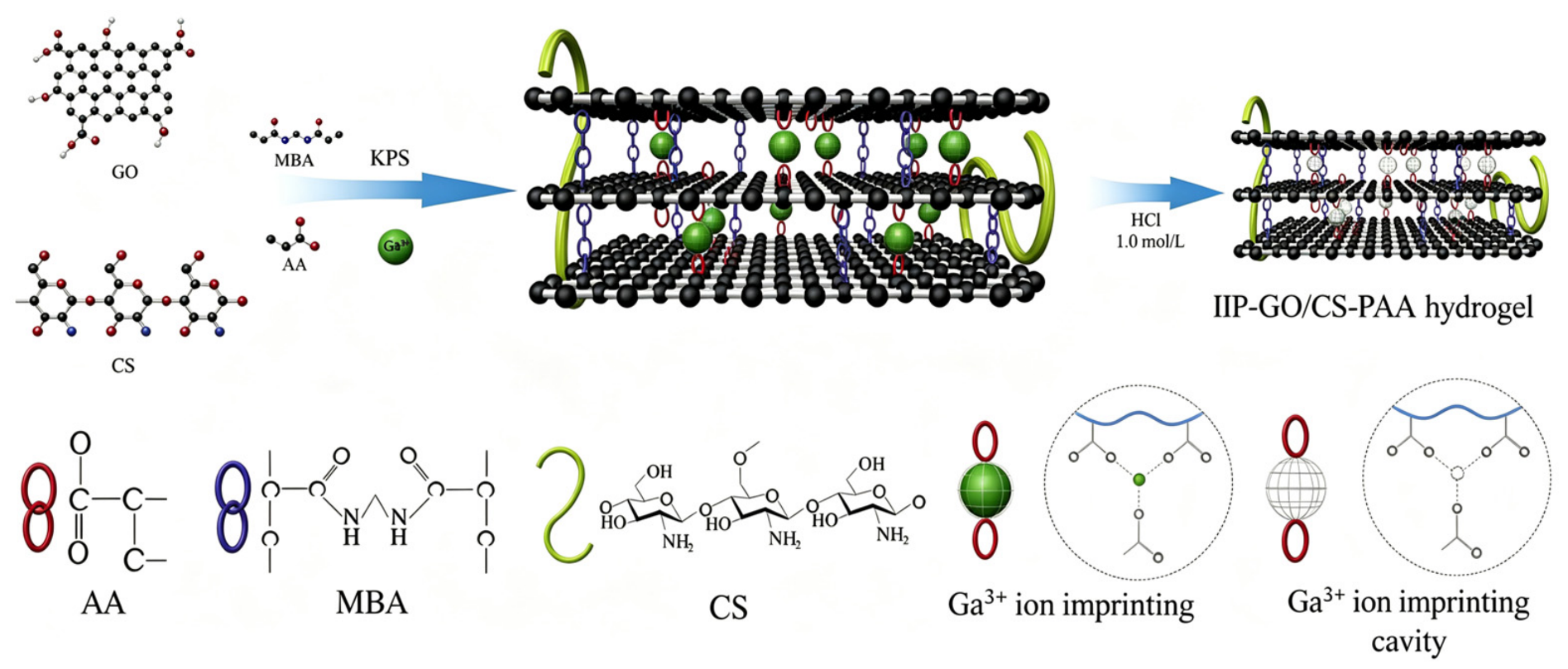
To enhance Ga(III) selectivity, ion-imprinting technology has been integrated with carboxyl-functionalized carbon substrates [46,47]. As illustrated in Figure 2, ion imprinting involves constructing tailor-made recognition cavities that match the ionic size and coordination geometry of target templates (e.g., Ga3+) following template elution [46]. These cavities facilitate the preferential capture of target species even amidst competing ions. Utilizing this strategy, a graphene oxide-based ion-imprinted polymer (IIP-GO/PAA) was synthesized for gallium extraction from acidic fly ash leachate, employing Ga3+ as the template and acrylic acid as the carboxyl-containing monomer [47]. Batch experiments revealed that the optimized IIP-GO/PAA achieved a maximum adsorption capacity of 221.56 mg/g at pH 3.0 in the absence of competing ions. In the presence of competing ions, the material exhibited a Ga3+ sorption capacity of 103.77 mg/g, while the sorption capacities for coexisting Al3+, Fe3+, Mg2+, and Ca2+ were 10.83 mg/g, 32.52 mg/g, 5.62 mg/g, and 1.7 mg/g, respectively. Sorption–desorption experiments showed that after five cycles with 1 M HCl as the eluent, the material still maintained 85.71% of its initial adsorption capacity. The authors attributed the material’s superior performance to the synergistic effect of carboxyl-mediated electrostatic interactions and imprinting-induced spatial geometric matching [47].
Carbon sorbents functionalized with carboxyl groups exhibit promising gallium adsorption capacities. These sorbents, however, typically suffer from poor selectivity in the presence of competing ions. While ion-imprinting architectures can significantly enhance the selectivity of these sorbents, their fabrication remains synthetically complex, and their performance often degrades during repeated regeneration cycles. Future research can graft hard-base moieties with high gallium affinity and selectivity on carboxylated carbon sorbents to further improve their overall gallium selectivity.

2.3. Carbon Sorbents Functionalized with Nitrogen-Containing Groups

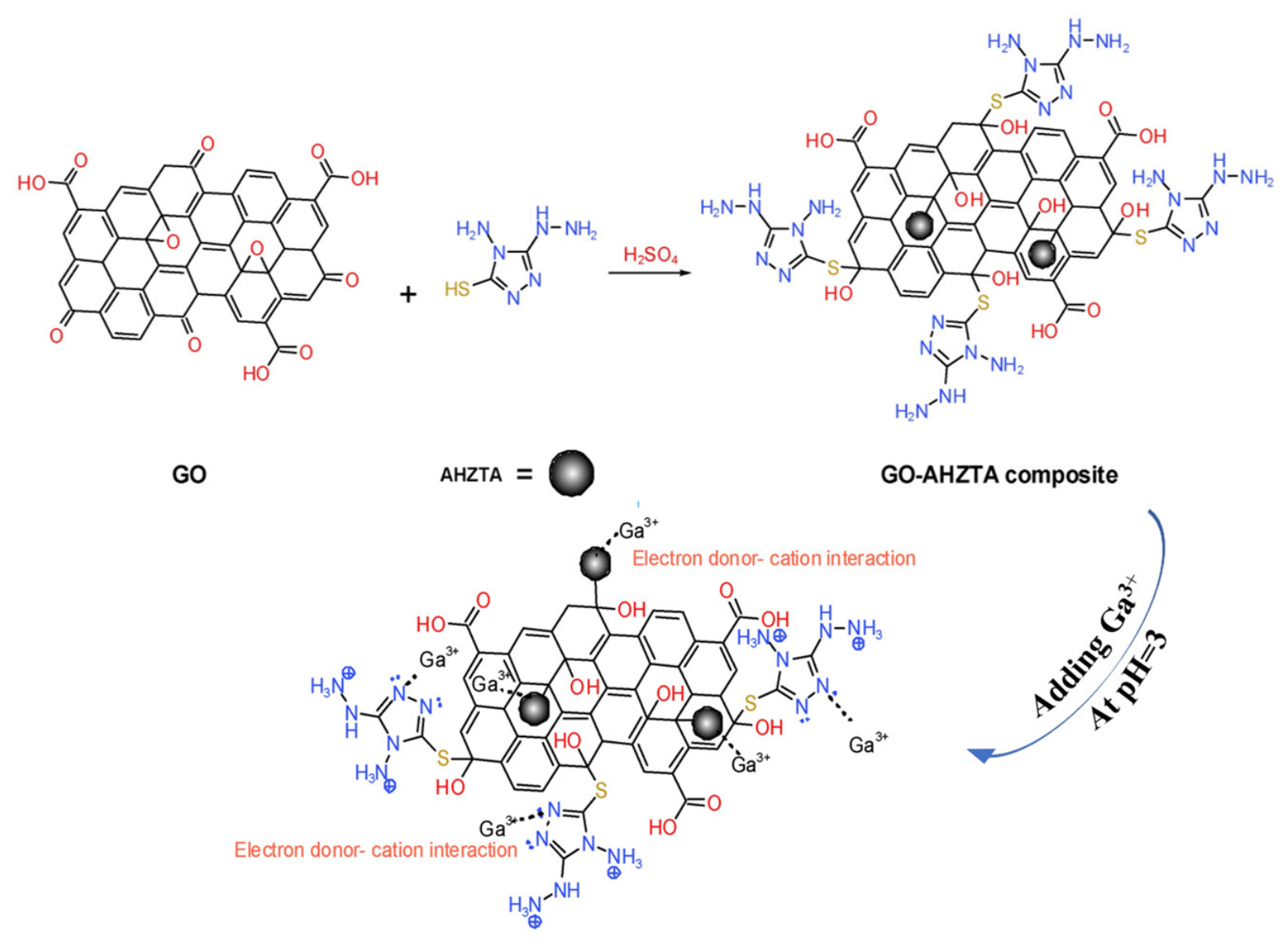
Carbon-based sorbents functionalized with nitrogen-containing groups have also been investigated for gallium extraction [39,48,49,50,51]. For instance, Zhu et al. [48] developed a nitrogen-functionalized carbonaceous sorbent, designated as GO-AHTZT, by covalently grafting 4-amino-3-hydrazino-1,2,4-triazole-5-thiol (AHTZT) onto graphene oxide (GO) via nucleophilic addition. Under optimal conditions (pH 3.0), the maximum adsorption capacity of GO-AHTZT for Ga(III) was 33.2 mg/g. Notably, the material demonstrated significant selectivity in the presence of competing ions, with a Ga3+ adsorption capacity of 23.92 mg/g, which substantially outperformed the uptake of coexisting Sc3+ (4.87 mg/g) and In3+ (1.90 mg/g). Reusability assessments revealed that the sorbent retained over 80% of its initial adsorption capacity after five consecutive adsorption–desorption cycles using 1 M NaOH as the eluent. Mechanistic studies further elucidated that Ga3+ capture on GO-AHTZT at pH 3.0 is driven by coordination with the lone-pair electrons provided by the N–N groups in the AHTZT moieties (Figure 3).
To further enhance adsorption performance, the same research group subsequently optimized the ligand structure by grafting 5-methyl-1,3,4-thiadiazol-2-amine (MTA) onto GO [49]. The resulting GO-MTA composite preserves the −C=N−N=C− moiety characteristic of the previous GO-AHTZT material, while further incorporating additional N-, O-, and S-based coordination centers to facilitate Ga3+ capture. Attributed to this structural design, GO-MTA achieved a Ga(III) sorption capacity of 55.6 mg/g at pH 3.0, significantly exceeding that of GO-AHTZT at the same pH. Furthermore, GO-MTA exhibited excellent regeneration stability, maintaining over 80% removal efficiency after ten cycles using 1.0 M HNO3 as the eluent. Mechanistic studies indicate that Ga3+ adsorption on GO-MTA is attributed to multi-site coordination involving the −C=N−N=C− moieties of the thiadiazole ring and other N-, S-, and O-containing functional groups, with the −C=N−N=C− segments playing a dominant role. Notably, maintaining an optimal pH of 3.0 is critical for both GO-AHTZT and GO-MTA. At lower pH values (pH < 3.0), the protonation of nitrogen-containing groups induces electrostatic repulsion with Ga3+ ions, thereby suppressing the adsorption process [49].
Although nitrogen-functionalized carbonaceous materials show promise for gallium extraction, systems relying exclusively on nitrogenous groups often suffer from restricted operational pH windows, particularly under strongly acidic conditions. Due to the moderate Lewis basicity of nitrogen relative to oxygen, N-donor sites alone frequently exhibit insufficient coordination strength to effectively capture the hard acid Ga3+, especially in the presence of competing hard-metal cations such as Al3+ [48,60]. Furthermore, the protonation of nitrogen-containing ligands in highly acidic media significantly diminishes their binding affinity toward Ga3+, leading to a marked decline in complexation stability and, consequently, overall adsorption capacity. A viable strategy to enhance the binding strength, selectivity, and operational flexibility of these sorbents could integrate nitrogen-containing groups with complementary functional moieties, such as amidoxime or oxygen-rich ligands, thereby creating synergistic N/O active sites. Beyond coordination chemistry, current research predominantly utilizes graphene oxide and oxidized carbon nanotubes as substrates. Future investigations may explore more cost-effective alternatives, such as mesoporous carbon or carbon cloth, to broaden practical applications. Additionally, the adoption of greener functionalization reagents, such as dopamine, could facilitate a more sustainable and accessible synthesis process.

2.4. Organophosphorus-Functionalized Carbon Sorbents

Organophosphorus-functionalized carbon sorbents, characterized by polar P=O and P–OH oxygen-donor groups, exhibit a superior affinity for Ga3+ in acidic media through the formation of multi-coordinate chelates. Given this robust binding capability, organophosphorus ligands have been extensively utilized in both solvent extraction and ion-exchange resin systems for gallium recovery [61,62]. Recently, to facilitate the selective separation of gallium from spent copper–indium–gallium–selenide (CIGS) photovoltaic leachates, Wang et al. developed a novel sorbent P507@MAC by impregnating phosphorus-based extractant P507 onto coconut-shell-derived mesoporous activated carbon (MAC) in dichloromethane, with subsequent solvent removal through rotary evaporation [52]. This composite achieved a significant gallium adsorption capacity of 67 mg/g at pH 2. Furthermore, the sorbent maintained over 93% of its initial capacity after six adsorption–desorption cycles using 0.5 M HNO3 as the eluent, indicating its excellent recyclability and potential for sustainable gallium reclamation. Mechanistic investigations reveal that Ga3+ sequestration at pH 2 is primarily governed by coordination with the surface-anchored P–OH and P=O moieties [52].
Despite the effectiveness of P507@MAC, its preparation by solvent impregnation employs toxic dichloromethane and suffers from weak physical interactions between the extractant and the carbon support, compromising the composite’s long-term cycling stability. To address these limitations, the same research group developed a more sustainable covalent functionalization strategy, utilizing dopamine as an anchoring agent via self-oxidative polymerization. This approach eliminates the use of dichloromethane and enhances phosphoryl immobilization [53]. Specifically, the phosphoryl-functionalized and polydopamine-coated mesoporous activated carbon (EPP-PDA@MAC) was synthesized through a green, one-pot modification route. This process utilized ethyl phenylphosphinate (EPP) as the organophosphorus precursor and polydopamine as an anchoring linker derived from self-polymerization under mild alkaline conditions. In adsorption tests, EPP-PDA@MAC achieved a notable gallium adsorption capacity of 140.7 mg/g at pH 2, more than double that of P507@MAC. In competitive-adsorption experiments, the material also showed superior selectivity for Ga3+ over competing ions like Al3+ and Zn2+. In the sorption–desorption experiments, the material retained approximately 90% of its initial capacity after nine cycles of regeneration with 0.5 M HNO3, demonstrating its robust stability. Mechanistic studies revealed that Ga3+ sequestration is primarily governed by ligand complexation with P=O moieties, supplemented by minor contributions from the phenolic hydroxyl groups within the polydopamine coating [53].

3. Challenges, Research Gaps, and Future Directions

Owing to their high specific surface area and robust physicochemical stability over a broad pH spectrum, carbon-based materials have emerged as promising scaffolds for grafting diverse functional groups toward gallium sequestration. Most current investigations, however, remain restricted to laboratory-scale exploration, leaving a number of research questions unaddressed, including insights that could be drawn from commercially available chelating resins for gallium sequestration. Based on their reported adsorption performance, carbon-based sorbents hold promise for future applications, provided that such existing research gaps are effectively bridged.
Despite recent progress, several critical research gaps persist in the laboratory-scale investigation of functionalized carbon-based sorbents for gallium recovery. Current assessments primarily rely on simplified, low-pH synthetic solutions, whereas studies employing media that reflect the intricate chemistry of Bayer-process liquor remain notably scarce. The inherent complexity of this liquor, characterized by extreme alkalinity, high concentrations of organic matter and carbonates, and significant vanadate content [63,64,65], profoundly influences the adsorption capacity, adsorption/desorption kinetics, and the structural stability of adsorbents. Specifically, humic substances and low-molecular-weight organic acids such as oxalic and acetic acids inhibit gallium uptake through organic fouling and competitive site occupation, potentially compromising the material’s structural integrity [66]. Furthermore, competitive adsorption from vanadate represents a formidable impediment to the long-term stability and selectivity of the adsorbent. Evidence from commercial chelating resins reveals that vanadate preferentially occupies active sites and exhibits greater resistance to elution than gallate, a phenomenon stemming from their distinct coordination affinities [32]. Consequently, the gradual accumulation of residual vanadium progressively diminishes the material’s gallium-capture capacity [28]. Interestingly, while amidoxime-functionalized resins demonstrate superior gallium selectivity in strongly alkaline media [67,68,69], the direct grafting of amidoxime groups onto carbon-based substrates remains largely unexplored.
In addition, pore architecture constitutes another critical yet under-explored research gap for gallium sequestration using functionalized carbon-based sorbents. While current research on carbon-based sorbents emphasizes surface functionalization, the role of pore size and geometry on adsorption kinetics and capacity is frequently overlooked. Although studies on conventional amidoxime-based resins have established that pore confinement and associated structural effects are paramount [70], these parameters remain poorly understood in the specific context of functionalized carbon materials.
One promising research frontier involves elucidating the synergistic interplay between surface-grafted moieties and pore architecture to maximize gallium adsorption efficiency. Specifically, systematic correlations can be established between the physicochemical attributes of functionalized mesoporous carbons that include pore size and functional site density, and the materials’ separation performance within complex matrices containing competing ions and interfering species (e.g., vanadate, carbonates, and organic matter) [71]. The integration of advanced multiscale spectroscopy with density functional theory (DFT) simulations could greatly facilitate the elucidation of the underlying interaction mechanisms [72]. Such fundamental insights will aid the rational design of future carbon-based sorbents capable of balancing sorption capacity, selectivity, and adsorption–desorption kinetics.
While research in functionalized carbon sorbents has predominantly focused on their surface modification and adsorption performance, innovative desorption strategies warrant intensive exploration to enhance their recovery efficiency and reusability. In this context, carbon cloth emerges as a superior substrate due to its structural integrity and versatile regeneration potential. In addition to its amenability to functionalization, the intrinsic electrical conductivity of carbon cloth can facilitate electrochemically assisted desorption [43,73]. This sustainable strategy may circumvent the inherent limitations of conventional chemical elution and effectively mitigate active-site poisoning by recalcitrant species (e.g., vanadium), thereby extending the sorbent’s operational lifespan.

Author Contributions

M.H.: Conceptualization, Investigation, Writing—original draft. L.Z.: Writing—review and editing, Data curation. X.Z.: Writing—review and editing. H.C.: Writing—review and editing, Data curation, Investigation. Y.C.: Writing—review and editing, Validation. H.Z.: Conceptualization, Supervision. R.L.: Conceptualization, Supervision, Writing—review and editing. J.Z.: Conceptualization, Supervision, Funding acquisition, Writing—review and editing. All authors have read and agreed to the published version of the manuscript.

Funding

This research was supported by the Weiqiao-UCAS Innovation Research Projects on Carbon Neutrality Technology (No. GYY-NYHJ-2023-WT-002) and the Fundamental Research Funds for the Central Universities (E3E40501X2).

Data Availability Statement

No new data were created or analyzed in this study. Data sharing is not applicable to this article.

Conflicts of Interest

The authors declare no conflicts of interest.

References

  1. Sun, C.; Wang, Y.-J.; Liu, D.; Fang, B.; Yan, W.; Zhang, J. Tailoring Interfacial Interaction in GaN@NG Heterojunction via Electron/Ion Bridges for Enhanced Lithium-Ion Storage Performance. Chem. Eng. J. 2023, 453, 139603. [Google Scholar] [CrossRef] [Scilit]
  2. Gao, F.; Li, Z.; Li, S. Recent Advances in the Preparation of Gallium-based 2D Materials and Devices Based on Gallium Liquid Metal. Adv. Funct. Mater. 2025, 35, 2424370. [Google Scholar] [CrossRef] [Scilit]
  3. Han, Z.; Liu, Q.; Ouyang, X.; Song, H.; Gao, T.; Liu, Y.; Wen, B.; Dai, T. Tracking Two Decades of Global Gallium Stocks and Flows: A Dynamic Material Flow Analysis. Resour. Conserv. Recycl. 2024, 202, 107391. [Google Scholar] [CrossRef] [Scilit]
  4. Song, H.; Wang, C.; Sen, B.; Liu, G. China Factor: Exploring the Byproduct and Host Metal Dynamics for Gallium–Aluminum in a Global Green Transition. Environ. Sci. Technol. 2022, 56, 2699–2708. [Google Scholar] [CrossRef] [Scilit]
  5. Dair, L. Gallium. In Mineral Commodity Summaries 2025; U.S. Geological Survey: Reston, VA, USA, 2025; pp. 74–75. [Google Scholar]
  6. Sverdrup, H.U.; Haraldsson, H.V. Gallium: Assessing the Long-Term Future Extraction, Supply, Recycling, and Price of Using WORLD7, in Relation to Future Technology Visions in the European Union. Biophys. Econ. Sustain. 2025, 10, 4. [Google Scholar] [CrossRef] [Scilit]
  7. Yadav, S.; Yadav, J.; Bruckard, W.; Haque, N.; Pramanik, B.K. Gallium and Germanium: Comparing Demand and Supply with Consideration of Electronic Waste as a Secondary Source. Sep. Purif. Technol. 2026, 398, 138270. [Google Scholar] [CrossRef] [Scilit]
  8. Bao, S.; Huang, Q.; Chen, B.; Jiang, Y. Hydrometallurgical Recovery of Gallium from Gallium-Containing Secondary Resources: Leaching, Separation and Purification. Sep. Purif. Technol. 2025, 376, 134068. [Google Scholar] [CrossRef] [Scilit]
  9. Frenzel, M.; Ketris, M.P.; Seifert, T.; Gutzmer, J. On the Current and Future Availability of Gallium. Resour. Policy 2016, 47, 38–50. [Google Scholar] [CrossRef] [Scilit]
  10. Reid, S.; Tam, J.; Yang, M.; Azimi, G. Technospheric Mining of Rare Earth Elements from Bauxite Residue (Red Mud): Process Optimization, Kinetic Investigation, and Microwave Pretreatment. Sci. Rep. 2017, 7, 15252. [Google Scholar] [CrossRef] [Scilit]
  11. Habashi, F. A Hundred Years of the Bayer Process for Alumina Production. In Essential Readings in Light Metals; Springer International Publishing: Cham, Switzerland, 2016; pp. 85–93. [Google Scholar]
  12. Qu, L.; Li, L.; Wu, Y.; Liu, F.; Wang, Y. A Review of the Current State of Research on Gallium Recovery from Bayer Liquor. JOM 2024, 76, 6084–6098. [Google Scholar] [CrossRef] [Scilit]
  13. Sonthalia, R.; Behara, P.; Kumaresan, T.; Thakre, S. Review on Alumina Trihydrate Precipitation Mechanisms and Effect of Bayer Impurities on Hydrate Particle Growth Rate. Int. J. Miner. Process. 2013, 125, 137–148. [Google Scholar] [CrossRef] [Scilit]
  14. Zhao, Z.; Yang, Y.; Xiao, Y.; Fan, Y. Recovery of Gallium from Bayer Liquor: A Review. Hydrometallurgy 2012, 125–126, 115–124. [Google Scholar] [CrossRef] [Scilit]
  15. Bénézeth, P. Gallium Solubility and Aqueous Speciation in Hydrothermal Solutions (60–250 °C): Experimental Study and Comparison with Aluminum. Mineral. Mag. 1994, 58A, 71–72. [Google Scholar] [CrossRef] [Scilit]
  16. Zhang, J.; Gao, C.; Hui, X.; Chang, Y. Extraction of Gallium from the Brown Corundum Dust with a One-Step Alkaline Leaching Process. Separations 2023, 10, 510. [Google Scholar] [CrossRef] [Scilit]
  17. Luong, H.V.T.; Liu, J.C. Flotation Separation of Gallium from Aqueous Solution—Effects of Chemical Speciation and Solubility. Sep. Purif. Technol. 2014, 132, 115–119. [Google Scholar] [CrossRef] [Scilit]
  18. Bahri, Z.; Rezai, B.; Kowsari, E. Selective Separation of Gallium from Zinc Using Flotation: Effect of Solution PH Value and the Separation Mechanism. Miner. Eng. 2016, 86, 104–113. [Google Scholar] [CrossRef] [Scilit]
  19. Raiguel, S.; Dehaen, W.; Binnemans, K. Extraction of Gallium from Simulated Bayer Process Liquor by Kelex 100 Dissolved in Ionic Liquids. Dalton Trans. 2020, 49, 3532–3544. [Google Scholar] [CrossRef] [Scilit]
  20. Frary, F.C. Process of Producing Gallium. U.S. Patent 2,582,376, 15 January 1952. [Google Scholar]
  21. Losev, V.; Buyko, O.; Shimanskii, A.; Kazantsev, Y.; Metelitsa, S.; Borodina, E.; Li, M. Extraction of Gallium from Carbon Concentrate—Aluminum Industry Waste. Hydrometallurgy 2024, 226, 106289. [Google Scholar] [CrossRef] [Scilit]
  22. De La, B.P. Method of Recovering Gallium from an Alkali Aluminate Lye. U.S. Patent 2,793,179, 21 May 1955. [Google Scholar]
  23. Helgorsky, J. Process for Liquid/Liquid Extraction of Gallium. U.S. Patent 3,971,843, 27 July 1976. [Google Scholar]
  24. Helgorsky, J.; Leveque, A. Procédé de Récupération Du Gallium de Solutions Très Basiques Par Extraction Liquide/Liquide. French Patent 2,277,897, 12 July 1974. [Google Scholar]
  25. Puvvada, G.V. Liquid–Liquid Extraction of Gallium from Bayer Process Liquor Using Kelex 100 in the Presence of Surfactants. Hydrometallurgy 1999, 52, 9–19. [Google Scholar] [CrossRef] [Scilit]
  26. Tadashi, N.; Masahiko, M. Process for Purifying Alumina and Recovering a Gallium Concentrate. U.S. Patent 3,144,304, 11 August 1964. [Google Scholar]
  27. Kataoka, Y.; Matsuda, M.; Yoshitake, H.; Hirose, Y. Method for Recovery of Gallium. U.S. Patent 4,468,374, 28 August 1984. [Google Scholar]
  28. Riveros, P.A. Recovery of Gallium from Bayer Liquors with an Amidoxime Resin. Hydrometallurgy 1990, 25, 1–18. [Google Scholar] [CrossRef] [Scilit]
  29. Qin, Z.; Liao, Y.; Wang, Z.; Wang, S.; Song, L.; Ma, K.; Luo, D.; Yue, H. Innovative Amidoxime Nanofiber Membranes for Highly Effective Adsorption of Ga(III) from Waste Bayer Solution. Ind. Eng. Chem. Res. 2023, 62, 11140–11150. [Google Scholar] [CrossRef] [Scilit]
  30. Zhang, H.; Peng, X.; Shi, G.; Yan, W.; Liang, M.; Chen, Y.; Heng, Z.; Zou, H. Uniform Macroporous Amidoximated Polyacrylonitrile Monoliths for Gallium Recovery from Bayer Liquor. J. Appl. Polym. Sci. 2021, 138, 49764. [Google Scholar] [CrossRef] [Scilit]
  31. Long, H.; Zhao, Z.; Chai, Y.; Li, X.; Hua, Z.; Xiao, Y.; Yang, Y. Binding Mechanism of the Amidoxime Functional Group on Chelating Resins toward Gallium(III) in Bayer Liquor. Ind. Eng. Chem. Res. 2015, 54, 8025–8030. [Google Scholar] [CrossRef] [Scilit]
  32. Cui, L.; Chen, M.; Zhang, Y.; Wang, L.; Yang, B.; Cheng, F. Insight into the Adsorption Mechanism of Gallium, Vanadium on Amidoxime Resin and Cascade Desorption for Synergistic Recovery. Chem. Eng. J. 2026, 528, 172431. [Google Scholar] [CrossRef] [Scilit]
  33. Zheng, Q.; He, C.; Meng, J.; Fujita, T.; Zheng, C.; Dai, W.; Wei, Y. Behaviors of Adsorption and Elution on Amidoxime Resin for Gallium, Vanadium, and Aluminium Ions in Alkaline Aqueous Solution. Solvent Extr. Ion. Exch. 2021, 39, 373–398. [Google Scholar] [CrossRef] [Scilit]
  34. Luo, J.; Wu, Y.; Xiang, D.; Wang, S.; Ye, J.; Liu, H.; Zhang, L. Dithiourea-Bridged Cross-Linked COF-COF for Efficient and Selective Gallium Recovery. Sep. Purif. Technol. 2026, 387, 136690. [Google Scholar] [CrossRef] [Scilit]
  35. Li, C.; Li, G.; Qiu, F.; Miao, Z.; Zhou, G.; Qiu, M.; Kou, W.; He, Q.; Zhu, J.; Wang, J.; et al. Amine-Appended 3D Metal Organic Framework with Tailored Energy-Matching Effect for Breakthrough Gallium Capture. Sep. Purif. Technol. 2025, 378, 134821. [Google Scholar] [CrossRef] [Scilit]
  36. Shi, C.; Wang, K.; Chen, C.; Cao, Y.; Zhou, G.; Wang, J.; Li, C. Highly Selective Capture of Gallium from Aqueous Solutions Using Tetradentate Amidoxime Functionalized MIL-53(Al) Nanofiber Membranes. Sep. Purif. Technol. 2024, 330, 125303. [Google Scholar] [CrossRef] [Scilit]
  37. Koshima, H.; Onishi, H. Adsorption of Iron(III), Gallium (III), Thallium (III), Antimony(V) and Antimony(III) on Activated Carbon from Hydrochloric Acid Solution. Anal. Sci. 1985, 1, 237–240. [Google Scholar] [CrossRef] [Scilit]
  38. Díez, E.; Gómez, J.M.; Rodríguez, A.; Bernabé, I.; Galán, J. Recovery of Gallium from Aqueous Solution through Preconcentration by Adsorption/Desorption on Disordered Mesoporous Carbon. J. Sustain. Metall. 2021, 7, 227–242. [Google Scholar] [CrossRef] [Scilit]
  39. Li, W.; Zhou, C.; Li, C.; Zhu, W.; Shi, J.; Liu, G. Synthesis of CNT/UiO-66-NH2 Adsorbent and the Selective Adsorption of Gallium in Solution. Sep. Purif. Technol. 2023, 323, 124464. [Google Scholar] [CrossRef] [Scilit]
  40. Sáez, P.; Bernabé, I.; Gómez, J.M.; Díez, E.; Fraile, C.; García, N.; Rodríguez, A. Assessment of Two Materials as Adsorbents for the Effective Removal and Further Pre-Concentration of Gallium from Aqueous Solutions: Mesoporous Carbon vs. Clinoptilolite. Separations 2023, 10, 349. [Google Scholar] [CrossRef] [Scilit]
  41. Xiong, Y.; Cui, X.; Zhang, M.; Wang, Y.; Lou, Z.; Shan, W. Microwave Hydrothermal Synthesis of Gallotannin/Carbon Nanotube Composites for the Recovery of Gallium Ion. Appl. Surf. Sci. 2020, 510, 145414. [Google Scholar] [CrossRef] [Scilit]
  42. Cui, J.; Cong, X.; Li, X.; Chen, X.; Wang, Y.; Gao, J.; Xiong, Y. Chitosan-Derived Layered Porous Carbon and Its Performance on Gallium Adsorption. J. Chem. Technol. Biotechnol. 2023, 98, 1387–1394. [Google Scholar] [CrossRef] [Scilit]
  43. Fan, J.; Gao, L.; Li, S.; Chai, N.; Lei, D. Efficient Recovery of Gallium(III) from Alkaline Solution by Electrosorption Using Biomass-Derived Carbon Aerogel Electrodes. Sep. Purif. Technol. 2025, 353, 128297. [Google Scholar] [CrossRef] [Scilit]
  44. Li, S.; Fan, J.; Gao, L. Conductive Biomass Carbon Aerogel with High Adsorption Performance for Gallium in Alkaline Solution. Miner. Eng. 2023, 204, 108396. [Google Scholar] [CrossRef] [Scilit]
  45. Zhang, Y.; Liu, X.; Wang, Y.; Lou, Z.; Shan, W.; Xiong, Y. Polyacrylic Acid-Functionalized Graphene Oxide for High-Performance Adsorption of Gallium from Aqueous Solution. J. Colloid Interface Sci. 2019, 556, 102–110. [Google Scholar] [CrossRef] [Scilit]
  46. Liu, B.; Zhang, M.; Chen, M.; Qin, L.; Wang, M.; Fu, D.; Liu, W.; Liu, X. Selective Adsorption Behavior of Gallium Ions on Graphene-Based Surface Ion-Imprinted Material from Simulated Acid Leach Solution of Fly Ash. J. Sep. Sci. 2026, 49, e70362. [Google Scholar] [CrossRef] [Scilit]
  47. Zhang, M.; Zhang, X.; Liang, C.; Qin, L.; Fu, D.; Wang, M.; Bai, Y.; Liu, W.; Liu, X. Preparation of Graphene-Based Surface Ion-Imprinted Adsorbent for Ga(III) Selective Extraction from Acid Leaching of Fly Ash. Sep. Purif. Technol. 2023, 325, 124681. [Google Scholar] [CrossRef] [Scilit]
  48. Zhu, X.; Guo, Y.; Zheng, B. Preparation of 4-Amino-3-Hydrazino-1,2,4-Triazol-5-Thiol-Modified Graphene Oxide and Its Greatly Enhanced Selective Adsorption of Gallium in Aqueous Solution. Molecules 2024, 29, 2778. [Google Scholar] [CrossRef] [Scilit]
  49. Zhu, X.; Guo, Y.; Zheng, B. Graphene Oxide Covalently Functionalized with 5-Methyl-1,3,4-Thiadiazol-2-Amine for pH-Sensitive Ga3+ Recovery in Aqueous Solutions. Molecules 2024, 29, 3768. [Google Scholar] [CrossRef] [Scilit]
  50. Li, W.; Zhou, C.; Li, C.; Zhu, W.; Shi, J.; Liu, G. Synthesis of UiO-66 Series Metal–Organic Framework Composites and the Adsorption Effect on Gallium. Chem. Eng. J. 2023, 455, 140881. [Google Scholar] [CrossRef] [Scilit]
  51. Li, C.; Zhou, C.; French, D.; Graham, I.T.; Wang, Z.; Li, Y.; Wang, F.; Liu, G. Synthesis of a Carbon Nanotube-Modified NH2-MIL-53(Fe) Adsorbent and Efficient Adsorption and Separation of Gallium Ions. J. Mater. Chem. A Mater. 2025, 13, 19864–19877. [Google Scholar] [CrossRef] [Scilit]
  52. Wang, W.; Xu, X.; Lai, D.; Xu, Q.; Li, J.; Wang, Y. Selective Isolation of Gallium and Indium from Waste Photovoltaic Modules Facilitated by Extractant-Mesoporous Activated Carbon Composites. Sep. Purif. Technol. 2024, 330, 125510. [Google Scholar] [CrossRef] [Scilit]
  53. Wang, W.; Xu, X.; Li, J.; Liu, T.; Wang, H.; Wang, Y. Green and Facile Modification of Mesoporous Activated Carbon for Selective Indium and Gallium Recovery from Waste Photovoltaic Modules. Green Chem. 2025, 27, 485–497. [Google Scholar] [CrossRef] [Scilit]
  54. Roosen, J.; Mullens, S.; Binnemans, K. Chemical Immobilization of 8-Hydroxyquinoline and 8-Hydroxyquinaldine on Chitosan-Silica Adsorbent Materials for the Selective Recovery of Gallium from Bayer Liquor. Hydrometallurgy 2017, 171, 275–284. [Google Scholar] [CrossRef] [Scilit]
  55. Raj, P.; Patel, M.; Karamalidis, A.K. Chemically Modified Polymeric Resins with Catechol Derivatives for Adsorption, Separation and Recovery of Gallium from Acidic Solutions. J. Environ. Chem. Eng. 2023, 11, 110790. [Google Scholar] [CrossRef] [Scilit]
  56. Lu, S.; Chen, L.; Hamza, M.F.; He, C.; Wang, X.; Wei, Y.; Guibal, E. Amidoxime Functionalization of a Poly(Acrylonitrile)/Silica Composite for the Sorption of Ga(III)—Application to the Treatment of Bayer Liquor. Chem. Eng. J. 2019, 368, 459–473. [Google Scholar] [CrossRef] [Scilit]
  57. Zhang, M.; Sun, Q.; Wang, Y.; Shan, W.; Lou, Z.; Xiong, Y. Synthesis of Porous UiO-66-NH2-Based Mixed Matrix Membranes with High Stability, Flux and Separation Selectivity for Ga(III). Chem. Eng. J. 2021, 421, 129748. [Google Scholar] [CrossRef] [Scilit]
  58. Deng, Q.; Li, W.; Liu, Q.; Fan, G.; Li, P.; Tan, X.; Teng, D. Speciation-Guided Gallium Recovery from Acidic and Alkaline Leachates via Functionalized Ti3C2 MXene Interfaces. Colloids Surf. A Physicochem. Eng. Asp. 2026, 748, 141028. [Google Scholar] [CrossRef] [Scilit]
  59. Hussain, M.; Zhao, L.; Zhang, X.; Yang, C.; Cui, Y.; Yu, Z.; Zheng, J. Functionalized Carbon-Based Materials for Uranium Extraction: A Review. Separations 2025, 12, 283. [Google Scholar] [CrossRef] [Scilit]
  60. Kaya, S.; Kariper, S.E.; Ungordu, A.; Kaya, C. Effect of Some Electron Donor and Electron Acceptor Groups on Stability of Complexes According to the Principle of HSAB. JNRS 2014, 3, 4. [Google Scholar]
  61. Liu, J.S.; Chen, H.; Chen, X.Y.; Guo, Z.L.; Hu, Y.C.; Liu, C.P.; Sun, Y.Z. Extraction and Separation of In(III), Ga(III) and Zn(II) from Sulfate Solution Using Extraction Resin. Hydrometallurgy 2006, 82, 137–143. [Google Scholar] [CrossRef] [Scilit]
  62. Zhao, Z.; Cui, L.; Guo, Y.; Li, H.; Cheng, F. Recovery of Gallium from Sulfuric Acid Leach Liquor of Coal Fly Ash by Stepwise Separation Using P507 and Cyanex 272. Chem. Eng. J. 2020, 381, 122699. [Google Scholar] [CrossRef] [Scilit]
  63. Lu, H.; Cao, X.; Zhang, W.; Li, Y.; Chen, Y.; Li, Y.; Wang, Z. Basic Research on Dynamic Adsorption and Desorption of Vanadium and Gallium in Bayer Mother Liquor. JOM 2025, 77, 5205–5221. [Google Scholar] [CrossRef] [Scilit]
  64. Pietrantonio, M.; Pucciarmati, S.; Forte, F.; Piergrossi, V.; Marcoaldi, C.; Fontana, D. Vanadium Recovery from Bayer Process Liquor Residue. JOM 2024, 76, 1531–1538. [Google Scholar] [CrossRef] [Scilit]
  65. Zhao, Z.; Li, X.; Chai, Y.; Hua, Z.; Xiao, Y.; Yang, Y. Adsorption Performances and Mechanisms of Amidoxime Resin toward Gallium(III) and Vanadium(V) from Bayer Liquor. ACS Sustain. Chem. Eng. 2016, 4, 53–59. [Google Scholar] [CrossRef] [Scilit]
  66. Islam, M.A.; Morton, D.W.; Johnson, B.B.; Angove, M.J. Adsorption of Humic and Fulvic Acids onto a Range of Adsorbents in Aqueous Systems, and Their Effect on the Adsorption of Other Species: A Review. Sep. Purif. Technol. 2020, 247, 116949. [Google Scholar] [CrossRef] [Scilit]
  67. Kou, Z.; Bian, W.; Wang, C. Preparation of Novel Amidoxime Resin and Its Performance in Gallium (III) Extraction from Bayer Liquor. Chem. Eng. J. Adv. 2022, 11, 100317. [Google Scholar] [CrossRef] [Scilit]
  68. Qu, L.; Li, L.; Wu, Y.; Liu, F.; Wang, Y. Study on the Adsorption Mechanism and Desorption Process of Gallium and Vanadium in Practical Bayer Liquor by Amidoxime Porous Resin. JOM 2025, 77, 3457–3471. [Google Scholar] [CrossRef] [Scilit]
  69. Lv, Z.; Fan, G.; Bai, Y.; Li, G.; Li, P.; Hu, W.; Cao, Y.; Yang, W.; Teng, D.; Zeng, H. Dual-Ligand Metal-Organic Frameworks via In Situ Amidoxime Engineering for Selective Ion Separation. Adv. Funct. Mater. 2026, 36, e26751. [Google Scholar] [CrossRef] [Scilit]
  70. Qin, Z.; Wang, S.; Zhang, S.; Xie, J.; Zhou, C.A.; Wang, C.; Song, L.; Ma, K.; Luo, D.; Yue, H. Cross-Linked Amidoxime Porous Resin for Selective Gallium Separation in Bayer Solutions: Reaction Mechanism and Kinetic Study. Chem. Eng. J. 2024, 481, 148340. [Google Scholar] [CrossRef] [Scilit]
  71. Protsak, I.; Stockhausen, M.; Brewer, A.; Owton, M.; Hofmann, T.; Kleitz, F. Enhanced Selective Extraction of Indium and Gallium Using Mesoporous Sorbents. Chem. Eng. J. 2024, 498, 154468. [Google Scholar] [CrossRef] [Scilit]
  72. Mondal, P.P.; Hintersatz, C.; Dhiman, S.; Guy, B.M.; Matys, S.; Ahammad, S.Z.; Jain, R. Gallium and Germanium Leaching from Jarosite Cake by Organic Acid: A Combined Experimental and DFT Approach. J. Environ. Manag. 2025, 394, 127375. [Google Scholar] [CrossRef] [Scilit]
  73. Li, M.; Chen, N.; Shang, H.; Ling, C.; Wei, K.; Zhao, S.; Zhou, B.; Jia, F.; Ai, Z.; Zhang, L. An Electrochemical Strategy for Simultaneous Heavy Metal Complexes Wastewater Treatment and Resource Recovery. Environ. Sci. Technol. 2022, 56, 10945–10953. [Google Scholar] [CrossRef] [Scilit]
Figure 1. Distribution of gallium and aluminum aqueous species as a function of pH at 25 °C. Reprinted with permission from Ref. [15]. Mineralogical Society.
Separations 13 00250 g001
Figure 2. Schematic diagram illustrating the synthesis of ion-imprinted adsorbent IIP-GO/CS-PAA and its ion recognition mechanism for Ga3+. Reprinted with permission from Ref. [46]. Copyright (2026), Wiley-VCH.
Separations 13 00250 g002
Figure 3. Schematic diagram showing the synthetic route of GO-AHTZT and its adsorption mechanism for Ga3+. Reprinted with permission from Ref. [48]. Copyright (2024), MDPI.
Separations 13 00250 g003
Table 1. Summary of the performance of functionalized carbon-based adsorbents for gallium extraction.
AdsorbentFunctional
Group
Qmax (mg/g)Synthesis MethodAdsorption Conditions and Key FindingsAdsorption MechanismRef.
Activated carbonO-containing groups16Commercial activated carbon directly utilized as adsorbent after drying at 105 °C for 2 h>95% from 7 M HCl solutionSorption might be attributed to the interaction between HGaCl4 and oxygen-containing groups on activated carbon[37]
Mesoporous Activated Carbonhydroxyl,
carboxyl
6.5Sucrose-impregnated silica gel treated with concentrated sulfuric acid, followed by carbonization at 600 °C and HF etching to remove the silica template25 °C; 0.25 h equilibrium timePhysical adsorption between Ga3+ and mesoporous activated carbon[40]
CNT-GT
(Gallotannin-modified Carbon Nanotubes)
hydroxyl,
carboxyl
170.8 at pH 3; 156.5 at pH 10Microwave hydrothermal oxidation of CNTs with HNO3/H2SO4 (1:3 v/v) to introduce -COOH groups, followed by gallotannin grafting via dicyclohexylcarbodiimide couplingpH 3 and 10; 30 °C; 9 h equilibrium time; 1 M HCl as eluent agent. 93.56% adsorption efficiency after 5 cyclesAt pH3: Complexation of gallium species with phenolic hydroxyl groups; At 10: Ligand exchange between the surface phenolic hydroxyl groups of the sorbent and the hydroxyl ligands of Ga(OH)4[41]
CS-800
(Chitosan-derived carbon at 800 °C)
O- and N-containing groups129.83Hydrothermal treatment at 200 °C followed by concurrent carbonization and KOH activation at 800 °CpH 3, 30 °C, 24 h equilibrium time, 1.5 M HCl as eluent, >90% adsorption efficiency after 6 cyclesInteraction between gallium species and the oxygen- and nitrogen-containing functional groups of CS-800, with the former playing the primary role[42]
NPAC@CF
(Nitrogen-doped Persimmon Activated Carbon Aerogel @ Carbon Fiber Cloth)
O- and N-containing groups250.69(1) Hydrothermal treatment (persimmon/urea, 100 °C, 2 h); (2) Simultaneous carbonization/ZnCl2 activation (800 °C, 60 min); (3) Slurry coating (with carbon black/PVDF in NMP) onto carbon fiber.pH 11; 0.6 h equilibrium time; 1 M HCl used as eluent agent; >75% adsorption efficiency after 3 cyclesSynergistic effect of capacitive Ga(OH)4 capture and gallate surface complexation with oxygen- and nitrogen-containing functional groups[43]
NHPA
(Nitrogen Doping-High Specific Surface Area Persimmon Aerogel)
O- and N-containing groups120.48Hydrothermal treatment of persimmon pieces and urea at 240 °C for 8 h to produce persimmon aerogel, followed by concurrent carbonization and ZnCl2 activation at 800 °C for 60 minpH 11; 25 °C; 24 h equilibrium timeElectro-assisted adsorption coupled with surface complexation of gallate with oxygen- and nitrogen-containing functional groups[44]
PAA/0.3GO-V
(Polyacrylic Acid/Graphene Oxide)
carboxyl196.84In situ polymerization of acrylic acid onto dispersed graphene oxide templatespH 2.8; 1 M HCl used as eluent agent; >90% adsorption efficiency after
4 cycles
Cation exchange between Ga(III) and carboxyl groups[45]
IIP-GO/CS-PAA
(Ion-Imprinted Graphene Oxide/Chitosan-Polyacrylic Acid)
carboxyl86.29Synthesized via Ga(III)-templated in situ polymerization of acrylic acid on GO/chitosan matrix, followed by acid elutionpH 3; 25 °C; 20 h equilibrium time; 1 M HCl used as an eluent; 94.50% adsorption efficiency after
5 cycles
Cation exchange between carboxyl groups and gallium ions[46]
IIP-GO/PAA
(Ion-Imprinted Graphene Oxide/Polyacrylic Acid)
carboxyl221.56Synthesized via in situ Ga (III)-templated polymerization of acrylic acid on GO, with acid elution to create target-specific recognition cavitiespH 3; 25 °C, 4 h equilibrium time; 1 M HCl used as eluent agent; 85.71% adsorption efficiency
after 5 cycles
Synergistic effect of carboxyl-mediated electrostatic interactions and imprinting-induced spatial geometric matching[47]
GO-AHTZT
(GO functionalized with 4-Amino-3-Hydrazino-1,2,4-Triazol-5-Thiol)
N-containing groups33.2Covalently grafting 4-amino-3-hydrazino-1,2,4-triazole-5-thiol onto the GO surface via nucleophilic additionpH 3; 25 °C; 0.5 h equilibrium time; 1 M NaOH used as eluent agent; >80% adsorption efficiency after 5 cyclesCoordination with the lone-pair electrons provided by the N–N groups in the AHTZT moieties[48]
GO-MTA
(GO functionalized
5-Methyl-1,3,4-Thiadiazol-2-Amine)
N-containing groups55.6Covalently coupling 5-methyl-1,3,4-thiadiazol-2-amine with GO through nucleophilic additionpH 3; 35 °C; 2 h equilibrium time; 1 M HNO3 used as eluent agent; >80% adsorption efficiency after 10 cyclesCoordination of gallium species with −C=N−N=C− moieties of the thiadiazole ring, and other N-, S-, and O-containing functional groups, with the −C=N−N=C− segments playing a dominant role[49]
P507@MAC
(P507@ Mesoporous Activated Carbon)
phosphoryl, phosphine hydroxyl67Prepared through the solvent evaporation-induced impregnation of P507 onto coconut shell-derived MAC using dichloromethanepH 2; 25 °C; 1.5 h equilibrium time; 0.5 M HNO3 as eluent; >93% of its initial adsorption capacity after 6 cyclesCoordination of gallium species with surface-anchored P-OH and P=O moieties[52]
EPP-PDA@MAC
(Ethyl Phenylphosphinate-Polydopamine @ MAC)
phosphoryl, hydroxyl140.7Synthesized via mild-alkaline one-pot modification of MAC with dopamine (anchoring linker) and phosphorus precursorpH 2; 25 °C; 8 h equilibrium time, 0.5 M HNO3 as eluent; ~90% of its initial capacity after 9 cyclesLigand complexation between Ga3+ and P=O groups, with minor contributions from phenolic hydroxyl groups[53]
Disclaimer/Publisher’s Note: The statements, opinions and data contained in all publications are solely those of the individual author(s) and contributor(s) and not of MDPI and/or the editor(s). MDPI and/or the editor(s) disclaim responsibility for any injury to people or property resulting from any ideas, methods, instructions or products referred to in the content.