


Abstract
In contemporary research on natural bioactive compounds, increasing emphasis is placed on the development of efficient and sustainable extraction technologies. This study aimed to develop and optimize an innovative extraction process for wild cyclamen (Cyclamen purpurascens Mill.) tubers to maximize the yield of total extractives using a Box–Behnken design. The effects of four extraction parameters were evaluated on the system response. A second-order polynomial model accurately described the extraction process, yielding a coefficient of determination of 0.919. The liquid-to-solid ratio was identified as the dominant factor affecting the extraction efficiency compared to the other factors investigated. The optimal extraction conditions were as follows: extraction time of 15.5 min, 13% (v/v) ethanol, liquid-to-solid ratio of 13.5 mL/g, and extraction temperature of 34 °C, resulting in a yield of 53.44%. The optimized process yielded a significant saponin content of 16.19 g/100 g, while the levels of phenolic compounds (132.52 mg GAE/100 g) and flavonoids (12.04 mg QE/100 g) were also quantified. UHPLC–ESI–MS/MS analysis confirmed the presence of triterpene saponins, flavonoids, and terpenoids. DPPH, ABTS+, and CUPRAC assays indicated the antioxidant potential of the extract, while the minimum inhibitory concentration assay showed antibacterial activity against Staphylococcus aureus and Escherichia coli. The established chemical profile and observed biological activities provide the basis for further evaluation of wild cyclamen tubers as a source of bioactive secondary metabolites.
1. Introduction
In advanced industrial and scientific research, there is a growing interest in natural sources of bioactive compounds. This interest is driven not only by scientific exploration but also by market demand and consumer preferences for natural and sustainable products. The global botanical extracts market, which includes plant-derived bioactive compounds used in nutraceuticals, functional foods, cosmetics, and pharmaceuticals, was valued at approximately USD 32.3 billion in 2025. It is projected to surpass USD 64.6 billion by 2034, corresponding to a compound annual growth rate of approximately 8% [1]. Such projected growth underscores the urgent need for the development of innovative, efficient, eco-friendly, and reproducible extraction procedures.
The success of the extraction process largely depends on the extraction parameters, which directly affect the yield, chemical composition, and functional quality of the resulting extract [2]. In this context, ultrasound-assisted extraction (UAE), as an advanced extraction technique, significantly enhances extraction efficiency and improves extract quality compared to conventional extraction methods [3]. The UAE also reduces the consumption of organic solvents [4], making it particularly suitable for sustainable laboratory and industrial applications. The choice of the extraction technique is the key to the successful extraction of bioactive compounds. However, sustainable production also requires the systematic optimization of process parameters. It is essential to maximize the recovery of target compounds while preserving their chemical stability and bioactivity [5]. Contemporary research increasingly employs mathematical and statistical approaches to support process optimization. Among these, experimental design and numerical optimization methods have proven particularly effective. For instance, the Box–Behnken design (BBD) allows comprehensive evaluation of individual factors and their interactions using a reduced number of experimental runs [6].
Wild cyclamen (Cyclamen purpurascens Mill.) is an important endemic and medicinal plant species that naturally occurs in shady and humid forest areas of Central and Southeastern Europe, including the Balkans [7]. This perennial herbaceous plant, belonging to the Primulaceae family [8], is characterized by well-developed underground organ-tubers, which are not sufficiently investigated. Various secondary metabolites, primarily saponins, triterpenoids, and phenolic compounds, have been identified in these tubers [9]. These compounds exhibit pronounced antioxidant, anti-inflammatory, antibacterial, antiviral, and antitumor activities [10,11]. Despite its long-standing use in folk medicine [12], systematic research aimed at optimizing the extraction of bioactive compounds from wild cyclamen tubers remains limited, further highlighting the scientific significance of this study. Advanced separation techniques such as UHPLC-ESI-MS/MS are necessary for the accurate identification of complex saponin profiles in the Cyclamen genus, where traditional methods often fail due to structural similarities.
This study aimed to investigate the influence of key extraction parameters on the yield of total extractives (TE) from wild cyclamen tubers. The UAE procedure was developed and optimized to achieve maximal yield of TE using the BBD. The extract prepared under optimal conditions was further subjected to the identification of individual bioactive compounds, determination of the total content of major classes of bioactive compounds, and evaluation of its selected biological activities. While previous research on Cyclamen species has primarily focused on the isolation of specific compounds or qualitative phytochemical screening, the novelty of this study lies in the integrated application of UAE combined with BBD for the systematic, mathematical optimization of the extraction process. Unlike traditional extraction methods, this approach ensures high efficiency in extracting a broad spectrum of bioactive compounds, facilitating potential synergistic effects. Furthermore, due to the high efficiency and controlled nature of the developed process, these extracts hold significant potential for practical application in the food, pharmaceutical, and cosmetic industries. This approach provides quantitative insights into process efficiency and establishes a robust foundation for subsequent chemical and biological investigations.
2. Materials and Methods
2.1. Chemicals and Reagents
Acetonitrile and water (HPLC-MS grade), 2,2-diphenyl-1-picrylhydrazyl (DPPH), dimethyl sulfoxide (DMSO), α-tocopherol, 2,2′-azinobis(3-ethylbenzothiazoline-6-sulfonic acid) (ABTS+), butylated hydroxytoluene (BHT), and gentamicin were purchased from Sigma Chemical (St. Louis, MO, USA). Formic acid was obtained from Carlo Erba Reagents (Val de Reuil, France), while 96% (v/v) ethanol and sulfuric acid were supplied by Zorka Pharma (Šabac, Serbia). Folin–Ciocalteu reagent, saponin, and gallic acid (purity 97%) were used as standards (AppliChem, Darmstadt, Germany). Copper (II) chloride (CuCl2), neocuproine, and ammonium acetate (CH3COONH4), Tryptic Soy Broth (TSB), Tryptic Soy Agar (TSA), and 2,3,5-triphenyltetrazolium chloride (TTC) were obtained from Merck (Darmstadt, Germany). All other chemicals used were of analytical grade.
2.2. Plant Material
Wild cyclamen (Cyclamen purpurascens Mill.) tubers were collected in Southeastern Serbia (Predejane, Leskovac; 42°49′58.22″ N, 22°07′44.9″ E) in September, following the flowering period. The plant material was thoroughly washed, cut into smaller pieces, and air-dried at room temperature. Moisture content of 6.13% (w/w) was determined by oven-drying at 105 °C until a constant weight was reached. The dried plant material was subsequently ground using a laboratory mill (Braun Aromatic KSM2, Kronberg im Taunus, Germany). The plant fraction of 0.4 mm was used for the extraction of bioactive compounds.
2.3. Box–Behnken Design
The BBD was selected for this study due to its specific advantages over other response surface methodologies, such as the Central Composite Design. BBD is generally more efficient as it requires fewer experimental runs, particularly when investigating three or more factors. Furthermore, BBD avoids extreme combinations of factor levels, which is advantageous for biological samples where extreme conditions might lead to sample degradation or non-linear effects outside the optimized range. The UAE of TE from wild cyclamen tubers was performed using a 7.8 L ultrasonic bath with maximum ultrasound power of 300 W (Sonic, Niš, Serbia). The operational frequency was 40 kHz, while energy density was 38.46 W/L. Extractions were carried out in 250 mL round-bottom flasks equipped with reflux condensers in triplicate. The system temperature was controlled using an external thermometer. The effects of four independent variables, each investigated at three levels (low, medium, and high), on the defined system response were selected based on the preliminary experiments (Table 1) to ensure the response surface captures the optimal region. The extraction time range was chosen to include both fast and slow extraction periods of bioactive compounds. Longer exposure to ultrasound leads to the degradation of sensitive bioactive compounds. Consequently, the extraction temperature was below 60 °C to avoid thermal degradation processes in the plant materials. The ethanol concentration was adjusted to allow the extraction of polar (saponins) and less polar compounds (polyphenols). The lowest liquid-solid ratio was sufficient to cover the plant material and allow the cavitation effect.
Table 1.
Factors analyzed in the extraction of total extractables with their actual and coded values according to the Box–Behnken design.
A second-order polynomial (quadratic) model was used to describe the extraction process, allowing the evaluation of linear and quadratic effects of the individual factors, as well as their interactions. The general equation form of the applied second-order polynomial model is presented in Equation (1).
where Y is the system response (TE); Xi, Xj are the factors; β0 is the intercept; βi is the coefficient of the linear term of factor i, βii is the coefficient of the quadratic term of factor i; βij are the coefficient of the interaction between factors i and j; and ε is the experimental error of the model.
2.4. Determination of Total Phenolic and Total Saponin Contents
The spectrophotometric method with the Folin–Ciocalteu reagent was used to determine the total phenolic content in the extract [13]. For the analysis, 0.1 mL of the extract was mixed with 1 mL of ten-fold diluted Folin–Ciocalteu reagent in distilled water, followed by the addition of 1 mL of 7% (w/v) sodium carbonate solution. After incubation for 90 min, the absorbance was measured at 765 nm. The results were expressed as milligrams of gallic acid equivalents per 100 g of dry weight (mg GAE/100 g d.w.).
The total saponin content in the extract was determined spectrophotometrically using the method described by Mora-Ocación et al. [14]. The stock solution (1 mg/mL) of standard saponin was prepared in 70% (v/v) ethanol and diluted in the concentration range of 5–1000 mg/mL. One milliliter of the sample was treated with 3.5 mL of Liebermann-Burchard reagent (16.7% (v/v) acetic anhydride in concentrated sulfuric acid) and incubated at room temperature for 30 min. The absorbance was measured using a double-beam UV-Vis spectrophotometer (Varian Cary-100 Conc, Mulgrave, Victoria, Australia). A negative control consisted of 1 mL of 70% (v/v) ethanol and 3.5 mL of Liebermann-Burchard reagent. The analyzed extract was prepared according to the same procedure. The saponin content was expressed as grams of saponin equivalent per 100 g dry weight (g SE/100 g d.w.).
2.5. UHPLC–ESI–MS/MS Analysis
The wild cyclamen tuber extract was analyzed using ultra-high-performance liquid chromatography coupled with electrospray ionization tandem mass spectrometry (UHPLC-ESI-MS/MS). Minor changes were made in the gradient program, wavelength, m/z range, and capillary voltage compared to the method described by Boškov et al. [15]. Analyses were performed on a Dionex Ultimate 3000 UHPLC+ system coupled to an LCQ Fleet Ion Trap (Thermo Fisher Scientific, San Jose, CA, USA). Xcalibur (2.2, SP1.48) and LCQ Fleet (v. 2.1) software were used for instrument control, data acquisition, and processing. Separation was achieved on a Hypersil Gold C18 column (50 × 2.1 mm, 1.9 µm) thermostated at 40 °C. The mobile phase consisted of 0.1% formic acid in water (A) and 0.1% formic acid in acetonitrile (B) at a flow rate of 0.30 mL/min. The injection volume was 3 µL. The gradient program was as follows: 5% B for 0.8 min, 5–95% B over 10 min, 95% B for 2 min, 95–5% B over 0.1 min, and 5% B for 2.1 min. DAD detection was performed at 254, 280, 320, and 340 nm. ESI conditions were optimized for stable spray, efficient desolvation, and high sensitivity for m/z 100–1000. The electrospray ionization was carried out under the following conditions: the electrospray voltage was 5 kV; sheath gas 42 arbitrary units; auxiliary gas 11 arbitrary units; capillary temperature 275 °C; positive/negative mode: ±46 V; tube lens voltage 80 V (negative) and 115 V (positive). These settings represent system-specific parameters for the LCQ Fleet mass spectrometer software (version 2.7.0.1103 SP1). Tentative identification of individual compounds was performed by comparing their retention times, UV–Vis spectra, and mass spectral data with relevant literature reports. The identity of each compound was established by analyzing the molecular ions ([M–H]− and [M–H]+) and, crucially, by interpreting the characteristic fragmentation patterns. These patterns were compared with established fragmentation pathways reported in previous studies for the identified classes of bioactive compounds, allowing for reliable tentative assignment of their structures.
2.6. Determination of Antioxidant Activity
2.6.1. DPPH Assay
The spectrophotometric procedure for DPPH assay was previously described by Savić & Savić Gajić [13]. One milliliter of a DPPH radical solution (3 × 10⁻⁴ mol/L) was added to 2.5 mL of the extract sample. Instead of the extract solution, the negative control contained an equivalent volume of 96% (v/v) ethanol. The absorbance was measured at 517 nm using a UV-Vis spectrophotometer (Varian Cary 100, Mulgrave, Victoria, Australia) after incubation for 30 min. The inhibition of DPPH radicals (IDPPH) was calculated and subsequently plotted as a function of sample concentration. It was calculated according to Equation (2):
where Ac is the absorbance for the negative control at 517 nm, and As is the absorbance for the sample at 517 nm.
Based on the obtained relationship between DPPH radical inhibition and extract concentration, the half-maximal inhibitory concentration (IC50) was determined by interpolation. The synthetic antioxidant BHT was used as a positive control.
2.6.2. Cupric Ion Reducing Antioxidant Capacity (CUPRAC)
Following the method given by Vasiljevic et al. [16], the sample was examined for its cupric ion reducing antioxidant capacity (CUPRAC). A serial dilution (0.156 to 20 mg/mL) of tuber extract (40 μL) prepared in DMSO was added to a mixture containing 50 μL of a 10 mM Cu(II), 50 μL of 7.5 mM neocuproine solution, and 60 μL of 1 M ammonium acetate buffer (pH = 7). The absorbance was measured at 450 nm (Elx 808, BioTek Instruments, Winooski, VT, USA) after incubation at 30 °C for 1 h. Cu(II) was exchanged with DMSO to form the blank. To enable comparison, two industrially important antioxidants, α-tocopherol and BHT, were also assayed (using the same range of concentrations).
2.6.3. ABTS+ Free Radical Scavenging Activity
An aliquot of serial dilutions of the extract (0.078–20 mg/mL) prepared in 45% (v/v) ethanol was mixed with 200 μL of activated ABTS+ solution. It was incubated at room temperature in the dark for 10 min. The absorbance was measured at 734 nm (Elx 808, BioTek Instruments, Winooski, VT, USA). Instead of the sample, the negative control contained the equivalent volume of 45% (v/v) ethanol. The results are expressed as the percentage of ABTS+ neutralization (IABTS), while the calculation was done using Equation (3):
where Ac is the absorbance of the negative control and As is the absorbance of the sample.
2.7. Antibacterial Activity
The ability of the tuber’s extract to inhibit the growth of pathogenic bacteria was assessed by the microdilution method with some modifications [17]. All tested bacterial strains (Staphylococcus aureus, Bacillus cereus, Enterococcus faecalis, Escherichia coli, Pseudomonas aeruginosa, Proteus mirabilis, Acinetobacter baumanii, and Salmonella enteritidis) were American Type Culture Collection (ATCC) ones, except methicillin-resistant Staphylococcus aureus, which was a clinical isolate. Before testing, all strains were subcultured in TSB overnight at 37 °C. Starting concentration of bacterial suspension was adjusted to 106 CFU/mL based on optical density measured at 600 nm (Elx 808, BioTek Instruments, Winooski, VT, USA). Serial concentrations of extract (50 μL) in TSB, ranging from 0.005 to 10 mg/mL, were mixed with 50 μL of test microorganisms in a 96-well microplate (Sarstedt, Germany). Only TSB was used as a negative control, while 50 μL of bacterial suspension with 50 μL of TSB served as a positive control. In parallel, tested microorganisms were incubated with serial dilutions (0.002 to 5 mg/mL) of gentamicin (positive control). Plates were incubated at 37 °C for 24 h, after which an indicator of cellular respiration, TTC, was added to each well (its final concentration was 0.05%). Plates were incubated at 37 °C for 30 min. The appearance of color indicated cellular respiration, pointing out that bacteria were not suppressed by the presence of the sample. The lowest concentration at which no color was present was the minimal inhibitory concentration (MIC). Furthermore, each well without the color was subcultured on the plate with TSA and incubated for 24 h at 37 °C. The lowest concentration at which there was no growth of bacterial colonies presented the minimal bactericidal concentration (MBC).
2.8. Statistical Analysis
All experimental data are presented as mean ± standard deviation (SD) of three independent measurements. Statistical analysis of the experimental data was performed using Design-Expert software (version 13; Stat-Ease Inc., Minneapolis, MN, USA). Analysis of variance (ANOVA) was applied to evaluate the statistical significance of the developed model, as well as the effects of individual factors and their interactions. Model adequacy was assessed based on the coefficient of determination (R2). The significance of the model terms was evaluated at a 95% confidence level (p < 0.05). To further validate the model’s reliability, 95% confidence intervals (CI) for the predicted optimal extraction conditions were calculated.
3. Results and Discussion
3.1. Modeling of Total Extractives from Wild Cyclamen Tubers
The extraction process of TE from wild cyclamen tubers was described using the BBD with four factors. The BBD enables the efficient evaluation of factor interactions and the identification of statistically significant parameters while requiring a relatively small number of experimental runs. The extractions were carried out under conditions representing combinations of different factor levels (extraction time, ethanol concentration, liquid-to-solid ratio, and extraction temperature) according to the BBD matrix, whose random order is presented in Table 2.
Table 2.
BBD matrix for modeling the extraction of total extractives (TE) from wild cyclamen tubers. An asterisk represents the central point of the BBD. The numbers within the columns in the parentheses denote the low (−1), medium (0), and high (+1) levels of the corresponding factor. The asterisk corresponds to the central point of the design.
The response variable (TE) serves as a quantitative indicator of process efficiency, reflecting the outcome of the extraction under the specified experimental conditions. The central point was replicated five times to estimate experimental error, assess model reliability, and evaluate the presence of curvature in the response surface. ANOVA at a 95% confidence level (Table 3) showed that the model was statistically significant (F = 11.4, p < 0.0001). This confirms that the investigated factors and their interactions significantly contribute to TE variability. The high F-value, coupled with a p-value below 0.0001, underscores the statistical robustness of the model and confirms that the observed variations are genuinely attributable to the investigated extraction parameters. Among the individual factors, the liquid-to-solid ratio (factor C) had the most significant effect on the TE (F = 110.18, p < 0.0001). Its quadratic term (C2) was also statistically significant (F = 20.12, p = 0.0005), indicating a non-linear relationship between the liquid-to-solid ratio and the response, with an optimal level present. Extraction temperature (factor D) also had a statistically significant effect on TE (F = 5.24, p = 0.0382). In addition, the interaction between ethanol concentration (factor B) and extraction temperature (factor D) was statistically significant (F = 11.61, p = 0.0042). In contrast, extraction time and ethanol concentration individually did not show statistically significant effects on the response (p = 0.5703 and p = 0.0569, respectively), although the latter approaches the threshold of significance. Other interaction terms, as well as the quadratic effects of factors A, B, and D, were not statistically significant (p > 0.1). The lack-of-fit was not significant (F = 0.73, p = 0.6891). It indicates that the model adequately fitted the experimental data and that the remaining variability can be attributed to random error rather than systematic inadequacy of the model.
Table 3.
Analysis of variance (ANOVA) for the second-order polynomial model used to model total extractives from wild cyclamen tubers. An asterisk represents a statistically significant value at the 95% confidence level.
The R2 value was 0.9193, indicating that the model explains about 92% of the variability in TE. The adjusted coefficient of determination (Adjusted R2) was 0.8387, indicating that the model is not overfitted and can be reliably used to interpret the results. The predicted R2 of 0.6554 is reasonably consistent with the adjusted R2, as the difference is less than 0.2. However, the observed discrepancy suggests that the model is somewhat sensitive to data variability, likely due to the inherent biological heterogeneity of the wild plant material used in this study. The model’s standard deviation was 4.81 and the coefficient of variation (C.V.%) was 12.94%. It is acceptable for most experimental systems, indicating moderate variability relative to the mean response value (37.21). Additionally, the adequate precision value of 12.17 exceeds the recommended minimum of 4, indicating an adequate signal-to-noise ratio and confirming that the model can be used to navigate the design space.
The polynomial regression model, expressed in terms of coded factors, provides a mathematical description of the TE extraction from wild cyclamen tubers (Equation (4)).
where Y is the TE, A is the extraction time, B is the ethanol concentration, C is the liquid-to-solid ratio, and D is the extraction temperature.
These coded values enable the interpretation and comparison of the significance of individual effects, as well as their mutual interactions within the experimental range. The magnitude of the model coefficients indicates the extent to which each variable influences the response. The largest individual contribution was from factor C, suggesting that increasing the liquid-to-solid ratio has a strong positive effect on the response. The quadratic term of the same factor had a negative impact, resulting in a pronounced non-linear relationship. Beyond a certain point, further increases in the liquid-to-solid ratio may lead to a decrease in the response. Of all the interaction terms, the interaction between factors B and D contributes most significantly to the TE. Unlike factor B, the linear terms of factors A and D impact the increase in the system response. The interactions AB, AC, AD, and CD, as well as the quadratic terms B2 and D2, have smaller absolute coefficients, resulting in comparatively weaker influences on the response. The response reached a maximum at a specific extraction time due to the quadratic effect, while ethanol concentration and extraction temperature displayed a pronounced minimum.
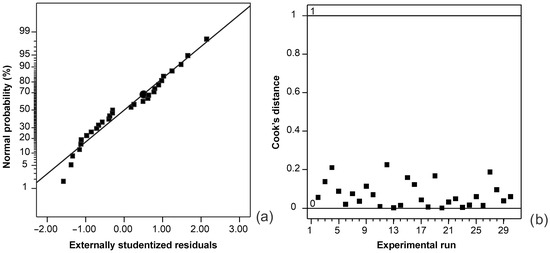
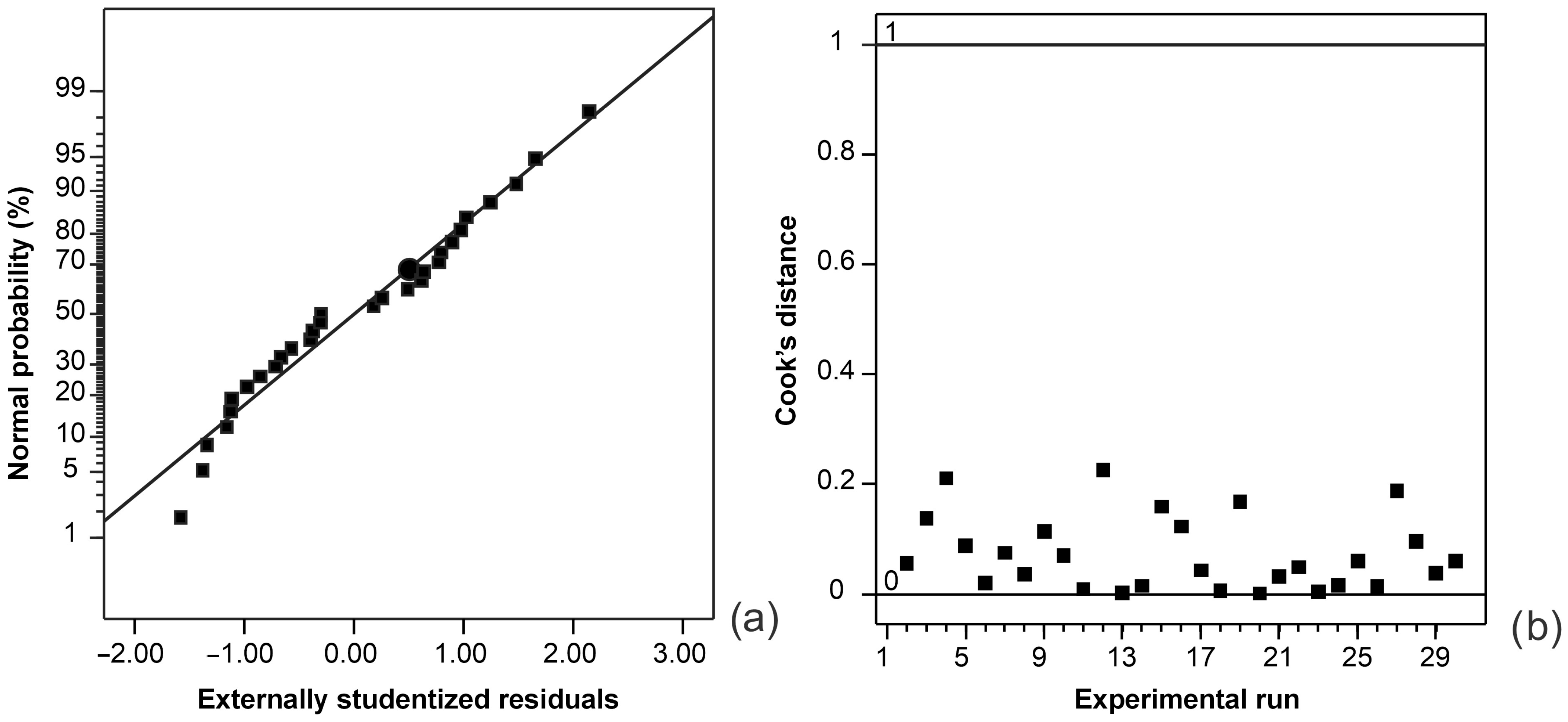
Since the data points are close to the straight line, the residuals are normally distributed, as shown in the normal probability plot (Figure 1a). Cook’s distance analysis (Figure 1b) revealed no influential points, with all values falling below the standard threshold of 1. These findings demonstrate that the model is robust, and no individual data point disproportionately affects its estimates.
Figure 1.
Diagnostic plots of the regression model: (a) normal probability plot for assessing the normality of residuals; (b) Cook’s distance for identifying influential points.
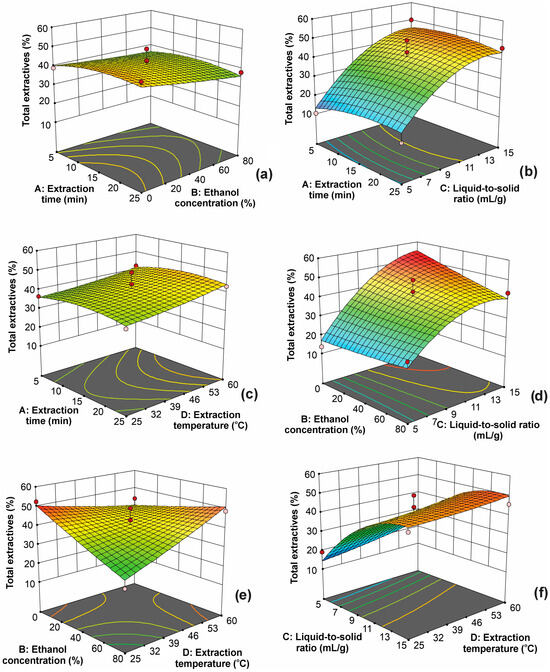
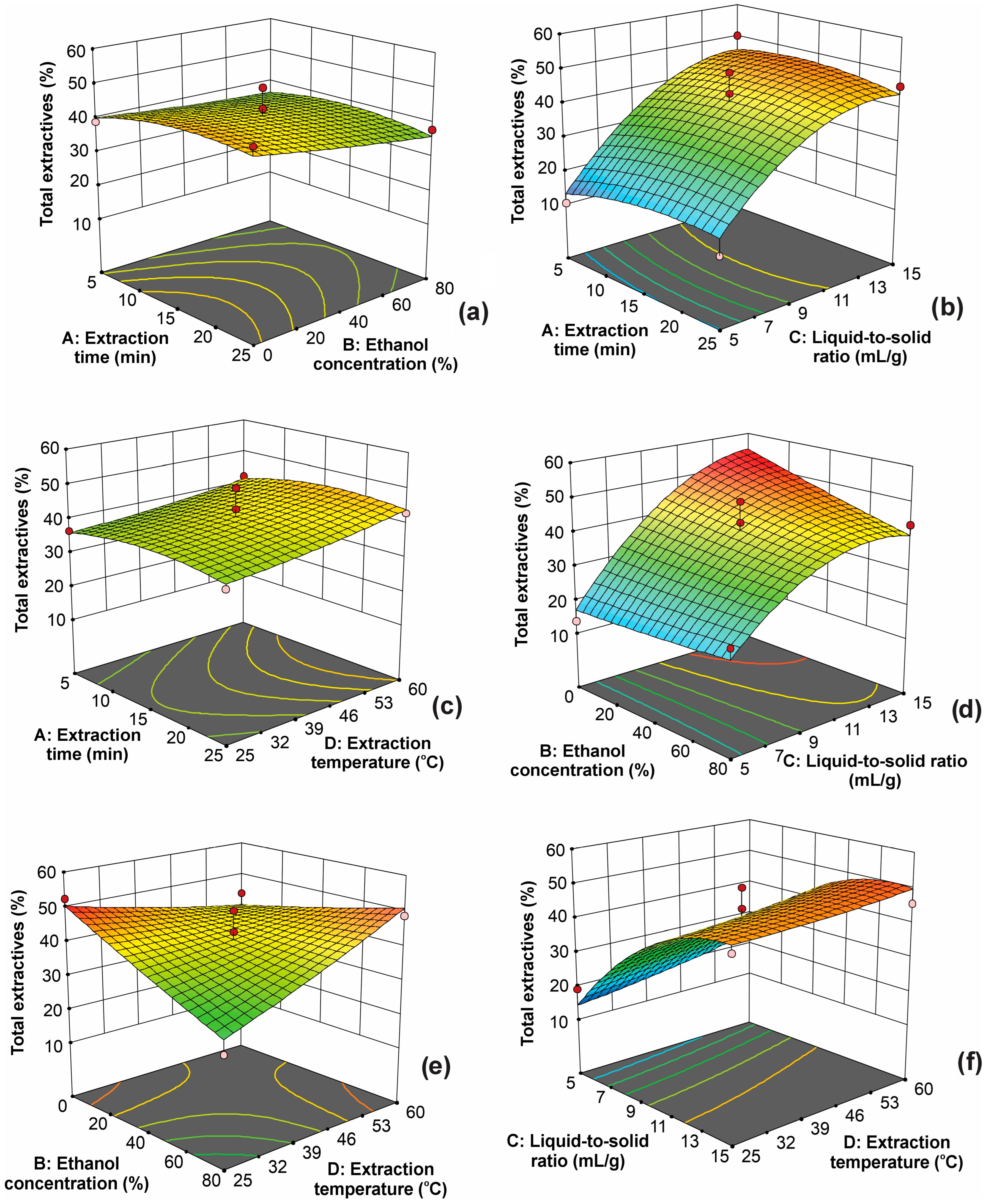
Based on the three-dimensional plots illustrating the dependence of TE yield on various combinations of process parameters (extraction time, ethanol concentration, liquid-to-solid ratio, and temperature), the relative importance and influence of each factor can be assessed. A three-dimensional response, illustrating the combined effects of extraction time and ethanol concentration on the TE content at a liquid-to-solid ratio of 10 mL/g and an extraction temperature of 42.5 °C, is presented in Figure 2a. A pronounced non-linear interaction between these parameters is observed, and only a minor effect on TE yield is noted. In the initial extraction phase, increasing extraction time enhances TE yield due to improved solute diffusion and mass transfer. The TE yield plateaus after a specific time, reflecting solvent saturation and equilibrium in mass transfer. Further extraction beyond this stage does not increase yield and may cause partial degradation of the extracted bioactive compounds. Similar trends have been reported in the literature, where extraction time is identified as a critical factor influencing extraction efficiency [18]. Importantly, the present results demonstrate that equilibrium is attained substantially faster than in conventional extraction approaches. While TE yield increases with extraction time, UAE achieves equilibrium in only about one-quarter of the time needed for reflux extraction [19]. This accelerated equilibrium results from the enhanced mass transfer and cell disruption induced by ultrasonic cavitation, highlighting the superior efficiency and time-saving benefits of UAE.
Figure 2.
Interaction effects between process variables: (a) extraction time and ethanol concentration (10 mL/g, 42.5 °C); (b) extraction time and liquid-to-solid ratio (40% (v/v) ethanol, 42.5 °C); (c) extraction time and extraction temperature (40% (v/v) ethanol, 10 mL/g); (d) ethanol concentration and liquid-to-solid ratio (42.5 °C, 15 min); (e) ethanol concentration and extraction temperature (15 min, 10 mL/g); and (f) liquid-to-solid ratio and temperature (15 min, 40% (v/v) ethanol).
The increase in the liquid-to-solid ratio leads to a pronounced enhancement of the TE yield (Figure 2b). This factor exerts the strongest effect by promoting mass transfer, facilitating solvent penetration into plant tissues and the release and dissolution of bioactive compounds until equilibrium is reached. The significant influence of the liquid-to-solid ratio on the extraction of bioactive compounds has been widely reported in the literature [20,21]. Several studies have demonstrated that the total yield of extracted bioactive compounds increases with an increasing liquid-to-solid ratio up to an optimal level [22]. Beyond this optimum, the extraction yield reaches a dynamic equilibrium and subsequently exhibits a marked decline. An appropriate liquid-to-solid ratio is critical for extraction optimization, since excessive solvent use increases costs and reduces sustainability. In Figure 2c, the extraction temperature exerts a stronger effect on TE yield than extraction time. The elevated temperatures accelerate dissolution kinetics and mass-transfer processes of bioactive constituents [18]. The interaction between ethanol concentration and liquid-to-solid ratio (Figure 2d) has an antagonistic effect on the TE yield. The effect of ethanol concentration becomes more pronounced at a higher liquid-to-solid ratio. The maximum TE yields are achieved when both parameters are at their higher levels. Singh et al. [23] reported a comparable influence of these parameters during the UAE of bioactive compounds from giloy. In Figure 2e, a strong synergistic interaction between ethanol concentration and extraction temperature can be noticed. Higher extraction temperatures improve solvent penetration and accelerate diffusion kinetics by reducing viscosity and surface tension. Additionally, higher temperatures facilitate the disruption of cell wall structures, promoting the release of intracellular bioactive constituents. A similar synergistic influence of ethanol concentration and temperature has been reported during the extraction of flavonoids from the stem and leaf waste of Astragalus membranaceus [24]. In Figure 2f, it can be observed that the liquid-to-solid ratio has a dominant influence on TE compared to the extraction temperature.
Summarily, the temperature and the liquid-to-solid ratio are the most critical factors affecting extraction efficiency, whereas extraction time has a minor impact. These results indicate that maximum TE yield can be achieved by performing the extraction at elevated temperatures, increasing the liquid-to-solid ratio, and optimizing ethanol concentration, while keeping the extraction time short without compromising yield. Ultrasonic treatment enhances mass transfer by generating cavitation effects, which disrupt plant cell walls and improve solvent penetration [25]. This leads to more efficient release of TE from wild cyclamen tubers.
3.2. Optimization of the Extraction Process of Total Extractives from Wild Cyclamen Tubers
The extraction process was optimized using the desirability function to determine the optimal combination of input parameters that maximizes TE yield. Based on the obtained results, the desirability value reached 1.000, indicating that the identified solution fully satisfies the defined objectives and constraints. The optimal extraction conditions were determined to be: an extraction time of 15.5 min, 13% (v/v) ethanol, a liquid-to-solid ratio of 13.5 mL/g, and an extraction temperature of 34 °C. Under these conditions, the predicted TE yield was 53.44%, while the experimentally obtained value was 52.87%, demonstrating a high level of agreement between the model and experimental data. Notably, the relatively low ethanol concentration suggests enhanced solubility of the target compounds in an aqueous medium. The optimal liquid-to-solid ratio is close to its upper limit within the design space. Furthermore, the optimal extraction time of approximately 15 min confirms that high extraction efficiency can be achieved within a relatively short processing time. Using this procedure, it is possible to improve process economy and energy efficiency. Overall, the identified optimal conditions represent a well-balanced compromise between extraction efficiency and rational resource utilization and can therefore be recommended for future laboratory-scale and potential industrial applications. To date, the available literature does not report optimized conditions for the extraction of TE from wild cyclamen tubers. The existing studies predominantly focus on the optimization of polyphenol extraction from this plant material [26].
3.3. Chemical Profile of the Wild Cyclamen Tuber Extract
In the wild cyclamen tuber extract obtained under optimal UAE conditions, a total phenolic content of 132.52 ± 1.48 mg GAE/100 g d.w. was determined, indicating an efficient recovery of phenolic compounds under relatively mild processing conditions. Such conditions are particularly advantageous for minimizing the degradation of thermolabile substances and preserving the native phytochemical profile of the extract. The total phenolic content achieved by UAE was lower than that reported in our previous study employing conventional reflux extraction [26]. Despite this fact, it is important to note that the higher total phenolic content obtained previously (177 mg GAE/100 g d. w.) required an almost six-fold longer extraction time (97.7 min), a higher ethanol concentration (36.2%, v/v), and a markedly greater liquid-to-solid ratio (25 mL/g). These conditions increase the consumption of solvents and energy, thereby reducing the overall sustainability of the process. The enhanced performance of the UAE can be attributed to the acoustic cavitation phenomenon, which disrupts plant cell walls, improves solvent penetration, and intensifies mass transfer, leading to the rapid release of polyphenolic compounds [27]. Consequently, the slightly lower polyphenol yield obtained via UAE can be considered an acceptable and rational trade-off, given the substantial gains in extraction speed, energy efficiency, and adherence to the principles of green and sustainable extraction technologies. Mahomoodally et al. [28] reported that the methanolic extract of Cyclamen coum Mill. tubers contained a higher total phenolic content (6.96 ± 0.46 mg GAE/g extract) than the corresponding aqueous extract (5.97 ± 0.06 mg GAE/g extract). Aydin et al. [10] reported that ethanol is a more effective solvent for the extraction of polyphenols from Cyclamen coum tuber compared to methanol and acetone. In their study, an ethanolic extract prepared at 55 °C for 6 h exhibited the total phenolic content of 4.69 ± 3.02 mg GAE/mL of the extract. Considering the liquid-to-solid ratio of 10 mL/g, this corresponds to approximately 46.9 ± 30.2 mg GAE/g of plant material. Based on this result, it can be concluded that their total phenol content is significantly lower than the result obtained in our study. Further comparison of the obtained total phenol content is not possible because the values are expressed in different units.
The pronounced saponin content (16.19 g SE/100 g d.w.) confirms the dominance of this class of compounds in wild cyclamen tubers compared to the others. This level of saponins is consistent with previous phytochemical reports on the genus Cyclamen [29]. It provides a strong chemical basis for the biological effects traditionally attributed to this plant, including anti-inflammatory, antimicrobial, and cytotoxic properties [11]. The high saponin content may also explain the observed hemolytic and membrane-active properties of the extract [30]. The presence of polyphenols and saponins can potentially exert a synergistic effect on the biological activity of the extract.
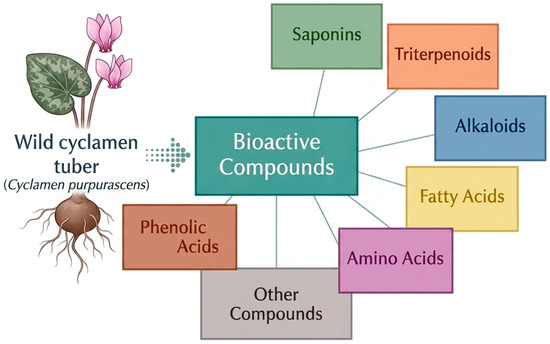
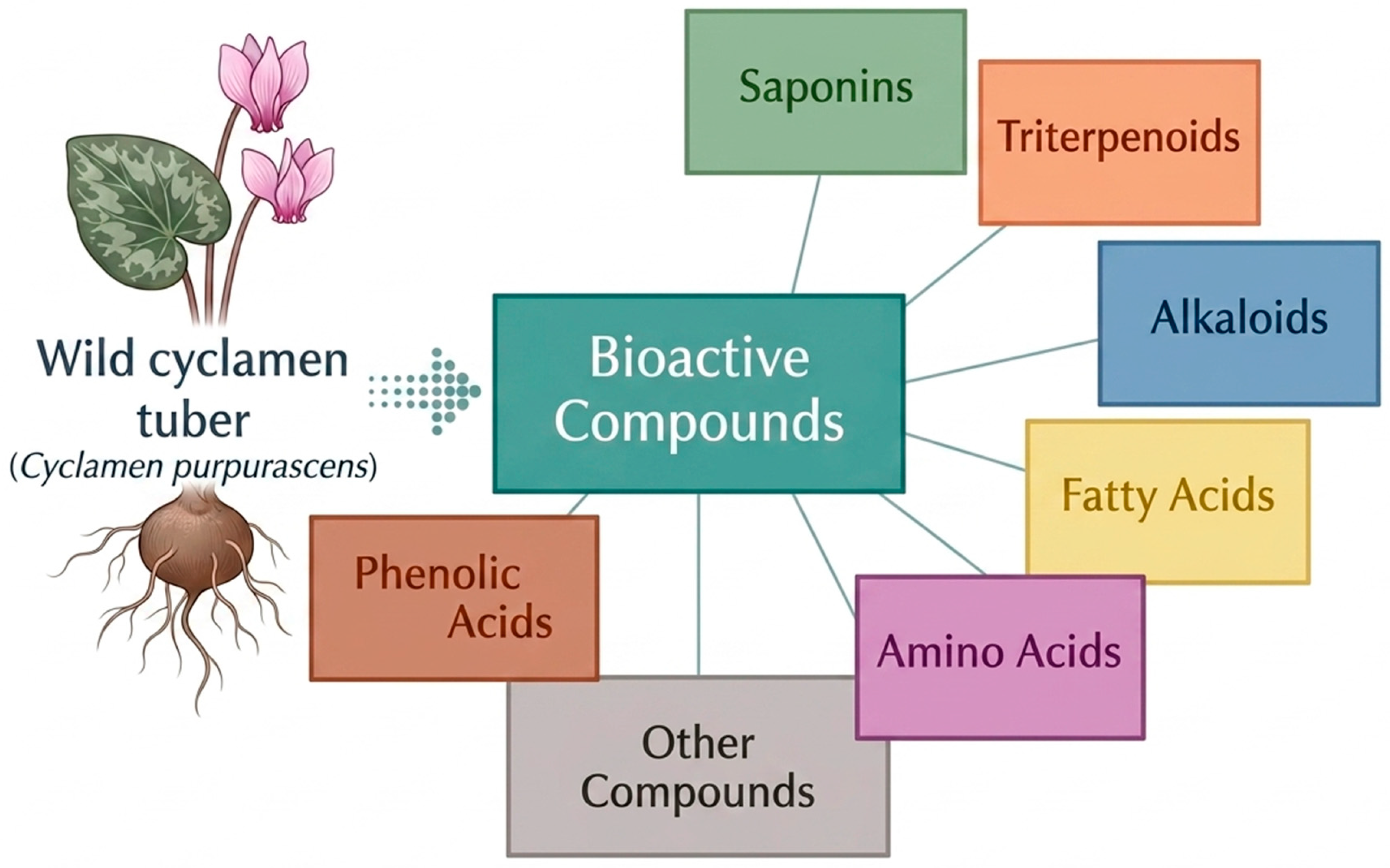
UHPLC–ESI–MS/MS analysis of the tuber extract prepared under optimal conditions revealed an exceptionally complex and chemically diverse profile of secondary metabolites (Figure 3).
Figure 3.
Schematic representation of the major classes of compounds identified in the plant extract of wild cyclamen tuber.
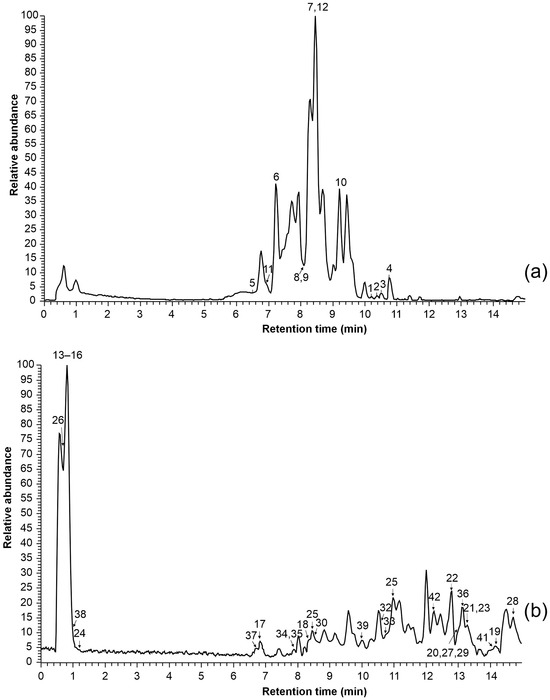
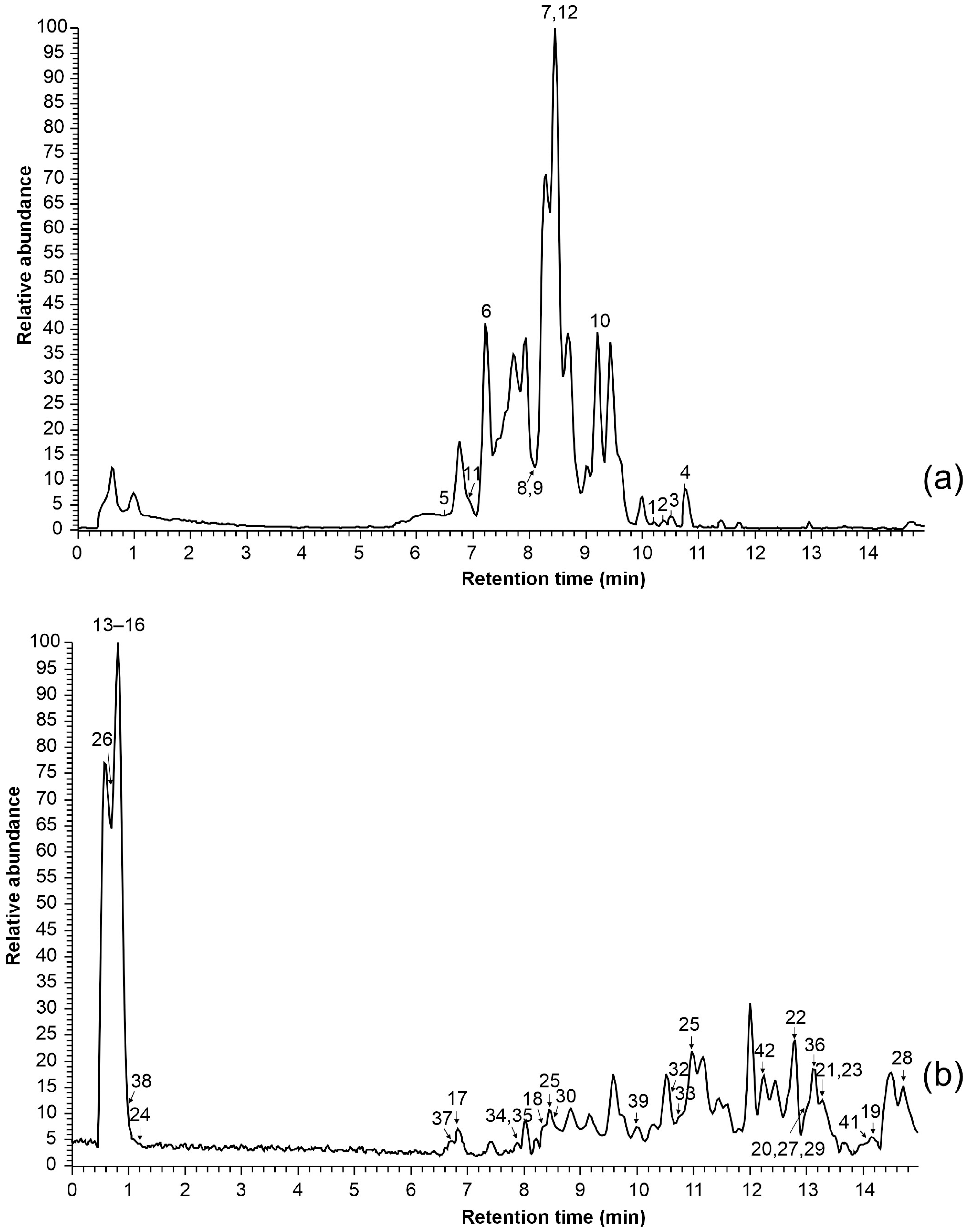
Numerous bioactive compounds, including triterpene saponins, flavonoids, alkaloids, terpenoids, fatty acids, steroids, and phenolic compounds, were detected under both negative and positive ionization modes (Figure 4). In Table 4, tentatively identified bioactive compounds in the wild cyclamen tuber are presented. A significant fraction of the detected components could not be identified. This is primarily attributed to the lack of available reference compounds for the less common phytochemicals present in Cyclamen tubers, as well as the limitations of the mass spectral libraries for specific plant-derived secondary metabolites. Furthermore, some compounds exhibited low intensities near the limit of detection, which hindered the acquisition of high-quality MS fragmentation spectra sufficient for definitive or even tentative structural elucidation. This highlights the complexity of the cyclamen chemical matrix and suggests that these minor components may represent novel derivatives or conjugates.
Figure 4.
UHPLC–ESI–MS/MS chromatograms of cyclamen tuber extract obtained in (a) negative and (b) positive electrospray ionization modes, based on the base peak within the m/z range of 100–1500. The numbers in the chromatograms correspond to the reference numbers of tentatively identified bioactive compounds listed in Table 4.
Table 4.
Bioactive compounds tentatively identified in wild cyclamen tuber extract by UHPLC–ESI–MS/MS in both electrospray ionization modes.
Triterpene saponins represented the predominant group of identified compounds, which is consistent with previous reports describing the genus Cyclamen as a rich source of this class of metabolites [47]. The presence of cyclacoumin (m/z 1075.54), its isomers (m/z 1105.48 and m/z 1219.89), and structurally related saponins were confirmed by characteristic fragmentation patterns observed in the negative ionization mode, involving successive losses of sugar moieties and the formation of stable aglycone ions. The detection of high m/z values, along with fragment ions at m/z 943, m/z 897, and m/z 765, indicates the presence of complex oligosaccharide chains linked to a triterpenoid backbone. In addition to cyclacoumin derivatives, ginsenosides Ra3 (m/z 1239.79), notoginsenoside A (m/z 1255.37), and yesanchinoside H (m/z 1267.18) were identified. Their presence in tubers may reflect structural convergence of saponin metabolites or conserved biosynthetic pathways across different plant taxa. These compounds are well known for their pronounced pharmacological properties, including anti-inflammatory, cytotoxic, and immunomodulatory activities [48].
The flavonoid profile of the extract comprised flavonols and flavonoid glycosides, including isorhamnetin derivative (m/z 315.25), herbacetin (m/z 303), and apigenin-6,8-di-C-β-D-glucoside (m/z 455.22) along with its isomer (m/z 659.27). These compounds are widely recognized for their strong antioxidant, anti-inflammatory, and cytoprotective properties [49]. Of particular interest is the detection of isorhamnetin-3-O-glucuronide, a metabolically stable flavonoid conjugate often associated with favorable bioavailability. The identification of 4-O-caffeoylquinic acid isomer further supports the phenolic nature of the extract and its contribution to antioxidant capacity. In the positive ionization mode, several nitrogen-containing compounds, including amino acids and alkaloids, were identified. The detection of L-leucine (m/z 132.02), L-phenylalanine (m/z 166.03), and D-arginine (m/z 175.04) reflects the primary metabolic status of the tubers, whereas the detection of alkaloids, such as reticuline (m/z 330), N-methylcoclaurine N-oxide (m/z 316.92), and trans-indole-3-acrylic acid (m/z 188), suggests the presence of active secondary metabolic pathways. The extract is also rich in terpenoids, including diterpenoids, triterpenoids, and tetraterpenes, which have also been previously reported in methanolic and aqueous tuber extracts of Cyclamen coum Mill. [28]. The identification of hederagonic acid (m/z 471.22), lupenone (m/z 425), and lycopene or β-carotene (m/z 537.28) suggests an active terpenoid metabolism, which is commonly associated with anti-inflammatory, antimicrobial, and cytotoxic effects [50]. The presence of ergosterol endoperoxide (m/z 429), a compound known for its antitumor and immunomodulatory activities [51], further enhances the biological relevance of the extract. In addition, several fatty acids and their oxidized derivatives, such as α-linolenic acid (m/z 297.09), oleamide (m/z 282.26), and oxo-octadecadienoic acid (m/z 295.1), were detected and may contribute to the regulation of inflammatory processes and cellular metabolism. The numerous components that were detected but unidentified, especially at higher m/z values, indicate the existence of previously uncharacterized secondary metabolites that may significantly contribute to the overall biological activity of the extract. These findings indicate the need for further detailed structural and biological investigations.
3.4. Antioxidant Activity of Wild Cyclamen Tuber Extract
This pronounced chemical diversity reflects the complexity of the metabolic network in the wild cyclamen tubers and provides a solid basis for a wide range of potential biological activities. The antioxidant potential of the analyzed extract was evaluated using three in vitro assays (DPPH, ABTS+, and CUPRAC), enabling a broader interpretation of its redox behavior. As demonstrated by the DPPH assay, the extract exhibited considerably weaker radical-scavenging activity (IC50 = 4.60 mg/mL) compared to the synthetic antioxidant BHT (IC50 = 0.036 mg/mL). This marked difference is expected given that BHT is a pure, low-molecular-weight phenolic antioxidant with high hydrogen-donating efficiency. The extract represents a chemically complex matrix dominated by triterpene saponins. Such compounds, although biologically active, are generally characterized by limited direct hydrogen atom transfer capacity toward stable free DPPH radicals.
In the ABTS assay, a concentration-dependent increase in radical scavenging was observed, reaching approximately 50% inhibition at 4.95 mg/mL. Compared to DPPH, the higher responsiveness in the ABTS system may be attributed to differences in reaction mechanisms and solvent compatibility. ABTS•+ is soluble in both aqueous and organic media and can react with a broader spectrum of antioxidants, including moderately polar constituents [52]. Nevertheless, the concentrations required to achieve substantial ABTS•+ scavenging remain considerably higher than those typical for potent phenolic-rich extracts.
The CUPRAC assay results provide additional insight into the reducing capacity of the extract. A gradual increase in cupric ion-reducing activity was observed with rising concentrations. However, the absorbances remained markedly lower than those recorded for α-tocopherol and BHT across all tested concentrations. While reference antioxidants exceeded the upper detection limit (>4.00 AU) at higher concentrations, the cyclamen extract reached only 1.23 AU at 20 mg/mL. Since the CUPRAC method primarily reflects electron transfer capacity, these findings suggest a limited abundance of strong electron-donating compounds within the extract.
Flavonoids and phenolic acids are well-established antioxidants capable of both hydrogen atom donation and electron transfer [53]. Their apparently low contribution to the overall antioxidant profile of the extract can likely be attributed to the optimized extraction conditions. The relatively low ethanol concentration (13.02%, v/v) favors the extraction of highly polar glycosidic saponins over less polar phenolic compounds. These findings are consistent with previous reports demonstrating significantly enhanced antiradical activity in cyclamen tuber extracts prepared with higher ethanol concentrations (≥70%, v/v), which more efficiently recover polyphenolic constituents regarded as the principal contributors to radical-scavenging activity [9,10]. Moreover, the UAE under mild temperature and short extraction time did not ensure exhaustive extraction of bound or less accessible phenolics.
When compared to reported data for Cyclamen africanum (DPPH IC50 78.66 ± 12.09 μg/mL, ABTS IC50 4.72 ± 1.77 μg/mL, and CUPRAC A0.5 42.01 ± 1.91 μg/mL) [9] and Cyclamen coum (DPPH IC50 129.74 ± 0.02 μg/mL and ABTS IC50 118.04 ± 0.07 μg/mL) [10], our extract exhibits lower activity, which is directly linked to the applied extraction strategy. While traditional protocols aim to maximize polyphenol yield, our optimized UAE protocol was intentionally designed to selectively prioritize triterpene saponins. This is quantitatively confirmed by the massive imbalance in the phytochemical profile, with a saponin-to-phenolic mass ratio of ~123:1 (16.19 g SE/100 g vs. 0.132 g GAE/100 g). Given that triterpene saponins possess negligible hydrogen-donating or electron-transfer capacity, they act as an inert matrix that dilutes the concentration of potent phenolic compounds. Consequently, the observed antioxidant activity is strictly proportional to the limited phenolic content recovered under these specific conditions, explaining the disparity compared to high-ethanol extracts that typically yield a broader spectrum of phenolic constituents.
3.5. Antibacterial Activity of the Wild Cyclamen Tuber Extract
The antibacterial activity of the ethanol extract was evaluated using MIC values (Table 5). The extract showed selective inhibitory activity against S. aureus and E. coli (MIC = 10.00 mg/mL). While these values are higher than those of the reference antibiotic gentamicin (0.01–5.00 mg/mL), they demonstrate the functional potential of the crude extract. Compared to the C. coum extract reported by Aydin et al. [10], our higher MIC values indicate that antibacterial activity varies significantly between species. This suggests that the inhibitory effect is strongly dependent on the specific saponin and phenolic content of the extract.
Table 5.
Minimal inhibitory concentrations of wild cyclamen tuber extract and reference antibiotic gentamicin against the various bacterial strains.
The observed susceptibility patterns among strains are inherently linked to cell wall architecture. Gram-negative bacteria possess an outer membrane rich in lipopolysaccharides. It acts as a robust permeability barrier that restricts the diffusion of bioactive compounds, thus necessitating higher inhibitory concentrations. Conversely, the absence of this barrier in Gram-positive bacteria typically facilitates the interaction of plant constituents with the cytoplasmic membrane. However, the resistance observed in B. cereus and E. faecalis in this study indicates that susceptibility is not governed solely by the cell wall structure, but primarily by the specific phytochemical composition of the crude extract. The moderate activity at 10.00 mg/mL implies that the current extraction protocol yields a matrix where bioactive compounds are highly diluted. It justifies the need for further fractionation to isolate more potent antimicrobial agents.
4. Conclusions
In this study, a UAE procedure for the recovery of TE from wild cyclamen tubers was successfully developed and optimized using a Box–Behnken design. Among the parameters analyzed, the liquid-to-solid ratio and extraction temperature had the most pronounced effect on the yield. The optimized parameters (15.5 min, 13% (v/v) ethanol, and 34 °C) provide a rapid and cost-effective protocol for the potential scale-up applications of cyclamen saponins, minimizing solvent and energy consumption in accordance with the principles of green chemistry.
Chemical characterization by UHPLC–MS/MS confirmed the predominance of triterpene saponins (16.19 g/100 g), establishing these tubers as a highly valuable raw material compared to other secondary metabolites, such as phenols and flavonoids. The observed antioxidant and antibacterial activities are directly related to this specific saponin-rich profile, rather than to the high phenolic content. From an industrial perspective, this optimized process is highly scalable, offering a sustainable method for producing standardized saponin-rich extracts. These extracts show significant potential as active ingredients in the pharmaceutical and cosmetic industries, as natural foaming agents or active components in dermatological formulations. Additionally, a significant portion of the minor compounds remained unidentified, likely due to the lack of reference standards and spectral library constraints. Consequently, future research directions should prioritize the large-scale isolation and absolute structural elucidation of these unknown compounds to fully understand the chemical diversity of the species.
Author Contributions
Conceptualization, I.M.S. and I.M.S.G.; methodology, I.M.S., I.M.S.G. and J.V.; software, I.M.S.; validation, I.M.S.G. and J.V.; formal analysis, I.M.S., I.M.S.G. and J.V.; investigation, M.G.S. and J.V.; resources, I.M.S.G. and J.V.; data curation, M.G.S., I.M.S., I.M.S.G. and J.V.; writing—original draft, I.M.S., I.M.S.G. and J.V.; writing—review and editing, I.M.S., I.M.S.G. and J.V.; visualization, I.M.S. and I.M.S.G.; supervision, I.M.S., I.M.S.G. and J.V.; project administration, I.M.S.G. and J.V.; funding acquisition, I.M.S., I.M.S.G. and J.V. All authors have read and agreed to the published version of the manuscript.
Funding
This research was supported by the Ministry of Science, Technological Development and Innovation of the Republic of Serbia, 451-03-34/2026-03/200133 and 451-03-33/2026-03/200051.
Data Availability Statement
The original contributions presented in this study are included in the article. Further inquiries can be directed to the corresponding author.
Acknowledgments
The authors have reviewed and edited the output and take full responsibility for the content of this publication.
Conflicts of Interest
The authors declare no conflicts of interest.
References
- Global Market Insights. Botanical Extracts Market. Available online: https://www.gminsights.com/industry-analysis/botanical-extracts-market (accessed on 14 March 2026).
- Putra, N.R.; Fajriah, S.; Qomariyah, L.; Dewi, A.S.; Rizkiyah, D.N.; Irianto, I.; Rusmin, D.; Melati, M.; Trisnawati, N.W.; Darwati, I.; et al. Exploring the potential of Ulva lactuca: Emerging extraction methods, bioactive compounds, and health applications—A perspective review. S. Afr. J. Chem. Eng. 2024, 47, 233–245. [Google Scholar] [CrossRef] [Scilit]
- Shehzadi, F.; Shoaib, M.; Munir, S.; Abdi, G. Ultrasound-assisted extraction of bioactive compounds from pomegranate peel and seed: A comprehensive review of key parameters and optimization strategies. Ultrason. Sonochem. 2026, 124, 107722. [Google Scholar] [CrossRef] [Scilit]
- Pereira, T.C.; Souza, V.P.; Padilha, A.P.F.; Duarte, F.A.; Flores, E.M. Trends and perspectives on the ultrasound-assisted extraction of bioactive compounds using natural deep eutectic solvents. Curr. Opin. Chem. Eng. 2025, 47, 101088. [Google Scholar] [CrossRef] [Scilit]
- Gul, H.; Nakilcioğlu, E. Process optimization of bioactive compounds extraction from bee bread using deep eutectic solvents: A response surface methodology approach. J. Food Meas. Charact. 2026, 20, 5587–5599. [Google Scholar] [CrossRef] [Scilit]
- Myo, H.; Khat-udomkiri, N.; Kittakoop, P.; Phanumartwiwath, A. Sustainable biovalorization of Centella asiatica L. urban using butylene glycol: A green extraction for anti-acne and wound healing potential. Green Chem. Lett. Rev. 2026, 19, 2607225. [Google Scholar]
- Yesson, C.; Culham, A. A phyloclimatic study of Cyclamen. BMC Evol. Biol. 2006, 6, 72. [Google Scholar] [CrossRef] [Scilit]
- Anderberg, A.A.; Trift, I.; Källersjö, M. Phylogeny of Cyclamen L. (Primulaceae): Evidence from morphology and sequence data from the internal transcribed spacers of nuclear ribosomal DNA. Plant Syst. Evol. 2000, 220, 147–160. [Google Scholar] [CrossRef] [Scilit]
- Amari, A.; Seridi, R.; Sadou, N.; Gali, L.; Mekersi, N.; Rachedi, B.A. Chemical profiles and biological potential of different parts of Cyclamen africanum Boiss. & Reuter—A medicinal plant. J. Herb. Med. 2023, 42, 100769. [Google Scholar] [CrossRef] [Scilit]
- Aydin, C.; Mammadov, R.; Davidov, M. Biological activities, phenolic constituents and of various extracts of Cyclamen coum tubers and leaves from Turkey. Chem. Plant Raw Mater. 2023, 1, 255–263. [Google Scholar] [CrossRef] [Scilit]
- Al-Rimawi, F.; Khalid, M.; Salah, Z.; Zawahreh, M.A.A.; Alnasser, S.M.; Alshammari, S.O.; Wedian, F.; Karimulla, S.; Almutairi, A.; Alanazi, F.I.B.; et al. Anticancer, antioxidant, and antibacterial activity of chemically fingerprinted extract from Cyclamen persicum Mill. Sci. Rep. 2024, 14, 8488. [Google Scholar] [CrossRef] [Scilit]
- Sharara, A.; Badran, A.; Hijazi, A.; Albahri, G.; Bechelany, M.; Mesmar, J.E.; Baydoun, E. Comprehensive review of Cyclamen: Development, bioactive properties, and therapeutic applications. Pharmaceuticals 2024, 17, 848. [Google Scholar] [CrossRef] [Scilit] [PubMed]
- Savić, I.M.; Savić Gajić, I.M. Optimization study on extraction of antioxidants from plum seeds (Prunus domestica L.). Optim. Eng. 2021, 22, 141–158. [Google Scholar]
- Mora-Ocación, M.S.; Morillo-Coronado, A.C.; Manjarres-Hernández, E.H. Extraction and quantification of saponins in quinoa (Chenopodium quinoa Willd.) genotypes from Colombia. Int. J. Food Sci. 2022, 2022, 7287487. [Google Scholar] [CrossRef] [Scilit]
- Boškov, I.A.; Savić, I.M.; Grozdanić Stanisavljević, N.Đ.; Kundaković-Vasović, T.D.; Radović Selgrad, J.S.; Savić Gajić, I.M. Stabilization of black locust flower extract via encapsulation using alginate and alginate–chitosan microparticles. Polymers 2024, 16, 688. [Google Scholar] [CrossRef] [Scilit]
- Vasiljevic, Z.; Vunduk, J.; Bartolic, D.; Miskovic, G.; Ognjanovic, M.; Tadic, N.B.; Nikolic, M.V. An eco-friendly approach to ZnO NP synthesis using Citrus reticulata blanco peel/extract: Characterization and antibacterial and photocatalytic activity. ACS Appl. Bio Mater. 2024, 7, 3014–3032. [Google Scholar]
- Vunduk, J.; Klaus, A.; Lazić, V.; Kozarski, M.; Radić, D.; Šovljanski, O.; Pezo, L. Artificial neural network prediction of antiadhesion and antibiofilm-forming effects of antimicrobial active mushroom extracts on food-borne pathogens. Antibiotics 2023, 12, 627. [Google Scholar] [CrossRef] [Scilit]
- Rani, U.; Kaur, S.; Panesar, P.S.; Chopra, H.K. Effect of ultrasound on the extraction of bioactive compounds from jamun (Syzygium cumini L.) seeds. Biomass Convers. Biorefinery 2025, 15, 31461–31474. [Google Scholar]
- Dulo, B.; De Somer, T.; Moyo, M.; Nakyese, E.; Githaiga, J.; Raes, K.; De Meester, S. Kinetic modeling of phenolic compounds extraction from nutshells: Influence of particle size, temperature and solvent ratio. Biomass Convers. Biorefinery 2024, 14, 23565–23579. [Google Scholar] [CrossRef] [Scilit]
- Lima, R.C.; de Carvalho, A.P.A.; da Silva, B.D.; Torres-Neto, L.; de Figueiredo, M.R.D.S.; Chaves, P.; de Almeida, A.E.C.C.; Conte-Junior, C. Green ultrasound-assisted extraction of bioactive compounds of babassu (Attalea speciosa) mesocarp: Effects of solid-liquid ratio extraction, antioxidant capacity, and antimicrobial activity. Appl. Food Res. 2023, 3, 100331. [Google Scholar] [CrossRef] [Scilit]
- Nakra, S.; Tripathy, S.; Srivastav, P.P. Green and sustainable extraction of bioactive compounds from Centella asiatica leaves using microwave pretreatment and ultrasonication: Kinetics, process optimization, and biological activity. Food Biophys. 2025, 20, 56. [Google Scholar] [CrossRef] [Scilit]
- Nekkaa, A.; Benaissa, A.; Lalaouna, A.E.; Mutelet, F.; Canabady-Rochelle, L. Optimization of the extraction process of bioactive compounds from Rhamnus alaternus leaves using Box-Behnken experimental design. J. Appl. Res. Med. Aromat. Plants 2021, 25, 100345. [Google Scholar] [CrossRef] [Scilit]
- Singh, S.M.; Tripathy, S.; Srivastav, P.P. Bioactive compound extraction from giloy leaves and steam using ultrasound: Bioactivity, antimicrobial, and LC–MS/MS study. Food Sci. Biotechnol. 2025, 34, 1835–1847. [Google Scholar] [CrossRef] [Scilit]
- Yang, X.; Xu, Y.; Huo, H. Optimization of flavonoids from Astragalus membranaceus stem and leaf waste using nonionic surfactant-integrated ultrasound-assisted extraction. Ultrason. Sonochem. 2025, 122, 107606. [Google Scholar] [CrossRef] [Scilit]
- Mushtaq, M.; Amin, Q.A.; Wani, T.A.; Hussain, S.Z.; Bhat, T.A.; Parveen, S.; Chaudhary, A.A.; Ali, M.A.M.; Qadri, T.; Amin, I. Cavitation-driven extraction: How ultrasound-induced acoustic cavitation maximizes bioactive compound recovery from Saussurea costus roots. Ultrason. Sonochem. 2025, 122, 107643. [Google Scholar] [CrossRef] [Scilit]
- Savic-Gajic, I.; Savic, I. Optimization of process parameters for extraction of polyphenolic compounds from wild cyclamen (Cyclamen purpurascens Mill.) tubers. Mater. Methods Technol. 2017, 11, 420–429. [Google Scholar]
- Siddique, M.; Rashid, R.; Ali, A. Fundamentals of acoustic cavitation, ultrasound-assisted processes, and sonochemistry. In Modeling and Simulation of Sono-Processes; Elsevier: Amsterdam, The Netherlands, 2025; pp. 3–17. [Google Scholar]
- Mahomoodally, M.F.; Picot-Allain, M.C.N.; Zengin, G.; Llorent-Martínez, E.J.; Stefanucci, A.; Ak, G.; Senkardes, I.; Tomczyk, M.; Mollica, A. Chemical profiles and biological potential of tuber extracts from Cyclamen coum Mill. Biocatal. Agric. Biotechnol. 2021, 33, 102008. [Google Scholar] [CrossRef] [Scilit]
- Saboora, A.; Sajjadi, S.T.; Mohammadi, P.; Fallahi, Z. Antibacterial activity of different composition of aglycone and glycosidic saponins from tuber of Cyclamen coum Miller. Ind. Crops Prod. 2019, 140, 111662. [Google Scholar] [CrossRef] [Scilit]
- Fernández-Campos, F.; Clares, B.; Rodríguez-Lagunas, M.J.; Jauregui, O.; Casals, I.; Calpena, A.C. Ex-vivo and in-vivo assessment of Cyclamen europaeum extract after nasal administration. Pharmaceutics 2019, 11, 426. [Google Scholar] [CrossRef] [Scilit]
- Ben Said, R.; Hamed, A.I.; Mahalel, U.A.; Al-Ayed, A.S.; Kowalczyk, M.; Moldoch, J.; Oleszek, W.; Stochmal, A. Tentative characterization of polyphenolic compounds in the male flowers of Phoenix dactylifera by liquid chromatography coupled with mass spectrometry and DFT. Int. J. Mol. Sci. 2017, 18, 512. [Google Scholar] [CrossRef] [Scilit]
- Zeng, Y.; Lu, Y.; Chen, Z.; Tan, J.; Bai, J.; Li, P.; Wang, Z.; Du, S. Rapid characterization of components in Bolbostemma paniculatum by UPLC/LTQ-Orbitrap MSn analysis and multivariate statistical analysis for herb discrimination. Molecules 2018, 23, 1155. [Google Scholar] [CrossRef] [Scilit]
- Emad, A.M.; Rasheed, D.M.; El-Kased, R.F.; El-Kersh, D.M. Antioxidant, antimicrobial activities and characterization of polyphenol-enriched extract of Egyptian celery (Apium graveolens L., Apiaceae) aerial parts via UPLC/ESI/TOF-MS. Molecules 2022, 27, 698. [Google Scholar] [CrossRef] [Scilit]
- Sun, T.T.; Liang, X.L.; Zhu, H.Y.; Peng, X.L.; Guo, X.J.; Zhao, L.S. Rapid separation and identification of 31 major saponins in Shizhu ginseng by ultra-high performance liquid chromatography–electron spray ionization–MS/MS. J. Ginseng Res. 2016, 40, 220–228. [Google Scholar] [CrossRef] [Scilit] [PubMed]
- Wan, J.B.; Zhang, Q.W.; Hong, S.J.; Li, P.; Li, S.P.; Wang, Y.T. Chemical investigation of saponins in different parts of Panax notoginseng by pressurized liquid extraction and liquid chromatography-electrospray ionization-tandem mass spectrometry. Molecules 2012, 17, 5836–5853. [Google Scholar] [CrossRef] [Scilit]
- Wang, J.; Du, Y.; Jiang, L.; Li, J.; Yu, B.; Ren, C.; Yan, T.; Jia, Y.; He, B. LC-MS/MS-based chemical profiling of water extracts of Moringa oleifera leaves and pharmacokinetics of their major constituents in rat plasma. Food Chem. X 2024, 23, 101585. [Google Scholar] [CrossRef] [Scilit]
- Wang, X.; Zhong, X.J.; Zhou, N.; Cai, N.; Xu, J.H.; Wang, Q.B.; Li, J.J.; Liu, Q.; Lin, P.C.; Shang, X.Y. Rapid characterizaiton of chemical constituents of the tubers of Gymnadenia conopsea by UPLC–Orbitrap–MS/MS analysis. Molecules 2020, 25, 898. [Google Scholar] [CrossRef] [Scilit]
- Farag, M.A.; Kabbash, E.M.; Mediani, A.; Döll, S.; Esatbeyoglu, T.; Afifi, S.M. Comparative metabolite fingerprinting of four different cinnamon species analyzed via UPLC–MS and GC–MS and chemometric tools. Molecules 2022, 27, 2935. [Google Scholar] [CrossRef] [Scilit]
- Wu, Y.; Zhang, H.; Zhu, J.; Zhang, Z.; Ma, S.; Zhao, Y.; Wang, Y.; Yuan, J.; Guo, X.; Li, Y.; et al. The effect of fermentation on the chemical constituents of Gastrodia tuber hallimasch powder (GTHP) estimated by UHPLC-Q-Orbitrap HRMS and HPLC. Molecules 2024, 29, 1663. [Google Scholar] [CrossRef] [Scilit]
- Razgonova, M.; Kulikova, V.; Khodaeva, V.; Bolotova, L.; Baigarashev, T.; Plotnikova, N.; Zakharenko, A.; Golokhvast, K. Simultaneous determination of steroidal alkaloids and polyphenol group from eight varieties of Siberian Solanum tuberosum L. through tandem mass spectrometry. Agriculture 2023, 13, 758. [Google Scholar] [CrossRef] [Scilit]
- Da Silva Antonio, A.; Dos Santos, G.R.C.; Pereira, H.M.G.; Da Veiga-Junior, V.F.; Wiedemann, L.S.M. Chemical profile of Ocotea delicata (Lauraceae) using ultra high-performance liquid chromatography–high-resolution mass spectrometry–Global Natural Products Social Molecular Networking workflow. Plants 2024, 13, 859. [Google Scholar] [CrossRef] [Scilit]
- Li, W.; Lin, Y.; Wang, Y.; Hong, B. Development of a matrix solid-phase dispersion extraction combined with UPLC/Q-TOF-MS for determination of phenolics and terpenoids from the Euphorbia fischeriana. Molecules 2017, 22, 1524. [Google Scholar] [CrossRef] [Scilit] [PubMed]
- Abdel Ghani, A.E.; Al-Saleem, M.S.; Abdel-Mageed, W.M.; AbouZeid, E.M.; Mahmoud, M.Y.; Abdallah, R.H. UPLC-ESI-MS/MS profiling cytotoxic, antioxidant, anti-inflammatory, antidiabetic, and antiobesity activities of the non-polar fractions of Salvia hispanica L. aerial parts. Plants 2023, 12, 1062. [Google Scholar] [CrossRef] [Scilit]
- Ruslin; Yamin; Rahma, N.A.; Irnawati; Rohman, A. UPLC MS/MS profile and antioxidant activities from nonpolar fraction of patiwala (Lantana camara) leaves extract. Separations 2022, 9, 75. [Google Scholar] [CrossRef] [Scilit]
- Pham, H.N.; Tran, C.A.; Trinh, T.D.; Nguyen Thi, N.L.; Tran Phan, H.N.; Le, V.N.; Le, N.H.; Phung, V.T. UHPLC-Q-TOF-MS/MS dereplication to identify chemical constituents of Hedera helix leaves in Vietnam. J. Anal. Methods Chem. 2022, 2022, 1167265. [Google Scholar]
- Grochowski, D.M.; Uysal, S.; Aktumsek, A.; Granica, S.; Zengin, G.; Ceylan, R.; Locatelli, M.; Tomczyk, M. In vitro enzyme inhibitory properties, antioxidant activities, and phytochemical profile of Potentilla thuringiaca. Phytochem. Lett. 2017, 20, 365–372. [Google Scholar] [CrossRef] [Scilit]
- Hekmati, Z.; Solouki, M.; Emamjomeh, A.; Zahiri, J.; Mirzaie-Asl, A. Transcriptomic analysis of Cyclamen persicum to identify invovled genes in triterpene secondary metabolites pathway. Biochem. Genet. 2025, 63, 1509–1526. [Google Scholar] [CrossRef] [Scilit]
- You, L.; Cha, S.; Kim, M.Y.; Cho, J.Y. Ginsenosides are active ingredients in Panax ginseng with immunomodulatory properties from cellular to organismal levels. J. Ginseng Res. 2022, 46, 711–721. [Google Scholar] [CrossRef] [Scilit] [PubMed]
- Huang, H. In vitro anti-inflammatory and antioxidant activities of flavonoids isolated from sea buckthorn. In Sea Buckthorn: A Functional Food Resource; Springer Nature: Singapore, 2025; pp. 83–104. [Google Scholar]
- Khanam, S.; Mishra, P.; Faruqui, T.; Alam, P.; Albalawi, T.; Siddiqui, F.; Rafi, Z.; Khan, S. Plant-based secondary metabolites as natural remedies: A comprehensive review on terpenes and their therapeutic applications. Front. Pharmacol. 2025, 16, 1587215. [Google Scholar] [CrossRef] [Scilit]
- Xu, T.; Zhang, Z.; Deng, S.; Du, X.; Xie, C.; Li, H.; Bu, M. Design, synthesis and antitumor activity evaluation of novel ergosterol peroxide derivatives based on carbamate and urea/thiourea dual pharmacophores. J. Braz. Chem. Soc. 2025, 36, e-20250053. [Google Scholar] [CrossRef] [Scilit]
- Wołosiak, R.; Drużyńska, B.; Derewiaka, D.; Piecyk, M.; Majewska, E.; Ciecierska, M.; Worobiej, E.; Pakosz, P. Verification of the conditions for determination of antioxidant activity by ABTS and DPPH assays—A practical approach. Molecules 2021, 27, 50. [Google Scholar] [CrossRef] [Scilit]
- Chiorcea-Paquim, A.M. Electrochemistry of flavonoids: A comprehensive review. Int. J. Mol. Sci. 2023, 24, 15667. [Google Scholar] [CrossRef] [Scilit]

Disclaimer/Publisher’s Note: The statements, opinions and data contained in all publications are solely those of the individual author(s) and contributor(s) and not of MDPI and/or the editor(s). MDPI and/or the editor(s) disclaim responsibility for any injury to people or property resulting from any ideas, methods, instructions or products referred to in the content. |
© 2026 by the authors. Licensee MDPI, Basel, Switzerland. This article is an open access article distributed under the terms and conditions of the Creative Commons Attribution (CC BY) license.